Samuel Chase

Samuel Chase Document

Following the adoption of the US Constitution, all naturalizations were performed according to federal law. But since the fledgling government was still establishing its systems, Congress authorized local courts to handle such matters. A 1790 Congressional act granted the administration of naturalization to any common law court of record. The states continued to play a role until the early twentieth century when the naturalization process moved to full federal control under the Basic Naturalization Act of 1906.

The 1790 Act provided that, “any alien, being a free white person, who shall have resided within the limits and under the jurisdiction of the United States for the term of two years, may be admitted to become a citizen thereof, on application to any common law court of record, in any one of the states wherein he shall have resided for the term of one year at least, and making proof to the satisfaction of such court, that he is a person of good character, and taking the oath or affirmation prescribed by law, to ‘support the constitution of the United States.’”1  Added to this, Maryland law required that any person wishing to become a citizen of the state must “repeat and subscribe a declaration of his belief in the Christian religion.”2

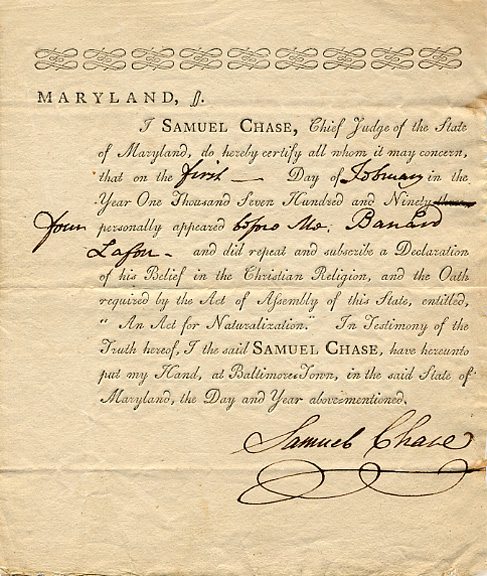
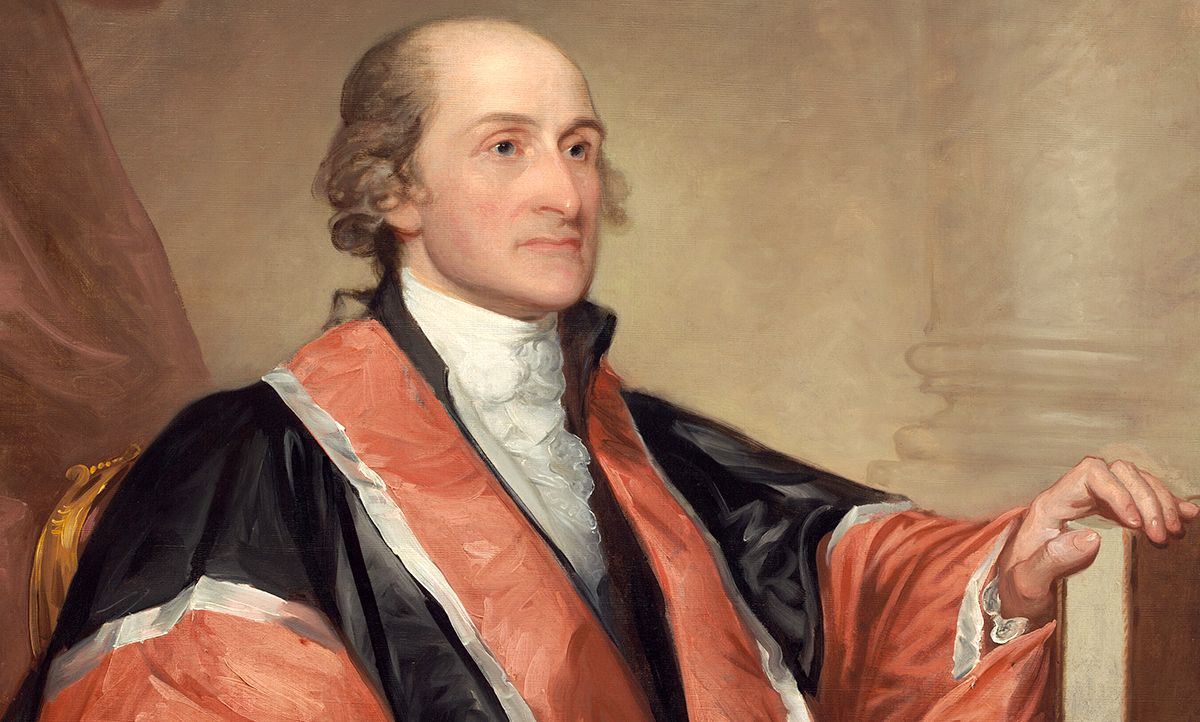
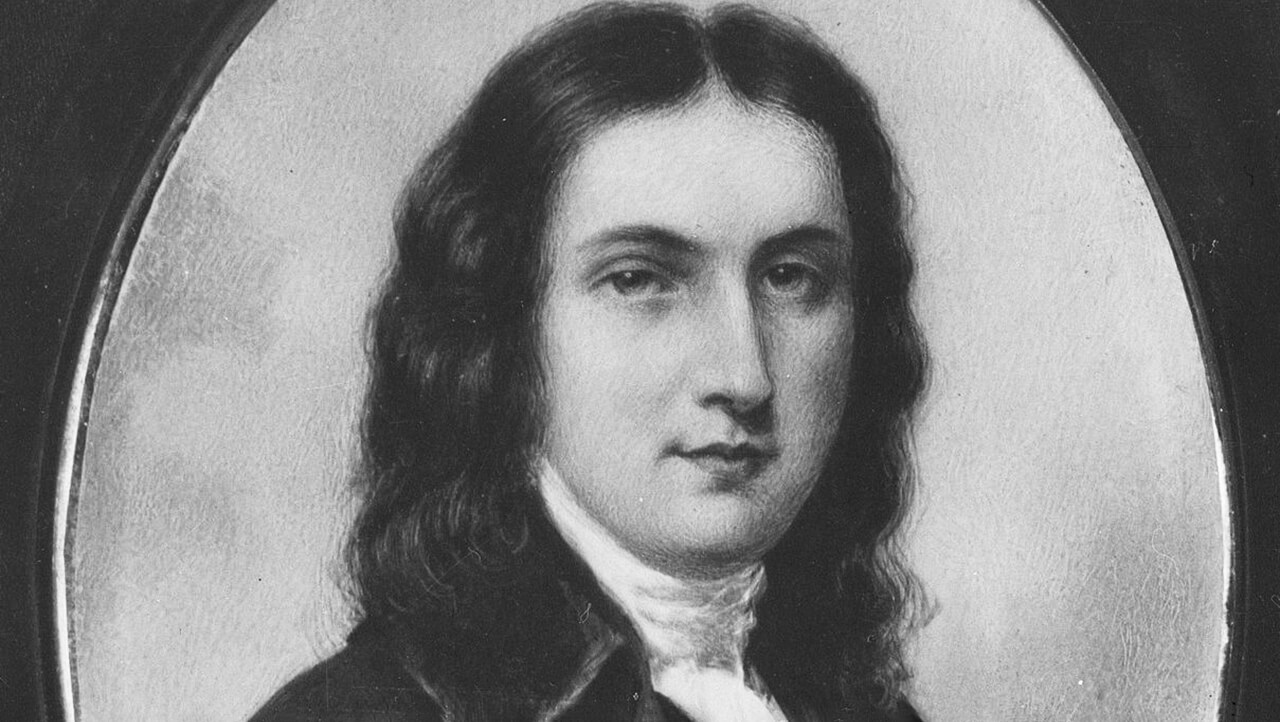
As chief justice of the Supreme Court of Maryland, Samuel Chase was responsible to certify the naturalization oaths by affixing his testimonium clause.

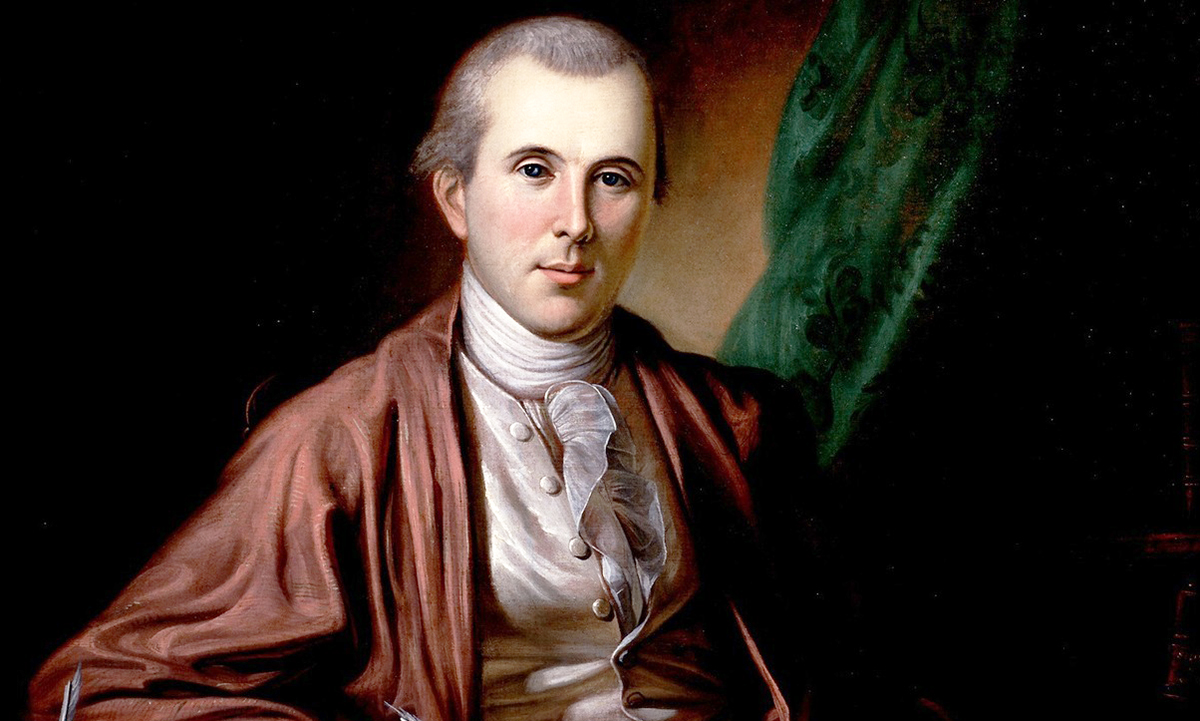
Chase (1741-1811) was a member of the Continental Congress from Maryland where he signed the Declaration of Independence. He served as the chief justice of the criminal court of Baltimore starting in 1788 and later became the chief justice of the state of Maryland. President Washington appointed him to the US Supreme Court in 1796.

samuel-chase-document-1Document Signed, Samuel Chase, August 17, 1793, Baltimore, Maryland

[Transcript]

Maryland,
I Samuel Chase, Chief Judge of the State of Maryland, do hereby certify all whom it may concern, that on the Seventeenth Day of August in the Year One Thousand Seve Hundred and n\ Ninety-three, personally appeared before me, Leon Changeuv [uncertain] and did repeat and subscribe a Declaration of his Belief in the Christian Religion, and the Oath required by the Act of Assembly of this State, entitled, “An Act for Naturalization.” In Testimony of the Truth hereof, I the said SAMUEL CHASE, have hereunto put my Hand, at Baltimore Tonn, I the said State of Maryland, the Day and Year above mentioned.
Samuel Chase

[Reverse]

State of Maryland
Baltimore County, to wit
I George Pheeports, Notary Public by lawful authority commissioned and sworn, dwelling in Baltimore Town in the County and State aforesaid, Do hereby Certify Declare and make known, that the name, Samuel, subscribed to the within Certificate is the own proper Hand writing of the Honorable Samuel Chase, Esquire, and that the said Samuel Chase at the time he subscribed his name to the said Certificate was lawfully and duly appointed commissioned and qualified as Chief Judge of the said State of Maryland and that full Faith and Credit is and ought to be given to any acts by him done, as well in courts of Justice as thereout.
>In Faith and Testimony whereof I the said Notary have hereunto set my Hand and offered my Seal Notarial, on this Twenty-first Day of August in the Year of our Lord, one thousand seven hundred and ninety-three.
Geo Pheeports, Noty Pubc
Of Balt County

Endnotes

1 An Act to Establish an Uniform Rule of Neuralization, March 26, 1790, 103

2 An Act for Naturalization, July, 1779 printed in the Maryland Gazette, April 4, 1793.

A Defence of the Use of the Bible in Schools

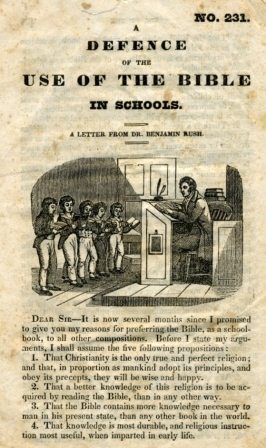
The following is part of the transcript from a letter written in 1791, which was published by the American Tract Society in 1830.


a-defence-of-the-use-of-the-bible-in-schools-1
Dear Sir:
It is now several months since I promised to give you my reasons for preferring the Bible as a schoolbook to all other compositions.  Before I state my arguments, I shall assume the five following propositions:

  1. That Christianity is the only true and perfect religion; and that in proportion as mankind adopt its principles and obey its precepts they will be wise and happy.
  2. That a better knowledge of this religion is to be acquired by reading the Bible than in any other way.
  3. That the Bible contains more knowledge necessary to man in his present state than any other book in the world.
  4. That knowledge is most durable, and religious instruction most useful, when imparted in early life.
  5. That the Bible, when not read in schools, is seldom read in any subsequent period of life.

My arguments in favor of the use of the Bible as a schoolbook are founded,
I. In the constitution of the human mind.

  1. The memory is the first faculty which opens in the minds of children.  Of how much consequence, then, must it be to impress it with the great truths of Christianity, before it is preoccupied with less interesting subjects.
  2. There is a peculiar aptitude in the minds of children for religious knowledge.  I have constantly found them, in the first six or seven years of their lives, more inquisitive upon religious subjects than upon any others. And an ingenious instructor of youth has informed me that he has found young children more capable of receiving just ideas upon the most difficult tenets of religion than upon the most simple branches of human knowledge.  It would be strange if it were otherwise, for God creates all His means to suit His ends.  There must, of course, be a fitness between the human mind and the truths which are essential to it happiness.
  3. The influence of early impressions is very great upon subsequent life; and in a world where false prejudices do so much mischief, it would discover great weakness not to oppose them by such as are true.  I grant that many men have rejected the impressions derived from the Bible; but how much soever these impressions may have been despised, I believe no man was ever early instructed in the truths of the Bible without having been made wiser or better by the early operation of these impressions upon his mind.  Every just principle that is to be found in the writings of Voltaire is borrowed from the Bible; and the morality of Deists, which has been so much admired and praised where it has existed, has been, I believe, in most cases, the effect of habits produced by early instruction in the principles of Christianity.
  4. We are subject, by a general law of our natures, to what is called habit.  Now, if the study of the Scriptures be necessary to our happiness at any time of our life, the sooner we begin to read them, the more we shall probably be attached to them; for it is peculiar to all the acts of habit, to become easy, strong, and agreeable by repetition.

For the whole text of Dr. Rush’s letter, see Rush’s Essays.

Election Sermon

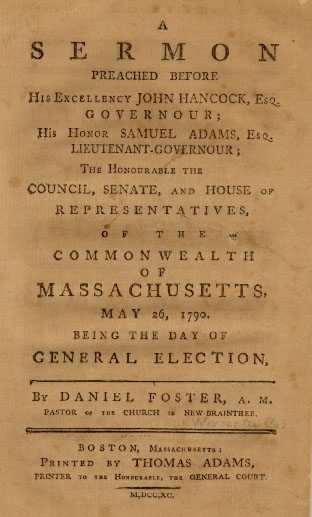
At the time of the Founders, it was a common practice for ministers to preach “Election Sermons,” and it was very common for a clergyman to be invited to give a sermon before the newly-elected government officials. This 1790 election sermon by Rev. Daniel Foster was given before the Massachusetts Governor (John Hancock), Lieutenant-Governor (Samuel Adams), and both houses of Legislature. Rev. Foster admonished these elected officials using Proverbs 8:16 (By Me princes rule, and nobles, even all the judges of the earth), and encouraged them to govern according to God’s ways. (For the full text of Foster’s Election Sermon click here.)

election-sermon-1

This is the text on the cover of the Election Sermon:


A
S E R M O N

PREACHED BEFORE

His Excellency JOHN HANCOCK, Esq.
GOVERNOUR;

His Honor SAMUEL ADAMS, Esq.
LIEUTENANT-GOVERNOUR;

The Honourable The

COUNCIL, SENATE, and HOUSE of

REPRESENTATIVES,

Of The

C O M M O N W E A L T H
of

M A S S A C H U S E T T S

MAY 26, 1790.

BEING THE DAY OF

GENERAL ELECTION


By DANIEL FOSTER, A.M.
PASTOR of the CHURCH in NEW BRAINTREE


BOSTON, Massachusetts:

PRINTED BY THOMAS ADAMS,
PRINTER to the HONOURABLE, the GENERAL COURT


M,DCC,XC


John Hancock (1737-93) was a soldier, public official and Harvard graduate(1754). He served several terms as a Selectman of Boston; member of the Provincial Legislature (1766-72); member of the Continental Congress (1774-78) where he was the first signer of the Declaration of Independence (1776) and President of Congress (1774-77); He was a Senior Major-General of the Massachusetts Militia (1778); a delegate to the State constitutional convention (1779); and Governor of Massachusetts (1780-85, 1787-93).

Samuel Adams (1722-1803) was a leader in the opposition to the acts by British Parliament which precipitated the American Revolution (1765-76); formed Boston’s Committee of Correspondence (1772); was a member of the Continental Congress (1774-81) where he signed the Declaration of Independence (1776); and helped draft the Articles of Confederation (1777); He served as president of the Massachusetts senate (1781); Lieutenant-Governor of Massachusetts (1789-94); and Governor of Massachusetts (1794-97). He is called both the “Firebrand of the Revolution” and “The Father of the American Revolution” for his important leadership in the cause of American independence.

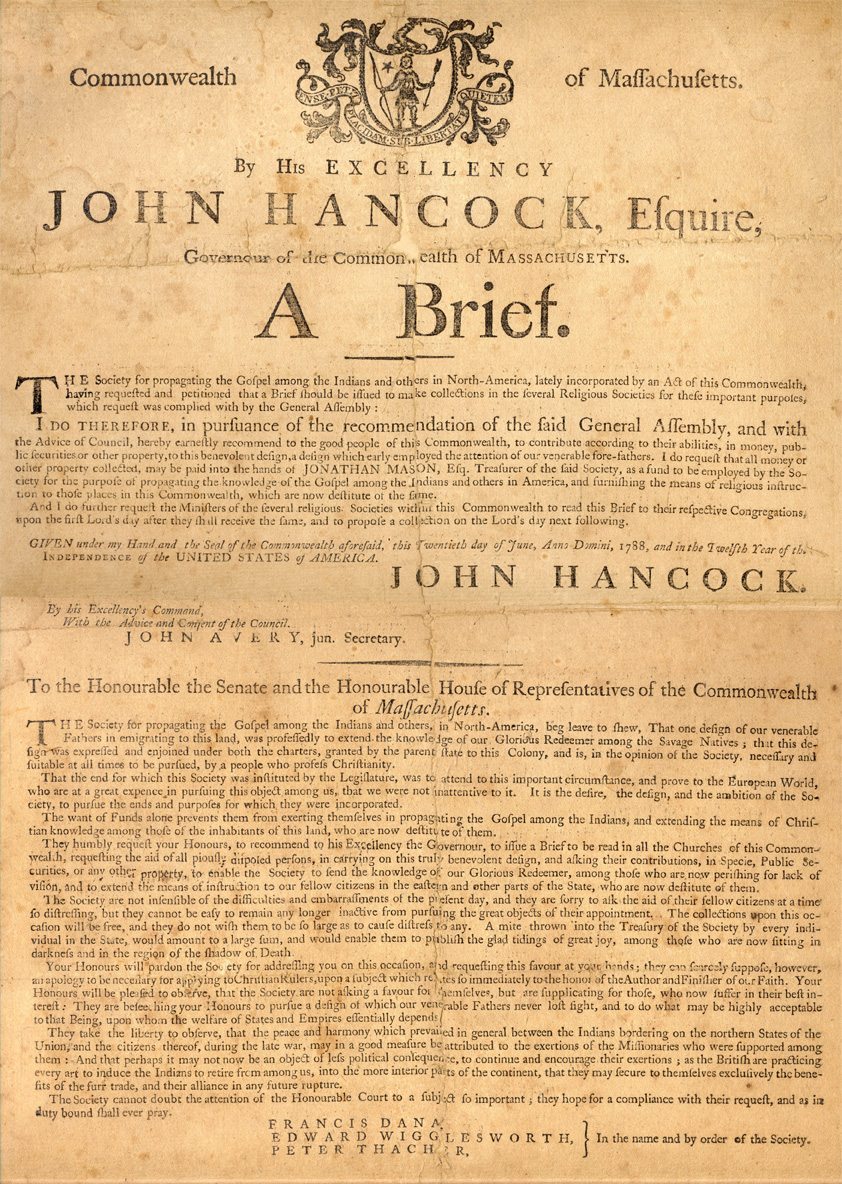
John Hancock – A Brief – 1788


This is a brief issued by Governor John Hancock on June 20, 1788. It includes his request for the people of Massachusetts “to contribute to their abilities, in money, public securities or other property” to the Society for Propagating the Gospel among the Indians and others in North-America who had originally requested a brief be issued. The transcript below has been changed to reflect modern spelling and grammar.


john-hancock-a-brief-1788-1

Commonwealth of Massachusetts.

By His EXCELLENCY

JOHN HANCOCK, Esquire,

Governour of the Commonwealth of Massachusetts.

A Brief.

The society for propagating the Gospel among the Indians and others in North-America, lately incorporated by an Act of this Commonwealth, having requested and petitioned that a Brief should be issued to make collections in the several Religious Societies for these important purposes, which request was complied with by the General Assembly:

I DO THEREFORE, in pursuance of the recommendation of the said General Assembly, and with the Advice of Council, hereby earnestly recommend to the good people of this Commonwealth, to contribute to their abilities, in money, public securities or other property, to this benevolent design, a design which early employed the attention of our venerable fore-fathers. I do request that all money or other property collected, may be paid into the hands of JONATHAN MASON, Esq. Treasurer of the said Society, as a fund to be employed the Society for the purpose of propagating the knowledge of the Gospel among the Indians and others in America, and furnishing the means of religious instruction to those places in this Commonwealth, which are now destitute of the same.
And I do further request the Ministers of the several religious Societies within this Commonwealth to read this Brief to their respective Congregations, upon the first Lord’s day after they shall receive the same, and to propose a collection on the Lord’s day next following.

GIVEN under my Hand and the Seal of the Commonwealth aforesaid, this Twentieth day of June, Anno Domini, 1788, and in the Twelfth Year of the Independence of the UNITED STATES of AMERICA.

JOHN HANCOCK.

By his Excellency’s Command,
With the Advice and Consent of the Council,
JOHN AVERY, jun. Secretary.


To the Honorable the Senate and the Honorable House of Representatives of the Commonwealth of Massachusetts.

The Society for propagating the Gospel among the Indians and others in North-
America, beg leave to show, That one design of our venerable Fathers in emigrating to this land, was professedly to extend the knowledge of our Glorious Redeemer among the Savage Natives; that this design was expressed and enjoined under both the charters, granted by the parent state to this Colony, and is, in the opinion of the Society, necessary and suitable at all times to be pursued, by a people who profess Christianity.

That the end for which this Society was instituted by the Legislature, was to attend to this important circumstance, and prove to the European World, who are at a great expense in pursing this object among us, that we were not inattentive to it. It is the desire, the design, and the ambition of the Society, to pursue the ends and purposes for which they were incorporated.

The want of Funds alone prevents them from exerting themselves in propagating the Gospel among the Indians, and extending the means of Christian knowledge among those of the inhabitants of this land, who are now destitute of them.

They humbly request your Honors, to recommend to his Excellency the Governor, to issue a Brief to be read in all the Churches of this Commonwealth, requesting the said of all piously disposed persons, in carrying on this truly benevolent design, and asking their contributions, in Specie, Public Securities, or any other property, to enable the said Society to send the knowledge of our Glorious Redeemer, among those who are now perishing for lack of vision, and to extend the means of instruction to our fellow citizens in the eastern and other parts of the State, who are now destitute of them.

The Society are not insensible of the difficulties and embarrassments of the present day, and they are sorry to ask the aid of their fellow citizens at a time so distressing, but they cannot be easy to remain any longer inactive from pursuing the great objects of their appointment. The collections upon this occasion will be free, and they do not wish them to be so large as to cause distress to any. A mite thrown into the Treasury of the Society by every individual in the State, would amount to a large sum, and would enable them to publish the glad tidings of great joy, among those who are now sitting in darkness and in the region of the shadow of Death.

Your Honors will pardon the Society for addressing you on this occasion, and requesting this favor at your hands; they can scarcely suppose, however, an apology to be necessary for applying to Christian Rulers, upon a subject which relates so immediately to the honor of the Author and Finisher of our Faith. Your Honors will be pleased to observe, that the Society are not asking a favor for themselves, but are supplicating for those, who now suffer in their best interest: They are beseeching your Honors to pursue a design of which our venerable Fathers never lost sight, and to do what may be highly acceptable to that Being, upon whom the welfare of States and Empires essentially depends.

They take the liberty to observe, that the peace and harmony which prevailed in general between the Indians bordering on the northern States of the Union, and the citizens thereof, during the late war, may in a good measure be attributed to the exertions of the Missionaries who were supported among them: And that perhaps it may not now be an object of less political consequence, to continue and encourage their exertions; as the British are practicing every art to induce the Indians to retire from among us, into the more interior parts of the continent, that they may secure to themselves exclusively the benefits of the fur trade, and their alliance in any further rupture.

The Society cannot doubt the attention of the Honorable Court to a subject so important; they hope for a compliance with their request, and as in duty bound shall ever pray.

FRANCIS DANA, ⎬ In the name and by order of the Society.
EDWARD WIGGLESWORTH, ⎬ [In the name and by order of the Society.]
PETER THACHER, ⎬ [In the name and by order of the Society.]

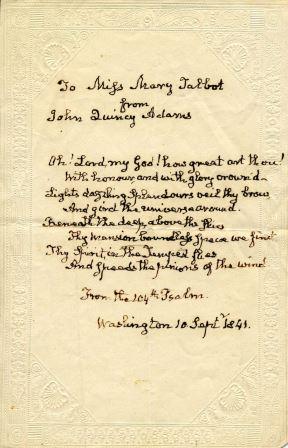
The 104th Psalm by John Quincy Adams

John Quincy Adams, sixth President of the United States was well known for his use of words. The below handwritten poem, dated September 10, 1841 and transcribed from the 104th Psalm, is a wonderful example of not only Adams’ appreciation for the Word of God, but also of his firm conviction and faith in God.


the-104th-psalm-by-john-quincy-adams-1

To Miss Mary Talbot
from
John Quincy Adams

Oh! Lord, my God! How great art Thou!
With honour, and with glory crown’d
Lights dazzling splendours veil thy brow,
And gird the universe around.

Beneath the deep, above the skies
Thy mansion boundless space we find.
Thy Spirit in the Tempest flies
And spreads the pinions of the wind.

From the 104th Psalm

Washington 10 Sept. 1841

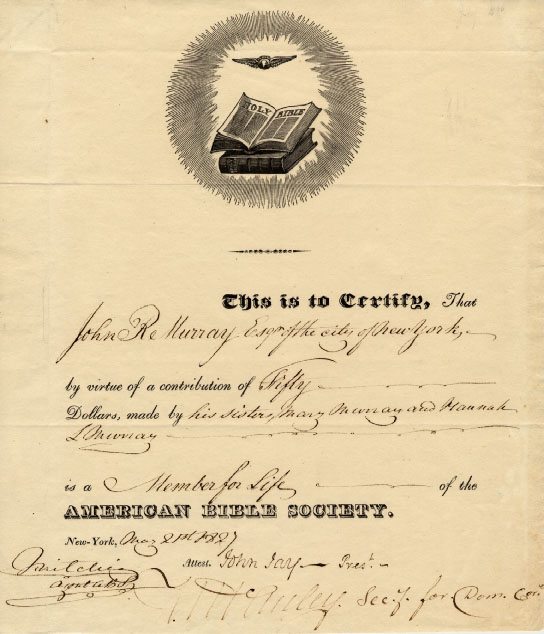
American Bible Society Certificate Signed by John Jay

John Jay (1745-1829) was an attorney, public official, diplomat, jurist. He was member of the Continental Congress (1774-76, 1778-79) where he was President of Congress (1778-79) and helped write the New York State constitution (1777). Jay also authored first manual on military discipline (1777) and served as Chief-Justice of the New York Supreme Court (1777-78). During the War for Independnece, he was appointed minister to Spain (1779) and also signed the final peace treaty with Great Britain (1783). Jay, along with James Madison and Alexander Hamilton, authored The Federalist Papers, which were instrumental in securing the ratification of the US Constitution. Under President George Washington, he was appointed first Chief-Justice of the U. S. Supreme Court (1789-95) and later declined a reappointment as Chief-Justice by President John Adams. Jay later served as Governor of New York (1795- 1801).

John Jay was also vice-president of the American Bible Society at its beginning, from 1816-21, and was president from 1821-27. Below is a membership certificate signed by him as president of the American Bible Society.


american-bible-society-certificate-signed-by-john-jay-1


This is to Certify, That John R Murray, Esqr. Of the city of New York, by virtue of a contribution of Fifty Dollars, made by his sisters, Mary Murray, and Hannah  L. Murray is a member for life of the

American Bible Society. 

New York, May 21st 1827
Attest. John Jay – Prest.[President] –
Jnitelies[?] Agent ABS
T. McAuley Secy. for Dom. Cores

Philadelphia Bible Society Bible

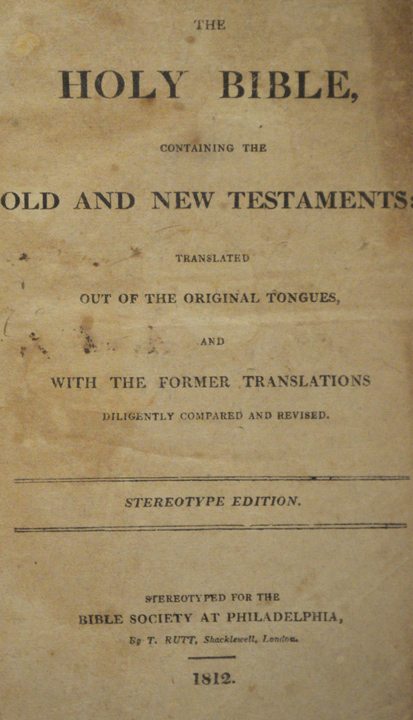
The Philadelphia Bible Society, America’s first Bible society, was officially organized on December 12, 1808. Rev. Dr. William White was president of the society and Declaration signer Benjamin Rush was a vice president. By 1816, 121 more Bible societies had been started across the nation.

Below, from WallBuilders’ Collection, is the title page of an original Bible published by the Philadelphia Bible Society in 1812. This was the first Bible printed in America to use stereotype plates.


philadelphia-bible-society-bible-1

Noah Webster & The Bible

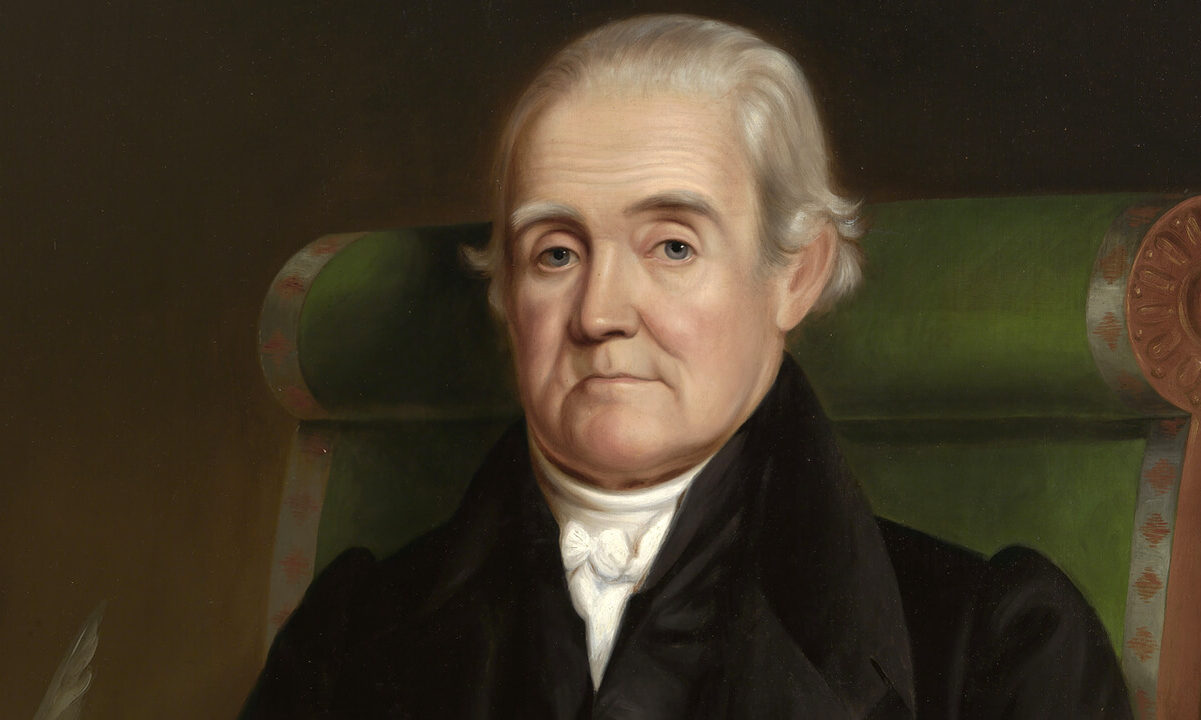
Even though, Noah Webster is most widely known for standardizing spellings and meanings of words through his Webster’s Dictionary, printed in 1828, he soon began an even greater task, which was to update The Holy Bible to exchange outdated and misunderstood words for more common ones. His belief in the inerrancy of Scripture was so strong, that he wrote an introduction to explain the changes that he made and the Scriptural integrity that was preserved. In fact, besides the introduction (transcribed below) to the Bible, WallBuilders has several notes and letters that discuss Noah Webster’s desire to preserve the accuracy of Scripture.
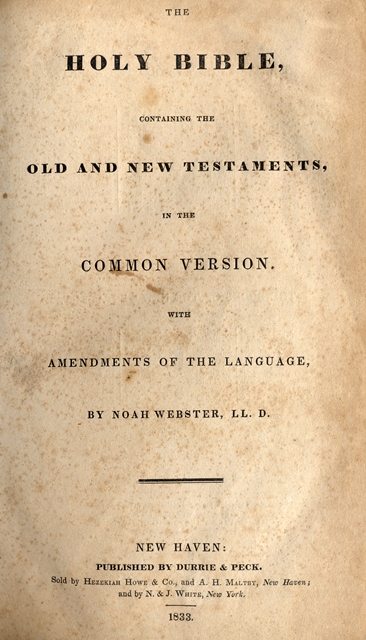

webster1833bible

The English version of the Sacred Scriptures, now in general use, was first published in the year 1611, in the reign of James I. Although the translators made many alterations in the language of former version, yet no small part of the language is the same, as that of the version made in the reign of Queen Elizabeth. In the present version, the language is, in general, correct and perspicuous [clear, comprehensible]; the genuine popular English of Saxon origin; peculiarly adapted to the subjects; and in many passages, uniting sublimity with beautiful simplicity. In my view, the general style of the version ought not to be altered.

But in the lapse of two or three centuries, changes have taken place, which, in particular passages, impaired the beauty; in others, obscure the sense, of the original languages. Some words have fallen into disuse; and the signification of others, in current popular use, is not the same now as it was when they were introduced into the version. The effect of these changes, is, that some words are not understood by common readers, who have no access to commentaries and who will always compose a great proportion of readers; while other words, being now used in a sense different from that which they had when the translation was made, present a wrong signification or false ideas. Whenever words are understood in a sense different from that which they had when introduced, and different from that of the original languages, they do not present to the reader the Word of God. This circumstance is very important, even in things not the most essential; and in essential points, mistakes may be very injurious [causing harm, hurt, damage, or distress].

In my own view of this subject, a version of the Scripture for popular use, should consist of words expressing the sense which is most common, in popular usage, so that the first ideas suggested to the reader should be the true meaning of such words, according to the original languages. That many words in the present version, fail to do this, is certain. My principal aim is to remedy this evil.
The inaccuracies in grammar, such as which for who, his for its, shall for will, should for would, and others, are very numerous in the present version.

There are also some quaint and vulgar phrases which are not relished by those who love a pure style, and which are not in accordance with the general tenor of the language. To these may be added many words and phrases, very offensive to delicacy and even to decency. In the opinion of all persons with whom I have conversed on this subject, such words and phrases ought not to be retained in the version. Language which cannot be uttered in company without a violation of decorum of the rules of good breeding, exposes the Scriptures to the scoffs of unbelievers, impairs their authority, and multiplies or confirms the enemies of our holy religion.

These considerations, with the approbation of respectable men, the friends of religion and good judges of this subject, have induced me to undertake the task of revising the language of the common version of the Scriptures, and of presenting for the public an edition with such amendments, as will better express the true sense of the original languages, and remove objections to particular parts of phraseology.

In performing this task, I have been careful to avoid unnecessary innovation and to retain the general character of the style. The principal alterations are comprised in three classes.

  1. The substitution of words and phrases now in good use, for such, as are wholly obsolete, or deemed below the dignity and solemnity of the subject.
  2. The correction of errors in grammar.
  3. The insertion of euphemisms, words and phrases which are not very offensive to delicacy, in the place of such as cannot, with propriety, be uttered before a promiscuous [consisting of parts, elements, or individuals of different kinds brought together without order] audience.

A few errors in the translation, which are admitted on all hands to be obvious, have been corrected; and some obscure passages, illustrated. In making these amendments, I have consulted the original languages, and also several translations and commentaries. In the body of the work, my aim has been to preserve, but, in certain passages, more clearly to express, the sense of the present version.

The language of the Bible has no inconsiderable influence in forming and preserving our national language. On this account, the language of the common version ought to be correct in grammatical construction, and in the use of appropriate words. This is more important, as men who are accustomed to read the Bible with veneration, are apt to contact a predilection for its phraseology, and thus to become attached to phrases which are quaint or obsolete. This may be a real misfortune; for the use of words and phrases, when they have ceased to be part of the living language, and appear odd or singular, impairs the purity of the language, and is apt to create a disrelish for it in those who have not, but long practice, contracted a like predilection. It may require some effort to subdue this predilection; but it may be done, and for the sake of the rising generation, it is desirable. The language of the Scriptures ought to be pure, chaste, simple, and perspicuous, free from any words of phrases which may excite observation by their singularity; and neither debased by vulgarisms, nor tricked out with the ornaments of affected elegance.

As there are diversities of tastes among men, it is not to be expected that the alterations I have made in the language of version will please all classes of readers. Some persons will think I have done too little; others, too much. And probably the result would be the same, were a revision to be executed by any other hand, or even by the joint labors of many hands.  All I can say is, that I have executed this work in the manner which, in my judgment, appeared to be the best.

To avoid giving offense to any denomination of Christians, I have not knowingly made any alteration in the passages of the present version, on which the different denominations rely for the support of their peculiar tenets.

In this country there is not legislative power which claims to have the right to prescribe what version of the Scriptures shall be used in churches, or by the people. And all human opinions are fallible it is doubtless for the interest of religion that no authority should be exerted in this case, except by commendation.

At the same time, it is very important that all denominations of Christians should use the same version, that in all public discourses, treatises, and controversies the passages cited as authorizes should be uniform. Alterations in the popular version should not be frequent; but the changes incident to all living languages render it not merely expedient, but necessary at times to introduce such alterations as will express the true sense of the original languages, in the current language of the age. A version thus amended may require no alteration for two or three centuries to come.

In this undertaking, I subject myself to the charge of arrogance; but I am not conscious of being actuated by any improper motive. I am aware of the sensitiveness of the religious public on the subject; and of the difficulties which attend the performance. But all men whom I have consulted, if they have thought much on the subject, seem to be agreed in the opinion, that it is high time to have a revision of the common version of the Scriptures; although no person appears to know how or by whom such revision is to be executed. In my own view, such revision is not merely a matter of expedience, but of moral duty; and as I have been encouraged to undertake this work, but respectable literacy and religious characters, I have ventured to attempt a revision upon my own responsibility. If the work should fail to be well received, the loss will be my own, and I hope no injury will be done. I have been painfully solicitous that no error should escape me. The reasons for the principal alterations introduced, will be found in the explanatory notes.

The Bible is the chief moral cause of all that is good, and the best corrector of all that is evil, in human society; the best book for regulating the temporal concerns of men, and the only book that can serve as an infallible guide to the future felicity. With this estimate of its value, I have attempted to render the English version more useful, by correcting a few obvious errors, and removing some obscurities, with objectionable words and phrases; and my earnest prayer is, that my labors may not be wholly unsuccessful. N.W.

New Haven, September, 1833
 

Noah Webster Letters

Below are some of the handwritten letters and notes Noah Webster wrote regarding his research surrounding his edition of The Holy Bible. These notes were written on the galleys, or proofs, of his Bible about to be printed. The letters also contain information regarding the printing of the Bible.


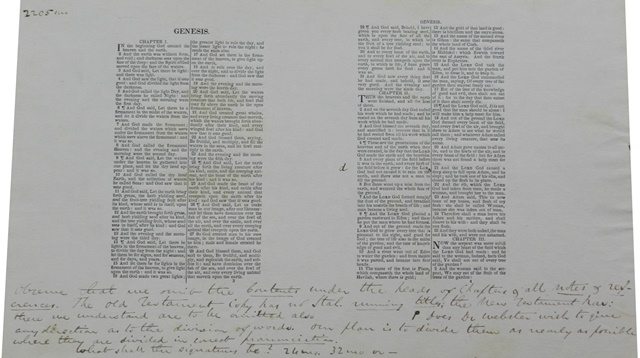
noah-webster-letters-1

Observe that we omit the Contents under the head of Chapter 9 all notes & references. The Old Testament copy has no Ital. running titles; the New Testament has: there we understand are to be omitted also. Does Dr. Webster wish to give any direction as to the division of words. Our plan is to divide them as nearly as possible where they are divided in correct pronunciation. What shall the signatures be? 26 mo. 32 mo or -.


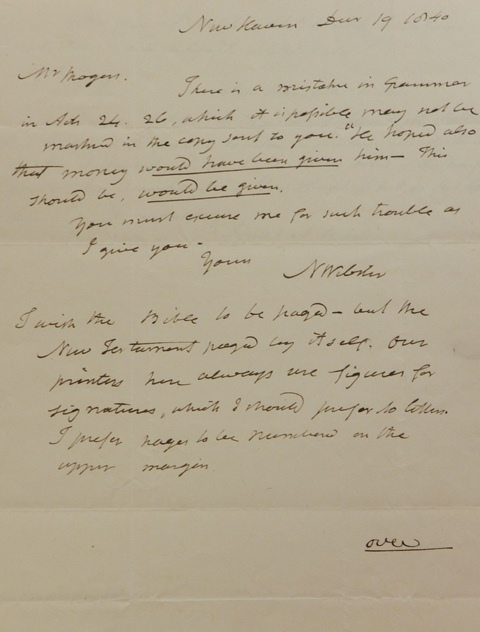
noah-webster-letters-2

New Haven, December 19, 1840

Mr. Morgan.

There is a mistake in Grammar in Acts 24. 26, which it is possible may not be marked in the copy sent to you. “He hoped also that money would have been given him” – This should be, would be given.
You must excuse me such trouble as I give you.
Yours,
N Webster

I wish the Bible to be paged – but the New Testament paged by itself. Our printers have always use figures for signatures, which [I would] prefer to letters. I prefer pages to be numbered on the upper margin.

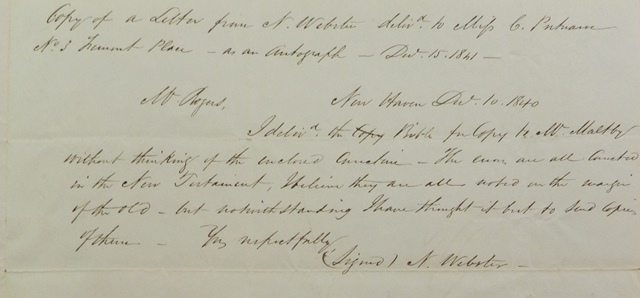
noah-webster-letters-3


Copy of a letter from N. Webster delivered to Msrs. C. [Pertuasse] No. 3 Tennant Place – as an autograph – Dec. 15. 1841 –

New Haven Dec. 10, 1840

Mr. Rogers,
I delivered the Copy Bible for Copy to W. Maltby without thinking of the enclosed Correction – The errors are all Corrected in the New Testament. I believe they are all noted in the margin of the old – but notwithstanding I have thought it best to send copies of them.
Yrs. respectfully,
(Signed) N. Webster


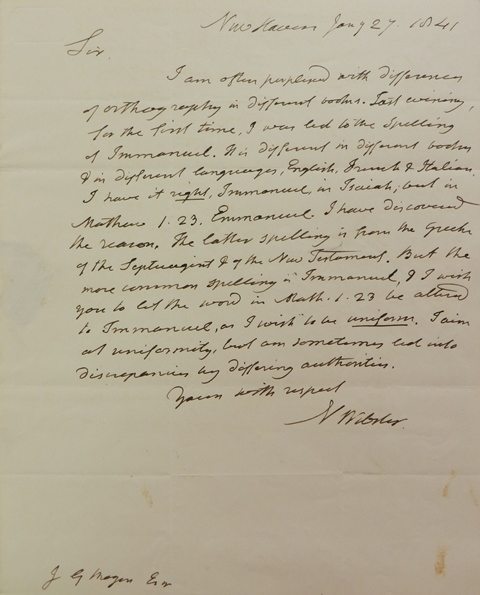
noah-webster-letters-4


New Haven Jany 27. 1841

Sir.
I am often perplexed with differences of [orthog. (abbreviation of orthography: the study of correct spelling)] regularly in different books. Last evening, for the first time, I was led to the spelling of Immanuel. It is different in different books & in different languages, English, French & Italian. I have it right, Immanuel, in Isaiah, but in Matthew 1. 23. Emmanuel. I have discovered the reason. The latter spelling is from the Greek of the Septuagint & of the New Testament. But the more common spelling is Immanuel, & I wish you to let the word in Math. 1. 23 be altered to Immanuel, as I wish to be uniform. I aim at uniformity, but am sometimes led into discrepancies by differing authorities.
Yours with respect
N Webster.

John Hart Documents

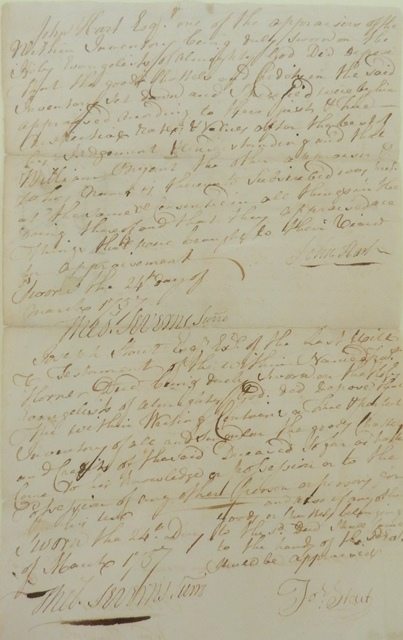
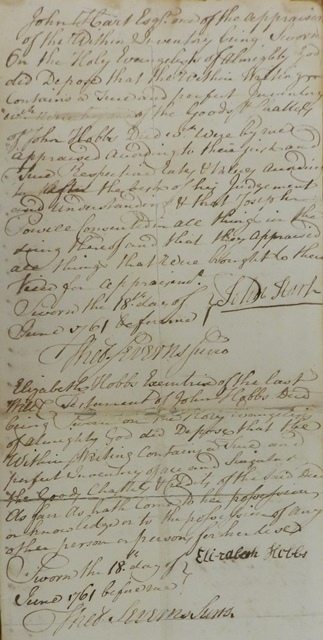
John Hart was a signer of the Declaration of Independence. He lived most of his life as a farmer and public official in New Jersey. This man’s Christian faith and character were as strong and evident as his patriotism. He donated a large parcel of ground on which to build the Baptist church in which he was an active member. Known as “honest John Hart” among his friends and neighbors, he was repeatedly elected to serve in both local and state offices. In his capacity as a local official, he regularly signed legal documents like these two below. These are two testimonies in the collection at WallBuilders are given by John Hart upon the administration of the estates of John Hobbs and [L. Horner]. As was customary in that day, he recognizes he was “sworn in on the Holy Evangelists of Almighty God” —that is, on the New Testament Gospels of Matthew,
Mark, Luke, and John that bear testimony to the life and ministry of Jesus Christ.


john-hart-document-1

John Hart Esq. one of the appraisers of the within inventory being duly sworn on the Holy Evangelists of Almighty God did depose that the goods and chattels and credits in the said inventory set down and specified were by him appraised according to those just and true respective [Goofert] and [Yaxely] after the best of his judgment and understanding and that William Bryant the other appraiser and whose name is hereunto subscribed every prof. of the same and consented in all things in the doing thereof and that they appraised all things that were brought to their view for appraisement.

Sworn the 24th day of March 1757

John Hart

Theo. Severns Jun.


john-hart-document-2

John Hart Esq. one of the appraisers of the within inventory being sworn on the Holy Evangelists of Almighty God did depose that the within writings contains a true and perfect inventory of the goods and chattels of John Hobbs which were by him appraised according to their just and true respective [Earley] and [Valicey] according to the best of his judgment and understanding and that Joseph Powell consented in all things in the doing thereof and that they apprised all things that were brought to their view for appraisement.

Sworn the 18th day of June of 61 [uncertain]

John Hart

Theo. Severns Jun.