Jefferson and Library of Congress

Most Americans are very familiar with the Library of Congress and its massive collection of millions of books, documents, recordings, photographs, sheet music, and manuscripts.1 But few know how Thomas Jefferson is connected to the library.

On April 24, 1800, Congress approved moving the federal government to Washington DC and granted resources for a congressional library:

That for the purchase of such books as may be necessary for the use of Congress at the said city of Washington, and for fitting up a suitable apartment for containing them and for placing them therein, the sum of five thousand dollars shall be, and hereby is appropriated.2

The books purchased for that library were originally kept in the Capitol building.3 But when the British invaded and set fire to the Capitol during the War of 1812,4 this collection was destroyed. This is where Jefferson comes in.

He offered to sell his collection of books (nearly 6,500) to Congress to replace the books that had been burned.5 His offer was accepted and nearly $24,000 (over $300,000 in today’s money) was set aside to purchase his books.6

Unfortunately, almost two-thirds of his collection was destroyed in another fire in 1851,7 but Jefferson’s library was a springboard from which the Library of Congress would continue to grow. Next time you visit the Library of Congress, remember one of the reasons this collection is so impressive is due to Thomas Jefferson’s influence.


Endnotes

1 “Fascinating Facts,” Library of Congress, accessed January 17, 2024.
2 “An Act to make further provision for the removal and accommodation of the Government of the United States,” April 24, 1800, The Public Statutes at Large of the United States of America, ed. Richard Peters (Boston: Charles C. Little and James Brown, 1845), II:56.
3 “History of the Library of Congress,” Library of Congress, accessed January 17, 2024.
4 “A Most Magnificent Ruin: The Burning of the Capitol during the War of 1812,” Architect of the Capitol, August 1, 2023.
5 Thomas Jefferson to Samuel H. Smith, September 21, 1814, The Writings of Thomas Jefferson, ed. H.A. Washington (Washington: Taylor & Maury, 1854), VI:383-385; “Sale of Books to the Library of Congress (1815),” Monticello, accessed January 17, 2024.
6 Samuel H. Smith to Thomas Jefferson, February 15, 1815, Founders Online.
7 “Thomas Jefferson: Jefferson’s Library,” Library of Congress, accessed January 17, 2024.

Address – Why Are You A Christian – 1795

John Clarke (1755-1798) biography

Born in Portsmouth, New Hampshire, Clarke grew up in a strongly patriotic family during the American War for Independence. In fact, his uncle, Timothy Pickering, was not only a military general under George Washington and later became Postmaster General, Secretary of War, and Secretary of State under President Washington. Clark graduated from the Boston Public Latin School in 1761, while only six years old. In 1774 at the age of nineteen, he graduated from Harvard. He returned for his Master’s Degree (1777), and then studied theology, receiving his Doctor of Divinity from the University of Edinburgh. He took a job on the staff of First Church of Boston, alongside the great preacher Dr. Charles Chauncy, who himself had been a significant influence in the years leading up to the American War for Independence. When Chauncy died in 1787, Clarke became pastor, where he continued until he suffered a stroke while preaching in 1798, passing away the next day at the age of forty-three. A two-volume set of his sermons were published after his death. The following sermon was the one he preached at the interment of the Rev. Samuel Cooper of Boston on January 2, 1784. (Note: the Rev. Cooper was a highly influential clergyman, identified by Founding Father John Adams as one of the individuals “most conspicuous, the most ardent, and influential” in the “awakening and revival of American principles and feelings” that led to American independence.)


AN

ANSWER

TO THE

QUESTION

WHY ARE YOU A CHRISTIAN?

BY JOHN CLARKE
Minister of a Church in Boston

AN ANSWER TO THE QUESTION, “WHY ARE YOU A CHRISTIAN?”

Not because I was born in a Christian country, and educated in Christian principles; — not because I find the illustrious Bacon, Boyle, Locke, Clarke, and Newton, among the professors and defenders of Christianity; – nor merely because the system itself is so admirably calculated to mend and exalt human nature: but because the evidence accompanying the Gospel, has convinced me of its truth. The secondary causes, assigned by unbelievers, do not, in my judgment, account for the rise, progress, and early triumphs of the Christian religion. Upon the principles of skepticism, I perceive an effect without an adequate cause. I therefore, stand acquitted to my own reason, though I continue to believe and profess the religion of Jesus Christ. Arguing from effects to causes, I think, I have philosophy on my side. And reduced to a choice of difficulties, I encounter not so many, in admitting the miracles ascribed to the Saviour, as in the arbitrary suppositions and conjectures of his enemies.

That there once existed such a person as Jesus Christ; that he appeared in Judea in the reign of Tiberius; that he taught a system of morals, superior to any inculcated in the Jewish schools; that he was crucified at Jerusalem; and that Pontius Pilate was the Roman governor, by whose sentence he was condemned and executed, are facts which no one can reasonably call in question. The most inveterate deists admit them without difficulty. And indeed to dispute these facts would be giving the lie to all history. As well might we deny the existence of Cicero, as that of a person by the name of Jesus Christ. And with equal propriety might we call in question the orations of the former as the discourses of the latter. We are morally certain, that the one entertained the Romans with his eloquence; and the other enlightened the Jews with his wisdom. But it is unnecessary to labor these points, because they are generally conceded. They, who affect to despise the Evangelists and Apostles, profess to reverence Tacitus, Suetonius, and Pliny. And these eminent Romans bear testimony to several particulars, which relate to the person of Jesus Christ, his influence as the founder of a sect, and his crucifixion. From a deference to human authority, all therefore, acknowledge, that the Christian religion derived its name from Jesus Christ. And many are so just to his merits, as to admit that he taught better than Confucius; and practiced better than Socrates or Plato.

But, I confess, my creed embraces many more articles. I believe, that Jesus Christ was not merely a teacher of virtue, but that he had a special commission to teach. I believe, that his doctrines are not the work of human reason, but divine communications to mankind, I believe, that he was authorized by God to proclaim forgiveness to the penitent; and to reveal a state of immortal glory and blessedness to those who fear God, and work righteousness. I believe, in short, the whole evangelic history, and of consequence, the divine original of Christianity, and the sacred authority of the Gospel. Others may reject these things as the fictions of human art or policy. But I assent to them, from a full conviction of their truth. The grounds of this conviction, I shall assign in the course of this work. And I shall undertake to show, why the objections of infidelity, though they have often shocked my feelings have never yet shaken my faith.

To come then to the Question : WHY ARE YOU A CHRISTIAN? I answer, because the Christian religion carries with it internal marks of its truth; because not only without the aid, but in opposition to the civil authority, in opposition to the wit, the argument, and violence of its enemies, it made its way; and gained an establishment in the world: because it exhibits the accomplishment of some prophecies; and presents others, which have been since fulfilled : and because its author displayed an example, and performed works, which bespeak, not merely a superior, but a divine character. Upon these several facts, I ground my belief as a Christian. And, till the evidence on which they rest, can be invalidated by counter evidence, I must retain my principles and my profession.

Section I.
The internal evidence of Christianity.

First—I am a Christian, because the intrinsic excellency of Christianity points it out as a system worthy of my belief; because the laws which it prescribes, the spirit which it breathes and the discoveries which it makes, are so admirably suited to the constitution and circumstances of man, that I cannot reject it. The perceptive part of Christianity has been very generally approved. And how is it possible, that any one should seriously object to laws, which tend to correct the errors, and reform the vices of human nature; and to exalt the character of man to the highest stage of moral perfection? If Christianity prescribed the austerities of the monk, the solitude of the hermit, or the wanderings of the pilgrim; if it even gave countenance to such extravagancies or allowed them the lowest degree of merit, I should esteem it a formidable objection to the system. But nothing of this description can be found in the writings of the Evangelists or Apostles. Those writings pure contempt upon al superstitious practices; and lead us to ascribe no value to any works, but those of true piety and virtue. They teach us to worship God in spirit and in truth; to love him supremely; to be grateful for his favors, and resigned to his dispensations; to trust his mercy, and rejoice in his government. They teach us to love our neighbor as ourselves; to forgive him when he has injured us; to bear with his infirmities, and to excuse his follies; to weep with him in his distresses; when he is in want, to afford him our assistance; and to do to him, as we should think it fit and reasonable, that he should do to us. They teach us to love even our enemies, so far at least, as to abstain from revenge; and to render them offices of kindness, when their circumstances call for commiseration. They teach us to govern our appetites and passions to be chaste, humble, temperate, pure, and as much as possible to be like our father in heaven, whose character is an assemblage of every natural and moral perfection. They teach children to reverence and obey their parents; and parents to love, instruct, and provide for their children. They teach the husband conjugal fidelity and affection; and the wife, the peculiar duties of her station, and the amiable virtues which adorn the sex; and bless the marriage union. They teach masters lenity, and the servants faithfulness. They teach rulers to exercise their authority for the public good; and persons in private life, not to withhold honor and submission from those, under whose wise and just administration, they lead quiet and peaceable lives. I a word, the affluent and the poor, the prosperous and the afflicted the aged and the young, may all find their duty in the sacred books. And the duties, there enjoined, are such as the enlightened reason of every man must approve.

These sublime lessons of morality are found in various parts of the New Testament. They enrich the divine sermon on the mount. And they are contained in the excellent parables delivered by Jesus Christ. I also find them in the discourses of the Apostles, and in their pastoral letters. I may say, wherever I open the Christian volume, I find some direction which if properly observed, would render me a good neighbor, a good member of society, a good friend, and a good man! And it is possible for me to doubt the divine original of a system, which furnishes such rules; and contemplates so glorious an object?

If the prohibitions of Jesus Christ were universally regarded, and his laws obeyed, what blessings would pour in on society? There would be no wars among the nations of the earth. There would be no oppression. There would be neither tyrants nor slaves. Every ruler would be just; every citizen would be honest; every parent would be faithful to his charge; every child would be dutiful; the purest affection would recommend domestic life; and neighbors would be mutual blessings. Under the dominion of Christianity, envy, pride, and jealousy would give way to the most enlarged benevolence. Human nature would recover its dignity. And every man would reap the present reward of his own virtues.

From these facts, others may draw their own conclusions : my inference is, that Christianity is true. I do not believe, that such a system of morals can be the work of human wisdom. That these laws originated with God; and that Jesus Christ was commissioned to promulgate them, appears to me a much more rational supposition. The more I inspect them, the less am I inclined to compliment human ingenuity with so glorious a production. If then, I continue to believe in this age of refinement, and free inquiry, it is because I am unable to resist the evidence arising from the transcendent excellency of the Christian precepts. I think it infinitely more probable, that they should be a communication from God, than that philosophy should justly claim the honor of the invention.

The doctrines of the Christian religion furnish an additional argument in its favor. They are such as appear worthy of God and answerable to the natural expectations of men. The perfections of the Deity, his agency in the creation and government of the world, the conditions of his approbation, the consequences, and a future state of existence, are points, respecting which every reasonable being would wish for information. And it is a fact, that the New Testament throws divine light on all these articles. It informs us, that there is One God; that he is infinitely holy, wise, benevolent, and just; that he is self-existent and independent; that his power is irresistible, and his presence universal; that he made and upholds all worlds; that he created the human species, and every inferior being; that he is moreover, their preserver and benefactor; that he exercises a moral government over man; that he requires obedience to his laws, and consequently, resents their infraction; that forgiveness is possible, and repentance and reformation the conditions; that death is not utter destruction; that all who die, will live again; that all who are raised, will be judged; and that there is a future state, in which virtue will shine with unfading luster, and receive an everlasting reward. These are not useless speculation, but doctrines of infinite moment. They interest as well the heart, as the understanding. And their influence extends both to our actions and our enjoyments.

It would be easy to produce the various passages, in which these points are maintained. But it is unnecessary; as everyone will allow them to be doctrines of Christianity. Whether the system be true or not, it certainly contains these articles. I would now put the question to every sober Theist, whether I must renounce either my understanding, or my creed? Is there anything incredible in this representation of God and man, of the demands of the one, and the destination of the other? Must I offer an affront to my reason, if I believe in one God, exercising the authority; and possessed of all the glorious attributes, ascribed to him in the Christian writings? Does my understanding revolt at the evangelical account of his providence and moral government? That I should make it my study to obey him; when guilty of disobedience, that I should repent and reform; and that, as I behave so I may expect to be treated; is there anything irrational in these doctrines? We read of a mediator, and a rich variety of blessings dispensed through him; and is not this agreeable to the established constitution of things in the world? Do not temporal mercies often flow to us through the mediation of others? And may not many instances be produced, in which the political redemption of a nation has been accomplished by the labors; or purchased by the blood of some virtuous patriot? Is common sense insulted by the doctrine of a resurrection? This has been asserted; but with what reason, I never could conceive. When I examine the power and wisdom of God, they do not appear incompetent to such an affect. When I consider the divine goodness, I see nothing in the resurrection of man irreconcilable with that perfection. And when I reflect, that God formed the human body; and inspired the breath of life, I can easily believe, that he is able to raise us up at the last day. Before I can reject the resurrection of mankind, it must therefore be demonstrated that the terms imply a contradiction.

As to a future state of retribution, I would ask, what presumption there is against it. We find, that we have already experienced great changes. Since our first introduction to this world, our active and intellectual powers have gained strength, as we have advanced towards maturity. And why may we not hereafter possess them in higher perfection? Why may we not move, not merely in a new, but in a nobler sphere? And as a moral government is evidently begun in this state, why may it not be completed in another? In these expectations, I think we are supported by the analogy of nature. As we have already existed in different states, new scenes may be in reserve for us; and new capacities of action, enjoyment, and suffering may await us beyond the grave.

Combining the doctrines and precepts of Christianity, I am led then to infer from them the truth of the system. Because the former are so important, and the latter so beneficial; because the doctrines of Christ tend to make us so wise, and hiss laws so good, I am , in a manner, compelled to receive them as divine. Such is their supreme excellence, that I must ascend to heaven for an adequate cause. I assent therefore, most unfeignedly to those words of our savior, “my doctrine is not mine, but his who sent me.” And I do Assert, were there no other evidence that our religion is from God, it would be more reasonable to admit its claims to a divine original, than to reject them.

Section II.
Evidence arising from the early triumphs of Christianity.

But my faith, as a Christian, does not rest on this single foundation. I have other reasons for believing the Gospel. The early triumphs of Christianity furnish a Second, and in my view, a most weighty argument in support of my religion. And my conviction of its truth gains strength every time I examine its introduction, progress, and establishment in the world. Recurring to the period of its infancy, I find, that it made its way not only without the aid, but in opposition to the civil authority. I observe, that it rose superior to the wit, the argument, and the violence of its enemies. I perceive, that it baffled the arts of the Jewish priests and rulers; and supported itself against the rage of the multitude. When Heathens become its enemies and persecutors, I find their opposition as ineffectual as that of the Jews. Though it was the contempt and derision of the more leading characters in society, yet I take notice, that it gained a wonderful ascendency over the human mind; and at length became the religion of the Roman world. These are facts : and how am I to account for them, if Christianity be a mere fable?

I can easily believe, that an imposture may succeed, if it have the public prejudices, the learning, wealth, and influence of the country, or the sword of the magistrate on its side. I never wondered that the attempts of Mahomet to establish his religion, were crowned with successes. When I peruse the Koran, and examine the materials of which it is composed; —when I observe how much art the whole is accommodated to the opinions and habits of Jews, Christians, and Pagans; —when I consider what indulgences it grants, and what future scenes it unfolds; —when I advert to the peculiar circumstances of the times, when its author formed the vast design of assuming the royal and prophetic character; —and more than all, when I contemplate the reformer at the head of a conquering army, the Koran in one hand, and in the other, a sword, — I cannot be surprised at the civil and religious revolution which has immortalized his name. With his advantages, how could he fail of success? Everything favored the enterprise. The nations beheld a military apostle. And they, who were unconvinced by his arguments, trembled at his sword.

But did Jesus Christ have recourse to such measures in order to establish his religion? Was he a general, or his apostles soldiers? In proof of his divine mission, did he affront the reason of mankind, by appealing to the sword? Did the learning of the age come to his assistance? Di genius and eloquence plead his cause? Were the principles of his religion such as would easily captivate persons of figure and fashion? Would wealth be partial to them? It is granted, that the laws of Christianity are perfectly accommodated to the reasonable, and moral nature of man; but did the habits of the age, in which they were promulgated, predispose the public mind to receive those laws? An were the doctrines of the gosp0el consonant to prevailing and popular opinions? There is not a man, who has examined the life, the actions, and the religion of Jesus Christ, Who will answer one of these queries in the affirmative.

In the whole compass of history, no fact is better established than the pacific character of our great master, and the inoffensive measures by which he prosecuted his cause. He proclaimed the truths; and inculcated the duties of his religion; but he used no violence to make men believe the one, or practice the other. He addressed himself to the reason of mankind; and then let them to make up their own judgment. At length he suffered; and his cause developed upon certain persons who had attended upon his ministry, and been witnesses of his actions. These persons, called apostles, went forth into the world; and taught the same truths, which they had learned from their master, and which he had sealed with his blood. In imitation of their great pattern, they likewise applied, not to the passions, but to the reason of the age. With the Jews, they argued on their own principles. And for the conviction of Gentile, they appealed to facts. Not one of their enemies ever pretended, that more formidable weapons were employed by the apostles in the Christian Cause. How then shall we account for their success? What induced several thousands of the Jewish nation to embrace Christianity? And why did such multitudes of the Gentile world forsake their superstitions; and receive the religion of the Gospel?

Was Christianity a popular system? None could be less so. Did it open the way to a seat in the Sanhedrim, to the honors of the priesthood, or to an office under the Roman government? I never heard the insinuation. Was it an introduction to wealth or power? It was the very reverse. Did it flatter any of the ruling passion of the human heart, or permit their gratification? Every one, who has examined it, knows the contrary. If then, as the terms are generally understood, it was neither honorable, profitable, nor popular; — if it was the derision of philosophy, and the contempt of learning; — if the wit of the age was exerted against it, — if the priesthood hated, and the magistrate persecuted it, to what cause am I to ascribe the prevalence of Christianity? Under all these disadvantages, what enabled it to keep its ground? Upon one principle only, can I account for this fact to my own satisfaction, and that is the truth of the system, and the patronage of heaven. I can believe, that truth may triumph over the most formidable opposition; and that God is able to defend his own cause.

For every phenomenon in nature, there must be a sufficient reason. This is a doctrine of philosophy; and not only so, but a dictate of common sense. Taking this principle for granted, I therefore, endeavor to account for the existence of Christianity. I find, that the religion of Jesus is not coeval with many events preserved in history. By means of various records, which have escaped the ravages of time, I perceive, that less than eighteen centuries will carry me back to the age, in which this religion was first proposed to the world. By the confession of its enemies, it derived no support from the family connections, outward circumstances, or fate of its author. So far from it, all these things operated against it. Jesus Christ, though a very excellent, was in the estimation of the world, a very obscure person. His family though once exalted, had fallen into decay. And his fate was as infamous as it was unmerited. His followers likewise, and those with whom he left his cause, were generally as obscure as their master, they had not wealth, to give them importance. They were not men in power. Nor were their natural abilities, or literary attainments so great, as to give them a decided superiority over their enemies. It is certain therefore, that Christianity did not woe its successes to anything dazzling in the personal accomplishments or circumstances of its first preachers.

Where then, shall I look for the cause? The religion of Christ did prevail; though to persons of figure and influence, its author was an object of contempt; and though his fate was that of the vilest malefactor. It did make its way; though its ministers were the farthest possible from that description of men, who take the lead in society; whose example it is their ambition to follow. It did succeed; though it bore an uniform testimony against all the impiety and immorality practiced in the world. Without flattering one disorderly passion of the human hart, without accommodating itself to one corrupt habit, it triumphed over the prejudices of multitudes. And whilst its profession was attended with every temporal discouragement, not only the provinces, but the very city of Rome, abounded with Christians! I ask the question once more, if Christianity be a fable how am I to account for this revolution?

I well know the solution which modern ingenuity has proposed. Gibbon’s secondary causes I have repeatedly examined; I would hope, with impartiality: I certainly have done it with attention. But they never gave me satisfaction; and for a reason, which the great Sir Isaac Newton shall assign. He says, that a cause must be known to exist; and that it must be adequate to an effect, before it can be admitted into sound philosophy; and before such effect can with propriety, be referred to it. But the causes, assigned by those who reject the Christian religion, appear to want both these conditions. We have no proof that many of them ever existed. And united, they seem utterly inadequate to explain the various appearances; and account for the phenomena, to which they have been applied. I am therefore a Christian, because the early conquests of Christianity will not suffer me to reject it as a fable.

Section III.
Evidence arising from the completion of prophecy.

But though conclusive, yet these are not the only arguments which give authority to the Gospel. The completion of prophecy furnishes a Third reason for that reverence, which I feel for Christianity; and for my assent to it as a divine religion. In perusing the Jewish and Christian writings, I find several predictions. Some of these preceded the savior; and others were uttered by him. Some were accomplished in him; and others in events, which took place after his appearing. Examples of each I shall first exhibit; and then show, why they determine me to be a Christian.

It was predicted that the Messiah should come, “before the scepter departed from Judah.” And does not history confirm this prediction? Did not Jesus Christ appear and suffer, before the Jewish government was subverted by the Romans? It was predicted, that “he should come whilst the second temple was standing” and that the house should derive glory from the occasional visits of so great a character. And was not this prophecy fulfilled? It was predicted, that he should come “in four hundred and ninety years,” from the time in which the city of the Jews should recover from the disgrace, under which it had lain during the captivity; that he should “be cut off;” and that “Jerusalem and the temple should be afterwards made desolate.” And did not these things happen in the order, and at the period here described? It was predicted, that in that age of the Messiah many astonishing works should be performed. And were not such works performed by Jesus Christ? At least, is it not an article in his history, that through his benevolent interposition, and in consequence of his supernatural powers, the blind received their sight, the lame walked, the deaf heard, the dumb spake, the sick recovered, and the dead revived? Finally, it was predicted, that “he should enter the holy city in triumph;” that his enemies should conspire against him; that “he should be sold for thirty pieces of silver;” that “he should be scourged,” and treated with every species of contempt; that his persecutors should “spit upon him;” that they should “pierce his hands and feet;” that the spectators of his crucifixion should mock him; that “the soldiers should draw lots for his garment;” that he should be numbered with transgressors; that “gall and vinegar” should be presented to him, when in his last agonies; and that he should “make his grave with the rich.” And in the history of Christ, have we not the completion of these prophecies? Comparing the predictions and the events, can we deny, that the latter are a perfect counterpart to the former?

But the person, whose fate was so particularly foretold, was himself a prophet. On various occasions, he declared to his followers, that he should suffer a violent death. He predicted, that his own countrymen would condemn him; and the Gentiles execute the sentence. He foretold the cowardice of Peter, the treachery of Judas, the terror and flight of all his disciples, when he should be arrested, his resurrection from the grave, the effusion of the holy spirit, the destruction of Jerusalem and the temple, with all the horrors attending it the dispersion of the Jews, the persecutions of his followers, and the success of the Gospel, notwithstanding the opposition, which would be made by its enemies.

And, according to the records of that age, did not all these things come to pass? Have we not the highest evidence, which history can afford, that Jesus Christ both suffered, and triumphed in the manner, which he had before described? Were not his disciples hated of all men? Were not the most wanton cruelties exercised upon them? And did not the time come, when their extermination from the earth was contemplated as a sacrifice, which the honor of God, the interests of truth, and the good of society required? Was not Jerusalem destroyed by the Romans? And as to the temple, did the resentment of the conquering army leave one stone of that magnificent building on another? Before their reduction, were not the sufferings of the Jews such as no other people had ever experienced? And after that event, were they not dispersed among all nations? Does not their dispersion still continue? And are they not, at this very moment, a standing proof of his veracity, who predicted their ruin? When I compare the denunciations of Jesus Christ with the fate of the Jews, I am unable to account for their conformity, if I reject his divine inspiration? The history of Josephus, who beheld the ruin of his country, comes in aid of the evangelists. And I feel the same confidence, that Christ foretold, as that the historian related, this terrible event.

After a cool and impartial examination of these facts, can it be strange that I should profess myself a Christian? How can I resist the evidence arising from the completion of prophecy? I find many predictions of prophecy? I find many predictions accomplished in Jesus Christ. And many, which were uttered by him, I find incontestably verified by succeeding events. Will it satisfy my reason, to insinuate that this may be the work of chance? Will it be sufficient to say, that the author of our religion, and certain persons, who assumed the name of prophets, happened to guess right? To those, who have any acquaintance with the doctrine of chances, this insinuation will appear both impertinent and absurd. That there could not have been such a series of fortunate guesses, is a point capable of arithmetical demonstration.

The man who can persuade himself to admit this supposition, must, with a very ill grace, object to the miracles, wonders, and signs, ascribed to Jesus Christ. And of all persons, he ought to be the last to charge others with credulity. As to myself, I cannot believe, that some hundreds of years before the savior appeared, the peculiar circumstances of his life and death were guessed by some imposing diviner. I cannot be reconciled to the supposition, that one by mere accident, guessed that he would enter Jerusalem, riding on an ass, and be there sold for thirty pieces of silver; another, that his enemies would pierce his hands, and his feet, would mock his agonies, and cast lots for his garment; a third, that he would be numbered with transgressors, and be laid in the tomb of a rich man. Such a wonderful resemblance of mere conjecture and fact would exceed any prodigy recorded in the sacred volume.

And the same observation will apply to the predictions of Jesus Christ; whether they relate to his own sufferings, or those of his devoted country. It is impossible that he should have described them with so much precision, unless his mind had been divinely illuminated. The success of modern conjectures is well known and if Jesus Christ be degraded to the rank of those, who have been most expert at guessing, I must say, their talents will admit of no comparison with his. The art, if it was only an art, makes no figure at the present age. I must therefore, conclude, that real predictions were uttered and accomplished. And I must draw from them the inference, that the system is divine, in support of which they have been urged. I have no other alternative, than either to admit this conclusion, or the most extravagant suppositions that ever disgraced the human kind.

Section IV.
Evidence arising from the character and miracles of Christ.

But I have a Fourth reason for my belief and principles as a Christian : and that is, that the author of my religion displayed an example: and performed works, which proclaim, not merely a superior, but a divine character. No human language can do justice to the temper and morals of Jesus Christ. The excellency of the one, and the purity of the other, render him an object worthy of our highest admiration. In ho wonderful a manner did he exemplify his own moral lessons? And how divinely did he support his character, as the friend of mankind? With what exquisite tenderness did he conduct towards the miserable? And what patience did he display, under every species of provocation? How condescending was he to the weak, how humble, how just, how ready to forgive his enemies, how benevolent to all? What a sublime devotion possessed his heart? And in scenes of the deepest distress, how perfect was his resignation? How amiably did he converse? How unblamably did he live? How nobly did he die? And can I reconcile the appearance of such virtue with the mean and interested views of an ambitious impostor? Is it credible, that such pure streams should proceed from a corrupt fountain?

Many, who reject the claims, and deny the miracles of Jesus Christ, admit the moral excellency of his character. A greater inconsistency cannot be conceived! What, is it no offence against the laws of morality to appeal to works never performed; and to pretend to the exercise of powers, which never existed? Are deliberate falsehood, imposition, and hypocrisy, to be crafted from the catalog of crimes? Is impiety no stain? And to die with an obstinate and inflexible adherence to false pretensions, is there nothing immoral in such behavior? I confess, I have very different views of right and wrong. And I feel a strong conviction, that falsehood and deceit, for whatever purpose they may be employed; and to whatever end they may be directed, are to the last degree, criminal and disgraceful.

Yet this accusation must be brought against Jesus Christ, if he did no miracle; and was only a self commissioned reformer. He certainly did profess to work miracles; and he did appeal to them, as divine attestations to his sacred character. If he insisted, that he was sent of God to enlighten and save mankind, he was careful to add, “The works, which I do, they bear witness of me.” I must therefore, deny that he was that excellent person, which some modern unbeliever profess to esteem him. Or, I must admit the reality of those miracles, to which he so often, and with so much solemnity, appealed. There is no other alternative. It cannot be, that he was a splendid pattern of pure and sublime morality; whilst his mission, and supernatural powers, were an artful pretence.

Reduced then, to the necessity either of admitting, together with the moral excellencies, the miracles of Jesus, or of rejecting both, I can, without difficulty, make up my judgment. However unphilosophical it may be thought, I am persuaded that he “did such works as no man could perform, unless God were with him.” Yes, notwithstanding the metaphysics of some and the sneers of others, I do believe that he appealed to facts, when he said, “The blind see; the lame walk; the lepers are cleansed; the deaf hear; and the dead are raised.” God who ordained the laws of nature, can certainly control or suspend them. Nor is there anything absurd in the supposition, that occasions may offer, on which such an application of almighty power may be worthy of God; and reflect honor on his wisdom and benevolence.

It is true, such interruptions of the general course of nature are not visible at the present age. Our eyes have never been gratified with the sight of a miracle. But this is no proof that they eyes of other men in other ages, have imposed upon their understandings. The king of Siam, because he had never seen ice, denied the possibility of its existence. His narrow experience, under a burning sun, was opposed to the testimony of a credible witness. If this prince had been a metaphysician, with what a multiplicity of arguments, would he have encountered and overwhelmed the European, who related the effects of cold upon the waters of his country? If he had been a philosopher, how learnedly would he have reasoned upon the elementary particles of fluids; and from their spherical form, how easily would he have demonstrated the impossibility of congelation? But what is logic, when opposed to fact?

The miracles ascribed to Jesus Christ, and the apostles, rest upon the same foundation with other articles, which we find in the narratives of his life. They have not come down to us through the channel of tradition; but by means of a formal record, made by persons, who declare themselves witnesses of the scenes which they describe. Nor are they introduced into these records merely by way of ornament; or to animate a dull narration: they are an essential part of the work. In the same page, we find the miracles and moral lessons of Jesus Christ. In the same artless manner, they are both related. For which reason, I feel myself unable to draw the line, where truth ends; and fiction begins. All my information concerning Jesus Christ, is derived from the same source. Where testimony is so explicit and circumstantial, I must therefore, admit the whole; or reject the whole. I mention this, because some have professed to believe the history of our Lord’s discourses, whilst they denied that of his miracles. But these articles are so connected, that there can be no discrimination. If an evangelist deserves credit, when he solemnly declares the things which he heard; why not, when he as solemnly declares the facts which he saw? Why should I ascribe more veracity to his ears, than to his eyes?

That the miracles of Jesus sand as fairly recorded as his moral instruction, is not however, my only reason for believing them. Certain events which took place at the memorable period, when these miracles are said to have been exhibited, are a demonstration of their reality. I find, that multitudes, who had the best means of informing their minds on this subject; and who could have detected the imposition, if any had been practiced, were fully persuaded; that supernatural powers had been exercised by Christ and his apostles. So strong was their conviction, that it overcame early habits; and induced them to embrace the religious system, which appealed to this evidence. Nor was this all : it overcame the apprehensions of contempt, of worldly losses, of every species of injury, and of a cruel and infamous death. Upon the principle of miracles, it is easy to account for this magnanimity. But, if the Christian record of miracles be a mere fable, how came the conviction of their reality to take possession of so many fair and honest minds; and to produce such astonishing effects? Why did they believe, who were placed beyond the reach of imposition; and who could have no motive assent to the powers, claimed by the founder, and first preachers of religion, but the certainty that they existed? I am free to confess, that the faith of multitudes, situated as they were, has great influence in confirming my own.

But to pursue the argument : I believe the miracles recorded in the New Testament, because they were not called in question by early infidels. The Jews were compelled to won, that the powers, occasionally exercised by Jesus Christ, were supernatural. “This man doeth many miracles,” was the confession even of the priests and Pharisees. And the modern Jews do not pretend to deny, that the founder of the Christian sect performed many things, which no man could do, unless he were assisted by invisible agents. But, to avoid the consequences of such a concession, they both ascribe his miracles to an infernal cause. Succeeding unbelievers were likewise as well convinced of this part of our Lord’s history. Julian acknowledges, that Christ opened the eyes of the blind; restored limbs to the lame; and recovered demoniacs of their malady. But he intimates, that these are no very extraordinary feats. And Celsus, another violent enemy to Christianity, not presuming to deny the mighty works of Jesus endeavors to depreciate them, by pretending that he learned magic in Egypt. Besides, it is well known, that because the miracles of Christ could not be denied, attempts were made to eclipse their glory. Appollonius Tyanaeus was brought into public view by two unbelievers, as a person whose powers exceeded those of Jesus. The concessions of Julian and Celsus, and this attempt to set up a rival to the savior, may be easily accounted for, if we admit that signs were displayed; and miracles performed by him. But if his supernatural powers were an artful pretence, why did not these adversaries publish the imposition? They did not want sagacity to detect any unfair dealing. And such a discovery would have given the triumph to their cause. That early unbelievers, and some of them persons of the most extensive information; that a Julian and a Celsus did not deny the miracles of Chris, is with me a very strong argument in favor of those miracles. And combined with other evidence, this circumstance is sufficient for my conviction.

Finally, the lying wonders, and pretended miracles of impostors, are a proof that supernatural powers have been employed for religious purposes. This appears to be the just conclusion from these facts. Impostors would not have had recourse to such arts, if they had not known the success of real miracles. Would counterfeits have found their way into circulation, if there never had been genuine coin? Did not the latter unquestionably suggest the former? We may be assured, that pretended miracles would never have enriched the legend of a faint, if real miracles had never attracted the attention of mankind. Supernatural powers have been feigned tin later times, because, in the primitive ages, such powers really existed. And lying wonders, at the tomb of the Abbe DeParis, cam in aid of his doubtful reputastion, because the tomb of Christ was the scene of wonders and sign, which gave immortal spendor to his character; and ensured the final triumphs of his cause.

I have now assigned the various reasons, on which I ground my assent to the miracles, which stand recorded in the Christian volume. I believe them, because they rest on the same historic evidence, with the moral instruction, and common facts contained in that book. I believe them, because co-temporary and subsequent events were such as might have been expected from the operation of miracles on the human mind. I believe them, because the early opposers of Christianity did not call them in question. And I believe them, because their reality appears to me, to be a fair deduction from many unsuccessful attempts to imitate, and to rival them. Thus convinced of the supernatural powers of Jesus Christ and the apostles, I am persuaded that they spake by authority; and consequently, that the religious system, church derives its name from the former, is not only superior to all others, but that it is DIVINE.

With such force, do these arguments operate on my understanding, that I feel an increasing confidence in my principles as a Christian. The more I examine the evidences of my religion, the more am I convinced, that it will not be overthrown by the weapons usually employed against it. The foundation which supports it, is not to be weakened by the shafts of wit; or blown down by the breath of ridicule. I am sensible, that there is no subject which may not be placed in a ludicrous point of light; as there is no character which may not be vilified. Religion, patriotism, chastity, and almost every moral and social virtue, have, in their turn, been so exposed as to invite contempt. Soame Jeyns has discharged all wit upon the rights of man, and the leading principles of a free government. If ridicule were the test of truth, his book would be unanswerable. But though it abounds with wit, it contains one argument. And for this reason, the cause of civil freedom has suffered no injury from such an assailant. Though republican principles be the butt of his ridicule, yet they command the highest respect, wherever they are seriously examined. And the same observation may be applied to the subject of religion. To overthrow the faith of one, who has studied its evidence, arguments must be employed, and not the false colorings of wit. Facts must be fairly and clearly disproved. Otherwise, the Christian will retain his reverence for religion; and thoughts ashamed of the disingenuity of an opposer, he will not be ashamed of the Gospel.

But from the wit exerted upon Christianity, I proceed to more sober objections. And I must say, that however plausible they may seem at first, they do not, by any means, invalidate its evidence. Many of them are impertinent; because they are leveled, not against the Christian religion, but against its corruptions. And many more are sufficiently answered by an appeal to the constitution of nature; and the degree of evidence upon which we act in general concerns. Some objections, if admitted, would overthrow the credit of all history. And others, when pursued to their just consequences, would not only subvert the religion of Christ, but would bury natural religion in its ruins.

In vain then, are objections of this kind urged against Christianity. In vain am I reminded that the Gospel was first preached to the multitude; and not to the learned wise. I know that there is as much fairness of mind in the former, as in the latter; and, in regard to matters of fact, that they are as competent judges. In vain am I called to reflect, that false pretences to inspiration, and lying wonders, have, in all ages, been employed for political purposes. The fact I do not dispute; but I deny the conclusion. Falsehoods are daily uttered; but does it follow, that the truth is never spoken? Because many counterfeits are in circulation, is there no unadulterated coin? As I have before had occasion to observe, the various arts of religious imposition take their origin from real miracles, and a real inspiration. In vain am I told, that the Christian system is not universal; and of consequence, cannot proceed from the common parent of mankind. I know that reason is imparted in various degrees; that the means of improvement, civil liberty, and all the outward blessings of life, are bestowed in different measures on different objects : and yet, I am persuaded, that they all come from God. In vain is my attention called to the angry disputes of Christians, respecting the doctrines of the Gospel I am convinced that such is the weakness of the human mind, disputes may arise on any subject. I hear men dispute on the principles of government, the rights of citizens, and the nature and extent of civil liberty : and yet, I doubt not, that these rights, and this liberty, have a real foundation; and that the end of government is their security. Why then, should the disputes of Christians discredit the Gospel? In vain is my faith insulted with the mortifying insinuation, that professors do not exemplify the virtues of their religion; that their principles and practice are often at variance. I am sensible that Christians are rational agents; and that the influence of their religion is not compulsory, but moral. Why then, should I be more surprised that the laws of the Gospel should be occasionally disregarded, than that the dictates of conscience, or the laws written on the heart, should not always maintain their authority? In vain will any urge, to the prejudice of Christianity, the ambition of a priesthood; and the various steps, by which the ministers of religion ascended from the condition of instructors, to that of oppressors. The Gospel I am certain, gives no countenance to such abuses. So far from it spiritual pride, and spiritual tyranny, are objects of its execration. I might go on to enumerate other popular objections against the system; but he who has formed his ideas of Christianity from the writings of the apostles and evangelists, will be certain that its credit is not injured by them.

As there is not any subject, which may not be turned into ridicule, neither is there any historical fact against which many plausible objections may not be raised. Considering his power, influence and popularity, the destruction of Cesar, by the Roman senators, may be opposed with great ingenuity; and many arguments may be brought to fix a suspicion on this part of ancient history. The execution of Charles the first, and the triumphs of Cromwell, are likewise articles which a logician might assail with many objections. And if a skeptic were so disposed, now easily might he refute (as the term is sometimes understood) the American history of independence4? He might contrast the naval and military strength, the riches, and the population of Britain, with the poverty and weakness of the colonies: —he might also expatiate on the different principles, habits, interfering interests, and jealousies of the colonists; — and subjoining the fears of some, and the strong attachment of others to their political parent, he might, from the whole, show the incredibility of our revolution. Still, the glorious fact is a refutation of such reasonings. And I must observe, that in regard to historical relations, the testimony of one credible witness will outweigh millions of such objections, as a fruitful imagination may easily invent.

This conviction never fails to accompany me, when I repair to the sacred oracles. In the New Testament, I find a detail of instructions given, of wonders performed, and of futurities revealed. I am also entertained with a particular account of the sufferings, death resurrection, and ascension of Jesus Christ. Other astonishing events likewise, as circumstantially related. And the history containing these things appears to be as fairly written; and to carry with it as substantial proofs of its authenticity, as any history which has gained credit in the world. Do any ask, why I believe the antiquity of the Christian records? I answer, for the same reason that I believe the antiquity of Virgil’s Poems, Cesar’s Commentaries, or Sallust’s Narrations: and that is, the concurring testimony of all intervening ages. Do any ask, why I believe, that the several books were written by the persons whose names they bear? I answer, for the same reason that I believe the Georgics to be the production of Virgil; — Jerusalem Delivered, that of Tasso; — Paradise Lost, that of Milton; —an Essay, upon the subject of Miracles to be the work of Hume; —and a Refutation of that Essay the performance of Campbell. Do any inquire, whether the sacred pages have not been greatly corrupted? I answer, they have not been greatly corrupted; as appears by a collation of the earliest manuscripts, and an appeal to the earliest versions, and ancient fathers. So many corroborating circumstances plead in favor of the Gospel, that I must either distrust all records; or continue to admit the authenticity of those, which display the duty and hopes of a Christian.

To conclude: the religion of Jesus Christ does not decline a fair examination. It consents to meet opposition; but in the character of its opponent, it requires certain qualifications, which have not always appeared in the contest. It requires a large acquaintance with the system itself, an acquaintance formed, not through the medium of human creeds, but by a direct application to the evangelic records. And it requires an extensive knowledge of the peculiar language, in which those records were originally composed, of the various readings grounded on different manuscripts of Heathen and Jewish testimonies, of the customs and moral state of those countries where Christianity was first published, of the concessions and objections of the earliest unbelievers, and of the general history of the church. Thus furnished, several have attacked this religion; but the contest has generally terminated in their conviction. I know many instances, where men have opened the history of Christ with the disrespect of unbelievers; and closed it with the reverence of Christians.

The prevailing sentiments of Americans will be naturally on the side of that religion, which has been the subject of this work. Its influence in the first settlement of the country, will not be soon effaced from their minds. Their political principles will inspire a reverence for a system, which admits of no respect of persons; but inspire a reverence for a system, which admits of no respect of persons; but enjoins the same duties on all; and opens to all, the same prospects of glory, honor, and immortality. Its benevolent tendency, conspiring with its evidence, must ensure to it a fair examination. And those, who thus examine, even if they remain unconvinced will consent, that others should cultivate its temper; and follow its rules. They will not be displeased at seeing the virtue of their neighbors, directed and invigorated by Christian principles. And though they may not see fit to adopt their language yet they will impute no uncommon weakness, credulity, or fanaticism to those, who say with apostle, “LORD TO WHOM SHALL WE GO? THOU HAST THE WORDS OF ETERNAL LIFE.”

Franklin’s Appeal for Prayer at the Constitutional Convention

The Constitutional Convention

Although authorized by the Congress of the Confederation, the Constitutional Convention of 1787 was nevertheless cloaked with secrecy and confidentiality. The official papers of the Convention sat in the Department of State, untouched, until 1818. Yet in retrospect, the gathering reveals both the men and the issues they faced during the founding era. Through analysis of both the Philadelphia debates and the various ratification conventions, we realize the concerns and needs of a developing nation.

Men of means and education pursued a limited, federal government capable of providing political and economic stability in a land of diverse sectional interests. The fight for freedom had been experiential; much of the struggle for structure and unity would be theoretical. The doctrines of scholars would meet with the practical necessities of an emerging nation, resulting in a balanced blend of pragmatism and principle, the Constitution of the United States of America.

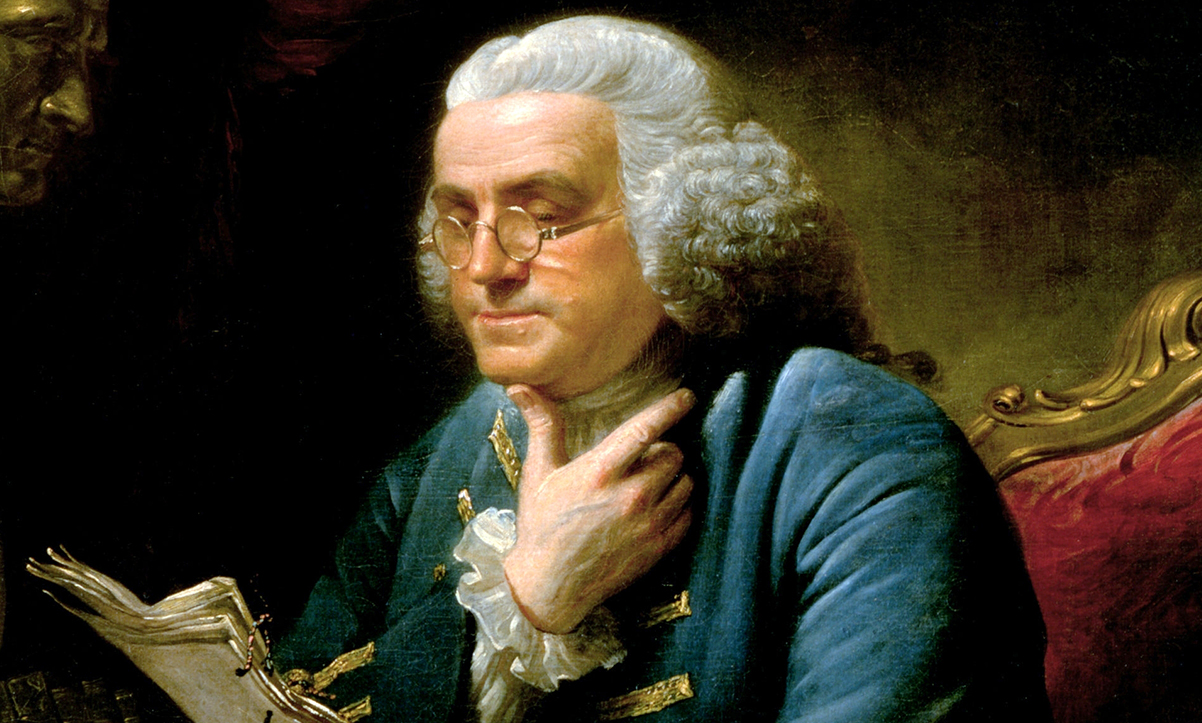
However, one of the most controversial issues, State’s representation, could have nullified the entire process. Tempers flared and interests clashed as the delegates sought their respective goals. It was within this quagmire of divisiveness that the elder statesman, Benjamin Franklin, offered his famous appeal for harmony and conciliation, an appeal for God’s intervention.

His solicitation seems almost out of character with our current understanding of the man. Wasn’t he a deist, believing in the clockmaker God who stepped back to watch the hands of time move toward eternity? Could God govern in the affairs of men, or nations, from such a distance? Perhaps Franklin’s appeal for prayer was out of despair and desperation; perhaps he was senile as some suggest; or perhaps we have misunderstood Franklin’s deism, misreading the man in the coonskin cap.

William Steele’s Account

Confusion still surrounds Franklin’s efforts, however. The primary source of this confusion appears to be a letter from William Steele to his son, Jonathan. Written in September 1825, the letter contained William’s recollection of a conversation with General Jonathan Dayton. (Dayton was a member of the Constitutional Convention and afterwards Speaker of the House of Representatives). This account also found its way into at least one national periodical, the National Intelligencer, and other sources as well. As Steele tells it, Dayton offered this account of Franklin’s words:

We have arrived, Mr. President . . . at a very momentous and interesting crisis in our deliberations. Hitherto our views have been as harmonious, and our progress as great as could reasonably have been expected. But now an unlooked for and formidable obstacle is thrown in our way, which threatens to arrest our course, and, if not skillfully removed, to render all our fond hopes of a constitution abortive.

It is, however, to be feared that the members of this Convention are not in a temper, at this moment, to approach the subject in which we differ, in this spirit. I would, therefore, propose, Mr. President, that, without proceeding further in this business at this time, the Convention shall adjourn for three days, in order to let the present ferment pass off, and to afford time for a more full, free, and dispassionate investigation of the subject; and I would earnestly recommend to the members of this Convention, that they spend the time of this recess, not in associating with their own party, and devising new arguments to fortify themselves in their old opinions, but that they mix with members of opposite sentiments, lend a patient ear to their reasonings, and candidly allow them all the weight to which they may be entitled; and when we assemble again, I hope it will be with a determination to form a constitution, if not such an one as we can individually, and in all respects, approve, yet the best, which, under existing circumstances, can be obtained.

(Here the countenance of Washington brightened, and a cheering ray seemed to break in upon the gloom which had recently covered our political horizon.) The doctor continued:

Before I sit down, Mr. President, I will suggest another matter; and I am really surprised that it has not been proposed by some other member at an earlier period of our deliberations. I will suggest, Mr. President, that propriety of nominating and appointing, before we separate, a chaplain to this Convention, whose duty it shall be uniformly to assemble with us, and introduce the business of each day by and address to the Creator of the universe, and the Governor of all nations, beseeching Him to preside in our council, enlighten our minds with a portion of heavenly wisdom, influence our hearts with a love of truth and justice, and crown our labors with complete and abundant success!

The doctor sat down, and never did I [General Dayton] behold a countenance at once so dignified and delighted as was that of Washington, at the close of the address! Nor were the members of the Convention, generally less affected. The words of the venerable Franklin fell upon our ears with a weight and authority, even greater than we may suppose an oracle to have had in a Roman Senate! A silent admiration superseded, for a moment, the expression of that assent and approbation which was strongly marked on almost every countenance.

The Recess

According to Steele, Dayton then recalled Alexander Hamilton’s protest and sarcastic refusal to accept “foreign aid.” And then he continued:

Washington fixed his eye upon the speaker [Hamilton], with a mixture of surprise and indignation, while he uttered this impertinent and impious speech, and then looked around to ascertain in what manner it affected others. They did not leave him a moment to doubt; no one deigned to reply, or take the smallest notice of the speaker, but the motion for appointing a chaplain was instantly seconded and carried; whether under the silent disapprobation of Mr. H___, or his solitary negative, I do not recollect. The motion for an adjournment was then put and carried unanimously, and the Convention adjourned accordingly.

The three days of recess were spent in the manner advised by Doctor Franklin. The opposite parties mixed with each other, and a free and frank interchange of sentiments took place. On the fourth day we assembled again, and if great additional light had not been thrown on the subject, every unfriendly feeling had been expelled; and a spirit of conciliation had been cultivated, which promised, at least, a calm and dispassionate reconsideration of the subject [state’s representation].

William Steele closed the letter confident he had “faithfully stated the facts” motivated by a desire to “perpetuate the facts.” From this source, and others, one might easily draw the conclusion that Franklin’s efforts brought a harmonious reconciliation to the Convention.

James Madison’s Letter

James Madison, however, in a letter to Jared Sparks on April 8, 1831, referred to this account as “erroneously given, with every semblance of authenticity.” And then in another letter to Thomas S. Grimke (January 6, 1834), Madison went further in his clarification concerning the “proposition of Doctor Franklin in favor of a religious service in the Federal Convention.” He said:

The proposition was received and treated with the respect due to it; but the lapse of time which had preceded, with consternations growing out of it, had the effect of limiting what was done, to a reference of the proposition to a highly respectable Committee.

He then continued:

That the communication [Steele’s account of Dayton’s testimony] was erroneous is certain; whether from misapprehension or misrecollection, uncertain.

Journal of the Constitutional Convention

Madison’s Journal originally contained a summary of Franklin’s words. However, in a later revision, he inserted the speech as written in Franklin’s own handwriting. It is the authoritative source concerning the Convention.

Mr. President

The small progress we have made after 4 or five weeks close attendance & continual reasonings with each other,”our different sentiments on almost every question, several of the last producing as many noes and ays, is methinks a melancholy proof of the imperfection of the Human Understanding. We indeed seem to feel our own want of political wisdom, some we have been running about in search of it. We have gone back to ancient history for models of Government, and examined the different forms of those Republics which having been formed with the seeds of their own dissolution now no longer exist. And we have viewed Modern States all round Europe, but find none of their Constitutions suitable to our circumstances.

In this situation of this Assembly, groping as it were in the dark to find political truth, and scarce able to distinguish it when presented to us, how has it happened, Sir, that we have not hitherto once thought of humbly applying to the Father of lights to illuminate our understandings? In the beginning of the Contest with G. Britain, when we were sensible of danger we had daily prayer in this room for the divine protection. ”Our prayers, Sir, were heard, and they were graciously answered. All of us who were engaged in the struggle must have observed frequent instances of a Superintending providence in our favor. To that kind providence we owe this happy opportunity of consulting in peace on the means of establishing our future national felicity. And have we now forgotten that powerful friend? I have lived, Sir, a long time, and the longer I live, the more convincing proofs I see of this truth- that God governs in the affairs of men. And if a sparrow cannot fall to the ground without his notice, is it probable that an empire can rise without his aid? We have been assured, Sir, in the sacred writings, that “except the Lord build the House they labour in vain that build it.” I firmly believe this; and I also believe that without his concurring aid we shall succeed in this political building no better than the Builders of Babel: We shall be divided by our little partial local interests; our projects will be confounded, and we ourselves shall become a reproach and byword down to future ages. And what is worse, mankind may hereafter from this unfortunate instance, despair of establishing Governments be Human Wisdom and leave it to chance, war and conquest.

I therefore beg leave to move, that henceforth prayers imploring the assistance of Heaven, and its blessings on our deliberations, be held in this Assembly every morning before we proceed to business, and that one or more of the Clergy of the City be requested to officiate in that service.

Mr. Sherman (from Connecticut) seconded the motion.

Mr. Hamilton and several others expressed their apprehensions that however proper such a resolution might have been at the beginning of the convention, it might at this late day, 1, bring on it some disagreeable animadversions [criticisms], and 2, lead the public to believe that the embarrassments and dissensions within the Convention, had suggested this measure. It was answered by [Dr. Franklin], Mr. Sherman and others, that the past omission of a duty could not justify a further omission, that the rejection of such a proposition would expose the Convention to more unpleasant animadversions than the adoption of it: and that the alarm out of doors that might be excited for the state of things within, would at least be as likely to good as ill.

Mr. Williamson, observed that the true cause of the omission could not be mistaken. The Convention had no funds.

Mr. Randolph proposed in order to give a favorable aspect to the measure, that a sermon be preached at the request of the convention on the 4th of July, the anniversary of Independence; and thenceforward prayers be used in the Convention every morning. Dr. Franklin seconded this motion. After several unsuccessful attempts for silently postponing the matter by adjourning was at length carried, without any vote on the motion.

Franklin’s Account

But the final word in this discussion comes from Franklin’s own pen. In John Bigelow’s, The Works of Benjamin Franklin, a footnote (pg. 378) referring to Franklin’s speech states:

To the original draft of this speech there is the following note appended in the handwriting of Dr. Franklin: “The convention, except three or four persons, thought prayer unnecessary.” [This same notation is given as a footnote on page 452 of Max Farrand’s Records of the Federal Convention.]

Bigelow continues by saying “the time which had elapsed without prayers in the convention, sufficiently explains the failures of Franklin’s motions.”

Analysis of the Accounts

The response to Franklin’s motion should not be viewed as an atheistic or deistic expression from the delegates. In their view, prayer was an official ceremony. It required ordained clergy to “officiate,” (as Franklin noted) and the funds to pay them (as Williamson observed). It was not as simple as asking “Brother George” to ask God’s blessings on their deliberations. This was not the general approach to religion during this time in history. Orthodox formality was the preferable style and manner, at least in official settings. For example, when Rev. Duche offered the first prayer in the Continental Congress, he appeared “with his clerk and in his pontificals, and read several prayers in the established form.” Granted, he also unexpectedly “struck out into an extemporary prayer,” but the point is made: religious formality was the order of the day.

Those orders were followed a few days later at the Reformed Calvinist Lutheran Church. In response to Franklin’s appeal, Virginia’s Mr. Randolph offered a counter proposal. He recommended that a “sermon be preached at the request of the convention on the 4th of July, the anniversary of Independence, & thence forward prayers be used in ye Convention every morning.” One report has Washington leading most of the Convention delegates to the church, where James Campbell preached a sermon trusting in the wisdom of the delegates to establish a “free and vigorous government.”

As it turns out, after the Convention, and nine days after the first Constitutional Congress convened with a quorum (April 9, 1789), they implemented Franklin’s recommendation. Two chaplains of different denominations were appointed, one to the House and one to the Senate, with a salary of $500 each. This practice continues today, posing no threat to the First Amendment. How could it? The men who authorized the chaplains wrote the Amendment.

Conclusion

The real strength of Franklin’s motion, from the conservative viewpoint, is as an example of his supposed “deism,” which is a far cry from what some would make it out to be. Franklin obviously felt that God governed in the affairs of men, not exactly the general understanding of today’s deism. But many people attempt to anachronously impose today’s definition upon Franklin, Jefferson, and others, implying they had nothing whatsoever to do with religion. This is usually done to support a broad, separationist approach to religion and government, which is inconsistent with the words and deeds of those who created America’s political system.

Franklin, as well as all of the Framers of the Constitution, realized the value of religion in society. And they realized the value of prayer in the weightier matters of politics. As it turns out, Dr. Franklin was not senile at all; he was simply asking for divine assistance in what proved to be the formation of our American system. Perhaps there were no “official” prayers during the Convention, but denying that the delegates wanted God’s blessing and direction, now that would be senility.

Summary

  • An 1825 letter gave an erroneous account of Franklin’s appeal.
  • Various periodicals circulated the story, assuming it to be correct.
  • Numerous others have presented the inaccurate details.
  • Madison’s 1831 letter called the account erroneous.
  • Madison’s 1834 letter clarified:

The proposition was received and treated with the respect due to it; but the lapse of time which had preceded, with consternations growing out of it, had the effect of limiting what was done, to a reference of the proposition to a highly respectable Committee.

  • Franklin drafted his appeal, and Madison included the written speech in his revised Journal.
  • Franklin offers the final say on the matter:

The convention, except three or four persons, thought prayer unnecessary.

  • However, Virginia’s Mr. Randolph offered a counter proposal: a July Fourth Sermon at the Convention’s request, followed by morning prayers. Washington led most of the delegates to hear the sermon and enjoy the festivities.
  • Although they did not bring in Chaplains, the first Congress instituted a Chaplaincy program that exists to this day.

Sermon – Eulogy on John Quincy Adams

John Quincy Adams’ Death
Joshua Bates (1776-1854) Biography:

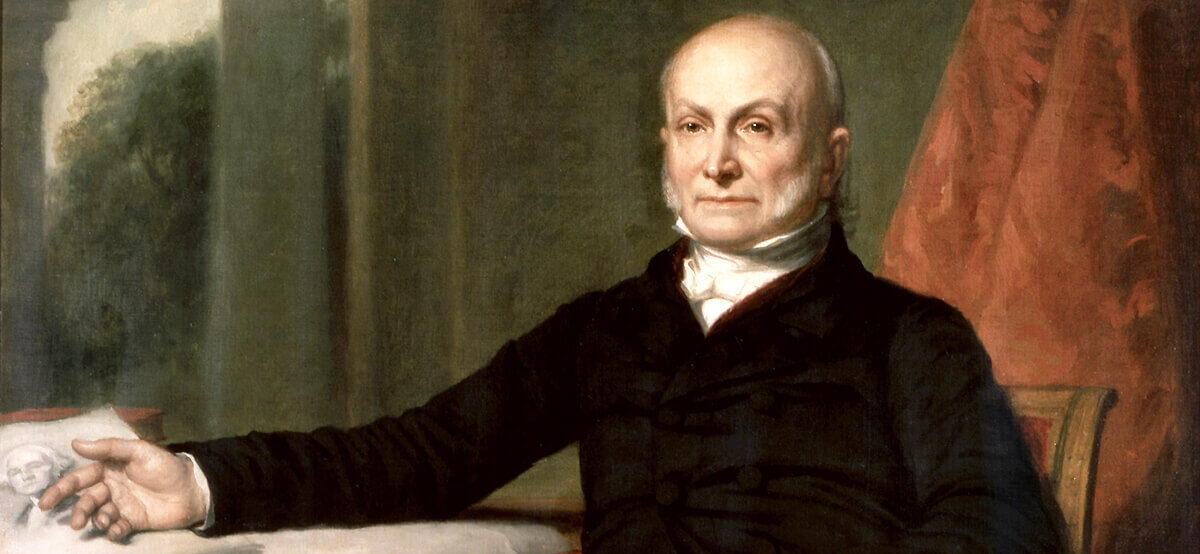
Born the same year that Congress penned the Declaration of Independence, Bates grew up helping with the family farm and serving as a clerk in the family store. Self-taught, he was able to enter Harvard in 1797 as a sophomore, and after three years he graduated with honors. He then took a teaching position at Philips Andover Academy, which is how he earned his living while studying theology. Ordained in 1803, he became pastor of the Congregational Church in Dedham, Massachusetts, until 1818, when he became President of Middlebury College, a position he held until 1839. After retiring from Middlebury, Bates served as the chaplain of the United States House of Representatives from 1839-1840. Former President John Quincy Adams was a member of the House during the time he was chaplain, and when Adams died eight years later in 1848 (following seventy years of public service in America’s behalf), Bates delivered the following sermon eulogizing Adams.


A DISCOURSE

ON

THE CHARACTER, PUBLIC SERVICES, AND DEATH,

OF

JOHN QUINCY ADAMS.


BY JOSHUA BATES.


WORCHESTER:

PRINTED BY SAMUEL CHISM.

218 Main Street.


DISCOURSE.

Know ye not that there is a prince and a great man fallen this day in Israel.

2 Sam. Iii. 38.

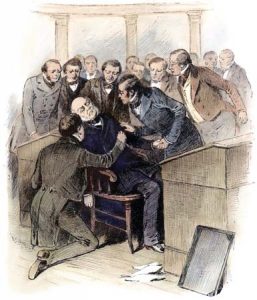
            “Know ye not that there is a great man fallen?”  This inquiry, or rather announcement, made in Judea, three thousand years ago, might, with great propriety, have been made in our country, when recently John Quincy Adams, under the sudden stroke of disease, sunk down in his seat in the Congress, and soon after died, still within the walls of the Capitol of the United States.[i]  Indeed, the announcement was made, in language scarcely less forcible and impressive, not only at Washington, but, through the whole land; was made and sent abroad with lightning speed, with telegraphic dispatch.  And everywhere, as the tidings spread, the involved sentiment seems to have met a ready response, and been echoed back, in soft and solemn tones, – “A great man is fallen.”

            Nor should we, my hearers, though far removed from the exciting scene of his death, and dwelling in a retired village, suffer the announcement of the solemn fact to pass by us, or the recollection of it to escape from our minds, without some special notice of the event itself, and some practical application of the instructions which it brings along with it.  I repeat the language of the text to-day,[ii] therefore, not for the purpose of comparing the event, to which I apply it, with that to which it was originally applied by David, the king and sweet Psalmist of Israel; nor for the purpose of tracing analogies and running a parallel between the great man of old, whose death David announced to the children of Israel, and him, whose death, at Washington, has been recently announced to us.  I adopt the language of the text, merely as a suitable and striking introduction to a discourse, on the character, public services, and death of this great man of Massachusetts, of New England, of the United States of America, of the world; who has thus fallen, full of years and crowned with honors.  Accordingly, I shall endeavor to delineate a few of the most prominent features of his character, and speak of some of the most striking occurrences and actions of his life, which conspired to constitute him “a great man.”  And I intend to intersperse the whole with such reflections and practical remarks, as seem adapted to the condition and claims of our country; and as are calculated to remind us of our obligations, and prompt us to the faithful discharge of duty, as members of civil society and citizens of a great republic.

            With this view I must detain you a little while, with the definition of terms; and occupy a few moments in showing what are the elements of greatness in human character – what constitutes a great man.

            Clearly all that is sometimes called great, is not truly great.  Greatness in man, evidently does not depend on position in society, on place and power, on office and rank, on pedigree and primogeniture; on the ten thousand nominal and factitious distinctions which have been arbitrarily made in society.  For the most elevated rank and the most honorable titles are often assumed by men of the lowest minds and vilest character; and not unfrequently the highest civil offices are conferred on the weak and the wicked.  In hereditary governments, the chances are, at least equal, that his will be the fact; whenever an heir-apparent ascends the throne; because he ascends, of course, without regard to character or qualifications.  And even in elective states, want of judgment in the electors, deception practiced by selfish aspirants, and the blinding influence of party spirit, too often produce the same results.  Thus the high places in civil society are sometimes filled by men of little minds, and destitute of all moral and religious principles.  And the ultimate consequence is, that the wicked walk on every side, when the vilest men are thus exalted.  Then vice and iniquity every where abound, drawing down upon the country the judgments of Heaven.

            Nor will the possession and development of some one high quality alone, make a great man.  A man may be a great mathematician or a great poet, a great general or a great politician, and yet be destitute of that, which is absolutely necessary to constitute a great man.  Yes, even the best moral qualities may be seen in connection with much intellectual deficiency; such weakness of judgment, wildness of imagination, or instability of purpose in a man, as to forbid the application of the epithet great to him as a man; however, charity may wink at his errors, smile at his foibles, pity his misfortune, and yet praise him for his good intentions.

            But we may remark positively, that great intellectual faculties and high moral powers, fully developed, properly directed, and actively employed, are all requisite to make a truly great man.  Or, to express the same thing in different language, we may say, a great man must possess, at once, symmetry and elevation of character.  His original powers of mind and susceptibilities of heart must be of a high order, cultivated with care, drawn out and kept in such just proportion and steady equilibrium, as to produce a finished character – firm and elevated, beautiful and sublime.  Or better still, perhaps, we may say: a great man must show his greatness, by standing on high ground, where his light may shine and he may be seen; and by there exhibiting those excellencies which are involved in a faithful and diligent discharge of the duties, growing out of all the relations of life and immortality.

            He must, therefore, be a man of firmness of purpose and decision of character; of self-possession, self-culture, and self-control; and all these qualities he must possess in such measure, as not only to secure his own happiness, but to be able, most effectually, to promote the happiness of others – of all others, who are dependent on him and connected with him.  He must be prepared to discharge faithfully and successfully all the duties which his social and civil relations impose upon him; prepared for the service of his country and generation; prepared, especially, for the service of his God and the enjoyment of his favor forever.

            Hence, though there may be degrees of greatness in character, and, of course, different classes of great men, yet the number of those who are truly eminent, and are entitled to the high distinction denoted by the epithet, is, in every age and country, comparatively small.  For, as we have said, no one can be truly great, without possessing great original powers of mind; nor unless these great powers are fully developed, carefully cultivated, properly directed, and faithfully employed.

            These cultivated and well-directed powers, I repeat, may exist in different degrees and various proportions, in different men; but in whatever degree or proportion they are possessed by any one, and in whatever relation or office he may be placed, if truly a great man, he will be found always prepared to meet the calls of duty with promptitude and decision, and to pursue the path of duty with untiring assiduity and never-yielding perseverance.

            Especially, let it be remembered, the religious element is indispensable to constitute greatness of character in man.  All other powers and qualities, however exalted and apportioned, will fail to produce true greatness, without the combining and controlling influence of this high quality.  To render them subservient to the purpose for which they were bestowed, or even to secure their salutary tendency, they must be sanctified by religious sentiment, and exercised and employed under the direction of religious principle.

            This element of greatness in character, has, indeed, been generally overlooked or forgotten.  Hence, talents of the most brilliant order have been wasted; genius permitted to run wild, and scatter abroad the seeds of death; and knowledge, though extensive and powerful, suffered to lie dormant, or become merely the power of producing mischief and misery in the world.  Hence the great general (so-called) has sometimes become a cruel murderer, destroying without mercy and almost without thought, the innocent and defenseless.  Hence the great poet (so-called) has sometimes become a trifler, a madman, a corrupter of youth, diffusing everywhere a mortal pestilence – error, ice, and wretchedness.  Hence, too, the great statesman and politician (so-called) has sometimes become a selfish demagogue, a fraudulent diplomatist, a cunning aspirant for power, and a cruel oppressor when in power.  Thus greatness (so-called – falsely so-called) sinks into littleness, into meanness even when separated from goodness.  Yes; all talents, however brilliant; all knowledge, however extensive; all developments of mental power, however mighty; all acquisitions of science and learning, however comprehensive; all natural sympathy and even moral sensibility, however exquisite; unsanctified by religious truth and uncontrolled by religious principle, will forever fail to  produce true greatness of character, or render any one truly a great man.  They need one essential ingredient to form the compound.  They want the combining and conservative element, the purifying and controlling power; that, which alone can give consistency, permanency and excellence; unity, beauty and sublimity, to human character; or render a man of great powers and acquisitions, truly a great man.

            Yet, as few as men of greatness of character are – here and there one in an age, like light-houses scattered along the sea coast, to guide the bewildered mariner – our country has produced her full proportion; and John Quincy Adams was decidedly one of the number.  Yes; he possessed all the elements of greatness, and most of them developed in a high degree, harmoniously combined, well balanced, and steadily employed, under the direction of enlightened conscience and fixed religious principle.

His native powers of mind seem to have been of a high order.  It may, perhaps, be thought by some, that his great attainments in literature and science, depended more upon his superior advantages for improvement, than on native vigor of intellect. It must indeed, be admitted, that his advantages were uncommonly great, and eminently calculated to develop his original powers of mind, and urge them forward to maturity.  Born at a most interesting period in the history of the country,[iii]  just as she was entering into her mighty struggle for independence, of parents deeply involved in the counsels and measures which led to that struggle and carried it through with success; rocked in the cradle of liberty and science, and nursed in the arms of piety and patriotism, his first impressions and earliest developments were unquestionably favorable to energy of character, enterprise of spirit, and that greatness to which he ultimately rose.  Especially was the influence of his excellent mother manifest in giving direction to his high pursuits and forming his elevated character, both intellectual and moral.  Under her superintendence his literary career, as well as his moral.  Under her superintendence his literary career, as well as his moral and religious training, was commenced.[iv]  And, even when withdrawn from her personal influence, by his residence with his father and others in Europe, he failed not to receive her high counsels through the medium of those excellent letters which are already before the public.

At the age of eleven years, he began to study foreign languages, both ancient and modern, in a foreign country; and, before he had reached the age of twenty, he had completed a course of liberal education, having pursued his studies at two universities,[v]  besides receiving the best tuition at home and abroad; and, at the same time, enjoying the advantages of travel and extended observation, in daily communion with some of the greatest minds and ripest scholars of the age.

But, while all this is admitted, it must be seen in the result, that the mind which could appreciate these advantages, meet their high claims on his energy and diligence, improve them all without distraction or weariness, and grow to maturity under their pressure and multiplied appliances, must have been a great mind; must have possessed happy tendencies and strong capabilities.  I am not, however, anxious to settle this metaphysical question, and balance the weight of evidence between the claims of original talents and a judicious, energetic, and persevering improvement of facilities and favorable opportunities.  It is enough for our purpose, that we are able to affirm and prove, that he possessed great powers of intellect, fully developed and completely disciplined; a mind of enlarged capacity, and well furnished with the richest stores of learning.

His opportunities for observation and the various circumstances of his early life, were surely favorable for the acquisition of knowledge.  But still, his perceptive faculties must have been acute, and his powers of attention and abstraction must have been great, or these opportunities and favoring circumstances would have availed him little; certainly would not have made him the ripe and universal scholar that he was.  Similar advantages have been enjoyed and abused by thousands.  Thousands, like him; have traveled in foreign lands, conversed with great minds and learned men, and received instruction in the best schools, who, nevertheless, wanted the capacity or energy of mind requisite for scholarship; for high attainments in literature and science; – not unfrequently have they come out  from the university “graduated dunces,” or returned from abroad, “traveled fools.”  He had the opportunities for improvement, it is true; and he improved them; because he possessed the capacity to receive and retain, and the energy to pursue and acquire knowledge.

We may, at least, affirm without the fear of contradiction, that his memory was extraordinary, perhaps unequalled.  I discover, however, nothing in his course of education peculiarly calculated to form such a memory; nothing but what is common to the discipline of a liberal education, with a steady exercise of the faculty, and a practical application of the knowledge acquired.  I know not, that he adopted any rules of arbitrary association, in order to strengthen his powers of retention and recollection; that he took any special pains to commit to memory, for the purpose of exercise and discipline; or that he reviewed what he read more frequently than other sound and finished scholars.  I see nothing, indeed, connected with his mental habits, peculiarly favorable to the improvement and enlargement of this intellectual faculty, except his early and continued practice of committing to writing, every day, the most important occurrences of the day, with his own views and reflections.  But this practice can scarcely be said to be peculiar to him.  Others have done the same thing; and some, perhaps; with equal care and particularity.  And yet his memory was certainly extraordinary; perhaps unparalleled, both as to its extend, retention, and readiness.  He seems to have taken notice of whatever occurred within the sphere of his observation; to have read whatever came to his hand, worthy of being read; and to have retained, and kept in a state of readiness for use, whatever of knowledge he had acquired, both by reading and observation.

It has been said, that readiness and retentiveness of memory are qualities inconsistent with each other, and not to be found in the same person; because they depend on antagonistic habits of association – the one belonging to the philosophic mind, and the other to the practical man of business.  But in him we have an example of their perfect consistency and complete union.  His memory was both philosophical and particular; both a retentive and a ready memory.  What he had once learned, as we said, he seems to have retained always; and what he thus knew, he had always at command, and ready for immediate and appropriate use.

The consequence of his great powers of memory, happily directed by the course of his education, and faithfully applied by his great industry and persevering energy of research, was, as already intimated, the acquisition of extensive and various knowledge – knowledge laid by in store, and yet held ready for use, whenever occasion called.

He was more or less acquainted with many of the modern languages of Europe; and several of them he could speak and write with readiness and accuracy.[vi]  In the classical languages of Greece and Rome, and especially the latter, he read much, and he was thoroughly acquainted with the literature which they embodied.  He was, too, a man of science; wonderfully catching the spirit of the times, and keeping along with the rapid progress, both of the abstract and the natural sciences.  But his knowledge of history, natural law, political economy, and the science of legislation and civil government, constituted his chief attainments, and furnished the mighty resources and high qualifications which he possessed for complicated action in public life, and the various services of his country to which he was called.[vii]

His unrivalled power in debate, depended more on his inexhaustible fund of knowledge and ready memory, than on any distinguished qualities of eloquence or peculiar graces of oratory.  He always overthrew his antagonists on the political arena, because he was always clad in panoply complete – armed cap-a-pe, with sword in hand, sharpened and burnished, and ready for action.  When pursued with objections, inquiries, and rash statements, as he sometimes was in Congress, and even with a spirit of bitterness and reproach, his resources of mind never failed him; his answers were always ready, his replies conclusive, his retorts keen; confounding his assailants with an array of facts which no man could gainsay, and a conclusiveness of argument which no man could resist.

It has been said, that no man ever attacked him wantonly, in a deliberative assembly, with impunity; that whoever presumed thus to assail him, might be sure of defeat – yes, if the combat was continued, of political death.  An illustration of the truth of this remark occurred in Congress, a few years ago, when he was suddenly attacked by a combination of talents and a conspiracy of interests and prejudices, with a view to his expulsion from the House of Representatives.  How expertly did he resist the attack on the right hand and on the left, in front and in rear; and how completely did he put the combined forces of his assailants to flight, and scatter them to the four winds of heaven!  During the first session of the twenty-sixth Congress, I remember, that a similar, though not so violent attack, was made upon him, with a similar result; and I remember, when the remark was subsequently made to one of the members of the House:  “Why, Mr. Adams seems to know more than any of you,” the prompt reply was: “Yes; more than all of us together.”

Another trait of intellectual character in Mr. Adams, which ought not to be passed without notice, is imagination.  This faculty, however, was certainly not so prominent in him, as was that of memory.  The two faculties, indeed, are never displayed, in very eminent degree, by the same person; because they depend on principles and habits of association differing from each other, and counteracting each other’s operation.  Memory depends on arbitrary connections, gross resemblances, and scientific classifications; but imagination on slight analogies, shadowy visions, ethereal views, and transcendental flights of fancy.  A rich, poetical imagination, therefore, is seldom found in connection with a giant memory.

His imagination, however was by no means deficient.  Some of his poetical effusions have been very favorably received by the literary public.  But if he was not eminent as a poet, he had sufficient power of imagination for the purposes of vivid conception, graphic description, forcible illustration; enough to constitute him a sound and dignified orator; enough to secure to him the title of “the old an eloquent,” as well as “the eloquent young man.”  His eloquence; however, did not depend on voice, or attitude, or playful gesture, but on

“Thoughts that breathe

And words that burn,”

on clearness of views, extent of knowledge, closeness of reasoning and soundness of judgment, expressed in appropriate and forcible language, and addressed to the understanding and the heart.

I well remember, with what dignity and commanding eloquence he rose, on the 5th of December, 1839, in that tumultuous assemblage of the Representatives of the people of the United States, who had been four days in the great hall of the Capitol, without a chairman and without order, trying, but trying in vain, to organize a House.  He rose, after having waited in silence till a crises seemed to be at hand – he rose – I seem to see him now – he rose, and, with his piercing eye, his slowly waving hand, and shrill voice, already enfeebled by age, he soon calmed the troubled elements, “and stilled the tumult of the people.”  The result is known.  But what the result of that party-strife would have been, without his influence, no one can tell.  It might have issued in a continued disorganized convention, or a complete dissolution of the government.

Mr. Adams, we may add, was a man of great decision of character, firmness of purpose, unflinching moral courage.  So prominent was this quality of his mind, that he was sometimes thought to be too unyielding, and even obstinate.  But time has generally shown, that what bitter enemies and timid friends called willfulness and self-sufficiency, was conscientious firmness – a determined adherence to what he viewed as right – that it was conscience and not self-will that held him to his purpose.  Witness his long contest and arduous struggle in Congress for the constitutional right of petition – a contest in which he sometimes stood almost alone; but one in which he never yielded, nor relaxed his efforts, till he carried his point, and convinced both friends and foes, that he was right, and that he had been conscientious in contending for the right.

It was this high quality of firmness and independence, of conscientious adherence to the decisions of his own judgment, which caused him, as I verily believe, so often to break off his connection with those who had claimed him as a partisan.  He was too conscientious and independent to be held in the trammels of party.  Of course, he has been claimed, at different times, as a member of the several political parties, which have existed in the country, but he was never completely identified with any.  Bred in the school of Federalism, he embraced and generally maintained its doctrines, during the administration of Washington and his father.  But, when an occasion occurred, where he thought the policy of the party wrong, he acted promptly on the other side of the question.  Believing, as he declared, that the rights of our oppressed seamen demanded stringent measures to bring the British government to regard the humane law of nations on the subject of impressments, he left the ranks of the opposition, and fell, of course, into the measures and the ranks of those who supported the administration.  He might have been wrong in his judgment; at the time I thought him wrong; and I am not yet convinced, that the unnatural war which followed the stringent measures of the Embargo of 1807, might not have been avoided, and thus much blood and treasure saved.  But he thought otherwise – honestly thought, as I now believe; and accordingly made the strong declaration, for which he has been often and severely censured: “Mr. President,” said he, addressing the presiding officer of the Senate of the United States – “Mr. President, I would not deliberate, I would act.”  I well remember the indignation which burst upon his head, from his former friends and his father’s friends.  Yes; I remember, when a grey-headed man pointedly reproached him in a public hall, where he could not, with propriety, vindicate his conduct; and I remember the meekness and firmness with which he bore the reproach.  The rebuke was certainly untimely; and the indignation, if, as is generally believed, he acted according to his judgment and conscience, was unjust.  Indeed, the language which preceded his vote for the Embargo, upon this supposition, was not rash; it was sublime; it was nobly said: “I would not deliberate, I would act.”

By this course he was brought, as I said, to sympathize and act with what was then called the Republican party; and with them he continued under Madison’s and Monroe’s administrations, till that old division of parties sunk into obscurity, and he was brought into the presidential chair.  But here he found many of his opinions so much at variance with the interests and prejudices of some with whom he was called to act, especially with regard to internal improvements, the regulation of a tariff, the proper treatment of the Indians, and the still more embarrassing subject of slavery, that the course of measures, which he felt himself compelled to recommend, deprived him of a second election to the presidential chair – an election which he might have secured, if he had been willing to sacrifice his judgment and his conscience, or resort to the power of perverted patronage and political proscription.

Finally, by this independent course he became the champion, and, for a time, the favorite of a new party, through whose influence he commenced his long and laborious career in the House of Representatives.  But to meet their wishes and sustain their proposed measures, he could proceed no farther than he felt himself at liberty to go, according to his views of the provisions of the Constitution, and the implied contract with the States of Virginia and Maryland, in the cession of the District of Columbia to the jurisdiction of the United States.  Here again some thought him self-sufficient on the one hand, or too scrupulous on the other.  But, whether right or wrong in judgment, he was honest and firm in purpose.  Thus has he been called to act, in the measures which he approved, with all parties; but he belonged exclusively to none.  Thus did he beautifully illustrate the character of decision, firmness, and moral courage, which constitutes a great man, acting as an independent republican.

One other general characteristic of his mind, or rather of his heart, I am constrained to mention: his susceptibility of emotion, his strong passions, his ardent feelings, his acute sensibility.  But strong as his passions were – and they were confessedly strong and easily excited, – they were always under the control of his will, and subject to the guidance of his reason.  In his highest sallies of indignant eloquence and withering sarcasm; in his most vehement retorts upon his antagonists in debate, he never said what he did not believe to be true; and seldom what he could not prove to be both true and just.  Under the most powerful provocations and the strongest excitement, his understanding remained undisturbed, his conceptions clear, his inexhaustible treasures of knowledge at command; and he never failed of vindicating the positions he had taken against the assailing powers of talent, and eloquence, and prejudice; and to the complete satisfaction of all enlightened, impartial observers.

“Always?” – “Never?” did I say?  Perhaps this language is too strong and sweeping.  He was a man; and it is human to err.  He may have made mistakes; he may have indulged unjust suspicions, and thrown out unkind insinuations.  Unquestionably he sometimes did.  But was he not always ready to explain, where he had been misapprehended?  To make reparation, where he had injured? To forgive, where forgiveness was asked? To be reconciled, where alienation had unhappily and inadvertently taken place?  Would time permit, I could state cases and relate anecdotes, which would furnish a favorable answer to these inquiries, and satisfy every candid mind.

He was, indeed, as we have said, a man of strong feelings and acute sensibility; and the wonder is, that his self-government was so nearly perfect as it was; that amidst all the storms of debate, through which, in high party times, he was called to pass, and under all the violent personal attacks of deliberately-formed conspiracy against him, he was able to control his feelings, so as to command the resources of his mighty mind and inexhaustible memory; so as to throw back upon his assailants the scorching and withering eloquence of truth, and reason, and indignant rebuke.

Yes, he was a man of feeling – of tender as well as strong feeling.  Often have I seen that feeling exhibited in his changing countenance, and even falling tears, under the preaching of the gospel of Christ, in view of the melting scenes of Calvary, and under the pressing influence of the doctrines which cluster around the cross.  Is it improper to say, (for I speak what I do know,) that he has been seen, as he sat in the Clerk’s seat, on the Sabbath, in one of the halls of Congress, with his eye turned to the preacher in the Speaker’s desk, melting into tears, while the doctrine of justification by faith and salvation by grace was exhibited and vindicated against Infidel objections; was presented, as a practical subject; “a doctrine according to godliness,” and applied to the heart and conscience?  This statement I make, not as showing his religious creed, for I know not what he believed on the subject; not even as proof of his being a Christian, (that proof belongs to another place.)  Besides, transient emotion is not the best evidence of religious principle.  But I mention the fact, merely as furnishing evidence of his sensibility – his susceptibility of tender emotion, in view of melting scenes of compassion; where justice is vindicated, while mercy is exercised; where love is exhibited, while integrity and truth are preserved; where grace is displayed, while righteousness is secured, and a holy moral government maintained; where, in a word, justice and mercy meet together, and righteousness and peace embrace each other.

Would time permit, I might here speak of his character for prudence, self-respect, industry, improvement of time, punctuality in business, early rising, exercise and general regimen; with his simplicity of  manners, of dress, of equipage, of everything, indeed, becoming a true republican in a well constituted republic.  For all these things were intimately connected with the development and efficient application of his intellectual powers, and his salutary influence in society.

I might too, speak of his private virtues, domestic relations, and moral character generally.  But my personal acquaintance with him was not sufficiently intimate to justify the attempt to do justice to these topics.  Besides, it seems uncalled for, and altogether unnecessary.  For here public sentiment, I believe, universally concurs with private friendship, in pronouncing his unqualified eulogy.  Here the tongue of slander is silent, and even the breath of calumny suppressed.

I might, moreover, speak more at large than I have incidentally done of his public services.  But they were performed in public view, and were subjected to public inspection.  They are recollected by some of my hearers; others have been told of them by their fathers; and they will soon become matters of history, and will unquestionably occupy some of the most brilliant and instructive pages of the history of liberty and our country.  Let it suffice, therefore, at this time, simply to say, – No man ever served his country longer,[viii] more faithfully, with higher motives and a purer patriotism; and history will, by and by, show with better and happier ultimate results.  Though party spirit has for a time counteracted some of his wise measures, and retarded the progress of improvement, it will not always retain its power; though it may, for the present, throw some obscurity over his political career, history will dissipate the darkness which surrounds it, and show it in all its brightness; will, especially, show, that the administration of the government, during his presidential term, was a model administration; among the most prudent and economical; free from the abuse of patronage, and the use of questionable power; consistent with the true spirit of the Constitution, and promotive of the cause of liberty and equal justice; – that, next to Washington, he has left the strongest impress of true republicanism on our institutions and the age.  History, I say, will do him justice.  Already, indeed, public opinion is returning to his rejected counsels, and preparing the way for the voice of history to be favorably heard.

But I forbear, and hasten to say a word on his crowning excellency; that which gave direction to his great talents, security to his high morals, utility to his arduous labors, and greatness to his whole character – I mean his religious principles.

Mr. Adams was a Christian; and a Christian, as has been beautifully said, “is the highest style of man.”  What were his particular views on many controverted points in theology, I am not informed. He did not intrude them on the public.  Indeed, I suppose though he was a close student of the Bible, he was not a technical theologian.  Some of his practical sentiments come out incidentally in his published writings, but not in technical language.  For example, in his second letter to his son, on the reading of the Bible, he says: “There are three points of doctrine, the belief of which form the foundation of all morality.  The first is the existence of God; the second is the immortality of the soul; and the third is a future state of rewards and punishments.  Suppose it possible,” he continues, “for a man to disbelieve either of these articles of faith, and that man will have no conscience; he will have no other law than that of the tiger or the shark.  The laws of man may bind him in chains or put him to death, but they can never make him wise, virtuous, or happy.”

In the autumn of 1840, Mr. Adams delivered two lectures in New York, on the subject of Faith, which, at the time, made a strong impression on the public mind, and are said to have done much in arresting the progress of Infidelity.  I find a synopsis of one of them in the New York Observer of November 28th, of that year, in the following words:

“1.  In the existence of one Omnipresent God, the Creator of all things.

2.  In the immortality of the soul, and man’s accountability to God for his conduct.

3.  In the divine mission of the Lord Jesus Christ.”

But I will not detain you with farther quotations.  He was a practical Christian; not a theorist; certainly not a sectarian.  He called himself a Bible Christian.  This blessed book he read much; and, in a course of letters to his son, written while he was in Russia, he recommends it as a Divine Revelation, to be read and studied daily, and to be made the rule of faith and practice.  To enforce on his son this earnest recommendation, he says: “I have myself, for many years, made it a practice to read through the Bible once every year.”  After speaking of the necessity of prayer “to Almighty God, for the aid of his Holy Spirit,” he adds: “My custom is to read four or five chapters every morning, immediately after rising from my bed.”  In this daily exercise, as he stated to a friend, he used the text of the original or versions in four other languages; always, however, making use of our common English translation as one of the copies.

He was, indeed, a Bible Christian; and his letters to his son show, with what confidence and strong faith he searched the Scriptures, and submitted to their authority.

He was, too, as I said, a practical Christian.  He early joined the church in his native village – a Congregational Church – formed in the days of our pilgrim fathers.[ix]  Here he continued to worship and attend on the ordinances of the gospel, whenever he visited that village.  At Washington, he always attended the stated service held in the Capitol in the morning, during the sessions of Congress.  In the afternoon, as there were no services in the Capitol, he attended at some church in the city.  He was, indeed, an example of punctuality and constancy, in attendance on the public worship and ordinances of God.  I am told, that he never failed, when in health, of attending on the religious services of Congress, during the winter of 1839 and 1840.  And had all the members of Congress been as constant, and punctual, and devout, as he was, I am confident, that a religious influence would have been diffused over the troubled elements of that stormy session.

Yes, he was a Bible Christian, I repeat; and a practical Christian.  And this fact gave the crowning excellence to his character, and rendered him truly “a great man.”

“Know ye not,” my hearers, that “a great man is fallen?”  The repetition of this inquiry brings us to the consideration of the closing scene of his life.  Let us contemplate it for a few moments, as it must have appeared to those who stood around him when he fell.  Truly it must have been a scene, not of excitement and solemnity merely, but of awful sublimity merely, and moral grandeur.  A great man fallen, at the close of a protracted period of public service, full of years, crowned with honors, still at his post of duty, with armor on, watching for his country’s good; surrounded by his compeers; having just given his last vote, and uttered his last emphatic No in the cause of liberty; – fallen and stinking submissively into the arms of death, and even announcing his departure from earth, in language of composure and peace of mind, is indeed a scene of great moral sublimity and beauty; may I not add, in view of his Christian character and Christian hopes, and the glory and immortality which awaited him, a scene of solemn joy?

I have often stood by the bed of dying Christians – Christians, dying in peace and hope; and sometimes in the triumph of faith, and even, like Stephen, in the ecstacies of anticipated life and immortality in the presence of their God and Redeemer.  And I have always viewed such scenes, not with sorrow, but with chastened joy.  Indeed, it is a blessed privilege to see a Christian die.  “For precious in the sight of the Lord is the death of his saints:”

                                                The chamber, where the good man meets his fate,

                                                Is privileged beyond the common walks

                                                Of virtuous life – quite on the verge of heaven.

But when a great man dies, and dies in the midst of circumstances and coincidences which fill the mind with high thoughts and rich associations; which read lessons of wisdom, while they bring consolation to the living, the beauty of death swells into the sublime of immortality; the very soul of the pious spectator is lifted up, and he is ready to exclaim with Elisha, as he gazed on the ascending chariot of Elijah: “My father, my father; the chariot of Israel, and the horsemen thereof!”

Who that has faith – who that has hope, would not wish to die such a death?  “Let me die the death of the righteous, and let my last end be like his!”


END. 


[i] The death of Mr. Adams was, indeed, sudden; and the circumstances attending it peculiarly impressive.  He had through life enjoyed almost uninterrupted health.  And by his attention to diet and regimen, early rising, regularity of exercise, careful appropriation of time, and complete system in the regulation of his business and various pursuits, he had been able to accomplish more labor than most men could endure; and to accomplish it with apparent ease and satisfaction.  A little more than a year before his death, he had a slight stroke of the palsy, which he viewed as the premonitory stroke of death, designed to bring his earthly labors to a close; and, we are told, he made a corresponding entry in his daily record of himself.  Still, as his energies of mind remained unimpaired, and as his bodily strength and activity soon returned, he was induced to resume his public duties, and take his seat in Congress.  And though he never recovered his full strength, he continued to discharge his public duties with his wonted faithfulness and punctuality; till, on Monday the 21st of February, 1848, as he sat in his seat in Congress, the same disease returned; and on Wednesday the 23d, closed his eventful life, at the ripe age of more than four-score years.

[ii] Delivered at Dudley, Mass., April 6th, 1848, being the day of the Annual Fast in this Commonwealth.

[iii] July 11, 1767.

[iv] It was stated by an intimate friend, that he continued, through life, to repeat, in connection with his evening devotions, a simple prayer, taught him by his mother.

[v] Leyden and Cambridge.

[vi] The French and German especially.

[vii] A collection of his miscellaneous publications, which, I hope, will soon be made, would furnish abundant proof of the accuracy of this general statement.

[viii] John Quincy Adams, the subject of this discourse, was born (as stated before) July 11th, 1767, in the village of Quincy, formerly a part of the town of Braintree.  His ancestors were among the first settlers of that part of Massachusetts.  He was the eldest son of John Adams – subsequently the second President of the United States, and Abigail (Smith) Adams, the daughter of a Congregational minister of Weymouth.

In the year 1778 – being then a lad of eleven years – he went to France with his father; and with him and at school pursued his studies as before; till, at the age of fourteen, in 1781, he proceeded to Russia, as private Secretary to Francis Dana, Minister to the Court of St. Petersburg.  Thence he returned to his father, in Holland, in 1783; and with him, as Minister to the Court of St. James, he went to England, where he acted as Private Secretary to his father, (at the same steadily pursuing his classical studies) till his return to America, where he finished his classical education; and was graduated at Harvard College in 1787.

His professional studies were pursued at Newburyport, in the office of Theophilus Parsons, subsequently Chief Justice of the Supreme Court of Massachusetts.

Mr. Adams commenced the practice of the law, at Boston, in 1790.  But he was soon called, by President Washington, in 1794, at the early age of twenty-seven, to assume the character of a public Minister at a foreign Court; and thus he commenced that career of public service which he pursued with little interruption to the end of life.

He continued in Europe, Resident Minister, at different Courts, till he was recalled by his father, at the close of his presidential term; and returned to America in 1801.

Almost immediately on his return, he was elected a member of the Senate of Massachusetts, and, in 1803, he was appointed a Senator of the United States.  This office he held till his resignation in 1808.  During a part of his Senatorial term, he had held the office of Professor of Rhetoric and Oratory in Harvard College.  To the duties of this office he devoted his undivided energies till 1809, when he was again called into public service, and appointed Minister Plenipotentiary at the Court of Russia.  Subsequently he was called to act as one of the Commissioners in negotiating the peace of Ghent in 1815.  Hence, by appointment, he proceeded to England; and became the Resident Minister of the United States, at the Court of St. James.

In 1817, he was called home to act as Secretary of State.  This office he held for eight years, during both the terms of Mr. Munroe’s Presidency.  In 1825, he became President of the United States.  On the expiration of his presidential term, he retired to private life; till in 1831 he consented to enter Congress again, as a member of the House of Representatives.  And in this capacity, he continued to serve his country, with undiminished zeal and fidelity, till Feb. 7th, 1848; when, as stated before, he died, at the age of 80 years and 7 months.

[ix] A.D., 1639.

Eulogy – 1813, Massachusetts

Isaac Parker (1768-1830) Biography:

Born in Boston, Parker graduated from Harvard when 18. After teaching for many years, he began studying law. Admitted to the law profession in 1789, Parker relocated to Castine, Maine, and became its first lawyer. In 1796, he was elected to Congress as a Federalist and served one term. Leaving Congress, Parker served as a US Marshall from 1797-1801 under President John Adams. Five years later, he relocated to Portland (where he remained until his death) and became a judge on the Massachusetts Supreme Court. He taught law at Harvard for eleven years, was an overseer at Harvard, and a Trustee of Bowdoin College. In 1820, he served as president of the Massachusetts Constitutional Convention. Two of his famous orations that were published included his Oration on Washington and Sketch of the Character of Chief-Justice Parsons.


A


SKETCH

OF THE CHARACTER OF THE LATE

CHIEF JUSTICE PARSONS,


EXHIBITED IN

AN ADDRESS TO THE GRAND JURY,

DELIVERED

AT THE OPENING OF THE SUPREME JUDICIAL COURT

AT BOSTON,

ON THE TWENTY-THIRD DAY OF NOVEMBER, 1813.

AFTER THE

USUAL CHARGE.


PUBLISHED AT THE UNANIMOUS REQUEST OF

THE GRAND JURY AND THE BAR OF SUFFOLK.


BY ISAAC PARKER, ESQ.

ONE OF THE ASSOCIATE JUSTICES OF THAT COURT.


BOSTON:

PRINTED BY JOHN ELIOT, COURT STREET

1813.

INTRODUCTION.


            CHIEF JUSTICE PARSONS was born in February, 1750, and received the rudiments of his education under the celebrated Master Moody, at Dummer Academy, in his native parish of Byefield, within the ancient town of Newbury.  His father was minister of that parish.  He received the ordinary honours of the University in Cambridge in 1769.  He entered upon the study of the law under the late Judge Bradbury, in Falmouth, now Portland, and while there kept the Grammar School in that town.  He practiced law there a few years; but the conflagration of the town by the British obliged him to withdraw to his father’s house, where he met Judge Trowbridge, as stated in the address.  He, in about a year from this time, opened his office in Newburyport.  He has been honoured with degrees of Doctor of Laws, from the University of Cambridge and Dartmouth College, and from Brown University in Rhode Island.  In 1801, he was presented by President Adams with a commission of Attorney General of the United States, which he did not accept.  He had been also, by the choice of our state Legislature, one of the Commissioners to settle a controversy with the State of New York.  He continued faithful to his chosen profession, until he was appointed Chief Justice of the State, which was in the summer of 1806.

            While this Address was passing through the press, the following letter was received, and the testimony it contains cannot fail to gratify the publick.

Cambridge, 1 December, 1813.

            My Dear Sir,

                        SINCE I handed you the note containing the testimonial of Professor Luzac to our venerated friend’s rank, as a proficient in Greek learning, I have received a letter from my respected friend Vanderkemp, from which I extract the following.

            “We have then lost that ornament of the bench, that brilliant gem of your country.—The Giant of the Law, the polished Greek scholar, is gone. I knew him:  I had learned to revere him through my friend Luzac.  You introduced me to him, and he afterwards honoured me by visiting me three times at my lodgings in Boston.  For this I was indebted to my deceased Luzac, whom he respected.  I flattered myself that I should yet gather a rich harvest from his acquaintance; and he seemed inclined not to disappoint me “Make my compliments to Mrs. V.” these were his last words to me, “and tell her she ought to command you to return soon to Boston.”—Such a delicate compliment from a Parsons, was a treasure to an epicurean, in regard of praise.”

            The good man then indulges his hopes, in a strain of enthusiasm, that the excellent properties of our deceased luminary may excite the emulation of professors of the law who survive him, and of those who may hereafter arise.

            I am, dear Sir,

            Your most obliged servant,

            D. A. TYNG.


ADDRESS, &c.


Gentlemen of the Grand Jury,

                        At the first assembling of this Court in this place, after the death of that eminent man who has for some years been its head and ornament, our minds are naturally and forcibly led to a contemplation of those extraordinary qualities, which had secured to him an uncommon share of the veneration of his fellow-citizens.

            Eulogies upon the dead have become, in publick estimation, but equivocal evidence of their virtues and talents, and indiscriminate panegyrick conveys no honour to its subject and no benefit to survivors.

            But the illustrious dead—those who have brought signal reputation to their country, who have aided in rearing and supporting the edifice of state, whose learning has been devoted to general use, whose private virtues have afforded an example to the young—whose strength of mind and character has added to the dignity of man—these ought not to be forgotten.

            The stores of human wisdom could never be increased, did not such men speak, even though dead.  Their lives, and their actions, recorded with truth, are the voice of history speaking to successive generations, calling them to emulate what is great and noble, and shewing the practicability of almost infinite improvement in the capacities of the human mind.

            I shall not be accused of fulsome panegyrick, in asserting that the subject of this address has for more than thirty years been acknowledged the great man of his time.  The friends who have accompanied him through life, and witnessed the progress of his mind, want no proof of this assertion; but to those who have heard his fame, without knowing the materials of which it is composed, it may be useful to give such a display of his character as will prove, that the world is not always mistaken in awarding its honours.

            From the companions of his early years I have learned, that he was comparatively great, before he arrived at manhood; that his infancy was marked by mental labour and study, rather than by puerile amusements; that his youth was a season of persevering acquisition, instead of pleasure; and that, when he became a man, he seemed to possess the wisdom and experience of those who had been men long before him.  And, indeed, those of us, who have seen him lay open his vast stores of knowledge in later life, unaided by recent acquirement, and relying more upon memory than research, can account for his greatness only by supposing a patience of labour in youth, which almost exhausted the sources of information, and left him to act rather than study, at a period when others are but beginning to acquire.

            His familiar and critical knowledge of the Greek and Latin tongues, so well known to the literati of this country, and to some of the most eminent abroad, was the fruit of his early labours, preserved and perhaps ripened in mature years, but gathered in the spring time of his life (a) His philosophical and mathematical knowledge were of the same early harvest, as were also his logical and metaphysical powers.

            Had he died at the age of twenty-one, I am persuaded he would have been held up to youth, as an instance of astonishing and successful perseverance in the severest employments of the mind.

            Heaven, which gave him this spirit of industry, endowed him also with a genius to give it effect. 

            There were united in him an imagination vivid, but not visionary, a most discriminating judgment, the attentiveness and precision of the mathematician, and a memory, which, however enlarged and strengthened by exercise, must have been originally powerful and capacious.

            With these wonderful faculties, which had, from the first drawings of reason, been employed on subjects most interesting to the human mind, he came to the study of that science, which claims a kindred with every other—the science of the law.

            This was a field worthy of his labours and congenial with his understanding.  How successfully he explored, cultivated and adorned it, need not be related to his cotemporaries.

            Never was fame more early or more just, than that of Parsons as a lawyer.  At an age when most of the profession are but beginning to exhibit their talents and to take a fixed rank at the bar, he was confessedly, in point of profound legal knowledge, among the first of its professors.

            His professional services were everywhere sought for.  In his native county, and in the neighbouring state of New-Hampshire, scarcely a cause of importance was litigated in which he was not an advocate.  His fame had spread from the country to the capital, to which he was almost constantly called to take a share in trials of intricacy and interest.

            At that early period of his life, his most formidable rival and most frequent competitor was the accomplished lawyer and scholar, the late Judge Lowell, whose memory is still cherished with affection by the wise and virtuous of our state.  Judge Lowell was considerably his senior, but entertained the highest respect for the general talents and juridical skill of his able competitor.  It was the highest intellectual treat, to see these great men contending for victory in the judicial forum.  Lowell, with all the  ardour of the most impassioned eloquence, assaulting the hearts of his auditors, and seizing their understandings also, with the most cogent as well as the most plausible arguments.  Parsons, cool, steady and deliberate, occupying every post which was left uncovered, and throwing in his forces, wherever the zeal of his adversary had left an opening.  Notwithstanding this almost continual forensic warfare, they were warm personal friends, and freely acknowledged each other’s merits.

            The other eminent men of that day, with whom Parsons was brought to contend, did full justice to his great powers.  I have myself heard the late Governor Sullivan declare, he was the greatest lawyer living.

            So rapid and yet so sure was the growth of his reputation, that immediately upon his commencing the practice of the law, his office was considered, by some of the first men our state has produced, to be the most perfect school for legal instruction.

            That distinguished lawyer and statesman Rufus King, having finished his education at our university, at an age when he was qualified to choose his own instructor, placed himself under the tuition of Parsons; and probably it was owing in some measure to the wise lessons of the master, as well as to the great talents of the scholar, that the latter acquired a celebrity during the few years he remained at the bar, seldom attained in so short a professional career.

            Many others of our principal lawyers and statesmen are indebted to the same preceptor for their fundamental acquisitions in the science of jurisprudence and civil polity.

            I will not omit to mention, for I wish not to exaggerate his powers, that he enjoyed one advantage in his education beyond any of his cotemporaries, except the learned, able and upright Chief Justice Dana, whose long and useful administration in this court ought to be remembered with gratitude by his fellow citizens.  I refer to the society and conversation of Judge Trowbridge, perhaps the most profound common lawyer of New England before the revolution.  This venerable old man, like some of the ancient sages of the law in England, had pursued his legal disquisitions, long after he had ceased to be actively engaged in the profession, from an ardent attachment to the law as a science, and had employed himself in writing essays and forming elaborate readings upon abstruse and difficult points of law.

            Many of his works are now extant in manuscript, and some in print, and they abundantly prove the depth of his learning, and the diligence and patience of his research.

            When Parsons had retired to the house of his father, a respectable minister of Newbury, in consequence of the destruction of Falmouth by the British, he there met Judge Trowbridge, who had sought shelter from the confusion of the times in the same hospitable mansion.  How grateful must it have been to the learned sage, in the decline of life, fraught with the lore of more than a half century’s incessant and laborious study, to meet in a peaceful village, secure from the alarms of war, a scholar panting for instruction and capable of comprehending his profound and useful lessons; and how delightful to the scholar to find a teacher so fitted to pour instruction into his eager and grasping mind.  He regarded it as an uncommon blessing, and has frequently observed, that this early interruption to his business, which seemed to threaten poverty and misfortune, was one of the most useful and happy events of his life.

            His habit of looking deeply into the ancient books of the common law, and tracing back settled principles to original decisions, probably acquired under this fortunate and accidental tuition, was the principal source of his early and continued celebrity.

            He entered upon business also, after this connexion ceased, early in our revolutionary war, when the courts of admiralty jurisdiction were open and crowded with causes, in the management of which he had a large share.  This led him to study with diligence the civil law, law of nations, and the principles of belligerent and neutral rights, in all which he soon became as distinguished as he was for his knowledge of the common and statute law of the country.  Twenty-six years ago, when I with others of my age were pupils in the profession of the law, we saw our masters call this man into their councils, and yield implicit confidence to his opinions.  Among men eminent themselves, and by many years his seniors, we saw him by common consent take the lead in causes which required intricate investigation and deepness of research.

            In the art of special pleading, which more than anything tests the learning of a lawyer in his peculiar pursuit, he had then no competitor.

            In force of combination and power of reasoning he was unrivalled, and in the happy talent of penetrating through the mass of circumstances which sometimes surround and obscure a cause, I do not remember his equal.

            His arguments were directed to the understandings of men, seldom to their passions; and yet instances may be recollected, when, in causes which required it, he has assailed the hearts of his hearers with as powerful appeals as were ever exhibited in the cause of misfortune or humanity.  I do not disparage others by placing him at their head.  They were great men, he was a wonderful man.  Like the great moralist of England, he might be surrounded by men of genius, literature and science, and neither he nor they suffer by a comparison. Indeed, he seemed to form a class of intellect by himself, rather than a standard of comparison for others.

            Even his enemies, for it is the lot of all extraordinary men to have them, paid involuntary homage to his greatness; they designated him by an appellation which from its appropriateness became a just compliment, the Giant of the Law.

            I have spoken now of his early life only, before he was thirty five years of age, and yet it is known that common minds and even great minds do not arrive at maturity in this profession until a much later period.

            From this time for near twenty years I lived in a remote part of the state, and had no opportunity personally to witness his powers; but his fame pursued me even there.  He was regarded by those lawyers, with whom I have been conversant, as the living oracle of the law.  His transmitted opinions carried with them authority sufficient to settle controversies and terminate litigation.

            On my accession to the bench, I had an opportunity to see him in practice at the bar, when he possessed the accumulated wisdom and learning of fifty-six years. Though laboring under a valetudinarian system, his mind was vigorous and majestic.  His great talent was that of condensation.  He presented his propositions in regular and lucid order, drew his inferences with justness and precision, and enforced his arguments with a simplicity yet fullness which left nothing obscure or misunderstood.

            He seemed to have an intuitive perception of the cardinal points of a cause, upon which he poured out the whole treasures of his mind, while he rejected all minor facts and principles from his consideration.

            He was concise, energetic and resistless in his reasoning. The most complicated questions appeared in his hands the most easy of solution; and if there be such a thing as demonstration in argument, he, above all the men I know, had the power to produce it.

            With this fullness of learning and reputation, having had thirty five years of extensive practice in all branches of the law, and having indeed for the last ten years acted unofficially as judge in many of the most important mercantile disputes which occurred in this town, he was, on the resignation of Chief Justice Dana, selected by our present Governour to preside in this court. (b) This was the first, and I believe the only instance of a departure from the ordinary rule of succession; and, considering the character and talents of some who had been many years on the bench, perhaps no greater proof could be given of his pre-eminent legal endowments, than that this elevation should have been universally approved. Perhaps there never was a period when the regular succession would have been more generally acquiesced in as fit and proper, and yet the departure from it in this instance, was everywhere gratifying.

            That the man who, in England would, probably, by the mere force of his talents, without the aid of family interest, have arrived to the dignity of Lord Chancellor or Lord Chief Justice, should be placed at the head of so important a department, was considered a most favourable epoch in our juridical history. (c)

            The imperfect system of judicature, which had prevailed here until about that period, had rendered even great legal abilities inadequate to the establishment of a course of proceedings, and uniformity of decisions, so necessary to the safe and satisfactory administration of justice.  There had been no history of past transactions preserved by a reporter, the sage opinions and learned counsels of departed judges had been lost even from the memory, and precedents were sought for only in the books of a foreign country.  The most interesting points of law had been settled in the hurry and confusion of jury trials; and conflicting opinions of judges, arising from pressure of business and want of time to deliberate, were adjusted by that body which is supposed by the constitution and the laws to be competent to try the fact alone.

            But a new era had arisen; our system had been wisely assimilated to that of England, imperfectly it is true, but with great improvements upon the old.

            Its success depended much upon the character of those who were called to administer it.  There were men upon the bench qualified to illustrate its advantages, (I need not say to a candid auditory that I speak altogether of others,) yet the appointment of parsons was hailed by all, and especially by those who best understood our past difficulties, with the highest approbation.  His profound learning, long and uninterrupted employment in the country and in the capital, and especially his accurate knowledge of forms and practice peculiarly fitted him to take the lead in the new and improved order of things.  How fully publick expectation has been satisfied, I need not declare.  The reformed state of the dockets throughout the commonwealth, the promptness of decisions, the regularity of trials, attest the beneficial effects of a system, which he has done so much to render popular and permanent.

            If to some respectable and eminent men he at times appeared precipitate, in his nisi prius opinions, I am sure they will admit that he of all men had the most right to decide promptly, and that the rectitude of his decisions generally justified their apparent haste.

            On this subject I would also remark, that in the course of thirty-five years practice almost every subject of legal inquiry had passed in review before his mind; that his memory, the most distinguished of all his great faculties, retained everything he had ever read, and almost everything he had ever heard; and that, thus supplied with principles and precedents, it is not astonishing that great minds, should sometimes be surprised at the suddenness of his opinions, and should be inclined to impute to haste what was the effect of knowledge.  He appeared to have an instantaneous perception of the legal merits of a controversy, and to see the beginning, middle and end of a cause with one comprehensive glance.  I acknowledge myself among those who have sometimes imputed to precipitancy, what I have afterwards found to be the result of learning and memory.

            To have had a depository for the preservation of the learned efforts of so eminent a judge, must be considered fortunate for us and for posterity.  The six first volumes of the present series of reports will long endure, as a monument of the technical learning and deep juridical reasonings of the late chief justice.  The principles of the common law, relating to real estates, are there clearly and familiarly explained, and most of our important legislative acts have there received constructions consonant to their real, but often obscure, intent.  In these books will also be found many important mercantile cases, in which the principles of commercial and marine contracts have been discussed with remarkable clearness, and the law merchant has been fully and satisfactorily explained.  Had he been speared to us, as I had always hoped he would be, for a period of ten years of judicial life, the abundant stores of his knowledge would have been thus drawn out for publick use, and his fellow-labourers who survive, and their successors, perhaps for centuries, would have enjoyed the fruits of his studies and experience.  But more than two years ago it pleased Heaven to afflict him with a malady, which, though it left his mind unimpaired, rendered corporeal exercise, particularly that of writing, extremely irksome.  In this respect only was his usefulness diminished, but the consequence has been a loss to the publick of much of his learning and juridical wisdom.

            But he possessed other qualities of a judge, not exposed to the publick eye, but equally important with those which have been mentioned.  He was a patient and diligent inquirer after truth, revolving and revising his own opinions, until it was scarcely possible they should not be correct, communicating freely to his brethren his own reasonings, and candidly listening to theirs, suppressing all pride of opinion, and being ready to adopt another’s, instead of his own, if found more conformable to truth, and never being willing to give the sanction of the whole court to a principle, until it had been tested by every method which learning and ingenuity could devise.

            The remarkable coincidence of opinion, which appears in our reports, is not more a testimony of his power of enforcing his own, than of his candid estimation of that of others.  He was not an arrogant man; for, though he well knew his own powers, he also knew the fallability of all human power, and that no man is so sufficient of himself as to want no assistance from others.  The decisions of the court, with the reasons on which they were founded, when digested and committed to writing by him, were submitted to the consideration of his brethren, with a strong desire that they should be criticized and pruned, and he lent a willing ear to suggestions of alteration and improvement.

            Though fraught with all the technical learning of the bar, and accustomed to a strict adherence to rules in his own practice, he yet, like Lord Mansfield, was averse from suffering justice to be entangled in the net of forms; and he, therefore, exerted all his ingenuity to support by technical reasoning the principles of equity and right.

            In the administration of criminal law, however, he was strict, and almost punctilious, in adhering to forms.  He required of the publick prosecutors the most scrupulous exactness, believing it to be the right, even of the guilty, to be tried according to known and practiced rules; and that it was a less evil for a criminal to escape, than that the barriers established for the security of innocence should be overthrown.

            He was a humane judge, and adopted, in its fullest extent, the maxim of Lord Chief Justice Hale, that doubts should always be placed in the scale of mercy.

            I have thus attempted a sketch of the professional and judicial character of Chief Justice Parsons; but he was always a man belonging to the publick, and his political character requires some attention.  I abstain from any observations upon the political doctrines he uniformly espoused, so far as they relate to the administrations of our government, for I wish not to offend the feelings of some who are obliged to hear, and who, probably, differ from him, and from me, upon that subject.  I mean only to show what he has done, in order that you may not refuse to join me in ascribing to him the character of a statesman and a patriot.  He was always tenaciously attached to home, and unwilling to engage in scenes which drew him from it; so that it was difficult to prevail upon him to take so great a share in publick councils as his townsmen and the people of his county desired.

            But on great and solemn occasions, when the commonwealth was organizing, and when it was in jeopardy, he yielded to the impulse of patriotism and the solicitations of his neighbours, and gave his time and talents to the state.  Accordingly in 1779 he became a member of the convention which deliberated upon and formed the frame of state government, which has so happily continued, in spite of the many rude shocks it has received, to the present day. At a time when the people had freed themselves from a government which had become tyrannical, when they were held together as a body politick by a sense of danger rather than by the restraints of law, and when an enthusiastic love of liberty was universally felt, so that the rigours of a bad government would naturally excite jealousy of any which should be proposed, it was no easy task to introduce into the compact vigour enough to prolong its existence beyond the time of peril, which seemed to supersede the necessity of all government.

            There were great and amiable men in that convention, so enraptured with the view of order, discipline and regard to right, spontaneously existing without coercive power, that they in some measure lost sight of the lessons of history, and concluded that the people would always remain wise and virtuous, and that the most lax system of government for such a people was the best.  There were others equally attached to true liberty, but less ardent in their feelings, who believed, that man was in all ages, and in almost all places, the same; a being of many virtues and many vices, thoughtful and moderate in adversity, rash and presumptuous in prosperity, and at all times requiring the strong arm of government and law to repress his passions, and restrain his propensity to errour.

            In the latter class was Parsons; and he was indefatigable in his exertions to obtain as energetic a system as the people would bear, and to introduce into it those checks and balances which would ensure its durability.  I have the authority of contemporary statesmen for declaring, that, among these wise men and patriots, Parsons, at that time not thirty years old, discovered an intelligence, strength of mind, and force of reasoning, which gave him a decided influence in that venerable assembly.  Many of the most important articles of the constitution were of his draught, and those provisions which were most essential, though least palatable, such as dignity and power to the executive, independence to the judiciary, and a separation of the branches of the legislative department, were supported by him with all the power of argument and eloquence, which could be derived from deep historical information and wise reflections upon the nature and character of mankind.  Wherever he was placed, his influence was immediately felt, and his assiduity and patience of investigation, added to his ability to enforce his opinions, put him in the front rank in all arduous and anxious conflicts. (d)

            After this constitution had been adopted by the people, and had gone into operation, he appeared but seldom in the political assemblies of the state.  The ordinary business of legislation was not of importance enough in his mind to draw him from a profitable pursuit of his profession, which was necessary for the support and education of an increasing family.  Yet when the seeds of disorder sprang up in the community, and the most dangerous principles of disorganization had begun to spread, he was again prevailed upon to take a seat in the legislature, where his great political knowledge, and his peculiar address, contributed largely to the preservation of that constitution he had done so much to establish.

            But another great national revolution occurred.  The constitution of the United States was presented to the people for their approbation, and a convention of delegates from the several towns in this commonwealth was assembled to discuss its merits, and adopt or reject it.  This was the crisis of life or death to the union of the states, and ruin or prosperity hung upon the decision.  Parsons again appeared in the cause of order, law and government, the cause indeed of the people, though they did not recognize it; for no doubt was entertained that, at the first meeting of that convention, a great majority of its members were predetermined to reject the constitution.  I, then a young man, was an anxious spectator of these doings.  I heard there the captivating eloquence of Ames, the polished erudition of King, the ardent and pathetic appeals of Dana, the sagacious and conciliating remarks of Strong, and the arguments of other eminent men of that body.  But Parsons to me appeared the master spirit of that assembly.  Upon all sudden emergencies, and upon plausible and unexpected objections, he was the centinel to guard the patriot camp, and to prevent confusion from unexpected assault. He labored there in season and out of season, the whole energies of his mind being bent upon the successful issue of a question which was, he believed, to determine the fate of his country.  This finished his political engagements, except some few years in the legislature at subsequent periods, when his influence was visible, but the subjects which occurred only of ordinary import.

            But though he was only occasionally engaged as a member of the legislature, he yet was an active observer of publick measures, and without doubt contributed his councils in many of the arrangements which took place.  His political friends frequently sought his advice, and they always found him perfectly acquainted with passing events and ready to communicate his opinions.

            More has been imputed to him on the score of political influence than was true.  By those who felt the weight of his character, without enjoying his confidence, it was believed, or at least asserted, that he dictated most of the measures which his political friends adopted.  From seven years most intimate and confidential intercourse with him, I can testify, that his influence has not been exerted during that period in projecting publick measures, that it appeared only in giving advice when solicited for it, and that if his opinions were adopted, it was not from any authority claimed by him or submitted to by others, but because they were deemed wise and beneficial.

            He was undoubtedly a bold politician, and on any interesting crisis his system was to take the ground which he thought was right, and maintain it without regard to the difficulties to be encountered, and especially never to be deterred by fear of unpopularity.  This sometimes led even his friends to think that his political courage partook of temerity, and that he overlooked expediency in pursuit of right; but it not unfrequently happened, that the difference between them was owing to his greater share of political foresight, or to his instantaneous perception of what the times and circumstances required.

            In his political, as well as in his judicial character, there was an apparent suddenness of opinion, which at the moment seemed precipitancy, but which has in most instances been discovered to be the effect of a process of reasoning astonishingly rapid, or the immediate decision of judgment upon fact and principles stored in his memory and always ready for use.  Instances could be adduced, in which his friends have rejected his opinions, from a doubt of their correctness, and yet have been necessarily brought, by the course of events which he had the sagacity to foresee, to the very point from which they had prudently, as they thought, receded.

            I add, that I most sincerely believe that he had no private or personal views to gratify, and that his sole object was the permanent interest and prosperity of his country.

            You will spare me a few moments, while I briefly exhibit to you the private character of this distinguished man.  He was just, regular and punctual in all his transactions.  Simplicity and order presided over his household; hospitality, without ostentation or ceremony, reigned within his mansion.  Domestick tranquility and cheerfulness beamed from his countenance, and was reflected back upon him from his happy and delighted family.  It has been the misfortune of many, if not most of those, who have been devoted to literature, and who have attained great celebrity, to have been so much absorbed in grave contemplations as to acquire a distaste to those charities of life which are the sources of its happiness, or to become insensible to the ordinary excitements to recreation and pleasure.  It was not so with Parsons.  He was great even in common affairs.  His conversation could instruct or amuse, as times and seasons suited.  Neither philosophers nor children could leave his society without being improved or entertained.  Amid the multifarious occupations of his mind in business and scientific pursuits, he had still found room for all the lighter literature, and was ready with his critique even upon the ephemeral works of fancy and of taste.  The more solid productions of polite literature had passed the ordeal of his judgment, so that his materials for social converse were abundant, and his power of using them unlimited.  Indeed, his memory may be considered a capacious store house, separated into an infinite number of apartments, in which principles, facts and anecdotes were laid up according to their classes, marked and numbered, so that he could draw them out and appropriate them whenever occasion offered, without confusion or misapplication.  His conversation was illumined with flashes of wit and merriment, which captivated his hearers, and rendered him at the same time the most edifying and the most entertaining of companions.  He was accessible, familiar and communicative, never morose or ill-natured, a patron of literature and literary men, a warm friend to the clergy and to the institutions of religion and learning, and a most ardent admirer and promoter of merit among the young. (e)  He was not an avaricious man, for, after a long life of labour in a lucrative profession, with as much opportunity as was ever enjoyed to amass riches, he has left no greater estate, than is frequently accumulated by a prudent and respectable tradesman.

            The man whom he most resembled in powers of mind could be brilliant and astonishing, when surrounded by kindred spirits, and spurred on to intellectual conflicts; but when the tournament was over, he retired with exhausted spirits and debilitated mind, and sunk into the gloom of superstition and the horrours of self-condemnation.  But Parsons could leave the theological controversy, the mathematical problem, or the legal inquiry, and enter, at once, with spirit and interest into domestick conversation, and even into children’s sports.  When fatigued with the labour of deep legal research, or exhausted by a continued train of thought upon one subject, it was not uncommon for him to relax his mind with some abstruse arithmetical or geometrical demonstration, or to turn over the pages of some popular and interesting novel.  And, strange as it may seem, it is true, that, from his earliest years to the latter season of his life, these two sources of amusement were constantly enjoyed by him. (f)

            I know that I am in danger of being thought so infatuated with admiration, as to exaggerate his talents, or at least to give them too high a colouring.  But death has destroyed all motives for flattery, if any could have existed, and a month’s interval has given opportunity to reflect upon the folly of overstrained praise.  I confess, the more I contemplate his character, the more I revere it.  To some of its strongest points I consider myself a witness, and should disdain to pass beyond the limits of truth.  In relation to his professional and publick judicial character, I speak in the presence of men, who are witnesses as well as myself.  As to his classical and literary acquirements I profess not to judge, except from the testimony of those best qualified to decide.  I can appeal with confidence to the learned and reverend governours of our university, who for more than ten years have enjoyed the benefit of his counsels, and witnessed the depth of his learning.  For his mathematical and philosophical eminence, I could summon the chosen professors of those branches, and I could add to them the modest and scientific Bowditch. (g)  For his knowledge in astronomy, mechanicks, chemistry and electricity I would venture to call the most distinguished masters we have in those several branches, and I believe the testimony from each witness would be, that Parsons was great in each particular department.

            Should anyone ask, had this great man no faults, no foibles?  I answer, he had, for he was a man—but none which ought to enter into a candid estimation of his character.  I leave them to those who are hardy enough to violate the sanctity of the tomb for the purpose of magnifying and exposing them.

            That such a man as this, whose mind had never been at rest, and whose body had seldom been in exercise, should have lived to the age of sixty three, is rather a matter of astonishment, than that he should then have died.

            At this distance from the period of his death, when the first painful sensations at so great a loss have subsided, it is not unsuitable to take consolation from the possible, if not probable consequences of a prolonged life.  Beyond the age at which he had arrived, I do not know, that an instance exists of an improvement of the faculties of the mind, but many present themselves of deplorable decay, and humiliating debility.  An opposite example exists in the case of that venerable Judge Trowbridge, whom I have had occasion to mention before in this address.  The last twenty years of his life passed in almost entire forgetfulness of and by the world.  Should it not be considered a happy, rather than a lamentable event, to escape the infirmities, the disabilities, and perhaps the neglects of a protracted old age?  Parsons died in the zenith of his reputation, in the strength of his understanding; and so dying, has left a legacy to his children and to the publick, in his character, more valuable than exhaustless riches.

            The testimony he bore, too, to the truth of the Christian revelation should furnish a consolation for his death.  It was the testimony of a most exalted human intellect, unclouded by the apprehensions of death, and unobscured by superstition. It was declared repeatedly in the best state of his health, and confirmed in the serene contemplation of his expected change.  It was the result of a trial of witnesses, in which professional acuteness was aided by native powers of discrimination.  He has left written evidence of the conclusion his penetrating mind had formed upon this all interesting inquiry.  It may seem unbecoming in a Christian to place much reliance upon human authority for his hopes of immortality and happiness.  But a great portion of the world is governed by authority, and when some few great men have published their skepticism, and thus given confidence to the infidel of inferior understanding, it is comforting to the sincere and humble believer, to be able to add the name of Parsons to the long list of great and good men, who have given their living and dying testimony to the religion they profess. (h)

            May the life and celebrity of this great man stimulate the young to diligence and perseverance in their studies, so that, at some future time, one may rise up from among them fit to supply his place in publick estimation.

            May his pre-eminent qualifications for the judicial magistracy, which cannot be reached by his fellow labourers, incite them to greater zeal, labour and attention, so that the chasm made by his death may be the less observed.  And may his departure impress us all with solemn and suitable reflections upon the vanity of all human attainments, compared with that wisdom which cometh from above, whose ways are pleasantness, and whose end is everlasting life.

NOTES.


            (a)  The following facts were communicated to me by the Hon. D. A. Tyng.

            During the late visit of Fr. Ad. Vanderkemp, Esq. formerly of Leyden, but for many years past resident in the State of New York, I had the satisfaction of introducing him to our late excellent Chief Justice, and of witnessing a very interesting conversation between these two learned men on various topicks of literature.  After we left the Chief Justice’s house, Mr. V. said to me, that he had been much gratified with the interview, for which he had felt a strong desire, and particularly from a circumstance which he then related.

            Some years since Mr. V. received a letter from the late Mr. John Luzac, professor of the Greek language, &c. in the university of Leyden, who was the relative and intimate friend and correspondent of Mr. V. and confessedly the first Greek scholar of his day in Europe; in which letter Mr. Luzac inquired of Mr. Vanderkemp, whether he had made an acquaintance with a Mr. Parsons of Boston, of whom he had heard that he was called in America “the Giant of the law.”—How well Mr. Parsons might be entitled to this appellation, Mr. Luzac said he could not judge; but he could of his own knowledge affirm that he was “a giant in Greek Criticism.”

            Professor Luzac’s opinion was founded on a correspondence he held with the Chief Justice many years ago, occasioned by the latter sending to Amsterdam for some rare editions of Greek authors which could not be obtained then, either in this country or England.

            At College he was an excellent scholar in Greek and Latin.  But he began the study of Greek again after he was 40 years old, when his eldest son was fitting for college.

            (b)  So great was his reputation as a lawyer, that, upon his removal from Newburyport to Boston, it was customary for merchants of distinction, who had some unavoidable dispute, to make out a statement of the facts, and submit them to his decision, and in this way many important commercial questions have been settled, without incurring the expense or delay of a lawsuit.

            (c)  The assertion, that Chief Justice Parsons would probably have been made Lord Chancellor or Lord Chief Justice in England had he lived there, will probably be considered extravagant by those who are in the habit of magnifying objects in proportion to their distance.  But from a comparison of him with Lords Mansfield, Kenyon, Ellenborough, Eldon and Erskine, as they appear in books, and from the opinion of several gentlemen, who have seen most of those dignitaries in the exercise of their high functions, I have little doubt that such would have been his destiny, and none that he would have merited it.

            (d)  It is not generally known, that before this convention of the people by their delegates was called for the purpose of making a constitution, the existing government, which was exercised by a convention, in the year 1777, drew up the form of a constitution, and presented it to the people for their acceptance.  This appeared to some gentlemen in the county of Essex so loose and inefficient in its texture, that they urged a representation of their towns in a county convention, which accordingly met in 1778 at Ipswich.  Parsons was one of this convention.  They agreed to advise the towns to reject the constitution, which had been proposed.  A committee of this county convention was appointed to take into consideration the proposed constitution, and report thereon.  Parsons was upon this committee.  The report is undoubtedly his, though he was probably aided by others, at least with their advice.  This elaborate report is called the Essex Result; and it contains an able discussion of the principles of a free republic, and shows clearly the defects of the proffered form of government.

            The people rejected the constitution.  A convention was called for the express purpose of making another, which was finished and accepted by the people in 1780.

            (e)  The zealous attention of the Chief Justice to the interests of the college, while he was a member of the corporation, was generally known. But his care for the interests of literature was in other ways exemplified.  He had been for three years one of the supervisory committee of a Grammar School, kept by Mr. Clap in this town.  I have attended the examinations of the scholars, at all of which the Chief Justice was present.  He generally took the lead in the examination, and discovered such a critical knowledge of the Greek and Latin languages as surprised everybody.

            His presence was useful in other respects, for he so interested and amused the boys with anecdotes concerning the men and the times about which they were reading, as to render their examinations pleasant, instead of being formidable to them.

            (f)  Judge Tudor, who was a class-mate of the Chief Justice in college, and in the college phrase, his chum, has frequently told me, that after the usual exercises, Parsons was in the habit of taking his slate and amusing himself with some deep mathematical calculation, and that he would vary his recreation by reading some tale or novel—it seeming indifferent to him, which of these amusements first fell in his way.  I have, within the last seven years of his life, found him indulging the same propensity—finding him with his slate and pencil so deeply engaged, that I would not disturb his slate and pencil so deeply engaged, that I would not disturb him for some minutes after my entrance, and not unfrequently as deeply engaged in some modern novel, or other work of fancy.

            (g)  Mr. Bowditch, in his Practical Navigator, on the subject of Lunar Observations, speaking of a method of correcting the apparent distance of the moon from the sun, says, “it is an improvement on Witchell’s method, and was made in consequence of a suggestion from a gentleman eminently distinguished for his mathematical acquirements;” and by a note referred to in this passage, Chief Justice Parsons is the gentleman alluded to.  Mr. Bowditch also received some communications from him on the subject of the Comet, which last made its appearance in our hemisphere, which showed ingenuity and learning.

            (h)  About three months before the Chief Justice died, I had a conversation with him upon the subject of the Christian religion, and particularly upon the proofs of the resurrection contained in the New Testament.  He told me, that he felt the most perfect satisfaction on that subject; that he had once taken it up with a view to ascertain the weight of the evidence by comparing the accounts given by the four evangelists with each other; and that from their agreement in all substantial and important facts, as well as their disagreement in minor circumstances—considering them all as separate and independent witnesses, giving their testimony at different periods, he believed that the evidence would be considered perfect, if the question was tried at any human tribunal.  I then did not know that he had made a publick profession of his belief by becoming a member of any church, and I asked him why he had not thus testified his belief.  He told me that he had postponed it a great while, because, as the general state of his health, and his fear of exposing himself to the cold and damp air would prevent him from attending publick worship constantly, and as from those causes, he might frequently be absent on communion days, he was apprehensive he might be thought not to act up to his profession; but that two or three years ago, he had made up his mind to do his duty in joining the church, and as much of his duty as he could in attending upon the ordinance—and he accordingly joined the church of which President Kirkland was then the pastor.

            A similar conversation was held by him with the Rev. Mr. Thacher during his late sickness, through the whole of which he evinced a patience and resignation, which, considering his extreme nervous irritability and apprehensions of disease, when in his best state of health, can be accounted for only by the enlightened and satisfactory hopes he entertained of a happy immorality.  It ought to be highly consolatory to his friends to know, that he whom they had seen to shrink at an eastern breeze, and to start at the slightest pain, should, at the certain approach of the king of terrours, collect all the energies of his wonderful mind, and contemplate his approaching dissolution with as much steadiness and composure, as he would many of the ordinary events of life.

END.

Oration – July 4th- 1837


An

Oration

Delivered

Before the Inhabitants

of

the Town of Newburyport,

at their request,

on the Sixty-First Anniversary

of

theDeclaration of Independence,

July 4th, 1837.

By John Quincy Adams.

“Say ye not, A Confederacy, to all them to whom this people shall say A Confederacy; neither fear ye their fear, nor be afraid.” Isaiah 8:12.

ORATION.Why is it, Friends and Fellow Citizens, that you are here assembled? Why is it, that, entering upon the sixty-second year of our national existence, you have honored with an invitation to address you from this place, a fellow citizen of a former age, bearing in the records of his memory, the warm and vivid affections which attached him, at the distance of a full half century, to your town, and to your forefathers, then the cherished associates of his youthful days? Why is it that, next to the birthday of the Savior of the World, your most joyous and most venerated festival returns on this day? – And why is it that, among the swarming myriads of our population, thousands and tens of thousands among us, abstaining, under the dictate of religious principle, from the commemoration of that birth-day of Him, who brought life and immortality to light, yet unite with all their brethren of this community, year after year, in celebrating this, the birth-day of the nation? Is it not that, in the chain of human events, the birthday of the nation is indissolubly linked with the birthday of the Savior? That it forms a leading event in the progress of the gospel dispensation?

Is it not that the Declaration of Independence first organized the social compact on the foundation of the Redeemer’s mission upon earth? That it laid the corner stone of human government upon the first precepts of Christianity, and gave to the world the first irrevocable pledge of the fulfillment of the prophecies, announced directly from Heaven at the birth of the Savior and predicted by the greatest of the Hebrew prophets six hundred years before? Cast your eyes backwards upon the progress of time, sixty-one years from this day; and in the midst of the horrors and desolations of civil war, you behold an assembly of Planters, Shopkeepers and Lawyers, the Representatives of the People of thirteen English Colonies in North America, sitting in the City of Philadelphia. These fifty-five men, on that day, unanimously adopt and publish to the world, a state paper under the simple title of ‘A DECLARATION.’

The object of this Declaration was two-fold. First, to proclaim the People of the thirteen United Colonies, one People, and in their name, and by their authority, to dissolve the political bands which had connected them with another People, that is, the People of Great Britain. Secondly, to assume, in the name of this one People, of the thirteen United Colonies, among the powers of the earth, the separate and equal station, to which the Laws of Nature, and of Nature’s God, entitled them. With regard to the first of these purposes, the Declaration alleges a decent respect to the opinions of mankind, as requiring that the one people, separating themselves from another, should declare the causes, which impel them to the separation. – The specification of these causes, and the conclusion resulting from them, constitute the whole paper. The Declaration was a manifesto, issued from a decent respect of the opinions of mankind, to justify the People of the North American Union, for their voluntary separation from the People of Great Britain, by alleging the causes which rendered this separation necessary. The Declaration was, thus far, merely an occasional state paper, issued for a temporary purpose, to justify, in the eyes of the world, a People, in revolt against their acknowledged Sovereign, for renouncing their allegiance to him, and dissolving their political relations with the nation over which he presided. For the second object of the Declaration, the assumption among the powers of the earth of the separate and equal station, to which the Laws of Nature and of Nature’s God entitled them, no reason was assigned, – no justification was deemed necessary.

The first and chief purpose of the Declaration of Independence was interesting to those by whom it was issued, to the people, their constituents in whose name it was promulgated, and to the world of mankind to whom it was addressed, only during that period of time, in which the independence of the newly constituted people was contested, by the wager of battle. Six years of War, cruel, unrelenting, merciless War, – War, at once civil and foreign, were waged, testing the firmness and fortitude of the one People, in the inflexible adherence to that separation from the other, which their Representatives in Congress had proclaimed. By the signature of the Preliminary Articles of Peace, on the 30th of November 1782, their warfare was accomplished, and the Spirit of the Lord, with a voice reaching to the latest of future ages, might have exclaimed, like the sublime prophet of Israel, – Comfort ye, comfort ye my people, saith your God [Isaiah 40:1]. But, from that day forth, the separation of the one People from the other was a solitary fact in their common history; a mere incident in the progress of human events, not more deserving of special and annual commemoration by one of the separated parts, than by the other. Still less were the causes of the separation subjects for joyous retrospection by either of the parties. – The causes were acts of misgovernment committed by the King and Parliament of Great Britain. In the exasperation of the moment they were alleged to be acts of personal tyranny and oppression by the King.

George the third was held individually responsible for them all. The real and most culpable oppressor, the British Parliament, was not even named in the bill of pains and penalties brought against the monarch. – They were described only as “others” combined with him; and, after a recapitulation of all the grievances with which the Colonies had been afflicted by usurped British Legislation, the dreary catalogue was closed by the sentence of unqualified condemnation, that a prince, whose character was thus marked by every act which might define a tyrant, was unworthy to be the ruler of a free people. The King, thus denounced by a portion of his subjects, casting off their allegiance to his crown, has long since gone to his reward. His reign was long, and disastrous to his people, and his life presents a melancholy picture of the wretchedness of all human grandeur; but we may now, with the candor of impartial history, acknowledge that he was not a tyrant. His personal character was endowed with many estimable qualities. His intentions were good; his disposition benevolent; his integrity unsullied; his domestic virtues exemplary; his religious impressions strong and conscientious; his private morals pure; his spirit munificent, in the promotion of the arts, literature and sciences; and his most fervent wishes devoted to the welfare of his people. But he was born to be a hereditary king, and to exemplify in his life and history the irremediable vices of that political institution, which substitutes birth for merit, as the only qualification for attaining the supremacy of power. George the third believed that the Parliament of Great Britain had the right to enact laws for the government of the people of the British Colonies in all cases. An immense majority of the people of the British Islands believed the same. That people were exclusively the constituents of the British House of Commons, where the project of taxing the people of the Colonies for a revenue originated; and where the People of the Colonies were not represented. The purpose of the project was to alleviate the burden of taxation bearing upon the people of Britain, by levying a portion of it upon the people of the Colonies. – At the root of all this there was a plausible theory of sovereignty, and unlimited power in Parliament, conflicting with the vital principle of English Freedom, that taxation and representation are inseparable, and that taxation without representation is a violation of the right of property. Here was a conflict between two first principles of government, resulting from a defect in the British Constitution: the principle that sovereign power in human Government is in its nature unlimited: and the principle that property can lawfully be taxed only with the consent of its owner.

Now these two principles, carried out into practice, are utterly irreconcilable with each other. The lawyers of Great Britain held them both to be essential principles of the British Constitution. – In their practical application, the King and Parliament and people of Great Britain, appealed for the right to tax the Colonies to the unlimited and illimitable sovereignty of the Parliament. – The Colonists appealed to the natural right of property, and the articles of the Great Charter. The collision in the application of these two principles was the primitive cause of the severance of the North American Colonies, from the British Empire. The grievances alleged in the Declaration of Independence were all secondary causes, amply sufficient to justify before God and man the separation itself; and that resolution, to the support of which the fifty-five Representatives of the One People of the United Colonies pledged their lives, their fortunes, and their sacred honor, after passing through the fiery ordeal of a six years war, was sanctioned by the God of Battles, and by the unqualified acknowledgment of the defeated adversary.

This, my countrymen, was the first and immediate purpose of the Declaration of Independence. It was to justify before the tribunal of public opinion, throughout the world, the solemn act of separation of the one people from the other. But this is not the reason for which you are here assembled. The question of right and wrong involved in the resolution of North American Independence was of transcendent importance to those who were actors in the scene. A question of life, of fortune, of fame, of eternal welfare. To you, it is a question of nothing more than historical interest. The separation itself was a painful and distressing event; a measure resorted to by your forefathers with extreme reluctance, and justified by them, in their own eyes, only as a dictate of necessity. – They had gloried in the name of Britons: It was a passport of honor throughout the civilized world. They were now to discard it forever, with all its tender and all its generous sympathies, for a name obscure and unknown, the honest fame of which was to be achieved by the gallantry of their own exploits and the wisdom of their own counsels. But, with the separation of the one people from the other, was indissolubly connected another event. They had been British Colonies, – distinct and separate subordinate portions of one great community. In the struggle of resistance against one common oppressor, by a moral centripetal impulse they had spontaneously coalesced into One People. They declare themselves such in express terms by this paper. – The members of the Congress, who signed their names to the Declaration, style themselves the Representatives, not of the separate Colonies, but of the United States of America in Congress assembled. No one Colony is named in the Declaration, nor is there any thing on its face, indicating from which of the Colonies, any one of the signers was delegated. They proclaim the separation of one people from another. – They affirm the right of the People, to institute, alter, and abolish their Government: – and their final language is, “we do, in the name, and by the authority of the good People of these Colonies, solemnly publish and declare that these United Colonies, are and of right ought to be FREE AND INDEPENDENT STATES.”

The Declaration was not, that each of the States was separately Free and Independent, but that such was their united condition. And so essential was their union, both in principle and in fact, to their freedom and independence, that, had one of the Colonies seceded from the rest, and undertaken to declare herself free and independent, she could have maintained neither her independence nor her freedom. And, by this paper, this One People did notify the world of mankind that they thereby did assume among the powers of the earth the separate and equal station, to which the Laws of Nature and of Nature’s God entitled them. This was indeed a great and solemn event. The sublimest of the prophets of antiquity with the voice of inspiration had exclaimed, “Who hath heard such a thing? Who hath seen such things? Shall the earth be made to bring forth in one day? Or shall a nation be born at once?” [Isaiah 66:8]. In the two thousand five hundred years, that had elapsed since the days of that prophecy, no such event had occurred. It had never been seen before. In the annals of the human race, then, for the first time, did one People announce themselves as a member of that great community of the powers of the earth, acknowledging the obligations and claiming the rights of the Laws of Nature and of Nature’s God. The earth was made to bring forth in one day! A nation was born at once! Well, indeed, may such a day be commemorated by such a Nation, from year to year!

But whether as a day of festivity and joy, or of humiliation and mourning, – that, fellow-citizens, – that in the various turns of chance below, depends not upon the event itself, but upon its consequences; and after threescore years of existence, not so much upon the responsibilities of those who brought the Nation forth, as upon the moral, political and intellectual character of the present generation, – of yourselves. In the common intercourse of social life, the birth-day of individuals is often held as a yearly festive day by themselves, and their immediate relatives; yet, as early as the age of Solomon, that wisest of men told the people of Jerusalem, that, as a good name was better than precious ointment, so the day of death was better than the day of one’s birth [Ecclesiastes 7:1]. Are you then assembled here, my brethren, children of those who declared your National Independence, in sorrow or in joy? In gratitude for blessings enjoyed, or in affliction for blessings lost? In exultation at the energies of your fathers, or in shame and confusion of face at your own degeneracy from their virtues? Forgive the apparent rudeness of these enquiries: – they are not addressed to you under the influence of a doubt what your answer to them will be. You are not here to unite in echoes of mutual gratulation for the separation of your forefathers from their kindred freemen of the British Islands. You are not here even to commemorate the mere accidental incident, that, in the annual revolution of the earth in her orbit round the sun, this was the birthday of the Nation.

You are here, to pause a moment and take breath, in the ceaseless and rapid race of time; – to look back and forward; – to take your point of departure from the ever memorable transactions of the day of which this is the anniversary, and while offering your tribute of thanksgiving to the Creator of all worlds, for the bounties of his Providence lavished upon your fathers and upon you, by the dispensations of that day, and while recording with filial piety upon your memories, the grateful affections of your hearts to the good name, the sufferings, and the services of that age, to turn your final reflections inward upon yourselves, and to say: – These are the glories of a generation past away, – what are the duties which they devolve upon us? The Declaration if Independence, in announcing to the world of mankind, that the People comprising the thirteen British Colonies on the continent of North America assumed, from that day, as One People, their separate and equal station among the powers of the earth, explicitly unfolded the principles upon which their national association had, by their unanimous consent, and by the mutual pledges of their faith, been formed.

It was an association of mutual covenants. Every intelligent individual member of that self-constituted People did, by his representative in Congress, the majority speaking for the whole, and the husband and parent for the wife and child, bind his and their souls to a promise, appealing to the Supreme Judge of the world for the rectitude of his intentions, covenanting with all the rest that they would for life and death be faithful members of that community, and bear true allegiance to that Sovereign, upon the principles set forth in that paper. The lives, the fortunes, and the honour, of every free human being forming a part of those Colonies, were pledged, in the face of God and man, to the principles therein promulgated. My countrymen! – the exposition of these principles will furnish the solution to the question of the purpose for which you are here assembled. In recurring to those principles, let us remark, First, that the People of the thirteen Colonies announced themselves to the world, and solemnly bound themselves, with an appeal to God, to be One People. And this One People, by their Representatives, declared the United Colonies free and independent States. Secondly, they declared the People, and not the States, to be the only legitimate source of power; and that to the People alone belonged the right to institute, to alter, to abolish, and to re-institute government. And hence it follows, that as the People of the separate Colonies or States formed only parts of the One People assuming their station among the powers of the earth, so the People of no one State could separate from the rest, but by a revolution, similar to that by which the whole People had separated themselves from the People of the British Islands, nor without the violation of that solemn covenant, by which they bound themselves to support and maintain the United Colonies, as free and independent States.

An error of the most dangerous character, more than once threatening the dissolution by violence of the Union itself, has occasionally found countenance and encouragement in several of the States, by an inference not only unwarranted by the language and import of the Declaration, but subversive of its fundamental principles. This inference is that because by this paper the United Colonies were declared free and independent States, therefore each of the States, separately, was free, independent and sovereign. The pernicious and fatal malignity of this doctrine consists, not in the mere attribution of sovereignty to the separate States; for within their appropriate functions and boundaries they are sovereign; – but in adopting that very definition of sovereignty, which had bewildered the senses of the British Parliament, and which rent in twain the Empire; – that principle, the resistance to which was the vital spark of the American revolutionary cause, namely, that sovereignty is identical with unlimited and illimitable power. The origin of this error was of a very early date after the Declaration of Independence, and the infusion of its spirit into the Articles of Confederation, first formed for the government of the Union, was the seed of dissolution sown in the soil of that compact, which palsied all its energies from the day of its birth, and exhibited it to the world only as a monument of impotence and imbecility. The Declaration did not proclaim the separate States free and independent; much less did it announce them as sovereign States, or affirm that they separately possessed the war-making or the peace-making power. The fact was directly the reverse.

The Declaration was, that the United Colonies, forming one People, were free and independent States; that they were absolved from all allegiance to the British Crown; that all political connection, between them and the State of Great Britain, was and ought to be totally dissolved; and that as free and independent States, they had full power to levy war, conclude peace, contract alliances, establish commerce, and do all other acts and things, which independent States may of right do. But all this was affirmed and declared not of the separate, but of the United, States. And so far was it from the intention of that Congress, or of the One People whom- they represented, to declare that all the powers of sovereignty were possessed by the separate States, that the specification of the several powers of levying war, concluding peace, contracting alliances, and establishing commerce, was obviously introduced as the indication of powers exclusively possessed by the one People of the United States, and not appertaining to the People of each of the separate States. This distinction was indeed indispensable to the necessities of their condition. The Declaration was issued in the midst of a war, commenced by insurrection against their common sovereign, and until then raging as a civil war. Not the insurrection of one of the Colonies; not the insurrection of the organized government of any one of the Colonies; but the insurrection of the People of the whole thirteen. The insurrection was one. The civil war was one. In constituting themselves one People, it could not possibly be their intention to leave the power of concluding peace to each of the States of which the Union was composed. The war was waged against all.

The war itself had united the inhabitants of the thirteen Colonies into one People. The lyre of Orpheus [Orpheus was, in Greek mythology, the son of the river god Oiagros and the Muse Calliope (the muse of epic poetry) and was called “the father of songs.” He was also considered to be the perfector of the lyre.] was the standard of the Union. By the representatives of that one People and by them alone, could the peace be concluded. Had the people of any one of the States pretended to the right of concluding a separate peace, the very fact would have operated as a dismemberment of the Union, and could have been carried into effect only by the return of that portion of the People to the condition of British subjects. Thirdly, the Declaration of Independence announced the One People, assuming their station among the powers of the earth, as a civilized, religious, and Christian People, – acknowledging themselves bound by the obligations, and claiming the rights, to which they were entitled by the laws of Nature and of Nature’s God. They had formed a subordinate portion of an European Christian nation, in the condition of Colonies. The laws of social intercourse between sovereign communities constitute the laws of nations, all derived from three sources: – the laws of nature, or in other words the dictates of justice; usages, sanctioned by custom; and treaties, or national covenants. Superadded to these, the Christian nations, between themselves, admit, with various latitudes of interpretation, and little consistency of practice, the laws of humanity and mutual benevolence taught in the gospel of Christ.

The European Colonies in America had all been settled by Christian nations; and the first of them, settled before the reformation of Luther, had sought their justification for taking possession of lands inhabited by men of another race, in a grant of authority from the successor of Saint Peter at Rome, for converting the natives of the country to the Christian code of religion and morals. After the reformation, the kings of England, substituting themselves in the place of the Roman Pontiff, as heads of the Church, granted charters for the same benevolent purposes; and as these colonial establishments successively arose, worldly purposes, the spirit of adventure, and religious persecution took their place, together with the conversion of the heathen, among the motives for the European establishments in this Western Hemisphere. Hence had arisen among the colonizing nations, a customary law, under which the commerce of all colonial settlements was confined exclusively to the metropolis or mother country. The Declaration of Independence cast off all the shackles of this dependency. The United States of America were no longer Colonies. They were an independent Nation of Christians, recognizing the general principles of the European law of nations. But to justify their separation from the Parent State, it became necessary for them to set forth the wrongs which they had endured. Their colonial condition had been instituted by charters from British kings. These they considered as compacts between the king as their sovereign and them as his subjects. In all these charters, there were stipulations for securing to the colonists the enjoyment of the rights of natural born Englishmen. The attempt to tax them by Act of Parliament, to sustain their right of taxing the Colonies had appealed to the prerogative of sovereign power, the colonists, to refute that claim, after appealing in vain to their charters, and to the Great Charter of England, were obliged to resort to the natural rights of mankind; – to the laws of Nature and Nature’s God.

And now, my friends and fellow citizens, have we not reached the cause of your assemblage here? Have we not ascended to the source of that deep, intense, and never-fading interest, which, to your fathers, from the day of the issuing of this Declaration, – to you, on this sixty-first anniversary after that event, – and to your children and theirs of the fiftieth generation, – has made and will continue to make it the first and happiest of festive days? In setting forth the justifying causes of their separation from Great Britain, your fathers opened the fountains of the great deep. For the first time since the creation of the world, the act, which constituted a great people, laid the foundation of their government upon the unalterable and eternal principles of human rights.

They were comprised in a few short sentences, and were delivered with the unqualified confidence of self-evident truths. “We hold,” says the Declaration, “these truths to be self-evident: – that all men are created equal; that they are endowed by their Creator with certain unalienable rights; that among these are life, liberty, and the pursuit of happiness; that to secure these rights, governments are instituted among men, deriving their just powers from the consent of the governed; that whenever any form of government becomes destructive of these ends, it is the right of the People to alter or to abolish it, and to institute a new government, laying its foundations on such principles, and organizing its powers in such form, as to them shall seem most likely to effect their safety and happiness.” It is afterwards stated to be the duty of the People, when their governments become incorrigibly oppressive, to throw them off, and to provide new guards for their future security; and it is alleged that such was the condition of the British Colonies at that time, and that they were constrained by necessity to alter their systems of government.

The origin of lawful government among men had formed a subject of profound investigation and of ardent discussion among the philosophers of ancient Greece. The theocratic government of the Hebrews had been founded upon a covenant between God and man; a law, given by the Creator of the world, and solemnly accepted by the people of Israel. It derived all its powers, therefore, from the consent of the governed, and gave the sanction of Heaven itself to the principle, that the consent of the governed is the only legitimate source of authority to man over man. But the history of mankind had never before furnished an example of a government directly and expressly instituted upon this principle. The associations of men, bearing the denomination of the People, had been variously formed, and the term itself was of very indefinite signification. In the most ordinary acceptation of the word, a people, was understood to mean a multitude of human beings united under one supreme government, and one and the same civil polity. But the same term was equally applied to subordinate divisions of the same nation; and the inhabitants of every province, county, city, town, or village, bore the name, as habitually as the whole population of a kingdom or an empire. In the theories of government, it was never imagined that the people of every hamlet or subordinate district of territory should possess the power of constituting themselves and independent State; yet are they justly entitled to the appellation of people, and to exemption from all authority derived from any other source than their own consent, express or implied.

The Declaration of Independence constituted all the inhabitants of European descent in the thirteen English Colonies of North America, one People, with all the attributes of rightful sovereign power. They had, until then, been ruled by thirteen different systems of government; none of them sovereign; but all subordinate to one sovereign, separated from them by the Atlantic Ocean. The Declaration of Independence altered these systems of government, and transformed these dependant Colonies into united, free, and independent States. The distribution of the sovereign powers of government, between the body representing the whole People, and the municipal authorities substituted for the colonial governments, was left for after consideration. The People of each Colony, absolved by the People of the whole Union from their allegiance to the British crown, became themselves, upon the principles of the Declaration, the sovereigns to institute and organize new systems of government, to take the place of those which had been abolished by the will of the whole People, as proclaimed in the Declaration of Independence. It will be remembered, that, until that time, the whole movement of resistance against the usurpations of the British government had been revolutionary, and therefore irregular. The colonial governments were still under the organization of their charters, except that of Massachusetts-Bay, which had been formally vacated, and the royal government was administered by a military commander and regiments of soldiers. The country was in a state of civil war. The people were in revolt, claiming only the restoration of their violated rights as subjects of the British king. The members of the Congress had been elected by the Legislative assemblies of the Colonies, or by self-constituted popular conventions or assemblies, in opposition to the Governors. Their original mission had been to petition, to remonstrate; to disclaim all intention or purpose of independence; to seek, with earnest entreaty, the redress of grievances, and reconciliation with the parent State. They had received no authority, at their first appointment, to declare independence, or to dissolve the political connection between the Colonies and Great Britain. But they had petitioned once and again, and their petitions had been slighted. They had remonstrated, and their remonstrances had been contemned. They had disclaimed all intention of independence, and their disclaimer had been despised. They had finally recommended to the People to look for their redemption to themselves, and they had been answered by voluntary and spontaneous calls for independence. They declared it, therefore, in the name and by the authority of the People, and their declaration was confirmed from New Hampshire to Georgia with one universal shout of approbation. And never, from that to the present day, has there been one moment of regret, on the part of the People, whom they thus declared independent, at this mighty change of their condition, nor one moment of distrust, of the justice of that declaration.

In the mysterious ways of Providence, manifested by the course of human events, the feeble light of reason is often at a loss to discover the coincidence between the laws of eternal justice, and the decrees of fortune or of fate in the affairs of men. In the corrupted currents of this world, not only is the race not always to the swift, nor the battle to the strong [Ecclesiastes 9:11], but the heart is often wrung with anguish at the sight of the just man that perisheth in his righteousness, and of the wicked man that prolongeth his life in his wickedness [Ecclesiastes 7:15]. Far different and happier is the retrospect upon that great and memorable transaction. Every individual, whose name was affixed to that paper, has finished his career upon earth; and who, at this day would not deem it a blessing to have had his name recorded on that list? The act of abolishing the government under which they had lived, – of renouncing and abjuring the allegiance by which they had been bound, – of dethroning their sovereign, and of discarding their country herself, – purified and elevated by the principles which they proclaimed, and by the motives which they promulgated as their stimulants to action, – stands recorded in the annals of the human race, as one among the brightest achievements of human virtue: – applauded on earth, ratified and confirmed by the fiat of Heaven. The principles, thus triumphantly proclaimed and established, were the natural and unalienable rights of man, and the supreme authority of the People, as the only legitimate source of power in the institution of civil government. But let us not mistake the extent, nor turn our eyes from the limitation necessary for the application, of the principles themselves.

Who were the People, thus invested by the laws of Nature and of Nature’s God, with sovereign powers? And what were the sovereign powers thus vested in the People? First, the whole free People of the thirteen United British Colonies in North America. The Declaration was their act; prepared by their Representatives; in their name, and by their authority. An act of the most transcendent sovereignty; abolishing the governments of thirteen Colonies; absolving their inhabitants from the bands of their allegiance, and declaring the whole People of the British Islands, theretofore their fellow subjects and countrymen, aliens and foreigners. Secondly, the free People of each of the thirteen Colonies, thus transformed into united, free, and independent States. Each of these formed a constituent portion of the whole People; and it is obvious that the power acknowledged to be in them could neither be co-extensive, nor inconsistent with, that rightfully exercised by the whole People. In absolving the People of the thirteen United Colonies from the bands of their allegiance to the British crown, the Congress, representing the whole People, neither did nor could absolve them, or any on individual among them, from the obligation of any other contract by which he had been previously bound. They neither did nor could, for example, release any portion of the People from the duties of private and domestic life. They could not dissolve the relations of husband and wife; of parent and child; of guardian and ward; of master and servant; of partners in trade; of debtor and creditor; – nor by the investment of each of the Colonies with sovereign power could they bestow upon them the power of dissolving any of those relations, or of absolving any one of the individual citizens of the Colony from the fulfillment of all the obligations resulting from them. The sovereign authority, conferred upon the People of the Colonies by the Declaration of Independence, could not dispense them, nor any individual citizen of them, from the fulfillment of all their moral obligations; for to these they were bound by the laws of Nature’s God; nor is there any power upon earth capable of granting absolution from them.

The People, who assumed their equal and separate station among the powers of the earth by the laws of Nature’s God, by that very act acknowledged themselves bound to the observance of those laws, and could neither exercise nor confer any power inconsistent with them. The sovereign authority, conferred by the Declaration of Independence upon the people of each of the Colonies, could not extend to the exercise of any power inconsistent with that Declaration itself. It could not, for example, authorize any one of the United States to conclude a separate peace with Great Britain; to connect itself as a Colony with France, or any other European power; to contract a separate alliance with any other State of the Union; or separately to establish commerce. These are all acts of sovereignty, which the Declaration of Independence affirmed the United States were competent to perform, but which for that very reason were necessarily excluded from the powers of sovereignty conferred upon each of the separate States. The Declaration itself was at once a social compact of the whole People of the Union, embracing thirteen distinct communities united in one, and a manifesto proclaiming themselves to the world of mankind, as one Nation, possessed of all attributes of sovereign power. But this united sovereignty could not possibly consist with the absolute sovereignty of each of the separate States.

“That were to make Strange contradiction, which to God himself Impossible is held, as argument of weakness, not of power.” [Quoted from Milton’s Paradise Lots (London: S. Simmons, 1674), Book 10.]

The position, thus assumed by this one People consisting of thirteen free and independent States, was new in the history of the world. It was complicated and compounded of elements never before believed susceptible of being blended together. The error of the British Parliament, the proximate cause of the Revolution, that sovereignty was in its nature unlimited and illimitable, taught as a fundamental doctrine by all the English lawyers, was too deeply imprinted upon the minds of the lawyers of our own country to be eradicated, even by the civil war, which it had produced. The most celebrated British moralist of the age, Dr. Samuel Johnson, in a controversial tract on the dispute between Britain and her Colonies, had expressly laid down as the basis of his argument, that:

“All government is essentially absolute. That in sovereignty there are no gradations. That there may be limited royalty; there may be limited consulship; but there can be no limited government. There must in every society be some power or other from which there is no appeal; which admits no restrictions; which pervades the whole mass of the community; regulates and adjusts all subordination; enacts laws or repeals them; erects or annuls judicatures; extends or contracts privileges; exempts itself from question or control; and bounded only by physical necessity.” [Johnson’s Taxation no Tyranny (1775).]

The Declaration of Independence was founded upon the direct reverse of all these propositions. It did not recognize, but implicitly denied, the unlimited nature of sovereignty. By the affirmation that the principal natural rights of mankind are unalienable, it placed them beyond the reach of organized human power; and by affirming that governments are instituted to secure them, and may and ought to be abolished if they become destructive of those ends, they made all government subordinate to the moral supremacy of the People. The Declaration itself did not even announce the States as sovereign, but as united, free and independent, and having power to do all acts and things which independent States may of right do. It acknowledged, therefore, a rule of right, paramount to the power of independent States itself, and virtually disclaimed all power to do wrong. This was a novelty in the moral philosophy of nations, and it is the essential point of difference between the system of government announced in the Declaration of Independence, and those systems which had until then prevailed among men.

A moral Ruler of the universe, the Governor and Controller of all human power, is the only unlimited sovereign acknowledged by the Declaration of Independence; and it claims for the United States of America, when assuming their equal station among the nations of the earth, only the power to do all that may be done of right. Threescore and one years have passed away, since this Declaration was issued, and we may now judge of the tree by its fruit. It was a bold and hazardous step, when considered merely as the act of separation of the Colonies from Great Britain. Had the cause in which it was issued failed, it would have subjected every individual who signed it to the pains and penalties of treason, to a cruel and ignominious death. But, inflexible as were the spirits, and intrepid as were the hearts of the patriots, who by this act set at defiance the colossal power of the British Empire, bolder and more intrepid still were the souls, which, at that crisis in human affairs, dared to proclaim the new and fundamental principles upon which their incipient Republic was to be founded. It was an experiment upon the heart of man. All the legislators of the human race, until that day, had laid the foundations of all government among men in power; and hence it was, that, in the maxims of theory, as well as in the practice of nations, sovereignty was held to be unlimited and illimitable. The Declaration of Independence proclaimed another law. A law of resistance against sovereign power, when wielded for oppression. A law ascending the tribunal of the universal lawgiver and judge. A law of right, binding upon nations as well as individuals, upon sovereigns as well as upon subjects. By that law the colonists had resisted their sovereign. By that law, when that resistance had failed to reclaim him to the rule of right, they renounced him, abjured his allegiance, and assumed the exercise of rightful sovereignty themselves. But, in assuming the attributes of sovereign power, they appealed to the Supreme Judge of the world for the rectitude of their intentions, and neither claimed nor conferred authority to do any thing but of right. Of the war with Great Britain, by which the independence thus declared was maintained, and of the peace by which it was acknowledged, it is unnecessary to say more.

The war was deeply distressing and calamitous, and its most instructive lesson was to teach the new confederate Republic the inestimable value of the blessings of peace. When the peace came, all controversy with Great Britain, with regard to the principles upon which the Declaration of Independence had been issued, was terminated, and ceased forever. The main purpose for which it had been issued was accomplished. No idle exultation of victory was worthy of the holy cause in which it had been achieved. No ungenerous triumph over the defeat of a generous adversary was consistent with the purity of the principles upon which the strife had been maintained. Had that contest furnished the only motives for the celebration of the day, its anniversary should have ceased to be commemorated, and the Fourth of July would thenceforward have passed unnoticed from year to year, scarcely numbered among the dies fasti [Latin for the days on which law business was allowed to be transacted, these days are part of the Fasti Diumi (the official year book of Rome included directions and dates for religious ceremonies, court days, and more).]of the Nation. But the Declaration of Independence had abolished the government of the thirteen British Colonies in North America. A new government was to be instituted in its stead.

A task more trying had devolved upon the People of the Union than the defense of their country against foreign armies; a duty more arduous than that of fighting the battles of the Revolution. The elements and the principles for the formation of the new government were all contained in the Declaration of Independence; but the adjustment of them to the condition of the parties to the compact was a work of time, of reflection, of experience, of calm deliberation, of moral and intellectual exertion; for those elements were far from being homogeneous, and there were circumstances in the condition of the parties, far from conformable to the principles proclaimed. The Declaration had laid the foundation of all civil government, in the unalienable natural rights of individual man, of which it had specifically named three: – life, liberty, and the pursuit of happiness, – declaring them to be among others not enumerated. The revolution had been exclusively popular and democratic, and the Declaration had announced that the only object of the institution of governments among men was to secure their unalienable rights, and that they derived their just powers from the consent of the governed. The Declaration proclaimed the parties to the compact as one People, composed of united Colonies, thenceforward free and independent States, constrained by necessity to alter their former systems of government. It would seem necessarily to follow from these elements and these principles, that the government for the whole People should have been instituted by the whole People, and the government of each of the independent States by the People of that State.

But obvious as that conclusion is, it is nevertheless equally true, that it has not been wholly accomplished even to this day. On the tenth of May preceding the day of the Declaration, the Congress had adopted a resolution, which may be considered as the herald to that Independence. After its adoption it was considered of such transcendent importance, that a special committee of three members was appointed to prepare a preamble to it. On the fifteenth of May this preamble was reported, adopted, and ordered to be published, with the resolution, which had been adopted on the tenth. The preamble and resolution are in the following words:

“Whereas his Britannic Majesty, in conjunction with the Lords and Commons of Great Britain, has, by a late Act of Parliament, excluded the inhabitants of these United Colonies from the protection of his crown; and whereas no answer whatever to the humble petitions of the Colonies, for redress of grievances and reconciliation with Great Britain, has been or is likely to be given, but the whole course of that kingdom, aided by foreign mercenaries, is to be exerted for the destruction of the good people of these Colonies; and whereas it appears absolutely irreconcilable to reason and good conscience for the people of these Colonies now to take the oaths and affirmations necessary for the support of any government under the crown of Great Britain, and it is necessary that the exercise of every kind of authority under the said crown should be totally suppressed, and all the powers of government exerted under the authority of the people of the Colonies, for the preservation of internal peace, virtue, and good order, as well as for the defense of their lives, liberties, and properties, against the hostile invasions and cruel depredations of their enemies: – Therefore, Resolved,

“That it be recommended to the respective assemblies and conventions of the United Colonies, where no government sufficient to the exigencies of their affairs hath been hitherto established, to adopt such government as shall, in the opinion of the Representatives of the People, best conduce to the happiness and safety of their constituents in particular, and America in general.”

The People of some of the Colonies had not waited for this recommendation, to assume all the powers of their internal government into their own hands. In some of them, the governments constituted by the royal charters were continued without alteration; or with the mere divestment of the portion of the public authority, exercised by the crown. In others, constitutions had been adopted, or were in preparation by representative popular conventions. Massachusetts was represented by a Provincial Congress, elected by the people as the General Court had been under the royal charter, and from that assembly the general Congress had been urgently invoked, for their advice in the formation of a government adapted to the emergency, and unshackled by transatlantic dependence. The institution of civil government by the authority of ‘the People, in each of the separate Colonies, was thus universally recognized as resulting from the dissolution of their allegiance to the British crown. But, that the union could be cemented and the national powers of government exercised of right, only by a constitution of government emanating from the whole People, was not yet discovered.

The powers of the Congress then existing, were revolutionary and undefined; limited by no constitution; responsible to no common superior; dictated by the necessities of a death-struggle for freedom; and embracing all discretionary means to organize and maintain the resistance of the people of all the Colonies against the oppression of the British Parliament. In devising measures for giving permanence, and, as far as human wisdom could provide, perpetuity, to the Union which had been formed by the common sufferings and dangers of the whole People, they universally concluded that a confederation would suffice; and that a confederation could be instituted by the authority of the States, without the intervention of the People. On the twenty-first of July, 1775, nearly a year before the Declaration of Independence, a sketch of articles of confederation, and contingently perpetual union, had been presented to Congress by Doctor Franklin, for a confederacy, to be styled the United Colonies of North America. It was proposed that this confederacy should continue until a reconciliation with Great Britain should be effected, and only on failure of such reconciliation, to be perpetual.

This project, contemplated only a partnership of Colonies to accomplish their common re-subjugation to the British crown. It made no provision for a community of independent States, and was encumbered with no burden of sovereignty. No further action upon the subject was had by Congress, till the eleventh of June, 1776. Four days before this, that is, on the seventh of June, certain resolutions respecting independency had been moved and seconded. They were on the next day referred to a committee of the whole, and on Monday, the tenth of June, they were agreed to in the committee of the whole and reported to the Congress. The first of these resolutions was that of independence. The second was, that a committee be appointed to prepare and digest the form of a confederation, to be entered into between these Colonies. The third, that a committee be appointed to prepare a plan of treaties to be proposed to foreign powers. The consideration of the first resolution, that of independence, was postponed to Monday the first day of July; and, in the meanwhile, that no time should be lost, in case the Congress should agree thereto, it was resolved, that a committee be appointed to prepare a Declaration, to the effect of the resolution. On the next day, the eleventh of June, the committee to prepare the Declaration of Independence was appointed; and immediately afterwards, the appointment of two other committees was resolved; one to prepare and digest the plan of a confederation, and the other to prepare the plan of treaties to be proposed to foreign powers. These committees were appointed on the twelfth of June.

The one, to prepare and digest the plan for a confederation, consisted of one member from each Colony. They reported on the twelfth of July, eight days after the Declaration of Independence, a draught of articles of confederation and perpetual union between the Colonies, naming them all from New Hampshire to Georgia. The most remarkable characteristic of this paper is the indiscriminate use of the terms Colonies and States, pervading the whole document, both the words denoting the parties to the confederacy. The title declared a confederacy between Colonies, but the first article of the draught was – “The name of this confederacy shall be the United States of America.” In a passage of the 18th article, it was said, – “The United States assembled, shall never engage the United Colonies in a war, unless the delegates of nine Colonies freely assent to the same.” The solution to this singularity was that the draught was in preparation before, and reported after, the Declaration of Independence. The principle upon which it was drawn up was, that the separate members of the confederacy should still continue Colonies, and only in their united capacity constitute States. The idea of separate State sovereignty had evidently no part in the composition of this paper. It was not countenanced in the Declaration of Independence; but appears to have been generated in the debates upon this draught of the articles of confederation, between the twelfth of July, and the ensuing twentieth of August, when it was reported by the committee of the whole in a new draught, from which the term Colony, as applied to the contracting parties, was carefully and universally excluded. The revised draught, as reported by the committee of the whole, exhibits, in the general tenor of its articles, less of the spirit of union, and more of the separate and sectional feeling, than the draught prepared by the first committee; and far more than the Declaration of Independence.

This was, indeed, what must naturally have been expected, in the progress of a debate, involving all the jarring interests and all the latent prejudices of the several contracting parties; each member now considering himself as the representative of a separate and corporate interest, and no longer acting and speaking, as in the Declaration of Independence, in the name and by the authority of the whole People of the Union. Yet in the revised draught itself, reported by the committee of the whole, and therefore exhibiting the deliberate mind of the majority of Congress at that time, there was no assertion of sovereign power as of right intended to be reserved to the separate States. But, in the original draught, reported by the select committee on the twelfth of July, the first words of the second article were, – “The said Colonies unite themselves so as never to be divided by any act whatever.” Precious words! – words, pronounced by the infant Nation, at the instant of her rising from the baptismal font! – words bursting from their hearts and uttered by lips yet glowing with the touch from the coal of the Declaration! – why were ye stricken out at the revisal of the draught, as reported by the committee of the whole? – There was in the closing article, both of the original and of the revised draught, a provision in these words, following a stipulation that the articles of confederation, when ratified, should be observed by the parties – “And the union is to be perpetual.” – Words, which, considered as a mere repetition of the pledge, the sacred pledge given in those first words of the contracting parties in the original draught, – “The said Colonies unite themselves so as never to be divided by any act whatever,” – discover only the intenseness of the spirit of union, with which the draught had been prepared; but which, taken by themselves, and stripped of that precious pledge, given by the personification of the parties announcing their perpetual union to the world, – how cold and lifeless do they sound! – “And the union is to be perpetual!” – as if it was an after-thought, to guard against the conclusion that an union so loosely compacted, was not even intended to be permanent.

The original draught, prepared by the committee contemporaneously with the preparation, by the other committee, of the Declaration of Independence, was in twenty articles. In the revised draught reported by the committee of the whole on the twentieth of August, the articles were reduced to sixteen. The four articles omitted, were the very grappling hooks of the Union. They secured to the citizens of each State, the right of native citizens in all the rest; and they conferred upon Congress the power of ascertaining the boundaries of the several States, and of disposing of the public lands which should prove to be beyond them. All these were stricken out of the revised draught. You have seen the mutilation of the second article, which constituted the Union. The third article contained the reserved rights of the several parties to the compact, expressed in the original draught thus:

“Each Colony shall retain and enjoy as much of its present laws, rights, and customs, as it may think fit; and reserves to itself the sole and exclusive regulation and government of its internal police, in all matters that shall not interfere with the articles of this confederation.”

In the revised draught, the first clause was omitted, and the article read thus:

“Each State reserves to itself the sole and exclusive regulation and government of its internal police, in all matters that shall not interfere with the articles of this confederation.”

From the twentieth of August, 1776, to the eighth of April, 1777, although the Congress were in permanent session, without recess but from day to day, no further action upon the revised draught reported by the committee of the whole was had. The interval was the most gloomy and disastrous period of the war. The debates, on the draught of articles reported by the first committee, had evolved and disclosed all the sources of disunion existing between the several sections of the country, aggravated by the personal rivalries, which, between the leading members of a deliberative assembly, animated by the enthusiastic spirit of liberty, could not fail to arise. When, instead of a constitution of government for a whole People, a confederation of independent States was assumed, as the fundamental principle of the permanent union to be organized for the American nation, the centripetal and centrifugal political powers were at once brought into violent conflict with each other.

The corporation and the popular spirits assumed opposite and adversary aspects. The federal and anti-federal parties originated. State pride, State prejudice, State jealousy, were soon embodied under the banners of State sovereignty, and while the cause of freedom and independence itself was drooping under the calamities of war and pestilence, with a penniless treasury, and an all but disbanded army, the Congress of the people had no heart to proceed in the discussion of a confederacy, overrun by a victorious enemy, and on the point, to all external appearance, of being crushed by the wheels of a conqueror’s triumphal car. On the eighth of April, 1777, the draught reported by the committee of the whole, on the preceding twentieth of August, was nevertheless taken up; and it was resolved that two days in each week should be employed on that subject, until it should be wholly discussed in Congress. The exigencies of the war, however, did not admit the regular execution of this order. The articles were debated only upon six days in the months of April, May, and June, on the twenty-sixth of which month the farther consideration of them was indefinitely postponed. On the eighteenth of September of that year, the Congress were obliged to withdraw from the city of Philadelphia, possession of which was immediately afterwards taken by the British army under the command of Sir William Howe. Congress met again on the thirtieth of September, at Yorktown, in the state of Pennsylvania, and there, on the second of October, resumed the consideration of the articles of confederation. From that time to the fifteenth of November, the debates were unremitting.

The yeas and nays, of which there had until then been no example, were now taken upon every prominent question submitted for consideration, and the struggle between the party of the States and the party of the People became, from day to day, more vehement and pertinacious. The first question upon which the yeas and nays were called was, that the representation in the Congress of the confederation should be proportional to a ratio of population, which was presented in two several modifications, and rejected in both. The next proposal was, that it should be proportional to the tax or contribution paid by the several States to the public treasury. This was also rejected; and it was finally settled as had been reported by the committee, that each State should have one vote. Then came the question of the proportional contributions of the several States. This involved the primary principle of the Revolution itself, which had been the indissoluble connection between taxation and representation. It follows as a necessary consequence from this, that all just taxation must be proportioned to representations; and here was the first stumbling block of the confederation. State sovereignty, which in the collision of debates had become stiff and intractable, insisted that, in the Congress of the Union, Massachusetts and Rhode Island, Virginia and Delaware, should each have one vote and no more. But when the burdens of the confederacy came to be apportioned, this equality could no longer be preserved; a different proportion became indispensable, and a territorial basis was assumed, apportioned to the value of improved land in each State. From the moment that these two questions were thus settled, it might have been foreseen that the confederacy must prove an abortion. Inequality and injustice were at its root. It was inconsistent with itself, and the seeds of its speedy dissolution were sown at its birth. But the question of the respective contributions of the several States, brought up another and still more formidable cause of discord and collision. What were the several States themselves? What was their extent, and where were their respective boundaries?

They claimed their territory by virtue of charters from the British kings, and by cessions from sundry tribes of Indians. But the charters of the kings were grossly inconsistent with one another. The charters had granted lands to several of the States, by lines of latitude from the Atlantic to the Pacific Ocean. Yet by the treaty of peace of February, 1763, between Great Britain and France, the King of Great Britain had agreed that the boundary of the British territories in North America should be the middle of the river Mississippi, from its source to the river Iberville, and thence to the ocean. The British colonial settlements had never been extended westward of the Ohio, and when the peace should come to be concluded, it was exceedingly doubtful what western boundary could be obtained from the assent of Great Britain. Besides which, there were claims of Spain, and a system of policy in France, in no wise encouraging to the expectation of an extended western frontier to the United States. Here then were collisions of interest between the States narrowly and definitely bounded westward, and the States claiming to the South Sea or to the Mississippi, which it was in vain attempted to adjust.

In the original draught of the articles of confederation, reported on the twelfth of July, among the powers proposed to be within the exclusive right of the United States assembled, were those of “limiting the bounds of those Colonies, which, by charter, or proclamation, or under any pretence, are said to extend to the South sea; and ascertaining those bounds of any other Colony that appear to be indeterminate: assigning territories for new Colonies, either in lands to be thus separated from Colonies, and heretofore purchased or obtained by the crown of Great Britain of the Indians, or hereafter to be purchased or obtained from them: disposing of all such lands for the general benefit of all the United Colonies: ascertaining boundaries to such new Colonies, within which forms of government are to be established on the principles of liberty.” This had been struck out of the revised articles reported by the committee of the whole.

A proposition was now made to require of the legislators of the several states, a description of their territorial lands, and documentary evidence of their claims, to ascertain their boundaries by the articles of confederation. This was rejected. Another proposition was, to bestow upon Congress the power to ascertain and fix the western boundary of the States claiming to the South Sea, and to dispose of the lands beyond this boundary for the benefit of the Union. This also was rejected, as was a similar proposal with regard to the States claiming to the Mississippi, or to the South Sea. These were all unavailing efforts to restore to the definitive articles of confederation, the provisions concerning the boundaries of the several States which had been reported in the original draught, and struck out of the draught reported by the committee of the whole, on the twentieth of August, 1776. An interval of fourteen months had since elapsed, which seemed rather to have weakened the spirit of union, and to have strengthened the anti-social prejudices, and the lofty pretensions of State sovereignty.

The articles containing the grant of powers to Congress, and prescribing restrictions upon those of the States, were fruitful of controversial questions and of litigious passions, which consumed much of the time of Congress till the fifteenth of November, 1777, when the articles of confederation, as finally matured and elaborated, were concluded and sent forth to the State Legislatures for their adoption. They were to take effect only when approved by them all, and ratified with their authority by their Delegates in Congress. It was provided, by one of the articles, that no alteration of them should ever be admitted, unless sanctioned with the same unanimity. There was a solemn promise, inserted in the concluding article, that the articles of confederation should be inviolably observed by every State, and that the Union should be perpetual. The consummation of the triumph of unlimited State sovereignty over the spirit of union, was seen in the transposition of the second and third of the articles reported by the committees, and the inverted order of their insertion in the articles finally adopted.

The first article in them all gave the name, or as it was at last called, the style, of the confederacy, “The United States of America.” The name, by which the nation has ever since been known, and now illustrious among the nations of the earth. The second article, of the plans reported to the Congress by the original committee and by the committee of the whole, constituted and declared the Union, in the first project commencing with those most affecting and ever-memorable words, – “The said Colonies united themselves so as never to be divided by any act whatever:” In the project reported by the committee of the whole, these words were struck out, but the article still constituted and declared the Union. The third article contained, in both projects, the rights reserved by the respective States; rights of internal legislation and police, in all matters not interfering with the articles of the confederation.

But on the fifteenth of November, 1777, when the partial, exclusive, selfish and jealous spirit of State sovereignty had been fermenting and fretting over the articles, stirring up all the oppositions of the corporate interests and humors of the parties, when the articles came to be concluded, the order of the second and third articles was inverted. The reservation of the rights of the separate States was made to precede the institution of the Union itself. Instead of limiting the reservation to its municipal laws and the regulation and government of their internal police, in all matters not interfering with the articles of the confederation, they ascend the throne of State sovereignty, and make the articles of confederation themselves mere specific exceptions to the general reservation of all the powers of government to themselves. The article was in these words: “Each State retains its sovereignty, freedom, and independence, and every power, jurisdiction, and right, which is not by this confederation expressly delegated to the United States in Congress assembled.” How different from the spirit of the article, which began, – “The said Colonies unite themselves so as never to be divided by any act what ever!” The institution of the Union was now postponed to follow and not to precede the reservations; and cooled into a mere league of friendship and of mutual defense between the States.

More then sixteen months of the time of Congress had been absorbed in the preparation of this document. More than three years and four months passed away before its confirmation by the Legislatures of all the States, and no sooner was it ratified, than its utter inefficiency to perform the functions of a government, or even to fulfil the purposes of a confederacy, became apparent to all! In the Declaration of Independence, the members of Congress who signed it had spoken in the name and by the authority of the People of the Colonies. In the articles of confederation they had sunk into Representatives of the separate States. The genius of unlimited State sovereignty had usurped the powers which belonged only to the People, and the State Legislatures and their Representatives had arrogated to themselves the whole constituent power, while they themselves were Representatives only of fragments of the nation.

The articles of confederation were satisfactory to no one of the States: they were adopted by many of them, after much procrastination, and with great reluctance. The State of Maryland persisted in withholding her ratification, until the question relating to the unsettled lands had been adjusted by cessions of them to the United States, for the benefit of them all, from the States separately claiming them to the South sea, or the Mississippi. The ratification of the articles was completed on the first of March, 1781, and the experiment of a merely confederated Union of the thirteen States commenced. It was the statue of Pygmalion before its animation, – beautiful and lifeless. And where was the vital spark which was to quicken this marble into life? It was in the Declaration of Independence. Analyze, at this distance of time, the two documents, with cool and philosophical impartiality, and you will exclaim, – Never, never since the creation of the world, did two state papers, emanating from the same body of men, exhibit more dissimilarity of character, or more conflict of Principle! The Declaration, glowing with the spirit of union, speaking with one voice the vindication of one People for the act of separating themselves from another, and ascending to the First Cause, the dispenser of eternal justice, for the foundation of its reasoning: – The articles of confederation, stamped with the features of contention; beginning with niggardly reservations of corporate rights, and in the grant of powers, seeming to have fallen into the frame of mind described by the sentimental traveler, bargaining for a post chaise, and viewing his conventionist with an eye as if he was going with him to fight a duel! Yet, let us not hastily charge our fathers with inconsistency for these repugnances between their different works. Let us never forget that the jealousy of power is the watchful handmaid to the spirit of freedom.

Let the contemplation of these rugged and narrow passes of the mountains first with so much toil and exertion traversed by them, teach us that the smooth surfaces and rapid railways, which have since been opened to us, are but the means furnished to us of arriving by swifter conveyance to a more advanced stage of improvement in our condition. Let the obstacles, which they encountered and surmounted, teach us how much easier it is in morals and politics, as well as in natural philosophy and physics, to pull down than to build up, to demolish than to construct; then, how much more arduous and difficult was their task to form a system of polity for the people whom they ushered into the family of nations, than to separate them from the parent State; and lastly, the gratitude due from us to that Being whose providence watched over, protected, and guided our political infancy, and led our ancestors finally to retrace their steps, to correct their errors, and resort to the whole People of the union for a constitution of government, emanating from themselves, which might realize that union so feelingly expressed by the first draught of their confederation, so as never to be divided by any act whatever. The origin and history of this Constitution is doubtless familiar to most of my hearers, and should be held in perpetual remembrance by us all.

It was the consummation of the Declaration of Independence. It has given the sanction of half a century’s experience to the principles of that Declaration. The attempt to sanction them by a confederation of sovereign States was made and signally failed. It was five years in coming to an immature birth, and expired after five years of languishing and impotent existence. On the seventeenth of next September, fifty years will have passed away since the Constitution of the United States was presented to the People for their acceptance. On that day the twenty-fifth biennial Congress, organized by this Constitution, will be in session. And what a happy, what a glorious career have the people passed through in the half century of their and your existence associated under it! When that Constitution was adopted, the States of which it was composed were thirteen in number, – their whole population not exceeding three millions and a half of souls; the extent of territory within their boundary so large that it was believed too unwieldy to be manageable, even under one federative government, but less than one million of square miles; without revenue; encumbered with a burdensome revolutionary debt, without means of discharging even the annual interest accruing upon it; with no manufactures; with a commerce scarcely less restricted than before the revolutionary war; denied by Spain the privilege of descending the Mississippi; denied by Great Britain the stipulated possession of a line of forts on the Canadian frontier; with a disastrous Indian war at the west; with a deep-laid Spanish intrigue with many of our own citizens, to dismember the Union, and subject to the dominion of Spain the whole valley of the Mississippi; with a Congress, imploring a grant of new powers to enable them to redeem the public faith, answered by a flat refusal, evasive conditions, or silent contempt; with popular insurrection scarcely extinguished in this our own native Commonwealth, and smoking into flame in several others of the States; with an impotent and despised government; a distressed, discontented, discordant people, and the fathers of the revolution burning with shame, and almost sinking into despair of its issue.

Fellow citizens of a later generation! You, whose lot it has been to be born in happier times; you, who even now are smarting under a transient cloud intercepting the dazzling sun-shine of your prosperity; – think you that the pencil of fancy has been borrowed to deepen the shades of this dark and desolate picture? Ask of your surviving fathers, cotemporaries of him who now addresses you, – ask of them, whose hospitable mansions often welcomed him to their firesides, when he came in early youth to receive instruction from the gigantic intellect and profound learning of a Parsons, – ask of them, if there be any among you that survive, and they will tell you, that, far from being overcharged, the portraiture of that dismal day is only deficient in the faintness of its coloring and the lack of energy in the painter’s hand. Such was the condition of this your beloved country after the close of the revolutionary war, under the blast of the desert, in the form of a confederacy; when, wafted, as on the spicy gales of Araby [Arabia] the blest, your Constitution, with Washington at its head,

“Came o’er our ears like the sweet sound That breathes upon a bank of violets, Stealing and giving odor.” [Quoted from William Shakespeare’s Twelfth Night, Act. 1, Scene 1 (c. 1601).]

And what, under that Constitution, still the supreme law of the land, is the condition of your country at this hour? Spare me the unwelcome and painful task of adverting to that momentary affliction, visiting you through the errors of your own servants, and the overflowing springtides of your fortunes. These afflictions, though not joyous but grievous, are but for a moment, and the remedy for them is in your own hands. But what is the condition of your country, – resting upon foundations, if you retain and transmit to your posterity the spirit of your fathers, firm as the everlasting hills? What, looking beyond the mist of a thickened atmosphere, fleeting as the wind, and which the first breath of a zephyr will dispel, – what is the condition of your country? Is a rapid and steady increase of population, an index to the welfare of a nation? Your numbers are more than twice doubled in the half century since the Constitution was adopted as your fundamental law. Would those of you whose theories cling more closely to the federative element of your government, prefer the multiplication of States, to that of the People, as the standard test of prosperous fortunes? The number of your free and independent States has doubled in the same space of half a century, and your own soil is yet teeming with more. Is extent of territory, and the enlargement of borders, a blessing to a nation? And are you not surfeited with the aggrandizement of your territory? Instead of one million of square miles, have you not more than two? Are not Louisiana and both the Florida’s yours? Instead of sharing with Spain and Britain the contested waters of the Mississippi, have you not stretched beyond them westward, bestrided the summits of the Rocky Mountains, and planted your stripes and your stars on the shores of the Pacific Ocean? And, as if this were not enough to fill the measure of your greatness, is not half Mexico panting for admission to your Union? Are not the islands of the Western Hemisphere looking with wistful eyes to a participation of your happiness, and a promise of your protection? Have not the holders of the Isthmus of Panama sent messengers of friendly greeting and solicitation to be received as members of your confederation? Is not the most imminent of your dangers that of expanding beyond the possibility of cohesion, even under one federative government – and of tainting your atmosphere with the pestilence of exotic slavery? Are the blessings of good government manifested by the enjoyment of liberty, by the security of property, by the freedom of thought, of speech, of action, pervading ever portion of the community? Appeal to your own experience, my fellow citizens; and, after answering without hesitation or doubt, affirmatively, all these enquiries, save the last, – if, when you come to them, you pause before you answer, – if, within the last five or seven years of your history, ungracious recollections of untoward events crowd upon your memory, and grate upon the feelings appropriate to this consecrated day, – let them not disturb the serenity of your enjoyments, or interrupt the harmony of that mutual gratulation, in which you may yet all cordially join. But fix well in your minds, what were the principles first proclaimed by your forefathers, as the only foundations of lawful government upon earth. – Postpone the conclusion, of their application to the requirements of your own duties, till to-morrow; – but then fail not to remember the warnings, while reaping in peace and pleasantness the rewards, of this happy day.

And this, my fellow citizens, or I have mistaken the motives by which you have been actuated, is the purpose for which you are here assembled. It is to enjoy the bounties of heaven for the past, and to prepare for the duties of the future. It is to review the principles proclaimed by the founders of your empire; to examine what has been their operation upon your own destinies, and upon the history of mankind; to scrutinize with an observing eye, and a cool, deliberate judgment, your condition at this day; to compare it with that of your fathers on the day which you propose to commemorate; and to discern what portion of their principles has been retained inviolate, – what portion of them has been weakened, impaired, or abandoned; and what portion of them it is your first of duties to retain, to preserve, to redeem, to transmit to your offspring, to be cherished, maintained, and transmitted to their posterity of unnumbered ages to come. We have consulted the records of the past, and I have appealed to your consciousness of the present; and what is the sound, which they send forth to all the echoes of futurity, but Union; – Union as one People, – Union so as to be divided by no act whatever. We have a sound of modern days, – could it have come from an American voice? – that the value of the Union is to be calculated! – Calculated? By what system of Arithmetic? By what rule of proportion? Calculate the value of maternal tenderness and of filial affection; calculate the value of nuptial vows, of compassion to human suffering, of sympathy with affliction, of piety to God, and of charity to man; calculate the value of all that is precious to the heart, and all that is binding upon the soul; and then you will have the elements with which to calculate the value of the Union. But if cotton or tobacco, rocks or ice, metallic money or mimic paper, are to furnish the measure, the stamp act was the invention of a calculating statesman. “Great financier! Stupendous calculato!” And what the result of his system of computation was to the treasury of Great Britain that will be the final settlement of every member of this community, who calculates, with the primary numbers of State sovereignty and nullification, the value of the Union. Our government is a complicated machine.

We hold for an inviolable first principle, that the People are the source of all lawful authority upon earth. But we have one People to be governed by a legislative representation of fifteen millions of souls, and twenty-six Peoples, of numbers varying from less than one hundred thousand to more than two millions, governed for their internal police by legislative and executive magistrates of their own choice, and by laws of their own enacting; and all forming in the aggregate the one People, as which they are known to the other nations of the civilized world. We have twenty-six States, with governments administered by these separate Legislatures and Executive Chiefs, and represented by equal numbers in the general Senate of the nation. This organization is an anomaly in the history of the world. It is that, which distinguishes us from all other nations ancient and modern; from the simple monarchies and republics of Europe; and from all the confederacies, which have figured in any age upon the face of the globe. The seeds of this complicated machine, were all sown in the Declaration of Independence; and their fruits can never be eradicated but by the dissolution of the Union. The calculators of the value of the Union, who would palm upon you, in the place of this sublime invention, a mere cluster of sovereign confederated States, do but sow the wind to reap the whirlwind.

One lamentable evidence of deep degeneracy from the spirit of the Declaration of Independence, is the countenance, which has been occasionally given, in various parts of the Union, to this doctrine; but it is consolatory to know that, whenever it has been distinctly disclosed to the people, it has been rejected by them with pointed reprobation. It has, indeed, presented itself in its most malignant form in that portion of the Union, the civil institutions of which are most infected with the gangrene of slavery. The inconsistency of the institution of domestic slavery with the principles of the Declaration of Independence, was seen and lamented by all the southern patriots of the Revolution; by no one with deeper and more unalterable conviction, than by the author of the Declaration himself. No charge of insincerity or hypocrisy can be fairly laid to their charge. Never from their lips was heard one syllable of attempt to justify the institution of slavery. They universally considered it as a reproach fastened upon them by the unnatural stepmother country, and they saw that before the principles of the Declaration of Independence, slavery, in common with every other mode of oppression, was destined sooner or later to be banished from the earth. Such was the undoubting conviction of Jefferson to his dying day.

In the Memoir of his Life, written at the age of seventy-seven, he gave to his countrymen the solemn and emphatic warning, that the day was not distant when they must hear and adopt the general emancipation of their slaves. [From Jefferson’s Memoir, Correspondence and Miscellanies (Boston: Gray & Bowen, 1830), Vol. 1. p. 40.] “Nothing is more certainly written,” said he, “in the book of fate, then that these people are to be free.”

My countrymen! It is written in a better volume than the book of fate; it is written in the laws of Nature and of Nature’s God. We are now told, indeed, by the learned doctors of the nullification school, that color operates as a forfeiture of the rights of human nature; that a dark skin turns a man into a chattel; that crispy hair transforms a human being into a four-footed beast. The master-priest informs you, that slavery is consecrated and sanctified by the Holy Scriptures of the old and new Testament; that Ham was the father of Canaan, and that all his posterity were doomed by his own father to be hewers of wood and drawers of water to the descendants of Shem and Japheth; that the native Americans of African descent are the children of Ham, with the curse of Noah still fastened upon them; and the native Americans of European descent are children of Japheth, pure Anglo-Saxon blood, born to command, and to live by the sweat of another’s brow. The master-philosopher teaches you that slavery is no curse, but a blessing! – that Providence – Providence! has so ordered it that this country should be inhabited by two races of men, one born to wield the scourge, and the other to bear the record of its stripes upon his back, one to earn through a toilsome life the other’s bread, and to feed him on a bed of roses; that slavery is the guardian and promoter of wisdom and virtue; that the slave, by laboring for another’s enjoyment, learns disinterestedness, and humility, and to melt with tenderness and affection for his master; that the master, nurtured, clothed, and sheltered by another’s toils, learns to be generous and grateful to the slave, and sometimes to feel for him as a father for his child; that, released from the necessity of supplying his own wants, he acquires opportunity of leisure to improve his mind, to purify his heart, to cultivate his taste; that he has time on his hands to plunge into the depths of philosophy, and to soar to the clear empyrean of seraphic morality. The master-statesman, – ay, the statesman in the land of the Declaration of Independence, – in the halls of national legislation, with the muse of history recording his words as they drop from his lips, – with the colossal figure of American liberty, leaning on a column entwined with the emblem of eternity, over his head, – with the forms of Washington and La Fayette, speaking to him from the canvass, – turns to the image of the father of his country, and forgetting that the last act of his life was to emancipate his slaves, to bolster the cause of slavery says, – That man was a slaveholder.

My countrymen! These are the tenets of the modern nullification school. Can you wonder that they shrink from the light of free discussion? That they skulk from the grasp of freedom and truth? Is there among you one who hears me, solicitous above all things for the preservation of the Union so truly dear to us, – of that Union, proclaimed in the Declaration of Independence, – of that Union, never to be divided by any act whatever, – and who dreads that the discussion of the merits of slavery will endanger the continuance of the Union? Let him discard his terrors, and be assured that they are no other than the phantom fears of nullification; that while doctrines like these are taught in her schools of philosophy, preached in her pulpits, and avowed in her legislative councils, the free and unrestrained discussion of the rights and wrongs of slavery, far from endangering the union of these States, is the only condition upon which that union can be preserved and perpetuated.

What! Are you to be told with one breath, that the transcendent glory of this day consists in the proclamation that all lawful government is founded on the unalienable rights of man, and with the next breath that you must not whisper this truth to the winds, lest they should taint the atmosphere with freedom, and kindle the flame of insurrection? Are you to bless the earth beneath your feet, because she spurns the footstep of a slave, and then to choke the utterance of your voice, lest the sound of liberty should be re-echoed from the palmetto groves, mingled with the discordant notes of disunion? No! No! Freedom of speech is the only safety valve, which, under the high pressure of slavery, can preserve your political boiler from a fearful and fatal explosion. Let it be admitted that slavery is an institution of internal police, exclusively subject to the separate jurisdiction of the States where it is cherished as a blessing, or tolerated as an evil as yet irremediable. But let that slavery, which entrenches herself within the walls of her own impregnable fortress, not sally forth to conquest over the domain of freedom. Intrude not beyond the hallowed bounds of oppression; but if you have by solemn compact doomed your ears to hear the distant clanking of the chain, let not the fetters of the slave be forged afresh upon your own soil; far less permit them to be riveted upon your own feet. Quench not the spirit of freedom. Let it go forth, – not in the panoply of fleshly wisdom, but with the promise of peace, and the voice of persuasion, clad in the whole armor of truth, – conquering and to conquer.

Friends and fellow citizens! I speak to you with the voice as of one risen from the dead. Were I now, as I shortly must be, cold in my grave, and could the sepulchre unbar its gates, and open to me a passage to this desk, devoted to the worship of almighty God, I would repeat the question with which this discourse was introduced: – “Why are you assembled in this place”? – And one of you would answer me for all, – Because the Declaration of Independence, with the voice of an angle from heaven, “put to his mouth the sounding alchemy,” and proclaimed universal emancipation upon earth!

It is not the separation of your forefathers from their kindred race beyond the Atlantic tide. It is not the union of thirteen British Colonies into one People and the entrance of that People upon the theatre, where kingdoms, and empires, and nations are the persons of the drama. It is not that this is the birthday of the North American Union, the last and noblest offspring of time. It is that the first words uttered by the Genius of our country, in announcing his existence to the world of mankind, was, – Freedom to the slave! Liberty to the captives! Redemption! Redemption forever to the race of man, from the yoke of oppression! It is not the work of a day; it is not the labor of an age; it is not the consummation of a century, that we are assembled to commemorate. It is the emancipation of our race. It is the emancipation of man from the thralldom of man!

And is this the language of enthusiasm? The dream of a distempered fancy? Is it not rather the voice of inspiration? The language of holy writ? Why is it that the Scriptures, both of the old and new Covenants, teach you upon every page to look forward to the time, when the wolf shall dwell with the lamb, and the leopard shall lie down with the kid? Why is it that six hundred years before the birth of the Redeemer, the sublimest of prophets, with lips touched by the hallowed fire from the hand of God, spake and said, – “The Spirit of the Lord God is upon me; because the Lord hath anointed me to preach good tidings unto the meek; he hath sent me to bind up the broken hearted, to proclaim liberty to the captives, and the opening of the prison to them that are bound?” [Isaiah 61:1] And why is it, that, at the first dawn of the fulfillment of this prophecy, – at the birth-day of the Savior in the lowest condition of human existence, – the angel of the Lord came in a flood of supernatural light upon the shepherds, witnesses of the scene and said, – Fear not, for behold I bring you good tidings of great joy which shall be to all people? Why is it, that there was suddenly with that angle, a multitude of the heavenly host, praising God, and saying, – Glory to God in the highest, and on earth peace, – good will toward men? [Luke 2:9, 10, 13, 14] What are the good tidings of great joy, which shall be to all people? The prophet had told you six hundred years before, – liberty to the captives, – the opening of the prison to them that are bound. – The multitude of the heavenly host pronounced the conclusion, to be shouted hereafter by the universal choir of all intelligent created beings, – Glory to God in the highest; and on earth peace, – good will toward men.

Fellow citizens! Fellow Christians! Fellow men! Am I speaking to believers in the gospel of peace? To others, I am aware that the capacities of man for self or social improvement are subjects of distrust, or of derision. The sincere believer receives the rapturous promises of the future improvement of his kind, with humble hope and cheering confidence of their final fulfillment. He receives them too, with the admonition of God to his conscience, to contribute himself, by all the aspirations of his heart, and all the faculties of his soul, to their accomplishment. Tell not him of impossibilities, when human improvement is the theme. Nothing can be impossible, which may be effected by human will. See what has been effected!

An attentive reader of the history of mankind, whether in the words of inspiration, or in the records of antiquity, or in the memory of his own experience, must perceive that the gradual improvement of his own condition upon earth is the inextinguishable mark of distinction between the animal man, and every other animated being, with the innumerable multitudes of which every element of this sublunary globe is peopled. And yet, from the earliest records of time, this animal the only one in the visible creation, who preys upon his kind. The savage man destroys and devours his captive foe. The partially civilized man spares his life, but makes him his slave. In the progress of civilization, both the life and liberty of the enemy vanquished or disarmed are spared; ransoms for prisoners are given and received. Progressing still in the paths to perpetual peace, exchanges are established, and restore the prisoner of war to his country and to the enjoyment of all his rights of property and of person. A custom, first introduced by mutual special convention, grows into a settled rule of the laws of nations, that persons occupied exclusively upon the arts of peace, shall with their property remain wholly unmolested in the conflicts of nations by arms.

We ourselves have been bound by solemn engagements with one of the most warlike nations of Europe, to observe this rule, even in the utmost extremes of war; and in one of the most merciless periods of modern times, I have seen, towards the close of the last century, three members of the Society of Friends, with Barclay’s Apology and Penn’s Maxims in their hands, pass, peaceful travelers through the embattled hosts of France and Britain, unharmed, and unmolested, as the three children of Israel in the furnace of Nebuchadnezzar. War, then, by the common consent and mere will of civilized man, has not only been divested of its most atrocious cruelties, but for multitudes, growing multitudes of individuals, has already been and is abolished. Why should it not be abolished for all? Let it be impressed upon the heart of every one of you, – impress it upon the minds of your children, that this, total abolition of war upon earth, is an improvement in the condition of man, entirely dependant on his own will. He cannot repeal or change the laws of physical nature. He cannot redeem himself from the ills that flesh is heir to; but the ills of war and slavery are all of his own creation. He has but to will, and he effects the cessation of them altogether. The improvements in the condition of mankind upon earth have been achieved from time to time by slow progression, sometimes retarded, by long stationary periods, and even by retrograde movements towards primitive barbarism. The invention of the alphabet and of printing are separated from each other by an interval of more than three thousand years. The art of navigation loses its origin in the darkness of antiquity; but the polarity of the magnet was yet undiscovered in the twelfth century of the Christian era; nor, when discovered, was it till three centuries later, that it disclosed to the European man, the continents of North and South America. The discovery of the laws of gravitation, and the still more recent application of the power of steam, have made large additions to the physical powers of man; and the inventions of machinery, within our own memory, have multiplied a thousand fold the capacities of improvement practicable by the agency of a single hand.

It is surely in the order of nature, as well as in the promises of inspiration that the moral improvement in the condition of man should keep pace with the multiplication of his physical capacities, comforts, and enjoyments. The mind, while exerting its energies in the pursuit of happiness upon matter, cannot remain inactive or powerless to operate upon itself. The mind of the mariner, floating upon the ocean, dives to the bottom of the deep, and ascends to the luminaries of the skies. The useful manufactures exercise and sharpen the ingenuity of the workman; the liberal sciences absorb the silent meditations of the student; the elegant arts soften the temper and refine the taste of the artist; and all in concert contribute to the expansion of the intellect and the purification of the moral sense of our species. But man is a gregarious animal. Association is the second law of his nature, as self-preservation is the first. The most pressing want of association is government, and the government of nature is the patriarchal law, the authority of the parent over his children. With the division of families commences the conflict of interests. Avarice and ambition, jealousy and envy, take possession of the human heart and kindle the flames of war. Then it is that the laws of Nature become perverted, and the ruling passion of man is the destruction of his fellow-creature, man. This is the origin and the character of war, in the first stages of human societies.

But war, waged by communities, requires a leader with absolute and uncontrolled command; and hence it is that monarchy and war have one and the same origin, and Nimrod, the mighty hunter before the Lord, was the first king and the first conqueror upon the record of time. “A mighty hunter, and his prey was man.” In process of time, when the passions of hatred, and fear, and revenge, have been glutted with the destruction of vanquished enemies, – when mercy claims her tribute from the satiated yet unsatisfied heart, and cupidity whispers that the life of the captive may be turned to useful account to the victor, -the practice of sparing his life on condition of his submission to perpetual slavery was introduced, and that was the condition of the Asiatic nations, and among them of the kingdoms of Israel and of Judah, when the prophesies of Isaiah were delivered. Then it was that this further great improvement in the condition of mankind was announced by the burning lips of the prophet. Then it was that the voice commissioned from Heaven proclaimed good tidings to the meek, mercy to the afflicted, liberty to the captives, and the opening of the prison to them that are bound.

It is generally admitted by Christians of all denominations, that the fulfillment of this prophecy commenced at the birth of the Redeemer, six hundred years after it was promulgated. That it did so commence was expressly affirmed by Jesus himself, who, on his appearance in his missionary character at Nazareth, we are told by the gospel of Luke, went into the synagogue on the Sabbath-day, and stood up to read. And there was delivered to him the book of the prophet Isaiah. And when he had opened the book, he found this very passage which I have cited. “The Spirit of the Lord God is upon me; because the Lord hath anointed me to preach good tidings unto the meek; he hath sent me to bind up the broken hearted; to proclaim liberty to the captives, and the opening of the prison to them that are bound! And he closed the book, and gave it again to the minister, and sat down” [Luke 4:17, 18, 20, 21]. This was the deliberate declaration of the earthly object of his mission. He merely read the passage from the book of Isaiah. He returned the book to the minister, and, without application of what he had read, sat down. But that passage had been written six hundred years before. It was universally understood to refer to the expected Messiah. With what astonishment then must the worshippers in the synagogue of Nazareth have seen him, an unknown stranger, in the prime of manhood, stand up to read; on receiving the book, deliberately select and read that particular passage of the prophet; and without another word, close the volume, return it to the minister, and sit down! The historian adds, “and the eyes of all them that were in the synagogue, were fastened on him. And he began to say unto them, This day is this scripture fulfilled in your ears.” The advent of the Messiah, so long expected, was then self-declared. That day was that scripture fulfilled in their ears. They had heard him, at once reading from the book of the prophet, and speaking in the first person, declaring that the Spirit of the Lord God was upon himself. They heard him give a reason for this effluence of the Spirit of God upon him because the Lord had anointed him to preach good tidings to the meek. They had heard him expressly affirm that the Lord had sent him to bind up the broken hearted, to proclaim liberty to the captives, and the opening of the prison to them that are bound. The prophecy will therefore be fulfilled, not only in the ears, but in the will and in the practice, of mankind. But how many generations of men, how many ages of time, will pass away before its entire and final fulfillment?

Alas! More than eighteen hundred years have passed away since the fulfillment of that scripture, which announced the advent of the Savior, and the blessed object of his mission. How long – Oh! how long will it be before that object itself shall be accomplished? Not yet are we permitted to go out with joy, and to be led forth with peace. Not yet shall the mountains and the hills break forth before us into singing, and all the trees of the field clap their hands. Not yet shall the fir tree come up instead of the thorn, nor the myrtle-tree instead of the brier. But let no one despair of the final accomplishment of the whole prophecy. Still shall it be to the Lord for a name, for an everlasting sign that shall not be cut off [Isaiah 55:12-13]. The prediction of the prophet, the self-declaration of the Messiah, and his annunciation of the objects of his mission, have been and are fulfilled, so far as depended upon his own agency. He declared himself anointed to preach good tidings to the meek; and faithfully was that mission performed. He declared himself sent to bind up the broken hearted; and this, too, how faithfully has it been performed! Yes, through all ages since his appearance upon earth, he has preached, and yet preaches, good tidings to the meek. He has bound up; he yet binds up the broken hearted. He said he was sent to proclaim liberty to the captives, and the opening of the prison doors to them that are bound. But the execution of that promise was entrusted to the will of man. Twenty centuries have nearly passed away, and it is yet to be performed. But let no one surrender his Christian faith, that the Lord of creation will, in his own good time, realize a declaration made in his name, – made in words such as were never uttered by the uninspired lips of man, – in words worthy of omnipotence.

The progress of the accomplishment of the prophecy is slow. It has baffled the hopes, and disappointed the wishes, of generation after generation of men. Yet, observe well the history of the human family since the birth of the Savior, and you will see great, remarkable, and progressive approximations towards it. Such is the prevalence, over so large a portion of the race of man, of the doctrines promulgated by Jesus and his apostles, – lessons of peace, of benevolence, of meekness, of brotherly love, of charity, – all utterly incompatible with the ferocious spirit of slavery. Such is the total extirpation of the licentious and romantic religion of the heathen world. Such is the incontrovertible decline and approaching dissolution of the sensual and sanguinary religion of Mahomet. Such is the general substitution of the Christian faith for the Jewish dispensation of the Levitical law. Such is the modern system of the European law of nations, founded upon the laws of Nature, which is gradually reducing the intercourse between sovereign states to an authoritative code of international law. Such is the wider and wider expansion of public opinion, already commensurate with the faith of Christendom; holding emperors, and kings, and pontiffs, and republics, responsible before its tribunals, and recalling them from all injustice and all oppression to the standard maxims of Christian benevolence and mercy, always animated with the community of principles promulgated by the Gospel, and armed with a two edged sword, more rapid and consuming than the thunder bolt, by the invention of printing.

But of all the events tending to the blessed accomplishment of the prophesy so often repeated in the book of Isaiah, and re-proclaimed by the multitude of the heavenly host at the birth of the Savior, there is not one that can claim, since the propagation of the Christian faith, a tenth, nay a hundredth part of the influence of the resolution, adopted on the second day of July, 1776, and promulgated to the world, in the Declaration of Independence, on the fourth of that month, of which this is the sixty-first anniversary. And to prove this has been the theme of my discourse.

And now, friends and fellow citizens, what are the duties thence resulting to yourselves? Need I remind you of them? You feel that they are not to waste in idle festivity the hours of this day, – to your fathers, when they issued their decree, the most solemn hours of their lives. It is because this day is consecrated to the cause of human liberty, that you are here assembled; and if the connection of that cause, with the fulfillment of those clear, specific predictions of the greatest of the Hebrew prophets, re-announced and repeated by the unnumbered voices of the heavenly host, at the birth of the Savior, has not heretofore been traced and exhibited in the celebrations of this day, may I not hope for your indulgence in presenting to you a new ray of glory in the halo that surrounds the memory of the day of your national independence?

Yes, from that day forth shall the nations of the earth hereafter say, with the prophet, – “How beautiful upon the mountains are the feet of him that bringeth good tidings, that publisheth peace!” [Isaiah 52:7] “From that day forth shall they exclaim, Sing, O heavens, and be joyful, O earth; and break forth into singing, O mountains! for the Lord hath comforted his people, and will have mercy upon his afflicted” [Isaiah 49:13, 24-25]. From that day forth, to the question, – “Shall the prey be taken from the mighty, or the lawful captive be delivered?” – shall be returned the answer of the prophet, – “But thus saith the Lord, – Even the captives of the mighty shall be taken away, and the prey of the terrible shall be delivered; for I will contend with him that contends with thee, and I will save thy children.” – “From that day forth, shall they say, commenced the opening of the last seal of prophetic felicity to the race of man upon earth, when the Lord God shall judge among the nations, and shall rebuke many people; and they shall beat their swords into ploughshares, and their spears into pruning hooks; nation shall not lift up sword against nation, neither shall they learn war any more” [Isaiah 2: 4].

My countrymen! I would anxiously desire, and with a deep sense of responsibility, bearing upon myself and upon you, to speak to the hearts of you all. Are there among you those, doubtful of the hopes or distrustful of the promises of the Gospel? Are there among you those, who disbelieve them altogether? Bear with me one moment longer. Let us admit, for a moment, that the prophesies of Isaiah have no reference to the advent of the Savior; – let us admit that the passage in the Gospel of Luke, in which he so directly makes the application of this particular prophesy to himself, is an interpolation; – go further, and if, without losing your reverence for the God to whom your fathers, in their Declaration of Independence, made their appeal, you can shake off all belief, both of the prophesies and revelations of the Scriptures; – suppose them all to be fables of human invention; yet say with me, that thousands of years have passed away since these volumes were composed, and have been believed by the most enlightened of mankind as the oracles of truth; – say, that they contain the high and cheering promise, as from the voice of God himself, of that specific future improvement in the condition of man, which consists in the extirpation of slavery and war from the face of the earth. Sweep from the pages of history all the testimonies of the Scriptures, and believe no more in the prophesies of Isaiah, than in those of the Cumaean sybil [a priestess of Roman mythology who presided over the Cumae (a Greek colony in Naples) Apollonian oracle]; but acknowledge that in both there is shadowed forth a future improvement in the condition of our race, – an improvement of good tidings to the meek; of comfort to the broken hearted; of deliverance to the captives; of the opening of the prison to them that are bound. Turn then your faces and raise your hands to God, and pray that, in the merciful dispensations of his providence, he would hasten that happy time.

Turn to yourselves, and, in the Declaration of Independence of your fathers, read the command to you, by the unremitting exercise of your highest energies, to hasten, yourselves, its consummation!
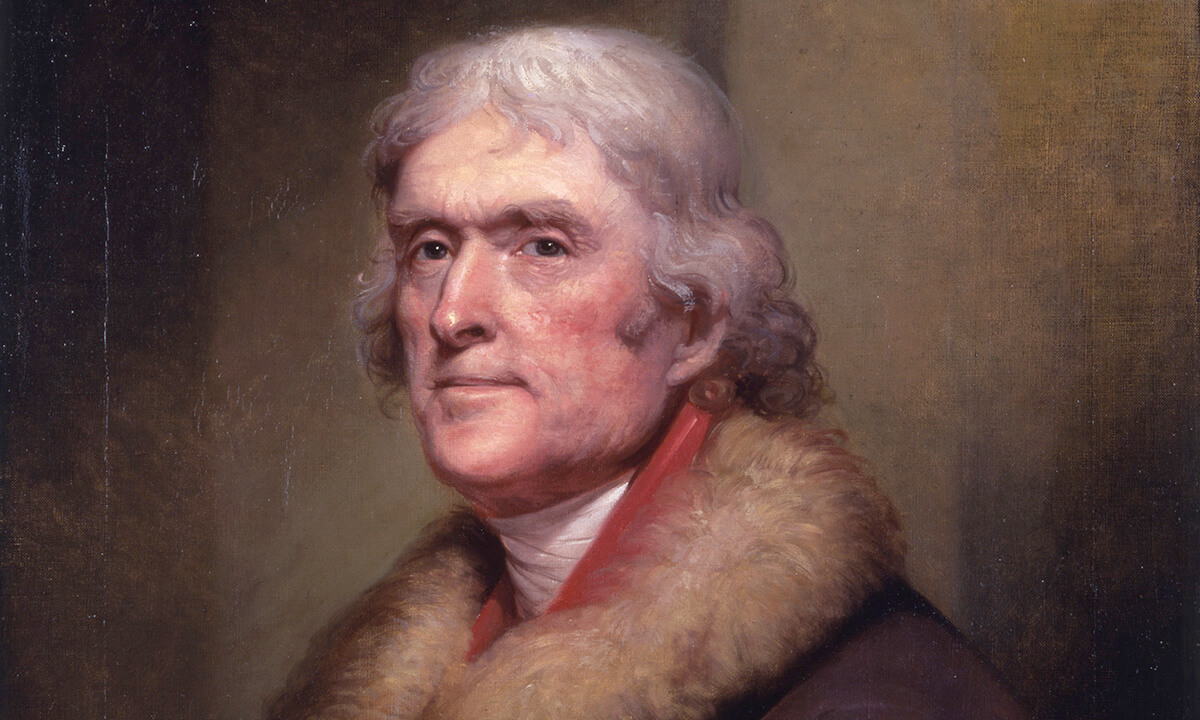
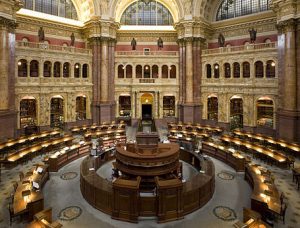
Religious Activities at Presidential Inaugurations

by David Barton

Americans have long believed that civic ceremonies such as presidential inaugurations should include religious activities. Recently, some individuals and groups have raised objections to these activities, often arguing that they violate the Founders’ supposed commitment to secularizing the public square by separating church and state.1 These arguments have no historical foundation, as can be seen by briefly considering America’s first presidential inauguration.

Constitutional experts abounded at George Washington’s inauguration. The inauguree himself was a signer of the Constitution, and one-fourth of the members of the Congress that organized and directed his inauguration had also been delegates to the Constitutional Convention. 2 This body certainly knew what was, and was not constitutional.

George Washington’s First Inauguration

The first inauguration occurred on April 30, 1789, at Federal Hall in New York City (the city served as the nation’s capital in 1789-1790). Extensive preparations for that event were made by Congress, with the cooperative help of a body of fourteen clergy, including ministers from different denominations and a rabbi.3

Local papers reported the first of these activities:

[O]n the morning of the day on which our illustrious President will be invested with his office, the bells will ring at nine o’clock, when the people may go up to the house of God and in a solemn manner commit the new government, with its important train of consequences, to the holy protection and blessing of the Most High. An early hour is prudently fixed for this peculiar act of devotion and it is designed wholly for prayer. 4

As the day proceeded, things appeared to be moving smoothly. But as the parade carrying Washington by horse-drawn carriage was nearing Federal Hall, it was realized that no Bible had been obtained for administering the oath. Today this would not be a problem for some civic officials, but in that era it would have been highly unusual to take an oath without a Bible.

Oaths in American History

In the Christian West, oath taking had long been held to be an innately religious activity. Many early colonial and state laws required oaths to be taken on the Bible. Some states even specified that they were to be taken “on the holy evangelists of Almighty God” 5 —that is, on the Bible, but with special emphasis on the Gospels. Requirements also routinely stipulated that “So help me God” be part of the official oath,6 and multiple states specifically required that the person taking the oath, “after repeating the words, ‘So help me God,’ shall kiss the Holy Gospels.” 7 These general provisions—in place at the time of the federal Constitution—were retained for generations.8

With this as the standard practice for oath-taking, a Bible was certainly needed. So Parade Marshal Jacob Morton hurried off and soon returned with a large 1767 King James Bible.

Bible & the Presidential Oath at the 1st Inauguration

The inaugural ceremony was conducted on the balcony at Federal Hall. With a huge crowd gathered below to watch the proceedings, the Bible was laid upon a crimson velvet cushion held by Samuel Otis, Secretary of the US Senate. New York Chancellor Robert Livingston administered the oath of office. (He was on the five-man committee charged with drafting the Declaration of Independence, but before he could affix his signature to the document he was called back to New York to guide his state through the Revolution. Because Livingston was the highest ranking judicial official in New York, he was chosen to administer the oath to President Washington.) Standing beside them were many distinguished officials, including Vice President John Adams, future Supreme Court Chief Justice John Jay, and Generals Henry Knox and Philip Schuyler.

When it came time to take the oath, Washington placed his left hand upon the Bible, which had been opened at random to Genesis 49,9 raised his right, and swore to “faithfully execute the office of President of the United States, and will to the best of my ability, preserve, protect and defend the Constitution of the United States.” He then bent over, reverentially kissed the Bible, and then likely added the words “So help me God.”

Oaths in the Various States

Significantly, twelve of the thirteen colonies at the time required the use of that phrase when taking an oath, 10 and the thirteenth colony required a declared belief in God just to hold office. 11 While no contemporary records verify this addition to his oath, it would have been highly unusual if he had neglected to do so; and we can be confident that the absence of these words would certainly have been noted in contemporary accounts.

Many of Washington’s actions related to oath-taking have clear antecedents in the Bible. For example, God declared: “I RAISED MY HAND IN AN OATH . . .” (Ezekiel 20:15, 23; 36:7; Psalm 106:26) and the Scripture further affirms that “The Lord has sworn by His RIGHT hand” (Isaiah 62:8). And when God’s people were instructed how to take an oath, they were told: “You shall . . . take oaths IN HIS NAME” (Deuteronomy 10:20), which is reflected with our use of the phrase “So help me God.”

Founders on Oaths

America’s Founders repeatedly affirmed that oath taking is an inherently religious activity. For example (emphasis added in each quote):

[An] oath—the strongest of religious ties.12 JAMES MADISON, SIGNER OF THE CONSTITUTION

[In o]ur laws . . . by the oath which they prescribe, we appeal to the Supreme Being so to deal with us hereafter as we observe the obligation of our oaths. The Pagan world were and are without the mighty influence of this principle which is proclaimed in the Christian system. 13 RUFUS KING, SIGNER OF THE CONSTITUTION

Oaths in this country are as yet universally considered as sacred obligations. 14 JOHN ADAMS, SIGNER OF THE DECLARATION, FRAMER OF THE BILL OF RIGHTS

An oath is an appeal to God, the Searcher of Hearts, for the truth of what we say and always expresses or supposes an imprecation [calling down] of His judgment upon us if we prevaricate [lie]. An oath, therefore, implies a belief in God and His Providence and indeed is an act of worship. . . . In vows, there is no party but God and the person himself who makes the vow.15 JOHN WITHERSPOON, SIGNER OF THE DECLARATION

The Constitution enjoins an oath upon all the officers of the United States. This is a direct appeal to that God Who is the avenger of perjury. Such an appeal to Him is a full acknowledgment of His being and providence. 16 OLIVER WOLCOTT, SIGNER OF THE DECLARATION

According to the modern definition [1788] of an oath, it is considered a “solemn appeal to the Supreme Being for the truth of what is said by a person who believes in the existence of a Supreme Being and in a future state of rewards and punishments . . .” 17JAMES IREDELL, RATIFIER OF THE CONSTITUTION, EARLY U. S. SUPREME COURT JUSTICE

The Constitution had provided that all the public functionaries of the Union, not only of the general [federal] but of all the state governments, should be under oath or affirmation for its support. The homage of religious faith was thus superadded to all the obligations of temporal law to give it strength. 18JOHN QUINCY ADAMS, PRESIDENT

George Washington, in his famous Farewell Address at the end of his presidency, pointedly warned Americans never to let the oath-taking process become secular:

[W]here is the security for property, for reputation, for life, if the sense of religious obligation desert the oaths . . . ?19

Clearly, in the Founding Era, the act of taking an oath was considered an intrinsically religious activity.

Eyewitness Account of the 1st Inauguration

After George Washington finished taking his oath, Chancellor Livingston proclaimed “It is done!” Turning to the crowd assembled below, he shouted, “Long live George Washington —the first President of the United States!” That shout was echoed and re-echoed by the crowd. As reported by one eyewitness:

It would seem extraordinary that the administration of an oath, a ceremony so very common and familiar, should in so great a degree excite the public curiosity. But the circumstances of his election—the impression of his past services—the concourse of spectators – the devout fervency with which he repeated the oath—and the reverential manner in which he bowed down and kissed the Sacred Volume—all these conspired to render it one of the most august and interesting spectacle ever exhibited on this globe. It seemed, from the number of witnesses, to be a solemn appeal to Heaven and earth at once. Upon the subject of this great and good man, I may perhaps be an enthusiast, but I confess that I was under an awful and religious persuasion that the gracious Ruler of the Universe was looking down at that moment with peculiar complacency [satisfaction] on an act, which to a part of His creatures was so very important. Under this impression, when the Chancellor pronounced in a very feeling manner, “Long live George Washington,” my sensibility was wound up to such a pitch that I could do not more than wave my hat with the rest, without the power of joining in the repeated acclamations which rent the air.20

Washington’s Inauguration Address

Washington and the other officials then left the balcony and went inside Federal Hall to the Senate Chamber, where he delivered the first Inaugural Address to a joint session of Congress. He began by emphasizing that it would be peculiarly improper to omit in this first official act my fervent supplications to that Almighty Being Who rules over the universe, Who presides in the councils of nations, and Whose providential aids can supply every human defect – that His benediction may consecrate to the liberties and happiness of the people of the United States a government instituted by themselves for these essential purposes. 21

Washington then called his listeners to remember and acknowledge God:

In tendering this homage [act of worship] to the Great Author of every public and private good, I assure myself that it expresses your sentiments not less than my own, nor those of my fellow-citizens at large less than either. No people can be bound to acknowledge and adore the Invisible Hand which conducts the affairs of men more than those of the United States. Every step by which they have advanced to the character of an independent nation seems to have been distinguished by some token of Providential Agency. . . . [and] we ought to be no less persuaded that the propitious [favorable] smiles of Heaven can never be expected on a nation that disregards the eternal rules of order and right which Heaven itself has ordained.22

Washington concluded the address by offering a heartfelt closing prayer:

I shall take my present leave—but not without resorting once more to the benign Parent of the Human Race in humble supplication [prayer] that . . . His Divine blessing may be equally conspicuous in the enlarged views, the temperate consultations, and the wise measures on which the success of this government must depend.23

Church After Inauguration

After the address, Congress had stipulated:

That after the oath shall have been administered to the President, he—attended by the Vice-President and members of the Senate and House of Representatives—proceed to St. Paul’s Chapel to hear Divine service.24

So, agreeable to the congressional resolution:

The President, the Vice-President, the Senate, and House of Representatives, &c., then proceeded to St. Paul’s Chapel, where Divine Service was performed by the chaplain of Congress. 25

The president and Congress went en masse to church, where the service was conducted by The Right Reverend Samuel Provoost—the Episcopal Bishop of New York who had been chosen chaplain of the Senate the preceding week. 26 He performed the service according to The Book of Common Prayer, including prayers taken from Psalms 144–150, administering the sacrament of Holy Communion, and Scripture readings from the book of Acts, I Kings, and the Third Epistle of John. 27

After the church service Congress returned to Federal Hall where it adjourned, thus concluding the official inaugural activities.

Conclusion

The first presidential inauguration included at least eight distinctly religious activities: (1) a time of public prayer preceding the inauguration (today, this often occurs through an official prayer breakfast preceding the inauguration); (2) the use of the Bible to administer the oath; (3) solemnifying the oath with multiple religious expressions (placing a hand on the Bible, saying “So help me God,” and kissing the Bible); (4) prayers offered by the president himself; (5) religious content in the inaugural address; (6) the president calling the people to pray or acknowledge God; (7) official church worship services; and (8) clergy-led prayers. These have been repeated, in whole or part, in every subsequent inauguration. 28

From the earliest colonial settlements to the first presidential inauguration, Americans believed that religious practices should play an important role in civic ceremonies. There is no reason to think America’s Founders desired to change these practices, and every reason to believe they firmly embraced them.


Endnotes

1 See, for example, “ FFRF asks Trump to eject religion and prayer from public oath-taking,” Freedom From Religion Foundation, January 3, 2017; Newdow v. Roberts, 603 F.3d 1002, Ct. of Appeals, Dist. of Columbia (2010); Newdow v. Bush, USDC, District of Columbia, Civil Action No. 04-2208 (JDB), opinion rendered January 14, 2005.

2 Significantly, many of the U. S. Senators at the first Inauguration had been delegates to the Constitutional Convention that framed the Constitution including William Samuel Johnson, Oliver Ellsworth, George Read, Richard Bassett, William Few, Caleb Strong, John Langdon, William Paterson, Robert Morris, and Pierce Butler; and many members of the House had been delegates to the Constitutional Convention, including Roger Sherman, Abraham Baldwin, Daniel Carroll, Elbridge Gerry, Nicholas Gilman, Hugh Williamson, George Clymer, Thomas Fitzsimmons, and James Madison.

3 See, for example, The Jewish Encyclopedia (New York: Funk and Wagnalls Company, 1907), XI:160, “Gershom Mendez Seixas.”

4 The Daily Advertiser, (New York, April 23, 1789), 2.

5 See, for example, the laws of Georgia, both before and after the federal Constitution: Oliver H. Prince, A Digest of the Laws of the State of Georgia (Milledgeville: Grantland & Orme, 1822), 3, “An Act for the case of Dissenting Protestants, within this province, who may be scrupulous of taking an oath, in respect to the manner and form of administering the same,” passed December 13, 1756 and South Carolina: Joseph Brevard, An Alphabetical Digest of the Public Statue Law of South Carolina (Charleston: John Hoff, 1814), II:86, “Oaths-Affirmations.”

6 See Connecticut as an example. For policies on this before the federal Constitution: R.R. Hinman, A.M., Letters From the English Kings and Queens, Charles II, James II, William and Mary, Anne, George II, &C., To the Governors of the Colony of Connecticut, Together With the Answers Thereto, From 1635 to 1749; And Other Original, Ancient, Literary and Curious Documents, Compiled From Files and Records in the Office of the Secretary of the State of Connecticut (Hartford: John B. Eldredge, Printer, 1836), 26-28. For policies on this following the federal Constitution, see: The Public Statute Laws of the State of Connecticut (Hartford: Hudson and Goodwin, 1808), 535, Title CXXII: Oaths, Ch. 1, Sec. 6, law passed in May, 1742; 540, Title CXXII: Oaths, Ch. 1, Sec. 25, law passed in May, 1726; 541, Title CXXII: Oaths, Ch. 1, Sec. 30 & 32, law passed in May, 1718.

For additional examples of states requiring people being sworn into office to say “so help me God” see: The Federal and State Constitution, Colonial Charters, and Other Organic Laws, ed. Francis Newton Thorpe (Washington: Government Printing Office, 1909), I:523, 1638-1639. Fundamental Orders of Connecticut; II:780, 1777. Georgia Constitution, Art. XIV-XV; III:1909, 1780. Massachusetts Constitution, Ch. VI; IV:2468, 1784. New Hampshire Constitution, “Oaths and Subscriptions”; VI:3255, 1778. Constitution of South Carolina, Sec. XXXVI. Laws of the State of Delaware (New Castle: Samuel and John Adams, 1797), II:1261, Ch. XCVIII, Sec. 29.

Laws of Maryland, Made Since MDCCLXIII (Annapolis: Frederick Green, 1787), Ch. V from “A Session of the General Assembly of Maryland…in the year of our Lord one thousand seven hundred and seventy-seven”. William Patterson, Laws of the State of New-Jersey (Newark: Matthias Day, 1800), 376, “An Act prescribing certain oaths,” February 20, 1799. The Public Laws of the State of Rhode-Island and Providence Plantations (Providence: Miller & Hutchens, 1822), 109, 111, “An Act to establish a Supreme Judicial Court,” passed from 1729-1822. Abridgment of the Public Permanent Laws of Virginia (Richmond: Augustine Davis, 1796), 219-220, “Oaths,” December 22, 1792, the text of many of the oaths listed here come from 1779.

7 John Haywood, A Manual of the Laws of North Carolina (Raleigh: J. Gales, 1814), 34, “Oaths and Affirmations. 1777”; Laws of the State of New-York (New York: Thomas Greenleaf, 1798), 21, “Chap. XXV: An Act to dispense with the usual mode of administering oaths, in favor of persons having conscientious scruples respecting the same, Passed 1st of April, 1778”; James Parker, Conductor Generalis: Or the Office, Duty and Authority of the Justices of the Peace (New York: John Patterson, 1788), 302-304, “Of oaths in general”.

8 George C. Edward, A Treatise on the Powers and Duties of Justices of the Peace and Town Officers, in the State of New York (Ithaca: Mack, Andrus & Woodruff, 1836), 91, “Of the proceedings on the trial.”

9 See, for example, “The 1st Presidential Inauguration,” Joint Congressional Committee on Inaugural Ceremonies (accessed on January 17, 2017).

10 Laws requiring some version of “so help me God” are found in all original 13 colonies except Pennsylvania. American Political Thought (Spring 2014), 3:1:55, Mark David Hall, “Madison’s Memorial and Remonstrance, Jefferson’s Statute for Religious Liberty, and the Creation of the First Amendment.”

11 The Pennsylvania Constitution of 1776 required legislators to swear or affirm, “I do believe in one God, the Creator and Governor of the universe, the Rewarder of the good and the Punisher of the wicked. And I do acknowledge the Scriptures of the Old and New Testament to be given by Divine inspiration” [The Constitutions of the Several Independent States of America (Boston: Norman and Bowen, 1785), 81, Pennsylvania, 1776, Chapter II, Section 10]. The Pennsylvania Constitution of 1790 required that the official “acknowledges the being of a God and a future state of rewards and punishments” [The American’s Guide: Comprising the Declaration of Independence; the Articles of Confederation; the Constitution of the United States; and the Constitutions of the Several States Composing the Union (Philadelphia: Towar, J. & D. M. Hogan, 1830), 168, Pennsylvania, 1790, Art. 9].

12 James Madison, The Writings of James Madison, ed. Gaillard Hunt (New York: G.P. Putnam’s Sons, 1904), V:30, to Thomas Jefferson on October 24, 1787.

13 Reports of the Proceedings and Debates of the Convention of 1821, Assembled for the Purpose of Amending The Constitution of the State of New York (Albany: E. and E. Hosford, 1821), 575, Rufus King, October 30, 1821.

14 John Adams, The Works of John Adams, ed. Charles Francis Adams (Boston: Little, Brown and company, 1854), IX:229, to the Officers of the First Brigade of the Third Division of the Militia of Massachusetts on October 11, 1798.

15 John Witherspoon, The Works of John Witherspoon (Edinburgh: J. Ogle, 1815), VII:139, 142, from his “Lectures on Moral Philosophy,” Lecture 16 on Oaths and Vows.

16 Jonathan Elliot, The Debates in the Several State Conventions on the Adoption of the Federal Constitution (Washington: Printed for the Editor, 1836), II:202, Oliver Wolcott on January 9, 1788.

17 Elliot, Debates (1836), IV:196, James Iredell on July 30, 1788.

18 John Quincy Adams, The Jubilee of the Constitution. A Discourse Delivered at the Request of the New York Historical Society, in the City of New York, on Tuesday, the 30th of April, 1839; Being the Fiftieth Anniversary of the Inauguration of George Washington as President of the United States, on Thursday, the 30th of April, 1789 (New York: Samuel Colman, 1839), 62.

19 George Washington, Address of George Washington, President of the United States . . . Preparatory to His Declination (Baltimore: George and Henry S. Keatinge, 1796), 23.

20 Gazette of the United States (May 9-13, 1789), 3, “Extract of a letter from New-York, May 3;” The American Museum: Or Repository of Ancient and Modern Fugitive Pieces, & c. Prose and Poetical (Philadelphia: Matthew Carey, 1789), V:505.

21 The Debates and Proceedings in the Congress of the United States, ed. Joseph Gales (Washington: Gales & Seaton, 1834), Vol. I, p. 27; George Washington, Messages and Papers of the Presidents, ed. James D. Richardson (Washington, D.C.: 1899), 1:44-45, April 30, 1789.

22 Debates and Proceedings (1834), I:27-29, April 30, 1789.

23 Debates and Proceedings (1834), I:27-29, April 30, 1789.

24 In the Senate: Debates and Proceedings (1834), I:25, April 27, 1789; in the House: Debates and Proceedings (1834), I:241, April 29, 1789.

25 Debates and Proceedings (1834), I:29, April 30, 1789.

26 Clarence W. Bowen, The History of the Centennial Celebration of the Inauguration of George Washington (New York, D. Appleton & Co., 1892), 54; “About the Senate Chaplain,” United States Senate, accessed June 24, 2025.

27 Book of Common Prayer (Oxford: W. Jackson & A. Hamilton, 1784), s.v., April 30th. For evidence that George Washington participated in that communion, see Peter Lillback, Sacred Fire (Bryn Mawr, PA: Dickinson Press, 2006), 420-423.

28 The religious activities that took place during Barack Obama’s inauguration ceremony in 2009 were fewer than those at Washington’s Inauguration but did include prayer before and after the oath of office, using a Bible during the oath, saying “so help me God” at the end of the oath [“The 56th Presidential Inauguration,” Joint Congressional Committee on Inaugural Ceremonies], religious content in the inaugural address [“President Barack Obama’s Inaugural Address,” The White House, January 21, 2009], and attending a prayer service the day after the inauguration [Amanda Ruggeri, “For President Obama, a Somber, Inclusive Inaugural Prayer Service,” U.S. News & World Report, January 21, 2009].


* This article concerns a historical issue and may not have updated information.

united states flag

The Real Story Behind Old Glory

You have given a banner to those who fear you, to be displayed because of the truth.
Psalm 60:4

June 14th is Flag Day which commemorates the day in 1777 when the Continental Congress passed a resolution “that the flag of the thirteen United States be thirteen stripes, alternate red and white; that the union be thirteen stars, white in a blue field, representing a new constellation.”1 Since that time, generations of Americans have celebrated the flag as a symbol of our God-given freedoms and God-blessed nation, and in every American military campaign, “Old Glory” has been a symbol of our freedom.

Interestingly, “Old Glory” was the name that Captain William Driver placed on a flag he was presented in 1831.2 The nickname given to that flag became so well known that during the Civil War, the Confederates tried unsuccessfully to confiscate and destroy Captain Driver’s flag that he had sewn into his bedcover to protect. 3 In 1862, when Union soldiers occupied Nashville, Driver took out his flag and flew it over the Capitol as a symbol that “Old Glory” stood firm.4

We still honor “Old Glory” today by celebrating Flag Day each year. The first Flag Day celebration occurred in Wisconsin in 1885, when a schoolteacher had his students observe June 14 as “Flag Birthday,” or “Flag Day.” This idea inspired others around the nation to continue the practice and as the celebrations grew, the idea received national recognition. In 1916, President Woodrow Wilson issued a presidential proclamation calling for the national celebration of Flag Day, thus establishing it as a national event.5

As you honor our flag, educate yourself on the greatness of America’s founding and inspire others to do the same!


Endnotes

1 Journals of the Continental Congress (Washington: Government Printing Office, 1907), VIII:464, June 14, 1777.
2 Harriet Ruth Waters Cooke, The Driver Family History (New York: John Wilson and Son, 1889), 180-181.
3 Cooke, Driver Family History (1889), 181-182; The Essex Institute of Historical Collections (Salem: The Essex Institute, 1901), 37:261-263, Robert S. Rantoul to Charles Kingsbury Miller, June 13, 1900.
4 The Essex Institute (1901), 27:261-263, Robert S. Rantoul to Charles Kingsbury Miller, June 13, 1900; Cooke, Driver Family History (1889), 180-182.
5 The Encyclopedia Americana (New York: The Encyclopedia Americana, 1919), 11:309, “Flag Day.”

* Originally Posted: June 14, 2012

Celebrate with Prayer

Millions join together annually in tens of thousands of groups across the nation for the National Day of Prayer, humbly imploring God’s blessings over this great nation. We stand in the long tradition as we follow the recommendation of Benjamin Franklin, who appealed to the 1787 Constitutional Convention to pray for this nation, when he said:

I have lived, Sir, a long time, and the longer I live, the more convincing proofs I see of this truth- that God governs in the affairs of men. And if a sparrow cannot fall to the ground without His notice, is it probable that an empire can rise without His aid? We have been assured, Sir, in the sacred writings, that “except the Lord build the House they labor in vain that build it.” I firmly believe this; and I also believe that without His concurring aid we shall succeed in this political building no better than the Builders of Babel.

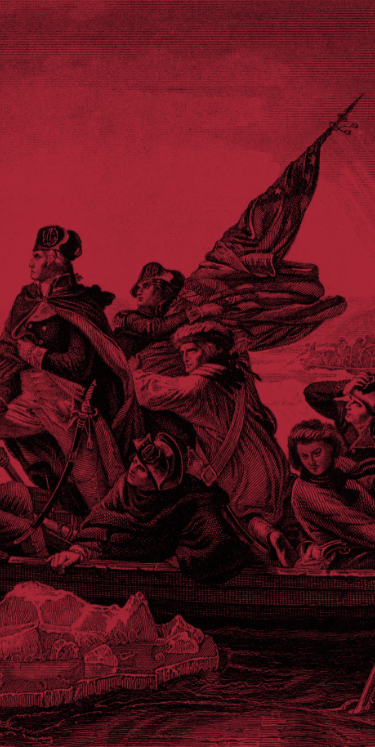
It is truly time to ask that God would govern in the affairs of men, that He would build the foundations of this nation, and that He would bless this great nation once again. Celebrate the annual observance of this call by participating in a prayer group near you.

To find these locations, you can visit the National Day of Prayer official site. If you’re unable to attend a gathering, please take time to personally lift up our nation, our government, our leaders, our military, our families, our businesses, our places of worship and ask for God to continue blessing our nation as we turn our face to Him.

A God-Given Inalienable Right

One of the first rights to be protected in early America was the right of conscience – the right to believe differently on issues of religious faith. As John Quincy Adams explained, this right was a product of Christianity:

Jesus Christ. . . . came to teach and not to compel. His law was a Law of Liberty. He left the human mind and human action free. 1

Early American legal writer Stephen Cowell (1800-1872) agreed:

Nonconformity, dissent, free inquiry, individual conviction, mental independence, are forever consecrated by the religion of the New Testament. 2

President Franklin D. Roosevelt likewise declared:

We want to do it the voluntary way – and most human beings in all the world want to do it the voluntary way. We do not want to have the way imposed. . . . That would not follow in the footsteps of Christ. 3

The Scriptures teach that there will be differences of conscience (cf. 1 Corinthians 8) and that if an individual “wounds a weak conscience of another, you have sinned against Christ” (v. 12). We are therefore instructed to respect the differing rights of conscience (v. 13). (See also I Corinthians 10:27-29.) Extending toleration for the rights of conscience is urged throughout the New Testament. (See also Romans 14:3, 15:7, Ephesians 4:2, Colossians 3:13, etc.)

Leaders who knew the Scriptures therefore protected those rights. For example, in 1640, the Rev. Roger Williams established Providence, penning its governing document declaring:

We agree, as formerly hath been the liberties of the town, so still, to hold forth liberty of conscience. 4

Similar protections also appear in the 1649 Maryland “Toleration Act,” 5 the 1663 Charter for Rhode Island, 6 the 1664 Charter for Jersey, 7 the 1665 Charter for Carolina, 8 the 1669 Constitutions of Carolina, 9 the 1676 Charter for West Jersey, 10 the 1701 Charter for Delaware, 11 and the 1682 Frame of Government for Pennsylvania. 12 John Quincy Adams affirmed that: “The transcendent and overruling principle of the first settlers of New England was conscience.” 13

Then when America separated from Great Britain in 1776 and the states created their very first state constitutions, they openly acknowledged Christianity and jointly secured religious toleration, non-coercion, and the rights of conscience. For example, the 1776 constitution of Virginia declared:

That religion, or the duty which we owe to our Creator and the manner of discharging it, can be directed only by reason and conviction, not by force or violence; and therefore all men are equally entitled to the free exercise of religion according to the dictates of conscience; and that it is the mutual duty of all to practice Christian forbearance, love, and charity towards each other. 14

Similar clauses appeared in the constitutions of New Jersey (1776), 15 North Carolina (1776), 16 Pennsylvania (1776), 17 New York (1777), 18 Vermont (1777), 19 South Carolina (1778), 20 Massachusetts (1780), 21 New Hampshire (1784), 22 etc. Today, the safeguard for the rights of conscience pioneered by Christian leaders is a regular feature of state constitutions. 23

The Founding Fathers were outspoken about the importance of this God-given inalienable right. For example, signer of the Constitution William Livingston declared:

Consciences of men are not the objects of human legislation. . . . [H]ow beautiful appears our [expansive] constitution in disclaiming all jurisdiction over the souls of men, and securing (by a never-to-be-repealed section) the voluntary, unchecked, moral suasion of every individual. 24

And John Jay, the original Chief Justice of the U. S. Supreme Court, similarly rejoiced that:

Security under our constitution is given to the rights of conscience and private judgment. They are by nature subject to no control but that of Deity, and in that free situation they are now left. 25

President Thomas Jefferson likewise declared that the First Amendment was an “expression of the supreme will of the nation in behalf of the rights of conscience.” 26

But President Obama disagrees with what for four centuries in American history has formerly been an inalienable right. He has specifically singled out and attacked the rights of religious and moral conscience, seeking to coerce dissenters into accepting his own beliefs. While Biblical teachings result in protection for differences of opinion on religious issues, secularists demand conformity of belief and practice to their own secular standards; they are especially intolerant of any differences that stem from Biblical faith.

While the President has targeted the Catholic Church for its religious beliefs, his attacks on religious conscience were ongoing, beginning shortly after he first took office when he first announced his plans to repeal religious conscience protection for medical workers. (We have posted on our website a piece showing the extreme and consistent hostility of this President against Biblical faith and values. As proven by his own actions and words, he is the most anti-Biblical president in American history.)


1 John Quincy Adams, A Discourse on Education Delivered at Braintree, Thursday, October 24th, 1839 (Boston: Perkins & Marvin, 1840), 17-18.

2 Stephen Colwell, Politics for American Christians: A World upon our Example as a Nation, our Labour, our Trade, Elections, Education, and Congressional Legislation (Philadelphia: Lippincott, Grambo & Co. 1852), 82.

3 “Franklin D. Roosevelt, “Christmas Greeting to the Nation,” American Presidency Project, December 24, 1940, https://www.presidency.ucsb.edu/node/209414.

4 “Plantation Agreement at Providence,” The Avalon Project, August 27 – September 6, 1640, https://avalon.law.yale.edu/17th_century/ri01.asp.

5 William MacDonald, Select Charters and Other Documents Illustrative of American History 1606-1775 (New York: MacMillan Company, 1899), 104-106.

6 “Plantation Agreement at Providence August 27 – September 6, 1640,” The Federal and State Constitutions, Colonial Charters and Other Organic Laws, ed. Francis Newton Thorpe (Washington: Government Printing Office, 1909), VI:3211; “Charter of Rhode Island and Providence Plantations,” The Avalon Project, July 15, 1663, https://avalon.law.yale.edu/17th_century/ri01.asp.

7 “The Concession and Agreement of the Lords Proprietors of the Province of New Caesarea, or New Jersey,” The Avalon Project, 1664, https://avalon.law.yale.edu/17th_century/nj05.asp.

8 “Charter of Carolina,” The Avalon Project, June 30, 1665, https://avalon.law.yale.edu/17th_century/nc03.asp.

9 “Fundamental Constitution of Carolina,” The Avalon Project, March 1, 1669, https://avalon.law.yale.edu/17th_century/nc05.asp.

10 “The Charter or Fundamental Laws of West New Jersey,” The Avalon Project, 1676, https://avalon.law.yale.edu/17th_century/nj05.asp.

11 “Charter of Delaware,“ The Avalon Project, 1701, https://avalon.law.yale.edu/18th_century/de01.asp.

12 “ Frame of Government of Pennsylvania,“ The Avalon Project, May 5, 1682, https://avalon.law.yale.edu/17th_century/pa04.asp.

13 John Quincy Adams, A Discourse on Education Delivered at Braintree, Thursday, October 24th, 1839 (Boston: Perkins & Marvin, 1840), 28.

14 “Constitution of Virginia: Bill of Rights,” The American’s Guide: Comprising the Declaration of Independence; the Articles of Confederation; the Constitution of the United States, and the Constitutions of the Several States Composing the Union (Philadelphia: Hogan & Thompson, 1845), 180.

15 “Constitution of New Jersey,” The Avalon Project, 1776, https://avalon.law.yale.edu/18th_century/nj15.asp.

16 Constitutions of the Several Independent States of America (Boston: Norman & Bowen, 1785), 132.

17 Constitutions of the Several Independent States of America (Boston: Norman & Bowen, 1785), 77.

18 “The Constitution of New York,” The Avalon Project, April 20, 1777, https://avalon.law.yale.edu/18th_century/ny01.asp 1777.

19 The Federal and State Constitutions, Colonial Charters, and Other Organic Laws, 3d. Francis Newton Thorpe (Washington: Government Printing Office, 1909), VI:3740.

20 Constitutions of the Several Independent States of America, (Boston: Norman & Bowen, 1785), 152-154.

21 Constitutions of the Several Independent States of America (Boston: Norman & Bowen, 1785), 6.

22 Constitutions of the Several Independent States of America (Boston: Norman & Bowen, 1785), 3-4.

23 “State Policies in Brief: Refusing to Provide Health Services,” Guttmacher Institute, March 1, 2012, https://www.guttmacher.org/statecenter/spibs/spib_RPHS.pdf.

24 William Livingston, The Papers of William Livingston, eds. Carl E. Prince, et al (Trenton: New Jersey Historical Commission, 1980), 2:235-237, writing as “Cato,” February 18, 1778.

25 Benjamin F. Morris, Christian Life and Character of the Civil Institutions of the United States, Developed in the Official and Historical Annals of the Republic (Philadelphia: George W. Childs, 1864), 152.

26 Thomas Jefferson to Messrs. Nehemiah Dodge, Ephraim Robbins, and Stephen S. Nelson, A Committee of the Danbury Baptist Association, in the State of Connecticut, January 1, 1802 Writings of Thomas Jefferson, ed. Albert Ellery Bergh (Washington D.C.: Thomas Jefferson Memorial Association, 1904), XVI:281-282.

* This article concerns a historical issue and may not have updated information.