Ten Facts About George Washington

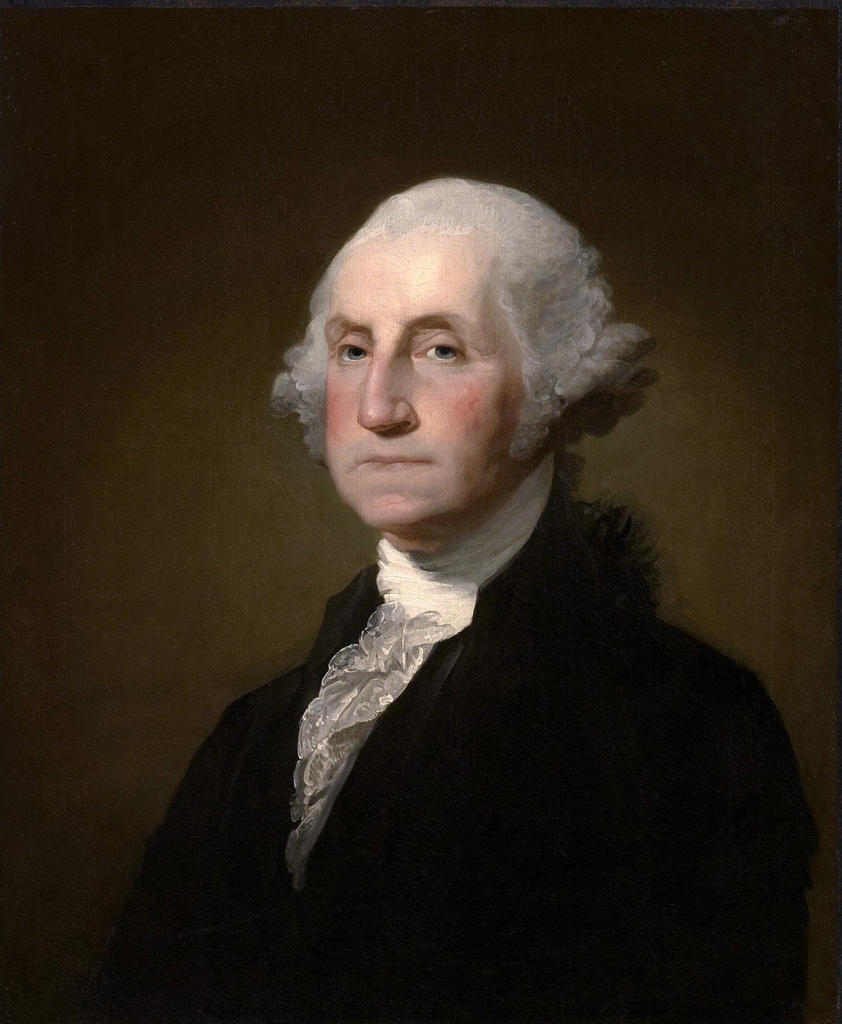
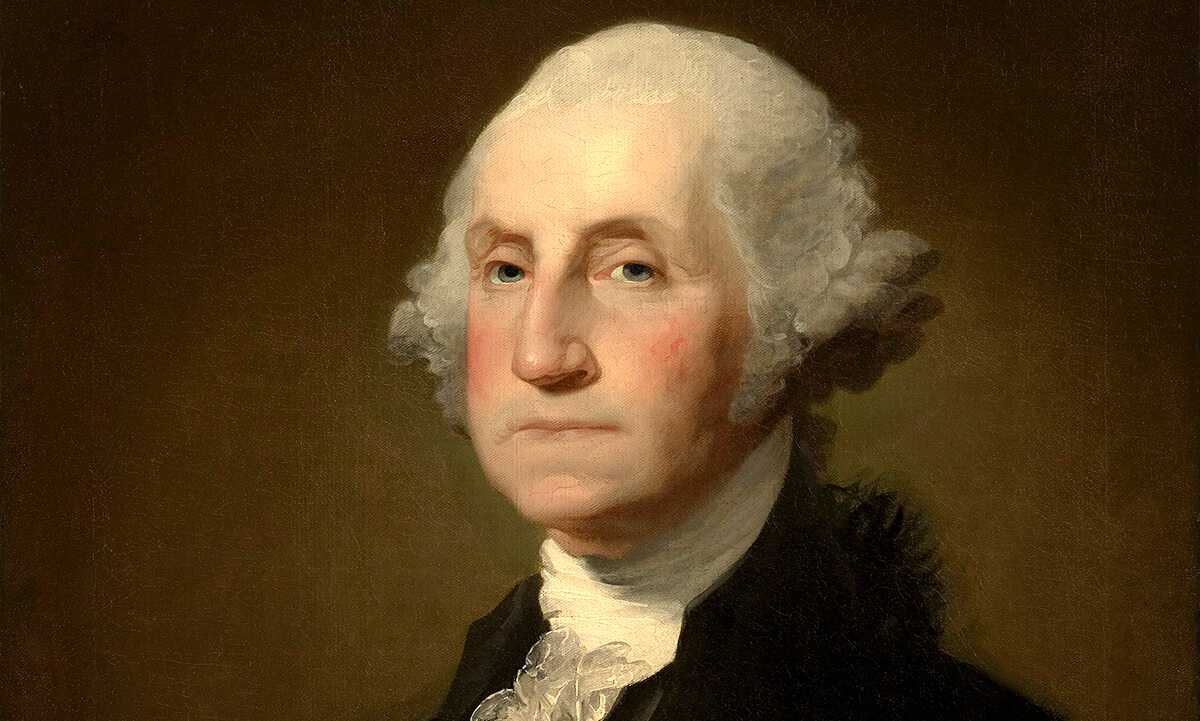
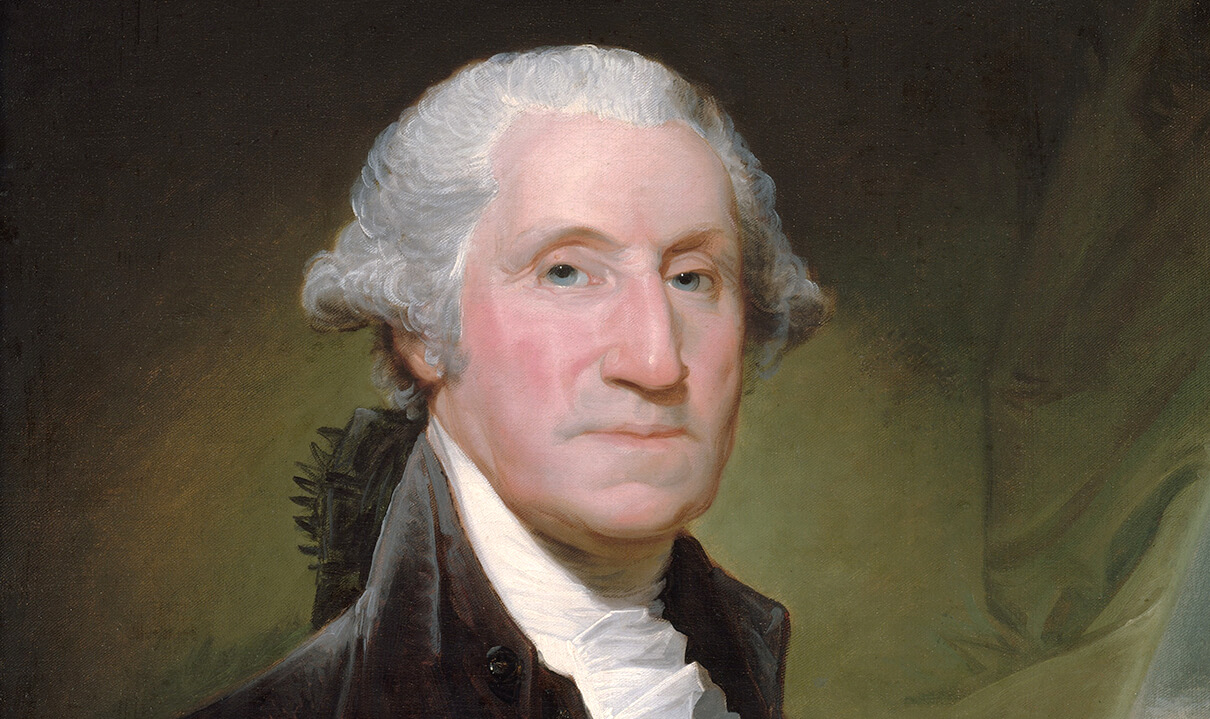
From the $1 Bill to the capital of America, George Washington’s name appears more often than probably any other name in American history. Being the most prominent Founding Father, everyone learns how Washington led the Continental Army against the British during the War for Independence and eventually became the first President of the United States. But there are plenty of stories and facts that are rarely taught in schools today. Watch the video and then read below about ten facts you probably do not know about George Washington.

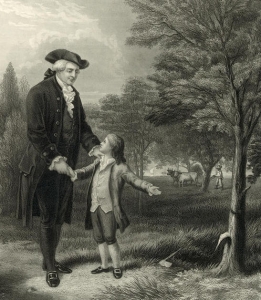
1. George Washington did not chop down a cherry tree.

“I cannot tell a lie,” a young George Washington is reported to have said—but his biographers sure can! The famous story originates from the 5th edition of the popular biography The Life of Washington the Great by Mason Weems.1 Published in 1806, seven years after Washington’s death, there are no primary sources attesting to its truthfulness. All things considered, its late appearance and the complete lack of evidence has led most to consider it apocryphal.

2. He was most embarrassed about his lack of education and his bad teeth.

The most persistent enemy to Washington were not his political or military opponents, but his teeth. By the time he was sworn in as the first President of the United States he only had a single original tooth left.2 Over the course of his life he had a number of dentures made from a wide variety of materials.3 The dentures of the time were large, bulky, and burdensome which worked together to make Washington quite self-conscience about them leading him to be more introverted than perhaps he might have been.4

On top of this, George Washington did not have the same high level of education his older brothers received due to the death of their father when he was only eleven years old. This tragedy led Washington to become a surveyor (which incidentally provided the exact education he needed to accomplish the amazing things God had planned for him). When standing next to the genius level intellects of Jefferson, Adams, and others it was easy for Washington to feel at an embarrassing disadvantage to his more educated peers.5 That said, Washington was still incredibly intelligent on account of his extensive reading throughout his life in order to make up for his perceived lack of formal education.

3. He was nominated to be commander of the colonial army by John Adams.

“I do not think myself equal to the Command I am honored with.”6 It was with these words that the ever-humble George Washington accepted the unanimous appointment to command the soon-to-be-created Continental Army. The official vote happened on June 15, 1775, with John Adams credited as being the one who recommended and nominated Washington to the position.7 On the occasion, Adams wrote to his wife explaining how Congress elected the, “modest and virtuous, the amiable, generous and brave George Washington,” and solemnly proclaimed that, “the Liberties of America, depend upon him.”8

4. George Washington was described as being taller than the average man.

In an era when the average man stood at 5’7″, noted early biographer Jared Sparks clocked Washington in at an impressive 6’3″ tall.9 John Adams, later in life, wrote to fellow signer of the Declaration of Independence, Dr. Benjamin Rush, that Washington had, “a tall stature, like the Hebrew sovereign chosen because he was taller by the head than the other Jews.”10

A military observer repeatedly called attention to the vast stature of Washington, explaining, “it is not difficult to distinguish him from all others; his personal appearance is truly noble and majestic; being tall and well proportioned.”11 He continues to write that Washington, “is remarkably tall, full six feet, erect and well proportioned…This is the illustrious chief, whom a kind Providence has decreed as the instrument to conduct our country to peace and to Independence.”12 George Washington was a tall man with an even bigger purpose.

5. He encouraged his troops to go to church.

As General, Washington would issue orders throughout the army instructing them on daily operations. On June 23, 1777, he issued the following order:

“All chaplains are to perform divine service tomorrow, and on every other succeeding Sunday, with their respective brigades and regiments, when their situations will admit of it, and the commanding officers of the corps are to see that they attend. The Commander-in-Chief expects an exact compliance with this order, and that it be observed in future as an invariable rule of practice, and every neglect will not only be considered a breach of orders, but a disregard to decency, virtue, and religion.”13

Being a man of great piety and sincere religion himself, it is no surprise that Washington placed such an extraordinary emphasis on his soldiers’ corporate worship. In fact, when Washington believed the chaplains were not making regular church services a proper priority, he required all the chaplains to come to a meeting to address the issue and then report back to him.14

Washington’s devotion to Christ was so apparent in the camp that the Rev. Henry Muhlenberg, father of Major General John Peter Gabriel Muhlenberg, remarked:

“His Excellency General Washington rode around among his army yesterday and admonished each and every one to fear God, to put away the wickedness that has set in and become so general, and to practice the Christian virtues. From all appearances this gentleman does not belong to the so-called world of society, for he respects God’s Word, believes in the atonement through Christ, and bears himself in humility and gentleness. Therefore the Lord God has also singularly, yea, marvelously, preserved him form harm in the midst of countless perils, ambuscades [ambushes], fatigues, etc. and has hitherto graciously held him in His hand as a [chosen] vessel. II Chronicles 15:1-3.”15

6. He forbade his officers to swear.

Along the same lines as the previous fact, Washington focused on making the American military not only righteous but also respectable. To this end, on July 4, 1775, he issued the following order:

“The General most earnestly requires, and expects, a due observance of those articles of war, established for the government of the army, which forbid profane cursing, swearing and drunkenness. And in like manner requires and expects, of all officers, and soldiers, not engaged on actual duty, a punctual attendance on Divine Service, to implore the blessings of Heaven upon the means used for our safety and defense.”16

7. He was the only President elected unanimously.

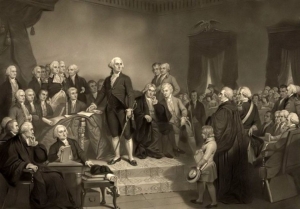
After the ratification of the Constitution, the first order of business was to fill the newly created positions of government. The most important question was, “who will be our President?” For the Americans of 1789, that was apparently an easy answer. “George Washington of course!” With that resolution, Washington, “by no effort of his own, in a manner against his wishes, by the unanimous vote of a grateful country.”17 In the history of the United States, there has been only one other unanimous vote for President — Washington again for his second term.18

8. George Washington added “So help me God” to the Presidential Oath of Office.

Article II, Section 1, of the Constitution states that when the President is sworn into office, he is to say the following oath:

“I do solemnly swear (or affirm) that I will faithfully execute the Office of President of the United States, and will to the best of my Ability, preserve, protect and defend the Constitution of the United States.”

With his hand laid upon the open Bible, Washington repeated the oath. He then sealed the oath by with a solemn, “so help me God,” and reverently bowed down and kissed the Bible.19 One eyewitness to the event recalled that, “it seemed, from the number of witnesses, to be a solemn appeal to Heaven and earth at once.”20

9. He was elected to be a vestryman at local churches.

In early American Episcopalian churches, vestrymen were, “a select number of principal persons of every parish, who choose parish officers and take care of its concerns.”21 This included making sure the poor, widows, and orphans were taken care of, and even extended to major decisions about the church as a whole.

George Washington was elected (perhaps his first election) to be a vestryman in two different parishes. In March of 1765, he was chosen in Fairfax Parish with 274 votes, and then four months later he was again chosen in Truro Parish with 259 votes.22 Washington was extremely active as a vestryman.23

On one occasion, Washington even went toe-to-toe with George Mason (fellow future delegate to the Constitution Convention) about relocating the church to a new site. After an impassioned speech by Mason which seemingly settled the question, Washington unassumingly rose and used a surveying map to show where the new site would be and how it would be better for each parishioner. This sudden recourse to sound reason and just sensibilities restored the council to their senses and they voted with Washington to move the church to the new site.24

10. George Washington was killed by his doctors.

This characterization might be a little uncharitable—the doctors were doing the best they could with the knowledge they had—but it doesn’t mean it’s not true. The old General fell sick after riding out on Mount Vernon during the cold rain. Soon, he was struggling to breathe. The following is taken from the journal of George Washington’s lifelong friend and physician, James Craik:

“The disease commenced with a violent ague, accompanied with some pain in the upper and fore part of throat, a sense of stricture in the same part, a cough, and a difficult rather than paint deglutition, which were soon succeeded by fever and a quick and laborious respiration. The necessity of blood-letting suggesting itself to the General, he procured a bleeder in the neighborhood, who took from his arm, in the night, twelve or fourteen ounces of blood.”25

Medical science at the time thought that a number of sicknesses were caused because of some issue with the person’s blood itself. To fix the disease, therefore, a common “solution” would be to bleed a patient out in order to get rid of the bad blood.

Once more doctors had been called to the scene, Craik continues:

“In the interim were employed two copious bleedings; a blister was applied to the part affected, two moderate doses of calomel were given, and an injection was administered, which operated on the lower intestines—but all without any perceptible advantage; the respiration becoming still more difficult and distressing.”26

Even more blood was taken, and now the doctors applied hot irons to his throat because they thought that an accumulation of blood in Washington’s throat was what caused the difficulty breathing. Calomel is a kind of mercury chloride, which, we now know to be quite toxic! This, along with the bleedings and the injections were a long way off from helping Washington recover. But the doctors weren’t done yet:

“Upon the arrival of the first of the consulting physicians, it was agreed… To try the result of another bleeding, when about thirty-two ounces of blood were drawn, without the smallest apparent alleviation of the disease… ten grains of calomel were given, succeeded by repeated doses of emetic tartar, amounting, in all, to five or six grains, with no other effect than a copious discharge of the bowels. The powers of life seemed now manifestly yielding to the force of the disorder. Blisters were applied to the extremities.”27

More blood-letting, more toxic calomel, more blisters. The biggest variation in this round of treatments is that they gave Washington another poisonous substance—emetic tartar. Altogether, it served only to give the dying President diarrhea.

Finally, Dr. Craik relates the end to his friend’s suffering:

“Speaking, which was painful from the beginning, now became almost impracticable; respiration grew more and more contracted and imperfect, till… when retaining the full possession of his intellect, he expired without a struggle.”28

A contemporary doctor estimated the total amount of blood drawn to be, “the enormous quantity of eighty-two ounces, or above two quarts and a half of blood in about thirteen hours.”29 The same doctor goes on to accurately explain that:

“Very few of the most robust young men in the world could survive such a loss of blood; but the body of an aged person must be so exhausted, and all his power so weakened by it as to make his death speedy and inevitable.”30

The average amount of blood in someone of Washington’s size and stature is around 210 ounces. If, as the doctor estimates, somewhere around 82 ounces were taken, then Washington lost nearly 40% of his blood. This amount is nearly tantamount to exsanguination (death by bleeding out), and when combined with the blisters, calomel, emetic tartars, and the various vapors, it appears to be the unfortunate conclusion that the doctors killed George Washington.31


Endnotes

1. Mason Locke Weems, The Life of Washington the Great (Augusta: George P. Randolph, 1806), 8-9.
2. “Washington Tooth Troubles,” Mount Vernon (accessed March 29, 2019).
3. “False Teeth,” Mount Vernon (accessed September 18, 2023).
4. “Washington Tooth Troubles,” Mount Vernon (accessed March 29, 2019).
5. “Education” Mount Vernon (accessed March 29, 2019).
6. June 16, 1775, Journal of the Proceedings of the Congress, Held at Philadelphia, May 10, 1775
7. John Adams autobiography, part 1, through 1776, Adams Family Papers: An Electronic Archive, Massachusetts Historical Society.
8. John Adams to Abigail Adams, June 17, 1775, Adams Family Papers: An Electronic Archive, Massachusetts Historical Society.
9. Jared Sparks, The Life of George Washington (Boston: Ferdinand Andrews, 1839), 102n.
10. John Adams to Benjamin Rush, November 11, 1807, Founders Online (accessed March 29, 2019).
11. James Thacher, A Military Journal During the American Revolutionary War (Boston: Richardson and Lord, 1823), 37.
12. Thacher, Military Journal, 182-183.
13. George Washington, General Order, June 28, 1777, Records of the Revolutionary War (New York: Pudney & Russell, 1858), 330.
14. Washington, General Order, October 6, 1777, Records of the Revolutionary War, 345.
15. Henry M. Muhlenberg, The Journals of Henry Melchoir Muhlenberg (Philadelphia: The Muhlenberg Press, 1958), III:149, journal entry for May 7, 1778.
16. George Washington, General Orders, July 4, 1775, Library of Congress (accessed September 18, 2023).
17. Washington Irving, Life of George Washington (New York: G. P. Putman & Company, 1857), IV:516.
18. Annals of Congress (1873), 2nd Congress, 2nd Session,  874-875, February 13, 1793; Jared Sparks, The Life of George Washington (Boston: Ferdinand Andrews, 1839), 445.
19. Irving, Washington, IV:475.
20. “Philadelphia, May 8. Extract of a Letter from New York, May 3,” Gazette of the United States (May 9 to May 13, 1789).
21. Noah Webster, “Vestry-man,” American Dictionary of the English Language (1828).
22. Jared Sparks, The Life of George Washington (Boston: Ferdinand Andrews, 1839), 520.
23. “Churchwarden and Vestryman,” Mount Vernon (accessed April 1, 2019).
24. Sparks, Washington, 106.
25. James Craik, “From The Times, A Newspaper printed in Alexandria (Virginia), dated December, 1799,” The Medical Repository (New York: T. & J. Swords, 1805), III:311.
26. Craik, “From The Times” Medical Repository, III:311-312.
27. Craik, “From The Times” Medical Repository, III:312.
28. Craik, “From The Times” Medical Repository, III:312.
29. John Brickell, “Medical Treatment of General Washington,” Transactions of the College of Physicians of Philadelphia (Philadelphia: Printed for the College, 1903), 25:93.
30. Brickell, “Medical Treatment” College of Physicians of Philadelphia, 25:93.
31. For a more technical examination of the medical circumstances surrounding Washington’s death see, Dr. Wallenborn’s, “George Washington’s Terminal Illness: A Modern Medical Analysis of the Last Illness and Death of George Washington,” The Washington Papers (November 5, 1997).


* Originally posted: May 9, 2019


“Give Me Liberty, or Give Me Death”

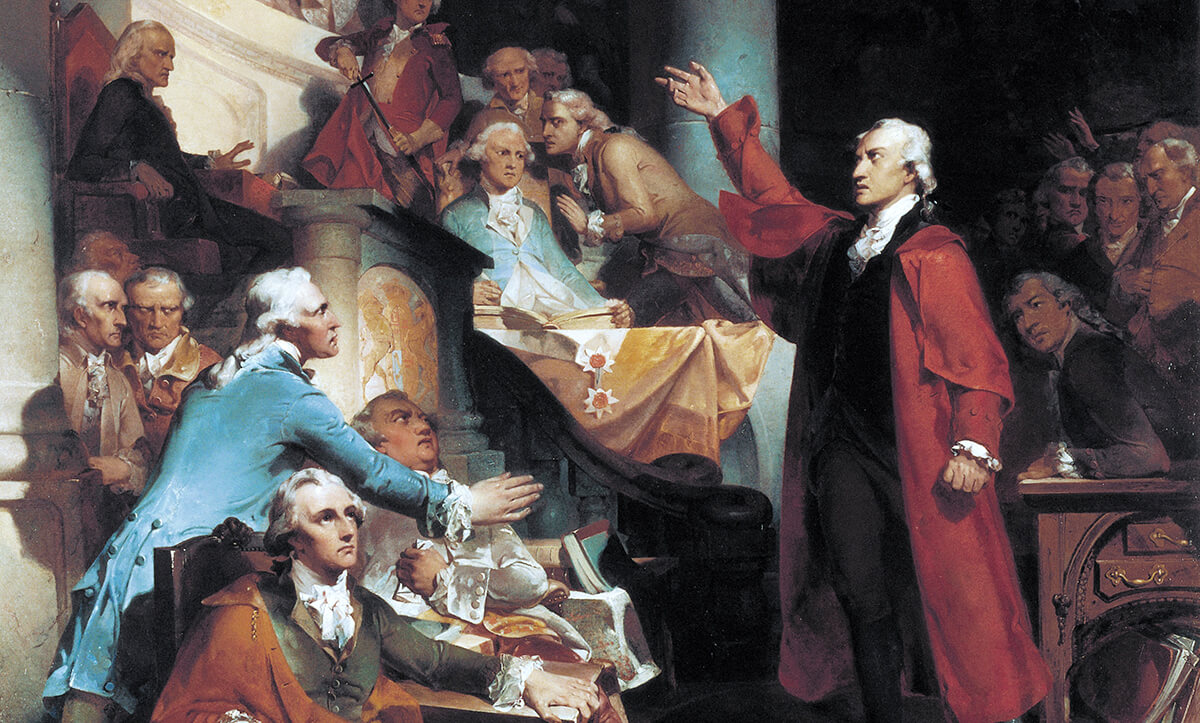
On March 23, 1775, Patrick Henry delivered one of the most famous speeches in American history. While some of his words are still familiar today, many Americans are unaware of the turbulent times preceding his celebrated address.

In the 1760s, Parliament passed numerous laws directly violating the rights of the colonists, including the Sugar Act (1764), the Stamp Act (1765), and many others. Patrick Henry, a member of the Virginia House of Burgesses, was one of many who objected. When the Stamp Act was repealed in 1766, the joy was so widespread that a Boston minister preached a notable sermon celebrating the event!

But the repeal of the Stamp Act was only a temporary reprieve. In 1767 came the hated Townshend Revenue Acts, which led to additional boycotts and protests. When the British sent troops to America to enforce these acts, it led to the shooting down of five Americans in what became known as the Boston Massacre. The Townshend Acts were finally repealed, but in 1774 they were replaced by even worse laws known as the Intolerable Acts.

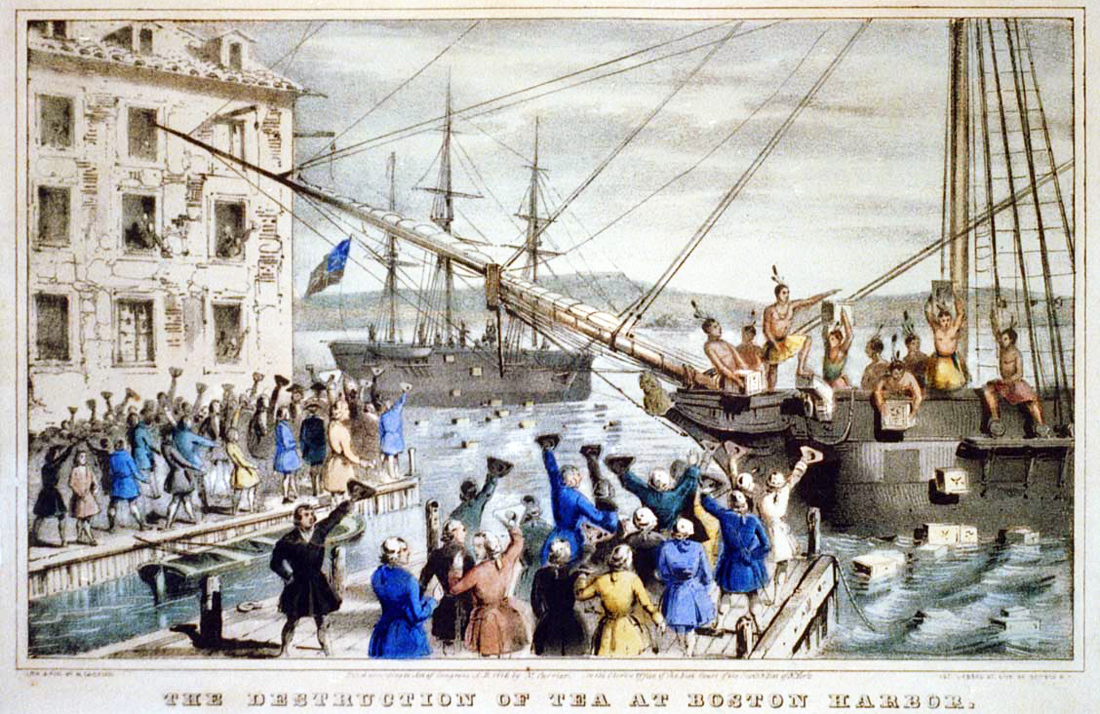
The British became more hard-fisted, and following the Boston Tea Party, they closed almost all commercial shipments, effectively ended self-government in Massachusetts, and required the people to house British troops in private homes. It was against the backdrop of this turmoil that Patrick Henry rose to speak.

Some had argued that the American Colonies were too weak to do anything against the British (one of the world’s greatest powers at that time), but in his March 23, 1775 speech, Henry replied:

Three millions of people armed in the holy cause of liberty and in such a country as that which we possess are invincible by any force which our enemy can send against us. Besides, sir, we shall not fight our battles alone. There is a just God Who presides over the destines of nations, and Who will raise up friends to fight our battles for us. The battle, sir, is not to the strong alone; it is to the vigilant, the active, the brave. . . .Gentlemen may cry, peace, peace — but there is no peace. The war is actually begun! The next gale that sweeps from the north will bring to our ears the clash of resounding arms! Our brethren are already in the field! . . . . Is life so dear, or peace so sweet as to be purchased at the price of chains and slavery? Forbid it, Almighty God! I know not what course others may take; but as for me, give me liberty, or give me death!

Significantly, Henry’s speech was heavily punctuated with quotations from numerous Bible verses. (See the commentary surrounding Matthew 12 in the Founders’ Bible for more about this, also showing how Bible verses appeared throughout numerous famous speeches by our Founding Fathers.) Not long after his speech came the Battles of Lexington and Concord, beginning the American War for Independence. So March 23rd marks the anniversary of one of the most famous speeches heralding American independence! (You can even purchase a parchment reprint of this famous speech from WallBuilders.)

First Federal Budget: 1789

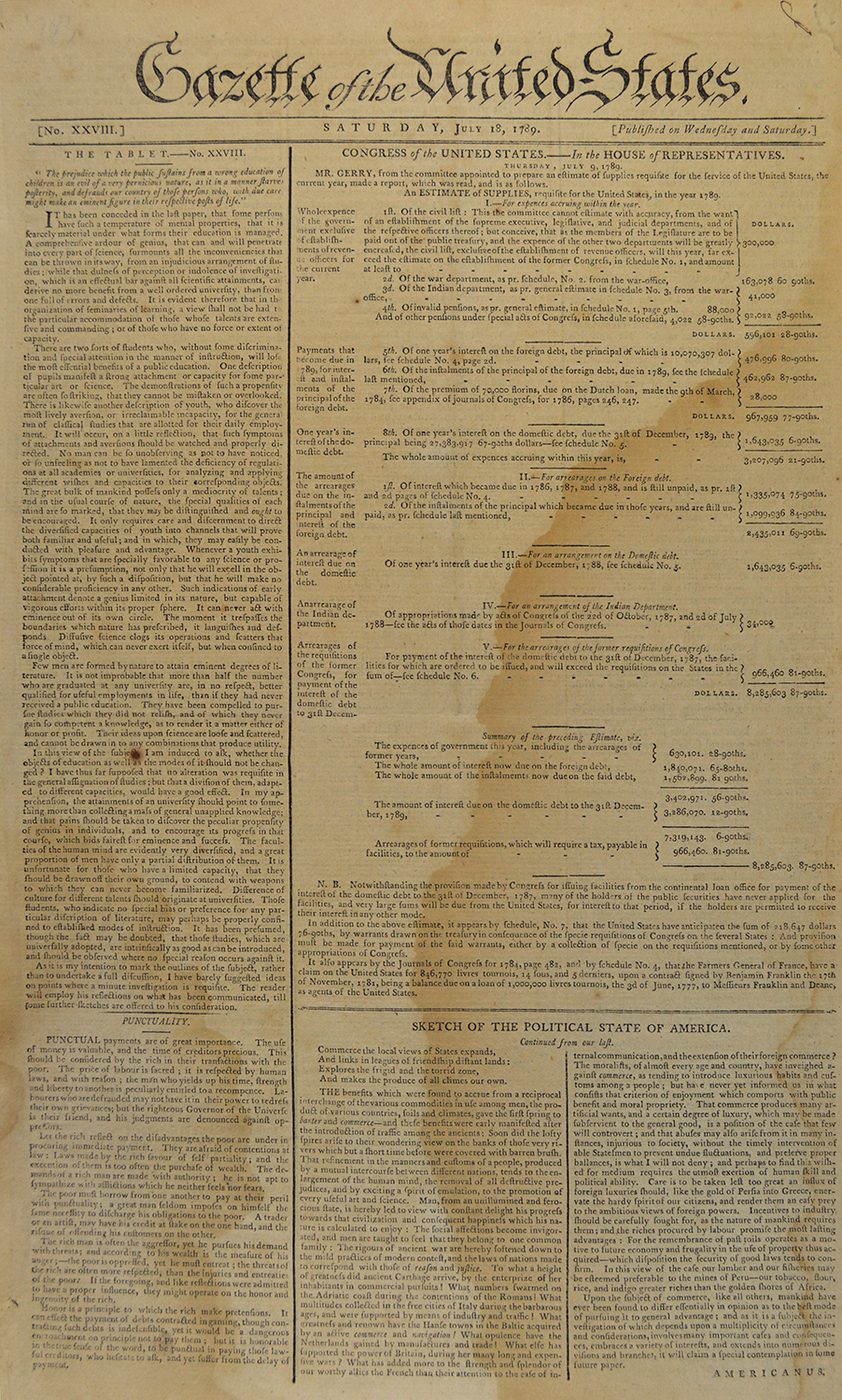
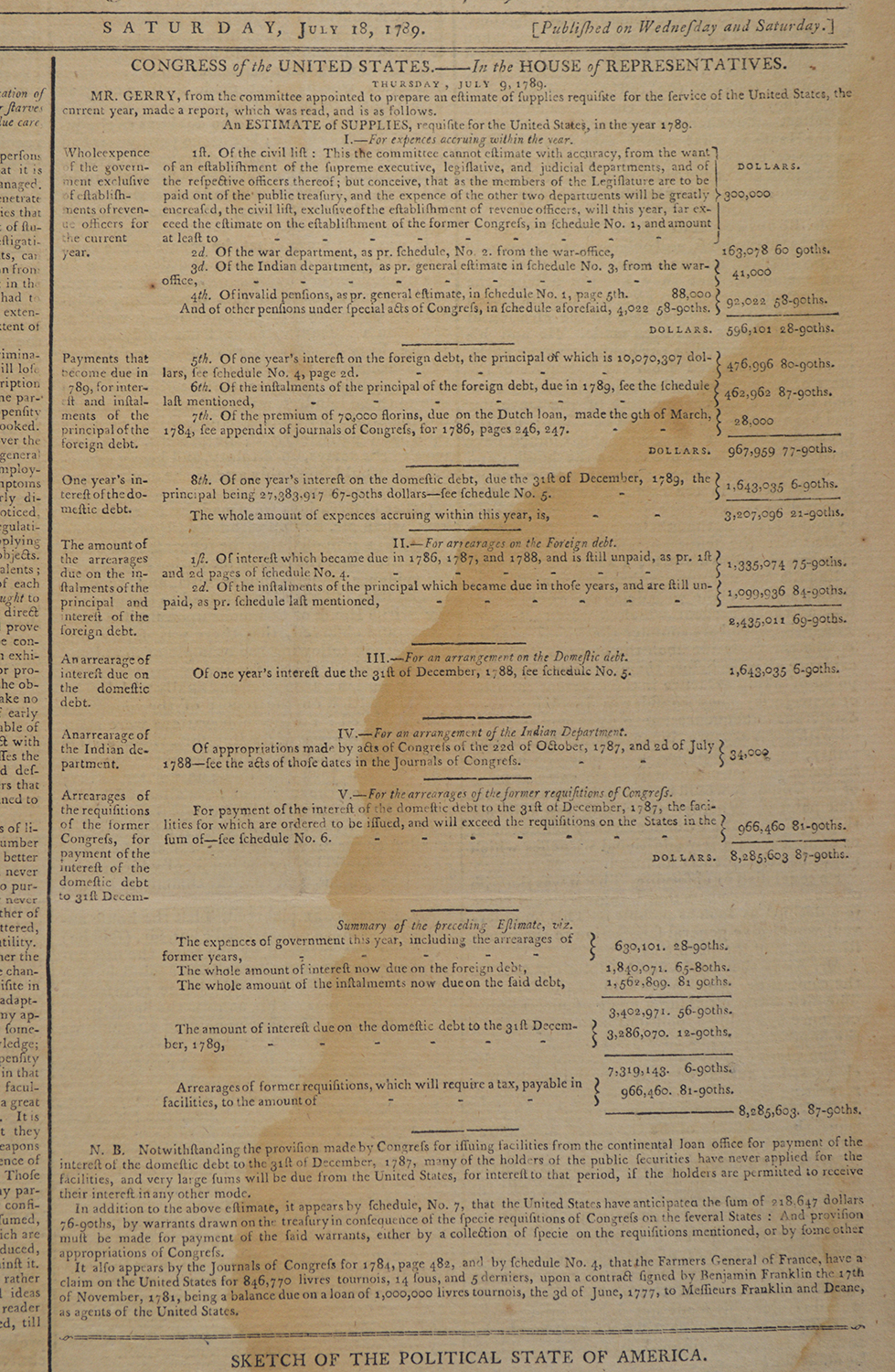
Below is an interesting item from WallBuilders’ collection — the first federal budget of the United States, dated July 9, 1789. This budget takes up only about 1/2 page of the newspaper it’s printed in, The Gazette of the United States (July 18, 1789).


Here’s the complete front page, the budget is on the top right.


And here’s a close-up of the budget.

George Washington 1785 Letter

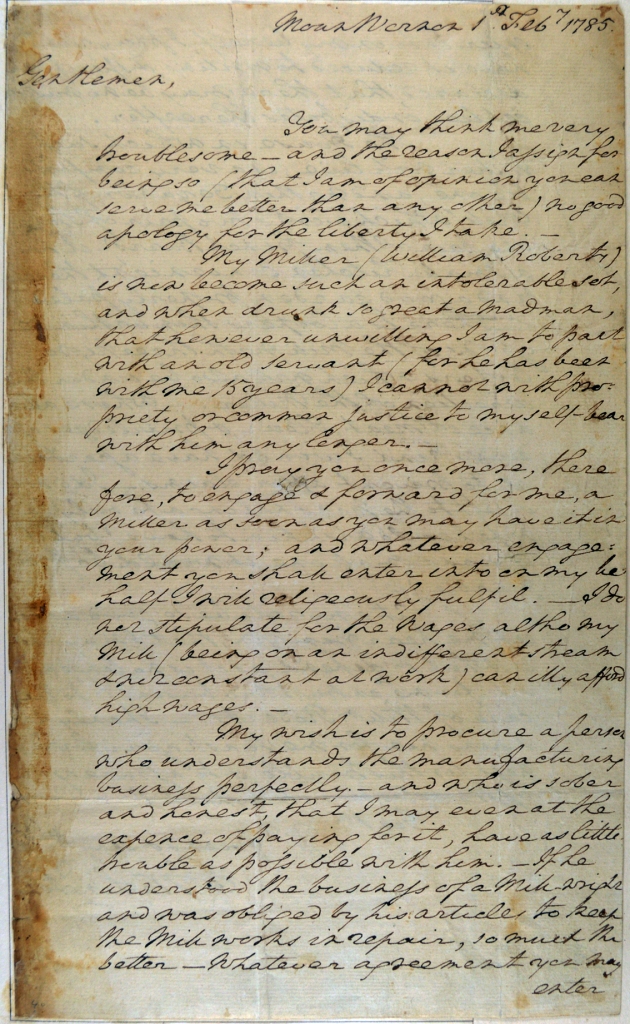
Below is an original letter in WallBuilders’ collection, from George Washington, dated February 1, 1785. This letter was written during a short period of retirement for Washington, following the War for Independence and before the Constitutional Convention. After resigning his military commission, he settled back in Mount Vernon following an almost continuance absence of eight years.


Mount Vernon 1st Feb. 1785

Gentleman,

You may think me very troublesome – and the reason I assign for being so (that I am of the opinion you can serve me better than any other) no good apology for the liberty I take.

My Miller (William Roberts) in now become such an intolerable serv, and when drunk so great a madman, that he never unwilling I am to part with an old servant (for he has been with me 15 years) I cannot with propriety on common justice to myself bear with him any longer.

I pray you once more, therefore, to engage & forward to me, a miller as seen as you may have it in your power; and whatever engagement you shall enter into on my behalf I will religiously fulfil. I do not stipulate for the wages at altho’ my Mill (being on an indifferent stream & not constant at work) can illy [sic] afford high wages.

My wishes to procure a servant who understands the manufacturing business perfectly – and who is sober and honest, that I may even at the expense of paying for it, have as little trouble as possible with him. If he understood the business of a Mill _____ and was obliged by his attitude to keep the Mill works in repair, so much the better. Whatever agreement you may enter into on my behalf, I pray you to have it reduced to writing, & specially declared, that there may be no misexception [sic] or disputes thereafter.

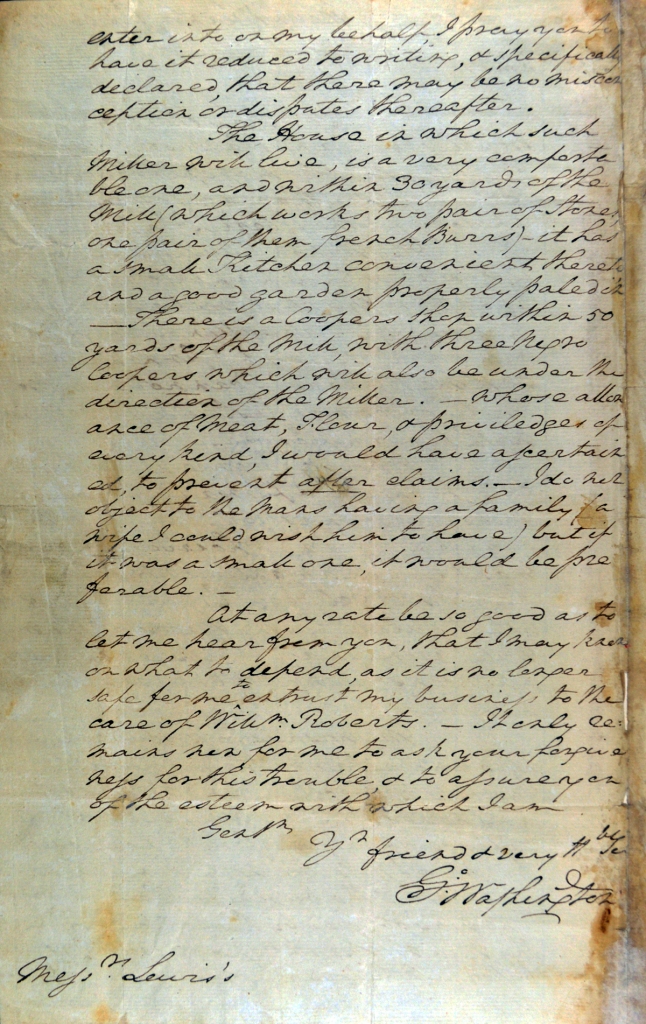
The House in which such Muller will live, is a very comfortable one, within 30 yards of the Mill (which works two pairs of stones one pair of them french Burns) – it has a small Kitchen convenient thereto and a good garden properly paled it. There is a Coopers shop within 50 yards of the Mill, with three Negro Coopers which will also be under the direction of the Miller. Whose allowance of meat, flour, & privileges of every kind, I would have ascertained, to prevent after claims. I do not object to the Mans having a family (a wife I could wish him to have) but if it was a small one, it would be preferable.

At any rate be so good as to let me hear from you, that I may know on what to depend, as it is no longer safe for me to entrust my business to the care of Willi’m Roberts. It only remains now for me to ask your sanguineness for this trouble & to assure you of the esteem with which I am

Gentm

Your friend & very Humble

G. Washington

Mess. Lewis’s

Four Letters on Government – John and Samuel Adams

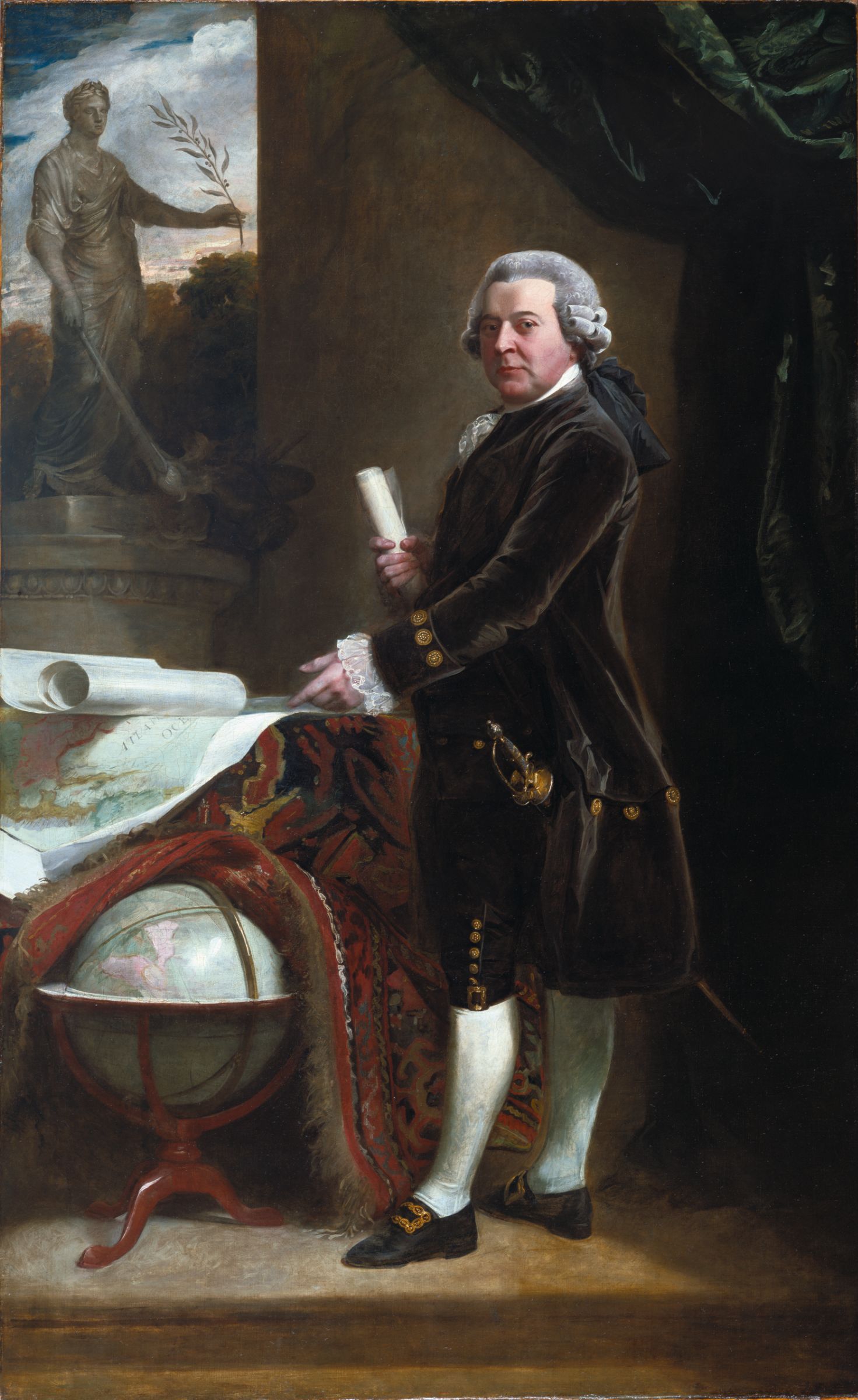
Samuel Adams (1722-1803) and his second cousin, John Adams (1735-1826), were important and longstanding actors in the struggle for American independence. John Adams expounds on this in his diary on February 9, 1772:

Is it not a pity that a brace [pair] of so obscure a breed should be the only ones to defend the household, when the generous mastiffs and best-blooded hounds are all hushed to silence by the bones and crumbs that are thrown to them, and even Cerberus himself is bought off with a sop? … they [John and Samuel Adams] have a sense of honor and a love of their country, the testimony of a good conscious, and the consolation of philosophy, if nothing more, which will certainly support them, in the cause of their country, to their last gasp for breath, whenever that may happen.1

John Adams

This “brace of Adamses” kept their word and continued to advocate for the liberty of their country through the War for Independence, and throughout the course of their lives, as demonstrated by a series of letters between them in 1790. John Adams was the vice president of the US and Samuel was the lieutenant-governor of Massachusetts during this period. Published in 1802 under the title Four Letters, discuss the future government of America from the perspectives of both the Federalist John Adams and the Anti-Federalist Samuel Adams.

John Adams, responding to an earlier letter from Samuel, recounts a recent visit to Philadelphia:

The sight of our old Liberty Hall and of several of our old friends, had brought your venerable idea to my mind, and continued it there a great part of the last week; so that a letter from you, on my arrival, seemed but in continuation.2

He then asks Samuel:

What, my old friend, is this world about to become? Is the millennium commencing? Are the kingdoms of it about to be governed by reason? Your Boston town meetings and our Harvard College have set the universe in motion. Every thing will be pulled down. So much seems certain. But what will be built up? Are there any principles of political architecture? What are they?3

Samuel Adams answers this query in his response:

You ask,—what the is about to become? and,—is the  millennium commencing? I have not studied the prophecies, and cannot even conjecture. The golden age, so finely pictured by poets, I believe has never as yet existed but in their own imagination. … The same tragedies have been acted on the theatre of the world, the same arts of tormenting have been studied and practiced to this day and even religion and reason untied have never succeeded to establish the permanent foundation of political freedom and happiness in the most enlightened countries on the earth.4

The elder Adams, as he turns his attention towards the hopeful element that he sees in mankind, becomes more positive:

The love of liberty is inter-woven in the soul of man, and can never be totally extinguished and there are certain periods when human patience can no longer endure indignity and oppression. The spark of liberty then kindles into a flame, when the injured people, attentive to the feelings of the just rights, magnanimously contend for their complete restoration.5

He reverts to his previous manner as he recounts how history shows that so often these sparks of freedom lead not to the flame of liberty, but rather to the flame of tyranny, remarking that, “such contests have too often ended in nothing more than ‘a change of impostors and impositions.’”6 Seeing that such a threat faces America as well, Samuel Adams explains the only hope he sees for preserving liberty:

Let the divines and philosophers, statesmen and patriots, unite their endeavors to renovate the age, by impression the minds of men with the importance of educating their little boys and girls; of inculcating in the minds of youth the fear and love of the Deity and universal philanthropy, and, in subordination to these great principles, the love of their country; instructing them in the art of self-government, without which they never can act a wise part in the government of societies, great or small; in short, of  leading them in the study and practice of the exalted virtues of the Christian system, which will happily tend to subdue the turbulent passions of men, and introduce that golden age…7

Sam Adams

Samuel, having placed his hopes in subsequent generations’ education in the tenets of true virtue, quips: “When this millennium shall commence, if there shall be any need of civil government, indulge me in the fancy, that it will be in the republican form, or something better.8

In his response, John Adams expresses his own pessimism regarding the nation’s—and more generally the world’s—ability to provide such an education. He agrees with his older cousin but reflects:

I think with you, that knowledge and benevolence ought to be promoted as much as possible; but, despairing of ever seeing them sufficiently general for the security of society, I am for seeking institutions which may supply in some degree the defect. If there were no ignorance, error, or vice, there would be neither principles nor systems of civil or political government.9

In this, the difference surfaces between the two Adams’. Anti-federalist Samuel Adams prefers to hope for the elevation of the people to a sufficient capability for self-government, while federalist John Adams places his hopes in the ability of an active government to preserve the safety of the nation by institutional means. Both aim for the secured liberty of America, but one seeks to achieve it by strengthening the people first, while the other aims to strengthen the government first. John Adams further explains his position:

With you, I have also the honor most perfectly to harmonize in your sentiments of the humanity and wisdom of promoting education in knowledge, virtue, and benevolence. But I think that these will confirm mankind in the opinion of the necessity of preserving and strengthening the dikes against the ocean, its tides and storms. Human appetites, passions, prejudices, and self-love will never be conquered by benevolence and knowledge alone, introduced by human means.10

John also takes a different route regarding the effects of the people’s strong affection for liberty and freedom so lauded by Samuel Adams. The younger says:

The numbers of men in all ages have preferred ease, slumber, and good cheer to liberty, when they have been in competition. We must not then depend alone upon the lover of liberty in the soul of man for its preservation. Some political institutions must be prepared, to assist this love against its enemies. Without these, the struggle will end only in a change of impostors. … Let us be impartial, then, and speak the whole truth. Till we do, we shall never discover all the true principles that are necessary.11

To the objections on the primacy of universal education over a strong government Samuel Adams responds:

I am very willing to agree with you, in thinking that improvements in knowledge and benevolence receive much assistance from the principles and systems of good government. But is it not as true that, without knowledge and benevolence, men would neither have been capable nor disposed to search for the principles or form the system? Should we not, my friend, bear a grateful remembrance of our pious and benevolent ancestors, who early laid plans of education? by which means, wisdom, knowledge, and virtue have been generally diffused among the body of the people, and they have been enabled to form and establish a civil constitution, calculated for the preservation of their rights and liberties.12

He then continues to argue for the necessity of a widespread educational system directed towards the moral development of the community:

I am far from thing the people can be deceived, by urging upon them a dependence on the more general prevalence of knowledge and virtue. It is one of the most essential means of further, and still further improvements in society, and of correcting and amending moral sentiments and habits and political institutions; till, “by human means,” directed by Divine influence, men shall be prepared for that “happy and holy state,” when “the Messiah is to reign.”13

Samuel Adams end by expressing that while John views government as the tool which will level both the aristocracy and the people, he believes that education is the true leveling agent:

Wise and judicious modes of education, patronized and supported by communities, will draw together the sons of the rich and the poor, among whom it makes no distinction; it will cultivate the natural genius, elevate the soul, excite laudable emulation to excel in knowledge, piety, and benevolence; and, finally, it will reward its patrons and benefactors, by shedding its benign influence on the public mind. Education inures men to thinking and reflection, to reasoning and demonstration. It discovers to them the moral and religious duties they owe to God, their country, and to all mankind.14

These four letters provide a window into the party conflicts which were raging between the Federalists and Anti-Federalist—though they show a much more civil and thoughtful tone than was generally seen at the time. In its most basic form, the “brace of Adamses” are seeking to answer how best the freedom of society can be improved. While they both value the necessities for education and political principles, the real difference arises from where they place primacy.


Endnotes

1 John Adams, February 9, 1772, The Works of John Adams (Boston: Charles C. Little and James Brown, 1850) 2:295-296.
2 The Works of John Adams (Boston: Charles C. Little and James Brown, 1851) 6:411.
3 John Adams to Samuel Adams, September 12, 1790, Works (1851), 6:411-412.
4 Samuel Adams to John Adams, October 4, 1790, Works (1851), 6:412.
5 Samuel to John, October 4, 1790, Works (1851), 6:413.
6 Ibid.
7 Samuel Adams to John Adams, October 4, 1790, Works (1851), 6:414.
8 Ibid.
9 John Adams to Samuel Adams, October 18, 1790, Works (1851), 6:415.
10 Adams to Samuel Adams, October 18, 1790, Works (1851), 6:416.
11 Adams to Samuel Adams, October 18, 1790, Works (1851), 6:418.
12 Samuel Adams to John Adams, November 1790, Works (1851), 6:422.
13 Samuel Adams to John Adams, November 1790, Works (1851), 6:423.
14 Samuel Adams to John Adams, November 1790, Works (1851), 6:425.

Jefferson and Library of Congress

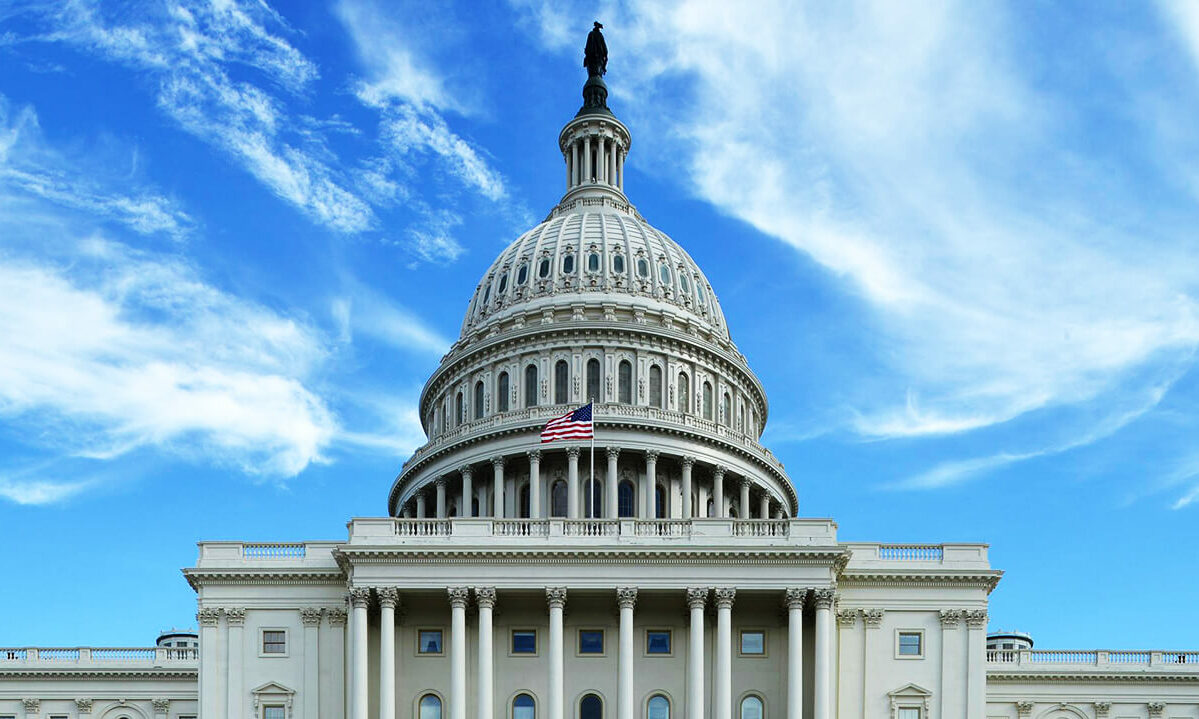
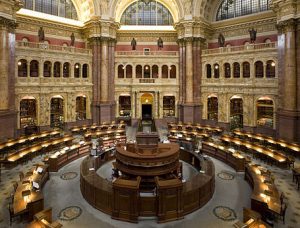
Most Americans are very familiar with the Library of Congress and its massive collection of millions of books, documents, recordings, photographs, sheet music, and manuscripts.1 But few know how Thomas Jefferson is connected to the library.

On April 24, 1800, Congress approved moving the federal government to Washington DC and granted resources for a congressional library:

That for the purchase of such books as may be necessary for the use of Congress at the said city of Washington, and for fitting up a suitable apartment for containing them and for placing them therein, the sum of five thousand dollars shall be, and hereby is appropriated.2

The books purchased for that library were originally kept in the Capitol building.3 But when the British invaded and set fire to the Capitol during the War of 1812,4 this collection was destroyed. This is where Jefferson comes in.

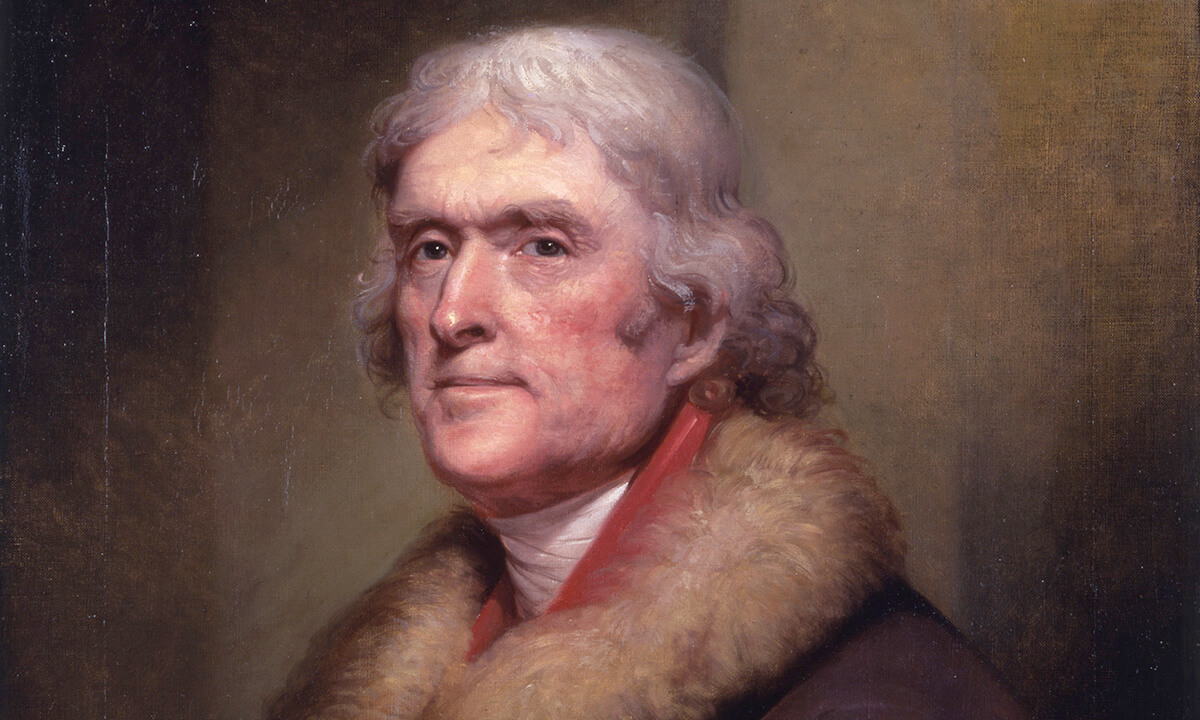
He offered to sell his collection of books (nearly 6,500) to Congress to replace the books that had been burned.5 His offer was accepted and nearly $24,000 (over $300,000 in today’s money) was set aside to purchase his books.6

Unfortunately, almost two-thirds of his collection was destroyed in another fire in 1851,7 but Jefferson’s library was a springboard from which the Library of Congress would continue to grow. Next time you visit the Library of Congress, remember one of the reasons this collection is so impressive is due to Thomas Jefferson’s influence.


Endnotes

1 “Fascinating Facts,” Library of Congress, accessed January 17, 2024.
2 “An Act to make further provision for the removal and accommodation of the Government of the United States,” April 24, 1800, The Public Statutes at Large of the United States of America, ed. Richard Peters (Boston: Charles C. Little and James Brown, 1845), II:56.
3 “History of the Library of Congress,” Library of Congress, accessed January 17, 2024.
4 “A Most Magnificent Ruin: The Burning of the Capitol during the War of 1812,” Architect of the Capitol, August 1, 2023.
5 Thomas Jefferson to Samuel H. Smith, September 21, 1814, The Writings of Thomas Jefferson, ed. H.A. Washington (Washington: Taylor & Maury, 1854), VI:383-385; “Sale of Books to the Library of Congress (1815),” Monticello, accessed January 17, 2024.
6 Samuel H. Smith to Thomas Jefferson, February 15, 1815, Founders Online.
7 “Thomas Jefferson: Jefferson’s Library,” Library of Congress, accessed January 17, 2024.

Sermon – House of Representatives – 1864

Byron Sunderland was born in Shoreham on November 22, 1819. He served 45 years as Pastor of the First Presbyterian Church in Washington D.C. Sunderland spoke privately about Christian philosophy with Lincoln. He served as Chaplain of the U.S. Senate, and presided over the wedding of President Grover Cleveland at the White House. Notably, he preached in favor of abolition, at a time, and in a place, where it was dangerous to do so.


SERMON
ON THEPUBLIC WORSHIP OF GOD,
DELIVERED IN THEHALL OF THE HOUSE OF REPRESENTATIVES,
SUNDAY, JANUARY 31ST, 1864AND REPEATED, BY REQUEST, IN UNION HALL, NO. 481 NINTH STREET,
MONDAY, FEBRUARY 8TH, 1864,BY: REV. B. SUNDERLAND, D.D.
Pastor of First Presbyterian Church, and Chaplain U.S. Senate for Thirty-Eighth Congress.

PUBLISHED BY REQUEST.

WASHINGTON, D.C.
CHRONICLE PRINT.
1864.

Washington,  D.C. Feb. 4, 1864.
REV’D BYRON SUNDERLAND, D.D.,
Chaplain U. S. Senate:
DEAR SIR:  Realizing the great value of the truths enunciated in the sermon delivered by you in the House of Representatives of the United States last Sabbath morning, “on the duty of maintaining the public worship of God,” knowing its most gratifying reception by the immense audience convened on that occasion, and feeling that others will be profited by hearing it, we invite you to repeat it at Hall No. 481 Ninth street, at a time agreeable to yourself, and also that you furnish a copy for publication.
With sentiments of high regard, we remain
Yours, very truly,
HENRY A. BREWSTER, New York.                                               WILLIAM BEBB, Ohio.
JUDSON S. BROWN, Massachusetts.                                             HANNIBAL HAMLIN, Maine.
LEONARD S. FARWELL, Wisconsin                                              SCHUYLER COLFAX, Indiana.
THADEUS STEVENS, Pennsylvania.                                             SOLOMON FOOT, Vermont.
AUGUSTIN CHESTER, Illinois                                                        D. CLARKE, New Hampshire.
JAMES M. EDMUNDS, Michigan.                                                  J. A. BROWN, Rhode Island.
B. B. FRENCH, Washington, D. C.                                                  W. C. DODGE, Minnesota.
A. F. WILLIAMS, Connecticut.                                                        J. CONNESS, California.
A. M. SCOTT, Iowa.                                                                           A. CARTER WILDER, Kansas.
N. B. SMITHERS, Delaware.                                                            R. G. GREENE, Virginia.
J. D. MERRILL, Missouri.                                                 HANISON REED, Florida.
J. W. NESMITH, Oregon.                                                                   J. D. DOTY, Utah.
J. F. SHARETTS, Maryland.                                                             J. CLAY SMITH, Kentucky.

WASHINGTON, D. C., Feb. 5, 1864.

TO MESSRS. BREWSTER, BEBB, BROWN, HAMLIN, FARWELL, and others:

GENTLEMEN:  Your note of the 4th inst. Is received, inviting me to repeat the discourse “on the duty of maintaining the public worship of God,” delivered in the House of Representatives January 31, 1864.  I cheerfully comply with the request, and designate Monday evening, the 8th inst., as the time.It is with thanksgiving to God that I find such sentiments endorsed by you, as the representatives of the great Christian community throughout the United States.  With trembling I think of the stern and fearful time in which we live, and of the stupendous contest for the supremacy of the law and of the perpetuity of the Union in which the nation is engaged.

I feel sure we all desire the triumph of our Government over the rebellion, because we believe it will be a victory for righteousness in the earth.

We must have Jehovah for our Captain by conforming to his requirements, and especially maintaining the public ordinances of his worship.
With sincere regards,
B. SUNDERLAND.
SERMON.
ISAIAH 66:23
“And it shall come to pass that from one new moon to another, and from one Sabbath to another, shall all flesh come to worship before me, says the Lord.”
This is a marvelous prediction.  What a day for the world, when the worship of God from month to month, and from week to week, shall be universal!

The worship of God implies the highest acts of which a rational creature is capable.  It demands all the powers of body and soul.  To conceive and feel all that it implies, and to give suitable outward expression to its thoughts and emotions, by the posture of the body, by the voice, by the various faculties of manifestation, presupposes a character of the noblest culture.

The worship of God may be solitary, as of the individual alone – domestic, as in the family – social, as in the small companies of friends – or public, as in the great and open congregation.

In any case however, to be real it must be spiritual, whatever may be the outward act by which it is expressed – “God is a spirit, and they that worship him must worship him in spirit and in truth.”

And what does this mean but that homage which is due to God as the Father of spirits, and the Supreme King?  In acts of worship, we render to God an acknowledgment of his right to rule over us – of the supreme authority of his law, and the righteousness of his kingdom and dominion, in opposition to all other pretended authority whatsoever.  For such an act, the whole being of the man is requisite – body, soul, mind, reason, sense, memory, hope, imagination, and the loftiest thoughts of human faith.  And as to spirituality, what is it but the life of justice and truth and virtue?  Can anything be more spiritual than these?  If I pay my honest debt, I hold the essence of that deed is as purely spiritual as the act of the loftiest adoration – both are proper upon occasion, and both befit the highest development of our nature.

Each form of worship of God has its appropriate characteristics, and requires in its observance the outward expression suited to its nature.  As I intend, in this discourse to speak chiefly of public worship, I will remark, in passing, that the general usage of the evangelical world has assigned three grand parts to the service of God in the great congregation: prayer – reading and expounding the Holy Scriptures – and praise in singing, with instruments of music; the first two generally conducted by the minister – the last by a choir, or the whole assembly.  Each of these parts is held to be of paramount importance, both from their intrinsic fitness and from the long experience of the affections of human nature.  Wherever an assembly meets for the public worship of God on the Sabbath, ample provision should be made, if practicable, for the full performance of each of these parts, so that nothing may be wanting to the great object.

In a congregation like this, meeting in a place like this, we have all the material or physical requisites, if properly employed, to make the public worship of God what it ought to be, so far as it depends upon such conditions.  If there is a failure, in any degree or in any sense, to make the service all it should be, we must attribute it to ourselves.  The Hall itself is sufficient – the attendants here are diligent, courteous and faithful – ministers are provided – the Sabbath day comes round – the word of God lies open before us – the people assemble – and the service begins.  That there may be given to public worship its greatest impressiveness, I take leave to mention that some general order should be observed, by all in the congregation, through the different parts of the service.  For example, in the reading of the Scriptures and preaching, let all sit with fixed attention upon what is uttered by the minister – not listless, or perhaps asleep – not distracted by idle curiosities – not whispering, or moving about or leaving the assembly, unless by imperative necessity.  Custom has stamped all these things as exceedingly vulgar and low-bred, besides being irreverent and insulting to God.

In time of singing, let all stand up, and devoutly join in the hymn of praise by the voice, or in silent meditation.  In time of prayer, let all kneel or bow the head forward, attesting by their attitude their sense of the solemnity of the act – and let there be no unnecessary noise or confusion, as is often the case in the time of daily prayer in these chambers – talking, rattling of papers, sitting in the seat, perhaps reading or writing, and in many ways showing that indifference to the act of prayer to God, which is positively shameful.  And while on this point, I wish every member of Congress were here today, that I might ask it of these kind gentlemen, such of them as have fallen into this habit – for I rejoice to say that many should be exempted – nay, I would not insinuate that to be a member of Congress is to be prima facie an unchristian man – every man innocent till proved guilty, is the maxim of law to which they, with us, are entitled; and indeed I know some among them to be as noble Christian gentlemen as are to be found in the land – and far, far be it from me to inveigh against men whose lives illustrate the clear virtues and sublime sympathies of our divine religion; who rejoice when it flourishes, and lament when it declines, and who would go to every length of rational sacrifice to promote its extension in the earth – no, not such do I intend – but such rather as profess no such adherence to its cause, and certainly exhibit none to be spoken of – but that I might ask it of them to reform in this particular.

I allude to this subject, not in a spirit of bitterness or personal complaint at all; for I have this to say, that in all my personal intercourse with members of Congress, and with the officers and employees of the Capitol, I have never received anything but kindness and respect, and I should be sorry to have aggrieved any of them, by alluding to these things now – but I do feel a solicitude for the honor of God, and that men should pay that homage to Him which is due to the Father of us all.  It is true that many times members are absent from the daily prayers = for which I have heard various reasons alleged – some detained by necessary business – some by providential dispensations – some from want of inclination toward this duty – and some from a positive dislike of the sentiments these gentlemen from this public Sabbath service, many, it is true, worshipping in the churches of the city, but the majority, I fear elsewhere, leaving the assembly here to be largely made up, from week to week, of strangers from all parts of the land, and of the great sojourning public who have no other stated place of worship.

It naturally follows from these very circumstances, that there is no certain reliance to be placed upon any one or any number of persons, for that most important and yet most difficult part of public worship, the praise of God in the singing of sacred hymns.  All that can be expected is the voluntary service of those who may be disposed to aid in the singing for the time being, upon a mere voluntary impulse.  Congress manifesting so great an indifference to the whole matter, not only by the absence of the greater portion of the members, but also by the decided opposition of the majority to making any provision for such services, it must continue to be a matter of regret that the ordinary resort in such cases to voluntary contributions is not practicable, and consequently if divine service is held here on the Sabbath, it must be subject to the inconvenience, the deficiency and the depression, which I have here pointed out.

It is true, a man may say, what right have you to lecture me on this or any other subject?  I reply, by the right of free speech, which God has given me – and when I have given my lecture, in respectful terms, there my responsibility ends, and his begins.  If Congress may not choose to receive what they regard as a chaplain’s lecture, that is their business, not mine.  This rule applies universally.  If you read a lecture to me, I cannot deny you the right – but my own judgment must decide whether it is of any value, and whether or not I will heed it; and I act in this, under a responsibility for which I am accountable, and one day must account to the Judge of all.  So I am the more earnest to develop the whole matter before us, as far as it lies in my power.

Now I undertake to say that there is an erroneous and most vicious public sentiment abroad, not only here among the public functionaries of the Government, but everywhere throughout the country, upon the whole question of the public worship of God.  Does it ever occur to men, that God has required these public ordinances of religion to be observed unto Him, and has foretold the advent of a day when all flesh shall come and worship before Him?  Does it ever occur to men to feel that one is just as much bound by these requirements as another?  Does it ever occur to them to think, that one man, as a member of the religious community, has just as much to think, that one man, as a member of the religious community, has just as much interest at stake in the maintenance of these ordinances of Heaven as another?  And yet this is really so.

I have truly no more interest in the matter than you have; and you have truly no more interest in the matter than that officer of the Government, high or low, who appropriates the Sabbath day of God to pleasure excursions, and forsakes the public worship of the Almighty, that he may pay court to some foreign minister, or find means for his own private and personal recreation.  I say I have no more interest in the matter than we all have in common – for if these ordinances of God are wantonly ignored and willfully neglected – if the great light that shines in them shall finally be extinguished, and the darkness and degradation of vice, precursor of destruction, shall succeed to it – and if finally, the whole structure of society, undermined and s=disintegrated, shall tumble into ruin, I shall have no more to lose than my neighbor, in the common catastrophe!  What I lose, he will lose – we shall all be alike despoiled.

Now the whole community may be divided in respect to this matter of public worship, into three classes: 1st, those who attend upon it with some just sense of its true nature and importance; 2d, those who go to the sacred assembly from grossly inadequate, if not wholly improper motives; 3d, those who stay away altogether.  Of the first class I have nothing to say, but that it is comparatively small – alas!  To small, I fear, for the leavening of the whole lump.  Of the second class I have this to say, that I wonder at them.  I am thankful to my Maker that whatever may have been, or may now be my faults, I never had the disposition or desire to attend public worship for the simple sake of seeing or being seen – of making a display – of ogling the assembly – and in short for any and every purpose, but the single one which is alone pertinent and proper, the devout and reverent waiting upon the Majesty of earth and heaven.  I never had any sympathy with that spirit which can sport and trifle in the place and time of prayer, – I never could comprehend that levity which mocks at the most sacred things, and turns the very sanctuary of Jehovah into a theatre of laughter and of jeers.  Of the third class I testify, in the name of religion, that they are moral delinquents by habit and inclination, and in their example before the nation and the world, they support the grand foundation principle of a practical atheism, and to this extent they are corrupters of society and the enemies of mankind.  I take my stand on the decrees of God’s word, and boldly declare that any man, who habitually neglects the worship of God, is a traitor not only to the high government and law of God, but also to the security and welfare of human society itself.

Said the devout Witherspoon, one of the signers of the Declaration, and one of the noblest spirits of the Revolution, a Christian and a clergyman of those brave and heroic times – “He is the truest friend to American liberty who is the most sincere and active in promoting true and undefiled religion, and who sets himself with the greatest firmness to bear down profanity and immorality of every kind.  Whoever is an avowed enemy to God, I scruple not to call him an enemy to his country.  It is your duty in this important and critical season to exert yourselves, everyone in his proper sphere, to stem the tide of prevailing vice, to promote the knowledge of God, the observance of his name and worship, and obedience to his laws.  Your duty to God, to your country, to your families, and to yourselves, is the same.  True religion is nothing else but an inward temper and an outward conduct suited to your state and circumstances, in the Providence, at any time.  And as peace with God and conformity to Him add to the sweetness of creature comforts, while we possess them, so in times of difficulty and trial it is the man of piety and inward principle that we may expect to find the uncorrupted patriot, the useful citizen, and the invincible soldier.”

In affixing his name to the Declaration of Independence, this man rose in that illustrious assembly, and gave utterance to these words: “Mr. President, that noble instrument on your table, which insures immortality to its author, should be subscribed this very morning, by every pen in the House.  He who will not respond to its accents, and strain every nerve to carry into effect its provisions, is unworthy the name of freeman.  Although these grey hairs may descend into the sepulcher, I would infinitely rather they should descend thither by the hand of the executioner than desert at this crisis the sacred cause of my country.”  The words ran through the body like electric fire.  Every man arose and affixed his name to that immortal document.  He spoke then the best and highest word of the nation.  He was the mouthpiece of a people standing on the religion of the Bible.

Every nation under heaven has had its religion, and will have to the end of time.  Our own nation has never recognized, in form or principle, any system but that of Christianity, the highest outward expression of which is known in the public service of divine worship maintained among us, especially on the Sabbath day.  And of all places in the land, none should be more important, none more command the sympathy and awaken the interest of the whole people, than the public worship of God in the Capital of the nation.

The historical facts connected with this subject are fraught with the deepest importance, and are entitled to the most serious consideration.  To go no further back than the adoption of the Federal Constitution, and confining ourselves also simply in this statement to the proceedings had in relation to the chaplains of Congress, we call to mind first, the fact that the Constitution of 1789 forbids Congress to make “law respecting an establishment of religion, or prohibiting the free exercise thereof” – and further says, “no religious test shall ever be required as a qualification for any office or public trust in the United States.”  This secures two things – the freedom of religion, and the equality of religious sects.  But it does not dispense with the divine obligations of the public worship of God.  So our fathers believed, and so they acted.  The first Congress under the Constitution elected two chaplains, and this practice is continued to the present day.  The law of 1789, and of 1816, regulating this subject, and fixing an annual salary which has never exceeded $750, was passed in pursuance of the conviction not only of the constitutionality, but of the eminent propriety and religious obligation of the service to which the chaplains of Congress were appointed.

And while speaking of salary for the chaplain service in this country, permit me to notice the contrast presented by the State establishment of the Church of England.  The statistics were furnished me by a friend who has thoroughly examined this whole subject.  From tables prepared by him, it appears that the tithing system of Great Britain for the support of the Church, opens an abyss absolutely appalling.  One single fact illustrates the truth of this assertion.  The amount of annual salary paid to some twenty four individuals in the highest orders of the clergy, aggregates nearly $1,000,000 – the highest single salary reaching over $78,000, and the lowest exceeding $20,000!  What then must be the cost of the entire ecclesiastical establishment?

Now, in comparison with this, what is done by our Government for the support of Christianity?  Until the present war, which has of course increased the expense of the chaplaincy, still however, leaving it as a system very defective, the little that was attempted by the Government of the United States can be reported in few words.  I find from a small volume published in 1856, entitled “Government Chaplains,” by Dr. L. D. Johnson, and containing much interesting and curious information, that there were at that date thirty chaplains in the Army, twenty-four in the Navy, and two in Congress, besides a number of post-chaplains and teachers among the Indians.  The whole expense annually to the Government of supporting this body of men did not exceed a quarter of a million of dollars.  I venture to assert that no nation ever existed on earth that maintained the popular religion at so cheap a rate.  Think of it again.

To say nothing of the army or navy, Congress has two chaplains, and gives them each $750 per annum for their services in daily attendance.  I do not for one ask an increase.  I am not pleading for money so much as for the moral effect of the observance, in Congress, of the public ordinances of Divine worship.  But there is no provision of law regulating or even requiring the public Sabbath service in which we are now engaged, and there never has been from the beginning, so far as I am instructed.  It seems to stand alone upon custom.  It has been the unvarying usage for the chaplains of Congress to hold one public service in the Capitol on the Sabbath.  It is evident that Washington, Franklin, Madison, Ellsworth, Sherman and their illustrious compeers, approved of the custom, and that ever since that day, the greatest, the best, and the purest men in the nation have given it countenance and support.  Yet there have been times when questions of the propriety of such services have arisen – times when a portion of the people have petitioned Congress for the abolition of the whole system of the chaplaincy, and consequently of the public religious services which chaplains perform – and times when the system of Government chaplains, and of the Christian ministry itself has met, in the Houses of Congress and out of them, a storm of ridicule, contempt and denunciation.

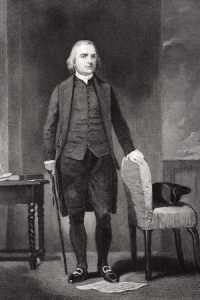
On the 5th of September, 1774 the American Congress was in session.  There was a doubt in the minds of many about the propriety of opening the daily deliberations with prayer, the reason assigned being the great diversity of opinion and religious belief.  Then rose the venerable puritan, Samuel Adams, with his long white locks hanging over his shoulders, and spoke as follows:  “It does not become men professing to be Christians, convened for solemn deliberation in the hour of their extremity, to say there is so wide a difference in their religious belief that they cannot as one man bow the knee in prayer to the Almighty, whose aid they hope to obtain.  Independent as I am, and an enemy to all Prelacy as I am known to be, I move that the Rev. Dr. Duche, of the Episcopal church, be invited to address the Throne of grace in prayer.”  Dr. Duche complied, and offered prayer, first in the form of his church, and then in extemporaneous supplication, until all hearts were moved, and the whole assembly were bathed in tears.  In the Convention which formed the present Constitution, another scene occurred, no less remarkable and impressive, when the venerable Franklin proposed, in words of profound solemnity never to be forgotten, the introduction of prayer to the Father of Light for that wisdom which was then wanting to harmonize the conflicting elements, and establish the conditions of the nation’s welfare.

Many are the thrilling facts in our country’s history which demonstrate the necessity of public religious services, conducted by the Christian ministry, to the well-being of the Government and the highest prosperity of the whole people.  And now I remark, by the way, that a volume has recently been issued, entitled “The Christian Life and Character of the Civil Institutions of the United States,” by the Rev. B. F. Morris, which is the only book of the kind in existence, and which I find to be a perfect treasury of the Christianity of the nation, as embodied in its public monuments, and attested by its public men – a book which ought to become the Manual of the people, and find a place in every library, and be in the possession of every man, woman and child in the nation, and the close companion of all, whether in public or private life.  I trust that book will be thoroughly studied by the present generation of Americans, for it has all the interest of a romance, with all the solidity of science, and all the sanctity of religion.  Go to that book, if you would see what the great and good men of the nation, from the beginning until now, have thought of the propriety and absolute necessity of the services of the Christian ministry, and of the observance of the public worship of God in our national affairs, and in the high places of the country.

I am mainly indebted to it for the impulse which originated this very discourse – for I saw it in manuscript, and have copiously drawn from it, as from a fountain deep and rare, for all the great words I have quoted, or am about to quote from our illustrious ancestors.  Need I say that its loyalty is one of its grandest features; that the very heart of a deep, genuine, glorious devotion to God and the Country and the Constitution, throbs through every page of it.  It could not be otherwise, for it is the sum of the great Christian monuments of the fathers who under God built up our nation – laid its foundation, and reared its mighty structure.  Oh had the degenerate sons of now dishonored sires in the rebellious States heeded these great lessons, instead of those of their false and lying prophets of a more recent time, how great a ruin they might have averted from their heads!

By the expressed conviction and resolute conduct of the great men of the first age of the Republic, the objections of the ignorant, the profane, the unbelieving, against the Christian religion and its devoted ministers were in a measure silenced.  But when at length, in after years, the institution of the Sabbath seemed to be peculiarly and openly endangered by the public example of the Government in the universal running of the mails, the Christian mind of the nation became alarmed, and the Christian ministry lifted up a decided protest, and made their voice heard in the halls of Congress upon that question.  This awakened a powerful opposition from the lax and dissolute men of every description, and kindled again into open conflagration the smoldering embers of the popular prejudice against the ministers and services of religion.  The debates in Congress of that period attest a severe conflict, in which at last however, the friends and advocates of immorality were virtually discomfited, and the cause of Christianity obtained a substantial triumph.  Thus the question of religion, especially as connected with the appointment of chaplains to Congress, and the public worship of God in the Capitol, was left undisturbed for a considerable period.  Meantime, however, a series of causes were operating to bring on the conflict in a fiercer form of political partisanship and bitter animadversion.

It must be confessed that the scramble for the office of chaplain to Congress, by many applicants, and by some perhaps not the best qualified for its responsibilities and duties, had been a growing evil, and was becoming an open scandal to the country.  Besides this, measures had been proposed in Congress affecting the question of slavery, and the repeal of a compact of long standing, which moved the whole nation to its very foundation.  It was an occasion when large portions of the Christian ministry felt justified in bearing an open testimony on the question at issue.  Earnest and stirring memorials, signed by large bodies of the clergy, were sent to Congress, and this aroused the indignation of Senators and Representatives of the dominant political party, against whose public policy the petitions of the memorialists were directed.  Sad is the chapter of the proceedings and debates in regard to the Christian ministry generally, and especially in regard to the election of chaplains, and their services in the 33d Congress.  The very election of a chaplain was characterized as “a farce.”  Votes were given for a female to be the chaplain of the House.  One speaker alludes to the election, as the election of “an humble chaplain.”  Another speaker said, “The candidates are multiplying, and those whose names are now before us are getting uneasy.

I am anxious to have the matter settled, so that the rejected applicants may apply for some other office if they do not get this!”  An article appeared in one of the daily papers of the city to this effect:  “We are altogether opposed to having chaplains to Congress.  We hope the last of them have been elected.  It is pretty well understood that those paid for prayers are to be made brief – cut off short, in order to avoid boring Congress.  Short as they are, they are bores.”  In the Senate, the opposition to the action of a portion of the Christian clergy, and especially to the ministers of New England, took a wider scope.  Senators held them up as deserving the grave censure of that body – as not knowing what they were talking about – as bringing our holy religion into disrepute – as agitators, transforming the lamb to the tiger and the lion.

Meanwhile, memorials came up from the profane and infidel in various quarters of the land for the total abolishment of the office of chaplain.  The reasons set forth for this were that the continuance of the office was in violation of the Constitution – that it imposed unjust taxation – that it was a virtual establishment of the union of church and state – and that it was subversive of the genius and spirit of American institutions.  All these points were fully answered in the reports of the Committees of the two Houses of Congress upon that whole subject, during that ever memorable period.  The Christian sentiment and deliberate sense of the people and of their representatives again prevailed, and the office of the chaplain and the public worship of God in this Capitol of the nation survived together!  But there are objections still, no doubt, lurking in the popular mind and heart, if not openly expressed, against the whole system of the Chaplaincy, and especially against the public worship of God in this high place, which I propose now to consider.

1.  It is unconstitutional.  The voice and practice of the fathers refute this charge.  The Constitution does not forbid the creation of the office of chaplain, with a salary by law of Congress; nor does it forbid the appropriation of money to support a decent observance of the public worship of God in this Capitol.  Congress appropriates thousands of dollars in other ways, not half so much calculated, in my opinion, to promote the public welfare and virtue of the people; and they have a right, under the Constitution, if they so choose, not only to employ a chaplain or chaplains to conduct daily prayers, and the services of public worship here on the Sabbath, but also to devote money from the public treasury to provide a choir, to purchase an organ, and to do all other acts and things necessary to the fullest perfection of divine service.  It will not do for any man to undertake to convince me that all this is unconstitutional.

It is a scandal on the Constitution – a reproach to the memory of our fathers – an insult to religion, and impiety toward God.  The catholic evangelical church of Christ of this day, in all denominations, will not tolerate such a sentiment – such a satire on the great organic law of a free and Christian people.  The Constitution is not at war with the law of God in this particular; and if it were conclusively shown to be, I should go for the higher law of God, and go for conforming the Constitution to that higher law.  We have had enough of sneering at this higher law of God in the land for the last fifteen years.  This is one of the iniquities that has brought at last the thunders of His judgment upon us.

2.  But this would be forming and establishing a union of church and state.  Not by any means.  I am as much opposed to such a union as any man, and would contend as strongly against it.  When our fathers, by the Constitution, deprived Congress of the power to establish religion by law, they did not intend to make us an infidel nation, nor our Government an impious and God-forsaken iniquity.  They meant not to divorce religion wholly from the existence and life of the Republic, but only to prevent the union of any Church establishment with the State, in such a way as to bind the conscience and burden the coffers of the people with either the creed or the taxes of any ecclesiastical institution.  Nobody finds fault with the employment of Government physicians and surgeons, and yet there is just as much reason on this ground for the complaint of a union of Therapeutics with the State.

What is meant by a State church is such as exists in England, where immense sums are appropriated, and large prerogatives exclusively granted to a single church establishment, at the expense of all others, and this in perpetuity.  No such policy has existed under our Constitution, and I trust it never may.  But it is a very different thing for Congress to provide for the public recognition and worship of God in their own halls, leaving all men free to act upon their conscience as to their attendance upon the same, responsible alone to God, for the manner in which these obligations are discharged.

3.  It is no place for religious services.  Ah, and whose opinion is this?  Jesus Christ instructs us, that the day has gone by, when the worship of God shall be confined to any one locality exclusive of another – when men shall worship the Father neither alone at Jerusalem nor in the mountains of Samaria, but everywhere, where men shall worship Him in the spirit.  The temple, the synagogue, the academy, the market-place, the forum, the theatre, the aeropagus, as well as the Christian sanctuary, have all been used for this high purpose.  Nay, the deserts and caves, and fastnesses of the mountains, the vast solitudes of nature, the wide forest, the open sea, under the broad sky in the light of day, in the shadow of midnight, the camp, the caravansary, the hospital, the asylum, the cottage, the seminary, the halls of justice, and the very jails and penitentiaries have been made the temples of the public worship of the Almighty.  And now will it do to say that here in the high conclave of the nation, there is no place for the pure, spiritual, public worship of the one only living and true God?

It is the thought of the infidel – it is the word of the profane!  I am well aware of the opinion of multitudes in this land in regard to the whole subject of Christianity, its ordinances, its laws, its requirements, it ministry, and especially in regard to those who represent it as chaplains, whether here or in the army or the navy.  I know they look with contempt upon the whole arrangement.  They treat the whole matter as though it were but the cant of superstition, or the bigotry of ignorance.  They look upon chaplains as beggars, and upon God as a myth, and upon his worship as a mummery.  They think it superbly magnanimous even to tolerate all this.  They think and feel and act as if Christianity had no right to be here in the world, and its ministers ought to be apologizing to every man they meet, for the fault of pursuing their profession.  But those who have such ideas are not the wise and virtuous of the land.  They are the impious and corrupt, the very dregs and refuse of human society.  They want no restraint on their lusts and passions.

They would hear no reproof of their vices.  They desire full scope for their briberies, their dishonesties, their peculations, their foul and pestilent iniquities.  Such men would no doubt be glad to see God himself dethroned, his law abolished, his government destroyed, and every vestige of his authority swept away, in order that they might run unimpeded and unquestioned into every excess of riot.  Why, I hear it on every hand, day by day, whispered in our dwellings, at the street corners, and everywhere, that there is an amount of corruption going on among us, through men connected with the Government, in all its branches, political, pecuniary, personal, official, and in every way, enough to sink the nation by the weight of its own enormities.  I hear it said on every side, that the same is true socially with the population of the city, in their resorts of amusement and in their dens of infamy.  Now if this be so, would it not be the most natural thing in the world for such a multitude to desire the public monuments of religion to be everywhere destroyed, that they may have full license to run their course of unscrupulous and lawless conduct, without molestation and without restraint.

And now I undertake to say to all such that I ask no leave of them to be following my profession as a minister of Christ.  I shall never beg of any such the privilege of staying in the world to preach the Gospel, and to join in the public worship of Almighty God.  I shall never go creeping and crawling before any man, in my clerical capacity.  If I am not treated as I ought to be, I have the instructions of my Great Master how to proceed.  I will shake the dust off my feet for a witness against them, and leaving them to settle the account with God in the day of final reckoning, I will go elsewhere, as Providence may guide my way.  It is not for any minister of Christ to be whining and puling among his fellow men, as though he were but half a man himself.  Someone remarked to me the other day that a member of Congress had said “he thought it a great privilege that we were allowed the use of this chamber for public worship at all” – and I say if that is the sense of the American Congress, I for one will leave them, the moment it is ascertained, to do their own preaching and praying, and to follow out their own devices in their own way.

I will not waste my breath upon any class of men who, in this age and country, feel like that.  The man who repudiates the Christian religion, and shows his contempt for all it enjoins, and for all who represent and serve it, does not reflect that it is the parent of all the highest social, intellectual, civil and moral good in the land – that it has fostered into greatness all the resources, industries, prosperities, honors and dignities of the nation – that it has adorned our civilization with its rarest ornaments – that it has given to woman her true place in the scale of life – that it has multiplied all the charities and magnanimities of human nature – and he may well be told, in the sententious language of Dr. Franklin, who on one occasion wrote, with a quiet satire only equaled by the truth of the sentence he penned, “For among us it is not necessary , as among the Hottentots, that a youth to be raised into the company of men, should prove his manhood by beating his mother!”  I think so, too.  Take Christianity from this land today – suspend the public worship of God everywhere – eliminate every radix and vestige of the Christian element from among the people, and what would you have left but a mass of fools and knaves, and a general scoundrelism swallowing itself up on all sides!  Therefore I say, stand your ground, to all men who would be true to God, the gospel, and their country.

I do not come here to ask any favor for myself, and I again assert that every man, high or low, black or white, has an equal interest and a common obligation for the maintenance of the public worship of God in this Capitol.  As a single member of the religious community, I do feel an intense interest in the support of the public recognition of God in this high place of the nation; and though I might never preach here again, it would be my prayer that some messenger of the great truth of Revelation might always stand here to uphold the mighty doctrine, and to flash its light and proclaim its summons over all the nation.

4.  But the office of chaplain is liable to abuse, both in the manner of seeking it and in the character of its incumbents.  I know it is alleged, and with some foundation of truth, I fear, that unworthy men have disgraced the profession, not only here but in the army and navy.  But the true remedy is purgation, not the destruction of the office.  Would you abolish Congress, because some members of Congress disgrace their station?  I deplore as deeply as any man the delinquencies of men assuming the sacred office, only to make it the means of pandering to their own selfishness or corruption.  I denounce it here, and I denounce it everywhere.  But let us not tear down the house over our heads because some thief or robber has stolen into it, to rifle it of its contents.

5.  But the services of chaplains are a bore to Congress.  Ah! Then so much the worse for  Congress.  I am glad no record shows, so far as I have seen, that any member of Congress said such a thing as that.  It was said by some scribbler for a newspaper.  It comes with an ill grace from a class of individuals who get their living by filling the issues of the daily press with garbage.  Do not take me to be criticizing that mighty power in the land without discrimination.  When I consider the gigantic influence of this wonder of modern civilization, I am struck with awe at the constancy, the rapidity, and the ubiquity of its operations.  It has more than realized all the fabled actors of antiquity.  The hundred-handed Briareus, the hundred-eyed Argus, the thousand gifts of Apollo, the strength of Hercules, the wisdom of Minerva, the laughter of Momus are all its own – yea, and it has also the secrets of the fatal box of Pandora – and the prolific growth and foliage of all times and climes, and latitudes and seasons, until its leaves fall daily thicker than the leaves of all the forests – to bless or blight the nations.  It is a mighty power for good or evil.  Many great and good men are endeavoring to direct its energies – to them let us give all praise – but in the hands of the evil and the venal, who can calculate the mischief it has power to work!

6.  But ministers are too apt to meddle with politics.  If they would only preach the gospel, and let politics alone, they might be tolerated.  Now I admit that there is a danger here, and that some fall into it – that is to say, ministers may fail in their great mission of preaching the gospel to the world, either by suppressing its great cardinal elements, and foisting in their place some truth, or error, as the case may be, which does not belong to the place they would assign to it; or they may so preach the gospel, in their style of handling it, as to render nugatory its legitimate influence and effect.  All this is to be carefully avoided.  But whoever undertakes to say that the gospel is not in itself essentially a system that takes hold upon the question of right and wrong everywhere in the nature, relations, society, intercourse and business of men, knows nothing of its principles or of its design.  I know there has been an attempt to divorce the gospel from politics, and politics from the gospel; and I hold it to be one of the most stupendous practical errors, follies, heresies, and crimes of the age.  The gospel is the most radical force of a moral and spiritual kind ever introduced into this world.

It is God’s plough-share, driven afield by the great cattle of his Providence, through the wilderness of human wrong and outrage for the last two thousand years; and wherever it comes, it is destined to tear up the prescription of ages of iniquity, the great systems of false religion and false philosophy, the infidelity, the tyranny, the oppression, the vice and rooted corruptions of mankind, and hurl them headlong from its mighty furrows.  If it encounters a vulgar and vitiated system of politics, it will no more spare that than anything else that tends to the destruction and ruin of mankind.  The gospel was designed to attack all false opinions and sentiments, all immoral customs and practices, all despotic and cruel principles, and every enemy of the virtue, the true culture, the Christian progress, and the spiritual elevation of mankind; and woe be to that professed minister of Christ who fails through any fear or favor of man, to declare the whole counsel of God, who abates one jot from the Revelation of divine wisdom.  It is the duty of the minister to proclaim Christ and him crucified, the only and all-sufficient Savior of the world, and all the cognate and kindred doctrines of grace; but around this central doctrine of the cross, this article of justification by faith, every human interest and relationship come thronging; and he must apply this truth, rightly dividing the word – a workman that needs not to be ashamed.

The truth is, and we may all know it, a pure Christianity is the only sufficient and proper conservator of the duties, the obligations, and immunities of mankind – the only lasting and adequate security of republican constitutional liberty.  This is the testimony of all the wisdom and greatness of the ages that are past:

“Government has an everlasting foundation in the unchangeable will of God,” said Otis.  “May we ever be a people favored of God,” said Warren.  “If it was ever granted to mortals to trace the designs of Providence, we may cry out, not unto us, but unto thy name be the praise,” said Samuel Adams.  “There is one thing more I wish I could give them, and that is the Christian religion,” said Patrick Henry.  “Let us play the men for God and the cities of our God,” said John Hancock.  “Science, liberty, and religion are the choicest blessings of humanity,” said John Adams.  “Righteousness exalts a nation,” testified Robert Treat Paine.  “The hand of Heaven seems to have directed every occurrence,” said Elbridge Gerry.  “I believe in the divine mission of our Savior,” said Thornton.  “I believe in the Christian religion,” said Hopkins.  “Let us be hopeful and trusting, for the Lord reigns,” said William Ellery.  “A life-long devotion to his country and his God.” Is the eulogy of Roger Sherman.  “

A professing Christian of eminent virtue,” was the substance of the testimony of the biographers of Huntingdon, of Williams, of Wolcott, of Livingston and Stockton.  Of Witherspoon, the historian says, “If the pulpit of America had given only this one man to the Revolution, it would deserve to be held in everlasting remembrance.”  “The worship of God is a duty,” said Benjamin Franklin. “I tremble for my country, when I reflect that God is just,” said Jefferson.  “The duty we owe to God can be directed only by reason and conviction, not by force and violence,” said George Mason.  “Religion is the solid basis of good morals,” said Governor Morris.  Of Pinckney it is certified, “He had practical faith in the divinity of the Bible, and its essential need to republican government” – of Benjamin Rush, that “he was one of the greatest and best of Christians.”  Fisher Ames, John Hart, James Smith, and Robert Morris were all believers in the gospel of Christ; and some of them were as eminent in His church as in the councils of the nation.  Hamilton, that great genius of the Revolution, says, “The law of nature, dictated by God himself, is of course superior to any other.  No human laws are of any validity, if contrary to this.”  “Grateful to Almighty God for the blessings which, through Jesus Christ, our Lord, he has bestowed upon my beloved country,” said the venerable Charles Carroll of Carrollton.

Thompson, Wythe, Wilson, Chase, the two Lees, were all pre-eminent Christians.  Every one of their illustrious associates and successors might be quoted as witnesses of the same great faith.  John Jay, Boudinot, Madison, Monroe, Ellsworth, Drayton, Greene, Knox, Wm. Livingston, Trumbull, Washington and Lafayette, Marshall, the Randolph’s, the Adams, Jackson, Clay, and Webster – all these have left an imperishable record of their conviction that it is as true now as in the remotest antiquity, that, using the language of Plutarch, “a city might as well be built in the air, without any earth to stand upon, as a commonwealth or a kingdom be constituted or preserved without religion!”  Need I say then, how deeply the American people, but especially the rulers, lawgivers, judges, and military and civil functionaries of our country, ought to feel the necessity and obligation of cleaving to this public recognition of Almighty God, and the great foundation principles of the Christian faith, in such a day as this?  Now the earthquake of popular excitement is heaving in every quarter.  Now the hurricane of popular opinion is sweeping fiercely and wildly across the naked heart of the nation.  Now grim-visaged war rolls his dun clouds, reddened with the blood of our bravest and best, over all the sky.  Now we are in the most momentous year of these great travail pangs – a year in which it is to be determined whether the nation, with the sword in one hand, and reeling under the weight of staggering blows from a giant rebellion, uplifted by the awful energies of the universal convulsion, can with the other steadily hold her great and sovereign birthright, and by the deliberate and unrestricted suffrage of a free people, advance to the high seat of Government a citizen for their President!  Oh when I look at these things, I say God help us.  Let the nation cling to the Christian religion.

It would be easy to show, as has been done over and over again, how the public worship of God tends directly to work those effects in the opinions, habits and spirit of the people which contribute to the public security and prosperity; and how, on the other hand, the neglect of these great ordinance s conspires to the demoralization of communities, until they are ground to powder beneath the upper and nether millstones of God’s providence.  But I shall not enter into this argument now.  It is sufficient to assert that no people can retain the principles of religion apart from its public monuments, ordinances, and commemorations.  God has foretold therefore, that his worship shall be universal; and that in the high places of every nation there shall be the celebration of his praise.  And therefore let me ask you whether it is a matter of individual and national concern for the people of the United States to maintain or not the public worship of Almighty God in these chambers of their Capitol?  Shall the great hope of man and the great light of salvation here be permitted to go out from the highest public altar of the country – the temple of law and justice – the edifice consecrated to the noblest earthly work of man?  No, no, sai I- a thousand times, no!  I would not have this capitol polluted and disgraced by any company of brawling politicians, demagogues and conspirators, who under the sacred forms of legislative office, in the proud parade of senatorial robes – bearing the insignia of representatives of a mighty people, use such a place as this to hatch their infernal plots, and to perfect the finesse or the chicanery of their corrupt and mischievous designs.

Nay, rather I would have every man who enters these halls feel at once the grand old air of an upright and majestic manhood – feel that he stands in a temple – not like that at Jerusalem, which smoked with the holocausts of a thousand victims but a place where God’s homage is paramount, and man’s dignity the next in value to the Infinite; both uniting to give these halls a sanctity more than the veneration of the Amphictyon Council – more than the Hebrew Sanhedrin – more than the Court of Aeropagus, or the Delphic Oracles – more than the Roman Senate- more than the Saxon Witenagemot – more than the House of Deputies of France – more than the Parliament of England.  And so long as the starry banner, the previous ensign of the Republic floats over the capitol, in token of the convention of the nation’s lawgivers, and so long as the statue of Liberty, now exalted over us by the wonderful skill and cunning handiwork of man, shall look down upon this grand panorama and proscenium of the metropolis, so long, even to the last running sand of expiring time, would I have this public structure devoted to the public worship of God – its pillars the emblems of his truth, its adornments the symbols of his favor, its chambers, halls and corridors filled with the rolling songs of praise, and echoing to the swell of voices uplifted in the wonder, the gratitude, the awe, and the adoration of His worship.

Yea, and when that glorious hour shall strike the full accomplishment of his great prediction, and from moon to moon, and from Sabbath to Sabbath, all nations shall come before the Jehovah of the whole earth, and there shall be one matchless and continuous anthem of worship, reverberating from hill to hill, and from land to land, and from shore to shore, as the sun performs his circuit in the heavens, and all the ministers of God, becoming the mouth of the millions of earth’s people, shall utter their successive testimony to the truth of the great salvation, and from all the renowned cities of the globe shall break, and echo, and respond, in the soul-thrilling accents of apocalyptic tongues, the last great announcement of the emancipated world, the kingdoms of the earth have become the kingdoms of our God, and when the great heart of human nature no longer driven by the sins and sorrows of the time, but redressed and full of living joy, shall beat with the mighty fervor of unutterable enthusiasm, and when from every summit of nature, and every tower of man, shall peal forth the solemn knoll of God’s great bells of time, calling mankind to worship – Oh, then would I have the capitol of my country stand high and strong, with all the heart of the nation gathered about it, God’s favor shining upon it, millions of prayers centered in it, and the voice of its worship going up to the Supreme Ruler of the Universe in a volume the clearest, the grandest, and the most earnest of all the voices that shall salute the ear of Heaven from the manifold languages of the whole earth!  This is an emulation worthy to be fostered, and may the Lord Jehovah hasten it in his time! Amen.
END.
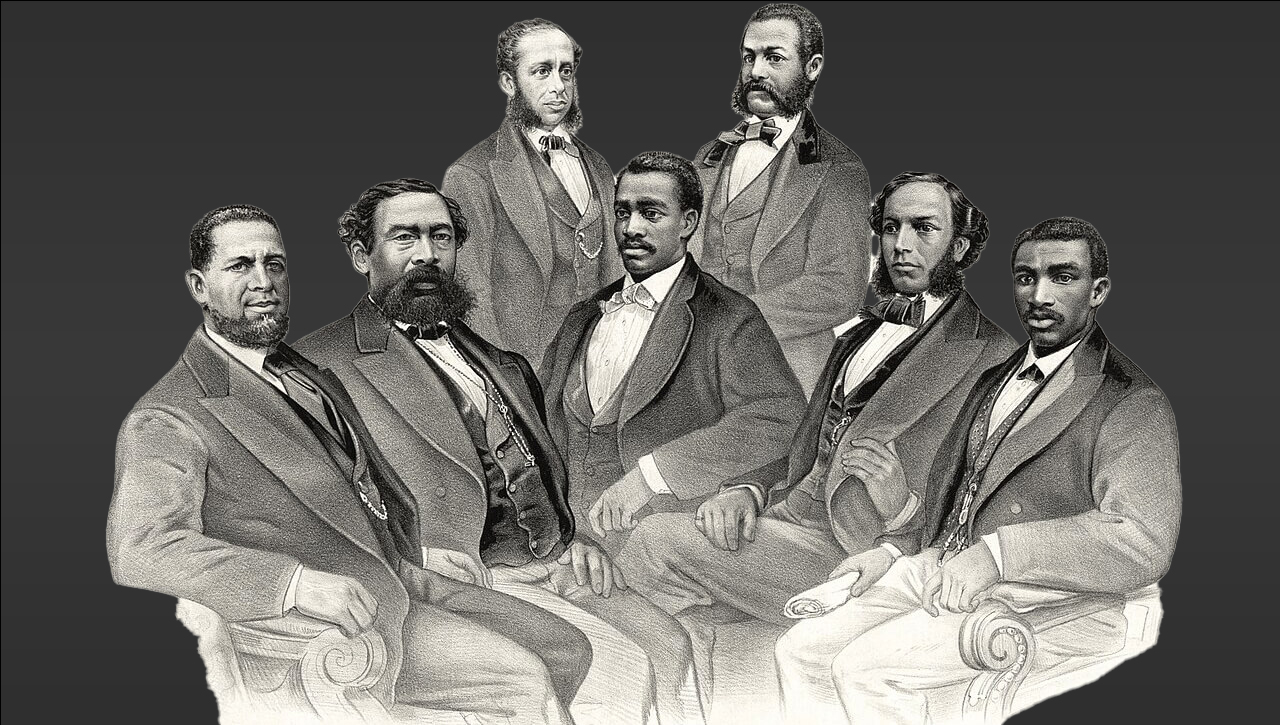
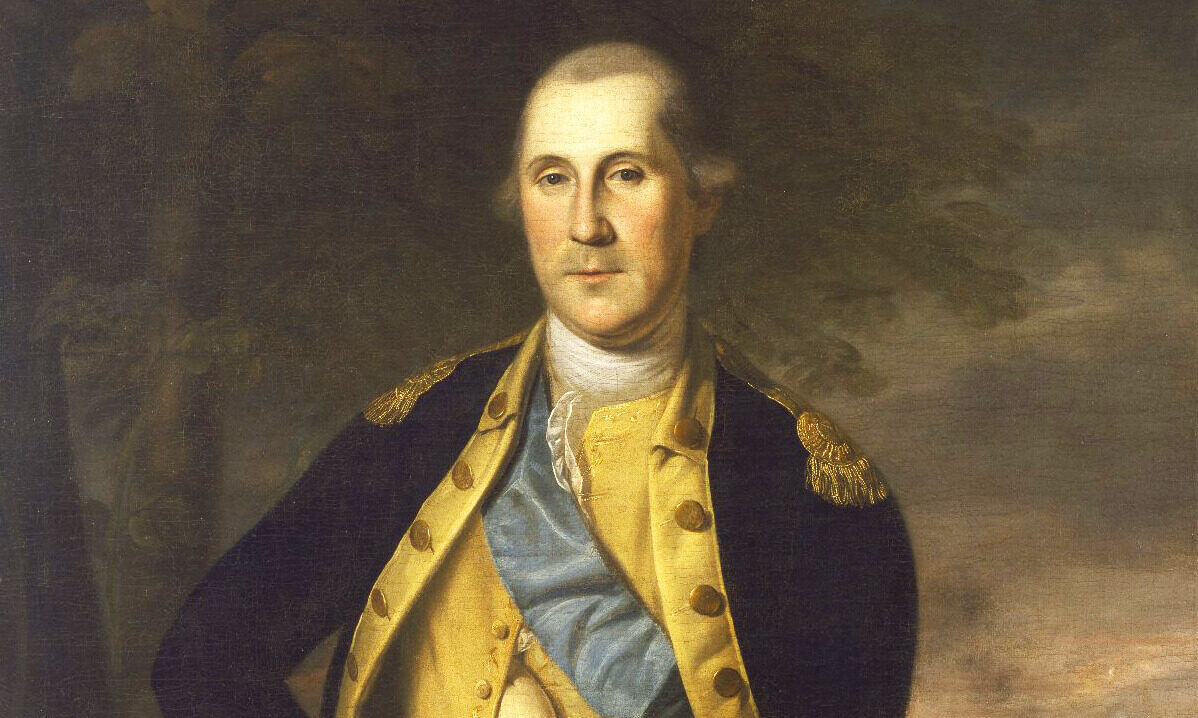
Religious Activities at Presidential Inaugurations

by David Barton

Americans have long believed that civic ceremonies such as presidential inaugurations should include religious activities. Recently, some individuals and groups have raised objections to these activities, often arguing that they violate the Founders’ supposed commitment to secularizing the public square by separating church and state.1 These arguments have no historical foundation, as can be seen by briefly considering America’s first presidential inauguration.

Constitutional experts abounded at George Washington’s inauguration. The inauguree himself was a signer of the Constitution, and one-fourth of the members of the Congress that organized and directed his inauguration had also been delegates to the Constitutional Convention. 2 This body certainly knew what was, and was not constitutional.

George Washington’s First Inauguration

The first inauguration occurred on April 30, 1789, at Federal Hall in New York City (the city served as the nation’s capital in 1789-1790). Extensive preparations for that event were made by Congress, with the cooperative help of a body of fourteen clergy, including ministers from different denominations and a rabbi.3

Local papers reported the first of these activities:

[O]n the morning of the day on which our illustrious President will be invested with his office, the bells will ring at nine o’clock, when the people may go up to the house of God and in a solemn manner commit the new government, with its important train of consequences, to the holy protection and blessing of the Most High. An early hour is prudently fixed for this peculiar act of devotion and it is designed wholly for prayer. 4

As the day proceeded, things appeared to be moving smoothly. But as the parade carrying Washington by horse-drawn carriage was nearing Federal Hall, it was realized that no Bible had been obtained for administering the oath. Today this would not be a problem for some civic officials, but in that era it would have been highly unusual to take an oath without a Bible.

Oaths in American History

In the Christian West, oath taking had long been held to be an innately religious activity. Many early colonial and state laws required oaths to be taken on the Bible. Some states even specified that they were to be taken “on the holy evangelists of Almighty God” 5 —that is, on the Bible, but with special emphasis on the Gospels. Requirements also routinely stipulated that “So help me God” be part of the official oath,6 and multiple states specifically required that the person taking the oath, “after repeating the words, ‘So help me God,’ shall kiss the Holy Gospels.” 7 These general provisions—in place at the time of the federal Constitution—were retained for generations.8

With this as the standard practice for oath-taking, a Bible was certainly needed. So Parade Marshal Jacob Morton hurried off and soon returned with a large 1767 King James Bible.

Bible & the Presidential Oath at the 1st Inauguration

The inaugural ceremony was conducted on the balcony at Federal Hall. With a huge crowd gathered below to watch the proceedings, the Bible was laid upon a crimson velvet cushion held by Samuel Otis, Secretary of the US Senate. New York Chancellor Robert Livingston administered the oath of office. (He was on the five-man committee charged with drafting the Declaration of Independence, but before he could affix his signature to the document he was called back to New York to guide his state through the Revolution. Because Livingston was the highest ranking judicial official in New York, he was chosen to administer the oath to President Washington.) Standing beside them were many distinguished officials, including Vice President John Adams, future Supreme Court Chief Justice John Jay, and Generals Henry Knox and Philip Schuyler.

When it came time to take the oath, Washington placed his left hand upon the Bible, which had been opened at random to Genesis 49,9 raised his right, and swore to “faithfully execute the office of President of the United States, and will to the best of my ability, preserve, protect and defend the Constitution of the United States.” He then bent over, reverentially kissed the Bible, and then likely added the words “So help me God.”

Oaths in the Various States

Significantly, twelve of the thirteen colonies at the time required the use of that phrase when taking an oath, 10 and the thirteenth colony required a declared belief in God just to hold office. 11 While no contemporary records verify this addition to his oath, it would have been highly unusual if he had neglected to do so; and we can be confident that the absence of these words would certainly have been noted in contemporary accounts.

Many of Washington’s actions related to oath-taking have clear antecedents in the Bible. For example, God declared: “I RAISED MY HAND IN AN OATH . . .” (Ezekiel 20:15, 23; 36:7; Psalm 106:26) and the Scripture further affirms that “The Lord has sworn by His RIGHT hand” (Isaiah 62:8). And when God’s people were instructed how to take an oath, they were told: “You shall . . . take oaths IN HIS NAME” (Deuteronomy 10:20), which is reflected with our use of the phrase “So help me God.”

Founders on Oaths

America’s Founders repeatedly affirmed that oath taking is an inherently religious activity. For example (emphasis added in each quote):

[An] oath—the strongest of religious ties.12 JAMES MADISON, SIGNER OF THE CONSTITUTION

[In o]ur laws . . . by the oath which they prescribe, we appeal to the Supreme Being so to deal with us hereafter as we observe the obligation of our oaths. The Pagan world were and are without the mighty influence of this principle which is proclaimed in the Christian system. 13 RUFUS KING, SIGNER OF THE CONSTITUTION

Oaths in this country are as yet universally considered as sacred obligations. 14 JOHN ADAMS, SIGNER OF THE DECLARATION, FRAMER OF THE BILL OF RIGHTS

An oath is an appeal to God, the Searcher of Hearts, for the truth of what we say and always expresses or supposes an imprecation [calling down] of His judgment upon us if we prevaricate [lie]. An oath, therefore, implies a belief in God and His Providence and indeed is an act of worship. . . . In vows, there is no party but God and the person himself who makes the vow.15 JOHN WITHERSPOON, SIGNER OF THE DECLARATION

The Constitution enjoins an oath upon all the officers of the United States. This is a direct appeal to that God Who is the avenger of perjury. Such an appeal to Him is a full acknowledgment of His being and providence. 16 OLIVER WOLCOTT, SIGNER OF THE DECLARATION

According to the modern definition [1788] of an oath, it is considered a “solemn appeal to the Supreme Being for the truth of what is said by a person who believes in the existence of a Supreme Being and in a future state of rewards and punishments . . .” 17JAMES IREDELL, RATIFIER OF THE CONSTITUTION, EARLY U. S. SUPREME COURT JUSTICE

The Constitution had provided that all the public functionaries of the Union, not only of the general [federal] but of all the state governments, should be under oath or affirmation for its support. The homage of religious faith was thus superadded to all the obligations of temporal law to give it strength. 18JOHN QUINCY ADAMS, PRESIDENT

George Washington, in his famous Farewell Address at the end of his presidency, pointedly warned Americans never to let the oath-taking process become secular:

[W]here is the security for property, for reputation, for life, if the sense of religious obligation desert the oaths . . . ?19

Clearly, in the Founding Era, the act of taking an oath was considered an intrinsically religious activity.

Eyewitness Account of the 1st Inauguration

After George Washington finished taking his oath, Chancellor Livingston proclaimed “It is done!” Turning to the crowd assembled below, he shouted, “Long live George Washington —the first President of the United States!” That shout was echoed and re-echoed by the crowd. As reported by one eyewitness:

It would seem extraordinary that the administration of an oath, a ceremony so very common and familiar, should in so great a degree excite the public curiosity. But the circumstances of his election—the impression of his past services—the concourse of spectators – the devout fervency with which he repeated the oath—and the reverential manner in which he bowed down and kissed the Sacred Volume—all these conspired to render it one of the most august and interesting spectacle ever exhibited on this globe. It seemed, from the number of witnesses, to be a solemn appeal to Heaven and earth at once. Upon the subject of this great and good man, I may perhaps be an enthusiast, but I confess that I was under an awful and religious persuasion that the gracious Ruler of the Universe was looking down at that moment with peculiar complacency [satisfaction] on an act, which to a part of His creatures was so very important. Under this impression, when the Chancellor pronounced in a very feeling manner, “Long live George Washington,” my sensibility was wound up to such a pitch that I could do not more than wave my hat with the rest, without the power of joining in the repeated acclamations which rent the air.20

Washington’s Inauguration Address

Washington and the other officials then left the balcony and went inside Federal Hall to the Senate Chamber, where he delivered the first Inaugural Address to a joint session of Congress. He began by emphasizing that it would be peculiarly improper to omit in this first official act my fervent supplications to that Almighty Being Who rules over the universe, Who presides in the councils of nations, and Whose providential aids can supply every human defect – that His benediction may consecrate to the liberties and happiness of the people of the United States a government instituted by themselves for these essential purposes. 21

Washington then called his listeners to remember and acknowledge God:

In tendering this homage [act of worship] to the Great Author of every public and private good, I assure myself that it expresses your sentiments not less than my own, nor those of my fellow-citizens at large less than either. No people can be bound to acknowledge and adore the Invisible Hand which conducts the affairs of men more than those of the United States. Every step by which they have advanced to the character of an independent nation seems to have been distinguished by some token of Providential Agency. . . . [and] we ought to be no less persuaded that the propitious [favorable] smiles of Heaven can never be expected on a nation that disregards the eternal rules of order and right which Heaven itself has ordained.22

Washington concluded the address by offering a heartfelt closing prayer:

I shall take my present leave—but not without resorting once more to the benign Parent of the Human Race in humble supplication [prayer] that . . . His Divine blessing may be equally conspicuous in the enlarged views, the temperate consultations, and the wise measures on which the success of this government must depend.23

Church After Inauguration

After the address, Congress had stipulated:

That after the oath shall have been administered to the President, he—attended by the Vice-President and members of the Senate and House of Representatives—proceed to St. Paul’s Chapel to hear Divine service.24

So, agreeable to the congressional resolution:

The President, the Vice-President, the Senate, and House of Representatives, &c., then proceeded to St. Paul’s Chapel, where Divine Service was performed by the chaplain of Congress. 25

The president and Congress went en masse to church, where the service was conducted by The Right Reverend Samuel Provoost—the Episcopal Bishop of New York who had been chosen chaplain of the Senate the preceding week. 26 He performed the service according to The Book of Common Prayer, including prayers taken from Psalms 144–150, administering the sacrament of Holy Communion, and Scripture readings from the book of Acts, I Kings, and the Third Epistle of John. 27

After the church service Congress returned to Federal Hall where it adjourned, thus concluding the official inaugural activities.

Conclusion

The first presidential inauguration included at least eight distinctly religious activities: (1) a time of public prayer preceding the inauguration (today, this often occurs through an official prayer breakfast preceding the inauguration); (2) the use of the Bible to administer the oath; (3) solemnifying the oath with multiple religious expressions (placing a hand on the Bible, saying “So help me God,” and kissing the Bible); (4) prayers offered by the president himself; (5) religious content in the inaugural address; (6) the president calling the people to pray or acknowledge God; (7) official church worship services; and (8) clergy-led prayers. These have been repeated, in whole or part, in every subsequent inauguration. 28

From the earliest colonial settlements to the first presidential inauguration, Americans believed that religious practices should play an important role in civic ceremonies. There is no reason to think America’s Founders desired to change these practices, and every reason to believe they firmly embraced them.


Endnotes

1 See, for example, “ FFRF asks Trump to eject religion and prayer from public oath-taking,” Freedom From Religion Foundation, January 3, 2017; Newdow v. Roberts, 603 F.3d 1002, Ct. of Appeals, Dist. of Columbia (2010); Newdow v. Bush, USDC, District of Columbia, Civil Action No. 04-2208 (JDB), opinion rendered January 14, 2005.

2 Significantly, many of the U. S. Senators at the first Inauguration had been delegates to the Constitutional Convention that framed the Constitution including William Samuel Johnson, Oliver Ellsworth, George Read, Richard Bassett, William Few, Caleb Strong, John Langdon, William Paterson, Robert Morris, and Pierce Butler; and many members of the House had been delegates to the Constitutional Convention, including Roger Sherman, Abraham Baldwin, Daniel Carroll, Elbridge Gerry, Nicholas Gilman, Hugh Williamson, George Clymer, Thomas Fitzsimmons, and James Madison.

3 See, for example, The Jewish Encyclopedia (New York: Funk and Wagnalls Company, 1907), XI:160, “Gershom Mendez Seixas.”

4 The Daily Advertiser, (New York, April 23, 1789), 2.

5 See, for example, the laws of Georgia, both before and after the federal Constitution: Oliver H. Prince, A Digest of the Laws of the State of Georgia (Milledgeville: Grantland & Orme, 1822), 3, “An Act for the case of Dissenting Protestants, within this province, who may be scrupulous of taking an oath, in respect to the manner and form of administering the same,” passed December 13, 1756 and South Carolina: Joseph Brevard, An Alphabetical Digest of the Public Statue Law of South Carolina (Charleston: John Hoff, 1814), II:86, “Oaths-Affirmations.”

6 See Connecticut as an example. For policies on this before the federal Constitution: R.R. Hinman, A.M., Letters From the English Kings and Queens, Charles II, James II, William and Mary, Anne, George II, &C., To the Governors of the Colony of Connecticut, Together With the Answers Thereto, From 1635 to 1749; And Other Original, Ancient, Literary and Curious Documents, Compiled From Files and Records in the Office of the Secretary of the State of Connecticut (Hartford: John B. Eldredge, Printer, 1836), 26-28. For policies on this following the federal Constitution, see: The Public Statute Laws of the State of Connecticut (Hartford: Hudson and Goodwin, 1808), 535, Title CXXII: Oaths, Ch. 1, Sec. 6, law passed in May, 1742; 540, Title CXXII: Oaths, Ch. 1, Sec. 25, law passed in May, 1726; 541, Title CXXII: Oaths, Ch. 1, Sec. 30 & 32, law passed in May, 1718.

For additional examples of states requiring people being sworn into office to say “so help me God” see: The Federal and State Constitution, Colonial Charters, and Other Organic Laws, ed. Francis Newton Thorpe (Washington: Government Printing Office, 1909), I:523, 1638-1639. Fundamental Orders of Connecticut; II:780, 1777. Georgia Constitution, Art. XIV-XV; III:1909, 1780. Massachusetts Constitution, Ch. VI; IV:2468, 1784. New Hampshire Constitution, “Oaths and Subscriptions”; VI:3255, 1778. Constitution of South Carolina, Sec. XXXVI. Laws of the State of Delaware (New Castle: Samuel and John Adams, 1797), II:1261, Ch. XCVIII, Sec. 29.

Laws of Maryland, Made Since MDCCLXIII (Annapolis: Frederick Green, 1787), Ch. V from “A Session of the General Assembly of Maryland…in the year of our Lord one thousand seven hundred and seventy-seven”. William Patterson, Laws of the State of New-Jersey (Newark: Matthias Day, 1800), 376, “An Act prescribing certain oaths,” February 20, 1799. The Public Laws of the State of Rhode-Island and Providence Plantations (Providence: Miller & Hutchens, 1822), 109, 111, “An Act to establish a Supreme Judicial Court,” passed from 1729-1822. Abridgment of the Public Permanent Laws of Virginia (Richmond: Augustine Davis, 1796), 219-220, “Oaths,” December 22, 1792, the text of many of the oaths listed here come from 1779.

7 John Haywood, A Manual of the Laws of North Carolina (Raleigh: J. Gales, 1814), 34, “Oaths and Affirmations. 1777”; Laws of the State of New-York (New York: Thomas Greenleaf, 1798), 21, “Chap. XXV: An Act to dispense with the usual mode of administering oaths, in favor of persons having conscientious scruples respecting the same, Passed 1st of April, 1778”; James Parker, Conductor Generalis: Or the Office, Duty and Authority of the Justices of the Peace (New York: John Patterson, 1788), 302-304, “Of oaths in general”.

8 George C. Edward, A Treatise on the Powers and Duties of Justices of the Peace and Town Officers, in the State of New York (Ithaca: Mack, Andrus & Woodruff, 1836), 91, “Of the proceedings on the trial.”

9 See, for example, “The 1st Presidential Inauguration,” Joint Congressional Committee on Inaugural Ceremonies (accessed on January 17, 2017).

10 Laws requiring some version of “so help me God” are found in all original 13 colonies except Pennsylvania. American Political Thought (Spring 2014), 3:1:55, Mark David Hall, “Madison’s Memorial and Remonstrance, Jefferson’s Statute for Religious Liberty, and the Creation of the First Amendment.”

11 The Pennsylvania Constitution of 1776 required legislators to swear or affirm, “I do believe in one God, the Creator and Governor of the universe, the Rewarder of the good and the Punisher of the wicked. And I do acknowledge the Scriptures of the Old and New Testament to be given by Divine inspiration” [The Constitutions of the Several Independent States of America (Boston: Norman and Bowen, 1785), 81, Pennsylvania, 1776, Chapter II, Section 10]. The Pennsylvania Constitution of 1790 required that the official “acknowledges the being of a God and a future state of rewards and punishments” [The American’s Guide: Comprising the Declaration of Independence; the Articles of Confederation; the Constitution of the United States; and the Constitutions of the Several States Composing the Union (Philadelphia: Towar, J. & D. M. Hogan, 1830), 168, Pennsylvania, 1790, Art. 9].

12 James Madison, The Writings of James Madison, ed. Gaillard Hunt (New York: G.P. Putnam’s Sons, 1904), V:30, to Thomas Jefferson on October 24, 1787.

13 Reports of the Proceedings and Debates of the Convention of 1821, Assembled for the Purpose of Amending The Constitution of the State of New York (Albany: E. and E. Hosford, 1821), 575, Rufus King, October 30, 1821.

14 John Adams, The Works of John Adams, ed. Charles Francis Adams (Boston: Little, Brown and company, 1854), IX:229, to the Officers of the First Brigade of the Third Division of the Militia of Massachusetts on October 11, 1798.

15 John Witherspoon, The Works of John Witherspoon (Edinburgh: J. Ogle, 1815), VII:139, 142, from his “Lectures on Moral Philosophy,” Lecture 16 on Oaths and Vows.

16 Jonathan Elliot, The Debates in the Several State Conventions on the Adoption of the Federal Constitution (Washington: Printed for the Editor, 1836), II:202, Oliver Wolcott on January 9, 1788.

17 Elliot, Debates (1836), IV:196, James Iredell on July 30, 1788.

18 John Quincy Adams, The Jubilee of the Constitution. A Discourse Delivered at the Request of the New York Historical Society, in the City of New York, on Tuesday, the 30th of April, 1839; Being the Fiftieth Anniversary of the Inauguration of George Washington as President of the United States, on Thursday, the 30th of April, 1789 (New York: Samuel Colman, 1839), 62.

19 George Washington, Address of George Washington, President of the United States . . . Preparatory to His Declination (Baltimore: George and Henry S. Keatinge, 1796), 23.

20 Gazette of the United States (May 9-13, 1789), 3, “Extract of a letter from New-York, May 3;” The American Museum: Or Repository of Ancient and Modern Fugitive Pieces, & c. Prose and Poetical (Philadelphia: Matthew Carey, 1789), V:505.

21 The Debates and Proceedings in the Congress of the United States, ed. Joseph Gales (Washington: Gales & Seaton, 1834), Vol. I, p. 27; George Washington, Messages and Papers of the Presidents, ed. James D. Richardson (Washington, D.C.: 1899), 1:44-45, April 30, 1789.

22 Debates and Proceedings (1834), I:27-29, April 30, 1789.

23 Debates and Proceedings (1834), I:27-29, April 30, 1789.

24 In the Senate: Debates and Proceedings (1834), I:25, April 27, 1789; in the House: Debates and Proceedings (1834), I:241, April 29, 1789.

25 Debates and Proceedings (1834), I:29, April 30, 1789.

26 Clarence W. Bowen, The History of the Centennial Celebration of the Inauguration of George Washington (New York, D. Appleton & Co., 1892), 54; “About the Senate Chaplain,” United States Senate, accessed June 24, 2025.

27 Book of Common Prayer (Oxford: W. Jackson & A. Hamilton, 1784), s.v., April 30th. For evidence that George Washington participated in that communion, see Peter Lillback, Sacred Fire (Bryn Mawr, PA: Dickinson Press, 2006), 420-423.

28 The religious activities that took place during Barack Obama’s inauguration ceremony in 2009 were fewer than those at Washington’s Inauguration but did include prayer before and after the oath of office, using a Bible during the oath, saying “so help me God” at the end of the oath [“The 56th Presidential Inauguration,” Joint Congressional Committee on Inaugural Ceremonies], religious content in the inaugural address [“President Barack Obama’s Inaugural Address,” The White House, January 21, 2009], and attending a prayer service the day after the inauguration [Amanda Ruggeri, “For President Obama, a Somber, Inclusive Inaugural Prayer Service,” U.S. News & World Report, January 21, 2009].


* This article concerns a historical issue and may not have updated information.

A God-Given Inalienable Right

One of the first rights to be protected in early America was the right of conscience – the right to believe differently on issues of religious faith. As John Quincy Adams explained, this right was a product of Christianity:

Jesus Christ. . . . came to teach and not to compel. His law was a Law of Liberty. He left the human mind and human action free. 1

Early American legal writer Stephen Cowell (1800-1872) agreed:

Nonconformity, dissent, free inquiry, individual conviction, mental independence, are forever consecrated by the religion of the New Testament. 2

President Franklin D. Roosevelt likewise declared:

We want to do it the voluntary way – and most human beings in all the world want to do it the voluntary way. We do not want to have the way imposed. . . . That would not follow in the footsteps of Christ. 3

The Scriptures teach that there will be differences of conscience (cf. 1 Corinthians 8) and that if an individual “wounds a weak conscience of another, you have sinned against Christ” (v. 12). We are therefore instructed to respect the differing rights of conscience (v. 13). (See also I Corinthians 10:27-29.) Extending toleration for the rights of conscience is urged throughout the New Testament. (See also Romans 14:3, 15:7, Ephesians 4:2, Colossians 3:13, etc.)

Leaders who knew the Scriptures therefore protected those rights. For example, in 1640, the Rev. Roger Williams established Providence, penning its governing document declaring:

We agree, as formerly hath been the liberties of the town, so still, to hold forth liberty of conscience. 4

Similar protections also appear in the 1649 Maryland “Toleration Act,” 5 the 1663 Charter for Rhode Island, 6 the 1664 Charter for Jersey, 7 the 1665 Charter for Carolina, 8 the 1669 Constitutions of Carolina, 9 the 1676 Charter for West Jersey, 10 the 1701 Charter for Delaware, 11 and the 1682 Frame of Government for Pennsylvania. 12 John Quincy Adams affirmed that: “The transcendent and overruling principle of the first settlers of New England was conscience.” 13

Then when America separated from Great Britain in 1776 and the states created their very first state constitutions, they openly acknowledged Christianity and jointly secured religious toleration, non-coercion, and the rights of conscience. For example, the 1776 constitution of Virginia declared:

That religion, or the duty which we owe to our Creator and the manner of discharging it, can be directed only by reason and conviction, not by force or violence; and therefore all men are equally entitled to the free exercise of religion according to the dictates of conscience; and that it is the mutual duty of all to practice Christian forbearance, love, and charity towards each other. 14

Similar clauses appeared in the constitutions of New Jersey (1776), 15 North Carolina (1776), 16 Pennsylvania (1776), 17 New York (1777), 18 Vermont (1777), 19 South Carolina (1778), 20 Massachusetts (1780), 21 New Hampshire (1784), 22 etc. Today, the safeguard for the rights of conscience pioneered by Christian leaders is a regular feature of state constitutions. 23

The Founding Fathers were outspoken about the importance of this God-given inalienable right. For example, signer of the Constitution William Livingston declared:

Consciences of men are not the objects of human legislation. . . . [H]ow beautiful appears our [expansive] constitution in disclaiming all jurisdiction over the souls of men, and securing (by a never-to-be-repealed section) the voluntary, unchecked, moral suasion of every individual. 24

And John Jay, the original Chief Justice of the U. S. Supreme Court, similarly rejoiced that:

Security under our constitution is given to the rights of conscience and private judgment. They are by nature subject to no control but that of Deity, and in that free situation they are now left. 25

President Thomas Jefferson likewise declared that the First Amendment was an “expression of the supreme will of the nation in behalf of the rights of conscience.” 26

But President Obama disagrees with what for four centuries in American history has formerly been an inalienable right. He has specifically singled out and attacked the rights of religious and moral conscience, seeking to coerce dissenters into accepting his own beliefs. While Biblical teachings result in protection for differences of opinion on religious issues, secularists demand conformity of belief and practice to their own secular standards; they are especially intolerant of any differences that stem from Biblical faith.

While the President has targeted the Catholic Church for its religious beliefs, his attacks on religious conscience were ongoing, beginning shortly after he first took office when he first announced his plans to repeal religious conscience protection for medical workers. (We have posted on our website a piece showing the extreme and consistent hostility of this President against Biblical faith and values. As proven by his own actions and words, he is the most anti-Biblical president in American history.)


1 John Quincy Adams, A Discourse on Education Delivered at Braintree, Thursday, October 24th, 1839 (Boston: Perkins & Marvin, 1840), 17-18.

2 Stephen Colwell, Politics for American Christians: A World upon our Example as a Nation, our Labour, our Trade, Elections, Education, and Congressional Legislation (Philadelphia: Lippincott, Grambo & Co. 1852), 82.

3 “Franklin D. Roosevelt, “Christmas Greeting to the Nation,” American Presidency Project, December 24, 1940, https://www.presidency.ucsb.edu/node/209414.

4 “Plantation Agreement at Providence,” The Avalon Project, August 27 – September 6, 1640, https://avalon.law.yale.edu/17th_century/ri01.asp.

5 William MacDonald, Select Charters and Other Documents Illustrative of American History 1606-1775 (New York: MacMillan Company, 1899), 104-106.

6 “Plantation Agreement at Providence August 27 – September 6, 1640,” The Federal and State Constitutions, Colonial Charters and Other Organic Laws, ed. Francis Newton Thorpe (Washington: Government Printing Office, 1909), VI:3211; “Charter of Rhode Island and Providence Plantations,” The Avalon Project, July 15, 1663, https://avalon.law.yale.edu/17th_century/ri01.asp.

7 “The Concession and Agreement of the Lords Proprietors of the Province of New Caesarea, or New Jersey,” The Avalon Project, 1664, https://avalon.law.yale.edu/17th_century/nj05.asp.

8 “Charter of Carolina,” The Avalon Project, June 30, 1665, https://avalon.law.yale.edu/17th_century/nc03.asp.

9 “Fundamental Constitution of Carolina,” The Avalon Project, March 1, 1669, https://avalon.law.yale.edu/17th_century/nc05.asp.

10 “The Charter or Fundamental Laws of West New Jersey,” The Avalon Project, 1676, https://avalon.law.yale.edu/17th_century/nj05.asp.

11 “Charter of Delaware,“ The Avalon Project, 1701, https://avalon.law.yale.edu/18th_century/de01.asp.

12 “ Frame of Government of Pennsylvania,“ The Avalon Project, May 5, 1682, https://avalon.law.yale.edu/17th_century/pa04.asp.

13 John Quincy Adams, A Discourse on Education Delivered at Braintree, Thursday, October 24th, 1839 (Boston: Perkins & Marvin, 1840), 28.

14 “Constitution of Virginia: Bill of Rights,” The American’s Guide: Comprising the Declaration of Independence; the Articles of Confederation; the Constitution of the United States, and the Constitutions of the Several States Composing the Union (Philadelphia: Hogan & Thompson, 1845), 180.

15 “Constitution of New Jersey,” The Avalon Project, 1776, https://avalon.law.yale.edu/18th_century/nj15.asp.

16 Constitutions of the Several Independent States of America (Boston: Norman & Bowen, 1785), 132.

17 Constitutions of the Several Independent States of America (Boston: Norman & Bowen, 1785), 77.

18 “The Constitution of New York,” The Avalon Project, April 20, 1777, https://avalon.law.yale.edu/18th_century/ny01.asp 1777.

19 The Federal and State Constitutions, Colonial Charters, and Other Organic Laws, 3d. Francis Newton Thorpe (Washington: Government Printing Office, 1909), VI:3740.

20 Constitutions of the Several Independent States of America, (Boston: Norman & Bowen, 1785), 152-154.

21 Constitutions of the Several Independent States of America (Boston: Norman & Bowen, 1785), 6.

22 Constitutions of the Several Independent States of America (Boston: Norman & Bowen, 1785), 3-4.

23 “State Policies in Brief: Refusing to Provide Health Services,” Guttmacher Institute, March 1, 2012, https://www.guttmacher.org/statecenter/spibs/spib_RPHS.pdf.

24 William Livingston, The Papers of William Livingston, eds. Carl E. Prince, et al (Trenton: New Jersey Historical Commission, 1980), 2:235-237, writing as “Cato,” February 18, 1778.

25 Benjamin F. Morris, Christian Life and Character of the Civil Institutions of the United States, Developed in the Official and Historical Annals of the Republic (Philadelphia: George W. Childs, 1864), 152.

26 Thomas Jefferson to Messrs. Nehemiah Dodge, Ephraim Robbins, and Stephen S. Nelson, A Committee of the Danbury Baptist Association, in the State of Connecticut, January 1, 1802 Writings of Thomas Jefferson, ed. Albert Ellery Bergh (Washington D.C.: Thomas Jefferson Memorial Association, 1904), XVI:281-282.

* This article concerns a historical issue and may not have updated information.

President Eisenhower’s One Nation Under God

February 7 is a notable historical day for the acknowledgment of God in modern America: it is the day that a sermon was preached before President Dwight D. Eisenhower, suggesting that the words “under God” be added to the pledge. The sermon was preached by the Rev. George M. Docherty, pastor of New York Avenue Presbyterian Church in Washington, D. C.1

This sermon was preached for Lincoln Day, and it had a great impact on those listening, including President Eisenhower, who was seated in the same pew that Abraham Lincoln had regularly occupied in that church as President.2 In that sermon Docherty stated:

There was something missing in the pledge, and that which was missing was the characteristics and definitive factor in the American way of life. Indeed apart from the mention of the phrase, the United States of America, it could be the pledge of any republic. In fact, I could hear little Muscovites repeat a similar pledge to their hammer and sickle flag in Moscow with equal solemnity.3

He made the point that the American pledge as it then existed could just have been recited by citizens from any country, even those from communistic nations that hated God. The day following the sermon, U. S. Rep. Charles Oakman from Michigan introduced a Joint Resolution (H. J. Res 371) to add the words “Under God” into the pledge,4 explaining:

Mr. Speaker, I think Mr. Docherty hit the nail squarely on the head. One of the most fundamental differences between us and the Communists is our belief in God.5

Two days later, on February 10th, Senator Homer Ferguson from Michigan introduced the Senate Joint Resolution (S.J. 126),6 explaining to the Senate:

Our nation is founded on a fundamental belief in God, and the first and most important reason for the existence of our government is to protect the God-given rights of our citizens. . . . Indeed, Mr. President, over one of the doorways to this very Chamber inscribed in the marble are the words “In God We Trust.” Unless those words amount to more than a carving in stone, our country will never be able to defend itself.7

These resolutions were passed, and on June 14, 1954 (Flag Day), President Dwight D. Eisenhower signed the bill into law, officially adding the words “under God” into the Pledge of Allegiance, telling the nation:

From this day forward, the millions of our school children will daily proclaim in every city and town, every village and rural school house, the dedication of our nation and our people to the Almighty. To anyone who truly loves America, nothing could be more inspiring than to contemplate this rededication of our youth, on each school morning, to our country’s true meaning. . . . In this way we are reaffirming the transcendence of religious faith in America’s heritage and future; in this way we shall constantly strengthen those spiritual weapons which forever will be our country’s most powerful resource, in peace or in war.8

Who could have imagined that a single sermon could have such an impact? Yet American history is full of such accounts. On February 7th, take time to read this remarkable sermon, remembering that we are indeed “one nation under God.”


Endnotes

1 George M. Docherty, One Way of Living (Harper & Brothers, New York, 1958), 158, “One Nation Under God.”
2 “Lincoln and ‘Under God’,” Presbyterian Historical Society, February 7, 2014; “House Joint Resolution 243 to Amend the Pledge of Allegiance to Include the Phrase ‘Under God’: Extension of Remarks of Hon. Louis C. Rabaut,” Feb 12, 1954,  Congressional Record (Volume 100 Session 2), 1700.
3 “Abraham Lincoln: Extension of Remarks of Hon. Charles G. Oakman,” Feb 12, 1954, Congressional Record (Volume 100, Session 2), 1697; George M. Docherty, One Way of Living (Harper & Brothers, New York, 1958), 164; “House Joint Resolution 243 to Amend the Pledge of Allegiance to Include the Phrase ‘Under God’: Extension of Remarks of Hon. Louis C. Rabaut,” Feb 12, 1954,  Congressional Record (Volume 100 Session 2), 1700.
4 Feb 8, 1954, Congressional Record (Volume 100, Session 2), 1522.
5 “Abraham Lincoln: Extension of Remarks of Hon. Charles G. Oakman,” Feb 12, 1954, Congressional Record (Volume 100, Session 2), 1697.
6 Feb 10, 1954, Congressional Record (Volume 100, Session 2), 1600.
7 Feb 10, 1954, Congressional Record (Volume 100, Session 2), 1600-1601.
8 Dwight D. Eisenhower, “Statement by the President Upon Signing Bill To Include the Words “Under God” in the Pledge to the Flag,” June 14, 1954, The American Presidency Project.