Black Communist Leader Exposes the Truth of Racial Divide

This is a part of our Alumni Series of articles written by past participants of the WallBuilders/Mercury One Leadership Training Program (now called “AJE Summer Institute”). Click here to learn more about this program. 

By Noah DeGarmo – Class of 2019

Manning Johnson, a black man born in 1908, joined the Communist Party USA in 1930, where he served as a national organizer for the Trade Unity League.[i] From 1931 to 1932, he served as the District Agitation Propaganda Director for Buffalo, NY, and was district organizer for Buffalo from 1932 to 1934. In 1935, Johnson ran as the Communist Party’s Candidate for New York’s 22nd Congressional District for the U.S. House of Representatives. From 1936 to 1939, he served on the Party’s National Committee, National Trade Union Commission, and Negro Commission. Despite his notable status, Johnson left the Communist Party in 1939.[ii]

Johnson explained that some of the biggest factors to his departure included his original religiosity, the Party’s promotion of “Soviet Negro Republic” in the “Black Belt” of the United States, the insincerity of the Party in saving the Scottsboro Boys, and finally, the Hitler-Stalin Pact of 1939.[iii] Additionally, Johnson saw that the Communists were using black Americans as pawns in their hope that a “bloody racial conflict would split America.”[iv]

After leaving the Party, Johnson became a government informant and witness, testifying in 18-20 cases by his own estimation.[v] In 1958, he published Color, Communism, and Common Sense detailing the Communist Party’s tactics for infiltrating the African-American community and inciting racial division in the United States, paving the way for a Communist takeover in America. Shortly after publishing the book, Johnson died in an automobile accident on June 26, 1959.[vi] The information he provides in this book is eerily similar to and has much to say about the state of America in 2020.

Johnson shares that the goal of Communist agents in the early 20th century was to cripple the black community in America and incite racial division. This division would consequently weaken the nation as a whole and provide the opportunity for Communists to gain power.

He writes that white Communists infiltrated black communities by presenting themselves as allies of the black cause. They preached that black Americans were oppressed and offered liberation as a guise for their Communist agenda:

White leftists descended on Negro communities like locusts, posing as “friends” come to help “liberate” their black brothers. Along with these white communist missionaries came the Negro political Uncle Toms to allay the Negro’s distrust and fears of these strangers. Everything was interracial, an inter-racialism artificially created, cleverly devised as a camouflage of the red plot to use the Negro.[vii]

Despite how they portrayed themselves, the Communists never did anything to advance the well-being of the black population. However, they gained power and money by parroting and hiding behind the cause of civil rights. The Communists placed all the responsibility for the condition of the African-American community on the white man. Johnson noted that this victimhood mindset strips black individuals of agency, discouraging initiative and responsibility.

The placing of the repository of everything, right and just, among the darker races is a dastardly Communist trick to use race as a means of grabbing and enslaving the whole of humanity.

Moscow’s Negro tools in the incitement of racial warfare place all the ills of the Negro at the door of the white leaders of America. Capitalism and imperialism are made symbols of oppressive white rule in keeping with instructions from the Kremlin.

To one familiar with red trickery, it is obvious that placing the blame for all the Negroes’ ills at the door of the white leaders in America is to remove all responsibility from the Negro. This tends to make the Negro:

  • feel sorry for himself;
  • blame others for his failures;
  • ignore the countless opportunities around him;
  • jealous of the progress of other racial and national groups;
  • expect the white man to do everything for him;
  • look for easy and quick solutions as a substitute for the harsh realities of competitive struggle to get ahead.

The result is a persecution complex — a warped belief that the white man’s prejudices, the white man’s system, the white man’s government is responsible for everything. Such a belief is the way the reds plan it, for the next logical step is hate that can be used by the reds to accomplish their ends.[viii]

Despite all the promises, plans, and “solutions,” Johnson understood that the Communists were only fanning the flames of racial tension in order to raise money which they poured into promoting more tension instead of using it to benefit black communities:

The fact that the reds have never contributed anything tangible to the progress of the Negro is overlooked though the reds have collected millions of dollars as a result of race incitement. Like the Communist Party, the N.A.A.C.P. has collected millions of dollars through exploitation of race issues. The bigger the race issue, the bigger the appeal and the bigger the contributions.[ix]

Yet one cannot find any report of any of this money being spent for factories and shops to provide jobs, land and home construction, specialized training for talented youth, hospitals, convalescent homes, classes in sanitation and personal hygiene, care and upkeep of property, combatting crime and juvenile delinquency, centers to aid Negro youth in preparing to meet stiff employment competition in science and industry.

It is then no accident that the N.A.A.C.P. is dubbed “The National Association for the Agitation of Colored People.” The record speaks for itself. Millions for agitation; not one cent for those things that win the respect and acclaim of other races and national groups.[x]

Johnson’s words from 1958 seemingly prophesy the events of  2020. Modern leftists of both races have artificially enflamed and exploited racial division for profit. Former NFL player Colin Kaepernick gained fame by kneeling during the national anthem in protest of police brutality, and has made millions off of this fame, securing an exclusive advertising deal with Nike and a recently-signed partnership with Disney. Additionally, organizations like Black Lives Matter collect millions in donations while doing nothing to practically advance black communities.

Johnson also writes that politicians would exploit racial division for votes, a practice continued by Democrats today.

Many white Northern politicians objectively aid the rapidly deteriorating racial situation through the exploitation of leftist propaganda to garner Negro votes. They care not a tinker’s dam about the Southern Negro and simply flatter the Northern Negro whom they consider a gullible fool. Getting elected and re-elected is their only concern.[xi]

The Democrat Party has maintained power in black communities for decades, while those communities continue to suffer from poor economies and high crime rates. Democrats claim to fight for black people, while doing nothing for their well-being.

Because the Communists were not truly on the side of the black community, they had to squash any voices who called them out on their hypocrisy. Any whites who opposed the communist agenda were accused of white supremacy, while black opponents were labeled Uncle Toms. Johnson, in a long but invaluable section of his book, reveals that this is not a new practice:

At the root of all the present racial trouble is interference in the internal affairs of Southern States by people not at all interested in an amicable settlement of any problems arising between Negro and white Americans.

This interference comes from organizations and individuals in the North seeking to use the Negro. Among them are found Communists, crypto-communists, fuzzy-headed liberals, eggheads, pacifists, idealists, civil disobedience advocates, socialists, do-gooders, conniving politicians, self-seekers, muddle-headed humanitarians, addle-brained intellectuals, crackpots and plain meddlers. Like “missionaries,” they descend on the South ostensibly to change or to benefit the Negro.

In fact and in implication, all of them seek to by-pass the responsible white and Negro leaders in the South to effect a solution. They employ a pattern of setting up provocative situations which inflame and agitate the white populace and then using it as propaganda here and abroad against the South in particular and all of America in general.

White Southerners who oppose these “missionaries” are pounced upon and labeled “race baiters”, “reactionaries”, “Ku Kluxers”, “white supremacists”, “persons outside the law” and so forth. Negro Southerners who oppose these “missionaries” are also attacked and labeled “Uncle Toms”, “traitors of the race”, “handkerchief heads”, “white folks niggers” and so forth.

Obviously such name calling is a deliberate attempt on the part of these “missionaries” to scuttle all the progress made by the Negro since slavery by creating an atmosphere of distrust, fear, and hate. Like a witch stirring her brew the “missionaries” stir up all the sectional and racial bitterness that arose in the wake of the Civil War and Reconstruction. They open old wounds. They thumb the pages of closed chapters. They rake over the dying embers of old grudges, old grievances, old fears and old hates, that time has been gradually consigning to history in the onward sweep of a young, lusty, healthy and growing nation.

Labeling opponents is a specialty of the reds. Smear is a cardinal technique. Any label found in the red stockpile, you may be sure, is carefully made and selected to draw the maximum hate to the person or persons, the group or the organization to which it is attached.

The use of such labels has a tendency to divide America. Nothing, in my opinion, would please the aforementioned weird assortment of “missionaries” more than a divided America unless it is a Soviet America. They are forever predicting it at the same time working tirelessly to bring it about.[xii]

Modern leftists still employ this tactic today. The Republican Party has been smeared as the party of racism, as the media constantly accuses conservatives, particularly President Trump, of white supremacy. Additionally, black conservatives are frequently labeled “coons” and “Uncle Toms.” In fact, conservative author and commentator Larry Elder, recently produced a documentary titled Uncle Tom exploring this exact phenomenon. Black conservatives in the public eye like Elder, Candace Owens, Jesse Lee Peterson, Ben Carson, and even Kanye West are often smeared as Uncle Toms by their leftist opposition.
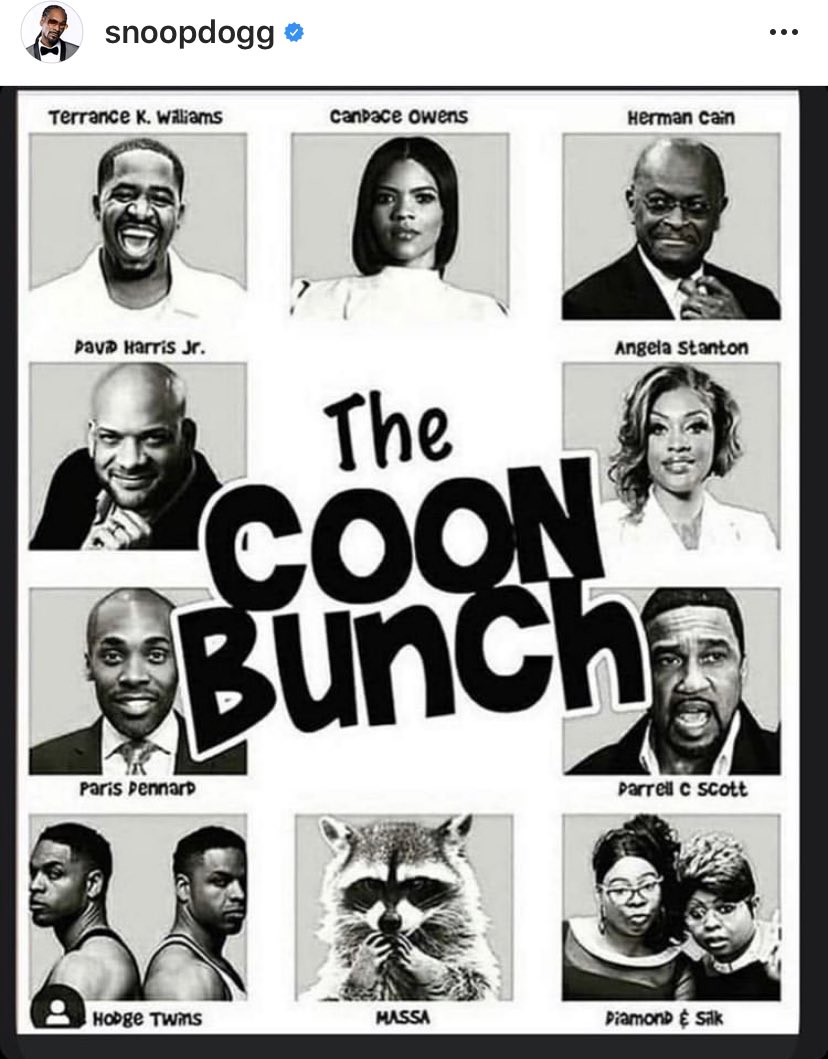
Johnson goes on to share how the communists would highlight racial division and emphasize incidents of racist violence while downplaying racial progress to cultivate a victimhood mentality among blacks in America.

Moreover, while they talk about “racial strife” in America as providing grist for Moscow’s propaganda mill they are busy creating it. They are careful to hide the fact that they are responsible for the provocations of extremists as was the case in Little Rock.

In all red propaganda, here and abroad, such acts of extremists are made the symbol of the treatment of the Negro in America. It also is the red smear pot in which all opponents of a forthwith solution of the race problem are tossed. The fact is that the majority of white Southerners are opposed to extremists. All-white Southern juries have convicted some of them as troublemakers and white Southern judges have sentenced some of them to long prison terms. This is deliberately ignored or played down by the leftists.[xiii]

These facts, too, are ignored or played down by the leftist “missionaries” and irresponsible crusaders. In political warfare, it seems, a cardinal principle to credit your enemy with only that which will hasten the build-up for his destruction.

The media of public information is far from free of communists and fellow travelers who operate under the guise of liberalism. They are ready at all times to do an effective smear job. Among these red tools may be found editorial writers, columnists, news commentators and analysts, in the press, radio and television. They go overboard in giving top news coverage to racial incidents, fomented by the leftists, and also those incidents that are interpreted so as to show “biased” attitudes of whites against Negroes. This is a propaganda hoax aimed, not at helping the Negro, but at casting America in a bad light in order to destroy its prestige and influence abroad, thereby aiding Soviet Russia in the penetration and conquest of Asia and Africa.

Thus all racial progress based upon understanding, goodwill, friendship and mutual cooperation, built up painfully over the years, is wiped out. White Americans are set against Negro Americans and vice versa. The stage is thus set for the opening of a dark and bloody era in Negro and white relations. Many white Northern politicians objectively aid the rapidly deteriorating racial situation through the exploitation of leftist propaganda to garner Negro votes. They care not a tinker’s dam about the Southern Negro and simply flatter the Northern Negro whom they consider a gullible fool. Getting elected and re-elected is their only concern.[xiv]

Modern leftists likewise seek to define the African-American experience exclusively by horrible, yet rare, incidents of violence against blacks at the hands of whites, specifically white cops. Following the tragic murders of Ahmaud Arbery and George Flloyd, many prominent Democratic politicians and celebrities wasted no time in painting the picture that these murders reflect the treatment of blacks across America.
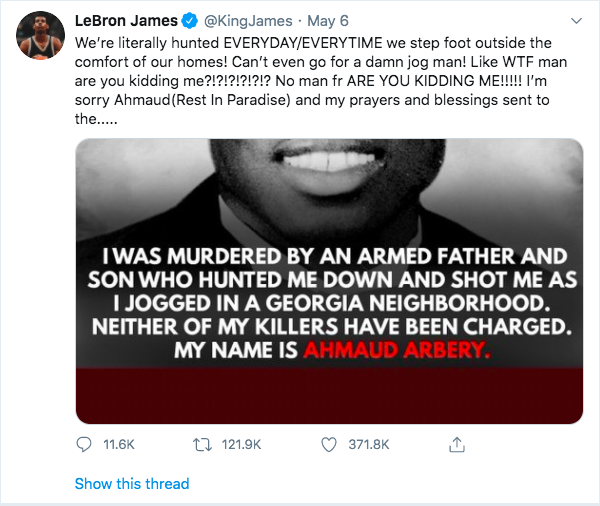
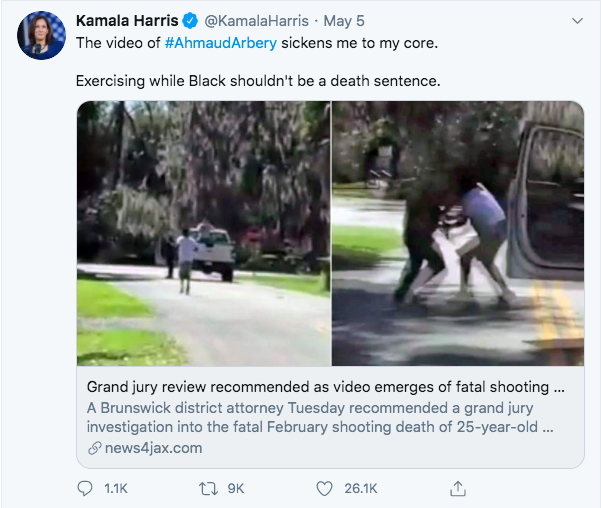
Additional statements include:

Watching his life be taken in the same manner, echoing nearly the same words as Eric Garner more than five years ago — ‘I can’t breathe’ — is a tragic reminder that this was not an isolated incident, but part of an ingrained systemic cycle that exists in this country.[xv]—Joe Biden

Being black in America should not be a death sentence. For five minutes, we watched a white officer press his knee into a black man’s neck. Five minutes. When you hear someone calling for help, you’re supposed to help. This officer failed in the most basic, human sense.—Minneapolis Mayor Jacob Frey

This does not necessarily mean that LeBron James is a communist. In fact, Manning Johnson reveals that Communists would manipulate progressives and liberals to spread their propaganda.

Significantly… there is only one highly organized, trained and disciplined force, and that is the Communists. So they are able to use, manipulate and combine this weird assortment of leftist “missionaries” in one way or another to bring about “a social upheaval which will plow up Southern institutions to their roots.”[xvi]

An essential tenet of the Communist strategy was the destruction of black businesses. Black communities could not have strong, independent, economies because that would undermine the communist argument that they were oppressed by the white man. According to Johnson, they schemed to ensure that black people were dependent on white businesses and on the U.S. government. If the black community was thriving, they wouldn’t be susceptible to the communist victimhood propaganda. As discussed earlier, the communists fostered “a persecution complex — a warped belief that the white man’s prejudices, the white man’s system, the white man’s government is responsible for everything.”[xvii] Independent, black-owned businesses were detrimental to this complex. Johnson writes:

The Negro business man has always been a chief target of the reds. They despise him because of his conservatism. They label him “a tool of the white imperialists” and an “enemy of the Negro masses.” Such labels are reserved for those the reds plan to liquidate and since the Negro business man is an inspiration and example to other Negroes to take advantage of the countless opportunities of the free enterprise system, he is therefore an object of derision by Communists. An enthusiastic response of the Negro to the appeal and opportunities for Negro business is a cardinal bulwark against Communism. Consequently, the reds seek to discredit, discourage and liquidate Negro business.

Only during the period of the Popular Front did the reds cease their attack on Negro business in order to link the Negro banker, broker, realtor, business man, merchant, lawyer, physician, preacher, worker and farmer with Bolshevism under the guise of a National Negro Congress.

Basically, the reds’ policy is now, and always has been, anti-Negro business. The fact that Negro business is sustained in the main by Negro patronage, that it exists almost entirely in the Negro community, makes it vulnerable to attack by the reds. They term it a product of “segregation,” “social isolation,” “the ghetto,” etc. And, too, the reds use the example of sharp competition between small and big business to discourage Negro entry into the general arena.[xviii]

While there were many peaceful protests following the murder of George Floyd, there were also violent riots in nearly every major city across America. Businesses were looted and communities were destroyed. The leftist message, parroted by the media, was that only large, insured corporations like Target were subject to looting. This is false. The brunt of the physical and financial destruction caused by these riots was borne by the Communists’ greatest enemy: black-owned small businesses.


Violent, racial conflict was the goal of the Communists — to divide America, weaken it, and make it ripe for Communist takeover.

Black rebellion was what Moscow wanted. Bloody racial conflict would split America. During the confusion, demoralization and panic would set in. Then finally, the reds say: “Workers stop work, many of them seize arms by attacking arsenals. Many had armed themselves before . . . Street fights become frequent. Under the leadership of the Communist Party the workers organize Revolutionary Committees to be in command of the uprising. Armed workers . . . seize the principal government offices, invade the residences of the President and his Cabinet members, arrest them, declare the old regime abolished, establish their own power. . .”[xix]

While it may seem conspiratorial, we should not underestimate the influence of Communists and Marxists in America today. Socialism is now viewed as favorable by millennials and Generation Z,[xx] with popular Democrat politicians like Alexandria Ocasio-Cortez and Bernie Sanders openly advocating for it. Marxism has spread through universities and left-wing activism, and one of the founders of Black Lives Matter has openly said, “We are trained Marxists.”


We should acknowledge the information shared by Manning Johnson and recognize that Communism is still a threat to American liberty, and it is a threat that we must take seriously and address accordingly.

Too few Americans in our day have the courage of their convictions. Too few will fly in the face of leftist opposition. Too few will stand up for truth in the face of the ominous and destructive storm of “me-tooism” or the communist ideological regimentation that hangs like a pall over our country. Many take the attitude that it is better to be safe than sorry or conclude, after a little difficulty or several reverses, that “if you can’t beat ’em, join ’em.” The words God, country and posterity have lost much of their substance and are becoming only a shadow in the hearts and minds of many Americans.[xxi]

Johnson’s entire book, which I encourage everyone to read, can be freely viewed at manningjohnson.org.

Disclaimer: The viewpoints expressed by the authors do not necessarily reflect the opinions of WallBuilders. 


Endnotes

[i] Hearings Regarding Communist Infiltration of Minority Groups. US GPO. 1949. pp. 497–521.

[ii] Hearings Regarding Communist Infiltration of Minority Groups. US GPO. 1949. pp. 497–521; County Clerk’s Index. 1951. pp. 1180-1363 (all testimony), 1180 (birth), 1183-1184 (CPUSA service), 1294-1295 (witness against Gerhart Eisler), 1295 (18-20 cases); Rader, Melvin (5 July 1954). “The Profession of Perjury”The New Republic.

[iii] Hearings Regarding Communist Infiltration of Minority Groups. US GPO. 1949. pp. 497–521.

[iv] Manning Johnson, Color, Communism, and Common Sense (Belmont: American Opinion Reprints, 1963), 18.

[v] County Clerk’s Index. 1951. pp. 1180-1363 (all testimony), 1180 (birth), 1183-1184 (CPUSA service), 1294-1295 (witness against Gerhart Eisler), 1295 (18-20 cases).

[vi] National Cemetery Administration. U.S. Veterans’ Gravesites, ca.1775-2006 [database on-line]. Provo, UT, USA: Ancestry.com Operations Inc, 2006. Ancestry, Inc.

[vii] Manning Johnson, Color, Communism, and Common Sense (Belmont: American Opinion Reprints, 1963), 22.

[viii] Manning Johnson, Color, Communism, and Common Sense (Belmont: American Opinion Reprints, 1963), 43-44.

[ix] Manning Johnson, Color, Communism, and Common Sense (Belmont: American Opinion Reprints, 1963), 43-44.

[x] Manning Johnson, Color, Communism, and Common Sense (Belmont: American Opinion Reprints, 1963), 44-45.

[xi] Manning Johnson, Color, Communism, and Common Sense (Belmont: American Opinion Reprints, 1963), 54.

[xii] Manning Johnson, Color, Communism, and Common Sense (Belmont: American Opinion Reprints, 1963), 51-52.

[xiii] Manning Johnson, Color, Communism, and Common Sense (Belmont: American Opinion Reprints, 1963), 52-33.

[xiv] Manning Johnson, Color, Communism, and Common Sense (Belmont: American Opinion Reprints, 1963), 53-54.

[xv] Sullivan, Sean. Biden calls for federal civil rights investigation into death of George Floyd, April 27, 2020. https://www.msn.com/en-us/news/politics/biden-calls-for-federal-civil-rights-investigation-into-death-of-george-floyd/ar-BB14G39Q?sf17491758=1.

[xvi] Manning Johnson, Color, Communism, and Common Sense (Belmont: American Opinion Reprints, 1963), 55.

[xvii] Manning Johnson, Color, Communism, and Common Sense (Belmont: American Opinion Reprints, 1963), 43-44.

[xviii] Manning Johnson, Color, Communism, and Common Sense (Belmont: American Opinion Reprints, 1963), 58.

[xix] Manning Johnson, Color, Communism, and Common Sense (Belmont: American Opinion Reprints, 1963), 18.

[xx] “2019 Annual Poll,” 2019. https://www.victimsofcommunism.org/2019-annual-poll

[xxi] Manning Johnson, Color, Communism, and Common Sense (Belmont: American Opinion Reprints, 1963), 56.
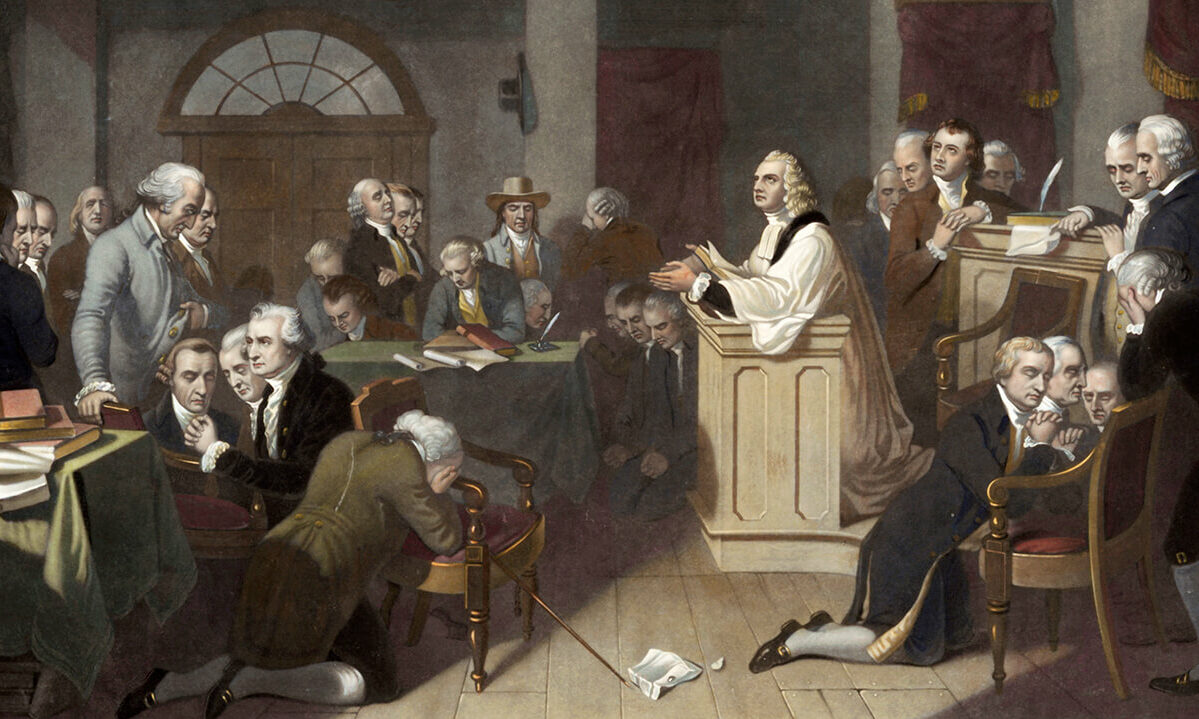

An Appeal to Heaven Flag

During the early days of the War for Independence—while the gun smoke still covered the fields at Lexington and Concord, and the cannons still echoed at Bunker Hill—America faced innumerable difficulties and a host of hard decisions. Unsurprisingly, the choice of a national flag remained unanswered for many months due to more pressing issues such as arranging a defense and forming the government.
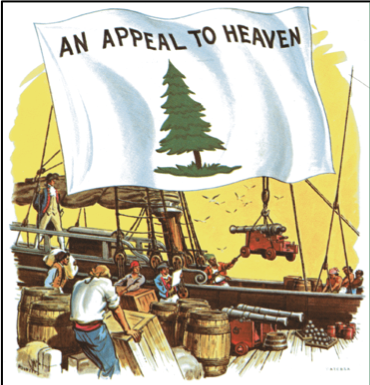
However, a flag was still needed by the military in order to differentiate the newly forged American forces from those of the oncoming British. Several temporary flags were swiftly employed in order to satisfy the want. One of the most famous and widespread standards rushed up flagpoles on both land and sea was the “Pinetree Flag,” or sometimes called “An Appeal to Heaven” flag.

As the name suggests, this flag was characterized by having both a tree (most commonly thought to be a pine or a cypress) and the motto reading “an appeal to Heaven.” Typically, these were displayed on a white field, and often were used by troops, especially in New England, as the liberty tree was a prominent northern symbol for the independence movement.1

In fact, prior to the Declaration of Independence but after the opening of hostilities, the Pinetree Flag was one of the most popular flags for American troops. Indeed, “there are recorded in the history of those days many instances of the use of the pine-tree flag between October, 1775, and July, 1776.”2
Some of America’s earliest battles and victories were fought under a banner declaring “an appeal to Heaven.” Some historians document that General Israel Putnam’s troops at Bunker Hill used a flag with the motto on it, and during the Battle of Boston the floating batteries (floating barges armed with artillery) proudly flew the famous white Pinetree Flag.3 In January of 1776, Commodore Samuel Tucker flew the flag while successfully capturing a British troop transport which was attempting to relieve the besieged British forces in Boston.4

The Pinetree Flag was commonly used by the Colonial Navy during this period of the War. When George Washington commissioned the first-ever officially sanctioned military ships for America in 1775, Colonel Joseph Reed wrote the captains asking them to:

Please to fix upon some particular color for a flag, and a signal by which our vessels may know one another. What do you think of a flag with a white ground, a tree in the middle, the motto ‘Appeal to Heaven’? This is the flag of our floating batteries.5

In the following months news spread even to England that the Americans were employing this flag on their naval vessels. A report of a captured ship revealed that, “the flag taken from a provincial [American] privateer is now deposited in the admiralty; the field is a white bunting, with a spreading green tree; the motto, ‘Appeal to Heaven.’”6

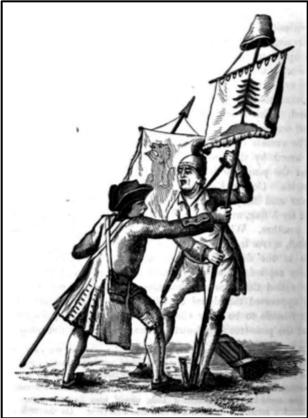
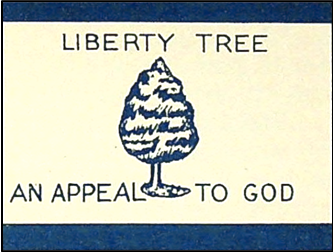
As the skirmishes unfolded into all out warfare between the colonists and England, the Pinetree Flag with its prayer to God became synonymous with the American struggle for liberty. An early map of Boston reflected this by showing a side image of a British redcoat trying to rip this flag out of the hands of a colonist (see image on right).7 The main motto, “An Appeal to Heaven,” inspired other similar flags with mottos such as “An Appeal to God,” which also often appeared on early American flags.
For many modern Americans it might be surprising to learn that one of the first national mottos and flags was “an appeal to Heaven.” Where did this phrase originate, and why did the Americans identify themselves with it?

To understand the meaning behind the Pinetree Flag we must go back to John Locke’s influential Second Treatise of Government (1690). In this book, the famed philosopher explains that when a government becomes so oppressive and tyrannical that there no longer remains any legal remedy for citizens, they can appeal to Heaven and then resist that tyrannical government through a revolution. Locke turned to the Bible to explain his argument:

To avoid this state of war (wherein there is no appeal but to Heaven, and wherein every the least difference is apt to end, where there is no authority to decide between the contenders) is one great reason of men’s putting themselves into society and quitting [leaving] the state of nature, for where there is an authority—a power on earth—from which relief can be had by appeal, there the continuance of the state of war is excluded and the controversy is decided by that power. Had there been any such court—any superior jurisdiction on earth—to determine the right between Jephthah and the Ammonites, they had never come to a state of war, but we see he was forced to appeal to Heaven. The Lord the Judge (says he) he judge this day between the children of Israel and the children of Ammon, Judg. xi. 27.8

Locke affirms that when societies are formed and systems and methods of mediation can be instituted, armed conflict to settle disputes is a last resort. When there no longer remains any higher earthly authority to which two contending parties (such as sovereign nations) can appeal, the only option remaining is to declare war in assertion of certain rights. This is what Locke calls an appeal to Heaven because, as in the case of Jephthah and the Ammonites, it is God in Heaven Who ultimately decides who the victors will be.

Locke goes on to explain that when the people of a country “have no appeal on earth, then they have a liberty to appeal to Heaven whenever they judge the cause of sufficient moment [importance].”9 However, Locke cautions that appeals to Heaven through open war must be seriously and somberly considered beforehand since God is perfectly just and will punish those who take up arms in an unjust cause. The English statesman writes that:

he that appeals to Heaven must be sure he has right on his side; and a right to that is worth the trouble and cost of the appeal as he will answer at a tribunal that cannot be deceived [God’s throne] and will be sure to retribute to everyone according to the mischiefs he hath created to his fellow subjects; that is, any part of mankind.10

The fact that Locke writes extensively concerning the right to a just revolution as an appeal to Heaven becomes massively important to the American colonists as England begins to strip away their rights. The influence of his Second Treatise of Government (which contains his explanation of an appeal to Heaven) on early America is well documented. During the 1760s and 1770s, the Founding Fathers quoted Locke more than any other political author, amounting to a total of 11% and 7% respectively of all total citations during those formative decades.11 Indeed, signer of the Declaration of Independence Richard Henry Lee once quipped that the Declaration had been largely “copied from Locke’s Treatise on Government.”12
Therefore, when the time came to separate from Great Britain and the regime of King George III, the leaders and citizens of America well understood what they were called upon to do. By entering into war with their mother country, which was one of the leading global powers at the time, the colonists understood that only by appealing to Heaven could they hope to succeed.

For example, Patrick Henry closes his infamous “give me liberty” speech by declaring that:

If we wish to be free—if we mean to preserve inviolate those inestimable privileges for which we have been so long contending—if we mean not basely to abandon the noble struggle in which we have been so long engaged, and which we have pledged ourselves never to abandon—we must fight!—I repeat it, sir, we must fight!! An appeal to arms and to the God of Hosts, is all that is left us!13

Furthermore, Jonathan Trumbull, who as governor of Connecticut was the only royal governor to retain his position after the Declaration, explained that the Revolution began only after repeated entreaties to the King and Parliament were rebuffed and ignored. In writing to a foreign leader, Trumbull clarified that:

On the 19th day of April, 1775, the scene of blood was opened by the British troops, by the unprovoked slaughter of the Provincial troops at Lexington and Concord. The adjacent Colonies took up arms in their own defense; and the Congress again met, again petitioned the Throne [the English king] for peace and settlement; and again their petitions were contemptuously disregarded. When every glimpse of hope failed not only of justice but of safety, we were compelled, by the last necessity, to appeal to Heaven and rest the defense of our liberties and privileges upon the favor and protection of Divine Providence; and the resistance we could make by opposing force to force.14

John Locke’s explanation of the right to just revolution permeated American political discourse and influenced the direction the young country took when finally being forced to appeal to Heaven in order to reclaim their unalienable rights. The church pulpits likewise thundered with further Biblical exegesis on the importance of appealing to God for an ultimate redress of grievances, and pastors for decades after the War continued to teach on the subject. For example, an 1808 sermon explained:

War has been called an appeal to Heaven. And when we can, with full confidence, make the appeal, like David, and ask to be prospered according to our righteousness, and the cleanness of our hands, what strength and animation it gives us! When the illustrious Washington, at an early stage of our revolutionary contest, committed the cause in that solemn manner. “May that God whom you have invoked, judge between us and you,” how our hearts glowed that we had such a cause to commit!15

Thus, when the early militiamen and naval officers flew the Pinetree Flag emblazoned with its motto “An Appeal for Heaven,” it was not some random act with little significance or meaning. Instead, they sought to march into battle with a recognition of God’s Providence and their reliance on the King of Kings to right the wrongs which they had suffered. The Pinetree Flag represents a vital part of America’s history and an important step on the journey to reaching a national flag during the early days of the War for Independence.

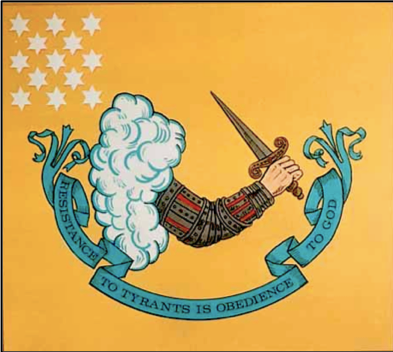
Furthermore, the Pinetree Flag was far from being the only national symbol recognizing America’s reliance on the protection and Providence of God. During the War for Independence other mottos and rallying cries included similar sentiments. For example, the flag pictured on the right bore the phrase “Resistance to Tyrants is Obedience to God,” which came from an earlier 1750 sermon by the influential Rev. Jonathan Mayhew.16  In 1776 Benjamin Franklin even suggested that this phrase be part of the nation’s Great Seal.17 The Americans’ thinking and philosophy was so grounded on a Biblical perspective that even a British parliamentary report in 1774 acknowledged that, “If you ask an American, ‘Who is his master?’ He will tell you he has none—nor any governor but Jesus Christ.”18
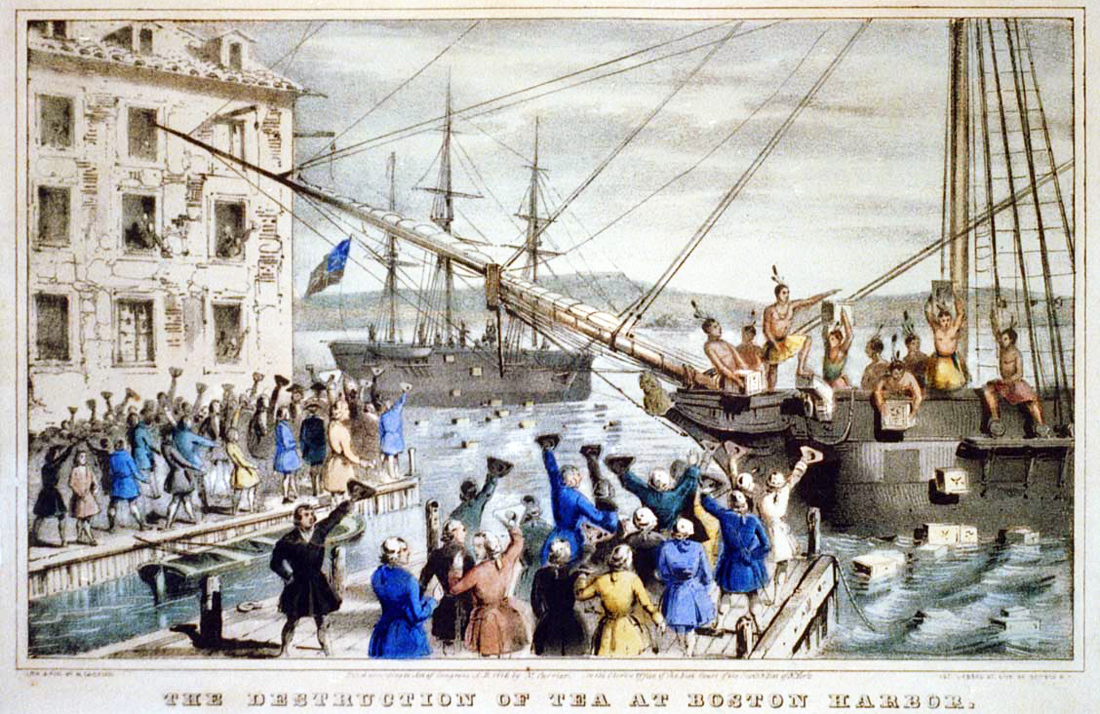
This God-centered focus continued throughout our history after the Revolutionary War. For example, in the War of 1812 against Britain, during the Defense of Fort McHenry, Francis Scott Key penned what would become our National Anthem, encapsulating this perspective by writing that:

Blest with vict’ry and peace may the heav’n rescued land
Praise the power that hath made and preserv’d us a nation!
Then conquer we must, when our cause it is just,
And this be our motto: “In God is our trust.”19

In the Civil War, Union Forces sang this song when marching into battle. In fact, Abraham Lincoln was inspired to put “In God we Trust” on coins, which was one of his last official acts before his untimely death.20 And after World War II, President Eisenhower led Congress in making “In God We Trust” the official National Motto,21 also adding “under God” to the pledge in 1954.22

Throughout the centuries America has continually and repeatedly acknowledged the need to look to God and appeal to Heaven. This was certainly evident in the earliest days of the War for Independence with the Pinetree Flag and its powerful inscription: “An Appeal to Heaven.”


Endnotes

1 “Flag, The,” Cyclopaedia of Political Science, Political Economy, and of the Political History of the United States, ed. John Lalor (Chicago: Melbert B. Cary & Company, 1883), 2.232.
2 Report of the Proceedings of the Society of the Army of the Tennessee at the Thirtieth Meeting, Held at Toledo, Ohio, October 26-17, 1898 (Cincinnati: F. W. Freeman, 1899), 80.
3 Schuyler Hamilton, Our National Flag; The Stars and Stripes; Its History in a Century (New York: George R. Lockwood, 1877), 16-17.
4 Report of the Proceedings (1899), 80.
5 Richard Frothingham, History of the Siege of Boston, and of the Battles of Lexington, Concord, and Bunker Hill (Boston: Charles C. Little and James Brown, 1849), 261.
6 Frothingham, History of the Siege of Boston (1849), 262.
7 Frothingham, History of the Siege of Boston (1849), 262.
8 John Locke, Two Treatises of Government (London: A. Millar, et al., 1794), 211.
9 Locke, Two Treatises (1794), 346-347.
10 Locke, Two Treatises (1794), 354-355.
11 Donald Lutz, The Origins of American Constitutionalism (Baton Rouge: Louisiana State University, 1988), 143.
12 Thomas Jefferson to James Madison, August 30, 1823, National Archives.
13 William Wirt, The Life of Patrick Henry (New York: McElrath & Bangs, 1831), 140.
14 Jonathan Trumbull quoted in James Longacre, The National Portrait Gallery of Distinguished Americans (Philadelphia: James B. Longacre, 1839), 4:5.
15 The Question of War with Great Britain, Examined upon Moral and Christian Principles (Boston: Snelling and Simons, 1808), 13.
16 Jonathan Mayhew, A Discourse Concerning Unlimited Submission and Non-Resistance to the Higher Powers (Boston: D. Fowle, 1750) [Evans # 6549]; John Adams to Abigail Adams, August 14, 1776, National Archives.
17 Benjamin Franklin’s Proposal, August 20, 1776, National Archives.
18 Hezekiah Niles, Principles and Acts of the Revolution in America (Baltimore: William Ogden Niles, 1822), 198.
19 Francis Scott Key, “The Defence of Fort M’Henry,” The Analectic Magazine (Philadelphia: Moses Thomas, 1814) 4:433-434.
20 B. F. Morris, Memorial Record of the Nation’s Tribute to Abraham Lincoln (Washington, DC: W. H. & O. H. Morrison, 1866), 216.
21 36 U.S. Code § 302 – National motto.
22 Dwight Eisenhower, “Statement by the President Upon Signing Bill To Include the Words “Under God” in the Pledge to the Flag,” June 14, 1954, The American Presidency Project.

Was the Boston Tea Party a Riot?

Recently America has witnessed a horrific tragedy in the killing of George Floyd by a police officer. To date, the officer has been fired, arrested, and charged with murder. Currently he is awaiting trial, at which point he will be prosecuted in front of a jury of his peers. This is the American judicial system punishing someone who has broken the law and violated the most central of the principles outlined in the Declaration—the right to life.

Peaceful protesters have marched around the country to demand justice. However, in the midst of justified outrage some people have themselves begun committing unjustifiable acts, assaulting and murdering police officers, burning down buildings, mercilessly beating people, and destroying their fellow citizens’ property. Out of town activists and professional agitators have poured into metropolitan centers and led rioters to destroy businesses, housing units, and even churches.

In defense of these heinous acts, some people have begun pointing to the Boston Tea Party as an example of how violent riots are part of American tradition. This historical perspective, however, is only possible if you don’t know the first thing about the Boston Tea Party, who was involved, and why it happened.

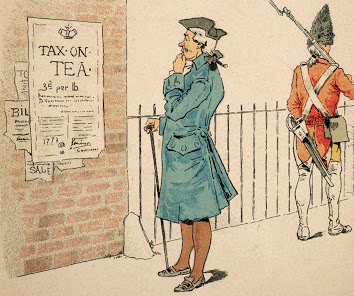
As a brief background, the British Parliament had been passing laws taxing American colonists for years without allowing for any recourse through representation in Parliament. (Although the Colonists had elected representatives in local government, they had no elected leaders to represent them in England.) This principle of arbitrary power exerted by the government was clearly illustrated by a tax on imported tea despite colonial resistance.
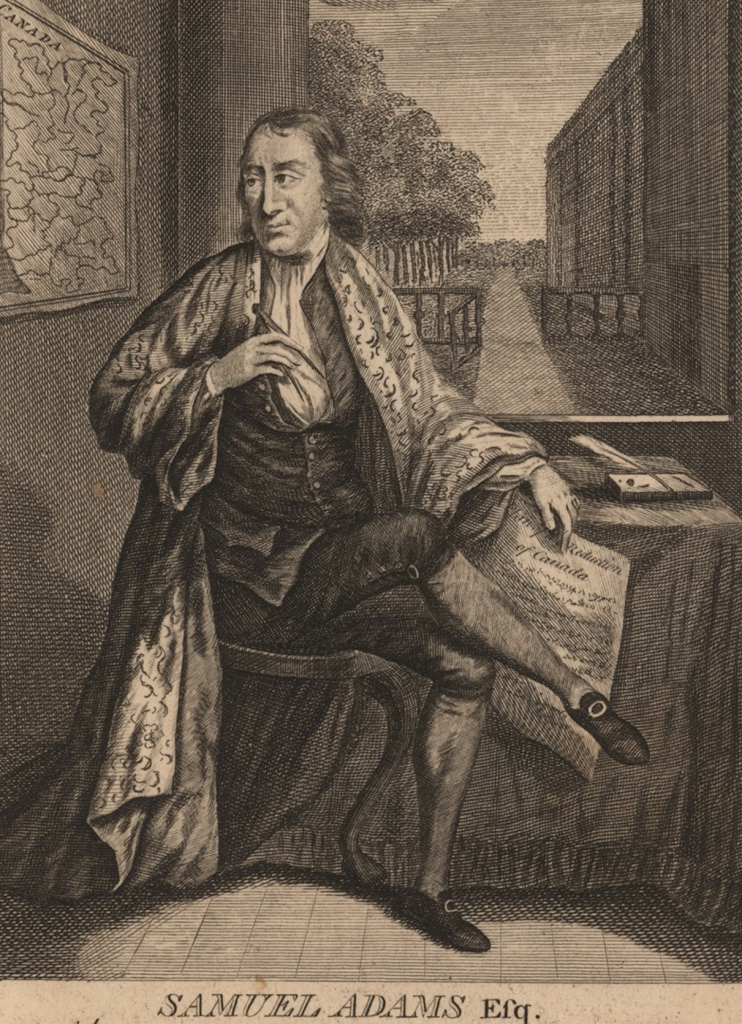
In 1773, England passed the Tea Act which effectively forced the colonists to import and pay for specifically English tea. One early historian explained that the British Prime Minister declared that, “it was of no use for anyone to offer objections, for the king would have it so.”[1] At major American ports commissioners were appointed to receive and pay for the tea, meaning that even if no individuals directly purchased tea, all the colonists would be taxed for it.

Naturally, the Americans were indignant and the colonists acted to prevent the tea from being received at the ports. In many cases, the British appointed leaders overseeing the importation stepped down or the tea-laden ships were forced to turn back to England. Benjamin Franklin explained that none of Great Britain’s actions were sufficient to overcome all the patriotism of an American.”[2]

In Boston, however, the Royal Governor, Thomas Hutchinson, forced the ships to stay in the harbor and the commissioners (two of whom were Hutchinson’s sons) refused to step down.[3] When three ships carrying the tea arrived, Abigail Adams explained the tense and dangerous situation that met the patriots:

“The tea (that baneful weed) is arrived. Great, and I hope, effectual opposition has been made to the landing of it.…the proceedings of our Citizens have been united, spirited and firm. The flame is kindled and like lightning it catches from soul to soul. Great will be the devastation if not timely quenched or allayed by some more lenient measures.”[4]

On both sides of the Atlantic all eyes turned to Boston to see what the patriots would do. In Philadelphia, who had been successful in getting their British appointed commissioners to resign, it was stated, “all that we fear is that you will shrink at Boston. May God give you virtue enough to save the liberties of your country!”[5]

With time running out and all other options exhausted, nearly 7,000 Bostonians gathered at the Old South Meeting House and learned from ship’s owner, Joseph Rotch, that his request to sail back to England had been rejected and that if the tea was not unloaded that night it was subject to confiscation by the English navy (who undoubtedly would land the tea and tax the colonists).[6]
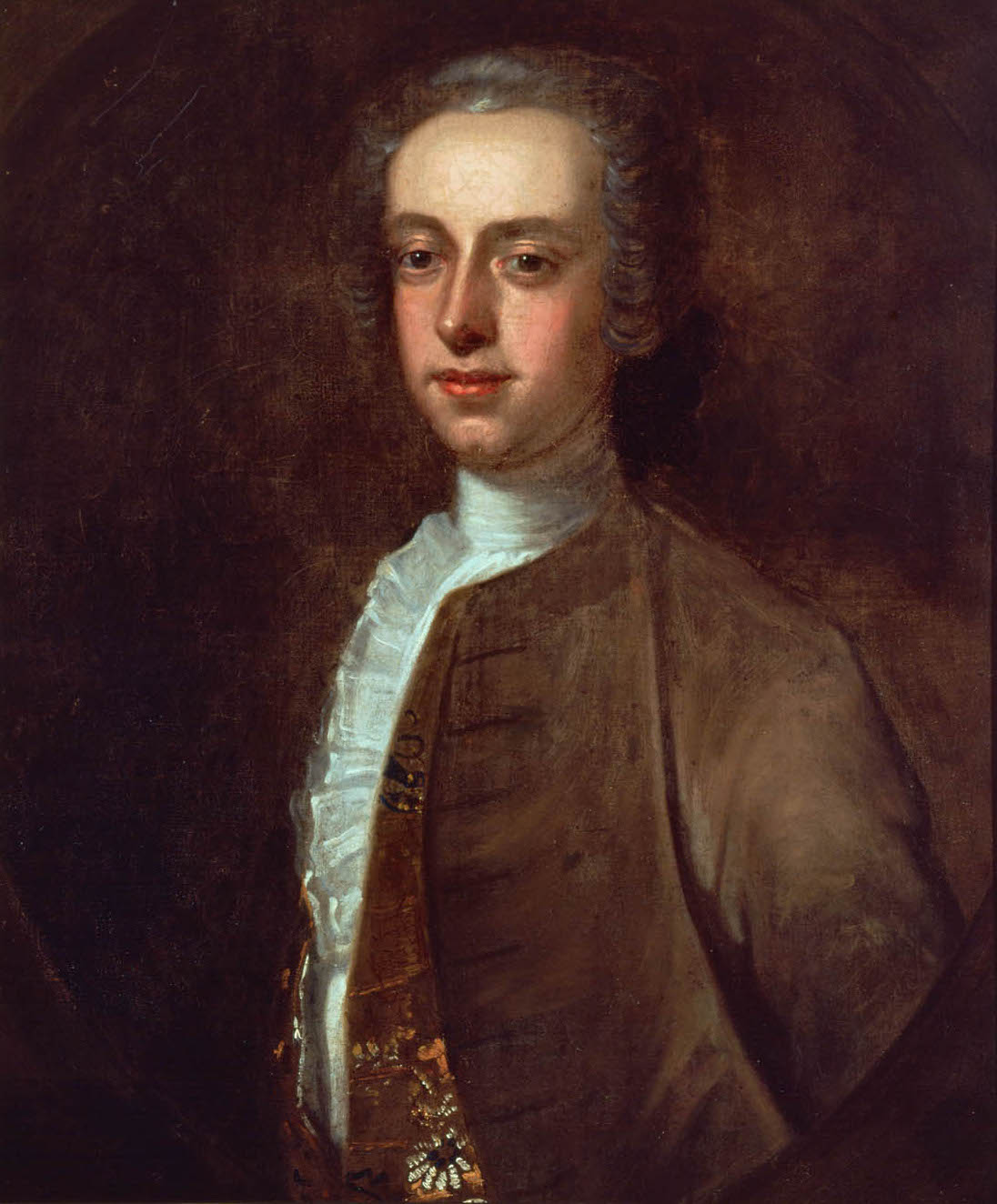
The colonists acknowledged that Rotch “was a good man who had done all in his power to gratify the people; and changed them [the people] to do no hurt to his person or his property.”[7] The patriots had formulated a plan to disguise themselves, board the ships and dump the tea in the harbor. At this point Samuel Adams called forth the men, wearing native American dress, and they proceeded to the ships and dumped the tea into the Boston Harbor.

Upon hearing the news of the “Tea Party”, John Adams exclaimed:

“This is the most magnificent movement of all. There is a dignity, a majesty, a sublimity, in this last effort of the patriots, that I greatly admire.”[8]

However, with this background in mind, the Boston Tea Party was not a riot by any stretch of the imagination for two important reasons.

First, it was 100% peaceful with no looting, rioting, injury, or destruction of person or private property.

It is no historical accident that it was called a party and not a riot. Throughout all of the actions taken by the patriots during that night, no personal property was destroyed. The tea itself, which was owned by the government-run East India Company and being forced upon the colonists by government edict, was the only item targeted.

In a letter written to Benjamin Franklin immediately after the Tea Party, it was explained that the Sons of Liberty arrived and demanded:

“the Tea, which was given up to them without the least resistance, they soon emptied all the chests into the harbor, to the amount of about three hundred and forty. This was done without injury to any other property, or to any man’s person…When they had done their business, they silently departed, and the town has been remarkably quiet ever since.”[9]

In fact, when it was discovered that one opportunist had filled his pocket with some tea, he “was stripped of his booty and his clothes together, and sent home naked,” with the writer sarcastically noting that it was “a remarkable instance of order and justice, among savages.”[10]

The morning after the Tea Party, John Adams reported that:

“The town of Boston, was never more still and calm of a Saturday night than it was last night. All things were conducted with great order, decency, and perfect submission to government” (emphasis in original).[11]

The early historian Richard Frothingham documents that:

“Notwithstanding the whoop, mentioned to have been given when the party went on board, they proved themselves quiet, orderly, and systematic workers; the parties in the ships doing faithfully the part assigned to them. In about three hours, they broke open three hundred and forty-two chests of tea, and cast their contents into the water. There was no interference with them; no person was harmed; no other property was permitted to be injured; and no tea was allowed to be purloined.…The inquirer will seek in vain in this deed for the tiger-like growl of an infuriated mob.”[12]

The ship owner himself, Joseph Rotch, explained to Governor Hutchinson that before the Tea Party the Boston assembly had given him no reason to fear the fury of the mob or the threat of a riot, noting that “his concern was not for his ship, which he did not believe was in danger, but he could not tell what would be the fate of the tea on board.”[13]

Gov. Hutchinson

In fact, everything was so peaceful and orderly that even crown-appointed Governor Hutchinson was forced to confess that, “the whole was done with very little tumult.”[14]

This is not to say that the situation couldn’t have quickly or easily turned violent. John Adams notes that there were bad actors who wished, “that as many dead Carcasses were floating in the Harbor as there are Chests of Tea.”[15] But to do so would have been wrong and injured innocent people like the ship owner Rotch who was just as much a victim of English tyranny as they were. Additionally, in the weeks leading up to the Boston Tea Party, patriot leaders had even stopped mobs from rioting.[16]

Indeed, it was documented that, “neither revenge, nor a spirit of hostility to rights of property or persons, formed a part of the program of the popular [patriot] leaders.”[17] And so stalwart were the patriots in their commitment to peaceful resistance that they “had been as true to the idea of order as they had been faithful to the cause of liberty.”[18]

Secondly, the colonists had only two options remaining them in that situation, pay the unjust tax or throw the tea into the harbor.

The Bostonians, along with all the other American colonists, had no representation in the English Parliament who were passing laws like the 1773 Tea Act. This meant that the colonists had no real legal way to seek the redress of their grievances. Therefore, the famous motto became “no taxation without representation.”

John Adams recognized that the patriots would not have been right if the problem could have been addressed in a different way. The morning after the Boston Tea Party, he wrote in his diary:

“The question is whether the destruction of this tea was necessary? I apprehend it was absolutely and indispensably so. They could not send it back, the Governor, Admiral and Collector and Comptroller would not suffer it. It was in their power [i.e. the Governor’s] to have saved it—but in no other. It [the ship] could not get by the castle, the Men of War [the British warships] &c. Then there was no other alternative but to destroy it or let it be landed. To let it be landed, would be giving up the principle of taxation by Parliamentary authority, against which the Continent have struggled for 10 years, it was losing all our labor for 10 years and subjecting ourselves and our posterity forever to Egyptian taskmasters—to burthens, indignities, to ignominy, reproach and contempt, to desolation and oppression, to poverty and servitude.”[19]

However, even with all of that at stake, the patriot leaders were careful to never let their justified anger lead them to commit unjustified acts of violence against innocent people.

Adams was not alone in his evaluation, and fellow patriot Thomas Cushing explained that the British policy concerning the forced importation of tea was, “the source of their distress, a distress that borders upon despair and they know not where to fly for relief”[20] After months of working to find a different effectual means of resolution the Bostonians had nowhere else to go.

Indeed, one of the Tea Party participants outlined their situation and how the English government had rejected all other methods of handling it:

“The Governor, Collector, and Consignees, most certainly had it in their power to have saved this destruction, and returned it undiminished to the owner, in England, as the people were extremely desirous of this, did everything in their power to accomplish it, and waited so long for this purpose, as to run no small risk of being frustrated in their grand design of preventing it’s being landed.”[21]

It was only, “after it had been observed to them, that, everything else in their power having been done, it now remained to proceed in the only way left,” and the tea was destroyed. [22] But, as mentioned early, the colonists saw that, “the owner of the ship having behaved like a man of honor, no injury ought to be offered to his person or property”[23]

The situation in American today is entirely different. Respect and decency are not being shown to innocent people or business owners. The current riots are like a destructive tornado set on destroying everything in its path.

Peaceful protests are protected by the Bill of Rights, but violent riots which destroy, loot, and victimize are antithetical to the American idea. The comparison of the violent riots to the Boston Tea Party is wildly unfounded and demonstrates that Americans should study their history before they try to weaponize it.


Endnotes

[1] John Fiske, The American Revolution (Boston: Houghton Mifflin Company, 1919, originally published 1891), 81.

[2] Benjamin Franklin, The Works of Benjamin Franklin (Philadelphia: William Duane, 1809), 6:310, to Thomas Cushing on June 4, 1773, in which Franklin said, “They have no idea that any people can act from any other principle but that of interest; and they believe that three pence on a pound of tea, of which one does not perhaps drink ten pounds in a year, is sufficient to overcome all the patriotism of an American.”

[3] Richard Frothingham, Life and Times of Joseph Warren (Boston: Little, Brown, & Company, 1865), 238, here.

[4] Abigail Adams, “To Mercy Otis Warren, 5 December 1773,” Founders Archive (accessed June 1, 2020), here.

[5] Richard Frothingham, Life and Times of Joseph Warren (Boston: Little, Brown, & Company, 1865), 267, here.

[6] See, Richard Frothingham, The Rise of the Republic of the United States (Boston: Little, Brown, and Company, 1872), 306-308; Richard Frothingham, Life and Times of Joseph Warren (Boston: Little, Brown, & Company, 1865), 275;  and George Bancroft, History of the United States (Boston: Little, Brown and Company, 1854), 6:482-487.

[7] Richard Frothingham, Life and Times of Joseph Warren (Boston: Little, Brown, & Company, 1865), 279, here.

[8] John Adams, “1773. Decr. 17th. From the Diary of John Adams,” Founders Archive (accessed June 1, 2020), here.

[9] Samuel Cooper, “To Benjamin Franklin, 17 December 1773,” Founders Archive (accessed June 1, 2020), here.

[10] Samuel Cooper, “To Benjamin Franklin, 17 December 1773,” Founders Archive (accessed June 1, 2020), here.

[11] John Adams, “To James Warren, 17 December 1773,” Founders Archive (accessed June 1, 2020), here.

[12] Richard Frothingham, Life and Times of Joseph Warren (Boston: Little, Brown, & Company, 1865), 281, here.

[13] Thomas Hutchinson, The History of the Province of Massachusetts Bay From 1749 to 1744 (London: John Murray, 1828), 435, here.

[14] Edward Howland, Annals of North America (Hartford: The J.B. Burr Publishing Company, 1877), 298, here.

[15] John Adams, “1773. Decr. 17th. From the Diary of John Adams,” Founders Archive (accessed June 1, 2020), here.

[16] See, for example, Richard Frothingham, Life and Times of Joseph Warren (Boston: Little, Brown, & Company, 1865), 251, here.

[17] Richard Frothingham, Life and Times of Joseph Warren (Boston: Little, Brown, & Company, 1865), 258, here.

[18] Richard Frothingham, Life and Times of Joseph Warren (Boston: Little, Brown, & Company, 1865), 273, here.

[19] John Adams, “1773. Decr. 17th. From the Diary of John Adams,” Founders Archive (accessed June 1, 2020), here.

[20] Thomas Cushing, “To Benjamin Franklin, 10 December 1773,” Founders Archive (accessed June 1, 2020), here.

[21] Samuel Cooper, “To Benjamin Franklin, 17 December 1773,” Founders Archive (accessed June 1, 2020), here.

[22] Thomas Hutchinson, The History of the Province of Massachusetts Bay From 1749 to 1744 (London: John Murray, 1828), 436, here.

[23] Thomas Hutchinson, The History of the Province of Massachusetts Bay From 1749 to 1744 (London: John Murray, 1828), 436, here.

Did America Create Slavery?

Democratic Senator Tim Kaine announced on the floor of the Senate that:

“The United States didn’t inherit slavery from anybody. We created it.”1

For even the most basic student of world history such a statement ought to immediately be recognized as incomprehensively ridiculous. Historically, every single people, nation, culture, and race has at various times been both the slave and the master. Indeed, “all have sinned and fallen short” (Romans 3:23). Sen. Kaine, just like the famously inaccurate 1619 Project, must ignore documented history and create his own fantasy world to arrive at such a conclusion.

For example, in ancient Greece—which existed thousands of years before America—nearly 30% of their population were slaves. The Roman Empire reached a staggering 40%.2 In fact, one of the most significant and widely known aspects of the Bible centers around the Israelites being delivered out of slavery in Egypt through the famous Exodus. We could walk through every nation in human history and find a tragic past riddled with slavery.

Arab Slavers

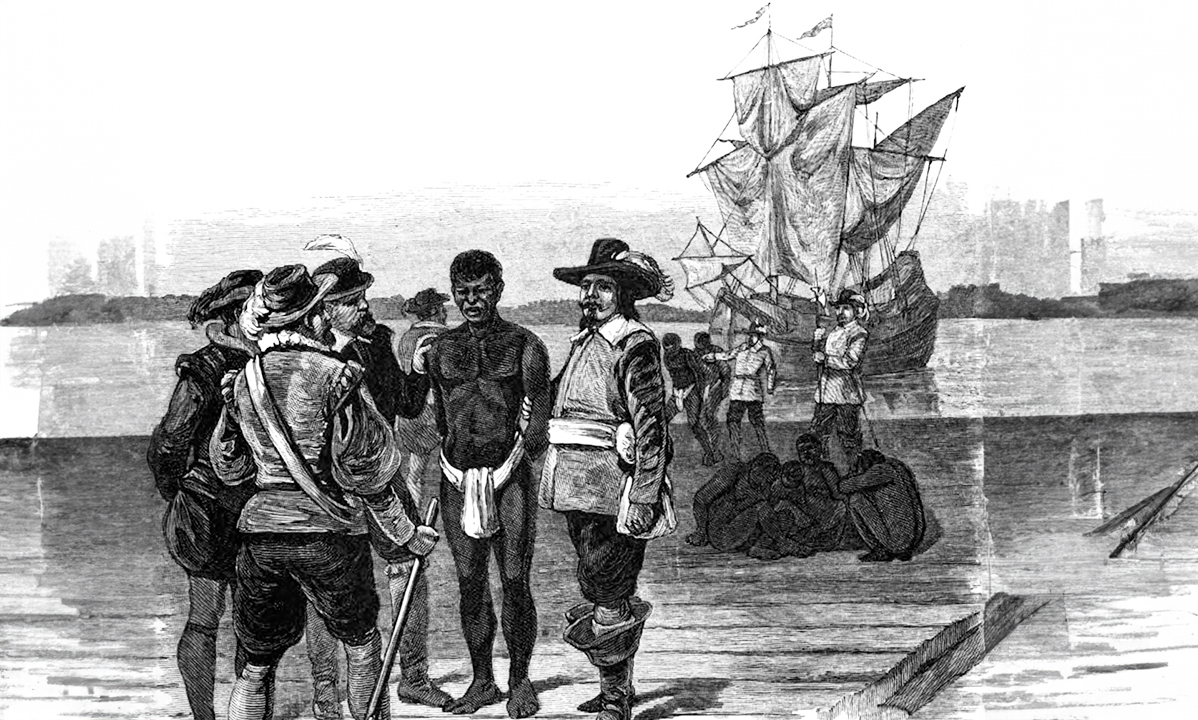
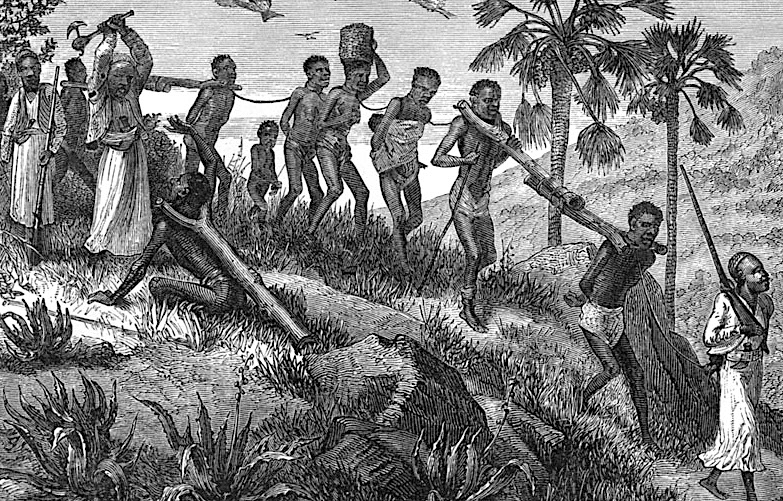
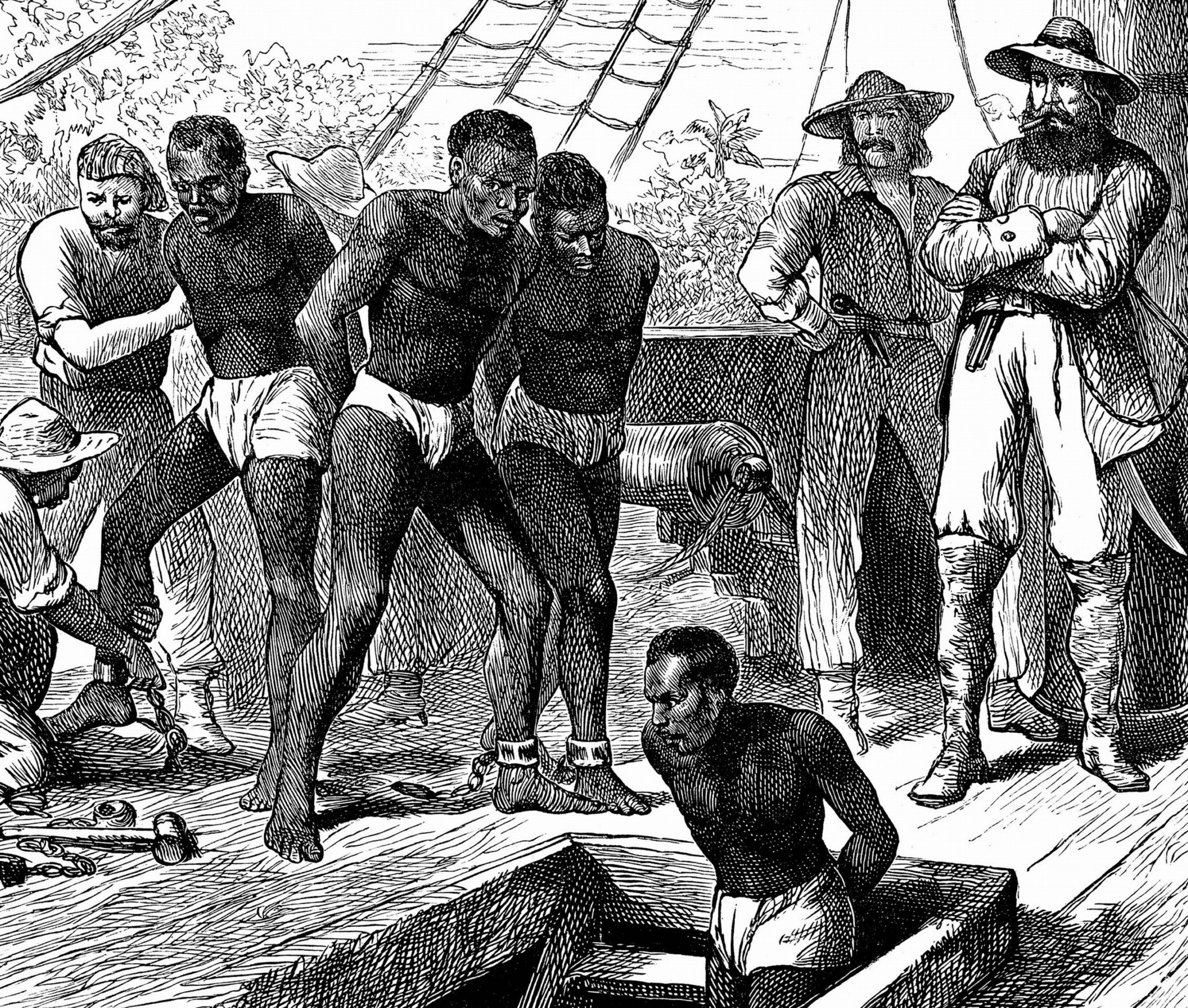
Prior to the creation of the Trans-Atlantic Slave Trade by the Spanish from Africa to South America in the early 1500s, Africa already participated in a robust trans-Saharan and Indian Ocean slave trade. Black tribes would raid, capture, and enslave other black tribes for profit, selling them across the continent and beyond. Many of these slaves were sold into the Islamic Middle East, and “medieval Arabs came to associate the most degrading forms of labor with black slaves.”3 Most likely it was this racial bias which was translated to the Iberian Peninsula (i.e., Spain and Portugal) when the Muslims conquered parts of that area in the 8th century. When the Spanish became the first European nation to significantly colonize the New World, they seemingly brought this bias with them which was thereby disseminated through the Americas, North, Central, and South. In this sense, America very literally inherited racial slavery—from the Arab Middle East through Spain.

Christian Slaves

What is perhaps even more astounding is that a larger number of white Europeans were captured and sold into African slavery than the number of Africans sold into the land that would become the United States. Just over 300,000 black slaves landed in the North American colonies which became America4 but 1,250,000 white Europeans were captured and shipped to slave markets in Northern Africa.5 This Barbary Coast Trade lasted longer than American slavery and was only stopped through the naval efforts of the British and Americans. Furthermore, it was not until the late 17th century that black slaves in the New World outnumbered white slaves in the Old.6

Additionally, for hundreds of years before Christopher Columbus ever conceived of the idea to sail westward, the Native Americans practiced mass slavery amid other practices including human sacrifice and cannibalism. This pre-Columbian native slave trade was so prolific that “wherever European conquistadors set foot in American tropics, they found evidence of indigenous warfare, war captives, and captive slaves.”7 Indeed, indigenous cultures saw slavery rates so prevalent that up to 20-40% of all Indians were enslaved by other Indians.8

Trans-Atlantic Slave Trade

Even today, nearly 160 years after America became one of the first nations to abolish slavery, there are still 94 nations that do not have laws criminalizing slavery.9 This has led to the enslavement of over 40 million people in the world right now. In a stroke of tragic irony, Africa has the highest rate of slavery today, closely followed by Asia,10 while North America has the lowest.11 Currently, Africa holds some 9,240,000 people in chains and slavery today,12 which is nearly identical to the total number of slaves disembarked in the entire New World (North, Central, and South America) throughout the almost four centuries of the Trans-Atlantic slave trade.13

So, clearly Sen. Tim Kaine must either be completely ignorant about the history of slavery or maliciously intentional in his presentation of “facts.” America in no way created slavery—in fact, if we were to say anyone “created” slavery in America we must conclude that the indigenous people did so. By contrast, the United States, despite its well-known shortcomings, ought to receive credit for having done more than nearly any other nation in the history of the world to fight slavery both in the past and today.

(Our book, The American Story: The Beginnings, has extensive information on the history of slavery not only in the United States but also the world.)


Endnotes

1 Tobias Hoonhout, “Dem Sen. Kaine Claims United States ‘Created’ Slavery and ‘Didn’t Inherit Slavery from Anybody,’” National Review, June 16, 2020.
2 Fernando Santos-Granero, Vital Enemies: Slavery, Predation, and the Amerindian Political Economy of Life (Austin: University of Texas Press, 2009), 226-227.
3 Philip Morgan, “Origins of American Slavery,” Organization of American History Magazine of History (July 2005), 19:4:53.
4 “Summary Statistics,” Slave Voyages, accessed June 16, 2020. Summary Statistics with the Principle Place of Slave Landing being restricted to Rhode Island, Maine, New Hampshire, Massachusetts, Connecticut, New York, New Jersey, Pennsylvania, Maryland, Virginia, North Carolina, South Carolina, Georgia, Florida, the Gulf Coast, and “Other North America.”
5 Past & Present (Aug., 2001), No. 172, 118, Robert C. Davis, “Counting European Slaves on the Barbary Coast”; Robert C. Davis, Christian Slaves, Muslim Masters: White Slavery in the Mediterranean, the Barbary Coast, and Italy, 1500-1800 (NY: Palgrave MacMillan, 2004), 23-24.
6 Morgan, “Origins of American Slavery,” American History Magazine (July 2005), 19:4:53.
7 Santos-Granero, Vital Enemiese (2009), 1.
8 Santos-Granero, Vital Enemies (2009), 226-227.
9 Sonia Elks, “Slavery is Not a Crime for Almost Half the Countries in the World,” Reuters (February 12, 2020), accessed June 16, 2020.
10 “Prevalence Across the Regions,” Global Slavery Index (2018), accessed June 16, 2020, here.
11 “Regional Highlights: Americas,” Global Slavery Index (2018), accessed June 17, 2020, here.
12 “Region Highlights: Africa,” Global Slavery Index (2018), accessed June 16, 2020, here.
13 “Summary Statistics,” Slave Voyages, accessed June 16, 2020.

* This article concerns a historical issue and may not have updated information.

Leadership Training Program in Israel

This is a part of our Alumni Series of articles written by past participants of the WallBuilders/Mercury One Leadership Training Program (now called “AJE Summer Institute”). Click here to learn more about this program. 
By Devyn Gulickson – Class of 2017

In the fall of 2017, I finished the Leadership Training Program (LTP) put on by Mercury One and WallBuilders and entered a new semester at my local college, armed with my new knowledge. While I was certain the knowledge I gained during those two weeks would forever change how I thought of America and its founders, I did not imagine that two years later I would have my perspective once again flipped on its head, this time about Israel. Between the informative speakers and the incredible sights, I would leave Israel with my political and historical views of Israel forever changed.

When I first heard I had been accepted to go to Israel, I was met with images I had seen on the news: suicide bombers, missiles flying overhead, violent protests. People I talked to said they would pray for my safety; the US State Department foreign travel advisory suggested I make out a will, designate a point of contact in case I was abducted, and to leave behind DNA – to confirm remains, it was implied.  I was excited to go to see the place where Jesus walked, but I could not ignore what I thought at the time were obvious and likely dangers that came along with a visit to Israel.

For the ten days of the trip, our tour group comprised of 38 LTP members, two trip mentors who had been on previous trips to Israel, four representatives of WallBuilders and Mercury One, a tour guide, and a former IDF soldier acting as our guard and medic.

Scattered throughout the trip were different speakers talking on a variety of topics: Anti-Semitism, Israeli startup tech culture, the Palestinians’ view of Israel, Aramaic culture and language, and what life is like living within a mile of the Gaza Strip. Just as WallBuilders taught us to go back to original sources and read firsthand accounts, these speakers allowed us to bypass the filter the news media has on Israel and the issues surrounding it.

We were able to hear different sides of the Israel-Palestine conflict and really get a sense of the complexity of the issue. An idea I heard throughout the trip regarding the conflict is that fear makes people do bad things. Like the famous quote, “Fear leads to anger. Anger leads to hate. Hate leads to suffering.” We were told multiple times that children on both sides grow up fearing (and in turn, hating) the other. An example of this was told by an Arab Christian, who supports the presence of Israeli security in the West Bank. He told us the story of how he was almost shot by a young IDF soldier a month before. He explained his car broke down in front of an IDF soldier in a place that, a week before, had been blown up by a suicide bomber in a car. The soldier looked about eighteen and was obviously extremely afraid that this was another suicide bomber. The boy was screaming at him to start his car, pointing his gun in his face. Fortunately, he was able to start the car and drive away. He finished the story by explaining he knew the boy probably did not want to shot him, but he was so afraid that he was going to die. This was just one example of how fear turns to violence.

If you had asked me before my visit to Israel if a one-state or two-state solution to the Israel-Palestine conflict was better, I would have said two-state. What I realized during the trip, though, is that I did not know why I thought that was true. After listening to the different speakers about what it is like to live with the constant threat of violence on both sides, it is hard to know if there will ever be peace, no matter if the final decision is one-state or two-state. There will definitely not be peace for a couple generations under a one-state solution because there has been too much blood shed between Palestinians and Israelis.  And a two-state solution keeps up the “us verses them” mentality that invites further division and hostility. Even if the government left in charge of Palestine is peaceful, it’s hard to know if an organization like Hamas won’t be elected into power again, with more power and land than before. I left Israel with a clearer understanding of the complex political situation, though less clear about a solution.

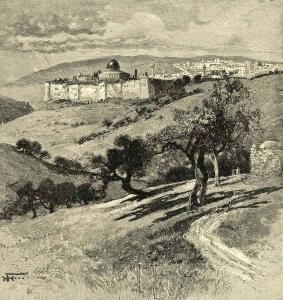
We also visited a multitude of Biblical sites ranging from the Garden of Gethsemane, to the Via Dolorosa, to Caesarea Philippi, to the Dead Sea and the Sea of Galilee. We explored the Jewish and Muslim quarters, shopped at the markets of Jerusalem and Tel Aviv, and walked in the ancient underground irrigation tunnels in the City of David. Each place we visited provided a greater understanding of the historical context of the biblical stories told in the Bible.
An example of this is the Garden of Gethsemane. When Jesus was praying in the garden on the Mount of Olives, He could have run if He had wanted to. The Mount of Olives in which the garden is on is between Jerusalem and the desert. He was not trapped and He did not surrender because He had no chance to escape from the guards; He did. This geographical knowledge maybe provides more context to Jesus’ pleading for His cup to pass over Him. He knew what was coming and saw an opportunity to run and avoid all the pain that would happen in the next hours. Who wouldn’t want to run? This just gives greater appreciation for the strength of Jesus’ will and how great His sacrifice was for us.

Looking back, this trip has certainly changed my perspective of Israel – both politically and historically. Because this trip has made me better understand the political situation in Israel, I have found myself more interested in learning about Israel and the Jewish people, and more willing to share my opinions of Israel with more confidence.

In a lot of ways this trip is very much a continuation of Mercury One and WallBuilders’ Leadership Training Program. We were able to visit “original source” biblical sites that we know existed and have evidence to support their location. We also received firsthand information by people living in hostile situations you only read about. I cannot thank Mercury One and WallBuilders enough for this opportunity and look forward to what’s in store for the future.

Disclaimer: The viewpoints expressed by the authors do not necessarily reflect the opinions of WallBuilders. 

united states flag

What Does the Flag Mean?

U.S.C.T. and the Symbolism of the Flag in the Civil War

The flag of the United States of America is the perennial symbol of the nation, but its meaning is constantly under debate. Recently, several major media incidents have questioned the true value of the Stars and Stripes—specifically whether the flag symbolizes racism or freedom.[1] Certain high-profile activists and revisionists claim that since the American flag flew over the nation while slavery remained active, it still condones racism today.

Such a perspective, interestingly, is not entirely unheard of in our nation’s past. Several years before the Civil War, great abolitionist leader Frederick Douglass (himself an escaped slave) summarized the sentiments of black Americans towards the federal banner at that time, saying:

“While slavery exists, and the union of these states endures, every American citizen must bear the chagrin of hearing his country branded before the world as a nation of liars and hypocrites; and behold his cherished national flag pointed at with the utmost scorn and derision.”[2]

As long as slavery was permitted and protected by the Union flag Douglass carried an attitude similar to those of recent critics. However, Douglass’s statement is conditional upon the existence of slavery, thereby suggesting that abolition would elevate the symbolic nature of the flag and improve its reception by black Americans.

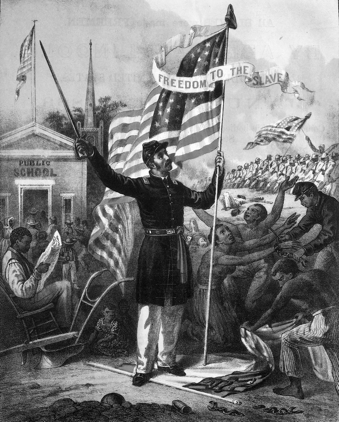
History reveals that Douglass was correct. Throughout the Civil War the men of the United States Colored Troops and those closely associated with the fight for freedom began to see the national flag in a different and positive light. Their patriotism and sacrifice redeemed the meaning of the flag, changing its reception in the black community from a symbol of slavery to one of liberty.

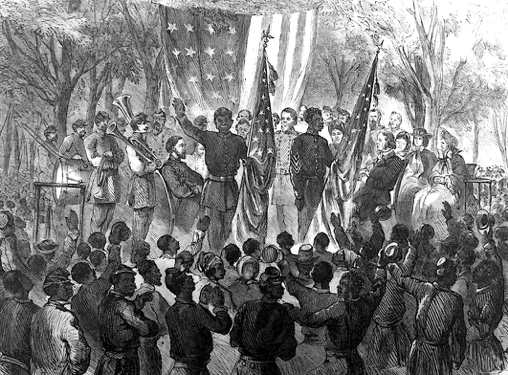
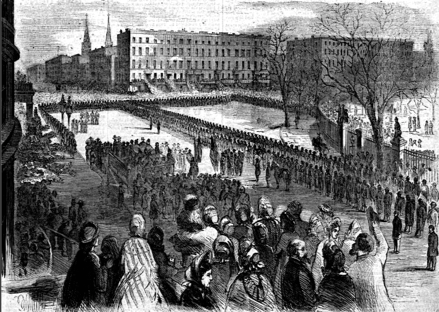
20th Regiment Receiving Flag

The journey of the flag and the black community during the Civil War largely began once black units were formed after the military opened its ranks to all people. Following custom, the Colored Troops, like many white units, received both a regimental and national flag, often from their local town, before going off to war.

For example, when the 20th US Colored Regiment was sent out of their native New York, Charles King, the son of Founding Father Rufus King, bestowed, “the flag of the Union and of Liberty to the first regiment of colored troops that has marched from this city to defend both.”[3] One paper considered the scene so important that an engraving was made, saying that, “no scene of the war has been more striking or significant.…[as] the flag of the country waved over them in benediction.”[4]

In his speech, Charles King imbued the national flag with a special meaning before passing it into the protection of its freshly “sworn defenders and guardians.”[5] King relates the flag’s significance to that of their shared faith, explaining that:

“The religion to the flag is second only to the religion of the altar.…Hence he who is false to his flag is false to his altar and his God.”[6]

To imply a spiritual significance to the defense of the flag most certainly would have affected the listeners. He went on to explain that by joining the military and risking their lives for those still bound by slavery, they not only elevate the flag but themselves also. Declaring that:

“When you put on the uniform and swear allegiance to the standard of the Union, you stand emancipated, regenerated, and disenthralled—the peer of the proudest soldier in the land.”[7]

The speech received a warm reception by both the citizens in attendance and the soldiers of the 20th Colored Regiment. The officer in charge received the flag saying:

“This beautiful banner symbolizes our country. It is this that makes death glorious beneath its starry folds—it is this that rouses the feelings of outraged honor when we see it trailed in the dust. How base and how dead to all sense of honor, must that wretch be whose brow burns not with shame and rage at the dishonor of the flag of his country.”[8]

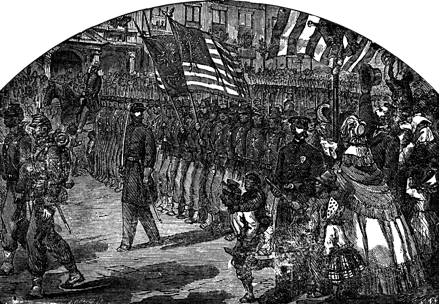
20th Regiment on Parade

Furthermore, in the lunch and procession following the presentation the soldiers of the 20th praised the speeches of Charles King and Col. Bartram, reflecting on how, “that flag is a big thing, boys.”[9] The men were beginning to see the Union flag not as the banner which had allowed slavery and oppression, but rather as the standard by which they could personally advance freedom’s cause.

The 20th were far from the only black soldiers to recognize the symbolic significance of receiving the national flag. For example, the 29th Regiment out of Connecticut enjoyed a bestowal ceremony, where, “to the surprise of the regiment we were presented with the United States national colors, which greatly pleased the boys.”[10] The 1st African Descent Regiment from Iowa were also presented with “a beautiful silk national flag” by the women of their state, “which was carried through the storms of battle, and returned at the close of the war to the State.”[11]

Most notably, however, the 1st South Carolina Volunteer Regiment (later the 33rd Colored) revealed their elevated affection to the national flag on many occasions. One evening a month before the Emancipation Proclamation went into effect, several men from the 1st began to give speeches to encourage the troops. Their commanding officer, Col. Thomas Higginson (a pastor and abolitionist) recorded the speech of Corporal Prince Lambkin, who was, “one of our color-guard, and one of our ablest men.”[12] Lambkin told his fellow slaves-turned-soldiers:

“Our masters they have lived under the flag, they got their wealth under it, and everything beautiful for their children. Under it they have ground us up, and put us in their pocket for money. But the first minute they think that ol’ flag meant freedom for we colored people, they pulled it right down, and run up a rag of their own. [Immense applause.] But we’ll never desert they ol’ flag, boys, never; we have lived under it for eighteen hundred sixty-two years [sic], and we’ll die for it now.”[13]

1st South Carolina Flag Ceremony

The speech was remembered by the Colonel as, “one of the few really impressive appeals for the American flag that I ever heard.” Less than a month after Lambkin’s speech, the 1st South Carolina were presented the national flag on the day, “Lincoln’s immortal proclamation of freedom was given to the world.”[14] Col. Higginson explained that after receiving the large silk flag:

“Then followed an incident so simple, so touching, so utterly unexpected and startling, that I can scarcely believe it on recalling, though it gave the keynote to the whole day. The very moment the speaker had ceased, and just as I took and waved the flag, which now for the first time meant anything to these poor people, there suddenly arose, close beside the platform, a strong male voice (but rather cracked and elderly), into which two women’s voices instantly blended, singing, as if by an impulse that could no more be repressed than the morning note of the song-sparrow: “My Country, ‘tis of thee, Sweet land of liberty, Of thee I sing!”

People looked at each other, and then at us on the platform to see whence came this interruption, not set down in the bills. Firmly and irrepressibly the quavering voices sang on, verse after verse; others of the colored people joined in; some whites on the platform began, but I motioned them to silence. I never saw anything so electric; it made all other words cheap; it seemed the choked voice of a race at last unloosed. Nothing could be more wonderfully unconscious; art could not have dreamed of a tribute to the day of jubilee that should be so affecting; history will not believe it; and when I came to speak of it, after it was ended, tears were everywhere. If you could have heard how quaint and innocent it was!

Just think of it! The first day they had ever had a country, the first flag they had ever seen which promised anything to their people, and here, while mere spectators stood in silence, waiting for my stupid words, these simple souls burst out in their lay, as if they were by their own hearths at home! When they stopped there was nothing to do for it but to speak, and I went on; but the life of the whole day was in those unknown people’s song.”[15]

The men of the 1st South Carolina bravely bore those flags throughout the war and, after victory, recalled with pride that, “it has never been disgraced by a cowardly faltering in the hour of danger, or polluted by a traitor’s touch.”[16] The success of the black divisions was measured, both by themselves and others, by their steadfast protection of the national flag through unflinching heroism and endless courage.

Nothing displays this more clearly than the numerous moments of bravery by black soldiers protecting the flag. No less than seven African Americans received the Medal of Honor for valiantly defending the national flag in battle.[17] The most famous example remains that of Sgt. William Carney who, though wounded twice, led the Massachusetts 54th through the Battle of Fort Wagner despite the overwhelmingly desperate situation.[18]

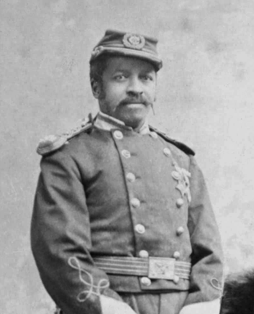
Christian Fleetwood

Additionally, several men at the Battle of Chaffin’s Farm received the Medal of Honor for not allowing the colors to touch the ground. Sgt. Alfred B. Hilton took up both the flag and the regimental standard once the original color bearers were shot. Thereafter, when Hilton himself was severely wounded, Sgt. Christian Fleetwood caught the national flag before it fell to the ground, and carried it through the rest of the fight—with General Butler himself allegedly witnessing their bravery.[19]

Such noble actions, however, were far from rare in the black units. At the Battle of the Crater the 43rd Colored Regiment gave ample proof of this for, “as each brave color bearer was shot down, another and another would immediately grasp the National emblem, all riddled with balls and plant it further on the enem[y’s] line,” until the flag was, “almost entirely cut up by the fire, and the Color Staffs splintered and broken.”[20] The list of heroic deeds in defense of the flag extends well beyond the few stories mentioned above, a fact which led USCT veteran and Civil War historian George Washington Williams to rejoice that, “the one flag of a great nation will float as the sovereign symbol of a free and united people.”[21]

The officers of these units particularly were struck by the devotion black troops showed to the flag under which so much oppression had been so recently practiced. For example, Lieutenant Joseph G. Golding of the 6th Colored Infantry recalled that his men bravely fought and nobly sacrificed, “to the utmost, even to the laying down of their lives for us, for the flag, [and] for the perpetuation of the grandest nationality the sun shines upon.”[22] That unit specifically suffered a 57% casualty rate throughout the War. Similarly, when the 33rd USCT mustered out at the end of the war, their commanding officer, Lt. Col. Trowbridge, explained in his final order that as a result of their efforts:

“Millions of bondsmen have been emancipated, and the fundamental law of the land has been so altered as to remove forever the possibility of human slavery being established within the borders of redeemed America. The flag our fathers, restored to its rightful significance.”[23]

Trowbridge explicitly applauds the USCT for helping to redeem the national symbol, elevating it finally to the standard which the Founding Fathers had envisioned.

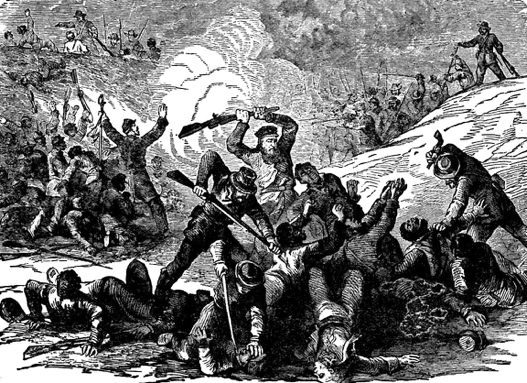
Fort Pillow Massacre

A natural result following the tireless devotion of the soldiers to the flag was that the nation as a whole also began to judge the flag by the way the government pursued liberating the slave population and the treatment of the African American soldiers. A major issue surrounded the revelation that Confederates would mistreat, brutalize, and kill the black troops if they were captured through the course of the war. One officer remarked that, “they fought with ropes round their necks,” because for them it was either victory or death.[24]

In response to the tragedy of Fort Pillow and the growing evidence that black prisoners were systematically treated horribly, an article in Harper’s Weekly demanded retaliation on the honor of the national flag. The author concluded that:

“After due delay, if the Government should find that the natural suspicion of foul play is correct, then if its retaliation is not swift, sure, and deadly, if the rebels are not taught, as by fire, that every man who fights beneath the national flag is equally protected by the people whose sovereignty that flag symbolizes, we are simply unworthy of success.”[25]

Through the course of the Civil War the status of the flag and the meaning it carried directly corresponded to the issue of abolition and equal rights.

After the war, the black men who fought under the American flag and were freed by that banner reflected this redeemed symbolism through both word and deed. Significantly in the years immediately following, many of the newly elected black congressmen pointed to the brave service of the USCT and their valiant defense of the national flag as evidence of their patriotism and rights.

One of the first to do so was Representative Richard Harvey Cain. A prominent pastor as well as one of the first African Americans elected to national office, Cain explained in a speech supporting increased civil rights that he had hoped to fight in the War due to his desire to, “vindicate the Stars and Stripes.”[26]

For the redemption of the flag, Cain, and thousands like him, sought to serve under that standard in order to effect such a change. Speaking on behalf of the black community which elected him, Cain explained:

“We propose to identify ourselves with this nation….We will take the eagle as the emblem of liberty; we will take that honored flag which has been borne through the heat of a thousand battles.[27]

Now, after the Civil War, the national flag finally stands as a suitable symbol for his constituents. Cain suggests that the Star-Spangled Banner rightfully encompasses both black and white, concluding that:

“Under its folds Anglo-Saxon and Africo-American can together work out a common destiny, until universal liberty…shall be known throughout the world.”[28]

John Roy Lynch

In the following session of Congress, another black Representative—John Roy Lynch—confirmed Cain’s sentiments through his defense of the Civil Rights Act of 1875. Born into slavery and freed only through the Emancipation Proclamation, Lynch’s perspective on the flag carries significant weight as he was once enslaved under its authority, then freed by it. In an eloquent expression Lynch proclaimed:

“I love the land that gave me birth; I love the Stars and Stripes. This country is where I intend to live, where I expect to die. To preserve the honor of the national flag and to maintain perpetually the Union of the States hundreds, and I may say thousands, of brave, and true-hearted colored men have fought, bled, and died. And now, Mr. Speaker, I ask, can it be possible that that flag under which they fought is to be a shield and a protection to all races and classes of persons except the colored race? God forbid!”[29]

Such a sentiment poignantly reflects the increasing veneration and regard for the national flag due to the results of the Civil War. Lynch had been born into slavery under the national standard, then liberated by those fighting for it, and now is himself defending the newfound meaning of the flag through the very institution of Congress which once had so powerfully operated against him.

Similarly, the continued importance of the aforementioned Medal of Honor recipient Sgt. Christian Fleetwood in the national black society gives valuable insight into how drastically the communal reception of the flag had changed on account of the war. Fleetwood’s bravery brought him public recognition to such a degree that he was, “known from one end of the Country to the other.”[30]

Settling into the Washington DC area once peace had been achieved, he capitalized on his influential standing and used his fame to train the next generation of black Americans to see the nation and flag the way he did. In addition to advocating for the role of African Americans in the military, he even formed and trained a black cadet corps. Fleetwood’s effort eventually led to the formation of the first black National Guard unit—paving the way for later units.[31]

Freedom to the Slave Broadside

However, perhaps Frederick Douglass, with whom we began, most resoundingly displayed how the actions of the USCT and the end of slavery redeemed the symbolism of the national flag and its reception by black Americans. Once abolition became an official war goal, Douglass began, in his own words, “to persuade every colored man able to bear arms to rally around the flag, and help save the country and save the race.”[32]

After victory and the successful emancipation of all slaves, the famed orator relates a story of sailing on the USS Tennessee specifically noting that for the first time he could rejoice to finally live, “under the national flag, which I could now call mine, in common with other American citizens.”[33]

In a later speech, Douglass ventures even further and announces that that the national flag truly is, “a glorious symbol of civil and religious liberty, leading the world in the race of social science, civilization, and renown.”[34] Douglass, like many others, realized that the American flag of 1865 was radically different than the one of 1855—its destiny proved one not of derision, as first believed, but rather of deliverance.

Ultimately, the brave sacrifices from the United States Colored Troops, and those who stood alongside them, successfully redeemed the symbolism of the Stars and Stripes—purging from its folds any sanction of slavery. America could now march into the next era under a unified flag fulfilling the promise of the Founding Fathers that all men were created equal.

Furthermore, the reception of national standard in the black community was revolutionized. Leaders like Douglass, Fleetwood, Lynch, and Cain all rallied to the flag instead of railing against it. After generations of steadfast resolve and four years of unimaginable courage, the entire nation—black and white—could join with the men of the 20th and confidently say: “that flag is a big thing.”[35]


Endnotes

[1] Cf. Julie Spankles, “Chris Pratt Is in Hot Water for This Controversial T-Shirt & the Internet Has Thoughts,” Yahoo Lifestyle, July 17, 2019, https://www.yahoo.com/lifestyle/chris-pratt-hot-water-controversial-184007706.html (accessed February 19, 2020); Bill Chappell, “Nike Pulls Shoes Featuring Betsy Ross Flag Over Concerns About Racist Symbolism,” National Public Radio, July 2, 2019, https://www.npr.org/2019/07/02/737977542/nike-pulls-shoes-featuring-betsy-ross-flag-over-concerns-about-racist-symbolism (accessed February 19, 2020).

[2] Frederick Douglass, My Bondage and My Freedom (New York: Miller, Orton, and Mulligan, 1855), 438.

[3] “The Twentieth U.S. Colored Regiment,” Harper’s Weekly, March 19, 1864, 178.

[4] “The Twentieth U.S. Colored Regiment,” Harper’s Weekly, March 19, 1864, 178.

[5] “Twentieth U.S. Colored Regiment—Reception by the Union League—Speeches of Charles King and Colonel Bartram—Departure for the Seat of the War.” First Organization of Colored Troops in the State of New York, To Aid in Suppressing the Slaveholders’ Rebellion (New York: Baker and Goodwin, 1864), 16.

[6] “Twentieth U.S. Colored Regiment—Reception by the Union League—Speeches of Charles King and Colonel Bartram—Departure for the Seat of the War.” First Organization of Colored Troops in the State of New York, To Aid in Suppressing the Slaveholders’ Rebellion (New York: Baker and Goodwin, 1864), 16.

[7] “Twentieth U.S. Colored Regiment—Reception by the Union League—Speeches of Charles King and Colonel Bartram—Departure for the Seat of the War.” First Organization of Colored Troops in the State of New York, To Aid in Suppressing the Slaveholders’ Rebellion (New York: Baker and Goodwin, 1864), 17.

[8] “Twentieth U.S. Colored Regiment—Reception by the Union League—Speeches of Charles King and Colonel Bartram—Departure for the Seat of the War.” First Organization of Colored Troops in the State of New York, To Aid in Suppressing the Slaveholders’ Rebellion (New York: Baker and Goodwin, 1864), 18.

[9] “Twentieth U.S. Colored Regiment—Reception by the Union League—Speeches of Charles King and Colonel Bartram—Departure for the Seat of the War.” First Organization of Colored Troops in the State of New York, To Aid in Suppressing the Slaveholders’ Rebellion (New York: Baker and Goodwin, 1864), 19.

[10] J. J. Hill, A Sketch of the 29th Regiment of Connecticut Colored Troops (Baltimore: Daugherty, Maguire, and Co., 1867), 21-22.

[11] Joseph Wilson, The Black Phalanx: A History of the Negro Soldiers of the United States (Hartford: American Publishing Company, 1897), 223, here.

[12] Thomas Higginson, The Writings of Thomas Wentworth Higginson (Cambridge: The Riverside Press, 1900), 3.149, here.

[13] Thomas Higginson, The Writings of Thomas Wentworth Higginson (Cambridge: The Riverside Press, 1900), 3.31, here. Higginson records the speech in the original spoken dialect, but the spelling has been updated above.

[14] Susie King Taylor, Reminiscences of My Life in Camp with the 33d United States Colored Troops, Late 1st S. C. Volunteers (Boston: Susie King Taylor, 1902), 48-49.

[15] Thomas Higginson, The Writings of Thomas Wentworth Higginson (Cambridge: The Riverside Press, 1900), 3.54-56, here.

[16] Susie King Taylor, Reminiscences of My Life in Camp with the 33d United States Colored Troops, Late 1st S. C. Volunteers (Boston: Susie King Taylor, 1902), 48-49.

[17] Cf., “Who Were These Heroes?” Negro History Bulletin 23, no. 3 (1959): 50-70.

[18] George Washington Williams, A History of the Negro Troops in the War of the Rebellion, 1861-1865 (New York: Harper and Brothers, 1888), 199-202.

[19] Walter Beyer, and Oscar Keydel, Deeds of Valor: How America’s Heroes Won the Medal of Honor (Michigan: The Perrien Keydel Company, 1901), 434-435; James Clifford, “Christian Fleetwood.” On Point 13, no. 3 (2007): 21-24.

[20] Jeremiah Marion Mickley, The Forty-Third Regiment United States Colored Troops (Gettysburg: J. E. Wible, 1866), 74-75.

[21] George Washington Williams, A History of the Negro Troops in the War of the Rebellion, 1861-1865 (New York: Harper and Brothers, 1888), 199-202, 236-237, 326, 333, 336-337.

[22] Candice Zollars, “6th U.S. Colored Infantry: They Laid Down Their Lives for the Flag,” Military Images 33, No. 3 (2015): 28.

[23] Susie King Taylor, Reminiscences of My Life in Camp with the 33d United States Colored Troops, Late 1st S. C. Volunteers (Boston: Susie King Taylor, 1902), 48.

[24] Thomas Higginson, The Writings of Thomas Wentworth Higginson (Cambridge: The Riverside Press, 1900), 3.337-338, here.

[25] “Treatment of Captured Colored Soldiers,” Harper’s Weekly, August 15, 1863, 515.

[26] The Congressional Record Containing the Proceedings and Debates of the Forty-Third Congress, First Session (Washington: Government Printing Office, 1874), 2.566.

[27] The Congressional Record Containing the Proceedings and Debates of the Forty-Third Congress, First Session (Washington: Government Printing Office, 1874), 2.903.

[28] The Congressional Record Containing the Proceedings and Debates of the Forty-Third Congress, First Session (Washington: Government Printing Office, 1874), 2.903.

[29] The Congressional Record Containing the Proceedings and Debates of the Forty-Third Congress, Second Session (Washington: Government Printing Office, 1875), 3.945.

[30] Roger D. Cunningham, “‘His Influence with the Colored People Is Marked:’ Christian Fleetwood’s Quest for Command in the War with Spain and Its Aftermath.” Army History, no. 51 (2001): 23.

[31] James Clifford, “Christian Fleetwood.” On Point 13, no. 3 (2007): 21-24.

[32] Frederick Douglass, The Life and Times of Frederick Douglass Written by Himself (Hartford: Park Publishing Company, 1882), 382.

[33] Frederick Douglass, The Life and Times of Frederick Douglass Written by Himself (Hartford: Park Publishing Company, 1882), 456.

[34] Frederick Douglass, The Life and Times of Frederick Douglass Written by Himself (Hartford: Park Publishing Company, 1882), 471.

[35] “Twentieth U.S. Colored Regiment—Reception by the Union League—Speeches of Charles King and Colonel Bartram—Departure for the Seat of the War.” First Organization of Colored Troops in the State of New York, To Aid in Suppressing the Slaveholders’ Rebellion (New York: Baker and Goodwin, 1864), 19.

Thieves Vinegar Recipe from the 1700s

This document from the WallBuilders collection is a recipe for Thieves Vinegar from the late 1700s. Thieves was used in a number ways as a remedy to fight against several diseases which affected early America.

Transcript:

Thieves Vinegar

Take rue, wormwood, tansey [sic., tansy], sage, hoorhound [sic., horehound], rosemary and flowers of lavender—of each one handful—put these herbs into a quart of strong white wine vinegar.

Let it stand either by the fire or in a sand heat 4 days, then boil it in a covered jar emerged to the neck in water. Cone must be taken not to let the steam evaporate when cold. Strain it and add 1 ounce of camphor. Bottle it and cork it close.

To keep off infection wash the loins, feet and hands, and sniff it.

For the headache add volatile salts.

People of Faith During COVID-19

Throughout both American and world history, the Church has arisen and become a much-needed leader in times of crisis. The COVID-19 pandemic provides us another such opportunity to be a shining light to people and communities. Gratefully, we have seen many churches across the nation rolling up their sleeves and taking the lead in extending God’s love to others and truly helping those in need during this difficult time.

We’ve compiled a list of actions that people of faith have taken to meet community needs in a practical way. Please use it to take action and serve others.

  1. Help those laid off from work.
    Some churches can financially bless workers who have been laid off by offering them jobs around the church, giving a one-time monetary gift, dropping off a load of groceries and paper-goods, bringing them a gas gift card, or helping them network within the church body to find and provide opportunities for those individuals to take on new jobs, even limited or part time opportunities, working from home. You can also provide them with lists of local resources like food pantries or places that offer free meals. Up to forty percent of all jobs are related to the service industry, and this area has been hit particularly hard in recent days, so this segment of the population may especially need help.
  2. Meet the needs of widows.
    Remember the widows, and especially elderly widows, within the community. Call them and ask how you can help meet their needs. Help limit the need for them to leave their homes and be exposed to the virus. Offer to drop off groceries, meals, medications, and so forth—or have groceries delivered. Have someone from the church mow their lawn or shovel snow from their driveway (weather dependent, of course). Have someone offer to drive them to any appointments they might have.
    If they have children, drop by a goodie bag for the kids that might have games or puzzles or things that they can do during this time off from school. If you have people in your church who are willing to babysit, consider asking if they would offer a day of babysitting services for these families for free.
  3.  Help the elderly.
    Consider setting up a hotline for the elderly to call if they need food or medications. Volunteers can deliver these essentials to their house or utilize grocery store delivery services. Check to see if assistance is needed in taking them to doctor appointments. Identify the needs of the elderly in your community and work together as a church body to meet them. While nursing homes are being extremely cautious, call your local nursing home and ask for the activity director and find out if you can bring them games or books or puzzle books.
  4. Sanitize and disinfect public spaces.
    If you have people with hazmat certifications, ask the city, governments, hospitals, schools, parks, if your church can assist cleaning a public space.
  5. Support small businesses.
    Due to the hysteria, countless businesses are suffering financially during this time – especially small businesses! Consider encouraging your congregation to buy gift cards to local restaurants or businesses right now that can be used later and help financially alleviate some of their current losses. If it’s a local restaurant, consider submitting a large order that can be delivered to families in need of help.
  6. Assist working parents.
    Many families have children who must now stay home from school while the parents are still working. Consider donating a day of babysitting or offering volunteers from the church to babysit for parents who cannot stay home with their children.
  7. Create Family Activity Kits.
    Consider putting together activities for families while they are home. Some ideas include boxes with Scripture readings, instructions for some fun games, worship songs, devotionals, snacks for the kids, and notecards to write encouraging notes to others that can be picked up from the church. Consider having the childrens’ pastor or leader create a special video lesson just for the kids that they can watch at some point during the week.
  8. Help the homeless.
    Consider purchasing food from restaurants and delivering it to homeless shelters or food banks, take them a bag of non-perishable food and toiletry items, or give them a gift card to a local grocery store.
  9. Donate blood!
    Many blood drives have been canceled because of the coronavirus and blood banks are in need of donation! Call your local blood bank and find out what they need and put the word out to your church members!
  10. Activate people to keep praying.
    Keep a running list of people and their specific needs and regularly distribute them to parishioners, encouraging your church to pray for them. People in your church could adopt a nursing home to pray for or those with weak immune systems, government officials who are making critical decisions, or someone suffering from COVID-19 in your community. While offering prayers are important, keeping them going is even more important.
  11. Serve healthcare workers.
    Many healthcare works will be very busy in the coming weeks, and many are placing themselves directly in harm’s way, giving tireless hours.  Consider how you could help healthcare workers you are already in relationship with while they work more during this time. You could offer to babysit their children, provide a meal, or simply send them a note of encouragement. Find out what their needs are and help meet them so they can in turn help those who are ill.
  12. Utilize the giftings in your church!
    Do you have someone who knows how to make homemade hand sanitizer? Ask them if they’d be willing to make some to pass out to those in need. Do you have people who babysit? Ask them if they’ll donate their services. Do you have mechanics? Ask if they can help with oil changes for those who have been laid off or for the widows/single parents/elderly. Do you have counselors? Ask if they’ll donate some sessions for those who need help or encouragement! Ask the youth group to write encouraging notes that can be passed out to first responders and medical workers, along with goodie baskets (with pre-packaged food or items like pens and highlighters and notepads so as not to cause concerns about germs!). This isn’t dependent on church leadership, but rather on the leadership involving those in their congregation who can and will help!

We will not fear during the time because we hold to the promises and truth found in the Word of God.

  • “For God hath not given us the spirit of fear; but of power, and of love, and of a sound mind.” – 2 Timothy 1:7
  • “Have I not commanded you? Be strong and of good courage; do not be afraid, nor be dismayed, for the Lord your God is with you wherever you go.” – Joshua 1:9
  • “Fear not, for I am with you; Be not dismayed, for I am your God. I will strengthen you, Yes, I will help you, I will uphold you with My righteous right hand.” – Isaiah 41:10

We encourage you to read what CS Lewis and Martin Luther said about panic and pandemics in their day.

If a brother or sister is naked and destitute of daily food, one of you says to them, “Depart in peace, be warmed and filled,” but you do not give them the things which are needed for the body, what does it profit? Thus also faith by itself, if it does not have works, is dead. – James 2:15-17

Religious Freedom Day

Religious Freedom Day is celebrated in America each year on January 16, the date of the 1786 passage of Thomas Jefferson’s Virginia Statute of Religious Freedom.

Thomas Jefferson was one of America’s strongest voices in support of public religious expressions and religious freedom, but today has been transformed by the media and ill-informed or ill-intentioned academics into someone who was hostile to public religious expressions. But the truth is just the opposite.

Jefferson’s documented record is that he openly promoted the use of the Bible in schools, religious meetings in public buildings, and the study of the Bible for all Americans. As he told a noted political leader, “I have always said, and always will say, that the studious perusal of the Sacred Volume will make better citizens, better fathers, and better husbands.”

(For an accurate view of Jefferson’s beliefs on faith and so many other areas, obtain the best-selling book The Jefferson Lies.)

Jefferson believed that one of the important aspects of religious freedom is to protect the right of religious conscience from government interference. Yet today, too many government officials and bureaucracies routinely attack this right, especially when it conflicts with their pro-homosexual, pro-abortion, pro-secular views about issues ranging from wedding bakers and florists to nurses who refuse to participate in abortions. But Jefferson pointedly declared, “It is inconsistent with the spirit of our laws and Constitution to force tender consciences.

Many other Founding Fathers also acknowledged the importance of the right of conscience:

The consciences of men are not the objects of human legislation. . . . For what business, in the name of common sense, has the magistrate. . . . with our religion? William Livingston (Signer of the Constitution)

Government is instituted to protect property of every sort. . . . Conscience is the most sacred of all property. James Madison (Signer of the Constitution, 4th President of the United States)

Let’s remember that the foundation of all of our religious liberties is the right of religious conscience — a right long protected in America’s governing documents.

Columbus Wasn’t an Idiot

Modern anti-history portrayals of Columbus enjoy ridiculing him as some sort of first-rate bumbling fool. It simply is definitive, “proof that Columbus was an idiot if he still thought they were in the Indies.”1 Come on, seriously, who in their right mind would mistake America for India? That’s what maps are for! I mean, they aren’t even close to each other. Who but a dunce of the highest order would miscalculate the circumference of the globe because he mistook calculations done in Arabic miles for those done in Roman miles instead.2 That’s just ridiculous!

But nevertheless, people who are neither sailors nor historians, have come to the stunning conclusion that the man formally named Admiral of the Ocean Sea was a “stubborn idiot” and a “cruel-hearted simpleton,”3 taking to calling him school-yard names like “Chuckle-Headed Columbus.” 4

Anti-Columbus activists declare without hesitation that Columbus, a figure respected for over 400 years:

Is the perfect American. He was loud, ignorant, greedy and evil, and his intolerance was fueled by his religious extremism. His life’s work was stealing wealth, bamboozling the government, and crushing the little people—whether his own shipmates or the Caribbean natives.5

Furthermore, these personal attacks now extend to anyone who might think the historical record tells a different story—certainly no one must examine the evidence or facts and draw a conclusion other than the one they reached. Defenders of Columbus are deemed, “just as idiotic and disgusting as he was,” because who but a bigot would suggest Columbus was anything but a, “half-wit harbinger of genocidal calamity.”6
However, for hundreds of years previous to the 1970’s (when much of the modern anti-Columbus sentiment took root) Columbus was constantly held in the highest regard as a sailor, navigator, and explorer. The main argument offered for Columbus’s lack of intelligence comes from the fact that he didn’t make it to India but instead discovered an entire world unknown to anyone except those who lived there. It seems odd that someone’s credentials would be attacked because they encountered something which literally no one knew existed, so let’s examine what kind of credentials Columbus had.

Christopher Columbus was not born into money or nobility. His father was a lower-class tradesman and nascent entrepreneur who worked extremely hard to give his children at least the basic fundamentals of education. Through his father’s efforts and a few wealthier friends who assisted him with the studies, Columbus learned to read at a young age—a remarkable feat for this era of widespread illiteracy. From this point on Columbus educated himself through constantly learning new skills and reading extensively in math and science specifically.

Columbus himself, realizing that his self-education might be used against him by academics who considered knowledge something only held by them alone, took time to relate his extensive experience to King Ferdinand and Queen Isabella. The Admiral explains that:

At a very early age I went to sea and have continued navigating until today. The art of sailing is favorable for anyone who wants to pursue knowledge of this world’s secrets. I have already been at this business for forty years. I have sailed all the waters which, up to now, have been navigated. I have had dealings and conversation with learned people—clergymen and laymen, Latins and Greeks, Jews and Moors, and with many others of other sects. I found Our Lord very well-disposed toward this my desire, and he gave me the spirit of intelligence for it. He prospered me in seamanship and supplied me with the necessary tools of astrology, as well as geometry and arithmetic and ingenuity of intellect and of manual skill to draw spherical maps which show cities, rivers and mountains, islands and ports—everything in its proper place.7

This could seem like a high boast if he was a bad sailor, but by all accounts, he quite probably undersells his ability as a navigator out of humility. In fact, one of the crew members on the second voyage to the New World took time to specifically note Columbus’s exceptional skill on the water:

But there is one thing that I wish you to know, that, in my humble opinion, since Genoa was Genoa, no other man has been born so magnanimous and so keen in practical navigation as the above-mentioned Lord Admiral; for, when navigating, only by looking at a cloud or by night at a star, he knew what was going to happen and whether there would be foul weather; he himself both conned and steered at the helm; and when the storm had passed over, he hoisted sail while the others were sleeping.8

And this evaluation of Columbus’s exemplary skill as a sailor (hoisting sail single handed is no small feat) and a navigator is by no means restricted to just those who sailed with him. Even the Pope took time to publicly praise, our beloved son Christopher Columbus,” and his, “the utmost diligence sailing in the ocean sea, through western waters.”9 From big to small, everyone acknowledged his skill at the helm.

Over 400 years after Columbus’s voyages, renowned naval historian Samuel Eliot Morison led the Harvard Columbus Expedition in 1939 while writing one of the most complete accounts of Columbus ever executed. From Columbus’s journals and other primary source documents, Morison and his crew traced Columbus’s path through the ocean and around the Caribbean. At the end of their journey, Morison concluded that:

The voyage that took him to “The Indies” and home was no blind chance, but the creation of his own brain and soul, long studied, carefully planned, repeatedly urged on indifferent princes, and carried through by virtue of his courage, sea-knowledge and indomitable will. No later voyage could ever have such spectacular results, and Columbus’s fame would have been secure had he retired from the sea in 1493. Yet a lofty ambition to explore further, to organize the territories won for Castile, and to complete the circuit of the globe, sent him thrice more to America. These voyages, even more than the first, proved him to be the greatest navigator of his age, and enabled him to train the captains and pilots who were to display the banners of Spain off every American cape and island between Fifty North and Fifty South. The ease with which he dissipated the unknown terrors of the Ocean, the skill with which he found his way out and home, again and again, led thousands of men from every Western European nation into maritime adventure and exploration.10

Even if you disagree with what Columbus was attempting to do, you cannot deny the fact that he was an outstandingly intelligent navigator—the best of his age. On top of that, his technical, scientific, and astrological knowledge rivaled, if not exceeded, that of many formally training “intellectuals” of his day.
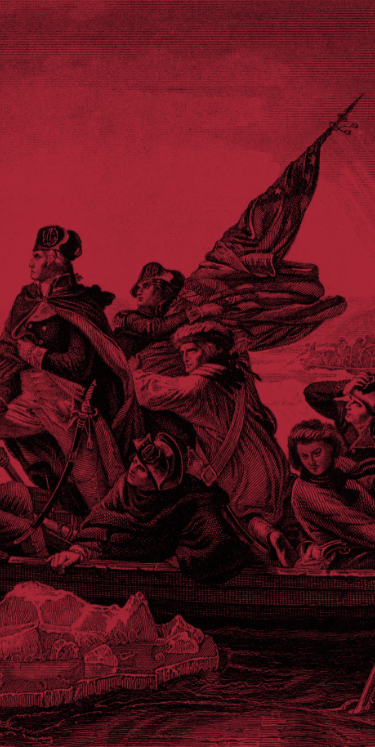
The Founding Fathers recognized that fact to the extent that often America was called Columbia in the poetry of people like Phillis Wheatley11 and Joseph Hopkinson in the famous song Hail Columbia.12 John Adams recognized that Columbus was, “a bold navigator & successful adventurer.,”13 while Thomas Jefferson scoured Europe for an accurate portrait of the Admiral going so far as to study which paintings bore the closest resemblance to Columbus.14 While president, George Washington spent time going to the theater to watch a play detailing the landing of Columbus.15 Others went so far as to say that he stands as the “type of the American character.”16

Beyond the personal acknowledgements from the various Founding Fathers, the culture as a whole so respected Columbus’s skill and importance as a sailor and explorer that one of the first ships in the United States Navy was the USS Columbus17 while the newly designed capitol was christened in his honor.18 So, very far from the idiot he is often portrayed as today, for over 400 years, people of science, of stature, and even entire nations understood that Christopher Columbus was a brave explorer who expanded the realms of human knowledge and understanding.


Endnotes

1 Seth Michels, “History Uncensored Ep. 6 Columbus the Idiot Part 2,” History Uncensored Podcast (July 9, 2019), here
2 Samuel Morrison, Admiral of the Ocean Sea (New York: MJF Books, 1970), 65.
3 Ken Layne, “Today We Honor Columbus, An Inspiration to Cruel Half-Wits Everywhere,” Gawker (October 14, 2013), here.
4 Seth Michels, “History Uncensored Ep. 6 Columbus the Idiot Part 2,” History Uncensored Podcast (July 9, 2019), here
5 Ken Layne, “Today We Honor Columbus, An Inspiration to Cruel Half-Wits Everywhere,” Gawker (October 14, 2013), here.
6 Rafi Schwartz, “These Defenses of Columbus Day Are Just as Idiotic and Disgusting as He Was,” Splinter (October 9, 2017), here
7 Christopher Columbus, “Letter from the Admiral to the King and Queen,” Christopher Columbus’s Book of Prophecies, trans. Kay Brigham (Fort Lauderdale: CLIE Publishers, 1992), 178.
8 Michele de Cuneo, “Michele de Cuneo’s Letter on the Second Voyage, 28 October 1495,” Journals and Other Documents on the Life and Voyages of Christopher Columbus, trans. Samuel Morrison (New York: Heritage Press, 1963), 227.
9 Alexander VI, “The Bull Inter Caetera. May 3, 1493,” European Treaties Bearing on the History of the United States and its Dependencies to 1648, edited by Frances Gardiner Davenport (Washington DC: Carnegie Institution of Washington, 1917), 61-62.
10 Samuel Morrison, Admiral of the Ocean Sea (New York: MJF Books, 1970), p. 669.
11 Phillis Wheatley, “To His Excellency, George Washington” Phillis Wheatley Historical Society (accessed August 20, 2019), here
12 Joseph Hopkinson, “Hail Columbia,” Bartleby (accessed August 20, 2019), here
13 John Adams to William Tudor, Sr., February 25, 1800, Founders Online (accessed August 16, 2019), here.
14 Thomas Jefferson, “Notes on the Likeness of Christopher Columbus, 28 August 1814,” Founders Online (accessed August 20, 2019), here
15 George Washington, “Diary Entry: 6 February 1797,” Founders Online (accessed August 20, 2019), here
16 Charles Ingersoll, “Proceedings at Philadelphia: The Triumph of Patriotism,” ed. Hezekiah Niles, The Weekly Register (Baltimore: The Franklin Press, 1812), 2:203, here.
17 John Adams, “Autobiography: In Congress, November and December 1775,” Founders Online (accessed August 20, 2019), here
18 Thomas Jefferson to George Washington, September 8, 1791, Founders Archive (accessed August 20, 2019), here