Thomas Jefferson Quiz

Thomas Jefferson Quiz

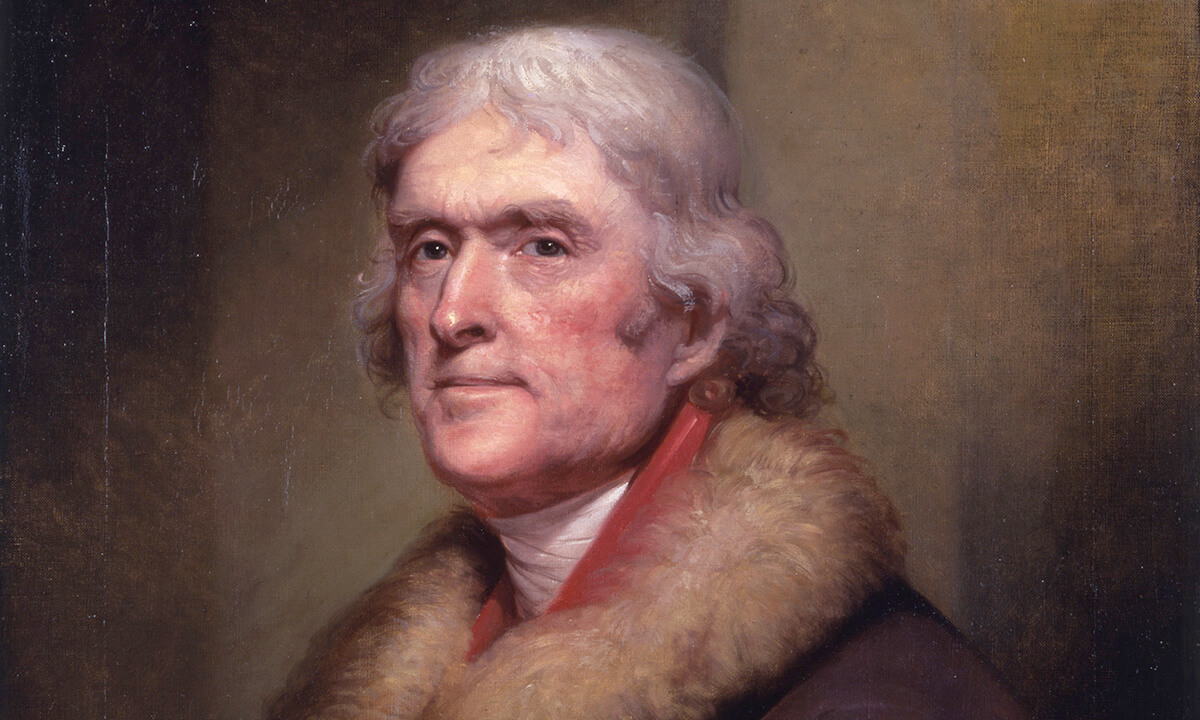
Did you know that Thomas Jefferson was given two baby bear cubs as president of the United States?

Zebulon Pike was part of an expedition that explored the Louisiana Purchase. On his trip, he discovered two grizzly bear cubs that he sent to President Thomas Jefferson. (Interestingly, Pike’s Peak was named after Zebulon Pike.) Zebulon Pike wrote a letter to Thomas Jefferson when he sent the cubs and Thomas Jefferson later acknowledged the gift with a letter of his own.

Take the quiz below to find out more about Thomas Jefferson!

/10
33

THOMAS JEFFERSON

From unusual animals to giant wheels of cheese, the third President of the United States carved out a prominent place in American history. Take this quiz to see how much you know about Thomas Jefferson!

1 / 10

About how much did the giant Mammoth Cheese sent to Thomas Jefferson in 1802 weigh?

2 / 10

Where is Thomas Jefferson's book collection now?

Guess the three word answer! Click the "Check" button to see if you are right!

3 / 10

Which document did Thomas Jefferson write?

4 / 10

Who helped Thomas Jefferson and John Adams become friends again?

5 / 10

Thomas Jefferson was President during which American war?

6 / 10

Thomas Jefferson died on the same day as _____.

Enter first & last name, then click the "Check" button.

7 / 10

True or False. Thomas Jefferson believed that churches and religion should stay out of the government.

8 / 10

What position did Thomas Jefferson hold while George Washington was president?

9 / 10

True or False. Jefferson cut out parts of the Bible he didn't like to make "The Jefferson Bible."

10 / 10

What colony/state was Thomas Jefferson from?

Your score is

The average score is 63%

Iconic Moments: Events of Faith and Prayer

Below are some 30 different important religious events that are either indicative of, set a tone for, or have directly impacted the development of America. Several are iconic, and all are important. A number are reflective of consequential movements, some of seminal events, and yet others of important individuals. We have not tried to prioritize them as to which might be more significant than another (although some definitely are). Rather, we have simply listed them chronologically for your consideration and selection. So here goes:

Cape Henry Landing, Jamestown, Virginia, 1607.

Coming ashore in the New World, Rev. Robert Hunt and the original Jamestown settlers erected a cross and had a prayer ceremony dedicating the new land to the Lord in what is considered the first English Christian worship service in America.1 This was how the first English settlement in America began, opening the door to more Christian settlements and colonies that steadily spread along the East Coast and then inland, eventually forming the United States of America.

Baptism of Pocahontas, 1613, US Capitol Rotunda Painting.

Pocahontas is considered one of the first, and certainly the most famous, of the early native converts to Christianity in the English New World. Upon her conversion, she changed her name to a Christian one, Rebecca.2 She was considered royalty, being the daughter of the chief, and when she traveled overseas to England, she was presented to the queen as the Princess Rebecca.3 The oldest known portrait of her hangs in the office of the Secretary of the Senate, showing her name as the Princess Rebecca, thus reaffirming her Christian faith.

Embarkation of the Pilgrims, 1620, US Capitol Rotunda Painting.

In the sail above the Pilgrims is the phrase, “God With Us,” descriptive of their entire belief system. They are gathered around an open Bible, and more specifically, a Geneva Bible, which included commentaries on the various issues of their day.With their heavy reliance on the Bible, and their ardent desire to achieve a useful application of its teachings and principles, many of the practical and distinctive civil traits that America has adopted over the centuries originated from the Pilgrims (Separatists) and their neighbors, the Puritans.These principles included elective republican forms of government,4 religious liberty,5 the rights of conscience,6 equality of all individuals and races,7 free market and free enterprise economics,8 due process in legal rights,9 public education for all children,10 and many other of the most important qualities that have come to characterize America.

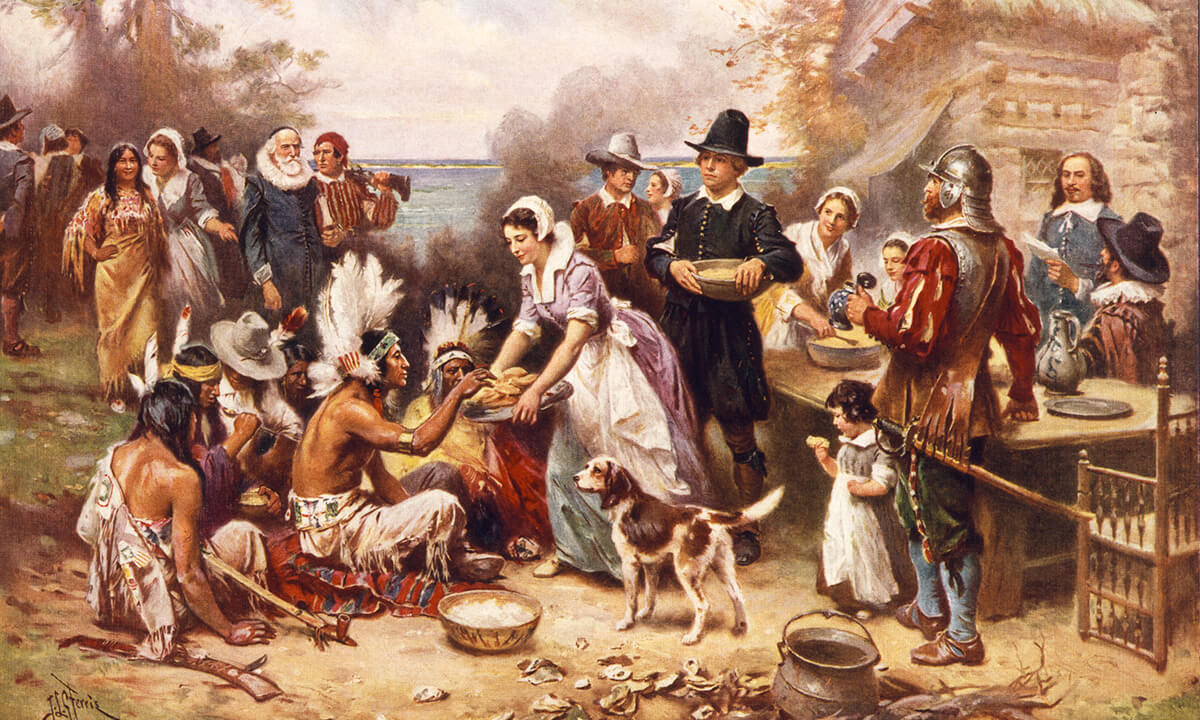
Pilgrims’ First Thanksgiving, 1621 (establishing a national practice).

After withstanding the first winter (in which half of the Pilgrims died), their Indian friends such as Samoset, Squanto, Chief Massasoit, and the 90 warriors from their tribe joined with the Pilgrims in three days of friendship, athletic competition, and thanking God.11 This started the traditional annual Thanksgiving celebration in America.

Pilgrims’ First Day of Fasting, 1623 (likewise establishing a national practice).

Like Thanksgiving, this event also began a national and state holiday and tradition.During a devastating drought in 1623, the Pilgrims called for a day of prayer and fasting.12 God directly answered their prayers, sending an out-of-season and uncharacteristically gentle rain that revived their crops, ultimately saving their lives. Even their Indian friends were amazed at the obvious, immediate, and undeniable answer to their prayers.13This day of fasting, combined with the annual day of thanksgiving begun two years earlier, led to the New England tradition of declaring a day of humiliation, fasting, and prayer in April, and a day of thanksgiving in November. Today, the annual spring day for humiliation, fasting, and prayer in Massachusetts survives as Patriot Day, recognized on April 15 each year.14By 1815, there had been over 1,400 official government-issued calls to prayer just in the New England area, including days of Thanksgiving, as well as Humiliation, Fasting, and Prayer.15

“A Model of Christian Charity” (A City on a Hill), John Winthrop, 1630.

In “The Great Puritan Migration” that began in 1630, from 700 to 1,000 religious colonists, in a fleet of 11 ships led by John Winthrop, abandoned the persecution and oppression of the Old World to seek civil and religious freedom in the New.16 Winthrop penned “A Model of Christian Charity” to both set forth as well as emphasize their responsibilities.Their colony was to be a model for the rest of the world—what Winthrop identified as “a city set on a hill”17 (quoting from Jesus’ words in Matthew 5:14)—and not become like so many other colonies around the globe that involved rapine, oppression, greed, and selfishness. That sermon, later published, had direct positive impact upon countless colonists who arrived in America. That work, especially its theme, was also subsequently cited as a reminder to later generations by US Presidents, including John F. Kennedy18 and Ronald Reagan.19

The First Great Awakening, 1730-1770.

This was a decades-long religious movement that directly laid the foundation for American Independence. Likely the most notable name associated nationally with this movement was the Rev. George Whitefield,20 but there were many other regionally-famous names as well, including Jonathan Edwards and Jonathan Mayhew in Massachusetts,21 Gilbert Tennant in Pennsylvania,22 Samuel Davies in Virginia,23 Eleazer Wheelock in New Hampshire,24 and those in other regions.The movement produced positive changes in many areas, including the growth of a more personal faith that was applied every day and not just on the Sabbaths. But more importantly, the First Great Awakening undeniably provided the foundation upon which American Independence was later erected. In fact, every grievance raised in the Declaration of Independence had been preached from the American pulpit prior to 1763.25Founding Fathers such as John Adams, Thomas Jefferson, and Benjamin Franklin attest to the national unity produced by the Great Awakening, specifically through the influence of the famous “Father Abraham” sermon of George Whitefield.26 As a result of the Great Awakening, America was no longer 13 jealously-divided nations, but had started becoming 13 individual states within one nation and faith.

The Destruction of the French Fleet, 1746.

In that era, France was warring with England for control of the interior of America, eventually leading to the French and Indian War in America (1754-1763). The French, seeking to defeat and drive the English from the region, dispatched a large fleet and nearly 11,000 men against the tiny settlements along the American northeast coast.27 Boston in particular was targeted to be burned and destroyed.28On October 16, 1746, with an enemy fleet underway, Massachusetts Governor William Shirley called for a Day of Humiliation, Fasting, and Prayer, seeking God’s direct intervention against the approaching adversary.29 The Rev. Thomas Prince preached the sermon at the official gathering that day, leading Bostonians in a specific prayer: “Deliver us from our enemy! Send Thy tempest, Lord, upon the waters to the eastward! Raise Thy right hand. Scatter the ships of our tormentors and drive them hence. Sink their proud frigates beneath the power of Thy winds!”30 Appropriate to his prayer, a violent storm arose and destroyed the enemy force.31

On November 27, 1746, Governor Shirley accordingly called for a Day of Thanksgiving.32 By direct Providential intervention, the fledgling American colonies, particularly the city of Boston, were saved from an enemy many times more powerful.132 years later in 1878, legendary poet Henry Wadsworth Longfellow captured this historic event in his “Ballad of the French Fleet,” in which he eulogized the prayer earlier offered by the Rev. Thomas Prince.33

Battle of the Monongahela, July 9, 1755.

During the French and Indian War, a young 23-year-old Colonel George Washington led American troops to join with British forces against the French and Indians in the interior of America. The top English commander, veteran British General Edward Braddock, against Washington’s recommendations, led them into a waiting ambush. More than half their troops were killed.34There were some 86 English officers in the battle, and of all mounted officers, Washington was the only one not shot down off his horse.35 After the battle, he openly attested to his family that “by the miraculous care of Providence, I have been protected beyond all human probability or expectation. For I had four bullets through my coat, and two horses shot under me, yet escaped unhurt, although death was leveling my companions on every side of me.”36Washington was a young man still largely unknown to the nation at this time. But the most famous pulpit orator of that day, the Rev. Samuel Davies (who mentored and trained the young Patrick Henry), referred to this battle and this incident in a deployment sermon he preached to a company of soldiers being sent to fight in this war. In that sermon, he concluded that because God had saved the young Washington’s life in such a dramatic fashion that surely this young man was destined for the role of a great leader in the rising America.37 Davies’ prophecy turned out to be correct, and George Washington, as a result of God’s direct Divine protection, eventually became “The Father of his Country.”38

The First Prayer in Congress, 1774.

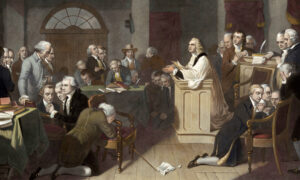
When the Founding Fathers gathered in their first-ever Congress, John Adams identified that the very first motion made was that they open with prayer.39 At the recommendation of Samuel Adams (a Puritan), the Rev. Jacob Duche (an Anglican) was asked to open that body in prayer. He not only prayed but he also read from the Scriptures, including from four chapters of the Bible (causing John Adams to enthuse over the reading of Psalm 3540), in what became a very lengthy service. The Founding Fathers enthusiastically reported the positive impact of that opening prayer and Bible session,41 and continued it each day thereafter, establishing the practice of having a chaplain open each session of Congress with prayer.

Government-Issued Calls to Prayer From Founding Fathers and Public Leaders.

From the first days of American independence, prayer was integral to official public proceedings. For example, on 15 separate occasions, the Continental Congress called the nation to alternating days of fasting, humiliation, and prayer, and then days of thanksgiving.42 Additionally, various prayer proclamations were issued by numerous Founding Fathers when they served as governors of their respective states.

This includes Governor John Hancock, who issued 22 separate prayer proclamations;43 Governor Samuel Adams, who issued 7;44 and so forth.Other notable Founding Fathers who, from their positions as public office-holders, also issued official calls to public prayer, include Signers of the Constitution such as George Washington45, James Madison,46 Ben Franklin47, John Langdon,48 William Livingston,49 William Paterson,50 Thomas Mifflin,51 and John Dickinson,52 and Signers of the Declaration John Adams,53 Thomas Jefferson,54 Josiah Bartlett,55 Caesar Rodney,56 Oliver Wolcott,57 Samuel Huntington,58 Elbridge Gerry,59 and Thomas McKean.60(And of course numerous presidents and countless governors, legislatures, and local leaders have followed in the footsteps of our forebears, repeating their same religious practices across the generations.)

Building the Military: General Orders, George Washington, 1776-1783.

The establishment of America’s military forces date to the American War for Independence. At that time, Commander-in-Chief George Washington instituted our original policies and standards, many of which still continue today.One of his earliest orders was for Divine Service to be a standard part of the activities of every military unit.61 Congress undertook the same practice for the Navy, stipulating, The commanders of the ships of the Thirteen United Colonies are to take care that Divine Service be performed twice a day on board, and a sermon preached on Sundays.”62

Religion and morality were to be at the base of our institutions. As prominent Founding Father John Witherspoon affirmed, “There is not a single instance in history in which civil liberty was lost and religious liberty preserved entire….God grant that in America true religion and civil liberty may be inseparable.”63Thus, Washington included in his General Orders that all soldiers avoid “profane cursing, swearing, and drunkenness,” theuse of an oath or execration,” “games of chance,” “vice and immorality,” and other such behaviors. He continued, “As a mean to abolish this, and every other species of immorality, Brigadiers are enjoined to take effectual care to have Divine Service duly performed in their respective brigades,” for “We can have little hopes of the blessing of Heaven on our Arms if we insult it by our impiety and folly.”64

Significantly, these initial military orders originally issued by Washington were continued by subsequent presidents,65 becoming standard practice.

Miracles in Battle, 1776-1783.

George Washington personally attested to numerous miraculous Divine interventions that turned defeat into victory, including at the Battle of Long Island, the Battle of Trenton, the Battle of Yorktown, and others.66 In fact, on more than 250 separate occasions, Washington openly acknowledged witnessing the hand of God in what was occurring around him during the war.67 As an example, he testified to General Thomas Nelson that “The hand of Providence has been so conspicuous in all this, that he must be worse than an infidel that lacks faith, and more than wicked, that has not gratitude enough to acknowledge his obligations—but—it will be time enough for me to turn preacher when my present appointment ceases.”68

Prayer at the Constitutional Convention, September 1787.

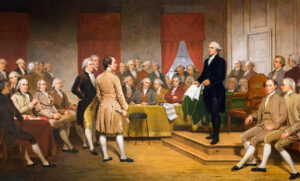
In an effort to solve the flaws in the existing national government that became apparent after the successful conclusion to the War for Independence, leading Founding Fathers gathered at Independence Hall in Philadelphia. George Washington chaired the meeting.69James Madison proposed a new governing document for the country. After several weeks of discussion, however, the delegates reached an impasse. Tempers flared and frustrations soared. Some delegates began leaving the city in exasperation and disgust.70 Those remaining despaired of success.

Benjamin Franklin, the eldest delegate at the gathering, was stirred to personally address the delegates in an impromptu fashion. He challenged them to turn to God for His aid and assistance, urging that “henceforth prayers imploring the assistance of Heaven, and its blessings on our deliberations, be held in this assembly every morning before we proceed to business, and that one or more of the clergy of the city be requested to officiate in that service.”71 Significantly, in a span of only 11 short sentences in his address, Franklin, in a conversational manner, referenced or alluded to numerous verses from the Scriptures in calling for the time of prayer.Since the Convention was approaching the Fourth of July, delegate Edmund Randolph further proposed that a sermon be preached to and for the Convention delegates and that “thenceforward prayer be used in the Convention every morning.”72The Convention then recessed for three days, with the delegates attending church and listening to patriotic orations.73

The Rev. William Rogers prayed a special prayer over the delegates. His prayer was subsequently printed on the front page of the newspaper, taking up more than half the page.74When the delegates reconvened after those three days, there was a change in the atmosphere. They began making progress and eventually solved the major problematic issues. The result is the best form of government ever devised by man, and the US Constitution has proved the most valuable and stable civil document in history—no nation has been under the same constitution longer than the United States.75

George Washington’s Resignation from the Military, 1783, US Capitol Rotunda Painting.

Once Great Britain officially signed the 1783 Peace Treaty of Paris, ending the American War for Independence,76 George Washington submitted his resignation as military Commander-in-Chief from all the states and the Continental Congress.77 Following that, he sent what was known as “General George Washington’s Circular Letter to the States, June 8, 1783,” in which he submitted his final thoughts on what needed to be addressed by Congress and the states.78 The final page of his political agenda offers his prayer for the nation, now referred to as “George Washington’s Prayer.” Significantly, every year at the National Prayer Breakfast (the prayer event sponsored by Congress on the first Thursday of February, regularly attended by delegates from well over 100 nations), George Washington’s prayer appears on the printed program for the breakfast,79 thus sending a message worldwide.

President George Washington’s First Inauguration, April 30, 1789.

George Washington’s first inauguration was arranged by 14 clergy, including both Christian ministers and a Jewish rabbi.80 It involved seven different religious activities: (1) the use of the Bible to administer the oath; (2) solemnifying the oath with multiple religious expressions (placing a hand on the Bible, saying “So help me God,” and then kissing the Bible); (3) prayers offered by the president himself; (4) religious content in the inaugural address; (5) the president calling on the people to pray or acknowledge God; (6) church inaugural worship services; and (7) clergy-led prayers.81 In the inauguration of every subsequent president, these activities have been repeated in whole or part. And significantly, in Washington’s “Inaugural Address,” a full one-third of it reflected on the “Providential Agency” of God at work in the nation’s founding.82

Weekly Church in the US Capitol, Beginning 1800.

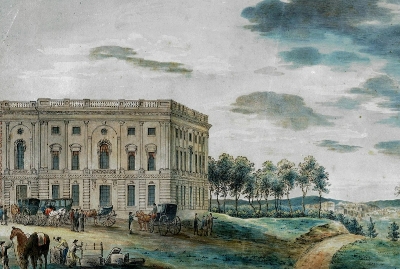
While New York City and then Philadelphia served as the first US capitals, construction began on the permanent Washington DC Capital City in 1793. In November 1800, work on the US Capitol building was sufficiently enough completed that the US House, US Senate, and the US Supreme Court moved into the structure.83On December 4, Speaker of the House Theodore Sedgwick and President of the Senate (and US Vice President) Thomas Jefferson approved the use of the new House Chamber for Sunday worship services, with the House and Senate Chaplain presiding over the weekly services inside the Chamber.84

Jefferson faithfully attended services there,85 being in attendance when Dorothy Ripley became the first woman to preach in the Capitol in 1806. In 1807, a larger House Chamber was constructed, and the church moved into that new area.86Other Presidents and Senators and Congressmen likewise went to Church at the Capitol. President John Quincy Adams attended church there and reported some 2,000 each week crammed into the House Chamber for church.87 He was also there when the second woman preached at the Capitol, Harriet Livermore.88 Bishop John England became the first Catholic to preach there in 1826 (also with John Quincy Adams in attendance).89In 1865, the Rev. Henry Highland Garnet was the first black American minister to preach in the Capitol Church, celebrating the end of slavery.90

Few think of the US Capitol building as a church, but by 1876 the Church at the Capitol was the largest in Washington DC, and the largest Protestant Church in the nation.

The Second Great Awakening, 1801-1850.

The years encompassed within this Awakening vary slightly according to the author or historian, but generally it is considered to have spanned the first half of the nineteenth century. In this movement were the names of many notable ministers, both black (Harry Hoosier, Lemuel Haynes, Andrew Bryan, Absalom Jones, and Richard Allen), and white (Francis Asbury, Charles Finney, Peter Cartwright, James A. Garfield, James McGready, Isaac Backus, and John Leland). This revival resulted in great impetus for many social reform movements, including the organized abolition movement, opposition to Indian removal, temperance, prison reform, women’s rights, and many others.

Robert Smalls, Charleston, SC, May 12, 1862.

While a slave, Robert Smalls piloted the flagship of Confederate General Roswell Ripley. Smalls and his crew of black comrades prayed fervently for their freedom. One day when the Confederate officers went ashore, Smalls and the other slaves decided to escape on the ship and turn it over to Abraham Lincoln.91Their escape route would take them past several Confederate forts, where they would be required to give the correct military code in order to continue. Fearful for their lives, the crew gathered around Smalls, who prayed, “Oh, Lord, we entrust ourselves into Thy hands. Like Thou didst for the Israelites in Egypt, please stand guard over us and guide us to our Promised Land of freedom.”92 They were able to safely pass every checkpoint, eventually reaching the Union fleet, where they presented them with the Confederate flagship.The crew was taken to Washington DC and met with President Lincoln. Smalls then joined the Union Army, serving on the same ship he had given to the Union,93 winning numerous engagements and becoming the first black military ship pilot in American history. After the war, he became a Major General in the South Carolina militia94 and then one of the early black members of Congress following the Civil War.95

President Abraham Lincoln’s Call for a Day of Humiliation, Fasting, and Prayer, March 30, 1863.96

Amidst the nation tearing itself apart in the Civil War, this proclamation focused on correcting the spiritual condition of the American people. Almost ignoring the Civil War raging around them, Lincoln’s call to prayer urged the people to examine their own relationship with God and His Scriptures, and conform their lives to that standard. This was one of the most important calls for prayer and fasting in American history and seemed to be a turning point in the Civil War: the Union had won only two major battles before this, but lost only one major battle afterwards. The proclamation did not seek to create a winner or a loser but rather to reconnect Americans with God and urge them to live according to His ways.

President Abraham Lincoln’s Gettysburg Address, November 19, 1863.97

This speech resounds with Biblical themes, even comparing the shed blood and atoning death of the brave men on Gettysburg’s battlefields, which made possible a new birth for the nation, with the atoning sacrificial shed blood and death of Jesus Christ on Calvary’s cross, which made possible a new birth and new life for fallen mankind.

Providence Spring, Andersonville, Georgia, Summer 1864.

During the Civil War, Camp Sumter in Andersonville became a POW facility. Designed to hold 10,000 prisoners, it was overcrowded with 33,000.98 It lacked sufficient food, shelter, or water. The only nearby water was a murky swamp, where prisoners washed clothes, bathed, and had a latrine. Disease was rampant, with some 100 prisoners per day dying.99 The men prayed and God sent a storm that began to fill cups, pots, and dishes. Lightning then struck the ground and a spring of clear water began spouting forth into the air. Named Providence Spring, it provided enough clean water for all the prisoners in the camp.100

The Rev. Henry Highland Garnet, Sabbath Morning, February 12, 1865.

On this date, the Rev. Garnet became the first black American to officially speak in the Halls of Congress.101 Two weeks earlier, the US House, joining their actions to the similar earlier actions of the Senate, had passed the 13th Amendment to abolish slavery.102The House chose to celebrate that momentous event by inviting the Rev. Garnet to preach in the official Church at the Capitol on the following Sunday. Garnet was a nationally-known black civil rights leader, at that time holding essentially the same fame and stature as Frederick Douglass.Rev. Garnet brought his church choir with him to the service. The result was a church service in the House of Representatives to celebrate the official end of slavery after nearly two-and-a-half centuries of bondage in America.

President Abraham Lincoln’s “Second Inaugural Address,” March 4, 1865.103

One of the shortest inaugural speeches, it is also one of the most spiritually profound in American history. This masterful speech draws deeply on Biblical texts, rhythms, and themes in a plea for national reconciliation. The former slave Frederick Douglass famously quipped, the President’s address “sounded more like a sermon than a state paper.”104 More recently, historian Ronald C. White, Jr. called it Lincoln’s “Sermon on the Mount.” 105

Military Bibles.

From 1774 to the present, more than 67 versions of Bibles and Armed Forces Prayer Books have been officially distributed to soldiers, sailors, and airmen106 as a source of spiritual strength and encouragement, including in every conflict from the American War for Independence to the War on Terror.

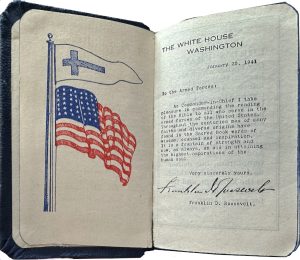
In both world wars, the US Government distributed Bibles to its warriors that, inside the front cover, included encouragements from notable leaders to read the Bible. This included pro-Bible messages from President Woodrow Wilson, President Teddy Roosevelt, and General John J. Pershing in World War I.107 Also prominent in later Bibles were the words and endorsement of famous World War II leaders108 including President Franklin Roosevelt, General George C. Marshall, General Omar Bradley, and General Douglas McArthur.

Also distributed to warriors in the Second World War were Bibles that had an outer-plate of steel on the cover. When placed in the left breast pocket over the heart, it was capable of stopping a bullet from a rifle. It was thus known as a “Heart-Shield Bible.”109 And inside the WWII US Navy Bible (easily identifiable because of its sea-blue cover), the picture across from the presidential letter shows the Christian naval pennant flying above the American flag. Significantly, in the US Flag Code to this day, the call to serve God still goes above the call to serve country.110

Numerous national heroes of great religious faith arose from within our military ranks, including Alvin York, the greatest soldier of World War I, who had been a pacifist but became one of the nation’s greatest heroes. Hollywood later turned his story of strong Christian faith into a blockbuster that won multiple academy awards, showing how Christian faith was not incompatible with patriotism and service to one’s country.111

The Four Chaplains, February 3, 1943.

An early tragedy after America entered World War II occurred in the North Atlantic, when the SS Dorchester troop carrier was torpedoed by a wolf pack of German submarines. Caught unprepared, hundreds of American soldiers died in the frigid waters.112 But responsible for saving scores, and perhaps hundreds of lives, were four Army Chaplains (a Dutch Reformed, a Methodist, a Jew, and a Catholic).113

As the American ship sank beneath the waters, the last sight by survivors was the four locked arm-in-arm, standing on the deck and praying as they plunged into the deep.114 President Truman created an equivalent Medal of Honor for the four (for they technically had not performed their remarkable acts of valor under enemy fire during combat).115 And special chapels (which President Truman helped dedicate) were built to honor the four.116Perhaps even more significant, in 1952, the American Legion (the nation’s largest military veterans’ organization) initiated a “Back to God” program in recognition of the Four Chaplains. They requested that every year annually, the Sunday closest to February 3 (the date of the disaster) should “be observed…throughout our nation and in all freedom-loving countries as ‘Go-to-Church’ Sunday, in worship and prayer for everlasting peace.”117

President Franklin Roosevelt, D-Day, June 6, 1944.

Perhaps the most momentous operation of World War II was D-Day. It had been kept a total secret from the American people, and its unfolding was a complete surprise. The President announced the active invasion in one of his “Fireside Chats.” He gave the people the news, then led them in a 6-minute prayer on behalf of the safety of the troops who, at that very moment, were unloading and under fire. He also prayed for the success of the operation.118 (Hear his announcement and prayer here: https://youtu.be/8-weBUzQleo.) Later that year, the White House had FDR’s D-Day prayer transcribed and turned into his Christmas Card for 1944.119

George Patton,Battle of the Bulge, Christmas 1944.

Behind D-Day, perhaps WWII’s next most momentous military engagement was the Battle of the Bulge. The Germans broke through American lines and brought the Allied advance to a complete halt. Supreme Commander Dwight Eisenhower dispatched George Patton and the Third Army to defeat the Germans and put the US Army back on the march to finish Hitler.120

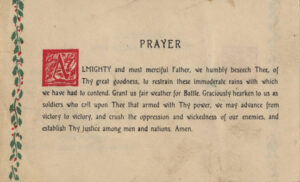
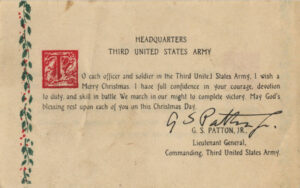
Patton’s greatest nemesis at that time was the weather, which was causing more damage to his troops than the Germans. Patton brought in his Chief of Chaplains, James O’Neill, and they created a prayer card for the weather that Patton wanted distributed to all 250,000 of his troops121—he wanted them all praying.Then as Patton approached the town of Luxembourg, his headquarters for the battle, he stopped at a church and had a conversation with God. He marched up to the statue of Jesus in the front of the church, hat in hand, and had a very candid discussion with Him about what He needed to defeat the Germans and end the war, slaughter, and oppression. He told Jesus that if He would give him just four days of good weather, he could defeat the Germans at the Bulge and get back to Hitler.122

The records show that after nearly six weeks of horrible weather and unending rain, Patton immediately got several days of clear weather,123 allowing his planes to take to the air and destroy the German tanks and equipment, thus winning the Battle of the Bulge. After the battle, Patton stopped by the church on his way out of town and congratulated Jesus on His excellent results with the weather.124

Dwight Eisenhower’s Inauguration and Presidency, 1953-1960.

Eisenhower openly expressed his concern that America was becoming too secular, and wondered what he could do to help prevent that. After taking communion the morning of his inauguration, he personally penned and prayed his own inaugural prayer125 (see on YouTube at https://youtu.be/DKqgFY8wmhI).

Eisenhower then undertook a number of specific actions to ensure that American government did not become “too secular.”This included starting the National Prayer Breakfast,126 adding “under God” to the Pledge of Allegiance,127 adding “In God We Trust” to all currency128 (Lincoln had it added to 2-cent coins in 1864 but to nothing else129), made “In God We Trust” the National Motto,130 and facilitated the addition of a Prayer Room to the US Capitol.131Also, Eisenhower was the only president to be publicly baptized while in office.132

Martin Luther King Jr, “Letter from A Birmingham Jail,” April 1963.133

After Birmingham passed a policy designed to halt the civil rights movement by forbidding any gatherings without a permit,134 King and his supporters continued to exercise their right to assemble. As a result, King was arrested (his 13th time) and placed in solitary confinement.135President John F. Kennedy directly intervened on his behalf.136 By King’s instruction, however, his supporters did not act to bail him out of jail.137 He wanted to keep national attention focused on the blatant injustice.

While in jail, eight local religious leaders, both Christian and Jewish, released an open letter criticizing King and his civil rights efforts.138 King typed a 21-page-long apologetic defending non-violent but direct actions against injustice. In that piece, he presented a long line of historical precedents from early church leaders proceeding up to his day who did not sit on the sidelines, thus establishing the moral and religious duty of direct engagement against wrong.

President John F. Kennedy, Christmas 1963.

While annual Christmas cards are regularly sent out from the White House to close supporters and friends, in 1963, the Christmas card sent out by President John F. and First Lady Jaqueline Kennedy was the first White House card to feature a crèche139—the Nativity Scene—the birth of Jesus Christ. The president was assassinated before they were able to distribute all of those cards, having signed only 30 at the time of his death.140

The Apollo Space Program. 1967-1972.

A cabin fire during a launch rehearsal for Apollo 1 resulted in the death of all three of its astronauts.141 Apollo personnel and workers, understanding just how dangerous the space program was, launched the Apollo Prayer League for employees and fellow workers to pray diligently for each mission and astronaut.142 The fact that a religious tone infused much of the Apollo space operations is apparent by what occurred during several of its missions.

Both Apollo 8 and 10 carried Bibles into space,143 and as Apollo 8 orbited the earth on Christmas 1968, the three astronauts broadcast their Christmas greetings back to earth by reading the Creation Account from the Bible (Genesis 1:1-10).144

With Apollo 11, man first landed on the moon. But before Buzz descended to its face, he took communion145 (see his communion cup to the right).

On Apollo 12, two Bibles were taken to the moon.146

On Apollo 13, 512 Bibles (in microform) were taken to the moon,147 but an explosion that occurred en route prevented them from landing. Thankfully, they were able to safely return to Earth.

On Apollo 14, some 513 Bibles were carried to the moon, of which 100 landed on the surface.148

On Apollo 15, a small red-paper Bible was left on the control panel of the lunar rover.149

Thus, as part of the space program a total of 1,029 Bibles were taken to the moon, of which 101 landed on its surface.

9/11 Memorial Service at the National Cathedral Following the Twin Towers Tragedy, 2001.150

These examples display clear and convincing proof of the prevalence of faith not only in everyday life but also as an indispensable positive influence in shaping America’s national public life. Our nation’s history affirms a clear and firm reliance on God and the Bible. These representative examples are well-documented historically and readily available for the average American to discover online. Although much of this history used to be well known, sadly most Americans have not been taught these stories and therefore are largely unfamiliar with them.

If a smaller portion of this list is selected to highlight or retell, we would not recommend pulling a subset from this list according to chronological order but rather in order of national impact and significance. For example, the first prayer in Congress or Franklin’s call to prayer at the Constitutional Convention would be more noteworthy than the first White House religious Christmas card; George Washington would be more nationally significant than Alvin York; and the Pilgrims’ first Thanksgiving was more impactful than the landing at Cape Henry.

Lastly, some examples, such as Providence Spring or the Apollo program, might bring extra criticism in this modern era. Sadly, many critics today (particularly among younger generations) openly doubt whether anyone landed on the moon.151 Similarly, there are many critics in certain states and geographical areas that still affiliate with one side or the other of the Civil War. These factors might result in added (and unnecessary) criticism from those quarters, but you will have to determine to what extent such external influences might carry weight. Nevertheless, there remains a definite and clear demonstration of faith and prayer in even these examples, as well as all the rest.


Endnotes

1 “Reverend Robert Hunt: First Chaplain at Jamestown,” National Park Service, accessed March 31, 2026, https://www.nps.gov/jame/learn/historyculture/the-reverend-robert-hunt-the-first-chaplain-at-jamestown.htm; Walter S. Griggs, Jr., Historic Richmond Churches and Synagogues (Charleston: The History Press, 2017), 13-17.

2 “Who was Pocahontas?” Jamestown-Yorktown Foundation, accessed March 31, 2026, https://www.acton.org/religion-liberty/volume-35-number-1/puritan-entrepreneur-do-all-glory-god.

3 Sarah A. Morgan Smith, Brian A. Smith. “The Puritan as Governor: With Consent of the Governed,” January 6, 2025, Acton Institute, https://www.acton.org/puritan-governor-consent-governed.

4 See, for example, “Mayflower Compact,” 1620, The Avalon Project, https://avalon.law.yale.edu/17th_century/mayflower.asp.

5 “America as a Religious Refuge: The Seventeenth Century, Part 1 – Religion and the Founding of the American Republic,” 2019, Library of Congress, https://www.loc.gov/exhibits/religion/rel01.html.

6 Edwin Hall, The Puritans and Their Principles (New York: Baker and Scribner, 1847), 148.

7 Christopher Cameron, “The Puritan Origins of Black Abolitionism in Massachusetts,” Historical Journal of Massachusetts (Summer 2011), 39:1&2:80.

8 Erik W. Matson, “The Puritan as Entrepreneur: Do All to the Glory of God,” January 13, 2025, Acton Institute, https://www.acton.org/religion-liberty/volume-35-number-1/puritan-entrepreneur-do-all-glory-god.

9 “The Mayflower Compact: Civil Body Politick,” November 24, 2015, Mass.gov, https://www.mass.gov/news/the-mayflower-compact.

10 David Rodriguez Sanfiorenzo, “Historical Foundations of Education in the United States: Colonial America to Reconstruction,” August 30, 2021, Introduction to Education,  https://uen.pressbooks.pub/introtoeducation/chapter/historical-foundations-colonial-america-to-reconstruction-eese-2010-introduction-to-education/.

11 William S. Russell, Guide to Plymouth and Recollections of the Pilgrims (Boston: George Coolidge, 1846), 95.

12 William Bradford, History of Plymouth Plantation, ed. Charles Deane (Boston: 1854), 142.

13 Bradford, History, ed. Deane (1854), 142.

14 “A Day of Thanksgiving, Summer 1623,” September 28, 2023, Plimoth Patuxet Museums, https://plimoth.org/yath/unit-4/a-day-of-thanksgiving-summer-1623.

15 William Love, Fast and Thanksgiving Days of New England (Boston: Houghton, Mifflin and Company, 1895), 446-447.

16 David Ammerman and Ronald Howard, “The Great Puritan Migration,” 2022, EBSCO Research, https://www.ebsco.com/research-starters/history/great-puritan-migration.

17 John Winthrop, “A Model of Christian Charity,” A Library of American Literature: Early Colonial Literature, 1607-1675, eds. Edmund Clarence Stedman & Ellen Mackay Hutchinson (New York: 1892)304-307.

18 John F. Kennedy, “The City upon a Hill Speech,” January 9, 1961, JFK Library, https://www.jfklibrary.org/learn/about-jfk/historic-speeches/the-city-upon-a-hill-speech.

19  Ronald Reagan, “Farewell Address to the Nation,” January 11, 1989), The American Presidency Project, https://www.presidency.ucsb.edu/documents/farewell-address-the-nation.

20 Frank Lambert, “‘Pedlar in Divinity’: George Whitefield and the Great Awakening, 1737-1745,” Journal of American History (December 1, 1990), 77:3:824-825; Leonard Woolsey Bacon, A History of American Christianity, The American Church History Series (The Christian Literature Co., New York, 1897), 175-176.

21 Susan O’Brien, “A Transatlantic Community of Saints: The Great Awakening and the First Evangelical Network, 1735-1755,” The American Historical Review (October 1, 1986), 91:4:825; Clinton Rossiter, “The Life and Mind of Jonathan Mayhew,” The William and Mary Quarterly (October 1, 1950), 7:4:532.

22 Gilbert Tennent to Benjamin Franklin, September 22, 1741, National Archives, https://founders.archives.gov/documents/Franklin/01-02-02-0077.

23 Wesley M. Gewehr, The Great Awakening in Virginia (Duke University Press, Durham, 1930), 188.

24 “Eleazar Wheelock: Preacher, Dartmouth College Founder,” September 21, 2023, Connecticut History, https://connecticuthistory.org/eleazar-wheelock-preacher-dartmouth-college-founder/.

25 Alice M. Baldwin, New England Clergy and the American Revolution, (New York: G.E. Stechert & Co., 1928), 170.

26 Stephen Mansfield, Forgotten Founding Father: The Heroic Legacy of George Whitefield (Nashville: Cumberland House, 2001), 86; John Adams to Thomas Jefferson, December 3, 1813, National Archives, https://founders.archives.gov/documents/Jefferson/03-07-02-0008.

27 Dan Landrigan, “Duc D’Anville Sails for New England in 1746 to Burn the Town of Boston,” October 28, 2025, New England Historical Society, https://newenglandhistoricalsociety.com/duc-danville-sails-for-new-england-in-1746-to-burn-the-town-of-boston/.

28 Dan Landrigan, “Duc D’Anville Sails for New England in 1746 to Burn the Town of Boston,” October 28, 2025, New England Historical Society, https://newenglandhistoricalsociety.com/duc-danville-sails-for-new-england-in-1746-to-burn-the-town-of-boston/.

29 Catherine Drinker Bowen, John Adams and the American Revolution (Boston: Little, Brown, and Company, 1951), 10-11.

30 Dan Landrigan, “Duc D’Anville Sails for New England in 1746 to Burn the Town of Boston,” October 28, 2025, New England Historical Society, https://newenglandhistoricalsociety.com/duc-danville-sails-for-new-england-in-1746-to-burn-the-town-of-boston/.

31 Bowen, John Adams (1951), 10-11.

32 Thomas Prince, The Salvations of God in 1746. In Part Set Forth in a Sermon at the South Church in Boston, Nov. 27, 1746 (Boston: D. Henchman, 1746).

33 Henry Wadsworth Longfellow, “A Ballad of the French Fleet,” October, 1746, Maine Historical Society, https://www.hwlongfellow.org/poems_poem.php?pid=239.

34 “The Battle of the Monongahela, July 9, 1755,” updated April 14, 2025, American Battlefield Trust, https://www.battlefields.org/learn/articles/battle-monongahela-july-9-1755.

35 “The Battle of the Monongahela, July 9, 1755,” updated April 14, 2025, American Battlefield Trust, https://www.battlefields.org/learn/articles/battle-monongahela-july-9-1755.

36 George Washington to John Augustine Washington, July 18, 1755, The Writings of George Washington, ed. John C. Fitzpatrick (Washington: Government Printing Office, 1931), 1:152.

37 Samuel Davies, Religion and Patriotism: The Constituents of a Good Soldier. A Sermon Preached to Captain Overton’s independnet company of volunteers, raised in Hanover County, Virginia, August 17, 1755 (Philadelphia: 1756), 10n.

38 George Washington to Lucretia Wilhelmina Van Winter, March 30, 1785, National Archives, https://founders.archives.gov/documents/Washington/04-02-02-0330.

39 John Adams to Abigail Adams, September 16, 1774, Letters of John Adams, Addressed to His Wife, ed. Charles Francis Adams (Boston: Charles C. Little and James Brown, 1841), I:23.

40 John Adams to Abigail, September 16, 1774, Letters of John Adams (1841), I:23-24.

41 Speech delivered in the Supreme Court on February 20, 1844, The Works of Daniel Webster (Boston: Little, Brown and Company, 1860), VI:162.

42 “Days of Fasting, Days of Thanksgiving: The Continental Congress Marks Revolutionary War Watersheds,” March 20, 2026, US House of Representatives: History, Art & Archives, https://history.house.gov/Blog/2026/March/3-20-Fasting-Thanksgiving/.

43 John Hancock, “A Proclamation for a Day of Fasting and Prayer,” Independent Chronicle and the Universal Advertiser (March 26, 1789), 1; John Hancock, “A Proclamation for a Day of Fasting, Humiliation and Prayer,” April 25, 1782, Evans #17593; John Hancock, “A Proclamation for a Day of Public Fasting and Prayer,” May 15, 1783, Evans #18024; John Hancock, “A Proclamation for a Day of Humiliation, Fasting, and Prayer,” April 17, 1788, Evans #21236; John Hancock, “A Proclamation for a Day of Fasting and Prayer,” March 31, 1797, Evans #23549; John Hancock, “A Proclamation for a Day of Fasting, Humiliation, and Prayer,” March 29, 1792, Evans #24519; John Hancock, “A Proclamation for a Day of Public Fasting, Humiliation and Prayer,” April 11, 1793, Broadside in the WallBuilders Collection.

44 See, for example, Fast Day Proclamation issued by Governor Samuel Adams, Massachusetts, March 20, 1797, in WallBuilders Collection; Samuel Adams, The Writings of Samuel Adams, ed. Harry Alonzo Cushing (New York: G. P. Putnam’s Sons, 1908), IV:407; Samuel Adams, A Proclamation For a Day of Public Fasting, Humiliation and Prayer, Governor of Massachusetts, from an original broadside in WallBuilders collection; Samuel Adams, Writings, IV:385; Samuel Adams, Proclamation for a Day of Fasting and Prayer, March 10, 1793; Samuel Adams, Proclamation for a Day of Fasting and Prayer, March 15, 1796.

45 “Draft of a Proclamation by George Washington, [1 January 1795],” National Archives, https://founders.archives.gov/documents/Hamilton/01-18-02-0003.

46 James Madison, ”A Proclamation for a Day of Public Prayer,” Connecticut Mirror (July 20, 1812), 3; James Madison, “A Proclamation for a Day of Public Prayer,” July 23, 1813, Independent Chronicle (July 29, 1813), 3–4; James Madison, “A Proclamation for a Day of Humiliation, Fasting and Prayer,” January 12, 1815, The Yankee (November 25, 1814), 2.

47 James Madison’s Notes on the Convention, June 28, 1787, Max Farrand, The Records of the Federal Convention of 1787 (New Haven: Yale University Press, 1911), I:450-452

48 John Langdon, “A Proclamation for a Day of Public Fasting and Prayer,” April 6, 1786, Evans #19824.

49 William Livingston, “A Proclamation for a Day of Fasting and Humiliation,” January 17, 1777, The Papers of William Livingston, ed. Carl E. Prince (New Jersey Historical Commission, 1979), I:200.

50 United States Oracle (Portsmouth, NH), May 24, 1800.

51 Thomas Mifflin, A Proclamation for a Day of Humiliation, Thanksgiving, and Prayer, issued November 14, 1793, published in  Dunlap’s American Daily Advertiser (December 6, 1793), from WallBuilders Collection.

52 John Dickinson, “A Proclamation for a Day of Public Prayer,” November 19, 1781, Evans #17134.

53 John Adams, “A Proclamation for a Day of Solemn Humiliation, Fasting and Prayer,” May 9, 1798, Russell’s Commercial Gazette (April 4, 1798); John Adams, “A Proclamation for a Day of Humiliation, Fasting and Prayer,” March 6, 1799The Works of John Adams, ed. Charles Francis Adams (Boston: Little, Brown, and Company, 1854), 9:572.

54 Thomas Jefferson, “Resolution of the House of Burgesses Designating a Day of Fasting and Prayer, 24 May 1774,” The Papers of Thomas Jefferson, ed. Julian P. Boyd (Princeton: Princeton University Press, 1950), 1:105–107.

55 Josiah Bartlett, Proclamation for a Day of Fasting and Prayer, March 17, 1792.

56 Caesar Rodney, “A Proclamation for a Day of Fasting, Humiliation, and Prayer,” May 6, 1779, Evans #43623.

57 Oliver Wolcott to Laura Wolcott, April 10, 1776, Letters of Delegates to Congress: 1774-1789, ed. Paul H. Smith (Washington: Library of Congress, 1978), 3:502-503.

58 Samuel Huntington, “A Proclamation for a Day of Fasting, Humiliation, and Prayer,” April 17, 1788, Evans #21761; Samuel Huntington, “A Proclamation for a Day of Fasting, Humiliation, and Prayer,” Pennsylvania Packet or General Advertiser, March 4, 1780, 3; Samuel Huntington, “A Proclamation for a Day of Fasting, Humiliation, and Prayer,” March 31, 1791, Evans #23284; Samuel Huntington, “A Proclamation for a Day of Fasting, Humiliation, and Prayer,” April 12, 1792, Evans #24218; Samuel Huntington, “A Proclamation for a Day of Humiliation, Fasting and Prayer,” April 17, 1793, Dunlap’s Daily American Advertiser, March 30, 1793, 3; Samuel Huntington, “A Proclamation for a Day of Fasting, Humiliation, and Prayer,” April 22, 1789, Evans #21018; Samuel Huntington, “Proclamation for a Day of Fasting, Humiliation, and Prayer,” March 28, 1789, from Broadside in the WallBuilders Collection.

59 Elbridge Gerry, Proclamation for a Day of Thanksgiving and Praise, October 24, 1810, from a proclamation in our possession; Elbridge Gerry, Proclamation for a Day of Fasting and Prayer, March 13, 1811, from a proclamation in the WallBuilders Collection; Shaw #23317; Elbridge Gerry, Proclamation for a Day of Fasting and Prayer, March 6, 1812, from a proclamation in the WallBuilders Collection; Shaw #26003.

60 William B. Reed, Life and Correspondence of Joseph Reed (Philadelphia: Lindsay and Blakiston, 1847), II:36-37.

61 George Washington to Lucretia Wilhelmina Van Winter, March 30, 1785, Founders Online.

62 “A History of Regulations in the United States Navy.” 1947, U.S. Naval Institute, https://www.usni.org/magazines/proceedings/1947/november/history-regulations-united-states-navy.

63 “Dominion of Providence Over the Passions of Men,” 1776, Online Library of Liberty, https://oll.libertyfund.org/pages/1776-witherspoon-dominion-of-providence-over-the-passions-of-men-sermon.

64 Washington, “General Orders,” May 2, 1778, Writings of Washington, ed. Fitzpatrick (1934), 11:343; Washington, “General Orders,” August 3, 1776, Writings of Washington, ed. Fitzpatrick (1932), 5:367; Washington, “General Orders,” February 26, 1776, Writings of Washington, ed. Fitzpatrick (1931), 4:347.

65 “General Orders No. 100: The Lieber Code,” April 1863, The Avalon Project, https://avalon.law.yale.edu/19th_century/lieber.asp.

66 George Washington Parke Custis, Recollections and Private Memoirs of Washington, by His Adopted Son (New York: Derby & Jackson, 1860), 190-192; Earl Cornwallis to Sir Henry Clinton, October 20, 1781, Correspondence of Charles, First Marquis Cornwallis, ed. Charles Ross (London: John Murray, 1859), 129; October 24, 1781, Journals of the American Congress: from 1774 to 1788 (Washington: Way and Gideon, 1823), III:679.

67 See, for example, Jerry Newcombe, “God’s Providence at Christmastime 1776,” March 13, 2024, Providence Forum, https://providenceforum.org/blog/gods-providence-at-christmastime-1776/.

68 George Washington to Brigadier General Thomas Nelson, Jr., 20 August 1778, National Archives, https://founders.archives.gov/documents/Washington/03-16-02-0373.

69  George Washington to James Madison, March 31, 1787, National Archives, https://founders.archives.gov/documents/Washington/04-05-02-0111; George Washington to David Humphreys, October 10, 1787, National Archives, https://founders.archives.gov/documents/Washington/04-05-02-0333.

70 “Convention and Ratification – Creating the United States,” Library of Congress, accessed March 31, 2026, https://www.loc.gov/exhibits/creating-the-united-states/convention-and-ratification.html.

71 “Franklin’s Proposal for Prayer,” June 28, 1787, National Park Service, https://www.nps.gov/articles/constitutionalconvention-june28.htm.

72 “Convention: A Daily Journal – Thursday, June 28, 1787,” 2020, Center for Civics Education, www.cui.edu/centers-institutes/center-for-civics-education/convention-a-daily-journal/post/thursday-june-28-1787.

73 George Washington, diary entry for July 4, 1787, The Writings of George Washington, ed. Worthington Chauncey Ford (New York: G. P. Putnam’s Sons, 1891), XI:148.

74 The Massachusetts Centinel (August 15, 1787), 1.

75 See, for example, a comparison with other national constitutions in David & Tim Barton, The American Story: The Beginnings (Aledo, TX: WallBuilder Press, 2024), 357-358, n64.

76 “Treaty of Paris (1783),” March 6, 2025, National Archives, https://www.archives.gov/milestone-documents/treaty-of-paris.

77 “Resignation of Military Commission,” 2024, George Washington’s Mount Vernon, www.mountvernon.org/library/digitalhistory/digital-encyclopedia/article/resignation-of-military-commission.

78 George Washington to The States, June 8, 1783, National Archives, https://founders.archives.gov/documents/Washington/99-01-02-11404.

79 George Washington to The States, June 8, 1783, National Archives, https://founders.archives.gov/documents/Washington/99-01-02-11404.

80 The Jewish Encyclopedia (New York: Funk and Wagnalls Company, 1907), XI:160, “Gershom Mendez Seixas.”

81 The History of the Centennial Celebration of George Washington as First President of the United States, ed. Clarence Winthrop Bowen (New York: D. Appleton and Company, 1892), 51-52; George Washington, April 30, 1789, James D. Richardson, A Compilation of the Messages and Papers of the Presidents (Published by Authority of Congress, 1897), 1:44-45; The Daily Advertiser (New York: April 23, 1789), 2; April 29, 1789, The Debates and Proceedings in the Congress of the United States, ed. Joseph Gales (Washington: Gales and Seaton, 1834), I:231-232; George Bancroft, History of the Formation of the Constitution of the United States of America (New York: D. Appleton and Company, 1882), II:363.

82 “First and Second Inaugurals,” 2024, George Washington’s Mount Vernon, https://www.mountvernon.org/library/digitalhistory/digital-encyclopedia/article/first-and-second-inaugurals.

83 December 4, 1800, Debates and Proceedings in the Congress of the United States (Washington: Gales and Seaton, 1853), 797, Sixth Congress.

84 Federal Orrery (Boston, July 2, 1795), 2.

85 Bishop Claggett’s (Episcopal Bishop of Maryland) letter of February 18, 1801, reveals that, as vice-President, Jefferson went to church services in the House. Available in the Maryland Diocesan Archives; Margaret Smith, The First Forty Years of Washington Society (New York: Charles Scribner’s Sons, 1906), 13; James Hutson, Religion and the Founding of the American Republic (Washington, DC: Library of Congress, 1998), 84.

86 Hutson, Religion and the Founding (1998), 91.

87 William C. Allen, A History of the United States Capitol, A Chronicle of Design, Construction, and Politics (Washington, D. C.: Government Printing Office, 2001), 271.

88 Mrs. Samuel Harrison Smith (Margaret Bayard), The First Forty Years of Washington Society, ed. Galliard Hunt (New York: Charles Scribner’s Sons, 1906), 15.

89 Thomas W. Jodziewicz, “Bishop John England: A Catholic Apologist at the United States Capitol,” American Catholic Studies (2010), 121:1:29–50.

90 “The First African American to Speak in the House Chamber,” US House of Representatives: History, Art & Archives, accessed April 7, 2026, https://history.house.gov/HistoricalHighlight/Detail/35139.

91 Stephen Ruiz, “The Former Slave Who Stole a Confederate Ship to Achieve His Family’s Freedom, June 16, 2025, Military.com, https://www.military.com/history/former-slave-who-stole-confederate-ship-achieve-his-familys-freedom.html.

92 Okon Edet Uya, From Slavery to Public Service: Robert Smalls, 1839-1915 (New York: Oxford University Press, 1971), 15.

93 “The Black Hero of the Planter Among His People,” The Evening Post (New York: October 7, 1862), from WallBuilders Collection, https://wallbuilders.com/resource/robert-smalls-honored-with-medal/.

94 William K. Donaldson, “Robert Smalls and the Steamship Planter: Turning the Tides for the Union Military in the Civil War,” The Gettysburg College Journal of the Civil War Era (2020), 10:5:15.

95 “Robert Smalls,” updated June 26, 2025, National Park Service, https://www.nps.gov/people/robert-smalls.htm.

96 Abraham Lincoln, “Proclamation 97—Appointing a Day of National Humiliation, Fasting, and Prayer,” March 30, 1863, The American Presidency Project, https://www.presidency.ucsb.edu/node/203143.

97 “Gettysburg Address,” Abraham Lincoln Presidential Library and Museum, accessed April 8, 2026, https://presidentlincoln.illinois.gov/exhibits/online-exhibits/gettysburg-address-everett-copy/.

98 Andersonville National Historic Site, “History of the Andersonville Prison,” December 11, 2024, National Park Service, https://www.nps.gov/ande/learn/historyculture/camp_sumter_history.htm.

99 Andersonville National Historic Site, “History of the Andersonville Prison,” December 11, 2024, National Park Service, https://www.nps.gov/ande/learn/historyculture/camp_sumter_history.htm.

100 John L. Maile, Prison Life in Andersonville: With Special Reference to the Opening of Providence Spring (Los Angeles: Grafton publishing Company, 1912), 61-71.

101 “The First African American to Speak in the House Chamber: February 12, 1865” United States House of Representatives, accessed April 8, 2026, https://history.house.gov/HistoricalHighlight/Detail/35139.

102 “The Thirteenth Amendment: January 31, 1865,” United States House of Representatives, accessed April 8, 2026, https://history.house.gov/HistoricalHighlight/Detail/36815.

103 “Second Inaugural Address of Abraham Lincoln,” March 4, 1865, The Avalon Project, https://avalon.law.yale.edu/19th_century/lincoln2.asp.

104 Frederick Douglass, Life and times of Frederick Douglass, Written by Himself (Hartford: Park Publishing Co., 1881), 369.

105 Ronald C. White, Jr., “Lincoln and Divine Providence,” Response: The Seattle Pacific University Magazine (Summer 2006), 29:3, https://spu.edu/depts/uc/response/summer2k6/features/lincoln.asp.

106Congressional Record: Senate (Washington D. C.: Government Printing Office), Vol. 151, Issue 148 (November 9, 2005), Senator James Inhofe, “Sec. 1073. Prayer at Military Service Academy Activities.”

107 See: “Typewritten Statement by Woodrow Wilson on the Bible, Framed,” Museum of the Bible, accessed April 9, 2026, https://collections.museumofthebible.org/artifacts/34440-typewritten-statement-by-woodrow-wilson-on-the-bible-framed; “Colonel Roosevelt’s message to the troops,” Theodore Roosevelt Center, accessed April 9, 2026, https://www.theodorerooseveltcenter.org/digital-library/o284904/; General Pershing’s Message to the Troops in a 1918 New Testament, Kentucky Historical Society, https://kyhistory.pastperfectonline.com/Webobject/AF7DD51E-412E-48F3-9041-615064940182; The New Testament of Our Lord and Saviour Jesus Christ (New York: American Bible Society, 1917).

108 See: “D-Day and the Bible in War,” Museum of the Bible, accessed April 9, 2026, https://www.museumofthebible.org/magazine/collections/d-day-and-bibles-in-war; Colonel Ron Ray, Endowed by Their Creator (Crestwood, KY: First Principles Press, 2013), passim; The Armed Forces Prayer Book, ed. Daniel A. Poling (New York: Prentice-Hall, Inc., 1951), 1, 12-13, 52, and passim; The New Testament of Our Lord and Saviour Jesus Christ (Washington: United States Government Printing Office, 1942).

109 The New Testament of Our Lord and Saviour Jesus Christ (Racine, WI: Whitman Publishing Company, 1942); John Phillips’ story, “Heart Shield Bibles,” June 7, 2021, Museum of the Bible, https://www.museumofthebible.org/book-minute/heart-shield-bibles; George Ferris’ account, “May This Keep You Safe From Harm,” February 28, 2002, 87thinfantry.org, https://87thinfantry.org/articles/?&id=1645111110&search=May%20This%20Keep#single.

110 4 U.S. Code § 7 (c).

111 “Movie: Sergeant York,” Sergeant York Patriotic Foundation, accessed April 9, 2026, https://sgtyork.org/movie.

112 “Chaplain Corps History: The Four Chaplains,” January 28, 2014, US Army, https://www.army.mil/article/34090/Chaplaincy_History__The_four_chaplains/.

113 “Fact Sheet: Four Chaplains,” WWII Informational Fact Sheets (Washington, DC: Department of Defense, 1995), 13-14.

114 “Chaplain Corps History: The Four Chaplains,” January 28, 2014, US Army, https://www.army.mil/article/34090/Chaplaincy_History__The_four_chaplains/.

115 “Chaplain Corps History: The Four Chaplains,” January 28, 2014, US Army, https://www.army.mil/article/34090/Chaplaincy_History__The_four_chaplains/.

116 “Fact Sheet: Four Chaplains,” WWII Informational Fact Sheets (1995), 14.

117 “Resolution No. 229: All Members of the American Legion Participate in Back to God Program,” August 1952, American Legion Digital Archive, https://archive.legion.org/node/88.

118 “FDR’s D-Day Prayer,” The National WWII Museum, https://www.nationalww2museum.org/war/articles/franklin-d-roosevelts-d-day-prayer-june-6-1944.

119 “From the Museum: Gifts from the Roosevelts,” May 29, 2015, Franklin D. Roosevelt Presidential Library, https://fdr.blogs.archives.gov/2012/12/21/from-the-museum-46/.

120 “Battle of the Bulge,” December 4, 2001, The National WWII Museum, https://www.nationalww2museum.org/war/topics/battle-bulge.

121 Evan Andrews, “8 Things You May Not Know About the Battle of the Bulge,” August 22, 2023, History.com, https://www.history.com/articles/8-things-you-may-not-know-about-the-battle-of-the-bulge

122 Lt. Col. Jack Widmer, “Patton’s Talk With God,” True: The Man’s Magazine (December 1947), 109-110.

123 Larry Newman, “What the Hell is All the Mourning About? (December 24-29, 1944),” Nathaniel Lande, Dispatches from the Front: A History of the American War Correspondent (New York: Oxford University Press, 1998), 248-252; James H. O’Neil, “The True Story of the Patton Prayer,” The Army Chaplaincy (Department of the Army: Spring 1995), 25, reprint of a 1950 US Government Printing Office original; Note by Col. Paul D. Harkins, George S. Patton Jr., War as I Knew It (Boston: Houghton, Mifflin, Company, 1947), 185-186.

124 Lt. Col. Jack Widmer, “Patton’s Talk With God,” True: The Man’s Magazine (December 1947), 112.

125 “Inaugurations,” January 12, 2026, Eisenhower Presidential Library,  https://www.eisenhowerlibrary.gov/eisenhowers-presidential-years/inaugurations.

126 Diane Winston, “The History of the National Prayer Breakfast,” February 2, 2017, Smithsonian Magazine, https://www.smithsonianmag.com/history/national-prayer-breakfast-what-does-its-history-reveal-180962017/.

127 Dwight Eisenhower, “Statement by the President Upon Signing Bill To Include the Words “Under God” in the Pledge to the Flag,” June 14, 1954, The American Presidency Project, https://www.presidency.ucsb.edu/documents/statement-the-president-upon-signing-bill-include-the-words-under-god-the-pledge-the-flag.

128 Law passed on July 11, 1955, https://www.govinfo.gov/content/pkg/STATUTE-69/pdf/STATUTE-69-Pg290-2.pdf.

129 “An Act in Amendment of an Act Entitled ‘An Act Relating to Foreign Coins and the Coinage at the Mint of the United States,’ Approved February Twenty-One, Eighteen Hundred and Fifty-Seven,” April 22, 1864, The Statutes at Large and Proclamations of the United States of America, ed. George P. Sanger (Boston: Little, Brown and Company, 1866), XIII:54-55.

130 Law passed on July 30, 1956, https://www.law.cornell.edu/uscode/text/36/302.

131 The Prayer Room in the United States Capitol (Washington, DC: United States Government Printing Office, 1956).

132 Introduction to Manuscript Collections, Dwight D. Eisenhower Presidential Library, accessed April 9, 2026, https://www.eisenhowerlibrary.gov/sites/default/files/research/subject-guides/pdf/eisenhower-religion.pdf.

133 “Letter From Birmingham Jail by Martin Luther King Jr.,” April 16, 1963, Bill of Rights Institute, https://billofrightsinstitute.org/primary-sources/letter-from-birmingham-jail/.

134 “Birmingham Campaign,” The Martin Luther King, Jr. Research and Education Institute, accessed March 31, 2026, https://kinginstitute.stanford.edu/birmingham-campaign.

135 “Birmingham Campaign,” The Martin Luther King, Jr. Research and Education Institute, accessed March 31, 2026, https://kinginstitute.stanford.edu/birmingham-campaign.

136 “Birmingham Campaign,” The Martin Luther King, Jr. Research and Education Institute, accessed March 31, 2026, https://kinginstitute.stanford.edu/birmingham-campaign.

137 “Birmingham Campaign,” The Martin Luther King, Jr. Research and Education Institute, accessed March 31, 2026, https://kinginstitute.stanford.edu/birmingham-campaign.

138 Alabama Clergymen’s Letter to Dr. Martin Luther King, Jr., April 12, 1963, https://www.samford.edu/arts-and-sciences/files/History/Statement-and-Response-King-Birmingham.pdf.

139 “White House Tour Omits Rare ’63 Christmas Card,” December 23, 2007, NBC News, https://www.nbcnews.com/id/wbna22371826.

140 “White House Tour Omits Rare ’63 Christmas Card,” December 23, 2007, NBC News, https://www.nbcnews.com/id/wbna22371826.

141 “Apollo 1,” July 26, 2021, National Air and Space Museum, https://airandspace.si.edu/explore/stories/apollo-missions/apollo-1.

142 Carol Mersch, “Religion, Space Exploration, and Secular Society,” Astropolitics (January 1, 2013), 11:1-2:68.

143 Grace Chung, “His Cosmic Ministry: John Stout, Aerospace Ministries, and the Lunar Bible Project,” Princeton Historical Review, accessed March 31, 2026, https://history.princeton.edu/undergraduate/princeton-historical-review/issue-22-23/his-cosmic-ministry.

144 “Apollo 8’s Christmas Eve, 1968 Message,” YouTube, https://www.youtube.com/watch?v=ToHhQUhdyBY.

145 Buzz Aldrin & Ken Abraham, Magnificent Desolation: The Long Journey Home from the Moon (New York: Harmony Books, 2009), 26-27.

146 First Presbyterian Church of Tulsa, “Lunar Bible Story,” YouTube, https://www.youtube.com/watch?v=fJSQ8r__opQ.

147 Chung, “His Cosmic Ministry,” Princeton Historical Review, https://history.princeton.edu/undergraduate/princeton-historical-review/issue-22-23/his-cosmic-ministry.

148 Chung, “His Cosmic Ministry,” Princeton Historical Review, https://history.princeton.edu/undergraduate/princeton-historical-review/issue-22-23/his-cosmic-ministry.

149 Ben Evans, “Rovering Across the Moon During Apollo 15,” August 9, 2019, RocketSTEM, https://www.rocketstem.org/2015/07/07/rovering-across-the-moon-during-apollo-15/.

150 “President’s Remarks at National Day of Prayer and Remembrance,” September 20, 2001, George W. Bush White House, https://georgewbush-whitehouse.archives.gov/news/releases/2001/09/20010914-2.html.

151 See, for example, “Why Do People Persist in Denying the Moon Landings?,” April 1, 2010, National Air and Space Museum, https://airandspace.si.edu/stories/editorial/why-do-people-persist-denying-moon-landings; “What do astronomers say about Moon landing deniers? Batting down the conspiracy theory with an assist from the 1969 Miracle Mets,” July 17, 2023, The Conversation, https://theconversation.com/what-do-astronomers-say-about-moon-landing-deniers-batting-down-the-conspiracy-theory-with-an-assist-from-the-1969-miracle-mets-207300; Mike Carmon, “The History of Moon Landing Denialism, and Why It Persists Today,” September 5, 2025, Meteored US, https://www.theweather.com/news/science/the-history-of-moon-landing-denialism-and-why-it-persists-today.html.
What Good Can I Do This Day?

Thoughts on Acts 10:38

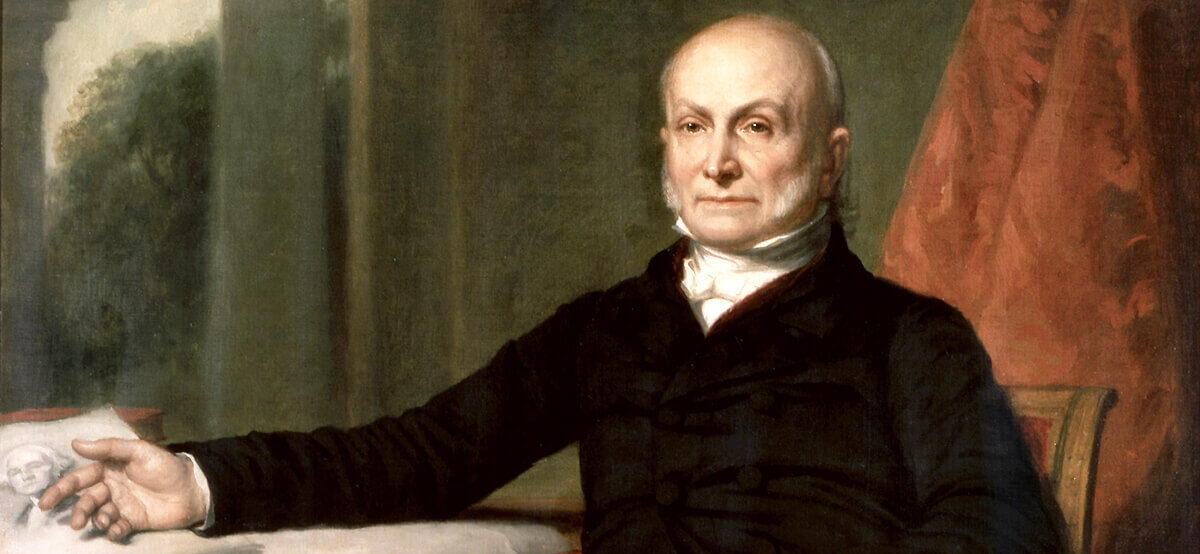
Founding Father John Quincy Adams gave his life to his faith, his family, and his country. He lived to be eighty years old and actively worked more than sixty of those years for the benefit of others. His service included diplomatic missions to five nations, serving as a state senator, US senator, secretary of state, and US president. And while every other president before and after him permanently retired from public life after leaving office, John Quincy Adams did not. On retirement, he was elected to the US House of Representatives, where he would spend nine terms. He eventually died in the US Capitol. Although he declared “I had not the slightest desire to be elected to Congress,”1 he still served because his neighbors desired his leadership and elected him for that purpose. Adams believed that it was his Christian duty to serve when called upon rather than indulging a personal wish to retire to a quiet unencumbered life.

In Congress, he took up the fight to end slavery at a time when the overwhelming majority in Congress did not want to even discuss the subject. He undertook a relentless personal crusade to secure the Declaration of Independence’s promise of “life, liberty, and the pursuit of happiness” for all individuals, regardless of race. But by choosing that path, he walked a difficult road. As he lamented, “The best actions of my life make me nothing but enemies.”2 Yet he did not quit, for he believed that “his service belonged to the nation.”3

He was consistently on the front lines in any quest to improve the lives of citizens and combat injustice. When he was seventy-four and had been fighting brutal congressional battles for over a decade, he wrote:

I deem it the duty of every Christian man, when he betakes himself to his nightly pillow, in self-examination to say, “What good have I done this day? Ay! And what evil have I done that may be repaired or repented of?” Nor should he rise from that pillow the next morning till after the inquiry, “What good can I do, and to whom, this day?” I have made this my rule for many years, with superadded prayer to the Lord of all—the Giver of every good gift for light [James 1:17]—for discernment, for guidance, for self-control, for a grateful heart to feel and acknowledge all His blessings, for humble resignation to His will, and submission to His chastisements. . . .Jesus Christ went about doing good [Acts 10:38]; I would do the same.4

John Quincy Adams understood that God places each of us here not to pursue own pleasure, but so that we might glorify God through serving and helping others. May the Spirit of God anoint us as well to imitate Jesus and personally “go about doing good.


Endnotes

1 John Quincy Adams, diary entry for September 18, 1830, Memoirs of John Quincy Adams, ed. Charles Francis Adams (Philadelphia: J. B. Lippincott & Co., 1876), 8:240.

2Adams, diary entry for October 25, 1833, Memoirs of John Quincy Adams, ed. Adams (1876), 9:26.

3 Dictionary of American Biography, ed. Allen Johnson (New York: Charles Scribner’s Sons, 1928), 1:92.

4 Adams, diary entry for November 16, 1842, Memoirs of John Quincy Adams, ed. Adams (1876), 2:269-270.


Meditating on God’s Word

Thoughts on Psalm 4:4

The Bible places great emphasis on the meditation of God and His Word. In fact, the Bible makes clear that you cannot grow spiritually without meditating on His Word.

Perhaps the best way to describe the importance of meditation is to liken it to the process of digestion. It is important to consume food (or to use a spiritual analogy based on Matthew 6:11 and 4:4, to consume the Word of God). But if what we consume is not broken down and digested so that it can be absorbed by the body, it renders no nutritional benefit. In fact, there are medical maladies whereby individuals can actually consume large amounts of food but die of starvation because the body does not break down and digest the food. So too, with the intake of God’s Word.

First Timothy 4:15 commands “meditate on these things; give yourself entirely to them, that your progress may be evident to all” (NKJV). Notice the sequence: if you (1) mediate on these things, (2) your growth and maturity will become evident to everyone. Similarly, Joshua 1:8 commands us to (1) meditate in His Word day and night, then (2) your way will be prosperous and you will have good success. Other verses that emphasize the importance of meditation include Psalm 63:6, Psalm 119:15, 99.

In both the spiritual and the physical realms, it is not how fast or how much you consume that is important, but how much you digest. And digestion takes time. You have to go over and over the same content similar to a cow chewing its cud. After cows have eaten, they lie still and ruminate—chew on what they ingested to allow full digestion and extract all the nutrition.

When you read God’s word (which should be done daily), be sure to meditate on what you just read. Take time to ask yourself questions:

  • Who — To whom was this passage written?
  • What — What was the theme of this passage?
  • When and Where — What were the circumstances and events that surrounded this message?
  • Why — Why was the message in this passage given?
  • How — How will I apply what is in this passage to my own life? What changes must I make in my own speaking, thinking, or behavior?

This meditation will move our spiritual lives beyond merely taking the “milk” of God’s Word to fully consuming its “solid food” (Hebrews 5:12-14).

The Way of the Righteous

John Quincy Adams was one of many Founding Fathers who had consumed much of God’s Word. He shared:

My custom is to read four or five chapters every morning immediately after rising from my bed. It employs about an hour of my time and seems to me the most suitable manner of beginning the day.1

In addition to his regular daily readings, every Sunday he usually covered additional chapters, frequently studying and comparing translations of the Bible in several different languages (of which he could speak seven). One Sunday in 1826, while serving as president of the United States, he recorded:

Heard Mr. [Robert] Little [pastor of a church Adams attended] from Psalm 119:133: “Order my steps in Thy Word, and let not any iniquity have dominion over me.” A desultory [spontaneous] and impressive moral discourse [sermon], setting forth by various illustrations the different modes by which iniquity [sin] may obtain dominion over us. Among his quotations from Scripture was that of the first seven verses of the fifth chapter of Isaiah (the song of the vineyard that brought forth wild grapes). In this instance, as in numberless others, I was struck with the careless inattention of my own mind when reading the Bible. I had read the chapter of Isaiah, containing this parable I dare say fifty times, and it was altogether familiar to my memory; but I had never perceived a fiftieth part of its beauty and sublimity. The closing verse of the parable, especially which points the moral of the allegory, speaks with irresistible energy: “For the vineyard of the Lord of hosts is the house of Israel, and the men of Judah His pleasant plant, and He looked for judgment, but behold oppression – for righteousness, but behold a cry” [Isaiah 5:7].2

Significantly, Adams was fifty-eight when he made this diary entry, and it had been his practice from his youth to read through the entire Bible every year.3 So despite having already read this passage from Isaiah “I dare say fifty times,” he still saw something brand new in it. As he confessed, “I was struck with the careless inattention of my own mind when reading the Bible.” It is for this reason that meditation receives such an emphasis in the Bible. We must read God’s Word every day; but we must also take time to digest what we read—to “meditate within your own heart…and be still” (Psalm 4:4).


Endnotes

1 John Quincy Adams, Letters of John Quincy Adams, to His Son on the Bible and Its Teachings (New York: Derby, Miller, & Co., 1848), 11-12.

2 John Quincy Adams, diary entry for November 5, 1826, Memoirs of John Quincy Adams, ed. Charles Francis Adams (Philadelphia: J.B. Lippincott & Co., 1874), 7:168-169.

3 Adams, Letters of John Quincy Adams, to His Son (1848), 10-11.

The Duty of Nations

Thoughts on Psalm 9:17

Proverbs 3:5–6 reminds us that in all our ways (public as well as private) we are to acknowledge Him. And while it is wisdom for individuals, it is also true of nations. In response to the idolatry of others or their failure to acknowledge God, Psalm 79:6 and Jeremiah 10:25 call for God’s wrath upon all nations that do not call upon His name. And the warranty of 1 Samuel 2:30 that “Those who honor Me I will honor, and those who despise Me will be lightly esteemed” was delivered to civil leaders, not religious ones.

The psalmist said, “The wicked return to Sheol, even all the nations who forget God” (Psalm 9:17). Whenever we stop acknowledging Him, whether as individuals or a nation, we soon forget Him, and at that point we are in trouble. Understanding this truth, President George Washington emphatically declared:

It is the duty of all nations to acknowledge the providence of Almighty God, to obey His will, to be grateful for His benefits, and humbly to implore His protection and favor.1

Notice the four duties that Washington said pertained to nations:

  1. Acknowledge God
  2. Obey His will
  3. Be grateful for His aid
  4. Implore His protection and favor

President John Adams concurred:

The safety and prosperity of nations ultimately and essentially depend on the protection and the blessing of Almighty God, and the national acknowledgment of this truth is . . . an indispensable duty which the people owe to Him.2

President Thomas Jefferson agreed, and in his First Inaugural Address reminded the nation that which was “necessary to make us a happy and a prosperous people” was “acknowledging and adoring an overruling Providence.”3

The conviction that America should publicly acknowledge God was frequently expressed by our national leaders. In fact, President Abraham Lincoln did so and warned the nation in his day that it was beginning to forget God:

It is the duty of nations as well . . . and to recognize the sublime truth announced in the Holy Scriptures and proven by all history that those nations only are blessed whose God is the Lord [Psalm 33:12]. . . . But we have forgotten God. We have forgotten the gracious hand which preserved us in peace and multiplied and enriched and strengthened us, and we have vainly imagined in the deceitfulness of our hearts that all these blessings were produced by some superior wisdom and virtue of our own. Intoxicated with unbroken success, we have become too self-sufficient to feel the necessity of redeeming and preserving grace—too proud to pray to the God that made us.4

For this reason, President Lincoln called the nation to a time of public humiliation, fasting, and prayer so that it would once again remember God.

Acknowledging God Today

Remembering and honoring God at the national level begins with simple acknowledgment of God. Modern disputes over things such as the National Motto, the inclusion of “under God” in the Pledge of Allegiance, public displays of the Ten Commandments or nativity scenes, and prayer at athletic events, school meetings, or political gatherings are not in fact small or trivial matters. Such public acknowledgments are not coercive, but rather simple, encouraging reminders with a long history underscoring the value and wisdom of honoring God. The Founding Fathers would never have supported any public policy that prohibited such expressions and cause us as a nation to forget God.


Endnotes

1 George Washington, “A Proclamation” printed in The Providence Gazette and Country Journal (October 17, 1789), 1. See also George Washington, “Proclamation for a National Thanksgiving,” Writings of George Washington, ed. Jared Sparks (Boston: American Stationers Company, 1837), XII:119.

2 John Adams, “Proclamation for a National Fast,” March 23, 1798, The Works of John Adams, Second President of the United States, ed. Charles Francis Adams (Boston: Charles C. Little and James Brown, 1851), IX:169.

3 Thomas Jefferson, “First Inaugural Address,” March 4, 1801, The Papers of Thomas Jefferson, ed. Barbara B. Oberg (Princeton: Princeton University Press, 2006), 33:150.

4 Abraham Lincoln, “A Proclamation” printed in The Liberator (April 24, 1863), 3. See also Abraham Lincoln, , “A Proclamation Appointing a National Fast-Day,” The Writings of Abraham Lincoln, ed. Arthur Brooks Lapsley (New York: G. P. Putnam’s Sons, 1923), 6:270–271.

The Rock Upon Which Our Republic Rests

Thoughts on 2 Kings 23

There are numerous Biblical occasions when civil leaders urged a national reading of God’s Word. For example, under righteous King Josiah of Israel:

The king went up to the house of the Lord with all the men of Judah, and with him all the inhabitants of Jerusalem—the priests and the prophets and all the people, both small and great. And he read in their hearing all the words of the Book of the Covenant which had been found in the house of the Lord (2 Kings 23:2).

Ezra also assembled the nation to read the Word of God (Nehemiah 8:1-3), and Moses likewise instructed the people to gather together and read God’s Word so that they might know it, obey it, and teach it to the rising generation, for by so doing, they would remain blessed as a nation (Deuteronomy 31:11-13).

America’s national leaders continued to follow this pattern. President Franklin Roosevelt proposed:

I suggest a nationwide reading of the Holy Scriptures during the period from Thanksgiving Day to Christmas. . . . Go to . . . the Scriptures for a renewed and strengthening contact with those eternal truths and majestic principles which have inspired such measure of true greatness as this nation has achieved.1

(Today, National Bible Week is still officially commemorated one week of the period between Thanksgiving and Christmas. But sadly few citizens know of its existence, and sadder still even fewer observe it.)

Why would President Roosevelt publicly call the nation to a time of Scripture reading? Because of its proven beneficial influence:

In the formative days of the Republic, the directing influence the Bible exercised upon the fathers of the Nation is conspicuously evident. . . . We cannot read the history of our rise and development as a Nation without reckoning with the place the Bible has occupied in shaping the advances of the Republic.2

On the same basis, President Ronald Reagan declared a national “Year of the Bible,” explaining:

Of the many influences that have shaped the United States of America into a distinctive Nation and people, none may be said to be more fundamental and enduring than the Bible. . . . The Bible and its teachings helped form the basis for the Founding Fathers’ abiding belief in the inalienable rights of the individual – rights which they found implicit in the Bible’s teachings of the inherent worth and dignity of each individual. This same sense of man patterned . . . the ideals set forth in the Declaration of Independence and the Constitution. . . . There could be no more fitting moment than now to reflect . . . upon the wisdom revealed to us in the [Bible].3

President Teddy Roosevelt similarly affirmed:

[T]he teachings of the Bible are so interwoven and entwined with our whole civic and social life that it would be literally—I do not mean figuratively, I mean literally—impossible for us to figure to ourselves what that life would be if these teachings were removed. We would lose almost all the standards by which we now judge both public and private morals—all the standards toward which we, with more or less resolution, strive to raise ourselves. Almost every man who has by his life-work added to the sum of human achievement of which the race is proud—of which our people are proud – almost every such man has based his lifework largely upon the teachings of the Bible. . . . Among the very greatest men, a disproportionately large number have been diligent and close students of the Bible at first hand. . . . So I plead not merely for training of the mind but for . . . the moral and spiritual training that have always been found in and that have ever accompanied the study of this Book—this Book, which in almost every civilized tongue can be described as “The Book.”4

Teddy wanted everyone to know the Bible, and a reason that he had been so thoroughly impressed by President Abraham Lincoln was his personal mastery of the Bible. As he explained:

Lincoln—sad, patient, kindly Lincoln, who after bearing upon his weary shoulders for four years a greater burden than that borne by any other man of the nineteenth century laid down his life for the people whom living he had served as well—built up his entire reading upon his early study of the Bible. He had mastered it absolutely – mastered it as later he mastered only one or two other books (notably Shakespeare) —mastered it so that he became almost “a man of one Book,” who knew that Book and who instinctively put into practice what he had been taught therein.5

Indeed, it is extremely difficult to find any of Lincoln’s major speeches not laced throughout with Scriptures, so it is therefore not surprising that in speaking of the Bible, Lincoln declared:

It is the best gift God has given to men. All the good the Savior gave to the world was communicated through this Book. But for it, we could not know right from wrong. 6

President Zachary Taylor also stressed how important it was that every citizen, especially young citizens, know the Bible:

The Bible is the best of books and I wish it were in the hands of everyone. It is indispensable to the safety and permanence of our institutions; a free government cannot exist without religion and morals, and there cannot be morals without religion, nor religion without the Bible. Especially should the Bible be placed in the hands of the young. It is the best schoolbook in the world. . . . I would that all of our people were brought up under the influence of that Holy Book.7

President Harry Truman, speaking at a conference of law enforcement officials assembled from across the nation, reminded them:

The fundamental basis of this Nation’s law was given to Moses on the Mount. The fundamental basis of our Bill of Rights comes from the teachings which we get from Exodus and St. Matthew, from Isaiah and St. Paul. I don’t think we emphasize that enough these days.8

President Andrew Jackson likewise declared of the Bible that “it is the rock on which our Republic rests.”9

And President Grant, on the 100th anniversary of American Independence exhorted, “Hold fast to the Bible as the sheet-anchor of your liberties; write its precepts in your heats, and practice them in your lives. To the influence of this Book we are indebted for all the progress made in true civilization, and to this we must look for our guide in the future.”10

There are many other examples demonstrating that America’s leaders understood the importance of God’s Word to the nation and publicly urged the reading and knowledge of it, just as ancient leaders such as Moses, Ezra, and Josiah had done. It is important that every citizen personally study, learn, and live by God’s Word, teaching it to their children and also electing at the local, county, state, and federal level leaders who know and honor the principles of “The Book.”


Endnotes

1 Franklin D. Roosevelt, “Proclamation 2629—Thanksgiving Day, 1944,” November 1, 1944, American Presidency Project, https://www.presidency.ucsb.edu/node/210843.

2 Franklin D. Roosevelt, “Statement on the Four Hundredth Anniversary of the Printing of the English Bible,” October 6, 1935, American Presidency Project, https://www.presidency.ucsb.edu/node/209257.

3 Ronald Reagan, “Proclamation 5018—Year of the Bible, 1983,” February 3rd, 1983, American Presidency Project, https://www.presidency.ucsb.edu/node/262128.

4 Theodore Roosevelt, “On Reading the Bible: Delivered before the Members of the Bible Society,” 1901, Modern Eloquence, ed. Thomas B. Reed (Philadelphia: John D. Morris and Company, 1903), XV:1770-1776.

5 Roosevelt, “On Reading the Bible: Delivered before the Members of the Bible Society,” 1901, Modern Eloquence, ed. Reed (1903), XV:1770-1776.

6 Abraham Lincoln, “Reply to Committee of Colored People of Baltimore Who Presented Him with a Bible,” Complete Works Comprising his Speeches, Letters, State Papers, and Miscellaneous Writings, John Nicolay and John Hay, editors (New York: The Century Co., 1894), 2:574.

7The President and the Bible,” New York Semi-Weekly Tribune (Wednesday, May 9, 1849), IV:100:1.

8 Harry S. Truman, “Address Before the Attorney General’s Conference on Law Enforcement Problems,” February 15, 1950, American Presidency Project, https://www.presidency.ucsb.edu/node/230655.

9 Ronald Reagan, “Proclamation 5018—Year of the Bible, 1983,” February 3rd, 1983, American Presidency Project, https://www.presidency.ucsb.edu/node/262128; see the same quote in a proclamation from President George H. W. Bush, “International Year of Bible Reading,” February 22, 1990, Code of Federal Regulations (Washington, D. C.: U. S. Government Printing Office, 1991), 21.

10 Ulysses Grant, “Message of President Grant to the Children and Youth of the U.S.” card in WallBuilders Museum collection.

Thanksgiving in America Tract

This printable tract contains a brief history of America’s Thanksgiving holiday and includes quotes from notable Founders excerpted from their Thanksgiving proclamations. See the complete text below and download it for your personal use!


The tradition of Thanksgiving as a time to focus on God and thank Him for His blessings dates back almost four centuries in America. While thanksgiving celebrations occurred as early as 1541 in Texas, and 1607 at Cape Henry, Virginia, it is from the Pilgrim festival of 1621 that we derive the current tradition of Thanksgiving.

The Pilgrims (a congregation of Bible-loving English Christians) set sail for America on September 6, 1620, and for two months braved the harsh elements of a storm-tossed sea. Upon arriving in what is now Massachusetts, and unprepared for the harsh New England winter, nearly half of them died before spring.

Emerging from that grueling winter, the Pilgrims were surprised when an Indian named Samoset approached them and greeted them in their own language, explaining to them that he had learned English from fishermen and traders. A week later, Samoset returned with a friend named Squanto, who also spoke English. Squanto lived with the Pilgrims and accepted their Christian faith.

Squanto taught the Pilgrims much about how to live in the New World, and he and Samoset helped forge a peace treaty that lasted for generations between the Pilgrims and the Wampanoag Indians. Pilgrim Governor William Bradford described Squanto as “a special instrument sent of God for [our] good.”

That summer, the Pilgrims, through hard work, prayer and the assistance of helpful Indians, reaped a bountiful harvest. As Pilgrim Edward Winslow affirmed, “God be praised, we had a good increase of Indian corn”; “by the goodness of God, we are…far from want.” The grateful Pilgrims therefore declared a time in the Fall to thank God and to celebrate with their Indian friends—America’s first Thanksgiving festival.

Ninety Wampanoag Indians joined the fifty-three Pilgrims for three days of feasting (which included shellfish, lobsters, turkey, corn bread, berries, deer, and other foods), athletic competition and play (the young Pilgrim and Wampanoag men engaged in races, wrestling matches, and athletic events, while the older men engaged in shooting competitions), and prayer and thanksgiving (for God’s providence in watching over and providing for them).

This celebration began an annual tradition that slowly spread to the entire nation. Americans now celebrate a Day of Thanksgiving each November as part of our long American tradition of openly and publicly acknowledging God.

Among the many examples of the open acknowledge of God is the Declaration of Independence, which declares:

We hold these truths to be self-evident, that all men are created equal, that they are endowed by their Creator with certain unalienable rights, that among these are life, liberty and the pursuit of happiness.”

As Thomas Jefferson affirmed: “And can the liberties of a nation be thought secure when we have removed their only firm basis—a conviction in the minds of the people that these liberties are the gift of God?

It was standard practice for our leaders across the generations to acknowledge God as the Source of our national rights and blessings, and to give thanks to Him.

Some people believe America has strayed from the strong religious convictions of previous generations. Perhaps, but an important question is not just “Where is our country’s faith?” but rather “Where do you stand on faith?” Have you thankfully acknowledged the providence of Almighty God in your own life?

As you celebrate Thanksgiving, remember to retain the original gratefulness to God that has always been the spirit of this, the oldest of all American holidays.

Give thanks to the LORD, call on his name; make known among the nations what he has done. PSALM 105:1

“It is the duty of all nations to acknowledge the providence of Almighty God, to obey His will, to be grateful for His benefits, and humbly to implore His protection and favor….Now, therefore, I do recommend …that we may all unite in rendering unto Him our sincere and humble thanks for His kind care and protection.” George Washington

“It is therefore recommended…[a day] for solemn thanksgiving and praise, that with one heart and one voice the good people may express the grateful feelings of their hearts and…join the penitent confession of their manifold sins…and their humble and earnest supplication that it may please God, through the merits of Jesus Christ, mercifully to forgive and blot them out of remembrance…and to prosper the means of religion for the…enlargement of that kingdom which consisteth in righteousness, peace and joy in the Holy Ghost [Romans 14:17]” Continental Congress, 1777

“It be recommended to the several states…a day of public and solemn thanksgiving to Almighty God…to beseech Him that He would…pour out His Holy Spirit on all ministers of the Gospel; that He would…spread the light of Christian knowledge through the remotest corners of the earth…[and] that He would establish these United States upon the basis of religion and virtue.” Thomas Jefferson

“The year that is drawing towards it close has been filled with the blessings of fruitful fields and healthful skies…We are prone to forget the Source from which they come….They are the gracious gifts of the Most High God….I do, therefore, invite my fellow-citizens…[to] observe…a Day of Thanksgiving and Prayer to our beneficent Father, Who dwelleth in the heavens.” Abraham Lincoln

“I…appoint…a day of public thanksgiving and praise,…rendering to God the tribute of praise for His unmerited goodness towards us…in continuing to us… the Holy Scriptures which are able to enlighten and make us wise to eternal salvation….[We] present our humble and penitent supplication…that He would… cause the benign religion of our Lord and Savior Jesus Christ to be known, understood, and practiced among all the inhabitants of the earth.” John Hancock

Download the complete tract here!


* To see more original Thanksgiving proclamations issued by presidents, governors, and other leaders over generations visit our Resources page and filter by “Proclamations” and “Holidays.”

** Learn the history of Thanksgiving through a few of WallBuilders’ articles, starting here.

George Washington First Becomes a National Leader

George Washington First Becomes a National Leader

george-washington-first-becomes-a-national-leader-1On July 3, 1775 George Washington took command of the newly formed Continental Army.1 Congress had selected him — one of its own members — to organize the farmers and local militia groups into an army capable of defeating the world’s greatest military power.2 Quite an undertaking!
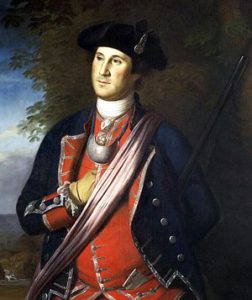
One of his first orders to the new American military set a clear tone of what he expected from his troops and also told us much about his character. In that order, Washington urged that

“…every officer and man will endeavor so as to live and act as becomes a Christian soldier, defending the dearest rights and liberties of his country.”3

That his troops display Christian character was important to Washington, and he later additionally charged them:

“To the distinguished character of Patriot, it should be our highest glory to add the more distinguished character of Christian.”4

He also issued orders prohibiting swearing,5 profanity,6 and gambling.7 He clearly set a very high moral standard for his troops, but it was not more than what he expected from himself. In fact, while just a young boy, he copied out 110 maxims concerning good behavior and manners. Called his “Rules of Civility,” he lived by them throughout his life, and they were especially apparent during his time as a soldier.

george-washington-first-becomes-a-national-leader-2Washington longed for military life from the time he was a young boy, and he got his first experience during the French and Indian War, two decades before the American Revolution. He should have been killed in the Battle of the Monongahela, but his life was saved by God’s Divine intervention. As he told his brother:
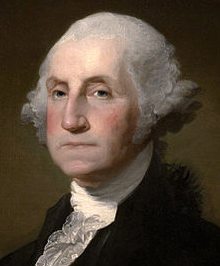
“[I] now exist and appear in the land of the living by the miraculous care of Providence that protected me beyond all human expectation; I had four bullets through my coat and two horses shot under me and yet escaped unhurt.”8

(Similar instances of his life being spared during the Revolutionary War are in the The Founders’ Bible article, “George Washington: The Soldier Who Could Not Die”).

It was as a result of what he did in the French and Indian War that he was first vaulted into the national spotlight. In fact, a famous military sermon preached in 1755 by the Rev. Samuel Davies (considered the greatest pulpit orator in American history) specifically singled out the young George Washington for special attention because of what happened in that battle.9

george-washington-first-becomes-a-national-leader-3It was largely because of Washington’s experiences in that early war that he was chosen by his fellow citizens as a member of Congress, and then chosen by his peers in Congress as Commander-In-Chief.10 He led America on to a successful conclusion of the Revolutionary War, oversaw the formation of the United States Constitution,11 and guided us through the implementation of our new government as our first president. He is rightly honored as “The Father of His Country.”12
Washington fully understood that the important part he had played in America’s formation was by the direction of God, acknowledging: “I have only been an instrument in the hands of Providence.”13

Let’s remember to honor one of the key individuals responsible for America’s independence: George Washington.

Special Notes: The remarkable story of George Washington is told in The Bulletproof George Washington. And his 110 Rules of Civility are still available today. Several of Washington’s religious and moral orders to his troops are found in the booklet The Spirit of the American Revolution. All of these are available in the WallBuilders store.


Endnotes

1 US Army Center of Military History, “Washington takes command of Continental Army in 1775,” April 15, 2016, US Army; “Creating a Continental Army,” Library of Congress, accessed July 1, 2025.
2 Washington Irving, Life of George Washington (Leipzig: Bernhard Tauchnitz, 1856), II:1.
3 George Washington, “General Orders,” July 9, 1776, The Writings of George Washington, ed. John C. Fitzpatrick (Washington: United States Government Printing Office, 1932), 5:245.
4 Washington, “General Orders,” May 2, 1778, Writings of Washington, ed. Fitzpatrick (1934), 11:343.
5 Jared Sparks, The Writings of Washington, (Boston: Ferdinand Andrews, 1840), III:491n.
6 Washington, “General Orders,” August 3, 1776, Writings of Washington, ed. Fitzpatrick (1932), 5:367.
7 Washington, “General Orders,” February 26, 1776, Writings of Washington, ed. Fitzpatrick (1931), 4:347.
8 Washington to John Augustine Washington, July 18, 1755 Writings of Washington, ed. Fitzpatrick (1931), 1:152.
9 Samuel Davies, Religion and Patriotism: The Constituents of a Good Soldier. A Sermon Preached to Captain Overton’s independnet company of volunteers, raised in Hanover County, Virginia, August 17, 1755 (Philadelphia: 1756), 10n.
10 “George Washington’s Commission as Commander in Chief: Primary Documents in American History,” Library of Congress, accessed July 1, 2025.
11 “Creating the United States: Convention and Ratification,” Library of Congress, accessed July 1, 2025; “The Constitutional Convention of 1787,” September 17, 2023, National Park Service.
12 See, for example, S. G. Arnold, The Life of George Washington, First President of the United States (New York: T. Mason, 1840), 8.
13 George Washington to Lucretia Wilhelmina Van Winter, March 30, 1785, Founders Online.

The mushroom clouds from the Hiroshima and Nagasaki atomic bombs.

Hiroshima, Obama, and American Morals

 On May 27, 2016, President Obama visited Hiroshima – the only American president to do so since the city was hit by an atomic bomb on August 6, 1945. That bomb hastened the end of World War II and helped halt further war deaths in the Pacific Theater beyond the 20 million lives already lost. 1

Both supporters and opponents scrutinized the president’s speech to see whether he would issue any direct apology for America’s having dropped atomic bombs, thereby extinguishing between 200,000 and 250,000 Japanese lives. 2 The president carefully stayed on script and delivered no overt apology, but even the mainstream media did not miss the fact that by simply appearing at Hiroshima he was issuing an indirect apology:

A majority of Japanese people view the atomic bombings as inhumane attacks — war crimes for which the United States has never been punished. . . . Hiroshima is a decidedly one-sided location; the United States dropped an atomic bomb on Japan. At this setting one country is victim, the other assailant. 3 Washington Post

No American president has visited Hiroshima or Nagasaki in the 71 years since the attacks because of concerns the trip would be perceived as an apology for the two bombings that helped bring an end to World War II. 4 ABC News

The president wrote in a Washington Post op-ed in late March, “As the only nation ever to use nuclear weapons, the United States has a moral obligation to continue to lead the way in eliminating them.” “Moral obligation”? . . . Why would America assume a “moral obligation” if not because the nation was guilty of some ill-advised, even immoral, action? 5 US News

A visit would inevitably be construed by many as a de facto U.S. apology. . . It would be seen as vindication for Japanese claims of victimization, encouraging those in Japan who still deny responsibility for a war of aggression. . . . The goal of a presidential visit to the nuclear bombing sites is to finally come to terms with the morally difficult decisions made in World War II.6 The Diplomat

A Moral Revolution?

The media recognized that the issue of morals was inseparable from any official visit to Hiroshima, and as expected, the president did address that issue in his speech. According to President Obama:

The scientific revolution that led to the splitting of an atom requires a moral revolution as well. That is why we come to this place [Hiroshima]. We stand here, in the middle of this city, and force ourselves to imagine the moment the bomb fell. We force ourselves to feel the dread of children confused by what they see. We listen to a silent cry. We remember all the innocents killed across the arc of that terrible war, and the wars that came before, and the wars that would follow. Mere words cannot give voice to such suffering, but we have a shared responsibility to look directly into the eye of history and ask what we must do differently to curb such suffering again. Someday the voices of the hibakusha [survivors of the bombings] will no longer be with us to bear witness. But the memory of the morning of August 6th, 1945 must never fade. That memory allows us to fight complacency. It fuels our moral imagination. It allows us to change. . . . We can tell our children a different story – one that describes a common humanity; one that makes war less likely and cruelty less easily accepted. We see these stories in the hibakusha [survivors of the bombings] – the woman who forgave a pilot who flew the plane that dropped the atomic bomb, because she recognized that what she really hated was war itself. 7

Notice the interesting moral perspective communicated by the president. He asks that we imagine the suffering in Hiroshima – the dread of the children; the voice from the victims of the bombings; the silent cry. He also praises the forgiveness of the Japanese woman who forgave the American pilot who dropped the bomb. All of these statements point us toward the Japanese viewpoint. Human and losses are always tragic, but viewing them with a factually-accurate perspective is crucial.

Take for example, the woman who forgave the Americans. Did she also forgive her Emperor for the treacherous and unprovoked surprise attack on Pearl Harbor that killed 2,403 Americans and wounded 1,178, 8 thus bringing America into the war? Did she forgive Japan for declaring war on America when we were working diligently to stay out of the war and be uninvolved? Did she forgive the Japanese military leaders for keeping the war against America going long after the rest of the world had surrendered? America would not have dropped atomic boms without these three Japanese-initiated events. So why are the Americans the transgressors who need to be forgiven?

And empathizing with children is important. But shouldn’t we likewise imagine the cries of the American children whose fathers were mercilessly slaughtered by the Japanese in the Bataan Death March, or killed in the many other Japanese atrocities that in both brutality and scope parallel the war crimes perpetrated by the Nazis in Europe? Throughout the War Japan engaged in active genocides, including against its Asian neighbors in Korea, Manchuria, the Philippines, and China. (It is estimated that in China alone some ten million innocents were exterminated by the Japanese. 9) Japan’s military philosophy was barbaric with no respect for human life.

For example, Japanese officers reportedly held a competition to see which officer could kill 100 people with his sword first, with a runoff to determine a winner. 10 They callously burned alive American prisoners after capture. 11 Others had their heads smashed in with sledgehammers. 12 There are always brutalities and atrocities in war. But as historian Mark Felton termed it, with the Japanese “murder [was] the rule rather than the exception.” 13 There is a reason that after the war, war-crime trials were held in Japan and not just Germany.

President Obama’s acknowledgment that Hiroshima calls for a moral revolution is a common view among Progressives, who repeatedly blame America for much of the evil in the world. Even the 2014 study guide for the Advanced Placement Test for high school U. S. History (written by the College Board, headed by Progressive educator David Coleman) told students that “the decision to drop the atomic bomb raised questions about American values.” 14 Following public outrage, the College Board modified that statement to read: “The use of atomic bombs hastened the end of the war and sparked debates about the morality of using atomic weapons.” 15 The change was an improvement, but it still preserved the view that the use of an atomic weapon was symbolic of America’s lack of morality. Other sources echo that belief:

Truman’s decision was a barbaric act that brought negative long-term consequences to the United States. 16

The . . . use of such a weapon was simply inhumane. Hundreds of thousands of civilians with no democratic rights to oppose their militarist government, including women and children, were vaporized, turned into charred blobs of carbon, horrifically burned, buried in rubble, speared by flying debris, and saturated with radiation. 17

The American government was accused [by modern Progressive writers] of racism on the grounds that such a device would never have been used against white civilians. 18

There are many similar claims. But what is missing is the compelling evidence that given what was occurring in Japan at that time, employing the atomic bomb was actually the more moral thing to do. Two categories of proof fully demonstrate this: (1) The reason the atomic bomb was used, and (2) The manner in which it was used. Consider the definitive evidence for each category.

The Reason the Atomic Bomb was dropped on Japan

Interestingly, there are many legitimate parallels between the Japanese military of World War II and ISIS more recently. In addition to the Japanese practices of open beheadings, mass executions, and other grotesque forms of torture intended to generate fear and terror among those they were seeking to subdue and control, they also specialized in suicide bombers. In fact, they leveled more than 2,000 suicide bombing attacks against Americans during the war, resulting in substantial losses of American lives. 19 Also, the Japanese military forcibly took Korean women and used them as sex slaves for their soldiers 20 in a manner similar to what ISIS terrorists do with non-Muslim women.

In World War II, America and the Allied Forces fought simultaneously on both the European and Pacific fronts. But late in the War they focused the bulk of their efforts on the European Theater until Germany and Italy finally capitulated. At that time, Japan, the remaining major Axis power, was losing battle after battle to Allied Forces in the Pacific but still refused to surrender along with their comrade nations.

With the war in Europe ended, Japan and the Pacific became the unitary focus of Allied military action. As American and Allied forces worked closer to Japan in victory after victory, they extended multiple informal opportunities to surrender to Japan before the official surrender declaration from the Potsdam Conference. But Japan rejected all offers. 21 The Allies therefore planned an assault on Japan similar to that which had ended the war in Europe.

They would conduct a D-Day style invasion followed by Allied troops incrementally fighting their way across the island until they finally took complete control, forcing the surrender that all sides knew was inevitable. Significantly, Japanese leaders fully understood that they could no longer win. But they wanted to extract as high a price as possible with their loss. Japanese leaders were defiant, determined to fight to the end regardless of the cost in human lives. As one foreign policy expert explained:

As U.S. forces in the Pacific advanced toward Japan, its people were committing suicide in hordes rather than face capture. Anticipating a land invasion, Japan’s leaders were preparing their people for a fight to the finish, conscripting boys as young as 15 and teaching them how to kill incoming U.S. troops and conduct kamikaze operations. 22

(Notice yet another similarity between the Japanese military and ISIS: training youth for suicide bombing missions.)

The Allies drew up plans for “Operation Downfall” – the code name assigned to the planned invasion of Japan. As part of the preparations, they prepared estimated casualties, calculating the probable loss of lives, both Japanese and Allied.

General Curtis Lemay, commander of the B-29 force that would be central to any invasion of Japan, was informed that the operation would result in at least 500,000 American deaths. 23 A study done for President Truman’s Secretary of War Henry Stimson estimated American casualties at 1.7 to 4 million (including up to 800,000 deaths), and from 5 to 10 million Japanese fatalities, depending on their level of determined resistance. 24 The projections included several million more casualties for other Allied Forces, which included nations such as Great Britain, China, Canada, and Australia. Evaluations thus placed the body count at around 7 million on the low side, to 14 million on the upper end.

President Truman understood the scope of the new atomic weapon at his disposal. But the other nations had no such conception for such a bomb had never been used before. Truman therefore went to extraordinary lengths to warn the Japanese of what was to come if they did not surrender (amazing details on this will be presented shortly). He finally had a choice to make. He could continue fighting with traditional weapons until the Japanese finally surrendered, which was estimated to be another half year, costing millions of lives in the process. 25 Or he could use an atomic bomb, which might result in 100,000 deaths per bomb. These deaths would be tragic but the numbers paled in comparison to the potential loss of millions of lives. The psychological shock of the use of such a weapon should rapidly push the enemy toward an immediate surrender. Given the situation, there was no moral dilemma. Truman chose to save millions of Japanese and Allied lives by using the atomic bomb.

The Manner in which the Atomic Bomb was Used on Japan

Prior to the decision to use atomic bombs, Allied Forces conducted incendiary bombings against Japanese military production areas. The Tokyo bombings of March 9-10, 1945, alone killed 100,000. 26 (Note that this death toll from traditional warfare was higher than that caused by the atomic bomb dropped on Hiroshima, or the one on Nagasaki.) Despite the high mortality numbers from traditional warfare, the Japanese not only refused to surrender but actually became more recalcitrant, preparing their people for continued fighting.

Months earlier, on June 15, 1944, the US military launched a bloody but successful weeks-long campaign to recapture the strategic island of Saipan. Located less than 1,500 miles from Tokyo, it provided a base from which Allied bombers could reach Japan and a key location from which to launch an invasion. A 50,000-watt radio station (KSAI) was also constructed there, so Allied bombers could track its radio broadcast waves as a beacon safely back to the tiny island in the middle of the Pacific.

Saipan also became the center of Allied communication. Utilizing the radio station, the US Office of War Information began broadcasting important information and messages directly to the Japanese people, bypassing their fanatical leaders. They also constructed a print shop. Prior to Allied bombings, B-29s dropped 63 million leaflets across Japan, warning citizens about the specific cities that had been targeted for bombing, and urging civilians to flee and avoid those areas. 27 However, Japanese military officials ordered the arrest of any citizen who read the leaflets, or did not turn them into local authorities.

On the other side of the world Allied leaders gathered in Potsdam, Germany, on July 26, 1945, to establish terms of surrender for Japan. The resulting Potsdam Proclamation called for “disarmament and abolition of the Japanese military; elimination of military influence in political forums; Allied occupation of Japan; liberation of Pacific territories gained by Japan since 1914; swift justice for war criminals; maintenance of non-military industries; establishment of freedom of speech, religion, and thought; and introduction of respect for fundamental human rights.” 28 If the Japanese rejected these terms, the result would be “prompt and utter destruction.” 29

The Allies knew that Japanese leaders would say nothing to their people about this offer, so the radio station on Saipan began broadcasting the Proclamation directly into Japan even before it reached Japanese leaders through official channels. And B-29s also dropped 3 million leaflets (see some of these leaflets from the WallBuilders library here) telling the people about the Proclamation. But on July 27, Japan officially rejected the proposal, thus continuing the war. 30

The next day, July 28, bombers dropped one million leaflets over the 35 Japanese cities (including Hiroshima and Nagasaki) targeted for bombing in coming days, urging citizens to evacuate those cities. That leaflet (with its picture of five B-29s releasing their cargo of bombs) specifically warned:

Read this carefully as it may save your life or the life of a relative or friend.

In the next few days, some or all of the cities named on the reverse side will be destroyed by American bombs. These cities contain military installations and workshops or factories which produce military goods. We are determined to destroy all of the tools of the military clique which they are using to prolong this useless war. But, unfortunately, bombs have no eyes.

So, in accordance with America’s humanitarian policies, the American Air Force, which does not wish to injure innocent people, now gives you warning to evacuate the cities named and save your lives. America is not fighting the Japanese people but is fighting the military clique which has enslaved the Japanese people.

The peace which America will bring will free the people from the oppression of the military clique and mean the emergence of a new and better Japan. You can restore peace by demanding new and good leaders who will end the war. We cannot promise that only these cities will be among those attacked but some or all of them will be, so heed this warning and evacuate these cities immediately. 31

Understandably, the crews scheduled to bomb those areas were concerned for their own safety, for the leaflets not only told the Japanese military exactly what was about to occur but also where. Nevertheless, humanitarian concerns for Japanese civilians remained foremost in American thinking, even jeopardizing the lives of Allied pilots and crews.

America specifically avoided bombing the Emperor’s palace or the historic temple area of Kyoto. But after days of bombings, “Japan’s Air Defense General Headquarters reported that out of 206 cities, 44 had been almost completely wiped out, while 37 others, including Tokyo, had lost over 30 percent of their built-up areas.” 32 But despite the increasingly extensive devastation, Japan still refused to surrender.

Bombings alone had proved insufficient to end the war. The only remaining traditional warfare option was a full-scale land invasion of Japan, which could produce the millions of casualties predicted in the various official reports. Facing this prospect, President Truman therefore approved the B-29 Enola Gay dropping the atomic bomb “Little Boy” over Hiroshima. The devastation that occurred is a matter of historical record.

Japan still refused to surrender. President Truman publicly and explicitly warned Japan that unless they ended the war quickly, more such bombs would be forthcoming:

We are now prepared to obliterate more rapidly and completely every productive enterprise the Japanese have above ground in any city. We shall destroy their docks, their factories, and their communications. Let there be no mistake; we shall completely destroy Japan’s power to make war. 33

B-29s then dropped five million leaflets across Japan, warning citizens:

TO THE JAPANESE PEOPLE:

America asks that you take immediate heed of what we say on this leaflet.

We are in possession of the most destructive explosive ever devised by men. A single one of our newly developed atomic bombs is actually the equivalent in explosive power to what 2000 of our giant B-29’s can carry on a single mission. This awful fact is one for you to ponder and we solemnly assure you it is grimly accurate.

We have just begun to use this weapon against your homeland. If you still have any doubt, make inquiry as to what happened to Hiroshima when just one atomic bomb fell on that city.

Before using this bomb to destroy every resource of the military by which they are prolonging this useless war, we ask that you now petition the Emperor to end the war. Our President has outlined for you the thirteen consequences of an honorable surrender. We urge that you accept these consequences and begin the work of building a new, better, and peace-loving Japan.

You should take steps now to cease military resistance. Otherwise, we shall resolutely employ this bomb and all other superior weapons to promptly and forcefully end the war.

EVACUATE YOUR CITIES 34

The radio station on Saipan also began broadcasting warnings every fifteen minutes directly to the Japanese people. America had undertaken every means possible to prevent dropping the first bomb, and did so again with the second one. Yet even days after the bomb on Hiroshima, the Japanese leadership remained unmoved. So on August 9, 1945, America dropped a second atomic bomb, “Fat Man,” over Nagasaki.

By 2AM the following morning (August 10), following extensive debates by Japanese authorities, Emperor Hirohito ordered acceptance of the surrender terms of the Potsdam Declaration. At 7AM the Japanese Cabinet transmitted word to the Allies that they accepted most of the terms, but insisted that the Emperor remain the sovereign ruler of the empire. Allied leaders tentatively agreed to this change so long as “from the moment of surrender, the authority of the Emperor and the Japanese Government to rule the state shall be subject to the Supreme Commander of the Allied powers.” 35 They awaited Japan’s official acceptance of this provision.

While awaiting the Japanese response, the Allies temporarily halted further bombing of Japan. The decision to end the war was now back in the hands of Japan’s leaders, but the people still knew nothing of Japan’s official offer of surrender. So the radio station on Saipan began announcing the news to the people, and the printing presses went into high-speed production. On August 12, B-29s dropped five million leaflets telling the Japanese:

These American planes are not dropping bombs on you today. American planes are dropping these leaflets instead because the Japanese Government has offered to surrender, and every Japanese has a right to know the terms of that offer and the reply made to it by the United States Government on behalf of itself, the British, the Chinese, and the Russians. Your government now has a chance to end the war immediately. You will see how the war can be ended by reading the two following official statements. 36

(The two statements included in the leaflet were the text of the Japanese offer to surrender, and the Allied response.)

On August 14, 1945, Japanese leaders accepted the terms and officially surrendered.

Conclusion

Neither bomb came as a surprise to the Japanese. They had been forewarned what would happen, and they chose a path of preventable destruction. Both bombs were dropped as a result of choices made by the Japanese leadership. Therefore, any “moral dilemma” that exists should center on Japanese decisions, not American ones.

By the way, Japan still has never officially apologized to America for the attack on Pearl Harbor. And Japan has other World War II skeletons in its closet that are just now being openly addressed. As one news service reported:

Japan and South Korea have only recently reached a compromise agreement to finally offer compensation and apology to the so-called “comfort women” compelled into sexual service in Japan’s wartime brothels. It remains a fragile agreement, not yet implemented, and many other wartime issues — such as the compensation for hundreds of thousands of Asians and Allied POWs dragooned into forced labor — remain unresolved. 37

Also indicative of positive American morals, after the war was over America rebuilt Japan – something it had no obligation to do. American General Douglas MacArthur guided Japan through transformational reforms in military, political, economic, and social areas. 38 An international military tribunal swiftly punished Japanese war crimes and war criminals and abolished official military Shintoism. America poured emergency food relief and economic aid into the nation, also extending $2.2 billion to Japan 39 (about $15.2 billion today). Under American leadership, the people were raised, women elevated, the economy rebuilt, and the country democratized. The transformation under American leadership was so thorough that by 1952, Japan was openly accepted back into the world community of nations.

From the American side, what happened at Hiroshima demonstrates no need for any “moral revolution,” as President Obama called it. Contrary to the claims of critics, the use of the bomb did not show a lack of morality on the part of America. On the contrary. The true immorality would have been for America to allow the war to drag on for another year, costing millions of lives, when it could have been stopped quickly, ending further deaths. No civilized person should ever want to take innocent life but rather should always seek to preserve it. The use of the atomic bomb did exactly that, saving the lives of millions, both Japanese and Allied.

Originally written Summer, 2016. Updated October, 2024. 


Endnotes

1 There was a total of 60 million casualties during WWII (45 million civilian and 15 million military deaths). See “By the Numbers: World-Wide Deaths,” National WWII Museum, accessed June 24, 2016. Chinese civilian deaths alone numbered in the millions. See Micheal Clodfelter, Warfare and Armed Conflicts Fourth Edition (Jefferson, NC: McFarland & Company Inc., 2017), 367.

2 See, for example, “Hiroshima and Nagasaki Death Toll,” UCLA, accessed June 24, 2016; “The Atomic Bombings of Hiroshima and Nagasaki: Chapter 10 – Total Casualties,” The Avalon Project, accessed June 24, 2016.

3 Jennifer Lind, “As Obama goes to Hiroshima, here are 3 principles for a successful visit (with no apologies),” Washington Post, May 26, 2016.

4 Margaret Chadbourn, “A Look at Whether Obama Should Visit Hiroshima and Nagasaki,” ABC News, May 9, 2016.

5 Lawrence J. Haas, “Don’t Apologize for Hiroshima: The president mustn’t express guilt over U.S. use of nuclear weapons during World War II,” US News, April 19, 2016.

6 Gi-Wook Shin and Daniel Sneider, “Should President Obama Visit Hiroshima?The Diplomat, April 16, 2016.

7 “Remarks by President Obama and Prime Minister Abe of Japan at Hiroshima Peace Memorial,” The White House, May 27, 2016.

8 “Pearl Harbor by the Numbers,” Pearl Harbor, May 27, 2017.

9 Professor R.J. Rummel estimates that there were over 10 million Chinese civilian casualties during the Sino-Japanese war. – R.J. Rummel, China’s Bloody Century (New Brunswick, NJ: Transaction Publishers, 1991), 103.

10 “The Contest to Cut Down 100 People,” google.com, English translations of 4 Japanese articles from 1937; see also Bob Wakabayashi, “The Nanking 100-Man Killing Contest Debate: War Guilt amid Fabricated Illusions, 1971-75,” Journal of Japanese Studies, Vol. 26, 307-340.

11 “The Palawan Massacre: The Story from One of its Few Survivors,” Warfare History Network, from an article in the WWII Quarterly, Spring 2019, Vol. 10, No. 3.

12 Michael Sturma, Surface and Destroy, The Submarine Gun War in the Pacific (University Press of Kentucky, 2011).

13 Mark Felton, The Slaughter at Sea, The Story of Japan’s Naval War Crimes (South Yorkshire, UK: Pen & Sword Books Ltd., 2007).

14 The College Board, AP United States History Course and Exam Description (September 2014), 71.

15 The College Board, AP Course and Exam Description: AP United States History (Fall 2015), 75.

16 “The Decision to Drop the Bomb,” U.S. History (accessed on June 20, 2016).

17 “Reasons Against Dropping the Atomic Bomb” History on the Net, accessed September 25, 2024.

18 “The Decision to Drop the Bomb,” U.S. History, accessed June 20, 2016.

19 Saul David, “The Divine Wind: Japan’s Kamikaze Pilots of World War II,” The National WWII Museum, May 19, 2020.

20 Comfort Women Speak: Testimony by Sex Slaves of the Japanese Military, Includes new United Nations Human Rights report, ed. Sangmie Choi Schellstede (New York: Holmes & Meier, 2000).

21 Foreign Minister Togo Shigenori, The Cause of Japan (New York: Simon and Schuster, 1956), 313.

22 Lawrence J. Haas, “Don’t Apologize for Hiroshima: The president mustn’t express guilt over U.S. use of nuclear weapons during World War II,” US News, April 19, 2016.

23 Thomas M. Coffey, Iron Eagle: The Turbulent Life of General Curtis LeMay, (New York: Crown Publishers, 1986), 147.

24 Richard B. Frank, Downfall: The End of the Imperial Japanese Empire (New York: Random House, 1999), 340; see also, Samuel J. Cox, “H-057-1: Operations Downfall and Ketsugo – November 1945,” Naval History and Heritage Command, January, 2021.

25 Reports of General MacArthur: The Campaigns of MacArthur in the Pacific, Vol. 1 (1994 Reprint), “‘Downfall’ The Plan for the Invasion of Japan.”

26 “Hellfire on Earth: Operation MEETINGHOUSE,” The National WWII Museum, March 8, 2020.

27 Richard S. R. Hubert, “The OWI Saipan Operation,” Official Report to US Information Service, Washington, 1946,  Richard S. R. Hubert Papers, Hoover Institution Library & Archives, charts pp. 88-89 .

28 Josette H. Williams, “The Information War in the Pacific, 1945,” Studies in Intelligence (2002), Vol 46, No 3, referencing “Proclamation by the Head of Governments, United States, China, and the United Kingdom,” Potsdam, Germany, July 26, 1945.

29 “Proclamation by the Head of Governments, United States, China, and the United Kingdom,” Potsdam, Germany, July 26, 1945.

30 Foreign Minister Togo Shigenori, The Cause of Japan (New York: Simon and Schuster, 1956), 313.

31 Richard S. R. Hubert, “The OWI Saipan Operation,” Official Report to US Information Service, Washington, 1946, Richard S. R. Hubert Papers, Hoover Institution Library & Archives, charts pp. 88-89, cited in Josette H. Williams, “The Information War in the Pacific, 1945,” Studies in Intelligence (2002), Vol 46, No 3. For an image of this leaflet and its translation, see “WWII Japanese Leaflets,” WallBuilders, May 29, 2023.

32 OWI [Office of War Information] Daily Digest, series 7, no. 46, 23 August 1945 cited in Josette H. Williams, “The Information War in the Pacific, 1945,” Studies in Intelligence (2002), Vol 46, No 3.

33 Harry S. Truman, “Statement by the President Announcing the Use of the A-Bomb at Hiroshima,” August 6, 1945, The American Presidency Project, accessed October 3, 2024.

34  Lilly Rothman, “See a Leaflet Dropped on Japanese Cities Right Before World War II Ended,” Time, December 14, 2015.

35 Richard B. Frank, Downfall: The End of the Imperial Japanese Empire (New York: Random House, 1999), 302.

36 Josette H. Williams, “The Information War in the Pacific, 1945,” Studies in Intelligence (2002), Vol 46, No 3.

37 Gi-Wook Shin and Daniel Sneider, “Should President Obama Visit Hiroshima?The Diplomat, April 16, 2016.

38  “Occupation and Reconstruction of Japan, 1945-52,” Department of State, accessed June 24, 2016.

39 Nina Serafino, et. al, U.S. Occupation Assistance: Iraq, Germany and Japan Compared (Congressional Research Services, 2006), 14, “Table 2. Japan: U.S. Assistance FY1946-1952.”

First Prayer in Congress

On September 5, 1774, the First Continental Congress met at Carpenters’ Hall in Philadelphia. Among the delegates who attended were George Washington, Patrick Henry, Samuel Adams, John Adams, John Jay, and many other notables.1 This meeting was important since it was the first time the colonies united on a large scale (though one colony was not represented), thus the tone it set would be crucial for America’s future. The congress had been called to address increasing British tyranny,2 including the Intolerable Acts, which had ended self-government in Massachusetts and shut down the port of Boston to commercial shipments.3

On the second day of the gathering, Congress got down to business. There was a call to open the meeting with prayer, but some delegates doubted they could pray together since there were different denominations present.4

Samuel Adams ended the debate when he announced that he was not a bigot and could “hear a prayer” from anyone “who was at the same time a friend to his country.” He then nominated Rev. Jacob Duché to conduct the prayers.5 It was amidst all these circumstances that on the third day, September 7th, the Rev. Duché led the first prayer in Congress.6

Delegate Silas Deane reported Duché prayed for a full ten minutes and then read the Scripture for the day.7

John Adams related to his wife how much this time of prayer meant for the attendees:

[Rev. Duché] read several prayers in the established form, and then read the collect for the seventh day of September, which was the thirty-fifth Psalm. You must remember, this was the next morning after we heard the horrible rumor of the cannonade of Boston. I never saw a greater effect upon an audience. It seemed as if Heaven had ordained that Psalm to be read on that morning.8

That time of prayer united the delegates despite their differences. In fact, Daniel Webster, “Defender of the Constitution,”9 later reminded the US Supreme Court of the unifying power of prayer:

Mr. Duché read the Episcopal service of the Church of England and then, as if moved by the occasion, he broke out into extemporaneous prayer. And those men who were then about to resort to force to obtain their rights, were moved to tears; and flood of tears, Mr. Adams says, ran down the cheeks of the pacific Quakers who formed part of the most interesting assembly. Depend upon it, where there is a spirit of Christianity, there is a spirit which rises above form, above forms, independent of sect or creed, and the controversies of clashing doctrines.10

It was prayer and the Scriptures that united the Founding Fathers, and they can still unite us today.


Endnotes

1 “First Continental Congress,” ushistory.org, accessed September 4, 2024, https://www.ushistory.org/declaration/related/congress.html?R6wF9AvbqY=C2A7B9B226BE11CE692F46F316C45D8F.

2 “10d. First Continental Congress,” ushistory.org, accessed September 4, 2024, https://www.ushistory.org/US/10d.asp?R6wF9AvbqY=C2A7B9B226BE11CE692F46F316C45D8F.

3 “American Revolution: The Intolerable Acts,” July 10, 2017, ThoughtCo., https://www.thoughtco.com/the-intolerable-acts-2361386.

4 John Adams to Abigail Adams, September 16, 1774, Letters of John Adams, Addressed to His Wife, ed. Charles Francis Adams (Boston: Charles C. Little and James Brown, 1841), 23.

5 Ibid.

6 “Wednesday, September 7, 1774, A.M.,” Journals of The American Congress: From 1774 to 1788 (Washington: Way and Gideon, 1823), I:8.

7 Silas Deane to Elizabeth Deane, The Deane Papers (NY: New York Historical Society, 1887), I:20.

8 John Adams to Abigail, September 16, 1774, Letters of John Adams (1841), 23-24.

9 See, for example, Daniel Webster For Young Americans: Comprising the Greatest Speeches of “The Defender of the Constitution” (Boston: Little, Brown, and Company, 1903).

10 Speech delivered in the Supreme Court on February 20, 1844, The Works of Daniel Webster (Boston: Little, Brown and Company, 1860), VI:162.