Black History Issue 2005

African American History Month provides an excellent opportunity for WallBuilders to accomplish its mission of “presenting America’s forgotten history and heroes, with an emphasis on our moral, religious, and constitutional heritage.”

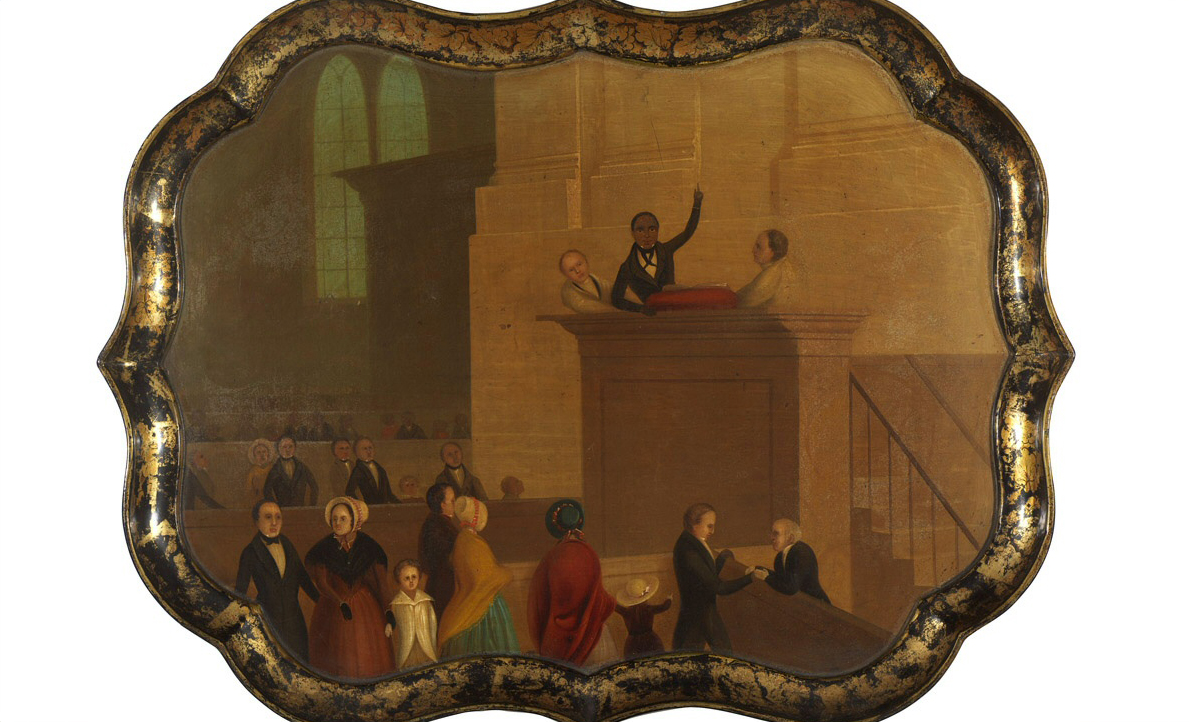
In this year’s issue, WallBuilders will highlight three notable (but often forgotten) ministers who were active before and during the national revival known as the Second Great Awakening (1795- 1845). These black ministers labored alongside white Christians and preached to both white and black congregations.

This should not seem unusual, however, for truly mature followers of Christ in all eras have long recognized that there are not several races but only two: the believer and the nonbeliever (Galatians 3:28 & Colossians 3:11). The stories of these three ministers are inspiring and are characterized by sacrifice and Christian courage.

African American poet James Weldon Johnson (1871-1938) properly said of these ministers:

The old-time Negro preacher has not yet been given the niche in which he properly belongs. . . . It was through him that the people of diverse languages and customs, who were brought here from diverse parts of Africa and thrown into slavery, were given their first sense of unity and solidarity. He was the first shepherd of the bewildered flock. His power for good or ill was very great. It was the old-time preacher who for generations was the mainspring of hope and inspiration for the Negro in America.

The Rev. Andrew Bryan 1737-1812

Andrew Bryan was born in slavery and grew up as a slave on a plantation in South Carolina. In 1782, Andrew and his wife Hannah became Christians under the preaching of the Rev. George Liele (1752 – 1828), an African American born into slavery who ministered the Gospel to other slaves. (Liele was the first African American ordained as a Baptist preacher.) Only nine months after his conversion, Andrew – still a slave – was preaching to both black and white congregations. He evangelized slaves on neighboring plantations and erected a crude wooden church; his congregation grew rapidly, attended by both blacks and whites. On January 20, 1788, Bryan was ordained as a Baptist minister.
As a result of the rapid growth of his church, persecution was initiated by nearby slave owners who feared a revolt if slaves heard the message of freedom in the Gospel. Hundreds of converted slaves not only were denied water baptism by their masters but also were forbidden to attend Bryan’s services. Many who did attend were flogged and severely punished, and even Andrew was whipped, beaten, and imprisoned (much like Paul and Silas in Acts 16:19-25), and his church was seized. (Andrew’s master, who supported his ministry, helped arrange his release from jail.)

Was Andrew bitter at this unjust treatment? Not at all. Instead, just as Jesus had instructed in Matthew 5, Andrew exulted in his persecution, proclaiming that “he rejoiced not only to be whipped but would freely suffer death for the cause of Jesus Christ;” he also prayed for the men who had persecuted him. This Christ-like behavior in Andrew won the respect of many observers.

Upon the death of his “master” in 1790, Andrew purchased his freedom and that of his wife. In 1794, several influential whites helped him raise the money to purchase property upon which to build a new church – the Bryan Street African Baptist Church (the first black Baptist church in America). Andrew then purchased a lot near the church upon which to build his home.

Within six years, the church had grown to almost 700 members (a large church at any time, it definitely was a mega-church in that era). In 1800, the church was reorganized as the First African Baptist Church of Savannah, and one of its ministries was a black Sabbath school – the first in the city. However, because Andrew’s goal was not simply to have a large congregation and an impressive church, in 1802 he deliberately split the congregation and planted a new church: the Second African Baptist Church of Savannah (its pastor, Henry Francis, started a school in the church to educate black children). The church growth continued, and in 1803 Andrew split the church again, forming the Third African Baptist Church of Savannah. As these churches grew, their congregations pioneered churches in other parts of the State.

At that time in America’s history, Georgia was one of the most stridently pro-slavery states in America. Thomas Jefferson (who in 1783 proposed the first antislavery law in America) noted that it was the influence of Georgia, North Carolina, and South Carolina that kept the national anti-slavery law from passing in Congress. Georgia had even been unable to provide its share of soldiers for the American
Revolution because its citizens feared that if they left their plantations to fight for American independence, their slaves would escape. Clearly, slavery was strongly embraced in Georgia, so Andrew labored in a region of the country in which ministry by – or to – African Americans was exceptionally difficult.

Nevertheless, upon Andrew’s death in 1812, the Savannah Baptist Association (comprised of the white Baptists of the city), praised Bryan’s work, proclaiming:

The Association is sensibly affected by the death of the Rev. Andrew Bryan, a man of color, and pastor of the First Colored Church in Savannah. This son of Africa, after suffering inexpressible persecutions in the cause of his divine Master, was at length permitted to discharge the duties of the ministry among his colored friends in peace and quiet, hundreds of whom, through his instrumentality, were brought to knowledge of the truth as “it is in Jesus.”

The ministry of Andrew Bryan brought thousands in Georgia to a personal relationship with God through Christ.

The Rev. “Black Harry” Hoosier (or Hosier) 1750-1810

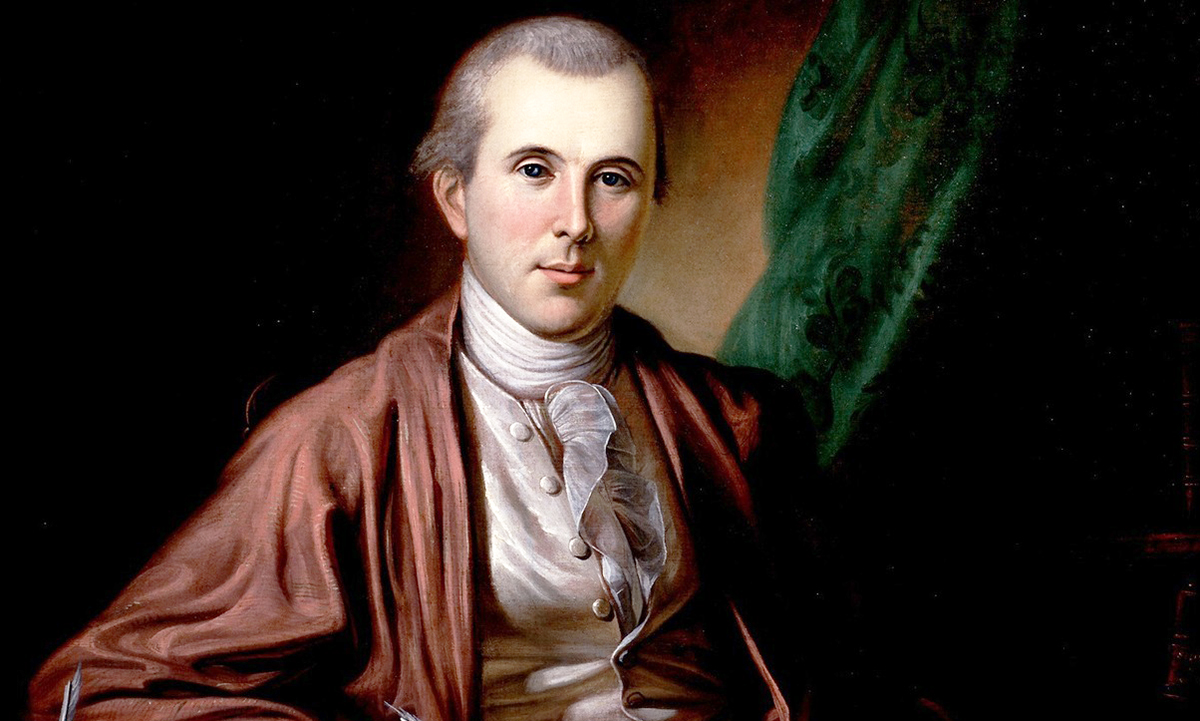
Harry Hoosier was born a slave in North Carolina, but toward the end of the American Revolution he obtained his freedom, converted to Methodism, and became a preacher. In 1781, he delivered a sermon in Virginia entitled “The Barren Fig Tree” – the first recorded Methodist sermon by an African American. Despite the fact that Hoosier was illiterate, he became famous as a traveling evangelist and was considered one of the most popular preachers of his era. In fact, after hearing Harry preach in and around Philadelphia, Dr. Benjamin Rush (1745-1813), a signer of the Declaration of Independence and an evangelical Christian, declared that accounting for his illiteracy, Hoosier was “the greatest orator in America.”

Early in his ministry, Harry became a close associate of Bishop Francis Asbury (1745- 1816), the “Founding Father of the American Methodist Church.”

(In 1771, Asbury – an Englishman – heard an appeal from John Wesley for preachers to go to America to “spread the Word.” Asbury responded, and during the next four decades he preached almost 20,000 sermons and rode over a quarter of a million miles across America – on horseback! When Asbury first arrived, there were only 550 Methodists in America, but by the time of his death in 1816, there were 250,000 – and 700 ordained Methodist ministers. In 1924 when a statue of Bishop Asbury was erected in Washington, DC, President Calvin Coolidge declared of Asbury that “He is entitled to rank as one of the builders of our nation.”)

Hoosier and Bishop Asbury traveled and preached together, but Bishop Asbury (who drew huge crowds) remarked that Harry drew even larger crowds than he did! In fact, the Rev. Henry Boehm (1775-1875) reported: “Harry. . . . was so illiterate he could not read a word [but h]e would repeat the hymn as if reading it, and quote his text with great accuracy. His voice was musical, and his tongue as the pen of a ready writer. He was unboundedly popular, and many would rather hear him than the bishops.” Harry also traveled and preached with other popular bishops of that era, including the Rev. Richard Whatcoat (1736- 1806), the Rev. Freeborn Garretson (1752-1827), and the Rev. Thomas Coke (1747-1814). The Rev. Coke said of Asbury that, “I really believe he is one of the best preachers in the world. There is such an amazing power that attends his preaching . . . and he is one of the humblest creatures I ever saw.”

Hoosier ministered widely along the American frontier and is described by historians as “a renowned camp meeting exhorter, the most widely known black preacher of his time, and arguably the greatest circuit rider of his day.” However, he was unpopular in the South for two reasons: first, frontier Methodists such as Hoosier tended to lean Arminian in their theology, contrasted with the denominations of the South that were largely Calvinistic (e.g., Presbyterians, Reformed, Episcopalians,
Baptists, etc. – yes, the Baptists of that day were largely Calvinistic!); second, Methodists were outspoken against slavery whereas the majority of the South supported slavery. Therefore, southern groups such as the Virginia Baptists came to use the term “Hoosiers” as an insulting term of derision that they applied to Methodists like Black Harry Hoosier, meaning that they were anti-slavery in belief and Arminian in theology.

Fisk University history professor William Piersen believes that this is the source of the term “Hoosier” that was applied to the inhabitants of Indiana. Piersen explains, “Such an etymology would offer Indiana a plausible and worthy first Hoosier – ‘Black Harry’ Hoosier – the greatest preacher of his day, a man who rejected slavery and stood up for morality and the common man.”

Noted African American historian Carter Woodson reported the words of early Methodist historian John Ledman in describing the closing chapter of Harry Hoosier’s life:

After he had moved on the tide of popularity for a number of years . . . he fell by wine – one of the strong enemies of both ministers and people. And now, alas! this popular preacher was a drunken ragpicker in the streets of Philadelphia. But we will not leave him here. One evening, Harry . . . determined to remain there until his backslidings were healed. Under a tree he wrestled with God in prayer. Sometime that night, God restored to him the joys of his salvation [Psalm 51:12]. . . . About the year 1810, Harry finished his course. . . . An unusually large number of people, both white and colored, followed his body to its last resting place, in a free burying ground in Kensington [near Philadelphia].

The Rev. Harry Hoosier was used by God to draw thousands of Americans to Christ during the early decades of the Second Great Awakening.

The Rev. John Marrant 1755-1791

John Marrant was born in New York in 1755. His father died early in John’s life; and in 1766 when John was eleven, his mother sent him to Charleston, South Carolina, to live with an older sister and learn a trade. After arriving in Charleston, John had a change of plans; as he explained: “I had passed by a school and heard music and dancing, which took my fancy very much; and I felt a strong inclination
to learn the music. I went home and informed my sister that I would rather learn music than go to a trade.” John therefore undertook the study of music and became skilled with both the violin and the French horn. According to John, within two years (while he was only thirteen years of age): “I was invited to all the balls and assemblies that were held in the town, and met with general applause of the inhabitants. I was a stranger to want, being supplied with as much money as I had any occasion for.”

On his way to play at one of those musical events, John and a friend passed a crowded meetinghouse. John noticed that the large crowd was gathered around “a crazy man halloing there.” The “crazy man” was the Rev. George Whitefield, and the assembly was one of many religious meetings that occurred during the First Great Awakening – a national spiritual revival that lasted from 1730-1770.

(The Rev. George Whitefield (1714-1770) has been called the greatest evangelist of all time. Born in England, he became a missionary to America, making seven separate trips and spending nine years preaching across the country. It is estimated that he preached to nearly ten million individuals in his lifetime, with crowds of 20,000 being common and reaching as high as 100,000 (of course, there was
no sound amplification then, and it was reported that Whitefield’s natural voice could be heard up to one mile away, thus easily accommodating such crowds). Whitefield preached some 18,000 sermons in his life – an average of 500 a year, and 10 each week. Often, up to 500 hearers at a time would fall to the ground and lie prostrate under the power of his sermons.)

John’s friend who was accompanying him, wanting to disrupt Whitefield’s event, dared John to take his French horn and “blow [it] among them.” Marrant accepted the challenge; raising the horn to his lips and preparing to blow, Whitefield suddenly looked directly at John, pointed his finger at him, and announced, “Prepare to meet thy God, O Israel!” Marrant immediately fell prostrate as though struck down (c.f., John 18:6 & Revelation 1:17), remaining motionless for almost half an hour. When John recovered, Whitefield ministered to the young boy and spent time with him. On the third day, Marrant committed his life to Christ and dedicated himself to Gospel ministry. (Marrant’s conversion occurred on Whitefield’s final missionary journey to America.)

An overjoyed Marrant returned to his family to share his newfound experience with them, but they rejected him. Like Moses of old (Exodus 2:15), John fled to the wilderness. There he met a Cherokee warrior and they spent ten weeks together, hunting and becoming fast friends. When they eventually returned to the Indian’s camp, Marrant was made a prisoner (the Cherokees at this time were often at war with the settlers; it was clear to the Cherokees that the black Marrant was not an Indian, so he therefore was an enemy settler).

When the Cherokee chieftain threatened John with death, John addressed the Cherokees in their own language and shared with them the Gospel of Christ. According to Marrant, “The king [the chief ] himself was awakened, and the others set at [spiritual] liberty. A great change took place among the people; the King’s house became God’s house; the soldiers were ordered away; and the poor condemned prisoner [Marrant] had perfect liberty and was treated like a prince. Now the Lord made all my enemies become my great friends.” Thus being released from his captivity, the chief granted Marrant permission to evangelize among the Cherokee – which he did for the next nine weeks, also evangelizing among the
Muskogees. As noted by African American historian Arthur Schomburg (1874-1938), Marrant was: “A Negro in America [like] the Jesuits of old, who spread the seed of Christianity among the American Indians before the birth of the American Republic.”

Following his success with his missionary endeavors, Marrant returned to his family; but they again rejected him because they now considered him too much of an Indian. Ironically, throughout his life Marrant was often faced with rejection which he overcame on each occasion: first, his family rejected his calling toward the Gospel ministry (yet he persevered and entered anyway); next, the Cherokees rejected him because he was a settler (again he overcame and evangelized among them); then, when he returned to his family, they rejected him as being too much of “a savage” in “the Indian style” (once more he persisted until he broke through the rejection and was finally reunited with his family).

Following these evangelistic efforts, Marrant agreed to work as a carpenter on a plantation near Charleston; and while working there, he evangelized among the slaves. As he explained, “During this time, I saw my call to the ministry fuller and clearer – had a feeling of concern for the salvation of my countrymen.” Sadly, however, when the mistress of the plantation found the slaves at prayer, she alerted her husband, who rounded up a posse and raided the prayer meeting. According to Marrant, “As the poor creatures came out, they caught them and tied them together with cords till the next morning, when all they caught – men, women, and children – were stripped naked and tied (their feet to a stake, their hands to the arm of a tree) and so severely flogged that the blood ran from their backs and sides to the floor, to make them promise they would leave off praying.”

All of this activity occurred before the American Revolution; and when the Revolution did commence, Marrant was impressed by the British into the navy. Following the war, he settled in England, and on May 15, 1785, was ordained as a Christian minister by the Calvinistic Methodists, a group started by George Whitefield. (Whitefield and the Wesleys worked together in forming the Methodist church, but the Wesleys became more Arminian in theology whereas Whitefield remained more Calvinistic and thus headed the Calvinistic Methodists.) Marrant continued his ministry efforts, preaching in England, then Canada, and then back in the United States. While in America, he became ill, and being in poor health, he desired to return to England to see his friends there. He died shortly thereafter at the age of thirty-six. Despite the apparent shortness of his life, Marrant nevertheless accomplished much, and was among the first African Americans to evangelize successfully among the American Indians.

Summary

These three famous ministers (the Rev. Andrew Bryan, the Rev. Harry Hoosier, and the Rev. John Marrant) were all well-known and even nationally known ministers in their day; all were extremely effective; all contributed greatly to the growth of American Christianity in particular and America in general. These three are just a few examples of the forgotten heroes and history that WallBuilders is proud to reintroduce to this generation of Americans!

The Finger of God on the Constitutional Convention

June 28th marks the annual anniversary of Founding Father Benjamin Franklin calling the Constitutional Convention to prayer after several weeks of difficult discussions and frequent impasses. The Founders well understood the need to seek God and the important part that God played both in establishing this nation and in the writing of the Constitution.

As Alexander Hamilton reported after its completion:

For my own part, I sincerely esteem it a system which without the finger of God [Luke 11:20] never could have been suggested and agreed upon by such a diversity of interests.1

James Madison agreed, and reported:

It is impossible for the man of pious reflection not to perceive in it the finger of that Almighty Hand which has been so frequently and signally extended to our relief in the critical stages of the Revolution.2

As far as these delegates were concerned, the finger of God – that is, His Divine power – had guided their writing of the Constitution. Benjamin Franklin also believed this to be the case, explaining:

[I] beg I may not be understood to infer that our general Convention was Divinely inspired when it formed the new federal Constitution . . . [yet] I can hardly conceive a transaction of such momentous importance to the welfare of millions now existing (and to exist in the posterity of a great nation) should be suffered to pass without being in some degree influenced, guided, and governed by that omnipotent, omnipresent, and beneficent Ruler in Whom all inferior spirits “live and move and have their being” [Acts 17:28].3

George Washington (president of the Convention) similarly attested:

As to my sentiments with respect to the merits of the new Constitution, I will disclose them without reserve. . . . It appears to me then little short of a miracle that the delegates from so many different states . . . should unite in forming a system of national government.4

Benjamin Rush, a signer of the Declaration from Philadelphia who closely monitored the proceedings, concurred, openly testifying:

I do not believe that the Constitution was the offspring of inspiration, but I am as perfectly satisfied that the Union of the States in its form and adoption is as much the work of a Divine Providence as any of the miracles recorded in the Old and New Testament were the effects of a Divine power.5

(For more about the Founders’ views of the “finger of God” and what that meant historically, see the article on this in the Founders’ Bible, from Luke 11:20).

Let us remember that God truly has had His hand involved in the formation of our government and let us take time out, as George Washington recommended, “to acknowledge the providence of Almighty God, to obey His will, to be grateful for His benefits, and humbly to implore His protection and favor”6 on America again.


Footnotes

1 Alexander Hamilton to Mr. Childs, Wednesday, October 17, 1787, Alexander Hamilton, John Jay, James Madison and Other Men of Their Time, The Federalist and Other Contemporary Papers on the Constitution of the United States, ed. E.H. Scott (New York: Scott, Foresman and Company, 1894), 646.
2 James Madison, Federalist #37, Alexander Hamilton, John Jay, & James Madison, The Federalist (Philadelphia: Benjamin Warner, 1818), 194.
3 Benjamin Franklin, “A Comparison of the Conduct of the Ancient Jews and of the Anti-Federalists in the United States of America,” no date, The Works of Benjamin Franklin, ed. Jared Sparks (Boston: Tappan, Whittemore, and Mason, 1837), V:162.
4 George Washington to Marquis de Lafayette, February 7, 1788, The Writings of George Washington, ed. Jared Sparks (Boston: Russell, Odiorne, and Metcalf, 1835), IX:317.
5 Benjamin Rush to Elias Boudinot on July 9, 1788, Letters of Benjamin Rush, ed. L. H. Butterfield (Princeton, New Jersey: American Philosophical Society, 1951), I:475.
6 Proclamation for a National Thanksgiving on October 3, 1789, Jared Sparks, The Life of George Washington (London: Henry Colburn, 1839), II:301.

Black History Issue 2004

Black Patriots of the American Revolution

Americans have lost much of their knowledge of basic historical facts, particularly those relating to the American Revolution. In fact, a recent survey of high-performing college seniors found that more thought that Ulysses S. Grant (a Civil War general in the 1860s) commanded the troops at Yorktown than George Washington (who actually did lead those troops in the 1780s). Since advanced college seniors cannot identify the commander-in-chief of the American Revolution, it is not surprising that today’s Americans know even less about the thousands of African Americans who fought during the Revolution, or that they participated in every major battle of the War.

Although this part of our history is unfamiliar today, it was known in previous generations because of the writings of black historians such as William Nell, an award winning young scholar in Boston during the 1830s. He studied law and became the first black American to hold a post in the federal government. In 1852, he authored Services of Colored Americans in the Wars of 1776 and 1812, and three years later, he penned The Colored Patriots of the American Revolution.

This issue is dedicated to a recovery of the knowledge of our black patriot heroes to whom today’s Americans of all colors owe a debt of gratitude.

James Armistead (Lafayette) (1760-1832)
James Armistead was one of the most important American spies during the Revolution. As a slave in Virginia, he witnessed much of the War; and following the British siege of Richmond in 1781, he asked his master, William Armistead, for permission to serve in the cause of American independence with General Marquis de Lafayette, a young Frenchman who came to fight with the Americans. His master agreed, and Lafayette accepted his services. Lafayette dispatched Armistead to the camp of the patriot-turned-traitor, Benedict Arnold (then a British general), to pose as an escaped slave looking for work. Arnold accepted Armistead and allowed him to work in the camp, thus placing him around other British generals, including British commander-in-chief Lord Cornwallis. Armistead obtained much vital information about British plans and troop movements, which he daily sent to General Lafayette. Ironically, Lord Cornwallis so trusted Armistead that he even asked him to become a British spy to watch the Americans. Armistead agreed and thus became a double-spy, feeding accurate information to the Americans and inaccurate information to the British.

Upon learning that the British fleet was moving Cornwallis and his troops to Yorktown, Armistead quickly relayed that information to Lafayette and Washington, who gathered the American forces at Yorktown. After the British troops had landed and the British fleet had unsuspectingly departed from Chesapeake Bay, the Americans engaged the British while the French fleet blockaded the Bay to keep the British navy from returning. The Battle of Yorktown ensued, and the British – without their navy to provide reinforcements or supplies and with no way to retreat off the peninsula on which they were trapped – finally surrendered. Armistead’s crucial information had helped bring a victorious end to the American Revolution.

Following the War, Armistead returned to slavery on his master’s plantation. Three years later, in 1784, General Lafayette returned to America for a visit and met with his friend, Armistead. Lafayette penned a certificate to Virginia leaders praising the work and important contributions of Armistead. Armistead then petitioned the legislature for his freedom, which was granted on New Year’s Day, 1787. (In his latter years, Armistead also received a retirement pension from the State for his military services.) Following his emancipation, Armistead adopted the name Lafayette and thereafter called himself James Lafayette. He remained in the State as a farmer.

General Lafayette became an ardent foe of slavery both in America and in Europe, and it is believed that it was his association with James Armistead that helped clarify his views on slavery, leading him to begin his strong public crusade against that evil.

In 1824, General Lafayette made his final visit to America; his tour across the nation was greeted by crowds of thousands in city after city. When touring Richmond, the General recognized in the crowd his black comrade from four decades earlier (now an old man) and called him out by name and embraced him – the last time the two patriot friends were to meet.

Jordan Freeman (? – 1781);
Lambo (Lambert) Latham (? – 1781)

In 1781, both black and white soldiers fought side by side at the Battle of Groton Heights, Connecticut. The American force of only 84 men, led by Lt. Col. William Ledyard, was attempting to defend the town of New London from a large invading force led by American traitor-turned-British General Benedict Arnold.

After suffering heavy casualties against the overwhelming British numbers, Col. Ledyard and his remaining troops retreated to tiny Fort Griswold, equipped with only a few small cannons. The Americans eventually ran out of ammunition; and when the British charged the fort, the Americans used their rifles as clubs, fighting back the British with only bayonets and pikes. The British began scaling
the walls of the fort; upon reaching the top, the British officer leading the attack – Major Montgomery – was speared and killed by black patriot Jordan Freeman. The British rushed over the walls and quickly overran the fort, overpowering the few remaining Americans.

A British officer then asked the American prisoners, “Who commanded the fort?” Colonel Ledyard replied, “I did once. You do now,” and handed his sword to the British officer, as was customary with a surrender. The British officer then took Ledyard’s own sword and thrust it through Ledyard’s body all the way to the hilt.

That act was witnessed by all the remaining Americans, including black patriot Lambert Latham. (When the flagpole of the fort had earlier been shot down by the British during the battle, Lambert grabbed the American flag and held it high until he was captured.) Latham had stood silently with the other American prisoners, but upon witnessing the coldblooded murder of his commander, Nell records what next occurred: “Lambert . . . retaliated upon the [British] officer by thrusting his bayonet through his body. Lambert, in return, received from the enemy thirty-three bayonet wounds, and thus fell, nobly avenging the death of his commander.”

The British – angered by the loss of so many of their soldiers at the hands of so few Americans – promptly slaughtered all the remaining Americans left in the fort, including Jordan Freeman.

Interestingly, Freeman had been a slave of Col. Ledyard, the commander of the fort, but had been freed by him. As a free man, Freeman had remained in the area and married. When the region came under attack from the British, Freeman chose to stay and fight for America side by side with the man who had once been his owner.

Today, at the site of old Fort Griswold is a plaque showing the moment in which Jordan Freeman killed the attacking British officer. There is also a huge monument standing there; the names of Jordan Freeman and Lambert Latham appear on that monument, along with the other American soldiers who gave their lives defending American liberty in that battle.

Peter Salem (1750-1816)
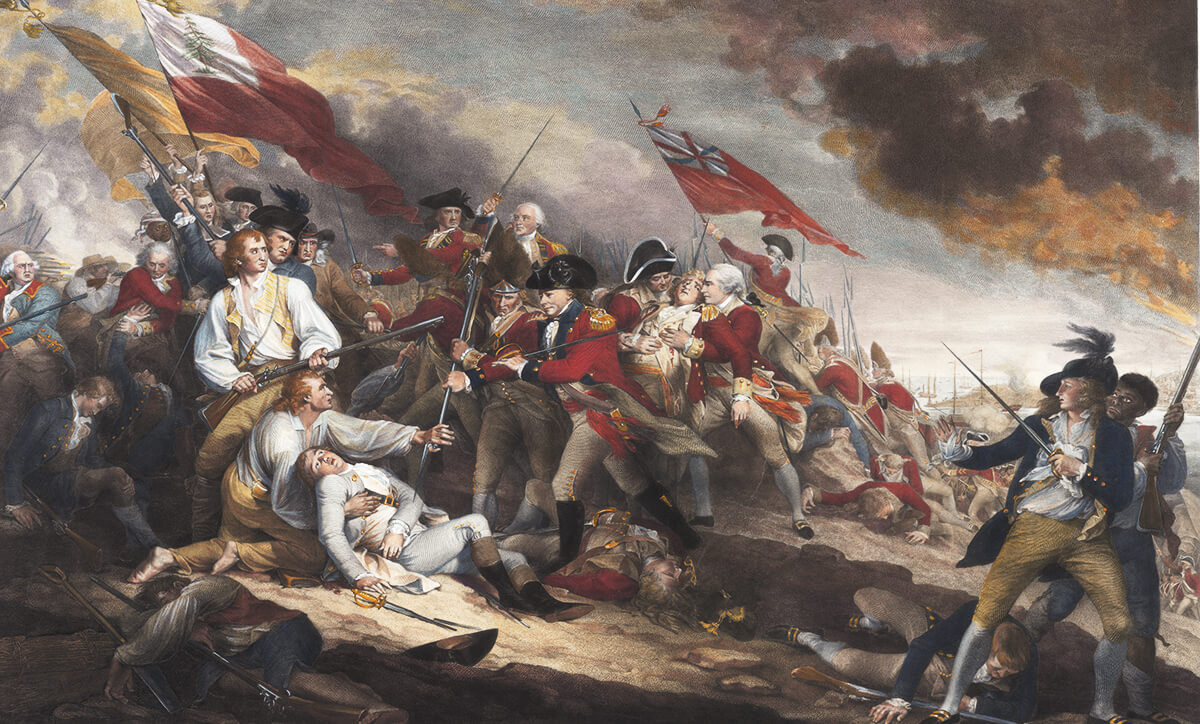
Peter Salem was a member of the famous Massachusetts Minutemen and was involved in a number of important battles, including the battles of Bunker Hill, Concord, and Saratoga (the first American victory of the Revolution). However, it was in the Battle of Bunker Hill on June 17, 1775, that he gained notoriety.

After the battles of Lexington and Concord, American troops from Massachusetts, Connecticut, New Hampshire, and Rhode Island assembled at Boston to confront the 5,000 British troops stationed there. The outmanned American forces engaged the British outside the city. The Americans were winning the conflict until they began running out of ammunition. With the Americans near defeat, British commander Major John Pitcairn (who had earlier led the British forces against the Americans at Lexington) mounted the hill and shouted, “The day is ours!” whereupon Salem promptly shot him, sending the British troops into confusion and allowing the Americans to escape safely. Peter Salem was honored before General Washington for his soldierly act.

Salem became a member of the Fifth Massachusetts Regiment and served throughout the rest of the Revolution – a total of seven years of military service in behalf of his country, a length of time achieved by few other soldiers in the Revolution. Salem had entered the Revolution as a slave but finished it as a free man, marrying in 1783, at the conclusion of the Revolution.

A stone monument was erected to Peter Salem at Framingham, Massachusetts, in 1882; and Salem is pictured in the famous painting of John Trumbull titled, “The Death of General Warren at the Battle of Bunker Hill.”

Prince Whipple (c. 1756 – c. 1797)
Prince Whipple had been part of a wealthy (perhaps even a royal) African family. When he was ten, he was sent by his family to America for an education; but while on the voyage, he was shanghaied by the ship’s treacherous captain and sold into slavery in Baltimore. He was bought by New Hampshire ship captain William Whipple, a famous leader in that State.

William Nell, in his 1852 The Colored Patriots of the American Revolution, tells the early story of Prince in America:

As was customary, Prince took the surname of his owner, William Whipple, who would later represent New Hampshire by signing the Declaration of Independence. . . . When William Whipple joined the revolution as a captain, Prince accompanied him and was in attendance to General Washington on Christmas night 1776 for the legendary and arduous crossing of the Delaware. The surprise attack following the crossing was a badly needed victory for America and for Washington’s sagging military reputation. In 1777, [William Whipple was] promoted to Brigadier General and [was] ordered to drive British General Burgoyne out of Vermont.

An 1824 work provides details of what occurred after General Whipple’s promotion:

On [his] way to the army, he told his servant [Prince] that if they should be called into action, he expected that he would behave like a man of courage and fight bravely for his country. Prince replied, “Sir, I have no inducement to fight, but if I had my liberty, I would endeavor to defend it to the last drop of my blood.” The general manumitted [freed] him on the spot.

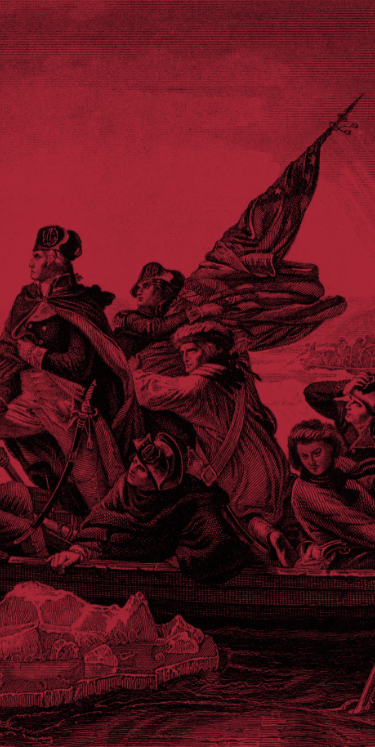
Prince Whipple did enter the service of America as a soldier during the Revolution and is often identified in a number of early paintings of the War, including that of General Washington after crossing the Delaware. In fact, many identify Prince Whipple as the man on the oar in the front of the boat in the famous crossing of the Delaware picture painted in 1851. Although Whipple did not actually cross the Delaware with Washington in the manner depicted, he was representative of the thousands of black patriots who did fight for American independence – and of the many African Americans who did cross the Delaware with Washington.

Prince Whipple fought in the Battle of Saratoga in 1777 and the Battle of Rhode Island in 1778. He directly attended General Washington and the general staff throughout the Revolution, serving as a soldier and aide at the highest levels.

Lemuel Haynes (1753-1833)
Lemuel Haynes was abandoned by his parents when he was five months old. He was taken in and apprenticed by the David Rose family. According to Haynes: “He [David Rose] was a man of singular piety. I was taught the principles of religion. His wife . . . treated me as though I was her own child.”

Haynes was given the opportunity for education – something rare for African Americans in that day. Haynes explained: “I had the advantage of attending a common school equal with the other children. I was early taught to read.” He also educated himself at night by reading in front of a fireplace. He developed a lifelong love for the Bible and theology, and even as a youth he frequently held services and preached sermons at the town parish. He also memorized massive and lengthy portions of the Bible.

In 1774 when he turned 21 and had finished his tradesman apprenticeship, he enlisted as a Minuteman in the local Connecticut militia. While he was not part of the Battle of Lexington, he did write a lengthy ballad-sermon about that famous battle. However, a week following that battle, Haynes and the Connecticut troops were part of the siege of Boston. Haynes was also part of the military expedition against Fort Ticonderoga, made legendary by Ethan Allen and the famous Green Mountain Boys. Haynes became an ardent admirer of George Washington and remained so throughout his life. In fact, Haynes regularly preached sermons on Washington’s birthday and was an active member of the Washington Benevolent Society.

After the Revolution, Haynes continued his studies in Latin, Greek, and theology and became the first African American to be ordained by a mainstream Christian denomination (the Congregationalists, in 1785), to pastor a white congregation (a congregation in Connecticut), and to be awarded an honorary Master’s Degree (by Middlebury College in 1804). Over his life, Haynes pastored several churches in Connecticut, Vermont, Massachusetts, and New York (often white churches), published a number of sermons, and was a confidant and counselor to the presidents of both Yale and Harvard.

Lemuel Haynes died at the age of eighty, having written the epitaph for his tombstone: “Here lies the dust of a poor helldeserving sinner, who ventured into eternity trusting wholly on the merits of Christ for salvation. In the full belief of the great doctrines he preached while on earth, he invites his children, and all who read this, to trust their eternal interest on the same foundation.”

Black Commandos
In December 1776, the secondin- command of the American Army, General Charles Lee, was taken prisoner by the British. In order for the Americans to effect his release through a prisoner exchange, a British general of the same rank was needed. A bold plan was therefore undertaken by Lt. Col. William Barton. He would slip past British forces at Newport, Rhode Island, enter the heart of the British camp, capture British General Richard Prescott in his quarters, and return him to the American side before the British learned of the raid.

Col. Barton hand-selected about forty elite soldiers, both black and white. He gathered the group, explained to them his plan, warned them of the risk, and asked for volunteers. All chose to be part of the daring operation.

Waiting until the middle of the night, the group loaded into small boats, and with muffled oars, rowed silently past General Prescott’s warships and guard boats anchored in the harbor. Landing near the general’s headquarters, the Americans quickly overpowered the guards and surrounded the house of the sleeping general. They entered his house and, standing outside his locked door, they had only to break down the door and quickly grab Prescott before he realized what had occurred.

At that moment, one of the black commandos, Prince Sisson – a powerful man – stepped forward and charged the door, using his own head as a battering ram; on the second try, the locked door gave way and Prince entered the quarters and seized the surprised general. They safely returned with Prescott to the American lines where he was subsequently exchanged for the second-in-command of the American Army, General Charles Lee. The daring act of Sisson is still celebrated to this day.

Rhode Island Fighters
The First Rhode Island was a regiment of 125 black patriots – both slave and free – commanded by Colonel Christopher Greene. That regiment, created during the infamous winter at Valley Forge, became noted for its bravery and courage, receiving its first baptism by fire during the Battle of Newport in 1778.

When reinforcements failed to arrive during that battle, the Americans were forced to retreat in the face of heavy British attacks, especially from the dreaded Hessian mercenaries. The First Rhode Island thrust themselves between the retreating Americans and the advancing Hessians and repulsed the British forces three separate times, inflicting heavy casualties on the mercenaries. (Following the battle, the Hessian commander asked to be transferred to a different location for fear that his remaining soldiers might shoot him because of the fearful losses which had been inflicted on them, and the deaths of so many of their comrades.)

In 1781 during the Battle of Croton River, Colonel Greene – commander of the regiment – was cut down by the British. William Nell, in his 1855 The Colored Patriots of the American Revolution, described what next occurred:

“Colonel Greene, the commander of the regiment, was cut down and mortally wounded: but the sabres of the enemy only reached him through the bodies of his faithful guard of blacks, who hovered over him, and every one of whom was killed.”

While Colonel Greene’s squad was killed, others of the Rhode Island First survived and served the remainder of the War. A battle-hardened and loyal unit, they were with George Washington when he accepted the surrender of Lord Cornwallis at Yorktown to end the Revolution.

Conclusion
Numerous other black patriots distinguished themselves during the American Revolution, including James Forten, Peter Poor, Cuff Smith, Cesar and Festus Prince, and thousands of others. It is appropriate that during African American history month, we should remember these great black patriots who contributed so much to the establishment of America as the foremost nation of the world.


Dwight D. Eisenhower – A Presidential Profile

Many of our nation’s Presidents have had remarkable but untold stories. The following story about President Eisenhower, published over a generation ago, was so inspiring that we wanted to share it with you.

A Question of Courage by Grace Perkins Oursler

(Reprinted from a 1959 Readers Digest School Reader, condensed and adapted from a Guideposts article.)

The boy had fallen, running home after school, and skinned his left knee. It was no more than a scratch. His trousers were not even torn, but by night the knee had begun to ache. Nothing much, he thought, being 13 and the sturdy son of a frontiersman. Ignoring the pain, he knelt and said his prayers. Then he climbed into bed in the room where he and his five brothers slept.

His leg was painful the next morning, but he still did not tell anyone. Life on the farm kept everyone busy. He always had to be up at six to do his chores before school. He had to do them well or he would be sent back to do them over again, no matter what else he had to miss, including meals. In his home, discipline was fair but stern.

Two mornings later the leg ached too badly for him to drag himself to the barn. It was Sunday and he could stay home while the rest of the family drove to town. He sat in the parlor and dozed until his brothers returned from Sunday school.

Mom and Dad did not come home with them because Sunday was parents’ day off. The boys did the housework and cooked the big meal of the week, while mother and father stayed on to attend church.

The Fight Begins

But by the time dinner was ready, the boy had climbed into bed. The shoe had to be cut off his swollen and discolored leg.

“Why on earth didn’t you tell somebody?” asked his mother. “Go quick,” she called to his father, “and fetch the doctor.”

She bathed the knee, foot and thigh, and wiped the boy’s sweating forehead with a moist, cool cloth. Even as she watched the angry infection grow worse, she remained calm. Mom had nursed her boys through accidents and ailments from toothaches to scarlet fever. One son she had lost, but that only made her calmer and more determined to fight for the others.

Old Dr. Conklin examined the leg and shook his head. “It’s not likely we can save it!”

The invalid sat up stiffly.

“What’s that mean?” he asked huskily.

“It means,” explained the doctor gently, “if things get worse we’ll have to cut off your leg.”

“Not me!” stormed the boy. “I won’t have it! I’d rather die!” “The longer we wait, the more we will have to take off,” urged the doctor.

“You won’t take any off!” The boy’s voice broke with a youthful crack, as his mother turned away, shaken. But there was the look of a man in the boy’s eyes.

A Promise to be Kept

Dr. Conklin stalked out, nodding to the mother to follow him. As he stood in the hallway explaining to the parents what probably would happen, they could hear the sick boy calling for his brother: “Ed! Ed! Come up here, will you?”

The brother stamped in. Then they heard the sick lad’s voice, high pitched with pain: “If I go out of my head, Ed, don’t let them cut off my leg. Promise me, Ed – promise!”

In a moment Ed came out and ran to the kitchen. When he returned his mother said, “Ed, what’s your brother asking for?”

“Fork. To bite on; to keep from screaming.”

Then Ed stood outside the bedroom door, his arms folded. Quite clearly he was standing guard.

Ed looked straight at Dr. Conklin. “Nobody’s going to saw off that leg!” he announced.

“But, Ed – you’ll be sorry,” gasped the doctor.

“Maybe so, Doc. But I gave him my word.”

And nothing changed that. If Ed had not stood his ground, father and mother might have yielded. They were not yet sure that amputation was necessary. The stubborn attitude first of the sick boy and then of his brother was unbelievable, for defiance of authority was unknown in that home. Yet there was Ed, standing before the sickroom door.

“Guess we’ll wait and see how he looks by tonight, eh, Doc?” said the father.

The Crisis

For two days and nights Ed stood guard, sleeping at the threshold, not leaving even to eat. The fever mounted and the suffering boy became delirious, babbling with pain. The older brother did not weaken, even though the discoloration of the swollen leg was creeping toward the hip. Ed remained firm because he had given his promise. Also he shared the frontiersman’s dread of being less than physically perfect. A man needed his arms and legs to do the hard work on a farm.

The parents knew that their son would never forgive an amputation, and Ed stood firm whenever the doctor returned. Once, in helpless rage, Dr. Conklin shouted, “It’s murder! Nothing but a miracle can save the boy now.” He left, slamming the front door.

Mother, father and watchful Ed shared the same thought as their anxious eyes turned from the doorway. Had they forgotten their faith because of their fears? Why, this sick boy’s grandfather, that vigorous and inspiring old farmer-minister, had always believed in healings through faith. Now, in this desperate hour, the three went to their knees at the bedside.

They prayed, taking turns in leading one another. Father, mother – and at last Edgar – each would rise in turn, go about the farm work and rejoin the continual prayer. During the second night the other four brothers joined in the prayers.

The next morning, when the faithful old doctor stopped by again, his experienced eye saw a sign. The swelling was going down!

Dr. Conklin closed his eyes and made a rusty prayer of his own – a prayer of thanksgiving. Even after the sick boy dropped into a normal sleep, one member of the family after another kept the prayer vigil all through the night.

It was nightfall again and the lamps were lighted when the boy opened his eyes. The swelling was away down now. The discoloration had almost faded. In three weeks – pale and weak, but with eyes clear and voice strong – the boy could once again stand up.

And Ike Eisenhower was ready to face life.”

(End of reprinted article)

This early Divine intervention by God in the life of a young Dwight Eisenhower produced a later blessing to America and the world.

The Story of a Leader

Eisenhower was born in 1890 in Texas and raised as a Presbyterian in Kansas. His mother had been a Mennonite and was a strong pacifist who morally opposed war, but the young Eisenhower believed that the best way to ensure peace was through a strong military. He therefore applied and was accepted at West Point Military Academy, where he graduated as a commissioned army officer in 1915.

Prior to World War II, Eisenhower served as a young officer under General Douglas McArthur in the Philippines. When the War broke out, Eisenhower was assigned to command a military training base in Louisiana with almost half-a-million soldiers. General George Marshall was so impressed with Eisenhower’s abilities that he made him the liaison between American and British strategists in London; and Prime Minister Winston Churchill was so taken with Eisenhower’s skills that he had him appointed as the Supreme Commander of the Allied Expeditionary Forces in Europe. As a result of Eisenhower’s leadership – particularly through bold measures such as the D-Day invasion – the Nazis and their allies were crushed and a wave of freedom swept across Europe and the world.

Following his service in World War II, Eisenhower became the very first chairman of the Joint Chiefs of Staff of the military, served a brief stint as president of Columbia University, was named the Supreme Commander of NATO, and was elected US President in 1952.

Throughout Ike’s life, his early religious training – more apparent at some times than at others – never fully departed him. For example, at his first Presidential Inauguration in 1953, Ike took his oath of office upon two Bibles – the one used by George Washington in his 1789 inauguration, and the one given to Ike by his mother upon his graduation from West Point. After being sworn in, Ike personally offered the inaugural prayer rather than having a minister do so:

My friends, before I begin the expression of those thoughts that I deem appropriate to this moment, would you permit me the privilege of uttering a little private prayer of my own. And I ask that you bow your heads:

“Almighty God, as we stand here at this moment, my future associates in the executive branch of government join me in beseeching that Thou will make full and complete our dedication to the service of the people in this throng, and their fellow citizens everywhere. Give us, we pray, the power to discern clearly
right from wrong, and allow all our words and actions to be governed thereby, and by the laws of this land. Especially we pray that our concern shall be for all the people regardless of station, race, or calling. May cooperation be permitted and be the mutual aim of those who, under the concepts of our Constitution, hold to differing political faiths; so that all may work for the good of our beloved country and Thy glory. Amen.”

During his first term, Eisenhower signed the federal law inserting the phrase “under God” into the Pledge of Allegiance. Why? According to Eisenhower:

In this way we are reaffirming the transcendence of religious faith in America’s heritage and future; in this way we shall constantly strengthen those spiritual weapons which forever will be our country’s most powerful resource in peace and war.

For his second inauguration, Eisenhower was actually sworn in twice. Because the legally designated inaugural day fell on a Sunday, Ike refused to have a public ceremony; the official oath was administered to him on the Sabbath in private. The following day, however, he had a public ceremony and was sworn in (again) before large crowds at the Capitol, taking his oath on his West Point Bible as he had at his first inauguration.

Eisenhower literally was used of God to bless Europe, America, and the entire world, none of whom would have experienced that blessing had not God sovereignly intervened in Ike’s life during his youth.


Black History Issue 2003

A black civil rights leader recently told an assembly at Michigan State University that American democracy was only decades old rather than centuries- that not until the 1965 Voting Rights Act when blacks could vote did democracy truly begin. [1]

Such a declaration does not accurately portray the history of black voting in America nor does it honor the thousands of blacks who sacrificed their lives obtaining the right to vote and who exercised that right as long as two centuries ago. In fact, most today are completely unaware that it was not Democrats but was actually Republicans-” like the seven pictured on the front cover-” who not only helped achieve the passage of explicit constitutional voting rights for blacks in 1870 but who also held hundreds of elected offices during the 1800s. [2]

Black Voting in the 1700s

Acknowledgment that blacks voted long before the 1965 Voting Rights Act was provided in the infamous 1856 Dred Scott decision in which a Democratic-controlled US Supreme Court observed that blacks “had no rights which a white man was bound to respect; and that the Negro might justly and lawfully be reduced to slavery for his benefit.” [3] Non-Democrat Justice Benjamin R. Curtis, one of only two on the Court who dissented in that opinion, provided a lengthy documentary history to show that many blacks in America had often exercised the rights of citizens-” that many at the time of the American Revolution “possessed the franchise of [voters] on equal terms with other citizens.” [4]

State constitutions protecting voting rights for blacks included those of Delaware (1776), [5] Maryland (1776), [6] New Hampshire (1784), [7] and New York (1777). [8] (Constitution signer Rufus King declared that in New York, “a citizen of color was entitled to all the privileges of a citizen. . . . [and] entitled to vote.”) [9] Pennsylvania also extended such rights in her 1776 constitution, [10] as did Massachusetts in her 1780 constitution. [11] In fact, nearly a century later in 1874, US Rep. Robert Brown Elliott (a black Republican from SC) queried: “When did Massachusetts sully her proud record by placing on her statute-book any law which admitted to the ballot the white man and shut out the black man? She has never done it; she will not do it.” [12]

As a result of these provisions, early American towns such as Baltimore had more blacks than whites voting in elections; [13] and when the proposed US Constitution was placed before citizens in 1787 and 1788, it was ratified by both black and white voters in a number of States. [14]

This is not to imply that all blacks were allowed to vote; free blacks could vote (except in South Carolina) but slaves were not permitted to vote in any State. Yet in many States this was not an issue, for many worked to end slavery during and after the American Revolution. Although Great Britain had prohibited the abolition of slavery in the Colonies before the Revolution, [15] as independent States they were free to end slavery-” as occurred in Pennsylvania, Massachusetts, Connecticut, Rhode Island, Vermont, New Hampshire, and New York. [16] Additionally, blacks in many early States not only had the right to vote but also the right to hold office. [17]

Congressional Actions

In the early years of the Republic, the federal Congress also moved toward ending slavery and thus toward achieving voting rights for all blacks, not just free blacks. For example, in 1789 Congress banned slavery in any federally held territory; in 1794, [18] the exportation of slaves from any State was banned; [19] and in 1808, the importation of slaves into any State was also banned. [20] In fact, more progress was made to end slavery and achieve civil rights for blacks in America at that time than was made in any other nation in the world. [21]

In 1820, however, following the death of most of the Founding Fathers, a new generation of leaders in Congress halted and reversed this early progress through acts such as the Missouri Compromise, which permitted the admission of new slave-holding States. [22] This policy was loudly lamented and strenuously opposed by the few Founders remaining alive. Elias Boudinot-” a president of Congress during the Revolution-” warned that this new direction by Congress would bring “an end to the happiness of the United States.” [23] A frail John Adams feared that lifting the slavery prohibition would destroy America; [24] and an elderly Jefferson was appalled at the proposal, declaring, “In the gloomiest moment of the Revolutionary War, I never had any apprehensions equal to what I feel from this source.” [25] Congress also enacted the Fugitive Slave Law allowing southern slavers to go North and kidnap blacks on the spurious claim that they were runaway slaves [26] and then passed the Kansas-Nebraska Act, allowing slavery into what is now Colorado, Wyoming, Montana, Idaho, North Dakota, South Dakota, Kansas, and Nebraska. [27]

This new anti-civil rights attitude in Congress was also reflected in many of the Southern and Mid-Atlantic States. For example, in 1835 North Carolina reversed its policies and limited voting to whites only, [28] as also occurred in Maryland in 1809. [29]

Political Parties

The Democratic Party had become the dominant political party in America in the 1820s, [30] and in May 1854, in response to the strong pro-slavery positions of the Democrats, several anti-slavery Members of Congress formed an anti-slavery party-” the Republican Party. [31] It was founded upon the principles of equality originally set forth in the governing documents of the Republic. In an 1865 publication documenting the history of black voting rights, Philadelphia attorney John Hancock confirmed that the Declaration of Independence set forth “equal rights to all. It contains not a word nor a clause regarding color. Nor is there any provision of the kind to be found in the Constitution of the United States.” [32]

The original Republican platform in 1856 had only nine planks-” six of which were dedicated to ending slavery and securing equal rights for African-Americans. [33] The Democratic platform of that year took an opposite position and defended slavery, even warning that “all efforts of the abolitionists [those opposed to slavery]. . . are calculated to lead to the most alarming and dangerous consequences and . . . diminish the happiness of the people and endanger the stability and permanency of the Union.” [34] The next Democratic platform (1860) endorsed both the Fugitive Slave Law and the Dred Scott decision; [35] Democrats even distributed copies of the Dred Scott ruling to justify their anti-black positions. [36]

Specific Constitutional Rights for African-Americans

When Abraham Lincoln was elected the first Republican President in 1861 (along with the first ever Republican Congress), southern pro-slavery Democrats saw the handwriting on the wall. They left the Union and took their States with them, forming a brand new nation: the Confederate States of America, and their followers became known as Rebels. During the War, Lincoln implemented the first anti-slavery measures since the early Republic: in 1862, he abolished slavery in Washington, DC; [37] in 1863, he issued the Emancipation Proclamation, ordering slaves to be freed in southern States that had not already done so; [38] in 1864, he signed several early civil rights bills; [39] etc. After the war ended in 1865, the Republican Congress passed the 13th Amendment abolishing slavery and the 14th Amendment providing full civil rights for all blacks, thus fulfilling the original promise of the Declaration of Independence.

Most southern States ignored these new Amendments. [40] Congress therefore insisted that the southern States ratify and implement these Amendments before they could be readmitted into the United States. [41]

Until their readmission, the civil rights of the Rebels in the South-” including their right to vote in elections-” were suspended. [42] The Constitution authorizes that certain civil rights may be suspended “in cases of rebellion” or when “the public safety may require it” (Art. I, Sec. 9, cl. 2). In fact, because the Rebels had taken up arms against their own nation-” an act of treason according to the Constitution (“Treason against the United States shall consist only in levying war against them . . .” Art. III, Sec. 3, cl. 1), they could have been executed (Art. III, Sec. 3, cl. 2). Instead, amnesty was granted to the Rebels if they took an oath of fidelity to the United States, which most eventually did. (Regrettably, after their readmission, and after Democrats regained the State legislatures from Republicans, those States worked aggressively to circumvent the 14th Amendment in violation of the pledge [43] they had taken.)

Because the Rebels (who had almost exclusively been Democrats) were not allowed to vote in the early parts of Reconstruction, Republicans became the political majority in the South; and since nearly every African-American was a Republican and could now vote, most southern legislatures-” at least for a few years-” became Republican and included many black legislators. In Texas, 42 blacks were elected to the State Legislature, [44] 50 to the South Carolina Legislature, [45] 127 to Louisiana’s, [46] 99 to Alabama’s, [47] etc.-” all as Republicans. These Republican legislatures moved quickly to protect voting rights for blacks, prohibit segregation, establish public education, and open public transportation, State police, juries, and other institutions to blacks. [48] (It is noteworthy that the blacks serving both in the federal and State legislatures during that time forgivingly voted for amnesty for the Rebels. [49])

During the time when most southern Democrats had not yet signed the oath of fidelity to the United States and therefore could not vote, they still found ways to intimidate and keep blacks from voting. For example, in 1865-1866, the Ku Klux Klan was formed by Democrats to overthrow Republicans and pave the way for Democrats to regain control [50]-” as when Democrats attacked the State Republican Convention in Louisiana in 1866, killing 40 blacks, 20 whites, and wounding 150 others. [51] In addition to the use of force, southern Democrats also relied on absurd technicalities to limit blacks. In Georgia, 28 black legislators were elected as Republicans, but Democratic officials decided that even though blacks had the right to vote in Georgia, they did not have the right to hold office; the 28 black members were therefore expelled. [52]

Because of such blatant attempts to nullify the guarantees of the 14th Amendment, the Republican Congress passed the 15th Amendment to give explicit voting rights to African-Americans. Significantly, not one of the 56 Democrats serving in Congress at that time voted for the 15th Amendment. [53]

Democratic Efforts to Limit Voting Rights for Blacks

During Reconstruction (1865-1877), Republicans passed four federal civil rights bills to protect the rights of African-Americans, the fourth being passed in 1875. [54] It was nearly a century before the next civil rights bill was passed, because in 1876 Democrats regained partial control of Congress and successfully blocked further progress. As Democrats regained control of the legislatures in southern States, they began to repeal State civil rights protections and to abrogate existing federal civil rights laws. As African-American US Rep. John Roy Lynch (MS) noted, “The opposition to civil rights in the South is confined almost exclusively to States under democratic control . . .” [55]

Devious and cunning methods were required to circumvent the explicit voting protections of the 14th and 15th Amendments, and southern Democrats implemented nearly a dozen separate devices to prevent blacks from voting, including:

  • Poll taxes

  • Literacy tests

  • “Grandfather” clauses

  • Suppressive election procedures

  • Black codes and enforced segregation

  • Bizarre gerrymandering

  • White-only primaries

  • Physical intimidation and violence

  • Restrictive eligibility requirements

  • Rewriting of State constitutions

1. The poll tax

The poll tax was a fee paid by a voter before he could vote. The fee was high enough that most poor were unable to pay the tax and therefore unable to vote. Although the poll tax affected both whites and blacks, it was disproportionately hard on blacks who were just emerging from slavery, many of whom had not yet established an independent means of living. A poll tax was first proposed in Texas in 1874, right after Democrats reclaimed power from the Republicans, [56] but it was North Carolina in 1876 that became the first State to enact a poll tax, [57] and other southern States quickly followed. [58]

2. Literacy tests

Literacy tests required a voter to demonstrate a certain level of learning proficiency before he could vote. In some cases, the test was 20 pages long for blacks, and those administering the tests were white Democrats who nearly always ruled that blacks were illiterate. In Alabama, the test included questions such as, “Where do presidential electors cast ballots for president?” “Name the rights a person has after he has been indicted by a grand jury.” [59] Democrats required blacks to have an above average education before they could vote but then simultaneously opposed black education and even worked with the Ku Klux Klan to burn down schools attended by blacks. [60] Clearly, they did not intend for blacks to vote.

3. “Grandfather” clauses

“Grandfather” clauses were laws passed by Democratic legislatures allowing an individual to vote if his father or grandfather had been registered to vote prior to the passage of the 15th Amendment. [61] Since voting in the South prior to the 15th Amendment was almost completely by whites, this law ensured that poor and illiterate whites, but not blacks, could vote.

4. Suppressive election procedures

Some election procedures (such as “multiple ballots”) were intentionally made complex and misleading. For example, a Republican voter might be required to cast a ballot in up to eight separate locations-” or sometimes to cast a vote for each Republican on the ballot at a separate location-” before the ballot would be counted. Democratic officials, however, often failed to inform black voters of this complicated procedure and their ballots were therefore disqualified. [62]

5. Black codes and enforced segregation

Black Codes (later called Jim Crow laws) restricted the freedoms and economic opportunities of blacks. For example, in the four years from 1865-1869, southern Democrats passed “Black Codes” to prohibit blacks from voting, holding office, owning property, entering towns without permission, serving on juries, or racially intermarrying. [63]

National observers at that time concluded that the South was simply trying to institute a new form of slavery through these Black Codes. [64] This tactic was obvious to African-Americans, thus causing black US Rep. Joseph H. Rainey (Republican from SC) to quip: “I can only say that we love freedom more-” vastly more-” than slavery; consequently we hope to keep clear of the Democrats!” [65]

Southern Democrats went well beyond Black Codes, however, and also imposed forced racial segregation. In 1875, Tennessee became the first State to do so, [66] and by 1890 several other southern States had followed. [67] As a result, schools, hospitals, public transportation, restaurants, etc., became segregated. (Even though the Republican Congress had already passed laws banning segregation, the US Supreme Court struck down those anti-segregation laws in a series of decisions in the 1870s and 1880s. [68])

6. Bizarre gerrymandering

Once the Democrats regained State legislatures at the end of Reconstruction, they began to redraw election lines to make it impossible for Republicans to be elected, thereby preventing blacks from being elected. [69] For example, although many blacks were elected as Republicans in Texas during Reconstruction, when the last African-American left the State House in 1897, none was elected (either as a Republican or a Democrat) for the next 70 years until federal courts ordered a change in the way Texas Democrats drew voting lines. [70] Furthermore, although Republicans had been an overwhelming majority in the State legislature during Reconstruction, after Democrats redrew election lines, for several decades there were never more than two Republicans serving in the House nor one in the Senate. [71] This pattern was typical in other southern States as well.

7. White-only primaries

Another way Democrats could keep blacks from being elected was by enacting Democratic Party policies prohibiting blacks from voting in their primaries. When Texas later codified this policy into State law, the US Supreme Court struck down that Texas law in 1927, [72] but not the party policies. The Democratic Parties in Georgia, [73] Louisiana, [74] Florida, [75] Mississippi, [76] South Carolina, [77] etc., therefore continued their reliance on white-only primaries. Because Democrats solidly controlled every level of government in the South (often called the “solid Democratic South” [78]), this policy had the same effect as a State law and again ensured that no black would be elected. In 1935, the Supreme Court upheld this Democratic policy [79] but then reversed itself and finally struck it down in 1944. [80]

8. Physical intimidation and violence

In 1871, black US Rep. Robert Brown Elliott (Republican from SC) observed that: “the declared purpose [of the Democratic party is] to defeat the ballot with the bullet and other coercive means. . . . The white Republican of the South is also hunted down and murdered or scourged for his opinion’s sake, and during the past two years more than six hundred loyal [Republican] men of both races have perished in my State alone.” [81] Elliott’s term “coercive means” accurately described the lynchings as well as the cross burnings, church burnings, incarceration on trumped-up charges, beatings, rape, murder, etc.

The Ku Klux Klan was a leader in this form of violent intimidation by Democrats. As African-American US Rep. James T. Rapier (Republican from al) explained in 1874, Democrats “were hunting me down as the partridge on the mount, night and day, with their Ku Klux Klan, simply because I was a Republican and refused to bow at the foot of their Baal.” [82]

Of all forms of violent intimidation, lynchings were by far the most effective. Between 1882 and 1964, 4,743 persons were lynched-” 3,446 blacks and 1,297 whites. [83] Why were so many more blacks lynched than whites? According to African-American Rep. John R. Lynch (Republican from SC), “More colored than white men are thus persecuted simply because they constitute in larger numbers the opposition to the Democratic Party.” [84]

Republicans often led the effort to pass federal anti-lynching laws, [85] but Democrats successfully blocked every anti-lynching bill. For example, in 1921, Republican Rep. Leonidas Dyer (MO) introduced a federal anti-lynching bill in Congress, but Democrats in the Senate killed it. [86] The NAACP reported on December 17, 1921, that: “since the introduction of the Dyer Anti-Lynching Bill in Congress on April 11, 1921, there have been 28 persons murdered by lynchings in the United States.” [87] Although some Democrats introduced anti-lynching bills across the decades, their Democratic leaders killed every effort and Congress never did pass an anti-lynching bill. [88]

9. Restrictive eligibility requirements

Election policies designed to limit black voting included requirements that a voter must reside in a state for two years, his county for one year, and his ward or precinct for six months before he could vote. [89] This requirement especially limited the effect of workers seeking employment-” often blacks. After the poll tax was abolished, some States, still trying to achieve the same effect, enacted annual registration fees for voters. The lower courts struck down such fees in 1971; [90] in 1972 the Supreme Court struck down the excessive filing fees established by Democratic legislatures; [91] these fees were designed to prevent what the Supreme Court had termed the “less affluent segment of the community” [92] from participating as candidates.

10. Rewriting of State constitutions

As a part of Reconstruction, most southern States had been required to rewrite their State constitutions to add full civil rights protections. [93] However, less than two decades later, many States revised their constitutions to remove those clauses. For example, in 1868 North Carolina had rewritten its constitution to include civil rights, [94] but in 1876 it amended its constitution to exclude most blacks from voting. [95] Over the next two decades, Democrats in Mississippi, [96] South Carolina, [97] Louisiana, [98] Florida, [99] Alabama, [100] and Virginia [101] also altered their constitutions or passed laws to negate many of the rights given to blacks during Reconstruction.

11. Other requirements

Other restrictions used by Democrats to keep blacks from voting included property ownership requirements. For example, in Alabama in 1901, a voter was required to own land or property worth at least $300 before he could vote [102] (today that would equate to more than $6,500. [103]) Some States would withhold voting rights for the “commission” of a crime-” not for a serious crime or a felony but rather for violating any of a long list of petty offenses (unemployed blacks or those looking for work were often charged with vagrancy, resulting in a loss of their voting rights). [104]

An Historical Sidenote

Current writers and texts addressing the post-Civil War period often present an incomplete portrayal of that era. For example, africana.com notes: “Southerners established whites-only voting in party primaries . . . or gerrymandered electoral districts, thus diluting the strength of black voters.” [105] Although it is true that both whites and southerners were the overwhelming source of difficulties for African-Americans, it was just one type of southern whites that caused the problems: southern racist whites. There was another type of southern whites: the non-racist whites, many of whom suffered great persecutions and even loss of life for supporting blacks. These whites are often unrecognized or unacknowledged in black history and are wrongly grouped with racist whites through the use of the overly broad terms such as “southerners” or “whites.” To make an accurate portrayal of black history, a distinction must be made between types of whites.

For example, the Rev. Richard Allen (1760-1831), a founder of the AME church in America, suffered many injuries at the hands of “whites”: he was a slave, his mother and brothers were sold separately and his family was split by his master, Allen was opposed by prominent Gospel ministers, etc. Yet Allen understood that only some whites were hostile. In fact, in his own memoirs, Allen openly acknowledges whites who helped him. For example, Allen writes to other blacks: “I hope the name of Dr. Benjamin Rush [a white signer of the Declaration] and Robert Ralston [a white wealthy merchant] will never be forgotten among us. They were the first two gentlemen who espoused the cause of the oppressed and aided us in building the house of the Lord for the poor Africans to worship in.” [106] Allen also notes that in 1784 when he started his first church in Philadelphia, “there were but few colored people in the neighborhood-” the most of my congregation was white.” [107] Such positive portrayals of black/white relations are too often missing from black history pieces today; instead, “whites” are described as oppressors. Some were; some were not.

Another illustration is provided by the passage of the 13th and 14th Amendments. Constitutional amendments must be passed by a margin of two-thirds in Congress and ratified by three-fourths of the States. Those Amendments abolishing slavery and providing civil rights and voting rights for African-Americans were passed by two-thirds of the white men in Congress and by white men in the legislature of three-fourths of the States-” an overwhelming majority of these white men were Republicans and were not racists. (Among the literally hundreds of whites voting for these amendments were two African-American Republicans elected in Massachusetts in 1866. [108])

Therefore, the africana.com quote would be much more historically correct-” although more politically incorrect-” were it to read: “Democratic legislatures in the South [instead of just “southerners”] established whites-only voting in party primaries . . . ” This weakness of distinction is typical of far too many black history writings addressing the post-Reconstruction era.

An Obvious Purpose

It is clear that many southern Democrats despised blacks and Republicans and used every possible means to keep them from power. This hostility was evident in the numerous devices they used-” including violence. In fact, after examining the abundant evidence, Republican US Sen. Roscoe Conkling (nominated as a US Supreme Court Justice in 1882) concluded that the Democratic Party was determined to exterminate blacks in those States where Democratic supremacy was threatened. [109]

The Democrats’ hostility was evident not only in their actions but also in the words they used to describe blacks and Republicans. Democrats applied epithets that were at that time considered base, vulgar, and derogatory-” terms such as “scalawags” (those in the South who had opposed succession) [110] or “radicals” (early Republicans were considered radical because their party was bi-racial and because they allowed blacks to vote and participate in the political process). [111]

Clearly, because Republicans embraced and welcomed blacks as equals, Democrats abhorred and bitterly opposed them. As black US Rep. Richard H. Cain (Republican from SC) explained in 1875: “The bad blood of the South comes because the Negroes are Republicans. If they would only cease to be Republicans and vote the straight-out Democratic ticket there would be no trouble. Then the bad blood would sink entirely out of sight.” [112] Many Democrats today-” including many black Democrats-” have picked up the Democrats’ long-standing hatred for Republicans without understanding its origins. They often blame that generations-long contempt on issues other than the anti-black, anti-Republican sentiments that shaped their Party, but history is clear.

Fighting the Constitution

Decades after the passage of the 14th and 15th Amendments, many Democrats still steadfastly opposed those protections. In 1900, Democrat US Sen. Ben Tillman (SC) declared: “We made up our minds that the 14th and 15th Amendments to the Constitution were themselves null and void; that the [civil rights] acts of Congress . . . were null and void; that oaths required by such laws were null and void.” [113] Democrats such as Rep. W. Bourke Cockran (NY), Sen. John Tyler Morgan (AL), Sen. Samuel McEnery (LA), and others agreed with this position and were among the Democrats seeking a repeal of the 15th Amendment (voting rights for African-Americans). [114] In fact, Sen. McEnery even declared: “I believe . . . that not a single southern Senator would object to such a move” [115] (of the 22 southern Senators, 20 were Democrats [116]).

Effect on Black Voting

Unrelenting efforts by Democrats to suppress black voting were successful. Eventually, in Selma, Alabama, the voting rolls were 99 percent white and 1 percent black even though there were more black residents than whites in that city; [117] and in Birmingham-” a city with 18,000 blacks-” only 30 of them were eligible to vote. [118] Black voters in Alabama and Florida were reduced by nearly 90 percent, [119] and in Texas from 100,000 to only 5,000. [120] By the 1940s, only 5 percent of blacks in the south were registered to vote. [121]

More Recent Civil Rights Efforts

In the 1940s, 1950s, and 1960s, a few Democratic leaders began to oppose their own party’s policies against blacks. Democratic President Harry S. Truman from Missouri was perhaps the first and most vocal national Democratic leader to advocate strong civil rights protections, [122] yet his party rejected his efforts. [123] Reformers such as Truman learned that it was a difficult task for rank-and-file Democrats to reshape their long-held views on race.

In fact, in 1924 when Texas Democratic candidate for Governor, Ma Ferguson, ran against the Democratic Ku Klux Klan candidate in the primary, it cost her the widespread support of the Texas Democratic Party. [124] Democrat Franklin Roosevelt understood his Party, however, and in his 1932 race he made subtle overtures to blacks but avoided making any overt civil rights promises. FDR was so unsuccessful in this approach that his Republican opponent, Herbert Hoover, received over 75 percent of the black vote in that election. [125]

Unlike FDR, Harry Truman worked boldly and openly to change his party. In 1946, he became the first modern President to institute a comprehensive review of race relations and, not surprisingly, faced strenuous opposition from within his own party. In fact, Democratic Sen. Theodore Bilbo (MS) admonished every “red blooded Anglo Saxon man in Mississippi to resort to any means” to keep blacks from voting. [126] Nonetheless, Truman pushed forward and introduced an aggressive civil rights legislative package that included an anti-lynching law, an anti-poll tax law, desegregation of the military, etc., but his own party killed all of his proposals. [127]

Southern Democratic Governors, denouncing Truman’s proposals, met in Florida and proposed what they called a “southern conference of true Democrats” to plan their strategy. [128] That summer at the Democratic National Convention when Truman placed strong civil rights language in the national Democratic platform, a walkout of southern delegates resulted. Southern Democrats then formed the Dixiecrat Party and ran South Carolina Gov. Strom Thurmond as their candidate for President. [129] (It was concerning this 1948 presidential bid by Thurmond that Republican Sen. Trent Lott (MS) uttered his disgraceful comments [130] that made national news.) Thurmond’s bid was unsuccessful; he later had a change of heart on civil rights and in 1964 left the Democratic Party. In 1971, as a Republican US Senator, Thurmond became the first southern Senator to hire a black in his senatorial office. [131]

In 1954, additional civil rights progress was made when the US Supreme Court rendered its Brown v. Board of Education decision, [132] integrating public schools and ending segregation. (Significantly, the Court was only reversing its own position taken nearly sixty years earlier in the Plessy v. Ferguson decision that upheld segregation laws enacted by Democratic State legislatures.)

In 1957, and then again in 1960, Republican President Dwight D. Eisenhower made bold civil rights proposals to increase black voting rights and protections. [133] Since Congress was solidly in the hands of the Democrats, they cut the heart out of his bills before passing weak, watered-down versions of his proposals. [134] Nevertheless, to focus national attention upon the plight of blacks, Eisenhower started a civil rights commission and was the first President to appoint a black to an executive position in the White House. [135]

In 1963, following the Birmingham riots, Democratic President John F. Kennedy proposed a strong civil rights bill. Its language was taken from the wording of Eisenhower’s original civil rights bill (before it was gutted by Democrats) and from proposals made by Eisenhower’s civil rights commission. [136] Kennedy’s tragic assassination halted his bill.

In 1964, the 24th Amendment was added to the Constitution, abolishing the poll tax. Significantly, on five previous occasions the House passed a ban on the poll tax but Senate Democrats had killed the bills each time. [137] As early as 1949 (as part of Truman’s proposed civil rights package), Democratic Sen. Spessard Holland (FL) introduced a constitutional amendment to end poll taxes, but it was 1962 before it was approved by the Senate. [138] Significantly, 91 percent of the Republicans in Congress voted to end the poll tax but only 71 percent of the Democrats did so; and in the Senate, of the 16 Senators who opposed the 24th Amendment, 15 were Democrats. [139] (The 24th Amendment banned poll taxes only for federal elections; in 1966, the US Supreme Court struck down poll taxes for all elections, including local and State. [140])

In 1964, Democratic President Lyndon B. Johnson picked up the civil rights bill introduced by President Kennedy. However, even though Democrats held almost two-thirds of the seats in Congress at that time, Johnson could not garner sufficient votes from within his own party to pass the bill. (Johnson needed 269 votes from his Party to achieve passage but could garner the support of only 198 of the 315 Democrats in Congress. [141]) Johnson therefore worked with Republicans to achieve the passage of the 1964 Civil Rights Bill, followed by the 1965 Voting Rights Act. (The 1965 Voting Rights Act by Johnson was a resurrection of Eisenhower’s original language before it had been killed by Democrats. When it was finally approved under Johnson, of the 18 Senators who opposed the Voting Rights Act, 17 were Democrats. In fact, 97 percent of Republican Senators voted for the Act. [142])

The 1965 Voting Rights Act banned literacy tests and authorized the federal government to oversee voter registration and elections in counties that had used voter eligibility tests. Within a year, 450,000 new southern blacks successfully registered to vote; [143] and voter registration of African-Americans in Mississippi rose from only 5 percent in 1960 to 60 percent by 1968. [144]

The 1965 Voting Rights Act opened opportunities for African-Americans that they had not enjoyed since Republicans had been in power a century before; the laws and policies long enforced by southern Democratic legislatures had finally come to an end. As a result, the number of blacks serving in federal and State legislatures rose from 2 in 1965 to 160 in 1990. [145]

Controversies and Successes

In recent years, much national media coverage has focused on allegations of election fraud in Dade County and West Palm Beach, Florida; St. Louis, Missouri; Michigan (the buying of votes); New Mexico (the destruction of thousands of uncounted ballots); etc. Significantly, each one of these incidents occurred in an area that was overwhelmingly Democratic and where the elections had been administered by Democratic election officials. The fact that such problems occur in areas under Democratic rather than Republican control might surprise many today, but it would not have surprised African-Americans a century ago.

In 1875, African-American US Rep. Joseph H. Rainey (Republican from SC) declared: “We intend to continue to vote so long as the government gives us the right and necessary protection; and I know that right accorded to us now will never be withheld in the future if left to the Republican Party.” [146] In fact, on the floor of Congress, Rainey told Democrats: “Your votes, your actions, and the constant cultivation of your cherished prejudices prove to the Negroes of the entire country that the Democrats are in opposition to them, and if they (the Democrats) could have [their way], our race would have no foothold here. . . . The Democratic Party may woo us, they may court us and try to get us to worship at their shrine, but I will tell the gentleman that we are Republicans by instinct, and we will be Republicans so long as God will allow our proper senses to hold sway over us.” [147]

The original philosophies and actions of both major parties are vividly documented in history but are largely unreported today. And while there has been good and bad on both sides, a general pattern is clearly established: African-Americans made their most significant gains as Republicans. Even today many of those patterns still remain. It is significant that black Republican US Rep. JC Watts (OK) chaired the Republican National Convention in Philadelphia in 2000. Watts was the third African-American to chair a National Republican Convention (the first was US Rep. John Roy Lynch (MS) in 1884 and then US Sen. Edward Brooke (MA) in 1968); [148] however, no African-American has ever chaired, or even co-chaired, a Democratic National Convention. Similarly, in the 130 years that Democrats controlled Texas, only 4 minority individuals served Statewide; in the 8 years that Republicans have controlled the State, 6 minority individuals already have served Statewide. In fact, Texas just elected three African-Americans to statewide office-” all as Republicans, apparently becoming the first State in America’s history to achieve this distinction. Furthermore, Maryland and Ohio each just elected black Lt. Governors-” both as Republicans.

An important point is illustrated by these recent elections (and by scores before them): in Democratic-controlled States, rarely are African-Americans elected statewide (with the exception of US Sen. Carol Moseley-Braun (IL, 1992-1998)); and African-American Democratic Representatives to Congress usually are elected only from minority districts (districts with a majority of minority voters). Minority Republicans, on the other hand, are elected statewide in Republican States, or in congressional districts with large white majorities. [149]

Perhaps this explains why African-American abolitionist Frederick Douglass a century ago reminded blacks: “The Republican Party is the ship, all else is the sea.” [150] The history of African-American voting rights in America proves Douglass was right.

[For more information on the struggle for African American Civil Rights see our Setting the Record Straight resource (in DVD, VHS, and Book format); we have also cataloged our Black History resources here]


Endnotes

[1] The Washington Times online, Steve Miller, “Jackson dismisses Founding Fathers,” September 16, 2002 (at https://www.wa shtimes.com/national/20020916-78725174.htm).

[2] Stanford University online, Peter Kolchin, “Reconstruction,” 1997 (at https://www.stanford.edu/~paherman/reconstruction.htm).

[3] Dred Scott v. Sandford, 60 U.S. 393, 407 (1856).

[4] Dred Scott v. Sandford, 60 U.S. 393, 573 (1856), Curtis, J. (dissenting).

[5] The Constitutions of the Several Independent States of America (Boston: Norman and Bowen, 1785), p. 92, 1776 Delaware Constitution, “Declaration of Rights,” #6.

[6] Constitutions (1785), p. 104, 1776 Maryland Constitution, “Declaration of Rights,” #5.

[7] Constitutions (1785), p. 5, 1784 New Hampshire Constitution, “Bill of Rights,” #11.

[8] Constitutions (1785), p. 58, 1777 New York Constitution, “Declaration of Rights,” #7.

[9] Rufus King, The Life and Correspondence of Rufus King, Charles R. King, editor (New York: G.P. Putnam’s Sons, 1900), p. 404.

[10] Constitutions (1785), p. 78, 1776 Pennsylvania Constitution, “Declaration of Rights,” #7.

[11] Constitutions (1785), p. 8, 1780 Massachusetts Constitution, “Declaration of Rights,” #9.

[12] Carter G. Woodson, Negro Orators and Their Orations (Washington, DC: The Associated Publishers, Inc., 1925), p. 310, Rep. Robert Brown Elliott from his speech on the Civil Rights Bill on January 6, 1874.

[13] John Hancock, Essays on the Elective Franchise; or, Who Has the Right to Vote? (Philadelphia: Merrihew & Son, 1865), pp. 22-23.

[14] Hancock, Essays on the Elective Franchise, p. 27.

[15] Benson Lossing, Harpers’ Popular Cyclopedia, pp.1299-1300; W.O. Blake, History of Slavery and the Slave Trade, p. 177; Benjamin Franklin, The Works of Benjamin Franklin, Jared Sparks, editor (1839), Vol. VIII, p. 42, to the Rev. Dean Woodward on April 10, 1773; Frank Moore, Materials for History Printed From Original Manuscripts, the Correspondence of Henry Laurens of South Carolina (New York: Zenger Club, 1861), p. 20, to John Laurens on August 14, 1776; Thomas Jefferson, The Writings of Thomas Jefferson, Albert Ellery Bergh, editor (Washington, DC: Thomas Jefferson Memorial Assoc., 1903), Vol. I, p. 34.

[16] Thomas R. R. Cobb, An Inquiry into the Law of Negro Slavery in the United States of America (Philadelphia: T. & T.W. Johnson & Co., 1858), pp. 171-172; see also The Public Laws of the State of Rhode-Island and Providence Plantations, as revised by a Committee, and finally enacted by the Honorable General Assembly, at their Session in January, 1798 (Providence: Carter and Wilkinson, 1798), pp. 607-611; see also The Public Statute Laws of the State of Connecticut. Book 1. Published by Authority of the General Assembly (Hartford: Hudson and Goodwin, 1808), pp. 623-626; see also Laws of the Commonwealth of Pennsylvania, From the Fourteenth Day of October, One Thousand Seven Hundred, to the Twentieth Day of March One Thousand Eight Hundred and Ten. Published by Authority of the Legislature (Philadelphia: Jon Bioren, 1810), Vol. 1, pp. 492-497.

[17] Constitutions (1785), p. 5, 1784 New Hampshire Constitution, “Declaration of Rights,” #11; p. 8, 1780 Massachusetts Constitution, #9; p. 78, 1776 Pennsylvania Constitution, #7.

[18] Debates and Proceedings in the Congress of the United States (Washington, DC: Gales and Seaton, 1834), Vol. II, p. 2215, 1789, “An act to provide for the government of the Territory northwest of the river Ohio”; see also The Constitutions of the United States of America (Trenton: William and David Robinson, 1813), p. 366, “Northwest Ordinance,” Article #6.

[19] Debates and Proceedings (1849), p. 1425, “An act to prohibit the carrying on the slave-trade from the United States to any foreign place or country” in 1794.

[20] Debates and Proceedings (1849), p. 1266, “An act to prohibit the importation of slaves into any port or place within the jurisdiction of the United States” in 1807.

[21] Cobb, An Inquiry into the Law of Negro Slavery, pp. 153, 163, 169.

[22] Debates and Proceedings (1849), pp. 2555, 2559, “An act to authorize the people of Missouri Territory to form a constitution and state government” in 1820.

[23] George Adams Boyd, Elias Boudinot (Princeton: Princeton University Press, 1952), p. 290, in a letter to Elias Boudinot on November 27, 1819.

[24] Charles Francis Adams, The Works of John Adams, Second President of the United States (Boston: Little, Brown and Company, 1856), p. 386, in a letter to Thomas Jefferson on December 18, 1819.

[25] Thomas Jefferson, The Works of Thomas Jefferson (New York and London: G.P. Putnam’s Sons, 1905), p. 157, in a letter to Hugh Nelson on February 7, 1820.

[26] Statutes at Large and Treaties of the United States of America, from December 1, 1845, to March 3, 1851, George Minot, editor (Boston: Little, Brown and Company, 1862), 31st Congress, 1st Session, Chapter 55, September 18, 1850, Vol. 9, pp. 462-465.

[27] Statutes at Large and Treaties of the United States of America, from December 1, 1851, to March 3, 1855, George Minot, editor (Boston: Little, Brown and Company, 1855), 33rd Congress, 1st Session, Chapter 59, May 30, 1854, Vol. 10, pp. 277-290.

[28] Hancock, Essays on the Elective Franchise, p. 22.

[29] Hancock, Essays on the Elective Franchise, pp. 22-23.

[30] Thomas Hudson McKee, The National Conventions and Platforms of All Political Parties, 1789-1905 (New York: Burt Franklin, 1971), pp. 18-20; Office of the Clerk, U.S. House of Representatives online, “Party Divisions” (at ht tp://clerk.house.gov/histHigh/Congressional_History/partyDiv.php); CNN AllPolitics.com, “Democratic Party History,” August 2, 2000 (at https://www.cnn.com/ELECTION/2000/conventions/democratic/features/history/).

[31] Eugene V. Smalley, A Brief History of the Republican Party. From Its Organization to the Presidential Campaign of 1884 (New York: John Alden, Publisher, 1885), p. 30.

[32] Hancock, Essays on the Elective Franchise, pp. 32-33.

[33] McKee, National Conventions and Platforms, pp. 97-99.

[34] McKee, National Conventions and Platforms, p. 91.

[35] McKee, National Conventions and Platforms, pp. 108-109.

[36] Harper’s Weekly online, “The Dred Scott Decision” (at https://blackhistory.harpweek.com/7Illustrations/Slavery/DredScottAd.htm) , in an advertisement that appeared in Harper’s Weekly, July 23, 1859.

[37] Statutes at Large, Treaties, and Proclamation of the United States of America, from December 5, 1859, to March 3, 1863, George P. Spanger, editor (Boston: Little, Brown and Company, 1863), 37th Congress, 2nd Session, Chapter 54, April 16, 1862, Vol. 15, pp. 376-378.

[38] James D. Richardson, A Compilation of the Messages and Papers of the Presidents, 1789-1897 (Published by Authority of Congress, 1899), Vol. VI, 157-159, Proclamation by Abraham Lincoln on January 1, 1863.

[39] Statutes at Large, Treaties, and Proclamation of the United States of America, from December, 1863, to December, 1865, George P. Spanger, editor (Boston: Little, Brown and Company, 1866), 38th Congress, 1st Session, Chapter 166, June 28, 1864, Vol. 13, p. 200; 1st Session, Chapter 144, June 20, 1864, Vol. 13, p. 144-145 [equalized pay]; and 2nd Session, Chapter 90, March 3, 1865, Vol. 13, pp. 507-509.

[40] Dominicus-von-Linprun-Gymnasium online, “American History: The Past of a Nation”

(at https://www.gymnasium-viechtach.de/ushistory/2_e.htm).

[41] Statutes at Large, Treaties, and Proclamation of the United States of America, from December, 1865, to March, 1867, George P. Spanger, editor (Boston: Little, Brown and Company, 1868), 39th Congress, 2nd Session, Chapter 152, March 2, 1867, Vol. 14, pp. 428-430; Statutes, from December, 1867, to March, 1869 (Boston: Little, Brown and Company, 1869), 40th Congress, 2nd Session, Chapter 69, June 22, 1868, Vol. 15, pp. 72-74.

[42] Statutes at Large, Treaties, and Proclamation of the United States of America, from December, 1865, to March, 1867, George P. Spanger, editor (Boston: Little, Brown and Company, 1868), 39th Congress, 2nd Session, Chapter 152, March 2, 1867, Vol. 14, p. 429.

[43] Statutes at Large, Treaties, and Proclamation of the United States of America, from December, 1867, to March, 1869, George P. Spanger, editor (Boston: Little, Brown and Company, 1869), 40th Congress, 1st Session, Chapter 6, March 23, 1867, Vol. 15, pp. 2-4.

[44] The Handbook of Texas online, “African Americans and Politics” (at https://www.tsha.utexas.edu/handbok/online/articles/print/AA/wmafr.html)

[45] Langston Hughes, Milton Meltzer, and Eric C. Lincoln, A Pictorial History of Blackamericans (New York: Crown Publishers, Inc., 1983), p. 204.

[46] Hughes, Meltzer, and Lincoln, Pictorial History (1983), p. 205.

[47] Alabama Moments in American History online, “Alabama’s Black Leaders During Reconstruction” (at https://www.alabam amoments.state.al.us/sec26det.html); etc.

[48] The Handbook of Texas online, “Reconstruction” (at https://www.tsha.utexas.edu/handbook/online/articles/print/AA/wmafr.html).

[49] Woodson, Negro Orators and Their Orations, p. 291, Sen. Hiram R. Revels from his speech on the Georgia Bill on March 16, 1870; p. 337, Rep. Richard H. Cain from his speech on the Civil Rights Bill on January 10, 1874; p. 379, Rep. Joseph H. Rainey from his speech made on March 5, 1872 in reply to an attack upon the colored state legislators of South Carolina by Representative Cox of New York; etc.

[50] Smalley, Brief History of the Republican Party, pp. 49-50; see also The Handbook of Texas online, “Ku Klux Klan” (at https://www.tsha.utexas.edu/handbok/online/articles/view/KK/vek2.html).

[51] Hughes, Meltzer, and Lincoln, Pictorial History (1983), p. 199; see also The Impeachment of Andrew Johnson online, “The New Orleans Massacre” (at https://www.impeach-andrewjohnson.com/06FirstImpeachmentDiscussion s/iiib-8a.htm); and Harper’s Weekly online, “The Riot in New Orleans” (at https://www.blackhistory.harpweek.com/7Illustrations/Reco nstruction/RiotInNewOrleans.htm).

[52] Woodson, Negro Orators and Their Orations, p. 291, Sen. Hiram R. Revels from his speech on the Georgia Bill on March 16, 1870; see also National Anti-Slavery Standard, September 26, 1868, “The South. The Rebel Perfidy in the Legislature. Colored Republicans Expelled” p. 1, and Georgia Secretary of State online, “Expelled Because of their Color: African-American Legislators in Georgia” (at https://www.sos.state .ga.us/Archives/ve/1/ec1.htm).

[53] Journal of the House of Representatives of the United States (Washington, DC: Government Printing Office, 1869), 40th Congress, 3rd Session, February 25, 1869, pp. 449-450; Journal of the Senate of the United States (Washington, DC: Government Printing Office, 1869), 40th Congress, 3rd Session, February 25, 1869, p. 361.

[54] Statutes at Large, Treaties, and Proclamation of the United States of America, from December, 1865, to March, 1867, George P. Spanger, editor (Boston: Little, Brown and Company, 1868), 39th Congress, 1st Session, Chapter 31, April 9, 1866, Vol. 14, pp. 27-30; 39th Congress, 2nd Session, Chapter 153, March 2, 1867, Vol. 14, pp. 428-430; Statutes at Large, from December, 1869, to March, 1871 (Boston: Little, Brown and Company, 1871), 41st Congress, 2nd Session, Chapter 114, May 31, 1870, Vol. 16, pp. 140-146; Statutes at Large, from December, 1873, to March, 1875 (Boston: Little, Brown and Company, 1875), 43rd Congress, 2nd Session, Chapter 114, March 1, 1875, Vol. 18, Part 3, pp. 335-337.

[55] Woodson, Negro Orators and Their Orations, p. 375, Rep. John R. Lynch from his speech on the Civil Rights Bill on February 3, 1875.

[56] The Handbook of Texas online, “Constitution Proposed in 1874” (at https://www.tsha.utexas.edu/handbook/online/articles/view/CC/mhc12.html), and “Constitution of 1876” (at https://www.tsha.utexas.edu/handbook/online/articles/view/CC/mhc7.html) .

[57] The Federal and State Constitutions Colonial Charters, and Other Organic Laws of the States, Territories, and Colonies, Francis Newton Thorpe, editor (Washington, DC: Government Printing Office, 1909), pp. 2834-2835, 1876 North Carolina Constitution, Article 5, Section 1; Article 6, Section 4.

[58] Palm Beach Post online, Mark Caputo, “Black Judge’s Honor Restored in History Books,” February 27, 2002 (at https://www.myflorida.com/myflorida/governorsoffice/black_history/ju dge2.html); University of Dayton School of Law online, J. Whyatt Mondesire, “Felon Disenfranchisement: the Modern Day Poll Tax” (at https://academic .udayton.edu/race/04needs/voting06.htm).

[59] Gilder Lehrman Institute of American History online, “America in Ferment: The Tumultuous 1960s,” November 14, 2002 (at http:/ /www.gliah.uh.edu/database/article_display.cfm?HHID=369).

[60] PBS online, “The Rise and Fall of Jim Crow” (at https://www.pbs. org/wnet/jimcrow/stories_org_kkk.html); see also Cyberschool online, “African Americans Under Congressional Reconstruction” (at https://br t.uoregon.edu/cyberschool/history/ch15/rights.html); see also Hughes, Meltzer, and Lincoln, Pictorial History (1983), p. 199; etc.

[61] Ohio State University online, “Voting Restrictions: Jim Crow” (at https://1912.hist ory.ohio-state.edu/race/jimcrow.htm); see also SkyMinds.Net, “American Civilization: The Reconstruction” (at https://www.skyminds.net/ civilization/12.php).

[62] Florida: History, People & Politics online, Unit 3: Florida as a State; “Civil Rights: The Case of Florida; Black Codes” (at https://www.fcim.org/ flhistory/unit3_t4_case.htm); see also World Socialist Web Site, Jerry White, “Florida’s Legacy of Voter Disenfranchisement,” April 6, 2001, p. 2 (at https://www. wsws.org/articles/2001/apr2001/flor-a09_prn.shtml); see also Pensacola Beach Residents & Leaseholders Assn. online, “Reconstruction and Revanchism in Escambia County, 1865-1888” (at https://www.pbrla.com /hxarchive_civwar_recon.html).

[63] African-American History online, “The Black Codes of 1865” (at https:// aafroamhistory.about.com/library/weekly/aa121900a.htm); see also The Handbook of Texas online, “Black Codes,” p. 1 (at https://www.tsha.utexas.edu/handbook/online/articles/view/BB/jsb1.html) .

[64] The Handbook of Texas online, “Reconstruction” (at https://www.tsha.utexas.edu/handbook/online/articles/print/AA/wmafr.html).

[65] Woodson, Negro Orators and Their Orations, p. 305, Rep. Joseph H. Rainey, speaking on April 1, 1871, to explain how the Ku Klux Klan’s actions limit African-American people’s participation in the political process.

[66] CNN.com, “Timeline of the Civil Rights Movement, 1850-1970,” February 1, 2001 (at https://www.cnn.com/fyi/interactive/specials/bhm/story/timeline.html).

[67] African-American History online, “Creation of the Jim Crow South” (at https://a afroamhistory.about.com/library/weekly/aa010201a.htm); see also National Park Service online, “Jim Crow Laws” (at https://www.nps.go v/malu/documents/jim_crow_laws.htm); etc.

[68] Civil Rights Cases, 109 U.S. 3 (1883).

[69] United States Department of Justice, Civil Rights Division, Voting Section online, “Introduction to Federal Voting Rights Laws” (at https://www.usdoj.gov/crt/vo ting/intro.htm).

[70] The Handbook of Texas online, “African Americans and Politics,” p. 3 (at https://www.tsha.utexas.edu/handbook/online/articles/print/AA/wmafr.html) , and “Texas Legislature,” pp. 4, 6 (at https://www.tsha.utexas.edu/handbook/online/articles/print/TT/mkt2.html ).

[71] The Handbook of Texas online, “Texas Legislature,” p. 4 (at https://www.tsha.utexas.edu/handbook/online/articles/print/TT/mkt2.html ).

[72] Nixon v. Herndon, 273 U.S. 536 (1927).

[73] Our Georgian History online, Col. Samuel Taylor, “Georgia’s Gilded Age: Georgia History 101” (at https:// www.ourgeorgiahistory.com/history101/gahistory09.html).

[74] SSHA Political Network News online, J. Morgan Kousser, “H-Pol’s Online Seminar: Historical Origins of the Runoff Primary,” Fall 1996 (at https://w ww2.h-net.msu.edu/~pol/ssha/netnews/f96/kousser.htm).

[75] World Socialist Web Site, Jerry White, “Florida’s Legacy of Voter Disenfranchisement,” April 6, 2001, p. 2 (at https://www. wsws.org/articles/2001/apr2001/flor-a09_prn.shtml).

[76] Ohio State University online, “Voting Restrictions: Jim Crow” (at https://1912.hist ory.ohio-state.edu/race/jimcrow.htm).

[77] Jim Crow Guide to the USA online, Stetson Kennedy, Chapter 10 (at https:// www.stetsonkennedy.com/jim_crow_guide/chapter10_2.htm).

[78] Harvard University Press online, “The Transformation of Southern Politics,” from a book review of The Rise of Southern Politics, Earl Black and Merle Black, p. 2 (at https:// www.hup.harvard.edu/Newsroom/pr_rise_south_repubs.html); see also The Atlantic online, Grover Norquist, “Is the Party Over?,” p. 3 (at https://www .theatlantic.com/unbound/forum/gop/norquist1.htm)

[79] Grovey v. Townsend, 295 U.S. 45, 55 (1935).

[80] Smith v. Allwright, 321 U.S. 649, 658 (1944); see also The Handbook of Texas online, “White Primary” (at https://www.tsha.utexas.edu/handbook/online/articles/print/WW/wdw1.html ).

[81] Neglected Voices online, “Speeches of African-American Representatives Addressing the Ku Klux Klan Bill of 1871,” pp. 5,10, Representative Robert B. Elliot, responding on April 1, 1871 to arguments that the Bill is unconstitutional, and that Ku Klux Klan is not violent (at https://www .law.nyu.edu/davisp/neglectedvoices/ElliotR.html).

[82 Woodson, Negro Orators and Their Orations, p. 354, Rep. James T. Rapier from his speech on the Civil Rights Bill on June 9, 1874.

[83] University of Missouri-Kansas City online, statistics provided by the Archives at Tuskegee Institute, “Lynching Statistics by Year” (at https://www.law.umkc.edu/faculty/projects/ftrials/shipp/lynchingyear.html ).

[84] Woodson, Negro Orators and Their Orations, p. 276, Rep. John R. Lynch from his speech in the case of his contested election.

[85] Robert L. Zangrando, The NAACP Crusade Against Lynching, 1909-1950 (Philadelphia: Temple University Press, 1980), p. 16.

[86] Congressional Record: Proceedings and Debates in the Second Session of the 73rd Congress of the United States of America (Washington, DC: United States Government Printing Office, 1934), Vol. 78, Part 11, p. 11869, June 15, 1934.

[87] Hughes, Meltzer, and Lincoln, Pictorial History (1983), p. 269.

[88] History Matters online, “The Body Court: Lynching in Arkansas” (at https://historymatters.gmu.edu/d /5467/); see also History @ Bedford/St. Martin’s online, “Conclusion” (at https://www.bedfordstmartins.com/history/modules/mod23/mod15_frame conclusion.htm).

[89] Alabama Public Television online, Wayne Flint, “History of the 1901 Alabama Constitution” (at https://www.aptv.org/con stitution/history.html).

[90] The Handbook of Texas online, “African Americans and Politics” p. 6 at (https://www.tsha.utexas.edu/handbook/online/articles/view/AA/wmafr.html ). &nbs p;

[91] Bullock v. Carter, 405 U.S. 134 (1972).

[92] Bullock v. Carter, 405 U.S. 134, 144 (1972).

[93] Statutes at Large, Treaties, and Proclamation of the United States of America, from December, 1865, to March, 1867, George P. Spanger, editor (Boston: Little, Brown and Company, 1868), 39th Congress, 2nd Session, Chapter 152, March 2, 1867, Vol. 14, pp. 428-429.

[94] The Federal and State Constitutions (1909), Vol. V, pp. 2800-2803, 2814, 1868 North Carolina Constitution, “Declaration of Rights,” #1, #10, #33, Article 6, Section 1.

[95] The Federal and State Constitutions (1909), Vol. V, pp. 2822-2823,2834-2835, 1876 North Carolina Constitution, “Declaration of Rights,” #1, #10, Article 5, Section 1; Article 6, Section 4.

[96] The Federal and State Constitutions (1909), pp. 2067-2068, 1832 Mississippi Constitution, Amendment 13, Article VIII; see also p. 2079, 1868 Mississippi Constitution, Article 7, Section 2; pp. 2120-2121, 1890 Mississippi Constitution, Article 12, Sections 241, 243-244.

[97] The Federal and State Constitutions (1909), pp. 3276, 3279-3280, 1865 South Carolina Constitution, Article 4, Ordinance, Section 3; see also pp. 3281, 3297-3298, 1868 South Carolina Constitution, Article 1, Sections 1-2, Article 8, Sections 2, 12; see also pp. 3307-3308, 1895 South Carolina Constitution, “Declaration of Rights,” #9, “Right of Suffrage,” Sec. 3 (c).

[98] The Federal and State Constitutions (1909), pp. 1449, 1462-1463, 1868 Louisiana Constitution, “Bill of Rights,” #1-3, 98, 103; see also pp. 1471, 1502, 1879 Louisiana Constitution, “Bill of Rights,” #5, #188; see also pp. 1562-1563, 1898 Louisiana Constitution, “Bill of Rights,” #197, Sections 2-4, #198.

[99] The Federal and State Constitutions (1909), pp. 704, 719-720, 1868 Florida Constitution, Article 1, 15.

[100] The Federal and State Constitutions (1909), pp. 132, 144, 1867 Alabama Constitution, “Declaration of Rights,” #1, Article 7, Section 2; see also p. 154, 1875 Alabama Constitution, “Declaration of Rights,” #1, Article 8, Section 1; see also pp. 209-210, 215, 1901 Alabama Constitution, “Declaration of Rights,” #181, #194.

[101] The Federal and State Constitutions (1909), pp. 3873-3875, 1870 Virginia Constitution, “Bill of Rights,” #1 Article 3, Section 1; see also pp. 3904-3907, 1902 Virginia Constitution, “Bill of Rights,” #1, #18-19.

[102] The Federal and State Constitutions (1909), p. 210, 1901 Alabama Constitution, Article 8, #181.

[103] Columbia Journalism Review online, “CJR Dollar Conversion Calculator” (at https://www.cjr.org/resources/inflater.asp).

[104] Florida: History, People & Politics online, Unit 3: Florida as a State; “Civil Rights: The Case of Florida; Black Codes” (at https://www.fcim.org/ flhistory/unit3_t4_case.htm).

[105] Africana.com, “History: Fifteenth Amendment or 15th Amendment,” p. 2 (at https://www.africana.com/A rticles/tt_521.htm).

[106] Richard Allen, The Life Experience and Gospel Labors of the Rt. Rev. Richard Allen (New York, Nashville: Abingdon Press, reprint of an earlier edition, 1960), p. 26.

[107] Allen, Life Experience (1960), p. 21.

[108] Virtual Black History Museum in Louisiana online, “1800s Interactive First’s Timeline,” p. 3 (at https://www.sabine. k12.la.us/mjhs/Archives/1800.htm).

[109] A Republican Text-Book for Colored Voters online, T.H.R. Clarke, B. McKay, editors, p. 43 (at https://memory.loc.gov/cgi-bin/query/r?ammem/murray:@field(FLD001+75319795+):@@@$REF$ ).

[110] Hughes, Meltzer, and Lincoln, Pictorial History (1983), p. 202; see also “Reconstruction” (at https://www.stanfo rd.edu/paherman/reconstruction.htm).

[111] The Handbook of Texas online, “African Americans and Politics” (at https://www.tsha.utexas.edu/handbook/online/articles/print/AA/wmafr.html), and “Reconstruction” (at https://www.tsha.utexas.edu/handbook/online/articles/view/RR/mzr1.html).

[112] Neglected Voices online, Representative Richard H. Cain, responding on February 3, 1875, to arguments that the Bill would unconstitutionally infringe the rights of whites (at ht tp://www.law.nyu.edu/davidp/neglectedvoices/RaineyFeb031875.html).

[113] Library of Congress online, A Republican Text-Book for Colored Voters, p. 1 (at https://memory.loc.gov/cgi-bin/query/r?ammem/murray:@field(FL D001+75319795+):@@@$REF$).

[114] Library of Congress online, A Republican Text-Book for Colored Voters, pp. 1, 10-11, 31 (at https://memory.loc.gov/cgi-bin/query/r?ammem/murray:@field(FL D001+75319795+):@@@$REF$); see also Library of Congress online, Hon. John P. Green, Colored Men and the Democratic Party: Review of American History on This Issue (Springfield, Ohio: Springfield Publishing Company), p. 6. (at https://memory.loc.gov/cgi-bin/query/r?ammem/mur ray:@field(FLD001+91898214+):@@@$REF$).

[115] Library of Congress online, Green, Colored Men and the Democratic Party, p. 6 (at . https://memory.loc.gov/cgi-bin/query/r?ammem/murray:@field(F LD001+91898214+):@@@$REF$).

[116] Biographical Directory of the American Congress 1774-1927 (Washington, DC: United States Government Printing Office, 1928), pp. 435-444, 479-488.

[117] Gilder Lehrman Institute of American History online, “Voting Rights, Period: 1960s,” p. 1 (at http:/ /www.gliah.uh.edu/database/article_display.cfm?HHID=369).

[118] Alabama Public Television online, Wayne Flint, “History of the 1901 Alabama Constitution,” p. 5 (at https://www.aptv.org/con stitution/history.html).

[119] Alabama Public Television online, Wayne Flint, “History of the 1901 Alabama Constitution,” p. 6 (at https://www.aptv.org/con stitution/history.html); see also World Socialist Web Site, Jerry White, “Florida’s Legacy of Voter Disenfranchisement,” April 6, 2001, p. 2 (at https://www. wsws.org/articles/2001/apr2001/flor-a09.shtml).

[120] Mike Kingston, Sam Attlesey, and Mary G. Crawford, Political History of Texas (Austin: Eakin Press, 1992), p. 187.

[121] Africana.com, “History: Fifteenth Amendment or 15th Amendment,” p. 2 (at https://www.africana.com/A rticles/tt_521.htm).

[122] Democratic National Committee online, “Brief History of the Democratic Party” (at https://www.democrats.org/ about/history.html), the article states, “With the election of Harry Truman, Democrats began the fight to bring down the final barriers of race and gender.” (emphasis added).

[123] Documentary History of the Truman Presidency online, “The Truman Administration’s Civil Rights Program: The Report of the Committee on Civil Rights” and President Truman’s Message to Congress of February 2, 1948, Vol. 11, p. 3 (at https://www.lexisnexis.com/academic/2upa/Aph/truman_docs/g uide_intros/tru11.htm), and “The Truman Administration’s Civil Rights Program: President Truman’s Attempts to Put the Principles of Racial Justice into Law, 1948-1950,” Vol. 12, pp.

1-2 (at https://www.lexisnexis.com/academic/2upa/ Aph/truman_docs/guide_intros/tru11.htm).

[124] The Handbook of Texas online, “Democratic Party,” p. 2 (at https://www.tsha.utexas.edu/handbook/online/articles/print/DD/wad1.html ).

[125] Colorado College online, “A Brief History of Civil Rights in the United States of America,” p. 8 (at https://www2.coloradocollege.edu/Dept/PS/faculty/loevy/civil%20rights.h tml).

[126] Truman Presidency online, “Report of the Committee on Civil Rights,” Vol. 11, p. 3 (at https://www.lexisnexis.com/academic/2upa/Aph/truman_docs/g uide_intros/tru11.htm).

[127] United States of America Congressional Record: Proceedings and Debates in the Second Session of the Eightieth Congress Second Session (Washington, D.C.: United States Government Printing Office, 1948), Vol. 94, Part 1, p. 927 February 2, 1948; see also Truman Presidency online, “Report of the Committee on Civil Rights,” Vol. 12, p. 13, (at https://www.lexisnexis.com/academic/2upa/Aph/truman_docs/guide_intros/t ru12.htm).

[128] Truman Presidency online, “Attempts to Put the Principles of Racial Justice into Law,” Vol. 12, p. 2 (at https://www.lexisnexis.com/academic/2upa/Aph/truman_docs/gu ide_intros/tru12.htm).

[129] Truman Presidency online, “Attempts to Put the Principles of Racial Justice into Law,” Vol. 12, p. 2 (at https://www.lexisnexis.com/academic/2upa/Aph/truman_docs/gu ide_intros/tru12.htm).

[130] Time online, Karen Tumulty, “Trent Lott’s Segregationist College Days,” p. 2 (at http:/ /www.time.com/time/nation/article/0,8599,399310,00.html), Lott stated that “…if the rest of the country had followed our [Mississippi’s segregationist Dixiecrat party] lead, we wouldn’t have had all these problems over the years either.”

[131] The Washington Post Writers Group online, Ellen Goodman, “Forgiving History?,” 2002, p. 2 (at https://www.pos twritersgroup.com/archives/good1212.htm).

[132] Brown v. Board of Education, 347 U.S. 483 (1954).

[133] The Civil Rights Act of 1964: The Passage of the Low that Ended Racial Segregation, Robert D. Loevy, editor (Albany: State University of New York Press, 1997), pp. 26, 27, 33; see also Civil Rights-” 1957: Hearings Before the Subcommittee on Constitutional Rights of the Committee on the Judiciary United States Senate Eighty-Fifth Congress First Session (Washington, DC: United States Government Printing Office, 1960), pp. 125-131; Civil Rights Act of 1960: Hearings Before the Committee on the Judiciary United States Senate Eighty Sixth Congress Second Session on H.R. 8601 (Washington: United States Government Printing Office, 1960), pp. 2-7.

[134] The Civil Rights Act of 1964, pp. 26, 27, 28, 30, 31.

[135] The White House Historical Association online, “African Americans and the White House: the 1950s” (at https://www.whitehousehistory.org/04_history/subs_t imeline/c_africans/frame_c_1950.html).

[136] Civil Rights-” 1957: Hearings, Part 3, p. 131; “Civil Rights Act of 1957” online, Part 3 (at http: //www.nv.cc.va.us/home/nvsageh/Hist122/Part4/CRact57.htm); see also The Civil Rights Act of 1964, pp. 27, 30-31; civilrights.org, “Civil Rights Act of 1964,” (at https://www.civilrights.org/library/permanent_collection/resources/1964cra.html ); “Voting Rights Act of 1965,” 42 U.S.C. 1973I.

[137] United States of America Congressional Record: Proceedings and Debates of the 88th Congress (Washington, DC: United States Government Printing Office, 1963), 1st Session, Vol. 109, Part 9, June 27, 1963, pp. 11864-11865; Library of Congress online, “Today in History,” January 23, 2002, pp. 1-2 (at https://memory.loc.gov/am mem/today/jan23.html).

[138] Library of Congress online, “Today in History,” January 23, 2002, p. 2 (at https://memory.loc.gov/am mem/today/jan23.html).

[139] Congressional Quarterly (Washington, D.C.: Congressional Quarterly Service, 1962), 87th Congress, 2nd Session, 1962, Vol. 18, pp. 630, 654.

[140] Harper v. Virginia Board of Elections, 383 U.S. 663 (1966).

[141] Congressional Quarterly (Washington, D.C.: Congressional Quarterly Service, 1965), 88th Congress, 2nd Session, 1964, Vol. 20, pp. 606, 696.

[142] Congressional Quarterly (Washington, D.C.: Congressional Quarterly Service, 1966), 89th Congress, 1st Session, 1965, Vol. 21, pp. 984, 1063.

[143] Gilder Lehrman Institute of American History online, “Voting Rights, Period: 1960s,” p. 2 (at http:/ /www.gliah.uh.edu/database/article_display.cfm?HHID=369).

[144] Africana.com, “Voting Rights Acts of 1965,” Kate Tuttle, pp. 1-2 (at https://www.africana.com/A rticles/tt_393.htm).

[145] Africana.com, “Voting Rights Acts of 1965,” Kate Tuttle, p. 2 (at https://www.africana.com/A rticles/tt_393.htm).

[146] Neglected Voices online, p. 6, Representative Joseph H. Rainey, responding on February 3, 1875, to arguments that the Bill would unconstitutionally infringe on the rights of whites, p. 6 (at https://www .law.nyu.edu/davisp/neglectedvoices/ElliotR.html).

[147] Woodson, Negro Orators and Their Orations, pp. 379-380, Rep. Joseph H. Rainey from his speech made on March 5, 1872 in reply to an attack upon the colored state legislators of South Carolina by Representative Cox of New York.

[148] James Haskins, Distinguished African American Political and Governmental Leaders (Phoenix: Oryx Press, 1999), p. 155; see also USA Today online, “Conventions 2000: Rep. J.C. Watts,” p. 1 (at https://www.usato day.com/community/chat/0817watts.htm); African American Political History online (at htt p://www.garyjosejames.com/AfricanAmericanPoliticalHistory.html).

[149] Maryland State Archives online, Michael Steele,”Lieutenant Governor,” January 27, 2003 (at https://www.mdarchives.state.md.us/msa/mdmanual/08conoff/html/msa13921 .html); see also Ohio Republican Party online, “Leadership: Lt. Governor Jennette Bradley” (at https://www.ohiogop.org/Victory2002.asp?FormMod e=Candidates&CID=8&T=Lt%2E+Governor+Jennette+Bradley); see also Black News Weekly online,”Ga. Could Send 5 Blacks to Congress,” p. 2 (at https://www.blacknewsweekly.c om/210.html); see also The Weekly Standard online, Beth Henary, “Things Go Right in Texas,” November 7, 2002 (at https://www.weeklystandard.com/Content/Public/Articles/000/000/001/ 875ahmds.asp); etc.

[150] Library of Congress online, A Republican Text-Book for Colored Voters online, p. 13 (at https://memory.loc.gov/cgi-bin/query/r?ammem/murray:@field(F LD001+75319795+):@@@$REF$).


Winter 2006

Introduction

On Thursday, January 4, 2007, Keith Ellison from the 5th Congressional District of Minnesota was sworn in as a Democrat Member of the 110th Congress amid the media fanfare of being the first Muslim elected to Congress. The following day, in a swirl of national controversy, Ellison had the usual private swearing-in ceremony, but this time on a 1764 Koran owned by Founding Father Thomas Jefferson

(Prior to his election to Congress, Ellison had been a Democrat state legislator in Minnesota, where he established a liberal voting record. Of his Muslim faith, Ellison explains: “I was raised Catholic and later became a Muslim while attending Wayne State University. I am inspired by the Quran’s message of an encompassing divine love, and a deep faith guides my life every day.” [1])

Muslims saw Ellison’s election and swearing-in as a great victory. For example, he recently spoke to a cheering crowd of 3,000 at a national convention of the Muslim American Society and the Islamic Circle of North America. At that event (described as being aimed “at revival and reform”), Ellison admonished his fellow Muslims: “You can’t back down. You can’t chicken out. You can’t be afraid. You got to have faith in Allah, and you’ve got to stand up and be a real Muslim! . . . On January 4, I will go swear an oath to uphold the Constitution of the United States. I’ll place my hand on the Quran!” The crowd responded with enthusiastic applause, cheering “Allahu akbar!” (Allah is great!). [2]

While Muslims at home and abroad were elated at Ellison’s victory, others had quite different reactions. In fact, two prominent critics, representing the feelings of many Americans, became the focus of national news stories following their outspoken denunciation of Ellison’s plans to use the Koran. One of those individuals was Jewish syndicated radio host and columnist Dennis Prager. Writing of Ellison’s intent to be sworn in on the Koran, Prager declared:

He should not be allowed to do so – not because of any American hostility to the Koran, but because the act undermines American civilization. . . . [I]t is an act of hubris that perfectly exemplifies multiculturalist activism – my culture trumps America’s culture. . . . Insofar as a member of Congress taking an oath to serve America and uphold its values is concerned, America is interested in only one book: the Bible. If you are incapable of taking an oath on that book, don’t serve in Congress. In your personal life, we will fight for your right to prefer any other book. We will even fight for your right to publish cartoons mocking our Bible. But, Mr. Ellison, America, not you, decides on what book its public servants take their oath. . . . Ellison’s [swearing on the Koran] will embolden Islamic extremists and make new ones, as Islamists, rightly or wrongly, see the first sign of the realization of their greatest goal – the Islamicization of America. When all elected officials take their oaths of office with their hands on the very same book, they all affirm that some unifying value system underlies American civilization. If Keith Ellison is allowed to change that, he will be doing more damage to the unity of America and to the value system that has formed this country than the terrorists of 9-11. [3]

A second individual who became a national news story was Congressman Virgil Goode of Virginia. Like most other Members of Congress, numerous constituents contacted him, expressing their opposition to Ellison’s plan to be sworn in on the Koran. Goode’s blunt candidness about the issue became the object of national news coverage. He told constituents:

Thank you for your recent communication. When I raise my hand to take the oath on Swearing-In Day, I will have the Bible in my other hand. I do not subscribe to using the Koran in any way. The Muslim Representative from Minnesota was elected by the voters of that district and if American citizens don’t wake up and adopt the Virgil Goode position on immigration there will likely be many more Muslims elected to office and demanding the use of the Koran. We need to stop illegal immigration totally and reduce legal immigration and end the diversity visas policy pushed hard by President Clinton and allowing many persons from the Middle East to come to this country.

I fear that in the next century we will have many more Muslims in the United States if we do not adopt the strict immigration policies that I believe are necessary to preserve the values and beliefs traditional to the United States of America and to prevent our resources from being swamped. The Ten Commandments and “In God We Trust” are on the wall in my office. A Muslim student came by the office and asked why I did not have anything on my wall about the Koran.

My response was clear, “As long as I have the honor of representing the citizens of the 5th District of Virginia in the United States House of Representatives, The Koran is not going to be on the wall of my office.” Thank you again for your email and thoughts.

Sincerely yours,
Virgil H. Goode, Jr.

The media reaction to these two leaders and their outspoken criticism of Ellison’s plan included epithets such as “racist,” “bigoted,” “homophobic,” “Islamophobic,” “sexist,” “xenophobic,” “fascist,” etc. [4]

There clearly has been no lack of emotive language surrounding the swearing in of Rep. Keith Ellison. Significantly, however, there is an historical backdrop to this controversy, with many salient elements in American history that are largely unknown today. This piece will present some of the forgotten history surrounding a Muslim serving in Congress.

Analysis

Is Keith Ellison actually the first Muslim to serve in the U. S. Congress? According to the national media, the answer is a resounding “Yes!” [5] That may well be true; however, John Randolph of Virginia, who served in Congress from 1799-1834, expressed that in his early years, he held a position “in favor of Mahomedanism” [6] and “rejoiced in all its triumphs over the cross [Christianity].” [7] Randolph was not a Muslim in the same sense as Ellison, but he certainly cultivated what he described as a position of “natural repugnance to Christianity.” [8] Francis Scott Key, author of the “Star Spangled Banner,” [9] befriended Randolph and faithfully shared Christ with him. Randolph eventually converted to Christianity [10] and became a strong personal advocate for his newfound faith. [11] (Interestingly, Key reached out to Muslims, sharing Christianity with them and even purchasing for them copies of the Christian Bible printed in Arabic. [12]

There were numerous Muslims living in America at the time of the American Founding. Islam had been introduced into America during the early 1600s with the entrance of slavery. It is estimated that ten percent of slaves were Muslim, [13] many of whom became free and lived in America but retained their Islamic faith. There were therefore early Muslim communities in South Carolina and Florida; [14] and there were enough Muslims that by 1806 the first Koran was published and sold in America. [15]

Significantly, during the Founding Era, like today, there was great concern over the possibility of a Muslim being elected to Congress. That concern was heightened by the fact that at that time, like now, America was involved in a war on terror against Islamic terrorists. That war, called the Barbary Powers War, lasted thirty-two years, involved six years of active overseas warfare against Muslim terrorists, and spanned four U. S. presidencies: those of George Washington, John Adams, Thomas Jefferson, and James Madison. [16]

Since few today have ever heard of that war, a brief review will provide useful background in addressing the issue of a Muslim being sworn into Congress.

Barbary Powers & Early America

The Barbary Powers conflict began during the American Revolution when Muslim terrorists from four different Islamic nations (Tunis, Morocco, Algiers, and Tripoli) began making indiscriminate attacks against the property and interests of what they claimed to be “Christian” nations (America, England, France, Spain, Portugal, Denmark, Sweden, etc.).

The Barbary Powers (called Barbary “pirates” by most Americans) attacked American civilian and commercial merchant ships (but not military ships) wherever they found them. Prior to the

Revolution, American shipping had been protected by the British navy, and during the Revolution by the French navy. After the Revolution, however, America lacked a navy of her own and was therefore left without protection for her shipping. The vulnerable American merchant ships, built for carrying cargoes rather than fighting, were therefore easy prey for the warships of the Barbary Powers, which seized the cargo of the ships as loot and took their seamen (of whom all were considered Christians by the attacking Muslims) and enslaved them. [17]

In 1784, Congress authorized American diplomats John Adams, Benjamin Franklin, and Thomas Jefferson to negotiate with the Muslim terrorists. [18] Negotiations proceeded, and in 1786, John Adams and Thomas Jefferson candidly asked the Ambassador from Tripoli the motivation behind their unprovoked attacks against Americans. What was the response?

The Ambassador answered us that it was founded on the laws of their Prophet [Mohammed] – that it was written in their Koran that all nations who should not have acknowledged their authority were sinners; that is was their right and duty to make war upon them wherever they could be found and to make slaves of all they could take as prisoners; and that every Musselman [Muslim] who should be slain in battle was sure to go to Paradise. [19]

Barbary Powers: America Under the Constitution

Given this “spiritual” incentive to enslave and make war, the Muslim attacks against American ships and seamen were frequent. In fact, in the span of just one month in 1793, Algiers alone seized ten American ships and enslaved more then one hundred sailors, holding them for sale or ransom.[20] Significantly, when Adams and Jefferson queried the Tripolian Ambassador about the seizure of sailors, he explained:

It was a law that the first who boarded an enemy’s vessel should have one slave more than his share with the rest, which operated as an incentive to the most desperate valor and enterprise – that it was the practice of their corsairs [fast ships] to bear down upon a ship, for each sailor to take a dagger in each hand and another in his mouth and leap on board, which so terrified their enemies that very few ever stood against them. [21]

The enslaving of Christians by Muslims was such a widespread problem that for centuries, French Catholics operated a ministry that raised funding to ransom enslaved seamen. As Jefferson explained:

There is here an order of priests called the Mathurins, the object of whose institutions is the begging of alms for the redemption of captives. About eighteen months ago, they redeemed three hundred, which cost them about fifteen hundred livres [$1,500] apiece. They have agents residing in the Barbary States, who are constantly employed in searching and contracting for the captives of their nation, and they redeem at a lower price than any other people can. [22]
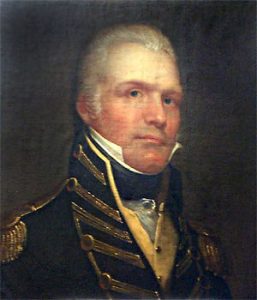
Ransoming Americans was no less expensive, and therefore a very profitable trade for the Muslim terrorists. As John Adams explained:

Isaac Stephens at Algiers. . . . says the price is 6,000 for a master [captain], 4,000 for a mate [officer], and 1,500 for each sailor. The Dey [Muslim ruler] will not abate [drop the price] a sixpence, he says, and will not have anything to say about peace with America. He says the people (that is the sailors, I suppose) are carrying rocks and timber on their backs for nine miles out of the country, over sharp rocks and mountains; that he has an iron round his leg, &c. He begs that we would pay the money for their redemption without sending to Congress, but this is impossible. [23]

In an attempt to secure a release of the kidnapped seamen and a guarantee of unmolested shipping in the Mediterranean, President Washington dispatched diplomatic envoys to negotiate terms with the Muslim nations. [24] They secured several treaties of “Peace and Amity” with the Muslim Barbary Powers to ensure “protection” of American commercial ships sailing in the Mediterranean. [25] And because America had no threat of force against the Muslims, she was required to pay hundreds of thousands of dollars (tens of millions in today’s money) of “tribute” (i.e., official extortion) to the Muslim countries to secure the “guarantee” of no attacks. In fact, one Muslim Ambassador told American negotiators that “a perpetual peace could be made” with his nation for the price of 30,000 guineas [$2.3 million today], with an additional 3,000 guineas [$230,000] fee for himself. [26] Having no other recourse, America paid. Sometimes the Muslims even demanded additional “considerations” – such as building and providing a warship as a “gift” to Tripoli, [27] a “gift” frigate to Algiers, [28] paying $525,000 to ransom captured American seamen from Algiers, [29] etc.

These extortion payments became a significant expense for the American government. In fact, in 1795, payments to Algiers alone (including the ransom payment to free 115 American seamen), totaled nearly one million dollars [30] (and Algiers was just one of the four warring Barbary Powers). Significantly,
America had to obtain a loan from Holland to make the payment, [31] and the entire affair displeased Washington, who considered it a “disgrace” to remit funds for that purpose, preferring rather to inflict “chastisement” upon the terrorists. [32] Nevertheless, the best solution at that time was to continue paying the protection money, for America lacked a military, having neither navy nor army (the army was available only on an as-needed basis to be called up from among the people in case they needed to defend themselves; America had no standing army). Disgusted with the payments, Washington lamented:

Would to Heaven we had a navy able to reform those enemies to mankind – or crush them into non-existence. [33]

By the last year of Washington’s presidency, a full sixteen percent of the federal budget was spent on extortion payments. [34] Thomas Jefferson, who served as Secretary of State under President Washington, believed that a time would come when not only the economic effects of the extortion payments to the Muslim terrorists would be felt by every American but also that using force would be the only practicable way to end the terrorist attacks. He predicted:

You will probably find the tribute to all these powers make such a proportion of the federal taxes as that every man will feel them sensibly when he pays these taxes. The question is whether their peace or war will be cheapest? . . . If we wish our commerce to be free and uninsulted, we must let these nations see that we have an energy [willingness to use force] which at present they disbelieve. The low opinion they entertain of our powers cannot fail to involve us soon in a naval war. [35]

Eventually, Americans reached the point Jefferson had predicted: not only did they feel the economic effects but they also resented the unprovoked attacks and paying for rights already guaranteed by international law. Therefore, tiring of the largely unsuccessful diplomatic approach, military preparations were urged, thus embracing President George Washington’s wise axiom that:

To be prepared for war is one of the most effectual means of preserving peace. [36]

In the last year of Washington’s presidency, he urged Congress to find the revenues to undertake the construction of a U. S. Navy to defend American interests on the high seas. [37] When John Adams became President, he vigorously pursued those plans, earning the title “Father of the Navy.” [38] Yet Adams was reticent to resort to a military solution – not because he opposed the use of force but rather because he didn’t think the people would fully support that option. [39] Furthermore, he believed that even though the extortion payments were high, the increased revenue produced by American commerce in that region would more than cover the costs. [40] Nevertheless, he longed for the change in international attitude that would result if America used military forces to defend our citizens and our rights.

Because America had adopted a policy of appeasement in response to the terrorist depredations, the Barbary Powers viewed America as weak. In fact, William Eaton, whom Adams had dispatched as American diplomat to Tunis (one of the four terrorist powers), reported to Secretary of State Timothy Pickering that “an opinion long since conceived and never fairly controverted among the Tunisians [is] that the Americans are a feeble sect of Christians.” [41] Truly, with no fear of consequence, Muslims found American targets especially inviting, fueling even further attacks.

Adams truly understood the difference that a naval force would make, explaining:

It would be a good occasion to begin a navy. . . . The policy of Christendom [i.e., of the Christian nations not fighting back for their rights] has made cowards of all their [the Christian nations’] sailors before the standard of Mahomet. It would be heroical and glorious in us to restore courage to ours. I doubt not we could accomplish it if we should set about it in earnest. [42]

By the end of Adams’ administration, extortion payments to the Muslim terrorists accounted for twenty percent of the federal budget. [43]

When Thomas Jefferson became President in 1801, having personally dealt with the Muslim Barbary Powers for almost two decades, he had already concluded that there were only three solutions to the terrorist problem: (1) pay the extortion money, (2) keep all American ships out of international waters (which would destroy American commerce), or (3) use military force to put an end to the attacks. [44] Jefferson discarded the first two options, rejecting the second as a matter of bad policy, and the first because:

I was very unwilling that we should acquiesce in the . . . humiliation of paying a tribute to those lawless pirates. [45]

He supported the third option, acknowledging:

I very early thought it would be best to effect a peace through the medium of war. [46]

Jefferson offered several reasons he believed this would be the best policy, including:

Justice is in favor of this opinion; honor favors it; it will procure us respect in Europe, and respect is a safeguard to interest; . . . [and] I think it least expensive and equally effectual. [47]

Jefferson formed this position long before his presidency; so once inaugurated, he began refusing payments to the offending nations. In response, Tripoli declared war against the United States (and Algiers threatened to do so), [48] thus constituting America’s first official war as an established independent nation. Jefferson, determined to end the two-decades-old terrorist attacks, selected General William Eaton (Adams’ Consul to Tunis) and elevated him to the post of “U. S. Naval Agent to the Barbary States,” with the assignment to lead an American military expedition against the four terrorist nations. Using the new American Navy built under Adams, Eaton transported the U. S. Marines overseas; and when the offending nations found themselves confronted by imminent American military action, all but Tripoli backed down.[49]

General Eaton therefore led a successful military campaign against Tripoli that freed captured seaman and crushed the terrorist forces. After four years of fighting, in 1805 Tripoli signed a treaty on America’s terms, thus ending their terrorist aggressions. (It is from the Marine Corps’ role in that first conflict with Muslim terrorists from 1801-1805 that the opening line of the Marine Hymn is derived: “From the halls of Montezuma to the shores of Tripoli . . .”)

American troops returned home, and the region briefly remained quiet, but by 1807, Muslim Algiers had resumed attacks against American ships and sailors. [50] Jefferson, preoccupied with efforts to avoid war with both Great Britain and France, did not return military forces to the region.

Nevertheless, his actions had brought America its first respite to the decades old attacks; so when he left office, Congress congratulated him, noting:

These are points in your administration which the historian will . . . teach posterity to dwell upon with delight. Nor will he forget . . . the lesson taught the inhabitants of the coast of Barbary – that we have the means of chastising their piratical encroachments and awing them into justice. [51]

(Interestingly, Congressman Ellison took his ceremonial oath of office on the Koran owned by Thomas Jefferson. A pertinent question might be: Why did Jefferson own a Koran? A simple answer is: To learn the beliefs of the enemies he was fighting. Recall that Jefferson had been personally exposed to Islamic beliefs when attempting to secure peace between America and Muslim terrorists. Having been told by the Muslim Ambassador that the Koran promised Paradise as a reward for enslaving, killing, and war, Jefferson  inquired into the irrational beliefs that motivated the Muslim groups and individuals warring against America. Therefore, using Jefferson’s Koran was perhaps not as noble an image as Ellison tried to portray, despite his unfounded claim that the Koran is “definitely an important historical document in our national history and demonstrates that Jefferson was a broad visionary thinker. . . . It [the Koran] would have been something that contributed to his own thinking.” [52] The Koran did contribute to Jefferson’s thinking, but certainly not in the sense Ellison meant.)

Barbary Powers During the War of 1812

When President Madison took office, he was immediately engulfed with the issues that led to the War of 1812, and was unable to respond with military force against the renewed terrorist attacks. (Significantly, during that time, American Jewish Diplomat Mordecai Noah negotiated with the Muslims in an attempt to secure the release of captured American Christians. [53])

When the war with the British ended in 1815, Madison dispatched warships and the military against Algiers, Tunis, and Tripoli, placing the American forces under the command of Stephen

Decatur and William Bainbridge (two veteran military heroes of the war on terror under Jefferson). America quickly subdued Algiers and brought her to the peace table where in July 1815, Algiers ratified a treaty freeing all Christians and ending future slavery of Christians. [54] The American fleet then sailed for Tunis, but immediately after their departure, Algiers renounced the treaty. However, two of the other nations being harassed by Muslim terrorists (Great Britain and the Netherlands) brought their fleets against Algiers and promptly defeated her, convincing Algiers to sign a new peace treaty. [55]

Meanwhile, the American forces confronted Tunis, and later returned to Algiers, where in December 1816, another treaty was signed to replace the one Algiers had renounced. [56] Thus America’s first War on Terror against Muslim terrorists was finally ended. After thirty-two years of conflict and six years of armed warfare, the terrorist attacks against Americans finally subsided.

During that extended conflict, the American public learned much about the character of the Muslim terrorists through the official correspondence between the State Department and its diplomats. For example, in addition to the insights gained from diplomats such as Adams and Jefferson, General William Eaton informed the Secretary of State why the Muslims were such dedicated foes:

Taught by revelation that war with the Christians [i.e., America] will guarantee the salvation of their souls, . . . their [the Muslims’] inducements to desperate fighting are very powerful. [57]

Even further insight came from General Eaton’s writings after he commenced military action against Tripoli:

April 8th. We find it almost impossible to inspire these wild bigots with confidence in us or to persuade them that, being Christians, we can be otherwise than enemies to Musselmen [Muslims]. We have a difficult undertaking! [58]

May 23rd. Hassien Bey, the commander in chief of the enemy’s forces, has offered by private insinuation for my head six thousand dollars and double the sum for me a prisoner; and $30 per head for Christians. Why don’t he come and take it? [59]

Throughout the extended conflict, Muslims viewed their actions in terms of a holy war against Christians; America, however, engaged in no religious war. Therefore, in the numerous treaties with the Barbary Powers, America sought to convince the Muslims there was no holy war – that as Christians, America had no hatred of Muslims per se. (Language typical in the treaties was that America had no “enmity against the laws, religion, or tranquility” of the Muslims, and that our substantial differences of “religious opinions shall [n]ever produce an interruption of the harmony between the two nations.” [60]) America did not retaliate against Muslims because of their faith but rather to end their terrorism against Americans.

Faith in the Constitution

At the time the Constitution was written in 1787, and ratified from 1787-1790, Muslim attacks against Americas had been occurring for years. It therefore became an understandable concern of citizens as to whether a Muslim might ever be elected to federal office under the new Constitution. The question was raised because of Article VI in the Constitution, which declared:

The Senators and Representatives . . . shall be bound by oath or affirmation to support this Constitution; but no religious test shall ever be required as a qualification to any office or public trust under the United States.

Citizens wanted to know if the clause prohibiting a religious test (i.e., prohibiting the federal government from examining the religious beliefs of any candidate) meant that Muslims – then warring against America – might be elected to federal office. Not only was that question specifically raised but it was also succinctly answered in the process of debating and ratifying the U. S. Constitution. For example, in the North Carolina ratifying convention, Governor Samuel Johnston explained:

It is apprehended that Jews, Mahometans, Pagans, &c., may be elected to high offices under the government of the United States. Those who are Mahometans (or any others who are not professors of the Christian religion) can never be elected to the office of President or other high office but in one of two cases. First, if the people of America lay aside the Christian religion altogether, it may happen. Should this unfortunately take place, the people will choose such men as think as they do themselves. Another case is if any persons of such descriptions should, notwithstanding their religion, acquire the confidence and esteem of the people of America by their good conduct and practice of virtue, they may be chosen. [61]

Signer of the Constitution Richard Dobbs Spaight similarly explained:

As to the subject of religion. . . . [n]o power is given to the general [federal] government to interfere with it at all. . . . No sect is preferred to another. Every man has a right to worship the Supreme Being in the manner he thinks proper. No test is required. All men of equal capacity and integrity are equally eligible to offices. . . . I do not suppose an infidel, or any such person, will ever be chosen to any office unless the people themselves be of the same opinion. [62]

Supreme Court Justice James Iredell (nominated to the Court by President Washington) agreed:

But it is objected that the people of America may perhaps choose representatives who have no religion at all, and that pagans and Mahometans may be admitted into offices. . . . But it is never to be supposed that the people of America will trust their dearest rights to persons who have no religion at all, or a religion materially different from their own. [63]

Theophilus Parsons (Chief Justice of the Supreme Court of Massachusetts) also affirmed:

No man can wish more ardently than I do that all our public offices may be filled by men who fear God and hate wickedness; but it must remain with the electors to give the government this security. [64]

The scope of Article VI was made clear by the writers and ratifiers of the U. S. Constitution: Muslims could be elected to office – but only if the people of that district desired it. Justice Joseph Story, placed on the Court by James Madison, therefore explained in his famous Commentaries on the Constitution that because of Article VI, on the federal level it was possible that . . .

the Catholic and the Protestant, the Calvinist and the Armenian, the Jew and the Infidel [Muslim], may sit down at the common table of the national councils without any inquisition into their faith or mode of worship. [65]

Through the Constitution, the Framers had constrained the federal government; however, they had left the people completely free – that is, the federal government could not apply any religious test, but the voters could. As a court explained in 1837:

The distinction is a sound one between a religion preferred by law, and a religion preferred by the people without the coercion of law – between a legal establishment which the present constitution expressly forbids . . . and a religious creed freely chosen by the people for themselves. [66]

Keith Ellison

Keith Ellison was selected by the voters of the 5th Congressional District of Minnesota in the process specified by the U. S. Constitution. Perhaps Ellison was chosen because the voters there “laid aside the Christian religion,” or perhaps because Ellison “acquired the confidence and esteem of the people by his good conduct and practice of virtue,” or because “the people themselves are of the same opinion.” The reasons matter not, for Ellison was the legitimate choice of the voters of the 5th District, and neither the federal government nor citizens outside Minnesota’s 5th District may do anything about it. The rest of the nation may be offended by what Ellison did with the Koran, but that is irrelevant to the legitimacy of his office; he was not elected to represent the nation but rather the voters in his district – as the other 434 Members in the U. S. House of Representatives were elected to represent the voters in their respective districts.

Yet, that being said, is there still an understandable element of concern with Ellison’s election? Certainly. After all, America and Americans are currently the target of attacks by members of the same Islamic faith that Ellison professes; and while Ellison may not hold the same specific beliefs as America’s enemies, he nevertheless holds the same religion. That America might be concerned about Ellison because of the behavior of others in his religion may seem unfair, but it is reality. Consider the recent election results as an example.

Exit polls affirm that the top issue for voters in 2006 was “corruption and ethics.” [67] This was logical considering the highly-publicized indictments (and near indictments) of so many Republicans over the previous two years: Rep. Duke Cunningham, Rep. Tom Delay, Rep. Bob Ney, Scooter Libby (Chief of Staff for the Vice-President), Tony Rudy and Michael Scanlon (from the office of the House Majority Leader), Governor Bob Taft, Governor Ernie Fletcher, Karl Rove’s multiple visits to a Grand Jury, the Jack Abramoff scandal, the sex scandal of Rep. Mark Foley, etc. Clearly, Republicans appeared “dirty” (even though Democrat U. S. Rep. William Jefferson was tainted, there were far fewer Democrats in the news for corruption problems); and since “corruption and ethics” was a top issue for voters, Republicans paid the price. Consequently, voters threw several dozen Republicans out of federal office. Yet many Republicans who lost in that political tsunami were completely clean from any charge of corruption (e.g., Rep. Jim Ryun, Rep. John Hostettler, Sen. Jim Talent, etc.); nevertheless, they were the victims of their scandalized associates – that is, the perception accorded the guilty Republicans was projected onto the innocent ones simply by virtue of the fact that they, too, were Republicans. The same is true with Keith Ellison’s Muslim faith.

Ellison may not have the same beliefs as the Muslims who openly decry and even attack America; nevertheless, their behavior reflects on him. It is therefore understandable that citizens outside his district are highly concerned. This concern was heightened by the fact that Ellison himself publicly flaunted his abrogation of American precedent by making his swearing-in on the Koran a national issue. After all, the ceremonial swearing-in is always a private ceremony, and what he did there would not have been an issue; however, he chose to make that private ceremony a public demonstration in the face of all Americans. Did any of the other 434 Members make a national issue of what they would do in their private swearing-in? No, only Ellison; he therefore should not decry the national controversy that he created.

Islam

Furthermore, the religion of Islam, both past and present, has yet to demonstrate that it is friendly to a free government and a free people.

As a modern confirmation of this fact, the U. S. Commission on International Religious Freedom monitors nations for egregious violations of religious liberty, and the current list of the most religiously-intolerant nations in the world is loaded with Islamic nations, including Eritrea, Iran, Pakistan, Saudi Arabia, Sudan, Turkmenistan, and Uzbekistan (secularism and communism join Islam as the other two worst offenders). [68] On the watchlist for serious but slightly less egregious violations are numbers of other Islamic nations, including Bangladesh, Egypt, Indonesia, and Nigeria (secularism and communism again join Islam among the worst violators). [69] Significantly, the Judeo-Christian belief system protects freedom and religious liberty; yet, other belief systems – especially that of Islam – have not exhibited those protections.

That intolerance and tyranny are general traits of Islam was also evident to observers two centuries ago – including political philosopher Charles Montesquieu (a particular favorite of America’s Framers [70]). In what was perhaps his most famous work (Spirit of  Laws, 1748), Montesquieu undertook a perusal of a thousand years of world history to assess the impact of both Islam and Christianity upon government. Based on his investigation, Montesquieu concluded:

A moderate [non-violent, non-coercive] government is most agreeable to the Christian religion, and a despotic government to the Mahometan. [71]

He continued:

The Christian religion is a stranger to mere despotic power. . . . [Christian rulers] are more disposed to be directed by laws and more capable of perceiving that they cannot do whatever they please. While the Mahometan princes incessantly give or receive death, the religion of the Christians renders their princes . . . less cruel. [72]

To demonstrate the truth of this fact, Montesquieu noted:

It is the Christian religion that . . . has hindered despotic power from being established in Ethiopia. [73]

Montesquieu’s reference to Ethiopia is instructive. Ethiopia became a Christian nation shortly after the time of Christ. Islam made its first appearance there in 615 AD; and even though Mohammed described Ethiopia as “a land of righteousness where no one was wronged,” [74] Muslims nevertheless began attempting to conquer and subjugate Ethiopia to the Islamic faith.

While Muslims attacked and swept over the rest of Africa exacting forcible conversions to Islam in a jihad (holy war), they were unable to defeat Christian Ethiopia until 1528 AD. In 1535, Ethiopia’s leader appealed to Europe for help, and by 1543, Christians in Ethiopia had regained their nation. Significantly, both before and after that short period of Islamic rule, Ethiopia was characterized by democratic government and non-coercion in religion. Ironically, Muslim jihads have today been renewed against Christians in Ethiopia, [75] despite the fact that Muslims there are still being well treated by Christians.[76]

Montesquieu, having examined the visible influences of both Christianity and Islam upon governments, therefore recommended:

From the characters of the Christian and Mahometan religions, we ought without any further examination to embrace the one and reject the other; for it is much easier to prove that religion ought to humanize the manners of men than that any particular religion is true. It is misfortune to human nature when religion is given by a conqueror. The Mahometan religion, which speaks only by the sword, acts still upon men with that destructive spirit with which it was founded.[77]

Montesquieu was not the only student of history to reach the same conclusion. For example, president, statesman, international diplomat, and legal scholar John Quincy Adams similarly observed:

[The] law of nations as practiced among Christian nations . . . is founded upon the principle that the state of nature between men and between nations is a state of peace. But there was a Mohametan law of nations which considered the state of nature as a state of war. [78]

And in 1898, Charles Galloway, like so many historians before and after him, also noted:

The Koran puts a premium upon war, offering the highest rewards to those who slay the greatest number of infidels. Mohammed’s cardinal principle (that the end justifies the means) consecrated every form of deception and lying and encouraged every sort of persecution and violence. . . . The citizen is the slave of the state; he has no rights to be respected. Mohammedanism is an absolute despotism. [79]

At about the same time, historian John Fiske reported of Muslim leaders:

The things done daily by the [Muslim] sovereigns were such as to make a civilized imagination recoil with horror. One of these cheerful creatures who reigned in the middle of the eighteenth century, called Muley Abdallah, especially prided himself on his peculiar skill in mounting a horse. Resting his left hand upon the horse’s neck, as he sprang into the saddle he simultaneously swung the sharp scimitar [curved broad-blade sword] in his right hand so deftly as to cut off the head of the groom who held the bridle. From his behavior in these sportive moods one may judge what he was capable of on serious occasions. He was a fair sample of the [Muslim] monarchs. [80]

These examples may seem to be extreme – that only the worst possible claims about Islam have been selected, but such is not the case. As affirmed by the current Commission on International Religious Freedom (as well as many other governmental and non-governmental human rights organizations), these characteristics accurately portray the societal outworkings of Islam today. Keith Ellison may be the one to break this pattern and start something new with Islam, but in the meantime, he should not be surprised that there is widespread concern over his decision to publicly flaunt American tradition and values and replace them with Islamic ones.

Historical Lessons

Having addressed the historical perspective of placing a Muslim in Congress, consider now lessons from history pertinent to the issue of Islam in America today. American Christians (and religious Jews) concerned about the presence of Islam in America should: (1) Keep a Statistical Perspective; (2) Practice Free-Market Pluralism; and (3) Remember the Greater Danger.

1. Keep a Statistical Perspective

According to an ABC News’ Muslim affiliate in Great Britain:

Experts agree Islam is one of the fastest growing religions in America. As many as five million Muslims live in the United States and in the last five years, the number of mosques in this country has increased from 843 to about 1,300. Most of the growth has come from immigration, but much of it is home-grown. For many black Americans [such as Ellison], Islam has become the religion of choice and some one million – mostly men – have converted. [81]

Such news reports abound, and given the regularly demonstrated characteristics of Islam around the world, such reports concern many Americans. However, the claim that Islam is the fastest growing religion in America (and the world) stems primarily from Islamic propaganda rather than actual statistical data. In fact, search the web for the terms “Islam/fastest/growing/religion,” and over eighty percent of the hits link to Islamic websites.

As an example of the propagandist nature of these claims, Muslims proudly assert that Islam is growing at a rate of 235 percent. Yet, what is missing from that claim is the time factor in the rate of growth. If Islam is growing at the rate of 235 percent per year, that would be impressive; but it turns out that it is has grown by 235 percent over a fifty-year period – not nearly as impressive. In fact, the growth of Islam has been primarily from births, not conversions; [82] and numbers of the world’s religions – including Christianity – are growing at a statistically faster rate than Islam. [83]

Furthermore, according to dozens of polls over recent decades, an average of 84 percent of Americans profess Christianity as their personal religion. [84] The next largest religious affiliation is Jewish (about 2 percent [85]), and other groups are even smaller, with Islam ranking third (0.5%), and then Buddhist (0.5%), Hindu (0.4%), Universalist Unitarian (0.3%), [86] and then still smaller groups such as Native American, Scientologist, Baha’I, Taoist, New Age, Eckankar, Rastrafarian, Sikh, Wiccan, Deity, Druid, Santeria, Pagan, Spiritualist, Ethical Culture, etc. [87] The combined total of the different non-Christian religions in America (including both Islam and Judaism) is regularly under four percent. [88]

Significantly, only two religions in America have a following of larger than one percent: Christians (at 84 percent), and Jews (at 2 percent). Muslims rank third in size in America, well below one percent. Therefore, even if Muslims double in size, they still have only half the number of Jews, and will continue to remain third on the overall list. “Fastest-growing” sounds impressive, but it must be kept in perspective – Muslims have “soared” to only 0.5 percent of Americans.

This is not to say that the rise of Islam in America is something to be ignored; far from it. Public policy and immigration policy on this subject should be carefully examined. Nevertheless, the innuendo suggesting the eminent takeover of Islam in America is overblown and should not strike fear into the heart of any American.

2. Practice Free-Market Pluralism

Because of Biblical influences and Christian civil leadership in colonial America, Americans early adopted a Free-Market approach to religion, establishing that approach in law and policy. Significantly, Christian leaders did not advocate this approach because they were indifferent to Christianity or because they believed all religions were equal; they held an opposite position on both points. However, based on Biblical teachings, Christians believed that individuals must make their own voluntary choices about their own faith, and then live with the consequences, even if that choice meant (from a Christian’s viewpoint) the difference between Heaven and Hell.

God established this approach as His modus operandi from the very beginning. In fact, after creating Adam and Eve and placing them in the Garden of Eden, He allowed them a choice – a choice that meant the difference between continued fellowship with Him or separation from Him. There was neither force, nor pressure, nor coercion applied to their decision; it was completely their voluntary choice. They chose poorly, and then lived with the consequences of their choice. God could have prevented them from choosing wrongly, but He allowed them the choice.

Moses followed the same pattern (Deuteronomy 30:19), as did Joshua (Joshua 24:15), and Elijah. In fact, in Elijah’s contest against the prophets of Baal atop Mount Carmel (I Kings 18), he offered the people a choice to follow the God of Israel, or to follow the god Baal:

Elijah told the people, “How long will you waver between two views? If the Lord is God, follow Him; if Baal is god, follow him.” (v. 21)

And not only did Elijah offer the people their choice, but he also permitted the followers of Baal the opportunity to pursue their religion and even encouraged them to take additional time in expressing their religion (vv. 25-29). When they finished, Elijah would present his case for the God of Israel; the people would then make their choice. Elijah – though outnumbered 450 to one (v. 22) – nevertheless believed that when eternal truth was presented and the comparison made, the people would choose correctly.

The New Testament is filled with examples following the same pattern, demonstrated first by Jesus Himself, then by the Apostles Peter and Paul, then by ministers Philip and Timothy, etc. Christians, both then and now – like the prophet Elijah and the prophets before and after him – believed that when truth was presented to people, it would eventually triumph. Therefore, all that was necessary to prevail was to present eternal truth. Sometimes it was accepted (I Thessalonians 2:13); sometimes it was rejected (II Thessalonians 2:10-12); but the individual lived with the consequences either way. Throughout the Scriptures, the key was to present the unvarnished truth; God and the Holy Spirit (not man) would do the work of validating the truth.

Following this Biblical model, the Founders believed that the truth of Christianity would prevail on its own merits – that Christianity need fear no other religion. As Thomas Jefferson explained:

Truth can stand by itself. . . . [I]f there be but one right [religion], and [Christianity] that one, we should wish to see the nine hundred and ninety-nine wandering sects gathered into the fold of truth. But against such a majority we cannot effect this by force. Reason and persuasion are the only practicable instruments. To make way for these, free inquiry must be indulged; and how can we wish others to indulge it while we refuse it ourselves.[89]

Founder Noah Webster (a devout Christian and an early judge and legislator responsible for specific language in the U. S. Constitution) similarly reminded Americans:

Let us reject the spirit of making proselytes to particular creeds by any other means than persuasion. [90]

James Madison agreed:

If the public homage of a people can ever be worthy the favorable regard of the Holy and Omniscient Being to Whom it is addressed, it must be that in which those who join in it are guided only by their free choice – by the impulse of their hearts and the dictates of their consciences; and such a spectacle must be [exciting] to all Christian nations. [91]

Ezra Stiles (1727-1795), Christian theologian and President of Yale, specifically rejoiced in the Free-Market approach to religion produced by American Christianity:

Religious liberty is peculiarly friendly to fair and generous disquisition. Here, Deism will have its full chance; nor need Libertines more to complain of being overcome by any weapons but the gentle, the powerful ones of argument and truth. Revelation [the Bible] will be found to stand the test to the ten thousandth examination. [92]

Because of this Free-Market approach, American Christians openly received numerous religious groups to America, including Jews, Muslims, Buddhists, and many others.

A Christian should never be fearful of any other religion. After all, if an individual has chosen Christianity, it is because he believes it superior to all others; he therefore should never be threatened by a religion that he personally considers weaker than the one he practices. In fact, if Christians fear the power of other religions over the power of their own, then they are in the wrong religion. A Christian’s confidence in his own religion, and his conviction that God will cause the truth to prevail when presented, should cause him not to exclude religious competition but rather to embrace it through America’s historic (and Biblical) Free-Market approach to religion.

3. Remember the Greater Danger

From a societal standpoint, there should be more concern over elected officials who are secularists and will swear an oath on no religious book, than for Muslims who swear on the Koran. After all, secularism presents a greater threat to American traditions and values than does Islam. As Jewish radio host and columnist Michael Medved warns:

It’s secularists and leftists who seek to alter the long-term essence of this deeply religious, majority Christian country . . . rather than believing fanatics who want to remake the nation as an alien, unrecognizable theocracy.[93]

Rabbi Daniel Lapin of the Jewish Policy Center similarly warns:

God help Jews if America ever becomes a post-Christian [secular] society! Just think of Europe![94]

That secularism is more dangerous to a society than any specific religious faith is statistically verifiable. For example, even though tens of millions of lives have been lost at the hands of numerous religious faiths over the past two thousand years (and most of those have indisputably been lost at the hand of Islam), the number of lives lost at the hands of secular governments in just the twentieth century alone is many times greater. For example, there were the 62 million killed by Soviet Communists; the 35 million by Chinese Communists; the 1.7 million by the Vietnamese Communists; the 1.6 million in the Polish Ethnic Cleansing; the 1 million in Yugoslavia; the 1.7 million in North Korea,[95] etc.

Furthermore, the number of deaths perpetrated by individual secular leaders is enormous. For example, Joseph Stalin was responsible for the murder of 42.7 million; Mao Tse-tung, 37.8 million; Hitler, [96] 20.9 million; Vladimir Lenin, 4 million; Pol Pot of the Khmer Rouge, 2.4 million; Yahya Khan, 1.5 million; [97] and numerous others could be listed. Significantly, secularism killed more in one century than did all religions combined in the previous twenty.

This truth was also evident two centuries ago, causing Benjamin Franklin to wisely quip:

If men are so wicked with religion, what would they be if without it? [98]

Founding Father Benjamin Rush (an outspoken evangelical Christian), also understanding the dangers of secularism, likewise acknowledged:

Such is my veneration for every religion that reveals the attributes of the Deity or a future state of rewards and punishments that I had rather see the opinions of Confucius or Mohamed inculcated upon our youth than see them grow up wholly devoid of a system of religious principles. But the religion I mean to recommend in this place is that of the New Testament. . . . [A]ll its doctrines and precepts are calculated to promote the happiness of society and the safety and well being of civil government. [99]

Rush was strongly committed to Christianity and sought to incorporate its principles throughout society (he started the Sunday School movement in America, founded America’s first Bible Society, endorsed the Bible in public schools, started a number of religious schools and universities, etc.); yet, he preferred having any religion in a society rather than no religion. In fact, even Muslims (with the exception of Ellison – at least based on his state legislative voting record) are pro-life, pro-traditional marriage, pro-creation science and Intelligent Design, pro-inalienable rights, etc.; secularists are opposed to every one of these and other traditional moral and religious values.

Therefore, America, while concerned about Ellison and the potential dangers of Islam, should be more concerned about secularists. The reality is that Members of Congress who refuse to swear an oath on any religious book represent a greater threat to American faith and culture than do those who swear on the Koran. These three considerations should keep Americans of Judeo-Christian faith from becoming overly fixated with Ellison’s faith or his flaunting of American traditions and cultural values.

Action Steps

Finally, to ensure that the negative manifestations and characteristics of Islam do not become part of American life or culture, there are several actions that citizens – particularly Christians – can take.

First, pray. (Enough said on this point.)

Second, learn more about Islam, how it operates, and what it teaches. There are numerous excellent primers available on this topic, including the current New York Times bestseller by Robert Spencer: The Truth About Muhammad: Founder of the World’s Most Intolerant Religion, and also The Politically Incorrect Guide to Islam (also by Robert Spencer). The wise recommendation of Chinese General and international relations expert Sun Tzu (544-496 BC) remains applicable today:

If you know the enemy and know yourself, you need not fear the result of a hundred battles. If you know yourself but not the enemy, for every victory gained you will also suffer a defeat. If you know neither the enemy nor yourself, you will succumb in every battle. [100]

Third, Christians should exercise the opportunity to use America’s religious Free-Market system to befriend and evangelize Muslims. On the conviction that through God and the Holy Spirit eternal truth will prevail, share your faith and spiritual truth with Muslims. (The web is full of useful guides on sharing one’s faith with Muslims.)

Fourth, Christians should do all they can to get other Christians out to vote – and to vote their values. In 2004, 28.9 million Evangelicals voted in the elections; [101] in this election, however, only 20.5 million voted [102] (a drop of 8.4 million Evangelicals). If citizens desire to see someone different than Keith Ellison elected to office, they must show up at the polls.

Furthermore, since public policy does not address issues of theology but rather of common values and of one’s philosophy of government, voting Biblical values may result in voting for a candidate that is not of the voter’s particular religion, race, gender, or political party. As Jewish syndicated radio host and columnist Dennis Prager acknowledges:

I am a Jew (a non-denominational religious Jew, for the record), and I would vote for any Muslim, Christian, Buddhist, Mormon, atheist, Jew, Zoroastrian, Hindu, Wiccan, Confucian, Taoist or combination thereof whose social values I share. Conversely, I would not vote for a fellow Jew whose social values I did not share. I want people of every faith, and of no faith, who affirm the values I affirm to enter political life. [103]

Similarly, I am a Protestant Christian, but I will quickly vote for Jews, Mormons, Catholics or any others who embrace Judeo-Christian values in public policy before I would vote for many self-described Evangelicals who do not embrace those values. For example, I would unhesitatingly vote for Jewish Rabbi Daniel Lapin for any office for which he might run – and I would do so over many Evangelicals who might run for the same office, for I personally know the strength of Lapin’s Judeo-Christian worldview and his approach to public policy.

Therefore, determine that it matters not the race, gender, religion, or political party of the candidate, but rather his or her willingness to preserve America’s religious, moral, and constitutional heritage. If Christians are not willing to vote, and to vote their values, then they should not complain about the philosophy or practices of those who are elected to office.

Fifth, if Christians are specifically concerned about Ellison’s Muslim faith, perhaps they should follow the example set by Francis Scott Key in his dealings with John Randolph; get to know him, build a trusting friendship relationship with him, share your Christian faith with him, and see if he will convert to Christianity!

© David Barton, 2007


Endnotes

[1] CNN.com, “Minnesota voters send first Muslim to Capitol Hill” (at https://www.cnn.com/2006/POLITICS/11/08/muslim.elect/).

[2] Detroit Free Press, “1st Muslim congressman thrills crowd in Dearborn” (at https://www.freep.com/apps/pbcs.dll/article?AID=/20061226/NEWS05/612260367).

[3] Townhall.com, “Dennis Prager: America, Not Keith Ellison, decides what book a congressman takes his oath on” (at https://www.townhall.com/columnists/DennisPrager/2006/11/28/america,_not_
keith_ellison,_decides_what_book_a_congressman_takes_his_oath_on
).

[4] Townhall.com, “Dennis Prager: A response to my many critics – and a solution” (at https://www.townhall.com/columnists/DennisPrager/2006/1/05/a_response_to_my_many_critics_-_and_a_solution).

[5]See, for example, Washingtonpost.com, “But It’s Thomas Jefferson’s Koran!” (at https://www.washingtonpost.com/wp-dyn/content/article/2007/01/03/AR2007010300075_pf.html); MSNBC.com, “First Muslim elected to Congress; Minn. Democrat converted in college, was once with Nation of Islam” (at https://www.msnbc.msn.com/id/15613050/); CNN.com, “Minnesota voters send first Muslim to Capitol Hill” (at https://www.cnn.com/2006/POLITICS/11/08/muslim.elect/); and Associated Press of Pakistan, “Keith Ellison is first Muslim member of US Congress” (at https://www.app.com.pk/en/index.php?option=com_content&task=view&id=1547&Itemid=2)..

[6] Hugh A. Garland, The Life of John Randolph of Roanoke (New York: D. Appleton & Co., 1853), Vol. II, p. 102, to Dr. Brockenbrough, September 25, 1818.

[7] Garland, Life of John Randolph, Vol. II, p. 102, to Dr. Brockenbrough, September 25, 1818.

[8] Garland, Life of John Randolph, Vol. II, p. 100, to Dr. Brockenbrough, September 25, 1818.

[9] The Analectic Magazine (Philadelphia: Moses Thomas, 1814), Vol. IV, P. 433, “Defence of Fort M’Henry.”

[10] Garland, Life of John Randolph, Vol. II, pp. 87-88, in a letter from Francis Scott Key, May-June 1816; pp. 99-100, Randolph’s letter to Francis Scott Key, September 7, 1818; pp. 103-104, Key’s letter to Randolph; 106-107, Key’s reply to Randolph’s letter of May 3, 1819; and pp. 108-109, Key’s reply to Randolph’s letter of August 8, 1819.

[11] Garland, Life of John Randolph, Vol. II, pp. 99-100, from a letter to Francis Scott Key, September 7, 1818; pp. 100-102, from a letter to Dr. Brockenbrough, September 25, 1818; p. 106, from a letter to Francis Scott Key, May 3, 1819; pp. 107-109, from a letter to Francis Scott Key, August 22, 1819; pp. 373-374.

[12] National Humanities Center, “Islam in America: From African Slaves to Malcolm X” (at https://www.nhc.rtp.nc.us/tserve/twenty/tkeyinfo/islam.htm).

[13] National Humanities Center, “Islam in America: From African Slaves to Malcolm X” (at https://www.nhc.rtp.nc.us/tserve/twenty/tkeyinfo/islam.htm).

[14] DawaNet, “American Muslim History” (at https://www.dawanet.com/history/amermuslimhist.asp).

[15] The Koran, Commonly Called The Alcoran of Mahomet, Sieur De Ryer, translator (Springfield: Henry Brewer, 1806).

[16] Naval Documents Related to the United States Wars with the Barbary Powers, Claude A. Swanson, editor (Washington: Government Printing Office, 1939), Vol. I, p. v.

[17] A General View of the Rise, Progress, and Brilliant Achievements of the American Navy, Down to the Present Time (Brooklyn, 1828), pp. 70-71.

[18] Thomas Jefferson, The Writings of Thomas Jefferson, Andrew A. Lipscomb & Albert Ellery Bergh, editors (Washington, D. C.: The Thomas Jefferson Memorial Association, 1903), Vol. V, p. 195, to William Carmichael, November 4, 1785.

[19] Thomas Jefferson, The Papers of Thomas Jefferson, Julian P. Boyd, editor (Princeton: Princeton University Press, 1954), Vol. 9, p. 358, Report of Thomas Jefferson and John Adams to John Jay, March 28, 1786.

[20] Naval Documents Related to the United States Wars with the Barbary Powers, Claude A. Swanson, editor (Washington: Government Printing Office, 1939), Vol. I, p. 55.

[21] Jefferson, Papers, Vol. 9, p. 358, to John Jay, March 28, 1786.

[22] Jefferson, Writings, Vol. VI, pp. 47-48, to John Adams, January 11, 1787.

[23] John Adams, The Works of John Adams, Second President of the United States, Charles Francis Adams, editor (Boston: Little, Brown, and Company, 1853), Vol. VIII, p. 394, to Thomas Jefferson, May 23, 1786.

[24] President Washington selected Col. David Humphreys in 1793 as sole commissioner of Algerian affairs to negotiate treaties with Algeria, Tripoli and Tunis. He also appointed Joseph Donaldson, Jr., as Consul to Tunis and Tripoli. In February of 1796, Humphreys delegated power to Donaldson and/or Joel Barlow to form treaties. James Simpson, U. S. Consul to Gibraltar, was dispatched to renew the treaty with Morocco in 1795. On October 8, 1796, Barlow commissioned Richard O’Brien to negotiate the treaty of peace with Tripoli. See, for example, Ray W. Irwin, The Diplomatic Relations of the United States with the Barbary Powers (Chapel Hill: The University of North Carolina Press, 1931), p. 84.

[25] See, for example, the 1787 treaty with Morocco; the 1795, 1815, and 1816 treaties with Algiers; the 1796 and 1805 treaties with Tripoli; and the 1797 treaty with Tunis. The American Diplomatic Code, Embracing A Collection of Treaties and Conventions Between the United States and Foreign Powers from 1778 to 1834, Jonathan Elliot, editor (New York: Burt Franklin, 1970; originally printed 1834), Vol. I, pp. 473-514.

[26] Jefferson, Papers, Vol. 9, p. 358, to John Jay, March 28, 1786.

[27] Gardner W. Allen, Our Navy and the Barbary Corsairs (Boston: Houghton, Mifflin and Company, 1905), p. 66.

[28] Allen, Our Navy, p. 57.

[29] Allen, Our Navy, p. 56.

[30] George Washington, The Writings of George Washington, John C Fitzpatrick, editor (Washington: Government Printing Office, 1940), Vol. 33, p. 385, to the Secretary of the Treasury, May 29, 1794; see also Library of Congress, “American Memory: America and the Barbary Pirates: An International Battle Against an Unconventional Foe” (at https://memory.loc.gov/ammem/collections/jefferson_papers/mtjprece.html).

[31] Washington, Writings, Vol. 33, p. 397, to The Secretary Of The Treasury, June 7, 1794.

[32] Washington, Writings, Vol. 29, p. 185, to Marquis de Lafayette, March 7, 1787.

[33] Washington, Writings, Vol. 28, p. 521, to Marquis de Lafayette, August 15, 1786.

[34] The federal budget was $6,115,000 in 1795; a payment of nearly $1 million was given that year to Algiers alone, not including what was given to the other Barbary Powers. See U.S. Department of Commerce, Bureau of the Census, Historical Statistics of the United States (White Plains, NY: Kraus International Publications, 1989), p. 1106; and Library of Congress, “American Memory: America and the Barbary Pirates: An International Battle Against an Unconventional Foe” (at https://memory.loc.gov/ammem/collections/jefferson_papers/mtjprece.html)

[35] Jefferson, Writings, Vol. V, p. 91, to John Page, August 20, 1785.

[36] Writings of George Washington, John C. Fitzpatrick, editor (Washington: Government Printing Office, 1939), Vol. 30, p. 491. “First Annual Message to Congress,” January 8, 1790.

[37] J. Fenimore Cooper, The History of the Navy of the United States of America (Philadelphia: Thomas, Cowperthwait & Co., 1847), pp. 123-124; see also A Compilation of the Messages and Papers of the Presidents: 1789-1897, James D. Richardson, editor (Washington, D. C.: Published by Authority of Congress, 1897), Vol. I, p. 193, from Washington’s “Eighth Annual Address,” December 7, 1796.

[38] Dictionary of American Navel Fighting Ships, s.v. “John Adams”; see also Hazegrey.org, “Dictionary of American Naval Fighting Ships, Vol. III: John Adams” (at https://www.hazegray.org/danfs/frigates/j_adams.htm).

[39] John Adams, The Works of John Adams, Second President of the United States, Charles Francis Adams, editor (Boston: Little, Brown, and Company, 1853), Vol. VIII, p. 407, to Thomas Jefferson, July 3, 1786.

[40] Adams, Works, Vol. VIII, p. 379, to John Jay, February 22, 1786.

[41] Charles Prentiss, The Life of the Late Gen. William Eaton (Brookfield: Merriam & Company, 1813), p. 146, to Mr. Smith, June 27, 1800.

[42] Adams, Works, Vol. VIII, p. 407, to Thomas Jefferson, July 3, 1786.

[43] Wikipedia, “First Barbary War” (at https://en.wikipedia.org/wiki/First_Barbary_War).

[44] Jefferson, Writings, Vol. V, p. 327, to Colonel Monroe, May 10, 1786.

[45] Jefferson, Writings, Vol. I, p. 97, from Jefferson’s Autobiography.

[46] Jefferson, Writings, Vol. V, p. 364, to John Adams, July 11, 1786.

[47] Jefferson, Writings, Vol. V, p. 365, to John Adams, July 11, 1786.

[48] Naval Documents, Vol. I, pp. 451, 453-454; see also Glen Tucker, Dawn Like Thunder: The Barbary Wars and the Birth of the U. S. Navy (Indianapolis: Bobbs-Merrill Company, 1963), p. 127.

[49] Report of the Committee to Whom was Recommended on the Twenty-Sixth Ultimo A Resolution Respecting William Eaton(City of Washington: A&C Way, 1806), January 8, 1806; Documents Respecting the Application of Hamet Caramalli, Ex-Bashaw of Tripoli (Washington, D.C.: Dwane & Son), pp. 58-60, letter from John Rodgers to Robert Smith, Secretary of the Navy, June 8, 1805.

[50] Glenn Tucker, Dawn Like Thunder: The Barbary Wars and the Birth of the U. S. Navy (Indianapolis and New York: Bobbs-Merrill, 1963), p. 448.

[51] Jefferson, Writings, Vol. XVII, p. 399, from the Congress, “Farewell Address to Thomas Jefferson, President of the United States,” February 7, 1809.

[52] Detroit Free Press, “Ellison: Quran influenced America’s founding fathers” (at https://www.freep.com/apps/pbcs.dll/article?AID=/20070105/NEWS01/70105032/1004/NEWS02).

[53] Frederick C. Leiner, The End of Barbary Terror (Oxford: Oxford University Press, 2006), pp. 29-30; see also Jewish Virtual Library, “Judaic Treasures of the Library of Congress: Mordecai Manuel Noah” (at https://www.jewishvirtuallibrary.org/jsource/loc/noah.html). A description of Noah’s diplomatic service in his own words is found in: Mordecai M. Noah, Travels in England, France, Spain, and the Barbary States, In the Years 1813-14 and 1815 (New York: Kirk and Mercein, 1819).

[54] Treaties and Conventions Concluded Between the United States of America and Other Powers Since July 4, 1776 (Washington: Government Printing Office, 1889), pp. 6-10, “Treaty of Peace and Amity,” June 30 and July 6, 1815, Articles III and VI; see also Yale Law School, “The Avalon Project: Treaty of Peace, Signed Algiers June 30 and July 3, 1815” (at https://www.yale.edu/lawweb/avalon/diplomacy/barbary/bar1815t.htm).

[55] British State Papers (London: James Ridgway and Sons, London, 1977), Vol. 3, p. 516, “Declaration of the Dey of Algiers, relative to the Abolition of Christian Slavery,” August 28, 1816.

[56] Treaties and Conventions Concluded Between the United States of America and Other Powers Since July 4, 1776 (Washington: Government Printing Office, 1889), pp. 10-15, “Treaty of Peace and Amity,” December 22 and 23, 1816; see also Yale Law School, “The Avalon Project: Treaty of Peace and Amity, December 22 and 23, 1816” (at https://www.yale.edu/lawweb/avalon/diplomacy/barbary/bar1816t.htm).

[57] Prentiss, Life, pp. 92-93, to Timothy Pickering, June 15, 1799.

[58] Prentiss, Life, p. 325, from Eaton’s journal, April 8, 1805.

[59] Prentiss, Life, p. 334, from Eaton’s journal, May 23, 1805.

[60] The American Diplomatic Code, Embracing A Collection of Treaties and Conventions Between the United States and Foreign Powers from 1778 to 1834, Jonathan Elliot, editor (New York: Burt Franklin, 1970; originally printed 1834), Vol. I, p. 493, Article 15.

[61] The Debates in the Several State Conventions on the Adoption of the Federal Constitution, Jonathan Elliot, editor (Washington, D. C.: Jonathan Elliot, 1836), Vol. IV, pp. 198-199, Governor Samuel Johnston, July 30, 1788.

[62] Elliot’s Debates, Vol. IV, p. 208, Richard Dobbs Spaight, July 30, 1788.

[63] Elliot’s Debates, Vol. IV, p.194, James Iredell, July 30, 1788.

[64] Elliot’s Debates, Vol. II, p. 90, Mr. Parsons, January 23, 1788.

[65] Joseph Story, Commentaries on the Constitution of the United States (Boston: Hilliard, Gray, and Company, 1833), Vol. III, p. 731, §1873.

[66] State v. Chandler, 2 Harr. 553, 2 Del. 553, 1837 WL 154 (Del.Gen.Sess. 1837).

[67] CNN.com, “Corruption named as key issue by voters in exit polls” (at https://www.cnn.com/2006/POLITICS/11/07/election.exitpolls/index.html).

[68] U.S. Commission on International Religious Freedom, “Countries of Particular Concern” (at https://www.uscirf.gov/countries/countriesconcerns/index.html).

[69] U.S. Commission on International Religious Freedom, “USCRIF Watch List” (at https://www.uscirf.gov/countries/countriesconcerns/watchlist/2006watchList.html).

[70] Donald S. Lutz, The Origins of American Constitutionalism (Baton Rouge, LA: Louisiana State University Press, 1988), pp. 142-145.

[71] Charles Secondat de Montesquieu, Spirit of Laws (London: J. Nourse and P. Vaillant, 1752), Vol. II, p. 147.

[72] Montesquieu, Spirit, Vol. II, p. 147.

[73] Montesquieu, Spirit, Vol. II, p. 147.

[74] Food for the Hungry International, “Christian History: Christianity in Ethiopia” (at https://www.fhi.net/fhius/ethiopiafamine/christian.html).

[75] See Voice of Martyrs Canada, “Continuing Persecution in Rural Ethiopia” (at https://www.persecution.net/news/ethiopia7.html); “Ethiopian Missionary Beaten and Arrested” (at https://www.persecution.net/news/ethiopia8.html); “Ethiopian Evangelist Killed for Refusing to Deny Christ,” (at https://www.persecution.net/news/ethiopia9.html); “Evangelist Badly Beaten” (at https://www.persecution.net/news/ethiopia10.html); “Churches Burned and Christians Attacked” (at https://www.persecution.net/news/ethiopia12.html); “Christians Arrested Following Violence” (at https://www.persecution.net/news/ethiopia13.html); and many others.

[76] Somaliawatch.org, “Coping With Islamic Fundamentalism Before And After September 11” (at https://www.somaliawatch.org/archivemar02/020316601.htm), stating “According to tradition, a group of Arab followers of Islam in danger of persecution by local authorities in Arabia took refuge early in the seventh century in the Aksumite Kingdom of the Ethiopian Christian highlands. They were well treated and permitted to practice their religion as they wished. Consequently, the Prophet Muhammad concluded that Ethiopia should not be targeted for Jihad. Ethiopia’s Christian rulers left no doubt, however, that Islam would be subservient to Christianity. Christian-Islamic relations remained generally cordial until Islamic raids from the Somali port of Zeila plagued the highlands in the late fifteenth century.”

[77] Montesquieu, Spirit, Vol. II, pp. 148-149.

[78] John Quincy Adams, The Jubilee of the Constitution (New York: Samuel Colman, 1839), p. 73.

[79] Charles B. Galloway, Christianity and the American Commonwealth (Nashville, TN: Publishing House Methodist Episcopal Church, 1898), pp. 39-40.

[80] John Fiske, The Critical Period of American History: 1783-1789 (Cambridge: Riverside Press, 1896), p. 158.

[81] BICNews, “Fastest-Growing Religion Often Misunderstood” (at https://www.iol.ie/~afifi/BICNews/Islam/islam21.htm).

[82] FrontPageMag.com, “Don Feder: Oh, Those Mischievous Muslims!” (at https://www.frontpagemag.com/Articles/ReadArticle.asp?ID=25182).

[83] For a statistical analysis, see article The Interactive Bible, “Encyclopedia of Islam Myths” (at https://www.bible.ca/islam/islam-myths-fastest-growing.htm).

[84] Pew Research Center, “The 2004 Political Landscape” (at https://people-press.org/report/display.php3?PageID=757) and “The Diminishing Divide…American Churches, American Politics” (at https://people-press.org/reports/print.php3?PageID=451); The Barna Group, “Annual Study Reveals America Is Spiritually Stagnant” (at https://www.barna.org/FlexPage.aspx?Page=BarnaUpdate&BarnaUpdateID=84) and “American Faith is Diverse, as Shown Among Five Faith-Based Segments” (at https://www.barna.org/FlexPage.aspx?Page=BarnaUpdate&BarnaUpdateID=105); City University of New York, “Graduate Center: American Religious Identification Survey, 2001 (at https://www.gc.cuny.edu/faculty/research_studies/aris.pdf); Adherents.com, “Largest Religious Groups in the United States of America” (at https://www.adherents.com/rel_USA.html) and “Gallup Polling Data over Last Ten Years” (at https://www.adherents.com/rel_USA.html- gallup); Harris Interactive, “Large Majority of People Believe They Will Go to Heaven” (at https://www.harrisinteractive.com/harris_poll/index.asp?PID=167); ABCNews.com, “Poll: Most Americans Say They’re Christian; Varies Greatly From the World at Large” (at https://abcnews.go.com/print?id=90356); American Public Media, “A Look at Americans and Religion Today” (at https://speakingoffaith.publicradio.org/programs/godsofbusiness/galluppoll.shtml); The Gallup Poll, “Focus On Christmas” (at https://poll.gallup.com/content/default.aspx?ci=14410&pg=2); Baylor University, “American Piety in the 21st Century” (at https://www.baylor.edu/content/services/document.php/33304.pdf).

[85] City University of New York, “Graduate Center: American Religious Identification Survey, 2001” (at https://www.gc.cuny.edu/faculty/research_studies/aris.pdf); Adherents.com, “Gallup Polling Data over Last Ten Years” (at https://www.adherents.com/rel_USA.html- gallup); Pew Research Center, “The 2004 Political Landscape” (at https://people-press.org/reports/display.php3?PageID=757).

[86] City University of New York, “Graduate Center: American Religious Identification Survey, 2001” (at https://www.gc.cuny.edu/faculty/research_studies/aris.pdf).

[87] City University of New York, “Graduate Center: American Religious Identification Survey, 2001” (at https://www.gc.cuny.edu/faculty/research_studies/aris.pdf).

[88] City University of New York, “Graduate Center: American Religious Identification Survey, 2001” (at https://www.gc.cuny.edu/faculty/research_studies/aris.pdf).

[89] Thomas Jefferson, Notes on the State of Virginia (Philadelphia: Matthew Carey, 1794), pp. 233-234, “Query 17.”

[90] Noah Webster, An Oration Pronounced Before The Citizens of New-Haven On The Anniversary Of The Independence Of The United States, July 4, 1798 (New-Haven: T. and S. Green, 1798), p. 13.

[91] James Madison, A Proclamation, for September 9, 1813, from The Weekly Register, Saturday, July 31, 1813, p. X.

[92] Ezra Stiles, The United States Elevated To Glory And Honor A Sermon, At the Anniversary Election, May 8th, 1783 (New Haven, MA: Thomas & Samuel Green, 1783), p. 56.

[93] Townhall.com, “Michael Medved: Religion, madness and secular paranoia” (at https://www.townhall.com/columnists/MichaelMedved/2006/10/04/religion,_madness_and_secular_paranoia).

[94] WorldNetDaily, “Rabbi Daniel Lapin: Which Jews does the ADL really represent?” (at https://worldnetdaily.com/news/article.asp?ARTICLE_ID=51671).

[95] R. J. Rummel, Death By Government (New Brunswick: Transaction Publishers, 1994), p. 4.

[96] Despite the fact that some Holocaust survivors believe Hitler to have been a Christian, recent documentation made available from the OSS (the noted intelligence agency of World War II), proves that Hitler was anti-Christian and that the Nazis engaged in a systematic campaign to eradicate European Christianity. See Nuremberg Project, “July 6, 1945 – The Nazi Master Plan: The Persecution of the Christian Churches” (at https://org.law.rutgers.edu/publications/law-religion/nurinst1.shtml); see also Christianity Today, “Christian History Corner: Final Solution, Part II” (at https://www.christianitytoday.com/ct/2002/102/52.0.html), and BBC News, “Nazi trial documents made public” (at https://news.bbc.co.uk/1/hi/world/americas/1753469.stm). Furthermore, Hitler killed more than twice as many Gentiles as Jews (while Hitler had 6 million Jews murdered, he was responsible for the deaths of a total of 20.9 million people. See Rummel, Death, p. 8. And both he and the Nazi party were linked to anti-Biblical occultism (see, for example, The History Channel, “In Search of History: Hitler and the Occult” (at https://store.aetv.com/html/product/index.jhtml?id=72289&
browseCategoryId=&location=&parentcatid=&subcatid
), and the list of books at Brough’s Books, “Nazi Occultism” (at https://www.dropbears.com/b/broughsbooks/military/occult_nazism.htm).

[97] Rummel, Death, p. 8.

[98] Benjamin Franklin, The Works of Benjamin Franklin, Jared Sparks, editor (Boston: Tappan, Whittemore and Mason, 1840), Vol. X, p. 282, to Thomas Paine.

[99] Benjamin Rush, Essays, Literary, Moral and Philosophical (Philadelphia: Thomas & Samuel F. Bradford, 1798), p. 8, “Of the Mode of Education Proper in a Republic.”

[100] Yuni Words of Wisdom, “Sun Tzu on The Art of War: An Intelligent Guide to Life Strategies and Wisdom” (at https://www.yuni.com/library/suntzu.htm).

[101] In the 2004 elections, a total of 125,736,000 votes were cast; twenty-three percent of voters were “Evangelicals,” thus translating into 28.9 million votes. See sources at New York Times, “Religious Voting Data Show Some Shift, Observers Say,” (at https://select.nytimes.com/gst/abstract.html?res=F50F17F7355B0C7A8CDDA80994DE404482
&n=Top%2fReference%2fTimes%20Topics%2fSubjects%2fE%2fEvangelical%20Movement
); and U. S. Census Bureau, “Voting and Registration in the Election of November 2004” (at https://www.census.gov/prod/2006pubs/p20-556.pdf).

[102] In the 2006 elections, a total of 85,251,089 votes were cast; twenty-four percent of voters were “Evangelicals,” thus translating into 20.5 million votes. See sources at George Mason University, “United States Elections Project: 2006 Voting-Age and Voting-Eligible Population Estimates” (at https://elections.gmu.edu/Voter_Turnout_2006.htm); New York Times, “Religious Voting Data Show Some Shift, Observers Say” (at https://select.nytimes.com/gst/abstract.html?res=F50F17F7355B0C7A8CDDA80994DE404482
&n=Top%2fReference%2fTimes%20Topics%2fSubjects%2fE%2fEvangelical%20Movement
).

[103] “A response to my many critics – and a solution,” Dennis Prager, Tuesday, December 5, 2006 (at https://www.townhall.com/columnists/DennisPrager/2006/12/05/a_response_to_my_many_critics_-_and_a_solution).

* This article concerns a historical issue and may not have updated information.

Religious Freedom Sunday

religious-freedom-sunday-1January 16, 1786, was the day that the Virginia Assembly adopted the Act for Establishing Religious Freedom, finally ending the official state-established church in Virginia. It provided that (1) all individuals would be free from any punishment for not conforming to state-established religious mandates, and (2) one’s religious affiliation would no longer affect the civil privileges he could enjoy 1. In short, in Virginia it legally secured religious toleration and protection for the right of religious conscience.

The Virginia Act, drafted by Thomas Jefferson in 1777, originally failed to pass when brought before the State Assembly in religious-freedom-sunday-21779 2. James Madison later reintroduced the measure, and it was finally enacted in 1786. Jefferson considered it one of his three greatest achievements, ranking it along with penning the Declaration of Independence and establishing the University of Virginia.

This act was reflective of the attitude that had developed across much of America toward securing full religious liberty for all — an attitude later embodied in the federal Bill of Rights’ 1st Amendment to the Constitution.

Each year, in commemoration of religious freedom (one of the most important of our freedoms), the President proclaims January 16th to be Religious Freedom Day 3. Religious Freedom Sunday is commemorated the Sunday before Religious Freedom Day, and this year, Religious Freedom Sunday falls on January 11th.

Gateways to Better Education have teamed up to provide ways for Christians and churches to celebrate this important day and to participate in encouraging the free exercise of religion. But don’t stop with just celebrating Religious Freedom Day at your church, make sure the schools in your area also recognize this special holiday. (Gateways to Better Education has a guidebook to help you enlighten those in the education system about this important day.)

Happy Religious Freedom Sunday!


Endnotes

1 https://www.virginiamemory.com/docs/ReligiousFree.pdf
2 https://www.virginiamemory.com/online_classroom/shaping_the_constitution/doc/religious_freedom
3 https://religiousfreedomday.com/. See, for example, proclamations by George H.W. Bush in 1992 (https://www.presidency.ucsb.edu/node/268664); William Clinton in 1996 (https://www.presidency.ucsb.edu/node/222064); George W. Bush in 2003 (https://www.presidency.ucsb.edu/node/212361); and Barack Obama in 2011 (https://www.presidency.ucsb.edu/node/289040).

Who Led the Plymouth Pilgrims?

And thus they found the Lord to be with them in all their
ways, and to bless their outgoings & incomings, for which
let his holy name have the praise for ever, to all posterity.
-William Bradford

The first officially-celebrated federal holiday was that of Thanksgiving, declared by President George Washington within a few months after his inauguration. 1 Thanksgiving, a long-cherished holiday celebration of rejoicing and giving thanks to God, has a long history in America from both before and after that 1789 proclamation.

Out of many historic celebrations of Thanksgiving, the most well known and closely emulated was the feast of the pilgrims as they celebrated the goodness of God in keeping them alive through a hard season, and providing them with food and shelter to face the coming winter. One of those attending what is known as the first thanksgiving was the Pilgrim’s newly chosen governor, William Bradford.

who-led-the-plymouth-pilgrims-1

As a young orphan, William Bradford sought revelation through the Bible. 2 Living near Scrooby, England, he became acquainted with the Puritans and the separatist movement.  Drawn by the simplicity of their services, and their commitment to both religious and political reforms, he joined the congregation, despite his family’s disapproval. 3

When the English threatened permanent imprisonment for those who criticized the corrupt practices of both the state and the church, the Scrooby church fled to Amsterdam to take refuge from the growing persecution. 4 Following a decade of relative peace in Holland, the religious climate became volatile due to a potential looming war with Spain and the secular behavior of the Dutch, 5 so the Pilgrims therefore decided to start a new English colony in America. 6
who-led-the-plymouth-pilgrims-2At 30 years of age, William Bradford and his wife Dorothy left  behind their 4 year-old son to make the perilous journey, along with 100 other congregation members. 7 While anchored off the coast of the New World, Dorothy fell overboard and drowned. 8

Over the following winter, one half of the 102 colonists died from hunger, exposure, or disease. 9  In 1621 following that brutal winter, William Bradford was chosen governor of the colony to replace John Carver, one of those who died.  With the exception of a few years, he continued to serve in that capacity for virtually the rest of his life. 10

The University of Kentucky highlights William Bradford and his account of the first years of the colony in their online course, American Literature from 1600-1865.  Throughout this course the reading assignments go back to the original documents, and you can read about the early years of America in the very words of those who lived then.


Endnotes

1 George Washington, Thanksgiving Proclamation, November 26, 1789; as published in The Providence Gazette and Country Journal on October 17, 1789.
2 Jeremy Belknap, American Biography (New York: Harper & Brothers, 1855), Vol. III, p. 7, “William Bradford.”  See also, Caleb Johnson, “William Bradford,” Mayflower History (at: https://mayflowerhistory.com/bradford-william/) (accessed on November 26, 2014).
3 Caleb Johnson, “William Bradford,” Mayflower History (at: https://mayflowerhistory.com/bradford-william/) (accessed on November 26, 2014).< 4 William Allen, The American Biographical Dictionary, (Boston: J.P. Jewett and Company, 1857), p. 117, “Bradford, William“; Dorothy Honiss Kelso, “Beyond the Pilgrim Story: William Bradford,” Pilgrim Hall Museum (at: https://www.pilgrimhallmuseum.org/william_bradford.htm) (accessed November 18, 2014); Jeremy Belknap, American Biography (New York: Harper & Brothers, 1855), Vol. III, pp. 17-52, “William Bradford.”
5 Emma Willard, History of the United States, Or, Republic of America (Philadelphia: A.S. Barnes & Company, 1843), p. 33. See also,  William Bradford and Valerian Paget, Bradford’s History of the Plymouth Settlement 1608-1650: Rendered into Modern English (New York: John McBride Company, 1909), pg. 21.
6 Dorothy Honiss Kelso, “Beyond the Pilgrim Story: William Bradford,” Pilgrim Hall Museum (at: https://www.pilgrimhallmuseum.org/william_bradford.htm) (accessed November 18, 2014). See also, Emma Willard, History of the United States, Or, Republic of America (Philadelphia: A.S. Barnes & Company, 1843), p. 33.
7 Dorothy Honiss Kelso, “Beyond the Pilgrim Story: William Bradford,” Pilgrim Hall Museum (at: https://www.pilgrimhallmuseum.org/william_bradford.htm) (accessed November 18, 2014).
8 Jacob Bailey Moore, Lives of the Governors of New Plymouth and Massachusetts Bay (Boston: C.D. Strong, 1851), p. 88.
9 William Bradford and Valerian Paget, Bradford’s History of the Plymouth Settlement 1608-1650: Rendered into Modern English (New York: John McBride Company, 1909), pp. 74-76.
10 William Allen, The American Biographical Dictionary,  (Boston : J.P. Jewett and Company, 1857), pp. 117-121, “Bradford, William.” See also, Dorothy Honiss Kelso, “Beyond the Pilgrim Story: William Bradford,” Pilgrim Hall Museum (at: https://www.pilgrimhallmuseum.org/william_bradford.htm) (accessed November 18, 2014); Caleb Johnson, “William Bradford,” Mayflower History (at: https://mayflowerhistory.com/bradford-william/) (accessed on November 26, 2014).

The Constitution and a Duel – What do they have in Common?

September 17th is Constitution Day, the anniversary of the signing of the Constitution. Our Constitution secures our God-given freedoms that were set forth in the Declaration of Independence, and today we add yet another year to our unsurpassed record as the longest ongoing constitutional republic in the world.

the-constitution-and-a-duel-what-do-they-have-in-common-2 A Founding Father who exerted great influence in our constitutional government was Alexander Hamilton. As a delegate to the Constitutional Convention of 1787, and one of its thirty-nine signers, he played what would be considered a minor role in the debates of the Convention itself. However he (along with John Jay and James Madison) became one of the three men most responsible for the adoption and ratification of the Constitution through the writing and publication of a series of articles which became known as The Federalist Papers.

Hamilton’s career was distinguished, including his service not only as a military aide to General George Washington and his own rise to a military general under Washington, but also as America’s first Secretary of the Treasury under President Washington. But notwithstanding such achievements, he is perhaps best known today today for his duel with Aaron Burr.

In the election of 1800, Hamilton worked against the re-election of incumbent president John Adams. When Aaron Burr and Thomas Jefferson tied in the vote for president, as required by the Constitution, the contest was sent to the House of Representatives for them to choose a winner. Hamilton strongly supported Jefferson over his fellow-New-Yorker Burr. 1

the-constitution-and-a-duel-what-do-they-have-in-common-4(By the way, during that election cycle in 1800, a number of ministers preached and published pulpit sermons against Jefferson, including Hamilton’s good friend, the Rev. John Mitchell Mason.)

In 1802, Hamilton urged the formation of a “Christian Constitutional Society” whose two-fold goal was “1st, the support of the Christian religion; 2nd, the support of the Constitution of the United States.”2 The purpose of the society was to elect to office those who supported Christianity and the Constitution. Hamilton saw an intrinsic relation between Christianity, the Constitution, and a strong and safe America, and he never viewed the Constitution as a secular document. He openly declared:

For my own part, I sincerely esteem it a system which without the finger of God [Luke 11:20] never could have been suggested and agreed upon by such a diversity of interests.3

Hamilton’s dream for his Christian Constitutional Society never came to pass. In 1804, he was shot down by Burr in a duel spurred by Burr’s frustration of Hamilton having thwarted so many of his political ambitions.4 (Burr was an egotistic and ambitious man who actually tried to build an empire for himself in what is now Mexico 5). The Rev. Mason attended Hamilton in the hours after he was shot. After Hamilton’s death, he released a pamphlet that included Hamilton’s personal account of the duel as well as Hamilton’s repeated affirmation of his firm personal reliance on God for his salvation.6

As we celebrate our great Constitution, let us not forget those who helped shape it and secured to us the blessings we enjoy today — leaders such as Alexander Hamilton!


Endnotes

1 Appletons’ Cyclopedia of American Biography. 6 vols. New York: D. Appleton & Co., 1889, s.v. “Hamilton, Alexander.” See also, Dictionary of American Biography. 21 vols. New York: Charles Scribner’s Sons, 1932, s.v. “Hamilton, Alexander.”
2 Alexander Hamilton to James A. Bayard, April 16-21, 1802, National Archive, https://founders.archives.gov/documents/Hamilton/01-25-02-0321.
3 Alexander Hamilton to Mr. Childs, Wednesday, October 17, 1787, The Federalist and Other Contemporary Papers on the Constitution of the United States, ed. E.H. Scott (New York: Scott, Foresman and Company, 1894), 646.
4 Dictionary of American Biography. (New York: Charles Scribner’s Sons, 1932), s.v. “Hamilton, Alexander;” Appletons’ Cyclopedia of American Biography. (New York: D. Appleton & Co., 1889), s.v. “Hamilton, Alexander.”
5 “Aaron Burr (1801-1805),” Miller Center, accessed October 27, 2023, https://millercenter.org/president/jefferson/essays/burr-1801-vicepresident.
6 J. M. Mason, An Oration Commemorative of the Late Major General Alexr. Hamilton (London: R. Edwards, 1804).

America’s Birthday Over the Centuries

Americans celebrate our national birthday each year on July 4th. Our country’s unprecedented freedom was the result of specific ideas, including those drawn directly from the Bible.

At the 150th anniversary celebration of the Declaration of Independence, President Calvin Coolidge affirmed:

happy-fourth-of-july-6No one can examine this record and escape the conclusion that in the great outline of its principles the Declaration was the result of the religious teachings of the preceding period. . . . They are found in the texts, the sermons, and the writings of the early colonial clergy who were earnestly undertaking to instruct their congregations in the great mystery of how to live. . . . Placing every man on a plane where he acknowledged no superiors, where no one possessed any right to rule over him, he must inevitably choose his own rulers through a system of self-government.1

On the 200th anniversary, President Gerald Ford also affirmed its Biblical roots:

Our Bicentennial is the happy birthday of all fifty States, a commonwealth, and self-governing territories. It is not just a celebration for the original Thirteen Colonies. . . . The earliest English settlers carried the Bible and Blackstone’s Commentary. . . . [and] American families in prairie schooners like these took with them on the overland trails the principles of equality and the God-given rights of the Declaration of Independence.2

Each year on July 4th, let’s make sure we preserve our memory of these unique governing principles.  Here are three simple things you and your family can do:

  • Read the Declaration of Independence.3 Reading the Declaration is rewarding as it is a deep and rich document. The Declaration gives the twenty-seven reasons that America was birthed, and sets forth the immutable principles of American government. These principles were the ones on which the Founders later erected the Constitution of the United States.
  • There were fifty-six signers of the Declaration. Find one you don’t know – perhaps one you’ve never heard of before; look him up and read a short biography about him4. Or get a copy of Lives of the Signers, so that you can have biographies about each one of the signers. In short, rediscover a new Founder.
  • John Adams said that Independence Day “ought to be commemorated as the day of deliverance by solemn acts of devotion to God Almighty. It ought to be solemnized with pomp and parade, with shows, games, sports, guns, bells, bonfires, and illuminations from one end of this continent to the other, from this time forward forevermore.”5 So enjoy the fireworks and parades and celebration – but also make sure to honor and thank God – make it a day celebrated “with solemn acts of devotion to God Almighty.”

May God continue to shed His grace on America!


Endnotes

1 Calvin Coolidge, “Address at the Celebration of the 150th Anniversary of the Declaration of Independence in Philadelphia,” July 5, 1926, The American Presidency Project.
2 Gerald R. Ford, “Remarks in Valley Forge, Pennsylvania,” July 4, 1976, The American Presidency Project.
3 “Declaration of Independence: A Transcript,” National Archives, accessed December 14, 2023.
4 Online sources for biographies of the Declaration signers include: ushistory.org, and the National Park Service. A comprehensive collection of biographies for each signer was done by John Sanderson in the 1820s. You can also read about the signers wives in The Pioneer Mothers of America.
5 John Adams to Abigail Adams, July 3, 1776, Letters of John Adams Addressed to His Wife, ed. Charles Francis Adams (Boston: Charles C. Little and James Brown, 1861), I:128-129.