Political Parties and Racial Equality

No, Salon, It is Democrats, not Republicans, Who Need to
“hide” When it Comes to Promoting Racial Equality

by Dr. David Barton

Dr. Paul Escott, professor of history at Wake Forest University, wrote a book entitled Lincoln’s Dilemma: Blair, Sumner, and the Republican Struggle over Racism and Equality in the Civil War Era (2014). The website Salon published a part of this work as an essay entitled “Republicans hide behind ‘the party of Lincoln’ to deflect racism charges. The party’s history is more complicated.”1

Much of Escott’s article accurately demonstrates that Lincoln opposed slavery and that the Republican Party was founded to combat this vile institution. But the essay’s title suggests otherwise. Whether it was professor Escott who wrote the title, or an over-eager editor at Salon, it is profoundly misleading, as are parts of the essay.

For instance, Escott asserts that Lincoln engaged in racist acts as a young politician. As evidence, he writes:

As a young politician, Lincoln engaged in the race-baiting and racist rhetoric that was common among Illinois politicians. While his party’s newspaper, the Sangamo Journal, accused a Democratic presidential nominee of “love for free negroes,” the young Lincoln charged that his “very trail might be followed by scattered bunches of Nigger wool.”2

Escott seems to believe that this 1840 quotation is a “smoking gun” that proves Lincoln to be a racist. But these were not Lincoln’s words.

The event that gave rise to this specific quote was an April 17, 1840 story in the State Register, where a pro-slavery Democrat sought to sully the reputation of the Whig Abraham Lincoln by claiming he was descended from blacks – that he was “from outward appearance originally from Liberia.”3 Since Democrats at this time generally saw blacks as subhuman,4 this was intended to denigrate Lincoln. But Lincoln replied ably to the attack.5

Three weeks later, on May 8, 1840, J. A. Chestnut wrote a response in the Sangamo Journal, defending Lincoln from the attack in the State Register.6 He openly ridiculed Lincoln’s attacker and, like the attacker, used insultingly racist language. In Chestnut’s opinion, Lincoln had “showed in his speech” that the head of his opponent’s party was “clothed with the sable furs of Guinea – whose breath smells rank with devotion to the cause of Africa’s sons – and whose very trail might be followed by scattered bunches of Nigger wool.”7 These are offensive words, but they belong to Chestnut, not Lincoln. Although he was purporting to describe a speech by Lincoln speech, even Chestnut does not pretend that Lincoln said these specific words.

Escott, in his attempt to “complicate” history, misattributes Chestnut’s words to Lincoln. At best, this is a significant error. At worst, it is dishonest revisionism.

Ironically, most of Escott’s article supports the idea that Lincoln was not a racist and that the Republican Party was founded to combat slavery and racism. This view can easily be supported with additional evidence. For example:

  • The national party platforms of 1856, 1860, and 1864 (the presidential elections leading up to and during Lincoln’s administration) show the Democrats as open and proud racists and Republicans as ardent civil rights proponents.8 In fact, the Republican platform of 1856 had only nine planks, and seven of them directly addressed achieving racial equality and civil rights.9
  • When the Thirteenth Amendment abolishing slavery was voted on by Congress in 1865, only 19 of the 82 (that is, 23 percent of) House Democrats voted to end slavery, but all 118 of the Republicans voted to end slavery.10
  • A similar voting pattern is visible in the passage of the other two racial Civil Rights Amendments (the Fourteenth Amendment of 1868, and the Fifteenth Amendment of 1870)11 as well as the first two dozen civil rights laws passed in Congress.12 In fact, in the 1875 anti-Klan bill, not a single Democrat in Congress voted either to outlaw or punish the Ku Klux Klan.13
  • All of the notorious Jim Crow laws and onerous Black Codes were enacted by Democrat legislatures and signed into law by Democrat governors.14
  • It was not until 1944 that the U. S. Supreme Court struck down the Democrat Party’s long-standing official policy of white-only primaries.15
  • Blacks from the south were not elected to Congress as Democrats until 1974, and then only after the U. S. Supreme Court ruled that the Democrat Party must stop drawing election lines to prevent blacks from being elected.16

Without a doubt some early Republicans were racists, and it would be shocking indeed if Lincoln never made a racist comment. But that is no excuse to misattribute Chestnut’s words to him and by any measure, the Democratic Party has been far more racist than has the Republican Party. So there is no need for contemporary Republicans to “hide” behind the Party of Lincoln. Instead, they should – and do – proudly embrace the Party’s long history of fighting for racial equality,17 despite what Salon wrongly claims.


Endnotes

1Racism the founding of the GOP: Abraham Lincoln, the Civil War and the real history of the Republican Party,” Salon, September 13, 2014.

2Racism the founding of the GOP: Abraham Lincoln, the Civil War and the real history of the Republican Party,” Salon, September 13, 2014.

3 Herbert Mitang, Abraham Lincoln: A Press Portrait (Chicago: Quadrangle Books, 1971), 18-20, quoting from J. A. Chestnut as published in the Sangamo Journal of May 8, 1840.

4 Indications of this belief by Democrats were expressed in many ways over the two decades preceding this incident. For example, in 1820 the Democrat-controlled Congress passed the Missouri Compromise (Debates and Proceedings in the Congress of the United States, 2555-2559, 16th Congress, 1st Session, “An act to authorize the people of Missouri Territory to form a constitution and state government,” approved March 6, 1820). It was the first federal act that expanded rather than reduced slavery in America. It repealed the 1789 law signed by President George Washington that forbid slavery in any federal territory (Acts Passed at a Congress of the United States of America Begun and Held at the City of New-York, on Wednesday the Fourth of March, in the Year 1789 (Hartford: Hudson & Goodwin, 1791), 104, August 7, 1789), which at that time included what became Ohio, Indiana, Illinois, Michigan, Wisconsin, and Minnesota. But as a result of the law passed by Democrats, slavery would no longer by banned in all federal territories but would now be permitted in certain ones. Consequently states began to enter the Union in pairs – one slave state and one free state together (“Missouri Compromise,” Library of Congress (accessed on September 7, 2016)) and slavery began to expand nationally with direct Democrat assistance. Later, the Democrat Platform of 1840 offered a strong defense of slavery, stating that “that all efforts by Abolitionists or others made to induce Congress to interfere with questions of slavery, or to take incipient steps in relation thereto, are calculated to lead to the most alarming and dangerous consequences, and that all such efforts have an inevitable tendency to diminish the happiness of the people and endanger the stability and permanence of the Union,” thus expressing the amazing Democrat belief that efforts to end slavery in America reduced the happiness of the people. Subsequent Democrat platforms took even stronger positions for slavery and against blacks. (See, for example, Thomas Hudson McKee, The National Conventions and Platforms of All Political Parties, 1789-1905 (reprinted New York: Burt Franklin, 1971), 41-42, 48, 60, and passim.)

5 Herbert Mitang, Abraham Lincoln: A Press Portrait (Chicago: Quadrangle Books, 1971), 18-20, quoting from J. A. Chestnut as published in the Sangamo Journal of May 8, 1840.

6 Herbert Mitang, Abraham Lincoln: A Press Portrait (Chicago: Quadrangle Books, 1971), 18, quoting from J. A. Chestnut as published in the Sangamo Journal of May 8, 1840; Richard Lawrence Miller, Lincoln and His World: Prairie Politician, 1834-1842 (Mechanicsburg, PA: Stackpole Books, 2008), 382.

7 Herbert Mitang, Abraham Lincoln: A Press Portrait (Chicago: Quadrangle Books, 1971), 18-20, quoting from J. A. Chestnut as published in the Sangamo Journal of May 8, 1840.

8 See, for example, Republican Campaign Edition for the Million (Boston: John Jewett & Co., 1856), 3-8; Thomas Hudson McKee, The National Conventions and Platforms of All Political Parties, 1789-1905 (New York: Burt Franklin, 1971), 91, 97-99, 108-109, 113-116, 125; an original 1864 broadside of the Republican Party Platform in our possession.

9 Republican Campaign Edition for the Million (Boston: John Jewett & Co., 1856), 3-8; Thomas Hudson McKee, The National Conventions and Platforms of All Political Parties, 1789-1905 (New York: Burt Franklin, 1971), 97-99.

10 Journal of the House of Representatives, 38th Congress, 2nd Session (Washington: Government Printing Office, 1865), pp. 168-171, January 31, 1865; Journal of the Senate, 38th Congress, 1st Session (Washington: Government Printing Office, 1863), 313, April 11, 1864.

11 Journal of the House of Representatives of the United States of America (Washington: Government Printing Office, 1866), Vol. 63, pp. 833-834, “June 13, 1866”; Journal of the Senate of the United States of America (Washington: Government Printing Office, 1865), 58:505, “June 8, 1866”; Journal of the House of Representatives of the United States (Washington, DC: Government Printing Office, 1869), 449-450, 40th Congress, 3rd Session, February 25, 1869; Journal of the Senate of the United States (Washington, DC: Government Printing Office, 1869), 361, 40th Congress, 3rd Session, February 25, 1869.

12 Statutes . . . from December, 1865, to March, 1867, 14:27-30, 39th Congress, 1st Session, Chapter 31, April 9, 1866, “An Act to protect all Persons in the United States in their Civil Rights”; Statutes . . . from December, 1865, to March, 1867,  14,:50, 39th Congress, 1st Session, Chapter 86, May 21, 1866, “An Act to prevent and punish Kidnapping”; p. 236, Chapter 240, July 25, 1866, “An Act legalizing Marriages and for other Purposes in the District of Columbia”; Statutes . . . from December, 1865, to March, 1867, 14:375-376, 39th Congress, 2nd Session, Chapter 6, January 8, 1867, “An Act to regulate the elective Franchise in the District of Columbia”; 379-380, Chapter 15, January 25, 1867, An Act to regulate the elective Franchise in the Territories of the United States”; 391-392, Chapter 36, February 9, 1867, “An Act for the Admission of the State of Nebraska Into the Union”; 428-430, Chapter 153, March 2, 1867, “An Act to provide for the more efficient Government of the Rebel States”; 546, Chapter 187, March 2, 1867, “An Act to abolish and forever prohibit the System of Peonage”; Statutes . . . from December, 1867, to March, 1869, 15:72-73, 40th Congress, 2nd Session, Chapter 69, June 22, 1868, “An Act to admit the State of Arkansas to Representation in Congress”; 73-74, Chapter 70, June 25, 1868, “An Act to admit the States of North Carolina, South Carolina, Louisiana, Georgia, Alabama, and Florida to Representation in Congress.” Statutes . . . from December 1869 to March 1871, 16:3, 41st Congress, 1st Session, Chapter 3, March 18, 1869, “An Act for further Security of equal Rights in the District of Columbia.” Statutes . . . from December 1869 to March 1871, 16:62-63, 41st Congress, 2nd Session, Chapter 10, January 26, 1870, “An Act to admit the State of Virginia to Representation”; 67-68, Chapter 19, February 28, 1870, “An Act to admit the State of Mississippi to Representation”; 80-81, Chapter 39, March 30, 1870, “An Act to admit the State of Texas to Representation”; 140-146, Chapter 114, May 31, 1870, “An Act to enforce the Right of Citizens of the United States to vote.” Statutes . . . from December 1869 to March 1871, 16:433-440, 41st Congress, 3rd Session, Chapter 99, February 28, 1871, “An Act to amend ‘An Act to enforce the Right of Citizens of the United States to vote’”; 17:13-15, 42nd Congress, 1st Session, Chapter 22, April 20, 1871, “An Act to enforce the Provisions of the Fourteenth Amendment to the Constitution.” Statutes at Large and Proclamations of the United States of America, from March 1871 to March 1873, George P. Sanger, editor (Boston: Little, Brown and Company, 1873), 17:601, 42nd Congress, 3rd Session, Chapter 262, March 3, 1873, “An Act to place colored Persons who enlisted in the Army on the same Footing as other Soldiers.” Statutes at Large, from December, 1873, to March, 1875 (Boston: Little, Brown and Company, 1875), 18:335-337, 43rd Congress, 2nd Session, Chapter 114, March 1, 1875, “An act to protect all citizens in their civil and legal rights.”

13 Congressional Globe (Appendix), 808, April 19, 1871; 831, April 20, 1871.

14 W. E. B. DuBois, Black Reconstruction In America (New York: The Free Press, 1962), 173, 177; Dictionary Of American History, s. v. “Black Codes”; African-American History online, “The Black Codes of 1865”; The Handbook of Texas Online, “Black Codes”; Brayton, Election Law of South Carolina, 16.

15 Smith v. Allwright, 321 U. S. 649, 658 (1944).

16 The Handbook of Texas Online, “African Americans and Politics”; South Carolina v. Katzenbach, 383 U. S. 301, 311 (1966); Gomillion v. Lightfoot, 364 U. S. 339, 346-348 (1960).

17 See, for example, David Barton, Setting the Record Straight: American History in Black & White (Aledo, TX: WallBuilder Press, 2013).

Election Resources and Information

Christians and Voting

Should Christians vote? What should they consider when voting? Find out in these videos!

Why Your Vote Matters

Five things to remember

Elections with David & Tim Barton (USB Thumb Drive)

Register to Vote

Are you registered to vote? If you’re not, click here and click on your state to register and make your voice heard this year.

Know the Candidates and Issues

So, how do we elect righteous leaders?

Obtain a sample ballot from your county. Many times they are available on the county’s election website.

Pray and ask God to give you wisdom. Recognize that there are no perfect humans, therefore no perfect candidate, but God can use even imperfect people to perform His will.

Examine the candidates to see where they stand on the issues compared to what the Bible says about those same issues. (Valuing what God values even in voting reveals priorities. God created 613 laws in the Old Testament, but specifically gave Moses His “Top Ten” list in Exodus 20. Issues surrounding life, marriage, and property are found in God’s “Top Ten” list. You can also find political/governmental matters regarding religious freedom, self-defense, taxes, etc. throughout the Old and New Testaments.)

Prioritize God’s values when voting. Consider the candidates’ positions compared to God’s “Top Ten” list. Thus, protecting unborn life and preserving Biblical gender standards are more important than problems like taxes or highway construction. Whether a candidate is running for school board or President of the United States, look for his or her record on Biblical morality and religious liberty issues as the best indicator of how each will act on every other issue.

Research candidates to know what they believe. You can learn about what candidates believe in many ways: check their websites about key issues or simply call their campaigns and ask and check with your politically-active Christian neighbors or friends about certain candidates and their beliefs. A candidate’s endorsements may also tell you a lot. For example, are they being endorsed by National Right to Life or Reproductive Freedom for All? Additionally, you can check out ChristianVoterGuide.com to find voter guides on many candidates and issues.

Vote Biblical values, not personal preference!

Click here to track Federal legislation and find out how your Congressman and Senators are voting.

Sites like On The Issues provide a wealth of non-partisan information on voting and candidates (including biographies, issue positions, voting records, campaign finances and interest group ratings). Another way to access voter information for your state is to use a search engine (i.e., google, bing, or yahoo) and type in “voter guide” or “voter information” along with key words like “pro-family” or “Christian” and the name of your state. Also check out our article on Steps for Viewing Candidates Scorecards!

Voting Guides

Visit ChristianVoterGuide.com for information on elections in specific states!

Resources for Pastors & Churches

This article and this article from the IRS lists activities that are and are not permissible for 501(c)(3) incorporated churches.

Liberty Counsel provides this very useful chart regarding what pastors and churches can do politically. (For more information from Liberty Counsel see this link and these resources.)

First Liberty has the following resources:

A Christian Voter Intimidation Letter from Americans United for Separation of Church and State is an example of efforts to intimidate Christians and churches from being involved in the election process. This article examines a letter regularly sent to pastors and churches, which attempts to intimidate them. WallBuilders takes this letter and crosses out the factually incorrect editorial comments designed to intimidate and leaves only the verified information intact.

WallBuilders Election Resources

Collection of the Founding Fathers’ quotes on voting here.

The Role of Pastors & Christians in Civil Government documents the historic role people of faith played in our government.

The 2024 Election Survey includes Christian voting statistics prior to the 2024 general election.

Additional Videos

Voter Responsibilities

Why Vote?

Christians Vote

How Does Jeremiah 17:9 Relate to the Constitutional Separation of Powers?

In their public presentations, our WallBuilders speakers frequently provide historical examples of how specific Bible verses impacted particular aspects of American culture. For example, the story of Matthew Maury and his geographical discoveries involves Psalm 8 and Ecclesiastes 1:6; James Kent (“A Father of American Jurisprudence”) cites 1 Samuel 7:15-16 with the formation of circuit courts; Isaiah 33:22 is associated with the three branches of government; and other such examples. 1

Many audience members, intrigued by how specific Bible verses directly shaped American practices, look up the Bible references that we routinely mention and are immediately impressed with their specificity and obvious applicability. But almost universally when they check John Adams’ mention of Jeremiah 17:92 as the basis of the constitutional separation of powers, they are perplexed and often conclude that our speaker must have used the wrong reference. It doesn’t seem that Jeremiah 17:9 relates to constitutional separation of powers, but it actually does. Allow us to explain, but first let’s lay some groundwork.

When Progressives grasped the reins of common education in the early 1900s, they introduced profound systemic changes, including age-graded education (previously, students were grouped according to knowledge level rather than age level), compulsory education (school attendance had been generally voluntary), extended school years (school was often three months a year, but Progressives made it most of the year), and twelve years of government education (prior to the Progressives, virtually no one went past eight-grade learning levels, after which they would enter college or some trade or profession). 3

These changes were not because previous educational practices had been unsuccessful, for it had been just the opposite. In fact, few college graduates today can master the eighth-grade exit exam given in the early 1900s by most states, 4 when school only lasted for a few months a year and for only eight years.

Perhaps the most significant transformation imposed by Progressives was that students were no longer taught how to think, but rather how to learn. Instead of being trained to reason sequentially and study and confirm independent sources, students were now required to listen to what the teacher said and then repeat it back. Thus, true/false, multiple choice, and fill-in-the-blank tests were introduced, 5 for they did not require a mastery of subject-matter knowledge but rather only a mastery of whatever the teacher had said.

By this change, the teacher became the small end of the funnel of knowledge – everything flowed through the teacher to the student. To invoke an old proverb, no longer did the student learn how to fish, but rather the teacher now gave them the fish. Because students were no longer trained in critical thinking, widespread indoctrination became the result – whatever the teacher believed was what was communicated to students, which they also came to believe. The warning by Jesus in Luke 6:40 had become reality: “Every student, when he is fully trained, will be like his teacher.”

Progressivism, liberalism, secularism, relativism, socialism, and other isms were now freely communicated to students by academia, and these beliefs have now thoroughly permeated the culture as those students become adults and filled various professions.

One teaching common among Progressives (and now widely believed even by many Christians) is that man is innately good but sometimes does bad things.6 But the Bible teaches just the opposite – that man is innately bad but sometimes does good things; and that is only when man’s wicked heart is remade by God.

Under the Progressive belief, if man shoots someone, the problem is with the gun; since man is instinctively good, it can’t be his fault that something bad happened, so we need to regulate the gun, not the man. Or if someone gets drunk and abuses his spouse, it is because man has a medical disease beyond his control – it’s not his fault, for he is inherently good. Or if someone fathers a dozen children out of wedlock, it is because he was not given enough condoms in school. In short, under Progressivism, if man does something bad, there was some outside cause for it, for man is inherently good.

But the Bible says just the opposite. Notice a few verses on this:

  • Mark 7:21-23 – For from within, out of the heart of man, come evil thoughts, sexual immorality, theft, murder, adultery, coveting, wickedness, deceit, sensuality, envy, slander, pride, foolishness. All these evil things come from within. (Matthew 5:19)
  • Genesis 6:5 & 8:21 – The Lord saw that the wickedness of man was great in the earth, and that every intention of the thoughts of his heart was only evil continually.
  • Romans 3:9 – It is written: “None is righteous, no, not one.” (c.f. Psalm 14:1-3, 53:1-3)
  • Ecclesiastes 9:3 – The hearts of the children of man are full of evil, and madness is in their hearts.
  • Galatians 5:19-21 – Now the works of the flesh are manifest, which are these; adultery, fornication, uncleanness, lasciviousness, idolatry, witchcraft, hatred, variance, emulations, wrath, strife, seditions, heresies, envyings, murders, drunkenness, revellings, and such like.
  • Psalm 5:9 – For there is no truth in their mouth; their inmost self is destruction; their throat is an open grave; they flatter with their tongue.

According to the Bible, man will only begin to do what is good when God changes his heart (see, for example Romans 6:6,16-17,19-20, 2 Corinthians 5:17, etc.). Without a life changed by God, mankind is naturally inclined to do what is wrong.

The Founders firmly held this Biblical view. They therefore constructed government fully expecting the worst – expecting that the people leading all three branches would become corrupt. Fifty-five hundred years of recorded history prior to the Founding Fathers had demonstrated that as the pattern of every human government that had ever existed. Understanding this, the Founders made specific plans to help limit the inherent corruption of man and they sought ways to prevent all three branches from becoming wicked at the same time. They wanted a fail-safe so that if one did, then perhaps the other branches could restrain it or drag it back to its limited function. The result was the various clauses providing and enforcing Separation of Powers.

The following excerpt is from the Founders’ Bible and it explains how the truth inherent in Jeremiah 17:9 helped produce the constitutional separation of powers.

Jeremiah 17:9 – The Constitutional Separation of Powers

“The heart is deceitful above all things and desperately wicked; who can know it?”

The separation of powers and reciprocal checks and balances incorporated throughout the Constitution has been heralded as one of the most important features of American government, enabling it not only to survive but to thrive for over two centuries. History was filled with examples showing that when government power was centralized in one body or leader, that government always became a danger to the rights of individuals and brought that nation to ruin. But the Founding Fathers had not only the examples of history to guide them but especially the teachings of the Bible.

A well-known verse addressing this subject was Jeremiah 17:9: “The heart is deceitful above all things and desperately wicked; who can know it?” This verse encapsulated what Calvinistic ministers and theologians termed the “depravity of man” or “total depravity” 7 (that the natural heart of man easily embraced moral and civil degradation), and it was a frequent topic for sermons in the Founding Era. The Founding Fathers understood the import of this verse and openly cited it – as when John Adams reminded Americans:

Let me conclude by advising all men to look into their own hearts, which they will find to be ‘deceitful above all things and desperately wicked’ [Jeremiah 17:9].8

The Biblically illiterate believe in the innate goodness of man – that man will naturally do what is right, but experience regularly affirms the opposite: without a heart regenerated by the power of God, man will routinely do what is wrong. Adams specifically rejected any notion of the innate goodness of man, especially when it came to government:

To expect self-denial from men when they have a majority in their favor, and consequently power to gratify themselves, is to disbelieve all history and universal experience – it is to disbelieve revelation and the Word of God, which informs us ‘the heart is deceitful above all things and desperately wicked’ [Jeremiah 17:9]. . . . There is no man so blind as not to see that to talk of founding a government upon a supposition that nations and great bodies of men left to themselves will practice a course of self-denial is either to babble like a newborn infant or to deceive like an unprincipled impostor.9

And even those who had experienced a regenerated heart through the power of God in Christ and who did not embrace Calvinism nevertheless knew enough about the truth of this verse and the tendencies of the heart to not even fully trust themselves to be above its corrupting influence. As John Quincy Adams explained:

I believe myself sincere; but the heart is deceitful above all things and desperately wicked [Jeremiah 17:9]. I do not believe the total depravity of man, but I am deeply conscious of the frailty of my own nature.10

Understanding this principle from Jeremiah 17 – a principle that was accepted by all sides of the theological spectrum – the Founders knew that government would be much safer if all power did not repose in the same authority. Making practical application of this Biblical truth, they therefore divided and checked power between branches so that if one leader or branch went wicked, the other two might still check and stop it. As George Washington explained:

A just estimate of that love of power and proneness to abuse it which predominates in the human heart is sufficient to satisfy us of the truth of this position. The necessity of reciprocal checks in the exercise of political power by dividing and distributing it into different depositories . . . has been evinced [demonstrated] by experiments ancient and modern, some of them in our country and under our own eyes.11

This remarkable feature of American government – the separation of powers and reciprocal checks and balances – can be attributed to the Founders’ understanding of Jeremiah 17:9.


Endnotes

1 For more information, see The Founders’ Bible (Shiloh Road Publishers, 2012).

2 John Adams, The Works of John Adams, Charles Francis Adams, editor (Boston: Charles C. Little and James Brown, 1851), Vol. III, p. 443, “On Private Revenge III,” published in the Boston Gazette, September 5, 1763; John Adams, A Defense of the Constitutions of Government of the United States of America (London: John Stockdale, 1794), Vol. III, p. 289, “Letter VI. The Right Constitution of a Commonwealth, examined.”

3 For more information, see “A Short History of United States’ Education 1900 to 2006,” historyliteracy.org (accessed on September 7, 2016); “10 Things You Should Know About the American Founding,” The Catholic World Report, July 3, 2012; “A campus shared by the College, the Academy and the Charity School,” Penn University Archives & Records Center (accessed on September 7, 2016); “John Dewey,” Biography (accessed on September 7, 2016).

4 See some examples of 8th grade exit exams in: B. A. Hathaway, 1001 Test Examples in Arithmetic with Answers (Cleveland, OH: Burrows Brothers Company, 1890); Warp’s Review Books (Minden, NE: Warp Publishing Company, 1928), on various subjects; Colorado State Eighth Grade Examination Question Book (Lincoln, NE: Lincoln Supply Co., 1927).

5 See, for example, Colorado State Eighth Grade Examination Question Book (Nebraska: 1927), pp. 4, 10, 12, questions from a 1927 Agriculture, Arithmetic, and Civics test; “true-false test,” Merriam-Webster (accessed on September 7, 2016); “multiple-choice,” Merriam-Webster (accessed on September 7, 2016).

6 See an example of this philosophy in Theodore Roosevelt, “Who is a Progressive?Teaching American History, April 1912.

7 See, for example, “total depravity,” Merriam-Webster (accessed on September 6, 2016); Herman Hanko, The Five Points of Calvinism (1976), “Chapter 1: Total Depravity.”

8 John Adams, The Works of John Adams, Charles Francis Adams, editor (Boston: Charles C. Little and James Brown, 1851), Vol. III, p. 443, “On Private Revenge III,” published in the Boston Gazette, September 5, 1763.

9 John Adams, A Defense of the Constitutions of Government of the United States of America (London: John Stockdale, 1794), Vol. III, p. 289, “Letter VI. The Right Constitution of a Commonwealth, examined.”

10 John Quincy Adams, Memoirs of John Quincy Adams, Charles Francis Adams, editor (Philadelphia: J.B. Lippincott & Co, 1876), Vol. XI, p. 270, November 16, 1842.

11 George Washington, Address of George Washington, President of the United States, and Late Commander in Chief of the American Army, to the People of the United States, Preparatory to His Declination (Baltimore: Christopher Jackson, 1796), p. 22.

No Professor Fea, The Founders Did Not Want Ministers to Stay out of Politics

by Dr. David Barton

Dr. John Fea is a professor of history at Messiah College in Pennsylvania. He has been an outspoken critic of those who believe that America had a Christian founding or think ministers should be active in politics.1 In addition to being an historian, he writes political columns praising those on the political left. For example, he called President Barack Obama “the most explicitly Christian president in American history,” and asserted that his “piety, use of the Bible, and references to Christian faith and theology put most other American presidents to shame.”2 Given Professor Fea’s political disposition, it is perhaps not surprising that his blog posts and opinion pieces on political issues are regularly critical of religious conservatives.

For instance, Dr. Fea strongly objected when 700 pastors gathered to hear from Republican presidential nominee Donald Trump. The candidate addressed issues of immediate concern to some pastors, notably the Johnson Amendment – a 1954 law that many believe unconstitutionally prohibits churches from addressing or speaking about political issues or candidates. (In my view, whether or not churches should address issues of public policy or endorse candidates is a question that should be decided solely by individual churches, not the federal government.)

Fea seems particularly upset by the idea that these 700 ministers might exercise their rights as American citizens to be involved in politics. Misusing historical arguments to bolster his own personal views, he writes:

The founders who crafted the original state governments – those governments celebrated by today’s conservative politicians as the most important source of democratic life – thought it was a good idea for ministers to stay out of politics [emphasis added]. The state constitutions of North Carolina (1776), New York (1777), Georgia (1777), South Carolina (1778), Delaware (1792), Tennessee (1796), Maryland (1799), and Kentucky (1799) all banned clergymen from running for office. The 1776 North Carolina Constitution states “that no clergyman, or preacher of the gospel of any denomination, shall be capable of being a member of either the Senate, House of Commons, or Council of State, while he continues in the exercise of the pastoral function.” The 1777 New York Constitution uses similar language: “And whereas the ministers of the gospels are, by their profession, dedicated to the service of God and the care of souls, and ought not to be diverted from the great duties of their function; therefore, no minister of the gospel, or priest of any denomination whatsoever, shall, at any time hereafter, under any pretense of description whatever, be eligible to, or capable of holding, any civil or military office or place within this State.”3

It is true that some state constitutions prohibited clergy from holding office. It is important to note that one reason they did so was because their framers had such a high view of the ministry that they did not want clergy to be distracted by “worldly” concerns. Yet only a small minority of states4 ever attempted to exclude ministers from public office, and most states that did eventually decided these restrictions were inappropriate and voluntarily removed them. In 1978, the United States Supreme Court declared the few remaining disqualifications to be unconstitutional.5

But it is not just states that changed their minds. Consider the views of Thomas Jefferson, often presented as one of the least religious of the Founding Fathers. The 1776 Virginia constitution contained a clergy-exclusion clause6 that Jefferson originally supported, explaining:

The clergy are excluded because if admitted into the legislature at all, the probability is that they would form its majority, for they are dispersed through every county in the state; they have influence with the people and great opportunities of persuading them to elect them into the legislature. This body, though shattered, is still formidable, still forms a corps, and is still actuated by the esprit de corps. The nature of that spirit has been severely felt by mankind, and has filled the history of ten or twelve centuries with too many atrocities not to merit a proscription from meddling with government.7

This was the early constitution of a state that, like many of the other states that excluded clergy from holding public office, had formally established the Church of England (that is, Anglicanism) as the colony’s official religion. Under these establishments the free exercise of religion was severely restricted for Quakers, Presbyterians, Methodists, Baptists, and other non-Anglicans, who were sometimes beaten, imprisoned, or fined by civic authorities joined to the state-established church.8 Moreover, clergy from these established churches were far more likely to be Loyalists (that is supportive of Great Britain and opposed to American independence) than clergy from other denominations. Clergy-exclusion clauses generally were not enacted in states with a history of republican or patriotic ministers, such as Massachusetts, Connecticut, New Hampshire, New Jersey, and Pennsylvania.

Jefferson, being from Anglican Virginia, feared that the religious persecution that had occurred earlier in his state might return in the newly independent Virginia. He wanted that possibility precluded and thus supported the constitutional provision. He may have also been concerned about the loyalty of these Anglican clergy. But later, when the power of the state-established church in Virginia had been fully broken and a proven record of all Christian denominations being treated equally under the law had been thoroughly demonstrated, Jefferson no longer supported that clause, explaining in 1800 to the Rev. Jeremiah Moore:

I observe . . . an abridgment of the right of being elected, which after 17 years more of experience and reflection, I do not approve: it is the incapacitation of a clergyman from being elected. . . . Even in 1783, we doubted the stability of our recent measures for reducing them [the clergy] to the footing of other useful callings [but i]t now appears that our means were effectual. The clergy here seem to have relinquished all pretension to privilege and to stand on a footing with lawyers, physicians &c. They ought therefore to possess the same rights.9

Not only did Jefferson think clergy should be able to run for office, there are even times when he encouraged them to do so. For instance, when he learned that his friend the Rev. Charles Clay was a candidate for Congress, he wrote him a letter wherein he wished him “every prosperity in this and in all your other undertakings.”10 And he personally recruited the Rev. William Woods, a local Baptist pastor, to run for a seat in the state legislature.11

As in Virginia, Georgia’s first state constitution contained a clause declaring: “No clergyman of any denomination shall be allowed a seat in the legislature.”12 When Presbyterian minister and signer of the Declaration John Witherspoon learned of this provision, he was livid. He had invested much of his adult life in securing not only civil but also religious liberties for every individual, including ministers, and he was not about to see a reduction of those liberties. He therefore sent off a fiery public letter, pointedly asking Georgia’s lawmakers:

Now suffer me to ask this question: Before any man among us was ordained a minister, was he not a citizen of the United States, and if being in Georgia, a citizen of the state of Georgia? Had he not then a right to be elected a member of the assembly, if qualified in point of property? How then has he lost, or why is he deprived of this right? Is it by offence or disqualification? Is it a sin against the public to become a minister? Does it merit that the person who is guilty of it should be immediately deprived of one of his most important rights as a citizen? Is not this inflicting a penalty, which always supposes an offence? Is a minister then disqualified for the office of a senator or representative? Does this calling and profession render him stupid or ignorant?13

Witherspoon then raised additional questions Georgia legislators apparently had not considered when drafting this clause. For example, what is it that makes a man a minister? Does he have to be ordained by the Pope? Or is it because his denomination or even local church considers him a minister? Or what if he simply declares himself a minister, with no confirmation by anyone else? Furthermore, how long is a person a minister? If he is retired, is he still disqualified from running? And what if he is bi-vocational – what if he also runs a business, or also teaches science and math? Is he a mathematician or a minister? Ironically, there was no disqualification against a corrupt individual running for office, or a known criminal, but there was a disqualification against a preacher? Having pointed out absurdities in their policy, Witherspoon sarcastically concluded:

I cannot help thinking that these difficulties are very considerable, and may occasion much litigation if the article of the constitution stands in the loose, ambiguous form in which it now appears; and therefore I would recommend the following alterations, which I think will make everything definite and unexceptionable:

“No clergyman of any denomination shall be capable of being elected a member of the Senate or House of Representatives because {here insert the grounds of offensive disqualification, which I have not been able to discover}. Provided always – and it is the true intent and meaning of this part of the constitution – that if at any time he shall be completely deprived of the clerical character by those by whom he was invested with it [that is, he is defrocked], as by deposition for cursing and swearing, drunkenness or uncleanness, he shall then be fully restored to all the privileges of a free citizen; his offence [of being a minister] shall no more be remembered against him; but he may be chosen either to the Senate or House of Representatives, and shall be treated with all the respect due to his brethren, the other members of Assembly.”14

Witherspoon’s critique must have struck a chord. When Georgia re-wrote its constitution in 1798, the clause prohibiting ministers from state office was deleted and a strong declaration of the rights of religious persons was inserted15 – a vast reversal from its first constitution.

It is not clear if Fea, in opposition to Jefferson, Witherspoon, and the United States Supreme Court, thinks it is appropriate to exclude clergy from holding public office. But he indisputably states that America’s Founders “thought it was a good idea for ministers to stay out of politics,”16 a position he endorses. He couldn’t be more mistaken.

Throughout American history clergy have played a key role in American politics, some while holding office and others without doing so. Consider, for instance, those brave ministers who led the fight against slavery, opposed Indian removal, and advocated for civil rights. One strongly suspects that Fea would support the political activities of these ministers.

Fea, like many on the political left, is guilty of embracing a double standard. If a member of the clergy supports a policy he favors, that is a good thing. But if a minister takes a political stand of which he does not approve, that cannot be tolerated. In this case, it is noteworthy that he is opposing clergy listening to a speech by Donald Trump, a candidate whom Fea has publicly criticized.17

This sort of hypocrisy is nothing new. John Adams observed this same behavior toward the patriotic preachers of his day, noting that:

It is curious to observe the conduct of the Tories [those who opposed the patriots] towards this sacred body. If a clergyman preaches against the principles of the Revolution and tells the people that upon pain of damnation they must submit to an established government of whatever character, the Tories cry him up as an excellent man and a wonderful preacher, invite him to their tables, procure him missions from the society and chaplainships to the navy, and flatter him with the hopes of lawn sleeves [i.e., a special church appointment]. But if a clergyman preaches Christianity, and tells the magistrates that they were not distinguished from their brethren for their private emolument [personal economic benefit] but for the good of the people – that the people are bound in conscience to obey a good government but are not bound to submit to one that aims at destroying all the ends of government – Oh, sedition! Treason!18

Significantly, Adams goes on to specifically reject Fea’s position, declaring:

It is the duty of the clergy to accommodate their discourses to the times – to preach against such sins as are most prevalent and recommend such virtues as are most wanted [lacking]. For example, if exorbitant ambition and venality [public corruption and bribery] are predominant, ought they not to warn their hearers against these vices? If public spirit is much wanted [lacking], should they not inculcate this great virtue? If the rights and duties of Christian magistrates [public officials] and subjects are disputed, should they not explain them, show their nature, ends, limitations, and restrictions, how much soever it may move the gall [anger the critics] . . .19

Adams rejoiced that concerning civil issues, “the pulpits have thundered”;20 but today Fea would apparently have the pulpits (or at least those pulpits promoting views to which he is opposed) be silent.

As Fea must know, there are a host of books by historians that attest to the important role both office-holding and non-office holding clergy played in the War for Independence and the creation of the new national government.21 Consider a few additional historical facts that Fea ignores:

  • Numerous individuals who served in formal ministry at some point in their lives also served in the Continental and Confederation Congresses, including John Witherspoon, Frederick Augustus Muhlenberg, Benjamin Contee, Abiel Foster, James Manning, Joseph Montgomery, Jesse Root, Hugh Williamson, Robert Treat Paine, Lyman Hall, Paine Wingate, and John Zubly.22
  • The Rev. Jacob Green of New Jersey was chairman of the committee that drafted the state’s original constitution in 1776;23 the Rev. Frederick Augustus Muhlenberg helped draft Pennsylvania’s 1776 constitution;42 the Revs. Samuel Stillman, Robert Treat Paine, and Gad Hitchcock helped write Massachusetts’ 1780 constitution;25 the Revs. John Bailey, David Rice, George Stovall Smith, Benedict Swope, Caleb Wallace, and James Crawford helped draft Kentucky’s original constitution of 1792;26 the Rev. John Smith helped frame Ohio’s original constitution of 1802;27 and the Rev. Amasa Learned helped write Connecticut’s first constitution following the Revolution.28
  • Christian ministers were also at the forefront of the movement for a federal constitution. The Revs. Jeremy Belknap and Samuel Stanhope Smith became leaders in pointing out the defects of the Articles of Confederation,29 joining their voices with those of the Rev. Dr. Witherspoon and the Rev. James Manning, both of whom had personally experienced its shortcomings while operating under it as members of Congress.30
  • Several delegates at the Constitutional Convention were trained in ministry or theology, including Abraham Baldwin, James Wilson, Hugh Williamson, and Oliver Ellsworth.31
  • When the federal Constitution was submitted to the states for ratification, nearly four dozen clergymen were elected as ratifying delegates,32 and many of them played key roles in securing its adoption. For example, in Massachusetts, it appeared that the Constitution would be rejected until the efforts of the Rev. Samuel West33 and the Rev. Samuel Stillman helped carry the day in support of the Constitution.34 Benjamin Lincoln (one of George Washington’s most trusted generals during the final campaigns of the War for Independence) reported to his former Commander-in-Chief: “It is very fortunate for us that the clergy are pretty generally with us . . .”35
  • In addition to ministers holding office, active Christian leaders and laymen also played a key role. According to the historian Stephen Marini, “Literally hundreds of [delegates to the U. S. Constitution ratification conventions] were Anglican vestrymen, Congregational deacons, and Presbyterian ruling elders. These were the highest offices available to laymen, empowering them to maintain the financial health of the parish, to enforce the moral norms of the church, and often to choose the minister of the congregation. Many hundreds more of the delegates were loyal parishioners who held lesser church offices: trustees, wardens, tithingmen, assessors, teachers, moderators, commissioners, and committeemen.”36

So ministers were not only vital in helping secure America’s independence and its form of government but they were also at the forefront of celebrating the new federal Constitution. During the ratification parade in Philadelphia, signer of the Declaration Benjamin Rush happily reported:

The clergy formed a very agreeable part of the procession. They manifested by their attendance their sense of the connection between religion and good government. They amounted to seventeen in number. Four and five of them marched arm in arm with each other to exemplify the Union. Pains were taken to connect ministers of the most dissimilar religious principles together, thereby to show the influence of a free government in promoting Christian charity. The rabbi of the Jews locked in the arms of two ministers of the Gospel was a most delightful sight. There could not have been a more happy emblem.37

When the first federal Congress convened, its members numbered several ministers, both active and inactive, including the Revs. Frederick Augustus Muhlenberg, John Peter Gabriel Muhlenberg, Abiel Foster, Benjamin Contee, Abraham Baldwin, Hugh Williamson, and Paine Wingate. In fact, the first Speaker of the U. S. House of Representatives was the Rev. Frederick Muhlenberg; and his is one of only two signatures appearing at the bottom of the Bill of Rights – which was intended to secure the right of every citizen – including ministers – to participate in the political process. This includes the First Amendment rights that protect the ability of ministers to publicly criticize the government, to speak freely about what is occurring in the civil arena, to join with other ministers and Christians to do the same, to express their personal religious convictions about any public policy issue, and to serve in public office!

And just as history does not demand the exclusion of ministers, neither does the Bible. Consider how often God sent His ministers to publicly confront civil leaders or expose their wicked policies:

  • Elijah confronted civil leaders Ahab and Queen Jezebel over issues such as their unjust use of eminent domain, religious persecution, and subornation of perjury (1 Kings 21:1-24, 1 Kings 18:18).
  • Isaiah confronted civil ruler Hezekiah over national security failures and issues related to the treasury (1 Chronicles 32:27-31, 2 Kings 20:12-19)
  • Nathan confronted civil leader David over his wicked moral policies and practices (2 Samuel 12),
  • Eliezer and Jehu confronted King Jehoshaphat over his blunders in foreign relations and ill-advised foreign alliances (2 Chronicles 19:1-2, 2 Chronicles 20:35-37)
  • John the Baptist confronted civil leaders for their hypocrisy (Matthew 3:7)
  • Jeremiah confronted King Zedekiah over numerous of his wicked public policies (Jeremiah 34)
  • John the Baptist confronted King Herod over his divorce and marriage practices (Luke 13:32. Matthew 12:23, 23:33, 23:27)
  • Samuel confronted King Saul over not fulfilling his assigned responsibilities (1 Samuel 13:1-14, I Samuel 15)
  • Micaiah regularly confronted King Ahab over his wicked public policies (1 Kings 22:7-18)
  • Gad confronted King David over wrong-headed public policies stemming from his own pride and arrogance (2 Samuel 24)
  • Jesus refused to be intimidated by Herod (Luke 13:31-32) and confronted the teachers of the law (Matthew 23)
  • Daniel confronted Nebuchadnezzar over his pride and arrogance (Daniel 4:1-27), and Belshazzar over his moral debauchery (Daniel 5:17-28)
  • Azariah (along with eighty other priests) confronted King Uzziah for usurping religious practices through an improper expansion of government powers (2 Chronicles 26:16-21)

And God’s ministers not only called out bad civil leaders and pointed out unBiblical public policies, they also frequently partnered with civil leaders in constructing good public policies and offering sound guidance. For example:

  • Elisha provided the King of Israel counsel and advice regarding military intelligence and policy (2 Kings 6)
  • Nathan provided guidance to David on architectural issues (2 Samuel 7:1-13)
  • Ezra gave strong counsel on marriage policy (Ezra 9-10), and Governor Nehemiah implemented that counsel into public policy (Nehemiah 8:1-6, 13:23-27
  • Paul provided civil leaders with guidance during times of impending disaster and natural calamity (Acts 27:9-12)
  • Jeremiah provided military guidance to King Zedekiah (Jeremiah 21:1-10)
  • King Joash pursued good policies as long as the priest Jehoiada provided him counsel, but when Joash lost that Godly input, his policies became wicked (2 Chronicles 24:1-2, 15-19)
  • Isaiah provided guidance on national security issues and foreign policy to King Hezekiah (Isaiah 37)

The Bible is loaded – and almost overflowing – with such examples. But Dr. Fea holds an opposite view. In fact, in lamenting how unhistorical it was that 700 ministers should hear from a presidential candidate and consider becoming involved in politics in different ways, he condescendingly quipped:

There’s an old Baptist saying that goes something like this: “If you mix horse manure and ice cream it doesn’t do much to the manure, but it sure does ruin the ice cream. ” . . . For all those concerned about the witness of the Christian church in the world, let’s remember that the founders thought it was a bad idea to mix horse manure and ice cream.38

The real horse manure is Dr. Fea’s claim that either the Founders or the Bible opposed the active participation of ministers in the civil arena.


Endnotes

1 See various of his articles criticizing those who hold such beliefs, including David Lane (“Why the Founding Fathers wanted to keep ministers from public office,” Religion News Service, August 15, 2016; David Barton; Mike Huckabee (“Why Huckabee May Have a Shot at the GOP Nomination,” philipvickersfithian.com, January 23, 2015; Focus on the Family (“Is America a Christian Nation? What Focus on the Family Gets Wrong,” philipvickersfithian.com, November 4, 2012; Eric Metaxas (“Burkholder on Metaxas,” philvickersfithian.com, September 26, 2012; and Peter Marshall (“Houston Chronicle Op-Ed,” philipvickersfithian.com, August 15, 2009.

2Would you vote for this man?Patheos, February 15, 2012.

3Why the Founding Fathers wanted to keep ministers from public office,” Religion News Service, August 15, 2016.

4 According to Francis Thorpe’s 1909 collection of state constitutions (The Federal and State Constitutions, Colonial Charters, and the Organic Laws of the State, Territories, and Colonies; Now or Heretofore Forming the United States of America, ed. Francis Newton Thorpe (Washington, D.C. 1909), of the 46 states in the United States at that time, only 14 ever had a clergy-exclusion clause, and most of those were voluntarily repealed. Those 14 states: Delaware (1776, 1792, 1831), Florida (1838), Georgia (1777, 1789), Kentucky (1792, 1799, 1850), Louisiana (1812, 1845, 1864), Maryland (1776, 1851, 1867), Missouri (1820, 1865), Mississippi (1817), New York (1777, 1821), North Carolina (1776), South Carolina (1778,1790, 1865), Tennessee (1834, 1870), Texas (1836, 1845, 1866), and Virginia (1850, 1864).

5 McDaniel v. Paty, 435 U.S. 618 (1978).

6 The Constitution of the Sixteen States (Boston: Manning and Loring, 1797), 212, “The Constitution of Virginia” July 5, 1776, “…all ministers of the gospel, of every denomination, be incapable of being elected members…”

7 Thomas Jefferson to Chelier de Chastellux, September 2, 1785, The Papers of Thomas Jefferson, ed. Julian P. Boyd (Princeton: Princeton University Press, 1953), 8:470.

8 This type of Virginia persecution occurred from Anglicans against non-Anglicans. For an example of what Baptists suffered in Virginia, see: William Cathcart, Baptist Patriots in the American Revolution (Philadelphia: S. A. George & Co., 1876), 12-18; Isaac Backus, A History of New England, With Particular Reference to the Denomination of Christians Called Baptists (Newton, MA: Backus Historical Society, 1871), II:97-98; George Bancroft, A History of the United States of America (Boston: Little, Brown, and Company, 1858), 1:449-450; Sanford Hoadley Cobb, The Rise of Religious Liberty in America Republicanism in Jefferson’s Virginia (New York: MacMillan, 1902), 112; Bruce Gourley, “An outline of Baptist Persecution in America,” The Baptist Index (accessed August 17, 2016); Lewis Peyton Little, Imprisoned Preachers and Religious Liberty in Virginia (Lynchburg, VA: J. P. Bell Co., Inc., 1938), xiii; etc.

9 Thomas Jefferson to Jeremiah Moore on August 14, 1800, The Works of Thomas Jefferson, ed. Paul Leicester Ford (New York: G. P. Putnam’s Sons, 1905), IX:143.

10 Thomas Jefferson to Rev. Charles Clay, January 27, 1790, The Writings of Thomas Jefferson, ed. Andrew A. Lipscomb (Washington, D. C.: The Thomas Jefferson Memorial Association, 1903), VIII:3-4.

11 Rev. John B. Turpin, A Brief History of the Albemarle Baptist Association (Richmond, VA: The Virginia Baptist Historical Society, 1891), 30-31.

12 The Federal and State Constitutions, Colonial Charter, and Other Organic Laws, ed. Francis Newton Thorpe (Washington: Government Printing Office, 1909), II:785, “Constitution of Georgia – 1777,” Art. LXII.

13 John Witherspoon, The Works of John Witherspoon (Edinburgh: J. Ogle, Parliament-Square, 1815), IX:220-223, “On the Georgia Constitution.”

14 Witherspoon, Works of Witherspoon (1815), IX:220-223, “On the Georgia Constitution.”

15 Federal and State Constitutions, ed. Thorpe (1909), II:800-801, “Constitution of Georgia – 1798,” Art. IV, Sec. 10.

16Why the Founding Fathers wanted to keep ministers from public office,” Religion News Service, August 15, 2016.

17Historians Against Trump,” The Way of Improvements Leads Home, July 12, 2016.

18 John Adams, The Works of John Adams, ed. Charles Francis Adams (Boston: Charles C. Little and James Brown, 1851), IV:55, “Novanglus: No. IV.”

19 Adams, Works of Adams, ed. Adams (1851), IV:56, “Novanglus: No. IV.”

20 Adams, Works of Adams, ed. Adams (1851), III:476, “The Earl of Clarendon to William Pym,” January 20, 1766.

21 For example, Alice M. Baldwin, The New England Clergy and the American Revolution (1928; reprint, New York: Frederick Ungar, 1958); Keith L. Griffin, Revolution and Religion: American Revolutionary War and the Reformed Clergy (New York: Paragon House, 1994). See also the excellent collection of political sermons from this era edited by Ellis Sandoz, Political Sermons of the American Founding Era 1730-1805 (Indianapolis: Liberty Fund Press, 1991).

22 See, John Sanderson, Biography of the Signers to the Declaration of Independence (Philadelphia: R. W. Pomeroy, 1823), V:102-104; Charles A. Goodrich, Lives of the Signers to the Declaration of Independence (New York: Thomas Mather, 1837), 113; Hubert Bruce Fuller, The Speakers of the House (Boston: Little, Brown, and Company, 1909), 22-23; William B. Sprague, Annals of the American Pulpit (New York: Robert Carter & Brothers, 1850), V:488; The National Cyclopedia of American Biography (New York: James T. White & Company, 1897)), VII:148; Memoir of the Rev. James Manning (Boston: Perkins & Marvin, 1839), 4-5; James H. Marshall, The United States Manual of Biography and History (Philadelphia: Leary & Getz, 1857), 182; Biographical Directory of the United States Congress: 177-Present for Lyman Hall, Joseph Montgomery, Jesse Root, Paine Wingate, and John Zubly.

23 B.F. Morris, Christian Life and Character of the Civil Institutions of the United States, Developed in the Official and Historical Annals of the Republic (Philadelphia: George W. Childs, 1864), 366.

24 William Warren Sweet, The Story of Religion in America (New York: Harper & Brothers Publishers, 1950), 182.

25 Frank Moore, The Patriot Preachers of the American Revolution (New York: Charles T. Evans, 1862), 260; Appletons’ Cyclopedia of American Biography (New York: D. Appleton and Company, 1888), IV, s.v. “Robert Treat Paine”; Sprague, Annals of the American Pulpit (1865), Unitarian Congregational: VIII:29.

26 Mrs. William Preston Drake, Samuel M. Wilson, Mrs. William Breckenridge Ardery, Kentucky in Retrospect: Noteworthy Personages and Events in Kentucky History: 1792-1942 (Commonwealth of Kentucky: Sesquicentennial Commission, 1942), 141-142, 151, 153, 179-180.

27John Smith,” Ohio History Central, accessed August 17, 2016.

28Learned, Amasa (1750-1825),” Biographical Directory of the United States Congress, accessed August 17, 2016.

29 James Hutchinson Smylie, American Clergymen and the Constitution of the United States of America (New Jersey: Princeton Theological Seminary, doctoral dissertation, 1958), 127-129.

30 Smylie, American Clergymen and the Constitution (1958), 139, 143.

31 Biographical Directory of the United States Congress: 177-Present for Abraham Baldwin and Hugh Williamson; “James Wilson,” University of St. Andrews, accessed on August 24, 2016); William Garrott Brown, The Life of Oliver Ellsworth (New York: The Macmillan Company, 1905), 20-21.

32 John Eidsmoe, Christianity and the Constitution (Grand Rapids, MI: Baker Books, 1987), 352, n.15.

33 Smylie, American Clergymen and the Constitution (1958), 185-186; Baldwin, New England Clergy (New York: Frederick Ungar, 1958), 145.

34 Frank Moore, The Patriot Preachers of the American Revolution (New York: Charles T. Evans, 1862), 260.

35 Benjamin Lincoln to George Washington, February 9, 1788, The Papers of George Washington, ed. Dorothy Twohig (Charlottesville: University Press of Virginia, 1997), 6:104-105.

36 Stephen A. Marini, “Religion, Politics, and Ratification,” in Religion in a Revolutionary Age, ed. Ronald Hoffman and Peter Albert (Charlottesville: University Press of Virginia, 1994), 189.

37 Benjamin Rush to Elias Boudinot, July 9, 1788, Letters of Benjamin Rush, ed. L. H. Butterfield (Princeton: American Philosophical Society, 1951), I:474.

38Why the Founding Fathers wanted to keep ministers from public office,” Religion News Service, August 15, 2016.

How to Respond to “Separation of Church and State”

We’ve all heard the phrase “separation of Church and State.” It is one of the best-known but least understood phrases in America today. It expresses the belief that there should be a wall of separation between one’s personal faith and any display of that faith in public. In America we advocate freedom of religion, yet if a teacher places a Bible on her desk,1 if a student bows his head to pray in school,2 or cheerleaders display Bible verses on their posters,3 they are accused of violating separation of church and state – of “subjecting” those around them to their faith.

As Christians, we must know how to respond. Do we know the history behind the phrase? Do we know our rights? Do we know our Founding Fathers’ intentions with the phrase?

Here are some simple ways we can respond so that we do not fall prey to the silencing of freedom of religion in the public square.

1. Where does the phrase “Separation of Church and State” originate?4

The concept of separation of Church and state actually originates in the Bible, where God created three institutions. In Genesis, God established the institution of family by creating male and female and placing them together in a lifelong union. Next came the institution of civil government to address our relationship with our fellow man. The final institution addressed our relationship with God, and was the creation of the temple, or the Church.

When God’s people left Egypt, God had them establish their own nation. At that time, God placed Moses over government and civil affairs and Aaron over spiritual ones, thus separating those two roles and jurisdictions. Neither excluded God from its operation, but each was to be headed and run by a different individual and not the same person. Later in the Bible when King Uzziah tried to combine the two institutions and serve as both a King and a Priest, God sovereignly weighed in and made clear that He did not want the same individual running both institutions together.

But in 391 AD, Emperor Theodosius combined both Church and State, and for the next twelve centuries, the State was in charge of the Church. The government decided what the official Church doctrines would be, and it punished violators who disagreed with those positions, not allowing them to practice their faith. There was a state-established Church, with the Church becoming an official arm of the State and with it being run by church officials appointed by the government. In the 1500s during the Reformation, those who followed the Bible began to call for a return to a Biblical separation of Church and State so that the government would no longer control or prohibit religious activities.

The early colonists who came to America brought this view with them, and in America they made sure that the government, or the State, could not control or limit religious beliefs or activities. This was their understanding of the separation of Church and State.

The phrase “separation of Church and State” cannot be found in the Constitution or the Declaration of Independence. In fact, it is not found in any of our nation’s founding documents. Related to government, the phrase first appeared in a letter written by Thomas Jefferson to the Danbury Baptist Association of Connecticut in 1801.5

Thomas Jefferson had worked very hard to separate the Anglican Church from the government in his home state of Virginia so that all other denominations could practice their faith without government penalty or persecution. Jefferson contributed to ending government-run religion in his state, so when he became president of the United States, the Baptists and those from other denominations were his strong supporters because he had fought for their freedom of religion – for their right to be free from state control in matters of faith.

The Danbury Baptists wrote Thomas Jefferson expressing their concern that the government might try to regulate their religious expression. In response, Jefferson wrote his now famous letter, using the phrase “Separation of Church and State” to reassure the Danbury Baptists that the First Amendment prohibited the government from trying to control religious expression. In short, the First Amendment was intended to keep government out of regulating religion, but it did not keep religion out of government or the public square.

2. What Does the Constitution Actually Say?

Today, people believe that “separation of Church and State” is in the First Amendment of the Constitution. But in the First Amendment the Constitution says, “Congress shall make no law…”


First Amendment:
“Congress shall make no law respecting an establishment of religion, or prohibiting the free exercise thereof; or abridging the freedom of speech, or of the press; or the right of the people peaceably to assemble, and to petition the government for a redress of grievances.”

The famous separation phrase appears nowhere in that Amendment, or in the Constitution.

So we must ask the question: How does a student praying over his lunch mean the same thing as Congress making a law? The answer: it doesn’t. The First Amendment meant Congress is limited from setting up a national denomination and Congress is limited from prohibiting the free exercise of religion. The First Amendment does not limit faith or the people, only the government.

The First Amendment was created by America’s Founders because of their desire to avoid something like the government-run Church of England. In fact, it was not just the government of England they longed to be different from, but they were also striving to be different from the way that churches and government had operated across most of Europe for the previous thousand years, for most nations at that time had state-established and state-controlled churches.

The Pilgrims, Puritans, and others who settled America wanted to return to God’s original plan of separating the church from government control. That long-standing American desire and practice of freedom of religion was specifically written in the First Amendment.


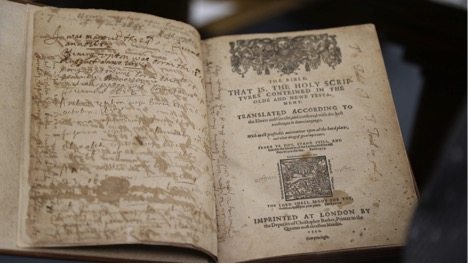
Here is one of the Bibles (dated 1590) that the Pilgrims and Puritan brought to America with them.6

how-to-respond-to-separation-of-church-and-state
The notes in this Bible actually discuss having a separation between government and the church. The Pilgrims therefore set up a system where they would have separate elections for both state leaders and church leaders so that the leaders would be different, rather than the same, as was the practice in England.


3. Faith has been part of American public Society for over 180 years.

Students had been praying over their lunches for over 180 years under the Constitution with no problem, as well as doing other religious activities that were always constitutional.

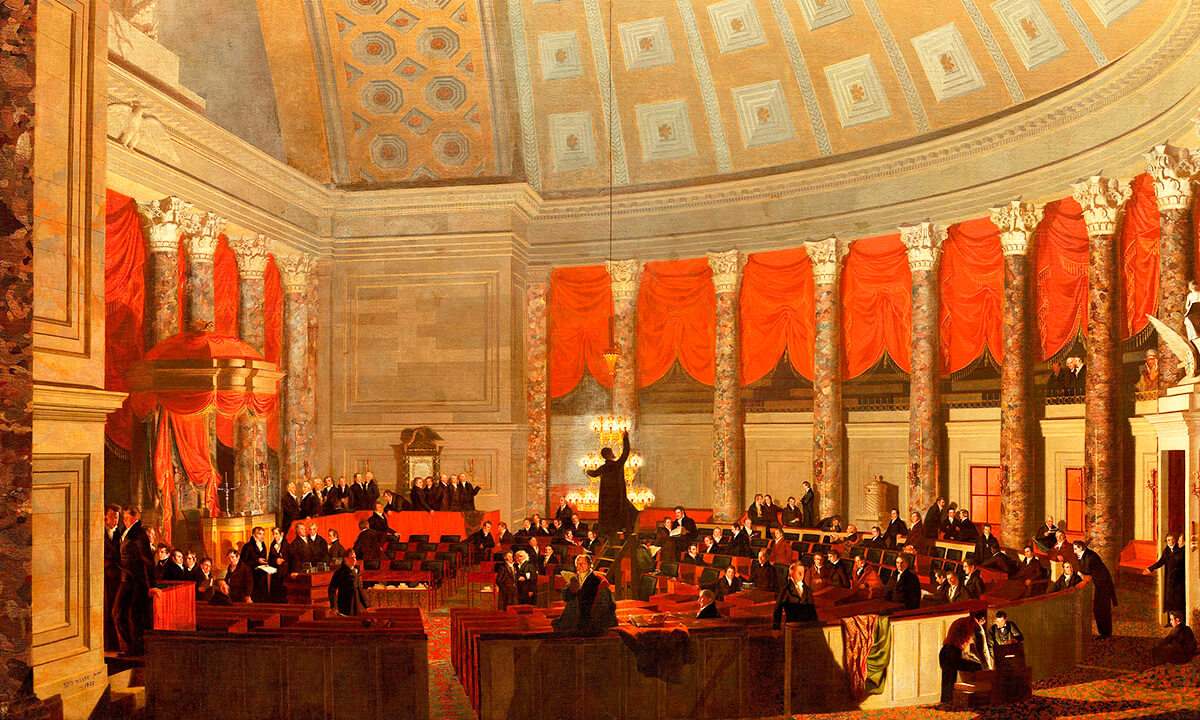
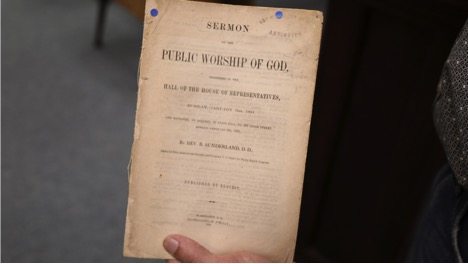
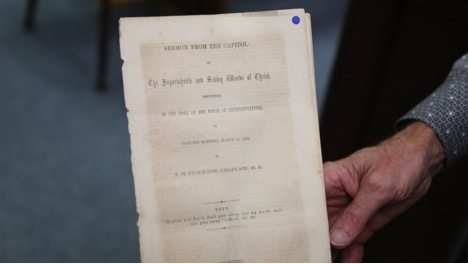
In fact, we actually have several original sermons from a church that Thomas Jefferson helped facilitate. It was a church that met inside the U.S. Capitol,7 where services were held in the House Chamber every Sunday. Both as Vice President and as President of the United States, Jefferson faithfully attended those church services inside the US Capitol and saw no constitutional problem with them, for Congress was not controlling religion for the entire nation but rather was only allowing religious expressions to occur, which was their constitutional role.


how-to-respond-to-separation-of-church-and-state-2
These are sermons preached at the Church that met inside the U.S. Capitol. The first one is on “The Public Worship of God,” and the second is on “The Imperishable and Saving Words of Christ.” Both sermons were preached in the Chamber of the U. S. House of Representatives.

how-to-respond-to-separation-of-church-and-state-3


It has only been in recent years that faith has been excluded from public schools, governmental venues, and the public square. Did we just invent separation of church and state? No, the phrase has existed since centuries before Jefferson, but today its meaning has been taken out of context and twisted to mean something entirely different.

This first happened in 1947 when the Supreme Court quoted only one phrase from Jefferson’s short 1801 letter to the Danbury Baptists. The Court claimed that there was to be “a wall of separation between Church and State” and that religious activities could no longer occur in the public square.8 They took the intent and clear purpose of Jefferson’s letter completely out of context. They did not show his short letter of only three paragraphs and 233 words which contained all the context and explanation but rather lifted a 8-word phrase out of it and remained silent on the rest.

Next time you hear someone claim religion has no place in public because of the “wall of separation,” I hope you’ll remember a few of the key pieces of history that many today have forgotten.


Endnotes

1 See, for example Roberts v. Madigan, 702 F. Supp. 1505 (D. Colo. 1989), aff’d, 921 F.2d 1047 (10th Cir. 1990).

2 See, for example, Broadus v. Saratoga Springs City School District, 02-cv-0136 (N.D.N.Y. 2002).

3 See, for example, Kountze Indep. Sch. Dist. v. Matthews, No. 09-13- 00251 (Tex. App.— Beaumont 2014).

4 See an article on the history of the phrase “Separation of Church and State” here.

5 See the text of the Danbury Baptists 1801 letter to Thomas Jefferson, and Jefferson’s 1802 reply here.

6 A Geneva Bible from the WallBuilders library, belonging to the Arthur Upton family.

7 See David Barton’s article “Church in the U.S. Capitol” for more information.

8 Everson v. Board of Education, 330 U.S. 1 (1947).

Biblical Christianity: The Origin of the Rights of Conscience

Overview

Significantly, 1 Timothy 1:5 declares that the goal of the entirety of everything taught in the Scriptures is threefold:

The goal of our instruction is love from a pure heart, and a good conscience, and a sincere faith.

Significantly, the three are inseparable, and without a good conscience, there will not be either a sincere faith or a pure heart. It is therefore not surprising that developing, maintaining, and living according to a good conscience is referenced more than thirty times in the New Testament (cf. Acts 24:16, 1 Timothy 1:19, 3:9, 1 Peter 3:16, 21, Romans 13:5, 2 Corinthians 4:2, etc.).

In fact, 1 Corinthians 8:4-12 flatly states that if a Christian views something as a matter of conscience – if the inner voice that God has placed within him or her tells them that something is sin to them – they are not to violate their conscience; and if anyone makes them do so, then they “sin against Christ.” (This message is repeated in Romans 1:1-23, 1 Corinthians 10:28-32, and elsewhere.) Few subjects in the Bible are stressed as strongly as that of maintaining a pure conscience – of preserving the conviction that one will answer directly to God for what his religious faith requires him to do, or refrain from doing.

Strikingly, only nations who respect Biblical teachings and traditions offer protection for the rights of religious conscience. Secular and non-Biblical nations, and those with state-established churches (such as those that predominated in England and Europe at the time of the American Founding), do not allow rights of conscience but instead demand conformity, which often requires governmental punishment coercion concerning religious beliefs, which violates the Scriptures.

Christ Himself established religious non-coercion as the standard. His approach was so voluntary that He even directed His disciples that when they presented the Gospel to others, if someone was interested, then they could stay and share the message with them; but if someone did not want to hear, then they were to leave the area and not force the issue (Luke 10:8-12). There was absolutely no coercion. It was also this way with Paul and the other Apostles: in every case; hearers then chose whether or not to follow Christianity; there was never any penalty, pressure, or force levied against them.

As John Quincy Adams noted, Jesus Christ “came to teach and not to compel. His law was a Law of Liberty. He left the human mind and human action free.”1 Two generations later, legal writer Stephen Cowell (1800-1872) similarly avowed:

Nonconformity, dissent, free inquiry, individual conviction, mental independence, are forever consecrated by the religion of the New Testament as the breath of its own life – the conditions of its own existence on the earth. The book is a direct transfer of human allegiance in things spiritual from the civil and ecclesiastical powers to the judgment and conscience of the individual.2

And several generations after that, President Franklin D. Roosevelt continued to affirm the same truth, noting: “We want to do it the voluntary way – and most human beings in all the world want to do it the voluntary way. We do not want to have the way imposed. . . . That would not follow in the footsteps of Christ.”3

From the beginning, America faithfully observed these principles, refusing to apply government coercion or conformity to the religious beliefs and practices of individuals. But today, this is dramatically and rapidly changing, with government routinely requiring people of faith to violate their religious conscience, particularly on social issues such as those surrounding aspects of sexuality, whether the taking of unborn human life, contraception, or requiring participation in homosexual nuptials, affirmation of transgenderism, and other major sexual elements of the LGBT agenda.

The American Experience on Religious Conscience

Colonial Era

Many of the early colonists who came to America were familiar with the Bible teachings on conscience and brought them to America, where they took root and grew to maturity at a rapid rate, having been planted in virgin soil completely uncontaminated by the religious apostasy and routine violations of the rights of conscience that had characterized the previous millennia. Hence, Christianity as practiced in America became the world’s single greatest historical force in securing non-coercion, religious toleration, and the rights of conscience.

For example, in 1640, the Rev. Roger Williams established Providence (the city that became the center of the Rhode Island colony), declaring:

We agree, as formerly hath been the liberties of the town, so still, to hold forth liberty of conscience.4

Similar language and protections were also included in subsequent American documents, including the 1649 Maryland “Toleration Act,”5 the 1663 charter for Rhode Island,6 the 1664 Charter for Jersey,7 the 1665 Charter for Carolina,8 the 1669 Constitutions of Carolina,9 the 1676 charter for West Jersey,10 the 1701 charter for Delaware,11 the 1682 frame of government for Pennsylvania,12 and many others. As John Quincy Adams affirmed, “The transcendent and overruling principle of the first settlers of New England was conscience.”13

Revolutionary Era

In 1775 (a year before our official separation from Great Britain), Commander-in-Chief George Washington addressed Continental soldiers and from the beginning charged them:

While we are contending for our own liberty, we should be very cautious of violating the rights of conscience in others, ever considering that God alone is the judge of the hearts of men and to Him only in this case they are answerable.14

With America’s official break from Great Britain in 1776, the states created their very first state constitutions and specifically secured the religious toleration, non-coercion, and the rights of conscience. For example, the 1776 constitution of Virginia declared:

[R]eligion . . . can be directed only by reason and conviction, not by force and violence; and therefore all men are equally entitled to the free exercise of religion according to the dictates of conscience.15

The 1776 Constitution of New Jersey similarly protected the rights of conscience,16 causing Governor William Livingston (a signer of the U. S. Constitution) to happily proclaim:

Consciences of men are not the objects of human legislation. . . . In contrast with this spiritual tyranny, how beautiful appears our catholic [expansive] constitution in disclaiming all jurisdiction over the souls of men, and securing (by a never-to-be-repealed section) the voluntary, unchecked, moral suasion of every individual – and his own self-directed intercourse with the Father of Spirits!17

When New York’s first constitution (1777) likewise protected the rights of conscience,81 Governor John Jay (an author of the Federalist Papers and the original Chief Justice of the U. S. Supreme Court) similarly rejoiced that:

Adequate security [under our constitution] is also given to the rights of conscience and private judgment. They are by nature subject to no control but that of Deity, and in that free situation they are now left. Every man is permitted to consider, to adore, and to worship his Creator in the manner most agreeable to his conscience.19

Similar clauses securing the rights of religious conscience also appeared in many other early state constitutions, including that of Delaware (1776),20 North Carolina (1776),21 Pennsylvania (1776),22 Vermont (1777),23 South Carolina (1778),24 Massachusetts (1780),25 New Hampshire (1784),26 etc. Today, the safeguards for the rights of conscience explicitly appear in forty-five state constitutions, and by inference in the other five.27

Federal Era

In 1788 following the ratification of the federal Constitution, six states submitted proposals for a Bill of Rights,28 with several specifically recommending national language that “all men have an equal, natural, and unalienable right to the free exercise of religion, according to the dictates of conscience.”29 Although the word “conscience” did not ultimately appear in the final language of the religion clauses of the First Amendment, those who framed that Amendment believed that by preventing the government from establishing a national religion and by guaranteeing to the people their “free exercise of religion,” that the rights of conscience had been fully secured30 – a fact affirmed by President Thomas Jefferson when he penned his famous letter to the Danbury Baptists assuring them that the First Amendment was an “expression of the supreme will of the nation in behalf of the rights of conscience.”31 Subsequent constitutional commentaries reiterated that the First Amendment did indeed protect the rights of conscience.32

Founding Fathers

In addition to the several Founders already mentioned, here are a few more unequivocal declarations regarding the constitutional duty of official to protect and defend the rights of religious conscience:

Government is instituted to protect property of every sort. . . . Conscience is the most sacred of all property.33 JAMES MADISON

No provision in our Constitution ought to be dearer to man than that which protects the rights of conscience against the enterprises of the civil authority.34 It behooves every man who values liberty of conscience for himself to resist invasions of it in the case of others, or their case may, by change of circumstances, become his own.35 Our rulers can have no authority over such natural rights only as we have submitted to them. The rights of conscience we never submitted – we could not submit. We are answerable for them to our God.36 THOMAS JEFFERSON

[T]he consciences of men are not the objects of human legislation. . . . For what business, in the name of common sense, has the magistrate (distinctly and singly appointed for our political and temporal happiness) with our religion, which is to secure our happiness spiritual and eternal? . . . [T]he state [does not] have any concern in the matter. For in what manner doth it affect society . . . in what outward form we think it best to pay our adoration to God?37 WILLIAM LIVINGSTON, SIGNER OF THE CONSTITUTION

Modern Era

As a result of the conscience protections long provided in American history and law, government exemptions are routinely granted to those whose religious faith requires them to participate in, or refrain from activities that violate their religious conscience. For example:

  • Pacifists and conscientious objectors are not forced to fight in wars;38
  • Jehovah’s Witnesses are not required to say the Pledge of Allegiance in public schools;39
  • The Amish are not required to complete the standard compulsory twelve years of education;40
  • Christian Scientists are not forced to have their children vaccinated or undergo medical procedures often required by state laws;41
  • Muslim and Jewish men are not required to shave their beards in jobs that otherwise require employees to be clean-shaven;42
  • Seventh-Day Adventists cannot be penalized for refusing to work at their jobs on Saturday;43

and there are additional examples.

Conclusion

Clearly, protection for the inalienable rights of religious conscience is deeply embedded into the fabric of American governmental policy. But as currently demonstrated in countless nations around the world, and now in America, when secularism or any other non-Biblical philosophy becomes dominant in its culture, a loss of legal protections for religious rights is usually one of the first casualties of the change.

Today in America, to seek to provide protection for the traditional rights of religious conscience is now regularly denounced as discriminatory.44 The LGBT movement, and those in government aligned with it, disdain the rights of religious conscience and instead use the power, penalties, and full force of the law to coerce all others to embrace and participate in affirming their views, including Christian bakers,45 florists,46 photographers,47 churches,48 homeowners,49 pastors,50 clerks,51 business owners,52 officials,53 religious schools,54 military personnel,55 sportscasters,56 and others.57

Our Framers recognized that if religious liberties and our civil liberties were inseparable – that if our religious liberties were diminished, our civil liberties would soon follow. As Joseph Story (a “Father of American Jurisprudence,” placed on the Supreme Court by President James Madison) pointed out:

There is not a truth to be gathered from history more certain or more momentous than this: that civil liberty cannot long be separated from religious liberty without danger, and ultimately without destruction to both. Wherever religious liberty exists, it will, first or last, bring in and establish political liberty.58

Signer of the Declaration John Witherspoon concurred:

There is not a single instance in history in which civil liberty was lost and religious liberty preserved entire. . . . God grant that in America true religion and civil liberty may be inseparable and that the unjust attempts to destroy the one may in the issue tend to the support and establishment of both.59

And Jedidiah Morse (a pastor, educator, and historian of the American Revolution, appointed by the federal government to document the condition of Indian affairs) agreed:

All efforts made to destroy the foundations of our Holy Religion ultimately tend to the subversion also of our political freedom and happiness. In proportion as the genuine effects of Christianity are diminished in any nation . . . in the same proportion will the people of that nation recede from the blessings of genuine freedom.60

Secularism produces an antipathy toward religion and religious rights, when ultimately diminish our civil rights. In fact, after President Obama announced that America no longer should be viewed as a Christian nation,61 he then announced that he was rescinding the traditional religious rights of conscience for those working in the medical profession.62 Historically, governmental protection for religious rights is the only sure indicator of protection for other non-religious civil rights.


Endnotes

1 John Quincy Adams, A Discourse on Education Delivered at Braintree, Thursday, October 24th, 1839 (Boston: Perkins & Marvin, 1840), 18.

2 Stephen Colwell, Politics for American Christians: A Word upon our Example as a Nation, our Labour, our Trade, Elections, Education, and Congressional Legislation (Philadelphia: Lippincott, Grambo & Co. 1852), 82, Tait’s Edinburgh Magazine, for 1844 (Edinburgh: William Tait, 1844), 752, “The Politics of the New Testament,” December 1844.

3 “Franklin D. Roosevelt, “Christmas Greeting to the Nation,” The American Presidency Project, December 24, 1940.

4 The Federal and State Constitutions, Colonial Charters and Other Organic Laws, ed. Francis Newton Thorpe (Washington: Government Printing Office, 1909), VI:3205-3207, “Plantation Agreement at Providence – August 27-September 6, 1640.”

5 William MacDonald, Select Charters and Other Documents Illustrative of American History 1606-1775 (New York: MacMillan Company, 1899), 104-106, “Maryland Toleration Act,” April 1649.

6 <a href=”https://babel.hathitrust.org/cgi/pt?id=mdp.39015001567794;view=1up;seq=27″ target=”“blank”” rel=”noopener”>Federal and State Constitutions, ed. Thorpe (1909), VI:3211, “Charter of Rhode Island and Providence Plantations-1663.”

7 Federal and State Constitutions, ed. Thorpe (1909), V:2537, “The Concession and Agreement of the Lords Proprietors of the Province of New Caesarea, or New Jersey, 1664.”

8 Federal and State Constitutions, ed. Thorpe (1909), V:2771, “Charter of Carolina – 1665.”

9 Federal and State Constitutions, ed. Thorpe (1909), V:2785, “The Fundamental Constitutions of Carolina – 1669.”

10 Federal and State Constitutions, ed. Thorpe (1909), V:2549, “The Charter or Fundamental Laws of West New Jersey, Agreed Upon – 1676.”

11 Federal and State Constitutions, ed. Thorpe (1909), I:558, “Charter of Delaware – 1701.”

12 Federal and State Constitutions, ed. Thorpe (1909), V:3063, “Frame of Government of Pennsylvania, May 5, 1682.”

13 John Quincy Adams, A Discourse on Education Delivered at Braintree, Thursday, October 24th, 1839 (Boston: Perkins & Marvin, 1840), 28.

14 George Washington, The Writings of George Washington, ed. John C. Fitzpatrick (Washington, D.C.: Government Printing Office, 1931), 3:492, to Benedict Arnold, September 14, 1775.

15 The American’s Guide: Comprising the Declaration of Independence; the Articles of Confederation; the Constitution of the United States, and the Constitutions of the Several States Composing the Union (Philadelphia: Hogan & Thompson, 1835), 180, 1776 Constitution: Bill of Rights, No. 16.

16 Federal and State Constitutions, ed. Thorpe (1909), V:2597, “Constitution of New Jersey – 1776.”

17 William Livingston, The Papers of William Livingston, ed. Carl E. Prince (Trenton: New Jersey Historical Commission, 1980), 2:235, 237, article under the name “Cato,” originally published in the New Jersey Gazette on February 18, 1778.

18 Federal and State Constitutions, ed. Thorpe (1909), V:2636-2637, “Constitution of New York – 1777.”

19 William Jay, The Life of John Jay (New York: J. & J. Harper, 1833), I:82, John Jay’s charge to the grand jury during the first term of the New York state Supreme Court.

20 Constitutions of the Several Independent States of America (New York: E. Oswald, 1786), 129.

21 Constitutions (1786), 185.

22 Constitutions (1786), 109.

23 Federal and State Constitutions, ed. Thorpe (1909), VI:3740.

24 Constitutions (1786), 215.

25 Constitutions (1786), 11-12.

26 Constitutions (1786), 4.

27 Forty-five state constitutions contain explicit language specifically singling out the rights of conscience. Five other states – Alaska, Hawaii, Louisiana, Montana, and South Carolina – use similar language to the U.S. Constitution (“make no law respecting an establishment of religion or prohibiting the free exercise thereof”). As is seen in the subsequent section, the Founding Fathers believed that this language provided specific protection for the rights of conscience.

28 Those states initially included Massachusetts, South Carolina, New Hampshire, Virginia, New York, and North Carolina; two years later in 1790, Rhode Island submitted its proposals. See Jonathan Elliot, The Debates in the Several State Conventions on the Adoption of the Federal Constitution (Washington: 1836), I:322-333.

29 Anson Phelps Stokes, Church and State in the United States (New York: Harper & Brothers, 1950), 1:600-610. New Hampshire recommended an amendment stating that “Congress shall make no law touching religion, or to infringe the rights of conscience.”

30 The Debates and Proceedings in the Congress of the United States, ed. Joseph Gales (Washington: Gales and Seaton, 1834), I:757-796, August 15, 1789 to August 21, 1789.

31 Thomas Jefferson, The Writings of Thomas Jefferson, ed. H. A. Washington (Washington D.C.: Taylor & Maury, 1854), VIII:113, “Messrs. Nehemiah Dodge, Ephraim Robbins, and Stephen S. Nelson, A Committee of the Danbury Baptist Association, in the State of Connecticut,” January 1, 1802.

32 See, for example, Joseph Story, Commentaries on the Constitution of the United States (Boston: Hilliard, Gray, and Company, 1833), I:701, § 990-991:

The rights of conscience are, indeed, beyond the just reach of any human power. They are given by God, and cannot be encroached upon by human authority, without a criminal disobedience of the precepts of natural, as well as revealed religion. The real object of the amendment was, not to countenance, much less to advance Mahometanism, or Judaism, or infidelity, by prostrating Christianity; but to exclude all rivalry among Christian sects, and to prevent any national ecclesiastical establishment, which should give to an hierarchy the exclusive patronage of the national government. It thus sought to cut off the means of religious persecution, (the vice and pest of former ages,) and the power of subverting the rights of conscience in matters of religion, which had been trampled upon almost from the days of the Apostles to the present age.

St. George Tucker, Blackstone’s Commentaries: with Notes of Reference, to the Constitution and Laws, of the Federal Government of the United States; and of the Commonwealth of Virginia (Philadelphia: William Young Birch and Abraham Small: 1803), I:489, “Appendix: Note G. Of the Right of Conscience; and Of the Freedom of Speech and Of The Press”:

Liberty of conscience in matters of religion consists in the absolute and unrestrained exercise of our religious opinion, and duties, in that mode which our own reason and conviction dictate, without the control or intervention of any human power or authority whatsoever. This liberty though made a part of our constitution, and interwoven in the nature of man by his Creator, so far as the arts of fraud and terrors of violence have been capable of abridging it, hath been the subject of coercion by human laws in all ages and in all countries as far as the annals of mankind extend.

James Wilson, Thomas McKean [Wilson and McKean both signed the Declaration of Independence, and Wilson was a signer of the Constitution and an original Justice on the U. S. Supreme Court], Commentaries on the Constitution of the United States of America (London: 1791), II:61:

In the third place we are told, that there is no security for the rights of conscience. I ask the honorable gentleman, what part of this system puts it in the power of Congress to attack those rights? When there is no power to attack, it is idle to prepare the means of defense.

And others.

33 James Madison, The Writings of James Madison, ed. Gaillard Hunt (New York: G. P. Putnam’s Sons, 1906), VI:102, “Property,” originally published in The National Gazette on March 29, 1792.

34 Thomas Jefferson, The Writings of Thomas Jefferson, ed. H. A. Washington (New York: Biker, Thorne, & Co., 1854), VIII:147, to the Society of the Methodist Episcopal Church at New London, CT on February 4, 1809.

35 Thomas Jefferson, Memoir, Correspondence, and Miscellanies, ed. Thomas Jefferson Randolph (Charlottesville: F. Carr, an Co., 1829), III:507, to Benjamin Rush on April 21, 1803.

36 Thomas Jefferson, Notes on the State of Virginia (London: John Stockdale, 1787), 265, “Query XVII: The different religions received into that state?”

37 William Livingston, Papers, ed. Prince (1980), 2:235, 237, article under the name “Cato,” originally published in the New Jersey Gazette on February 18, 1778; Hezekiah Niles, Principles and Acts of the Revolution in America: Or, An Attempt to Collect and Preserve Some of the Speeches, Orations, & Proceedings (Baltimore: William Ogden Niles, 1822), 306-307, “Remarks on liberty of conscience, ascribed to his excellency William Livingston, governor of New Jersey, 1778”; B. F. Morris, Christian Life and Character of the Civil Institutions of the United States, Developed in the Official and Historical Annals of the Republic (Philadelphia: George W. Childs, 1864), 162-163, from William Livingston.

38 United States v. Seeger, 380 U.S. 163 (1965).

39 West Virginia State Board of Education v. Barnette, 319 U.S. 624 (1943).

40 Wisconsin v. Yoder, 406 U.S. 205 (1972).

41 See, for example, “Parents claim religion to avoid vaccines for kids,” NBCNews, October 17, 2007; “Vaccination Exemptions,” College of Physicians of Philadelphia (accessed on May 9, 2016).

42 Potter v. District of Columbia, Civil Action No. 01-1189 (D.D.C. Sept. 28, 2007).

43 Hobbie v. Unemployment Appeals Commission of Florida, 480 U.S. 136 (1987); Sherbert v. Verner, 374 U.S. 398, 409 (1963).

44 See, for example, Adam Serwer, “Arizona passes law allowing discrimination,” MSNBC, February 21, 2014; Paresh Dave, “Miss. governor signs religious freedom bill; civil rights groups dismayed,” Los Angeles Times, April 4, 2014; Chris Johnson, “Georgia Senate passes religious discrimination bill,” Washington Blade, March 5, 2015; Tony Cook, “Gov. Mike Pence signs ‘religious freedom’ bill in private,” IndyStar, April 2, 2015; Monica Davey, “Indiana and Arkansas Revise Rights Bills, Seeking to Remove Divisive Parts,” The New York Times, April 2, 2015; Timothy Holbrook, “Georgia, North Carolina bills are about LGBT discrimination. Period,” CNN, March 28, 2016; Marina Fang, “Tennessee Legislature Resurrects Discriminatory Transgender Bathroom Bill,” Huffington Post, April 6, 2016.

45 See, for example, Ken Klukowski, “Baker Faces Prison for Refusing to Bake Same-Sex Wedding Cake,” Breitbart, December 12, 2013; Chris Enloe, “‘Sweet Cakes’ Owners’ Bank Accounts Seized as Damages for Refusing to Bake Wedding Cake for Lesbian Couple,” The Blaze, December 29, 2015.

46 See, for example, Danny Burk, “A florist loses religious freedom, and much more,” CNN, February 20, 2015.

47 See, for example, Ken Klukowski, “New Mexico Court: Christian Photographer Cannot Refuse Gay-Marriage Ceremony,” Breitbart, August 22, 2013; Kristine Marsh, “Gays Force San Francisco Wedding Photographers to Close Shop,” MRC NewsBusters, November 21, 2014; Samuel Smith, “Christian Videographer Faces Legal Action After Refusing to Work Lesbian Wedding, Says It’s Against Her Biblical Beliefs,” Christian Post, March 18, 2015.

48 See, for example, Molly Montag, “Group asks IRS to investigate Cornerstone Church,” Sioux City Journal, October 1, 2010; “Southern Baptists draw distance from harsh anti-gay rhetoric, yet hold to convictions,” Baptist Press, May 24, 2012.

49 See, for example, Andrea Peyser, “Couple fined for refusing to host same-sex wedding on their farm,” New York Post, November 10, 2014.

50 See, for example, Todd Starnes, “Fired for preaching: Georgia dumps doctor over church sermons,” Fox News, April 20, 2016; Natalie Jennings, “Louie Giglio pulls out of inauguration over anti-gay comments,” The Washington Post, January 10, 2013.

51 See, for example, Allan Smith, “Anti-gay-marriage Kentucky clerk jailed for refusing to issue same-sex marriage licenses,” Business Insider, September 3, 2015; Jim Douglas, “Hood County is focal point of same-sex debate,” WFAA, July 1, 2015.

52 See, for example, Katie Zezima, “Couple Sues a Vermont Inn for Rejecting Gay Wedding,” The New York Times, July 19, 2011; Billy Hallowell, “Lesbian Couple Wins Discrimination Lawsuit Against Religious Bed and Breakfast Owner Who Denied Them a Room,” The Blaze, April 16, 2013; Justin Moyer, “Kentucky T-shirt printer that wouldn’t make gay pride shirts vindicated by court,” The Washington Post, April 28, 2015; Charlie Butts, “Iowa couple fined for refusing gay wedding: ‘We are still here’,” OneNewsNow, June 3, 2015.

53 See, for example, Kathleen Gilbert, “San Diego firefighters victorious in suit against forced participation in gay pride parade,” Life Site News, January 28, 2011; Eryn Sun, “Court Affirms CDC’s Firing of Counselor Over Same-Sex Advice,” Christian Post, February 8, 2012; Ryan T. Anderson, “Atlanta Fire Chief Fired for Expressing Christian Beliefs,” The Daily Signal, January 8, 2015; “Utah officer who objected to role in gay pride parade says he was unfairly labeled a bigot,” Fox News, February 25, 2015; Randy Ludlow, “Ohio judges who perform weddings must marry same-sex couples,” The Columbus Dispatch, August 11, 2015.

54 See, for example, “Evangelical College Gay Rights Stand Causes Uproar,” NewsMax, November 2, 2014; “Gay Teacher Files Sex Discrimination Claim Against Georgia School,” NPR, July 9, 2014; “Lesbian teacher who was fired for becoming pregnant sues Catholic school for discrimination,” Daily Mail, August 22, 2014.

55 See, for example, Todd Starnes, “Fox Exclusive: Airman Faces Punishment for her Religious Beliefs,” Fox News, August 6, 2013; Kirsten Anderson, “Air Force Sergeant claims he was fired for refusing to endorse gay ‘marriage’: faces court martial,” Life Site News, September 10, 2013; “Navy Threatens To End 19-Year Career Of Decorated Chaplain Who Served Navy SEAL Teams, According To Liberty Institute,” PR Newswire, March 9, 2015.

56 See, for example, Melissa Barnhart, “Fox Sports Southwest Charged With Discrimination for Firing Craig James Over Homosexuality Remarks,” Christian Post, March 7, 2014; Ahiza Garcia, “‘I’m not transphobic,’ says ex-ESPN analyst Curt Schilling,” CNN Money, April 22, 2016.

57 See, for example, “Missouri school sued by student who refused to support gay adoptions,” USA Today, November 2, 2006; Paul Strand, “University Employee Punished over Marriage Petition,” CBN News, October 18, 2012; Billy Hallowell, “Christian Product Engineer Claims Ford Motor Fired Him for Voicing His Bible-Based Opposition to the Company’s Promotion of ‘Pro-Homosexual Ideas’ — Now He’s Fighting Back,” The Blaze, January 28, 2015.

58 Joseph Story, A Discourse Pronounced at the Request of the Essex Historical Society, on the 18th of September, 1828, in Commemoration of the First Settlement of Salem, in the State of Massachusetts (Boston: Hilliard, Gray, Little, and Wilkins, 1828), 46.

59 John Witherspoon, The Dominion of Providence over the Passions of Men. A Sermon, Preached at Princeton, on the 17th of May, 1776. Being the General Fast appointed by the Congress through the United Colonies (Philadelphia: 1777), 27-28, 38.

60 Jedidiah Morse, A Sermon, Exhibiting the Present Dangers and Consequent Duties of the Citizens of the United States of America. Delivered at Charlestown. April 25, 1799, The Day of the National Fast (MA: Printed by Samuel Etheridge, 1799), 9.

61 Aaron Klein, “Obama: America is ‘no longer Christian’,” WorldNetDaily, June 22, 2008. See also David Brody, The Brody File, “Exclusive: Barack Obama E-mails the Brody File,” CBN News, July 29, 2007; “Obama says U.S., Turkey can be model for world,” CNN, April 6, 2009.

62 See, for example, Rob Stein, “Obama Plans to Roll Back ‘Conscience’ Rule Protecting Health Workers Who Object to Some Types of Care,” The Washington Post, February 28, 2009; Saundra Young, “White House set to reverse health care conscience clause,” CNN, February 27, 2009; Rob Stein, “Obama administration replaces controversial ‘conscience’ regulation for health-care workers,” The Washington Post, February 18, 2011.

* This article concerns a historical issue and may not have updated information.

Is America a Christian Nation?

Modern claims that America is not a Christian nation are rarely noticed or refuted today because of the nation’s widespread lack of knowledge about America’s history and foundation. To help provide the missing historical knowledge necessary to combat today’s post-modern revisionism, presented below will be some statements by previous presidents, legislatures, and courts (as well as by current national Jewish spokesmen) about America being a Christian nation. These declarations from all three branches of government are representative of scores of others and therefore comprise only the proverbial “tip of the iceberg.”

Defining a Christian Nation

Contemporary critics who assert that America is not a Christian nation always refrain from offering any definition of what the term “Christian nation” means. So what is an accurate definition of that term as demonstrated by the American experience?

Contrary to what critics imply, a Christian nation is not one in which all citizens are Christians, or the laws require everyone to adhere to Christian theology, or all leaders are Christians, or any other such superficial measurement. As Supreme Court Justice David Brewer (1837-1910) explained:

is-america-a-christian-nation-2

[I]n what sense can [America] be called a Christian nation? Not in the sense that Christianity is the established religion or that the people are in any manner compelled to support it. On the contrary, the Constitution specifically provides that “Congress shall make no law respecting an establishment of religion, or prohibiting the free exercise thereof.” Neither is it Christian in the sense that all its citizens are either in fact or name Christians. On the contrary, all religions have free scope within our borders. Numbers of our people profess other religions, and many reject all. Nor is it Christian in the sense that a profession of Christianity is a condition of holding office or otherwise engaging in public service, or essential to recognition either politically or socially. In fact, the government as a legal organization is independent of all religions. Nevertheless, we constantly speak of this republic as a Christian nation – in fact, as the leading Christian nation of the world.1

So, if being a Christian nation is not based on any of the above criterion, then what makes America a Christian nation? According to Justice Brewer, America was “of all the nations in the world . . . most justly called a Christian nation” because Christianity “has so largely shaped and molded it.”2

Constitutional law professor Edward Mansfield (1801-1880) similarly acknowledged:

In every country, the morals of a people – whatever they may be – take their form and spirit from their religion. For example, the marriage of brothers and sisters was permitted among the Egyptians because such had been the precedent set by their gods, Isis and Osiris. So, too, the classic nations celebrated the drunken rites of Bacchus. Thus, too, the Turk has become lazy and inert because dependent upon Fate, as taught by the Koran. And when in recent times there arose a nation [i.e., France] whose philosophers [e.g. Voltaire, Rousseau, Diderot, Helvetius, etc.] discovered there was no God and no religion, the nation was thrown into that dismal case in which there was no law and no morals. . . . In the United States, Christianity is the original, spontaneous, and national religion.3

Founding Father and U. S. Supreme Court Chief Justice John Marshall agreed:

is-america-a-christian-nation-3

[W]ith us, Christianity and religion are identified. It would be strange, indeed, if with such a people our institutions did not presuppose Christianity and did not often refer to it and exhibit relations with it.4

Christianity is the religion that shaped America and made her what she is today. In fact, historically speaking, it can be irrefutably demonstrated that Biblical Christianity in America produced many of the cherished traditions still enjoyed today, including:

  • A republican rather than a theocratic form of government;
  • The institutional separation of church and state (as opposed to today’s enforced institutional secularization of church and state);
  • Protection for religious toleration and the rights of conscience;
  • A distinction between theology and behavior, thus allowing the incorporation into public policy of religious principles that promote good behavior but which do not enforce theological tenets (examples of this would include religious teachings such as the Good Samaritan, The Golden Rule, the Ten Commandments, the Sermon on the Mount, etc., all of which promote positive civil behavior but do not impose ecclesiastical rites); and
  • A free-market approach to religion, thus ensuring religious diversity and security for the rights of religious conscience.

Consequently, a Christian nation as demonstrated by the American experience is a nation founded upon Christian and Biblical principles, whose values, society, and institutions have largely been shaped by those principles. This definition was reaffirmed by American legal scholars and historians for generations5 but is widely ignored by today’s revisionists.

American Presidents Affirm that America is a Christian Nation

President Barack Obama is the first American president to deny that America is a Christian nation.6 Notice a few representative statements on this subject by some of the forty-three previous presidents:

The general principles on which the fathers achieved independence were. . . . the general principles of Christianity.7 JOHN ADAMS

[T]he teachings of the Bible are so interwoven and entwined with our whole civic and social life that it would be literally….impossible for us to figure to ourselves what that life would be if these teaching were removed.8 TEDDY ROOSEVELT

America was born a Christian nation – America was born to exemplify that devotion to the elements of righteousness which are derived from the revelations of Holy Scripture.9 WOODROW WILSON

American life is builded, and can alone survive, upon . . . [the] fundamental philosophy announced by the Savior nineteen centuries ago.10 HERBERT HOOVER

This is a Christian Nation.11 HARRY TRUMAN

Let us remember that as a Christian nation . . . we have a charge and a destiny.12 RICHARD NIXON

There are many additional examples, including even that of Thomas Jefferson.13

Significantly, Jefferson was instrumental in establishing weekly Sunday worship services at the U. S. Capitol (a practice that continued through the 19th century) and was himself a regular and faithful attendant at those church services,14 not even allowing inclement weather to dissuade his weekly horseback travel to the Capitol church.15

(The fact that the U. S. Capitol building was available for church on Sundays was due to the Art. I, Sec. 7 constitutional requirement that forbade federal lawmaking on Sundays; and this recognition of a Christian Sabbath in the U. S. Constitution was cited by federal courts as proof of the Christian nature of America.16 While not every Christian observes a Sunday Sabbath, no other religion in the world honors Sunday except Christianity. As one court noted, the various Sabbaths were “the Friday of the Mohammedan, the Saturday of the Israelite, or the Sunday of the Christian.”17)
is-america-a-christian-nation-4Why was Jefferson a faithful attendant at the Sunday church at the Capitol? He once explained to a friend while they were walking to church together:

No nation has ever existed or been governed without religion. Nor can be. The Christian religion is the best religion that has been given to man and I, as Chief Magistrate of this nation, am bound to give it the sanction of my example.18

The U. S. Congress Affirms that America is a Christian Nation

Declarations from the Legislative Branch affirming America as a Christian nation are abundant. For example, in 1852-1853 when some citizens sought a complete secularization of the public square and a cessation of all religious activities by the government, Congress responded with unambiguous declarations about America as a Christian nation:

is-america-a-christian-nation-5

HOUSE JUDICIARY COMMITTEE: Had the people, during the Revolution, had a suspicion of any attempt to war against Christianity, that Revolution would have been strangled in its cradle. At the time of the adoption of the Constitution and the amendments, the universal sentiment was that Christianity should be encouraged, not any one sect [denomination]. Any attempt to level and discard all religion would have been viewed with universal indignation. . . . In this age there can be no substitute for Christianity; that, in its general principles, is the great conservative element on which we must rely for the purity and permanence of free institutions.19

SENATE JUDICIARY COMMITTEE: We are Christians, not because the law demands it, not to gain exclusive benefits or to avoid legal disabilities, but from choice and education; and in a land thus universally Christian, what is to be expected, what desired, but that we shall pay a due regard to Christianity?20

In 1856, the House of Representatives also declared:

[T]he great vital and conservative element in our system is the belief of our people in the pure doctrines and divine truths of the Gospel of Jesus Christ.21

On March 3, 1863 while in the midst of the Civil War, the U. S. Senate requested President Abraham Lincoln to “designate and set apart a day for national prayer and humiliation”22 because:

is-america-a-christian-nation

[S]incerely believing that no people, however great in numbers and resources or however strong in the justice of their cause, can prosper without His favor; and at the same time deploring the national offences which have provoked His righteous judgment, yet encouraged in this day of trouble by the assurances of His word to seek Him for succor according to His appointed way through Jesus Christ, the Senate of the United States do hereby request the President of the United States, by his proclamation, to designate and set apart a day for national prayer and humiliation.23 (emphasis added)

President Lincoln quickly complied with that request,24 and issued what today has become one of the most famous and quoted proclamations in America’s history.25

Across the generations, our national reliance on God, the Bible, and Christianity has been repeatedly reaffirmed. In fact, consider five representative images produced by the U. S. Government. The first three are from World War II: one shows the Nazis as the enemy because they want to attack the Bible, and the other two encourage Americans to buy War Bonds by pointing to Christian images. The fourth and fifth images are from the Department of Agriculture in the 1960s, using the Bible and even Smokey Bear in prayer as symbols to encourage Americans to be conscious of fire safety and to help preserve and conserve nature.

is-america-a-christian-nation-6 is-america-a-christian-nation-7is-america-a-christian-nation-8 is-america-a-christian-nation-9 is-america-a-christian-nation-10

There are scores of other official actions by the U. S. Congress over the past two centuries affirming that America is a Christian nation.

The Judicial Branch Affirms that America is a Christian Nation

From the Judicial Branch, consider first some declarations of prominent U. S. Supreme Court Justices regarding America as a Christian nation.

Justice Joseph Story (1779-1845) was appointed to the Court by President James Madison. Story is considered the founder of Harvard Law School and authored the three-volume classic Commentaries on the Constitution of the United States (1833). In his 34 years on the Court, Story authored opinions in 286 cases, of which 269 were reported as the majority opinion or the opinion of the Court26 and his many contributions to American law have caused him to be called a “Father of American Jurisprudence.” Justice Story openly declared:

is-america-a-christian-nation-11

One of the beautiful boasts of our municipal jurisprudence is that Christianity is a part of the Common Law. . . . There never has been a period in which the Common Law did not recognize Christianity as lying at its foundations. . . . I verily believe Christianity necessary to the support of civil society.27

His conclusion about America and Christianity was straightforward:

In [our] republic, there would seem to be a peculiar propriety in viewing the Christian religion as the great basis on which it must rest for its support and permanence.28

Justice John McLean (1785-1861) was appointed to the Court by President Andrew Jackson. McLean served in the U. S. Congress, as a judge on the Ohio Supreme Court, and then held cabinet positions under two U. S. Presidents. His view on the importance of Christianity to American government and its institutions was unambiguous:

is-america-a-christian-nation-12

For many years, my hope for the perpetuity of our institutions has rested upon Bible morality and the general dissemination of Christian principles. This is an element which did not exist in the ancient republics. It is a basis on which free governments may be maintained through all time. . . . Free government is not a self-moving machine. . . . Our mission of freedom is not carried out by brute force, by canon law, or any other law except the moral law and those Christian principles which are found in the Scriptures.29

Already mentioned at the beginning was Justice David Brewer (1837-1910), appointed to the Court by President Benjamin Harrison. Brewer held several judgeships in Kansas and served on a federal circuit court before his appointment to the Supreme Court. In addition to his already noted statements, Justice Brewer also declared:

We constantly speak of this republic as a Christian nation – in fact, as the leading Christian nation of the world.30

Brewer then chronicled the types of descriptions applied to nations:

is-america-a-christian-nation-13

We classify nations in various ways: as, for instance, by their form of government. One is a kingdom, another an empire, and still another a republic. Also by race. Great Britain is an Anglo-Saxon nation, France a Gallio, Germany a Teutonic, Russia a Slav. And still again by religion. One is a Mohammedan nation, others are heathen, and still others are Christian nations. This republic is classified among the Christian nations of the world. It was so formally declared by the Supreme Court of the United States. In the case of Holy Trinity Church vs. United States, 143 U.S. 471, that Court, after mentioning various circumstances, added, “these and many other matters which might be noticed, add a volume of unofficial declarations to the mass of organic utterances that this is a Christian nation.”31

Brewer did not believe that calling America a Christian nation was a hollow appellation; in fact, he penned an entire book setting forth the evidence that America was a Christian nation.32 He concluded:

[I] have said enough to show that Christianity came to this country with the first colonists; has been powerfully identified with its rapid development, colonial and national, and today exists as a mighty factor in the life of the republic. This is a Christian nation. . . . [T]he calling of this republic a Christian nation is not a mere pretence, but a recognition of an historical, legal, and social truth.33

Justice Earl Warren (1891-1974) agreed with his predecessors. Before being appointed as Chief Justice of the U. S. Supreme Court by President Dwight D. Eisenhower, Warren had been the Attorney General of California. Warren declared:

is-america-a-christian-nation-14

I believe the entire Bill of Rights came into being because of the knowledge our forefathers had of the Bible and their belief in it: freedom of belief, of expression, of assembly, of petition, the dignity of the individual, the sanctity of the home, equal justice under law, and the reservation of powers to the people. . . . I like to believe we are living today in the spirit of the Christian religion. I like also to believe that as long as we do so, no great harm can come to our country.34

There are many similar declarations by other Supreme Court Justices, but in addition to the declarations of individual judges, the federal courts have repeatedly affirmed America to be a Christian nation – including the U. S. Supreme Court, which declared that America was “a Christian country,”35 filled with “Christian people,”36 and was indeed “a Christian nation.”37 Dozens of other courts past and present have repeated these pronouncements38 but so,
is-america-a-christian-nation-15too, have American Presidents – as in 1947 when President Harry Truman quoted the Supreme Court, declaring:

This is a Christian Nation. More than a half century ago that declaration was written into the decrees of the highest court in this land [in an 1892 decision].39

American Jewish Leaders Agree with History

Jewish leaders, although firmly committed to their own faith, understand that by defending Christianity they are defending what has provided them their own religious liberty in America. For example, Jeff Jacoby, a Jewish columnist at the Boston Globe explains:

This is a Christian country – it was founded by Christians and built on broad Christian principles. Threatening? Far from it. It is in precisely this Christian country that Jews have known the most peaceful, prosperous, and successful existence in their long history.40

Aaron Zelman (a Jewish author and head of a civil rights organization) similarly declares:

[C]hristian America is the best home our people have found in 2,000 years. . . . [T]his remains the most tolerant, prosperous, and safest home we could be blessed with.41

Dennis Prager, a Jewish national columnist and popular talkshow host, warns:

If America abandons its Judeo-Christian values basis and the central role of the Jewish and Christian Bibles (its Founders’ guiding text), we are all in big trouble, including, most especially, America’s non-Christians. Just ask the Jews of secular Europe.42

Prager further explained:

I believe that it is good that America is a Christian nation. . . . I have had the privilege of speaking in nearly every Jewish community in America over the last 30 years, and I have frequently argued in favor of this view. Recently, I spoke to the Jewish community of a small North Carolina city. When some in the audience mentioned their fear of rising religiosity among Christians, I asked these audience-members if they loved living in their city. All of them said they did. Is it a coincidence, I then asked, that the city you so love (for its wonderful people, its safety for your children, its fine schools, and its values that enable you to raise your children with confidence) is a highly Christian city? Too many Americans do not appreciate the connection between American greatness and American Christianity.43

Don Feder, a Jewish columnist and long time writer for the Boston Herald, similarly acknowledges:

Clearly this nation was established by Christians. . . . As a Jew, I’m entirely comfortable with the concept of the Christian America.44 The choice isn’t Christian America or nothing, but Christian America or a neo-pagan, hedonistic, rights-without-responsibilities, anti-family, culture-of-death America. As an American Jew. . . . [I] feel very much at home here.45

In fact, Feder calls on Jews to defend the truth that America is a Christian Nation:

Jews – as Jews – must oppose revisionist efforts to deny our nation’s Christian heritage, must stand against the drive to decouple our laws from Judeo-Christian ethics, and must counter attacks on public expressions of the religion of most Americans – Christianity. Jews are safer in a Christian America than in a secular America.46

Michael Medved, a Jewish national talkshow host and columnist, agrees that America is indeed a Christian nation:

The framers may not have mentioned Christianity in the Constitution but they clearly intended that charter of liberty to govern a society of fervent faith, freely encouraged by government for the benefit of all. Their noble and unprecedented experiment never involved a religion-free or faithless state but did indeed presuppose America’s unequivocal identity as a Christian nation.47

Burt Prelutsky, a Jewish columnist for the Los Angeles Times (and a freelance writer for the New York Times, Washington Times, Sports Illustrated, and other national publications) and a patriotic Jewish American, gladly embraces America as a Christian nation and even resents the secularist post-modern attack on national Christian celebrations such as Christmas:

I never thought I’d live to see the day that Christmas would become a dirty word. . . .How is it, one well might ask, that in a Christian nation this is happening? And in case you find that designation objectionable, would you deny that India is a Hindu country, that Turkey is Muslim, that Poland is Catholic? That doesn’t mean those nations are theocracies. But when the overwhelming majority of a country’s population is of one religion, and most Americans happen to be one sort of Christian or another, only a darn fool would deny the obvious. . . . This is a Christian nation, my friends. And all of us are fortunate it is one, and that so many millions of Americans have seen fit to live up to the highest precepts of their religion. It should never be forgotten that, in the main, it was Christian soldiers who fought and died to defeat Nazi Germany and who liberated the concentration camps. Speaking as a member of a minority group – and one of the smaller ones at that – I say it behooves those of us who don’t accept Jesus Christ as our savior to show some gratitude to those who do, and to start respecting the values and traditions of the overwhelming majority of our fellow citizens, just as we keep insisting that they respect ours. Merry Christmas, my friends.48

Orthodox Rabbi Daniel Lapin of the Jewish Policy Center unequivocally declares

[I] understand that I live . . . in a Christian nation, albeit one where I can follow my faith as long as it doesn’t conflict with the nation’s principles. The same option is open to all Americans and will be available only as long as this nation’s Christian roots are acknowledged and honored.49

In fact, with foreboding he warns:

Without a vibrant and vital Christianity, America is doomed, and without America, the west is doomed. Which is why I, an Orthodox Jewish rabbi, devoted to Jewish survival, the Torah, and Israel am so terrified of American Christianity caving in.50 God help Jews if America ever becomes a post-Christian society! Just think of Europe!51

— — — ◊ ◊ ◊ — — —
There is much additional evidence, and it unequivocally demonstrates that any claim that America was not a Christian nation is an unabashed attempt at historical revisionism. Of such efforts, former Chief Justice William Rehnquist wisely observed, “no amount of repetition of historical errors . . . can make the errors true.”52


Endnotes

1 David J. Brewer, The United States: A Christian Nation (Philadelphia: John C. Winston Company, 1905), 12.

2 Brewer, A Christian Nation (1905), 57.

3 Edward Mansfield, American Education, Its Principle and Elements (New York: A. S. Barnes & Co., 1851), 43.

4 John Marshall to Rev. Jasper Adams, May 9, 1833, The Papers of John Marshall, ed. Charles Hobson (Chapel Hill: University of North Carolina Press, 2006), XII:278.

5 Stephen Cowell, The Position of Christianity in the United States in its Relations with our Political Institutions (Philadelphia: Lippincott, Grambio & Co., 1854), 11-12; Joseph Story, A Familiar Exposition of the Constitution of the United States (Boston: Marsh, Capen, Lyon, and Webb, 1840), 260.

6 See, for example, “Obama says U.S., Turkey can be model for world,” CNN, April 6, 2009; David Brody, The Brody File, “Exclusive: Barack Obama E-mails the Brody File,” CBN News, July 29, 2007; Aaron Klein, “Obama: America is ‘no longer Christian’,” WorldNetDaily, June 22, 2008; and so forth.

7 John Adams to Thomas Jefferson, June 28, 1813, The Works of John Adams, ed. Charles Francis Adams (Boston: Little, Brown and Company, 1856), X:45-46.

8 Ferdinand Cowle Iglehart, D.D., Theodore Roosevelt, The Man As I Knew Him (New York: The Christian Herald, 1919), 307.

9 Paul M. Pearson and Philip M. Hicks, Extemporaneous Speaking (New York: Hinds, Noble & Eldredge, 1912), 177, printing Woodrow Wilson, “The Bible and Progress;” The Homiletic Review: An International Monthly Magazine of Current Religious Thought, Sermonic Literature and Discussion of Practical Issues (New York: Funk and Wagnalls Company, 1911), LXII:238, printing Woodrow Wilson, “The Bible and Progress,” May 7, 1911.

10 Herbert Hoover, “Radio Address to the Nation on Unemployment Relief,” American Presidency Project, October 18, 1931.

11 Harry S. Truman, “Exchange of Messages With Pope Pius XII,” American Presidency Project, August 28, 1947.

12 Richard Nixon, “Remarks at the National Prayer Breakfast,” American Presidency Project, February 1st, 1972.

13 Thomas Jefferson to Gouverneur Morris, November 1, 1801, The Papers of Thomas Jefferson, ed. Barbara Oberg (Princeton: Princeton University Press, 2008), 30:545.

14 See, for example, Bishop Claggett’s (Episcopal Bishop of Maryland) letter of February 18, 1801, available in the Maryland Diocesan Archives; The First Forty Years of Washington Society, ed. Galliard Hunt (New York: Charles Scribner’s Sons, 1906), 13; William Parker Cutler and Julia Perkins Cutler, Life, Journal, and Correspondence of Rev. Manasseh Cutler (Cincinnati: Colin Robert Clarke & Co., 1888), II:119, to Joseph Torrey, January 3, 1803 & 113, entry of December 12, 1802; James Hutson, Religion and the Founding of the American Republic (Washington, D. C.: Library of Congress, 1998), 84.

15 Cutler and Cutler, Life, Journal, and Correspondence (1888), II:119, to Dr. Joseph Torrey, January 3, 1803; entry of December 26, 1802 (II:114).

16 See, for example, Church of the Holy Trinity v. U. S., 143 U.S. 457, 465, 470-471 (1892); City Council of Charleston v. S.A. Benjamin, 2 Strob. 508, 518-520 (S.C. 1846); State v. Ambs, 20 Mo. 214, 1854 WL 4543 (Mo. 1854); Neal v. Crew, 12 Ga. 93, 1852 WL 1390 (1852); Doremus v. Bd. of Educ., 71 A.2d 732, 7 N.J. Super. 442 (1950); State v. Chicago, B. & Q. R. Co., 143 S.W. 785, 803 (Mo. 1912); and many others.

17 Ex parte Newman, 9 Cal. 502, 509 (1858).

18 Hutson, Religion, 96, quoting from a handwritten history in possession of the Library of Congress, “Washington Parish, Washington City,” by Rev. Ethan Allen.

19 “Rep. No. 24: Chaplains in Congress and in the Army and Navy,” March 27, 1854, Reports of Committees of the House of Representatives Made During the First Session of the Thirty-Third Congress (Washington: A. O. P. Nicholson, 1854), 6, 8.

20 “Rep. Com. No. 36: Report,” January 19, 1853, The Reports of Committees of the Senate of the United States for the Second Session of the Thirty-Second Congress, 1852-53 (Washington: Robert Armstrong, 1853), 3.

21 January 23, 1856, Journal of the House of Representatives of the United States: Being the First Session of the Thirty-Fourth Congress (Washington: Cornelius Wendell, 1855), 354.

22 March 2, 1863, Journal of the Senate of the United States of America Being the Third Session of the Thirty-Seventh Congress (Washington, D.C.: Government Printing Office, 1863), 379.

23 March 2, 1863, Journal of the Senate…Third Session of the Thirty-Seventh Congress (1863), 378-379.

24 Abraham Lincoln, Proclamation Appointing a National Fast Day (March 30, 1863), WallBuilders.

25 A May 2016 Bing search for this proclamation resulted in 400,000+ hits.

26 “Story, Joseph,” Dictionary of American Biography, ed. Dumas Malone (New York: Charles Scribner’s Sons, 1936), 18:106.

27 Joseph Story, Life and Letters of Joseph Story, ed. William W. Story (Boston: Charles C. Little and James Brown, 1851), II:8, 92.

28 Joseph Story, Commentaries on the Constitution of the United States (Boston: Hillard, Gray, and Company, 1833), III:724.

29 B. F. Morris, Christian Life and Character of the Civil Institutions of the United States (Philadelphia: George W. Childs, 1864), 639.

30 Brewer, A Christian Nation (1905), 12.

31 Brewer, A Christian Nation (1905), 11.

32 Brewer, A Christian Nation (1905).

33 Brewer, A Christian Nation (1905), 40, 46.

34 “Breakfast in Washington,” Time, February 15, 1954.

35 Vidal v. Girard’s Executors, 43 U. S. 126, 198 (1844).

36 U.S. v. Macintosh, 283 U.S. 605, 625 (1931).

37 Church of the Holy Trinity v. U. S., 143 U. S. 457, 465, 470-471 (1892).

38 See for example, Warren v. U.S., 177 F.2d 596 (10th Cir. 1949); U.S. v. Girouard, 149 F.2d 760 (1st Cir.1945); Steiner v. Darby, Parker v. Los Angeles County, 199 P.2d 429 (Cal. App. 2d Dist 1948); Vogel v. County of Los Angeles, 434 P.2d 961 (1967).

39 Harry S. Truman, “Exchange of Messages with Pope Pius XII,” American Presidency Project, August 6, 1947.

40 Jeff Jacoby, “The freedom not to say ‘amen’,” Jewish World Review, February 1, 2001.

41 Aaron Zelman, “An open letter to my Christian friends,” Jews for the Preservation of Firearms Ownership.

42 Dennis Prager, “America founded to be free, not secular,” Townhall.com, January 3, 2007.

43 Dennis Prager, “Books, Arts & Manners: God & His Enemies – Review,” BNet, March 22, 1999.

44 Don Feder, A Jewish Conservative Looks at Pagan America (Lafayette: Huntington House Publishers, 1993), 59-60.

45 Don Feder, “Yes – Once and For All – American is a Christian Nation,” DonFeder.com, February 16, 2005.

46 Don Feder, “The Jewish Case for Merry Christmas,” Front Page Magazine, December 7, 2006.

47 Michael Medved, “The Founders Intended a Christian, not Secular, Society,” Townhall.com, October 3, 2007.

48 Burt Prelutsky, “The Jewish grinch who stole Christmas,” Townhall.com, December 11, 2006.

49 Daniel Lapin, America’s Real War (Oregon: Multnomah Publishers, 1999), p. 116.

50 Rabbi Daniel Lapin, “A Rabbi’s Call to American Christians – Wake Up! You’re Under Attack,” End Time Prophetic Division, January 19, 2007.

51 Rabbi Daniel Lapin, “Which Jews does the ADL really represent?” WorldNetDaily, August 25, 2006.

52 Wallace v. Jaffree, 472 U. S. 38, 106-107 (1984), Rehnquist, J. (dissenting).

Expatriation, Conscience, and a Worthless Oath of Office

After Mississippi Governor Phil Bryant signed a law protecting religious conscience, [1] and North Carolina Governor Pat McCrory signed a law limiting bathroom use to biological sex, [2] Governor Andrew Cuomo of New York issued executive orders banning all non-essential travel to the two states. [3] Cuomo’s sought to show solidarity with the LGBT agenda but both of his acts were direct violations of specific constitutional protections in state and federal constitutions.

The first right Cuomo abridged was the constitutional right of expatriation – the right to move freely between states. This right was rooted, as were all other inalienable rights, in the natural law, which meant that they were seen as coming directly from God and thus were never to be regulated or infringed by government. As Constitution signer John Dickinson affirmed, an inalienable right is one “which God gave to you and which no inferior power has a right to take away.” [4] He explained:

We claim them [these rights] from a higher Source – from the King of kings, and Lord of all the earth. They are not annexed to us by parchments and seals. They are created in us by the decrees of Providence, which establish the laws of our nature. They are born with us; exist with us; and cannot be taken from us by any human power. [5]

Numerous other Founders said the same, including John Adams, [6] Alexander Hamilton, [7] Samuel Adams, [8] and Thomas Jefferson. [9]

Because expatriation (the right to move freely and without interference between states) was one of the specific natural rights beyond government regulation, it was therefore protected in various state constitutions, [10] in the Articles of Confederation, [11] and in the U. S. Constitution through the Privileges and Immunities Clause. [12] This right has been upheld in numerous rulings by the Supreme Court up to the current time, [13] but Cuomo disdains it.

The other inalienable right Cuomo openly repudiated was that of religious conscience – the longest-protected of American civil rights. Explicit protection for this was established long before the Constitution incorporated it, beginning with Rhode Island (1640), Maryland (1649), New Jersey (1664), Carolina (1665), and so forth. This right prevented government from forcing persons of faith to participate in activities that violated their religious convictions. The Founding Fathers strongly affirmed this to be the most precious and sacred of all our many constitutional and civil rights. For example:

No provision in our Constitution ought to be dearer to man than that which protects the rights of conscience. [14] Our rulers can have no authority over such natural rights, only as we have submitted to them. The rights of conscience we never submitted. [15] It is inconsistent with the spirit of our laws and Constitution to force tender consciences. [16] THOMAS JEFFERSON

Government is instituted to protect property of every sort. . . . Conscience is the most sacred of all property. [17] The religion then of every man must be left to the conviction and conscience of every man; and it is the right of every man to exercise it as these may dictate. This right is in its nature an unalienable right. [18] JAMES MADISON

Many other Founders affirmed the same, as did state constitutions across the subsequent two centuries.

Today, this longest-protected of all of America’s civil rights is now the most frequently attacked one. Christian bakers, florists, photographers, sportscasters, professors, and others have been fired, fined, or jailed simply for refusing to personally affirm or participate in homosexual nuptials – something their religious conscience says is wrong for them.

For example, the Washington State constitution explicitly provides that:

Absolute freedom of conscience in all matters of religious sentiment, belief, and worship shall be guaranteed to every individual; and no one shall be molested or disturbed in person, or property, on account of religion. [19]

But the constitutional protection for this “absolute” freedom was insufficient to prevent the state from punishing florist Barronelle Stutzman for declining to personally be part of in a wedding that was anathema to her own sincerely-held religious convictions. [20] Similarly explicit clauses in other state constitutions have also failed to safeguard citizens in Oregon, [21] New Mexico, [22] Colorado, [23] Kentucky, [24] New York, [25] California, [26] Georgia, [27] Maryland, [28] Iowa, [29] and elsewhere.

The inalienable right to religious conscience seems to be the right that political leaders today are the most eager to abrogate, including Governor Cuomo. In fact, the constitution of New York provides explicit protection for the rights of religious conscience, [30] but he seeks to punish those in other states who do what his own state constitution demands.

Our constitutions provide explicit protection for the inalienable rights of expatriation and religious conscience. Governor Cuomo took an oath to uphold the constitution of his state and of the United States. He has miserably failed to do either.


Endnotes

[1]Gov. Phil Bryant signs MS ‘religious freedom’ bill,” The Clarion-Ledger, April 15, 2016.
[2] Erica Stapleton and Hope Ford, “Gov. McCrory Signs “Bathroom Bill” Into Law,” WFMY News, March 25, 2016.
[4] John Dickinson, Letters from a Farmer in Pennsylvania, to the Inhabitants of the British Colonies (New York: The Outlook Company, 1903), p. xlii, “Introduction.”
[5] John Dickinson, The Political Writings of John Dickinson (Wilmington: Bonsal and Niles, 1801), Vol. I, p. 111, “An Address.”
[6] John Adams, The Works of John Adams, Charles Francis Adams, editor (Boston: Charles C. Little & James Brown, 1851), Vol. III, p. 449, “A Dissertation on the Canon and Feudal Law.”
[7] Alexander Hamilton, The Works of Alexander Hamilton, John C. Hamilton, editor (New York: John F. Trow, 1850), Vol. II, p. 80, “The Farmer Refuted,” 1775.
[8] Samuel Adams, The Writings of Samuel Adams, Harry Alonzo Cushing, editor (New York: G.P. Putnam’s Sons, 1908), Vol. IV, p. 356 to the Legislature of Massachusetts, January 17, 1794.
[9] Thomas Jefferson, The Writings of Thomas Jefferson, H. A. Washington, editor (Washington, D.C.: Taylor & Maury, 1854), Vol. VII, p. 73, to Dr. John Manners, June 12, 1817.
[10] The Constitutions of the Several Independent States of America (London: J. Stockdale, 1783), p. 187, 1776 Pennsylvania Constitution, A Declaration of the Rights of the Inhabitants of the State of Pennsylvania: Sec. XV; “The Founders’ Constitution (accessed on May 3, 2016).
[11]Articles of Confederation, Art. 4,” The Founders Constitution (accessed on May 3, 2016).
[12]Privileges and Immunities Clause,” The Heritage Guide to the Constitution (accessed on May 3, 2016).
[13] See, for example, Corfield v. Coryell,
6 Fed. Cas. 546, no. 3,230 (C.C.E.D.Pa. 1823); Crandall v. State of Nevada, 73 U.S. 6 Wall. 35 35 (1867); Paul v. Virginia, 75 U.S. 7 Wall. 168 (1869); Saenz v. Roe (98-97), 526 U.S. 489 (1999).
[14] Thomas Jefferson, The Writings of Thomas Jefferson, H. A. Washington,editor (New York: Rikers, Thorne & Co., 1854), Vol. VIII, p. 147, to the Society of the Methodist Episcopal Church at New London, Connecticut, February 4, 1809.
[15] Thomas Jefferson, Notes on the State of Virginia (London: John Stockdale, 1787), p. 265.
[16] Thomas Jefferson, The Works of Thomas Jefferson, Paul Leicester Ford, editor (New York: G.P. Putnam’s Sons, 1904), Vol. III, “Proclamation Concerning Paroles,” January 20, 1781.
[17] James Madison, The Writings of James Madison, Gaillard Hunt, editor (New York: G.P. Putnam’s Sons, 1906), Vol. VI, p. 102, “Property,” originally published in The National Gazette on March 29, 1792.
[18] James Madison, A Memorial and Remonstrance on the Religious Rights of Man (Washington, D.C.: S.C. Ustick, 1828), p. 3.
[19]Washington State Constitution,” Washington State Legislature, Art. 1, Sec. 11 (accessed on May 3, 2016).
[20] Danny Burk, “A florist loses religious freedom, and much more,” CNN, February 20, 2015.
[23] Ken Klukowski, “Baker Faces Prison for Refusing to Bake Same-Sex Wedding Cake,” Breitbart, December 12, 2013.
[25] Andrea Peyser, “Couple fined for refusing to host same-sex wedding on their farm,” New York Post, November 10, 2014.
[26] Kristine Marsh, “Gays Force San Francisco Wedding Photographers to Close Shop,” MRC NewsBusters, November 21, 2014.
[27] Ryan T. Anderson, “Atlanta Fire Chief Fired for Expressing Christian Beliefs,” The Daily Signal, January 8, 2015.
[28] Paul Strand, “University Employee Punished over Marriage Petition,” CBN News, October 18, 2012.
[29] Charlie Butts, “Iowa couple fined for refusing gay wedding: ‘We are still here’,” OneNewsNow, June 3, 2015.
[30]New York State Constitution,” New York State, Art. 1, Sec. 3, January 1, 2014.
* This article concerns a historical issue and may not have updated information.

America: A Christian or a Secularist Nation?

David Barton
In a Boston Review article entitled “The Eternal Return of the Christian Nation,” Stanford history professor Richard White first belittles and then attempts to dispel what he terms the “myth” of a Christian nation. To prove his point, he opens his piece by quoting John Adams’ comment that:

“It was never pretended that any persons employed in [drafting the founding documents] had interviews with the gods or were in any degree under the inspiration of heaven.” Ours was a government “founded on the natural authority of the people alone, without a pretense of miracle or mystery.” 1

This statement by Adams seems to affirm White’s position. Yet the story is not quite so simple. Indeed, White selectively quotes Adams to make him appear to say almost the opposite of what he actually said.

By way of background, the quoted passages are from a single paragraph in the preface of Adams’ three-volume work, A Defence of the Constitutions of Government of the United States of America, written in 1787 in response to British criticisms of the new American governments. In this work, Adams defends the recently drafted state constitutions (the federal Constitution had not yet been penned). To be properly understood, they must be viewed in the context of the full paragraph from which White takes them.

Adams begins the paragraph in question by summarizing the pattern of human governments preceding the American Revolution. He observed that earlier governments had been imposed on the people rather than chosen by them, and that the primary means for accomplishing this coercion had been by invoking the authority of various gods. Adams explained:

It was the general opinion of ancient nations that the divinity alone was adequate to the important office of giving laws to men. The Greeks entertained this prejudice throughout all their dispersions; the Romans cultivated the same popular delusion; and modern nations, in the consecration of kings, and in several superstitious chimeras of divine right in princes and nobles, are nearly unanimous in preserving remnants of it. Even the venerable magistrates of Amersfort [a city in the province of Utrecht, Netherlands] devoutly believe themselves God’s vicegerents. Is it that obedience to the laws can be obtained from mankind in no other manner? 2

Previous governments had heavily relied upon what later became characterized as the “Divine Right of Kings” doctrine, which bestowed on a small elite a supposed divine authority to rule over and oppress their brethren. The Founding Fathers rejected any notion that such a divine mandate existed.

For example, James Otis (mentor of Samuel Adams and John Hancock, and a close associate of John Adams) asserted that the only king who had any Divine right was God Himself, and that He had ordained that political power should rest with the people, not the elites:

Has it [government] any solid foundation? any chief cornerstone. . . ? I think it has an everlasting foundation in the unchangeable will of God, the Author of Nature, Whose laws never vary. . . . The power of God Almighty is the only power that can properly and strictly be called supreme and absolute. In the order of nature immediately under Him comes the power of a simple democracy, or the power of the whole over the whole. . . . [God is] the only monarch in the universe Who has a clear and indisputable right to absolute power because He is the only One who is omniscient as well as omnipotent. . . . The sum of my argument is that civil government is of God, that the administrators of it were originally the whole people. 3

Signer of the Constitution John Dickinson agreed, affirming:

Kings or parliaments could not give the rights essential to happiness. . . . We claim them from a higher source – from the King of kings, and Lord of all the earth. They are not annexed to us by parchments and seals. They are created in us by the decrees of Providence, which establish the laws of our nature. They are born with us; exist with us; and cannot be taken from us by any human power without taking our lives. In short, they are founded on the immutable maxims of reason and justice. It would be an insult on the Divine Majesty to say that he has given or allowed any man or body of men a right to make me miserable. 4

The Founders did not remove God from government, nor did they see it as a purely secular entity. They simply rejected the centuries-old doctrine that rulers could be maintained only through the power of a menacing religious belief enforced upon the people by priests and kings. But White wrongly concludes that Adams’s rejection of the Divine Right of Kings is actually a rejection of God Himself and an endorsement of secularist government.

Consider the change in meaning that occurs when Adams’s two phrases are placed back into the context from which White lifted them. The underlined portions of the following quotes were omitted by White:

It will never be pretended that any persons employed in that service had any interviews with the gods, or were in any degree under the inspiration of Heaven, any more than those at work upon ships or houses, or laboring in merchandise or agriculture. 5

Adams is not saying that there was no inspiration of Heaven in government, but only that it was no more than in any other profession. That is, no shop owner, merchant, farmer, carpenter, or sailor claimed a Divine Right to impose his will upon his fellows, nor should government; but it does not follow that merchants, farmers, or sailors (or government) were therefore secular.

Even more significantly, consider the broader context for the second phrase quoted by White:

Thirteen governments thus founded on the natural authority of the people alone, without a pretence of miracle or mystery, which are destined to spread over the northern part of that whole quarter of the globe, are a great point gained in favor of the rights of mankind. The experiment is made, and has completely succeeded; it can no longer be called in question, whether authority in magistrates and obedience of citizens can be grounded on reason, morality, and the Christian religion, without the monkery of priests, or the knavery of politicians. 6

Adams does indeed reject the Divine Right of Kings, but he explicitly argues that the new state constitutions were founded on “reason, morality, and the Christian religion.” White may believe that Adams was not serious about his claim that Christianity had an important influence on the framers of the new state constitutions, but he needs to argue his point, not simply ignore evidence that does not suit his preconceived ideas.

The idea Adams was a secularist becomes even less plausible if one considers other comments he made about the Christian nature of America’s governments. For example, in describing a reply he wrote to the young men of Philadelphia, Adams told Thomas Jefferson:

The general principles on which the fathers achieved independence were the only principles in which that beautiful assembly of young gentlemen could unite, and these principles only could be intended by them in their address, or by me in my answer. And what were these general principles? I answer, the general principles of Christianity, in which all those sects were united; and the general principles of English and American liberty, in which all these young men united and which had united all parties in America in majorities sufficient to assert and maintain her independence. Now I will avow that I then believed and now believe that those general principles of Christianity are as eternal and immutable as the existence and attributes of God. 7

Additionally, Adams was an author of the clause in the 1780 Massachusetts state constitution that declared:

Any person chosen Governor, Lieutenant-Governor, Counsellor, Senator, or Representative, and accepting the trust, shall, before he proceed to execute the duties of his place or office, make and subscribe the following declaration, viz. “I do declare that I believe the Christian religion and have firm persuasion of its truth.” 8

There are many other quotes from Adams conveying the same tone about government:

[I] think there is nothing upon this earth more sublime and affecting than the idea of a great nation all on their knees at once before their God, acknowledging their faults and imploring His blessing and protection. 9

[R]eligion and virtue are the only foundations not only of republicanism and of all free government but of social felicity under all governments and in all combinations of human society. 10

The Bible contains the most profound philosophy, the most perfect morality, and the most refined policy that ever was conceived upon earth. It is the most republican book in the world, and therefore I will still revere it. 11

But should the people of America once become capable of that deep simulation towards one another and another towards foreign nations which assumes the language of justice and moderation while it is practicing iniquity and extravagance, and displays in the most captivation manner the charming pictures of candor, frankness, and sincerity while it is rioting in rapine and insolence, this country will be the most miserable habitation in the world, because we have no government armed with power capable of contending with human passions unbridled by morality and religion. Avarice, ambition, revenge, or gallantry, would break the strongest cords of our Constitution as a whale goes through a net. Our Constitution was made only for a moral and religious people. It is wholly inadequate to the government of any other. 12

Suppose a nation in some distant region should take the Bible for their only law book and every member should regulate his conduct by the precepts there exhibited. Every member would be obliged, in conscience, to temperance and frugality and industry; to justice and kindness and charity towards his fellow men; and to piety, love, and reverence, towards Almighty God. In this commonwealth, no man would impair his health by gluttony, drunkenness, or lust; no man would sacrifice his most precious time to cards or any other trifling and mean amusement; no man would steal, or lie, or in any way defraud his neighbor, but would live in peace and good will with all men; no man would blaspheme his Maker or profane his worship; but a rational and manly, a sincere and unaffected piety and devotion would reign in all hearts. What a Utopia – what a Paradise would this region be! 13

Only by first ignoring extensive historical writings and then by misportraying other portions of them can White make his historically inaccurate assertion. It is unfortunate that so many American youth have been subjected to this type of faulty academic tutelage concerning the overwhelmingly positive influence of Christianity in America’s history and among America’s Founders.


Endnotes

1. Richard White, “The Eternal Return of the Christian Nation,” Boston Review, October 5, 2015.

2. John Adams, A Defence of the Constitutions of Government of the United States of America (Philadelphia: Hall and Sellers, 1787), Vol. I, pp. x-xi, “Preface.”

3. James Otis, The Rights of the British Colonies Asserted and Proved (Boston: J. Williams, 1766), pp. 11, 12, 13, 98.

4. John Dickinson, The Political Writings of John Dickinson (Wilmington: Bonsal and Niles, 1801), Vol. I, pp. 111-112.

5. John Adams, A Defence of the Constitutions of Government of the United States of America (Philadelphia: Hall and Sellers, 1787), Vol. I, pp. xi-xii, “Preface.”

6. John Adams, A Defence of the Constitutions of Government of the United States of America (Philadelphia: Hall and Sellers, 1787), Vol. I, pp. xii-xiii, “Preface.”

7. Thomas Jefferson, The Writings of Thomas Jefferson (Washington D. C.: The Thomas Jefferson Memorial Association, 1904), Vol. XIII, p. 293, from John Adams to Thomas Jefferson on June 28, 1813.

8. A Constitution or Frame of Government Agreed Upon by the Delegates of the People of the State of Massachusetts-Bay (Boston: Benjamin Edes & Sons, 1780), p. 44, Chapter VI, Article I.

9. John Adams, The Works of John Adams, Second President of the United States, Charles Francis Adams, editor (Boston: Little, Brown & Company, 1854), Vol. IX, p. 291, correspondence originally published in the Boston Patriot, 1809, Letter XIII.

10. John Adams, The Works of John Adams, Second President of the United States, Charles Francis Adams, editor (Boston: Little, Brown and Company, 1854), Vol. IX, p. 636, to Benjamin Rush on August 28, 1811.

11. Old Family Letters, Alexander Biddle, editor (Philadelphia: J. B. Lippincott Company, 1892), pp. 127-128, John Adams to Benjamin Rush on February 2, 1807.

12. John Adams, The Works of John Adams, Second President of the United States, Charles Francis Adams, editor (Boston: Little, Brown and Company, 1854), Vol. IX, pp. 228-229, to the Officers of the First Brigade of the Third Division of the Militia of Massachusetts on October 11, 1798.

13. John Adams, The Works of John Adams, Second President of the United States, Charles Francis Adams, editor (Boston: Charles C. Little and James Brown, 1850), Vol. II, pp. 6-7, diary entry for February 22, 1756.

Treaty of Tripoli

Founded on the Christian Religion?

A line from this treaty embodies the counter charge most frequently invoked (and most heavily relied upon) by critics in their attempt to disprove what history overwhelmingly documents. Asserting that America never was a Christian nation, they invoke a clause from Article XI of the 1797 Treaty of Tripoli that declared:

The government of the United States is in no sense founded on the Christian religion . . .

On its face, that clause appears to be nondebatable and final, but what the critics fail to acknowledge is that they have lifted eighteen words out of a sentence that is eighty-one words long, thereby appearing to make it say something that it does not say when replaced in the full sentence. Significantly (and much to the chagrin of the critics), when the borrowed segment is placed back into the full sentence, and when the full sentence is placed back into the full treaty, and then when the circumstances that caused the writing of the 1797 Treaty of Tripoli are presented, the portion of a line that they invoke actually strengthens rather than weakens the claim that America was a Christian nation.

Barbary Powers War

The 1797 Treaty of Tripoli was one of several negotiated with during the “Barbary Powers War,” a war against Muslim terrorists that began toward the end of the Revolutionary War and continued through the Presidencies of George Washington, John Adams, Thomas Jefferson, and James Madison.1 During America’s original “War on Terror,” five Muslim countries (Tunis, Morocco, Algiers, Tripoli, and Turkey) were making indiscriminate terrorist attacks against what they claimed to be five “Christian” nations (England, France, Spain, Denmark, and the United States). The conflict so escalated that in 1801, Tripoli formally declared war against the United States,2 thus constituting America’s first official war as an established independent nation.

The Barbary Powers (called Barbary “Pirates” by most Americans) attacked American merchant ships (but not naval ships) wherever they found them. (Prior to the Revolution, American shipping had been protected by the British navy, and during the Revolution by the French navy; but after the Revolution, there was no protection, for America lacked a navy of its own.) These unprotected American merchant ships, built for carrying cargoes rather than for fighting, were easy prey for the warships of the Barbary Powers.

The cargo of these ships was seized as loot and their “Christian” seamen3 were enslaved in retaliation for what Muslims claimed that Christians had done to them (e.g., during the Crusades, Ferdinand and Isabella’s expulsion of Muslims from Granada,4 etc.). So regular were the attacks that in 1793, Algiers alone seized ten American merchant ships and enslaved more then one hundred sailors, holding them for sell or ransom.5

Barbary Powers Treaties

In an attempt to secure a release of the kidnapped seamen and a guarantee of unmolested shipping in the Mediterranean, President Washington dispatched envoys to negotiate terms with those Muslim nations.6 They reached several treaties of “Peace and Amity” with the Muslim Barbary7 powers to ensure “protection” of American commercial ships sailing in the Mediterranean,8 but because America had no navy and no threat of any power against the Muslims, the terms of the treaties were particularly unfavorable for America.

Sometimes she was required to pay hundreds of thousands of dollars (tens of millions in today’s money) of “tribute” (i.e., official extortion) to each Muslim country to receive a “guarantee” of no attacks. Sometimes the Muslims also demanded additional “considerations” – such as building and providing a warship as a “gift” to Tripoli,9 a “gift” frigate to Algiers,10 paying $525,000 to ransom captured American seamen from Algiers,11 etc.

In those treaties, America inserted various declarations attempting to convince the Muslims that as Christians, we were not pursuing a “jihad” against them – that we were engaged in a war on the basis of our religion or theirs. For example, in the 1784 treaty negotiated by Thomas Jefferson and John Adams that eventually ended Moroccan hostilities against the United States, three separate clauses acknowledged the conflict as being one between Muslim and Christian powers;12 and the 1795 Treaty with Algiers contained similar acknowledgments.13 In fact, a subsequent treaty with Algiers even stipulated what would occur if captured America (or European) Christian seamen escaped from Algiers and found refuge on any of our ships:

If . . . any Christians whatsoever, captives in Algiers, make their escape and take refuge on board any of the ships of war, they shall not be required back again nor shall the consul of the United States or commanders of said ships be required to pay anything for the said Christians. As the government of America has, in itself, no character of enmity against the laws, religion, or tranquility of any nation, and as the said states have never entered into any voluntary war or act of hostility except in defense of their just rights on the high seas, it is declared by the contracting parties that no pretext arising from religious opinions shall ever produce an interruption of the harmony between the two nations; and the consuls and agents of both nations hall have liberty to celebrate the rites of their respective religions in their own houses.1

No Enmity Against Muslims

America regularly attempted to assure the Muslims that as Christians, we had no religious hatred of them – that we had “no enmity against the laws, religion, or tranquility” of the Muslims, and that our substantial differences of “religious opinions shall [n]ever produce an interruption of the harmony between the two nations.” Furthermore, we inserted specific clauses into the treaties to ensure that our Christian diplomats in their Muslim nations could practice their Christian faith, just as their Muslim diplomats in America could practice their Muslim faith.15 Very simply, using multiple clauses, we attempted to reassure them that we were not like the Period II Christian nations that had attacked them simply because they were Muslims; America was not – and never had been – a party to any such religious war.

The 1797 treaty with Tripoli was just one of the many treaties in which each country recognized the religion of the other, and in which America invoked rhetoric designed to prevent a “Holy War” between Christians and Muslims.16 Article XI of that treaty therefore stated:

As the government of the United States of America is not in any sense founded on the Christian religion as it has in itself no character of enmity against the laws, religion or tranquility of Musselmen [Muslims] and as the said States [America] have never entered into any war or act of hostility against any Mahometan nation, it is declared by the parties that no pretext arising from religious opinions shall ever produce an interruption of the harmony existing between the two countries.17

Christian Religion Clause in 1797 Treaty

Critics end the sentence after the words “Christian religion,” thus placing a period in the middle of a sentence where no punctuation existed in the earliest copy of the treaty that was presented to Congress, stopping the sentence in mid-thought.18 However, when Article XI is read in its entirety and its thought concluded where the punctuation so indicates, then the article simply assures Tripoli that we were not one of the Christian nations with an inherent hostility against Muslims and that we would not allow differences in our “religious opinions” to lead to hostility.

(Significantly, even if Article XI contained nothing more than what the critics cite – i.e., “the government of the United States is not in any sense founded on the Christian religion” – this still would not refute America being a Christian nation since the article only refers to the federal government. Recall that while the Founders themselves openly described America as a Christian nation, they also included a constitutional prohibition against any official federal establishment of religion. Therefore, if Article XI is read as a declaration that the federal government of the United States did not establish the Christian religion, such a statement does not repudiate the fact that America was considered a Christian nation. However, the history of the Treaty, of the treaties negotiated before and after it, and the circumstances of the conflict discounts even that reading.)

Even though clauses such as Article XI in the 1797 treaty clearly demonstrate America’s efforts to distinguish itself from the historical European Christian nations that hated Muslims, the diligent diplomatic efforts proved unsuccessful – especially in the case of Tripoli (today’s Muslim Libya); terroristic attacks against American interests continued largely unabated.

Extortion Payments

The extortion payments became a significant expense for the American government. In fact, in 1795, payments to Algiers, including the ransom payment to free 115 American seamen, totaled nearly one million dollars19 – a full sixteen percent of the entire federal budget for that year!20 And Algiers was just one of the five Barbary Powers. Not surprisingly, American presidents and citizens resented remitting such extortion payments simply to enjoy rights already guaranteed them under international law. Preparations were therefore begun for a military remedy, thus embracing President George Washington’s axiom that:

To be prepared for war is onto the most effectual means of preserving peace.21

In the final year of his presidency, Washington urged Congress to undertake the construction of a U. S. Navy to defend American interests.22 President John Adams vigorously pursued those naval plans, earning him the title of “Father of the American Navy.”23 Nevertheless, Adams shied from a direct military confrontation and instead pursued a more pacific approach to the ongoing Barbary Powers encroachments.

By 1800, however, extortion payments to the Muslim terrorists accounted for twenty percent of the federal budget; so when Thomas Jefferson became President in 1801, he refused further payments and decided that it was time to take military action to end the two-decades-old terrorist attacks. Jefferson took General William Eaton (who had been appointed as “Consul to Tunis” by John Adams in 1799) and elevated Eaton to the post of “US Naval Agent to the Barbary States,” with the assignment to lead an American military expedition against Tripoli. Using the brand new American Navy to transport the U. S. Marines overseas, General Eaton led a successful campaign that freed captured American seaman and crushed the Muslim forces. After five years, in 1805 Tripoli signed a treaty on America’s terms, thus ending their aggressions.

Barbary Powers in the Early 1800s

It is from the Marine’s role in that first War on Terror that the U. S. Marines derive part of the opening line of their hymn: “From the halls of Montezuma to the shores of Tripoli . . .” Two centuries later, the Marines were again ordered into action in that same general region of the world in America’s second “War on Terror,” again fighting Muslim terrorists.

By 1807, Muslim Algiers had resumed attacks against American ships and sailors, and eventually declared war on America, but Jefferson was distracted with efforts to keep from going to war against Great Britain or France.

During the War of 1812

When President Madison took office, he, too, became rapidly preoccupied with the issues that led to the war of the War of 1812, and also was unable to respond with military force against the attacks. With the end of that War, in 1815, Madison dispatched warships and the military against three Muslim nations: Algiers, Tunis, and Tripoli. Beginning first with Algiers, America quickly subdued them and brought them to the peace table where in July 1815 they ratified a treaty that freed all Christians and ended future slavery of Christians.24

The American fleet then departed for Tunis, to deal with them; promptly after the Americans departed, Algiers renounced the peace treaty. However, two of the other Christian nations being harassed by Muslim terrorist attacks (the British and the Dutch) brought their fleets against Algiers and attacked and subdued them.

In 1816, Algiers signed a new peace treaty in which the Muslims agreed that “the practice of condemning Christian Prisoners of War to slavery is hereby and forever renounced.”25 Significantly, when the treaty was signed, it acknowledged the date according to both the Christian and Muslim calendars:

Done in duplicate, in the warlike City of Algiers, in the presence of Almighty God, the 28th day of August, in the year of Jesus Christ, 1816, and in the year of the Hegira, 1231, and the 6th day of the Moon Shawal.26

In the meantime, the American fleet and Marines had subdued Tunis, who signed a treaty ending the Christian enslavement and terrorist attacks. The Americans then signed another treaty Algiers in December 1816, replacing the one Algiers had renounced, in which the Muslims agreed to end the slavery of Christians.27 This conflict ran the course of some thirty-two years, and it involved multiple incursions of the American military into the region, remaining there almost seven years, before the attacks against America ebbed.

Parallels Between Wars on Terror

Interestingly, there are many parallels between America’s two Wars on Terror. Perhaps U. S. Army Colonel Brian Birdwell – a decorated veteran of the modern War on Terror, later crucially-burned during the terrorist attack on the Pentagon – best explained the philosophy behind both Wars on Terror. Birdwell noted that America had only two options in the terrorists war of attrition against the United States: continue to deal with the mosquitoes coming out of the Middle East swamp, or go drain the swamp and thus prevent future mosquitoes from coming out of it.

In both 1801 and 2003, America had endured two decades of mosquitoes prior to its decision to go drain the swamp. Many Americans today forget that the 2003 invasion of Afghanistan and Iraq was preceded by the 1983 Muslim terrorist attacks on the Beirut Embassy and the Marine Barracks; the 1985 Muslim terrorist attack on TWA flight 847; the 1985 attack on the Achillo Lauro cruise ship; the 1993 bombing of the World Trade Centers; the 1996 attacks on the Khobar Towers and multiple African Embassy bombings; the 2000 attack on the U. S. S. Cole, and the 9/11 attacks on the World Trade Centers and the Pentagon.

Thousands of Americans across the world had been killed in those earlier two decades of terrorist attacks before America tired of dealing with the mosquitoes and decided to drain the swamp – just as did President Jefferson in 1801 after two decades of similarly harassing attacks.

General William Eaton

Significantly, not only the numerous treaties from the Barbary Powers conflict but also all of the official correspondence from the twenty year conflict leading up first to Jefferson’s and then to Madison’s attack on the Muslim Barbary Powers affirms that it was always viewed by both sides as a conflict between Muslim nations and a Christian one. For example, the writings of General William Eaton both in his early role as a diplomatic envoy under Adams and then in his later role as military theatre commander under Jefferson provide irrefutable testimony of this fact.

Eaton, when writing to President Adam’s Secretary of State, Timothy Pickering, apprised him of why the Muslims would be such dedicated foes:

Taught by revelation that war with the Christians will guarantee the salvation of their souls, and finding so great secular advantages in the observance of this religious duty [i.e., the secular advantage of keeping captured cargoes], their [the Muslims’] inducements to desperate fighting are very powerful.28 (emphasis added)

Eaton also explained why the Muslims found American targets so inviting. For example, when the American cargo ship “Hero” arrived in Tunis, the Muslims immediately noted that the heavy-laden ship was protected by only two tiny four-pound cannons. According to Eaton:

[T]he weak, the crazy situation of the vessel and equipage [armaments] tended to confirm an opinion long since conceived and never fairly controverted among the Tunisians, that the Americans are a feeble sect of Christians.29(emphasis added)

Very simply, this type of weakness invited continued attack – and thus the need (to that point) to negotiate the often extortive treaties to keep peace. Eaton told Secretary Pickering how pleased one of the Barbary rulers had been to receive the payments promised him by America in one of the treaties:

He said, “To speak truly and candidly . . . . we must acknowledge to you that we have never received articles of the kind of so excellent a quality from any Christian nation.”30 (emphasis added)

Eaton’s Account of Battles

When John Marshall became the new Secretary of State in 1800, Eaton promptly informed him:

It is a maxim of the Barbary States that “The Christians who would be on good terms with them must fight well or pay well.”31 (emphasis added)

When General Eaton finally commenced his military action against Tripoli at Jefferson’s order, his personal journal noted:

April 8th…. We find it almost impossible to inspire these wild bigots with confidence in us or to persuade them that, being Christians, we can be otherwise than enemies to Musselmen [Muslims]. We have a difficult undertaking!32 (emphasis added)

May 23rd. Hassien Bey, the commander in chief of the enemy’s forces, has offered by private insinuation for my head six thousand dollars and double the sum for me a prisoner; and $30 per head for Christians. Why don’t he come and take it?33 (emphasis added)

Shortly after the military excursion against Tripoli was successfully terminated, its account was written and published. Even the title of the book bears witness to the nature of the conflict:

The Life of the Late Gen. William Eaton . . . commander of the Christian and Other Forces . . . which Led to the Treaty of Peace Between The United States and The Regency of Tripoli34 (emphasis added)

The numerous documents and treaties surrounding the Barbary Powers Conflict confirm that historically it was always viewed as a conflict between Christian America and Muslim nations. Furthermore, the one line from Article XI of the Treaty of Tripoli singled out by critics does not disprove that America was a Christian nation; to the contrary, when that line is reinstated back into the full sentence and its context, it proves exactly the opposite.


Endnotes

1 Naval Documents Related to the United States Wars with the Barbary Powers, ed. Claude A. Swanson (Washington: Government Printing Office, 1939), I:v.

2 History of the War Between the United States and Tripoli, and Other Barbary Powers (Salem Gazette Office, 1806), 88-89.

3 A General View of the Rise, Progress, and Brilliant Achievements of the American Navy, Down to the Present Time (Brooklyn, 1828), 70-71.

4 Glen Tucker, Dawn Like Thunder: The Barbary Wars and the Birth of the U. S. Navy (Indianapolis: Bobbs-Merrill Company, 1963), 50.

5 Naval Documents, ed. Swanson (1939), I:55.

6 President Washington selected Col. David Humphreys in 1793 as sole commissioner of Algerian affairs to negotiate treaties with Algeria, Tripoli and Tunis. He also appointed Joseph Donaldson, Jr., as Consul to Tunis and Tripoli. In February of 1796, Humphreys delegated power to Donaldson and/or Joel Barlow to form treaties. James Simpson, U. S. Consul to Gibraltar, was dispatched to renew the treaty with Morocco in 1795. On October 8, 1796, Barlow commissioned Richard O’Brien to negotiate the treaty of peace with Tripoli. See, for example, Gardner W. Allen, Our Navy and the Barbary Corsairs (Boston: Houghton, Mifflin and Company, 1905), 46, 52-56; Ray W. Irwin, The Diplomatic Relations of the United States with the Barbary Powers (Chapel Hill: The University of North Carolina Press, 1931), 84.

7 See, for example, treaties with: Morocco: ratified by the United States on July 18, 1787 (Treaties and Other International Agreements of the United States of America: 1776-1949, ed. Charles I. Bevans (Washington, D. C.: Department of State, 1976), IX:1278-1285).

Algiers: concluded September 5, 1795; ratified by the U. S. Senate March 2, 1796; “Treaty of Peace and Amity” concluded June 30 and July 6, 1815; proclaimed December 26, 1815 (Treaties and Conventions Concluded Between the United States of America and Other Powers Since July 4, 1776 (Washington, D. C.: Government Printing Office, 1889), 1-15).

Tripoli: concluded November 4, 1796; ratified June 10, 1797;  “Treaty of Peace and Amity” concluded June 4, 1805; ratification advised by the U. S. Senate April 12, 1806 (Treaties, Conventions, International Acts, Protocols and Agreements between the United States of America and Other Powers: 1776-1909, ed. William M. Malloy (Washington, D. C.: Government Printing Office, 1910), II:1785-1793).

Tunis: concluded August 1797; ratification advised by the Senate, with amendments, March 6, 1798; alterations concluded March 26, 1799; ratification again advised by the Senate December 24, 1799 (Treaties, Conventions, ed. Malloy (1910), II:1794-1799).

8 Gardner W. Allen, Our Navy and the Barbary Corsairs (Boston: Houghton, Mifflin and Company, 1905), 33, 45, 56, 60.

9 Allen, Our Navy and the Barbary Corsairs, 66.

10 Allen, Our Navy and the Barbary Corsairs, 57.

11 Allen, Our Navy and the Barbary Corsairs, 56.

12 The American Diplomatic Code, Embracing A Collection of Treaties and Conventions Between the United States and Foreign Powers from 1778 to 1834, ed. Jonathan Elliot (Washington: Jonathan Elliot, Jr., 1834), I:473-479, Articles 10, 12, & 24.

13 The American Diplomatic Code, ed. Elliot (1834), I:479-489.

14 The American Diplomatic Code, ed. Elliot (1834), I:492-493, Articles 14 & 15.

15 See, for example, The American Diplomatic Code, ed. Elliot (1834), I:493, 1815 treaty with Algiers, Article 15; Treaties, Conventions, ed. Malloy ( 1910), II:1791, 1805 treaty with Tripoli, Article XIV.

16 (See general bibliographic information from footnote 7 above for each of these references) Morocco: see Articles 10, 11, 17, and 24; Algiers: See Treaty of 1795, Article 17, and Treaty of 1815, Article 17; Tripoli: See Treaty of 1796, Article 11, and Treaty of 1805, Article 14; Tunis: See forward to Treaty.

17 Acts Passed at the First Session of the Fifth Congress of the United States of America (Philadelphia: William Ross, 1797), 43-44, “Treaty of Peace and Friendship Between the United States of America and the Bey and Subjects of Tripoli of Barbary,” signed November 4, 1796.

18 The excerpt from the Treaty of Tripoli above is from 1797, the same year that the treaty went into effect, and is thus from the earliest and most authoritative printing. Nonetheless, there are some later printings of the Treaty of Tripoli, decades later, such as that which was sanctioned by Congress in the 1832 volume set American State Papers, in which the editors of that later work inserted extra punctuation into the text not present in the first printing:

“As the government of the United States of America is not, in any sense, founded on the Christian Religion; as it has in itself no character of enmity against the laws, religion, or tranquility, of Musselmen [Muslims]; and, as the said States [America] never have entered into any war, or act of hostility against any Mehomitan nation, it is declared by the parties that no pretext arising from religious opinions, shall ever produce an interruption of the harmony existing between the two countries.”

The insertions of these semi-colons and commas do not change the meaning of the document. The latter premises (“it has in itself no character of enmity against the laws, religion, or tranquility, of Musselmen … the said States never have entered into any war, or act of hostility against any Mehomitan nation”) still contextualize the first premise (“the government of the United States of America is not, in any sense, founded on the Christian Religion”) and narrow it down from a general assertion of the United States government’s character to a niche commentary on the relationship of American Christianity to Islam.

Significantly, when one compares this singular quotation from the Treaty of Tripoli to the full Christian heritage of the United States, it quickly becomes clear that the quotation must be read in a niche context in order to make any sense.

19 George Washington, The Writings of George Washington, ed. John C Fitzpatrick (Washington: Government Printing Office, 1940), 33:385, to the Secretary of the Treasury, May 29, 1794; Gerard W. Gawalt, “America and the Barbary Pirates: An International Battle Against an Unconventional Foe,” Library of Congress.

20 U.S. Department of Commerce, Bureau of the Census, “Historical Statistics of the United States” (New York: Kraus International Publications, 1989), 2:1104.

21 Writings of George Washington, ed. Fitzpatrick, 30:491, “First Annual Address to Congress,” January 8, 1790.

22 James Fenimore Cooper, The History of the Navy of the United States of America (Philadelphia: Thomas, Cowperthwait & Co., 1847), 151. A Compilation of the Messages and Papers of the Presidents: 1789-1897, ed. James D. Richardson (Washington, D. C.: Published by Authority of Congress, 1899), I:201-202, George Washington, “Eighth Annual Address,” December 7, 1796.

23 Dictionary of American Naval Fighting Ships, (1968), III:521-523, s.v. John Adams.

24 Treaties and Conventions Concluded Between the United States of America and Other Powers Since July 4, 1776 (Washington, D. C.: Government Printing Office, 1889), 13-14, 1815 treaty with Algiers, Articles XIII, XV, and XVII.

25 A Complete Collection of the Treaties and Conventions of Reciprocal Regulations at Present Subsisting Between Great Britain and Foreign Powers, ed. Lewis Hertslet (London: Richard Clay & Sons, 1905; originally printed in 1840), I:88, “Declaration of the Dey of Algiers,” August 28, 1816.

26 Collection of the Treaties and Conventions, ed. Hertslet (1905; originally printed in 1840), I:88, “Declaration of the Dey of Algiers,” August 28, 1816.

27 “Treaty of Peace and Amity, with Article Additional and Explanatory,” The Avalon Project, December 22-23, 1816, see Articles XIV, XV, and XVII.

28 Charles Prentiss, The Life of the Late Gen. William Eaton: Several Years an Officer in the United States’ Army, Consul at the Regency of Tunis on the Coast of Barbary, and Commander of the Christian and Other Forces that Marched From Egypt Through the Desert of Barca, in 1805, and Conquered the City of Derne, Which Led to the Treaty of Peace Between the United States and the Regency of Tripoli (Brookfield: E. Merriam & Co., 1813), 92-93, from General Eaton to Timothy Pickering on June 15, 1799.

29 Prentiss, The Life of the Late Gen. William Eaton, 146, from General Eaton to Mr. Smith on June 27, 1800.

30 Prentiss, The Life of the Late Gen. William Eaton, 150, from General Eaton to Timothy Pickering on July 4, 1800.

31 Prentiss, The Life of the Late Gen. William Eaton, 185, from General Eaton to General John Marshall on September 2, 1800.

32 Prentiss, The Life of the Late Gen. William Eaton, 325, from Eaton’s journal, April 8, 1805.

33 Prentiss, The Life of the Late Gen. William Eaton, 334, from Eaton’s journal, May 23, 1805.

34 Prentiss, The Life of the Late Gen. William Eaton.