Sermon – Ordination – 1773


Naphtali Daggett (1727-1780) graduated from Yale in 1748. He was a pastor of a church in Long Island (1751-1756), professor of divinity at Yale (1756-1780), and president pro tempore at Yale (1766-1777). Daggett was taken prisoner in 1779 after personally taking part in fighting the British. He preached the following sermon in Boston on May 19, 1773.
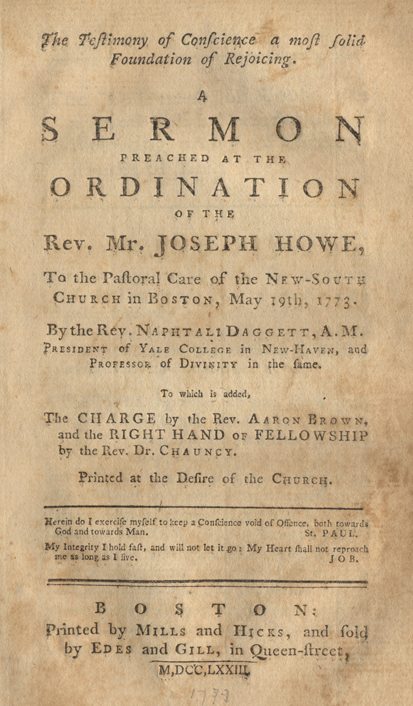

sermon-ordination-1773


The Testimony of Conscience a most Solid Foundation of Rejoicing

A

SERMON

PREACHED AT THE

ORDINATION

OF THE

Rev. Joseph Howe,

To the Pastoral Care of the New-South Church in Boston, May 19th, 1773.

By the Rev. Naphtali Daggett, A. M.
President of Yale College in New-Haven, and
Professor of Divinity in the same.

To which is added,

The CHARGE by the Rev. Aaron Brown, and the RIGHT HAND
Of FELLOWSHIP by the Rev. Dr. Chauncy.

Printed at the Desire of the Church.

Herein do I exercise myself to keep a Conscience void of Offence, both towards God and towards Man.

St. PAUL.

My Integrity I hold fast, and will not let it go: My Heart shall not reproach me as long as I live.
JOB.

The Testimony of Conscience a most solid Foundation of Rejoicing under all Circumstances of Life.

II COR. I. 12.

For our Rejoicing is this, the Testimony of our Conscience, that in Simplicity and godly Sincerity, not with fleshly Wisdom, but by the Grace of God we have had our Conversation in the World, and more abundantly to you-wards.

The Apostles of our Lord Jesus Christ had a very arduous and trying service enjoined them.—They were required to go forth into all the world, and teach all nations the Christian religion in direct opposition to the numerous, deep-rooted prejudices, corruptions and false religions then established upon earth; and to insist upon it, that all, who heard them, should believe in, trust and submit to One, as their God and Saviour, who had been lately executed in the ignominious character of a malefactor by his own nation, the Jews.

It was easy to foresee, that in the execution of this their commission they would necessarily meet with the most virulent opposition and persecution from an ignorant, degenerated, prejudiced world, who had slain their Lord and Master with wicked hands. And he had indeed clearly assured them before hand of this event; that they would be hated and persecuted of all men for his sake.

They had neither learning, civil or ecclesiastical power, nor the encouragement of the great ones of the earth to befriend their undertaking. On the contrary, all these were firmly and inveterately leagued against them, with Satan, the prince of the powers of the air, as their head and leader, who had long indulged the most implacable spite against the seed of the woman. Under these discouraging circumstances, it must have been the most extravagant, romantic enterprise ever attempted by mad-men, to set out upon the design of Christianizing the world, unless they had been absolutely certain of the truth of their doctrine, their mission from God, and his unfailing promise of assistance and success.

But God doubtless chose this chose this method for bringing the world to the Christian faith; that it might most evidently appear to after ages to have been effected, not by might, by worldly power and wisdom; but by the spirit of the Lord. So that the surprising success and progress of the gospel under all those unfavourable and forbidding circumstances might be a lasting evidence of its divine original, while at the same time 1 “the foolishness of God is hereby demonstrated to be wiser than man; and the weakness of God to be stronger than man.” The apostles in first propagating the gospel had nothing to support them but the evidence of truth, the God-like grandeur and dignity of their doctrines, the holiness of their lives, and those incontestable miracles which they were enabled to work in confirmation of their divine mission, together with the promised influences of the Holy Spirit upon the minds and hearts of men. By these they made their way surprisingly through all imaginable opposition, converting great multitudes to the Christian faith; yet not without meeting with the most cruel persecutions, reproaches, scourging, imprisonment and death itself; which sufficiently evidenced, how opposite the world was to embracing the religion of Jesus. And while multitudes died martyrs in the cause, still the cause lived, and gained ground, according to the prediction of Gamaliel,– 2 “If it be of God, ye cannot overthrow it.”

The apostle in this chapter mentions some of the tribulations, distresses and trials they had to undergo for the sake of the gospel. “The sufferings of Christ, says he, i. e. sufferings in some measure resembling his, abound in us:–For we would not, brethren, have you ignorant of our trouble which came to us in Asia, that we were pressed out of measure, above strength, insomuch that we despaired even of life.” In another place in this epistle he gives a more particular, but summary account of his sufferings;– 3 “In stripes above measure, in prisons more frequent, in deaths oft. Of the Jews five times received I forty stripes, save one. Thrice was I beaten with rods, once was I stoned, thrice I suffered shipwreck, a night and a day I have been in the deep, in journeying often, in perils of water, in perils of robbers, in perils by mine own countrymen, in perils by the heathen, in perils in the city, in perils in the wilderness, in perils in the sea, in perils among false brethren; in weariness and painfulness, in watchings often, in hunger and thirst, in fastings often, in cold and nakedness.”

And yet amidst all their arduous labours, their severe trials and sufferings, we see the apostles were comfortably supported, and went on cheerfully in the work, in which they were engaged, notwithstanding all the ungrateful abuses, reproaches and ill treatment they met with from the world. They had no worldly honours, or secular advantages in view; no inviting prospects of an earthly nature to invite and animate them. It is therefore evident, they must have had supernatural assistance and support, which not only kept up their courage and resolution, but raised them superior to all difficulties, and made them even rejoice in tribulations. One important article of this divine support the apostle mentions in the text: For our rejoicing is this, the testimony of our conscience, that in simplicity and godly sincerity, &c. an inward consciousness of our integrity in the sight of God, with a confident reliance on his promise for success, and the glorious rewards of another world to crown our labours. The words suggest this doctrine:–

Doc. That the testimony of conscience in our favour is the most solid foundation of rejoicing under all circumstances in life.

The explanation of the text, if it needs any, will naturally come in, while we consider—What the testimony of conscience is:–What is requisite to its being in our favour:–And why it is the most solid foundation of rejoicing under all circumstances in life.

I. We may consider, what this testimony of conscience is:–Conscience, considered as a faculty, is nothing but our reason exercised in judging of the lawfulness or unlawfulness of our actions, compared with the divine law, the rule of duty. By this reason, which God hath given us, we judge of the truth and evidences of divine revelation, and search out the meaning of it. By this, under the assistance of the Holy Spirit, we examine into the nature, the tenour, and conditions of the gospel, the requirements of it, and the terms of salvation therein revealed. This is necessarily supposed in all the commands and directions given us, to search the scriptures:–To examine, try and prove ourselves, whether we be in the faith?—Whether we be the sons of God, or the children of disobedience. This supposes us able to understand the rule of trial, and to have a capacity of comparing ourselves, or our true character, in order to judge of our conformity to the rule.

Accordingly we find, that we have an immediate consciousness of what passes within us: Not only what our actions are; but what our dispositions, views and governing motives to action. The testimony of conscience then is the inward witness of our spirit to the sincerity and uprightness of our hearts before God, when compared with his laws, and the qualifications necessary to salvation required in the gospel. The testimony of conscience is that reflex act of the mind whereby we judge of the moral goodness or evil of our actions and dispositions, or of the goodness of our state, according to the prescribed rule of judging. Agreeable hereto the apostle says of the heathen,– 4 “Their conscience also bearing witness, and their thoughts the mean while either accusing, or else excusing one another.” And elsewhere,– 5 “if our heart condemn us not, then have we confidence towards God.” We read in scripture of a good conscience, and of an evil conscience. The latter intends a guilty, accusing conscience; the former means directly the reverse of this. The apostle in the text intends the testimony of a good conscience, as this only can be a just foundation for rejoicing. We are likewise to understand him to mean a well-regulated, and duly enlightened conscience: For although the testimony of an erroneous conscience in our favour will necessarily be attended with joy; yet this is only the joy of the hypocrite, that will perish.—Such a misguided conscience is so far from being a just and solid foundation for rejoicing, that ‘tis one of the most awful judgments.

In a word, the testimony of conscience intended in the text, is the inward approbation and witness of our heart, that we have sincerely complied with the offers of the gospel; have truly devoted ourselves to God and his service through Jesus Christ; and in consequence hereof do habitually and prevailingly endeavour to have our whole conversation such as becomes the gospel, in simplicity and godly sincerity.

But do not many enjoy the pleasure of this self-approbation, while in truth and reality they have no solid foundation for rejoicing? Does not the ignorant, conceited Deist feel very comfortably elated in thinking, that by a superior greatness of genius and rare discernment, he has been enabled to soar above he vulgar errors and prejudices of those weak souls, who perceive their need of a revelation from the Father of Lights; and are hence induced to believe, “that God at sundry times, and in divers manners spake to the fathers by the prophets, and to us in these last days by his Son;” and so are credulous enough to believe the bible to be the word of God? while he is conscious to himself that he hath most uprightly followed that sure unerring guide, the dictates of human reason, not only in those social virtues, which he may have occasionally practiced; but also in those more manly freedoms, which the contracted Decalogue unpolitely forbids?

Does not the self-righteous legalist feel extremely satisfied to think he hath been so upright, so sincere, practiced so many virtues, done so many good deeds to mankind, and performed so many acts of piety and devotion towards God, that he cannot imagine the best of beings will be so severely incomplaisant, as to mark against him the few slips and sins he may have been guilty of through inadvertency, or some unhappy inclination of nature?

Does not the affectedly humble, but really proud enthusiast exult with exceeding joy, while he pleasingly fancies himself indulged in the greatest familiarities with the Supreme Being, as one of his most distinguished favourites;–is caught up into the third heavens in the multiplicity of his revelations, and seems to hear from the throne of the Majesty on high such transporting declarations as these, in the very language of scripture,–“O, man, greatly beloved of God:–Son, be of good cheer, thy sins are forgiven thee?”—No doubt these and many other instances of groundless, delusive joy do, and will, take place in the hearts of men, notwithstanding the clearest external teachings and instructions heaven can give. Nor can we rely on anything, but sovereign grace, to secure us from being the unhappy subjects of these fatal delusions. The consideration of which may very justly excite us to have our eyes to the Father of Lights to direct us in judging impartially of ourselves, and in making a due application of the truth, while we consider,

II. What is really requisite to the testimony of conscience being in our favour. It is very plain, negatively, that it is not requisite, that it should bear testimony to our perfect innocence. This is impossible in this state of sin and great imperfection. The conscience of the holiest saint on earth must testify against him, that he hath sinned and come short of the glory of God: That he is in himself a guilty sinner; and that if God should mark iniquity against him, he could not stand:–That he hath been greatly deficient in every duty, and chargeable with continual criminal imperfections in all the holiest services he hath ever performed. The apostle very freely acknowledged he had not already attained what he was aiming at, neither was yet perfect; so that when he had a prevailing disposition to do good, evil was still present with him. Under a deep, affecting sense of this he sighed forth that heavy complaint, O wretched man that I am!

But then the apostle tells us positively, in the text, what was the matter or substance of the testimony which conscience bore in their favour, viz. that in simplicity and godly sincerity they had their conversation in the world.

Now the truth and reality of this is the grand requisite to conscience bearing testimony for us, so that it may be a just and solid foundation of rejoicing to us. I will therefore only briefly consider, what is necessarily comprised in this testimony, as

I. A consciousness that we have sincerely devoted and dedicated ourselves to God through Christ, according to the call and demand of the gospel.

Our hearts must testify this, that we have truly given ourselves up to the Lord and his service, with an hearty desire of glorifying him in such business and employments as Providence shall point out to be our duty. That we have at least a prevailing hope of what the apostle was so well assured of respecting himself, when he says, “I know whom I have believed.” Conscience must give some comfortable evidence to us, that we have really complied with the call of the gospel, have received, and humbly submitted to Christ, as our king to reign over us, as his willing and loyal subjects.

II. That we have faithfully endeavoured to do the work and business which he hath assigned us.

Let our calling be what it will, faithful, vigorous activity and diligence therein is our indispensable duty. And if we do not labour industriously in the service of our Lord, instead of having the testimony of conscience in our favour, it will condemn us, as wicked and slothful servants. If we be called to the sacred work of the ministry, we must “do the work of an Evangelist.” Assiduous labour and vigilance, and that not of the easiest kind, is most plainly assigned to ministers of the gospel. This is evidently required in their character of labourers and soldiers &c. and it is needless to mention how repeatedly and solemnly this is enjoined upon them in the word of God, or to enumerate the various articles of service and labour allotted to them. Nor can slothfulness and idleness in any case be followed with more fatally dreadful consequences than in this. Most applicable to this is what was said by the prophet concerning another work, 6“cursed be he that doth the work of the Lord deceitfully.” How frequently do we find this apostle making mention of his, and his fellow-labourers striving and laboring, even night and day with the greatest ardour and diligence in the work of the ministry? 7 “Whom we preach (meaning Christ) warning every man, and teaching every man, in all wisdom, that we may present every man perfect in Christ Jesus. Whereunto I also labour, striving according to his working, which worketh in me mightily.” The apostles being able to make these and such-like declarations with truth, was what laid a solid foundation for his rejoicing: And we must be able to say the same, if we would share in, and be partakers of that noble joy.

III. A consciousness that we have been incited and influenced by a right principle of action in our conversation.

By the principle of action here I would be understood to mean that temper of mind, or disposition of foul, whereby a person hath been inclined to that course of actions which he hath performed in the world. ‘Tis exceeding manifest, that persons may be influenced to the same visible conduct, or materially good actions from very different springs or principles at heart. The apostle therefore observes, in the text, that their conscience bore testimony with regard to this, that their conversation in the world had proceeded from a principle of godly sincerity, or the grace of God, in opposition to fleshly or carnal wisdom. They had been powerfully inclined to devote themselves to the service of God in the gospel-ministry by the grace of God ruling in their hearts.

If we be induced to action merely from a natural principle of self-love, without a supreme regard for God, his honour and glory, we have not that godly sincerity mentioned in the text. The apostle could say, “We preach not ourselves, but Christ Jesus the Lord; and ourselves your servants for Jesus’ sake.” He may be justly considered as explaining what he means by the grace of God, or godly sincerity in the test, where he tells us in this same epistle, “That the love of Christ constrained them” to their ministerial labours. It was by a supernatural principle of divine grace implanted in their hearts by the spirit of God, that they were irresistibly borne along and carried forward in the service of God; so that while this reigned in their hearts, no obstacles could stop them in their course.

Natural sincerity is, when a person acts from the impulse of mere natural principles, or a regard merely to self-interest, in what he does. Godly sincerity is, when the love of God bears sway, as the ruling spring of action in the soul.

The apostle elsewhere speaks of the wisdom of the flesh, and the wisdom of the spirit; and of that wisdom which is from above, and that which is from beneath, as different or opposite principles of action. And the testimony of conscience can be of no avail to us, unless it witnesses by an inward consciousness, that we are actuated by the wisdom of the spirit, or by a gracious disposition wrought in our hearts by the spirit of God.

IV. That we have fixed upon, aimed at, and pursued a right end in what we have done in the world.

This hath an essential influence in determining the quality of our actions. If our highest, ultimate end be wrong, our conduct, completely viewed, cannot be right, or meet with the divine approbation. Could we suppose the apostles to have been inspired, and have performed all their extraordinary labours and services for any lower end, than the honour and glory of God, the testimony of their conscience would have been essentially defective. But their conscience witnessed for them, that they had behaved with simplicity in the world: That their grand, governing end and design was such, as was naturally indicated by their actions. “Their eye was single.” The word simplicity, in the original, seems to be nearly of the same signification with sincerity. It denotes an uprightness of intention and design, in opposition to hypocrisy, or acting under a disguise: In which case a person’s real end is different from that which he professes, or makes a shew of: When his profession or actions naturally indicate a certain end to be aimed at by him, while he really hath a different one in view. The meaning of the word simplicity, above-given, is agreeable to the etymology of it, and the sense in which it is frequently used in the new testament, as in Romans xii. 8. “Let him that giveth, do it with simplicity;” with an upright intention, and not with any such low, selfish end, as that of being seen of men. Eph. vi. 5. “Servants, be obedient to them that are your masters according to the flesh, with singleness of heart, as unto Christ.” The apostles plainly professed, both by words and actions, that they aimed not at any thing this world could bestow, but at the highest and noblest end in the extraordinary services they undertook. This was the tenour of their declarations: “We seek not yours, but you.”-—“For whether we be beside ourselves, it is to God; or whether we be sober it is for your cause.”-—“For we which live are always delivered unto death for Jesus’ sake.” 8 “Therefore I take pleasure in infirmities, in reproaches, in necessities, in persecutions, in distresses for Christ’s sake.” This being their profession, they must have had an ultimate view to God and his glory, and a disinterested regard to the good of mankind, in order to support the truth of this testimony, that they had their conversation in simplicity. Godly sincerity requires and implies a supreme regard to God as our last end. 9 “For whether we live, we live unto the Lord, or whether we die, we die unto the Lord.” Whatever regard we may lawfully have for our own honour, ease or interest, these must not be uppermost in the view of our minds; but all subordinated to God, and his honour. This is a most material thing, when we come to view ourselves in the sight of God, and under his omniscient eye, who searcheth the heart, and most perfectly views all the springs of action in us, all our motives and designs. It is plainly of the last importance, that a well regulated conscience be able to testify to our sincerity in this respect.

I am not insensible how difficult it is for us, in this imperfect state of blindness and self-partiality, clearly to know our deceitful hearts in this matter, nor of the danger we are in of drawing up a wrong judgment in our own favour, which should make us exercise the greatest care and caution, while we examine ourselves by attending to the workings of our hearts, and comparing them with the tenour and habitual course of our conduct, enquiring what we are enabled to do for God, and how far we can readily deny ourselves for his sake, and give up, and sacrifice our interest to his honour and interest. And yet I am fully persuaded, that those, whose hearts are right with God, and found in his statutes; who daily exercise themselves to keep consciences void of offence towards God and towards man, may, by due attention and careful self-examination, upon solid evidence, obtain a comfortable, satisfactory testimony of conscience in their favour, and be able to appeal to God, with humble modesty, “Thou knowest that I am not wicked,” i.e. allowedly so.

V. That we have, according to the best of our knowledge and skill, used the proper means for attaining this best end. Conscience must be able to testify, that we have not regulated our conversation by the principles and maxims of fleshly wisdom. Fleshly wisdom is that craft or policy whereby the men of this world govern their conduct in order to attain their ends. And as they are prevailingly determined by a regard to their own gratification, they will not ordinarily stick at the greatest unlawfulness of the means they use, provided they can judge them most subservient and conducive to their purpose.

This was not the manner of the apostles conduct: Nor did they govern themselves by these rules of prudence. They were harmless and blameless, as the sons of God, without rebuke: Yet very far from being supinely inactive. They were vigilant and attentive; sagacious to espy dangers, cautious not to create them needlessly, and wary to escape them. Their prudence consisted much in giving no just occasion of offence to Jew or Gentile: In performing every innocently-winning office of goodness and condescension, without meanly seeking applause of men. They were discrete and wise: But then their wisdom was not only consistent with, but greatly consisted in, the innocence of the dove. They were harmless as sheep in the midst of wolves;–yet not cowardly timorous.—They were bold as lions, when the honour of God and the Redeemer, the cause of truth and pure religion was endangered: Nor did they, when called to action, shun to expose themselves to the most formidable dangers in defence of it. They would not comply with an unlawful measure, to conciliate the favour of monarchs and the whole world, or extricate themselves out of the greatest difficulties and dangers. They would not neglect a plain, known duty, or shun to declare the whole counsel of God, even the most obnoxious, offensive truths, that were profitable, and that before kings, in order to avoid the severest persecution. For it was their governing maxim, to obey God rather than man, when their commands clashed with each other. When the Holy Ghost assured them, that bonds and imprisonments awaited them in every city, and the affectionate, kind entreaties of Christian friends urged them hard not to expose themselves to the threatened dangers, though they could not indeed be unaffected with the expressions of their kindness, they felt it deeply, almost to the breaking of their hearts; but still a deeper sense of duty and obligation to their divine Redeemer supported their resolution undaunted, as we have it expressed with inimitable beauty, and the liveliest sensibility in such language as this, “What mean ye to weep and break my heart? For I am ready not only to be bound, but also to die at Jerusalem for the name of the Lord Jesus.”

There was a just and noble simplicity in their conduct in this respect; that they would not descend to mingle carnal measures, and crafty devices of their own invention, with the means which God had directed them to use. They kept strait and close to the line of truth. Thus they express themselves; 10 “We can do nothing against the truth, but for the truth.”-—“We have not followed cunningly devised fables, when we made known unto you the power and coming of our Lord Jesus Christ.” They had no party to espouse, besides that which Christ had made himself the head of, who came to bear witness to the truth. They had no little party designs or interest to serve; were not therefore necessitated to deal in ecclesiastical intrigues and politics. 11 “They renounced the hidden things of dishonesty; not walking in craftiness, nor handling the word of God deceitfully; but by manifestation of the truth commending themselves to every man’s conscience in the fight of God.” They were not indifferent about the great distinguishing truths of the gospel; nor did their Catholicism consist in (what some have since valued themselves upon) regarding the treating almost all the doctrines of the gospel, as indifferent points of speculation. They boldly and fairly oppose all false religion, and all corruptions of the Christian doctrine by blending error with the truth. This condescending apostle, who was willing to become all things to all men, in matters of mere indifference, did not scruple to anathematize an angel from heaven, that should dare to advance any other, i.e. contrary, doctrine to what he had preached, as knowing that he had received his from the unerring spirit of truth. 12 Those who advanced pernicious errors in doctrine, subversive of, or highly prejudicial to, the gospel-scheme and plan of salvation, or favouring licentious practices, they openly and boldly declared to be enemies to the cross of Christ. But then they practiced no little fly craft, no low, under-hand measures to blacken the character of their enemies needlessly.—They willingly left the honour of such low dealing to their enemies, who did not fail to practice it very freely, as many since have done, who will scarcely allow common sense to those who differ a little from them in some immaterial points, not unfrequently characterizing them for fools and dunces. Or if they oppose any of their peculiar, darling whims, or more hurtful errors, they will be sure, either by fly insinuations, or confident majesterial assertions, to endeavour to stigmatize them with the frightful, ambiguous name of heretics, or the still more unmeaning epithet of contracted bigots. I know it is good to be zealously affected always in a good thing; nor is it surely any evidence of meanness or malevolence to contend earnestly for the faith once delivered to the saints with the meekness of wisdom, and with that zealous boldness, which the high importance of sacred truth justly requires, in opposition to all those adversaries, who endeavour to corrupt or pervert the gospel of Christ. All that I mean to condemn is, the using sly, crafty, ill natured artifices in support of what we deem to be the cause of Christ, which cause always disdains such ill chosen and unfriendly assistance. It rests securely on the open, honest evidence of truth: It never deigns to call in, or ever thinks it can be served by, any aid that wickedness can afford it. It may not be improper to observe here, those who are engaged on the side of error are by much the most likely, in their straits, to have recourse to such an impolitic, wicked refuge, like Saul to the witch of Endor, when God had departed from him.

All these practices are intirely inconsistent with that simplicity and godly sincerity, on which the apostles justly valued themselves.

However good therefore our cause may be, we must be ware that we do not take undue methods for the support of it; but trust it with God, in the use of those means which he hath prescribed. The cause of God, in which the salvation of souls is concerned, may not, cannot be maintained or served by craft, carnal policy, or any measures not consistent with the strictest truth, justice and goodness. And if by a close, prudent adherence to these we cannot obtain the desired success, or accomplish what we sincerely aimed at, yet we shall have the testimony of a good conscience, if it witness for us, that we have used all lawful and proper means for attaining the end. Not the greatness of success; but the sincerity of our intentions, and the suitableness of the measures used are the grand articles requisite to be attested by conscience.

III. I proceed to consider why or how this testimony of conscience is the most solid foundation of rejoicing under all circumstances of life.

Not because it implies, that we have done the whole of our duty. No, there will still be an humbling consciousness of many criminal defects and neglects of duty, which will effectually exclude all boasting or glorying in ourselves, under any such notion as this, that we have hereby in the least merited the favour or approbation of God. A deep sense of guilt will stop the mouth, and lay the holiest saint on earth low before God. His rejoicing therefore will not be in himself, but in the Lord, in his sovereign abounding mercy through Christ. And yet this testimony of conscience will afford as many just reasons for rejoicing, as,

I. That we have in any good measure, or only in some small degree acted up to our character and obligations.

Our being entirely indebted to rich grace, for any good we may have been enabled to do, doth not at all exclude a real, just self-approbation, wherein we have in any measure complied with the will of God, and performed our duty. Perfectly consistent are these several declarations of this great apostle Paul;–“By the grace of God I am, what I am.—I labored more abundantly than they all; yet not I, but the grace of God which was with me.” And yet this is my rejoicing, the testimony of my conscience, that in simplicity and godly sincerity, &c. I have had my conversation in the world.”

While we ascribe to God the whole praise of whatever good he hath been pleased to bestow upon us, or enabled us by his grace to do, there is just room to feel a humble, self-complacency in being what God hath made us, although the more we are enabled to do for him, and act up to our character, the more we are indebted to him.

II. ‘Tis just cause of rejoicing, that we have been instrumental of doing any good to mankind.

It is an high honour to be faithful servants to our generation.

The apostle Paul magnified his office, while at the same time he declared himself a debtor to the Greeks and Barbarians, to the wise and the unwise:–And that a necessity was laid upon him to preach the gospel. “It is more blessed to give than to receive;” to communicate good to others, than to receive it from them, however indisposed our selfish hearts may be to relish this blessedness. The ever blessed God delights in thus communicating good: And an imitation of him herein affords a pleasing gratification to a benevolent heart, and yields the soul a sublime, refined joy and pleasure. If we have the same mind in us, which was also in Christ; if we have that law of kindness written on our hearts, requiring and disposing us to love our neighbour as ourselves, we cannot fail of feeling a sensible joy in the thought of having contributed to the promoting their happiness.

III. This testimony of conscience is just cause of rejoicing, as it assures us of our having been designed active in advancing the glory of God and the Redeemer.

The infinite blessedness of God renders it impossible for us to be really profitable to him; yet we may be said in some proper sense to honour and glorify him by serving him: And he condescends to represent himself as honoured by the willing, faithful services of his creatures. It is, it will forever be, the inseparable effect of love to make us rejoice and take delight in pleasing and honouring the object of it. Gratitude for the infinite blessings of redemption by Christ will necessarily make the creature’s heart rejoice in thinking he hath contributed his mite in displaying the honour of the Redeemer, and the glory of God’s grace:–That he hath herein been a worker together with God; and is unto him a sweet savour of Christ in them that are saved, and in them that perish.

IV. As it furnishes us with a comfortable refutation of the reproaches and calumnies that may be cast upon us.

To be suspected, vilified and reproached, and injuriously robbed of that good name, which is as precious ointment, hath something in it very painfully grating to human nature. There is likewise something tenderly affecting in the thought of the injuriousness of this conduct, especially when it springs from, and has base ingratitude mingled with it. Innocence however, like a brazen wall of defence, affords a comfortable shelter, a mighty support under such attacks of ignorance or malice; enables the soul to rise superior to them, and to esteem it comparatively a little thing to be judged by man’s judgment, while he can appeal to the Searcher of Hearts, as the Judge of his integrity, assured that he will bring forth his judgment as the light, and his righteousness as the noon-day.

But just reproaches, the echo of the voice of conscience, sting and cut to the quick, when they come keenly edged with conscious guilt; which will often be our mortifying situation, if we have not the testimony of conscience to our simplicity and godly sincerity.

But a well-grounded testimony of conscience in our favour appears a matter of still infinitely greater importance, when we consider it.

V. In connection with the divine approbation, and as giving assurance of final acceptance with him.

In this view of it the mind cannot conceive of any equally just foundation for rejoicing. This makes heaven:–This must give joy unspeakable and full of glory.—Let us pause a moment, my brethren, and consider what an importantly critical situation we are in this moment, while probationers for eternity, I mean in this life, which is but a moment. We stand, as it were, in the middle between Heaven and Hell, this moment of life determines the event, and consigns us over to the one or the other for eternity. The favour and approbation of the Almighty is life and endless felicity: His frowns and displeasure are death and hell. Imagination cannot suggest any real good, any thing possibly desirable for us, but it is all fully comprehended in final acceptance with God.—When therefore we anticipate in our thoughts the decisive sentence to be very shortly given from the tribunal of Christ, with assurance from the testimony of conscience, that we shall be able in that solemn day to give up our account with joy and not with grief, it is impossible not to feel ourselves supported by the most solid foundation of rejoicing, a foundation as firm and solid, as the immutable rock of ages. The rejoicing that can spring from any other consideration, of riches, honour, and all the enjoyments of time and sense, will bear no more comparison with this, than a moment’s laughter of the fool with the endless, ever-fresh, unsatiating joys of Paradise, and those deep rivers of pleasure, which flow perpetual at God’s right hand. With the utmost reason then did the apostles make this the matter of their rejoicing, even a consciousness of their simplicity and godly sincerity.

APPLICATION.
The considerations which have been suggested may justly excite in us all the greatest solicitude now to lay well this foundation of rejoicing, and secure it for our own.

The present state, though very wisely calculated for a state of probation, is far from yielding uninterrupted joy and pleasure. We cannot travel long on earth, under the most promising circumstances, before we shall descend into some Bokim, a vale of tears; and very often are but just ascended from one to higher ground and fairer prospects, before we are obliged to descend again into another, which we must wade through in grief and sorrow, with the wearisome, lonely steps of pilgrims. Under these dark, solitary scenes, when the joy of our heart is ceased; when the fig-tree blossoms not, nor creation wears a smile, to what shall we betake ourselves for rest and consolation? The whole creation cannot give it.—Happy then, if we can find solid cause of rejoicing in the testimony of our conscience: This will give peace and joy; not as the world giveth: Will enable us to rejoice in the Lord, and joy in the God of our salvation, yea, even to rejoice in tribulations. Or, if we suppose the best that possibly can be supposed relative to the present state, that we may live many days and rejoice in them all; yet let us remember the days of darkness, for they will be many. All that cometh is vanity. For what is our life! It is even a transient vapour, which appeareth a little while, and then vanisheth away. When therefore our declining sun is just setting, and we are got into the dusky, lonely evening of life; or when any other indubitable symptoms declare death to be just entering our doors, to what shall we then have recourse for support or consolation? Will all the past pleasures or enjoyments of the world afford us any relief? ‘Tis impossible; for they are annihilated;–they are not. Will any future expectations from earth come in to our aid, when we shall stand in the most pressing need of it? Alas! we cannot reach them: They are absolutely cut off by the supposition, and flee away before us. Will the kindest assistance of friends be of any avail to us? No; we are in the very article of biding a lasting adieu to them, our dying hands withdrawing from theirs. Nothing therefore will be able to administer any relief, or solid rejoicing, or even tolerable support, but that testimony of conscience which assures us of the divine favour, “That when our heart and strength shall fail, God will be the strength of our heart, and our portion for ever.”

At these solemn seasons, and indeed through the whole of life, this testimony of conscience will be of infinite importance to all, whatever their rank, condition or employment may be. But when we consider the words of our text, as coming from the mouth of a minister of Jesus Christ, under inspiration, with a particular application to himself and his brethren in the ministry, they seem in a special manner to demand the most serious attention of those who sustain that sacred character.

Permit me then, my reverend fathers and brethren in the ministry, with all humility and freedom, to address to you and to myself the hints that have been offered on the subject.

Such a solemnity as this before us cannot but impress our minds afresh with a sense of the very sacred obligations we laid ourselves under to God, when we devoted ourselves to his service in the gospel ministry. And it highly concerns us at such a time to review our past conduct with the strictest impartiality, as in the awful presence of him who searches our hearts, and enquire how we have acted up to these obligations: And to enter into ourselves, and examine, whether conscience testifies for us, that in simplicity and godly sincerity, not with fleshly wisdom, but by the grace of God, we have hitherto had our conversation in the world?—Have our prevailing motives and principles of action been such, as will meet with the divine approbation?—Have we made God, his interest and glory, the highest end of our ministerial labours, while at the same time we have been prompted and constrained to faithfulness by a benevolent solicitude for the souls committed to our charge?

For our quickening to industry and diligence in the work of the Lord, let us consider, that we may well afford to be active and laborious therein. We have not such an hard, trying service, in many respects, assigned to us, as was laid on the apostles and primitive ministers of Christ. Instead of the want of all things, hunger and nakedness, which they were called to endure, we are comfortably supported, have a competency, if not an affluence, of worldly good. Instead of that infamy, reproach and contempt, with which they were loaded, we are kindly treated with all the esteem and honour we deserve (and sometimes more) by the world around us, except some few profligate sons of Belial, in whose power it is not to honour us so much any other way, as by their spiteful reproaches, thereby giving a lively specimen of the ancient enmity put between the woman’s seed and the seed of the serpent: At the same time they treat us full as respectfully as they do their Maker. It must then be most criminal ingratitude in us to be slothful in our business, while we are serving the Lord, who hath made our work so much easier than was that of the apostles. Not but that we have toil and labour enough, with many sinking discouragements, and exercising scenes to pass through, in the faithful discharge of our trust. But let none of these things move us, any otherwise than only to animate us to labour and strive, that we may obtain the rejoicing testimony of conscience. And let us daily bear in mind the solemn, closing scene, when we must give up an account of our stewardship, and be no longer stewards; when our departure shall be at hand, and we shall be ready to be offered up. When it shall be at hand, did I say? It is at hand now, even with the youngest of us; for the time is short. And with respect to some of us the shadows of evening, already arrived, are extended long from the hoary head, and remind us, that our sun is just setting. May we all be faithful to the death; and while we live, have the testimony of our conscience for our rejoicing, as a sure earnest of a crown of glory to be bestowed upon us at the last day.

But I must briefly address myself more particularly to this our younger brother, who is now to be solemnly set apart to the work and service of the sanctuary.

Dear Sir,

The solemn hour is now come, in which you are publicly to devote yourself, and be consecrated, to the noble, arduous work of the gospel-ministry, and take upon yourself one of the weightiest trusts ever committed to a mortal. You are about to inlist under the Captain of our salvation, as a fellow-soldier with the apostles, a fellow-servant with angels, who are ministering spirits to the church; yea, as a worker together with God himself, for the grand purpose of accomplishing the designs of redeeming mercy towards your fellow-sinners. Doth not the weight of the charge make your heart tremble, and constrain you to look up by faith and fervent prayer to God through Christ for that grace, which alone can make you an able and faithful minister of the new testament? Both duty and affection incline me to say a few words to you on this solemn, joyful occasion. I trust you have weighed well the importance of your undertaking, and often seriously considered the great necessity of those being truly and experimentally religious, whose business and profession engages them to spend their lives in making others so. let it then be your first care to save your own soul: Then will you be the more likely to save the souls of them that hear you. May this affecting thought daily engage your attention to the concerns of your soul, and quicken you to walk humbly and closely with God. The agreeable, intimate acquaintance I have had with you, while you faithfully discharged the office of a tutor in our college for several years to its great advantage, and with equal reputation to yourself, gives me the pleasure of knowing both your natural and acquired accomplishments for the work you are engaging in, as well as your soundness in the faith. Hold fast that form of sound words, which you have learned from the sacred oracles, and which (may I not say) you have in part heard of me. Practice all that condescension to the weakness and prejudices of others, which the apostle intended by becoming all things to all men. Be gentle towards all men. To which I know your natural disposition is very inclinable. But then be on your guard, lest a condescending and pacific temper at any time betray you into compliances, injurious to your virtue and dishonourable to your profession. Set down your foot at the line of truth, and let not fear, frowns, flatteries or reproaches, or any temporal inconveniencies whatever, make you swerve an hair’s-breadth from it. Condescendingly sacrifice any thing for the sake of peace, except truth and duty: But invariably keep to these. In all your instructions study to be plain and intelligible, which is the prime end of language. And let not your taste for elegance of stile, accuracy of diction and composition, by any means prevent the most plain, close and pungent application to the hearts and consciences of your hearers. Study infinitely more to recommend Christ and his religion to your hearers, than yourself. Keep the great end of the gospel-ministry always in view, the advancing the glory of God and Christ in the salvation of souls committed to your charge. Let me just intreat you to pay a particular attention to the youths and children, and those under serious, religious impressions in your congregation, as having the greatest prospect of success with these: And herein imitate the great Shepherd of the sheep, “who carries the lambs in his arms, and gently leadeth those that are with young.” I cannot now suggest to you the numerous, weighty motives, that might be urged to excite you to the greatest faithfulness and diligence in discharging the high rust you are now to have committed to you. I trust you will daily bear in mind the vast importance to yourself, as well as others, of being able to adopt, with application to yourself, through the course of your ministry, and especially at the close of it, the declaration of the apostle in the text. May you experimentally know the solid rejoicing, which this testimony will not fail to give all those who are faithful to the death; and may you than receive the promised crown.

Let me now say a few words to the church and congregation, at whose call and request a minister is now to be ordained over them in the Lord.

Beloved Brethren,

My unacquaintedness with your particular circumstances will excuse me with only saying a few words to express our joy and congratulation with you in having been directed to, and succeeded in, your unanimous choice of one to be your pastor, who, we have reason to hope, will be an able and faithful minister of the new-testament among you, and naturally care for the welfare of your souls. We desire to join with you in thankful acknowledgments to the great Shepherd and Head of the church, for the provision he is making from time to time for the edification of the same, by raising up and qualifying men to feed his sheep and his lambs, the flock which he hath purchased with his own blood. And that you have this day the experience of this his kind care for you, in providing one to take the oversight, and act the part of a bishop towards your souls; in consequence of which you are like to enjoy the ministry of the gospel and the administrations of its ordinances resettled among you; and that under prospects very encouraging, and joyfully promising happy success. O let your eyes and fervent prayers be directed this day to the God of all grace for his blessing to accompany these solemn transactions, and render the means of grace provided for you a favour of life unto life to the salvation of all your souls: That you and your pastor may have sweet communion with God and one another, while you dwell here in the house of the Lord, feasting on the rich provisions, with which the gospel abundantly furnishes you. Dear brethren, I trust our hearts all ardently breathe out this wish and prayer, The Lord send you the blessing out of Sion.

I close with a word to this great assembly in general. What doth conscience now testify to you, respecting the manner of your conversation in the world? That it is conducted and regulated in simplicity, godly sincerity, and by the grace of God? Blessed are ye indeed, if this be the case. How thankfully and joyfully may you live; and how cheerfully go on in the ways of the Lord, while you have this for your rejoicing, even the testimony of your conscience; a testimony that carries with it an assurance of the divine approbation and final acceptance with God? But if it be the reverse of this with you, and conscience either be asleep, or pronounce plainly to you, that you have your conversation with fleshly wisdom, and live after the flesh, in the neglect of God and religion, think seriously, with what torturing fears and distressing apprehensions, this conscience, if it be duly enlightened, will distract your guilty souls at the near approach of death, when your next speedy remove must be into eternity, and to the bar of God, who is greater than your conscience, and knoweth all your wickedness. And what an everlasting source of unutterable anguish will its accusations be to you, when it shall be fully awakened to the liveliest sensibility, in the regions of horror and despair, and pour in continual reproaches and self-condemnation upon your souls, like a stream of fire from incensed Omnipotence! O be persuaded now to turn its testimony in your favour, by turning from all your sins unto God through Jesus Christ: Then will it speak peace to you here, as a sure pledge of peace and joy everlasting in the presence and favour of God in the coming world.

AMEN.
 

The CHARGE, by the Rev. Aaron Brown.

Reverend and Dear SIR,

It having pleased God to lead this church into the unanimous choice of you to be their pastor, and to incline you to accept of their call; we, whose hands are imposed, do in the name of the Lord Jesus Christ, and by virtue of authority derived from him, ordain and separate you, Joseph Howe, to the great, important and laborious work of the gospel-ministry; especially committing to your pastoral care and oversight the Christian Society, who usually assemble in this place for public worship.

And in that same all-glorious name, we do now most solemnly charge thee, before God and the elect angels (which are doubtless witnesses of these solemnities) that to the utmost of thy power thou discharge thyself, in all parts of that ministry and trust we are now committing to thee.—Preach the word, and declare the whole counsel of God, that you be pure from the blood of all men; for it is required of ministers, who are stewards of the mysteries of God, that a man be found faithful.—Keep back nothing that may be profitable to this people. Let them know from the word of God, that they are naturally guilty and depraved, that “there is a vast and unspeakable difference between a sinner and a saint,” between those who are in a state of nature and those who are in a state of grace. Testify unto them repentance towards God and faith towards our Lord Jesus. Preach Christ and him crucified, the doctrine of his atonement and satisfaction, justification through faith in his blood, and sanctification by his spirit.

Remember that you are a minister of the gospel of Christ: Let Christianity therefore, and not the subtleties of wit and philosophy, be the grand matter and aim of your discourses.—Be not of those who corrupt the word of God, or handle it deceitfully; but by manifestation of the truth commend yourself to every man’s conscience in the sight of God. Nor speak with the enticing words of man’s wisdom, but in the demonstration of the spirit and of the power. Study more to be profitable, than to be popular,–more to gain the divine approbation, than the applauses of a polite and respectable assembly.

Reprove, rebuke, exhort, with all long suffering and doctrine; and in the discharge of this part of your trust, variously accommodate yourself to the needs and circumstances of every one; instructing the ignorant,–convincing the unconvinced,–reproving the transgressor,–refuting and putting to silence the gain-sayer,–exhorting the indolent and slothful, and comforting the feeble minded.—In a word, like the great and good Shepherd, gather the lambs in your arms, carry them in your bosom, and gently lead those that are with young.

We, moreover, authorize and charge thee to administer to all persons, duly qualified, the sacraments of the new-testament, (baptism and the Lord’s supper) with becoming solemnity, and agreeable to the rules of the gospel.—Feed Christ’s sheep and feed his lambs.

Exercise also that holy discipline with which, as a gospel-minister, you are entrusted; exercise it with fidelity and tenderness; not lording it over God’s heritage, nor doing any thing by partiality.

We likewise commit unto you authority to assist in ordaining others to the sacred office, as you may be called of God thereunto: But lay hands suddenly on no man.

Let no man despise thee, but esteem thee highly in love, for thy works sake: Therefore be thou an example to believers, in word, in conversation, in charity, in spirit, in faith, in purity.—Give attendance to reading, to exhortation and doctrine. Neglect not the gift that is in thee, which is given by the laying on of the hands of the Presbytery. Meditate on these things give thyself wholly to them, that thy profiting may appear unto all.

Pray fervently, constantly for this people, and bless them from time to time in the name of the Lord. Pray also for yourself, that the grace of Christ may be sufficient for you; for who is sufficient for these things?

Finally, and in a word, in all things approve thyself a faithful minister of the new-testament, a workman that needeth not to be ashamed.

Long may you be continued a great blessing to this people, and they a comfort to you. May the blessing of many souls ready to perish, come upon you; and the God of peace, which brought again our Lord Jesus Christ, the great Shepherd of the sheep, through the blood of the everlasting covenant, make you perfect in every good work to do his will, working in you, that which is well pleasing in his sight, through Jesus Christ our Lord, to whom be glory forever and ever,

A M E N.
 

The Right Hand of Fellowship, by the Rev. Dr. Chauncy.

Dear Sir,

As you have now been separated to the work of the Gospel ministry, and to the charge of the Christian society who worship God in this place, “by prayer and the laying on of the hands of the Presbytery.” In conformity to the common usage upon these occasions, founded on apostolic example, at the desire of the venerable council present, and in their name, I give you my right hand. and I do it, to signify to you, to this great assembly, and to all the churches in the land, that we esteem you a true minister of Jesus Christ, well furnished for, rightly called to, and regularly instated in, the ministerial office; that we affectionately embrace you, as one who has been solemnly devoted to the service of souls; and that we shall always be in readiness to lend you our help by our prayers, advices, and in all other Christian ways, according to our respective abilities, as you may need, and desire it; especially in things “pertaining to the kingdom of God, and Jesus Christ.” Expecting the same expressions of pious charity from you, as the interest of religion may make them proper.

At the same time we “bow our knee to the God and Father of our Lord Jesus Christ, the Father of mercies, and God of all grace,” humble and importunately beseeching, that he would adorn you more and more with the gifts and graces of His spirit; that He would animate you to your work, guide and assist you in it, and support and comfort you under all the trials you may be called to meet with in the upright and faithful discharge of it; that he would make you “wise to win souls,” and happily instrumental in “turning many to righteousness;” and that, at “the time of the time,” you may be found among those servants of our Lord Jesus Christ, who shall shine in the kingdom of His Father as “the brightness of the firmament, and as the starts for ever and ever.”

We now salute you, the Christian church, who statedly worship in the Deity in this house; rejoicing with you in that kind Providence, which has given you, with so much unanimity, love, and peace among yourselves, “a pastor (as we trust) after God’s own heart;” one who is well qualified to “feed you with knowledge and understanding.”

Brethren, we own you as members, in common with yourself, of that “one body” of which Christ is “the head;” we profess a cordial regard to you as such; and we promise, that we will cheerfully afford your own assistance, to all the purposes of “spiritual edification;” as we are able, and may be called thereto; expecting and desiring the like office of brotherly love and duty from you.

Finally, we commend both you and your pastor “to God, and to the word of His grace; which is able to build you up, and give you inheritance among the sanctified by faith in Jesus Christ,” to whom be glory in the church, on earth, and in Heaven, both now and throughout all ages.

AMEN.


Endnotes

1. I. Cor. 1. 25.

2. Acts v. 39.

3. Chap. xi. 23-27.

4. Rom. II. 15.

5. 1st John III. 21.

6. Jerem. Xlviii. 10.

7. Col. i. 28, 29.

8. xii. 10.

9. Rom. xiv. 8.

10. 2d Cor. xiii. 8.

11. 2d Cor. iv. 2.

12. Gal. i. 13.
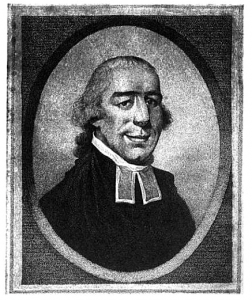
Sermon – Eulogy – 1784

John Clarke (1755-1798)

Born in Portsmouth, New Hampshire, Clarke grew up in a strongly patriotic family during the American War for Independence. In fact, his uncle, Timothy Pickering, was not only a military general under George Washington and later became Postmaster General, Secretary of War, and Secretary of State under President Washington. Clark graduated from the Boston Public Latin School in 1761, while only six years old. In 1774 at the age of nineteen, he graduated from Harvard. He returned for his Master’s Degree (1777), and then studied theology, receiving his Doctor of Divinity from the University of Edinburgh. He took a job on the staff of First Church of Boston, alongside the great preacher Dr. Charles Chauncy, who himself had been a significant influence in the years leading up to the American War for Independence. When Chauncy died in 1787, Clarke became pastor, where he continued until he suffered a stroke while preaching in 1798, passing away the next day at the age of forty-three. A two-volume set of his sermons were published after his death. The following sermon was the one he preached at the interment of the Rev. Samuel Cooper of Boston on January 2, 1784. (Note: the Rev. Cooper was a highly influential clergyman, identified by Founding Father John Adams as one of the individuals “most conspicuous, the most ardent, and influential” in the “awakening and revival of American principles and feelings” that led to American independence.)

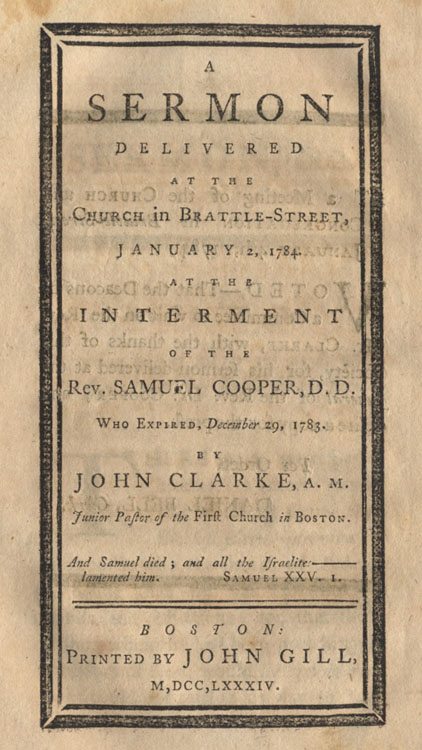
The following sermon was preached at the interment of Rev. Samuel Cooper in Boston on January 2, 1784.


sermon-eulogy-1784

A

S E R M O N

DELIVERED

AT THE

CHURCH IN BRATTLE-STREET,

JANUARY 2, 1784.

AT THE

INTERMENT

OF THE

REV. SAMUEL COOPER, D.D.

Who Expired, December 29, 1783.

BY
JOHN CLARKE, A. M.
Junior Pastor of the First Church in Boston.

And Samuel died; and all the Israelite—lamented him.
Samuel XXV. I.

A
SERMON, &c.

ACTS XX. 38.

Sorrowing most of all for the words which he spake, that they should see his face no more.

There is not, my respected hearers, a more tender and affecting scene, than the last solemn interview of the apostle with the church of Ephesus. Knowing that he was appointed to bonds and afflictions; and that those, among whom he had been preaching the kingdom of God, would see him no more,–he could not pursue his way to Jerusalem, till he had first dropped a parting tear; and bid his very dear and valued friends a final adieu. From 1 Miletus therefore, he sent for the Elders of that church: And, with a tenderness peculiarly affecting, he reminds them of the zeal and fidelity with which he had discharged his duty as a minister of Jesus Christ. He had kept back nothing that was profitable to them. He had taught them in public, and in private. The whole counsel of God he had solemnly declared. And, for the space of three years, he had ceased not to warn everyone, night and day, with tears. In proof of this, he appeals to those who were acquainted with him from his first arrival at Asia; and knew after what manner he had been with them at all seasons.

Having done that justice to his own character, which he was conscious it deserved,–he proceeds to his future expectations. And now behold, says he, I go bound in the spirit unto Jerusalem, not knowing the things that shall befall me there: Save that the Holy Ghost witnesseth, in every city, that bonds and afflictions abide me. But none of these things move me, neither count I my life dear unto myself, so that I might finish my course with joy, and the ministry which I have received of the Lord Jesus. This tender and affectionate speech, joined to the gloomy predictions with which it was interspersed, and the liberal sentiments with which it concluded, melted them into tears. They all wept sore. They fell on Paul’s neck, and kissed him. Sorrowing much on his account, because bonds and afflictions awaited him; but more on their own, because they should see his face no more.

The behavior of the Ephesian Elders on this tender occasion, does no less honour to their feelings as men, than their profession as Christians. As fellow-creatures with the excellent apostle, they could not be unmoved at his approaching sufferings. As fellow-christians, it had been ingrateful to refuse a tear. Religion, blessed be God, does not extinguish the social feelings: It refines and improves them. It quickens our sensibility; points out the proper objects of our affection; and when they are torn from us, it teaches us to sorrow, though not as those who are without hope. The grief therefore, discovered by the apostle’s friends, does honor to their hearts. And the lively sorrow, which marks every countenance, and pierces every bosom in this assembly, is no less becoming our religious character!

A faithful minister of Jesus Christ, is deservedly esteemed by the people of his charge. Such was the apostle Paul to the Christians of Ephesus. And such are all those who imbibe his spirit; and are actuated by his noble and disinterested motives. Under God, he had been the instrument of their conversion. He had built tem up in the most holy faith of the gospel. And he had labored, night and day, to form them to that character, and to qualify them for that felicity, which is the glorious object of the Christian dispensation. In prosecution of this work, he had discovered a great and generous mind. Superior to the motives which actuate other persons, he had studied merely their good. And he was undeterred from the pursuit, though it had exposed him to may temptations, and cost him many tears.

This generous and ardent zeal of the apostle they repaid with the tenderest affection. Sensible of his labours of love, and all he had done, and suffered for the church, they beheld him with eyes of gratitude; and openly acknowledged the obligation. Oppressed, as it were, with the memory of his kindness, they wept fore. They fell on his neck: They embraced him: They gave a loose to all those tender feelings, which had been excited by his pathetic discourse.

At this distressing apprehensions from wicked and unreasonable men, they were most painfully affected. Like the master he served, they saw him despised and rejected of men. They beheld him cited before unjust tribunals; and condemned without cause. And, to complete the horrour of the scene, imagination painted him expiring under the cruel hand of persecution; and sealing the truth of Christianity with his blood. And though he appeared unmoved at these approaching sufferings, they beheld them with extreme anguish. The arrow pointed at the breast of the apostle, already pierced them with many sorrows.

But what more deeply wounded their hearts, was the mournful consideration, that they should see his face no more. This was the last interview they should ever have with their most valued friend. No more should they hear his heavenly instructions: No more should they hand upon his lips; admire his gracious words; or be transported with his divine eloquence! His example also, which had been so bright and dazzling, they were to contemplate no more. The apostle was going from them,–going to bonds and afflictions, to sufferings, and to death. He would therefore, take a final leave of them, in this world, hoping for an eternal intercourse in the world to come!

The tears, which were shed on this occasion, were a tribute due to the memory of the apostle. He deserved them all of his Christian friends. No tokens of regard, which they could pay, could possibly exceed the merits of their benefactor. For which reason, we should justly impeach their gratitude had they not melted at his discourse: And their whole Christian character, had they not sorrowed most of all, because they were to see his face no more. These words, when applied to a common friend, call up the most gloomy ideas; but how emphatically moving, when they refer to a generous benefactor, or any one for whom we entertain an ardent affection!

But, from the same principle we applaud the sensibility, and the undissembled sorrow of these Ephesians, we must enter into their feelings; and imitate theirconduct, when he faithful fail from among the children of men. To learning, patriotism and piety, we can not refuse the tribute of a tear. And when all these unite in the person of a Christian minister, his very dust will be precious to us, and we shall weep, with unaffected sorrow, over his cold remains.

It would indeed, be unpardonable arrogance, to pretend that any of the followers of this divine apostle could have his claim to the affections of their flock. However, there have been persons, in the ministerial profession who were burning and shining lights—who, to the learning of the scholar, united the virtues of the patriot; and to the easy familiarity of the companion, the seriousness and devotion of a Christian. In the church of Christ, there have been servants who were an honour to their order. Well instructed in the truths of religion, they have kept back nothing which was profitable to their charge. Generously concerned for the welfare of their flock, they have displayed the grace of the gospel with a most captivating eloquence; and enforced the precepts of it by a splendid example. In one word, there have been persons conspicuous, not only for the love of God, but the love of their country;–distinguished by their patriotic as well as their religious virtues; and no less beneficial to society, than ornamental to the church of Christ! And when such excellent characters are taken from us, shall we not feel, and lament the loss? Shall we not dress their tomb with fresh laurels? With faithful epitaphs shall we not engrave their stone? And, in our bosoms, cherish the everlasting remembrance of their virtues? Could latest time efface their image from our hearts, we should ill deserve the blessings we derive from them.

The death of an amiable, and distinguished servant of Jesus Christ is a loss, which every good mind will sincerely lament. It is a loss to his family and connexions,–a loss to the people of his charge,–a loss to the learned world,–his brethren of the profession,–the Commonwealth,–and, I will add, it is a loss to mankind! The first have peculiar reason to mourn, when the husband, the parent, and the friend is taken from them. And we should justly charge them with insensibility, did they not melt at the reflection,–that they shall see his face no more. How could they restrain the flowing tear, when they behold those eyes closed in night, which once beamed with tenderness and love;–that tongue locked in silence, on which ever dwelt the law of kindness;–and that visage deformed by death, which always wore the smiles of friendship! Surely, no human heart could be unsubdued by such a spectacle.

Next to his more immediate connexions, the people of his charge will mourn his death. They have lost an able minister, and an affectionate friend. How often have they been warmed by his devotion; and instructed by his discourse? How often have they listened to the gracious words, which proceeded from his lips? And, with what pious rapture have they accompanied him to the throne of Almighty God? When sick, how have they been supported by his Christian admonitions? When oppressed with sorrow, how have they been relieved by his tender application of the promises, and consolations of the gospel? When clouds and darkness hae over-shadowed their minds, how have they been enlightened by his religious conversation? And when ready to despair, how have they been reived by his elevated descriptions of the grace of God, and the merits of a Redeemer! Such reflections will crowd upon the minds of a grateful people, when their pastor is taken from them. They will mourn for the loss sustained by his particular friends; but most of all on their own account, because they shall see his face; hear his voice; and listen to his instructions no more!

Again—the death of such a person, will prove an unspeakable loss to the learned world. By his accurate taste, the brilliancy of his imagination, and the clearness of his judgment, he adorned and enriched the republic of letters. Others therefore, will lament his death, besides those who were bound to him by the ties of friendship or religion.

His brethren in the ministry, will never forget the hour, which consigned their dear and valued friend to the grave. The solemn sound of his funeral bell will dwell upon their ear. And his much loved image will present itself in the silent hour of night; or called up by fancy, will meet their waking eyes, in every place sacred to retirement, or religious contemplation. There will they call to mind his many virtues. There will they review the pleasing scenes in which he partook; and the happy intercourse they mutually enjoyed. And often will they repair to the sacred shrine, which contains his venerable dust. The memory of his virtues will create a sigh; while their bosoms will be wrung with the sad reflection,–they shall embrace their friend, and their brother no more!

Finally,–such a distinguished character, when cut off in the midst of his usefulness, will be an irreparable loss to society. The deadly arrow, which destroys him, will deeply wound the bosom of his country, She will feel, in a lively manner, the afflictive dispensation of divine providence: And will mourn over him as an only child. The man, who to the extensive benevolence of a Christian, unites a generous regard to that society of which he is a member, ought to be had in everlasting honour. His prayers, which have been gratefully received by the court of Heaven, ought not to be ingratefully overlooked by his fellow-men. They should remember how they have seen and heard, should call to mind his noble exertions in their behalf; and how uniformly and zealously he has always studied the public good. This part of his character should be the object of their frequent contemplation. They would they be deeply impressed with the loss they had sustained; and they would bless his memory as a patriot, while they revered his name as a minister and a Christian.

Thus have I described the person, who, as a domestic friend, a scholar, a member of society, but more especially, a minister of religion, deserves to be honoured when alive; and when dead, to be universally lamented. And did such a character never exist but in imagination? Did you never see the original of that portrait, I have thus imperfectly drawn? The grief which clouds your brow, the sighs which rend your bosoms;–and the tears which fall from your eyes, proclaim aloud, that such you esteemed your dear and venerable pastor, whose remains are now before you2; but whose face you shall see no more! Behold, the precious dust of your most honoured friend! Behold, all that now remains of the scholar, the patriot, and the divine! Venerable shade! Why dost thou revisit this sacred habitation? Was it to open our wounds anew! Was it to imbitter the cup which divine providence has poured out to us? Or was it to impress our minds with this mortifying truth—that EVERY MAN, AT HIS BEST ESTATE, IS ALTOGETHER VANITY!

We mourn with you, Christian friends, on this very distressing occasion. You have lost a most amiable and engaging minister; we a most friendly and entertaining companion. Some, in this assembly, mourn a husband, a parent, or a brother dead: And others are now paying the last tribute of respect to a patriot no more! We, who have more lately entered into the ministerial profession, bewail a friend, from whom we expected the greatest comfort; and whose counsel, assistance, and the pleasures of whose conversation, we promised ourselves for years to come. But vain are all expectations from so uncertain a thing as human life. Our friend, and your pastor is called to the mansions of the dead; and we shall see his face no more!

Within these walls, sacred to piety, and the public worship of God, you shall no more hear his voice. No more hall you catch the flame of his rational and animated devotion. No more shall your prayers ascend, clothed with his pious eloquence, an acceptable tribute to the father of mercies. No more shall the great truths of religion be set forth with his beauties of style; or recommended with his engaging delivery. That voice, those powers, and that manner, which once charmed, will charm no more!—Wherefore, give a loose to those tender feelings which his death has excited. There is a luxury in religious grief, unknown to vulgar minds. And the greatest understandings will not think it a weakness, in faltering accents, or a broken voice, to express their sorrow.

Justly should I incur the censure of his friends;–and greatly should I injure the memory of Dr. Cooper, should I not say, he was a peculiar ornament to this religious society. His talents as a minister were conspicuous to all; and they have met with universal applause. You know, with what plainness, and, at the same time, with what elegance, he displayed the grace of the gospel. You know, with what brilliancy of style he adorned the moral virtues; and how powerfully he recommended them to universal practice. When the joys of a better world employed his discourse, can you ever forget the elevated strains in which he described them? And his prayers, surely they must be remembered, when his qualifications for the other duties of his office, and his many shining accomplishments are forgotten! If those, who constantly attended upon his ministry are not warmed with the love of virtue;–if they are not charmed with the beauty of holiness;–if they are not transported with the grace of the gospel, must they not blame their own insensibility? Remember therefore, how you have seen, and heard, and hold fast, and repent.

But the place in which I now stand, was not the only theatre, on which he appeared with such applause: In private, also, he displayed his talents for the office he sustained. With peculiar facility, could he enter into the feelings of others, and adjust his conversation to the particular state of their minds. He could raise the bowed down, and encourage the feeble hearted. In the house of mourning, he could light up joy. He could inspire those, who were approaching the shades of death, with Christian fortitude. And by expatiating on the mercy of God, and the merits of a Saviour, he could revive those who were ready to despair! Thus various and accomplished his character, how justly are you affected on this occasion!

However, the people of his charge are not the only persons who mourn this event. The death of their honourable pastor is a general calamity. It is severely felt by all our societies: And by that, in a particular manner 3, which has been so long united with this church in a stated lecture. It is felt by this town, which gloried in him no less as a citizen, than a minister of the gospel. It is felt by the University, to whose honour and interests he was passionately devoted. The governours of that learned society will testify, how ardently he labored to raise it to superior eminence; and how he encouraged those sciences, the sweets of which he had so early, and so liberally tasted. His death will be lamented by this Commonwealth; and most sincerely, by some of the first characters in it. For with them he was intimately connected, and they distinguished him by every public token of respect.

In one word, his death will be a common loss to these American States; for, as a patriot, he was no less celebrated, than as a divine. Well acquainted with the interests of his country, he constantly and ardently pursued them. But while, as a states-man, he discerned what would tend to our glory and happiness, as a minister of religion, he prayed it might not be hid from our eyes. And you can tell with what fervor he offered up his supplications.

I MIGHT now descent to the more ornamental parts of his character. I might display him as the familiar friend, and the entertaining companion. I might remind you of his correct and elegant taste; and that most engaging politeness, which rendered him so agreeable in every private circle. But why should I aggravate a wound, which already bleeds too much! Why should I call up the pleasing image of a person, whom you shall see no more? Let me rather suggest those consolations, which will enable you to bear your loss with Christian fortitude, and to sorrow not as those who are without hope.

And behold, your 4 redeemer liveth; and he shall stand at the latter day upon the earth. Yet a little while, and5 Lord shall descend from Heaven with a shout with the voice of the archangel and the trump of God! And then shall the dead in Christ awake to immortal felicity! 6 That body, which is now sown in corruption, shall be raised in incorruption: That which is sown in dishonor, shall be raised in glory: That which is sown in weakness, shall be raised in power: And this natural shall be transformed into a spiritual body! Behold, I shew you a mystery! We shall not always remain under the power of the grave; but, in a moment, shall we awake, at the last trump; and our bodies shall be changed. And7 Jesus Christ shall fashion them like unto his glorious body, according to the working, whereby he is able even to subdue all things unto himself. Happy day! When they who sleep in Jesus, shall hear his voice and come forth! When they shall be delivered from all the infelicities of this mortal state! When8 they that are wise, shall shine as the brightness of the firmament;–and he that hath turned many to righteousness, as the stars for ever and ever!

9In the multitude of your thoughts within you, may these prospects delight your souls. May they support you at the silent tomb, to which you will soon repair; and leave the precious dust of our departed friend. May you realize them at the holy communion, on the approaching Sabbath. And may they be your joy and consolation, whenever you call to mind his amiable character; and remember that you shall see him no more.

And now, brethren, we proceed to the last tokens of respect to these remains. Could that voice, which has so often delighted this assembly, be once more unlocked, I can easily conceive, how you would be accosted by our deceased brother. Forgive me, if I presume to be his voice on this occasion Beloved Charge—Let not your hearts be troubled, ye believe in God, believe also in his Son. 9 If ye loved me, ye would rejoice, because I go to your father and my father; to your God and my God. To that God I now 11commend you, and to the word of his grace which is able to build you up; and to give you an inheritance among all them that are sanctified.12 And now, brethren, a long, a last farewell: Be perfect, be of good comfort, be of one mind, live in peace; and the God of love and peace shall be with you!

A M E N.


The following character of Doctor COOPER, drawn by another hand, is taken from the Continental Journal, of January 22, 1784.

Dr. Cooper was the second son of that distinguished divine, the late Rev. William Cooper, one of the pastors of the church in Brattle-Street: He was born the 28th of March, 1725. While he was passing through the common course of education at a grammar school in this town, and afterwards at the university in Cambridge, he exhibited such marks of a masterly genius as gave his friends the pleasure of anticipating a life eminently useful to his country.

His pious father having designed him for the gospel ministry, was happy to find his son’s inclination meeting his own. Divinity was therefore the Doctor’s favorite study; and having early felt the impressions of serious religion, the honour of being a minister of the gospel weighed down every consideration of temporal advantages.

He early made his appearance as a preacher, and so acceptable were his first performances, and such the expectations they had raised, that he had scarce attained to the age of twenty years before he received a call from the church and congregation in Brattle-Street, to succeed his father who died December 13th, 1743, as colleague with the celebrated Doctor Colman. In this office he was ordained May 25th, 1746, just thirty years after the ordination of his father.

The Doctor did not disappoint the expectations he had raised; his reputation increased, and he was soon one of the most universally acceptable preachers in the country. Through a course of near thirty-nine years public ministry, he conducted himself with such wisdom and integrity, prudence and ability, as procured him the like love and esteem from his venerable colleague, and the people of his charge which his father had enjoyed, and the notice and respect of all the clergy in the Commonwealth. Indeed his whole life was worthy the imitation of all who wish to live admired, or die lamented.

He early discovered a happy talent for composition; his sermons bore the mark of a genius and taste: they were clear and elegant—sensible and truly evangelical, and delivered with an energy and pathos which warmed the heart,–in a stile which charmed the ear,–and with an eloquence which always gained the attention of his auditory.

In prayer he was greatly distinguished;–his thoughts and language were devotional, pertinent and scriptural; well adapted to the particular occasion, and delivered with such humility and reverence, and at the same time grateful variety, as could hardly fail of kindling a flame of devotion in the most dull and lifeless of his fellow-worshippers. When celebrating the peculiar mysteries of our holy religion—how was he carried even beyond himself, with such a flow and fullness of expression, as often bore away the intelligent and spiritual worshippers as on angels wings towards heaven!—

About twelve months after his call and before his ordination, a malignant and mortal fever then prevailing, he was introduced by his reverend colleague to the chambers of the sick, and the beds of the dying. He has often observed, it was a happy introduction to the work of the ministry—It was one means of eminently qualifying him for that part of pastoral duty; and it is universally allowed that few, if any, were more judicious and successful in their applications and addresses to persons in those circumstances.

His religious sentiments were rational and catholic, being drawn from the gospel of Christ; in them he was ever steady, and though a friend to the rights of conscience and a free enquiry, he yet wished to avoid, in his common discourses, those nice and needless distinctions, which had too often proved detrimental to Christian love and union.

It was happy for his country, that his early intension of devoting himself to the work of the gospel ministry, or the cares of that important office to which he was ever attentive, did not prevent his completing his character by an intimate acquaintance with other branches of science besides divinity, particularly with the classicks. Upon their sparkling field he pleasingly roved from flower to flower, and finally became one of the most finished scholars of the present day.

He was a friend to learning, and to the university in which he was educated, and was a faithful member of the board of overseers. After the loss of Harvard hall, with the library and apparatus, by fire, in 1762, he exerted his extensive influence in procuring subscriptions to repair that loss. There having been a vacancy in the corporation in 1767, the Doctor was elected one of that board, and continued a very attentive, firm, and judicious member until his death.

His fame for literary accomplishments, and his character as a divine, became too great to be limited to his native country; it introduced him to the university of Edinburgh, from whence he was complimented with a diploma of doctor in divinity.

Dr. Cooper was an active member of the society for propagating the gospel among the aboriginals of America, the work was pleasing to his benevolent mind, and he was ever watchful that the pious intensions of the donors in those charities should not be disappointed.

When his country had asserted her right to independence, he was anxious to lay a foundation for the encouragement of useful arts, and the growth of the sciences in this land of civil liberty. In his opinion knowledge, as a handmaid to virtue, was necessary to support free governments and promote public happiness. He was therefore one of the foremost in forwarding the plan on foot, in 1780, for establishing an American academy of arts and sciences; and this society, from a sense of his literary merits, elected him their first vice-president.

To his acquaintance with divinity, and the other branches of science, were added a just knowledge of the nature and design of government, and the rights of mankind.—The gospel taught him to wish and promote their happiness, and the shining examples of the first ministers of this Commonwealth in the cause of their country, were ever before his eyes.

He well knew that tyranny opposes itself to religious as well as civil liberty; and being among the first who perceived the injustice and ruinous tendency of those measures of the British court, which at length obliged the Americans to defend their rights with the sword, this Reverend Patriot was among the first who took an early and decided part in the politics of his country.

He did what he could, not only by his prevailing address, his counsels and advice, but by his pen, in conjunction with other distinguished patriots, to alarm the sleepy, animate the timed, support the sufferer, encourage the warrior, and unite the people.

The abilities and steadiness thus manifested in this glorious cause, endeared him to his country, and he was esteemed, consulted and confided in by some of the principal leaders in the opposition—The success of it lay near his heart, and he regarded as friends all who aided it, whether here or in Europe.

He did much to obtain foreign alliances, and his letters were read with great satisfaction by the ministry of Versailles, whilst men of the most distinguished characters in Europe became his correspondents.

When France made a proffer of her friendship in the most disinterested manner, and became the supporter of our freedom and independence, it was necessary to subdue the prejudices against that nation which Britain had early sown in New-England, as also to conciliate the habits and manners of the two nations—Dr. Cooper appeared as one peculiarly formed by heaven for this happy purpose.

He possessed an elevation of thought, a delicacy of sentiment, and quickness of apprehension, which, united with an easiness of manners, and the most engaging address, never failed of gaining the attention and giving pleasure to the most respectable circles. Noblemen of the first distinction in Europe and fame for their literary accomplishments, having been by the course of the late war brought to America, were fond of being introduced to him;–when they had once seen him, they coveted an intimate acquaintance.

The great friendship subsisting between him, Dr. Franklin and Mr. Adams, was one means of his being known in France; and he gentlemen coming from that kingdom were generally recommended to him by those ambassadors.

When the fleets of his Most Christian Majesty have adorned our harbor, he was always the confidential friend of the gentlemen who commanded; and the many officers and subjects of that august and beloved Monarch who visited him, were ever received with an ease and cordiality that was pleasing, and highly endeared him to them.

When the civil constitution of this Commonwealth, in which he had some share, was formed and approved of by the people, he was, according to the custom of the country, called upon to introduce it with a sermon: this discourse, with others of his writings, have been printed in several languages, and are some specimens of his singular abilities.

The nature of his illness, which from the first he apprehended would be his last, was such as rendered him some part of the time incapable of conversation.—He had, however, intervals of recollection: at these times he informed his friends that he was perfectly reconciled to whatever Heaven should appoint—willing rather to be absent from the body and present with the Lord; that his hopes and consolations sprang from a belief of those evangelical truths which he had preached to others; that he wished not to be detained any longer from that higher state of perfection and happiness which the gospel had opened to his view.

He declared his great satisfaction in seeing his country in peace, and possessed of freedom and independence; and his hopes, that by their virtue and public spirit, they would shew the world that they were not unworthy those inestimable blessings.

With the tenderest expressions of love and kindness to his near connections and friends and the dear people of his charge, who have always shewn him every mark of their love and esteem, he closed this mortal life, and has, we trust, entered into the joys of his Lord.

Thus lived and thus died, the great and amiable Doctor Cooper, and his death is a loss which learning and religion, patriotism and friendship, will long feel and lament.


Endnotes

1. Ver. 17.

2. The body was carried into the church on this occasion.

3. The first Church.

4. Job xix. 25.

5. Thes. Iv. 16.

6. I Cor. xv. 42, &c.

7. Phil. III. 21.

8. Dan. XII. 3.

9. Psal. XCIV 19.

10. Ver. 28.

11. Acts XX. 32.

12. 2 Cor. XIII 2.

Sermon – Thanksgiving – 1783 Massachusetts


Joseph Willard (1738-1804) graduated from Harvard College in 1765 and served as a tutor at the College until 1772. He was ordained in November of 1772 at First Congregational Church in Beverly, Mass. In 1780, he was one of the founding members of The American Academy of Arts and Sciences. He was elected President of Harvard in 1781 and served until his death in 1804.


sermon-thanksgiving-1783-massachusetts

A
Thanksgiving
Sermon

Delivered at Boston
December 11, 1783,
To
The Religious Society
in Brattle Street,

Under the Pastoral Care
of
The Rev. Samuel Cooper, D.D.
By
The Rev. Joseph Willard, A.M.
President of the University in Cambridge.
Thanksgiving Sermon.
Psalm CXVIII, 27.
God is the Lord which hath showed us light; bind the sacrifice with cords, even unto the horns of the altar.


This is a Psalm of David; and it appears to have been penned by him, in the way of grateful acknowledgement to God, for some remarkable deliverance, which He had granted him from the hands of his enemies, who had been almost ready to destroy him, and over-run the kingdom of Israel. “All nations compassed me about, says he, but in the name of the Lord I will destroy them. They compassed me about; they compassed me about like bees, they are quenched as the fire of thorns; for in the name of the Lord I will destroy them. Thou hast thrust sore at me, that I might fall, but the Lord helped me. The Lord is my strength and song, and is become my salvation.” Thus was he delivered from the hands of his enemies, and he gives the glory to God—to that God upon whom, he tells us, in a verse proceeding, he had called in his distress; and he is desirous that he should be praised. “God is the Lord, says he in our text, which hath showed us light; bind the sacrifice with cords, even unto the horns of the altar”; i.e. As the omnipotent Lord appeared for us in our days of darkness—in our times of trouble, distress and danger, and hath caused light to shine upon us—hath made a way for our escape, and hath granted us salvation, let us be grateful to him—let us show our gratitude by offering him sacrifices of thanksgiving—let us bring our victims, for this purpose, to the altar, and there keep them bound, ready to be offered to God, to show our gratefulness and the joy of our hearts. Such was the exhortation of David to the people of Israel, when God had showed peculiar favors to him and them; and, in similar circumstances, a people, at this day, should consider the exhortation as directed to them. And in treating upon this text we shall show, that when God has remarkably interposed for a people in their days of darkness or calamity, and granted them light, or signal deliverances and favors, they ought to offer to Him a tribute of thanksgiving and praise.
God is the Lord, says David, which hath showed us light. This implies that he and his people had been in darkness. And here we may observe, that darkness and light are frequently used in a metaphorical sense, in the Holy Scriptures. Darkness is put for trouble, perplexity and calamity. Thus Joel speaking concerning the famine and other judgments under which the Israelites labored, calls the season, “A day of darkness and of gloominess, a day of clouds and of thick darkness.” And Zephaniah prophesying of the judgments of God, which were coming upon Judah, says concerning the time when they should fall upon them, “That day is a day of wrath, a day of trouble and distress, a day of wasteness and desolation, a day of darkness and gloominess, a day of clouds and thick darkness.” These and many other passages make it evident that darkness is sometimes used in the Holy Scriptures metaphorically for trouble and calamity; and it is with propriety thus used. In days of public calamity how distressing is sometimes the prospect? Which way soever we look, trouble and melancholy appear, and gloom is apt to seize upon and overwhelm the mind as darkness in the night involves the body.
We find light in the Holy Oracles spoken of in an opposite sense. It is put for prosperity and serenity of mind, or joy. And when God is mentioned as interposing for his people and removing their troubles and calamities, he is said to give them light, and they are spoken of as enjoying light. Thus, when God made a way for the Jews to be delivered from the wicked devices of Haman, and to be saved from that destruction, in which their enemies were ready to involve them, it is said that they had light and gladness and joy. Many such days had the children of Israel, while they continued to be a nation. After they had been involved in darkness they saw light; they had their troubles removed; and from adversity, through the goodness and mercy of God, they emerged to prosperity.
If we read their history with any attention, we shall find that they had many dark days. Their troubles and calamities were sometimes exceeding great; and they seemed to be threatened with destruction. The greatest scourges they had were generally their enemies, who, when they revolted from God were permitted to make war upon them, and oftentimes to reduce them to abject circumstances and great distresses. These were to them seasons of great gloom and darkness, and they sometimes knew not which way to turn. But when they repented, God interposed for them and granted them deliverance, whereby the clouds were dispersed and light shone upon them. And in whatever way they had light after their darkness it was God who was the Author of it.
David openly acknowledges God to be the Author of the deliverance that he and his people had, from the hand of their enemies, as celebrated in the Psalm from which we have taken our text. Like a man of true wisdom, he perceived the divine government—he saw the providence of God concerned in the important events that took place in his affairs; and as became a man of sincere piety, he freely spoke of it and gave glory to the Ruler of the world; and all who think with propriety and are men of real religion will join with David, and will allow, that God’s hand ought to be acknowledged, in all great and happy events which concern them.
We have enough to convince us, that God is the Governor of the Universe, and doth his pleasure in the armies of heaven and among the inhabitants of the earth. He hath almighty power, infinite wisdom, the strictest justice, and unbounded goodness; he is therefore able to rule in the best manner. Were we to argue only from what reason should dictate to us concerning such a Being, we must be convinced that he would rule in the best manner, if he should undertake the government of the world; and the same reason would dictate to us, that such a Being would not leave it without government: None could be equal to the undertaking but a Being of infinite perfections. God therefore must direct in all or the whole would run to confusion.
God’s providence and government are treated of in the plainest manner, in the Sacred Oracles. By them we are informed that He hath set up his empire among the children of men, and that He disposes of all things concerning them, as he pleases. He is represented as directing the concerns both of individuals and communities or nations. He orders what respects the outward circumstances of each one of us; and as to what concerns nations, he speaks to build and to plant them—and He speaks to pluck up, and to pull down and to destroy.
There are proofs, innumerable proofs of a superintendency over the affairs of men, which they cannot but be sensible of, if they open their eyes and reflect in the least. Such facts must arise to view as must fully convince every unprejudiced mind of providence. Oftentimes are events entirely contrary to human plans, and even to the most sanguine expectations. Men fail, when they appear to be upon the eve of carrying their purposes into execution, and their expectations perish. Sometimes men are as unexpectedly successful in their undertakings. They have been driven to attempt things, in which human probability has been entirely against them, and yet they have carried their attempts into execution. Thus are men taught, that there is Power above who orders and directs in all the affairs of the children of men. This has so often been the case with respect both to individuals and communities that he must be obstinately blind who does not see it.
God sometimes fulfills the desires of the children of men, without any human instrumentality. Thus, by a series of miracles wrought in Egypt, he caused the king of Egypt to let the children of Israel go out of his land, where they had for a long time been groaning under the most cruel bondage. And by working a miracle, he pated the red sea, when the king of Egypt with a large army pursued the Israelites; and after the Israelites had marched through and escaped, he caused the sea to return upon the Egyptians, who followed them, whereby they were all drowned; and thus was a most wonderful and memorable deliverance wrought for his people. In a like miraculous manner, God granted deliverance to the Samaritans, after they had been for a long time besieged by the army of Benhadad king of Syria, and had endured the rigors of famine. The sacred historian tells us, 2 Kings vii[7]th chapter, that, The Lord made the host of the Syrians to hear a noise of a great host, and they said one to another, Lo, the king of Israel hath hired against us the kings of the Hittites and the kings of the Egyptians, to come upon us. Wherefore they arose and fled in the twilight, and left their tents and their horses, and their asses, even the camp as it was, and fled for their life. As remarkable a deliverance God gave Hezekiah from the army of Sennacherib king of Assyria. He had greatly distressed the land of Judea, and by his army and threatenings had thrown Hezekiah and the inhabitants of Jerusalem into much consternation. He boasted what he would do to the kingdom of Hezekiah, and spoke blasphemous words against the God of heaven. But the Almighty soon blasted his purposes. His angel went out, and in one night smote in the camp of the Assyrians, an hundred fourscore and five thousand men; and Sennacherib, without attempting anything farther, returned to his own land. This memorable account we find in 2 Kings xix, and in Isaiah xxxviii. These are a few instances of many that might be produced from sacred Writ, where God, in the most remarkable manner, interposed and granted salvation to his people, without human means; so that the glory could not but be entirely ascribed to him.
But the hand of God does not always appear so immediate and conspicuous, in those great and happy events which a people sometimes experiences; yet his providence may be seen in them; and though human means may have been made use of, the finger of God may still evidently appear in bringing about what takes place. A number of instances favoring this position, may be found in the sacred pages, respecting the children of Israel, which there is not time to mention, but which those conversant with their bibles may easily advert to.
There never has been a nation for whom God has so miraculously interposed, in their days of darkness, as he often did for the children of Israel; and scarcely ever is his providence marked with such very signal footsteps. Yet divine interpositions for other nations have sometimes been so evident, that he must have been willfully perverse who has not owned them. They have sometimes appeared to be upon the brink of ruin; everything has seemed to be fast tending to their overthrow; they have been so enveloped in darkness, that almost ever mind has been filled with gloom, and has presaged the saddest events: But a series of prosperous circumstances have ere long taken place; every undertaking has been smiled upon; ways and means have unexpectedly been found for them to reinstate their affairs, and a train of successes has attended all their operations. Everything has turned out so contrary to human appearances and expectations, that none but an atheistical mind could resist the evidences appearing for the interposals of a divine providence. Even Heathens have remarked such interposals, and have highly celebrated them; and surely it would be a disgrace to those, who are favored with the knowledge of the true religion, when they see such remarkable events taking place, or which have taken place, not to acknowledge the hand of Him who rules in heaven and among the inhabitants of the earth, and who orders things as it best pleases Him. And they who are interested in events, which have been graciously overruled to their advantage and happiness, would conduct entirely unworthy the benefits they have received, should they not acknowledge that they are indebted to the providence of God for them. A humble sense of their dependence upon Him ought to possess their minds, as well when they have received favors, as when they are in want of them. And it is highly provoking to God, when men entirely arrogate that to themselves, for which they have been indebted to his blessing and the success which he has granted to their endeavors, and they have reason to fear lest he should withdraw his favors. But they who have a sense of their obligations to God, for the light and prosperity which they enjoy, and with grateful hearts acknowledge it, may hope that he will be further merciful to them, and will grant them all needed salvation.
Gratitude to God always becomes the children of men, who are continually receiving benefits from his hand; and it in a peculiar manner becomes them, when they have received any signal favors. This was the temper of David, as we find in our text.  As the Lord had showed him and his people light, he exhorts to bind the sacrifice with cords unto the horns of the altar. He was ready to offer a tribute of praise to the God of his salvation himself, and to lead others to do the same. This is a conduct which all ought to pursue.
God has been pleased to endue us with passions and affections, as well as reason; and when we see particular actions or modes of conduct, we not only reason upon them, but we immediately feel ourselves impressed with the idea of their propriety or impropriety. When we perceive a malignant temper in any one of our fellow creatures, and see him manifesting it by malevolent actions, not only does our reason tell us that his temper is evil and his actions wrong, but we immediately feel ourselves impressed with the idea of his vileness; and indignation arises in our breasts against him. On the contrary, when we see one of our fellow creatures of diffusive benevolence, who shows the goodness of his heart by frequent acts of kindness and beneficence, and who delights to make all those who are around him happy, our hearts must be immediately impressed with a love of his character; unless we are devoid of the common feelings of the human heart; and if we have been benefitted by him, we shall not only love his character, but, shall feel gratitude enkindled in our bosoms.
Shall we feel thus disposed towards one of our fellow men, in whose character there is benevolence and goodness, and can we see remarkable manifestations of the goodness of God towards us, and not have our hearts deeply impressed with gratitude and thankfulness to Him! None can possibly bestow upon us such favors as God, but all must in acts of goodness fall infinitely short of him; and shall any feel more grateful to a fellow creature, who bestows a few favors, than to that infinitely good Being, who loads us with benefits, and to whom we are obliged for disposing others to do us good? Did men but seriously consider from whence all their mercies flow—that it is God to whom they are indebted for the blessings they enjoy, they could not but feel highly grateful to him. A grateful mind must always be acceptable to God; all therefore should be solicitous that their mind be thus disposed; and if they are truly grateful to him they cannot but be ready to offer him a tribute of praise, and to conduct in such a manner as to glorify him.
To live as God requires is the most substantial praise that men can pay him. This shows that they have a proper sense of their obligations to him, and are studious to glorify him: All therefore should endeavor so to order their whole conversation and conduct, that a tribute of praise may be daily ascending from them, and they may lead a life of thanksgiving. But particular exercises of praise and thanksgiving are a mean of promoting such a character in ourselves and others. They have tendency to excite sentiments of love and gratitude to God, and to lead men to study what His will is, that they may conform thereto.
David in our text, sensible of his obligations to God speaks of offering him sacrifices. There were sacrifices of thanksgiving appointed under the Mosaic dispensation. These we read of in Leviticus vii. The Israelites were directed to offer sacrifices of thanksgiving to testify their gratitude for the favors they received from God; and if these sacrifices were attended with grateful hearts, they were acceptable to him.
Jewish sacrifices, we all know, have long since ceased, but there are ways in which Christians may offer to God sacrifices of thanksgiving. They may have days appointed to meet together at the house of God, to attend to discourses of his goodness and mercy, to sing his praises, and to offer their thankful acknowledgements for his favors, before the throne of his grace. And if they thus meet together, with hearts deeply impressed with a sense of divine benefits, and sincerely join in these acts of worship, they glorify God and are accepted by him.—They also offer him the sacrifice of thanksgiving, while they temperately partake of the bounties of his providence, and at the same time have their affections engaged to him for his blessings. And they who are in circumstances of ease of affluence may offer to God the sacrifice of thanksgiving, by imitating him in his bounty, and bestowing favors, with a true spirit of charity, upon those who are in circumstances of indigence.
But omitting what might be further offered upon this head, I shall now proceed to the improvement.
From what we have heard, let us all be excited to keep in our minds a realizing sense of the providence of God, as continually directing human affairs. And at a time when there are any great and signal benefits, in which we with others are concerned, let us show that we are properly impressed with a consideration of our being indebted to God.
It becomes us to acknowledge a divine providence, when we are partakers of peculiar favors; for however the blessings we enjoy may appear to have been in any measure procured by ourselves, or by any of our fellow men, we or they are but second causes. God is the first cause, and without him nothing can be brought to pass. In all signal blessings, therefore, let us gratefully acknowledge him, and we may hope at all times to have his favorable regards, and those mercies that we farther stand in need of. And, under great and happy events in which it becomes us to rejoice, let us endeavor that our joy may be under proper regulations.
We should enjoy with cheerfulness the prosperity that God is pleased to allot to us; and when we meet with peculiar deliverances and favors, especially of a public nature, in which not only we, but multitudes of our fellow men are concerned, we may be particularly joyous; only we should guard against everything that would not become us as men and as Christians. And we should in a particular manner be glad in the Lord, who is our divine Benefactor. Let us with sincerity pay our tribute of thanksgiving to him, and make our gratitude known by striving to live as well as speak his praises—joining the sacrifice of a pious and Godly conduct to the offerings of our tongues.
Let us now consider what has been offered, as it respects the occasion of our being together at this time.
We are called together by our Rulers, this day, to celebrate the loving kindness of God as it appears in those great things which he hath done for us. And in order that our gratitude may abound, in those happy circumstances in which we now find ourselves, let us take a retrospective view of the state of our affairs, in this land, for some years past. We shall indeed be able but just to glance upon many things; but we shall see sufficient to fill our minds with adoring thoughts of the great Governor of the world, and the highest gratitude to him for his unspeakable benefits.
We have had days of darkness as well as seasons of light. How gloomy was our situation, for several years before the late war, when Great Britain was endeavoring to lay upon us burdens difficult to be borne, and which, if we had submitted to them, would have sunk us to a very abject state. We had to contend with artful men, and those bent upon carrying their purposes, at all events. But in the midst of these glooms God gave us some light. He early raised up those among us, who had wisdom to detect the plots of these men, and firmness to oppose their measures, so that we did not fall that easy prey to them, which they had expected. They took one method after another, to put the shackles upon the inhabitants of this land; sometimes by artful, at other times by violent measures; but there were always found those among us, who could traverse their designs; and though the blessing of God, upon the exertions of our worthy and steady Patriots, the enemies of our Zion were never able to carry these their destructive plans into execution.
How dark was the prospect, when the port of this Metropolis was shut up by a cruel act of the British Legislature, as a punishment for opposing their unjust measure? Soon after which, the Government of the Province was essentially altered, and made a King’s Government, that the people might be brought to humiliating submission; and to reduce them the sooner to this, a military Governor, with a  considerable military force, was placed among us. Gloom sat upon the countenances of all but a few, and we trembled for the event of these things. “But though we were perplexed, we were not in despair—though we were persecuted, we were not forsaken.” Many who had appeared Patriots, continued firm in their country’s cause; and God granted a remarkable union of the inhabitants of this land. This Metropolis found friends, through the Continent, to help her under her distresses—this Province found others disposed to make her cause a common one; and by their united counsels they made a glorious stand against the hand of oppression.  Thus did light break forth from darkness. Our enemies, who had thought by rigorous methods to intimidate us, were chagrined at finding so determined a spirit of opposition to their schemes, and they were plunged into difficulties which they knew not how to surmount.
But the most trying scenes were still to come.  On the memorable 19th of April 1775, hostilities began, bloodshed commenced, which led on to that train of events, which have astonished the world. But how dark was the aspect when war had thus commenced between Great Britain and the inhabitants of her then Colonies! In this Province the war began; and we could not tell how far we should be aided and supported by our sister Colonies, in this last appeal to heaven. But God, who has the hearts of all men in his hand, surprisingly inclined them to aid us; and the determination became general, to withstand the hand of oppression, to the last extremity. Those in this Province, who with so much patriotism and bravery turned out to repel the enemy, at the commencement of hostilities, were soon joined by their brethren, from other parts, so that it was not long before we had a large army collected, and a General at the head of it, in whom entire confidence was placed; and thus heaven appeared to smile upon us in the midst of our distresses. And we had this further happiness, that the Council of the United colonies harmonized in their measures, and strenuously pursued whose plans, which, they judged, would best conduce to secure the liberty and felicity of the people. But although we had thus some light, yet there were dark clouds which could not but give us uneasiness. Our army was for a good while in a very fluctuating state. At the same time, they were almost destitute of everything necessary to carry on a war, while our enemies were well furnished. Yet, God ere long gave us some signal advantages against them, particularly in the ever memorable battle of Bunker-Hill, enabled us to circumscribe them within very narrow bounds, and prevent them from ravaging the country. And after they had been in possession of our Capital, for some months, He was remarkably with us, in driving them from the important post. And how wonderful were the smiles of providence upon us, in procuring those military articles we stood in need of! All the efforts of our enemies to prevent our supply proved abortive. When we were in the greatest straits, some of the enemy’s vessels laden with  military stores and clothing, fell into our hands—we soon became able to manufacture military stores for ourselves, in large quantities—foreign ports were opened to us, and freely supplied us with whatever we stood in need of; so that all the endeavors of our enemies to force us into a compliance with their unjust measures, by putting it out of our power to oppose them, for want of arms and military stores, were entirely frustrated.
In the summer of 1776, so large was the British force, both by sea and land, at New York, that human probability was, that they would carry all before them. Yet, the Fathers of our country, our intrepid Patriots did not despair of our affairs; and when they found that all addresses to the throne for justice were unavailing, and there appeared the most determined spirit to oppress this people, deprive them of their invaluable liberties and bring them to abject submission, they nobly dared as it were in the face of the royal fleets and armies, to assert their freedom, declare their independence on that power which was thus injuriously treating them, and to rank themselves among the distinct nations of the earth. This step the people at large had previously authorized the great Council of the States to take, if they should think it expedient; and they have never had reason to repent that it was taken. Such a measure, taken under such circumstances, must immortalize the memory of the then inhabitants of this country, and particularly, of that band of intrepid patriots, who proposed the measure and openly published it to the world, under the signature of that distinguished Patron of liberty, who has ever stood forth to assert its glorious cause, even in times of the greatest hazard.
After this memorable transaction, in the course of the summer, the enemy gained many advantages over us; and in the autumn our affairs wore an extremely dark aspect. Our army was reduced to an handful of men, compared with that of our enemy. But our Commander in Chief, who has ever shown with peculiar lustre in circumstances of difficulty, through the blessing of providence upon his arms in the winter, revived the drooping spirits of his countrymen. His splendid and successful actions of Trenton and Princeton gave a new turn to our affairs; and large recruits soon joined our little army. Our enemies were disappointed in their expectations, and greatly chagrined; and we had light and joy, after great darkness and perplexity.
During the course of the war, God remarkably prevented the ruin of our cause by British gold, when employed for that purpose. A remarkable instance of his kindness we had in the detection of Arnold, one of our Major Generals, in his ungrateful, vile and treacherous designs and plots. Had he succeeded in these designs, such a blow would have been given to our affairs, as we should have severely felt; and the consequences might have been fatal to our cause. But the Lord disappointed him.—While we view, with the utmost contempt, detestation and abhorrence the abandoned traitor, purchased with the enemy’s gold, let us consider, with the greatest gratitude, the footsteps of the providence of our gracious and divine Benefactor, by which his atrocious plots were brought to light and frustrated, when they were upon the point of being executed; and to him be the glory of all!
The military events, after the last mentioned actions of Trenton and Princeton, were various; and to give a minute detail would now be tedious and improper. Our defensive and offensive actions were sometimes signal. Witness Red-Bank, Stony-Point, Monmouth and several other places. But the successes that attended our arms, in two instances, were so important in themselves and so momentous in their consequences, that I cannot forbear briefly describing them.
The first instance I refer to, is the capture of General Burgoyne and his army, at Saratoga, by General Gates and his forces. How gloomy was the prospect, sometime before the event? When our forces were abandoning their strong holds, and leaving all to the enemy.—The enemy, at the same time pursuing, and slaying and taking prisoners many of our soldiers—Numbers of towns, in the northern department, lying open to the ravages of the British troops and to the cruel depredations of the savages—Multitudes fleeing from their habitations and leaving their substance, to escape the sons of violence; and scarcely knowing where to retire—The enemy flushed with success, penetrating into the country, and threatening to over-run that quarter like an overflowing flood! At that time we were ready to think that all these things were against us; and we trembled for the event.  But it was not long before we saw that God meant all for good. Many of our militia were inspired to take the field, in their country’s cause. We soon met with great success at Bennington, against a large division of the enemy; after which, they lost ground in every quarter. Their main body was prevented from advancing, by our army, which daily augmented, by great numbers, who voluntarily took the field. Large divisions of the enemy’s army were attacked and repulsed; and the whole, soon after, fell into the hands of our brave General and his troops.
When the news of this capture reached Europe, it filled the minds of our enemies with dismay; and it happily made way for our alliance with the French nation, from which we have received the most important advantages. From that period, the inhabitants of these United States have appeared to the nations of Europe of much higher consequence than before, and their cause of far greater moment. And the example of France induced others, particularly the United Provinces in the Netherlands, to favor our struggles for securing our independence.
The other memorable instance of success was at York Town in the autumn of 1781. Several of the first months of that year afforded us very unfavorable prospects. When the spring opened, we had but a small army in the field, and our enemies were making great progress in the southern States. At the time that General Green was appointed for, and sent to that department, he had almost every difficulty to contend with. When he began his campaign he had but a very small army. But by his merit and enterprising spirit he soon collected a considerable force, and engaged Earl Cornwallis, the enemy’s commander in chief in that quarter. The contest was obstinate, notwithstanding our forces were inferior in numbers; and although the enemy kept the ground, yet they suffered so severely and were in such circumstances, that they were soon obliged to leave it to our army, which was in the neighborhood, and was ready to  meet them again, in a few days after the battle.
Our General and army marched to South Carolina, while the enemy proceeded to Virginia, with a full expectation of adding that State to their southern conquests, which they thought secure to them. But their expectations were eventually disappointed, in every quarter. Our arms, by the smiles of a kind providence, were crowned with the most happy success in the Carolinas, and one important post after another fell into the hands of our brave General and army.
When Earl Cornwallis had arrived in Virginia, he found there the brave Marquis la Fayette to oppose him, but with so small a force, that he was able to make but little head against him. The British General, therefore, greatly distressed the people of that State, and the prospect for a time, was in that quarter, very unfavorable to us. But after a while the prospect brightened. Our illustrious and generous Ally the King of France, who had, the year before, sent us a considerable fleet and army, did, on this emergency, furnish these States with a powerful armament, to cooperate with us against the British forces. And what was the event? The united arms of America and France, by the blessing of heaven succeeded according to our wishes. The British fleet severely shattered, and driven from the Chesapeake by the French, and unable to relieve their General, returned to port with disappointment and loss. Our illustrious General and Commander in Chief, with the allied army, approached the enemy, who were strongly fortified, but with such vigor and resolution was the siege prosecuted, that the Earl was soon reduced to the necessity of capitulating, and submitted to such terms as were imposed—terms, indeed, less humiliating and severe than he, who had constantly marked his footsteps with devastation and cruelty, had any right to expect; but not too lenient for the noble and generous mind of a Washington to give—a mind, which has ever compassionated the unfortunate, though by their conduct they have oftentimes been undeserving of pity.
This glorious event was the finishing stroke to the offensive war of the Britons in America. Our enemies were convinced, that to prosecute the war any father would be but to plunge themselves into greater disgrace and wretchedness. Through the year 1782, therefore, there were no military actions among us, worth notice; and negotiations for peace were more thought of than preparations for war. And happily, in the beginning of the present year, peace was settled, and the independence of these United States was acknowledged by Great Britain; and our Plenipotentiaries gained, by the treaty, everything for us that our most sanguine expectations could promise us. Such a great and important revolution in the cause of freedom, and completed in so few years, is not to be found recorded in history; and it must ever appear an event as astonishing as it is important.
I have briefly related these things, my hearers, not to inform of anything new, but to stir up the mind by way of remembrance, and to bring many important things into one point of view, that we may the better see the divine footsteps, and be led to adore that God, who has safely conducted us through the difficulties we have had to sustain, has given us a name and rank among the nations of the earth, and firmly established our freedom.
Freedom! How pleasing is thy name, how grateful to those who have so long been struggling in thy cause! The inhabitants of the United States, who not long since, were ingloriously dependent upon another power, have now the direction of their own affairs; and from that true spirit of liberty, which so eminently distinguishes them, we have everything to hope. Methinks, I see the firmest and most distinguished Patriots, and the wisest and most just Legislators, in long succession, blessing the land. Under their patronage and encouragement, methinks I see agriculture carried to great perfection, by the wisdom and industry of this people, and trade and commerce so extended and improved, as to be highly to the emolument of these States. Methinks I see science flourishing, and improved to the highest degree, under the fostering hand of liberty. Methinks I see virtue and piety encouraged by all ranks of men, and the gospel of Jesus Christ having free course among us; and religious knowledge, and religious liberty, charity and Catholicism eminently prevailing, and this land becoming in all respects, the glory and the joy of the whole earth. Methinks I see the interests of mankind essentially promoted, by our glorious and successful struggles, and the benign influences of our freedom extending far and wide.—But whither am I carried in these pleasing presages? I forbear.—God grant, that expectations so delightful to our minds may never be blasted!
Methinks, my hearers, we cannot take a review of the great and momentous events, respecting these States, which we have been considering, without seeing the interpositions of a divine providence, in the most conspicuous manner, in bringing us out of darkness into marvelous light; and I must think, we all say in our hearts, “If it had not been the Lord, who was on our side, when men rose up against us: Then they had swallowed us up quick, when their wrath was kindled against us. Then the waters had overwhelmed us, the stream had gone over our soul. Then the proud waters had gone over our soul. Blessed be the Lord, who hath not given us a prey to their teeth. Our soul is escaped, as a bird out of the snare of the fowler; the snare is broken, and we are escaped.”
Great thanks are due to many, both in the civil and military line, who have exerted themselves to carry us happily through the war, in which we have been engaged in the support of freedom, and to secure the independence of these States. But whatever obligations we are under to our Patriots, still it is to God that we must give glory; and while we remember them with gratitude, as we ought always to do, let us principally be joyful in the rock of our salvation, and praise God for raising up of our fellow men to be such extensive blessings to us.
We mutually feel pleasure, my brethren, under prosperous events, in which we are concerned; and we ought not to suppress our pleasure, at such times, but only give it a proper direction. Did we not feel pleasure and joy when providence bestowed peculiar favors upon us, or were we immediately to labor to suppress every pleasurable sensation, at such a time, we should want a great stimulus to gratitude to the hand from whence we receive the mercies we enjoy. To be joyful, therefore, under such circumstances, is not only allowable, but is also a duty; and not to be moved would be greater proof of stupidity than of piety. The wise man says, “In a day of prosperity be joyful;” and we are authorized to it, by examples of good men, recorded in the word of God. But while we give outward demonstrations of joy, let us take care that we do not run into levity and vanity, into extravagance, luxury and excess; but in all our expressions of joy, on this happy occasion, let us conduct agreeably to the rules of reason and religion. Let us indulge to nothing that would jostle out of our minds a sense of the obligations we are under to God; but let us preserve a grateful regard to the providence of that Being, from whom comes every good and perfect gift; and who is the Author of all the happiness we enjoy or can expect. And let us strive to have our joy so operate, that through the blessing of God it may promote in our souls a true love to Him, and a sincere desire to please and obey Him. Thus should we all endeavor to improve the remarkable blessings God has bestowed upon us, and so to rejoice in the Lord that we may be furthered in our way to that blessed world, were there is joy unspeakable and full of glory.
But as God’s hand ought to be acknowledged with gratitude and thankfulness, in all such important events as we have been considering, so it ought also to be, in those things in which it does not appear so conspicuous to us, because they are more common. When the inhabitants of a Community enjoy great health and plenty, they are indebted to God therefore. In him we live move and have our being; and he upholds us from day to day. All diseases are under his direction and control. He can send them upon us, or restrain them, as he pleases. The state of the air may be salubrious or pestilentious, adapted to promote health or to impair it. There may be many other things, which may act as external causes, and may subserve or destroy it. But still, nothing can take place without the permission or direction of God, who is the health of our countenance. To him therefore be the praise and glory, for that health which the inhabitants of this land have, for the year past, enjoyed; and may we all show our gratitude to him, by improving our health in his service.
As God has savored us with remarkable health, so he has given us kindly seasons, and has blessed us with great plenty, filling us with food and gladness. This his goodness demands our grateful acknowledgements; and we ought to make it our great concern, to improve the bounties of his providence, in such a manner, that we may thereby honor and glorify him. May they who have ability be ready to show their gratitude to God, by assisting the poor, and extending their bounty to those who are objects of charity. The poor we have always with us; and they who have a sufficiency of this world’s goods should consider themselves God’s Almoners, and should be ready to expend something feed the hungry and clothe the naked, remembering what St. Paul has said, “To do good and to communicate forget not, for with such sacrifices God is well pleased.”
We have great reason of thankfulness that we have a good Government, and that our Rulers are such, that under their administration we may lead quiet and peaceable lives. And God be praised, that since the last anniversary, we have had so few internal difficulties among us, and that there is so general a disposition to promote good order.
Above all things, my brethren, let us be thankful to God, that he hath continued to us the precious privileges of the Gospel of Jesus Christ. Let us strive with the greatest care to improve these privileges aright, which will be the most substantial proof that we are truly grateful for them.
God is calling upon you, my brethren, to consider the importance of improving these privileges, by his present afflictive providence, in interrupting the public services of your justly beloved and valued Pastor, who has, for many years, labored among you in word and in doctrine. While that eminent servant of our Lord Jesus Christ shall be detained from this his sanctuary, may you reflect how you have received and heard. May you consider how you have improved under his ministry. As far as it has had a due influence upon you, may you be grateful to God who has blessed it. If it has not been improved by you as it ought to have been, may you be humble and penitent, and resolve, relying upon divine grace, that you will for the future be more attentive to the great and momentous truths of the gospel.
Notwithstanding you are partakers of the public joy, which is diffused enough through the land, yet it cannot but be damped, by what you feel as a religious Society, on account of the sickness of your excellent Pastor; and in this regard it is with you a day of darkness. I feel you concern—I heartily condole with you under this afflictive dispensation of providence, and consider myself as deeply interested. May a life so eminently useful and valuable be precious in the sight of God. May he graciously restore him to health and to distinguished serviceableness among this people of his beloved charge—to the University of which he is so excellent and beneficial as Governor, and to the public, which he has greatly serve, and which would very sensibly feel his loss.
Blessed be God who is in any measure giving light and hope. May that goodness which is begun be perfected.  May the darkness soon be entirely dispelled and perfect day appear. May your Pastor be raised up, and be continued to be a burning and shining light in this golden candlestick, as he has heretofore been, and even to increase in luster; and may you for a long season rejoice in  his light.
Finally, that we may all walk agreeably to the light of gospel truth in this world, and that we may finally be received to the world of eternal light and glory above, may God of his infinite mercy grant, through Jesus Christ our Lord. Amen.

Sermon – Election – 1783, Massachusetts


sermon-election-1783-massachusetts

A

Sermon

Preached Before His Honor

Thomas
Cushing
, Esq;

Lieutenant Governor,

The Honorable the

Council,

And the Two Branches

Of The

General Court

Of The

Commonwealth

Of

Massachusetts

May 28, 1783.


Being the Anniversary of

General
Election
.


By Henry Cumings, A.M.

Pastor of the Church in Billerica.


Commonwealth of Massachusetts.

In Senate, May 29, 1783


Ordered, That Jeremiah Powell, Moses Gill, and Ebenezer Bridge, Esquires, be a Committee to wait on the Rev. Mr. Henry Cumings, and return him the Thanks of this Board for the Sermon delivered by him, Yesterday before his Honor, the Lieutenant- Governor, the Council, and the two Branches of the General Court; and to request a Copy of the same for the Press.

S. Adams, President

I Peter V. 5.

Yea, all of you be subject to one another.


Without enquiring into the particular meaning of these words, considered in a sense restrained by their coherence with what proceeds and follows, I shall take them as an independent sentence; in which detached view, they comprehend all those duties of civil and social life, which mankind owe to one another, whatever difference there may be among them, as to their respective capacities and outward condition in the world.

As then are formed for society, and cannot be happy in a state of separation from one another; so their well- being depends upon mutual assistance and support, and a reciprocal interchange of those offices of friendship and benevolence, which their mutual dependence requires, and both reason and religion prescribe.

That all men ought in some sense to be subject to one another, is the plain doctrine of the apostle Peter, in the words just read. This doctrine concerns all societies, under every form and constitution of government, whether monarchal, popular or mixed. It is especially suited to the genius of a commonwealth, founded upon this leading principle, that ˙all men are born free and equal; that is, come into the world on even ground in regard to authority; no one having a right to govern, in virtue of primogeniture or descent from an higher and more noble parentage than others.

The subject therefore is worthy of the attention of this respectable auditory; and the speaker has no doubt but they will afford him their candid indulgence, while he modestly attempts to offer a few thoughts upon it, though he should not be able to handle it, in a manner answerable to it’s dignity and importance.

According to it’s most common use, the word subjection signifies the submission of an inferior to a superior, and applies only to those duties, which men owe to those, who have authority over them. In order therefore to accommodate the doctrine of mutual subjection, to all the members of a community, we must sometimes depart from the strict sense of this word, or vary the meaning of it, so as to make it consist with the differences between men, in regard to their several abilities; and with those distinctions of office, rank and authority, which are necessary in society.

It is evident that the duties, which men owe to one another, and to society, are not, in all cases, precisely the same; but must be different, according to the difference of their respective advantages, opportunities and other circumstances. And when any one fulfils the obligations resulting from his particular condition and station in life; or that arise from the particular sphere of action, whether high or low, in which he moves; he does, on his part, conform to the great law of mutual subjection, and render himself a good and useful member of society.

Every one ought to consider, that he was born, not for himself alone, but for others, for society, for his country; and consequently that he is indispensably obliged to render the best assistance and service in his power, to his fellow- citizens around him, and to contribute his share towards the general interest of the community to which he belongs, This obligation is not confined to a few; but extends to all, from the highest officer in the state, through all subordinate ranks, and inferior orders and degrees, down to the lowest peasant and plebian. For though all are not able to render themselves useful and beneficial, in the same respects; yet there is no one, who enjoys the powers of reason and health, in any tolerable degree, but may, by a suitable employment of his faculties and abilities, not only serve himself, but the public, and make himself a blessing, in some respect or other.

There is a resemblance between the natural body and the body politic. The natural body is composed of many members; none of which are useless; but all calculated to answer some valuable purpose, and sub- serve the good of the whole. What therefore apostle Paul says of the natural body with a view to illustrate the union, which ought to subsist between the members of the Christian church, is equally applicable to civil societies. The body, says he, is not one member, but many. If the foot shall say, Because I am not the hand, I am not of the body; is it therefore not of the body? And if the ear shall say, Because I am not the eye, I am not of the body; is it therefore not of the body? If the whole body were an eye, where were the hearing? If the whole body were hearing, where were the smelling? But now hath God set the members, every one of them in the body, as it hath pleased him. The eye cannot say unto the hand, I have no need of thee; nor again the head to the feet, I have no need of you. Nay, much more those members of the body, which seem to be more feeble, are necessary. God hath so tempered the body together, that there should be no schism in it; but that the members should have the same care one for another. And whether one member suffer, all the members suffer with it; or one member be honored, all the members rejoice with it. So that the union and connection between the several parts of the natural body, and their necessary dependence one on another, is an apt illustration of the great law of mutual subjection in civil societies; the members whereof, whether rich or poor, in high life or low, in office or out of it, stand in need of mutual assistance and support; without which it will be impossible to promote the common interest, or to preserve the peace and harmony of the whole.

A man’s being raised above others in wealth or office, does not render him independent on those who are beneath him, in these respects. He cannot say, he has no need of those, who are in a lower condition and meaner circumstances; for, without their aid and service, he would lose the advantage of his elevation; and, like Samson, shorn of his locks, become weak like other men.

The mechanic and tiller of the ground are as necessary in society as the legislator, civil magistrate, or any other profession. The labors of the poor and services of the lower classes of people, in their several callings and occupations, are of as great importance to the general welfare of a state, as the counsel of the wise, the bounty of the rich, and protection of the powerful. If therefore any one, capable of attending to the common business of life, is an unprofitable and useless member of the community, it is not owing to any necessity arising from his outward condition in the world, but to some faulty cause.

Whoever, suppressing a regard for the good of others, confines himself to the narrow circle of his own private interest, does thereby render himself, at best, a nuisance to society. Such an one can have no just claim to honor and respect, let his station in life be what it will. It is not the external splendor of their circumstances, but a constant endeavor to be good, and to do good, according to their abilities, that makes men truly great and honorable. In the sight of God, who respecteth not persons, but in judging of men regards only the moral differences between them, no outward condition is more honorable than another. The true criterion of real worth is a man’s conduct; in that station or post in life, whether conspicuous or obscure, which providence has allotted to him.

It is the business of civil rulers, who are entrusted with the high powers of government, to enact and take care for the effectual execution of such laws, as shall be best calculated to restrain the exorbitancy of the human passions, to guard individuals against insults and outrages, and secure every one in the peaceable enjoyment of liberty, property, and all the blessings of society. And while they employ their authority and power in pursuit of these great ends of their promotion, it is the duty and interest of people at large, to yield a cheerful obedience to them, and a ready compliance with those rules, regulations and laws, which are made and provided, for the benefit of each particular member, in harmony with the prosperity and welfare of the whole collective body.

The grand end of social union and of the institution of civil government, is the good of the whole, and of every individual in consistence therewith. This end may be frustrated, not only by an abuse of powers in rulers; but also by an abuse of liberty in the people. Power abused ceases to be lawful authority, and degenerates into tyranny. Liberty abused, or carried to excels, is licentiousness. Neither of these can consist with the good of society. The former, unresisted, will introduce slavery, and ignominious servitude, among the lower ranks and orders of people. The latter is a prolific source of disorder and anarchy.

When rulers take the advantage of the powers they are vested with, to oppress their subjects and rob people of their just rights, in order to enrich and aggrandize themselves, they counteract the very end of their advancement, and instead of being ministers of God for good, become rods of his school for correction (not to say, ministers of the devil for mischief.) And when people, under pretence of liberty, refuse obedience to lawful authority, and oppose the measures of just government, merely because such measures do not coincide with their private views and separate interests, the principles on which they act, are evidently inconsistent with a state of society, and lead directly back to a state of nature. For where such an excess of liberty is claimed and allowed, as leaves it optional with every individual to obey or disobey the civil authority, according as he shall judge it to be for or against his particular interest, a state of society cannot differ much from a state of nature.

If every man, without compulsion, would strictly conform to the obligations of natural law, there would be no occasion for forming any social connections, or uniting under any forms of civil government. But such is evidently the state of human nature; such the disorder of the human passions; such the power of envy, prejudice and a lust of domination; such the force of evil biases, proceeding from ignorance, contracted views and competitions of interest; that without the introduction of social compact and civil authority, mankind could have no dependence upon mutual help and assistance, nor any security against abuses and injures, violence and rapine.

It being necessary for men to unite in society, and establish civil government, in order effectually to avail themselves of the advantages of mutual succor, defense and protection; without which, their enjoyments would be few and precarious, and their inconveniences and dangers great and distressing: this being the case, every one, who has just conceptions of things (far from claiming a liberty to do whatever his ambition, avarice or partiality to himself might dictate to be right) must feel himself obliged to consult the general welfare, by conforming to the laws of society, constitutionally made by public authority, for the good of the whole; though such laws should sometimes interfere with his private views, and contradict his prejudices.

The public good is the attracting point, the common centre of gravity, which should confine, regulate and govern the motions of all the members of society. When any fly off from this point and take an eccentric course, the coercion of law should be used, to check their irregular motions, and reduce them back to their proper centre, in order that the economy and beauty of the politic system may be preserved, and the bands of society remain unbroken.

That a due subordination may be kept up between the several parts of the politic body; and all the members thereof be made to conspire, in the exercise of their respective functions, to the health and happiness of the whole; effectual care should be taken to prevent government from falling into contempt, To honor those, who are entrusted with the powers of government, is one thing, evidently necessary for this end. This therefore is a duty which we owe to society. And that people may have no excuse for not doing their duty, in this respect, it concerns all civil officers, especially those in high rank and authority, to maintain their dignity, by a decent gravity of deportment, an inflexible adherence to the rules of justice and equity, and a steady application to the business of their exalted stations. Such a conduct, in rulers, has a powerful tendency to attract esteem, and command respect and veneration. But tho’ they should justly merit the highest honors, by a worthy behavior, and a zealous uniform pursuit of the great ends of their promotion, it would not be at all strange, to find some few, disposed to withhold from them due respect and submission. For there always have been, and probably always will be, some in the world, who under the baneful influence of those leveling principles, that cannot brook any civil distinctions and restraints, despise government, and speak evil of dignities. Persons of this description are dangerous members of society, as their principles and practices are subversive of all civil authority, and tend directly to plunge civil government into an universal wrack of ruin.

It deserves to be remembered, that we honor society, when we honor those, who are clothed with lawful authority. For as all lawful authority in rulers, is derived from the people, through the medium of that constitutional compact, which binds them together in one body; so to treat the rulers of a people, with respect and honor, suitable to their public characters, and the offices which they sustain, is a proper expression of that reverence, which individuals owe to the community, as a body. I may add, that as the respect shewn to those, who are in public stations, rebounds to the public; so it also tends to make a people appear respectable, and to give to government the energy, necessary for attaining the ends of it. On the contrary, to withhold respect from those, who have been constitutionally promoted to offices of authority and power, is to cast a slight and contempt on the whole body of the people, and tends to make a society appear mean and despicable, to relax the reins of government and undermine the very foundations of it.

It is reasonable indeed for a people to keep a jealous eye upon those, who are be trusted with power, in the several departments of government. This is necessary to keep them on their guard against all encroachments on their liberties, and to preserve them in a readiness to resist the first approaches of despotism. But suspicions may be carried too far. When upon insufficient grounds, they are indulged to such a degree, as to destroy all confidence in civil rulers, an encourage the impatience of people under the restraints of law, they are of dangerous consequence; as they plant the seeds of faction, a convulsive disease, that threatens the dissolution of the body politic. When faction enters a state, with its usual train of virulence, malevolence and abusive invective, it unstrings the nerves of government, and introduces such disorder and uncertainty into public measures, and such strife and division among people, as are inconsistent with the public safety, security and prosperity. This distemper is generally the offspring of envy and disappointed ambition. Avarice always stands ready to foster and nurse, to increase and inflame it, by groundless criminations of men and measures; especially when the public exigencies require heavy taxes, and expensive exertions.

The inconveniences and mischiefs, that must accrue to society, from this, and every other gross violation of the law of mutual subjection, are sufficient to convince any one of the necessity of a strict adherence to it. Our obligation to avoid divisive principles and practices, and by a constant intercourse of mutual good offices, to endeavor to make ourselves beneficial to one another, and serviceable to society, is therefore a plain dictate of reason and common sense. I would add (if any desire further satisfaction) that this obligation is enforced upon us, in the sacred scriptures, by the authority of the supreme Legislature and Governor of the world. The words at the head of this discourse are the words of an apostle, under the inspiration of God. Another inspired apostle expresses himself to the same purpose, in these words, Let no man seek his own; but every man another’s wealth.- Look not every man on his own things; but every man also on the things of others. The meaning of which is, that men ought not to confine their views to their own private interest, but to extend their regards to the welfare of others, and exercise a benevolent concern and care for the good of their fellow creatures.

This also is a doctrine expressly taught by the great author of our holy religion, when he commands us to love our neighbor as ourselves; and enjoins upon us that comprehensive rule of equity and charity, All things whatsoever ye would that men should do to you, do ye even so to them.

It may not be improper to observe here, that the Christian religion recommends itself to the embraces of every lover of mankind, by its being the most benevolent institution in the world, admirably calculated, by it’s doctrines, precepts and sanctions, to promote peace on earth, and good will among men. And whoever duly considers the nature of Christianity, and attends to it’s adaptedness to suppress the corrupt lusts, and restrain the irregular passions of men; to fill the mind with noble sentiments of piety and benevolence, and engage people in pursuits, suitable to the dignity, and conducive to the happiness of their reasonable natures; cannot doubt, but (other things being alike) he, who has imbibed the spirit and principles of this religion, will make a better magistrate, a better legislator, a better judge, and in short, fill every office and department in government, with more honor to himself and advantage to the public; and in private life, make a better subject and a better citizen; than one who has formed his views and sentiments, upon any other system of religion and morals.

It has indeed been objected, as an essential defect in Christianity, by some not well affected to it, that it no where particularly recommends the noble virtue of patriotism. But (not to insist on any thing else) it is sufficient to reply to this objection, that whatever there is excellent and laudable in patriotism, is included in that generous and diffusive benevolence, which is the animating soul of this religion. Virtuous patriotism, far from implying any ill- will to the rest of mankind; is nothing else, but the principle of universal benevolence, exercised as far as a man’s power extends, upon the objects that claim his first regards. Far as no one has ability to carry his good will to all men into effect; so reason will teach every one, that his first obligation is to those, with whom he is more immediately connected, and where providence has assigned him his station and sphere of usefulness. Should a man suppress a particular affection for the society, with which he is most closely united, and neglect the interest of his own country under pretence of exercising equal benevolence towards all mankind; it would be the same thing, in effect as to resolve to be useless, and neglect the good of all. For there is no other way, in which any one can render himself serviceable to those parts of the great community of mankind, with which he has no special connection, than by the exercise of an hearty zeal for the welfare of his own country, and endeavoring, in the most effectual manner, to promote the good of that society, which bounds the sphere of his influence and power. In this sense, and in this way, all men, in all the distinct states and kingdoms of the world, may and ought to be subject to one another. It is thus only that we can fulfill our obligations to all mankind.

True it is, patriotism is but a blind affection, and essentially defective as to any virtuous excellence, if it prompts a man to defend the cause of his country, when his country forms itself into a faction against the rights of mankind, and is wickedly endeavoring to bring other states and nations under it’s arbitrary jurisdiction and government. No one, who will consult the sober dictates of reason, can suppose himself obliged to espouse such an unrighteous cause, or freely to afford any support to his country, in the prosecution of such an evil design. The principle of benevolence to all, clearly forbids this. But the same principle obliges the members of every community, to a zealous exertion, in defense of their rights, laws and liberties, when the same are endangered by the unrighteous claims, and violent proceedings of ambitious enemies. In such a case, defensive war is a duty, founded not barely on the principles of self-preservation and patriotism, but also on the principle of unconfined universal benevolence; it being evidently for the interest of all mankind, that in all parts of the world, those should be opposed, to the last extremity, who are endeavoring to advance themselves upon the ruins of the essential rights of human nature.

The man, who makes the happiness and prosperity of his country, a grand object of his zealous pursuit, and generously risks his life and fortune, when the case requires it, in the defense of it’s constitution and laws, is a character worthy of universal esteem and honor. Such an one, so far as his abilities extend, exercises friendship to all men. What then shall we say of those who, when the rights and liberties of their country, are in danger of falling a prey to the aspiring ambition of proud invaders, who have waged an unjust war against it, stand aloof, and not only refuse to assist in saving it from ruin, but desert it, and, of free choice, join the standard of the enemy? Can such persons make good their pretensions, 1 will not say to patriotism, but to general benevolence? Whatever be their motives, are they not to be viewed as enemies, if actions have any meaning? And should their country, which they have thus neglected, and abandoned to its fate in a time of trouble and danger, be successful in its endeavors to maintain its cause, and defeat the designs of its enemies, must not their admission afterwards to the freedom and privileges of it, be an act of mere favor and special grace, to which they can lay no equitable claim?

Christianity indeed obliges us to love and forgive our enemies, and do good to those who treat us ill. But this obligation does not extend so far, as to exclude a regard to our own safety and defense. It would be unreasonable to suppose, that our good- will to enemies, ought to supercede our obligations to ourselves and to our country; or that we are required to consult their welfare, by methods that would encourage and promote their evil designs, and put us into such a situation, as to lie at their mercy. It is allowed by all, that a vindictive temper is inconsistent with the spirit and precepts of Christianity. Whoever does any thing merely for the sake of revenge, or in order to gratify his malevolent resentments, transgresses the Christian law of benevolence. But a man may take such measures for his own security and defense, as shall operate to the disadvantage of his enemies, and at the same time preserve a Christian temper. If by the conduct of enemies, we are unhappily reduced to this alternative, either to take such measures, as will involve them in trouble and distress; or to suppress our love to ourselves, to our friends, and to society; common sense will teach us on which side our obligation lies. In cases of competition, even private friendship ought to yield to the public good; much more ought benevolence to an enemy to give way to the good of our country; and to remain suspended, as to outward exercises, when the case is so circumstanced, that it cannot be thus exerted, without counteracting the interest of the community to which we belong. A regard to the public ought to swallow up event partial affection, inconsistent with the general interest.

It is to the honor of America, that from the time we were first threatened with British tyranny, to the commencement of the late war; and from the commencement of the war, thro’ all the stages and vicissitudes of it, to it’s happy conclusion; she has produced an illustrious band of worthy patriots, who, unactuated by any unfriendly dispositions towards the rest of mankind, have, with unshaken firmness and fortitude, defended her cause, in the cabinet and in the field, by the pen and by the sword, against the arbitrary claims and hostile violence of her unnatural and cruel enemies. Inspired with the love of liberty, moved by the generous impulse of patriotic virtue, how many, quitting the calm enjoyments of domestic ease and tranquility, have magnanimously encountered and braved all the fatigues and dangers of war, and voluntarily sacrificed their lives for the support of the cities of our God, in the unabridged enjoyment of their religion and liberties! Time would fail me to give a catalogue of those worthies, who, unintimidated by the vaunting menaces and fulminating proclamations of British Rabshakehs, have nobly dared to espouse the cause of American liberty, and distinguished themselves by their heroic exertions; not counting their lives dear, that they might save their country. Their names are written on our hearts, as with a pen of iron, and point of a diamond; and will be consecrated to honorable remembrance, in the annals of America, till time shall be no more: while the name of every envious, sneering scoffer, calumniator, and wicked conspirator, is either lost in oblivion, or doomed to perpetual infamy.

Some, it may be, whose frozen breasts have never yet been warmed with the generous flame of patriotic fire, in order to detract from the merit of the zealous assertors and defenders of the liberties of their country, will pretend there is no such thing as public virtue. But if there are any such contracted souls, who, without a blush, profess to have no social affections, of force enough to give them the least motion out of the narrow sphere of self, it may be best not to dispute feelings with them; but to allow them all that sordid selfishness which they claim, and not affront them by contradiction. But let us not sacrifice our own generous feelings, to their system. They have no more right to impose their feelings upon us, than we have to impose ours upon them.

It must give pleasure to every true friend of human kind, to consider, that the late grand revolution, which has raised so great a part of America into a state of independence, was undertaken, and, by the assistance of divine providence, has been brought about; not from ambitious views, or a fondness for dominion; but upon principles friendly to the rights and liberties of every nation, upon the face of the whole earth. Unprompted by ambition to enlarge her territories by unjust conquests, or to compel any other states or kingdoms to submit to her usurped authority and government, America has contended only for the common rights of men. Her grand aim, her ultimate object in all her struggles and exertions, has been, not to prepare a yoke of bondage for the necks of others; but to free herself and posterity from the tyranny of lawless arbitrary power (that source of plagues to the weak and defenseless part of mankind) and to secure those blessings, without which, the great ends of society, must be lost. With the most perfect cordiality, we have wished, and still wish, to cultivate friendship with all nations, on such a footing, as shall be to mutual advantage, and conduce to the general good of the whole world. In regard even to Britain, persuaded I am, that the inhabitants of these states (with very few exceptions) might safely appeal to the great Searcher of hearts, as a witness to their sincerity, should they declare, that though she has treated them in the most barbarous and provoking manner, and forced them in their own defense, to fly to arms, and engage in a long and bloody war; yet they never wished to see her deprived of freedom, or reduced to inglorious subjection to any power on earth. Though she has cut the knot of kindred- love, and effectually destroyed that predilection, which produced a special attachment to her, in preference to others, yet we are not so implacable and unforgiving, but that we can heartily wish her prosperity and happiness, its common with other nations.

The independence of these American states, being founded on such a broad basis of generous philanthropy, we have reason to hope they will still be the special care and charge of the gracious Parent of the universe, whose tender mercies are over all his works; and that, under his almighty patronage, they will become a permanent flourishing empire, supported by the principles of virtue, religion and liberty without licentiousness.

Let me, on this occasion, with all the sensibility of lively joy, express my hearty congratulations, on the happy cessation of hostilities, after a most distressing, expensive and bloody war. Hail, auspicious, happy day, that has put a stop to the effusion of human blood and the horrors of war, and sheathed the devouring sword; that has crowned our virtuous efforts with glorious success, giving us established independence with the returning blessings of peace, and filling our mouths with songs of triumph! Men, brethren and fathers, I felicitate you, I felicitate my country, on this great, this glorious event; an event, which cannot but cause every patriotic heart to expand with joy, at the prospect of the bright scenes which it opens to view, after a long and gloomy night of sorrow and trouble.

What acknowledgments do we owe to the supreme Governor of the world; who was pleased to hear our cries, in the days of our distress, and to give us persevering courage and fortitude in those trying times, when our affairs wore the gloomiest aspect; when we were involved in awful scenes of havoc, blood and carnage, and surrounded with the depredations and shocking ravages of a war, carried on against us with savage wantonness; who was pleased to defend us, by his mighty power, when we were weak, unprepared and unequal to the conflict, and to enable us to make such a noble stand, and to gain such signal victories, while we were without ally, as gave us respectability abroad, and induced one of the first European powers, heartily to espouse our cause, and assist us by a generous and friendly alliance: who hath been our shield and protection, from the first rise of the war, through all the hazardous progress of it, and hath led forth our armies, under the conduct of a wise, brave and intrepid general expert in war, of singular equanimity in success and disappointment, endued with a soul formed for noble achievements, whom he was pleased to raise up and qualify for the important command which has been committed to him, and to honor as a distinguished instrument of the emancipation of his country? These are the Lord’s doings, and they are marvelous in our eyes.

When we look back on the difficulties and hazards in which we have been involved; when we consider what engines of mischief and destruction have been employed to work our ruin; when we reflect on the perils and dangers we were in, not only from the policy and power, the stratagems and violence of open and professed enemies, but from the insidious arts, treacheries and conspiracies of false and deceitful men among ourselves; who, under the disguise of friendship or mask of neutrality, have constantly endeavored to dishearten and discourage us, to obstruct our measures, retard our operations and disappoint our enterprises, and, at the same time, secretly to aid the cause of those, who had unjustly compelled us, to make our appeal to Heaven, as our last resort: When we consider these things, what reason have we to adore, the merciful providence of almighty God, who, by many signal interpositions in our favor, has finally baffled and defeated the mischievous machinations of all our enemies, both secret and open; disconcerted the plans of those who unrighteously rose up against us, and obliged them (notwithstanding all their pride of power, and vain confidence of reducing us to unconditional submission) to yield the grand point contended for, by negotiating a peace with us, upon the footing of equality and independence! With the greatest pertinency may we now adopt the language of the royal psalmist, and say, If it had not been the Lord, who was on our side, when men rose up against us; then they had swallowed us up quick, when their wrath was kindled against us; then the waters had overwhelmed us, the stream had gone over our soul; then the proud waters had gone over our soul. Blessed be the Lord, who has not given us, as a prey to their teeth. Our soul is escaped as a bird out of the snare of the fowlers; the snare is broken, and we are escaped. Our help is in the name of the Lord, who made heaven and earth.

If we have wisdom to make a good improvement of this happy event, what blessings and felicities, that this world is capable of affording, may we not secure to ourselves and to our posterity? When we look forward, what glorious prospects open to view! How pleasant must it be to every sincere lover of his country, to entertain his fancy with future scenes, and behold, through the medium of probable conjecture, the future glory, grandeur and magnificence of America! To behold her raised superior to all her enemies; extending her friendly arms for the support and protection of other states and nations against the attacks of restless encroaching ambition; and (while none dare to distrust or affront her) offering a refuge and asylum, in her bosom, to the injured and oppressed of the human race in all quarters of the globe! To behold wealth and opulence flowing in upon her, in continual streams, from the inexhaustible sources of agriculture, and a free trade and commerce with all nations! To behold her spreading, by a rapid population, over those vast tracts of uncultivated land, which are now the haunts of wild beasts, and see the wilderness, by the hand of industry, changed into a fruitful field, blossoming as the rose, and yielding, in plentiful exuberance, every rural comfort and delight! To behold her exalted to noble heights of improvement, in every useful art and science; mounting on the strong pinions of virtue, learning, eloquence, religion, philosophy, and other sublime intellectual accomplishments, above Greece and Rome, in their zenith of glory!

These are agreeable prospects; but whether America shall ever realize them, depends much upon the wisdom and virtue of the present generation. Every patriot, from the highest to the lowest order, has now an extensive field opened before him, for the display of his utmost abilities, in providing for the future peace and prosperity of his county. The consequences of our conduct this opportunity, will affect, not ourselves only, but unborn millions.

Every consideration proper to influence the human mind, obliges us to exert ourselves, to make sure of the blessings, which are now offered by the propitious hand of providence, and to transmit the same to succeeding generations. Should we neglect the means necessary for these purposes, the bright day, which now beams upon us, may soon be overcast with clouds; and our songs of triumph end in new scenes of sorrow and trouble.

The British troops are not yet removed. Their withdrawment, as soon as conveniency will permit, is necessary to give us full assurance that the reconciliation on the part of Britain is sincere. Suspicion therefore should not sleep, until they are withdrawn. Prudence, wisdom, reason, require vigilance caution, and oblige us to be on our guard.

Though the land now rests from war; and we daily expect to hear that the definitive treaty of peace is completely ratified, yet it would be exceedingly unsafe for people to lay by their arms, and neglect all military matters. Our country affords so many tempting objects to excite the ambition of other nations (especially of those, who can have easy access, by reason of a proximity of territory) that we can have no security of a lasting peace, or of enjoying long the blessings of freedom, if we should totally withdraw our attention from the arts of war, and be unprovided with the means of defense. Standing armies in a time of peace are indeed dangerous to liberty; but a well furnished and well disciplined militia is of great importance to a state, being necessary either to prevent a war, or to put people into a capacity to defend themselves against any invasion or attack from their enemies. The public welfare requires that our militia be kept on such a respectable footing, as shall render us secure at home, and formidable abroad. But leaving it to the wisdom of our rulers to determine what is best in reference to this matter, let me observe, that

The inhabitants of these states are under the most sacred obligations, not only to consult the happiness of the states, to which they respectively belong, by discountenancing all disorders, suppressing those vices, that are inconsistent with the interest of society, and giving encouragement and support to every virtue, upon which the peace, prosperity and stability of each state, separately considered, depend; but by endeavoring to strengthen those bands of union, which have connected the whole together, as one independent nation. By solemn confederacy and compact every one is bound, to keep the good of all the sates in view, while he aims to promote the good of the particular state with which he is more immediately connected. In order to preserve the union between the states, and establish it upon a permanent basis, whatever is inconsistent with the principles, which, upon the maturest deliberation, have been adopted, as the grand cement of it, must be carefully avoided; and a proper attention be paid to the interest and welfare of the whole. The separate good of the several states, is to be pursued only by such measures, as shall harmonize with the good of all in the confederacy.

Nothing did more encourage Britain to undertake and protract the late war, than a presumption, that it would be impossible for states, so distant from one another; so different, in many respects, in their education and manners; and between which, from situation and other circumstances, there would often be an interference and competition of interest; to unite, or remain long united in one common cause. By mortifying experience she is now convinced of her mistake; having seen the union gather strength and confirmation, under the overruling hand of providence, from the very measures which she took, in hopes to break and destroy it. Chagrined at this disappointment of our enemies, it is possible there may be some among us, who having always been disaffected to our cause, and all along endeavored to alarm people’s minds with presages of divisions and dissensions between the states, may still wish and hope to promote such an event, lest their reputation for foresight should suffer; as Jonah wished for the destruction of Nineveh, lest his prophetic abilities should be called in question. But should any be so inimical as to attempt any thing of this sort, by sowing discord; fomenting animosities; endeavoring to propagate unreasonable jealousies and suspicions, or to nourish and strengthen local prejudices; it is hoped there is wisdom, virtue and resolution enough among the friends of the country, to defeat their evil designs, and (maugre the utmost efforts of every incendiary and mischief- maker) to preserve the union unbroken, and the confederacy uninterrupted and entire.

It is evidently of the greatest importance to these states, both conjunctly and separately considered, to keep the public faith, sacred and inviolate. This is a main pillar in the politic fabric; without which the building must soon fall. This is necessary to gain us honor and confidence among other nations, and to preserve peace and union among ourselves. Every one therefore is obliged to contribute his share towards fulfilling the engagements and promises, made by lawful authority, in behalf of all the states, or of the particular state to which he belongs; that all, whether countrymen or foreigners, who have afforded or shall afford any assistance or service to the public, may receive justly expected rewards; and none have reason to complain that they have been deceived and injured, by depending on public faith. Should any be disposed to violate their obligations, in this respect, the civil magistrate has undoubted authority, and ought to compel them to their duty; for if every one might be left at liberty, to do what is right in his own eyes, public credit would stand upon a precarious foundation, and be continually liable to be sacrificed to the humor, caprice and avarice of individuals.

Though a public credit has been in a declining state, yet we are glad there is an hopeful prospect of its recovery. What particular methods are best for placing it on a firm and durable basis, I have not the vanity to think myself capable of determining. But it is conceived, no method can be adopted for this purpose, but what will require the aid of taxes, in some mode or other; and consequently give umbrage to those (if any such there are) who never can be satisfied, unless they can enjoy the blessings of good government without cost. But he, who has just conceptions of things, cannot sure expect to enjoy the blessings of society, or suppose it possible to support the honor and credit of government, and attain the ends of it, without considerable expense, even in the most peaceable times; much less, in times of danger, difficulty and general calamity.

It cannot be thought strange, that a distressing war, of eight years continuance, has involved us in a great debt. But considering the magnitude of the object, which we have had in pursuit, and the great exertions which we have been obliged to make an order to attain it, our debt is not so great, as might have been expected. Those nations, which are now groaning under the iron yoke of oppression, and despotic government, would think themselves happy, if they could purchase the invaluable blessings of liberty, at so cheap a rate. There is yet another consideration, which alone is sufficient to silence all complaints, on this head. It is this, that if we had been reunited to Britain, and in addition to other expenses, had had a proportional share of her enormous debt laid upon us, it would have hung like a millstone about our necks, and plunged us into inevitable bankruptcy, from which we never could have recovered ourselves. Our present burden, tho’ somewhat pressing, is comparatively light. Let prodigality, luxury, and other impoverishing vices be banished from among us; and let frugality, economy and industry supply their place; and then considering our means and resources, it will not be so difficult to discharge our debt, in the course of a few years, as some may imagine. And while the legislature, in levying taxes, for this and other important purposes, take all possible care to make the burden as light as the public exigencies will permit, and to adjust each man’s share of the public expense to his interest and circumstances, every one, instead of indulging a murmuring temper, should cheerfully endeavor to defray his part, rejoicing that such wise provision is made for judgment to run down as waters, and righteousness as a mighty stream.

Convinced of the necessity of a strict regard to justice, for preserving the credit of government, and mutual confidence between the members of a community, every true friend to society will wish and endeavor to promote it, in all orders of men, from the highest to the lowest. It is an observation of a king, as much celebrated for his wisdom as magnificence, and may be laid down as a maxim, confirmed by the experience of all ages, that righteousness exalteth a nation. According to the natural course of things, and common order of providence, that society has the fairest prospect of prosperity, and lasting felicity, where government, first founded in equity, is administered according to the rules of impartial justice; and where truth, honesty and fidelity are encouraged, maintained and promoted between man and man, in their private intercourse and transactions. In this case, peace and harmony will prevail among the members of a society; who will consequently be in a suitable disposition to serve one another, and to unite in such measures, as the general interest shall, at any time, require. But, when the opposite vices predominate; when faith and truth, uprightness and integrity take their flight; when justice is made a matter of traffic, and is bought and sold for money; when deceit, falsehood, unrighteousness and oppression bear sway without control; then disorder and confusion, schism, tumult and misery, may be expected as a natural consequence and effect.

Though unrighteousness, may sometimes answer a present purpose; yet follow it a little way, in it’s consequences, and it will be found to be the parent of difficulty and trouble, of embarrassment and perplexity. There can be no danger or hazard in adhering to the rules of justice; but what is morally wrong can never be good policy, in reference either to public or private affairs.

There is nothing more manifest, than that the interest of a people is greatly affected, by the virtues and vices prevalent among them. From hence the inference is obvious, that the morals of a people are among the great objects, which claim the particular attention of the legislature and civil authority. It evidently falls within their province, to provide means, by law, for the suppression of vice and wickedness, and the promotion of good morals. In order effectually to answer these ends, care should be taken for diffusion of learning and religion through a society; that people may entertain just conceptions of the dignity and rights of human nature, and be early initiated in the principles of a sober, honest and pious life. The general prevalence of ignorance and irreligion must be productive of very mischievous effects in society. For ignorant minds, unimpressed with a sense of a Deity, of a providence and a future state, must be unprincipled, and prepared, whenever occasions offer, for the most atrocious crimes. I would just add, that an ignorant people, are continually liable to be imposed upon, and seduced into a surrender of their liberties, by the specious arts, eloquence and address of deigning men, whose, enterprising ambition will not fail to lay hold on such an advantage, for the acquisition of power.

Sensible of how great importance it is to the happiness of a people, to be early instructed in the principles of piety and virtue, and furnished with good degrees of knowledge, respecting the things of this world and that to come, our worthy ancestors were induced to take effectual care for the encouragement and support of the liberal arts and sciences; for the preservation of a reverential sense of a Deity on people’s minds; for the instruction of all in religion and good literature. Great and invaluable are the blessings, that have been derived to us, their posterity, from their pious care, in these respects; a consideration whereof should provoke us to imitation; that as we have reason to honor their memory, for the excellent provision they made for our happiness and welfare, so our descendents may have equal reason to rise up and call us blessed.

Our new constitution, while it has provided every guard, which human wisdom can invent, to defend our liberties, civil and religious, against every encroachment of arbitrary power, has authorized our civil rulers to take care of the morals of people, by furnishing then with the means of instruction in virtue, piety and every branch of useful knowledge. They will therefore consider themselves as obliged to adopt suitable measures for the encouragement of literature, the advancement of the sciences, and the preservation of a sense of religion among all orders of men.

To say nothing of other literary institutions, which claim the patronage of our political fathers, and of all the friends of science; let me observe, that the laws providing for the establishment of schools, in our several towns and plantations, are wisely calculated to promote the great ends of society, by affording to all, the necessary means of education and instruction in the most important, useful and profitable branches of learning. But of what service or significance are the best laws, while they lie dormant, and may be transgressed with impunity? A law unexecuted is without life; and can answer no end, but to bring civil authority into disrepute.

As to laws obliging people to assemble for public worship, and provide themselves with public teachers of religion; such laws are evidently well adapted to promote the good order of civil government, and advance the happiness of a people, by enforcing the use of proper means for impressing men’s minds with an awe of the supreme Governor of the world, and engaging them from a sense of their accountableness to him, to fulfill all moral obligation, and live in the practice of the virtues of a good life. And it is conceived that such laws can be no reasonable ground of complaint, so long as the sacred rights of conscience are sufficiently guarded and secured, by leaving people at liberty to choose their own teachers, and modes of worship; and while none are subjected to fines, forfeitures or any disadvantages of a civil nature, for their particular religious sentiments and profession, if they be peaceable members of society, and do not propagate any doctrines, inconsistent with the safety of the state.

To carry the idea of religious liberty so far, as to make it an effectual hindrance to the providing and using necessary means, for the preservation of a sense of religion and moral obligation among the members of a community, is to oppose it to the interests of human society, and to rob civil government of one of it’s main supports. For this most powerful enforcements of obedience to civil authority, are derived a consideration and belief, that there is a supreme invisible Power, presiding over the world, to whom all men are accountable, and who will reward, or punish every man, in a future state, according to his works. Obedience that proceeds wholly from fear of punishment from men, is precarious and uncertain; and will be withdrawn, upon the slightest temptations of pleasure or profit, whenever a person believes, that he can escape with impunity. Religion therefore forms a more steady and permanent principle of obedience to civil government, than any penal sanctions, of a temporary nature by which the laws of men can be enforced.

It would evidently conduce greatly to the happiness and tranquility of society, and facilitate the administration of government and public justice, could people, in general, be persuaded to submit to the authority of the community, vested in it’s rulers, and to obey the laws, not only for wrath, but for conscience sake. It is not conceivable how any society should enjoy this advantage, where the public worship of God is neglected, and no proper means made use of, for the instruction of people in piety, religion and morality.

The design of the institution of civil government being the good of the people, they who are entrusted with the management of it, should make this the grand object of their attention and pursuit, and in the exercise of their constitutional powers, use all means and methods, that are of manifest importance and necessity to answer this end. This will make them a terror to evil doers; and an encouragement to them who do well. This will not only command a general reverence; but ensure to them the particular esteem, assistance and support of every true friend to the commonwealth; and cause the censures and calumnies of the envious, malicious and factious, to recoil on their own heads. This will make them public blessings and benefactors; and give them those sincere delights and supporting consolations, which arise from reflections on such good and useful actions, as have greatly contributed to the general interest and prosperity, and advanced the happiness of society.

It might be thought an inexcusable omission, should I close this discourse, without paying a particular honorable attention to the worthy gentlemen, who have lately been vested with the sovereign powers of this commonwealth. Their promotion to such high stations of authority, by the suffrages of a free people, gives them respectability, and entitles them to our confidence.

It affords us singular pleasure, that the highest seat in government, is filled, the fourth time, with a generous, uniform, persevering and resolute patriot; who has acquitted himself with integrity and honor, in the several important departments, in which he has been employed, since the beginning of our late contests. Nor shall we forget, that for the early decided and distinguishing part, which he took, in the cause of his country, he had the honor to be marked out, in conjunction with an eminent compatriot, for the first victim of British vengeance. Our satisfaction on account of his being again chosen first magistrate of this commonwealth, would be without allay, on this occasion, was he not prevented, by sickness, from honoring the solemnities of the day with his presence.

We are happy to find, that the second rank in government, by the voice of the people, is again conferred on a gentleman, who, by an unwearied inflexible attachment to the cause of America, through all the hazardous scenes of the late war, from first to last, has given full proof of his patriotism, and justly merited public respect and honor.

We rejoice that so many other worthy characters, that have approved themselves fast friends to their country, in the most perilous times, are instructed with a share in the administration of government, and the important powers of legislation.

The testimony, which his Excellency; his Honor, the lieutenant- governor; and the honorable gentlemen, that compose the two branches of the general court, have received; and which the council, still to be chosen, will receive, of the esteem and confidence of the people, by their election to such high offices; must be an encouragement and animating motive to them, to improve the advantages resulting from their exalted stations, for the good of the public, the end of their advancement. We know that their business must be particularly difficult and arduous, at such a day as this. Until the body politic shall be cured of those distempers and disorders, which have been introduced by the convulsions of war, it will require great strength and fortitude of mind, to hold the reins, and sustain the burden of government. Great skill and wisdom, great firmness and resolution tempered with prudence, are necessary, at the present crisis, to retrieve public credit; to do equal justice to all; to quiet the agitations of people’s minds; to put the affairs of the public into a proper train and arrangement; to repair the disorders of the political machine, and adjust the wheels and springs of it, in such a manner, that every part may answer its end, and contribute to the beauty, order and usefulness of the whole. We therefore most heartily commend our civil fathers to the blessing of that God, who giveth wisdom to the wise, and understanding to the prudent. May the legislature, and all in authority, from the first magistrate to the lowest officer, be endued with wisdom and armed with prowess, suitable to their stations, and be public blessings.

And let all people, of every class and denomination, seriously consider, how much it behooves them to submit to those, who are in authority over them, and to conform to the constitution and laws of the commonwealth, in order effectually to secure the blessings of civil government. While civil rulers are to be cautioned against an abuse of authority, and exhorted to employ their powers for the good of the public; people are to be put in mind to honor and obey magistrates; to be subject unto the higher powers, and to submit themselves to every ordinance of man, for the Lord’s sake.

When people give way to a refractory temper; set themselves up in opposition to government; and by continual groundless invectives, endeavor to bring an odium upon their rulers, and upon all public measures; they take a direct method to over- throw all civil authority, and to disband and abolish society. Let people be vigilant and guarded against the encroachments of arbitrary power; but let them, at the same time, take heed, that they deprive not themselves of the blessings of good government, and plunge themselves into all the disorders and mischiefs of anarchy, in order to secure themselves against tyranny. This would be as preposterous, as for a mariner to suffer voluntary shipwreck upon the rocks of Scilly, in order to avoid the dangers of Charybdis. No wise man will run into one extreme, in order to avoid its opposite, while he can steer safely, in a middle course, between both.

Sensible of the importance of good government, the true friends of society will cheerfully submit to lawful authority, and endeavor to encourage and support those, who are in public stations, in the execution of their high offices, for the public good. And while they do thus, they will cultivate in themselves and others, those benevolent dispositions, and those principles of integrity, honesty and justice, which are necessary to preserve peace and amity, good humor, order and mutual confidence among neighbors, and to lay a foundation for those private friendships, which afford some of the most refined social pleasures and delights.

And let it be remembered, that by the virtues of a good life, added to their religious devotions and acts of homage and worship, the people put themselves under the protection and patronage, and secure the friendship of that almighty Being, whose providence governs the world; whose voice all nature obeys; to whose control all second causes and subordinate agents are subject; and whose sole prerogative it is to dispense blessings or calamities, as to his wisdom seems best. A people under the smiles of Heaven must be prosperous and happy. If God be for us, who can be against us?

What happiness might we enjoy, as a people, and as individuals, if every one would, reform his vices; cultivate a meek, peaceable and benevolent spirit; and use his best endeavors to promote the good of others, as well as his own? What blessings might we procure to ourselves and to the community, if with one heart and one soul, we would apply ourselves to the duties, that we owe to one another, as brethren and fellow citizens, and make it our business to fulfill all moral, social and civil obligations? By thus doing, at the same time that we should brighten our prospects into the future world, and, through the merits of our most merciful Redeemer, provide for immortal blessedness in another state of existence, we might also secure to ourselves all the blessings of society on earth, and change this world into a sort of paradise.

We have therefore every inducement suitable to work upon us as rational creatures, to engage us to conform to the rules of virtue, and comply with the great and comprehensive law of subjection to one another. Let us lay our minds open to the sacred influence of such mighty motives, that we may be happy in our connections, both public and private, in this world; and in the world to come, be admitted to the society of those blessed beings, who, knit together by the indissoluble ties of the most sincere and ardent love, have happy and uninterrupted experience of the most pure, perfect and sublime pleasures of friendship, for ever and ever.

May the benevolent Parent and supreme Ruler of the universe bestow his benediction on us; unite our hearts in love to one another, and in the love of virtue; and dispose us to keep all his commandments always; that, the scenes of our troubles closed, we may see good days; rejoice in the happy effects of his favor to us, and in the promising prospects of the blessedness and prosperity of our descendents, to the latest generation.

AMEN

The Sermon on the Mount Carl Bloch, 1890

Sermon – Fasting – 1783, Massachusetts


This sermon was preached by Charles Turner on a day of Fasting and Prayer in Massachusetts on May 15, 1783.


sermon-fasting-1783-massachusetts

Due Glory to be given to God.

A

DISCOURSE

CONTAINING

TWO SERMONS

PREACHED IN

CAMBRIDGE

MAY 15, 1783.

BEING A DAY APPOINTED BY GOVERNMENT

FOR PUBLICK FASTING AND PRAYER.

BY CHARLES TURNER

A Discourse, & c.

I Chronicles xvi.29.

Give unto the Lord the Glory due unto His Name.


These words are a portion of a Psalm, composed by a King of Israel, to be sung, on occasion of bringing up the Ark of God, from the house of Obed-edom, into the place prepared for it, in the city of David. It may not be amiss to read them, with some connected sentences, and subjoin a few hints to discover the sense.

Give unto the Lord, says the devotional Prince, from an heart replete with the noblest sentiments of piety; give unto the Lord, ye kindreds of the people, give unto the Lord glory and strength; give unto the Lord the glory due unto his name; bring an offering and come before him; worship the Lord in the beauty of holiness: Let not the praises of Him, who governs the whole world, be confined to the people of Israel. Let all the kindred nations, on the face of the whole earth, join to celebrate the unrivalled glories of his perfections, and his almighty, most gracious, and unexceptionably moral government. Let them assay, in the solemnities of public worship, as well as in other ways, to pay unto him, adoring, grateful and reverential respects, proportional to his merits; in connection with the cultivation of that universal holiness, which appears with such an incomparable beauty and luster, when viewed as most highly agreeable to the divine moral nature and pleasure, most highly becoming the house and worshippers of the Holy One of Israel, and essentially important to our enjoying true and rational happiness, and the continuance of those favors for which we praise our divine benefactor.

We find a vein of expression similar to this, several times adopted, in the devotional sublime compositions of the old testament; nor can I suppose it possible, that the bringing it, once more, into public view, contemplation and use, should be disagreeable to any persons, who are possessed of the true sentiments and feeling of religion and patriotism; in connection with the set of ideas, concerning the uncommon measures of Heaven, towards our Country which must be supposed to crowd in upon their minds, on this occasion.

By glorifying God, or giving glory to His name, we do not, or at least ought not to expect, that we shall be able to make an addition, to the dignity, and honorableness of the Divine Nature, works of creation, and administrations of government; farther than, by endeavoring to render his moral creatures more honorable, in promoting religion and virtue among them. Our part is, to glorify God, by improving the means of grace, maintaining a prayerful regard to the assistances of the Holy Spirit, and using sincere endeavors and exertments, so as to cherish, in our own hearts, honorable and respectful thoughts of that Great Being; and by endeavoring to promote a respectfulness, for the Divine Majesty, in the minds of others—speaking to his honor, in our conversation—joining in the public praises and acknowledgements of Zion, as well as, in more private social worship; and making it manifest, by our whole deportment, in the world, that we esteem the perceptive authority of our heavenly Father, to be worthy of the highest regards, and judge his favor to be better than life; instead of bringing the authority and friendship of God into contempt, in the eyes of our fellow creatures, by our impious and vicious lives and conversations. In the sense I have mentioned it is, that we are, with one mind, and with one mouth to glorify God, even the father of our Lord Jesus Christ. In the same sense, the fruits of righteousness are, by Jesus Christ, unto the praise and glory of God.

A sincere, and conscientious conformity, to the whole system of Christian duty, is the general method, for glorifying God; but attention to the language of our text, leads us to be a little more particular, and enquire, what may be especially incumbent on us, as we are required to give unto the Lord, the glory which is due to his name. He is above the possibility of becoming indebted to us, according to the rules of commutative justice; but glory is due from us to him, in the strictest sense: and if we render glory to him, in any measure proportionate to our obligations, the revenue will not be small.

Our duty is, to pay to the Lord, the highest honors we are capable of, in the use of the powers and advantages, he has been pleased to favor us with; honors, as highly raised, as possible, above those degrees of respect, which it is decent for us to show, to the greatest and most deserving of men, or other beings, in the world he has created; to worship and praise the Lord, with suitable frequency, and with the highest practicable ardors, of well instructed and regulated zeal; and, in the discharge of duty, in our several departments and relations in life, and in all manner of conversation, to exert ourselves for attaining, through grace, to the highest pitch of godliness and virtue, and bringing forth much fruit, whereby our heavenly Father shall be glorified.

To come up to the spirit of our text, uncommon judicial dealings must be acknowledged, and uncommon favors celebrated, with those peculiar exercises of piety, which are suitable to the particular nature, importance and demands of such divine dispensations: and, if we receive blessings and privileges from Heaven, of singular richness and estimation, to use the best diligence for their preservation, and to improve them, in the most virtuous, advantageous and faithful manner, is due grateful respect, to the great and generous Donor of all good; is suitable to that, which is justly expected of them, to whom much is committed; and belongs to a proper conformity, to the demand of the text before us.

In fine, if we would be found, in the happy society of those, who give unto the Lord the glory due unto his name, we must come, through assistance divine, to love the Lord our God, with all our hearts, and with all our souls, with all our minds, and with all our strength, and our neighbors as ourselves. If we come up to this standard, sincerely; and act, as uniformly, as the imperfections of this state will admit, and in the whole of life, under the well-directed influence, of these grandest of all principles, we shall be accepted, through the blood of the covenant, though we fall short of glorifying him, with that strict and high moral perfection, which man might have attained to, in a state of innocency; and, though we fall unspeakably short of glorifying him, adequately to his real and plenary dignity; for that is beyond the sphere, not only of imperfect men on earth, but also of the Angels in Heaven. Said the Lord’s ministers to the congregation, Nehem. 9, 5, Stand up, and bless the Lord your God forever and ever; and blessed be thy glorious name, which is exalted above blessing and above praise.

The reasonableness of paying superlative honors to him is obvious, from the consideration of the transcendent dignity of His nature and operations, who hath set his glory above the heavens. Whatever perfections are most honorable, are possessed by him infinitely; or, however, in the highest degree and manner, in which it is possible for them to be possessed, by any being. It is glorious, to be the author of great and numerous works, evidencing the highest wisdom, the best design, and most amiable goodness? His works are great and manifold, in wisdom bath he made them all—In a wise regard to creature happiness, in connection with the manifestation of his own glory. He is most honorable as Governor of the world. Is there glory in a Throne? He is seated upon one, which is high and lifted up. Is there glory in an honorable court and retinue? He is attended by ten thousand times ten thousand, who excel in strength, nor less in wisdom, and the most honorable accomplishments, of a moral nature. If there be glory in extent of dominion; His kingdom ruleth over all. Is it glorious to reign with unlimited power? He doth according to his will, in the Armies of Heaven, and among the inhabitants of the earth; and none can stay his hand, or say unto him what doest thou? Is it glorious, for an absolute monarch (for such the Great God is, and ought to be) to rule in the most undeviating manner, according to all the highest moral perfections? Numerous periods of inspiration, furnish the most ample attestation, to the excellency of the whole divine government, and administrations, in this regard. Does it belong to an honorable parental ruler, to discover an indignation against immorality, as tending to the misery of his realms; to use suitable chastisements, in terrorem [Latin “in fear”], and with a view to reformation and happiness—chastisements, regulated by perfect justice, and under the most merciful restraints and limitations? The Lord is glorious in holiness; just and true, and kind, in his judicial dispensations: and as he does not afflict, nor grieve, willingly, He has no disposition to exceed the measure, which may be necessary, for answering the great and salutary purpose. Is it honorable to be generous to the ill-deserving; and especially, to confer eminent favors on those, who are meritorious of high displeasure? His tender mercies are over all his works. He does good to the evil and unthankful. He gave his Son, for the redemption of a lapsed world; and, while we were yet sinners, Christ died for us. And if we properly consider the favors, God has, of late years, conferred on the people of the United States of America, in connection with our real character, as to religion and morality. I misjudge, if the generosity and grace, of the Governor of the world, will not appear, with a distinguished luster.

Both the call of civil Authority, and the dispensations of Divine Providence admonish, and invite us, at this time, to blend the exercise of Fasting and Thanksgiving together; and the comprehensive text, and subject chosen, are not unfavorable to such a purpose.

That we should earnestly endeavor, and supplicate the grace of God, that we may be thereby enabled, so to acknowledge, and resent his mercies and his judgments, as to put in practice, all the exercises of unfeigned repentance, is suitable to the season, and incumbent on us, as we desire to give unto the Lord the glory due unto his name.

Says the good old Israelitish General, upon a certain affecting occasion, My son, give, I pray thee, glory to the Lord God of Israel, and make confession unto him.

The holy God, has been visiting this People, in his permissive providence, with a distressing scene, of oppression and war; a war, which has been attended, with unusual difficulties and embarrassments; with considerable expense of interest and lives; and which, soberly speaking, has been prosecuted, by our enemies, with circumstances, of uncommon rage, barbarity and cruelty. These calamities, we did not deserve, from our fellow-creatures; but our sins have been such as to merit them all, at the hand of God: and it is our duty, to glorify his name, by ascribing righteousness to him, notwithstanding all that has come upon us.

Before the commencement of the war (if not since) we imbibed the false maxims, and the vices, of that which we fondly called the Parent State, with a thirst and avidity, which were truly amazing. There appears a judicial pertinency, in permitting our punishment to arrive, from the same quarter; and I have sometimes mistrusted, that the sufferings referred to, were especially intended as a chastisement for our folly, in thus greedily adopting the sins, of an old, corrupted and depraved Country. However, certain it is, that the most of our maritime Towns, which, in consequence of their situation and mercantile connections, had the chief, and most immediate share, in the inglorious importation, of European error, wickedness and folly, have suffered, in a manner, in some degree distinguishing. And certain it is, that, the degree of our guilt, from what quarter so ever it arose, must have been great in the sight of God; otherwise, that infinitely merciful Being, would not have brought, such a discipline upon us. The kind intention of Heaven was, our reformation, in order to our happiness; but how have our manners comported, with the urgent, monitory language of the divine rod?

A more than common, prevailing spirit of self-correction, and an extraordinary exercise of virtues and graces, were justly to be expected of us, upon the alarming occasion. Would it not therefore be a shocking consideration, if, on candid enquiry, it should appear, that people, of the several ranks and ages, are, on the whole, as sinful, or more sinful, than they were, when the war commenced? Some, we trust, have been instructed in the fear of the Lord; but is there more true religion and virtue in the land now, than there was eight years ago? We fear there is less. If we do not judge incorrectly, pride, and avarice, with all the vices which come under the denomination of luxury, disregard to the Lord’s-Days, and Christian institutions, profaneness and deism, have been making advancements, with no moderate strides, even when we have been in the furnace of afflictive discipline; while a general decay and languor of vital piety, has been, by some, and I fear too justly, complained of. It is further remarkable, that the sins specified, in which, we are supposed to have increased, when suffering such heavy judgments, are sins of no inferior magnitude; as, I am persuaded, calm attention to the language of scripture, in relation to them, would convince you.

Disrespect to the Lord’s Sabbaths and ordinances is aggravated, in proportion to the importance of a serious observation of them, in order to preserve, and promote the excellent religion of Jesus Christ, for God’s glory and human happiness.

Pride is said to be the first, if not the greatest of sins. It is one of the most fruitful sources of oppression; it is peculiarly dishonest and hateful to God, as well as odious to men. No wonder then, it should be singled out, as it seems to be, in Divine Providence, for a sin, to be remarkably branded, on many occasions, by judgments in this world; that pride should go before destruction, and an haughty spirit before a fall. Nor is it surprising to find the Prophet saying, that the Lord purposed to stain the pride of all glory. Those instances of most consummate arrogancy, which, in late times, we have seen succeeded, by the fall of those, who were so elated, into some of the most humiliating of all circumstances, afford a striking comment, on those emphatical passages of Scripture, which have a reference to this kind of immorality.

As for avarice, with luxurious sensuality and effeminacy, they are particularly grieving to the holy spirit; no true love to God, or to our Country, can subsist in the heart that is captivated with them; and I may add, no substantial peace and happiness; while they are fruitful in every device, to invade the rights of others, for the accumulation of wealth, or the support of extravagance, and a licentious career.

And what shall we say, concerning the guilt of our numerous profane swearers; in the sea-faring employment, in the army, in seaport towns, and in other parts of the land; whose practice has such a direct tendency, to bring the name of God into contempt, and weaken men’s veneration for a solemn oath, that great and useful band of society. They have made proficiency in this horrible wickedness, even in the heat and rage of those military engagements, which are attended with such imminent danger of dying in an instant, and being suddenly transferred to His tribunal, who has said that, by our words we shall be condemned. To the admonition of the ancient Prophet, to glorify the Lord in the fires, even the name of the Lord God of Israel, in the isles of the sea, they have not attended.

Or what shall be said, concerning our modern gentlemen, who, like the Pharisees of old, are disposed to suggest, that Jesus Christ was an impostor, if not an instrument of the devil, employed to impose a false religion on mankind, for the answering of worldly and base purposes? They would cashier a religion, the most honorary to God, and the best calculated to promote liberty and happiness in society, and the present and future felicity of individuals, of anything that ever made its appearance, upon the stage of this world; and they ought, in my opinion, to be considered and treated as enemies to human kind. How do they dishonor the Son! And by so doing, dishonor the Father also. I do believe, with all my heart, and with all my soul, that deism, in its nature, guilt, malignity and dangerous tendency, comes the nearest to the blasphemy against the Holy Ghost, never to be forgiven, in this world, nor in the world to come, of any sin which is, or indeed can be committed, in these later ages of the world, by the sons of men.

While I consider our progress, in infidelity and profaneness, with other vices, when under such an heat of divine wrath, I cannot forbear thinking of those words, in the Book of God, And the fourth angel poured out his vial upon the sun, and power was given unto him to scorch men with fire, and men were scorched with great heat, and blasphemed the name of God, which hath power over these plagues, and they repented not to give him glory.

It may be further observed, without impertinency, that while, during the war, there has been a general decay of piety and virtue, and an increase of several species of heinous sinfulness, amidst the most distressing and awakening dispensations, there has been also a series of great and marvelous interpositions, in our favor. The goodness of God is adapted and designed to lead us to love and gratitude, and in the result to repentance; and the more signal tokens of it appear, in a more forcible and striking manner, to demand our penitential return to the love and service of God. How amazingly have we resisted the design and tendency of the most wonderful dispensations of divine love and commiseration! Nor may we forget, that, in the meantime, we have been blessed with the free enjoyment of those Christian privileges, which gave us advantages for high attainments, in those graces and virtues, which are for the honor of God, and the public utility.

My drift is to convince, that the sin of this People, and especially of the more degenerate parts of the Community, is greatly aggravated in the sight of God. I am not sensible that I have been intemperately high in my colorings; if I have not, the mind must be extremely callous, that does not admit the designed conviction.

It appears to me, that the devil has, in late times, come down to America, in great wrath, and equal cunning; I trust it was because he knew, or at least entertained a well-grounded suspicion, that he was likely to have but a short time. If, while this people, by the singular favor and aid of Heaven, were contending, with so much honor and success, for independency and republican constitutions, it was the plan of the arch-adversary, to tempt them into a scene of wickedness, so aggravated, so dishonorable and provoking to an holy God; and a scene of vice, which is so agreeable to the spirit and purposes of monarchy and tyranny, and so utterly abhorrent to the genius, and to the just expectation of preserving the constitution and blessings of a free republic; that, in this way, he might bring us to put on the inconsistent ridiculous figure of a man, who is industrious, as soon and as fast as possible, to destroy with one hand, that which he is most earnestly contending to build up with the other, I should view it, as one of the most notable devices, that ever was invented in the cabinet of the infernal regions. But if, calling in by prayer, the almighty Arm, to our assistance, we resist the devil, he will fly from us.

On the whole, if it is a sober, truth, that our sin has been so great and aggravated, while we have been contending for freedom, what are the reflections which are suitable on this occasion! Ought we not to be most deeply humbled, in the sight of God, confessing our merit of utter destruction? Ought we not to realize, with trembling, our dependence on infinite grace and mercy, for the prevention of our suffering those calamities of sickness, of drought and scarcity, of discord, and other distressing judgments, which we so highly deserve, and which we are by no means free from danger of? For God may intend to vary the method of his treatment of us, as a judicious and kind parent, when his children appear to be hardened, under one mode of discipline, may be disposed to alter his measures, and adopt some other. And there may be particular danger, that God will bring some terrible mortality to those, whose sins, in the late times, have been as crimson; while he preserves our national privileges, for the sake of the rising, and future generations. Remember the case of those, whose carcasses fell in the wilderness; Those murmurers, who despised the promised land, and desired to return to Egypt; whose children were to enjoy the land flowing with milk and honey, while the rich privilege was denied to the sinful parents. Ought we not to renounce every sin, with the most penitential sorrow, remorse and abhorrence; and devote ourselves to serve the Lord, according to the directions of the Gospel, through the spirit, with the whole heart, our best powers, and noblest exertions? Ought we not to put up most fervent cries for pardon, through the blood of Jesus Christ; for the aversion of deserved judgments, the continuance of enjoyed, and the concernment of needed blessings? And, ought we not to adore the grace of God, in granting us so honorable, and advantageous a peace, as we have now a prospect of; after we have so dishonored and offended him, in the course of the war, as being grace, so divinely generous, as to exceed all astonishment? Highest praise and love, gratitude and devotion must be rendered, if we would give unto the Lord the glory due unto his name; and, if the tear of unfeigned repentance, is not, by such treatment, drawn forth, the heart must be made of steel and adamant.

I know not how, fully to account for God’s disclosing to us the brightness of his face, in such a manner, as he does at present, while we are involved, with so little remorse, in such a scene of impiety and vice as hath been described, without introducing the supposition of his strong inclination, to give before the world, a striking attestation, to the justice of our cause; to manifest the affection and esteem, he entertains for liberty, and his holy aversion to oppressive devices and measures; to discover the distinguishing regard and tenderness, for those greater degree of religion, which, after all our degeneracy, may possibly remain among us, than are to be found, in the land of our oppressors; to pave the way, for the happiness of our infant offspring, and unborn posterity; to make preparation, possibly, for accomplishing in future time, some high designs of his grace and providence, concerning America, and the rest of mankind; and, in the meantime, to try us, in the most extraordinary manner, by mercy, as well as by judgment, with a desire to bring us to repentance, that we may be, a people prepared for the Lord. God grant, that all our hearts, may be properly coincident, with all his high and holy purposes, so far as they may be discovered by us! One of his great and good designs appears, with a sufficient degree of perspicuity; I mean his purpose, by his merciful and judicial dispensations, to teach us the evil and danger of sin; to convince us of the necessity, of forsaking all our immoralities; and the dutifulness of devoting ourselves to serve him, with the most impartial reformation, and grateful affection, in the kingdom of his dear Son.

Although God, for wise reasons, may sometimes see fit, to defer the infliction of those public calamities on a people, which their sins deserve; and to be patient, towards a particular offender; yet does it highly concern each individual sinner, to consider his constant exposedness to death; and that, if he dies without repentance, from that point of time, his judgment will not linger, nor his damnation slumber: Except the addition, which may be made to his infernal woe, at the resurrection and final judgment; and the increase of misery, which may take place, on occasion of his increasing wickedness.

The confusions of the late war, it must be confessed, have not been very favorable to the purposes of sedate consideration; while, at the same time, they have furnished scenes of extraordinary temptation. And these things may possibly be thought to plead some little degree of apology, for our delinquency in time past; but now, God is indulging to us, an opportunity for calm reflection. Behold the goodness and severity of God! If we do not now view them both, in a contemplative manner, and are not, of course, brought to the exercise of a godly reforming sorrow for our sins, we shall be found utterly inexcusable, and have reason to be apprehensive of the most melancholy consequences.

But, according to present appearances, a most glorious, an almighty, most wise and gracious God, has blasted all the proud and invidious, the assuming and avaricious purposes of the sons of thralldom to enslave America; and all the blessings of liberty are ours, unless we choose, through immorality, and supine carelessness, to lose the advantage of those great things, which have been wrought for us, and, through the grace and help of the Most High, have been wrought by us. He is restoring to us the blessings of peace, after an arduous conflict; ascertaining to us an absolute Independency; doing us an illustrious honor, in the sight of the nations; and confirming to us those privileges, which were so highly esteemed by our Ancestry; and for which they suffered so freely, so patiently, and so much!

Scarcely can we enjoy our happiness, in the absence of those Worthies. Their company, at such a Time, the compassion, in a reflection on sufferings, and the mutual gratulations, at the friendly sympathizing interview, would sublimate rejoicing into ecstasy! But we must be content, at present, without their society; and we trust they are blessed, with much higher felicity, than can possibly be enjoyed, by the inhabitants of this world, even in our circumstances.

It might be thought by some (whether justly or not) to savor of malevolence, and therefore to be exceptionable, should we, at this time, adopt the language of the Apostle John, and say, Rejoice over her thou Heaven, and ye holy Apostles and prophets, for God hath avenged you on her; but to engage our hearts, in praising and blessing, and giving thanks to our Fathers God and ours, with elevated strains of sincerest, and most joyful devotion, must by no means be omitted, if we desire to conform to our duty, in giving to the Lord the glory due unto his name. He has been pleased to glorify his power and wisdom, grace and mercy on our behalf, in a very wonderful manner; and our part is, imploring his grace for our assistance, to exert our best abilities, for making his praise glorious.

I believe, and all the people in general, of these United States believe, and, I hope in God, they will forever judge, that such liberty, as that, which is now opening to our view and enjoyment, involves in it, or furnishes advantages for obtaining all that is great and good, and richest, and best, conducing to the happiness of society on earth, to the internal true peace, and self-possession of individuals, and their everlasting life and glory. If, therefore, our estimation be just, and the ardor of our devotion ought to bear a proportion to the value of a blessing received, it is our duty to command our souls, to bless the Lord, by the noblest exertions of the best powers, which heaven has endowed them with.

Other considerations may be brought into view, whereby it will appear, that exalted strains of praise, thanksgiving and blessing, are proper sacrifices, at this day.

If a sense of obligation is justly heightened, as indeed it is, on the receipt of a savior, especially one of great importance, from a benefactor whom we have highly offended and injured; and our sin against the divine majesty has been such, as hath been represented, in a former stage of this discourse, what feelings of grateful resentment ought to possess our hearts, at this time, towards the father of mercies and God of all grace!

Nor may we, with any degree of innocency, forget the favorable appearances of Heaven, of an extraordinary complexion, during our contest, which have led on to the glorious issue, in which we are now called to rejoice.

And what a field here opens! It is the business of a folio, rather than of a sermon; of a year, or an age, rather that of a few days, to exhibit such a representation of these things, as the subject truly merits. Blushing, therefore, with a consciousness of my own deficiency, I must beg you to be contended with a few hints only.

Some of our towns and cities have been, in a greater of less degree, brought to desolation; many of our friends and fellow countrymen have lost their lives in the high places of the field, as well as on the sea; and Lord! How many have perished, by shocking abuse, in a state of imprisonment! The idea is too painful to be dwelt on. Various have been the distressing scenes, which God has called us to pass through; but with what mercies, reliefs and assistances, well-judged, kind and seasonable, have our calamities been interspersed!

Let us consider the American Characters, which God has been pleased to form, to raise up, inspirit, support and succeed, for our relief and assistance, in our distresses—The spirit of liberty, Protestantism and union, which has been diffused through this land, among people of clashing civil interests, and various religious complexions; which thing, we seriously judge, has been wrought by the finger of God. Consider, the patience in pressing trials, and the worthy fortitude and spirit of perseverance, wherewith God has been pleased to endow this people. Consider, in what a manner we have succeeded, and the lives of our people have been precious in the sight of the Lord, even to astonishment, in many, if not most of the encounters, which we have had with the enemy. Consider, how strangely we have prospected by sea, and have been enriched with captures from our oppressors, as the Israelites of old, by the borrowed wealth of Egypt. Consider, the abilities, the navy, and the intimidating reputation of those, with whom we have been called to contend; the endless arts they have made use of , to deceive, to affrighten and discourage, to disunite, to weaken and ruin us; together with the exposedness of our long sea coast, and many maritime towns; and our imbecility, want of resources, and scantiness of preparations, in the early stages of the war especially: and yet, that the enemy have scarcely gained any advantages over us, except such as must naturally and almost necessarily be expected by us, unless we could have flattered ourselves, that God would conduct the war, in our favor, in a manner, not only wonderful but perfectly miraculous. Meditate the powerful alliances obtained, notwithstanding the contempt, with which we had, by many, been generally treated before-time; and the growing interest, which it has pleased God to favor us with, in the respect, esteem and friendship, of almost all Europe: Consider how the supercilious expectations, and anticipated triumphs of our enemies have been blasted, by the illustrious reduction of Two whole British Armies. In fine, let us consider all things as conspiring, in the most wonderful, wise, powerful and kind providence of God, to effectuate such an event, as now captivates our attention. And having our sense of obligation to the Governor of the world highly improved, let us with one heart, and with one voice exclaim, bless the Lord, O our souls, and all that is within us bless his holy name; bless the Lord O our souls, and forget not his wonderful benefits!

The Lord has done great things for us, whereof we are, or at least ought to be glad. By what instrumentality our success has been effected, is, in many respects, sufficiently obvious; and if we were favored with the presence of a Prophet among us, he might possibly be able to give us some further light, and inform use, in how many instances, the Angel of the Lord has been sent for our help and deliverance. We desire, however, to pay no such respects to the means and instruments, which God has employed for our relief and assistance, as would be derogatory from the glory due to Him. While we are sincerely willing to pay, every suitable mark of honor and esteem, to our great and humane benefactors on earth, we reserve and appropriate our religious praises and adorations, to the great Sovereign of the world, to whom alone they are due; in the use of such language at that in 1 Chron. 29: 11-13, Thine, O Lord, is the greatness, and the power, and the glory, and the victory, and the majesty: for all that is in the heaven and in the earth, is thine, thine is the kingdom, O Lord, and thou are exalted as head above all. Both riches and honor come of thee, and thou reignest over all. Both riches and honor come of thee, and thou reignest over all, and in thine hand is power and might, and in thine hand it is to make great, and to give strength unto all. Now therefore, our God, we thank thee, and praise thy glorious name.

Let us realize our immense obligations to the Father of lights, from whom cometh down every good, and every perfect gift. And by the most vigilant, and circumspectful attention to every suitable measure, and precaution, for preserving and perpetuating our dear liberties, civil and sacred; by improving them with diligence, good judgment and sobriety; and therefore so, that they may afford us the greatest, the most, and the best happiness, which this world and state are capable of furnishing; by all good conversation in Christ; and by attainments in the divine life, in some good measure correspondent to the degree, in which he has honored Himself and us, by the signal favors and advantages, which he has been pleased to confer upon us, let us endeavor to give unto his Great Name its due glory. If we will take every the best, and most justifiable method, to make our rich privileges contribute in the best manner, to our essential interest and happiness, the God who is Love, will deign to be pleased, and think Himself honored.

Some persons are disposed to hint, that republican freedom is not a thing to be chosen; because mankind are so immoral, fickle and indiscreet, that they are in the utmost danger of using such liberty, to their own ruin. This a mode of argumentation, genuinely papistical; and if a reasoner of this stamp, is supposed to have in contemplation, his own worldly wealth, power and aggrandizement, I am suspicious, he will lose sight of the public freedom, and view earthly grandeur, as a most important boon, highly worth the grasping after, notwithstanding any supposed danger of his improving it, to his own detriment: Whereas, it appears, to the eye of judicious, benevolent, candid and impartial consideration that the People, are, at least, as likely to make an advantageous improvement of republican liberty, as the great men of the earth are, to make a laudable, and profitable use of their grandeur, wealth and power. The language of the protestant and patriotic friend to liberty and the human race, is this, deny not to the people the immense blessing of freedom, through real, much less pretended fears of their destroying themselves by it; but endeavor to raise the people to wisdom and virtue, that so they may improve their freedom, to the greatest and most happifying purposes.

The security and preservation of our privileges, as well as the due improvement of them, calls for our best attention.

The domineering, and abusive principles of depraved nature, on which the systems of spiritual, and civil tyranny have been erected (notwithstanding that the excellent advantages, of a most moral, benevolent and heavenly religion, has been granted to many) have hitherto generally prevailed, to the suppression, and oftentimes to the speedy interment, of those beams of a spirit of freedom, and those systems of liberty, which have, at one time and another, made their appearance upon the face of the earth; and the history of this world, as to the main strokes of it, appears to be chiefly, a story of injurious, oppressive crimes, and the sins, miseries and calamities, which they have occasioned and inferred; if we trace it, from the days of the mighty Hunter, down to the present period. But, O Lord, how long! Is this stygian current, which has, in so deplorable a manner engulfed the happiness of mankind, never to be stopped? With God, all things are possible. To his almighty grace, we make our humble appeal; but not without a consciousness, that we cannot give to the Lord, his due praise and glory, unless we join our best endeavors, for bringing about so important, and desirable an event. A seasonable enquiry is, What can be devised, in addition to the means, which have been already used, at least in this country, for the preservation of freedom, when once asserted and vindicated?

On a long course of observation and reflection, I have come to the following conclusion, that the habits formed in youth, are amazingly strong, inveterate, and inflexible, and do generally and in the main, go with the man, through the various stages of life, and, through the dark valley of the shadow of death, into the eternal state; and that, the character of the world, as to religion and virtue, liberty and happiness, always has, and probably always will depend, in a very great measure, if not almost entirely, upon education. Solemn thoughts, if they are just, for those who are blooming in life, as well as for those, to whom God has committed the charge of them! If our sentiments are correct, there is perhaps no one subject, which can more pertinently claim the attention of the people of these United States, at this time particularly, than that of education; and especially, the improvement of youth, in that Christian practical godliness, public spirit and virtue, which would exclude the vile oppressing passions from their hearts; and form them, to that true spirit of liberty, which is nothing more nor less than a spirit of true Christianity, considered as extending itself into, and operating in reference to matters of civil and ecclesiastical government and immunity.

If I am not prejudiced in favor of my Country, America is blessed with a genius, which deserves the epithet of singular; and if so, it would be rendering due glory, to the Author of all gifts, and not a little honorable to us, if this genius should be exerted for the investigation of some methods, for the right education of all the children of the people, superior than any, which have hitherto been adopted. If this is not the case, it is my opinion, that this is not likely to be, for a long time, a free country. But, if all the youth were educated, in the manner we recommend, The Kingdom of God would appear to have come, in a more signal manner, than ever it has yet done, at least for numerous ages; the perpetuated enjoyment of that freedom, for which we have suffered, would, under the favor of Heaven, be ensured to us; and we might be induced to think of that Millennial state, the approach whereof, does perhaps at this time appear, by several prognostic symptoms, to be in some degree probable.

I do not wish to prescribe, in a manner, that might have the appearance of assumption; but one proposal I will adventure to risk; and that is, that all in high life, and affluent circumstances, form a Combination, to abate, as to every luxurious superfluity, according to the genius of the heavenly, spiritual, moderate, self-denying religion of Jesus Christ; and devote the monies thus redeemed (which would amount to no small sum) to the promotion of such a Christian, and republican education in the land, as hath been recommended; so much excepted, as it might be necessary to distribute among those, who are in circumstances particularly unhappy, in consequence of the calamities of the late war. This is a measure, not unsuitable to be contemplated, on a day of Fasting, or Thanksgiving. And should the people, of the description I have mentioned, incline to come into it, what a glorious instance of conduct would it be! In every light, how patriotic! This would be, in style and taste, high, to some purpose. How would it gladden, and bless the heart of every sincere, and considerate friend to religion, liberty, and his country! What a figure would the combination make, in the page of history, to the latest ages! And what a due tribute of glory would they bring, to the great God, the bountiful Author of all their riches, and means of enjoyment!

Extremely happy should I be, to be furnished with satisfactory evidence, that the young Gentlemen of the University were captivated with that spirit, which I have endeavored, my present discourse should breathe. We do not censure their inclination to excel, in various arts and sciences, which are embellishing, and in a more moderate degree, useful to society; but our grand wish is, to see their ambition chiefly engaged about those things, which are the most worthy, important and glorious; to see them emulous for excelling, in divine science; in love to God and their Country; in truly Christian, and republican sobriety and economy; in the art of being truly happy, in this world and forever; and in the noble principles, and temper of liberty, which may render them blessings to the Commonwealth, by disposing them to use their best endeavors, for cultivating, and perpetuating its freedom and felicity, in connection with pure and undefiled religion. This would be, to their pious parents, and to all the well-principled people among us, especially at this time, when there is such a decay of that virtue, which is so essential to freedom, like rain upon the mown grass. Let not the apprehension of singularity be terrifying to them. In times of general depravity, singularity is the path of virtue, happiness and glory. They have now an opportunity of distinguishing themselves, on a momentous occasion; Heaven grant, that they may not fail of reaping the honor of it! That they should go forth into the world, fraught with those noble principles and passions, which we are intent upon recommending, is the rather desired, because we trust they will ere long fill those important public stations, which will render their instructions and examples, of great and extensive influence. May they consider, how much the glory of God, and the public good are interested, in the improvement they shall make of their talents and advantages; and herewithall bear in mind, that divine declaration, Him that honoreth me, I will honor; but he that despiseth me, shall be lightly esteemed.

Ministers of the Gospel, in some past years, being impressed with a sense of the inestimable value of freedom, and apprehensive of the slavery, wherewith our land was threatened, exerted themselves to enlighten the people concerning their danger, and prompt them to unite in measures for self-defense. And, if they have not, in the days of depreciating currency, been properly rewarded, by their fellowmen, in respect to temporal things, for their courageous exertions, and labors of love, we believe, nevertheless, that they have the satisfaction of a good conscience, and hope, that governed and animated by superior motives, they will always appear as faithful advocates, for the preservation of those rights and privileges, which are so happily vindicated and established.

It has been said, indeed, by moderns, as well as by them of old time, That ministers have no right to interpose, in reference to matters of a political nature. Ministers, however, have a right, at least to preach the Gospel; and, if they might be the means of its being universally propagated, and practically regarded; to the suppression of the exorbitant pride, ambition, covetousness, lust of dominion, and other vile affections, which now reign among men, all the curious, exalted, wicked and formidable machinery of papal, and anti-republican despotism, would instantly be precipitated headlong to the ground, and dashed to pieces; and, if mistrial endeavors might be blessed, for the continuance of such universal, pure Christianity, the Hydra-monsters of civil, and ecclesiastical tyranny, would no more erect their horrendous terrific heads, to the abuse, and destruction of the human race, and to the dishonor of God, and usurpation of his sacred throne, but would be forever banished from this world.

If we intend our Country shall continue free, there must be a constant attention and concern, for the preservation of its freedom, among persons of every order, and of every age. It is as necessary, that the people should keep up a perpetual watch and guard, from age to age, to prevent the rise of those Tumors in the Body-politic, which would be detrimental, and ruinous to its health and happiness, as it is, that a Christian should maintain a vigilant, unintermiting and persevering struggle, to prevent the usurpation, and predominancy of the principles of corrupt nature, in his own heart.

After all, I seem to hear some person say, the republican politician may theorize, and the puritan preach; but the current, nevertheless, will continue its baneful, sweeping and destructive course. Foreign monarchical principles, luxurious excesses, and superfluities will be catched at, with an accelerating pleasure and appetite; The insinuating intrigues, and devices of foreign courts will prevail, to the dissemination of the principles of party spirit, discord and corruption, in the land; extensive commerce, and accumulated opulence, will support the high scenes of ever increasing sensuality, worldly-mindedness and extravagancy; luxury will be fertile, in the generation of every arrogant, over-bearing, injurious and oppressive passion; they, who, on the basis of vile affections, have ripened an arbitrary system of thought, in their minds, will become more confirmed therein; and others, on the same principles, will contract a despotic, and depraved bias of mind; some will be grasping, aspiring, machinating and intriguing; some will be venal; others will be timid; many will be careless; and all in general corrupt: Hence, the vitals of our free constitutions will be gradually, and imperceptibly eaten out, if they are not destroyed by sudden violence; the famed American structure will fall to decay, and go the way of all the earth!

May God forbid it! May the Great Friend to the rights and happiness of mankind forbid it! Who sent his Son into this world to bleed for us, that we might be free indeed. May the dignity and consistency, wherewith He shall be pleased to invest the United States of North America, forbid it! Forbid it thou Holy Spirit! Whose province it is to promote every temperate, every humble, every holy and heavenly, every just, every kind and social disposition in the hearts of men.

But if such an event should take place, after all the great and wonderful things, which God has done for us, and by our instrumentality; and after all that we have undergone, in the grandest of causes; and I might be supposed to remain in this world, to be a spectator of such an unblessed catastrophe—Farewell, to all future enjoyment in life! Sorrow be thou my companion! Grief and wo my constant attendants, till, according to the destination of an Holy God, I return to the dust, from whence I was taken! Nor am I able easily to realize, if, in the infinite grace and mercy of God, I should arrive to the heavenly world, how I could adequately enjoy the Place, as long as the Idea of such an event, should be retained—Whither has the gale of affection driven me!—tis time to give myself a check—if my vehemence I have been guilty of weakness and eccentricity, I beg you will do me the friendship to remember the pathos wherewith the welfare of our dear country is desired, and forget the rest.

Apprehensions of danger we have; but must, nevertheless, encourage ourselves to hope better things concerning America, and things that accompany salvation, though we thus speak.

Reflecting on all that is past, and anticipating the still greater things, which we humbly trust, the Great God, in his grace and providence, will do, in time to come, for us and ours, you will, without an invitation, join with me, in repeating the following animated Doxologies, which we find recorded, in the Book of the Revelation of Jesus Christ. Blessing, and honor, and glory and power be unto him that sitteth upon the Throne, and unto the Lamb forever and ever, Amen. Blessing and glory, and wisdom, and thanksgiving, and honor, and power, and might, be unto our God forever and ever,

AMEN.

Sermon – Christmas – 1788

James Dana (1735-1812) graduated from Harvard in 1753. He was ordained as a minister in 1758. His first congregation was in Wallingford, CT, and later was minister at the first church in Haven (1789). Dana was a vocal supporter of the American Revolution, preaching sermons in New Haven, CT during the legislative session. Below is his 1788 sermon on the Natvity of Christ.


sermon-christmas-1788

The N A T I V I T Y of C H R I S T:

A DISCOURSE delivered in Christ-Church,
Wallingford, December 25, 1788; and in
the City of New-Haven, on Lord’s-day,
January 4, 1789.

To which is subjoined (by particular Desire) a
PRAYER after the Sermon when delivered
at Wallingford.

By J A M E S D A N A, D. D.
Senior Pastor of the First Church in Wallingford.


L U K E II. 14.
Glory to God in the highest, and on earth peace, good will towards men.

The entrance of Emmanuel into our world was first announced by an angel to some humble shepherds. “I bring you,” said the heavenly herald, “good tidings of great joy, which shall be to all people. For this day is born, in the city of David, a Saviour which is Christ the Lord—And suddenly there was with the angel a multitude of the heavenly host, praising God, and saying, Glory to God in the highest, and on earth peace, good will towards men1

We will consider, FIRST, the subject matter of this acclamation of the heavenly host.

Secondly, The foundation laid by the advent of the Saviour for the united acknowledgments of men and angels.

Thirdly, Recommend the spirit of his religion, the prevalence of which would be most happy for mankind on earth, and bring glory to God on high.

First, Of the subject matter of this acclamation.

Here we may take a general survey of the Christian institution, as a promulgation of peace to mankind in a state of apostacy. They are represented as alienated, and enemies in their mind, without strength, children of disobedience, and consequently of wrath. They therefore need reconciliation to God.—Nor less to one another. For unrenewed nature is thus described: Living in malice and envy, hateful, and hating one another; full of all unrighteousness, malignity, and deceit. The old man, in distinction from such as are renewed in the spirit of their mind, is known by pride, jealousy, malice, revenge, and other unfriendly passions, the bane of society, the source of private animosities and national wars. And even those who have put off the old, and put on the new man, having remains of human depravity, experience and manifest more or less of the carnal mind, which is enmity. “All have gone out of the way. There is not a just man who doth good, and sinneth not.”

The existence of the above alienation hath been, and is manifest over all the earth: It is supposed in all those scriptures which speak of reconciliation for iniquity, and represent Jesus Christ as our peace, coming into the world, and enduring the cross to restore peace on earth. God made man upright. He hath fallen from original rectitude. His glory is departed from him.

The peace celebrated by angels, as in the text, denotes, first, peace with God. He is reconciling the world to himself, not imputing their trespasses. He proclaimeth peace through Jesus Christ, who knew no sin, and whom God hath set forth to be a propitiation for it, that we might be made the righteousness of God in him. It is to the glory of God’s grace, that he maketh us accepted in the beloved. He first loved us, or no mediator would have been provided. Hence the ransom Jesus paid is the effect, not the cause of the love of God. In this greatest gift of the Father’s love, grace super abounds where sin abounded.

In the parable of the prodigal son, the father met the profligate while a great way off; fell on his neck, and kissed him; put the best robe on him, and a ring on his finger, and shoes on his feet, receiving him with every mark of paternal affection and joy. Such is the divine condescension and compassion to wandering, perishing sinners. “He that spared not his own Son, but delivered him up for us all, how shall he not with him also freely give us all things?” Let the glory of his grace be celebrated by heaven and earth. For if God be for us, who shall be against us? No temptation can happen to us above that we are able. All things shall work together for good. Should any injure us in our outward in work together for good. Should any injure us in our outward interest, it will not be in their power to deprive us of the special protection and smiles of a reconciled God. If not reconciled to him, what power can deliver us from his hand who is able to destroy soul and body? Whom then would you fear? With whom would you be at peace?

Further: The sacrifice of Jesus was a voluntary one. The Messiah, having a body prepared for him, “gave himself an offering and sacrifice to God, and put away sin by the sacrifice of himself. Lo, I come—I delight to do thy will, O my God. There is one Mediator between God and men, the man Christ Jesus, who gave himself a ransom for all.” How wonderful his friendship! “Though he was rich, for our sakes he became poor, that we through his poverty might be rich. Greater love hath no man than this, that a man lay down his life for his friends. But “when we were enemies, we were reconciled to God by the death of his son.”

Consider how great HE was who undertook our redemption, and you cannot doubt but he was able to heal the breach the apostacy had made. Call to mind on this occasion the character given of him in prophecy. “Unto us a child is born, unto us a son is given, and the government shall be upon his shoulders: And his name shall be called, Wonderful, Counselor, The mighty God, The everlasting Father, The Prince of peace.” He who was “set up from everlasting, by whom all things were made and consist,” whose “glory was that of the only begotten of the Father, HE was made flesh. The word, who was God,” became incarnate: God was manifest in the flesh—This is a plain declaration of his divinity and humanity. Thus the prophet who foretold his miraculous conception: “Behold, a virgin shall conceive, and bear a son, and shall call his name Emmanuel.” If such is the character of our redeemer, who will question but he is mighty to save?

Further: The peace here proclaimed includes peace and good will among men. The example of our heavenly Father instructs us to love our enemies, bless them that curse us, and do good to them that hate us. Our own forgiveness is expressly suspended on our imitation of the divine example. As a motive to such imitation, a comparison is made of our offences against God with those of our fellow-men against us. The former are said to be to the latter as ten thousand talents to an hundred pence. The example of the author of our faith is a further motive to the exercise of forgiveness. These are examples which can never be paralleled. Were we “followers of God as dear children;” did we “walk in love as Christ hath loved us,” we should “put away all bitterness, and wrath, and anger, and clamour, and evil-speaking, with all malice, and be kind one to another, tender-hearted, forgiving one another.” The peculiar characteristics of the wisdom from above are these: “First, pure, then peaceable, gentle, and easy to be intreated, full of mercy and good fruits, without partiality and without hypocrisy.” Those whom the Saviour pronounceth blessed, are, the poor in spirit, the meek, the merciful, the peacemakers, such as can bear to be reviled and persecuted for righteousness’ sake; such as forgive injuries to seventy times seven;–who do not wait till the injurious ask reconciliation, but prevent them by unsolicited proposals of it, in imitation of the divine example. Did the principles and maxims of benevolence, inculcated by our religion, rule in men’s hearts, all unworthy emulations, all animosities and bitterness would cease. The members of a family, neighbourhood, civil or religious community would be of one heart and soul. The spirit of Christianity “beareth, hopeth, believeth all things, thinketh no evil, seeketh not her own, envieth not, vaunteth not itself, is not puffed up.” It worketh no ill to its neighbor; doth good to all as it hath opportunity; and, if possible, lives peaceably with all men.

This may be impossible. For some men would wrest from others the liberty of judging and acting for themselves, in a matter wherein every one must stand or fall to his own master, being accountable only to the searcher of hearts. When men make their own sentiments the terms of salvation, it may be impossible to be on good terms with them, and yet have peace with God and their own consciences.

There doubtless are real Christians in all communions, whether different communions acknowledge it, or not. In the exercise of Christian charity the question is not to what class of professors a person belongs, but whether he is a real member of that kingdom which is righteousness and peace. Professors may agree by love to serve one another, and unite their interest for the advancement of the kingdom of their common master, while they are best edified by a diversity of forms, have different views of some revealed truths, and different apprehensions as to some of the ways whereby Christianity may be best advanced. If, on account of such differences, or any of a like nature, they separate each other from the body of Christ, they know not what they do.

The church of Christ, in its extensive boundaries, needs the gifts of all the parts into which it is divided, and of every individual of each denomination, as the natural body needs the concurrence of all its members, in order to its beauty, health and growth. “For as the body is one, and hath many members, and all members have not the same office, so also is Christ.” Hence it ill becomes any denomination of Christians to assume the whole honour of supporting Christianity, or the reformation, even suppose they may be viewed as eminent defenders of both. And it would as ill become any denomination to suppose their own weight and influence so inconsiderable, that it is of little consequence how they demean themselves. Various denominations should consider themselves, and treat each other, as severally and jointly subservient to the cause of the same Lord. They should excite each other to a laudable emulation, that through their united influence the gospel may have free course.

“Let every man be fully persuaded in his own mind. Why dost thou judge thy brother?” Had this advice been followed, the religion of the prince of peace would never have been improved as an instrument of discord and war. This was a consequence, an undersigned consequence, of its establishment. As its author foretold, it separated nearest friends, and proved an occasion of the sharpest contests. This came to pass, however, through the ignorance, prejudices and lusts of men: It was not the consequence of a right understanding of the gospel, or of men’s having the spirit it inculcates; but the reverse. Peace on earth, good will among men, are the legitimate fruits of this religion. Under its influence the state of this world would be that which we are taught to expect when “the knowledge of the Lord shall fill the earth: They shall not hurt nor destroy in all God’s holy mountain.”

RELIGION must be maintained under some form. This is indispensible to the welfare of communities. In this view it will be the care of the magistrate who seeks the good of his people: At the same time it is the unalienable right of every individual to choose his own way of worship. Particular forms do not open the kingdom of heaven to men, nor shut that kingdom against them. “If any man have not the spirit of Christ, he is none of his.” Whoever hath this spirit, is an heir of salvation. Shame to the charity of such as will not allow it!—

We have but one rule by which to judge whether men are Christians, viz. by their fruits. And the fruits of Christianity are “love, joy, peace, long-suffering, gentleness, goodness, faith, meekness, temperance.” Perfect unity in sentiment among the professors of the same religion is impossible. They may yet be one in affection—may “keep the unity of the spirit in the bond of peace,” as the disciples of one Lord, who are called in one hope.

Those who have such confidence in their own construction of the scriptures as to make it necessary to all Christians, have much occasion to consider our Lord’s words respecting such as said, “Lo, here is Christ; or lo, he is there;” that is, here or there only. Our Lord said, “Go not after them; nor follow them.” Hence we infer, either that they had not his presence with them; or if they had, they yet knew not what spirit they were of in denying this presence to be with others: Herein at lest they may not be imitated. This is a distinguishing mark of the Romish church; and it is doubtful whether infallibility itself can support the exclusive claim. For if her infallibility be not proved and known to others as well as herself, are others obliged to admit her faith? What effect hath it on that peace and good will which Christianity inculcates? On brotherly kindness and charity? Compare Saul of Tarsus, making havoc of the church, with Paul the meek and humble apostle of Jesus, going everywhere in the fullness of the blessing of the gospel of peace. Thus the gospel, thro’ divine operation, takes from men the spirit of self-sufficiency, and gives them a better mind.

Our Lord rebuked the spirit of the disciples who would have called for fire from heaven on the Samaritan village. The Samaritans would not receive him, because he was going to Jerusalem. The disciples wished that the Samaritans might be instantly consumed. In both there was doubtless a mixture of an old national enmity. But Jesus came not to destroy, but to save. Nor may his disciples consign one another over to the divine wrath, because they have not attained to think alike. By sentiments of mutual respect, by imitating the virtues of their master, they would adorn the doctrine of our Saviour.

It must give one who hath the spirit of Christianity an exalted pleasure to be able to reflect, that his best endeavours have been used to promote the great end of the incarnation of Christ. Compare the pleasures of Christian benevolence, which thinks and hopes the best of all men, is kindly affectioned, and, with brotherly love, in honor preferreth others, while all within its reach are the better for it—compare the satisfaction such an one hath in himself, with the spirit of bigotry and suspicion—the spirit which absolves or retains men’s sins according as they do or do not conform to us—the spirit which loves, and doth good to those only of one denomination. The former are perfect as our Father in Heaven. The latter, whatever they imagine, have much reason to ask, whether their love is anything more than the interest of a party. Their own assurance, their trusting in themselves, and despising others, is no circumstance in their favour. Error has usually more confident and zealous advocates than the truth. The disciple of Jesus “receiveth the Kingdom of God as a little child.”

Lastly, the peace our subject mentions includes peace in our consciences. The disciple of Jesus hath “joy and peace in believing, and aboundeth in hope by the power of the Holy Ghost.” This is called “the love of God shed abroad in the heart”—“the witness of the spirit of God with theirs, that they are children of God”—“the earnest of the spirit in their hearts.” Hence their “fellowship is with the Father and Son.” This “peace which passeth understanding,” is doubtless comprehended in the peace for which the angelic hosts celebrated the praise of the MOST HIGH at the nativity of Christ. “Because ye are sons, God hath sent forth the Spirit of his Son into your hearts, crying, Abba, Father.” To accomplish the end of his death, Jesus sent the Spirit after his return to heaven, for the conviction and conversion of unbelievers, and the confirmation and joy of believers unto life, that they might go on to perfection. The design of the dispensation of grace thro’ a Mediator is thus expressed: “The loftiness of man shall be bowed down, and the haughtiness of men shall be made low: and the Lord alone shall be exalted in that day.” When this design is effected, through the power of the Spirit with the word, the alienation of the sinner is destroyed. He commenceth an object of the special love of God, an heir of salvation. He “hath put off the old, and put on the new man.” In the eternal counsel of peace it pleased the Father to reconcile all things to himself by Jesus Christ. The covenant of peace was between them. The chastisement of our peace was upon him. God now condescends to beseech sinners to accept reconciliation in Christ. The sum of our ministry is this: “Be ye reconciled to God.” Angels minister to men for this end. And the eternal Spirit operates with the means of grace. Hence “the weapons of our warfare are mighty to the pulling down of strong holds.” Not by human exertions; “but by my Spirit, saith the Lord.” The excellency of the power is of God, that no flesh should glory in his presence. “What is man, that thou art mindful of him? And the son of man, that thou visitest him?”

We proceed to remark, Secondly, the foundation laid, by the advent of a Saviour, for the united acknowledgments of men and angels.

The subject of the united adoration and gratitude of the heavenly host at the nativity of Christ was this: Glory to God in the highest, and on earth peace, good will towards men. Let the earth join with heaven in this acclamation. Join in it this day, ye who observe the present solemnity in commemoration of the birth of Christ. Ye who believe it to be the birth-day of your eternal hopes. So illustrious a personage was never born into our world—one so worthy to be remembered—one whom all men are commanded to honour, even as they honour the Father.

Whether other worlds have fallen, and had a Redeemer provided? Or how far the angelic host, who here celebrate the birth of the Redeemer of mankind, are interested in his redemption? Are questions which do not affect the present subject, nor do at all belong to us. It is sufficient that we know there is peace on earth through the interposition of the Saviour, Christ the Lord—that superior intelligences give glory to God in the highest for this, and interest themselves in what so nearly concerns us. They were never alienated from God. They have always done his will with alacrity and zeal. Perfect harmony and love have reigned among them. They rejoice that peace is proclaimed to our fallen race, and desire to look into the scheme of man’s redemption: It is the subject of their adoration. There is joy among these benevolent spirits at the conversion of every sinner on earth. They cheerfully minister for this purpose, that rebels may be reclaimed; and recovered sinners trained up to join them in the exercises and enjoyments of the world of perfect purity and love.

Shall heaven be full of joy and praise, that God hath sent his Son to our redemption? And shall rebels and apostates be indifferent to the proclamation of pardon, peace and glory? Is God propitious? Will he accept repentance? Has he laid help on one that is mighty? Are the glad tidings published to us? Doth the offended majesty of heaven offer us full pardon unsolicited; and even entreat us to lay down our weapons of rebellion? Is he long-suffering, not willing that any should perish? Is the proclamation of peace unlimited, so that whosoever will may share in it? What shall we say? “Bless the Lord, O our souls! And all that is within us, bless his holy name.” For he hath remembered us in our low estate. “The day spring from on high hath visited us, and the sun of righteousness risen upon us, to guide our feet in the way of peace. Sing, O ye heavens, for the Lord hath done it; shout ye lower parts of the earth: break forth into singing ye mountains, O forest, and every tree therein: for the Lord hath redeemed Jacob, and glorified himself in Israel. Blessed are the people who know the joyful sound: They shall walk, O Lord, in the light of thy countenance. In thy name shall they rejoice all the day; and in thy righteousness shall they be exalted.”

But redemption should be imprinted on our hearts, as well as celebrated with our tongues. What would be our obligations for deliverance from formidable outward enemies; from slavery, prison and death; and restoration to freedom and eligible circumstances? From the abundance of our hearts we should seek opportunities to te4stify our gratitude to our deliverer, and endeavour, by every means to secure his friendship. Are our obligations less for deliverance from the slavery of sin, from the hosts and prison of hell; restoration to the glorious liberty of the sons of God? Are our obligations less for eternal redemption? Had not messages of salvation been brought from heaven to earth by the Son of God in our nature, must we not have joined with sinning angels, “Farthest from God is best.” How beautiful, then, upon the mountains are the feet of him that bringeth good tidings, that publisheth peace, that bringeth good tidings of good, that publisheth salvation, that saith unto Zion, thy God reigneth.”

If it be asked. What evidence have we that there was such a person as Jesus born in the city of David, at the time we suppose; who taught, lived, and performed such works as never man did, died on the cross, and rose to immortal life? Our answer is, the same evidence as we have for the existence of any conspicuous characters in ancient history. Yea, more, if possible: For besides the testimonies of Christian, Jewish and Pagan historians to the life of Jesus, the accomplishment of his prophecies in all ages since, and before the face of all people, undeniably proves, not only that there was such an illustrious character at that time, but also that he was sent of God.

The temple and city of Jerusalem were laid in ruins about seventeen hundred years ago, and have never been rebuilt, though Jews and heathen have united their efforts to defeat the prophecy of this desolation. The chosen people have ever since been scattered over the face of the earth, and yet preserved as a distinct people; alike distinguished by universal approbrium, and by their malignity to the author of Christianity. Consider their state at present, and ever since their desolation. Were these things foretold, and have they come to pass, without the determinate counsel and providence of God? Hath this unexampled chastisement befallen them, because they added to their other crimes this above all, that they crucified the Lord of Glory? Let such in the present age as deny the Lord that bought them, be warned. Let them seek refuge in that Saviour whom they have pierced by their infidelity and other crimes. For there is no more sacrifice for sin.

If the whole history of Jesus is denied, let them shew in what age, in what country, and by whom his religion was first introduced—and by what means it was established.

Thirdly, It was proposed to recommend the benevolent spirit of Christianity, the prevalence of which would be most happy for mankind on earth, and bring glory to God on high.

St. Paul inculcates Christian union on the primitive converts by such considerations as these. 2

All professions are alike entitled to, and bound to exercise, private judgment. Those who have the most improved knowledge in Christianity should bear with the prejudices of such as are less informed, and not please themselves. All being accountable at the tribunal of God, all should beware lest they invade his prerogative, by excluding their fellow-disciples from his mercy, because of different opinions on unimportant points. A contention for forms should never be so maintained as to bring into neglect and reproach things commendable, and even essential to all Christians. For the most specious professors are nothing, if they have not charity, Hence a regard to the common cause of Christianity, the purity and extension of it, the union and edification of its disciples, should govern all who assume the profession. For no man liveth to himself. By such considerations as these doth the apostle exhort to brotherly love—to peace with all men, and holiness. On what other terms can we enjoy the God of peace, or the society above who are made perfect in love.

The unexampled instance of humility and charity exhibited by the Lord of glory, when he took our nature upon him, inculcates on all his followers the most unfeigned and fervent love to one another, and to mankind of every nation. This spirit renders the righteous man more excellent than his neighbor. Those especially have engaged to cultivate and display it, who have fellowship in breaking of bread and prayer, in that institution which is the body and blood of Christ. Different denominations of professors, under the influence of this spirit, will unite their endeavours for the purity and extension of the Christian religion, rejoicing in each other’s gifts, and in the peace of the church.

Is this mind in us? Then our good wishes and earnest prayers embrace men of every communion, nation and character; at the same time we feel a peculiar complacence in such as appear to have the spirit of Christ, whether they are of our persuasion or now; whether near or remote; our own countrymen or foreigners. With all such we shall most cheerfully unite in the propagation of the Gospel.

St. Paul has given us a particular description of charity, I Cor. XIII. This is the more excellent way mentioned at the conclusion of chapter XII. Whoever compares the two chapters will plainly see, that schism is the opposite to charity. The schismatic divides the body of Christ: The spirit of charity unites it. Schismatics establish this rule for the excision of members:–We ourselves are always right: They who differ from us are wrong; and therefore to be excluded from the communion of saints.

Our Lord forewarned his disciples, that they would meet with like treatment as he had, and by his own behavior taught them a proper temper under it. “Who did no sin, neither was guile found in his mouth: Who when he was reviled, reviled not again; when he suffered, he threatened not; but committed himself to him that judgeth righteously. Leaving us an example, that ye should follow his steps. If ye were of the world, the world would love his own; but because ye are not of the world, therefore the world hateth you.” The Christian therefore must lay his account to suffer wrongfully from the world. He forfeits his character, if he doth not arm himself with the same mind as was in Christ Jesus, who endured the contradiction of sinners. A true disciple will shew much condescension for the Gospel’s sake, that others may partake of its blessings with him. He will be patient in tribulation. He will walk in wisdom towards them that are without. He will take care that there be no occasion of stumbling in him. Is this attended to by those who are pertinacious and obstinate about meat and drink—the peculiarities of any one denomination; while righteousness and peace, the essentials of Christianity, are sacrificed?

The Christian will indeed obey God rather than men, though men should persecute him for obeying the dictates of his conscience. At the same time he will endeavour to recommend his profession to all men, by shewing them, that Love, divine and social, is more than whole burnt-offerings and sacrifices—that faith worketh by love. Under the commanding influence of this spirit, a fondness for discriminating terms would be forgotten in a common concern for Christianity, and a common exertion against its foes. Thus our Lord prayed for his disciples. “That they all may be one, as thou, Father, art in me, and I in thee; that they also may be one in us: that the world may believe that thou hast sent me.” There would be no jar in families, no schism in churches, no tumults in the state, were the spirit of Christianity imbibed. Domestic tranquility and love would bless every house, alleviating every care, consoling under every sorrow, giving a relish to every enjoyment. Kindred would e knit together, as David and Jonathan. Neighbours would be as brethren. It would be with kingdoms as in the natural body, in which “the members have the same care one of another.” Numerous as they are, and however various their office, “the eye doth no say to the hand, I have no need of thee; nor the head to the feet, I have no need of you. Those members which seem to be more feeble are necessary.” Under the influence of this spirit, nations would learn war no more. All would be content with their own rights, and fulfill their duty to others. Whatever different apprehensions there might be, any ill effects therefrom would be prevented. Yea, these would but display the Christian spirit to better advantage. The earth would be like heaven. What glory would be brought to God on high from the universal prevalence of this spirit! What shall we say more to recommend it?

How much then is it to be lamented, that the spirit of Christianity has been departed from in all times and places, by those who have professed a zeal for it? What cause have we to lay our hand upon our heart, and be deeply humbled that we are so prone to animadvert with severity on every mistake and trespass of our brethren; while God in Christ is ever ready to bury in eternal oblivion our numberless and aggravated offences, and proclaimeth peace to all mankind? Dare we indulge hatred against another, while we glory in this, that the Son of the blessed was born into our world, and endured the cross, to make reconciliation for our iniquities? Shall we look for mercy from God, and yet suffer one sun after another to go down upon our wrath against our brother? Yea, one year after another to roll over, and our resentment to continue unabated? Those of whom this may be said, do not surely give the best evidence that they themselves are reconciled to God. In the day of judgment we shall all have infinite need of mercy. Our hope that we shall then find it, depends much on our loving mercy. The merciful shall obtain mercy. Why then has peace been taken from the church and world, under pretence of contending for the faith? The consequence of obedience to the faith would be, as we have seen, peace on earth, and good will among men. To this end Christ was born and came into the world. To this end he both died and revived.

Many rejoiced at the birth of John, because he prepared the way of the Lord. But the birth of Christ is matter of highest joy to all people. For all the blessings of time and eternity are the purchase of his being made flesh, and placing his delights with the sons of men. “Bless the Lord, ye his angels, that excel in strength; ye ministers of his that do his pleasure”—But why call on the angels? They cease not day and night from celebrating the Redeemer. Unto you, therefore, O men! I call; and my voice is unto the sons of men. With God there is plenteous redemption. He that is mighty hath done great things for our ruined race. He hath not withheld his own Son from us. The Son of the blessed “is our peace, having reconciled Jews and Gentiles unto God by the cross, having slain the enmity thereby. Through him we have access by one Spirit unto the Father.” Joy to the world that Jesus reigns! May each of our hearts be his throne. We his ambassadors pray you in his stead, be ye reconciled to God.

Every intelligent and serious Christian will distinguish between a religious commemoration of the birth of Christ, and such excesses as have been common on this occasion. The Christian’s joy in outward things is regulated by the rules of morality, and the superior rules of sobriety and heavenly-mindedness inculcated by the precepts and life of Jesus. He hath not forbid us to rejoice with our friends—to take our portion. But to rejoice in his salvation is to see our own necessities and his fullness; and to come to him as he inviteth all that labour and are heavy-laden, that we may find rest to our souls. In him we shall have peace, if we take his yoke upon us and learn of him. May no light or extravagant joy stain the joy of this day.

Were his religion well understood and universally practiced, all nations would be blessed in abundance of peace. Would we be useful to society or ornaments in the church, would we enjoy ourselves and have peace with God, let us cordially embrace the faith of Christ, and live by it. So shall we rejoice and be glad all our days. It comes recommended to all ages, and to all orders. It is alike adapted to public and private stations, to high and low, rich and poor. Under its influence men will be faithful in little and much; will possess the confidence of each other, the approbation of their own minds, and of him with whom they have to do. It ends in glory honor and immortality. Would to God that such sentiments, and correspondent resolutions, might be taken up on the present occasion by old and young, and middle aged. How few the years of man’s rapid race! We are hastening to the grave. Our fathers where are they? Yea, where are many of our cotemporaries? How many that were younger than we, are gone to the house appointed for all living? In the year past some of us have been bereaved of tender connections. It is not with me as it once was 3

Instead of presuming on years to come, let us determine to improve the present to the glory of God on high, and the good of men. Let us lay up in store a good foundation against the time to come, by abiding in our callings, walking as God hath variously distributed to us. He that teacheth, let him attend continually on this thing. He that ruleth, let it be with diligence, and as the minister of God for good. And let not those who occupy a lower room, say, Because I am not the eye or the head, I am not of the body. Let love be without dissimulation. Not slothful in business; fervent in spirit; serving the Lord.

When the devout Simeon, who waited for the consolation of Israel, saw the infant Saviour, he said, “Lord, now lettest thou thy servant depart in peace.” It will be the consolation of every dark hour thro’ life, and especially of our last moments, if we love the Savior whom we have not seen—if we can assuredly say, I know whom I have believed, and that he is able to keep what I have committed to him against that day, when he shall come in his kingdom.


Substance of a PRAYER offered up after Sermon, December 25, 1788. Published by particular Desire.ALMIGHTY GOD, of whom the whole family in heaven and earth is named! Angels and men have one Father. We joy in thee as the God and Father of our Lord Jesus Christ. With the host of heaven we give glory to the most high God, that thou hast raised up an horn of salvation for us, in the house of thy servant David. Great is the mystery of godliness: God was manifest in the flesh, justified in the Spirit, seen of angels, preached unto the Gentiles, believed on in the world, received up into glory. The glad tidings of great joy to all people, proclaimed at the Saviour’s birth, have reached our ears, through the tender mercy of our God. Blessed are the people who know the joyful sound.

Impress on our minds what we have heard concerning the Lord Jesus Christ, the Prince of Peace, through whom pardon, grace and glory are published to a world of apostates. All the angels of God worship him. They are employed by him as ministering spirits for the heirs of salvation. We would honour him even as we honour the Father.

May professors of different denominations unite in their endeavours to advance that kingdom which is not meat and drink, but righteousness, and peace, and joy in the holy Ghost. To this end may they be like-minded one towards another, according to Christ Jesus; that with one mind and one mouth they may glorify God. Christ is not divided. There is one body, and one spirit, even as we are called in one hope. We have all one Father, even God; and one master, even Christ; and all we are brethren. May ministers and churches of every denomination adorn the doctrine of our Saviour by a conversation becoming the gospel, not seeking their own things, but hose of Jesus Christ; above all things putting on charity, which is the bond of perfectness; rejoicing in the gifts, and contributing to the proficiency and usefulness of one another, and to the edification of the universal Church. By caring for each other as members of one body, by keeping the unity of the spirit in the bond of peace, and a common concern for the honour of the great head of the church, may they fulfill their duty to him, and one another, and the whole church, that there may be no schism in the body. The faith of our Lord Jesus, the Lord of glory, is without respect to persons, or forms of profession. Grant, O Father, that all in every place, who call on his name, may stand fast in one spirit, with one mind, striving together for the faith of the gospel. According to the Saviour’s prayer for his disciples, may they all be one—that the world may know that thou hast sent him.

Revive the languishing spirit of Christianity among all who make profession of it, and make known thy saving health to all nations. Root out of thy church every plant which thou our heavenly Father hast not planted.

May grace and peace from God our Father, and from the Lord Jesus Christ, be multiplied to the flock of God who usually worship in this Sanctuary. May they remember how they have received the messages of salvation from their late worthy pastor, 4 and hold fast, and repent. We commend him and his family to the grace of God. Grant him more perfect and confirmed health. Protract his life and usefulness. May the wilderness and solitary place be glad for the good tidings he may bring; and welcome him, saying, Blessed be he that cometh in the name of the Lord. Send labourers into that part of thine harvest, who may go forth in the fullness of the blessing of the gospel of peace.

May the rules of Christian sobriety regulate the joy of this day, in this place and elsewhere. May nothing take place unbecoming the occasion.

Teach us to rejoice in the Lord always. May our moderation be known to all men. The Lord is at hand. May the peace of God which passeth all understanding, keep our hearts and minds through Jesus Christ; to whom with the Father and Holy Ghost be glory from all on earth and in heaven for evermore. Amen.


Endnotes

1 When this sermon was preached at New-Haven, the general distribution of the subject was thus introduced: “The substance of what will be offered to your consideration, was delivered a few days since to an Episcopal congregation, on occasion of the celebration of the nativity of Christ. But it is equally applicable to the present occasion, (the holy Communion) and to professors of all denominations.

2 Rom. XIV. Passim, and chap. XV, 1-7.

3 The author’s youngest son, Mr. Eleutheros Dana, died July 10, 1788, etat. 27.

4 The Rev. Samuel Andrews, missionary at Wallingford, from the society for the propagation of the gospel, twenty-five years; removed to St. Andrews, New-Brunswick, A. D. 1787.

Sermon – Election – 1788, Massachusetts

sermon-election-1788-massachusetts

David Parsons was an influential pastor from New Hampshire. He was born in Amherst in 1749. Parsons attended Harvard and graduated in 1771; he later received a Doctorate of Divinity from Brown University in 1800. Rev. Parsons pastored the Amherst Congregational church from 1782 until 1819, and was a proficient scholar. He was offered the divinity chair at Yale in 1795 but declined the honor. He did however, become a principle backer for Amherst College, donating the land for the college and serving as board president (Noah Webster also played a significant role in the founding and establishment of Amherst College). David Parsons died in May of 1823 at the age of 74. In this election sermon, Rev. Parsons continues the century-old tradition of American ministers giving a sermon before newly-elected government leaders. Parsons’ sermon, given before John Hancock and both chambers of the Massachusetts Legislature, describes the importance of virtuous civil rulers and characterizes good government from a Biblical standpoint.


A
Sermon
Preached Before His Excellency
John Hancock, Esq.
Governor;
The Honorable the Council,
and the Honorable the Senate,
and House of Representatives, 1
of the Commonwealth of
Massachusetts,
May 28, 1788.
Being the Day of
General Election

By David Parsons, A.M. Pastor of A Church in Amherst.

Proverbs 29:2
When the righteous are in authority, the people rejoice; but when the wicked beareth rule, the people mourn.

The preacher considers it to be the special design of our present meeting in this place (according to common usage, and the laudable example of our pious Ancestors) to seek the divine influence and direction in the important concerns of the day to express our grateful and devout praises for the inestimable blessings of government – to implore the divine blessing upon our civil magistrates in the discharge of the duties of their several departments – and to meditate on such suggestions from the oracles of truth, as may be pertinent to such an occasion.

Therefore he shall hope to have acquitted himself to the satisfaction of this numerous and respectable assembly in the part assigned him, if pursuant to the line of his own ministerial character, he shall offer such religious considerations, as may be thought proper for the business of the day; though he should avoid political disquisitions – though he should not decide in matters of controversy; or dictate in matters of state, or attempt to give instructions to politicians who are furnished with much better means or knowledge, and must be presumed to be already well informed, respecting the proper duties of their station.

Waving therefore whatever might favor of impertinency upon such subjects, I would observe, that the sentiment contained in the words under consideration, is clearly this, that the subjects or every government, however depraved, or insensible they may be to some purposes, have usually an ability to discern the virtues or defects of their rulers – that they quickly feel the advantages or embarrassments of a virtuous or vicious administration, and usually discover their internal sentiments, by exhibiting external demonstrations of sorrow or joy.

The words seem also to carry with them this further implication, that righteousness (which in the scriptures is used to signify sincere piety, or the fear of God) makes an important part of the character of a ruler. Yet there are many professors of Christianity, who, (not much to the honor of their profession) will strenuously maintain, that between religion and politics, there ought to be little or no connection – that an Infidel or an Atheist out to stand as fair a candidate for the suffrages of a people, as the pious man, or the exemplary Christian. Indeed it must not be disputed that persons of ability and accomplishments, who act from no higher motives than those of honor, popularity or ambition, are often improved by Divine Providence, to render very essential services to a community. But after all, must it not be allowed, that sincere piety, the true fear of God, refines and exalts the character of the ruler? Doth not this firm and unshaken principle which ever directs his actions, and give him a better foundation for the people’s confidence? He acts from the purest motives – he meditates the noblest actions -prompted by so divine a principle, his salutary influence, like the beams of the morning sun, disperseth the gloomy horrors of vice, tyranny and oppression; and diffuseth over the whole community, the blessings of light, joy, liberty and peace. Thus are the words of inspiration, “the spirit of the Lord spake by me, and his word was in my tongue; the God of Israel said; the rock of Israel spake to me, he that ruleth over men; must be just, ruling in the fear of God; and he shall be like the light of the morning, when the sun riseth, even a morning without clouds; as the tender grass springing out of the earth by clear shining after rain.”

Our subject naturally resolves itself into the two following propositions by way of inquiry, viz.

I. What evidence may be reasonably expected from rulers, that they possess those virtues which are the source of joy to the people?

II. When a people may reasonably express their grief on account of the corruption or ill administration of rulers?

Joy and grief are human passions, which are readily excited, and often very strongly expressed: and they are to be commended or blamed, according to the various causes whereby they are produced, and the measure to which they extend. The body of a people, may not always judge right respecting the qualifications of their rulers; yet with proper means of information, they generally form a just opinion; and the opinion which they form, is not to be holden in contempt: For no wise and good magistrate will wish to hide his character from the view of the people, or reduce to give them the best possible evidence of his integrity and virtue.

Ruler’s therefore in the legislative department, ought to enact laws which are well calculated to suppress vice; and punish the transgressor. The laws of men have often a more immediate influence upon mankind, than the laws of God; because human penalties, though not more certain, yet are expected to be more immediately inflicted. This makes it necessary that rulers should pay the utmost attention to the enacting good laws; for without these the community can never be safe; vice must reign and triumph, virtue be unprotected and depressed.

Rulers in the executive department, ought to see that good laws be well executed; for to what purpose doth it prove to enact the most excellent laws, with the proper penalties, when these penalties are never to be inflicted, nor the laws carried into execution? When the boldest transgressors may bid defiance to the laws of justice, and flatter themselves with impunity? To indulge the violators of law, with frequent instance’s of impunity – to make it easy for them to evade public justice, has always a tendency to destroy the influence of the magistrate, and bring government itself, into a state of contempt. When the guilty escape, the number of offenders is quickly found to increase: But when the laws are held sacred, and their penalties inflicted, the authority of the magistrate is established, his person respected, and the government revered.

Rulers are obliged to do justice, not only in respect to the laws, but in respect to the subjects; and they are to enforce the execution of them, (unless where some particular reasons of state may require a suspension, or omission) in order to make the best compensation that may be, for the injury of the offense. The neglect of punishment justly merited, is often the cause of God’s heavy judgments upon a people. The Benjamites refused to do justice upon the man who had occasioned the death of the Levite’s Concubine; multitudes of them were slain in battle, their cities were laid in ashes, and their whole tribe almost extinguished. To punish great and notorious acts of injustice, is called in scripture, “to put away evil from the land;” because to this purpose the sword is put into the hands of rulers; and they bear the sword in vain who refuse to protect their people. I am speaking in general of the neglect to put good and wholesome laws into execution, without having reference to particular instances; for surely not to punish an offense, is to encourage it, unless, as was said before, the indemnity is justified by particular reasons of state; by the neglect of the government to punish or suppress it. And it is certain that the impunity of the offender, is a spring of universal mischief – it is not owing to the public magistrate, if the best man in the community is not as vicious as the worst. A law had better be annihilated, than to exist with universal contempt. And no good magistrate will be an unconcerned spectator, and see the righteous laws of the State openly violated; but recollecting the duty of his office, will endeavor to bring offenders to their merited punishment.

Rulers ought to furnish the people with this further evidence of their virtue, that they are friendly to religion among their people, and use their influence and authority to uphold and promote it. Religious worship and order maintained among a people, hath a most salutary effect upon their morals; it promotes vital piety, and due obedience to the laws of God and man. Rulers therefore should, by their example and authority, encourage the worship of God, and see that it is maintained with dignity and reputation. For in this the glory of the great Supreme, and the best interest of men are jointly concerned, which are the great designs of the providential government of God in the world. It is by no means beneath the dignity of the greatest magistrate or monarch on earth, to yield the most profound subjection to God, and pay homage to the Redeemer of men; nor to consecrate themselves, to their power and authority, to his service. God requires that they cooperate with him in his designs to effect the best interest of his people – that they should be hearty friends to religion – devout worshipers of God – afford protection and encouragement to his servants – that they should be patrons, and nursing Fathers to the church of Christ; and use their utmost endeavors to advance his kingdom. All which they may do without binding the rights of conscience, or exerting their authority to impose articles of faith, or modes of worship; or enforcing these by penalties. Indeed such an exercise of power in a ruler would be to extend his commission beyond its limits and to defeat its design, which was to protect and preserve the rights of conscience. The authority of rulers may be exercised in matters of religion, so far as to tolerate, encourage and support the worship of God in some form or other. The pleas of conscience are frequently made to cover a design, and with intent only to form an excuse from contributing to the support of religion, or upholding any form of social worship. In this case the constitutional power of government ought to be employed to disappoint the dissemblers, and enforce the rights of religion.

Righteous rulers will also attend to the morals of their people. Morality is an essential part of religion, and intimately affects the very being of society: and the magistrate bears the sword in vain, who pays no attention to a matter which so much concerns the peace of society. He forgets the designs of his commission, which is “to be a terror to evil doers, a praise to such as do well.” A proper use of the authority vested in civil rulers is commonly effectual to check the rapid growth of impiety, to curb and refrain the vicious inclination of men. The profanation of God’s sacred name and worship, as well as other enormous crimes against the laws of God and the community, will be duly noticed and punished by the vigilant magistrate. The happy effects produced by the vigilant care of rulers in promoting religion and virtue – and by their attention to the morals of the people – by their exertions for the establishment of schools and seminaries of instruction, to form the morals of youth to virtue and religion, are hardly to be described. The community have had large experience of these salutary influences of the magistrate; and it is ardently to be wished that the sense of their importance, might produce a still greater degree of attention.

A people may reasonably expect to find in their rulers a love and esteem for virtuous men; and a disposition to advance those of that character to places of honor and truth. Thus the royal Psalmist, “Mine eyes shall be upon the faithful of the Land, that they may dwell with me;” “he that walketh in a perfect way, shall serve me.”

Surely a man ought not to be advanced to a station of honor merely because he has a high sense of his own merit – nor because he requires very great respect to be paid him – or because he is able to flatter, and willing to do any thing for preferment – nor perhaps because he may be used as an instrument to effect a particular purpose – nor because he is indigent, yet scorns to submit to the duties of his proper calling – or because he hath important friends to solicit for him. Therefore good rulers will regard the safety and true interest of the public, and will let those share their favors who best deserve them; having regard both to their accomplishments and virtues. They will commit no trust to a man devoid of principle, sensible that he would be likely to oppose every good purpose, as he who hates to be reformed, will hinder reformation. The unprincipled person is never to be trusted; for the most trifling consideration he will betray his trust, and make use of his power and influence to subvert the government that gave them. The frequent instances of this nature which have happened, furnish matter of caution to every government, respecting the servants they employ, and what characters they trust, with such powers as they have a constitutional right to confer. Those who are strangers to a principle of virtue and conscience, and who contemn the laws of God, will not hesitate to trample upon the laws of men, whenever it answers any sinister purpose of their own. But the man of virtue will be ready to sacrifice every private consideration, that he may promote the interest of his country, and discharge the duties of his trust with fidelity and success. He will hazard both reputation and life, as the case may be, in support of the dignity of government, and the honor of the laws. Such an one will be proof against the evil insinuations of the designing and crafty; and both in public and private will bear testimony against faction, sedition, and every evil work. Such characters therefore, will be in great estimation with righteous rulers.

It is not degrading the character of righteous rulers to pay a decent and candid attention to the complaints of their subjects, expressed in a decent manner; but it is such an evidence of their virtue as may excite a people’s joy. Rulers derive their authority from the people, and they cannot suppose themselves elevated beyond the reach of their addresses or applications. They hold their offices for a short term, after which, they must stand upon a level with their subjects. Those who are worthy of the honor, and who accept their election with proper views, will be desirous to know the particular state and circumstances of their subjects, that they may be under the greater advantage to sub-serve their interest. They will therefore pay a particular regard to their complaints, and as far as they can (consistently with the interest, reputation and safety of the Commonwealth) afford them relief; or assign a satisfactory reason why supposed grievances are not redressed; and convince the people that their want of success in their applications to government, is not owing to want of sympathy and affection; but because their petitions are incompatible with the interest of the state. Such attention paid to the supposed grievances of subjects, naturally procures affection and confidence, and seldom fails of establishing such rulers’ interest in the hearts of a grateful people. It disposeth their subjects to pay to them all due subjection and honor, according to the inspired Apostle, “not for wrath, but for conscience sake;” and to do it from interest, inclination and choice. Thus will they become the joy of their subjects, and the terror of their foes. As the wise man asserts, “when the righteous are in authority the people rejoice.” They will enjoy peculiar satisfaction to see persons of known virtue and integrity promoted in the government, and the administration put to the hands of such, as both understand in what manner to use their power; and are disposed to use it with equity and moderation. This will have a tendency to conciliate the esteem, and procure the veneration of the people; one and all will be ready to unite their influence to render their administration easy and happy.

Let us now attend to the second question, viz. When a people may reasonably express their grief on account of the corruption or ill administration of rulers?

By contrasting the former character, we have the answer. For if a people have reason to rejoice when their rulers give the most plenary evidence of a righteous and faithful administration, by suppressing and punishing vice, encouraging virtue protecting the virtuous, and religious, promoting such to office, and cherishing a fellow feeling of the distresses of the community at large, they cannot forbear to mourn and weep when they observe in their rulers, a reverse of this excellent character. For as we have before remarked, mankind have not lost all sense of the Excellency of virtue they retain such an idea of goodness, that they are willing to see it exemplified in the character of their rulers, even when they find it not in themselves. They have an exalted opinion of it in others, however averse they may be from admitting its influence in their own practice.

Nothing occasions more grief to a people than to find their rulers like Omri, the Israelitish king, making ungodly statutes – when mischief is established by laws, and the people enjoined to enforce them under sever penalties. God has often times permitted the rulers of a people to be so devoid of all sense of justice and equity, as to frame the most pernicious statutes, which in their operation, have been productive of infinite mischiefs: and which, with tolerable discernment, might have been easily foreseen. When therefore a people have the extreme misfortune to have rulers of such a description, they can expect nothing from them; but such administration as will be the occasion of sorrow and mourning as long as it shall continue.

And hence originates that dishonor and contempt in which the rulers of a people are sometimes holden by their subjects. When a people despise their magistrates, contemn their government, profane the worship of God, and insult the ministers of religion, we are ready to consider such conduct as the effect of some weakness in government, or want of virtue in the magistrate. But when a people discover a disposition in their rulers, to subvert the principles of natural justice, and injure them of their just rights under color of law; is it matter of surprise, in the present state of human nature and passions, to see them meditating to reform government, and to procure deliverance from such intolerable oppression?

Add to this, when the great political characters who ought to be the most exemplary persons, are without a sense of religion shew no proper reverence of authority, or regard for the church of Christ; do not act under the influence of conscience, or the fear of God; this is a sufficient cause for public mourning and lamentation! As such persons are greater in power influence, so much greater is the calamity of the people; for they are not only unhappy by natural and immediate consequences, but are thereby exposed to the more severe judgments of God, which will undoubtedly succeed. When iniquity or irreligion is “framed into a law,” and God must be dishonored, or the rights of his people invaded, this surely is a source of grief to every good man.

No injury so great, no iniquity so much to he abhorred as a wicked law, therefore it concerns every state to see that their laws are righteous and just. And whenever any Legislature, find on a review, that laws have been passed, though perhaps by inadvertency, which deserve that description, justice to God and man, and demands that they be instantly repealed. That rulers should frame laws notoriously unjust, deprive innocent citizens of their liberty, subject them to grievous penalties, for no cause but to gratify their own evil passions, is such a direct violation of the laws of God, and the rights of men, as must fill every sensible heart with grief and horror. Every citizen of every description, as he contributes an equal share towards the support of government, hath a right to expect equal justice and protection; unless by some crime or errors in his conduct, he hath forfeited that right; and when the right is denied, unless on account of some defect of his own, he hath certainly a good cause to complain. And when causes of complaint, by the administration of unprincipled and tyrannical magistrates, become general, and perhaps almost universal, the effects will also be as extensive as the causes; little besides expressions of lamentation and sorrow, will be seen or heard through the whole community.

The people have equal reason to mourn when wicked men are preferred by their rulers, and distinguished by their special favors. In times of confusion and degeneracy, wicked and designing men, obtain promotion; and of times such persons are entrusted with the more important concerns of the public, who were never possessed of virtue and economy, sufficient to transact their own. Hence the public are deprived of the abilities of such in the Commonwealth, who are persons of the best understanding, and the greatest wisdom. This is a sure consequence of the promotion of wicked men, that many of the most valuable characters, retire into obscurity, and decline any part in government. As Solomon observes, “when the wicked rise, men hide themselves, but when they perish the righteous increase.” Flatterers and parasites are the men who find favor with a wicked administration, but such as govern their lives by the maxims of religion, and the laws of virtue, if not wholly neglected, will commonly be disposed to excuse themselves. If they are possessed of large property, they will soon find that their exertions in favor of virtue, will render their property insecure – have they great talents and abilities, they will soon find that to use them in favor of virtue, will be to expose them to the depredations and persecutions of a wicked, lawless power – do they exert themselves in favor of the public interest, and to deliver their country from embarrassments and distresses, they find that their virtuous efforts, do but expose them to the fury of a wicked administration.

Happy is it for a land, when good men increase, and more happy when their talents are exercised for the good of the community. “But when the wicked rise, a man is hidden.” They who are void of principle, detest every thing which is sacred, as far as they have power they thrust good men into obscurity, and they are forced to abscond for their own safety. Those who are lost to all sense of virtue, duty or moral obligation, will improve their power to the worst purposes; and by this means they debase their character in the elimination of the people, who feel themselves truly miserable under their oppressive administration. They cannot but mourn to see their rulers so devoid of the principles of virtue, while they behold the melancholy effects of their wickedness, wherever they turn their eyes – they cannot but mourn when they anticipate the event of such unrighteous measures of government, and the miserable consequences which must necessarily be produced. Sad indeed is the condition of that people, who have just occasion for such complaints! They cannot but give their attestation to the truth of the observation, in the text, “when the wicked beareth rule the people mourn.”

IMPROVEMENT.
A very natural reflection, which may be made upon the subject is this, viz. That virtue is honorable, and adds an eminent luster to the reputation of a ruler. And in this view particularly that it is praised and admired by those that love it not, that it is honored by the followers and family of vice – that it forces glory out of shame, honor from contempt – that it reconciles men to the fountain of honor, the Almighty God, “who will ever honor those that honor him.” Certain it is, that religion sub serves even our temporal purposes; no great end of state, can be well attained without it; even ambition itself often seeks to derive its support from a pretense of religion. “If a new opinion be commenced, and the author would make a party, and draw disciples after him, at least he must be thought to be religious.” This is a demonstration how great an instrument or means of reputation, piety and religion are. Now if only the pretense will do us such good offices amongst men, the reality will do us much more, besides the advantages we may hope to receive from the divine benediction. The power of godliness, will certainly do more than the form alone.

No one it is presumed, can infer from any thing which hath been suggested, that obedience is not due to rulers from their subjects, although they might have reason to be suspicious of their moral character, and although there be many things in their administration, which might be a just cause of grief and mourning. The obedience we owe to magistrates, differs essentially from that which we owe to God. We ought to obey God with our understanding, and will, that is, we ought to obey him intelligently and freely; our obedience resulting from a sense of the rectitude of his precepts. But such obedience to human laws is not always required; for we may sometimes doubt of the fitness or equity of them. For so long as magistrates are liable to error, though it be highly necessary, considering ourselves as members of society, that we conform our own actions to their laws; yet it is not always our duty to believe that their laws are most salutary or convenient, because human laws may be sometimes otherwise. But our social obligations require us to be subject to laws which we may think very inconvenient, provided they be not sinful in themselves. It would be happy if inferiors would not employ themselves too much in disputing the policy and prudence of their rulers, and the propriety of their laws. We are not to obey laws, which cannot be obeyed without conscience; but an action may be wrong in respect of the person commanding it, and yet innocent in respect of the person who executes the command.

In the case of wars between nations or States, the subjects cannot be a competent judge of the equity of the dispute, yet perhaps he must bear arms, i. e. he must pay due obedience to the powers of the State. And in the case of executing an unjust sentence on a supposed criminal; not the executioner, but the judge is commonly considered as the author of the injury. He who serves his Prince in an unjust war, is but the executioner of an unjust sentence. It is generally true, that subjects are obliged to yield obedience to the laws of the State, without questioning the policy of them, if they are not apparently repugnant to the laws of God: Whereas to oppose the ruler, on any other principle than this, tends to introduce confusion into society; weakens the bands of government; destroys the authority and influence of rulers, and is in danger to issue in the subversion of the State.

Human government is of divine ordination, and our understandings are impressed, at first view, with the necessity of it. Every one must feel and acknowledge the propriety and utility of that subordination in society, which is required by the divine constitution. And he who is ever ready to impeach the conduct of rulers, reproach their administration, and dispute the wisdom, propriety or policy of their laws, obstructs their usefulness, weakens their influence, and exposeth himself to the displeasure of him, whose servants or vicegerents they are: He doth all in his power to bring the wisdom and power of the magistrate into contempt, and plunge the State into confusion and disorder. Suffer me to add, that he who is confident of his own understanding (and who is more so than he who thinks himself wiser than the laws?) needs no other tempter, than himself, to pride and vanity, which are the natural parents of disobedience. The laws ready to impeach the conduct of rulers, reproach their administration, and dispute the wisdom, propriety or policy of their laws, obstructs their usefulness, weakens their influence, and exposeth himself to the displeasure of him, whose servants or vicegerents they are: He doth all in his power to bring the wisdom and power of the magistrate into contempt, and plunge the State into confusion and disorder. Suffer me to add, that he who is confident of his own understanding (and who is more so than he who thinks himself wiser than the laws?) needs no other tempter, than himself, to pride and vanity, which are the natural parents of disobedience. The laws which are enacted by wise and just legislators, are not dictated by an arbitrary will, but result from the principles of reason and justice. They are reasonable and good in themselves; they are calculated not to sub-serve any sinister purposes, or private views, but to advance and secure the happiness of men. Whenever it happens otherwise, the legislators are tyrannical, and the government oppressive: Statutes contradictory and inconsistent are to be expected, and even such as might invert the order of things, and substitute vice, in the room of virtue. From the rotations of subjects to rulers, obligation to rulers, and duties upon those obligations, do necessarily result. Subjection to laws being considered the first and most essential of those duties, ought to be cheerfully yielded by the good subject, though in some cases it may be apprehended that the laws are not the most salutary to the interest of the people. Every citizen cannot be supposed to be able to determine absolutely on a subject of so great importance. But it must be his duty to persevere in his subjection and allegiance, till his rulers may perhaps be convinced that their measures ought to be changed; which conviction, if there be real foundation, they may quickly receive from the complaints of the people, and from such regular remonstrances, as will proceed from the most loyal and virtuous citizens.

Let us all endeavor to cultivate within our sphere, a reverence for authority, and a due submission to laws and government. Lifting up our desires to God that he would ever favor this Commonwealth with righteous rulers, who shall not feel indifferent to the rejoicings, or complaints of their subjects. And that under their wise and prudent administration, “the people may lead quiet and peaceable lives in all godliness and honesty.”

The usual addresses on such occasions as the present, will close the subject.

And as decency and propriety dictate, I would address my subject to his Excellency the Governor and Commander in Chief of this Commonwealth.

May it please your Excellency, God in his good providence hath conferred a signal honor upon you in repeatedly placing you in the highest seat in government, and entrusting you with the principal management of the most important concerns of this Commonwealth. It cannot, Honored Sir, but excite in your breast the most pleasing sensation, to find your character thus revered, and your person holden in such high estimation by so numerous and respectable a people as compose this State; and to see the evidence which it gives that your administration is of a similar complexion with that mentioned in our text, which is ever a source of general joy.

And however gloomy and difficult the day is in which you preside, your administration being of the description above, you may look for and expect all needed aid from him “who giveth wisdom to the wise, and knowledge to them that know understanding.”

Your Excellency’s early and intimate acquaintance with the situation of the Commonwealth, and a thorough knowledge of the constitution particularly, render you a more able instrument in the hands of Providence, and give you peculiar advantages for guiding our public affairs with a skillful hand. An uncommon share of knowledge, prudence and wisdom in a Governor is specially necessary in such an important and critical day as the present; to steer the helm of government with discretion – to afford light to a people enveloped in darkness and doubtful expectation – to relieve them of unnecessary burdens – and to protect their liberties from any encroachments. Your Excellency will find occasion for the improvement and exercise of all your peculiar talents in directing and regulating the public affairs of government, so as to preserve the rights of conscience, and give satisfaction to all your citizens. The popular account is very uncertain; and though the important services rendered to your country in the most hazardous transactions, have raised your Excellency’s reputation, and enrolled your name among the patriotic heroes of the age, yet such is the uncertainty of human things, that is possible that some inconsiderable circumstance, which might counteract the wishes of a misguided people, might sully the luster of all your former glories.

If your Excellency had no higher spring of action, and were not actuated by the noblest, and most disinterested motives, in your arduous and unwearied endeavors to promote to promote the lasting reputation, interest and peace of your citizens, your situation might expose you to the severest mortification. But we flatter ourselves that you have a more stable foundation of security and honor from a conscience witnessing your integrity; and your sincere endeavors that righteousness shall mark all the steps of your administration; that the present and future joy of your citizens may not be interrupted or diminished.

As your Excellency’s character stands high in the estimation of this people, it gives you a greater advantage, and should be no less a motive with you to study, and invariably to pursue their best interest and happiness. In seeking the common good and welfare of your people, you will secure your interest in their affections, and live in their hearts; which must afford the greatest satisfaction to a good magistrate. You will doubtless think it your duty to discover a becoming zeal in promoting and maintaining that righteousness among the people “which exalteth a nation;” and for the want of which, the basis of the happiest governments, in other respects, have been wholly subverted.

Your example and influence will not be wanting to the support of religion and religious order that the worship of God be upheld – the Sabbath duly sanctified-the ministers of Christ encouraged and supported – that schools of learning be duly maintained, according to the true spirit and intent of the good laws of our Land, and the pious examples of our ancestors.

But especially will your Excellency be disposed to use the influence of your dignified and exalted station, to bring vice and irreligion into disrepute, the rapid growth of which, is truly alarming! As the minister of God you cannot be an unconcerned spectator, while his enemies are profaning his sacred name, degrading his worship, contemning his Sabbaths, and treating his faithful servants with scorn. Your pious indignation in this case, will be roused, and with zeal will you countenance and support the arm of the proper magistrate, in executing the laws of the land, against bold transgressors, that they may flee or fall before them. In this way, Honored Sir, you will mightily sub serve the cause of reformation, and lay a restraint upon vice, which will in the final issue of things, be branded with eternal infamy.

In every part of your Excellency’s administration, your reverence for God and zeal for his cause, will induce you to make his revealed will, that unerring standard of truth and righteousness, the basis of your conduct: Not unmindful that this is not only the rule by which your administration is to be regulated; but whereby Deity itself will be guided in the final decisions of the last day; in which the greatest Potentate will be equally interested with the meanest peasant. A suggestion which your Excellency will not judge unreasonable, from the recent instance of the death of your worthy, pious and truly excellent contemporary in office, 2 since the last anniversary Election: Whose virtuous character, and unwearied endeavors to promote the true interest and reputation of his country, will render his memory dear, and lasting, with all the sons of freedom.

That you Excellency may long live the joy and ornament of this great people; that your health may be confirmed, and your usefulness protracted – that your administration may be productive of still greater rejoicing with the people of this Commonwealth; and when filled with days and replete with grace, you shall be discharged from further services here, that you may share the honors of the heavenly world, will be the unceasing prayers of the virtuous and good.

Our subject is next addressed with due humility to the Honorable the Senate, and House of Representatives.

Honored and respectable Gentleman, The sovereign powers of this Commonwealth vested in you, by the united voice of this large people, give high importance to your character, and entitle you to their respect and confidence. And that you may not disappoint their most sanguine expectations, you will make religion and righteousness the basis of your administration and rule of your proceedings. That all your laws shall favor of piety and a sacred regard for the honor of God, and the best good of your constituents.

This was the original design of the institution of civil government, and so far as you should deviate there from, you would defeat the end of your promotion.

There is no positive certainty, indeed, that the best rulers will wholly escape the invectives of disappointed individuals, but integrity and uprightness will be sure to establish the approbation and esteem of all that are truly virtuous. Such persons are not unapprised of the difficulties and embarrassments with which all public business is attended – and they very well know that great allowances are to be made for the seeming inconsistencies that are many times discoverable in governmental matters; and are more likely to be found in republican governments, where it is so peculiarly necessary to comply with the humors and conform to the wishes of the people. When rulers make it evident that they are governed by principles of integrity; and there is no appearance of injustice in any of their acts, the judicious part of the community will revere their authority and obey the laws, even when they may not be exactly conformed to their own political sentiments. The public are in no danger from its virtuous citizens; for they never will be found to lessen the influence of authority, or unhinge the bands of government, even though they should consider the operation of some particular laws as being unjust, oppressive, and severe, if at the same time, they considered their legislators as honest men, who had no intention to oppress.

Rulers therefore should study to approve themselves to God, to their own consciences, and to the virtuous among their people, if they would be desirous to be useful, and increase the joy of their citizens. Envious and disappointed individuals will be able to make but a feeble opposition to the measures of government, if the character and conduct of rulers justly command a general reverence with the virtuous and good in the Commonwealth. These will feel themselves constrained from a love of order, from a respect to real merit, from a sense of interest, from a regard to the morals of the people, and from the more important conviction of duty to God’s institution, to exert their influence in favor of established government.

If then, Gentlemen, you would answer the end of your delegation, and would “be a terror to evil doers, and a praise and encouragement to them who do well,” it will be a principal object of your attention to rule in righteousness. And in order to rule well, it will be equally necessary that you should exhibit an example of virtue, that religion and piety may not only be discovered in your laws, but in your conversation, “rendering you conspicuous for piety and mercy, justice and sobriety;” in this way will your authority be strengthened, and your administration supported. Your constituents will be induced to take their measures and example from you. And they will be encouragers of peace or licentiousness, in some measure, as they shall find countenance or encouragement from your conversation and example.

The eyes of the people are upon their rulers, and upon you, Gentlemen, in particular, to hear your sentiments in the most critical cases, and disputable subjects; and may expect from you such things as do not fall within your department. In such a case, Gentlemen, you will doubtless recollect the powers vested in you by your commission, and keep within its limits.

However, Gentlemen, I would not presume to go out of my line, to dictate to you any measures of a civil or political nature; your wisdom and good sense do not require this from me.

Permit me to say, that as magistracy is of God’s ordination, you have a right to expect and demand due respect and obedience from your subjects. And we “ought for ever to consider it as a peculiar favor of Heaven, that Christians are promoted to be rulers and judges among Christians.”

It belongs to your department, Gentlemen, not only to enact righteous laws, but according to your constitutional department, to judge righteous judgment – to plead the cause of the oppressed; to relieve the fatherless and widow, and him that hath no helper; to render to every one according to the justice of his cause which shall be brought before you. You will remember, gentlemen, that you commission is limited by God. He who has dignified you above your brethren, hath limited your powers by his holy word. You are not authorized to obey the dictates of passion or arbitrary will, but to act agreeably to the revealed will of God. When Joshua was appointed chief magistrate, God installed him in his powers, and put the law into his hand saying, “this book of the law shall not depart our of thy mouth.” Look then gentlemen upon the copy that is before you, then upon the commission which is given you. And as you are God’s vicegerents to carry on the affairs of his kingdom on earth, you will take your directions from his word, and imbibe his spirit.

We being sensible, gentlemen, that your wok is difficult, and that you have an arduous task to cure all the disorders of the political body, restore harmony and peace, and to unite the jarring interests of parties, and fix them to one common center, do most sincerely commend you to that God, “who giveth wisdom to the wise, and understanding to the prudent”. Ye yourselves cannot but be sensible of your need of divine aid and direction: “In all your ways then acknowledge God, and he shall direct you paths.” Let a consciousness of human weakness prompt you, to repair to the fountain of light and knowledge, and may you improve them, when obtained, to the honor of God and the good of your constituents. And may you obtain the divine presence and blessing in the faithful discharge of the duties of your department during your whole administration. And as a reward for your services, may you be honored as the political saviors of this people, and meet their most cordial approbation with great rejoicing. And more especially may you reap the effects of a serene and acquitting conscience. And having served your generation according to the will of God, may you participate the joys of the blessed forever.

This whole assembly of God’s people will permit me to make the suggestion, that virtue in rulers is not more necessary than in the body of the citizen’s collectively. The more virtuous the community, the less is the occasion for the exercise of the gifts and graces of those in authority, and the less is the danger of injury from rulers if they were ill disposed. When we are tempted to complain of our rulers and feel anxious least they should betray their trust, and expose the people to the loss of their liberties, we may recollect that a virtuous people cannot be enslaved, and that it would be impracticable for rulers to involve their citizens in calamities that are grievous and mournful, if there were not a large proportion of abandoned and unprincipled men to give countenance to, and aid them in their evil designs. And if a community are so lost to a sense of their own interest, and so regardless of their obligations to God and each other, as justly to expose themselves to the most fatal injuries, who can declare that their calamity is unmerited?

That the administration of civil rulers may be such as may occasion rejoicing, it becomes us not only to solicit God’s presence with them and his blessing upon them; but to demean ourselves as good citizens, and remove all the embarrassments which may render it excessively difficult, if not wholly impracticable, to do equal justice in all cases.

It cannot be denied but that a people may have sometimes a mighty influence upon a righteous administration, and procure such measures to be adopted as are fraught with matter for grief and mourning. But this evil ought not to be palmed upon our rulers. We ought, in such cases, as honest men, to reprobate our own conduct, and keep within our own province. There is not a greater mischief which can befall a people, than to be divided into sects and parties, either in respect to religion or civil policy. The consequences are fatal to peace, harmony and order; and it is this, my friends, which renders our present situation very threatening.

On all accounts it is our interest, and we are bound in honor and conscience faithfully to adhere to, and vigorously to pursue the same glorious cause. We are bound to unite our influence that religion and righteousness may spread and prevail – that practical piety and holiness may be more visible in our lives, and that the worship of God in private and public, may ornament our society, and that our own hearts especially, may become a fit habitation for the Holy Spirit.

True Piety in the hearts of men, will render them the best citizens. And both rulers and people are under the same divine laws, are subject to the same authority, encouraged and animated by the same motives, and favored with the same example. It would be happy if their object might be the same; and they were equally studious to promote the honor and glory of their common Lord.

Let us not forget that the same rules that will teach, and the same grace and integrity, that will dispose rulers to discharge the duties of their office faithfully, are equally necessary and ought to be equally regarded by those whom God hath made subject to them:

And that all opposition to lawful authority, “is resisting the ordinance of God,” who hath made it our duty to be “subject not only for wrath, but for conscience sake.”

And let me suggest, that as we make our religious character our boast, and have so oft made our appeal to Heaven, that we are God’s people, and our cause the cause of God, we ought strenuously to endeavor to make the sincerity of this profession, more evident to the world; otherwise we shall justly deserve the imputation of having our hearts and tongues at the greatest remove from each other.

If declarations entitled us to credit abroad, and even with Deity itself, our deserts could hardly be compensated. But let us deal faithfully with ourselves, and confess our personal and national unworthiness, if we expect God’s forgiveness and blessing. And let us cultivate a principle of justice, of public spirit, and benevolence in the community; and live as the grace of God teacheth. Let us be sensible of the invaluable blessings, which indulgent Heaven bestows – and particularly, that we enjoy the great advantage of civil government, by the continuance and support of which, we are, for the present, secure in our persons and properties. And while we all affect to seek a mild and equal government, may we unite our influence to support the same, that “in the peace thereof, we may have peace.”

And though we might be apprehensive that there were grievances which ought to be redressed, yet ought we to let a manly firmness and resolution be discovered in pursuing the paths of virtue till the object be obtained.

A people may be as criminal in adopting means of relief, as they can suppose those to be, who originated the cause of complaint. And while our conduct is such as it ought to be towards our rulers, and we suitably address them upon the subject of public burdens, let us encourage ourselves that they will feel our distresses, and ease our complaints.

Let us resume courage and hope for better times – when peace and good order shall be established upon a proper basis – when justice shall be impartially administered – when friendship, brotherly love, and Christian fellowship, shall be universal. When it shall be reckoned an honor to be sincerely religious, and to be subjected to the rules of righteousness in all our transactions with men. When none but the virtuous shall rule and judge the people of God, the administration of whom shall greatly increase their joy and gladness.

Then truly “blessed is the people that know the joyful sound; they shall walk, 0 Lord, in light of thy countenance. In thy name shall they rejoice all the day, and in thy righteousness shall they be exalted. For thou art the glory of their strength; and in thy favor our horn shall be exalted. For the Lord is our defense, and the holy one of Israel is our King.”

AMEN


NOTES

[1] Ordered, that Mr. Cooley, Mr. Carnes, and Mr. Parsons, be a Committee to wait on the Reverend David Parsons, and thank him, in the name of the House, for the Sermon delivered by him, this day, before His Excellency the Governor, the Council, and the two Branches of the General Court; and also to request of him a copy thereof for the press.

[2] His Honor Thomas Cushing, the first Lieutenant-Governor of the Commonwealth, who died February 28, 1788.

Sermon – Election – 1788, Connecticut


Josiah Whitney (1731-1824) preached this sermon in Connecticut on May 8, 1788.


sermon-election-1788-connecticut

The essential requisites to form the good Ruler’s
Character, illustrated and urged.

A

S E R M O N,

Preached in the Audience of His Excellency

SAMUEL HUNTINGTON, Esq. L.L.D.

Governor and Commander in Chief;

His Honor

OLIVER WOLCOTT, Esq.

Lieutenant-Governor,

And the Honourable The

Counsellors and House of Representatives

Of the

STATE of CONNECTICUT,

At Hartford, on the Day of the

ANNIVERSARY ELECTION,

May 8th 1788.

By JOSIAH WHITNEY, A. M.
Pastor of the first Church of Christ in Brooklyn.


At a General Assembly of the State of Connecticut, holden at Hartford, on the second Thursday, of May, 1788.

ORDERED, That the Hon. William Williams, Esq. and Capt. Ebenezer Scarborough, return the Thanks of this Assembly to the Rev. Josiah Whitney, for his Sermon, delivered before the Assembly on the 8th Instant, and request a Copy thereof, that it may be printed.

A true Copy of Record,
Examined, by

George Wyllys, Sec’ry.


An ELECTION SERMON.
 

EXODUS, xviii. 21.

Thou shalt provide out of all the people, able men, such as fear God, men of truth, hating covetousness; and place such over them.

THAT there is a living, intelligent author of universal nature, a Being called God, is a truth, which shines gloriously in the splendor of the sun — vegitates in every plant — lives in every animal, and diffuses itself throughout all nature.

That this glorious Being does according to his will, in the army of heaven, and among the inhabitants of the earth; and that his dominion is absolute, yet wise and reasonable, are also truths agreeable both to natural and revealed religion.

Absolute dominion, doing according to will and pleasure belongs only to him.

Men are not fit for it. When any have assumed it, their government has ordinarily soon become tyrannical and intolerable.

The stock of corruption in men, discovers itself as soon as there are objects to call it forth: hence none ought to be trusted with absolute power, because it gives vicious inclinations their full play, which before were cramped, and confined within narrow bounds.

Men do not mistrust themselves, because they are ignorant of what is in them.

Many who would say in a private station as Hazael did; What is thy servant a dog, that he should do this great thing? Yet like him, have done the very thing when raised to sovereignty, which before they were shocked with the tho’ts of.

There is but one Being in the universe fit for absolute rule: This one is God, in whom all perfections to meet as to form the most perfect character.

Though he is an absolute sovereign, yet his perfections prescribe the measures of his providence, so as most to promote the welfare and happiness of his creatures.

In his providential government, there is a great variety, so great that we cannot fully comprehend it, nor reduce it to rules and measures.

Hence some who suppose it a reflection on their understandings, not to be able to solve all difficulties, and account for everything, are ready to think, that the course of things is without a wise, intelligent direction.

But wiser are they, who when they feel their inability, to investigate some of the ways of Providence, believe that all are guided and issued by a divine hand.

Often when particular events take place, we cannot at first tell, whether they are the effects of the favour, or displeasure of the world’s great Ruler: Time, the great expositer of events can only satisfy us—Nay perhaps we never shall have satisfaction as to some: Yet from a belief of a supreme providential guidance, we rest assured that things are ordered, or permitted in such a manner, as that in the issue, all will see and own God to be an infinitely wise, just and good governor.

Striking instances there are in every age, of a superintending Providence: human affairs are conducted thereby to their proper periods; all which to minds enlightened and enlarged from on high, are full of harmony and beauty.

That God influences and directs human affairs, is most evident from the sacred writings; these declare, That the kingdom is the Lord’s—That he is the governor among the nations—That he judges the people righteously, and governs the nations upon earth.—The living may know that the MOST HIGH ruleth in the kingdom of men, and giveth it to whomsoever he will.—The heavens do rule. But how does God govern the world?—By instruments? Or by his own immediate influence? It may be a sufficient answer, to say, that though the scriptures just quoted speak of none but God, as governing the world, and though he needs not the aid of any of his creatures, yet to keep them busy and active, he has assigned them work, according to the talents given them. Some he wills should move in higher, and others in lower spheres—Some are to govern; others are to be governed. He raised up Moses and Aaron to give law to Israel—lead them out of Egypt, and guide them towards the land of promise. This indeed is attributed to God, but not without the instrumentality of these his dignified servants. Thou leadest thy people like a flock, by the hand of Moses and Aaron.

Moses, in our text was directed by his father-in-law, the priest, or prince of Midian, to appoint some under him, to be rulers over the people. Should it be said this was not divine, but human counsel, therefore not obligatory: it may pertinently be replied, that it was counsel which probably wanted not a divine sanction. Jethro was sensible that God’s approbation was necessary, in order to Moses’s following his advice; therefore said, If thou shalt do this thing, and God command thee so. The government the Israelites were under, was a Theocracy; and it cannot be reasonably, supposed that Moses would have made so considerable an alteration in it, without divine leave. No doubt God directed him to follow the advice. Nay, may we not add, that it is advice so evidently reasonable, that there lies an appeal to common sense, that it must be agreeable to the will of God.

In our text we have several requisites, necessary to from the character of good magistrates. These will be distinctly considered, after premising a few things, which it is hoped, will be neither foreign to the subject, nor unacceptable to the audience.

Society is necessary, to the comfortable subsistence of mankind, in the present state.

Man is evidently formed for society. When God made the first man, he saw it was not good for him to be alone; therefore made an helpmeet for him. He formed him for society, and disposed him to enter into it.

Should we suppose one placed in Paradise, where were all outward good things, in the greatest variety and plenty, but without social intercourse with his fellow creatures—could he be happy? No, misery would be his portion.

Man alone is insufficient for his happiness—Alone, he is liable to innumerable evils, which he can neither prevent nor redress—full of wants, which he cannot supply.

Hence may be argued, the expediency and necessity of uniting in society, for mutual delight, help and defense.

To speak in the language of inspiration—Two are better than one, because they have a good reward for their labour; if they fall, one will lift up his fellow: But woe to him that is alone when he falleth; for he hath not another to lift him up. If one prevail against him, two shall withstand him, and a threefold cord is not easily broken. Mankind in every age have been so sensible of the necessity of civil combinations, that they have formed kingdoms, commonwealths, counties, towns and the like, for their mutual convenience, and for the preservation of their lives, liberties and properties.

Let it be further premised, that civil government is absolutely necessary to the support and well being of society.

As society is necessary to the well being of mankind; so government is no less necessary to the support of society. Nay, good government is the very life and soul of society.

Should a number lie together without government, and every one do what is right in his own eyes, what must the consequence be in such a lapsed, disordered world as this? Why, they would soon prey upon, and devour each other. Neither life nor property could be secure. The earth would be filled with violence. Rather would a considerate person fly to the wilderness, where he might be in safety, though alone, than remain with sons of rapine and violence.

Not a few of mankind are impatient under the restraints of government: They abhor it and the necessary expenses for its support. They ardently wish to be rid of both.

Wickedness, shocking to relate, prevailed in Israel when there was no government there, and everyone did that which seemed good to him. So would it be with others, left destitute of government as they were. They would soon disband and crumble to pieces.

It is sad to have a bad government, but a government in some, nay many respects bad, is better than none. It is impossible for things to go well where there is none.

Hence, we ought further to premise, that it is the will of God, that some form of civil government should be established among mankind.

What the particular form shall be, whether monarchical, republican, or aristocratical, he has not told us.

Nations or states are left to choose and adopt such as are most agreeable to their genius and circumstances.

Some natural rights are to be given up into the hands of one, or more, for the preservation of the rest.

One form may be best for one people, and a different one for another. In general, that ought to have the preference, which best secures the lives, liberties, and properties of men.

But some form, God wills every people should have to promote, and establish the interest of society, which is the great, and sole end of government.

His will it is also, that there should be some persons vested with authority, and placed over a people. And when properly designated to places of trust, and confidence, they are to be considered as ordained of God to their office, they receive not their commission immediately from him, but mediately. They who have the right of electing them to places of rule, and vesting them with civil power, are the instruments by which God conveys the power to them; and when they are thus vested with it, they are his ministers, and are to be acknowledged as such, as long as they do his will, and well discharge the duties of their place. While they do so they are entitled to respect, and should be obeyed.

But should they cease to be ministers of God for good — should they do evil, neglect the public interest, and have no higher, better object than the gratification of pride, ambition, and selfish regard, then the obligation upon people to respect, and obey them, also ceases.

Indeed no small degree of implicit confidence ought to be placed in rulers, a trust being committed to them, implies it.

They who call them to places of trust, should consider them as fallible, liable to do wrong in some instances. Errors they expect will be found in their administration, because these attend the best; hence they should make proper allowances for human frailty. They must be more than men, who err not. Judicious persons consider unreasonable jealousy of rulers, as mean and mischievous: therefore carefully guard against it themselves, and use their influence that others might not be troubled with this evil disease, which makes all under its dominion cruel as the grave.

But should rulers abuse their power and authority, turn oppressors and tyrants—Should they subvert the public welfare; then their right to command ceases: And it is not only lawful to oppose them, but depose them.

No government is to be submitted to, at the expence of that, which is the sole end of all government, viz. the common good and safety of society. Neither reason nor religion require submission to those who subvert this end: they ought to be discarded and hissed out of their places.

The title ministers of God, only belongs to them while they do the will of God, by exercising a just and reasonable authority, and ruling for the good of men.

These remarks are agreeable to reason, and revelation.

It might be affrontive to this respectable, enlightened audience, to intimate a suspicion, that they disbelieve them, or consume the time in a labored proof of things so level to common sense.

The requisites to form the character of good rulers, mentioned in our text, will now be attended to.

Moses was advised to provide out of all the people, able men, for rulers.

Ability is an essential requisite in the character of good rulers. “Able men, i.e. as a learned expositor says, men able to endure labour;–or men who are not needy, but rich and wealthy;–or men of parts;–or men of courage; for it may refer to any of these, especially the last, such as did not fear potent persons, but God alone.” According to this, they should be men of such health and strength as to be capable of bearing the burdens and fatigues of their office.—They should be men of so much interest or wealth, as shall raise them above the temptation of transgressing for a piece of bread.—Men of parts, of such natural and acquired accomplishments, as to understand well the constitution and laws of their country; as well as the duties of the place to which they are raised. The want of these would expose them to the artifices of party tools, and render them dupes to men of intrigue. Meanness of character, strangely lessens the dignity of rulers.

As ability which respects the faculty is necessary, so is courage, the proper and vigorous application of it to public duties.—Without this the best abilities will be useless. Rulers who know not their duty, or who have not resolution enough to do it well, will never have that respect, which is paid to well exercised authority—they will be despised by the giddy and thoughtless, while the reflecting good citizen, will drop a tear over prostrate authority, knowing that the consequence of its being trampled upon, will be faction, and every evil work, all which may be presented by rulers, who know their duty, and with a steady even hand dare to do it.

Thus essential is ability, to persons clothed with authority. Yet unless it is well directed, it may be injurious to society.

Therefore that able men may be useful men, our text nextly directs, that they should be such as fear God, i.e. religious persons.

Religion is often expressed in the sacred writings, by some eminent grace, or exercise of it, either by faith in God — or by the love of God — or by the fear of God, as in our text and many other places. Such as fear God in the sense of our text, are men truly religious; who make a profession of religion, and pay a practical regard to its laws and duties.

That rulers should fear God, is evident from scripture. — The man who was raised up on high, the anointed of the God of Jacob, and the sweet psalmist of Israel, with an inspired soul tells us, what God said to him.—The God of Israel said, the rock of Israel spake unto me, he that ruleth over men must be just, ruling in the fear of God.

Jehoshaphat, a pious king gave the following charge to persons, who were designated to places of trust, Take heed what ye do, for ye judge not for man, but for the Lord; wherefore let the fear of God be before you.—Nehemiah, a devout governor gave Hananiah charge over Jerusalem, because he was a faithful man, and feared God above many. These things which were written aforetime, were written for our learning, that we should have our eyes upon men of religion, in the choice of rulers.

We cannot find in the Bible, a ruler characterized as good, but who shewed a regard to God, and the things of God.

We cannot certainly determine who are truly religious, the internal character of others is out of our sight. But they who profess religion, and are visibly governed by its laws, are to be treated and confided in as religious. Rulers never should be ashamed of honouring God, by an explicit dedication of themselves to him, and by a personal and constant attendance upon his public worship, and ordinances.—Can they who do not thus honour God, reasonably expect to be raised to places of trust?—or if raised thereto, can they with equal reason expect to be honoured, and obeyed by a religious people, as religious rulers can? I trow not.

Good natural abilities, improved, and polished by education, and rightly directed, make persons publicly and extensively useful; but would not these enlarged, and aided by religious motives, make them much more so?

Irreligious rulers are not so likely to be extensively useful, as the religious—The examples of the latter will have an happier influence upon mankind,–Even their public devotions, may not only be acts of homage to the Deity, but of utility to men, as examples of piety.

Dominion is not founded in grace, nor is every religious man fit for a ruler; yet such a man, (other things being equal) is better qualified for public trust, than the irreligious.

The religion which rulers should have, and by which their lives and conduct should be governed, is the religion of Jesus, which eminently teaches the fear of God.

The gospel of Christ invites all to behold him, seated on the right hand of the majesty on high, exalted far above principalities and powers, and to believe that he will come the second time, to judge the world in righteousness. The government is on his shoulder—dominion and fear are with him—His voice is full of majesty to the rulers of this world—Be wise now,–be instructed—kiss the son, lest he be angry—serve the Lord with fear.

The temper which his religion recommends, wrought in the soul, by the divine spirit, restores it, to its primitive rectitude—directs its actions to the best ends—and extends its views, far beyond the limits of time, even, to the city which hath foundations whose builder and maker is God.

This discovered in rulers, demands reverence to their persons—attention to their counsels—and obedience to their laws.

Happy are such rulers, and happy they who are under their rule. When the righteous are in authority, the people rejoice.

The next requisite is truth, men of truth, i.e. honest upright men, above the meanness of deceit themselves, and careful to detect, and punish it in others—their words may be taken and relied upon with unsuspecting confidence—they neither violate truth by their words nor actions; their words are the true interpreters of their minds.—They punctually perform every private, and official engagement, unless unavoidably prevented, as may sometimes be the case.—The public faith they consider as sacred, and they mean to maintain it, notwithstanding the menaces of the mighty, or the murmurings of the multitude.—They abhor artifice and dissimilation—ambiguity in their discourse, whereby others might be imposed upon, they carefully avoid.

When called to judge in doubtful matters, they diligently search out the cause which at first they knew not, and having found the truth, are resolved to support it.

The last requisite to form the character of good rulers, mentioned in our text, is hating covetousness.

Which means a noble, and generous contempt of the world, and intimates that rulers should “not be greedy of money” but abhor bribery, and every dirty method of gain.

Covetousness, is an ill-looking vice, odious in itself, and pernicious in its effects. No vice perhaps more eradicates every virtuous, and social quality.

When it leads to riches, for no other end, than to look upon them, or to answer the demands of luxury, in both cases the true end of riches is defeated, and the consequence is, a forfeiture of integrity.—It leads the rich to oppress—the poor to great and petty larceny,–It hardens the parent against his offspring, makes the master cruel to his servant, and disturbes the peace of families, and communities.

A person under its dominion, is a stranger to the fervours, and pleasures of devotion, and to aspirations for Heaven, its refined, exalted delights, he has no taste for; if he was there, he would feel no joy, unless he should find that figurative description of the place literally true. The street of the city was pure gold, and could make the same use of gold there, as he has here.

Rulers under the dominion of this vice, will be mischievous to the State, by frustrating the measures which ought to be taken for its benefit, and turning them to their private emolument.

Avarice, where it is a ruling principle, silences the voice of reason, religion, honour, and public spirit; and where their voice is not heard, what effectual check can there be upon the greedy great, to control their unbounded insatiable desire of gain?—If the place they are in is lucrative, they are resolved to make the most of it, though the public might be greatly injured.

Men who hate not covetousness, are not fit for rulers, for their love of money will expose them to bribery, and to the violation of the sacred obligations they are under to fidelity.

They, whose god is either a golden, or silver, or, which is worse, a paper one, will sacrifice the public interest at the shrine of this sordid deity.

Should they be prevented enriching themselves at the public cost, by the vigilance of others, the disappointment might lead them to meditate mischief; for disappointed avarice, kindles faction. Wants, fears, hopes, and wishes terminating in selfish regard, at once check the efforts of generous public principle.

Avarice, enervates the force of government, and frustrates the most patriotic measures.

Public spirit, a liberal generous temper, springing from benevolence, stands opposed to this vice. They who have the former, hate the latter.

Though their charity begins at home, yet it ends not there, as it does in the avaricious. They wish well to all, and according to their abilities and opportunities, do good. They are faithful in things committed to their trust, rejoice in others prosperity, and happiness—embrace all opportunities to promote the public interest, and seek not their own profit, to the detriment of the public.

They hate covetousness.

The character formed by these requisites, tells civil rulers what theirs should be, and must be, to answer the end of their advancement.

Government will be poorly administered by rulers, who are destitute of these requisites. It cannot be expected that things will go well, when persons of vicious principles, and loose morals are in authority. If they are unfaithful to God, and their own souls, will they probably be faithful to the public? Every friend of virtue says no. They want something sufficient to control their lusts. Without the aids of religion, and virtue their best motives will be feeble, and inconstant.

Devout acknowledgements are God’s due, for the institution of civil government.

Some may consider it as a burden, rather than a blessing, as the invention of the ambitious, to raise themselves to the honors and profits of the world; and not as the institution of God, for the good of all—They must be wrong—for government under God, is the guard, and security of our peace, religion, lives, and properties; nay, of everything in this world, for which it is worthwhile to live in it.

Hence, submission to good government, and good rulers, is the duty of a people.

Government cannot exist, nor its advantages be felt, without proper submission, proper submission I say, not absolute, unlimited subjection, for this is fit for brutes only, not for men.

The people of this State, have an excellent form of government, and have been favoured with a succession of rulers, in whom the preceding qualification, have been eminently exemplified. Perhaps no ancient, nor modern State, in these respects has been happier.

Names, distinguished for ability, piety, and integrity grace the annals of our State. And it affords no small pleasure to believe, that Gentlemen in general of like complexion, at present fill the legislative and executive departments. And it is devoutly wished, that such may be the character of those, who may be either continued in office, or a new called thereto this day, by the suffrages of the freemen.—And also, that in future elections, persons of the same character may be the objects of their choice.

Our remaining a happy flourishing people, depends upon our having such rulers.

The discourse turns into addresses usual on this Great Anniversary occasion.

Custom, and decency, lead me in the first place, respectfully to address Governor Huntington, who, by divine providence is placed in the first chair of government.

May it please your Excellency,

As your command has brought me to perform the present service; you will allow me to put you in remembrance of the requisites, which form the good ruler’s character, though you have long known them, and are established in the present truth.

Your gradual rise on the scale of promotion, till you received the highest tokens of respect, and honor, in the power of the State to bestow, shews the public opinion of your ability, and integrity; which tokens you will be pleased to accept, as testimonials of their esteem, and gratitude, for your prudent, upright conduct, at the council-board, and on the seat of justice—For your patriotic conduct, in the federal council of the States, very especially at that most critical era, when the immortal act passed, which constitutes the Independence of these sovereign States—By which a Nation was literally born in a day, and your name, and the names of the rest of that august body, will be transmitted with applause to posterity—and for discharging afterwards, with dignity, and to universal approbation, the office of President of Congress.

Since you have been our first magistrate, you have been acceptable to the multitude of your brethren. And should you again be called to be so, we trust it will be your unremitted, unwearied care, to seek and promote the welfare of this people.

You cannot be insensible Sir, that they who have entrusted you, with this large portion of authority, have a right to expect this.

We doubt not the rectitude of your intentions, nor call in question the sincerity of your desires, to discharge the trust reposed in you, to the acceptance of this people, and what is ore, to the acceptance of God, before whom, you as well as we must stand, and be judged.— The fear of God, or religion (which we trust has a commanding influence upon your heart, and life) will best prepare you for every duty—afford the most effectual aids in doing it—diminish fears in times of danger—and raise you above the frowns and flatteries of time.

We can wish your Excellency no greater felicity, than the union of fervent piety, with a strong public affection; these united, and aiding each other, will make you eminently useful, afford peace in your own breast, such peace as the world cannot give, nor take away—administer the best supports in the article of death—and accompany you to the General Assembly, and the church of the first-born, which are written in Heaven, into which illustrious assembly, may an entrance be administered unto you abundantly, after you have served your generation, by the will of God. Amen.

The discourse nextly turns to Honor Lieutenant Governor Wolcott, the honourable Counsellors, and house of Representatives.

Honored, and much respected Gentlemen.

We esteem ourselves happy in having rulers, and Representatives, who proceed from the midst of us; and will therefore more naturally care for our State.

Your time, abilities, and authority, by your acceptance of public trusts, are consecrated to the community, and cannot without manifest injustice, be withheld therefrom.—And by your official oaths, you will feel an additional obligation, to promote the public welfare.—No solicitude to promote it, would be to violate your sacred honour, which you have pledged, and to incur the displeasure of God, unto whom you have lift up your hands.

When your attention in past sessions, has been called to national and State matters, difficulties neither few, nor small (by reason of the inefficiency of the consideration) have met you. It is hoped that future ones may not be so many, nor so formidable, if that Constitution of Government should be established, which the honourable convention of the States have recommended. The wisest and bestof our citizens, esteem this Constitution, though not perfect, yet as very replete, with temperate, energetic, political wisdom—They rejoice that seven of the States have accepted it, and earnestly wish that it may soon have the approbation of ALL—at least two more to complete the number required for its establishment.

Could its establishment, have been announced by the Chaplin of the day, with singular pleasure he would have congratulated your honours,–this respectable assembly, his fellow citizens, and countrymen, upon the auspicious event.—But though he cannot, yet is pleased with the prospect, that the Preacher on the next anniversary election, may have the satisfaction of doing it.

Meanwhile, may you Gentlemen, find no insuperable embarrassments, but be able to discover, and adopt adequate remedies, for every complaint.

To restore and maintain the public faith, and credit in pecuniary matters—do justly to creditors—promote peace and order—suppress vice—reprove and reform Sabbath-breakers, and the neglecters of public worship-=-patronize the interest of learning—and countenance religion,– the fear of the Lord, are things, most important, and will employ your thoughts, after the elections of this day are over.

Arise Fathers, these things belong to you.—The virtuous citizens of the State will be with you; and what is more, God will be with you—Be of good courage and do them.

The examples of rulers, have great influence upon the manners of the people.

We expect, and have a right to expect, religious ones from you, these will more effectually recommend, and enforce the practice of religion, than any laws you can make, these, beheld not only in your public administrations, but also in private life, will be the most forcible laws—the most effectual means of persuading others to fear God, and keep his commandments.

Our text not only requires, that you should be able men, but also such as fear God.

The best preaching will ordinarily be but to little purpose, if rulers in general by their practice say, the fear of God is not before their eyes. Gentlemen, we are persuaded better things of you, and things that accompany salvation, though we thus speak. Under the influential guidance of that wisdom, which is from above, may you shew yourselves able men, such as fear God, men of truth, hating covetousness; and may you receive the reward of faithful servants, when removed from the present sphere, and verge of mortality. Amen.

My fathers, and brethren of the Clergy, will candidly accept a few words, addressed to them, if fitly spoken.

Reverend Sirs,

Our office is important, its duties difficult, who is sufficient for these things? Aided by our Divine Master, our ministry will not be in vain; his grace therefore, let us devoutly solicit, that we may be serviceable to mankind.

Countenanced by civil rulers, we may successfully recommend obedience to lawful authority—the observance of the wholesome, and necessary laws of the State—reprove vice and immorality—shew the ruinous tendency of discontent and faction—and the salutary effects of leading quiet and peaceable lives in all godliness, and honesty.—If at proper times we judiciously treat these subjects, and influence others, to pay a practical regard to them, we shall be essentially useful to the commonwealth.

Our profession has been treated with contempt, and insult.

An Hume felicitated his times, and boasted, that “the clergy had lost their influence”—But ought it ever to be a matter of boast, that a learned virtuous clergy have lost their influence?—May not one, though of the order, be allowed boldly, yet decently to affirm, that when the clergy, and that religion which they faithfully preach, have been most honoured, and respected by a nation, then things went best among them, and they were most honoured, and respected by nations around them.

This State from its beginning has been happy under the influence of Christian Bishops of the above complexion; and does it not much concern us, the present Bishops of the churches, that we are good ministers of Jesus Christ? Certainly it does. Convinced of this, let it be our invariable aim, to promote the civil interests of the State, in the ways just mentioned.

But we are not to stop here—the spiritual and eternal good of those committed to our charge, should most of all engage our attention, and employ our time and talents—We are to declare all the counsel of God, respecting the recovery of our sinful race, from the ruins of the apostacy, through a Glorious Christ. To testify repentance towards God, faith towards our Lord Jesus Christ—to explain, and urge that holiness, without which no man shall see the Lord.—To affirm constantly the connection between the means of religion, and its existence—This derogates not from the grace of God, for his grace is not more exalted by precluding all beneficial tendency of means, than by allowing it, since the means, and their operation are from him. Means are appointed; but if of no service, why were they appointed?

In our preaching let us keep close to the word of life, and declare its truths, in their native purity, and simplicity.

Abstract reasonings, metaphysical speculations may amuse some, but cannot profit any, like the plain, easy, and simple truths of Christianity; these, will afford solid, lasting comfort to devout souls hovering on the verge of life, while those, in this solemn hour, will pass away as a vision of the night—In a word, let us preach the essential fundamental truths of the gospel, the unsearchable riches of Christ, and tell all, both high and low, rulers, and ruled, that unless they repent, and believe, and follow after holiness they cannot be saved.

The time to fulfill our ministry is short, we like the priests of old, are not suffered to continue by reason of death—presently, we know not how soon, we must go the way whence we shall not return—the way which our departed fathers, and brethren have gone—the way which those truly respectable, and eminent ministers of Christ 1 have gone, who have died since the last Election.

May we be diligent, and faithful, that we may be found in peace, without spot, and blameless at the coming of our Lord Jesus Christ. Amen.

An address to the Assembly at large closes the discourse.

Men, Brethren, and Fathers.

The requisites to form the character of good rulers, have been laid before you, let them have place in your memories, that those persons may have your suffrages, in future elections, who are able men, such as fear God, men of truth, hating covetousness. They who are deficient in these, or are vicious, and immoral, are at once to be reprobated. One of these requisites, viz. the fear of God, or religion is the one thing needful for everyone, of whatever age, or character. Happiness in time, and through eternity depends upon it.—This, we neither should have mentioned, nor urged had we meant, to court the applause of those, who value themselves as being too polite, to be religious.—This is their language—“To suppose persons of fashion, swayed in their conduct, by a regard to religion, is an affront to the delicacy, and refinements of a modest taste”—Hence, they deride the ordinances of Heaven—the day set apart by the law of God, and their country, for worshipping the deity is treated as a vulgar, obsolete institution—should you recommend to them, that family devotion which began the mornings, and concluded the evenings of their pious ancestors, you would become the objects of their pity, if not contempt. Had our object been the ratification of these persons, we must have apologized for the rudeness, of even hinting at religion as necessary, for anybody. But knowing we must speak not as pleasing men, but God who trieth our hearts, we are bold in asserting, the necessity of religion, and in saying, that such modest ones ought never to be raised to posts of honour, and trust—nay, should any after being raised thereto, be found such, let them speedily be removed as utterly unworthy the public confidence, and left to herd with their like, in irreligion and vice.

Should indifference, as to the character of rulers ever become fashionable, or the preference given those who cast off the fear of God—make light of Christ—his religion—laws and ordinances—that it would become those who speak in the name of the Lord, on such occasions as this especially, to urge with pathos, the necessity of rulers having the second requisite contained in our text—And they would be faulty if they did not.

Excellent, my fellow-citizens is the Constitution of our State, with a great sum it was obtained by our worthy Forefathers, and at the expense of much blood, and treasure it has been defended, and preserved—The footsteps of a kind, almighty Providence are to be traced, in uniting, and defending these States, when involved in the horrors of war,–raising them to freedom, and independence, restoring Peace, and hitherto continuing it—and also in the prospect, of soon having an energetic government established. May our gratitude for the great, and good things which have been done for us, be evidenced by a wise, and discreet improvement of our constitutional privileges.

The right of electing rulers and representatives, is ours. We cannot reasonably wish to elect them oftener than we do.

When called to elect representatives, let men be the objects of our choice, who have the requisites recommended in our text: They who have them, will not need the instructions of their constituents, to regulate their votes in General Assembly.

By a proper use of the right of electing rulers and representatives, we may obtain the redress of any real grievance.

Hence recurring to arms and staining our hands with blood, is quite needless—Nay, it is a crime which deserves the severest vengeance, in the power of a State to inflict.

The last year’s outrages opposition to government, in a neighbouring commonwealth, viewed in its nature, and tendencies, should lead us to abhor faction, and its promoters, and abetters. Whether the lenity of government towards the leaders of that rebellion, is consistent with good policy, is a question, which by and by will be faithfully answered by Time, the best expositor of events.

The disappointed, and restless, persons of broken fortunes, and characters, will at times excite, and foment disturbances; and under the guise of patriotism, call for the redress of pretended grievances, with a view to gratify their avarice, or ambition. These, when formed into little political clubs, and allowed to lead others, as uneasy, and mischievously inclined as themselves, are always troublers of a State, and should be treated as pests in society.

What Heaven’s will is concerning persons of this complexion, is manifest from that edict of its great ruler, to all his loyal subjects—Take us the foxes, the little foxes that spoil the vines, for our vines have tender grapes. q.d. “diligently look after these mischievous ones, take them in their early craft, check them in their beginnings, while they are yet little foxes, small whelps; knowing their craft and subtilty [artifice], windings and turnings, shifts and evasions; timely guard against them, detect their frauds, use every effort that they might be taken and kept from doing further mischief.”

Thankful, let us be for our privileges, and careful to cultivate and cherish the virtues of civil life—Let us encourage the hearts of rulers, and strengthen their hands, by appearing in their defence and for their support, while they shew themselves ministers of God for good to us.

By industry and frugality let us aim to improve what we are already possessed of to the best advantage, that we may keep what we already have, as well as acquire more. Aided by these, agriculture, manufactures, and traffick will flourish; and we shall be able in due time, to have the necessaries and conveniences of life in such plenty and variety, as to render the importation of them from foreign nations, less necessary.

Diligence in our callings, retrenching unnecessary expenses—living within, and not beyond our incomes—avoiding extravagance, and dissipation, will make us an opulent happy people.

All whether high or low, rich or poor, have work to do. Let none eat the bread of idleness.

Let not America’s daughters, however affluent their circumstances may be, think it disreputable, to seek wool and flax, and work willingly with their hands, by applying them to the spindle, or with them holding the distaff. And to enforce this, let it be remembered that no less a woman than the mother of king Lemuel did so, or recommend it.

Let us, respected hearers, do all the good we are capable of doing. A large reward awaits all who do much good.

The connection between time, and eternity, is real, and important.—The intellectual endowments, and moral pursuits of those of our race, who partake of the rest which remains for the people of God, are doubtless, analogous to those they had in this world.—The measure of their bliss there, is apportioned to their improvements in virtue here—pleasing thoughts these, to contemplative, devout minds; and should raise desires for the sublimest knowledge, in the improvement of intellectual powers; and serve to regulate moral pursuits, by the strictest virtue: in doing so, we may with reason expect capacities there, wonderfully enlarged, and fitted to operate with the utmost facility, in most extensive spheres.

The joys of Heaven, consist not in epicurean indolence, nor stoical apathy, nor enthusiastic raptures, nor in the sensual gratifications of the Koran—But in conformity to the image of God—doing his will, and enjoying him.

The rewards of eternity, were of old much confined by ethnic pride, or policy, to celebrate conquerors, and legislators.

But Christianity announces blessedness, to the virtuous of all nations, capacities, stations, and ages; it assures all the devout followers of the lamb of God, moving either in the higher, or lower walks of humanity, that the crown of life, shall be theirs, that in the Great Rising Day, they shall be happy in their whole persons, happy in proportion to their place, on the scale of goodness here.

But not so, shall it be with the ungodly, those who would not that Christ should reign over them—endless sorrow will be their portion.

Is the present life thus connected with the future? Does religion lead to happiness? Irreligion to misery? Then let us chuse and practice the former, and guard against the latter, that our future existence may be happy. By religion, not only our spiritual, and eternal interest will be promoted, but our temporal also; for it serves to render us useful, and ornamental members of society.

Such, let us invariably aim to be, so long as it shall please God, in whose hand our breath is, to continue us in this world.—But let us not chiefly look to the things which are seen, and are temporal: for our chief, our greatest interest lies in a better country, that is, an heavenly, to which may our souls, on the wings of faith, and contemplation often soar. While on earth, may our conversation our citizenship be in Heaven. And may we have the testimony, the first of the human race had, who went not downwards to the sky” which was this, That he pleased God. Our ambition can fly at no higher, nor better mark than the pleasing that Being, who made us, and will judge us. Though it would be presumption, to expect such a passage from earth to Heaven, as Enoch had; yet if we have a like testimony, that we please God, we may rest assured, that when our earthly tabernacles shall be dissolved, we shall find the building of God, the house not made with hands, eternal in the Heavens.

Now unto him that is able to keep us from falling, and to present us faultless before the presence of his glory, with exceeding joy; to the only wise God, our Saviour, be glory, and majesty, dominion and power, both now, and ever.

A M E N.


Endnotes

1. Rev. Mess’rs Little-Trumbull-Whittlesey-Williams.

Sermon – Election – 1787, Connecticut


Elizur Goodrich (1734-1797) graduated from Yale in 1752. He was a tutor at Yale (1755-1756), a pastor in Durham, CT (1756-1797), and prepared over 300 students for college. Goodrich gave this sermon in Connecticut on May 10, 1787.


sermon-election-1787-connecticut

The Principles of civil Union and Happiness
Considered and recommended.

A

S E R M O N

Preached Before His Excellency

SAMUEL HUNTINGTON, Esq. L.L.D.

Governor and Commander in Chief,

And the Honorable the

GENERAL ASSEMBLY

OF THE

STATE OF CONNECTICUT.

Convened at Hartford, on the Day of the

ANNIVERSARY ELECTION,

May 10th, 1787.

By ELIZUR GOODRICH, D. D.
Pastor of the Church of Christ in Durham.


At a General Assembly of the State of Connecticut, holden at Hartford, on the second Thursday of May, A. D. 1787.

ORDERED, That the Hon. James Wadsworth, Esq. and Capt. Simeon Parsons, return the Thanks of this Assembly to the Rev. Dr. Elizur Goodrich, for his Sermon, delivered at the General Election, on the 10th of May Instant, and request a Copy thereof, that it may be printed.

A true Copy of Record,
Examined by

George Wyllys, Sec’ry.


P S A L M cxxii. 3

JERUSALEM IS BUILDED, AS A CITY THAT IS COMPACT TOGETHER.

JERUSALEM was a city, defended with strong walls, the metropolis of the kingdom of Israel, and the capital seat of the Hebrew empire.—It’s inhabitants were not a loose, disconnected people, but most strictly united, not only among themselves, but with all the tribes of Israel, into a holy nation and commonwealth, under Jehovah their king and their God.—And as Jerusalem was the place, which he was pleased to honour as the seat of his royal residence and government, it was most truly the city of the Great King. Hence both by divine appointment, and the common consent of the nation, it was established as the local centre of communion in all the privileges of their civil and sacred constitution. There were the thrones of judgment, the thrones of the house of David, and the supreme courts of justice, and of the public administration: There were the Levites, waiting in their courses, and the Priests, ministering in their offices, before the Lord: There was the testimony, the ark of the covenant, the temple, and the solemn services of religion: And there all the tribes and scepters of the people, assembled three times in the year, to present national homage to Jehovah, their king and their God.

In all these respects, whether Jerusalem be considered in a natural, civil or religious view, its strength and beauty consisted, in being builded “as a city, that is compact together.” Hence the Psalmist’s affection for Jerusalem expressed in this Psalm was not a mere partial and local fondness; but had in view, and was excited by the most noble objects. These were the exaltation of Jehovah, the king and God of Zion—the honour and happiness of the nation—the preservation of the true religion, and the peace and best good of all the tribes of Israel. Religion therefore, and public spirit were untied in the ardent affection of the pious Israelites, toward Jerusalem, which they preferred above their chief joy.

We have also a Jerusalem, adorned with brighter glories of divine grace, and with greater beauties of holiness, than were ever displayed, in the most august solemnities of the Hebrew-temple-worship; and presents, to our devout admiration, gratitude and praise, more excellent means of religion and virtue, peace and happiness, than ever called the attention of the assembled tribes of Israel. We enjoy all the privileges of a free government, the blessings of the gospel of peace, and the honours of the church of God. This is our Jerusalem.

The safety and preservation of it depend, under God, on the friendly agreement of its citizens in all those things, necessary for its honour and defence, happiness and glory. Without this agreement, it cannot be “builded as a city, that is compact together.” There will be no peace within its walls, nor prosperity within its palaces: It can have neither strength or beauty, nor administer protection to its inhabitants; but it will be as a city broken down, and without walls.

The text therefore, and the great occasion, on which we are assembled in the house of God, justify a discourse on the great principles and maxims, of civil union—the importance of a good, public administration, to answer the great ends of government—and the necessity of the joint exertions of subjects, with their rulers, in promoting the public peace and happiness.

I am then, in the first place, to point out some of the great principles and maxims, which are the foundation and cement of civil union and society.

The principles of society are the laws, which Almighty God has established in the moral world, and made necessary to be observed by mankind; in order to promote their true happiness, in their transactions and intercourse. These laws may be considered as principles, in respect of their fixedness and operation; and as maxims, since by the knowledge of them, we discover those rules of conduct, which direct mankind to the highest perfection, and supreme happiness of their nature. They are as fixed and unchangeable as the laws which operate in the natural world.

Human art in order to produce certain effects, must conform to the principles and laws, which the Almighty Creator has established in the natural world. He who neglects the cultivation of his field, and the proper time of sowing, may not expect a harvest. He, who would assist mankind in raising weights, and overcoming obstacles, depends on certain rules, derived from the knowledge of mechanical principles, applied to the construction of machines, in order to give the most useful effect to the smallest force: And every builder should well understand the best position of firmness and strength, when he is about to erect an edifice. For he, who attempts these things, on other principles, than those of nature, attempts to make a new world; and his aim will prove absurd and his labour lost. No more can mankind be conducted to happiness; or civil societies united, and enjoy peace and prosperity, without observing the moral principles and connections, which the same Almighty Creator has established for the government of the moral world.

Moral connections and causes in different circumstances produce harmony or discord, peace or war, happiness or woe among mankind, with the same certainty, as physical causes produce their effect. To institute these causes and connections belongs not to men, to nations or to human laws, but to build upon them. It is no more in the power of the greatest earthly potentate to hinder their operation, than it is to govern the flowing and ebbing of the ocean.

The great and most universal principle and law of rational union and happiness, is the love of God and of our neighbour: This in the moral, is like the great law of gravitation and attraction in the natural world, and its tendency in human society, is to universal good. The first maxim derived from it, is that divine precept in the gospel, “whatsoever ye would that men should do unto you, do ye also the same unto them.” Hence religion and virtue are the great principles on which the happiness of human societies must be built; and from these principles must be derived the knowledge of all laws, which determine the order of that benevolence, we owe to one another, and point out the means of attaining the greatest good.

If this were a state of so much innocence and perfection, that the law of reason and of love directed and influenced all the views and actions of mankind, there would be no necessity for the coercion of civil government. But in the present depraved state of human nature, the various dispositions and differing pursuits, the jarring interests, and unruly passions, the jealousies and misapprehensions of neighbours would spoil their harmony and good agreement; and, when disputes arose, there would be no common judge, to whom they might refer their differences; but everyone would be an avenger of his own wrong: This would soon end in a state of hatred and war; and destroy all human peace and happiness. To prevent this mischief, and to secure the enjoyment of rational liberty, which summarily consists in the unmolested privilege and opportunity of “leading a quiet and peaceable life, in all godliness and honesty,” is the great end of the institution of civil society and government.

The end therefore, and nature of civil government imply that it must have for its foundation, the principles and laws of truth, justice and righteousness, mercy and the fear of God; or it can never advance the happiness of mankind. For that mankind by uniting into society, and putting themselves under a common government, can promote their true interest, otherwise than by observing these laws, is as contrary to reason as, that a machine may be of great and beneficial use in human life, when its whole construction is contrary to all the principles, by which the world of nature is actuated and kept together.

There can be no beneficial union among the members of a community, where these great principles of righteousness and truth integrity and the fear of God, are not maintained, both among themselves, and towards all mankind. Any number of men, confederated, both among themselves, and towards all mankind. Any number of men, confederated together in wickedness and injustice, can have no strength, but what they derive from being faithful to one another. Such a combination may exist among robbers and pirates: but their agreement ought not to be dignified by the name of civil union: it ought rather to be esteemed a wicked conspiracy against the rights of mankind, which can never be justified by number, nor on any pretence of public good.

These moral principles and connections are moral laws, not only, as they point out a fixed order of events respecting moral ends, in which view the mere politician, who has no fear of God before his eyes, may consider them; but to the enlightened and religious mind, they are moral laws, in a higher sense—laws of our creator, for the conduct of our life and manners. They cannot therefore be transgressed, without offending against his will and authority—without incurring guilt in his sight, and rendering ourselves obnoxious to his wrath and displeasure, as the great and righteous governor of the world. “The Lord is in his holy temple, the Lord’s throne is in heaven; his eyes behold, his eye-lids try the children of men. The Lord trieth the righteous; but the wicked and him that loveth violence, his soul hateth. Upon the wicked he shall rain snares, fire and brimstone and an horrible tempest. This shall be the portion of their cup. For the righteous Lord loveth the righteous, his countenance doth behold the upright.”

If we can find what are the laws and rules, which men, as rational creatures, must observe, that they may arrive at the greatest happiness and perfection of their nature, these are the laws which they must observe, when united in political bodies, in order to promote the common good of society. The same virtue and integrity, truth, justice and honour, which, we venerate in a private character, must be found in the public administration, and generally prevailing among a people, or a state, cannot be united, peaceful and happy in itself, and respectable in the world.

Hence in all well regulated civil communities, laws of natural, universal and unchangeable obligation hold the first rank: They are such fixed means of union, peace and happiness, that no other can or ought to be substituted in their room. It may however be observed, that the force of civil society cannot extend to all laws of this kind; but only to such upon the observation of which the common quiet of mankind entirely depends. To do to our neighbour as we would that he should do to us is one of the planest dictates of reason, and a law of universal equity and obligation. It comprehends the whole of social duty, and extends to kindness, humanity and mercy, as well as to truth and justice. But although it is the great rule of our conduct and the bond of society, it cannot in its whole extension have the force of a civil law in commonwealths. Controversies about the violation of it would be perplexed and intricate: Litigious suits would be infinitely multiplied: The good and virtuous would be deprived of the most valuable part of their character: and the state would be torn with intestine division and discord.

But, tho’ all the laws of nature cannot be enforced with civil sanctions, yet every righteous state adopts those, which are necessary for the preservation of the public peace, and for an equal and impartial distribution of rewards and punishments. The good and virtuous, who are influenced to do well out of reverence to God, and sincere love to mankind, must be protected and encouraged; and the wicked and disorderly, restrained by the dread of punishment. The great laws of justice must be armed with a civil force, and never allowed to be transgressed with impunity. Such, for instance, is that statute of Jehovah, the God and King of Israel, “Ye shall do no unrighteousness; in judgment, in mete-yard, in weight or in measure. Just balances, just weights, a just ephah, and a just hin, shall ye have.” This law must be admitted into every civil state; but, that it may have force in society, the public standard must be fixed; the most convenient weights and measures, determined; the manner of their being tried, ascertained; and an awful penalty annexed to transgression. These are circumstances, which are not determined by the law of nature; but must be adjusted by civil regulations suited to the condition of particular commonwealths.

The principles and laws of justice are fixed and unchangeable—they depend not on human authority; but the particular regulations, by which they have force in society, as civil laws, not being determined by the law of nature, may be changed, when they are found inconvenient and hurtful to the community. Hence the legislative authority of a state, extends to the repealing of old, as well as the making of new laws.

Nevertheless, great care should be taken in framing laws, that they may be suited to the peculiar state of a people, and have an equal and uniform operation for the public good. New and different circumstances require new and different regulations in society, fitted to the occasions which produce them: But the fundamental laws, by which a people are compacted together, like the laws of the natural world, must have a fixed consistence and duration. Such, in general, are laws relating to personal liberty, the privileges of the subject, and the powers of the magistrate—to private property and the execution of justice—to the punishment of evil-doers and the preservation of the public peace—to marriage, education, religion, and the rights of conscience—to the public forms, and order of government—and to the revenues and taxes, by which the state is supported. Frequent changes even in the external appendages, much more an unfixedness in the laws, and a want of stability in the public administration, diminish he energy and dignity of government, and will be attended with uneasiness and discord.

I shall only add, that as the best and most useful laws can be of no use, unless subjects be trained up and educated in a manner of living conformable to them, every wise state will pay great attention to the education of children, and to all such regulations, as are necessary for the instruction of the people in the principles of piety and virtue. The best security men can have, of living together in harmony and love, is from the prevalence of true religion, and a due regard to the will and authority of the supreme being. Religion and virtue, are the strongest bond of human society, and lay the best foundation of peace and happiness in the civil state.

I proceed, in the next place, to consider the importance of a good public-administration of government, to the peace and happiness of a people.

All the qualifications of a good administration may be summed up in two heads, the ability and faithfulness of those, who are entrusted with the weighty concerns of the state: To one or the other of these two things may be referred, whatever can be desired or expected in a good ruler. These qualifications are of the highest importance, in every administration. A free people, under God, may justly put confidence in such an administration, and not find themselves disappointed, as they must unavoidably be if they commit themselves into the hands of weak or wicked men. The former, though they mean never so well, are unable to do good; the latter may improve their great talents, to do mischief: Neither of them are fit to be entrusted with the great affairs of state. Who, on the one hand, would willingly trust his whole interest to the power and disposal of a man of the greatest abilities, but destitute of honour and conscience; or on the other hand, who would undertake a dangerous voyage, on the boisterous ocean, under the command of the most upright and honest man, who had no knowledge of the art of navigation, nor any acquaintance with the seas. In common affairs no honest man will undertake any business for which he knows he is unfit, though he should be solicited to do it: The same should be observed by men, invited to serve the public. When a people have raised men of weak abilities to posts of honour, it may seem hard to neglect them; and it must, indeed, be ungrateful, if in any good degree, they maintain the dignity of their stations, and advance the public good; and especially, if the posts they hold, were un-sought, and conferred without solicitation. Nevertheless it should be considered, that those, who undertake the affairs of the public, are as answerable for their abilities, as the soldier for his courage, when he enlists into the service of his country. The safety of the public is to be preferred to the honour of an individual.

Here I might delineate more fully the character of an able and faithful administration; but I will not enlarge, and shall say only in a few words, that the principal lines of it, are knowledge, wisdom, and prudence, courage and unshaken resolution, righteousness and justice, tempered with lenity, mercy, and compassion, and a steady firmness of public measures, when founded in wisdom and the public good, together with inflexible integrity, the fear of God, and a sacred regard to the moral and religious interests of the community. These are the great characteristics of an administration, which will procure respect and confidence; and has the best tendency to promote the happiness, union and strength of a people, and to render them as a “city, that is compact together.”

If a virtuous people venerate rulers of this character, and unite their endeavours with them in advancing all the noble ends of society, they will have the fairest prospect of peace and prosperity; which was the last thing, I proposed to be considered.

Let the first object, exciting the attention of a free people, be the character of those, whom they introduce into public offices; and, the next, that they reverence the worthy magistrate, support him in his office and dignity, and shew a ready obedience to the laws of the state.

Not only may a people be delivered into the hands of tyrants, as the rod and scourge of heaven for their impiety and madness; but through their own folly, “children may be their princes, and babes rule over them.” Such a “people shall be oppressed every one by another, and every one by his neighbour.”

Happy the free and virtuous people, who pay strict attention to the natural aristocracy, which is the institution of heaven; and appears in every assembly of mankind, on whatever occasion, thy are met together. Happy the people who have wisdom to discern the true patriot of superior abilities, in all his counsels ever manifesting a sincere regard to the public good, and never with a selfish view attempting to deceive them, into hurtful measures; and happy the people who distinguish him from the designing demagogue, who, while he sooths them in their vices, and flatters them with high notions of liberty, and of easing their burdens, is plunging them into the depths of misery and bondage.

How idle are all disputes about a technical aristocracy, if people disregard that divine injunction, given by Moses, to the free electors of Israel, when he was about to appoint some assistants in government. “Take ye wise men and understanding and known among your tribes” for their great abilities and good deeds, “and I will make them rulers over you.”

Such an aristocracy is founded in merit and designed by the God of government and order, to direct a free people in the choice of their judges and public magistrates. Riches are so far necessary as to raise the judge and counselor above the temptation of transgressing for a peace of bread, nevertheless this aristocracy is derived from merit and that influence, which a character for superior wisdom, and known services to the commonwealth, has to produce veneration, confidence and esteem, among a people, who have felt the benefits, and enjoy the advantage of being under so happy a direction.

This influence of character in the language of the Roman republic, was called Auctoritas partum, and the veneration paid to it by the people, Verecundia plebis. It is essentially necessary in all good governments, but especially the life and spirit of a happy, free and republican state, which subsists on the virtues of its citizens, and can never, while any sound wisdom is left to direct the public choice, by design commit the civil administration into the hands of men destitute of political abilities, or who are the patrons of vice.

It is therefore, of the highest importance to the being, happiness and peace of free republics, to shew a fixed and unalterable regard to merit in the choice of their rulers: The next thing is to discover a deference and submission to authority, obedience to the laws, a spirit of righteousness and peace, and a disposition to promote the public good.

Honor and respect are due to rulers: The order and good of society require external marks of distinction, and titles of eminence to be given them. This is due to their office; an honour paid to the institution of government; but there is a further honour due to them, when they are faithful in executing the trust committed to them, and direct all their actions to advance the true interest of the state. In this view, good rulers alone can be honoured, because they alone deserve esteem and respect. We owe obedience and subjection to all rulers in the execution of their office, according to the laws of the land; but, as to cordial affection, veneration, esteem and gratitude, these are due only to the worthy magistrate;; and the debt will be paid by all virtuous citizens, although he should be blasphemed, arraigned, and condemned by the factious and discontended, who wish that there should be no righteous government in the world.

If we willfully transgress the laws of society and resist the just commands of civil authority, we do an injury not so much to the magistrate, as to the community, and expose ourselves to the high displeasure of Almighty God, whose authority is above all human constitutions, and can never be annulled by the decrees of kings and nobles, the consults of senates, or the joint consent of a people.

This is the sentiment of a great and good man, who well knew the rights of human nature, and the privileges of a subject, which he had the courage to plead before kings and magistrates; I mean the apostle Paul, who, illuminated with the knowledge of Christianity, and inspired with the benevolence of the gospel, the slave of no party, in the greatest transports of zeal, spoke only the words of truth and soberness. The doctrine he delivered was not the effect of servile flattery and shameful cowardice: It proceeded not from the spirit of fear, but of love and a sound mind: It is so expressed as at once to declare the great end of civil government, the duty of the magistrate, and the reasonableness of the subjects obedience. It contains both an effectual guard against supporting tyranny and oppression, and a most serious and solemn warning against lawless rebellion, anarchy and confusion: It is delivered as a divine injunction upon Christians, in a letter to the saints at Rome, and is profitable for all ages, and especially seasonable for the present. “Let every soul be subject to the higher powers. For there is no power but of God. The powers that be are ordained of God. Whosoever therefore resisteth the power, resisteth the ordinance of God, and they that resist shall receive judgment to themselves. For rulers are not a terror to good works, but to the evil. Wouldst thou then not be afraid of the power? Do that which is good, and thou shalt have praise of the same. For he is the minister of God to thee for good. But if thou dost evil, be afraid, for he beareth not the sword in vain: for he is the minister of God, a revenger to execute wrath, upon him that doeth evil. Wherefore ye must needs be subject, not only for wrath, but for conscience sake. For, for this cause pay ye tribute also: for they are God’s ministers, attending continually upon this very thing. Render therefore to all their dues: tribute to whom tribute is due; custom, to whom custom; fear to whom fear; honour to whom honour.”

When a constitutional government is converted into tyranny, and the laws, rights and properties of a free people are openly invaded, there ought not to be the least doubt but that a remedy consistent with this doctrine of the apostle, is provided in the laws of God and reason, for their preservation; nor ought resistance in such case to be called rebellion. But who will imagine, that God, whose first law, in the world of nature and reason, is order and love, has commissioned men of a private character, with a lawful power, on every pretence of some public mismanagement, to enflame and raise the multitude, embroil the state, and overturn the foundations of public peace.

Civil society can exist no longer, than while connected by its laws and constitution: These are of no force, otherwise than as they are maintained and defended by the members of the commonwealth. This regular support of authority is the only security, a people can have against violence and injustice, feuds and animosities, in the unmolested enjoyment of their honest acquisitions: Hence the very end of civil society demands, that the orders of government be enforced; the fountains of justice, kept open; the streams, preserved pure; and the state, defended against all internal and foreign violence. These ends can never be attained, under the most excellent constitution and laws, but by means of an able and faithful administration, and the concurring zeal and assistance of all good and virtuous citizens.

Although some exclude religion and the profession and worship of the gospel from having any concern in the happiness of civil society and in the choice of rulers among a free people, yet without religion, a people happily united in all other respects, want the bond, most essentially necessary to preserve the union, and to excite everyone to faithfulness in his station.

The chief glory of the Gospel is, that it opens the way of salvation to a fallen world, and contains the words of eternal life: And were not this its great and distinguishing excellence, it would be of so much less importance to mankind, as the concerns of eternity are greater than those of time. It does everything for our happiness in this world, which can be effected by the most excellent precepts of morality, and by instructing us in all the duties, we owe to God, our neighbour and ourselves: At the same time, it binds us to the most unremitting diligence and perseverance in all good works, by the solemn account we must give to our righteous judge, for all the deeds done in the body.

The blessed Gospel is therefore the best privilege which a people can enjoy; and were its precepts duly observed, the civil state would be in the best order, and in the most excellent condition. Persons of all ranks, according to their abilities, would be blessings to the community. The foundations of our Jerusalem would be laid with polished stones, and the city of our habitation be built up without the noise of saws and hammers. The stone would not cry out of the wall of public fraud and oppression, nor the beam out of the timber answer it; but our officers would be peace, and our exactors righteousness; our walls would be called salvation and our gates praise, and no wasting violence and destruction would be heard in our borders.

Having pointed out the principles and maxims, on which civil union and happiness depend, and considered both the character of a good administration of government, and what is required of the subjects and citizens of a free state, I proceed to address and exhort the several orders of men present, that in their several places they use their best and most faithful endeavours for promoting the public peace and prosperity, that this and the United States, may, after the model of Jerusalem, be “builded, as a city that is compact together.”

In the first place, duty requires, that with the greatest respect and reverence the public exhortation be addressed to his Excellency, Governor Huntington, the Chief Magistrate of this free State.

May it please your Excellency,

While I congratulate my fellow-citizens, on the return of this joyful anniversary, I beg leave to address your Excellency, with the honours of the day, and the thanks of a grateful people for all the peaceful blessings of your administration.

The many faithful and important services rendered to your country, in the most difficult and interesting affairs of this and the United States have distinguished you with honour, among the patriots of America—enrolled your name, in the immortal list of those great and noble personages, who in the most heart-searching times, sealed the independence of America, adventured to sit at the head of the national council—and added you to the bright constellation of the illustrious Statesmen and Governors of this free commonwealth.

How different is the station of a chief magistrate in a free government, who lives in the hearts of the people, from that of the arbitrary despot, who has many slaves, but not a loyal subject? All seem to adore the tyrant, and tremble at the least motion of his eye, while they sigh for a change; and at the first blow, the idol is pulled down, and trampled under foot. The confidence and esteem of a virtuous and free people are derived from known and approved merit, and have a lasting foundation. The chair of state is marked with this motto, FOR THE BEST AND THE WORTHIEST CITIZEN.

I SINCERELY with your Excellency, the most pleasing satisfaction, in the esteem, veneration and gratitude of your citizens; but I persuade myself, you look to an higher source of joy, and to a greater witness of integrity, than the most unanimous approbation of a sensible and grateful people: I mean the witness of conscience, appealing to the great searcher of hearts, that in the whole of your public conduct, and in all the private walks of life, you have considered yourself, as the servant of the Most High God, and devoted all your abilities, ultimately to the honour and service of the eternal king.

This is that rectitude of intention and endeavour, which is able to give calm peace through all the changing scenes of life, and all the uncertainties of earthly greatness; and even in the view of approaching death, and the prospect of the appearing and kingdom of our Lord Jesus Christ. It cannot therefore, fail of affording your Excellency serene joy, while with an unreproaching heart, you look round on the assembled commonwealth; and with an unruffled mind, meet the great event of this day.

Should the providence of God, and the voice of this free people continue your Excellency in the first feat of government, I would with the deepest humility and respect, honoured sir, beseech and even charge you, in the presence of the supreme judge and this great congregation, to look to the grace of the eternal Jehovah, that you may be furnished for, and be found faithful in the high employment. You will not think it, beneath your exalted dignity, to be exhorted by one of the meanest of Christ’s servants, to acknowledge the infinite source of wisdom, in all your ways, and to ask direction of heaven, in all your paths, that truth and integrity may ever guide you; and righteousness and mercy be the girdle of your loins.

I am persuaded, that the peace and happiness of this, and the United States, cannot be built up and established, but upon the maxims I have pointed out and recommended. You, Sir, are a master-builder on the walls of our Jerusalem: Let not these walls be daubed with the untempered mortar of injustice, jealousy and discord; but may they be cemented by the uniting principles of justice, benevolence and public spirit.

The post assigned your Excellency, in divine providence, is high and honourable,–the employment, great and weighty, the objects in view, beautiful and glorious, and the motives, such as may well inspire a noble and generous breast, with the warmest zeal, the most unshaken fortitude, and the most unremitting perseverance, in the most faithful endeavours, to answer the great ends of the exalted station, you hold in this commonwealth. Some of these objects, motives and ends are the exaltation of Jehovah, the King and Governor of the universe—the high importance and dignity of government, the great foundation of peace and quiet—your own honour in being furnished by God with great abilities of eminent usefulness—the loss or preservation of public liberty, and the rights of a free people, on which depends the happiness of thousands, or the misery of millions,–the cause of religion and virtue, and the consequences of them on the present and eternal interests of mankind—the peace and best good of civil society, and the honour and safety of this, and the United States,–and finally the joys or the sorrows of that great and glorious day, when dignity and power will be no defence; but the highest potentate, and the meanest slave, will stand without distinction before the supreme and eternal judge, and receive the solemn, and decisive sentence from his mouth.

These, Sir, are weighty considerations, which I humbly address to your constant attention, that under the influence of them, you may be found faithful, and met the final approbation of your Lord. In the weight of government, you will be encouraged and assisted by good men and virtuous citizens; whose continual and earnest prayer will be that the blessing of Almighty God may attend and render your administration successful for the honour of God, the advancement of piety and virtue, the true interest of this and the United States of America, and the general good of mankind.

May your Excellency long live, the ornament of your country and the church of Christ.—May you be happy in the consciousness of faithfully serving God and your people; and have the unspeakable joy of beholding them safe, virtuous and free.—And, when the Supreme Disposer of all events, shall dismiss you from the services of this world, whether you shall then be in public life, and the chief magistracy over this people, or free from public cares in the serene retirements of a peaceful old age, may you experience the solid supports of the Christian hope, share in the rewards of grace, and shine with unfading glories, in the kingdom of the Redeemer.

Let the public exhortation in the next place be acceptable to his Honour, Lieutenant-Governor Wolcott, the Honourable Councellors, and the Respectable Representatives of this State.

Honoured Gentlemen,

How happy will it be if the Magistrates and Representatives of this State shall enter upon public business, with a noble spirit of true patriotism, having no narrow and private interests at heart; but seeking the good of our Jerusalem, build it up on the great foundations of truth and righteousness. Then peace will be within our walls, and prosperity within our palaces.

A SELFISH and contracted spirit in any member of society is a great blemish; but in a chief ruler—in a senator—in the representative of a free people, it is vile—it is odious, and unpardonable. Let this spirit be banished from public counsel; or it will destroy all harmony of sentiment, and lead into the narrow by-paths of private ambition and self-exaltation: The builders will not understand each other’s language; scenes of confusion ensue, and the public resolutions shew more the complexion of party-attachment, than the public good.

If the leaders of a people are not united in the great maxims of government, and maintain not steadiness in the public administration, the people never will, nor can be easy. And when a community is rent by the animosities and different views of their principal leaders and citizens, a republic is verging towards an ochlocratical [mob rule] state, in which the prevalence of a party, is no sure token of truth. In this situation, justice may be overborne by the violence of misguided passion, blind to the true interest of the people and, the best means of safety. An Aristides through envy, was banished by his citizens; and Cicero, the friend of liberty, of the laws and constitution of his country, for his wise and vigorous measures in defeating and crushing the Catalinarian conspiracy and rebellion [an attempt by Lucius Sergius Catilina to overthrow the Roman Republic, 63 BC], under the administration of a furious tribune was driven from Rome: But, when the fire of party had subsided, and the people were recovered to their senses, they recalled him, with every mark of public honour; and styled him the father and preserver of his country; an honour never before conferred, on a Roman citizen.

Never was union in counsel and in public exertions, more necessary in America, than at the present day. If we improve the advantages, which Providence has put into our hands, we may be a great and flourishing people, happy and united among ourselves, and our name be respectable among the nations. But, if we forget the God of our salvation, and neglect the means of virtue and religion, with which we are favoured above any people on earth—if we are divided, and contend about every plan devised for strengthening the national union, and restoring the national honour and safety—if the several states, losing sight of the great end of the confederation, are influenced by mere local and partial motives, and if, in their respective and distinct jurisdictions, they forsake the paths of righteousness, we shall become the scorn and contempt of foreign nations, a prey to every bold invader; or fall by intestine divisions, till we sink into general ruin, and universal wretchedness.

If anyone doubt this, let him consult the history of nations, and especially of Israel: Let him look into the book of the Lamentations of Jeremiah. There, the Hebrew Prophet and mourner appears a man of sorrows, and compacted with grief’s: He breaths in sighs, and speaks in groans: Complicated scenes of horror and distress strike all our senses, while we hear the lamentations of his broken heart, mourning the ruins of Jerusalem, the cruel slaughter, and captivity of the people, the desolation of the temple, and that “from the daughter of Zion, all her beauty” was “departed.”

I THEREFORE, persuade myself, Gentlemen, that in full confidence of your zeal for the public good, I may with all deference and freedom, recommend to your attention, the honour and safety of the confederate republic, as being of the same importance to the happiness and defense of the several states, as the peace and prosperity of Jerusalem, were to the several tribes of Israel.

If the national union, by concentrating the wisdom and force of America, was the means of our salvation from conquest and slavery—if the existence, liberty and independence of these states, and their national character, importance and glory depend still upon their united firmness and strength—if this union be necessary for the decision of controversies, which might otherwise engender wars among themselves, and be the only probable means of their safety and defense against foreign nations,–and if without it, the American commerce and intercourse can never be respectable, safe and extensive in the various parts of the world.—If these things are true, which I leave, Gentlemen, to your own consideration, certainly there are no objects of greater magnitude and importance, more loudly calling the attention of America, than the national union, the necessity of supporting the national honour, and to give the federal government energy at home, and respectability abroad.

I WOULD, Gentlemen, beg leave to ask, whether to neglect the great interest of the whole, and to imagine that each state can singly preserve and defend itself, be not absurd, as if several men, at an amazing cost, should lay a costly foundation, and erect the mighty frame of a most magnificent palace; and then, before the expense be paid, from a fondness of finishing, each one, his own room, and enjoying the pleasures of his separate apartment, they should fall into such contention and division, as not only to leave the frame neglected, uncovered and exposed to continual decay and ruin, but the whole undertaking liable to that curse, pronounced in the book of God. “Woe unto him, that buildeth his house by unrighteousness, and his chambers by wrong; that useth his neighbours service without wages, and giveth him not for his work.”

I OWN, Gentlemen, I am concerned for the national honour and happiness; and were I to consult only my own feelings, I might hold up to your view, the dying languors of the national union, as foreboding ruin, division, or some dreadful convulsion, to these states. But perhaps, my fears are grounded not in the state of the nation, but in the want of an extensive knowledge of public affairs. You will, however, give me leave to hope, that the greatest attention will be paid to all just and reasonable measures, for supporting and maintaining the liberty and glory of the American states, and republic.

I only add, Gentlemen, on this subject, my most sincere prayer, that heaven would guide all your deliberations, and collect and unite the wisdom and patriotism of America, in the proposed convention of the states, in some just and equal system of federal subordination, effectually securing the internal liberty and sovereignty of the states, and giving such dignity and authority to the federal government, that it may be the means of securing the peace, and prosperity of the whole; and the benefit of it reach to the most distant ages, and increase from generation to generation to the latest posterity.

I persuade myself, Gentlemen, you will have a watchful regard to the rights and privileges of this people; and in all reasonable ways, ease their burdens and relieve their sorrows. You are too well acquainted, to need any information of the uneasiness, discontent and complaints, which prevail in the state. I will not presume to say, how far, these complaints are without any just foundation—how far, they arise from the real distresses and burdens of the times—how far, they are founded in any real, or supposed mistakes, in the public administration—or how far they have been nursed and cherished, by men of power and influence; whose office required them, to quiet the voice of murmuring, instead of inflaming the public, in order to answer their own ends, and procure self exaltation, or to prevent that of others. But, from whatever different and opposite sources, these complaints arise, you cannot do your people more essential service, than to apply the most faithful counsels and prudent means, for the removing and healing them.

If any of the evils, the people suffer, have been occasioned by their own imprudent conduct, you will nevertheless pity them; and afford all the relief in your power. This is to act the part of a kind and tender father, who would not by unreasonable severity, push his children on to ruin and despair. But, though you pity and study to relieve them in trouble, you must not support them in vice and disorder. As a faithful physician will sometimes use palliatives, but will never gratify a sick patient to his destruction: So as far as may be confident with the great rules of righteousness: you will suit the public conduct to the infirmities of the people, but you cannot consent to measures of iniquity, which will work ruin and misery to the state.

Hear all the equitable petitions of the people; but should they ask you to be unrighteous, stop your ears: Be merciful and compassionate; but maintain a conduct consistent with the dignity, faith and honour of government, and with those fixed rules and everlasting maxims, by which it is to be administered. It is a day, in which trimmers and time-servers are very unfit to direct the affairs of state. I wish, none such may be found among the honourable personages, whom I now address. If any of you, Gentlemen, for acting the dictates of an upright conscience, should fall under the displeasure of the people, you will have infinitely greater support and consolation in the rectitude of your own minds, than the highest applause fellow-mortals can give. Superior dignity and virtue, in these circumstances of trial, appear to the best advantage, and shines with the brightest luster; and will meet the approbation of the great judge in the presence of an assembled world. The frowns of a misguided, and the resentments of an ungrateful people, cannot bend the true patriot to meanness; nor the loss of honour and public station, tempt him to iniquity, and to consent to such measures, as in his fixed opinion and judgment, will end in public shame and ruin.

Remember, Gentlemen, that while you are examining the rights of individuals, and their claims on one another, or on the public, you drop the character of legislators, and should act by the same fixed rules of law and equity, as the judge on the bench. In causes of a judicial kind, your high character of sovereignty will not excuse an arbitrary decision, or denial of justice, any more than the same may be excused in the lowest executive court. In granting favours, you have only to consider, whether they are equitable and consistent with the good of the community; but in doing justice, you have no sovereign discretion. No wise man thinks his life and estate safe in the hand of a tyrant, bound by no restraint of law: Excuse me, Gentlemen, when I add, that the discretion of a popular assembly, acting by no fixed and known rules of equity, is a different expression, but the same in effect, as the arbitrary will of a despot. Sovereign power should never be perverted to acts of unrighteousness: Let not therefore the notion of omnipotence, and of being above control, insensibly insinuate itself into your deliberations, and lead to a different determination, from what you would give in a different character. With deference to your high stations, I am warranted with all freedom to assure you, in the fear of God, the almighty and eternal Judge, that the consideration of not being accountable to an higher court on earth, should be one of the most forcible motives, to engage you to the greatest uprightness and impartiality, not only between subject and subject, but especially the subject and the public. Remember, that as in this world, there is an appeal from a lower to a higher court, so when the most sovereign and uncontrollable court on earth, gives an unrighteous sentence, and wickedly perverts judgment, there is immediately entered in the high court of heaven, an appeal, which, in the great day of general assise, will be called, and must be answered. Then you, my honourable Auditors, and all the kings and judges of the earth shall appear, and give an account for your conduct, while you acted in the character of Gods, on earth.

I have not pointed out, wherein the difficulties and embarrassments of the present day consist; nor what political measures are best to extricate the people from them: These things, Gentlemen, belong to you, and demand the exercise of your superior wisdom and prudence; but I am confident of the real advantage of those principles and maxims, I have insisted on as the great foundation of the happiness and strength of civil society. In this, I think, I have kept within my own limits, and can therefore with an humble freedom, commend them to your attention and consideration. To you it belongs to build upon them, and to improve all your dexterity, zeal and authority to compact us together. To you we look to heal our wounds, to appease our disquiet, to rectify our disorders, and to apply those bands and ligaments, which shall hold us together, and prevent our dissolution and ruin. This is the righteous expectation of God, and the desire and hope of all good men. Be not like the ten spies, who brought up an evil report of the good land of Canaan, and discouraged the hearts of their brethren: but like Joshua and Caleb, who endeavoured to still the people with the assurances of good hope, that under God they were able to surmount the difficulties before them.

Notwithstanding the darkness of the present day, and the public difficulties we labour under, be of good courage, and the Lord be with you: Though the earth and it’s inhabitants be dissolved, hold up the pillars thereof; and never let this state be removed from the foundations of righteousness and truth. If these foundations have by any means received a shock, and seem to be in a tottering condition, let your wisdom and courage give them stability. If the pillars of public faith and justice, judgment and equity have been bent and twisted, like the limber osier, give them that strength and firmness, that they may hereafter stand unshaken as the aged oak: and let this people, and all the world know, that you man to be a righteous legislature; and wish to rule over a righteous people.

I shall add only in a few words, that while in all other ways, you endeavour the good of this people, and expect from them a reverential regard for magistracy, and a peaceable behavior in the state, you will Gentlemen, appoint men of virtue and religion on to all important offices of executive trust: And be yourselves the best examples of righteousness and the fear of God. Shew yourselves friends to religion and virtue—to the church of Christ, and the worship of God—to the ministers of the gospel—and to the great and important interests of education and learning in the state: By this you will do honour to yourselves, and essential service to your country, merit the esteem and gratitude of good men, and meet the approbation of God. If religion and good manners be legible, not only in your laws, but in your lives, rendering you conspicuous for piety and mercy, justice and sobriety, your authority will be strengthened, and your administration supported. The attractive force of your examples, will engage your people to that behavior, which is necessary to the peace and prosperity of the state; and the endeavours of good citizens will be united in procuring and advancing the noble and beneficial ends of society. Thus you will be the lights of the world, the ornaments of mankind; and having with eminent usefulness served your generation according to the will of God, may you finally enjoy the rewards of faithful servants.

The public exhortation and address now turns itself to the Ministers of the Gospel.

My Fathers and Brethren,

We are members of civil society, equally interested in it’s peace and prosperity, with the rest of our fellow-citizens; and especially “because of the house of the Lord our God,” we are bound “to seek” it’s “good.” The immediate ends of the magistracy and ministry are different, but not opposite: They mutually assist each other, and ultimately center in the same point. The one has for its object the promotion of religion and the cause of Christ; the other immediately aims at the peace and order of mankind in this world: Without which, there could be no fixed means of religion; nor the church have a continuance on earth, but through the interposition of a miraculous providence, constantly displayed for its preservation. Hence the church of Christ will have no fixed residence, where there is no civil government, until he, whose right it is, shall take to himself his great power, and reign King of nations, even as he is King of saints.

How thankful then should we be for the ordinance of civil government, which is a token of divine forbearance to a guilty world; and will continue till the designs of the Christian ministry, are accomplished. How many have no higher conception of the Christian ministry, and the wisdom and goodness of God in appointing it, than as relating to this world? Hence, while they pride themselves in civil privileges, and perhaps, allow the morality of the gospel to have some good influence on the happiness of society, they have no idea of the glory of the Christian scheme of salvation, and despise the gospel, the ministry and the church of God. And yet, were it not, that the gospel might be preached, and the church have a being on earth, civil government would cease among men.

To preach the gospel of the Redeemer, to open his salvation, to explain and urge his precepts, and to represent the motives of the religion taught by him, together with the administration of the ordinances, which he hath appointed, are the immediate end; and the peculiar work of the Christian ministry. This is the part, my Fathers and Brethren, assigned to us, on the walls of our Jerusalem; and whoever is faithful in this divine employment, will at once advance the temporal and eternal interests of mankind.

To this work, therefore, let us attend with all diligence and faithfulness, and use our utmost endeavours to promote the designs of redeeming love, in recovering sinful, guilty and miserable men, to the image and favour of God, in bringing them to a life of holiness, and to the practice of all righteousness and virtue. In doing this, we shall be the happy instruments of advancing the best good of society, by leading them to the diligent practice of all the duties of the social and Christian life; and render them, most useful in their respective places: But, more especially, we shall be happy, in being made instruments, under the sacred influence of our divine Lord, of plucking them from the jaws of destruction, and the power and tyranny of Satan, of raising them to the greatest dignity and perfection of their nature, and of preparing them for the new Jerusalem, the city of our God, “wherein dwelleth righteousness.”

While we look to our civil fathers for their kind countenance and protection, it will be our constant care to strengthen and encourage them, in the great and weighty concerns of government, by our prayers, by our public instructions, and by our examples, not only of civil subjection and obedience, but of all virtues, which adorn the Christian profession and ministry, and conduce to the peace and prosperity of the commonwealth.

In this let us strive to excite, and unite all our endeavours. What is more necessary, than union among the ministers of Christ? What gives the enemies of religion more advantage, than the discord, which has prevailed among Christians? Or what stabs the cause of the Redeemer, with deeper wounds, than the contention of his ministers? Let us not look to the coercive power of the civil sword, to heal these wounds; but to our divine and almighty Saviour, to give us one heart and one way; and let us study his gospel, which contains not only the doctrines we are to teach, and the duties we are to inculcate; but the most forcible motives of mutual love, kindness and forbearance. If we drink at this pure fountain of benevolence, and imbibe the spirit of the meek and lowly Jesus, it will cleanse away our envy, pride and ambition, the great sources of ministerial contention. We shall love one another, and strive together in our endeavours, and in our prayers for the success of the gospel, and the peace of churches.

Brethren, our time is short: Our fathers many of them are gone: Every year makes breaches upon our order. May God sanctify the heavy strokes of the year past, upon the churches, and the ministry, that we may be quickened to greater zeal and diligence in our important work. He that is faithful to the death, shall receive the crown of everlasting life and love, in the kingdom of our heavenly Father.

An Address to the numerous audience present, on this joyful occasion, shall conclude my discourse.

Friends and Fellow Citizens,

A CONSTITUTION of Government, which gives a people the liberty of choosing their own rulers, and of being governed by laws, established by common consent, while they make a wise use of it, is a privilege more valuable, than the gold of Ophir, and of greater importance to public happiness, than the rich mountains of Peru. What shall you do to render this privilege, a blessing to the present age, and hand down the joys of it to future generations? Make it your constant aim to choose able and faithful men, who fear God and hate covetousness, to be your rulers; honour and encourage them in all their endeavours to make you a virtuous, prosperous and happy people, and apply yourselves with diligence to your own business, that in your several stations, you may contribute to the public good.

The burden of government at all times, and especially at the present, is very great: We may so behave as to render it, far greater and more difficult, by our misconduct and disorderly practices; and prevent the best fruits of the most wise and righteous administration. We may discourage the hearts and slacken the hands of the most worthy magistrates, by an unruly and discontented spirit, and by an opposition to all their designs for the public good. How many endeavour to enervate and avoid the force of the most wholesome laws of society; and use every art to make the people discontented, and to promote factions in the state.

I THINK it my duty on this solemn occasion, to warn my fellow citizens, against all such vile and wicked practices, which tend to the ruin of magistracy, and the destruction of peace and order. I wish, my Fellow-Citizens, all had a due sense of the high importance of civil government, and the protection afforded us by the laws of our country. Whatever security and peace, we enjoy by day or night, at home or abroad, in the house, in the field, or by the way, are by means of civil union and society. Without this bond, and the restraint of civil institutions, no one would be safe in his person or property. The weak would be continually exposed to the oppression and injustice of a more powerful neighbour. Civil government therefore, well constituted, and impartially administered, is one of the most important blessings, a gracious God has bestowed upon a guilty world; and the laws and constitution of our country are our best inheritance, which we should defend at the hazard of our lives and fortunes.

If any real or supposed grievances should arise in a republic, they may be examined and redressed, without having recourse to arms, and opposing the government of the people, in the hands of the constitutional authority of the state. Good rulers will esteem it, an honour that the public conduct should be examined, and the errors of administration rectified: And if rulers appointed by the people abuse their authority, they may be displaced. A republic has the means of redress within itself; and cannot be oppressed, but by its own fault and neglect.

But while in a free government, the public conduct is open to inspection and discussion, there is a great difference between the reproof of friendship, and the reproach of an enemy; much more between personal slander and abuse, and a candid examination of public mistakes and grievances, that they may be rectified and redressed. The latter is the right of the people and may be encouraged; the former is to be detested, nor can its venom be hidden, or justified, under the cloak of public good. Its tendency is to introduce an embittered party-spirit, and to promote factions and disturbances: It favours, not of that wisdom from above, pure, peaceable, gentle, easy to be entreated, full of mercy and good fruits, without partiality, and without hypocrisy, but of that which is earthly, sensual, devilish: It is not a cement, having the least tendency to add strength to the foundations, beauty to the walls, or peace and prosperity to the palaces of our Jerusalem.

I SINCERELY condole with my country, under the heavy burden lying on the people. If a considerable part of this burden has been brought upon ourselves by imprudent conduct, we ought not to complain to our rulers, and think ourselves hardly used, if the foundations of justice be not removed for your sakes. If any part of it be occasioned by unnecessary expenses in government, and by salaries and rewards, too lavishly bestowed on those, who serve the public, we have right to complain, and to expect redress. And if the claims of any men on the public, or other burdens in the state, be unjust, we may boldly apply to our rulers for relief: For to execute judgment, to do justice, to loose the bands of wickedness, to undo the heavy burdens, to let the oppressed go free, and to break every yoke, is the great end of their institution and office: Surely then, a righteous Legislature will hear all our reasonable complaints, and ease our sorrows.

But if these burdens are just, the price of our liberty, and of all the privileges which we enjoy, what can our rulers do, but encourage us to be a righteous and industrious people, and contrive the best, most easy and effectual measures for discharging the public debt?—They cannot deny that we have had an army—hired soldiers, and carried on a long and expensive war, in which through the signal interposition of a wonder-working Providence, we have been gloriously successful—that we are indebted to France, Holland and Spain, in sums to a large amount—and that thousands of our citizens have lent their substance and treasure to this and the United States; many of whom are distressed by the public failure.—They cannot create silver and gold: But supposing, it were in their power to furnish a full and rich store of these articles, for which we might sell and mortgage our estates, would not this be the ruin of the greater part of the debtors in the state, and of many other citizens, now in flourishing circumstances?—But, it will be said, they can emit a bank of paper money, the benefit of which was experienced in former times. A mighty benefit; a blessed privilege, indeed, if it be on such a sinking foundation, that the dishonest taking advantage of its depreciation may defraud their creditors, and live and riot on the simplicity of their neighbours, and the spoils of public faith. Would it be right, y Fellow-Citizens, to force such a medium into the hands of the people, against their will and consent? A tyrant may compel his vassals for gold or silver promised, to take lead, tin, wood or stubble: But this would be esteemed in an eastern despot no better, than open and bare faced robbery. Such a thought ought not to be entertained of the righteous Legislature of a free people, who enjoy the Bible, in which we are taught, that whoever expects to be an inhabitant of the heavenly Jerusalem, though he sware to his hurt, changeth not. If this bank of paper-money be on a sure foundation, and have a currency, equal to gold and silver, the question returns, how shall we obtain it, unless we earn it, or pledge our estates for the redemption of it? In the first method, we might as well obtain silver and gold; the latter is big with ruin to thousands, and would tend to discourage the frugality, industry and economy, which begin to have so promising an appearance; and must be the means of freeing us from the great embarrassments we are under.

A SUDDEN plenty of money, would not help us; nay it would do us hurt, unless it were obtained in that way, which would encourage those virtues in society, which are the strength, the happiness, and beauty of a people. These are industry, honesty, frugality, and the reciprocal acts of friendship, kindness, and mercy, which arise from the dependencies of one upon another. Had we a thousand tons of silver dispersed in this state, in such manner as should check the growth of those virtues, it would be truly the root of all evil, and dispose us to such a conduct, that in a few years, this mighty sum would vanish and the people become reduced to a more wretched state of indigence and want, than before: The years of plenty would soon be over, and there arise a louder cry for the suspension of public and private justice, than has ever been heard in America.

I CANNOT my Fellow-Citizens but flatter myself, that the necessity of the times has begun to work for its own relief, in a way conducive to the public good, and the virtue and peace of the people. Agriculture is more encouraged and attended to—the herds and flocks of large and small cattle are increasing—wool and flax are more prized—home-manufactures begin to be thought necessary—the distaff, the wheel and loom are becoming more fashionable—the shops of trifling baubles and gewgaws are less crowded—suits at law diminished—a general spirit of industry is more prevalent, and patience and perseverance seem only necessary to crown the work.

But to close this discourse and address; let us my Friends and Fellow-Citizens, faithfully attend to our true interest and safety, in all those ways which are pointed out in wisdom and the circumstances we are under. Encourage your rulers in building up our Jerusalem, on the strong foundations of truth and righteousness—maintain in your hearts and conduct, those principles and maxims of love, benevolence and goodness, which will render you a united, happy and prosperous people. Let God be honoured, and the grace of the Redeemer exalted; the Sabbath sanctified; the worship and ordinances of the Lord’s house, maintained: The pious and virtuous education of the rising generation, religiously regarded; and a firm and inviolable adherence to the laws and institutions of Christ, manifested by all orders and ranks of men. Then virtue and peace, righteousness, mercy and the fear of God, will flourish, and every member of the community, will be found, fixed in his proper place, and discharging the duties of it.

This is that peaceful and happy state, which King David so earnestly desired might be the portion of Jerusalem, and make it a joy and a praise in all the earth. Let his holy and pious wish be the language of all our hearts: “Pray for the peace of” our “Jerusalem: They shall prosper that love thee: Peace be within thy walls, and prosperity within thy palaces: For my brethren and companions sake, I will now say, peace be within thee; because of the house of the Lord our God, I will seek thy Good.”

A M E N.

Sermon – Slavery – 1791


Jonathan Edwards (1745-1801) was a son of the First Great Awakening preacher, the senior Jonathan Edwards. When the Revolutionary War began and after the death of his father, Edwards and his family relocated to Princeton, NJ. He graduated from the College of New Jersey (1765), and was a tutor at Princeton (1767-1769). Edwards was pastor of: the society at White Haven, CT (1769=1795), and a Church at Colebrook, CT (1796-1799). The following sermon was preached by Edwards in opposition to the slave trade and slavery.


sermon-slavery-1791

THE

INJUSTICE AND IMPOLICY

OF THE

SLAVE TRADE,

AND OF THE

Slavery of the Africans:

ILLUSTRATED IN

A SERMON

PREACHED BEFORE THE CONNECTICUL SOCIETY FOR THE PROMOTION OF FREEDOM, AND FOR THE RELIEF OF PERSONS UNLAWFULLY HOLDEN IN BONDAGE,

AT THEIR ANNUAL MEETING IN NEW-HAVEN,

SETEMBER 15, 1791.

By JONATHAN EDWARDS, D. D.
Pastor of a Church in New-Haven.


At a meeting of the Connecticut Society for the Promotion of Freedom, and for the Relief of Persons unlawfully holden in Bondage, at New-Haven, September 15, 1791,

Voted, That the President return the Thanks of this Society to the Rev. Doctor Edwards, for his Sermon this Day delivered before the Society, and that he request a Copy thereof, that it may be printed.

Test. Simeon Baldwin, Sec’y.


The injustice and impolicy of the slave-trade, and of the slavery of the Africans.

MATTHEW VII. 12.THEREFORE ALL THINGS WHATSOEVER YOU WOULD, THAT MEN SHOULD DO TO YOU, DO YE EVEN SO TO THEM; FOR THIS IS THE LAW AND THE PROPHETS.

This precept of our divine Lord hath always been admired as most excellent; and doubtless with the greatest reason. Yet it needs some explanation. It is not surely to be understood in the most unlimited sense, employing that because a prince expects and wishes for obedience from his subjects, he is obliged to obey them: that because parents wish their children to submit to their government, therefore they are to submit to the government of their children: or that because some men wish that others would concur and assist them to the gratification of their unlawful desires, therefore they also are to gratify the unlawful desires, of others. But whatever we are conscious, that we should, in an exchange of circumstances, wish, and are persuaded that we might reasonably wish, that others would do to us; that we are bound to do to them. This is the general rule given us in the text; and a very extensive rule it is, reaching to the whole of our conduct: and is particularly useful to direct our conduct toward inferiors, and those whom we have in our power. I have therefore thought it a proper foundation for the discourse which by the Society for the Promotion of Freedom, and for the Relief of Persons unlawfully holden in Bondage, I have the honour to be appointed to deliver, on the present occasion.

This divine maxim is most properly applicable to the slave-trade, and to the slavery of the Africans. Let us then make the application.

Should we be willing, that the Africans or any other nation should purchase us, our wives and children, transport us into Africa and there sell us into perpetual and absolute slavery? Should we be willing, that they by large bribes and offers of a gainful traffic should entice our neighbours to kidnap and sell us to them, and that they should hold in perpetual and cruel bondage, not only ourselves, but our posterity through all generations? Yet why is it not as right for them to treat us in this manner, as it is for us to treat them in the same manner? Their colour indeed is different from our’s. But does this give us a right to enslave them? The nations from Germany to Guinea have complexions of every shade from the fairest white, to a jetty black: and if a black complexion subject a nation or an individual to slavery; where shall slavery begin? Or where shall it end?

I propose to mention a few reasons against the right of the slave-trade—and then to consider the principal arguments, which I have ever heard urged in favour of it,—What will be said against the slave-trade will generally be equally applicable to slavery itself; and if conclusive against the former, will be equally conclusive against the latter.

As to the slave-trade, I conceive it to be unjust in itself—abominable on account of the cruel manner in which it is conducted—and totally wrong on account of the impolicy of it, or its destructive tendency to the moral and political interests of any country.

I. It is unjust in itself.—It is unjust in the same sense, and for the same reason, as it is, to steal, to rob, or to murder. It is a principle, the truth of which hath in this country been generally, if not universally acknowledged, ever since the commencement of the late war, that all men are born equally free. If this be true, the Africans are by nature equally entitled to freedom as we are; and therefore we have no more right to enslave, or to afford aid to enslave them, than they have to do the same to us. They have the same right to their freedom, which they have to their property or to their lives. Therefore to enslave them is as really and in the same sense wrong, as to steal from them, to rob or to murder them.

There are indeed cases in which men may justly be deprived of their liberty and reduced to slavery; as there are cases in which they may be justly deprived of their lives. But they can justly be deprived of neither unless they have by their own voluntary conduct forfeited it. Therefore still the right to liberty stands on the same basis with the right to life. And that the Africans have done something whereby they have forfeited their liberty must appear, before we can justly deprive them of it; as it must appear, that they have done something whereby they have forfeited their lives, before we may justly deprive them of these.

II. The slave-trade is wicked and abominable on account of the cruel manner in which it is carried on.

Beside the stealing or kidnapping of men, women and children, in the first instance, and the instigation of others to this abominable practice; the inhuman manner in which they are transported to America, and in which they are treated on their passage and in their subsequent slavery, is such as ought forever to deter every man from acting any part in this business, who has any regard to justice or humanity. They are crowded so closely into the holds and between the decks of vessels, that they have scarcely room to lie down, and sometimes not room to sit up in an erect posture; the men at the same time fastened together with irons by two and two; and all this in the most sultry climate. The consequence of the whole is, that the most dangerous and fatal diseases are soon bred among them, whereby vast numbers of those exported from Africa perish in the voyage: other in dread of that slavery which is before them, and in distress and despair from the loss of their parents, their children, their husbands, their wives, all their dear connections, and their dear native country itself, starve themselves to death or plunge themselves into the ocean. Those who attempt in the former of those ways to escape from their persecutors, are tortured by live coals applied to their mouths. Those who attempt an escape in the latter and fail, are equally tortured by the most cruel beating, or otherwise as their persecutors please. If any of them make an attempt, as they sometimes do, to recover their liberty, some, and as the circumstances may be, many, are put to immediate death. Others beaten, bruised, cut and mangled in a most inhuman and shocking manner, are in this situation exhibited to the rest, to terrify them from the like attempt in future: and some are delivered up to every species of torment, whether by the application of the whip, or of any other instrument, even of fire itself, as the ingenuity of the ship-master and of his crew is able to suggest or their situation will admit; and these torments are purposely continued for several days, before death is permitted to afford relief to these objects of vengeance.

By these means, according to the common computation, twenty[five thousand, which is a fourth part of those who are exported from Africa, and by the concession of all, twenty thousand, annually perish, before they arrive at the places of their destination in America.

But this is by no means the end of the sufferings of this unhappy people. Bred up in a country spontaneously yielding the necessaries and conveniences of savage life, they have never been accustomed to labour: of course they are but ill prepared to go through the fatigue and drudgery to which they are doomed in their state of slavery. Therefore partly by this cause, partly by the scantiness and badness of their food, and partly from dejection of spirits, mortification and despair, another twenty-five thousand die in the seasoning, as it is called, i.e. within two years of their arrival in America. This I say is the common computation. Or if we will in this particular be as favourable to the trade as in the estimate of the number which perishes on the passage, we may reckon the number which dies in the seasoning to be twenty thousand. So that of the hundred thousand annually exported from Africa to America, fifty thousand, as it is commonly computed, or on the most favourable estimate, forty thousand, die before they are seasoned to the country.

Nor is this all. The cruel sufferings of these pitiable beings are not yet at an end. Thenceforward they have to drag out a miserable life in absolute slavery, entirely at the disposal of their masters, by whom not only every venial fault, every mere inadvertence or mistake, but even real virtues, are liable to be construed into the most atrocious crimes, and punished as such, according to their caprice or rage, while they are intoxicated sometimes with liquor, sometimes with passion.

By these masters they are supplied with barely enough to keep them from starving, as the whole expense laid out on a slave for food, clothing and medicine is commonly computed on an average at thirty shillings sterling annually. At the same time they are kept at hard labour from five o’clock in the morning, till nine at night, excepting time to eat twice during the day. And they are constantly under the watchful eye of overseers and Negro-drivers more tyrannical and cruel than even their masters themselves. From these drivers for every imagined, as well as real neglect or want of exertion, they receive the lash, the smack of which is all day long in the ears of those who are on the plantation or in the vicinity; and it is used with such dexterity and severity, as not only to lacerate the skin, but to tear our small portions of the flesh at almost every stroke.

This is the general treatment of the slaves. But many individuals suffer still more severely. Many, many are knocked down; some have their eyes beaten out; some have an arm or a leg broken, or chopt off; and many for a very small or for no crime at all, have been beaten to death merely to gratify the fury of an enraged master or overseer.

Nor ought we on this occasion to overlook the wars among the nations of Africa excited by the trade, or the destruction attendant on those wars. Not to mention the destruction of property, the burning of towns and villages, &c. it hath been determined by reasonable computation, that there are annually exported from Africa to the various parts of America, one hundred thousand slaves, as was before observed; that of these six thousand are captives of war; that in the wars in which these are taken, ten persons of the victors and vanquished are killed, to one taken; that therefore the taking of the six thousand captives is attended with the slaughter of sixty thousand of their countrymen. Now does not justice? Does not humanity shrink from the idea, that in order to procure one slave to gratify our avarice, we should put to death ten human beings? Or that in order to increase our property, and that only in some small degree, we should carry on a trade, or even connive at it, to support which sixty thousand of our own species are slain in war?

These sixty thousand, added to the forty thousand who perish on the passage and in the seasoning, give us an hundred thousand who are annually destroyed by the trade; and the whole advantage gained by this amazing destruction of human lives is sixty thousand slaves. For you will recollect, that the whole number exported from Africa is an hundred thousand; that of these forty thousand die on the passage and in the seasoning, and sixty thousand are destroyed in the wars. Therefore while one hundred and sixty thousand are killed in the wars and are exported from Africa, but sixty thousand are added to the stock of slaves.

Now when we consider all this; when we consider the miseries which this unhappy people suffer in their wars, in their captivity, in their voyage to America, and during a wretched life of cruel slavery: and especially when we consider the annual destruction of an hundred thousand lives in the manner before mentioned; who can hesitate to declare this trade and the consequent slavery to be contrary to every principle of justice and humanity, of the law of nature and of the law of God?

III. This trade and this slavery are utterly wrong on the ground of impolicy. In a variety of respects they are exceedingly hurtful to the state which tolerates them.

1. They are hurtful, as they deprave the morals of the people.—The incessant and inhuman cruelties practiced in the trade and in the subsequent slavery necessarily tend to harden the human heart against the tender feelings of humanity in the masters of vessels, in the sailors, in the factors, in the proprietors of the slaves, in their children, in the overseers, in the slaves themselves, and in all who habitually see those cruelties. Now the eradication or even the diminution of compassion, tenderness and humanity, is certainly a great depravation of heart, and must be followed with correspondent depravity of manners. And measures which lead to such depravity of heart and manners, cannot but be extremely hurtful to the state, and consequently are extremely impolitic.

2. The trade is impolitic as it is so destructive of the lives of seamen. The ingenious Mr. Clarkson hath in a very satisfactory manner made it appear, that in the slave-trade alone Great-Britain loses annually about nineteen hundred seamen; and that this loss is more than double to the loss annually sustained by Great-Britain in all her other trade taken together. And doubtless we lose as many as Great-Britain in proportion to the number of seamen whom we employ in this trade.—Now can it be politic to carry on a trade which is so destructive of that useful part of our citizens, our seamen?

3. African slavery is exceedingly impolitic, as it discourages industry. Nothing is more essential to the political prosperity of any state, than industry in the citizens. But in proportion as slaves are multiplied, every kind of labour becomes ignominious: and in fact in those of the United States, in which slaves are the most numerous, gentlemen and ladies of any fashion disdain to employ themselves in business, which in other states is consistent with the dignity of the first families and first offices. In a country filled with Negro slaves, labour belongs to them only, and a white man is despised in proportion as he applies to it.—Now how destructive to industry in all of the lowest and middle class of citizens, such a situation and the prevalence of such ideas will be, you can easily conceive. The consequence is, that some will nearly starve, others will betake themselves to the most dishonest practices, to obtain the means of living.

As slavery produces indolence in the white people, so it produces all those vices which are naturally connected with it; such as intemperance, lewdness and prodigality. These vices enfeeble both the body and the mind, and unfit men for any vigorous exertions and employments either external or mental. And those who are unfit for such exertions, are already a very degenerate race; degenerate, not only in a moral, but a natural sense. They are contemptible too, and will soon be despised even by their Negroes themselves.

Slavery tends to lewdness not only as it produces indolence, but as it affords abundant opportunity for that wickedness without either the danger and difficulty of an attack on the virtue of a woman of chastity, or the danger of a connection with one of ill fame. A planter with his hundred wenches about him is in some respects at least like the Sultan in his seraglio, and we learn the too frequent influence and effect of such a situation, not only from common fame, but from the multitude of mulattoes in countries where slaves are very numerous.

Slavery has a most direct tendency to haughtiness also, and a domineering spirit and conduct in the proprietors of the slaves, in their children, and in all who have the control of them. A man who has been bred up in domineering over Negroes, can scarcely avoid contracting such a habit of haughtiness and domination, as will express itself in his general treatment of mankind, whether in his private capacity, or in any office civil or military with which he may be vested. Despotism in economics, naturally leads to despotism in politics, and domestic slavery in a free government is a perfect solecism in human affairs.

How baneful all these tendencies and effects of slavery must be to the public good, and especially to the public good of such a free country as ours, I need not inform you.

4. In the same proportion as industry and labour are discouraged, is population discouraged and prevented. This is another respect in which slavery is exceedingly impolitic. That population is prevented in proportion as industry is discouraged, is, I conceive, so plain that nothing needs to be said to illustrate it. Mankind in general will enter into matrimony as soon as they possess the means of supporting a family. But the great body of any people have no other way of supporting themselves or a family, than by their own labour. Of course as labour is discouraged, matrimony is discouraged and population is prevented.—But the impolicy of whatever produces these effects will be acknowledged by all. The wealth, strength and glory of a state depend on the number of its virtuous citizens: and a state without citizens is at least as great an absurdity, as a king without subjects.

5. The impolicy of slavery still further appears from this, that it weakens the state, and in proportion to the degree in which it exists, exposes it to become an easy conquest.—The increase of free citizens is an increase of the strength of the state. But not so with regard to the increase of slaves. They not only add nothing to the strength of the state, but actually diminish it in proportion to their number. Every slave is naturally an enemy to the state in which he is holden in slavery, and wants nothing but an opportunity to assist in its overthrow. And an enemy within a state, is much more dangerous than one without it.

These observations concerning the prevention of population and weakening the state, are supported by facts which have fallen within our own observation. That the southern states, in which slaves are so numerous, are in no measure so populous, according to the extent of territory, as the northern, is a fact of universal notoriety: and that during the late war, the southern states found themselves greatly weakened by their slaves, and therefore were so easily overrun by the British army, is equally notorious.

From the view we have now taken of this subject we scruple not to infer, that to carry on the slave-trade and to introduce slaves into our country, is not only to be guilty of injustice, robbery and cruelty toward our fellow-men; but it is to injure ourselves and our country; and therefore it is altogether unjustifiable, wicked and abominable.

Having thus considered the injustice and ruinous tendency of the slave-trade, I proceed to attend to the principal arguments urged in favour of it.

1. It is said, that the Africans are the posterity of Ham, the son of Noah; that Canaan one of Ham’s sons, was cursed by Noah to be a servant of servants; that by Canaan we are to understand Ham’s posterity in general; that as his posterity are devoted by God to slavery, we have a right to enslave them.—This is the argument: to which I answer:

It is indeed generally thought that Ham peopled Africa; but that the curse on Canaan extended to all the posterity of Ham is a mere imagination. The only reason given for it is, that Canaan was only one of Ham’s sons; and that it seems reasonable, that the curse of Ham’s conduct should fall on all his posterity, if on any. But this argument is insufficient. We might as clearly argue, that the judgments denounced on the house of David, on account of his sin in the matter of Uriah, must equally fall on all his posterity. Yet we know, that many of them lived and died in great prosperity. So in every case in which judgments are predicted concerning any nation or family.

It is allowed in this argument, that the curse was to fall on the posterity of Ham, and not immediately on Ham himself; If otherwise, it is nothing to the purpose of the slave-trade, or of any slaves now in existence. It being allowed then, that this curse was to fall on Ham’s posterity, he who had a right to curse the whole of that posterity, had the same right to curse a part of it only, and the posterity of Canaan equally as any other part; and a curse on Ham’s posterity in the line of Canaan was as real a curse on Ham himself, as a curse on all his posterity would have been.

Therefore we have no ground to believe, that this curse respected any others, than the posterity of Canaan, who lived in the land of Canaan, which is well known to be remote from Africa. We have a particular account, that all the sons of Canaan settled in the land of Canaan; as may be seen in Gen. x. 15-20. “And Canaan begat Sidon his first born, and Heth, and the Jebusite, and the Emorite, and the Girgasite, and the Hivite, and the Arkite, and the Sinite, and the Arvadite, and the Zemorite, and the Hamathite; and afterward were the families of the Canaanites spread abroad. And the border of the Canaanites was from Sidon, as thou goest to Gerar, unto Gaza; as thou goest unto Sodom and Gomorrah, Admah, and Zeboim, even unto Lashah.”—Nor have we account that any of their posterity except the Carthaginians afterward removed to any part of Africa: and none will pretend that these peopled Africa in general; especially considering, that they were subdued, destroyed and so far extirpated by the Romans.

This curse then of the posterity of Canaan, had no reference to the inhabitants of Guinea, or of Africa in general; but was fulfilled partly in Joshua’s time, in the reduction and servitude of the Canaanites, and especially of the Gibeonites; partly by what the Phenicians suffered from the Chaldeans, Persians and Greeks; and finally by what the Carthaginians suffered from the Romans.

Therefore this curse gives us no right to enslave the Africans, as we do by the slave-trade, because it has no respect to the Africans whom we enslave. Nor if it had respected them, would it have given any such right; because it was not an institution of slavery, but a mere prophecy of it. And from this prophecy we have no more ground to infer the right of slavery, than we have from the prophecy of the destruction of Jerusalem by Nebuchadnezzar, or by the Romans, to infer their right respectively to destroy it in the manner they did; or from other prophecies to infer the right of Judas to betray his master, or of the Jews to crucify him.

2. The right of slavery is inferred from the instance of Abraham, who had servants born in his house and bought with his money.—But it is by no means certain, that these were slaves, as our Negroes are. If they were, it is unaccountable, that he went out at the head of an army of them to fight his enemies. No West-India planter would easily be induced to venture himself in such a situation. It is far more probable, that similar to some of the vassals under the feudal constitution, the servants of Abraham were only in a good measure dependant on him, and protected by him. But if they were to all intents and purposes slaves, Abraham’s holding of them will no more prove the right of slavery, than his going in to Hagar, will prove it right for any man to cohabit with his wench.

3. From the divine permission given the Israelites to buy servants of the nations round about them, it is argued, that we have a right to buy the Africans and hold them in slavery. See Lev. Xxv. 44-47. “Both thy bondmen and thy bondmaids, which thou shalt have, shall be of the heathen that are round about you; of them shall ye buy bondmen and bondmaids. Moreover, of the children of the strangers that do sojourn among you, of them shall ye buy, and of their families, that are with you, which they begat in your land; and they shall be your possession. And ye shall take them as an inheritance for your children after you, to inherit them for a possession; they shall be your bondmen for ever: but over your brethren the children of Israel ye shall not rule one over another with rigour.” But if this be at all to the purpose, it is a permission to every nation under heaven to buy slaves of the nations round about them; to us, to buy of our Indian neighbours; to them, to buy of us; to the French, to buy of the English, and to the English to buy of the French; and so through the world. If then this argument be valid, every man has an entire right to engage in this trade, and to buy and sell any other man of another nation, and any other man of another nation has an entire right to buy and sell him. Thus according to this construction; we have in Lev. Xxv. 43, &c. an institution of an universal slave-trade, by which every man may not only become a merchant, but may rightfully become the merchandize itself of this trade, and may be bought and sold like a beast.—Now this consequence will be given up as absurd, and therefore also the construction of scripture from which it follows, must be given up. Yet it is presumed, that there is no avoiding that construction of the absurdity flowing from it, but by admitting, that this permission to the Israelites to buy saves has no respect to us, but was in the same manner peculiar to them, as the permission and command to subdue, destroy and extirpate the whole Canaanitish nation; and therefore no more gives countenance to African slavery, than the command to extirpate the Canaanites, gives countenance to the extirpation of any nation in these days, by an universal slaughter of men and women, young men and maidens, infants and sucklings.

4. It is further pleaded, that there were slaves in the time of the apostles; that they did not forbid the holding of those slaves, but gave directions to servants, doubtless referring to the servants of that day, to obey their masters, and count them worthy of all honour.

To this the answer is, that the apostles teach the general duties of servants who are righteously in the state of servitude, as many are or may be, by hire, by indenture, and by judgment of a civil court. But they do not say, whether the servants in general of that day were justly holden in slavery or not. In like manner they lay down the general rules of obedience to civil magistrates, without deciding concerning the characters of the magistrates of the roman empire in the reign of Nero. And as the apostle Paul requires masters to give their servants that which is just and equal, (Col. iv. I.) so if any were enslaved unjustly, of course he in this text requires of the masters of such, to give them their freedom.—Thus the apostles treat the slavery of that day in the same manner that they treat the civil government; and say nothing more in favour of the former, than they say in favour of the latter.

Besides, this argument from the slavery prevailing in the days of the apostles, if it prove anything, proves too much, and so confutes itself. It proves, that we may enslave all captives taken in war, of any nation, and in any the most unjust war, such as the wars of the Romans, which were generally undertaken from the motives of ambition or avarice. On the ground of this argument we had a right to enslave the prisoners, whom we, during the late war, took from the British army; and they had the same right to enslave those whom they took from us; and so with respect to all other nations.

5. It is strongly urged, that the Negroes brought from Africa are all captives of war, and therefore are justly bought and holden in slavery.—This is a principal argument always urged by the advocates for slavery; and in a solemn debate on this subject, it hath been strongly insisted on, very lately in the British parliament. Therefore it requires our particular attention.

Captives in a war just on their part, cannot be justly enslaved; nor is this pretended. Therefore the captives who may be justly enslaved, must be taken in a war unjust on their part. But even on the supposition, that captives in such a war may be justly enslaved, it will not follow, that we can justly carry on the slave-trade, as it is commonly carried on from the African coast. In this trade any slaves are purchased, who are offered for sale, whether justly or unjustly enslaved. No enquiry is made whether they were captives in any war; much less, whether they were captivated in a war unjust on their part.

By the most authentic accounts, it appears, that the wars in general in Africa are excited by the prospect of gain from the sale of the captives of the war. Therefore those taken by the assailants in such wars, cannot be justly enslaved. Beside these, many are kidnapped by those of neighbouring nations; some by their own neighbours; and some by their kings or his agents; others for debt or some trifling crime are condemned to perpetual slavery—But none of these are justly enslaved. And the traders make no enquiry concerning the mode or occasion of their first enslavement. They buy all that are offered, provided they like them and the price.—So that the plea, that the African slaves are captives in war, is entirely insufficient to justify the slave-trade as now carried on.

But this is not all; if it were ever so true, that all the Negroes exported from Africa were captives in war, and that they were taken in a war unjust on their part; still they could not be justly enslaved.—We have no right to enslave a private foe in a state of nature, after he is conquered. Suppose in a state of nature one man rises against another and endeavours to kill him; in this case the person assaulted has no right to kill the assailant, unless it be necessary to preserve his own life. But in wars between nations, one nation may no doubt secure itself against another, by other means than the slavery of its captives. If a nation be victorious in the war, it may exact some towns or a district of country, by way of caution; or it may impose a fine to deter from future injuries. If the nation be not victorious, it will do no good to enslave the captives whom it has taken. It will provoke the victors, and foolishly excite vengeance which cannot be repelled.

Or if neither nation be decidedly victorious, to enslave the captives on either side can answer no good purpose, but must at least occasion the enslaving of the citizens of the other nation, who are now, or in future may be in a state of captivity. Such a practice therefore necessarily tends to evil and not good.

Besides; captives in war are generally common soldiers or common citizens; and they are generally ignorant of the true cause or causes of the war, and are by their superiours made to believe, that the war is entirely just on their part. Or if this be not the case, they may by force be compelled to serve in a war which they know to be unjust. In either of these cases they do not deserve to be condemned to perpetual slavery. To inflict perpetual slavery on these private soldiers and citizens is manifestly not to do, as we would wish that men should do to us. If we were taken in a war unjust on our part, we should not think it right to be condemned to perpetual slavery. No more right is it for us to condemn and hold in perpetual slavery others, who are in the same situation.

6. It is argued, that as the Africans in their own country, previously to the purchase of them by the African traders, are captives in war; if they were not bought up by those traders, they would be put to death: that therefore to purchase them and to subject them to slavery instead of death, is an act of mercy not only lawful, but meritorious.

If the case were indeed so as is now represented, the purchase of the Negroes would be no more meritorious, than the act of a man, who, if we were taken by the Algerians, should purchase us out of that slavery. This would indeed be an act of benevolence, if the purchaser should set us at liberty. But it is no act of benevolence to buy a man out of one state into another no better. Nay, the act of ransoming a man from death gives no right to the ransomer to commit a crime or an act of injustice to the person ransomed. The person ransomed is doubtless obligated according to his ability to satisfy the ransomer for his expense and trouble. Yet the ransomer has no more right to enslave the other, than the man who saves the life of another who was about to be killed by a robber or an assassin, has a right to enslave him.—The liberty of a man for life is far greater good, than the property paid for a Negro on the African coast. And to deprive a man of an immensely greater good, in order to recover one immensely less, is an immense injury and crime.

7. As to the pretence, that to prohibit or lay aside this trade, would be hurtful to our commerce; it is sufficient to ask, whether on the supposition, that it were advantageous to the commerce of Great-Britain to send her ships to these states, and transport us into perpetual slavery in the West-Indies, it would be right that she should go into that trade.

8. That to prohibit the slave trade would infringe on the property of those, who have expended large sums to carry on that trade, or of those who wish to purchase the slaves for their plantations, hath also been urged as an argument in favour of the trade.—But the same argument would prove, that if the skins and teeth of the Negroes were as valuable articles of commerce as furs and elephant’s teeth, and a merchant were to lay out his property in this commerce, he ought by no means to be obstructed therein.

9. But others will carry on the trade, if we do not.—So others will rob, steal and murder, if we do not.

10. It is said, that some men are intended by nature to be slaves.—If this mean, that the author of nature has given some men a license, to enslave others; this is denied and proof is demanded. If it mean, that God hath made some of capacities inferior to others, and that the last have a right to enslave the first; this argument will prove, that some of the citizens of every country, have a right to enslave other citizens of the same country; nay, that some have a right to enslave their own brothers and sisters.—But if this argument mean, that God in his providence suffers some men to be enslaved, and that this proves, that from the beginning he intended they should be enslaved, and made them with this intention; the answer is, that in like manner he suffers some men to be murdered, and in this sense, he intended and made them to be murdered. Yet no man in his senses will hence argue the lawfulness of murder.

11. It is further pretended, that no other men, than Negroes, can endure labour in the hot climates of the West-Indies and the southern states.—But does this appear to be fact? In all other climates, the laboring people are the most healthy. And I confess I have not yet seen evidence, but that those who have been accustomed to labour and are inured to those climates, can bear labour there also.—However, taking for granted the fact asserted in this objection, does it follow, that the inhabitants of those countries have a right to enslave the Africans to labour for them? No more surely than from the circumstance, that you are feeble and cannot labour, it follows, that you have a right to enslave your robust neighbor. As in all other cases, the feeble and those who choose not to labour, and yet wish to have their lands cultivated, are necessitated to hire the robust to labour for them; so no reason can be given, why the inhabitants of hot climates should not either perform their own labour, or hire those who can perform it, whether Negroes or others.

If our traders went to the coast of Africa to murder the inhabitants, or to rob them of their property, all would own that such murderous or piratical practices are wicked and abominable. Now it is as really wicked to rob a man of his liberty, as to rob him of his life; and it is much more wicked, than to rob him of his property. All men agree to condemn highway robbery. And the slave-trade is as much a greater wickedness than highway robbery, as liberty is more valuable than property. How strange is it then, that in the same nation highway robbery should be punished with death, and the slave-trade be encouraged by national authority.

We all dread political slavery, or subjection to the arbitrary power of a king or of any man or men not deriving their authority from the people. Yet such a state is inconceivably preferable to the slavery of the Negroes. Suppose that in the late war we had been subdued by Great-Britain; we should have been taxed without our consent. But these taxes would have amounted to but a small part of our property. Whereas the Negroes are deprived of all their property; no part of their earnings is their own; the whole is their masters.—In a conquered state we should have been at liberty to dispose of ourselves and of our property in most cases, as we should choose. We should have been free to live in this or that town or place; in any part of the country, or to remove out of the country; to apply to this or that business; to labour or not; and excepting sufficiency for the taxes, to dispose of the fruit of our labour to our own benefit, or that of our children, or of any other person. But the unhappy Negroes in slavery can do none of these things. They must do what they are commanded and as much as they are commanded, on pain of the lash. They must live where they are placed, and must confine themselves to that spot, on pain of death.

So that Great-Britain in her late attempt to enslave America, committed a very small crime indeed in comparison with the crime of those who enslave Africans.

The arguments which have been urged against the slave-trade, are with little variation applicable to the holding of slaves. He who holds a slave, continues to deprive him of that liberty, which was taken from him on the coast of Africa. And if it were wrong to deprive him of it in the first instance, why not in the second? If this be true, no man hath a better right to retain his Negro in slavery, than he had to take him from his native African shores. And every man who cannot show, that his Negro hath by his voluntary conduct forfeited his liberty, is obligated immediately to manumit him. Undoubtedly we should think so, were we holden in the same slavery in which the Negroes are: And our text requires us to do to others, as we would that they should do to us.

To hold a slave, who has a right to his liberty, is not only a real crime, but a very great one. Many good Christians have wondered how Abraham, the father of the faithful, could take Hagar to his bed; and how Sarah, celebrated as an holy woman, could consent to this transaction: Also, how David and Solomon could have so many wives and concubines, and yet be real saints. Let such inquire how it is possible, that our fathers and men now alive, universally reputed pious, should hold Negro slaves, and yet be the subjects of real piety? And whether to reduce a man, who hath the same right to liberty as any other man, to a state of absolute slaery6, or to hold him in that state, be not as great a crime as concubinage or fornication. I presume it will not be denied, that to commit theft or robbery every day of a man’s life, is as great a sin as to commit fornication in one instance. But to steal a man or to rob him of his liberty is a greater sin, than to steal his property, or to take it by violence. And to hold a man in a state of slavery, who has a right to his liberty, is to be every day guilty of robbing him of his liberty, or of man-stealing. The consequence is inevitable, that other things being the same, to hold a Negro slave, unless he have forfeited his liberty, is a greater sin in the sight of God, than concubinage or fornication.

Does this conclusion seem strange to any of you? Let me entreat you to weigh it candidly before you reject it. You will not deny, that liberty is more valuable than property; and that it is a greater sin to deprive a man of his whole liberty during life, than to deprive him of his whole property; or that man-stealing is a greater crime than robbery. Nor will you deny, that to hold in slavery a man who was stolen, is substantially the same crime as to steal him. These principles being undeniable, I leave it to yourselves to draw the plain and necessary consequence. And if your consciences shall, in spite of all opposition, tell you, that while you hold your Negroes in slavery, you do wrong, exceedingly wrong; that you do not, as you would that men should do to you; that you commit sin in the sight of God; that you daily violate the plain rights of mankind, and that in a higher degree, than if you committed theft or robbery; let me beseech you not to stifle this conviction, but attend to it and act accordingly; lest you add to your former guilt, that of sinning against the light of truth, and of your own consciences.

To convince yourselves, that your information being the same, to hold a Negro slave is a greater sin than fornication, theft or robbery, you need only bring the matter home to yourselves. I am willing to appeal to your own consciences, whether you would not judge it to be a greater sin for a man to hold you or your child during life in such slavery, as that of the Negroes, than for him to spend one night in a brothel, or in one instance to steal or rob. Let conscience speak, and I will submit to it’s decision.

This question seems to be clearly decided by revelation. Exod. xxi. 16. “He that stealeth a man and selleth him, or if he be found in his hand, he shall surely be put to death.” Thus death is, by the divine express declaration, the punishment due to the crime of man-stealing. But death is not the pu7nishment declared by God to be due to fornication, theft or robbery in common cases. Therefore we have the divine authority to assert, that man-stealing is a greater crime than fornication, theft or robbery. Now to hold in slavery a man who has a right to liberty, is substantially the same crime as to deprive him of his liberty. And to deprive of liberty and reduce to slavery, a man who has a right to liberty, is man-stealing. For it is immaterial whether he be taken and reduced to slavery clandestinely or by open violence. Therefore if the Negroes have a right to liberty, to hold them in slavery is man-stealing, which we have seen is, by God himself, declared to be a greater crime than fornication, theft or robbery.

Perhaps, though this truth be clearly demonstrable both from reason and revelation, you scarcely dare receive it, because it seems to bear hardly on the characters of our pious fathers, who held slaves. But they did it ignorantly and in unbelief of the truth; as Abraham, Jacob, David and Solomon were ignorant, that polygamy or concubinage was wrong. As to domestic slavery our fathers lived in a time of ignorance which God winked at; but now he commandeth all men every where to repent of this wickedness, and to break off this sin by righteousness, and this iniquity by shewing mercy to the poor, if it may be a lengthening out of their tranquility. You therefore to whom the present blaze of light as to this subject has reached, cannot sin at so cheap a rate as our fathers.

But methinks I hear some say, I have bought my Negro; I have paid a large sum for him; I cannot lose this sum, and therefore I cannot manumit him.—Alas! This is hitting the nail on the head. This brings into view the true cause which makes it so difficult to convince men of what is right in this case.—You recollect the story of Amaziah’s hiring an hundred thousand men of Israel, for an hundred talents, to assist him against the Edomites; and that when by the word of the Lord, he was forbidden to take those hired men with him to the war, he cried out, “But what shall we do for the hundred talents, which I have given to the army of Israel?” In this case, the answer of God was, “The Lord is able to give thee much more than this.”—To apply this to the subject before us, God is able to give thee much more than thou shalt lose my manumitting thy slave.

You may plead, that you use your slave well; you are not cruel to him, but feed and clothe him comfortably, &c. Still every day you rob him of a most valuable and important right. And a highwayman, who robs a man of his money in the most easy and compliant manner, is still a robber; and murder may be effected in a manner the least cruel and tormenting; still it is murder.

Having now taken that view of our subject, which was proposed, we may in reflection see abundant reason to acquiesce in the institution of this society. If the slave-trade be unjust, and as gross a violation of the rights of mankind, as would be, if the Africans should transport us into perpetual slavery in Africa; to unite our influence against it, is a duty which we owe to mankind, to ourselves and to God too. It is but doing as we would that men should do to us.—Nor is it enough that we have formed the society; we must do the duties of it. The first of these is to put an end to the slave-trade. The second is to relieve those who, contrary to the laws of the country, are holden in bondage. Another is to defend those in their remaining legal and natural rights, who are by law holden in bondage. Another and not the least important object of this society, I conceive to be, to increase and disperse the light of truth with respect to the subject of African slavery, and so prepare the way for its total abolition. For until men in general are convinced of the injustice of the trade and of the slavery itself, comparatively little can be done to effect the most important purposes of the institution.

It is not to be doubted, that the trade is even now carried on from this state. Vessels are from time to time fitted out for the coast of Africa, to transport the Negroes to the West-Indies and other parts. Nor will an end be put to this trade, without vigilance and strenuous exertion on the part of this society, or other friends of humanity, nor without a patient enduring of the opposition and odium of all who are concerned in it, of their friends and of all who are of the opinion that it is justifiable. Among these we are doubtless to reckon some of large property and considerable influence. And if the laws and customs of the country equally allowed of it, many, and perhaps as many as now plead for the right of the African slave-trade, would plead for the right of kidnapping us, the citizens of the United States, and of selling us into perpetual slavery.—If then we dare not incur the displeasure of such men, we may as well dissolve the society, and leave the slave-trade to be carried on, and the Negroes to be kidnapped, and though free in this state, to be sold into perpetual slavery in distant parts, at the pleasure of any man, who wishes to make gain by such abominable practices.

Though we must expect opposition, yet if we be steady and persevering, we need not fear, that we shall fail of success. The advantages, which the cause has already gained, are many and great. Thirty years ago scarcely a man in this country thought either the slave-trade or the slavery of Negroes to be wrong. But now how many and able advocates in private life, in our legislatures, in Congress, have appeared and have openly and irrefragably pleaded the rights of humanity in this as well as other instances? Nay, the great body of the people from New Hampshire to Virginia inclusively, have obtained such light, that in all those states the further importation of slaves is prohibited by law. And in Massachusetts and New Hampshire, slavery is totally abolished.

Nor is the light concerning this subject confined to America. It hath appeared with great clearness in France, and produced remarkable effects in the National Assembly. It hath also shone in bright beams in Great-Britain. It flashes with splendor in the writings of Clarkson and in the proceedings of several societies formed to abolish the slave-trade. Nor hath it been possible to shut it out of the British parliament. This light is still increasing, and in time will effect a total revolution. And if we judge of the future by the past, within fifty years from this time, it will be as shameful for a man to hold a Negro slave, as to be guilty of common robbery or theft. But it is our duty to remove the obstacles which intercept the rays of this light, that it may reach not only public bodies, but every individual. And when it shall have obtained a general spread, shall have dispelled all darkness, and slavery shall be no more; it will be an honour to be recorded in history, as a society which was formed, and which exerted itself with vigour and fidelity, to bring about an event so necessary and conducive to the interests of humanity and virtue, to the support of the rights and to the advancement of the happiness of mankind.

A P P E N D I X.

Some objections to the doctrine of the preceding sermon, have been mentioned to the author, since the delivery of it. Of these it may be proper to take some notice.

1. The slaves are in a better situation than that in which they were in their own country; especially as they have opportunity to know the Christian religion and to secure the saving blessings of it. Therefore it is not an injury, but a benefit to bring them into this country, even though their importation be accompanied and followed with slavery. It is also said, that the situation of many Negroes under their masters is much better, than it would be, were they free in this country; that they are much better fed and clothed, and are much more happy; that therefore to hold them in slavery is so far from a crime, that it is a meritorious act.

With regard to these pleas, it is to be observed, that every man hath a right to judge concerning his own happiness, and to choose the means of obtaining or promoting it; and to deprive him of this right is the very injury of which we complain; it is to enslave him. Because we judge, that the Negroes are more happy in this country, in a state of slavery, than in the enjoyment of liberty in Africa, we have no more right to enslave them and bring them into this country, than we have to enslave any of our neighbours, who we judge would be more happy under our control, than they are at present under their own. Let us make the case our own. Should we believe, that we were justly treated, if the Africans should carry us into perpetual slavery in Africa, on the round that they judged, that we should be more happy in that state, than in our present situation?

As to the opportunity which the Negroes in this country are said to have, to become acquainted with Christianity; this with respect to many is granted: But what follows from it? It would be ridiculous to pretend, that this is the motive on which they act who import them, or they who buy and hold them in slavery. Or if this were the motive, it would not sanctify either the trade or the slavery. We are not at liberty to do evil, that good may come; to commit a crime more aggravated than theft or robbery, that we may make a proselyte to Christianity. Neither our Lord Jesus Christ, nor any one of his apostles has taught us this mode of propagating the faith.

2. It is said, that the doctrine of the preceding sermon imputes that as a crime to individuals, which is owing to the state of society. This is granted; and what follows? It is owing to the state of society, that our neighbours, the Indians roast their captives: and does it hence follow, that such conduct is not to be imputed to the individual agents as a crime? It is owing to the state of society in Popish countries, that thousands worship the beast and his image: and is that worship therefore not to be imputed as a crime to those, who render it? Read the Revelation of St. John. The state of society is such, that drunkenness and adultery are very common in some countries; but will it follow, that those vices are innocent in those countries?

3. If I be ever so willing to manumit my slave, I cannot do it without being holden to maintain him, when he shall be sick or shall be old and decrepit. Therefore I have a right to hold him as a slave.—The same argument will prove, that you have a right to enslave your children or your parents; as you are equally holden to maintain them in sickness and in decrepit old age.—The argument implies, that in order to secure the money, which you are afraid the laws of your country will some time or other oblige you to pay; it is right for you to rob a free man of his liberty or be guilty of man-stealing. On the ground of this argument every town or parish obligated by law, to maintain its helpless poor, has a right to sell into perpetual slavery all the people, who may probably or even possibly occasion a public expense.

4. After all, it is not safe to manumit the Negroes: they would cut our throats; they would endanger the peace and government of the state. Or at least they would be so idle, that they would not provide themselves with necessaries: of course they must live by thievery and plundering.

This objection requires a different answer, as it respects the northern, and as it respects the southern states. As it respects the northern, in which slaves are so few, there is not the least foundation to imagine, that they would combine or make insurrection against the government; or that they would attempt to murder their masters. They are much more likely to kill their masters, in order to obtain their liberty, or to revenge the abuse they receive, while it is still continued, than to do it after the abuse hath ceased, and they are restored to their liberty. In this case, they would from a sense of gratitude, or at least from a conviction of the justice of their masters, feel a strong attachment, instead of a murderous disposition.

Nor is there the least danger, but that by a proper vigilance of the select-men, and by a strict execution of the laws now existing, the Negroes might in a tolerable degree be kept from idleness and pilfering.

All this hath been verified by experiment. In Massachusetts, all the Negroes in the commonwealth were by their new constitution liberated in a day: and none of the ill consequences objected followed either to the commonwealth or to individuals.

With regard to the southern states, the case is different. The Negroes in some parts of those states are a great majority of the whole, and therefore the evils objected would, in case of a general manumission at once, be more likely to take place. But in the first place there is no prospect, that the conviction of the truth exhibited in the preceding discourse, will at once, take place in the minds of all the holders of slaves. The utmost that can be expected, is that it will take place gradually in one after another, and that of course the slaves will be gradually manumitted. Therefore the evils of a general manumission at once, are dreaded without reason.

If in any state the slaves should be manumitted in considerable numbers at once, or so that the number of free Negroes should become large; various measures might be concerted to prevent the evils feared. One I beg leave to propose: That overseers of the free Negroes be appointed from among themselves, who shall be empowered to inspect the morals and management of the rest, and report to proper authority, those who are vicious, idle or incapable of managing their own affairs, and that such authority dispose of them under proper masters for a year or other term, as is done, perhaps in all the states, with regard to the poor white people in like manner vicious, idle or incapable of management. Such black overseers would naturally be ambitious to discharge the duties of their office; they would in many respects have much more influence than white men with their country men: and other Negroes looking forward to the same honourable distinction, would endeavour to deserve it by their improvement and good conduct.

But after all, this whole objection, if it were ever so entirely founded on truth; if the freed Negroes would probably rise against their masters, or combine against government; rests on the same ground, as the apology of the robber, who murders the man whom he has robbed. Says the robber to himself, I have robbed this man, and now if I let him go he will kill me, or he will complain to authority and I shall be apprehended and hung. I must therefore kill him. There is no other way of safety for me.—The coincidence between this reasoning and that of the objection under consideration, must be manifest to all. And if this reasoning of the robber be inconclusive; if the robber have no right on that ground to kill the man whom he hath robbed; neither have the slave-holders any more right to continue to hold their slaves. If the robber ought to spare the life of the man robbed, take his own chance and esteem himself happy, if he can escape justice; so the slave-holders ought immediately to let their slaves go free, treat them with the utmost kindness, by such treatment endeavour to pacify them with respect to past injuries, and esteem themselves happy, if they can compromise the matter in this manner.

In all countries in which the slaves are a majority of the inhabitants, the masters lie in a great measure at the mercy of the slaves, and may most rationally expect sooner or later, to be cut off, or driven out by the slaves, or to be reduced to the same level and to be mingled with them into one common mass. This I think is by ancient and modern vents demonstrated to be the natural and necessary course of human affairs. The hewers of wood and drawers of water among the Israelites, the Helots among the Lacedemonians, the slaves among the Romans, the villains and vassals in most of the kingdoms of Europe under the feudal system, have long since mixed with the common mass of the people, and shared the common privileges and honours of their respective countries. And in the French West-Indies the Mulattoes and free Negroes are already become so numerous and power a body, as to be allowed by the National Assembly to enjoy the common rights and honours of free men. These facts plainly show, what the whites in the West-Indies and the Southern States are to expect concerning their posterity, that it will infallibly be a mongrel breed, or else they must quit the country to the Negroes whom they have hitherto holden in bondage.

Thus it seems, that they will be necessitated by Providence to make in one way or another compensation to the Negroes for the injury which they have done to them. In the first case, by taking them into affinity with themselves, giving them their own sons and daughters in marriage, and making them and their posterity the heirs of all their property and all their honours, and by raising their colour to a partial whiteness, whereby a part at least of that mark which brings on them so much contempt, will be wiped off. In the other case, by leaving to them all their real estates. It is manifest by the bare stating of the two cases, that the compensation in the latter case is by much the least. In the former cause, the compensation will include all that is included in the latter and much more. If therefore our southern brethren and the inhabitants of the West-Indies would balance their accounts with their Negro slaves, at the cheapest possible rate, they will doubtless judge it prudent, to leave the country with all their houses, lands and improvements to their quiet possession and dominion; as otherwise Providence will compel them to much dearer settlement, and one attended with a circumstance inconceivably more mortifying, than the loss of all their real estates, I mean the mixture of their blood with that of the Negroes into one common posterity.

At least it is to be hoped, that these considerations will induce them to forbear any further importation of slaves, as the more numerous the slaves are, the more dangerous they will be, and the more deeply tinged will be the colour of their mulatto posterity.

It is not to be doubted, but that the Negroes in these northern states also will, in time, mix with the common mass of the people. But we have this consolation, that as they are so small a proportion of the inhabitants, when mixed with the rest, they will not produce any very sensible diversity of colour.