Sermon – Artillery – 1847

William Parsons Lunt (1805-1857) Biography:

At the age of ten, his parents sent him to an academy to prepare him for college. Lunt graduated from Harvard at the age of 18 and spent a year teaching in Plymouth. He then began the study of law in Boston, and in 1825 entered Cambridge Divinity School. In 1828, he became pastor of the Second Unitarian Church of New York City but left in 1833. For the next two years, he served as a visiting preacher in churches who needed a fill-in pastor, and then became an associate pastor in Quincy, Massachusetts, where he eventually became pastor, serving until 1856. His heart’s desire was to visit the Holy Land and walk where his Savior had walked, which he was finally able to do after he left the church in Quincy; but on that trip, he became ill, died, and was buried near the Red Sea. Across his life, he preached several notable sermons, including the funeral sermon of former President John Quincy Adams, a sermon on the great Daniel Webster, and a noted artillery sermon.

sermon-artillery-1847

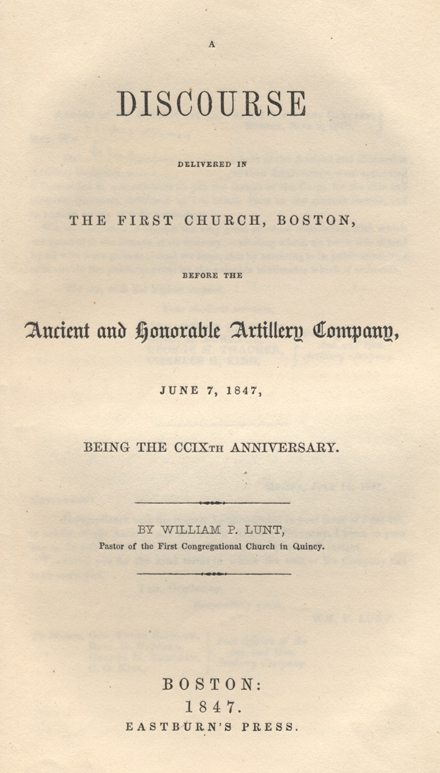
A

DISCOURSE

DELIVERED IN

THE FIRST CHURCH, BOSTON,

BEFORE THE

ANCIENT AND HONORABLE ARTILLERY COMPANY,

JUNE 7, 1847,

BEING THE CCIXth ANNIVERSARY.

BY WILLIAM P. LUNT,
Pastor of the First Congregational Church in Quincy.


ARMORY OF THE ANCIENT AND HONORABLE ARTILLERY COMPANY,
BOSTON, JUNE 9, 1847.Rev. Wm. P. Lunt,

Dear Sir:—The undersigned, by a vote of the Ancient and Honorable Artillery Company, passed on the evening of their Anniversary, were appointed a Committee to communicate to you the thanks of the Corps for the able and eloquent discourse, delivered by you before them on the seventh instant, and to request a copy of it for publication.

We take occasion to express the very great personal satisfaction with which we listened to the sermon at its delivery;–a feeling which we know was shared by all who were present;—and we hope, that by assenting to its publication, you will enable the public to profit by the valuable sentiments which it embodies.

We are, with the highest respect,
Your obedient servants,

Past Officers of the Anc. And Hon. Artillery Company.
GEO. TYLER BIGELOW,
BENJ. H. BURRELL,
GEORGE M. THACHER,
CHARLES G. KING,


Quincy, June 14, 1847.GENTLEMEN:

In compliance with the request, communicated in your favor of June 9th, in behalf of the Ancient and Honorable Artillery Company, I place in your hands, for publication, the discourse delivered on the seventh instant.

Thanking you for the kind terms in which the vote of the Company has been conveyed,

I am, Gentlemen,

Respectfully yours,

WM. P. LUNT.

Past Officers of the Anc. And Hon. Artillery Company.

To Messrs. GEO. TYLER BIGELOW,
BENJ. H. BURRELL,
GEORGE M. THACHER,
C. G. KING,


DISCOURSE.NUMBERS, CHAP. XXVII, V. 20.

“And thou shalt put some of thine honor upon him (Joshua) that all the congregation of the children of Israel may be obedient.”

HEBREWS, CHAP. III, V. 3.

“For this man was counted worthy of more glory than Moses.”

The words which I have just read have been selected, partly from one of the Sacred Books of the Old Testament, and in part from the Christian Scriptures, simply because they bring together three ideas, which it is the object of this discourse to treat of in connection. Moses, knowing that he must soon be removed from the earth, felt the importance of designating some person who should succeed him, as a Leader of the Hebrew people. The chief work, that of organizing the nation, and moulding the civil and ecclesiastical institutions under which they were to live,—this work had been done by Moses, the Prophet and Lawgiver. The most difficult duty of a Leader had, therefore, been already accomplished. It remained to appoint some one who should help to preserve what had been gained, and to consolidate what had been established, who should direct the energies of this compact community against their enemies, and secure for them the quiet possession of the promised land. A person competent for this office was found in Joshua, and Moses was directed to set him before the congregation. “And,” continues the divine charge to Moses, “thou shalt put some of thine honor upon him, that all the congregation of the children of Israel may be obedient.” The idea conveyed by these words seems to be, that although Joshua succeeded Moses, yet he did not,—it was not intended that he should,—fill the place of the great Hebrew Lawgiver. He had but a secondary office to discharge, and only a portion of the honor, of which Moses was the object, was transferred to him. This then may be regarded as the sentiment of the ancient Scriptures,—that the Lawgiver takes precedence of the Military Leader. But if such be the relative rank of Moses as compared with Joshua, we find a different place assigned to him when we turn to the new dispensation. A greater than Moses is here. “For this man (the author of Christianity) was counted worthy of more glory than Moses.”

Jesus, Moses, Joshua,—the inspired moral teacher, the wise lawgiver, the skilful and brave captain. The Bible, which commands us to render unto all their dues, seems to assign this relative order and rank, in the scale of honor, to the three personages I have named. And this is the order in which mankind have generally consented to esteem the three kinds of greatness represented by these individuals. It is true that this order has been occasionally disturbed in the judgments of the world; but in the long course of events men’s minds settle down upon this estimate. Sometimes there has been a disposition to rate too high the military chief. And this pernicious idolatry has encouraged wars and oppressions in the earth. But such perverted feelings short-lived. They soon yield to a sounder and juster way of thinking. What renowned master of the art of war, from “great Julius” to still greater Napoleon, occupies such a space in the world’s regard as Moses, the Hebrew legislator and statesman? Or has exerted such a powerful influence (not to speak at present of the kind of influence, but simply of its amount) upon the actual condition of the world?

And this order, which the Bible assigns, to the moral teacher, the lawgiver, and the military leader, has, uniformly and from the commencement of our history, accorded with the sentiment of New England. It is a curious fact, quite characteristic of our forefathers, that, when application was first made for a charter for the Military Company whose anniversary we are met to observe, according to Gov. Winthrop, “the Council, considering (from the example of the Pretorian Band among the Romans, and the Templars of Europe) how dangerous it might be to erect a standing authority of military men which might easily, in time, overthrow the civil power, thought fit to stop it betimes.” We might be disposed to smile at the great jealousy evinced by our ancestors towards what has always seemed to us a harmless situation, if we did know that this jealousy was connected, in their characters, with qualities to which we are indebted for all we most highly prize. Let the philosophical student of history say, to what other portion of the inhabited earth shall we turn, to find, in the early half of the seventeenth century, such a wholesome distrust of military influence, such a wise precaution with regard to any thing that threatened danger to “the civil power.” We can forgive the exaggeration which brought up before the imaginations of the Puritan settlers of New England, the lordly Templars and the despotic Pretorians, when we reflect upon the civil virtues of which they left the world such eminent examples.

And do I err, in supposing that the sentiment which was so strong in the minds of the fathers of New England, which we have seen to be the sentiment of the Hebrew and of the Christian Scriptures, which allowed only part of the honor belonging of right to Moses to be given to Joshua, and which counted the teacher of Galilee “worthy of more glory than Moses,”—in supposing that this is the sentiment of those who have invited me to address them on the present occasion? I am not standing in the presence of men whose trade is war. Pleasant as are the associations of this day to those most interested in it, I presume they all, without exception, think more highly of their civil relations and of their duties as citizens and Christian men, than of military distinction. We have never had among us a class of fighting-men, whose training has been only that of the camp of the gun-deck. It is to be hoped that we may never need or know such a class in the midst of us, and that we may not go beyond our own limits to seek an idol of this sort for the worship of our people. And we have never failed to have among us a large class of men, with strong arms and stout hearts, who, when danger threatened, or rebellion lifted its head, or the country was invaded, or our citizens were immured in foreign prisons, or the laws needed to be supported and upheld, could seize their weapons, and use them with effect. May the number of this class never be smaller.

I have remarked that the order which the Bible assigns to the three individuals already named, is, Jesus the inspired moral teacher, Moses the lawgiver, Joshua the military leader. It may be said, I know, in regard to Moses and Jesus, that they were both lawgivers and both moral teachers. They were so in a certain sense. But there is a lain distinction between them which our minds readily make. Moses was a teacher of morals. But his distinguishing peculiarity is, that he conveyed his moral influence to men’s minds, in the shape of commandments which were to be obeyed, rather than of moral truth which was designed to live in men’s convictions, and to work obedience through the action of those convictions upon the conscience, the will and the life. And so too in a certain sense Jesus may be called a lawgiver, inasmuch as he taught doctrines and principles which have ruled the minds and hearts of thousands of human beings the world over. But his was “the law of the spirit of life,” pertaining to the soul, and not the law which enjoins obedience, without regard to the state of the mind, upon penalty of suffering and death. Moses gave the world a code of laws. He went into particulars. He invented and prescribed a special form of civil and ecclesiastical polity. He organized a community and nation, and his laws extended to the minute detail of life. Christ, on the other hand, devised and enjoined no particular form of civil or ecclesiastical polity. His kingdom was not intended to be visible, or to take any outward shape; it was to be set up in the souls of men. His truth was to rule his followers through the convictions of the mind, the sentiments of the heart, and the principles of the conscience. It did not limit men’s choice to any particular modes of expressing its principles. It did not dictate any pattern for social organization. It was a spirit rather than a rigid rule. It was a new atmosphere which men were to inhale, and thereby receive and be conscious of a higher, intenser, more healthy moral life. Christ was a teacher of moral truth, and communicated it in such a shape that it should dwell in men’s minds, be appropriated by them, made their own, through faith, inward conviction, and manifest itself outwardly in whatever acts, features of character, virtues, modes of life, habits, and manners, social institutions usages, conventional arrangements and political combinations it might incline men spontaneously to adopt. In this way Christian truth, being enthroned in the mind as a principle, would operate so steadily and powerfully as to render unnecessary all express statutes. It would produce a better kind of righteousness than that which consists in literal obedience, in mere conformity to rules, the reason of which is not seen and acknowledged.

And the three individuals who have been named represent three principles which obtain in the government of the world in which we live, viz: Force, Reason, Love. These principles all enter into the methods by which Providence controls and governs the world. They all have a place, an appropriate place, in the Divine administration of the affairs of the universe. Not force alone, nor reason alone, nor yet love alone, is to govern in such a world as we are living in. Each of these principles has its sphere marked out for it, its office to perform, its part to contribute to the general end. And every theory, that would do justice to the plain facts of life, must recognize all these principles. He who is Almighty does yet not depend solely upon his irresistible power and absolute sovereignty. He is wise and just too; and would have his proceedings and laws understood and allowed to be wise and just by his rational creatures. And he seeks also, not merely to control, as he may, our destiny, nor merely, through the convictions of the rational faculty in the human mind, to extort a cold acknowledgment that his government is right and just, but to attach us to himself by the strongest affection of the heart, the love of God.

The three principles we are considering are seen operating in the government of a family. Parental authority, the right and duty, if need be, to enforce obedience, is every where acknowledged. The child is reasoned with as soon as he comes to years of discretion. And the affections of the young heart ought to be cultivated, appealed to and relied on in every Christian home. There may be ground for saying that that household is in the best condition, where no force is needed, where it is not necessary even to reason with children, to produce submission and obedience, where all is accomplished by love. But there seems to be no ground for asserting that any one of the three principles just named can be dispensed with at once and in all cases; much less can it be maintained, that either of them is inadmissible in any circumstances. And the same is true in regard to the human race at large, considered as the great family of God. He appeals to the reason or intelligence which he has bestowed upon us. He reveals himself also as our Father, and inspires us with love. But at the same time it is a fact which we cannot gainsay, and ought not to thrust out of sight, or to nullify by our favorite theories, that we are living under a system of absolute Power which is as appalling as it is irresistible. The great difficulty with many is that they take up theories, or contract prejudices, which narrow the mind’s vision and pervert the judgment. There is a place for force in the arrangements of the world. But those who have been accustomed to the use of force exclusively to govern their fellow-men, are too apt to be skeptical concerning the efficacy or practicability of any other kind of influence. The rigid disciplinarian of the quarter-deck, the “Iron Duke” of armed legions, or the stern pedagogue of the type of the last century are unable to conceive it possible to govern boys or men in any other way than by the rope’s end, or the rod, or the bayonet. The suggestion that other modes may be employed with success, would furnish proof positive, to such minds, of derangement on the part of him who should make it. And an equally narrow way of thinking is often witnessed in those who take up the notion that every thing is to be effected by reason or by love, and who exclude force from the lawful and God-appointed instrumentalities by which the world is to be controlled. Now against this narrow way of thinking, the Bible as well as human live, is a continued protest.

Force, Reason, Love. The military represents and embodies the first of these ideas, Force. The second, Reason, expresses itself in Law, understood in the largest sense; comprising common, municipal, constitutional, international Law; all those usages and customs which are the ruts in which the wheels of society run for unmeasured periods of time, until the track is worn smooth, and deviation from them is not thought of; all those express statutes and enactments which legislators make and adapt to existing and temporary exigencies in any community; all those fundamental, organic principles which are agreed on by men, in framing the particular governments under which they consent to live; all those general ideas of right and justice, the materials of an uncompiled code of catholic Law by which different nations are united virtually in a kind of world-confederacy, or what Sir James Mackintosh happily calls “the great commonwealth of mankind;” a union and commonwealth, let it be observed, in passing, which it is the tendency of civilization, especially of Christian civilization, to promote and strengthen, to make possible, and so to make actual. All these branches of Law we may properly refer to the Reason or Intelligence which God has given us, even if we adopt the theory of a separate and appropriate faculty of the human mind for the apprehension and judgment of moral facts and the moral ideas which every mind gins, of necessity, in this world, and forms them into systems, laws, commandments, and thus gives shape and body to what, through instinct, or original sentiment, or inborn principle, the Creator may be supposed to have implanted in the human constitution.

The third idea of which mention has been made is Love. This is the foundation principle of Christianity. The first commandment according to Christ is love to God. The second is like to it, love to our neighbor. And all the Law and Prophets are summed up in these two precepts. Nor does the fact that Christianity does not make use of force or of reason, to effect its intended objects, prove that it condemned the use of force and reason under all circumstances. The special work it proposed to accomplish did not require force. “If my kingdom were of this world,” said Jesus, “then would my disciples fight.” He had no outward visible polity to establish, as Moses had. Neither did he come to found a school of science, to discourse logically concerning philosophy, morals, theology, to unfold the abstruse subjects upon which the profoundest minds have been meditating, almost without result, for centuries. If this had been a chief or a prominent object with him, then would he have relied, as he never did, upon reason; he would have speculated and theorized; he would not have “taught as one having authority,” but would have shown the reason of what he enjoined upon his followers by formal arguments. Yet who pretends that Christianity condemns the use of reason or appropriate appeals to reason, or all attempts to influence men through their reason? And is there any more reason for alleging that Christianity condemns all use of force, because it had no occasions for force itself? It in fact expressly declares, that the civil magistrate “beareth not the sword in vain;” and commands its disciples to “render unto Caesar the things which are Caesar’s.”

I say, therefore, again, that force has its appropriate place in the government of the world. Among the attributes which we are taught to ascribe to the Deity, is omnipotent might. Nor does Christianity, the religion emphatically of love, leave out of view this dread feature of the Godhead. Christ not only presented to men’s minds the mild idea of God the Father, but warned his disciples to “fear him who is able to destroy both soul and body in hell.” Can the theorists of our day repeat this awful language, and then say that our religion entertains no other idea of government than love? It would not be easy to turn to a passage in either sacred or profane writ,—search, if we will, the records of the world through—of more terrible import than the words which I have quoted from the lips of him whose great law at the same time was love.

The emblem that represents the government of the world is a wheel within a wheel, as seen in the vision of God’s ancient Prophet. Force, Reason, Love, these are the principles of three kingdoms, one within another, involved in a perplexed general system, ruling men by their fears, by their convictions, and by their affections.

But in the modern Platonic Republic which the wise men of our day construct in idea, force is not admitted; it is not regarded as a legitimate agent in effecting any purpose which rational beings may aim at; it is accordingly condemned, disowned, and rejected. This way of thinking is approved by those particularly who oppose war as unjustifiable under any circumstances. War is undeniably, professedly, an appeal to physical force, to settle national differences. But force is at the foundation of all society, as society has hitherto always been constituted. Society is based upon a compulsory, not a voluntary principle. There always has been, and it would seem that there must be, allegiance to a sovereign will, however that will may be expressed, and wherever men may consent that it shall be lodged. “The powers that be are ordained of God.” Such is the form of words in which the Christian Scriptures recognize the important principle I have stated. In this language is expressed the idea of the divine right of government; not the divine right of kings; not the divine right of a republic; not the divine right of any particular form of government which men have devised or can devise; but the divine right of government, the divine right then of force. The Divine Providence allows mankind the privilege of choosing what form of government they will live under. But they are not allowed to go farther than this. They have never been permitted to choose between some government and none at all.

The right of any government to call upon those who live under its protection to contribute a portion of their substance, in the shape of a tax, for public uses, will be generally conceded. But suppose I resist the call, and choose to reason against the justice or propriety of such payment, not against the particular amount that may be assessed, but against the right to impose any amount whatever, will the officer or agent of government, who may be charged with the collection of the tax, stand and reason with me the point; or will he not proceed, in the execution of his official duty, to compel payment, by the seizure of such portion of my property, if he can find any, as shall meet the demand, and if need be, the escort of my person to the safe lodgings for such cases made and provided? Now this escort is not conducted, and this whole process, called with some humor (for the law, it seems, has its humor as well as its fictions) a civil process, is not served, by armed officials, by plumed and sworded knights, nor is it accomplished by sweet and resonant music; but in what, except these unessential accidents, does it differ from the way of “an army with banners?” It is force—physical force—the force of the stronger, compelling me, whether I will or not, whether to my mind what is required may seem rational and right, or tyrannical and unjust, compelling me to contribute my proportion to the public weal.

We hear much, (not too much certainly) concerning the horrors of war. The picture which is drawn of those horrors is not overcharged. It is all true to fact and reality. The catalogue of atrocities which war occasions is easily filled up, because those atrocities are public, notorious transactions, enacted in the open face of heaven. The passions that lead to them are such as may be indulged, through the license of the world’s opinion, without scruple. But can any reflecting man doubt, that as large, if not a still larger catalogue of what may be called the horrors of peace, such, I mean, as belong exclusively to a time of peace, such as war banishes, and may perhaps be regarded as a remedy for in Providence, might be made out? Take, for example, the times that preceded the first French Revolution; consider the state of society in that country, the morals of the people in all classes, the monstrous abuses which were not only tolerated but consecrated by the insane delusion which left, unburied and chained to the living body of society, the dead and corrupt past; and if our horror at the bloody scenes which followed is not diminished, is not our amazement less, when we trace those scenes to their true cause? Who at the present day speaks or writes of the French Revolution, in the manner of Edmund Burke, at the close of the last century, when the personal sufferings of the royal and noble exiles who carried to England all the grace, vivacity and elegance of the French Court, might well inspire a romantic interest, in their behalf, in all cultivated and generous minds? Instead of lamenting, in the musical language of Burke, that “the age of chivalry is gone,” we are disposed rather to pray that it may never be allowed to return. We can see, what the contemporaries of the great tragedy were too near to discern, that the interests of humanity required that there should be a violent social convulsion, and an overthrow of existing institutions. The soil of society must be broken up by the ploughshare of revolution and war, before it could be prepared to produce what humanity craved. Consider the thirty years of peace with which the nations of the first class in Christendom have been blessed since the career of Napoleon was terminated on the decisive field of Waterloo. And is there any thinking man among us, so blindly wedded to theory, or so afraid of betraying a good cause by acknowledging a plain truth, who believes or will assert that such a peace could have been enjoyed for so long a period, had it not been preceded by the desolating but purifying flame of war, which was allowed to pass over the earth, and to burn up the corrupt, noxious materials that had been accumulating for centuries?

Peace, then, we must conclude, is sometimes essentially promoted by war. This seems to be one of the appointments of the Divine Providence that rules in the world’s affairs. God make the “wrath of man to praise him, and the remainder of wrath he restrains.” In the story of the Hebrew champion, Samson, we read, that, after he had exerted his prodigious strength in the destruction of a lion, in one of his journeys over the same region, “he turned aside to see the carcass of the lion, and behold there was a swarm of bees and honey in the carcass of the lion.” And upon this incident he founded the riddle which he “put forth” to his companions; “out of the eater came forth meat, and out of the strong come forth sweetness.” This is, in truth, the riddle which the Sphinx proposes to man’s mind in all ages. Out of the fierce wars whose office is to rend, and destroy, and devour, there comes forth a better social condition of the world for man. You may say, my hearers, that this is a sad view to take of human affairs. I will not dispute with any on that point. It is sad, awfully mysterious. But we need not on that account, shut our eyes to the plain facts of life.

Moreover in regard to war, the question deserves attention, what constitutes its real evil, in the eye of the Christian moralist? We commonly confine our attention to its external signs and effects. The millions of treasure which it helps to squander, the suspension of useful arts which it occasions, the blood which it causes to be shed, the pillage, depopulation, misery, which follow in its train, these are usually set forth as the saddest signs and fruits of war. But if we view the subject from the highest ethical point of observation, it is not these external evils we shall look to, so much as to the passions out of which war springs, and which it helps to create and cherish. A Christian apostle asks, “From whence come wars and fightings? Come they not from hence, even from your lusts?” War is passion embodied in the terrific action of contending hosts. But are there no lusts and passions raging in men’s bosoms in time of peace? In a purely ethical point of view, is there much to choose between the rivalries of opposite factions and sects, the bitter feuds of social life, the brood of viperous passions that are engendered in a state of what we call peace, and the martial sentiments which inflame men on the field of battle? Are not the evils which accompany war made less by reason of the discipline which is essential to an armed host among civilized nations? Compare the warfare of two hostile Indian tribes, those Nimrods of the prairie, meeting each other in small bodies, each man singling out his adversary, and directing against some individual the fury of his whole wrath; or the battles narrated with so much spirit by Homer, which are in fact a series of personal encounters of the fiercest kind; compare these with the maneuvers and conflicts of modern armies in civilized nations, disciplined in a scientific manner, whose missiles of destruction take effect at great distances, and I presume it will be allowed that, although there may be greater sacrifice of life, in civilized warfare, (yet that is not always the case, if we take into view the comparative numbers engaged) there is less exasperation of spirit, less of ferocious passion awakened, less of brutal inhumanity, less of wanton waste of blood from the cruel love of shedding blood, than in the combats of savages or of classical heroes. And is this consideration not worthy of any regard. Does it make no difference in our ethical judgment of two scenes? Is it no gain in a moral point of view, that the improvement of military science makes a battle depend more upon skill in maneuvers, than on a desperate, malevolent, and revengeful struggle between matched foeman?

The abolition of war is far less important, in a moral point of view, than the object which Christianity aims to effect, which is to moderate and soften those dispositions of which war is an outward expression, and only one expression. The “action of the tiger” in war is no more opposed to Christianity than the stealthy venom of the serpent in time of peace. The history of the Christian Church even exhibits not a little of the war-spirit rankling in the breasts of those who have had words of peace and love upon their lips. Out of the hearts of two theological disputants, who boast that they war not with carnal weapons (though it is not easy to see why the tongue is not a carnal weapon; the Psalmist speaks of those whose tongue was a sharp sword) if there were any method of extracting the gall and malice with which they are actuated, there might be procured of anger, hatred and revenge enough to sustain quite a long campaign of modern field service. Nor if one were seeking for models of the true Christian spirit, would he be advised to go into the stormy assemblies of modern reformers, where a person must substantiate his claim to be a philanthropist by pronouncing the shibboleth of abuse.

It is alleged by some that the use of force is inconsistent with the Christian Religion, which commands its disciples to love their enemies, and to overcome evil with good. But those who produce these precepts with a view to show the unlawfulness of that particular exhibition of force which is seen in war, do not go far enough. The principles from which they reason would carry them much farther than they are inclined to go. The only persons who can consistently use these and similar Christian precepts literally, are the advocates of non-resistance, those who are opposed to any government on a compulsory principle. If any are disposed to retain the Navy of the country, “as a part of the police of the seas,” while they reason against all war as inconsistent with Christianity, where is their consistency, and what becomes of the principle which they start from? What right has any country, according to their interpretation of the Christian precepts, to establish such a “police of the seas?” Why seek to “purge the seas of pirates,” by the strong force of a naval armament? Why attempt to put down “the hateful traffic in human flesh,” by firing into the vessels employed in this traffic, and thus putting at hazard the lives of the innocent and guilty? Is the pirate to be excluded from Christ’s law of forgiveness? Is the slave-dealer not a man, that those who are in favor of a strict construction of the Christian rules, cannot give him the benefit of the command to “love our enemies?”

Besides, if the precept “love your enemies” is to be taken literally and applied to public national affairs, it is plain that it must be applied to criminal law, that it must overthrow the whole fabric of penal jurisprudence, nay, it will be found to be opposed to all legal measures for redressing wrongs or maintaining human rights. If we must take literally the precepts “Love your enemies,” and “overcome evil with good,” what right have you to incarcerate the incendiary, the highway robber, the forger, the homicide? Not only the gallows must be torn down, but the question will recur, with all its original force to a conscience formed on such a construction of the Christian rules,—what right have you, on your principles, to save a human being’s life, merely that you may immure him in a stone cage; that you may take from him his liberty, which ought to be dearer to every person than life; that you may separate him from wife and children, whom he has sworn before God to support; that you may deprive him, for a term of years, perhaps during life, of the rights of a citizen; that you may shut him up with companions whose society is likely to be demoralizing, which perhaps may kill what little remains of vitality his soul and conscience may have retained?

But again, if he who consents to enjoy the fruits of crime be in part responsible for it, then it may be asked of the ultra peace men of our day, how they can justify themselves in foro conscientiae, in continuing to use whose institutions, and to enjoy those rights and privileges which have been purchased in past ages, and for which was paid the price of blood? The conscientious anti-slavery man refuses to sweeten his meals with the sugar which has been produced by the lash-stimulated labor of the negro slave of the tropics. And why should the equally conscientious anti-war man be willing to enjoy the freedom, the political privileges, the liberty to worship God in the way that he may judge right? This freedom, and these social blessings were won for us in former times by men clad in mail, with drawn swords in their hands, contending in mortal combat for the rights which they faithfully transmitted to posterity. Who ever heard of a person, by reason of his conscientious principles, his abhorrence of all war, abjuring is country, giving up home and all the social blessings he has enjoyed from his youth, and all because these blessing were procured for us, as they certainly were, on the field of battle, and at the cannon’s mouth? Among the many forms of extravagance that abound in our day, why is it that we never hear of an instance of this kind?

The Discourse thus far has aimed to show that there is a place for Force in the appointments of Providence; that it is only in such an imaginary Commonwealth as Gonzalo pictures, there is “no sovereignty;” and that if it be lawful and consistent with Christianity to employ force in upholding social order, and restraining crime, it may be used too in maintaining the independence of a nation, or in defending it from invasion. But our general speculations on the subject of Force and War need not prevent our opposition to an unnecessary, an unjust, and an inglorious war. One feature in the Reform movements of our day is the disposition to adopt the most extravagant general doctrines, for the sake of bringing to bear upon special evils the greatest amount of indignant and condemnatory sentiment. But this fails, as all intellectual, as well as all pious frauds, always must fail, of affecting the object for which they are resorted to. The finds of moderate, sober, honest persons, who love the truth, the exact truth, the whole truth, and who are disposed to rest content when they have obtained the whole, without seeking for more, such minds feel that a deception has been practiced upon them, when advantage has been taken of their real love of any good cause, or of their sincere wish to remove any acknowledged evil, to oblige them to endorse general doctrines which they do not esteem sound and true, which they perhaps detest.

But if there be, as the Discourse has endeavored to show, a place for Force, in the arrangements of Providence, there is also a place, and a much higher place for Reason. The influence which the great lawgiver exerts upon the world, by the laws and institutions which he frames, is surely of a better kind and entitled to more honor, than the skill of the great captain, who plans enterprises, and conducts men in disciplined masses, inspired with his sentiments, and obedient to his will, to the execution of his purposes. The declaration of the inspired volume finds an echo in every sound mind, when it says,—that “wisdom is better than weapons of war;”—that wisdom by which “kings reign, and princes decree justice;” which is described by the ancient Hebrew sage, as “the breath of the power of God,—the brightness of the everlasting Light, the unspotted mirror of the power of God,” as “more beautiful than the sun, and above all the order of stars;” that large, comprehensive wisdom, which looks before and after, which includes, in one survey, a wide field of objects and relations, which turns, by a well-timed word or act, the tide of events, which founds institutions whose plastic influence is felt by remote generations. “In Orpheus’s theatre,” says Lord Bacon, “all beasts and birds assembled, and forgetting their several appetites, some of prey, some of game, some of quarrel, stood all sociably together, listening to the airs and accords of his harp, the sound whereof no sooner ceased, or was drowned by some louder noise, but every beast returned to his own nature, wherein is aptly described the nature and condition of men, who are full of savage and unreclaimed desires of profit, of lust, of revenge, which as long as they give ear to precepts, to law, to religion,—so long is society and peace maintained; but if these instruments be silent, all things dissolve into anarchy and confusion.”

If the influence of Force, as employed and directed by the military leader, be most speedy and brilliant in its results, the influence of Reason or Wisdom in law, and social institutions, is most enduring. What memorials are there in the world of ancient Rome? 1 “Its martial glory,” to use the words of another, “has long since departed, but the ‘eternal city’ still continues to rule the greatest part of the civilized and Christian world, through the powerful influence of her civil codes. In every civilized country of Europe, the Scandinavian nations and England excepted, the Roman civil law either formed the original basis of the municipal jurisprudence, or constitutes a suppletory code of ‘written reason,’ appealed to where the local legislation is silent, or imperfect, or requires the aid of interpretation to explain its ambiguities.”

The ancient Scriptures furnish a striking illustration of the two kinds of greatness we are comparing, in the history, which they record, of the two nations that sprang from Esau and Jacob. Esau was a “cunning hunter;” and he afterwards became a successful military chief. He possessed himself, by force, of Mount Seir, established there a splendid military authority, and left to succeed him, a line of dukes and kings, who built for themselves a safe, and, for a long time, an impregnable fortress “in the clefts of the rock.” But what is there left now to testify of Edom? They who lifted themselves up as the eagle, and who set their nest among the stars, were long since brought low. The fierce scream of that mountain eagle was long ago silenced. And when, as a people, they passed away, they left no perceptible influence upon the world; there is nothing to show how great they once were, in any institutions, any modes of thought, any social, political, religious, moral principles, left by them as a legacy to after times. Nothing of Edom remains except the rocky city which still stands, without inhabitants, in the desert, to convince the awe-struck traveller of the truth of God’s prophetic denunciations.

Jacob too, was the father of a nation, but how different in its character and destiny, and influence upon the world, from that we have been contemplating! As different as were the personal qualities and habits of their respective founders. The Patriarch Jacob was a man of mild and gentle disposition. He “dwelt in tents;” he led a regular life, a life of quiet industry, that served to moderate the passions, that encouraged thought and reflection. His pursuits, instead of exciting and inflaming, sobered and calmed the mind, and gave room for reason and the higher sentiments to operate. While employed as a shepherd or as a “tiller of the ground,” he would receive into his soul the bland and awful influences of Nature; there would be stamped upon his mind an image of the order, regularity, obedience to fixed laws, which mark the works of God; he would experience the full power of the religious sentiment; he would see visions of angels ascending and descending above his head; he would make covenants with his unseen Guide and Protector; he would set up pillars of stone to mark as sacred, the spots where his mind had been elevated and inspired by religious ideas and emotions. And the peculiar character which was in this way formed would be communicated to his descendants. The people that traced their origin back to the Patriarch Jacob, were eminently religious, and they were governed by fixed laws. The whole civilized world has been influenced by Hebrew thoughts and principles. “Out of Jacob came the star” which still shines to guide the nations, and “out of Israel came the scepter” which is destined to bear sway through the earth.

Thus it is that Reason perpetuates itself, while Force, however violent, soon comes to an end and leaves no trace upon the world. Reason may be likened to the “still small voice,” which the Prophet heard in the holy mountain. Long after the fire, and the strong wind, and the earthquake of human passions have wasted their violence and died way in silence, the whisper of God comes down through the ages, and is heard by all listening minds to the end of time.

And if those individuals deserve honor who legislate for particular portions of the human race, still more highly should they be ranked whose large and comprehensive genius investigates the principles of general law or international morality. International law, or the extension of the rules of truth, justice and fidelity, which are acknowledged to be binding among individuals, to nations in their mutual intercourse, is the growth of modern times. It marks the Christian era of the world’s history. 2

The science of international law is, as yet, but in its infancy. Its future improvement opens to the vision of the mind a condition of the world that shall approximate nearer and nearer to the picture which prophecy has drawn of universal and perpetual peace.

While any positive institution, such as a Congress of nations, which has been proposed for the settlement of national questions, is open to strong objections on the ground that it would be likely to interfere with the independence of separate States, the labors of individual writers, whose genius qualifies them to codify the notions of justice and right which are recognized by all minds, such labors are sure to produce good results. 3 “If, says a writer on international law, “the international intercourse of Europe, and the nations of European descent, has been marked by superior humanity, justice, and liberality, in comparison with the usages of the other members of the human family, they are mainly indebted for this glorious superiority to those private teachers of justice, to whose moral authority sovereigns and states are often compelled to bow.”

An apology for war has very frequently grown out of the want of some acknowledged rule or standard of public right and justice, by which nations shall try their differences. This is a want which it is the happy tendency of civilization to supply more and more. The extended and still increasing intercourse which commerce and Christian enterprise are encouraging, among the inhabitants of different lands, helps to form a treasury of common moral ideas, ideas of what is right and just and true; and thus are collected the materials which constitute a universal reason, a world-opinion, a catholic conscience; and the stronger this becomes, the more likely will it be to supersede brute force in the adjustment of national differences. Already this moral world-power, which was wholly unknown to ancient civilization, has acquired a mighty weight. And I would ask to what work so noble, so truly worthy of the acutest, profoundest, and most comprehensive intellect, can the attention of the publicist of our day be directed, as to the task of giving form and body to the loose ideas of public right and duty that are floating in men’s minds, and which, if brought together and digested into a consistent system, could not fail of exerting a powerful and benign influence upon the destinies of mankind? That statesman or political moralist who invents a happy form of speech for fitly expressing, making current and portable, those convictions of justice and right which belong, in the ore, to all human minds, confers an incalculable benefit upon the world. “How forcible,” says the Scripture, “are right words.” “Like apples of gold in pictures of silver.”

He who puts a principle of public justice and international morality into such a shape, by the help of verbal statement, as to command assent from the minds of men educated in different countries, and under the most various, perhaps opposite influences,—who makes the principle harmonize with their convictions, and who thus gives truth the force of law to human beings in the most distant regions of the earth,—he is really the king, the ruler of his fellows. He bears sway in the world, not indeed by any visible presence, not because seated in any chair of state, not with visible tokens and insignia of authority, but by the secret, irresistible influence which he exerts upon men’s minds, upon the sources of action. And I trust I may be allowed, without the charge of impropriety, to say, in this connection, that the services of that distinguished individual, who, while occupying the office to which pertained the foreign relations of the country, adjusted a controversy of long standing with the most powerful nation on the globe, and whose pen, in that critical juncture, was the wand of Prospero allaying the tempest of war, will not, it is to be feared, be appreciated as they deserve, till an impartial posterity shall assign him the place he will occupy among the benefactors of his age.

I say, then, and will not my audience join me in this sentiment, if we must elevate above the level and measure of common mortals any human being, let it be, no the Military Leader, not the Joshua’s of the past or of the present, but the Lawgiver, who moulds the institutions of a people, and gives them an individual existence, or the moral Teacher who communicates to the souls of men universal truth, and who thus becomes the Founder of a universal empire. And this, we find, to be in fact the direction which men’s men’s sentiments have, in the long run, taken. It is Moses the Lawgiver who, in the conceptions of the world, “saw God face to face.” It is Christ, who became, in men’s belief, a part of the very Deity. If any be disposed to regard these judgments as extravagant, it must yet be allowed to be an error on the right side. If we must call it so, the mythology of Israel and of Christendom is of a far higher and more excellent kind than the mythology of Greece and Rome, which deified brute force and military valor.

Finally, while Force is the agent employed by the Military Leader, and Reason or Intelligence is appealed to by the Lawgiver, Christianity relies upon Love. Christianity, by this principle of universal love which it inculcates, by this spirit of humanity which it breathes into the soul, lays the foundation of a kind international sentiment, which cannot but modify the relations of different countries to each other, and prevent the growth of those bitter prejudices and antipathies which are sure to find bloody expression in war. The Christian precept which commands its disciples to love their enemies, that is, not to allow their hearts to harbor so much hatred and hostility to any human being, let his acts and deserts be what they may, as to be unable to exercise towards him, should there be occasion, the offices of justice, benevolence, mercy,—this precept has sometimes been objected to by unbelievers as impracticable, and such reasoners have made the precept an argument against the claims of our Religion. But if we consult History we find the great truth illustrated, that, in exact proportion as men have approximated to the temper of this precept, has been the progress of civilization and social advancement. In the savage state we seldom, if ever, meet with large nations, a great number of inhabitants living together in peace under the shelter of a common government. But they are cut up into petty tribes, few in number, ranged under their respective chieftains, and perpetually at war with each other. This has always been the case with the aboriginal inhabitants of our continent. They present to our view the picture of society broken into a great number of fragments. On the other hand it is the office of civilization, and especially of Christian civilization, to collect together these fragments, to unite them into one compact body, to multiply the ties and relations that make them one. In a Christian community men, instead of standing isolated, or in narrow circles, eyeing with jealousy and hatred all beyond that narrow line, are grouped together by millions and hundreds of millions, and their hearts learn to expand, their affections reach abroad widely, their sentiments become large, and comprehensive. And there cannot manifestly, be any large nation, without an approach to the sentiment of universal love which the Divine Religion of Christ inculcates. In accordance with this cardinal precept of love, it is the noble aim of Christianity, without interfering directly in political or civil arrangements, and without prescribing any form of polity, or establishing any visible kingdom, to form a communion of man with man the world over, irrespective of place of birth, of color, or of race. And our best hope for the world must be that this Christian idea of communion, of a community, may be realized more and more perfectly. It has already proved fatal to many of the odious inequalities and oppressions that have afflicted our race. Christianity was sure, if its doctrines and maxims were received, to result in free political institutions. And the more fully the Christian idea of communion is understood and acted on, the stronger, more permanent, and safer will be the basis upon which society will rest. Stronger than all external bands of mere force, is that communion of feeling which grows out of the love which our Religion inspires.

In the early period of the history of society, the sentiment is quite weak. Communion, or what resembles it, is known only among the members of the same family circle, or of the same tribe. In course of time the sentiment extends, and becomes the binding principle of neighborhoods and small societies. Then it extends still farther and becomes the basis and cement of large Commonwealths. And finally the sentiment grows so as to link together the inhabitants of different countries, and it is a cheering fact that this international sentiment, this communion of man with man, exists as an element of modern society, and that it is continually growing stronger. Nor let it be imagined that the Christian principle of love has yet reached its full, intended expansion. The enlarged and still enlarging intercourse of the human race must effect changes in the condition of man upon the earth, and of governments in their relations to each other, the nature of which we cannot foresee or predict. It will be likely to modify essentially men’s notions of patriotism, of exclusive allegiance to any one government, and of national independence, ideas which have hitherto been held with a jealous tenacity.

But whatever may be our particular speculations on these points, we cannot refuse to entertain the vision, which has ever been seen by hopeful minds, of a period, in the coming ages, of perpetual and universal peace, when the trumpet shall be hung in the hall, no more to bray its harsh summons to conflict, when the arts of peace, the earth over, shall “beat men’s swords into ploughshares and their spears into pruning hooks.” Grant, if you will, that this is but a vision, a dream of philanthropy. That is no reason why it should be sneeringly rejected. It has gladdened and strengthened the hearts of the good and of the wise too, in every generation. Blot out, if any are bold enough so to do, from the pages of Scripture, the prophesy which foreshows this blessed era, still some similar promise would before long, be uttered from the depths of man’s soul. That soul is ever prophetic of good, through the principle of hope which God has implanted in it. Tossed as human beings are on a flood of restless, boisterous waters, hope brings to the ark, in which the interests of the race are floating, a sign of some Ararat on which man shall rest at last, and the bow of God upon the black cloud is cheering token of serene skies that are yet to smile upon the world. We cannot afford to dismiss this hope from our hearts.

Gentlemen of the Ancient and Honorable Artillery Company, if I were to assert that our fathers were the authors of and deserve the credit of originating a citizen-soldiery, some perhaps might not assent to the entire truth of such a claim, And yet, if it must be conceded that they only continued in use what had existed to some extent, and in a certain form, in their native country, we may certainly claim for them what is, practically considered, as important and as honorable to their character, that they gave a prominence and assigned an office to the institution of a citizen-soldiery, by making it a substitute for a standing army, which it had never had before. It was a favorite idea with them to train a body of men, who, without making war a trade, without foregoing the peaceable pursuits of industry, without dropping the character, the manners, the sentiments of citizens and of Christians, should yet be enrolled in bands of convenient size, and learn the use of arms, and submit to the necessary subordination and discipline of an armed host, and be ready, on any exigency and in a righteous cause, not for the sake of fighting, but because a sacred duty to the common weal impelled them, to practice their acquired skill, and to put to hazard their lives. If this was, for all practical purposes, a new thing among the nations, if the Puritan settlers of this Continent brought into use an instrument for maintaining social order and stability, which should effect the good objects proposed, without incurring the danger which had usually accompanied a resort to force, then, gentlemen, your Company, which was the first enrolled on this continent, is deserving of honorable mention in the history of civilization. Your anniversary, in that case, deserves to be noticed, not merely as the annual and pleasant gathering of a band of friends, but as one of the signs marking the opening of a new era in the progress of man. If we can say of the Fathers of New England, that they were the authors of the free Common School, for the instruction of the children of the people, and that they entrusted to the people themselves, their own defence as citizen-soldiers, then have they given to the world two institutions which have exerted an incalculable influence in favor of the prosperity, the improvement, the Christian peace and stability of modern society.

We will honor them for this. And we will hope and pray that the place which they assigned to military talent, as compared with other higher and more sacred forms of service to society and humanity, may ever accord with the sentiment of New England.


Endnotes

1. Wheaton’s History of International Law.

2. Among the Greeks and Romans a foreigner was regarded as a barbarian and an enemy, and was treated accordingly. With the Hebrews, foreigners were all included under a common term of reproach as Gentiles, and if they escaped hatred and contempt, were not placed upon an equality with the chosen people.

3. Wheaton’s History of International Law.

*Originally Published: December 20, 2016.

Sermon – New Planet – 1847


Cyrus Augustus Bartol (1813-1900) graduated from Harvard divinity school in 1835. He was a co-pastor with Charles Lowell at the West Church in Boston in 1837 and became the sole pastor of that church in 1861.


sermon-new-planet-1847

THE
NEW PLANET:

Or,

AN ANALOGY

Between the

PERTURBATIONS OF MATTER AND SPIRIT.

A

SERMON,

BY
C. A. BARTOL,
JUNIOR MINISTER OF THE WEST CHURCH, IN BOSTON.

SERMON.

Proverbs xvi. 11. A just weight and balance are the Lord’s.

The public attention has been lately much drawn to the discovery of a new planet, in that system of the heavenly bodies, to which our earth belongs. This remarkable fact has been the subject of many scientific comments. It may also however be regarded in various religious aspects. I know not that it has been considered in the point of view now proposed, as presenting an analogy between the material and moral universe. But this analogy is so perfect, so fixed in the principle and manner of the discovery, and leads to views so consolatory, as well as instructive, that we may profitably trace it.

“A just weight and balance are the Lord’s.” His creation is but an exact balance of worlds. Planets orderly revolving at various proportionate distances about the sun, lesser moons and satellites, in orbits as precise, moving round the planets, and the whole solar system as it were one single globe, rolling obedient to some mighty centre, which a late astronomer professes to have descried in the depths of the starry space.

For a considerable number of years, it had been supposed, that the solar system, of which our world is part, was all brought into the field of view and scientific knowledge; one bright body after another, with perhaps its attendant orbs, having revealed its station to the observer’s eye, nearer to, or farther from the sun,—from Mercury thirty-six millions of miles distant, to Herschel at the astonishing remoteness of more than eighteen hundred millions. And at length the heavenly lyre, to use a favorite figure with astronomical authors, was thought to be complete,—the planet Herschel being the last chord in this glorious harmony to the Creator’s praise. But still another note is now added, in the discovery of a new world vastly exceeding in size that appointed for our mortal dwelling. It is the principle and mode of this discovery, which I wish to note, as suggesting the analogy to which I have referred.

Le Verrier, the sagacious explorer of the celestial spheres, to whom we owe this great achievement of the age, was led into the track of the new planet, by detecting some perturbations. The perturbations of a planet are deviations or diversions from its regular separate course about the centre, which are occasioned by the attraction of other bodies. It was at first thought, these perturbations would finally derange the universe, and bring into inextricable confusion and destructive chaos that whole portion of nature in which we are placed.

But further insight into the process, by which these mighty masses of matter are drawn or driven along their glittering pathways, has shown that God’s creation is fashioned wiser than man’s fearful supposition, and that the compensations for these disturbances are so wonderfully wrought out, that the very mingling and apparent clashing of almost innumerable forces preserves the equilibrium of the whole, and, so far as we can see, will secure the stability of the universe. Of the perturbations however in question there had been no previous explanation.

But the question arose in the explorer’s mind, as through the lenses of his searching tube he gazed on that bright sphere, so long supposed to tread on the very verge and outermost circle of those stars that sing together in our little sister-band of God’s infinite family of worlds,—as he gazed and, with his armed, instructed eye, saw it tremble and sway from the line it should in obedience to the sun and its fellow travelers maintain, the question arose, what affection it could feel to make it thus lean aside; and, with a bold prudence, he judged that it must have beyond some other companion, which human eye had not yet seen. He scans these perturbed inclinations more exactly, measures their amount, ascends to their adequate cause, and though that cause still lay darkly ranging on, with to earthly vision undiscernible luster, he yet predicts its place, and course, and time of arrival into the focus of human sight. His prediction is recorded, to be entertained by some, or incredulously smiled at by others.

But lo! In due time the stranger comes as announced, to fulfill this “sure prophetic word” of the divinely inspired understanding of man; and a glorious new world swims into his telescopic view, sailing on the farthest rim of solar attraction, more than three thousand millions of miles away,—a world immense in its proportions as compared with this narrow surface of human action and passion. It comes and sets up its blue, brilliant disc in the heavens, in addition to the broad, lustrous face of Jupiter, the shining ring of Saturn, the soft beauty of Venus, and the red shield of Mars.

“A just weight and balance are the Lord’s.” I believe we may with equal justice say, as we examine the order and observe the perturbations of the moral universe. The motions and trembling and disturbances of the human heart also refer to a world beyond.

The disorders and wrongs and sufferings of human life demand a rectification and balance, as much as the swayings and wanderings of a material orb. For God is a spirit. His nature is essentially moral, and He cannot have made the moral and spiritual system of things less perfect than his outward and coarser handiwork. Let us consider, then, some of these moral perturbations, and inquire what the compensation must be.

And first, there is a perturbation of the human heart in view of death, and, so far as we can see, it is peculiar to the human heart. The animal seems to have no proper fear of death; he knows nothing of that peculiar horror with which the soul of man starts back aghast from the gulf of annihilation. That horror and perturbation belong to the human nature. It is made a part of us by the Author of our nature. It is felt not by the bad and conscience-stricken only; but by the good and self-approving also. Indeed, in proportion as faithful culture has opened the nobler faculties and expanded the better affections towards God and man, it is felt more deeply.

What, then, is it that thus draws our heart aside from the orbit of mortality, and makes it unwilling to keep true to the line that leads only to the grave? Shall we not conclude, like the astronomer, that it is another world, another system of moral being, that attracts and claims fellowship with it, and sways it up and on, over the white mark of the inscribed tombstone,—a real world, though yet unseen by human eye,—a world more glorious than the present, though no ray of it has yet actually reached us—a world that shall yet at length swim out from the darkness and distance, in which it is now kept and mysteriously involved, and when the veil of blinding flesh is taken off, and our eye purged of these mists of mortal ignorance, rush into the field of vision, and to those who doubt or believe, appear as a majestic reality?

There is a second perturbation of the human heart in view of sin. It feels that it was made for holiness, that its true nature is not (as it has been called) evil and depraved, but that it is constituted of God to love and worship and be like Him. And yet it is aware how short it falls of the noble mark. It is led away by appetite and passion, it succumbs to the power of temptation, it is wounded and sorely scarred in its enlistments in the base service of sin, and it moves but halt and slowly in the race of well-doing and virtue which its Creator ordained.

But, note and confess this fact: it is not content thus; it mourns bitterly over its backwardness; it is remorseful at its transgressions; it repents of its excesses; it calls itself an outcast, an enemy of God, yea, a thing of shame and woe, in the extravagance of its sorer mortification; and yet, notwithstanding, even in its degradation, it cries out with inextinguishable hope, “Who shall deliver me from the body of this death!” for it feels, in the intensest experience which its consciousness reveals, that this guilty shame is not its appointed and final destiny. By the grace of God and its own conspiring it must be cleansed from these stains, whose defilement is eating into its life and destroying its peace.

It sees however the road to perfection running before it, no short, no smooth, no level pathway, but long, and rough, and interminably ascending; and if the date of mortal existence is its date, then it must fail of its destiny: aye, in its best, purest development,—in the most perfect of men, it is still short of the mark, as they, especially, with an honest sadness confess. Yes, if that quiet enclosure of the body’s resting-place, with its thick-strewn hillocks, over which the shadows play from the rustling leaves and creaking boughs of the trees,—if that be the term of all,—then there is a perturbation of the human heart, for which no compensation exists,—then there is a break in the order of Divine workmanship,—then the moral world is ajar and unbalanced, while the material world, in all its parts and systems, rolls on and sings, as it shines, in everlasting harmony,—then the heavy clouds of the narrow pit press down, not upon an exhausted and decaying organization merely, but upon the untimely interruption, upon the unaccountable failure, upon the miserable wreck of the finer and spiritual fabrics, the vessels of an excelling honor, launched on their career with the strongest and most determined impulse of the hand of Omnipotence; launched with yet loftier and farther reaching aims than those lustrous globes sailing on their eternal voyage through the heavens. But no! the very thoughts refuse to pursue the absurd and impious hypothesis. “A just weight and balance are the Lord’s.” And the moral explorer of God’s works, as well as the material, concludes upon the existence of another world,—though yet unseen by actual vision, another world to balance and complete the present. Does it not indeed lie off there in the depths of his power, held aloft steadily by His Almightiness, even as the sparkling sphere that rides inconceivably remote along its sure but trackless way through measureless space to adjust and finish the balance of the material creation?

Yes, thou swift traveller through the unfathomable deeps,—untraceable but by the wondrously marking pencil of science,—one of the morning stars that sang together over the fastened foundations and laid corner-stone of earth!—thou teachest me a lesson of my Maker’s justice, as rounding every mass, and with his plummet ruling every motion, and speeding along every imponderable beam of material splendor, to make His boundless universe perfect as a diamond-scale through all its vastness, finished exactly to the finest stroke and particle: and justice stopping?—oh no, not stopping in its marvelous quality and matchless workmanship there, but running on with equity as infallible into the moral world, into the soul of man. Thou seemest to speak with a never before perceived utterance, and from thy high post and divine watch-tower, (as though that were the purpose of thy discovery,) to declare that there is a spiritual eternity corresponding to the material infinity; that man’s observations and conceptions are not baseless illusions, but the figures and shadows of a transcendent and now incomprehensible reality; a reality not less but greater than our most enlarged and glowing fancy. And though mute, save in reason’s ear, thou dost prophesy to the faithful struggler with sin and temptation here, a suture freedom from these disturbances in a world to come!

There is one more perturbation of the human heart in the view of sorrow. Linked together by the strong and various affections of life, we might be almost indisposed to look beyond the revolutions of this earthly scene. But if we are tempted to feel thus, the severing of the links in the sweet chain of domestic and social love, and the disappearance of the objects to which our whole being tended, soon comes to disturb this worldly orbit in which we have moved, and then our hearts sway from the earthly line, and go in search of the beloved. They are still affected by those objects though invisible; and, with yearning desire, they feel after them, if haply they may find them. As even heathen fable represents men as penetrating to the shades below in search of those dear to them, so the heart, educated in a better school, soars into the brightness above after the forms of the departed. It is never quite at rest in this lower atmosphere after their removal. It forsakes its ordinary path of action, and diverges from its habitual track of meditation. It veers from its present ecliptic of being, however clear and sunny that earthly ecliptic may be. It feels the perturbation of sorrow! And is it a causeless and unmeaning perturbation, referring to no substance, but excited in us by the Author of our frame for our mere mockery, baffling, and torment? Is there nothing but a blank, rayless void beyond corresponding to it? Oh no—these beating and sorrow-perturbed hearts before me cry out, Not so! There is a world there, a world of splendor, an inhabited and social world, a world larger and more comprehensive than ours, a more spacious mansion in our Father’s great house—our home—and for all the faithful, Death, God’s angel, but waiting to open the door.

Oh, Death, even as we gaze at the clay-cold ruins thou haste made, we feel it is so. As we trace the surviving influence of the disinterested and good, we feel it is so. Truly may it be said of the “loved, revered and honored head” which thou takest, that, even as it lies low and still upon the bier, “thou canst not turn one hair to thy dread purposes, or make one feature odious.” * * “Strike, shadow, strike! And see his good deeds springing from the ground to sow the world with life immortal.” See, if thou canst, beyond thy dark precincts, the released spirit, from the solitary deathbed or from the whelming sea, wing its way on an endless career of excellence!

From the peaceful purity of private life, and even from the guilt-stained scenes of earth, come testimonies that this beating and perturbed heart of man is made for a loftier destiny.

When, on that southern field, where we are waging this deplorable war, the Mexican woman comes out with comforts in her hands for suffering friend and foe mingling together in conflict, and is shot down by a chance bullet, and the soldiers afterwards with a touched feeling suspend their deadly strife on the soil ploughed by the cannon-ball, to give her decent burial, (well reversing their arms to dig that grave!) who does not feel that the human heart, though passionate, and though polluted, is yet appointed to a greater fate beyond the dust of the valley?

Our subject suggests one reflection respecting that Christian faith, which answers our longing interrogations of the future, and confirms all our best reasonings.

It is strange that any of the spiritualizing philosophers of the day should be incredulous as to the miraculous works and resurrection of Christ,—these facts so congenially meet the mind in its loftiest flights into the regions of spiritual truth,—meet it, not to contradict, not to narrow, not to baulk, but to illuminate, to exalt, and carry on its researches. These facts are the very crown of the intellect and soul of man.

Our argument to-day has been a rational argument, suggested by nature and encouraged by Scripture. But it lands us on the firm shore of the Christian revelation. It ends at the shining sepulcher of Jesus. It brings us to his glorious ascension, not as an appearance portentous and disorderly in God’s universe, not as a history to be caviled at as monstrous, and gnawed by the tooth of a jealous, unbelieving criticism, but to be accepted, welcomed, as something most probable and natural for God to do. While our minds strive and reason, let us thank Him for this superhuman instruction on a point so momentous. Even as the observations of the astronomer turned supposition into fact in regard to the planet, so Jesus Christ has actually revealed the world which the human mind had conjectured and made calculations upon. By his works he is the verifier of man’s loftiest ideas. He has sailed across the gulf of time, and disclosed the continent of eternity; he has dispersed the mists of the grave, and unveiled the world of spirits. Human hope had earnestly longed for, human imagination had brightly pictured, human reason had almost foreshown, that unbounded continent that upper world, as the soul’s immortal habitation; but no Columbus of the earth or the heavens had actually discovered it. Jesus Christ visited its shores, and came back with the tidings of its real existence. It is no longer the bourn from which no traveller has returned. We may still trace the analogies that indicate, and make the rational calculations that predict, and draw the images in our fancy that adorn it. Yet let us not slight, but greet with grateful souls the confirmations of supernatural evidence, by which our Saviour manifests and makes it sure. The Christian does not deprecate examination of his faith. And yet, oh Doubt, and oh Scepticism, could you prove the omens of man’s immortality to be all empty and salacious, boast not your triumph!

“Let wisdom smile not on her conquered field,
No rapture dawns, no treasure is revealed,”

as you dig the pit in this universal grave of the earth’s crust, and bury all the beauty, all the goodness, all the glory of the world! Boast not, smile not, but hang the head in sorrow and shame as you tell your melancholy story. But no! these omens cannot be made hollow to the human soul. Especially that great and wondrous omen, (but the climax of an ascending series,) of our Lord’s broken tombstone, will be significant forever. It meets indeed the perturbations of the human heart, to make them quiet and peaceful. It turns those perturbations into predictions. Whether our minds are excited or unexcited, whether our reasonings are strong or feeble, whether our imaginations glow or darken, this great omen of a risen Redeemer still cheers us. For it brings that future world out of the darkness in which it had revolved, to roll in celestial splendor to every believer’s eye, and gleam with inextinguishable promise to all generations.

Sermon – Moral Uses of the Sea – 1845


Horace Bushnell (1802-1876) graduated from Yale in 1827. He taught school briefly before being qualified for the bar (1831) but decided to study theology instead and became minister of the North Congregational Church in Hartford (1833-1853). Bushnell preached this sermon on board a ship in 1845.


sermon-moral-uses-of-the-sea-1845

A DISCOURSE

ON THE

MORAL USES OF THE SEA.

DELIVERED ON BOARD THE

PACKET-SHIP VICTORIA, CAPT. MORGAN,

AT SEA, JULY, 1845.

BY HORACE BUSHNELL, D.D.

PUBLISHED BY
REQUEST OF THE CAPTAIN AND PASSENGERS.


Having been requested, in the absence of the Author, to superintend the printing of this Discourse, I venture to promise the reader no ordinary gratification and delight; and to express my admiration that a performance so full of thought, and life, and beauty, should have been thrown off, at the moment, on the ship-board.

THOS. H. SKINNER.


October 13, 1845.


DISCOURSE.
Genesis i. 10.—“And God called the dry land Earth; and the gathering together of the waters called the Seas: And God saw that it was good.”

Not a few have wondered why God, in creating a world for habitation of man, should have chosen to hide three-fourths of its surface under a waste of waters. Doubtless it had been as easy for him to have made it a good round ball of meadow and plough-land. The field where leviathan plays might as well have been given to the reaper: the fickle domain of waters might as well have been erected into a firm continent of land, and covered with flourishing and populous empires. Why, then, asks the inquisitive thought of man, why so great waste in the works of God? why has He ordained these great oceans, and set the habitable parts of the world thus islanded between them? Why spread out these vast regions of waste, to suppress the fruitfulness and stint the populousness of his realm?

That He has done it we know. We also know his opinion of the arrangement—God saw that it was good. This should be enough to check all presumptuous judgments and over curious questions: God has done it, and in His view it is good.

Still, if our object be not to judge God, but to instruct ourselves, the whole field is open, and we may inquire at pleasure. And now that we are out upon this field of waters, cut off from the society of man, and from all the works of God, save the waters themselves, it cannot be inappropriate to inquire, What is the meaning and use of the sea? For what beneficent end or object may we suppose the Almighty Creator to have ordained its existence?

Were this question put by the natural philosopher, he would proceed at once to show that the sea tempers the climate of the land, making the heat less intense and the cold less rigorous; that the sea is a great store-house of provisions in itself, and also of waters for the land, without which even that were unfruitful; and many other things of a like nature, all of which may be true, and yet it cannot be said, with any confidence, that God could not have tempered the climate of the land as well, and made it as fruitful, without the sea.

It is only when we look at the moral uses of the world, its uses in the discipline of mind and character, where the free will of man, if it is to be preserved in its freedom, requires that God should condescend to particular means and expedients—it is only here that we seem to grasp those imperative and momentous reasons which can be said, with most confidence, to have determined God’s arrangement in the matter we are considering. Indeed, there is a kind of impropriety in considering physical ends or causes s being, in any case, the final causes of God’s works; for to God there is, in strict reason, no final cause but virtue or moral good. To this all things are subordinate; for this all things are done. When we say that the world is made for the habitation of man, we do not mean, if we rightly understand ourselves, that it is made to contain as many men as possible, in as much of plenty and ease as possible. In that case, most manifestly, God should have made as many acres of good productive land as possible; nay, He should have made the earth as large as possible. Having it for his problem to raise the most numerous possible herd of men, He has only to enlarge his pasture. For the same reason, too, there should be no rigors of heat or of frost, no deserts, whether of sand or snow, no tempests, no fruitless seasons. Most manifestly the world is made to be the habitation of man, in some other and far different sense. Rather is it built to bless him as a moral creature, so ordered and fitted up that it shall most powerfully conduce to make him truly a man, a creature of intelligence, society, love and duty. Having this for his design, He has rather sought to limit than to extend the number of our race; for a school of virtue, you will observe, may be too large, as well as too easy, for the benefit of the pupil. Therefore, He gives us a small globe to inhabit, narrows down our field still farther by rigors of perpetual frost, and barren mountains, and oceans of water—all that He may bring us into compass and compression, and set us under the holy discipline of danger, toil and hardship; for these are the best, the only sufficient instruments of knowledge and character. To such a being as man, virtue can only be a conquest.

Prepared by views like these, let us go on to ask, What are the moral uses of the sea? Wherein does it appear to have been added for the moral benefit of the world?

I think it will appear, as we prosecute this inquiry, that the ordinance of the sea is so thoroughly interwoven with all that is of the highest interest to man—the progress of society, art, government, science and religion—in a word, all that is included in moral advancement—that, without the sea, the world could not be considered a fit habitation for man. Nor will it be difficult for you, I trust, to believe that when the Almighty smiled upon the waters and the land, and pronounced them good, He had some especial reference to the moral benefit of that being whose residence He was preparing.

One great problem of God, in building a school for man, was, how to distribute the school; for it is manifest that no one government, or society, could fill and occupy the whole domain—certainly not, without producing indefinite confusion and oppression, and sacrificing many of the most powerful stimulants to energy and advancement of every sort. Neither could it be done, without exalting the throne or governing power to such a pitch of eminence as would probably attract the religious homage of mankind, and set it at the head of a universal Lamaism. But if the world is to be distributed into nations, or kingdoms, which are likely to be always jealous of each other and sometimes hostile, they need to be separated by natural barriers, such as will prevent strife by circling them within definite boundaries, and, when they are in actual strife, will fortify them against destruction one from the other. This is effected, in part, by interposing mountains n driers, but more effectually, and on a larger scale, by spreading seas and oceans between them. These great bodies of water can be passed more easily for purposes of convenience than for those of destruction. Indeed, it is impossible for whole nations to pour across them for purposes of invasion, as across a mere geographical line. Nature is here the grand distributor and fortifier of nations. She draws her circle of waters, not around some castle or fortified citadel of art, but around whole nations themselves. Then it is within these fortified circles of nature, that nations are to unfold their power and have their advancement. Such was Greece, cut off from all the world by boundaries of rock and water, which no Xerxes with his invading army could effectually pass; having, at the same time, enough of strife and struggle within to keep her on the alert and waken all her powers to vigorous exercise. Such is England now. England, for so many ages past he foremost light of Europe, the bulwark of law, the great temple of religion, could never have been what it is, or anything but the skirt of some nation comparatively undistinguished, had not the Almighty drawn his circle of waters around it, and girded it with strength, to be the right hand of his power. It is the boundaries of nations, too, that give them locality and settle those historic associations which are the conscious life of society and the source of all great and high emotions; otherwise they fly to perpetual vagrancy and dissipation—there is no settlement, no sense of place or compassion, and, as nothing takes root, nothing grows. Thus the ancient Scythian, roaming over the vast levels of the north, is succeeded by the modern Tartar; both equally wild and uncultivated—the father of three thousand years ago and the son of today.

Again it will be found that the oceans and seas have sometimes contributed, beyond all power of estimation, to the moral and social advancement of the race, by separating one part of the world even from the knowledge of another, and preserving it for discovery and occupation at an advanced period of history. Had the territory of the United States been conjoined to the eastern shore of Asia, or the western of Europe, or had there been no oceans interposed to break the continuous circle of land, it is obvious that the old and worn-out forms of civilization would have wanted a spur to reform and improvement that is now supplied. When, at length, the New World was discovered, then was man called out, as it were, to begin again. The trammels of ancient society and custom, which no mere human power could burst, were burst by the fiat of Providence, and man went forth to try his fortunes once more, carrying with him all the advantages of a previous experience. I set up for the United States no invidious claim of precedence. We acknowledge our rawness and obscurity, in comparison with the splendor and high refinement of more ancient nations. We only claim it as our good fortune that we are a new nation, peopled by men of a new world, who had new principles to be tested, for the common benefit of mankind. As such the eye of the world is upon us, and has been for many years. The great thought of our institutions—the happiness and elevation of the individual man—is gradually and silently working its way into all the old fabrics of legitimacy in Christendom, and compelling the homage of power in all its high places. Whatever motion there has been in European affairs for the last half century—all the mitigations of law, the dynasties subverted, the constitutions conceded, the enlarged liberty of conscience and the press, popular education—everything that goes to make society beneficent—has been instigated, more or less directly, by the great idea that is embodied and represented in the institutions of the United States. This same great idea, the well-being and character of the individual man, has been brought forth, too, to offer itself to the world, just at the right time. Without it, we may well doubt whether the institutions of Europe had not come to their limit, beyond which they had not, in themselves, any power of advancement. Had it come earlier, Europe was not ready for it. The immense advantage that is thus to accrue to mankind, as regards the great interests of truth, society and religious virtue, from the fact that our Western Hemisphere was kept hidden for so many ages, beyond an impassible ocean, to be opened, in due time, for the planting and propagation of new ideas, otherwise destined to perish, no mind can estimate. Nor is this process of planting yet exhausted. There are islands in the Southern Oceans larger than England, that are yet to become seats of power and of empire, and possibly to shine as lights of Antarctic history eclipsing those of the north; or, if not eclipsing, giving to all the northern climes, both of the Eastern and Western Worlds, the experiment of new principles, needful to their progress and happiness.

But it is another and yet more impressive view of the moral utility of seas and oceans, that, while they have a disconnecting power operating in the ways first specified, they have at the same time a connecting power, bringing all regions and climes into correspondence and commercial interchange. Fortified by oceans and seas against injury from each other, they are yet united by the same for purposes of mutual benefit. Were there no seas, were the globe covered by a continuous sheet of land, how different the history of the past from what it has been! How different the moral and intellectual state of human society from what it now is! There being no medium of commerce, save that of land travel, no intercourse could exist between nations remote from each other. They would know each other only by a kind of tradition, as now we know the past. Tradition, too, in its long and uncertain transit across the longitude of the world, would clothe itself in fable, and we, instead of being made to feel the common brotherhood of man as now, should probably be fast in the belief that the opposite hemisphere of the world is peopled by giants, Centaurs, Anthropophagi, and such-like fabulous monsters. There would, of course, be no commerce, except between nations that are adjacent; and society, being life without motion or stimulus, would rot itself down into irredeemable bigotry and decrepitude. God would not have it so. On the ocean, which is the broad public highway of the Almighty, nations pass and re-pass, visit and revisit each other, and those which are remote as freely as those which are near. And it is this fluid element that gives fluidity and progress to the institutions and opinions of the race. It is only in the great inland regions of the world, as in Central Africa and Asia, that bigotry and inveterate custom have their seat. In these vast regions that never saw the sea, regions remote from the visits of commerce and the moving world, men have lived from age to age without progress, or the idea of progress, crushed under their despotisms, held fast in the chains of indomitable superstition, rooted down like their trees, and motionless as their mountains. In the mean time, the shores and islands of the world have felt the pulse of human society, and yielded themselves to progress. It is, in a word, this fluid sea, on whose bosom the free winds of heaven are wasting us to-day, which represents all mobility and progress in the human state. Without this interposed, the rock-based continents themselves were not more fixed than the habits and opinions of mankind. On the other hand, you will observe that the prejudices of men who live upon and by the waters are never invincible. They admit of change, somewhat by habit and association, as their element changes, and they shift their sail to the winds. Hence it was, in part, may we not believe, that our Saviour began his mission on the shores of Gennesaret, and among the boatmen there. Out of these, too, he chose his apostles, because they had the ductility requisite to receive new truths and new opinions of duty. Among them he had few prejudices to encounter, while at Jerusalem every mind was set against him with obstinacy as firm as the rocks of Zion. So it was never a Babylon, or a Timbuctoo, or any city of the inland regions, that was forward to change and improvement. But it was a Tyre, queen of the sea; a Carthage, sending out her ships, beyond the Pillars of Hercules, to Britain and the Northern Isles; an Athens, an Alexandria—these were the seats of art, and thought, and learning, and liberal improvement of every sort. So, too, it was the Italian commercial cities that broke up the dark ages, and gave the modern nations that impulse which set them forward in their career of art and social refinement, and, remotely speaking, of liberty.

The spirit of commerce, too, is the spirit of peace, its interest the interest of peace, and peace is the element of all moral progress, as war is the element of all barbarism and desolation. Every ship that sails the ocean is a pledge for peace to the extent of its value—every sail a more appropriate symbol of peace than the olive-branch itself. Commerce, too, has at length changed the relative position of nations. Once upon a footing of barbarism, they are now placed on a footing of friendship and civilization. In the most splendid days of Athens, piracy was a trade, not a crime; for it was the opinion that nations are naturally hostile, and will, of course, prey upon each other. But now, at length, commerce has created for itself a great system of international and commercial law, which, to a certain extent, makes one empire of all the nations, maintaining the rights of person and property, when abroad upon the ocean, or in other lands, as carefully and efficiently as if there were but one nation or people on the globe. Search the history of man, from the beginning till now, you will find among all the arts, inventions and institutions of the race, no one so beneficent, none that reveals so broad a stride of progress, as this. And it promises yet to go on, extending its sway, till it has given rules to all the conduct of nations, provided redress for all injuries, and thus lawed out forever all war from the earth.

The nations engaged in commerce will, of course, be the most forward nations. In perpetual intercourse with each other, they will ever be adopting the inventions, copying the good institutions, and rectifying the opinions, one of another; for the man of commerce is never a bigot. He goes to buy, in other nations, commodities that are wanted in his own. He is, therefore, in the habit of valuing what is valuable in other countries, and so, proportionally, are the people or nation that consumes the commodities of other countries. And so much is there in this, that the government, the literature, nay, even the religion of every civilized nation must receive a modifying influence from all the nations with whom it maintains an active commerce. In opinions, literature, arts, laws—nay, in everything—they must gradually approximate, till they coalesce, at last, in one and the same catholic standard of value and excellence. Commerce is itself catholic, and it seems to be the sublime purpose of God, in its appointment, to make everything else so, that, as all are of one blood, so, at last, they shall be one conscious brotherhood.

In the mean time, the nations most forward in art and civilization are approaching, by the almost omnipresent commerce they maintain, all the rude and barbarous nations of the world, carrying with them, wherever they go, all those signs of precedence by which these nations may be impressed with a sense of their backwardness, and set forward in a career of improvement. They need only be visited by the ships, or especially the steam-vessels, of European commerce, to see that they are in their childhood, and there must remain, except as they adopt the science and the institutions of European nations. What, consequently, do we behold? Not the wilds of Northern Russia only, not the islands only of the sea, becoming members of European laws, arts and manners—but the throne of Siam inquiring after the methods and truths of the West; all British India studying English, in a sense more real than the study of words; Muscat sending over to examine and copy our arts; both branches of the Mohammedan empire receiving freely, and carefully protecting, Christian travelers, and adopting, as fast as they can, the European modes of war and customs of society; China beginning to doubt whether she is indeed the Celestial Empire, and doomed, ere twenty years are gone by, to be as emulous of what is European as Egypt or Turkey now is. All this by the power of commerce. They feel our shadow cast on their weakness, and their hearts sink within them, as if they had seen a people taller than they. For the same reason, too, the false gods are trembling in their seats the world over, and all the strongholds of spiritual delusion shaking to the fall. The sails of commerce are the wings of truth. Wherever it goes (and where does it not?) the power of science, and of all that belongs to cultivated manhood, is felt. The universal air becomes filled with new ideas, and man looks out from the prison of darkness in which he has been lying, chained and blinded, sees a dawn arising on the hills, and feels the morning-breath of truth and liberty.

What I have said, thus far, is not so distinctively religious as some might expect in a Christian discourse. But you will observe that all which I have said, in this general way, of human advancement, as connected with the uses of the sea, involves religious advancement, both as regards knowledge and character. All the advancement, too, of which I have spoken, is, in one view, the work of Christianity; for this it is which has given to Christendom its precedence. And it is precisely the office of the Christian faith that it shall thus elevate and bless mankind—bless them, not in their devotions only, not in their sacraments, or in passing to other worlds, but in everything that constitutes their mortal life—in society, art, science, wealth, government—all that adorns, elevates, fortifies, and purifies their being. You will also perceive that the very tone of Christian piety itself, especially where it is not tempered, as in the United States, by the presence and toleration of all varieties of faith and worship, needs to be modulated and softened by the influence of a general intercourse with mankind; for such is the narrowness of man, that even the love of Christ itself is in perpetual danger of dwindling to a mere bigot prejudice in the soul; mistaking its mere forms for substance; becoming less generous in its breadth the more intense it is in degree; and even measuring out the judgment of the world by the thimble in which its own volume and dimensions are cast. The piety of the Church can never attain to its proper power and beauty till it has become thoroughly catholic in its spirit; a result which is to be continually favored and assisted by the influence of a catholic commerce. I do, indeed, anticipate a day for man, when commerce itself shall become religious, and religion commercial; when the holy and the useful shall be blended in a common life of brotherhood and duty, comprising all the human kindred of the globe.

Such an expectation, too, is the more reasonable, when you consider that commerce is so manifestly showing herself to be the handmaid of religion, by opening, as I just now said, the way for the universal spread of Christianity. It quells the prejudices of the natives, and shames away all confidence in their gods and institutions, and then the Church of God, as the ground is cleared, or being cleared, comes in to fill the chasm that is made, by offering a better faith. What, then, do we see, but that the ocean is becoming the pathway of the Lord? He is visiting the nations, and they shake before him! The islands give up first—the continents must follow! One thing is always sure—either commerce must fold up its sails, and the ocean dry up in its bed, (which few will expect,) or else every form of idolatry and barbarous worship must cease from the world. This I say apart from all the Christian effects and instrumentalities supplied by missions; for these are as yet insignificant, compared with those mighty workings of Providence whose path is in the sea. But if these precede, those must follow. As man is a religious being, God will never undertake to rob him of a false religion without giving him a better. Neither can any Christian mind contemplate the rapid and powerful changes which, in our day, have been wrought in the practical position of the heathen nations, without believing that some great design of Providence is on foot, that promises the universal spread of the Christian faith and the spiritual redemption of all the races of mankind. “Lift up thine eyes round about and see, all they gather themselves together come unto thee! The abundance of the sea shall be converted unto thee, the forces of the Gentiles shall come unto thee!”

The sea has yet another kind of moral and religious use, which is more direct and immediate. The liquid acres of the deep, tossing themselves evermore to the winds, and rolling their mighty anthem round the world, may be even the most valuable and productive acres God has made. Great emotions and devout affections are better fruits than corn, more precious luxuries than wine or oil. And God has built the world with a visible aim to exercise his creature with whatever is lofty in conception, holy in feeling, and filial in purpose towards himself. All the trials and storms of the land have this same object. To make the soul great, He gives us great dangers to meet, great obstacles to conquer. Deserts, famines, pestilences, walking in darkness, regions of cold and wintry snow, hail and tempest—none of these are, in his view, elements of waste and destruction, because they go to fructify the moral man. As related to the moral kingdom of God, they are engines of truth, purity, strength, and all that is great and holy in character. The sea is a productive element of the same class. What man that has ever been upon the deep has not felt his nothingness, and been humbled, for the time at least, of his pride? How many have received lessons of patience from the sea? How many here have bowed, who never bowed before, to the tremendous sovereignty of God? How many prayers, otherwise silent, have gone up, to fill the sky and circle the world, from wives and mothers, imploring his protecting presence with the husbands and sons they have trusted to the deep? It is of the greatest consequence, too, that such a being as God should have images prepared to express Him and set Him before the mind of man in all the grandeur of his attributes. These He has provided in the heavens and the sea, which are the two great images of his vastness and power; the one, remote, addressing itself to cultivated reason and science—the other, nigh, to mere sense, and physically efficient, a liquid symbol of the infinitude of God. We ourselves, upon it resting in peace or quailing with dread, as if wasted by his goodness, or tossed by the tremendous billows of his will. It is remarkable, too, how many of the best and most powerful images of God in the Scriptures are borrowed from the sea. “Canst thou by searching find out God? The measure thereof is longer than the earth, and broader than the sea.”—“Thy judgments are a great deep”—“Who shut up the sea with doors? I made the cloud the garment thereof, and brake up for it my decreed place, and set bars and doors, and said, hitherto shalt thou come and no further, and here shall thy proud waves be stayed.”—“Which alone spreadeth out the heavens and treadeth upon the waves of the sea.”—“Thy way is in the sea, and thy path in the great waters.”—“The waters saw thee, O Lord, the waters saw thee; they were afraid, the depths also were troubled!” Every kind of vastness—immensity, infinity, eternity, mystery, omnipotence—has its type in the sea, and there is as much more of God in the world, for man to see and feel, as the sea can express, and as much more of worship and piety as there is of God.

Doubtless it will occur to some of you, that the moral and religious character of the seafaring race does not favor the view I have taken of the benefits accruing to mankind from the sea. This, however, is rather the fault of the land than of the water. It is here, on land, that the vices of the sea have their cause and sustenance. There is not a more open, fine-spirited race of beings on earth than the seafaring race. But when they reach the land, they are too much neglected by the good, and always surrounded by the wicked, who hasten to make them their prey. Latterly, more has been attempted for their benefit, and the results accomplished are such as cannot but surprise us. Far enough are they from hopelessness, if so great a change can be wrought in so short a time, by means so limited. Indeed, I might urge it as one of the best proofs of the mitigating and softening influence of the sea, that no dejected race of landsmen could ever have been made to show the effects of Christian effort and kindness so speedily, or by so many and fine examples of Christian character. And I fully believe that the time is at hand when all that pertains to commerce is to be sanctified by virtue and religion, as of right it should be; when the mariners will be blended with all the other worshipers on shore, in the exercise of common privileges, and as members of a common brotherhood; when the ships will have their Sabbath, and become temples of praise on the deep; when habits of temperance, and banks for saving, will secure them in thrift, and assist to give them character; when they will no more live an unconnected, isolated, and therefore reckless life, but will have their wives and children vested here and there, in some neat cottage among the hills, to be to them, when abroad, the anchor of their affections and the security of their virtue; when they will go forth, also, to distant climes and barbarous shores, with all their noble and generous traits sanctified by religion, to represent the beauty of Christ to men, and become examples of all that is good and beneficent in his Gospel. Be it ours to aid a purpose so desirable, theirs to realize it in their conduct and character.

I cannot better conclude, than by referring to a thought suggested by my text, and illustrated by my whole course of remark, viz. this: That God made the world for salvation. Even in that earliest moment, when our orb was rising out of chaos, and reeking with the moisture of a first morning, God is seen to have been studying the moral benefit and blessing of our race. He did not make the seas too large. He laid them where they should be. He swept their boundaries with his finger, in the right place. The floods lift up their voice, the floods lift up their waves, but they are not too furious or dangerous. The Lord on High is mightier than the noise of many waters, yea, than the mighty waves of the sea. God manages and guides this army of waters—every wave is in his purposes and rolls at his feet. He is over all as a God of salvation, and the field He covers with his waters He makes productive. When He called the dry land earth, and the gathering together of the waters called the seas, then had He in mind the kingdom of his Son, and the glory and happiness of a race yet uncreated. He looked—He viewed it again—He saw that it was good. And the good that He saw is the good that is coming, and to come, when the sea shall have fulfilled its moral purpose, and all kindred and people that dwell upon its shores shall respond to the ever-living anthem it raises to its Author. Then let the sea roar, and the fullness thereof, the world and they that dwell therein. Let the floods clap their hands, and the hills be joyful together before the Lord!

Sermon – Christmas – 1844

Christmas in Early America

In America’s early years, the celebration of Christmas was a subject of heated debate among Christians, and the lines between the opposing views were drawn largely according to church affiliation. Those from the High Church (e.g., Anglicans, Catholics, Episcopalians, etc., which practiced a more formal tradition of worship), tended to support Christmas celebrations, while those from the Low Church (e.g., Congregationalists, Baptists, Quakers, etc., which practiced a more informal mode of worship), tended to oppose that celebration.

The views of the two sides had largely been shaped by their own history in Europe. For example, the High Church, which had been the church of Europe for centuries before the first colonists came to America, celebrated Christmas. However, those from the Low Church had been persecuted by the High Church, particularly by the Catholic and Anglican Church, so the Low Church saw no reason that they should copy the festival of those that had so harshly persecuted them.

Interestingly, when European colonists came to America, those affiliated with the High Churches tended to settle in southern colonies such as Virginia, Maryland, and Carolina, while colonists from the Low Churches more frequently settled in northern colonies such as Massachusetts, Connecticut, and Rhode Island.

Not surprisingly, therefore, the Virginia colony- affiliated with the Anglican Church- began celebrating Christmas from its very beginnings under Governor John Smith, but the Pilgrims and Puritans of Massachusetts- affiliated with the Congregational Church- refused to celebrate that day. In fact, their opposition to Christmas was so strong that for almost two centuries in Massachusetts, Christmas celebrations were not only discouraged but even forbidden by law.

The first state to make Christmas a state holiday was Louisiana (a southern state with a Catholic tradition) in 1837- a time when the resistance to Christmas in the north was just beginning to weaken. By the 1840s and 1850s, many more states began recognizing the holiday, and by 1870, Christmas celebrations had become so accepted that Christmas was even recognized by the federal government as a holiday.

The Christmas Sermon below was delivered in 1844- a time when the celebration was still a subject of hot debate among Christians across the nation. Preached by Robert Hallam, rector of St. James Episcopal Church in Connecticut (an area of the country still very resistant to recognitions of Christmas), the sermon is an apologetic in favor of Christmas celebrations. It addresses the arguments against celebrating Christmas and presents arguments in favor of such celebrations.

sermon-christmas-1844

CHRISTIAN HOLY-DAYS:

A


SERMON


Preached In


St. James’ Church, New-
London
;

Christmas- Day, 1844,

By Robert A. Hallam, Rector.


“I went with the multitude, and brought them forth into the house of God; in the voice of praise and thanksgiving, among such as keep holy-day.”- Psalm xlii: 4. 5. (Psalter.)

“To them that are sanctified in Christ Jesus, called to be saint, with all that in every place call upon the name of Jesus Christ our Lord, both theirs and ours:- Grace be unto you, and peace from God our Father, and from the Lord Jesus Christ.”- 1 Cor. 1: 1-3.

“He that regardeth the day, regardeth it unto the Lord; and he that regardeth not the day, to the Lord he doth not regard it.”-Romans, xiv:6

The Apostle speaks here of the Jewish holy-days. By the abrogation of the Law these had fallen from their ancient dignity of things obligatory, into the humbler class of things indifferent. Their observance was no longer binding upon the conscience of any man. Expediency was the highest sanction it could claim. Liberty of opinion produced its usual result of diversity of judgment and intolerance.

Jewish Christians were dealt with indulgently, and allowed without hindrance or molestation to persevere in paying a sacred regard to those annual seasons, which the history of their nation, the example of their forefathers, and the habits of their own former lives had invested with so many venerable and endearing associations.- This was simple permission however. Not even Christian Jews were required to observe Mosaic holy days. And Christian Gentiles were decidedly dissuaded from it. Their adoption of the practice might seem to indicate obligation, represent it as a permanent law and institution of Christianity, and denote a dangerous learning to formality and superstition. Even in the case of the Jews the license was jealously watched and carefully guarded. Every disposition to elevate liberty into obligation, to magnify their privilege into a duty, to enforce conformity among themselves, still more to exact if of the Gentiles, was immediately noticed and repressed.

“Ye observe days, and months, and times, and years,” writes St. Paul to the Galatian Christians in a tone of solemn remonstrance and alarm, “I am afraid of you, lest I have bestowed upon you labor in vain.” Of this freedom variety of opinion and usage was the natural fruit. Most Jews regarded the day; perhaps a few Gentiles. Some Jews disregarded the day; and the great body of the Gentiles. The difference was perfectly allowable and innocent, and ought to have created no disturbance of confidence or interruption of harmony. But the spirit of man is naturally prone to be uncharitable and dictatorial. He is not content with liberty, he aims at dominion. His own judgment is the infallible standard of truth, his own practice the unquestionable rule of rectitude. He would fain be a pope and a despot, who decisions are not to be questioned, whose will is not to be contravened, whose conclusion is a Procrustean test, not only to measure but to coerce.

The Christians of Apostolic times were not satisfied to differ amicable in things intrinsically indifferent. Conscience must needs be enlisted on the side of their respective views; and then the more conscientious they were, the most intolerance they grew. Alienation and distrust, party spirit and proselytism, mutual denunciations, bickerings and criminations were the melancholy consequence.

The Gentile was not a Christian because he did not keep the Passover; the Jew was not a Christian because he did. The Apostle saw and lamented the causeless and injurious strife. This fourteenth chapter of the epistle to the Romans, as well as several chapters in his first epistle to the Corinthians, is devoted to an examination of the dispute about this and kindred topics, with a view to settle the questions that had given rise to it upon their real merits, and allay the unholy heat it had generated. “Let no man,” he writes, “judge you in meat, or in drink, or in respect of an holy day, or of the new moon, or of the Sabbath days,”- that is, of the old seventh day Sabbath, which, under the new economy had given place to the Lord’s day of the first,–“which,” says he, “are a shadow of things to come; but the body is of Christ.” And again, “One man esteemeth one day above another: another esteemeth every day alike. Let every man be fully persuaded in his own mind. He that regardeth the day, regardeth it unto the Lord; and he that regardeth not the day, to the Lord he doth not regard it.” The diversity is lawful and harmless. Observance or nonobservance is perfectly optional. The celebration of the day, with an enlightened, pious and devout endeavor to make it subservient to the promotion of the honor of God and the welfare of the soul, is a truly Christian service, such as Christians may fitly and profitably render; and such is acceptable to the Lord and redounds to his honor. And the refusal to celebrate the day, if it be grounded upon an honest conviction of its inutility and a holy fear of its perversion to sensual or superstitious purposes, it equally innocent and commendable, a Christian service also, and offering pleasing to God and conducive to his glory. Let not him that regardeth the day, despise him that regardeth it not; and let not him that doth not regard the day, judge him that regardeth it: for God hath received him.

At an early period of the Christian era-how early we cannot precisely determine, certainly very early, in days bordering very closely upon the times of the Apostles, if not retreating into them-a system of fast and festival commemorative of the leading events of the life of Jesus Christ, grew up, which in its relationship to Christianity, and to the duty of Christ’s disciples, is, in many important respects, parallel to the Christian retention and adoption of the Mosaic holy-days. Like it, it can claim no divine authority; for it is enjoined by no precept of the New Testament, and can shew no clear proof of having originated in any suggestion of Christ, or in the example of his Apostles. It can urge nothing beyond probability- a probability of the exact degree of which men, with their existing prepossessions, can hardly judge candidly and impartially- that it had primarily a more honorable beginning than individual fancy; though it soon acquired an ecclesiastical approval and sanction. It was a natural fruit, as it seems to us at least who regard the day, of religious impulses and reverential sentiments, of feelings deeply seated in the constitution of man and ever craving opportunity of outward expression, of the very same sensibilities which have led men of all countries and ages to regard with a peculiar sacredness and veneration places and days signalized by important events, to mark them by permanent monuments and periodical observances. It is the religious memory embodied and made visible; just as the patriotic memory is, in the noble shaft that graves the heights of Charlestown, or in the festivities that mark the anniversary of the day that gave birth to our national independence. It is the symbol of an inward sentiment strong in the texture of humanity, indelible and universal, which vehemently demands utterance and manifestation, and will not be denied it in some form without a violence that injures the fabric. That this system began, at least almost as soon as the Christian Church was established, is manifest from the fact of its universal and consentaneous observance in all parts of that Church, however widely separated and however differing in many respects, from the earliest times of which ecclesiastical historians give us any account, and of its uninterrupted continuance in all its branches till within three centuries past. Even now, it is retained by a vast majority of those who bear the Christian name, as well as Reformed as Romanist, Greek, or Oriental, whether Episcopal or non-Episcopal in their constitution, liturgical or extemporary in their worship. The exception is confined, as the preacher believes, to those bodies of Christians in Great Britain and this country, whose forms of government are nonprelatic, and of worship, unwritten. Certainly then, this system may claim to rank among those antiquities of the Gospel, whereof the memory of man and the testimony of history runneth not to the contrary; and can make good to itself that celebrated canon, the “quod semper, ubique, ab omnibus,” the always, everywhere, by all, of Vincent of Lerins.I said above, this system is a natural growth of the human mind. I believe it would have formed part of the costume of an historical religion, of a religion founded on historic facts, under any circumstances. But it was peculiarly natural under the actual circumstances. Jew and Gentile united in the Church of Christ, had each been educated under an annual series of holy-days; that of the former, accommodated by God to what I have described above as a want of our nature; that of the latter, devised by man to satisfy and appease it. How natural how happy, that the new religion in whose common bosom their ancient feud and distinction were to cease, in its rich store of solemn and interesting histories, should afford materials out of which to frame a new and common series, to occupy the place of the obsolete observances of the once, and of the impure trivial ceremonies of the other.

Among the inconsiderate aspersions thrown by those who do not regard the day upon their Christian brethren who do, is the charge that the practice is pagan, and was adopted in accommodation to the customs of the heathen, as a means of conciliation, and with a view of rendering the transition to Christianity more gentle and palatable. I am not aware that the charge is anything better than a surmise, or can claim in its support one particle of historical evidence. But I am not careful to deny it. I am perfectly willing that it should be true. Let it be, that our Christian holy-days are an imitation of heathen festivals. I see in the fact nothing but a proof of the singular wisdom and candor of the primitive Christians, who could see and acknowledge what was good in a corrupt religion, gracefully adopt it, and use it as a means to facilitate the success of the truth. The alleged coincidence of the principal holy-days of the Church with corresponding festivals of heathenism, whether real or imaginary, designed or accidental, will be no disparagement of them with men of sense and impartiality. It leaved the real question at issue entirely unaffected-are they innocent? Are they salutary?

Equally ungenerous and irrelevant is it to call the holy-day system Romish, a remnant of Popery. True, the Church of Rome holds the Christian holy-days sacred. So does the Sabbath, the Bible and the Sacraments. True wisdom consists in “taking forth the precious from the vile.” Candor will be careful to discriminate, and not to condemn and reject the good and harmless things of an evil system. They who follow in the steps of the English Reformers, suppose, that in a clearer perception of this principle that was enjoyed by most of their fellow laborers in the work of the Reformation, consisted the especial advantage and honor of those venerated men. But the holy-day system is in truth much older than Popery. It is the common possession of Papist and Protestant, inherited from a day older than either. It flourished at a period when the Bishop of Rome, so far from assuming that unlawful title to himself, was reproving his brother of Constantinople, for daring to arrogate the dignity of universal bishop; and before that monstrous fabric of falsehood and corruption, which sprung from and in turn supported the Papal supremacy, had so much as received its foundation. It is not to be disposed of by an appeal to popular odium. It must rest upon its intrinsic expediency and worth. It was neither originated by Rome, nor can it be disparaged by her adoption.

We rest then the claims of this festival, and of the system into which it enters, and of the system into which it enters, simply upon the plea of a presumed utility.

In support of this plea, we allege, first, the nature of man, so constituted, that he instinctively seeks to reveal in outwards expressions of an appropriate and significant description the inward feelings that occupy and engage him, and finds in such manifestation not only a relief, but the aliment and support, of the emotion that prompts them. This propensity discloses itself in the universal fondness for monuments and commemorative rites, which has always and does everywhere characterize mankind. And all experience proves the efficacy of such memory of the facts they represent, preserving a fresh and lively sense of them in men’s minds, giving stability to the principles embodied in the, permanency to the enthusiasm which they tend to inspire, and perpetuity to their practical influence.

We adduce, also, its early adoption by the Church of Christ, as evidence that this very want impulse were actually felt, obeyed, and Christianized by an incorporation into the service of God, before the Bride of the Redeemer had declined from the fervor of her “first love,” or departed from her primal purity and fidelity.

We add the testimony of our own experience and observation. We say with the Psalmist, “As we have heard so have we seen in the city of our God.”We have, as we trust, ourselves been made holier and happier by its operation. We have witnessed, as we think, its influence upon others, in helping to make them holier and happier. Its whole tendency seems to us benign and profitable. It arrays the Church “in a raiment of needle work,” “a clothing of wrought gold,” a fit apparel for her presentation to the Kind, a costume that makes her venerable and lovely in the yes of her children. Whatever tends to render religion beautiful and attractive, to call the attention of men to her, to awaken their interest in her, is deserving of the regard of her friends. An attire of comeliness is not to be despised, if it do but serve to obtain for her that notice, which may lead to the perception and appreciation of her more solid and substantial charms. Rome has bedizened her in the finery of a courtesan; the fear of Rome may sometimes have reduced her too nearly to a state of nudity.

As a means awaking interest, and calling forth a spirit of inquiry in the young, the holy-day system is highly useful. This happy effect Scripture expressly ascribes to the Mosaic festivals:-it is not less true of the Christian:-“and it shall come to pass, when your children shall say unto you, what mean ye by this service? That ye shall say, it is the sacrifice of the Lord’s Passover, who passed over the houses of the children of Israel in Egypt, when he smote the Egyptians, and delivered our houses.” The simple questions of a child about the evergreen wreaths that now adorn our temples, may afford a particularly happy and favorable opportunity for communicating to it a knowledge of the facts and truths of Christianity. Instruction so communicated, in answer to voluntary inquiry, comes with far greater effect, than that which comes unsought to passive, perhaps reluctant, minds. Answer your children’s questions then. Perhaps the result of some such question and answer may lead you to bless God for Christmas, and for this Christmas.

The holy-day system moreover provides a series of profitable and interesting themes for public instruction. It brings into an annual review the principal incidents in the life of Christ, the leading features of the great work by which he wrought out our redemption. It presents them in their order and connexion, and displays the successive contribution of each to the perfect whole. Such a system is replete with instruction, instinct with doctrine and with duty. It involves all that a Christian ought to believe and to do to his souls health. It is a great safeguard against partial teaching. It secures an annual survey of the whole field of the gospel. It checks the tendency of ministers to have pet topics and doctrines. Even if the pulpit be silent, the desk must make its annual proclamation of the whole counsel of God. A people among whom this system is developed with any tolerable degree of ability and fidelity, may parish; but it cannot be that they shall be “destroyed for lack of knowledge.” I speak warmly, for I feel warmly. I know that no generous mind will be displeased at the spontaneous movements of an honest but not uncharitable enthusiasm.

I trust then, sufficient reason has been shown, why, in the celebration of this festival, and of that round of holy-day which in their orderly succession make up that zodiac of heavenly signs through which she delights to take her yearly circuit, our church is not justly liable to any charge of superstition, of adding to the word of God, of Popery, or of dogmatism. She ranks it no higher than a municipal regulation, recommended to her by the ancient and general practice of the Church Catholic, and by her own experience of pleasure and profit in its use. She rests her observance of it, upon no divine law or intrinsic obligation, but simply upon expediency and ecclesiastical precept. It is but a private way she has of endeavoring to “edify herself in love,” and “build up her children in their most holy faith.” She dictates to none; she reproaches none. Thus have I sought to “give an answer to every man that asketh a reason” of this peculiarity of our practice, “with meekness and fear;” and to make it appear not incredible at least to any, that “he that regardeth the day” may “regard it unto the Lord;” and unseemly in “him that regardeth it not” to judge severely “him that regardeth it.”

But let us not forget that the text has a reverse side. It is also written, “He that regardeth not the day, to the Lord he doth not regard it.” Godliness then, will consist with a disregard of the day. Let us then be careful never to charge those who neglect to observe the day, with a breach of the divine law, or the omission of an essential means of spiritual edification and improvement. They do at the utmost but forego a source of religious improvement and strength which we retain and price, the want of which is compensated to them, it may be, by other arrangements of their own, Certain it is, that without them, they do attain a measure of Christian excellence, activity and usefulness, which should provoke us only to praise and emulation. Let us not conclude, that, because they have not our way, they have no way of keeping in mind the incarnation and other facts in the history of redemption, of meditating upon them, and making them “profitable for doctrine and instruction in righteousness.” Let not “him that regardeth the day” grow arrogant, and despise “him that regardeth it not.” Not even if we are assailed with ignorant misrepresentation and rude invective, let us be driven out of our calmness and charity. Nay, my dear brethren, let us never forget that we are disciple of One, “who, when he was reviled, reviled not again; who, when he suffered, threatened not; but committed himself to Him who judgeth righteously. “Render not evil for evil, nor railing for railing, but contrariwise blessing; knowing that ye are thereunto called, that ye should inherit a blessing.”

We are assembled this day to celebrate the nativity of the Son of God. The theme is one full of wonder, of instruction, and of comfort.

It commends Christ to us as a perfect Savior. As a Redeemer. We need one who can suffer in our stead; one who can make a satisfaction to divine justice; one who can be a “mediator between God and man, a days-man betwixt us, that might lay his hand upon us both,” This qualification the Son of God acquired by his assumption of flesh. This enabled him to die, to die a penal death, and by his death, render our pardon practicable, righteous, safe and credible. Hence “it is a faithful saying and worthy of all acceptation,” that Christ is “able to save.” Are you weary and bowed down with burden of sin? Go to Him: he can, he will “give you rest.”

As an example. By his human life, he became the model of humanity; a display of what our nature should be, a demonstration of what our nature may be. How inspiriting is this exhibition! Who has not felt the force and value of a pure and lovely example? Christ has gone before us in our walks, in our labors, in our trials, in our sufferings. Wheresoever we are, we may carry with us in the mirror of our minds, an image of “the man Christ Jesus;” and fashion and attire our life after the pattern of its perfect simplicity, propriety and beauty.

As a Head and Champion. His assumption of man’s nature at once proved its dignity and augmented it. It teaches us to think highly of ourselves, not morally or spiritually, but as to the constitution and destiny of man, and of ourselves as man. “God hath made us a little lower than the angels, to crown us with glory and honor.” Therefore “the Lord from heaven” stooped to be one of us, and to save us. He became “the second Adam,” the new Head of humanity; and took it into a close and eternal union with himself, and made it sharer of his own dignity. As he died because we die, so he rose that we might rise, and was glorified that we might share his glory. “As our forerunner, he hath for us entered” heaven; and “he ever liveth to make intercession for us”. What a demonstration of the value of our souls! What en encouragement to seek their salvation!

As a Friend and Helper. His human nature has gone up with him on high. His human memories and sympathies survive, and abide forever. He sees us, and with interest, in all our earthly troubles, in all our conflicts with unbelief, in all our struggles after holiness. He come to us, to enliven, refresh, strengthen, and reclaim us. “We have not an High Priest, that cannot be touched with the feelings of our infirmities;” or that will look idly upon them. Wherefore “lift up the hands that hang down, and the feeble knees.””Come boldly to a throne of grace to find mercy and grace to help in time of need.”


Col II 16:17

The author is aware that some may be disposed to rest the claims of the Church’s holy-day system on higher grounds that those of utility and ecclesiastical appointment; and that by such his citation of Vincent’s rule may be quoted against him. The consent of the Church is of use to elucidate and confirm doctrines and duties of which the New Testament gives intimation; but it cannot clothe with obligation anything that lacks this foundation. The Church can make an observance obligatory on its members, by that “power to decree rites and ceremonies,” (Art. XX) which is inherent in her as a society, and especially as a society divine; but nothing short of Scripture can make any observance binding on the Church. “Whatsoever is not read therein, nor may be proved thereby,” says Art. VI., “is not to be required of any man that it should be believed as an article of faith, or be thought requisite or necessary to salvation.” Still the antiquity and universality of the usage are a strong testimony in its favor; and the common judgment and feeling of Christendom, is certainly a proof of its expediency, and of the wisdom of our Church in retaining it, not easily set aside. And this, with the other considerations tending to the same conclusion exhibited in the discourse, forms the ground of deference here taken.

When the author was a student in Yale College, a professor in that institution delivered a lecture in support of this theory; in which he attempted to show that the birth of Jesus Christ did not occur on the 25th of December, and that that day had been selected for its commemoration in conformity to the Roman Saturnalia. He happened to choose Christmas day for its delivery; but the students mindful of the holiday, if not of the holy-day, left him to an empty lecture room, and compelled him to defer it to another week. Hooker disposes of this supposition effectually in a few words. But the discourse maintains that its truth or falsehood if perfectly immaterial. The blow, like multitudes of others aimed at the Episcopal Church, falls harmless, because bestowed upon a shadow. A Churchman’s answer is comprised in two words. Who cares?

Jer. xv: 19

Rev ii:4

Ps. xlviii: 8

Ps. xlv: 13,14

“Well to celebrate these religious and sacred days, is to spend the flower of our time happily. They are the splendor and outward dignity of our religion, forcible witnesses of ancient truth, provocations to the exercise of all piety, shadows or our endless felicity in heaven, on earth everlasting records and memorials, wherein they which cannot be drawn to hearken to what we teach, may only by looking upon what we do, in a measure read whatsoever we believe.” – Hooker, Eccl. Pol. B. V. lxxi. 11.

“She on the hills, which wantonly allureth all, in hope to be by her preferred, hath kissed so long her painted shines, for her reward. She, in the valley, is so shy of dressing, that her hair doth lie about her ears. While she avoids her neighbors pride, she wholly goes on th’ other side and nothing wears. But dearest mother, (what those miss,) the mean, they praise and glory is; and long may be.” – George Herbert

Ex. xii:26,27. See also Ex. xiii: 14,15; Josh. iv:6,7:21-24; Ps. lxxxviii:5-8.

Hos. iv:6

“The way before us lies distinct with signs- through which, in fixed career, as through a zodiac, moves the ritual year of England’s Church.”- Wordsworth

Eph. iv:16

Jude, 20

1 Pet. Iii:15

2 Tim iii:16

1 Pet. ii:23

1 Pet. iii:9

1 Tim. ii:5

Job ix: 33

Ps. viii:5

1 Cor. xv: 45-49

Heb. vi:20

Heb. vii:25

Heb. iv: 15

Heb. xii: 12

Heb. iv:16

* Originally published: Dec. 21, 2016.

Sermon – Christmas – 1843


P. H. Greenleaf preached this sermon on Christmas Day, which was published in 1843.


sermon-christmas-1843

THE CHRISTMAS FESTIVAL.

A

SERMON,

DELIVERED ON THE

EVENING OF CHRISTMAS DAY,

IN

SAINT JOHN’S CHURCH,

CHARLESTOWN.

By P. H. GREENLEAF,
RECTOR OF THE CHURCH.

“By festival solemnities and set days, we dedicate and sanctify to God the memory of his benefits, lest unthankful forgetfulness thereof should creep upon us in course of time.”

Augustine De Civit: Dei 16:4.

This sermon, prepared in the ordinary course of parochial duty, was not originally intended for publication. But some strictures upon the Church for her observance of the Christmas Festival having been recently made, it is now published, in accordance with the wishes of some, who judge that its circulation may be useful, and to whose judgment the author feels bound to defer.

Almighty God, who hast given us thy only begotten Son to take our nature upon him, and as at this time to be born of a pure Virgin; grant that we, being regenerate and made thy children by adoption and grace, may daily be renewed by thy Holy Spirit, through the same our Lord Jesus Christ, who liveth and reigneth with thee and the same spirit, ever one God, world without end. Amen.

SERMON.
Isaiah, LX. 13.

THE GLORY OF LEBANON SHALL COME UNTO THEE, THE FIR-TREE, THE PINE-TREE, AND THE BOX, TOGETHER, TO BEAUTIFY THE PLACE OF MY SANCTUARY; AND I WILL MAKE THE PLACE OF MY FEET GLORIOUS.

These are the beautiful prophetic emblems of the glory and the eternity of Christ’s kingdom.

It was no new thing thus to shadow forth the coming and the kingdom of the Redeemer. The ancient prophecies, looking onward to his advent, declare, “Behold the man, whose name is the Branch;” 1 it shall be “beautiful and glorious;” 2 “a Rod shall come out of the stem of Jesse,” 3 and “a Branch shall grow out of his roots.” His Church is represented as a “choice vine,” 4 and he whose hope the Lord is, as “a tree, whose leaf shall be ever green.” 5 It was predicted, that the Messiah should make the “wilderness to blossom as the rose;” 6 and that the cedar and the myrtle should spring up “in the solitary place,” 7 and the brier and the thorn pass forever away. 8 The scenery of the earth gave the prophets of God beautiful imagery, in which to clothe their predictions, and by which the faith of coming generations should be confirmed.

Hence, when the evangelical Prophet is opening to future faith disclosures of the ultimate triumph of the gospel, and the eternity and glory of the Christian Church, he employs, in the language of our text, the illustrative imagery of the material world. As though he had said, “amid those changes in human affairs, represented by the succession of the seasons,–when other institutions and religions have, like summer flowers, faded and gone,–when, amid the desolations of earth, all other vitality shall seem destroyed, the Kingdom and Church of the Redeemer shall still survive; its ministry and sacraments, its faith and gospel, shall have a visible existence; and, like the unchanging verdure of the fir, and the pine, and the box, shall continue to beautify the sanctuary, and make the place of his feet glorious, until his coming again.”

And, still, the same beautiful emblems are employed to shadow forth the same truths. Annually, at the birth-time of Jesus, when we specially commemorate the coming, the glory, and the eternity of his Church and kingdom, we perceive a peculiar propriety in bringing from their wintry abode these wreaths, in their unfading beauty and their unchanging verdure, that they may (as in prophetic days) testify of the Messiah. Fit emblems of eternal life! This day they entwine Christian altars, visible tokens of our undying hopes. Fit representatives of perpetuity! They show forth the eternity of the gospel faith in the gospel-church. And as such, as fitting emblems of truth, dear to Christian faith,–truths, we would consecrate in the memory of ourselves and our children, we bring the cedar, which is “the glory of Lebanon, and the fir-tree, and the pine-tree, and the box, to beautify the sanctuary, and make the place of his feet glorious;” because, on this day was born, “in the city of David, a Saviour who is Christ the Lord.” 9

Nor are we solitary in this festival commemoration. To-day, the Christian world presents the sublime spectacle of one vast cloud of incense ascending from earth to heaven. Men of every clime, and every language, and every tongue,–men differing widely in opinion, in interest, in intellect and position, do homage to the Saviour. Wars cease. Not an hostile weapon is raised this day in Christendom. Even enemies suspend their feuds, and, whatever of unholy strife burns and rages in the bosom of wickedness and the depths of sin, the surface, at least, is calm; and to-day, there is “peace on the earth.” What but the power of the gospel, and the energy of its life-giving principles, could bring together so many discordant elements, and send up, at once, toward heaven, the homage of the earth. Nay, think not,

“Though men were none,
That heaven would want spectators, God want praise;
Millions of spiritual creatures walk the earth
Unseen, both when we wake and when we sleep.
All these with ceaseless praise his works behold
Both day and night.” 10

And these ‘glad voices of the sky,’ which sang in Judea of old, still chant “Glory to God in the highest, and on earth peace, good-will toward men.”

The incarnation of Jesus, and the glory of his kingdom, are still the wonderful themes, into which “angels desire to look,” 11 and are not able. Redeeming love causes 12 joy in heaven, as well as upon the earth, and no theme more stirs the deep fountains of gladness among all the servants of God. And, therefore it is, that we keep this festival season. We would give one day to its distinct and joyful remembrance. We would connect it with our holiest hopes, our best affections, our most endearing and time-honored associations. And, therefore, our families are gathered,–affectionate greetings interchanged,–in the sanctuary, anthems and glad voices swell the notes of praise,–near and dear ones surround us,–the absent, too, are remembered, and the day is linked with family gathering and kindred love.

Let it not be supposed, that we attach an undue importance to this festival, or are disposed to revive or continue its superstitious observance. Its antiquity might prove the piety of our fathers; but unless we could show its practical utility, unless we had some important truth to commemorate, some salutary influences to be sent forth in its observance, we would not ask it to be preserved, nor could we expect it would retain such hold upon the public mind as to be of any real value in the subserving of truth.

We do not profess to be of those philosophers, who affect to despise “subsidiaries in religion,” [as though men could go where these are not,] and who would live independent of external influences. On the contrary, such is our nature, so are we constituted, as that we are incessantly acted upon by the men and things which surround us. Hence, from the time when the morning stars sang together for joy, 13 and angels chanted the glad tidings of salvation, music and voice have been employed to awaken devotional sentiment and enkindle piety. And not only eloquence and song, but painting, and architecture, have lent their aid to awaken pious feelings, and produce, as well as increase, devotional sentiment. Hearts, hard and perverse, insensible to argument and reason, are sometimes softened and swayed by the influence of sensible objects and sounds. And the power of these influences you cannot measure. They are not confined to a single spot, or a single mind. They spread on every side, like the undulations of the smitten water. They reach those who never saw or heard them. They extend their impressions, circle after circle, to distant generations, “as the small pebble stirs the peaceful lake.”

To such influences, we would give a direction; we would address the eye as well as the ear; we would employ these subsidiaries in the preservation of truth, and to promote and cultivate the practice of piety. And, therefore, because we judge that the festival and its attending circumstances present truth, send forth healthy religious influences, produce good affections, and promote godliness, we retain it; and only while it answers the end of its institution, would we observe it.

Our festival commemorates the incarnation of God for the salvation of men. Can you select an event more wonderful than this,–one fraught with richer blessings,–one better deserving our commemoration?

Consider, for a moment, the condition of the world in the day when Christ was born. The remains of that age are the admiration of our own. Its marbles, it paintings, the magnificent fragments of its genius, its learning, its poetry and song, give proof of man’s intellect and skill. And however moderns may vaunt of their improvements in Christian philosophy, and their advance in the science of a God, much of both is older than Christianity, and, too often, is but a revival of pagan wisdom. Yet these monuments of antiquity are also monuments of man’s ruin. Vestiges enough remain of his genius, his wisdom, his intellect, to show the impress of divinity; yet, disjointed and turned from the purposes of their creation, they betoken his fall. The whole world lay in moral ruin. The knowledge of a true God, his law and will, had almost faded from human tradition, and though conscience still lingered in the soul, like a spirit of the departed, “unwilling to leave even the ruins of the palace which it once occupied;” 14 the mind was debased; the man was lost.

Under these circumstances, God, at this time, became “manifest in the flesh.” 15 Jesus was born at Bethlehem. The angel, who sang at his birth, called him “a Saviour;” and he proved to be, as the holy Simeon said, “the light to lighten the Gentiles, the glory of Israel.” 16 He came—the predicted Messiah—the Way of life 17 –to sanctify the soul, 18 to forgive the sins, 19 and to save and bless mankind. God, who, at sundry times, and in divers manners, spake, in time past, unto the fathers, by the prophets, in these last days, spake unto men by his Son, whom he appointed heir of all things, by whom, also, he made the worlds; who, being the brightness of his glory, and the express image of his person, and upholding all things by the word of his power, 20 came to the earth for the redemption of men. The day, therefore, which ushered Jesus to the world, was the birth-day of all those hopes of reconciliation with God, of restoration to purity, of happiness beyond the grave, which to us, sinners, are the chiefest and choicest blessings.

Has it not always been an admitted public duty to acknowledge social blessings, and gratefully to remember those through whose instrumentalities they were obtained? Are not the names of Washington, Adams, Hancock, and Warren, the jewels of our country, familiar as household words? Do we not set apart times and seasons to their memory, and hallow the birth-days of our freedom as political festivals? It is wise, it is expedient to do so. These festivals exert an influence upon the public mind. They are the levers of public sentiment, the channels of healthy feeling, the means and modes whereby good principles and sound morals may be perpetuated. Much more, as the common recipients of blessings from the hand of God, are bound socially to acknowledge and specially to commemorate them. Indeed, the same causes, which bring us together in social worship would also make it right and expedient to consecrate a day to the express commemoration, by suitable signs and symbols, of the greatest of all blessings, the coming of a Saviour to a ruined world.

It cannot, with truth, be denied, that a religion, wholly spiritual, and wholly abstracted from sensible objects, would be unfit for mankind. Hence, our Lord instituted the ‘sign’ of water, and the elements of the Eucharist. Hence, our memorial columns, our festival seasons. Hence, we set up this day, as a tangible and sensible monument of the particular event it commemorates. It stands up, in the year, as a ‘pillar of witness,’ inscribed with, “God, manifest in the flesh.” It is designed and intended to act upon the public mind, to move as a lever of public sentiment. It offers, annually, to man, a sensible memorial of the miraculous birth, and the divine character of Jesus, our Redeemer, and their blessed results. And its effect is to perpetuate that which it commemorates, to deepen the lines of its memory, to interweave gospel-truth with dear and time-honored associations, and transmit that truth, unbroken, from age to age.

And, therefore, we have come hither, to-day; we have kept it as a great festival solemnity; we have set up the fir-tree and the evergreen, to beautify the sanctuary; we have brought hither our children to sing a festival song, 21 and join us in our praise, that, by tangible memorial, and sensible object, by all that can reach the eye and the ear, we may impress ourselves and them, with the great theme of the day.

There are some objections made to the observance of this day, as a religious festival, which, because they are current, and, to some, formidable, would seem to require, in this place, particular notice. It is sometimes said, that this institution, not being the subject of a divine command, or express injunction, has no warrant from Scripture, and no place in a religion which has abolished legal ordinances. To this, it may be replied, that the fact commemorated, and its attendant doctrines and influences, sufficiently indicate the Scriptural nature of the festival. There needs no express law to make its subject and theme interesting to the Christian mind. While men live, who trust in a Saviour’s cross, that which called forth angel-song should breathe in sacred harmonies on earth.

Nothing is commanded in the New Testament, which is not of the essentials of Christianity. Belief and obedience, faith and repentance, the word and the sacraments,–these were, at the first, enjoined. All else was left to Apostolic direction; where the Apostles left no direction, then to the decree of Christ’s Church; and where neither the Gospel, nor its Apostles, nor its Church, directed, then to the individual judgment. Now, the keeping of Christmas is not an essential article of Christian doctrine. Like the ritual of the service, and the mode of worship, this institution is left to the discretion of the various branches of Christ’s Church. In the exercise of this discretion, that branch of the Church catholic to which we belong has enacted its observance; and, in that enactment, we have the concurrence of the large majority of Christians, and, as we think, the warrant of primitive usage and common sense. Nevertheless, we prescribe it, not for others, but for ourselves. And though it is painful to know that any blame 22 us for the observance of an institution, which partakes of the nature of a domestic regulation, yet, as we base its observance only upon the expediencies and proprieties of the case, our rule is, here, as elsewhere,–“Let every man be fully persuaded in his own mind.” 23

Another objection to this festival arises from another and a better source. Apprehensive of the increase of popery in our country, alarmed at every co-incident between us and Rome, some fear to give currency or countenance to the observance of this day, because, from its origin and circumstances, they judge it has become identified with Roman superstition. In their apprehension and alarm, we could well join, at every proof of the growth of this schismatical Church, or the increase of its principles. But if the simple fact of either reception or original at Rome is good cause for the rejection of a Christian institution, many things, far from being objectionable, would share its fate. We admit neither its Roman origin, nor its identity with Roman superstition. It is identified neither with Rome, nor Greece, nor Syria, nor with any national Church. We claim for it that it is catholic, apostolic, scriptural.

But even if it had original at Rome, 24 is it good philosophy and sound argument to reject any thing, because it flows through an imperfect conductor, or an unsightly channel? May not the water be pure, though the pipe be leaden? May not the Scriptures be God’s word, though Jewish bigotry and Roman intolerance have been their keepers?

An objection like this cannot stand a moment’s examination. The real question is, not whence it came? But why is it used? And until its observance be shown to be unscriptural in its original, or mischievous in its tendencies, I claim your judgment in its favor.

It is sometimes further objected to this festival, that the day we observe was not the true birth-day of Jesus, and therefore its observance should cease. I deny both the premises and the conclusion.

Although we have no certain proof, as to the time, when this day was first observed in the Christian church, yet, because it was, at a very early period, kept as the true day 25 by those who, from their position, had ample opportunity for knowledge; because it was at so early a period, generally thus observed, 26 and because the Church, for so many centuries, has agreed in this judgment, we affirm, that it is the true day, and place the burden of proof to the contrary, upon those who deny it. The time of the officiating by Zacharias in his course, 27 and the conduct of Herod, in the murder of the holy innocents, 28 are strong collateral proofs; while the general tradition, and the absence of any other assumed day, strengthen our opinion.

But admit, that we are mistaken, does it therefore follow, that we should cease to observe it? We do not rest its expediency or propriety upon it, as a birthday, but as a conventional period, generally designated for commemorating an important truth. Christians, separated by wide seas, by many circumstances of condition, of language, and of clime, have agreed upon this, as a suitable period for uniting in this commemoration. They, and their fathers, for a thousand years, have so done. The day is endeared to them, by a vast variety of hallowed associations and tender recollections. And, it is more than probable, that there never has been a time, since the birth of Jesus, when so many immortal souls have united in one solemn religious exercise, as upon this festival day. 29

Does it add nothing of interest to the day, that almost a world’s population are sending up their anthems with ours? Does it form no reason for keeping this high festival, that it can, more than any other institution, unite the greatest number of souls in an act of religious homage? Surely, if so many Christians are agreed, in this great act of annual thanksgiving to God for the blessing of a Saviour, it forms good cause for our union with them to consecrate this day to the nativity of Jesus.

But here, again, the force of our argument is evaded by an allegation, that there is not such an agreement of men in an act of religious homage, but only in an act of festivity, often riotous and unhallowed.

He must be a bold man, who should review the thousands of Christian altars in the civilized world, where, to-day, prayer has been made, and gaze upon the kneeling millions who render to-day, their thanksgivings, and say, “there is no homage there.”

The ancient prayers, the hallowed services, the anthems, which peal from so many temples, and the ‘tables of the Lord’ spread in so many lands, sufficiently indicate the intention of the assembly, and the agreement of Christian minds in an act of religious adoration. The truth is, however, that the fountain of human action sends forth, even its purest streams, more or less contaminated, and no tide of human feeling long flows uncorrupt. And, therefore, you can never secure man’s best religious offerings from taint, or his best institutions from perversion and sin. The Christmas festival, like the thanksgiving day of New England, is a human institution; and both are frequently perverted by unhallowed festivities. But would it be fair argument, and good philosophy to say, that there were no grateful hearts, in this Commonwealth, upon a thanksgiving-day, because so many persons desecrate it? Or would such perversion be considered as good cause for its abolition? Clearly not. Rather would we save it from being corrupted, and sanctify it by acts of piety and devotion.

Christians, every where, consecrate this Sabbath, as holy to the Lord. And thus would we ever commemorate the birth-time of our Redeemer. 30 We hallow it annually, by the Eucharistic sacrifice, the highest act of homage known to our religion. We devote it to religious festivities and grateful acknowledgments of the goodness of God. It is, to us, the day of the incarnation of Jesus. His marvelous birth, his holy office, his divine character,–these re the themes of our thought. If he were only a man, we might turn over the remarkable circumstances of his birth, to the page of history. If he were only a man, we should consider his virtue and his obedience, but his bounden duty and reasonable service. If he were only a man, we should never dream it could be true, that his blood could cleanse from sin; 31 and truly, if he were only a man, the story of the angel-songs at his birth-time is but an embellishment of antiquity. But when we consider him as divine, as the manifested God, the event we commemorate is at once invested with an august and sublime character. It was an event, fitting to be a world’s wonder, and worthy to be ushered in by “a multitude of the heavenly host singing and praising God.” 32 And, therefore, because we would, on this day, commemorate a manifested divinity, because we would annually trace the distinct outlines of this truth, and keep it in memory forever, we set apart this day, and, by every endeared recollection and hallowed association, would consecrate it as the birth-time of our blessed Redeemer, and therefore as the beginning of that ‘mystery of godliness,’ by which the Word, on this day made flesh, gave us ‘the power to become the sons of God.’ “Come faith, and bend our knees and hearts to Jesus, the manifested God! Come hope, and spread above us thy many colored bow of promise, the token of God’s covenant. And thou, charity, the fairest daughter of heaven, come, gladden the poorest of Christ’s brethren by thy benevolence; and begin here, that work of divine love, which shall be finished where faith shall have faded before vision, and hope be lost in the fruition of the promises.” 33

Need we further argument for the festival season? Shall we gravely apply ourselves to apologize for our memory of the birth-time of the Saviour of sinners? No: rather let us rejoice, that we have opportunity to discharge a great social duty, by this public acknowledgment of our highest benefactor.

The Christian Sabbath tells of the Christian’s Saviour. It comes to us, teeming with memorials and sacred recollections; yet if it present any one fact in our Lord’s history, or any one truth of his Gospel, more prominent than another, it is the fact and truth of the resurrection.

The Christian “Communion of the body and blood of the Lord’ excites in the pious soul liveliest emotions of gratitude, and brings to ‘remembrance his blessed passion and precious death, his mighty resurrection and glorious ascension,’ and in the memorial we make, and which he has commanded, as often as we eat that bread and drink that cup, we do show the Lord’s death, till he come.

But when we set apart a day, as the memorial of his birth-time, we bring into strong relief the specific event we commemorate. Its distinct remembrance tends to perpetuate the recollection of its supernatural character. It draws close the attention to its remarkable circumstances. The day stands up as a memorial column in the year, inscribed with the fulfilled prophecies. We make it distinct testimony to the divine character of our Redeemer, and it becomes, therefore, a witness to us, and to our children’s children, that the Word which was in the beginning with God, on this day, “was made flesh and dwelt among us.” 34

Every thing in the character of the day, its appropriate services, its ritual, and circumstances strengthen our belief that it had its original in the piety of the primitive Christians. It has stood the test of more than a thousand years of vicissitudes and changes. It has been approved, and owned, and blest among the people of God, in every part of the world; and Christian experience has tested, for many centuries, its utility as a mean of grace, its tendency to promote piety, its efficiency to preserve truth, increase religious affections, and give vigor to Christian hopes.

And now, my friends, as this holy day is passing away, and the shades of its even-tide are gathering thick and fast around us, as you depart from this beautified sanctuary, carry with you, as the lesson of the day, the reflection, how dark would be our world without Christ! No comfort for the living! No hope for the dying! None, for the loved and lost! Where could man look for strength, in the trials of life? Where could he fly for relief and support in its afflictions and sorrows? More than all, what would he have ever before him, but an unknown and dread hereafter,–the more dreadful, because unknown!

You know not, you cannot know, how much of all your earthly happiness,–how much of all that is noble, and intellectual, and refined in civilized life,–how much of all that makes your home comfortable, your life desirable, and your hearts happy,–you owe to the event we commemorate this day. And oh! If any children of Adam can have adequate impression of that deep and dark-swelling tide, which would have swept generation after generation of Christless spirits into eternity,–if any of our fallen race can gain a lively sense of that redeeming love, which to-day manifested a Saviour to the lost, it must be, and it an be only those, who have “looked unto the rock whence they were hewn, and to the hole of the pit whence they were digged,” 36 and have made Jesus the strength of their heart and their portion forever.

They can feel the gladness of gratitude, for they have been rescued by Jesus from the terrors of a broken law, and the apprehensions of a future judgment. They can rejoice at these glad tidings, for Jesus hath delivered them from the slavery of unholy passions, and the dominion of an ungodly world. They can rejoice, for, amid all the trials, and the difficulties, and the distresses, with which they must struggle in this ‘vale of tears,’ Jesus hath engaged, they shall be sustained by divine power, cheered by celestial comforts, guided by infinite wisdom, and saved by infinite love. They feel, that, if God hath so loved them in their transgression, and hath so blessed this scene of rebellion, much more will he bless, 37 with perfect and enduring happiness, those who, through Jesus, have become ‘children of grace and inheritors of the kingdom of heaven.’ And, therefore, to them, the event of this day is indeed ‘glad tidings of great joy.’ And such it may become to you and ‘to all people.’

Take home, then, with you, as the lesson of the day, how dark our world, how sad the fate of man without a Christ! Strive to gain such knowledge of your own heart as shall make you feel the value of a Saviour. Behold him, not only in his humiliation as ‘made flesh,’ but in the glory of his mediatorial throne, as exalted to ‘make intercession.’ And go not to a prayerless bed! Give neither sleep to your eyes nor rest to your mind, until you have surrendered yourself to the Redeemer. And prove your gratitude for the inestimable blessing of salvation, by committing your everlasting interests to him, who was to-day manifested in Bethlehem to be both “a Prince and a Saviour.” 38


Endnotes

1 Zechariah vi. 12.

2 Isaiah iv. 2.

3 Isaiah xi. 1.

4 Isaiah v. 2.

5 Jeremiah xvii. 8.

6 Isaiah xxxv. 1.

7 Isaiah xli. 19.

8 Isaiah lv. 13.

9 Luke ii. 11.

10 Milton’s Paradise Lost, b. 4.

11 I Peter i. 12.

12 Luke xv. 7.

13 Job xxxviii. 7.

14 Wolfe.

15 1 Timothy iii. 16.

16 Luke ii. 32.

17 John xiv. 6.

18 Hebrews xiii. 12.

19 Matthew ix. 6.

20 Hebrews i. 1-3.

21 More than an hundred little children, of St. John’s Sunday School, were gathered before the chancel, in the afternoon of Christmas day. After the usual evening service, the Rector catechized them in the presence of the congregation, and presented each child with a Christmas gift. The children made an offering to God, in token of gratitude for a Saviour, and paid $20 18, (the results, in many cases, of earnings and self-denial,) to the General Board of Missions, to be expended in sending the knowledge of a Saviour to children who have it not.

22 See a little Sunday school book, published by the Massachusetts Sunday School Union, entitled, “Christmas,” and devoted to teaching the children of those who do NOT keep the festival, how unscriptural is the conduct of those who do!

23 Rom. xiv. 5.

24 This we deny, although its observance was enacted by Julian, bishop of Rome, A.D. 345. (Giesel. i. 292.) “It is found marked as such in a Roman calendar supposed to have been compiled in, or before A.D. 354.” Pilk. Evang. Hist. 45. Introd.

25 Giesel. Eccl. Hist. i. 292.

26 St. Chrysostom to. 5, hom. 33 (in 4th century) uses this language: “This day is of great antiquity, and of long continuance, being famous and known in the church from the beginning.”
It cannot be denied, that the fathers of the church, in the days here called “the beginning,” may have had as good ground for fixing upon that day, as men now have for celebrating the landing of the Plymouth colonists, on the twenty-second of December; the direct evidence of which may be as much lost to posterity, as that of the day of the nativity would be to us, had we no other testimony.
St. Augustine, also, mentions the same fact. Sermon 18, de Nat. Ch. De Trinitate, lib. iv. c. 5. Quoted by Dr. Pilkington, Evang. Hist. Chron. Disert. P. 46.

27 Luke i. 5, 26; ii. 6.

28 Matt. ii. 16.

29 Reference is here had to the fact, that the festival occurred, in this year, upon Sunday. It is sometimes said, that Sunday, being the Lord’s day, is a sufficient commemoration of Jesus, for all practical purposes. But the Lord’s day can scarcely be said to commemorate any thing, unless it be the fact of the resurrection. It comes to us, filled with associations and influences. It is not, as this festival, a distinct and specific memorial of the birth of Jesus, of the time when Christianity “was not, and began to be.”

30 “This festival is the most improper season, (if there can be one more than another) for impiety and wickedness, and a most notorious aggravation of it; because contrary to the design of our Saviour’s coming into the world, who ‘was made manifest, that he might destroy the works of the devil.’” Comp. for Festivals (edit. 1715.) p. 72.

31 1 John i. 7.

32 Luke ii. 13.

33 Bishop Dehon.

34 I Cor. ii. 26.

35 John i. 14.

36 Isaiah li. 1.

37 Romans viii. 32.

38 Acts. V. 31.

Sermon – Christmas – 1841


sermon-christmas-1841

Joy of the Shepherds.
A
Simple
Christmas Sermon

“And the shepherds returned, glorifying and praising God for all the things that they had heard and seen, as it was told unto them.” – Luke ii. 20.

In the history which the evangelist, Luke, gives us of the birth of our blessed Savior, we are told that, “The shepherds returned, glorifying and praising God for all the things that they had seen and heard.” It is in the twentieth verse of the second chapter.

The shepherds had been to Bethlehem to see the infant Redeemer, and returned to take care of their flocks.

They were happy men, those shepherds, and very good men too, we may be sure, or God would never have made them so happy. They were not learned men; for as they had to watch their flocks by night and by day, but little time was left them to read books. Yet they were better taught than even the wise men, (and these wise men were good men too,) who came from the East to find out where Christ was born. God Sent a star to show them the way; but he sent an angel, all bright with his own glory, to tell that the shepherds were pious men, who would be glad to hear that their Savior was born, and would go and worship him.

Herod was a very great king, and very rich. His palace was very fine with gold, and silver, and purple, and precious stones. All the people that stood about him, and waited on him, were dressed in very beautiful clothes, and no doubt he had a great many singers and players upon instruments, who made good music for him to hear. But he never saw such a splendid sight as these shepherds saw, when the glory of the great God, who made all the silver, and gold, and bright and precious things, shone around them. He never had a servant to wait upon him looking so beautifully as the messenger that came to them; for it was an angel of the Lord, all glittering with the brightness of heaven, who came to tell them that their Savior was born. And there never was such a concert heard on earth as the angels made over the hill-side for these humble men, singing the anthems which God loves to hear in heaven.

Yet we need not envy those shepherds: for if we love Jesus Christ, and believe what God has told us, we may be as happy as they were, and happier too. God has given us the Bible to tell us all, and a great deal more, than the angels told them: and, besides, he sends his Holy Spirit to make us understand, if we are willing to be taught, all that he has said. We cannot go to Bethlehem and see the Savior there, a little babe, because long since he grew up to be a man; and having obeyed God’s law for us, died for our sins, and went up again into heaven, where he now reigns our blessed and holy King. But if we give our hearts to him, and trust him as our Savior, it is better than if we saw him on earth. For once, when the apostle Thomas worshipped him as his Lord and his God, because he saw him and touched him after he had risen from the dead, the Savior said to him, “Thomas, because thou hast seen me, thou hast believed: blessed are they that have not seen me, and yet have believed.”

If we believe the Bible we shall know not only that Christ was born into the world to be our Savior, but also that he lived, and died upon the cross, to make our salvation certain. We shall know not only that he was once a little child to show his love for us, but also that he is now the King of kings, in the glory of his Father; and yet as mindful of us on the throne of heaven, as when here upon the earth. If we do not love and trust him as our savior, we have no right to be glad and happy on Christmas-day, for hi is not our Savior; and God will punish us the more, because he has sent his Son into the world, and we have not given our hearts to him. But if we do truly believe on him, and try, by his help, to be like him, we may praise and glorify God now for the birth of Jesus Christ, and hope, through the death of Jesus Christ, to praise him in heaven, where the angels are always singing, “Glory to God in the highest:” and we shall sing it with them, and perhaps as well as they can.

The sacred historian tells us, that after the shepherds had been to Bethlehem, to see the new-born Savior, they returned glorifying and praising God.

They glorified God:—That  is, they not only were glad in their hearts, and talked gladly among themselves, but they worshipped God, with prayers and thanksgivings, and praised him for all the goodness and mercy he showed  in sending his own Son to be born into the world, that he might be our Savior. For it is not enough that we are glad when God gives us blessings, we must remember that they come from the great and holy God; and that we do not deserve them, because we are sinners. Therefore we must worship him, first, as the great and holy God; and then thank him for having such a love and pity towards such poor creatures as we are. And this we should do, not only when we pray to God by ourselves, but also before other people in his church, that they may be taught to praise God too. We should glorify and praise God—

First:—For showing his love towards us in the birth of Christ.

When we think how great God is; how many worlds he has made; how many pure and glorious angels he has to serve him; and how many more he could make if he chose, and then think how little we are ourselves, and how little we can do for him, we might well be afraid that he would never take notice of us. It is true, he seems to take care of all; and there is not a little bird that sings but he feeds; and we cannot look into any little flower of the field in the morning, but we shall see in it a drop of dew that God has sent to make it fresh and sweet: and so he feeds us, and takes care of us, and all we have comes from him. But then it is so easy for him to do so. As he sits upon his high throne he has but to open his hand, and plenty rains down from it, for all the living beings he has made. If he only says, “Let it be done,” no matter what it is, it is done at once. May he not then take care of us without thinking about us, or loving us much, after all?

So we find the heathen, who have no Bible, though they may believe in God, seem always to be afraid of him than to think of him as a God of love. But when we read of the birth of Jesus Christ, and know that he is the Son of God—God himself—who has come all the way to earth to live among people on earth for a little while, as a child, as a lad, and then as a man, we must see how God loves us, and how much he thinks of us.

Heaven is a very bright and happy place. There is no trouble there. There are no storms, no winters, no dark nights there. The leaves of the trees never wither; the flowers are always blooming; and there are no thorns, nor briers, nor waste places where nothing can grow. There is no sickness among those who live in heaven. They never suffer any pains. They are never tired. They never die. Those happy angels never have shed one tear in all their happy lives. They never quarrel nor hate one another; nor fight, nor steal, nor kill each other; and heaven was Jesus Christ’s home. Yet he loved us so much that he came from heaven into this sad and unhappy world. He put himself into our nature, and had a body and a soul like ours. He lived among wicked men. He became so poor that he had no home to live in, and they treated him cruelly, and hated him; so that he was “a man of sorrows, and acquainted with grief,” until he was put to death on the cross. He knew all this would happen to him when he came into the world, and yet he came, to show us how much he loved us, and how much he wished us to love him. O! How much must he love this world, when he thinks of the time he lived here for our sakes! How much must he love men when he remembers how he was a man! How much must he pity us when we are in trouble—for he had so much trouble himself! How much must he pity poor people, when he looks back upon the time when he was poor, and “had not where to lay his head!” How much must he love little children who love him, when he thinks of the manger at Bethlehem, where he slept as a little child.

Let us praise and glorify God as we think how much he loved us, and showed it by being born a little child. Surely he who loved us so much, then, will love us always, if we love him. Surely he who gave himself to us, will give us every thing that is good for us, if we ask and thank him for it. Surely we ought to love him best of all, who loved us so much, and is willing to love us still.
But there is another reason why we should glorify and praise God for giving us such a great Savior as Jesus Christ.

We are not only poor and little in his eyes, but we are also sinners. All our troubles, and sickness, and death, have been brought on us by our sins; and, what is worse, they are but the beginning of the trouble, and pain, and death that will come upon the sinner, who continues to be wicked, in another world. If God does not forgive us our sins, we shall be miserable forever in hell, among the devils. But God would rather save us than punish us forever. He wishes to bring us back to his love; that, instead of going to hell, we may go to heaven when we die: and he sent Jesus Christ into the world, that he might be our Savior.

We had broken his law, and God had said that he would love none who did not keep it; and Jesus Christ came and obeyed that law, that his father might love us for his sake. We deserve to die forever, because God had said that those who sin must die forever. But Jesus Christ died upon the cross in our stead. He died that we might not die.

God loved his Son so much, that he will take His death in place of the death of all those who are sorry for their sins, and who hope he will pardon them for Christ’s sake.

And now Jesus Christ, after living for us, and dying for us, has gone up to heaven to intercede for us, that God would hear us when we pray, and give us his pardon and his love, and every thing that we need.

O, when we think what Christ came into the world for, of all he suffered in his life of sadness, and his death of pain, and of how much he thinks of us now; and then think again that he is the great God, the very God we have sinned against, and whom we have made angry with us, ought we not to love him, and be sorry for our sins, and believe in his name?

We should glorify and praise God, too, for setting us such a good example in the life of Jesus Christ. We always know to do a thing better when we see it done, than when we are only told how to do it. So God thought; and though he had given us his holy commandments, and told us in many ways what we ought to do, yet, because we are very ignorant and foolish, he sent his Son, Jesus Christ, to become a man, that he might do what we are to do; and we know how to do all, by knowing how he did. So that now, if we only do as Christ did, we are sure that we are right.

He has set an example for us all. If we are young children, we see how Christ did when he was a little child. He loved his mother Mary, and her husband Joseph, who was like a father to him, and he obeyed them in all they said: for he was subject unto his parents. So all children who are like Jesus Christ, and wish him to love them, will love their fathers and mothers, or teachers, and do what they say. He grew in wisdom as he grew older: and so all good children who love Jesus Christ, will love to learn and become wiser every day. But especially did he love his Father in heaven, and learned his will, as you find when he went up to the temple at Jerusalem, and said he “must be about his Father’s Business;” by which he meant, that he should always serve his Father in heaven, and do what was for his glory. So all children who love Jesus Christ, will love to pray to their Father in heaven, and study the Bible, and attend at the place of worship; remembering that they are not their own masters, but God’s children.

Besides, we see that he was patient, and waited until his Father called him to act like a man, before he went out into the world to act for himself.

So all good children who wish to be like Jesus Christ, must not think that they are wise as men and women; but wait until they grow older before they contradict and become stubborn  in thinking they are right, and everybody else is wrong. You may think you know a great deal now, my dear children; but you will not—at least I hope you will not—think so by and by. Those people who think they know the most, particularly little people, are always the greatest fools, and get the most laughed at of anybody.

Christ has set an example for us all: for though he was first a child, he afterwards became a man. Are we poor and obliged to work for our living?—Christ was poor—and if we bear our poverty as meekly and patiently as he did, he will love us the more, because we are poor and like him. I have heard of people who are very angry at being called servants, though they are servants, and are paid wages for doing their work. But Christ was a servant. He “took upon him the form of a servant,” when he was born; and once we find that he waited on his own disciples like a servant, and washed their feet.

The name of servant is an honorable name; and if we only serve God in serving others, we shall be the brethren of Christ; and all good Christians will love good servants for Christ’s sake. Better to be a pious servant, than a wicked king.

Are we rich?—We ought not to be proud of it, or of our fine clothes and handsome houses, and the many good things that we have, and so despise poor people; because Christ was rich: he owned everything; for he made everything. All we have is from him, and he can dress a little lily finer than a prince; yet he was so humble and meek, that he laid all aside, and came to bless poor people, and to take all that love him to a beautiful home in heaven. So, if we would be like Christ, instead of being proud, we should remember that we are so poor as to have nothing but what Christ gives, and use our money in helping the poor, in feeding and clothing the needy, and in giving Bibles and good books to those who have none, and in sending missionaries to teach the ignorant and wandering the way to heaven.

Are we in trouble? Christ was always in trouble while he was on earth; but he bore it all without murmuring, because it was his good Father’s will. So should we drink the cup our Father gives us; and although it may seem bitter at first, if we receive it patiently, it shall be very sweet in the end. Trouble, if we profit by it, is the way to heaven, for it is the way in which Christ went there.

All Christ’s life was spent in doing his Father’s will, and in doing good to men. It was his meat and drink to do his Father’s will; and he came all the way from heaven to earth to save the souls of those that were ready to perish. The same love that made him pity men’s souls, made him pity their bodies when they were in want or pain. Almost every day of his life, after his baptism, we find him working a miracle to feed hungry people; or healing some sick, or blind, or lame person; or raising up someone from the dead. But his chief business was to save souls. So, if we would be true Christians, we must follow Christ; we must serve God all our lives, and be always trying to do good to our fellow-creatures; and more than all, in trying to save their souls by his divine blessing.

Let us now learn a few lessons from the birth of Christ.

1. We must become as little children if we would enter the kingdom of Christ.

Christ was given to us as the pattern of a Christian; and we see that he was born from the power of God. So we must be born again by the Spirit of God; and as God dwelt in the human nature of Christ, so must God the Holy Spirit dwell in us, that we may be able to live Christian lives.

Christ began his life on earth from the earliest infancy, and never ceased serving God and doing good till the end of it. So we can never begin serving God too soon. We ought never to put off being Christians until we become older; for our whole lives are little enough to give him.

When we devote our youth to God, ‘Tis pleasing in his eyes:
A flower, when offered in the bud,
Is no vain sacrifice.
‘Tis easier work if we begin
To serve the Lord betimes;
While sinners that grow old in sin,
Are hardened in their crimes.
‘Twill save us from a thousand snares,
To mind religion young;
Grace will preserve our following years,
And make our virtues strong.

So, if we be young, we ought to begin to serve God at once, that all our lives may be spent for him: and that is the reason why Christ loves to have little children come to him, they look so like what he was when he began to serve God on earth. If we be old, the more reason that we should not put off serving him, because we have so little time (who can tell how little?) to serve him in.

We must begin the Christian life as little children. They know nothing, and then begin to learn. So must we, no matter how much we know of other things, come to Christ to be taught, as though we had never known anything before. We must be willing to begin at the beginning, as Christ himself did, by becoming a little child, and learn from God the things that belong to salvation.

We must feel ourselves to be weak and helpless as little children, looking to Christ for all that we need, and leaning upon him. How feeble was the infant Jesus, in his mother’s arms? How dependent is a little child upon his parents for food, for clothing, for instruction? So must we become the little children of God, to be carried in Christ’s arms, to be fed by his grace, and clothed by his righteousness; and taught by his Spirit, and led by his hand. Until we have such simple faith, we do not begin the Christian life.

2.  We must be humble.

Christ was humble. He became a poor little child. He says, “Learn of me, for I am meek and lowly in heart, and ye shall find rest for your souls.” What a shame it is for anyone to be proud, when the Son of God was so humble? Humility is the root of the Christian character. The tallest oak tree in the forest grew from a little root, low, in the ground. If you cut that root, the tree dies, no matter how high and strong its branches may seem to be. So, unless we begin low, and keep our thoughts and prayers towards heaven, we shall never make true Christians. God hates proud people, but he gives grace to the humble.

3. We must be full of love and kindness.

It was love and kindness that made Christ our Savior. We are not Christians until we share in Christ’s loving-kindness, and be full of love and kindness to all around us. The best way to keep Christians, is first to give god thanks for his love and kindness to us, and then to show love and kindness to those who need our help. The best Christmas feast for a Christian’s heart, is making some poor person happy by our goodness for Christ’s sake.

I will only add some words of good St. Bernard.

There were four fountains in Paradise that sent forth living waters. So, there are four fountains opened by the birth of Christ in the kingdom of God.

There is the fountain of mercy, in which we may wash away our sins.

There is the fountain of heavenly wisdom, where we may drink in holy thoughts and feelings.

There is the fountain of the Spirit’s Grace, where we may drink in life and power to do God’s will.

And there is the fountain of holy zeal, which sends forth the waters of pious charity to refresh us, as we go on the way to heaven.

Let us then “draw waters with joy out of these wells of salvation.”

The End.

*Originally Posted: Dec. 24, 2016

Sermon – Christian Patriot – Boston, 1840

Rev. Mellish Irving Motte (1801-1881) was originally from Charleston, South Carolina. He obtained a Bachelors of Arts from Harvard in 1821 and became pastor of the South Congregational Church in Boston on May 21, 1828.

In this 1840 sermon, Rev. Motte encourages Christians to fully engage the culture, especially in the political arena. He decries politicians acting out of self-interest and greed rather than making decisions based upon what is morally right and wrong. Motte insists that religious morality is the very first manifestation of true patriotism and “Public virtue is the strongest spirit of national vitality.” He reminds his listeners that nations must be judged in the present since they do not exist in eternity and national ruin awaits national unrighteousness. Rev. Motte states that America’s Fathers founded the country on Christian principles and intended for the United States to be a Christian nation. According to Motte, the realization of this goal is to be found in individual piety and allegiance to righteousness over any political party.


The Christian Patriot
A
Sermon
Delivered at the
South Congregational Church,
Boston, July 5, 1840

By M. I. Motte

Psalm 144:15
Happy is that people, whose God is the Lord

One of the most common of mistaken and false forms, into which religion is apt to run, is an isolated piety, and abstract and independent devotion; religion separated from the business of life, instead of being woven up, conscientiously, with all its concerns. For convenience’ sake, we have a particular day, and place, and order of men, and class of exercises, especially devoted to the consideration of the great topic; but it is that its influence may be made to run through all days and places, all intercourse, every subject and employment. Yet the church has every been prone, even more than it conscious of, to sever itself from the world, instead of leavening it to its own spirit; and the same man, in his church relations, is a Christian, or would grieve not to be considered and to consider himself so, who, in some of his worldly interests and pursuits, is absolutely an atheist, living without God in his thoughts.

On no subject us thus more obvious, than on the one, from which it is most unfortunate in our country religion should be driven off, seeing it is that which agitates more people here than any other, viz. the whole business of politics. Religion and politics are spoken of as opposite poles, the positive and the negative as the acknowledgment of God is concerned. We hear it said, politics are of no particular religion; and it is too often true, in a more absolute sense than is intended. It would seem, at first, as if both subject were so important, so exciting, that the human hear is hardly large enough for both. (3) When we speak of a man as a politician preeminently, one enthusiastically absorbed in the affairs of the nation, or more probably of a party, we do not expect to find him in a church. And when a zealot for churches is invited to the polls, he seems to answer to the purpose, when he replies, “My Master’s kingdom is not of this world.” If he is a clergyman, the professional response expected from him is, “I have nothing to do with politics;” and only those object to this, who suppose, if he voted at all, he would vote with them; to all others he seems to have made the natural and legitimate reply. Both of these men are wrong, but they both point the direction in which public prejudice blows.

Our festivals, again, are either political or religious; not both together. There would seem to be something incompatible and profane, or absurd, in making them both. Such an anniversary as yesterday is not strikingly a religious day; as tomorrow’s published list of its outrages and truculent mishaps in all our cities will attest. Early in the morning, trains may be seen leaving the city by every outlet, anxious to escape the celebration of the National Independence. And, when the day of the month falls upon the first day of the week, its celebration is postponed till Monday; as if confessedly impossible to bring its spirit to into harmony with the Christian Sabbath.

All this shows, not the politics and religion are necessarily inconsistent, – for the former, I suppose, is a duty as really as the latter, and all duties should be performed in the fear of God, – but it shows, that the spirit of politics which prevails is not the right one. The good of our country should be provided for, as in the sight of God, and in sacred love to our fellow-men; and then it is a holy service, and need not be dissevered from the solemnest ministrations of devotions. It is one of the modes of worship with which the Universal Father is well pleased; one of the forms of his appointed ceremonial of religion pure and undefiled, which consists in going about doing good for his sake. But, if it is only a selfish, headlong, intemperate scramble for preeminence, if it is mercenary, not moral, in its spirit, a question of interest, not of right, the Sabbath is too good a day for it, and so is every other day.

Interest is to be regarded as well as right; but do not all political parties appeal too exclusively to the former? A reverence for right is not held high enough, as the guiding polar star for the opinions of the people. The people think, morality is a matter of home and neighborly intercourse, not involved in the vote they cast, and the opinions they express, on the acts of government, encouraging or condemning. How seldom is the guilt of upholding iniquitous public measures reflected on, as good men reflect on private violations of the ten Commandments. They may do infinitely more mischief than an individual’s misdemeanor, and yet many deem it a little thing. Men seem to think they may hold what opinions, and belong to what parties they please, without regard to their truth or effects, except as affecting themselves; as if politics were a lawless region, always out of Christendom, and from which even conscious was excluded by general consent. Look through the community and the world, and see how, on almost every question, you may draw a line between parties, accurately coinciding with the line between their interests. You need not ask, on which side a man’s convictions lie, if you only know on which side his wishes lie. The coincidence is certainly remarkable; and melancholy it is to reflect on the wide heartlessness it indicates. Here we see men fair-minded in every other concern, men of severe religious sanctity, of nice honor, of scrupulous integrity in their personal transactions, where the welfare of a few immediate connections or acquaintances is at stake; but, when millions lose though the prevalence of an opinion, the first and only thought that seems to occur to them is, How will it affect us, and I our lowest interests? And, if it promise to be lucrative, forthwith they adopt that opinion, and if their soul’s salvation hung upon it.

They adopt that opinion, I said; But can it be possible, that men always do really believe as if for their interests? Can they be conscientious, in such innumerable cases, arriving, through the careful and dispassionate examination, at precisely the result that happens to favor the views and wishes? I allow a great deal for the blinding power of self-interest; but this uniform concurrence of hope and belief is astonishing still. These same people will reason as clearly as daylight on any argument which comes within the tenth of an inch of their own concerns without touching it; but, the moment it touches, their light is darkened, their logical acumen is blunted, their perceptions evince a certain unfortunate obliquity, which is sure to twist their notions in one invariable direction. Can this be right? Can it be honest? We know, or we might know, if we chose, that truth and justice cannot always, and on every accidental question and measure, be in our favor. We are bound, at any rate, not to take it for granted. Let us inquire. Let us make up our minds to lose so many dollars, relinquish a few prejudices, and partialities, and expectations, rather than lose probity, the approbation that speaks within, all generosity of soul, and the smiles of God. Let us not be satisfied to be guilty, because the guilt is shared with a multitude. Away with injustice and ungenerosity, though only in thought, however popular, however fashionable. So shall we do our part to bring into currency a more elevated and uncompromising tone of political honor and conscience; and the whole regions of politics be no longer but as the Barbary States of moral geography, outlawed lands and piratical seas, from which are excluded all faith and virtue, all laws of God and man.

Politics should be but one form of that charity which is the end of the divine law. One more of benevolence, one of the ministrations of philanthropy; and “Holiness to the Lord” be inscribed over the portals of its halls of state and the chambers of its social festivals, as over the church door. Especially with us should this be aimed at on triple grounds. For, if political parties with us cannot be Christian parties, then are we a godless nation; there can be few Christians throughout the length and breadth of the land; since he, who is no politician under our institutions, is a solitary rarity.

Then, if they believe their own declamations, puffing up so unweariedly the national vanity, we are the most favored people on which the sun shines, at least, as regards all that God has done for us; and the Giver of all good should, least of all, be ungratefully overlooked by us. All the flights of rhetoric, that yesterday glittered over this continent, all the floods of panegyric that were sounded forth upon ourselves and our institutions and advantages, should they not all reecho, at least in and undertone whisper in reason’s ear, as if saying, To whom much is given, of them much will be required?

And, then, to make all that is given to us safe for us, and to expect a blessing continuance, we must remember God, and insist on a religious morality as the very first manifestation of a true patriotism. Ay, patriotism, that most abused words. Alas! That it is every vaunted and bravadoed by the scoffer and the profligate, not knowing, that blessed is that people, and that alone, whose God is the Lord. Without him they may speak great swelling words of vanity; but bombastic professions and oratorical displays are not the disinterested self-denial and sober toils of a virtuous citizen, who fears God and honors government, and serves and saves the state without boasting. He alone is a patriot. By such alone the country stands.

The Ruler of nations hath uttered the decree. From beginning of time his world has illustrating it. As surely as he is just and the King of nations as of individuals; as surely as there is truth taught by experience, and the unvarying certainty of the same effects from the same causes, according to the natural constitution he has impressed on his universe, the past, in all quarters of the globe, bids us look well to it. You may be the traitor within the garrison, though treason to the country be furthest from your thoughts. You may invoke ruin upon it when you are shouting, louder than any, the glory of its institutions. You may be the deadly enemy, though you shed your blood for it. Look into the nature of things. When hath a righteous nation perished? Where is there one doing justice and judgment, and it is not well with it? Public virtue is the strongest spirit of national vitality; and private virtue is the life-blood, coursing through every artery and vein, large and small, of the public institutions.

On the other hand, is it not undeniable from reason, scripture, and experience, that predominance of selfish principles and corrupt morals is the unfailing cause of calamities, perplexities, and ruin in a country? Reason tells us, that the character of the Judge of all the earth is the pledged to have it so. Vice, in the individual, may not always meet its retribution, nor virtue its reward, in this world, because there is to be another, of more perfect retribution for individuals. But nations exist here alone. Unlike the soul, they are annihilated at their temporal dissolution. Therefore, if their fortunes and fate be subject of the Divine Providence, to their present existence, which is the only one, must be applied the principle of its moral rule.

The scriptures confirm this rule, and do not restrict it to the theocracy of Israel. They say; “O Israel, thou hast fallen by thine iniquity; your iniquities have turned away good things and withheld them from you.” But it is not of Israel alone, (of whom it might be said, God was, in a peculiar way, a Governor by temporal sanctions,) that he announces this principle of legislation. His declarations are general. “At what instant I shall speak concerning a nation and concerning a kingdom, to build up and to plant it; if it do evil in my sight, that it obey not my voice, then I will repent of the good wherewith I said I would benefit them. In the hand of the Lord, there is a cup, and the wine is red. It is full mixed, and he poureth out of the same. As for the dregs thereof, all the ungodly of the earth shall drink them.”

And the experience of mankind puts the impressive truth beyond dispute. What is history but, on this account, like the Prophet’s, a scroll written, within and without, with lamentation, and mourning, and woe. Pity weeps as she unrolls its venerable annals. Its oldest records present the Cities of the Plain set forth for an example of the national ruin, that full surely awaits national unrighteousness. “Ten righteous men could not be found in them,” and they perished. Even to an earlier page the genius of history points, and sighs over the ravages of the flood. “All flesh had corrupted their ways before the Flood.” And we stand aghast at the sweeping catastrophe. Turn over a few pages onward, and direct your attention to the chosen people. See them, at one time, visited with pestilence, famine, conflagration, tempest; at another, falling under the sword, or languishing in captivity, feeling before the scourge of war, or terrified with awful phenomena of nature, and all these proclaimed the retributory angels of the Lord, the ministers of his justice for their sins. The wisdom of their wise men was taken away, and the understanding of their prudent men hid; and it was moral debasement that did it. Their cities, the places of their fathers’ sepulchers, were laid waste, and the gates thereof consumed with fire; and, in all the seasons of their affliction, mark the moral shade running though the history in proportioned intenseness; mark idolatry and its bitter fruit, general profligacy, tempting them to forget their God.

Read of a later day, travel among the scenes of profane chronicles, if you would see, that national vice is national suicide. Stand upon the moldering ruins of a thousand cities, once great and fair, and seek, – you will seek in vain, – for trace or even site of many others; and ask where are they, and why have they vanished from the earth? Roam through the desolated territories of empires, once splendid and mighty, and, as you brood over the gloomy vestiges of their decay, cannot find an inhabitant for many a mile, where throngs were loud and busy once, ask yourself, if integrity, industry, humanity, temperance, piety, and purity were rife there, when the besom of destruction came to sweep a tomb under those wide-spread ruins.

Thus history or travel will conduct you over the globe, and everywhere teach the same salutary lesson. They will point to empire after empire, and dynasty after dynasty, shriveling and shrinking with the imbecility of moral corruption; and it is not more sure, that the palaces of their pride, and the monuments of their perverted might, are crumbling into dust, than that other empires and other dynasties, now treading in their steps, will follow them to decay and desolation. O that our beloved land may be wise from the lesson! And the lesson is more pertinent under our republican polity, than under any other. If righteousness exalteth a nation, and sin is a reproach and ruin to any people, most speedily of all must it prove so to a people without the restraints of a strong government. Liberty and licentiousness roll trippingly off the tongue together; they flow, unseparated, from the lips of many, with easy alliteration and commonplace proverbialness, as if they were almost the same thing, or one inevitably followed the other. But, if it does, it is as commonplace a maxim of history, that it will follow it speedily to ruin. Liberty licentiousness, – it is the tritest of proverbs, – cannot coexist lastingly. The free people is the last that can afford to be vicious. The slave may throw off the restraints of virtue, and yet be kept in order by the restraints of despotism. But, when a freeman does not govern himself, he is ungoverned, so to speak, and careering to perdition; like the uncurbed wild ass of the desert, rushing to the precipice he tosses his head too high to see.

Therefore, every immoral republican is a traitor and conspirator against his government, as much as if, being the subject of a king, he pointed a dagger against his life. He is spreading stratagems and snares for the feet of his sovereign; for public virtue is his sovereign. He is seeking to blind, and deafen, and lame, and cripple, and make wholly inefficient, and worse than inefficient, he is seeking to corrupt, into tyrannical wantonness and cruelty, the most beneficent monarch that ever sat upon a throne.

So that you see, my brethren, in addition to every other motive for being good Christians, patriotism should be one. After we have turned away from the voice of God; after we have steeled our hearts to the claims of him who died upon Calvary, the just for the unjust, the he might bring us to God; after we have besotted our minds to act the fool’s part of blindness to our own interest; there is yet one appeal which may not be lost upon our generosity, one consideration that should be sufficient; public spirit, the love of our country. Its welfare is resting on our individual virtue. For as drops of water make up the ocean, and grains of sand constitute vast continents, so the personal character of the humblest individual among us adds something, for weal or for woe, to that national character, by which the land of our love, the government which has cherished us, will stand or fall. Our native soil, the scene of our happy childhood, the land of our fathers, the land where we have enjoyed so much, where we expect so much, and from which the world expects so much, shall it realize these expectations? Shall it become, as has been so fondly anticipated, the glory of the nations, has the perfection of beauty, the joy of the whole earth, showing what man can do with unshackled energies and faculties ripely developed in the wholesome air of liberty? Or shall it be one more byword and mockery of the aspirations and pretensions of freedom.

Think of this, when tempted to any wicked or base act. Above all, think of it when tempted to into any of the peculiar and besetting snares, and betraying exaggerations and caricatures of liberty; to vicious license, to lawlessness and recklessness of restraint, to inebriate zeal, party prejudice, bigoted factiousness, mob-rioting, passionate reviling of the powers that be, or the powers that are to be, and all bitter or mercenary partisanship. Remember, when tempted to any of these, you are tempted then to disappoint so many noble souls, the lovers of their kind, in every quarter of the globe, the enthusiasts for the advancement of the human race to a pitch of excellence and enjoyment yet unrealized, but the guaranty for which they look for in the great experience of self-government now trying on these shores.

The old world may be said to be leaning, with feverish anxiety, over the ocean to catch every symptom of the success or failure of his experiment. Have pity on the last hopes on man. Let is not be said again, as it was by the dying Brutus, after he had sacrificed all to realize a patriot’s dream; “O virtue, I have worshipped thee as a reality, and found thee but a shadow.” Let it not be said, again, as it was by the noble-hearted Madame Roland, as, on her way to the guillotine to lose her head for continuing a virtuous enthusiast for freedom amidst the herd of vicious, she passed under the statue of Liberty; “O Liberty, how they have played thee! What crimes have been committed in the name!” Ay, how it has been played in the world, historionized, juggled! What crimes have been committed, what crimes have not been committed, in its sacred name? It is assuredly the cloak of boundless evil, when not guarded with most scrupulous probity; for the best things, corrupted, always become the worst. The precious diamond may be blackened into a worthless coal. The sweet name of liberty has become a sound of ill omen and nauseous associations to many of the readers of history, from want of virtue in its votaries. Patriotism has been characterized as the last resource of a villain. Revolutions, said Napoleon, are not made with rosewater; but it were well if blood, and seas of it, were the dearest price paid. Moral corruption is what renders revolutions worse than vain.

Our fathers have made one more trial, knowing that past failures were from want of Christian principle, and that they had settled these shores expressly in obedience to Christian principle, and therefore they might hope. In faith and prayer they struggled; for they felt, that with God all things are possible in the cause of righteousness, and they hoped their children would feel this too. From the first, they set out with the idea of making this community that happy people, whose God is the Lord, – a Christian nation, – what the world had never yet seen, but what all its experience concurred in testifying it must seem or it would never see the amount of prosperity man is capable of attaining on earth. A Christian people! Not merely a sober, industrious people, without religion, if such could be expected, but distinctively a Christian people. Bright and glorious idea, far-seeing wisdom, true friends, and see its kingdoms prospering at this time just in proportion as they come near realizing this idea, other elements of their greatness being the same. Begin from the effete East, and come to the infant West. The nominally Christian are more thriving than the Pagan Mahometan; the Protestant than the Catholic; the praying and Bible-reading, than the ceremonial and formalist; and, so long hypocrisy could be kept out, that people would prosper most, who should require, as the settlers of these New England colonies did, that none but members of the church should be rulers in the state. Such a regulation is a bait for hypocrites, a trap for the consciences of the ambitious, and, therefore, it is not to be enforced after the primitive virtues of the settlement have been corrupted. But, is there were not fear of hypocrisy, verily and indeed happy would be that people, with whom God was effectively their Lord through the strict observances of such a rule. Then might we see such a phenomenon as a Christian people.

As it is, let us, – and it seems more incumbent on us than on any nation that lives in the sun’s more expressive, than as a mere geographical term. When we are called a Christian nation, let us allow more the meant, than that we are not savages or barbarians, or only semi-civilized, as all those nations are in which Christianity is unknown. Christian should be more than European or American, as distinguished from Asiatic or African. It should be more than latitude and longitude; more than eastern or western, northern or southern; more than tropics and zones, equator and ecliptic, arctic or antarctic.

And how can we make a Christian nation? To become so, must be an individual, not a collective act. Legislation cannot do it, if legislation would. Resolves of majorities, in caucus or in Congress, in towns or by states, or even unanimous votes, is not the way to affect it. The simple and sole process is for each person privately to resolve, for his single part, no influence in legislative deliberations, no political name or fame whatever, – nay, the shrinking woman and child, whose deliberations look not beyond the homestead, or who can legislate only over their own hearts, – these can add a stone, as truly as the mightiest statesman or the loudest demagogue, to build up the national temple to the Lord. Public opinion is the life-breath of our own government, and therefore to Christianize that, we have but to Christianize ourselves. O what it is ye may achieve! No such power as this is possessed by the subjects of any government but yours. They cannot regenerate their sovereign. They cannot even pray for his conversion with hope, the assurance, of the prayer being granted if sincere, which may warm your breasts.

And is there a consideration of earth or heaven, that is not present and potent to move us to this prayer? Pour it out to God, if righteousness would have but the promise of the life that now is. If a majority of the citizens were sincere followers of Jesus Christ, is it not evident, the councils of this nation would be wiser and mightier, its progress more glorious, its dominion even more potent than any the world has ever seen? The day when it shall be resolved, that the same evangelical principles shall govern states that govern churches and gospel professors in their private relations, would be the true jubilee of freedom. That will be the mind’s and the soul’s declaration of independence. That will be breaking every yoke at length from body, and heart, and spirit. Thenceforth slavery, in any form, would be but a tradition and a name; whereas now it is the commonest of conditions, and to the mass liberty is but a name; for he that serveth any sin is the slave of sin. That day will come, when the people choose.

Choose it, resolve it, O my brethren, as the first of civil duties. Whatever your party predilections, sacrifice them all for the party of righteous men. Support no administration, and oppose none, but one the ground of moral principle. Go with them as far as Jesus Christ would go, and no further. Read the constitution by the light of the Gospel. The Savior be your paramount leader.

And now I see his communion table before me this day, and I fear all that has been said will seem out of keeping with its solemn associations; so desecrating, as I began with intimating, seems any allusion to the politician’s trade. But let me hope I have not spoken all in vain. Follow it in the spirit in which you come here to the house of the Lord himself. You are performing a solemn act of worship then, if you feel it aright. You should enter upon office, you should deposit your vote for office, with a religious sense of accountableness, like that which makes you so serious when you handle the emblems of the Savior’s body and blood.

Approach his table because you would be good citizens, among the other reasons of the act; because you love, and you serve and save, your country; because you would have it long free; because you would be truly free yourselves. Where the spirit of the Lord is, there is liberty. If his Son shall make your free, ye shall be free indeed. Where he is not the deliverer, men may clamor, and boast, and carouse, and with bacchanalian revelry call themselves free but they are the bondmen of corruption, the thralls of Satan. O be ye, unlike them, the freedmen of the Lord, whose service is perfect freedom.

Sermon – Thanksgiving – 1864 Connecticut


A sermon preached by Reverend Charles Little on the day of a National Thanksgiving. Rev. Little uses Titus 3:1 as the basis for his sermon.


sermon-thanksgiving-1864-connecticut-1


Relation of the Citizen to Government.

A

Discourse

Delivered on the Day of

National Thanksgiving,

November 24th, 1864.

By

Rev. Charles Little
Pastor of the Congregational Church,

Cheshire, Conn.

“Put them in mind to be subject to principalities and powers, to obey magistrates, to be ready to every good work.” Titus iii, 1.

The subject which I present to you today, is one authorized by the text and demanded by the times. It is the relation of the citizen to the government. Civil government, like the family and the church, is a Divine institution. Ordained of God, whosoever resisteth it, reisteth the ordinance of God.

If any think that an apology is needed for the discussion of this subject in the pulpit, they will find one in its gospel associations. Paul made no mistake when he linked this subject with some of the grandest truths of God’s word. If an inspired Apostle thought it worthy to be classed with such topics—as free grace, the love of God, regeneration, justification, the Saint’s blessed hope, the coming of Christ to judge the world, and the inheritance of life eternal; if he, when commissioning Titus to ordain elders and perfect the churches, commanded him to instruct the converts on their duties to the government, who can claim that pastors are forbidden to speak of these things to their people from the pulpit?

Two preliminary inquiries demand our attention: What is the life of a nation? We hear it said—“The life of the nation is in danger”—“the nation is decaying.” What is meant?

The life of a nation is something more than the aggregate, or united, or concentrated life of its people. It is that which gives it vitality, which secures growth and greatness. It consists, if I mistake not, of three different elements combined and assimilated into that one mysterious principle, which we call life.

The first is found in its civil institutions, its constitution, laws, and the modes of their administration.

The second is in its physical resources, embracing climate, soil, minerals, facilities for manufactures and trade, and perfection of the mechanic arts.

The third is in the industry, intelligence and virtue of its people.

The nation which has the largest share of these in their greatest perfection, will enjoy the most vigorous and the longest life. Its influence will predominate in the counsels of the nations.

What is government? It is that form of fundamental rules and regulations by which a nation is governed, which are embodied in its constitution and laws, written and unwritten. This is the true meaning, though in common language, the right to govern, and the person or persons governing are called the government.

What, for example, is the government of these United States? Is it the President and his cabinet? Is it the congress? Is it the judiciary? Or is it all these combined? Neither. The Constitution of the United States and the laws made in conformity therewith constitute the government of this country. For the administering of this government, legislative power is vested in the congress, judicial power in the courts, and executive power in the President. This government was made by the people and for the people. This is evident from the Preamble to the Constitution:
“We, the people of the United States, in order to form a more perfect Union, * * * * and secure the blessings of liberty for ourselves and our children, do ordain and establish this Constitution for the United States.”

This government is also supreme. In the sixth article you will find these words:
“This Constitution and the laws of the United States, which shall be made in pursuance thereof, and all treaties made, or which shall be made under the authority of the United States, shall be the supreme law of the land, and the Judges in every State shall be bound thereby, anything in the constitution or laws of any State to the contrary notwithstanding.”

Thus, in imperishable letters engraven on the foundation of our government, are recorded the important truths that—it was framed by the people of the whole country, not by the separate States, and that is supreme over all—a true sovereignty, not a collection of sovereignties.

Do we not see here, standing out in bold relief, the fallacy of the much vaunted doctrine of State rights—the doctrine that each state may secede at pleasure?

Though the people reserved to their respective State governments all rights not specified in the Constitution, did they not explicitly say that that should be supreme? But if the general government is supreme, what are the others but subordinate.

The dogma that each State may secede at pleasure, if true, would destroy our government superstructure and foundation. Our constitution and laws would be as worthless as the waste and sand thrown up by the ocean in a storm.

What now is the relation of the citizen to the government; a citizen of our country to our general government?

This is three-fold. First.—He is an elector, charged with the high duty of giving his suffrage for those who are to make or to execute the laws. The distinguishing feature and crowning glory of a republican government is the right of suffrage, the proper use of which, in this country, will solve the problem whether such a government can be permanent.

If, as we believe, a republican form of government will most effectually secure the good of the people, and will the soonest elevate the nations to the highest civilization; if, as we are assured, the oppressed of the world are now looking to the success of our government as their chief hope, and if the failure of free institutions here will roll back the sun of liberty beneath the horizon, and give to decaying despotisms a new lease of life for centuries to come, is it not evident that the right of suffrage involves momentous responsibilities?

The citizen who violating his solemn oath to vote for those men whose election he believes will be for the best good of the nation, gives his suffrage for men whom he knows to be unworthy, is he not largely guilty of the curse which such rulers bring upon the land? And does the citizen who refuses to vote, escape his responsibility or materially lessen his guilt?

Every elector is bound to study and understand, as far as him lies, the nature of our government, and the principles which will best sub serve its high ends—he is bound, so far as possible, to qualify himself for the selection of suitable men for office. Especially is he under obligation to acquire that virtue which will lift him above bribery, fraud, and every dishonorable motive. And the fact that many unworthy men have received this inestimable privilege, increases the obligation of every true citizen to use his right more intelligently and conscientiously.

Again, the citizen is a subject bound to obey the laws. The laws made according to the collective will of the electors are obligatory upon all alike.

The obligation to obedience is two-fold. It exists in the nature of things. A nation cannot live without government, and government cannot continue without obedience. Without this there will be speedy anarchy and ruin.

This obligation arises also from the will of God. He commands obedience. Government is His institution; rulers are his ministers; obedience to them He regards as to Himself.

Therefore, every citizen is bound to obey the laws. The only exception is when a person believes that compliance with a particular requisition will violate his conscience. He may then disobey, but must submit to the penalty. It has also been held that when the laws become cruelly oppressive, and there is no remedy, if a majority of the people believe that success is probable, they may unite in resisting the laws.

Happily, under our constitution there is a peaceable remedy for all oppressive laws and therefore, a justifiable revolution in this country is hardly within the limits of possibility.

Once more the citizen is eligible to office. Hence, it is the duty of each elector, so far as his opportunities will allow, to qualify himself for office, and when this is tendered to accept, unless other duties prevent. True loyalty and patriotism require some persons to make sacrifices in this service of their country. Whoever accepts an office, high or low, should remember that he is the minister of God, that he is to labor in it with fidelity, seeking, alike, the glory of God, the safety of the government, and the welfare of the people.

Besides the peculiar obligations which spring from these three special relations of the citizen to the government, there are others more general, yet too important to be overlooked.

By a decree of the ancient Roman Senate, the Consuls were commanded to see that the republic received no detriment. This duty is now laid upon every American citizen. Providence, philanthropy and true self-interest, make each elector a conservator and defender of our country. Each one is bound to aid in the enforcement of the laws, for laws unexecuted are a source of weakness and of danger. Personal obedience is not enough, we must do what we can to secure the obedience of others. We are bound therefore, to labor for the extension of right principles, for the creation and sustaining of a public sentiment, which will frown down all violations of law, which will demand and ensure the punishment of criminals of every grade. Each elector is also obliged to give his effective influence against all practices which tend to increase ignorance and vice, and for every institution which will promote knowledge and virtue.

These duties, comprehensive and important, follow necessarily form the text and other scriptures, and are as binding upon us as any Divine precept.

In view of the truths thus set forth, in view of the probable future of our country, the glorious possibilities before it, are we not constrained to acknowledge that, in this land, citizenship with the elective franchise is one of the highest earthly distinctions, and when worthily worn, is more honorable than the monarch’s crown?

A prophet’s vision only could picture that future.

Its possibilities appall us. Seven hundred millions of people might dwell here and not equal in proportion the population of Great Britain and Ireland.

Its probabilities oppress us. We expect that there hundred millions will by and by reap the results of this war, in the enjoyment of earth’s richest treasures.

Its certainties surpass belief. One hundred millions are soon to bless God for a home in this land. And then with every material resource developed, every mental gift employed, a government, free and perfect, and these all sanctified; this nation shall be the power and glory of the world; the white robed angel of peace shall continually hove above and guard this land, while rays of light and life shall spread over the earth, hastening the true millennium of the ages.

My subject furnishes some important practical inferences. It affords a triumphant justification of those who have supported the government in this war. It has been thought strange that good men, and especially the ministers of Christ, should be so strenuously earnest in advocating the putting down of this rebellion by force of arms.

In view of the truths presented above, the answer is obvious. Good citizenship required this, good citizenship made this a religious duty. The nation must attempt to conquer the rebellion or give up its life. If, without a struggle, it had permitted one third of its subjects to revolt, and take with them its ships, forts and arsenals, what prestige or power would have remained? It was, undoubtedly, incumbent on those who administered the government to conquer the rebellion, if possible. What other course was open? Negotiations? Who negotiates with armed traitors? Arbitration? When a burglar opens your safe and takes your valuables, do you leave it to referees to decide what part he shall restore? What trust could we have placed in those who had violated their oaths of allegiance? Would they have abided by any arbitrament, if opposed to their wishes?

Again—could we not have granted the traitors all which they wished, and so have allowed them to remain? There was no desire on the part of the leaders to remain, they sought occasion to rebel. No terms would have kept them in the Union except those which would have made the mass of Northern freeman the subjects of a Southern oligarchy.

But you might have let the seceding States go in peace. Yes! And then, where would have been the oath of the President, who had solemnly sworn to “faithfully execute the office of President of the United States,” and to the best of his ability, to “preserve, protect and defend the Constitution of the United States?” Where would have been the oaths of office holders and electors, those oaths by which they all had sworn to be faithful to the Constitution, that Constitution which declares—that it and the laws made in pursuance thereof, shall be the supreme law of the land, anything in the Constitution or laws of any State, to the contrary notwithstanding? These solemn oaths would have been, where? Broken, violated, trodden in the dust. And then the guilty violators, office holders, electors, all, would they not have stood forth before the world, their fair fame blackened and disgraced, their meanness despised of men, and abhorred of God, themselves worthy of the infamy which would have immortalized their names? Would not the very statutes and portraits in our national halls have blushed for shame?

Let the seceding States go in peace, and you destroy the government; for then other States may separate when they shall please. Let Oregon and California request it, the Western Empire rises upon the shores of the mighty Pacific. Let the ingathering crowds of hardy adventures demand it, the Rocky Mountain Empire exists, the Switzerland of America, rich beyond estimate, in mines of gold and silver. Let the dwellers in the great valley wish it, the Mississippi Empire, with its teeming multitudes will claim supremacy over the continent. Let the Middle States agree, the Central Empire is before you bidding for the trade of the world. Where then will be the Union, where the boasted government of our Fathers—the glory of the people and the fear of despots? Where?

New England will indeed remain, the last to abandon, as she was the first to inaugurate the ancient honored Republic. New England will remain intact in her resources of granite and ice, safe in the knowledge and virtue of her people. She will remain with a record honorable above others, marred only by the memory of a few degenerate sons who would not sacrifice themselves to save their country. She will remain with a future, noble, prosperous and worthy of her origin and her history.

Let the seceding States go, and you invite anarchy and despotism to run riot in our hitherto happy land. Think you that these various empires can be established, consolidated and perfected in peace? Will there be no sub-secessions, no counter rebellion, no disputes respecting boundaries, extradition treaties, division of public property, duties on exports and imports? Will these questions be settled peacefully? As well might you expect that the planets, broken loose from their central sun, and whirling uncontrolled through space, would find their way back in safety to their former orbits.

No! Let the general government be destroyed, and in the view of right reason, there will be wars on this continent, of which the present is but a dim shadow. There will be long years red with human blood and gore, before the angel of peace shall again spread her blessed wings over the land. With such facts and probabilities before them, how could religious, thoughtful, loyal men, refrain from giving their influence for the speedy and utter destruction of the rebellion?

Did not their cheeks blanch and their hearts beat wildly while they beheld the vials of Jehovah’s wrath pouring their dread contents upon the guilty land, filling it with these gory battle fields, these groaning hospitals, these shrouded homes and crushed hearts? At such a sight could they remain unmoved? Could they fail to pray for the shortened time, for speedy peace? Having prayed, must they not work?

Moses prayed, but deliverance came not till “he stretched his hand over the sea.” So these true men have prayed and labored till now the nation is walking on dry land, through waters which soon are to whelm the rebel leaders in remediless ruin.

Another inference from my subject, and following necessarily from the last, is this:
It is now the duty of every citizen to use his utmost exertions in sustaining the government and in aiding the administration to subdue the rebellion. Obedience to God requires this, for He commands you to be subject to principalities and powers, to obey magistrates, and to be ready for every good work.

Fulfillment of oaths requires this: Is that man true to his oath, is he faithful to the Constitution, who, when he sees the Constitution violated, and the beautiful flag, emblem of its power, shot down with rebel bullets, sits in silence, caring not and rebuking not the traitor? Justice to a large portion of the Southern people demand this. They did not vote for secession, they did not wish it. They do not today enjoy that which the General Government is bound to secure to every State, a republican form of government. The safety of your children demands this. Let the Government be destroyed and where is you assurance that they will pass safely through scenes of anarchy and blood?

Once more, the welfare of the world demands this. Without doubt, the existence on this territory of on united, free, powerful Republic, firmly grounded in the knowledge and virtue of the whole people, would be the hope, the joy of the oppressed everywhere. This nation would then become the beacon light of the world, before whose brightness the chains of the oppressed, and the sword of the oppressor would disappear.

Under the pressure of these motives, Divine and human, personal and philanthropic, can we hesitate to labor with our might for the entire subjugation of the rebels, which is the only practicable way for the speedy return of peace. And when peace shall come with healing in her wings, by the blessing of God, no more to depart; when peace shall come, filling the expanding hearts of the people with intensest joy, holding in store blessings, unmeasurable and invaluable for the hundred millions yet to dwell on the mountains, in the valleys, and by the shores of this one blessed land, will it not add infinitely to your satisfaction, if you can then feel that, in the hour of her peril, you were faithful to your country, and to you God?

This subject, my friends, sheds a brilliant light upon the grounds of our Thanksgiving, today.

Where are we? On the road to ultimate victory—past the middle mile-stone—within sight of the enemies’ capital—within hearing of their despairing groans.

What have we escaped? The wreck of our Government, the ruin of our nation, the reproach of the world.

What have we saved? Our country’s honor, our self-respect, our power and place among the nations.

What are our hopes? Bright, beautiful as the rainbow tints. Beyond the dark dread path which now we tread, we discern the open plain. Beyond the tide of blood which yet for a time must flow, beyond the burden of debt which, for a little while, must still increase, we behold the early dawn which heralds the rising sun of peace. Even now we seem to see his beams, gilding with gold and purple, the upper edges of the black sulphureous clouds which obscure our lower vision.

There is confidence in the cabinet, confidence in the army, confidence in the hearts of the people.

What are our hopes? They are strong, they energize, they prolong endurance, they produce strength, they give power.

What are our hopes? They are firm in the wisdom of our officers, civil and military, firm in the strong arms and hearts of our patriotic soldiers and sailors, firm in the unswerving loyalty of the mass of the people. They strengthen, as we listen to the echoes of our booming cannon, from sea and land, and to the resounding triumph of our victorious legions.

Our hopes? They are sure because grounded in the justice of a sacred cause, a cause the tidings of whose success shall vibrate over the world and along the coming centuries, thrilling millions of hearts with purest joy.

Our hopes? They are unfailing because sustained by the marked interpositions of an Almighty God, who judgeth among the nations, and who hath proclaimed liberty unto the people.

A few more heavy blows and the double-monster, slavery and secession, dies; a few more months of labor, and rest will come; the woes of war endured a little longer, and peace shall return, a peace, peace-inspiring and permanent, a peace which shall soothe the weeping mourner, nerve the maimed sufferer, free the last slave, and thrill the souls of all.

Is there not in these things reason for devout thanksgiving to Almighty God? Add to these our other blessings—health and fruitful seasons, domestic joys and social happiness, educational facilities and literary privileges; churches, Sabbaths, communion of saints, the mercy seat and hopes of heaven; is there not cause, is there not motive for thanksgiving, such as were never ours before?

How should this day be kept? With praise and prayer, with joy and gladness, with the gathering of households, and the renewal of friendships, with the enjoyment of Providential bounties and gifts to the destitute, with the remembrance of God’s mercies, and the worship of His holy name.

Once in ancient time a nation delivered kept holy day, with timbrels and dances, and with a memorable, memorial song. In a coming eternity, hosts redeemed shall sing that song, and the song of the Lamb, in Eternal Thanksgiving.

Here today, midway between the two, we, a nation richly blessed by the God who delivered them, we, in memory and hope, offer up the tribute of our rejoicing hearts.

Sermon – Thanksgiving – 1864

Thanksgiving for Victories
Discourse
By: Rev. R. D. Hitchcock, D.D.
 

“Blessed be the Lord my strength, which teacheth my hands to war, and my fingers to fight.”—Psalm 144:1
You can not have failed to notice how small a part of the peculiar rhetoric of war has ever come from the great makers and masters of war. The contending heroes of the Iliad simply go out to meet each other under the walls of Troy. It is left for the poet to tell us how they rushed together like thunder-clouds in a summer sky. The nine campaigns of Cæsar in Gaul turned out very much to his mind, but his own account of them in the Commentaries is probably not very much like the reports which would have been sent by the Roman Russell to the Roman Times, had Rome at that time either enjoyed or endured either a Russell or Times. We have a General who threatens nothing more than to “move upon the works” of the enemy. For the “tornado” and “lightning” of the movement we are indebted to the sprightly correspondents, special or regular, who take no part in it only to see it. There is nothing strange in this, and nothing to be sneered at. Battles may be grand when looked at from afar, and grander still in their results; but to those who are in them they are hideous, and those who know the most about them are inclined to say the least. Louis Napoleon is said to have had his stomach turned, and his dreams badly haunted ever since, by the slaughter he witnessed at Solferino.

The author of the sentence chosen for our text today was at once a great poet and a great conqueror. When he received his kingdom, it was only a small fraction even of Palestine. And at last, after seven years, with all the Hebrews under him, it reached only to the roots of Lebanon on the north, touched the Arabian desert on the south, and went but little beyond the Jordan on the east. But before he died, the Red Sea and the Euphrates were his boundaries, and there was no potentate anywhere in Western Asia who did not tremble at the name of the shepherd’s son of Bethlehem.

Now what had this man to say of war? Many things in many places, as he who runs may read, but in our text two things: First virtually, that war is sometimes a good thing; and, secondly, that success in it is of God. “Blessed be the Lord my strength, which teacheth my hands to war, and my fingers to fight.”

Today at the suggestion of the President–the President of these nearly forty United States of North America–we have thanked and are thanking God, thanking him in speech and in feeling deeper than speech, for two most signal and present victories: the one at Mobile on our Southern Gulf, where Army and Navy, planting the feet of our national power, the one upon the land, the other upon the sea, have had a united triumph; the other at Atlanta in Georgia, where after four months of incessant marching and fighting, a shell has been lodged at last in the very bowels of this monstrous Confederacy. These are great victories, there can be no doubt of it; as great as any in history. They do not end the rebellion, to be sure; but they begin the ending of it. A few more such blows, and the work is substantially accomplished. And so we bless God today, in this temple of peace, for these achievements of war, gratefully remembering the dead, tenderly mindful of the wounded and the bereaved, and, above all, humbly supplicating the Power above us for what further victories are needed to bring this great and sore struggle to a righteous consummation, disband our brave and patient but wearied armies, and set in motion again the arrested currents of our ordinary life.

You can not regret more deeply than I that our own spiritual teacher is not here now to lead your devotions, and expound the lessons of the hour. And yet I will not distrust you charity, nor permit myself to be troubled by the fear that you may be yearning for something better than you will get. I am sure you will not be impatient with me for not doing better than I can, snatching time as I do for this discourse from the grasp of other duties and other cares.

I. Let me first speak to you about war in general.

The Bible speaks of it in many, many places as one of the direst of calamities. Those who employ of the Litany of the English Church pray every Sunday: “From lightning and tempest; from plague, pestilence, and famine; from battle and murder, and from sudden death, Good Lord deliver us.” And such is the common feeling of civilized and cultured, to say nothing of regenerated and Christian, men. War, as I have said already, is a hideous thing. Our instincts are against it. As rational beings we resent this appeal from reason to the sword, from brain to muscle, as an atrocious indignity to reason itself. It makes us ashamed of men to see them hunting each other, as the sportsman hunts a tiger in the jungle; to see them tear each other to pieces as tiger tears tiger when both are famished, and are both unwilling to divide their spoil. Swords, and pistols, and muskets, and cannon, and bullets, and balls, and forts, and iron-plated ships, with all the other inventions which mean death to man, are more hateful than any human abhorrence has ever painted them. War, in and of itself in its last analysis, is simply butchery; the butchery, not of soulless animals like sheep and oxen, but of reasoning and immortal men. Shame on it all. And the greater the war, the greater the shame. In great, long wars, the waste of life is frightful. Five millions of me, it is estimated, perished in the Crusades. An equal number of French men fell victims to the military genius of the First Napoleon. Farmers, mechanics, merchants, scholars, are torn away from their beneficent pursuits to fatten corn-fields, as at Waterloo; perhaps to be of less use even than that. And the gaps thus made in society are not filled for a generation. And then there are multitudes on crutches, or maimed and limping, till nature has had time to put them all under the sod. And then there are delicate women, dressed in black, in our sight for years, pensioned, it may be, meagerly, or it may be painfully living by the needle, making shirts at five cents apiece for men who had made fortunes out of the war which cost them their husbands. And then there are little children to grow up, weeping every night when they are put to bed as they are told of their fathers, who had their lives shot or stabbed out of them on some far off battle-field, and whose bodies are not asleep at home in the village graveyard. And then there is the absolute annihilation of property; charcoal, niter, sulfur in the powder that is burnt; lead and iron in the bullets and balls; and a hundred other things, which get planted in every battle, not to grow, but to rot. Harvest fields are trampled to mud, houses and barns are consumed, railways torn up, engines and cars demolished, ships sunk or set fire to with their cargos, light-houses blown up, and harbors obstructed or destroyed. And then, too, there is great peril of serious damage to the moral character. There is the life in camp, away from all domestic endearments and restraints; and raids through hostile territory, sweeping property like whirlwinds; and the fury of battle, so liable to kindle a thirst for blood, or at least to cheapen the value of human life. Such are some of the fruits and tokens of war. War means death and destruction: death, violent and sudden; destruction, utter and irreparable. In this aspect of it, it is hard to imagine any worse thing which could possibly happen. Satanic and hellish some men have called it. But Milton thinks otherwise, and worse, of it:

“O shame to men! Devil with devil damned
Firm concord holds, men only disagree
Of creatures rational.”
But bad as war is, some other things are worse, immeasurably worse. And when war and any one of these other worse things is the only and enforced alternative, then is war a right and good thing; with all its abominations it is right, with all it horrors it is good. War, we have said, is death and destruction; but the death only of the body, the destruction only of property. Even at this, however, the loss is not so great as may at first appear. Death will come sooner or later to us all. The man who falls in battle only dies a little sooner than he expected. Property likewise is perishable. War only sweeps it away more swiftly. But rated at their highest value, neither life nor property should be thought inalienable. Life is sweet and property is good, but life and property may be too dearly ransomed. “What shall it profit a man, if he shall gain the whole world, and lose his own soul?” And souls may be lost without being sent to perdition beyond the grave; reaching that perdition doubtless at last, but lost some time before.

With respect to the Christian martyrdoms, I believe there is nowhere any debate. No man dares to say, if any man is mean enough to think, that those uncompromising saints who preferred death to apostasy, died foolishly. That one early martyr at the stake in Smyrna, the aged Polycarp, states the case for them all. On his way to the flames, Herod, an official with his father Nicetes, met him in their chariot. Lifting the venerable Bishop into the chariot, they say: “What harm is there in it to say, Lord Caesar, and sacrifice, and so be safe?” Afterward the proconsul urged him: “Swear, and I will set thee at liberty; reproach Christ.” But his answer was: “Eighty and six years have I now served Christ, and he has never done me the least wrong; how, then can I blaspheme my King and my Savior?” And so he lost a life which a single sentence would have saved. But so he won everlasting bliss in heaven, and on earth everlasting renown; here the laurel and there the palm.

But it may be said that the difference is wide between yielding up one’s own life and taking the life of another; between martyrdom and war. The commandment is, “Thou shalt not kill;” and war, we are told, is murder. But if mere killing be murder, my reply is, then it is murder to hang a murderer; as some, indeed are quite ready to affirm, denouncing scaffold and battle-field as alike unchristian. This is logical, but false; a right conclusion from a wrong premise. “Thou shalt not kill” does not mean, “Thou shalt not take away life.” But, as expounded by our Lord himself, its meaning is “Thou shalt do no murder.” Murder is more than killing. Killing is sometimes not merely a right, but a duty, even for individuals, as when one anticipates by a quick of his own, the blow of an assassin. And if an individual may take life in self-defense, much more may it be done by the body politic, with its formalities of arrest and trial. In the face of murder, treason, or any other capital offence, the commandment is, “Thou shalt kill.” Magistracy is nothing without its sword. That sword may not always be reddened justly; but justly reddened, it does the will of God, who complacently permits no magistrate to bear the sword in vain. Occasions arise when organized society must either kill or be killed itself; and organized society must not consent to die.

Now war is nothing more nor less than capital punishment on a large scale: sometimes outside, between nation and nation, when we call it foreign war; sometimes inside, when we call it civil. The chief difference is, that on the scaffold there is but one executioner, while on the battle-field the executioners are many. In either case, it is the organized society that strikes, on the scaffold with its single band of civil justice, on the field with its many mailed hands of war. But sheriff or soldier, it matters not, they are equally legitimate. War, then with all its evils, is not itself wrong. In particular instances it may be wrong, or it may be right; but each instance must be judged of by itself. Our proper rule of judgment would appear to be, that war, to be righteous must be always defensive war. Defensive, I mean, in spirit; for it is
obvious that a war may be offensive in form, which is strictly defensive in spirit, as in the case of Charlemagne, who repeatedly attacked and crippled the Barbarians, who were preparing to attack, and might have crippled him. The alternative before him was not that of peace or war, but of war today or war tomorrow; and the choice he made was of war today. Offences have not yet ceased between nation and nation, any more than they have ceased between man and man; nor will they cease for some time to come. Nation still insults and injures nation. The insulted and injured nation may exercise a long forbearance, protesting against its wrongs; but there is a limit beyond which forbearance is not a virtue, but a crime. That limit overstepped, of which the Christian conscience of the nation must calmly judge, then the blade must leave its scabbard, and the God of battles must be invoked to arbitrate the conflict. International offenses, no longer endurable, must be punished. For some offenses, the lighter punishment of commercial non-intercourse may suffice. But other offenses of graver character cry aloud for the crowning punishment of war. And war for a nation’s rights, when those rights are at once vital and jeopardized, is always a war of self-defense; in its essence that, whatever may be its form. Such war, we declare, is right. It is more than right; it is a duty. And the nation which shirks this duty deserves its inevitable doom; I say, its inevitable doom, for whatever nation is afraid to fight, and is known to be afraid to fight, forfeits the respect of other nations and is near its end. The vultures will soon be screaming over it.

But if a nation may defend itself on the outside against foreign assailants, much more may a nation defend itself on the inside against domestic traitors and rebels. Civil war, as all the world knows, is worse than foreign war; as much worse as a wolf in the fold is worse than a wolf at the door. It is more ferocious and bitter in its spirit, more desolating in its effects. It furrows the land with a hotter plowshare, and plants it with larger armies of the slain. Its havoc, as in the last days of the Roman Republic, as in the last days of the French Republic, is often arrested only by the iron hand of a despot, enforcing order at the expense of ancient liberties and rights. There are great miseries, and great risks. But when a wanton rebellion, long brooded over, is at length hatched, when constitutional and peaceful methods of redress for alleged grievances are haughtily spurned, when the national flag is insulted, and the national authority defied, then civil war must come; has, indeed, already come. It is the national life that is threatened: and if that life is worth having, it is worth defending. If there be fire in the nation’s heart, that fire must burst and burn. If there be nerve in the nation’s arm, that arm must strike. It is no longer a question of parties, which shall rule, whether this or that, but the supreme and final question of life or death to the State itself. Unresisted assassination is virtual suicide. A great nation has no right to die; and the greater the nation, the greater the wrong of allowing itself be made to die. Lost wealth me be shortly recovered, slaughtered millions of men may by and by be replaced; but the splendid living organism of a high-hearted, prosperous, puissant nationality, with all its array of arts and industries, of laws and institutions, of grand historic memories and of still grander aspirations, which challenge the coming centuries, the dust of heroes in its soil, accomplished work of man, but a slow growth of reluctant time, a wondrous miracle of Providence, which may not be witnessed again on the same spot for ages. It must not be suffered to perish. By all that is sacred in heaven, by all that is brave, sweet, and precious on earth, by the sleeping ashes of the fathers, by the cradles of the children, by all the examples of the past, by all the prowess of the present, by all the prophetic visions of the future, it must not be suffered to perish.

But war, in such emergencies as we have now considered, has also another aspect than this of tragic and terrible necessity. It has its compensations, greatest always in the greatest and grandest conflicts, which go far to make us bless even the bitterness of the bud for the sweetness of the flower. If war, by withdrawing largely the muscle of a country from productive pursuits to a pursuit whose very genius is destruction, deranges business, choking up the old channels of trade, it, on the other hand, opens new channels of its own. Armies must be clothed, and sheltered, and nourished; navies must be launched; and iron throats on the land and on the sea must be fed with powder, and lead, and iron. And, above all, if men are mowed down by regiments, and sorrow carried to innumerable homes, yet heroes are made for history, and the life of the nation is enriched by the lives of its champions. If some weak statesmen are broken down by the burden, others are found to bear it. If frogs croak, and wise owls hoot, in the night of disaster, birds of promise come singing in the morning. If some moral interests are imperiled, others and greater ones are promoted. What would England have been today without her righteous wars, domestic and foreign? England, or any other of the first nations of Europe? What but “a nation of shopkeepers;” a swarm of bees, hiving their honey; a herd of cattle, chewing their cuds? That is a great day for a man, when he puts his life in peril for a principle. That is a great day for a people, when they stand up for their rights. As men now are, and as the world now goes with them, a long peace, such as the merchant prays for, is more dangerous to the soul than battles are to the body. Peace is a hot summer, teeming with life, and hurrying its crops to ripeness, but drying up the brooks, wrapping the land in smoke, and robbing the air of its tonics. War is lightning. And lightning is good. It may kill a horse or two in the pasture, or burn a barn, or prostrate a man standing in his doorway, or, striking a church, may turn, for some months, a Christian congregation quite out of doors; but its clears the air, and without it we should none of us have long to live.

War, then, with all the losses and horrors that attend it, with all the sorrows that follow it, is not always to be denounced, is not always to be shunned. King David was no stranger to war, making verses about it from afar. The nations round about him would not let him alone in Palestine. His own sons stirred up rebellions against him. And so he became a warrior, fighting for his kingdom and his crown; warrior, as well as lyrist, singing as he returned from victory: “Blessed be the Lord my strength, which teacheth my hands to war, and my fingers to fight.”

II. Let me next speak to you about the secret success in war.

Napoleon is commonly reported to have said that Providence is always on the side of the heaviest battalions. I am slow to believe he ever said it. He must have known better, for he was not ignorant of history. The fact is, rather, that the heaviest battalions are always on the side of Providence; not, I admit, in all the preliminary or incidental skirmishes, not in all the smaller battles eve, but certainly in all the greater, decisive battles which have settled anything worth settling. Many a time have little armies beaten large armies; as at Marathon and Plataea, the Greeks the Persians, who outnumbered them as ten to one. Who knows, or can know, which are the heaviest battalions, till it be found out which did the crushing, and which were crushed? David, though a stripling, was taller than Saul, and weighed more than Goliath. But his stature was not in inches by the rule, nor his weight in ounces by the scales. The Kearsarge and Alabama were more nearly matched than is often the case in naval engagements of that sort. As they steamed towards each other, with sanded decks and shotted guns, it would have been difficult to determine which it would have been difficult to determine which was the better ship, or which was the better equipped, officered, and manned. As hour later it was all plain enough. No intelligent man in Christendom now needs to be told which ship went down, nor why. Patriotism commanded and worked the one; piracy commanded and worked the other.

One of the finest sayings of modern literature is that of Schiller: “The world’s history is the world’s judgment.” It condenses into a proverb the whole philosophy of history and yet nearly three thousand years before, another poet had written: “I said unto the fools, deal not foolishly: and to the wicked, Lift not up the horn: lift not up your horn on high: speak not with a stiff neck. For promotion cometh neither from the east, nor the west, nor from the south. But God is the judge: he putteth down one, and setteth up another.” For us, as individuals there is a great day of judgment to come, with trumpet or archangel, and banner of flame, and book of God’s memory and ours. But for races and nations, the day of judgment, like Elias to the Hebrews hundreds of years ago, is come already. It has come, and stays. It is now, and always. From the moment a nation is born, from that moment it begins to be judged. Nations indeed are free, liking what they will, and doing what they like. Hence, as human nature is always doing the same, human events are always repeating themselves. There is nothing new under the sun; but ever the same old circuit of growth and decay, of conquest and defeat. So at first it seems, and so in part, but only in part, it is. Besides the movement round, there is another movement onward, making the circuits spiral. And that spiral movement is of God, impelling the nations onward, while they go spinning round and round. The goal we know: it is the final triumph here on earth of truth and right over lies and wrong. Towards that goal the revolving nations have always pointed their fingers, and have always moved. I am not addressing atheists, and therefore I shall not now undertake to prove the law of history is not revolution only, but also progress. Suffice it here to say, that the vindication of our Christian philosophy of history is the whole substance of history itself, its woof and its warp. Since the fall of man, which had its organic culmination in the godless civilization of Adam’s eldest son, as far back as we can see through the eyes of Herodotus, as far back as we can see through the eyes of Moses, the world has not revolved only, but also advanced. Not always from age to age, from great epoch to great epoch, has there been one steady march. Any school-boy will recite you the names and the dates. Egypt, Chaldea, Assyria, Babylon, Persia, Greece, Macedon, and Rome, those names of the old empires, all witnesses to progress, all witnesses for God, that he has led amongst the nations, and compelled them, in the working out of their own ambitious purposes, also to work out his purposes of justice and grace Amidst those older empires Palestine stood central. For hundreds of years five millions of Hebrews determined the course of history. It was to train, to try, and finally to punish them, that those empires came and went. And now it is the son o a Hebrew mother, who is also the Son of God, around whom the nations revolve, and whose purposes they execute, whether they will or no. His kingdom, set up eighteen hundred years ago, has been steadily growing ever since. It is stronger today than ever it was before. It will be stronger tomorrow than it is today. Greece helped it in her decrepitude, and died only when she could help it no longer. And so of all the nations since: the empire of Charlemagne, the medieval kingdoms of Europe, the empires of the two Napoleons, and all the rest. Each has had its own inspiration, each its own aims, but of God all have had only one and the same errand, and all have either bowed or been broken, will bow or will be broken, beneath the weight of Christ’s arm. By the eternal covenant of redemption, this world is Christ’s. He died for it, and he will have it. The past guarantees the future. Since those tongues of flame at Pentecost till now, not a single important event has happened which has not done something towards bringing in the promised millennium. Every national birth and every national death, every revolution and every reform, every discovery and every conquest, every invention and every battle, every science and every art, has had its Christian errand, and has done it. The Roman Empire built roads for the feet of the apostles and early evangelists, and kept order in their assemblies. Charlemagne repeated in northern Europe the southern empire of the Caesars. Priests and schoolmen redeemed the Middle Ages from utter barbarism. Then out of the feudal chaos sprang the modern centuries, have been elaborating the Christian civilization that now rules the world. Study closely this chart of history, tracing the career of every nation and of every great ruler of every problem of their fortunes. The race has not been to the swift nor the battle to the strong. But the blood of Christ has been beating in the arteries of the world. Truth, right, law, liberty–these have been the light and the life of men, making the foolish wise and the weak strong, so that one has been able to chase a thousand, and two have put ten thousand to flight.

And of all the methods employed to bring the world right, there is none, perhaps, more effective, surely none so imposing, as this war. It is, indeed, a rough method, the delight of the savage, the dread of the civilized, and yet the appointment of Providence as the indispensable condition of human progress. The onward movement of the race has been always, not a journey, but a march. The new territories have had to be conquered. Wiser laws, humane institutions, liberties enlarged and chartered, order assured–these all have been the crimsoned trophies of war. Even peace itself has had to be purchased with blood and tears. And so it is that the great military campaigns of history are its great way marks. The great battles are but synonyms of great ideas realized. It is no new thing for bayonets to think; they have always thought, thinking better and better from age to age. It is the brains behind the bayonets that are thinking now. The devil rages, but God reigns; and what is best for man is sure to win in the long run. “He always wins who sides with God.” In the great crises of history, when the clock of the universe is about to strike a new hour, it matters now what splendor or genius in leadership, what weight of massed columns, what prodigality of preparation, what prestige of previous achievement, may be set in array against the right; unseen squadrons are in the air above, unseen chariots in the mountains round about, and the battle is the Lord’s–both the battle and the victory. Napoleon could never understand why his army was routed at Waterloo. By all military precedent, the rout should have been upon the other side. Napoleon was never surer of victory than then. But besides the army against him on the ground, there was the army against him on the ground, there was another army against him in the air. The stars in their courses fought against him, and he was vanquished. A bad cause may be successful at the start. Inspired from beneath, and not from above, its fire is fierce and withering; but it fights too fast and wildly. The good cause is stunned and staggered by the first onset; but by and by it rallies, warming as it works, and striking harder and harder till the field is won.

How it comes to pass that the good cause at last carries the day, every good man knows, or ought to know. This secret of the Lord is with them that fear him. Every soldier in the field has an ally in every Christian closet; and he knows it. Every tent-fire blazes with the light of remembered hearth-stones. Every peal of the bugle is tremulous with the voices of wives and children. Every battle has its benediction from every altar of worship. And ever triumph shall have its anthems from generation to generation. Good men thus armed are invincible. We need not await the bulletins; the end is sure.

III. And now let me say a few words about our own war.

We are tired of hearing it called gigantic, that word has been used so much. And yet the fact remains of a great war; the greatest perhaps, in history. I need not tell you how great it is: great in the length and breadth of its theater; great in its host of armed men upon the land, great in its fleets upon the sea, great in its cost of treasure, great in its cost of blood. So great is it, that had its dimension been foreseen, the heart of the nation would have failed it. So great is it, that the hearts of many men have failed them as it is. So great is it, that only the most vivid sense of the still greater issues at stake in it will suffice to bear us through.

Cries of peace are on the wind. We heard them at the start. We have heard them all along. We hear them now louder than ever. But cries of peace from whom, and to whom? Some are the prayers of all the saints ascending since the war began, that God will be pleased, in his own good time, to send us peace by righteousness, that so it may be a lasting peace. But no cry is heard as yet from the rebels in arms, who might have peace tomorrow, by simply throwing down their weapons and striking their flag. No cry as yet from our own brave boys, their blue jackets fragrant with the smell of victories. No cry from the bloody graves of fallen heroes, who would as gladly fight and die again for the old flag. No cry even from widows and orphans, who have lost all they had to lose, and now only pray it may not have been in vain. Nowhere any cry do we hear, but from the lips of rebels not in arms, or who, if not rebels, are the dupes and the tools of rebels, doing the work of rebels, and doing it better now and here than though they had followed their hearts down over the lines these are the men who now cry for peace at any price, peace on the instant by the grounding of our arms, when they know, some of them better even than we–for they have learned it from Richmond–that the rebellion is on the verge of grounding its arms. Peace, they cry, as over a drawn battle, when they know the battle is nearly finished in victory. Peace, they cry, when they know that peace now, without another blow, would be substantially the triumph of our foes. Some of these men who cry for peace are bold, bad man; as bold and bad as Catiline. Others are only the rank and file of old political organizations, who know no other voice than that of their old shepherds. Taking them all together, their name is legion. They are found in all portions of the loyal states, and in numbers are probably about as strong, relatively, as the Tories of the Revolution; perhaps a little stronger. They are now, by the confession of the rebels themselves, the forlorn hope of their Confederacy. Foreign intervention was abandoned long ago as an idle dream. The rebellion is standing literally on its last legs; it ahs conscripted everything it could lay its hands on that could be of any use to it between the cradle and the grave. The recruiting drumbeat would not be more out of place in the churchyards than in the streets of most of the Southern towns. A few thousands of men more on our side, and the thing is ended. Peace would then come, not by an armistice, which would lead to no peace that could last, but by victories so overwhelming and conclusive that no man anywhere would dare to challenge the result. So says the Lieutenant-general of our armies, God bless him for his sublime tenacity of purpose, for his steadfast faith, for his man victories. So say all our best generals. So say all our best soldiers. And the rebels know it to be true. Only one hope now sustains them, and that is their hope of seeing yet, at the eleventh hour, a divided and palsied North.

Shall they see it? Tell me, Christian friends and neighbors, tell me, my fellow-countrymen, shall they see it? This is now the grand question before us. And it is the only question. The question of slavery, in its relations to our politics, our industry, our religion even, is just now supremely impertinent: impertinent, I say, not because slavery can be cleared of the guilt of this rebellion, or can be thought compatible with the revived prosperity and permanent peace of the republic, or can be looked upon with moral indifference by moral men; but simply because, by its own act, it now lies at the mercy of events which must have their course. Of the four millions of southern bondmen at the beginning of this rebellion, more than one million–Mr. Davis has said nearly two millions–have been freed already. Others yet will snatch their freedom as our armies advance. And they would have snatched it all the same had there been no Proclamation of 1863. That military edict is, therefore, but a poor apology for turning against the Government now. Beyond all controversy, it has weakened the rebellion, and strengthened the Government; weakened the rebellion by making emancipation, not merely a military incident, but a well advised and avowed purpose, in order to the quicker an surer triumph of our arms; strengthened the Government by all the thousands of colored troops now in its service, by arraying on our side the sympathies of the best men in Europe, and securing for ourselves the inspiration, not of patriotism alone, but also of philanthropy and the fear of God. To re-enslave these freedmen would be not merely infamous, it would be insane. These, then, are wholly out of the problem. The eagles are uncaged, and gone. What shall be done with such as may not have been actually liberated along the paths of our armies, what shall be done with the institution of slavery itself–these are questions of the future, questions to be taken up and disposed of after the war is ended, and the Union, which, according to the loyal theory of the war, has never been dissolved, shall have been in fact restored. For the future, the immediate future, to which they belong, they are questions of the gravest moment. Perhaps we shall all soon feel them to be the crucial questions of our destiny. Perhaps the hour is nearer than some of us suppose, when the whole nations shall be standing in awe of Him whose office it is to say, Inasmuch as ye have done it, or have not done it, , unto one of the least of these my brethren, ye have done it, or have not done it, unto me. But just at this most critical conjuncture of our affairs–just emerging, as we are, from the lowest depths of our despondency, the national brain oppressed, the natural pulse feverish, and these questions are not in time. The only question now, if we are wise, is the question of war or armistice. This is the question offered us. Let us accept it, and hold its apostles to it and hold ourselves to it, and hold ourselves to it, and hold each other to it, and hold the nation to it. If Ajax fails of victory for want of light, be it no fault of ours.

Armistice is the watch-word. But what is armistice? Not peace; only hostility suspended. But hostility suspended in order to peace, they tell us. Be not deceived, my countrymen. Peace will never come this way. The rebellion is still, engineered and dominated by able and desperate men, who have sworn with an oath as stern as that of the famous Delenda est Carthago, that the old Union shall never be reestablished. This explains the remark of Mr. Davis, that they “are not fighting for slavery, and care very little about it.” He did not mean that they are sick of the institution, and ready to give it up. He only meant, although of course too shrewd to own up to it, that, with their independence established, and an open sea between themselves and the dusky continent, they will know how to make good the losses of the war. They are inflexibly resolved upon an independent Confederacy; and if, with their armies so well in hand, they can hold the Southern masses to that program today, with those armies refreshed and resupplied, they will be able to hold these same masses to that same program tomorrow. The armistice will end, as it began, in an unqualified and stubborn demand for independence. They say they want nothing else and will think of nothing else. If their demand be refused–as refused it must be, for I have read in a recent document that “ the Union must be preserved at all hazards”–then it will be war again, only worse, and less likely by a thousand fold to end propitiously than now. If the demand be conceded, there may, indeed, be peace for a time, but war again after a season, and war for ever, till either our descendants learn the wisdom now offered to us, or the continent is black with ruins. What man in his senses can imagine for a moment the possibility of permanent amity, or anything like it, between two such governments as would take the place of the one government now battling for its life? What man that wishes to plant, or spin, or trade, or study, would be willing to stay amidst such uncertainties as would then be chronic?

Sermon – Thanksgiving – 1863

A Willing Reunion Not Impossible
Thanksgiving Sermon Preached at
St. Paul’s, Brookline, November 26, 1863,
By
Rev. Francis Wharton
“In the shadow of thy wings will I rejoice.” —Ps. lxiii. 7.
It is the usage of the divine Word to speak of God’s mystery as the believer’s peace. Concealment, we are told, is a part of the glory of God; and the very darkness, therefore, in which our path may be enfolded, leads us to trust in God, who is in the cloud. “Thou canst not see my face,” said God to Moses, “for there shall no man see me and live.” “And it shall come to pass, while my glory passeth by, that I will put thee in a cleft of the rock, and will cover thee with my hand as I pass by,”—hiding thus from the creature the movement of the Creator, even when the Creator is most near. So the apostle cries,—“Oh the depth of the riches both of the wisdom and knowledge of God! How unsearchable are his judgments, and his ways past finding out! For of him, and through him, and to him, are all things; to whom be glory forever. Amen.” And in the same strain of praise for this, the hiddenness of the providence of God, the Psalmist exclaims, in the words of the text,—“In the shadow of thy wings will I rejoice.”

I think, dear friends, in the first place that this must be the believer’s cry in reference to the shadows that hung over him during former parts of his pilgrimage, but which are now passed. Few of us but must recall moments when we seemed placed in the cleft of the rock; and, like one pent in between the rugged walls and the beetling roof of some dark sea-side cave whose mouth the waves wash, could then see no path of escape. Yet, as we now view these moments of depression or affliction, what is our present cry? Do we not feel that even for these we can praise God? Do we not see that he whose paths are on the sea, and whose footsteps are not known, led us forth by a way of which we knew nothing? “Before I was afflicted I went astray, but now have I kept thy word.” We now see that our plans, which we so much cherished, were very different from God’s plans, which we did not understand; and that our plans would have led to ruin, but God’s have led to peace. We see that, whenever, in our own presumptuous wisdom, we chose our own path, against his obvious leadings, it led to sorrow, if not to sin; and that God’s discipline, which tore us, bleeding as it were, from ties in which we had thus wrapped ourselves, was the way of right and of love. We see that even God’s providence of affliction, in removing from us beloved and believing friends, was a providence of mercy,—completing the number of the elect, adding to the glory of heaven, weaning us from earth. We see how even our own sicknesses and disappointments have been blessings, warning us, as we grew older, not to attach ourselves to the transitory things of earth, but to place our affections on heaven. In the shadows of the past we can, therefore, rejoice in the light of experience; and so Faith teaches us to rejoice in the shadow of the present, grievous as may be the affliction or sore the trial. For the shadow is the covering of God’s wing.

But if such be the case with personal troubles, how much more strongly must it be so in reference to those which strike, not merely individuals, but nations,— nations whose destiny involves, not only that of multitudes of individual souls, but, in a large measure, those of Christ’s militant church. It is true, that, in our own case, as our country stands on this Thanksgiving Day, the shadow over us is not unbroken. We look back, as we close this beautiful autumn, upon a harvest of singular fullness. In no time has wealth poured itself so abundantly upon our great marts; at no former period has the giant growth of our giant country been so marked in this, the favored region in which we live. And we see this growth and this flush not only in our business, but in our educational and ecclesiastical interests. Our schools were never so full, our religious contributions never so large, the mental activity of the country never so great, as now. And yet, as we view all this, we turn with a sigh to the one great and overwhelming grief that overshadows us: a country divided into two hostile camps, and divided by a chasm into which not merely wealth, but life, is swallowed up in the costliest libations; a people, only a few years since united in affection and peace, now apparently separated by an enmity even unto death. In this, the shadow of God’s wing on our land, what reason have we to rejoice? By these, the waters of Babylon,—in this, the strange land of discord in which we now find ourselves,—how can we, as a nation raise the voice of praise? This question let me now attempt to consider.

And first, in these, our national trials, we are led to contemplate heaven as the sole country which cannot be disturbed, and God as the sole ruler whose supremacy cannot be touched. Each form of human government has been successively shaken to its centre. The military despot, the constitutional king, the little community in which each man has an equal share of power, the vast centralization, where the aristocrat acts and speaks for;—each, in turn, has yielded to that law which stamps imperfection on all the institutions of man. And now, our own system, of all others the most perfect,—of all others, that which best unites individual liberty with governmental power,—speaks the same lesson. The genius of constitutional liberty stands by the camp, and tells us that not even the best of human governments is able, without force, to control human passion; that there is but one government that cannot be shocked,—that of heaven; but one power in whose protection we can find peaceful refuge,—the power of God. In God, then, let our supreme dependence be placed.

But, secondly, these national trials cannot be studied without seeing in them important political as well as religious compensations. I have never, from the beginning of this melancholy struggle, been able to conceive of the great country included between the lakes and the Gulf, and the Atlantic and Pacific, otherwise than as one. All the analogies of other countries forbid its division, unless division be followed by war which would last until the one part or the other is politically cancelled. In no case in Europe do we meet with two contiguous powers, unseparated by natural boundaries, maintaining their independence and their integrity untouched. Between France and Spain the Pyrenees erect an almost impassable natural barrier, and, in addition to this, there is that moral severance arising from difference of tongue; yet France has, more than once, overrun Spain, and Spain has now sunk to a second-class power, virtually the dependent of France. In a still more active process of absorption, the principalities of Burgundy, of Navarre, of Normandy, were gradually so worked up into the body of the kingdom of France, by the mere energy of homogeneousness of language and contiguity of soil, that now even the old boundaries are lost. Through the same process Wales and Scotland were united to England, Norway to Sweden, Bohemia to Austria, Silesia to Prussia, and, in the very few last years, Naples, Parma, Modena, and Tuscany, to the new kingdom of Italy. If, in some of these cases, the fusion was produced immediately by war, the principle is the same; for the only alternative to a peaceable union, when nature or art has erected no positive boundary, is, war to be continued unto one party or the other gives way; and it is only by such boundaries, or by the joint guaranties of Europe’s leading powers, that the smaller states of the continent are kept from immediate absorption in their more powerful neighbors. I do not say that this is right; but I do say that it is in obedience to one of those instincts of human society which it is as impossible to control as it would be to overrule that law by which the smaller particle gravitates to the greater, or the stronger force attains a supremacy over the weak. And peculiarly does this law seem to apply to this country, where there is not only no natural boundary, where there is not only no natural boundary dividing North and South; not only no dissimilarity in language, in religion, in historical antecedents, in general policy of government,—but where the two sections are united by reciprocity of staples, where the Mississippi couples the lakes and the Gulf by one main commercial avenue, and where the Alleghany and Rocky hills divide the country into valleys running north and south. There could be no permanent peace, were an artificial boundary cut through interests which would thus have such interminable causes of conflict; there could be no peace, without political death, when peace involved a severing of the great arteries of national life: there can be no alternative, as I conceive, between a federal union of some sort, and a series of exhausting wars, which must continue until the one side or the other obtain an ascendency which is final and complete.

Nor do I see any answer to this, in the fact that such is now the antagonism between North and South, that a willing reunion under the same general government is impossible. Antagonisms no less bitter,—antagonisms often strengthened by difference of language, and of political antecedents, as well as by natural boundaries, which do not obtain among us, existed in all the cases of absorption I have mentioned; and yet, the great law of populations prevailed, and the contiguous lands were united. No execration of our own time could be more bitter than that with which the Welsh bards, as the prophets of Welsh patriotism, visited the English Invaders:

“Ruin seize thee, ruthless king,
Confusion on thy banner wait,”—

So they have been paraphrased by the poet Gray; yet Wales soon began to exchange institutions with England, and, under a common government, to be fed by, and to feed, its wealth. No wail could be sadder than that of the Scotch minstrel, singing, as it seemed to him, the dirge of Scotch glory:—

“Old times are passed, old manners gone,
A stranger fills the Stuart’s throne;
And I, neglected and oppressed,
Long to be with them, and at rest.”

Yet soon, not only Highland hate and Lowland suspicion died out, but the poet’s melancholy at the loss of Scotch royalty, gave way to as proud a loyalty to the new empire as ever was felt to the old.

If, five hundred years back, we should stand with Wycliffe in one of the cloisters of Baliol, we might hear him lamenting, as the chief obstacle to British union against papal usurpation, not merely the feuds between York and Lancaster, but the territorial division of the land among distinct powers. “Here,” he might say, “to the west, protected by dense forests, and shut off by a barbarous language, lift up the Welsh princes a defiant brow. Between us and Scotland rise the Teviot hills; but more impassable than there are the barriers of tongue, of habit, of bitter, relentless hate. It seems impossible,” so he may reason, “that these barriers, so fatal to the true independence of this isle should be removed; and yet, while they stand, how can the great cause of truth prosper?” So argued the wisest and most hopeful of Wycliffe’s day, and of many a day following; yet the time came when these barriers sank away, and these warring populations fused, under that invisible process of assimilation which territorial contiguity involves.

Or let us, as illustrating the fugitiveness of the passions of civil, as distinguished from international, war, go to the battle-field of Newbury, at the beginning of the great military contest between Charles I. and his parliament. Let us there listen to Lord Falkland, the purest and most unprejudiced patriot of the day; the one who most faithfully sought to preserve harmony by reconciling the two contending factions, and who now, in utter despair of that country he so much loved, and of that peace for which he so much longed, is about to throw away his life on the spot where the carnage is threatened. “He lives too long who has survived his country,” so we can hear him cry. “I see England finally and definitely divided into two hostile clans. I see the torch of civil war handed down from generation to generation; hatred has dug a pit between brother and brother which they cannot cross; hatred is to be the perpetual boundary-line which is to divide this people into two hostile camps; each element has in it much that is true; each is essential to England’s prosperity: yet now, as it stands, I see only war until one or the other is extinguished, and unchecked despotism, or unchecked anarchy, rules supreme.” Yet Lord Falkland’s own sons might well have lived to see peace restored without either of these essential elements being extinguished; to see Puritanism and Anglicanism, Royalism, and Parliamentism, each surviving the contest, to continue, by their own alternations and interchanges, to build up English prosperity; and to witness a final settlement, in which each element, divested of the fiercer passions with which it was once mixed, would vie with the other in loyalty to a constitutional king.

Nor, should we transport ourselves back to one of our New York or New England towns, at a period but a few years later, do we find political or social antagonisms less marked. New York acknowledged the supremacy of the Dutch crown, New England acknowledged that of England; and England and Holland were then at war. New York held to aristocratic, New England to democratic, institutions; and besides these political and social differences, the two countries were inflamed by the fiercest commercial jealousy. Perhaps nowhere, even in that hard age of dissension, could be found two contiguous populations more utterly unlike, and more heartily disliking each other, as well as politically more thoroughly antagonistic, than those then existing in New England and New York. They were separated by far greater dissimilarities than now are North and South; and by equally bitter antipathies; but the Revolution gave New York and New England one government and almost one heart.

I see nothing, therefore in the immediate animosities of any two contiguous populations to prevent the operation of the great law of which I speak; and least of all, can I assign this effect to an animosity so sudden and recent as that now dividing North and South. We cannot forget that we are substantially one stock. There is scarcely a family which can go back three generations without coming to a common parent whose descendants are scattered north, south, and west; and, underneath this surface antagonism, which is none the less bitter from the very nearness of those whom it now inflames, I do believe that there is in the American people a base of mutual affection and respect which will remain long after this strife is forgotten. In union were formed the impressions of our country’s youth. The old man, whom you watch, retains his childhood’s memories the most vividly; the old friendships, the old scenes, the old sacrifices, are what gave his character its final mould–And the old country will retain, I believe, its old memories, when the transient fever of the present is long past. It will look back to that infancy when its two sections interchanged their sons; when Southern soldiers rallied under a New England captain, to reclaim their soil form the invader, and when Washington’s majestic presence first made a New England army feel the grandeur and the strength of a united land. This consciousness of community of blood, of community of history, of community of religion, of community, it must needs be, of destiny, lies at the foundation of the American life; and, fearful as is the present struggle, and resolute as should be our determination to maintain to the last the cause of authority and law, I see nothing in these, the divisions of the moment, that shows that, as to us, the great laws of population are reversed, and that it is God’s will that we should dwell apart. Once, it is true, in the world’s history, God stretched a sea between two nations whom it was his will to separate; and at his command the path he had opened through the waters was closed, and the waves lifted themselves up to execute his omnipotent decree. But he has laid down no boundary line between the North and South of this American race, but, on the contrary, in the councils of omnipotence, has knit together its rivers, its mountains, its history, its lineage, its religion, in one. When, therefore, we read this decree of reunion on nature’s face, and in the country’s real heart, and the page of the divine economy for the Christian future, we may even now, in these shadows of war, see God’s wing, and rejoice in the hope that we will soon again, though with temper chastened, and energies refined, and institutions ameliorated, possess a united land.

One or two practical points I will mention in conclusion. And the first is, that, as long as reconciliation is scorned, and a war for separation insisted on by those at arms against our government; and as long, therefore, as war is necessary for our own defense, and for that of our country and homes, we are advised, by every principle of humanity and policy, that the war, on our part, should receive our united and unreserved support. “A great country,” it was said by a master of statesmanship, “cannot wage a little war.” Our own imperial attitude; the desire to spare unnecessary bloodshed and cost; the determination to avoid that border vindictiveness which marks a protracted and feeble contest, and the determination, also, if we must have war, to have war disconnected with personal hate,—to have, in other words, battle, not assassination; the determination to close, as soon as possible, the terrible suspense by which we are now overhung;—all these motives combine to urge us to collect our whole strength, and, in perfect union, so far as this immediate object is concerned, to stake everything on the result.

And this brings me to a second point,—the wrong of giving way to feelings or expressions of personal bitterness towards those against whom we are thus arrayed. In the last publication I have seen one of whom I shall never cease to love and venerate, but who believing, as I think wrongly, at the beginning of the war, that the union was finally divided, took his stand on the soil to which he belonged,—in the last publication of the late Bishop Meade, of Virginia, he quoted an old proverb, that we should treat our friends as if they might someday become enemies; and our enemies, as if someday the might become our friends; and he added, that while all our Christian life required us to reject the first part of this maxim, the same Christianity required us to accept the second. And I would add to this, that not only Christian feeling, but national magnanimity; not only national magnanimity, but public policy;—all these motives combine in teaching us to treat as those soon to become friends, those now marshaled against us as enemies. We should avoid, I think, not merely the language, but the temper, of recrimination, as prejudicial to our own success,—as forbidden by the first principles of the gospel we believe.

One other topic I cannot persuade myself to overlook. In addition to that care over our sick, wounded, and imprisoned soldiers to which the associations of this day so impressively call us, there is a special work of cardinal importance to be performed to that large body of the African race now thrown upon us for support. The question is not one of theory, but of fact. By the necessities of war, if not by our own voluntary political choice, vast numbers of this docile and amiable but unhappy people have been detached from their old homes and are now dependent on us, not merely for their daily bread, but for that practical education which will enable them to sustain themselves in their new condition. It well becomes us, on this Thanksgiving Day, to consider what is due from us to this people, thus so solemnly consecrated to our care. And I do not hesitate to say, that this most delicate trust is one which we must make up our minds faithfully and religiously to discharge. We have now accepted the tutelage of this people,—a people whose capacities, great as the far past shows them to be, are to be recalled from the sluggishness into which they have fallen in the bondage of centuries; and we have accepted this tutelage, as one of the elements of restoration of our own political power. We have invited them to aid us: their men have fought for us on the battlefield, leaving their women and children to our care: both men and women are ignorant of the art of self-support, as well as destitute of its means; and may God help us to do to them the right! And, among the elements of this right, let me mention, not merely temporary aid, but the determination to remove that prejudice which in the North, and particularly at the North-West, refuses to receive the negro as part of the industrial energies of the land. If, in the present state of the country,—if, in view of the liberty we are giving to so large a part of the negro race, and the military debt we are accumulating to them, we do not remove this prejudice; if we do not receive the Africans to a free home, and to the full rights of labor in this our land, or, if that be impracticable, give them adequate homesteads elsewhere,—we shall, I think, be eternally branded as a nation dead to generous impulses, and unfaithful to the most sacred trusts. The question is not the political one of emancipating these particular slaves, for that is already done; but of saving those whom, for our own purposes, we have already emancipated from moral and physical ruin. To this work the intelligence and humanity of the country are most solemnly pledged.

And now, as we separate, I recur once more to the comforting thought which the text brings. As our difficulties multiply; as problems, apparently insoluble,—such as that which concerns the destiny of this unhappy people, to whom I have just directed your thoughts,—as problems, apparently insoluble, start up in our path, we fall back on this great truth: that God, who interposes the cloud, will, if we trust in him, open the way. The future will bring its solutions, if the present only bring its faith. The very incomprehensible about us is a proof that it is God who is near, and who leads. It was a cloud that went, in the day, before Israel, as he marched from the land of bondage; but this very cloud, in the night, when Israel would otherwise have died, became lit with flame, and led him in the path of right. On Sinai, God spoke his law from a thick cloud, in the midst of thunders and lightning, and to the voice of a trumpet exceeding loud: just as in the darkness and tumult of war by which we are now beset, he speaks to us. And even divine redemption is hid in the same shadow; and, in the moment when the Lord is transfigured before his disciples, “a bright cloud overshadows them,” and from this cloud the Father speaks, “This is my beloved Son.” Be this comfort, then, ours,—the comfort that God rules, and God redeems; and let this comfort give us a tranquil faith in God, and a resolute determination to perform those practical duties which in this emergency he prescribes. If so, it will be with no mere flutter of languid dependence, but in the courage of a determined and active heart, that, even in the clouds of this Thanksgiving day,—clouds which though sunlit by yesterday’s victory are still dark,—we lift up our voice in triumph, and cry, “In the shadow of thy wings will I rejoice.”