Sermon – Atlantic Telegraph – 1858


This sermon was preached by Joseph A Copp on August 8, 1858 in Chelsea, Massachusetts. It was preached to celebrate the completion of a trans-Atlantic telegraph cable between America and England on August 5, 1858.


sermon-atlantic-telegraph-1858-1

THE ATLANTIC TELEGRAPH: AS ILLUSTRATING THE PROVIDENCE AND BENEVOLENT DESIGNS OF GOD.

A

DISCOURSE,

PREACHED IN THE

BROADWAY CHURCH, CHELSEA,

AUGUST 8, 1858,

BY
JOSEPH A. COPP, D. D.


The Atlantic Telegraph Cable was announced from Trinity Bay, Thursday, August 5th, and on the next Sabbath morning, the 8th, was the subject of the following Discourse to a joint congregation of the Broadway and Plymouth Societies, in the Church of the former; and at the earnest request of members of both, is now given to the public.


DISCOURSE.JOB XII. 9.

THE HAND OF THE LORD HATH WROUGHT THIS.

It is said that the first telegram sent over the experimental wire of Morse, and which was expressive alike of the good taste and piety of the inventor, was the appropriate Scripture, “What hath God wrought?” A text of similar import has been selected this morning, to discourse, in the way of religious improvement, on the last and grandest achievement of the electro-telegraph.

The subject which, at the present time, justly absorbs public attention throughout Great Britain and the United States, with demonstrations of universal joy, is the union, so happily established between the two countries, by the electric cable. Incredulity may no longer doubt—fears and misgivings are at an end—the marvelous work is done! The wonders of art and practical science in the past, are as children’s work—the creations of the nursery—when compared with this.

A few years ago, the electric telegraph was a thing unknown, a thing incredible to general science; but now it has become a matter of common experience, and of every day business. But to-day we witness another step in the wonderful art, more wonderful than any of its former triumphs—the crowning miracle of all. A few days ago, what was characterized as visionary and impracticable, under natural hinderances deemed insurmountable, and what was pronounced by some eminent scientific men impossible on scientific grounds, is to-day a certain, a pleasing fact. In the face of all reasonings and fears to the contrary, behold the reality! That bold work, against which mighty nature seemed to hurl defiance—to proclaim her prohibition in tempests and stormy waves—is done! Angry ocean may foam and rage, and skeptical science may hesitate and doubt, but the cable is laid!

An epoch worthy of commemoration and thankfulness dawns on us this holy day—worthy of most religious recognition, as coming from God. Today, mother England and her American daughter, heretofore separated for nearly three hundred years of time, and nearly three thousand miles of distance, are brought to shake hands across an annihilated ocean. A proximity of communion and intimacy is henceforth established between them, like that between the sister municipalities, in the midst of which it is our privilege to live. It is true, we cannot to-day hear the bells of Old England ring out her church-going people, but we might hear, along the wonderful cable, her Christians pray and her ministers preach, and lift their pious acclamation over this new and heaven-sent bond of union between the Christian millions of the two countries. Wonderful event! As we contemplate it, the heartfelt utterance rises spontaneously to our lips, “THE LORD HATH WROUGHT THIS!” An event so wonderful in itself, and so prophetic of good to mankind, must be ascribed to the wonder-working providence of Him “who sitteth on the circle of the earth”—who “laid the foundations thereof,” and “stretched the line upon it” of a far-reaching benevolence.

THE PROVIDENCE OF GOD IN THE ACCOMPLISHMENT OF THE OCEAN TELEGRAPH, AND THE GOOD TO MANKIND IT MUST WORK, is the subject of our special consideration.

The Christian cannot doubt that this interesting event, from first to last, is of God. It may indeed be the fruit of genius, courage and unwearied toil. We would gladly ascribe all honor to the inventor, an illustrious son of Massachusetts, whose work confers glory on his country and his native State. But who inspired the fortunate train of thinking, which has led to the grand result? Who put it into the heart of the immortal Morse, to begin and maintain those tedious, expensive, and often disappointed experiments, through years of neglected toil and discouraged hope, which have to-day culminated in the last—greatest wonder of the world? The scientific discoverer himself, was the first to give the glory to God. Like Bezaleel, the son of Uri, he was “filled with the Spirit of God, in wisdom and understanding, and in knowledge.” His soul was touched by a spark brighter than electric light—a spark of heavenly wisdom itself—and the truth burst forth upon him. In that first dispatch, which his own hand sent over the speaking wire, he demonstrated the reality of the wonderful invention, and laid its honor, at the same time, at the footstool of God.

But let us pass from a truth, which atheism alone will deny, and contemplate that particular providence under which the Ocean Telegraph was finally accomplished.

Twelve months ago, when those two mighty ships, with their escort, went forth to do a work by which continents were to be joined, universal expectation was high and sanguine. Science and skill, it was supposed, had so nearly conquered every opposing difficulty, that the enterprise could hardly fail. Great, therefore, was the public disappointment, in the disaster that terminated the expedition. A year rolls round, and all the appliances of science and toil, within the reach of human power, have done their best to correct every error and imperfection, and to perfect the arrangements for a second and successful trial.

But God, to whom belongs, and should be ascribed, the glory of the work, will teach men their weakness and dependence; will make them feel, that in an enterprise on such a magnificent scale, and of such important moral bearings, success “is not of him that willeth, nor of him that runneth, but of God that showeth mercy.” For a great work, men must be disciplined. Nothing great is accomplished in this world by human agency, as all history will show, without a previous training. So God will teach the leading minds in this great enterprise, and an interested public looking on, that success depends on His favor, who holds the winds in his fist, and the waters in the hollow of his hand. He had planted a mighty ocean between the continents, and before this stormy barrier of six thousand years shall be forced by modern art, and yield to the embracing nations, His permission must be obtained, and the world be made to know, that He consents to the union, and smiles on the work.

Previous failure and disappointment, had somewhat cooled the ardor of expectation, and schooled the minds of men; but the work of discipline was not complete. And now comes the final trial. Prepared for every contingency, as was supposed, the ships turn their prows to mid-ocean. But the winds of heaven are let loose against them, and the angry billows threaten with destruction the daring fleet. God, who measures out the tempest for discipline, and not for destruction, restrains its violence. The ships outlive the storm. One but just survives it. With thanksgivings to God for sparing mercy, they meet at the appointed place, and, with no little despondency, begin the work assigned them. We know the unhappy issue of another, and another trial. Deeply discouraged they return to Ireland, and by the failure of the undertaking spread discouragement over the civilized world. But the enterprise for which so much of mind, and labor, and money had been expended, cannot be abandoned. At least another effort must be made, to satisfy the public, and to sustain a noble company, and if possible a sinking stock, which had become almost worthless in the market.

Under these clouds of discouragement, the cable fleet set about making their last desperate trial. It again set sail, like a forlorn hope, braving the dangers of the fatal breach. The ships, henceforth ever memorable, return to mid-ocean. They return, as the world now felt, to the closing disaster—to throw away their precious cable, seal the financial ruin of the company, and stamp the whole enterprise as a visionary, daring, and impracticable thing. All men looked with sympathy on the noble band of scientific adventurers, and naval officers, doomed to be the victims of the failure.

But another scene awaits us, in which we find an illustration of the Christian proverb, that “man’s extremity is God’s opportunity.” The time, ordained in the eternal counsels of wisdom, had come for success. The managing minds, the men designing and executing, were now disciplined. Science and toil had done all that was possible, and were humbled. And now it was deeply felt, and frankly acknowledged, if God be favorable, it may be done—without a special providence it must fail. And here let us turn aside, and take a look into a secret chapter of this memorable expedition. What were the feelings and encouragements of those practical men, on whom rested the executive responsibilities? Of those on board the Niagara, we can only speak with certainty. These men were rebuked and humbled by past failure, and had come to commit the great work to God in prayer. Their own complete arrangements, were less an encouragement than dependence on the blessing of God. The commander of the ship, and the chief electrician, felt so profoundly the need of God’s blessing, that they sought it through the prayers of God’s people on shore, and humbly implored it in their own state-rooms on board. They invested their undertaking with a high moral importance, rising far above scientific achievement and commercial convenience, as looking to a future of love and good will, of peace and religious benefit to mankind; and thus, purified from low aims, they were prepared to commend the undertaking to Him whose purpose it is, that all things shall so work, as finally to make purity and virtue triumphant.

It is most interesting to know, that while the world of commerce and ambition,–while bankers and philosophers, cabinets of state, and faculties of science, were contemplating the affair from their own stand-points, and in the light of their own peculiar interests and pursuits, there were others, on the land, and in the cabins of the Niagara, a chastened band, praying over it, in the serene light of philanthropy and religion.

Heaven is not unconcerned, when men of pure intentions and humble confidence, call for an exercise of grace, or interposition of Providence in behalf of a worthy object. Under the lofty impulses of religion and humanity, God has given to the soul a large liberty of asking. “Where two or three (said the Saviour) are gathered together in my name, there am I in the midst of them;” and if these “shall agree, as touching anything they shall ask, it shall be done for them of my Father which is in heaven.”

Such were the circumstances of moral discipline and of dependence, under which the two ships meet and make their last splice. No human power was equal to the contingencies of the undertaking. Disappointment had prepared them for the worst; and now, having committed all to God’s holy providence, these two ships separate, and hopefully, prayerfully, but tremblingly, bid on each other farewell.

And now a great and joyful surprise is about to break upon the world. “Weeping may endure for a night, but joy cometh in the morning.” Had it been announced the other day, as the final dispatch, that the last effort had been unsuccessful, and the cable was lost, a feeling of regret, indeed, would have followed the announcement, yet no one would have been disappointed; it was already lost in the fears of the multitude. But the time had come for the stupendous work to receive the approval of God, that man might see the divine hand in the accomplishment, and his glory in the end.

And now the surprise that has gladdened the country, and thrilled the hearts of millions in America and Great Britain, is one, under the circumstances, that points emphatically to heaven, and declares, in the language of the Psalmist, “This is the Lord’s doing, and it is marvelous in our eyes.”

And now let us proceed to inquire, as the conclusion of the whole matter, WHAT IS THE GRACIOUS END CONTEMPLATED BY PROVIDENCE IN THIS WONDERFUL EVENT, AND WHAT GOOD TO MANKIND WILL IT WORK?

An event in which the hand of God has been visible, must of course be for good. All things, however, are providential, in that they are wisely employed or overruled, and, directly or indirectly, move forward towards a great and benevolent end. The world, and all things in it and concerning it, are subject to an almighty will, and shall work out the purpose of infinite benevolence. God’s ultimate object cannot be defeated; it will be accomplished as certainly as there is omniscience to plan, and omnipotence to execute.

But in the view of man, some things are more obviously and directly providential than others. While God is actually in all events, yet in many of them he moves invisibly and mysteriously; but in others, his agency unveils itself to a conscious and awe-struck world. Thus Job said, “I have heard of thee with the hearing of the ear, but now, mine eye seeth thee.” Is it not so in the event before us? When all hope of success, under obstacles apparently insurmountable, had been well nigh abandoned, God reveals his own arm; he holds back the winds; he calms the troubled sea; he lays, as it were, with his own hand, the slender wire over that dark and mysterious plateau, hidden for unknown ages, in the depths of ocean, “that it might take hold of the ends of the earth.”

Now what is the design of a providence so signally displayed? We may say generally, and with confidence, some good of corresponding greatness and mercy to the children of men.

First, this telegraphic cable is to be a pledge and bond of peace. Two great Christian nations of the same origin, of the same language, and embarked on the same enterprises of civilization and humanity, ought never to contend but in the noble rivalry of doing good. To contend in low, brutal, wicked war, let us believe, will henceforth be impossible to these kindred nations. They have fought their last battle, and shed the last drop of fraternal blood. The bond of an everlasting union and sympathy is laid between them; it is the cord of love, “a threefold cord, not quickly broken.” It will bind the heart of Old England with noble, fraternal beatings, to that of Young America. Along this cord of connection, will flow those moral forces which, like the processes of life, excite to combine, and, conveying a healthful influence to every part, will serve to unite in harmony and strength, the general system. Through this wonderful medium, will pass and repass the utterances of commerce, of letters, of friendship and religion. Every pulsation of business, of science, and of society along the electric chain between the millions of either land, will strengthen the amity of the countries.

Acquaintance, is the practical philosophy of forbearance and love. Experience shows, the more we understand ourselves and others, the more improbable becomes hurtful difference and vulgar contention. Nations, like individuals, need but mutual acquaintance, to discover the common advantages which flow from peace and friendship. Wars among nations, like quarrels among individuals, are blunders and mistakes. Justice and humanity, no more than true policy, forbid them in every case; and it never can be the interest of men or of nations, to disregard their claims.

Let us therefore hail the success of the great experiment, as the pledge of increasing intimacy and acquaintance, and consequently of peace and good neighborhood between nations destined to control the empire of the world. In the struggle of the past, it was the distance of the Colonies that lost them to the mother country. Their wrongs were unknown, their cries unheard, their just demands unappreciated. The mother, afar off, became indifferent, and then cruel; and the daughter rebellious, and then independent. The result, in its present form, is very well; but henceforth all contention is needless, as it would be wicked between the nations. We therefore hail the success of the Ocean Telegraphs, as closing forever the gates of Janus between kindred millions, and pledging them to a long career of peace and prosperity. Let them go on in an alliance of friendship and love, to do the work of humanity and civilization for the less favored members of the family of mankind.

But, secondly, in this event, we see an omen of promise for Christian progress. Merchants and capitalists projected the Atlantic Telegraph, with worldly views and for worldly ends. Selfishness, very likely, labored to accumulate the wealth, that first moved in the mighty enterprise; and selfishness, it may be, has employed the means and agencies that have accomplished it. But God knows how to overrule the worldly views and ends of man, and turn the plans and labors of the selfish to the account of his kingdom. Commerce builds ships for her own gains and glory, but Religion employs them to send the Bible and the Missionary to the heathen. Capitalists lay railroads, but along the iron track, Christianity and its literature, and its thousand appliances for good, travel and are diffused. The improvements of art, and the facilities of modern traffic, are the ready avenues through which the grace of God pours the riches of mercy on a sinful world. And so in the case of this sub-Atlantic Telegraph; for whatever advantage of state, of commerce, or of letters, it may be regarded and used, God will employ it for the higher purposes of religion and humanity; along it will burn many a dispatch of mercy, to quicken the pulse of Christian activity and holy love of souls, in the old or new world. Transatlantic piety and American zeal, kindled up by intercommunicate flashes, drawn from the battery of heaven itself, will be felt reciprocally and simultaneously in both hemispheres. Wonderful vehicle! Like the spinal cord in the animal system, which conveys the impressions and volitions, from the seat of intellect in the brain, to the most distant members, deciding with instantaneous precision the most remote and complicated movements; so this international spinal connection will serve to convey and multiply the impressions of the divine will, to parts at hand, and to places afar off. Over it will run the living word of Christ, with the speed of lightning, the warmth of love, and the certainty of truth, to perform its saving work on either side of the globe. It is the fulfillment of prophecy—in a significant sense, “It is the voice of him that crieth in the wilderness (of waters), Prepare ye the way of the Lord, make straight in the desert (of deep ocean) a highway for our God.”

Thus, science and wealth have unwittingly laid their contributions at the feet of our blessed Redeemer, to be employed in the promulgation of that saving truth, for which he lived, suffered, and died, and now liveth forever more. This grand achievement belongs to Christ,–to the glory of his kingdom and the progress of his truth we would consecrate it this day. He, to whom God has given all things, rightly claims the telegraph as his own. It is the angel of the Apocalypse, having the everlasting gospel to preach; the angel of heaven’s own lightning, hurrying with the speed of thought,–not through the clouds above, but, under depths, mysterious, profound, and awful, carrying the message of God, “Peace on earth and good will to men,” with angelic certainty and dispatch to the nations.

Thus we may rejoice to-day as Christians and philanthropists, in an event which will bring glory to God and good to man every where, and which will contribute in its future operations to that promised and long prayed for epoch, when Jesus shall reign universally, and

“His kingdom stretch from shore to shore,
Till moons shall wax and wane no more.”

Sermon – House of Representatives – 1858


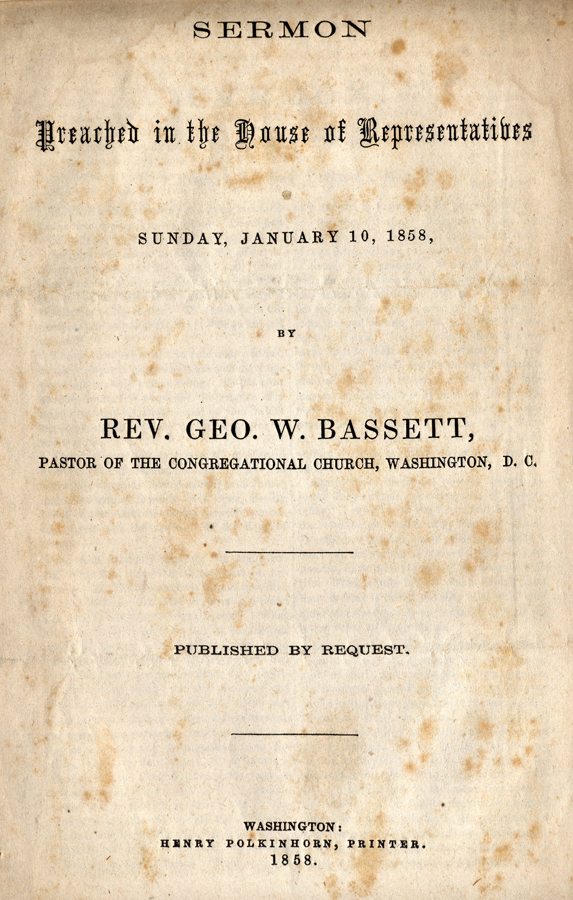
This sermon was preached by George W. Bassett in the House of Representatives chamber in 1858.


sermon-house-of-representatives-1858-1

SERMON

PREACHED IN THE HOUSE OF REPRESENTATIVES

SUNDAY, JANUARY 10, 1858.

BY

REV. GEO. W. BASSETT,
PASTOR OF THE CONGREGATIONAL CHURCH, WASHINGTON, D. C.


SERMON.

I Kings, 2, 2: Show Thyself a Man.

This was a charge worthy of a dying monarch to the heir-apparent to his throne. David had nobly fulfilled his destiny as a man and a sovereign, and was about to entrust the affairs of a great kingdom to his youthful son. Most appropriately, therefore, does he enjoin upon him to conduct himself in a manner worthy of the dignity of his station. This he does in the comprehensive words of the test: “Show thyself a man.”

Though few are called to rule over nations, in many respects these words are strikingly appropriate to every human being. To the most obscure mortal is entrusted the empire of a mind deathless as Deity; and he that rules his own spirit is superior to the conqueror of the world.

The most profound statesmen, the most sagacious of politicians, and the most fearless and invincible warriors have generally failed here; and the weakest females have often meekly borne off the palm, amidst the shouts of attending angels and the applause of the King of kings.

Our text naturally suggests two inquiries: 1st. What are the essential elements of humanity? 2d. What conduct is becoming a man in view of those elements? Or, what is a man? And what is it to show one’s self a man? 1. What is a man? Oh! That the spell of sensuality might be broken, and that American mind might be disenthralled of matter; that men would see that they possess other than physical elements of being; and that the chief end of man is not to eat, drink, and die! Man possesses a triune nature – physical, intellectual, and moral; the existence, functions, and destiny of each, clearly distinguished from the other. On each department of our nature is inscribed by the creator, immutable laws, in obeying which, this natural destiny is accomplished and well-being secured; and in disobeying which, the appropriate end of being is defeated, and inevitable ruin incurred.

Look at the physical or lowest department of the human constitution. What does nature dictate in regard to its proper function and legitimate destiny? Adaptation is the key to this subject. To what is this idolized body of man adapted? And you have the exact design of nature in its creation. We find it endowed with five senses, each susceptible of pleasurable excitement from certain external objects. But the excitement of these, even on legitimate objects, beyond certain limits, is uniformly productive of pain. Hence we infer there is a natural limit to their lawful gratification. And further, these senses are the means of communication with the material world; their momentary gratification is by no means their ultimate end: they are altogether subordinate and subservient to mind. And when they usurp an unnatural supremacy over mind, their empire is death to all nobleness and true humanity.

Again, these corporeal powers belong to earth; they exhibit not a symptom of immortality. I refer not to the “spiritual body” of the resurrection spoken of by Paul and others, (a subject, I confess, hard to be understood,) but I say the corporeal powers which we now possess, have their sphere of operation in this life. Their nature is flesh, and not spirit; and their destiny is death, not life. Let this cardinal fact ever modify our estimate of their relative value and importance.

Let us, in the second place, leaving the dark domain of matter, approach the ethereal regions of spirit, and contemplate, for a moment, the immortal part of man. Here we discover the essential characteristics of a man, as distinguished from the brute. Man’s spiritual nature is composed of intellectual powers and moral feelings. Of his intellectual powers, notice particularly the power of original, independent thought. Man’s intellectual activities are not limited to the mere functions of perception. A far higher destiny is stamped upon the human intellect. He possesses not only the power to perceive facts, but to apprehend their multiplied relations, and to reduce them to complete systems of philosophy. Wisdom is the legitimate prerogative of the human intellect. Observe also the power of volition. Man was evidently not made to be the mere creature of another’s will – to live, and breathe, and speak, and think at another’s command – but was endowed with the more than royal power of individual responsibility and independent action.

In regard to the moral nature of man, notice the principle of conscience by which he comprehends and feels the force of moral obligations. He perceives what is right and feels bound to do it, and he perceives what is wrong and he feels bound to resist it. This universal moral sense, whatever may be its constitutional element, is an undeniable and imperishable fact of human nature. It is an essential part of the deathless man. It’s still small voice may be drowned for a moment, in the wild tumult of the rebellious passions; it may even be lulled into a temporary slumber, by the siren voice of vicious pleasure; but this will only prepare it to awake to a more terrible vengeance upon its suicidal victim.

As kindred to this, I would mention another interesting element of our moral constitution, and which we may call a natural sense of justice. It differs from conscience, in that the latter limits its mandates to one’s own moral acts, while the former may have reference to transactions in which one has no agency, and can have no personal responsibility. Our conscience can have nothing to do with the unheard-of cruelties of Nena Sahib, while our sense of justice is painfully violated. Conscience does not contrast this murderer of women and children, with their brave protector and avenger, the immortal Havelock. It is entirely inoperative here. But the sense of justice is not. This, independent of one’s own acts, cries out that the conduct of one is that of unparalleled barbarity, while that of the other is unsurpassed in true glory. Now, I maintain that this sense of justice is one of the most sacred and authoritative instincts of our common humanity. I know its dictates may be violated, and that too, in the name of religion, and under the mandates of a vitiated conscience; but remove all disturbing forces, and let humanity express its natural promptings, and there is no essential discrepancy. The race utters one universal demand for justice between man and man.

But we have not apprehended the essential elements of human nature until we have contemplated the source of moral action – the heart. This it is which loves and hates. This susceptibility is the crowning glory of man. An intellect to apprehend; a conscience to command, and a will to execute, without a heart to feel and love, would leave their possessor wanting in the cardinal element of humanity. The heart to love, more than all elements, constitutes the glory of our race. This is the seat of virtue, the fountain of bliss. Here is seen pre-eminently the divine image, all radiant with benevolence, or defaced and marred, and polluted by the indulgence of supreme selfishness.

Again, progress is a law of man’s spiritual nature. The human body manifestly possesses a limited destiny. It attains to complete development and maturity in a few years. It then commences its natural process of decay. Not so of the spirit of man. Reason can discover no limit to its progressive development.

The growth and expansion of the intellect is produced by its exercise upon newly discovered facts and relations, and as the facts of the universe and their relations are without limit, so there can be no reason for setting bounds to the future progress of the human intellect. The incarnate mind is amazed at the stupendous destiny that is stamped upon the intelligence of man.

The moral nature of man is also highly susceptible of consolidation and progress. Strength and stability, result from habitual exercise. The principle of benevolence, which is the great law of our moral nature, is strengthened chiefly by exercise. And all creation is full of exciting causes, and stimulants to the exercise of this faculty. Especially is the moral condition of our world one universal appeal to this principle. Besides, the Creator has connected pleasure with the legitimate exercise of all of the intellectual and moral powers, thus stimulating them to voluntary efforts at development, and indicating their appropriate destiny. Not less truthfully than beautifully is it said, that “the path of the just is as the shining light, which shines more and more unto the perfect day.” Progress, therefore, is a law of man’s spiritual nature.

Having thus imperfectly reviewed the elements of the human constitution, we will proceed to the consideration of the second topic of discourse, viz: What conduct is becoming to human nature, or what is it to show one’s self a man?

1. It is not becoming a man to cultivate and exercise, exclusively or principally, his bodily powers and appetites. Nothing is more unbecoming in a man than the subjection of his physical constitution. What a moral picture is here presented to our conception! Look at the world, materialized, sensualized, degraded! What is the grand inquiry of this God-begotten race? What shall I eat? What shall I drink? Wherewithal shall I be clothed? Constitute the practical ethics of the world! Mind, heart, immortality, God, holiness – these are unwelcome ideas, seldom thought of and scarcely apprehended. What a wide waste of being! “Man, created but a little lower than the angels, and crowned with glory,” living like the beasts that perish! In the highest circles of fashion men often present the humiliating phenomena of refined and cultivated animals. Their Divine humanity is lost sight of, eclipsed by refined and reputable sensualism. Is it manly to bring all the immortal powers of the spirit to subserve the momentary gratification of the animal appetites? Is it not worse than brutal? Is it not devoting the powers of a man to perform the acts of a brute? Such is the stultifying influence of the selfish passions, that immortal man has gone mad after sensual pleasure. And although every unlawful indulgence infuses an adder’s poison, yet the subjected spirit is dragged along, as by some infernal spell, from vice to vice, until it becomes the unresisting slave of its own lusts. And then what an object is man! How fallen from his primeval glory!

2. It is unbecoming a man to suffer his intellectual attributes to predominate over and subject his moral sentiments; to develop his mind at the expense and neglect of his heart.

From the lowest walks of life, through all grades of society, to the highest positions of honor and dignity, the majority of men seem everywhere to ignore the existence of a moral and accountable nature. So far from moral considerations bearing supreme sway, their claims are violated and sacrificed for the paltry considerations of temporal gratification. Intellect, and especially that second-rate development called sagacity, smartness, and sometimes talent, is worshipped. Men of genius, where are they? If this age is capable of producing them, they are struggling with adversity or pining in want; and as to superior moral worth, and an uncompromising hostility to wrong, it is an encumbrance. True virtue – not the sham religion of the times – is an un-current element of power. The real statesman may apprehend correctly the great principles that lie at the foundation of his country’s peace, but the mere politician who ignores those principles, and flatters the popular prejudices, is the available man. He, with some noble exceptions, secures the popular suffrage. And the real prophet of God may apprehend fully the moral degeneracy of the Church. He may detect and expose the heartless formalism of her service, the disgraceful inconsistency of her members, and the mercenary motives of her cowering, man-fearing, soul-deceiving priesthood, – but his message is not received. Still the “prophets prophesy smooth things, and the priests bear rule, (keep their places,) and the people love to have it so.”

But this state of things is all incompatible with the natural supremacy of the moral over the other departments of the human constitution. Man’s moral nature was evidently stamped with regal authority. As the supremacy of the physical over the spiritual makes the beast, so the ascendency of the intellectual over the moral, makes the Devil.

Intellect is not the seat of virtue or of bliss. It is the medium of happiness or of misery, according to the moral state of the heart. Did the transcendent genius of Byron make him happy? He

“Stood on the Alps – stood on the Appenines,
And with the thunder talked, as friend to friend,
And wore his garland of the lightning’s wing,
In sportive twist.
Suns, moons, and stars and clouds, his sisters were;
Rocks, mountains, meteors, seas, and winds and storms,
His brothers – younger brothers, whom he scarce
As equals deemed.<

—Yet

He died – he died of what? – of wretchedness;
Drank every cup of joy, heard every trump
Of fame; drank early, deeply drank; drank draughts
That common millions might have quenched – then died
Of thirst, because there was no more to drink.”

Deluded man! He essayed to quench his immortal thirst at the broken vessels of sinful pleasure, but neglected that perennial fountain of life that issues from the Eternal Throne above. It was the matchless words of his own bitter experience, that

“They who know the most
Must mourn the deepest o’er the fatal truth –
The Tree of Knowledge is not that of Life”

And so it must ever be with the ascendancy of the intellect over the moral nature of man. To enlarge the intellect while the heart is depraved, is to increase the power of self-torture. Every idea that is received into the mind of an unsanctified heart, will be a charge in the spiritual battery of self-destruction, that will play upon the guilty soul forever.

Is it acting the part of a man to develop all the secondary elements of human nature, while the cardinal principles – those to which all the others are naturally subservient – are either neglected or vitiated? To show one’s self a man, is to develop the entire constitution, and not to neglect or squander the most important part. Melancholy and fearful is the sight of a giant intellect under the control of wickedness. It is dark and terrible as the storms of the tropics – gloomy and desolate as polar midnight.

But I remark positively: 1. To show one’s self a man, is to repent of sin. Strange as this may sound, it is the first step towards real manhood. That man was made for virtue and not vice, – for holiness and not sin – is evident from all the adaptations of his moral constitution. But that he has violated the laws of his moral nature, and become positively vicious, is evident to all. Now the only natural or possible mode of correcting his vitiated moral nature, is to repent. No other act has the least tendency towards it. Repentance, therefore, is not only manly, but is the first truly manly act a human being is capable of. Such is the universality of human wickedness, that all moral acts, previous to repentance, are selfish and unworthy of a man. I am aware that repentance is looked upon as a weakness; but it is the most heroic of acts. It is self-subjection – a triumph over one’s worst foes – those of his own household; yea, those of his own heart! I am not speaking of the servile cowering of the sycophant; but the honest and generous return to duty of the erring subject of the Great God – an acknowledgement of the rights of the Creator and Benefactor of the universe. It is establishing the supremacy of virtue in a self-reined soul. To prostrate one’s self before the Great Jehovah, and ingenuously confess his transgressions, and abandon them forever, shows a perception of right, and evinces an integrity of purpose which is truly exalted and manly. But for a moral being to persist in wrong, against the dictates of his judgment, and under the lash of a guilty conscience, argues anything but manliness. It is the spirit of slavery in the love of it. Viewed by the standard of universal right, man is in ruins. His heart is a moral wreck, and his ignorance of the fact is one of its most melancholy effects. Now I ask if the only retrograde process from vice to virtue, from misery to bliss, and that process approved and urged by every power of the soul, is not a manly process? I say, then, to the persevering transgressor of God’s law: “Show thyself a man,” and repent of you. To the self-enslaved drunkard or epicure, I would say, show yourself a man, and subject your body to the spirit. And to the lover of the world, I would still say, show thyself a man, and trample your idols in the dust. Repentance, meanness? What else is honorable? Is justice mean? What faculty of your mind says it? But repentance is only justice to God and man. Every sin is a blow at the Throne of God and a stab at the heart of man. Sin is an infraction of the law that guards the throne, and protects the interests of the universe, and its criminality and ill-desert is measured only by the magnitude of those interests. And can it be deemed manly to persevere in transgression? Every power and faculty of man’s triune nature answers, no! A wretched, sin-cursed race cries out, no! All the angelic world above, and all the demoniac tribes beneath, unite their testimony against the manliness of continued transgression!

2. Earnest and appropriate efforts to attain to the highest possible degree of moral development, are well becoming a man. Growth in grace, truly apprehended, is the highest possible aim of man on earth. He has not apprehended the relations of man in this world, who has failed to recognize his condition as that of war, – a war of truth against error, – of virtue against vice, – of right against wrong; and it is manly to wage this great war with untiring zeal and true bravery. No nobler spectacle presents itself to observing angels, than that of a weak mortal summoning all his moral powers to the contest of right against wrong, striving to subdue every unworthy principle of action, and aspiring after the highest degree of moral greatness. This is more glorious than all military or civil triumphs.

If you would be manly and truly superior, my hearers, subdue passion; overcome prejudice; re-enthrone reason, and obey the supreme law of your mind.

3. Piety is manly. Reverence for the Supreme Being, and loyalty to the Sovereign of the Universe, are becoming a man, and nothing is more unbecoming that the opposite. There is not a constitutional pulsation of man’s moral nature, nor an adaptation or prompting of his whole constitution, but points to real piety as the true normal condition of his being. Men of mind affect to despise the Christian religion! I mean true apostolic Godliness, – real, genuine Puritanism, – the uncompromising war against the world, the flesh and the devil. They look with contempt and aversion upon the votaries of such a religion, and call the man that renounces the riches and honors of the world for such a religion, and makes himself of no reputation, for Truth’s sake – a miserable fanatic; and they affect to pity his weakness and want of manliness!

But what is a Christian, but a rectified man? This it is; nothing more; nothing less. I protest against the vulgar prejudice that when a man becomes a Christian, he ceases to be a man. He then assumes his proper, his primeval humanity, and never before. Those religions that degrade the soul, narrow the heart, and fill the mind with bigotry, conceit, and unmanly servility, are not genuine Christianity. They are the prolific spawn of an age of heartless formalism. But true Christianity is a very different thing. It is a sacred consecration of all our powers to the good of universal being. It is a condition of vast moral superiority; even a triumph over the world, the flesh, and the devil. It is a condition of perpetual antagonism against all wrong, and of uncompromising identity with all right.

Now, shall he who pours out his full heart of love and gratitude upon his Infinite Creator and Benefactor, and devotes all his powers to universal well being, be looked upon with contempt by him who worships the stupid things of sense, and knows no higher motive of action than supreme selfishness? Do you call piety superstition? It is true philosophy. Adoration meanness? It is the highest employment of man! Says a great writer, “No nobler feeling than this of adoration for one higher than himself dwells in the breast of man.” Man was made to love and to love the lovely, and to love supremely the Infinitely Lovely; and this alone is manly. Christianity degrading to humanity? Look at facts. Who is it that now challenges the gratitude and admiration of the civilized world for his unparalleled military heroism in avenging violated and slaughtered innocence, and in protecting and defending the helpless? Who is the avenging hero of bloody Cawnpore, and the angel of salvation to besieged and distressed Luck now? Who wrought those miracles of bravery in that six days march of blood and death from one to the other? The brave, the beloved Havelock, the Baptist exhorter. He it was who when Colonel, baptized the soldiers of his own regiment; and his commanding officer having investigated charges against him for disorderly and un-soldier like conduct in the thing, pronounced his regiment the most orderly and well behaved; and sending him his respects, ordered him to baptize the whole army. Has Christianity degraded that self-sacrificing hero? What else made him equal to the exigency, and carried him triumphantly through those overwhelming scenes?

Did Puritan Christianity render the soldiers of Cromwell inferior as men? When did they show it? Was it on the field of battle? Was it when the gay Cavaliers of the Royal army melted before their burning charges like wax in the furnace? Was it in the presence of the Parliament of England, whom they expelled from their venerated halls because they did the work of the Lord deceitfully, as they said? Was it when, under the inspiration of pure truth, they rose superior to all human laws and precedents, and executed a murderous sovereign in the name of the Eternal God? What made Cromwell’s Ironsides all heroes? What but the Christian religion? Are you ashamed of piety as unmanly? Go, erase from the scroll of fame the names of Washington, Wilberforce, Newton, Locke, and Milton, and even old Socrates, the most pious of the heathen!

Nowhere will you find the complete development of all the departments of the human constitution, but under the rectifying influence of a pure Christianity.

4. Love to our fellow man is essential to a manly character. The duties of justice between man and man and the spirit of universal brotherhood, are manifest dictates of the human constitution; and when man violates these principles, he so far forth ceases to be human, and approaches the character of spirits and beasts of prey. The relation of mutual dependence and essential equality, which characterizes the race, stamps its destiny in this respect. “No man lives to himself” and obeys the laws of his being; and he who lives a life of supreme selfishness, lives in violation of the laws that are written upon his constitution, and he experiences all the melancholy consequences of transgression. His heart is withered, his moral sense blunted, and his whole spiritual nature vitiated. Look at the selfish world. Man rioting upon the blood and bones of his fellow! Is this manly? Is it the dictate of the human constitution? Is man really a beast of prey? Has God furnished him with the tusks of the hyena? Has he endowed him with the mean selfishness of the wolf? The sly deception and trickery of the fox? And the fatal poison of the adder, that he should go about as a roaring lion, seeking whom he may devour? Whence this divine sense of justice, and those celestial promptings of benevolence and generosity? Ah! Man was made to be the brother, and not the tyrant and robber of his fellow man. Those fraternal promptings of his unsophisticated nature are unmistakable. They utter plainly the voice of nature’s God.

Rem. 1. This subject suggests a forcible argument in proof of the divinity of the Christian religion. It is the entire harmony of that religion with the human constitution. Reason can account for the wonderful adaptation of the provisions of the Gospel to the spiritual necessities of man, only on the theory of a common author. Philosophy had exhausted her resources in four thousand years of fruitless efforts to solve the momentous problem of human regeneration. All was hopeless darkness until the Star of Bethlehem arose with the beams of Heaven’s own light. From that great day to the present time, true Christianity has been the uniform antagonist of vice, and the great lever of human elevation. To my mind, it is far more difficult to account for the human than the divine origin or Christianity. Reason testifies, not that God was not its author, but that none but God could have been its author.

2. Notice one of the popular errors of the times. It is the neglect of the moral culture of the masses. Great and unwanted efforts are made by governments and associations to extend popular education. But education is limited to the cultivation of the intellect. No appropriate influences are used to cultivate the controlling and prompting powers of conscience and heart. Temples of Minerva, called colleges, are built and endowed; temples of fashion, called churches, are enlarged and beautified, but no temples of truth, charity and self-sacrificing benevolence are consecrated in the popular heart. Ah! My hearers, common school education will not save this country. The disease of this nation lies deeper than the intellect. It is in the heart and moral feelings of the people, and the remedy must be applied there. Like the old Jacobins, you have erected an altar to the Goddess of Reason, and alongside of it you have inaugurated the profligate worship of Bacchus, the degrading slavery of Mammon, and the wild disorder of Belial. The stream of public corruption is onward and resistless. Nothing can save this nation from discord and universal profligacy, but the wide dissemination of a reformed Christianity.

3. You see that genuine Christianity is not incompatible with the dignity and true prosperity of man. What is human dignity but the realization of human destiny? And what is prosperity but the healthy development of the entire man? But practical Christianity alone secures these ends. There is not an instinct of human nature but is gratified to its fullest susceptibility, solely by complying with the true dictates of Christianity. One can enjoy the legitimate pleasure of the bodily appetites to the highest degree, only by obedience to the Christian mandate of temperance in all things. The rich man fails of the highest advantages of wealth, unless that wealth is all consecrated to God – and so of an unsanctified ambition. Be assured, my hearers, yonder Presidential mansion will not pay at the cost of one iota of personal integrity. Fanatic or not, I protest to you that it is no temptation to a mind that appreciates the transcendent glory of moral excellence. There is a more true dignity in wheeling the gravel of the streets, with an untarnished and un-degraded spirit, than in mounting the proudest throne on earth, at the cost of honor, personal independence and true liberty. If, then, you would rise superior to all the corrupt dominions of earth, show thyself a man – claim your divine birthright, and wield the scepter of moral dominion over the world, the flesh and the Devil.

By all the necessities of your temporal being – by the immortal hungering of your deathless spirit – by the universal wail of a sin-cursed world – by the sympathetic yearnings of angelic hosts above – and by the infinite pulsations of God’s compassionate heart, I urge and entreat you now to show yourselves men; dethrone the world, and give your heart to God, and your life to the temporal and eternal welfare of your race.

Sermon – Election – 1856, Vermont


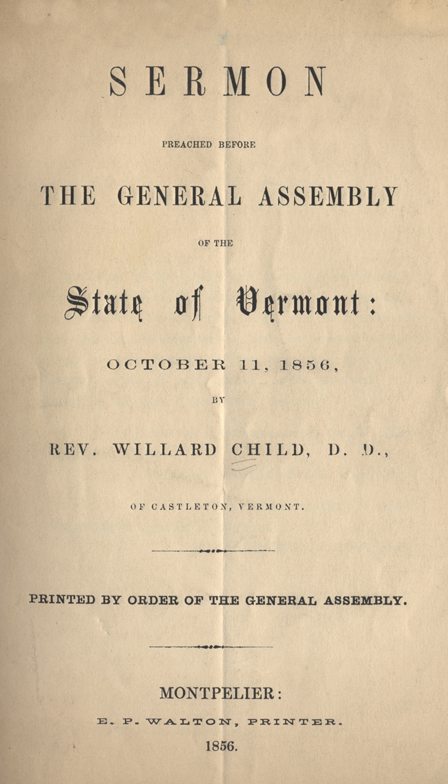
The following is an election sermon preached by Willard Child in Vermont on October 11, 1856.


sermon-election-1856-vermont


SERMON

PREACHED BEFORE

THE GENERAL ASSEMBLY

OF THE

STATE OF VERMONT:

OCTOBER 11, 1856,

BY
REV. WILLARD CHILD, D. D.,
OF CASTLETON, VERMONT.

PRINTED BY ORDER OF THE GENERAL ASSEMBLY.


Resolved, by the Senate and House of Representatives, That the thanks of the General assembly be tendered to the Reverent Willard Child, D. D., for his Election Sermon, and that the Secretary of State be directed to request a copy of said Sermon for the press, and to cause one thousand copies of said Sermon, when procured, to be printed for the use of the General Assembly.

In House of Representatives, Oct. 11, 1856.
Read and adopted.
NORMAN WILLIAMS, JR., Ass’t Clerk.
In Senate, Oct. 11, 1856.
Read and adopted in concurrence.
R. C. BENTON, Jr., Ass’t Sec’y.


SERMON.
“HE SHOWETH HIS WORD UNTO JACOB, HIS STATUTES AND HIS JUDGMENTS UNTO ISRAEL. HE HATH NOT DEALT SO WITH ANY NATION, AND AS FOR HIS JUDGMENTS, THEY HAVE NOT KNOWN THEM. PRAISE YE THE LORD.—Psalm CXLVII, 19, 20.

The four Psalms, with which the book is concluded, are believed to have been written after the restoration of the Jews from their long captivity, and the re-building of their temple and the re-establishment of their religious service under Nehemiah and his compatriots. They breathe a fervent spirit of gratitude and joy, unmingled with the mournful strains with which many of these wonderful compositions are saddened. They celebrate the power, and wisdom and goodness of God, as manifested in the kingdom of Nature, yet often recurring with deeper delight to the more precious revelation of his character and ways to his peculiarly favored nation. In the psalm of the text, the writer sings in lofty strains the glory of that only living and true God, who controls the seasons of the year, and all material elements, and makes them subserve the wants of all his creatures; yet the intelligent reader cannot but observe how he is attracted to the truth, and how fondly he broods over it, that this great Being, who is so mighty in counsel and so wonderful in working, is eminently the God of Israel; and, in the language of a recent commentator, “will work spiritual changes corresponding to these natural phenomena, for the benefit of the people whom he has entrusted with the revelation of his will.” But if such were the views and feelings of the Jew, with his incomplete revelation, and his system of worship, which was chiefly only the shadow of good things to come, how much more should similar views and feelings be cherished by a people who are blessed with the full-orbed revelation, and the spiritual worship of the Christian dispensation;–a dispensation in which ‘life and immortality are brought to light,” and not the consecrated hierarch alone, but every worshiper, permitted, through “the offering made once for all,” by Jesus his great High Priest, to enter himself “the most holy place,” and draw near to God in full assurance of faith. The following statement, then, is plainly derived from the text, and, I trust, will not be deemed inappropriate to the occasion which has assembled us before God in this house of prayer: The highest privileges and richest blessings of any people, are found in the possession of the word of God, and the institutions, instructions and ordinances of a pure religion. This proposition, obviously warranted by the text, will be sustained and enforced by every just view we can take of the character, condition, relations and prospects of man. And a due consideration of its significance may fully justify the propriety of the course you have adopted, as the rulers and legislators of a commonwealth, to signalize the commencement of your offices and duties by an act of homage to that religion, which is the fountain-light of our best knowledge, and the sure guardian of our dearest interests, for this world and that which is to come. It is no unhallowed union of church and state, injurious to both, but the fit acknowledgment of wise and good men, that for the right discharge of their official duties they need that wisdom which cometh from above, and that for the state, whose welfare they are sacredly bound to promote, the blessing of God is the only effectual provision: that “except the Lord keepeth the city, the watchman waketh in vain.” For the confirmation of the statement proposed as the theme of discourse at this time,–

I. Let us look, first, at man in his social and civil relations; and see how, for the perfection of all these, and to ensure the realization of their highest blessings, the truths and institutions and influences of religion are indispensable. It is not difficult to show, by decisive historic proof, that for our civil freedom, and those institutions of popular government in which we rejoice, we are directly indebted to religion. Our popular institutions of civil government were the gift of religion to the state. The wisdom and instincts of religion revealed their conception and produced the longing for them, and the purifying influences of religion prepared a people by whom they could be realized. An infidel historian has been compelled to record, that the great principles of freedom in the English constitution owe their existence to that noble body of earnest religious men, who were derided by their enemies as “puritans,” a name now widely honored among the nations. From these men came our own pilgrim fathers. And be it forever remembered, that their great object in coming hither, was freedom to worship God according to the high behests of a religion which they regarded as paramount to all the considerations relating to the duty and the destiny of man. Their establishment of free political institutions, the freest the world has ever seen, was a corollary to their main proposition. That proposition was not human, it was divine; it was not earthly, but heavenly. It was freedom of conscience,–freedom to learn, and do all the will of God, without human dictation or human restraint. And the wisdom which guided them in ordering their civil and political affairs well—better than the world had ever seen before,–was an emanation from that wisdom which made them wise unto salvation. They were wise in the things of earth and time, because they reverenced “the word, and the statutes and the judgments” which the Lord had given unto them, and, guided by such a heavenly light, they considered all the things of time in their relation to the things of eternity. Such was the way in which our blessed heritage was prepared and transmitted to us, and only in this way can it be preserved and freed from the formidable dangers which now oppress it, and be handed down to bless the thronging generations that shall come after us.

“Sons of sainted pilgrim sires,
Guardians of their altar fires,
Hold the truth that made them free,
Hold their faith and purity.”

“They were sent to free the mind,
Heavy burdens to unbind,
Nobly they discharged their trust,
Peace and honor to their dust.”

“By their tears, their toils, their cares,
Martyr struggles, wrestling prayers,
We, beneath our spreading vine
And our fig-tree now recline.”

“Sons of sainted pilgrim sires,
With a zeal that never tires,
Tread the path your fathers trod,
Serve the Lord, your Father’s God.”

We have indeed a great and goodly land—a land “flowing with milk and honey,” with a fullness of tide such as Canaan in its palmist days never knew. But “man doth not live by bread alone. By every “word that proceedeth out of the mouth of the Lord doth man live.” And we have marvelous mechanical inventions. What were the swift ships, and swift dromedaries of the old Hebrew, to the storm-wind velocity and lightning speed with which we traverse land and sea? But though man may yoke his car to the storm-wind or to the lightning, he cannot so overtake his highest good, even for this world, and much less for another. By other means must that be reached than by any discovery or application of the powers of nature, or any perfection of mechanical inventions.

We are certainly in possession of the freest political institutions which have ever been known on earth. And we talk full often, and I fear too boastfully, of our superiority to other nations in this regard. We foster thus, it is to be apprehended, a selfish and vain-glorious spirit, instead of that humble gratitude which acknowledges the Divine giver of our privileges, and ensures to us their continuance, with His favor to crown them all. And often, it seems to me, the very nature of these free political institutions is misunderstood or forgotten, and they are thought of and spoken of, as if they had in themselves an inherent living energy to work out their results and secure our well-being. But what, in truth, are all the institutions of freedom but open and unobstructed channels for the utterance and action of the general sentiments of the people? And what if the people become generally corrupt? What, if unscrupulous ambition, unchecked covetousness, and wanton and brutal self-indulgence become lords of the ascendant, and the ruling spirits of the hour,–what then will be our boasted free institutions? Like other mere channels, they can only give free course to the flood that is poured into them from the fountains, having no power in themselves to determine whether that flood shall be the water of life, bearing health and gladness to all the people, or whether it shall be the torrent of woe and death. The ballot box and universal suffrage are doubtless mighty instruments, but they are instruments which ignorant and bad hands can use, as well as wise and good. And if ignorance and vice predominate, may not then the ballot box become a terror and a curse? Can we rely on the collisions of unmitigated selfishness neutralizing each other, and ensuring the dominion of that law, “whose voice is the harmony of the universe?” “The voice of the people is the voice of God,” only when the people are informed and actuated by the spirit of the Lord. If the mind and conscience and heart of the people are not educated to intelligence and goodness, then our institutions cannot be maintained, and it would not in such a state of things be best that they should. Then we should be compelled to invoke the aid of brazen gates and bars to hold in stern check that very freedom in which we now exult.

And is there any agency, on which we may securely rely, to give the needful knowledge and integrity to a great and rapidly growing people? Where are we to look for the conservative influences that shall save us from following in the way of those free states which have grown great, and rich, and luxurious, and wicked, until they were strangled by their own vices, and smothered by their own corruptions? Let all due honor be given to the literary institutions of our land, and especially to our noble system of free schools, designed to give the means of education to all the children of our land; to the poorest and lowest not less than to those by fortune more favored. Let them be perfected, and let them be perpetual. Every wise statesman will place it among his chief cares to give to our system of free education for all the people every excellence and advantage of which it is capable. He will regard that as suicidal parsimony which withholds any needful and possible expenditure of money or of effort for the accomplishment of such an end. Mr. Webster once eloquently said, in describing the vast military power of Great Britain, “the beat of her morning drum follows the rising sun “around the globe.” But there is a power more benign, more honorable and more mighty, than that of navies and armies. And let ours be the boast, abjuring alike the false glory, and all the murderous accompaniments of “the spirit-stirring drum, the ear-piercing fife, and all the pomp and panoply of war,” that far as our republic extends, the morning school-bell summons the myriads of our happy children and youth to their richly provided and well disciplined schools. But while we foster with generous care, let us not idolize our system of school education. Let us not depend upon it for that which it will certainly never accomplish. If “knowledge is power,” be it ever remembered that it is, in itself merely, equally the power of good or of evil. What is knowledge in the hand of the bold bad man but a mighty engine to be wielded for a villain’s ends? To another agency besides that of the mere school, to another power than that of such an education, must we look for an enlightened conscience, and a renovated heart, safely and happily to guide the energies and shape the destinies of a self-governed nation. That power is the Bible, setting forth the statutes and judgments of the Lord, and rendered quick and powerful by the spirit of God in awakening the conscience and renovating the heart. The lessons of history and the character of man duly pondered, would clearly show that the school itself had its origin in, and must depend mainly for its continuance and perfection upon, a religion which puts a Bible into every man’s hand, and strives by all means to have him make that book “the man of his counsel and the guide of his life.” It was the men who braved the dangers of a wintry ocean and the horrors of a New England wilderness “to seek a faith’s pure shrine,”—freedom to worship God after the dictates of their own conscience,–who built the school house next to the house of God, and honored the good school master next to the faithful minister of Christ. We are now the possessors and guardians for the generations who shall throng after us, of a broad and fair heritage, prepared by the wisdom and toils, and sacrifices not without blood, and blessed by the prayers of those more deeply learned in the school of Christ. If we would have it go well with us and with our children, we must profit by their heaven-taught wisdom and experience. True religion seeks not the protection and support of rulers and legislators, it asks no human enactments to enforce its behests, but it offers itself as a hallowed protection and support to all men in all conditions; and if its behests have due reverence, it will “bind our princes” in bonds which will be ornaments of glory upon them, and “teach our senators” a “wisdom” which conflicts not with the wisdom which is from above, and which therefore commends itself to every man’s conscience in the fear of God. This is the one great palladium of our safety,–mighty alike to give strength to a healthy conservatism, and energy to all needful reforms. This will ensure the enactment of good laws, and their faithful execution, and that sacred loyalty in the people, which identifies self-respect, and earnest regard for our neighbor’s well-being, with the spirit of obedience to the government of the state. We are now, as a nation, subjected to the severest trial which we have ever experienced. Various elements of evil are developing themselves with peculiar malignity and power, and thoughtful men, who love our government and feel that the cause of human freedom, as connected with popular institutions, is deeply involved in the issue of our experiment, have sometimes trembled for the result. Such men know that the combinations of selfishness cannot always be depended on to adjust our increasing difficulties. Nothing, I believe, can effect this but the power the conscience and the heart of the nation can be so controlled as to constrain the putting away from us of all that conflicts with the laws of eternal justice, and at the same time to constrain the needful concessions when points of mere interest are in question, then the Lord will be our God, and we shall be a light to the nations. Otherwise we shall fall like Lucifer, and our example, instead of being the elevating hope of the oppressed, will be a by-word and a hissing among the nations, and the tyrant’s strongest argument and most impregnable defence.

When we look at man in his more intimate social relations, the truth receives increased confirmation that the richest blessings of any people are found in the possession of the word of God, and the instructions and ordinances of a pure religion. What is to give us that earthly paradise—that only bliss of man which has survived the fall,–a pure and happy home? Legislation cannot do it. The mere intellectual culture of the school can by no means achieve this end.—Nothing can do it but that religion, with its heavenly revelations, its solemn worship, and its affecting sanctions, which the word of the Lord and his statutes and judgments ordain. It is this religion presiding in every dwelling-place, and making all there feel that the favor of God is life, and his loving kindness better than life, which will make all the inmates,

“Each in his proper station move
And each fulfill his part,
With sympathizing heart,
In all the cares of life and love.”

There the Bible will proclaim to listening ears and reverent hearts—“Husbands love your wives, even as Christ loved the church, and ye wives see that ye reverence your husbands.” “Children obey your parents in the Lord, for this is right.” “Honor thy father and mother,” &c. “And ye parents, provoke not your children to wrath lest they be discouraged, but bring them up in the nurture and admonition of the Lord.” “Servants obey in all things your masters according to the flesh, not with eye-service, as men pleasers, but in singleness of heart, fearing God. And what service ye do, do it heartily as unto the Lord, and not unto men, knowing that of the Lord ye shall receive the reward of the inheritance, for ye serve the Lord Christ.” “Masters give unto your servants that which is just and equal, knowing that ye also have a master in heaven.” Nothing but this could have prepared those delightful pictures of family piety which adorn that charming book—“Henderson’s tour in Iceland.” It was this which furnished the Ettrick Shepard with the matter for those descriptions of most sacred and touching beauty found in his sketches of the highlands of Scotland. It was this which furnished all the elements of that loveliest of Burns’ poems, which the world will never let die. It was this which prepared and moved the Christian patriarch, reverently to uncover his hoary head, and lead his family in the high praises of God, in the sweetest of Scotia’s holy lays. It was this that taught the old patriarch to seek for himself and for all his family around him the lessons of eternal wisdom, in the old family Bible. It was this which inspired the Christian patriarch, the husband and the father, kneeling to commend to the wisdom and care of Heaven’s high King, himself and the dear objects of his love. Well might the poet, awed by the spirit of his theme, exclaim,–

“From scenes like these old Scotia’s grandeur springs,
That makes her loved at home, revered abroad.”

But to the existence of scenes like these, every thoughtful man must know that the Kirk of Scotland, with its plain and faithful preaching, and its solemn worship and ordinances, was indispensably needful. And then in other important relations of society, beyond the family circle, on which the happiness of man greatly depends, on no other agency can he rely to ensure their proper working, but on the Divinely appointed and Divinely blessed institutions of religion. The kind and trustworthy physician, the honorable lawyer, the honest mechanic, the good neighbor, and the faithful friend, all these are schooled and disciplined, as a general truth, only in the hallowed precincts of the sanctuary. This truth has forced itself, in part, upon the conviction of even some intelligent infidels, and led them to give their countenance and patronage to religious institutions. Happy for them on to a profounder view; that, having seen the adaptation of our holy religion to the present wants of man, they had marked duly this convincing proof of its divine origin, and laid hold for themselves of its everlasting blessings, instead of being contented to glean only “the blessings which it scatters on the field of time, on its march to immortality.” As surely as man is a sinner, and as God is just, no other agency can create, and adjust, and guard from fatal injury, “the thousand ties which bind our race in gentleness together,” but the divinely appointed institutions and influences of the religion of Christ. “Here, before God, and in view of judgment and its eternal retributions, the rich and the poor meet together,” and feel that “the Lord is the Maker of them all.” And here, if anywhere, or ever, they learn the lessons of that “love,” which “worketh no ill to its neighbor,”—that “charity,” which “is the bond of perfectness.”

And then again, where but in the word of the Lord, with its statutes and its judgments, is man to find refuge and consolation in the sorrows of earth, which embitter the present, and darken all the future? God has written it as the destiny of man, and all will see its fulfillment, “if a man live many years and rejoice in them all; yet let him remember the days of darkness; for they also shall be many.” The lightest and the gayest heart will be made heavy and sad, and from the sturdiest spirit will be wrung the wail, “Man was made to mourn.” No human wisdom, vigilance or labor can avail to avert the destiny. The legions of evil are around us, the bow is bent, the arrow is drawn to the head, and the shaft will ere long quiver in each heart. Now the God of all consolation, in pity to man in his peril and sadness, has given him the sanctuary, which his word with its statutes and judgments ordains, as his refuge. Here the nature and end of all affliction is expounded. And while the heart is awed by the conviction that it is no accident—no plant of bitterness springing spontaneously from the soil of earth, but God’s own appointment,–it is also soothed by the assurance that it is the Divine method of bringing the blind, by a way that they know not, to rest in his bosom. Out from the sanctuary, angel voices send forth the cheering strains,

“Come ye disconsolate, where’er ye languish,
Come, at the shrine of God fervently kneel,
Here bring your wounded hearts,
Here tell your anguish,
Earth has no sorrow which Heaven cannot heal.”

“Joy of the comfortless, light of the straying,
Hope when all others die, fadeless and pure,
Here speaks the Comforter,
In God’s name saying,
Earth has no sorrow which Heaven cannot cure.”

But there are higher and more momentous relations pertaining to man than those which concern earth and time; and when these are contemplated, the word of the Lord, and his statutes and judgments, are at once revealed as man’s grand want. We are accountable to God, and shall soon pass away from earth, and all its sorrows, and all its joys, to judgment. Earth is no home for the generations of men; and if any regard it as such, they will wrong themselves with a mighty error, which will soon become irretrievable. Since all the places which now know us will soon deny us, and welcome other occupants, to be disposed of in turn in quick succession, while we have departed to other joys or sorrows, great and eternal, we need other oracles than those which the wisdom of this world can offer, and another discipline than that which would teach us how to treasure its wealth, acquire its honors, or luxuriate in its pleasures. We want to be so trained as to meet death’s inevitable hour with peace and hope, and to render our account with joy to the Judge of all. With such an account and its retributions in prospect, how trivial are all the pursuits and interests of earth! Do my ways please God? Will heaven at last welcome me home? These questions disclose the infinite worth of the word of God, and the ordinances of religion. Here all men are gathered together in view of that which is the grand concern of all. On that hallowed day especially, which hushes the din of business, and calls man into audience with God, the man of business is reminded that he has an interest claiming his attention of infinitely greater moment than anything to which earth can summon him—his interest in the great salvation. Here buoyant youth,

“Whose pulses mad’ning play,
Wild drive them pleasure’s devious way,”

are met with the solemn warnings of life’s great issues,–death, judgment and eternity. And here the worldly wise man is called to the solution of the mighty problem,–“What shall it profit a man if he gain the whole world and lose his own soul? Or what shall a man give in exchange for his soul?”—And, in a word, all are here called to estimate aright the significance of man’s earthly life, as a problem for eternity. And here we have disclosed to our view what clothes the word of God and the ordinances of religion with infinite dignity, and exalts to the highest our estimate of their importance:–the grand concerns of a spiritual life. They testify of the great salvation which God has provided in the face of all people. This is their direct and great subject and end. It is not that men may be favored with the best governmental institutions, and rejoice in a prosperous commonwealth; it is not to spread over domestic relations a banner of love, nor to consecrate the fellowship of good neighborhood, nor to guard and adorn an earthly paradise, nor even to soothe the sorrows of man’s mournful lot on earth. Not any of these, nor all of these combined, constitute the chief end for which God hath written unto men the great things of His word, and hallowed and blessed for him the Sabbath, and encompassed him with the instructions and warnings and promises of the sanctuary. It is that man may be a partaker of the great salvation. Man is a guilty and ruined creature, and a new relation must be established between him and his Maker, by the pardon of his sins and the renewal of his nature after the image of God, or Heaven can never know him. If this be so, what a dreadful impertinence is everything which would divert man’s chief attention from the great question of salvation; and what madness is in his heart who does not set this question before him in all his ways. But a voice sounds from the word of the Lord and his statutes and judgments, to convince men of sin, of righteousness and of judgment; to warn man that death is ever but a step from his path, and to adjure him, in the name of his pitying God and Redeemer, not to neglect the great salvation. But even those who have drawn near to God in the inner sanctuary, who are aroused to a thorough earnestness in working out their salvation, are still beset in their new spiritual career with formidable difficulties. The world is still around them with its thronging temptations, and their long unresisting subjugation to the law of sin has endowed temptation with frightful power. Often vigilance begins to slumber, the strenuous purpose falters, the bright visions of faith wane, and they are tottering to a fall. But they enter the sanctuaries of the Lord, and light from on high breaks upon them, and a purer atmosphere encompasses them. Their temptations are unmasked; keenness of sight is renewed to the eye of faith; and hope again exults in her heavenly aspirations. Here culminate the influences of the word and statutes and judgments of the Lord, in admonishing the Christian disciple to hold fast that which he has received, that no man may take his crown; in nerving him to fight the good fight of faith, that he may lay hold on eternal life; in keeping him assured that he can be made a partaker of Christ only by holding fast the beginning of his confidence steadfast unto the end; in a word, in training the child of God to be made meet to be a partaker of the heavenly inheritance in his Father’s presence for eternity.

Views, like those which we have now been considering, have doubtless influenced the Chief Magistrate, and the Gentlemen of the Senate and the House of Representatives of this Commonwealth, to the religious appointment and observances of this day. You thus express, honored Rulers, your conviction that every man, in all the relations he sustains, and in all his present and his eternal interests, owes allegiance to the word, the statutes and the judgments of the Lord, and that upon them he is to depend for the guardianship of his well being. You reverence Him who has declared—“Them that honor me I will honor, and they that despise me shall be lightly esteemed;” and of whom his prophet also has proclaimed, “the nation and the kingdom that will not serve thee shall perish; yea, those nations shall be utterly wasted.” May He, whose favor is life and whose loving kindness is better than life, vouchsafe a gracious acceptance of your worship, and grant you wisdom and grace in the discharge of your responsible duties to the State, and may his blessing prosper all the interests of our beloved Commonwealth, and delivering our nation from all its perils and oppressions, establish us in justice and in peace. May this broad land be the home of freedom, and the dwelling place of a people whom God has blessed, for thousands of generations. And may that religion, which is the best, the only effectual guardian of our social and civil institutions, and all the dear interests dependent upon them, be to us personally a light to guide and cheer our way through this earthly life, and when the shadows of earth are changed for the realities of eternity, may it be to us a preparation for our welcome reception,

“High in salvation and the climes of bliss.”

Sermon – Snow and Vapor – 1856


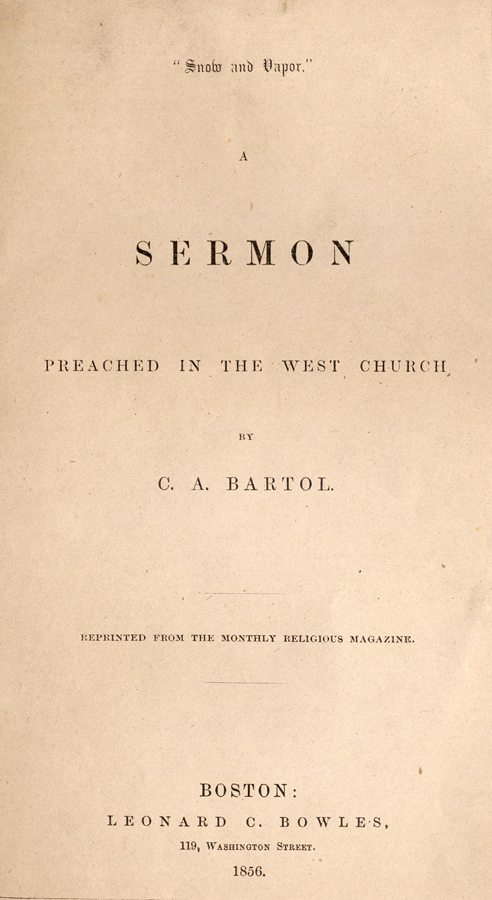
Cyrus Augustus Bartol (1813-1900) graduated from Harvard divinity school in 1835. He was a co-pastor with Charles Lowell at the West Church in Boston in 1837 and became the sole pastor of that church in 1861.


sermon-snow-and-vapor-1856

“SNOW AND VAPOR.”

A

SERMON

PREACHED IN THE WEST CHURCH

BY

C. A. BARTOL.


SERMON.

Ps. cxlviii. 8: “Snow and vapor.”

For many weeks, one universal object of sight, and subject of conversation, has been the snow; and as the snow is not only in the street, and in our talk, but also in the Bible, it may not be out of place in the pulpit. But some may say, What to do with religion has this frozen mist of the air, which, at certain seasons, comes to block up the ways, and make bad walking,—to chill the atmosphere, and require additional clothing for our warmth? There are those who allow themselves by it rather to be made irreligious; for they are even out of humor with the snow, and call it many hard names, as in it they walk staggering, or drive uneasily about; while not a few, I fear, will regard any attempt to give to it any thing like a spiritual meaning as the weakest play of fancy, and most superficial show of flowery rhetoric, quite unworthy the attention of a serious man. But evidently, to justify its introduction, I need only remind you that David elevates this creature of the snow into his choir of the divine praise; and, if he makes it worship, I may try to make it preach. For I would rather be of that sect which perceives a spiritual sense in every material thing, as in the mere mention in the Scripture of rain and dew, than belong to that other denomination of worldlings and skeptics, to whom nothing great or holy is suggested by the strong agencies, and fine motions, and visible spectacles, of the creation in which we live. Let the snow, then, in its extraordinary accumulation, be the burden of our discourse till we can humbly receive its religious teachings.

First, it impressively sets forth the divine power. “Snow and vapor,” the Psalmist well says; for snow is but vapor undergoing a change of structure as it passes out of one stratum of the atmosphere into another of different temperature. That by this simple law—which noiselessly turns a globule of moisture into a frosty flake, falling softly through the air, or borne as a feather before the wind—there should be gathered, from the treasure and boundless generation of the clouds, such an innumerable flock to whiten the ceiling of heaven and the floor of the world, making, north and south, the ocean-coast but one bank of spotless luster, and spreading westward till mountain and prairie are clad in the same thick, unblemished dress; that there should be marshaled such a mighty host of particles, each in itself insignificant, to hurl tempests athwart the unmeasured concave, more terrible and resistless than ten thousand armies with banners, rocking old ocean to its depths, and wrapping the earth in its winding-sheet, sifting down the closely folding, widely drifting substance so thick and copious from the sky, that, but for the “thus far and no farther” of God’s restraint, we should soon all be in our whited sepulchers, and all life of plant or animal gasp and die under the enormous load; this—shall I call it overwhelming avalanche from heaven, or light whirling of an instrument so delicate, to sweep the face of nature, and balk all the ability and mechanical contrivance of man—is surely a striking token of the Divine Almightiness. And it is good there should be such a demonstration of power, to convince us in and self-confident mortals that there is a Being at work, beside and above ourselves, for whom it wakens our acknowledgment and stirs our adoration. I know that this moving massive column, which the Creator wields, may seem like a scourge, as it stops the traveller on his journey, lays across the track its old bar, against which the fire-breathing engine—nothing else dare face—impotently frets its force away; puts out the lights that shine over the sea from the headlands, and blinds the poor sailor on the freezing deck or the stiffening shrouds; turns the deep into a gloomy pit, in which his laboring bark pitches to unknown ruin; casts away many a noble ship on the rocks, or founders her in the waves, and keeps back the precious cargo whose arrival would be wealth, and whose detention is poverty. I know well, from many a tale and many a sight, that, in alpine passes and fathomless ravines, its smooth and level look deceives and destroys the incautious wayfarer; that its huge piles slide in fury to overwhelm villages and plains in an instantaneous and unexpected grave; that it creeps in enormous glaciers, which I have seen and penetrated into and shuddered at, down the slopes, threatening the abodes of man; and shoots up into frowning peaks and mountains of ice, that, with eternal forbidding, warn him and his arts and cultivation for ever off. But all this is only material, bodily, worldly menace and harm. The exhibition of power that I speak of touches the soul, raises the heart’s ascriptions and doxologies to God, fetches men in fear and danger to the knees perhaps not bent before in supplication, or put anthems of deliverance on lips that had never sun, till David’s harp rings again, and our hymns flow with new meaning from our mouths; while, all over the land and the water, innumerable eyes, that had sought only pleasure or gain, look up trembling and grateful through the windows of heaven, thus terribly opened, to the Source of all things. And this, I say, is good: all these devotions or thanksgivings, born of the blast, are man’s best blessing in his tribute of awe to his Maker. Let the tempest come, if it will drive us to such refuge; let the hurricane blow, if it will make us pray; let the snow fall, if its descending lines are the pillars for our ascending thoughts! Tornado and gulf shall be welcome, if, tossed by the one or sinking in the other, we find out God. Business and intercourse are interrupted, you say. And is it not well, for such a diviner end, that their wheels, so fast and constant, should sometimes stop, restless creatures be brought to a stand, and a holy season instituted in the midst of the week? I pity the man, who, when the snow kept him one day from our temple, could not turn the hinderance itself into worship.

But it is not to ravage and lay waste that the storm is shaped from the clouds and precipitated upon the ground. The snow is a preacher of goodness as well as power, and has very important ministries, in the economy of nature, for human welfare. In our northern climate, it prevents the frost from penetrating so as to be fatal to the roots and seeds in the soil. While it appears to dart cold into every thing, it is but a garment to warm the ground; and, in polar regions, men resort, for protection from “the eager and nipping air,” to caves in the snow, which afford them comfort, and are the houses in which all their fatigues are refreshed and wants satisfied. In its melting, it fills the spr springs, and waters the fields, whose growth also, from its peculiar composition, it so stimulates and increases, that it has been called the fertilizer of the poor man’s farm. But what would be the richest landholder’s resources compared with its aid? All the labor and capital in the world could never compass the valuable ends it achieves. Are we dissatisfied with the snow? And do we wish it away, saying, as some do, We shall be glad when it is gone, and moving our foot impatiently as it slumps or slips in the road, and, it may be, indulging ourselves in some of those epithets and superfluous expletives of cursing or complaint, which arise always from our ignorance or folly, and express sometimes our impiety and sin? Or saying only, We are thankful at any signs of the winter’s breaking up, as though we could be thankful for nothing in the winter itself? But let us beware lest we cross our own interests, and maltreat our friends. The snow you spurn, dissolving in due time, and taking to itself wings from the air and the sunbeams, or making the clouds its chariot, may light in the flower whose fragrance you shall by and by inhale, or flow in the juices of the fruit or grain you shall relish. It shall run in the veins of the earth, or fly over the territory to infuse richness and drop fatness, producing verdure and blossoms and harvests, whose origin you may not suspect,—an unostentatious benefactor, concealing its gifts,—and, in the plenty it lavishes and the wide existence it creates and supports, atoning a million times over for the property or life which, in its assaults, it may have crushed. Useful beyond all estimate, exchanging its wintry pallor for summer glow, it unfolds the doctrine of love no less than of omnipotence.

But it were a poor treatment of the snow to stop with considerations of household economy. It is a preacher of beauty as much as of utility. Ye who love shining gems, behold it! Every particle of it is a perfect and magnificent crystal, in its momentary formation as exquisitely fashioned as the diamond which inconceivable ages are required subterraneously to mature. In its organization, it is as complete as any star that rides in the heavens, and sometimes lies in sight with a roundness and radiation as regular as the planetary sparkle and orb. Its fleece, the sudden production of nature, sent forth by God, as the Scripture says, like wool, is knit into a texture whose grace and delicacy no loom ever rivaled. Falling broad and gentle through the sky, what phenomenon is brighter, what meteor more attractive, what object more cheerful? Robing hill or alley, and, by its dazzling brightness, provoking comparison and contest even with the beauty of greenness and flowers, into which, at last, this Proteus of nature converts itself; crusting the trunks and branches of the forest, so that we are content they should exchange their garniture of waving leaves for such brilliance,—it would seem as if the Creator spread it out for a feast to the imagination, as well as, in its wondrous instrumentalities, for food to the palate; and that he would shut up joy for the heart, even in its sometimes biting and bitter quality, as he stores away the best of our happiness in the reservoirs of our pain and the discipline of his afflictive providence. Let not the vision, the beautiful apparition of the snow, be withdrawn till you observe the marvelous scenery with which it curtains this theatre of the world. How God himself must love beauty, and desire to feed with it his creatures, when he sends it not alone in softness on zephyrs, but with every fierce element and hard and cruel change in the creation!

I would never be fanciful in the thoughts or counsels of this place; but the snow has always, moreover, appeared to me a preacher of purity. Coming so clean and spotless from above, the most unstained of all things that ever reach the eye, it admonishes us of that raiment of innocence we should wear, and the immaculate purpose alone we should entertain. “Holy, holy, holy!” the angels cry to God; and this visible type seems to come down from above as the shadow of his holiness, and a lesson for our own purity. Yet how soon the snow is trodden under foot, contracts a soil, and flows in a muddy stream through the world! O “young men and maidens, old men and children,” let not your uncorrupted feeling be a cheap and common thing, to be thrown out by the wayside or trampled in the dirt! But as much of the snow, caught aloft on the pinnacles of temples or the summits of the earth, keeps its whiteness for ever, so maintain the purity of your heart.

I hope, in your thoughts, I trust in many of your deeds, you have anticipated one other point,—that the snow is a preacher of charity. It is God’s messenger to indicate the objects for your mercy and care, and awaken those humane affections in your breast which are the supreme blessing alike of those who cherish them and of those on whom they are fixed. Wherefore does the snow fall, but to direct you to ill-defended roofs, to the shivering poor, to unclad or houseless sufferers? What is its office but to summon you to supply the wants of unemployed laborers and hungry souls? What, indeed, does it immediately make of you, if you will, but a minister of Heaven’s bounty, with God’s gifts in your hands, seeking chambers where the fire has gone out and the board is unfurnished? Yes, the storm is your commission for that great and long war against human need and distress, grander than any war of man against his fellow-man. The snow is your investiture with the divine office of clothing the naked. Forsake not the assembling of yourselves together, in your circles of industry, so to toil for this purpose, according to Christ’s precept. Let this cold winter itself warm our hearts to the needy! He who can sit in his comfortable room, and luxuriate at his abundant table, and fold about him his costly garments, and call for his carriage to convey him whither he lists, and be utterly deaf to the exhortation of the elements, to the command from the lowering clouds, to the charge laid upon him by darkness and ice, wind and hail, to attend to the necessities of the ragged and cold and weary and famishing,—this man may be a formal worshipper, and may pass for a respectable citizen; but he disobeys precepts writ as plain on the tables of nature as on the pages of God’s word. All God’s creatures, animate and inanimate, preach to us, as well as his book; and his creature of the snow is one of the most pathetic of his monitors, and its preaching the preaching of all duty. Its preaching, did I say?—nay, its practice, active and faithful servant that it is. In what a round of well-doing it goes! How it changes its shape to accomplish its beneficent errands! It rose distilled from the sea; it formed itself in vapor; it was congregated in the cloud; it journeyed through the sky; it descended to the ground; it has departed already, or is departing, in the circuit of the divine benignity, in currents over the earth or through the air, doing good at every step, reviving and cleansing, till it reaches again the parent ocean from which it came. What an example, in its little figure, to the soul to be diligent, never resting from the works of holiness and motions of kindness, till it, too, attain to its Source!

My friends, the snow, that now admonishes us with such lessons, will one day lie on our graves. It has fallen on the graves of many dear to us. Their mounds of earth are covered with a dress that may signify to us the white robes they wear, we trust, in glory. Would we might live such lives, that the falling snow may by and by be, over our poor mortal remains, no untrue emblem of our spirit! Oh, may it then only come from the heaven to which we have gone! May its descent remind those we leave behind us that we were as diligent in God’s service as are all the elements he makes the unconscious angels of his power and love. As they muse in memory of us, may they feel that something of the unspotted simplicity of childhood was left with us when we died, and that we have ascended where nothing that defileth can come!

C. A. B.


Sermon – Giving – 1877


Luther Alexander Gotwald (1833-1900) gradated from Pennsylvania College in 1857 and the theological seminary there in 1859. He was preacher in many towns including: Shippensburg, Chambersburg, Labanon and York, PA and Dayton and Springfield, OH. The following sermon was preached by Gotwald in 1877 in York, PA.
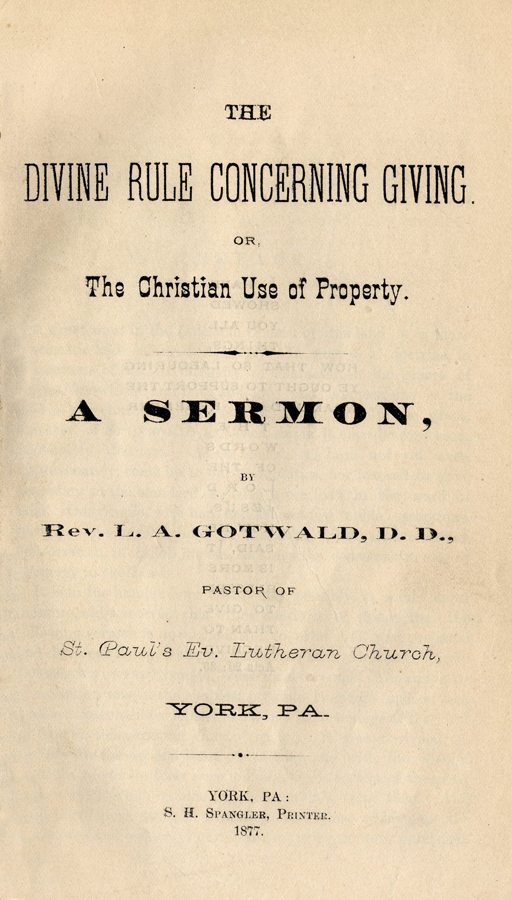

sermon-giving-1877-1

THE

DIVINE RULE CONCERNING GIVING.

OR,

THE CHRISTIAN USE OF PROPERTY.

A SERMON,

BY

Rev. L. A. GOTWALD, D. D.,
PASTOR OF
St. Paul’s Ev. Lutheran Church,

YORK, PA.


I HAVE SHOWED YOU ALL THINGS, HOW THAT SO LABOURING YE OUGHT TO SUPPORT THE WEAK AND TO REMEMBER THE WORDS OF THE LORD JESUS, HOW HE SAID, IT IS MORE BLESSED TO GIVE THAN TO RECEIVE.

Acts 20:35.

PREFACE.
A great want in the Lutheran Church of this land is a more systematic and enlarged liberality. In purity of doctrine, in correctness of life, in integrity of character, in the graces of biblical knowledge and faith and love and holiness, she is the peer of any church upon the face of the earth. In the grace, however, of Scriptural Beneficence, she is, it must be confessed, lamentably deficient. As a church we have not yet, even approximately, come up to our possibilities, nor learned to give according to the standard of giving prescribed in the word of God. Our people, with here and there a few noble exceptions, have not yet gotten hold of the Bible truth that Christian consecration, in it full import, includes the consecration also of property to the Lord.

It is in the humble hope that it may possibly, in some slight measure, aid to correct this wrong condition of things, that the following sermon is now committed to print. It was prepared and delivered by appointment before the YORK AND ADAMS COUNTY CONFERENCE OF THE SYNOD OF WEST PENNSYLVANIA. The aim in its composition was, in the simplest possible language and in the smallest reasonable compass, to exhibit the teachings of the word of God on this Christian duty of giving. It was designed especially for the ear and heart of the laity, and with the wish, if possible, to stir up their pure minds to a realization of the great things which God, in this respect, requires from them. And with this design, and with this purpose of thus addressing the noble men and women of our churches, it is also now published.

The sermon is not “published by request,” neither of congregation nor conference nor synod. The only one who has requested its publication is the author himself. And this his own request he complies with from no other motive than the desire to help forward all he can the various benevolent activities of the church to which he belongs and which he loves as he loves his own life.

Being published and distributed gratuitously he asks only the small favor that each one to whom it may be sent will carefully read it, with a mind open to conviction, and with a heart willing promptly to comply with whatever is established from the word of God as Christian duty; for, in the language of our own precious Luther, “God has given to us the measuring line of His own word, and they that lie and do thereafter, well it is for them, for God will richly reward them both in this life and in the life to come.”

York, PA., August 23d, 1877.

SERMON.
“NOW CONCERNING THE COLLECTION FOR THE SAINTS, AS I HAVE GIVEN ORDER TO THE CHURCHES OF GALATIA, EVEN SO DO YE.

UPON THE FIRST DAY OF THE WEEK LET EVERY ONE OF YOU LAY BY HIM IN STORE, AS GOD HATH PROSPERED HIM, THAT THERE BE NO GATHERING WHEN I COME.” 1ST Cor. 16: 1-2.

This text is an expression of the Scriptural Rule of Beneficence.

Concerning this rule it may, in a preliminary way, be remarked that it is given, not as mere advice, which we are at liberty either to heed or to disregard, but that it comes to us clothed with divine authority and in the form of an emphatic and positive divine command. Paul wrote this epistle, as he wrote all his other epistles, under the direct inspiration of the Holy Ghost.—His words, therefore, are God’s words. And hence, when, in enunciating this Rule, he here says:—“I have given order or command to the churches to lay aside systematic contributions for religious or charitable purposes,” we must receive what he says as the command or order to us of God Himself, a divine law which possesses the same binding force and obligation which is possessed by any other divine law.

It may also, as a preliminary thought, be further observed, that this Scriptural Rule of Beneficence, as here stated by the Apostle, is universal in its application, or, in other words, is binding upon all Christians, and upon one church as much as it is upon another. For this epistle, it may be noticed, is addressed not alone to the Corinthian Christians, but “to all that in every place call upon the name of Jesus Christ our Lord both theirs and ours.” Besides, the Apostle here expressly says that this same rule which he thus gives to the Corinthian church, he had also given “to the churches of Galatia.” And, in addition to all this, it might be well asked, if this rule or law is not perpetual and binding upon the present Christian churches, as much as upon those to whom the Apostle spoke and wrote, then what scriptural rule or law is thus perpetual or binding? If this rule is local and temporal, in its application, then what rule, in the whole canon of the word of God, is not? This rule of Christian beneficence, here addressed to the Corinthian Christians, we must, therefore, regard as being, also, directly and personally addressed to each one of us, and in these words we must hear not the Apostle only, but God Himself saying to us all, “at certain stated times, let every one of you lay by him in store, as God hath prospered him:”

But let us now turn to an analysis and careful consideration of the Rule itself. In looking at it, I notice—

I. That it involves the element of Intelligence, or a knowledge of the specific objects claiming Christian Beneficence. The object toward which these Corinthian Christians were here asked to give was the relief of the poor saints at Jerusalem. This object the Apostle had fully explained to them; had shown them the need of these their suffering fellow Christians; had exhibited to them their obligations toward them; and had given to them such a clear and intelligent statement of the case that they fully understood all concerning it.—(2 Cor. 8: 10; 9: 2, 5.).

They were not only asked to give, but to give intelligently, and they were first thus made intelligent with regard to the object in order that they might and would cheerfully and liberally give.

This scriptural rule of beneficence, embraces, then, as a first element, intelligence. Christians, in giving to religious objects, should know what those objects are. They should be informed with regard to their precise character, their aims, their history, the extent of their operations, their success, their hindrances, their possibilities, their merits, their claims. And hence every Christian should, in every possible way, seek to make himself intelligent with regard to all church work. To this end he should study the doctrines and polity of his church. He should be familiar with her history. He should acquaint himself with all her institutions and organizations for the prosecution of the cause of Christ. He should be a student of her literature. He should, week after week, through her various journals, inform himself of what the church, both at home and in heathen lands, is seeking to do for the world’s conversion. He should also carefully read the proceedings of her Synods, and especially of her General Synod, and thus learn what the combined wisdom of the church adopts and recommends as the best methods of doing good. And to this end, also, there rests a most emphatic duty upon every minister of the church. The priests lips should keep knowledge and the people should seek the law at his mouth, for he is the messenger of the Lord of Hosts.”—(Malachi 2:7.) The minister is the people’s teacher. His duty is to instruct them. And his duty is to instruct them in respect to this grace of giving, as much as in respect to the other graces of a Christian character. “I will give you pastors according to my heart which shall feed you with knowledge and understanding.”—(Jer. 3:15.) “My people are destroyed for lack of knowledge: because thou hast rejected knowledge, I will also reject thee, that thou shalt be no priest to me: seeing thou hast forgotten the law of thy God, I will also forget thy children.”—(Hosea 4:6.)

It is his duty fully and repeatedly to speak to his people, both from the pulpit and in their homes, with regard to our church periodicals, our Colleges and Theological Seminaries, our system of Beneficiary Education, our struggling cause of Home and Foreign Missions, our Church Extension work, and every other good object appealing to the church for help. This, I repeat, is every gospel minister’s most sacred duty. He owes it to himself as a true man worthy of his position. He owes it to the church which has entrusted him with her interests, and ordained him as one of her helpers and leaders. He owes it to his own people who have chosen him as their religious guide and look to him for a knowledge of their duty. He owes it to his own people who have chosen him as their religious guide and look to him for a knowledge of their duty. He owes it to the world, perishing for the want of the gospel. And he owes it, above all, to Christ, whose ambassador he declares himself to be. Alas! That so many notwithstanding all these obligations, are yet so derelict in their duty in this respect!

But, I notice

II. That this Scriptural Rule of Beneficence, as here expressed, embraces, also, the element of Voluntariness. The divine command is here most clear and positive. But obedience to the command, like obedience to every other divine command, is left as a voluntary matter with us. Each one, hearing the command, is free to give or not give; and, if he gives, it is with him also to decide how much or how little he will give. God compels no one to give. Giving is every where in the Bible left as a voluntary matter with ourselves, and its moral value is, indeed, largely dependent on its being thus purely voluntary. God tells us our duty, shows us His claims upon us, asks us for our gifts, tells us that He is pleased with the grace of liberality and that He will bless us in return for it, and even commands us to bring our gifts and lay them on His altar. But there He stops. There is no compulsion to give. Our giving must be voluntary. It must be our own cheerful and self-willed act. It must come as a ready and spontaneous expression of our piety and love to God. To be acceptable giving—to be, as it should, true and scriptural and genuinely Christian giving—it must have in it preeminently the element of heartiness, of deep gratitude, of joy in giving. It must partake of the nature of worship, offering to God our gifts as an act of thankful affection toward Him, bringing them to Him as a grateful return for all the infinite goodness which He has bestowed upon us. We must give because we love to give, and feel glad that we have the privilege of giving. There must be entire voluntariness, I repeat, in it. As the Apostle says: “Every man according as he purposeth in his heart, so let him give; not grudgingly nor of necessity; for God loveth a cheerful giver.” And so, here in our text, it is as their own unrestrained and voluntary act that the Apostle asks these Corinthian Christians to give. “Let,” he says, “every one give. Let each one, as his own free, happy Christian act, on each first day of the week, lay by him, in store, as God hat prospered him!”

I notice, however,

III. That this Scriptural Rule of Beneficence, as here expressed in our text, includes especially the element of Regularity or System. The Apostle not only here enjoins upon these Christians at Corinth to give, but to have also a specific and regular time to give. “Upon the first day of the week,” as a regular and fixed habit, attending to it as punctually and faithfully as you attend to the duty of prayer or going to God’s house or reading God’s word, attend also to this duty of giving. “As ye,” he says, “abound in faith, and utterance, and knowledge, and diligence, and love, see that ye abound in this grace of liberality also.” He does not say to them, “Wait until some agent with a subscription book visits your congregation; Or wait until some eloquent preacher occupies your pulpit and in pathetic terms forces your duty upon you and, almost against your will, persuades you to give; Or wait until I come, and with the electric force of my eloquence, backed by my apostolic authority and power, set before you the different benevolent operations of the church, and play upon your sympathies, or perhaps touch your vanity, and excite your rivalry, and thus move you to give. No! He said nothing of that kind to them. What Paul wanted was not one single large collection, extorted by eloquence or persuasion, and followed perhaps by a terrible reaction and by a long withholding of liberality from all benevolent objects. Not this did he want. On the contrary, he aimed to establish in the Corinthian church a permanent system of liberality, a conscientious habit of giving, an abiding rule of benevolence. What he wanted was that each one, as a matter of pure Christian principle, as an act of worship, (for giving is worship) without agencies or appeals or pressure from without of any kind, but moved to it simply out of love to God and desire for his glory, should upon every recurring Lord’s Day, as part of the religious service of that day, make an offering of his means towards the furtherance of religious and Christian objects, “As I have given order to the churches of Galatia, even so do ye.’ How? Why thus: “Upon the first day of the week,” upon the Lord’s Day, the day when He rose for thee from the dead and finished the work of thy redemption, upon the day when above all other days thy mind is calm and thy heart is warm under the beams of the Sun of Righteousness shining fully upon thee, upon the blessed Lord’s Day, “let every one of you,” young and old, rich and poor, male and female, parents and children, “lay by him in store, as God hath prospered him, that there be no gatherings when I come.”

Now, with the very letter of this rule some of us will, most likely, not be able to comply; and yet with the principle or spirit of it, we all both can and ought to comply. The letter of the rule demands that regularly, on every Lord’s day, we should lay aside, out of the income of the preceding week, a certain proportion for God. But, by many of us, our income is not received weekly, but monthly, or quarterly, or annually. By others their income is not fixed at all, neither in respect to time nor amount, but is entirely dependent upon the success of certain enterprises or investments. And hence with the exact and literal requirements of this scriptural rule but few of us can comply. But with the essential principle or spirit of this law we all can comply, and ought to comply. And what is the principle or spirit of this law? Simply this:—that at certain stated times, if possible on every Lord’s Day, and if not then whenever it is possible, each Christian, without exception, shall lay aside for religious and charitable purposes, a certain proportion of his net earning, profit, income, or capital, thus having a separate and sacred fund for the Lord, and thus always having something on hand to give as the various appeals for the cause of Christ and humanity are presented to him. A mechanic, e. g., one who receives his wages regularly every week, should also, according to this inspired Law of Beneficence, every week, i. e., every Lord’s Day, take out of the week’s wages which he thus receives a certain conscientiously determined portion and lay it aside, or put it away in some secure place, as the Lord’s money, to be cheerfully and liberally given, whenever called upon, for the Lord’s cause. The clerk, or mechanic, or minister, who receives his salary monthly or quarterly or semi-annually should also monthly or quarterly or semi-annually make such a deposit for the Lord. The farmer whose full returns are received only at the end of the year, should at the end of the year, or at least once sometime in the year, make such a settlement with the Lord. And the merchant, the tradesman, the banker, and others, whose incomes vary, both in time and amount, should all conscientiously determine beforehand what amount of their gains they will give to the Lord, and then, as those gains are received, honestly and faithfully, also, deposit in the Lord’s funds the exact amount which they had thus determined upon giving. In other words, this whole matter of giving ought, by every Christian, to be reduced to a regular and rigid system; prompted on the one hand wholly by love and gratitude to God, and zeal for the cause of Christ, and yet carried out on the other hand, upon the most rigid business principles. As an illustration I may here rehearse an example or two of this conception of giving from my own pastoral experience.

The first case of the now sainted Mr. W., of S., a business man, not given to much religious demonstration, but a man of eminent integrity of character, and whose memory is very precious to me. He was always a cheerful and liberal giver. I often asked him for contributions toward various benevolent objects, and was never rebuffed nor refused; his only question ever being, “How much ought I to give?” Sitting with him in his office one day, and conversing on this subject of benevolence, I said in substance to him, “Mr. W. I often ask you for money for religious and charitable purposes, and you always give and give liberally. May I ask you how you manage to be able always to do so? Have you a plan or system in your beneficence?” Turning in his chair, and pointing to one corner of the room, he said to me, “Do you see that safe? In that safe is a secret drawer. That drawer is marked “The Lords’ Drawer.” Into that drawer, at the end of each week, I deposit, as nearly as I can estimate it correctly, the one-tenth of all that I have made during that week. I do this as regularly and systematically as I attend to any other business transaction—for that I regard also as business, my business with the Lord. Having once thus deposited money in that drawer I then regard that money as no longer in any sense mine. It is the Lord’s. I am simply the custodian and disposer of it. And hence when you, or any other of the Lord’s accredited agents call upon me, and say that the Lord sent you here for some of His money in my hands, it is the easiest thing in the world, and a most pleasant thing also, to go right there to that drawer, and pay out to the Lord His own money—not mine, but His. That, sir, is my plan, and that is how I always have something to give. How much did you say you wanted to-day.”

A second case is that of a gentleman whose very initials I shall conceal, since he is still living, and with true Christian modesty prefers that his left hand should not know what his right hand does for Christ and His church. Some ten years ago he made a certain investment involving considerable financial risk. Before doing so, however, he made the whole matter a subject of earnest prayer. He also solemnly covenanted with God that the one-tenth of all that he made, whether much or little, should be given to religious uses. And to bind himself as solemnly as possible to this covenant, and to prevent his selfishness from possibly afterward gaining the mastery over him and lead him to break it, he wrote it out, and on his knees subscribed it, and then laid it away as a witness against himself in the future Eight months passed. The transaction proved eminently successful. He cleared on his investment about seventy-five thousand dollars. And so one day, he came to my study, related to me the whole matter from beginning to end, and asked me to direct him in distributing most beneficially the sum of seven thousand five hundred dollars, the one-tenth of what he had made, among the leading benevolent objects of the church. The task was a delightful one both to him and me, and one which I would love often to repeat.

Both these cases reveal the moral and spiritual sublimity of true Christian giving, and show how constant and large with God’s blessing, our benefactions may be if we learn once to give from religious principle and in rigid compliance with an intelligent system.

There being thus this necessity and obligation for plan or system in individual beneficence, it is also, of course, highly important that there should be plan and regularity with regard to it established in each of our congregations. There should in each church be some system adopted by which in turn each one of the leading benevolent objects will be brought from the pulpit to the attention of the people, and by which at certain fixed times every member will be called upon to make his contribution to these objects. And yet in most of our churches, and especially in many of our large and wealthy congregations in the country, there is no such system at all, and no attempt whatever on the part of the pastors to establish such a system. All is left to the mere chances of the passing occasion. In some of our congregations there is but one collection taken for benevolent purposes during the whole year, called the “Harvest Collection,” a collection which at best is meager enough, and which often, if the weather should chance to be bad, or from some other cause the congregation should be small, amounts to nothing at all. And that one collection, on that one day, expresses the sum total of the benevolent work and of the liberality of three or four or five hundred Lutheran Christians for one whole year!

Now, all this could easily be remedied by the introduction of some plan of beneficence such as I have suggested above. Among the various plans which have been successfully introduced in many of our churches are the following:

1. The Box System, recommended and fully endorsed by our General Synod of 1871, at Dayton, Ohio.

2. The Envelope System, which differs nothing in principle from the Box System, but only in the receptacle into which contributions are deposited.

3. The Committee System, where stated contributions are gathered regularly by a committee, being the same in principle a the Box and Envelope Systems.

And to indicate how important our General Synod regards system in this matter of beneficence, that body at its last meeting in Carthage Illinois, passed unanimously the following resolution, viz:

Resolved, That all the Synods in connection with this General Synod be, and are hereby, urged to propose some such plan as those just enumerated to every congregation under their jurisdiction, and that the chairman of each delegation now in attendance be entrusted with the presentation of this resolution to his synod.” (See Minutes, page 31.)

I notice now yet—

IV. That this Scriptural Rule of Beneficence involves the element also of Proportion according to Ability. “Let everyone,” says our text, “lay by him in store, as God hath prospered him.” And elsewhere we are commanded to give, “every man according to his several ability.” And again, “according to the ability that God giveth.” And then, once more, we are told that “if there be first a willing mind, it is accepted according to that a man hath, and not according to he hath not.

Now, in these and in similar passages of the word of God, it is implied, first, that every Christian can give something; and it is declared, secondly, that each one should give in proportion to his means or ability to give. The question, therefore, to be determined is, What is each one’s ability? How much relatively can and ought a Christian to give to the Lord?

Under the Old Testament dispensation the pious Jew was divinely required to give much. He was required to give the first fruits both of his flocks and his field. He was required, also, to ransom with money his first born child. He was required, in reaping his fields, to leave the corners for the poor. Whatever fell from the reapers hands he was also required to leave for the poor. Then, every seventh year, all his fields were to be left uncultivated, and whatever grew spontaneously he was required to give to the poor. Then one-tenth, also, of all the products of his field he was annually required to give to the Levites who had no land assigned them. Then there were trespass offerings, and sin offerings, and peace offerings, and many other costly sacrifices, all of which he was required to bring. Then, every fiftieth year, or every year of Jubilee, all debts had to be remitted. And then, also, there were frequent and costly journeys to Jerusalem which he was required to make, and various gifts to the temple which he was required to offer. Adding all of which together, each Jew must, by divine requirement, have given annually, for religious purposes, at least one-third of all his income! We may call this a large proportion. But it was the proportion, let us remember, which God Himself required. And it is remarkable that, just in proportion as the Jewish people, complied with this requirement, God also prospered them. Such was the divine standard of liberality among God’s ancient people the Jews. Taking, therefore, this Old Testament standard as the measure by which to estimate our duty, we learn from it that each one of us, ought to give, at least, one-third of all our earnings or income to the Lord.

But we are not, you say, Jews: we are Christians. Turn with me, then, to the conduct in this respect of the early Christians, or of the apostolic or primitive church. What proportion, let us ask, of their wealth or income did they give to the cause of Christ? They, I answer, gave all they had. Listen! “And all that believed were together, and had all things common, and sold their possessions and goods and parted them to all men as every man had need!” Now, I do not understand this passage to teach that each one of these early Christians literally sold all his property, and placed the proceeds in one common treasure, out of which all were then fed and clothed. No. The existence of no such community system, or common stock company, is here taught. For, as the sequel teaches, and as we are told in various other places, the early Christians, with comparatively few exceptions, continued in their own homes and retained their properties. And the Apostle expressly declares: “If any man provide not for his own, and especially for those of his own house, he hath denied the faith, and is worse than an infidel!” The passage, then, simply means that they held their possessions as dedicated supremely and first of all to Christ, and even occasionally for this purpose sold some of their property, parting sometimes, as in the case of Barnabas, with their lands and homes, in order that they might be the more able to give, feeling that their wealth was not their own but the Lord’s, and that they, as His stewards, should use what He had thus entrusted to them purely for His glory. The spirit of the early Christians, then, was a spirit of entire consecration both of themselves and their property to Christ and to the glory of God. They first gave themselves to God, and with themselves they also gave all they had to him. “Moreover, brethren we do you to wit of the grace of God bestowed on the churches of Macedonia; How, that, in a great trial of affliction, the abundance of their joy and their deep poverty abounded unto the riches of their liberality. For to their power, I bear record, yea, and beyond their power hey were willing of themselves; Praying us with much entreaty that he would receive the gift, and take upon us the fellowship of the ministering to the saints. And this they did, not as we hoped, but first gave their own selves to the Lord, and unto us by the will of God.—(2 Cor. 8:1-5.)

And this spirit, now, of those early Christians, thus holding their wealth as consecrated to Christ, it is our duty as Christians also to possess. Not to sell all, and at once give all, and then have no more to give, but to feel that all we have is God’s, and that it is all only entrusted to our care to be used, as occasion or opportunity presents itself, for the good of our fellow men and for the glory of God. This, I say, is the view of property which every Christian now ought to take; for this is the true, the scriptural, the New Testament view of it.

Guided, then, by the requirements of God from his ancient people the Jews, and guided especially by the spirit and conduct of the early Christians and guided in addition by the entire genius of Christianity, and the universal teaching of God’s word with regard to the use of property, we may lay down for ourselves the following rules by which to determine how much each one of us is able to give to the cause of Christ. And—

a. We ought to give according to the sum total of our property or capital. This is, the rich must give a larger proportion of their income than the poor. A poor widow, e.g., with a dependent family, cannot afford, in justice to herself, to give the one-tenth of all her earnings, simply because, by doing so, she would be depriving her children of their very bread, and hence God does not require her to give that proportion. A widow’s mite, or just whatever she can, in justice to herself and children, give, that, and that only, God asks her to give. But with the rich man or the man in good circumstances, the case is entirely different, and the duty therefore is also different. He can give, not only the one-tenth of all his income, but much more. He can give the one-fourth, or the one-half, or the three-fourths, or even all of his income, beyond his expenses of living, and even part of his very capital itself, because his means of support will still be abundant. In other words, the greater a man’s wealth or capital, the larger also must be, not simply the naked amount which he gives, compared with the amount which the poor give, but the larger also must be the amount in proportion to his income, or the amount as compared with the sum total of his wealth. 1 And hence the rule which was adopted by Mr. Cobb, a merchant of Boston, whose case is familiar to us all, was eminently proper and Christian. When he became a Christian he resolved, and upon his knees solemnly pledged himself to give one-fourth of his net profits to the lord. If ever worth $20,000, he resolved to give one-half of the net profits. If ever he should acquire $30,000, he resolved to give three-fourths of his net income to the Lord. And if ever he should become worth $50,000, he resolved to give after that all his net profits to the Lord. And this resolution he sacredly kept, never allowing himself to become worth more than $50,000, always giving in proportion to his increasing wealth until it reached the sum upon which he had thus determined and then afterward, to the day of his death, giving all that he made. This, then, is the first rule by which to determine how much to give, viz: each one ought to give in proportion to the sum total of his wealth, and he ought, when once he has acquired a certain conscientiously determined sum, then afterward give all his income, above his expenses, to the Lord.

b. A second rule which we may deduce from what was said, to guide us in the duty of giving, is: That each one of us ought to give according to the amount of our income or wages. Most persons have nothing save their daily earnings. Their wages is their all. The ability of such persons to give is, of course, determined entirely by the amount of wages they receive, and the expense of living to which they are subject. The hard working mechanic, e.g., with a large family to support, and who receives only perhaps a dollar a day, is able, like the widow, to cast in only two mites into the treasure of the Lord. But, if now his wages should, in the good providence of God, is doubled, then also should his contributions be doubled. As his wages increase so also should his liberality increase. For according to his ability is also his obligation. And so with every one. Increase in salary or wages increases the ability, and, with the ability, the obligation, to give. The case often quoted of John Wesley is a case right in point. Reducing his expenses to the lowest possible figure, when his income was L30 a year, he lived on L28, and gave away L2. The next year his income increased to L60, but he still lied on L28, and gave away L32. The third year his income had increased to L120, but, still true to his plan, he lived on L28, and gave away L92. And, at the time of his death, by following out this principle of increasing his liberality with each increase of his salary, he had given away to benevolent objects the large sum of over one hundred thousand dollars in our money.

c. A third rule which we may lay down for our government in this matter is: That we ought to give according to what our ability might be by industry and economy. There are many professing Christians who lack industry, who spend much of their time in thriftless idleness, and who, in consequence, never accumulate what they might accumulate, and who therefore have not the ability to give which they might have. And so, also, with many there is a lack of the Christian grace of economy, with whom extravagance is a besetting sin, and who, on this account, lack the ability, or at least, the disposition to give to the name of Christ. Now, the scriptural idea is that a Christian is not to bury his Lord’s talent, nor is he to waste it, but, by industry or economy, he is to increase it, out of two pounds making five, and out of five making ten, and thus by increase of his wealth increase his ability with wealth to do good. And hence it is doubtful whether our Christian business men, no matter what amount of wealth they may have accumulated, have ever the moral right, for the mere sake of their personal ease, and with no necessity laid upon them by broken health or other compulsory causes, to “retire from business.” Their business knowledge and tact and capacity are talents, and these talents, as long as possible, should be used to make money for the Lord. “I have showed you all things, how that so laboring ye ought to support the weak, and to remember the words of the Lord, how He said, It is more blessed to give than to receive.” (Acts 20:35.) “Not slothful in business; fervent in spirit; serving the Lord.” (Rom. 12:11.)

This, then, is another principle by which we may determine how much we ought to give. Our duty is, by industry and economy, to make ourselves as able as possible to give to the cause of Christ. And it is amazing how much one can save, and gather, in the course of a year, if only one has a will to do so. As an illustration, a poor shoemaker being asked how he continued to give as much as he did, replied that it was all easily done by simply heeding the apostle’s directions as here given in our text. “I earn,” said he, “one day with another, about a dollar a day, and I can, without inconvenience to myself or family, a lay by five cents a day out of it for charitable purposes; the amount of which each week is thirty cents. My wife takes in dewing and washing, and earns something like two dollars a week, out of which she lays by ten cents. My children each earn a shilling or two occasionally, and are glad to add their penny to ours; so that altogether we lay by us in store forty cents a week, which in the course of a year amounts to twenty dollars and eighty cents.” Now, this illustration shows us how much even the poorest, if they will, may gather, by industry and rigid economy, to give to the Lord.

d. But we may derive for ourselves still one other rule by which to ascertain our duty in respect to this matter of giving, viz: That each one of us ought to give all that we can possibly spare by self-denial and positive personal sacrifice! The duty to practice self-denial in order to be able to give, is taught us all through the word of God. It is taught us by example. Look at the example of God’s ancient people in the offerings they brought for the erection of the tabernacle. “And they spake unto Moses, saying, The people bring much more than enough for the service of the work which the Lord commanded to make. And Moses gave commandment, and they caused it to be proclaimed throughout the camp, saying, Let neither man nor woman make any more work for the offering of the sanctuary. So the people were restrained from bringing. For the stuff they had was sufficient for all the work to make it, and too much.—(Exodus 36:3-7.) Or look at the example of those noble Macedonian Christians to whom Paul (2 Cor. 8:2.) refers. Or look at the example of the Christians at Philippi concerning whom the same Apostle says, (Phil. 4:16.) “Ye sent once and again unto my necessity.” Or look at the example of the noble Apostles, who counted not even their live dear unto themselves, but rejoiced to suffer the loss of all things that they might save souls. (Acts 20:24.) Or look, above all, at the example of Jesus Himself, who, though He was rich, yet for our sakes became poor, that we through His poverty might become rich. (2 Cor. 8:9.) And not by example only, but by direct precept, also, is this duty taught us. For hear what the Master said to the rich young man, “Yet lackest thou one thing; sell all that thou hast, and distribute unto the poor, and thou shalt have treasure in heaven, and come follow me.” (Luke 18:23.) And hear what He says to His disciples, “But rather give alms of such things as ye have, and behold all things are clean unto you.” (Luke 11:41.) “Sell that ye have, and give alms, provide yourselves bags which wax not old, a treasure in the heavens that faileth not, where no thief approacheth, neither moth corrupteth.” (Luke 12:32.) “Deny thyself, take up thy cross, and follow Me. For whosoever will save his life shall lose it; but whosoever shall lose his life for my sake and the Gospel’s, the same shall save it.”—(Mark 8:34-35.)

And this duty, indeed, the whole spirit or genius of Christianity inculcates; for the very life of our holy religion is a life of love and self-surrender and willing sacrifice for the good of others. Self-denial for the cause of Christ, is, then, a Christian duty binding upon all who call themselves disciples of Jesus. And hence all that, in justice to certain other rightful claims upon me, I can spare by the practice of self-denial it is also my duty thus to spare. All, e.g., that I can thus spare by denying myself extravagant articles of food and clothing; all that I can spare by denying myself extravagant enjoyments and indulgence; all especially that I can spare by denying myself mere luxuries and gratifications of appetite; all this, if I would come up to the full measure of the Bible standard of my Christian duty in this respect, I must also, by self denial thus spare. I am to deny myself! I am to make sacrifices! My benevolence, like that of the Apostles, and especially like that of Jesus, is to cost me something! I must give until I feel it, and feel it deeply; give, until I can really give no more! Then, and then only, will I have given as much as I ought to give!

“Give! As the morning that flows out of heaven;
Give! As the waves when their channel is riven;
Give! As the free air and sunshine are given;
Lavishly, utterly, joyfully give.
Not the waste drops of thy cup overflowing,
Not the faint sparks of thy hearth ever glowing,
Not a pale bud from the June roses blooming,
Give as He gives who gave thee Himself!”

This expression of each one of us ought to give towards the support and spread of the gospel all he “can” give, and that he ought to give “until he can give no more,” may possibly seem extravagant and unwarranted by the word of God, Let it only, however, he rightly understood, and it will not seem so. The claims of the gospel and of the church are not the only just claims held against us. There are, on the contrary, many other claims, claims grounded in the very constitution of our being and which we owe to ourselves, and claims springing from our relationships and surroundings and which we owe to our fellow men, and these claims it is also our duty to meet as well as those of the gospel. We possess, e. g., a physical nature, which claims from us regard for our health and which makes at certain times been costly recreation a duty; an intellectual nature which claims from us culture in the expenditure of money for education and travel and books; an aesthetic nature which claims gratification in costly objects of beauty and works of taste and art; a social nature which relates us to the community and the state and which in each of these relations lays claims upon our liberality; and a domestic nature which assigns us our place in the circle of home and brings us under obligations to those who are there dependent upon us. And this manifold nature, with which we are all thus endowed, God himself, as our creator, has given us as much as He has given to us the gospel and the church, and these also He requires us, within certain just bounds of moderation, to honor and meet as much as He expects us to honor and meet the claims of the gospel and church. Indeed, a full-orbed piety takes in all these various relations, and a truly symmetrical and well-balanced Christian is one who, guided by heavenly wisdom, has learned how rightly to adjust the claims upon him both of the things of time and eternity.

Both the ability and the obligation of the Christian, therefore, to give toward the furtherance of the cause of Christ, or, in other words, the claims upon him of the gospel, are modified by these various other claims which are thus, in the divine order of things, laid upon him. And hence the question What is the measure of my personal obligation with my means to aid the spread of the gospel, or, in other words, the question How much and in what things must I deny myself in order to be able to help onward the gospel, this, I say, is a question which must and can be determined by each individual Christian himself alone.—Its solution falls purely within the sphere of Christian casuistry. It is a matter for each one’s own conscience enlightened by the word of God and sanctified by divine grace, to decide. Weighing, on the one hand, with moderation the relative value of all earthly and merely temporal claims upon him, and weighing well, on the other, the infinite value of the gospel, the perishing world’s great need of it, the ability which God has given him to relieve this need, the mighty love of Christ in seeking and saving him, and his incalculable indebtedness to this love for all the happiness which he now enjoys and for all for which he hopes in the life to come, he must himself determine how much of his means he owes unto the Lord and how much of it he is justifiable in expending for things of earth, for his dwelling, for furniture, for dress, for recreation, for tobacco, for statuary, for paintings, for horses and carriages, for eating and drinking. All must be settled at the bar of his own enlightened individual conscience. He is God’s steward, and must give account, and it is to his own Master that he standeth or falleth. And hence, as the Apostle to the Gentiles admonishes “Happy is he that condemneth not himself in that thing which he alloweth.” Or as the Apostle John expresses it: “Beloved, if our heart (our conscience) condemns us not, then have we confidence toward God.”

And the question here also suggests itself forcibly whether more of our Lutherans who possess wealth should not also, in addition to thus giving liberally while they live, remember our various church enterprises also in their “last wills and testaments?” What munificent bequests are made, from time to time, by Presbyterians, Methodists, Baptists, and Episcopalians to the Boards of Missions and Education, or to the Seminaries and Colleges, or to some other enterprise of their respective churches. How rarely however, that any of our wealthy Lutherans thus leave their money, or any part of it, to aid the Lutheran Church after they are gone, in building up the Master’s Kingdom in the world! Shall it always be so?

“There are many rich men and women, some with no natural heirs, who content themselves while they live with very limited and circumscribed contributions to the Church which has reared them, and die without leaving to it a dollar of their abundant means. Surely our great cause deserves better from its own children, whom God has prospered that they might do liberal things for it. Surely also, there is need for such assistance, considering the very infirm and struggling condition of our enterprises, institutions and operations.

We therefore take occasion again to call the attention of those who are blessed with means, and whom the church has blest with all their immortal hopes, and who expect from that same church the future perpetuation of what they consider best and purest in religion and piety, not to forget the claims that are upon them from this source, and to learn to be considerate and liberal in setting apart reasonable portions of their accumulations for the Lord and His needy Church. If gifts and contributions must needs be narrowed, limited and stinted during life, let there be timely provision made that the church may not be deprived of its rightful share in these estates when their favored proprietors have gone to give an account of their stewardship to the Great Judge of all.

It is also important to remember in this connection that in some of the States, bequests to charitable or religious purposes, or institutions are null and void in the law, unless made some months previous to death. Any one, therefore, who is contemplating the devise of legacies to benevolent or church purposes should lose no time in making a will to that effect, lest the law should step in at last and completely thwart and nullify all these benevolent and pious intentions so unwisely delayed to the last extremity. It will not bring death any sooner to be ready for it, and to have all these matters duly arranged at once. Ye men and women of wealth and fortune, God expects liberal things of you. See to it that ye be not undutiful in your stewardship!” 2

May the Holy Spirit give to each one of us an instructed and honest conscience with regard to the right and true Christian use of our property, and may not, in the day of judgment, our conscience be, in this respect, a witness to testify against us!

And now, if we all were only thus willing to give, how vastly might not the benevolent contributions of each one of us be increased. How much more we all might thus give. And what abundant streams of wealth would then flow into the treasury of the Lord, and how all the various agencies of the church would then have more than means sufficient for all their needs.

This, then, is the Scriptural Rule of Beneficence! This is God’s requirement from us in regard to this grace of Christian Giving! This is our duty, as here expressed by the pen of inspiration itself; “Upon the first day of the week, let every one of you lay by him in store, as God hath prospered him.” And this is the duty of all—of one as much as of another—of you, and of me, and of every one who calls himself a Christian. By the last and great commission of the Saviour bidding us go into all the world and preach the gospel to every creature, by the command of God’s word repeated upon almost every inspired page, by the examples of the saints in the centuries past, 3 by the goodness to us of God, by the love even unto death of Christ, by the moral needs of the world perishing in its sins, by the welfare of the church asking and pleading for our help, by the gratitude we owe for what grace has done for us, by the ability which God has bestowed upon us, by our hope of heaven, by the value of souls, by the account we must render in the great Day of Judgment, by all these considerations, the duty is most solemnly imposed upon every one of us who loves the name of Christ, to the fullest possible extent of our ability, to give of our income toward the support and universal spread of the gospel. “The love of Christ should constrain us, and we should thus judge that if One (Christ) died for all then were all dead: and that He died for all that they who live should not henceforth live unto themselves, but unto Him who died for them and rose again.”—(2 Cor. 5: 14-15.)

And, must at this present time, is it especially our duty to give liberally of our means to the cause of Christ. For now, more than ever before in our whole history, God is giving to us, as a church, most glorious opportunities to do good. Both at home and abroad He is throwing open before us wide doors of Christian usefulness, such as the very angels would rejoice to enter. And yet now more than ever, compared with the work thus providentially assigned us, the needed means are wanting. Our various benevolent treasuries are, almost without exception, impoverished, and are hindered in their labors because of this one lack—the lack of money. Our Foreign Mission Boards are laden heavily with debt, and their appeal for relief is but slowly responded to by the churches. Our work of Home Missions is limited to the small number of only forty mission point, whereas if the means necessary were supplied the number could quickly be multiplied to ten times forty. Our Church Extension Board, for lack of means, are compelled to decline repeated and most deserving applications for assistance. Our Colleges and Seminaries all need increased endowments, and could vastly enlarge their power for good if only they had increased funds with which to carry on their operations. Our work, also, of Beneficiary Education is in the same sad condition: its treasury being already overdrawn, and pious and talented young men who offer themselves to the church to study for the ministry are turned away, for the mere want of money. And so is it with almost all our church enterprises. They all need money!—They are all standing still, or going back, or even dying out, and all only because of this one ever present lack—the lack of money! Cry after cry comes up for help! Appeal upon appeal, pressing and tender and touching, from Africa and India and Japan, and from all the Great West and the vast South of our land, fill and crowd the columns of each number of our religious journals. Oh, our Lutheran church has, in the orderings of Divine Providence, opened up to her to-day an almost boundless field of opportunities. Here are grand possibilities. The field is white unto the harvest, and God is calling to her loudly and bidding her enter it, and save the golden grain by garnering it for Him. And as I have already said, there is but one lack which stands as a hindrance to the accomplishment of it all: the lack of money. Oh what a humiliating spectacle! What a mortifying confession this is to make. The world everywhere ready to be brought to Christ, and the church of Christ clutching her gold, and because of the cost refusing to heed the divine voice which thus summons her to her duty!

But, there is a cause for all this. Back of this lack of money there is another and a more vital lack, and the source of all this lack of liberality which is thus, to day, everywhere hindering and crippling and killing the activeness of the church. It is the great lack of real and supreme Christian Love. There is not in our hearts, as there should be, an over mastering love for souls, for the church, for Christ. We have not yet come under the full expulsive power of the gospel, driving the world as an object of supreme affection out from the temple of our souls, and enthroning Jesus there as our one and only Lord and King. Oh, this is our one vital want, as a church, to-day. We want a more fervent and all consuming and all-controlling love for Christ. We want more love for perishing souls. Were this ours, did this pure flame of Christian love thus burn as it should upon the altar of our hearts, there would be no such reluctant giving of our wealth as there now is. Our love for Christ would consume our sinful love of gold. Our riches would then be laid, in thousands of dollars, at the feet of Jesus. Our silver and gold would then all be consecrated to Him and cheerfully used for His glory. The treasuries of the church would then overflow with gifts. And instead of our present impotence and feebleness of activity, because of our lack of means, the means would then soon be abundant, the church would then be clothed with new aggressive power, and millions would then soon be gathered into the kingdom of Christ. “The glory of Lebanon shall come unto thee, the fir-tree, the pine-tree, and the box together, to beautify the place of my sanctuary; and I will make the place of my feet glorious. The sons also of them that afflicted thee shall come bending unto thee: all they that despised thee shall bow themselves down at the soles of thy feet; and they shall call thee, The city of the Lord, The Zion of the Holy One of Israel.” (Isaiah 60: 13-14.) Pray then, ye that have power with God, to baptize our Lutheran church of this land everywhere with a new baptism of this grace of a supreme Christian love; a love that will melt off these chains that bind our souls down as slaves to our gold and will lead us to lay our wealth with ourselves upon the altar for Christ.

Thus consecrating our property to the Lord, He also will richly, as He has promised, bless us in return. He will do so in things spiritual. Our churches almost everywhere are mourning over a spiritual deadness which has settled down upon them. The word preached lacks power. The youth of the church are swept away by the waves of temptation surrounding them. Few are asking after the way of salvation. The love of many has waxed cold. Revivals of pure religion are rare. God appears to have withdrawn himself from us. And the lamentation of Isaiah goes up to-day from many a discouraged pastor’s heart, “Lord who hath believed our report, and to whom is the arm of the Lord revealed.” And is there not a cause for all this? Are we not possibly by this sin of illiberality grieving away God’s Spirit from among us? Are we not possibly repeating the crime of His ancient people in the days of Malachi? “Will a man rob God? Yet ye have robbed me. But ye say, Wherein have we robbed thee? In tithes and offerings. Ye are cursed with a curse: for ye have robbed me, even this whole nation.”—(Mal. 3; 8-9.) And even in things temporal we shall not be the losers by giving liberally of our means towards the cause of Christ. For it is He who has said: “The liberal soul shall be made fat, and he that watereth shall be watered also himself.” (Proverbs 11: 25.) “Honor the Lord with thy substance, and with the first fruits of all thine increase, so shall thy barns be filled with plenty and thy presses shall burst out with new wine.” (Prov. 3: 9-9-10.) “Give, and it shall be given unto you, good measure, pressed down, shaken together, and running over, shall men give unto your bosom. For with the same measure that ye mete withal, it shall be measured to you again.” (Luke 6:38.) “But this I say, He which soweth sparingly, shall reap also sparingly; and which he soweth bountifully shall also reap bountifully. (2 Cor. 9:6.)

Oh, Thou Divine Master! Help us to believe these Thy promises. Give us grace to trust this Thy word. And aid us all henceforth, as Thou dost command, to bring the tithes (the tenths) into Thy storehouse, and prove Thee, and experience the truthfulness of declaration, that thou wilt open the windows of heaven and pour out upon us such a blessing that there shall not be room enough to receive it? Amen!


Endnotes

1. A gentleman called upon a wealthy friend for a contribution. “Yes, I must give you my mite,” said the rich man. “You mean the widow’s mite I suppose,” replied the other. “To be sure I do.” The gentleman continued: “I will be satisfied with half as much as she gave. Now how much are you worth?” “Seventy thousand dollars,” he answered. “Give me, then, a check for thirty-five thousand: that will be just half as much as the widow gave, for she gave all she had.” That was a new idea to the wealthy merchant, so he contributed liberally.

2. Lutheran and Missionary, August 30, 1877.

3. The People of Israel (Exodus 36:5;) Princes of Israel (Num. 7:2-3;) Boaz (Ruth 2: 8-17;) David (2 Sam. 9:7-10;) Barzillai and others (2 Sam. 17: 27-28;) Araunah (2 Sam. 24:22;) Shunamite (2 Kings 4: 8-10;) Judah (2 Chron. 24: 10-11;) Nehemiah (Neh. 7: 70;) Jews (Neh. 7: 71-72;) Job (Job 29: 15-16;) Joanna and others (Luke 8: 3;) Zaccheus (Luke 19: 8); Primitive Christians (Acts 2: 45;) Barnabas (Acts 4: 36-37;) Dorcas (Acts 9: 36;) Cornelius (Acts 10: 2;) Church of Antioch (Acts 11: 29-30;) Lydia (Acts 16: 15;) Paul (Acts 20:34;) Stephana and others (I Cor. 16: 17;) Poor Widow (Mark 12: 42-44;) Churches of Macedonia (2 Cor. 8: 1-5.)—(Bates’ Cyclopedia p. 61.)
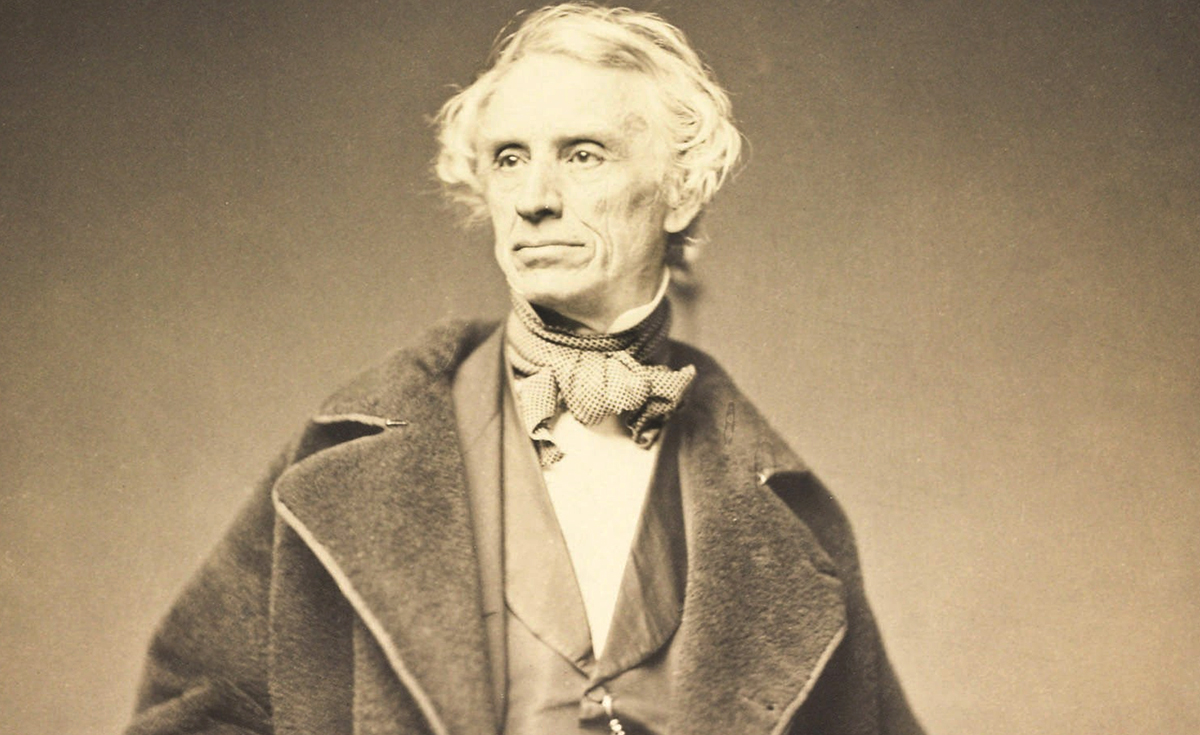
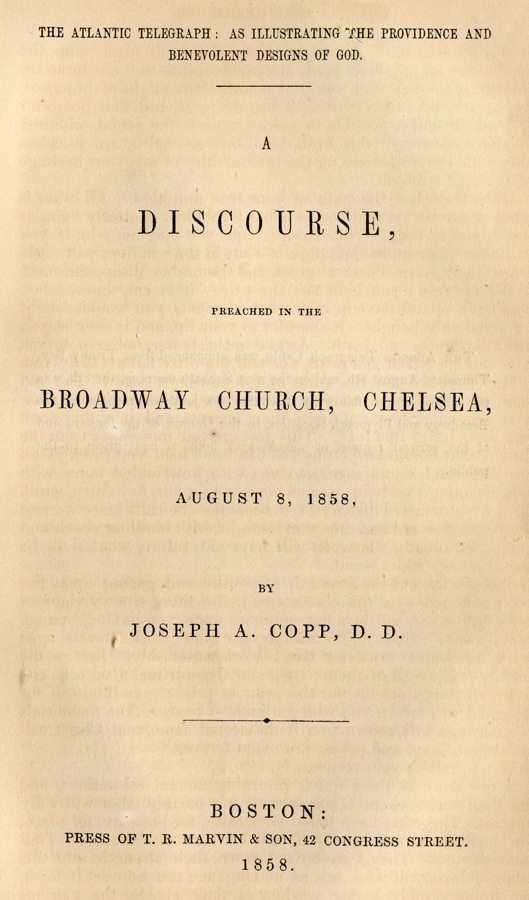
Sermon – Thanksgiving – 1853


Charles Wadsworth (1814-1882) graduated from Union College in 1837. He was pastor of congregations in: Troy, NY (1842-1850), Philadelphia (1850-1862, 1869-1882), and San Francisco (1862-1869). The following Thanksgiving sermon was preached by Wadsworth in Philadelphia on November 24, 1853.


sermon-thanksgiving-1853


RELIGION IN POLITICS:

A SERMON

PREACHED IN THE

ARCH STREET PRESBYTERIAN CHURCH,

PHILADELPHIA,

ON THANKSGIVING DAY, NOV. 24, 1853,

BY

CHARLES WADSWORTH,
PASTOR.


RELIGION IN POLITICS.
“Render to Cesar the things that are Cesar’s.”—Mark XII. 17.

These words, you will remember, are part of our Lord’s answer to the Herodians, when they sought to entangle him in the political controversies of the times. I have not, of course, selected them as a theme of usual scriptural and Sabbath-day exposition. You have come here expecting to have your meditations turned into channels beseeming the occasion. That occasion, owing to the agreement of so many of our United States, to celebrate it simultaneously, is a great National Thanksgiving. And to turn from its national or political aspects, and confine ourselves to what are called technically, “religious” considerations, were to do evident violence to the proprieties of time and occasion.

And yet, here, at the very outset, are we met with the outcry of the whole howling pack of Infidelity and Irreligion, as they hunt in couples for Christian inconsistencies; claiming meanwhile for themselves, the whole body politic, as a carcass from the shambles, to be cast to their kennel. “Do not bring politics into the pulpit,” say these men. “Do not desecrate God’s sanctuary. A preacher’s business is to minister to the gospel,–God’s pure and peaceable gospel. And beware how you desecrate and pollute it by interfering in State matters.” Verily, these be most wonderful men! Blaspheming, and reviling, and trampling under their foul feet, for the whole three hundred and sixty-five days of each year, this very gospel; and then overwhelmed with a holy awe, lest some preacher, once in a whole annual revolution, should happen, in their apprehension, to forget its high sacredness. Ah! Most astonishing men! Most wonderful zeal for the gospel! Nevertheless, we agree with these men in the assertion that a preacher’s business is with the Gospel of Christ, and its religion only. But, then, what is RELIGION? Religion, as revealed in the gospel! Is it an influence so ethereal and unearthly, as to require to be shut carefully from common life into Sabbath days and sanctuaries, lest its white garments should become soiled by a contact with worldliness?

So, indeed, these men tell us. And here we are at issue with them. Religion is not merely a sentiment, but a life. Not merely affections God-ward, but activity man-ward. It renders a man not merely a singer of psalms, and a partaker of sacraments, but, indeed, renders him mainly a kind friend, an affectionate father, an estimable citizen, and an honest man. And, therefore, a religion that does not pass beyond the region of technical sacredness, and pervade the whole economy of the social and secular—entering as a living power into the commerce, and the literature, and the magistracy, and the politics of a man—is a mutilated and a monstrous religion, make the best of it.

In the text, our Lord sets forth one great part of Christian duty. It is not only “Rendering unto God the things that are God’s,” but, as well, “Rendering unto Cesar the things that are Cesar’s;”—a principle taking as vital an interest in a human, as in the Divine government. And, if you will remember, that in Christ’s time the form of civil governments, and their practical administration, were as imperfect as they ever have been; and that the Cesar’s were, with few exceptions, the veriest of tyrants, you will perceive how emphatically we are taught in the text—that a man’s religious duties are not only unto his God, but as well unto his country; or, more simply stated—that a man should carry his Christianity heartily and wholly into the politics of his country.

And this, then, is the theme of our present meditation. The duty of every Christian man to go forth in the face of all this infidel outcry, and carry his religion into his politics.

But, then, what do we mean by Politics? Do we mean the paltry chicanery of placemen for power? A working out the low artifices of party in pursuit of offices and spoils? Would we have a Christian minister, or a Christian man, go down to the shameless and undisguised corruption which pervades what is called the peculiar moral code of politics? Would we have such a man sit face to face with the brutal ignorance and ruffian vice, which, hidden from the face of honest men, distribute the parts of the great play, and shuffle, and cut, and deal the dirty cards wherewith partisan gamblers are to play a game, whose great stake is our civil and national welfare? Oh no, no. By Politics, as we would have them mingled in by Christian men, we mean—“The science of government; that part of ethics which consists in the regulation and government of a state or nation, for the preservation of its peace and prosperity; comprehending the defence of its existence and rights against foreign control or conquest; the augmentation of its strength and resources; the protection of its citizens in all their rights; and the preservation and improvement of their manners and morals;”—and involving therefore every religious, patriotic, and domestic interest that is near and dear to us. And in such—as the only grand and just idea of Politics—we would have every Christian and good man mingle religiously and wholly. And this, for several reasons, we will now go on to consider.

And this, first of all: Because such political privileges and blessings as we enjoy, deserve at our hands, as God’s great gift, such a public, religious consecration.

This is indeed the very “sacrifice of thanksgiving” we are met in God’s house to offer this morning. In all times have religious offerings been discriminative and appropriate. The “husbandman” has brought of the “fruits of the ground.” The “shepherd” has brought the “firstling of his flocks.” And one appropriate sacrifice of thanksgiving for national and political blessings, is not a mere expression of gratitude in hallelujahs, but a consecration to God of our powers, in a service which shall perpetuate unto children’s children our great social, and political, and national privileges.

And surely such privileges as ours deserve such an offering. Truly, a goodly and glorious gift is our American birthright! I know men tell us it is grandiloquent, and in bad taste, and savors of arrogance and vanity, and is wanting in national courtesy and good breeding, to be everlastingly glorying in our “Eagles” and “Star-Spangled Banners,” and exulting in our national consciousness of political superiority, and our national hope of a sure, and limitless, and magnificent future. But for our very lives we cannot help it. “How can the children of the bride chamber mourn, while the bridegroom is with them?” We look at the nations of the old world—gigantic, if you please, but manifestly in the wrinkle and decay of a hoary age; and we look at our own land, just springing in glorious and gigantic youth, with flashing eye and iron sinews, to run such a race of honor and power as the world never saw. And we cannot—shame on us if we could—repress the thrill of pride from the heart, and the exulting words from the tongue, as we think of our own matchless land as it is now and shall be.

Oh! I see it! I see it! A nation that shall be unto all other nations as blessed old Israel was to the Amorite and the Philistine. A nation stretching from ocean to ocean across this whole continent. A nation of freemen, self governed; governed by simple law, without a police or a soldiery. A nation of five hundred millions of people, covering the sea with their fleets, and the land with great cities. First in learning, and science, and arts, and every great produce of industry and genius. Ay, and better and higher and holier,–a virtuous and godly people; bound together in one tender and beautiful brotherhood; and luxuriant with fruit and flower, in the bloom and aroma of all Christian graces. The refuge of the oppressed. The protector of the downtrodden. The home of the exile. The terror of despotism. The victorious champion of earth’s wronged tribes, against tyranny and outrage. The almoner of God’s great grace to the wounded spirit and bleeding heart of a redeemed humanity. I see this, and more than this, in our safe, and dazzling, and limitless future. And my tongue would cleave to the roof of my mouth, if I thought to check the joyous words that swell up in hallelujahs.

We have—we have a magnificent birthright. And what is it all, but God’s gift—God’s gift through the Gospel? All it is—all it shall be—a RESULT OF CHRISTIANITY—and so all it is, and all it shall be, but an ascension gift of my Lord unto his disciples as Christians. And are we then as Christians—as the very men for whom it was projected and for whom it is conserved—are we, as religious and Christian men, to stand back from this glorious nationality, and let fools and ruffians—the filth, and pollution, and offscouring of moral life,–creatures bought and sold for a price, as cattle for the shambles—the wrecks and the rotten-wood that float with every shifting tide of infidel and irresponsible political opinion,–are we to stand altogether aloof, and let creatures like these mar and mutilate this great national machinery? Shall the insane fanaticism of the North, and Southern sham-chivalry, bluster about the dissolution of the Union, and hew with a fool’s axe at the root of the tree of our Liberty? And must I, as a Christian man and minister, not smite them with all the strength God has given me, lest I should pollute my Christianity by a contract with worldliness?

Away with such shallow and hypocritical reverence for Christianity. I owe it to my Gospel and my God, as all the return I can make for a birthright so glorious, to fling myself as a Christian man, into the defence of that birthright, and bare my bosom, as a religious being, to the infidel and accursed tide, that would sweep all those good and glorious things away, as wrecks upon a deluge. And we have come up this day as a rejoicing people, not merely to praise God, but to consecrate ourselves to this very work in a sacrifice of thanksgiving. And go forth in the performance of our Christian work, “Rendering,” not only “to God the things that are God’s, but as well rendering unto Cesar the things that are Cesar’s.”

Now this leads me to remark, Secondly, That as Christian men, we are bound to this duty; because our nation needs this day for her own preservation, the mingling in her politics of this religious element.

She needs it, indeed, at all times. On all principles of national and governmental policy. There never has existed—and never can exist a nation, without this pervading element of religious influence. Even the heathen and unenlightened rulers of the elder world, all perceived and acted on this common-sense maxim. History has no record of a single legislator, who attempted to enforce obedience to law on the sole ground of its civil sanctions, and its temporal penalties. They universally perceived the insufficiency of all such motives, if unstrengthened by the higher motives drawn from religious principles. And if they were strangers to Divine Revelation, they found a substitute in their Mythology, and applied it as skillfully as might be, to the prejudices of the people. Lycurgus, Solon, Numa Pompilius, Mohammed, and indeed, every legislator at all famed for the wisdom of his institutions; were compelled to have recourse to religion: and in fact, derived therefrom their mightiest motives to enforce obedience. And in all this, they acted on an accurate and extensive knowledge of human nature; and with a wisdom that will remain true, so long as sinful passions and affections have such an influence on mankind. For whenever, as in France, the attempt has been made to loose all religious restraints from the minds of a people; then have the whirlwind and the storm, and the great waves dashing into shipwreck, made eloquent proclamation that for the preservation of every great national and political interest, there is need of a God, to ride upon the whirlwind and direct the storm.

Now, if all this be evidently true, even of nations held in check by the armed power of despotism, how emphatically must it be true of a free and a self-governing people. Our free institutions were created, and are conserved by the Christian religion. The two grand pillars whereon the whole edifice rests, are—The Equality of Human Rights—and—Brotherly Love equal to Self-Love. And these great truths we have learned from the Gospel. Take them away, and our peculiar nationality is destroyed in a moment. We may still exist, indeed, as a power on the earth. We may exist still united under an armed aristocracy, or a great military despotism. Or we may exist a fragmentary and dissevered power, as a hundred petty and belligerent principalities. And this Continent may be parceled out like the old, unto rival conquerors. And our miserable descendants “increase and multiply, and vegetate and rot,” in ignorance and bondage. And go forth in fierce feuds, marshaled under rival banners of the Bear, and the Lion, and the Lilies, over the very fields where their fathers marched united and triumphant, and free, under their one glorious Eagle. But sure I am, that if the religious element be taken from our politics, our Republicanism is gone, at a stroke, and for ever.

I have not the limits here, to enter into the argument of the manifold advantages to a free people of Gospel piety. Time would fail me, to tell you how it increases national wealth, by diminishing the popular tendency to luxury and extravagance, and by inculcating temperance, and industry, and frugality. How it operates as a mighty check on all those corruptions which weaken a free people. How it educates into truth and tenderness the popular conscience, without which, just laws must remain dead letters in the statute book, unenforced, and without influence. How it destroys all those selfish and sectional animosities, whereunto demagogues always appeal when they would break in pieces great governments. How, in short, by restraining in the human heart the vices hat weaken, and regenerating into nobler life the virtues that strengthen, it makes ever manifest the great truth, that free, and prosperous, and united, and “blessed is that people whose God is the Lord.”

This, and all this, we take in our argument for granted. And based upon it, our plea is, that we are called on as religious men to rise up, and cast more of this salt of godliness into our national character. We are this very day, in God’s sight, going backward from our old moral landmarks. We are even now as a nation swarming with drunkards, and Sabbath-breakers, and profane swearers. The emissaries of the old foreign Ecclesiastical despotism—the tool and the mainspring of all European despotism—are among us, foul and frequent as locusts of the Nile on the green things of God’s husbandry. Fanatics at both ends of the Union are toiling might and main at their fiendish work of dismemberment. Our national compact itself, founded on the compromise of local interests, exposes us more and more to sectional jealousies and competition, and to the heartless assaults of ambitious agitators of popular passions. We are entering confessedly on stormy times. New forms of infidelity, and political atheism, and false philanthropy, are rising in strength in the midst of us. While Christian men stand aloof, fools are heaving at the pillars of our great national temple. And the whole tribe of the Philistines are twisting at the cords, while God’s Samson sleeps in the lap of the Enchantress. It is time, high time, then, for Christian championship to awake. By the men of the present generation is the great question to be settled, whether there can be maintained in the midst of us, enough of an enlightened and tender moral sense to keep us a virtuous, and free, and united people, in face of all these assaults of infamy and irreligion. By the Christian men that now worship in God’s temples is the uncertain problem to be solved,–Whether the light of liberty that shines on us this day, is of a sun bounding gloriously from the Orient, or already sinking sadly and slowly to the sepulchral clouds of the west. And, therefore, the call comes to us loud as the voice of prophets in the glorious days of Israel of Judah, to stand forth against the enemies of hearthstone and altar for our God and our country; casting religious salt into the polluted fountains of our national conscience; pouring religious light along the troubled seas of our national politics; “rendering unto Cesar the things that are Cesar’s, as surely as unto God the things that are God’s.”

And by all this are we brought to remark, Thirdly: That we are urged to this duty by our regard for all the great interests of the Race and the World.

Disastrous as would be the destruction of our peculiar nationality in regard of ourselves—more disastrous and appalling still would it prove in regard of the human race everywhere. Speaking only civilly and politically, and there is no sign of hope for a world’s popular liberties, if our republicanism fail us. Unto America are turned this day the regards of all nations, as the last practical experiment of popular self-government. From America goes forth this day the only light of hope to fall on the heart of an oppressed race as a joy and a consolation. For this great work were we raised up, and this great work are we doing. Talk as men will about the sanctity of international law, as preventing on our part with the old world, interference and intervention; yet spite of it all, with the whole power that is given us we are interfering and intervening. As surely and constantly as the blazing sun interferes with the prowling night-beasts, are we interfering with the oppressions and despotisms of the world’s farthest nations. There is not a Cabinet in Europe that does not look upon this great Republic as the real author of all the revolutionary movements on that whole broad continent; that does not plot and pray for our ruin, as the mighty disturber of the peace of their haggard and hoary oppressions, and the only formidable and gigantic obstacle to the perpetuity of their foul despotisms hereafter and for ever. The grand and simple principle that unites us as a free people, is a principle actively and essentially at war with the whole spirit of European nationality. And we are this very morning, by the never-ceasing and omnipresent influences of our free institutions, more powerfully and offensively interfering with the despotic policy of those European Empires, than if a hundred thousand armed men stood marshaled under the American Eagle on the banks of the Danube, and our whole naval power, three times told, were cruising on those European seas, sweeping a despot’s fleets from the waters, or thundering with a thousand guns against the bulwarks of a despot’s capital.

We are interfering, and, what is more, we are bound to be interfered with! We may let European despotisms alone—and, doubtless, we shall let them alone, as to all armed aggression—but then the plain and simple fact is, they will not let us alone. It is a mistake altogether to imagine that the whole popular sympathies of the old world are with popular freedom; or that the masses of those oppressed nations are prepared for, or ambitious of, our free institutions. The political movement of the whole East is backward manifestly to feudalism. Those favored empires; that with a constitution limiting the monarch, we have rejoiced over as already half free; and gloried in as marching in the van of advancing civilization; are already in the wane and wrinkle of dotage and decrepitude. Great Britain is tottering already under the hideous burden of a bloated aristocracy; and the Lion that once roused itself to shake the world its banner, now crouches tamed and spaniel-like at the tread of the great Eastern despotism. France, that looked unto the world so like a winged creature of liberty, by a monstrous recoil has gone back to a chrysalis, and is bound, as God lives, to come forth a worm again. Spain is already a dead thing in the grave; and Austria, that fouler thing than a despotism—the despotic tool of a despot. And if princes seem building for freedom and the race on the banks of the Rhine, and along the blue Italian seas, they build, alas, on a volcano—the crater already ablaze, and the whole mountain shaking.

Yonder continent has indeed this day but one united—one advancing and absorbing power; and that the great Northern, and naked, and unmitigated military despotism. A despotism, too, be it ever remembered, not resting in, and trusting to, popular ignorance, but where industry is stimulated; and the arts encouraged and fostered by all possible appliances; and commerce steadily and strenuously advanced in every possible direction; and where the subjects are not held in an unwilling bondage, but are the rejoicing and enthusiastic abettors of despotism. And thus firm on her foundations, and terrible in her might, is Russia aspiring and advancing to the conquest of the world. And prescient of the far future, she sees in the whole wide world to-day but one mighty obstacle in her path—this young Republic—the everlasting light of our popular freedom in the dark places of tyrants. And so the momentous signs of the times are now proclaiming a coming conflict, when amid such terrors of antagonism as the earth never saw, there shall go on under the rival banners of the Bear and the Eagle, the last great battle for freedom and the world! But if in all this we read not aright the programme of the struggle, sure we are, at least, that the great conflict of this and the coming generation will be of Freedom against Tyranny. And sure we are, therefore, as well, that in the preservation and perpetuity of our free institutions there rest the only hopes of oppressed humanity; and that in the terrible hour that is coming on all people, our own civil and religious liberty must furnish the only championship for man’s heart and soul against the despotisms of the world.

Now, if to this thought of our civil and political influence upon the nations, you add the other thought, of the religious AND EVANGELICAL influence we are manifestly designed to exert upon a lost race, the thought under consideration will appear most impressive. Even if for the civil franchises of mankind there were to rise up other than American championship; yet whence, save from the American Church, can go forth the light of a redeeming gospel to the dark places of the earth? If there be any philosophic reading of a historic Providence, then from God’s past and present dealings with us as a peculiar people, and from the evident signs of the times, as displaying the powerlessness of all other nations for evangelizing a world; from these, I say, is the truth as apparent as an oracle of Revelation, that unto us, as stewards of the grace of God, is awarded the magnificent service of sending forth a full and free gospel over all the benighted continents of our globe—that from our beloved land, glorious in its scenery, and its broad boundaries, and its new growth of civilization, and its loftier type of civil and religious manhood, the Angel that hath the everlasting gospel to preach, is already pluming the wing for flight over the nations; and that the hopes of the race, therefore, not merely for Time, but for Eternity! Not merely for Earthly Freedom, but for Immortal Glory, do, under God, suspend themselves upon the perpetuity of our Union, and the permanent progress and development of our free institutions. So that to give up our national character to the spoiler, were not only to quench every light on the altars of Liberty, but to quench for the world the fires on God’s altars—to shiver the great wheel in the mechanism of a triumphing Evangel—and so to cast the race back, not merely to the iron thraldom of despotism, but to the more monstrous bondage of superstition and infidelity.

And I say you have only to remember all this, and consider it, and you will get an impression of the unspeakable importance to a whole world of mankind, of the perpetuity and progress of our free institutions, which will make you jealous with an immortal jealousy of any stain upon our national character as a wisely-governed, and intellectual, and moral, and religious people; and send every man of us to stand proudly up in his place as an American Christian and patriot; carrying our piety as an inspiration into the duties of our citizenship, and lifting up in great faith Christ’s redeeming Cross as a bulwark more powerful than all else to roll back the tides of iniquity, and corruption, and infidel legislation, and the whole wild deluge of ruffian and irresponsible politics, which would sweep all these glad and glorious things away as wrecks upon the waters. For we shall perceive how God himself has linked all the great interests of our race with these American politics, so that in this whole matter, by “rendering to Cesar the things that are Cesar’s,” we are most surely, as well, “rendering unto God the things that are God’s.”

Now this leads me to remark, Fourthly,–and lest we should weary you,–Finally: That we are urged to this duty by a due regard for our RELIGION itself.

We have already said that it is a false notion of religion which supposes it to be polluted, and thus injured, by every contact and concern with merely worldly interests. And we now go further, and declare, that we should do very much to honor and magnify Christianity, were we to carry it forth as an energizing principle—yea, as a vital and controlling power—into our whole practical life as American citizens.

You are all of you familiar with the infidel clamor of the times—that the Christianity of the Gospel has proved a great failure. That while it did good service as a pioneer of civilization, and a rudimental teacher of the alphabet in the great school of humanity, nevertheless, that now, when the race has progressed from its nomadic life, and the great man-child has flung off its swaddling bands, and mastered the rudiments of knowledge, and entered the higher forms of intellectual culture—that now Christianity must surrender its great charge to the higher teachings of Philosophy, and be flung aside as an effete engine, whose work has been accomplished, and whose day gone by. And we are fain to confess, that this outcry is not without plausible arguments—arguments drawn with irresistible force from the narrowness of the field, and the feebleness of the power, wherein professing Christians have themselves developed their Christianity. For we most frankly admit, that a religion that remains shut away from the common business of life, into the pure regions of spiritualism, as a thing of ecstasies, and sentiment, and psalm-singing: appearing statedly on Sabbath days, and in sanctuaries, and seen no more abroad during the six days of the secular and the social—We confess, I say, that such a religion, be it Christian or Pagan, is altogether out of place, and imbecile amid the restless and earnest tides of an age and a life like our own.

But then quite as confident I am, that if Christianity have not hitherto acquitted herself to the full of all her secular and social duties; the secret lies not in her inadequacy to the work; but in the smallness of the sphere which Christians themselves have assigned her, and the class and kind of labor they have committed to her hands. Sure I am, at least, that as an intellectual and moral system, Christianity was designed for all nations and generations; and is divinely adapted to the exigencies of all nations and generations. Her credentials to our Race, are not merely as a fitting and tender nurse for its unsteady infancy; but more fittingly still, as the earnest tutor of its hot youth; and the glorious guide and guardian of its magnificent manhood.

Embodying, as Christianity does within itself, the mightiest and most practical moral influences to be found in God’s universe. And revealed as the master contrivance of Infinite Wisdom, to restore man from his ruins, and bring back a wandering world to the light and the liberty of God’s own children. It has only to be inaugurated in its place of rightful authority. Only to be brought forth from the cloisters of contemplation, and the chairs of academic speculation. Only to take hold in its strength, on the great practical questions of the race and the age,–and the scoffing world will acknowledge as they see, that an influence so long despised as a thing only busy with creeds, and ceremonies, and sacraments, can yet work gloriously and with a strong arm, as man’s practical benefactor—that its fostering is of every influence which makes up civilization—that its calling is unto the patronage of the arts, and sciences, and literature, and commerce, and trade—that its place is as truly in the cabinet s in the conventicler, in the senate-chamber, as at a sacrament—that it an a quit itself vigorously of all Social and Civil, in a word, of every secular duty; and is gloriously equal to all the exigencies of the times, and every possible emergency of the day and the generation.

And we say, such an inauguration to a high sway over things merely temporal, Christianity deserves to-day, at the hands of its disciples. It deserves to be justified openly from the suspicions of the world, that it is after all, but a low, and paltry, and driveling fanaticism. It deserves to be brought abroad from the closet and cloister, to enter as a living power into the philosophy, and speculation, and the earnest life, and all the high enterprise of an uprising Humanity, “Rendering unto Cesar the things that are Cesar’s,” as steadfastly, “as unto God the things that are God’s.”

Religion has, indeed, its most glorious place in the recesses of the redeemed spirit, and an honored throne in the Sanctuary, with its praises and sacraments. It is the joy and glory of its great prerogative, that it abides in the sanctities of the heart, and the household; and brings heavenly comfort and peace to the secluded hut of the poor child of want; and sits in seraphic love at the hushed bedside of the dying. Nevertheless, it is its other prerogative, and should be its joy and glory as well, to take care of man’s temporal interests as wisely as his spiritual. And, walking abroad as the conserving spirit of the day and the age, to pour its divine light upon the speculations of philosophy; and to bathe with its heavenly dews man’s learning and genius; and to lay its strong hand on the energies of trade, and of commerce; and to lift up its heavenly, yet resistless voice, in the halls of legislation; and to stand in meek, yet mighty glory, in the haughtiest presence of monarch and noble; and to fling from its radiant loveliness a resistless moral power, that shall pervade the world’s arts, and sciences, and literature, and jurisprudence, and economy of politics, and machinery of government. “Rendering as wisely and as well, unto Cesar the assisting tribute that is Cesar’s, as unto God the adoring worship that is God’s.”

Christianity, I say, deserves this honor at our hands. What we are as a nation this day, we owe, under God, to its blessed influences. Our very National existence is a miracle of the Gospel. The Genoese navigator and the German reformer,–the one opening a new world; the other evolving a new Humanity to enter in and occupy,–were rocked in the same cradle, twin-children of Evangelism. The strong sifting of all nations for God’s chosen seed, to scatter in glorious husbandry on this virgin soil, was a Gospel winnowing. That almost heavenly refinement of taste and love; that found earth’s noblest kingdoms but an intolerable wilderness, without a pure altar, and an open Bible; but could make a blessed home with the storm, and the sea-eagle, and a God to worship; was an inspiration of the Gospel. That patriotism and courage, and self-sacrificing toil, which battled fearlessly unto death for hearthstone and altars, were all upshots from the Gospel. The matchless wisdom of a Constitution, whose great central truth of “human equality” was in direct antagonism to all principles of known governments, and startled the old despotisms of the world as the light of a coming judgment; was a direct revelation of the Gospel. Yes, and then all the subsequent beatitudes, which, as if flung from angel wings, have been scattered along all our path to national immortality—our accumulating wealth—our enlarging commerce—our vast increase of population—our progress in arts and manufactures—the magnificence of our practical charities—the increasing harmony and strength of our political machinery—the enticing beauty which our land bears to-day, to far away nations amid the sobbing agonies of their downtrodden children—and the glory, and honor, and power, which the world accords to-day, to the wing of the American Eagle, in its flight through the skies. This, all this, and more than this—all, in short, which makes the American eye flash with pride; and the American heart beat with rapture; and gathers us this very hour in God’s temples with loud hallelujahs of praise, an exulting and thanksgiving people; we owe under God to our glorious Christianity.

And, amid such results of magnificent accomplishment, CHRISTIANITY DESERVES at our hands, a justification from the slander of the infidel, that it is at best an imbecile and worn out and dreamy sentimentalism. It deserves to be lifted up as the conservator of the glories it has created; and since by the breath of its inspiration, life’s great ocean has been roused from the dead calm of ages into billowy and exulting play; it deserves to be sent forth in a divine glory, visibly to ride upon the whirlwind and direct the storm. Christianity claims, AS A DIVINE RIGHT, the acknowledgment in the face of the universe, that “while it renders carefully unto God the things that are God’s, it renders as carefully unto Cesar the things that are Cesar’s.”

Such then, most imperfectly put, are some of the reasons why American Christians should carry their religion with their duties of citizenship. That they hae not done so hitherto is a fact which needs no argument. So manifestly devoid of all Christian principles is the whole moral code of American politics, that to prove a man positively religious or even severely and Puritanically a moral man, were to destroy all his chances of political popularity and preferment. And this, too, at a time when the great balance of power in this matter is confessedly in the hands of the virtuous and religious. But when, strange to tell, these virtuous and godly men; either from unfounded fear of dishonoring their religion by so earthly a contact; or, from an unutterable contempt of the whole business of such desecrated politics; have stood in their dignity aloof from it altogether. Leaving the matter of popular nominations for office, and the arrangement of platforms, and the projection of great national and state policies, and, in short, the whole real working of our great political machinery—(and mark me here—I am not speaking, nor will I be misunderstood as speaking evil of our Rulers, and Magistrates, and Representatives; in regard of whom religion itself enjoins reverence; and who, for aught we know, are models of all that is honest, and pure, and lovely, and of good report. But I am speaking of that ubiquitous class of irresponsible, yet efficient men, whose calling is to pull the wires of partisanship, and mingle the seething elements in the great political cauldron; and who virtually, at least, color if they do not control our whole national politics)—leaving it all, I say, to the oral outcasts of our social system; to men, bankrupt of all virtuous reputation; to wily demagogues, who would flatter the foul fiend for the sake of his influence; to fawning menials, who would crouch at despot’s feet for the smile of his patronage; to blustering ruffians, whose only elements of moral power are blows and blasphemies; to vaporing patriots and brawling philanthropists who would freely barter their country and their race, and their own souls, for the profits of an office or the outfit of an embassy; to the blind fools of fanaticism, who would trample the Union and Constitution under their feet, and deluge this blessed heritage with flames and blood, and bring down upon their own wives and little ones a worse than Ethiopian bondage, for the sake of the phantom of an abstract and selfish principle, whose practical outworking were a cruelty and a curse. Leaving it, in short, I say, to such things as these—to the low, mercenary, Machiavelian herd that gather in the dens of darkness and sin—to project the programme and distribute the parts of that great play, whose sublime issues are; the glories of our country, and the welfare of a world.

This, and worse than this, is the sad truth about the matter. Pardon me, my brethren, that I feel constrained to stir up with so foul a picture your pure minds by way of remembrance. I confess that to a refined taste it is coarse and revolting. But the pitch was on the canvass! I but touched it and am defiled.

Nevertheless, the picture is neither caricature nor exaggeration; but the sorrowful truth colored too faintly. And all this, too, at a time when as sincerely as ever before private virtue and morality are revered and honored throughout the land; when the great mass and majority of our population; north and south; east and west; of every party, and every state; are proverbially honest, and intelligent and law-abiding, and patriotic, and earnestly desiring the application of a pure and religious morality to the whole complex machinery of government. And when it needs only a religious courage and consecration, to take hold on those great interests; and this whole vampire brood, that fatten on the nation’s heart would hide their heads in shame, as serpents from a sun-burst.

It is time, then, we say—high time that religious men roused themselves to a sense of their political responsibilities. Moralists, indeed, tell us—from the pulpit, sometimes—that Christianity claims no power over a State, and no official connexion with it. But what, I pray these men, is a State? An abstraction—an idea! No, indeed! Simply an aggregate of individual and immortal men; and with every one of these men Christianity should have an immortal connexion; and over them it has a claim, pre-eminent and eternal. It is time, then, that the precise bearing of Christian principles upon legislation, and the administration and general policy of our government, were understood and acted on. Not that Christianity may be established by law; but that our laws may be established by Christianity. Not that the Gospel asks alliance with the State, but that the State sorely needs the conserving influences of the Gospel. It is time that Christianity came abroad from its cloistered sanctity, to acquit itself of its great civil and national responsibilities. And spite of the whole howling herd of infidelity and irreligion, (who in this, are only true to their instincts, and do after their kind)—it is time for Christian men, and Christian ministers—now so busy with the minutiae of private and minor immoralities. Uttering fierce denunciations against slight heresies in a man’s creed, and trifling inconsistencies in man’s conduct. Seeing well to it, that a little child does not laugh loud on the Sabbath, and that a man’s face does not graciously smile at any questionable amusement. Loud in the outcry of “heresy” and “hypocrisy” against men, honestly striving to walk in the ways of godliness. I say it is time for such Christian ministers and men, to walk forth to a broader field, and to a loftier standpoint; to cast an indignant glance over our civil and national short-comings; to launch the fiery denunciations of our blessed Redeemer, as “serpents” and “vipers” against irresponsible placemen and their unprincipled tools; and to pour the glorious light of the Gospel of God, into the whole hideous den of political abominations.

And this, then, is our religious business this day, in this temple of Jehovah. We have come up, with one common thank-offering unto God, for our great national beatitudes. Beatitudes so wide and so wonderful, that the eye moistens and the heart bounds, as we contemplate our great birthright. God’s great gift to us, not merely as men, but mainly as Christians. For, whatever we are, or may be, we owe to the Gospel. All our social and national influences—all the canvass of our commerce—all the enterprise of our market-places—all the breadth and wealth of our husbandry—all the machinery of our trade, and the pomp of our great cities. All! All! Have grown up to us under the shadow of this Cross, and owe all their goodness, and glory, and power, to the sprinkled Blood from Mount Calvary. And coming with some sense of the greatness of our blessings—God claims at our hands, as the only fit “sacrifice of thanksgiving,” such a consecration of ourselves to his service, as shall send us abroad in our strongest endeavors to keep the blest fires of liberty bright on these altars;–and transmit, undimmed of one glory, our free institutions to an hundred generations that shall come after us.

Such a religious consecration can, and can alone, save us from the tides of infidelity, and corruption, and moral death, that are rolling in upon us. Let Christian men go bravely forth, carrying their religion as a light, and a power, and a conserving influence, into our political machinery, and nothing out of Heaven an impede or weaken us. Who speaks in fear of foreign aggression? Why, sirs, Gibraltar is not more steadfast and secure against the dash of its sea-surges, than we against the wildest assaults of the banded war-power of the world’s every despot. Who talks about “disunion”—and the severance of this great national confederacy? Why, sirs! The fanatic and the fool who thinks to accomplish it, might better think to sever the mighty bond that unites the Solar system, and blow with his foul breath those glorious stars away that march in God’s great law of gravitation round the blaze of the sun.

Ay! Ay! If borne radiantly abroad as the light and the savor of our earnest lives, along the vales, and by the streams, and athwart the great hills of our blessed land, this heavenly Gospel have free course and be glorified; then, spite of every storm upon the seas, and every cloud upon the firmament, are our foundations as the everlasting mountains, and our blessedness as the immutable love of our Heavenly Father. And so, upon the sincerity of our religious consecration on such festal days as this, depend, under God, these momentous issues.

Oh! We are here to-day, not merely to unite in a great national hallelujah, but to work out a great prophetic problem in the face of the universe. To bring forth the data for the solving the solemn question,–Whether this national hallelujah of thanksgiving hath to God the character of a birthday gratulation over our luxuriant youth—or a funeral wail over our already smitten and departing glories.—Whether these shadows that brood to-day along our national landscapes, are passing away from a rising, or lengthening and deepening with a descending sun.—Whether the giant Babe which God’s hand, amid tempests and storms, has rocked into majestic strength in this great cradle of the West: imbued with the gentle spirit of the Gospel; and filled, as to its great heart, with Divine Love; shall come forth to its earnest manhood, sandalled to walk the round world as a deliverer; and safe, therefore, under God’s own shield, to mount to the loftiest summit of national glory. Or, alas! alas! Whether, with the madness of a fool’s atheism within it, shall leap from that cradle like a roused giant, to rush in mad strength on the bosses of God’s buckler, and perish as a reed in the crashing fire of God’s thunderbolt

Sermon – American Institutions & the Bible – 1876


Jeremiah Eames Rankin (1828-1904) was ordained in 1855 and pastored churches in New York, Vermont, Massachusetts, Washington, D.C., and New Jersey. He became president of Howard University in 1889. Rankin preached this sermon in 1876 in Washington, D.C.


sermon-american-institutions-the-bible-1876-1

The Bible the Security of American Institutions.

A SERMON.

Preached in the First Congregational Church, Washington, D.C., January 16th, 1876, by the Pastor.

J. E. RANKIN, D. D.


I wish to speak, this morning, upon “The Bible and American Institutions,” and I have chosen my text from Deut. Xxxii. 46, 47: “Set your hearts unto all the words which I testify unto you this day; which ye shall command your children to observe to do; all the words of this law. For it is not a vain thing for you; because it is your life; and through this thing ye shall prolong your days in the land, whither ye go over Jordan to possess it.”

Has it ever occurred to us to ask why a volume like the Bible, intended for all the human family, in all its generations, for different individualities, for different types of civilization, for people under different systems of government; should be so largely occupied with the rise, growth and decline of one single nation; and that, one of the narrowest and most exclusive that ever existed upon the face of the earth? To ask what common property and interest all periods of time, all nations, and kindreds, and peoples, and tongues can have in the history of a nation occupying so small a territory, so isolated, so short-lived; intellectually, commercially, politically exerting so little influence upon the other nations of the earth?

There is only one answer to this question. There was one respect in which this nation was unlike all that ever went before it, and is unlike all that ever will come after it, to the end of time. It was raised up to be among the other nations, what the model-school is to those who are learning how to teach; to be under the dissecting knife of the student of human history, just what the subject is to the student in anatomy and physiology. In a word, the history of the Hebrew nation, as recorded by the national annalists, prophets, poets; as illustrated in laws and institutions, in subjects and rulers, and especially as it lays bare the secret relations of this nation to the living Jehovah and to His government; the real King of Kings and Lord of Lords; the history of the Hebrew nation in all these respects—being the only truthful history ever written—was intended to teach the founders of other nations what foundations to lay, and the conservators and guardians of other nations what safeguards to insist on, in order that these nations might be successfully established, in order that they might be perpetuated to the latest generation of time.

If by giving us the biography of individuals such as Abraham and Isaac and Jacob; such as Joseph and David and Daniel; such as Peter and John and Paul, God intends to teach us by the example of men of like passions as we are, to give us the benefit of their wisdom and experience in the conduct of our private affairs, in our relations to men, and in our relations to God; so by giving us the biography of this single, this peculiar, this elect nation, He intends to give all future nations the benefit of the wisdom and folly of the successes and disasters, of the rise, the culmination and decline of the Hebrews as a Commonwealth, as an Empire, as the fragments of an Empire; rounding out their history from the captivity of Egypt, until they were scattered as an astonishment, a proverb and a byword, among all the nations of the earth.

The Old Testament, the old Hebrew Scriptures, outgrown are they? Just as much as are the foundations of the earth. They contain the patterns and the prototypes of all human history. They are to human life, to society, to government, to institutions, to laws, to the life and well-being of man, to the life and well-being of nations, just what the earth’s frame-work—the slow product of those countless geologic periods—is to the earth’s herself, the only sure foundation upon which to build, the only grand treasure-house in which to mine, for great principles of truth and justice and honor; as the text has it, they are a nation’s life, and through them shall a nation prolong its days. They teach us that there is a grander figure in human history than great lawgivers like Moses; than great captains like Joshua; than great poets like David; than great prophets like Isaiah; that God is there, though men know it not! In Hebrew history He is discerned there before the history. He calls Abraham from a land of idolators; He leads Israel out of Egypt like a flock; He builds up a great Hebrew dynasty which culminates in the reign of Solomon. His servants, the prophets, minutely predict all the prosperous and adverse events in the perspective of Jewish history. In other history He is recognized only after the event; unless the prototypes of Hebrew history have furnished us with discernment to anticipate the event. And this is precisely what they are for. Emerson says: “The student of history should read it, actively and not passively; should esteem his own life the text, and the books the commentary. Thus compelled, the muse of history will utter oracles.” And so of the history of nations. A man who can read the history of the American people, from the landing of the Pilgrims to the destruction of slavery, when the nation came up out of the Red Sea of civil war, and not see the living God there; who can review the Colonial period; the period of the revolution; the period of national consolidation; the anti-slavery struggle; the Rebellion; without recognizing after the event, if not in the event, the same majestic movement of a Divine purpose as called Abraham and his descendants and gave them the Land of Promise, driving out the heathen before them; as broke the fetters of the bondmen in Egypt, and overwhelmed their pursuers in the Red Sea; the man who can read the past one hundred years of our national history, collating and comparing it with the great events in Jewish history, without seeing the foot prints of the same majestic Being who takes the wise in their own craftiness; who makes the wrath of man to praise Him; who brings good out of evil, and light out of darkness; who made a pathway for His own people, and troubled the chariots of the Egyptians, must be in a kind of moral idiocy!

“History,” says the Greek historian, Thucydides, “is philosophy teaching by examples.” But in Bible history we have the living God as His own interpreter. He tells us why He selects such a man as Saul for the first king of Israel; why He sets aside Saul for David; why He permits the dismemberment of the Hebrew nation; why He sends His people away into their captivities; why He recovers them. He unrolls scroll after scroll of Jewish history, pointing out its signification as the nation lives it. Now, when Robert Walpole says of all uninspired human history, that “it is a lie;” when Napoleon I asks, “What is history but a fable agreed upon?” when by confession of all, such history is full of mistakes and prejudices and discolorings; its facts are often manufactured, and its philosophies often false; when frequently great villains are painted like great men, and the world’s real benefactors often unnoticed; and yet uninspired history is put into the hands of our children and youth in our public schools; I would like to know what reason any reasonable or patriotic man can give why Bible history should be excluded; why those who are to be our future citizens and rulers; why those who are to keep pure and to perpetuate our free institutions should not be taught from living examples in Hebrew history, the principles of God’s dealings with nations; why and how He raises them up; how they break with Him, and why He lets them go down to swift destruction.

But, if the Old Testament tells us how to build up and make prosperous a great nation, on what foundations to set it, how to secure the smiles and favor, how to avoid the displeasure of the living Jehovah in public administration; gives us, in the Hebrew nation as a prototype and example, the great principles of national weakness and strength, we have only to turn to the New Testament, to discover man’s duty as a man; as a citizen; to discover the kind of citizens that will perpetuate a nation; the units of which the great aggregate must be made up. The Lord Jesus says that His kingdom is not of this world. And yet, in His kingdom here, and in fitting men for His future kingdom, He trains up men and women and children who make the best citizens of earthly kingdoms. He loans to temporal kingdoms the citizens of eternity. In this discussion I shall hold myself to the boundaries of time and sense. In its effects upon individuals, by teaching men to love the Lord their God, with all their hearts; by teaching them to love their neighbors as themselves; by teaching them to pay tribute to whom tribute is due, and honor to whom honor; by teaching them self-restraint and industry and temperance; by teaching them to provide for their own; parental love, filial love, conjugal love, Christian love, the gospel of the Lord Jesus provides the most conservative influence that ever was planted in earthly kingdoms; puts leaven into every one of them, such as tends to make model citizens, model men.

Where has the decadence of nations usually begun? It has begun in the decline of individual virtue. In their early struggles, when the strong oppress the weak, and the weak are pushed out to shift for themselves; when men are encountering the hardships of frontier life; when they are putting in place foundation-stones, nations, like emigrant families, are comparatively secure from temptation from within. The manhood of such men as founded this Republic never had the temptations which have fallen to the manhood of the public men of our own time. The first one hundred years of a nation’s life are not the most perilous. Then, men are occupied with fundamental things; have a deep sense of public responsibility; seem to themselves to be making history; to be acting in the eyes of the nation and for the life of the nation; to be doing work for posterity. And they are. And the dignity and pressure of the part which they are enacting keep them from ease-taking and frivolity; keep them from flinging themselves away in indolence and luxury and corruption. But when a nation has been thoroughly established; when she becomes preoccupied with manufactures and commerce; when no danger threatens her from without, individual virtue becomes more and more imperiled. And the only method of preventing the decline of the nation, through the decline of the individual citizen, is by bringing that citizen under the influence of the principles of a pure morality. And this is done by the Gospel of the Lord Jesus Christ; by teaching them to love God with all their hearts, and their neighbors as themselves. Let it be understood that all questions relating to another life are here thrown out of the account; that man actually dies, as the brute dieth; yet, for him to bring his whole nature, his whole life, individual, domestic, social, private, public, under the power of the Gospel, will make him the best possible kind of a citizen. And this is what every State wants.

Who constitute the dangerous classes in a republic? They are men and women and children who are kept from the Bible and the power of the Bible. You may tell me that some of them are very religious. I admit it. And yet many of them do not understand the first principles of a true Christian morality; are ready upon an emergency to break any commandment of the Decalogue, think themselves doing God service; love neither their neighbors nor themselves; fear not God, regard not man.

I do not speak against them. They are the legitimate fruit of a system. I speak against the tree which bears such fruit; against the system that makes them what they are; that must make men like them; a system which effaces and confounds the distinction between right and wrong; which substitutes the traditions of men, human legends, myths and chronicles, for the sublime oracles of God; which shuts up the Word of God; which dares to bring the sanction of God’s authority to enforce the commandments and devices of men; a system which claims not only ecclesiastical, but civil allegiance from all its votaries in whatever land, whose Head does, in the thought of all his loyal subjects, wear all crowns. I know that it is often said, “Well, if no religion, it is a good police system.” And what could we do, with the influx of such material into our population, without the restraints which spring from it, as a system of police? It has made its votaries what they are. It keeps them what they are. If it had given them the Bible, if it had taught them the principles of religious liberty, if it had trained them to think for themselves, as directly accountable to God and not to the representative of the system, it would not be required for the purposes of police. That was a fair retort to a priest who returned a piece of stolen property taken by a servant girl, with the word: “There, if the girl had been a Protestant you would never have regained this property.” “Ah, if she had been a Protestant, she never would have stolen it.” The system creates the necessity.

And who are the conservative classes in our civilization? They are the families which are under the influence of the Bible; the men and women who are under training of the truth as it is in Jesus; who study the Bible for themselves; who reject tyranny in things ecclesiastical just as emphatically as they do in things civil! You cannot make a free man in things temporal, of one who in things spiritual does not think for himself, is a slave. Bind a man’s conscience in the church, and you may soon gag his mouth and bind his hands in the State.

“What constitutes a State?
Men, high-minded men!
Men who their duties know,
But know their rights, and knowing, dare maintain.”

And, if it can be made to appear that nothing is so good as the Bible, to bring men into such relations to God and man, as will make them “high-minded men,” safe citizens; safe for a republic; that nothing is so well suited to make our population such that they will keep the peace with the God of nations, and not bring themselves under His judgments; as will make them know their duties and their rights, and knowing, dare maintain; then the highest of all laws, the law of self-preservation, makes it incumbent on the State; makes it not only the right, but the duty of the State, not only not to permit the Bible to be crowded out of the place it has occupied in the fundamental instruction of American children, but even to make it the corner-stone of their education; to begin with it, to end with it; to make it a text-book in all our schools.

The first duty of this Republic is that of self-preservation. We have these free institutions to have and to hold, and to transmit. Here comes a gigantic system, magnificent, seductive, subtle, dying in individual men, but living in the generations and ages; the enemy of civil and religious freedom the world over; chameleon-like in its hues, having an insinuating aspect, even in a free land, but unchanging in its nature and essence; claiming supreme authority over every citizen of every nationality under the sun; every one of whose subjects must swear a modified allegiance to all earthly kingdoms; the fosterer of human ignorance and superstition and crime; in the year of grace, 1875, driving Bible-missionaries out of Spain; mobbing and murdering them—American citizens too—in Mexico; admitting through its own organs that if it ever becomes supreme in this land, there will be an end to all religious freedom: stabbing to the heart in the street a little boy in Oviedo, Spain, because he had joined a Protestant church; in this country, refusing burial rites to children who have attended Bible Sunday schools, and doing similar things to grown-up men in Canada; in short, through the Syllabus of the Pope, its infallible Head, stigmatizing and condemning at one breath all the grand characteristics of American civilization, and openly challenging them before the world as ruinous to the true progress of humanity; here comes this system, in its very nature inimical to individual freedom and advancement , and insists that we modify some of our fundamental things; some of the things that Washington, and Jefferson, and Adams, and Webster, and a hundred years of experience have taught us to be essential to our very life as a nation, to accommodate it; to help it keep its votaries in chains of darkness, under the domination of priestcraft; taking the money of the people to found sectarian institutions of its own, and yet denying the right of a great people to keep the simple, unadulterated Word of God in her Common Schools! Known in all history as giving no recognition to the rights of conscience; having the blood of almost every martyr to religious freedom in its skirts; having invented its thumb-screws and racks, and other instruments of torture, having kindled its flames, and dug deep its dungeons, if it were possible, to exorcise from humanity all sense of individual right as between man and God; to exalt itself into God’s place over man; and yet, urging its plea against the Author of the Bible, and the Author of the conscience, and the time-sanctioned usage of the Republic, upon the ground of conscience! What answer shall we give it?

Our answer is this, that the life of a nation is its supreme law. We must have a free, intelligent, moral population, or our doom is sealed. No man can have rights under the Constitution of the United States—call them by whatever name you may please—to undermine this Government, or to plot its overthrow, or to make its future impossible. It is a contradiction in terms. For nearly a half century this country was engaged in throwing sops to the Cerberus of slavery, to keep his bark quiet. He made way with the sops and kept barking. Here were men who claimed that they owed primal allegiance to their separate States, who took their oaths to the United States Constitution with that reservation; who insisted upon this compromise and that compromise, upon this settlement and that settlement, and when they had secured all they could get in the Union, then they determined to break it up! What did the country do? She rose up and stood for life! Nor did she unsheathe her sword in vain. She nerved herself to cut that cancer of slavery out of her own body, and throw it back to the dark ages, where it came from and where it belonged! It was that or annihilation! What became, then, of all the reserved rights of States; of all the compromises: of all the pacific legislation of the past? They were not worth the paper they were written on. And let it be once understood by the American people—as it is becoming understood—that under the specious plea of rights of conscience, this great Ecclesiasticism, hoary with age and crime, whose adherents owe their first and supreme allegiance to him who sits upon the Seven Hills of Rome, and whose temporal power has been sloughed off by the modern nations just in proportion to their vigor and manhood, proposes to sap the foundations of our free institutions; proposes to make an intelligent, moral population in this country an impossibility; proposes to train up within our borders, and to make a portion of our political system, citizens educated at the feet of Jesuits; citizens whose consciences are held in the right hand of their Father Confessors: then there will be another uprising of a great people. And shall we wait for a half century of compromises, before we make ready for it?

But I am asked, Has not a man a natural right to dictate how his children shall be educated, or whether they shall be educated at all? Every child born in this Republic is destined to become an integral part of it, has upon him responsibilities which he cannot meet, which he cannot bear with safety to the Republic, without an education, without moral education. And if parents will not educate their children, then will the State, just in proportion as it is true to its own life, either see them educated in its own schools, or abridge to them the right of suffrage, the right of citizenship. You do not call in an ignorant quack to treat your child when he is in danger of death. And will the State allow that man to tamper with great questions vital to its existence and perpetuity who in morals knows not his right hand from his left, who cannot read, who cannot write? Compulsory education! Education, whether the parent wills it or nills it, and especially if he nills it; education in morals; the imparting of the sanctions of human and divine law against the common tendencies and crimes of human nature, against all those courses which unfit a man for citizenship; education in American history; education in that which makes American citizenship peculiar as a heritage of the fathers; this has come to be a national necessity, and is one of the questions with which the General Government must have to do.

Let a man insist upon his right to educate his child as a thief, or let him come up a thief, will society, will the State recognize this right? The State will punish both him and his child if he undertake it. The State guarantees “life, liberty and the pursuit of happiness” to its citizens upon this single condition, that they will not use these blessings to undermine its foundations. And I have not the least doubt that if it be the judgment of a Great People that ignorance of the historical records of the Bible; ignorance of the law of God and the precepts of the Lord Jesus, is incompatible with citizenship, it is within its legitimate prerogative, from this time forth, to have the Bible taught in every school, public and private, in the whole land. I speak here of right, not expediency; though it be right and wise, it must be expedient; how can it be otherwise? The Bible is not a denominational work. The Bible is not a sectarian work. It is the centre and source and standard of all religious truth. As against the Bible, and the Author of the Bible, there are no rights of conscience. It is like talking of the rights of the eye against the light, or of the lungs against the air. And if any system is afraid of it, wants to temper its clear light; wants to filter the very water of life as it comes from under the throne of God, so much the worse for that system!

But in this discussion I do not urge the claims of the Bible on religious grounds. In passing I simply call attention to this anomaly: that an institution professing to be founded by the Lord Jesus Christ, who spoke the very words recorded in the New Testament to the common people, and they heard them gladly; who commended the Scriptures to our diligent study; an institution claiming to be the true church of the living God, to which has been given the duty of preaching the Gospel to every creature; that such an institution shall shrink from the light of the Bible, whatever the version! And I say that such an institution cannot expect the confidence of any thinking people. It is too late in the world’s history for this. It is too free a country for it.

It is also too late to pretend that this great ecclesiastic-political system is not hostile to the Word of God. It reckons among its converts from heathenism portions of more than sixty different nationalities. And into the language of not a single one of them has it ever translated the Bible. When was Bible translation or Bible distribution ever undertaken by it? The Psalmist says: “The entrance of thy Word giveth light; it giveth understanding unto the simple.” But Pope Leopold III warns all people against Bible Societies, and Pope Pius VII quotes his words with approval. Gregory XVI was in sorrow, night and day, because of them. And the present Pope regrets the recent improvements in the art of printing, which so greatly facilitate the free distribution of the Bible and other dangerous books. It is not the Bible in the schools merely, it is the Bible, anywhere and everywhere, against which this system lifts up its voice. It is the light of the Bible which it fears. It is the freedom of the Bible before which it cowers. Shall we not meet it in defence of what it most dreads? Shall we weaken our cause by forsaking the pivotal point on which the issue must be made up: on which the battle must turn?

How to maintain the life of this free nation against ignorance and superstition and crime is come to be the great problem of the hour. For a half century we argued and compromised and debated in a vain endeavor to live at peace with a system with which in a free government there was no peace; which tyrannized over men’s bodies; which put manacles on their limbs, and sold them upon auction blocks; and at last we had to go down to the field of death and cross swords with its defenders before it was exterminated. This work is hardly over, when as though all the great rights of man were to be here tried before the Judge of all the Earth, now rises up this great rights of man were to be here tried before the Judge of all the Earth, now rises up this great ecclesiastical tyranny; this tyranny over men’s consciences and souls; this buyer and seller of men’s souls, and this buyer and seller of men’s souls, and flings itself across the pathway of our progress; brings upon us its entail of ignorance and poverty and crime, imported, created here; seduces our legislators into granting it subsidies and endowments; and then arrays itself against the Bible in our common schools—against the schools themselves; striking a double blow at the very citadel of our freedom; and when we remonstrate, it pleads the rights of conscience! Have we another half century of conflict before us before we open our eyes to the truth, that this is one vast political system, even more than that of slavery; all the more dangerous, all the more insidious, because it bears an ecclesiastical name, and pleads for church rights; that it is a system never to be satisfied until it names for us our law-makers and judges and executives; until it has its foot upon our necks?

We say to the adherents of this system, that in the matter of freedom of worship, of propagating their views, they shall be undisturbed, even though all history has shown the system itself to be hostile to human freedom and human progress; and we know it to be. But when its leaders undertake to brake down the common school system itself, we charge them with being the enemies of our free institutions, and we call upon all the friends of civil liberty to rally against them; to come to some understanding how to check their progress. It is a saying of Edmund Burke that “when bad men combine, the good must associate, else they will fall, one by one, an un-pitied sacrifice, in a contemptible struggle.” Here is a system that is a permanent, undying combination. It is its very instinct to break down all individual freedom. It moves as an army. It is an army. And its leaders, as history knows them, are so crafty and insidious, that having chosen as their appellation the name of Jesus—the purest and most guileless of Beings who ever lived upon earth—in 335 years they have wrought in its derivative, Jesuit, this etymological change; that while Jesus means “holy, harmless, undefiled and separate from sinners,” Jesuit means just the opposite; just the very contrary qualities; means treachery, craft, intrigue; means the wisdom and subtlety of the serpent, with the serpent’s fangs. Can such a well-drilled combination be resisted without a common understanding and a common movement on the part of the friends of civil and religious liberty?

You may tell me that it is inexpedient to agitate this question. That is just what the Pope thinks. He says: “Act, but do not agitate.” That is his policy. Our policy is to agitate. “For,” as Milton asks, “who ever knew truth put to the worse in a free and open encounter?” And if we agitate we shall get a free and open encounter; we shall get a thorough discussion of the subject. It is for the majority of this nation to determine whether, at the dictation of this most tyrannical of all tyrannies, of this bitterest and most unscrupulous enemy of civil and religious freedom, the Book which links men and nations directly to God; which gives man an open horizon toward eternity, is to pass out of our common schools. And let us remember this: that it is not a mere question of political expediency; of present policy. It is a question that strikes down into the very foundations of our civil and religious liberty. For s sure as the Bible is the book of God, He has so constituted society and governments that if it be the chart by which we manage our public affairs, the standard by which we determine the character of our civilization, our future is secure; we shall walk upon the high places of the earth; while if we do otherwise, if we discard it or dishonor it, He will turn us into Hell, with all the other nations that have forgotten Him! For if the salt shall lose its savor, wherewith shall it be salted? It is henceforth good for nothing, but to be cast out and trodden under foot of men!

Sermon – Artillery Election – 1853


This sermon was preached by Rev. Hubbard Winslow in Massachusetts on June 6, 1853.


sermon-artillery-election-1853

A

SERMON

DELIVERED BEFORE THE

ANCIENT AND HON. ARTILLERY COMPANY,

MONDAY, JUNE 6, 1853.

ON THE 215TH ANNIVERSARY OF THE CORPS.

BY REV. HUBBARD WINSLOW,
OF BOSTON.


Boston, June 6, 1853.

My Dear Sir,

By an unanimous vote of the Ancient and Honorable Artillery Company, the Officers of the past year were directed to present their grateful acknowledgments for the very instructive and eloquent Discourse delivered by you this day, on the occasion of their Anniversary, and to ask the favor of a copy for the press. It gives me much pleasure to be the organ of the wishes of the Company, and of the Officers recently associated with me in command.

Very respectfully, your obedient servant,
FRANCIS BRINLEY

Rev. Hubbard Winslow,
6 Alliston Street.
________

Boston, June 9, 1853.

Hon. Francis Brinley:

Dear Sir,—Be pleased to accept and to present to the other gentlemen of the Ancient and Honorable Artillery Company, my grateful acknowledgment of the indulgence with which you have been pleased to regard the Discourse delivered by me on the occasion of your Anniversary, and to consider the manuscript at your entire service.

With sentiments of highest esteem, I have the honor to remain,
Your obedient servant,
HUBBARD WINSLOW.


SERMON.
REVELATION 11:15.

And the seventh angel sounded; and there were great voices in heaven, saying, The kingdoms of this world are become the kingdom of our Lord and his Christ, and he shall reign for ever and ever.

Without a gracious revelation from heaven the race of man is irrecoverably lost in idolatry and sin. Without this, in vain are the combined forces of science, art, arms, commerce, wealth, and all other human means, to elevate man to the knowledge of God and the practice of true virtue.

Such a revelation it has pleased God to grant. Its light began to dawn immediately after the fall in paradise. It is a kingdom of redemption, whose king is the Son of God, who appeared “when the fullness of the time was come,” according to the divine promise, to offer up himself in the cause of human salvation.

Should your present speaker deviate so far from the usual custom on this occasion, as to contemplate the subject of Military Institutions only as included in a more comprehensive theme, his apology is that it has been so ably discussed by his predecessors as to render its particular consideration at present superfluous.

I propose, with your indulgence, to offer reasons for believing that, in response to the utterance of the seventh angel in our text, pure Christianity, the only religion congenial to free civil institutions, is destined to become the permanent religion of the entire human family; and also to indicate the especial relation of our own country to this great event. I place Christianity in the van of the march of liberty, as pioneering rather than following true civilization, and as being at once both the parent and defence of all free institutions. My belief that all nations are to become civilized, elevated, refined, and to enjoy the inestimable blessings of liberty, is founded upon and precisely commensurate with my belief that pure Christianity is to prevail over the whole world.

My argument will be addressed to such as admit the truth and excellence of our religion, but are skeptical in regard to its success. It has been so long struggling with unsubdued foes; such large portions of mankind are sunk in gross idolatry; so much individual and organized hostility “against the Lord and against his anointed” still prevails on all sides; and there is so much deeply-seated infidelity, both secret and avowed, even in Christian lands, that the wisest of men sometimes find their faith put to the test. They are tempted either to doubt that interpretation of the Scriptures which asserts the universal triumph of Christianity, or to question the absolute authority of the Scriptures themselves.

But we are of those who believe that, despite of all obstacles, this divine religion, pure and undefiled, is to obtain complete victory over the world.

I. It is my first object to exhibit the rational grounds for this belief.

1. Christianity will prevail because it is TRUE.

Truth has a natural power over the human mind. Through prejudice and sin men may be induced to reject it, but in so doing they act against their proper nature; in resisting truth they hold their minds in a forced state. Although error may seem for a time triumphant, steadily advancing truth overtakes it at last and lays an omnipotent hand on the intellect. In both the natural and moral world, truth is progressive, and always ultimately sure of its object.

Look for the moment at the resistance encountered by some of the truths of natural science; for instance, those respecting the solar system. Five hundred years before Christ, Phthagoras taught, in part, the true doctrine upon this subject. But it was despised and rejected by men, and for ages seemed to be dead and buried. But truth cannot die; nor can it be always restrained. We may as well attempt to chain the internal fires of the globe. When those fires seem to lie dormant, they are accumulating force for fresh action. So truth, when apparently ineffective, is preparing to shake the intellectual world, and to assume practical dominion over it.

After the lapse of nearly two thousand years, the true doctrine of the solar system found another advocate. Copernicus published to the world that the sun is the centre of the system, that the earth moves round it and also on its own axis. Again was this truth assailed. But was it finally defeated? No. Truth has ample time to vindicate its claims, and it suffers noting from delay. Another hundred years rolled by and Gallileo arose. He invented the telescope, and with the combined aid of mathematical and telescopic evidence, reasserted the truth. But the day of triumph still lingered. Truth’s champion was imprisoned and his books were burned.

Another century passed, and Newton arose. His splendid discoveries in optics and his vast improvement of the reflecting telescope, combined with his towering mathematical genius to bring forth to the world, in bold defiance, this same despised and rejected truth. The conflict was long and severe, but every struggle gave new advantage to truth, and at length it compelled error to yield and prejudice to hide her face, while it marched resistlessly onward to take possession of the whole enlightened world.

Now the doctrines of Christianity being as true to the moral universe as those of Copernicus are to the natural, their final success is equally certain. There is in error a principle of innate destructibility; especially it cannot endure hard usage. It requires a peculiarly favorable adjustment of the elements; it needs the hothouse nursery of the selfish passions. And even patronage herself, with hands full of gold, cannot confer immortality upon it. Truth, on the other hand, survives by its own inherent vitality. Rough handling may for a time retard its progress, but cannot destroy it. It will live and thrive, even on bleak, wintry rocks, and amidst howling blasts.

For several centuries great ingenuity and labor were bestowed upon attempts to change the baser metals into gold; so have human device been employed to make false systems of religion, such as Paganism, Mahommetanism, and various corruptions of Christianity, pass for truth. But these base metals cannot be converted into gold; nor can they always pass for it; for the human mind eventually detects imposition.

In virtue of the same influence by which commanding intellects carry their own generation forward in some truths, they often hold subsequent generations back from embracing others. A single illustration of this fact will suffice. Galen, the illustrious prince of the Greek physicians, flourished in the year of our Lord 130. He taught surgery as well as medicine, and was in advance of all his contemporaries. Truth and error were blended in his teaching, but his greatness gave such currency to his errors, that for centuries it was unpardonable presumption to question any of his positions. This subsequently prevented men from arriving at the truth respecting the circulation of the blood.

At length Harvey arose. But even then mankind had scarcely reached a point of knowledge at which to cope successfully with the great name of Galen. History records, that “the promulgation of the truth by Harvey respecting the circulation of the blood, roused the attention of all Europe. The old professors, accustomed to pay a blind and implicit deference to the authority of Galen, which was now utterly subverted, and ashamed to confess that their whole life had been spent in teaching the grossest errors, took up their pens in opposition to the author of these innovations. One party asserted that the discovery was not new one; that it had been known to several persons, and indeed to all antiquity. Others attempted to disprove his statements by experiment and reasoning.” But over all these obstacles the truth at last prevailed.

Similar to this has been the conflict between Christianity and infidelity. Some infidels, such as Hume and Bollingbroke, have attempted to prove that Christianity is not true to nature. Others, such as Hobbs, Taylor, and Volney, have maintained that it is so very natural that any person could ascertain its principles without a revelation; that they were in fact understood and taught by the Egyptians, long before the Bible was written.

Here then we have two classes directly opposing each other in their attempts to subvert Christianity, just as the two classes opposed each other in their attempts to subvert science. The result in both cases has been the same.

Thus men of great reputation have frequently embalmed and transmitted error with truth, as amber combines and preserves the precious with the vile; but the progress of human knowledge at length forces a separation; only the truth is finally retained, the error is rejected. Hence, whenever an individual has ascertained a truth, whether of science or religion, and has cast it forth upon the human mind, he may set his heart at rest as to its final success. It will assuredly work its way through all obstructions, and will finally command the universal homage of mankind. In this view, we can look for nothing less than a complete and triumphant victory for Him who is, in the highest and most absolute sense, “THE TRUTH.”

2. Christianity will prevail because it is GOOD. It is as good as it is true, as perfectly adapted to our moral as to our intellectual nature. The happiest portions of the world are precisely those which enjoy most of its refining and ennobling influence; and they are the happinest because they enjoy it. Now, there is a tendency in goodness, as well as in truth, to gain upon and eventually to win the convictions of men; hence a religion which eminently elevates and blesses mankind must eventually receive their homage.

Do you say that men oppose Christianity despite of its perceived utility? This is rather true of individuals than of communities.

There is a power in consociated interests to foster whatever is proved to be useful. Hence, so fast as the nations of the earth become fully persuaded that Christianity renders them wiser and happier, they stretch forth their hands to receive it. Selfish individuals may hate it, because it makes war on their lusts, but the commanding voice of the public conspires with that of all wise and good men to declare in its favor.

Precisely the same principle obtains here as in the arts and sciences. The art of printing was at first resisted by thousands of individuals, because it destroyed their business and their gains; but when its general utility became manifest, they were compelled to yield. Individual selfishness must succumb to the public weal. So of steam navigation, rail-roads, manufactories, all abbreviations of labor. They are at first opposed by many because they conflict with private interests, but they at last compel submission to the general good.

The same law holds in the advancement of moral interests. The cause of temperance, for example, even in its truest and most Christian form, at first encountered great opposition. It had to struggle against some of the most depraved appetites and most selfish passions of men. But as its utility became manifest, lust and avarice were compelled to yield. The victory is not fully won, but the result is certain. The good cause is advancing, slowly but surely, and you can no more stop it than you can arrest the sun in his glorious path. The same is true of every vice which Christianity condemns, and of every virtue which she enjoins. By the all-prevailing power of her goodness, she is thus gradually subduing the world to her laws.

The character of Christ and the benefits of his religion are constantly becoming better understood. Hence his moral power over the world is practically increasing.

It is an instructive fact, that all attacks upon Christianity have been aimed at false views of its moral tendencies, as well as of its intellectual claims. The ground on which infidelity stands is, therefore, by the progress of human knowledge, constantly diminishing.

3. Christianity will prevail because it HARMONIZES WITH TRUE SCIENCE. This harmony is unaccountable on any other supposition than that the religion in question is from above and is destined to prevail. For when it was first promulgated most of the modern sciences were unknown. Now as Christianity assumes the truth of the Old Testament, were science subversive of the writings of Moses and the Prophets, it would be equally so of Christ and the Apostles. For although the Bible was given to teach us religion and not science, yet, if it reveals the true religion, it must have come from the Creator of all things, and will therefore assume only that with which science, in her amplest unfolding, fully harmonizes. But as both science and philology require profound study, we should hold judgment in abeyance respecting discrepancies, and patiently await the decision of mature investigation. It is often as true in religion as in science, that a “little learning is a dangerous thing.”

Observe, then, how the modern sciences, in their infancy, have threatened the Bible, but as they have advanced to maturity have become its firm advocates.

When modern Astronomy first scaled the heavens and walked those mighty spaces amidst flaming worlds, she looked askance upon the Bible. Its religion was in her dazzled eye, a small and contemptible affair, unworthy of so vast and splendid a universe. But as science and philology advanced, they unitedly espoused the conclusion that the principles of Christianity and those of Astronomy are strictly analogous, in simplicity, extent, grandeur, and design; that they obviously proceed from the same infinite mind, embrace the moral and physical departments of the same universe, and contemplate the same grand object.

Chemistry supposed, at first, that she could dispense with the living God, by referring all the phenomena of life and thought to certain physical agencies. But subsequent researches have proved that no such agencies exist adequate to the effects in question, and that we must recognize the power of that “Eternal Life” revealed in the Bible, before we can account for the first throb of created life or kindling of created intellect.

Geology, no less presumptuous, had scarcely begun to dig into the rocks when she vainly supposed she had there found testimony against the Mosaic record. But more thorough research has conspired with more accurate philology to demonstrate, beyond a question, that the cosmogonies of Moses and of science are, in their leading facts, essentially the same. Indeed the more thoroughly we study the two, the firmer is our conviction that no human being, in the age of Moses, could have described the order and progress of creation as he did, unless under the guidance of Him who alone foresees the developments of science.

The successive stages or epochs in the work of creation, following each other in the exact order indicated by physical laws, are written with equal distinctness and exact accordance upon the historic rocks and the inspired record. The stage through which the world is now passing, the period of God’s rest “from all his work which he had made,” is rendered no less evident by Geology than by revelation; for, if the one asserts that God ceased from creating, the other demonstrates that there have been no more creations since this period commenced.

The recent discoveries of Layard and of other distinguished Archaeologists, have tended alike to detect more or less of truth and fable in many of the profane histories, but to establish, so far as they go, the entire truth of all that is related in the sacred Scriptures. “The Nile, the Euphrates, and the Tigris, all seem to be yielding their testimony to the truth of the Bible.”

In fact all the discoveries of science and art are conducting us to the same faith. No other religion can endure their light. Paganism cannot; Mahommetanism cannot; the religion of the Chinese cannot; all false religions vanish before it like night-shades before the rising sun. It is becoming increasingly evident that the Bible, though the oldest of books, and written, much of it, by uneducated men, is yet in advance of all the sciences, arts, governments, and refinements of mankind. We can enter no science which it has not anticipated; we can make no improvements in laws, politics, social and domestic institutions, for which it has not amply provided; and its literary gems are excelled in classic beauty and brilliancy by those of no age or country.

Men have from time to time advanced imposing speculations subversive of its divine authority, but they and their speculations have passed away together. Many a perverted intellect has risen up, like a flaming comet, in its lawless course threatening wide disaster, which has soon disappeared forever from our moral horizon, while the true luminary of the world has been steadily ascending higher and higher towards its zenith in the heavens. And it needs not the eye of prophecy to see that the time must surely come, when all the congregated wisdom of the world will do homage to Him who spoke “as never man spake.”

4. Christianity will prevail, because it HAS PREVAILED. Greater obstacles remain not than it has already surmounted; mightier miracles are uncalled for than it has already wrought; no more signal victories than it has repeatedly won, will unfurl its triumphant banners over the whole earth. Our argument here is to the effect that the almighty power of God is in it. What this religion has done, therefore, it can still do. That living Omnipotence, which made the throne of the Caesars tremble at the name of Jesus; which prostrated the marble domes of heathen temples in the dust; which forced down the boasting science and literature of the Augustine age; which overthrew the time-honored dynasties of Jewish and Pagan prejudice; which, in the scoffer’s own emphatic words, “turned the world upside down,” can erect altars to the true God under the whole heavens. Not to believe here, is to make all history false; to doubt on this point, is to sin against our own senses. Truly, if John, in the dawn of Christianity, could feel assured of its triumph as of a present reality; and if the stubborn incredulity of multitudes of Jews was resolved into unwavering faith, unbelief in us is a shameful marvel. If the early Christians saw in the dawning light of the future, we see the blazing light of the past.

What wonders has this religion wrought! In defiance of all the ignorance, prejudice, lust and sottishness of mankind; despite of the meager facilities, in the early ages, for circulating thought and extending a permanent moral influence; and in resistance to all the canonized authority of idol systems, and the frowning menace of hostile kingdoms, it has steadily made its way; enlightening, elevating, disenthralling our race; revolutionizing states and empires; until it has boldly challenged and has received the willing homage of the most enlightened portions of the whole world.

In the mean time science, commerce, art, all forms of human enterprise, are bringing the distant members of the human family together. A valuable truth elicited by a mind here, speedily finds its way, as on the wings of the wind, to minds in remotest lands; a benevolent affection kindled in an American heart, may soon make itself felt by hearts in India, China, and the distant Islands of the ocean. Indeed, the deep throbbing of Christian liberty and the mighty impulse of Christian enterprise, in America, are at this moment prostrating the temples of pagan idolatry, and are even shaking the Celestial Empire to its centre. Already the eye of hope sees America stretching the hand of paternal embrace to lands of Christian liberty across the Pacific.

The direct instrumentalities of Christianity are also increasing both in number and effectiveness. Bibles, Tracts, Colporteurs, Missionaries, are diffusing light, and many are praying for the coming of God’s kingdom. The Holy Spirit, without whose influence no good is accomplished, is making the gospel effectual to the salvation of those who receive it.

Finally, in connection with these multiform encouragements, are the cheering voices of inspired prophecy, proclaiming the benign purpose of God that all flesh shall see his salvation. The decree of the Almighty has gone forth. “Hath He said it? And shall he not do it?” Sound the glad tidings over land and sea; let them roll upward on waves of silvery light to the highest heavens, and downward on the dark clouds of thundering terror to hell; let angelic worlds believe and rejoice, let “the devils also believe and tremble.”

II. Time forbids to speak as freely of the especial relation of our own country to this cause as I intended.

Let it be remembered, that while Christianity fosters and protects science, art, domestic and social institutions, civil government, all that elevates and adorns humanity, she also makes them subservient to her own welfare. She does not extend her dominions by the Bible and the Church alone, indispensable as these are, but by appropriating to her service the intellect, enterprise, commerce, wealth and power of Christian nations.

In this view no intelligent person can resist the conviction that our nation, in connection with our parent-nation, Great Britain, is destined to exert a controlling religious influence over the destinies of mankind. Its entire history, up to this hour, clearly marks it for some mighty agency.

When we notice signal interpositions of heaven in the early histories of nations, as in the Hebrew and the Roman, we justly conclude that some great design is to be accomplished by them. These nations have formed epochs and made their broad marks upon the world. What countries have not felt their influence?

But how far does our own nation transcend all others in the prophetic grandeur of its history? A land stretching from ocean to ocean, and from the burning tropics to the poles; possessing measureless wealth of soil, of precious and useful metals and minerals, of bays and navigable waters; of all that nature, in her widest reach of benefaction, ever presented to mortals; what was Canaan or Italy compared with it? This land was sacredly concealed from the civilized world until the constellated miracles of the fifteenth century had poured their lights upon mankind, and had thus prepared the way for a great and final demonstration. It then rose to view, as from ocean depths, and invited Christian civilization to its savage but generous bosom.

And what has less than four centuries wrought? Already does the vast wilderness bud and blossom as the rose. Already we behold a territory of more than a thousand miles square overspread with smiling landscapes, teeming with the products of cultivation; adorned with rich and splendid cities, with manufactures and commerce, with schools and churches, all rivaling those of the other hemisphere; and to crown all, an independent, Christian nation, not yet a hundred years old, standing firmly up in the strength of a giant manhood.

The character of the founders and early guardians of our nation should be especially noticed in this connection. They were the rarest men of the rarest race. The settlers of New England generally, and, to a great extent, of the central and southern States, were eminently of this character. They came to America, they braved the hardships and perils of the wilderness, they hewed down the forests, they planted these institutions, that they might serve God as faithful Christians in advancing the cause of human redemption. They were intelligent, high-souled, far-reaching, determined men. They were both lamb-wise and lion-wise;—towards God, gentle, submissive, humble; towards the hostile powers of man, unflinching and resistless.

We have not time to mention the immortal names associated with our colonial history, nor to open the brilliant roll of Franklins, Hamiltons, Jays, Jeffersons, and Adamses, connected with our earliest period as a nation; it will suffice to notice distinctly only one in this connection, the name of Him who was “first in war, first in peace, and first in the hearts of his countrymen.”

Standing in the forefront of the prolonged struggle for liberty, he led our armies against fearful odds, until prolonged jubilant shouts proclaimed us an independent people.

Again, obedient to his country’s call, he ascended the first presidential chair, and by the dignity, impartiality, wisdom and commanding firmness of his administration, set an example for the imitation of his successors and for the admiration of mankind till the end of time. That man was a Christian; and when the millennial anthem shall ascend from the emancipated world, amongst the foremost names enkindling gratitude and praise to heaven will be GEORGE WASHINGTON.

Nor have we time to mention other names only less illustrious, as we trace our history down to the present; but there is ONE, scarcely second even to Washington, which none of us, whatever may be our political views, would consent to pass in silence. When half a century after the Father of his country was laid to rest, a man of gigantic intellect, of invincible honesty, of dauntless courage, of clear and far-reaching vision, of immovable firmness, and of all-embracing patriotism, was demanded, to teach us the nature and design of Republican Institutions; to expound and defend our Constitution; to enforce our obligations to the Federal Compact; to vindicate our commerce; to settle our relations with foreign powers; to save the Union from destruction, and transmit it, with augmented strength and glory, to future generations; that man appeared among us;—and not less manifest is the hand of God in raising him up to complete the work of Washington and establish us in our own goodly inheritance, than it was in raising up Joshua to complete the work of Moses and establish the Israelites in Canaan. That man, too was a Christian; and as in the case of Washington, so in his, “the lying lips, which speak grievous things proudly and contemptuously against the righteous,” will be “put to silence;” the foul breath of slander will eventually waste upon the breeze, and all human lips, the wide world over, will be proud to utter the immortal name, DANIEL WEBSTER.

In raising up men like these to found and guide our nation, what less could heaven have designed than that we should accomplish some signally benign work for our race? We have, it is true, to surmount the evils especially incidental to republics, besides some of those common to other nations, of which the most trying, perhaps, is slavery. But however different our views, all will eventually agree that we ought to “follow the things which make for peace,” and that there is a way to perpetuate the Union, while we elevate and redeem the oppressed, and through them pour into their fatherland the lights of science and religion. Thus “Ethiopia will stretch forth her hands to God.” Benighted Africa, long sunk in abject slavery, will rise up and take her seat among the Christian nations.

In estimating the relative influence which our country is to exert over the destinies of mankind, we should especially notice its prospective greatness. It doubles its population every twenty-five years. At this rate it will contain, in 1953, more than four hundred millions of people; a number equal to half the population of the globe. Boston will cover an area ten miles square, densely settled, and will have two millions of inhabitants. New York will stretch on all sides beyond the rivers bounding Manhattan, and will embrace a population of seven millions. Cincinnati will have three millions of inhabitants; and all the thriving cities of the land will rise, more or less, in like proportions. Railroads and engines, far better than we now have, will connect the ocean at all important points; Oregon and New England, Mexico and Labrador, will be only six days apart. The whole of North America, as to its moral and Christian influence, at least, will be included in this nation, and South America will realize and emulate its example.

Not only will intelligence fly on the magic wires, from sea to sea and from zone to zone, over all parts of this great land, but the lightnings will find a way to bear it from continent, so that antipodes will converse freely with each other. Thus “many shall run to and fro, and knowledge shall be increased.”

Under these circumstances, our nation combines the two most important elements for extending its religion, to wit, freedom and strength. Ours is eminently a popular government, calling into activity all orders of mind, and thus investing the entire wealth of the nation’s intellect. It favors virtue, rewards talent, excites enterprise, and thus encourages its enlightened and benevolent subjects to circumnavigate the globe with the blessings of Christianity. There is thus an intimate alliance between true religion and liberty. If this religion lays the foundation and rears the top-stone of civil liberty, the nation blessed with this liberty pours forth the full tide of its influence to extend the religion which has thus blessed it.

While it should not be the specific object of civil governments to propagate Christianity, it still ought to be, and ever has been, a leading aim of our government to favor and protect it. Hence Bible, Tract, Missionary and Colonization Societies, whose direct and avowed object is to Christianize mankind, have always received from it appropriate encouragement. Thus the freedom of our institutions, founded as they are upon Christian principles, renders us virtually a Christianizing nation.

Ours is a strong government, able alike to control its own subjects and to command the respect of all foreign powers. This is by some doubted; and as it is the material point on which our entire argument ultimately depends, I must dwell a moment upon it.

Facts have proved that the strength of government does not lie in a despot, nor in a aristocracy of hereditary claims, defended by standing armies; for those armies, instigated by demagogues or by the popular will, may wheel their faces round and hurl monarch and courtiers from their seats in a single day.

The true strength of a government must lie in the intelligence, wealth, and virtue of its subjects, represented and protected by its three essential departments—the legislative, to enact laws; the judicial, to expound and apply them; and the executive, to enforce them. All these are most happily combined in the American government.

No mention, not even the British, compares with this for the general intelligence of its subjects. The Americans are eminently an educated, reading, knowing people. If knowledge is power, this is the most powerful nation beneath the heavens. Knowledge in this country is not restricted to a few, nor is it of a speculative character; it is the property of all classes and is eminently practical. The poorest man’s son sits at school upon the same seat as the millionaire, learns the same lessons, wins the same prizes, and aspires to the same places of power.

There is also with us a very general distribution of wealth. We have, it is true, the poor among us; but neither poverty nor riches are confined to any particular class. We have no privileged rank. Whilst an aristocracy of wealth, by combining the poor against the rich, weakens a nation, wealth possessed in the various classes, as the reward of industry and frugality, binds the people together in defence of their common interests. Hence, other things equal, the more wealth we possess and the more general its distribution, the greater is our national strength.

If we are destined to fall as a nation, the catastrophe will be more due to the want of virtue than of any other element of strength. Still, even in this respect, we certainly compare not unfavorably with the people of other lands. We may truly say, more in the spirit of gratitude than of boasting, that the principles of true virtue and religion are widely and practically embraced by the American people, and are already gaining upon their confidence and their homage.

With these advantages, our nation is rendered strong and enduring, by the law-loving spirit of the great body of citizens, investing the executive with so much of military force as may suffice to protect and defend them.

Wise legislation and impartial adjudication may greatly reduce the needed force of the executive, but they cannot entirely dispense with it. They who are “past feeling” in their souls, “being seared as with a hot iron,” must be touched in the only remaining vital part, the body. There must be, in every strong government, not only that which says to its subjects, This is your duty, do it if you will, but that which says also, This is your duty, do it if you will not. Even behind the throne of God, all radiant with light and love, are stores of wrath, with “lightnings, and voices, and thundering, and an earthquake,” indicating that the Almighty himself must needs wield these terrible engines against incorrigible rebels.

While, therefore, we strenuously deprecate standing armies, as endangering the safety and debauching the character of a nation, we do not by any means discard Military Institutions. We believe in the Christian authority and absolute necessity for well organized and disciplined military companies, to be at the service of the executive, for both civil and national defence. We cannot conceive how government can be securely maintained without them; nor have we the slightest suspicion that it ever will be, in the present state of humanity, excepting in the wild dreams of a transcendental and impracticable philanthropy. The man who shall devise means of sustaining government, in a world like this, without admitting a resort to force, will evince a wisdom more than divine. We fearlessly walk the streets of our thronged metropolis, and repose safely in our dwellings at night, only because lawless villains know that there is force in reserve, and that men true to law are empowered to use it.

For the same reason that we need the military arm to protect our social and domestic interests, we need it also to protect us as a nation. But it should be a power strictly limited by the necessities of the government and subject to its decisions, as expressed through the executive by the prevailing voice of the people. Hence the importance of military defences, and especially of schools in which pupils are trained in a course of severely scientific discipline for service. A few officers thus well schooled, are prepared, in case of necessity, to lead their fellow citizens in defence of their country, and with them to accomplish immeasurably more in repelling invasion than all the standing armies of the Old World. He who said, “He that hath no sword, let him sell his garment and buy one,” never designed that his people should be undefended. Neither individuals nor nations can wisely depart from the wisdom of Christ. The citizen soldier, holding the weapon of defence, and even periling his life, if need be, in defence of his fire-side, his altar, his liberty, and his country, is acting no less in obedience to the injunction of Christ than to the noble example of our Puritan fathers.

We firmly maintain, then, that while aggressive wars can be maintained on no Christian grounds, the simple position of personal and national defence, and that by force, when other means fail, is alike the dictate of humanity and religion. Such is the principle assumed by our government; angel-like in deeds of love and mercy to all nations not aggressive, but to the spoiler “terrible as an army with banners.”

Movements of despotic powers at the present time seem to indicate intentions adverse to free institutions. So long as they are strictly defensive, true policy forbids our interference. But should tyranny assay to plant foot on this land sacred to freedom and Christianity, the land that drank the blood of our fathers in defending liberty, ten thousand swords shall leap from their scabbards, our artillery will everywhere awaken its thunder; all true Americans will unite heart and hand to repel the invader. “The battle of that great day of God Almighty” with “the spirits of devils working miracles, which go forth unto the kings of the earth,” may remain to be fought by America, to prepare the way for the naked feet of the gospel through the nations. If so, America will not shrink from the conflict, nor has she any fear for the result. But we anticipate “a more excellent way.” Already, we trust, the awful day of sanguinary battles has gone down; soon may that glorious morning, bringing peace on earth and good will to men, pour its gladdening beams over the world.

The prospect of a vast power to be ultimately wielded over the earth by the American States, is also greatly brightened by our growing attachment to the Union. Events which have hitherto seemed to threaten, have in the end served to strengthen it. Political agitations are incidental to free institutions, but they need not alarm us. They are only the ripples upon the surface. The current of sober common-sense, in the American mind, is too deep and strong to be essentially disturbed by them.

If any thing was wanting to secure the permanence of our national compact, that want was supplied by the unanswerable arguments and imperishable eloquence of our great Statesman. So long as his name is honored by the people of this land, it will be an impregnable bulwark of strength to the Union. “Firmly knit and compacted together in peace,” the United States of America cannot fail to become more than a match for the rest of the world. Holding their commanding position of intelligence, freedom, commerce and wealth, and controlled by Christian principles, they will diffuse, as a beacon light upon the top of a high mountain, the bright and healing radiance of their example over all the nations.

The practical lesson of our subject, brief but weighty, is plainly this: THAT EVERY TRULY GOOD CITIZEN WILL DO ALL IN HIS POWER TO AUGMENT THE INTELLIGENCE, WEALTH, AND VIRTUE OF THE NATION, TO HONOR AND PERPETUATE ITS CONSTITUTION, AND TO SECURE OBEDIENE TO ITS LAWS.

Allow me, in closing, to congratulate you, The Ancient and Honorable Artillery Company, as a generous and patriotic Band, who have from the first steadfastly defended those Institutions, which are destined thus to bless mankind. It is no mean honor to bear any part in such a cause, but the part which you have borne is a highly distinguished one. You were the first regularly organized association for the defence of American liberty; and there is something sublimely defiant in the tones you are accustomed to utter. By the terrible bolts of his artillery, Napoleon swept the field and shattered the despotic dynasties of the Old World; by the same weapons, you have contributed to defend the liberties of the New. On every succeeding Anniversary like the present, the bold notes of your brazen voices will be gladly heard, as they have been for more than two centuries, by thronging patriots, old and young, upon our glorious Common; and to the latest generation, on the fourth day of every July, in the length and breadth of this great land, the cannon’s sulphurous throat will roll up to heaven, in the ears of exulting millions, the loud anthem of a nation’s liberty.

The day we celebrate brings you to your two hundred and fifteenth anniversary. You have survived six generations, and have ever been a faithful guardian of their lives and interests. You have defended them from the wild savages at home, by training and furnishing men for the sanguinary conflicts with the Narragansetts and Pequots; you have served also, in a similar manner, to rebuke the menace of no less dangerous foes from abroad. A faithful ally of the crown, during the period of colonial subjection, you shrunk from none of the services then imposed; a bold champion of liberty, when heaven’s appointed hour of release came, your well trained and valiant members firmly breasted, as occasions offered, the assaults of the revolution; undisturbed by subsequent strife’s of political parties, the turbulent action of designing demagogues, and the mad dreams of radical reformers, you have moved steadily on, from generation to generation, in the same undeviating path of duty.

O it is good, in these changing times, to see something thus abiding. We call you Ancient and Honorable, and well we may, for you not only have an origin far back in the Honorable Artillery Company of London, but you have lived, on American soil, to witness the rise and fall of states and empires in the Old World. Ancient and Honorable you indeed are; still, with the frosts of more than two hundred New England winters upon you, you have the freshness and vigor of youth; and you promise to enjoy “a green old age” through all coming years, till perfected renovation of humanity.

“Foretold by prophets and by poets sung,”

shall render your official service no longer needful. Until then, MAY YOUR ‘BOW ABIDE IN STRENGTH AND THE ARMS OF YOUR HANDS BE MADE STRONG BY THE HANDS OF THE MIGHTY GOD OF JACOB.’

Sermon – Memorial Day – 1875

Below is a Memorial Day sermon by Rev. Jewell, preached in San Fransisco on May 29, 1875. See additional sermons on Memorial Day here and here.


sermon-memorial-day-1875-1


THE NATION’S DEAD

CELEBRATION OF

MEMORIAL DAY, SATURDAY, MAY 29, 1875,BY THE

GRAND ARMY OF THE REPUBLIC.

THE DECORATION OF SOLDIERS’ GRAVES,
SERVICES AT THE CEMETERIES – PRAYERS AND ORATIONS,
THE EVENING AT PACIFIC HALL,

ORATIONS BY GOV. PACHECO AND REV. DR. JEWELL.

SAN FRANCISCO:
ALTA CALIFORNIA BOOK AND JOB PRINTING HOUSE,
No. 529 California Street.

REV. MR. JEWELL’S ORATION.


Mr. President and Fellow Citizens:  Words never seem more meaningless and feeble, than on an occasion like the present, yet are never consecrated to holier uses, than when they embalm such deeds, as we today are seeking to communicate.  Yet we find encouragement in that.  Historic precedent, declares the value of speech, and its power in reproducing the heroism, in which the nations of the past have gloried.  It was thus that Marathon became the mother of Thermopylae.  Thermopylae of Salamis, and Salamis of Platea.

It has been said that the tomb of Leonidas as long as an annual oration was delivered from its side, produced a yearly crop of heroes.  It was thus that the dead body of Lucretia brought forth the liberators of Rome.  Romans begat Romans, not more by raising triumphal arches to her victorious Consuls than by the constant recital of their glorious history.

Egypt not only reared obelisks and monuments to her braves, but on them carved the history of their bravery.

Greece enacted that her heroes slain should have an honored sepulture, amid imposing rites.  She encased their ashes in cypress and gold, and after leaving them in state for four days, bore them to their resting place, amid fountains, and walks, and stately columns, amid groves sacred to Minerva, their tutelary Goddess, made doubly  beautiful by monuments and statues carved by her illustrious masters.  And here standing upon some lofty platform, her most eloquent orators would pronounce their valor in words of thrilling pathos.

Germany embalms the heroism of her sons in grateful sons and story, and makes their children feel, “’Tis sweet to die for Faderland.”

France not only confers her Legions of Honor, but chronicles the act of her heroes in fitting words.

England confers her titles of nobility, and grants her chieftains an honored sepulture in Westminster Abbey.

If these have thus sought to perpetuate the memory of their heroes slain, and thus reproduce their lofty example, what shall Americans not do to honor the resting place and memory of her fallen braves, of more than Roman or Spartan valor?  Ours is indeed a nobler tribute, because it springs not from a monarch’s edict, but from millions of grateful, loyal hearts.  Less demonstrative and imposing, it is true, but more heartfelt and appreciative – the simple commemorative services by which a nation saved, would tell the story of its gratitude.  It sweeps the heart-strings with a touch of tenderness unknown to nations of the past, for it tells of privileges more exalted preserved to us; it tells of a patriotism more lofty and of heroism more sublime than was ever known by any nation of the world.

How thrillingly beautiful and touching the incipient history of this day, and the peculiar nature of the memorial offerings then made!

The ceremony is said to be older than the organization by whom it is chiefly superintended now.

In 1864, thousands of our sons and brothers who had worn the blue were sleeping in soldiers’ graves all through the Southern States, and those who would could not and those who would not visit them or do them honor.  Amid the beauties of the vernal bloom, the women of the South went forth to strew flowers on the graves of their slain.

Immediately those whose dusky brows had been baptized with the sparkling dews of Freedom, and knowing to whom they owed their emancipation, anxious to recognize their obligations to the vicarious sufferings, toil and death of those who slept in the unhonored graves, and with a love and devotion as lofty as ever thrilled a human heart went forth to field and wood, and gathered the wild flowers in their beauty.  Under the cover of a darkness, only relieved by the twinkling stars, they stole softly and silently to the slighted graves of our fallen heroes; and bedewing them with tears and breathing benedictions over them, reverently and tenderly laid thereon their humble floral offerings.

Beautiful and fitting initiation of a custom which is now fully enshrined in the hearts of us all, and shall be continued by our children’s children to the end of time.  As beautiful and touching and well-nigh as religiously sacred as the offerings of the women who came to the sepulcher, very early in the morning, while it was yet dark, for fear of the Jews, bringing spices with which to anoint the body of their Lord.  Each recognized in the one whose grave they blessed; a Savior, from degrading chains, to a heritage of manhood.  But what is it that we celebrate, and why do we feel called upon to continue this beautiful and touching observance?  Like those who originated the custom, we feel that we are debtors to those who, living or dead, became a part of that great holocaust of blood which stained so many fields of our land, and made so many decks slippery with human gore.  It is ours equally with them to sing:

“Four hundred thousand men,
The brave and good and true,
In tangled wood, in the mountain glen,
On battle plain, in prison pen,
Lie dead for me and you.Four hundred thousand of the brave
Have made our ransomed soil their grave,
For me and you.In many a fevered swam
By many a black bayou,
In many a cold and frozen camp
The weary sentinel ceased his tramp,
And died for me and you.From Western plain to ocean tide,
Are stretched the graves of those who died
For me and you.In treason’s prison hold
Their martyr spirits ‘grew
To stature like the saints of old,
While mid dark agonies untold
They starved for me and you.The good, the patient and the tried,
Four hundred thousand men have died,
For me and you.
[Edward C. Porter,”The Nation’s Dead,” Round Table, September 9, 1865.]


How unquestioning and unhesitating the patriotism, and how awfully sublime the uprising!  The war took the Nation by surprise.  The chief conspirators thought they had effected their object fully.  In four years of assiduous care, they had stripped the Northern arsenals and conveyed the arms to the South.  They had sent the Navy to the ends of the earth, so that at the critical moment it was good as no Navy.  They had reduced the Treasury to bankruptcy, and destroyed its credit , as they thought, hopelessly.  They had compelled a weak-spined President to say in his annual message, and contrary, we believe, to his convictions, that the Union was going to pieces and he had no authority to interfere.

We stood watching and trembling as one.  State after another declared itself out of the Union.  One after another of the Southern forts and arsenals were appropriated.  One after another of those educated to the arts of war, in our military schools, joined themselves to the Rebels.  A deep and ominous silence seemed to settle down upon us, of the North.  It was mysterious, and unintelligible.  Some thought it meant distrust of our forms of government.  Some even interpreted it as a sympathy with the Southern uprising.

It was as the silence of Nature in the torpid Winter.  It was as the hush of life in the darkness of night.  It was as the stillness of earth and sky, that precedes the breaking of the tempest.

But no seer could divine what that waking would be.  The silence was deep and awful.  Men began to feel that the sentiment of loyalty was wanting in American hearts that ours was not a style of nationality to inspire that lofty sentiment.

But we soon learned better.  The silence was broken and interpreted.  The suppressed fire flamed out.  In that mysterious silence the fires of a holy patriotism were nursing themselves, and the glow was becoming hotter and whiter.  The pent up forces were moving and accumulating, like the meeting and commingling elements of subterranean fires before the mountain’s summit opens, or the earthquake rocks a continent.

Oh how grand was the bursting forth.  It was deeper and broader than the “father of waters.”  It was more forceful and impetuous than the gushing life of Spring.  It was like the rushing mighty wind, in which was the sounding beat of celestial pinions, and which filled Jerusalem on Pentecost, crowning each mute disciple with cloven tongues of fire.[Acts 2:1-3]  No sooner did the electric current smite us with the intelligence that on that April morn the old flag had been dishonored and trailed in Southern dust, than up went the Stars and Stripes hillside of the loyal North, and thousands sprang forth as one man to defend that which had made America tremble as a magic word of hope, among all the down-trodden nationalities of the world.

Then it was, as our noble chief began to speak, the long columns began to move.  Soon as the voice was heard, thousands of those who seemed wholly absorbed in industrial pursuits, sprang to arms.  At the first call seventy-five thousand responded HERE.  Again the call was made, and the answer was in fact and in song,

“We are coming, Father Abraham, our nation to restore
We are coming, Father Abraham, three hundred thousand more.”
[Robert Morris, “We Are Coming Father Abraam,” New York Evening Post, July 16, 1862.]Our foreign-born sons, God bless them, stood side by side with those born on American soil.The Irishman followed Sheridan, and the Dutchman “fought mit Sigel.”

Partisanship gave way to patriotism.  Douglass, the defeated Presidential candidate, all honor to his memory.  Dickinson and Dix stood side by side with those who had been their political antagonists, and from every shade of political complexion came declarations of unconditional loyalty to country.  When the war broke out, the London Times predicted that the Rebellion could not be subdued without extreme conscription, and in enforcing this, none could be forced into the service who did not vote for the existing administration.

They knew not the intensity of American patriotism.  They forgot that each man here is a sovereign; an integral part of the nation, and calls no man lord and master.  That each was striking the blow for himself, and felt the greatness and responsibility of American citizenship.  That no man regarded the payment of any sacrifice or treasure too great which was required to perpetuate the Republic in the consummation of her missions as the political and civil evangel of the nations.

Men were there as privates in the ranks who were fit to be Presidents and Ministers of State; and men there died whose ashes are worthy of sepulture in Westminster Abbey nay, more, that are worthy of being buried in American soil and have their graves annually showered with the floral offerings of their surviving comrades-in-arms.  Oh, how sublime was the scene.  Souls took fire with the holiest patriotism.

Mothers, hiding the starting tears, sent their sons to battle, with tender benedictions; wives, and sisters, and maiden lovers, girding themselves with womanly fortitude to meet an hour awful with anguish, bade adieu to the young and brave, who were to return no more.

Fathers forced back the manly tenderness that choked in their words of inspiring counsel, and little children clung with indefinable forebodings to loved papas they should never embrace again.

Our streets echoed to the soldier’s tread, and “God bless you” was breathed in accents tremulous with hope and fear.

Our army was the wonder of the world.  Over 2,600,000 soldiers entered the ranks, and the heroism which sent them forth remained with them to the last.

How bright seem today the examples of illustrious daring which then fascinated the gaze of an admiring world.

A Sherman mowing a swath thirty miles wide through the very center of the rebellious territory,  and he serried ranks of the protesting chivalry.

A Hooker charging the enemy above the clouds on Lookout Mountain.

A Sheridan streaming through forty miles of foam and dust, and bringing order out of chaos and organizing victory out of defeat.

A Farragut lashed to the mast-head of the Hartford, and amid the storms of shot and shell, winning immortal triumphs.

A Grant holding on like a bulldog to the throat of the Rebellion, even when Lee sent his Generals with an army to the very gates of Washington.

Come with me for a moment and let me lift the curtain, and take a look into the tent of the Commander-in-Chief of the Army of the Potomac.  It is past the hour of midnight.  Sad hearts are entering there, for it is a gloomy hour in the great campaign of the Wilderness, a night following a day of disaster.  The army was fearfully hewn in pieces, and it seemed almost inevitable that the morrow would find our battered, bleeding regiments, reeling and staggering toward Washington.  Hard by them on the gory field lay fifteen thousand of our noble braves, wounded, dying, dead.

A file of noble officers, one by one, reach the door of that tent, give a silent salute, and pass in, and as silently take their seats.

Meade, Sedgwick, Hancock, Warren, and others, make up the circle.  For thirty minutes not a word is uttered.  It is an awful silence, which at length is broken by the most reticent man among them.  The question passes from one to another, “General can you tell me what is to be done?”  A sad and tremulous “No!” came from the lips of each.  The Chieftain seized a pen, hastily passed it over a fragment of paper, and passing it to Meade, and, “Break the seal at four o’clock and march.”

He did the same for each of them, and each retired ignorant of what was ordered, but anticipating a retreat.  Anything else seemed madness run mad.  Had they known that the orders were to advance a possible mutiny had followed.

The next morning, before 5 o’clock, the army moved and within an hour Lee’s scouts stood before him, disclosing the state of affairs.  He read the dispatch; he tore it in fragments – and, stamping vehemently, he exclaimed: “Sir, our enemy have a leader at last, and our cause is lost, sir, lost!”

He supposed us hopelessly hewn in pieces, and had ordered that his men be allowed to take a long rest that morning; but awoke to see the army he thought demoralized, flanking him and cutting off his base.  He fought and retreated and acknowledged his doom was sealed.  Who but the man of iron nerve could have met the responsibilities of that midnight hour?  I confess to a liking of that kind of Caesarism it be.

It is recorded of a French soldier of many battles that although offered promotion, he persisted in remaining in the ranks.  His admiring and grateful sovereign sent him a sword inscribed, “First among the Grenadiers of France.”  When he fell on the field of glory, the Emperor ordered his heart embalmed and placed in a silver case, and passed into the keeping of his company, with the command that his name be called at each roll-call, and the oldest grenadier respond, “Dead upon the field of honor.”  Oh, how many names are left to us, upon the mention of  which the response should ever be: “DEAD UPON THE FIELD OF HONOR.”  When in reverential love, as this anniversary returns, and floral wreaths shall fall from comrade hands upon the honored graves of many a hero slain, shall not angels, who keep the camp-fires along celestial heights, hear a million throbbing hearts bearing gratefully the answer to the roll-call of our heroes, BAKER – Dead upon the field of honor.  LYON – Dead upon the field of honor. MITCHELL – Dead upon the field of honor.  RENO, KEARNEY, MANSFIELD, WADSWORTH, SEDGWICK, McPHERSON – all dead upon the field of honor.  “Probe a little deeper,” said a wounded soldier to the surgeon feeling for a ball in the region of the heart, “Probe a little deeper, Surgeon, and you will find the Emperor.”

Oh, how many an idolized commander is enshrined in the hearts of comrades her tonight.  Well may you lead us to these sacred shrines, and allow our tears to mingle with yours as you pay them you undying homage.

They sleep well, and henceforth their names belong to American history.  These mounds will never cease to preach liberty and heroism more eloquently than the living orator.  It is well that comrades move in garlanded processions to the shrines of deeds so immortal.  It is a pageantry burdened with honors which can find no other adequate expression.

But we are not to forget that it is not alone the personal heroism manifested, that justifies these memorial demonstrations.  It was not a mere match of prowess or display of personal courage.  It was not a mere exhibition of matchless endurance and patient suffering for championship.  It was not a a mere gladiatorial combat for the entertainment and admiration of the on-looking Nations.  It was an issue between right and wrong; between political truth and heresy; between preservation and destruction.  It was a conflict for the life of our nationality, “the green graves of our sires, God and our native land.”  In vain all the struggles of the past; in vain all the sufferings of the heroes of the Mayflower; in vain the struggles of our Revolutionary sires; in vain the blood that crimsoned Bunker Hill and Lexington, Monmouth and Yorktown, had not America’s sons shown themselves worthy custodians of freedom’s lofty heritage.

It was the last great conflict for freedom, the point of history upon which hung the hopes of freedom’s lovers among all nations.  It was the culmination of a conflict of a thousand years.

Other lands had struggled for freedom.  Greece struggled long and bravely, and come short of the goal.  Poland and Hungary in their turn had grappled with the oppressor, and again been ground into the earth.  Again and again had our exalted guest, the Goddess of Human Rights, come from dungeons with the dust of ages on her garments – from chains which had eaten into her soul – from scaffolds, with the blood of martyrdoms on her forehead – from attics, where she had drunk her tears in the bitterness of her soul, and looked in among the nations for a place where she might remain as a presiding genius.

I see her in the forests of Germany, away back before the Christian era proper, as is her swathing bands she lay nursed by those liberty-loving tribes.

I see her as she comes to England, and in her childhood asserts herself, as with Magna Charta in her grasp, she resisted Absolutism through so many eventful years.  I see her in her youth, standing with Cromwell, and uttering her protest against the Norman-French idea of sovereignty.  I see her, finally, as she came across the sea to find in our loved land a broader field and a more congenial clime.  I see her, as she stands with our fathers at Yorktown, Monmouth and Bunker Hill.

I see her breathing on that noble assembly in old Independence Hall, as one by one, with trembling hand, they pledge their lives, their fortunes and their sacred honor.

I see her as she smiles and weeps at Valley Forge.  I see her as she bends over a Washington as he prays, and says, “We must, we shall prevail.”

I see her, as afterward she presided over a history, which, verified before a wondering world, had all the charms of romance.

But did we not also see her, as on our National Birthday Anniversary we read our “Bill of Rights,” which pronounced all men free and equal, bring a tear from her fair cheek, as she caught the echo of that disrespectful titter which ran around the world, as four millions, bearing the image of their Maker, clanked their chains and groaned for freedom?

Of heroes of the Blue, we say: “Your devotion not only bound the Union, but unbound the slave and buried beyond the hope of resurrection, the shameful relic of a barbarous age.”

For this all nations thank you, and shall continue to thank you to the end of time.

And may we not rejoice that in that fiery ordeal the pestilent heresy of State Rights was burned up? And hereafter we are to be known as an absolute organic unity?  Woe, unmingled woe, to the profane hand which shall ever seek to sever us.  No North, no South, no East, no West!

A union of lakes, and a union of lands
A union of principles none may sever,
A union of hearts, and a union of hands
The American Union Forever.
[George Pope Morris, Poems (New York: Charles Scribner, 1860), pp. 68-69, “The Flag of Our Union.”]

The war and its attendant history has made us more capable of self-government.

The fundamental principles of our institutions have been made clearer and dearer to us.

The whole people have accepted as never before, the whole democratic theory of nationality.  “For weal or for woe,” our future is the future of a consistent and inexorable democracy.

To the comrades of the Grand Army of the Republic here gathered, allow me a parting word.  To the life-long enjoyment of the peaceful heritage your valor helped to win – to our sanctuaries, our homes, our hearts, we receive and welcome you.  Never was the Angel that records the deeds of true heroes made busier than when your brave hearts and strong hands furnished him employment.  Your bravery challenged and received the homage of the world.  Great interests confided to your hands were not betrayed, and a grateful nation shall continue to pay you honor.  Our children shall be taught to lisp your names with reverence, and our children’s children shall moisten your resting places with their tears.  Ye heroes of many a hard and well-fought battle, we will never, never forget the story of your heroism.  Our youth shall emulate your virtues.  Future generations shall study your record, and transmit to others the story of your sacrifice; and those who, in after years, shall join in the services of the Soldiers’ Memorial Day, inspired by your glorious example as they drop the garland upon your patriot grave, shall lift the hand to Heaven and say, “THIS SHALL BE LIBERTY’S HOME FOREVER.”

At the conclusion of the exercises, one of the Brothers of the Grand Army sang “John Brown.” Being accompanied by the band and a chorus of the entire audience, after which the meeting was adjourned, satisfied with the days’ good done.

Sermon – Thanksgiving – 1864 Connecticut


A sermon preached by Reverend Charles Little on the day of a National Thanksgiving. Rev. Little uses Titus 3:1 as the basis for his sermon.


sermon-thanksgiving-1864-connecticut-1


Relation of the Citizen to Government.

A

Discourse

Delivered on the Day of

National Thanksgiving,

November 24th, 1864.

By

Rev. Charles Little
Pastor of the Congregational Church,

Cheshire, Conn.

“Put them in mind to be subject to principalities and powers, to obey magistrates, to be ready to every good work.” Titus iii, 1.

The subject which I present to you today, is one authorized by the text and demanded by the times. It is the relation of the citizen to the government. Civil government, like the family and the church, is a Divine institution. Ordained of God, whosoever resisteth it, reisteth the ordinance of God.

If any think that an apology is needed for the discussion of this subject in the pulpit, they will find one in its gospel associations. Paul made no mistake when he linked this subject with some of the grandest truths of God’s word. If an inspired Apostle thought it worthy to be classed with such topics—as free grace, the love of God, regeneration, justification, the Saint’s blessed hope, the coming of Christ to judge the world, and the inheritance of life eternal; if he, when commissioning Titus to ordain elders and perfect the churches, commanded him to instruct the converts on their duties to the government, who can claim that pastors are forbidden to speak of these things to their people from the pulpit?

Two preliminary inquiries demand our attention: What is the life of a nation? We hear it said—“The life of the nation is in danger”—“the nation is decaying.” What is meant?

The life of a nation is something more than the aggregate, or united, or concentrated life of its people. It is that which gives it vitality, which secures growth and greatness. It consists, if I mistake not, of three different elements combined and assimilated into that one mysterious principle, which we call life.

The first is found in its civil institutions, its constitution, laws, and the modes of their administration.

The second is in its physical resources, embracing climate, soil, minerals, facilities for manufactures and trade, and perfection of the mechanic arts.

The third is in the industry, intelligence and virtue of its people.

The nation which has the largest share of these in their greatest perfection, will enjoy the most vigorous and the longest life. Its influence will predominate in the counsels of the nations.

What is government? It is that form of fundamental rules and regulations by which a nation is governed, which are embodied in its constitution and laws, written and unwritten. This is the true meaning, though in common language, the right to govern, and the person or persons governing are called the government.

What, for example, is the government of these United States? Is it the President and his cabinet? Is it the congress? Is it the judiciary? Or is it all these combined? Neither. The Constitution of the United States and the laws made in conformity therewith constitute the government of this country. For the administering of this government, legislative power is vested in the congress, judicial power in the courts, and executive power in the President. This government was made by the people and for the people. This is evident from the Preamble to the Constitution:
“We, the people of the United States, in order to form a more perfect Union, * * * * and secure the blessings of liberty for ourselves and our children, do ordain and establish this Constitution for the United States.”

This government is also supreme. In the sixth article you will find these words:
“This Constitution and the laws of the United States, which shall be made in pursuance thereof, and all treaties made, or which shall be made under the authority of the United States, shall be the supreme law of the land, and the Judges in every State shall be bound thereby, anything in the constitution or laws of any State to the contrary notwithstanding.”

Thus, in imperishable letters engraven on the foundation of our government, are recorded the important truths that—it was framed by the people of the whole country, not by the separate States, and that is supreme over all—a true sovereignty, not a collection of sovereignties.

Do we not see here, standing out in bold relief, the fallacy of the much vaunted doctrine of State rights—the doctrine that each state may secede at pleasure?

Though the people reserved to their respective State governments all rights not specified in the Constitution, did they not explicitly say that that should be supreme? But if the general government is supreme, what are the others but subordinate.

The dogma that each State may secede at pleasure, if true, would destroy our government superstructure and foundation. Our constitution and laws would be as worthless as the waste and sand thrown up by the ocean in a storm.

What now is the relation of the citizen to the government; a citizen of our country to our general government?

This is three-fold. First.—He is an elector, charged with the high duty of giving his suffrage for those who are to make or to execute the laws. The distinguishing feature and crowning glory of a republican government is the right of suffrage, the proper use of which, in this country, will solve the problem whether such a government can be permanent.

If, as we believe, a republican form of government will most effectually secure the good of the people, and will the soonest elevate the nations to the highest civilization; if, as we are assured, the oppressed of the world are now looking to the success of our government as their chief hope, and if the failure of free institutions here will roll back the sun of liberty beneath the horizon, and give to decaying despotisms a new lease of life for centuries to come, is it not evident that the right of suffrage involves momentous responsibilities?

The citizen who violating his solemn oath to vote for those men whose election he believes will be for the best good of the nation, gives his suffrage for men whom he knows to be unworthy, is he not largely guilty of the curse which such rulers bring upon the land? And does the citizen who refuses to vote, escape his responsibility or materially lessen his guilt?

Every elector is bound to study and understand, as far as him lies, the nature of our government, and the principles which will best sub serve its high ends—he is bound, so far as possible, to qualify himself for the selection of suitable men for office. Especially is he under obligation to acquire that virtue which will lift him above bribery, fraud, and every dishonorable motive. And the fact that many unworthy men have received this inestimable privilege, increases the obligation of every true citizen to use his right more intelligently and conscientiously.

Again, the citizen is a subject bound to obey the laws. The laws made according to the collective will of the electors are obligatory upon all alike.

The obligation to obedience is two-fold. It exists in the nature of things. A nation cannot live without government, and government cannot continue without obedience. Without this there will be speedy anarchy and ruin.

This obligation arises also from the will of God. He commands obedience. Government is His institution; rulers are his ministers; obedience to them He regards as to Himself.

Therefore, every citizen is bound to obey the laws. The only exception is when a person believes that compliance with a particular requisition will violate his conscience. He may then disobey, but must submit to the penalty. It has also been held that when the laws become cruelly oppressive, and there is no remedy, if a majority of the people believe that success is probable, they may unite in resisting the laws.

Happily, under our constitution there is a peaceable remedy for all oppressive laws and therefore, a justifiable revolution in this country is hardly within the limits of possibility.

Once more the citizen is eligible to office. Hence, it is the duty of each elector, so far as his opportunities will allow, to qualify himself for office, and when this is tendered to accept, unless other duties prevent. True loyalty and patriotism require some persons to make sacrifices in this service of their country. Whoever accepts an office, high or low, should remember that he is the minister of God, that he is to labor in it with fidelity, seeking, alike, the glory of God, the safety of the government, and the welfare of the people.

Besides the peculiar obligations which spring from these three special relations of the citizen to the government, there are others more general, yet too important to be overlooked.

By a decree of the ancient Roman Senate, the Consuls were commanded to see that the republic received no detriment. This duty is now laid upon every American citizen. Providence, philanthropy and true self-interest, make each elector a conservator and defender of our country. Each one is bound to aid in the enforcement of the laws, for laws unexecuted are a source of weakness and of danger. Personal obedience is not enough, we must do what we can to secure the obedience of others. We are bound therefore, to labor for the extension of right principles, for the creation and sustaining of a public sentiment, which will frown down all violations of law, which will demand and ensure the punishment of criminals of every grade. Each elector is also obliged to give his effective influence against all practices which tend to increase ignorance and vice, and for every institution which will promote knowledge and virtue.

These duties, comprehensive and important, follow necessarily form the text and other scriptures, and are as binding upon us as any Divine precept.

In view of the truths thus set forth, in view of the probable future of our country, the glorious possibilities before it, are we not constrained to acknowledge that, in this land, citizenship with the elective franchise is one of the highest earthly distinctions, and when worthily worn, is more honorable than the monarch’s crown?

A prophet’s vision only could picture that future.

Its possibilities appall us. Seven hundred millions of people might dwell here and not equal in proportion the population of Great Britain and Ireland.

Its probabilities oppress us. We expect that there hundred millions will by and by reap the results of this war, in the enjoyment of earth’s richest treasures.

Its certainties surpass belief. One hundred millions are soon to bless God for a home in this land. And then with every material resource developed, every mental gift employed, a government, free and perfect, and these all sanctified; this nation shall be the power and glory of the world; the white robed angel of peace shall continually hove above and guard this land, while rays of light and life shall spread over the earth, hastening the true millennium of the ages.

My subject furnishes some important practical inferences. It affords a triumphant justification of those who have supported the government in this war. It has been thought strange that good men, and especially the ministers of Christ, should be so strenuously earnest in advocating the putting down of this rebellion by force of arms.

In view of the truths presented above, the answer is obvious. Good citizenship required this, good citizenship made this a religious duty. The nation must attempt to conquer the rebellion or give up its life. If, without a struggle, it had permitted one third of its subjects to revolt, and take with them its ships, forts and arsenals, what prestige or power would have remained? It was, undoubtedly, incumbent on those who administered the government to conquer the rebellion, if possible. What other course was open? Negotiations? Who negotiates with armed traitors? Arbitration? When a burglar opens your safe and takes your valuables, do you leave it to referees to decide what part he shall restore? What trust could we have placed in those who had violated their oaths of allegiance? Would they have abided by any arbitrament, if opposed to their wishes?

Again—could we not have granted the traitors all which they wished, and so have allowed them to remain? There was no desire on the part of the leaders to remain, they sought occasion to rebel. No terms would have kept them in the Union except those which would have made the mass of Northern freeman the subjects of a Southern oligarchy.

But you might have let the seceding States go in peace. Yes! And then, where would have been the oath of the President, who had solemnly sworn to “faithfully execute the office of President of the United States,” and to the best of his ability, to “preserve, protect and defend the Constitution of the United States?” Where would have been the oaths of office holders and electors, those oaths by which they all had sworn to be faithful to the Constitution, that Constitution which declares—that it and the laws made in pursuance thereof, shall be the supreme law of the land, anything in the Constitution or laws of any State, to the contrary notwithstanding? These solemn oaths would have been, where? Broken, violated, trodden in the dust. And then the guilty violators, office holders, electors, all, would they not have stood forth before the world, their fair fame blackened and disgraced, their meanness despised of men, and abhorred of God, themselves worthy of the infamy which would have immortalized their names? Would not the very statutes and portraits in our national halls have blushed for shame?

Let the seceding States go in peace, and you destroy the government; for then other States may separate when they shall please. Let Oregon and California request it, the Western Empire rises upon the shores of the mighty Pacific. Let the ingathering crowds of hardy adventures demand it, the Rocky Mountain Empire exists, the Switzerland of America, rich beyond estimate, in mines of gold and silver. Let the dwellers in the great valley wish it, the Mississippi Empire, with its teeming multitudes will claim supremacy over the continent. Let the Middle States agree, the Central Empire is before you bidding for the trade of the world. Where then will be the Union, where the boasted government of our Fathers—the glory of the people and the fear of despots? Where?

New England will indeed remain, the last to abandon, as she was the first to inaugurate the ancient honored Republic. New England will remain intact in her resources of granite and ice, safe in the knowledge and virtue of her people. She will remain with a record honorable above others, marred only by the memory of a few degenerate sons who would not sacrifice themselves to save their country. She will remain with a future, noble, prosperous and worthy of her origin and her history.

Let the seceding States go, and you invite anarchy and despotism to run riot in our hitherto happy land. Think you that these various empires can be established, consolidated and perfected in peace? Will there be no sub-secessions, no counter rebellion, no disputes respecting boundaries, extradition treaties, division of public property, duties on exports and imports? Will these questions be settled peacefully? As well might you expect that the planets, broken loose from their central sun, and whirling uncontrolled through space, would find their way back in safety to their former orbits.

No! Let the general government be destroyed, and in the view of right reason, there will be wars on this continent, of which the present is but a dim shadow. There will be long years red with human blood and gore, before the angel of peace shall again spread her blessed wings over the land. With such facts and probabilities before them, how could religious, thoughtful, loyal men, refrain from giving their influence for the speedy and utter destruction of the rebellion?

Did not their cheeks blanch and their hearts beat wildly while they beheld the vials of Jehovah’s wrath pouring their dread contents upon the guilty land, filling it with these gory battle fields, these groaning hospitals, these shrouded homes and crushed hearts? At such a sight could they remain unmoved? Could they fail to pray for the shortened time, for speedy peace? Having prayed, must they not work?

Moses prayed, but deliverance came not till “he stretched his hand over the sea.” So these true men have prayed and labored till now the nation is walking on dry land, through waters which soon are to whelm the rebel leaders in remediless ruin.

Another inference from my subject, and following necessarily from the last, is this:
It is now the duty of every citizen to use his utmost exertions in sustaining the government and in aiding the administration to subdue the rebellion. Obedience to God requires this, for He commands you to be subject to principalities and powers, to obey magistrates, and to be ready for every good work.

Fulfillment of oaths requires this: Is that man true to his oath, is he faithful to the Constitution, who, when he sees the Constitution violated, and the beautiful flag, emblem of its power, shot down with rebel bullets, sits in silence, caring not and rebuking not the traitor? Justice to a large portion of the Southern people demand this. They did not vote for secession, they did not wish it. They do not today enjoy that which the General Government is bound to secure to every State, a republican form of government. The safety of your children demands this. Let the Government be destroyed and where is you assurance that they will pass safely through scenes of anarchy and blood?

Once more, the welfare of the world demands this. Without doubt, the existence on this territory of on united, free, powerful Republic, firmly grounded in the knowledge and virtue of the whole people, would be the hope, the joy of the oppressed everywhere. This nation would then become the beacon light of the world, before whose brightness the chains of the oppressed, and the sword of the oppressor would disappear.

Under the pressure of these motives, Divine and human, personal and philanthropic, can we hesitate to labor with our might for the entire subjugation of the rebels, which is the only practicable way for the speedy return of peace. And when peace shall come with healing in her wings, by the blessing of God, no more to depart; when peace shall come, filling the expanding hearts of the people with intensest joy, holding in store blessings, unmeasurable and invaluable for the hundred millions yet to dwell on the mountains, in the valleys, and by the shores of this one blessed land, will it not add infinitely to your satisfaction, if you can then feel that, in the hour of her peril, you were faithful to your country, and to you God?

This subject, my friends, sheds a brilliant light upon the grounds of our Thanksgiving, today.

Where are we? On the road to ultimate victory—past the middle mile-stone—within sight of the enemies’ capital—within hearing of their despairing groans.

What have we escaped? The wreck of our Government, the ruin of our nation, the reproach of the world.

What have we saved? Our country’s honor, our self-respect, our power and place among the nations.

What are our hopes? Bright, beautiful as the rainbow tints. Beyond the dark dread path which now we tread, we discern the open plain. Beyond the tide of blood which yet for a time must flow, beyond the burden of debt which, for a little while, must still increase, we behold the early dawn which heralds the rising sun of peace. Even now we seem to see his beams, gilding with gold and purple, the upper edges of the black sulphureous clouds which obscure our lower vision.

There is confidence in the cabinet, confidence in the army, confidence in the hearts of the people.

What are our hopes? They are strong, they energize, they prolong endurance, they produce strength, they give power.

What are our hopes? They are firm in the wisdom of our officers, civil and military, firm in the strong arms and hearts of our patriotic soldiers and sailors, firm in the unswerving loyalty of the mass of the people. They strengthen, as we listen to the echoes of our booming cannon, from sea and land, and to the resounding triumph of our victorious legions.

Our hopes? They are sure because grounded in the justice of a sacred cause, a cause the tidings of whose success shall vibrate over the world and along the coming centuries, thrilling millions of hearts with purest joy.

Our hopes? They are unfailing because sustained by the marked interpositions of an Almighty God, who judgeth among the nations, and who hath proclaimed liberty unto the people.

A few more heavy blows and the double-monster, slavery and secession, dies; a few more months of labor, and rest will come; the woes of war endured a little longer, and peace shall return, a peace, peace-inspiring and permanent, a peace which shall soothe the weeping mourner, nerve the maimed sufferer, free the last slave, and thrill the souls of all.

Is there not in these things reason for devout thanksgiving to Almighty God? Add to these our other blessings—health and fruitful seasons, domestic joys and social happiness, educational facilities and literary privileges; churches, Sabbaths, communion of saints, the mercy seat and hopes of heaven; is there not cause, is there not motive for thanksgiving, such as were never ours before?

How should this day be kept? With praise and prayer, with joy and gladness, with the gathering of households, and the renewal of friendships, with the enjoyment of Providential bounties and gifts to the destitute, with the remembrance of God’s mercies, and the worship of His holy name.

Once in ancient time a nation delivered kept holy day, with timbrels and dances, and with a memorable, memorial song. In a coming eternity, hosts redeemed shall sing that song, and the song of the Lamb, in Eternal Thanksgiving.

Here today, midway between the two, we, a nation richly blessed by the God who delivered them, we, in memory and hope, offer up the tribute of our rejoicing hearts.