Sermon – Election – 1818, Connecticut


sermon-election-1818-connecticut
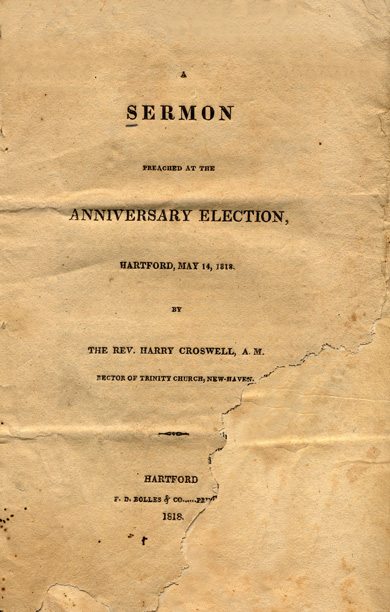
A

SERMON

PREACHED AT THE

ANNIVERSARY ELECTION,

Hartford, May 14, 1818

BY

TH REV. HARRY CROSWELL, A. M.

RECTOR OF TRINITY CHURCH, NEW-HAVEN.


SERMON.
LUKE XX. 25.
RENDER, THEREFORE, UNTO CAESAR, THE THINGS WHICH BE CAESAR’S, AND UNTO GOD, THE THINGS WHICH BE GOD’S.

Holding in high veneration, the character of our pious forefathers; feeling every disposition to treat the customs which bear the sanction of their authority, with deference and respect; I would not, without good and sufficient cause, depart from a course, which appears to have been ranked among the “steady habits” of my native state: nor would I, from an affectation of singularity, or on any other slight ground, dissent from opinions, which have long been considered by many as incontrovertible. If, therefore, on the present occasion, I shall appear to entertain doubts on the propriety of blending too closely, the civil and religious aspects of the community; or if I shall seem more solicitous to maintain the dignity of my profession, than to subserve any particular political interest: or if it shall be found that I am more ambitious to fulfill my obligations as a minister of Christ, than to offer the incense of flattery to any sect or denomination of men; I trust, you will do me the justice to believe, that I act under the influence of a solemn sense of duty—and that I am governed by no other motive, than a sincere desire to comply with the spirit of the precept, which I have selected for my text. Be this, however, as it may—I hope to find a defense of the sentiments which I may advance, and a justification of the course which I may pursue, in the example of our blessed Lord, in the case which drew this precept from his lips.

It will be recollected, that the passage before us was spoken by our Savior, in answer to a political question a question, calculated to involve him in disputes entirely foreign to his views, and at variance with the nature of his mission. It is not necessary now to refer all the circumstances of this case; nor to examine into the motives of those by whom the question was proposed to him; nor to enquire, whether the respectful terms in which it was expressed, were affected, or sincere:—“Master, we know that thou sayest and teachest rightly; neither acceptest thou the person of any; but teachest the way of God truly: Is it lawful for us to give tribute unto Caesar, or no?” [Matthew 22:16-17; Luke 20:21] It is sufficient to remark, what indeed must be evident to all, that the question was of a political nature, and involved a point on which the people by whom he was surrounded, were much divided. The Jews, on one hand, were extremely tenacious of their religious freedom; and, acknowledging no other sovereign but God, they considered their independence an essential point in their religion, and viewed every interference or imposition of the civil authority, as an infringement of their spiritual privileges. While, on the other hand, the adherents of the Roman government, who pertinaciously maintained the claims of the emperor upon the service and allegiance of the people, would have highly resented any denial of his authority, or any indignity offered to his sovereignty. The question, therefore, appeared to present insurmountable difficulties; and our Saviour himself viewed it as a temptation thrown in his way by those who proposed it, for the purpose of ensnaring him. “He perceived their craftiness, and said unto them, Why tempt ye me?” [Matthew 22:18; Luke 20:23] And then, requiring them to shew him “a penny” (a current Roman coin) he asked, “Whose image and superscription hath it? They answered and said, Caesar’s.” [Matthew 22:20-21; Luke 20:24] To which he replied, “Render, therefore, unto Caesar, the things which be Caesar’s, and unto God’s the things which be God’s.” [Matthew 22:21; Luke 20:25] As if he said—I perceive that you hold in your possession, and employ in your daily transactions, a coin, bearing the image and superscription of the emperor—that is, it is impressed with the dead or likeness of Caesar, and with his imperial titles. By receiving and using, and thus giving currency to this coin, you virtually admit the authority of his government; because it is by that authority, that this coin has received the stamp which it bears. Were you disposed to reject the authority of Caesar, you would refuse to give currency to his coin, which derives its nominal value from his image and superscription. Having thus tacitly submitted to his authority, you are bound in obedience to his laws, and to pay that tribute which he requires for the support of his government. You must render unto Caesar, the things which be Caesar’s. But, having done justice to Caesar, you are not thereby absolved from your duty to God. To Him, you owe that love, and reverence, and worship, of which no earthly power has a right to deprive him. It is that homage of the heart, which you cannot withhold from your Almighty Sovereign, without incurring the guilt of flagrant ingratitude and impiety. You must, therefore, also render unto God, the things which be God’s. “And they could not take hold of his words before the people; and they marveled at his answer, and held their peace.” [Luke 20:26] Such is the example, on which I rely, to defend the sentiments which I feel bound to express on this occasion. Such is the case, which I adduce to show, that it is both improper and hazardous for those who minister in holy things, to intermeddle with the party-politics if the times in which they live. Such is the authority, on which, I trust, the opinion may be maintained, that political and religious concerns are separate and distinct, and that they cannot, without manifest inconsistency, be blended together.

In the precept before us, our Divine Lord and Master as clearly defined the limits and jurisdiction of the two empires of heaven and earth. A distinguishing line is here drawn between our temporal and spiritual concerns, and between our civil and religious rights and obligations. Keeping this distinction constantly in view, therefore, I propose now to apply the principle embraced in the text—

First, to all classes and descriptions of men, collectively—
Second, to those who are in authority, as civil rulers and magistrates—
And third, to those of the clerical profession.

1. All classes and descriptions of men, are bound to render unto Caesar, the things which be Caesar’s, and unto God, the things which be God’s. If the subjects of the Roman empire, by possessing and giving currency to a coin which bore the image and superscription of Caesar, became obligated to submit to his government, and to pay the tribute which he demanded—it must be admitted, that every citizen of a free country, by accepting the protection, and receiving the benefit, of the laws enacted by the government, binds himself in honor, in justice, and in good faith, to yield obedience to that government, and to contribute to its support. A difference in the constitution or form of government, can make no difference in the principle. Is the citizen protected in the enjoyment of his rights and liberties—his property and his reputation? Does he pursue his proper calling, under the guardianship of the laws? Does he seek redress, when he is wronged? Does he sit securely under his vine and his fig tree; and does he enjoy his fireside unmolested? These are the only proper questions for his consideration, in determining what is due from him to his government. And if he can answer these questions only in the affirmative, if follows, as a necessary consequence, that he owes allegiance to the government. He cannot refuse an equitable return of that tribute or pecuniary support, which the management of the public concerns may require. We perceive, then, that the only manner in which we can render unto Caesar, the things which be Caesar’s—in which we can fulfill our duties and obligations to the civil government, under which it has pleased God to place us—is to yield to that government obedience and support, to submit quietly to its laws, and to contribute cheerfully towards its necessary and lawful expenditures. This appears to be a fair construction of our Lord’s precept; and the same principle is supported by the general tenor of the scriptures. And hence we conceive, that the minister of Christ cannot safely or justly inculcate any other political sentiment, amid the conflicting and discordant opinions of his fellow men. But if we owe thus much to Caesar—to our civil government—how much more do we owe to God! to that Almighty Ruler, who created us by his power, who preserves us by his providence, who redeemed us by his love, and who sanctifies us by his grace. We must not only obey him; but our obedience must be prompted by that love and gratitude, which carry the whole heart and soul into his service. We must be tributary to him: But instead of that perishable substance, which derives its value from the image and superscription of an earthly prince, the tribute which we owe to Him, is that living an immortal spirit, which is rendered invaluable, by the “form and pressure,” THE IMAGE, AND THE NAME OF GOD! The entire energy of the soul, must be poured out in reverence, in worship, and adoration, or we withhold that tribute which we owe to our Almighty Sovereign. We possess no treasure that can be substituted for this tribute—nothing that can exempt us from this obedience. No outward forms of submission—no cold or formal compliance with appointed ordinances—no zeal or fervency in support of peculiar doctrines or tenants—no vain-glorious or arrogant pretensions to exclusive sanctity—no sacrifices we can possibly make, save only the sacrifice of the heart, can prove acceptable to our heavenly Master. Nothing in this world—no created substance—nothing within the power of men or angels—can redeem the pledge, by which the soul is bound to God. If it can profit a man nothing, though he gain the whole world, and lose his own soul [Matthew 16:26; Mark 8:36]—so it would avail him nothing, were he to offer the whole world to God, and withhold his own soul. Thus, in the general application of the precept under consideration, we perceive how far the empire and jurisdiction of our earthly rulers extend, and where the claims of our heavenly Sovereign commence. We perceive the dividing line between our temporal and spiritual concerns, and between our civil and religious rights and obligations. If, in the one case, we withhold our obedience and support, we render not unto Caesar, the things which be Caesar’s; and so, in the other, if we withhold the entire devotion of the heart and soul, we render not unto God, the things which be God’s.

2. Those who are in authority, as civil rulers and magistrates, are bound, in their official capacity, to render unto Caesar, the things which be Caesar’s, and unto God, the things which be God’s. In making this application of the of the precept, the necessity of keeping constantly in view, the distinguishing line between our civil and religious rights and obligations, is sufficiently apparent. Because it is manifestly important to know, how far the civil ruler may interpose his authority in matters of a religious nature, without over-stepping the boundaries of his province, or usurping the prerogative of heaven. Touching this point, then, let us ask, whether the civil rulers of a commonwealth, composed of various denominations of Christians, can, consistently with the rights of all, exercise authority or control over those concerns which are strictly spiritual?—Or whether they can prescribe rules of faith, or modes or worship, for the great body of the people, without violating the spirit of this precept? Man is required to worship God, in spirit and in truth: and it has been already shown, that no tribute can be acceptable to the Almighty, except the free-will offering of a devoted heart. Indeed, it cannot be supposed, that services rendered by constraint—or in mere conformity to prevailing customs or habits—or to gratify the wills or affections of men—can be such a tribute, as a Being of infinite purity and boldness requires. And may not the interference of the civil government in matters of this nature, give such a bias to the mind, and impose such shackles on the will, as entirely to change the quality of the offering? Is it not the natural tendency of such an interference, to give to the religious services of the people, an appearance rather of subserviency to Caesar, than of devotion to God? If this be admitted, the civil ruler will undoubtedly hesitate long, before he will consent to exercise any authority or control in spiritual concerns. Aware that it is the prerogative of God, solely and exclusively to judge the heart; and aware also, that all men are accountable to Him alone, for the motives which govern them in their intercourse with heaven, the civil government will abstain from every measure, which may seem to usurp the rights of conscience, or which may obtrude on ground forbidden to any earthly power. All laws which tend, either directly or indirectly, to prevent the freedom of spiritual exercises—either by setting up distinctions among the different denominations of Christians—or by elevating one denomination above another—or by granting exclusive privileges to the one—or by withholding favors from others—will be carefully avoided. Nor will the government give the sanction of its authority to any habits or customs, which are likely to overawe the conscience, or cause the sense of responsibility which man owes to his Eternal Sovereign, to be transferred to his temporal rulers. The question, therefore, again returns—whether the authority of the civil ruler can, in any case, extend to matters of a religious nature? The peace and good order of society—the safety and tranquility of the people—undoubtedly depend upon the strict observance of those divine commands which prescribe a man his moral duties. Hence, it becomes the duty of the government, to found all its laws upon the moral precepts of the Bible: and the right of inflicting temporal penalties for breaches of the moral law, must follow as a necessary consequence. But all this, it will be observed, relates only to temporal affairs: and this interference is not designed, nor is likely to produce, any other than a temporal effect. It has no concern whatever with the heart or conscience. And although God may so overrule the measures of the government, as to render them instrumental in the work of conversion; yet it is not ordinarily expected, that outward punishment will produce internal renovation. Thus, then, we perceive, in this application of the precept before us, that the boundaries between the two empires can be distinctly marked. The utmost power of man, can extend only to outward and temporal concerns—while every thing relating to faith, reverence, worship, and devotion—every thing which depends on the feelings, affections, and sentiments of the inner man—belongs exclusively to God. We may therefore conclude, that the civil government cannot prescribe rules of faith, or modes of worship, for the great body of the people, without claiming for Caesar, the things which be not Caesar’s—without violating that great charter of Christian liberty, which was written by the Spirit of God, and sealed by the blood of the Savior.

3. But I am now, thirdly, to apply that precept in the text, more particularly to a class of men, whose political and religious rights and obligations, are not to be defined by the same rules which govern other cases, and whose temporal and spiritual concerns, cannot be measured by the same standard. I allude to those who are of the clerical profession. And in this application, it will be proper to consider the things of Caesar as the general concerns of the world, in contradistinction to those things which are spiritual. This class of men profess to be solely and exclusively devoted to God and his service. They profess to have relinquished the world, with all its concerns—its wealth, its honors, and its pleasures. They profess to be the ambassadors of Christ—the publishers of his gospel—the stewards of his household—the shepherds of his flock: and the acknowledge and confess, that after the entire devotion of their time and talents to the cause of their divine master, they still may prove unprofitable servants. From these men, then, Caesar, or the things of this world, can justly claim but little: and it may not be improper to enquire, in what way they may be liable to render unto Caesar, the things which be not Caesar’s and, consequently, withhold from God, that tribute which of right belongs to Him alone. If men, professing to have given up this world—shall still pursue its vain objects—shall still covet its perishable riches—shall still pant after its fleeing honors—shall still participate in its corrupting pleasures—do they not thereby depart from the plain import of their profession? Do they not injure the cause in which they are engaged? Do they not neglect their high and indispensable duties and obligations? And do they not violate both the letter and the spirit of the precept of our blessed Lord? Again, if men, bearing the commission of ambassadors of Christ, shall so far forget the allegiance they owe to him, as to listen to the overtures of any earthly power, or lend their influence to subserve any temporal interest—do they not thereby betray the sacred trust reposed in them, and treacherously surrender the rights of their master? Again, if these men, while pretending to publish and proclaim the gospel of truth, of peace, and salvation, shall, on the contrary, become promulgators and heralds of a spurious divinity, so mingled with the maxims of the world, and so degraded by the impurities of natural reason, as to obscure the truth, engender strife, and defraud man of his eternal hopes—do they not prove themselves the slaves of Caesar, though disguised in the livery of Christ? And again, if men, under the name of shepherds of the flock of Christ, shall appear more intent on feeding themselves, than on feeding the flock—if they shall neither strengthen the diseased, nor heal the sick nor bind up the broken, nor bring back that which was driven away, nor seek that which was lost—but shall suffer the sheep to wonder through all the mountains, and the flock to be scattered upon all the face of the earth—can such unfaithful shepherds expect any thing from their Sovereign, but denunciations and judgments? No—they cannot hope to hear the approving sentence, Well done, good and faithful servants! [Matthew 25:21] These are among the cases, in which the precept before us may be violated: but others, of a still deeper shade may be mentioned. If those, for instance, who have received the office of ministers in the church of Christ, shall engage in the political contentions and disputes of the day; and shall thereby foment party animosity and discord among the people, and disturb that peace and harmony, which they are bound, by the most solemn of all obligations, to cherish and maintain—how can they excuse themselves from the charge of perverting the sacred things of God, to the gratification of the unholy passions of man? And how much more culpable must they appear, if they shall carry their devotion to the things of the world and to Caesar, so such a length, as to pollute the temple and the pulpit, which are solemnly consecrated to the service and worship of Almighty God, by converting them unto forums, for political disputation! Thus we perceive the various ways in which they are liable to violate the precept. And we perceive the necessity of constant watchfulness and circumspection on their part, lest they should be found blameable, in rendering unto Caesar, the things which be not Caesar’s, and in withholding from God, the things which be God’s.

Having thus made the proposed application of the principle embraced in the text—to the people collectively—to the civil rulers and magistrates—and to the clergy—I shall observe the same classification in a few closing remarks.

Under a system of government, where the whole sovereignty of the state returns annually to the hands of the people, we seldom discover any want of attachment or respect to the civil rulers, or any disposition to withhold from hem, that obedience and support, which they have a right to claim. It is unnecessary, therefore, to ask you, my brethren, whether you render unto Caesar, the things which be Caesar’s. But there is a question of infinitely greater importance, which I am bound to impress home upon your hearts and consciences:—Do you render unto God, the things which be God’s? Does that Almighty Sovereign, by whose power you were created—by whose providence you are upheld—by whose love you were redeemed, and by whose grace you were sanctified—receive that tribute which he rightfully demands from his creatures? Have you given him your hearts? Have you surrendered your wills and affections to his guidance? Have you humbled yourselves before him? Have you poured out, on the foot-stool of his throne, the entire energy of your souls, in love, in worship, and adoration? Remember the immortal pledge, by which you are bound to the service of the Great Jehovah. Think not, that the external homage of a poor, perishing body, or the dross of this world’s wealth, can redeem that pledge. The treasures of this world will soon lose their value. The body, with all its powers, soon be mingled with the clods of the valley.—The dust must “return to the earth as it was.” But, “the spirit shall return to God who gave it.” [Ecclesiastes 12:7] Yes—while the body is mouldering in the grave, the immortal spirit shall still live. It shall again reanimate the scattered dust, on the morning of the resurrection: and it shall be held responsible before the bar of our Eternal Judge, for the manner in which every precept of holy write has been complied with. Have you rendered unto God, the things which be God’s? will then be the great and momentous question, for every soul to answer. And if the bare suggestion, now excites a momentary alarm—what must be the effect of such a question, amid the tremendous scenes of the final day—when the awful concerns of eternity are laid open to the view of the countless throng, who shall then surround the judgment-seat?

Honored and respected rulers! In expressing my sentiments on the subject before us, I have aimed at a plainness and frankness becoming my profession.—Allow me, however, to indulge in a hope, that I have not been so unfortunate, as to violate any rule of decorum, or overstep the limits of my province. With state affairs, I claim not the right, I feel not the disposition, to meddle. But for the holy religion which I profess—for the Church, in which I have the happiness to minister—I feel bound, on all proper occasions, to plead. Suffer me, then, to avail myself of this opportunity to express an earnest hope, that those who are called to administer the government by the united suffrages of a free people, will regard the religious rights of all, with an equal and impartial eye—that all denominations of Christians, may enjoy the privilege of worshipping God according to the dictates of their conscience, without the fear of incurring the displeasure, or forfeiting the favor, of their rulers—that our religious services may be free from every mixture of human policy, and every bias of worldly influence—and that the incense which ascends to the throne of grace, may be that “pure offering,” [Malachi 1:11] which constitutes the only acceptable tribute that man can render to God.

My brethren of the clergy! I need not apologize for the freedom with which I have spoken of the rights and obligations peculiar to ourselves, and of the importance of our Lord’s precept, when applied to our practice. The subject undoubtedly demands our attention. And as there are few occasions which call such a number of our profession together, I have deemed this a fit and proper opportunity for expressing, not only my own sentiments, but those held by the Church generally to which I belong. And as we have little reason to hope, that we shall all meet again in this world—you will permit me now, on parting, to add a word of exhortation. Let us, then, my brethren, endeavor to profit by the precept before us. Aiming to maintain the honor of our profession, and the dignity of the Christian ministry, let us not become instrumental in debasing them, by worldly mixtures. Let it be our study to stand aloof from those disputes, which disturb the peace and harmony of society. Let us not suffer ourselves to be drawn into measures, which may tend to promote the spirit of party among our respective flocks. Let us not give any reasonable cause for suspicion, that our influence is exerted in those political questions, by which the community is unhappily divided. Let us not put it in the power of the historian, to accuse us of descending from our high calling, to mingle in those dissentions, which are the offspring of human pride and passion. And, above all, let us beware that we do not defraud our Lord and Mast of his rightful claims. His kingdom is not of this world. He is jealous of his honor; and will no suffer his unfaithful servants to escape unpunished. We know the nature of our obligations. We know by what solemn vows we have enrolled ourselves under the standard of the Cross. We know that we stand pledged, by every thing dear and sacred to man, to preach CHRIST CRUCIFIED. Let us not, then, incur the dreadful quilt of preaching a religion without a Cross. Let us not glory, save in the cross of our Lord Jesus Christ. [Galatians 6:14] By this cross, let the world be crucified unto us: and by the same cross let us be crucified unto the world.

And to God, the Father, Son, and Holy Ghost, be ascribed all the honor and glory, now, henceforth, and forever. Amen.

Sermon – Election – 1824, Massachusetts


Daniel Sharp (1783-1853) immigrated from England to America in 1805. He was a pastor of a Baptist Church in Newark, NJ (1809-1812) and a Baptist Church in Boston (1812-1853). Sharp was also a Brown University fellow (1828-1853). The following election sermon was preached by Sharp in Massachusetts on May 26, 1824.


sermon-election-1824-massachusetts

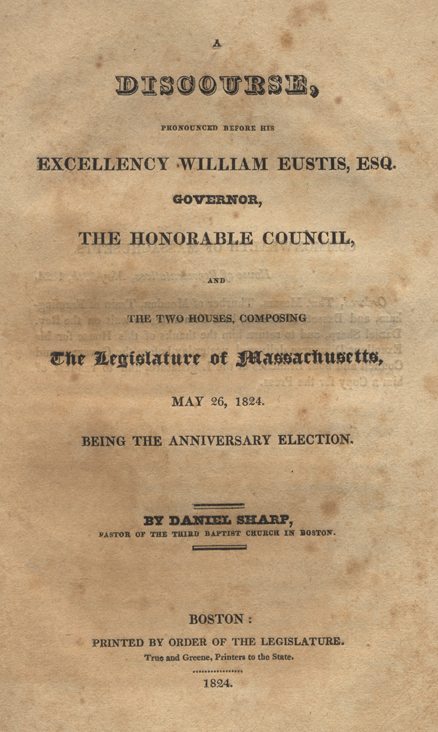
A

DISCOURSE,

PRONOUNCED BEFORE HIS

EXCELLENCY WILLIAM EUSTIS, ESQ.

GOVERNOR,

THE HONORABLE COUNCIL,

AND

THE TWO HOUSES, COMPOSING

THE LEGISLATURE OF MASSACHUSETTS,

MAY 26, 1824.

BEING THE ANNIVERSARY ELECTION.

BY DANIEL SHARP,
PASTOR OF THE THIRD BAPTIST CHURCH IN BOSTON.


COMMONWEALTH OF MASSACHURSETTS.
House of Representatives, May 27th, 1824.

Ordered, That Messrs. Thurber of Mendon, Train of Framingham, and Bassett of Boston, be a Committee to wait on the Rev. Daniel Sharp, and to return him the thanks of this House for his Excellent Discourse delivered yesterday before the Governor and Council and both Branches of the Legislature, and to request of him a Copy for the Press.


DISCOURSE.
JEREMIAH……CHAP 30, VERSES XIX, XX, XXI.

And out of them shall proceed thanksgiving, and the voice of them that make merry: and I will multiply them and they shall not be few; I will also glorify them and they shall not be small. Their children also shall be as aforetime, and their Congregation shall be established before me, and I will punish all that oppress them. And their Nobles shall be of themselves, and their Governor shall proceed from the midst of them.

In this chapter the Prophet foretells the deliverance of the Jews from captivity in Babylon, and the blessings connected with their return to the land of their fathers. When we recollect the deep-toned anguish with which he elsewhere records the sufferings of his countrymen, it is easy to conceive, that he should announce the termination of their calamities, and the commencement of a happy era in their history, with all the glow of patriotic delight.

And as a man of piety, his delight must have been greatly increased, when he foresaw, that in the enjoyment of profusion of blessings, the author of them would not be forgotten. He was told, that the voice of joy and thanksgiving should be heard, and that the people would have such a conviction of the kindness of their deliverer, as to engage their hearts to approach unto Him.

There can be nothing more pleasing to God, or more in unison with a spirit of enlightened piety, than a devout and grateful acknowledgment of his benefits. This is a duty which we all owe to our Maker. But if we would perform this duty acceptably, and make it a reasonable service, we must meditate on our personal and relative condition; we must ponder on the nature, extent, and variety of our blessings; and not only review the history of the past, but look forward to the cheering prospects of the future. When our thoughts are thus employed, whatever may be our situation, whether we dwell in the shades of private life, or are elevated by the suffrages of our fellow citizens to public and honorable station, we shall feel innumerable reasons for thanksgiving to Almighty God.

As the Civil Authorities of the Commonwealth are assembled in this house, to render homage to the Governor of the World, and to pray that he would guide their Counsels and bless their measures for the public good, it will not perhaps be deemed unsuitable to the occasion, should I remind them, and my fellow citizens who are present, that the past kindness of Providence to our Country, and the excellent nature of our Civil Institutions, have special claims on our gratitude.

It would be impossible in one discourse, to enumerate all the blessings of our social and political condition. I shall therefore confine myself to such topics as are suggested by the prediction in our test. In doing this you will not fail to observe, a remarkable coincidence between the blessings that were promised to the Jews, and those for which our nation is so highly distinguished.

1st. it was predicted, that their population should greatly increase. “I will multiply them and they shall not be few.” In the sacred writings, nothing is more common, than to describe the prosperity of a nation by the number of its inhabitants. The promise made to Abram, that his seed should be as the stars of Heaven for multitude, was an assurance that they would become a mighty and prosperous people. When Moses was about to resign the cares of office, he expressed his desires for the prosperity of the Israelites in the following prayer; “The Lord God of your fathers make you a thousand times so many as ye are, and bless you, as he hath promised you.” It was also mentioned by another prophet as a special token of divine favor, that a little one should become a thousand, and a small one a strong nation.

There may indeed, be such a state of society, and such arrangements concerning the distribution of property, that an increase of population may be viewed with dread. Even men of enlarged and philosophical minds, may only consider it, as the introduction of so many human beings to swell the tide of misery and vice which already flows through the poorer classes of the community.

But there is nothing in our political Institutions, or the possible limitation of our means of subsistence, which can make an increase of population, a subject of gloomy foreboding to us. So far from this, when we read the history of our country, and learn from how small a beginning we have already become a numerous people, we are sensible that we have great cause for gratitude.

When the pious but feeble band of Pilgrims landed at Plymouth, and asked as a boon, that they might be permitted to dwell among savages; who among them could have thought, that their posterity would have extended over so many States? Had any of the number been endowed with the gift of prophecy, and like the bards of old described, what would be the condition and increase of their descendants after the lapse of two hundred years, he would have been to them as one that dreamed. They could not have believed him for joy. But God has multiplied us, so that we are not few. There are at this time more than a million and a half of inhabitants in New-England; and it has been stated by respectable authority, 1 “that there are now more than a million of people, descendants of New-England ancestry, living free and happy, in regions which sixty years ago, were tracts of unpenetrated forest.” And what is still more gratifying, these people have carried with them from the home of their Fathers, the love of literature and religion; and those habits of industry virtue and economy, for which New-England has been so justly celebrated.

When from the sons of the Pilgrims, we direct our attention to the present number of inhabitants in the United States, we shall find, that the population of no other modern nation has advanced with equal rapidity. At the commencement of the war of the Revolution, there were about three millions of people, and now there are nine millions enjoying the blessings of rational freedom; and having the means of support within their power. There are also physical and moral causes peculiar to this country, now in operation, which render it certain, that in the ordinary course of Providence, its inhabitants, will become exceedingly numerous.

Now as a great population must bring within our reach more of the necessaries and comforts of life; and by facilitating to a greater extent the distribution of labour, must also make us less dependent on other nations, and less liable to insult and wrongs; we cannot do otherwise, than view it as a great blessing, that God has multiplied us and we are not few.

I need not tell you, my respected hearers, that the real glory and prosperity of a nation does not consist in the hereditary rank, or titled privileges of a very small class in the community; in the great wealth of the few, and the great poverty of the many; in the splendid palaces of nobles and the wretched huts of a numerous and half-famished peasantry. No! such a state of things may give pleasure to proud, ambitious, and selfish minds, but there is nothing here on which the eye of a patriot can rest with unmingled satisfaction. In his deliberate judgment;

“Ill fares the land, to hast’ning ills a prey,
Where wealth accumulates, and men decay;
Princes and lords may flourish, or may fade;
A breath can make them, as a breath has made;
But a bold peasantry their country’s pride,
When once destroy’d, can never be supplied.

It is an intelligent, virtuous, free and extensive population, able by their talents and industry to obtain a competent support, which constitutes the strength and prosperity of a nation.

2d. One of the advantages arising to a community possessing the character I have just described, is, the impression made on other nations of their greatness and power.

Here we perceive a very distinct resemblance between the promise made to Israel, and the commanding attitude in which the United States stand forth to the view of the kingdoms of the earth. The Lord said, concerning his ancient people; “I will also glorify them and they shall not be small.” That is, he would make them appear great and formidable in the eyes of surrounding nations. The same promise in substance had been made to their ancestors, just before they entered Canaan. “This day, said the Almighty, will I begin to put the dread of thee, and the fear of thee, upon the nations that are under the whole heaven, who shall hear report of thee.” You can easily suppose, that this must have operated as a powerful check on the unjust and ambitious designs of neighbouring princes, and thus have contributed much to the peace of the nation. In the same manner God has glorified the American people. And the fruits of this blessing are seen in the quiet repose they enjoy at home, and he unrivalled prosperity of their commerce abroad.

Events have taken place in the history of our country, which have indelibly impressed every European Government with the conviction of our power. It was remarked, by one of your most eminent statesmen, more than half a century ago, when referring to the difficulties which finally terminated in the Independence of his country; “Our Fathers were a good people, we have been a free people, and if you will not let us remain so any longer, we shall be a great people.” 2 Whether these words were written in the spirit of prophecy or not, they have literally been fulfilled. God has exalted us in the sight of the nations. They have had the most indubitable proofs of the wisdom and sagacity of our statesmen; they have seen the skill and valor of our warriors; they have acknowledged the prowess of our navy; they have been convinced of the universal patriotism of our citizens; they have heard of the enterprise of our merchants; the ingenuity of our artisans; the industry and happiness of our husbandmen; and the respectability of our men of literature and science.

Now the estimation in which we are held by foreign powers, lays us under special obligations of gratitude to God. To this cause, we may in a great measure ascribe our peace and prosperity; the preservation of our fellow citizens from the toils and dangers of war; and the undisturbed endearments of domestic life. It is because God has glorified us, that our rights are not infringed; and that no wicked design of subjugating us or of dictating to us; under what kind of government we shall live, has been attempted. I have made these statements, not to excite within you a spirit of national pride, but the feelings of joy and humble gratitude to the author of all good.

3d. The permanency of their Civil Institutions is enumerated among the causes why the people of Israel would be thankful. “Their children also, shall be as aforetime, and their Congregation shall be established before me.” They shall be restored to the blessings which their Ancestors enjoyed. The people at large shall be established. The compact which binds them together, shall be indissoluble. And is there I ask, a people under Heaven, who in this respect have equal cause of thankfulness with ourselves? We have a government founded in reason, and the fitness of things. It emanates from the will of the Sovereign People. It is adapted as all Governments should be, to promote the greatest good of the whole. And while it wisely provides for the honour and dignity of the Officers of State, yet it also provides, that all their power and authority shall be derived from, and dependent upon the people.

When our social compact was first formed, the enemies of freedom predicted its speedy destruction. They asserted, that it was too weak to hold the distant and diversified parts of the union together; and denounced it as an experiment of doubtful tendency, and were fearful that it could not be permanently established. But not one of these gloomy predictions have been verified. The Demon of Anarchy has not desolated our land. Our social compact has held the different parts of the Union together. It is firmly established. And it proves to be a wise and beautifully organized system; diffusing its salutary influence from the north to the south, and from the east to the west. It blesses alike the rich and the poor, and has this distinctive excellence, that it neither favours nor oppresses any particular denomination of professing Christians. While it is perpetually conferring the most substantial benefits upon us at home; it is viewed from abroad, by the Philosopher and Philanthropist of every other Country with wonder and delight.

What cause have we my hearers for thankfulness. While the political Institutions of other countries are tottering under the infirmities of age; ours just in their prime, are receiving firmness and solidity by the addition of years. While wise men in other nations are hoping, and yet fearing a change; while they are expecting, and yet dreading alterations in the social edifice; we are dwelling in ours with security. Relying on the continued kindness of Providence, we are neither agitated by the fear of storms from without, or strife from within.

Our satisfaction would indeed be greatly diminished, could we perceive anything in the character or condition of the community, that portends the probability of a change in our rational form of Government. But we are confident that our political Institutions will be permanent. Scarcely any of those causes exist in our Country, which have been so unfavourable to the attainment or preservation of Civil Liberty in other nations.

We have no great Military power to awe us into submission to unjust and arbitrary measures; or to put on us chains of bondage, and make us wear them. The means on which we chiefly rely for national defense consists in a Militia, whose interests and happiness are identified with those of the people, and who in fact are the people. There can therefore be no danger, that an organized body of men, who are habitually engaged in the peaceful and profitable avocations of life, should ever use their arms for the insane purpose of destroying their own sacred rights and dear bought liberties.

It is also a circumstance peculiarly favourable to the permanency of our free Institutions, that we have no established Priesthood. It is a melancholy fact, that wherever a union between Church and State has been the last in granting a particle of liberty to the people; and always the first in aiding to take it from them. This has not happened because they were worse than other men, but from the very nature of their connection with the State. They have felt, that it was only dutiful and grateful to strengthen the hand that fed them. And they have known, that it was in vain to aspire at clerical dignity, or the smiles of Court favour, unless they were strenuous supporters of the prerogatives of Princes. Hence both interest and inclination have made them the unblushing advocates of the divine right of Kings and of the Doctrine of non-resistance and passive obedience.

We sincerely bless God, that the ministers of every denomination in this Country, are shut out from all hope of ever being connected with the State; and that they are under no temptation to degrade Religion by employing it as an instrument of secular power. We hope few have the disposition, and we are glad that none have the ability either to control the consciences, or abridge the liberties of their fellow men on account of their religious opinions. It is the glory of our social compact that it leaves truth and error, equally unshackled, to contend against each other; and that it knows nothing of that monstrous system which inflicts fines, imprisonment and tortures on the body under the hypocritical pretence of doing good to the soul. An entire separation of the Church from the State, is then, a subject of congratulation, because this circumstance is favourable to the permanency of the freedom of our Government.

Neither is there with us, that utter destitution of knowledge in the poorer classes of the community, which, were it exists, renders them incapable of self-government, and of discerning the nature and proper boundaries of Civil Liberty. Notwithstanding all that has been written on the semi-barbarous state of Society in this Country, there is not a nation on the Globe, with perhaps, the exception of Scotland, where the means of Education are so free and extensive, and where the people so generally avail themselves of them, as in the United States.

“By the Constitution of the United States, says Mr. Ingersoll, it is the duty of government to promote the progress of science, and the useful arts. Not one of the eleven new States has been admitted into the Union without provision in its Constitution for Schools, Academies, Colleges, and Universities. In most of the original States large sums in money are appropriated to Education, and they claim a share in the great landed investments, which are mortgaged to it in the new States. Reckoning all those contributions, federal and local, it may be asserted, that nearly as much as the whole national expenditure of the United States, is set apart by laws to enlighten the people. Besides more than half a million of pupils at public Schools; there are considerably more than three thousand under graduates matriculated at the various Colleges and Universities, authorized to grant academical degrees; not less than twelve hundred at the Medical Schools; several hundred at the Theological Seminaries; and at least a thousand Students of law,” with a population thus informed, and who feel all the lofty consciousness of being freemen; we may well be confident that “their children shall be as aforetime; and their congregation shall be established.”

Nor ought we to omit a consideration of the fact, that as a people, we are strangers to that extreme poverty which, by creating a sense of dependence is unfriendly to the liberty of the citizen. When a large population, however virtuous and industrious they may be, find it difficult to obtain the necessaries of life, they must have cares which claim their attention much more effectually than the consideration of government and laws. Hence to procure a bare subsistence, they are frequently obliged to give their suffrages in support of measures which are subversive of the dearest rights of man. But where the state of property is different; where the great body of the people are possessors of the soil; and feel that they have a personal interest in all the enactments of the State which affect the liberty or property of the individual; they will be careful that the blessings they enjoy shall be transmitted to their posterity unimpaired.

And I may add that the infrequency of elections which has operated against the rights and liberties of the subject in other countries, is an evil which does not exist here. The frequency of elections produces a sense of responsibility in those who are appointed to office; it prevents in a great degree that abuse of power and inattention to the interests of their constituents which has frequently marked the conduct of Legislators when they have held their office for a long term of years, or for life; and it also gives the people an opportunity of expressing in a silent but forcible manner, their views of the public measures which have been pursued. From this general, but rapid view which we have taken of our situation, we may anticipate with pleasure the permanency of our political Institutions. We cannot perceive in them any elements of decay; nor anything in the condition or future prospects of the Republic, that should lead us to expect they will be changed.

4th. It was stated by the Prophet, that his people would be joyful, because their Nobles should be of themselves, and their Governor should proceed from the midst of them.

Such a change in their political condition, must have appeared to them an invaluable blessing. They had been long under a foreign yoke. The nobles who had governed them, were regardless of their welfare. They took their young men to grind, and the children fell under the wood. They also added insult to injury. For they that carried them away captive, required of them a song; and they that wasted them required of them mirth. It was therefore impossible for them to be restored to liberty and independence, and to have rulers from among themselves, without sensations of unutterable joy.

Nor can the possession of similar blessings be overlooked by us without incurring the guilt of ingratitude. There was a time which some off you are not too old to remember, when your nobles came from abroad, and strangers exercised authority over you. Men whose feelings, habits, and pretensions were dissimilar to your own, held the highest offices in the State. Many of them no doubt, were persons of much private worth and general excellence of character. But the source from whence they derived their dignity and power, and the conditions on which they retained them, forbade their taking that earnest and undivided interest in the welfare of the Commonwealth, which may always be expected from men of principle, when chosen by the people.

The right to choose our Governors from the midst of us, when wisely exercised, is attended with many and great advantages.

It gives the people an opportunity of placing in the Chair of State, men of talents, integrity and patriotism. Nor can any good reason be assigned, why our civil rulers should not always be persons, of clear and comprehensive views, capable of discerning the complicated interests of the community, and determined impartially to promote them. If we are just to ourselves, our social condition must be superior to that of any nation whose Chief comes to the possession of supreme authority by natural descent. In this case it is altogether uncertain, whether he who is to reign will be wise or foolish; devoted to his pleasures or the welfare of his country. Notwithstanding the general joy that is manifested at his birth, no one can tell whether he will be a blessing, or a scourge; a benefactor, or a tyrant. It is then a right, not to be valued lightly, that we can select the ablest and best citizens amongst us to direct the affairs of the Commonwealth.

There is another advantage in the election of our Civil Rulers from the midst of us, perhaps as great as the one I have just mentioned. They must feel a greater interest in the welfare of the people, and exercise a deeper sympathy in their situation, than could be expected under any other form of government. In other nations, Rulers are not from the midst of the people. In their own estimation at least, they form a distinct and higher order of beings. They pride themselves in their birth and blood; and look upon all others as an inferior race of mortals. Hence they do not consider themselves as occupying important stations for the good of the people. They consider them as a vulgar herd, made to minister to their pride and pleasure. They view their own interests not only as separate, but at variance, with the interests of the common people. Under the influence of these views and feelings the most powerful Monarchs on the Continent of Europe, have entered into what we believe to be a base and unholy alliance against the rights and liberties of all their subjects. When the Empress Catharine of Russia wrote a letter of advice and sympathy, to the unfortunate Queen of France just before the Revolution; she expressed it as her opinion that, “Kings ought to proceed in their career, undisturbed by the cries of the people, as the moon pursues her course unimpeded by the howling of dogs.” While the feelings of horror come over us at a recollection of the atrocious cruelties of the French Revolution, yet we cannot but detest the cold hearted selfishness that could dictate such counsel as this. And yet, what is it, but the proud, unfeeling, and despotic spirit of Catharine, which governs the Cabinets of continental Europe?—Whatever may be the oppression and sufferings of the people there, they must stifle their groans and endure all with patience. For should they seek a redress of their grievances, this misnamed Holy Alliance has determined, that for every such presumptuous attempt, their chains shall be doubly riveted. While we devoutly pray, that He who sitteth in the heavens, would break their bands asunder, and cast away their cords from us,” let us also be thankful, that our Governors proceed from the midst of us, and not from a rank of men, who because they are elevated by the artificial distinctions of society, are gazing down on the multitude with the aspect and feelings of utter contempt. Instead of this, they feel that they belong to the people; that they have with them a common interest; and that whatever measures will affect the rights, liberties and happiness of their fellow citizens will also affect their own. They also expect in the course of events to resign the cares and honors of office, and again appear as private citizens. Now all these considerations combined, will have such an influence on their feelings, that they will labor to promote the best interests of the Commonwealth. Proceeding from the midst of us, notwithstanding the honorable station which they hold, and the respect that is justly shewn them, yet they cannot forget their accountability to the people who have chosen them. This supplies them with motives to diligence and fidelity, which owing to the imperfection of our nature the very best of men sometimes need.

And although last mentioned, yet perhaps, it is not the least advantage of a popular government, that it brings into operation a greater amount of talent than any other. It is acknowledged by everyone, that the occurrence of great events, awakens the dormant energies of the human mind, and calls forth the most splendid and powerful abilities. It was the momentous question whether your country should be free and independent, and the declaration that it was so, which gave to you, Orators, Statesmen and Generals, whose names all future ages will delight to honor. The characters of men are generally moulded by the circumstances in which they are placed.—They seldom put forth all their strength without some powerfully exciting motives. But what motives can those have to qualify themselves for stations from which they are forever excluded on account of Plebeian extraction? How can those be expected to prepare themselves for the service of their country when they know, that their services would be rejected, because unfortunately, they dissent from the established religion, and have honesty to avow it? But in a country like ours, where the most obscure individuals in society, may by their talents, virtues, and public services, rise to the most honorable distinctions, and attain to the highest offices which the people can give, the most effectual inducements are presented. It is indeed true, that only a few who run in the race for political honor can obtain the prize. But although many come short, yet the exertions and progress which they make are not lost either on themselves or society. The suitableness of their characters and talents for some other important station may have been perceived; at least the cultivation of their minds, and the effort to acquire an honorable reputation may render them active and useful members of the community. These are some of the benefits peculiar to a popular government. Benefits which we have long enjoyed. And if we form any just estimate of their value, from us will “proceed thanksgiving and the voice of them that make merry.”

His Excellency will permit us on this occasion to offer him our respectful salutations. During a long life spent in the public service of his Country, he must have witnessed her increasing prosperity at home, her fame abroad, and he permanency of her free institutions with inexpressible satisfaction. It must be gratifying to his Excellency, that he is not indebted for his present elevation to noble birth, but to the suffrages of a free and enlightened people.

Republics have been charged with ingratitude.—And if to erect magnificent palaces, and make large grants of money, be necessary expressions of national gratitude, then, we have been ungrateful. But such as the people have had, they have freely bestowed on the distinguished Patriots and Heroes of their country. All the Presidents, and nearly all the Vice Presidents of the United States, have been persons who either by their wisdom or valor, assisted in achieving our Independence. And who, possessing any greatness of soul would not prefer to be like Washington, “first in the hearts of his countrymen;” or like the venerable sage of Quincy, happy in the unfeigned respect and gratitude of nine millions of freemen, rather than receive a price for his services, which should release his country from more honorable obligations?

It is only necessary to look over the list of governors in our own State, to be convinced that gratitude for public services has not been an inactive principle here. Our last Chief Magistrate for whose private and public character men of all parties feel a sincere and profound respect, was a soldier of the revolution. Nor has it been forgotten by the people that his Excellency held an important station in the army during the whole of that eventful period. Besides other considerations which I need not name; gratitude has had its influence in assigning to his Excellency the distinguished office which he now occupies.

The resignation of his honor the Lieut. Governor, would have been a source of regret to his fellow citizens, had they not known, that his services for the State are not withdrawn. Having acceptably discharged Legislative and Executive duties, he is now clothed with Judiciary power. We doubt not that his Honor will fill the seat of justice, with high reputation to himself, and add another name to the eminent men in that department. Should he need any incitement in the performance of new and arduous duties, he will call to recollection his learned, able and upright predecessor.

The honourable Council, the Senate the House of Representatives, will please to receive our congratulations. Proceeding from the midst of the people, and appointed for the express purpose of superintending the public interests, the objects of your labors are clearly defined. But how to attain these objects in the most effectual and satisfactory manner will frequently be a subject of painful solicitude. In cases which are brought before you, where there are interfering claims, you will find it of great advantage to divest yourselves as much as possible of local and sectional prejudices, and to act under the impression, that you represent the whole, and not merely a part of the Commonwealth. There is one statute of our common Lawgiver, which if sacredly regarded, will often do more in giving a right direction to your measures than the most able and eloquent arguments. “Therefore all things whatsoever ye would that men should do to you, do ye even so to them: for this is the law and the prophets.”

It has been a part of the system of despotic governments to keep the people in a state of gross ignorance. But a polity like ours can exist to no valuable purpose unless knowledge be generally diffused. Our Legislators have always perceived this; and to their honor it should be recorded, that they have made liberal provision for our Schools and Colleges. As our wealth and population have increased, Literary Institutions have arisen in different parts of the State; nor have they been left to wither and die from an apprehension, that they would impede the growth of those already planted.

Believing that knowledge and virtue, are the pillars which support our political Fabric, we indulge the hope that our Civil Rulers will continue to bestow, impartial, and liberal aid to Seminaries of learning. The multiplication of these, is an indication that the people are rising in the scale of intellectual improvement, and one of the best pledges that we shall remain virtuous and free. And it may be expected that each College in exciting an honorable rivalry, will be ambitious to enlarge its foundation, and provide more ample means for the instructions of its Students. But these considerations, have no doubt, already occurred to you and will have their due weight in your deliberations.

With the congratulations of this day, the Governor and Council, and the two branches of the Legislature will allow me to suggest that they need the blessing of God. Whatever experience and talents, you may bring to the Councils of State, your best efforts will be fruitless without the favor of the Almighty. “Except the Lord build he house: they labor in vain that build it: except the Lord keep the City, the watchmen waketh but in vain.” It was a conviction of his entire dependence on God for prosperity, which caused a Chief Magistrate of Judah to pray; “Do good in thy good pleasure unto Zion: build thou the walls of Jerusalem.”

Influenced by the same views, are we not ready with one consent, to offer the supplication; “O satisfy us early with thy mercy; that we may rejoice and be glad all our days. Let thy work appear unto thy servants, and thy glory unto their children. And let the beauty of the Lord our God be upon us: and establish thou the work of our hands upon us; yea, the work of our hands establish thou it.”


Endnotes

1. Vide Hon. Daniel Webster’s discourse at Plymouth.

2. Hon. James Otis, Esq.

Sermon – Election – 1823, Massachusetts


Nathaniel Thayer (1769-1840) graduated from Harvard in 1789. He was a pastor in Wilkeshare, PA and in Lancaster, MA (1795-1840). The following election sermon was preached by Thayer in Massachusetts on May 28, 1823.


sermon-election-1823-massachusetts

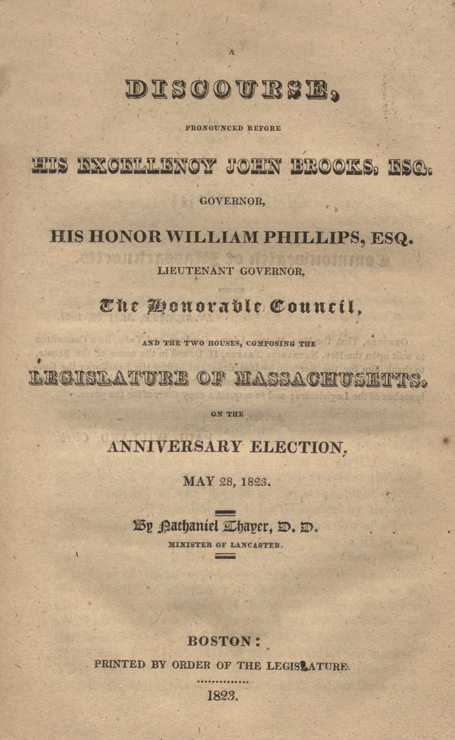
A

DISCOURSE,

PRONOUNCED BEFORE

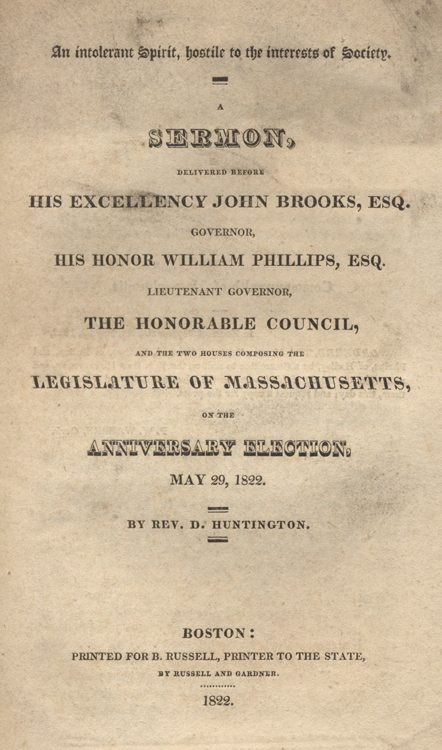
HIS EXCELLENCY JOHN BROOKS, ESQ.

GOVERNOR,

HIS HONOR WILLIAM PHILLIPS, ESQ.

LIEUTENANT GOVERNOR,

THE HONORABLE COUNCIL,

AND THE TWO HOUSES, COMPOSING THE

LEGISLATURE OF MASSACHUSETTS,

ON THE

ANNIVERSARY ELECTION,

MAY 28, 1823.

By Nathaniel Thayer, D. D.
MINISTER OF LANCASTER.


COMMONWEALTH OF MASSACHUSETTS.
IN SENATE, MAY 29, 1823.

Ordered, That the Hon. Messrs. Adams, Gardner, and Tufts, be a Committee to wait upon the Rev. Nathaniel Thayer, D. D. and in the name of the Senate, to thank him for the Sermon, by him delivered before His Excellency the Governor, His Honor the Lieutenant Governor, the Honorable Council, and both branches of the Legislature; and to request a copy thereof for the press.

Attest,
PAUL WILLARD, Clerk.


DISCOURSE.
DEUTERONOMY…CHAP. XXVI., VERSE XIX.
And to make thee high above all nations which he hath made, in praise, and in the name, and in honor; and that thou mayest be an holy people unto the Lord thy God, as he hath spoken.

It is appropriate duty of an assembly of Christian patriots, to meditate the condition and destiny of their country. They will anxiously inquire after the means, which will extend and perpetuate its honor, peace, prosperity, and happiness. From a variety of sources they may derive aid in this review. They will weigh the probable result of the form of civil government, which is adopted. They will consider the natural tendency of the degree of encouragement given to learning. Their hope will be measured by the evidence which exists of the faithful application of a correct system of morals and religion. They will be assisted in forming a judgment by the veneration which is paid to Christian ordinances. They will take into the account the character of the rulers, the course of their policy, the manners of the great, the general taste and habits of society. They will not overlook the estimate which is declared of the sacrifices and services of the founders, friends, and defenders of their nation. They will survey the history of other countries and kingdoms, and from the causes which led to their rise or decline, prosperity or adversity, will learn the reasonable grounds of expectation. They will especially consult the sacred records. From the principles there published, the conditions of national glory or debasement there revealed, they may come to a safe conclusion.

Every community may collect lessons of instruction, encouragement, and warning from the divine communications to ancient Israel. It will be found without variation, that when a purpose is affirmed, promise made, or threatening pronounced, the accomplishment is to depend on an important condition. This condition is at the direction and control of the individuals or people, who are addressed. The instance before us is an illustration. If the Israelites should “perform their solemn vows on the day, that they avouched the Lord to be their God, should walk in his ways, keep his statutes, and his commandments, and his judgments, and should hearken unto his voice,” which would be in the most comprehensive sense to gain and support the character of a holy people, they might then rely on the promise, that they should be “high above all nations, in praise, and in the name, and in honor.”

Many causes combine to raise the hope, that America is destined by providence to distinction. One of the first efforts of patriotism will be, to ascertain and urge the adoption of a course, which will lead to the highest national honor and happiness.

The attention of this respected auditory is invited to a reference to facts in the situation and prospects of our country, which encourage the expectation, that it may hold a pre-eminent rank amongst civilized and Christian nations; and to a rehearsal of the means, which in the nature of things and by the appointment of heaven, are essential to the attainment of it.

In the history of communities is found a reason for the opinion, that the character and prospects of a people depend in a degree on climate and local situation. The salubrity [fitness] and uniformity of a temperate zone have proved favorable to physical strength and intellectual vigour. Inhabitants of countries, thus located, are happily formed to endure labor; engage in enterprise; secure a reputable subsistence; and perform the responsible duties of social and civil life. When surveying our scenery, our attention is arrested by a wonderful exhibition of river, lakes, and mountains. At these, the partiality of the native citizen leads him to gaze as designed by Him, “who hath measured the waters in the hollow of his hand, meted out heaven with the span, comprehended the dust of the earth in a measure, weighed the mountains in scales, and the hills in a balance,” as indications of the uncommon grandeur of his country. He will also find much to raise his attachment to it in its remoteness from powerful nations, who, if they have the desire, can with difficulty exert the means for retarding its elevation. There is also some merciful provision, if it be duly regarded, against the rise of envying, jealousies, and evil surmisings in the inhabitants of this favored land. Each section of the territory has some distinguishing excellence. It has either an atmosphere, which is a pledge of general health; a soil, suited to the luxuriant growth of some valuable articles of subsistence, convenience, or comfort; special advantages for the amassing of wealth by agriculture, manufactures, or commerce; liberal provision for extending to the members of every class the benefits of knowledge; or circumstances, which have excited ardour in the investigation of Christian truth and support of religious institutions. We may without reservation and with patriotic pride, adopt the sentiment of a writer, who has with elegance recorded the scenes most interesting to this nation. It is a wonderful fact, that a people inhabiting such an extent of territory, of such a diversity of views and principles in politics and religion, combining so many separate and apparently discordant and jarring interests; and at the same time exhibiting “fewer diversities of character, language, habits, and interests than any empire of similar extent in the world; all this accumulation of happiness and strength would have seemed only a splendid vision, beyond the conception of prophecy.

The natural equality of this people is a source of their most sure and rapid advancement. It is not the design, nor would it be for the growth and prosperity of our republic, to present any insuperable obstacle to the existence of outward, intellectual, or moral distinctions. The great value of these is, that they are not hereditary; that they proceed from the assiduous application of talents, and that in their acquirement are developed all the energies of the human character. So long as the political principles, by which we are professedly guided, remain uncorrupt and in active force, merit and service will form the only title to exaltation and honor. We shall look upon the badge of office as a splendid phantom, if it be gained by hollow professions, a morbid state of the public feeling, and the abandonment of principles, which the experience of ages has proved the only adequate source of individual or general prosperity.

A vast variety of causes operates to the introduction of inequalities in condition and character. Natural talents, education, associations, examples, seasons for exertion, motives to excellence do each conspire to form the difference. Let it be the desire and aim of every lover of his country, to disseminate and preserve in entire activity and influence the principle, that civil distinction shall in no case be the purchase of caprice, honorable descent, party views, local considerations, sinister or ambitious designs. Let it be an avowed maxim, coextensive with our limits and existence as a people, and boldly propagated wherever a correct term of promotion or claim to public confidence may with propriety be urged, that “able men, such as fear God, men of truth, hating covetousness, shall only be exalted to any office of emolument, honor, or trust.”

Territorial extent, and the opportunity it gives for all talents to be put in successful requisition, is another fact promising distinction to this nation. Enterprise is often checked, and talents are paralyzed by the intimation and belief, that the field for exertion is limited, that the professions and various employments are so crowded with labourers, that such as are now in preparation for service have little prospect of success. Centuries will probably elapse, before this may be urged to excuse the suspension of a spirit of adventure, or extinguish the hope of finding a field for honorable activity. Let it not be said, because that speck of the country with which we are conversant is occupied, that there is no remaining scene for diligence and usefulness. Shall the Divine cherish the narrow belief, that he cannot to spiritual advantage scatter the incorruptible seed; the Physician, that he will have no opportunity for skillfully arresting the progress of disease; the Lawyer, that he cannot aid in the distributions of law and justice; the Mechanic, that he is unable to subsist by his handiwork; the Citizen, that he can accomplish no object of personal or public utility, but in the centre of a thickly inhabited village, or amidst the refinements and luxuries of a populous city? May the patriotic sentiment find many advocates, that it is greater evidence of original and strong powers, to subdue the untrodden forest, than to till the cultivated field. May the Christian belief be diffused, that he is a fairer candidate for the honors of this world, and the glories of immortality, who shall be a humble instrument of causing the moral wilderness to blossom, than he, who shall contentedly remain an inefficient and dronish incumbent on cultivated society. May it in no instance operate as a hindrance to the growth of this nation, that parental weakness and partiality, or local attachments and prejudices have stifled in our young men a spirit of emigration. May they go, and evince the benefits of their early education, by establishing for the basis of domestic happiness and civil prosperity the principles and institutions, which have hitherto been the honor and security of this people.

All the remaining facts in the situation and prospects of this nation, which are necessary to confirm the hope of pre-eminence, may be comprised in some remarks on the peculiar character of our civil and religious institutions.

The former had their origin under more favorable auspices than those of any other country. There have been governments called free besides our own. Too often were they the fruits of usurpation and conquest, and in them liberty existed only in name. Of no other may it with equal justice be said, that the government is the result of the cool, deliberative wisdom of the native inhabitants, uncontrolled by foreign influence, and oppression at home. In men of superficial judgment, or constitutional despondency, the gloomy and extravagant predictions of the frailty of our political fabric, and the short life of our republic, may be reconciled with the purest patriotism. ON the page of history they have read an unbroken narrative of the premature birth, ephemeral and monstrous growth, convulsive throes, anticipated and awful dissolution of ancient republics. Hence they have hastily concluded, that in no state of things, or period of the world could a collection of moral beings be found, capable of a protracted enjoyment of liberty. They have slightly surveyed and misjudged the broad foundation on which our government rests. The thought has escaped them, that the two massive pillars, learning and religion, which are equal to the support of a civil structure of any dimensions, were raised and consecrated on the first possession of the soil. They have forgotten too, that the original architects were not under the control of inordinate ambition, selfish and mercenary views; not the builders of an edifice, which should simply provide a shelter for themselves and the men of their own generation, but which should be a safe and commodious habitation for their successors of the most distant times. Hurried in forming a judgment by ill-boding apprehensions, they have likewise overlooked, that these were men religiously educated, resolved to jeopardize everything else, that they might remain in quiet possession of liberty of conscience.

No period can be set to the durability of this confederated republic, if the design of the original projection be not perverted. In the establishment of schools and seminaries of learning, and in the erection of temples, the most effectual means were devised for attaching permanency to our civil privileges. While these fountains of knowledge are liberally supplied, these temples saved from destruction, and furnished with a learned and faithful ministry, we have little to fear from the encroachments of despotism. A well informed and religious people are in no danger of losing their liberties.

Still more may be said of our religious institutions, should they retain their primeval character. It is an unprecedented and singular fact in the history of nations, that the first settlers of this had for a paramount motive of their adventure, in search after a resting place, the enjoyment of religious liberty. When about to form a community, they justly believed that a nation without religion could have only a limited existence, and must be in degradation and disgrace. But little inferior to this degradation did they consider the state of the inhabitants of a country, who professed and supported religion, but had in operation means to keep the understanding and conscience in fetters. In accordance with the enthusiasm for religious freedom shown by our ancestors, their descendants, when framing constitutions of government, rested the responsibility of interpreting scripture, and of electing forms of worship, with the subjects.

No enlightened and upright statesman has dared to defend the licentious opinion, that the body politic would be in a healthful and vigorous state, if the right of choosing a mode of worship were treated with general indifference. We do not plead for anything resembling a national religious establishment. Forms of worship and systems of faith, supported and embraced by us, cannot be of a truly Christian character, or accord with the liberty of inquiry and choice, supposed and ensured by the Great Teacher from heaven, but when they are the result of a candid and independent investigation of revealed truth, and are adopted with the deliberate and settled conviction, that they correspond to the general spirit of his Gospel.

We can with difficulty make an exaggerated representation of the value of religious institutions, in their effect on the state and character of communities. Let it be tested by a small corporation. The habitual attendance on the duties of the Sabbath, has a benign influence on the domestic state, social intercourse, ordinary transactions, general manners. It tends to allay the turbulence of passion, liberalize the feelings and sentiments, restrain corrupt propensities, give a regular and moral direction to the whole conduct.

Imagine Christian ordinances to have universal patronage, and you will find a diminution of crimes, a gradual but incessant elevation of the moral taste, an industrious and upright use of all the means of outward prosperity. Should this nation be thus distinguished, you may expect that it will be high above all nations in praise, and in name, and in honor.

The things, to which we have referred, all tend to national dignity. From them has come the unexampled rise, the present standing, and whatever is admirable or exhilarating in the prospects of this community. Apart from the public opinion and course, they have not in themselves the power of preservation and progress. There are means, which are essential evidence of the nurturing care of the possessors of these advantages, and without a continual application of them we shall not advance, but be retrograde. In their moral state, neither individuals nor nations can remain stationary.

What are these means?

1. A correct and ardent love of country.

The sentiment is collected from reason, receives an affecting illustration in the example of the Redeemer, and is involved in the obligation to universal benevolence, which is an irreversible law of his religion, that this love of country is an essential principle of virtue, and is connected with all which is elevating and ennobling in the human character. It needs much to chasten, guide, and carry it to perfection. Patriotism, which is wild, boisterous, regardless of means to express itself, undirected by a knowledge of the tendency and history of nations and men, unsanctified by piety, is always suspicious, and frequently the source of mischievous operation. It subordinates concern for country to the accomplishment of purposes of ambition. It exhausts itself in high sounding protestations. It patronizes the pernicious theory, that a man may attain to eminence as a patriot, who has no liberality of feeling, no disposition to sacrifice personal convenience, interest, or happiness for the common good, and no veneration for religion, which shall prompt to vigorous and unwearied exertions for its support. This can with no shadow of reason be called Christian patriotism.

Is it to propose a visionary project, and which is unworthy the attention of a free people, that there be added to our means of education more systematic and pointed instructions relating to this virtue? Could ordinary teachers, or instructors of any class, be more usefully employed, than by exciting in the young a fervid attachment to the land of their fathers’ sepulchers; instilling as some of the first and best lessons, that the origin, growth, institutions, interests, character, and prospects of their country should often be contemplated, and never but with profound veneration? Might we not without giving rise to a dangerous pride, and without encouraging a supercilious contempt of the people of any nation, or age, frequently refer to the facilities at our command for obtaining a livelihood; attaining to distinction; accumulating wealth; acquiring knowledge; and laying up in store a good foundation for the generations, who shall live when we are sleeping in the dust? Might we not in special give birth to a glowing, inextinguishable, operative attachment to their country, should we dilate upon the Christian opportunities here enjoyed; the love of truth which is promoted; the spirit of free inquiry which has gone forth; the universal toleration of opinions and worship, which form a precious part of our liberties? If some of the first lessons which are given be of this character, it cannot be delusive expectation that a spark of patriotism will be enkindled in the youthful breast, which “no waters can quench, or floods drown.” It must then be, that the children, who are yet to be born, will have for their guides and protectors a race of men, who have the enlarged and philanthropic views, which give the surest promise of a steady advancement of their country toward perfection.

2. Liberal care and solicitude for the education and employment of the rising generation.

The opinion is not novel, but as ancient as the existence of civil government, and of republicanism in particular, that families are nurseries of the Commonwealth; children and youths the future pillars and guardians; that the dispositions, views, and habits which are cherished in the domestic circle from the husband and parent; mark the magistrate; characterize the civil ruler; shape the citizen. Nor has any sure expedient been yet devised, as a substitute for the first rudiments of learning, or the more advanced lessons. The most romantic and licentious have not found any plausible qualification for an actor on the public stage; nothing which could make him a safe depository of the great interests of society; nothing which could render him a faithful protector of its liberties, or an impartial and wise dispenser of justice, short of early, scientific, and moral instruction. Take knowledge from a republic, and you remove the corner stone. Cease to dispense and instill moral and Christian maxims into the youthful mind, and you leave the state without the prospect of trusty guides, and the certain and easy prey of every wanton assailant. It would be no miracle, but according to the course of things, and it would be a natural addition to the swoln catalogue of fallen states, if America, stripped of the means of learning and moral improvement, should furnish a triumph to some daring usurper, or a throne to some relentless despot. Keep alive the spirit of literary emulation, which pervades our land, and place your children in the way of knowing their relation to a moral Governor and Judge, and we may in vain attempt to set bounds to the rising glory and happiness of our country.

Every parent or guardian of a liberal mind will be as solicitous to form in his children a habit of industry, and to train them to some reputable employment, as that they should be scholars. Would it not establish free states upon a more firm and immovable basis, if the Athenian regulation should be rigidly enforced? It was there a standing law, that the son was exonerated from the support of his father, if he had neglected to initiate him into some regular and lucrative trade. Look upon him as a dangerous member of society, who shall advance the sentiment, that virtuous industry is at any time degrading. Let the youths who are coming upon the stage, and have not in view a learned profession, aim to be well skilled in some mechanic art, or devoted to a gainful and laborious enterprise. If by personal diligence or a prosperous event, they are raised above the necessity of manual labor, they need not fear, that their capacity for usefulness in any condition, will be reviewed by them with regret or mortification. No. They have the most solid cause of self respect, because they have done something to make industry reputable, and to gain for this people, on account of their skill and diligence, a name and a praise amongst all nations.

3. A vigilant and faithful regard to civil rights.

It is not difficult to know what these rights are, the value to be set on them, and the extent to which they are to be defended, if we form correct ideas of republican liberty. It is a liberty to pursue any course of thought, judgment, action, whether relating to our persons, property, performance of relative or civil duties, which is approved by nature and reason, and can be reconciled with the regulations and laws, which as a people we have voluntarily adopted for our guidance and restraint. We cannot but notice and admire the correspondence of a liberty of this character to that by which Christ hath made us free. He has guaranteed to all moral beings the liberty to think, judge, and act in the view of motives, within the limits prescribed by the law of nature and reason, and which by his gospel, containing a perfect republication of that law, is sanctioned.

There are civil rights, which are by all admitted. Such are the right of coming to a decision in our mind, and decorously expressing this, on the reasonableness and constitutionality of laws, the character and measures of rulers. We have also a right lawfully to resist assaults of our person, encroachments upon our property, an unauthorized invasion of any of our liberties, whether this come from persons in elevated stations, or in retirement. We have moreover the right of electing rulers. An awful responsibility rests upon subjects duly to exercise and guard these civil rights. IN the former cases they are at all hazards to maintain their liberty within the bounds of righteousness and law. In the choice of rulers they are to exercise judgment, unbiased by sinister, party, or local considerations, with a sacred regard to the qualifications and claims of the candidates for promotion, to the general good, and in strict submission to the scriptural character given of those, who are worthy of being clothed with authority. Neglect these things, undervalue these civil rights, and you may consider this state of torpor, this predisposition to moral blindness, as the sure precursor of your own disgrace, and the downfall of your country. Respect those rights. Use with caution but intrepidity this liberty. Guard against licentiousness. After a full investigation of the talents, the moral qualities, the political knowledge, the evidences of public spirit, and religion, in such as are offered for your suffrages, aid only in the appointment of the faithful of the land. Do thus, and you will be the nursing fathers of this nation. You may consider as certain its continued progress toward the perfection of civil glory.

4. Acting from concern for posterity.

Each age has an influence upon the external state, literary improvements, moral and religious character of such as shall succeed. A habit of imitation, a reverence for what is customary and ancient, and the idea that a principle, a mode of life, a regulation, an institution are transmitted under sanction of the attachment and value of a venerated progenitor will make them precious in the eyes of the descendant. He will cling to each and all of them as to the image of a much loved, respected, and departed friend.

In a qualified sense both virtue and vice continue in the world by descent. “The iniquities of the fathers will be visited upon the children unto the third and fourth generation;” will from one of the causes above recited or their joint operation have a control over their state and moral standing. Without any limitations of the number of generations, or the period of their existence, will the descendants of those, who have been and done good, derive essential benefits from the liberality and intrinsic excellence of a worthy ancestry.

The present age may not, with the profusion of means, have done all, which was practicable for their own good, and for the improvement and well being of after generations. To their honor be it publicly proclaimed, they have done much. Charities have been wisely applied to relieve the sufferer, reanimate the apparently dead, restore the insane, ameliorate the state of the indigent, and extend the advantages of science. These will be perpetual monuments of the liberality and Christian proficiency of our times. Nor will it cease to be remembered in commendation of this generation, that it has given birth to the mighty enterprise of terminating wars, spreading far and wide the blessings of the gospel, and sending “the word of life” without mutilation, or “words which man’s wisdom teacheth,” to those, who are perishing for lack of knowledge. Show yourselves worthy of being the children or cotemporaries of such men, by a solicitude to cherish and disseminate this heaven-born spirit, to patronize and recommend these measures. You are scattering seed, which will yield a rich harvest in distant ages. You are at work for the reputation and happiness of those, who shall then live. Your magnanimity and disinterestedness will inspirit the generations, which are yet to be born, to go, think, and do likewise. You may indulge a prophetic spirit, and announce to a listening world, that yours will be the land, which God hath chosen, and in which he will condescend to dwell.

Finally. A practical dependence on moral and religious principles, as they are enforced y Christianity.

We cannot but indulge the hope, that the idea, that nations can exist without the active prevalence of correct views of morality and religion, is exploded. We do hope for the honor of the present and of coming periods, that the individuals or people will not again be known, so bereft of reason and judgment, devoid of decency, regardless of character, blunted in moral sense, unworthy of life or its blessings, as to defend the preposterous idea, that any community can exist in dignity, prosperity, or safety without a sense of God, his government, and providence.

Is it to be licentious in charity to believe, that this address is made to an assembly, who, without exception, are ready to admit, that in the Gospel of Jesus alone is embodied such a system of morals and religion, as accords with the best wishes of man, approves itself to the enlightened understanding and judgment, is suited to exalt and make happy individuals and nations? If any have the boldness to deny this, let them be told, that they are indulging an opinion, and uttering language, which are rejected by common sense, are in open resistance to nature and reason, contradicted by the experience of the vile and unbelieving, subversive of all which is great and good in the world, and full of danger to themselves in every stage of their existence. Go then to the work, to which Christianity calls you. Abandon every corrupt propensity and sin. Independently oppose all excess and luxury. Be the friends of charity, truth, and rectitude. Exemplify “whatsoever things are true, honest, pure, lovely, praiseworthy, and of good report.” Have the faith in the Son of God, which is the surest principle of purity, and which shall incite you to the observance of all his ordinances and laws. Be examples of habitual piety. You may then believe, that whatever you have imagined or been taught of the future greatness, glory, prosperity, or blessedness of your country, will be accomplished. You or your children will be the witnesses of a fulfillment of the purposes and promise of God, in that he hath made you high above all nations which he hath made, in praise, and in name, and in honor; and this because you are a holy people unto the Lord your God, as he hath spoken.

Americans! This is the renown, to which your country by natural and adventitious advantages seems to be destined, and these are the means of attainment and security. A deliberate observer cannot reflect upon the course of his nation from comparative insignificance to distinction; from poverty to wealth; from weakness to power; from oppression to liberty; without holding in high veneration the honored instruments of these changes. Men of every succeeding age will celebrate the adventurous spirit, fortitude, wisdom, disinterestedness, and piety of our ancestors. None will have the hardihood to deny, that the latest generations will reap the benefit of their patriotic feelings, liberal provisions, and prospective aims.

We review the revolutionary struggle as an eventful epoch in our national history. The actors in that scene and their achievements cannot fail to be prominent articles in the annals of America. We should commit an act of the grossest injustice, and be unworthy of our blessings, did we not identify with the history of Washington, and his military and civil associates, much which is excellent and stable in our government; useful and permanent in our institutions; animating and estimable in our prospects.

The associations of the present hour awaken in our mind the days and scenes, with which our destinies as a people are intimately united. Called to take a respectful leave of our Chief Magistrate, he will permit us to remind him of the privilege of having lived in the most perilous times, shared the affection and confidence of the political deliverer of this nation, and aided him and other worthies, in founding, rearing in full proportions, and embellishing the Temple of Liberty. We ascribe praise to the giver of all good dispositions, that His Excellency, on retiring from public life, can bear testimony in honor of his countrymen, that ingratitude, which is the common legacy of Republics, forms no part of his reward. He may feel assured, that “our tongue will cleave to the roof of our mouth,” before we shall cease to recount his sacrifices and efforts for the common good, and the solicitude he has evinced for the ark of God. It is with joy and gratitude that we express our belief, that this administration will have a conspicuous place on the page of history. It will be held up as a model for the rulers of all free people, for success in allaying the rancor of party; for the principle which has been in exercise, to reward merit without regard to political distinctions, and for the lustre it has shed upon our Commonwealth. We offer a devout prayer, that His Excellency may live, to witness the continued purity and prosperity of our institutions, and to support them by his example. On the day, which God hath appointed, may the Lord, the righteous Judge, bestow upon him a crown of righteousness.

It will be gratefully remembered, that His Honor the Lieutenant Governor cheerfully obeyed the call of patriotism, and devoted the most valuable years of his life to the public interest. It is to us a cause of consolation, that in retiring from political life he has not separated himself from duties and objects, essentially important to the welfare and happiness of the world. Now that the repose of nations is again disturbed, and the people, who delight in war, ostentatiously boast of their preparations for the work of human destruction, we felicitate ourselves, and the cause of peace, and Christianity, on finding him at the head of a band of Peacemakers. We congratulate them on the unexampled diffusion of their principles. It is a favorable symptom of the moral state of the world, that nations signalized by ambition and martial prowess, esteem it honorable to learn of them the art of causing wars to cease from the ends of the earth. May they have good success in the prosecution of their work. We supplicate for their President, and all who co-operate with him, the highest of blessings and titles, even that they may be called “the Children of God.”

The Honorable Council, the Senate, and the House of Representatives will accept our congratulations on the tranquil and prosperous state of our country. They will appreciate the privilege and honor of being raised to office at a period, in which our humane, scientific, and civil establishments are in the height of their growth and vigour. Their duty chiefly consists in protecting, and carrying to perfection schemes of elevation and affluence, projected by their distinguished predecessors. The rulers of a free government cannot be unapprised of their moral and religious obligations. The state of order, and the general virtue, which it is expected will be produced under the reign of despotism, by compulsion and force, they may hope will be effected in a greater degree by instruction and their own example.

As many of the enterprising in this community are investing their property in manufacturing interests, as the most probable means of accumulation, and they are receiving the highest patronage, one request may be preferred to our Civil Fathers. If it be possible by early legislative provision, or by other means, which your wisdom shall suggest, we offer an earnest petition, that the class of labourers may be saved from the degradation of mind and character, which we deplore in those who are thus occupied in the elder world.

Imperishable fame redounds to the memory of preceding Legislators for their assiduity and vigilance in the promotion of useful knowledge. We commit to the keeping of their successors our Schools and Seminaries of learning, in the hope that they have an unshaken faith in the doctrine, that knowledge and virtue are the only safeguards of republicanism. We have a full persuasion, that while the seats in our halls of legislation are retained by the lovers of learning, and religious liberty, and by those, who venerate an Institution, which under God is a great source of our respectability and happiness, the University in this vicinity will be the object of their watchful and paternal care.

May we also from political as well as Christian motives bespeak your sympathy as citizens, and disciples of Jesus, in behalf of our Corporations, which by reason of indigence or divisions are without stated religious instruction and the ordinances. This appeal is made with the greater assurance, as the station you occupy is proof of the general confidence in your rectitude and public spirit. It is likewise believed, that much good might be produced by your example. Use your influence then in securing for your destitute brethren the means of religious knowledge. Keep them from being witnesses of a spirit of proselytism in any of its excesses. Provide for them such plain, reasonable, practical instructions as were dispensed by the Saviour, and his immediate disciples. Seed, which is thus sown, with the blessing of heaven, will spring up and bear fruit, “some thirty fold, some sixty fold, some an hundred fold.” You may hope to convert what are known to be abodes of anarchy, vice, and impiety, into scenes of Christian purity and order. You may hope in the best possible way to add strength and stability to our Republic; to convert those, who are now the servants of corruption, to the regularity and usefulness of good citizens; to “the stature of perfect men in Christ Jesus, and to the liberty of the Sons of God.”

With a reference to the retributions of eternity may you execute your labours for the suppression of vice, encouragement of virtue, preservation of order, and security of the common welfare. May you attain to the dignity and reward of good and faithful servants.

Christian Ministers! The enlightened and patriotic have been ready to acknowledge your agency in advancing the civil interests, independence, and moral distinction of this community. They rely on the religion you preach, with its momentous sanctions, and the ordinances you administer, to multiply the refinements of domestic and social life; impose restraints on the inclination to libertinism and excess; strengthen the arm of the magistrate; establish in the ordinary intercourse of men a love of charity, truth, justice, and right; eradicate all in their speculations or practice, which savours of superstition; give fervency and elevation to piety; minister consolation in affliction, sickness, and death; and to keep alive a sense of accountability at the tribunal of heaven.

An order of men, whose personal influence is owned, whose office is respected, whose work is admitted to involve the best interests of time and immortality, will suffer the word of exhortation, that they in nothing fail to sustain their appropriate character. Brethren! Ye are called unto liberty. It is your privilege to live where there are no hierarchal establishments. It is your happiness to have fallen upon times, too enlightened, to tolerate or fear the general triumph of a lust of spiritual domination. Let it be your great solicitude to give no just occasion for a prejudice against your profession. How can we better fulfill our commission, than by repressing in ourselves, and aiming to overcome in others, everything which is allied to religious indifference, illiberality, or censoriousness, and by showing that we have “put on the meekness and gentleness of Christ?” How can we reflect higher honor on our office and religion, than by bending all our energies to the discovery of truth; and by uniting in an earnest and well directed effort to advance the kingdom, which consisteth in righteousness, peace, and joy? How can we do more to make our nation high above all nations in praise, and in name, and in honor, than by dispensing such lessons, as shall persuade our fellow Christians to “deny all ungodliness, and worldly lusts, and to live soberly, righteously, and godly in the world?” How may we give more full effect to the Gospel, than by displaying the evidence of integrity and charity in our temper, preaching, and life, which must and will result from a cordial belief, that “one is our Master, even Christ, and all we are brethren?”

Each inhabitant of this land has a reputation and interest, which must rise or sink with the character, condition, and prospects of his country. To none but the stranger to genuine patriotism will it be a matter of indifference, whether the scene of his nativity shall be in honor or disgrace. Let it therefore be admitted by every citizen as an obligation, which he cannot alienate, to stand as a sentinel to guard the public welfare. Whatever may be his rank or station, he may by his principles and habits contribute to establish, or sully his country’s fame. Who does not admire to gaze in imagination on the glory and grandeur to which his nation may attain! Who is not prepared to give wings to his fancy, that he may survey the millions of people in distant times, who shall ascribe the existence of their privileges, and the sum of their safety and joy, to the liberality and foresight of the present and preceding ages!

Be as virtuous and pious as the land you inhabit is excellent, and you may hope to transmit this inestimable inheritance for the possession and enjoyment of future generations. They will rise up and call you blessed, who aided in forming and giving permanency to their institutions, and in devising so many of the means of their improvement and happiness.


Endnotes

1. Tudor’s Life of J. Otis.

2. Priestly’s Lectures on History.

Sermon – Election – 1823, Connecticut


Nathaniel Taylor (1786-1858) graduated from Yale in 1807. He was pastor of the First Congregational church of New Haven from 1812 until 1822, when he was appointed Professor of Didactic Theology at Yale. This election sermon was preached by Rev. Taylor in Hartford, CT on May 7, 1823.


A

SERMON,

ADDRESSED TO THE LEGISLATURE

OF THE STATE OF

CONNECTICUT,

AT THE

ANNUAL ELECTION

IN

HARTFORD,

MAY 7, 1823.

BY NATHANIEL W. TAYLOR,
PROFESSOR OF DIDACTIC THEOLOGY IN THE THEOLOGICAL SEMINARY
ATTACHED TO YALE COLLEGE.

HARTFORD:
PUBLISHED BY ORDER OF THE LEGISLATURE.
Charles Babcock, Printer.

1823.


At a General Assembly of the State of Connecticut, holden at Hartford, in said State, on the first Wednesday of May, A. D. 1823.

RESOLVED BY THIS ASSEMBLY, That the Hon. William Moseley and Cornelius Tuthill, Esq. be a Committee to present the thanks of this Assembly to the Rev. NATHANIEL W. TAYLOR, for the Sermon delivered by him before the Assembly, at the opening of the Session, and to request a copy thereof, that it may be printed.

A true Copy of Record,
Examined by
THOMAS DAY, Secretary.
 

SERMON.
ISAIAH LIX. 14.

“And judgment is turned away backward, and justice standeth afar off; for
Truth is fallen in the street, and equity cannot enter.”

WITH the exception of a few political visionaries, the world has concurred in the opinion, that mankind must be governed. Man finds so many opportunities and inducements to injure others for his own benefit, he is so destitute of any principle within him to rise up for their defence, that if there were no influence from without, to overawe him into a respect for their rights, like a beast of prey, he would be ever ready to destroy.

Conspicuous as are the wisdom and goodness of God in upholding human society, without the prevalence of the benevolent affections, even his mercy has provided no relief from the ravages of overt injustice. The moment that mutual injury begins, the moment that mutual animosity controls the social intercourse of a community, all its bands are broken. Even a company of highwaymen must abstain from robbing and murdering one another, or abandon their association. Justice then, as opposed to overt acts of injustice, is the main pillar of human society. Take this away and the whole edifice crumbles into ruins.

Hence the grand object for which civil government is required, and at which it aims, is to enforce the observance of justice.

The text refers us to a period in the history of Israel, when this great design of civil government was wholly defeated. A total disregard of the rights of men, distrust and violence prevailed in their most appalling forms, and were felt in their most dreadful results. Of these calamities the text also assigns the cause: “For truth is fallen in the street—and equity cannot enter.” Truth, as it unfolds the rules and motives of moral action, was contemned and disregarded throughout the community. The sense of an ever-present Ruler and Judge, the restraints of laws enforced by sanctions drawn from eternity, had lost their power on the consciences and conduct of men. Of such a prostration of the standard of public morals, the consequence was natural. There was a disruption of social ties, and a lawless spirit, that let loose human selfishness to invade human peace and happiness, without check and without relief.

The text then will lead me to shew, that a corrupt public opinion, on the subject of morals, destroys the efficacy of civil government.

This will appear, if we consider

1. The inherent weakness of civil government—The efficacy of civil government, to secure the observance of its laws, must consist wholly in its rightful authority, and in its penal sanctions.

All authority in civil government must be founded in the right of the Ruler to claim the obedience of subjects; and all the influence of such authority must result from an acknowledged obligation on the part of the subject to submit to its demands. But a corrupt public opinion disclaims such obligation; and of course the validity of every claim for obedience on the ground of rightful authority. Shall the subject be told that protection and obedience are reciprocal duties? Shall he be told that he has entered into the social compact, and by virtual stipulation relinquished his natural right into the hands of the ruling power? Shall he be told of the public good and of the anarchy and the woes which result from trampling on the laws of the land? But what are duties, compacts, the public good, or the public ruin, to the man who disclaims all moral obligation? Civil laws, in such a case, are mere appeals to human selfishness in one form, to repress human selfishness in another, leaving man accountable simply to himself. The rightful authority of the Ruler, as “a minister of God for good,” being disclaimed, every man’s inclination is his law, his tribunal, and his judge.

Nor is the fact changed by the influence of penal sanctions. To man, viewed simply in relation to laws enforced by civil penalties, this world is the only place of retribution; and every question of obedience or disobedience is with him merely an arithmetical problem respecting the amount of his present personal advantage. Aside then from the success which attends the active invention and unwearied artifices of those who devise and pursue their own interest in defiance of human laws; aside from the confidence with which crime relies on concealment or escape; there is often an energy in human passion, which penalties, threatened by human power, cannot restrain. Bodily suffering is of light estimation, compared with the restlessness or anguish of ungratified desire. The death-song of the savage, which he sings when expiring under the hands of his tormentors, shows how the spirit within can sustain the pressure from without. But the spirit, tortured by its own fires, awakes to desperation. Obstruct the path of excited avarice or excited ambition, by toil, by suffering or even by torment, and the influence to check its career is as stubble before the spreading flame. Let then a corrupt public opinion detach from civil government its moral obligation, and leave it only the influence of penal sanctions, and let the prospect of wealth or fame open bright to their appropriate passions, and the deeds of the pirate and the hero tell us what men would do. How would terror and consternation seize every heart in a moment, did we know that there was nothing but the feeble arm of magistracy to protect us from the daggers of assassins.

2. The truth of our position is apparent from the direct influence of public opinion on civil government. Public opinion, in fact, governs the world. Its influence in elective governments, where all authority returns back into the hands of the people at frequent intervals, is absolutely paramount to every other.—That which forms the laws, is the opinion of the people, expressed by the voice of the people. It is through this influence that governments, and their specific regulations, are modified or wholly abandoned by revolution and change. That, on which the administration of a government depends, is the opinion of the people, expressed by the voice of the people. So much so, that any exceptions, to the decisive control of this authority, is a sure preliminary to changes that shall restore its supremacy. That, which determines the execution of the laws, is the opinion of the people expressed by the voice of the people; so much so, that a law which carries not with it the sanction of its own popularity, becomes extinct by repeal, or obsolete by desuetude. What then is civil government, with its laws and their sanctions, before the controlling power of public opinion? What are legislators, what are judges, what are executive officers? The mere vehicles of expressing public opinion; the instruments of the will of the people; the v0x populi forming its edicts and its laws, and carrying them into execution. Nor is this any perversion of republican institutions. It shows, however, the controlling principle of the whole machinery, the presiding genius of our whole political system. This, I say, is public opinion, and it should be so; it is essential to the very existence of that form of government which, under God, has so long blessed us. Still it is a fact, and a fact which may serve to show us where our strength lies, and whence, if at all, weakness and ruin will overtake us. Let public opinion, with all this omnipotence of control, become deeply corrupt, and still government, its laws, their framers, their executors, are all subservient to its dictates. What do laws against murder avail, under the frown of public opinion? Let the laws against dueling, in many parts of our own country, answer. What are laws against bodily torture, when the practice of it is countenanced by public opinion? Barbarities, which are enough to make our blood curdle, inflicted on many unhappy victims of slavery, furnish the answer. What are laws against drunkenness, when the popular voice forbids their execution? The woes and the groans of the land bring the reply to every ear. Now let public opinion advance in degeneracy, till it shall decree into its public enactments, the maxims of infidelity and atheism; let the living God be voted out of existence, and death, the door of eternal retribution, be transformed into the unbroken sleep of the grave; let evil be called good and good evil, darkness be put for light and light for darkness; and what would be your legislators, your judges, your witnesses, your executive officers? The mere panders and patrons of crime. What would be your subjects?—The mere perpetrators of crime. And how long before a tide of woes would overwhelm all that is fair and happy in the land? How long before an impatience under miseries, which humanity could not endure, would madden and convulse the nation, till every foundation of order, peace and happiness, would be subverted as by the shock of an earthquake.

3. A corrupt public opinion destroys all that subsidiary influence, on which the efficacy of civil laws chiefly depends. It is a fact, which admits of no denial, that not the love of God, not the disinterested love of our species, but selfishness, is the governing principle of the great bulk of mankind.

When we reflect on this fact, on the countless temptations to selfish gratification, and the facilities of attaining it by deceit and violence, and when at the same time, we look over the face of society, and witness the security with which man counts on his enjoyments, it is truly a cause of astonishment to see on what all this security depends. Human laws do indeed put their restraints on many crimes; they do promote many of the practical moralities of life; and thus exert an influence, without which, every vestige of social good would be swept away. But then how entirely dependent are these laws for their results on an influence not their own? How innumerable are the actions of men, over which they can exert no more influence, than we can extend to the elements of future storms when preparing for their desolations?

It is precisely in these circumstances that a sound public opinion holds a check on human selfishness, for which we might look in vain to the combined strength of nations. This it does, through the medium of custom and fashion, of a regard to moral character, and of conscience and the fear of God.

There is perhaps no kind of moral action to which custom and fashion cannot reconcile man, or which they cannot render even agreeable. Their power to divest bestiality itself of its offensiveness, and crime of its enormity, may be learned in the politest city of Europe. It is this influence which, even in this country, tolerates slavery with its tortures and its murders, among those who in other respects are humane and liberal. It is this which sustains in vogue, the honorable way of killing by single combat, and which often gives sanction and currency to practices in one age, which it interdicts with the deepest frown of abhorrence in another. In short, what custom and fashion require or justify is the way of the world; and they will retain the great mass of a community in the path which they prescribe, though it be the path of death.—In vain then is the voice of legislation lifted against the voice of fashion. What the latter demands or patronizes will infallibly compel legislative submission or legislative connivance.

Now it is public opinion which imparts this high and commanding supremacy to custom and fashion, and thus creates and sustains a standard of moral action which sets legislative power at defiance. Let then public opinion, through this medium, I do not say sanction the violation of civil statutes, but give currency merely to those vices, and proscribe merely those moralities which no human laws can reach; let all that strictness of morals, that regularity of conduct, and those proprieties and decencies of deportment, which prevail in a well ordered family, neighborhood, or larger community, become repulsively unfashionable; and how soon would distrust and suspicion sunder every tie of social life, and human selfishness awake in the forms of malice, revenge and cruelty, and be witnessed in all the horrors of its fierce and relentless struggles!

Another influence of public opinion, indispensable to the efficacy of civil laws, is a regard to moral character. Pride of character is the master passion of an unsanctified world. No man can endure the misery of being despised by all around him, with the consciousness that he deserves it. When he can no longer look society in the face, and when he feels himself to be case out of affection and fellowship with all, he retires to a solitude of still deeper wretchedness. There he feels those inward pangs from which no secrecy can protect, under which no hardihood of soul can sustain him; and which, like avenging furies, haunt his guilty spirit and drive him to desperation or distraction.

Here then is a mighty influence of counteraction on human selfishness; an influence to which, in this world, society owes most of its tranquility and enjoyment; an influence so powerful on the one hand, that were the standard of moral character to be raised so high, and to become so imperious in a community, s to banish every enemy of its peace into an exile of self-contempt, a solitude where he should be greeted neither by human sympathy, nor human affection, civil laws would be superseded, or required only as rules of counsel and direction; an influence so powerful on the other hand, that obedience to civil statutes which should involve in disgrace and infamy, no weight of penalty could enforce, for torment and death would be more welcome than the retribution of such obedience.

Now this regard to reputation, with all its power of control, is not so much the desire of meriting, as of actually obtaining public approbation. It makes all wish to be accounted fit for society; in none does it awaken the purpose of being really fit. It therefore secures simply that degree of moral virtue, and of exemption from crime, which constitute such fitness in the judgment of those who arbitrate the question. Of course in man, as a member of civil society, it is a desire and an aim exactly graduated by the standard of moral character which public opinion erects. Beyond the limit which public opinion prescribes as honorable, human selfishness will not go, in obedience to legislative requirement; within this limit it will advance to its object, regardless of legislative prohibition though its way be tracked with blood.

In vain then do we look to human laws, deriving no support from public opinion, to curb the fury of human passions. Let this single influence be unfelt, let public opinion cease to attach infamy to crime, and award only shame and contempt to the sanctity of virtue, let there be none anxious to maintain nor willing to make a single sacrifice to maintain an average moral character, and how common would licentious and barbarous deeds become? How would the quiet of mutual confidence be displaced by the excesses and alarms of unbridled ferocity? Human selfishness would become its own lawless avenger in the retaliation of wrongs, in violence and in massacre; and we should go into an assemblage of men as we should enter a den of lions.

Public opinion acts no less powerfully in securing to human laws their efficacy, through the medium of conscience and the fear of God. He who formed and protects us has provided, within our own bosoms, a check for that injustice which is beyond the restraining power of man. There is a voice within which gives to moral sanctions an efficacy more powerful than that of a thousand gibbets. In the presence of conscience, man is in the presence of God; and the same voice speaks to him, which speaks to angels and to arch-angels from the throne of the eternal. Through the same medium, rewards and punishments adjudged by omnipotence and operating at tall times and in all circumstances, bring their palpable and pressing power to bear on moral action. I need not say how entirely all this influence on the great mass of the community depends on the soundness of public opinion. It is public opinion, as it upholds the standard of duty and obligation, which gives to conscience all its power. Thus it exhibits the moral turpitude of crime to steady inspection, and by anticipation constrains the criminal to read in every eye that meets him, the reproach that echoes in his own heart. Were the light of moral truth, then, to be extinguished from the public mind; were a corrupt public opinion to dispense with the moral and religious instruction of children, with the institution of the Sabbath, with the revelation which God has made of himself, of his law, and of human destiny, with all the appointed vehicles of conveying moral truth to the mind; conscience would become extinct in the soul of man. And what, then, would be the power of human edicts? Let there be none sensible to the high and commanding authority of moral excellence; none who revolt at the turpitude of crime; let conscience, at no point on the descending scale of profligacy, utter an admonition or forebode approaching wrath; let the being of a God be excluded from human belief, and the mind robbed of all idea of his perfections and majesty; let every element of that character which exalts him on the riches of the universe, as its beneficent Parent, and gives him the throne as its Almighty Sovereign and Judge, be done away from human thought, and then measure the efficacy of civil statutes on the conduct of men. Follow that child, who grows up without these restraints, through his profanity and strifes, and pilfering and thefts; his forgeries, robberies and murders, till he terminates his career on the gallows, despising alike the hand of his executioner and the wrath of his God; and you have no overdrawn picture of what every member of the community would be, under a similar exemption. What, then, would be the fact, were these restraints not merely removed, but every child, from early infancy, initiated into all the arts and excesses of vice, and every step of his progress animated by the counsel and the example of ruffians, old in crime, till he should become as much a child of hell as themselves! Oh, what scenes of wretchedness and horror would spread every field of observation! How should we see human selfishness in all that malignity and death which give to hell itself its moral aspect and its eternal woes!

4. We appeal to facts. Did time permit, we might trace the truth before us in a comparison of one Christian country with another; we might refer to different parts of our own country; and to that period of its history when infidelity and its practical licentiousness threatened “to subvert foundations.” We might recur to the history of England in the different eras of its moral light and moral influence. We might recur to the state of the pagan nations of antiquity, and show that, false and corrupt as their moral systems were they inspired an elevation of feeling and character which gave to society all its value. Though such appeals might furnish a convicting, they would not furnish the fullest illustration of the point we aim to establish. If we would justly estimate the evil of a corrupt public opinion, we must recur, not to examples of its partial corruption; not to examples where the subversion of Christianity has been followed by the morals of enlightened heathenism, but by the desecration of all that is pure, and exalted, and holy in Christianity itself, without any substitute; where it leaves too much light for the superstitions of heathenism to restrain man, and where by way of reprisal for its past odious authority, it is put down under all the ignominy and hatred of detected imposture. Passing by, then, the sufferings which so long distressed the nations, when popery took away from men the word of life, and substituted the commandments of men for the commandments of God; and the scenes of horror and of woe that desolated the nations under the reign of Mahomedanism, we have a memorable example, never to be forgotten, witnessed in our own age. In one country, and that the seat of arts, of science and of refinement, the revelation of God underwent a total eclipse. On that theatre of darkness, infidelity and atheism performed their horrid tragedy. Convulsion succeeded convulsion; every mound of authority was thrown down, and the voice of law, and the pleas of anguish, were alike drowned in the fury of the tempest. It was not a war of common atrocity; not a war for liberty or conquest; but a war of extermination of all that blesses man in time, and brightens his prospects for eternity. Men stuck the dagger of their enmity not only into the bosoms, but into the souls of men, nor did they deem their triumph complete till they had demolished every altar where human guilt had wept, and human misery been comforted; yea, till God and his Son were exiled from human thought. Law, order, civilization, were overwhelmed, as by the sweep of a tornado. The fires of hell kindled on the devoted land; and while the smoke of its torment ascended up to Heaven, Europe with its thrones trembled to its centre. And when we remember how the dark cloud rose over us, and how it looked like the preparation for the final storm, it becomes us to be instructed.

The subject leads us to the following remarks:

1. There is no form of government better than our own for a virtuous community; and none worse for a vicious community. In a monarchy and an aristocracy, where subjects are held in awe by the terror of military establishments, there is an independent sovereignty, which can augment its power, and enforce submission. But in a republic, rulers are governed while they govern; and in a virtuous republic, the people govern themselves by the ennobling influence of moral principle. Does liberty then consist in exemption from the grasp of despotism, and in doing our own will in accordance with enlightened duty and moral obligation? If this be liberty, where can it be found in perfection, except in a virtuous republic? And what is social happiness? What but the operation and effects of moral principle, of the fear and the love of God, and of the love of man, producing the whole train of social virtues, with their benign results? A moral influence, as it operates only on the reason and the conscience, is of mighty efficacy; operating on the heart, it gives perfection to human character and human happiness. This is not a dream. There is a world where this influence pervades every heart, animates every action, and reigns in the diffusion of universal blessedness. The same influence would bless earth, as well as heaven. And so long as sense and reason are left us, we shall look to this influence to bless this state; and so long as it shall here be felt, earth shall furnish no spot to rival this goodly land in the moral character and social happiness of its inhabitants.

But what is a republic without this influence? The people have no monarch to fear but themselves; no lords to whom they are vassals; their lords are dependent on them. Unlike a monarchy, or an aristocracy, a republic has no power of coercion by which it can reach degradation of principle and character, and compel visible loyalty from a spirit of rebellion. The government is the will of the people, and where that will becomes corrupt, as the prostration of moral sentiment will make it, everything is left to the fury of human passions, unchecked by power, or by principle. At the moment of such deficiency, human selfishness is lawless, and, from its woes, despotism is a welcome refuge. So sure then as a general corruption of moral sentiment shall pervade this republic, those principles of human nature which, unchecked, will invade human peace and happiness, will be found in the full play of their deadliest energies, in these fields, and streets, and dwellings, where all is now peace and joy. Then, highly as we prize our political institutions, grateful as we ought to be to heaven for the blessings they impart, should welcome monarchy, aristocracy, despotism, anything but a corrupt republic.

2. The subject suggests several reasons why we have to expect the continued efficacy of our civil institutions. Probably no state or nation has existed, in which there has been a combination of circumstances so favorable to the moral character of its inhabitants, as in this state, and of course none so favorable to the efficacy of political institutions. Here none are compelled to crime by the desperate state of their circumstances. Their employment, as an agricultural people, while it gives dignity to character, precludes, by a powerful tendency, a taste for the pleasures of sensuality and the vices of idleness. The husbandman, by his very occupation, is every placed amid the wonders of an omnipresent God, and summoned to praise him as the Great Parent of existence, and of all that blesses it. We are placed at a distance, also, from the wars and revolutions and crimes of older countries. What a mighty drama has been acting on the theatre of Europe, for the last age, while we have stood as on a safe and lofty eminence, to survey its horrors and learn wisdom from its follies and its crimes! Our political institutions have also secured, in no common degree, the great ends of social union. We have had, indeed, our political conflicts with their sins and calamities, but they have been without blood. There is a moral sentiment pervading the community, which demands the execution of many of our wholesome laws. There is a dark frown of popular opinion to meet open crime, and awe the gross daring of licentiousness and impiety. The sanctuary of justice has not been violated by the approach of bribery and oppression; nor has atheism been heard in the hall of legislation, to decree, amid the plaudits of an infuriated populace, the fool’s wish, “no God,” into a civil enactment. Religious liberty is not yet in chains. We are all born to feel, that no power on earth has a right to interpose between our conscience and our God, and that the prerogative of forming religious opinions, with its solemn responsibilities, is our own; a prerogative highly auspicious to the cause of truth and virtue. With the conviction that ignorance will make the place of its dominion “the region and valley of the shadow of death,” we look with joy to the institution of our common schools, by which provision is made to carry the light of useful knowledge, like the light of heaven, into every dwelling; and with still more bland emotion we look to our seminary of science, as the sun of the whole system, from which emanates a most benign influence on every department of social life, while it extends the light of salvation, and carries on the high enterprise of redeeming grace, in this state, in the neighboring states, and throughout the nation.

The Christian ministry in this state is distinguished by purity of doctrine, and the success of its labors. Without allusion to sectarian peculiarities, for I can easily overlook these distinctions in the present estimate, the clergy of our country, generally, are unrivalled in those qualifications which give to Christianity its effects on the conscience and the hearts of men. It is here that a laborious ministry brings the religion of the gospel home to the bosoms and business of the people, and makes them feel that they have a personal concern with it. It is here, if anywhere, that the sacred page of God’s revelation is opened, to show man his character and his destiny; that Christianity makes known her laws and her precepts, and reveals the bright visions of her promises, and the deep terrors of her denunciations. It is here, that she gives all her solace to human sorrow, and all her joys to human hope; and it is in this land that we seem to hear the exclamation—“Behold how beautiful on the mountains are the feet of him that bringeth good tidings, of good, that publisheth salvation, that saith unto Zion, Thy God reigneth.”

With that series of religious revivals which has blessed our country, in its power and extent, there is nothing to be compared, in any other portion of Christendom. While we can trace these footsteps of the Great Deliverer from sin; while his life-giving spirit departs not from us, this shall be the glory of all lands, and ours the privilege to blend the confidence of hope with the fervor of our petition—“Thy kingdom come, and thy will be done here as it is in heaven.”

Such are some of the principal causes of moral influence in this state, whose perpetuated operation will ensure the stability and the efficacy of our political institutions. So long as they exist, in their present state, the vital principle of our political existence will not be destroyed; it will still beat strong at the seat of life, for the requisite causes will exist to sustain a vigorous pulsation. We may indeed be agitated by political or religious commotions; ambition may project and execute and convulse; party conflicts may be even more violent than ever; error may spread its pestilential clouds and vapors; persecution may light its fires; foreign invasion may approach; the ark of God may be cast upon the floods; and the tempest may thicken and sweep around us—but Connecticut will be remembered by the Ruler of the storm, and in the hour of his mercy he will say to the winds, “cease,” and to the waves, “be still.”

3. Our subject suggests some of the principal sources of danger to our political prosperity. It is not believed that we have reached that prostration of moral sentiment, which resists the efficacy of all wholesome laws. The danger is that we shall reach it; and it is well to advert to the causes which may hurry us down this fearful declivity.

One principal source of danger is our party competitions. In this country we have, for many years, gone largely into the experiment of party conflicts. And who can assign limits to the ravages they had long since made, had a sound public opinion by shame and infamy, and moral sanctions, put no restraint on their feuds and their violence? Who has not seen their tendency, not only to proceed to every excess, which public sentiment would patronize or justify, but to corrupt that sentiment, and thus to remove every barrier to their own most baleful progress and calamities? Who has not seen enough to satisfy him, how easily the integrity of rulers, the majesty of law, and the sanctions of morality may be trodden in the dust before the march of party spirit?

Now we know that in a republic there are peculiar causes to augment the violence of contending parties. There are always enough to lead on the most desperate enterprises of ambition. There is a dependence of rulers on the people, which puts into the hand of the demagogue the most powerful engine of revolution, and which inspires a party with the consciousness of its own strength, and prompts its revenge and its excesses. There is in rulers a spirit of servile accommodation, which impairs the prerogative of government, and instead of maintaining the strait onward course of independent integrity, fearless of popularity or place, gives to “the voice of the constitutents,” the devotedness of an oracular annunciation; as if legislators had no further use, for either sense of honesty, than to ascertain and conform to the pleasure of those who give them their office. The extension, perhaps I ought to say the unavoidable extension, of the elective franchise, with the increasing unequal distribution of property, in this county with fearful probability, will one day operate in the violence and rage of party contests. A finer field is never opened for the career of unprincipled ambition, than when it can enlist its associates, and draw around it its dependants, and raise the outcries of faction, to redress the oppressions of the rich and the great. At the same time, no rights are dearer to most men than rights of property; there are none, the invasion of which is more sure to provoke resistance and conflict, or to awaken the most desperate struggles for their protection. Let then the state be convulsed, let party collisions become as violent and revengeful and excessive, as there are causes enough to make them, and how soon would every mound, reared by a sound public opinion on morals, be overflowed by the waves of popular fury! The men, on whom God should most visibly frown, would stand highest in popular estimation. From the hall of legislation, and the sanctuary of justice, would be heard the decrees of popular licentiousness. Crimes would be legalized by dignified example, by legislative license, and by judicial protection; and all the security, with which we now look at the joys of our pilgrimage, would be broken up, by the barbarities of anarchy, or the oppressions of despotism.

Another source of danger to our political welfare, is the declining estimate of the value of religious institutions. Long before the formation of our present Constitution, an increasingly low estimate of religious institutions was visible, in a considerable part of our population. Of this, a former law of the state, not the abolition of it, was, it is believed, a principal occasion. With the hostility which the law excited, was associated, to some extent, hostility to the object which it aimed to support. To this hostility, the repeal of the law, by gross perversion indeed, secured a triumph, and was considered, by many, not only as a release from the obligation to support religious institutions, but as a public sanction of the sentiment, that these institutions are unworthy of support. It thus gave to avarice the power, and to enmity to the gospel the gratification, of being avenged of their old enemies; and in many instances they have turned their backs on this only guardian of our political and social welfare. Neither the necessity of the change adverted to, nor the wisdom and the integrity of many who were active in producing it, is called in question. There were dangers and evils without the change, it is believed, greater than exist with it. All that is asserted is, that these perils have not wholly ceased. The danger is that future excesses will be the greater, as the consequence of former restraints; that this particular corruption of public opinion will increase, will withdraw patronage and support from religious institutions; reduce the “hire” of the laborers in God’s vineyard, and hold up the ministry of reconciliation as an object of suspicion and obloquy, till the message it brings from heaven will be despised and unheard; that custom and fashion will soon exempt a man from the disgrace which he merits for refusing pecuniary patronage to the institutions of divine mercy; that an indifference to the gospel, and an aversion to its grand peculiarities, will prevail, which will exchange it for damnable heresy; that those inadequate views of its benign efficacy upon the social state of man will obtain, which will consent to go without its weekly ministrations, and to leave posterity to grow up untouched and unblessed by its power; and that such contempt of the gospel, under the retributive providence of God, will exile that gospel from the land, bring on the community all the woes which mark its departure, in time, and lead away future generations from its great salvation, to the tribulation and the wrath of a ruined eternity.

Another source of danger is the difference of religious faith, and the sectarian zeal it awakens among different denominations of Christians. Contests, dictated simply by passion, are comparatively of feeble influence and of short duration. But those which are fortified, by the convictions of the judgment, are usually calamitous and lasting. Hence, religious differences are capable of exciting the passions of men, and perpetuating their animosities beyond any other cause. This has been well understood by the leaders in revolution, in every country. Never have they counted, with stronger confidence, on the adherence of their followers, than when they could enlist them through the medium of their religious partialities and zeal. It is in such contests, that animosities become the fiercest and the most relentless. Then, passion is sustained, in its utmost height, by the imagined rectitude of its cause, and from it, as the supposed cause of millions, even ferocity derives a steady impulse, to invigorate and sanctify all its movements. Then it is that the cause of truth and righteousness, which ought to be dearer to its professed votaries than every other, is abandoned for the cause of a sect; and the standard of moral action, the whole influence of religion in a community, is exposed to an effectual prostration. Then it is that infidelity and sectarian zeal, Herod and Pilate-like, find a common interest, and embark in a common cause; and the polluting union issues in death, to what is most beloved of God, and most desirable to man. In this country, the separation of Christians into distinct detachments, by its familiarity, loses much of its alarming aspect. We fondly hope that no apprehensions of evil, from this source, will be realized, but we cannot esteem them wholly groundless. While this separation exists to create uncharitable and exclusive spirit, while it converts every attempt to adjust external differences, into the occasion of exasperated feeling, and more distant alienation, the danger is, that the breach will continue to widen, that the cause of God will be relinquished for the cause of a sect, that professed love to God will be found in friendly concert and active co-operation, with infidelity and atheism; that a corruption of moral sentiment will pervade the community, to sanctify the excesses of passion in a cause deemed so holy; that jealousy of power on the one hand, and pretensions to it on the other; that superstition, in all its bigotry and impiety, in all its fury, will apply their combined energies to civil disunion, and civil conflict. Nor are there more fearful ingredients which an avenging God mingles in the cup of his indignation, when he would root up and destroy. Nor should it be forgotten that these very causes, which exist only in an incipient state with us, have, from similar beginnings, proceeded to these foreboded results; and that, by their help, even in this land, some future Cromwell may be seen.

“To wade through slaughter to a throne.”
The only other source of danger to our political and social welfare, which I shall mention, consists in the prevalence of open vice. As the population and wealth of a country increase, the means and the opportunities of vicious indulgence are greatly multiplied. The relative influence of the righteous and the wicked though the proportion in numbers remains the same, greatly changes. In a dense population, there is enough of the latter to retire from the influence of the former, into a separate association for mutual countenance and support. The effects of these and other causes are visible in the sensualities of luxury and the extravagances of pride, in the more frequent occurrence of the more desperate crimes of robbery, assassination, and plunder, in violations of the Sabbath, by business, amusement, and a diminished attendance on its worship, in falsehood and fraud, and pre-eminently in the crime of drunkenness. These sins subvert foundations. They not only indicate but form the standard of public morals, and this by a most powerful tendency to corrupt public sentiment. Familiarity with crimes impairs the sense of their enormity; reputation and character cease to operate as restraining motives, for disgrace and infamy lose their influence by division among the multitude; the public conscience is rendered callous by the impunity and prevalence of vice, and by the fond conceit, that what the world approve, God will. These tendencies are all visible among us in actual results. There is a toleration of vice, an unsuspecting freedom and openness in the commission of many crimes, which in other days were unknown, and which indicate a great change in the public sentiment and moral character of this community. Through the prevalence of vice, and the countenance given to it, our habits are changing, and we are in fact becoming another people. I shall not attempt exactly to measure the depth and force of this stream of moral corruption. Fearful as its progress is, it may perhaps now be arrested. But let it roll on unchecked another generation, and who shall say that its accumulated tide can be stayed from the most fearful desolations? Profanity, Sabbath breaking and drunkenness do not indeed directly invade the rights of men, but they bring in their train every crime that will do it. Let public sentiment be corrupt enough to tolerate these crimes, and it will soon detach from every other crime its infamy and its turpitude, and banish the fear of God from the human mind. The single sin of drunkenness may obtain a prevalence in a community, that will prostrate all moral influence, and paralyze all moral sensibility. It is the unfailing cause of moral debasement. It is this crime which, in the infinitude of its guilt and its woes, comprises every element of ruin, and provokes the deepest frown of Heaven’s vengeance. And to say nothing of other crimes, if we have already reached that prostration of moral sentiment and moral influence, which compels the sword of magistracy to sleep over this, if the men whose profession is to make drunkards, and to people Hell with the victims of their art, are kept, in countenance by public opinion, if the products of our fields, the very bread of human sustenance is reputably converted, almost without a metaphor, into “the fire and brimstone” of the pit, who will say that there is no cause for alarm?

Such are some of the dangers to which our political and social blessings are exposed. Some of the causes are inseparable from the nature of our government: all of them are in actual existence, and in actual operation. We may, indeed, flatter ourselves into security, with the dream, that something, we know not what; some redeeming spirit; some tutelary Genius, will protect and save us. No, my hearers, nothing but the spirit and genius of Christianity can save us. If we cannot uphold a moral influence, through the medium of moral sentiment, which shall be adequate to counteract these causes of ruin, then, as the ordinances of heaven go on to their appointed results, so will this republic descend, through convulsion and anarchy, to the vast cemetery of nations. All our dreams to the contrary will only hasten our descent to that fearful abyss.

4. Our subject calls on every friend of his country, to fulfill his part in upholding and augmenting a sound public opinion on the subject of morals. Among the most prominent and effectual means of this end, are the following:

In the character of subjects, the most important duties devolve upon us. The authority of God enjoins, that we “lead quiet and peaceable lives, in all godliness and honesty;”—that “every soul be subject unto the higher powers.” Whatever may be thought of the unqualified import of these injunctions, whatever may be said of the doctrine of passive obedience and non-resistance, undeniably there are rights and privileges of freemen; undeniably, it may be their duty to bring their influence to affect the issue of party competitions; and to redress injustice and oppression on the part of government. But it is maintained, that in this state, with a government and a people like ours, no good, but immense evil, must result from perpetuated party conflicts. In such circumstances, a thousand fold more injury is done by one party campaign of a few years, than any administration of our government will go right. On the contrary, if anything can make that administration go wrong, it is the influence of party zeal. If anything tends to corruption among the people, and oppression on the part of rulers, it is party zeal. Whatever party, then, be dominant, and whatever be the means by which it acquired the ascendency, yet when it has acquired it, our highest security, in regard to the wisdom and the rectitude of its measures, lies in an enlightened sound popular opinion. To secure this influence, and to prevent the ravages of party spirit, it is indispensable that the contest be abandoned; and, instead of committing our interests to the heat, and revenge, and maddening zeal of party commotions, we must place our reliance on the steady, unimpassioned energy of enlightened virtue in the people. Let the one cease, and the other pervade the community, and we shall exchange the darkness and fury of the tempest, for the clear shining of the sun, and the mildness of the zephyr.

Laying aside, then, our party contests, together with their jealousies and suspicions, let our hearts unite in a common interest. Let us remember that submission to the powers that be, which are ordained of God, is a duty which can scarcely need qualification, in this community. Let it be remembered, that injustice and oppression, on the part of government, are seldom prevented, but often provoked, by party contests. Let the political oracle, who is loud in the cry for improvement and change, be counted as he is, a political maniac; and the party zealot be eyed and scorned as the enemy of his country.

In the character of Christians, we have solemn duties to perform, in regard to the peace and welfare of the state. We have already adverted to the dangers and the evils, in this respect, of sectarian zeal and sectarian conflicts, when connected with political contests. Such dangers and evils are not fictitious; and they summon Christians, of every denomination, under solemn responsibilities, to union.

Every denomination of Christians should depend, simply, for the maintenance of its numbers, and its influence, on the purity of its doctrines, the sanctity of its morals, and the zeal and labors of its ministry. It always has been, and it always will be, an ultimate curse, to any religious denomination, to strengthen and build up itself by political patronage. If Christians are to be less concerned, for the cause of God and of souls, than for the success of their religious party; if sect is to clash with sect; if to augment their secular influence, and to pervert it to build up their cause, they are to become political factions; and if the community are to witness only their mutual hostility and contests, the most fearful results may be foretold with the certainty of prophecy.—Nothing, nothing can atone for “the broken unity, the blighted peace, the tarnished beauty, the prostrate energy, and the humbled honor of the church of God.” Every barrier, between the church and the world, would be swept away; ignorance of God and of duty would thicken apace, and the broadest sunshine of the gospel be eclipsed by the spreading darkness. Moral influence, the only safeguard of social order and social happiness, would cease from the community; and when God should come to make inquisition for blood, the death of whole generations would be found at the door of this disgraceful, guilty strife among brethren.

Let Christians, then, bury in oblivion their sectarian contests, with all those animosities, jealousies, and suspicions, which mar their intercourse. Without a pretence of differing on essential truths, or that each sect has not every desirable means of promoting the cause of God, what can justify alienation, and mutual competitions? When, by union and concert, we might do so much to uphold and extend that influence which the wisdom of God has appointed to bless men, in time and eternity, what can justify us in wasting our strength in the work of proselytism, and for this purpose merging the Christian in the sectarian, and the sectarian in a political partisan? Ah! Brethren, we want more of the sacred fire that glowed in the breasts of the early Christians; more of the spirit of heaven; more fellowship with angels, with God and his Son, in the work of bringing men to repentance and to salvation. God calls his people to other service than mutual contention. While the enemy, rushing in like a flood on the one side, calls us to defend a common Christianity, the field, whitening to the harvest on the other, invites to its toils and its rewards. “The New Jerusalem is descending from God out of Heaven,” and we seem to hear “voices in heaven,” voices of acclaiming gladness, saying, “the kingdoms of this world are becoming the kingdoms of our Lord and of his Christ.” Let us, then, open our hearts to higher and nobler inspirations. Let us strike our hands in a covenant of love; let our hearts accord with the designs, and our efforts keep pace with the movement of God’s beneficence. Then shall the church of God be one, and secure, from the most profane, the acknowledgment of her divinity in the blessings she bestows on our land. Then, in firm encounter, her sons shall meet the legions of error and of death, and go on to new triumphs, till earth shall hear and welcome the salvation of God.

As members of the community, and especially as those who have authority and influence, we are called to counteract vice, and to uphold the institutions of religion. What might not be done by men of talents, and wealth and influence, to change the moral aspect of a whole State; and to cause it to assume, as it were, the face of another Eden? And why do they not do it? Because they want the heart.—I know that every plan of moral improvement is met by the paralyzing prediction, that nothing can be done. I know too, that there is a point of moral degeneracy from which a people will not choose to rise, and from which God will not choose to raise them. But heaven forbid that we should have reached this place of despair and woe. Nor do we believe, that there are no existing laws which can be executed, and especially that no laws can be formed, which can be executed, for the suppression of Sabbath breaking and drunkenness. Which is the town in this state, a majority of whose freemen, would not approve and support decisive measures for such a purpose? There is yet left a correctness of moral sentiment, which would uphold any legislature, who should strenuously bring the power of its provisions to bear on these evils. Nay, there are friends of good order and good government enough to create a sound public opinion, that shall secure an active co-operation with legislative efforts, which neither the sectarian, nor political partisan can withstand. Criminals, and the abettors of crime, are cowards. Conscience and God are both against them. And let the civil statute, and public opinion, be arrayed against them, and their defeat is certain. At any rate, let the experiment be tried; and let us have the appalling decision that nothing can be done, if at all, as the result of thorough experiment. Look at the ravages of the single crime of drunkenness, in families, in neighbourhoods—go to your poor-houses and prisons, and see the prostration of moral principle, what desolations of domestic peace, what crimes, and woes, and death, it spreads through the land! What a tax every sober and industrious member of the community has to pay for the support of this soul-destroying sin. More than nine tenths of the poor-tax of our country result from this single cause. Think of nearly fifty millions of dollars of annual expenditure in this nation, for strong drink. See how this crime associates with it every crime and every woe;-sabbath breaking, profanity, idleness, lying, fraud, the extinction of natural affection, theft and murder, and sorrows, griefs and broken hearts, ruined parents, and a ruined offspring. It is no exaggeration. Look, and you shall see the raging of a pestilence, before which the bloom of paradise would wither. And must we only sit still to contemplate its desolations? Shall sectarian and party zeal, to secure the auspicious patronage and support of drunkards, consent to defeat this cause of humanity? And every heart be cold, and every hand idle, as if panic struck by the fear of popular odium? Then, a few generations passed, and we are a ruined people. Liberty and religion will here mingle their tears of despair over all that man holds dear and God counts holy.—Oh, for some spirit of emancipation—that some Howard, or Clarkeson, or Wilberforce might rise up to set us free from this bondage, or to alleviate its horrors; embarking all his talents in the enterprise, and persevering in it, in defiance of every obstacle. Never was there a finer field for benevolence and philanthropy to shed abroad their blessings; never a cause, which might better draw around it adherents from the friends of humanity, and secure the active concert of every virtuous member of society. Would it not be well if any of the wretched victims of this vice could be reclaimed? Would it not be well if our sons and our daughters could be saved from entering the same path of woe? Would it not be well if every virtuous member of the community, every legislator, and every executive officer, and every parent, and every friend and brother could be enlisted in the cause, and if an influence of counsel, and warning, and example, of shame and infamy, and legislative provision, and of a sound public opinion could be made to reach every member of the rising generation, that should check the career of so many thousands whose steps take hold on hell? And would not the man, who should commence the work, and prosecute it with any measure of success, call forth the warmest tribute of gratitude from his country, and stand high in the approbation of his God?

Not less imperious is the duty of upholding the institutions of religion. Our argument, on this point, is not now drawn from the interests of eternity. It is simply an appeal to patriotism. If men had no souls; were there no judgment day; no preparation requisite for the immortal state; the well-being of society, in time, demands the support of Christian institutions. These are the institutions which divine wisdom and mercy have appointed to bless man on earth. Without them, the laws of civil government, salutary and indispensable as they may be, are but a cobweb provision. The great ends of government must fail in every nation, without national morality. This is well understood by the friends of revolution, in every Christian country. When they would corrupt, and overturn, and destroy, their first and most sanguinary measures have been directed against Christian ministers and Christian institutions. Change, innovation, revolution in a community, where religious institutions exert their proper influence, are hopeless.—These must first be brought into contempt, and when this is done, the work of ruin is complete. Even the wiser heathen knew this, and defended their religious rites with a spirit and a wisdom which disgrace many in this enlightened country. Let then the friends of their country, and of social happiness, be as wise as their enemies. Why should they not understand where their strength lies, and be as solicitous to preserve it, as the invaders of national happiness and prosperity are to destroy it? Why should not legislators, judges, magistrates of every description, with every friend of his country, uphold those institutions which are its strength and its glory? May not institutions, which the wisdom and goodness of God have appointed to bless man in time as well as in eternity, be upheld without intolerance and persecution? Are we thus prepared to libel their Author, and, for the sake of liberality and charity to men, are we to have no charity for the living God; and, to show that we have none, by laying aside his ordinances as useless? Shall clamors, about the rights of conscience, induce us to throw away Heaven’s richest legacy to earth? Shall the murderer plead the rights of conscience, for the privilege to kill, and the incendiary for the privilege to burn? Has any man rights of conscience which interfere with a nation’s happiness? Or is it yet to be made a question, whether Christianity be not a wretched imposture; whether it have a salutary influence on civil society? Have we, in this land, to hold this point as yet in debate? Can we decide that theft, and robbery, and murder are evils, and yet not decide whether the influence of the gospel of God be to bless or to curse those who feel it? Is it right to punish crimes which invade social peace? Does the public welfare demand it? And yet is it persecution so to bring the light and influence of moral truth to bear on the mind of man, as to prevent these crimes? But you will make men Christians. And what if we do? The sin is not unpardonable. Besides, is it not as truly an act of kindness to make men Christians, by the exhibition of duty and its sanctions, in the light of God’s truth, as it is to make men infidels and atheists, by means of falsehood and sin? But you’ll make sectarians. God forbid. We plead for no such influence. We only ask for those provisions of law, and that patronage from every member of the community, in behalf of a common Christianity, which are its due, as a nation’s strength and a nation’s glory. In this country, and pre-eminently in this state, the unity of our councils, the vigor of our government, our laws, our habits, have resulted from the moral influence of Christianity. Annihilate this influence, and you bid he soul depart, and prepare a grave for our liberties, our religion, our morals, and our happiness. And who would put his hand to this work? Who are the men that would empty our sanctuaries, and our pulpits; break down the Sabbath, and all the institutions of Christianity; and exclude its influence from their own minds, and the minds of their fellow beings? They are men who would extinguish the idea of Jehovah in the mind of man, as if that were the most painful to human contemplation, and the most destructive to human happiness! Great God! What deeds of horror have these men to perpetrate, that makes them thus dread thine inspection? Unhappy, wretched men! The presence that enraptures Heaven is their chiefest torture; nor can they find relief but in the persuasion that the world is forsaken of its God!—Are these men to be listened to! No—brethren, they are the enemies of God and man, and so ought they to be accounted.

Let us then remember that the safety and welfare of nations is not to be chiefly sought either in arts or in arms—and that the utmost barbarity may be united with the highest refinement. We may dream of a philosophical millennium, and banish the fear of God and dependence on his mercy; but he who ruleth among the nations has fixed the laws of national prosperity. By his resistless decree, no vigor of the body politic can long survive the decay of religious institutions. No wisdom or policy, that despises the power of his Gospel, can withstand that wrath of the Almighty by which he avenges his abused goodness. Let then every friend to his country do what he can to secure to Christian institutions their place and influence in that system of means which God has appointed to bless humanity in time. Let the being of God, as the ever present Ruler and final Judge of men, be recognized. Let the Saviour’s name be adored and trusted. Let “the teaching Priest” be heard in the sanctuary—Let the Sabbath be consecrated as the day of salvation. Let the family and the school be the nursery of youthful piety. Let the magistracy of our land, by a faithful execution of the laws, become a terror to evil doers, and the praise of them that do well. In a word, let all those institutions be upheld, by which God would bless, and we shall be blessed. Angels or embassies of love will still visit our land, and minister to the heirs of salvation. The spirit of grace will still breathe on the dry bones of the valley and quicken to immortal life. The Saviour will be satisfied with the trophies of his mercy. The sun of our nation’s prosperity will rapidly rise to its meridian, and the voice of a reigning God, command it to stand still in fullest splendors.

The application of our subject, to the civil authorities of our State now assembled, is obvious.

Respected Rulers, while the pulpit is not the place to discuss measures of state policy, nor to offer the incense of flattery to any one administration, or to regale the passions of any political party, I am happy in the conviction that I need not hesitate to employ it in speaking of some of your duties to “the blessed and only Potentate.” “The powers that be are ordained of God.” To you, then, under God, we look, in no small degree, for the perpetuity of our civil rights and social blessings; not only by the wisdom of your laws; not only by acts, to encourage the industry and commerce of our state; but by giving your countenance and patronage, your private example, your public influence, to uphold that standard of public morals which is the only pillar of society, the only safeguard of nations. High responsibilities pertain to your station. You live not, you act not, merely for yourselves. Your influence will outlive you; your virtues will survive these tabernacles of clay; your errors and vices will not go down with you to the tomb. They will alike reach future generations, and be felt in other worlds. On the one hand, by disregarding the means of national morality, by indifference or hostility to God’s appointed means of national happiness. You may become accessory to the profanation of the name and of the Sabbath of God; you may silence the embassy of his grace, and extinguish the light of salvation; you may even direct the midnight robber to his neighbor’s dwelling, and put the dagger into the assassin’s hand. On the contrary, by the contribution which your countenance and example as men; your acts and measures as rulers of the people, may tend to sustain Christian institutions, and to uphold a correct standard of morals; you may exert an influence that will descend to save and to bless, till the latter day of glory. Virtue and piety have a peculiar lustre to awe and to attract, when adorned with the rays of honor and authority. While, then, it is the desire of some to shine, and of some to govern, and of some to accumulate, be it yours to execute the high prerogative of ministers of God for good! The time is short–one 1 whose presence has often honored this anniversary, and who occupied a distinguished place in your councils, is no more. We lament the death of the able jurist, the upright counselor, and the wise and honorable magistrate. We revere his virtues, and would embalm his memory as a faithful servant of his God, and of his country. You, his associates in public life, and public responsibility, must soon follow him to his last account. And when the distinctions of earth shall pass away; when death shall take from rank its pageantry, and from royalty its crowns; what will then cheer the retrospect of time, and gladden the anticipations of eternity? Not to have heard the plaudits, and drawn the gaze of men; not to have been breathed on by the applauses of your fellow worms; but to have been actuated by that ennobling principle, which reason ratifies, and conscience approves; which God enjoins, and his spirit inspires—that of being and doing good. And then, too, how endeared will a seat in glory be, whence you shall look down on earth and see, as the effects of your instrumentality, the joys of social life, and preparation for eternal glories, perpetuated through future generations; how will it swell the joy of that world, to meet from this, through the ages to come, your brethren and kinsmen, according to the flesh, bringing their crowns of immortality, and laying them at your feet as an acknowledgment of your influence in imparting to them the bliss of such an inheritance!


1 Lieut. Governor Ingersoll.

The Sermon on the Mount Carl Bloch, 1890

Sermon – Election – 1822, Massachusetts


Daniel Huntington (1788-1858) graduated from Yale in 1807. He was pastor of a church in North Bridgewater, MA (1812-1832, 1841-1858). The following election sermon was preached by Huntington in Massachusetts on May 29, 1822.


sermon-election-1822-massachusetts

An intolerant Spirit, hostile to the interests of Society.

A

SERMON,

DELIVERED BEFORE

HIS EXCELLENCY JOHN BROOKS, ESQ.

GOVERNOR,

HIS HONOR WILLIAM PHILLIPS, ESQ.

LIEUTENANT GOVERNOR,

THE HONORABLE COUNCIL,

AND THE TWO HOUSES COMPOSING THE

LEGISLATURE OF MASSACHUSETTS,

ON THE

ANNIVERSARY ELECTION,

MAY 29, 1822.

BY REV. D. HUNTINGTON.


Commonwealth of Massachusetts.
In House of Representatives, May 29, 1822,

ORDERED, That Messrs. Keyes, of Concord, Billings, of Boston, and Phelps, of Hadley, be a Committee to wait on the Rev. Dan Huntington, and return him the thanks of this House, for the Discourse delivered by him, before them, this day; and request a copy for the press.

Attest,
P. W. WARREN, Clerk.


SERMON.
ACTS….CHAPTER XVIII….VERSES XIV AND XV.
“If it were a matter of wrong, or wicked lewdness, O ye Jews! Reason would that I should bear with you: But if it be a question of words, and names, and of your law, look ye to it; for I will be no judge of such matters.”

THESE are the words of Gallio, the deputy of Achaia, one of the old Grecian States, then a province of the Roman Empire. The Apostle Paul was now before him, in Corinth, the capital of the province, under an accusation brought against him by the Jews. He was charged with worshipping God contrary to the law. The charge was in connection with his having recently become a convert to the faith of the Gospel. From having been a proud persecuting Pharisee, he becomes an enlightened Christian. Commissioned from on high, he goes forth into the world, a preacher of righteousness. In the cities which he visits, to carry the glad tidings of the Gospel, he occasionally meets with the Jews, his “brethren and kinsmen, according to the flesh.” His conversion to Christianity, does not make him a stranger to them. He does not avoid their society, neither does he conceal his sentiments. Very frankly he expresses to them his convictions and his hopes. He appeals to his conduct, as the test of his sincerity. So far as they are disposed to accord to him the civilities of life, he accepts them. He takes up his residence with them: he labors with them, in his occupation: he goes with them “to the house of God in company,” occasionally addressing their assemblies, on the weighty subjects “pertaining to life and godliness.”

While he avails himself of their hospitality and their fellowship, however, he does not forfeit his independence as a man, nor does he forget his message as an Apostle. The theme of his preaching is “Jesus and the resurrection:” Jesus Christ, the Son of God; the hope of the sinner; in whom, as he often repeats, “we have redemption through his blood,” and the animating hope of “life everlasting.” His instructions “distil as the dew,” and drop as “the small rain upon the tender herb.” The desired effect is produced. Many of the Corinthians, both Jews and Greeks hearing, believe and are baptized. It is noticed by his former friends with a jealous alarm. Soon does he perceive among them, the consequences that too commonly follow disappointed ambition and wounded pride. Their indignation at length bursts forth, in acts of open violence. The banners of a religious warfare are unfurled. The usual engines of persecution are brought into operation. The Apostle is denounced. His name is cast out as evil. The doors of their synagogues are closed against him. The harshest epithets are applied. He is “a babler;” “a setter forth of strange God;” “a fellow that persuadeth men to worship God contrary to the law.” Wherever he goes, he is met by the Jews, “stirring up the people against him.”

Not having been convinced, however, by their arguments, nor duped by their flatteries, he is not now to be awed by their menaces. Alluding to their conduct, afterwards, in his epistle, to the inhabitants of this very city, he says, “Wherein soever any is bold, I am bold also. Hare they Hebrews? So am I. Are they Israelites? So am I. Are they the seed of Abraham? So am I. Are they ministers of Christ? I am more.” He ventures still to think for himself, and to teach as he believes.

Such being the nature of his crime, he is arraigned before the Proconsul of the province.

Gladly would he have availed himself of such an opportunity, at once for attesting to his innocence of the charge brought against him; and for exhibiting to those around him, as he had before done, in similar instances, the consolations of the religion of Christ.

But when now about to open his mouth, Gallio said unto the Jews, “If it were a matter of wrong, or wicked lewdness, O ye Jews, reason would that I should bear with you: but if it be a question of words, and of names, and of your law, look ye to it, for I will be no judge of such matters. And he drave them from the judgment seat.”

The story is instructive, showing us that there is a disposition in men, to control the opinions of their fellow men:

The means used to accomplish the object:

And that such a disposition, wherever it exists, is not only hateful in itself, but hostile to the interests of social happiness.

It deserves attention, as one of the opening acts of a scene, in which, for ages, the human character has been unfolding, in events disastrous to society beyond description, and which, we trust in God, is now drawing to a close. Happy shall I think myself, if anything may be said on this occasion, to hasten a consummation so desirable.

The subject shows us,

I. That there is a disposition among men, to control the opinions of their fellow men; especially their religious opinions.

The disposition often originates in a restless desire for power. To be able to dictate without contradiction, gives an ascendancy, always congenial to the feelings of the aspiring partisan.

The origin of this disposition, however, need not always be resolved into depravity of character. We often perceive its commencement, in some of the best feelings of our nature. Honestly believing our own opinions, on important subjects, to be right, the wish that others may embrace them, is not only innocent, it is kind, and commendable. Regarding our principles, as the rule of conduct, and the basis of character, we cannot be too much in earnest, to have them established in our own minds, and in endeavoring by fair means, so to recommend them to those within the circle of our influence, as to persuade them to see, and feel, and act with us.

But how few, comparatively, have appeared to be satisfied with this! How many, not content with being right themselves; and with the best arguments they can use to influence others; making their own speculations the standard of truth and duty—are too ready to insist, that all around shall conform to it! A want of conformity, is in their estimation, a proof of their error. If the question in agitation, be of a religious nature, they are fatally wrong. Religion, from its native importance, heightening as it does, every passion on which it acts; and rendering every contest into which it enters, uncommonly ardent—their principles, their motives, and their characters, are condemned by those who differ from them, with unfeeling severity.

Being thus deep rooted, in the very principle of our natures, we must expect to find the development of this spirit, in every period of the world. And do we not find it, in fact, coeval with the history of man? For nearly six thousand years, has it not been producing its baleful effects among the nations?

Confining our attention, however, to what has taken place, since the introduction of Christianity, how has its mischievous power here displayed itself in all its atrocity! It was visible, even in the family of our Saviour. It was one of his own disciples who said, “Master, we saw one casting out devils in thy name, and we forbade him, because he followeth not with us.” More than once, had our Lord occasion to reprove this spirit, in those around him.

Constantly, were both he and his disciples, harassed by the Scribes and Pharisees, on account of the doctrines which they taught. Of him the complaint was “He deceiveth the people.” And with respect to the disciples, the imposing interrogatory was, “Why do they transgress the tradition of the elders.”

And what was the result? Said our Saviour, “The disciple is not above his master, nor the servant above his Lord. Beware of men, for they will deliver you up to the councils, and they will scourge you in their synagogues. If they have persecuted me, they will also persecute you.” This is now history. He himself soon fell a victim to their intolerance; and his disciples, in every succeeding period of the church, have, in a greater or less degree, been drinking the same bitter cup.

Innumerable, almost, are the examples of this spirit, both in the conduct of Jews and Pagans toward the primitive Christians; in the conduct of Christians among themselves; and in their conduct toward the heathen, whom by violence, they undertook to proselyte to Christianity. Under its infatuating influence, the persecuted, for conscience sake, have become persecutors; and these, in their turn, have suffered the evils they had inflicted on others.

The subject leads us

II. To consider the means which have been used by those who have undertaken thus to control the opinions of others. The means employed on this occasion, were violence and fraud. We have already seen the Apostle before the Roman governor, both falsely accused, and grossly insulted—and had the clamors of his persecutors prevailed, probably the loss of life, would have been the immediate consequence of an adherence to his opinions. Where the state of society has favored it, something similar to this, has been the usual process for making free inquiry hazardous.

The first step has been, to produce an impression of infallibility, in the person, or the body, assuming the controlling power. They must be resorted to, as the unerring oracle. Claiming the keys of the kingdom, the door to its immunities must be opened or closed by them; and their decisions must be received with the most unwavering confidence.

Implicit faith, on the part of those to be controlled, is no less necessary, in establishing the desired ascendency, than infallibility in those who assume the power of controlling. The common people, as if incapable of understanding the word of God, must resign themselves to their teachers. As if blind, they must be led. When led, they must not hesitate to follow. Their reason, their judgment, their conscience, their moral agency; their interests for time and eternity, are no longer at their own disposal. And to have it known that they are not, frequent experiments must be made upon their credulity and good nature. If they hear it inculcated with uncommon ardor, that a few speculative points in theology, are the essentials of religion, no doubts may be entertained. If taught that “all error is fatal,” they must believe it. They must often, be made to understand, that all the remaining piety on the earth, has taken up its last abode with the people of their denomination; and that to them it belongs exclusively, to preserve and perpetuate sound doctrine and a pure church. It has been found, at some periods, and among some classes of Christians, not too great a stretch of credulity, for the proper exercise of implicit faith, to believe that dishonesty, falsehood, calumny, cruelty oppression, and wickedness of almost any description is venial, if in practicing it, what is called a good object may be promoted.

Other notions, similar to this in their spirit and tendency, such as that the correctness of opinions, is to be estimated according to their antiquity and prevalence; and that it is reproachful for a person to change his opinions—have been equally current. Where these expedients have failed of producing their desired effect, others have not been wanting.

The last resort of the persecuting bigot has been, to compel men to believe right. Aided by mystery, creeds, canons, decrees and councils, with all their appropriate appendages of terror, he commences the dreadful work. If they are few in number, who dissent from the common faith, he avails himself of the vantage-ground afforded him from this circumstance, for exciting, if possible, a general prejudice against them. This is done, by identifying them with everything odious; by indiscriminate censure; by vague and unfounded charges often repeated; by ungenerous allusions; unjust insinuations; unfair reasonings; and terrific denunciations. To these have succeeded, vexations ecclesiastical processes, beginning in making men offenders for a word, and issuing in the highest acts of discipline. Where the times have been favorable, in how many instances has death, in all its dreadful forms, been the consequence of a conscientious adherence to truth!

The object under the

III. General head of this discourse, is to show that the disposition manifested in these efforts to prevent free inquiry, is not only hateful in itself, but hostile in its effects, to the interests of social happiness.

Its effect, at Corinth, was an insurrection. The disturbance arose, as we have seen, from the exclusive spirit of the Jews, in their attempts to silence the Apostle.

The most violent dissentions, and the most bloody wars have arisen among men, in attempting by authority to regulate each others opinions.

Much has been said on the subject of heresy, and much has been done to suppress it. But it is worthy of remark, that all the mischief in society, has arisen rather from opposition to heresy, than from heresy itself.

The Apostle was now successfully preaching the gospel; and both he and his converts were walking worthy their vocation as Christians. But the Jews and others were continually dissatisfied. Their craft was in danger. Their pride of opinion, their prejudices, their interests were affected by his success. He had his adherents, and they had theirs. Hence the tumult.

Like causes, producing like effects, we must always expect the exclusive and controlling spirit, to produce disorder.

It is a gross insult offered to the understandings of men. The language of it is, either you have not the necessary faculties to comprehend what you are taught from the sacred oracles, or you have not integrity to avow what you really believe. A charge, founded upon either alternative, is touching a man of common feelings, where his sensibility cannot fail to be excited; and brings into action those passions, which are always unfavourable to social intercourse.

It is also a violation of right: and whenever the rights of men, and especially their religious rights, are invaded, there will be a reaction. The peace of society will be disturbed.

Let none infer, fr5om what may be said in contending for freedom of inquiry, that it is supposed to be of no importance, what a man believes. Our sentiments are our principles of action. Good sentiments, legitimately derived from the word of God, are unquestionably the foundation of religion. But in determining what these are, every man must judge for himself.—“Why even of yourselves,” saith our Lord, “judge ye not what is right.” “Not for that we have dominion over your faith,” saith our Apostle. And again, “Who art thou, that judgest another man’s servant.” Every man must judge for himself, and any attempt to subject him to any inconvenience on this account, is usurpation. It is an invasion of an unalienable right. Any man, or body of men, attempting to deprive me of that right encroaches upon Christian liberty, and is to be resisted. “If the foundations be destroyed, what can the righteous do.” The first principles of religious freedom being invaded, what security have we, for anything valuable.

Of the evils of persecution, nothing need be added. Its name is legion. Wherever the persecuting spirit has had power, it has been destructive beyond description. In resisting its impious claims, what torrents of blood have flowed; what privations and pains; what afflictions, in a thousand forms, have been endured!

It may, however, and often does exist, where the civil arm is wanting. There is a persecuting heart, and a persecuting tongue, as well as a persecuting sword. Hard names, uncharitable censures, rash dealings, are the very essence of it. Public slander, bitter reviling, “babblings,” “wounds without cause,” are as inconsistent with the spirit of the gospel, as to banish, imprison, and destroy men for their religion. With such a spirit walking about like “a roaring lion, seeking whom it may devour,” what have society before them but contention and woe?

The demoralizing effects of certain popular sentiments, which have sometimes obtained currency, must be evident to all.

That the end sanctifies the means, though too gross to be avowed, it cannot be denied, has had a secret and most pernicious influence.

Nor is it less evident, that the reproach so often cast upon men, for changing their opinions, is unfriendly to the progress of truth, and of course to human happiness.

To be “carried about by every wind of doctrine;” to change our opinions from mere whim and caprice, is certainly a disgrace and a sin.

But it is not less degrading and sinful, for a man, from the same motives, to defend opinions contrary to his convictions.

Implicitly to receive for truth, the speculations of those who have gone before us, is indeed, an effectual bar to all improvement. Said the venerable Robinson, in his well known parting advice, to that part of his flock who have been styled the pilgrims of New England, “I cannot sufficiently bewail the condition of the reformed churches, who are come to a period in religion, and will go, at present, no further than the instruments of their reformation.”

The notion, also, that the correctness of opinions is to be estimated according to their prevalence, is equally calculated to mislead mankind.

There was a time, during the Jewish monarchy, when a popular leader seduced the affections of the body of the people, placed himself at the head of ten tribes, and drew them off from the worship of the true God, to the idols, set up in Bethel and Dan.

Was it the duty of the two remaining tribes, to follow the example of the ten? Had they done it, and had they left upon record for it, that they thought it not justifiable to oppose the majority, would it have been evidence that they were a wise and virtuous people?

When there were only seven thousand in Israel, who had not bowed the knee to Baal, among the hundreds of thousands, who had, did they wisely, or did they not, in opposing the multitude?

When the darkness of superstition and idolatry overspread the face of the Christian Church, what would have become of pure religion, had not the Albigenses, and the Waldenses, and a few others, retired to the mountains of Italy, that they might there enjoy, unmolested, the blessed truths of an uncorrupted gospel.

If Wickliffe, Luther, Melanethon, and a few others, the fathers of the reformation, had not dared to make themselves singular in contending for Christian liberty, we might still have been groping in the darkness, and groaning under the burden of a most blind and cruel superstition.

We are never at liberty to “follow a multitude to do evil.” To be singular in a good cause, is proof of superior virtue. And to all who have their rials on this subject, it is said, “be thou faithful unto death, and I will give thee a crown of life;” while of those, who by their numbers, are embolden to harden themselves in transgression, it is said, “though hand join in hand,” they “shall not be unpunished.”

We have now attended to several thoughts suggested by the subject. We have seen from it, that the disposition in men, to control, by authority, the opinions of their fellow men, which has always been a dominant passion in the human breast, has been productive of an immense mischief to society. And it is because of its deleterious influence upon society and social happiness, that it has been made a topic for the present occasion. To this view of the subject, I have endeavoured, and shall still endeavour to confine myself.

It only remains to inquire, is it applicable to us?—and if so, how shall the evil complained of be remedied?

Does the subject then admit of an application to our own community?

Let the intelligent look at what is passing in many of our Congregations and Churches; in Ecclesiastical Associations and Councils, and answer for themselves. Let them listen to the voice of clamor and contumely, of terror and exclusion, issuing from the pulpit and the press, and echoing from one extremity of our limits to another, impeaching the purest motives, maligning the fairest characters, and enkindling unjust suspicions among the uninformed.—Let them observe the movements of those who set themselves in opposition to every gentle and tolerating measure; let them notice the projects that are put in operation for enlisting partisans, and for augmenting their resources. To gain the control of funds, see them, not only fawning upon the widow, and those who are so unhappy as to be destitute of near relatives, but watching around the dying pillow of the opulent, crying like the horse leach, “give, give;” encouraging the belief, that every cent committed to their disposal, shall be a gem in that crown of glory finally to be bestowed as a reward to the fidelity of their votaries.

Who that has read the history of Ignatius Loyola, and his followers; of their objects; of the peculiarities of their policy and government; of the progress of their power and influence, and of the pernicious effect of this order on civil society, that does not sometimes feel the mingled emotions of grief and indignation, at what he still sees passing before him?

Guarded, however, as the cause of religious liberty, at the present day is, by Genius, Literature and Religion, under the government of a holy God, she has nothing to fear. It ought to be mentioned with gratitude, to the great Author of all good, that we live in a day, when the principles of civil and religious liberty are so well understood. Many are disposed to open their eyes to the light of truth, and are roused to act. The reign of terror is past. The Inquisition is no longer in force. The thunders of the Vatican have ceased to roar. The dogmas of the school-men are no longer in vogue. The Gibbet is not now to be seen planted before our doors. The fires of persecution no longer blaze around our dwellings. Our sanctuaries of justice are unpolluted. Our rulers are enlightened, and the people are free.

It daily becomes more and more evident, that an imposing spirit, as it is not suited to the genius of a free people, cannot long be sustained by them. In very respectable portions of the community, it has been tried, and is well understood, that men will not be controlled in their opinions.

But still “the yoke of every oppressor” is not broken. There are burdens and impositions, which are still felt. If the power is taken away, the disposition to prevent free inquiry by authority is not wanting. It is not to be disguised, that in some sections of this enlightened Christian community, there is too much evidence of a disposition for spiritual domination, which is producing in society a perpetual mischief. There are bodies of men, still claiming a jurisdiction as absolute, if not as extensive, as was ever claimed by the most imposing Pontiffs of the dark ages.

It is what some constantly see, and hear, and feel. We are daily conversant with those, the language of whose conduct is, “Stand by thyself, I am holier than thou:” and who, considering themselves “to have attained,” in every necessary qualification, gratuitously assume the prerogative, of dictating to their fellow Christians, on disputed points, what they shall believe. With no superior claims to the necessary means of enlightening their fellow men; having had no more than common advantages for information: having no credentials of any special illumination: from their lives appearing to be, certainly, as much uninspired men as others: and differing as much from one another, as from those, whom they unite in condemning – they seem to be constantly saying to those around then, “The secret of the Lord is with us,” “hear his word at our mouths.” And if any, after this, in exercising the right of private judgment, fall into “the way that some call heresy,” the harshest epithets are applied. They are denounced, as introducing “another Gospel”; as “Apostates”; as “Deists in disguise.” If moral, they are accused of making a merit of their morality. If pious, it is hypocrisy.

In all these means, which are used for controlling the right of private judgment, do we not perceive the shattered remnants of the machinery of a once formidable and most mischievous hierarchy? And shall we see our fellow men collecting and arranging these remnants; and endeavoring again to bring them into action, without letting them know, that we are not insensible to their operations, and the evils of them.

Can we reflect that the subject admits of a direct and unequivocal application to ourselves; that the evils complained of do exist; and sink down under it, into a state of total unconcernedness? Realizing that the blessings of Independence are our birthright: being inhabitants of the Commonwealth, whose Constitution was the first to acknowledge the great principles of civil and religious liberty: living as we do, where those principles have ever been well understood and firmly maintained: occupying the ground where those struggles commenced, which issued in the freedom of our country: surrounded as we still are, by those who bore a conspicuous part in those struggles: in view, too, of those blood-stained heights, where the friends of freedom first met the shock of battle, and where now repose the ashes of the virtuous brave: surrounding, also, these altars, where, in the days of our fathers, the prayers of many a wrestling Jacob, in favor of the same cause, have ascended to the throne of God, and have prevailed; offering our devotions, as we do, at the present hour, among a people, who have not only prayed, but have lived like Christians; where the ministers of religion and the people of their respective charges, have, for the most part, like the primitive disciples maintained a delightful and harmonious intercourse;–can we contemplate with cold indifference, a spirit, which is at work, not only to dissolve this harmony where it exists, but which is calculated, also, to exert a most destructive influence throughout all our Towns and Churches?

Apprized of the evil, we inquire, How may it be remedied? As we would be a happy people, every encroachment upon Christian liberty, must be resisted. The resistance, where there is occasion for it, should be mild, courteous and dignified; at the same time, it should be frank and determined. It should be made, under a deep and solemn impression, that all other privileges are comparatively trifling, unless we can, unbiased and unembarrassed, continue to open our eyes upon the light of divine truth as it is communicated to us.

But why do I speak of resistance? Rather let all endeavor that any occasion for it may be unnecessary.

In order to this, be it understood, that the great questions, which, at the present day, agitate the public mind, are not to be decided by the force of authority. Men must be left, undisturbed, to enjoy the fruits of their own inquiries, and to decide for themselves. In forming our opinions, there must be mutual condescension. What we claim for ourselves, we must willingly concede to others. This must be done with good feelings; in the exercise of kind affections; in the spirit of humility; remembering that those who differ from us, no less than ourselves, have interests of infinite moment at stake.

Let it be understood, also, that with the same upright motives, in their investigations, men will arrive at extremely different results; that the members of the body of Christ, of all denominations, do “drink into the same spirit.” Guided by the word of God, and endeavoring to regulate their lives by its rules, they are aiming at the same thing. The honor of God; the peace and prosperity of society; their own salvation, and the salvation of those around them, is what they are all seeking. Let every man have the credit of good intentions, so far as it is supported by fair and honorable conduct. In addition to this, let the means of information continue to be generally diffused, and be made easy of access.

A principal artifice of the superstition of former ages, has been to keep the common people in ignorance: and in the true spirit of such a procedure, we still hear them advised, with the appearance of great seriousness, “not to read the writings, nor be present at the instructions,” of those, who in giving their own opinions of revealed truth, dissent from the common faith.

But is there any other way of dealing honestly with a rational being, at liberty to inquire for the truth, than to give him the advantages for knowing it, and leave him to judge for himself. The influence of such a course, has been tested: its good effects are visible: let it be still pursued, and we may hope, that error will vanish like the mist of the morning, before the rising sun.

If any with whom we are conversant, appear to be mistaken in their views of religion, let us endeavor to instruct them; if ignorant, let us enlighten them; if censorious, insolent, and dogmatical, in the spirit of meekness and love, let us rebuke them; but by no means, let us take upon ourselves the awfully hazardous responsibility of determining their future destiny. “Judge not, that ye be not judged.”

Would we see unhappy divisions multiplied: friendly intercourse interrupted: and the charities of life destroyed, then let us indulge an exclusive spirit: go on to draw dividing lines: to erect separate interests: to form parties and combinations to hunt down and devour one another.

On the other hand, would we enjoy true happiness, so far as it can be enjoyed in the present state; then in addition to our other innumerable blessings, “Let us seek the things that make for peace, and things wherewith one may edify another.” Believing as we are taught, that he who is not against Christ, is on his part, let us aspire to an elevation of sentiment, and a generosity of soul, which will enable us to look beyond all petty distinctions of party and system; and which will lead us in making our estimate of men, to look principally at their life and conversation. “By their fruits shall ye know them.”

All have an interest in the subject. It has been selected for the occasion, under the impression, perhaps a mistaken one, that it calls for public notice. It has been freely discussed, with the conviction, that the great principles of the Reformation, from which society has derived such a rich harvest of blessings, should ever be cherished in grateful remembrance: that every encroachment upon them should be regarded with a jealous eye: and that open opposition should with a jealous eye: and that open opposition should, if possible, be awed into silence. So important a cause, hitherto so happily maintained, we trust will never be abandoned.

We cannot but felicitate ourselves and the public, in view of the progress of Christian light and liberty, not only in our own State; but in our common country, and through the civilized world. Of this there are evident tokens. We rejoice to believe, that the time is advancing, when Christianity, unencumbered with those errors and corruptions which have been heaped upon it for ages, and no longer haunted by the demon of persecution, will everywhere prevail, and will be found in all the relations of life, to have its peculiar effects.

The subject, we trust, will be suitably noticed by our political fathers, to whom we look with confidence, in all our concerns, connected with the public peace and prosperity. To them we look, on this occasion, not for legislative interference, but for their influence as men and as Christians, who always have at heart the high interests of the State.

To determine “questions of words and names,” and ceremonies, which have been too much the subject of angry dispute and bloody contest, the enlightened Christian Magistrate will not consider a duty of his office.

In questions of conscience merely, though he may have an opinion of his own, he will not feel himself at liberty to decide for others.

And above all, will he be on his guard against lending his aid to persecutors. The conduct of the Roman Governor, in this respect, will meet the approbation of every judicious man. So far did he well, in caring for none of those things—So far, is his example worthy of imitation.

In other respects, however, his conduct is altogether the reverse of what we should expect in a wise and virtuous Magistrate. With the credentials, which the Apostle offered, Gallio was inexcusable, for not hearing him with respectful attention, and for not listening to his defense. Clothed in the pride of office, he seems not only to have been regardless of the interests of religion, but seems not to have cared, whether the accused suffered justly or unjustly.

His conduct was unbecoming a good ruler, in refusing protection, at the same time, to Sorsthenes, and, and in neglecting to quell the tumult which arose on his account.

The members of every well regulated society, have a decided interest in its welfare. The man of generous feelings, will never stand the unconcerned spectator of suffering innocence; and if clothed with authority, as he will not see the rights of conscience invaded without rebuke, so will he not suffer disorder and excess to go unpunished. In every situation, as the bold reprove of vice, he will be “a terror to evil doers, and for the praise of them, that do well.” “He that ruleth over men must be just, ruling in the fear of God.” He will not forget, but with Gallio will remember, that “matters of wrong and wicked lewdness”—injustice and licentiousness, vice and immorality, are the subjects which peculiarly belong to his province; and that to restrain and suppress them, is the great object for which he is elevated to power. In dispelling the clouds that may have been gathered by ignorance, and prejudice and sin, his influence will be “as the light of the morning when the sun ariseth: even a morning without clouds; as the tender grass springing out of the earth by clear shining after rain.”

He will cultivate that peace in his own breast, which in some measure composes the turbulent passions. In private life, he will be an example of the virtues of the Gospel. His public administrations will be marked with that true dignity of character, in which, honor, integrity, wisdom, disinterestedness, benevolence, and genuine patriotism, are harmoniously blended.

We look to him as the guardian of our rights, civil and religious. In every situation, in short, we expect to find in him, and exemplification of “the wisdom, which is from above; which is first pure, then peaceable, gentle, and easy to be entreated, full of mercy and good fruits, without partiality, and without hypocrisy.”

With such rulers, have the inhabitants of this Commonwealth, been richly blessed, for successive generations.

Assembled on this joyful anniversary, we offer them the congratulations of the occasion. We tender them the homage of our respects. We hail them as the friends of our liberties, and of social order. We implore, in their behalf, the choicest benediction, of the Supreme Ruler.

In their deliberations and decisions, may they have the divine guidance—And in the great day of final decision may it appear, that in our respective stations, we have so discharged all relative and social duties, that in the abundant mercy of God, manifested through our Lord Jesus Christ, our works may follow us to a blessed reward.

Sermon – Election – 1822, Connecticut


Thomas Church Brownell (1779-1865) graduated from Union College in 1804. He was ordained in 1816. In 1819, he was consecrated a bishop in the Connecticut Episcopal diocese. He served as the first President of Trinity College (1824-1831). This election sermon was preached by Bishop Brownell in New Haven, CT on May 1, 1822.


sermon-election-1822-connecticut

A

SERMON,

ADDRESSED TO THE LEGISLATURE

OF THE STATE OF

CONNECTICUT

AT THE

ANNUAL ELECTION

IN

NEW-HAVEN,

MAY 1ST, 1822.

BY THOMAS CHURCH BROWNELL, D.D. LL.D
Bishop of the Protestant Episcopal Church in the Diocese of Connecticut

NEW-HAVEN:
PUBLISHED BY ORDER OF THE LEGISLATURE.
J. Barber, printer.
1822.


SERMON.
PSALM 97TH, Verse 1st.

“THE LORD REIGNETH; LET THE EARTH REJOICE.”

The Providence and government of God extend to all the affairs of men. All his dispensations are administered with unerring wisdom and justice, and dictated by unbounded goodness. These ideas should be impressed upon the minds of all men; and both nations and individuals should embrace them as the grounds of their dependence and their trust.

Our religious ancestors cultivated a deep sense of the superintending Providence of God; and were accustomed to recognize it in all the great transactions of state, not less than in the private concerns of life. It is in pursuance of a pious custom derived from them, that the supreme Magistrate, and the Legislators of this Commonwealth, have now assembled to solemnize their election to office, and to seek the direction and blessing of God, in the exercise of their high responsibilities.

It will accord, then, with the occasion on which we have met, not less than with the import of the text I have chosen, that we should devote our thoughts to that directing and controlling Providence which the Supreme Being exercises in the affairs of the world; and establish our hearts by meditating on the perfect righteousness, wisdom, and goodness, with which its dispensations are administered.—“The Lord reigneth; let the earth rejoice.”

I. Man, in the pride and presumption of his heart, is fond of accounting for everything through the agency of second causes. Limiting his views to these, he disregards the unseen Ruler of the Universe, who gives to these causes their impulse and direction. Speculating upon national wars, he traces their origin to the ambition of princes, and the intrigues of politicians. Civil commotions, where the citizen is armed against the citizen, and where the brother’s hand is raised against the brother;–these he regards as arising from the machinations of demagogues, working on the passions of the turbulent, and on the ignorance and prejudices of the weak. Dearth and famine, he attributes to unpropitious seasons; and the “pestilence, which walketh in darkness,” he ascribes to noxious vapours, and a tainted atmosphere. These he beholds as regular effects, constantly flowing from the same causes, and he looks no further. He imagines himself prepared to explain and to decide, with perfect confidence and self complacency. He sees not, nor recognizes Him who regulates the course of nature, by laws established in infinite wisdom, and who over-rules the passions and the counsels of men to his own purposes: Him, who, “when he giveth quietness, none can make trouble:” Him, who can “make the heaven that is over our head brass, and the earth that is under our feet iron:” Who can send forth the “pestilence that walketh in darkness, and the destruction that wasteth at noon-day:” Who can turn “a fruitful land into barrenness, for the wickedness of them that dwell therein.”

But let not the daring atheist think in his heart, which says there is no God, that these events are fortuitous. Let not the presumptuous speculatist ascribe them merely to the disorders of the elements, and the conflicts of human passions, in opposition to the plain dictates of revelation. Reason itself, no less than revelation, declares that amidst all these disorders of nature, and the confusion of nations, there is still a presiding and controlling Intelligence, secretly bringing light from the darkness: a Divine Spirit which moves over the troubled “face of the waters,” and harmonizes the chaos of the moral world, as it did originally that of nature.

If the order and beauty, the contrivance and design, which we observe in the works of nature, evince that the world was at first created by a wise, powerful, and benevolent Being; the continuance and preservation of the course of nature, demonstrate that it is upheld, directed, and governed by the same omnipotent wisdom and counsel. The celestial bodies are still kept and guided in their appointed orbits, and no planet dashes headlong from its course, spreading desolation through the system. All the elements of which the world is composed, however repugnant to each other they may be, are preserved in their original equilibrium. The fire consumes not the air; and the water which the atmosphere elaborates from the ocean, it returns again to the same great depository. The sun still comes daily “forth from his chamber, rejoicing as a giant to run his course.” Day and night; summer and winter; seed-time and harvest, are preserved in their regular vicissitudes; and the whole course of nature, upheld and directed by the hand that created it, still moves on without pause or decay. These facts demonstrate that there is a superintending and unerring Providence, “great in counsel, and mighty in work,” that guides the motions of the heavens, and bears up the pillars of the earth;” that recruits the decays of nature, and preserves the fabric ever the same.

Nor is the Providence of God less manifest in the affairs of men, than it is in the operations of nature. He who tempered the elements of the world, and moulded the minds of men as he willed, will sway them according to his pleasure. The great revolutions which decide the fate of nations, and change the face of the world, are moved and directed by his almighty influence. “Sitting upon the circle of the earth,” he wields and guides these moral phenomena, as he directs the comet’s path through the physical system; renovating the principles of life and growth, and by ways unknown but to himself, conducting all events to the great ends for which he first designed them.

“It is not in man that walketh to direct his steps,” independent of the divine concurrence. The deepest designs of the greatest politicians are often made to terminate in folly. Their counsels are distracted, their measures broken, and their plans defeated. The unjust oppressor is often ruined by the unjust oppressor, in his turn; and they who have spoiled the widow and the orphan, often leave their own widows and orphans a prey to other spoilers. In these events we cannot fail to trace the secret hand of Providence; that undiscernible hand, always wielded in righteousness, yet full of mercy and goodness; which governs and directs all the affairs of the world with unerring justice and inscrutable wisdom: which is so often opened to feed the hungry that cry for food; which is extended to relieve those who are oppressed, and to succor those who are in adversity or affliction; which “restrains the wrath of man,” checks the tide of iniquity, even when its current seems most uncontrollable, and rescues the world from confusion and distraction, by ways which no human wisdom could contrive, or force effect.

It is not merely to the great events of the world that the superintending Providence of God is confined. All things and all events are subject to his direction. As nothing is too great for the control of the Almighty, so nothing is too small for his notice. And the same providential care which preserves the balance of the universe, guides the planets in their courses, and directs the destinies of nations, suffers not a sparrow to fall to the ground unheeded, and even “numbers the very hairs of our heads.”

In the material world, the Providence of God is absolute, and independent of any concurrence or co-operation. The springs of nature are in his hand, and he moves them as he pleases. When her wheels roll on silently and harmoniously; when the rains from heaven moisten and refresh the earth, and the breezes fan the air with health, we seldom look beyond these second causes. It is when the waters descend in a deluge upon the land, and when the hurricane sweeps it with desolation, that we recognize the hand of Providence. And it is especially when we read in the sacred records of the course of nature suspended, or subverted; when we read of the sun arrested in the midst of his career, or of a dry pathway made through the midst of the sea, the waters forming a wall upon the right hand and upon the left, that we are compelled to acknowledge the existence and control of a power above nature, whose fiat everything in heaven and in earth must obey.

Towards his intelligent creatures, the Providence of God is exercised in concurrence with their own free-agency, and in consistency with their accountability. Having endowed them with the understanding to discern, and the will to choose, he does not subvert their rational powers; but his administration over them is exercised in a way which, however incomprehensible it may be to us, is still conformable to the capacities he has given them. We cannot, indeed, perceive the divine influence on our minds. We have no sense to convey to us an impression of it. It is not cognizable by our consciousness; and our knowledge of the nature and intercourse of spirits, is too imperfect to enable us to comprehend the manner, or the degree, in which it is exerted. We cannot understand the connexion between our mental faculties and our bodily organs, nor discover in what manner the volitions of our souls produce the corresponding movements of our bodies. How then shall we trace the connexion between the sovereign government of God, and the free-agency of man; or illustrate that obscure region, where they meet and blend together? “Such knowledge is too excellent for us; we cannot attain unto it.” Of this, however, we may be assured, that “though the heart of man deviseth his ways, yet the Lord directeth his steps;” and that having made man a rational and accountable creature, he governs and directs him in some way conformable to his nature, and compatible with the free exercise of his moral powers. The divine influence must, therefore, coalesce with our own free-agency. Its operations must combine with the voluntary operations of our own minds, though we are unable to distinguish or to separate them, or even to comprehend the manner in which they are exerted.

But perhaps we may properly make a distinction between God’s government of men, when considered as moral agents, and in their relation to himself, and in his government over them in their relations to society, and as the instruments of his providence, in the general government of the world.

As a moral being, it seems to be the province of the divine government, to give laws to man for the regulation of his conduct; to annex to them the proper rewards of obedience, and the punishments of disobedience; and to bestow upon him such inward supplies of grace, as may counterbalance the weakness and corruption of his fallen nature: and thus, leaving him to his freedom, to reward or punish him as he shall deserve.

But when we consider men as members of society, the consequences of their actions extend beyond themselves, and affect the condition of others. Under such circumstances, it should seem that the Providence of God must be concerned so to control and direct their actions, as may best serve the purposes of his government in the world, and conform to the deserts of those who may be affected by their conduct.

It cannot comport with the economy of divine Providence to make an individual good or bad; virtuous, or vicious, by irresistible force. But it may well accord with its dispensations, to induce men, by an unfelt influence, to do the good which they otherwise would not, and to abstain from the evil which they might be inclined to do. There will thus be a difference between the dispensation of Grace and that of Providence. The dispensation of Grace, looking chiefly to a future existence, will have for its object to ameliorate the nature of man, and make him virtuous and good, that he may be happy in another world. It can therefore admit of no greater force than is consistent with the free exercise of his moral powers. But there are general dispensations of Providence, which relate to the temporal condition of men and of nations; to the happiness or misery which may be awarded to them in the present world, for their own discipline and improvement, and to manifest the divine retributions. For such purposes, since it does not affect their future accountability, God may make individuals or nations, the mere instruments of his Providence, and the agents by which he will accomplish the wise counsels of his judgment or mercy to mankind.

In whatever unknown ways, then, the Providence of God may be exercised, in these truths we may rest: It will not destroy the freedom or accountability of his intelligent creatures: It will be administered in righteousness and mercy; and it will surely effect the great ends of his government in the world. The moral as well as the physical agent is in his hands, and he knows how to make both subservient to his gracious purposes, although both may be alike unconscious of the wonderful ministration in which they are employed.

Such seem to be the reflections suggested by the first proposition of our text—“The Lord reigneth.” The text also contains another proposition, which may be considered as a consequence of the first—“let the earth rejoice.”

II. The earth may rejoice in the government of God, because it is exercised in righteousness and mercy. Let us then proceed to a more minute consideration of the rules by which the Providence and government of God are administered.

It is a general rule, with respect to individuals, that the Providence of God is manifested in rewarding the right exercise of their moral faculties, and in punishing the abuse of them; and that men are made happy or miserable, according as they are virtuous or vicious. For the transgression of our first parents, pain, and disease, and death, were inflicted on the whole human race; as a standing monument of God’s displeasure against sin, and as a perpetual memento to mankind, of its awful consequences. If we look round upon society, we shall perceive that almost all the evils which it suffers, are the direct consequences of disobedience to the divine commands. Were each individual to “do to others as he would have other do to him,” the most perfect equity would become universal, and it would be impossible that anyone should suffer wrong. And were every man to “love his neighbour as himself,” the most perfect benevolence would prevail throughout the world. Instead of those malignant passions which destroy the harmony of social intercourse, every heart would be inspired with peace and love: and instead of those bitter contentions which self-interest and ambition create, the only emulation among men would be, who should contribute most to the diffusion of an universal charity. Thus the obedience and virtue of individuals, would ensure their own happiness and that of the community.

But since men will not obey the salutary laws of God, and since the present world is a state of discipline and probation, the economy of Providence has ordained pain and misery as the consequences of guilt; in order to check the devices of the wicked, and to deter the good man from transgression. Yet while it is the general dispensation of Providence, that happiness shall be the concomitant of a life of righteousness, while misery is attendant on guilt, the rule is not so universal as to destroy human liberty. It does not always make a man’s virtue and piety the exact measure of his temporal happiness—much less that of his worldly prosperity. The ungodly sometimes “prosper in the world, and increase in riches,” while the righteous man appears to have “cleansed his heart in vain.” Yet we need not distrust the righteous Providence of God. We need not become “envious at the foolish,” nor “stumble at the prosperity of the wicked.” When we take a more enlarged view of the divine government, and come to “understand their end,” we shall find that they ever “stand on slippery places,” and that they are often “brought to sudden desolation.” And even in these deviations from the general law of Providence, we shall discern the traces of that more perfect dispensation which will take place in another world. We shall read in them the intimations of that great day of final retribution, appointed by the Judge of “quick and dead,” when “for the work of a man shall he render unto him, and cause every man to find, according to his ways.”

It is, therefore, by connecting the dispensation of both worlds together, that we learn rightly to estimate the awards of Providence. Thus we shall learn, that though wickedness may for a time triumph, while goodness lies prostrate, and is trampled upon, yet there is, in the end, an indissoluble connexion between virtue and happiness—between vice and misery; and that justice is ever the great rule of the divine government.

The Providence of God with respect to nations, differs in one important particular, from the measure of its dispensations with regard to individuals. Its rewards and punishments extend not beyond the present state. In their national capacity they must receive the award of their deserts. They cannot await the retribution of the general judgment.

Human laws punish the individual, to preserve the peace of society. A nation stands in the same relation to the aggregate of mankind, that an individual does to the community; and if it violate the laws which the Supreme Being has imposed to secure the peace and happiness of the world, the good of the great society of nations requires that it should receive the penalties of its guilt. For national transgressions, therefore, God inflicts national punishments. He chastises sinful nations with the scourge of war. He sends upon them the blight, and the mildew; famine and pestilence; and he takes from them the blessings which they have abused or despised. “Jerusalem is ruined, and Judah is fallen!” Why? “Because their tongue and their doings were against the Lord.”—“Her staff and her stay is taken away from her, and the man of war, and the judge, and the prophet, and the prudent, and the ancient, and the honourable men, and the counselor—for she cast away the law of the Lord of Hosts, and despised the word of the Holy One of Israel.”

But though there be this difference in the dispensation of Providence to individuals, and towards nations, yet the rule of the divine government is ever the same, and the same great law is extended to both:–The practice of virtue and religion is rewarded with the blessings of Heaven, while wickedness and impiety as surely bring down the divine punishments upon the guilty.

So manifest has been the economy of Providence, in this respect, that it has not escaped the observation even of the Heathen. Such nations have always esteemed it necessary to be just and good, not merely from a sense of present advantage, but from a firm conviction that it was required of them by the gods. And if we trace the history of these nations, we shall find the brightest periods of their glory, to have been when this sentiment was the most deeply impressed on the public mind, and when the bonds of civil life were sanctified by a feeling of their dependence upon Heaven. The illustrious nation, which of all others most interests the youthful imagination;–of this nation it has been well remarked, that “if in many things the Romans were inferior to others, in piety to the gods they were superior to all.” Whether contending for their national safety, or warring for victory and conquest, it was the first care both of their senate and the people, to propitiate the deities, who were supposed to be the protectors of Rome: and nothing could inspire confidence in their generals, or their armies, if any of the prescribed rites had been neglected. When their eagles were sent forth to battle, they were first consecrated to the gods. And if disaster or defeat attended them, these were supposed to be the consequence of some neglected rite, or of the prevalence of national vice and impiety. These superstitions, however absurd or extravagant they may appear, seem yet to be the result of some impression of the retributive justice of Heaven, derived from an observation of the course of human affairs, or stamped originally on the creature man, by the Creator himself:–A sentiment, however, which causes the most ignorant tribes to strive to propitiate the favour of their deities, and deprecate their displeasure, through a thousand erring ways.

But if the natural powers of reason and observation, or the remains of some original light, still shedding its feeble ray over the moral world, enabled the very heathen nations to perceive (though “through a glass darkly”) that there must be some Superior Power which presided over the world;–a power on which they were dependent, and to which they were accountable;–which rewarded their virtue and their piety with blessings, and sent down its punishments for their vice and irreligion; how manifest must all these truths appear under the clear light of revelation?

In the pages of the Holy Scriptures, we are everywhere instructed in the great truth that “righteousness exalteth a nation,” but that “sin is a reproach to any people.” This lesson is inculcated by direct precept, and by historical instruction; and above all, by the dispensations of Providence towards that distinguished nation—so long the “peculiar people” of God. By his servant Moses, he “set before them blessing and cursing;”—the rewards of righteousness, and the penalties of sin. By his prophets, he expostulated with them for their disobedience, and warned them of his impending judgments. When they kept his laws, and sought the Lord in righteousness, he enlarged their borders, and blessed them with prosperity. When they rebelled, and worshipped other gods, he chastised them with famine and with pestilence, with the sword and with captivity. And notwithstanding all their perverseness, and incorrigible wickedness, it was not till they had filled up the measure of their guilt, by the rejection and crucifixion of his beloved Son, that the arm of divine justice fell upon their land, annihilated their national existence, and scattered the remnant of the inhabitants among all people that dwell upon the face of the earth.

If we except the Jewish nation, we shall find no portion of the world where the hand of divine Providence has been so clearly discernible, or where its dispensations have been marked with such distinguished mercies, as in our own happy country. When we look back upon the history of two short centuries, and trace the progress of the little bands of pilgrims which first landed on our shores;–when we see them rapidly converting the savage wilderness into fertile fields; while the tide of population spreads along the coasts, and swells beyond the western mountains;–when we see this people successfully sustaining the arduous struggle of the war of Independence, and advancing in the path of national greatness, till they become a mighty Republic of freemen, with the noblest literary and religious institutions, and with the most perfect government under heaven, we cannot fail to perceive, that if ever a nation experienced the peculiar favour of providence, we are that people. And adopting the language of the Legislator of Israel, we may say, “What nation is there so great, who hath God so nigh unto them, as the Lord our God is, in all that we call upon him for? And what nation is there so great, that hath statutes and judgments so righteous?”

Let these distinguished national blessings, excite in us a corresponding national gratitude; and let us cherish the consideration, that the destinies of our country are still in the hands of the same superintending Providence. And while we thus discharge the first of duties which religion enjoins, we shall also be laying the foundation of the most exalted patriotism. We shall learn to love our country, not merely on account of the selfish interests which bind us to it, but because it is the favoured place appointed by the Almighty for the development of our physical and intellectual faculties, and for the range of our moral affections; and because we can find no worthier resting-place for these affections, except in that better country, reserved for the righteous, in the heavens. Such a patriotism connects in one view, both the present and the future world, and combines its influence with that of religion, to induce us to act our parts well here, with a reference to the rewards of eternity.

According to the principles which have now been advanced, and if the divine government be administered in conformity to the rules which have been stated, it follows, that whether we consider ourselves as individuals, as members of the community, or as Legislators, we have all of us important duties to perform.—If the superintending Providence of God, be exercised in a way compatible with our freedom and accountability, it becomes our duty to concur and co-operate with its gracious designs, and to act in conformity to the righteous laws of its administration.

As individuals, it becomes our duty to live “soberly, righteously, and godly, in the present world;” to render a faithful and willing obedience to all the divine commands, and cordially to embrace that way of salvation, through the righteousness and atonement of a crucified Redeemer, which is revealed in the Gospel;–and then, submissively and confidingly, to await the issue of the divine counsels. Such a life, if it do not bring to us all that temporal happiness which the general economy of Providence allows us to hope for, will still be attended with the richest consolations; and in that future world, where the righteous dispensations of Providence shall be consummated, it will insure to us everlasting felicity.

As members of the community, and as Legislators, it becomes our duty to promote the principles of equity and justice, to cherish the public morals, and to cultivate a fervent and enlightened national piety; as forming, according to the order of Providence, the only sure basis of national prosperity.

The first principles of our private and our public duties are, therefore, the same. They coincide in their elements, and are alike connected with the cultivation of morality and religion. And if the blessedness of individuals is the reward of a life of righteousness, so also the liberty, the prosperity, and the stability of nations, are founded on the moral and religious character of the individuals who compose them.—If our country is now free, prosperous, and happy, it is the award of Providence for the piety and the virtues of our forefathers. The blessings can only be preserved and perpetuated by the virtues and the piety of their descendants.

In revolving the history of past times, we perceive that the most distinguished nations have had their periods of prosperity and decline. Many of the greatest empires which have excited the admiration of the world, are now annihilated, and nothing remains of them but their name. Some have fallen the victims of civil dissensions; others have been swept away by the tide of conquest: and some have dwindled into insignificance, by the natural progress of luxury and effeminacy. In the same pages which relate the decline and dissolution of these nations, we read of the general corruption of public morals, and the degeneracy of national character, which preceded their fall. It is the order of Providence, that in the moral, as well as in the natural world, the same causes shall produce the same effects. So long as the principles of a pure morality, and an enlightened religion, are cherished by individuals, and diffused throughout a nation, that nation will remain free, prosperous and happy. But whenever the people become dissolute and licentious; when the sanctuaries of legislation and of justice shall become venal and corrupt, and the temples of religion shall be neglected, or polluted by infidelity, the degradation and final overthrow of such a people, will be sure to mark the impartial justice of the divine administration.

While Heaven protects and blesses our country, then, let us bear it impressed on our minds, that the rewards of righteousness, will not be continued to the ungrateful, the vicious, or the profane. Let us carefully practice ourselves, and strive to diffuse throughout the community, the principles of a sound morality; let us cherish in our hearts, and profess before the altars of our God, the doctrines of his pure and undefiled religion; and let us appropriate to ourselves, and conscientiously observe, the exhortation of Jehovah to the leader of his ancient people;–“Only observe to do according to all the law which I command thee; turn not from it to the right hand or to the left;–so shalt thou make thy way prosperous, and so shalt thou have good success.”

How much do you know about the Constitution?

Here are some questions relating to the United States Constitution so you can test your knowledge!

  1. Of the 39 signers of the Constitution, how many had previously signed the Declaration of Independence?
  2. The Constitution was signed in 1787, but was not binding until it was ratified. When did that happen?
  3. Which state was the first to ratify the new constitution?
  4. Which state was the last to ratify the Constitution?
  5. How many articles does the Constitution contain?
  6. Which article is the longest, and why?
  7. The Constitution Convention met in Philadelphia for the purpose of creating a document that would establish a new government for the States. True or False?

On September 17th 1787, in a warm room in Philadelphia, 39 men signed the document that formed our nation: the United States Constitution. With each passing year, America continues her record of having the longest on-going constitutional republic in history. Discover more resources, including lesson plans and activities, on our Constitution Hub!


How’d you do?

  1. Six: Benjamin Franklin, Roger Sherman, Robert Morris, George Clymer, George Read, and James Wilson1
  2. It was ratified on June 21, 1788, when New Hampshire became the 9th state to ratify the Constitution, as specified in Article 7 of the Constitution. The new government under the Constitution came into effect on March 4, 1789.2
  3. Delaware, on December 7, 17873
  4. Rhode island, on May 29, 17904
  5. Seven5
  6. Article I is the longest. It organizes and governs the legislative branch, which was the branch closest to the people and the most important of the three branches. It was therefore given the most, and the most powerful responsibilities.6
  7. False. The purpose was to address and solve the weaknesses that had become apparent under the Articles of Confederation, the document under which the country had been governed during the American Revolution.7

Endnotes

1 “Signers of the Declaration Biographical Sketches,” National Park Service, accessed December 15, 2023.
2 “About the Constitution: FAQs,” National Constitution Center, accessed December 15, 2023.
3 “Observing Constitution Day: Background,” National Archives, accessed December 15, 2023.
4 “Observing Constitution Day: Background,” National Archives, accessed December 15, 2023.
5 “The Constitution of the United States: A Transcript,” National Archives, accessed December 15, 2023.
6 “The Constitution of the United States: A Transcript,” National Archives, accessed December 15, 2023.
7 “Constitution of the United States: Primary Documents in American History,” Library of Congress, accessed December 15, 2023.

Charles Thomson – the Life of the Cause of Liberty

America’s founding was blessed by the contributions of many individuals who are little, or even completely unknown to us today. Charles Thomson is one such unsung patriot.

In 1774 he was beginning to make a name for himself as a patriotic leader in Philadelphia. John Adams noted, “This Charles Thompson is the Sam Adams of Philadelphia — the Life of the Cause of Liberty, they say.”1

secretary-of-the-continental-congress-charles-thomson-2Though never a member of that august body, as Secretary of the Continental Congress for over fifteen years, Thomson had a front-row seat to the birth of the nation and his fingerprints are all over America’s establishing documents. For example, the copy of the Declaration of Independence included with the official Journals of Congress were in Thomson’s handwriting, and he was one of only two people who actually signed it on July 4th.2

secretary-of-the-continental-congress-charles-thomson-3 Thomson is also responsible for the Great Seal of the United States, which he prepared and Congress approved in 1782.3

As the First Congress took its place under the new government created by the Constitution, Thomson retired from that long-term post. His last official act was personally notifying George Washington that he had been unanimously selected the President of the United States.4

But Thomson was not only a great patriot and supporter of the American cause, he was also a champion of the Word of God. In fact, his name is associated with some of America’s earliest Bible editions.

For example, his name, as Secretary of Congress, is found in the introduction to “The Bible of the Revolution,” which was the first Bible printed in English in America. That Bible was printed by Robert Aitken, the official printer of the Continental Congress. Aitken described his Bible as “a neat edition of the Holy Scriptures for the use of schools.”5 It was reviewed and approved by a committee of the Continental Congress, and published with the official congressional endorsement prominently in the front. (All of the original books pictured below that are associated with Charles Thomson are from our collection at WallBuilders.)

secretary-of-the-continental-congress-charles-thomson-5 Thomson was also responsible for the first American translation of the Greek Septuagint (the full Greek Bible) into English in 1808 – a labor of love that consumed nearly two decades of his life.6 Called Thomson’s Bible, it is a four volume-set that is considered one of the most scholarly of American Bible translations.

secretary-of-the-continental-congress-charles-thomson-7 Thomson also produced an eight-volume set in which every other page was blank, thus allowing readers space to write notes on the Scriptures as they studied them.
secretary-of-the-continental-congress-charles-thomson-6 In 1815, Thomson published his famous Synopsis of the Four Evangelists, in which he took all the passages from the four Gospels and arranged them chronologically, producing something like one super long Gospel, with all Jesus’ words and acts arranged sequentially. Today, we call such a work a synoptic Gospel.

George Washington praised Thomson’s dedication, “Your Services have been important, as your patriotism was distinguished” He added his belief that “Posterity will find your Name so honorably connected…”7 Sadly, today, Charles Thomson has become a forgotten Founding Father, but his influence, both politically and spiritually, permanently shaped the course of America and blessed American life.

February 14, 2024 This post has been updated to correct information regarding Thomson’s American translation of the Bible. 


Endnotes

1 John Adams, diary entry from August 30, 1774, Adams Family Papers, Massachusetts Historical Society, accessed November 1, 2023.
2 John Hancock was the second and the other delegates signed weeks later. Journals of the Continental Congress 1774-1779, edited from the original records in the Library of Congress by Worthington Chauncey Ford, Chief, Division of Manuscripts, Washington DC: Government Printing Office, 1905, The Avalon Project, Yale Law School, accessed November 1, 2023.
3  “Original Design of the Great Seal of the United States (1782),” Milestone Documents, National Archives, updated October 23, 2023.
4 Lewis R. Harley, Charles Thomson: Patriot and Scholar (Norristown, PA: Historical Society of Montgomery County, 1897), 28-29.
5 The Holy Bible as Printed by Robert Aitken and Approved & Recommended by the Congress of the United States of America in 1782, reprinted (New York: Arno Press, 1968), Introduction.
6 Harley, Charles Thomson: Patriot and Scholar (1897), 33-34.
7 George Washington to Charles Thomson, July 24, 1789, Founders Online, National Archives, accessed November 1, 2023.

The Finger of God on the Constitutional Convention

June 28th marks the annual anniversary of Founding Father Benjamin Franklin calling the Constitutional Convention to prayer after several weeks of difficult discussions and frequent impasses. The Founders well understood the need to seek God and the important part that God played both in establishing this nation and in the writing of the Constitution.

As Alexander Hamilton reported after its completion:

For my own part, I sincerely esteem it a system which without the finger of God [Luke 11:20] never could have been suggested and agreed upon by such a diversity of interests.1

James Madison agreed, and reported:

It is impossible for the man of pious reflection not to perceive in it the finger of that Almighty Hand which has been so frequently and signally extended to our relief in the critical stages of the Revolution.2

As far as these delegates were concerned, the finger of God – that is, His Divine power – had guided their writing of the Constitution. Benjamin Franklin also believed this to be the case, explaining:

[I] beg I may not be understood to infer that our general Convention was Divinely inspired when it formed the new federal Constitution . . . [yet] I can hardly conceive a transaction of such momentous importance to the welfare of millions now existing (and to exist in the posterity of a great nation) should be suffered to pass without being in some degree influenced, guided, and governed by that omnipotent, omnipresent, and beneficent Ruler in Whom all inferior spirits “live and move and have their being” [Acts 17:28].3

George Washington (president of the Convention) similarly attested:

As to my sentiments with respect to the merits of the new Constitution, I will disclose them without reserve. . . . It appears to me then little short of a miracle that the delegates from so many different states . . . should unite in forming a system of national government.4

Benjamin Rush, a signer of the Declaration from Philadelphia who closely monitored the proceedings, concurred, openly testifying:

I do not believe that the Constitution was the offspring of inspiration, but I am as perfectly satisfied that the Union of the States in its form and adoption is as much the work of a Divine Providence as any of the miracles recorded in the Old and New Testament were the effects of a Divine power.5

(For more about the Founders’ views of the “finger of God” and what that meant historically, see the article on this in the Founders’ Bible, from Luke 11:20).

Let us remember that God truly has had His hand involved in the formation of our government and let us take time out, as George Washington recommended, “to acknowledge the providence of Almighty God, to obey His will, to be grateful for His benefits, and humbly to implore His protection and favor”6 on America again.


Footnotes

1 Alexander Hamilton to Mr. Childs, Wednesday, October 17, 1787, Alexander Hamilton, John Jay, James Madison and Other Men of Their Time, The Federalist and Other Contemporary Papers on the Constitution of the United States, ed. E.H. Scott (New York: Scott, Foresman and Company, 1894), 646.
2 James Madison, Federalist #37, Alexander Hamilton, John Jay, & James Madison, The Federalist (Philadelphia: Benjamin Warner, 1818), 194.
3 Benjamin Franklin, “A Comparison of the Conduct of the Ancient Jews and of the Anti-Federalists in the United States of America,” no date, The Works of Benjamin Franklin, ed. Jared Sparks (Boston: Tappan, Whittemore, and Mason, 1837), V:162.
4 George Washington to Marquis de Lafayette, February 7, 1788, The Writings of George Washington, ed. Jared Sparks (Boston: Russell, Odiorne, and Metcalf, 1835), IX:317.
5 Benjamin Rush to Elias Boudinot on July 9, 1788, Letters of Benjamin Rush, ed. L. H. Butterfield (Princeton, New Jersey: American Philosophical Society, 1951), I:475.
6 Proclamation for a National Thanksgiving on October 3, 1789, Jared Sparks, The Life of George Washington (London: Henry Colburn, 1839), II:301.

A Southern View of Black History?

Today, most Americans are taught Black History from a southern point of view. That is, they are exposed to the slave trade and the atrocities of slavery that were common in the South but hear nearly nothing about the many positive things that occurred in the North.

For example, who has been taught about Wentworth Cheswell1 — the first black elected to office in America, in 1768 in New Hampshire? Or the election of Black American Thomas Hercules to office in Pennsylvania in 1793? Or that in Massachusetts, blacks routinely voted in colonial elections? Or that when the Constitution was ratified in Maryland, more Blacks than Whites voted in Baltimore? Such stories are absent from textbooks today.

History is properly to teach the good, the bad, and the ugly — all of it; but students today usually get only the bad and the ugly, rarely the good. For example, students are regularly told that the first load of slaves sailed up the James River in Virginia in 1619 and thus slavery was introduced into America,2 but few learn about the first slaves that arrived in the Massachusetts Colony set up by the Christian Pilgrims and Puritans. When that slave ship arrived in Massachusetts, the ship’s officers were arrested and imprisoned, and the kidnapped slaves were returned to Africa at the Colony’s expense.3 That positive side of history is untold today.

Similarly, most Americans are unaware that American colonies passed anti-slavery laws before the American Revolution, but that those laws were vetoed by Great Britain, who insisted on the continuance of slavery in America. In fact, several Founders who owned slaves while British citizens freed them once America declared her independence. Sadly, we have been taught to identify Founding Fathers who owned slaves but are unaware of the greater number who opposed slavery or worked with anti-slavery societies.

WallBuilders owns numerous documents showing these positive aspects of Black History, including of praiseworthy efforts to end oppression of African Americans.

For example, the 1774 letter on the right is from Quaker John Townsend, who wrote to inquire after an African slave he had earlier sold. He wanted to reacquire that slave in order to “have the opportunity to set her free.” (The Quakers, like several colonial denominations, firmly opposed slavery and pushed their members to do all possible to end the evil.)

In this 1782 document, Christopher Johnson, a soldier in the American Revolution, declares that he is “fully persuaded that freedom is the natural rights of all mankind & that it is my duty to do unto others as I would desire to be done by in the like situation.” Having fought a war to win his own political freedom, and invoking the Golden Rule delivered by Jesus in Matthew 7:12, he freed (that is, manumitted) his slaves.

In this 1837 document, Dorcas, a Black American who is “a free woman of color,” petitions the court to recognize the legality of two slaves that were freed. According to the Tennessee Act of 1831,4 freed slaves were required to move out of the state, but the subsequent act of 18335 permitted slaves to remain in the state if they had received their freedom prior to 1831. In her letter, Dorcas affirms that “the said two slaves, Warner and Nancy” had received “their freedom long before the passage of the act of 1831” and asks the court to take appropriate action for ensuring their freedom.

On our website, there are many more such documents and many inspiring stories, illustrating a side of Black History of which few Americans are told today


Endnotes

1 “A Black Patriot: Wentworth Cheswell,” WallBuilders, https://wallbuilders.com/resource/a-black-patriot-wentworth-cheswell/.
2 “Slavery,” Harper’s Encyclopaedia of United States History, ed. Benson Lossing (New York: Harper & Brothers, 1974); W. O. Blake, The History of Slavery and the Slave Trade (Columbus: J. & H. Miller, 1858), 98.
3 Blake, History of Slavery (1858), 370-371; Thomas R.R. Cobb, An Inquiry into the Law of Negro Slavery (Philadelphia: T. & J. W. Johnson & Co., 1858), I:cxlvii-cxlviii; W. E. Burghardt DuBois, The Suppression of the AfricanSlave-Trade to the United States of America (New York: Social Science Press, 1954), 30.
4 “Emancipation: 1831–Chapter 102,” A Compilation of the Statutes of Tennessee, Of a General and Permanent Nature, From the Commencment of the Government to the Present Time, eds. R. L. Caruthers & A. O. P. Nicholson (Nashville: James Smith, 1836), 279.
5 “An Act to explain an act, entitled “an act concerning free persons of color, and for other purpose,” passed December 16, 1831,” November 23, 1833, Public Acts Passed at the First Session of the Twentieth General Assembly of the State of Tennessee 1833 (Nashville: Allen A. Hall & F. S. Heiskell, 1833), 99-100.