Sermon – Snow and Vapor – 1856


Cyrus Augustus Bartol (1813-1900) graduated from Harvard divinity school in 1835. He was a co-pastor with Charles Lowell at the West Church in Boston in 1837 and became the sole pastor of that church in 1861.


sermon-snow-and-vapor-1856

“SNOW AND VAPOR.”

A

SERMON

PREACHED IN THE WEST CHURCH

BY

C. A. BARTOL.


SERMON.

Ps. cxlviii. 8: “Snow and vapor.”

For many weeks, one universal object of sight, and subject of conversation, has been the snow; and as the snow is not only in the street, and in our talk, but also in the Bible, it may not be out of place in the pulpit. But some may say, What to do with religion has this frozen mist of the air, which, at certain seasons, comes to block up the ways, and make bad walking,—to chill the atmosphere, and require additional clothing for our warmth? There are those who allow themselves by it rather to be made irreligious; for they are even out of humor with the snow, and call it many hard names, as in it they walk staggering, or drive uneasily about; while not a few, I fear, will regard any attempt to give to it any thing like a spiritual meaning as the weakest play of fancy, and most superficial show of flowery rhetoric, quite unworthy the attention of a serious man. But evidently, to justify its introduction, I need only remind you that David elevates this creature of the snow into his choir of the divine praise; and, if he makes it worship, I may try to make it preach. For I would rather be of that sect which perceives a spiritual sense in every material thing, as in the mere mention in the Scripture of rain and dew, than belong to that other denomination of worldlings and skeptics, to whom nothing great or holy is suggested by the strong agencies, and fine motions, and visible spectacles, of the creation in which we live. Let the snow, then, in its extraordinary accumulation, be the burden of our discourse till we can humbly receive its religious teachings.

First, it impressively sets forth the divine power. “Snow and vapor,” the Psalmist well says; for snow is but vapor undergoing a change of structure as it passes out of one stratum of the atmosphere into another of different temperature. That by this simple law—which noiselessly turns a globule of moisture into a frosty flake, falling softly through the air, or borne as a feather before the wind—there should be gathered, from the treasure and boundless generation of the clouds, such an innumerable flock to whiten the ceiling of heaven and the floor of the world, making, north and south, the ocean-coast but one bank of spotless luster, and spreading westward till mountain and prairie are clad in the same thick, unblemished dress; that there should be marshaled such a mighty host of particles, each in itself insignificant, to hurl tempests athwart the unmeasured concave, more terrible and resistless than ten thousand armies with banners, rocking old ocean to its depths, and wrapping the earth in its winding-sheet, sifting down the closely folding, widely drifting substance so thick and copious from the sky, that, but for the “thus far and no farther” of God’s restraint, we should soon all be in our whited sepulchers, and all life of plant or animal gasp and die under the enormous load; this—shall I call it overwhelming avalanche from heaven, or light whirling of an instrument so delicate, to sweep the face of nature, and balk all the ability and mechanical contrivance of man—is surely a striking token of the Divine Almightiness. And it is good there should be such a demonstration of power, to convince us in and self-confident mortals that there is a Being at work, beside and above ourselves, for whom it wakens our acknowledgment and stirs our adoration. I know that this moving massive column, which the Creator wields, may seem like a scourge, as it stops the traveller on his journey, lays across the track its old bar, against which the fire-breathing engine—nothing else dare face—impotently frets its force away; puts out the lights that shine over the sea from the headlands, and blinds the poor sailor on the freezing deck or the stiffening shrouds; turns the deep into a gloomy pit, in which his laboring bark pitches to unknown ruin; casts away many a noble ship on the rocks, or founders her in the waves, and keeps back the precious cargo whose arrival would be wealth, and whose detention is poverty. I know well, from many a tale and many a sight, that, in alpine passes and fathomless ravines, its smooth and level look deceives and destroys the incautious wayfarer; that its huge piles slide in fury to overwhelm villages and plains in an instantaneous and unexpected grave; that it creeps in enormous glaciers, which I have seen and penetrated into and shuddered at, down the slopes, threatening the abodes of man; and shoots up into frowning peaks and mountains of ice, that, with eternal forbidding, warn him and his arts and cultivation for ever off. But all this is only material, bodily, worldly menace and harm. The exhibition of power that I speak of touches the soul, raises the heart’s ascriptions and doxologies to God, fetches men in fear and danger to the knees perhaps not bent before in supplication, or put anthems of deliverance on lips that had never sun, till David’s harp rings again, and our hymns flow with new meaning from our mouths; while, all over the land and the water, innumerable eyes, that had sought only pleasure or gain, look up trembling and grateful through the windows of heaven, thus terribly opened, to the Source of all things. And this, I say, is good: all these devotions or thanksgivings, born of the blast, are man’s best blessing in his tribute of awe to his Maker. Let the tempest come, if it will drive us to such refuge; let the hurricane blow, if it will make us pray; let the snow fall, if its descending lines are the pillars for our ascending thoughts! Tornado and gulf shall be welcome, if, tossed by the one or sinking in the other, we find out God. Business and intercourse are interrupted, you say. And is it not well, for such a diviner end, that their wheels, so fast and constant, should sometimes stop, restless creatures be brought to a stand, and a holy season instituted in the midst of the week? I pity the man, who, when the snow kept him one day from our temple, could not turn the hinderance itself into worship.

But it is not to ravage and lay waste that the storm is shaped from the clouds and precipitated upon the ground. The snow is a preacher of goodness as well as power, and has very important ministries, in the economy of nature, for human welfare. In our northern climate, it prevents the frost from penetrating so as to be fatal to the roots and seeds in the soil. While it appears to dart cold into every thing, it is but a garment to warm the ground; and, in polar regions, men resort, for protection from “the eager and nipping air,” to caves in the snow, which afford them comfort, and are the houses in which all their fatigues are refreshed and wants satisfied. In its melting, it fills the spr springs, and waters the fields, whose growth also, from its peculiar composition, it so stimulates and increases, that it has been called the fertilizer of the poor man’s farm. But what would be the richest landholder’s resources compared with its aid? All the labor and capital in the world could never compass the valuable ends it achieves. Are we dissatisfied with the snow? And do we wish it away, saying, as some do, We shall be glad when it is gone, and moving our foot impatiently as it slumps or slips in the road, and, it may be, indulging ourselves in some of those epithets and superfluous expletives of cursing or complaint, which arise always from our ignorance or folly, and express sometimes our impiety and sin? Or saying only, We are thankful at any signs of the winter’s breaking up, as though we could be thankful for nothing in the winter itself? But let us beware lest we cross our own interests, and maltreat our friends. The snow you spurn, dissolving in due time, and taking to itself wings from the air and the sunbeams, or making the clouds its chariot, may light in the flower whose fragrance you shall by and by inhale, or flow in the juices of the fruit or grain you shall relish. It shall run in the veins of the earth, or fly over the territory to infuse richness and drop fatness, producing verdure and blossoms and harvests, whose origin you may not suspect,—an unostentatious benefactor, concealing its gifts,—and, in the plenty it lavishes and the wide existence it creates and supports, atoning a million times over for the property or life which, in its assaults, it may have crushed. Useful beyond all estimate, exchanging its wintry pallor for summer glow, it unfolds the doctrine of love no less than of omnipotence.

But it were a poor treatment of the snow to stop with considerations of household economy. It is a preacher of beauty as much as of utility. Ye who love shining gems, behold it! Every particle of it is a perfect and magnificent crystal, in its momentary formation as exquisitely fashioned as the diamond which inconceivable ages are required subterraneously to mature. In its organization, it is as complete as any star that rides in the heavens, and sometimes lies in sight with a roundness and radiation as regular as the planetary sparkle and orb. Its fleece, the sudden production of nature, sent forth by God, as the Scripture says, like wool, is knit into a texture whose grace and delicacy no loom ever rivaled. Falling broad and gentle through the sky, what phenomenon is brighter, what meteor more attractive, what object more cheerful? Robing hill or alley, and, by its dazzling brightness, provoking comparison and contest even with the beauty of greenness and flowers, into which, at last, this Proteus of nature converts itself; crusting the trunks and branches of the forest, so that we are content they should exchange their garniture of waving leaves for such brilliance,—it would seem as if the Creator spread it out for a feast to the imagination, as well as, in its wondrous instrumentalities, for food to the palate; and that he would shut up joy for the heart, even in its sometimes biting and bitter quality, as he stores away the best of our happiness in the reservoirs of our pain and the discipline of his afflictive providence. Let not the vision, the beautiful apparition of the snow, be withdrawn till you observe the marvelous scenery with which it curtains this theatre of the world. How God himself must love beauty, and desire to feed with it his creatures, when he sends it not alone in softness on zephyrs, but with every fierce element and hard and cruel change in the creation!

I would never be fanciful in the thoughts or counsels of this place; but the snow has always, moreover, appeared to me a preacher of purity. Coming so clean and spotless from above, the most unstained of all things that ever reach the eye, it admonishes us of that raiment of innocence we should wear, and the immaculate purpose alone we should entertain. “Holy, holy, holy!” the angels cry to God; and this visible type seems to come down from above as the shadow of his holiness, and a lesson for our own purity. Yet how soon the snow is trodden under foot, contracts a soil, and flows in a muddy stream through the world! O “young men and maidens, old men and children,” let not your uncorrupted feeling be a cheap and common thing, to be thrown out by the wayside or trampled in the dirt! But as much of the snow, caught aloft on the pinnacles of temples or the summits of the earth, keeps its whiteness for ever, so maintain the purity of your heart.

I hope, in your thoughts, I trust in many of your deeds, you have anticipated one other point,—that the snow is a preacher of charity. It is God’s messenger to indicate the objects for your mercy and care, and awaken those humane affections in your breast which are the supreme blessing alike of those who cherish them and of those on whom they are fixed. Wherefore does the snow fall, but to direct you to ill-defended roofs, to the shivering poor, to unclad or houseless sufferers? What is its office but to summon you to supply the wants of unemployed laborers and hungry souls? What, indeed, does it immediately make of you, if you will, but a minister of Heaven’s bounty, with God’s gifts in your hands, seeking chambers where the fire has gone out and the board is unfurnished? Yes, the storm is your commission for that great and long war against human need and distress, grander than any war of man against his fellow-man. The snow is your investiture with the divine office of clothing the naked. Forsake not the assembling of yourselves together, in your circles of industry, so to toil for this purpose, according to Christ’s precept. Let this cold winter itself warm our hearts to the needy! He who can sit in his comfortable room, and luxuriate at his abundant table, and fold about him his costly garments, and call for his carriage to convey him whither he lists, and be utterly deaf to the exhortation of the elements, to the command from the lowering clouds, to the charge laid upon him by darkness and ice, wind and hail, to attend to the necessities of the ragged and cold and weary and famishing,—this man may be a formal worshipper, and may pass for a respectable citizen; but he disobeys precepts writ as plain on the tables of nature as on the pages of God’s word. All God’s creatures, animate and inanimate, preach to us, as well as his book; and his creature of the snow is one of the most pathetic of his monitors, and its preaching the preaching of all duty. Its preaching, did I say?—nay, its practice, active and faithful servant that it is. In what a round of well-doing it goes! How it changes its shape to accomplish its beneficent errands! It rose distilled from the sea; it formed itself in vapor; it was congregated in the cloud; it journeyed through the sky; it descended to the ground; it has departed already, or is departing, in the circuit of the divine benignity, in currents over the earth or through the air, doing good at every step, reviving and cleansing, till it reaches again the parent ocean from which it came. What an example, in its little figure, to the soul to be diligent, never resting from the works of holiness and motions of kindness, till it, too, attain to its Source!

My friends, the snow, that now admonishes us with such lessons, will one day lie on our graves. It has fallen on the graves of many dear to us. Their mounds of earth are covered with a dress that may signify to us the white robes they wear, we trust, in glory. Would we might live such lives, that the falling snow may by and by be, over our poor mortal remains, no untrue emblem of our spirit! Oh, may it then only come from the heaven to which we have gone! May its descent remind those we leave behind us that we were as diligent in God’s service as are all the elements he makes the unconscious angels of his power and love. As they muse in memory of us, may they feel that something of the unspotted simplicity of childhood was left with us when we died, and that we have ascended where nothing that defileth can come!

C. A. B.


Sermon – Eulogy – 1854


Cyrus Augustus Bartol (1813-1900) graduated from Harvard divinity school in 1835. He was a co-pastor with Charles Lowell at the West Church in Boston in 1837 and became the sole pastor of that church in 1861.


sermon-eulogy-1854

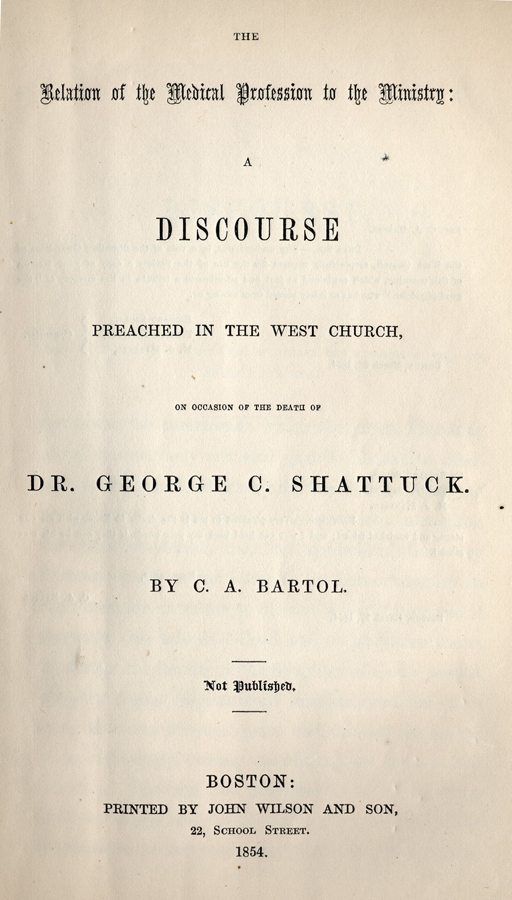
THE

Relation of the Medical Profession to the Ministry:

A

DISCOURSE

PREACHED IN THE WEST CHURCH,

ON OCCASION OF THE DEATH OF

DR. GEORGE C. SHATTUCK.

BY C. A. BARTOL.


DISCOURSE.

Luke IX. 2: “AND HE SENT THEM TO PREACH THE KINGDOM OF GOD, AND TO HEAL THE SICK.”

Such was the commission which the great Physician of the human body and soul gave to his twelve disciples, when he clothed them with their office of carrying on his work in the world. In prophetic metaphor, the older revelation, too, had symbolized this very likeness of the mortal frame to the immortal spirit in their common exposure to disease, when it inquired if there were no balm in Gilead, and no physician there, to recover the health of the daughter of God’s people. Nay, the pagan religion itself foreshadowed the same thing from the remotest point and faintest beginning of its mythology, owning the healing art for a sacred function. The first that practiced it, to the heathen mind was a god and the child of a god; his immediate descendants, at the same time physicians and priests, lived in the temple, and allowed none to be initiated into the secrets of their knowledge without a solemn oath; while the most famous of the Greek physicians, who founded a school and was the earliest to raise medicine to the dignity of a science, was reputed to stand in the line of the same divine descent. You know, moreover, how intimately medicine and religion have been connected by the rudest savage tribes of our own day, as well as by the most civilized races of antiquity. But, to indicate for the pulpit my theme to-day of the medical profession in its relation to the ministry,—which you will allow me to treat in the plainest and most familiar manner,—it is enough to know, that a being before whom all the deities of classic story grow pale and fade away, in his own life and in his charge to his apostles, associated the ills of the flesh with those of the mind for the merciful remedies of his gospel.

There is something very touching in his selecting, for the particular proof of his own heavenly authority, this gracious work of relief and cure to the suffering human frame; restoring from fever and palsy and epilepsy and insanity, from blindness, deafness, dumbness, death. Ah! A cordial truth did his beneficent deeds express, that he came to be for ever the friend of the human body as well as soul, redeeming them both from anguish and corruption, from the sin that runs over into the dying part, and the sickness that penetrates to the undying: for he saw, as a superficial philosophy does not, the companionship between these two natures, so intimate no thought can divide and bound their territories, and so he took the whole man for his love and tenderness; and when the age of outward miracles ceased, and the Christian believer, as such, could no longer wondrously bring back lost health to the sick man, they who religiously devoted themselves to the study and exercise of the art of healing, in worship of the Divinity that made them, and in love of their fellow-creatures, in a business essentially partaking as much as any other of piety and humanity, in some sense in this respect succeeded to the apostles and to the great Lord and Master of us all.

One of the most interesting aspects of this general statement is the friendly relation that should subsist between the professors of medicine and the ministry. Surely they should be friends. Jesus Christ has formed the bond of their amity. He is in his life their common parent. They meet in his spirit. They trace back all that is benign and holy in their several offices and highest purposes to his temper and his acts. Jealousy between them is nothing less than an affront to him who, through all Galilee, taught in the synagogues, and healed the diseases of the people; and any mutual discord, from whatever cause arising, is a quarrel in the very body of the Son of God, and as though those messengers of his, when they went out through all Judea, bearing in one hand soundness for the flesh, and in the other comfort and salvation for the heart of man, had fallen out by the way. Distrust, alienation, divorce, between these professions, so long wedded, and ever in the daily round following in each other’s track, would indeed be not according to history, or according to Christianity, or according to the best hopes and auguries of the future welfare, private or public, of mankind. Therefore let us rejoice in the wide and substantial harmony that has ever prevailed in these two classes. The minister who refers to this topic, truly should not only rejoice, but give thanks, because of a peculiar generosity of the physician’s gratuitous service to his calling, a matter of less pecuniary than moral meaning. The minister, on his part, however, should at least pay with his gratitude his respect to the skill and science of the physician, honoring his vocation, and not lightly giving, as I see it said he sometimes does, the most precious, though commonly accounted the cheapest, thing a man can give, his name and recommendation to every presumption of ignorance and charlatan’s elixir, by whose author or vender he may be entreated. It is not the less but the more necessary to say this, because, in these times of the broader diffusion of light and a growing individual independence, the once marked enclosures and high fences of all the professions are somewhat invaded; men without title or preparation choosing to argue their own case, to hold forth their own revelations, and be their own doctors. With the awakening of thought and the spread of knowledge has come the ascertainment of our ignorance; no claims, private or professional, pass as they once did; and no occupation can stand any more on the ground of mere caste, of a strange tongue or a black letter, but only on the actual benefit it can yield to human beings, in mind, body, or estate.

Yet, in this shock to confidence and loss of reverence, accruing on the universal assertion of intellectual freedom, on the reign, too, of empiric observation, and the custom here in all things of our proverbial and characteristic American haste, there is danger that men will desert the truly wise, who have patiently and expensively qualified themselves for their instruction, defence, or restoration, and foolishly rely on their own imprudence, or the shallow boasts of those who have more at heart their own gain and interest, than any benefit to their kind. To this particular disadvantage, probably no one of the professions is so grossly exposed as the medical. For, while the severe preparation required for the law may reduce the number there of mere pretenders, and while the facts and themes of religion are for the most part matters of sober, scholarly investigation,—vulgar criticism, popular and rudely practical doubt, roused in part very possibly by many contrariant doctrines, seems to have fixed on the medical profession for its especial prey or chosen quarry to pursue; so that we ought not to be surprised were its members sometimes worried and vexed in this chase of hungry questioning and skepticism, sharpened by the lively concern everybody has in an affair so near to him as his own health, especially if this running after them be shared in or cheered on by any whose social position, reputation for learning, or personal hold on the affections of others, invests them with power to hinder or further any sentiment or cause.

It should, however, be some antidote to any irritation hence, that every one of the professions, in this curious and prying age, in some way, coarser or more refined, partakes in this trial of secret insinuations or open assaults. In the wisdom of God, no less than in the folly of man, it may be best for them that they should; for the miserable jeers that charge the lawyer with cunning and selfish appropriations of the sum in dispute, the minister as a dumb dog or covert infidel, and the doctor as at work to physic his patient into the grave, may but combine with candid or subtle investigations of the basis of each several vocation to impart a more finished quality, a nobler and disinterested stamp, to every worthy member of them all. Nay, the doubtful and deliberative tone thus infused into the habit of their minds, leading them to consider well before they act or speak, to indulge or enlighten all honest unbelief in others, and to lay aside whatever might be arrogant or overweening in themselves, will, in their simple modesty, and frank confession of how little as well as how much they know, assuming no oracular airs, but, for the ancient look of mysterious consequence or magical power, putting the benign aspect of depending on true science and a higher strength to secure a humane end, make them, with more accomplished control of their art, greater benefactors to their kind. Accordingly, I believe that justice was never more sure, or health safer, or morality and religion better cared for, than in their modern hands. You will not hint a worldly motive for this declaration. The man who basely attacks his own profession, and rends the cloth he wears, is as likely to have a worldly or ambitious aim, as he that respects his guild or calling; for well said old Samuel Johnson, that he who rails at established authority in any thing shall never want an audience; and an audience is what some seem most of all to crave! But, at whatever former period any of the professions may have been exalted in a more awful or formal respect, it may be doubted whether there was ever more earnestness or vitality, than may not seldom now be seen, in their exercise of every one of them.

The provinces of the minister and the physician, which I am now particularly considering, lie so near to each other, that there doubtless is in their relations a peculiar delicacy. They must be in fellowship, or else in some degree of envy, if not collision; for wholly separate they cannot be, nor should be. Indeed, both the human mind and body are, in their disordered states, so brought under the inspection alike of the messengers of health and of salvation, or spiritual health; the affections of the inner and outer part of human nature so run into, and are often well-nigh confounded with, one another; temperament is so close to temper, habit of body so linked with habit of mind, phlegm is such a name for sloth, and a sanguine or nervous frame such a neighbor to heat and irritability; there is so much gloom or brightness in the digestion; so much kindness in the circulations of the heart, or wrath in the flow of the bile; the vapors that rise or the beams that shine in one region of our marvelous soul or structure so soon overspread the other; a permanently morbid mood of mind, as one has said, so invariably indicates physical disorder; in fine, the soul owes so much to the body, as its organ, dwelling, school, and means of discipline, and the body so much to the soul in every good disposition and holier person; and virtue or vice, soundness or disease, wherever existing, seems so to take them both for a common abode; religion itself is sometimes such a medicine, and medicine such a succor and aid to the conscience; the roots and springs of health or sickness are so much in the moral condition, and make us think so often of—-

“the fruit
Of that forbidden tree, whose mortal taste
Brought death into the world, and all our woe,”—

that they who have attempted to divine in its morbid conditions this wondrous double-empire into their distinct rules may occasionally find themselves unwittingly assuming each other’s prerogatives, and trespassing or treading a little on each other’s grounds. Then, as the minister may know very little of medicine, and the physician as little of the springs of the moral life; as one may, in his meditations, have neglected the order of physical facts, and the other, in the ken scent of his observations, been drawn away from contemplating spiritual and invisible realities or principles,—they may interfere with each other, and do each some harm to the incarnate yet spiritual creature let down from Almighty Power into their associated charge. Therefore, it no doubt is best each should in general, as far as many be, occupy his own, avoiding the debatable land.

Yet, what singular opportunities are at times offered to the physician of giving spiritual counsel, peradventure all the more all the more potently because it is not precisely his technical place! How not unfrequently he has availed himself, as in duty bound, of openings for moral influence! Indeed, shall I say, it curiously illustrates the state of the case, that I have known the same worthy physician, who had complained of ministers looking after the bodies of his patients, to feel under the obligation of himself looking after and ministering to their souls! It were, in fact, but ungrateful for me to lose the memory, or omit here the mention, of my own sympathetic meetings, from time to time, with physicians on either side the bed, over the same suffering and the same death. Truly, for one, I am free to confess a sincere and unaffected pleasure, looking not with an evil eye, but with unalloyed admiration, whenever a word has been so fitly spoken, the kingdom of God preached, and the sick healed, as of old, by the same person! On the other hand, if a clergyman, not dealing in panaceas, or endorsing nostrums, or presuming to stand umpire between rival systems of medicine, should state or illustrate any of those great laws of nature that are over us, and in us, and through us all, on which human sanity hangs, and the transgression of a single one of which is sin, the generous and sensible physician, who is really laboring for the sake of God and man, will welcome the good service of his brother, as much as the farmer would the friendly hand, that, from its own concluded avocation, should come over to mow in his field or thresh on his floor. Let there be on either side no selfishness, no officiousness, no needless volunteering; but an inclination each one to do his own stint, lending help beyond only at the divine command in case of necessity; and, though they be borderers, they will, without strife or foray, live in peace.

But my purpose is not so much to adjust the terms of intercourse or mode of personal bearing between the two professions, as, being moved by the decease of an ornament of one and a friend of the other, to pay a warm and honest tribute of my regard to that to which I do not belong. The desk, whose incumbents everywhere are so indebted to that profession, may well offer, more frequently than it has done, such a tribute. At least, I shall not fail of it now according to the poor measure of my ability, partly as a token of regard for one who loved his own profession and mine both so well, and who would value honor done to his vocation, so long and nobly by him discharged and adorned, more than were it done to himself. The physician has in stewardship under God this mortal body in all the ills it incurs, or to which it is heir. It is a great and holy and most responsible trust. It seems to me so grand and tender, that I will not seek any-wise to lessen, but let it, for the moment, fill the whole field of view, that we may learn to do it and its holders more justice. I will not speak now of theology, the princely science, or alone of religion, the paramount concern, though I shall be enjoining a duty truly religious, or of the soul, the only endearing essence,—but of the body, the body which every one of us brought in hither this morning, and must lay down yonder at life’s evening,—our companion for a short stage, a poor, feeble, weary, ailing thing, but all we have to work with in this world, and which therefore, by every pain, dislocation, or infirmity it is rescued from, by every fever it burns, or chill it shakes with, by every fit which convulses it, or consumption in which it pines, pathetically appeals to us to render due credit to them who keep this many[jointed, myriad-chorded instrument, harp of thousand strings, of so universal play and turn, the true history of whose derangements would be almost as various and tragic as that of the passions of the human mind of which it is the earthly organ, in tune and repair.

Yes, honor to those who have probed he hiding-places of its power, laid open its minute cells; traced the course of its flowing streams; caught every one of the trembling nerves by which it acts or feels, communicates or receives; discovered the causes of its throbbings and its tears; snatched it so often from its most fearful jeopardizes; warned it of its many foes; hovered over it in its most critical emergencies; searched out every one of its disturbed conditions, and labored untiringly to redeem it from them all; actually converted many of its troubles, once fatal, into tolerable and curable maladies; in their devoted friendship passed night after night, as well as the lie-long day, with it, and encountered the fiercest storms that ever blew, and travelled over the most broken ways ever traversed in its behalf, never deserting it while breath remained; and, while spending themselves in outward toils, have brooded over all the elements and phenomena of nature, its grosser brother, in their relation to its symptoms, with the profoundest and most persevering study, to detect and gather every kind of material and invent every tool that advancing human knowledge could fit to alleviate its anguish, free it from the occasions of its distress, check the tendencies to disease, remove the obstructions from the way of its living nature, and lengthen out its days for the increase of human happiness and the manifestation of all the faculties and attributes of the immortal mind. They deserve well of their kind. Let them have their meed of praise and renown! Let those who have experienced their favors, if paid yet priceless, bring it! Let the pulpit yield it,—and even my weak words, for their sincerity, pass for the present hour and spot, as one of its humble signs and expressions!

Physicians, so honorably placed as we have seen in the Christian faith, one of them being styled “Luke the beloved,” have, as we well know, a corresponding rank and sphere in society. And here gain we touch on their inevitable union with the ministry. Their function, like the pastoral, is one of the threads that pass through the entire system of human life. It is one of the great bonds of union among men. Appointed to re-unite the sundered or confirm the debilitated bonds of corporeal well-being, to rejoin the dissevered ligaments, close gaping wounds, and set in motion the suspended workings of the animal frame, they are, by the unlimited reach of their benevolent and indispensable offices, also a solder and cement in the edifice of the common-weal. They do much to cure the body politic, as well as the individual constitution. The rich and the poor, the citizen and the stranger, the high and the low, the virtuous and the vile, the physician must take care of them all; and he follows the example of his Great Master in so doing. Like the central iron rod, or the main supporting beam, or the stout traversing keel, with which all is connected and on which all is more or less suspended or built, is the operation of his so strong and busy hand. None has more disagreeable, and it may be thankless, tasks than he. Yet this must be his consolation, that none comes nearer to the human heart, as well as to that which covers that heart, than the good physician who is also a good man. His chaise passing round is the very emblem of a benignant errand; or waiting at the door, an earnest to the passer-by, that good is going on within. “Who, is your physician?” is a question asked perhaps as often as any other, and always asked by friends with lively interest; and “my physician” are words rarely pronounced without a glow of emotion, if not a gush of thanksgiving, accorded to but few earthly benefactors. For all endeavor, patience, and watching, so spoken they are beyond silver and gold a remuneration to that human heart of ours which craves indeed many things beneath the sun, but above all other things hungers and thirsts for a just respect and a holy love. They that visit and heal the sick, that bring the color back into the pallid cheek, that enliven again the heavy lack-luster eye, enable hand and foot and head to resume their wonted avocations in all effort and delight of body or mind, and thus put a new song into the mouth for restoring mercy, certainly do not miss large and perhaps unequalled measures of that consideration which, second to the favor and blessing of Almighty God, is rightfully dearest to the soul. Heaven grant to them both benedictions, the human and the divine, with the grace to fulfill both the commandments,—the first of supreme love with all the heart and strength to God, and the second, which is like to it, of loving one’s neighbor as one’s self. Such the wish and prayer which the voice of this place would breathe towards them, and breathe for them up into the sky! And might I say one word further, from my theme, it would be,—May the prophecy of their friendship with the ministry of religion reach as far forward as its tradition reaches back!

But the physician, who heals and under Providence lengthens out the lies of others, must himself sicken and die. While many, through his instrumentality, remain in the land of the living, he himself may have gone. Those he raised from prostration may visit his couch, and those he rescued from the grave weep grateful at his sepulcher. A vacancy here noticeable by you all makes needless any explanation of the motive of my present subject. A form, familiar for many years, and ever growing more venerable in our eyes, has disappeared. It was the form of one who might well suggest to me the text of this discourse; for no man ever respected more either his own profession or that of the ministry, or more closely associated them together in his mind; so that once, being examined under oath as to some record he might have made, he exclaimed that “by the grace of God the name of a minister was never entered with a charge on his books”! Yet he began his career, as perhaps it is best every young man should, having nothing in particular to trust to but his own talent and fidelity, with what I have heard him in his own phrase style “the healthy stimulus of prospective want;” and, waiting quietly for his first patients, attending slowly to case after case, he laid silently, stone by stone, the foundation of his fame. Every truly noble building rests on just such a basis of deep and secret diligence; and as a great merchant once said that the making of his first thousand dollars cost him more perplexity than all the rest of his immense fortune, so is it with the first achievement, by manifest, undeniable, and unmistakable power, of all professional success. The towering reputation far seen over the land, the wide-spread practice opening through a thousand portals, reposed simply and solidly on the genuine qualities which both assured skilful handling to the sick, and bore off prize after prize in the early competitions of the literary medical essay.

But our friend did more than eminently exemplify the essential traits of a wise and able practitioner. Though he has said to me he was a physician, and nothing but a physician,—while it is utterly superfluous for me to bring the fact of his professional superiority to your notice,—he was consulted on other matters beside the hazards and extremities of mortal life. Extraordinarily distinguished for insight into the soul as well as body, joining, in fact, the physical and the spiritual, that are brought into such juxtaposition in our text; reading character as he did health or disease; leaping through obstructions to his point, with an electric spark of genius that was in him; clothing his conclusions sometimes with a poetic color, and sometimes with the garb of a quaint phraseology; employing now a pithy proverb, and now a cautious and tender circumlocution, to utter what could scarce have been otherwise conveyed, in a method of conversation, which, in its straight lines or through all its windings, I never found otherwise than very instructive,—an intuitive sagacity and perfect originality marked all his sayings and doings. He could never be confounded with any other man. Borrowing neither ideas nor expressions, he was always himself. Yet there was nothing cynical or recluse or egotistical about him. I never heard him boast himself or despise another. He had a large and warm heart, with room in it for many persons and all humanity. Though he was so peculiar, much of his heart was the common heart, as the most marked and lofty mountains have in them most of the common earth. While not a few are absorbed in some single relation, he observed and acted well in the multitude of his relations to his fellow-men. He was remarkable for this broad look and observance of all the interests, material or moral, mechanical or spiritual, of the world, and was equally at home in a question of finance or an enterprise for religion; actually, in his early life and growing thrift, giving a large part of his property for the building of a church. He had, moreover, this precious singularity, that he never seemed to belong to any one class or little social circle, but to stand well and beneficently related to all. Often have I had occasion to perceive, not only his large and cordial, but very various and wide, hospitality. He fulfilled, as nearly as I remember to have seen it, that remarkable, difficult, and apparently almost uncomprehended precept of our Saviour, in which he tells, when we make a feast, not to call to it our friends and rich neighbors, but the poor, the maimed, the lame, the blind; and probably no man in this city could die, who would be remembered by a greater number of those in their necessity touched by his timely beneficence; for he seemed ever to discern the season, as well as to feel the inclination, to do good; his relief of another was less a tax or duty than a self-gratification; while he never forgot a favor he had received, he never allowed any one to feel a load from the favor he conferred. He did not wait to be asked. He did not yield to all solicitations. He preferred generally to give in his own way and of his own motion; and to no one did good deeds offer and suggest themselves more abundantly or opportunely. Before my personal acquaintance began, the first thing I knew of him was his attendance upon a sick fellow-student in Cambridge, coming often, yet refusing to receive any fee. And the next thing I knew of him was his receiving into his house, and then, like the good Samaritan with his message to the host of the inn, commending to a distant professional brother, another friend and fellow-student. It might not please him or those nearest to him, if I should attempt even partially to enumerate his bounties, so ample, to various institutions of learning, for their libraries or chairs of instruction, which in some instances may have come to your hearing; but I have reason to think that his kindness much more frequently flowed in private channels, beheld only by the recipients and the All-seeing.

Being such a hearty and unostentatious philanthropist, it is perhaps unnecessary to say, in addition, that he was a real Christian. But he belonged to no one sect or denomination of Christians. Referring all to God, taking the highest view of the divine dignity of Jesus Christ, hoping to be accepted, saved, reconciled to the Father through the mediation of the Son, he extended his sympathy and hand of fellowship to all the faithful preachers of the gospel. He was truly catholic. You will excuse me, but there must be put into any conscientious report of him, what will indeed appear as but one practical exposition of the general truth of this discourse, his repeated mention of his especial regard for ministers,—“ministers,” he added with emphasis, “not of one name, but of all;” and his deference to the ministerial office is a quality in him, certainly in these days, standing out with some prominence. Indeed, the inclination of his respect might have been embarrassing but for he fraternal and authentic good-will from which it came. His respect ever somewhat veiled his heart, protecting an exquisite sensibility, which all might not notice, and hindered him from professing the entire warmth of personal affection he felt. But a reverence for the Most High was in him wholly distinct from all other principles. His will towards men was strong. But he seemed to have no will towards God. His will vanished before the Supreme; and he would have none beside. As a physician, he looked not to his medicines alone, but to God, for success, and prayed before he prescribed.

So it was with him, with ever-increasing interest, to the last. “Pray with me” was commonly his first salutation as I entered his sick chamber. “I want your prayers: they are a great comfort and consolation.” “Pray not for my recovery.” “I am going to God.” “I wish in your prayer to go as a sinner.” “I humbly thank you” was in the pressure of his hand, as much as in the articulate motion of his lips, when the express act of devotion was over. “Next to my God, I want to be near to my minister,” referring, of course, not to the individual, but, as was his wont, the office. And, at the last, having spoken his love to those most closely related to him, just before he went, “Time, Eternity, Eternity, Eternity,” were his expiring words; knowing, as he retained possession of his mind, that he was just stepping over that mysterious causeway, hid from mortal eyes, the sight of which no fleshly vision could bear, which separates one from the other.

I need not say, for the information of any in this society, that, being thus devout, he was a willing and open-handed supporter of religious institutions. To the utmost extent of his strength and opportunity, he was a constant, as he was a happy, worshipper in this house. He was an humble, penitent, affectionate confessor of his Lord at this communion-table, from which he had been long restrained by diffidence; but, in the last year of his life, was ready joyfully to bear witness, through the emblems of the broken body and flowing blood of the Saviour, that the confidence which, whether coming or staying away, we cannot feel in ourselves, we may feel in him and in God. The square and fountain in front of this church; the marble baptismal font before this altar, much of whose expense it was one of his dying bequests should be paid by his kindred survivors, at the same time declaring his delight in its beauty, thus associating it for ever with his departure; the repair and enlargement of the room for the Sunday-school, to which he chiefly contributed, affirming to me more than once how important he considered the religious instruction of the youth among us; the libraries for the school and the parish, which he increased with special donations,—are but examples selected from the numerous fruits and demonstrations of his Christian and reverential charity. Ah! But for faith and encouragement to emulation of such good deeds, it were a sorry day for any religious body when such a benefactor dies!

In thus reporting, as truly and exactly as I am able, the positive excellencies of our friend, I intend not, as is the custom in some eulogies, to imply that they were all; when the value of any praise of mortals lies in the definite truth that leaves room for fair exceptions, while the fulsome commendation that does not discriminate is merely worthless, signifying nothing. It would be a poor compliment to one, who perhaps was never guilty of an insincerity in his life, to intimate that he had no failings, or to present any panegyric of perfection for his character; to declare that this good man and true-hearted Christian had but one immaculate side, or moral features only of absolute beauty, which would so contradict his own word and consciousness. And were I to say that his fine natural ardor went not to the least excess; that his energetic purpose in no instance was imperious; that, bent upon action, and on speedily executing his good plans, he never became impatient of debate, or did any injustice to others’ thoughts, or exercised mastery over others’ designs; or that, prospered greatly as he was in his fortunes, it was never requisite for him to struggle against the world’s getting undue possession of his mind; that he was such a paragon, he never spoke harshly or acted hastily; in short, that no defects qualified and mingled with the rare and unsurpassed nobilities of his soul; and that even unawares he favored nothing wrong, nor opposed and put down any thing right,—I should insult his honesty, and belie my own conscience, and might do despite to that spirit of grace and truth, which, above the highest human attainments, still holds the unreached standard of moral goodness and infinite glory. But, if he could set his face as flint, oh! He could pour out his heart like water; the rock of rugged strength welling with currents copious and pure, for he was a pure-hearted man; and never was a gentler or more pathetic soul, a breast quicker to throb, or an eye more moist, at any grand or affecting spectacle or tale; if he was not caressing, neither was he self-indulgent; and if his passion ever overstepped the bounds of equity, he was prompt to feel remorse, humility, and grief, as more than once I have myself had occasion to note; while his character was continually softening, improving, ripening, as he went on,—ripe, fully ripe, indeed, at last!

But the question, in regard to any among mortals, is not whether he is faultless, none that breathe or ever did breathe being such; but, after the faults are subtracted, the question is, what mass, what weight, what height of worth, is left behind. Some seem to have neither grievous faults nor shining virtues; and a man may be apparently well-nigh blameless, without being very good, as a pure ore of iron or copper is not so precious as the mineral gold, though with earth and stone intermixed. My friend always seemed to me to be the mineral gold. Nor do I know where, in any individual, to look for a larger amount of the sterling treasure. Ah, while I speak of him, I can hardly imagine him away! A vision, he rises in my path, invites my gaze, greets me at the door, sits there in the sanctuary! The intensity of this abiding presence that will not down, of this reality that will not go, is the measure of force that has been in a man. And he surely was one of the powers among us that cannot cease even here below.

It is not the habit of this place to celebrate the merits of any human being. Nor might I have done it now, save to unfold with livelier interest, through a solemn dispensation of Providence, a subject of universal concern. The characters of all human beings sink before that Holy Majesty which fills this place, and which we here assemble to adore. But God is glorified not only by direct praise and ascending prayer. He is glorified, too, in his faithful servants, imperfect men though they be. All the beauty and splendor of the earth and heavens cannot compass so fair or sublime a pitch of his glory as is displayed in the loyal and loving souls of his children. We do not honor him by hiding out of sight, or passing over in silence, aught just or worthy in his intelligent creatures; but every light of virtue, taken from under the bushel of privacy to shine out of the candlestick of a true confession before men, illuminates also, to their view, the spotless attributes of the Creator. To the Creator, as its source, we ascribe all that is worthy and good. We thank him for the fruit of the earth. We thank him for the brightness of the sun. We thank him for the better beams of knowledge, and the nobler springing from every germ and disclosure of his sacred truth. We thank him, above all, for that manifestation of his wisdom and love which we discern in his obedient offspring, and which was incarnate in his beloved Son.

Sermon – Thanksgiving – 1853


Charles Wadsworth (1814-1882) graduated from Union College in 1837. He was pastor of congregations in: Troy, NY (1842-1850), Philadelphia (1850-1862, 1869-1882), and San Francisco (1862-1869). The following Thanksgiving sermon was preached by Wadsworth in Philadelphia on November 24, 1853.


sermon-thanksgiving-1853


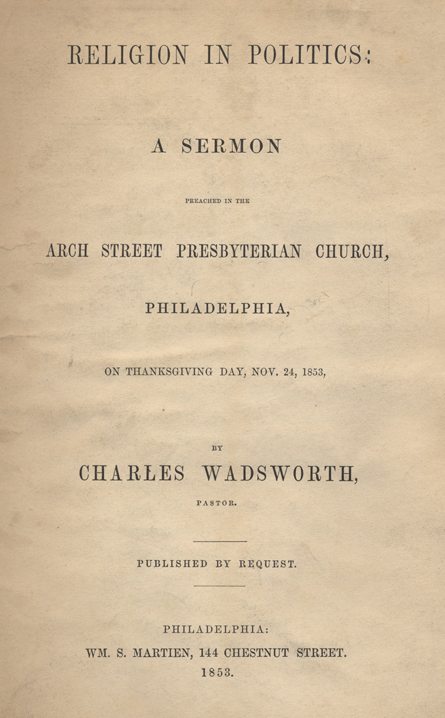
RELIGION IN POLITICS:

A SERMON

PREACHED IN THE

ARCH STREET PRESBYTERIAN CHURCH,

PHILADELPHIA,

ON THANKSGIVING DAY, NOV. 24, 1853,

BY

CHARLES WADSWORTH,
PASTOR.


RELIGION IN POLITICS.
“Render to Cesar the things that are Cesar’s.”—Mark XII. 17.

These words, you will remember, are part of our Lord’s answer to the Herodians, when they sought to entangle him in the political controversies of the times. I have not, of course, selected them as a theme of usual scriptural and Sabbath-day exposition. You have come here expecting to have your meditations turned into channels beseeming the occasion. That occasion, owing to the agreement of so many of our United States, to celebrate it simultaneously, is a great National Thanksgiving. And to turn from its national or political aspects, and confine ourselves to what are called technically, “religious” considerations, were to do evident violence to the proprieties of time and occasion.

And yet, here, at the very outset, are we met with the outcry of the whole howling pack of Infidelity and Irreligion, as they hunt in couples for Christian inconsistencies; claiming meanwhile for themselves, the whole body politic, as a carcass from the shambles, to be cast to their kennel. “Do not bring politics into the pulpit,” say these men. “Do not desecrate God’s sanctuary. A preacher’s business is to minister to the gospel,–God’s pure and peaceable gospel. And beware how you desecrate and pollute it by interfering in State matters.” Verily, these be most wonderful men! Blaspheming, and reviling, and trampling under their foul feet, for the whole three hundred and sixty-five days of each year, this very gospel; and then overwhelmed with a holy awe, lest some preacher, once in a whole annual revolution, should happen, in their apprehension, to forget its high sacredness. Ah! Most astonishing men! Most wonderful zeal for the gospel! Nevertheless, we agree with these men in the assertion that a preacher’s business is with the Gospel of Christ, and its religion only. But, then, what is RELIGION? Religion, as revealed in the gospel! Is it an influence so ethereal and unearthly, as to require to be shut carefully from common life into Sabbath days and sanctuaries, lest its white garments should become soiled by a contact with worldliness?

So, indeed, these men tell us. And here we are at issue with them. Religion is not merely a sentiment, but a life. Not merely affections God-ward, but activity man-ward. It renders a man not merely a singer of psalms, and a partaker of sacraments, but, indeed, renders him mainly a kind friend, an affectionate father, an estimable citizen, and an honest man. And, therefore, a religion that does not pass beyond the region of technical sacredness, and pervade the whole economy of the social and secular—entering as a living power into the commerce, and the literature, and the magistracy, and the politics of a man—is a mutilated and a monstrous religion, make the best of it.

In the text, our Lord sets forth one great part of Christian duty. It is not only “Rendering unto God the things that are God’s,” but, as well, “Rendering unto Cesar the things that are Cesar’s;”—a principle taking as vital an interest in a human, as in the Divine government. And, if you will remember, that in Christ’s time the form of civil governments, and their practical administration, were as imperfect as they ever have been; and that the Cesar’s were, with few exceptions, the veriest of tyrants, you will perceive how emphatically we are taught in the text—that a man’s religious duties are not only unto his God, but as well unto his country; or, more simply stated—that a man should carry his Christianity heartily and wholly into the politics of his country.

And this, then, is the theme of our present meditation. The duty of every Christian man to go forth in the face of all this infidel outcry, and carry his religion into his politics.

But, then, what do we mean by Politics? Do we mean the paltry chicanery of placemen for power? A working out the low artifices of party in pursuit of offices and spoils? Would we have a Christian minister, or a Christian man, go down to the shameless and undisguised corruption which pervades what is called the peculiar moral code of politics? Would we have such a man sit face to face with the brutal ignorance and ruffian vice, which, hidden from the face of honest men, distribute the parts of the great play, and shuffle, and cut, and deal the dirty cards wherewith partisan gamblers are to play a game, whose great stake is our civil and national welfare? Oh no, no. By Politics, as we would have them mingled in by Christian men, we mean—“The science of government; that part of ethics which consists in the regulation and government of a state or nation, for the preservation of its peace and prosperity; comprehending the defence of its existence and rights against foreign control or conquest; the augmentation of its strength and resources; the protection of its citizens in all their rights; and the preservation and improvement of their manners and morals;”—and involving therefore every religious, patriotic, and domestic interest that is near and dear to us. And in such—as the only grand and just idea of Politics—we would have every Christian and good man mingle religiously and wholly. And this, for several reasons, we will now go on to consider.

And this, first of all: Because such political privileges and blessings as we enjoy, deserve at our hands, as God’s great gift, such a public, religious consecration.

This is indeed the very “sacrifice of thanksgiving” we are met in God’s house to offer this morning. In all times have religious offerings been discriminative and appropriate. The “husbandman” has brought of the “fruits of the ground.” The “shepherd” has brought the “firstling of his flocks.” And one appropriate sacrifice of thanksgiving for national and political blessings, is not a mere expression of gratitude in hallelujahs, but a consecration to God of our powers, in a service which shall perpetuate unto children’s children our great social, and political, and national privileges.

And surely such privileges as ours deserve such an offering. Truly, a goodly and glorious gift is our American birthright! I know men tell us it is grandiloquent, and in bad taste, and savors of arrogance and vanity, and is wanting in national courtesy and good breeding, to be everlastingly glorying in our “Eagles” and “Star-Spangled Banners,” and exulting in our national consciousness of political superiority, and our national hope of a sure, and limitless, and magnificent future. But for our very lives we cannot help it. “How can the children of the bride chamber mourn, while the bridegroom is with them?” We look at the nations of the old world—gigantic, if you please, but manifestly in the wrinkle and decay of a hoary age; and we look at our own land, just springing in glorious and gigantic youth, with flashing eye and iron sinews, to run such a race of honor and power as the world never saw. And we cannot—shame on us if we could—repress the thrill of pride from the heart, and the exulting words from the tongue, as we think of our own matchless land as it is now and shall be.

Oh! I see it! I see it! A nation that shall be unto all other nations as blessed old Israel was to the Amorite and the Philistine. A nation stretching from ocean to ocean across this whole continent. A nation of freemen, self governed; governed by simple law, without a police or a soldiery. A nation of five hundred millions of people, covering the sea with their fleets, and the land with great cities. First in learning, and science, and arts, and every great produce of industry and genius. Ay, and better and higher and holier,–a virtuous and godly people; bound together in one tender and beautiful brotherhood; and luxuriant with fruit and flower, in the bloom and aroma of all Christian graces. The refuge of the oppressed. The protector of the downtrodden. The home of the exile. The terror of despotism. The victorious champion of earth’s wronged tribes, against tyranny and outrage. The almoner of God’s great grace to the wounded spirit and bleeding heart of a redeemed humanity. I see this, and more than this, in our safe, and dazzling, and limitless future. And my tongue would cleave to the roof of my mouth, if I thought to check the joyous words that swell up in hallelujahs.

We have—we have a magnificent birthright. And what is it all, but God’s gift—God’s gift through the Gospel? All it is—all it shall be—a RESULT OF CHRISTIANITY—and so all it is, and all it shall be, but an ascension gift of my Lord unto his disciples as Christians. And are we then as Christians—as the very men for whom it was projected and for whom it is conserved—are we, as religious and Christian men, to stand back from this glorious nationality, and let fools and ruffians—the filth, and pollution, and offscouring of moral life,–creatures bought and sold for a price, as cattle for the shambles—the wrecks and the rotten-wood that float with every shifting tide of infidel and irresponsible political opinion,–are we to stand altogether aloof, and let creatures like these mar and mutilate this great national machinery? Shall the insane fanaticism of the North, and Southern sham-chivalry, bluster about the dissolution of the Union, and hew with a fool’s axe at the root of the tree of our Liberty? And must I, as a Christian man and minister, not smite them with all the strength God has given me, lest I should pollute my Christianity by a contract with worldliness?

Away with such shallow and hypocritical reverence for Christianity. I owe it to my Gospel and my God, as all the return I can make for a birthright so glorious, to fling myself as a Christian man, into the defence of that birthright, and bare my bosom, as a religious being, to the infidel and accursed tide, that would sweep all those good and glorious things away, as wrecks upon a deluge. And we have come up this day as a rejoicing people, not merely to praise God, but to consecrate ourselves to this very work in a sacrifice of thanksgiving. And go forth in the performance of our Christian work, “Rendering,” not only “to God the things that are God’s, but as well rendering unto Cesar the things that are Cesar’s.”

Now this leads me to remark, Secondly, That as Christian men, we are bound to this duty; because our nation needs this day for her own preservation, the mingling in her politics of this religious element.

She needs it, indeed, at all times. On all principles of national and governmental policy. There never has existed—and never can exist a nation, without this pervading element of religious influence. Even the heathen and unenlightened rulers of the elder world, all perceived and acted on this common-sense maxim. History has no record of a single legislator, who attempted to enforce obedience to law on the sole ground of its civil sanctions, and its temporal penalties. They universally perceived the insufficiency of all such motives, if unstrengthened by the higher motives drawn from religious principles. And if they were strangers to Divine Revelation, they found a substitute in their Mythology, and applied it as skillfully as might be, to the prejudices of the people. Lycurgus, Solon, Numa Pompilius, Mohammed, and indeed, every legislator at all famed for the wisdom of his institutions; were compelled to have recourse to religion: and in fact, derived therefrom their mightiest motives to enforce obedience. And in all this, they acted on an accurate and extensive knowledge of human nature; and with a wisdom that will remain true, so long as sinful passions and affections have such an influence on mankind. For whenever, as in France, the attempt has been made to loose all religious restraints from the minds of a people; then have the whirlwind and the storm, and the great waves dashing into shipwreck, made eloquent proclamation that for the preservation of every great national and political interest, there is need of a God, to ride upon the whirlwind and direct the storm.

Now, if all this be evidently true, even of nations held in check by the armed power of despotism, how emphatically must it be true of a free and a self-governing people. Our free institutions were created, and are conserved by the Christian religion. The two grand pillars whereon the whole edifice rests, are—The Equality of Human Rights—and—Brotherly Love equal to Self-Love. And these great truths we have learned from the Gospel. Take them away, and our peculiar nationality is destroyed in a moment. We may still exist, indeed, as a power on the earth. We may exist still united under an armed aristocracy, or a great military despotism. Or we may exist a fragmentary and dissevered power, as a hundred petty and belligerent principalities. And this Continent may be parceled out like the old, unto rival conquerors. And our miserable descendants “increase and multiply, and vegetate and rot,” in ignorance and bondage. And go forth in fierce feuds, marshaled under rival banners of the Bear, and the Lion, and the Lilies, over the very fields where their fathers marched united and triumphant, and free, under their one glorious Eagle. But sure I am, that if the religious element be taken from our politics, our Republicanism is gone, at a stroke, and for ever.

I have not the limits here, to enter into the argument of the manifold advantages to a free people of Gospel piety. Time would fail me, to tell you how it increases national wealth, by diminishing the popular tendency to luxury and extravagance, and by inculcating temperance, and industry, and frugality. How it operates as a mighty check on all those corruptions which weaken a free people. How it educates into truth and tenderness the popular conscience, without which, just laws must remain dead letters in the statute book, unenforced, and without influence. How it destroys all those selfish and sectional animosities, whereunto demagogues always appeal when they would break in pieces great governments. How, in short, by restraining in the human heart the vices hat weaken, and regenerating into nobler life the virtues that strengthen, it makes ever manifest the great truth, that free, and prosperous, and united, and “blessed is that people whose God is the Lord.”

This, and all this, we take in our argument for granted. And based upon it, our plea is, that we are called on as religious men to rise up, and cast more of this salt of godliness into our national character. We are this very day, in God’s sight, going backward from our old moral landmarks. We are even now as a nation swarming with drunkards, and Sabbath-breakers, and profane swearers. The emissaries of the old foreign Ecclesiastical despotism—the tool and the mainspring of all European despotism—are among us, foul and frequent as locusts of the Nile on the green things of God’s husbandry. Fanatics at both ends of the Union are toiling might and main at their fiendish work of dismemberment. Our national compact itself, founded on the compromise of local interests, exposes us more and more to sectional jealousies and competition, and to the heartless assaults of ambitious agitators of popular passions. We are entering confessedly on stormy times. New forms of infidelity, and political atheism, and false philanthropy, are rising in strength in the midst of us. While Christian men stand aloof, fools are heaving at the pillars of our great national temple. And the whole tribe of the Philistines are twisting at the cords, while God’s Samson sleeps in the lap of the Enchantress. It is time, high time, then, for Christian championship to awake. By the men of the present generation is the great question to be settled, whether there can be maintained in the midst of us, enough of an enlightened and tender moral sense to keep us a virtuous, and free, and united people, in face of all these assaults of infamy and irreligion. By the Christian men that now worship in God’s temples is the uncertain problem to be solved,–Whether the light of liberty that shines on us this day, is of a sun bounding gloriously from the Orient, or already sinking sadly and slowly to the sepulchral clouds of the west. And, therefore, the call comes to us loud as the voice of prophets in the glorious days of Israel of Judah, to stand forth against the enemies of hearthstone and altar for our God and our country; casting religious salt into the polluted fountains of our national conscience; pouring religious light along the troubled seas of our national politics; “rendering unto Cesar the things that are Cesar’s, as surely as unto God the things that are God’s.”

And by all this are we brought to remark, Thirdly: That we are urged to this duty by our regard for all the great interests of the Race and the World.

Disastrous as would be the destruction of our peculiar nationality in regard of ourselves—more disastrous and appalling still would it prove in regard of the human race everywhere. Speaking only civilly and politically, and there is no sign of hope for a world’s popular liberties, if our republicanism fail us. Unto America are turned this day the regards of all nations, as the last practical experiment of popular self-government. From America goes forth this day the only light of hope to fall on the heart of an oppressed race as a joy and a consolation. For this great work were we raised up, and this great work are we doing. Talk as men will about the sanctity of international law, as preventing on our part with the old world, interference and intervention; yet spite of it all, with the whole power that is given us we are interfering and intervening. As surely and constantly as the blazing sun interferes with the prowling night-beasts, are we interfering with the oppressions and despotisms of the world’s farthest nations. There is not a Cabinet in Europe that does not look upon this great Republic as the real author of all the revolutionary movements on that whole broad continent; that does not plot and pray for our ruin, as the mighty disturber of the peace of their haggard and hoary oppressions, and the only formidable and gigantic obstacle to the perpetuity of their foul despotisms hereafter and for ever. The grand and simple principle that unites us as a free people, is a principle actively and essentially at war with the whole spirit of European nationality. And we are this very morning, by the never-ceasing and omnipresent influences of our free institutions, more powerfully and offensively interfering with the despotic policy of those European Empires, than if a hundred thousand armed men stood marshaled under the American Eagle on the banks of the Danube, and our whole naval power, three times told, were cruising on those European seas, sweeping a despot’s fleets from the waters, or thundering with a thousand guns against the bulwarks of a despot’s capital.

We are interfering, and, what is more, we are bound to be interfered with! We may let European despotisms alone—and, doubtless, we shall let them alone, as to all armed aggression—but then the plain and simple fact is, they will not let us alone. It is a mistake altogether to imagine that the whole popular sympathies of the old world are with popular freedom; or that the masses of those oppressed nations are prepared for, or ambitious of, our free institutions. The political movement of the whole East is backward manifestly to feudalism. Those favored empires; that with a constitution limiting the monarch, we have rejoiced over as already half free; and gloried in as marching in the van of advancing civilization; are already in the wane and wrinkle of dotage and decrepitude. Great Britain is tottering already under the hideous burden of a bloated aristocracy; and the Lion that once roused itself to shake the world its banner, now crouches tamed and spaniel-like at the tread of the great Eastern despotism. France, that looked unto the world so like a winged creature of liberty, by a monstrous recoil has gone back to a chrysalis, and is bound, as God lives, to come forth a worm again. Spain is already a dead thing in the grave; and Austria, that fouler thing than a despotism—the despotic tool of a despot. And if princes seem building for freedom and the race on the banks of the Rhine, and along the blue Italian seas, they build, alas, on a volcano—the crater already ablaze, and the whole mountain shaking.

Yonder continent has indeed this day but one united—one advancing and absorbing power; and that the great Northern, and naked, and unmitigated military despotism. A despotism, too, be it ever remembered, not resting in, and trusting to, popular ignorance, but where industry is stimulated; and the arts encouraged and fostered by all possible appliances; and commerce steadily and strenuously advanced in every possible direction; and where the subjects are not held in an unwilling bondage, but are the rejoicing and enthusiastic abettors of despotism. And thus firm on her foundations, and terrible in her might, is Russia aspiring and advancing to the conquest of the world. And prescient of the far future, she sees in the whole wide world to-day but one mighty obstacle in her path—this young Republic—the everlasting light of our popular freedom in the dark places of tyrants. And so the momentous signs of the times are now proclaiming a coming conflict, when amid such terrors of antagonism as the earth never saw, there shall go on under the rival banners of the Bear and the Eagle, the last great battle for freedom and the world! But if in all this we read not aright the programme of the struggle, sure we are, at least, that the great conflict of this and the coming generation will be of Freedom against Tyranny. And sure we are, therefore, as well, that in the preservation and perpetuity of our free institutions there rest the only hopes of oppressed humanity; and that in the terrible hour that is coming on all people, our own civil and religious liberty must furnish the only championship for man’s heart and soul against the despotisms of the world.

Now, if to this thought of our civil and political influence upon the nations, you add the other thought, of the religious AND EVANGELICAL influence we are manifestly designed to exert upon a lost race, the thought under consideration will appear most impressive. Even if for the civil franchises of mankind there were to rise up other than American championship; yet whence, save from the American Church, can go forth the light of a redeeming gospel to the dark places of the earth? If there be any philosophic reading of a historic Providence, then from God’s past and present dealings with us as a peculiar people, and from the evident signs of the times, as displaying the powerlessness of all other nations for evangelizing a world; from these, I say, is the truth as apparent as an oracle of Revelation, that unto us, as stewards of the grace of God, is awarded the magnificent service of sending forth a full and free gospel over all the benighted continents of our globe—that from our beloved land, glorious in its scenery, and its broad boundaries, and its new growth of civilization, and its loftier type of civil and religious manhood, the Angel that hath the everlasting gospel to preach, is already pluming the wing for flight over the nations; and that the hopes of the race, therefore, not merely for Time, but for Eternity! Not merely for Earthly Freedom, but for Immortal Glory, do, under God, suspend themselves upon the perpetuity of our Union, and the permanent progress and development of our free institutions. So that to give up our national character to the spoiler, were not only to quench every light on the altars of Liberty, but to quench for the world the fires on God’s altars—to shiver the great wheel in the mechanism of a triumphing Evangel—and so to cast the race back, not merely to the iron thraldom of despotism, but to the more monstrous bondage of superstition and infidelity.

And I say you have only to remember all this, and consider it, and you will get an impression of the unspeakable importance to a whole world of mankind, of the perpetuity and progress of our free institutions, which will make you jealous with an immortal jealousy of any stain upon our national character as a wisely-governed, and intellectual, and moral, and religious people; and send every man of us to stand proudly up in his place as an American Christian and patriot; carrying our piety as an inspiration into the duties of our citizenship, and lifting up in great faith Christ’s redeeming Cross as a bulwark more powerful than all else to roll back the tides of iniquity, and corruption, and infidel legislation, and the whole wild deluge of ruffian and irresponsible politics, which would sweep all these glad and glorious things away as wrecks upon the waters. For we shall perceive how God himself has linked all the great interests of our race with these American politics, so that in this whole matter, by “rendering to Cesar the things that are Cesar’s,” we are most surely, as well, “rendering unto God the things that are God’s.”

Now this leads me to remark, Fourthly,–and lest we should weary you,–Finally: That we are urged to this duty by a due regard for our RELIGION itself.

We have already said that it is a false notion of religion which supposes it to be polluted, and thus injured, by every contact and concern with merely worldly interests. And we now go further, and declare, that we should do very much to honor and magnify Christianity, were we to carry it forth as an energizing principle—yea, as a vital and controlling power—into our whole practical life as American citizens.

You are all of you familiar with the infidel clamor of the times—that the Christianity of the Gospel has proved a great failure. That while it did good service as a pioneer of civilization, and a rudimental teacher of the alphabet in the great school of humanity, nevertheless, that now, when the race has progressed from its nomadic life, and the great man-child has flung off its swaddling bands, and mastered the rudiments of knowledge, and entered the higher forms of intellectual culture—that now Christianity must surrender its great charge to the higher teachings of Philosophy, and be flung aside as an effete engine, whose work has been accomplished, and whose day gone by. And we are fain to confess, that this outcry is not without plausible arguments—arguments drawn with irresistible force from the narrowness of the field, and the feebleness of the power, wherein professing Christians have themselves developed their Christianity. For we most frankly admit, that a religion that remains shut away from the common business of life, into the pure regions of spiritualism, as a thing of ecstasies, and sentiment, and psalm-singing: appearing statedly on Sabbath days, and in sanctuaries, and seen no more abroad during the six days of the secular and the social—We confess, I say, that such a religion, be it Christian or Pagan, is altogether out of place, and imbecile amid the restless and earnest tides of an age and a life like our own.

But then quite as confident I am, that if Christianity have not hitherto acquitted herself to the full of all her secular and social duties; the secret lies not in her inadequacy to the work; but in the smallness of the sphere which Christians themselves have assigned her, and the class and kind of labor they have committed to her hands. Sure I am, at least, that as an intellectual and moral system, Christianity was designed for all nations and generations; and is divinely adapted to the exigencies of all nations and generations. Her credentials to our Race, are not merely as a fitting and tender nurse for its unsteady infancy; but more fittingly still, as the earnest tutor of its hot youth; and the glorious guide and guardian of its magnificent manhood.

Embodying, as Christianity does within itself, the mightiest and most practical moral influences to be found in God’s universe. And revealed as the master contrivance of Infinite Wisdom, to restore man from his ruins, and bring back a wandering world to the light and the liberty of God’s own children. It has only to be inaugurated in its place of rightful authority. Only to be brought forth from the cloisters of contemplation, and the chairs of academic speculation. Only to take hold in its strength, on the great practical questions of the race and the age,–and the scoffing world will acknowledge as they see, that an influence so long despised as a thing only busy with creeds, and ceremonies, and sacraments, can yet work gloriously and with a strong arm, as man’s practical benefactor—that its fostering is of every influence which makes up civilization—that its calling is unto the patronage of the arts, and sciences, and literature, and commerce, and trade—that its place is as truly in the cabinet s in the conventicler, in the senate-chamber, as at a sacrament—that it an a quit itself vigorously of all Social and Civil, in a word, of every secular duty; and is gloriously equal to all the exigencies of the times, and every possible emergency of the day and the generation.

And we say, such an inauguration to a high sway over things merely temporal, Christianity deserves to-day, at the hands of its disciples. It deserves to be justified openly from the suspicions of the world, that it is after all, but a low, and paltry, and driveling fanaticism. It deserves to be brought abroad from the closet and cloister, to enter as a living power into the philosophy, and speculation, and the earnest life, and all the high enterprise of an uprising Humanity, “Rendering unto Cesar the things that are Cesar’s,” as steadfastly, “as unto God the things that are God’s.”

Religion has, indeed, its most glorious place in the recesses of the redeemed spirit, and an honored throne in the Sanctuary, with its praises and sacraments. It is the joy and glory of its great prerogative, that it abides in the sanctities of the heart, and the household; and brings heavenly comfort and peace to the secluded hut of the poor child of want; and sits in seraphic love at the hushed bedside of the dying. Nevertheless, it is its other prerogative, and should be its joy and glory as well, to take care of man’s temporal interests as wisely as his spiritual. And, walking abroad as the conserving spirit of the day and the age, to pour its divine light upon the speculations of philosophy; and to bathe with its heavenly dews man’s learning and genius; and to lay its strong hand on the energies of trade, and of commerce; and to lift up its heavenly, yet resistless voice, in the halls of legislation; and to stand in meek, yet mighty glory, in the haughtiest presence of monarch and noble; and to fling from its radiant loveliness a resistless moral power, that shall pervade the world’s arts, and sciences, and literature, and jurisprudence, and economy of politics, and machinery of government. “Rendering as wisely and as well, unto Cesar the assisting tribute that is Cesar’s, as unto God the adoring worship that is God’s.”

Christianity, I say, deserves this honor at our hands. What we are as a nation this day, we owe, under God, to its blessed influences. Our very National existence is a miracle of the Gospel. The Genoese navigator and the German reformer,–the one opening a new world; the other evolving a new Humanity to enter in and occupy,–were rocked in the same cradle, twin-children of Evangelism. The strong sifting of all nations for God’s chosen seed, to scatter in glorious husbandry on this virgin soil, was a Gospel winnowing. That almost heavenly refinement of taste and love; that found earth’s noblest kingdoms but an intolerable wilderness, without a pure altar, and an open Bible; but could make a blessed home with the storm, and the sea-eagle, and a God to worship; was an inspiration of the Gospel. That patriotism and courage, and self-sacrificing toil, which battled fearlessly unto death for hearthstone and altars, were all upshots from the Gospel. The matchless wisdom of a Constitution, whose great central truth of “human equality” was in direct antagonism to all principles of known governments, and startled the old despotisms of the world as the light of a coming judgment; was a direct revelation of the Gospel. Yes, and then all the subsequent beatitudes, which, as if flung from angel wings, have been scattered along all our path to national immortality—our accumulating wealth—our enlarging commerce—our vast increase of population—our progress in arts and manufactures—the magnificence of our practical charities—the increasing harmony and strength of our political machinery—the enticing beauty which our land bears to-day, to far away nations amid the sobbing agonies of their downtrodden children—and the glory, and honor, and power, which the world accords to-day, to the wing of the American Eagle, in its flight through the skies. This, all this, and more than this—all, in short, which makes the American eye flash with pride; and the American heart beat with rapture; and gathers us this very hour in God’s temples with loud hallelujahs of praise, an exulting and thanksgiving people; we owe under God to our glorious Christianity.

And, amid such results of magnificent accomplishment, CHRISTIANITY DESERVES at our hands, a justification from the slander of the infidel, that it is at best an imbecile and worn out and dreamy sentimentalism. It deserves to be lifted up as the conservator of the glories it has created; and since by the breath of its inspiration, life’s great ocean has been roused from the dead calm of ages into billowy and exulting play; it deserves to be sent forth in a divine glory, visibly to ride upon the whirlwind and direct the storm. Christianity claims, AS A DIVINE RIGHT, the acknowledgment in the face of the universe, that “while it renders carefully unto God the things that are God’s, it renders as carefully unto Cesar the things that are Cesar’s.”

Such then, most imperfectly put, are some of the reasons why American Christians should carry their religion with their duties of citizenship. That they hae not done so hitherto is a fact which needs no argument. So manifestly devoid of all Christian principles is the whole moral code of American politics, that to prove a man positively religious or even severely and Puritanically a moral man, were to destroy all his chances of political popularity and preferment. And this, too, at a time when the great balance of power in this matter is confessedly in the hands of the virtuous and religious. But when, strange to tell, these virtuous and godly men; either from unfounded fear of dishonoring their religion by so earthly a contact; or, from an unutterable contempt of the whole business of such desecrated politics; have stood in their dignity aloof from it altogether. Leaving the matter of popular nominations for office, and the arrangement of platforms, and the projection of great national and state policies, and, in short, the whole real working of our great political machinery—(and mark me here—I am not speaking, nor will I be misunderstood as speaking evil of our Rulers, and Magistrates, and Representatives; in regard of whom religion itself enjoins reverence; and who, for aught we know, are models of all that is honest, and pure, and lovely, and of good report. But I am speaking of that ubiquitous class of irresponsible, yet efficient men, whose calling is to pull the wires of partisanship, and mingle the seething elements in the great political cauldron; and who virtually, at least, color if they do not control our whole national politics)—leaving it all, I say, to the oral outcasts of our social system; to men, bankrupt of all virtuous reputation; to wily demagogues, who would flatter the foul fiend for the sake of his influence; to fawning menials, who would crouch at despot’s feet for the smile of his patronage; to blustering ruffians, whose only elements of moral power are blows and blasphemies; to vaporing patriots and brawling philanthropists who would freely barter their country and their race, and their own souls, for the profits of an office or the outfit of an embassy; to the blind fools of fanaticism, who would trample the Union and Constitution under their feet, and deluge this blessed heritage with flames and blood, and bring down upon their own wives and little ones a worse than Ethiopian bondage, for the sake of the phantom of an abstract and selfish principle, whose practical outworking were a cruelty and a curse. Leaving it, in short, I say, to such things as these—to the low, mercenary, Machiavelian herd that gather in the dens of darkness and sin—to project the programme and distribute the parts of that great play, whose sublime issues are; the glories of our country, and the welfare of a world.

This, and worse than this, is the sad truth about the matter. Pardon me, my brethren, that I feel constrained to stir up with so foul a picture your pure minds by way of remembrance. I confess that to a refined taste it is coarse and revolting. But the pitch was on the canvass! I but touched it and am defiled.

Nevertheless, the picture is neither caricature nor exaggeration; but the sorrowful truth colored too faintly. And all this, too, at a time when as sincerely as ever before private virtue and morality are revered and honored throughout the land; when the great mass and majority of our population; north and south; east and west; of every party, and every state; are proverbially honest, and intelligent and law-abiding, and patriotic, and earnestly desiring the application of a pure and religious morality to the whole complex machinery of government. And when it needs only a religious courage and consecration, to take hold on those great interests; and this whole vampire brood, that fatten on the nation’s heart would hide their heads in shame, as serpents from a sun-burst.

It is time, then, we say—high time that religious men roused themselves to a sense of their political responsibilities. Moralists, indeed, tell us—from the pulpit, sometimes—that Christianity claims no power over a State, and no official connexion with it. But what, I pray these men, is a State? An abstraction—an idea! No, indeed! Simply an aggregate of individual and immortal men; and with every one of these men Christianity should have an immortal connexion; and over them it has a claim, pre-eminent and eternal. It is time, then, that the precise bearing of Christian principles upon legislation, and the administration and general policy of our government, were understood and acted on. Not that Christianity may be established by law; but that our laws may be established by Christianity. Not that the Gospel asks alliance with the State, but that the State sorely needs the conserving influences of the Gospel. It is time that Christianity came abroad from its cloistered sanctity, to acquit itself of its great civil and national responsibilities. And spite of the whole howling herd of infidelity and irreligion, (who in this, are only true to their instincts, and do after their kind)—it is time for Christian men, and Christian ministers—now so busy with the minutiae of private and minor immoralities. Uttering fierce denunciations against slight heresies in a man’s creed, and trifling inconsistencies in man’s conduct. Seeing well to it, that a little child does not laugh loud on the Sabbath, and that a man’s face does not graciously smile at any questionable amusement. Loud in the outcry of “heresy” and “hypocrisy” against men, honestly striving to walk in the ways of godliness. I say it is time for such Christian ministers and men, to walk forth to a broader field, and to a loftier standpoint; to cast an indignant glance over our civil and national short-comings; to launch the fiery denunciations of our blessed Redeemer, as “serpents” and “vipers” against irresponsible placemen and their unprincipled tools; and to pour the glorious light of the Gospel of God, into the whole hideous den of political abominations.

And this, then, is our religious business this day, in this temple of Jehovah. We have come up, with one common thank-offering unto God, for our great national beatitudes. Beatitudes so wide and so wonderful, that the eye moistens and the heart bounds, as we contemplate our great birthright. God’s great gift to us, not merely as men, but mainly as Christians. For, whatever we are, or may be, we owe to the Gospel. All our social and national influences—all the canvass of our commerce—all the enterprise of our market-places—all the breadth and wealth of our husbandry—all the machinery of our trade, and the pomp of our great cities. All! All! Have grown up to us under the shadow of this Cross, and owe all their goodness, and glory, and power, to the sprinkled Blood from Mount Calvary. And coming with some sense of the greatness of our blessings—God claims at our hands, as the only fit “sacrifice of thanksgiving,” such a consecration of ourselves to his service, as shall send us abroad in our strongest endeavors to keep the blest fires of liberty bright on these altars;–and transmit, undimmed of one glory, our free institutions to an hundred generations that shall come after us.

Such a religious consecration can, and can alone, save us from the tides of infidelity, and corruption, and moral death, that are rolling in upon us. Let Christian men go bravely forth, carrying their religion as a light, and a power, and a conserving influence, into our political machinery, and nothing out of Heaven an impede or weaken us. Who speaks in fear of foreign aggression? Why, sirs, Gibraltar is not more steadfast and secure against the dash of its sea-surges, than we against the wildest assaults of the banded war-power of the world’s every despot. Who talks about “disunion”—and the severance of this great national confederacy? Why, sirs! The fanatic and the fool who thinks to accomplish it, might better think to sever the mighty bond that unites the Solar system, and blow with his foul breath those glorious stars away that march in God’s great law of gravitation round the blaze of the sun.

Ay! Ay! If borne radiantly abroad as the light and the savor of our earnest lives, along the vales, and by the streams, and athwart the great hills of our blessed land, this heavenly Gospel have free course and be glorified; then, spite of every storm upon the seas, and every cloud upon the firmament, are our foundations as the everlasting mountains, and our blessedness as the immutable love of our Heavenly Father. And so, upon the sincerity of our religious consecration on such festal days as this, depend, under God, these momentous issues.

Oh! We are here to-day, not merely to unite in a great national hallelujah, but to work out a great prophetic problem in the face of the universe. To bring forth the data for the solving the solemn question,–Whether this national hallelujah of thanksgiving hath to God the character of a birthday gratulation over our luxuriant youth—or a funeral wail over our already smitten and departing glories.—Whether these shadows that brood to-day along our national landscapes, are passing away from a rising, or lengthening and deepening with a descending sun.—Whether the giant Babe which God’s hand, amid tempests and storms, has rocked into majestic strength in this great cradle of the West: imbued with the gentle spirit of the Gospel; and filled, as to its great heart, with Divine Love; shall come forth to its earnest manhood, sandalled to walk the round world as a deliverer; and safe, therefore, under God’s own shield, to mount to the loftiest summit of national glory. Or, alas! alas! Whether, with the madness of a fool’s atheism within it, shall leap from that cradle like a roused giant, to rush in mad strength on the bosses of God’s buckler, and perish as a reed in the crashing fire of God’s thunderbolt

Sermon – Artillery Election – 1853


This sermon was preached by Rev. Hubbard Winslow in Massachusetts on June 6, 1853.

sermon-artillery-election-1853

A

SERMON

DELIVERED BEFORE THE

ANCIENT AND HON. ARTILLERY COMPANY,

MONDAY, JUNE 6, 1853.

ON THE 215TH ANNIVERSARY OF THE CORPS.

BY REV. HUBBARD WINSLOW,
OF BOSTON.


Boston, June 6, 1853.

My Dear Sir,

By an unanimous vote of the Ancient and Honorable Artillery Company, the Officers of the past year were directed to present their grateful acknowledgments for the very instructive and eloquent Discourse delivered by you this day, on the occasion of their Anniversary, and to ask the favor of a copy for the press. It gives me much pleasure to be the organ of the wishes of the Company, and of the Officers recently associated with me in command.

Very respectfully, your obedient servant,
FRANCIS BRINLEY

Rev. Hubbard Winslow,
6 Alliston Street.
________

Boston, June 9, 1853.

Hon. Francis Brinley:

Dear Sir,—Be pleased to accept and to present to the other gentlemen of the Ancient and Honorable Artillery Company, my grateful acknowledgment of the indulgence with which you have been pleased to regard the Discourse delivered by me on the occasion of your Anniversary, and to consider the manuscript at your entire service.

With sentiments of highest esteem, I have the honor to remain,
Your obedient servant,
HUBBARD WINSLOW.


SERMON.
REVELATION 11:15.

And the seventh angel sounded; and there were great voices in heaven, saying, The kingdoms of this world are become the kingdom of our Lord and his Christ, and he shall reign for ever and ever.

Without a gracious revelation from heaven the race of man is irrecoverably lost in idolatry and sin. Without this, in vain are the combined forces of science, art, arms, commerce, wealth, and all other human means, to elevate man to the knowledge of God and the practice of true virtue.

Such a revelation it has pleased God to grant. Its light began to dawn immediately after the fall in paradise. It is a kingdom of redemption, whose king is the Son of God, who appeared “when the fullness of the time was come,” according to the divine promise, to offer up himself in the cause of human salvation.

Should your present speaker deviate so far from the usual custom on this occasion, as to contemplate the subject of Military Institutions only as included in a more comprehensive theme, his apology is that it has been so ably discussed by his predecessors as to render its particular consideration at present superfluous.

I propose, with your indulgence, to offer reasons for believing that, in response to the utterance of the seventh angel in our text, pure Christianity, the only religion congenial to free civil institutions, is destined to become the permanent religion of the entire human family; and also to indicate the especial relation of our own country to this great event. I place Christianity in the van of the march of liberty, as pioneering rather than following true civilization, and as being at once both the parent and defence of all free institutions. My belief that all nations are to become civilized, elevated, refined, and to enjoy the inestimable blessings of liberty, is founded upon and precisely commensurate with my belief that pure Christianity is to prevail over the whole world.

My argument will be addressed to such as admit the truth and excellence of our religion, but are skeptical in regard to its success. It has been so long struggling with unsubdued foes; such large portions of mankind are sunk in gross idolatry; so much individual and organized hostility “against the Lord and against his anointed” still prevails on all sides; and there is so much deeply-seated infidelity, both secret and avowed, even in Christian lands, that the wisest of men sometimes find their faith put to the test. They are tempted either to doubt that interpretation of the Scriptures which asserts the universal triumph of Christianity, or to question the absolute authority of the Scriptures themselves.

But we are of those who believe that, despite of all obstacles, this divine religion, pure and undefiled, is to obtain complete victory over the world.

I. It is my first object to exhibit the rational grounds for this belief.

1. Christianity will prevail because it is TRUE.

Truth has a natural power over the human mind. Through prejudice and sin men may be induced to reject it, but in so doing they act against their proper nature; in resisting truth they hold their minds in a forced state. Although error may seem for a time triumphant, steadily advancing truth overtakes it at last and lays an omnipotent hand on the intellect. In both the natural and moral world, truth is progressive, and always ultimately sure of its object.

Look for the moment at the resistance encountered by some of the truths of natural science; for instance, those respecting the solar system. Five hundred years before Christ, Phthagoras taught, in part, the true doctrine upon this subject. But it was despised and rejected by men, and for ages seemed to be dead and buried. But truth cannot die; nor can it be always restrained. We may as well attempt to chain the internal fires of the globe. When those fires seem to lie dormant, they are accumulating force for fresh action. So truth, when apparently ineffective, is preparing to shake the intellectual world, and to assume practical dominion over it.

After the lapse of nearly two thousand years, the true doctrine of the solar system found another advocate. Copernicus published to the world that the sun is the centre of the system, that the earth moves round it and also on its own axis. Again was this truth assailed. But was it finally defeated? No. Truth has ample time to vindicate its claims, and it suffers noting from delay. Another hundred years rolled by and Gallileo arose. He invented the telescope, and with the combined aid of mathematical and telescopic evidence, reasserted the truth. But the day of triumph still lingered. Truth’s champion was imprisoned and his books were burned.

Another century passed, and Newton arose. His splendid discoveries in optics and his vast improvement of the reflecting telescope, combined with his towering mathematical genius to bring forth to the world, in bold defiance, this same despised and rejected truth. The conflict was long and severe, but every struggle gave new advantage to truth, and at length it compelled error to yield and prejudice to hide her face, while it marched resistlessly onward to take possession of the whole enlightened world.

Now the doctrines of Christianity being as true to the moral universe as those of Copernicus are to the natural, their final success is equally certain. There is in error a principle of innate destructibility; especially it cannot endure hard usage. It requires a peculiarly favorable adjustment of the elements; it needs the hothouse nursery of the selfish passions. And even patronage herself, with hands full of gold, cannot confer immortality upon it. Truth, on the other hand, survives by its own inherent vitality. Rough handling may for a time retard its progress, but cannot destroy it. It will live and thrive, even on bleak, wintry rocks, and amidst howling blasts.

For several centuries great ingenuity and labor were bestowed upon attempts to change the baser metals into gold; so have human device been employed to make false systems of religion, such as Paganism, Mahommetanism, and various corruptions of Christianity, pass for truth. But these base metals cannot be converted into gold; nor can they always pass for it; for the human mind eventually detects imposition.

In virtue of the same influence by which commanding intellects carry their own generation forward in some truths, they often hold subsequent generations back from embracing others. A single illustration of this fact will suffice. Galen, the illustrious prince of the Greek physicians, flourished in the year of our Lord 130. He taught surgery as well as medicine, and was in advance of all his contemporaries. Truth and error were blended in his teaching, but his greatness gave such currency to his errors, that for centuries it was unpardonable presumption to question any of his positions. This subsequently prevented men from arriving at the truth respecting the circulation of the blood.

At length Harvey arose. But even then mankind had scarcely reached a point of knowledge at which to cope successfully with the great name of Galen. History records, that “the promulgation of the truth by Harvey respecting the circulation of the blood, roused the attention of all Europe. The old professors, accustomed to pay a blind and implicit deference to the authority of Galen, which was now utterly subverted, and ashamed to confess that their whole life had been spent in teaching the grossest errors, took up their pens in opposition to the author of these innovations. One party asserted that the discovery was not new one; that it had been known to several persons, and indeed to all antiquity. Others attempted to disprove his statements by experiment and reasoning.” But over all these obstacles the truth at last prevailed.

Similar to this has been the conflict between Christianity and infidelity. Some infidels, such as Hume and Bollingbroke, have attempted to prove that Christianity is not true to nature. Others, such as Hobbs, Taylor, and Volney, have maintained that it is so very natural that any person could ascertain its principles without a revelation; that they were in fact understood and taught by the Egyptians, long before the Bible was written.

Here then we have two classes directly opposing each other in their attempts to subvert Christianity, just as the two classes opposed each other in their attempts to subvert science. The result in both cases has been the same.

Thus men of great reputation have frequently embalmed and transmitted error with truth, as amber combines and preserves the precious with the vile; but the progress of human knowledge at length forces a separation; only the truth is finally retained, the error is rejected. Hence, whenever an individual has ascertained a truth, whether of science or religion, and has cast it forth upon the human mind, he may set his heart at rest as to its final success. It will assuredly work its way through all obstructions, and will finally command the universal homage of mankind. In this view, we can look for nothing less than a complete and triumphant victory for Him who is, in the highest and most absolute sense, “THE TRUTH.”

2. Christianity will prevail because it is GOOD. It is as good as it is true, as perfectly adapted to our moral as to our intellectual nature. The happiest portions of the world are precisely those which enjoy most of its refining and ennobling influence; and they are the happinest because they enjoy it. Now, there is a tendency in goodness, as well as in truth, to gain upon and eventually to win the convictions of men; hence a religion which eminently elevates and blesses mankind must eventually receive their homage.

Do you say that men oppose Christianity despite of its perceived utility? This is rather true of individuals than of communities.

There is a power in consociated interests to foster whatever is proved to be useful. Hence, so fast as the nations of the earth become fully persuaded that Christianity renders them wiser and happier, they stretch forth their hands to receive it. Selfish individuals may hate it, because it makes war on their lusts, but the commanding voice of the public conspires with that of all wise and good men to declare in its favor.

Precisely the same principle obtains here as in the arts and sciences. The art of printing was at first resisted by thousands of individuals, because it destroyed their business and their gains; but when its general utility became manifest, they were compelled to yield. Individual selfishness must succumb to the public weal. So of steam navigation, rail-roads, manufactories, all abbreviations of labor. They are at first opposed by many because they conflict with private interests, but they at last compel submission to the general good.

The same law holds in the advancement of moral interests. The cause of temperance, for example, even in its truest and most Christian form, at first encountered great opposition. It had to struggle against some of the most depraved appetites and most selfish passions of men. But as its utility became manifest, lust and avarice were compelled to yield. The victory is not fully won, but the result is certain. The good cause is advancing, slowly but surely, and you can no more stop it than you can arrest the sun in his glorious path. The same is true of every vice which Christianity condemns, and of every virtue which she enjoins. By the all-prevailing power of her goodness, she is thus gradually subduing the world to her laws.

The character of Christ and the benefits of his religion are constantly becoming better understood. Hence his moral power over the world is practically increasing.

It is an instructive fact, that all attacks upon Christianity have been aimed at false views of its moral tendencies, as well as of its intellectual claims. The ground on which infidelity stands is, therefore, by the progress of human knowledge, constantly diminishing.

3. Christianity will prevail because it HARMONIZES WITH TRUE SCIENCE. This harmony is unaccountable on any other supposition than that the religion in question is from above and is destined to prevail. For when it was first promulgated most of the modern sciences were unknown. Now as Christianity assumes the truth of the Old Testament, were science subversive of the writings of Moses and the Prophets, it would be equally so of Christ and the Apostles. For although the Bible was given to teach us religion and not science, yet, if it reveals the true religion, it must have come from the Creator of all things, and will therefore assume only that with which science, in her amplest unfolding, fully harmonizes. But as both science and philology require profound study, we should hold judgment in abeyance respecting discrepancies, and patiently await the decision of mature investigation. It is often as true in religion as in science, that a “little learning is a dangerous thing.”

Observe, then, how the modern sciences, in their infancy, have threatened the Bible, but as they have advanced to maturity have become its firm advocates.

When modern Astronomy first scaled the heavens and walked those mighty spaces amidst flaming worlds, she looked askance upon the Bible. Its religion was in her dazzled eye, a small and contemptible affair, unworthy of so vast and splendid a universe. But as science and philology advanced, they unitedly espoused the conclusion that the principles of Christianity and those of Astronomy are strictly analogous, in simplicity, extent, grandeur, and design; that they obviously proceed from the same infinite mind, embrace the moral and physical departments of the same universe, and contemplate the same grand object.

Chemistry supposed, at first, that she could dispense with the living God, by referring all the phenomena of life and thought to certain physical agencies. But subsequent researches have proved that no such agencies exist adequate to the effects in question, and that we must recognize the power of that “Eternal Life” revealed in the Bible, before we can account for the first throb of created life or kindling of created intellect.

Geology, no less presumptuous, had scarcely begun to dig into the rocks when she vainly supposed she had there found testimony against the Mosaic record. But more thorough research has conspired with more accurate philology to demonstrate, beyond a question, that the cosmogonies of Moses and of science are, in their leading facts, essentially the same. Indeed the more thoroughly we study the two, the firmer is our conviction that no human being, in the age of Moses, could have described the order and progress of creation as he did, unless under the guidance of Him who alone foresees the developments of science.

The successive stages or epochs in the work of creation, following each other in the exact order indicated by physical laws, are written with equal distinctness and exact accordance upon the historic rocks and the inspired record. The stage through which the world is now passing, the period of God’s rest “from all his work which he had made,” is rendered no less evident by Geology than by revelation; for, if the one asserts that God ceased from creating, the other demonstrates that there have been no more creations since this period commenced.

The recent discoveries of Layard and of other distinguished Archaeologists, have tended alike to detect more or less of truth and fable in many of the profane histories, but to establish, so far as they go, the entire truth of all that is related in the sacred Scriptures. “The Nile, the Euphrates, and the Tigris, all seem to be yielding their testimony to the truth of the Bible.”

In fact all the discoveries of science and art are conducting us to the same faith. No other religion can endure their light. Paganism cannot; Mahommetanism cannot; the religion of the Chinese cannot; all false religions vanish before it like night-shades before the rising sun. It is becoming increasingly evident that the Bible, though the oldest of books, and written, much of it, by uneducated men, is yet in advance of all the sciences, arts, governments, and refinements of mankind. We can enter no science which it has not anticipated; we can make no improvements in laws, politics, social and domestic institutions, for which it has not amply provided; and its literary gems are excelled in classic beauty and brilliancy by those of no age or country.

Men have from time to time advanced imposing speculations subversive of its divine authority, but they and their speculations have passed away together. Many a perverted intellect has risen up, like a flaming comet, in its lawless course threatening wide disaster, which has soon disappeared forever from our moral horizon, while the true luminary of the world has been steadily ascending higher and higher towards its zenith in the heavens. And it needs not the eye of prophecy to see that the time must surely come, when all the congregated wisdom of the world will do homage to Him who spoke “as never man spake.”

4. Christianity will prevail, because it HAS PREVAILED. Greater obstacles remain not than it has already surmounted; mightier miracles are uncalled for than it has already wrought; no more signal victories than it has repeatedly won, will unfurl its triumphant banners over the whole earth. Our argument here is to the effect that the almighty power of God is in it. What this religion has done, therefore, it can still do. That living Omnipotence, which made the throne of the Caesars tremble at the name of Jesus; which prostrated the marble domes of heathen temples in the dust; which forced down the boasting science and literature of the Augustine age; which overthrew the time-honored dynasties of Jewish and Pagan prejudice; which, in the scoffer’s own emphatic words, “turned the world upside down,” can erect altars to the true God under the whole heavens. Not to believe here, is to make all history false; to doubt on this point, is to sin against our own senses. Truly, if John, in the dawn of Christianity, could feel assured of its triumph as of a present reality; and if the stubborn incredulity of multitudes of Jews was resolved into unwavering faith, unbelief in us is a shameful marvel. If the early Christians saw in the dawning light of the future, we see the blazing light of the past.

What wonders has this religion wrought! In defiance of all the ignorance, prejudice, lust and sottishness of mankind; despite of the meager facilities, in the early ages, for circulating thought and extending a permanent moral influence; and in resistance to all the canonized authority of idol systems, and the frowning menace of hostile kingdoms, it has steadily made its way; enlightening, elevating, disenthralling our race; revolutionizing states and empires; until it has boldly challenged and has received the willing homage of the most enlightened portions of the whole world.

In the mean time science, commerce, art, all forms of human enterprise, are bringing the distant members of the human family together. A valuable truth elicited by a mind here, speedily finds its way, as on the wings of the wind, to minds in remotest lands; a benevolent affection kindled in an American heart, may soon make itself felt by hearts in India, China, and the distant Islands of the ocean. Indeed, the deep throbbing of Christian liberty and the mighty impulse of Christian enterprise, in America, are at this moment prostrating the temples of pagan idolatry, and are even shaking the Celestial Empire to its centre. Already the eye of hope sees America stretching the hand of paternal embrace to lands of Christian liberty across the Pacific.

The direct instrumentalities of Christianity are also increasing both in number and effectiveness. Bibles, Tracts, Colporteurs, Missionaries, are diffusing light, and many are praying for the coming of God’s kingdom. The Holy Spirit, without whose influence no good is accomplished, is making the gospel effectual to the salvation of those who receive it.

Finally, in connection with these multiform encouragements, are the cheering voices of inspired prophecy, proclaiming the benign purpose of God that all flesh shall see his salvation. The decree of the Almighty has gone forth. “Hath He said it? And shall he not do it?” Sound the glad tidings over land and sea; let them roll upward on waves of silvery light to the highest heavens, and downward on the dark clouds of thundering terror to hell; let angelic worlds believe and rejoice, let “the devils also believe and tremble.”

II. Time forbids to speak as freely of the especial relation of our own country to this cause as I intended.

Let it be remembered, that while Christianity fosters and protects science, art, domestic and social institutions, civil government, all that elevates and adorns humanity, she also makes them subservient to her own welfare. She does not extend her dominions by the Bible and the Church alone, indispensable as these are, but by appropriating to her service the intellect, enterprise, commerce, wealth and power of Christian nations.

In this view no intelligent person can resist the conviction that our nation, in connection with our parent-nation, Great Britain, is destined to exert a controlling religious influence over the destinies of mankind. Its entire history, up to this hour, clearly marks it for some mighty agency.

When we notice signal interpositions of heaven in the early histories of nations, as in the Hebrew and the Roman, we justly conclude that some great design is to be accomplished by them. These nations have formed epochs and made their broad marks upon the world. What countries have not felt their influence?

But how far does our own nation transcend all others in the prophetic grandeur of its history? A land stretching from ocean to ocean, and from the burning tropics to the poles; possessing measureless wealth of soil, of precious and useful metals and minerals, of bays and navigable waters; of all that nature, in her widest reach of benefaction, ever presented to mortals; what was Canaan or Italy compared with it? This land was sacredly concealed from the civilized world until the constellated miracles of the fifteenth century had poured their lights upon mankind, and had thus prepared the way for a great and final demonstration. It then rose to view, as from ocean depths, and invited Christian civilization to its savage but generous bosom.

And what has less than four centuries wrought? Already does the vast wilderness bud and blossom as the rose. Already we behold a territory of more than a thousand miles square overspread with smiling landscapes, teeming with the products of cultivation; adorned with rich and splendid cities, with manufactures and commerce, with schools and churches, all rivaling those of the other hemisphere; and to crown all, an independent, Christian nation, not yet a hundred years old, standing firmly up in the strength of a giant manhood.

The character of the founders and early guardians of our nation should be especially noticed in this connection. They were the rarest men of the rarest race. The settlers of New England generally, and, to a great extent, of the central and southern States, were eminently of this character. They came to America, they braved the hardships and perils of the wilderness, they hewed down the forests, they planted these institutions, that they might serve God as faithful Christians in advancing the cause of human redemption. They were intelligent, high-souled, far-reaching, determined men. They were both lamb-wise and lion-wise;—towards God, gentle, submissive, humble; towards the hostile powers of man, unflinching and resistless.

We have not time to mention the immortal names associated with our colonial history, nor to open the brilliant roll of Franklins, Hamiltons, Jays, Jeffersons, and Adamses, connected with our earliest period as a nation; it will suffice to notice distinctly only one in this connection, the name of Him who was “first in war, first in peace, and first in the hearts of his countrymen.”

Standing in the forefront of the prolonged struggle for liberty, he led our armies against fearful odds, until prolonged jubilant shouts proclaimed us an independent people.

Again, obedient to his country’s call, he ascended the first presidential chair, and by the dignity, impartiality, wisdom and commanding firmness of his administration, set an example for the imitation of his successors and for the admiration of mankind till the end of time. That man was a Christian; and when the millennial anthem shall ascend from the emancipated world, amongst the foremost names enkindling gratitude and praise to heaven will be GEORGE WASHINGTON.

Nor have we time to mention other names only less illustrious, as we trace our history down to the present; but there is ONE, scarcely second even to Washington, which none of us, whatever may be our political views, would consent to pass in silence. When half a century after the Father of his country was laid to rest, a man of gigantic intellect, of invincible honesty, of dauntless courage, of clear and far-reaching vision, of immovable firmness, and of all-embracing patriotism, was demanded, to teach us the nature and design of Republican Institutions; to expound and defend our Constitution; to enforce our obligations to the Federal Compact; to vindicate our commerce; to settle our relations with foreign powers; to save the Union from destruction, and transmit it, with augmented strength and glory, to future generations; that man appeared among us;—and not less manifest is the hand of God in raising him up to complete the work of Washington and establish us in our own goodly inheritance, than it was in raising up Joshua to complete the work of Moses and establish the Israelites in Canaan. That man, too was a Christian; and as in the case of Washington, so in his, “the lying lips, which speak grievous things proudly and contemptuously against the righteous,” will be “put to silence;” the foul breath of slander will eventually waste upon the breeze, and all human lips, the wide world over, will be proud to utter the immortal name, DANIEL WEBSTER.

In raising up men like these to found and guide our nation, what less could heaven have designed than that we should accomplish some signally benign work for our race? We have, it is true, to surmount the evils especially incidental to republics, besides some of those common to other nations, of which the most trying, perhaps, is slavery. But however different our views, all will eventually agree that we ought to “follow the things which make for peace,” and that there is a way to perpetuate the Union, while we elevate and redeem the oppressed, and through them pour into their fatherland the lights of science and religion. Thus “Ethiopia will stretch forth her hands to God.” Benighted Africa, long sunk in abject slavery, will rise up and take her seat among the Christian nations.

In estimating the relative influence which our country is to exert over the destinies of mankind, we should especially notice its prospective greatness. It doubles its population every twenty-five years. At this rate it will contain, in 1953, more than four hundred millions of people; a number equal to half the population of the globe. Boston will cover an area ten miles square, densely settled, and will have two millions of inhabitants. New York will stretch on all sides beyond the rivers bounding Manhattan, and will embrace a population of seven millions. Cincinnati will have three millions of inhabitants; and all the thriving cities of the land will rise, more or less, in like proportions. Railroads and engines, far better than we now have, will connect the ocean at all important points; Oregon and New England, Mexico and Labrador, will be only six days apart. The whole of North America, as to its moral and Christian influence, at least, will be included in this nation, and South America will realize and emulate its example.

Not only will intelligence fly on the magic wires, from sea to sea and from zone to zone, over all parts of this great land, but the lightnings will find a way to bear it from continent, so that antipodes will converse freely with each other. Thus “many shall run to and fro, and knowledge shall be increased.”

Under these circumstances, our nation combines the two most important elements for extending its religion, to wit, freedom and strength. Ours is eminently a popular government, calling into activity all orders of mind, and thus investing the entire wealth of the nation’s intellect. It favors virtue, rewards talent, excites enterprise, and thus encourages its enlightened and benevolent subjects to circumnavigate the globe with the blessings of Christianity. There is thus an intimate alliance between true religion and liberty. If this religion lays the foundation and rears the top-stone of civil liberty, the nation blessed with this liberty pours forth the full tide of its influence to extend the religion which has thus blessed it.

While it should not be the specific object of civil governments to propagate Christianity, it still ought to be, and ever has been, a leading aim of our government to favor and protect it. Hence Bible, Tract, Missionary and Colonization Societies, whose direct and avowed object is to Christianize mankind, have always received from it appropriate encouragement. Thus the freedom of our institutions, founded as they are upon Christian principles, renders us virtually a Christianizing nation.

Ours is a strong government, able alike to control its own subjects and to command the respect of all foreign powers. This is by some doubted; and as it is the material point on which our entire argument ultimately depends, I must dwell a moment upon it.

Facts have proved that the strength of government does not lie in a despot, nor in a aristocracy of hereditary claims, defended by standing armies; for those armies, instigated by demagogues or by the popular will, may wheel their faces round and hurl monarch and courtiers from their seats in a single day.

The true strength of a government must lie in the intelligence, wealth, and virtue of its subjects, represented and protected by its three essential departments—the legislative, to enact laws; the judicial, to expound and apply them; and the executive, to enforce them. All these are most happily combined in the American government.

No mention, not even the British, compares with this for the general intelligence of its subjects. The Americans are eminently an educated, reading, knowing people. If knowledge is power, this is the most powerful nation beneath the heavens. Knowledge in this country is not restricted to a few, nor is it of a speculative character; it is the property of all classes and is eminently practical. The poorest man’s son sits at school upon the same seat as the millionaire, learns the same lessons, wins the same prizes, and aspires to the same places of power.

There is also with us a very general distribution of wealth. We have, it is true, the poor among us; but neither poverty nor riches are confined to any particular class. We have no privileged rank. Whilst an aristocracy of wealth, by combining the poor against the rich, weakens a nation, wealth possessed in the various classes, as the reward of industry and frugality, binds the people together in defence of their common interests. Hence, other things equal, the more wealth we possess and the more general its distribution, the greater is our national strength.

If we are destined to fall as a nation, the catastrophe will be more due to the want of virtue than of any other element of strength. Still, even in this respect, we certainly compare not unfavorably with the people of other lands. We may truly say, more in the spirit of gratitude than of boasting, that the principles of true virtue and religion are widely and practically embraced by the American people, and are already gaining upon their confidence and their homage.

With these advantages, our nation is rendered strong and enduring, by the law-loving spirit of the great body of citizens, investing the executive with so much of military force as may suffice to protect and defend them.

Wise legislation and impartial adjudication may greatly reduce the needed force of the executive, but they cannot entirely dispense with it. They who are “past feeling” in their souls, “being seared as with a hot iron,” must be touched in the only remaining vital part, the body. There must be, in every strong government, not only that which says to its subjects, This is your duty, do it if you will, but that which says also, This is your duty, do it if you will not. Even behind the throne of God, all radiant with light and love, are stores of wrath, with “lightnings, and voices, and thundering, and an earthquake,” indicating that the Almighty himself must needs wield these terrible engines against incorrigible rebels.

While, therefore, we strenuously deprecate standing armies, as endangering the safety and debauching the character of a nation, we do not by any means discard Military Institutions. We believe in the Christian authority and absolute necessity for well organized and disciplined military companies, to be at the service of the executive, for both civil and national defence. We cannot conceive how government can be securely maintained without them; nor have we the slightest suspicion that it ever will be, in the present state of humanity, excepting in the wild dreams of a transcendental and impracticable philanthropy. The man who shall devise means of sustaining government, in a world like this, without admitting a resort to force, will evince a wisdom more than divine. We fearlessly walk the streets of our thronged metropolis, and repose safely in our dwellings at night, only because lawless villains know that there is force in reserve, and that men true to law are empowered to use it.

For the same reason that we need the military arm to protect our social and domestic interests, we need it also to protect us as a nation. But it should be a power strictly limited by the necessities of the government and subject to its decisions, as expressed through the executive by the prevailing voice of the people. Hence the importance of military defences, and especially of schools in which pupils are trained in a course of severely scientific discipline for service. A few officers thus well schooled, are prepared, in case of necessity, to lead their fellow citizens in defence of their country, and with them to accomplish immeasurably more in repelling invasion than all the standing armies of the Old World. He who said, “He that hath no sword, let him sell his garment and buy one,” never designed that his people should be undefended. Neither individuals nor nations can wisely depart from the wisdom of Christ. The citizen soldier, holding the weapon of defence, and even periling his life, if need be, in defence of his fire-side, his altar, his liberty, and his country, is acting no less in obedience to the injunction of Christ than to the noble example of our Puritan fathers.

We firmly maintain, then, that while aggressive wars can be maintained on no Christian grounds, the simple position of personal and national defence, and that by force, when other means fail, is alike the dictate of humanity and religion. Such is the principle assumed by our government; angel-like in deeds of love and mercy to all nations not aggressive, but to the spoiler “terrible as an army with banners.”

Movements of despotic powers at the present time seem to indicate intentions adverse to free institutions. So long as they are strictly defensive, true policy forbids our interference. But should tyranny assay to plant foot on this land sacred to freedom and Christianity, the land that drank the blood of our fathers in defending liberty, ten thousand swords shall leap from their scabbards, our artillery will everywhere awaken its thunder; all true Americans will unite heart and hand to repel the invader. “The battle of that great day of God Almighty” with “the spirits of devils working miracles, which go forth unto the kings of the earth,” may remain to be fought by America, to prepare the way for the naked feet of the gospel through the nations. If so, America will not shrink from the conflict, nor has she any fear for the result. But we anticipate “a more excellent way.” Already, we trust, the awful day of sanguinary battles has gone down; soon may that glorious morning, bringing peace on earth and good will to men, pour its gladdening beams over the world.

The prospect of a vast power to be ultimately wielded over the earth by the American States, is also greatly brightened by our growing attachment to the Union. Events which have hitherto seemed to threaten, have in the end served to strengthen it. Political agitations are incidental to free institutions, but they need not alarm us. They are only the ripples upon the surface. The current of sober common-sense, in the American mind, is too deep and strong to be essentially disturbed by them.

If any thing was wanting to secure the permanence of our national compact, that want was supplied by the unanswerable arguments and imperishable eloquence of our great Statesman. So long as his name is honored by the people of this land, it will be an impregnable bulwark of strength to the Union. “Firmly knit and compacted together in peace,” the United States of America cannot fail to become more than a match for the rest of the world. Holding their commanding position of intelligence, freedom, commerce and wealth, and controlled by Christian principles, they will diffuse, as a beacon light upon the top of a high mountain, the bright and healing radiance of their example over all the nations.

The practical lesson of our subject, brief but weighty, is plainly this: THAT EVERY TRULY GOOD CITIZEN WILL DO ALL IN HIS POWER TO AUGMENT THE INTELLIGENCE, WEALTH, AND VIRTUE OF THE NATION, TO HONOR AND PERPETUATE ITS CONSTITUTION, AND TO SECURE OBEDIENE TO ITS LAWS.

Allow me, in closing, to congratulate you, The Ancient and Honorable Artillery Company, as a generous and patriotic Band, who have from the first steadfastly defended those Institutions, which are destined thus to bless mankind. It is no mean honor to bear any part in such a cause, but the part which you have borne is a highly distinguished one. You were the first regularly organized association for the defence of American liberty; and there is something sublimely defiant in the tones you are accustomed to utter. By the terrible bolts of his artillery, Napoleon swept the field and shattered the despotic dynasties of the Old World; by the same weapons, you have contributed to defend the liberties of the New. On every succeeding Anniversary like the present, the bold notes of your brazen voices will be gladly heard, as they have been for more than two centuries, by thronging patriots, old and young, upon our glorious Common; and to the latest generation, on the fourth day of every July, in the length and breadth of this great land, the cannon’s sulphurous throat will roll up to heaven, in the ears of exulting millions, the loud anthem of a nation’s liberty.

The day we celebrate brings you to your two hundred and fifteenth anniversary. You have survived six generations, and have ever been a faithful guardian of their lives and interests. You have defended them from the wild savages at home, by training and furnishing men for the sanguinary conflicts with the Narragansetts and Pequots; you have served also, in a similar manner, to rebuke the menace of no less dangerous foes from abroad. A faithful ally of the crown, during the period of colonial subjection, you shrunk from none of the services then imposed; a bold champion of liberty, when heaven’s appointed hour of release came, your well trained and valiant members firmly breasted, as occasions offered, the assaults of the revolution; undisturbed by subsequent strife’s of political parties, the turbulent action of designing demagogues, and the mad dreams of radical reformers, you have moved steadily on, from generation to generation, in the same undeviating path of duty.

O it is good, in these changing times, to see something thus abiding. We call you Ancient and Honorable, and well we may, for you not only have an origin far back in the Honorable Artillery Company of London, but you have lived, on American soil, to witness the rise and fall of states and empires in the Old World. Ancient and Honorable you indeed are; still, with the frosts of more than two hundred New England winters upon you, you have the freshness and vigor of youth; and you promise to enjoy “a green old age” through all coming years, till perfected renovation of humanity.

“Foretold by prophets and by poets sung,”

shall render your official service no longer needful. Until then, MAY YOUR ‘BOW ABIDE IN STRENGTH AND THE ARMS OF YOUR HANDS BE MADE STRONG BY THE HANDS OF THE MIGHTY GOD OF JACOB.’

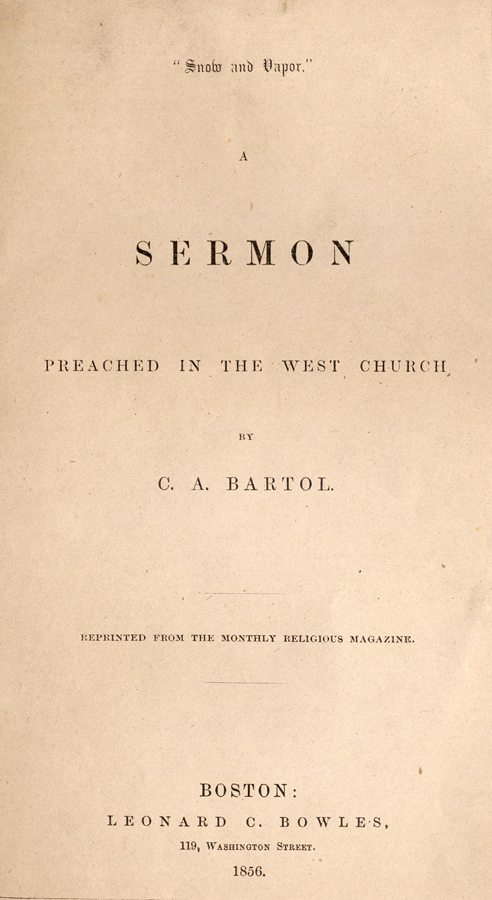
Sermon – Atlantic Telegraph – 1858


This sermon was preached by Joseph A Copp on August 8, 1858 in Chelsea, Massachusetts. It was preached to celebrate the completion of a trans-Atlantic telegraph cable between America and England on August 5, 1858.


sermon-atlantic-telegraph-1858-1

THE ATLANTIC TELEGRAPH: AS ILLUSTRATING THE PROVIDENCE AND BENEVOLENT DESIGNS OF GOD.

A

DISCOURSE,

PREACHED IN THE

BROADWAY CHURCH, CHELSEA,

AUGUST 8, 1858,

BY
JOSEPH A. COPP, D. D.


The Atlantic Telegraph Cable was announced from Trinity Bay, Thursday, August 5th, and on the next Sabbath morning, the 8th, was the subject of the following Discourse to a joint congregation of the Broadway and Plymouth Societies, in the Church of the former; and at the earnest request of members of both, is now given to the public.


DISCOURSE.JOB XII. 9.

THE HAND OF THE LORD HATH WROUGHT THIS.

It is said that the first telegram sent over the experimental wire of Morse, and which was expressive alike of the good taste and piety of the inventor, was the appropriate Scripture, “What hath God wrought?” A text of similar import has been selected this morning, to discourse, in the way of religious improvement, on the last and grandest achievement of the electro-telegraph.

The subject which, at the present time, justly absorbs public attention throughout Great Britain and the United States, with demonstrations of universal joy, is the union, so happily established between the two countries, by the electric cable. Incredulity may no longer doubt—fears and misgivings are at an end—the marvelous work is done! The wonders of art and practical science in the past, are as children’s work—the creations of the nursery—when compared with this.

A few years ago, the electric telegraph was a thing unknown, a thing incredible to general science; but now it has become a matter of common experience, and of every day business. But to-day we witness another step in the wonderful art, more wonderful than any of its former triumphs—the crowning miracle of all. A few days ago, what was characterized as visionary and impracticable, under natural hinderances deemed insurmountable, and what was pronounced by some eminent scientific men impossible on scientific grounds, is to-day a certain, a pleasing fact. In the face of all reasonings and fears to the contrary, behold the reality! That bold work, against which mighty nature seemed to hurl defiance—to proclaim her prohibition in tempests and stormy waves—is done! Angry ocean may foam and rage, and skeptical science may hesitate and doubt, but the cable is laid!

An epoch worthy of commemoration and thankfulness dawns on us this holy day—worthy of most religious recognition, as coming from God. Today, mother England and her American daughter, heretofore separated for nearly three hundred years of time, and nearly three thousand miles of distance, are brought to shake hands across an annihilated ocean. A proximity of communion and intimacy is henceforth established between them, like that between the sister municipalities, in the midst of which it is our privilege to live. It is true, we cannot to-day hear the bells of Old England ring out her church-going people, but we might hear, along the wonderful cable, her Christians pray and her ministers preach, and lift their pious acclamation over this new and heaven-sent bond of union between the Christian millions of the two countries. Wonderful event! As we contemplate it, the heartfelt utterance rises spontaneously to our lips, “THE LORD HATH WROUGHT THIS!” An event so wonderful in itself, and so prophetic of good to mankind, must be ascribed to the wonder-working providence of Him “who sitteth on the circle of the earth”—who “laid the foundations thereof,” and “stretched the line upon it” of a far-reaching benevolence.

THE PROVIDENCE OF GOD IN THE ACCOMPLISHMENT OF THE OCEAN TELEGRAPH, AND THE GOOD TO MANKIND IT MUST WORK, is the subject of our special consideration.

The Christian cannot doubt that this interesting event, from first to last, is of God. It may indeed be the fruit of genius, courage and unwearied toil. We would gladly ascribe all honor to the inventor, an illustrious son of Massachusetts, whose work confers glory on his country and his native State. But who inspired the fortunate train of thinking, which has led to the grand result? Who put it into the heart of the immortal Morse, to begin and maintain those tedious, expensive, and often disappointed experiments, through years of neglected toil and discouraged hope, which have to-day culminated in the last—greatest wonder of the world? The scientific discoverer himself, was the first to give the glory to God. Like Bezaleel, the son of Uri, he was “filled with the Spirit of God, in wisdom and understanding, and in knowledge.” His soul was touched by a spark brighter than electric light—a spark of heavenly wisdom itself—and the truth burst forth upon him. In that first dispatch, which his own hand sent over the speaking wire, he demonstrated the reality of the wonderful invention, and laid its honor, at the same time, at the footstool of God.

But let us pass from a truth, which atheism alone will deny, and contemplate that particular providence under which the Ocean Telegraph was finally accomplished.

Twelve months ago, when those two mighty ships, with their escort, went forth to do a work by which continents were to be joined, universal expectation was high and sanguine. Science and skill, it was supposed, had so nearly conquered every opposing difficulty, that the enterprise could hardly fail. Great, therefore, was the public disappointment, in the disaster that terminated the expedition. A year rolls round, and all the appliances of science and toil, within the reach of human power, have done their best to correct every error and imperfection, and to perfect the arrangements for a second and successful trial.

But God, to whom belongs, and should be ascribed, the glory of the work, will teach men their weakness and dependence; will make them feel, that in an enterprise on such a magnificent scale, and of such important moral bearings, success “is not of him that willeth, nor of him that runneth, but of God that showeth mercy.” For a great work, men must be disciplined. Nothing great is accomplished in this world by human agency, as all history will show, without a previous training. So God will teach the leading minds in this great enterprise, and an interested public looking on, that success depends on His favor, who holds the winds in his fist, and the waters in the hollow of his hand. He had planted a mighty ocean between the continents, and before this stormy barrier of six thousand years shall be forced by modern art, and yield to the embracing nations, His permission must be obtained, and the world be made to know, that He consents to the union, and smiles on the work.

Previous failure and disappointment, had somewhat cooled the ardor of expectation, and schooled the minds of men; but the work of discipline was not complete. And now comes the final trial. Prepared for every contingency, as was supposed, the ships turn their prows to mid-ocean. But the winds of heaven are let loose against them, and the angry billows threaten with destruction the daring fleet. God, who measures out the tempest for discipline, and not for destruction, restrains its violence. The ships outlive the storm. One but just survives it. With thanksgivings to God for sparing mercy, they meet at the appointed place, and, with no little despondency, begin the work assigned them. We know the unhappy issue of another, and another trial. Deeply discouraged they return to Ireland, and by the failure of the undertaking spread discouragement over the civilized world. But the enterprise for which so much of mind, and labor, and money had been expended, cannot be abandoned. At least another effort must be made, to satisfy the public, and to sustain a noble company, and if possible a sinking stock, which had become almost worthless in the market.

Under these clouds of discouragement, the cable fleet set about making their last desperate trial. It again set sail, like a forlorn hope, braving the dangers of the fatal breach. The ships, henceforth ever memorable, return to mid-ocean. They return, as the world now felt, to the closing disaster—to throw away their precious cable, seal the financial ruin of the company, and stamp the whole enterprise as a visionary, daring, and impracticable thing. All men looked with sympathy on the noble band of scientific adventurers, and naval officers, doomed to be the victims of the failure.

But another scene awaits us, in which we find an illustration of the Christian proverb, that “man’s extremity is God’s opportunity.” The time, ordained in the eternal counsels of wisdom, had come for success. The managing minds, the men designing and executing, were now disciplined. Science and toil had done all that was possible, and were humbled. And now it was deeply felt, and frankly acknowledged, if God be favorable, it may be done—without a special providence it must fail. And here let us turn aside, and take a look into a secret chapter of this memorable expedition. What were the feelings and encouragements of those practical men, on whom rested the executive responsibilities? Of those on board the Niagara, we can only speak with certainty. These men were rebuked and humbled by past failure, and had come to commit the great work to God in prayer. Their own complete arrangements, were less an encouragement than dependence on the blessing of God. The commander of the ship, and the chief electrician, felt so profoundly the need of God’s blessing, that they sought it through the prayers of God’s people on shore, and humbly implored it in their own state-rooms on board. They invested their undertaking with a high moral importance, rising far above scientific achievement and commercial convenience, as looking to a future of love and good will, of peace and religious benefit to mankind; and thus, purified from low aims, they were prepared to commend the undertaking to Him whose purpose it is, that all things shall so work, as finally to make purity and virtue triumphant.

It is most interesting to know, that while the world of commerce and ambition,–while bankers and philosophers, cabinets of state, and faculties of science, were contemplating the affair from their own stand-points, and in the light of their own peculiar interests and pursuits, there were others, on the land, and in the cabins of the Niagara, a chastened band, praying over it, in the serene light of philanthropy and religion.

Heaven is not unconcerned, when men of pure intentions and humble confidence, call for an exercise of grace, or interposition of Providence in behalf of a worthy object. Under the lofty impulses of religion and humanity, God has given to the soul a large liberty of asking. “Where two or three (said the Saviour) are gathered together in my name, there am I in the midst of them;” and if these “shall agree, as touching anything they shall ask, it shall be done for them of my Father which is in heaven.”

Such were the circumstances of moral discipline and of dependence, under which the two ships meet and make their last splice. No human power was equal to the contingencies of the undertaking. Disappointment had prepared them for the worst; and now, having committed all to God’s holy providence, these two ships separate, and hopefully, prayerfully, but tremblingly, bid on each other farewell.

And now a great and joyful surprise is about to break upon the world. “Weeping may endure for a night, but joy cometh in the morning.” Had it been announced the other day, as the final dispatch, that the last effort had been unsuccessful, and the cable was lost, a feeling of regret, indeed, would have followed the announcement, yet no one would have been disappointed; it was already lost in the fears of the multitude. But the time had come for the stupendous work to receive the approval of God, that man might see the divine hand in the accomplishment, and his glory in the end.

And now the surprise that has gladdened the country, and thrilled the hearts of millions in America and Great Britain, is one, under the circumstances, that points emphatically to heaven, and declares, in the language of the Psalmist, “This is the Lord’s doing, and it is marvelous in our eyes.”

And now let us proceed to inquire, as the conclusion of the whole matter, WHAT IS THE GRACIOUS END CONTEMPLATED BY PROVIDENCE IN THIS WONDERFUL EVENT, AND WHAT GOOD TO MANKIND WILL IT WORK?

An event in which the hand of God has been visible, must of course be for good. All things, however, are providential, in that they are wisely employed or overruled, and, directly or indirectly, move forward towards a great and benevolent end. The world, and all things in it and concerning it, are subject to an almighty will, and shall work out the purpose of infinite benevolence. God’s ultimate object cannot be defeated; it will be accomplished as certainly as there is omniscience to plan, and omnipotence to execute.

But in the view of man, some things are more obviously and directly providential than others. While God is actually in all events, yet in many of them he moves invisibly and mysteriously; but in others, his agency unveils itself to a conscious and awe-struck world. Thus Job said, “I have heard of thee with the hearing of the ear, but now, mine eye seeth thee.” Is it not so in the event before us? When all hope of success, under obstacles apparently insurmountable, had been well nigh abandoned, God reveals his own arm; he holds back the winds; he calms the troubled sea; he lays, as it were, with his own hand, the slender wire over that dark and mysterious plateau, hidden for unknown ages, in the depths of ocean, “that it might take hold of the ends of the earth.”

Now what is the design of a providence so signally displayed? We may say generally, and with confidence, some good of corresponding greatness and mercy to the children of men.

First, this telegraphic cable is to be a pledge and bond of peace. Two great Christian nations of the same origin, of the same language, and embarked on the same enterprises of civilization and humanity, ought never to contend but in the noble rivalry of doing good. To contend in low, brutal, wicked war, let us believe, will henceforth be impossible to these kindred nations. They have fought their last battle, and shed the last drop of fraternal blood. The bond of an everlasting union and sympathy is laid between them; it is the cord of love, “a threefold cord, not quickly broken.” It will bind the heart of Old England with noble, fraternal beatings, to that of Young America. Along this cord of connection, will flow those moral forces which, like the processes of life, excite to combine, and, conveying a healthful influence to every part, will serve to unite in harmony and strength, the general system. Through this wonderful medium, will pass and repass the utterances of commerce, of letters, of friendship and religion. Every pulsation of business, of science, and of society along the electric chain between the millions of either land, will strengthen the amity of the countries.

Acquaintance, is the practical philosophy of forbearance and love. Experience shows, the more we understand ourselves and others, the more improbable becomes hurtful difference and vulgar contention. Nations, like individuals, need but mutual acquaintance, to discover the common advantages which flow from peace and friendship. Wars among nations, like quarrels among individuals, are blunders and mistakes. Justice and humanity, no more than true policy, forbid them in every case; and it never can be the interest of men or of nations, to disregard their claims.

Let us therefore hail the success of the great experiment, as the pledge of increasing intimacy and acquaintance, and consequently of peace and good neighborhood between nations destined to control the empire of the world. In the struggle of the past, it was the distance of the Colonies that lost them to the mother country. Their wrongs were unknown, their cries unheard, their just demands unappreciated. The mother, afar off, became indifferent, and then cruel; and the daughter rebellious, and then independent. The result, in its present form, is very well; but henceforth all contention is needless, as it would be wicked between the nations. We therefore hail the success of the Ocean Telegraphs, as closing forever the gates of Janus between kindred millions, and pledging them to a long career of peace and prosperity. Let them go on in an alliance of friendship and love, to do the work of humanity and civilization for the less favored members of the family of mankind.

But, secondly, in this event, we see an omen of promise for Christian progress. Merchants and capitalists projected the Atlantic Telegraph, with worldly views and for worldly ends. Selfishness, very likely, labored to accumulate the wealth, that first moved in the mighty enterprise; and selfishness, it may be, has employed the means and agencies that have accomplished it. But God knows how to overrule the worldly views and ends of man, and turn the plans and labors of the selfish to the account of his kingdom. Commerce builds ships for her own gains and glory, but Religion employs them to send the Bible and the Missionary to the heathen. Capitalists lay railroads, but along the iron track, Christianity and its literature, and its thousand appliances for good, travel and are diffused. The improvements of art, and the facilities of modern traffic, are the ready avenues through which the grace of God pours the riches of mercy on a sinful world. And so in the case of this sub-Atlantic Telegraph; for whatever advantage of state, of commerce, or of letters, it may be regarded and used, God will employ it for the higher purposes of religion and humanity; along it will burn many a dispatch of mercy, to quicken the pulse of Christian activity and holy love of souls, in the old or new world. Transatlantic piety and American zeal, kindled up by intercommunicate flashes, drawn from the battery of heaven itself, will be felt reciprocally and simultaneously in both hemispheres. Wonderful vehicle! Like the spinal cord in the animal system, which conveys the impressions and volitions, from the seat of intellect in the brain, to the most distant members, deciding with instantaneous precision the most remote and complicated movements; so this international spinal connection will serve to convey and multiply the impressions of the divine will, to parts at hand, and to places afar off. Over it will run the living word of Christ, with the speed of lightning, the warmth of love, and the certainty of truth, to perform its saving work on either side of the globe. It is the fulfillment of prophecy—in a significant sense, “It is the voice of him that crieth in the wilderness (of waters), Prepare ye the way of the Lord, make straight in the desert (of deep ocean) a highway for our God.”

Thus, science and wealth have unwittingly laid their contributions at the feet of our blessed Redeemer, to be employed in the promulgation of that saving truth, for which he lived, suffered, and died, and now liveth forever more. This grand achievement belongs to Christ,–to the glory of his kingdom and the progress of his truth we would consecrate it this day. He, to whom God has given all things, rightly claims the telegraph as his own. It is the angel of the Apocalypse, having the everlasting gospel to preach; the angel of heaven’s own lightning, hurrying with the speed of thought,–not through the clouds above, but, under depths, mysterious, profound, and awful, carrying the message of God, “Peace on earth and good will to men,” with angelic certainty and dispatch to the nations.

Thus we may rejoice to-day as Christians and philanthropists, in an event which will bring glory to God and good to man every where, and which will contribute in its future operations to that promised and long prayed for epoch, when Jesus shall reign universally, and

“His kingdom stretch from shore to shore,
Till moons shall wax and wane no more.”

Wentworth Cheswell Documents

Wentworth Cheswell (sometimes Chiswell or Cheswill), from New Hampshire, held some position in local government for half a century, holding a position every year from 1768 until 1817. Below are documents from the WallBuilders library signed by Cheswell during the twelve years he served as Justice of the Peace.


Wentworth Cheswell Document from 1812

wentworth-cheswell-documents-2
Wentworth Cheswell Document from 1813


Wentworth Cheswell Document from 1814


Wentworth Cheswell Document from 1815


Wentworth Cheswell Document from 1816

Bible Society Reports

The Philadelphia Bible Society, America’s first Bible society, was officially organized on December 12, 1808. By 1816, 121 more Bible societies had been started across the nation. Below, from the WallBuilders library, is a group of reports from various 19th century Bible societies. At WallBuilders, we also have an original Bible published by the Philadelphia Bible Society.


bible-society-reports-1 bible-society-reports-2 bible-society-reports-3 bible-society-reports-4 bible-society-reports-5 bible-society-reports-6 bible-society-reports-7 bible-society-reports-8

Daniel Webster’s Letter to the American Bible Society

Daniel Webster, a second generation Founding Father, was extremely expressive about his faith. The Daniel Webster letter below is written about the “national” (American) Bible Society and a request it received to send Bibles to South America.


daniel-websters-letter-to-the-american-bible-society-1


The national Bible Society has lately been called upon by the new Republic of South America to send them the Scriptures.

She is desirous of complying with this request, and although the claims, of our own destitute countrymen are urgent, and must be attended to, yet she is anxious to aid, also, at this critical period of her existence, our sister Republic. She appeals therefore, to our wealthy and benevolent citizens for their patronage in this noble work.

Danl. Webster

Benjamin Rush Personal Bible Study

Founding Father Benjamin Rush’s handwritten personal Bible study booklet entitled “References to Texts of Scriptures Related to Each Other Upon Particular Subjects.” In it he listed scriptures under various topics and wrote his own notes on those scriptures. We have included excerpts of the booklet below.


benjamin-rush-personal-bible-study-1
Booklet Cover


benjamin-rush-personal-bible-study-2benjamin-rush-personal-bible-study-3

Rush recorded three pages of scriptures and notes regarding
“Atonement”


benjamin-rush-personal-bible-study-4
“Universal Salvation”

Rush cataloged scriptures such as Exodus 32:11-12; Romans
5:3-4; Isaiah 49:6,8-9; Matthew 15:13; etc. under the title “Universal Salvation”


benjamin-rush-personal-bible-study-5
“Objects of Prayer” & “Influences
of Religion on Family Prosperity”

Rush’s notes on scripture passages related to prayer and
God’s blessings
(Note: nail used in book seam)


benjamin-rush-personal-bible-study-6
“Kindness to Strangers”

Rush lists Leviticus 19:33, Exodus 12:49, Deuteronomy 23:7
and other verses under the heading “Kindness to Strangers”


benjamin-rush-personal-bible-study-7
“Efficacy of Prayer”

Rush’s scriptures on the effectiveness of prayer include
Genesis chapter 18 and 21:17 & 21.


Benjamin Rush

(1745-1813) Rush was a physician, educator, philanthropist, and statesman. He graduated from Princeton (1760) and then studied medicine in Philadelphia, Edinburgh, London, and Paris. He served in the Continental Congress (1776-77) and signed the Declaration of Independence (1776). Rush also: suggested to Thomas Paine that he write Common Sense (1776) and supplied the title for it as well as helped publish it; was Surgeon-General of the Continental Army (1777-78); and was one of the founders of Dickinson College (1783). He was an influential delegate to the State ratification convention for the federal Constitution (1787), and along with James Wilson, one of the principal coauthors of the Pennsylvania constitution (1789-90). Rush served as Treasurer of the U. S. Mint under Presidents John Adams, Thomas Jefferson, and James Madison (1797-1813). He mediated a reconciliation between long time political rivals John Adams and Thomas Jefferson; was a founder of the Pennsylvania Society for Promoting the Abolition of Slavery (1774) and its president; founder and Vice-president of the Philadelphia Bible Society (1808-13); member of the First Day Society of Philadelphia (1790); and a member of the Abolition Society (1794-97). Benjamin Rush is called the “Father of American Medicine” for his numerous medical discoveries.

Sermon – Church and Country – 1891


This address was given by a Bishop of the Protestant Episcopal Church, William Stevens Perry (1832-1898), on May 19, 1891.


sermon-church-and-country-1891-1

THE CHURCH AND THE COUNTRY.

FROM THE ADDRESS TO THE CONVENTION OF THE DIOCESE OF IOWA,
MAY 19, 1891, BY WILLIAM STEVENS PERRY, BISHOP.

Most gratifying to me and most encouraging are the evidences apparent on every side that the clergy generally are seeking in every legitimate way to make the influence of the Church felt on every side. The historic position of the clergyman of the Church is indicated in the old-time word applied to him as the “parson”—the “person” of the community where he dwells; the one interested in each one’s welfare; the one, above all other men, laboring for everybody’s temporal and spiritual good. One and another may voluntarily withdraw themselves from the direct influence of the Priest of God, but he is still the person to minister in spiritual things to all who do not thus refuse his kindly offices—his ministrations of grace. This conception of priestly position, privilege, and duty will make the priest of our smallest mission the ever-widening centre of spiritual usefulness for good to all men. The highways and byways are certainly open to us, and they will be found to contain numbers who will gladly respond to our efforts for their spiritual good. I like that homely old English word, “parson,” and that grander, nobler word—the connecting link of the two dispensations—priest. Let the priest by broad sympathies, by active labor, by caring for more than the little circle of avowed parishioners, and by striving to reach every soul within his reach, acquaint all within his influence of his purpose and his place, and the Church will redeem John Wesley’s watchword. “The world is my parish,” and that part of the world in and about one’s parish will become the theatre of an aggressive work for Christ which God will own and men will recognize and bless. It is a pitiful idea of the priestly vocation and the priestly commission that leads one to confine his ministrations solely to those who contribute to his support. By the terms of his ordination he is not only “to feed and provide for the Lord’s family,” but also “to seek for Christ’s sheep that are dispersed abroad, and for His children who are in the midst of this naughty world, that they may be saved through Christ forever.”

As a Bishop of a Church whose history runs parallel with that of our country; whose priests, first of all ministers of religion, held the services and administered the sacraments of Holy Church in the tongue of our English fathers on the Atlantic and Pacific coasts; whose Bishops, clergy and members were foremost in the work of colonization; whose “missioners” numbered among their most noted names those of Francis Fletcher, the first priest officiating on the soil of California, Richard Seymour the first priest of New England, Robert Hunt the first priest of Virginia; and later those of Whitefield the great evangelist, the Wesley’s, John and Charles, the preacher and poet of Methodism, each laboring for Christ and His Church in Georgia; and Thomas Thompson of New Jersey the first missionary from this country to Africa; and countless others like minded; whose also was the first convert to Christ in Holy Baptism of the aborigines in Raleigh’s ill-starred colony at Roanoke in 1587; whose cross-topped Church built at Fort St. George in 1607, was the first place of Christian worship erected on the coast stretching from Maine to Georgia, thirteen years before the Puritans landed at Plymouth; whose member and ministers founded the first American University, that of Henrico, Virginia, and the first free school, at Charles City in the same colony; whose baptized members furnished two-thirds of the signers of the Declaration of Independence and a majority of the framers of the federal Constitution; which gave us our Washington and the most distinguished of the patriots who, in the halls of Congress or on the battle-field, won for us our independence;–I cannot fail to call the attention of clergy and laity to the importance of inculcating at fitting times and under suitable circumstances the Christian duty of patriotism. We at the present juncture of national affairs, need to be reminded that, as citizens of the United States of America, we owe our country’s first discovery and settlement—our very nationality—not to Columbus and Spain and Rome, but to Cabot and England and to England’s Church. The close connection of the Church of England with our colonization and development is now established as an historic fact. The strife for the possession of the empire of the Western World was waged from the start between the Anglican and the Roman communions. Through the papal bull meted out the New World to Spain to hold as a fief of the Roman See, the Church, the Crown, the Commonwealth of England recognized no peace with Spain beyond the line—the line of demarcation beyond which Spain was to have absolute and undisputed rule. The rival communions, Anglican and Roman, were each successful in securing a moiety of the New World, but the territory we as a nation occupy was claimed and planted by England, and not by Spain or France. We may thank God that our nationality was thus based on Magna Charta, on the English Constitution, on the English common law, on the English Bible, and on the English Book of Common Prayer. Mexico and the Latin republics of the South American states may date their origin and their faith from Spain and Rome. We are the sons of Anglo-Saxon sires. Our fathers at the Revolution fought for their rights as free-born Englishmen—rights which would not have been ours by inheritance or possession had not the mother land of England successfully resisted the Spanish attempts to monopolize the Western World, and the mother Church of England sent the priest with her people and supplied the word of God and the Church’s prayers wherever her baptized children went. True as it is that in a land such as ours no state establishment of religion is either practicable or desirable, but still the fact that our communion alone is spoken of as the American Church; and that we alone, by reason of our occupancy of all sections of our beloved country; by our historic connection with the Nation’s past; by the close similarity of our general ecclesiastical constitution with that which our fathers—Churchmen as well as patriots—established for the land; and by our recognition, in prayers and offices from the very first, of “the powers that be” as “ordained of God,” shows that we are each day growing more and more worthy of our claim to be called the American Church, and to be in truth the American Catholic Church. In view of the duty so specially ours of recognizing the authority under which we live, I would urge upon my reverend brethren of the clergy, and upon the laity as well, the duty of seeking to be in touch with everything national and patriotic. Gladly would I see over every Church in Iowa, under the cross, the flag of the republic floating from spire or tower, telling of our love for country as the cross uplifted tells of our grateful recognition of the emblem of our salvation. We should not as Churchmen be a whit behind any in our patriotism; teaching its lessons in our Sunday Schools, from our pulpits, in our every-day speech. The American idea should dispossess all other ideas so far as true politics, the common weal of the commonwealth, are concerned. The love of country will, if awakened, encouraged, and developed, dominate partisanship and make us better citizens and men. We need and we should countenance in this land no organizations of Englishmen, of Scotchmen, Welshman, Irishmen, Scandinavians, Germans, French, or Italians associated for the furtherance of un-American purposes or ideas. Much less should we consent to the growth amongst us of secret tribunals with their crimes and assassinations, or the organization of men of foreign birth and sympathies trained to the use of arms. We must recognize no flag but the Stars and Stripes. Our liberties are endangered, even before we are aware, by this banding together of foreigners, who seek an asylum and a support in our free land that they may the better carry on their schemes of interference with other nations. For God and native land may well be our motto! If we are true to our country’s needs, if true to our Christian faith, we may make this land of ours “God’s noblest offspring,” even though it be the last.