John Adams Letter to Benjamin Rush

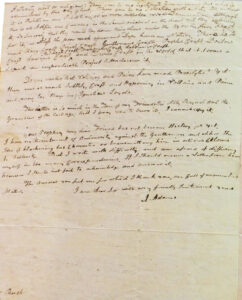
The following is the original December 21, 1809 letter by John Adams to Benjamin Rush, followed by the transcription. The transcript has been modified from the original to include modern grammar and spelling.
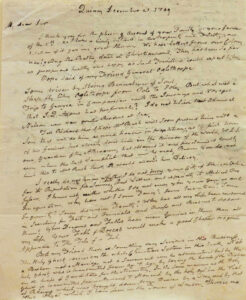

Quincy December 21, 1809

My dear Sir

I thank you for the pleasing account of your family in your favor of the 5th as I have a lively interest in their prosperity and felicity, your relation of it gave me great pleasure. We have letters from our colony navigating the Baltic, dated at Christiansand. They had been so far as prosperous and healthy and happy as such travelers could expect to be.

Pope said of my friend General Oglethorpe.
Some driven by strong benevolence of soul shall fly like Oglethorpe from pole to pole. But what was a trip to Georgia in comparison with the journeys and voyages that J.Q. Adams has performed? I do not believe that Admiral Nelson ever ran greater risks at Sea.

Tell Richard that I hope Mrs. Rush will soon present him with a son that will do him as much honor in proportion as the first born of his genius has already done him in the opinion of the world. W.S.S. our guardian of the Athenaum has obtained it and proclaims it loudly everywhere the best pamphlet that will be read. Be sure you do not hint this to Mrs. Rush Junr. It would alarm her delivery.

I really do not know whether I do not envy your city of Philadelphia for its reputation for science, arts, and letters and especially its medical professor. I know not, neither whether I do not envy you your genius and inspiration. Why have I not some fancy? Some invention? Some ingenuity? Some discursive faculty? Why has all my life been consumed in searching for facts and principles and proofs and reasons to support them? Your dreams and fables have more genius in them than all my life. Your Fable of Dorcas would make a good chapter or a good appendix to the Tale of a Tub.

But my friend there is something very serious in this business. The Holy Ghost carries on the whole Christian system in this Earth. Not a baptism, not a marriage, not a Sacrament can be administered but by the Holy Ghost, who is transmitted from age to age by laying the hands of the Bishop on the heads of candidates for the Ministry. In the same manner as the Holy Ghost is transmitted from monarch to monarch by the holy oil in the vial at Rheims which was brought down from Heaven by a dove and by that other phial [vial] which I have seen in the Tower of London. There is no authority civil or religious: There can be no legitimate government but that which is administered by this Holy Ghost. There can be no salvation without it. All without it is rebellion and perdition, or in more orthodox words damnation. Although this is all artifice and cunning in the sacred original in the heart, yet they all believe it so sincerely that they would lay down their lives under the ax or the fiery fagot [bundle of wood used for burning individuals at the stake] for it. Alas, the poor weak ignorant dupe human nature. There is so much king craft, priest craft, gentlemen’s craft, people’s craft, doctors craft, lawyers craft, merchants craft, tradesmen’s craft, laborers craft and Devil’s craft in the world that it seems a desperate [hopeless] and impractical project to undeceive it.

Do you wonder that Voltaire and Paine have made proselytes [converts]? Yet there [is] near as much subtlety, craft and hypocrisy in Voltaire and Paine and more too than in Ignatious Loyola [a Spanish knight who was a founder of the Jesuits].

This letter is so much in the tone of my friend the Abbe Raynal [a French writer] and the grumblers of the last age, that I pray you to burn it. I cannot copy it.

Your prophecy, my dear friend, has not become history as yet. I have no resentment of animosity against the gentleman and abhor the idea of blackening his character or transmitting him in odious colors to posterity. But I write with difficulty and am afraid of diffusing myself in too many correspondences. If I should receive a letter from him however I should not fail to acknowledge and answer it.

The Auroras you lent me for which I thank you are full of momentous matter.

I am dear sir with every friendly sentiment yours, J. Adams.

Dr. Rush

*WallBuilders has an article about the dream of Benjamin Rush (which this Adams letter is in response to) and the reconciliation of Adams and Jefferson in 1812. To read this article click here.
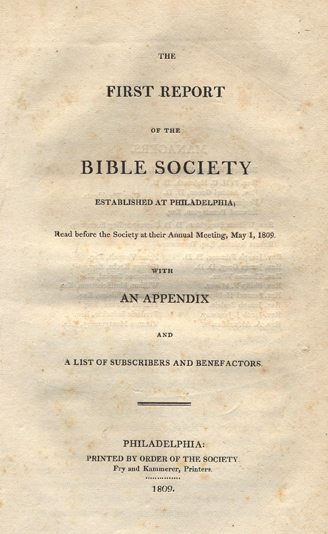
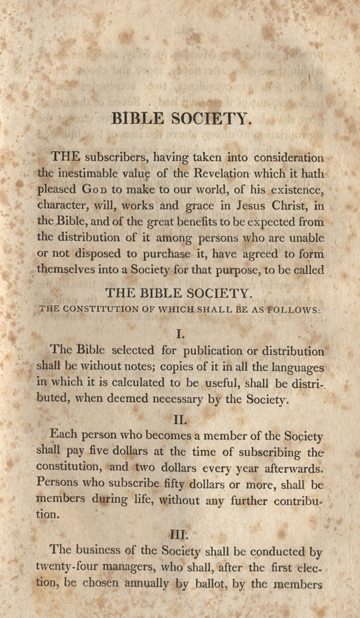
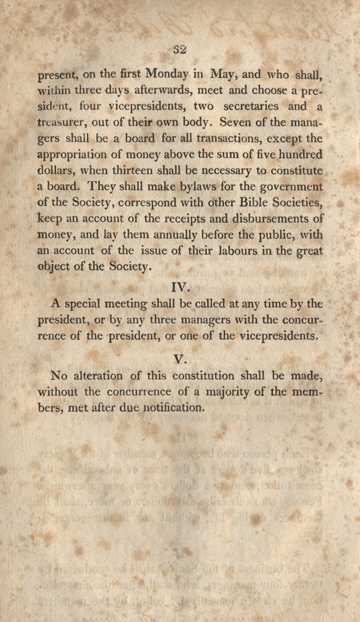
Philadelphia Bible Society Constitution

The Philadelphia Bible Society, America’s first Bible society, was officially organized on December 12, 1808. Rev. Dr. William White was president of the society and Declaration signer Benjamin Rush was a vice president. By 1816, 121 more Bible societies had been started across the nation.

Below, from WallBuilders’ Collection, is the Philadelphia Bible Society constitution, published in 1809. See also this title page from the first Bible printed by the Philadelphia Bible Society.


philadelphia-bible-society-constitution-1
philadelphia-bible-society-constitution-2

philadelphia-bible-society-constitution-3

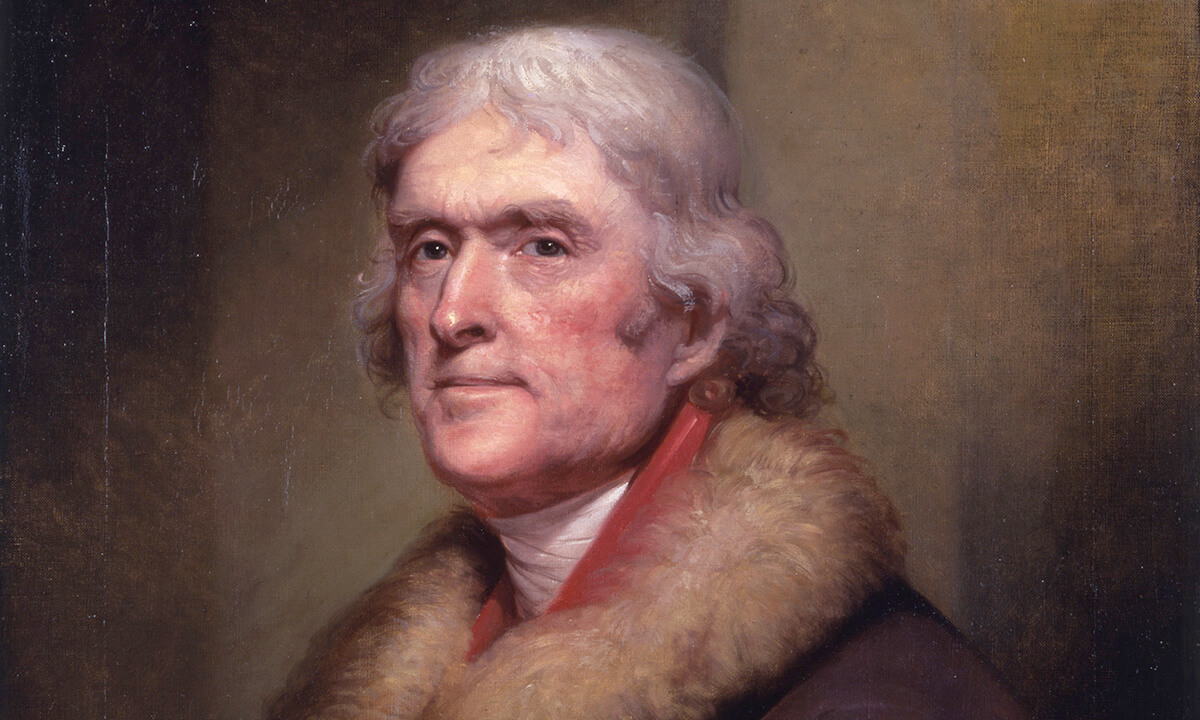
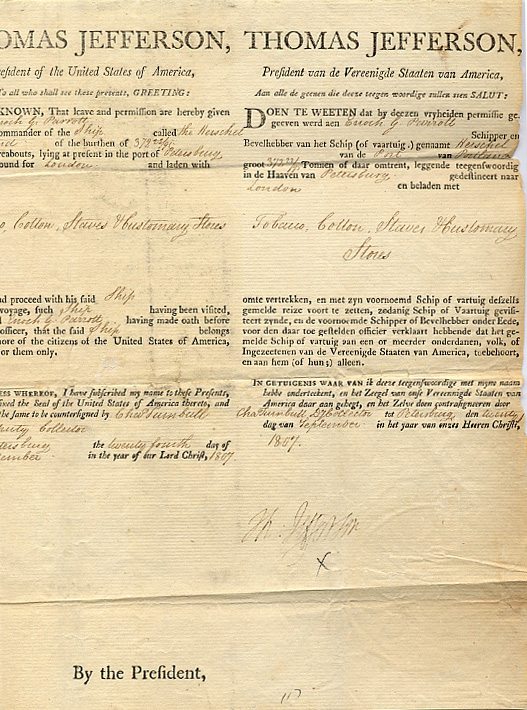
Thomas Jefferson Document


Following is an original document in our possession, signed by Thomas Jefferson on September 24, 1807. This document is permission for a ship called the Herschel to proceed on its journey to the port of London. The interesting characteristic of this document is the use of the phrase “in the year of our Lord Christ.” Many official documents say “in the year of our Lord,” but we have found very few that include the word “Christ.” However, this is the explicitly Christian language that President Thomas Jefferson chose to use in official public presidential documents.


thomas-jefferson-document

Benjamin Rush Letter to Elisha Boudinot

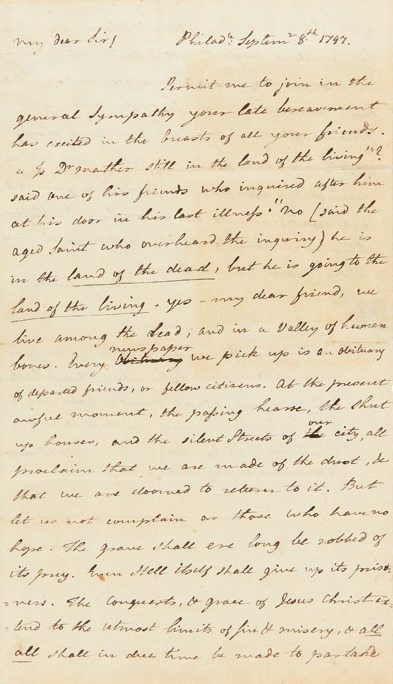
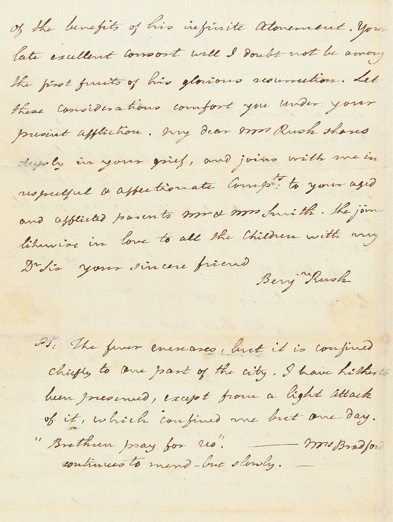
Below is a letter that WallBuilders came across from Benjamin Rush (Declaration signer) to Elisha Boudinot, brother of Founding Father Elias Boudinot. Rush wrote this letter on September 8, 1797 in condolence for the loss of Elisha’s wife. Notice the specifically religious content in this letter.


benjamin-rush-letter-to-elisha-boudinot-1


benjamin-rush-letter-to-elisha-boudinot-2

Philad. September 8th. 1797.

My dear Sir:


Permit me to join in the general sympathy your late bereavement has excited in the breasts of all your friends. “Is Dr. Mather still in the land of the living” said one of his friends who inquired after him at his door in his last illness. “No (said the aged saint who overheard the inquiry) he is in the land of the dead, but he is going to the land of the living.” Yes – my dear friend, we live among the dead; and in a valley of human bones. Every newspaper we pick up is an obituary of departed friends, or fellow citizens. At the present awful moment, the passing hearse, the shut up houses, and the silent streets of our city, all proclaim that we are made of the dust, & that we are doomed to return to it. But let us not complain as those who have no hope. The grave shall ere long be robbed of its prey. Even Hell itself shall give up its prisoners. The Conquests & Grace of Jesus Christ extend to the utmost limits of fire & misery, & all all shall in due time be made to partake of the benefits of this infinite Atonement. Your late excellent consort will I doubt not be among the first fruits of his glorious resurrection. Let those considerations comfort you under your present affliction. My dear Mrs. Rush shares deeply in your grief, and joins with me in respectful & affectionate [comforts] to your aged and afflicted parents Mr. & Mrs. Smith. She joins likewise in love to all the children with my Dr Sir your sincere friend.

Benjm Rush


PS: The fever increases, but it is confined chiefly to one part of the city. I have hitherto been preserved, except from a light attack of it, which confined me but one day. “Brethren pray for us.” – Mrs. Bradford continues to mend but slowly.

Jacob Broom Letter

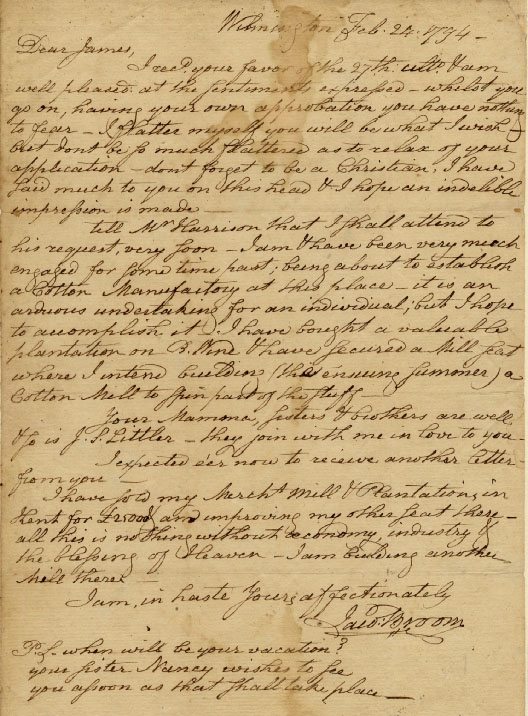
Jacob Broom (1752-1810) was a farmer, surveyor, businessman, public official, and philanthropist. He prepared military maps for General George Washington prior to the Battle of Brandywine (1777) and held numerous local political positions throughout his life. Broom was member of the Delaware legislature (1784-86, 1788); and a delegate to the Constitutional Convention where he signed the federal Constitution (1787). He is probably one of the least known signers of the Constitution.


In this letter, Jacob expresses fatherly pride and reminds his son James to remember what he had been taught and “be a Christian”:

jacob-broom-letter-1


This is the text of Jacob Broom’s letter:

Wilmington Feb. 24,1794

Dear James,

I recd.[received] your favor of the 27th ulti [last] & am well pleased at the sentiments expressed – whilst you go on, having your own approbation you have nothing to fear – I flatter myself you will be what I wish but don’t be so much flattered as to relax of your application – don’t forget to be a Christian, I have said much to you on this head [topic of discourse] & I hope an indelible impression is made –

Tell Mr. Harrison that I shall attend to his request, very soon – I am & have been very much engaged for some time past; being about to establish a Cotton Manufactory at this place – it is an arduous undertaking for an individual; but I hope to accomplish it – I have bought a valuable plantation on B. Wine and have secured a Mill seat [site] where I intend building (the ensuing summer) a Cotton Mill to spin part of the stuff [note: Broom built the first cotton mill at Brandywine in 1795 near Wilmington, DE] –

Your mamma, sisters & brothers are well & so is J.S. Littler – they join with me in love to you –

I expected sir now to receive another letter from you –

I have sold my Mercht.[Merchant] Mill & Plantations in Kent for 25,000 I am improving my other seat there – all this is nothing without economy, industry & the blessing of Heaven – I am building another Mill there –

I am, in haste yours affectionately

Jaco Broom

P.S. when will be your vacation? Your sister Nancy wishes to see you as soon as that shall take place –

Samuel Chase

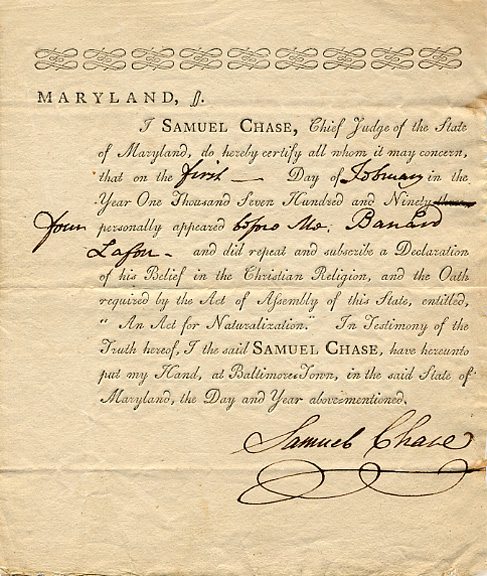
Samuel Chase Document

This is a document we have in our possession, signed by Samuel Chase on February 1, 1794. This document is Chase certifying Barnard Lafon’s “Declaration of his belief in the Christian religion and the Oath required by the Act of Assembly of this State entitled ‘An Act for Naturalization’.”

Samuel Chase was born in April, 1741 in Maryland. He served in Congress from 1774-1778 and was a signer of the Declaration of Independence. He served as the Chief Justice of the criminal court of Baltimore starting in 1788 and later became the Chief Justice of the state of Maryland. He was appointed an Associate Justice in the United States Supreme Court where he served from 1796 until his death in June, 1811.


samuel-chase-document-1

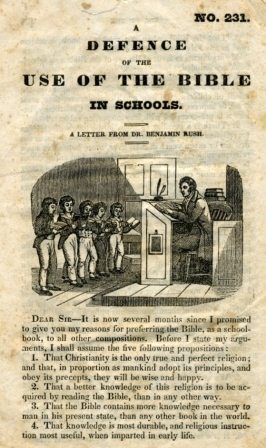
A Defence of the Use of the Bible in Schools

The following is part of the transcript from a letter written in 1791, which was published by the American Tract Society in 1830. To purchase the whole text of Dr. Rush’s letter, see The Bible in Schools pamphlet that can be found in the WallBuilders store.


a-defence-of-the-use-of-the-bible-in-schools-1
Dear Sir:
It is now several months since I promised to give you my reasons for preferring the Bible as a schoolbook to all other compositions.  Before I state my arguments, I shall assume the five following propositions:

  1. That Christianity is the only true and perfect religion; and that in proportion as mankind adopt its principles and obey its precepts they will be wise and happy.
  2. That a better knowledge of this religion is to be acquired by reading the Bible than in any other way.
  3. That the Bible contains more knowledge necessary to man in his present state than any other book in the world.
  4. That knowledge is most durable, and religious instruction most useful, when imparted in early life.
  5. That the Bible, when not read in schools, is seldom read in any subsequent period of life.

My arguments in favor of the use of the Bible as a schoolbook are founded,
I. In the constitution of the human mind.

  1. The memory is the first faculty which opens in the minds of children.  Of how much consequence, then, must it be to impress it with the great truths of Christianity, before it is preoccupied with less interesting subjects.
  2. There is a peculiar aptitude in the minds of children for religious knowledge.  I have constantly found them, in the first six or seven years of their lives, more inquisitive upon religious subjects than upon any others. And an ingenious instructor of youth has informed me that he has found young children more capable of receiving just ideas upon the most difficult tenets of religion than upon the most simple branches of human knowledge.  It would be strange if it were otherwise, for God creates all His means to suit His ends.  There must, of course, be a fitness between the human mind and the truths which are essential to it happiness.
  3. The influence of early impressions is very great upon subsequent life; and in a world where false prejudices do so much mischief, it would discover great weakness not to oppose them by such as are true.  I grant that many men have rejected the impressions derived from the Bible; but how much soever these impressions may have been despised, I believe no man was ever early instructed in the truths of the Bible without having been made wiser or better by the early operation of these impressions upon his mind.  Every just principle that is to be found in the writings of Voltaire is borrowed from the Bible; and the morality of Deists, which has been so much admired and praised where it has existed, has been, I believe, in most cases, the effect of habits produced by early instruction in the principles of Christianity.
  4. We are subject, by a general law of our natures, to what is called habit.  Now, if the study of the Scriptures be necessary to our happiness at any time of our life, the sooner we begin to read them, the more we shall probably be attached to them; for it is peculiar to all the acts of habit, to become easy, strong, and agreeable by repetition.

For the whole text of Dr. Rush’s letter, see the WallBuilders store to purchase the The Bible in Schools pamphlet.

Election Sermon

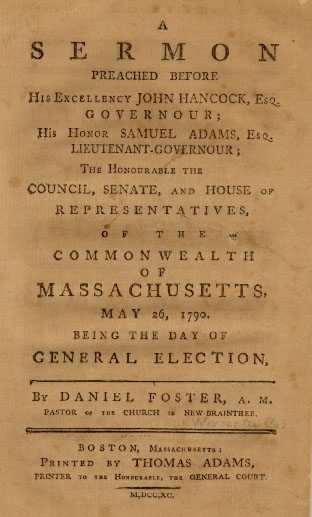
At the time of the Founders, it was a common practice for ministers to preach “Election Sermons,” and it was very common for a clergyman to be invited to give a sermon before the newly-elected government officials. This 1790 election sermon by Rev. Daniel Foster was given before the Massachusetts Governor (John Hancock), Lieutenant-Governor (Samuel Adams), and both houses of Legislature. Rev. Foster admonished these elected officials using Proverbs 8:16 (By Me princes rule, and nobles, even all the judges of the earth), and encouraged them to govern according to God’s ways. (For the full text of Foster’s Election Sermon click here.)

election-sermon-1

This is the text on the cover of the Election Sermon:


A
S E R M O N

PREACHED BEFORE

His Excellency JOHN HANCOCK, Esq.
GOVERNOUR;

His Honor SAMUEL ADAMS, Esq.
LIEUTENANT-GOVERNOUR;

The Honourable The

COUNCIL, SENATE, and HOUSE of

REPRESENTATIVES,

Of The

C O M M O N W E A L T H
of

M A S S A C H U S E T T S

MAY 26, 1790.

BEING THE DAY OF

GENERAL ELECTION


By DANIEL FOSTER, A.M.
PASTOR of the CHURCH in NEW BRAINTREE


BOSTON, Massachusetts:

PRINTED BY THOMAS ADAMS,
PRINTER to the HONOURABLE, the GENERAL COURT


M,DCC,XC


John Hancock (1737-93) was a soldier, public official and Harvard graduate(1754). He served several terms as a Selectman of Boston; member of the Provincial Legislature (1766-72); member of the Continental Congress (1774-78) where he was the first signer of the Declaration of Independence (1776) and President of Congress (1774-77); He was a Senior Major-General of the Massachusetts Militia (1778); a delegate to the State constitutional convention (1779); and Governor of Massachusetts (1780-85, 1787-93).

Samuel Adams (1722-1803) was a leader in the opposition to the acts by British Parliament which precipitated the American Revolution (1765-76); formed Boston’s Committee of Correspondence (1772); was a member of the Continental Congress (1774-81) where he signed the Declaration of Independence (1776); and helped draft the Articles of Confederation (1777); He served as president of the Massachusetts senate (1781); Lieutenant-Governor of Massachusetts (1789-94); and Governor of Massachusetts (1794-97). He is called both the “Firebrand of the Revolution” and “The Father of the American Revolution” for his important leadership in the cause of American independence.

The 104th Psalm by John Quincy Adams

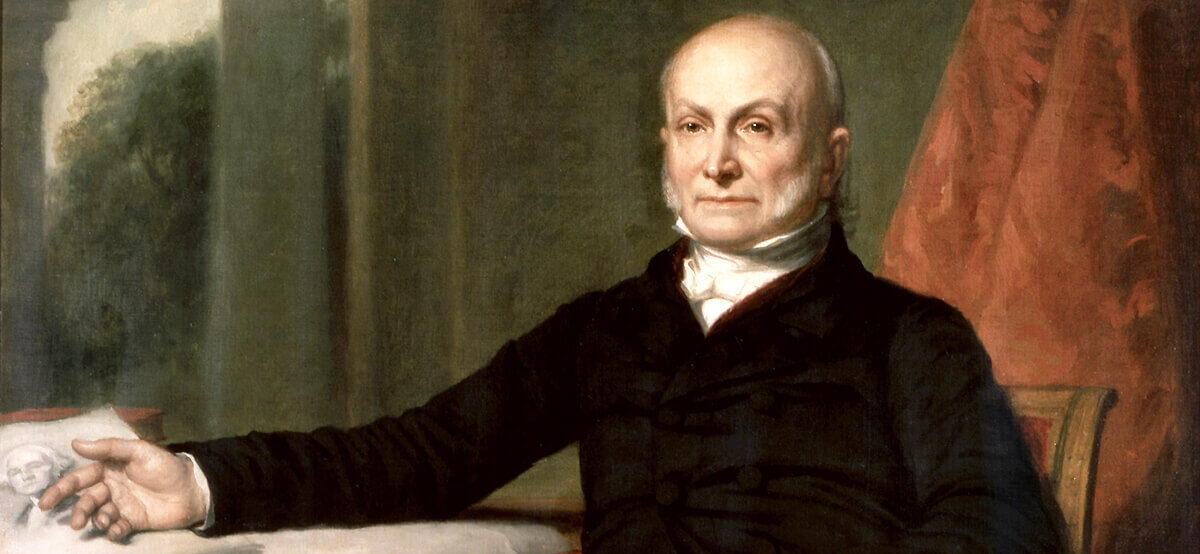
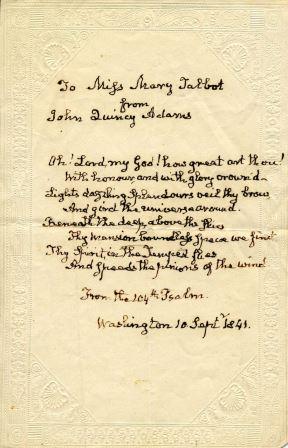
John Quincy Adams, sixth President of the United States was well known for his use of words. The below handwritten poem, dated September 10, 1841 and transcribed from the 104th Psalm, is a wonderful example of not only Adams’ appreciation for the Word of God, but also of his firm conviction and faith in God.


the-104th-psalm-by-john-quincy-adams-1

To Miss Mary Talbot
from
John Quincy Adams

Oh! Lord, my God! How great art Thou!
With honour, and with glory crown’d
Lights dazzling splendours veil thy brow,
And gird the universe around.

Beneath the deep, above the skies
Thy mansion boundless space we find.
Thy Spirit in the Tempest flies
And spreads the pinions of the wind.

From the 104th Psalm

Washington 10 Sept. 1841

American Bible Society Certificate Signed by John Jay

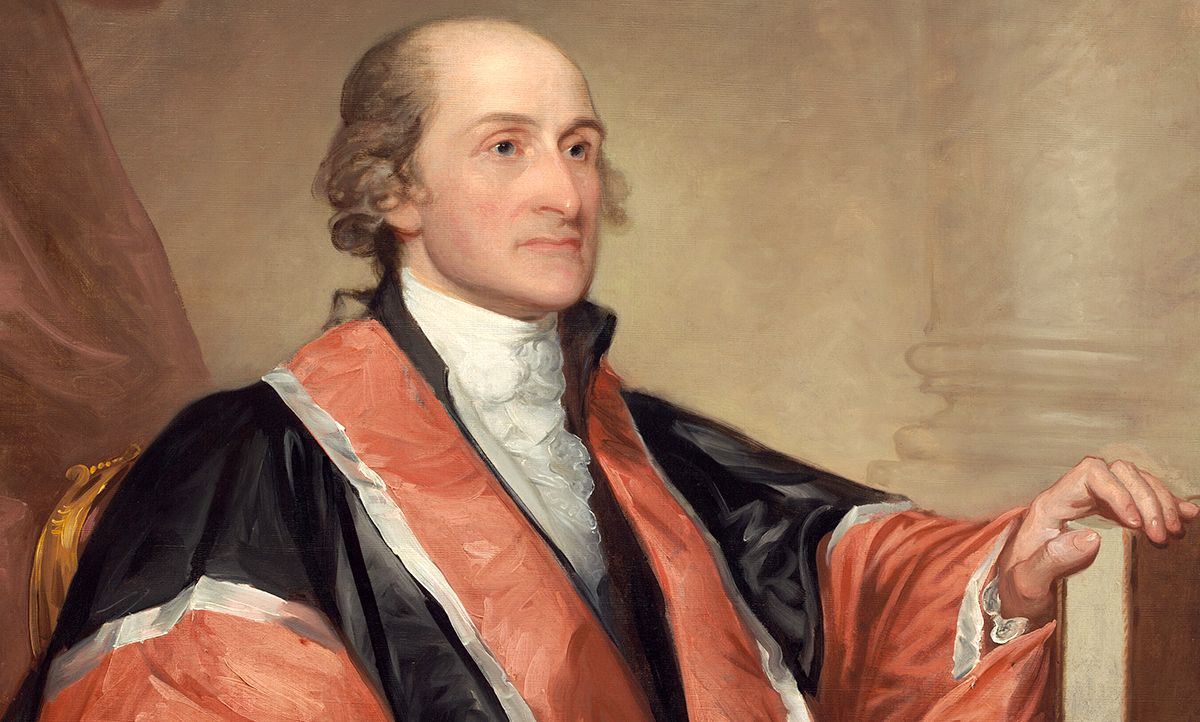
John Jay (1745-1829) was an attorney, public official, diplomat, jurist. He was member of the Continental Congress (1774-76, 1778-79) where he was President of Congress (1778-79) and helped write the New York State constitution (1777). Jay also authored first manual on military discipline (1777) and served as Chief-Justice of the New York Supreme Court (1777-78). During the War for Independnece, he was appointed minister to Spain (1779) and also signed the final peace treaty with Great Britain (1783). Jay, along with James Madison and Alexander Hamilton, authored The Federalist Papers, which were instrumental in securing the ratification of the US Constitution. Under President George Washington, he was appointed first Chief-Justice of the U. S. Supreme Court (1789-95) and later declined a reappointment as Chief-Justice by President John Adams. Jay later served as Governor of New York (1795- 1801).

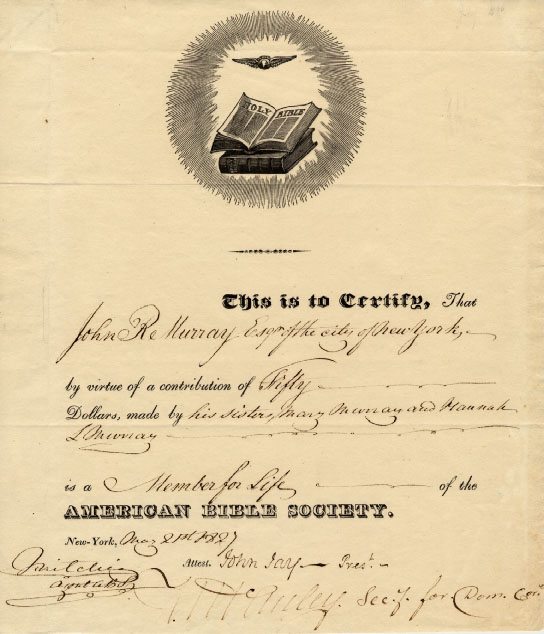
John Jay was also vice-president of the American Bible Society at its beginning, from 1816-21, and was president from 1821-27. Below is a membership certificate signed by him as president of the American Bible Society.


american-bible-society-certificate-signed-by-john-jay-1


This is to Certify, That John R Murray, Esqr. Of the city of New York, by virtue of a contribution of Fifty Dollars, made by his sisters, Mary Murray, and Hannah  L. Murray is a member for life of the

American Bible Society. 

New York, May 21st 1827
Attest. John Jay – Prest.[President] –
Jnitelies[?] Agent ABS
T. McAuley Secy. for Dom. Cores