Sermon – Artillery – 1828, Massachusetts

John Pierpont (1785-1866) Biography:
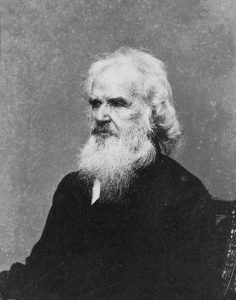
Born in Connecticut to a well-known family, he graduated from Yale in 1804. He worked as an educator for several years, then began studying law. In 1812, he passed the bar and went to work as a lawyer in Newbury, Massachusetts. But being dissatisfied as an attorney he became a merchant in Boston, then Baltimore, and next entered the study of theology. He graduated from Cambridge Divinity School and was ordained in 1819. He pastored a Boston church until 1845, then a church in Troy, New York, until 1849, and then another church in Massachusetts, where he pastored until 1856. While a pastor, Pierpont penned two of the more popular classroom school readers of that day. He was an abolitionist, a member of the temperance movement, a Liberty Party candidate for governor in the 1840s, and then a Free-Soil Party candidate for governor in 1850. He served as a Massachusetts field chaplain during the Civil War, but the physical demand was too great for his aging body, so he took an appointment in the Treasury Department in Washington, where he worked until his death in 1866. He was an accomplished poet and penned many published poems as well as sermons.


“Who Goeth A Warfare At His Own Charges?”


A DISCOURSE
Delivered Before the
ANCIENT AND HONORABLE
ARTILLERY COMPANY
OF MASSACHUCHETTS,
On the Celebration of Their 190th ANNIVERSARY,
BOSTON, JUNE 2, 1828


By JOHN PIERPONT.
Published at the Request of the Company.
BOSTON


Bowles and Dearborn, 72 Washington Street.

1828
Boston.
Press of Isaac R. Butts & Co.


DISCOURSE


1 Corinthians, 9:17
Who goeth a warfare, at any time, at his own charges?

            This question is proposed by the apostle Paul by way of illustration or argument.  The point that he would prove is, that, as an apostle of Christ, giving up his time and powers for the benefit of those to whom he had been sent, and submitting to the labors and privations of the service in which he was engaged, he had a right to such compensation, from those for whom he labored, as would support him under his labors; or, as he himself states his point, he would prove that they who preached the gospel had a right to a living out of the gospel.  This proposition he proves and illustrates by a variety of comparisons.  The law of Moses permitted the priests, who were to superintend the offering of sacrifices in the temple, to feed upon the sacrifices they offered; and the ox, employed in treading or threshing corn, to eat of the grain that he threshed.  And who, asks the apostle, feeds a flock, and does not eat of the fruit of the vineyard?  Or who goeth a warfare at any time, at his own charges?  Whoever thinks of serving as a soldier, of doing military duty, at his own expense; or, as the analogy of his argument requires, without being paid for his services by those for whose benefit they are rendered?
            This last illustration of the apostle—this appeal of his to the common usage of nations, and to the common sense of mankind, as to what would be equitable,– might have been very pertinent in his day, to the point before him.  Its force would have been felt, and his question must have been unanswerable.  But in our days, should a soldier of the Cross, in an argument to prove that, as a minister of religion, he had a right to a support from those for whose benefit he labors, ask, “Who goeth a warfare at any time at his own charges?”—whoever does military duty at his own expense?—not one of his hearers but would answer, every militia-man in the country.
           
My friends and fellow citizens, I do not forget where I stand.  I do not forget in whose presence, nor yet at whose bidding I speak.  I stand in a Christian church—in one of the oldest of the churches of our fathers.  I speak in the presence of the chief rulers and counsellors of the commonwealth, and at the bidding of an ancient and an honorable military company; a company the most ancient on the continent, and one in which some of the most honorable men of our country have been enrolled.  I cast myself upon the honorable feelings which become men , whether they become soldiers or magistrates, with the full conviction that what I shall now say will not be misconstrued, as it certainly would be, were it construed into anything disrespectful to the memory or wisdom of our fathers, or to any individual of all those before whom I stand.  Personal worth, as well as the feelings and opinions of all who are worthy, I cannot but hold in reverence.  But while I do not forget where I am, I would not forget “whose I am, and whom I am bound to serve.”  Knowing that, officially at least, I am a servant of the Lord, and being taught that “where the spirit of the Lord is there is liberty,” I know that, if that liberty is anywhere, it ought to be here, in his church; and believing that it is here, I claim it as my own, and as my own I will use it.  I will use it; and will ask no protection of my gown from any responsibility for the manner in which I use it, if I speak of plain things in a plain way.  Every citizen, so long as he is respectful to the legislator, has a right to examine his laws.  If he sees that they are inequitable, if he feels that they are “needlessly oppressive to the community, and benefiting nobody on earth,” he has a right to say so.  Nay, it is his duty to say so.  It is his duty to lift up his voice against them; and, so far as he can, to make the pulpit and the press lift up their voices against them.  It is his duty to examine them; if he deems them useless, to show their inutility; if absurd, to expose their absurdity.  He will thus draw the public mind to them. They will become more and more, the subjects of free discussion.  If there is good reason for them, good reasons will be given for them, and the wisdom of the laws will be made more widely manifest. If there are no such reasons, the public mind will , in time, become satisfied that there are none; and the public arm will, soon after that, disencumber itself of everything that burdens without strengthening it—will free itself of every thong, but that which carries as a sling, and that which binds on its shield.
            Far be it from me, to say that there is no advantage gained, no blessing secured, by the militia system of our country, even as it is at present arranged and administered.  The question that I would raise is this; Are the benefits that we secure by it, in any degree proportionate to the expense at which they are secured?  Far be it from me to speak disparagingly of the wisdom of our fathers generally, or particularly of that wisdom which, in their day, they displayed, in the laws by which their military force was organized and governed—the laws by which they sought protection from danger which they felt.  The question I would propose is, whether it is wise in us, under our circumstances, to do the same things, that it was wise in them to do under theirs.  Far be it from me to question the bravery of American troops, even of militia-men.  That has been doubted too often, and proved too often on those who have doubted it, for me to bring any skepticism in relation to it within the scope of the present discourse.  I would rather ask, is there anything, in the present state of the country and the times, which requires our militia-men, at so great an expense to themselves, to show how valiant they would be if their valor were called for?  Set an enemy of blood and bone upon our shore, and I think it would be very wise in us to let our militia-men charge bayonet upon him, and push him back into the water; and I verily believe, that the militia-men of Massachusetts  would not be long in showing that they thought it very wise in them to do it.  But is it as wise to keep them standing on the shore, with their bayonets bright and bristling, against such an enemy comes? Or marching and countermarching …

                        “——–In battailous aspect
                        Bristled with upright beams innumerable
                        Of rigid spears and helmets thronged,”

to guard against a foe that has already fallen—to overawe “The British ghosts that in battle were slain,” when, in other times, they came upon the shore?
            True wisdom, I suppose, consists in adapting our conduct, and our laws, the rules of our conduct, whether as individuals or states, to the circumstances in which we are placed.
            It is wise to foresee evil, and to guard against it.  Prudence is a part of wisdom; prudence, which foresees danger.  Courage is a part of wisdom; courage, which confronts the danger that it sees.  But it is no more a part of wisdom to foresee danger and to confront it promptly, than it is to calculate the contingencies well, on which danger depend—to measure well the danger that may be apprehended, and to preserve a due relation between the probability of an uncertain evil, or the magnitude of a certain one, and the expense at which we would protect ourselves from an evil, certain or uncertain. 
            Does this position require illustration?  It was wise, then, in Cairo or Constantinople to guard against the plague, at the expense of personal comfort and convenience.  Would it be wise to demand the same sacrifices to guard against the same evil in St Petersburgh or Quebec?  It is wise in the Hollanders, who have dyked out the German ocean from their plains, to look well to their dykes; to tax themselves freely for the support of their waterstaat; to keep a patrol moving, day and night, along those barriers, in raising and supporting which the Dutchman has purchased the right to take upon his lips, and that without impiety, the language of the Omnipotent, “Hitherto shalt thou come, and no farther, and here shall thy proud waves by stayed.” –But would the police which is wise on the east side of the German ocean, be as wise on the west?—and, if the guidman who tenants a ninth story on the rock of Edinburgh, should pay as readily and as roundly to insure himself against “the danger of the seas,” as does the respectable burgher of Amsterdam, should we think him eminently wise?  In feudal times it was very wise in the English baron to make his house a castle.  But if a New England farmer were, now, in order to protect himself against his neighbors, to make his house a castle, with its round-towers, and its donjon-keep, with its moat, and draw-bridge and port-cullis;–if he were to constitute his seneschal and wardours; and keep his…

                                    “Nine and twenty yeomen tall,
                                    Waiting duteous in his hall,
                                    Ten of whom, all sheathed in steel,
                                    With belted sword, and spur on heel,
                                    Quitted not their harness bright,
                                    Neither by day nor yet by night,
                                But lay down to rest with their corslet laced,
                                    Pillowed on buckler cold and hard,
                                 And carved at the meal with gloves of steel,
                                    And drank the red wine through the helmet barred”—

His neighbors, I imagine, would begin to suspect that all was not right at “the castle,” and would take measures to place the knight upon a peace establishment in the asylum at Charlestown.
            Perhaps I need not further illustrate my meaning when I say that true wisdom, whether we act as individuals or as states, consists in adapting our conduct, to the circumstances under which we are placed.
            Now, with due deference to the opinions of the patriots of former days, by whom the militia laws were made, and with due deference to the opinions of the patriots of our own days, by whom those laws are not yet unmade, it does appear to me that, in the present constitution and operation of those laws, when considered in reference to the present circumstances of this Commonwealth and of our common country, there is not that wisdom discovered, which is shown in the general provisions and requirements of our civil polity.
            But, as much as it is becoming the fashion of the day—and an excellent fashion it is—in adopting or rejecting opinions, whether in religion or politics, to ask. What are the reasons that support an opinion?  Rather than who are the men that hold it?—I crave the ear of my audience, while I state a few of the reasons on which rests the opinion I have ventured to advance in respect to the militia laws of our country.
            First, then, the militia system does not seem to me to discover the true wisdom of which I have spoken, because, under this system, we seek protection at an expense more than commensurate to our danger.
            To satisfy ourselves whether this is so, we must compare the expense with the danger:–a comparison, it is admitted, which cannot be made with very great accuracy, though, I trust it may be well with all the accuracy that is necessary.  What, then, is the annual expense of the militia of Massachusetts, to the state of Massachusetts?
            The commonwealth has more than fifty thousand men, on her militia rolls.  Grant that these are called out for review, drill, elections, and parade, no more than three days a year; and we have 150,000 days devoted to military duty by those who do that duty.  Allow then only one spectator for one soldier—and it must be a very stupid affair if it there are not as many to see the show, as there are to make it,–and there are 150,000 days more.  Allow moreover only two thirds as much time for each individual to prepare for the field—for fatigue or frolic—and to recover from its duties, or its debauch, as there is spent upon the field,–and we have 200,000 days more.  Now, allowing that there is truth in the remark of a native citizen of Boston, who passes for a very sensible man, viz. that “Time is money,” and allowing one day to be worth only one dollar, the militia of Massachusetts costs the state of Massachusetts, half a million dollars a year.  I make no accounts here, of the money spent upon arms, ammunition, uniforms—the ammunition that is burned up—the muskets and swords, and the costly coats of many colors are laid up—treasures that are kept, for the moth and rust to corrupt, three hundred and sixty days, that they may glisten and look gay for five:–I make no account of the monies, or the morals, that are thrown away in the low revelry of tents and taverns, though of these things there is a fearful account made by “ the Judge of all the earth:”—I estimate even the time of the militia-men at less than one third of the value which, in the form of fines for non-attendance, the law itself gives it, and the commonwealth of Massachusetts pays half a million of dollars a year for the protection which it seeks from its militia system.
            Now, what is the danger against which protection is purchased at this rate?  There are but two forms of danger against which a military force can protect the people of this commonwealth:–danger from insurrection, and danger from invasion.  What is the danger to the citizens from insurrection?  You have already answered this question, my hearers, in the view you entertained of the sanity that good farmer whom we just now supposed to have made his house a castle, fortified and guarded according to the usage of feudal times.  And if there were danger from insurrection, the insurgents will have gained, from militia drilling, the same advantage in the use of arms against the loyalists, as the loyalists would have gained against them;–and it is worth our while to inquire what benefit, in a time of civil war, would result to the whole body politic, by having previously strengthened each of the hands of which both are using all the strength they have, in tearing the body to pieces.  From the danger of insurrection, then, how are protected by your militia, granting that there were there danger from that quarter? 
            And what is our danger from invasion that we sacrifice so much of our substance to be protected from it?—what is the danger of Massachusetts?  What if this Samson of the New England family rest,–ay, sleep even,–on the lap of Peace?  Who are the Philistines that are going to be upon him before he can wake up and shake his locks at them?  Are the Winnebagoes, and the Pawnees, and the Flat-heads, coming down to argue with us the title to the hunting grounds of the Pequods and the Narragansetts?  And are we willing to compromise the suit and buy our peace at half a million dollars a year?  Or do we make a good bargain when we pay that price, or any price, to secure our shores against invasion?
            You do not need my friends, that I should answer these questions.  I fear, rather, that you will say I am trifling with you when I ask them; and that they are below the dignity of my subject.  But, before you say this, I beg you to consider that my present subject is the dangers that impend our civil state, dangers from which we seek protection under our militia system.  If these dangers are trifles in themselves, we do not descend below the dignity of truth, in treating them as such.  Truth does not always look black, and talk pontifically in her teachings.  There is much truth, and as salutary truth, in the sunshine that plays upon the flower that it is showing you, or in the breeze that handles it lightly, while it gives you its odor, as there is in the voice or the visage of the thunder cloud that shows it.  You pay seriously for that security from invasion, for which you look to the present operations of the militia system.  If your danger from these quarters is such a trifle that it cannot be seriously named, my first objection to that system is a sound one, for you to look to it to protect you, at an expense that is beyond measure more than commensurate with your danger; and we have endeavored to show that to do this is not wise, for that “it is out of all proportion and relation of means to ends.”
            My second objection to the present system is, that, granting a real danger, it affords a very inadequate security; and all the security that it does afford might be derived from it, were it so modified that it should be sustained at incomparably less expense. 
            That militia, trained or untrained, are competent to contend with regular and disciplined troops, during a whole campaign, no one pretends; or, if anyone believes that they are, let him inquire of any military man, and he will change his opinion.  They are efficient only in a sudden emergency, or when acting in small parties, falling upon an enemy by surprise, or hanging upon his rear as sharp shooters, and taking off his numbers in detail.  And this, I maintain, is a species of service for which the inhabitants of New England,–unless their right hand has strangely forgotten its cunning since the retreat of their enemy from Concord, and their own defeat at Bunker Hill—are as competent without the discipline of training days, and without red coats and plumes, as with them.  I do but use the words of another, a distinguished advocate for the militia, a full believer in it, as well as an ornament of it, when I say, “The success which attended the mode of warfare by undisciplined troops at Lexington, was so marked that it is wonderful that it should since have been so much disregarded.  The very men who , when formed in a body, scattered like sheep, upon the approach of the British columns, rendered signal services the same day, on the enemy’s retreat, when they were left to their intelligence.”[i]
            Yes, to prove that militia cannot long be depended on, for defense against regular and veteran troops, the seat of our National government is a melancholy witness.  And if, in proof of their efficiency in a sudden exigency, or in one brief struggle, I am pointed to Baltimore, or to New Orleans, or to Plattsburgh, or to Bunker Hill, or to the road “back again” from concord to Phipps’s farm, I answer—that just so efficient they would have been, indeed may we not say, thus dreadfully efficient they were, without the years of previous dressing, and drilling, and drumming—without the fifes and finery—without the pomp, and the pompons, and the parades which now cost the Commonwealth more than all she pays for the support of her municipal government, in its legislative, its judicial, and its executive departments:–ay, more than all that twice told.
            I object, then, to the military system, in its present form and mode of operations, because in times of danger it affords inadequate security; as well as because in times when there is no danger it costs a very adequate price.
            There is still another ground of skepticism as to the wisdom of the militia system, I its present form and operations.  It is not equitable; and I need not labor to prove, that where there is no equity there is no wisdom.  It is not equitable; for, while it purports to protect the whole, it throws the burden of all the protection that it does give upon a part of the community;–upon a small part;–upon a part not the most able to bear it, even, if it were righteous that they should bear it.
            A late venerable chief magistrate of Massachusetts, when, in one of his general orders, he is magnifying the importance of the militia to the state, says—“the militia system was established for the protection of the property of the wealthy.”  Then I say, let the wealthy pay for that protection.  Do they pay for it?  Look at the operation of the law.  A wealthy justice of the peace, in the country, hires half a dozen young men to work upon his farm for six months, from the first of May to the last of October; the whole seasons for military operations.  They are warned to do military duty, “for the protection of the property of the wealthy.”  If they go, their wages, for the time employed in going, staying and returning, he diligently deducts in the day when he “reckoned with them.”   If they do not go, he is the magistrate before whom you, as clerk of the company, bring your suits against them for their fines.  You come into his presence with the delinquents.

                                    “He wonders to what end you have assembled
                                    Such troops of citizens to come to him,
                                    His grace not being warned thereof before”–

but he pronounces upon them the sentence of the law, pays his own fine out of his own fees, deducts the “court day” from their calendar, and, if they cannot pay the amount of judgment, for fines, and fees, and costs of suit, the poor debtor’s prison will secure them, for six days, at least, from any further of their country’s claims upon their services in “protecting the property of the wealthy.”
            “We should like to understand, if we may,” says a writer in one of the English Reviews, while commenting upon the orations of our Everett, and our Sprague, and our Webster—“We should like to understand, if we may, upon what principle the poor and the rich are taxed as they are, in the United States of North America, under the militia law.  By the poor we mean those that are not rich, those who are neither wealthy nor destitute.  Of both these are demanded about twelve days of their time to defend the property of the rich man.  The rich, of course, do not appear in the field: the poor do.  The latter cannot afford to keep away:–the former can.  The poor lose, the rich gain, therefore, by submitting to the penalty.  It is, moreover, notoriously true that, while the rich men never turn out, and the poor always do, the rich seldom or never pay the fine when they should pay it, and the poor seldom or never escape.  The rich are let off; here, because they belong to this or that profession, either in church or state, or because they are doctors, or because they are teachers; there, because they are supported by the public, or have carried a commission two or three years in the militia: here, because they have contributed to the purchase of a fire engine; there, because they have encouraged a lottery: as if such people, were to have that property, whether of this or that profession,–teachers or not,–preachers or not,–officers or not,–having property, were to have that property defended by those who have no property—insured, we may say, at the charge of the latter.
            “But why so unequal a tax, under a show of equality?  If watchmen were needed for the guardianship of a city, where would be the wisdom, where the justice, of calling out every free male citizen of a particular age, for so many nights in the year—every one, rich or poor—under a penalty which would be very sure to keep the latter abroad in all weathers, while the former would be exempted, or excused, or suffered, in some way or other, to escape from the duty of watching their own houses?  What if the poor man, who does go forth, were paid by the rich man who does not, for the guardianship of the public?—or at least for watching over the property of the rich man?”[ii]  “Militias are but watchmen.  The subject of their charge may be either a city or a state.  Now the tax which is paid in the United States of North America for that guardianship is a poll tax.  It should be a property tax.  What if the militia were paid so much for every day’s labor?”
            Thus asks the Reviewer: and I repeat the question—“What if the militia were paid for every day’s labor?”—I answer, in the first place, justice would then be done to the militia, which now is not: and, in the second place, I answer, that if they were paid, and if “a tax were laid equally upon every part of the community for the purpose of paying them,” I will consent to do militia duty again myself, if “every part of the community” were not stirring the inquiry, very soon, whether that enormous tax were necessary—whether the circumstances of the country and of the times were so fraught with danger, as to justify such sacrifices for security against that danger.  The question would come up, whether anything more were called for, by a wise reference to the circumstances of the times, than, that arms should be provided at the public charge for the public defense,–that they should be deposited in places where they might be kept in order in time of security, and seized on in an hour in time of alarm: and if this were now thought to be enough, and if some measure like this were now adopted, for one, I doubt not that the good old commonwealth of Massachusetts, whenever she sees that “the Cambells are comin’” indeed, will soon muster a man to a musket,–a man, too, who, though he has never handled it on parade, will show his enemy that he knows what his musket was made for.
            I have, thus far, endeavored to present to you, my hearers, some considerations, the object of which has been to bring your attention to the system of militia laws, in this commonwealth, especially so far as that system is subject to the legislative wisdom of the commonwealth,–apart from the provisions and requirements of the laws of the United States,–that, if it be found capable of amendment, it may, in due time, become the subject of amendment.  I have endeavored to make myself understood.  Would that I had power to make the evils of the system felt here, as they are felt by the citizen abroad.—If it be said that I manifest no respect for the law, my answer is, that I feel none.  The framers of the system may have framed it wisely for their times; but since they have slept, and their graves have been hallowed, as they are hallowed, by the gratitude of their children, the times have changed; and if we are as wise as our fathers, our laws will be so changed as to be as well adapted to our times, as the laws of our fathers were to theirs.  I would not be insensible to the value of those men’s services who have labored to accommodate the system to our times, nor yet deaf to the arguments which its advocates advance in its favor.  Shall we consider one or two of these arguments?
            We are told that the present trainings of the militia “teach civility and respect for authority.”—That the respect of the militia-man for the authority that subjects him to sacrifices and inconveniences, to fatigue and exposure and expense, which, with but half the sagacity and sensibility of an ordinary New Englander, he must see to be unnecessary, and feel to be oppressive,–will be proved, that his veneration for the laws will be put to a severe test, by these trainings—and that his civility, towards those officers who are required by their duty to exercise this authority, will be very adequately tried by these days of drill and review, indeed, I do not doubt.  Bur that he will be taught respect for this authority;–or that he will learn any great civility, or show much of what he has already learned, while moving under the instant fear of being put under guard, I should think he must have a strong natural affinity to civility towards “men in office,” and a particular aptitude to learn respect for authority, to encourage us to hope.
            We hear, too, of the benefit which the laboring part of the community derives from the relaxation and recreation furnished by the military holidays, and are told that the health and spirits are recruited by them.
            In regard to these benefits, I shall not speak with confidence.  It belongs rather to the medical generation to give an opinion in regard to them; and though every man, under our happy form of government, has a right to give his opinion as a statesman, not every man has a right to prescribe as a doctor.  I have always understood, however, that alternation is one of the leading principles of discipline in the animal economy.  The relaxation of the sedentary man is, therefore, to be sought in action, and that of the laborer in repose.  What sanative power there may be to a laboring man, in the difference between working all day in one field-with a hoe, and working all day in another field with a gun, is a question which I shall leave with the faculty.  I cannot but remark, however, that, admitting all the great benefit to the man who eats his bread in the sweat of his brow, that is claimed for him in an occasional  relaxation from toil, and in a season of comparative repose, that benefit is secured to him by the gentle and most happy authority of our religion; which allows to him not five, but fifty days a year, in which he feels it a religious duty to rest from his labors, and enjoy the fruits of them in grateful adoration of the Divine Being.
            But we are told, once more, that in discharging his military duties, a soldier, and especially an officer cultivates his sense of self-respect; he feels his importance to society, and acquires a habit of acting with a regard to his character.  “Every man,” it is said, “who wears an epaulette, feels in a greater or lesser degree, the pride his station.”[iii] 
            Ay, “the pride of his station”—the pride of office.  And are we certain that it is well that he should feel this pride of office, even as he does?  Well for the community, or for the man himself who wears the epaulette?
            Have you never seen the industrious young farmer, the respectable and thriving young mechanic, soon after he had put on his epaulette, pushed on by his pride out of sight of his prudence; stimulated by that badge of his country’s trust, to displays of hospitality, to the “gentlemen officers and fellow soldiers” of his corps, to which his means were not equal; taking counsel of his pride, rather than of his purse, for his own costume, and for the

                                                “—–tilting furniture, emblazoned shields,
                                                Impresses quaint, caparisons, and steeds,
                                                Bases and tinsel trappings”

of his station; till his shop was forsaken, his farm mortgaged, his habits of industry broken up, and the man himself broken down?  The zeal of the soldier hath eaten many a citizen up.
            And if this pride of office will drive a man with one epaulette into a forgetfulness of himself, well may it be expected to drive a man with two, into a forgetfulness of others.  Are you sure that your militia laws will always keep, within the limits which they have themselves marked out, those distinguished military characters, otherwise, most worthy and most valuable men, who have felt most sensibly this pride of office?  If your laws allow as I suppose they do, a brigadier general, within certain limits, and on certain conditions, to call out his brigade for review in one body; is there no danger that a major general will mount an analogy of his own, and gallop to the conclusion that your laws allow him, which I suppose they do not, to call out his division for review in one body?  And that your young men of civic habits and with constitutions conformed to civic habits, will be called out to fatigue duty, to sleep upon the tented field, and even on ground where no tents are, to wage a warfare, and that at their own charges, with cold and wet; a warfare at which a veteran might tremble, and in which Death seeks—ay, and ere yet has found, and followed till he seized, the soldier of a feebler frame!  Have we not ground to suspect the pride of military office, and guard against its assumptions?  Is there not a reason to believe, that where it conduces once to the public weal, it conduces twice to private wo?
            But, it may be asked, shall we set at naught the parting counsel of the illustrious Father of his country, “that in peace we prepare for war.  Let your navy guard your coasts at home, and plead for your interests and for your rights abroad—guard your coasts with fire, and plead with thunder for your rights.  Let your armories ring with the “busy note of preparation.”  Let your magazines of arms and ammunition be kept full, for the common safety, at the common charge.  Let them stand, in their fullness, by your temples of justice, and, if need be, by every one of your temples of religion ; and doubt not, that when there is need, the worshippers in either temple will well know what those weapons mean.  When, and where, did New England ever complain that, in her danger, she could not man all her guns?  Or that she had more powder and shot on her hands, than her children were ready to take off?   I have never read that chapter of her Lamentations.  May we not argue to the future from the past?  Dare we not trust our ships for protection from invasion—our ships of war, that, at the first foot-fall of a coming foe, would growl along our coast like watch-dogs?  If we dare not, let us, like the prudent Belgians, listen to the suggestions of wisdom, and raise our barriers where our perils press.  Let us listen to the teachings of our shores themselves, and what Nature has made strong, let us make stronger.  Let our granite fortresses, that know look down in defiance upon the waves, be made to look down in defiance upon all that can float thereon.  Let those surly and laconic pleaders, that argue the cause of nations in the last appeal—the “black but comely” brethren of your “Hancock’ and your “Adams” whose brighter, but not more honest faces are shining upon us today—be restrained, at the common expense, and seated, tier above tier, on our shore, their mouths filled with weighty arguments; and trust me, though the land behind them, in the meantime, be permitted to repose in security that has been graciously given it, whenever the trial comes on, those managers of your cause will show that a spirit of utterance has been given them.
            Gentlemen of “The Ancient and Honorable Artillery Company”—in the freedom with which I have spoken of the present state and exactions of our militia laws—in questioning, as I have done, and as every citizen has a right to do, both their wisdom and their righteousness—I am sure that you will not understand me as treating with disrespect either the men who administer, or the men who obey those laws, it is but just to observe, that their altercations have almost uniformly been amendments, in that they have almost always consisted in softening their antecedent severity, and, in taking off something of the burden which they had before laid upon the shoulders of the citizen.  In any age of improvement, it is not to be expected that public laws should be in advance of the public sentiment; but it is inevitable that, in a government of the people especially, they should not gradually follow the convictions and feelings of the community, in regard to the rights of the private citizen, and the degree of liberty, and of exemption from onerous duties, which he may justly claim, and securely enjoy.  Your own records furnish evidence that the state of things, in this respect, is much better now than it was in the infancy of your company, when Upshal was doomed, by the voice of the law, to perpetual imprisonment, because, as a matter of the law, to perpetual imprisonment, because, as a matter of conscience, he refused to bear arms; and we ought to not doubt that, in time, the onward movement of the age will be so far felt by the laws, that they will no longer require the private citizen to go a warfare at his own charges, for the public benefit; or even to put on his panoply at all, against an ideal enemy, and, day after day, so to fight, “as one that beateth the air:”  and till that time arrives, far be it from me, whatever I may think of the law, to speak disrespectfully of those who obey it.  No; let every citizen who obeys the laws, be respected because he obeys them.  If they are bad, let him change them, but not break them.  Let him change them if he can, and let him lift up his voice, and put forth his power where he can, that they may be changed.  We respect the citizen who obeys a law which he feels to be wise and righteous;  but  still more profoundly do we respect the citizen who obeys a law which he feels to be unrighteous and unwise, merely because it is the law.  There is that which challenges not respect merely, but veneration in the sight of thousands of our fellow citizens quitting their homes, and, at their own inconvenience and cost, moving in martial array, toiling under the heats and burdens of a military day, and feeling, at the same time, that they are spending their strength for naught, and their money for that which is not bread, merely as an act of homage to the majesty of law.
            No man in the community, however, is so insignificant that he may not do something for the benefit of the community.  Your own company may do much, by the weight of your influence, and by the authority of your example, towards undoing the heavy burdens which may yet be borne by any part of society, without profit to the rest, and breaking every yoke under which the citizen is made to bend his neck, without either enriching or strengthening the state.  By recurring to your past history, we see that yourselves have not unfrequently felt the pressure of pecuniary demands to be greater than you could conveniently bear; and though, by sumptuary laws, you have repeatedly striven against this pressure, and though some individuals of ample means have always been upon your roll, and though by great efforts , or by the excitement of particular occasions, your numbers have been swelled for a season; yet, again and again have they been “minished and brought low,” by the expenses incident to the objects and usages of your association.
            It becomes you, to give a proper tone to the public feeling on this subject.  Let me exhort you, therefore, having in all past time shown that, as soldiers, you cannot forget the state when she needs your services, to show now, that, as citizens, you will not forget yourselves, when she does not.  Husband your resources; squander neither them nor your time in vain parade, or thankless hospitalities, in time of peace; and show that you are contributing to the glory and strength of the state, not by playing the soldier, but by acting the citizen: then: in times of danger and of war, if those times shall come, rally around the altar of your country, with the fruits of your of your peaceful labors.  Cast your treasures upon that altar, with the promptness of the ancient and the honorable of other days; nay, if it must be so, leap upon that altar yourselves—a living and a willing sacrifice—and then, not on earth alone, but in heaven, will you be regarded as having offered a reasonable service.
 

[i] Letter on the military system, addressed to John Adams by William H. Sumner, Adjutant General of Massachusetts, 1823. P.26.

[ii] See Westminster Review, Jan. 1826

[iii] Letter before cited  p. 46

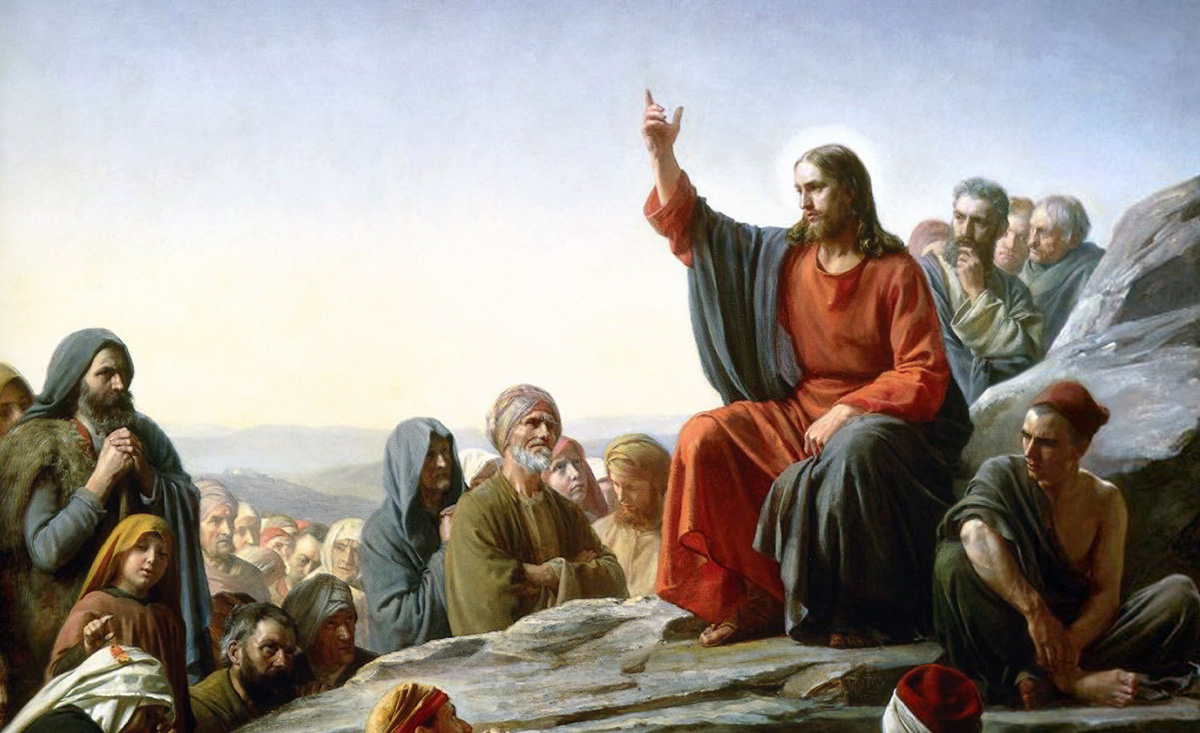
The Sermon on the Mount Carl Bloch, 1890

Sermon – Artillery Election – 1814, Massachusetts

Samuel Cary (1785-1815) Biography:

Cary (whose father was a minister) graduated from Harvard in 1804, when nineteen. He entered the study of theology and in 1808 he took a probationary position at King’s Chapel in Boston (which began as an Anglican Church in 1686). Successfully performing his assigned duties, in 1809 he was asked to join the staff of King’s Chapel as a Junior Pastor, but in 1815, he became very ill and was forced to retire from preaching. At the urging of friends, Cary traveled to England as a better climate in which to convalesce, but passed away while there.

The Ancient and Honorable Artillery Company was originally organized and chartered in England in 1527. Many of those who arrived in America in Plymouth in the early 1600s had been involved with the Company and saw the need for one in the New World, for there was absolutely no organized military force to provide protection. In 1637, a group of settlers sought a charter from then governor John Winthrop, but he initially refused the request, wanting no organized military that could overthrow the civil power. However, one year later, he changed his mind and granted a charter. On the first Monday of that June, the election of the officers was to take place on the Boston Commons, and for the next 300 years, the Ancient and Honorable Artillery Company conducted its annual election of officers at the Boston Commons. Across the years as traditional military and militia reduced the need for the Ancient Artillery Company, it became more of a civic organization, raising funds for local churches, helping enforce local laws, and promoting the local Boston economy. Members of the Company likewise contributed their time and finances to education, religion, and charity.


SERMON

Preached Before The

ANCIENT AND HONORABLE

ARTILLERY COMPANY,

In Boston, June 6, 1814

Being the 177th Anniversary of Their

Election of Officers

By Samuel Cary,

One of the Ministers of the Chapel, Boston,


Non jam ad culmina rerum

Injustos erevisse queror; tolluntur  in altum

Ut lapsu graviore ruant.           Claudian.


BOSTON:

Published by Thomas Wells, 3, Hanover Street

John Eliott, Printer.

1814.


SERMON


2 Samuel 24:16.

And the Lord said unto the Angel that destroyed the people, it is enough, stay thou Thine Hand


       It is at all times a most animating subject to consider the proofs of divine agency in the affairs of this world; the connexion which exists between the revolutions of human society, its improvement or corruption, its prosperity or wretchedness and God the beneficent cause and controller of all things.  It is peculiarly so at this period of the world, when we have lived to see a course of events, to which nothing in history can be at all parallel; events so vast, so unexpected, so appalling; which have so baffled all our calculations and all human foresight, that the mind cannot rest upon mere natural causes, but ascends and fixes itself upon that invisible power, which calls order out of confusion and joy out of depression and despair.  And the subject presents itself with obvious propriety on the present occasion, when the soldier appears in the temple of the most high, to acknowledge, that his courage and strength and skill, without the divine blessing, are all vanity; that it is God, who covers him with his shield in battle; that peace and war, glory and shame, victory and defeat are from his hand.

I shall make no apology therefore, if I should deviate from what may have been the usual practice on these occasions, for the sake of making such remarks upon these great occurrences, as may display the agency of divine providence in producing them and their tendency to confer ultimate and great benefit upon human society.

Let us endeavor to recall some of those apprehensions, which not many months ago, made every good and every thoughtful man among us tremble for himself and for mankind.  What a spectacle of horror, of cold-hearted, merciless tyranny, of the irresistible and triumphant career of vice was at that time exhibited in Europe!  We saw a despotism of a character totally unknown in modern history, more ferocious and more extensive than the soundest politicians had believed could have existed in an advanced and enlightened state of society, establishing itself, upon the ruin of old and venerable habits, principles and institutions;-a despotism possessing all the worst features of the ancient governments, with more experience, more profound views of human nature, more skill in applying itself to the character, the favorite prejudices, the corrupt passions and sympathies of mankind;-a dreadful despotism, which held both soul and body in chains. We saw it advancing with an impetuosity, which confounded all calculations and all resistance; bearing down in its course, monarchs and armies and nation, degrading the exalted, disarming the powerful, endeavoring to crush every feeling of patriotism and every manly sentiment; proclaiming an exterminating war against human liberty, virtue and happiness.  We saw it inflicting misery upon its victims till their courage is gone, till they resigned themselves to despair.

It was a time of universal dismay—a day of clouds and of thick darkness.  There was nothing in prospect to support or encourage hope, no visible means of arresting the destroyer in his course and saving the world from slavery, nothing in short to console the philanthropist but confidence in the over-ruling, the ever watchful, the benevolent providence of the Supreme Being. The most enlightened of our citizens thought they could perceive distinctly, that the foundations of this terrible power were laid with too much care and were too broad and deep to be shaken by any probable human efforts; that there were causes, to be found in the profligate spirit and principles of the French revolution and in the habits and comparative imbecility of the other nations of Europe, which ensured its permanence and its security.  They told us of the immense resources of France; of the admirable subtlety with which her plans of subjugation had been conceived and the steadiness with which they had been kept in view and the success which had followed them; of the boldness with which she had released herself from every mortal obligation, from all those common ties, those habits and laws, which connected her with other people and place her in some measure within their control.  A nation like France, despising the restraints of justice and humanity, calling its whole population to arms, employing its whole wealth in the service of war or of corruption, giving all its spirits and energies to foreign conquest, must, as they thought, be always irresistible.  They told us of the martial enthusiasm of this people, of their thirst for glory and their contempt for the arts of peace, a passion which had marked their national character for centuries, which was diffused through all ranks and all possible conditions, which glowed in the bosom of squalid penury and reconciled the slave to his chains and was extinguished only with life;– a passion which taught them to submit to any sacrifices and to follow any leader who could cut his way to victory.  We were referred to the character of the man, who held these great resources at his own disposal; to his fierce, inexorable, insatiable ambition; to his unrivalled skill in the art of sowing discord among his enemies, dividing their strength, alarming their fears, inflaming their cupidity; to the originality and grandeur of his military schemes, the facility with which he could strike all the points of his object at the same moment, the fury of his onset, the rapidity with which one blow was followed by another, the immense armies, trained by exact discipline and animated by the hope of victory and plunder, with which he could overwhelm his terrified enemies.  We were told of that keen sight, which penetrated all the sources of danger and was forever on its guard, which detected hostility in its very germ and could blast it; which suffered nothing to escape its notice, however remote, however difficult of access, which could serve as an instrument of ambition.  Can we forget the impassioned tone of eloquence, in which our statesmen and orators declared to their countrymen, that the same fatal influence, which had destroyed the energies of Europe, had extended itself to our own shores and was already visible in the base servility of the government and in the degraded character and growing depravity of the people?  Can we forget the anguish, which these great men saw their country associating itself with the fortunes of this sanguinary tyrant and throwing at his feet the noble inheritance, which had been purchased with the blood of its best citizen?  We thought of consequences of this most hateful union.  It was a theme, on which our emotions were unutterable; on which we dwelt, “till our hearts grew liquid and we could have poured them out like water.”[i]

Let me hold this picture before your eyes a little longer. — It was a time, when men said, one to another, doth God know this?  Is the arm of the Lord shortened, that he cannot save?  Why is this moral desolation, this contempt of truth and justice and mercy and good faith, permitted to spread itself over the face of society?  It was indeed the language of short-sighted impatience, of unmanly, thoughtless despondency; of men, who, because they could not see the end of these things and how far this confusion and misery might be consistent with the ultimate felicity of mankind, distrusted the benevolent intentions of the Deity; of men, who did not allow themselves to consider, that the design of the calamity, might be corrective and remedial; that, however terrible and mysterious, it might still be intended to to remove greater and more fatal corruptions and to be the instrument of some vast and permanent good to be conferred hereafter.  We have proofs equally strong and incontestable, that the storms of society and the storms of nature are called forth and controlled by God.  We see them equally serving as means of purification and followed by that genial, benign sunshine, which yields health, plenty and cheerfulness.  Everyone knows, that war, not-withstanding its influence upon public morals and its innumerable calamities, is one of the most powerful instruments, in the hand of God, of destroying deep rooted and inveterate abuses, of elevating the human character, eliciting its noblest energies and displaying all the sublimity of virtue; that it advances society toward perfection, increases its knowledge, improves its condition, excites its piety;[ii]  that its ultimate effects, in one word, are often inestimable.  While the dark cloud is hanging over our heads and the thunder is roaring furiously around is, the heart may perhaps sink with terror, because the end is distant and uncertain and the tempest, we think, may discharge its fury upon ourselves.  But if we are permitted to live til it is over and the light of heaven gain bursts forth in full splendor, we feel that what excited all this solicitude was a dispensation of mercy.

We have seen the justice of the Supreme Being manifested in the utter ruin of this tremendous despotism.  It is now proved to have been a scourge in his hands, inflicting misery under his eye and in such degree and to such extent, as his perfect wisdom determined to be right.  It was permitted to rise, like a malignant star, to a fearful elevation and to “shake pestilence from its horrid hair,” till the mysterious purpose of heaven was accomplished; and then God stretched forth his hand and sunk it forever.  There is nothing since the miraculous victories of the Old Testament. Which has demonstrated the divine interposition so clearly, as this great act of retribution; nothing which has taken place so directly in opposition to the strongest human probabilities, or to which human causes, even in the eye of the most intelligent observers, appeared so totally inadequate.  Could we have believed, that a force so immense and irresistible as that which invaded the north of Europe, a body of disciplined warriors, a mass, vigorous, active, intelligent, in proportion to its magnitude; animated by the most powerful of human passions; supported by the accumulated resources of Europe, conducted by a leader, accustomed to see victory hovering about his standard, whose very name paralyzed the strength of his antagonists; and opposed by a people without political or military renown and degraded by domestic tyranny ,—that these vast armies were marching to their graves?  Could any human sagacity have foreseen, that, in the heart of a half civilized country, there would have been displayed a miracle of magnanimity, unequalled by anything ever exhibited among mankind and will be learnt by future ages of admiration,—a people sacrificing their capital, the object of deep religious awe and the strongest national enthusiasm, to the safety of their country?  Could we have thought, that this accursed enemy of virtue herself?— that his overthrow would be so sudden, so complete, so awful; that this mighty conqueror, who had set God and man at defiance, should, in the space of a few months, have fled, a trembling coward, alone, exhausted seeking his safety within the walls of his own palace; that so many enslaved people would have shaken off the yoke which crushed them to the earth and actually decree the repose of Europe, from the very throne of the disgraced and fallen oppressor?  Yet this is what our eyes have seen!  Oh God, how just and how terrible are thy judgments!

And now the day of vengeance and desolation is over.  God has to the destroying angel, it is enough, stay thine own hand.  The fearful images, which have passed before us in rapid succession, have disappeared, and the light of hope and peace is drawing upon the world.  But still it may be asked, can events, which have produced in their progress such extreme misery, be referred to the Supreme Being, and to beneficence?  Are we to consider the anarchy and horrors of the French revolution and its deadly enmity to religion and the consequent subversion of the most sacred rights of mankind, as produced by the permission of God and as an act of mercy?  Let it be remembered, my friends, that evil, or what we call evil, when it is employed as the punishment of vice, or as the means of rectifying disorder, or of producing good, is one of the instruments of benevolence.  If it is the only mode, or the most effectual mode of promoting human improvement;—if, for instance, it is the direct the direct tendency of this great experiment, which we have now seen brought to its conclusion, to develop and to establish those principles, which are essential to social happiness; if it will serve to give mankind more enlightened views of the nature of government or of religion, to increase their knowledge or their virtue, to effect radical and permanent beneficial changes in their condition;— then it is unquestionably a subject of thankfulness to heaven and ought to be acknowledged as such by us, who survive the storm and by those, who come after us.  That this is, in fact, its tendency, I will endeavor to show in a few words.

It would be wrong for us to undertake to say what precise effects will take place when this convulsion of Europe has subsided.  But there are some general views of the subject, which, at least, so far display its tendency to promote human happiness upon the whole, as to vindicate the equity of the divine government in permitting it to exist.

In the first place, we may consider it as a lesson of most solemn instruction to the present and all future ages.  It has taught mankind in a tone of energy, which must forever be heard and felt;— that the restraints of law and of religion are essential to  the very existence of human liberty;—that a state of rational freedom is not that in which every citizen may act as he is prompted by his corrupt passions, or his false principles, or the impulse of his wild imagination; but that in which he has the power of acting the part for which God created him and improving his own character and advancing his own and his neighbor’s felicity.  It has given more solid ideas of government itself and of the rights of mankind.  It has exhibited to the world the singular spectacle of a pure theoretic democracy, –a government of the very populace, a state in which all ranks, conditions, and understandings are levelled, in which power is entrusted without discrimination  to the ignorant and the intelligent, the upright and the base, the men of character, principle, virtue and those who have no consciousness of their responsibility and are capable of sacrificing everything to their own selfishness,—a state in which the passions are triumphant and every clamorous demagogue becomes an oracle.  We have seen how far such a state of things is consistent with public liberty and happiness.  We have seen the passion for unrestrained freedom overturning principles, which had been sanctioned by the experience of ages, plunging a flourishing people into anarchy, and at length subjecting it to the rod of a ferocious tyranny, which had no heart to pity the miseries it inflicted.  And is it possible for us, or for posterity to see these things in vain?

It is most important, that this decisive experiment should be permitted to take place in the present state of society.  It was the error of many intelligent minds, that the intellectual condition of mankind was so evidently improved, that they would now be safe under a government of philosophy; that liberty was in no danger of being abused, because men were capable of discerning their real interests and the necessity of restraining themselves.  Similar experiments in ancient times had no weight in the minds of these reasoners.  They saw nothing in the lesson of history, nothing in the state of the Greek and Roman republics, or the causes of their destruction, which was at all applicable to an enlightened age.  They considered the principles of government as so much better understood and the means of judging rightly on subjects that immediately affect human happiness, as diffused so generally among all classes, that the seeds of corruption would be at once detected and extinguished; that a free people would, of course, be virtuous, because virtue was essential to their security.  But now this delusion is ended.

In the second place, it is the evident tendency of these events to destroy the accumulated abuses of the old systems.  That such abuse did exist and were inveterate and most oppressive is undeniable; that they were an effectual bar to the general advancement of society and that it was most important, that they should be rectified, is also undeniable.  But how was this desirable end to be accomplished?  How were evils, which had become so venerable by age, so confirmed by education and habit, so closely associated with all the sympathies of human nature, to be separated from the good and thrown away forever?  Not by the mere influence of reason, for reason had to be content with power, with ambition, with avarice, with the fear of change,—with enemies, who would either despise its gentle remonstrances, or would not hear them;—not by the moral improvement of mankind, for it was first necessary  to remove the evils, before such improvement  could exist.  Nothing could have so effectually and so radically extirpated these abuses, as the great convulsion which God, in his wisdom, has permitted to take place in Europe; an event it is true, which seemed, instead of correcting, to destroy; which overturned the whole political fabric, with its good as well as its evil, its beauty and deformity; but which, without question, will prove most salutary in its consequences.  The discordant and inflammable principles, which had been so long collecting, have discharged their fury and are harmless.  Society will be restored to tranquility and to refinement.  It will be settled upon more solid principles awakened as it is, and made wise by the severe lessons of experience.  There will probably be a more equal distribution of power, a more sacred regard to the acknowledged rights of mankind, more distinct ideas of the duties of those who govern and those who obey, a more solemn conviction, that the true glory of the one consists in giving efficacy to just laws by their ready acquiescence, and that of the other in promoting the public prosperity.

Again it is the tendency of these events to encourage a commercial, instead of a military spirit, among the nations of Europe.  War has always been their passion and pride; a passion kept alive and cherished by the nature of their governments, their habits and institutions.  But in the general wreck of ancient habits and institutions, these sources of military enthusiasm have disappeared and will not soon and perhaps never be revived.  War is at length a prostrate and vanquished enemy.  The world is exhausted by its miseries and tired of the follies of ambition and the blood-stained trophies of victory.  What a lesson for the pride of kings in the poor, degraded exile of the Mediterranean, yesterday the terror and scourge of mankind, darting thunder from Olympus and covering the earth with desolation; today so low, so despicable, that his conquerors will not deign to crush him!

Europe will now seek felicity in the arts of peace, in the interchange of good offices, of wealth, of knowledge; in the encouragement of industry and honorable enterprise, in giving useful employment to all classes of its population; in exciting a love of order and truth and justice and all those virtues, which are the support and ornament of society.  That commerce may eventually produce luxury and its peculiar vices and a spirit of mutual hostility, is not improbable.  But in the mean time the general state of society will have been most essentially improved; habits of amity will have been formed between the people of different nations, the principles of national law and justice will have become generally understood and respected; and war will neither possess its present malignant character, nor will its effects be so ruinous to the general interests of mankind.

I persuade myself, that these most awful dispensations of divine providence are intended to produce great efforts upon the religious character of society.  They have already drawn the eyes of the world to the Supreme Being.  In the stillness of prosperity, when men are wafted gently along the stream of life by favorable breezes and cheered by a serene sky, they forget the Creator and their dependence and their duty.  It is amid the horrors of the storm and the earthquake and the falling empires that we fly to religious principles for consolation and feel that without the protective care of the Deity, we must perish, we are nothing.  The persons, who are now to act a distinguished part in Europe, have been trained in the school of adversity; they know the value of religion and they will support and diffuse it by their example.
But this is not all.  Christianity was given by God to soften the hearts and reform the manners of the world.  It is a system most admirably adapted to its end; and eighteen centuries have elapsed since its influence began to be exerted.  Has it been successful?  No. and the reason is, that Christianity, as it has been current in Europe during this long period, is as distinct from that simple and benevolent religion, which was once delivered to the saints, as the abominations of Paganism. The thing, which has assumed this name, is a ferocious system, armed with the sword of the civil magistrate, loaded with disgusting absurdities, teaching sentiments concerning God and the condition of mankind, which fill the soul with horror and breathing vengeance against all, who venture to question its infallibility.

When the religion of Jesus was taken under the protection of the state as incapable of protecting itself and was decorated with artificial ornaments to make it venerable in the eyes of the vulgar; and when the scriptures were withdrawn from the public eye, as if this gift of God was an inconsiderate gift and ill adapted to the conditions or wants of man,— then a dark cloud spread itself over this bright orb, and it became invisible.  Then the dogmas of ignorant pride and the reveries of an absurd philosophy were delivered to mankind, as the genuine doctrine of the gospel.  Our faith fell into the hands of theorists, who undertook to make the work of omniscience more perfect, to supply what they chose to consider deficient and to beautify what to their tasteless vision seemed gross deformities.  The consequence was that a mass of falsehood became incorporated with Christianity, which was handed down from generation to generation; and which, though in some measure exploded at the reformation, still exerted a most fatal influence throughout Europe.  But in this whirlwind which we have seen subverting religion and liberty and government, from their foundations, these abuses, of which we speak, have disengaged themselves from Christianity.  There is at least this advantage resulting under the care of divine providence from a general inattention to religion, that what is false belonging to it loses its hold upon the affections; error ceases to be encouraged and it expires; systems are permitted with impunity to be severely scrutinized; and the true principles of religion, which are indestructible, invulnerable by any revolutions of society, founded in the nature of man and eternal as his duration— these true principles rise from their temporary depression in a purified and most glorious form, to be the consolation, the support, the joy of mankind.
It appears that the great principle of Protestantism, the right of worshipping God unmolested, according to the dictates of conscience, is to be guaranteed by the new constitution of France.  My friends, have we considered this all-important, this most animating fact with sufficient attention?  The rights of conscience are at length distinctly recognized and protected upon the continent of Europe!  Christians then are permitted to search the records of their faith, without opposition and without fear; to hold their own conclusions and to avow them honestly; to assail and reject error without exposing themselves to public scorn, or the lash of ecclesiastical tyranny.  The mind is at last free.  Man may worship the God of his affections and his understanding, the God of the scriptures, the God and Father of our Lord Jesus Christ, instead of the idol of superstition, or of the civil magistrate.  The principle obstruction to freedom of inquiry and the acquisition of evangelical truth and the genuine influence of Christianity, are at an end and is it too much to predict, that the gospel in its original simplicity, the gospel as it was preached by Christ and his apostles, that gospel, which breathes nothing but benevolence and subdues the whole heart to purity,—will come forth from obscurity and reign in triumph over the very people who have loaded it with injuries?  What a glorious prospect presents itself to our eyes!  What a day is breaking upon the moral state of man!  Intolerance, bigotry, persecution, —demons, your hour is come, your empire is destroyed!

Gentlemen of the Ancient and Honourable Artillery—-In applying this subject to the state and prospects of our own country, it is impossible to disguise or to restrain our apprehensions.  We have seen the Supreme Being wise and benevolent in his dispensations; and this should teach us to confide in his care and to be satisfied, that whatever lot is reserved for us will be right.  But at the same time we have seen him leading mankind to happiness through scenes of inconceivable misery.  Perhaps it may be necessary, that we should suffer more and severely, before we are permitted to see days of prosperity.  It may be that there are prevailing vices among us, which must be removed by punishment; a national tameness and insensibility to honour, which requires to be stimulated; a timid, luxurious, indolent, mercenary spirit, which fears to be disturbed, more than it fears disgrace; a national degeneracy, which must be checked before it drags us to ruin.  Our fathers scorned to stop and calculate, whether it was more profitable to be freemen or slaves.—perhaps the blessing of regenerated Europe are not to be imparted to us, who may be unworthy to enjoy them. When, however, I consider the character of the nation, with which we at war, the astonishing elevation on which it stands, its unexampled magnanimity;— when I consider the heroism and inflexible fidelity with which it has defended the cause of God and man, of religion, of liberty, of justice, of everything valuable, which escaped the fangs of anarchy; the enthusiasm with which it has flown to the succor of nations who dared to struggle for their rights; its devotion to the arts of peace and to whatever improved the intellectual and moral conditions of society—-I think there is everything to hope. I think this people will not tarnish the ineffable glory which surrounds them, by an act of mere vengeance.

But, gentlemen, there are more serious causes of apprehension than foreign hostility.  The collisions between this country and Europe may be extinguished.  But will peace reconcile the innumerable contending interests which exist among ourselves?  Will it appease the fierce animosities which are cherished by the different sections of this republic, or restrain the ungovernable spirit of party, or teach the people and their rulers to become disinterested patriots?  I fear the time is not far distant, when these seeds of national disgrace and wretchedness will shoot into fatal luxuriance.  But on this topic I have no time and no desire to enlarge.  Let us trust in God.  If prosperity is in store for us, let us take warning by what we have suffered and bear it with moderation.  If we are to pass through scenes of horror, let it be with that fortitude and that dignity, which will prove us worthy of our ancestors and bright examples to our posterity.

OFFICERS OF THE COMPANY.

1813-1814
Captain,   Capt. Jonathan Whitney
Lieutenant, Mr. Jacob Hall
Ensign,       Mr. Caswell Beal

Sergeants,
Capt. John Roulstone       Mr. Edward Gray
Mr. Abraham Wood         Mr. James Hooper

1814-1815
Captain,  Mr. William Howe
Lieutenant, Capt. George Welles
Ensign, Mr. Levi Melcher

Sergeants,
Capt. Benjamin Loring                  Capt. James B Marston
Mr. John Dodd                               Mr. Thomas Wells


[i] Ames

[ii] When thy judgments are in the earth, the inhabitants of the world will learn righteousness.  Isaiah 26: 9.

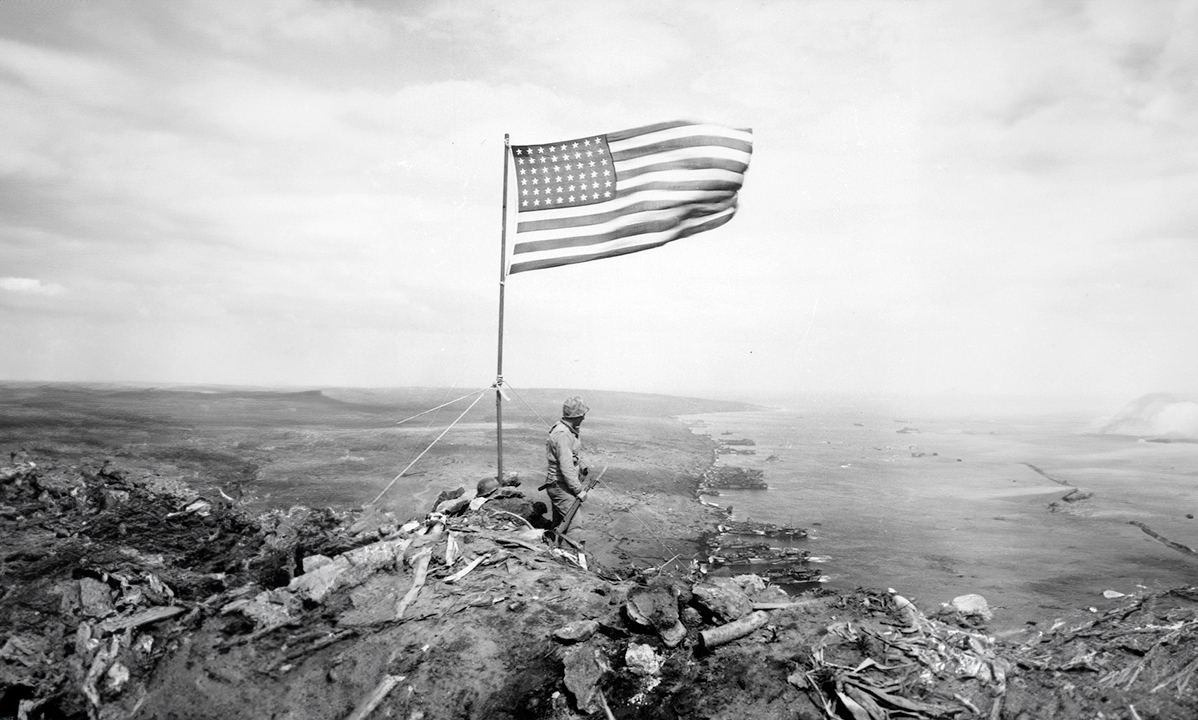
A member of the American military stands beside a US flag raised after the Battle of Iwo Jima.

The Tomb of the Unknown Soldier – A Forgotten History?


This Sunday (November 11) is Veterans Day! Veterans Day is a time to honor the survivors, and to be grateful for their service and sacrifice to defend what we as Americans believe.
This holiday (originally known as Armistice Day) was established to remember the 1918 signing of the Armistice Treaty and to honor the heroes of World War I. [1]  In 1921, Congress resolved to build a tomb to honor the men who died overseas. Sergeant Edward Younger was given the task of choosing one of four unknown American soldiers to bring home for burial. [2] When the Navy ship Olympia arrived in Washington on November 9th with the body of the fallen soldier, America responded. The Cavalry band played “Onward Christian Soldiers” as the casket was taken to the U.S. Capitol, where the soldier was laid in State. President Warren G. Harding, governmental officials, and thousands of Americans paid their respects to this fallen soldier. [3]
On the morning of November 11th, this soldier was given a military procession to Arlington National Cemetery and buried at what is known today as the Tomb of the Unknown Soldier. This tomb has been guarded around the clock by dedicated servicemen and women since 1948. [4] The honor for the sacrifice of this soldier was recently once again evident when the guards refused to leave their post during Hurricane Sandy, which was reminiscent the soldiers’ determination to guard the tomb during Hurricane Isabel in 2003. [5]

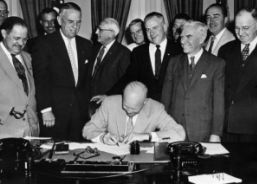
The honor paid to this soldier is the same respect that all of our veterans deserve. It was in 1954 that Veterans Day was officially renamed by President Dwight D. Eisenhower to honor American veterans of all wars. [6] These brave men and women who
are willing to sacrifice their lives for our freedom should be celebrated and venerated.

On this special day when we pause to reflect on the sacrifices made across the years by men and women willing to lay down their lives to protect and defend our Constitution, our freedoms, and our way of life, let’s be proactive in our gratitude.

  • Thank a veteran or active military member in uniform
  • Attend a Veterans Day parade
  • Pray for the military families
  • Remind those around you of the significance of this day.
  • Listen to Tuesday’s WallBuilders Live Program


[1] “Veterans Day,” The Library of Congress, October 26, 2010 (at: https://memory.loc.gov/ammem/today/nov11.html). See also, “The History of Veterans Day,” Center for Military History: United States Army, November 19, 2012 (at: https://www.history.army.mil/html/reference/holidays/vetsday/vetshist.html).
[2] J. R. McCarl, Decisions of the Comptroller General (Washington: Government Printing Office, 1923), Vol. 2, pp. 387-389. See also, “Tomb of the Unknowns,” Army: Old Guard (https://www.army.mil/info/organization/unitsandcommands/commandstructure/theoldguard/specplt/tomb.htm) (accessed on November 9, 2012); “The Tomb of the Unknowns,” Arlington National Cemetery (https://www.arlingtoncemetery.mil/VisitorInformation/TombofUnknowns.aspx) (accessed on November 9, 2012); “Edward F. Younger, Sergeant, United States Army,” Arlington National Cemetery, December 25, 2007 (https://www.arlingtoncemetery.net/eyounger.htm).
[3] Kirk L. Simpson, “The Unknown Soldier,” Supplement Service Bulletin of the Associated Press (New York: Associated Press, December 1921) pp. 3-4. See also, “Tomb of the Unknown Soldier,” The Quartermaster Review, September-October, 1963 (at: https://www.qmfound.com/tomb_of_the_unknown_soldier.htm); B. C. Mossman and M. W. Stark, The Last Salute: Civil and Military Funerals 1921 – 1969 (Washington, D.C.: Department of the Army, 1991) pp. 3-18 (at: https://www.history.army.mil/books/Last_Salute/Index.htm).
[4]   “Tomb of the Unknowns,” Army: Old Guard (https://www.army.mil/info/organization/unitsandcommands/commandstructure/theoldguard/specplt/tomb.htm) (accessed November 9, 2012). See also, “Tomb of the Unknown Soldiers Stand Guard During Hurricane Sandy,” MyFoxDC.Com, November 12, 2012 (at: https://www.myfoxdc.com/story/19943347/tomb-of-the-unknown-soldiers-stand-guard-during-hurricane-sandy).
[5] Katie Pavlich, “Tomb of the Unknown Soldier Remains Guarded Through Hurricane Sandy,” TownHall, October 29, 2012 (at: https://townhall.com/tipsheet/katiepavlich/2012/10/29/tomb_of_the_unknown_soldier_remains_guarded_through_hurricane_sandy). See also, Luis Martinez, “Still Vigilant at the Tomb of the Unknowns Despite Irene,” ABC News, August 28, 2011 (at: https://abcnews.go.com/US/hurricanes/vigilant-tomb-unknowns-irene/story?id=14397525#.UJ1zZYbCaSo).
[6] The Federal Register (Washington, D. C.: The National Archives, 1954), Vol. 19, No. 198, Dwight Eisenhower, “Proclamation 3071: Veterans Day 1954” (at: https://www.va.gov/opa/vetsday/docs/proclamation_1954.pdf).


united states flag

The Real Story Behind Old Glory

You have given a banner to those who fear you, to be displayed because of the truth.
Psalm 60:4

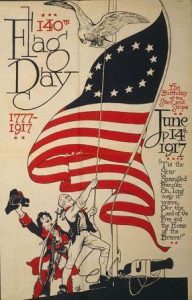
June 14th is Flag Day which commemorates the day in 1777 when the Continental Congress passed a resolution “that the flag of the thirteen United States be thirteen stripes, alternate red and white; that the union be thirteen stars, white in a blue field, representing a new constellation.”1 Since that time, generations of Americans have celebrated the flag as a symbol of our God-given freedoms and God-blessed nation, and in every American military campaign, “Old Glory” has been a symbol of our freedom.
Interestingly, “Old Glory” was the name that Captain William Driver placed on a flag he was presented in 1831.2 The nickname given to that flag became so well known that during the Civil War, the Confederates tried unsuccessfully to confiscate and destroy Captain Driver’s flag that he had sewn into his bedcover to protect. 3 In 1862, when Union soldiers occupied Nashville, Driver took out his flag and flew it over the Capitol as a symbol that “Old Glory” stood firm.4

We still honor “Old Glory” today by celebrating Flag Day each year. The first Flag Day celebration occurred in Wisconsin in 1885, when a schoolteacher had his students observe June 14 as “Flag Birthday,” or “Flag Day.” This idea inspired others around the nation to continue the practice and as the celebrations grew, the idea received national recognition. In 1916, President Woodrow Wilson issued a presidential proclamation calling for the national celebration of Flag Day, thus establishing it as a national event.5

As you honor our flag, educate yourself on the greatness of America’s founding and inspire others to do the same!


Endnotes

1 Journals of the Continental Congress (Washington: Government Printing Office, 1907), VIII:464, June 14, 1777.
2 Harriet Ruth Waters Cooke, The Driver Family History (New York: John Wilson and Son, 1889), 180-181.
3 Cooke, Driver Family History (1889), 181-182; The Essex Institute of Historical Collections (Salem: The Essex Institute, 1901), 37:261-263, Robert S. Rantoul to Charles Kingsbury Miller, June 13, 1900.
4 The Essex Institute (1901), 27:261-263, Robert S. Rantoul to Charles Kingsbury Miller, June 13, 1900; Cooke, Driver Family History (1889), 180-182.
5 The Encyclopedia Americana (New York: The Encyclopedia Americana, 1919), 11:309, “Flag Day.”

* Originally Posted: June 14, 2012
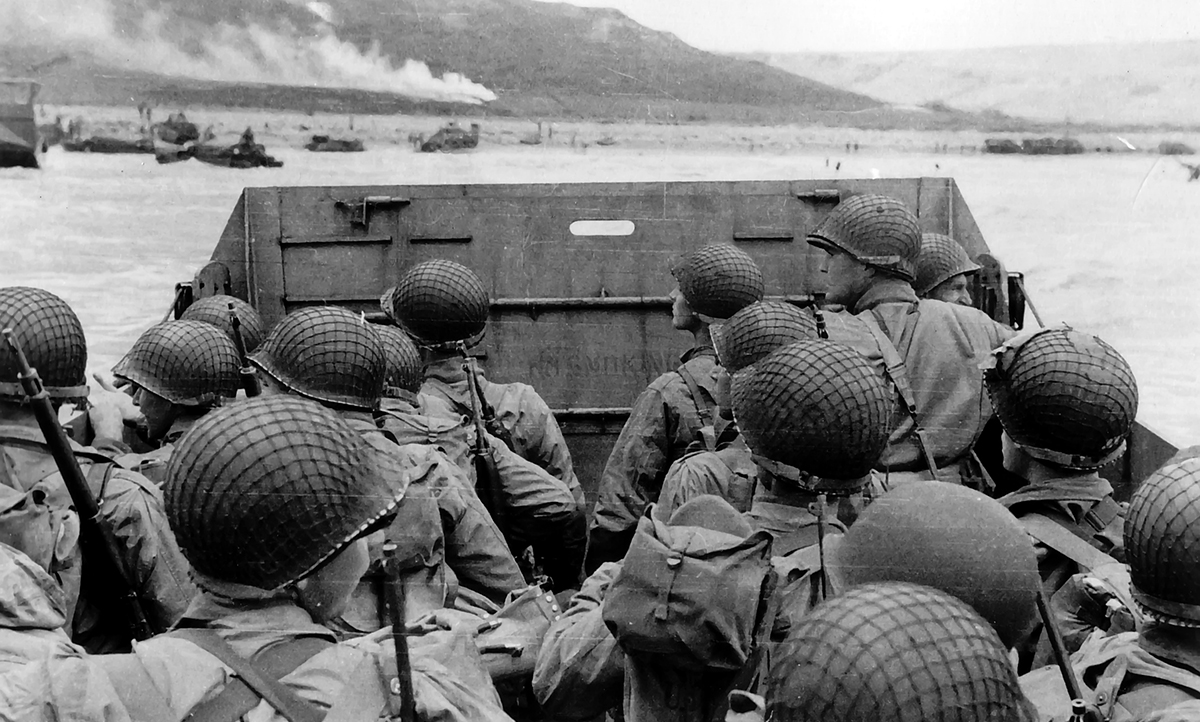
American troops land at Omaha Beach during the D-Day landings of 1944.

Honor a Veteran!

Veterans Day originally started as a national holiday to commemorate Armistice Day – the end of the violence in WWI, which had occurred on the eleventh hour of the eleventh day of the eleventh month (i.e., November 11 of 1918).

The following year in 1919, President Woodrow Wilson established the first observance of Armistice Day, explaining:

To us in America, the reflections of Armistice Day will be filled with solemn pride in the heroism of those who died in the country’s service and with gratitude for the victory. 1

But in 1954, following both WWII and the Korean War, President Eisenhower signed an act renaming the holiday Veterans Day 2 so that “a grateful Nation might pay appropriate homage to the veterans of all its wars who have contributed much to the preservation of this Nation.”3 (emphasis added) He requested:
[L]et us solemnly remember the sacrifices of all those who fought so valiantly on the seas, in the air, and on foreign shores to preserve our heritage of freedom; and let us re-consecrate ourselves to the task of promoting an enduring peace so that their efforts shall not have been in vain. 4

But veterans were respected and honored long before any official holiday was established, including by George Washington in his June 8, 1783 Circular Letter of Farewell to the Army calling on Congress to provide veterans’ benefits, which he believed was due them as “the price of their blood and of your independency.” 5 In 1989, the Department of Veterans Affairs was elevated to a cabinet level department by President George H. W. Bush.

On this special day when we pause to reflect on the sacrifices made across the years by men and women willing to lay down their lives to protect and defend our Constitution, our freedoms, and our way of life, let’s be proactive in our gratitude. Thank a veteran or active military member in uniform, attend a Veterans Day parade, pray for the military families, and remind those around you of the significance of this day. For additional information about this holiday, see:
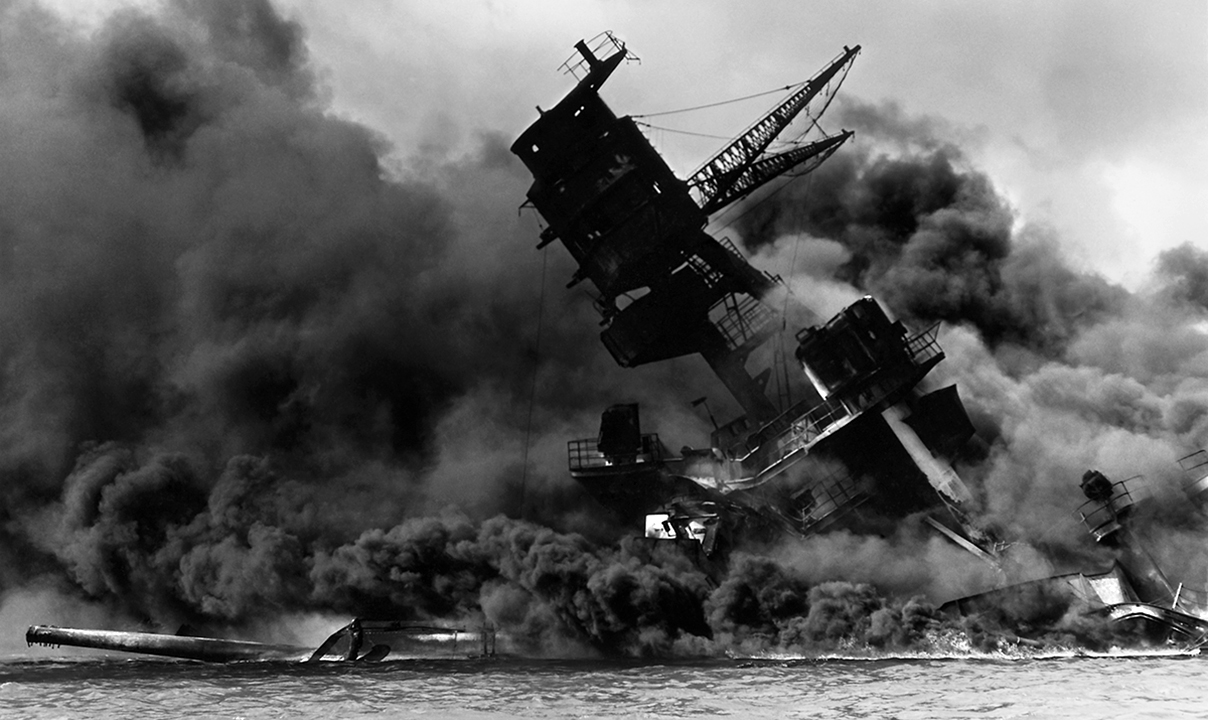
https://www.va.gov/opa/vetsday/vetdayhistory.asp

God bless!


Endnotes

1  Woodrow Wilson, “Address to Fellow Countrymen,” November 11, 1919, Supplement to the Messages and Papers of the Presidents (Bureau of National Literary, 1921), 8804, https://www.google.com/books/edition/A_Compilation_of_the_Messages_and_Papers/ZKUyAQAAMAAJ?hl=en&gbpv=1&pg=PA8804&printsec=frontcover.
2 “History of Veterans Day,” United States Department of Veterans Affairs (at: https://www.va.gov/opa/vetsday/vetdayhistory.asp.
3 The Federal Register (Washington, D. C.: The National Archives, 1954), 19:198, Dwight Eisenhower, “Proclamation 3071: Veterans Day 1954,” https://www.va.gov/opa/vetsday/docs/proclamation_1954.pdf.
4 The Federal Register (Washington, D. C.: The National Archives, 1954), 19:198, Dwight Eisenhower, “Proclamation 3071: Veterans Day 1954,” https://www.va.gov/opa/vetsday/docs/proclamation_1954.pdf.
5 George Washington to Meshech Weare, et al, “Circular Letter of Farewell to Army,” June 8, 1783, The Writings of George Washington, ed. John C. Fitzpatrick (Washington, D. C.: Government Printing Office, 1938), XXVI:492, https://founders.archives.gov/documents/Washington/99-01-02-11404.

The USS Arizona sinks after it's bombed during the Pearl Harbor attacks in 1941.

Remembering Pearl Harbor


For Americans today, the account of Pearl Harbor and America’s entry into World War II is nothing more than a subject of academic study. But there are still a handful of veterans alive today who were actually part of that epic event. In yesterday’s program on WallBuilders Live, Chief Petty Officer (Ret.) James Womack recounted his remarkable experiences aboard the U.S.S. St.Louis on that fateful day as they battled the Japanese in that devastating American defeat. It is inspiring to hear about the bravery and courage of those who stood in harm’s way on that fateful morning. (If you missed this, or any program on the more than 180 stations across the nation that air WallBuilders Live, you can hear those previous programs on our Archives page.)

As we commemorate this famous “date which will live in infamy,” an excellent prayer to offer on this day is an official Pearl Harbor Remembrance Day Prayer:

Dear Father, on this annual recollection of the Pearl Harbor tragedy, we pray for thy benign blessings and guidance. Enable us to reflect clearly and conscientiously upon our priceless heritage. Let us be determined to guard and preserve it through all trials and difficulties. Help us to be worthy of the lofty ideals for which so many courageous men and women sacrificed so much. Grant us steadfast spirits always to defend our great inheritance for the countless generations yet unborn. Cast thy countenance upon our beloved country, the United States of America. Shelter the inhabitants of our land from all anguish, peril, and gloom. May this blessed haven ever be the citadel of justice, freedom, and brotherhood. May the time not be distant O God, when mankind will live in security and confidence as it is written in the book of thy Prophet Isaiah: “Nation shall not lift up sword against nation, neither shall they learn war anymore.” Then the glory of God shall be revealed and all flesh shall see it together. Amen

And during this season of giving, some simple ways you can give back to the veterans who have sacrificed so much on behalf of us all include:


A Soldier and a President

November 11th, Veteran’s Day, is the day America has set aside to remember and honor those who have been part of our Armed Forces.

As the Supreme Commander of the Allied troops in Europe, Dwight D. Eisenhower’s bold leadership on the beaches of Normandy during the D-Day invasion of France gained the admiration of the nation. This popularity would later contribute to the slogan “I like Ike” and he was eventually elected and inaugurated as America’s 34th President.

While many Americans today are familiar with General Eisenhower, few know much about his strong faith. For example, the day before his presidential inauguration in 1953, he wrote his own inaugural prayer, which he personally delivered the next day, dedicating himself before God to the service of the people.

During his presidency, he signed into law the bill that added the words “under God” to the Pledge of Allegiance, established the National Prayer Breakfast, made “In God We Trust” the national motto, placed “In God We Trust” on paper currency and not just coinage, and a Congressional Prayer Room was added to the U. S. Capitol.

An inspirational account of God’s providential intervention in the life of a young Dwight Eisenhower was published and distributed nationally during his presidency, and was even circulated during his presidential campaign.

General Eisenhower is one of America’s better known veterans, but the others are no less important. So please take the time to find veterans around you and thank them for their service, and their willingness to sacrifice so much to preserve liberty for all of us.

The Barbary Powers Wars

What important American victory in the Barbary Powers Wars occurred on this date in 1801?

(*See below for the answer.)

The Barbary Powers Wars were the first wars officially declared against America following our victory in the War for Independence. 1 Muslim terrorists from five different Islamic nations (Turkey, Tunis, Morocco, Algiers, and Tripoli) were making indiscriminate attacks against the property and interests of what they claimed to be “Christian” nations (America, England, France, Spain, Portugal, Denmark, Sweden, etc.). 2 These Muslim terrorists (called Barbary, that is, barbaric “pirates” by most Americans) attacked American civilian and commercial merchant ships wherever they found them, seizing the cargo and enslaving the crew. 3

In 1784, Congress dispatched three diplomats – John Adams, Benjamin Franklin, and Thomas Jefferson – to negotiate with these Muslim nations and end the unprovoked attacks. 4 They found this to be a difficult task, for the attacking of ships and the taking of Christians by Muslims had been a widespread problem for centuries. 5

The Muslims found they could finance their wars and terror operations by enslaving and then selling captured seamen. (The Muslims took 1.25 million captive slaves in that period. 6) Because this was such a widespread and recurring problem, other Christian nations formed standing organizations to raise money to purchase enslaved seamen. As Jefferson explained:

There is here an order of priests called the Mathurins, the object of whose institutions is the begging of alms for the redemption of captives. About eighteen months ago, they redeemed three hundred, which cost them about fifteen hundred livres [$1,500] apiece. They have agents residing in the Barbary States, who are constantly employed in searching and contracting for the captives of their nation, and they redeem at a lower price than any other people can. 7
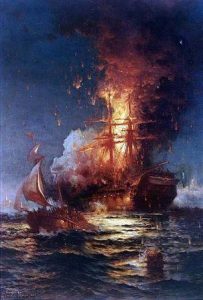
Ransoming Americans was no less expensive, and therefore was a very profitable trade for the Muslim terrorists. 8 Additionally, the Muslim nations would sign treaties with the attacked nations, including America, providing that for an annual “tribute” (perhaps $1 million a year, along with the “gift” of several frigates), that they would perhaps refrain from further attacks. By 1795, such “peace” payments to Muslim terrorists comprised a full sixteen percent of the entire federal budget!  9

Among the many treaties signed with Muslim nations during this period was the famous 1797 treaty with Tripoli. It was one of the many treaties in which each country officially recognized the religion of the other in an attempt to prevent further escalation into a “Holy War” 10 such as had existed between Christians and Muslims in the Middle Ages.

The Muslims considered that all Christian nations were like those of the Crusades, when Christians fought Muslims simply because they were Muslims. 11  However, America was definitely not like the European Christian nations from medieval times, for we did not kill Muslims, Jews, or any one else for their faith. In fact, many Founding Fathers talked about how different America as a Christian nation was from the European Christian nations; 12 and the American treaties, including the Treaty of Tripoli, made this very point.
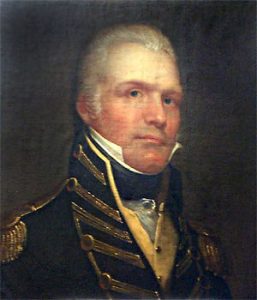
Significantly, secularists regularly cite one clause from that treaty in devious attempts to make it appear that the Founding Fathers emphatically avowed that America was not a Christian nation. They thus quote from that treaty the line declaring “The government of the United States is in no sense founded on the Christian religion . . . ” This declaration certainly seems to be straightforward – until you discover that the critics only used part of the quote. Notice what the full, unedited clause states:

As the government of the United States of America is not in any sense founded on the Christian religion as it has in itself no character of enmity against the laws, religion or tranquility of Musselmen [Muslims]. and as the said States [America] have never entered into any war or act of hostility against any Mahometan nation, it is declared by the parties that no pretext arising from religious opinions shall ever produce an interruption of the harmony existing between the two countries. 13 (emphasis added)

This clause from the Treaty of Tripoli simply affirms that America was not one of the European Christian nations with an inherent hostility toward Muslims, and that America had never been part of arbitrary wars against Muslims such as had characterized the Crusades. This clause definitely does not deny or undermine America’s strong Christian heritage – unless you wrongly place a period in the middle of the sentence, as secularist critics do.
When Thomas Jefferson became president in 1801, he decided that it was time to take military action to end the two-decades-old unprovoked Muslim terrorist attacks against Americans. 14 Using the brand new American Navy to transport the U. S. Marines overseas (President George Washington had called for the construction of a navy in 1795, and President John Adams had overseen its construction 15), General William Eaton took the American military and proceeded to the same region of the world where Americans are still being attacked today. He then led a successful five-year campaign to free captured Americans and crush Muslim terrorist forces. 16 Tripoli (now called Libya) finally capitulated and signed a treaty on America’s terms in 1805, thus ending their aggressions – at least for a while. 17
(By the way, it was from the Marine’s role in that first War on Terror from 1801-1805 that the U. S. Marines derive part of the opening line of their hymn: “From the halls of Montezuma to the shores of Tripoli . . .”)
Shortly after President James Madison took office, he became engulfed in the War of 1812. With America preoccupied in a second war against the British, Algerian Muslim terrorists again began attacking Americans. But upon concluding the war with the British, President James Madison dispatched the American military and warships against three Muslim nations: Algiers, Tunis, and Tripoli. 18 America (with the assistance of Great Britain and the Netherlands) subdued those Muslim nations and brought them to the peace table, where they freed all the enslaved Christians. 19
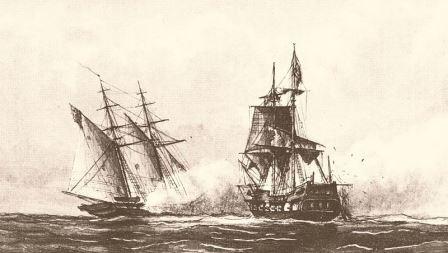
*On this date in history, the U.S.S. Enterprise captured the Trioplitan ship known as the Tripoli. While the terrorists sustained heavy losses, the Americans did not lose a single man in the battle. 20


Endnotes

1 Thomas Clark, Naval History of the United States, from the Commencement of the Revolutionary War to the Present Time (Philadelphia: M. Stiles, 1814), 1:140; James H. Morgan, Register of the Military Order of Foreign wars of the United States (New York: The National Commandery, 1900), 11-19.
2 Richard O’Brian to Thomas Jefferson, June 8, 1786, Naval Documents Related  to the United States Wars with the Barbary Powers, ed. Claude A. Swanson (Washington: United States Government Printing Office, 1939), 1:1-6; A General View of the Rise, Progress, and Brilliant Achievements of the American Navy Down to the Present Time (Brooklyn: 1828), 70-71; “Barbary Pirates,” The Encyclopedia Britannica, ed. Hugh Chisholm (New York: The Encyclopedia Britannica Company, 1910), 383.
3 Julian Hawthorne et. al., United States from the Discovery of the North American Continent up to the Present Time (New York: James Schouler, 1894), 3:17-20; Forward written by President Franklin D. Roosevelt, December 30, 1958, Naval Documents, ed. Swanson (1939), 1; Theodore Lyman, The Diplomacy of the United States (Boston: Wells and Lilly, 1828), 2:338-342.
4 Thomas Jefferson to William Carmichael, November 4, 1785, The Writings of Thomas Jefferson, ed. Andrew A. Lipscomb (Washington, D. C.: The Thomas Jefferson Memorial Association, 1903), V:195; Garner W. Allen, Our Navy and the Barbary Corsairs (Boston: Houghton, Mifflin, and Company, 1905) 28.
5 “Barbary Pirates,” The Encyclopedia Britannica, ed. Hugh Chisholm (New York: The Encyclopedia Britannica Company, 1910), 383.
6 Robert Davis, Christian Slaves, Muslim Masters: White Slavery in the Mediterranean, the Barbary Coast and Italy, 1500-1800 (Palgrave Macmillan, 2004).
7 Thomas Jefferson to John Adams, January 11, 1787, The Writings of Thomas Jefferson, ed. Andrew A. Lipscomb (Washington, D. C.: The Thomas Jefferson Memorial Association, 1903), VI:47-48.
8 No. 43: Prisoners at Algiers, American State Papers: Documents, Legislative and Executive, of the Congress of the United States (Washington: Gales and Seaton), 1:100-101.
9 The federal budget was $6,115,000 in 1795; a payment of nearly $1 million was given that year to Algiers alone, not including what was given to the other Barbary Powers.  See US Department of Commerce, Bureau of the Census, Historical Statistics of the United States (White Plains, NY: Kraus International Publications, 1989), 1106; George Washington to the Secretary of the Treasury, May 29, 1794, The Writings of George Washington, ed. John C Fitzpatrick (Washington: Government Printing Office, 1940), 33:385.
10 See, for example, the 1786 Treaty with Morocco: Articles 10, 11, 17 and 24; the 1795 Treaty with Algiers: Article 17; the 1815 Treaty with Algiers: Article 13; the 1816 Treaty with Algiers: Articles 14 and 15; the 1796 Treaty with Tripoli: Article 11; the 1805 Treaty with Tripoli: Article 14; and the 1797 Treaty with Tunis: Forward.
11 Thomas Edward Watson, The Life and Times of Thomas Jefferson (New York: D. Appleton and Company, 1903), 247-249.
12 See for example, John Jay, “Address to the Annual Meeting of the American Bible Society,” May 8, 1823, Correspondence and Public Papers of John Jay, ed. Henry Johnston (New York: G. P. Putnam’s Sons, 1893), IV:491; John Quincy Adams, An Oration Delivered Before the Inhabitants of the Town of Newburyport at Their Request on the Sixty-First Anniversary of the Declaration of Independence (Newburyport: Charles Whipple, 1837), 17; John Adams in a speech to both  houses of Congress, November 23, 1797, The Works of John Adams, ed. Charles Francis Adams (Boston: Little, Brown and Company, 1854), IX:121; Noah Webster, History of the United States (New Haven: Durrie & Peck, 1832), 339, “Advice to the Young”; Daniel Webster, Mr. Webster’s Speech in Defence of the Christian Ministry and In Favor of the Religious Instruction of the Young. Delivered in the Supreme Court of the United States, February 10, 1844, in the Case of Stephen Girard’s Will (Washington, DC: Gales and Seaton, 1844), 12-13.
13 Acts Passed at the First Session of the Fifth Congress of the United States of America (Philadelphia: William Ross, 1797), 43-44.
14 Thomas Jefferson, “Second Annual Message,” December 15, 1802, The Writings of Thomas Jefferson (Washington, D.C.: Taylor & Maury, 1854), 8:17; Thomas Jefferson, “Autobiography,” 1821, The Writings of Thomas Jefferson, ed. Paul Leicester Ford (New York: G.P. Putnam’s Sons, 1892), I:91-93; Elizabeth Huff, “The First Barbary War,” Monticello, accessed December 1, 2023.
15 “The Reestablishment of the Navy, 1787-1801,” Naval History Bibliography.
16  William Grimshaw, The History of the United States, From Their First Settlement as Colonies to the Cession of Florida, in Eighteen Hundred and Twenty-One, (Philadelphia: Benjamin Warner, 1821), 194-195; Charles Prentiss, The Life of the Late Gen. William Eaton; Several Years an Officer in the United States’ Army, Consul at the Regency of Tunis on the Coast of Barbary, and Commander of the Christian and Other Forces That Marched from Egypt Through the Desert of Barca, in 1805, and Conquered the City of Derne, Which Led to the Treaty of Peace Between the United States and the Regency of Tripoli; Principally Collected from His Correspondence and Other Manuscripts (Brookfield: E. Merriam & Co., 1813).
17 “The Barbary Wars, 1801-1805,” National Museum of the US Navy, accessed October 7, 2025.
18 John Quincy Adams, The Lives of James Madison and James Monroe (Buffalo: Geo. H. Derby and Co., 1850), 93; “Barbary Wars, 1801-1805 and 1815-1816,” US Department of State: Office of the Historian, accessed October 7, 2025.
19  James Madison, “Seventh Annual Message,” December 5, 1815, The Writings of James Madison, ed. Gaillard Hunt (United States: G.P. Putnam’s Sons, 1908), VIII:33; Perceval Barton Lord, Algiers, with Notices of the Neighbouring States of Barbary, (London: Whittaker & Co., 1835), 50-60.
20 Garner W. Allen, Our Navy and the Barbary Corsairs (Boston: Houghton, Mifflin, and Company, 1905), 96; Naval Documents, ed. Swanson (1939), 1:538-540.

American troops land at Omaha Beach during the D-Day landings of 1944.

This Day in History: D-Day

In 1941, America, although striving to be uninvolved, was pulled into another world war.  Still recovering from the previous one, the attacks at Pearl Harbor on December 7th ensured America’s involvement in one of the bloodiest wars in history. 1

In response to the Pearl Harbor attacks, America declared war on Japan, Germany, and Italy. 2   In order to help fund the war effort, the government issued war bonds, and then printed posters to help encourage Americans to purchase the bonds. Interestingly, many posters were overtly Christian in their content (such as the one pictured on the left).
June 6th is a great time to pause and remember those brave men who so valiantly fought for freedom. It was on this date, 69 years ago, that the Allied troops stormed the beaches of Normandy  3 in an effort to turn the tide of the war. 4  This strategic landing enabled the Allies to push back the German troops. 5  As the Supreme Commander of the Allied Forces, Dwight D. Eisenhower told the troops:

The eyes of the world are upon you. The hopes and prayers of liberty-loving people everywhere march with you.

The prayers of America for her troops were also evident in President Franklin D. Roosevelt’s D-Day Prayer that he prayed in a national radio address given to the American people as the D-Day invasion was underway. 6  As we remember those brave men who sacrificed so much in World War II, let us also be grateful for the men and women who continue to preserve the freedoms that America holds dear today.

Be sure to tune check out WallBuilders Show radio program to hear several stories of WWII Veterans. To see what the Bible – and the Founders- said about war (Psalm 144 and Romans 13) and numerous other topics, be sure to check out The Founders’ Bible.


Endnotes

1 “World War II” Encyclopedia Britannica (accessed June5, 2013).  See also,  Wayne M. Dzwonchyk and John Ray Skates, “A Brief History of the U.S. Army in WWII,” U.S. Army Center of Military History (accessed June5, 2013).
2 “Declarations of a State of War with Japan, Germany, and Italy: Proceedings in the Senate, Monday, December 8, 1941,” Avalon Project (accessed June 5, 2013). See also, “Declarations of a State of War with Japan, Germany, and Italy: Proceedings in the House of Representatives, Monday, December 8, 1941,” Avalon Project (accessed June 5, 2013).
3 “D-Day: June 6, 1944,” U.S. Army (accessed June 5, 2013).
4 “D-Day, the Normandy Invasion, 6 – 25 June 1944,” Naval History and Heritage Command (accessed June 5, 2013). See also, William M. Hammond, “Normandy,” U.S. Army Center of Military History, October 3, 2003.
5 “Outline of Operation Overlord,” U.S. Army Center of Military History, February 4, 2012. See also, “D-Day, the Normandy Invasion, 6 – 25 June 1944,” Naval History and Heritage Command (accessed June 5, 2013). William M. Hammond, “Normandy,” U.S. Army Center of Military History, October 3, 2003.
6 “D-Day,” Franklin D. Roosevelt Presidential Library and Museum (accessed June 5, 2013).

The Webster Regiment

An anniversary occurs each April of an 1861 event: the formation of the Twelfth Massachusetts Regiment. Benjamin F. Cook, who enlisted as a Union private in the Civil War and quickly rose through the ranks, was later tasked by his comrades with documenting the history of that regiment.1 Affectionately known as “The Webster Regiment,” it was named after Fletcher Webster, the longest surviving son of the great Daniel Webster 2 (who is commonly referred to as the “Defender of the U.S. Constitution”).
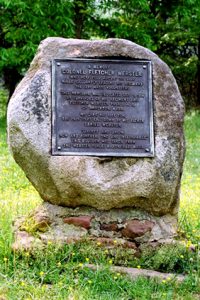
Fletcher Webster had previously served under his father in the State Department and was one of the two men chosen to deliver the news of President William Henry Harrison’s death to Vice President John Tyler.3  On April 21, 1861, responding to an event that happened in Baltimore two days earlier4  as well as to President Abraham Lincoln’s call for volunteers, Fletcher Webster gave a moving speech urging the formation of a new regiment.5 Benjamin Cook recorded a newspaper’s description of the scene:

Mr. Webster’s remarks were patriotic in the extreme. He could, he said, see no better use to which the Sabbath could be put than to improve it by showing our gratitude to Divine Providence for bestowing upon us the best government in the world, and to pledge ourselves to stand by and defend it. 6

Webster concluded that speech by stating:
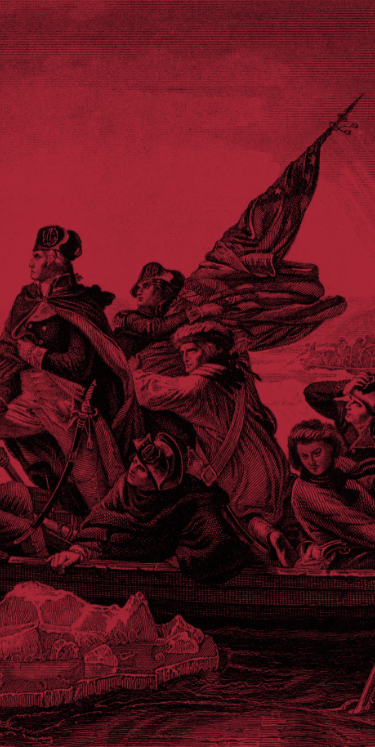
Let us show the world that the patriotism of ’61 is not less than that of the heroes of ’76; that the noble impulses of those patriot hearts have descended to us.7

The crowd responded and a new regiment was formed. Having enlisted enough men to fill “sixteen full companies,”8  it arrived at Fort Warren the first week in May. Significantly, WallBuilders owns original organizational documents for this regiment that we thought you might enjoy seeing. They establish temporary officers, chaplains, etc., pending the official recognition of the regiment, which occurred in early June.

Although Fletcher Webster was killed a little over a year later on August 26, 1862, at the Second Battle of Bull Run,9  the regiment retained its nickname as “The Webster Regiment.” It went on to fight in major battles at Antietam, Fredericksburg, Gettysburg, and elsewhere, and was later declared by General Meade to be “the finest regiment in the service.”10


Endnotes

1 “Captain Benjamin Franklin Cook,” Antietam: On the Web; Benjamin F. Cook and James Beal, History of the Twelfth Massachusetts Volunteers (Webster Regiment) (Boston: Twelfth (Webster) Regiment Association, 1882), 3-5.
2 William Schouler, A History of Massachusetts in the Civil War (Boston: E.P. Dutton & Co., 1868), 111.
3 “John Tyler,” United States Senate.
4 “Exciting days of the Civil War are Recalled: When Webster’s Regiment Passed Through York,” The Reading Eagle (Friday, August 4, 1922).
5 “The Late Colonel Fletcher Webster,” Harper’s Weekly: A Journey of Civilization (New York: Harper Brothers, Saturday, September 20, 1862), VI:299; Cook and Beal, History of the Twelfth  (1882), 9-10.
6 Cook and Beal, History of the Twelfth (1882), 9-10; Schouler, Massachusetts in the Civil War (1868), 111.
7 Cook and Beal, History of the Twelfth (1882), 10.
8 Cook and Beal, History of the Twelfth (1882), 10-11.
9 “Webster, Fletcher,” The National Cyclopedia of American Biography (New York: James T. White & Co, 1906) XIII:169; “Death of Col. Fletcher Webster,” New York Times, September 2, 1862.
10 Cook and Beal, History of the Twelfth (1882), 143.