Message of President Grant to the Children and Youth of the U.S.

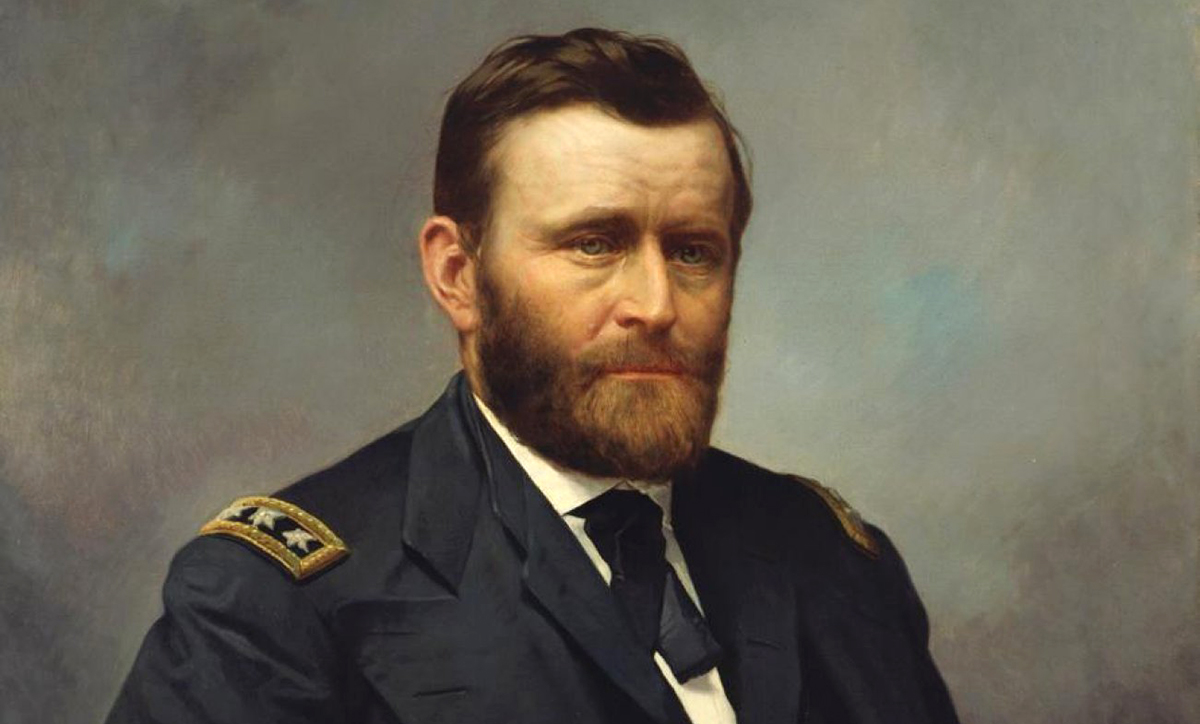
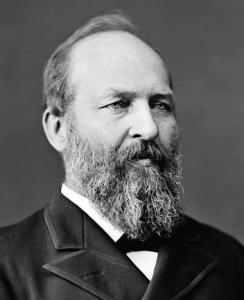
During the festivities celebrating the centennial of the creation of America through the Declaration of Independence, then president Ulysses S. Grant took time to speak to the younger generations of Americans. His message centered on the vital influence and role the Bible in American and the preservation of the liberties enjoyed by here citizens.

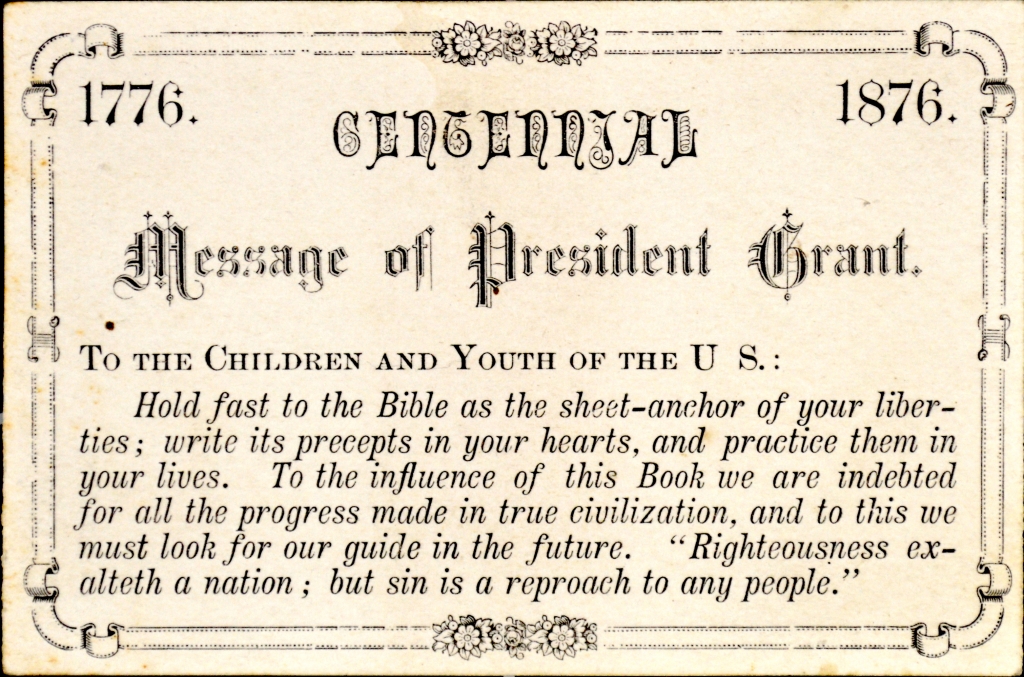
One of the ways Grant’s message got disseminated was through cards such as the example below from the WallBuilders’ Library. The body of the card reads:

Hold fast to the Bible as the sheet-anchor of your liberties; write its precepts in your heats, and practice them in your lives. To the influence of this Book we are indebted for all the progress made in true civilization, and to this we must look for our guide in the future. “Righteousness exalteth a nation; but sin is a reproach to any people.”

Listen to David Barton and Audrea Decker from the Pro-Family Legislative Network discuss this artifact:

First Federal Budget: 1789

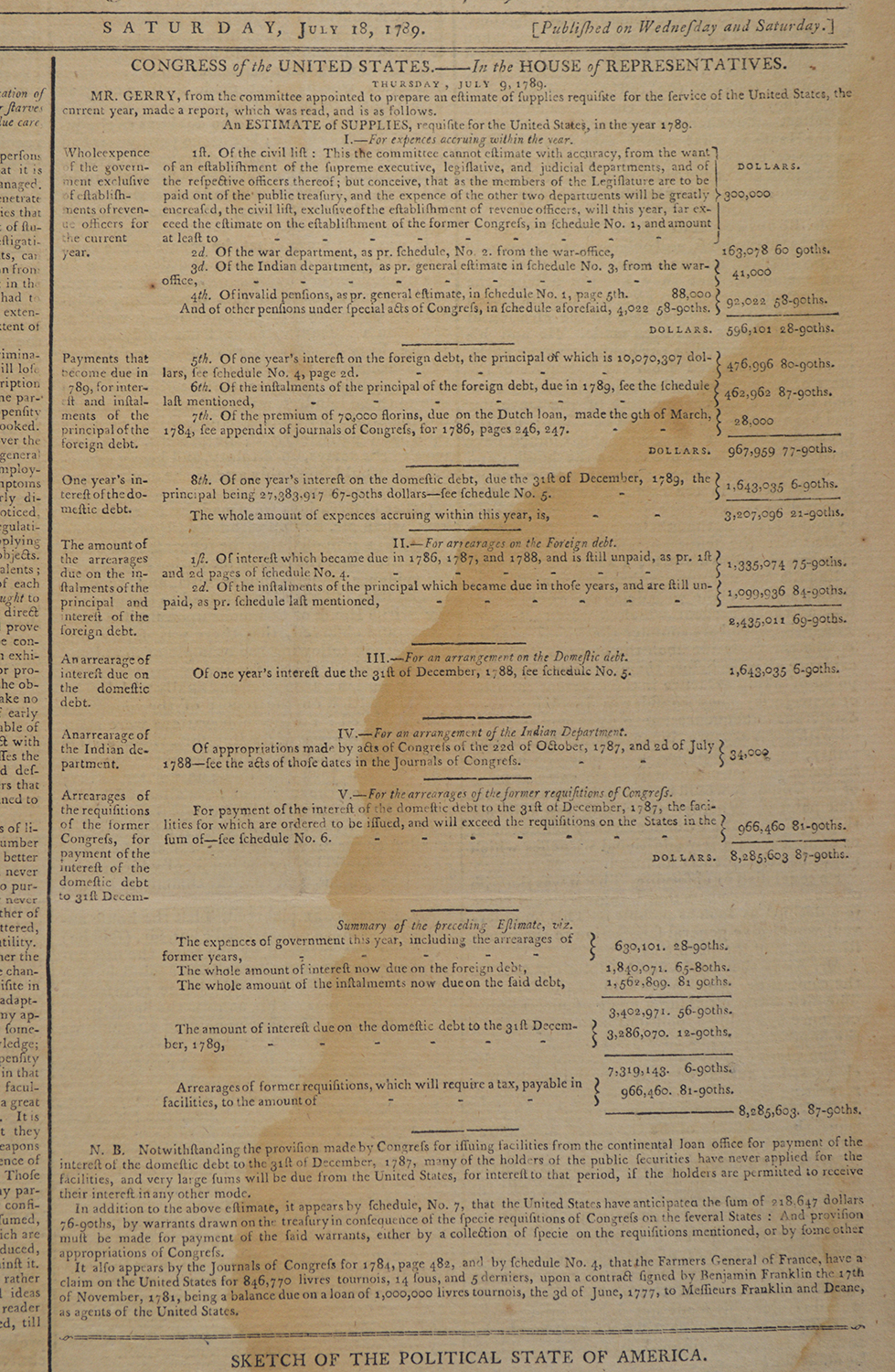
Below is an interesting item from WallBuilders’ collection — the first federal budget of the United States, dated July 9, 1789. This budget takes up only about 1/2 page of the newspaper it’s printed in, The Gazette of the United States (July 18, 1789).


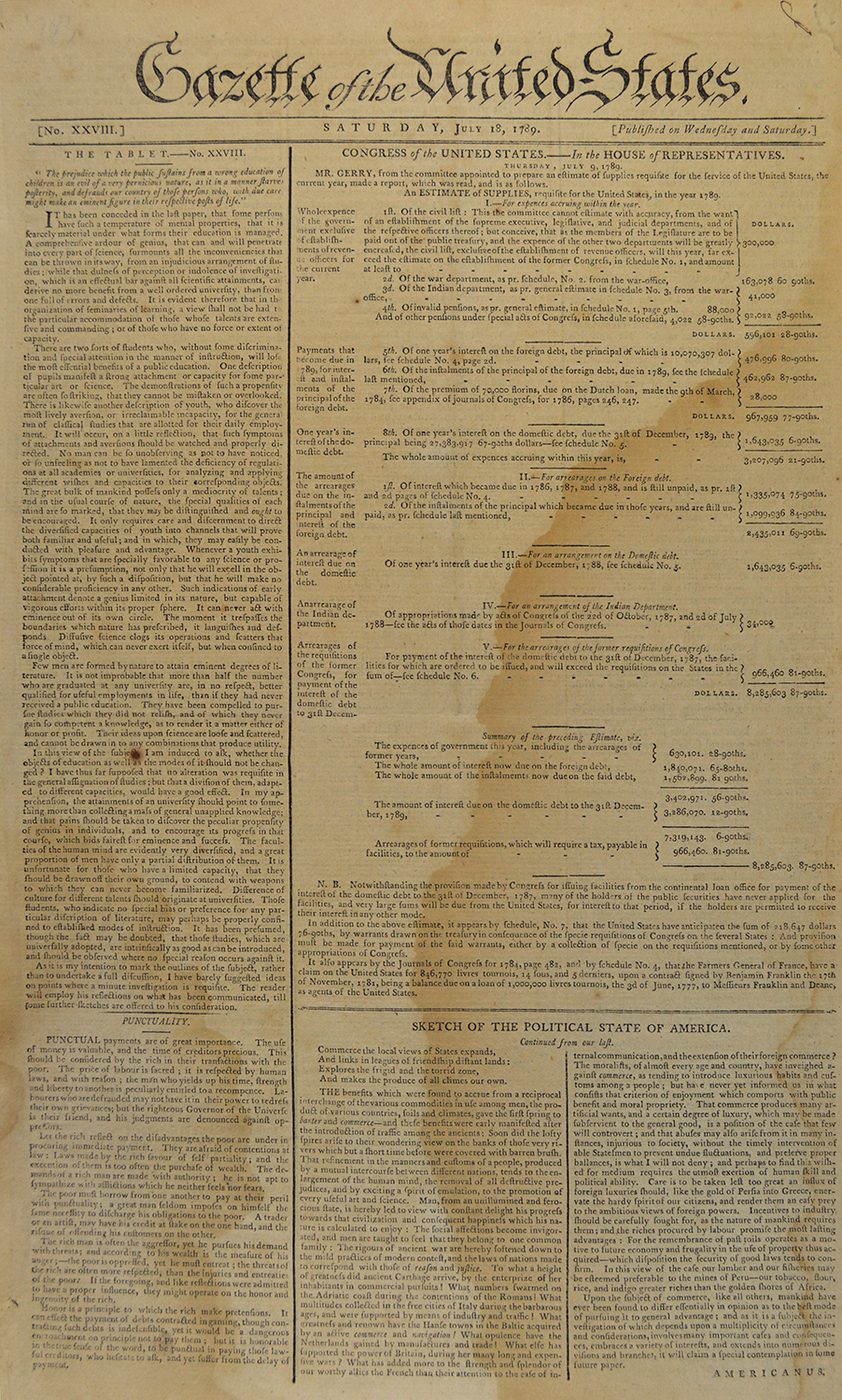
Here’s the complete front page, the budget is on the top right.


And here’s a close-up of the budget.

1789 Inauguration Eyewitness

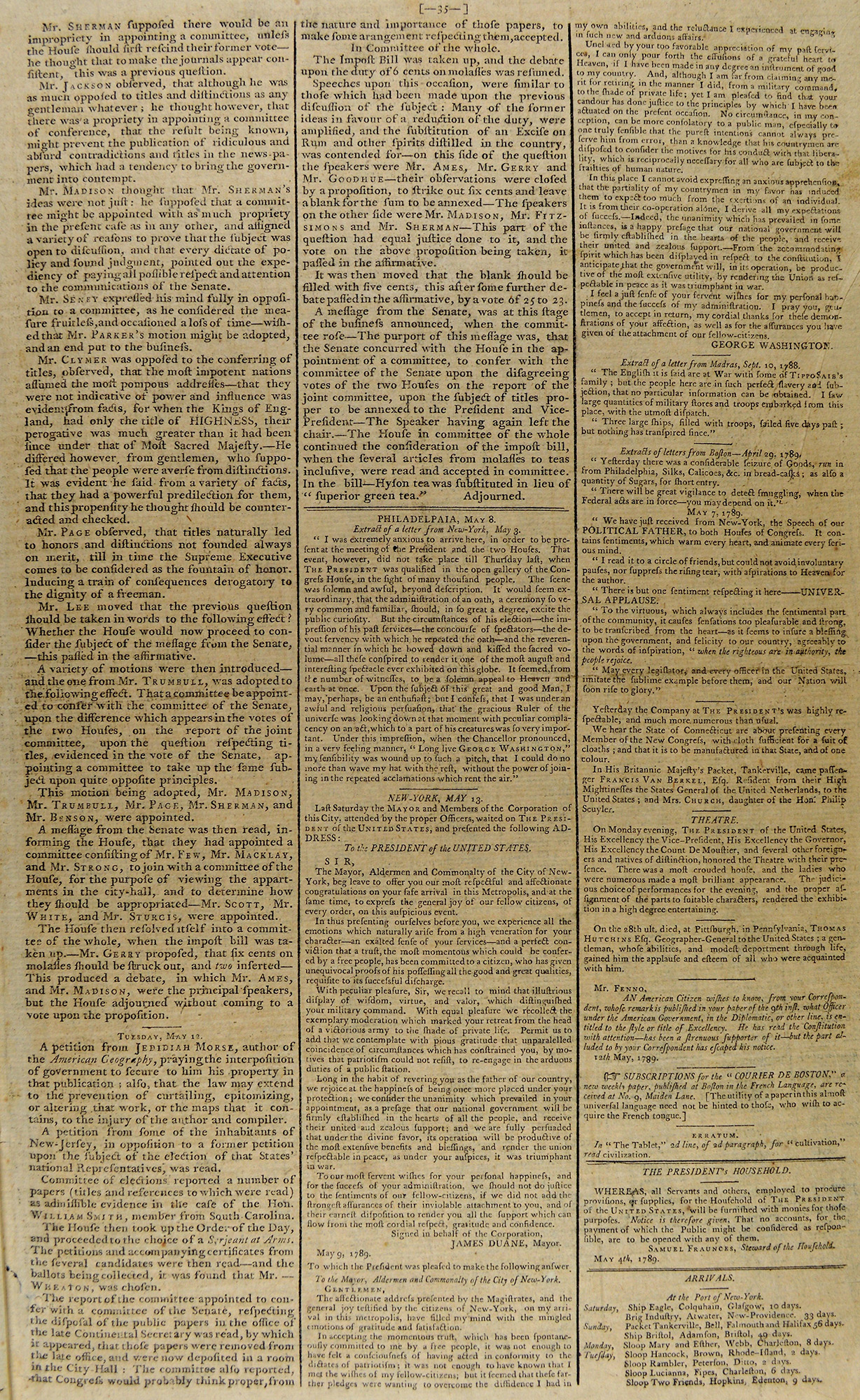
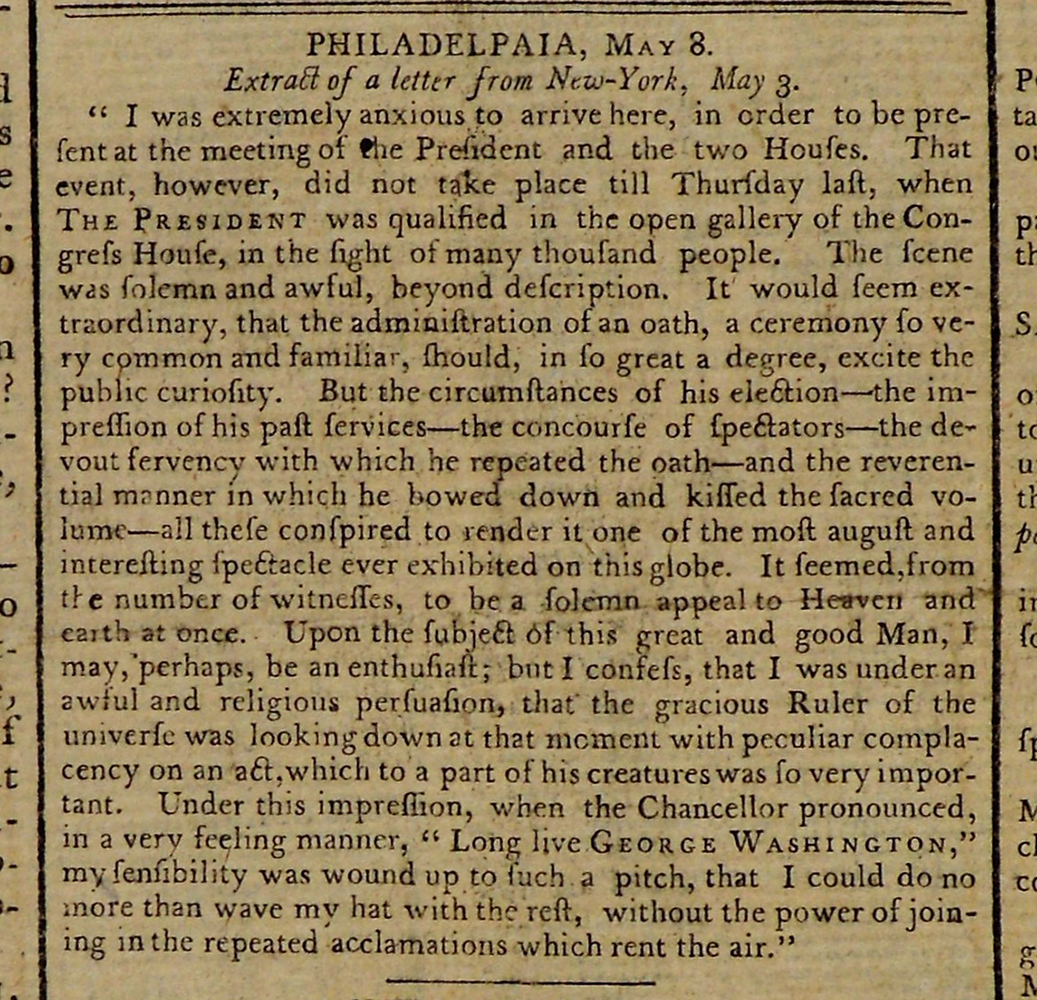
The 1789 inauguration of George Washington as the first President of the United States under the Constitution was a very important event. It established several precedents for inaugurations that have withstood the test of time, including many religious activities. Congress had set up a basic procedure for the inauguration but there were some of the details that Washington added in himself during this historic event — such as the phrase “so help me God” after the oath and the practice of giving an inauguration address. Below, from WallBuilders’ collection, is a May 3, 1789 excerpt of an eyewitness account of the inauguration that was printed in the newspaper, Gazette of the United States (May 9-May 13, 1789).


Philadelphia, May 8.

Extract of a letter from New-York, May 3.

“I was extremely anxious to arrive here, in order to be present at the meeting of the President and the two Houses. That event, however, did not take place til Thursday last, when The President was qualified was qualified in the open gallery of the Congress House, in the sight of many thousand people. The scene was solemn and awful, beyond description. It would seem extraordinary, that the administration of an oath, a ceremony so very common and familiar, should, in so great a degree excite the public curiosity. But the circumstances of his election—the impression of his past services—the concourse of spectators—the devout fervency with which he repeated the oath—and the reverential manner in which he bowed down and kissed the sacred volume—all these conspired to render it one of the most august and interesting spectacle ever exhibited on this globe. It seemed, from the number of witnesses, to be a solemn appeal to Heaven and earth at once, Upon the subject of this great and good Man, I may, ‘perhaps, be an enthusiast; but I confess, that I was under an awful and religious persuasion, that the gracious Ruler of the universe was looking down at that moment with peculiar complacency on an act, which to a part of his creatures was so very important. Under this impression, when the Chancellor pronounced, in a very feeble manner, “Long live George Washington,” my sensibility was wound up to such a pitch, that I could do no more than wave my hat with the rest, without the power of joining in the repeated acclamations which rent the air.”

George Bush on Prayer

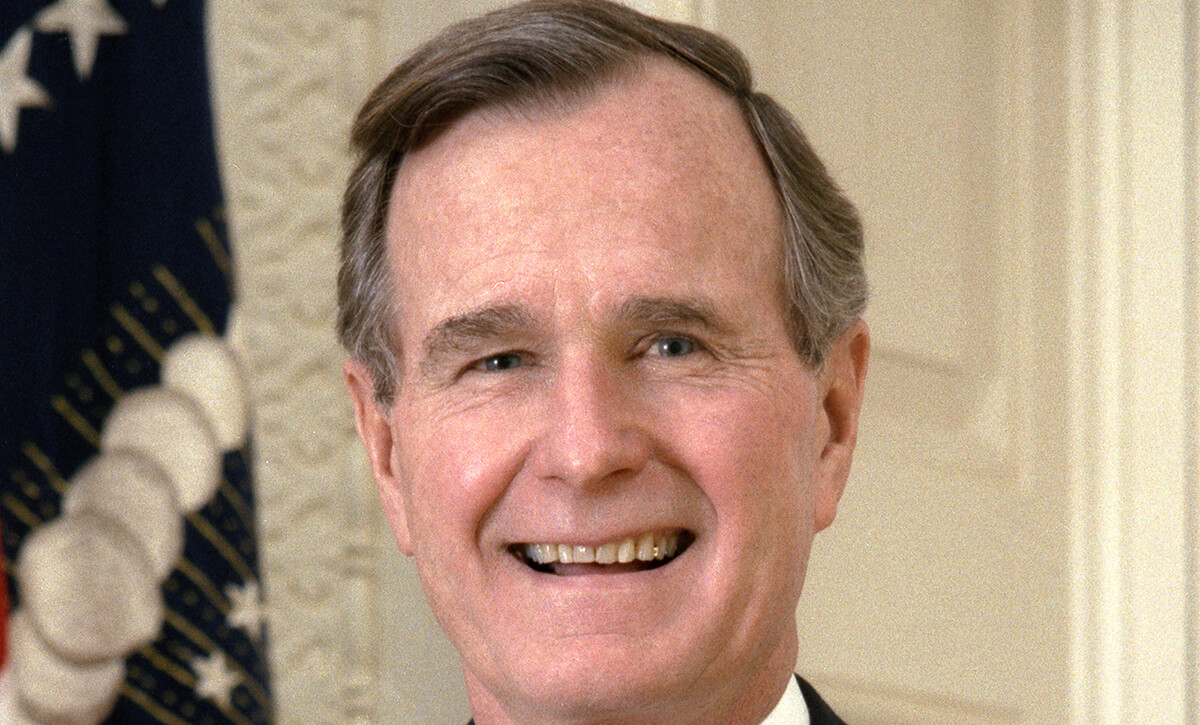
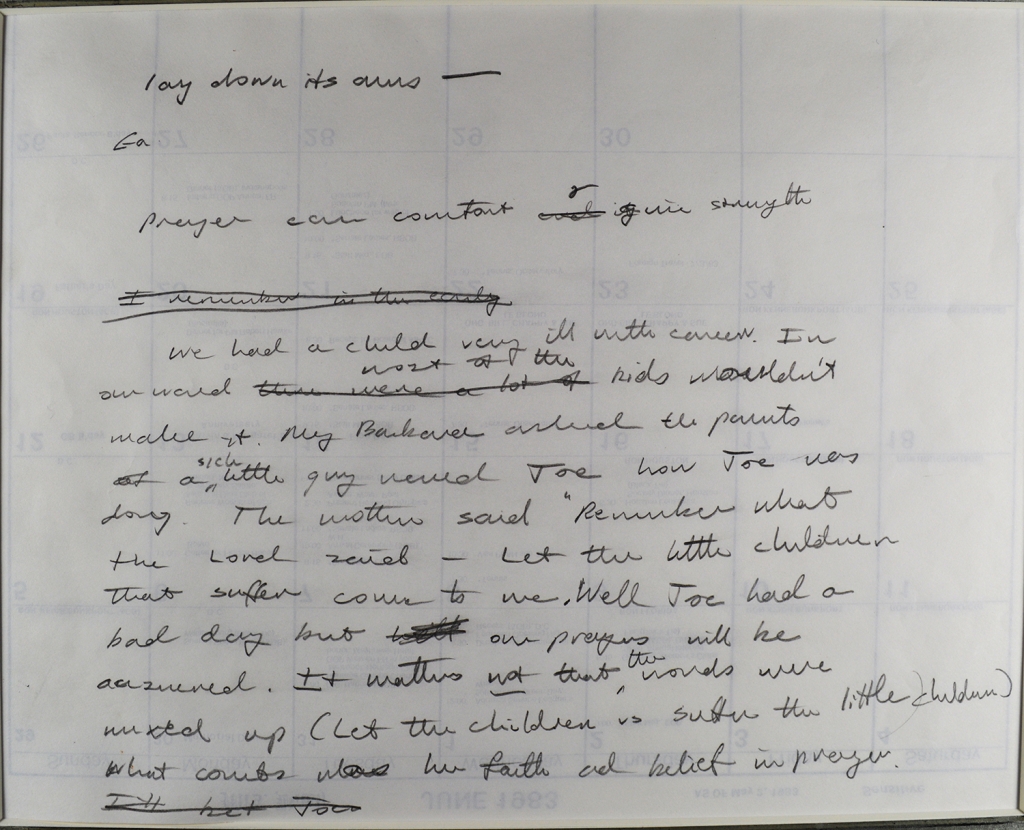
George Herbert Walker Bush (1924-2018) served his country in the military during WWII, was ambassador to the UN (1971-1973), Vice-President (1981-1989), and President of the United States (1989-1993). From the WallBuilders’ Collection, below is a handwritten note by him written on the back of a June 1983 calendar that belonged to Barbara Bush that provides an interesting glimpse into his faith.


Lay down its [arms] –
Ga

Prayer can comfort & give strength.

We had a child very ill with cancer. In our world most of the kids wouldn’t make it. My Barbara asked the parents of a sick little guy named Joe how Joe was doing. The mother said “Remember what the Lord said – Let the little children that suffer come to me. Well Joe had a bad day, but our prayers will be answered.” It matters not that two words were mixed up (let the children vs suffer the little children), what counts was her faith and belief in prayer.

A Preacher and the President

President James Garfield–
A Minister of God

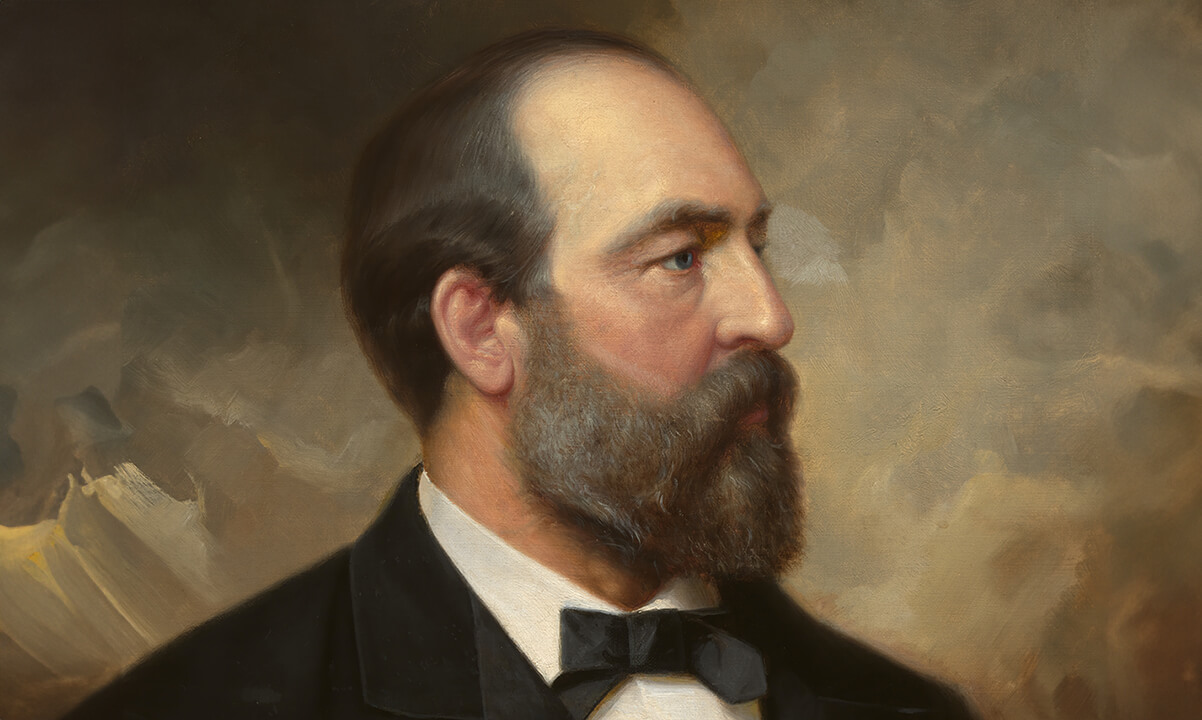
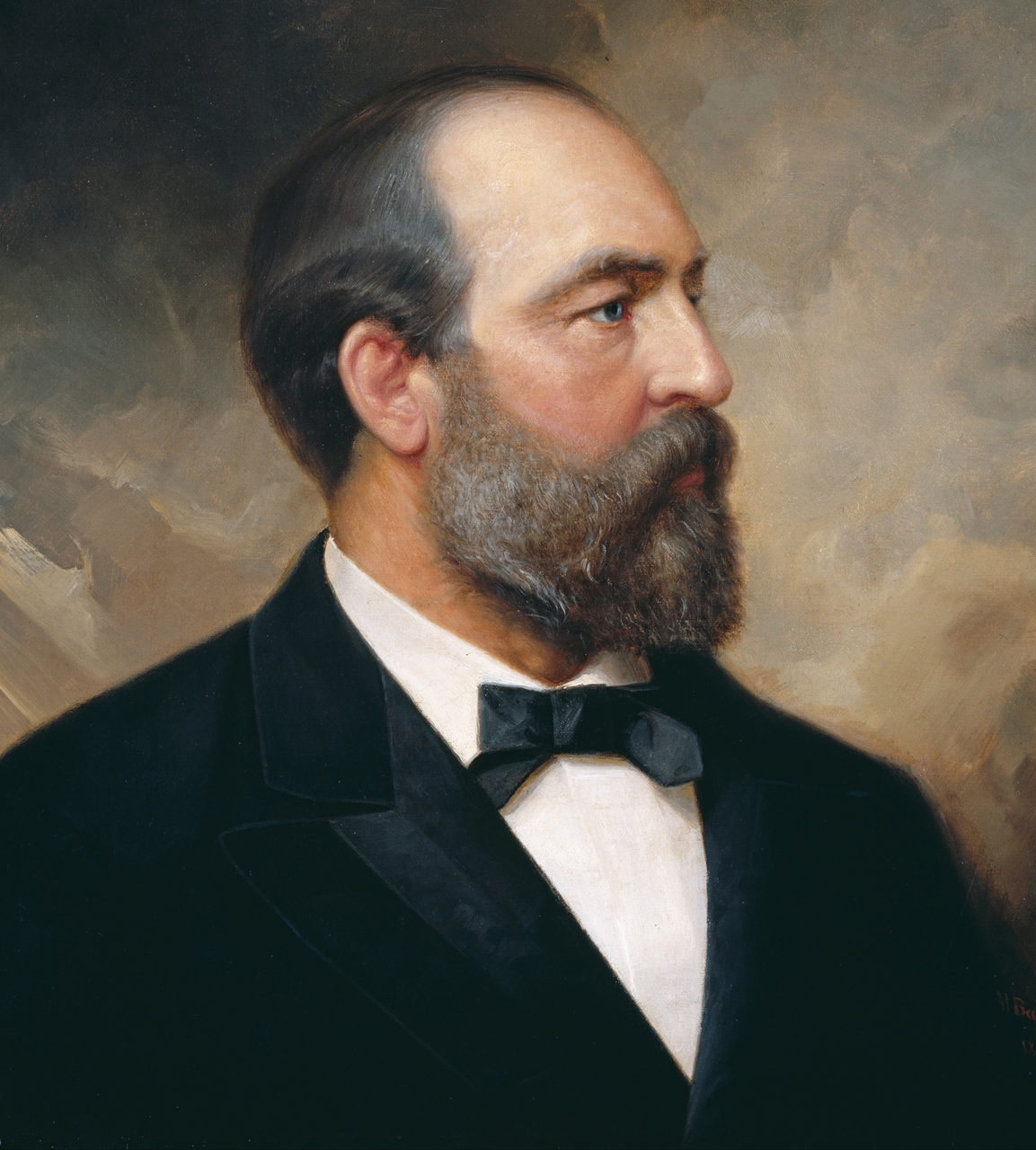
James Garfield, the 20th president of the United States, was a Gospel minister, thus clearly contradicting today’s errant notion that religious leaders are not to be involved with civil government. Sadly, few know much about Garfield partly because of the deliberate secularization of American history but also because of his short presidency.

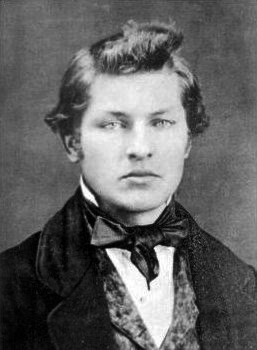
Garfield was born in Ohio in 1831–the last president to be born in a log cabin. He grew up working on the family farm before going to work on a canal boat at age 16. An 1881 biography recounts an occasion when he unexpectedly fell into the river:

James was awakened out of a very sound sleep…He began to uncoil a rope to steady the boat through a lock it was approaching. The rope caught somehow on the edge of the deck and resisted several pulls that he made to extricate it. At last it yielded but, in the rebound, sent him headlong over the bow into the water…Death seemed inevitable. Fortunately his hand seized the rope in the darkness…and he drew himself, hand over hand, upon deck. He saw that he had been saved as by a miracle…’What saved me that time? It must have been God. I could not have saved myself’…During the time that he was thus reflecting he was trying to throw the rope so that it would catch in the crevice. Again and again he coiled the rope and threw it; but it would neither kink nor catch…It was but a few weeks after the last immersion before James was quite severely attacked by ague, a diseases that prevailed somewhat in that region…The captain settled with James…and James started for home…As he drew near the house, he could see the light of the fire through the window…Looking in at the window, he beheld her [his mother] kneeling in the corner, with a book open in the chair before her…her eyes were turned heavenward; she was praying. He listened and he distinctly heard, “Oh, turn unto me, and have mercy upon me! Give Thy strength unto Thy servant, and save the son of Thine handmaid!’

His mother’s statement struck his heart, but it was two years later in 1850 before he became a Christian.

Throughout his life, Garfield was involved in multiple career fields. He was self-taught in law, served as a Union military general in the Civil War, and was a member of the House of Representatives (where he was a key leader in passing numerous civil rights bills to secure racial equality), and he also served as an ordained minister during the Second Great Awakening.

One of the many unique items related to James Garfield in the WallBuilders’ collection is an 1858 letter in which Garfield recited details from a series of services he preached:

We have just closed our meeting with happy results. There were 34 addition[s]. 31 by immersion…I have spoken 19 discourses in our meeting here.

President James Garfield was inaugurated president on March 4, 1881, and later that year on July 2, he was shot by an assassin. The doctors were unable to find and remove the bullet, and on September 19, 1881, he finally succumbed to the complications related to the medical treatment. (Interestingly, Alexander Graham Bell attempted unsuccessfully to find the bullet using a metal detector.)

Garfield reminded citizens of the important role they played in keeping American government healthy and strong, telling Americans:

[N]ow more than ever before, the people are responsible for the character of their Congress. If that body be ignorant, reckless, and corrupt, it is because the people tolerate ignorance, recklessness, and corruption. If it be intelligent, brave, and pure, it is because the people demand these high qualities to represent them in the national legislature. . . . [I]f the next centennial does not find us a great nation . . . it will be because those who represent the enterprise, the culture, and the morality of the nation do not aid in controlling the political forces.

The life of President James A. Garfield should be an inspiration to Americans today, especially to Christians and Americans of faith.

Happy Independence Day!

America’s Birthday

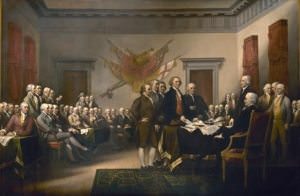
On July 4, 1776 a group of Americans approved a document declaring the United States of America free from English rule. This document was the Declaration of Independence,1 and each year on July 4th we celebrate the birthday of this courageous action!

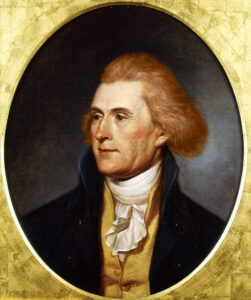
The Declaration of Independence is the nation’s birth certificate.2 Thomas Jefferson, the primary author of the Declaration,3 outlined its purpose:

When forced, therefore, to resort to arms for redress, an appeal to the tribunal of the world was deemed proper for our justification. This was the object of the Declaration of Independence. Not to find out new principles, or new arguments, never before thought of, not merely to say things which had never been said before; but to place before mankind the common sense of the subject, in terms so plain and firm as to command their assent, and to justify ourselves in the independent stand we are compelled to take. Neither aiming at originality of principle or sentiment, nor yet copied from any particular and previous writing, it was intended to be an expression of the American mind.4

John Adams, in informing his wife, Abigail, of the events preceding the passage of the Declaration, stated:

I am well aware of the toil and blood and treasure that it will cost us to maintain this Declaration and support and defend these states. Yet through all the gloom, I can see the rays of ravishing light and glory–I can see that the end is more than worth all the means and that posterity will triumph in that day’s transaction.5

Across the generations, many others have heralded the importance of the Declaration. For example, Civil War hero Ulysses S. Grant saw it as one of the many evidences of God’s guidance:

In all these marked stages of national progress, from the Declaration of Independence to the recent amendments of the Constitution, it is impossible not to perceive a providential series and succession of events.6

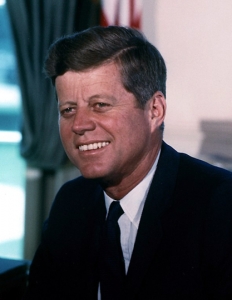
And President John F. Kennedy’s words about the Declaration are as stirring today as they were when they were originally delivered decades ago:

[The] Declaration unleashed not merely a revolution against the British but a revolution in human affairs. Its authors were highly conscious of its worldwide implications. And George Washington declared that liberty and self-government everywhere were, in his words, “finally staked on the experiment entrusted to the hands of the American people.” This prophecy has been borne out….This doctrine of national independence has shaken the globe, and it remains the most powerful force anywhere in the world today.7

As we celebrate the birthday of America, don’t forget the many sacrifices made long ago by the signers of the Declaration on our behalf!

“On this special day, the birthday of our nation, in the midst of all the joyous celebrations let us take a moment to remember the debt of thanks we owe to those who came before us, to the same God who guides us all, and to the spirit of faith and patriotism which still makes America ‘the land of the free and the home of the brave’.”
Ronald Reagan8


Endnotes

1 “Declaration of Independence: Primary Documents in American History,” Library of Congress, accessed June 24, 2025.
2 “The Declaration of Independence,” National Archives, accessed June 24, 2025.
3 Thomas Jefferson to James MAdison, August 30, 1823, Memoirs, Correspondence, and Private Papers of Thomas Jefferson, ed. Thomas Jefferson Randolph (London: Henry Colburn and Richard Bentley, 1829), III:385.
4 Thomas Jefferson to Henry Lee, May 8, 1825, The Writings of Thomas Jefferson, ed. Paul Leicester Ford (New York: G. P. Putnam’s Sons, 1899), X:343.
5 John Adams to Abigail Adams, July 3, 1776, The Works of John Adams, ed. Charles Francis Adams (Boston: Little, Brown, and Company, 1856), I:232.
6 Ulysses S. Grant, “Special Message,” July 14, 1870, The American Presidency Project.
7 John F. Kennedy, “Address at Independence Hall, Philadelphia,” July 4, 1962, The American Presidency Project.
8 Ronald Reagan, “Radio Address to the Nation on the Observance of Independence Day,” July 3, 1982, The American Presidency Project.

Presidents’ Resources

Many heroes and topics were discussed on the February 19, 2018 TBN show “America’s Hidden History” with David and Tim Barton. Below are some helpful resources to find out more! (Right click on the images for larger versions to download.)


George Washington

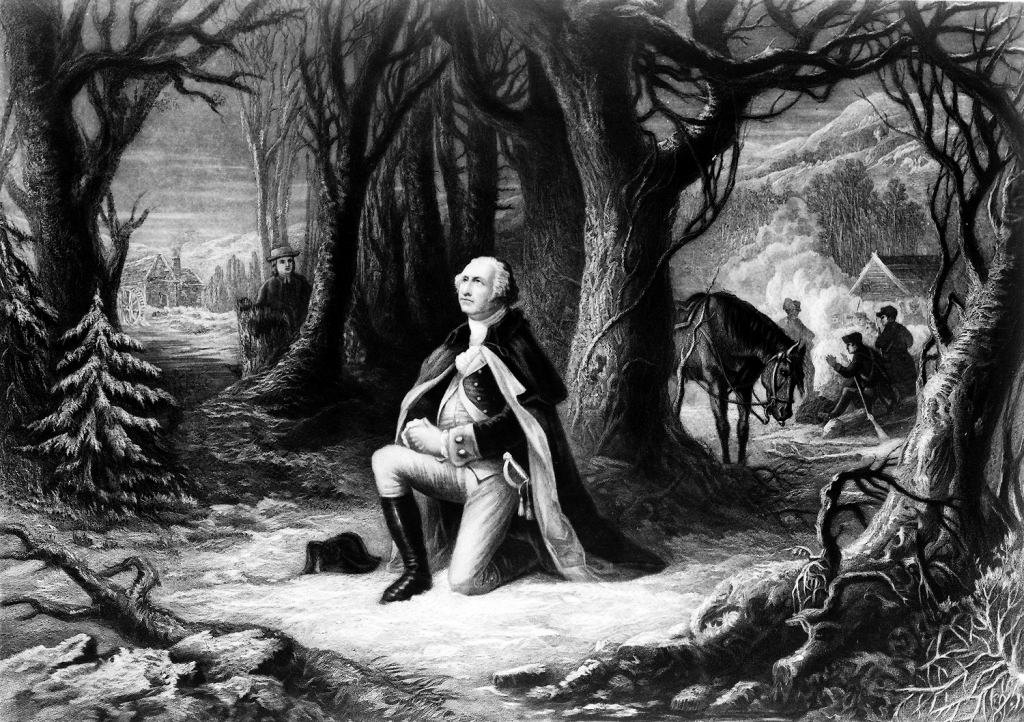
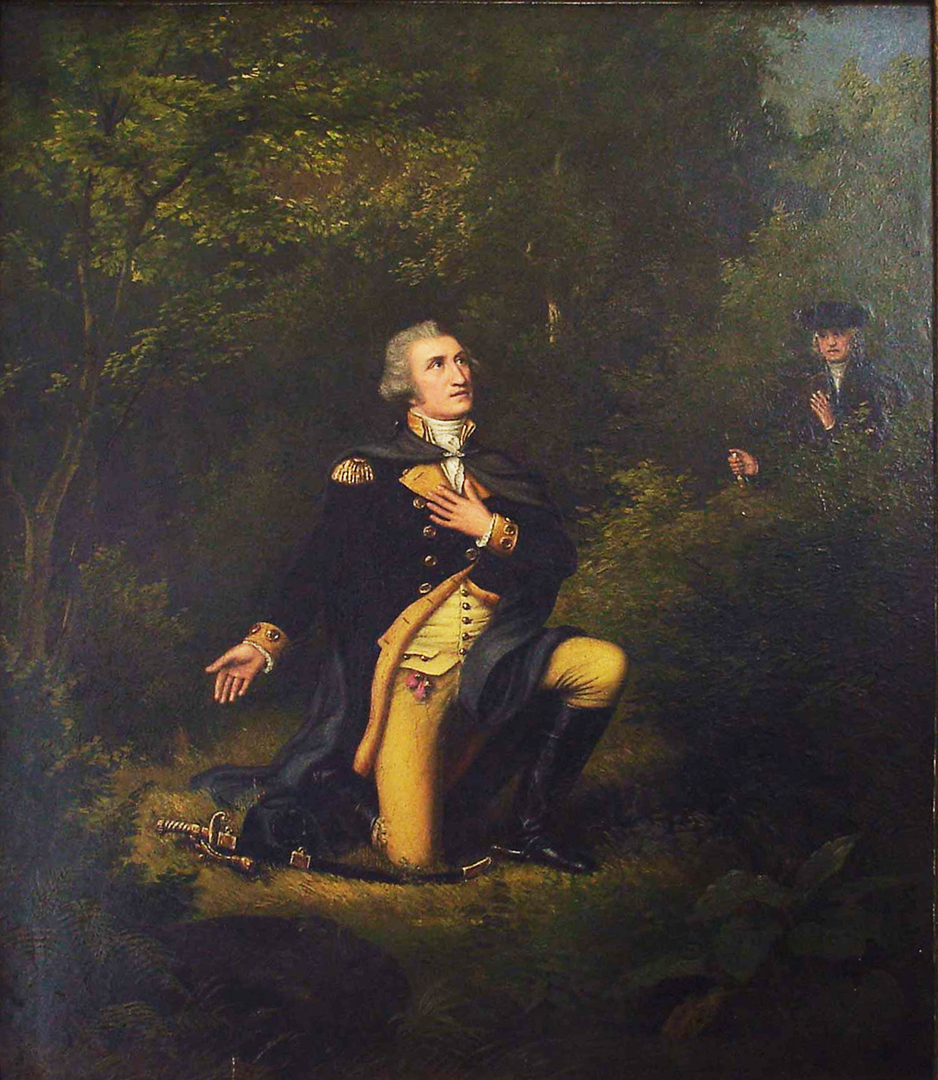
Isaac Potts Witnesses the Prayer at Valley Forge

(Library of Congress)

Rev. E. C. M’Guire, The Religious Opinions and Character of Washington (New York: Harper & Brothers, 1836), 158-169.

Benson Lossing, The Pictorial Field-Book of the Revolution (New York: Harper & Brothers, 1852), II:336n.

Benson Lossing, Recollections and Private Memoirs of Washington, by His Adopted Son George Washington Parke Custis (Philadelphia: J. W. Bradley, 1861), 275n.

George Washington’s Faith

Jared Sparks’ Collection of Washington’s Writings:

Read the books online.

Nelly’s Letter on Washington’s Faith:

Inserted into volume 12 of Sparks’ Collection.

George Washington’s Religious Activities

Vestryman at His Church:

Mount Vernon

Kept a Prayer Journal:

Read Online

First Presidential Prayer Proclamation:

WallBuilders’ Collection

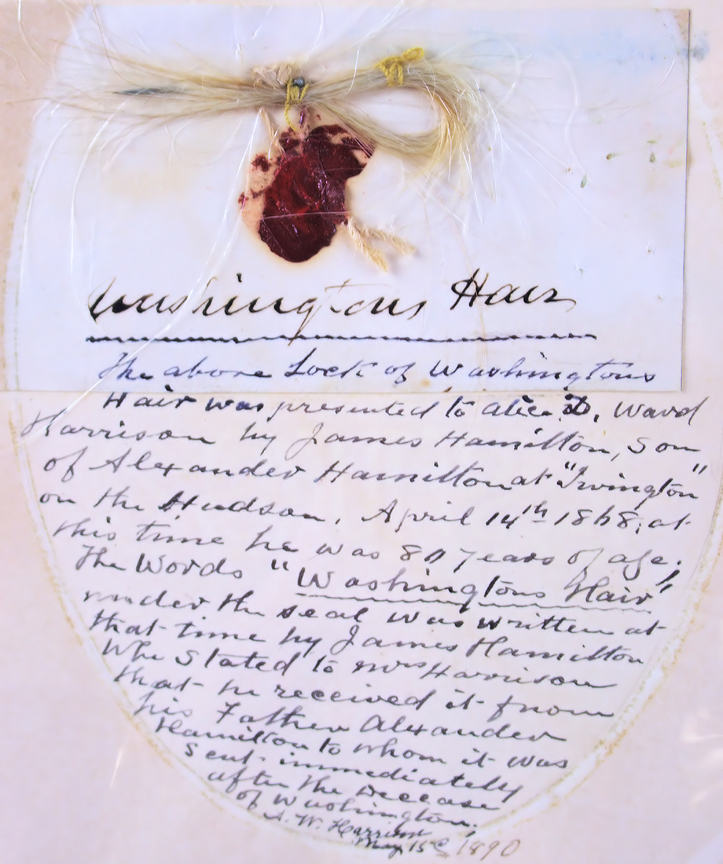
Locks of Hair

These two locks of George Washington’s hair are from WallBuilders’ Collection.


John Adams

Called Himself a “Church Going Animal

“[f]or it is notorious enough, that I have been a Church going Animal for Seventy Six years, i.e. from the Cradle”

[Letter from John Adams to Benjamin Rush on August 28, 1811.]

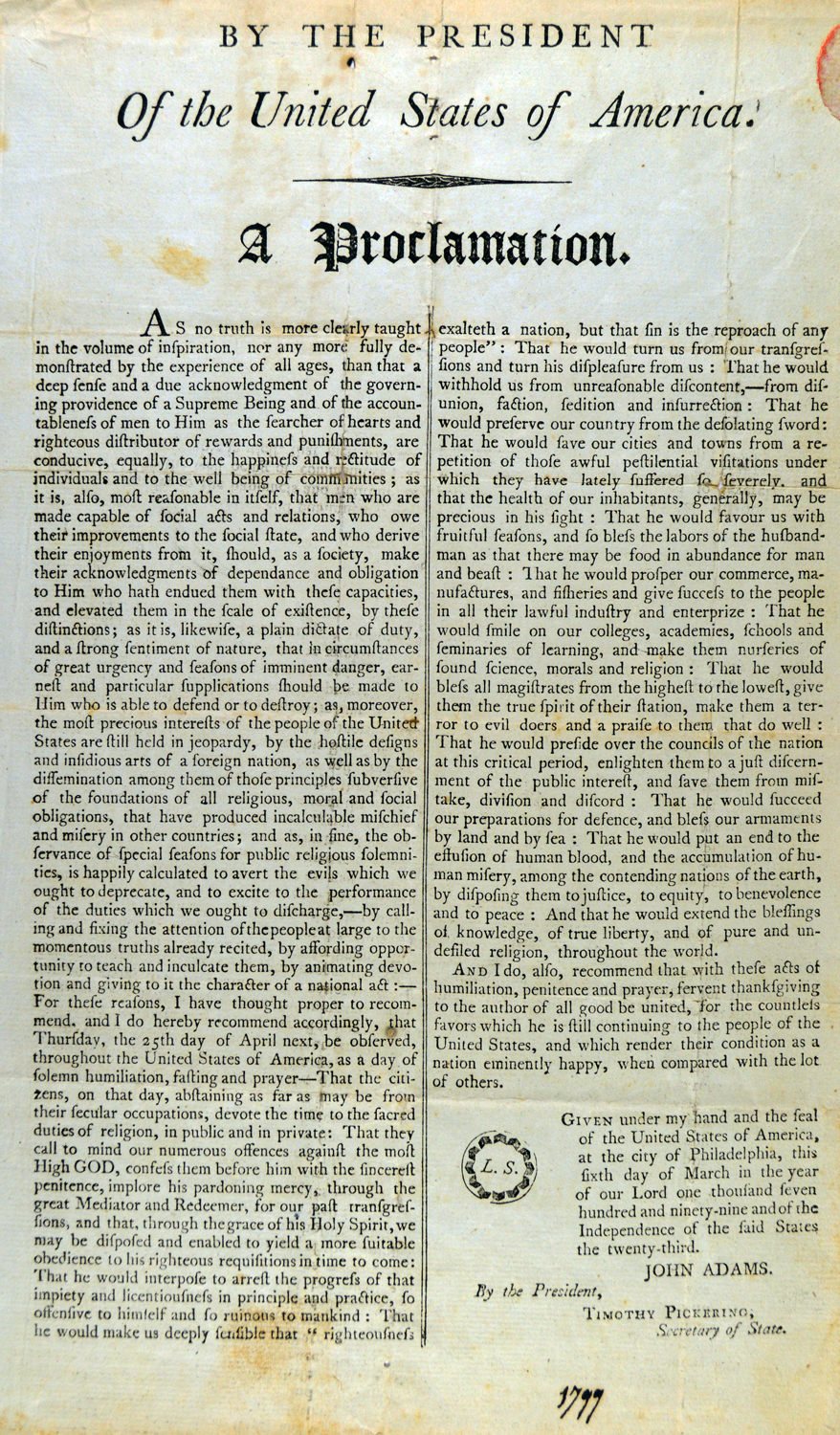
Prayer Proclamation

From WallBuilders’ Collection:


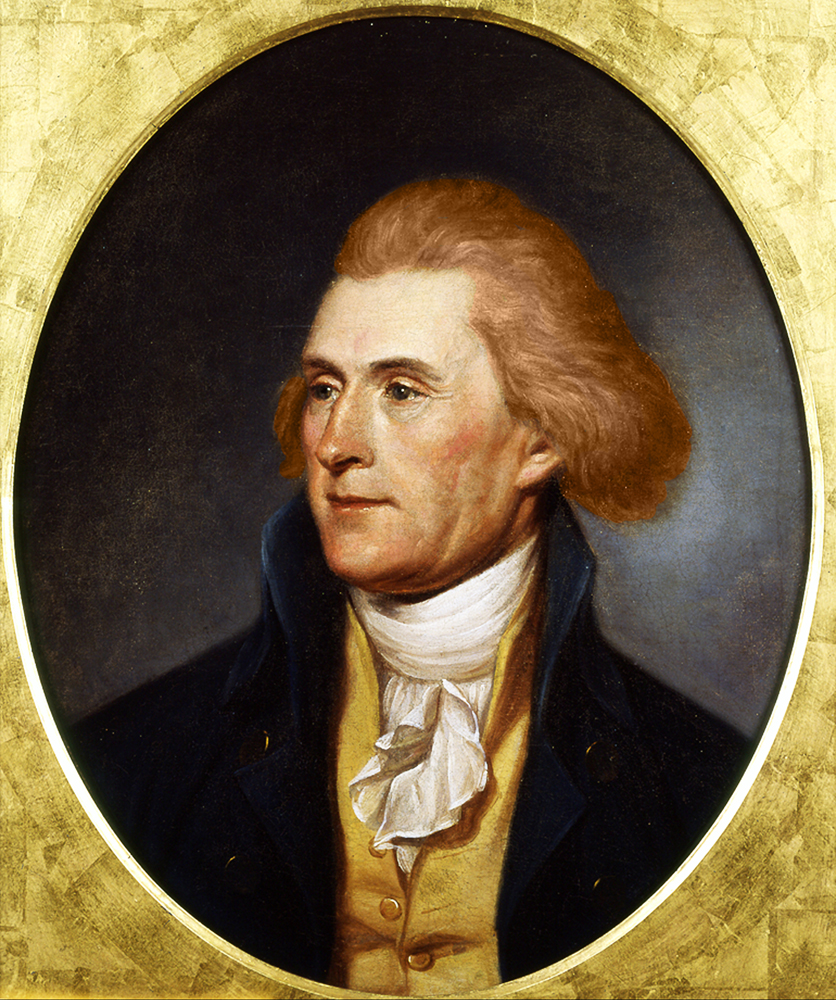
Thomas Jefferson

Religious Activities

Helped Fund John Thompson “Hot Press” Bible:

Thomas Jefferson, The Papers of Thomas Jefferson, Second Series (Princeton: Princeton University Press, 1997), Vol. II, p. 979, February 26, 1798.

Helped Fund Thomas Scott Bible:

Thomas Jefferson, The Papers of Thomas Jefferson, Second Series (Princeton: Princeton University Press, 1997), Vol. II, p. 1195, December 21, 1807.

Involvement in Worship Services in the U.S. Capitol:

WallBuilders

Library of Congress

See additional information in David Barton’s book The Jefferson Lies.

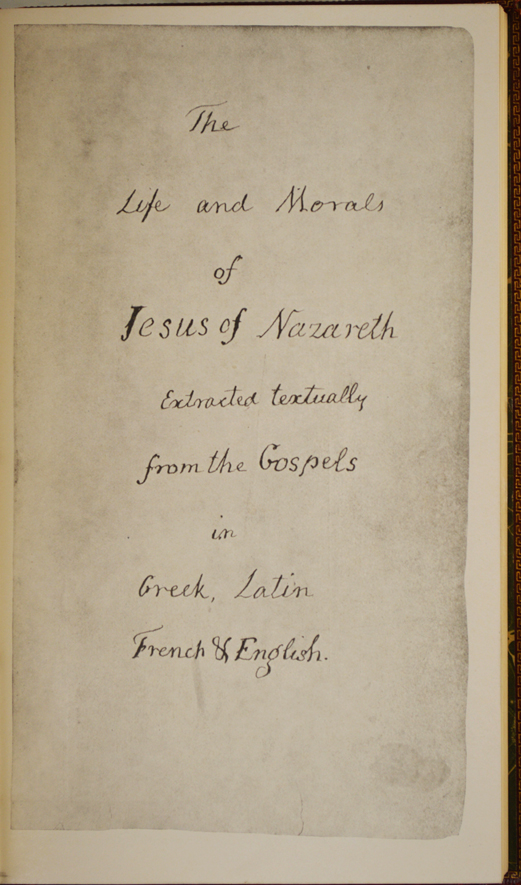
Jefferson’s “Bibles”

Read the book:

Google Books

Jefferson’s Writings on This Work:

Letter to Dr. Priestley on April 9, 1803

“Syllabus of an Estimate of the Merit of the Doctrines of Jesus, compared with those of others” sent with a letter to Benjamin Rush on April 21, 1803

Letter to Joseph Priestly on January 29, 1804

Letter to John Adams on October 12, 1813

Letter to Charles Clay on January 29, 1815

Letter to Charles Thompson on January 9, 1816


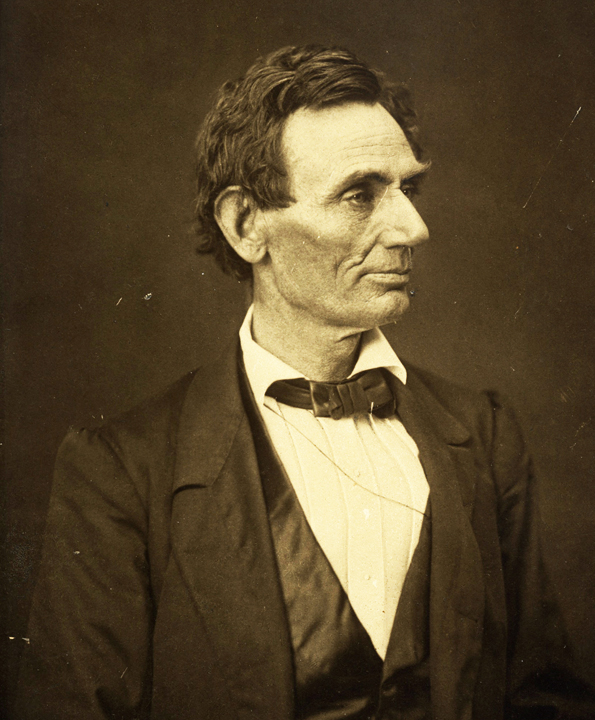
Abraham Lincoln

Lincoln’s Battle With God by Stephen Mansfield

Print from Glass Plate Negative

 Buy the book.

Dred Scott Supreme Court Decision

See the complete opinion.

Republican Party Platforms

1856

1860

1864

13th Amendment Resources

Library 0f Congress

National Archives

John Quincy Adams’ Influence on Abraham Lincoln

John Quincy Adams. His Connection with the Monroe Doctrine (1823) by Worthington Chauncey Ford and with Emancipation under Martial Law (1819-1842) by Charles Francis Adams (Cambridge: John Wilson and Son, 1902), 72.


James Garfield

Biographical Resources:

Miller Center

White House

Handwritten Letter:

WallBuilders’ Collection


Franklin Roosevelt

Pearl Harbor Information:

WallBuilders

The Avalon Project

War Bond Posters & WWII Bibles:

WallBuilders

WallBuilders

Roosevelt D-Day Announcement:

WallBuilders

Handwritten Letter:

From WallBuilders’ Collection


Harry Truman

Proclamation at End of WWII:

WallBuilders


Dwight Eisenhower

Religious Activities:

Inaugural Prayer:

WallBuilders’ Collection

National Prayer Breakfast Started:

Time

Smithsonian

“Under God” in Pledge of Allegiance:

WallBuilders

“In God We Trust” National Motto:

Government Printing Office

“The General Principles of Christianity” – Context Leading to Adams’ June 28, 1813, Letter to Jefferson

When writing to Thomas Jefferson on June 28, 1813, John Adams discusses the fact that America achieved independence through the general principles of Christianity. The letter itself, however, was the culmination of events which began nearly fifteen years earlier.

Adams and Jefferson were friends for many years but fell out after the events of the presidential election of 1800. By the year 1813 Jefferson and Adams had resumed their friendship after the repeated urgings of Dr. Benjamin Rush.1 This newly revived friendliness, however, was significantly tested when private letters written by Jefferson to Dr. Joseph Priestly were published in the biography of Rev. Theophilus Lindsey. One of the letters from 18012 included apparent and harsh censures of Adams’ policies. Upon readings this book Adams wrote to Jefferson on May 29, 1813, saying, “I wish to know if you have seen this book. I have much to say on the subject.”3
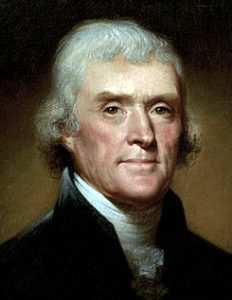
After waiting for twelve days without a response, Adams again took up his pen on June 10, 1813, and went through the 1801 Jefferson letter responding to the various claims made against him. Adams focused on the part where Jefferson had quoted him, writing: “The President himself declaring that we were never to expect to go beyond them in real science.”4 In the original letter to Rev. Priestly, Jefferson explains his disgust at this alleged statement by the then President Adams, exclaiming:

Those who live by mystery & charlantanerie, fearing you would render them useless by simplifying the Christian philosophy, – the most sublime & benevolent, but most perverted system that ever shone on man, – endeavored to crush your well-earnt & well-deserved fame.”5

Responding to these now twelve year old charges, Adams declared:

The sentiment that you have attributed to me in your letter to Dr. Priestley, I totally disclaim, and demand, in the French sense of the word, of you the proof. It is totally incongruous to every principle of my mind and every sentiment of my heart.6

Four days later Adams wrote another letter to Jefferson continuing the project of rebuffing Jefferson’s claims from 1801, but this time focusing mainly on the “alien law.”7

On June 15, 1813, Jefferson responded to the initial letter from May 29. The existence of the biography and even the person of Theophilus Lindsey was entirely new information to him. After looking back upon his own copies of the letters sent to the Dr. Priestly, Jefferson began explaining these letters. He told Adams that, “it was a confidential communication of reflections on these from one friend to another, deposited in his bosom, and never meant to trouble the public mind.”8 He further explained:

Still less must they [readers of the letters in question] consider it as looking personally towards you. You happen, indeed, to be quoted, because you happened to express more pithily than had been done by themselves, one of the mottos of the party. This was in your answer to the address of the young men of Philadelphia.9

At the end of the letter Jefferson makes clear that he sees no need to drag up things from so long ago remarking: “I should see with reluctance the passions of that day rekindled in this, while so many of the actors are living, and all are too near the scene not to participate in sympathies with them. About the facts you and I cannot differ; because truth is our mutual guide.”10

Upon receiving Jefferson’s letter, Adams retrieved his response to the address of the young men of Philadelphia from 1798, fifteen years prior.11 Adams then proceeded to correct Jefferson’s misconception of what had been said. The young men of Philadelphia had addressed Adams during the time when hostilities with France where high, assuring the President that they were, “accentuated by the same principles on which our forefathers achieved their independence.”12 In answer to this Adams admonished them to hold fast to those fundamental principles:

Science and morals are the great pillars on which this country has been raised to its current population, opulence, and prosperity. Without wishing to damp the ardor of curiosity, or influence the freedom of inquiry, I will haphazard a prediction, that after the most industrious  and impartial researches, the longest liver of you all will find no principles, institutions, or systems of education more fit, in general, to be transmitted to your posterity than those you have received from your ancestors.13

It was from this statement that Jefferson had drawn the criticism that Adams thought no improvement could be made upon the sciences of the ancestors, thereby implying that he was one of those who preferred “mystery and charlantanerie” over the simplicity of Christianity. Perceiving Jefferson’s misunderstanding, Adams described the principles which he referred to in his 1798 letter. He began by walking through what his answer did not mean:

Could my answer be understood by any candid reader or hearer, to recommend to all the others the general principles, institutions, or systems of education of the Roman Catholics, of those of the Quakers, or those of the Presbyterians, or those of the Philosophers? No.14

Adams here dismissed any idea that he attempted to propagate and employ for personal power a “most perverted system” of values instead of that “most sublime and benevolent” form of Christianity. Carrying on, Adams revealed what he truly meant, saying:

The general principles in which the fathers achieved independence, were the only principles on which that beautiful assembly of young men could unite, and these principles only could be intended by them in their address, or by me in my answer. And what were these general principles? I answer, the general principles of Christianity, in which all those sects were united, and the general principles of English and American liberty…15

Adams explained to Jefferson that in actuality they both desired the same ends – that the simplicity of those general principles of the Christian faith be maintained by the younger generation just as it had been by their own.


Endnotes

1 Cf. https://wallbuilders.com/resource/benjamin-rush-dream-about-john-adams-and-thomas-jefferson/

2 Thomas Jefferson to Doctor Joseph Priestly, March 21, 1801, The Works of Thomas Jefferson, ed. Paul Ford (New York: G. P. Putnam’s Sons, 1905), IX:216.

3 John Adams to Thomas Jefferson, May 29, 1813, Founders Archives.

4 John Adams, The Works of John Adams, ed. Charles Francis Adams (Boston: Little, Brown and Company, 1856), X:40.

5 Jefferson, Works of Jefferson, IX:217.

6 Adams, Works of Adams, X:41.

7 Adams, Works of Adams, X:42.

8 Jefferson, Works of Jefferson, XI:294.

9 Jefferson, Works of Jefferson, XI:294.

10 Jefferson, Works of Jefferson, IX:296.

11 Adams, Works of Adams, IX:187.

12 Adams, Works of Adams, X:44.

13 Adams, Works of Adams, X:44.

14 Adams, Works of Adams, X:45.

15 Adams, Works of Adams, X:45.
Benjamin Harrison 1894 Letter to His Son

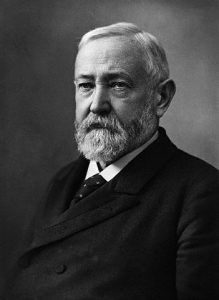
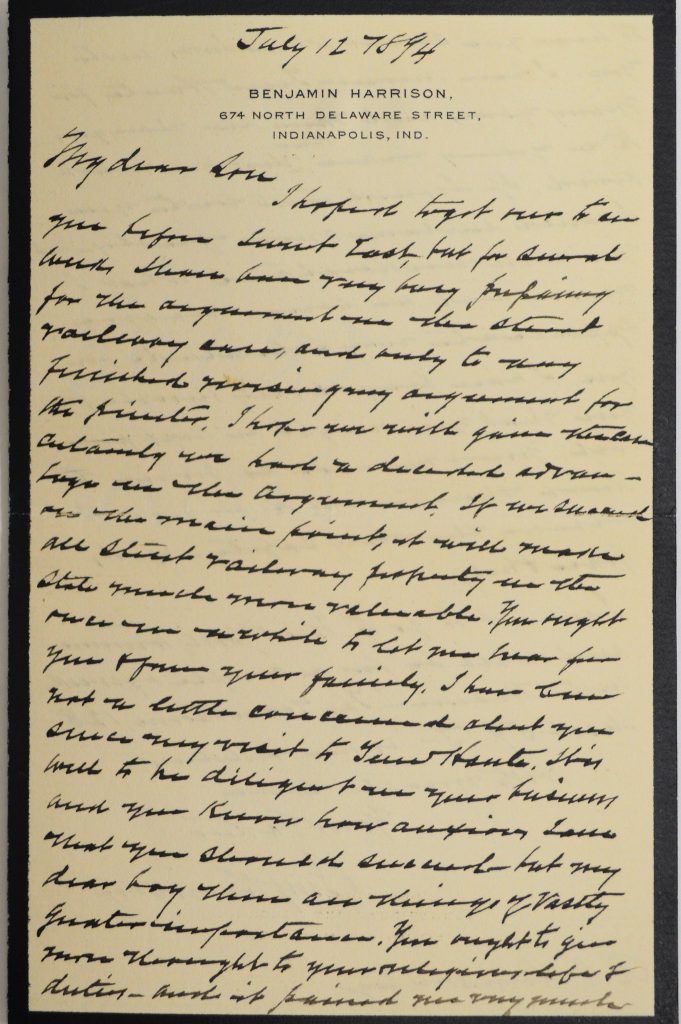
Benjamin Harrison (1833-1901) was a lawyer, a Civil War brigadier general, and eventually the twenty-third president of the United States from 1889-1893. In this letter to his son, Russell Benjamin Harrison, on July 12, 1894, he admonishes the younger Harrison to remain steadfast in the faith. The former president explains to his son, “It’s well to be diligent in your business, and you know how anxious I am that you should succeed – but my dear boy there are things of vastly greater importance. You ought to give more thought to your religious life and duties.” Such a candid and clear call to a higher life came due to a recent incident in which Russell Harrison had cursed in front of his father. President Harrison continues, writing, “Young men are so prone to think there is no danger and to forsake the only safety – God’s grace and help.”
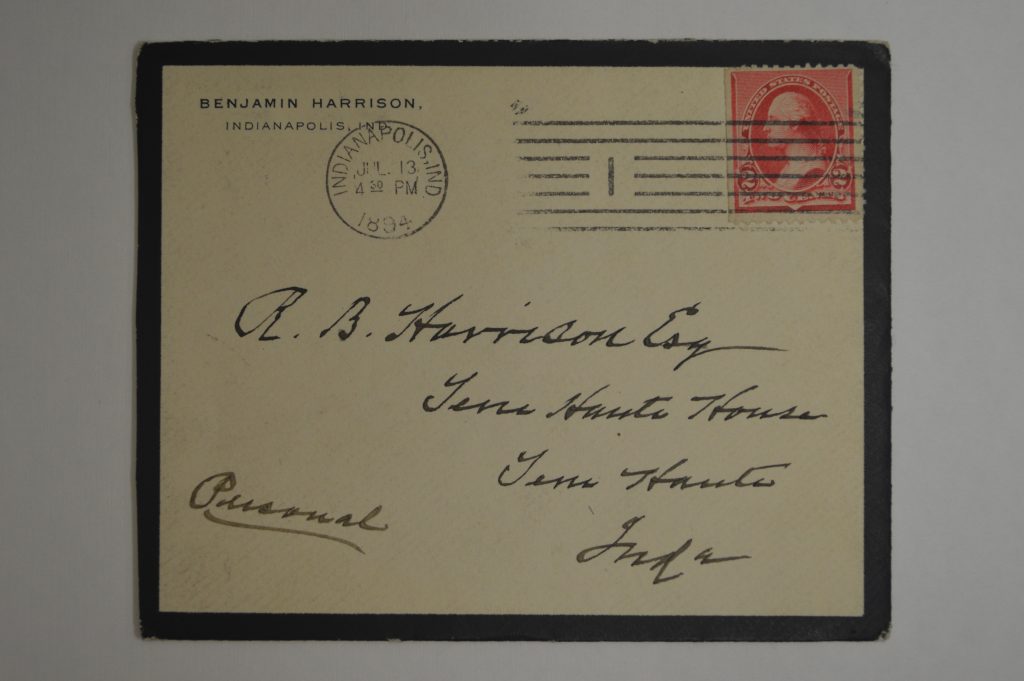
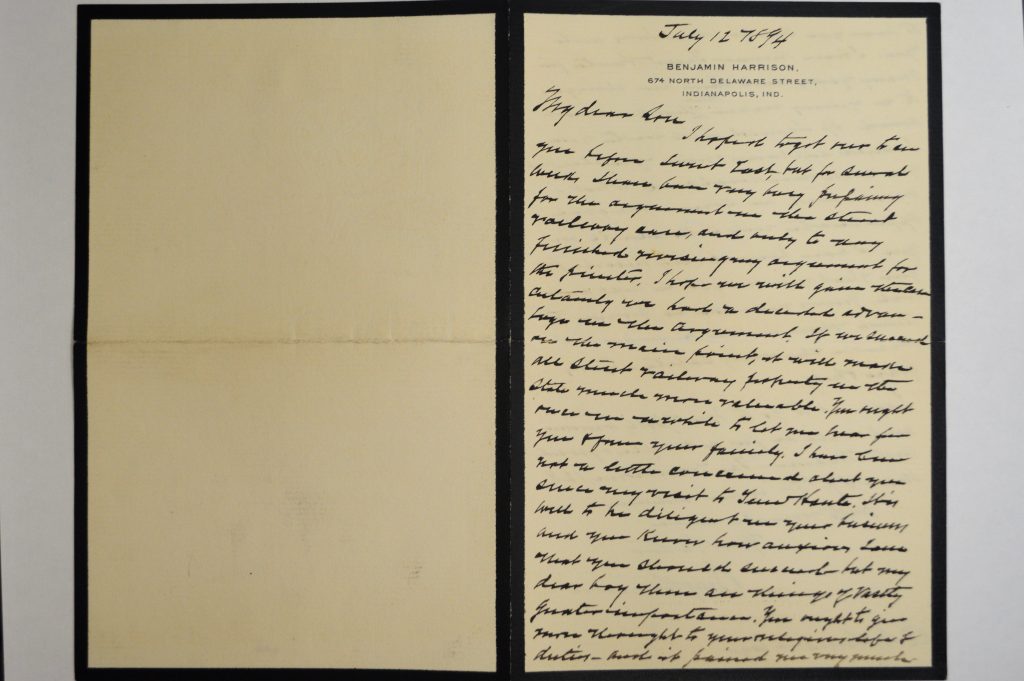
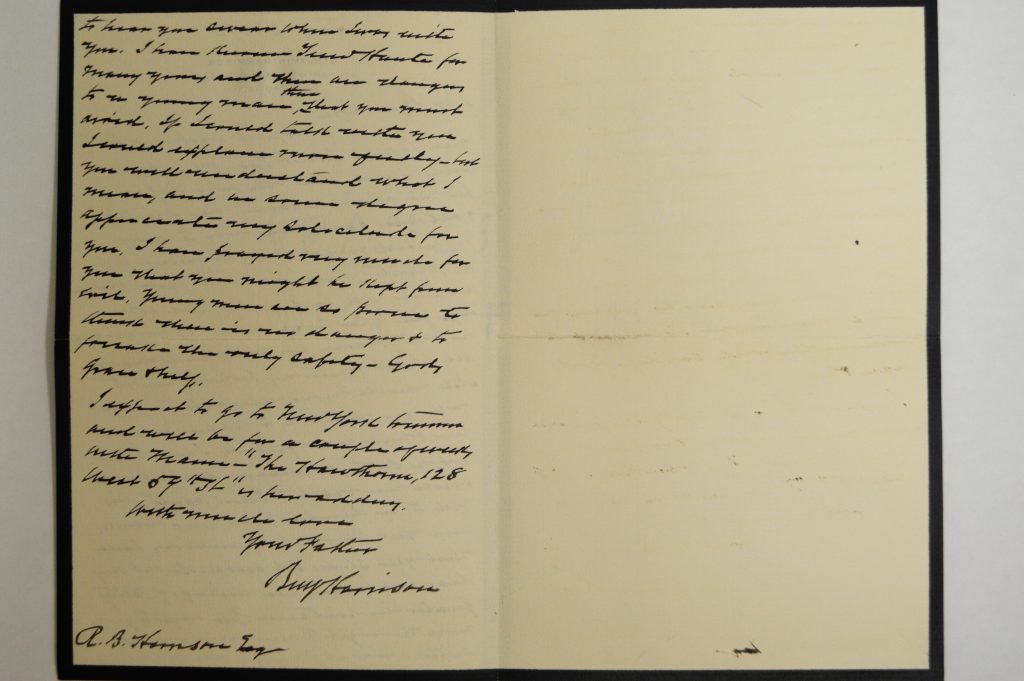
Benjamin Harrison’s faith, however, was not confined to personal letters to his son. While he was sitting president he routinely expressed his faith when acting in an official capacity. Harrison made it evident from the beginning that he and all Americans had God to thank for their country, declaring in his 1889 inaugural address:

No other people have a government more worthy of their respect and love, or a land so magnificent in extent, so pleasant to look upon, and so full of generous suggestion to enterprise and labor. God has placed upon our head a diadem, and has laid at our feet power and wealth beyond definition or calculation. But we must not forget that we take these gifts upon the condition that justice and mercy shall hold the reins of power, and that the upward avenues of hope shall be free to all the people.1

Following this introductory address, President Harrison issued several proclamations calling the nation to prayer. Of these included a yearly call for Thanksgiving which continually reinforced the national reliance our country had upon God. Selections include:

A highly favored people, mindful of their dependence on the bounty of divine Providence, should seek fitting occasion to testify gratitude and ascribe praise to Him who is author of their many blessings. It behooves us then to look back with thankful hearts over the past year and thank God for his infinite mercy. – THANKSGIVING PROCLAMATION 18892

I do invite the people, upon that day to cease from their labors, to meet in their accustomed houses of worship and to join in rendering gratitude and praise to our beneficent Creator for the rich blessings He has granted to us as a nation, and in invoking the continuance of His protection and grace for the future. – THANKSGIVING PROCLAMATION 18903

To God, the Beneficent and the All Wise, who makes the labors of men to be fruitful, redeems their losses by His grace, and the measure of whose giving is as much beyond the thoughts of men as it is beyond his desserts, the praise and gratitude of the people of this favored nation are justly due. – THANKSGIVING PROCLAMATION 18914

He [God] has stayed the pestilence at our door; He has given us more love for the free institutions in the creation of which His directing providence was so conspicuous; He has awakened a deeper reverence for law; He has widened our philanthropy by a call to succor the distress in other lands; He has blessed our schools and is bringing forward a patriotic and God-fearing generation to execute His great and benevolent designs for our country; He has given us great increase in material wealth and a wide diffusion of contentment and comfort in the homes of our people; He has given His grace to the sorrowing. – THANKSGIVING PROCLAMATION 18925

On top of these prayer proclamations, he also issued a special call to prayer on the centennial of George Washington’s inauguration. In the proclamation itself Harrison explained the purpose behind it:

In order that the joy of the occasion may be associated with a deep thankfulness in the minds of the people for all our blessings in the past, and a devout supplication to God for their gracious continuance in the future, the representatives of the religious creeds, both Christian and Hebrew, have memorialized the Government to designate an hour of prayer and thanksgiving on that day.6

Therefore, in accordance to the wishes of the Christian and Jewish representatives, Harrison recommended that at 9 o’clock in the morning:

The entire community repair to their respective places of divine worship, to implore the favor of God that the blessings of liberty, prosperity, and peace may abide with us as a people, and that His hand may lead us in the paths of righteousness and good deeds.7

Benjamin Harrison, both in his private life and while before the public eye, always remembered and strove to remind others that God was the source of safety, prosperity, and comfort.


Pictures of the Letter

Page 1
Page 2
Page 1 Close Up

Transcription

My dear Son,

I hoped to out get out to see you before I went East but for several weeks I have been very busy, preparing for the argument in the street railway case, and only today finished revising my argument for the printer. I hope we will gain the case. Certainly we had a decided advantage in the argument. If we succeed in the main point, it will make all street property in the state much more valuable.

You ought once in a while to let me hear from you and from your family. I have been not a little concerned about you since my visit to Terre Haute. It’s well to be diligent in your business, and you know how anxious I am that you should succeed – but my dear boy there are things of vastly greater importance. You ought to give more thought to your religious life and duties. And it pained me very much to hear you swear when I was with you. I have known Terre Haute for many years and there are dangers to a young man there that you must avoid. If I could talk with you I would explain fully. But you will understand what I mean, and in some degree appreciate my solicitude for you. I have prayed very much for you that you might be kept from evil. Young men are so prone to think there is no danger and to forsake the only safety – God’s grace and help. I expect to go to New York tomorrow and will be a couple of weeks with Mama – “The Hawthorne, 128 West of 59th St.” is the address.

With much love,
Your father,
Benj. Harrison


Endnotes

1 Benjamin Harrison, Public Papers and Addresses of Benjamin Harrison (Washington: Government Printing Office), 35.

2 Harrison, Papers and Addresses, 240.

3 Harrison, Papers and Addresses, 241.

4 Harrison, Papers and Addresses, 241-242.

5 Harrison, Papers and Addresses, 242.

6 Harrison, Papers and Addresses, 243.

7 Harrison, Papers and Addresses, 243-244.

Religious Messages from WWI

On April 6, 1917, the US entered World War I,1 providing much needed troops to a war effort that cost millions of lives across the world.2 In a speech calling for a declaration of war, President Woodrow Wilson used a phrase that would summarize America’s intent in becoming involved in this and future conflicts: “The world must be made safe for democracy.”3 Although America was officially involved in fighting for just over a year, there were still more than 53,000 American soldiers who lost their lives in that conflict.4 Let’s take time to remember these service members and the war they fought in.

Americans had initially preferred remaining neutral in what was seen as a European conflict but actions taken by Germany led to a shift. In May 1915, a German U-boat (submarine) sank a British ocean liner killing over 1,000 people including about 120 Americans.5 Then, in February 1917, a telegram was intercepted in which the Germans offered Mexico a return of territory lost to the US if Mexico would join the war.6 These actions raised outrage among the general public, making the declaration of war more acceptable when it was made.

As would also happen during WWII, war bonds were used as a way to raise money for the war effort.7 In our collection of original documents and artifacts, WallBuilders has war bond posters from both WWI and WWII that used religious messages to ensure support and raise money for those wars.

Also, throughout American history, Bibles have been distributed to soldiers going into war and sometimes these Bibles would include messages from leaders on the importance of Bible reading. For example, a letter from President Woodrow Wilson was used in a WWI era Bible (pictured here from a Bible in WallBuilders’ Collection):

The Message of President Wilson to Soldiers and Sailors, US Army and Navy, June 6, 1917. Sent Through the Maryland Bible Society.

This book speaks both the voice of God and the voice of humanity, for there is told in it the most convincing story of human experience that has ever been written, take it all in all, and those who head that story will know that strength and happiness and success are all summed up in the exhortation, “Fear God and keep his commandments.”

John Pershing was put in command of the American forces in WWI. His involvement in several victories in the later months of the war helped the Allies obtain victory. General Pershing returned to America a war hero and was promoted to General of the Armies in 1919.8 His letter printed in the front of a 1917 Bible provides a glimpse into his religious beliefs:

To The American Soldier:

Aroused against a nation waging war in violation of all Christian principles, our people are fighting in the cause of liberty.

Hardship will be your lot, but trust in God will give you comfort; temptation will befall you, but the teachings of our Saviour will give you strength.

Let your valor as a soldier and your conduct as a man be an inspiration to your comrades and an honor to your country.

Our history demonstrates that America accorded religion and morality a prominent place in military life — a belief that, sadly, is today being eroded.


Footnotes

1 “Echoes of the Great War,” Library of Congress, accessed April 2, 2025.
2 “How many people died during World War I?” February 13, 2025, Britannica.
3 Woodrow Wilson, “Joint Address to Congress Leading to a Declaration of War Against Germany,” April 2, 1917, National Archives.
4 American War and Military Operations Casualties: Lists and Statistics (Congressional Research Services: 2020), 2.
5 “RMS Lusitania: 18 Minutes That Shocked The World,” Imperial War Museum, accessed April 2, 2025.
6 “Zimmermann Telegram (1917),” National Archives.
8 “The Posters That Sold World War I to the American Public,” July 28, 2015, Smithsonian Magazine.
9 “John Pershing – World War I,” February 28, 2015, National Park Service.