Religious Messages from WWI

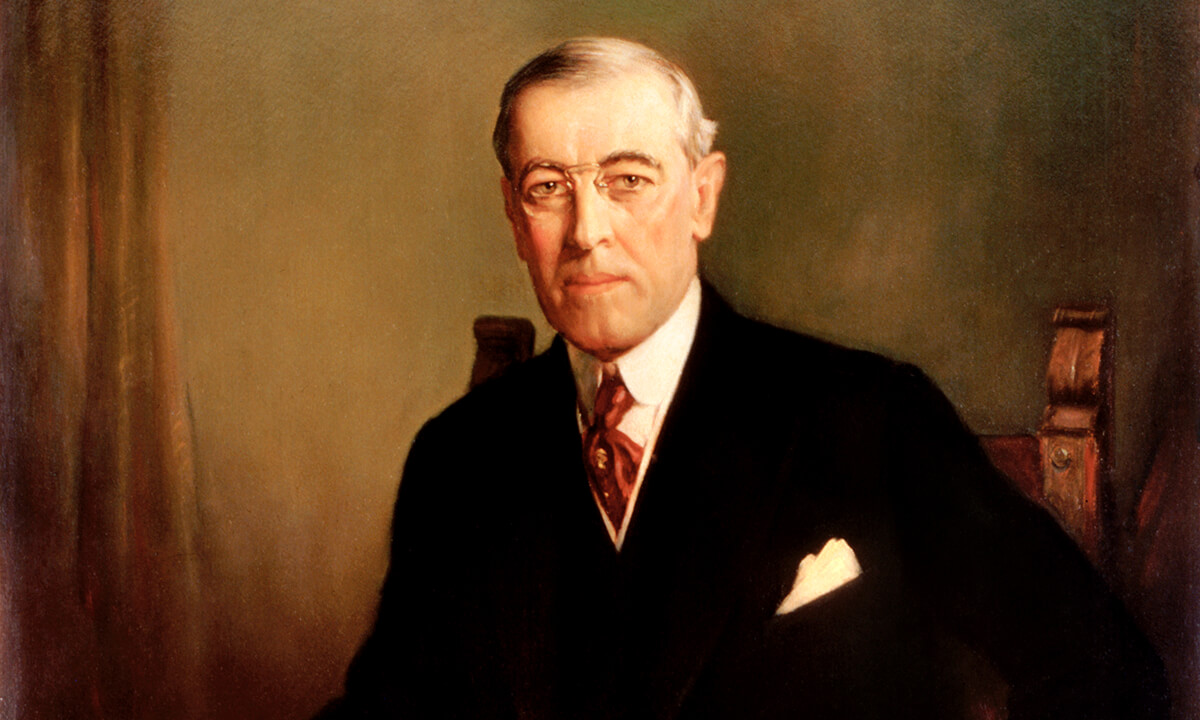
On April 6, 1917, the US entered World War I,1 providing much needed troops to a war effort that cost millions of lives across the world.2 In a speech calling for a declaration of war, President Woodrow Wilson used a phrase that would summarize America’s intent in becoming involved in this and future conflicts: “The world must be made safe for democracy.”3 Although America was officially involved in fighting for just over a year, there were still more than 53,000 American soldiers who lost their lives in that conflict.4 Let’s take time to remember these service members and the war they fought in.
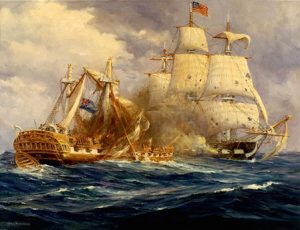
Americans had initially preferred remaining neutral in what was seen as a European conflict but actions taken by Germany led to a shift. In May 1915, a German U-boat (submarine) sank a British ocean liner killing over 1,000 people including about 120 Americans.5 Then, in February 1917, a telegram was intercepted in which the Germans offered Mexico a return of territory lost to the US if Mexico would join the war.6 These actions raised outrage among the general public, making the declaration of war more acceptable when it was made.

As would also happen during WWII, war bonds were used as a way to raise money for the war effort.7 In our collection of original documents and artifacts, WallBuilders has war bond posters from both WWI and WWII that used religious messages to ensure support and raise money for those wars.

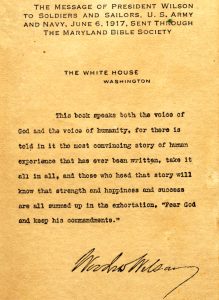
Also, throughout American history, Bibles have been distributed to soldiers going into war and sometimes these Bibles would include messages from leaders on the importance of Bible reading. For example, a letter from President Woodrow Wilson was used in a WWI era Bible (pictured here from a Bible in WallBuilders’ Collection):

The Message of President Wilson to Soldiers and Sailors, US Army and Navy, June 6, 1917. Sent Through the Maryland Bible Society.

This book speaks both the voice of God and the voice of humanity, for there is told in it the most convincing story of human experience that has ever been written, take it all in all, and those who head that story will know that strength and happiness and success are all summed up in the exhortation, “Fear God and keep his commandments.”

John Pershing was put in command of the American forces in WWI. His involvement in several victories in the later months of the war helped the Allies obtain victory. General Pershing returned to America a war hero and was promoted to General of the Armies in 1919.8 His letter printed in the front of a 1917 Bible provides a glimpse into his religious beliefs:

To The American Soldier:

Aroused against a nation waging war in violation of all Christian principles, our people are fighting in the cause of liberty.

Hardship will be your lot, but trust in God will give you comfort; temptation will befall you, but the teachings of our Saviour will give you strength.

Let your valor as a soldier and your conduct as a man be an inspiration to your comrades and an honor to your country.

Our history demonstrates that America accorded religion and morality a prominent place in military life — a belief that, sadly, is today being eroded.


Footnotes

1 “Echoes of the Great War,” Library of Congress, accessed April 2, 2025.
2 “How many people died during World War I?” February 13, 2025, Britannica.
3 Woodrow Wilson, “Joint Address to Congress Leading to a Declaration of War Against Germany,” April 2, 1917, National Archives.
4 American War and Military Operations Casualties: Lists and Statistics (Congressional Research Services: 2020), 2.
5 “RMS Lusitania: 18 Minutes That Shocked The World,” Imperial War Museum, accessed April 2, 2025.
6 “Zimmermann Telegram (1917),” National Archives.
8 “The Posters That Sold World War I to the American Public,” July 28, 2015, Smithsonian Magazine.
9 “John Pershing – World War I,” February 28, 2015, National Park Service.

America’s Founders on Easter

Easter is celebrated across the world as one of the most significant Christian holy days — as a time when we pause to remember the great sacrifice of Jesus on the cross as well as the ultimate triumph of His resurrection. America’s Founding Fathers often commented on Easter.
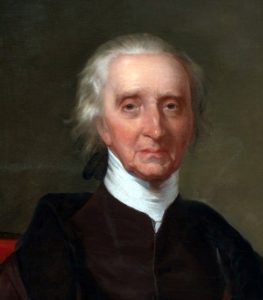
For example, Charles Carroll, signer of the Declaration of Independence, viewed Easter as the power for salvation, explaining:

The approaching festival of Easter, and the merits and mercies of our Redeemer copiosa assudeum redemptio [with the Lord there is plentiful redemption] have lead me into this chain of meditation and reasoning, and have inspired me with the hope of finding mercy before my Judge, and of being happy in the life to come — a happiness I wish you to participate with me by infusing into your heart a similar hope.
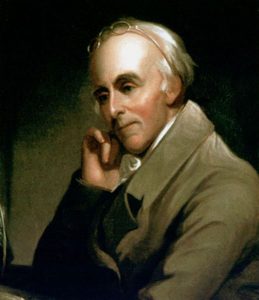
Benjamin Rush, another signer of the Declaration, pointed out how Jesus’ resurrection not only redeemed man to God but also to each other. He noted:

He forgave the crime of murder on His cross; and after His resurrection, He commanded His disciples to preach the gospel of forgiveness, first at Jerusalem, where He well knew His murderers still resided. These striking facts are recorded for our imitation and seem intended to show that the Son of God died, not only to reconcile God to man but to reconcile men to each other.
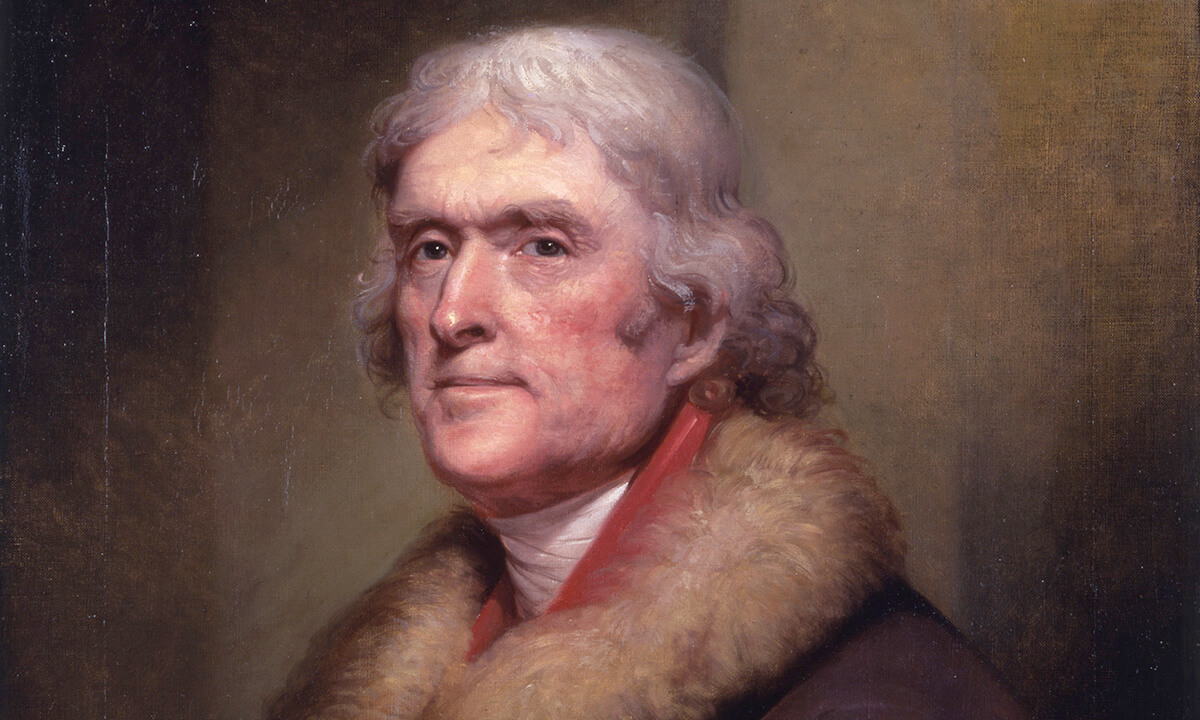
Easter is indeed a special day, not only from an historical viewpoint but also from a spiritual one. As early American clergyman Phillips Brooks accurately noted, because of Easter “Let every man and woman count himself immortal. Let him catch the revelation of Jesus in His resurrection. Let him say not merely, ‘Christ is risen,’ but ‘I shall rise’.” Indeed! So, from all of us at WallBuilders, Happy Easter!

Jefferson and Library of Congress

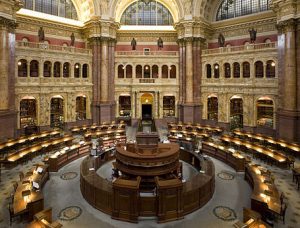
Most Americans are very familiar with the Library of Congress and its massive collection of millions of books, documents, recordings, photographs, sheet music, and manuscripts.1 But few know how Thomas Jefferson is connected to the library.
On April 24, 1800, Congress approved moving the federal government to Washington DC and granted resources for a congressional library:

That for the purchase of such books as may be necessary for the use of Congress at the said city of Washington, and for fitting up a suitable apartment for containing them and for placing them therein, the sum of five thousand dollars shall be, and hereby is appropriated.2

The books purchased for that library were originally kept in the Capitol building.3 But when the British invaded and set fire to the Capitol during the War of 1812,4 this collection was destroyed. This is where Jefferson comes in.

He offered to sell his collection of books (nearly 6,500) to Congress to replace the books that had been burned.5 His offer was accepted and nearly $24,000 (over $300,000 in today’s money) was set aside to purchase his books.6

Unfortunately, almost two-thirds of his collection was destroyed in another fire in 1851,7 but Jefferson’s library was a springboard from which the Library of Congress would continue to grow. Next time you visit the Library of Congress, remember one of the reasons this collection is so impressive is due to Thomas Jefferson’s influence.


Endnotes

1 “Fascinating Facts,” Library of Congress, accessed January 17, 2024.
2 “An Act to make further provision for the removal and accommodation of the Government of the United States,” April 24, 1800, The Public Statutes at Large of the United States of America, ed. Richard Peters (Boston: Charles C. Little and James Brown, 1845), II:56.
3 “History of the Library of Congress,” Library of Congress, accessed January 17, 2024.
4 “A Most Magnificent Ruin: The Burning of the Capitol during the War of 1812,” Architect of the Capitol, August 1, 2023.
5 Thomas Jefferson to Samuel H. Smith, September 21, 1814, The Writings of Thomas Jefferson, ed. H.A. Washington (Washington: Taylor & Maury, 1854), VI:383-385; “Sale of Books to the Library of Congress (1815),” Monticello, accessed January 17, 2024.
6 Samuel H. Smith to Thomas Jefferson, February 15, 1815, Founders Online.
7 “Thomas Jefferson: Jefferson’s Library,” Library of Congress, accessed January 17, 2024.

An Historic Debate

From the time before the American War for Independence, black Americans served as elected officials in local politics. Following the Civil War, hundreds more were elected to state and federal office.
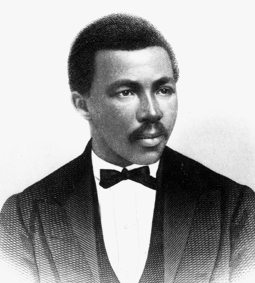
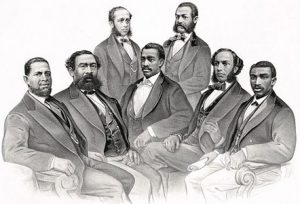
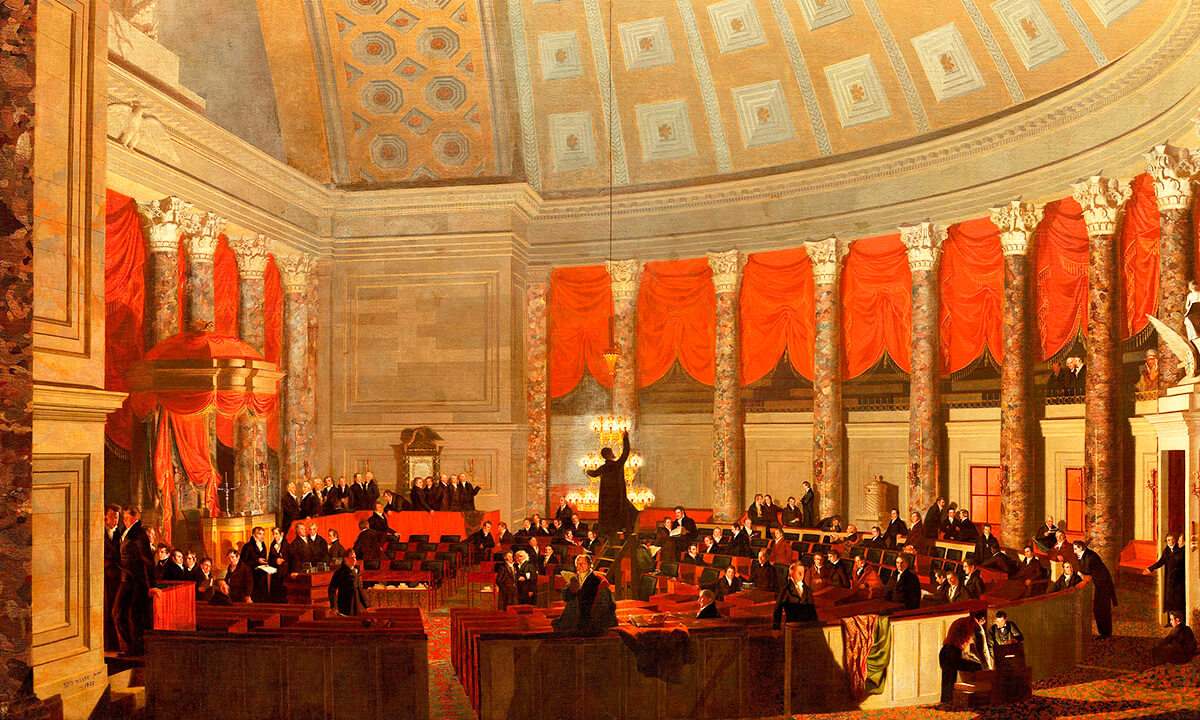
For example, at the national level, in 1871, Robert Brown Elliott was elected to the US House of Representatives — one of the first blacks elected to national office (the picture on the left shows the first seven blacks elected to Congress, including Elliott; all seven were Republicans). Originally from England, Elliott came to the U.S. in 1867 and quickly became influential in South Carolina, being one of 78 black delegates to the 1868 state constitutional convention, and placing second in the vote to be speaker of the state house.

Shortly after his election to the US House, Republican Elliott faced off in a debate over a civil rights bill against three pro-slavery Democrats: Alexander Hamilton Stephens of Georgia (the former Vice-President of the Confederate States of America, elected as a Democrat to Congress after the Civil War), James Beck of Kentucky (elected in 1867), and John Thomas Harris of Virginia (elected in 1871). After those three Democrats attacked the civil rights bill that protected the constitutional rights of black Americans, Elliott (pictured below) rose and responded:

[I]t is a matter of regret to me that it is necessary at this day that I should rise in the presence of an American Congress to advocate a bill which simply asserts rights and equal privileges for all classes of American citizens. I regret, sir, that the dark hue of my skin may lend a color to the imputation that I am controlled by motives personal to myself in my advocacy of this great measure of natural justice. Sir, the motive that impels me is restricted by no such narrow boundary but is as broad as the Constitution.
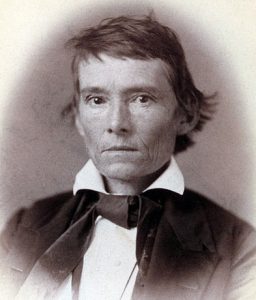
Elliott then went on to recount how African-Americans had fought for America during the War for Independence, the War of 1812, and the recent Civil War. He concluded with a stiff rebuke against the racist Democrat Stephens:

He [Stephens — pictured on the right] offers his government (which he has done his utmost to destroy) a very poor return for its magnanimous treatment, to come here to seek to continue, by the assertion of doctrines obnoxious to the true principles of our government, the burdens and oppressions which rest upon five millions of his countrymen [slaves] who never failed to lift their earnest prayers for the success of this government when the gentleman [Stephens] was asking to break up the Union of these States and to blot the American Republic from the galaxy of nations.

Elliott’s powerful and eloquent arguments embarrassed his opponents. The Democrats were incensed, but their replies were shallow at best. As the American Methodist Episcopal Church Review reported:

Mr. Beck of Kentucky, and other Democratic members of the House who had felt the force of Mr. Elliott’s rhetoric to their discomfiture, could not deny the merit of his speeches, so they denied his authorship of them. . . . The charge of non-authorship was made by Democrats upon the general principle that the Negro, of himself, could accomplish nothing of literary excellence.

In short, Democrats claimed that no black was smart enough to make such arguments as Elliott had, so he must have plagiarized them from someone else!

Elliott served in the House of Representatives until 1874 when he resigned and returned to South Carolina politics. Forced out of office with the resurgence of the Democratic Party in the south (1877), he became a customs inspector for the federal Treasury Department (1879-1882) and then ran a law practice before his death in 1884.

The courageous efforts for freedom and equality made by Elliott and other Americans throughout history should never be forgotten.

united states flag

America’s National Anthem

On March 3rd, 1931, an Act of Congress made the Star Spangled Banner America’s national anthem. So, in celebration of this important event, we invite you to study the song and the reason it was written.

Following the American Revolution, Americans hoped to live in peace but France and England became engaged in a conflict that drew America back into war. The British captured American ships on the high seas and forced American sailors (around 10,000 of them) to fight for England. The United States declared war. Known as the War of 1812, it lasted until 1815.

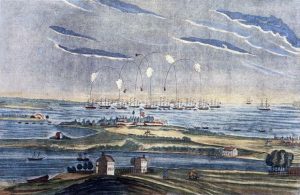
In August 1814, England invaded Washington, D.C., setting fire to the Capitol, White House, and other government buildings. The British then marched to Baltimore, Maryland, and on September 13 began bombarding Fort McHenry.

At that time, attorney Francis Scott Key was aboard a British ship negotiating the release of a friend. Throughout the long night, he watched the attack on Fort McHenry, fearing its fall, but when morning arrived, the American flag was still flying — the fort had survived the attack.
Inspired by these events, Francis Scott Key wrote down a few lines about the attack while still on board the ship and then wrote several more lines after reaching shore. Shortly thereafter they were published as a poem titled “Defence of Fort M’Henry.” Set to music in November of that year, it was named “The Star Spangled Banner.”

Americans know the first verse of this song as it’s what we sing at sporting events or important occasions, but there is religious content that few know about. Notice especially the fourth verse:

O thus be it ever when freemen shall stand
Between their lov’d home and the war’s desolation!
Blest with vict’ry and peace may the heav’n rescued land
Praise the power that hath made and preserv’d us a nation!
Then conquer we must, when our cause it is just,
And this be our motto – “In God is our trust,”
And the star-spangled banner in triumph shall wave
O’er the land of the free and the home of the brave.

Today, let’s celebrate our national anthem in its entirety — an anthem that shows America’s strong foundation of religious faith and something we should all be proud to remember!

* You can watch David Barton’s short history of the Star Spangled Banner or you can purchase a high resolution copy to show to your church, school, or other group!

Pastors Lead the Charge

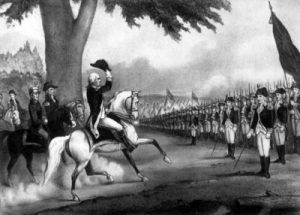
March 17 is annually celebrated in Boston as “Evacuation Day,” commemorating the departure of the British from the city1 after an extended eleven month occupation2 at the start of the American War for Independence. That occupation lasted from April 19, 1775, through March 17, 1776, encompassing the Siege of Boston3 and including early notable events of the War, such as the Battles of Lexington and Concord,4 Bunker Hill,5 and George Washington taking command of the American army.6
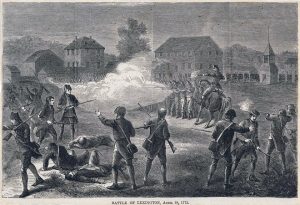
The occupation started when British leader Thomas Gage led troops into Boston, and then dispatched hundreds to seize or destroy ammunition stored in Concord.7 Riders such as Paul Revere set out to warn local inhabitants,8 and also to alert John Hancock and Samuel Adams (who were under threat of death by the British9) of the approach of the British army.

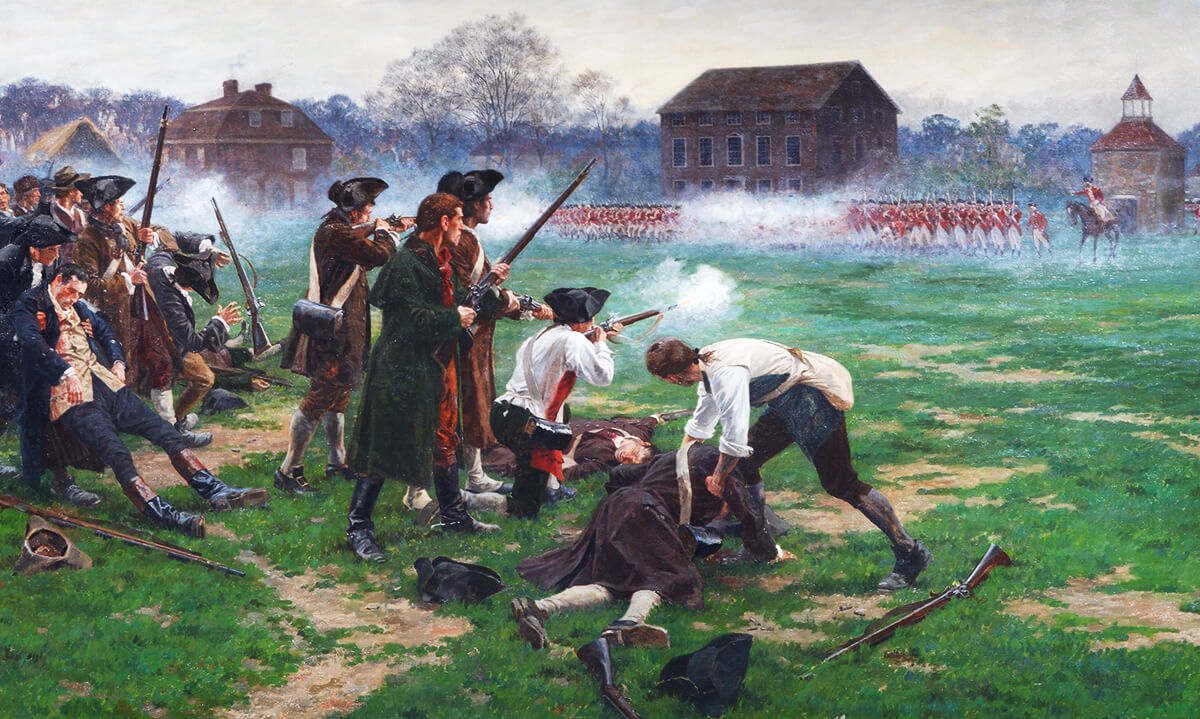
Hancock and Adams were staying in the home of Lexington Pastor Jonas Clark.10 Pastor Clark and 77 militia from his church11 gathered to meet the approaching British–a skirmish easily won by the 800 British troops.12 (In the WallBuilders library is a sermon preached by Jonas Clark on the one-year anniversary of the Battle of Lexington.13)
After Lexington, the British pressed on to Concord, where they were met by Rev. William Emerson and some 400 Americans.14 After the British suffered casualties in that skirmish, they retreated to Boston,15 and all along the way, British forces were fired upon by American militias from the surrounding countryside, including those led by pastors such as Philips Payson and Benjamin Balch.16 (Many additional preachers also fought in other engagements throughout the War.17)

Evacuation Day is a reminder of the courage and backbone shown by the spiritual leaders of earlier generations–a spiritual leadership still badly needed today!


Endnotes

1 “March 17, 1901: Boston Celebrates First Evacuation Day,” Mass Moments, accessed January 17, 2024.
2 “Siege of Boston,” Massachusetts Historical Society, accessed January 17, 2024.
3 Richard Frothingham, History of the Siege of Boston, and of the Battles of Lexington and Concord, and Bunker Hill (Boston: Charles C. Little and James Brown, 1851), 91-119.
4 “Lexington and Concord,” US History, accessed January 17, 2024.
5 Frothingham, History of the Siege of Boston (1851), 121-132.
6 “Washington takes command of Continental Army in 1775,” US Army, April 15, 2016.
7 Frothingham, History of the Siege of Boston (1851), 55.
8 “The Real Story of Paul Revere’s Ride,” The Paul Revere House, accessed January 17, 2024.
9 “Attempted Capture of John Hancock and Samuel Adams,” WallBuilders.
10 J. T. Headley, The Chaplains and Clergy of the Revolution (NY: Charles Scribner, 1864), 78.
11 Jonas Clark, “Sermon-Battle of Lexington-1776,” WallBuilders.
12 Benson J. Lossing, A History of the United States for Families and Libraries (NY: Mason Brothers, 1860), 232.
13 Jonas Clark, “Sermon-Battle of Lexington-1776,” WallBuilders.
14 Benson J. Lossing, A History of the United States, From the Discovery of the American Continent (Boston: Little, Brown, and Company, 1864), VII:290, 299.
15 Lossing, History of the United States (1864), VII:303-306.
16 Headley, Chaplains and Clergy (1864), 60; Balch Leaflets (Salem, MA: Eben Putnam, 1896-1897), 28.
17 Daniel Dorchester, Christianity in the United States From the First Settlement Down to the Present Time (NY: Hunt & Eaton, 1889), 265.

The United States of . . . Not America

by David Barton

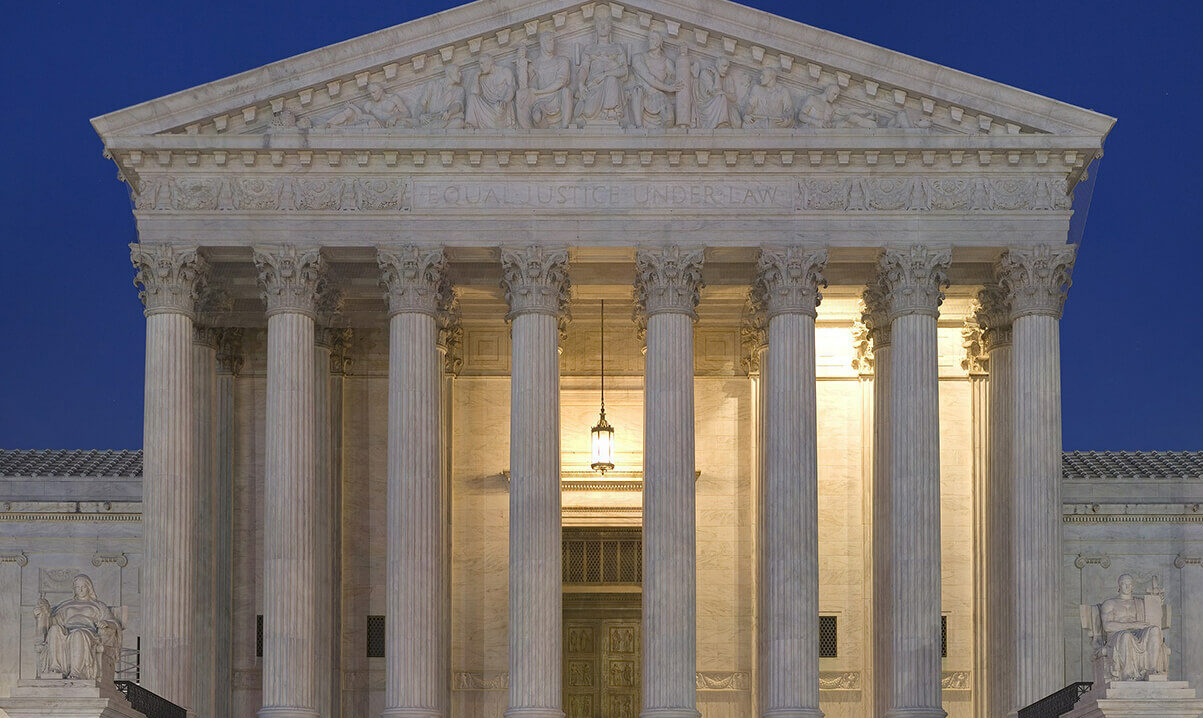
Here’s a simple question: “What is America’s first-protected, most-important, and longest-cherished politically-protected right?” The answer? The rights of religious conscience. But the Supreme Court of Washington State just became another [1] in the line of recent courts [2] who know nothing of, or don’t care about this inalienable right.

The early colonists arriving in America came largely seeking this right. In Europe, the governments consistently told them how to practice their faith, and punished them if they did not do what the government wanted; [3] but the religious-minded colonists believed that no one but God could tell them how to practice their faith.

The Pilgrims journeyed to America in 1620 to escape the hounding government persecution in England, [4] as did 20,000 Puritans in the 1630s. [5] In 1632, government-persecuted Catholics fled to America; [6] in 1654, persecuted Jews from Portugal; [7] in 1680, persecuted Quakers arrived here, [8] as did persecuted Anabaptists from Germany in 1683, [9] up to 400,000 persecuted Protestants from France in 1685; [10] and so forth. These settlers, having been punished for exercising their rights of religious conscience, promptly enshrined these rights in their own governing documents, including Rhode Island in 1640, [11] Maryland in 1649, [12] Jersey in 1664, [13] Carolina in 1665, [14] Pennsylvania in 1682, [15] and so forth. [16] As John Quincy Adams affirmed, “The transcendent and overruling principle of the first settlers of New England was conscience.” [17]

In 1776 when America separated from Great Britain, the rights of religious conscience were once again promptly preserved in the new state constitutions [18] and then in the federal Constitution. According to the Founding Fathers, this was one of the most important rights they protected:

“No provision in our Constitution ought to be dearer to man than that which protects the rights of conscience.[19] “[O]ur rulers can have no authority over such natural rights only as we have submitted to them. The rights of conscience we never submitted. [20]It is inconsistent with the spirit of our laws and Constitution to force tender consciences.” [21] Thomas Jefferson

“Government is instituted to protect property of every sort. . . . Conscience is the most sacred of all property.” [22] James Madison, Signer of the Constitution

“[T]he rights of conscience and private judgment. . . . are by nature subject to no control but that of Deity, and in that free situation they are now left.” [23] John Jay, an Author of the Federalist Papers and original Chief Justice of the U. S. Supreme Court

“Consciences of men are not the objects of human legislation . . . The state [does not] have any concern in the matter. For in what manner doth it affect society . . . in what outward form we think it best to pay our adoration to God?” [24] William Livingston, signer of the U. S. Constitution

Based on this long tradition, today . . .

Conscientious objectors are not forced to fight in wars; [25]

Jehovah’s Witnesses are not required to say the Pledge of Allegiance in public schools; [26]

The Amish are not required to complete the standard twelve years of education; [27]

Christian Scientists are not forced to have their children vaccinated or undergo medical procedures often required by state laws; [28]

Seventh-Day Adventists cannot be penalized for refusing to work on Saturday; [29]

And there are many additional examples.

It was because the rights of religious conscience were so important that they were specifically protected in the constitutions of the individual states—such as that of Washington, which declares:

Absolute freedom of conscience in all matters of religious sentiment, belief, and worship shall be guaranteed to every individual; and no one shall be molested or disturbed in person or property on account of religion . . . [30]

But despite the clarity of this clause, we now get word that the Washington Supreme Court has ruled that Baronelle Stutzman, a devout and pious Christian florist . . .

was bound by state law to use her artistic talents to design floral arrangements to celebrate what she viewed as an immoral event: a gay wedding. The pretext for overriding the florist’s rights to free speech and religious liberty was Washington’s so-called “public accommodations law,” which required the owner, Barronelle Stutzman, to provide goods and services to customers “regardless” of their sexual orientation. [31]

Several things are wrong with this decision.

First, Baronelle has been economically-fined and governmentally-coerced to use her talents and skills in a way that violates her sincerely-held religious beliefs.

Second, the explicit wording of the Washington State constitution has been completely ignored by the Washington State Supreme Court. In essence, a Washington state court has deemed the Washington state constitution to be unconstitutional, just because they don’t want to uphold its provisions.

Third, the court elevated a state law (their “public accommodations law”) above the state constitution; but constitutions always trump statutory laws—always.

Fourth, John Adams described us as “a government of laws and not of men,” [32] but decisions like this make us just the opposite: the personal predilections of judges are now routinely placed above constitutional provisions duly enacted by the people.

Two centuries ago, Thomas Jefferson rejoiced that “the comparison of our governments with those of Europe is like a comparison of heaven and hell,” [33] but this happy distinction is now disappearing. Because of this ruling (and dozens more like it in recent years), America is becoming more and more like the tyrannical governments of Europe that millions of early colonists fled in order to be free from the government persecution of their inalienable rights of religious conscience.


Endnotes

[1] “Washington court rules against florist in gay wedding case,” Fox News, February 16, 2017 (at: https://www.foxnews.com/us/2017/02/16/washington-court-rules-against-florist-in-gay-wedding-case.html); David French, “Washington’s Supreme Court Imposes Its Progressive Faith on a Christian Florist,” National Review, February 16, 2017 (at: https://www.nationalreview.com/article/444989/washington-supreme-court-christian-florist-religious-freedom-gay-discrimination-case).

[2] See, for example, Warren Richey, “How the push for gay rights is reshaping religious liberty in America,” The Christian Science Monitor, July 11, 2016 (at: https://www.csmonitor.com/USA/Justice/2016/0711/How-the-push-for-gay-rights-is-reshaping-religious-liberty-in-America); Liz Fields, “Judge Orders Colorado Bakery to Cater for Same-Sex Weddings,” ABCNews, December 7, 2013 (at: https://abcnews.go.com/US/judge-orders-colorado-bakery-cater-sex-weddings/story?id=21136505);  Ted Olsen, “N.M. Supreme Court: Photographers Can’t Refuse Gay Weddings,” Christianity Today, August 22, 2013 (at:
https://www.christianitytoday.com/gleanings/2013/august/nm-supreme-court-photographers-cant-refuse-gay-weddings.html).

[3] See, for example, “Religion and the Founding of the American Republic,” Library of Congress
(at:
https://www.loc.gov/exhibits/religion/rel01.html); George Bancroft, History of the United States (Boston: Charles C. Little and James Brown, 1848), Vol. I, p. 275; Samuel Macpherson Janney, The Life of William Penn: With Selections form His Correspondence and Autobiography (Philadelphia: Lippincott, Grambo & Co., 1852), pp. 52-56.

[4] “About the Pilgrims: Religion,” Pilgrim Hall Museum (at: https://www.pilgrimhallmuseum.org/ap_religion.htm) (accessed on February 20, 2017).

[5] Lynn Betlock, “New England’s Great Migration,” GreatMigration.org, 2003 (at: https://www.greatmigration.org/new_englands_great_migration.html).

[6] “The Charter of Maryland, June 20, 1632,” Archives of Maryland Online (at: https://msa.maryland.gov/megafile/msa/speccol/sc2900/sc2908/000001/000549/html/am549–3.html) (accessed on February 20, 2017).

[7] David Grubin, “The Jewish Americans: Introduction,” PBS (at: https://www.pbs.org/jewishamericans/jewish_life/) (accessed on February 20, 2017).

[8] Religion and the Founding of the American Republic, “Americas as a Religious Refuge: The Seventeenth Century, Part 2,” Library of Congress (at: https://loc.gov/exhibits/religion/rel01-2.html) (accessed on February 20, 2017).

[9] “Timeline: Amish in America,” PBS (at: https://www.pbs.org/wgbh/americanexperience/features/timeline/amish/) (accessed on February 20, 2017).

[10] Religion and the Founding of the American Republic, “Americas as a Religious Refuge: The Seventeenth Century, Part 2,” Library of Congress (at: https://loc.gov/exhibits/religion/rel01-2.html) (accessed on February 20, 2017).

[11] “Plantation Agreement at Providence: August 27-September 6, 1640,” The Avalon Project (at: https://avalon.law.yale.edu/17th_century/ri01.asp).

[12] William MacDonald, Select Charters and Other Documents Illustrative of American History 1606-1775 (New York: MacMillan Company, 1899), p. 104-106 (at: https://books.google.com/books?id=1C0PAAAAYAAJ&pg=PA104#v=onepage&q&f=false).

[13] “The Concession and Agreement of the Lords Proprietors of the Province of New Caesarea, or New Jersey, 1664,” The Avalon Project (at: https://avalon.law.yale.edu/17th_century/nj02.asp).

[14] “Charter of Carolina; June 30, 1665,” The Avalon Project (at: https://avalon.law.yale.edu/17th_century/nc04.asp).

[15]Frame of Government of Pennsylvania, May 5, 1682,” The Avalon Project (at: https://avalon.law.yale.edu/17th_century/pa04.asp).

[16] See, for example, The Federal and State Constitutions, Colonial Charters and Other Organic Laws, Francis Newton Thorpe, editor (Washington: Government Printing Office, 1909), Vol. VI, p. 3211, “Charter of Rhode Island and Providence Plantations-1663;” “The Charter or Fundamental Laws of West New Jersey, 1676,” The Avalon Project (at: https://avalon.law.yale.edu/17th_century/nj05.asp); “Charter of Delaware, 1701,” The Avalon Project (at: https://avalon.law.yale.edu/18th_century/de01.asp).

[17] John Quincy Adams, A Discourse on Education. Delivered at Braintree, Thursday, Oct. 24, 1839 (Boston: Perkins & Marvin, 1640), p. 28 (at: https://books.google.com/books?id=vu1RAAAAcAAJ&pg=PA28#v=onepage&q&f=false).

[18] See these many state constitutions. Virginia, 1776: The American’s Guide: Comprising the Declaration of Independence; the Articles of Confederation; the Constitution of the United States, and the Constitutions of the Several States Composing the Union (Philadelphia: Hogan & Thompson, 1845), p. 180; New Jersey, 1776: “The Constitution of 1776,” The State of New Jersey (at: https://www.state.nj.us/njfacts/njdoc10a.htm); Delaware, 1776: Constitutions of the Several Independent States of America, (Boston: Norman & Bowen, 1785), p. 91; North Carolina, 1776: Constitutions of the Several Independent States of America, (1785), p. 132; Pennsylvania, 1776: Constitutions of the Several Independent States of America, (1785), p. 77; South Carolina, 1778: Constitutions of the Several Independent States of America, (1785), pp. 152-154; Massachusetts, 1780: Constitutions of the Several Independent States of America, (1785), p. 6; New Hampshire, 1784: Constitutions of the Several Independent States of America, (1785), pp. 3-4; Vermont, 1777: The Federal and State Constitutions, Colonial Charters, and Other Organic Laws, Francis Newton Thorpe, editor (Washington: Government Printing Office, 1909), Vol. VI, p. 3740.

[19] Thomas Jefferson, The Writings of Thomas Jefferson, H. A. Washington, editor (New York: Ricker, Thorne & Co., 1854), Vol. VIII, p. 147, to the Society of the Methodist Episcopal Church at New London, Connecticut, February 4, 1809 (at: https://books.google.com/books?id=aiI7AQAAMAAJ&pg=PA147#v=onepage&q&f=false).

[20] Thomas Jefferson, The Writings of Thomas Jefferson, H. A. Washington, editor (New York: Ricker, Thorne & Co., 1854), Vol. VIII, p. 400, “Notes on Virginia: Query XVII” (at: https://books.google.com/books?id=wyYWAAAAYAAJ&pg=PA400#v=onepage&q&f=false).

[21] Thomas Jefferson, The Writings of Thomas Jefferson, Paul Leicester Ford, editor (New York: G. P. Putnam’s Sons, 1893), Vol. II, p. 430, “Proclamation Concerning Paroles,” January 19, 1781 (at: https://books.google.com/books?id=BGYSAAAAYAAJ&pg=PA430#v=onepage&q&f=false).

[22] James Madison, The Writings of James Madison, Gaillard Hunt, editor (New York: G. P. Putnam’s Sons, 1906), Vol. VI, p. 102, “Property,” originally published in The National Gazette, March 29, 1792 (at: https://books.google.com/books?id=zn5DAQAAIAAJ&pg=PA102#v=onepage&q&f=false). 

[23] William Jay, The Life of John Jay (New York: J. & J. Harper, 1833), Vol. I, p. 82 (at: https://books.google.com/books?id=S_c5AAAAcAAJ&pg=PA82#v=onepage&q&f=false).

[24] H. Niles, Principles and Acts of the Revolution in America (Baltimore: William Ogden Niles, 1822), pp. 306-307, “Remarks on liberty of conscience, ascribed to his excellency William Livingston, governor of New Jersey, 1778” (at: https://books.google.com/books?id=l2UFAAAAQAAJ&pg=PA306&#v=onepage&q&f=false).

[25] “Conscientious Objection and Alternative Service,” Selective Service System (at: https://www.sss.gov/consobj) (accessed on February 20, 2017).

[26] West Virginia State Board of Education v. Barnette, 319 U.S. 624 (1943).

[27] Wisconsin v. Yoder, 406 U.S. 205 (1972).

[28] See, for example, “Vaccination Exemptions,” The College of Physicians of Philadelphia (at: https://www.historyofvaccines.org/content/articles/vaccination-exemptions) (accessed on February 21, 2017).

[29] See, for example, “U.S. Law Allowing Adventists to Miss Work on Sabbath Turns 50,” Adventist Review, July 16, 2014 (at: https://www.adventistreview.org/church-news/u.s.-law-allowing-adventists-to-miss-work-on-sabbath-turns-50).

[30] Constitution of the State of Washington, Amendment 34 (passed 1958).

[31] David French, “Washington’s Supreme Court Imposes Its Progressive Faith on a Christian Florist,” National Review, February 16, 2017 (at: https://www.nationalreview.com/article/444989/washington-supreme-court-christian-florist-religious-freedom-gay-discrimination-case).

[32] John Adams, The Works of John Adams, Charles Francis Adams, editor (Boston: Charles C. Little and James Brown, 1851), Vol. IV, p. 404, “A Defence of the Constitutions of Government of the United States of America,” 1778 (at: https://books.google.com/books?id=a2QSAAAAYAAJ&pg=PA404#v=onepage&q&f=false).

[33] Thomas Jefferson, The Writings of Thomas Jefferson, H. A. Washington, editor (New York: John C. Riker, 1853), Vol. II, p. 249, to Joseph Jones on August 14, 1787 (at: https://books.google.com/books?id=azY7AQAAMAAJ&pg=PA249#v=onepage&q&f=false).

No, Revisionists, Thanksgiving is not a Day of Mourning

No, Revisionists, Thanksgiving is not

a Day of Mourning

by David Barton

Just before Thanksgiving [2017], I discussed the origins of the holiday on Glenn Beck’s show The Vault.[1] I understand the program has been used profitably by teachers throughout America. After a college professor showed the episode to a class, a student sent him eleven “articles” posted on the internet purporting to show that the Pilgrims killed and oppressed Indians. He asked me how I would respond to the posts, and what resources I would recommend for readers interested in an accurate account of the Pilgrims and the first Thanksgiving. I’m happy to be of assistance.

The internet posts did indeed claim that the Pilgrims killed and oppressed Indians.[2] However, they were all opinion pieces that contained no footnotes and mentioned only a few sources—none of which were published before 1990.

If one is seeking to establish facts – such as those related to the Pilgrims’ longstanding peace with the Indians from 1621–1675 – it is necessary to consult primary sources from that era, which include journals, diaries, letters, recorded speeches, and other first-hand evidence about those events. Sources should always be properly cited so that interested, or skeptical, readers can examine them.

The opinion pieces cited by the student made broad, sweeping claims and lacked specificity or details about where or when Pilgrims killed and oppressed Indians. Some articles referenced the Indian war of 1637, but some of the claims could have also referred to an encounter in 1623, or King Philip’s War of 1675, the three early conflicts between Indians and the Pilgrims.

To confirm the truth about any such claims and incidents, three excellent primary sources about the Pilgrims should be consulted. First, Of Plymouth Plantation by William Bradford. (Bradford regularly served as governor of the colony from 1622–1656, and his journals cover the years 1620–1647). Second, A Relation or Journal of the Beginning and Proceedings of the English Plantation Settled at Plimoth in New England (also known as Mourt’s Relation, written by Pilgrims William Bradford and Edward Winslow, covering 1620–1621, including the Pilgrims’ relations with the Indians). And third, Chronicles of the Pilgrim Fathers of the Colony of Plymouth, from 1602 to 1625 (1841; Alexander Young, editor, it includes records of the Pilgrims compiled from 1602–1625).

And there are some excellent contemporary works based on these earlier sources, including Robert Bartlett’s The Pilgrim Way (1971), George Willison’s Saints and Strangers (1965), and anything written about the Pilgrims by Dr. Jeremy Bangs, former Chief Curator of Plimoth Plantation, in Plymouth, Massachusetts (the original home of the Pilgrims) and director of the Leiden-American Pilgrim Museum Foundation. Bangs is considered by other colonial historians to be one the best modern experts on the Pilgrims. He has authored multiple books and articles about the Pilgrims and Puritans, including the easily accessible piece “The Truth About Thanksgiving Is that the Debunkers are Wrong” (available at: https://historynewsnetwork.org/article/15002).

Older works also provide an historically accurate view of the Pilgrims and their many contributions. Particularly useful are American history books written by nineteenth-century historians George Bancroft, Benson Lossing, and Charles Coffin. (These books are available online at www.books.google.com.)

Also of benefit is the long series of Forefathers’ Day orations. Since 1769, Forefathers’ Day has been celebrated annually in Plymouth, Massachusetts, to commemorate the landing of the Pilgrims. The celebration includes annual orations about the Pilgrims that, collectively, provide much history and perspective. Among those delivering these orations were many famous individuals (links to their particular oration appear in each footnote):

·         An Oration Delivered at Plymouth, December 22, 1802, At the Anniversary Commemoration of the First Landing of Our Ancestors At That Place, by John Quincy Adams[3]

·         A Discourse Delivered at Plymouth, December 22, 1820, In Commemoration of the First Settlement of New-England, by Daniel Webster[4]

·         Others orators addressing the subject of the Pilgrims in these annual commemorations include Edward Everett (President of Harvard, Governor of Massachusetts, US Senator);[5] Robert C. Winthrop (President of the Massachusetts Historical Society, Speaker of the US House of Representatives);[6] Rufus Choate (US Senator);[7] Oliver Wendell Holmes (Professor at Harvard, physician, writer);[8] Lyman Beecher (abolitionist; President of Lane Seminary);[9] a second speech by Daniel Webster (US Senator, Secretary of State to three presidents);[10] and others.

(The following link contains a listing of these addresses delivered from 1770 to 1865: www.americanantiquarian.org/proceedings/44539521.pdf.)

Of the three major conflicts between the Pilgrims and the Indians, King Philip’s War was by far the biggest. Concerning this, there are many reputable academic or historical society websites that present a neutral, factual view, including:

·         https://www.globalsecurity.org/military/ops/king_philip.htm

·         https://militaryhistory.about.com/od/battleswars16011800/p/King-Philips-War-1675-1676.htm

·         https://colonialwarsct.org/1675.htm

While these websites are good for brief and general overviews, we always encourage readers to consult primary sources, and particularly important for the 1675 King Philip’s War are:

·         A Relation of the Indian War, by Mr. Easton, of Rhode Island, by John Easton, 1675[11]

·         A Narrative of the Indian Wars in New-England, From the First Planting Thereof, in the Year 1607, to the Year 1677, by the Rev. William Hubbard, 1677[12]

·         The Narrative of the Captivity and Restoration of Mrs. Mary Rowlandson, 1682[13]

·         Cotton Mather, Magnalia Christi Americana, or The Ecclesiastical History of New-England, 1702 (2 vols.)[14]

The following three books are secondary sources about that war, but they rely heavily on relevant primary sources. We therefore highly recommend them:

·         The History of King Philip’s War, by Samuel G. Drake, 1825[15] (an expansion of A Brief History of the Warr with the Indians in New-England, by Increase Mather, 1676[16])

·         The History of King Philip’s War, by Benjamin Church, 1865 (based on the writings of those who participated in the war)[17]

·         King Philip’s War, Based on the Records and Archives of Massachusetts, Plymouth, and Rhode Island and Connecticut, and Contemporary Letters and Accounts, by George Ellis and John Morris of the Connecticut Historical Society, 1906[18]

— — — ⧫ ⧫ ⧫ — — —

After receiving the inquiry from the professor and looking over the articles provided by the student, we began examining the primary source works mentioned above. We also contacted historians in Massachusetts, including those who help run the Pilgrim museum. The outcome was the same. State historians affirm that the official peace between the Pilgrims and the Indians was the longest on record—they have found no record of any treaty that lasted longer than the 54 years of the Pilgrim treaty (1621–1675). Furthermore, when the treaty was eventually broken in 1675 during King Philip’s War, it was the Indians and not the Pilgrims who violated it.

Here is a brief overview (based on primary sources, referenced in the footnotes) verifying what led up to that conflict and the breaking of the treaty.

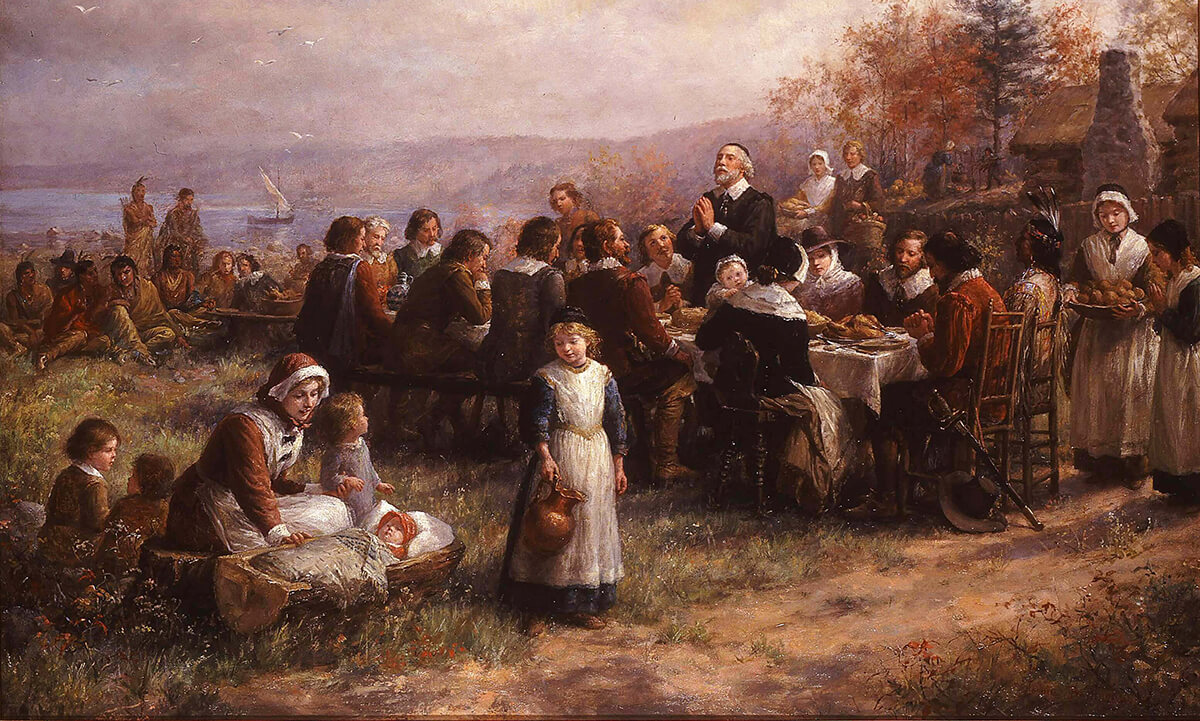
The Pilgrims, after arriving in December 1620, survived a difficult beginning with the help of several Indians who befriended them.[19] Intending to live in the area where they had landed, they approached the local tribe, seeking to purchase land. The price was set by the Indians, and written documentation of sale was received for those purchased lands.[20]

This policy of purchasing land from the Indians came to characterize the general practice of the New England and portions of the mid-Atlantic regions, being mirrored not only by the Puritans in the Massachusetts Bay Colony[21] but also by the Rev. Roger Williams with Rhode Island,[22] the Rev. Thomas Hooker with Connecticut,[23] and William Penn with Pennsylvania.[24] (On one occasion, Penn actually purchased some of the same tracts multiple times because at least three tribes claimed the same land, having taken and retaken it from each other in conquest; so Penn secured it from each.[25]) The practice of purchasing land from the Indians was also followed[*] in New Hampshire,[26] New Jersey,[27] and New York.[28]

The Pilgrims and their Indian neighbors the Wampanoag entered into a peace treaty in 1621. Experiencing good relations with the tribe and a strong friendship with their chief, Massasoit, in 1623 he informed the Pilgrims of a treacherous assault to be made against them by the Massachusetts tribe, which was gathering other chiefs for a surprise attack.[29] Facing potential extermination, Pilgrim Miles Standish led a preemptive strike, thus saving the colonists. Without this, the Pilgrim story could have been as short-lived as that of the colonists of Roanoke, Virginia or Popham, Maine. Good relations continued between the Pilgrims and Wampanoag, with the next period of tensions with other tribes occurring in the 1637 Pequot War.

The Pequot were warlike and aggressive, even against their Indian neighbors on every side, which included the Wampanoag (allies and friends of the Pilgrims), Narragansett, Algonquian, and Mohegan. The Pequot had established a trading monopoly with the Dutch, which the arrival of the English threatened, so they determined to rid the region of the English. After killing some English settlers, the colonists responded and organized strikes against the Pequot.[30] The war spread across much of Connecticut, and also threatened the Plymouth and Massachusetts Bay Colonies. The conflict ended when Sassacus, the chief of the Pequot, was pursued and killed by the Mohegan and Mohawks.[31]

One of the aforementioned articles provided by the student claimed that it was during this war that Pilgrims killed Indians,[32] but this claim is wrong. The Pilgrims’ participation in this conflict was limited to a skirmish at Manisses Villages, where no Indians were killed.[33] Some of the articles provided by the student claim that the Thanksgiving of 1637 was to give thanks that Indians were killed,[34] but this is also in error. It was called to give thanks for the end of the Pequot War.[35]

The Pilgrims lived in harmony with the Wampanoags from the time of their 1621 treaty, through the 1623 and 1637 conflicts, and until the long peace finally collapsed in 1675 with King Philip’s War. Today, revisionist scholars such as James D. Drake, Daniel R. Mandell, and Jill Lepore claim that this conflict was the result of Indians pushing back against greedy land-grabbing colonists, with the Indians simply trying to regain territory that was rightfully theirs.[36]

But such a portrayal is wrong. For example, Pilgrim Governor Josiah Winslow avowed that at the outbreak of the war:

I think I can clearly say that before these present troubles broke out, the English did not possess one foot of land in this colony but what was fairly obtained by honest purchase of the Indian proprietors.[37]

If King Philip’s War was not retaliation for the unjust seizing of Indian land by colonists, what was its cause? The answer is simple: Christian missionaries. Metacom—chief of the Wampanoag Indians and grandson of Massasoit, who took the English name King Philip —recognized that missionaries were converting Indians to Christianity, which was changing some behaviors. This threatened their traditional way of life.

Prior to becoming Christians, Indians often engaged in immoral practices such as the prolonged barbarous torture of captives.[38] Missionaries sought to end such practices by converting Indians and teaching them Christian morals.[39] Missionaries, including John Eliot, Thomas Mayhew, and Andrew White worked extensively with various tribes and had great success in converting Indians to Christianity. By 1674, Eliot’s Christian villages of “praying Indians” in Massachusetts numbered as many as 3,600 converts.[40] It was in the following year (1675) that Metacom, fearing that Christianity would change Indian culture,[41] launched ferocious surprise assaults against settlers in the region,[42] seeking to exterminate all English colonists in Rhode Island, Connecticut, and Massachusetts.

Numerous places in New England were suddenly and unexpectedly attacked. Colonists were murdered and their belongings burned or destroyed.[43] This included even the town of Providence, where Roger William’s own home was burned.[44] Significantly, Williams had always been on the best of terms with the Indians, not only having purchased his colony from them[45] but also having championed Indian rights and claims.[46] Yet, regardless of how well Christian settlers had previously treated Indians, Christians were all to be exterminated; their very existence was perceived as a threat to Indian practices.

King Philip’s War cannot be accurately characterized as Indians versus the English, however, for many of those attacked were themselves Indians—but they were Christian Indians. They, like the settlers, were targeted, hurt, or killed by their unconverted brethren.[47] To secure their own lives and safety, many of the converted Indians fought side-by-side with the colonists throughout the conflict,[48] and the war eventually ended when Metacom was killed by another Indian.[49]

Returning to the objections raised by the student, it is true that Pilgrims and Puritans killed Indians—but in the context of a just and defensive war. The war lasted about fifteen months, and early in the war more settlers died than did Indians—largely because of the surprise attacks. In fact, of the ninety towns in Massachusetts and Plymouth Colony, twelve were totally destroyed and forty more attacked and partially destroyed.[50] But eventually the colonists assembled local militias and fought back in an organized fashion, finally gaining the upper hand. By the conclusion of the war, 600 settlers and 3,000 Indians had been killed—the highest casualty rate by percentage of total population of any war in American history.[51]

This information about King Philip’s War is not to suggest that the amount of land owned by Indians was not decreasing; it was. But the diminishing land holdings in this region during this time was definitely not for the reason we are often told today. Indian land was fairly purchased by settlers, not stolen.[52] Early historian George Bancroft (1800-1891), known as “The Father of American History”[53] for his systematic approach to documenting the story of America, confirmed that Indian lands were indeed shrinking because the Indians’ own “repeated sales of land has narrowed their domains” to the point where “they found themselves deprived of their broad acres, and by their own legal contracts driven, as it were, into the sea”[54] (emphasis added).

This is not to say that land was never stolen from Indians. Some definitely was. For instance, during the heyday of westward expansion that began in the early nineteenth century, the Indian removal policies of Andrew Jackson certainly violated private property rights,[55] and such policies became the rule rather than the exception, forcibly driving Indians from their lands in Georgia, Mississippi, Louisiana, and elsewhere across the Southeast.[†] By 1845, the term “Manifest Destiny” was coined to describe the growing notion that it was America’s “destiny” to spread westward, and that nothing—including Indians—should be allowed to stand in the way. As a result, the Biblical view of purchasing private property from its owner was replaced with the anti-Biblical notion that “possession was nine-tenths of the law” and therefore whoever could take and hold the land was its “rightful” owner.[56]

The 19th century deterioration in relations between Americans and Indians over unjust land seizures occurred most commonly two centuries after the Pilgrims. The original treaty the Pilgrims negotiated with the Indians lasted for 54 years until the Indians broke it; and in general, the Pilgrim and Puritan killings of Indians occurred in their own self-defense primarily against the perfidious unprovoked attacks from Metacom’s Indians, and then in ending the war he had started. We find no historical basis to support the general claim made in the articles provided by the student, and certainly no evidence to support the overall tone of the claims in those internet posts.


[*] The author owns one of the nation’s largest private libraries of Founding Era materials, containing over 100,000 originals, or copies of original documents that predate 1812. Among these holdings are multiple original signed deeds in which Indians willingly and voluntarily sell their land to settlers. One example is an Indian deed dated February 9, 1769, and signed by four Indian leaders from the Aughquageys tribe, selling 300,000 acres—or nearly 470 square miles of land—to settlers in New York. The land-area sold by the Indians in just this one transaction was the equivalent of modern Los Angeles or San Antonio, was larger than modern New York City, and seven times larger than modern Washington DC. There are hundreds of such deeds, legitimately transferring land by mutual agreement and purchase from various Indian tribes to colonists/settlers.

[†] Among the other original documents in our library, we also possess land deeds from the state of Georgia selling parcels in Cherokee-held lands directly to settlers, seeking to drive the Cherokee from their homelands.


Endnotes

[1] “Vault: S1:E10 – Thanksgiving,” GlennBeck (at: https://www.glennbeck.com/content/gb_videos/s1e10-thanksgiving/) (accessed on December 27, 2016).

[2] The websites the student included were:

1.       Thanksgiving, a day of mourning for Native Americans: https://www.salon.com/2016/11/23/thanksgiving-a-day-of-mourning-for-native-americans/

2.       American Indian Perspective on Thanksgiving: https://nmai.si.edu/sites/1/files/pdf/education/thanksgiving_poster.pdf

3.       Do American Indians Celebrate Thanksgiving?: https://www.huffingtonpost.com/dennis-w-zotigh/do-american-indians-celebrate-thanksgiving_b_2160786.html

4.       For Me, Thanksgiving Is A “Day Of Mourning”: https://www.refinery29.com/2016/11/130572/day-of-mourning-thanksgiving-protest-native-americans

5.       First Thanksgiving: https://kids.nationalgeographic.com/explore/history/first-thanksgiving/

6.       The REAL Story of Thanksgiving Introduction for Teachers The Plymouth Thanksgiving Story: https://www.manataka.org/page269.html

7.       For National Day of Mourning, Native Americans highlight their struggles: https://www.metro.us/boston/for-national-day-of-mourning-american-indians-highlight-their-struggles/zsJpkv—Q2Rg789wZSCBU/

8.       National Day of Mourning Reflects on Thanksgiving’s Horrific, Bloody History: https://www.boston.com/news/local-news/2014/11/26/national-day-of-mourning-reflects-on-thanksgivings-horrific-bloody-history

9.       Why these Native Americans are spending Thanksgiving marching and mourning, not celebrating: https://fusion.net/story/371773/native-americans-thanksgiving-plymouth-mourning/

10.    National Day of Mourning: https://www.uaine.org/

11.    Local Native Americans consider the history of Thanksgiving: https://pilotonline.com/life/holidays/local-native-americans-consider-the-history-of-thanksgiving/article_982d6590-fe10-57c8-b0b3-170e4d743490.html

[5] An Oration Delivered at Plymouth December 12, 1824, by Edward Everett (at: https://books.google.com/books?id=wiVob3vXftAC&printsec=frontcover#v=onepage&q&f=false).

[6] An Address, Delivered Before the New England Society, in the City of New York, December 25, 1839, by Robert C. Winthrop (at: https://books.google.com/books?id=KjvgALUiLqoC&pg=PA2#v=onepage&q&f=false).

[7] The Age of the Pilgrims: The Heroic Period of Our History: An Address Delivered in New York Before the New-England Association, December, 1843, by Rufus Choate, beginning on page 371 (at: https://books.google.com/books?id=8ssnAQAAMAAJ&pg=PA371#v=onepage&q&f=false).

[8] Oration Delivered Before the New England Society, In the City of New York, At Their Semi-Centennial Anniversary, by Oliver Wendell Holmes, 1855 (at: https://books.google.com/books?id=VVNIAAAAYAAJ&pg=PA3#v=onepage&q&f=false).

[9] The Memory of our Fathers. A Sermon Delivered at Plymouth, on the Twenty-Second of December, 1827, by Lyman Beecher (at: https://books.google.com/books?id=f3GLfji3qPMC&pg=PA1#v=onepage&q&f=false).

[10] Speech of Mr. Webster, at the Celebration of the New York New England Society, December 25, 1850, by Daniel Webster; beginning on page 496 (at: https://books.google.com/books?id=vRs7AQAAMAAJ&pg=PA496#v=onepage&q&f=false).

[19] For example, Samaset and Squanto are both mentioned in William Bradford, History of Plymouth Plantation (Boston: 1856), pp. 93-95; Squanto is called Tisquantum in Mourt’s Relation or Journal of the Planation at Plymouth (Boston: John Kimball Wiggin, 1865), pp. 102, 106. Mourt’s Relation also mentions Hobamak (also known as Hobbamock), p. 123.

[20] James Thacher, History of the Town of Plymouth, from its First Settlement in 1620 to the Present Time (Boston: Marsh, Capen & Lyon, 1835), p. 138.

[21] George Bancroft, History of the United States, from the Discovery of the American Continent (Boston: Charles C. Little and James Brown, 1848), Vol. I, pp. 350-351.

[22] William Gammell, Makers of American History: Roger Williams (New York: The University Society, 1904), pp. 61-62.

[23] G. H. Hollister, The History of Connecticut, From the First Settlement of the Colony to the Adoption of the Present Constitution (New Haven: Durrie & Peck, 1855), pp. 18-19, 96.

[24] Samuel M. Janney, The Life of William Penn: With Selections from His Correspondence and Autobiography (Philadelphia: Friends Book Association, 1882), pp. 121-122, 442; George Bancroft, History of the United States of America (Boston: Charles C. Little and James Brown, 1848), Vol. II, pp. 381-382.

[25] Samuel M. Janney, The Life of William Penn: With Selections from His Correspondence and Autobiography (Philadelphia: Friends Book Association, 1882), p. 442: “It appears that Penn, before his return to England in 1684, had taken measures to purchase the lands on the Susquehanna from the Five Nations (Iroquois) who claimed a right to them by conquest…Governor Dongan, having made the purchase, conveyed the same to William Penn, by deed dated January 13, 1696, in consideration of 100 [pounds] sterling. The Susquehanna Indians did not recognize the right of the Five Nations to make this sale; and, in order to satisfy their demands, Penn entered into a treaty with two of their chiefs, named Widnpah and Andaggy Innekquagh, whose deed, dated September 13th, 1700, conveys the same lands and confirms the bargain and sale made to Governor Dongan. But it appears there was still another chief claiming an interest in those lands, viz. Connoodaghoh, king of the Conostoga or Minquary Indians. This sachem, on company with the king of the Shawnese, the chief of the Ganawese, inhabiting at the heads of the Potomac, the brother of the emperor of great king of the Onondagoes, Indian Harvey, their interpreter, with others of the their tribes to the number of forty, met Penn and his council in Philadelphia on the 23d of 2d month, (April) 1701, and entered into a treaty of amity, in which they also confirmed the sale of the lands on the Susquehanna.”

[26] Jeremy Belknap, The History of New Hampshire (Dover, NH: J. Mann & JK Remick, 1812), pp. 16-17.

[27] John Warner Barber, The History and Antiquities of New England, New York and New Jersey (Worcester: Dorr & Howland & Co, 1841), p. 66.

[28] W. H. Carpenter and T. S. Arthur, History of New Jersey (Philadelphia: Lippincott, Grambo & Co., 1853), pp. 25, 27-28.

[29] William Bradford, History of Plymouth Plantation (Boston: 1856), p. 131.

[30] William Bradford, History of Plymouth Plantation (Boston: 1856), pp. 351-342, 356-357. 131.

[31] William Bradford, History of Plymouth Plantation (Boston: 1856), pp. 349-361; The History of New England from 1630 to 1649 by John Winthrop, James Savage, editor (Boston: Phelps and Farnham, 1825), Vol. I, pp. 222-226.

[33] For an account of the non-involvement of the Pilgrims in the 1837 Pequot War, see: William Bradford, History of Plymouth Plantation (Boston: 1856), pp. 355-356, “The Court here agreed forthwith to send 50 men at their own charge; and with as much speed as possible they could, got them armed, and had made them ready under sufficient leaders, and provide a bark to carry them provisions & tend upon them for all occasions; but when they were ready to march (with a supply from the Bay) they had word to stay, for the enemy was as good as vanquished, and there would be no need”; The History of New England from 1630 to 1649 by John Winthrop, James Savage, editor (Boston: Phelps and Farnham, 1825), Vol. I, p. 226: “Upon our governor’s letter to Plymouth, our friends there agreed to send a pinnace, with forty men, to assist in the war against the Pequods; but they could not be ready to meet us at the first.”

[34] See, for example, Thanksgiving, a day of mourning for Native Americans: https://www.salon.com/2016/11/23/thanksgiving-a-day-of-mourning-for-native-americans/; The REAL Story of Thanksgiving Introduction for Teachers The Plymouth Thanksgiving Story: https://www.manataka.org/page269.html; National Day of Mourning Reflects on Thanksgiving’s Horrific, Bloody History: https://www.boston.com/news/local-news/2014/11/26/national-day-of-mourning-reflects-on-thanksgivings-horrific-bloody-history.

[35] The History of New England from 1630 to 1649 by John Winthrop, James Savage, editor (Boston: Phelps and Farnham, 1825), Vol. I, p. 226, entry for March 15, 1637: “There was a day of thanksgiving kept in all the churches for the victory obtained against the Pequods, and for other mercies.”

[36] James D. Drake, King Philip’s War: Civil War in New England 1675-1676 (MA: University of Massachusetts Press, 1999), pp. 1, 30-31; Daniel R. Mandell, King Philip’s War: Colonial Expansion, Native Resistance, and the End of Indian Sovereignty (MD: Johns Hopkins University Press, 2010), pp. 27, 30; Jill Lepore, The Name of War: King Philip’s War and the Origins of American Identity (Random House, 2009), “What’s in a Name?”  More reputable writers have made similar claims.  See, for example, Francis Jennings, The Invasion of America; Indians, Colonialism, and the Cant of Conquest (Chapel Hill: University of North Carolina Press, 1975), pp. 128, 144-145; New England Encounters: Indians and Euroamericans ca. 1600-1850. Essays Drawn from The New England Quarterly, Alden T. Vaughan, editor (Boston: Northeastern University Press, 1999), pp. 61-64, David Bushnell, “The Treatment of the Indians in Plymouth Colony”; Karen Ordahal Kupperman, Indians and English: Facing Off in Early America (Ithaca and London: Cornell University Press, 2000), p. 239.

[37] James Thacher, History of the Town of Plymouth, from its First Settlement in 1620 to the Present Time (Boston: Marsh, Capen & Lyon, 1835), p. 138; Abiel Holmes, The Annals of America from the Discovery by Columbus in the Year 1492, to the Year 1826 (Cambridge: Hilliard & Brown, 1829), p. 383.

[38] See, for example, accounts such as:

·         Franklin B. Hough, A Narrative of the Causes which Led to Philip’s Indian War, of 1675 and 1676, by John Easton of Rhode Island (Albany, NY: J. Munsell, 1863), pp. 143-144, an eyewitness account dated February 25, 1675: “Thomas Warner one of the two that came down from Albany and had been prisoner with the Indians who arrived here this morn, being examined, faith, that he was one of the persons that begin sent out from Hatfield where the English Army lay, to discover the enemy, but a party of Indians waylaid them, and shot down 5 of their company, and took 3 of which he and his comrade are two, the 3rd they put to death, the 9th was an Indian that came with them and escaped away. That the Indians lay still two days after they were taken, and then a party of about 30 with whom he was marched to a river to the north-east from thence about 80 miles called Oasuck, where about a fortnight after the rest of the army came to them, having in the mean time burnt two towns: they killed one of the prisoners presently after they had taken him, cutting a hole below his breast out of which they pulled his guts, and then cut off his head. That they put him so to death in the presence of him and his comrade, and threated them also with the like. That they burnt his nails, and put his feet to scald them against the fire, and drove a stake through one of his feet to pin him to the ground. The stake about the bigness of his finger, this was about 2 days after he was taken.”

·         John S. C. Abbott, The History of King Philip (Harper & Brothers, New York, 1857), pp. 317-318, where Abbott, using the words of Cotton Mather, describes Indian tortures: “They stripped these unhappy prisoners, and caused them to run the gauntlet, and whipped them after a cruel and bloody manner. They then threw hot ashes upon them, and, cutting off collops of their flesh, they put fire into their wounds, and so, with exquisite, leisurely, horrible torments, roasted them out of the world.”

·         Richard Markham, A Narrative History of King Philip’s War and the Indian Troubles in New England (New York: Dodd, Mean & Company, 1883), pp. 241-242, describing an event at the beginning of King Philip’s War: “A little after the middle of April [1676] Sudbury was attacked…Captain Wadsworth with fifty men had been dispatched from Boston that day to strengthen the garrison at Marlborough. After his company reached Marlborough, more than a score of miles from Boston, they learned that the savages were on their way against Sudbury…A small party of Indians encountered them when about a mile from their destination, and withstood them for a short time, but yielding to their superior numbers retreated into the forest. Wadsworth and his men followed, but when they were well into the woods suddenly found themselves the centre of five hundred yelling demons, who attacked them on all sides. They made their way to the top of a hill close at hand, and for four hours fought resolutely, losing but five men, for the savages had suffered severely in the first hand-to-hand attack, and feared to come to close quarters. As night came on the enemy set fire to the woods to the windward of their position. The leaves were dry as tinder, and a strong wind was blowing. The flames and smoke rolled up upon the devoted band, threatening their instant destruction. Stifled and scorched, they were forced to leave the hill in disorder. The Indians came upon them so like so many tigers, and outnumbering them ten to one in the confusion slew nearly all. Wadsworth himself was slain. Some few were taken prisoners, and that night were made to run the gauntlet, and after that were put to death by torture.”

[39] See, for example, J. W. Barber, United States Book; Or, Interesting Events in the History of the United States (New Haven: L. H. Young, 1834), p. 53; and Methodist Quarterly Review: 1858, D. D. Whedon, editor (New York: Carlton & Porter, 1858), Vol. XL, pp. 244-245: “In a short time, under the labors of Eliot, hundreds of Indians renounced their heathenism and embraced Christianity. As early as 1660 he had gathered ten settlements of Indians, who were comparatively civilized, and under religious influence…In 1675 King Philip’s War broke out. The missionary settlements of Eliot were in the center of the theater of this war. Many of the Christian Indians would have remained neutral; but Philip attacked them, and drove them into hostility; the commotions that followed not only prevented the progress of the Gospel, but destroyed much that had been done. War blasted all these opening religious prospects of the poor Indians; and war provoked, too, by the aggressions of the white man.”

[40] Gustav Warneck, Outline of a History of Protestant Mission from the Reformation to the Present Time (New York: Fleming H. Revell Company, 1903), p. 165.

[41] J. W. Barber, United States Book; Or, Interesting Events in the History of the United States (New Haven: L. H. Young, 1834), p. 53n; John S. C. Abbott, The History of King Philip (Harper & Brothers, New York, 1857), pp. 171-172.

[42] J. W. Barber, United States Book; Or, Interesting Events in the History of the United States (New Haven: L. H. Young, 1834), pp. 53-54; Richard Markham, A Narrative History of King Philip’s War and the Indian Troubles in New England (New York: Dodd, Mean & Company, 1883), pp. 109-110.

[43] Franklin B. Hough, A Narrative of the Causes which Led to Philip’s Indian War, of 1675 and 1676, by John Easton of Rhode Island (Albany, NY: J. Munsell, 1863), p. 42, a letter dated June 29, 1675, pp. 176-177, “Record of a Court Martial, Held at Newport, R.I. in August, 1676, for the Trial of Indians charged with begin engaged in Philip’s Designs”; William Hubbard, A Narrative of the Indian Wars in New-England from the First Planting Thereof, in the Year 1607, to the Year 1677 (Danbury: Stiles Nichols, 1803), p. 64, notes from a meeting of the commissioners of the united colonies held at Boston, Sept. 9, 1675, pp. 77-78.

[44] National Park Service, “Frequently Asked Questions,” Roger Williams National Memorial Rhode Island (at: https://www.nps.gov/rowi/faqs.htm) (accessed on January 9, 2017). See also Welcome Arnold Greene, The Providence Plantations for Two Hundred and Fifty Years. An Historical Review of the Foundation, Rise, and Progress of the City of Providence (Providence, RI: J.A & R.A. Reid, 1886), p. 42.

[45] William Gammell, Makers of American History: Roger Williams (New York: The University Society, 1904), pp. 61-62.

[46] Romeo Elton, Life of Roger Williams (New York: G. P. Putnam, 1852), pp. 21, 33-34, 39-41, 44-45.

[47] Methodist Quarterly Review: 1858, D. D. Whedon, editor (New York: Carlton & Porter, 1858), Vol. XL, pp. 244-245; John S. C. Abbott, The History of King Philip (Harper & Brothers, New York, 1857), pp. 187-190, 216.

See, for example, Rev. John Holmes, Historical Sketches of the Missions of the United Brethren, p. 210, “With a view to execute their horrid purpose, the young Indians got together, chose the most ferocious to be their leaders, deposed all the old Chiefs, and guarded the whole Indian assembly, as if they were prisoners of war, especially the aged of both sexes. The venerable old Chief Tettepachsit was the first whom, they accused of possession poison, and having destroyed many Indians by his art. When the poor old man would not confess, they fastened with cords to two posts, and began to roast him at a slow fire.”; pp. 210-211, “During this torture, he [Chief Tettepachsit] said, that he kept poison in the house of our Indian brother Joshua. Nothing was more welcome to the savages than this accusation, for they wished to deprive us of the assistance of this man, who was the only Christian Indian residing with us at that time….We knew nothing of these horrible events, until the evening of the 16th, when a message was brought, that the savages had burned an old woman to death, who had been baptized by the Brethren in former times, and also that our poor Joshua was kept close prisoner.”; p. 139, “Their external troubles, however, did not yet terminate. They had not only a kind of tax imposed upon them, to show their dependence on the Iroquois , but the following very singular message was sent them: “The great head, i.e. the Council in Onondago, speak the truth and lie not: they rejoice that some of the believing Indians have moved to Wayomik, but now they lift up the remaining Mahikans and Delawares, and set them down also in Wayomik; for there a fire is kindled for them, and there they may plant and think on God: but if they will not hear, the great head will come and clean their ears with a red-hot iron (meaning they would set their houses on fire) and shoot them through the head with musquet-balls.”

[48] Increase Mather, The History of King Philip’s War (Albany: J. Munsell, 1862), pp. 49-50, 127-128, 184; Henry William Elson, History of the United States of America (The MacMillan Company, New York, 1904), p. 122; George Madison Bodge, Soldiers in King Philip’s War (Boston: 1906), pp. 34, 37, 104.

[49] John S. C. Abbott, The History of King Philip (Harper & Brothers, New York, 1857), p. 361.

[50] John Fiske, The Beginnings of New England (Boston and New York: Houghton, Mifflin and Company,, 1890), p. 240.

[51] James David Drake, King Philip’s War: Civil War in New England, 1675-1676 (The University of Massachusetts Press, 1999), pp. 1–15.

[52] See, for example, George Bancroft, History of the United States From the Discovery of the American Continent (Boston: Charles C. Little and James Brown, 1848), Vol. II, p. 99.

[53] See, for example, “George Bancroft,” Encyclopedia Britannica (at: https://www.britannica.com/biography/George-Bancroft-American-historian) (accessed on December 30, 2016);

[54] George Bancroft, History of the United States From the Discovery of the American Continent (Boston: Charles C. Little and James Brown, 1848), Vol. II, p. 99.

[55] William Garrott Brown, Andrew Jackson (New York: Houghton, Mifflin and Company, 1900), pp. 130-131; William Graham Sumner, American Statesmen: Andrew Jackson (Boston: Houghton, Mifflin, and Company, 1899), pp. 224-229.

[56] See, for example, the Cherokee nation in Georgia. Georgia passed laws dividing Cherokee land up in various counties and put those lands in control of the state. Andrew Jackson, the president at that time, did not interfere with the Georgia laws and would not enforce or support the Supreme Court’s decision that declared this Georgia law unconstitutional. William Garrott Brown, Andrew Jackson (New York: Houghton, Mifflin and Company, 1900), pp. 130-131.

* Originally published: Feb. 23, 2017.

* This article concerns a historical issue and may not have updated information.

Trump the Theocrat?

by David Barton

In 1945, George Orwell penned Animal Farm. One of his characters was Squealer the pig, who arbitrarily redefined words so that they would mean what he wanted. As Orwell explained about Squealer, “he could turn black into white” as part of his attempt to get the other animals to accept his message. [1] It appears that Secular Progressives are the modern Squealer.

According to them, Donald Trump has now shown us who he really is: a Theocrat.[2] Never mind that leading up to the election, we were all fed a steady diet of how irreligious he was. [3] That doesn’t matter anymore. Now he’s a Theocrat!

Ironically, they don’t even call the Pope a theocrat, and especially not their Sharia Supremacist friends seeking to install a global caliphate. The term “Theocrat!” is so repulsive that it is reserved solely for Donald Trump and those who support him.

They are so repulsed by traditional religion that they exploded in derision after First Lady Melania Trump recited the Lord’s Prayer at a rally in Florida. [4] And then when a public meeting in Louisiana was opened with prayer and the Pledge of Allegiance, it was repeatedly interrupted with vocal outbursts and heckling. [5] All of this was nauseating to them, but then—horror of horrors!—Trump promised to restore constitutional protections for the rights of religious conscience and to level the political playing field to allow people of faith to have the same constitutional free speech rights that secular folks have. [6] That announcement was so terrifying it caused a Washington Post columnist to warn the nation that “Much-dreaded ‘sharia law,’ or something resembling it, may well be coming to the United States.” [7] Wow.

Let’s see if I get this right: if you want to restore the constitutional free speech rights of all citizens, including pastors (rights which were unconstitutionally removed by Senator Lyndon Baines Johnson in 1954 [8]), and if you want to protect the constitutional rights of religious conscience (which, historically speaking, is America’s first-protected, most-important, and longest-cherished politically-protected right [9]), then you are establishing a “Theocracy”?

To quote a famous line from Inigo Montoya in the popular movie Princess Bride: “You keep using that word, I do not think it means what you think it means.”

I understand that it might be difficult for Secular Progressives to know the meaning of a word as simple as “theocracy.” Most of them probably went first to public school and then attended an “elite” academic college afterwards, and study after study affirms that most of those who attend such institutions no longer receive even a rudimentary knowledge of basic historical facts [10] (and they certainly don’t get much logic or common sense).

So just for clarity, here’s the simple definition of “theocracy”:

·         “A system of government in which priests rule in the name of God, or a god.” (Oxford Dictionary) [11]

·         “A form of government [with] the God’s or deity’s laws being interpreted by the ecclesiastical authorities.” “A system of government by priests claiming a divine commission.” (dictionary.com) [12]

·         “Government ruled by…religious authority.” (American Heritage Dictionary) [13]

Do they really believe that Trump is a priest, or an ecclesiastical authority? How silly! And a theocracy also uses coercion and force to enforce its beliefs and dogmas. Furthermore, it excludes input from the people—no elections. So by definition, a constitutional republic with open elections, such as America has, cannot be a theocracy (but let’s not confuse them with something so simple).

However, there is one other important fact that Secular Progressives ignore: just as religion can be the basis of a theocracy, according to the US Supreme Court, so, too, can non-religion. Back in 1965, the Court held (and reiterated many times since) that all that is required to be a “religion” is “whether a given belief that is sincere and meaningful occupies a place in the life of its possessor parallel to that filled by the orthodox belief in God.” [14] The Court has therefore repeatedly ruled that Progressives, Humanists, Satanists, Atheists, Evolutionists, and other such secularist groups are just as religious as Bible-based groups, and so each of these secularist groups now receives the same religious tax-deductible standing as traditional religious groups.

So, if what Trump believes can represent a theocracy, so, too, can what Secular Progressives believe. In fact, Secular Progressives are more likely to be truly theocratic, for they regularly exercise coercion to force dissenters to adopt their beliefs. If you doubt this, just ask the bakers, [15] florists, [16] photographers, [17] clerks, [18] chaplains, [19] and others [20] who have tried to avoid participating in the Progressives’ religious rites to their great goddess of the Sexual Revolution, whether abortion, homosexuality, transgenderism, or other manifestations of the LGBT agenda. (Significantly, Romans 2:21-23 in the Bible points out that critics are often guilty of the very crimes and shortcomings they accuse others of. That certainly appears to be so in this case.)

So how does the charge of “Theocracy!” relate to what Trump and his administration is doing? It doesn’t—unless you are Squealer the pig.


Endnotes

[1] George Orwell, Animal Farm (New York: Harcourt, Brace and Company, 1946, 1st American Edition), p. 16.

[2] See, for example, David Leonhardt, “Trump Flirts With Theocracy,” The New York Times, January 30, 2017; Catherine Rampell, “Religious law may be coming to America. But it’s not sharia; it’s Christian,” The Washington Post, February 2, 2017. 

[3] See, for example, Steve Benen, “Trump’s religious talk causes unease among social conservatives,” MSNBC, July 21, 2015; Jack Jenkins, “The Real Reason Trump is Winning Evangelical Support: They’re Just Not That ‘Religious’,” ThinkProgress, January 27, 2016; Rebecca Kaplan, “Pope Francis: Donald Trump ‘is not Christian’,” CBS News, February 18, 2016.

[5] Tim Morris, “‘Won, they booed the name of Jesus’: Sen. Cassidy town hall,” The Times-Picayune, February 23, 2017.

[6] Ryan T. Anderson, “Mr. President: Don’t Cave to Liberal Fearmongering. Protect Religious Freedom,” The Daily Signal, February 2, 2017; Sarah Posner, “Leaked Draft of Trump’s Religious Freedom Order Reveals Sweeping Plans to Legalize Discrimination,” The Investigative Fund, February 1, 2017.

[7] Ian Tuttle, “Donald Trump, Theocrat?National Review, February 3, 2017.

[8] Michelle Terry, “How the Johnson Amendment Threatens Churches’ Freedoms,” ACLJ (accessed February 27, 2017).

[9] David Barton, “Biblical Christianity: The Origin of the Rights of Conscience,” WallBuilders, December 29, 2016; David Barton, “A God-Given Inalienable Right,” WallBuilders, January 4, 2017.

[10] See, for example, Jennifer Kabbany, “Top 30 Liberal Arts Colleges in Nation Don’t Require U.S. History Survey Course,” The College Fix, January 28, 2014; Douglas Belkin, “Study Finds Many Colleges Don’t Require Core Subjects Like History, Government,” The Wall Street Journal, October 15, 2014; W. Gardner Selby, “Don Willett: Elite universities mostly don’t require history majors to take American history,” PolitiFact, January 30, 2017.

[11]theocracy,” Oxford Dictionaries (accessed on February 27, 2017).

[12]theocracy,” Dictionary.com (accessed on February 27, 2017).

[13]theocracy,” American Heritage Dictionary (accessed on February 27, 2017).

[14] United States v. Seeger, 380 U.S. 163, 166 (1965).

[17] Ted Olsen, “N.M. Supreme Court: Photographers Can’t Refuse Gay Weddings,” Christianity Today, August 22, 2013.

[18]Clerk Defies Order, Won’t Issue Gay Marriage Licenses,” CBN News, August 13, 2015; “Clerk Who Said ‘No’ to Gay Couples Won’t Be Alone in Court,” The New York Times, September 2, 2015.

[20] See, for example, Billy Hallowell, “Sportscaster and Former NFL Player Who Says He Was Fired Over Anti-Gay Comments Vows to Fight Back: ‘Own Up to Making a Mistake’,” The Blaze, October 1, 2013; and see many more examples in the annual report “Undeniable: The Survey of Hostility to Religion in America,” First Liberty, January 27, 2016.

Address – Why Are You A Christian – 1795

John Clarke (1755-1798) biography

Born in Portsmouth, New Hampshire, Clarke grew up in a strongly patriotic family during the American War for Independence. In fact, his uncle, Timothy Pickering, was not only a military general under George Washington and later became Postmaster General, Secretary of War, and Secretary of State under President Washington. Clark graduated from the Boston Public Latin School in 1761, while only six years old. In 1774 at the age of nineteen, he graduated from Harvard. He returned for his Master’s Degree (1777), and then studied theology, receiving his Doctor of Divinity from the University of Edinburgh. He took a job on the staff of First Church of Boston, alongside the great preacher Dr. Charles Chauncy, who himself had been a significant influence in the years leading up to the American War for Independence. When Chauncy died in 1787, Clarke became pastor, where he continued until he suffered a stroke while preaching in 1798, passing away the next day at the age of forty-three. A two-volume set of his sermons were published after his death. The following sermon was the one he preached at the interment of the Rev. Samuel Cooper of Boston on January 2, 1784. (Note: the Rev. Cooper was a highly influential clergyman, identified by Founding Father John Adams as one of the individuals “most conspicuous, the most ardent, and influential” in the “awakening and revival of American principles and feelings” that led to American independence.)


AN

ANSWER

TO THE

QUESTION

WHY ARE YOU A CHRISTIAN?

BY JOHN CLARKE
Minister of a Church in Boston

AN ANSWER TO THE QUESTION, “WHY ARE YOU A CHRISTIAN?”

Not because I was born in a Christian country, and educated in Christian principles; — not because I find the illustrious Bacon, Boyle, Locke, Clarke, and Newton, among the professors and defenders of Christianity; – nor merely because the system itself is so admirably calculated to mend and exalt human nature: but because the evidence accompanying the Gospel, has convinced me of its truth. The secondary causes, assigned by unbelievers, do not, in my judgment, account for the rise, progress, and early triumphs of the Christian religion. Upon the principles of skepticism, I perceive an effect without an adequate cause. I therefore, stand acquitted to my own reason, though I continue to believe and profess the religion of Jesus Christ. Arguing from effects to causes, I think, I have philosophy on my side. And reduced to a choice of difficulties, I encounter not so many, in admitting the miracles ascribed to the Saviour, as in the arbitrary suppositions and conjectures of his enemies.

That there once existed such a person as Jesus Christ; that he appeared in Judea in the reign of Tiberius; that he taught a system of morals, superior to any inculcated in the Jewish schools; that he was crucified at Jerusalem; and that Pontius Pilate was the Roman governor, by whose sentence he was condemned and executed, are facts which no one can reasonably call in question. The most inveterate deists admit them without difficulty. And indeed to dispute these facts would be giving the lie to all history. As well might we deny the existence of Cicero, as that of a person by the name of Jesus Christ. And with equal propriety might we call in question the orations of the former as the discourses of the latter. We are morally certain, that the one entertained the Romans with his eloquence; and the other enlightened the Jews with his wisdom. But it is unnecessary to labor these points, because they are generally conceded. They, who affect to despise the Evangelists and Apostles, profess to reverence Tacitus, Suetonius, and Pliny. And these eminent Romans bear testimony to several particulars, which relate to the person of Jesus Christ, his influence as the founder of a sect, and his crucifixion. From a deference to human authority, all therefore, acknowledge, that the Christian religion derived its name from Jesus Christ. And many are so just to his merits, as to admit that he taught better than Confucius; and practiced better than Socrates or Plato.

But, I confess, my creed embraces many more articles. I believe, that Jesus Christ was not merely a teacher of virtue, but that he had a special commission to teach. I believe, that his doctrines are not the work of human reason, but divine communications to mankind, I believe, that he was authorized by God to proclaim forgiveness to the penitent; and to reveal a state of immortal glory and blessedness to those who fear God, and work righteousness. I believe, in short, the whole evangelic history, and of consequence, the divine original of Christianity, and the sacred authority of the Gospel. Others may reject these things as the fictions of human art or policy. But I assent to them, from a full conviction of their truth. The grounds of this conviction, I shall assign in the course of this work. And I shall undertake to show, why the objections of infidelity, though they have often shocked my feelings have never yet shaken my faith.

To come then to the Question : WHY ARE YOU A CHRISTIAN? I answer, because the Christian religion carries with it internal marks of its truth; because not only without the aid, but in opposition to the civil authority, in opposition to the wit, the argument, and violence of its enemies, it made its way; and gained an establishment in the world: because it exhibits the accomplishment of some prophecies; and presents others, which have been since fulfilled : and because its author displayed an example, and performed works, which bespeak, not merely a superior, but a divine character. Upon these several facts, I ground my belief as a Christian. And, till the evidence on which they rest, can be invalidated by counter evidence, I must retain my principles and my profession.

Section I.
The internal evidence of Christianity.

First—I am a Christian, because the intrinsic excellency of Christianity points it out as a system worthy of my belief; because the laws which it prescribes, the spirit which it breathes and the discoveries which it makes, are so admirably suited to the constitution and circumstances of man, that I cannot reject it. The perceptive part of Christianity has been very generally approved. And how is it possible, that any one should seriously object to laws, which tend to correct the errors, and reform the vices of human nature; and to exalt the character of man to the highest stage of moral perfection? If Christianity prescribed the austerities of the monk, the solitude of the hermit, or the wanderings of the pilgrim; if it even gave countenance to such extravagancies or allowed them the lowest degree of merit, I should esteem it a formidable objection to the system. But nothing of this description can be found in the writings of the Evangelists or Apostles. Those writings pure contempt upon al superstitious practices; and lead us to ascribe no value to any works, but those of true piety and virtue. They teach us to worship God in spirit and in truth; to love him supremely; to be grateful for his favors, and resigned to his dispensations; to trust his mercy, and rejoice in his government. They teach us to love our neighbor as ourselves; to forgive him when he has injured us; to bear with his infirmities, and to excuse his follies; to weep with him in his distresses; when he is in want, to afford him our assistance; and to do to him, as we should think it fit and reasonable, that he should do to us. They teach us to love even our enemies, so far at least, as to abstain from revenge; and to render them offices of kindness, when their circumstances call for commiseration. They teach us to govern our appetites and passions to be chaste, humble, temperate, pure, and as much as possible to be like our father in heaven, whose character is an assemblage of every natural and moral perfection. They teach children to reverence and obey their parents; and parents to love, instruct, and provide for their children. They teach the husband conjugal fidelity and affection; and the wife, the peculiar duties of her station, and the amiable virtues which adorn the sex; and bless the marriage union. They teach masters lenity, and the servants faithfulness. They teach rulers to exercise their authority for the public good; and persons in private life, not to withhold honor and submission from those, under whose wise and just administration, they lead quiet and peaceable lives. I a word, the affluent and the poor, the prosperous and the afflicted the aged and the young, may all find their duty in the sacred books. And the duties, there enjoined, are such as the enlightened reason of every man must approve.

These sublime lessons of morality are found in various parts of the New Testament. They enrich the divine sermon on the mount. And they are contained in the excellent parables delivered by Jesus Christ. I also find them in the discourses of the Apostles, and in their pastoral letters. I may say, wherever I open the Christian volume, I find some direction which if properly observed, would render me a good neighbor, a good member of society, a good friend, and a good man! And it is possible for me to doubt the divine original of a system, which furnishes such rules; and contemplates so glorious an object?

If the prohibitions of Jesus Christ were universally regarded, and his laws obeyed, what blessings would pour in on society? There would be no wars among the nations of the earth. There would be no oppression. There would be neither tyrants nor slaves. Every ruler would be just; every citizen would be honest; every parent would be faithful to his charge; every child would be dutiful; the purest affection would recommend domestic life; and neighbors would be mutual blessings. Under the dominion of Christianity, envy, pride, and jealousy would give way to the most enlarged benevolence. Human nature would recover its dignity. And every man would reap the present reward of his own virtues.

From these facts, others may draw their own conclusions : my inference is, that Christianity is true. I do not believe, that such a system of morals can be the work of human wisdom. That these laws originated with God; and that Jesus Christ was commissioned to promulgate them, appears to me a much more rational supposition. The more I inspect them, the less am I inclined to compliment human ingenuity with so glorious a production. If then, I continue to believe in this age of refinement, and free inquiry, it is because I am unable to resist the evidence arising from the transcendent excellency of the Christian precepts. I think it infinitely more probable, that they should be a communication from God, than that philosophy should justly claim the honor of the invention.

The doctrines of the Christian religion furnish an additional argument in its favor. They are such as appear worthy of God and answerable to the natural expectations of men. The perfections of the Deity, his agency in the creation and government of the world, the conditions of his approbation, the consequences, and a future state of existence, are points, respecting which every reasonable being would wish for information. And it is a fact, that the New Testament throws divine light on all these articles. It informs us, that there is One God; that he is infinitely holy, wise, benevolent, and just; that he is self-existent and independent; that his power is irresistible, and his presence universal; that he made and upholds all worlds; that he created the human species, and every inferior being; that he is moreover, their preserver and benefactor; that he exercises a moral government over man; that he requires obedience to his laws, and consequently, resents their infraction; that forgiveness is possible, and repentance and reformation the conditions; that death is not utter destruction; that all who die, will live again; that all who are raised, will be judged; and that there is a future state, in which virtue will shine with unfading luster, and receive an everlasting reward. These are not useless speculation, but doctrines of infinite moment. They interest as well the heart, as the understanding. And their influence extends both to our actions and our enjoyments.

It would be easy to produce the various passages, in which these points are maintained. But it is unnecessary; as everyone will allow them to be doctrines of Christianity. Whether the system be true or not, it certainly contains these articles. I would now put the question to every sober Theist, whether I must renounce either my understanding, or my creed? Is there anything incredible in this representation of God and man, of the demands of the one, and the destination of the other? Must I offer an affront to my reason, if I believe in one God, exercising the authority; and possessed of all the glorious attributes, ascribed to him in the Christian writings? Does my understanding revolt at the evangelical account of his providence and moral government? That I should make it my study to obey him; when guilty of disobedience, that I should repent and reform; and that, as I behave so I may expect to be treated; is there anything irrational in these doctrines? We read of a mediator, and a rich variety of blessings dispensed through him; and is not this agreeable to the established constitution of things in the world? Do not temporal mercies often flow to us through the mediation of others? And may not many instances be produced, in which the political redemption of a nation has been accomplished by the labors; or purchased by the blood of some virtuous patriot? Is common sense insulted by the doctrine of a resurrection? This has been asserted; but with what reason, I never could conceive. When I examine the power and wisdom of God, they do not appear incompetent to such an affect. When I consider the divine goodness, I see nothing in the resurrection of man irreconcilable with that perfection. And when I reflect, that God formed the human body; and inspired the breath of life, I can easily believe, that he is able to raise us up at the last day. Before I can reject the resurrection of mankind, it must therefore be demonstrated that the terms imply a contradiction.

As to a future state of retribution, I would ask, what presumption there is against it. We find, that we have already experienced great changes. Since our first introduction to this world, our active and intellectual powers have gained strength, as we have advanced towards maturity. And why may we not hereafter possess them in higher perfection? Why may we not move, not merely in a new, but in a nobler sphere? And as a moral government is evidently begun in this state, why may it not be completed in another? In these expectations, I think we are supported by the analogy of nature. As we have already existed in different states, new scenes may be in reserve for us; and new capacities of action, enjoyment, and suffering may await us beyond the grave.

Combining the doctrines and precepts of Christianity, I am led then to infer from them the truth of the system. Because the former are so important, and the latter so beneficial; because the doctrines of Christ tend to make us so wise, and hiss laws so good, I am , in a manner, compelled to receive them as divine. Such is their supreme excellence, that I must ascend to heaven for an adequate cause. I assent therefore, most unfeignedly to those words of our savior, “my doctrine is not mine, but his who sent me.” And I do Assert, were there no other evidence that our religion is from God, it would be more reasonable to admit its claims to a divine original, than to reject them.

Section II.
Evidence arising from the early triumphs of Christianity.

But my faith, as a Christian, does not rest on this single foundation. I have other reasons for believing the Gospel. The early triumphs of Christianity furnish a Second, and in my view, a most weighty argument in support of my religion. And my conviction of its truth gains strength every time I examine its introduction, progress, and establishment in the world. Recurring to the period of its infancy, I find, that it made its way not only without the aid, but in opposition to the civil authority. I observe, that it rose superior to the wit, the argument, and the violence of its enemies. I perceive, that it baffled the arts of the Jewish priests and rulers; and supported itself against the rage of the multitude. When Heathens become its enemies and persecutors, I find their opposition as ineffectual as that of the Jews. Though it was the contempt and derision of the more leading characters in society, yet I take notice, that it gained a wonderful ascendency over the human mind; and at length became the religion of the Roman world. These are facts : and how am I to account for them, if Christianity be a mere fable?

I can easily believe, that an imposture may succeed, if it have the public prejudices, the learning, wealth, and influence of the country, or the sword of the magistrate on its side. I never wondered that the attempts of Mahomet to establish his religion, were crowned with successes. When I peruse the Koran, and examine the materials of which it is composed; —when I observe how much art the whole is accommodated to the opinions and habits of Jews, Christians, and Pagans; —when I consider what indulgences it grants, and what future scenes it unfolds; —when I advert to the peculiar circumstances of the times, when its author formed the vast design of assuming the royal and prophetic character; —and more than all, when I contemplate the reformer at the head of a conquering army, the Koran in one hand, and in the other, a sword, — I cannot be surprised at the civil and religious revolution which has immortalized his name. With his advantages, how could he fail of success? Everything favored the enterprise. The nations beheld a military apostle. And they, who were unconvinced by his arguments, trembled at his sword.

But did Jesus Christ have recourse to such measures in order to establish his religion? Was he a general, or his apostles soldiers? In proof of his divine mission, did he affront the reason of mankind, by appealing to the sword? Did the learning of the age come to his assistance? Di genius and eloquence plead his cause? Were the principles of his religion such as would easily captivate persons of figure and fashion? Would wealth be partial to them? It is granted, that the laws of Christianity are perfectly accommodated to the reasonable, and moral nature of man; but did the habits of the age, in which they were promulgated, predispose the public mind to receive those laws? An were the doctrines of the gosp0el consonant to prevailing and popular opinions? There is not a man, who has examined the life, the actions, and the religion of Jesus Christ, Who will answer one of these queries in the affirmative.

In the whole compass of history, no fact is better established than the pacific character of our great master, and the inoffensive measures by which he prosecuted his cause. He proclaimed the truths; and inculcated the duties of his religion; but he used no violence to make men believe the one, or practice the other. He addressed himself to the reason of mankind; and then let them to make up their own judgment. At length he suffered; and his cause developed upon certain persons who had attended upon his ministry, and been witnesses of his actions. These persons, called apostles, went forth into the world; and taught the same truths, which they had learned from their master, and which he had sealed with his blood. In imitation of their great pattern, they likewise applied, not to the passions, but to the reason of the age. With the Jews, they argued on their own principles. And for the conviction of Gentile, they appealed to facts. Not one of their enemies ever pretended, that more formidable weapons were employed by the apostles in the Christian Cause. How then shall we account for their success? What induced several thousands of the Jewish nation to embrace Christianity? And why did such multitudes of the Gentile world forsake their superstitions; and receive the religion of the Gospel?

Was Christianity a popular system? None could be less so. Did it open the way to a seat in the Sanhedrim, to the honors of the priesthood, or to an office under the Roman government? I never heard the insinuation. Was it an introduction to wealth or power? It was the very reverse. Did it flatter any of the ruling passion of the human heart, or permit their gratification? Every one, who has examined it, knows the contrary. If then, as the terms are generally understood, it was neither honorable, profitable, nor popular; — if it was the derision of philosophy, and the contempt of learning; — if the wit of the age was exerted against it, — if the priesthood hated, and the magistrate persecuted it, to what cause am I to ascribe the prevalence of Christianity? Under all these disadvantages, what enabled it to keep its ground? Upon one principle only, can I account for this fact to my own satisfaction, and that is the truth of the system, and the patronage of heaven. I can believe, that truth may triumph over the most formidable opposition; and that God is able to defend his own cause.

For every phenomenon in nature, there must be a sufficient reason. This is a doctrine of philosophy; and not only so, but a dictate of common sense. Taking this principle for granted, I therefore, endeavor to account for the existence of Christianity. I find, that the religion of Jesus is not coeval with many events preserved in history. By means of various records, which have escaped the ravages of time, I perceive, that less than eighteen centuries will carry me back to the age, in which this religion was first proposed to the world. By the confession of its enemies, it derived no support from the family connections, outward circumstances, or fate of its author. So far from it, all these things operated against it. Jesus Christ, though a very excellent, was in the estimation of the world, a very obscure person. His family though once exalted, had fallen into decay. And his fate was as infamous as it was unmerited. His followers likewise, and those with whom he left his cause, were generally as obscure as their master, they had not wealth, to give them importance. They were not men in power. Nor were their natural abilities, or literary attainments so great, as to give them a decided superiority over their enemies. It is certain therefore, that Christianity did not woe its successes to anything dazzling in the personal accomplishments or circumstances of its first preachers.

Where then, shall I look for the cause? The religion of Christ did prevail; though to persons of figure and influence, its author was an object of contempt; and though his fate was that of the vilest malefactor. It did make its way; though its ministers were the farthest possible from that description of men, who take the lead in society; whose example it is their ambition to follow. It did succeed; though it bore an uniform testimony against all the impiety and immorality practiced in the world. Without flattering one disorderly passion of the human hart, without accommodating itself to one corrupt habit, it triumphed over the prejudices of multitudes. And whilst its profession was attended with every temporal discouragement, not only the provinces, but the very city of Rome, abounded with Christians! I ask the question once more, if Christianity be a fable how am I to account for this revolution?

I well know the solution which modern ingenuity has proposed. Gibbon’s secondary causes I have repeatedly examined; I would hope, with impartiality: I certainly have done it with attention. But they never gave me satisfaction; and for a reason, which the great Sir Isaac Newton shall assign. He says, that a cause must be known to exist; and that it must be adequate to an effect, before it can be admitted into sound philosophy; and before such effect can with propriety, be referred to it. But the causes, assigned by those who reject the Christian religion, appear to want both these conditions. We have no proof that many of them ever existed. And united, they seem utterly inadequate to explain the various appearances; and account for the phenomena, to which they have been applied. I am therefore a Christian, because the early conquests of Christianity will not suffer me to reject it as a fable.

Section III.
Evidence arising from the completion of prophecy.

But though conclusive, yet these are not the only arguments which give authority to the Gospel. The completion of prophecy furnishes a Third reason for that reverence, which I feel for Christianity; and for my assent to it as a divine religion. In perusing the Jewish and Christian writings, I find several predictions. Some of these preceded the savior; and others were uttered by him. Some were accomplished in him; and others in events, which took place after his appearing. Examples of each I shall first exhibit; and then show, why they determine me to be a Christian.

It was predicted that the Messiah should come, “before the scepter departed from Judah.” And does not history confirm this prediction? Did not Jesus Christ appear and suffer, before the Jewish government was subverted by the Romans? It was predicted, that “he should come whilst the second temple was standing” and that the house should derive glory from the occasional visits of so great a character. And was not this prophecy fulfilled? It was predicted, that he should come “in four hundred and ninety years,” from the time in which the city of the Jews should recover from the disgrace, under which it had lain during the captivity; that he should “be cut off;” and that “Jerusalem and the temple should be afterwards made desolate.” And did not these things happen in the order, and at the period here described? It was predicted, that in that age of the Messiah many astonishing works should be performed. And were not such works performed by Jesus Christ? At least, is it not an article in his history, that through his benevolent interposition, and in consequence of his supernatural powers, the blind received their sight, the lame walked, the deaf heard, the dumb spake, the sick recovered, and the dead revived? Finally, it was predicted, that “he should enter the holy city in triumph;” that his enemies should conspire against him; that “he should be sold for thirty pieces of silver;” that “he should be scourged,” and treated with every species of contempt; that his persecutors should “spit upon him;” that they should “pierce his hands and feet;” that the spectators of his crucifixion should mock him; that “the soldiers should draw lots for his garment;” that he should be numbered with transgressors; that “gall and vinegar” should be presented to him, when in his last agonies; and that he should “make his grave with the rich.” And in the history of Christ, have we not the completion of these prophecies? Comparing the predictions and the events, can we deny, that the latter are a perfect counterpart to the former?

But the person, whose fate was so particularly foretold, was himself a prophet. On various occasions, he declared to his followers, that he should suffer a violent death. He predicted, that his own countrymen would condemn him; and the Gentiles execute the sentence. He foretold the cowardice of Peter, the treachery of Judas, the terror and flight of all his disciples, when he should be arrested, his resurrection from the grave, the effusion of the holy spirit, the destruction of Jerusalem and the temple, with all the horrors attending it the dispersion of the Jews, the persecutions of his followers, and the success of the Gospel, notwithstanding the opposition, which would be made by its enemies.

And, according to the records of that age, did not all these things come to pass? Have we not the highest evidence, which history can afford, that Jesus Christ both suffered, and triumphed in the manner, which he had before described? Were not his disciples hated of all men? Were not the most wanton cruelties exercised upon them? And did not the time come, when their extermination from the earth was contemplated as a sacrifice, which the honor of God, the interests of truth, and the good of society required? Was not Jerusalem destroyed by the Romans? And as to the temple, did the resentment of the conquering army leave one stone of that magnificent building on another? Before their reduction, were not the sufferings of the Jews such as no other people had ever experienced? And after that event, were they not dispersed among all nations? Does not their dispersion still continue? And are they not, at this very moment, a standing proof of his veracity, who predicted their ruin? When I compare the denunciations of Jesus Christ with the fate of the Jews, I am unable to account for their conformity, if I reject his divine inspiration? The history of Josephus, who beheld the ruin of his country, comes in aid of the evangelists. And I feel the same confidence, that Christ foretold, as that the historian related, this terrible event.

After a cool and impartial examination of these facts, can it be strange that I should profess myself a Christian? How can I resist the evidence arising from the completion of prophecy? I find many predictions of prophecy? I find many predictions accomplished in Jesus Christ. And many, which were uttered by him, I find incontestably verified by succeeding events. Will it satisfy my reason, to insinuate that this may be the work of chance? Will it be sufficient to say, that the author of our religion, and certain persons, who assumed the name of prophets, happened to guess right? To those, who have any acquaintance with the doctrine of chances, this insinuation will appear both impertinent and absurd. That there could not have been such a series of fortunate guesses, is a point capable of arithmetical demonstration.

The man who can persuade himself to admit this supposition, must, with a very ill grace, object to the miracles, wonders, and signs, ascribed to Jesus Christ. And of all persons, he ought to be the last to charge others with credulity. As to myself, I cannot believe, that some hundreds of years before the savior appeared, the peculiar circumstances of his life and death were guessed by some imposing diviner. I cannot be reconciled to the supposition, that one by mere accident, guessed that he would enter Jerusalem, riding on an ass, and be there sold for thirty pieces of silver; another, that his enemies would pierce his hands, and his feet, would mock his agonies, and cast lots for his garment; a third, that he would be numbered with transgressors, and be laid in the tomb of a rich man. Such a wonderful resemblance of mere conjecture and fact would exceed any prodigy recorded in the sacred volume.

And the same observation will apply to the predictions of Jesus Christ; whether they relate to his own sufferings, or those of his devoted country. It is impossible that he should have described them with so much precision, unless his mind had been divinely illuminated. The success of modern conjectures is well known and if Jesus Christ be degraded to the rank of those, who have been most expert at guessing, I must say, their talents will admit of no comparison with his. The art, if it was only an art, makes no figure at the present age. I must therefore, conclude, that real predictions were uttered and accomplished. And I must draw from them the inference, that the system is divine, in support of which they have been urged. I have no other alternative, than either to admit this conclusion, or the most extravagant suppositions that ever disgraced the human kind.

Section IV.
Evidence arising from the character and miracles of Christ.

But I have a Fourth reason for my belief and principles as a Christian : and that is, that the author of my religion displayed an example: and performed works, which proclaim, not merely a superior, but a divine character. No human language can do justice to the temper and morals of Jesus Christ. The excellency of the one, and the purity of the other, render him an object worthy of our highest admiration. In ho wonderful a manner did he exemplify his own moral lessons? And how divinely did he support his character, as the friend of mankind? With what exquisite tenderness did he conduct towards the miserable? And what patience did he display, under every species of provocation? How condescending was he to the weak, how humble, how just, how ready to forgive his enemies, how benevolent to all? What a sublime devotion possessed his heart? And in scenes of the deepest distress, how perfect was his resignation? How amiably did he converse? How unblamably did he live? How nobly did he die? And can I reconcile the appearance of such virtue with the mean and interested views of an ambitious impostor? Is it credible, that such pure streams should proceed from a corrupt fountain?

Many, who reject the claims, and deny the miracles of Jesus Christ, admit the moral excellency of his character. A greater inconsistency cannot be conceived! What, is it no offence against the laws of morality to appeal to works never performed; and to pretend to the exercise of powers, which never existed? Are deliberate falsehood, imposition, and hypocrisy, to be crafted from the catalog of crimes? Is impiety no stain? And to die with an obstinate and inflexible adherence to false pretensions, is there nothing immoral in such behavior? I confess, I have very different views of right and wrong. And I feel a strong conviction, that falsehood and deceit, for whatever purpose they may be employed; and to whatever end they may be directed, are to the last degree, criminal and disgraceful.

Yet this accusation must be brought against Jesus Christ, if he did no miracle; and was only a self commissioned reformer. He certainly did profess to work miracles; and he did appeal to them, as divine attestations to his sacred character. If he insisted, that he was sent of God to enlighten and save mankind, he was careful to add, “The works, which I do, they bear witness of me.” I must therefore, deny that he was that excellent person, which some modern unbeliever profess to esteem him. Or, I must admit the reality of those miracles, to which he so often, and with so much solemnity, appealed. There is no other alternative. It cannot be, that he was a splendid pattern of pure and sublime morality; whilst his mission, and supernatural powers, were an artful pretence.

Reduced then, to the necessity either of admitting, together with the moral excellencies, the miracles of Jesus, or of rejecting both, I can, without difficulty, make up my judgment. However unphilosophical it may be thought, I am persuaded that he “did such works as no man could perform, unless God were with him.” Yes, notwithstanding the metaphysics of some and the sneers of others, I do believe that he appealed to facts, when he said, “The blind see; the lame walk; the lepers are cleansed; the deaf hear; and the dead are raised.” God who ordained the laws of nature, can certainly control or suspend them. Nor is there anything absurd in the supposition, that occasions may offer, on which such an application of almighty power may be worthy of God; and reflect honor on his wisdom and benevolence.

It is true, such interruptions of the general course of nature are not visible at the present age. Our eyes have never been gratified with the sight of a miracle. But this is no proof that they eyes of other men in other ages, have imposed upon their understandings. The king of Siam, because he had never seen ice, denied the possibility of its existence. His narrow experience, under a burning sun, was opposed to the testimony of a credible witness. If this prince had been a metaphysician, with what a multiplicity of arguments, would he have encountered and overwhelmed the European, who related the effects of cold upon the waters of his country? If he had been a philosopher, how learnedly would he have reasoned upon the elementary particles of fluids; and from their spherical form, how easily would he have demonstrated the impossibility of congelation? But what is logic, when opposed to fact?

The miracles ascribed to Jesus Christ, and the apostles, rest upon the same foundation with other articles, which we find in the narratives of his life. They have not come down to us through the channel of tradition; but by means of a formal record, made by persons, who declare themselves witnesses of the scenes which they describe. Nor are they introduced into these records merely by way of ornament; or to animate a dull narration: they are an essential part of the work. In the same page, we find the miracles and moral lessons of Jesus Christ. In the same artless manner, they are both related. For which reason, I feel myself unable to draw the line, where truth ends; and fiction begins. All my information concerning Jesus Christ, is derived from the same source. Where testimony is so explicit and circumstantial, I must therefore, admit the whole; or reject the whole. I mention this, because some have professed to believe the history of our Lord’s discourses, whilst they denied that of his miracles. But these articles are so connected, that there can be no discrimination. If an evangelist deserves credit, when he solemnly declares the things which he heard; why not, when he as solemnly declares the facts which he saw? Why should I ascribe more veracity to his ears, than to his eyes?

That the miracles of Jesus sand as fairly recorded as his moral instruction, is not however, my only reason for believing them. Certain events which took place at the memorable period, when these miracles are said to have been exhibited, are a demonstration of their reality. I find, that multitudes, who had the best means of informing their minds on this subject; and who could have detected the imposition, if any had been practiced, were fully persuaded; that supernatural powers had been exercised by Christ and his apostles. So strong was their conviction, that it overcame early habits; and induced them to embrace the religious system, which appealed to this evidence. Nor was this all : it overcame the apprehensions of contempt, of worldly losses, of every species of injury, and of a cruel and infamous death. Upon the principle of miracles, it is easy to account for this magnanimity. But, if the Christian record of miracles be a mere fable, how came the conviction of their reality to take possession of so many fair and honest minds; and to produce such astonishing effects? Why did they believe, who were placed beyond the reach of imposition; and who could have no motive assent to the powers, claimed by the founder, and first preachers of religion, but the certainty that they existed? I am free to confess, that the faith of multitudes, situated as they were, has great influence in confirming my own.

But to pursue the argument : I believe the miracles recorded in the New Testament, because they were not called in question by early infidels. The Jews were compelled to won, that the powers, occasionally exercised by Jesus Christ, were supernatural. “This man doeth many miracles,” was the confession even of the priests and Pharisees. And the modern Jews do not pretend to deny, that the founder of the Christian sect performed many things, which no man could do, unless he were assisted by invisible agents. But, to avoid the consequences of such a concession, they both ascribe his miracles to an infernal cause. Succeeding unbelievers were likewise as well convinced of this part of our Lord’s history. Julian acknowledges, that Christ opened the eyes of the blind; restored limbs to the lame; and recovered demoniacs of their malady. But he intimates, that these are no very extraordinary feats. And Celsus, another violent enemy to Christianity, not presuming to deny the mighty works of Jesus endeavors to depreciate them, by pretending that he learned magic in Egypt. Besides, it is well known, that because the miracles of Christ could not be denied, attempts were made to eclipse their glory. Appollonius Tyanaeus was brought into public view by two unbelievers, as a person whose powers exceeded those of Jesus. The concessions of Julian and Celsus, and this attempt to set up a rival to the savior, may be easily accounted for, if we admit that signs were displayed; and miracles performed by him. But if his supernatural powers were an artful pretence, why did not these adversaries publish the imposition? They did not want sagacity to detect any unfair dealing. And such a discovery would have given the triumph to their cause. That early unbelievers, and some of them persons of the most extensive information; that a Julian and a Celsus did not deny the miracles of Chris, is with me a very strong argument in favor of those miracles. And combined with other evidence, this circumstance is sufficient for my conviction.

Finally, the lying wonders, and pretended miracles of impostors, are a proof that supernatural powers have been employed for religious purposes. This appears to be the just conclusion from these facts. Impostors would not have had recourse to such arts, if they had not known the success of real miracles. Would counterfeits have found their way into circulation, if there never had been genuine coin? Did not the latter unquestionably suggest the former? We may be assured, that pretended miracles would never have enriched the legend of a faint, if real miracles had never attracted the attention of mankind. Supernatural powers have been feigned tin later times, because, in the primitive ages, such powers really existed. And lying wonders, at the tomb of the Abbe DeParis, cam in aid of his doubtful reputastion, because the tomb of Christ was the scene of wonders and sign, which gave immortal spendor to his character; and ensured the final triumphs of his cause.

I have now assigned the various reasons, on which I ground my assent to the miracles, which stand recorded in the Christian volume. I believe them, because they rest on the same historic evidence, with the moral instruction, and common facts contained in that book. I believe them, because co-temporary and subsequent events were such as might have been expected from the operation of miracles on the human mind. I believe them, because the early opposers of Christianity did not call them in question. And I believe them, because their reality appears to me, to be a fair deduction from many unsuccessful attempts to imitate, and to rival them. Thus convinced of the supernatural powers of Jesus Christ and the apostles, I am persuaded that they spake by authority; and consequently, that the religious system, church derives its name from the former, is not only superior to all others, but that it is DIVINE.

With such force, do these arguments operate on my understanding, that I feel an increasing confidence in my principles as a Christian. The more I examine the evidences of my religion, the more am I convinced, that it will not be overthrown by the weapons usually employed against it. The foundation which supports it, is not to be weakened by the shafts of wit; or blown down by the breath of ridicule. I am sensible, that there is no subject which may not be placed in a ludicrous point of light; as there is no character which may not be vilified. Religion, patriotism, chastity, and almost every moral and social virtue, have, in their turn, been so exposed as to invite contempt. Soame Jeyns has discharged all wit upon the rights of man, and the leading principles of a free government. If ridicule were the test of truth, his book would be unanswerable. But though it abounds with wit, it contains one argument. And for this reason, the cause of civil freedom has suffered no injury from such an assailant. Though republican principles be the butt of his ridicule, yet they command the highest respect, wherever they are seriously examined. And the same observation may be applied to the subject of religion. To overthrow the faith of one, who has studied its evidence, arguments must be employed, and not the false colorings of wit. Facts must be fairly and clearly disproved. Otherwise, the Christian will retain his reverence for religion; and thoughts ashamed of the disingenuity of an opposer, he will not be ashamed of the Gospel.

But from the wit exerted upon Christianity, I proceed to more sober objections. And I must say, that however plausible they may seem at first, they do not, by any means, invalidate its evidence. Many of them are impertinent; because they are leveled, not against the Christian religion, but against its corruptions. And many more are sufficiently answered by an appeal to the constitution of nature; and the degree of evidence upon which we act in general concerns. Some objections, if admitted, would overthrow the credit of all history. And others, when pursued to their just consequences, would not only subvert the religion of Christ, but would bury natural religion in its ruins.

In vain then, are objections of this kind urged against Christianity. In vain am I reminded that the Gospel was first preached to the multitude; and not to the learned wise. I know that there is as much fairness of mind in the former, as in the latter; and, in regard to matters of fact, that they are as competent judges. In vain am I called to reflect, that false pretences to inspiration, and lying wonders, have, in all ages, been employed for political purposes. The fact I do not dispute; but I deny the conclusion. Falsehoods are daily uttered; but does it follow, that the truth is never spoken? Because many counterfeits are in circulation, is there no unadulterated coin? As I have before had occasion to observe, the various arts of religious imposition take their origin from real miracles, and a real inspiration. In vain am I told, that the Christian system is not universal; and of consequence, cannot proceed from the common parent of mankind. I know that reason is imparted in various degrees; that the means of improvement, civil liberty, and all the outward blessings of life, are bestowed in different measures on different objects : and yet, I am persuaded, that they all come from God. In vain is my attention called to the angry disputes of Christians, respecting the doctrines of the Gospel I am convinced that such is the weakness of the human mind, disputes may arise on any subject. I hear men dispute on the principles of government, the rights of citizens, and the nature and extent of civil liberty : and yet, I doubt not, that these rights, and this liberty, have a real foundation; and that the end of government is their security. Why then, should the disputes of Christians discredit the Gospel? In vain is my faith insulted with the mortifying insinuation, that professors do not exemplify the virtues of their religion; that their principles and practice are often at variance. I am sensible that Christians are rational agents; and that the influence of their religion is not compulsory, but moral. Why then, should I be more surprised that the laws of the Gospel should be occasionally disregarded, than that the dictates of conscience, or the laws written on the heart, should not always maintain their authority? In vain will any urge, to the prejudice of Christianity, the ambition of a priesthood; and the various steps, by which the ministers of religion ascended from the condition of instructors, to that of oppressors. The Gospel I am certain, gives no countenance to such abuses. So far from it spiritual pride, and spiritual tyranny, are objects of its execration. I might go on to enumerate other popular objections against the system; but he who has formed his ideas of Christianity from the writings of the apostles and evangelists, will be certain that its credit is not injured by them.

As there is not any subject, which may not be turned into ridicule, neither is there any historical fact against which many plausible objections may not be raised. Considering his power, influence and popularity, the destruction of Cesar, by the Roman senators, may be opposed with great ingenuity; and many arguments may be brought to fix a suspicion on this part of ancient history. The execution of Charles the first, and the triumphs of Cromwell, are likewise articles which a logician might assail with many objections. And if a skeptic were so disposed, now easily might he refute (as the term is sometimes understood) the American history of independence4? He might contrast the naval and military strength, the riches, and the population of Britain, with the poverty and weakness of the colonies: —he might also expatiate on the different principles, habits, interfering interests, and jealousies of the colonists; — and subjoining the fears of some, and the strong attachment of others to their political parent, he might, from the whole, show the incredibility of our revolution. Still, the glorious fact is a refutation of such reasonings. And I must observe, that in regard to historical relations, the testimony of one credible witness will outweigh millions of such objections, as a fruitful imagination may easily invent.

This conviction never fails to accompany me, when I repair to the sacred oracles. In the New Testament, I find a detail of instructions given, of wonders performed, and of futurities revealed. I am also entertained with a particular account of the sufferings, death resurrection, and ascension of Jesus Christ. Other astonishing events likewise, as circumstantially related. And the history containing these things appears to be as fairly written; and to carry with it as substantial proofs of its authenticity, as any history which has gained credit in the world. Do any ask, why I believe the antiquity of the Christian records? I answer, for the same reason that I believe the antiquity of Virgil’s Poems, Cesar’s Commentaries, or Sallust’s Narrations: and that is, the concurring testimony of all intervening ages. Do any ask, why I believe, that the several books were written by the persons whose names they bear? I answer, for the same reason that I believe the Georgics to be the production of Virgil; — Jerusalem Delivered, that of Tasso; — Paradise Lost, that of Milton; —an Essay, upon the subject of Miracles to be the work of Hume; —and a Refutation of that Essay the performance of Campbell. Do any inquire, whether the sacred pages have not been greatly corrupted? I answer, they have not been greatly corrupted; as appears by a collation of the earliest manuscripts, and an appeal to the earliest versions, and ancient fathers. So many corroborating circumstances plead in favor of the Gospel, that I must either distrust all records; or continue to admit the authenticity of those, which display the duty and hopes of a Christian.

To conclude: the religion of Jesus Christ does not decline a fair examination. It consents to meet opposition; but in the character of its opponent, it requires certain qualifications, which have not always appeared in the contest. It requires a large acquaintance with the system itself, an acquaintance formed, not through the medium of human creeds, but by a direct application to the evangelic records. And it requires an extensive knowledge of the peculiar language, in which those records were originally composed, of the various readings grounded on different manuscripts of Heathen and Jewish testimonies, of the customs and moral state of those countries where Christianity was first published, of the concessions and objections of the earliest unbelievers, and of the general history of the church. Thus furnished, several have attacked this religion; but the contest has generally terminated in their conviction. I know many instances, where men have opened the history of Christ with the disrespect of unbelievers; and closed it with the reverence of Christians.

The prevailing sentiments of Americans will be naturally on the side of that religion, which has been the subject of this work. Its influence in the first settlement of the country, will not be soon effaced from their minds. Their political principles will inspire a reverence for a system, which admits of no respect of persons; but inspire a reverence for a system, which admits of no respect of persons; but enjoins the same duties on all; and opens to all, the same prospects of glory, honor, and immortality. Its benevolent tendency, conspiring with its evidence, must ensure to it a fair examination. And those, who thus examine, even if they remain unconvinced will consent, that others should cultivate its temper; and follow its rules. They will not be displeased at seeing the virtue of their neighbors, directed and invigorated by Christian principles. And though they may not see fit to adopt their language yet they will impute no uncommon weakness, credulity, or fanaticism to those, who say with apostle, “LORD TO WHOM SHALL WE GO? THOU HAST THE WORDS OF ETERNAL LIFE.”