Edward Everett (1794-1865) graduated from Harvard in 1811. He was ordained a minister in 1814. Everett worked as a tutor at Harvard (1812-184), professor of Greek literature at Harvard (1815-1826), an overseer of Harvard (1827-1847, 1849-1854, 1862-1865), and president of Harvard (1846-1849). He was also a member of U.S. Congress (1825-1835), Secretary of State (1852-1853), and member of the U.S. Senate (1853-1854).
ORATION
DELIVERED AT CAMBRIDGE
ON THE
FIFTEENTH ANNIVERSARY
OF THE
DECLARATION OF INDEPENDENCE
OF
THE UNITED STATES OF AMERICA.
BY EDWARD EVERETT.
ORATION.
Fellow Citizens,
It belongs to us with strong propriety, to celebrate this day. The town of Cambridge and the county of Middlesex are filled with the vestiges of the Revolution; whithersoever we turn our eyes, we behold some memento of its glorious scenes. Within the walls, in which we are now assembled, was convened he first provincial Congress, after its adjournment at Concord. The rural magazine at Medford reminds us of one of the earliest acts of British aggression. The march of both divisions of the Royal army, on the memorable nineteenth of April, was through the limits of Cambridge; in the neighboring towns of Lexington and Concord, he first blood of the Revolution was shed; in West Cambridge, the royal convoy of provisions was, the same day, gallantly surprised by the aged citizens, who stayed to protect their homes, while their sons pursued the foe. Here the first American army was formed; from this place, on the seventeenth of June was detached the Spartan band, that immortalized the heights of Charlestown, and consecrated that day, with blood and fire, to the cause of American Liberty. Beneath the venerable elm, which still shades the southwestern corner of the common, General Washington first unsheathed his sword at the head of an American army, and to that seat 1 was want every Sunday to repair, to join in the supplications which were made for the welfare of his country.
How changed is now the scene! The foe is gone! The din and the desolation of war are passed; Science has long resumed her station in the shades of our venerable University, no longer glittering with arms; the anxious war-council is no longer in session, to offer a reward for the discovery of the best mode of making salt-petre, an unpromising stage of hostilities, when an army of twenty thousand men is in the field in front of the foe; the tall grass now waves in the trampled sally-port of some of the rural redoubts, that form a part of the simple lines of circumvallation, within which a half-armed American militia held the flower of the British army blockaded; the plough has done, what the English batteries could not do, has leveled others of them with the earth; and the Men, the great and good men, their warfare is over, and they have gone quietly down to the dust they redeemed from oppression.
At the close of the half century, since the declaration of our Independence, we are assembled to commemorate that great and happy event. We come together, not because it needs, but because it deserves these acts of celebration. We do not meet each other, and exchange our felicitations, because we should otherwise fall into forgetfulness of this auspicious era; but because we owe it to our fathers and to our children, to mark its return with grateful festivities. The major part of this assembly is composed of those, who had not yet engaged in the active scenes of life, when the Revolution commenced. We come not to applaud our own work, but to pay a filial tribute to the deeds of our fathers. It was for their children that the heroes and sages of the Revolution labored and bled. They were too wise not to know, that it was not personally their own cause, in which they were embarked; they felt that they were engaging in an enterprise, which an entire generation must be too short to bring to its mature and perfect issue. The most they could promise themselves was, that, having cast forth the seed of liberty; having shielded its tender germ from the stern blasts that beat upon it; having watered it with the tears of waiting eyes, and the blood of brave hearts; their children might gather the fruit of its branches, while those who planted it should moulder in peace beneath its shade.
Nor was it only in this, that we discern their disinterestedness, their heroic forgetfulness of self. Not only was the independence, for which they struggled, a great and arduous adventure, of which they were to encounter the risk, and others to enjoy the benefits; but the oppressions, which roused them, had assumed, in their day, no worse form that that of a pernicious principle. No intolerable acts of oppression had ground them to the dust. They were not slaves, rising in desperation from beneath the agonies of the lash; but free men, snuffing from afar “the tainted gale of tyranny.” The worst encroachments, on which the British ministry had ventured, might have been borne, consistently with the practical enjoyment of many of the advantages resulting from good government. On the score of calculation alone, that generation had much better have paid the duties on glass, painters’ colors, stamped paper, and tea, than have plunged into the expenses of the Revolutionary war. But they thought not of shuffling off upon posterity the burden of resistance. They well understood the part, which Providence had assigned to them. They perceived that they were called to discharge a high and perilous office to the cause of Freedom; that their hands were elected to strike the blow, for which near two centuries of preparation – never remitted, though often unconscious – had been making, on one side or the other, of the Atlantic. They felt that the colonies had now reached that stage in their growth, when the difficult problem of colonial government must be solved; difficult, I call it, for such it is, to the statesman, whose mind is not sufficiently enlarged for the idea, that a wise colonial government must naturally and rightfully end in independence; that even a mild and prudent sway, on the part of the mother country, furnishes no reason for not severing the bands of the colonial subjection; and that when the rising state has passed the period of adolescence, the only alternative which remains, is that of a peaceable separation, or a convulsive rupture.
The British ministry, at that time weaker than it had ever been since the infatuated reign of James II, had no knowledge of political science, but that which they derived from the text of official records. They drew their maxims, as it was happily said of one of them, that he did his measures, from the file. They heard that a distant province had resisted the execution of an act of parliament. Indeed, and what is the specific, in cases of resistance? – a military force; and two more regiments are ordered to Boston. Again they hear, that the General Court of Massachusetts Bay has taken counsels subversive of the allegiance due to the crown. A case of a refractory corporation; what is to be done? First try a mandamus; and if that fails, seize the franchises into his majesty’s hands. They never asked the great questions, whether nations, like man, have not their principles of growth; whether Providence has assigned no laws to regulate the changes in the condition of that most astonishing of human things, a nation of kindred men. They did not inquire, I will not say whether it were rightful and expedient, but whether it were practical, to give law across the Atlantic, to a people who possessed within themselves every imaginable element of self-government; a people rocked in the cradle of liberty, brought up to hardship, inheriting nothing but their rights on earth, and their hopes in heaven.
But though the rulers of Britain appear not to have caught a glimpse of the great principles involved in these questions, our fathers had asked and answered them. They perceived, with the rapidity of intuition, that the hour of separation had come; because a principle was assumed by the British government which put an instantaneous check to the further growth of liberty. Either the race of civilized man happily planted on our shores, at first slowly and painfully reared, but at length auspiciously multiplying in America, is destined never to constitute a free and independent state; or these measures must be resisted, which go o bind it, in a mild but abject colonial vassalage. Either the race of civilized man happily planted on our shores, at first slowly and painfully reared, but at length auspiciously multiplying in America, is destined never to constitute a free and independent state; or these measures must be resisted, which go to bind it, in a mild but abject colonial vassalage. Either the hope must be forever abandoned, the hope that had been brightening and kindling toward assurance, like the glowing skies of the morning, the hope that a new center of civilization was to be planted on the new continent, at which the social and political institutions of the world may be brought to the standard of reason and truth, after thousands of years of degeneracy, either this hope must be abandoned, and forever, or the battle was now to be fought, first in the political assemblies, and then, if need be, in the field.
In the halls of legislation, scarcely can it be said that the battle was fought. A spectacle indeed seemed to be promised to the civilized world, of breathless interest and uncalculated consequence. “You are placed,” said the provincial Congress of Massachusetts, in their address o the inhabitants of December 4th 1774, an address promulgated at the close of the session held in this very house, where we are now convened, “You are placed by Providence in a post of honor, because it is a post of danger; and while struggling for the noblest objects, the liberties of our country, the happiness of posterity, and the rights of human nature, the eyes, not only of North America and the whole British empire, but of all Europe, are upon you.” 2 A mighty question of political right was at issue, between the two hemispheres. Europe and America, in the face of mankind, are going to plead the great cause, on which the fate of popular government forever is suspended.
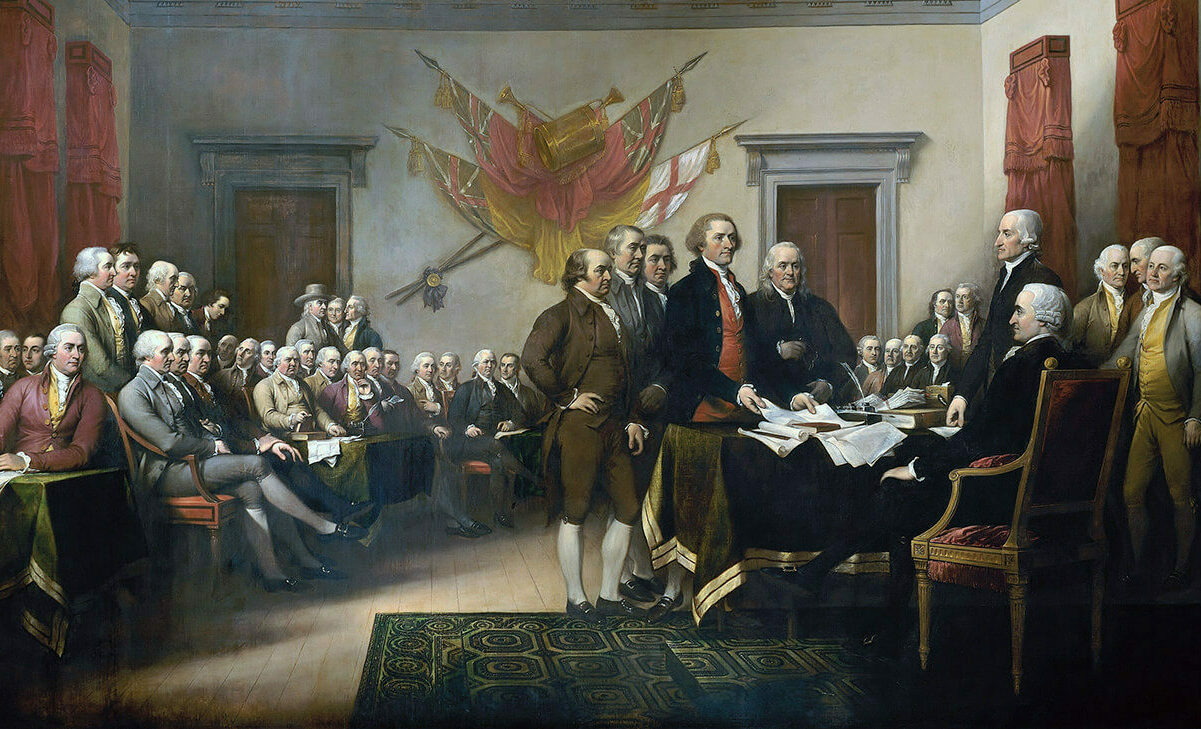
One circumstance, and one alone exists, to diminish the interest of the contention – the perilous inequality of the parties – an inequality far exceeding that, which gives animation to a contest; and so great as to destroy the hope of an ably waged encounter. On the one side, were arrayed the two houses of the British parliament, the modern school of political eloquence, the arena where great minds had for a century and a half strenuously wrestled themselves into strength and power, and in better days the common and upright chancery of an empire, on which the sun never set. Upon the other side, rose up the colonial assemblies of Massachusetts and Virginia, and the continental congress of Philadelphia, composed of men whose training had been within a small provincial circuit; who had never before felt the inspiration, which the consciousness of a station before the world imparts; who brought no power into the contest but that which they drew from their cause and their bosoms. It is by champions like these, that the great principles of representative government, of chartered rights, and constitutional liberty, are to be discussed; and surely never, in the annuals of national controversy, was exhibited a triumph so complete of the seemingly weaker party, a rout so disastrous of the stronger. Often as it has been repeated, it will bear another repetition; it never ought to be omitted in the history of constitutional liberty; it ought especially to be repeated this day; the various addresses, petitions, and appeals, the correspondence, the resolutions, the legislative and popular debates from 1764, to the declaration of independence, present a maturity of political wisdom, a strength of argument, a gravity of style, a manly eloquence, and a moral courage, of which unquestionably the modern world affords no other example. This meed of praise, substantially accorded at the time by Chatham, in the British parliament, may well be repeated by us. For most of the venerated men to whom it is paid, it is but a pious tribute to departed worth. The Lees and the Henrys, Otis, Quincy, Warren, and Samuel Adams, the men who spoke those words of thrilling power, which raised and ruled the storm of resistance, and rang like the voice of fate across the Atlantic, are beyond the reach of our praise. To most of them it was granted to witness some of the fruits of their labors; such fruit as revolutions do not often bear. Others departed at an untimely hour, or nobly fell in the onset; too soon for their country, too soon for liberty, too soon for everything but their own undying fame. But all are not gone; some still survive among us; the favored, enviable men, to hail the jubilee of the independence they declared. Go back, fellow citizens, to that day, when Jefferson and Adams composed the sub-committee, who reported the Declaration of Independence. Think of the mingled sensations of that proud but anxious day, compared to the joy of this. What honor, what crown, what treasure, could the world and all its kingdoms afford, compared with the honor and happiness of having been united in that commission, and living to see its most wavering hopes turned into glorious reality. Venerable men! You have outlived the dark days, which followed your more than heroic deed; you have outlived your own strenuous contention, who should stand first among the people, whose liberty you vindicated. You have lived to bear to each other the respect, which the nation bears to you both; and each has been so happy as to exchange the honorable name of the leader of a party, for that more honorable one, the Father of his Country. While this our tribute of respect, on the jubilee of our independence, is paid to the grey hairs of the venerable survivor in our neighborhood; let it not less heartily be sped to him, whose hand traced the lines of that sacred charter, which, to the end of time, has made this day illustrious. And is an empty profession of respect all that we owe to the man, who can show the original draught of the Declaration of the Independence of the United States of America, in his own handwriting? Ought not a title-deed like this to become the acquisition of the nation? Ought not the price, at which it is bought, to be the ease and comfort of the old age of him who drew it? Ought not he, who at the age of thirty declared the independence of his country, at the age of eighty, to be secured by his country in the enjoyment of his own? 3
Nor let us forget, on the return of this eventful day, the men, who, when the conflict of counsel was over, stood forward in that of arms. Yet let me not by faintly endeavoring to sketch, do deep injustice to the story of their exploits. The efforts of a life would scarce suffice to paint out this picture, in all its astonishing incidents, in all its mingled colors of sublimity and woe, or agony and triumph. But the age of commemoration is at hand. The voice of our fathers’ blood begins to cry to us, from beneath the soil which it moistened. Time is bringing forward, in their proper relief, the men and the deeds of that high-souled day. The generation of contemporary worthies is gone; the crowd of the un-signalized great and good disappears; and the leaders in war as well as council, are seen, in Fancy’s eye, to take their stations on the mount of Remembrance. They come from the embattled cliffs of Abraham; they start from the heaving sods of Bunker’s Hill; they gather from the blazing lines of Saratoga and Yorktown, from the blood-dyed waters of the Brandywine, from the dreary snows of Valley Forge, and all the hard fought fields of the war. With all their wounds and all their honors, they rise and plead with us, for their brethren who survive; and bid us, if indeed we cherish the memory of those, who bled in our cause, to show our gratitude, not by sounding words, but by stretching out the strong arm of the country’s prosperity, to help the veteran survivors gently down to their graves.
But it is time to turn from sentiments, on which it is unavailing to dwell. The fiftieth return of this all-important day appears to enjoin on us to reassert the principles of the Declaration of Independence. Have we met, fellow citizens, to commemorate merely the successful termination of a war? Certainly not; the war of 1756 was, in its duration, nearly equal, and signalized in America by the most brilliant achievements of the provincial arms. But no one would attempt to prevent that war, with all its glorious incidents, from gradually sinking into the shadows, which time throws back on the deeds of men. Do we celebrate the anniversary of our independence, merely because a vast region was severed from an European empire, and established a government for itself? Scarcely even this; the acquisition of Louisiana, a region larger than the old United States, the almost instantaneous conversion of a vast Spanish colonial waste, into free and prosperous members of our republican federation, the whole effected by a single happy exercise of the treaty-making power, this is an event, in nature not wholly unlike, in importance not infinitely beneath the separation of the colonies from England, regarded merely as a historical transaction. But no one thinks of commemorating with festivals the anniversary of this cession; perhaps not ten who hear me recollect the date of the treaty by which it was effected; although it is unquestionably the most important occurrence in our history, since the declaration of independence, and will render the administration of Mr. Jefferson memorable, as long as our republic shall endure.
But it is not merely nor chiefly the military success nor the political event, which we commemorate on these patriotic anniversaries. It is to mistake the principle of our celebration to speak of its object, either as a trite theme, or as one among other important and astonishing incidents, of the same kind, in the world. The declaration of the independence of the United States of America considered, on the one hand, as the consummation of a long train of measures and counsels – preparatory, even though unconsciously, of this event, and on the other hand, as the foundation of the systems of government, which have happily been established in our beloved country, deserves commemoration, as the most important event, humanly speaking, in the history of the world; as forming the era, from which the establishment of government on a rightful foundation is destined universally to date. Looking upon the declaration of independence as the one prominent event, which is to represent the American system (and history will so look upon it), I deem it right in itself and seasonable this day to assert, that, while all other political revolutions, reforms, and improvements have been in various ways of the nature of palliatives and alleviations of systems essentially and irremediably vicious, this alone is the great discovery, in political science; the Newtonian theory of government, toward which the minds of all honest and sagacious statesmen in other times had strained, but without success; the practical fulfillment of all the theories of political perfection, which had amused the speculations and eluded the grasp of every former period and people. And although assuredly this festive hour affords but little scope for dry disquisition, and shall not be engrossed by me with abstract speculation, yet I shall not think I wander from the duties of the day, in dwelling briefly on the chain of ideas, by which we reach this great conclusion.
The political organization of a people is of all natters of temporal concernment the most important. Drawn together into that great assemblage, which we call a nation, by the social principle, some mode of organization must exist among men; and on that organization depends more directly, more collectively, more permanently, than on anything else, the condition of the individual members that make up the community. On the political organization, in which a people shall for generations have been reared, it mainly depends, whether we shall behold in one of the brethren of the human family the New Hollander, making a nauseous meal from the worms which he extracts from a piece of rotten wood; 4 or the African cutting out the under jaw of his captive to be strung on a wire, as a trophy of victory, while the mangled wretch is left to bleed to death, on the field of battle; 5or whether we shall behold him social, civilized, Christian; scarcely faded from that perfect image, in which at the divine purpose, “Let us make man,”
“______ in beauty clad,
And reason throned upon his brow,
Stepped forth immortal man.”
I am certainly aware that between the individuals that compose a nation, and the nation as an organized body, there are action and reaction; that if political institutions affect the individual, individuals are sometimes gifted with power, and seize on opportunities, most essentially to modify institutions; nor am I at all disposed to agitate the scholastic question, which was first, in the order of nature or time, men forming governments or governments determining the condition of men. But having long acted and reacted upon each other, it needs no argument to prove, that political institutions get to be infinitely the most important agent in fixing the condition of individuals, and even in determining in what manner and to what extent individual capacity shall be exerted and individual character formed. While other causes do unquestionably operate, some of them, such as national descent, physical race, climate, and geographical position, very powerfully; yet of none of them is the effect constant, uniform, and prompt; while I believe it is impossible to point out an important change in the political organization of a people, a change by which it has been rendered more or less favorable to liberty, without discovering a correspondent effect on their prosperity.
Such is the infinite importance to the nations of men of the political organization which prevails among them. The most momentous practical question therefore of course is, in what way a people shall determine the political organization under which it will live; or in still broader terms, what is a right foundation of government. Till the establishment of the American constitutions, this question had received but one answer in the world; I mean but one, which obtained for any length of time and among any numerous people; and that answer was force. The right of the strongest was the only footing on which the governments of the ancient and modern nations were in fact placed; and the only effort of the theorists was, to disguise the simple and somewhat starling doctrine of the right of the strongest, by various mystical or popular fictions, which in no degree altered its real nature. Of these the only two worthy to detain us, on the present occasion, are those of the two great English political parties, the Whigs and the Tories, as they are called, by names not unlike, in dignity and significance, to the doctrines which are designated by them. The Tories taught that the only foundation of government was “divine right;” and this is the same notion, which is still inculcated on the continent of Europe; though the delicate ears of the age are flattered by the somewhat milder term, legitimacy. The Whigs maintained, that the foundation of government was an “original contract;” but of this contract the existing organization was the record and the evidence; and the obligation was perpetually binding. It may deserve the passing remark, therefore, that in reality the doctrine of the Whigs in England is a little less liberal than that of the Tories. To say that the will of God is the warrant, by which the king and his hereditary counselors govern the land, is, to be sure, in a practical sense, what the illustrious sage of the revolution, surviving in our neighborhood, dared as early as 1765, to pronounce it, “dark rivalry.” But in a merely speculative sense it may, without offense, be said, that government, like everything else, subsists by the Divine will; and in this acceptation, there is a certain elevation and unction in the sentiment. But to say that the form of government is matter of original compact with the people; that my ancestors, ages ago, agreed that they and their posterity, to the end of time, should give up to a certain line of princes the rule of the state; that no right remains of revising this compact; that nothing but extreme necessity, a necessity which it is treasonable even to attempt to define beforehand, justifies a departure from this compact, in which no provision is made that the will of the majority should be done, but the contrary; a doctrine like this, as it seems to me, while it is in substance as servile as the other, has the disadvantage of affecting a liberality not borne out by the truth.
And now, fellow citizens, I think I speak the words of truth and soberness, without color or exaggeration, when I say, that before the establishment of our American constitutions, this tory doctrine of the divine right was the most common, and this Whig doctrine of the original contract was professedly the most liberal doctrine, ever maintained by any political party in any powerful state. I do not mean that in some of the little Grecian republics, during their short-lived noon of liberty and glory, nothing better was practiced; nor that, in other times and places, speculative politicians had not in their closets dreamed of a better foundation of government. But I do mean, that, whereas the Whigs in England are the party of politicians who have enjoyed, by general consent, the credit of inculcating a more liberal system, this precious notion of the compact is the extent to which their liberality went.
It is plain, whichever of these solemn phrases – “divine right” or “original compact” – we may prefer to use, that the right of the strongest lies at the foundation of both, in the same way and to the same degree. The doctrine of the compact denounces every attempted change in the person of the prince as a breach of faith, and as such also not only treasonable but immoral. When a conflict ensues, force alone, of course, decides which party shall prevail; and when force has so decided, all the sanctions of the divine will and of the social compact revive in favor of the successful party. Even the statute legislation of England, although somewhat coy of unveiling the chaste mysteries of the common law, allows the successful usurper to claim the allegiance of the subject, in as full a manner as it could be done by a lawful sovereign.
Nothing is wanting to fill up this sketch of other governments, but to consider what is the form in which force is exercised to sustain them; and this is that of a standing army; at this moment, the chief support of every government on earth, except our own. As popular violence, the unrestrained and irresistible force of the mass of men, long oppressed and late awakened, and bursting in its wrath all barriers of law and humanity, is unhappily the usual instrument by which the intolerable abuses of a corrupt government are removed; so the blind force of the same fearful multitude, designedly kept in ignorance both of their duty and their privileges as citizens, employed in a form somewhat different indeed, but far more dreadful, that of a mercenary standing army, is the instrument by which corrupt governments are sustained. The deplorable scenes which marked the earlier stages of the French revolution have called the attention of this age to the fearful effects of popular violence; and the minds of men have recoiled at the dismay which leads the van, and the desolation which marks the progress of an infuriated mob. But the power of the mob is transient; the rising sun most commonly scatters its mistrustful ranks; the difficulty of subsistence drives its members asunder; and it is only while it exists in mass, that it is terrible. But there is a form, in which the mob is indeed portentous; when to all its native terrors it adds the force of a frightful permanence; when, by a regular organization, its strength is so curiously divided, and by a strict discipline its parts are so easily combined, that each and every portion of it carries in its presence the strength and terror of the whole; and when, instead of that want of concern which renders the common mob incapable of arduous enterprises, it is despotically swayed by a single master mind, and may be moved in array across the globe.
I remember to have seen the two kinds of mob brought into direct collision. I was present at the second great meeting of the populace of London in 1819, in the midst of a crowd of I know now how many thousands, but assuredly a vast multitude, which was gathered together in Smithfield market. The universal distress, as you recollect, was extreme; it was a short time after the scenes at Manchester, at which men’s minds were ulcerated; deaths by starvation were said not to be rare; ruin by the stagnation of business was general; and some were already brooding over the dark project of assassinating the ministers, which was not long after matured by Thistlewood and his associates; some of whom, on the day to which I allude, harangued this excited, desperate, starving assemblage. When I considered the state of feeling prevailing in the multitude around me – when I looked in their lowering faces – heard their deep indignant exclamations – reflected on the physical force concentrated, probably that of thirty or forty thousand able-bodied men; and added to all this, that they were assembled to exercise an undoubted privilege of British citizens; I did suppose that any small number of troops, who should attempt to interrupt them, would be immolated on the spot. While I was musing on these things, and turning in my mind the commonplaces on the terrors of a mob, a trumpet was heard to sound – an uncertain, but a harsh and clamorous blast. I looked that the surrounding stalls should have furnished the unarmed multitude at least with that weapon, with which Virginians sacrificed his daughter to the liberty of Rome; I looked that the flying pavement should begin to darken the air. Another blast is heard – a cry of “The horse-guards!” ran through the assembled thousands; the orators on the platform were struck mute; and the whole of that mighty host of starving, desperate men incontinently took to their heels; in which, I must confess – feeling no vocation, in that cause to be faithful found, among the faithless – I did myself join them. We had run through the Old Bailey and reached Ludgate hill, before we found out, that we had been put to flight by a single mischievous tool of power, who had come triumphing down the opposite street on horseback, blowing a stagecoach man’s horn.
We have heard of those midnight scenes of desolation, when the populace of some overgrown capital, exhausted by the extremity of political oppression, or famishing at the gates of luxurious palaces, or kindled by some transport of fanatical zeal, rushes out to find the victims of its fury; the lurid glare of torches, casting their gleams on faces dark with rage; the ominous din of the alarm bell, striking with affright, on the broken visions of the sleepers; the horrid yells, the thrilling screams, the multitudinous roar of the living storm, as it sweeps onward to its objects; but oh, the disciplined, the paid, the honored mob; not moving in rags and starvation to some act of blood or plunder; but marching, in all the pomp and circumstance of war, to lay waste a feebler state; or cantoned at home among an overawed and broken-spirited people! I have read of granaries plundered, of castles sacked, and their inmates cruelly murdered, by the ruthless hands of the mob. I have read of friendly states ravaged, governments overturned, tyrannies founded and upheld, proscriptions executed, fruitful regions turned into trampled deserts, the tide of civilization thrown back, and a line of generations cursed, by a well organized system of military force.
Such was the foundation in theory and in practice of all the governments, which can be considered as having had a permanent existence in the world, before the Revolution in this country. There are certainly shades of difference between the oriental despotisms, ancient and modern – the military empire of Rome – the feudal sovereignties of the Middle Ages – and the legitimate monarchies of the present day. Some were and are more, and some less, susceptible of melioration in practice; and of all of them it might perhaps be said – being all in essence bad,
“That, which is best administered, is best.”
In no one of these governments, nor in any government, was the truth admitted, that the only just foundation of all government is the will of the people. If it ever occurred to the practical or theoretical politician, that such an idea deserved examination, the experiment was thought to have been made in the republics of Greece, and to have failed, as fail it certainly did, from the physical impossibility of conducting the business of the state by the actual intervention of every citizen. Such a plan of government must of course fail, if for no other reason, at least for this, that it would prevent the citizen from pursuing his own business which it is the object of all government to enable him to do. It was considered then as settled, that the citizens, each and all, could not be the government; someone or more must discharge its duties for them. Who shall do this; how shall they be designated?
The first king was a fortunate soldier, and the first nobleman was one of his generals; and government has passed by descent to their posterity, with no other interruption, than has taken place, when some new soldier of fortune has broken in upon this line of succession, in favor of himself and of his generals. The people have passed for nothing in the plan; and whenever it has occurred to a busy genius to put the question, by what right government is thus exercised and transmitted? The common answer has been, By Divine right; while, in times of rare illumination, men have been consoled with the assurance, that such was the original contract.
But a brighter day and a better dispensation were in reserve. The founders of the feudal system, barbarous, arbitrary, and despotic as they were, and profoundly ignorant of political science, were animated themselves with a spirit of personal liberty; out of which, after ages of conflict, grew up a species of popular representation. In the eye of the feudal system, the king was the first baron, and standing within his own sphere, each other baron was as good as the first. From this important relation, in which the feudal lords of England claimed to stand to their prince, arose the practice of their being consulted by him, in great and difficult conjunctures of affairs; and hence the co-operation of grand council (subsequently convened in two houses under the name of parliament) in making the laws and administering the government. The formation of this body has proved a great step in the progress of popular rights; its influence has been decisive in breaking the charm of absolute monarchy, and giving to a body partially eligible by the people a share in the government. It has also operated most auspiciously on liberty, by exhibiting to the world, on the theatre of a conspicuous nation, a living example, that in proportion as the rights and interests of a people are represented in a government, in that degree the state becomes strong and prosperous. Thus far the science and the practice of government had gone in England, and here it had come to a stand. An equal representation, even in the House of Commons, was un-thought of; or thought of only as one of the exploded abominations of Cromwell. It is asserted by Mr. Hume, writing about the middle of the last century, and weighing this subject with equal moderation and sagacity, that “the tide has run long and with some rapidity to the side of popular government and is just beginning to turn toward monarchy.” And he maintains that the British constitution is, though slowly, yet gradually verging toward an absolute government. 6
Such was the state of political science, when the independence of our country was declared, and its constitutions organized on the basis of that declaration. The precedents in favor of a popular system were substantially these, the short-lived prosperity of the republics of Greece, where each citizen took part in the conduct of affairs; and the admission into the British government, of one branch of the legislature nominally elective, and operating, rather by opinion than power, as a partial check on the other branches. What lights these precedents gave them, our fathers had; beyond this, they owed everything to their own wisdom and courage, in daring to carry out and apply to the executive branch of the government that system of delegated power, of which the elements existed in their own provincial assemblies. They assumed, at once, not as a matter to be reached by argumentation, but as the dictate of unaided reason – as an axiom too obvious to be discussed, though never in practice applied – that where the state is too large to be governed by an actual assembly of all the citizens, the people shall elect those, who will act for them, in making the laws and administering the government. They, therefore, laid the basis of their constitutions in a proportionate delegation of power, from every part of the community; and regarding the declaration of our Independence as the true era of our institutions, we are authorized to assert, that from that era dates the establishment of the only perfect organization of government, that of a Representative Republic, administered by persons freely chosen by the people.
This plan of government is therefore, in its theory, perfect; and in its operation it is perfect also; that is to say, no measure of policy, public or private, domestic or foreign, can long be pursued, against the will of a majority of the people. Farther than this the wisdom of government cannot go. The majority of the people may err. Man collectively as well as individually, is man still; but whom can you more safely trust than the majority of the people; who is so likely to be right, always right, and altogether right, as the collective majority of a great nation, represented in all its interests and pursuits, and in all its communities?
Thus has been solved the great problem in human affairs; and a frame of government, perfect in its principles, has been brought down from the airy regions of Utopia, and has found ‘a local habitation and a name’ in our country. Henceforward we have only to strive that the practical operation of our systems may be true to their spirit and theory. Henceforth it may be said of us, what never could have been said of any people, since the world began, be our sufferings what they will, no one can attribute them to our frame of government; no one can point out a principle in our political systems, of which he has had reason to complain; no one can sigh for a change in his country’s institutions, as a boon to be desired for himself or for his children. There is not an apparent defect in our constitutions which could be removed without introducing a greater one; nor a real evil, whose removal would not be rather a nearer approach to the principles on which they are founded, than a departure from them.
And what, fellow citizens, are to be the fruits to us and to the world, of the establishment of this perfect system of government? I might partly answer the inquiry, by reminding you what have been the fruits to us and to the world; by inviting you to compare our beloved country, as it is, in extent of settlement, in numbers and resources, in the useful and ornamental arts, in the abundance of the common blessings of life, in the general standard of character, in the means of education, in the institutions for social objects, in the various great industrious interests, in public strength and national respectability, with what it was in all these respects fifty years ago. But the limits of this occasion will not allow us to engage in such an enumeration; and it will be amply sufficient for us to contemplate, in its principle, the beneficial operation on society, of the form of government bequeathed to us by our fathers. This principle is Equality; the equal enjoyment by every citizen of the rights and privileges of the social union.
The principle of all other governments is monopoly, exclusion, favor. They secure great privileges to a small number, and necessarily at the expense of all the rest of the citizens.
In the keen conflict of minds, which preceded and accompanied the political convulsions of the last generation, the first principles of society were canvassed with a boldness and power before unknown in Europe, and, from the great principle that all men are equal, it was for the first time triumphantly inferred, as a necessary consequence, that the will of a majority of the people is the rule of government. To meet these doctrines, so appalling in their tendency to the existing institutions of Europe, new ground was also taken by the champions of those institutions, and particularly by a man, whose genius, eloquence, and integrity gave a currency, which nothing else could have given, to his splendid paradoxes and servile doctrines. In one of his renowned productions, 7 this great man, for great, even in his errors, most assuredly he was, in order to meet the inferences drawn from the equality of man, that the will of the majority must be the rule of government, has undertaken, as he says, “to fix, with some degree of distinctness, an idea of what it is we mean when we say the People;” and in fulfillment of this design, he lays it down, “that in a state of rude nature, there is no such thing as a people. A number of men, in themselves, can have no collective capacity. The idea of a people is the idea of a corporation, it is wholly artificial; and made, like all other legal fictions, by common agreement.”
“In a state of rude nature, there is no such thing as a people!” I would fain learn in what corner of the earth, rude or civilized, men are to be found, who are not a people, more or less improved. “A number of men in themselves have no collective capacity!” I would gladly be told where, in what region, I will not say of geography, I know there is none such, but of poetry or romance, a number of men has been placed, by nature, each standing alone, and not bound by any of those ties of blood, affinity, and language, which form the rudiments of a collective capacity. “The idea of a people is the idea of a corporation, it is wholly artificial, and made like all other legal fictions, by common agreement.” Indeed, is the social principle artificial? Is the gift of articulate speech, which enables man to impart his condition to man, the organized sense, which enables him to comprehend what is imparted? Is that sympathy, which subjects our opinions and feelings, and through them our conduct, to the influence of others and their conduct o our influence? Is that chain of cause and effect, which makes our characters receive impressions from the generations before us, and puts it in our power, by a good or bad precedent, to distil a poison or a balm into the characters of posterity? Are these, indeed, all by-laws of a corporation? Are all the feelings of ancestry, posterity, and fellow-citizenship; all the charm, veneration, and love, bound up in the name of country; the delight, the enthusiasm, with which we seek out, after the lapse of generations and ages, the traces of our fathers’ bravery or wisdom, are these all “a legal fiction?” Is it, indeed, a legal fiction, that moistens the eye of the solitary traveler, when he meets a countryman in a foreign land? Is it a “common agreement,” that gives its meaning to my mother tongue, and enables me to speak to the hearts of my kindred men, beyond the rivers and beyond the mountains? Yes, it is a common agreement; recorded on the same registry with that, which marshals the winged nations, that,
In common, ranged in figure, wedge their way,
Intelligent of seasons; and set forth
Their airy caravan, high over seas
Flying, and over lands, with mutual wing
Easing their flight.
The mutual dependence of man on man, family on family, interest on interest, is but a chapter in the great law, by which commerce, manufactures, and agriculture support each other, is the same law, in virtue of which the thirsty earth owes its fertility to the rivers and the rains; and the clouds derive their high-traveling waters from the rising vapors; and the ocean is fed from the secret springs of the mountains; and the plant that grows derives its increase from the plant that decays; and all subsist and thrive, not by themselves but by others, in the great political economy of nature. The necessary cohesion of the parts of the political system is no more artificial, than the gravity of the natural system, in which planet is bound to planet, and all to the sun, and the sun to all. Insulate an interest in society, a family, or a man, and all the faculties and powers they possess will avail them little toward the great objects of life; in like manner, as not all the mysteriously combined elements of the earth around and beneath us, the light and volatile airs, that fill the atmosphere; not the electric fluid, which lies condensed and embattled in its cloudy magazines, or subtly diffused through creation; not the volcanic fires that rage in the earth’s bosom, nor all her mines of coal, and niter, and sulphur; nor fountains of naphtha, petroleum, or asphalt, not all, combined and united, afford one beam of that common light, which sends man forth to his labors, and which is the sun’s contribution to the system, in which we live. And yet the great natural system, the political, intellectual, moral system, is artificial, is a legal fiction! “O that mine enemy had said it,” the admirers of Mr. Burke may well exclaim. O that some impious Voltaire, some ruthless Rousseau had uttered it. Had uttered it! Rousseau did utter the same thing; and more rebuked than any other error of this misguided genius, is his doctrine of the Social Contract, of which Burke has reasserted, and more than reasserted the principle, in the sentences I have quoted.
But no, fellow citizens; political society exists by the law of nature. Man is formed for it; every man is formed for it; every man has an equal right to its privileges, and to be deprived of them, under whatever pretence, is so far to be reduced to slavery. The authors of the Declaration of Independence saw this, and taught that all men are born free and equal. On this principle, our constitutions rest; and no constitution can bind a people on any other principle. No original contract, that gives away this right, can bind any but the parties to it. My forefathers could not, if they had wished, have stipulated to their king, that his children should rule over their children. By the introduction of this principle of equality it is, that the Declaration of Independence has at once effected a before unimagined extension of social privileges. Grant that no new blessing (which, however, can by no means with truth be granted) be introduced into the world on this plan of equality, still it will have discharged the inestimable office of communicating, in equal proportion, to all the citizens, those privileges of the social union, which were before partitioned in an invidious gradation, profusely among the privileged orders, and parsimoniously among all the rest. Let me instance in the right of suffrage. The enjoyment of this right enters largely into the happiness of the social condition. I do not mean, that it is necessary to our happiness actually to exercise this right at every election; but I say, the right itself to give our voice in the choice of public servants, and the management of public affairs, is so precious, so inestimable, that there is not a citizen who hears me, that would not lay down his life to assert it. This is a right unknown in every country but ours; I say unknown, because in England, whose institutions make the nearest approach to a popular character, the elective suffrage is not only incredibly unequal and capricious in its distribution; but extends after all, only to the choice of a minority of one house of the legislature. Thus then the people of this country are, by their constitutions of government, endowed with a new source of enjoyment. Our religious hopes, intellectual meditations, social sentiments, family affections, political privileges, these are springs of un-purchased happiness; and to condemn men to live under an arbitrary government, is to cut them off from nearly all the satisfactions, which nature designed should flow from those principles within us, by which a tribe of kindred men is constituted a people.
But it is not merely an extension to all the members of society, of those blessings, which, under other systems, are monopolized by a few; great and positive improvements, I feel sure, are destined to flow from the introduction of the republican system. The first of these will be, to make wars less frequent, and finally to cause them to cease altogether. It was not a republican, it was the subject of a monarchy, and no patron of novelties, who said,
War is a game, which, were their subjects wise,
Kings would not play at.
A great majority of the wars, which have desolated mankind, have grown either out of the disputed titles and rival claims of sovereigns, or their personal character of their favorites, or some other circumstance evidently incident to a form of government which withholds from the people the ultimate control of their affairs. And the more civilized men grow, strange as it may seem, the more universally is this the case. In the barbarous ages the people pursued war as an occupation; its plunder was more profitable, than their labor at home, in the state of general insecurity. In modern times, princes raise their soldiers by conscription, their sailors by impressments, and drive them at the point of the bayonet and dirk, into the battles they fight for reasons of state. But in a republic, where the people, by their representatives, must vote the declaration of war, and afterwards raise the means of its support, none but wars of just and necessary defense can be waged. Republics, we are told, indeed, are ambitious, a seemingly wise remark, devoid of meaning. Man is ambitious; and the question is, where will his ambition be most likely to drive his country into war; in a monarchy where he has but to ‘cry havoc, and let slip the dogs of war,’ or in a republic, where he must get the vote of a strong majority of the nation? Let history furnish the answer. The book, which promised you, in its title, a picture of the progress of the human family, turns out to be a record, not of the human family, but the Macedonian family, the Julian family, the families of York and Lancaster, of Lorraine and Bourbon. We need not go to the ancient annals to confirm this remark. We need not speak of those, who reduced Asia and Africa, in the morning of the world, to a vassalage from which they have never recovered. We need not dwell on the more notorious exploits of the Alexander’s and the Caesars, the men who wept for other worlds to visit with the pestilence of their arms. We need not run down the bloody line of the dark ages, when the barbarous North disgorged her ambitious savages on Europe, or when at a later period, barbarous Europe poured back her hold ruffians on Asia; we need but look at the dates of modern history, the history of civilized, balanced Europe. We here behold the ambition of Charles V, involving the continent of Europe in war, for the first half of the sixteenth century, and the fiendlike malignity of Catherine de’ Medici and her kindred distracting it the other half. We see the haughty and cheerless bigotry of Philip, persevering in a conflict of extermination for one whole age in the Netherland, and darkening the English channel with his armada; while France prolongs her civil dissensions, because Henry IV was the twenty-second cousin of Henry III. We enter the seventeenth century, and again find the hereditary pride and bigotry of the House of Austria wasting Germany and the neighboring powers with the Thirty Years’ war; and before peace of Westphalia is concluded, England is plunged into the fiery trial of her militant liberties. Contemporaneously, the civil wars are revived in France, and the kingdom is blighted by the passions of Mazarin. The civil wars are healed, and the atrocious career of Louis XIV begins; a half century of bloodshed and woe, that stands in revolting contrast with the paltry pretenses of his wars. At length the peace of Ryswic is made in 1697, and bleeding Europe throws off the harness and lies down like an exhausted giant to repose. In three years, the testament of a doting Spanish king gives the signal for the Succession of war; till a cup of tea spilled on Mrs. Masham’s apron, restores peace to the afflicted kingdoms. Meantime the madman of the North had broken loose upon the world, and was running his frantic round. Peace at length is restores, and with one or two short wars, it remains unbroken, till, in 1740, the will of Charles VI occasions another testamentary contest; and in the gallant words of the stern but relenting moralist,
The queen, the beauty, sets the world in arms.
Eight years are this time sufficient to exhaust the combatants, and the peace of Aix-la-Chapelle is concluded; but, in 1755, the old French war is kindled in our own wilderness, and through the united operation of the monopolizing spirit of England, the party intrigues of France, and the ambition of Frederic, spread throughout Europe. The wars of the last generation I need not name, nor dwell on that signal retribution, by which the political ambition of the cabinets at length conjured up the military ambition of the astonishing individual, who seems in our day, to have risen out of the ranks of the people, to chastise the privileged orders with that iron scourge, with which they had so long afflicted mankind; to gather with his strong Plebeian hands the fragrance of those palmy honors, which they had reared for three centuries in the bloody gardens of their royalty. It may well be doubted, whether, under a government like ours, one of all these contests would have taken place. Those that arose from disputed titles, and bequests of thrones, could not of course have existed; and making every allowance for the effect of popular delusion, it seems to me not possible, that a representative government would have embarked in any of the wars of ambition and aggrandizement, which fill up the catalogue.
Who then are these families and individuals – these royal lanistae – by whom the nations are kept in training for a long gladiatorial combat? Are they better, wise than we? Look at them in life; what are they? “Kings are fond,” says Mr. Burke, no scoffer at thrones, “kings are fond of low company.” 8 What are they when gone? Expende Hannibalem. Enter the great cathedrals of Europe, and contemplate the sepulchers of the men, who claimed to be the lords of each successive generation. Question your own feelings, as you behold where the Plantagenet’s and Tudors, the Stuarts and those of Brunswic, lie mournfully huddled up in the chapels of Westminster Abbey; and compare those feelings with the homage you pay to Heaven’s aristocracy, the untitled learning, genius, and wit that moulder by their side. Count over the sixty-six emperors and princes of the Austrian house, that lie gathered in the dreary pomp of monumental marble, in the vaults of the Capuchins at Vienna; and weigh the worth of their dust against the calamities of their Peasants’ war, their Thirty Years’ war, their Succession war, their wars to enforce the Pragmatic Sanction, and of all the other uncouth pretences for destroying mankind, with which they have plagued the world.
But the cessation of wars, to which we look forward as the result of the gradual diffusion of republican government, is but the commencement of the social improvements, which cannot but flow from the same benignant source. It has been justly said that he was a great benefactor of mankind, who brought into action such a vast increase of physical, political, and moral energy; who have made not two citizens to live only, but hundreds, yea, unnumbered thousands to live, and to prosper in regions, which but for their achievements would have remained for ages unsettled, and to enjoy those rights of man, which but for their institutions would have continued to be arrogated, as the exclusive inheritance of a few. I appeal to the fact. I ask any sober judge of political probability to tell me, whether more has not been done to extend the domain of civilization, in fifty years, since the declaration of independence, than would have been done in five centuries of continued colonial subjection. It is not even a matter of probability; the king in council had adopted it, as a maxim of his American policy, that no settlements in this country should be made beyond the Allegany’s; that the design of Providence in spreading out the fertile valley Mississippi, should not be fulfilled.
I know that it is said, in palliation of the restrictive influence of European governments, that they are as good as their subjects can bear. I know it is said, that it would be useless and pernicious to call on the half savage and brutified peasantry of many countries, to take a share in the administration of affairs, by electing or being elected to office. I know they are unfit for it; it is the very curse of the system. What is it that unfits them? What is it that makes slavish labor, and slavish ignorance, and slavish stupidity, their necessary heritage? Are they not made of the same Caucasian clay? Have they not five senses, the same faculties, the same passions? And is it anything but an aggravation of the vice of arbitrary governments, that they first deprive men of their rights, and then unfit them to exercise those rights, and then unfit them to exercise those rights; profanely construing the effect into a justification of the evil?
The influence of our institutions on foreign nations is – next to their effect on our own condition – the most interesting question we can contemplate. With our example of popular government before their eyes, the nations of the earth will not eventually be satisfied with any other. With the French revolution as a beacon to guide them, they will learn, we may hope, not to embark too rashly on the mounting waves of reform. The cause, however, of popular government is rapidly gaining in the world. In England, education is carrying it wide and deep into society. On the continent, written constitutions of governments, nominally representative, though as yet, it must be owned, nominally so alone, are adopted in eight or ten, late absolute monarchies; and it is not without good grounds that we may trust, that the indifference with which the Christian powers contemplate the sacrifice of Greece, and their crusade against the constitutions of Spain, Piedmont, and Naples, will satisfy the mass of thinking men in Europe, that it is time to put an end to these cruel delusions, and take their own government into their own hands.
But the great triumphs of constitutional freedom, to which our independence has furnished the example, have been witnessed in the southern portion of our hemisphere. Sunk to the last point of colonial degradation, they have risen at once into the organization of free republics. Their struggle has been arduous; and eighteen years of checkered fortune have not yet brought it to a close. But we must not infer, from their prolonged agitation, that their independence is uncertain; that they have prematurely put on the toga virilis of Freedom. They have not begun too soon; they have more to do. Our war of independence was shorter; happily we were contending with a government, that could not, like that of Spain, pursue an interminable and hopeless contest, in defiance of the people’s will. Our transition to a mature and well adjusted constitution was more prompt than that of our sister republics; for the foundations had long been settled, the preparation long made. And when we consider that it is our example, which has aroused the spirit of Independence from California to Cape Horn; that the experiment of liberty, if it had failed with us, most surely would not have been attempted by them; that even now our counsels and acts will operate as powerful precedents in this great family of republics, we learn the importance of the post which Providence has assigned us in the world. A wise and harmonious administration of the public affairs, a faithful, liberal, and patriotic exercise of the private duties of the citizen, while they secure our happiness at home, will diffuse a healthful influence through the channels of national communication, and serve the cause of liberty beyond the Equator and the Andes. When we show a united conciliatory, and imposing front to their rising states, we show them, better than sounding eulogies can do, the true aspect of an independent republic. We give them a living example that the fireside policy of a people is like that of the individual man. As the one, commencing in the prudence, order, and industry of the private circle, extends itself to all the duties of social life, of the family, the neighborhood, the country; so the true domestic policy of the republic, beginning in the wise organization of its own institutions, pervades its territories with a vigilant, prudent, temperate administration; and extends the hand of cordial interest to all the friendly nations, especially to those which are of the household of liberty.
It is the way that we are to fulfill our destiny in the world. The greatest engine of moral power, which human nature knows, is an organized, prosperous state. All that man, in his individual capacity, can do – all that he can effect by his fraternities – by his ingenious discoveries and wonders of art – or by his influence over others – is as nothing, compared with the collective, perpetuated influence on human affairs and human happiness of a well constituted, powerful commonwealth. It blesses generations with its sweet influence; even the barren earth seems to pour out its fruits under a system where property is secure, while her fairest gardens are blighted by despotism; men, thinking, reasoning men, abound beneath its benignant sway; nature enters into a beautiful accord, a better, purer asiento with man, and guides an industrious citizen to every rood of her smiling wastes; and we see, at length, that what has been called a state of nature, has been most falsely, calumniously so denominated; that the nature of man is neither that of a savage, a hermit, nor a slave; but that of a member of a well ordered family, that of a good neighbor, a free citizen, a well informed, good man, acting with others like him. This is the lesson which is taught in the charter of our independence; this is the lesson, which our example is to teach the world.
The epic poet of Rome – the faithful subject of an absolute prince – in unfolding the duties and destinies of his countrymen, bids them look down with disdain on the polished and intellectual arts of Greece, and deem their arts to be
To rule the nations with imperial sway;
To spare the tribes that yield; fight down the proud;
And force the mood of peace upon the world.
A nobler counsel breathes from the charter of our independence; a happier province belongs to our free republic. Peace we would extend, but by persuasion and example, the moral force, by which alone it can prevail among the nations. Wars we may encounter, but it is in the sacred character of the injured and the wronged; to raise the trampled rights of humanity from the dust; to rescue the mild form of Liberty, from her abode among the prisons and the scaffolds of the elder world, and to seat her in the chair of state among her adoring children; to give her beauty for ashes; a healthful action for her cruel agony; to put at last a period to her warfare on earth; to tear her star-spangled banner from the perilous ridges of battle, and plant it on the rock of ages. There be it fixed for ever, the power of a free people slumbering in its folds, their peace reposing in its shade!
To have been one of those, whose names stand subscribed to the Declaration of Independence, is of itself a rare felicity; to have lived to witness, at the close of the half century from the declaration, the prosperous condition of Independent America, is an eminent favor of Providence, beyond the reach of expectation, and almost beyond the course of Nature. But history can scarce furnish a coincidence so nearly miraculous, as that the individuals, who stood first and second on the Committee of five appointed to prepare the Declaration, who were the two persons exclusively designated by their colleagues for this most honorable trust, and who, after filling as associates, or competitors, the highest offices in the country, had long cultivated an honorable intercourse in retirement, should have passed out of the world together, on the Fiftieth Anniversary of the day, which their Declaration had rendered immortal for themselves, for their country, and for every free people. That these venerated Fathers of their Country retained to the last that possession of reason, which enabled them to feel the signal favor of Providence, that was vouchsafed to them, is a wonderful circumstance at their advanced age, which fills up this picture of human felicity. When Mr. Adams, then near his end, was informed by his attendants that the firing of cannons and ringing of bells denoted the Fourth of July, instead of calling it a “glorious day,” as he was wont to do, he was heard by those around him, for the first time, and almost with his last breath, to call it “a great and a good day!” It is impossible to contemplate a scene like this, and compare it with his letter written from Philadelphia on the 5th of July, 1776, without emotions of a higher cast, than those of astonishment and admiration. “Yesterday,” he then wrote in the spirit of prophecy, “the greatest question was decided which was ever decided among men. A resolution was passed unanimously ‘That these United States are and of right ought to be Free and Independent States.’
“The day has passed. The fourth of July, 1776, will be a memorable epoch in the history of America. I am apt to believe, it will be celebrated by succeeding generations as the Great Anniversary Festival. It ought to be commemorated as the day of deliverance, by solemn acts of devotion to Almighty God. It ought to be solemnized with pomp’s, shows, games, sports, guns, bells, bonfires, and illuminations, from one end of he continent to the other, from this time forever! You will think me transported with enthusiasm, but I am not. I am well aware of the toil, blood, and treasure it will cost to maintain this Declaration, and support and defend these States; yet, through all the gloom, I can see a ray of light and glory. I can see that the end is worth more than all the means; and that posterity will triumph, although you and I may rue – which I hope we shall not.”
It is stated, in the accounts of the last days of Mr. Jefferson, that his favorite exclamation, as he drew near his departure was, Nunc dimittis, Domine, “Lord, now let thou thy servant depart in peace.” On the day before his death, being sensibly near his end, on inquiring what day of the month it was, and being answered “The third of July,” he expressed a desire to live till the next day, “that he might breathe the air of the Fiftieth Anniversary!”
There have certainly been times, in the history of our country, when the political opposition between these two venerable men, was deemed a source of great evil, in its immediate influence on the community. In reference to their own characters, to their personal history, and the moral influence of their example, their political contention can now no longer be regretted. Nothing less than so keen a struggle between men, who had been united hearted and hand, in such a cause; and nothing less than a long and honorable friendship subsequently existing between men who had thus contended, would have sufficed to read a salutary lesson of mutual forbearance and respect to the contending political interests of the day, and of mild expostulation to those, who, imitating these illustrious men in nothing but their dissensions, mistakenly think to show respect to their memory, by endeavoring to revive and perpetuate them.

 The rights of religious conscience were then enshrined at the federal level in the
 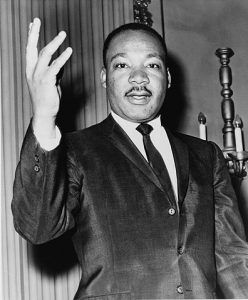 Also celebrated today is the birthday of the Rev. Martin Luther King Jr. This pastor practiced many First Amendment rights, including not only that of free-exercise of religion but also assembly, petition, and speech. Dr. King’s use of non-violent protests during the Civil Rights movement caused him to receive the

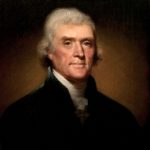 First, Jefferson did not coin the phrase. It was introduced in the 1500s by leading clergy in England who objected to the government taking control over religious doctrines and punishing religious activities and expressions. In America, many famous early ministers also used the phrase – all well over a century before Jefferson did.
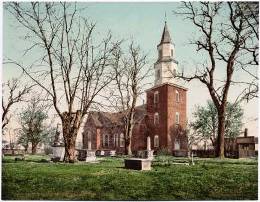 Third, on multiple occasions, Jefferson called his state to Christian prayer and worship. In 1774, he called for a day of fasting and prayer,
 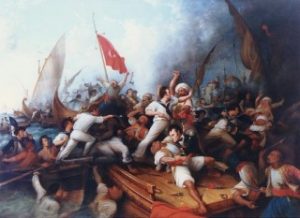 That 1797 treaty was one of several that America negotiated with Muslim nations during America’s first War on Islamic Terror (1784-1816),

 One of the unique and overlooked parts of our national capitol is the Congressional Prayer Room. This room was opened in 1954, the same year in which Congress added the phrase “under God” to the pledge of allegiance. In front of the chapel is an inspired stained-glass window portraying George Washington kneeling in prayer. Around the widow is the scripture Psalm 16:1 declaring, “Preserve me, O God, for in Thee do I put my trust.” This verse remains an inspiration to Congressional leaders today.
 God commands us in Scripture to pray for those in authority over us. I Timothy 2:1-2 states, “Therefore I exhort first of all that supplications, prayers, intercessions, and giving of thanks be made for all men, for kings and all who are in authority.”