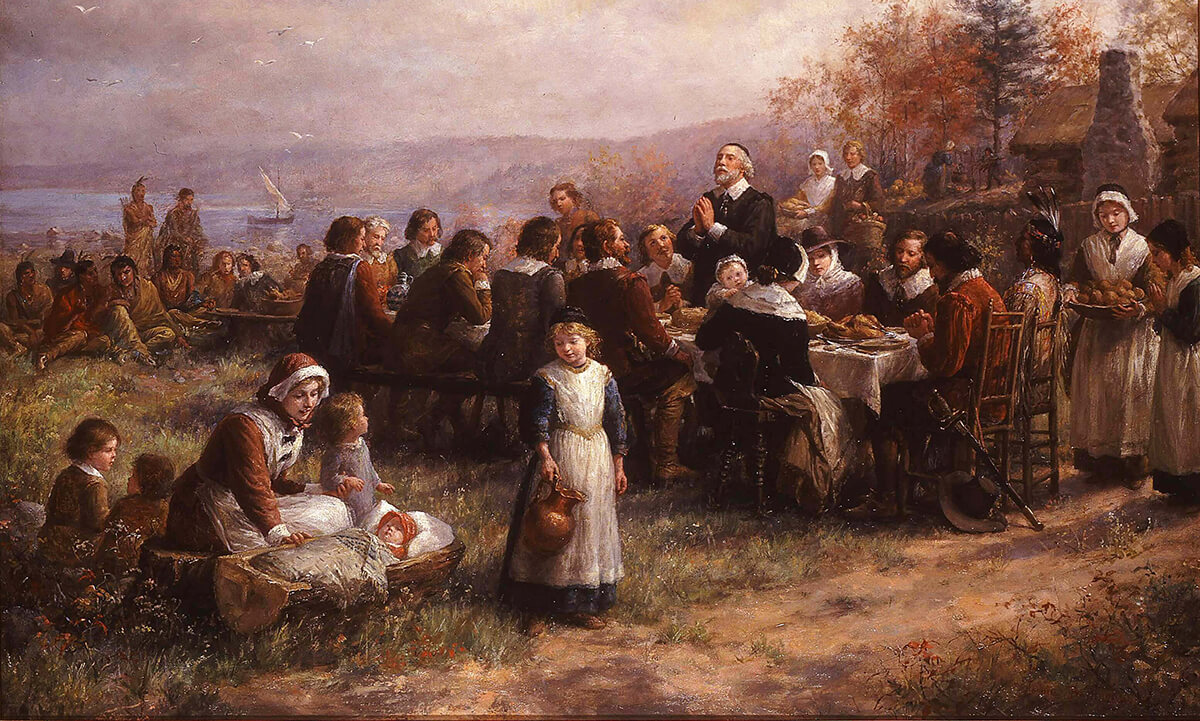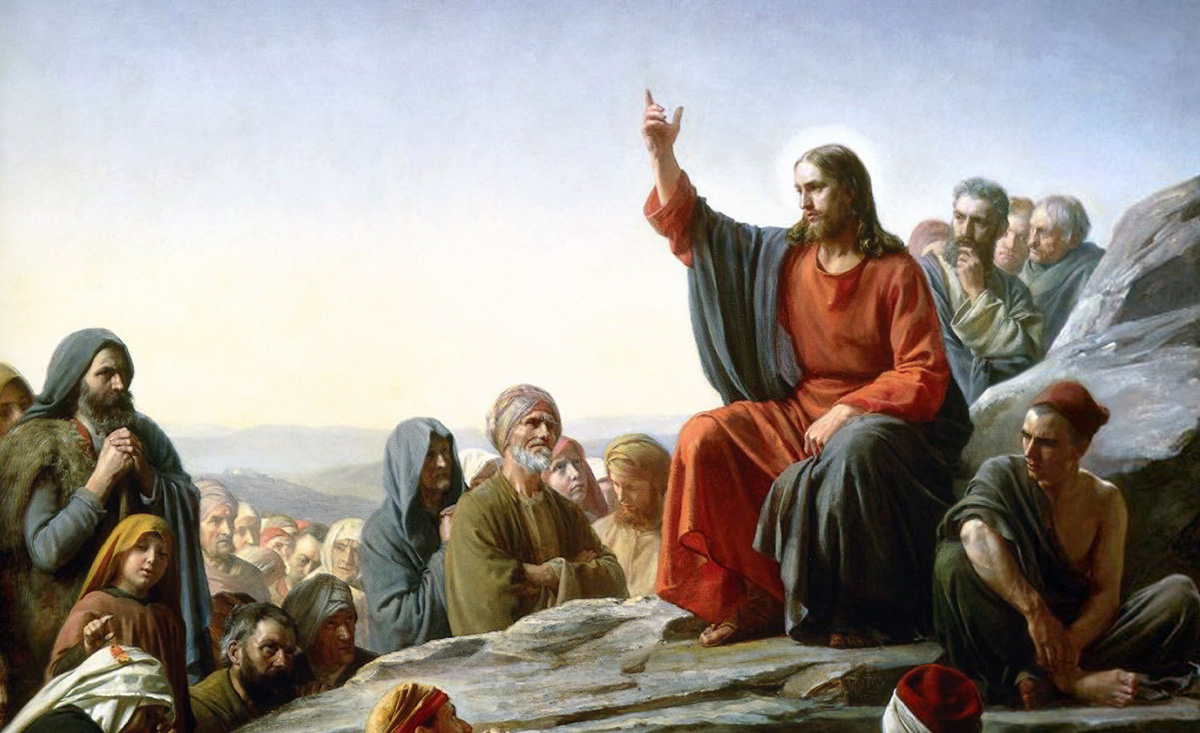
The Sermon on the Mount Carl Bloch, 1890

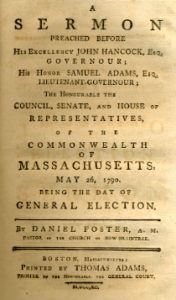
Sermon – Election – 1790, Massachusetts

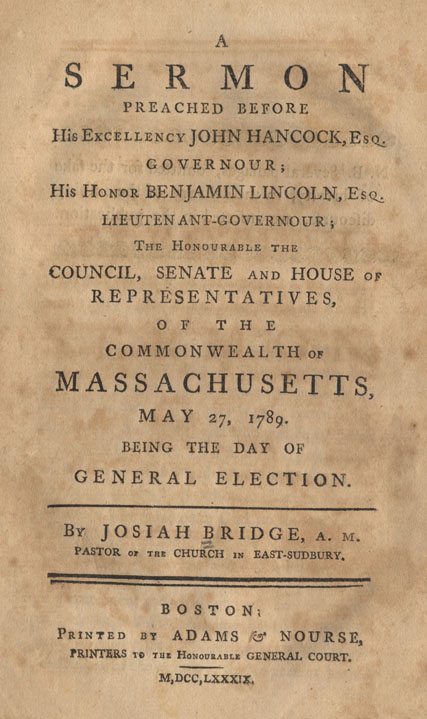
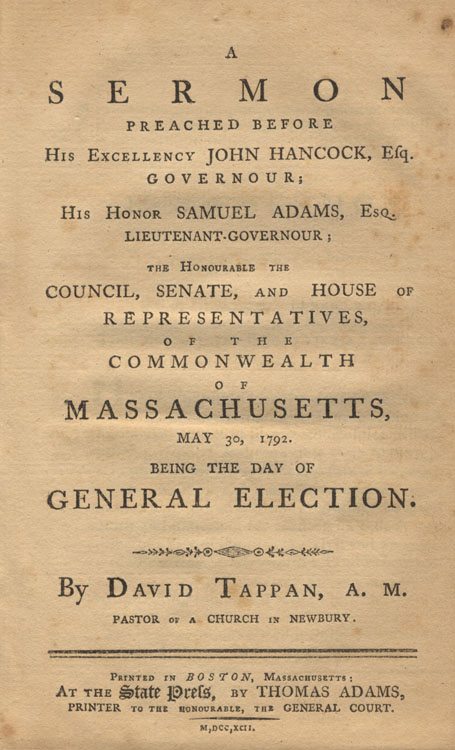
sermon-election-1790-massachusettsThe Reverend Daniel Foster was born in 1750. He was ordained in 1788 (his father, the Rev. Isaac Foster, preached his ordination), and pastored a church in New Braintree, Massachusetts for many years. Daniel Foster had numerous sermons published, of which copies of five are know to be extant. In this election sermon, preached before Governor John Hancock, Lieutenant-Governor Samuel Adams, and both houses of the Massachusetts legislature, Rev. Foster provides an exemplary model of a pastor illuminating God’s governmental principles for the political leaders of his State. He lists the duties of magistrates as well as the duties of the people in a Christian country, and details God’s design for civil government.

Reverend Foster ends his sermon by directly addressing on a personal and individual level John Hancock, Samuel Adams, and the legislators. Foster’s sermon is loaded with Biblical wisdom; and he is an excellent example of a minister whose “lips keep knowledge [that] the people should seek the law from his mouth” (Malachi 2:7).


A
Sermon
Preached Before
His Excellency John Hancock, Esq.
Governor;
His Honor Samuel Adams, Esq.
Lieutenant-Governor;
The Honorable the
Council, Senate, and House of Representatives,
of the Commonwealth of Massachusetts,
May 26, 1790.
Being the day of
General Election

By Daniel Foster, A.M. Pastor of the Church in New Braintree.

Proverbs 8:16. By Me princes rule, and nobles, even all the judges of the earth

In compliance with the laudable example of our pious Ancestors, on such joyful anniversary occasions as this day presents us with we have assembled in the House of God, to offer our devout praises to him for what he has done for them, and for us, their children; to seek his direction and blessing upon our Political Fathers here present, in the discharge of the important trust reposed in them, and his smiles on this confederate rising Republic.

And as it has fallen to one of the least of the Ambassadors of Christ, to perform so essential a part of the exercise of the day, it will not be expected that he turn Statesman in this sacred place, or wander into all the affairs of government: But, in compliance with his character as a Minister, make such observations from the sacred text, as may be profitable for direction and encouragement, that the men of God here present, may be furnished to every good work.

This book was penned by King Solomon a man famed for wisdom and understanding throughout all the East.

That being who has an easy access to the human mind, appeared to him in Gibeon, in a vision of the night; and God said, ask what I shall give thee? And his request, “give therefore thy servant an understanding heart,” was so acceptable, that God gave him wisdom above all that were before him in Jerusalem; for the people soon perceived “that the wisdom of God was in him to do judgment.”

In these Proverbs of the wise man, we have the comprehensive duties we owe to God, and the world, made plain and easy, and enforced with the most powerful motives. By folly, the Preacher would be understood to mean vice and wickedness and by wisdom, grace and Christ.

In the text, the person speaking is doubtless Jesus Christ, who by the Apostle, is called “the wisdom of God, and the power of God.” “By me Princes rule, and Nobles, even all the Judges of the earth:” That is, by my Providence and appointment, they are advanced to rule and govern; and their government is merciful and righteous, happy and prosperous, by my council and assistance.

Ever since the apostasy; the blessed God, has pursued an uniform plan of grace, and government with the church, and the world. The merciful design of which, is to reduce to order, peace and happiness, his intelligent offspring. To prosecute this design, he has sent into the world the “PRINCE Of PEACE,” and given him a commission for acts of ministry and grace, magistracy and government.

The intervention of the new covenant, and the advent of Jesus its Mediator, gave birth to order and subordination in Heaven, and upon Earth.

In Heaven there are thrones, dominions, principalities and powers, angels and arch-angels; and upon earth, princes, nobles, and judges – and Christ is Head over them all.

The text leads us to speak of civil government, as ordained of God, in the hands of the mediator; of civil rulers, as holding their commission and authority under Christ; of their duty and dignity as his Ministers, and of the duty and privilege of the people under their administration.

I. That civil government is ordained of God in the hands of the Mediator, the Absolute necessity of order and government, for the existence and happiness of society, pleads its divine original: For without it, the affairs of mankind would fall into the utmost confusion and disorder.

The nature of man, as a sociable creature, would no doubt, have led him to some sort of government had sin never entered the world. But since sin has debased the noble nature of man, and spread itself through the whole world, both reason and revelation plead for government.

It is not a matter of human prudence only, but of necessity and moral obligation: And being enjoined by him who rules in the kingdoms of mortal men, it is an important mean of delivering us from the evils of the apostasy; and designed to prepare us for the more encouraging restraints the gospel enjoins.

Civil government, then, is a branch of the tree of life, and founded in, and built upon that covenant, sealed in Heaven by the oath of God, and upon earth by the blood of Christ.

He being commissioned by the Father to manage the great affairs of Empire, as well as of Zion.

“Yet have I set my King upon my holy Hill of Zion.” “The government shall be upon his shoulders.”

The kingdom of Christ, where he rules by his word and spirit, is his Church, a spiritual kingdom. But his commission extends to the Utmost ends of the earth.

“For the stone cut out of the mountain without hands, is to break in pieces all other kingdoms, and fill the earth.”

His kingdom will outlive all other kingdoms, and swallow them up; for he must reign till he hath “put down all rule and all authority and power.”

This implies that rule and authority among men, or which is the same thing, civil government, is a divine appointment, and that it is put into the hands of the Mediator to rule and govern the world. For when the great and important ends for which he received his mediatorial kingdom, shall be accomplished, he will put down both ministry and magistracy.

II. That civil rulers hold their commission and authority under Christ.

Not that Christ has pointed out the form of government, or the persons to rule and govern; in this sense his “kingdom is not of this world” But Christianity enforces the law of nature; and has confirmed the several constitutions of states and kingdoms, and called our obedience to the higher powers, as the gospel finds them.

The mode of government, and persons to govern, are submitted to the wisdom of men, in pursuance of a divine ordinance, that second causes might operate. It being the method of God to carry on the designs of his government in this world, by the instrumentality of subordinate Agents. When therefore, a people unite in a form of government, and choose persons to rule and govern them and pledge their faith to be obedient to, and support the government, “though it be but a man’s covenant, yet if it be confirmed, no man disannulleth or addeth thereunto.”

The Magistrate then, called to office by the voice of the people, and solemnly sworn, becomes an ordinance of God, and receives his authority from him, “by whom Princes rule, and Nobles, even all the Judges of the earth.”

And the apostle, when he enjoins obedience to civil rulers, “because the powers that be, are ordained of God,” means to include in his idea, the methods by which they become possessed of their power, and likewise the use and improvement they make of it: If they rule for God, and for good to the people, they are to be subjected to, otherwise, “we ought to obey God, rather than men.”

III. We come to speak of the duty and dignity of civil rulers, as the ministers of Christ.

1st. It is their duty to uphold the kingdom of Christ, which consists in “righteousness, and peace, and joy in the Holy Ghost.”

Religion is, and ever has been, considered the glory of a people; as it insures the favor and protection of Heaven.

Under the former dispensation, the Ark of God, which contained his laws, was a token of his presence and defense. Governor Eli, whose heart trembled for it, sustained the tidings of the of the death of his two Sons with fortitude; but when it was told him that the Ark of God was taken, he fell and died, and his Daughter refused to be comforted, though a Son was born; because the glory was departed from Israel, and the Ark of God was taken.

Under this dispensation, the gospel and its ordinances, are our glory and defense. And as magistrates are honored by Christ, and act under his banner, they should be careful to be his glory, and support his religion in the world.

All men should be possessed of a principle of piety and virtue; but none stand in greater need of it than those who are called to rule and govern.

Religion dignifies and enables the mind “refines and purifies the heart” fits men to act worthily their part on the stage of life, and shines with a peculiar luster in the Christian magistrate. This will procure for them honor in the sight of all men; “for those that honor me, I will honor.”

Saul was destitute of this principle; but desirous of its fruits and effects. Therefore he pressed the man of God, and laid hold on the skirt of his mantle, and it rent; saying “honor me now I pray thee, before the Elders of my people.”

This is the way to have the presence, and blessing of God with them, and upon their administration.

The seat of the magistrate is called the throne of God; “and he was caught up unto God, and into his throne.” As they have the image of God upon them as his Ministers, and act by his authority, it should be their care to have the image of God within them as men.

It is an honorable account we have of Judah, in a time of general revolt, the ten tribes went after Jeroboam; but Judah yet ruleth with God, and is faithful with the saints.

If religion is not honored and supported by men in places of public trust, the glory of the Lord will soon depart, and the fire of God be scattered over the city.

Rulers are called “the shields of the earth;” they are to protect the people from injuries among men, and likewise from the judgments of God. When God’s wrath was kindled against Israel, for their idolatry at the foot of the mount, we find Moses, that pious ruler, pleading the cause of the people, and he sounds his plea upon God’s covenant, and reminds him of his oath. And David, that man after God’s own heart, when he saw the Angel that smote the people, said, but these sheep, what have they done? “And the Lord said unto the Angel, it is enough, stay now thine hand.”

The attention Christian rulers pay to religion in their hearts, and in their government, will be their support when they are called to lay down their commission, and their lives; it will brighten the scene before them, and embalm their memories when they are dead.

2d. It is the duty of Christian rulers, to preserve and secure to the people, their liberties and properties.

The end and design of civil government is to secure the happiness of the whole community. For this, rulers are appointed; “he is the Minister of God to thee for good.”

The liberties of mankind have ever been held dear, for they are given are by God and nature. “With a great sum, obtained I this freedom,” says the chief Captain to Paul, who relied, “but I was born free.”

This has been and still is the voice of Americans; and our attention to the voice, which is from Heaven, has brought us into possession of the liberties and privileges, we this day enjoy.

An infringement on these, has ever awakened the fears, and kindled the resentment of an enlightened people! It has overturned empires and kingdoms, caused the stars to fall from Heaven, and princes to walk, as at this day, like servants on the earth!

In order to secure the liberties and privileges of the people, righteous and equitable laws should be made, and preserved. “That which is altogether just shall ye follow,” is an injunction from the First Magistrate in the universe.

We plead for a government of laws, not of men. The law is a rule to try all causes between man and man by; and it is a rule between the magistrate and subject it teaches the one how to rule, and the other how to obey.

They are the pillars on which the Commonwealth stands; to them we appeal for a redress of grievances, and into their hands we are willing to fall; but not into the hands of men. They are in scripture, called the foundations of the earth; and said to be out of course, when the magistrate is either ignorant of them, or neglects to support his authority in their execution.

3d. The Christian ruler will hear the complaints, and redress the grievances of the people he governs.

He will not with Rehoboam, reject the voice of the old men whose years have taught them wisdom, and apply to young men for counsel; answer the people with grievous words, and cause them to say in the bitterness of their souls, “what portion have we in David? Neither have we inheritance in the son of Jesse.” But he will enlighten the ignorant; and those that are out of the way, he will reduce to order and obedience, with the cords of law and love. He will follow the example of him by whom he rules, whose work and glory it is, to make peace and bind up the wounds of the people.

Christian rulers will consider the infancy of the people, and the burdens laid upon them, and be careful lest they over-drive, and so destroy the flock of God.

They will lessen the charges of government, and lighten every burden, as much as is consistent with the honor and well-being of government.

The cause of the widow, the fatherless, the orphan; the soldier, and him that has loaned hi money for the help of government, will come with peculiar grace before Christian rulers; who will hold themselves Heaven’s clients to vindicate their righteous claims; and plead their cause.

The credit of the Commonwealth, at home and abroad, is a matter that requires particular attention: In many instances its faith has been pledged. But Christian rulers will remember, that our father Abraham, was not justified by faith only; and add energy to our faith, that we may as a people, be justified in the sight of God, and the world.

4th. We come as proposed, to speak of the duty and privilege of the people under the administration of Christian rulers. And

1st. It is their duty to pray for them.

Government is an important trust, and though it be limited by righteous and equitable laws; yet such is the condition of human nature in this world, that the greatest and best of men are liable to err, and are insufficient to manage the great affairs of state, without direction and influence from Heaven.

God is the blessed and only potentate, his essential perfections are his blessedness, and enable him to manage an universal Empire! He stands in no need of his creatures’ wealth to maintain his crown, their power to effect his designs, or their wisdom to direct his counsels. But it is far otherwise with his vicegerents here on earth; though they are called gods, and clothed with authority from Christ and the people yet they are but men.

The affairs of government are often intricate and perplexing, and dangers eminent and threatening, so that rulers find occasion to adopt the language of the pious king of Judah, “neither know we what to do.”

We are divinely bound to pray “for all in authority,” that government might be equal and righteous, and that we might “lead a peaceable and quiet life, in all Godliness and honesty.”

It is the blessing of God, that makes government steady and effectual, and gives peace and quietness to the Commonwealth; and God will be sought unto, for such an inestimable blessing.

When we pray for them, we pray for the advancement of peace, and Godliness, this being the end for which government is instituted.

2d. It is the duty of the people, to support their rulers. That authority by which they govern, enjoins obedience from the people to all their righteous laws.

And as they have a painful preeminence above their fellow mortals, and an arduous and important trust committed to them by God, and the people; they should be freed from cares and troubles about the affairs of the world. “For this cause, pay you tribute also; for they are God’s Ministers, attending continually upon this very thing.” The advantages we enjoy tinder a righteous administration, entitle those who govern to large returns. Our persons and properties are secured, and we set under our own vine and fig-tree; being protected, by a government merciful and righteous.

When taxes are made for the support of government, there is a moral obligation on the people, to discharge them; for government which is an ordinance of God, could not subsist without such support.

Our blessed Lord set us an example worthy of imitation, when he sent Peter to the mouth of the fish, that he might receive money to pay their tribute. And enjoined upon us to “render to Caesar, the things that be Caesar’s.” A support, honor, love and obedience, are enjoined through the whole book of God, upon the people, as a just tribute due to those who govern.

It is the privilege of the people granted them by God and nature, to choose their own rulers.

Kingly government was never of divine appointment; but added, as the law was, “by reason of transgression.”

The government, early established in the world among the ancient Hebrews, was a free republic like ours, the sovereignty resided in the body of the people.

They were to choose able men; and they were called to give their assent to the laws given from Heaven, before they were put into execution.

When government is thus founded, according to the divine mind, and rulers chosen, they become representatives of the power and majesty of God; and important instruments employed by his providence and grace, in the administration of affairs in this lower world.

They are entrusted with the lives, liberties and properties of the people, For them prayer should be continually made, and to them obedience given, as God’s vicegerents, when they rule for him, and for good to the people.

People should be careful of censuring them, and increasing their burden and concern, lest they be reproved by him, who has forbid our “reviling the gods, or speaking evil of the rulers of the people.”

But when rulers neglect the great affairs of government “when they break not every yoke” plead not the cause of the injured and innocent, the widow and fatherless, the poor and needy, when they do not support religion, liberty, the arts and literature; the pillars of government will fall, and society throw off its pleasing apparel: “The sword shall be upon the arm, and upon the right eye of the magistrate” he shall lose his discernment in public measures, and his authority shall be taken away.

On the other hand when those in authority, move with dignity in their proper sphere, are God’s ministers for good; and people are subject for conscience sake, what a pleasing appearance does the Commonwealth put on! Such as once induced the prophet to exclaim “how goodly are thy tents, 0 Jacob, and thy tabernacles 0 Israel!”

From what has been said we may infer.

1st. That God in the scheme of grace by Christ, provided for the happiness of mankind in this world, as well as for their immortality and glory in the next. And foreseeing to what endless confusion and irregularity the world would tumble, without order and subordination: has with one stroke wrote himself, religion and government on the mind of man. – And has sent his son from Heaven to explain, and enforce, what, at first, he wrote on the mind of man, and to reign and govern in righteousness.

Civil government is designed to sub-serve the grace of the gospel; and the happiness it defuses through society in this world, should call forth our gratitude and praise to God, its author.

It smoothes the rugged road of life, gives the quiet and peaceable enjoyment of every blessing, and raises in the mind, the most exalted conceptions of that blessed Being, whose benevolent design, is to raise the virtuous among mankind, by small gradations, to happiness and perfection with himself.

Government is a link in the chain of everlasting mercy; and those who are obedient “for the Lord’s sake” who has appointed it, may expect that their path will shine more and more unto the perfect day.

2d. We infer. “That days of greater peace and happiness, then have ever dawned upon the church and world and before us in America” this we argue from the ability of Christ’s person, the extent of his commission, his going forth of old with our fathers; and the deliverance he hath wrought for this generation.

The kingdom of providence, and the kingdom of grace are his; and he manages the affairs of the one in subserviency to the other.

It has been the method of God from the beginning, to reveal the designs of his grace and mercy to the world by degrees.

He promised one, mighty to save, and able to govern soon after the apostasy in the garden; but four thousand years were numbered, before the desire of all nations came.

Since he appeared on the theater of life, the church and world have pressed on for ages, through, the fire of perfection: Deluges of blood, oppression and slaughter, but little benefited, to appearance, by his coming and death.

Till the Angel of the Lord pointed our forefathers to this Western World; a land where he determined to unfold the plan of redemption and government. Here they found a safe retreat from persecution and cruelty. Savage beasts and men vanished before them, like the dew before the rising sun.

Here the church was founded upon the doctrines of Christ, and the Apostles, which put forth her branches like the palm-tree, and bid fair to eclipse the glory of the world.

This awakened the fears of the country from whence they came, who were grieved at our greatness and envious at our rising glory, and attempted to take from us, our liberty, and this land God gave to our fathers; prepared chains to bind us to passive obedience, and drag us to perdition. The great charter was violated, and the laws that were to protect this infant world, infringed upon. “The foundations were all destroyed, and what could the righteous do?”

In that day of our distress, we appealed to the strength of Jehovah, and the justice of our cause: And God came from Teman, and the Holy One from Mount Paran, he stood and measured the earth, and drove asunder the nations, and confirmed us in the possession of this goodly land.

Under the direction, and by the assistance of Him, who administers on Heaven’s eternal plan, we are delivered from the horrors of war, and enjoy both civil and religious liberty!

We have been led to frame and adopt a constitution of government that is the wonder of the world; resembling that which God of old, gave the Israelites, the seed of Abraham his friend.

We shouted with heartfelt joy, when the political ark was brought to its place. Sing O Heavens for the Lord hath redeemed New England, and glorified himself in America!

When we look over these great events, we are constrained to cry out with the Patriarch, “surely the Lord is in this place, and we know it not.”

We are respected abroad among the nations of the earth, and united at home. God has put this honor upon us, and spoke peace to our borders.

The system of national government we have settled, we hope, will secure to us, and hand down to the generations to come, the liberties and privileges we have procured by our toil, treasures, and the blood of many of our virtuous sons.

The choicest blessings, religion, liberty and peace, were reserved in the counsels of God, for thee, O America!

And what God has done for our fathers, and for us of this generation, are but intimations of our future happiness and glory; that he will have a light before him in this Jerusalem, ’till the second coming of Him, who is the “light to lighten the Gentiles, and the glory of his people Israel.” Here the empire of Jesus is founded, and these are the halcyon days disclosed to the pious Prophet, in a vision of the night.

“And behold! one like the Son of Man came to the ancient of days, and there was given him dominion, glory and a kingdom; and his dominion is an everlasting dominion, which shall not pass away; and his kingdom, that, which shall not be destroyed.”

From the rise and present exaltation of America, we conclude she is to be the theater, where the latter day glory shall be displayed; and the medium through which religion, liberty and learning, shall be handed round creation.

3d. We infer: That Christ will vindicate the sacred rights of his government, in the utter destruction of all that oppose his reign.

It becomes rulers, ministers and people, to be willing subjects of this kingdom, that they may be the glory of Christ its King.

The impious and ungodly will be ensnared in their own plots and devises; and the Heavens will reveal their iniquity one day. “Kiss the Son, less he be angry, and ye perish from the way.”

True it is, God has done great things for us; he has delivered us from war, and invited us by the dawn of peace, to lay aside the dread artillery of death; he has given us a land that flows with milk and honey, and settled both church and state in peace.

But what is this to the sinners of my people, who live in intemperance, debauchery, pride and luxury, fraud and deceit; who violate God’s holy laws, neglect the duties of the gospel covenant, cast off fear, and restrain prayer before God.

Jesus, who is exalted at the head of the universal polity of Angels and men, when his wrath is kindled but a little, will dash such characters to pieces like a potter’s earthen vessel.

From the evil returns we have made to Heaven for past mercies, we have reason to fear the divine rebukes: “You only have I known of all the families of the earth, therefore I will punish you for your iniquities.

God brought his people of old to the borders of the promised land; but they murmured against Moses and Aaron, and were for making a Captain and returning into Egypt. This provoked Him who had done great things for them, to say “your carcasses shall fall in the wilderness, and ye shall know my breach of promise: But your little ones, them will I bring in, and they shall know the land which ye have despised.” So it will be with the wicked of this generation; with Balaam we behold the glory of America, but not nigh; we shall meet the grave, and the horrors of eternity; and our “sons will come to honor, and we know it not.”

We have solemn tidings this day from the mount of God: “The children of New England have forsaken my covenant: Do ye thus requite the Lord?” O foolish people and unwise!

Hear with what irresistible eloquence the prophet Isaiah pleads against the impenitent of this age and country; “Hear O Heavens, and give ear O Earth, for I have nourished and brought up children, and they have rebelled against me.”

O that we may as a people, know in this our day, the things of our peace, repent, and do our first works; that God may heal us, and bestow those blessings, he has encouraged us to hope for, from past mercies. Then shall we find the grave in peace, and leave this inheritance to our children’s children; who will read the history of our day, with amazement and veneration, and call us blessed, when we are sleeping in the dust!

But it is time that I close the subject with particular attention to the important political characters that compose so great a part of this respectable assembly.

And His Excellency the Governor and Commander in Chief of this Commonwealth, claims our first attention.

MAY IT PLEASE YOUR EXCELLENCY,

We rejoice to find, venerable sir, that you are again, by the suffrages of a free and independent State, called to fill the first seat of government. You are the man on whom the eyes of this Israel are set, that you should rule over us.

Your former services for these States, in the day of small things, and your administration government in this Commonwealth, are engraven on our hearts, as with the point of a diamond.

It was under your presidency and direction, that an ancient prophesy was literally accomplished, “a nation born in a day.” America declared free, sovereign and independent!

Your ardent love to your country, your indefatigable labor on her behalf, and your alms which have been distributed to the poor and needy, render you dear to this, and will, to the generations to come.

Time shall stop her course, and expire in eternity, before you will be forgotten. While religion, liberty, justice and benevolence, are counted valuable upon earth, your Excellency will have a name and praise in it.

An holy God has deprived you, of a promising son to bear up your name, when you become weak like other men, and are called to sleep with your fathers, and by him, who for so many years, was your worthy and pious contemporary in office: But he has left you a name better than that of many sons; one that will live in the breasts of virtuous Republicans, ’till our father Adam shall salute the arrival of his youngest son to the abodes of bliss.

We have not only a grateful remembrance of your past services for America, and this Commonwealth in particular, but we confide in your good disposition, and uncommon abilities, to fill with dignity, the seat of government, where Divine Providence has placed you.

Your Excellency will please to remember, that your authority comes from Christ, though by the mediation of the people; whose religion you will imbibe in your heart, and support in your government, that the people may take knowledge of you, that you have been with Him, by whom you rule.

The ministers of Christ, who are commissioned by the same authority that invests you, will meet your countenance and protection, though they act in another apartment in the house of Christ.

The University, that has given birth to so many important characters, both in church and state, leans forward, as it were, and whispers to you her son, to administer to her necessities.

We wish you the presence and blessing of Heaven, to enable you to act in your whole administration, under the influence of a principle of justice and mercy: This will entitle you to the love and esteem of a people you have made happy. This will yield you calmness of mind, under the bodily infirmities, God is pleased to inflict you with, and the cares and troubles of government, this will brighten the gloom of death, and give you boldness in the day of Christ.

May you long live to serve your God and generation; and when you are called to put off this mortal form, may your soul wing her way to yonder bright and intellectual world; where, from the mouth of your Divine Master, may you hear that blessed euge, “well done good and faithful servant, thou hast been faithful over a few things, I will make thee ruler over many things, enter thou into the joy of thy Lord.”

His Honor the Lieutenant Governor, claims our next respects, to whom the discourse is now addressed:

MAY IT PLEASE YOUR HONOR,

It has pleased God to spare your important life, to see the fruit of your labor and anxiety, in years past, and to awaken the attention of the people to call upon you, to exert your talents and abilities for the good of this Commonwealth, At a time when the voice of men, whose years have taught them, is needed.

Your integrity, patriotism and devotedness to the cause of your country, has given you favor, and kindled in the minds of the people esteem and veneration, that time will not obliterate.

The Recording Angle will not silently pass by your labor and attention, when we came over Jordan with our staff.

The laws of justice and gratitude, which are the laws of God, require that we accept it with thankfulness to you; and more especially to that God, who has made you so instrumental in delivering us from tyranny and oppressive power.

We have a recent remembrance of the critical day, when His Excellency and your Honor, were excluded a pardon of God and America, for their insults and cruelty.

You have lived to see your desires accomplished; the Temple of Liberty raised and the glory of America, founded through the world by the trump of Fame! Now your eyes behold this, you are ready to adopt the words of Simeon, when he clasped the infant Savior in his arms, “now lettest thou thy servant depart in peace, for I have seen thy salvation.”

We look to you, honored sir, and expect that you conspire with your best endeavors, to make easy and happy, this great people: And may a grateful people, by their returns of honor and justice, equal your past, and their expectations of your future services.

May God have you in his holy keeping; make the remainder of your days comfortable and happy, and when he shall see fit to discharge you from further services below, may you shine forth with resplendent glory in the kingdom of the Redeemer above.

And may the Honorable Council, so necessary and important a Branch in government, be counseled and directed of God; and in all matters that come before them, act with stability and firmness, being influenced by that wisdom which is from above.

May your piety and virtue, gentlemen, recommend you to the favor and protection of Heaven; and your integrity and uprightness of conduct, render you more and more objects of the love and confidence of your brethren. But if your labor and fidelity, should not meet the approbation of the world, as it is often the case, you will have within you, conscious worth before you, an animating prospect of the acceptance of God, and a reward in the world to come.

The Honorable the Senate, and the Honorable the House of Representatives, claim the attention of the Preacher, and to whom he would now turn his discourse.

You are this day, respectable gentleman, constituted the ordinance of God, for good; and, having received authority from Christ, and the people, you have before you a very weighty concern, to promote the best interest of the people, and see that the Commonwealth receive no detriment.

The multitude of your brethren have put confidence in you, and made you the keepers of their vineyard. You will regard, gentlemen, the sacred enclosure of Christ, and be nursing fathers to his church, and people. We look to you for equal and righteous laws, and a pattern of every virtue.

You will remember, that government came into the world, on the same benevolent errand its Divine Author did, not to perplex and destroy men’s lives, but to enlighten, reform, and save them: And if there are any laws too sanguine in the case of life and death, you will adopt some other punishment than that of sending souls unprepared, to the tribunal of God.

Be not unmindful, sirs, that the eyes of God are upon you in your public capacity: He observes what attention you pay to the concerns of the public, to the widow and fatherless, the poor and needy, and the cause of virtue and religion. To him you are accountable, and before his awful tribunal you must soon stand, with the meanest of your brethren.

You are called Gods, let your compassion to the poor, resemble that of the Father of Mercies.

Guard against pride, covetousness, and a disposition to bind heavy burdens on the people.

Lay aside party considerations and private designs, and do that which you can answer to God, and the people. Then you will be blessed and the blessings of many, ready to perish, will come upon you. And in the last grand revolution, when all distinctions, but those of a religious nature will be forever done away, you will meet the approbation of HIM, by whom you rule, and your reward will be great. We wish you divine direction, and a blessing, this day, out of the house of God.

Let this great and attentive Assembly, call to mind the duties they owe to God, and the world, and the obligations they are under to the faithful discharge of them.

Of infinite importance is it to us, Christian friend’s, that we are possessed of that faith in, and faithfulness to Christ, which the gospel constitution makes necessary, in order for us to obtain eternal life. If we are the subjects of divine grace, and act worthily our part on the stage of life, we may meet adversity with fortitude, and death with comfort – for it will reach us to a world, where God will be the sun, in which he will run through our souls with a torrent of delight. On this pleasing hope and joyful expectation, I will dismiss you, until that day, in which may the Preacher find mercy, and meet you all amongst the redeemed of the LORD – and the glory shall be given to HIM, who sitteth upon the throne, and to the LAMB, forever and ever; and let all the people say AMEN


Sermon – Election – 1790, Connecticut


Nathan Strong (1748-1816) graduated from Yale in 1769, was ordained in 1774, and became pastor of 1st church in Hartford. He served as chaplain in the Revolutionary Army, ran the “Connecticut Evangelical Magazine” from 1800 to 1815, and was one of the founders of the Connecticut Missionary Society.

sermon-election-1790-connecticut

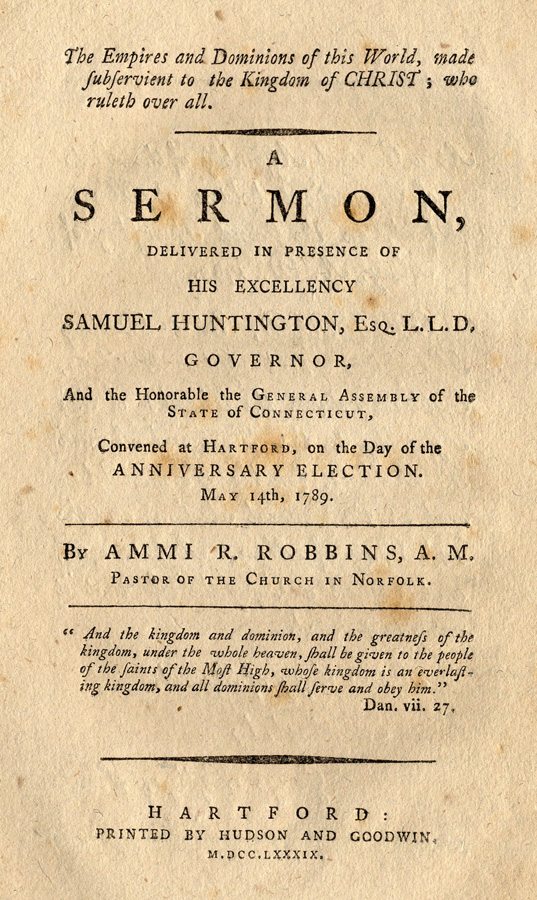
Mr. Strong’s Election Sermon.
1790

A

SERMON,
DELIVERED IN PRESENCE OF
HIS EXCELLENCY
SAMUEL HUNTINGTON, Esq. L.L.D.
GOVERNOR,
And the Honorable the General Assembly of the
State of Connecticut,

Convened at Hartford, on the Day of the

ANNIVERSARY ELECTION.

May 13th, 1790.

BY NATHAN STRONG, A.M.

Pastor of the First Church in Hartford.

HARTFORD:

PRINTED BY HUDSON AND GOODWIN.

M.DCC.XC.


At a General Assembly of the State Of Connecticut, in America, holden at Hartford, on the Second Thursday of May, A. D. 1790.
ORDERED, That Colonel Thomas Seymour and Captain Jonathan Bull, return the Thanks of this Assembly to the Reverend Nathan Strong, of Hartford, for his Sermon delivered at the General Election, on the 13th Day of May 1790, and request a Copy thereof that it may be printed.

A true Copy of Record,
Examined by
George Wyllys, Sec.

ELECTION SERMON.

ROMANS, xiii. 7, 8, 9.

Render therefore to all their dues: tribute, to whom tribute is due; custom, to whom custom; fear, to whom fear; honor to whom honor.
Owe no man anything, but to love one another: for he that loveth another hath fulfilled the law.
For this, Thou shalt not commit adultery, Thou shalt not kill, Thou shalt not steal, Thou shalt not bear false witness, Thou shalt not covet; and if there be any other commandment, it is briefly comprehended in this saying, namely, Thou shalt love thy neighbour as thyself.

This passage, which is a summary of the laws of Religion, may also be considered as a summary of those political and social duties, by which a nation is made happy.  The chapter in connection is the best political dissertation that was ever penned.  Without entering into a comparison of the several kinds of government, which men have erected, the writer confines himself to general truths and duties, which are necessary in all of them, are founded in the nature of society, and approved by reason and experience.

He begins the chapter with asserting the divine origin of civil government.  The powers that be are ordained of God, whoever resisteth the power resisteth the ordinance of God.  Infinite wisdom suffers us to chuse our own form of government, and designate the instruments by whom it shall be executed; but the ordinance is still the Lord’s, and to refuse obedience is sinning against heaven.—Nor hath any man a right to complaint, as the institution was designed for human good, and there is an easy way of reconciling our own interest with all the powers of a well regulated government.  For rulers are not a terror to good works but to the evil.  Wilt thou then not be afraid of the power?  Dost thou desire it to be a blessing and not an evil to thee?  Do that which is good and thou shalt have praise of the same.  For he is the minister of God to thee for good.  Wherefore ye must needs be subject, not only for wrath but conscience sake.

After asserting the divine origin and the necessity of civil government, in some of the kinds practiced by men; the Apostle recapitulates, in our text, the principal duties by which society is united, protected and made happy, and sums up his description in these words, And if there be any other commandment, it is briefly comprehended in this saying thou shalt love thy neighbour as thyself.—If there be any political duty, not otherwise expressly commanded, we may find it in the great law of Christian love; this law directs rulers and subjects in every possible connection, and will make them faithful in their respective places.  On reviewing the connection of the chapter, it appears that the Apostle designed our text, as a collection of political maxims, by which society may be preserved, and the great end of government be promoted under whatever form or constitution it subsists: and on further attending to the same maxims, we find they are the essential laws of religion, which were early given to men as a rule of duty, and of their present and future well being. I think this is a clear proof, that religion and a well regulated civil government are subjects which cannot be separated.  A good ruler or a good subject will not suffer these laws to go out of his view.  Happiness is the great end designed by all social institutions; for this, the laws and duties of religion are enjoined on creatures by the wisdom of their maker; for the same end men have organized government, and defined its powers and duties; both have relation to the social capacities and enjoyments of connected minds, and aiming at the same end, must in a considerable degree procure it by the same means.  So far as religion and government deviate from each other, one or the other of them deviates from the nature of men, and the effects of their social relation.

Happiness cannot subsist without love and justice, between those who are brought into connection by the supreme providence.  The blessedness of a perfect world, and the perfection of divine government, are represented to us by the abundance of these virtues.  We have no reason to suppose that systems of virtue or law, essentially different, are necessary for the good government of the heavenly and earthly societies; as they both aim at the same thing, the happiness of rational minds in union with each other.  There is not an idea, in the world, more dangerous to society, or more debasing to civil government, that this, that it stands on a basis of human wisdom and will, apart from those great religious obligations, which direct the manner and duties of intercourse in all worlds.

Religion, or love, holiness and righteousness, the names by which it is commonly called in the sacred oracles, is the constitution and law of the supreme government, by which the Almighty is glorified, and his creatures connected in blessedness; and the nature of intelligent beings admits not a safe introduction of other principles; depart from these and we act no longer like reasonable men or like Christians.

Our apprehensions of a perfect and glorious society must be defective, as we have not the aid of experience; but in accounting to ourselves for the blessedness and stability of its orders, we always conceive the perfect exercise of religion, as a cause sufficient for the effect.  If the laws of religion are sufficient to render the divine government most glorious and happy; and if the practice of religion will give a future perfection to the heavenly life, why are not the same principles and practice, the strength and safety of men’s government in this world.  The Lord our God governs according to the nature of things, and his administration always ends well; and are not men, when they act for him in the temporary authorities of the world, most like to succeed, to support their own dignity, and be a blessing to others, when they adopt in their administration and act from the same principle.

A ruler needs religion much more than his unofficered brethren, to support his mind under trials, and to guard him against temptations.  When the respectable citizen rises from private into public life, he must expect to exchange quietness for trouble; honor, though alluring, has its bitterness and its dangers; enemies before unknown, will rise up; the jealous will sift all his actions, and what man can be so guarded as to have all his behavior escape censure?  The ambitious, thinking him in the way of their own progress, will be his enemies.  To support the mind under these evils, and lead it into the exercise of prudence and patience, religion is necessary.

To hold great power and places of confidential trust is a state of temptation, which every man cannot resist, and those who are wise will not accept a call to public service, until by examination, they find in their hearts fixed principles of fidelity.  A bad man may seek elevation, but it is only a good man who can bear it; many shine in adversity, which cools the appetites and unsocial passions; but to shine in prosperity; to be humane and just in the circle of a court; to be true and honorable in the treatment of all mankind; to be righteous and honest when power gives opportunity for oppressing, the assistance of fixed religious principles are certainly necessary.  If religion be necessary to assist us in the common duties of life, it is more necessary where duties are multiplied and enlarged.

Political elevation is generally esteemed honorable, but it is not always attended with honor, for this depends not on the elevation itself, but on the principles and conduct of the person who is raised.  What is true honor but the esteem and love of mankind on virtuous reasons?  He who renders to all their dues—who preserves himself from a transgression of God’s laws, by injuring the purity, interest or reputation of others, and performs the political and brotherly duties enjoined in the command—thou shalt love thy neighbour as thyself; he hath an honor which enemies cannot long stain, nor time wipe away.  But a profusion of knowledge, and the glare of great abilities, without fixed principles of love to God and men, are like a song, the sounds die away and the pleasing surprise of the mind departs.

Having made these general remarks on the usefulness of religion in civil society, and in the character of one who rules men; that we may see its efficacy in the clearest manner, let us more accurately trace its nature and effects in the mind.

We are now to consider the formation of a character, which will be uniformly supported thro life, and where a steady practice evidences some habitual dispositions, that cannot be subverted by every slight temptation.

The great end of political associations is best answered where there is the most perfect union, and those principles are most essential to government, which have the greatest tendency to produce union.  The interests of individuals, are by the emergencies of time thrown into many situations.  We live with many others whose passions are complicated, various and pointed to their own personal ends.  Every lesser district, very family, and individual in the family, hath interests of its own.  If these private interests have a supreme influence the utmost evils will ensue.  It is the business of government to hold the balance between them, to check the overbearing and point them to a common good, and for this it needs the assistance of some pervading social bond, and this bond can be no other than religion.

But few minds are so enlightened in the institution of nature and the supreme wisdom which formed it, as to see that a pursuit of the general good will be an eventual advancement of each man’s private good; and where there is this enlarged understanding if the heart be corrupt, the passions will rebel.

In all rational society there needs some cementing principle of the heart, by which the minds who compose it may be united, have one interest, one common good, and one happiness.

Many philosophers, and politicians of renown in their times, have enquired for this bond of union without success, and seduced by their own reasoning, have substituted art, corruption or power.

Christian love in its comprehension of virtues, is the supreme tie of social connexion.  This is the same as the Apostle means, when he says –owe no man anything, but to love one another—and if there be any other command, it is briefly comprehended in this saying, thou shalt love thy neighbour as thyself.—He that loveth his neighbour hath fulfilled the law; he will exercise all the varieties of love as they are modified in the actions of justice, truth, integrity and beneficence; he will render to all their dues, tribute to whom tribute is due, custom to whom custom, fear to whom fear, and honor to whom honor; he will reverence the property, peace and reputation of all mankind; and by his divine love he will be made happy in doing good to others.—Thou shalt love the Lord thy God with all thy heart, with all thy strength and with all thy mind, and thou shalt love thy neighbour as thyself, are the two greatest laws of an enlightened policy, in every community of reasonable creatures; this is religion in the heart, and the visible practice of it is that religion in life, by which a man becomes a good ruler, or a good subject, according as God is pleased to place him.  These first laws of religion are as excellent for earth as for Heaven; and as good a directory in civil administration, as in Christian living.

I would not be understood that the holy scriptures are a code of civil law, nor that they superceed its necessity, nor that the religion of Christ determines the most proper constitution of nations.  The divine law and gospel have in view a more comprehensive object, the government, the glory and happiness of the creation; still they embrace those moral and religious principles, in all their varieties, on which the happiness and stability of lesser societies must depend.—Public peace is the fruit of union—union is the result of Christian love and religion.  When every man regards the welfare of his brother and of the whole, the political body is strong, full of energy and happiness.

These are the most permanent and safe principles on which society can be organized, and all others are liable to an easy dissolution.  Power may constrain a kind of order in the state, but its very appearance is gloomy, and it is destitute of happiness.  Fear which awes cannot sweeten the heart and feelings of mankind; the subject compelled to quietness by a dread of severity, at the same moment wishes revolt, and the pleasant amities of living are all denied.—The selfish passions may be variously addressed, and a system of human art constructed; but to how many casualties it is subject and how often annihilated in a moment, the history of empires is full of witness.  Justice, truth, righteousness and mercy are the solid basis of empire, and these are but branches of religion or Christian love.  To these permanent principles of society nothing may be opposed, and the necessity which men sometimes urge is but a delusion.  All the virtues of a pious and good life, ought to be the object of national encouragement.  These reconcile the heart of the subject to the welfare of the whole and of his brethren.  They make a ruler the friend and father of his country; and might the heart of every citizen be inspired with these principles, the art and exercise of government would become extremely simple, and each one would be influenced by his feelings, to act in the sphere of his duty.  Coercion or an artful address to the passions of different orders of men would fall into disuse, for it is only thro human degeneracy, that these subsidiary aids can produce any benefit.

I am sensible that human nature must be taken by the civil governor as he finds it, and that there is not in the world a sufficiency of true religion to effect so happy a state as is described; but still he ought not to let these great principles of society go out of view, and if he doth, will certainly injure the public.

It is not uncommon for some, on observing men’s corruption, to embrace dangerous opinions on this subject.  Aiming at a wise and deep policy, they substitute collusion, intrigue, and an artful address to the passions and interests of parties, in the place of love, justice and truth.  They insinuate that religion and its institutions have nothing to do with government and civil policy, and that the moral obligations which may be a fit subject for the exhortation of a clergyman, cannot be very strictly consulted by those who manage the civil interests of mankind.  When any collection of people are so corrupt, that they will not bear reproof and the corrective restraint of government, that people ought to be disbanded and feel the correction of their own vices; and that which ought to be done the natural operation of things will speedily effect.  Such representations as I just mentioned, may sometimes proceed wholly from corruption of heart; an ambitious man, who knows himself destitute of religious principles, must be unwilling to have their usefulness in society generally acknowledged; but very often I believe they proceed from an ignorance of human nature, and the nature of society.  Tho the arts of corruption may succeed with a man for a few times, a loss of public confidence will put it out of his power to repeat them often.  Let him that ruleth over men be just; ruling in the fear of the Lord, is a law of perpetual usefulness, and derives its fitness from the nature of society; indeed religion is the best bond of society, and being such is the best support of government.

Tho a distinction is made in the state, between the civil and Ecclesiastical departments, neither of them is independent of the other.  Civility and the good order of political regulations are a great advantage to religion; religion and its institutions are the best aid of government, by strengthening the ruler’s hand, and making the subject faithful in his place, and obedient to the general laws.

Tho the author of our holy religion assumed no temporal authority, and gave no opinion on the several kinds of government, or the temporal jurisdictions of men; yet he established as first principles in his church, those laws which are essential to the peace of every state; on which every kind of authority must stand, which can be a blessing to the people; or which nerve the hand of government and protect the liberties of mankind.  Hence we find that wherever a just understanding of Christianity hath obtained, and its duties been practiced, they have had a benign influence on the liberty of nations:  And where a contrary effect hath been aided by what men called religion, as was the case in the Papal Hierarchy, it was owing to a subversion of the true principles of Christianity.  A spurious superstructure was raised by the corruption of men, falsely called by the name of religion, and not calculated to refine either the affections or practice of the people, but to aid a secular power by terrifying men, while those who were first in church and state shared their spoils.

The religion of Jesus, with no weapons in its hand but those of truth and love, silently subverts oppression; makes the people regular in discharging their duties, and rulers upright and humane in their administration; and there needs no other means to subvert the tyrannies of the world, than the universal spread and practice of this religion.

When as subjects, we find that religion assists us in doing all enjoined duties, and reconciles us to the interest of the public and our neighbours, we must suppose, that it will give equal assistance to those whom God appointeth to be in authority over us; and that their manners ought to be adorned by obedience to the divine law.  We feel sure that religion will guard them against temptations—lead them to a sound policy—to liberal feelings—to a paternal regard of the people, and an undaunted support of justice.

If there be not a mistake in these leading propositions, the following important conclusion must be received; that without religion no society whatever can long subsist in peace, or those who are members of it have reason to rejoice in the connexion.

The supreme will commands religion, for its usefulness to his connected creatures.  He saw that by this, the minds he created would become happy, and be joined in a communion, that makes the advantage of each one, matter of joy to the whole, and the dignity and perfection of the whole, an object of delight to each individual.  He saw that thus the intelligent kingdom would have one spirit, one interest and one happiness.  On what other foundation can rational and useful union subsist in this world?  In both cases the subjects are the same and have the same powers, faculties and capacities.  Do not those persons therefore act unnaturally, and against the laws of existence, who attempt the establishment of any society on other principles beside those of religion?  Are not their expectations of its permanency without reason?  Have we not always found the spirit of religion our best assistance in the duties and connexions of life?  Have we not found our families happy, in the same proportion, as its spirit and orders reigned in them?  Or looking back on the civil state, can we recollect a single instance of public injustice, or the semblance of it, or the extraordinary prevalence of any immorality, which was not followed with great evils?  The law of God and nature can never be repealed.

The conclusion extends itself still further; First, that it is the right; and Secondly, that it is the duty of civil rulers to protect religion.

First, it is their right.  It is a plain maxim of reason, that the civil state is vested with all necessary powers of self-preservation.  If it be lawful for mankind to combine in a political union, they have right to perpetuate the establishment; and as the passions of men are, there can be no comfortable living without such establishments.  To deny civil government the right of protecting religion, and suppressing irreligion, is denying it the most essential means of self-preservation.  All kinds of vice militate against the state, and religion in the modification of its virtues are its safe-guard.  To organize the civil state, and appoint a number of the people to be rulers; to commit the public to their charge and make them responsible for its well-being; and then to deny them the means and power of protecting and encouraging religion, is a severe requirement.  If any man accepts the charge, under this restriction he promises beyond human performance.

Secondly, It is the duty of rulers to protect and encourage religion, and of the people to assist them in doing it.  The public weal is the most sacred of all earthly betrustments.  Every man when called to office, hath an opportunity to refuse this care, if he thinks himself incapable, or finds that his heart is not honest enough to do it with fidelity; but when the trust is accepted, the obligations to a faithful performance are most sacred.  No light causes will excuse either the civil, or religious minister of the public, for unfaithfulness in the duties of his office.  The happiness of an individual is dear, and the forfeit of it more bitter than can be described; how much more dear the aggregate happiness of the public body?  Entering into society, we deposit our property, lives, friends and happiness, in the hand of the public; the public recommit this trust to the care of rulers, and give them a right and power to see it inviolably preserved.  If religion and its institutions be the most certain means to preserve, is it not their duty to protect and encourage virtue and piety?  Or can any man be called faithful in his appointment, who hath neglected to give this encouragement, both officially and in the private example of his life?  He hath had the visible dignity, but with a consciousness of unfaithfulness, can he feel honorable to himself, or be so vain as to suppose that he is respected in the hearts of the people?  Under a conviction of the truth I have urged, can he look back upon himself with a peaceful conscience?  The parent who hath been a fearer of the Lord, and a faithful subject and citizen, when he sees his family corrupted by such irreligion as the state ought to suppress, hath reason to complain, that his expense and allegiance have not been repayed by that guardian care, which he had a right to expect from the civil power, which alone can stop the sources and punish the instruments of corruption.

May I be suffered to suggest another serious truth.  The government is the Lords; men are the instruments of providence in arranging its powers and duties, and appointing proper persons to execute them; the government is still the Lord’s.  He commits his creatures to such of their brethren, as are supposed to have most wisdom and discreetness.  The whole earthly state, is designed as a school of instruction, and correction to mature such virtues, as will make men perfectly happy in another life.  This is one end of government, for we cannot disconnect time and eternity.  This great people are placed in the hands of their rulers, by Almighty God their tender Father and Saviour.  He sits supreme King and expects fidelity from all; every care and exertion that such religion be encouraged, as will secure present and eternal happiness.  Could we keep alive a sense of divine things, and the connexion between this and another world, these truths would make a deep impression on all our hearts.

By commending religion to the protection of the state, and the practice of its leading characters, I do not mean to urge an intolerant and persecuting spirit, which is very different from a tender care of piety.  Many differences of opinion in a land of Christian light, are concerning the non-essentials and the ritual of religion.  Several of these matters, the great head of the Church when he was on earth, did not think proper to determine.  Their propriety often depends on local or temporary circumstances, or on the particular construction and feelings of different minds.  Such differences when conscientiously maintained, have not a dangerous effect either on the essentials of religion, or good order of the state; and government may tolerate them with safety.  If we look thro the Christian sectaries, who differ in ceremonies and words, candor will perceive, that the greatest number of them unite, in the weighty matters of faith, piety, religion and justice, towards God and towards men.  A diffusion of knowledge is now advancing a liberal spirit.  May the Great Head of the Church hasten the period, when those who think alike, concerning a divine love, justice, faith and truth, may join their hands and hail a future meeting in Heaven, where ceremonies and modes of expression will not separate brethren.  Experience hath taught, that tolerancy in these things is the most powerful means of union; and a conscientious government will find little difficulty in determining when to encourage and when coerce.

But while we speak of a liberal spirit, let not immorality and irreligion think they have a right to our tenderness.  Liberality is a divine affection of the heart, a love of the truth and of men, and cannot be pleased with vice.  True liberality is Christian love, and delights in God and in all the virtues he commandeth, and is most mistaken by such persons, as triumph in vice over the social obligations:  If there be who speak with lightness of a most perfect and glorious providence; if there be, who think they may treat the religion of their brethren with lightness; if there be a few, either so odd or weak in their way of thinking, as not to see in our sacred books, truths most favorable to society, and a most glorious description of Almighty, his justice and goodness; if there be, who live wicked and immoral lives, they ought not to think it consistent either with the dignity or safety of the state to protect their sins.  A delirious man is to be pitied, but for his sake a nation cannot change its institutions:  An immoral man is a subject of our forgiveness and prayer as Christians, and of our neighbourly offices as citizens; but must not expect, that the venerable public, will suffer him to sport with the principles of their existence.

Our subject admits a variety of practical inferences, on which I may not enlarge.  It instructs us all how to be good citizens:  Every man is a member in the political body; and every member hath a place in which it may be useful.  If any are not useful, it is their fault; for divine wisdom hath so organized the body, there is a place, a business and a duty for all.  The man who doth his duty, be his service what it may, deserves well of the state.  No order, profession or employment, may say to another, there is no need of thee.  All will do well if they respect the great principles of religion, if their hearts possess divine love, and their practice be in obedience to the law of God; and without these a man’s character will be defective, whether he move in a high sphere, or hath a humble place in the state.  Religion will make us contented with such place and employment as providence appointeth, and authorize us to think of ourselves we are not useless.  The want of religion, if it doth not make a person entirely useless, yet in a great measure destroys him to mankind; and our rising admiration of his useful accomplishments, dissolves in tears of sorrow for degenerate human nature.

Our subject reproves all those vices injurious to society, and none is more so than party spirit.  Partial affection for local districts and their interests, must breed opposition, and the general good will be forgotten in interested altercation.  But of all party intrigue, that is the most open insult on the dignity of a free state, and most threatening to its happiness, when offices are bartered for emolument, and dignities divided by private influence.  Such things religion forbids, and decency with a sigh turns her face from the scene.

Religion forbids, and when it prevails among a people will prevent, the cruel practice of privately slandering the reputation of elevated characters.  To wound in the dark is an easy thing, and a small capacity influenced by a bad heart can do it effectually.  Unfounded jealousies, are as dangerous to the public as to those who suffer them, and by being often repeated, shake the foundation of government, and place the worthy and unworthy, on the same level of confidence in the minds of the people.

Religion is the best friend of men’s liberties and properties.  Under his influence, government will be just to all its engagements, and the interest of every citizen stand secure, on the basis of equity and justice.  Where the spirit and practice of religion reigns, the sigh of oppression will cease, and men no longer groan under the power of their brethren. A great part of the happiness of the world, must be attributed to the humane influence of the religion of Jesus, and the remainder of oppression is a witness how imperfectly his doctrines are understood, and how little there is of his spirit, even in the countries which are called Christian.  On the ground of prophetic assurance we expect a day, in which this religion shall fill the earth, and when it happens, there will be no traffick in the bodies and souls of men; oppression and slavery will cease and the image of the Creator in reason and understanding, will be allowed as evidence of a right to the privileges of his family.

Our subject recommends to the rulers of the state, an encouragement of all those institutions, by which religion and science are diffused among the people.  It is the manner of divine wisdom, to work by means regularly established.  When the institutions of religion fall into disrepute, we have no right to expect, that the spirit of piety will prevail among the people.  The visible orders of religion are an enclosure, which holds its friends together; and under an idea of tolerancy many have run into an opposite extreme of opinion, that in all cases where men pretend conscience, they ought to be exempted from the direction of law.  To argue much on these matters may not be salutary, but I think a little attention will determine the point; for when we look on those districts within the United States, in which all legal protection hath been denied to the institutions of religion, we can easily trace the political evils, jealousies and confusion which have ensued.

Science is friendly to religion and good order, and on this ground claims protection from government.  The expences of education are the most economical deposit which can be made for the liberties of our offspring.  Men of information will neither forfeit, nor quietly submit to the loss of their civil rights; but the ignorant are ensnared by their brethren.  Much therefore is due to the minds of our youth, who will fill the first offices in the state and in the church and be the only pillars of order, when a few years have laid this honorable and pious Assembly in the dust.

If religion and science are the strength of the state, and the preservation of public liberty, we ought to reflect with gratitude on the goodness of God, in furnishing so many characters eminent in both.  When we look on this collection, it calls to our remembrance many of our fathers, who, by their piety and wisdom, were pillars in our Israel; and who now receive a more permanent reward than men can give.  It is but a small return, which even a grateful people can make to the fidelity of their rulers; but tho we cannot reward, an acknowledgement of the obligation is beautiful, and must encourage their hearts in doing us good.  The chief officers of the state, who are gathered before the Lord on this occasion, to bless his name and ask his presence, have a right to our dutiful address.

May it please your Excellency,

The God of our fathers who hath all power and dominion, hath been pleased to put an important trust into your hands, and select you as the instrument of exercising his government, and dispensing his favor to this people.  Tho an elevated station among men, cannot divest you of the weaknesses of humanity; tho we make no doubt, but in the presence of a higher ruler you feel in yourself all the imperfections of a creature; yet you will indulge us in returning our thanks, for many benefits you have rendered to the state, and especially for the undeviating testimony you have borne in favor of religion, both by your precept and example.  Much is in the power of your excellency; tho the Gods of the people must die like men, and be soon reduced to a level with their brethren, yet they have a weighty influence on public opinion and practice, and the happiness of many, perhaps even for another world, stands or falls with them.  Impressed with this truth, we look to our first Magistrate to do more than any other man can do.  You stand in the place of the Lord to this people—they consider you cloathed with an authority from Heaven—they have confidence in your singular art of presiding with united firmness and moderation—well as an inclination men have to imitate the great, they will be strongly impelled by your example.  While subordinate orders of men in the state have their sphere of duty and influence, we look to you, Sir, to be the most decided and powerful friend of that religion and righteousness, which is the true wisdom of government, and will establish our prosperity on a permanent basis.  To our rulers, and chiefly to your care, we have committed everything that is dear to us on earth; our lives, properties, liberties and happiness, hoping that by a mild administration, you may be able to preserve the betrustment; but if severity be at any time necessary, to restrain the invasions of vice, we shall pray without ceasing, that the God of Heaven will give you wisdom to use the sword he hath put into your hand.  The honor of being first among many is great; but much greater is the honor of being faithful to God who hath given this appointment, and of exercising it like a good man; and while we gratefully acknowledge the dignity of your station, we beseech the most high to make you a Christian indeed, and fill your heart with the comforts of undefiled religion.  The reward which we cannot give, your Excellency will find in living near to God, in feeling your dependence on his grace thro the Redeemer, and in adoring his holiness.  When wearied with the cares of State, in the retirement of devotion you will feel and say, it is good to be here.  And when Almighty God takes you from this people and the honorable trusts he hath given you on earth, may you dwell forever in his love.

May I likewise be permitted to express the public regard and expectations, to the Honorable Lieutenant-Governor, the Council, and House of Assembly.

Honorable Gentlemen,

This annual presentment before God, of the Rulers and chief Estates of the land, is an event which must interest the feelings of a pious mind.  It cannot fail to enkindle in us a reverent devotion, when we behold the princes, the heads of families and representatives of the people, addressing our heavenly King for his blessing and direction.  This anniversary of worship is a solemn engagement before God, that the government shall be according to his will; that a respect for his institutions shall be maintained, and religion encouraged.  If you, who are the honorable of the land, countenance virtue and justice; if piety is conspicuous in your lives; if industry, temperance, justice and a fear of God, are patronized by the laws you enact; if you appoint persons of wisdom and discreet goodness to execute the laws of the State; good order will prevail and vice be ashamed:  But without this aid from you, Honorable Gentlemen, there is reason to expect that licentiousness will break over every barrier, dishonor God who hath so often protected this people and their fathers, and induce a general wretchedness.  The experience of all people witnesses the sacred truth, that righteousness exalteth a nation; and it is also a truth as certainly known, that the manners of a people, do in a great measure take their complexion from public measures.  When we consider how much your respectable body can do for God, and the eternal interest of men, we must earnestly solicit your care, to preserve the purity of the people, to encourage good living, and reward by your confidence in them, such men as fear the Lord and obey his law.

The local situation of your honorable body, in every part of the State; your opportunity for personal observation of the manners in every district;–the force of your example, united with legislative authority, will essentially aid you in doing what is requested.  The harmony of the people and peace of the land follows the harmony and union of their Rulers; and when the citizens see that every kind of vice is discountenanced by those in dignified stations, it will be a powerful guard of their principles and manners.  To stand the guardians of public happiness is a solemn situation, and one in which every man needs to be divinely assisted.—Honorable Gentlemen, may the God of wisdom make you skillful to govern and wise unto eternal peace.

The sons of Aaron are also before the Lord.  The sanctity of their profession, and its near connection with my subject, naturally calls my address to them:

Reverend Fathers and Brethren,

The duty incumbent on all Christian citizens, piety towards God, and righteousness and love to men, is doubly incumbent on us.  We are consecrated to the service of religion, and under the most solemn vows.  There is every reason, that we use a greater diligence than other men, in promoting a divine knowledge of God and his Son, love, faith, vital piety, experimental religion and a good practice.  If those who act in the civil department, are judged guilty for spiritual negligence; how much greater is the criminality of a gospel minister, who is expressly set apart as a watchman for the souls of men.  From the advantage to be derived in this life, we have the same inducement as other men, to urge the power and practice of godliness; national prosperity is a motive which will animate the heart of every good man.  Tho not cloathed with civil power, we are connected with the state.  Wise men of every profession, know the salutary influence of an enlightened and pious clergy, on the civil system, and therefore much is expected from us; and much may be done to advance justice and peace, encourage obedience to the laws, and strengthen the hand of government.  But more weighty considerations are drawn from another world.  The souls of this people are to be happy or wretched forever, and of this happiness or misery we are the messengers.  To describe the perfections and will of God; to assert his government, and declare his wrath against sin; to publish the Gospel of Jesus Christ, and explain its peculiar doctrines, which are full of holiness and love; to urge a Christian faith and practice; to encourage men by the glory promised to godliness, and awaken them by the terrors of the Lord prepared to avenge iniquity; to be an example to the church in humility, sobriety and every grace, are our peculiar duties; and we cannot excel in them without much labour and prayer.  For the right performance of these duties, there is a peculiar necessity that we take much care of our own hearts, and be personally warmed with love to God and men.  Whatever assists us to love religion, will furnish us with ministerial accomplishments, especially to abound in prayer, will comfort, enlighten and assist us in every duty, and give us a happy preparation, thro divine mercy, for that immortality which we preach to others.  Let us be united in a fervent charity, and in supplication for an out-powering of the spirit, on us and on our churches, and when our Lord cometh he will make us perfect unto eternal peace.

My Brethren of every character, let us resolve here before the Lord that we will serve him.  Blessed are the righteous; but one sinner destroyeth much good, and disturbeth his land.  This honorable legislature are the anointed ones of the Lord; it is our duty to pray that they may be endowed with wisdom, to give them reverence, and to honor all the Judges and ministers of justice in the land.  Our political happiness in a great degree depends on our own conduct, for a vicious people cannot be a happy one.

Especially let us endeavour by faith and patience, by charity and good works, to obtain the promises, and secure to ourselves a habitation not made with hands, eternal in the heavens.  How precious are these moments of time, and who can describe how much depends on a right improvement of them?  The soul which remains in sin shall die; but for the pure in heart, there is reserved an inheritance, incorruptible, undefiled, and that fadeth not away.  Amen.

PRINTED BY HUDSON AND GOODWIN.

Sermon – Ordination – 1789


Joseph Eckley (1750-1811) graduated from Princeton in 1772. He was the pastor of the Old South Church in Boston beginning in 1779. Eckley was an original member of the Society for Propagating the Gospel Among the Christians. (This Society is discussed in WallBuilders’ book The Jefferson Lies.)

This sermon was preached by Rev. Eckley in Concord, NH on July 1, 1789 on the ordination of Israel Evans.


sermon-ordination-1789

sermon-ordination-1789-2

Sermon

Delivered at the Ordination

Of Rev. Israel Evans,

Concord, N.H.

With a Part of

Dr. MacClintock’s Charge.

July 1st, 1789.

II CORINTHIANS, IV. 7.
WE HAVE THIS TREASURE IN EARTHEN VESSELS.

So great is the variety of scripture passages suitable for the introduction of a discourse on an occasion like the present that I confess myself to have been at some difficulty in making a particular choice. How far my determination in preference of the passage which I have now read may be acceptable, I am unable to say: But as it will certainly introduce a number of serious thoughts, in which, whatever may be our different employments in life, or our stations in the Church, we are all highly interested, I shall rely on your candor, whilst at the request of my worthy friend, the Pastor elect of this Society, I proceed to offer them to you.

The apostle, in several chapters of this Epistle, enlarges greatly on the excellency and importance of the Gospel Ministry. It will not be needful to take up your time by an explanation of the context, as I conceive I shall be sufficiently justified from the use which he makes of the passage now chosen as the text, to select from it, and propose to you for the present time, this single and well known truth, viz. that in the economy of grace, the treasure of the Gospel, with a particular view to its publick dispensation, is entrusted with frail and imperfect men; or to render the idea still more concise, I would express, that the work of the Ministry, or the great honour and privilege of preaching the Gospel, is committed by the Divine Being, to those, who may be called earthen vessels. If this was the case in the days of the Apostle, it is certainly the case in ours. And as the event is part of the plan or method chosen by the Almighty in conducting the great work of grace, it surely becomes us to give it a proper attention, that we may not only be able to justify, but admire it.

What I design in this discourse is to endeavour, in the first place, to show on what accounts the Ministers of the Gospel may be compared with earthen vessels;–secondly, to illustrate the fitness and propriety of the important work of the Ministry being committed to such imperfect instruments;–and lastly, to consider the moral duties and reflections which the knowledge of this truth most naturally suggests.

FIRST then I am to show on what accounts the Ministers of the Gospel may be compared with earthen vessels.

And first, they may be compared with earthen vessels in consideration of their natural weaknesses, infirmities, and wants. Derived from earthly parents, they are possessed of bodies which are continually liable to pain, sickness, and decay. The earthly houses of their tabernacle, like all earthly things, call for the greatest care and attention of the inhabitants. Subject to hunger, to thirst, and cold, they are indebted to common bounties of God’s providence for each day’s preservation; nor can even these relieve them from many occasional distresses, or prevent their finally falling by the arrests of death. Yielding gradually to the sentence which was at first pronounced in Paradise, they live in constant expectation of its complete fulfillment, knowing that it is written concerning each of them, as every other descendant of Adam, Dust thou art, and unto dust shalt thou return.

But secondly, as the comparison in the text applies to the natural infirmities under which the Ministers of the Gospel labour, in like manner the application holds good in relation to those which are moral. Is there a righteous man on earth, who doeth good, and sinneth not? If so, you will be ready to conclude that he may be found among the Preachers of the holy Gospel. But there is no such person in the collective body. The Ministers of Christ are not only subject to like passions with other men, but are amenable for possessing the same natural corruptions and depravity of heart. The more they look within themselves, and contemplate the nature and tendency of sin, the more they find reason with the Apostle to exclaim, O wretched men that we are; who shall deliver us from the body of this death? Who indeed but Jesus Christ, through the efficacy of his Gospel? To the same Gospel therefore which they preach to others, they apply for consolation and deliverance themselves. In the same Saviour they trust for redemption, without whose grace they would not only be destitute of all hope of the favour and friendship of God, but would assuredly perish in their sins. With the additional rapture which their own experience produces, they are thus able to use the exclamation, O the depth of the riches both of the wisdom and knowledge of God, manifested in the redemption of sinners by his son Jesus Christ!

Thus have I shortly exhibited to you, on what accounts the Ministers of the Gospel may be compared with earthen vessels. I have drawn the comparison however, from a view of only one side of the subject. You must be sensible that there is many a vessel, which, though it be made of clay and continually liable to be broken, is at the same time very beautiful in its formation, and as long as it lasts is well calculated for the honorable station to which it is advanced. It would be a sad description of the Minister of Christ, if it included in it no other idea than that of his being a frail, a weak, and sinful man. Although the Apostle was always very ready to acknowledge his own imperfections both natural and moral, as well as those of his brethren and cotemporaries in the service of his Lord; yet as it is evident that he entertained the most honourable sentiments of the character of the person who, according to the plan of the New Testament, was qualified to preach the Gospel; I shall think that I confine myself to the business pointed out in the text, by endeavouring to give a short description of one, who, though he may be compared with an earthen vessel, may notwithstanding be called a good Minister of Jesus Christ.

It is requisite, in the first place, that he should be a good man.—By this I do not intend that he should merely be externally moral. No doubt it is of the utmost consequence that his life and conversation should, in this particular, be correspondent with his profession, and that he should have a good report among his fellow men. But it is moreover essential that he should be a converted man, giving reasonable evidence that, in some good measure, he has felt the power of the Christian religion on his heart, and happily experienced the influence of the several graces and affections which characterize those who in the scriptures are called believers, being born of God, by the washing of regeneration, and renewing of the Holy Ghost.—-Though it may at times happen that the labours of an unsanctified Preacher may be rendered useful to the people of his charge, yet the prospect, in general, is very gloomy and discouraging. It is the real acquaintance with the nature of the divine love in the soul, which bestows life to the publick labours of a Minister,–lustre to his example, and stamps a value on his character, which in all respects is most desirable in one, who by profession is engaged in treating with men on matters which are of infinite importance.

To this let it be added secondly,–it is essential to the good Minister of Jesus, that he be a man of knowledge, having at least a tolerable acquaintance with human sciences, and certainly a very good acquaintance with the great and fundamental doctrines of the Gospel which he is to preach.—He should be a scribe who is well instructed—able and apt to teach, and rightly divide the word of truth.

There are other qualifications greatly to be desired: I dwell on the two already mentioned, as those which are indispensable. The power of religion, and knowledge of the Gospel, will not only make the employment of the Minister the most delightful of all others, but will inspire him with a force and capaciousness of mind, eminently sitting him for the service of his Master. They will bestow on him a truly brilliant genius; or at least, will so vastly strengthen it, where it is naturally possessed, as to mark on his exertions the greatest prospect of success. As it was the fire of patriotism, and love of liberty, which formed the Grecian and Roman Orators; so will the love and knowledge of his profession, essentially assist in forming the Christian Orator, who from his experience of divine things, will address his hearers with a solemnity and animation which they cannot resist—will paint to them the corruption of the human heart, and ingratitude of sin, in language, the strength of which they will not be able to deny—will represent the charms of holiness in a manner compelling them to acknowledge the beauty of the draught—and then, by all which is interesting to them in the present and future worlds, will call on them to embrace a plan of Redemption, in which is contained infinite wisdom, and to accept of an offered Redeemer, who is infinitely worthy and good.

Shall I be permitted to inquire whether we have not sometimes taken notice of a mode of preaching which is too dry, speculative, and uninteresting—which, though it may comprise in it some truths as far as they go, is confined to subjects, comparatively of trifling consequence—is cold and unanimating, containing little more of the Gospel than might be found in the morals of Seneca, or deduced from the once boasted of maxims of the ancient heathen schools. As the importance of the Christian religion to men, and the concern which they have in its doctrines, is the same now as in the days of the Apostles, may it not be expected that the Ministers in every age will greatly form their discourses after the model which these eminent servants of Christ Jesus have transmitted to them?

It must be confessed indeed that the circumstances of things, in some respects, are altered. The greater numbers of hearers in the assemblies to which the Apostles usually addressed themselves, were unbelievers. As far as relates to a rational conviction of the truths of Christianity, it is the reverse in ours. In respect to the doctrines which the immediate successors of our Saviour delivered and penned, there was a dependence on miraculous inspiration by the Holy Spirit. Without this dependence, a great part of the business of a Preacher, in the present state of the Church, will be to endeavour to explain these doctrines; it being hardly supposable, with regard to many of them, that it was expected by their Divine Author they would be so fully understood at their first delivery, as in the more danced state of the Christian world.—In the prosecution of this work, the judicious servant of Jesus will naturally be led to enlarge on the essential truths of the Gospel system—comparing scripture with scripture—reasoning on the analogy and beauty discoverable in the whole;–thus enriching his sermons with many pertinent observations, and useful thoughts.

But notwithstanding the diversity now hinted at, in the manner of preaching, arising from the diversity of circumstances between the past and present ages of the Church; yet as to the principal things to be inculcated, they will ever remain without change. Whilst men are sinners, the great and primary business of the Preacher will be to convince them of the fact—discover to them their danger, and urge them to repent, and cordially believe in the Lord Jesus, and be saved. That he may be an instrument, through divine assistance, of effecting this, he will address them, as the Apostles did, on the most interesting points; at the same time, exhibiting consolation to Christians, and thus affording evidence that he is a faithful Minister of the New Testament.—How necessary is true piety, and a knowledge of the Gospel, to the right performance of this work! Can the chilly and phlegmatick speaker enter into the hearts of an assembly, and kindle up a flame of sacred love, the nature of which he has neither described or known? Just as easy as the uninstructed professor can reveal knowledge, or without ability and forethought can argue on the sublime nature of ever living truth.

Let me then here ask, whether it is not incumbent on all those who are particularly concerned in the encouragement and introduction of Gentlemen to the work of the Ministry, to require a reasonable satisfaction as to the important qualifications which have been mentioned? It is the injunction of an Apostle, Lay hands suddenly on no man. Can it be said that there is a compliance with this rule, unless there is, at the same time, a well grounded trust in the piety of the candidate, and his acquaintance with the truths which he is about to teach?

But to close this part of the subject;–the sum of it is, that the Ministers of the Christian religion, in all ages of the world, qualified as the Gospel requires, are no other than imperfect men. Like earthen vessels, they really possess the valuable properties essential in the service to which they are brought forward; but like them, are endurable as well as incomplete. Neither on the one hand, are they without the moral signatures of the divine workmanship in their constitution and nature; nor on the other, are they free from the blemishes and detects which are visible on all terrestrial things, and will assuredly attend them ‘till time shall be no more.—-Such are the Agents, employed in the Redeemer’s Church on earth: For we have this treasure in earthen vessels.

I come now to the SECOND head of the discourse, in which I am to attempt to illustrate the reasonableness and propriety of the important work of the Ministry bing committed to such imperfect instruments.

The principal idea expressive of this propriety, we find in the words immediately connected with the text, viz. that the excellency of the power may be of God, and not of men. The meaning of the Apostle I conceive o be this,—That the preaching of the Gospel is committed unto those, who in many respects are like earthen vessels, with the particular design that the success attending, instead of being attributed to the influence of the instruments, might be known to result from the intrinsic excellency of the Gospel itself, applied o the hearts and consciences of men by the power or spirit of God, thus testifying that it came from Heaven, and is truly divine.

In the use which is made of imperfect agents in the ministerial employment, the attention of the observers is wisely withheld from any immoderate reliance on them, that it may be at full liberty to contemplate, and impartially examine, the doctrines which they preach. There is perfect evidence that no undue advantage is taken, or bias imposed; and thus the excellency of the power, producing conviction to the truth, is perceived to be of God, and not of any other agent.

My hearers, I imagine, will readily agree with me in sentiment, that in so important a work as the Gospel system, it is highly desirable that the affections as well as the judgment of men in respect to it, should be fully tried and made known. In the present mode of inculcating its doctrines by the instrumentality of men, it must be apparent that this trial is most fairly made; nor can we be at a loss in concluding that this was a principal object with the Divine Being in its original appointment.

Had it pleased the wise Author of every perfect gift, he might have commissioned a select band of Angels to have left their native seats, and descended among men to proclaim the system of redemption, and teach returning sinners the certain way to Heaven. Happy! Thrice happy to have engaged in the employment! So honourable is its nature—so fully harmonizing with the seraphick joy & benevolence of their minds, that we might have beheld them residing with us as the Ministers of our Churches—walking in radiant glory among the golden candlesticks of the Lord Jesus—sweetly instructing us in divine truth—sometimes perhaps taking their flight to Heaven to relate the tidings of their success, and then returning to earth again—thus opening an intercourse between both worlds, and tempting us to think that even God himself was coming down to dwell with men.

Delightful and engaging would the circumstances have been! But a question arises—What would have been the effects? Undoubtedly they would have been, that the authority of such characters, and indisputableness of their mission from Heaven, would have commanded the speculative assent of men to the Gospel, whether they approved of it or not. The religion of Jesus must necessarily have become the religion of the world, even though the inhabitants had remained unfriendly to it. No criterion would have been found to have assisted in judging between the real and merely nominal Christian; nor might it have been accounted either wise or honourable to have acknowledged the distinction.

In direct opposition to this method of procuring faith, I think it evident that the Christian system, notwithstanding it is, strictly speaking, demonstrative, admitting of no reasonable doubt, is considered and made use of by its Author, as an address to the rational powers, the consciences and hearts of men, so that at least there is a possibility of their rejecting it, but this possibility arising from the corruption of their nature, inclining them either to view it imperfectly, or through a false and coloured medium.—I appeal to all present, whether the reception of the essential doctrines of Christianity is not represented in the Scriptures as depending, in the greatest degree, on the previous dispositions of mankind. As our Saviour says, If any man do his will, he shall know of the doctrine, whether it be of God. But this could not be the case, if instead of men, some superior order of beings, of whose mission we could not possibly doubt, were expressly sent to preach unto us.—May we not therefore discover much of the wisdom of God in the establishment of a mode of addressing us concerning the truths of the Gospel, which is so admirably calculated to prove and discover the moral state of our hearts, at the same time that it illustrates how easily his power, when it accompanies his word, can perform what it once designs, and triumphing over every obstacle, make known the exceeding riches and glory of his grace?

But there are other particulars in which a judicious observer will discern the fitness that human being should be employed in the great work of instructing mankind.—Acquainted by experience with the wants and sorrows, the hopes and fears, of men, the human Preacher will be so much the better able to form his address with application to them. A glorious Seraph from the bright world above, might represent the beauties of the place to greater advantage: But for descriptions of the sad nature of sin, who is so calculated to give them, as the person who has felt it? For lively pictures of the joys which accompany repentance, who is so well instructed to present them, as the penitent himself?—-Indeed, many are the circumstances, relating both to the lapsed and recovered condition of man, with which a spotless Angel can have no acquaintance.—To delineate the happiness attendant on a state of pardon, is the proper work of those who have been pardoned.—To set forth the conflicts between grace and nature—to represent the trials and temptations to which the present life is continually exposed, & apply the means which are best calculated to afford relief, is their particular business, whose experience furnishes them with the most distinct ideas, and who having been tempted and afflicted themselves, are daily sharing in the comfort of those resources, which it is their employment to recommend to others.

It would be easy to enlarge on these particulars, were it not for the danger of exceeding the bounds necessarily allotted to a single part of a discourse. If notwithstanding the reasons existing in support of the sentiment here professedly maintained, there are yet any persons inclined to think that the truths of the Gospel might be maintained and inculcated by much more powerful means than the exertions and instrumentality of men, I would briefly observe, that they have already been made use of, and in a variety of ways. Whoever considers the astonishing scenes at Mount Sinai which attended the promulgation of the Almighty’s will—then passes on to the history of the Prophets, with the works they wrought—from hence traces the grand series of events to the incarnation and publick preaching of God’s son—and lastly weighs in his mind the account given of the Apostles, with the constant miracles they performed, and all these things in support of the same system of religion—surely he cannot be at a loss to determine, that there is nothing which Heaven could do for the instruction of men, which has been overlooked or omitted. Nor ought he to be surprised at the present alteration which it has pleased providence to introduce in the method of ministration in his holy word. At first, the truths of it required the assistance of agents commissioned from above with peculiar powers, for the purpose of its establishment. But since its establishment, the duty of men is to contemplate and examine it. In the performance of this work, it is sufficient, next to a dependence on divine aid in favour of heir own endeavours, that they can rely on the help of those of their fellow men, who are professedly devoted to the employment; who being of like rank and condition with themselves in the system of creation, are properly calculated for the business of communicating instruction, as well as happily uniting with those who embrace the truth in the pleasures of that endearing friendship, which arises from a similarity in circumstances, and the mutual participation of the same divine grace.

Reflecting on these things, what reasonable person can refuse admiring the care of providence for his creatures, in the appointment of the present method of religious instruction?—a method so happily congenial with the natural feelings and capacities of men, and which, considering its entire dependence on the truth of the Gospel revelation, and on the patronage of Heaven, has, in the effects already visible in the world, procured such additional honour to the system of Christianity, and such abundant glory unto God.

The LAST thing proposed in the order of the discourse, was to consider the moral duties and reflections which the knowledge of the truth, viz. that the preaching of the Gospel is committed to earthen vessels, most naturally suggests.

And certainly they are many as they respect the Ministers of Christ Jesus themselves, who will, no doubt, often meditate on the nature of their calling—on the obligations they are under, as the instruments employed by the Almighty in his service—on the particular ways by which they may be assisted to render their instrumentality, in the present circumstances of it, as efficacious as possible—and on the serious account which they must give, when at the close of a few years, the tabernacle of the body in which they now act, will grow weak and totter, or like earthen vessels, after they are broken into pieces, will be of no further use.

My respected Fathers and Brethren in the ministry will always remember, that notwithstanding it has pleased the great Head of the Church to employ them, weak and frail as they are, in preference to Angels or superior beings, it is not because the work is considered of little consequence, or is unworthy to engage the most exalted agents either in Heaven or earth. It is the joy—it is the consolation of the Christian, that it is a work which has employed the labours of One, who is far superior to any Angel.—The first Preacher of the Gospel, and great Author of the Christian system, who performed everything in its support, was no less a personage than the Son of God—the favourite of Heaven—the Creator—the King, and the Lord of Angels.

Thus is the servant with his divine Master. Where I am, said Jesus to his Disciples, whilst he was yet laboring among them, there shall ye be also—engaged in the same business, and advanced to the like important station.—To the Christian Minister, in each successive period of the Church, employed in many respects in similar offices and duties, how will the thought convey a lively sense of the unspeakable honour which is done him, inclining him, whilst he receives it joyfully, to receive it humbly, and show forth the answerable effects!—When he contemplates the vast importance of the Gospel to the future interest of mankind—when he calls to view how near this interest lays unto his Saviour’s heart—and when, after all other means have been used with men, by Prophets and apostles, divinely inspired and endowed with astonishing powers, he recollects that the present remaining one is by the ministry of imperfect beings like himself, with what emphasis will he consider that he is addressed by Heaven to exhibit the utmost circumspection and fidelity?—that by contending against his remaining corruptions, he may prevent all impediments to his usefulness—by enriching his mind with increase of knowledge, he may recommend his doctrines to the best advantage—by growing in grace and holiness, he may render his ministrations the more efficacious and convincing—and finally, by constant prayer to Heaven for a blessing on his labours, he may ensure the promised assistance and benediction; thus approving himself to be a servant acknowledged by his Master, whose grace is evidently sufficient for him, and whose strength is made perfect in his weakness.

Nor can there be a more serious and affecting thought to the Christian Minister, advanced as he is to so honourable a station, than that like those to whom he ministers, he shall shortly die; and instead of soaring with the disengaged spirit to the bright world of joy, to claim the plaudit which a perfectly holy agent might expect by right, on more humble wing, shall go unto his Master as an imperfect servant, to be tried by the same Gospel he has preached unto others; which, though it pardons all omissions and defects repented of, yet takes cognizance of them, at the same time that it rewards each instance of fidelity.—Yes! My respected Fathers and Brethren, the day will speedily arrive when the work of each of us in the ministry will be finished, and we shall be called to give an account of our stewardship, before the tribunal of our Lord, who made us stewards. As imperfect and human beings, we need the hints and admonitions which the Gospel offers on this interesting subject. I might respect to you the declarations of our Saviour concerning the future and truly solemn doom of unfaithful Ministers. But as better suited to my age, together with the present circumstances and occasion, let me rather remind you, in few words, of the prospects and rewards of the truly faithful and good. When the great Head and Founder of his Church shall descend from Heaven in royalty divine—when attended by myriads of shining Angels, he shall take his seat for the process of the Judgment, how exalted will be their expectations and delight! See them approaching, at the mandate of their Judge: Observe the smile which brightens on his face, as they draw nearer to him: Then hear the musick of his voice, whilst he addresses them, Come, ye blessed of my Father:–Ye Ministers in my kingdom, approach my throne: Ye have been faithful in my Gospel: Receive the glory which is mine to give: Enter ye into the joy of your Lord.

What songs of gratitude! What acclamations of holy triumph shall be listened to by attending worlds, when they ascend, with their Redeemer, into the mansions of the blessed! Nations, and kingdoms, and empires of the earth, shall come to nothing, whilst the kingdom of Christ shall rise in splendor inexpressible, and his servants be received to reign in it forever. Then will commence the knowledge of the fullness and excellency of the promise, that they who are wise, shall shine as the brightness of the firmament; and they who turn many to righteousness, as the stars for ever and ever.

But the subject very naturally suggests many serious duties and moral reflections to the hearers, as well as Preachers of the Gospel.—From the acquaintance we all have with human nature, I presume there is reason to apprehend it to be not only a supposable, but a certain fact, that there are many persons, even in this advanced state of truth and knowledge, who conclude with themselves, that if they were addressed by some superior messengers, on the important concerns of religion, rather than by their fellow men, it would be much happier for them, as in this case, without the uncertainty and danger now attending the event, they would assuredly be won over to embrace the Gospel, with all the blessings it presents.—The reasons which have inclined the Almighty to choose the present method in the ministration of his word, have been already mentioned. Admitting that the great object with him was to persuade men to become merely speculative or nominal Christians, the matter would be wholly altered. But in further confirmation of what has been observed, that as to any change to be produced in the moral or religious affections, ensuring the salvation of men, the dependence is, on no account, to be placed on the exalted or uncommon character of the Preacher, let me only add a single passage from the New Testament, If they will not bear Moses and the Prophets, neither will they be persuaded though one rose from the dead.

Independent however, of all reasoning concerning the several methods which might be chosen in the ministration of the Gospel, a principal a principal part of the business before us is, to contemplate the one which in fact is. You find, my hearers, by unalterable experience, that your Ministers are only men. No winged Cherub is seen descending to you, to declare Heaven’s behest, and with the celestial cadence of his voice, to inspire your souls with rapture, perhaps terrific awe. The treasure of divine grace, and privilege of proclaiming the glad tidings of salvation, is actually committed to earthen vessels, like yourselves. Receive them as the messengers which are sent to you from God; undoubtedly because, in the present situation of the world, he thought them to be the best; and remember, at the same time, that you can have no other.

As it is well known there are particular duties on the part of Ministers towards the people of their charge, in like manner, there are duties from the people towards them, and these arising, in great measure, from the circumstance, that their Ministers are men. Encompassed with the various wants which are common to all human beings, they stand in need of the same supports of nature; which, according to reason, and the law of the Gospel, are cheerfully to be administered by the people whom they serve.

Nor ought the consideration that even the best of ministers are morally imperfect, to be ever admitted in a manner, the tendency of which is to destroy the efficacy of their preaching. When we wish to receive benefit from the instructions of one of our fellow men, our first business is to regard him with candour and love.—Happy are the people who have found a Minister, of whom they have received reasonable satisfaction that he is a true and upright Christian—that his heart is engaged in the great cause of religion—that he is earnestly desirous of promoting the spiritual welfare of their souls, and being well acquainted with the nature of his work, is determined steadily to pursue it. More than this, is not to be required, because more than this, will never be obtained. If they discover imperfections in his character, it becomes them to remember that there are imperfections in their own. A true love to him as the servant and friend of Jesus Christ, will dispose them to cast the mantle of charity over smaller things, and carrying his case, with their own, in prayer before God earnestly to supplicate for greater degrees of sanctification and improvement in every Christian grace.

It may be mentioned as an unhappy circumstance, that there should ever be any persons in our Churches, who, inattentive to the duty we have been considering, should rather be disposed to mar the peace, and destroy the influence of their Ministers, than assist them in their work—who, by being captious, restless, and ever ready to complain, sometimes do essential injury in the circles where they move, but oftener a more lasting injury to their own souls. If a messenger were dispatched from the New Jerusalem, to preach expressly to them, though they might be compelled to speak well of his character, it is doubtful whether they would love him.

In fine, as the Ministers of Jesus Christ, are only men, next to the countenance and support of their divine Master, they need the assistance and encouragement of those with whom they dwell, and to whom they are bound by the endearing ties of affinity and friendship. Where there is a sincere desire among a people, to obtain spiritual advantage from their Ministers, they must receive them cordially, strengthening their hands, and encouraging their hearts. When this is the case, the blessing is not far from them, and they will scarcely fail to experience the Gospel to be the power of God, and the wisdom of God for their everlasting salvation.

The usual order of the service on this solemnity, as well as my own inclination, require me now to address myself to my much esteemed and worthy Brother, who is about to take the pastoral charge of this Church of our common Lord.

Reverend and dear Sir,

I DOUBT not that you are well acquainted with the importance of the work in which you this day renewedly engage. The long friendship which has been held between us, and the variety of scenes through which we have passed together, render our meeting, on this occasion, both agreeable and affecting.—You will remember, my dear Sir, that, like the rest of your Brethren, you receive the treasure of the Gospel in an earthen vessel. Frail and imperfect as we are, has our Master honoured us by putting us into the ministry? Happy will it be, if we serve him with fidelity.

Will you permit me to remind you, that the great object of our preaching should be the salvation of men’s souls. The more heart-searching our discourses—the more they contain in them of the distinguishing articles of Christianity—the more earnestly we represent to our hearers the evil, the delusion, and danger of sin, and endeavour to lead them to the blood of the Cross; the more we shall be likely to fulfill our ministry with honour and success. It is a poor course of sermons which treats chiefly of the social duties, or the virtues which men might practice as philosophers, if they had heard nothing of the nature of redemption through a Mediator: And he is a poor Preacher, who does not give abundant evidence that his highest pleasure is to dwell on the theme of Jesus Christ and him crucified.

In the several trials and difficulties which may be expected in the ministerial course, call to mind, Sir, the gracious promise of a divine support. Let me add—if we love our work, our pleasures will be more abundant than all our trials, and our encouragements will vastly outweigh our greatest pains.

Finally, be strong in the Lord, and is the power of his might. May the great Head of the Church succeed your labours among this people; and after many seals are added to your ministry, may you be received to a crown of joy which never fades away, and so be ever with the Lord.

Permit me now, my Brethren of this Christian Society, to address myself to you, on this agreeable occasion.

In consequence of the long acquaintance I have had with your Pastor elect, I have the pleasure to congratulate you that we, this day, settle a Gentleman with you, in the work of the ministry, who, added to the natural gifts and improvements of his mind, has afforded every reasonable evidence of his being a sincere friend of our common Lord. Receive him as such. That his labours may be succeeded among you, lend to him your attention—lend to him your hearts—lend to him your love. I am persuaded he will return the offering, and thus your obligations and religious pleasures will be reciprocal, and formed for increase.

It will be needless for me to repeat to you the sentiments which have been delivered at this time. As far as you think them to be conformable to truth, you will apply them to your own circumstances, and the solemn transaction in which you are concerned this day.

Brethren, we are all members of one Church. Tho’ divided into many Societies, we all acknowledge the same Master and Head; and tho’ generally worshipping in different places, our hope and expectation is to be gathered together in one, even in the city of God and of the Lamb. There may we finally meet: There may we dwell, with the Christians of every age; and we shall find sufficient time to increase our knowledge of each other, and unite in the sublime engagements of friendship, joy & love.

To conclude—let us all who are present on this occasion, reflect seriously on the inestimable value of the Christian religion, and the importance of receiving it in such a manner as that it may be effectual to our salvation.

It is to be remembered that the season of our probation will speedily be over, when, whatever may have been our different stations and employments in life, we must give an impartial account before our Master, and receive the sentence according to our works.

Through the assistance of divine grace, and faith in the Lord Jesus Christ, may we be prepared for his coming. Then shall we happily join each other at the right hand of our Judge; and with the ransomed of the Lord—with songs and everlasting joy upon our heads, be received into the Heavenly Paradise, where we shall more than ever admire the Gospel of our redemption, and unite in singing the new Anthem, To Him that loved us, and washed us from our sins in his own blood, and hath made us kings and priests unto God and his Father; to Him be glory and dominion for ever and ever.

A M E N.

THE
C H A R G E,
B Y
By the Reverend Mr. Macclintock, of Greenland.
The Ministry of the Gospel being a divine institution, designed to promote the glory of God, in the eternal salvation and happiness of a guilty world by Jesus Christ, is therefore a trust the most weighty and important that can be committed to either Angels or men; to the due discharge of which, many peculiar qualifications, much wisdom, prudence, and fidelity, are requisite; of this we have the fullest evidence both in the Son of God taking upon him this office when he was personally present on earth, and in the solemn charge given by the Apostles to those whom they separated to the work of the ministry, by the laying on of the hands of the Presbytery; in which are pointed out the qualifications and duties of the ministerial character.

In conformity to their example, and in the exercise of the authority derived to us through them from the Lord Jesus Christ, the glorious Head of the Church, we ordain and appoint you, the Reverend ISRAEL EVANS, who have already been ordained a Minister of the Church universal, to the particular care and oversight of the Church of Christ in this place—to preach the word—to administer the seals of the New Covenant, Baptism and the Supper, to qualified subjects—to exercise the discipline Christ hath appointed in his Church, and to assist, when called in providence, in separating others to this work.

And we solemnly CHARGE you, in the presence of God, who by his energetic Word, quickeneth and preserveth all things, and therefore is able to support you under every trial, and to deliver you from the greatest evils to which you may be exposed in the prosecution of this work—in the name of the Lord Jesus Christ, who, at the expense of his most precious life, bare witness to the truth before Pontius Pilate, and herein hath set you an example, not to count your life dear unto the death in defence of his cause—before the elect Angels, invisibly present on this occasion, who have stood fast in their integrity—and this numerous assembly, the spectators and witnesses of this solemn transaction; that you take heed to the ministry you have received of the Lord Jesus; that you fulfill it with care and diligence, under a sense of its interesting consequences both to yourself and to them that hear you.

In doctrine, shew uncorruptness, and sound speech, that cannot be gainsaid; not teaching for doctrine the traditions of men, by which the Gospel is adulterated; but drawing the matter of your discourses from the pure and uncorrupt fountain, by a careful attention to the sacred Oracles, making that form of sound words, taught by Christ and his Apostles, your constant director.—Let it be your determination, to know nothing among the people of your charge, but Jesus Christ and him crucified—make Him the Alpha and Omega of your preaching, as he is of the sacred Scriptures.

Keep back noting from your hearers that would be profitable to them, from a criminal fear of offending, or desire of pleasing men; but steadily declare the whole counsel of God, in the face of the greatest opposition. See that your end, in undertaking this sacred work, is right; that it is not for the sake of filthy lucre, or any selfish motive; but from a pure and ardent love to Christ, which will engage you to diligence and assiduity in feeding his sheep and lambs.—Let godly sincerity mark your character, in your publick instructions, and in all your professions and declarations to men; not walking in craftiness, nor handling the word of God deceitfully; but, as in his fight, under a sense of his Omniscient eye, to which all things are manifest, so speak and act.—

Endeavour to adapt your publick discourses, and private addresses, to the particular cases and circumstances of your people. Set the terrours of the law, before the thoughtless and secure, that if it shall please God, they may be awakened, convinced, and made sensible of their perishing need of a Saviour: To the convinced, display the all sufficiency of Christ, and the freeness, riches, and sovereignty, of divine grace; that they may be encouraged to trust in him, and to hope for eternal life through his merits—To the tempted, open the armory of God; that, being clothed with the weapons of defence taken from thence, they may be able to repel the fiery darts of Satan, and to stand fast in the evil day—To the afflicted and sorrowful, administer the balm of consolation, the promises and hopes of the Gospel, to soothe the anguish of their minds, and heal their bleeding wounds.—

By all the powerful motives derived from the authority, the love, and mercy, of the great God, inculcate on Christians the various duties of their several stations and relations, mentioned in the charge given by the Apostle to Timothy and Titus, and in them to their successors in office, through every period of time.—Explain from time to time the precepts and directions of the Gospel, which point out to Christians the way of duty, and hold up to their view the crown of immortal life, which the righteous Judge will give to the conquerors, to animate them to patience and perseverance in fighting the good fight of faith.—In all the various duties of this important part of your office, study to approve yourself to the consciences of men, a workman that needeth not be ashamed, rightly dividing the word of truth, and giving to everyone his portion of meat in due season.—

Would you justly deserve this character, be not satisfied with any present attainments, nor presume to feed your people with chaff, empty extempore effusions, or hasty incoherent harangues, which would starve their souls, or at least keep them babes in knowledge all their days; but if you would desire that they may grow in grace, and in the knowledge of our Lord Jesus Christ, so as to attain a clear comprehensive view of the Christian system, and that your profiting may appear to all men, give thyself to reading, to meditation, and to prayer.—To reading, in order to furnish your own mind with that various knowledge, which is necessary to enable the Christian Minister to discharge the duties of his station with dignity and reputation—to mediation, as the means of possessing your mind with the ideas you meet with in reading, and enlarging your views—and to prayer, as the way of deriving all needed supplies from the Father of lights and mercies, from whom cometh down every good and perfect gift.—A Minister, of all men, should be much in prayer; because, of all others, he most needs divine wisdom and assistance, to perform the duties of the sacred office in such a manner as to be a sweet savour of God in Christ, both in them that are saved, and in them that perish; for who is sufficient for these things?

With regard to your manner in speaking, let it be deliberate, grave, and solemn; suitable to the nature and importance of your subject, and the majesty of that Being, in whose name and presence you speak; remote from affectation, theatrical airs, and ludicrous expressions, which would tend to excite disgust or levity in the hearers. If you would desire that they should believe and obey the truth, you must preach it in such a manner as will give them reason to think that you believe it yourself. The Minister of the Lord should not only bring beaten oil, well studied discourses, for the service of the sanctuary; but deliver them with a proper pathos and animation, excited by a sense of the importance of what he speaks: To this end, endeavour in the first place to get your own heart affected with a sense of the truths you are about to declare to others; and when you thus speak from the heart, it will be most like to reach their hearts.

Moreover, we charge you to take heed, not only to your doctrine, that it be pure and uncorrupt; but also to yourself, to your manner of life, that it be exemplary, and as becometh the Gospel, that so you may give no just occasion to any to charge you with a contradiction between your preaching and practice; but by the sanctity of your manners, may be a living comment on your doctrine, exhibiting before others, in your daily example, the Christian virtues you inculcate on them in your preaching. Be thou an example to the faithful, in word, in conversation, in charity, in spirit, in fidelity, and in purity.

Your extensive knowledge of men will enable you, in your deportment toward others, to observe a due medium between that unsociable stiffness, which would lead them to think religion is inconsistent with benevolence and friendship, and that gross familiarity, which would subject you to their contempt, and in all things maintain that gravity and dignity, in speech and behavior, by which you will magnify your office.

In admitting persons to Christian privileges, make a difference between the clean and unclean, receiving such only as, in a judgment of charity, have a right, according to the word of God, to the seals of the Gospel Covenant.

In separating others to the work of the ministry, lay hands suddenly on no man, before you are well satisfied that he is possessed in a competent measure, of the qualifications requisite for this office; that you may not be a partaker of other men’s sins, by introducing those who, through their ignorance, imprudence, or vicious lives, would dishonor the cause they are set to defend.

In the exercise of that authority you have received from the Lord Jesus Christ, reprove, rebuke, exhort, with all longsuffering and doctrine; and in passing the censures of the Church on offenders, see that nothing be done by partiality, from private friendship and affection.

O Sir, keep that sacred trust which has now been committed to you, and let no man take thy crown from thee; endure hardness as a good soldier of Jesus Christ, in defending his cause: thus you will probably be instrumental of saving them that hear you—at least you will escape that dreadful doom which awaits the unfaithful Minister.

You will have more to hope for—if Israel should not be gathered, you will be approved by the glorious Judge, at the great day of his final appearance—and receive from him the gracious promised reward of a good and faithful Servant.

Sermon – Election – 1789, Massachusetts


Josiah Bridge (1739-1801) graduated from Harvard in 1758. He was pastor of a church in Sudbury (1761-1801). The following election sermon was preached by Bridge in Massachusetts on May 27, 1789.


sermon-election-1789-massachusetts

A

SERMON

PREACHED BEFORE

His Excellency JOHN HANCOCK, Esq.

GOVERNOUR;

His Honor BENJAMIN LINCOLN, Esq.

LIEUTENANT-GOVERNOUR;

The Honourable The

COUNCIL, SENATE AND HOUSE OF

REPRESENTATIVES,

OF THE

COMMONWEALTH OF

MASSACHUSETTS

MAY 27, 1789.

BEING THE DAY OF

GENERAL ELECTION.

By JOSIAH BRIDGE, A. M.
Pastor of the church in East-Sudbury.


Commonwealth of MASSACHUSETTS.
In SENATE, May 27, 1789.

ORDERED, That Ebenezer Bridge, Cotton Tufts, and Benjamin Austin, jun. Esq’rs. Be a Committee to wait on the Rev. Josiah Bridge, and thank him in the name of the Senate, for the SERMON delivered by him this day, before his Excellency the Governour, the Council, and the two Branches of the General Court; and also to request of him a copy thereof for the Press.

Attest.
SAMUEL COOPER, Clerk.


AN

Election SERMON.

PSALM LXXXII. VERSE I.

GOD STANDETH IN THE Congregation of the Mighty: He judgeth among the Gods.

This passage of inspired scripture may well possess the minds of this numerous and respectable audience, with reverence and a sacred awe, before him, who is greatly to be feared in the assembly of his saints; and who will be sanctified in all them that come nigh him: It is particularly adapted to arrest the most serious attention of our honoured Rulers; at whose invitation we are assembled in the House of God on this auspicious anniversary,–to supplicate the Divine Presence with them, and his smiles and blessing upon the special business of the day; and their administration of government the ensuing year; and to enquire of him from his word, agreeable to the laudable practice of our pious Progenitors, from the first settlement of the country, to the present period.

Our text has a primary reference to the Rulers of God’s ancient covenant people. But as this passage of scripture is of no private interpretation, it will as fitly apply to our civil fathers now before God, as to the Jewish Sanhedrim of old.

The words before us, will naturally lead us—‘To make some brief and general observations on government.’—The propriety and usefulness of an assembly, for conducting the important affairs of it.—The sublime characters rulers sustain.—The Supreme Ruler present with them, as an observer, and judge; ready for their assistance and support, when acting up to their character; and carefully noticing whenever they lose sight of the great end of their appointment: And the powerful influence, the consideration of his presence and inspection must have, to engage them in a conscientious discharge of the duties of their exalted stations. May I be indulged your serious and candid attention, while I attempt to dilate a little, upon these several particulars; all obviously contained in, or easily deducible from our text. GOD standeth in the Congregation of the Mighty: He judgeth among the Gods.

That our text applies to the supreme government of a community, and involves the various departments of it, is readily seen by looking into the Psalm before us; where we find this congregation of the mighty, reproved for the improper use of their power, and a different mode of conduct enjoined upon them. “How long will ye judge unjustly, and accept the persons of the wicked? Defend the poor and fatherless: Do justice to the afflicted and needy: Deliver the poor and needy, rid them out of the hand of the wicked.”

Civil government is both a dictate of nature, and revelation; and is accordingly indifferently denominated, the ordinance of God, and the ordinance of man. Man was originally formed for society, and furnished with faculties adapted thereto: Faculties for the improvement of which social intercourse is indispensably necessary. Some of the most important duties, and refined delights of human life are of the social kind.

In order to obtain the benefits of society, civil rule is essentially requisite. Those lusts of men, from whence come wars and fightings, are so prevalent in this apostate world, that they are obliged to form compacts and combinations, for mutual assistance and support. And there is perhaps no people no earth, however uncultivated and barbarous, but who have adopted some kind of civil polity.

The light and law of nature, which uniformly urges to this mode of procedure, may well be accepted, as an expression of the divine will: For God addresses the human mind in divers manners; and he does it by the voice of reason, as well as revelation.

The providence of God is particularly concerned, in elevating man to post of honour and dignity; and giving them a seat among the congregation of the mighty. “For4 a promotion cometh neither from the east, nor from the west, nor from the south: But God is the judge: He putteth down one, and sitteth up another.” “By me (says wisdom, or that glorious Being who is the wisdom of God) by me kings reign, and princes decree justice. By me princes rule and nobles, even all the judges of the earth.” And in the New-Testament, we have the same idea held up, in terms equally express. “Let every soul be subject to the higher powers; for there is no power, but of God. The powers that be, are ordained of God. Whosoever therefore resisteth the power, resisteth the ordinance of man, for the Lord’s sake; whether it be to the King, as supreme, or unto Governors, as unto them that are sent by him, for the punishment of evil doers, and for the praise of them that do well. For so is the will of God.”

These declarations apply to civil government in general, which is indispensably necessary to social felicity and safety. But they are by no means to be extended to every mode of government that has obtained among mankind. Not certainly to a despotic and lawless domination. This is not the ordinance of God. Nor indeed any other government, but such as protects the subjects in the peaceable possession of their just rights, properties and privileges.

The particular form of government and mode of administration, that shall obtain among the various nations of the world, heaven has not seen fit to prescribe. This seems to be referred to the wisdom of each community to determine for themselves. And a great variety has in this respect, actually taken place; in consequence of the different genius, sentiments and situation, of different people, in different ages and climes.

In some constitutions, the supreme authority hath been vested in one man. In others, a few are selected for the purpose. Others still have submitted it to many. The particular mode of government that has obtained the preference with the people of this land, directs our attention to the latter of these three. And so does our text. The congregation of the mighty.

There seems an evident propriety in committing the management of the interesting and important affairs of government, to a number selected from the whole.

Power is of an intoxicating quality; and for a single individual to be vested with foreign rule, is subjecting him to a temptation too strong for human virtue. A desire of pre-eminence is natural passion, and when properly restrained, may prove highly beneficial to society. But when it has a full free course, and attains the summit of its wish, and feels itself without control; the subject of this undue elevation, is apt to be puffed up with pride, to become intolerably supercilious and tyrannical; and to trample upon those rights of the community, and individuals, which it is the prime design of government to protect.

Wherever the will of a despot is the supreme law, the great end of government is usually perverted. This is sufficiently attested by facts: And it is no other than what might justly be expected from the nature of man.

There are, it is true, advantages arising from vesting the administration in the hands of one man, or a few; when they are well furnished with wisdom and fidelity; advantages from the decision and dispatch, with which affairs of State may be transacted; and which in particular emergencies, may be peculiarly beneficial. But they are so counterbalanced by the ills that result from arbitrary rule, on the one hand, and the safety that arises from good advice on the other, that there seems a manifest propriety that a number should be selected for the business.

“Where no council is (says the wise Solomon) the people fall: But in the multitude of counselors there is safety.” So limited is the human mind in all its perceptions and operations, and so diffuse, difficult, and many times perplexed are human affairs, especially the important ones of government, that they elude the comprehension of an individual; and demand the combined wisdom of a number, to conduct them with propriety. In free and judicious debates, there is frequently much light reflected upon intricate subjects. What escapes the observation, or recollection of one, may occur to another; and the minds of all be ripened for a result, by means of the light mutually reflected in their consultations. Affairs of State, thus carefully canvassed, may doubtless be conducted with greater propriety, by an assembly of the wisest and best men in a community, than by a single individual, however improved and judicious he might be.

Such further is the immense weight of government, that it is too heavy for the shoulders of an individual: A congregation of the mighty, will find the burden equal to their united strength. Thoughtless and inconsiderate people, may fondly conceive, that the business of a Ruler is as easy as the character is honourable. But those who know the circle of their duty, and the various difficulties that attend it, are fully sensible, that it is an office, laborious, extensive, and greatly exercising to all the powers of the body and mind.

Whatever refers to the public safety and happiness, demands their attention. The good and wholesome laws, that are in being, are faithfully to be executed; and proper persons sought out to carry them into effect. Laws unexecuted, however good in themselves, and beneficial in their tendency, answer no valuable purpose; and may really prove injurious, by lowering the general influence of authority. If men may violate one law without any animadversion; why not another? There is nothing inspires the public mind with so general a veneration of government, as an undoubted expectation, that every penalty incurred, shall be inflicted. New laws are from time to time to be framed, accommodated to the temper, genius and circumstances of a people, and the exigencies of state: And to be so framed that it may not be easy to elude their meaning, or evade their force. Justice, distributive, penal, and commutative, must have a free uninterrupted course in a community: This seems to be the very corner stone of its happy existence. Useful literature is to be encouraged, that youth may be trained up in knowledge and virtue, and fitted to serve God, and their generation, according to his will. Religion pure and undefiled, before God and the Father, so indispensably necessary to secure the favour and blessing of heaven, is particularly to be patronized. They must guard with a vigilant eye, against the numerous evils which threaten the body politic, whether from external violence, or internal convulsions; and attend to whatever serves to promote public prosperity. The commerce, agriculture, and manufactures of a people should particularly be put under the most judicious regulations; to encourage honesty industry, and banish idleness: The former as beneficial, as the latter is baneful. The one, continually prompting to vice and sedition; the other engaging to a quiet and peaceable life.

Great and arduous is the labor requisite for so extensive a sphere of action as this; some outlines of which, we have but hinted at. And the difficulties of it are sometimes greatly enhanced, by the peculiar embarrassments in which a people are involved. The cumbrance of a great community is hard to be borne; but their strifes render the burden still more grievous.

When Jethro, that wise Prince, and priest of Midian, observed Moses attending this duty from morning to evening, he makes this just remark.—“The thing that thou doest is not good: Thou wilt surely wear away: This thing is too heavy for thee: Thou art not able to perform it thyself alone.” And the excessive labour and fatigue, and various vexations of the service, effectually convinced Moses of the propriety of his observation. Though he was eminently furnished with every qualification requisite for a good ruler, and successful administration;–such as learning, wisdom, meekness, patience, and the most perfect patriotism; yet worn down with painful services, and ready to sink under the burden, we find him pouring out his complaint to God, in these expressive terms,–“Wherefore hast thou afflicted thy servant? And wherefore have I not found favour in thy sight, that thou layest the burden of all this people upon me? Have I conceived all this people? Have I begotten them, that thou shoudst say unto me,–carry them in thy bosom as a nursing father carrieth the sucking child.—I am not able to bear all this people alone, because it is too heavy for me.”

Upon this earnest application to heaven, God was pleased to alter their form of government. Moses is directed to select out of all the people, seventy men of their first characters: Men known and noted as such, to be joined with him in the administration. These composed the great Sanhedrin, and are that Congregation of the Mighty,–those earthly Gods, to whom our text most probably hath a primary reference.

It is a divinely glorious character they sustain. The mighty, and according to the Hebrew dialect, Gods. These terms express their dignity, and point out the necessity of suitable qualifications for the discharge of the duties of their station.

The dignity of rulers, has by some been improved, as a subject of flattery; and their minds have been immoderately puffed up, by the high strained compliments of fawning sycophants; till they have conceived themselves something above human. But they bear the image of God’s authority, and are illustrious by the rays of his majesty, for a very different purpose:–That they might imitate the justice and beneficence of that glorious Being they represent; and exercise the authority with which they are vested in providence, to the great and good ends, for which they are raised above their brethren. When the public good engrosses their attention, and engages their unwearied exertions: When they lay themselves out for the encouragement of whatever is virtuous, commendable and praise worthy, and for the suppression of everything of a contrary nature and tendency: When they improve all the powers of their minds, and all the advantages of their preferment to these ends:–Then do they act up to their honourable character; they fill with dignity their exalted stations, and may be fitly denominated Gods, and workers together with God.

To be equal to this important character and employ, it is necessary that they be persons of good natural abilities, and acquired accomplishments. The former of our bodies and the father of our spirits, has been pleased to exercise, both his “wisdom and sovereignty in the different make of men. To some he giveth wisdom and understanding exceeding much; and largeness of heart, even as the sand that is on the sea shore,” whereby they are able to discern both time and judgment, and are ready for every emergency. The powers of others seem formed upon a lesser scale, and evidently point them to a lower line of duty. Education serves to keep up the natural diversity in the human composition. The situation and circumstances of some, in the course of providence, is peculiarly favourable for improvements in those useful sciences which enlarge and ennoble the mind, and qualify it for extensive usefulness. While others are necessarily destitute of those advantages, and consequent improvements. Providence, as with a sun-beam, points out the former of these, as persons proper to be vested with ruling powers, in preference to the latter. Their qualifications bespeak it; the public good demands it; and the word of God directs to it. “Provide out of all the people able men, such as fear God, men of truth, hating covetousness, and place such over them.” Able men—men possessed of wisdom and knowledge; of sense and substance, or fortitude and firmness; neither enervated by debauchery, or effeminated by dissipations, equal to the cares, fatigues and burden of government; and of “attending continually on this very thing.” Their religious and moral qualifications are directly subjoined, and are equally desirable in those who rule over men. Such as fear God, are really religious, in principle and practice; Men of truth—of inviolable integrity; who maintain a sacred regard to their engagements: Hating covetousness; not only free from that turbid source of corruption; but detesting the low principle that centers wholly in itself.

Such characters collected from a large community, for the purpose of conducting its important public concerns, compose a truly respectable assembly: A Congregation of the Mighty: God’s vicegerents. They exhibit a faint resemblance and representation of the source of all power; and are ministers of the providential government of the great Supreme.

Our text represents the great Jehovah as present with them; and taking cognizance of their conduct. God standeth in the Congregation of the Mighty: He judgeth among the Gods.

Infidel minds, and those who by their conduct, have made it for their interest, either that there should be no God, or that he should be regardless of their behavior; have sometime flatly denied his superintending human affairs. At other times endeavoured to argue themselves into skepticism upon the subject. The ancients of Israel, in the days of Ezekiel, had the confidence to assert, that “The Lord had forsaken the earth.” Others of a still more ancient date are represented as querying—“Is not God in the height of heaven? And behold the height of the stars, how high they are—How doth God know? Can he judge through the dark cloud? Thick clouds are a covering to him, that he seeth not, and he walketh in the circuit of heaven.” Others still have said in their hearts, secretly whispered to themselves, when rebuked by their consciences for their criminal conduct; not daring to utter aloud the impious thought: “God hath forgotten, he hideth his face; he will never see it.”

Our inward feelings revolt at such blasphemous suggestions, and assertions. And the word of God throughout, reprobates the shocking imagination; and represents it, as the fruitful source of all the over-flowings of impiety and immorality, which prevail, in the most degenerate places and periods of time.

The most high God, the possessor of Heaven and Earth, is uniformly revealed in his word, as an immense, an infinite Being; omnipresent and omniscient. His universal presence and inspection, are necessary to the administration of his providential government now; and to a righteous distribution of rewards and punishments, in the judgment of the great day.

He is present in the Congregation of the Mighty as an attentive observer:–A powerful assistant: A righteous Judge.

Though he has given the earth to the children of men, and imparted of his authority to his Vice-gerents below; yet he still holds the reins in his own hands, and hath the government on his shoulders; and critically observes the conduct of those, who by being exalted to rule, are brought especially nigh to himself.

He beholds with approbation those wise and faithful servants who conform to the moral character of the Supreme Ruler, and make his administration the pattern and standard of theirs. He observes their unwearied endeavours to possess their minds with political wisdom, that they may fully comprehend the duties of their station; and their uncorrupted fidelity for the discharge of them; their careful attention for the removal of every needless burden, and the redress of every real grievance. He sees their solicitude to remove whatever obstructs the free course of justice; their assiduous endeavours, that it may be impartially administered, to all of every rank, and in every part of the community. He observes the firmness and fortitude with which they oppose themselves against evil doers, and the workers of iniquity; with what zeal and ardour, they labour for the suppression of vice and immorality, so utterly ruinous, both from its natural tendency, and the righteous judgment of God. He regards their meekness, self-denial and patience, their prudence, paternal affection and public spirit; and that philanthropy and God-like benevolence which animates to the noblest exertions for the public good.

He particularly notices the serious reference they cultivate to his all seeing eye; and the habitual influence this has upon the temper of their hearts, as well as the discharge of the duties of their exalted stations.

A lively sense of an ever present God, must powerfully arrest every mind that is the subject of it; and beget that fear of the Lord, which is the beginning of wisdom: Which is so essential and important a branch of religion, as to be frequently substituted for the whole of it. This important principle is indispensably necessary, for every man, who wishes to approve himself to God. It is the greatest ornament to a Christian Ruler; and of the happiest influence to the uniform discharge of every incumbent duty. Whenever it exists and exerts itself, Heaven regards it with approbation. It renders the services and sacrifices of all who possess it acceptable, and well pleasing in his sight. The Congregation of the Mighty thus qualified, disposed and employed; will secure and enjoy the approbation of the Supreme Ruler.

But the great God not only takes notice of all their exertions for the honour of his name, and the good of society; but is present with them for their assistance and support.

Civil Rulers are honoured as ministers and instruments of his providential government; and they are favoured with his providential presence, that the ordinance of Heaven in this respect, might not be rendered void; but that they may accomplish that which the Supreme Ruler pleases; and prosper in the station which he has assigned them.

When God has such a favour for his people, as to afford their Rulers his gracious presence; his right hand and the light of his countenance will do great things for them, and cause all things to go well with them.

Are they involved in darkness, or embarrassed with difficulties? The fountain of light, will illuminate their minds, and irradiate their paths, and make their duty plain before them.

Are they beset with threatening dangers? He that is with them, is more, and mightier, than all that are against them; and can easily deliver from the strivings of the people within; and external violence from abroad.

The presence of the Supreme Ruler, in the congregation of the mighty, as a sun and a shield for their direction and defence, is at all times desirable; and upon some emergencies of the highest importance. Such difficulties may perplex their minds, and embarrass their paths, as that they may really not know what to do. But the Father of light, if graciously present with them, can easily point out to them, the path of duty and safety. He has an immediate access to the human mind, and an entire command of it. As the rivers of water, he turneth it which way soever it pleaseth him. He can suggest such a train of thought, and mode of conduct, as shall lead them out of the labyrinth, set their feet upon a rock, and establish their goings.

Does a spirit of sedition arise, and the contagion catch from breast to breast; do the clouds collect and blacken, the clamor wax louder and louder, and direct its course, against the constitution and guardians of the State: Is it ready to burst out in contention, confusion, and every evil work? Oh how desirable is the gracious presence and powerful influence of the Supreme Ruler, at such a period, with those who act under him.

Such seasons of danger and distress are not ideal. They have been realized under every form of government; though more frequently perhaps under those of the most liberal complexion. It is not the best system of civil rule; or the most faithful and judicious administration, that is a certain security from such evils.

Under the , where God himself condescended to be their King; enacted their laws, civil as well as sacred; resided among them, exhibiting continually, a visible appearance of his presence; conducting the affairs both of Church and State, by the ministry of Moses;–of whose appointment to office by Heaven, his qualifications for it, and fidelity in it, they had the most undeniable proofs. Yet under all these advantages for a quiet administration, and obligations to a due submission; Korah and company, had the address to effect a most dangerous insurrection. They first attach to their interest, a number of leading characters; then raise their posse, and prepare their charge.

But what charge could hold, against so eminent a Ruler as Moses? Whom has he defrauded, or oppressed? Not a single individual. He declares before the heart-searching God, he had not. “Respect them not (says he, in his solemn address to the Deity) I have not taken one ass from them, neither have I hurt one of them.”

What is the terrible grievance, or pretended grievance, that enables these sons of sedition, to raise the whole Congregation against Moses and Aaron? It is pride and imperiousness. Strange that this of all things, should be the charge, when we are assured, from sacred record, that “the man Moses, was very meek, above all men which were upon the face of the earth.” But what of that? The charge takes, and that answers the purpose. “Ye take too much upon you, (they complain) seeing all the Congregation are holy, every one of them: Wherefore then lift ye up yourselves above the Congregation of the Lord?

This daring rebellion was severely rebuked by the righteous Governour of the World. The authors of it, and leaders in it, were partly consumed by fire from the Lord: And for the rest, the earth opened her mouth, and they went down quick into the pit.

But such a malignant effect had this insurrection upon the minds of the people, that even this awful interposition of the great God of Heaven, was not sufficient to quell it. The very next day there is a fresh rising, and a new charge exhibited. Moses and Aaron are impeached with killing the people of the Lord.

Gracious Heaven! Is it possible, that when those sinners against their own souls, were cut off by the hand of God, in the open view of thousands and ten thousand witnesses; and by his creating a new thing too; causing “the earth to open and swallow them up, with all that appertained to them,” that the whole Congregation should directly charge Moses and Aaron, with the murder of those pious good people?

This was too much for infinite patience to endure. “Get ye up from this congregation (says the Lord to Moses, prostrate before him as an humble fervent intercessor for them) that I may consume them in a moment.” And though Moses and Aaron stood in the gap, and at length turned away the anger of God: Yet it was not till fourteen thousand seven hundred, were made monuments of the divine displeasure; besides them that died about the matter of Korah.

These things happened to Israel of old for ensamples; and they are written for our admonition on whom the ends of the world are come, and they admit of a profitable improvement. We do not indeed in the present age expect miraculous interpositions; yet when God is graciously present with his servants, he does sometimes by a surprising coincidence of events, work out their salvation: So that “whoever is wise and observes them, may understand the loving kindness of the Lord.” To proceed with our subject.

The great Governor of the world, is not only present with those in authority, as an observer of all the good they do for his people; and to afford every assistance and support, as circumstances require:–But as a righteous judge, who critically observes the deportment of the whole, and of each individual, and takes cognizance whenever they lose sight of the great end of their appointment. He judgeth among the Gods.

That all-piercing eye which pervades the universe, and penetrates every disguise, sees who constitute the Congregation of the Mighty. He perfectly knows the various views they have; and the different improvement they make of their talents and opportunities. They are raised above their brethren; not that they may shine in affluence, and fare sumptuously every day; much less, that they may indulge to inglorious ease and sloth; and least of all, that they should pervert judgment and justice; but that having a more extended circle of duty, they may be more extensively useful. If however there are any who neglect the business of their station, who permit their talents to lie by them useless, as though folded up in a napkin, if content with the honors or profits of preferment, they leave the duties to be performed by others: He who stands in the midst of their assembly observes it. If through their delinquency, “judgment is turned away backward, and justice standeth afar off: If truth falleth in the street, and equity cannot enter,” the Lord sees it. “If they forbear to deliver them that are drawn unto death, and those that are ready to perish; if they say, behold we knew it not: Doth not He that pondereth the heart consider it? And He that keepeth their soul, doth He not know it? And shall He not render to every man according to his works?”

Whatever pleas any may substitute for the neglect of their duty, every omission is noticed by the righteous Judge; and noted down in the book of his remembrance. The abuse of their trust, exposes them to the just resentments of those, who have confided their interests to their care; and to the present rebukes of that God who judgeth in the earth. But whether they fall under the effects of these now, or not—a severe reckoning and an awful doom awaits them at the great day: “Cast ye the unprofitable servant into outer darkness, there shall be weeping and gnashing of teeth.”

And if mere indolence and inattention to duty, be thus resented by the Supreme Ruler; those who are chargeable with direct and positive breaches of their trust, will not escape his observation. If they judge unjustly, and accept the persons of the wicked: If mischief be framed by a law, in effect and constructively, however covertly done, and men are turned aside from their right—He who is higher than the highest regardeth such violent perversion of judgment and justice. When this is the case, “all the foundations of the earth or land, are out of course,” as it is expressed in our context: For when justice is perverted, what good can be expected? “The omniscient God sees, and shall he not avenge such injustice as this? Hear that declaration of our blessed Lord, which will apply to the point, and deserves the serious attention of those who abuse their trust; “But if that evil servant shall say in his heart, my Lord delayeth his coming; and shall begin to smite his fellow-servants, and to eat and drink with the drunken; the Lord of that servant shall come, in a day when he looketh not for him, and in an hour that he is not aware of, and shall cut him asunder, and appoint him his portion with the hypocrites.”

And now will not the consideration of the divine presence in the assembly of political rulers, most powerfully engage them to a conscientious discharge of the duties of their exalted station? If their minds are possessed with a lively sense of his immediate inspection; they will, they must attend to the important affairs that come before them, with great solemnity of spirit.—Every matter that is suggested, or submitted to their consideration, will be impartially examined; and nothing suffered to pass merely upon the account of its plausible appearance. In every debate the enquiry will be, not what measure will most contribute to my popularity; to secure my present station; or advance me to an higher? Nor, what will be most for my personal interest, or the advantage of those with whom I am particularly connected? But what is fit, and right in itself, and in the view of my most calm and retired thoughts, divested as much as possible of passion and prejudice? What will stand the awful trial of the Supreme Governour, and meet his final approbation?

A lively sense of an ever present God, habitually impressed upon the mind, will happily influence the general temper and conduct; and it will prove peculiarly beneficial in pressing public emergencies: It will raise above that fear of man which bringeth a snare; and lessen, if not utterly destroy the force of temptation, from whatever quarter it originates. It will make them stedfast, immovable, abounding in the work of the Lord. It will expand the human heart, and inspire with a laudible ambition, to secure his sacred sanction. In short it will form a principle of action, which viewed in its proper connexion and extent, is one of the noblest and best that can possess the Ruler’s breast.

There are it is true, other principles that have their use, and are often improved by Providence to produce good effects: Such as a benevolent disposition:–A quick sense of honor:–ambition of being distinguished as of consequence in the State; and the like. But the influence of all these lower principles, is very uncertain, especially in times of great trial and temptation. If present interest, and present duty interfere, as they sometimes may, what is there but a serious reference to the invisible God, that will enable the ruler to hold fast his integrity? This indeed will engage him to go through honor and dishonor, good report, and evil report; resolutely to surmount, or charge through every difficulty and opposition that he meets with in the line of duty. The testimony of his own conscience affords him a constant support, a continual feast. “The work of righteousness shall be peace; and the effect of righteousness, quietness and assurance forever.”

Faithful Rulers, acting uniformly under the influence of this most excellent principle, have the fairest prospect of securing the acceptance and approbation of their fellow-citizens; and thereby of protracting the period, and enlarging the sphere of their usefulness. But whatever returns are made them, by an ungrateful world or perverse generation; God is not unrighteous to forget their work and labour of love. That peace of his which passeth all understanding, shall possess their hearts, and prove their support under every present pressure. And in the nearest views of dissolution, the testimony of their consciences, that they have walked before God, with a perfect heart, and have done that which was right in his sight, will inspire a hope sure and stedfast. And great shall be their reward in Heaven.

Will not the subject, thus considered, naturally lead us to reflect, with the most pleasing sensations, and sincerest gratitude to Heaven, upon our own happy constitution of civil government. Emancipated from British domination, freed from that exorbitant claim to a right to bind us in all cases whatever; which like a horrid vortex threatened to swallow up all that was dear and sacred in our view; and to reduce us to a state of absolute servility: Freed from these evils, we have had the singular privilege of forming and establishing a frame of government for ourselves: And, to render it the more perfect, of availing ourselves of the examples and maxims of the sacred writings, as well as the wisdom of all preceding ages. The thought that it is our own is a pleasing recommendation. The treasure and the blood we have been obliged to expend in order to its acquisition, must enhance its value. But especially the broad basis it lays for equal liberty, civil and religious; the security it gives to all our rights as men, and Christians; the favourable aspect it has upon our peace and prosperity in this life; and the advantages if affords of securing a good foundation against the time to come; all conspire to raise our esteem even to veneration. Strangers are not permitted to rule over us. “Our nobles are of ourselves: And our Governour proceeds from the midst of us.” Our best characters, it is our privilege and our duty to select, out of all the people, and from every part of the Commonwealth, to conduct our interesting affairs: And, not by will or caprice, but fixed fundamental rules, which they are under the oath of God to maintain sacred and inviolable. And if experience should convince us that amendments or alterations, are eligible, or necessary; a constitutional mode is pointed out, in which they may be effected, without exposing us to those intestine jars and convulsions, which usually attend alterations, and especially revolutions in other States. Happy, thrice happy people, have we but wisdom to know, and virtue to improve, so excellent a system.

What thanks should we render to God most high, to God who performeth all things for us, for the favourable dispositions of his providence, which opened the way for, and has enabled us to secure so excellent a constitution! Our present situation is by no means the result of chance. The revolution that introduced it was replete with brilliant events; such as engaged the attention and admiration of distant nations; and will shine with distinguished lustre in the faithful page of history. The hand of Heaven has been conspicuous, in raising up eminent characters for council and war, in uniting so extensive a territory in a common cause; in giving us favour in the eyes of foreign powers, and influencing them to afford us essential aid; and especially in a variety of marvelous interpositions of his providence, in periods of greatest perplexity, darkness and danger. How did the Supreme Ruler ride forth upon the Heavens for our help; and in his Excellency upon the skies! How often did he make bare his arm on our behalf, and exert the saving strength of his own right hand, till we obtained the completion of our wishes; peace with established independence; upon terms too, as honorable to America, as they were humiliating to Britain.

To hint at these interesting events, will not be deemed improper at this time, as it serves to touch the secret springs of gratitude, and draw forth our whole souls in love to him, to whom we are so infinitely indebted. And at the same time, may remind our civil Fathers of the confidence the community repose in them, by committing the Supreme powers of the constitution, both Legislative and Executive, to their care: And the sacred obligations they lay themselves under by accepting the trust.

His Excellency will consider his renewed call to the first seat of government in this Commonwealth, by the voice of the people, as a decided proof of their continued attachment to his person, and grateful acceptance of his past services: And the confidence they still repose in his abilities and disposition for future exertions in their favour.

His Honor the Lieutenant-Governour elect: The Honourable the Senate, and the Honourable House of Representatives, advanced to their respective important stations by the suffrages of their fellow-citizens, have now an happy opportunity of improving the large share of public confidence they possess, in contributing to the peace, order and felicity of the whole community. To this great end, they will direct their united attention and exertions.

In filling up the vacancies in the Legislature, and furnishing out a Council, for the Supreme Executive, their eyes will be upon the faithful in the land, upon men of known and tried abilities.

In all the business that comes before our Honoured Rulers, they will keep in view the public good, as the great end of their appointment to office. By a strict conformity to the principles of the constitution, they will if possible, cut off all occasion for murmuring and complaint: And where any really exists, effectually and expeditiously remove it.

They will keep a vigilant eye upon those restless spirits, who either from an aversion to the necessary restraints of government, discontent at their own situation, or embarrassments in their personal interest, through their own folly, extravagance or unsuccessful speculations, are continually plotting mischief, exciting the fears and jealousies of honest people, insinuating that their liberties and privileges, are invaded, or in danger, &c. Such men are the pests of society: They should be narrowly observed, and whenever their factious disposition discovers itself by overt acts, seasonably and severely animadverted upon; that others may avoid their crimes as they would their fate. Inattention to evils of this kind in their rise is dangerous, and may prove fatal.

To contribute to public happiness our civil Fathers will give every encouragement to industry, so indispensably necessary to bring forward to our aid, the numerous resources with which our country is blessed. By good laws and proper encouragements, they will endeavour to improve our agriculture, fisheries, commerce, arts and manufactures. These extensive fields will furnish out full, and profitable employ for all parts of the community. And industry in the improvement of these advantages, attended with proper economy, would enable us to emerge from our embarrassments, discharge our debts, feel our independence, and appear to advantage upon the great Theatre of the world.

To answer the great end of their appointment, our Rulers will patronize learning and the liberal arts. They will encourage our Schools and Academies, and especially our University, so illustrious for the renowned characters it has already produced: And to which the Commonwealth will still direct her eye for “strong rods for the scepter of them that bare rule;” to her own sons nurtured in that seat of learning, will she look for prophets, and to her young men for Nazarites, to take her by the hand, and lead her in the way she ought to go.

They will moreover endeavour the impartial distribution of justice and judgment. “The God of Israel said, the rock of Israel spoke: He that ruleth over men, must be just.” Would they approve themselves to the Supreme Ruler or answer the prime design of government; they must conscientiously attend to this cardinal virtue. All their acts and laws must be founded upon this sure basis. And all their promises and engagements, held sacred and inviolable.

Their promises, their plighted faith for the payment of the public debt, does in a particular manner solicit their most serious attention. The creditors of the public, attached to the interest of their country, in the most critical juncture, cheerfully stepped forward, and exposed both their persons, and their fortunes, to the most threatening dangers, on her behalf. While some jeoparded their lives in the high places of the field, and endured all the fatigues of a severe and long continued war; through various perils, many times in cold and nakedness, hunger and thirst, yea “in deaths oft.” Others risked their interest at the earnest call of their country, in the support of the common cause, relying upon the public faith. Have they forfeited their right to their interests, either from loan, or services performed? Britain perhaps, had her arms been successful, might determine they had; for their treasonable attempts against her authority. And those among ourselves, who have been uniformly inimical to the American cause, may be pleased with the cruel mortification to which they see them subjected. But is there an individual friendly to the revolution, and possessed of the most moderate share of judgment and integrity, who does not view them as highly meritorious?

The decided part they took in favour of their much injured country, and in periods too of its utmost perplexity and danger, is greatly to their honor. They asserted her rights and supported her cause, not by a mere profusion and flourish of words; but by actions, which admitted of no duplicity of sense or meaning. They risked their dear-earned interest, and their still dearer lives for the freedom of their country. Heaven directed and assisted the noble exertions, and crowned the arduous attempt with glorious success. Had they not a right to expect, that government would honor themselves, by paying a sacred regard to their engagements? Did not sound policy, justice, honor, gratitude and every ingenuous principle which actuates the human mind, urge to this? Can specious promises, under the names of certificates, indents, facilities, due-bills, &c. couched in the fairest terms, while covering the grossest deception, be considered as an honorable discharge of the public engagements? Is this class of citizens, to look and expect till their eyes and hearts fail them with waiting? Have not many already been as effectually ruined by their dependence upon the public faith, as if their substance had been consumed by the flames? Have not many, urged by sad necessity, been obliged to part with their public securities, for a very trifling consideration? And must not more directly share their severe fate, unless the justice of government interpose? Some appear averse to this interposition, because it must now come too late with respect to many. But if through the delinquency or delay of the public, many of her faithful and tried friends, who have rendered her the most essential service, are ruined; is this a good reason why they should make thorough work, and dispatch the whole body of them?

“To turn away a man from his right, or subvert him in his cause, the Lord approveth not,” in any case whatever. But are there not in the case before us some circumstances, which give a peculiar colouring to the injustice done, to a part at least, of the public creditors, by withholding their due?

When David while in the strong hold, exclaimed,–“O that one would give me water to drink out of the well of Bethlehem; and three of the thirty chief, break through the host of the Philistines, and drew it, and brought it to him; he would not drink of it. My God forbid it me, that I should do this thing (says he.) Shall I drink the blood of these men, that have put their lives in jeopardy? For with the jeopardy of their lives they brought it.” In this view of the case, and as far as it will fairly apply to our army,–is there an individual, who would withhold from them their due; and deprive them of that bread they have acquired a righteous claim to, at the peril of their lives? Again.

The aged and helpless, and particularly widows and orphans, may be viewed as another class of public creditors. These, incapable of vindicating their rights, have a special claim to the patronage and protection of authority. Injustice offered to these, and especially to the latter, is ever considered as greatly aggravated. And some of the most pointed threatnings in the whole book of God, are directly leveled against this sin. Says the Supreme Ruler of the universe,–Ye shall not afflict any widow, or fatherless child. If thou afflict them in anywise, and they cry at all unto me; I will surely hear their cry, and my wrath shall wax hot, and I will kill you with the sword, and your wives shall be widows, and your children fatherless.”

There is other property, of which the community have availed themselves in the late contest, the with-holding of which, and especially the perversion of it, from its original design, is perhaps carrying injustice to its highest pitch. I mean that which has been devoted to God: Consecrated to charitable uses: The pious donations to our University: The funds for the benefit of Churches, and other societies: The provision made in one place and another, for the relief of the aged and necessitous, the widow and orphan. What is an invasion of this kind of property, but down-right sacrilege? A crime that scarce admits of excuse or extenuation. “If one man sin against another, the Judges shall judge him: But if a man sin against the Lord, who shall plead for him?”

Shall these claims upon the public be still suspended to give scope for speculation? Shall they be vacated, or in any degree mutilated, because the discharge of them is not to be effected, without laying a burden upon the community? And this when we are assured, they are entirely competent to the annual discharge of the interest, and lowering the principal, with a tax no heavier in proportion to the present number, than was commonly paid before the war? Would such pleas avail between man and man? Would they with good men and true, in a Court of Justice? Should an individual endeavour to get rid of his debts by such means, would it not consign his character to perpetual infamy? Can any plead for it then in a community; especially when the example it exhibits is so detestable in itself, and so destructive in its tendency, and abominable in the eyes of a righteous God, who declares, “I hate robbery for burnt sacrifice.”

Permit me only to add here, Our honoured Rulers among all their other exertions for the good of the Commonwealth, will pay a particular attention to the interest of Religion. Is it their governing aim to approve themselves to God? They must personally think of, and practice, the graces and virtues of the Christian character, without which it is not possible to please God. If they have the interest of religion at heart, they will give it their determined support: Not by instituting articles of faith, or forms of worship, or in any manner infringing the rights of conscience; but by promoting none to places of power and trust, but persons of good moral characters; by countenancing and encouraging the ministers of religion; by a faithful execution of the laws for the suppression of profaneness, immorality and impiety; and especially by an exemplary attendance upon public worship, and gospel institutions. Examples, and particularly of those in higher life, have a prevailing victorious force; and by them good Rulers may eminently subserve the interests of piety and virtue.

“Godliness is profitable to all things; having promise of the life that now is, and of that which is to come.” It ensures the favour and blessing of heaven. It contributes to public happiness, by engaging all orders of men to an upright discharge of their several duties. Rulers possessed of religious principles, will approve themselves “Ministers of God for good,” to their people. And subjects under similar influences, will yield due obedience; not merely for wrath, or through fear of punishment; but from a far nobler principle,–“for conscience sake.” Religion in this view is so far from being a vain thing, that it is our life.

To these articles, and indeed to the whole circle of the duties of their elevated stations, our honoured civil Fathers will view themselves as under sacred obligations to attend. It is fit and reasonable in itself, that you do so. Heaven requires it of you; and the public good, in which your own private happiness, and that of your dearest connections is involved, demands it. But there is no consideration can have a more commanding force, than that which our text holds up to view. May you all feel its fullest effect. God standeth in the Congregation of the Mighty. The Supreme Ruler, before whom the most exalted intelligences of the upper world, prostrate with veiled faces, is present with you. He knows you all by name. Your principles, your views and the inmost recesses of your souls, are all naked and open to his inspection. He is at hand for your assistance. If you devoutly implore it, he will graciously afford it. And if you have it, and improve it; we may hope for clear evidence, from your happy and successful administration, that He is with you of a truth.—He judgeth among the Gods. He carefully notices your conduct, with a view to a righteous retribution. “Though you are called Gods, yet you must die like men;” and like your brethren of the dust appear before his dread tribunal, without any remains of your present civil distinctions. Actuated by this solemn thought; conducting with serious reference to the broad eye of heaven, and the recompence of reward; you will have the fairest prospect of acquitting yourselves with honour, of being approved of God, and accepted by the multitude of your brethren. Yea, it will give you boldness in the day of Christ Jesus. Having been faithful in a few things, he will make you rulers over many; and admit you to the joy of your Lord.

How solicitously concerned does it become us all to be, that we avail ourselves to the utmost of our present inestimable advantages; and especially that we do not forfeit and forego them, by our own folly and perverseness!

Our advantages are much every way. The lines are fallen to us in pleasant places; and we have a goodly heritage. The land we possess, like the chosen residence of God’s favourite people of old, is “a land of hills and vallies, and drinketh water of the rain of heaven. The eyes of the Lord our God are always upon it, from the beginning of the year even unto the end of the year.” It amply repays the toils of the industrious husbandman; yielding a rich supply of the necessaries, and most substantial articles of life; and a good surplusage for the purposes of commerce. Our fields, the uncultivated wilderness, the fisheries, the trade, and numerous arts and manufactures, offer business and bread, to every industrious individual; business suited to every different genius; and a decent support, and what in other countries would be called luxurious living.

Our land is a “valley of vision.” We are blest with the bright beams of gospel light and grace, which afford the highest advantages, for securing an inheritance in a better, in a heavenly country, when our connections with this are over.

The establishment of the new federal system, so favourable to a firm, and at the same time free government; so well adapted to brace the nerves of civil authority, through the whole frame; “to establish justice, insure domestic tranquility, provide for the common defense, promote the general welfare, and secure the blessings of liberty for ourselves and our posterity:” The consideration which our firm bond of union will give us among the nations of the earth: The bright and pleasing prospect of enjoying the fruits of all our exertions and expense for liberty and independence, under the wise councils, and judicious regulations, of those eminent patriots, from the various parts of the union, which compose our national government: and especially under the presidency of that illustrious Chief, in whom we all concenter our views with an unanimity as desirable, as it is unexampled.

These advantages we now possess, are great in a separate view; but combined, are they not singular, and unparalleled, by any part of the whole habitable world? May I not with the utmost propriety, as well as warmest emotions, congratulate our honoured Rulers, this respectable audience, and our whole land, upon our present promising situation? More particularly upon the new era so happily, so auspiciously commenced. The tranquil easy advance to this new stage of political existence; and all the pleasing scenes which providence is opening to our view. Have we not the most flattering presages of realizing all that felicity so beautifully pictured out by the sweet Psalmist of Israel? “That our sons may be as plants grown up in their youth; that our daughters may be as corner-stones, polished after the similitude of a palace; that our garners may be full, affording all manner of store; that our sheep may bring forth thousands and ten thousands in our streets; that our oxen may be strong to labour; that there be no breaking in or going out; no complaining in our streets.” Happy is the people that is in such a case; yea happy is that people whose God is the Lord.

Says an ingenious foreigner with respect to these United States;–“It is impossible not to wish ardently, that this people may attain to all the prosperity of which they are capable. They are the hope of the world. They may become a model to it. They may prove the fact, that men can be free, and yet tranquil. They may exhibit an example of political liberty, of religious liberty, of commercial liberty, and of industry. The asylum they open to the oppressed of all nations, should console the earth. The ease with which the injured may escape from oppressive governments, will compel Princes to become just and cautious. And the rest of the world will gradually open their eyes upon the empty illusions with which they have been hitherto cheated by politicians.”

With all these advantages, greater perhaps than providence has ever committed to any one people “since the transgression of the first pair;” with all our own raised expectations, and that of others; should we through our folly and perverseness, miscarry, alas how contemptible shall we appear! How criminal and wretched hall we be!

And is there not really danger sufficient to suggest the idea? To put us upon our guard, if not to alarm our fears? Virtue is justly represented, as the spirit of a republican government. Have we a sufficiency to animate ours? If the spirit be departed the form will be of but little worth. Had the people of these States, in fact, possessed those measures of public and private virtue, which the confederation gave them credit for; that might have proved a foundation for many generations. Experience has given the most unequivocal proofs, that it did not possess energy sufficient for us. And though we promise ourselves much from the National Constitution, so happily effected, organized and commenced; yet we may by no means expect to be happy under it, without our own consent and co-operation too.

If we are not prudent and cautious in our elections to important public offices: If we are impatient of the necessary restraints and expense of good government: If we indulge to mean groundless jealousies and suspicions of those in authority; and give a loose rein to the vices too prevalent in the present day; and especially if we get beyond the restraints of religion, and bid adieu to the fear of God: Have we not every reason to expect, that our most pleasing prospects will soon be closed, and succeeded by the deepest gloom?

May we unite in guarding against this danger; and exert ourselves for the support of order, peace and good government; which is really no other than our own support, and that of our nearest and dearest interests. Let us endeavour to derive a blessing upon the administration of government, by addressing ardent prayers, supplications, intercessions and thanksgiving, to the throne of Grace, for all who are in authority. Let us cultivate a condescending, benevolent, pacific and public spirit: And especially by repentance and reformation, and a careful practice of the various graces which constitute the Christian character; let us strive to conciliate the favor of Heaven. This will have the happiest aspect upon our tranquility. “If God giveth quietness, who then can make trouble? But if he hideth his face, who can behold him, whether it be done against a Nation or a man only?”

To conclude, let us all of every character, seriously remember, that the all-seeing eye of the Supreme Governor and Righteous Judge of the world, is not confined to the congregation of the Mighty. It runs to and fro through the whole earth, beholding the evil and the good. It critically observes the temper of our hearts, and the tenor of our lives: how we conduct in our several stations; whether we improve, or neglect, the talents committed to our trust; whether we make his approbation our governing principle, or live as without God in the world. We have each our station and work assigned us by our common Lord; and are under a sacred injunction to occupy till he comes. Come he most certainly will; and every eye shall behold him: And everyone receive an irreversible award from his mouth, according to the deeds done in the body. Let this solemn awful thought have its due weight on all our hearts, and it will have the best effect. It will make us such manner of persons as we ought to be in all holy conversation and godliness. Thus may we pass with improvement the varying scenes of this mortal life; and finally be admitted to a kingdom that cannot be moved; to a city that hath foundations whose maker and builder is GOD.

AMEN.

Sermon – Election – 1789, Connecticut


Ammi Robbins (1740-1813), brother of Chandler Robbins, graduated from Yale in 1760. He was pastor to a Congregational church in Norfolk, CT (1761-1813) and served as chaplain to General Philip Schuyler’s brigade at Albany (1776). Robbins preached this sermon in Connecticut on May 14, 1789.


sermon-election-1789-connecticut

The Empires and Dominions of this World, made
Subservient to the Kingdom of CHRIST; who
ruleth over all.

A

S E R M O N,

DELIVERED IN PRESENCE OF

HIS EXCELLENCY

SAMUEL HUNTINGTON, Esq. L.L.D.,

GOVERNOR,

And the Honorable the General Assembly of the

State of Connecticut,

Convned at Hartford, on the Day of the

ANNIVERSARY ELECTION.

May 14th, 1789.

By AMMI R. ROBBINS, A. M.

Pastor of the Church in Norfolk.

“And the kingdom and dominion, and the greatness of the
kingdom, under the whole heaven, shall be given to the people
of the saints of the Most High, whose kingdom is an everlasting
kingdom, and all dominions shall serve and obey him.”

Dan. vii. 27


At a General Assembly of the State of Connecticut, holden at Hartford, on the Second Thursday of May, A. D. 1789.

ORDERED, That Dudley Humphry and Giles Pettibone, Esquires, return the Thanks of this Assembly to the Reverend Ammi R. Robbins, for his Sermon delivered at the General Election, on the 14th Day of May, A. D. 1789, and request a Copy thereof that it may be printed.

A true Copy of Record,
Examined by
George Wyllys, Sec.


An ELECTION SERMON.
 

D A N I E L, ii. 44.

In the days of these Kings, shall the God of Heaven set up a kingdom which shall never be destroyed; and the kingdom shall not be left to other people; but it shall break in pieces, and consume all these kingdoms, and it shall stand forever.

WHEN our Lord Jesus was about to ascend from earth to heaven, having finished the glorious work for which he came, he gave in charge to his immediate followers, to go forth and disciple all nations. This commission he was pleased to preface with these words: “All power in heaven and in earth, is given unto me.”

This same divine person many ages before, appeared to Moses, the Hebrew law-giver, and spake from the burning bush, when he gave him commission to go for the redemption of his people from their severe bondage, by the name of “I AM THAT I AM:” And told him to say “I AM” hath sent me. It was HE also who, many years after, appeared to Joshua, the commander in chief of the Hebrew bands, by the name of the “Captain of the Lord’s host.”

In the Proverbs of king Solomon, divinely dictated, under the name of Wisdom, this same divine Being makes no hesitation to declare, “By ME kings reign and princes decree justice; by ME princes rule, and nobles, even all the judges of the earth.”

His holy apostle declares that “God hath exalted him far above all principality and power, and might and dominion, and every name that is named, not only in this world, but also in that which is to come:” that “all things are put under his feet,” and that “he is given to be head over all things to the church.”

From all which we safely conclude, that absolute DOMINION belongs to the Lord Jesus Christ. And that all the limited authority, dominion and power, to be found among men, is, either mediately or immediately derived from him.

“The power of those who are exalted to seats of government,” said a venerable father on a like occasion, almost a century past 1 is from HIM. Whatever the particular instruments or means of conveying this power, and vesting it in these and those particular persons, may be: yet the power itself is from God, a ray of His. In elective states where persons are advanced by the suffrages of others, to places of rule, and vested with civil power; the persons chusing, give not the power, but God. They are but the instruments of conveyance, and do but design, i.e. nominate, the persons that shall receive it from Him.”

Hence it is HE, who in his holy providence, putteth down one, and setteth up another. He exalted even heathen princes—raised up a Pharaoh, called Nebuchadnezzar his servant, and Cyrus his shepherd and his anointed.

This divine Immanuel was pleased, in the visions of the night, to give to an heathen despot, some intimations of the glory and success of HIS KINGDOM on earth.

It is hoped it will not be thought unseasonable, if the speaker humbly invite the attention of this very respectable auditory for a few minutes, to that KING and KINGDOM which hath no end. Especially when it is remembered that it is his duty and business, to study its laws and maxims, to endeavor to proclaim its beauties, and to persuade his fellow-men, to seek first its righteousness, prosperity and glory.

The context, it is presumed, is so well remembered by all who consult the sacred pages, that it precludes the necessity of any rehearsal. The image that appeared to stand before the astonished prince, is so particularly described and so minutely interpreted, as renders a repetition needless. Great numbers in this auditory have, no doubt, received profitable instruction, as well as pleasing entertainment, in reading in ancient history, a more full account of the prophet’s prediction, of which this chapter contains only the out-lines.

We may observe therefore, from the text, that a glorious kingdom is to be set up; and that it is to be set up, in the midst of the changes and overturnings of earthly dominion and greatness. Agreeably to the prophet Ezekiel, who was contemporary with the one who gave us our text. “I will overturn, overturn, overturn it, i.e. dominion, and it shall be no more.”

Thus the Chaldean dominion was transferred into the hands of the Persians; thence into the hands of the Grecian conqueror, and from the Greeks to the Romans. This last empire arriving at the highest pinnacle of earthly glory: HE, whose right it is, even the Lord from heaven—the Lord Jesus appeared to lay the foundation of this kingdom spoken of in our text.

Be pleased further to observe, that this kingdom shall never be destroyed. While the formidable empires and mighty kingdoms of this world, in their turn, rise and fall, yea, become extinct and forgotten; this kingdom shall abide and remain—shall out live and be an attendant on the funeral of all the short-lived dominions of the earth. Moreover, that it shall brake in pieces and consume all those that are in opposition to it; or bring into it, crowns and scepters—absorb all earthly powers, and make them contribute to its progress, advancement and glory.

I have now to ask your attention, to the supreme RULER in this kingdom—The nature of its laws and maxims—and the character of its subjects.

The supreme ruler in this kingdom is none other than the Lord Jesus Christ. He who made all things, and by whom all things consist. He who thought it not robbery to be equal with God: but made himself of no reputation, and became obedient unto death, even the death of the cross. And this, that he might erect a kingdom on earth, and with such subjects as a lapsed world is composed of; even sinners and transgressors against their God.

For this, it was necessary that he should purchase and redeem them, and that with the price of his own blood—That he should assert the rectitude of the divine administration, the equity and goodness of his LAW; which could not be, but by his obedience and sacrifice. This therefore he cheerfully undertook. “Behold I come, in the volume of the book it is written of me, to do thy will, O God.” In order for the accomplishment of which, he appeared meek and lowly; submitted to the reproaches and indignities of wicked men—to be accounted mean and contemptible, and when he was reviled, reviled not again. He was full of philanthropy, went about doing good, and was emphatically the sinner’s friend.

His obedience in his threefold character, as a Man, a Jew and a Redeemer, was perfect and persevering; his sufferings and death meritorious, and his resurrection and ascension, certain and triumphant.

This divine Ruler is possessed of every perfection suited to be the great head of this kingdom. He is now continually operating in the course of his all-governing providence, with such wisdom, power and goodness, as to make all things subservient to his grand design, in bringing glory to God, and happiness to the system of intelligence. “He maketh his angels spirits, and his ministers a flame of fire.” He conducts the affairs of this world in such a manner, as is best calculated to promote, and most wisely adapted to advance, the interests of this kingdom on earth. When “the heathen rage and the people imagine a vain thing:” He sitteth in the heavens and laugheth at their folly. When the kings and potentates of the earth take counsel together, and set themselves against him; “He dasheth them in pieces like a potter’s vessel.”

From the earliest ages, He hath so ordered the events of time, that the rise and fall of nations—the revolutions and changes which have come to pass, among the generations of men; have all contributed to bring forward the mediarorial plan, and will, in issue, produce a large revenue of glory to the Lord Jesus Christ.

Nor is this kingdom propagated by fire and sword, or by the arts and stratagems of war; by which indeed most of the kingdoms of this world have been set up and established: but by the still small voice of the Divine Spirit — by heavenly influence on the minds of men; without noise, pomp and magnificence: For “this kingdom cometh not with observation.”

This supreme King of Zion, not only disappoints and confounds the devices of those who are in opposition to his kingdom; but rules in the hearts of his people by love. As his administrations are all wise, just and good; so the laws, precepts and maxims by which he governs, are excellent and divine. To these then in the next place, I am to ask your attention.

This is the only absolute monarchy we know of, that is without its faults. Monarchical government, we may, perhaps, be allowed to say, is the best in the universe, provided the monarch be wise, just and good. But such are the imperfections and corruptions attendant on lapsed degenerate men, that it is exceedingly dangerous to erect such a government in our world; lest oppression and violence should stalk uncontrouled, and misery and wretchedness be still more accumulated among the children of men.

The history of past ages exhibits a hideous portrait of the dismal effects of absolute despotic government. “What mighty blessings to mankind,” remarks a worthy divine 2 on a similar occasion, “were the famous Ninus, Nebuchadnezzar, Alexander, yea even Caesar, and later heroes of the sort; who have been celebrated in the records of fame? What did they ever do, but butcher mankind? Ravage, rob and plunder millions better than themselves? And to what other end, but to serve their own lawless and unbridled lusts? What were their most celebrated virtues, but the wonderful generosity of giving those riches, honors and privileges to some of their slaves, which they had first unrighteously gotten into their power, and taken from others?”

But in the government we are contemplating, although it is absolute monarchy, it is, nevertheless, the most wise, equitable and mild. The laws in this kingdom are, indeed, calculated to bring glory and dignity to the prince—to exalt the sovereign: yet also to secure the liberty and felicity of the subject.

A FUNDAMENTAL law in this kingdom is Love. “Thou shalt love the Lord thy God with all thy heart, and thy neighbor as thyself.” On this, all the rules, statutes and maxims of this kingdom are founded.

As the glorious Ruler himself was full of love to God, and benevolence to mankind, so he requireth the exercise of this capital virtue, in all his subjects. This constitutes order and peace, and lays a foundation for a most agreeable and happy society.

JUSTICE, integrity and uprightness, are urged, as most essential requisites for the conduct of all the subjects of this kingdom. It is a most important maxim given and insisted on, by the glorious Legislator, “As ye would that men should do to you, do ye also to them likewise.” This is that which the Lord requireth, “to do justly and love mercy.”

It is an important direction in this kingdom to render to all their dues. Various are the relations and different the offices to be sustained in social connection, whether in civil or religious life. And hence different duties and obligations arise; according to the various stations among men, in which, by divine Providence, they are placed. Hence rules are prescribed. He that ruleth is required to rule “with diligence.” And to “be just, ruling in the fear of God.” To be a “terror to evil-doers, and a praise to such as do well.” He is to consider himself as “God’s minister,” attending continually on this very thing.

Or subjects it is also required, that they submit to the ordinances of men”—and “be subject, not only for wrath, but also for conscience sake.” And of him that teacheth, it is required “that he wait on teaching”—and give himself wholly to these things, that his profiting may appear.” In a word, the rule is, “let every man abide in the calling wherein he is called”—and “render to all their dues, tribute to whom tribute is due, honor to whom honor, and fear to whom fear.

BENEFICENCE is also required of the subjects of Christ’s kingdom. Not only that benevolent affection be exercised; but that it be expressed in beneficent actions and conduct towards our fellow-men. The rule adopted is, “look not every man at his own things, but every man also, at the things of others.” In opposition to that narrow and contracted selfishness, which is so incompatible with all moral and social virtue.

TRUTH and sincerity, in opposition to hypocrisy, and artful dissimulation is strongly urged, as a necessary regulation for the conduct of the subjects of this dominion. An open and honest frankness in communication, with “yea, yea, nay, nay,” inasmuch as “whatsoever is more that this, cometh of evil.” To these may be added, sobriety, temperance and charity, as distinguishing ornaments of those who belong to a kingdom which is never to have an end.

I only add here, that cheerful, uniform and persevering obedience to these, and all the commands of Christ Jesus, is strictly enjoined: For it is “he that endureth to the end, that shall be saved.” But the bare mention of all the laws and maxims of this kingdom, would be to copy a considerable part of the New-Testament. Give me leave to suggest one thought more, under this head of discourse and it shall be dismissed: and that is, that as the laws in this kingdom are all founded in consummate wisdom; so they are not too many, nor too few—they need no amendments, nor do they ever require any repeal. Such is the imperfection that attends the human-kind, that the wisest constitution that can be formed by men, and laws and statutes thence arising, may, and often are, attended with mischievous and unhappy effects. Nor is it possible to foresee, with precision, their operation, so as to prevent them. Hence ariseth the necessity of alteration and change, in legislation, and consequently in administering upon it. But instability in government, ever disposes to discontent and faction. These things are in a greater or less degree, necessary attendants on this imperfect state—such is the situation of our world. But in the kingdom of the Redeemer, the constitution is perfect—the laws and rules consummately wise, and the administration, of consequence, perfectly equitable and just.

I have now in the last place, to request your attention to the character of the subjects of this dominion, of which we have been speaking. And if in doing this, we find the principal outlines of the truly virtuous and godly man—the chief characteristics of the real Christian; it is hoped, it will not be deemed a misspending the time. For I may presume to assert, that it is our highest honor, and will be our greatest felicity to be truly religious—to be real Christians; whatever be our stations and employments in this uncertain world. The speaker would be understood therefore, by delineating the character, humbly to recommend it.

The subjects of this kingdom partake of the same spirit and temper of their glorious Ruler and Lord—and they walk in some measure even as he walked. They are endued with a principle of real virtue, being born from above. This lays a foundation for virtuous conduct, and holy practice, both towards God, themselves, and mankind. They exercise “Repentance toward God, and Faith in the Lord Jesus Christ. Sensible they are sinners, and of consequence, under a forfeiture of the divine favour: they look to the free mercy of God, through the atonement of Christ, for pardon and acceptance unto eternal life. They are (acting in character, and in this view it is intended to consider them) strongly attached to their Prince. They are voluntary in his service—are not subjects by constraint; but find that in being obedient, and in “keeping his “commands there is a great reward”—and that “his yoke is easy and his burden light.”

Such is their love and attachment to their Sovereign and Lord, that they have a tender concern for his honor and interest, and his glory ever lies near their hearts: For when they “behold the transgressors they are grieved.” As they love God, so they love mankind—they are disposed, as they have opportunity, to do good to all. They love not only their friends, but their enemies. Their benevolent affection is not bounded by their peculiar connections, nor circumscribed with their own community or nation: but their philanthropy extends to all mankind.

Another characteristic of the subjects of this kingdom is, they are solicitous to approve themselves faithful in their stations. Agreeably to the rule given: “Let every man abide in the same calling wherein he is called.” And are diligent in improving the talents committed to them, be they more or less; feeling the weight of that charge, “Occupy until I come.”—They keep in mind, that they are amenable to their glorious Lord, for the privileges they enjoy, and betrustments [entrustments] committed to them. They fear the doom of the slothful servant, and are anxious to obtain the blessed Euge pronounced on the faithful ones.

Moreover the subjects of this kingdom are quiet and peaceable members of the community, to which the providence of God hath joined them. They are disposed not to be factious, turbulent and boisterous; but rather to feel the influence and obligation of true patriotism—to seek the real prosperity and good of their country. Hence they feel bound by the precepts and example of their Lord, to discharge the duties they owe to their country, and in whose protection they share a part. From this consideration they will not murmur, much less refuse, to contribute their proportion for its security and defense: remembering that their blessed Lord, even after he had proved an exemption, ye wrought a miracle to pay his poll-tax.

I add, the subjects of this kingdom are men of prayer; and entertain a sacred regard for the Christian institutions. Whether in more exalted, or in humbler stations, they are not ashamed of Jesus and the cross of Christ. They love his Sabbaths, they attend on his worship and ordinances, and set a greater estimate on the light of his countenance and the communication of his grace and love, than they do on gold, yea than much fine gold.

In fine, they endeavor to keep a conscience void of offence, both toward God, and toward man. They are influenced, from a sacred regard to their God and their Saviour, to live soberly, righteously and godly in the world”—And in their habitual conduct, they are disposed to act as in sight of the solemn judgment to come—and with a serious view to the glorious and awful retributions of eternity.

Thus having an unshaken trust and confidence in God, and abiding under the shadow of his wings; they can be calm and sedate, in the midst of the boisterous tumults, and shaking perplexities of a tempestuous world—soar above its frowns—despise its flatteries—look with becoming indifference on its sublunary vanities—wait for a comfortable dismission from its vexations and evils—and hope and look, through grace, for the approbation of their Lord, and an open and abundant entrance into his kingdom of glory.

With pleasing contemplation we remark; how glorious is the King of Zion. Who will not fear, who will not love, this supreme Ruler. How glorious his person, how exalted his kingdom, how excellent his laws—how wise his administrations, and how happy his subjects. Is all power in heaven and earth given unto Him? Is it by Him, kings reign and princes decree justice? By Him, do princes rule, and nobles, even all the judges of the earth—and doth his kingdom extend over and absorb all others?—Then it is easy and natural to conclude, that all authority and power, short of Him, when viewed on a large scale, is only executive. By Him, and under Him they rule and govern, are executing his purposes, and bringing about the infinitely benevolent designs of his heart.

The Christian ruler, the really virtuous, who are in authority, will rejoice to subserve the interests of his kingdom. They will contribute all in their power, to promote the greatest good—the honor of the Redeemer and the best good of mankind. They will feel that it is a privilege, as well as an honor, to be by Him furnished with superior abilities, and placed in circumstances, so imitate their divine Lord in doing good—in seeking to diffuse happiness around them. And thus the Lord Jesus makes them happy instruments to promote his glorious purposes.

And indeed, this divine Ruler, in the course of his wise providence, doth so dispose and order events, that those who are not virtuous rulers, not friendly to his kingdom; but rather seek to oppose and hinder its progress, shall yet be under his control; so that they shall subserve his pleasure. For “the wrath of man shall praise him, and the remainder of wrath will he restrain.”

Not the most bloody tyrant that ever swayed a scepter, or disgraced a diadem, can go a step beyond his divine permission: nor a wicked Hazael be king over Syria, but by his designation. How animating the thought that the Lord Jesus reigns—that he hath a kingdom which shall know no end—and that he is gathering subjects into it, all around our world!

Notwithstanding all the opposition that hath taken place, and the many efforts which have been made to overthrow this kingdom, it still abides. It hath withstood the shock of its enemies for ages, and will still withstand them.

Great indeed, hath been the opposition to this kingdom in the world. Besides the pagan darkness which hath, for ages, brooded over the greater part of the earth—besides the awful delusion of that grand Impostor, the false prophet in the East—besides the tyranny and superstitions of the Roman Pontiff and his zealous votaries: there have been swarms of errors, wild enthusiasm and superstition, with a kind of religious frenzy and madness, which have prevailed in many parts of this more enlightened country. All which seem to promote increasing infidelity, and to obstruct the cause of the Redeemer, and the apparent progress of his kingdom: yet, blessed be God, great is the truth and will prevail.” This kingdom shall rise higher and higher, shall spread more and more, dispelling the clouds of darkness, and mists of delusion, before the glorious “sun of righteousness,” until it shall prevail over all the earth. “For the Gentiles shall come to his light, and Kings to the brightness of his rising.”

We also remark, The absolute necessity, and great blessing of good civil government. Wherever true Christianity, and the cause and interest of the Redeemer extends; there also civil government extends. Where the latter is now, but anarchy prevails, “there is confusion and every evil work:” to the total exclusion of the mild and benevolent maxims of the Prince of Peace. O! what gratitude becometh those, whom God is pleased to bless with good civil government?

“Inconsiderate men,” 3 as one observes, are apt to think government rather a burden, than a blessing; rather as what some persons have invented for their own particular advantage; than what God hath instituted for the good of all. This is, under him, the great guard and security of men’s property, peace, religion, lives; of everything here, for which it is worthwhile to live.”

And when we see men impatient under proper government, disposed to discontent and faction, to disseminate a spirit of contention—to “speak evil of dignities,” and despise their rulers: if the character of the subjects of Christ’s kingdom hath been justly drawn; it is indeed difficult, if not impossible to reconciled this character, with that of a real Christian; let their professions and pretensions be what they may.

“Tyranny and anarchy,” said another of our fathers, many years past, 4 “like fire and frost, though contrary in their natures, are, in many instances, much alike in their effects. A factious and ungovernable disposition in the people, does as effectually destroy the public happiness, as tyranny in the rulers. And a man has no more security of his life, or any of the enjoyments of it, when the execution of the laws is prevented by a mutinous temper of the people; than he would have if the laws were suspended by the arbitrary will of tyrannical governors.”

The maxims of the religion of Jesus, abundantly teach and inculcate, nay strictly enjoin, cheerful and ready subjection to civil government; and under its happy influence and protection they may hope and expect “to lead quiet and peaceable lives in all godliness and honesty.”

In a view of the glory of the kingdom of the Redeemer, and the certainty of its spread and progress in the world; permit me once more to remark—The importance of this new and extended dominion to which we belong—and which covers no inconsiderable part of this western continent.

May we not anticipate the joy that shall arise in every truly virtuous and pious mind, from a consideration that this shall be the Theatre on which, angels and men, shall behold the displays of the Redeemer’s grace, and the glorious enlargement of his kingdom?

It is a just remark of a truly great man, that the visible kingdom of Christ, from its first rise, is making its progress towards the West. A vast, an immense, yea in great part, an unknown territory lies before us in that direction. And, so far as it hath been explored, for fruitfulness of soil, mildness of climate, and superior advantages of inland navigation, equals, if not surpasses any other part of the globe. Hitherto it hath been occupied, by little more than savage beasts and savage men. Shall this be all; until it shall be consumed with the rest of the burning world? Surely not.

The special agency of Heaven was so visibly manifest, in the late American Revolution, as forced the acknowledgment of it, even from the inattentive as well as the attentive mind—from the profane and impious, as well as the virtuous and sober.

The Supreme Ruler, whose province it is, to tread out empires, and give them birth; hath, in his holy providence, laid the foundation of this new and extended empire. Nor is his hand less conspicuous, in the opening such a fruitful world before us; sufficient for the support of many millions of inhabitants; than also in inspiring such a remarkable spirit of emigration to the west. And this, not only from amongst us on the eastern shore of this continent: But also from various parts of the other. Hardy adventurous souls, quitting the narrow and barren limits that gave them birth, to go and dwell in a more goodly land. And thus lay the foundations for immense population and increase; and open the way for the progress of this kingdom, and spread the praises of the great Redeemer, in that land of darkness and “shadow of death.”

He must be very contracted in his views, who imagines that all these preparations, in Providence, are only for men to act over the busy scenes of a short life, in pleasure, voluptuousness and sensuality: or that earthly parade and show, is all that is intended. No, surely. ‘Tis no enthusiasm, ‘tis no utopian chimera, to hope and believe, that this kingdom shall there spread and prevail, and the Lord Jesus get to himself a name and a praise in those ends of the earth.

But I may not dwell, any longer on the pleasing contemplation. The important business of the day forbids; and requires that the discourse be shut up with the usual addresses.

I congratulate my friends, and brethren of this Commonwealth, on the joyful return of this pleasing anniversary. Great and distinguishing have been the mercies of the God of heaven to our nation and infant empire. And when we were in imminent danger of such internal convulsions and divisions, as, had they not been checked, portended our overthrow and speedy ruin; and this notwithstanding the infinite expence of toil, treasure and blood: Behold it hath pleased Him, by whose special providence, our empire was founded, to unite a great people, in strengthening the bands of union, in forming and adopting a Constitution, in a manner unequalled by, nay without a precedent among the nations of the earth.

With ineffable pleasure, the citizens of the United States, may once more behold HIM who is justly esteemed the Father of his country, and, under God, the Saviour of a great people; from the toils of war, tasting the sweets of his beloved retirement and domestic tranquility for a short season—at the united solicitations of a grateful and feeling people; again step forth, and though reluctant, take the Presidents’ Chair: to head, not the gallant heroes and veteran soldiers in the field; but the sage councilors in the cabinet—the august legislature of America.

With equal satisfaction, we also view that distinguished Patriot, whose invincible attachment to his country from early life, hath called forth his great exertions, not only by his instructive pen; but also in person, from Court to Court, as our Ambassador abroad: now, as a tribute of gratitude from his country, at their call, is pleased to take the Chair of Vice-President.

With no less joy we view the venerable Senators and Representatives of our nation, in general Congress assembled; with deliberation and firmness, unitedly exerting their wisdom, integrity and zeal, to heal the wounds, and cure the disorders of their distressed country, and render their fellow citizens both happy at home, and respectable abroad. Was the resolution and the establishment of our Independence, the “Lord’s doings?”—Surely this not less.

Great and distinguishing have been the mercies of God to this State in particular: and this day is a witness, of the patience and goodness of the God of our Fathers, towards us their children; in continuing to us, our civil and religious privileges of such inestimable worth.—We behold our fathers and brethren, who are constituted by the suffrages of a free people, the pillars and supporters of this state—the guardians of our precious immunities. And when in General Assembly met, as soon as formed, we view them resorting together, to the house of God, unitedly to look up to the great Fountain of Wisdom, “the Father of Lights,” and to implore his presence and direction with them. The weighty concerns before them call for it, virtuous citizens, will attend them.

Nor is it a small part of the joy that appears in the countenances of this numerous throng,–May it please your Excellency; for to you, Sir, I beg leave, with filial confidence, yet humble deference, more particularly to direct my discourse.—It is not one of the least felicities of this people, to behold you, Sir, at the head of your numerous brethren and citizens of this commonwealth. Especially when we consider you as one born and educated among us—as one who hath given early and continued assurances of your steady attachment to the best interests of your citizens, by a long series of public and unremitting labors both at home and abroad.

Shall we repeat our expressions of gratitude, for the eminent services you have rendered to this State, and to the United States? Although this may be acceptable, yet a consciousness of your own integrity and fidelity in your various important offices, I know, must afford you much greater satisfaction. You will permit me, Sir, as one of the ministers of the Lord Jesus, to request you often to reflect, that the eyes of God, and this people, are upon you—that as your office is high and honorable, so the duties of it are arduous and difficult. That you are accountable to Him, by whose providence, you are raised to your exalted station: and that “where much is given much is also required.”

You will often contemplate, with divine pleasure, the glory and importance of that King and Kingdom, which hath been the theme of the foregoing discourse. Nor will you be ashamed to be, and continue to be, a faithful subject of the Prince of Peace. To Him you will still repair, and on his grace you will rely, in all your trials, whether official or personal—even to Him who hath said, “My grace is sufficient for you.”

A becoming sense of your own insufficiency without divine aid—the sweets of an approving conscience, and the approbation of your Judge at last; will often bring you, with a spirit of humble dependence, to the throne of grace, with that petition which proceeded from one5 who presided over a greater people than your Excellency now doth.—“Give, therefore, thy servant an understanding heart, to judge thy people, that I may discern between good and bad: for who is able to judge this thy so great people.”

Your Excellency, will suffer me to remind you, that as the Lord Jesus, who is the head of all power, hath, in his holy providence, furnished you with ability, and placed you in circumstances, to be eminently useful; so He will, one day, call you to render an account to Him your glorious Master.—Before whose tribunal, shall you and we stand, divested of every official distinction and titles of honor, which are peculiar to this world.

And now, That your Excellency may still possess the fullest confidence, and the warmest affection of a grateful people—a long and successful administration—the testimony of an approving conscience—the supports of religion through life—the consolations of divine grace at death—and the final approbation of your Supreme Judge; is our devout wish and ardent prayer.

Such, my indulgent auditors, is the imperfection that attends the wisest and best men, that they may sometimes, even in the great affairs of legislation, and in the appointment of executive authority, do that, which on further inspection, they are convinced is not wisest and best. For it is a received maxim, “Humanum est errare.” Therefore we find by experience that two different boards in the great representation of the people, is exceedingly useful and necessary: For “he that is first in his own cause seemeth just; but his neighbor cometh and searcheth him”—And “two are better than one.”

In such a government as ours, that there should be a check upon the great body in General Assembly, is found to be peculiarly salutary and beneficial.

The upper board of this great representation, in conjunction with his Excellency, and his Honor the Lieutenant-Governor, we consider as the representation of the people at large: and being promoted to that dignified station by the suffrages of the people through all parts of the State; they will, of course, be free from partial and local feelings, and consider themselves equally concerned for the whole body of their constituents.

You will suffer me then, May it please your Honor, and you Honorable Counsellors, just to remind you that, great is the confidence this people repose in you, when you are selected out from the many thousands in this commonwealth, to compose the circle around the council-board. Peculiar deference, esteem and honor is due from us to you, in your high stations: as also fatherly care, love and faithful exertion from you, honored Gentlemen, to us. The many proofs you have given of your ready discernment of, and regard for the real interests of the people, are not altogether unknown or wholly unnoticed. We request your Honors, still to exert your patriotic zeal and abilities for our good, and wish you at all times that “wisdom which is profitable to direct.”

You will indulge the freedom of a Christian minister, when he exhorts you among all the weighty concerns to which you are called; also to attend to that King and Kingdom of which we have been speaking. By His providence, you are raised to places of distinguished honor and trust. By Him you “Nobles and Judges rule,” as well as “all the Judges of the earth.”

You will remember, venerable Fathers, that you have not only to be, and do, that which is right in the sight of men; but especially to see that you approve yourselves to your own consciences and to the Lord Jesus, to whom you are accountable. And that it is your highest honor, and will be your greatest felicity, to be found at last, the faithful subjects of that kingdom which shall outlive all others. Cultivating the spirit and temper with which that Supreme Ruler was possessed; will expand your hearts with philanthropy, and dispose you to exert yourselves in the improvement of the talents which by your accomplishments and situations, God hath committed to you. Nor will the dazzle of earthly honors make you forget, that though you are stiled God’s on earth, you must die like men; and be called to render an account of your stewardship.

And the weight of this serious truth, you will the more sensibly feel, when you reflect that one of your number hath been called away from your Board and from our world, the year past. Although for a series of years, he adorned his seat at the Council-Board—he was not suffered to continue by reason of death.

His ability, integrity and zeal, for his country’s welfare—his fidelity and perseverance, in the duties of his civil, social and religious life, could not prevent the Honorable JOSEPH SPENER, Esquire, from a dismission from his useful offices and employments here: but having served his generation, “he is gathered to his fathers.”

But that I be not tedious, we wish you, honored Senators, and those Gentlemen, who may, this day, be invited, by the providence of God and the voice of the freemen, to join your circle, and supply the place of him who has slept in death; and any or all, the seats of those worthy members of your body who are called away to attend on the interesting concerns of the federal government in our national Congress: We wish you, revered Fathers, heavenly wisdom and understanding in all your consultations and decrees. And that you may be so happy as that having served your generation faithfully by the will of God, you may be gathered to your fathers in peace, meet the approbation of your own consciences and of your final Judge; and by Him, through grace, be admitted to the rewards of the faithful.

How great is the privilege, my candid hearers, that when our numbers and local circumstances will not admit of the great body of the people to meet together, to consult the general good, and give themselves law, or enact statutes by which to be governed: that we may detach a number of our brethren from every part of the community, to represent us in General Assembly. That they should here convene, and mutually communicate and receive, the feelings, the wants, the maladies and complaints of the great whole. But alas, how difficult, how arduous, how embarrassed oft times and perplexed, is their situation? Though their stations are respectable, and demand our esteem and reverence; yet their situation requires our prayers, our best wishes and every friendly aid.

It is not one of the least of our precious privileges, Gentlemen Fathers and Representatives of this whole Corporation, that you, and such as from time to time sustain your offices, may meet twice a year, and oftner if the public exigencies require; to look over every part of the community and carefully to see; not only “ne quid Refpublica detrimenti caperet” as the Roman phrase was; not only, left the commonwealth receive any detriment; but also studiously to exert yourselves, as fathers of the people you represent, to build them up—promote their tranquility—cement their union, and do all in your power, to advance the public weal.

It belongs not to me, Gentlemen, to dictate to you how to rule—what must be done, or what not be done, in your legislative or executive departments. Ye yourselves know what are the exigencies of, and what the necessary provisions for the commonwealth, and to you, a particular attention to this duty belongs. You will therefore make the general welfare your grand object, in all your consultations and resolves.

Indulge me, honored Gentlemen, the freedom to entreat you all to become the willing subjects of that kingdom, which shall flourish when all earthly power and authority, shall no more be needed. And to make the laws and maxims of that Supreme Ruler, whose character we have described, the measure of your conduct, in your political as well as private capacities. I may not doubt, honored Sirs, you will bear in mind, that you are accountable to him, and that his eye is ever upon you.

You are, when in Assembly met, acting in a legislative capacity, and many, if not most of you, when dispersed, are called to act in judicial and executive departments. In each and in every character you sustain; if you “fear God” like Joseph of old, you will indeed be pillars and supporters of our republic. Should you keep in mind that you are, not only amenable to the public; but that you must give an account to that Supreme Judge, whose eye beholds the secret springs and motives of every heart; and let this be uppermost in your minds; you will then hardly do amiss: But, destitute of benevolence and virtuous principle, as the great Pole-star to influence and guide you; although your knowledge and abilities may be great; you will be in danger of ship-wreck—of bringing ruin on yourselves and those who are embarked with you.

Worthy Gentlemen, we ardently desire and devoutly wish you the divine guidance, the gracious presence, and blessing of the Supreme Ruler—the Lord Jesus Christ—and that by wise and judicious precept, and faithful correspondent example, you may be great blessings in life, and, through grace, accepted at death, and made happy when your places shall no more be found in this uncertain world.

Although the business of the day doth not call for the special attention of the Ministers of the Gospel, any farther than that they shew themselves friendly and solicitous to promote in their line, the general good; and meet in convention to cultivate harmony, and strengthen and assist one another, in the important business in which they are called to act: yet the subject of the foregoing discourse, exhibiting the nature and importance of that divine and glorious kingdom, in which they are called more immediately to labour; will allow a word from one who esteems it a privilege to be accounted one of their brethren.

The consideration, My Reverend Fathers and dear Brethren, that the kingdom of the divine Redeemer shall survive all others, and that by His providence, others shall be made subservient to its interests—The consideration also, of the utility and importance of civil government to promote the interests of this kingdom; should fill our hearts with joy and gladness, and animate us to a diligent and laborious attention to the work, whereunto we are called.

To us, blessed be God, even to us, is this grace given, to preach among our fellow-men, our fellow-sinners, “the unsearchable riches of Christ.”—To exhibit the character of the Redeemer—to unfold, explain, and enforce the laws and maxims of his kingdom, and to beseech lapsed men “in Christ’s stead, to be reconciled to God.”

If this employment as the ancient divines used to say, is “formidable to the shoulders of angels;” what must it be in our view, when we consider ourselves, equally involved in the apostacy, guilt and ruin of our fellow-men?

Should we not ever entertain an abiding sense of our own insufficiency, and continually look to Jesus our divine Master, for needful grace and aid, to enable us to the faithful discharge of our important trusts. And while we are favored with the protection and countenance of our civil father, we are under better advantages to do good among our people for both worlds. They will readily tell us, that by faithfully attending to the duties of our office—by public and private precept and exhortation, enforced by proper and becoming example; we may do much towards the peace and order of society, and good of the commonwealth. This, then should be a powerful stimulus to faithful and laborious exertion in our profession. But when we reflect on the exalted glory of the Redeemer—the infinite importance of the spread of his kingdom—the glorious things spoken for the city of our God—the perishing condition mankind are in by sin—the door of mercy opened in the gospel, and the solemn account we shall soon be required to render of our ministry. When we reflect on these things, surely we shall be humble, prayerful, watchful, zealous and engaged in every branch of our arduous work. We shall strive together in love for the faith of the gospel, and the promotion of hat dear cause which we have espoused. We shall abound in love to our common Lord, in love to one another, and tender benevolence to mankind. And when one and another of our fathers and brethren are summoned off, from the wall of our Jerusalem, calling on us as they go; to make haste—to finish our ministry and follow them; shall we not hear—shall we not feel!—shall we not be all attention, and look and wait for the coming of our Lord?—“Blessed is that servant whom, his Lord when he cometh, shall find so doing.”

I will detain this numerous auditory no longer, than only to beseech your attention, My Brethren and Fellow-Citizens, to that glorious Ruler and that blessed Kingdom, which hath been briefly described. Suffer me to ask you, my friends, what think you of Christ—what think you of his kingdom—what think you of the final happy condition of his subjects? Permit me to exhort and charge you all, to become the faithful and loyal subjects of this Prince of Peace.—In his own words, to “seek first the kingdom of God.” Your peace and quiet in this world; but especially your comfort in death, and your happiness in the world to come, depends on your speedy compliance with this, his exhortation.

The day and age in which we lie is evil. The preachers have been wont on these most public occasions, to shew to our Israel “their transgressions.” And may not he who now speaketh be allowed to bear a testimony against the prevailing evils which threaten our ruin—which presage the lawful displays of divine indignation, and call for the uplifting hand of a sin-revenging God. When he dares to make mention of them, he feels the more undaunted, from a conscious persuasion that he hath the favor and countenance, not only of his Excellency who hath commanded him to speak this day, and the honorable legislative body—together with the concurrence of his brethren of the sacred character and all serious men: but also the approbation of his God. He dares then to say, O Connecticut, how art thou fallen! Once famous for benevolence, righteousness and the fear of God—for the belief and practice of religion—even the religion of Jesus, which alone brings sinners to heaven. Now abounding with impenitence, infidelity and all manner of impieties.—The precious word of God disregarded.—The holy Sabbath treated with growing neglect.—The sacred institutions of the Lord Jesus, by many despised.—Family-prayer awfully out of fashion. And of consequence, all manner of violations of the duties we owe to one another. Injustice, fraud, violence, profanes, debauchery, intemperance, deceit, falsehood, and covetousness—these and many more evils which are the genuine offspring of these; too much mark our towns and communities. Meanwhile the God of our Fathers in anger withdrawn, and the necessary influences of the blessed spirit withheld!—Is it not time to stop in our career, and enquire—where are we—and what must we expect? Hath not the Most High given us a gentle rebuke in cutting short, both the harvests in the year past, and thereby caused the cries of the poor to be more than usually heard for bread.

We have heretofore, felt the rod of the Almighty, in the desolations of war, and in the destructions of the pestilence that walketh in darkness: but have, as yet, God be thanked, been strangers to the horrors of famine. Have we not reason to tremble, and be “afraid of his righteous judgments?” General and open impieties, are followed with public and sore judgments. Let us open our eyes and see—receive conviction, repent and reform.

Brethren, the time is short. Religion is a reality. Gospel truths all-important. The concerns of eternity weighty and momentous. The retributions of the last great day, glorious and awful. To leave the paths of sin—to forsake the ways of the destroyer—to become friends to the Lord Jesus, and lovers of mankind: this will secure the favor of God—will make us a happy people. This will make us good citizens and good subjects. This will make it easy to rule, and to be ruled; each one attending to the duties of his own proper station. Then shall we strive together to promote the general good. So shall we behold our Jerusalem built up—this, a land of light, liberty and religion—our country grow and increase—our empire enlarge and extend—and that divine kingdom, which shall absorb all others, spread and prevail, “till the earth shall be full of the knowledge of the glory of the Lord.” Then “violence shall no more he heard in thy land, wasting and destruction within thy borders: But thou shalt call thy walls salvation, and thy gates praise.”


Endnotes

1. Rev. Mr. Bulkley’s Election Sermon.

2. Rev. Dr. Williams, of Lebanon.

3. Rev. Dr. Mayhew.

4. Rev. Mr. Hobart, in his Election Sermon.

5. King Solomon.

Sermon – Thanksgiving – 1795 Pennsylvania


William White (1748-1836) graduated from the College of Philadelphia in 1765, was ordained in 1772, and became rector of Christ Church in 1779. He served as chaplain in the Continental Congress, helped organize the Anglican church in America after the Revolution, and was elected Bishop of the Protestant Episcopal Church. To see the corresponding national Thanksgiving Proclamation issued by George Washington click here.


sermon-thanksgiving-1795-pennsylvania


A
Sermon

On the

Reciprocal Influence

Of

Civil Policy

And

Religious Duty

Delivered in

Christ Church, in the city of Philadelphia,
On Thursday, the 19th of February, 1795,
Being the Day of General Thanksgiving.

By William White, D. D. Bishop of the
Protestant Episcopal Church, in the
Commonwealth of Pennsylvania.

Philadelphia:
Printed by Ormrod & Conrad, at the Old
Franklin’s Head, No. 41, Chesnut-Street.

March, 2d. 1795.

DEDICATION.

To the President of the United States.

Sir,
The liberty which I take, of sending the following Sermon from the Press, with a dedication to the first Magistrate, is not from the thought, that I can, in any way, add to the reputation, so high as his, in
our own country and throughout the world; but for a use, which arises out of my argument.

The relation which I have asserted of religion to civil policy, is well known to be considered as chimerical by some; while it is contemplated by others, as involved in whatever relates to the prosperity of the commonwealth. If a question should be raised, concerning the sense of the governments under which we live, it cannot be denied, that persons of the latter description may appeal to many particulars, in law and in practice, which can be defended on no other ground, than that of the propriety of the states availing itself of the religious principle in the minds of its citizens, in order to answer the purposes of its institution. When, therefore, in addition to constantly operating sanctions, we hear the voice of our country calling on us to assemble, for the express design, of offering our acknowledgments to the Almighty Ruler of the Universe, for his prospering of its counsels, and of invoking the continuance of his mercies; it is another sanction of the latter opinion, which the advocates of it cannot fail to notice, as being to their purpose; especially if it be aided by the reputation of those, from whose authority it proceeds.

It cannot have escaped the notice of any, that, since your elevation to the seat of supreme Executive authority, you have, in your official capacity, on all fit occasions, directed the public attention to the Being and the Providence of God: And this implies a sense, as well of the relation, which nations, in their collective capacities, bear to him, their Supreme Ruler; as of the responsibility to him of earthly Governors, for the execution of the trusts committed to them. Even had such acknowledgments come from any one, whose conversation or whose conduct were in opposition to the principle implied; still they might have been pleaded, as an homage to the truth, extorted by existing circumstances or by some selfish views; at the expense of the violation of theory, or else of the crimination of the person. In the present instance, it is to my purpose to remark; and, but for this circumstance I should not now remark it; that an unimpeached sincerity of character, accompanied by the public acknowledgment of a Divine Being, not attached to station but evidenced throughout life, warrants, on every rul of evidence, a much stronger construction. We have a right, to apply the testimony of such a character, as the result of an enlightened conscience; and to think it an advantage to our cause, to pronounce, that a mind, which has embraced all the civil interests of the American people, has not overlooked the relation which they all bear, to the great truths of religion and of morals.

On this ground, Sir, I presumed, in the following discourse, delivered in your presence, to apply the summons under which we were assembled, to the doctrine which it was my object to establish: in doing which, it could not escape my recollection, that the sanction would come, with especial weight, before a Congregation, who have been witnesses of a correspondent conduct of the person, in his attendance on divine worship among them, during the frequent occasions of his temporary residence in this city, within the twenty years last past. For the truth of the construction of the act of government, the preacher only is responsible: The right of making the construction, if it be done with decency, seemed to come within his privileges as a citizen: And for any censure he might hazard, as to the propriety of the reasoning, he was willing to commit himself in that respect; considering, as he did, that the point intended to be established, was not mere matter of speculation, but involved important duties of civil rulers and equally important rights of Christian ministers: the former, as a conformity to professions brought forward to the public eye; and the latter, as giving us an opportunity to remind our civil superiors, when occasion and prospect of usefulness occur, of practicing duties, which with a view to the happiness of the civil state, they, officially and with great propriety, recommended to us and to our congregations.

From this statement of circumstances, the design, and, I hope, the propriety of the Dedication, must be evident. It is, Sir, that in proof of a point, which I believe to be essential to the duties and to the felicities of public and of private life, I may, in the most explicit and pointed manner that occurs to me, avail myself of the aids which I think I discover, in the measures of your administration and in the weight of your character: a use of human authority, which cannot be objected to, as in applicable to the subject; because it is of the essence of my argument, that, in every permanent government, civil rulers will be drawn to confess the principle asserted; either, as in the present instance, by a declaration of truths believed and felt; or, as may happen, by a compliance with what they suppose to be popular prejudices and weakness. And this is a circumstance, which I apply in proof, that my doctrine is involved in, and inseparable from social order.

The time, Sir, may come, and I believe it must come, when the doctrine here maintained will be held a much more important subject, than it has yet been, or political investigation; and when the acknowledging of if will be demonstrated by fact, to be a trait in the character of the enlightened statesman and in that of the virtuous citizen. In that event, it will be no small part of the praise of the chief magistrate of the present day, that, as the result of his own judgment and consistently with his own practice, he made acknowledgments, which are in contrariety to a theory, that sets open the flood-gates of immorality.

What is more, the time will assuredly come to another state of being; and I cannot suppose that the personage whom I am addressing has a doubt of the certainty of it; when the recollection of having upheld the interests of religion and of virtue will be a more substantial consolation, than any now arising from the merited gratitude of fellow citizens and the applauses of distant nations.

That you may enjoy that best reward of your present labors; and that the remainder of your life may be crowned with a measure of felicity, proportioned to the glory of the past period of it; is, Sir, the sincere wish and the devout prayer, of your respectful, affectionate and obliged humble servant,
WILLIAM WHITE
Feb. 28th, 1795.

ADVERTISEMENT.
The author of the following sermon consented to the Publication of it, at the request of many whom he esteems; and particularly, of his Brethren, the Episcopal Clergy in this City: A request, which, considering the nature of the subject and the reasons given for the publication, he could not refuse; without consciousness of a degree of sensibility to the censure or the indifference of the public, which, perhaps, would be a greater fault than another, to avoid the imputation of which, he has evaded many other applications, for the committing of discourses to the Press.

Deut. XXXIII. Part of 27.
“The eternal God is thy refuge, and underneath are the Everlasting Arms.”
I will begin with a confession, which, if it should be offensive to any, cannot consistently be so to those, who have given their attendance on the present occasion. It is this: that, however I revere the appointments under which we are assembled, and value the pious purposes which it states ; yet I rejoice in it, not so much for its more immediate and declared uses, as for the proposition in which it will stand to the opinion, maintained by many, that there is no necessary connection, between civil government and religion; or, in other words, between the duties of the social state, and those which are supposed to be the dictates of devotion. This is an opinion, which has been set up, at different times, by infidelity and by fanaticism, as it has suited their respective purposes. It has gained ground, in our day, among those who are no enemies of social order; but who, disgusted at the abuses, to which religion has been prostituted by power, see no remedy for them, but in the opposite untried extreme. To all, therefore, who think they discover, in that extreme, the seeds of the dissolution of morals and of government, it must be agreeable to contemplate an appointment, grounded on the contrary important truth; and which, issuing from the first branches of the federal government, and being honoured and attended to by the other branches of it, may be considered as the opinion of the nation, delivered to us by its constituted authorities, that it is bound to acknowledge the presiding Providence of God; to cultivate his favour by acts of worship; and to impress on the public mind, that sense of his perfections, which is the highest sanction of the duties of individuals, to the commonwealth, and to one another.

Were my opinion, on this subject, other than what has been stated, I should find it continually contradicted in the Scriptures. For we are told, on that high authority,-“they who rule over men, should rule in the fear of God;” and, “by him kings reign, and princes decree justice;” a sentiment alike applicable to the administrators of public authority, under every form, or by whatever name; and it is he, “who speaks the word concerning states and kingdoms;”-to “build and to plant,” on the one hand, and “to pluck up and destroy,” on the other. And in the New Testament, however far the kingdom of its divine author, from being that of this world, yet it has an influence on its affairs, in the injunction it gives, “to be subject not only for wrath, but also for conscience sake;” and in its affirming, of magistrates, that they are “God’s ministers,” designated to their stations by his Providence.

These authorities, and may others to the purpose, however far from confounding religion and human policy, in respect to their sanctions, and the states of being to which they belong, yet shew, that the two subjects are contemplated by revelation, as having and action and reaction on one another.

Among the many places to my purpose, are the words of my text. They are those of the Jewish Law-giver; when, having seen his people borne (as it is said) “on Eagles’ wings,” and now on the verge of the promised land; and when, having taken a view from the top of Pisgah, of countries on which he was not to enter, he contemplates, in prophetic visions, the future fortunes of the nation; and, in some of the strongest symbols of eastern poetry, describes them, such as they afterwards came to pass. Of this exalted strain, my text is a very small part. I have taken it, merely for the acknowledgment it contains, of the relation of the nation to their heavenly King; in their being the subjects of his protecting and blessing providence. And therefore, I shall say no more in the way of comment, out proceed to the object of this discourse: which is, to show,
1. The Sanctions of which government may extend, to the encouragement of religion and the practice of its duties;
2. The aids, which religious duties must bring, to the support of government and the accomplishment of its righteous ends; and
3. The joint effect of both these considerations, on the purpose, for which we are, this day, assembled.

1st. I am to show, the sanctions which government may extend, to the encouragement of religion, and the practice of its duties.

One way, is by acknowledging religion to be the basis of its existence.

That this is so, needs no other proof, than that government arises out of the wants of society, in al its possible circumstances: for it follows, that the relation between rulers and the people, or, if you will, between the public and the individuals severally who compose it, is as evident as that between husband and wife, or that between parent and child, or any other: all which relations, existing as they do in nature, point to the will of the God of nature, as the source of the duties they involve.

The evidence of the relation thus asserted is not weakened, by the considering of the civil state, under the notion of a social compact. For although express or implied compact be the origin of the forms of government and of the titles of those who govern; yet, it is not left to compact, whether there shall be government; but it arises from that property of our nature, by which we are social beings; and therefore can never be denied, as an appendage to the human condition; unless it be contended, that it is more agreeable to the order of nature, to seek our respective abodes in the recesses of forests; not to leave them, except to prey on other animals and on one another; and to retire from our bloody meals, satiate and sullen, to our dens.

But no: it is a characteristic of man, that he is a social being: Society however, cannot exist, without government: which, therefore, rests on the will of God, who ordained society and qualified us for its enjoyments. Is it not, then, an instance of the propitious influence, which religion may look for from the civil state, that it should acknowledge itself, to have been created by her pleasure, and to be supported by her commands? The scriptures, alike exact in tracing the origin, as in defining the limits of our duties, have drawn the line of distinction on the present subject; in declaring government to be, in respect ot the forms under which it is administered, “the ordinance of man;” and yet, in respect to the foundation on which it stands, “ordained of God:” a foundation, which cannot be shaken, without the destroying of every vestige of moral obligation; as well from the administrations of those who govern, as from the submission and the obedience which they require.

2dly. Another aid, which religion may receive from government, is in the good examples of those, by whom its power are exercised.

However apparently true in theory, the encomiums made on man, as a being governed by reason; yet, when brought to the standard of practice, it must be confessed, that he is much oftener governed by prejudice, or by passion, or by fancy; or, by what combines them all, a propensity to imitation. There can be but little occasion to demonstrate, that high stations, with their usual attendants of wealth, of patronage, and of real or supposed abilities, must be powerful incentives to an imitation of the virtues of those who fill them: and if it could be doubted, it might be seen to be the result of a correlative fact, that can have been unobserved by few, I mean the frequent effect of the vices of such persons, in the corrupting of the minds and the morals of their dependents, of their companions, and in proportion as their spheres extend, of the public generally. There arises, indeed, from this view of the subject, the awful truth, that even splendid benefits to society give us, sometimes, an inadequate ground, on which to judge of the general usefulness of the characters, by whom they have been achieved. Moralists tell us, to call no man happy, before his death: But to determine on his usefulness, we must go beyond that period; and form a probable estimate of the effects of his actions, on his fellow men, in ages to come; aye, and on their condition in that state, in which both they and he shall answer, for “the things done in the body.” If, while he was dazzling–perhaps benefiting them by his labors, he was corrupting them by his example; if his children, his servants, his friends, in short all who either from connection, or from the eminence of his station, had their notice drawn to him, knew nothing of his acknowledging of a God, than what arose from a profanation of his name; if they beheld him living in the habitual neglect of those acts of devotion, by which alone it can be made venerable to the mass of mankind, and by which alone they can be trained to the practice of its duties; and if the poison of his ungodly living be spreading over the body politic, to the depraving of its members and perhaps, before long, to the downfall of the government, which it is his boast to serve; in regard to all, who, in this picture, stand confessed, could we see them, with the whole assemblage of their actions; looking back to the motives from which they spring and to the consequences in which they end; it would be a series of mischiefs, for which no services can atone.

But to turn aside from this representation, of what civil rulers may do by a corrupt conduct, I rather delight in reminding those whom the present occasion has brought together, of what they may do, by their opposite good example. They may, by the profession and the practice of religion, show them to be as ornamental to the private character, as they are essential to the peace and the prosperity of the state: they may make irreligion and immorality as unfashionable, as they are base: they may extend the opinion, until it shall be as universal as it is true, that society has no sure hold of a man’s integrity, but by motives which address themselves to his conscience: they may expose the folly and the mischiefs of the assertion, that a bad man in private life is not, on that account, the worse citizen or ruler of the state. They may do all this; and therefore, to say nothing of their own responsibility for a good, which Providence has connected with their stations; the position is true, that government may extend this benefit to religion, thro’ the medium of the good examples of those, who are entrusted with the administration of its powers.

3dly. It may effect the same, by laws. I mean such laws, as are for the suppression of immoral conduct: it being this and not the conscience, to which laws apply. I mean, further, such laws, as encourage bodies of men, associated for the purposes of devotion and of charity, and which maintain them in their rights and their properties. And if anyone should extend the sentiment, to such laws, as exist in the eastern parts of this union, affording to bodies of the description stated, a more positive and direct aid, I know of no principle of government, that can interfere; and there is so much credibly said, of the good order, and of the good morals resulting, as not to permit me to doubt their usefulness. But I wish, on this point, to express myself with reserve; and to limit the privilege of the citizen, by the decorum of the ministry. It is the belief of Christians, that their church is “the stone from the mountain, made without “hands,” which shall survive all the revolutions of states and kingdoms: and “stand forever.” They know, that it will exist, independently on the policy of the world; but whether this will obtain its righteous ends, without the sanctions and the precepts of the other, may be doubted. In what way, if at all, that aid should be applied, must be left to the community, thro’ the medium of their public functionaries. To us, as Christians, it only belongs, to implore the Divine being, that in this and in every other line. They may have wisdom to discern and grace to accomplish the high ends of their delegation.

In the meantime, left the sentiments now expressed should be construed to a meaning, foreign to that of him who utters them; it may be proper to declare, that they are considered as independent on any alliance, by which, either the magistrate may make religion the engine of despotism, or by which the priesthood may avail itself of his authority, to establish a dominion over consciences. The first, wherever the evil exists, partakes of the character of that beast in the revelation, to whom “the dragon “gave his power and seat and great authority:” and the latter has the properties of that other beast in the same book, “which had two horns “like a lamb and spake like a dragon.” Still, the just and reasonable objects of religion and of civil policy are, in part, the same; and therefore, the one may extend its salutary influence to the other. I pretend not either to prescribe, or to limit the extent in which they may be expected to co-operate; any further that to pronounce, that either of them is misapplied, whenever its venerable name is made a cover, for measures which violate the high demands of justice, or of mercy, or of civil and religious freedom.

But while I wish to supplicate, with modesty, the sanction which government may extend to religion; I will adopt, under the second head of my discourse, the higher tone of confidence, as to the aids, which religion must bring to government: must, in the strictest sense; in regard, not only to the sure tendency of religious duties, but to the impossibility, that society should exist without them.

The way to demonstrate this, is to point out several instances, in which the influence of religious duties is deeply felt; and then to submit to every understanding, whether, considering the difficulty of restraining the passions of mankind, within the bounds necessary to the social state, even with these aids, it is credible, that the object can be accomplished without them.

The first proof I shall give, is, that religion is the proper principle of all duty; it being beyond the ingenuity of man, to devise another, that shall extend to all times and to all cases. Is it possible, then, that a regard to the Being who sees in secret, that powerful principle, which manifests itself in personal conduct, in domestic duties, in short, in all the affairs of private life, may be spared from the high departments of the public? That there is no call for it, in the exercise of public rights, nor in the enacting of public law, nor in the administration of public justice, nor in the expenditure of public treasure?

The argument derives weight, from the acknowledgment made by the wisest statesmen of different times and countries, of there being the imperfection inherent to government, that it is, in itself, insufficient to its objects; owing to the innumerable occasions, in which the temptations to injury either have no counterpoise in the danger of detection, or are so powerful as to defy it. hence it is, that rulers of every description have had recourse, more or less, to the religious principle in the mind; the virtuous, because they venerate it, as the voice of God, giving effect to their designs; and the wicked, as supposing it a weakness, which they may abuse. We may be told, indeed, of the hypocrisies, which have been engrafted on this stock: Which, however, only show, how deep is the root of the principle, which must be conformed to, either in sincerity or in pretense. For as there would be no imposing professions of friendship, if there were not such a tender sentiment in nature; and no wearing of the mask of patriotism, if there were not such a species of benevolence to adorn and dignify the mind; so, there would be no hypocrisy for the purposes of state, if real religion were quite foreign to its concerns.

Is there not, then, incorporated in the condition of humanity, an evidence of the principle of humanity, an evidence of the principle in question? Must not its influence be felt, in innumerable cases, remote from the notice of human eye, and in an extent, that surpasses the powers of human calculation? And in this its silent operation, must it not be a powerful counterpoise, to the basest passions of our nature? To that daring ambition, which would disregard every impediment of law? To that disappointed ambition, which would sacrifice the world, to its revenge? To that love of rule, which would let no bounds to its oppressions? And to that love of gain, which nothing else can circumscribe? What if, in very many, these passions rage without control: Still society gains a great deal, from the many, in whom they are, by religion, conquered: from the many more, in whom they are, by her admonitions, bounded: and from the many more, in whom, by her awful presence, they are accommodated to character and decorum; and even forced to assume the cloak of apparent virtues.

2dly. There is a powerful effect of religion, in the cultivation it brings to all amiable affections: which I mention as another proof, of the aid asserted. The most obvious property of devotion, is its elevating of our minds to that all perfect good, whom we cannot contemplate, without moral improvement. Let anyone, who doubts of the amiable tendency of religion, consider devotion as an operative principle on the mind; investigating its effects, when it acts, retired from every notice, but that of its great object; and independent on any dark passions, with which error or infirmity may clog it: and let him deny, if he can, that, whether it be a duty or a weakness, the affections which it prompts are those of gratitude; of humility; of resignation; of love; but above all, of a longing desire, to be conformed to the standard of perfection thus displayed to it; especially of imitating the essential benevolence of his nature, which extends as wide as the creation. Can then such affections be awakened, in our intercourse without Creator; while we are insensible to the occasions which call for them, in our intercourse with our fellow men? Shall the same person have a heart easily melted in one case, but cold and obdurate in the other? Shall he, in the former relation, be grateful, humble, resigned, affectionate? And in the latter, be ungrateful, arrogant, impatient, selfish? No; the habits of the mind cannot show the impressions of such opposite and inconsistent molds: and if so, it is evident, that devout affections must yield their genial warmth to all those departments of private life, the felicities of which make up the great compound of public good, which it is the object of law and of government to accomplish.

3dly. There is a proof of my point, in the vast diversity of condition, accompanying the social state, in all the variety of its forms: A circumstance, which calls for the contentment of very many; while, independently on religion, there can be no rational motive to the duty, that shall be applicable to the great majority of mankind. Perhaps it would, in some measure, break the force of this argument, if it could be proved, that the only fit and intended government, is the despotism of the few, over the miserable many: Although even then, there would be this inconsistency in the divine government, that the few are too weak for the sovereignty assigned to them, without a belief in the many, of duties which have no existence, but in the imagination. But to uphold the opinion of a commonwealth, in which every individual has his part; to describe a government, the leading feature of which, is the combining of the interest and the wills of all, to a single point and for a united object; and yet to imagine, that, independently on the sanctions which religion offers, the citizens of such a commonwealth, or the subjects of such a government are bound to contribute in their respective callings, whatever these may be, to the common good; and to suppose, that its least successful members will not–indeed, may not arrogate to themselves, such portions of its wealth and of its honors, as either fraud or violence may promise to make their own; is project, alike chimerical in theory and shown to be impossible in practice. Yes, it has always happened, that whenever, either by the refinements of a false philosophy, or by any other means, the mass of a people have been brought to disregard the first and leading truths of religion, all have become impatient to govern; and there have been none qualified to every vestige of equal liberty and equal law; or, if the names were retained, it was only to render the power the more secure and the oppression the more extreme: An awful lesson to thee, O my country; and what exhibits to thee irreligion in high station, as a blasting of the honors of the patriot and an impeachment of the integrity of the man.

Lastly; I will mention another instance; which, indeed, is not strictly another; but a confirmation of those which have gone before: I mean, the blessed tendency of those express precepts in the scriptures, which were given to promote the great points of social order and submission to authority and law. They are such as that of “rendering tribute to Caesar;” and of course, to the Supreme Power, under whatever form or name; that of “being subject: to the powers that be;” and that of being subject to every ordinance of man, for the Lord’s sake;” with others, which it is not necessary to repeat: Precepts, which, however they have been perverted to the setting of prerogative above law, were never given to prescribe forms of government, or to adjust the pretensions of interfering claims; but having in contemplation acknowledged government, under whatever form, declare, that the interests and the passions of the individual are to bow before the authority of the public; under the highest penalties, which even religion has to offer. Now it cannot be affirmed of these precepts, any more than of the others in scripture, that they have their full force on all, who confess their obligation. Yet it is impossible, but that they must have a visible effect on some; and a silent and insensible influence over many more: and therefore, such a religion must be fruitful of aid to the government, under whose protection it lifts up its voice; and whose prosperity it teaches us to pray for and to promote.

And now, if, after a discussion of the points stated, there should be any one in this assembly, who thinks that the proofs do not apply; and who, therefore, believes, that a member of the community is not the worse citizen of the worse statesman, for his being an irreligious or an immoral man; or rather, for it is to this the argument extends, its being no part of his character, that it is adorned by the profession of religion, and by the practice of its duties; and who would risqué the future fortunes of his country, on the issue of such a Theory; unsupported as it is by the history of past times and contradicted by the opinions of the wisest and the best men, in all ages and in all countries; I would remind such a person, of the consequences of the experiment, if it should be unsuccessful. For in that case, it goes to the utter depravation of the morals of the people. In regard to their civil interests, it lands them, after the fluctuations of faction, with all its horrors, in that only cure of a corrupted community, unrelenting despotism. And in regard to their condition in another life, however uninteresting to such a political adventurer; the very possibility of its “second death,” and the danger of having added to the number of its victims, should make him, at least, seriously weigh the consequences which he hazards.

In the meantime, I hope it appears to the audience generally, that there was reason, to exult, as I did, in the beginning of this discourse, in the civil sanction which my doctrine receives, from the appointment under which we are assembled; and that I promised to apply, in the conclusion, the tow points discussed, as incentives to the duty of the occasion.

It is the duty of thanksgiving, for mercies of the greatest magnitude; a duty, which, if the argument of this discourse is well founded, rests on us, in the double character of citizens and of Christians: which calls on us, as well to attend to the patronage extended by the public authority, to the practice of piety; as to yield to the same authority, the aids it asks of us, for the forwarding of its righteous views.

If ever there were causes of general devout gratitude, they must be such, as are brought before us, at this time: causes, which, however comprehensive of benefits of various forts, may be traced to that principal cause, under Providence, the establishment of a government, proportioned to the necessities of the nation; and connected with that event, the molding of the constitution of the state government, to the principles of the federal. For that great lading event, about the time of its accomplishment, we poured forth our praises to Almighty God, in this place. But however sincere our joy, it was reserved to subsequent events, to show us the full benefit of the occasion of it. For it seems to have been a part of the dispensation, which was permitting bloody wars among powerful nations, to place this rising commonwealth, at the eve of the mighty contest, in the very condition, which, alone, could prevent her from being involved in and, perhaps, the victim of the storm. So that, if we have formerly contemplated, with devout gratitude, an event, which finding us disunited and weak at home, neglected and despised abroad, with a discouraged agriculture and an almost ruined commerce, produced an immediate and progressive increase, in whatever can make a people prosperous, secure and happy; there was yet, in reserve, an evidence of the magnitude of the mercy; an opening of the precipice, on the verge of which we stood; but which we should not now contemplate, without lifting up our voices and our hearts, to the presiding power of God; who has thus guarded us against not only seen, but unseen dangers; and has done more for us, than our own knowledge of our situation permitted us either to ask, or to think.

Even with this apparent guard against the danger, who, among us, did not possess, a few months ago, some such feelings as those of the prophet, when under the view of the desolations coming on his country, he exclaimed, in the agony of his spirit, “O my soul, thou hast heard the sound of the trumpet and the alarm of war? The danger has died, like distant thunder, with noise, but not with desolation. This is a mercy, which may best be estimated, by a contrast with the miseries of weeping millions of our fellow men: and if we have a sense of the benefit, now is the time to raise the song of gratitude to him, who, with such tender care, has” defended us under his wings and “made us safe under his feathers;” and “whose faithfulness and truth have, so conspicuously, been our shield and buckler.”

Little, however, does it avail, for a country to be free from foreign war, if discord, foul fiend, blow the trumpet of sedition within her bosom; and if, when citizen and citizen disagree, the appeal be made, not to law, not to the fountain from which law should issue; but to violence and persecution. Such, however, is what faithful history will record; not to stain the rising glory of our republic, but to illustrate its principles; competent as they have been found, to the calling forth of the spirit and of the strength of the community, against those who would arrogate to themselves its powers. Far be it from me, to open wounds, which, I hope, are closing; or to dwell on errors, for which penitence is, probably, endeavoring to atone. But it is impossible to take into view the full ground of our Thanksgiving, unless we remember the disorder referred to, with gratitude for the suppressing of it; this, after a forbearance, which should have prevented the necessity, and yet by a firmness and force, which rendered resistance desperate; with the least possible injury to private convenience, and to public treasure; and with the rendering of what had happened an additional security of the government, endangered by it. all which, while it deservedly directs the public gratitude to those, whose wisdom guided and whose courage accomplished the measure, should carry us further; even to the adoration of the high and mighty Ruler of the Universe; who, having bid the billows roll, has bid them sleep; who has brought lasting good out of temporary evil; and who is thus conspicuously beheld, in his “stilling,” not more “the rage of the sea, and the noise of his waves,” than “the madness” of popular tumult and insurrection.

If there could be any doubt of these public mercies, it would be easy to read their proper character, in the private benefits, which flow from them. For was there ever a country, which, in the same space of time and in proportion to its numbers and its means, has exhibited the like spirit of enterprise on the ocean? Has made the same extension of its agriculture? Has witnessed the beginnings and the progress of so many useful arts and trades? Has received so many testimonies of the increasing respect of foreign nations, not only in the treaties of their governments, but in the emigrations of their subjects? These are mercies, which the world witnesses and records: Well then does it become us, not only to confess them, but to give the praise where it is supremely due, to that gracious Being, who make “the clouds drop down on us their fatness;” and who, in every other way, blesses the public, and the individuals, generally, who compose it.

Here my enumeration would cease; if a new ground of gratitude had not recently arisen from what is stated as a subject of prayer, in the appointment. I allude to the instruction that we should intercede, in favor of the whole family of mankind, for the blessings, which we possess or ask for, ourselves. For bear witness, o ye nations of the earth, that confederate America, not seeking her glory and her wealth, in the destruction of you citizens, in the devastation of your countries and in the spoiling of your commerce, wishes you every felicity, which she can implore of a gracious providence, for herself! Am I sanguine, in contemplating the benevolent sentiment, as in part carrying into effect, in the confessed negotiations of contending nations? I trust not: And may God grant, not only the full accomplishment of the event desired; but that, to perpetuate it, there may, more and more, prevail the genuine spirit of that religion, and fruit of which will at last be, that “nation shall not rise against nation: and that “they shall learn war, no more.”

And now, I hope I shall not be thought to derogate from the mercies enumerated, if, having a retrospect to the argument of this discourse, I exhort you, in the language of scripture, to “rejoice, with trembling:” To “rejoice, for the real ground of joy, in the blessings stated; but “with trembling,” left, in this career of prosperity, there be a lurking evil, to disappoint us of its fruits. When we compare the circumstances of the settlement of this country, with the energy, which, in a variety of ways, has been of late years, put forth; it is no unsuitable inquiry to a reflecting mind, how far the characters which have been formed and the events which have been achieved, were the result, under Providence, of those religious persuasions and of those virtuous habits, which were a general characteristic of the early settlers; and therefore, how far a now growing spirit of irreligion may be like a worm, in the issuing buds of the glory of the republic? If the answer be such as is suggested by my subject, the danger cannot be discovered, nor the error corrected, too soon. Let then the occasion be considered, as calling our attention “to the rock from which we were hewn;” And thus, as drawing us back to the habits, which have raised us to our rank among the nations. How great a change this would make on many, who, otherwise deserve well of their country, cannot escape our notice. In regard to all such, great is the difficulty of Christian ministers; men, who ought to cultivate, in themselves and in others, a reverence, as well of the persons, as of the stations, of those who possess the confidence of the public; great, I say, is our difficulty, in pressing the most obvious duties, without an apparent implication of their examples, as having a contagious influence on morals. Were this avoided, we could not make the world blind, to the confession implied by themselves, in their attendance on such occasions as the present, of what ought to be their attendance, at other times.

Guardians of your country’s weal! By the sanction which you have given to this day’s devotions, you have demanded their support of the high interests, which you superintend: Let is not then be thought an indecent freedom, that, in return, we invite your patronage of the practice of piety, in all its duties. Christian brethren, generally! The government, in its various branches, confesses, this day, the connection of its purposes, with your devotions: Let it receive the benefit of them; not only at this time, but on all fit occasions; and especially, by their happy influence, in the discharge of the duties of life.

Finally, one and all! “Fear God and keep his commandments.” For this it the whole “of man;” in regard, as well to the dignity of his nature, as to his duties, private and public.

Sermon – Artillery Election – 1792


Joseph Eckley (1750-1811) graduated from Princeton in 1772. He was the pastor of the Old South Church in Boston beginning in 1779. Eckley was an original member of the Society for Propagating the Gospel Among the Indians. (This Society is discussed in WallBuilders’ book The Jefferson Lies.)

The following sermon was preached by Eckley as an artillery election sermon in Boston on June 4, 1792.


sermon-artillery-election-1792


A

SERMON,

PREACHED AT THE REQUEST

OF THE

ANCIENT AND HONOURABLE

ARTILLERY COMPANY,

June 4, 1792:

BEING THE ANNIVERSARY

OF THEIR

ELECTION OF OFFICERS.

BY JOSEPH ECKLEY, A. M.
MINISTER  OF THE Old South Church in BOSTON.

BOSTON:
PRINTED BY SAMUEL HALL.
MDCCXCII.


A

SERMON.

PSALM LXXXV. II.

TRUTH SHALL SPRING OUT OF THE EARTH; AND RIGHTEOUSNESS SHALL LOOK DOWN FROM HEAVEN.

There is a grandeur and elegancy in the ancient poetry of the East, which, in some particulars, has been unequalled in modern times.  The words which I have read to you include a striking illustration of the propriety of this remark, in which truth and righteousness, two of the most exalted virtues conspiring to ennoble the human race, are represented as forming both an easy and a happy junction—the one ascending from the earth as when she bringeth forth her bud, or from the garden when it causeth the things that are sown in it to spring up—the other looking down like the benignant sun in his daily course, directing us by his rays, and refreshing us with his heat.

To a person of taste and science, the recital of the text will, on this account, communicate an elegant pleasure.  But when it is considered that, added to this circumstance, it contains a prophetic declaration applying to the state of man, we become interested in it as a public body.  On the present agreeable occasion, it solicits our attention, and will not fail, I hope, to afford us entertainment in our several stations and capacities as good soldiers or as statesmen, as philosophers and as Christians.

Will you permit me to add, I contemplate it with satisfaction, that at the request of this ancient and honourable Company, I have it in my power to address you at a time, when, judging of the state of improvement, and the revolutions in the world, the prophecy which it contains, seems to be fast verging to an accomplishment.—Scarcely will it be needful to observe that it has an evident relation to the Messiah’s reign on earth, embracing some prosperous condition of things, surpassing any which has yet appeared, when the knowledge and love of truth, which the Psalmist, by a bold and brilliant figure, describes as coming from the earth, shall really arise in the hearts of men, and the sun of righteousness look down and smile with blessings on them.

Indeed beautiful as the text is, it comprises little more than an epitome of the illustrious signatures of the times it so happily foretells; in which, relying on this and other gracious promises to the same effect, we find that knowledge, liberty, peace, holiness, and happiness will universally prevail.

In attempting to perform the duty annexed to the subject, it will be natural for me then, in the FIRST PLACE, to propose to you some of the evidences corroborating the text, on which the expectation of so glorious an era appears to be founded—offering some general remarks concerning the time in which it may be expected.  Having done this, I shall SECONDLY consider the means which will probably conspire to its introduction—subjoining a few observations on the methods of improving the present complexion of things in the world at large, and our country in particular.

Among the sacred references to this important era, the following, which are selected from many others,  appear to be sufficiently explicit.  The earth shall be full of the knowledge of the Lord, as the waters cover the sea.  Wisdom and knowledge shall be the stability of the times.  There shall be abundance of peace.  They shall beat their swords into ploughshares, and their spears into pruning hooks:  Nation shall not lift up sword against nation, neither shall they learn war any more; for they shall not hurt nor destroy.  All the ends of the earth shall remember, and turn unto the Lord.  In his days shall the righteous flourish.  And it shall come to pass, that in the place where it was said unto them, Ye are not my People, there it shall be said unto them, ye are the Sons of the living God.  And men shall be blessed in him:  All nations shall call him blessed.

Various sentiments have been held by commentators relating to the time, when these distinguishable prophecies will be fulfilled.  Whilst one class of writers has dated its existence at a season prior to the general resurrection or conflagration of the world—according to the theory of another class, it is not to be expected ‘till the second advent of our Saviour on the great day of judgment; after which, it is supposed that the righteous will reign with the Redeemer on the earth, new formed amidst the convulsion which is to pass upon the system, and properly prepared for their reception.

The present opportunity will not admit of a particular discussion of the subject.  As it is interesting in its nature, and intimately connected with the business of the discourse, I shall however briefly offer to you a few remarks, inclining me to give the preference to the former of these theories.

In the first place, it is to be preferred on account of the general complexion of the language used by the inspired writers in its numerous representations.  When we read of People and of Nations employed in converting their warlike weapons into instruments of husbandry—of the mountains bringing forth peace, and the little hills producing righteousness,[i] we find ourselves transported among beings of our own class and order—we mix in those scenes which have little or no affinity with the employments of the resurrection state—being vastly more allied to the circumstances of the earth in its present situation, than when it will have been melted and transformed by fire.  And whatever allowance may be made for the figurative manner in which the prophetic authors were accustomed to indite their thoughts, the application of every metaphor is excluded from this subject by what we learn in reference to the continuance of the season, which the Psalmist says will be as long as the sun and the moon shall endure.[ii]

Secondly, the doctrine, I think, is to be inferred, with some degree of propriety, from a consideration of the nature and perfection of the divine government and administration over all human affairs.

Judging from what appears to have been the design of the Creator, it is not so easy to suppose that a period will be put to the world by judgment and by conflagration, until a change has passed on it for the better.  Scarcely does it seem sufficient for the gratification of the good man to think that the clouds which have hovered round this terraqueous globe, should be succeeded by the brightness of some future state.  As more honorary, in his estimation, to the Almighty Architect, may it not be expected that the darkness, which, through divine permission, has been spread over the earth, by the great adversary of God and man, will be dissipated long before the setting of the sun—that he who crept by his wiles, into the habitations of men, will eventually be driven from them, having first been conquered on his own assumed ground—that where in consequence of his success, innumerable thorns and briars have risen up, the myrtle tree will put forth its fragrant leaves, and the little shrubs their aromatic fruit—and that in exchange for Eden, once the happy, but forfeited seat of the two progenitors of mankind, a new paradise will be formed, which instead of being circumscribed by the small bounds, capable of having been traversed by Adam or by Eve, will be from sea to sea, and extend from the river to the ends of the earth.

Indeed, of the rise and glory of such a distinguished time, we find there has been a general impression with many of the most refined and polished nations of the world.  It is the season particularly noticed by the ancients under the descriptions of the golden age—the mighty years—the baleyon days, prognosticated by their common bards, and celebrated by their more refined poets.  The Pollio of Virgil[iii] seems as if it had been composed with a pointed reference to the distinguished circumstances of the important era; in which the writer, no otherwise mistaken than in the name and title of his professed hero, boldly rises on the lofty strains rehearsed in the imitation of the celebrated Pope,—

The Saviour comes, by ancient bards foretold;
Hear him ye deaf, and all ye blind behold.
No more shall nation against nation rise,
Nor ardent warriors meet with hateful eyes.
The lambs with wolves shall graze the verdant mead,
And boys in flow’ry bands the tyger lead.
No sigh—no murmur, the wide world shall hear;
From ev’ry face, he wipes off ev’ry tear.
Fix’d is his word—his saving pow’r remains;
His realm for ever lasts—the great Messiah reigns.

Thus, as in the seventh day in the first sacred week, when the Supreme Architect made a pause, and contemplating what he had produced out of the preceding chaotic state, pronounced it very good, and sanctified it to man—as on the sabbatical year in the Jewish economy when the land had rest—so, in this promised time of jubilee, the world shall enjoy an uninterrupted series of happiness and composure—the beneficent and wise designs of heaven relating to the present state, assume the semblance of winding to a close; and the affirmation of the angel to the Evangelist be accomplished, when he said, that in the days of the voice of the seventh angel, when he shall begin to sound, the mystery of God should be finished, as he hath declared to his servants the prophets.[iv]

In the second division of the discourse, it was proposed to consider the means, leading to the introduction of this auspicious day.  Among these, I conceive that the progress of science in the world, holds a conspicuous rank.  Despotic governments, with their concomitant evils, always maintain their strength proportionate to the degrees of ignorance among the people.  The dominion of tyranny is properly speaking a dominion of darkness—supported by the imposition of falsehood under the pretended vestiges of truth—enervating the mental powers of human beings, and degrading them from the rank of men.  Terrible in its external form, but base within, it may be compared with the image in Nebuchadnezzar’s vision, the head of which was of gold, but the feet of iron, mixed with rotten clay.—Against this, the kingdom of the Messiah is professedly introduced, which, like the stone cut out of the mountain without hands, will eventually overthrow the usurping idol, and maintain its place for ever.  Indeed, unlike the kingdoms of this world, it is of a spiritual nature—designed to illuminate the understandings, and regulate the affections of its subjects.  By informing them for what purposes they were sent into the world—enjoining a supreme veneration to the great Author of their being, and next to this, an affectionate regard to one another, as children of the same eternal Father—partakers of the like wants, and brethren of one common family, it is eminently calculated to meliorate the events which may be expected by them in human life, until they are first prepared, and afterward translated to heaven.  It is the kingdom which God has given to his Son—the laws by which it is governed—the promises which give it life, and the sanctions administering to its support, being written by Prophets and Apostles inspired for the honourable work, and guided by a hand which is divine.

With much reason it might be expected, that principles thus pure in themselves, and friendly to the common benefit of mankind, would be disrelished by despots and their dependants, whose object is a monopoly of power, as it is of grandeur and wealth.  Either therefore by a direct denial of the authenticity of the sacred scriptures, or by the establishment of religious hierarchies, professedly assisting, but actually subverting their operation, a great part of the governments which have hitherto existed in the world, have united with meretricious zeal.  From such powerful causes, aided no doubt by the moral depravity annexed to human nature in general, throwing a veil before the intellectual vision, it has come to pass that the progress of religious science has, for many ages, been comparatively small.  But the interest of mankind is too deeply concerned, to allow such licentious impositions to remain perpetual.  The enlarged cultivation of the art of printing, by which the mild and equitable principles of our religion become more generally known—the great increase of commerce, introducing man to an acquaintance with his fellow man—the burdens incident to tyrannical governments, with the public bankruptcies which are threatened in consequence of the wanton wars concerted through the meer ambition of statesmen and of princes, will no doubt conspire in time, to produce alarms, where despotism now prevails, occasioning many revolutions, in which the people will judge it prudent to take the lead.

Forseeing these things, it has pleased the benevolent Creator of the world, plainly to foretell that the time will certainly come when mankind universally shall be free.  And he has foretold it, not only as a probable event, resulting from an application of the truths of reveled writ to the general benefit of society, but as that, which by his wise and holy providence, he is determined to bring to pass.  The language in which he has asserted it is, I the Lord will perform it.  In the government of the world, he no doubt, acts by means—making use of the reason and abilities of his creatures in the accomplishment of his wise designs.  Acquainted with these means, and reasoning from analogy, we may often judge of their operation with a great degree of probability and precision.

But there would be an uncertainty attending all human things, were they to be left unaided by the concurrent influence of a divine and overruling Mind.  By ways and methods which are often out of fight by us, but perfectly coincident with the well known and established doctrine of the moral liberty and free agency of man, the purposes of infinite Wisdom are brought to view.  In expectation of the joyful jubilee on which we are now contemplating, we may therefore rely not only on the probable conjunction of natural causes and effects, but more surely on the divine promise certifying the event, and making it the proper object of a rational and yet implicit faith.  Thus supported by the united aids of reason and revelation—to the pleasure, we add the triumph of our faith, in anticipating the happy era, when, in every nation under heaven, the eyes of the blind will be opened, to release the prisoners from their prison, and them that sit in darkness from the prison-house—when the broken-hearted shall be comforted, and liberty proclaimed to the captive—they that erred in spirit, being brought to understanding, and they that murmured to sound doctrine.

In the preceding observations, the view which we have taken, has been principally confined to the emancipation of mankind from the shackles of oppression, and the emporium of reason in every nation of the world.  A more important article included in this promised era, is that of the universal prevalency of religion; which, as it will be productive of the peaceful state so beautifully described by the prophetic writers, will operate, with like success, to complete the happiness and glory of the times.

Arguing from the maxims already proposed, it is easy to conceive that at least there may be a decided conviction of the value of political liberty, and a general struggle in its behalf, where the knowledge of religion in its spirituality and truth is by no means universal in its operation.  The idea of interest alone, resulting from the improvements made in society by experience and by time, may be sufficiently operative in the production of very astonishing changes in the political world.  Whilst we are at no loss therefore in accounting for the existence of such changes in the former of these articles, we seem to be under the necessity of examining still further for the cause of the latter.

And this I conceive to be no other than the animating influence of the Divine Spirit, which, when to answer the wise purposes for which the Deity gave permission, the mystery of iniquity will have sufficiently worked—the weakness of all error been detected, and the force of moral principles obtained at least a speculative triumph, he will then plentifully communicate to the world; and thus, by refining the minds of men, will confirm them in the belief of religious truth—by meliorating their dispositions, insure to them the enjoyment of liberty and peace—and by sanctifying their hearts, prepare them for the reception of every blessing they can enjoy both here, and forever hereafter.

Then shall the reign of virtue—the expected time of rest—the promised Sabbath—the Messiah’s kingdom on earth, be happily consummated; and the ancient prophecy of Daniel, comprehending many others of more recent date, advance to its complete fulfillment—I saw in the night visions, and behold one like the Son of Man, came with the clouds of heaven, and came to the Ancient of Days, and they brought him near before him.  And there was given him dominion, and glory, and a kingdom, that all people, nations and languages should serve him: his dominion is an everlasting dominion which shall not pass away, and his kingdom that which shall not be destroyed.

Proceeding now from general principles to their application, it may be proper in this place, to take a view of the present state of society in the world, and enquire in what progress it appears to be toward the enjoyment of the expected blessings—so far especially as relates to the articles of knowledge and liberty, which according to the account that has been given, will be progressive in their operation, preceding the universal prevalency of religion which will crown the whole.

And I must take occasion here to congratulate my respected hearers, not only on the present political state of their country, but on the circumstance of their having lived in an age, when, as among the heavenly bodies, a newly discovered planet, through the penetration of an Herschel, was added to the system of which the earth is part, so the United States of America, by a mighty movement in the great order of human things, were at the same time brought forward to the admiring gaze of all the sons of freedom, and amidst their acclamations, took rank among the nations of the world.

It will be needless to attempt the recital of the remarkable scenes accompanying the procession of this great event.  With those who now hear me, and have borne no inconsiderable part, as statesmen in projecting—as soldiers by confirming, and as philanthropists in contemplating them, their memory will be coequal with the duration of life.  The principal business before us is the consideration of their effects.  And important as these have been to the inhabitants of the United States, the circumstance which renders the revolution of the highest value is the influence which it appears to have on the sentiments of mankind in general, arising from the perception that it embraces no other than the common cause of the great majority of people in every clime and nation of the globe.—Where is the place in which the political doctrines which gave it birth—the actions by which it was sustained—the signal providences appearing in its behalf, with the unparalleled success by which it was finally crowned, have not been received with avidity, and contemplated with surprise?  From the general discussion it has introduced on the subject of national politicks, a degree of light has emanated, through which many ancient but false maxims have been highly exploded—the design of government, with the proper business of public magistrates been freely discussed;—and whilst the antiquated notion of the divine commission and authority of earthly sovereigns, true only as it related to the Jews, has been giving way to the more rational opinion that it is God makes men, and men make kings, MAN has come forward in his proper garb on the theatre of human life, where, instead of waiting like the silent mute for the single purpose of external ornament, he has had his opinion to make known, and his part to act in the important drama.

In the mean time, the objects of religious hierarchies have been closely inspected.  Exploded in the new world, they have sunk in estimation in the old.  It is perceived that the rights of conscience are too sacred to be regulated by mortals.  The language which has been held on the nature of religious liberty, has been sufficiently energetic to command an universal hearing; and what a few years past, would have brought the abettors to the dungeon or the stake, is now triumphant over the united influence of the Inquisitions in Spain and Portugal, or of the Vatican in Rome.

On the subject of political changes, it is impossible to reflect without advertence to the present state of France.  Important to the world in general, it is interesting to Americans, both as the professed friends of universal freedom, and the recipients of the assistance of this magnanimous people, in a time of trouble.

We love the French:  It is the debt of gratitude, for they loved us.  In France we have a brother.  When the fair standard of American liberty was erected, he heard the tidings.  As the friend of liberty, he crossed the Atlantic to behold and to protect it.  He put his soul into the act; and having returned with the affections of Columbia’s sons, Fayette is now conspicuous near the like standard in his native country, to join in dressing it with its proper trophies, and to behold it flourish.  The time is come when the like trophies are in general admiration, and the sons of freedom, in whatever place they dwell, are viewed as brethren.  We have lived to see the world in mighty motion—combinations forming to relieve the oppressed and set the sons of Afric free—the rights of man assumed—state prisons torn—political and moral principles examined with becoming freedom; and whilst many are running to and fro, knowledge is increasing.

In fine—if it might not be deemed too particular, I should propose it for enquiry, whether, judging from the past as well as present combination of events, there is not sufficient reason to conclude, that we have advanced to that important part of time delineated hieroglyphically in the vision of St. John, by the pouring out of the sixth vial on the Euphrates? In which time, as formerly by turning the waters of that river, and making the channel dry, a way was found for the admission of the Eastern kings Cyrus and Cyaxeres into Babylon, terminating in the deliverance of the Jews, then acknowledged to be the people of God, so now, the floods of error are gradually passing away before us, introductory to the complete establishment of the kingdom of righteousness and truth, when, after the yet expected succession of events, the seventh and last angel will pour his vial into the air, the seat of Satan’s sway—a voice out of the temple of heaven from the throne will say, It is done—the millennium state, or empire of holiness commence with the distinguished luster promised in the Messiah’s reign, and the whole earth be filled with his glory.

Having thus gone through with the principal ideas suggested by the text, and taken a view of the present moral and political state of man, a few observations shall be subjoined, arising from the particular situation of our country, and on the happy methods of its improvement.

Perhaps it may be thought a mistake, but I shall notwithstanding venture to observe, that, considering the degree of political knowledge prevailing in America, it appears to me to be next to impossible that tyranny should ever be established in the United States.  The sentiment, it is presumed, is founded on the reason and nature of things:  But if the preceding construction of the scripture promises be true, it is removed still further from the admission of dispute.

For myself therefore I must confess that I look forward, without the least anxiety on this article, and anticipate many succeeding generations, each of them illustrious for a happy race of freemen.  It does not follow however, that we are to expect a complete exemption from political evils.  In the present imperfect state of human nature, a revolution in the government may not only be productive of a necessary change of duties, but in some respects, of a change of dangers.  There will everywhere be sinister and sordid men, who, when desirous of places of emolument of honour, will be less anxious concerning the means, than the certainty of their attainment.  These are the time-servers and the sycophants, who, in monarchical governments, will surround the court, or be seen cringing within the vortex of the throne; and in the governments which are more popular, will be equally busy, fluttering and negotiating, on all sides, in the assemblies of the people.  The object of their attraction is the same in one as in the other situation:  It is the power of serving and promoting them, which, whether it be lodged in many or in a few, like the shrines of Demetrius, will be sure of commanding a great crowd  of adorers, crying, through in more modernized language, Great is Diana of the Ephesians.

Considering this subject with the attention it deserves, may it not then, with propriety, be concluded, that one of the most certain means productive of the safety and happiness of a people, consists in their ability to distinguish and find out disinterested and honest men to constitute the several departments by which the laws are enacted, and righteousness professedly maintained.  Let the king live forever, will invariably be the form of expression among suitors and dependants, where absolute monarchy prevails.  It is just as necessary in republicks, that the congratulatory address should be to liberty and the constitution.  Liberty is one of the noblest of all the birthrights, which a wise and rational man can wish.  But whilst the interested, as well as the disinterested, may equally profess to be within the number of its votaries, the inhabitants of these States will no doubt discover the necessity of committing the protection of their laws and privileges to approved patriots—judiciously guarding against the arts of those who merely address themselves to the popular feelings of a day, thereby enfeebling the social compact—and preserving a just respect for the political sentiments which are frank and undisguised, having been formed on an acquaintance with the history of government in the world, exhibiting the various occasions of the rise and fall of nations, testified by reason, and confirmed by indubitable experience.

I cannot help adding a remark or two, in this place, on the subject of religion.  The unjustifiable influence of the Church, with the unbounded power of its dignitaries and other priests, in various parts of Europe, has had the unhappy effect of occasioning much infidelity with great numbers of the laity, who, from their wealth and station in life, profess to think freely, or without subjection to exterior control; and as this influence is now continually diminishing, even with the other ranks and classes of the people, it is probable that, in a few years, the interests of religion will undergo a more material convulsion, the consequences of which will very generally be perceived and known.  Certainly there is much weakness in refusing to admit the evidence of truth owing to the errors and misconduct of a part of those who are its professed abettors.  The various enormities, both in the doctrines and practices of many churches, were really to be expected, because they were long ago foretold by the great Author of our Religion; and every argument of this kind, was thus completely wrested from the cause of infidelity.

But whatever may have been the bad effects of such religious impositions in several of the nations in Europe, it is hoped they will not extend to the citizens of America.  For the credit of religion, it is no more than reasonable to observe, that among the promoters of the Revolution in this country, there is no class of persons who have been more indefatigable in their stations than the body of the clergy—explicitly declaring their disapprobation of all religious establishments—thus committing their temporal interest to the governance of the people—assuming no influence but such as might arise from the general manner of their lives, and serious performance of the duties of their office—hereby removing every occasion of distrust and jealousy against their order, and offering themselves, on well-known principles, as the constant candidates for the friendship and esteem of those whom they profess to serve.  What the consequence has been, where the Church and State have been blended together, as in some countries, is already discovered.  What the consequence may be, in relation to the present system adopted in America, less than half a century now before us, will clearly determine.  In the establishment of the national system of government, it is a matter, I conceive, which is worthy of attention.

Whilst the clergy have no interest clashing with that of the laity’s, for the sacred offices of religion are engaged in by the former from a sincere apprehension of their importance, and suitably encouraged by the latter from the like faith and motives, it may be presumed that the most salutary effects will be experienced by the community.  In attempting to lay the foundation for the happiness of posterity, it is not only wise and virtuous, but absolutely requisite, to call in the united aids of morality and religion.  Never were the prospects of any people more promising and glorious than those of the inhabitants of these States, or the means and capacity greater for rendering them successful.  Consequential on the exertions productive of the Revolution in America, the mental abilities of her sons seem to have been brought forward at an earlier period than is usual, and to have expanded to a fuller growth.  From the contemplation of the vast scenes through which we passed during the war, and the great and important business which has been transacted since the peace, there is an energy of mind, and a genius characteristical of Americans, which, like the Eagle in the escutcheon of the National Arms, delights itself in soaring high, and beholding objects which are great as well as deep.  What tends still further to the growth of this mental invigoration, is the knowledge of the vast capaciousness of the territory belonging to the United States, already increasing in population with the most astonishing rapidity, and in like manner improving in the arts.

It is to be expected that the succeeding age will make progression both in agriculture and science, which, if it were possible for us to behold it, would inspire our minds with equal wonder and delight.  On the excursive pinions of imagination, we will now take the view.  Roving by the perennial fountains, or on the the verdant banks of the meandering streams, we perceive the busy husbandman employed in gathering the rich bounties of Ceres and Pomona—the hills around him vocal with the musick of his bleating flocks—the meads and vallies blooming like the rose.  Where the Wigwam stood, behold the Capitol erects its lofty dome, and the sacred Church its spire.  Cities after cities rise to court the admiration of the observant eye; whilst Patriotism and Philosophy find new Washingtons and Hancocks, Adamses and Franklins, to add to the resplendency and importance of the times.—Thus it is that Fancy assumes the privilege to indulge her sportive flights.  Guided, as she professes in the present case by the conductress Reason, her flights are not in vain.  Hail to the rising glory of this Western World!  Hail to the more happy days of universal peace and freedom!  Let thy ways, O Lord, be known on earth; and thy saving health among all nations.

As the subject on which we have contemplated, is highly interesting to every friend of liberty and his country, there is, I conceive, a particular application of it due on this occasion, to the ancient and honourable Company, at whose desire we are now assembled.

Worthy and respected Gentlemen,

With pleasure I address you as the members of an association, incorporated more than a century and half, as a military school and nursery for officers, the utility of which has been experienced from its commencement to the present time.  Were it now a season of Alarm and War, it might have been requisite to have discoursed to you on the immediate duties of the soldier, or on the proper use and design of Arms.  In the present tranquil situation of the United States, I have presumed there was no topick more naturally coinciding with your views, or better harmonizing with the spirit usually cherished on this day, than such as might lead me to the exhibition of some of the glorious fruits of the past efforts of this country in the cause of truth and freedom; which, as they were the objects with your Company, when it lately lent its generous aid in erecting the waving banners in the military field, would in a similar manner, awaken the same animation, if, in the course of human events, there should ever be the necessity of taking the field again.  You study tacticks from no delight in war, but from the laudable and benevolent principle of maintaining righteousness with peace.  Inspired by so rational and conciliating a motive, you are entitled to the thanks of your countrymen for the perseverance which you manifest in the duties of your institution.  From the respectable abilities of the Officers whom in time past you have chosen to command you, as well as from the military knowledge and attention of the Captain[v] who leads your corps this day, you no doubt derive very essential advantage.  Reflecting on the present glory of America, it is a satisfaction which you owe yourselves, to call to mind how many members of your association became distinguished in the late noble contest for our liberties, whose heroic actions, with their names, the page of history will faithfully transmit to the latest times.

The polite attentions, added to the presence of your commander in chief the Governour of this Commonwealth, with that of the principal gentlemen in the civil and other offices in the State on these public days of your anniversary election, must be convincing testimonies to you of their great esteem for your ancient corps, and their approbation of its honourable design.  Having performed the religious services of the Church, we shall cordially accompany you to the Hall, where the festive board will be surrounded by so many friends and defenders of the proper rights of man, and the hilarity during the regalement, as well as through the future pastimes and military evolutions of the day, be the result of those philanthropic sensations which extend from our country to every nation on the globe.

Receive from us our most hearty wishes for your future prosperity and honour.  Engaged in protecting the liberties of your countrymen, may you at the same time experience the efficacy of that sacred and religious freedom, which is proposed to us through the great Captain of our spiritual and everlasting salvation—that when you quit the ranks militant on earth, you may be admitted to the angelick companies in heaven—and putting off the sword and buckler which are worn by Combatants, may receive the crowns of Conquerors in the celestial state.

To this respectable assembly in general, let me now observe, that pleasing as our political and other prospects may be considered, the time allowed us in which to enjoy them is short and transient; after which, our conduct on the serious question of their improvement, will pass a most solemn and august review.  An apprehension of the brevity of human life, should instruct us to comprise in it as many duties as is possible.  Among these, I presume, we may rank the duties which we owe our country in particular, and the world at large.

Shall I be allowed to make the enquiry, whether to the other methods of improvement, and the numerous institutions among us, the establishment of a Revolution or Constitutional Society, might not be attended with important advantages—part of the business of which should consist in a regular correspondence with those of the same names in Europe, and the objects be the dissemination of the great principles of liberty and good government, and the introduction of some well-concerted plan among the nations, as the basis of an universal peace.[vi]

The happy influence of these Societies abroad has been confessedly experienced; and in speaking of them, I am led to pay a tribute of respect to the memory of a distinguished member, not long since deceased in Great-Britain, whose known attachment to the general cause of liberty, and affectionate writings in favour of the interest of America, have inscribed his name upon our hearts.  Could we pay a visit to the tomb of Doctor Price, we would shed a tear of friendship on his hallowed urn; or if the harmonious musick of the band this day, could reach the dead, we would bid it cease a while its martial notes, and softly strike the funeral dirge.

What a blessed revelation is the Gospel of the Son of God, in which we learn that after the body sinks, or goes to mingle with its native dust, the spirit still survives!  In the great world of spirits, the friends of liberty, in its moral and most extensive sense, shall meet in perfect and never-ending bliss.—And with this idea, I conclude.—Glorious as are the promises we have contemplated relating to the prosperous state of nations, and the happy days of universal jubilee, they are bounded by what may properly be called the events of time.  “The cloud-capt tow’rs—the gorgeous palaces—the solemn temples—the great globe itself, with all that it inherit, shall dissolve—and like the baseless fabric of a vision, leave not a wrack behind.’  Or, in more energetic, because inspired language—The heavens shall pass away with a great noise, and the elements shall melt with fervent heat; the earth also, and the works that are therein, shall be burnt up.

But there are other promises which reach forward to eternity.  If we are found among the friends of truth and virtue, we shall be able to stand unmoved amidst the convulsions of the present system; for there are prepared for us new heavens and a new earth, wherein dwelleth righteousness; and we shall live eternally with the Lord.—To him be everlasting praises.

A M E N.


[i] Psalm lxxii.3.
[ii] In the 20th chapter of Revelation we are informed indeed, that, at the close of this time, the tranquility will be interrupted a little season, by new enemies arising in various quarters of the earth.  But considering what is added concerning the inefficacy of the attempt, owing to the direct interposition of heaven in defence of the friends of righteousness, immediately preceeding the judgment and end of the world, the propriety of the observation still appears, when it is said of this happy era that it shall last as long as the sun and moon.
[iii] Said to be taken from a Sibylline prophecy, which, by whatever fraud obtained, corroborates the idea of the general expectation of the times of which it speaks.
[iv] Rev. x. 7.—It is well known that Seven is a kind of sacred number in the Scriptures, signifying in the several revolutions and divisions of time, a season of religion and rest.  For further particulars and their application to this subject , the reader is referred to Loman and other commentators on the prophecies.
[v] Colonel Josiah Waters.
[vi] An idea of this kind has frequently been proposed, within the percent age, in several large or national assemblies in Europe as well as in America.  From the state of things on the old Continent, and indeed from the complexion of the scripture prophecies, there is reason to think that very desperate measures will be adopted, and that there will be much war and bloodshed for some time to come, before the power, annexed to the various civil and ecclesiastical usurpations, will be destroyed, and the people maintain their rights.  But as these important objects may be expected in the issue, no small encouragement therefore is exhibited to each association on the afore-mentioned plan; for though the good effects might not very soon be universal, it is probable they would, in some particulars, be real; and in junction with other means, might at length be happily instrumental in producing the full establishment of the desired event.

Sermon – Thanksgiving – 1795 Massachusetts

The Rev. Thomas Baldwin
 

Thomas Baldwin (1753-1825), an influential pastor and well-known author, was born and raised in Connecticut until the age of 16 when he moved to New Hampshire, where he later became a member of the State Legislature. As a young man, he was many times called upon to read sermons before his church when the minister was absent. In 1783, he became an ordained evangelist and for 7 years traveled on horseback among the state’s towns, preaching the Gospel until 1790, when he became the pastor of the Second Baptist Church in Boston. (This is the church where he was pastoring when he preached this Thanksgiving Sermon in accordance with the national Thanksgiving Proclamation issued by President George Washington). In 1803, Baldwin began publication of the Massachusetts Baptist Missionary Magazine, later renamed the American Baptist Magazine (the only Baptist publication in America for years), of which he was the only editor until 1817 and the senior editor until his death in 1825. During his lifetime, Baldwin published 34 separate works, including several books and numerous sermons (published at the special request of his hearers). Baldwin died in Maine at the age of 72, having the day before his death preached two sermons in Massachusetts.

Second Baptist Church of Boston
 

July 27, 1743 – The church was established (formed from a church split from First Baptist Church)
March 15, 1746 – The church meets in its own building for the first time
1743-1790 – The church has four separate pastors
1790-1825 – Thomas Baldwin becomes its fifth pastor, leading the church for 35 years

Notable Events During the Tenure of Pastor Thomas Baldwin
 

1803-1805 – Baldwin was a noted revival preacher, and during this part of the Second Great Awakening, 212 members were added to his church
January 1, 1811 – A new church building is dedicated with an estimated 3,000 people present
July 27, 1816 – A Female Sabbath School (only for poor children) is begun, with 37 children present; they are taught the alphabet, reading, and spelling and memorized portions of the Bible, catechisms, etc.
1817 – A Male Sabbath School begins
1817- 1825 – The Sabbath School is expanded to include children of the rich as well as the poor


sermon-thanksgiving-1795-massachusetts
A

SERMON,

DELIVERED

FEBRUARY 19, 1795:

BEING

THE DAY OF

PUBLIC THANKSGIVING

Throughout the United States.

BY THOMAS BALDWIN.

P S A L M XXXIII 12

BLESSED IS THE NATION WHOSE GOD IS THE LORD, AND THE PEOPLE WHOM HE HATH CHOSEN FOR HIS OWN INHERITANCE.


In obedience to the call of the President of the United States, we are now, my brethren, assembled in the house of God to offer thanksgiving and prayer to the “great Ruler of nations, for the manifold and signal mercies which distinguish our lot as a nation” [a direct quote from the 1795 Thanksgiving Proclamation issued by President George Washington]. And as God is this day publicly to be praised in the assemblies of His people, I have thought the [Bible] passage now read might be a suitable foundation of our present meditations.

This beautiful psalm, whoever might be the penman of it, is evidently designed to set forth the power and goodness of God in such an amiable [agreeable] light as to excite our confidence, awaken our gratitude, and warm the devout passions of the soul with sacred joy.

If we contemplate God either in His word or works, we shall find abundant matter for joy and thankfulness: “For the word of the Lord is right, and all His works are done in truth. He loveth righteousness and judgment; the earth is full of goodness of the Lord” [Psalm 33:4-5].

From this view of the righteousness, equity, and benevolence of the Divine government, the pious psalmist was led to exclaim, as in the text; “Blessed is the nation whose God is the Lord, and the people whom He hath chosen for his own inheritance.” That we may more fully enter into the spirit of the text, we shall attempt:

I. To show when it may be said of a nation that “the Lord is their God” – to consider what evidence a people may have that the Lord has chosen.

II. To consider what evidence a people may have that the Lord hath chosen them for His inheritance.

III. That we may infer the duty and obligations of a people thus favored and blessed (in illustrating of which we shall attend to several particulars contained in the proclamation).

I. We are to show when it may be said of a nation that “the Lord is their God.”

As a nation, we form a particular character in distinction from that of individuals. As such, we may exhibit the amiable [likeable] features of virtue and religion, or the base picture of vice and infidelity. In this character we may receive temporal blessings as the fruits and reward of virtue, and also suffer national calamities as the punishment of our vice and impiety.

Therefore,

1. When as a nation we acknowledge the eternal God to be the Creator, Preserver, and Upholder of all things – when we acknowledge His universal dominion over all worlds, and all beings – and when we attribute those Divine perfections to Him which are necessary to form His exalted character and render Him the proper object of our love and esteem; and

2. When we acknowledge that system of truth contained in the Bible to be His word, and as such reverence and obey its doctrines and precepts – when we cordially subscribe to its Divine originality [inspiration] and rest all our hopes of futurity on its precious promises – when we endeavor to imbibe its genuine spirit and live agreeably to its dictates; and

3. When we acknowledge Him as the lone object of religious worship and adoration in distinction from all false gods and idols – when at stated seasons we attend upon His institutions and offer up our prayers and praises through that medium which He hath appointed; and

4. When we acknowledge Him as our rightful Sovereign and live in subjection to His laws (for it can never be supposed that a people have chosen the Lord for their God, while they refuse to have him reign over them. The very language of His enemies is, “Let us break His bands in sunder and cast His cords away” [Psalm 2:3], whilst those who approve of His government say, “The Lord is our Lawgiver, the Lord is our King, He will save us” [Isaiah 33:22]. And, said Jesus, “Then are ye My friends when ye do whatsoever I command you” [John 15:14]); and

5. When we acknowledge His universal Providence over all the works of His hands (if we rely upon His protecting care and Providence, we shall manifest it by appealing to His wisdom to direct us when involved in darkness and difficulty, and to His power to defend us when surrounded by threatening dangers; and finally, in leaving the issue of our most interesting concerns to the righteous disposal of Him who controls all human events);

6. And lastly, when we acknowledge the Lord to be the Giver of all mercies (nothing can be more calculated to keep us humble and thankful than to realize our dependence on God: “Every good and every perfect gift comes down for the Father of lights” [James 1:17]. A sense of our own unworthiness and of the Divine goodness in bestowing favors upon us will excite in us the most lively [strongest] sentiments of gratitude and undissembled [genuine] joy and will finally issue in thanksgiving and praise).

But we come

II. To show, what evidence a people may have that the Lord hath chosen them for his inheritance.

The terms very naturally imply each other; agreeably to the tenor of the new covenant, “I will be their God and they shall be My people” [Ezekiel 37:27]. And again, “I love them that love me” [Proverbs 8:17].

Although this part of our subject may not appear so capable of proof as the former (since neither love nor hatred can be certainly known by common course of Providence) as one event happeneth to all, yet undoubtedly there may be some rational evidence in favor of the people whom God hath chosen.

As

1. God’s disposing a people to choose Him to be their God is a clear evidence that He had previously chosen them for His inheritance: “Ye have not chosen Me (said the Savior to His disciples, that is first) but I have chosen you” [John 15:16]. They had indeed chosen Him with all their hearts; but this was consequent upon His choice and therefore could not be the cause, although it was the best evidence of their being His people. “We love Him because He first loved us” [1 John 4:19]. But we observe,

2. Special and remarkable instances of Divine interposition in behalf of a people naturally lead us to conclude that God hath chosen them for His own.

Of old, He chose the seed of Abraham for His people and Jacob for the lot of His inheritance; and although He suffered them for a season to be afflicted by their enemies, yet when the set time was come for their deliverance from Egyptian bondage, His arm was made quite bare in the fight of the nations.

The children of Israel at this time were sunk under the most abject slavery. They indeed groaned under their bondage but had no idea of deliverance; and by being so long accustomed to serve, they had quite lost the spirit of enterprise. Yea, they were so far inured [accustomed] to their wretched condition and so indifferent to the cause of freedom, that after Moses had exhibited his credentials and given the most unequivocal proof of his being sent of God to liberate them from their vile servitude, they were ready upon almost every appearance of difficulty or danger to raise their clamorous voices and say, “Let us alone that we may serve the Egyptians.” But their drooping spirits were finally cheered, and with one consent they rallied round the standard of freedom; and while the Egyptians for their cruelty were visited with various plagues and were now mourning the loss of their first-born, under cover of the night they made their escape. But the tyrant of Egypt soon determined to pursue them.

The ransomed tribes, not being furnished with weapons of defense in order to escape the Philistines, took their route by the way of the wilderness and were now encamped between Migdol and the Red Sea. Imagination itself could scarce conceive of a situation more disadvantageous and distressing than theirs. The sea spread itself in their front; on either side they were enclosed by inaccessible mountains. Hahiroth on one side and Baal-zephon on the other, forbade their flanking off, whilst in their rear they beheld their late imperious master with all their tyrant bands in crowded columns advancing towards them, glittering in armor and amply furnished with the whole apparatus of death!

At this critical moment when ruin appeared inevitable, Moses – who had the most perfect command of himself – endeavored to calm their fears and excite their confidence in God. “Stand still,” said he, “and see the salvation of the Lord” [Exodus 14:13]. The cloud which led their way instantly went back and stood as an impenetrable wall before the Egyptian host. Moses now took his awful rod and stretched his hand out over the sea and the waters divided. Then, “the waters saw thee, O God, the waters saw thee; they were afraid and the depths were troubled” [Psalm 77:16]. “He made the waters to stand as an heap; they were congealed in the heart of the sea” [Exodus 15:8], until the chosen tribes had marched safely through.

But when one dark scene has passed, another equally distressing instantly opened to their view. They were now traversing the barren sands of Arabia beneath a burning sun and their soul fainted within them. No fruitful fields supplied their hunger, nor cheering springs allayed their thirst. In vain they wished for the flesh-pots of Egypt or the waters of the Nile. No human exertions could save them. The Lord again interposed and the heavens supplied them with bread, and the rock followed them with streams of living water.

The interpositions of Heaven were so visible in behalf of this people that an eastern soothsayer, after using in vain all the arts of magic to curse them, was constrained to say, “The Lord his God is with him and the shout of a King is among them” [Numbers 23:21].

When David upon a particular occasion was celebrating the Divine goodness, it brought to remembrance those days of the right hand of the Most High when God so remarkably interposed in their behalf; even when they were strangers in the land. “And when (said he) they went from nation to nation and one kingdom to another people, He suffered no man to do them wrong. Yea, he reproved kings for their sakes; saying, Touch not Mine anointed and do My prophets no harm.” [I Chronicles 16: 20-22]. And thus He led them on to the possess the Promised Land.

But we are called upon by the man whom we delight to honor [President George Washington] thankfully to notice “the manifold and signal mercies with distinguish our lot as a nation.” But where shall we begin! The various streams of Divine goodness have constantly followed us through all this wilderness.

The interpositions of a kind Providence towards us from the first settlement of this country to the present day have been almost as conspicuous as those granted to Israel of old.

The groaning of our fathers under the persecuting yoke of oppression, although in their native land, was heard in heaven. Nor did they long groan in vain, for God was pleased to dispose their hearts to unite in forming the important design of attempting a passage across the pathless ocean in search of these western shores. Numerous were the trials and disappointments they experienced in leaving their native land, and many were the fears and discouragements with which they conflicted on the boisterous ocean until at length they discovered the Continent [America] and again trod on solid ground.

But how seemingly easy would it have been for the savages to have collected their numerous tribes and hurled such showers of darts and poisoned arrows upon them as to have obliged them to quit [leave] the shore; or at least to have harassed them in such a manner as to have prevented them from cultivating the soil and in that way forced them to re-embark.

Various indeed were the scenes of distress through which the first adventurers passed, and various were the deliverances which they experienced. Death early discovered their infant settlement and within less than five months after their first landing at Plymouth swept away nearly one half of their number. Sometimes painted savages with hideous yells disturbed their peaceful camp, and sometimes famine with meager visage [face] stared them in the face.

Three years after their arrival they were brought to such straits, their provisions being spent, when it was three or four months to harvest so that when they lay down at night they knew not where to get any for the morning; and for three or four months together they had neither bread nor corn. “Yet (said they) we bear our wants with cheerfulness and rest on Providence” [a quote from the Journal of the Pilgrims at Plymouth, compiled by George Cheever (New York: John Wiley, 1848), p. 283]. Nor did they rely in vain. God heard their cry and sent them relief.

Thus when death and savages and famine seemed all to combine against this feeble colony, God was pleased to give the high command, “Destroy it not, for a blessing is in it” [Isaiah 65:8].

Heaven had undoubtedly designed this beautiful part of the creation for nobler purposes than to lay an uncultivated waste for beasts and savages to roam over. It was evidently marked out by Divine Providence as the favored spot on which liberty (which had long been imprisoned in other parts of the globe) should erect her spacious temple.

But this high design was not then fully understood, and America – like a child in minority for a long season – was under “tutors and governors” [Galatians 4:1-2] of a foreign appointment until the fullness of time [Galatians 4:4] came for her to be free.

But time would fail to recount the various wonders of Divine goodness towards this land, or the numerous instances of oppression from a foreign power which led on to that memorable season which marked a new epoch in the history of the world – I mean the fourth of July 1776, which announced the freedom and independence of America.

That auspicious [fortunate] morn will long be remembered (perhaps as long celebrated) as the political birthday of this nation. Then our fathers in council assembled made their solemn appeal to the Great Judge of the Universe for the rectitude of their intentions and the justice of their cause.

And, my brethren, were not the interpositions of Divine Providence quite visible in our behalf in disposing the different states to lay aside their local prejudices and all unite in one great object? And did not Heaven remarkably smile upon our exertions? How surprising was the spirit of enterprise which then appeared in every class of citizens! Our legislators in Congress nobly opposed and effectually counteracted the subtle and perfidious [treacherous] politics of a nation long skilled in the intrigues of war. And our young sons, uninured [unaccustomed] to the dangers and hardships of a camp but animated with the noble sentiment of liberty, and led on by our immortal WASHINGTON, encountered an army of disciplined veterans with a courage and firmness which would have done honor to Roman bravery. Unsubdued [unconquered] by difficulties, and unappalled [not scared] by dangers, our troops were led on from conquering to conquer [Revelation 6:2], one army after another falling into their hands until our foes were obliged to subscribe [agree to] conditions of peace.

Shall we now, my brethren, ascribe all this glory to ourselves? No; we will say with the devout psalmist, “If it had not been the Lord Who was on our side – now may America say, if it had not been the Lord Who was on our side when men rose up against us, then they had swallowed us up quick” [Psalm 124:1-3]. It was the God of armies which led our troops to victory and glory, and His forever shall be the praise!

Happy indeed is the nation whose God is the Lord and the people whom He hath thus highly favored.

We come now, as was proposed,

III. To infer the duty and obligations of a people thus favored and blessed. The two following inferences very naturally arise from the subject;

1. If we have chosen the Lord to be our God, it is our indispensible duty to acknowledge with thanksgiving the numerous favors He confers upon us.

2. As we are dependent creatures, it is our duty to beseech the kind Author of these blessings to continue them to us and to extend those which we enjoy to all mankind.

In illustrating those observations, we shall attend particularly to the proclamation [of President Washington] upon which we are now convened.

  • 1. We are called upon to offer thanksgiving “for the possession of constitutions of government which unite and by their union establish liberty with order.” If ever a people were under obligations to the Great Ruler of the Universe for the full and free enjoyment of their natural rights and privileges, we certainly are. 1If we are not happy, we must blame ourselves for it, for our modes of government are not the dictates of a conquering tyrant but the deliberate choice of American freemen. No foreign lord has dominion over us, but our “rulers are of ourselves and our governors proceed from among us” [Jeremiah 30:21]. And as the most important offices, both Federal and State governments, are elective, no hereditary dunce can ever be imposed upon the people; but [only] the man whose tried wisdom, fidelity and patriotism shall commend him to their choice.But our constitutions are said to “unite and by their union to establish liberty with order.” But why do they unite? Undoubtedly because they secure the equal rights of all. We cannot reasonably expect that either “union or order” will long prevail where the essential rights of one part of the community are violated and government is instituted and administered for the benefit of a part only and not for the whole. May we ever consider our rights unalienable and in a constitutional way remonstrate [protest] against the smallest infringement.
  • 2. We are directed to offer public thanksgiving to God “for the preservation of our peace, foreign and domestic.”A moment’s reflection, my brethren, will convince you of the propriety of this remark. For notwithstanding the embarrassments which our trade hath suffered on the seas, and the many unprovoked insults offered to our flag; we have shown ourselves superior to those who have injured us by despising rather than retaliating their crimes. And although our western border has been partially distressed, yet the great body of the nation has been folded in the secure arms of peace. And by the blessing of God on the cause of liberty in Europe, and the wise and steady exertions of our supreme Executive [President Washington], aided by our Federal Council [the U. S. Congress], we have been preserved from the horrors and calamities of a foreign war.
  • 3. “The suppression of the late insurrection” is mentioned by our worthy President as a matter of public thanksgiving [in 1794 in western Pennsylvania, armed riots had broken out against the federal government to protest a federal tax on whiskey]. And let the cause of the unhappy insurrection be as it may, we will rejoice and praise God that the consequences were far less fatal than we feared and that it has been wisely overruled not only for the suppression of that rebellion but for the strengthening and cementing of the union. May it also be farther beneficial by deterring other from opposing lawful authority and prevent their making the desperate appeal to arms.
  • 4. “The prosperous course of our affairs, public and private” calls for our grateful acknowledgments. That our wealth and population have rapidly increased within these few years past much beyond any former calculations cannot be denied. And we have the satisfaction still to believe that the tide has not begun to ebb but is yet increasing. Our settlements are extending; the wilderness yields to the hand of cultivation and becomes a fruitful field; towns are built and cities enlarged. Citizens of every class find sufficient employ and ample encouragement to reward their industry. The liberal arts are nourished and useful knowledge discussed and surely there can be nothing wanting but real piety [holiness] to make us truly happy.

But from the uncertain tenure by which we hold these enjoyments, we are led to infer:

2. That it is our duty to beseech the kind Author of these blessings to continue them to us and extend those which we enjoy to all mankind.

And

  • 1. By the proclamation, we are directed “to beseech the kind Author of these blessings graciously to prolong them to us.” We shall be naturally led to this if we suitably realize that the same hand which bestows our blessings may take them away at any time without asking our leave [permission]. And such is the versatility of all earthly things that we know not what will be on the morrow or even what the present day will bring forth – we know not how soon the present scene may be revealed and the dark clouds of adversity overshadow our brightest prospects. Let us then humbly acknowledge our dependence on that Living Fountain and thankfully adore the Giver of All Our Mercies.
  • 2. We are exhorted to pray God “to imprint on our hearts a deep and solemn sense of obligations to Him for them.” Without this, we can never be thankful, for if we consider our enjoyments as the just reward of our own wisdom or industry, we shall feel thankful to none but ourselves. The Lord deliver us from the horrid sin of ingratitude! As our blessings are multiplied, may we consider our obligations increased to love and adore our Great Benefactor.
  • 3. We are to beech the kind Author of Our Blessings “to teach us rightly to estimate their immense value.” Our blessings, my brethren, are numberless and great. We are a people highly favored of the Lord. Our civil and religious privileges are none of the least; we “sit under our own vine and fig tree and none are permitted to disturb or make us afraid” [Micah 4:4]. We worship God according to the dictates of our own consciences without the dread of an Inquisition or fear of persecution. We are indeed exalted to heaven in point of privilege; let us not forget that “where much is given, there much will be required” [Luke 12:48].
  • 4. We are directed to pray that we may be kept from “abusing” the favor we enjoy. It is too often the case that those who have called upon God in the day of their trouble have forgotten Him in the time of prosperity. Happy would it be if we could learn that sacred lesson, “to use the world as not abusing it” [1 Corinthians 7:31]. Our blessings are given us to use but not to abuse. They are often bestowed in abundance so that we may disperse abroad and give to the poor, and thus lay up a treasure in the heavens which “fadeth not away” [1 Peter 1:4]. But should we become vain in our prosperity and “forget the God which made us and lightly esteem the Rock of our salvation” [Deuteronomy 32:15]; we must expect He will turn His hand against us and deprive us of the blessings we abuse. May the Lord “preserve us from the arrogance of prosperity” and enable us so to walk before Him as a nation that He may delight to prosper and bless us.But we are to conclude our supplications by praying,
  • 5. That God would “impart all the blessings we possess or ask for ourselves to the whole family of mankind.”

This beautiful sentiment, my brethren, breathes universal benevolence and good will to the whole human race. Much more is implied in it than what is expressed. I conceive that it fully authorizes and enjoins us to extend our views to other objects not so particularly mentioned in the proclamation. And

1. We will fervently pray that the blessings of the Gospel of our Lord Jesus Christ which we peculiarly enjoy may be extended to all mankind – that the altars and idols of Pagan superstition may fall before the light of truth and that the shades of Mahometan imposture [Islamic deception] may be dispelled by the bright beams of the “Sun of Righteousness” [Malachi 4:2]. And that the dragon and the beast and the false prophet; and all the anti-Christian powers which have in any way opposed and persecuted the religion of Jesus Christ may be subdued. May the Gospel with its benign [gentle] influences extend from land to land and from sea to sea until the knowledge of God shall cover the earth, from the rising to the setting sun [c.f., Isaiah 11:9].

2. As we enjoy the blessings of peace, we sincerely wish the same to all our fellow-men. Base indeed must be the heart which for any pecuniary [monetary] advantages would wish a war to continue, which makes such havoc of the human species. Hence, my brethren, let us offer up our prayers continually to the God of Peace that the present distressing war among the European nations may come to an end [the Second Hundred Years War between France and Britain and their respective allies were raging in Europe at this time], and that it may terminate in the overthrow of tyranny and despotism and the establishment of liberty and the equal rights of man. And particularly, that nation which came to our relief in the day of trouble [France] may speedily obtain and give such honorable conditions of peace as shall convince the world that they are friends to liberty, order, and humanity and are only to be dreaded by tyrants. May they soon realize all the advantages which a free and enlightened people can derive from a government framed by the unalterable principles of reason and founded upon the eternal basis of equal rights.

But

3. As we desire and enjoy liberty and freedom ourselves, we will not forget our brethren who are in captivity and slavery.

Our unhappy countrymen who have fallen into the hands of the Algerines [Muslim terrorists opposing America during our first War on Terror against Islamic terrorists which lasted from 1784-1816] whose “tender mercies are cruelties” [Proverbs 12:10], shall not be forgotten in our supplications. We will beseech the God of All Compassion to remember them in the land of their captivity and to give them favor in the eyes of those who have carried them captive. We will not only pray for them but whenever we shall be called upon by proper authority, we will cheerfully subscribe for their redemption [i.e., contribute to a fund to pay a ransom to free Americans; see the WallBuilders article on this at https://wallbuilders.com/LIBissuesArticles.asp?id=374 ] and restore them again to the embraces of their friends and the blessings of freedom.

But the benevolent sentiment we now dwell upon does not confine our wishes here; no, we wish the same blessings of liberty which we enjoy to all mankind. May the day soon arrive when not difference of climate or features nor the color of the skin – when nothing but crimes shall consign any of the human race to slavery.

Urged by my own feelings, I am persuaded, my brethren, you will indulge me to mention in particular one of our suffering friends. I mean the brave, but unfortunate Marquis de la Fayette! “At the age of nineteen he espoused the cause of America,” and early determined to embark for this country. But before he could accomplish his design, intelligence arrived at Paris “that the American insurgents reduced to two thousand, were flying [retreating] before a British force of thirty thousand regulars.” In short, things appeared so discouraging that our commissioners at Paris “thought it but honest to dissuade him from the present prosecution of his perilous enterprise.” But nobly triumphing over every discouragement, he said, “Hitherto I have only cherished your cause – I am now going to serve it.” 2 He at length procured a vessel at his own expense and came to America. Soon after his arrival, Congress conferred on him the rank of Major-General, which he accepted – but with the condition of serving at his own expense. 3

His services for several years together in the American army are too well known to require a particular detail upon this occasion. The later part of his command, however, was peculiarly distinguished by the difficulties he encountered and the important services he rendered this country – particularly in counteracting and harassing the movements of the British army in Virginia.

From his embarrassed [difficult] situation at a certain time, Lord Cornwallis thought himself so sure of taking him that he wrote to the British court that “the boy could not escape him.” But the fact proved just the reverse, for he found not long after that it was impossible for him to escape and was finally obliged to resign himself and army as prisoners of war [i.e., the British surrender at Yorktown in 1781].

Can we now, my brethren, who enjoy the fruit of his toils, forget this generous patron of American freedom who is now suffering the horrors of a wretched confinement and languishing in a dreary [French] prison? [Lafayette was imprisoned five years (1792-1797) because of his views of liberty, first in Germany and then in Austria. At the time of this oration, he was still in prison – a fact that greatly angered Americans since he was an American citizen – an honor awarded him by Congress at the end of the Revolution – as well as an American hero]. No; we will raise our supplicating voice to Heaven for him. And may that God who heareth the groans and sighs of the prisoner break the bars of Magdeburg Castle and let that oppressed patriot go free! And may the glorious Gospel of Peace which proclaims liberty to captives and opens the prison doors to them that are bound extend its heavenly influence throughout the world!

To conclude.

While we commiserate [empathize with] the cause of the unfortunate and sympathize in their distresses, let us endeavor wisely and thankfully to improve our privileges and blessings to the glory of God and the best good of our fellow-men. Let us diligently cultivate habits of “sobriety, order, morality and piety” and study to lead “quiet and peaceable lives in all godliness and honesty” [1 Timothy 2:2].

And may the God of Abraham, of Isaac and of Israel – the God in Whom our fathers trusted and found deliverance – continue to be our God and to bless us. “There is none like unto the God of Jeshurun, Who rideth upon the heaven in thy help and in His excellency upon the sky” [Deuteronomy 33:26]. “The eternal God is thy refuge and underneath are the everlasting arms” [Deuteronomy 33:27]. “Happy is that people that is in such a case; yea, happy is that people whose God is the Lord” [Psalms 33:12].

A M E N


Endnotes

The following footnotes appear in this form in the original sermon:

1. As a nation, we certainly enjoy every natural right; and if under any of the State Constitutions any class of citizens do not enjoy equal privileges, the matter will undoubtedly be attended to at a proper time and the grievance redressed.

2. Amer. Geog. pp. 136, 137.

3. Ibid.

Sermon – Election – 1792, Massachusetts


David Tappan (1752-1803) graduated from Harvard in 1772. He was a pastor of a church in Newbury (1774-1792) and later a professor of divinity at Harvard (1792-1803). The following election sermon was preached by Tappan in Massachusetts on May 30, 1792.


sermon-election-1792-massachusetts

A

SERMON

PREACHED BEFORE

His Excellency JOHN HANCOCK, Esq.

GOVERNOUR;

His Honor SAMUEL ADAMS, Esq.

LIEUTENANT-GOVERNOUR;

The Honourable the

COUNCIL, SENATE, AND HOUSE OF

REPRESENTATIVES,

OF THE

COMMONWEALTH

OF

MASSACHUSETTS,

MAY 30, 1792.

BEING THE DAY OF

GENERAL ELECTION.

By David Tappan, A. M.
PASTOR OF A CHURCH IN NEWBURY.


Commonwealth of MASSACHUSETTS.

In the House of Representatives, May 30, 1792.

ORDERED, That Mr. Emery, Mr. Thorndike, and Mr. Howe, be a Committee, to wait on the Reverend David Tappan, and thank him in the name of the HOUSE, for the SERMON delivered by him this day, before His Excellency the Governor the Council, and the two Branches of the General Court; and also to request of him, a copy thereof for the Press.

Attest.
HENRY WARREN, Clerk.


AN
Election SERMON.

PSALM 77, VERSE 20,

THOU LEDDEST THY PEOPLE LIKE A FLOCK, BY THE HANDS OF MOSES AND AARON.

How various and transcendent are the excellencies of the sacred writings! They combine all the different species of literary composition in their highest perfection, and consecrate them to the moral improvement, the present and future happiness of man. They furnish the best summary precepts, models, and incentives, for producing the good citizen and statesman, for effecting an orderly and prosperous state of things in the civil and temporary combinations of this world: Whilst their primary object is, to prepare men for the nobler, the everlasting community of the blessed.

These observations are eminently illustrated by that part of the inspired volume, which relates to God’s ancient people. The words just recited, look back to the infancy of that favoured nation. They introduce the God of Israel under the beautiful signature of a Shepherd leading his flock; which expresses in a very lively and endearing manner, the singular tenderness and care, with which Heaven had conducted that people from the bondage of Egypt, to the promised Canaan. The latter part of the verse, presents the subordinate and united agency of Moses and Aaron, in accomplishing that memorable series of events. These two celebrated characters had been early and closely linked together, by the ties of nature, of religion, and of common sufferings. They were afterwards united by the more awful bond of a divine commission, which constituted them Plenipotentiaries from Jehovah, the King of Israel, to the Egyptian Court, which employed them as instrumental saviours of their oppressed countrymen, as their guides and protectors through the dangers of the wilderness, and the prime Ministers of their civil and ecclesiastical polity. Whilst the one was Chief Magistrate in the Commonwealth, the other was High Priest, or first officer in the Church. And the institution and combined influence of these two orders in that community, were a most wise and salutary provision both for its public and individual happiness.

The divine appointment, then, and concurrent agency of the civil and ecclesiastical ruler, in leading the ancient people of God, naturally invite our attention to the importance and utility of political and religious guides in a Christian state, and to that union of affection and of exertion for the common good, which ought to characterize and cement them. To explain and enforce this union, without confounding the Church and the Commonwealth, or blending the different provinces of their respective Ministers, is a truly delicate task. The Speaker hopes, however, that his well-meant endeavours to explore such a field, before an audience so respectable, will not be deemed either vain, or impertinent to the occasion. He flatters himself that the seasonable and momentous complexion of the subject, which cannot fail to strike every intelligent eye, will procure to the discussion and application of it a candid reception.

This joyful anniversary collects our civil and sacred leaders from various parts of the State, to one consecrated spot. It unites them, methinks, into one happy brotherhood. It brings them together to the altar of God, their common Founder, Master, and Judge. It makes them joint partakers in a kind of yearly festival, sacred to liberty and to religion—a festival, which seems to renew and to seal mutual friendship, and their harmonious ardent affection to the general interest. Is it not congenial then with the spirit of the day, as well as decent and useful on other accounts, that these two orders should sometimes be the united object of its public addresses from the word of God; that their reciprocal influence, and their conjunct operation to the common good, should be clearly defined, and forcibly urged?

Under the solemn impression of these ideas, we will endeavour to mark out the two different provinces of Moses and Aaron, or of the Ruler and the Priest; the beneficent influence of each upon the public welfare; and the several ways, in which they may and ought to befriend and assist each other in leading the people of God.

The discriminating genius of the two departments may be thus defined. The one has for its immediate object, the temporal interest of mankind; the other, their spiritual and everlasting. The one aims to regulate their outward behavior, so far as to restrain them from injuring one another or the public, and engage their contributions to the common welfare: The other contemplates the due regulation of the heart, as well as the overt-acts which issue from that source. The one enforces its addresses by sanctions merely civil and worldly; the other by motives which chiefly respect the soul and the life to come.

Let us now turn our attention to the important and happy influence of each department upon the public interest.

The importance of such an officer in society as the civil Magistrate, is immediately seen and felt by all. It grows out of the present weakness and corruption of mankind. It is suggested by the social feelings belonging to our frame, joined with a sense of mutual dependence and common danger. Accordingly, when such officer possesses the spirit of his station, and with intelligence and fidelity pursues its leading design, the effects on the community will be equally benign and diffusive. A ruler of this character, like the central orb of the planetary world, enlightens and animates, cements and beautifies the whole political system. With a skillful, steady, yet gentle hand, he moulds a confused mass of discordant materials into one regular and harmonious compound, and holds it together with a silken, yet invincible chain. By a strictly righteous, equal, and paternal administration, he spreads the blessings of justice, freedom, tranquility, public and private prosperity, through all classes of the people. The advantages of such a magistracy transcend description. To use the delicate and splendid figures of inspiration. It resembles “the light of the morning, when the sun riseth, even a morning without clouds; like the tender grass springing out of the earth by clear shining after rain.”

But it is needless to expatiate on this branch of our subject. The beneficent influence of good civil rule stands confessed to the eye of reason. It is inscribed, as with a sun-beam on the face of our happy country. It has been delineated with superior ability and address, on these anniversary solemnities.

Let us then direct our attention to the other object before us, namely, the importance and benefit to society, of the CHRISTIAN PRIESTHOOD, or of public religious instructors. To set this point in a just and easy light, let us consider at large, the necessity of religion to the well-being of a community, and then inquire, what are the best means of diffusing and maintaining it.

The necessity of religion to public order and happiness, has been generally acknowledged by discerning minds in all countries and ages, yea, by enlightened infidels and atheists. But a set of philosophers and free-thinkers, who boast of their superior reason and liberality, have appeared on the stage, in these days of modern refinement, who have employed all the powers of metaphysical sophistry and licentious ridicule to shake the foundations of religion: And some of them have even denied its political importance and utility, and have proposed in its stead a kind of philosophical or civil morality, as fully competent to the purposes of general order and security. A system of ideas, or at least of practical feelings, very similar to this, seems growing into fashion in various parts of the American Union; a system, which considers all religious principles, observances and instructors, as the remains of old monkish ignorance, superstition and bigotry, or the antiquated offspring of worldly policy, begotten in the early and ruder stages of society; but which are wholly unsuitable and useless, if not a heavy tax upon the public, in this more enlightened and mature period of human affairs! But let us meet these refined politicians upon their own ground; and ask them, what they have to substitute in the room of religion, as an adequate prop to their own favourite scheme of morality.

Will they say, that civil laws and institutions, planned with wisdom, and executed with vigour, will completely answer the purpose? But these human provisions can embrace only the visible actions of the subject. They can prevent or punish those offences only, which may be known and legally proved. They consequently, leave out of their jurisdiction all secret crimes; as well as those numberless immoralities, which human laws can never distinctly define, but which operate as the poison both of private and social felicity. Civil regulations proclaim their own incompetency, even in the judicial procedures submitted to their authority: For no general rule can accommodate itself to an infinite diversity of circumstances: And therefore the aid of religious principle seems absolutely necessary to supply the defect. This will teach the Legislator to construct, and the Judge to interpret and apply the laws, upon so just and liberal a plan, as will present the best advantages in every case, for discovering the truth, and so for protecting the innocent, as well as chastising the willful offender. This will induce a conscientious, a filial and generous obedience, on the part of the subject, to the reasonable authority of the Magistrate and the laws. At the same time it will prevent a cowardly, degrading submission to the claims and measures of imperious despots, or a fawning, idolatrous, prostration at the feet of a dignified fellow-worm. In short, whilst human laws punish criminal actions, it is the glory of religion to prevent them, to tear up the roots from which they grow. Whilst law is deaf and unrelenting to the cries of penitent guilt, religion pardons and comforts the suppliant, returning offender, and hereby encourages and fortifies his purposes and efforts of future obedience. Whilst the one enforces strict justice only, the other inculcates the whole train of gentle and beneficent virtues: It inspires an intercourse of humane, generous kindness, and grateful attachment and fidelity, between the higher and lower classes in society; an intercourse, which like the vital fluid diffuses cheerful health through the whole political body. Thus civil institutions and measures, even in their best state, require the succours of religion, to supply their deficiencies, to soften their rigour, to enforce and to sweeten their observance.

“But a sense of honour, the desire of esteem and praise, and fear of their opposites, joined to the efficacy of salutary laws, will certainly form a sufficient security of the general order and welfare.” We answer, the good influence of this principle will not bear a comparison with that of religion. For the praise or censure of the world, exerts its principal force within a very small circle, upon more splendid or public characters; whilst the great majority of the people, concealed under humble roofs, feel little of its efficacy. But religion applies its stimulating or withholding influence to the ignorant, the obscure, and the weak; as well as to the wise, the noble and the mighty. The world does not bestow its palm till men have almost reached the goal; but religion applauds and cherishes the first virtuous desire, intention, or effort. The world often mistakes in its judgment of characters and actions; but religion places an unerring witness and judge in our very bosoms. In a word, even the esteem of men in the case before us, ultimately derives its force from religion. For if the social or moral virtues of mankind, were once stripped of the lustre, the stability, and the majesty, which religious principles communicate, the respect paid to them, would suffer an immediate shock: The idea of honour and disgrace, connected with their performance or omission, would be greatly enfeebled: And the opinion of the world, left without a steady guide, would grow too fluctuating and capricious, to restrain or to actuate human conduct.

“But the connection between the interest of the public and of individuals, lays a sufficient bond upon the latter to contribute to the order and welfare of the former.” We reply, this connection is not always so immediate and striking, as to influence the unthinking, the poor and the wretched, to pay homage to the order and beauty of the social system, whilst there is nothing for them individually, but apparent deformity and misery; whilst those very principles and rules, which secure harmony to the public, wealth, power and magnificence to some of their fortunate neighbours, seem to bind them down to perpetual poverty and toil; and when a violation of these laws promises instant relief or benefit to themselves, and at the same time, perhaps threatens no direct injury to the community at large. There are some cases too, in which the more opulent ranks, or the governing powers of the State, may with reason consider the public interest and their own, as separate objects: And if their minds are not enlightened and regulated by religion, they will often view these two interests as distinct, when they really unite. The will also be supremely inclined to pursue private advantage, at the expense of every rival claim. In such instances, what is there effectually to restrain such elevated characters from sacrificing the public, at the shrine of their adored, though paltry idol? There is nothing which promises a sure and perpetual guard against these evils, but religious principles, the sentiment of a Deity, and of a future state of recompense, early planted in the minds, and deeply rooted in the hearts both of the high and low.

“But some infidel and irreligious characters have conducted well in a social and political view.” We answer, religious ideas early taught and imbibed, will secretly influence the conscience and practice, long after the understanding has begun to question, and even to reject the arguments, on which they are founded. Besides, a habit of order and propriety in conduct, once formed, is not easily subdued by after speculations; especially when an adherence to it is connected with the marks of public esteem and favour, or enforced by the commanding motive of private interest. Not to add, that there are some, who affect a superiority to the common mass of mankind, by talking like infidels, who yet feel themselves constrained to think and act, in many instances, like vulgar believers.

“But if religion be the main prop of social order, why does not the latter always relax and decline with the former?” The answer is, religion still keeps her hold of men, through the medium of natural conscience, of early habit, and some awful controlling impression of a future retribution, even when their hearts do not feel her transforming power, nor their lives display her peculiar and most attractive charms. If then religious principles have such salutary effects on society, even when their influence is feeble, and when they manage the human mind by the inferior and precarious handle of fear; what would be their fruits, if they reigned in full glory, and commanded the free and steady services of love? If love to God and men, which is the life of religion, pervaded all classes in the community, what a copious and excellent harvest would it quickly produce! This would ensure the universal practice of all those virtues, which nourish and exalt a nation; whilst it directly promoted the interest and comfort of all ages, conditions and stations; it would, as the great law of moral attraction, draw the affections and efforts of all to one common center, the good of the whole. Must not such a spirit and conduct immediately advance the respectability, the vigour, the temporal and spiritual prosperity of a people? Must they not draw down the approving smiles, the guardian care, the rewarding munificence of the Supreme Ruler of nations? On the other side, must not irreligion, and its natural offspring, vice, equally tend, both by a direct and a judicial operation, to disjoint, to enfeeble, to destroy a community? Does ot the universal experience of public bodies from the beginning to this day, seal the truth of these observations? Is it not one mighty practical demonstration of the salutary fruit of piety and virtue, or the baneful influence of their opposites, upon the order, the liberty, the general welfare of nations?

The necessity of religion to public happiness being sufficiently proved, an interesting question arises; what are the best means of diffusing and maintaining in a community this precious and fundamental blessing? This inquiry brings up to view the importance of public religious instructors. The political necessity of such an order of men, directly results from that of religion itself, when compared with the ignorance, dullness, and depravity of the human mind, the spiritual and sublime nature of religious truths, the want of leisure as well as ability in the bulk of mankind, for studying and familiarizing them, and the influence of surrounding objects of worldly cares and amusements to intercept their view, to efface or weaken their impression. In this dark and impure region, how apt are even the most contemplative and virtuous characters to lose sight of moral and spiritual objects, and to get out of the sphere of their attractive and regulating influence! How greatly then do we all need the friendly voice of STATED MONITORS, to recall our forgetful, wandering feet; and to enlighten and warm our hearts afresh with the divine principles and motives of religion! Those in high station need to be frequently reminded, that there is a Being above them, to whom they are accountable, equally with the lowest of the people. Persons of great genius and learning, require to be often admonished that their obligations to serve God and the public, are proportioned to their superior talents. The worthy and good in society, need a frequent and lively inculcation of those truths, which tend to nourish and fortify their virtues, to enliven and extend their efforts of usefulness. How much ore needful, then is public religious instruction to the inferior members of the community, to the numerous class of laborious poor, to the grossly ignorant, the careless, and the vicious! Without this, how shall they obtain a competent knowledge, or an abiding practical impression of their various relations and duties to God, to man, to civil society?

In this view, the public worship of the Deity, and stated instructions in religion and morality, appear as necessary and beneficial to the State, as they are to the souls of individuals: And the institution of a WEEKLY SABBATH, devoted to those purposes, is the offspring of profound and generous policy, if viewed merely in its aspect upon our present social condition. For the decent and united observation of it, by the Members of each Corporation, is, an eminent mean of promoting useful knowledge, civilization and good neighbourhood; of strengthening the cords both of political and Christian union; of bringing seasonable rest and refreshment to the body and mind, after the fatigues of worldly care and toil; and of keeping alive in the minds of all ranks, an awful commanding sense of Deity, of moral and religious obligation: Agreeably, the public benefits of this institution are distinctly visible on the face of those communities, which carefully support and observe it; whilst the contrary features equally distinguish those, which despise or neglect it.

The preacher cannot do full justice to this part of his theme, or to his own profession as a Gospel Minister without adding, that the CHRISTIAN RELIGION, properly stated and enforced by its teachers, has a peculiarly favourable influence upon the present social state of mankind: For, it is the volume of revelation only, that fully illustrates and confirms, and with due authority presses, those great religious principles, which we have shown to be the basis of virtue and of order. At the same time it superadds a new scheme of truth, suited to the lapsed state of mankind, which at once encourages, directs, assists and constrains to universal goodness; it presents the Deity, in the full orbed lustre of his perfections; it displays the matchless philanthropy, the generous expiation and intercession of his Son; it offers and conveys the needed succours of his spirit; it ascertains and describes the future joys and sorrows of immortality. Must not these discoveries, suitably realized, powerfully tend to check transgression—to kill the seeds of vice, and to produce, to enoble, and improve every branch of a virtuous character? The moral system too, which Christianity builds upon these principles, is an eminent friend to our present felicity. For it inculcates the most extended, the most active, the most self-denying benevolence; it links us to the great brotherhood of man; yea, it unites us to the universe, to eternity, and to God, the head and sum of both. It levels all the haughty feelings of superior rank or abilities, and places true greatness in humble, condescending, elevated goodness. By this, as well as by constantly pointing us to those two great levelers, death and an endless retribution, it introduces a kind of generous republican equality among the different orders and conditions in society. It equally regards and secures the interest of all the members of the community, by that great rule of equity, “whatever ye would that men should do unto you, do ye even so to them.” By presenting the same motives and rewards of virtue to the weak and the strong, and by urging both to secret acts of goodness, from a regard to the approving eye, and final recompense of the Supreme Judge; it provides a steady support, a constant opportunity, a universal engagement to the practice of virtue. We may add, it regulates and refines those important social connections and duties, the conjugal, parental and filial, in a manner highly favourable to the order and happiness of human society. In a word, the spirit of our religion, is uniting and peaceable: It is loyal, patriotic, and free: It is the life and support of good government and of rational liberty. Even the positive, ceremonial rites of Christianity, properly administered, are important out-works, which guard the public welfare: For by striking upon the senses and imaginations of men, they bring affecting truths with peculiar force to their hearts, and hereby operate to produce a decent and regular outward deportment.

What an engine of public usefulness, then, does the Christian institution put into the hands of its Ministers! And how important is it to the common good, that such an order of men should be spread out over the whole community! What unspeakable aid may they afford to, as well as receive from, the civil Magistrate! Whilst the people at large reap a plentiful harvest from the united labours of both! Which brings us more distinctly to point out the several ways in which the Ruler and Priest may and ought to combine their influence, or to assist each other, in leading the people of God.

We mean not to advocate such a union or cooperation of the two order, as involves a heterogeneous mixture of civil and spiritual objects; as places the Magistrate upon Christ’s throne, in the Church, and invests the Christian Minister with the honors and the powers of the State: Such motley alliances are the offspring of political and priestly ambition, aided by equal cunning; are the main pillar both of civil and religious tyranny; and the source of infinite mischiefs to the intellectual and moral character as well as the temporal condition of mankind. They infect the best religion under Heaven, its Professors and Ministers, with the spirit of this world, with a proud, cruel, persecuting and immoral disposition. As a celebrated writer observes, “persecution is not an original feature in any religion; but is always the strongly marked feature of all law, religion, or religious established by law. Take away the law-establishment, and religion re-assumes it original benignity. In America a Catholic Priest is a good citizen, a good character, and a good neighbour; an Episcopalian Minister is of the same description; and this proceeds from there being no law-establishment in America.”

But whilst we execrate such treasonable conspiracies between Rulers and Priests, against the dearest rights and interests of man, we may consistently recommend to the two orders, a liberal and patriotic combination for the general good. There is indeed, in many respects, a natural alliance between intelligent, virtuous Magistrates and Ministers, in a free and Christian State.

And first, the Magistrate may and ought to cooperate with the Christian instructor, by throwing the weight of his personal example and private influence into the scale of Christian piety and virtue. The efficacy of example, when arrayed in all the splendor of high office, is not to be described. As religion adds grace and dignity to the most exalted station, so she derives a superior charm and majesty from it.

When the great political characters in a community, give their uniform sanction to religion, by exhibiting her fairest features in their daily deportment; when they openly revere the name, the Sabbaths, the temple, and all the sacred institutions of the Most High; when they liberally and zealously contribute to the settlement and support, the reputation and success of a learned and virtuous Priesthood, to the extensive propagation of Christian knowledge, and to the pious education of the rising age; when they are eminent patterns of virtue themselves, and are careful to cherish and honour it in others; how unspeakably do such examples confirm and extend the credit and influence of religion! What animation and confidence, what superior respectability and success, do they give to its teachers! What authority and energy must the inward consciousness, and open lustre of such virtue impart to Rulers themselves, in their official proceedings; especially those which have for their object, the suppression of wickedness, and the encouragement of the opposite interest! Which leads us to observe, that Rulers efficaciously concur with Christian Ministers, when they carry the spirit of religion into their public conduct: When all their political measures are regulated by the everlasting maxims of natural justice, of Christian equity and benevolence: When they accordingly distribute the burdens, apply the resources, fulfill the engagements and discharge the debt of the public, with the scrupulous fairness, the exact economy, the assiduous attention required by those rules, in the similar transactions of private citizens: When they detest and scorn the idea of sanctioning by their public authority, any measure, which they would blush to avow or to practice in their individual capacity: In short, when the whole system of their public conduct appears to be prompted and guided by a SUPREME regard to the example and laws, the approbation and honour of the infinite Ruler and the good of his moral family: What a glorious attestation is here of the reality, the commanding force of religious obligation! Such a train of political measures is pregnant with various and almost inconceivable good. It inculcates various sentiments upon the public mind, with all the authority and force of the highest, the most conspicuous, and unequivocal example. It also directly and efficiently contributes to the general prosperity: For it proceeds upon principles, which are as essentially necessary and conducive to social union and happiness, as the laws which govern the material world, are to the harmony and welfare of nature.

Further, the Magistrate may greatly strengthen the Christian Teacher, by directing his public attention to the advancement of religion and virtue as an immediate and primary object; by so arranging his measures for the increase of temporal good, as to render them in the best manner subservient to that which is spiritual and eternal; by enacting and executing laws for the prevention or punishment of profaneness and immorality; by promoting virtuous characters to offices of honor and usefulness; by neglecting and despising the vicious; by lessening and removing the temptation to iniquity; by augmenting and multiplying the encouragements to goodness; by giving birth and efficacy to public and private means of learning, so essential to rational piety; by effectually providing for the support and decent observance of public religious worship and instruction so necessary, as we have seen, to the virtue, the civilization, and happiness, of the community. Such a legal provision for the maintenance of religious institutions, obviously falls within the province of the Magistrate, on account of their transcendent importance to civil government and society: Nor does such provision adjusted upon an equal and liberal plan, make the least approach to a political establishment of any particular religious profession, nor consequently involve any invasion of the prerogative of Christ, or the sacred rights of conscience. On the other hand, Secondly. The Christian Minister may and ought to strengthen the hands of the civil Ruler. If he possesses those qualities of head and heart, which suit his benevolent and comprehensive office, he must have the most tender and ardent feelings for the interest of the State, as well as the Church. He must perceive an important connection between them, as well as the friendly aspect of the Christian doctrine upon both. He must consequently feel a double stimulus to a prudent and faithful discharge of his trust. He therefore endeavours, both in his public ministrations, and in his private conversation and example, so to represent and enforce the Christian system, as that it may, under the divine blessing, have its full effect upon the character and condition of mankind, in reference to this world and the next. He takes particular care not to make this beneficent and peaceable religion, an engine of civil or spiritual tyranny, confusion, malignant strife, or in any respect, an instrument of increasing, instead of lessening human depravity and wretchedness. He feels himself peculiarly united to the worthy Magistrate, by the ties of personal esteem and public affection. He studies that his whole deportment respecting the Rulers and the laws, may express and promote a spirit of decent subjection and obedience, and he enforces such submission by all the authority and sanction of religion. His social intercourse with his family and flock, his daily prayers in private and in public, tend to kindle and to nourish the sentiments of loyalty and patriotism. He loves to mention in the ears of the rising race, the names and services of patriot Rulers, of eminent public benefactors; and hereby to charm the tender mind to the love of virtue, of country, of mankind, as well as to a due veneration for, and grateful submission to such Ministers of divine benevolence. His public discourses too, all tend either directly or remotely, to form his hearers into good citizens and subjects, as well as holy Christians. That such a reciprocation of services between the two orders, falls within the line of propriety and important duty, is too obvious to the eye of discernment, to require a formal illustration.

It is with great satisfaction, that we appeal to the historic page of our own country, for a striking comment upon the preceding discourse. Our fathers were led out of the house of bondage in Britain, into the wilderness of America, and planted here, as in the land of promise, by the same divine Shepherd, who led ancient Israel from deep oppression and misery, to the joys of freedom and plenty. The same good spirit, which inspired Moses and Aaron, to undertake and conduct so arduous an enterprise, evidently guided and animated the leaders in that great attempt, which gave birth to New-England. The same union of friendship, of counsel and exertion in the public cause, which characterized the Hebrew Lawgiver and High-Priest, distinguished the political and religious Fathers of Massachusetts. The rulers of the State, were at the same time Members and pillars of the Church. The religion which they thus solemnly professed, was the rule of their public and private conduct, and the advancement of its interests, a main object of both. For this purpose, they readily co-operated with the schemes and endeavours of worthy clergymen, and contributed their best efforts for their comfort, reputation and success.

The advice and influence of the priesthood were likewise ever at hand, to aid and succeed the operations of the Magistrate, and to promote the civil, as well as religious interests of the people. It is granted, indeed, that our ancestors carried this union of Church and State, to an unwarrantable length. But this was not their peculiar fault: It was the complexion of the age. And shall we, their children, who owe so much to their generous services and sufferings, shall we, like undutiful and cursed Ham, take pleasure in exposing their nakedness? No, my fellow-citizens; whilst we spread a veil of filial piety over their imperfections, let us with the most grateful emotions, celebrate that united agency of Moses and Aaron, which, under God, laid such early and noble foundations of freedom and order, of science and religion; which in the feeble infancy, and great poverty of the settlement gave birth to a public seminary of learning; a seminary, which from its foundation, to this day, has borne on its front the united inscription of the Ruler and the Priest, in the names of its Founders, and Benefactors, of its Governors and Sons! But passing over the intermediate stages of our history; you will permit me modestly to ask, does not the inscription just mentioned, appear very conspicuous on the face of our late glorious revolution? Did not these two orders remarkably unite their efforts to keep the public mind in a posture of vigilance, of information, of patriotic ardour? In those times which tried men’s souls, did not the public prayers and discourses, the private influence and example of the great body of the clergy, firmly and successfully co-operate with the civil and military measures of the country? Did not the same zealous concurrence of the two departments, procure the adoption of the excellent constitution of Massachusetts, and of the present federal system, which gives union, order, and happiness to America? Did not the same virtuous and unshaken combination eminently mark that perilous and alarming crisis, which a few years since passed over this Commonwealth? Do not these striking facts evince, that the spirit of the clerical office at least, in this enlightened and free country, is an important friend to the liberty, government and happiness of society? On the other hand, it becomes us gratefully to acknowledge the support which religion and its Ministers have received from the civil government of this State, from the authority and example of some of the first political characters in it; the additional reputation and success which they have instrumentally derived from that source; and the consequent face of superior union and order, civilization and virtue, which adorns a great part of our community. These advantages would strike us with much greater force, were we allowed to contrast our situation in these respects, with that of some other parts of the Union: But decency forbids the invidious comparison.

When we look over this numerous and respectable assembly, a cloud of witnesses rushes upon our senses and hearts, in support of the ideas now advanced.

Our eye is first caught by the Chief Magistrate of this Commonwealth, who has had a large share in the great political drama, that has been acted on the stage of the new world, and covered it with glory. The presence of his Excellency restrains the lips of delicacy from paying him a formal tribute of praise. But while his distinguished political services are engraven on every American bosom, justice to a different part of his character, constrains us to observe, that he has ever treated religion, its institutions and Ministers, with a respect becoming the enlightened, consistent patriot, and Ruler, in a Christian State. The clergy within his jurisdiction, feel the animating influence of his attention and patronage, and wish him in return, a large experience of the comforts of our divine religion, amidst that trying scene of bodily infirmity, with which he has so long been afflicted. It is also our united prayer to God that his Excellency may ever form his whole private and public conduct upon the divine model proposed in the life and precepts of the Christian lawgiver. That so his personal example and official measures may unite their influence to spread piety and virtue as well as every temporal blessing, through the community. To this, he will feel himself urged by every motive, which can operate upon a heart of sensibility; in particular, by the interesting prospect of death and endless retribution, to which the highest earthly god is equally bound with the lowest of his subjects. May conscious fidelity cheer the solemn hour of dissolution, inspire boldness before the decisive tribunal, and be crowned with superior glory in the kingdom of Heaven.

His Honour, the Lieutenant-Governour, merits our tribute of respect, on account of that distinguished union of political wisdom, patriotic virtue, and Christian piety, which has long dignified his reputation among the civilians of the age, he has not been ashamed of the cross of Christ, but has long been enlisted under that despised, but heavenly banner. May he still continue an ornament and pillar, both of the Church and Commonwealth, till his hoary head shall come down to the grave in peace.

The Honourable Council claim our regards, on account of their important share in the executive department, and worthy personal qualities, which pointed them out to the suffrages of their enlightened fellow-citizens. Whilst their elevation to this office reflects on them a ray of glory, it obliges them to a correspondent dignity of sentiment and conduct: It invites them to a noble imitation of the governing wisdom, justice and mercy of HIM, who is wonderful Counselor, the King of righteousness and of peace. It particularly calls them to advise and consent to the appointment of such characters only, to interpret and execute the laws, as are exemplary themselves for the observance of human and divine injunctions, and endowed with talents and dispositions suited to the important trust. In this way they may unspeakably promote the civil and moral interests of all parts of the Commonwealth.

The Gentlemen who compose the two Branches of the Honourable Legislature, will permit our congratulations on the fresh mark of esteem and confidence, with which their constituents have honoured them. They will likewise remember that the trust, with which they are charged, is very solemn and momentous; that it is rendered still more awful, by the declarations and oaths, with which they have recently entered on its execution. As we cannot doubt their sincerity in those professions and appeals to Heaven, we entertain a cheerful hope that all their transactions on this day and through the year, will be regulated by the excellent principles of that religion, and of those civil constitutions which they have publicly taken for their guide. We reasonably expect that all their laws and proceedings will be so many branches growing out of the stock of equal justice and comprehensive benevolence; that they will be strongly marked with the same integrity, virtue and honor, which suit and adorn the rational and Christian character in a private capacity. They will ever remember that the same practical principles, must form the basis both of public and individual happiness and glory; and that the policy of those who would rear the fabric of national prosperity upon a different foundation is equally unphilosophical and iniquitous. As human art, in order to produce certain useful effects must conform to the principles of nature, or the established laws of its great Architect; so the politician must build the order and welfare of society upon those moral principles and connections, which the same Almighty Ruler, has instituted in the rational system. If he act an opposite part, he virtually, attempts a new creation: Yea, like the man of sin, he exalts himself above all that is called God; for it is the glory of the Deity himself, though he be an absolute Almighty Sovereign, that he cannot govern upon any other plan than that of inviolable truth, justice, and goodness; that he cannot lie to any of his subjects, or trifle with their reasonable petitions, expectations or claims. It will be the glory of our Rulers, to copy after this divine original. No idea therefore of omnipotence or uncontrolled Sovereignty, will be permitted to infect their deliberations and decisions; but their whole conduct, as it respects particular citizens, the Commonwealth in general, and the great American Republic, will, we trust, exhibit a fair picture of honest, enlarged and Federal policy.

Honored Fathers: As you do not remove out of the sphere of religious obligation, by entering the circle of politicks; as you, have all this day professed the Christian belief, and many of you are complete visible members of the Redeemer’s family; you will feel under the most sacred ties, to devote the superior powers and advantages of your present stations, to the Christian interest. Whilst therefore you tenderly guard the rights of conscience, and afford equal protection to all peaceable citizens, you will make and enforce every needful provision for the general diffusion of religious and moral sentiments, and for the maintenance and observation of those Christian and literary institutions, which are requisite to that end. Among such institutions, the neighbouring University has a distinguished claim to your liberal patronage. It has been one of the grand nurseries of civilization, liberty, good government and religion. Our very existence, as a respectable community, is, under God, greatly derived from that source. Filial gratitude then, as well as every sentiment of public virtue, press our Rulers to nurse and cherish this their ancient parent, with a tender and generous care.

In a word, let me respectfully call upon all our civil officers, in every department, to consecrate their authority, influence and example to the greatest good of the community. You, Gentlemen, collectively considered, are the moving and regulating principle of the whole political machine. If you jointly and strenuously pursue a virtuous train of conduct, it will operate like a powerful charm upon all parts of the system, and call up a new creation of beauty, virtue and happiness. Let it then be your first ambition and endeavour, to make mankind wiser, better and happier; to raise up the drooping head of virtue; to tread down irreligion and vice; to enlarge the empire of knowledge and righteousness; to augment as much as possible, the sum of created good, and of creating and redeeming glory.

And since the advancement of these great interests lies very much between you and the standing teachers of religion, let gentlemen in these different orders cultivate a friendly and patriotic alliance, by all the methods which prudence and generous virtue suggest.

Ye venerable leaders of our civil and ecclesiastical tribes; how many and how forcible are the ties which bind you together! IN this land of political and religious freedom, you both derive your election to office from one source; you are fellow-labourers in one great and benevolent cause; you are important members of one civil body, and by visible profession and sacred obligation, of one Christian family; in the due performance of your several offices, you display the same leading excellent talents and virtues, and mutually give and receive the most important support. Certainly then, there can be no strife, no jealous distance between you; for ye are brethren. We congratulate the people of Massachusetts, on the liberal and virtuous union, which at this moment subsists between you, and which is particularly exemplified in those numerous laudable incorporations, which embrace many of your first characters; and which have for their object, the interests of science, of arts, of education, of humanity, of Christian knowledge and piety. To perpetuate this union and render it still more operative to the general good, and not the low selfishness or vanity of exalting and strengthening his own profession, considered as a separate interest, has been the preachers governing motive in this discourse; and with a view to the same grand object, he modestly submits to the candour of both departments, a few monitory hints, suggested by the present aspect of society and of religion.

In the first place: Our leading characters in the civil and the literary line, will feel the peculiar importance, at this degenerated period of animating their clerical brethren, in every method dictated by wisdom and virtue; and particular, by encouraging them to calculate their public ministrations upon principles of the most extensive usefulness. They will consider, that many of us are connected with societies, which are chiefly composed of the laboring and more illiterate class; that these peculiarly need the privileges of a weekly Sabbath and public religious instruction; and that many of them require very plain, and very pungent applications, in order to enlighten their ignorance, to rouse their stupidity, or to check their vicious career. Our Christian patriots, therefore far from despising, will generously aid those teachers, who frequently endeavour, by all the methods of familiar, pathetic, or alarming address, to reach and refine these rougher parts of the community. The enlarged knowledge and experience of our learned civilians will also inspire sentiments of candour towards the priesthood, in regard to that variety of speculation, of gifts, and address, by which it is diversified; they will view this diversity as naturally resulting in great measure from the spirit of free inquiry and improvement, which characterizes the present day. They will consider too, that it furnishes public teachers suited to the various capacities, tastes and prejudices, and all the grades of character and condition, which at this period mark the face of society. They will further consider, that the operation of republican equality and religious freedom, will sometimes introduce a Christian instructor not perfectly agreeable to the relish or the speculations of a few superior members of a corporation, but perhaps very acceptable and beneficial to the general mass of the people. In such cases, does not a regard to social order, to equal rights, to the greatest moral and political good, require a generous and peaceable acquiescence?

On the other hand it becomes the clergy at this day studiously to hold up their office, and the religion which they teach, in the most respectable and pleasing light. A special attention to this object, is rendered important, by the present improved state of society; by the learning and politeness, which adorn many of our religious assemblies; by the rapid progress of loose sentiments and manners, and the consequent disrelish or contempt of Christian doctrines, institutions, and teachers. To check these spreading evils it becomes the sacred order to pay great attention both to the private and public duties of their function; it becomes them, in the performance of the latter, to display a force of reasoning, a propriety of thought, of method and expression, a decency of style and address, which may at once bear down the scoffs and the sophistry of libertism, justly please the taste of literary refinement, and at the same time exhibit the plain, the affectionate, the evangelical preacher. It becomes them both in their ministrations and personal example, to represent the Christian institution and ministry, as friendly to human happiness in both worlds; as breathing a social and courteous, a candid and forbearing, a loyal, uniting, and public spirit; a spirit, which whilst it supremely attaches us to the service and rewards of the life to come, cherishes a proper sensibility of our rights, duties, and enjoyments as inhabitants of the earth. It becomes them in every consistent method, to support the civil interests of the community, the respectability of its Rulers, and the efficacy of its Laws. And whilst law speaks to the public ear, in one uniform, inflexible tone, it is ours, my Reverend Fathers and Brethren, to bring home the address of religion to the bosoms of individuals; and by a pertinent and forcible application of her peculiar truths and sanctions, to seize their consciences, their imaginations, their hearts; to possess and command their inmost feelings. By this process, under the influence of the all creating spirit; we are first to mould them into good men, and then by an easy transition into good citizens, rulers and subjects. Above all, let us ever keep in our own realizing view, and endeavour to enforce upon our people, the primary, the infinitely weighty object of our religion and ministry, viz. the spiritual, everlasting salvation of immortal beings, and the glory of God and his Son, shining forth in the wondrous contrivance, and accomplishment of it. Whilst our Rulers are pushing forward our temporal prosperity and glory, let us labour to establish and to complete that glory, by a corresponding advancement of this most important object. Into this channel let us endeavour to draw all the civil and literary, as well as religious advantages, which come within our reach. Let the united efforts of the clergy and laity, be especially employed in diffusing Christian knowledge and virtue, through those vast territories of our country, whose poverty, and remote situation have precluded the stated enjoyment of religious institutions; and in promoting a more general and effectual attention to the private means of education, in various parts of the Commonwealth. By such a union of public exertion, our leading characters in Church and State, will resemble the two olive-trees, which the Prophet saw in vision, emptying their golden oil into the candlestick of Zion.

Fellow-Citizens of this great Assembly,

I felicitate you and our common country, on the natural, civil and religious advantages, by which we are so eminently exalted; and especially on the prosperous train of our national affairs, under the auspices of indulgent Heaven, and its favourite Minister, the President of the United States. When we mention this beloved citizen and benefactor of America, every bosom present, feels the endearing and forcible illustration, which his example gives to the leading sentiment of this discourse. For the charm of his piety, of his public and private virtue, as well as political wisdom, has been a principal cement of our national union, and so a prime source of all its attendant blessings. What then is wanting to complete the glory and happiness of our country? Nothing but the general prevalence of the same excellent spirit; a spirit of sublime virtue, corresponding to the natural grandeur and extent of America, and to its noble constitutions of government and religion. Virtue enlightened and invigorated by political and Christian knowledge, is eminently the soul of a republic. It is necessary to direct, to enliven, to guard the election of its Rulers, and to secure to them, the generous confidence, submission and cooperation of the people. It is peculiarly requisite in a community like ours, spread out over such an immense continent, divided by so many local governments, prejudices and interests: A people so circumstanced, can never be firmly and durably united, under one free and popular government, without the strong bands of religious and moral principle, of intelligent and enlarged patriotism. Liberty planted in such a soil, will be perpetually tending to unbridled licentiousness, distracting jealousies, and popular confusion. Let us then set up a vigilant guard against these encroaching evils. Let us not imagine that the exercise of civil liberty, consists in ignorant or envious abuse of public characters and measures; nor that religious freedom will justify careless neglect or wanton contempt of the truths, the ordinances, and ministers of that religion, which was sent down from Heaven to guide us, to present and future happiness. Though we are not accountable to the civil Magistrate for our religious sentiments and worship; yet we certainly are to the Deity; and he has given us no liberty in this enlightened country, either to think with Deists and Skeptics, or to live like Atheists; nor will the prostitution of his Sabbaths, to idleness or amusements in human and divine laws, pass in his account for a mark of superior politeness or liberality. In opposition to these wicked, but too modish abuses of liberty, let us remember that energetic government, is the guardian of freedom, and that religion, especially the Christian, is the pillar of both. Let us then properly respect, support, and concur both with our civil and religious Ministers. Let us exercise the most scrupulous care in the election of both, and be rationally satisfied, that their heads and hearts, their principles and morals, comport with the spirit of their several offices. But having chosen them, let us treat their persons and administrations with that confidence and honour, which become a wise and magnanimous people, and which may, by the blessing of God, give the greatest effect to their benevolent labours.

Finally: As the crown of all, let us become pious towards God, humble and obedient believers in his Son, conscientiously submissive to the government and laws of our country, sober, frugal, and diligent in our several employments, just and kind to one another, unitedly and zealously attached to the great interests of America, and of the whole human fraternity. Then we shall hold out an inviting example to all the world, of the propitious operation of a free government; we shall encourage and accelerate the progress of reason, and of liberty, through the globe. Already has the new world diffused the light and warmth of freedom across the Atlantic, into the old; which has given birth to a surprising and glorious revolution. Let us be nobly ambitious, by our future conduct, to feed and extend the generous flame; and thus to realize the wishes and hopes of all benevolent spirits in Heaven and earth. Let us especially labour and pray, that these political struggles and changes, may, under the divine agency, introduce new and brighter scenes of Christian knowledge and piety, till the whole world shall be covered with divine glory and human bliss. And may we in particular, after having filled our departments in society here, with usefulness and honor, be united to the more glorious community of the righteous; where the official distinctions of Moses and Aaron, are known no more; where all the followers of the Lamb, shall form one royal priesthood, one mighty combination of perfect and happy immortals; and God the original source of being and blessedness, shall be ALL in ALL.

AMEN.

Sermon – Thanksgiving – 1795 Philadelphia


The following is the text of a sermon preached by Samuel Stanhope Smith on February 19, 1795 – the day of the national Thanksgiving proclaimed by President George Washington.

Samuel Stanhope Smith (1751-1819) graduated from Princeton in 1769 and began helping his father (a minister) with his school and studying theology. He became a tutor at Princeton in 1770 where he studied under John Witherspoon and was ordained in 1773. Smith played a role in the founding of August County College (later Washington and Lee Univeristy) and Hampden-Sydney College. He became president of Princeton upon Witherspoon’s death in 1794 and served until 1812.


sermon-thanksgiving-1795-philadelphia


The Divine Goodness
To the
United States of America.

A
DISCOURSE,
on the
Subjects of National Gratitude.
Delivered in the Third Presbyterian Church in Philadelphia,
On Thursday the19th of February, 1795,
Recommended by the President of the United States,
To be observed throughout the Union as a Day of
General Thanksgiving and Prayer.
Published at the Request of the Committee of that Church.

By Samuel Stanhope Smith, D.D.
Vice-President and Professor of Moral Philosophy and
Divinity, in the College of New-Jersey.

A
SERMON, & c.

PSALM cvii. 21.
Oh! That men would praise the Lord for his goodness, and for his wonderful works to the children of men!

This verse is the chorus1 of a psalm destined to offer to God the praise of a devout and grateful people for the goodness of his providence towards their nation, and individually towards themselves in various situations of life. It is therefore a proper introduction to our present duty. “Let us sacrifice the sacrifices of thanksgivings, and declare his works with rejoicing.”

Thanksgiving to God for public, or for private blessings is an act of worship as reasonable as it is pious—because, as the whole course of nature is arranged and moved by him, every good and perfect gift, which we enjoy, must flow to us from the immediate direction and beneficence of his providence. Surrounded continually with many proofs of the divine goodness, and partakers of many of its fruits, thanksgiving ought to form a part of our daily devotions. But singular instances of personal or national felicity require public and solemn acknowledgments. Connected by fraternal relations with the whole family of mankind it is our duty to rejoice in their happiness, as well as to sympathize with them in their misfortunes. But, united with our country by more intimate ties, it is especially our duty to bring our vows and offerings of praise for her prosperity before the throne of eternal mercy. To this pious office we are now invited by her voice speaking through that illustrious and excellent magistrate who adds to all his other virtues a sacred regard to religion, and who has ever shown an exemplary and humble acknowledgment of divine providence, even in those moments, so glorious to himself, when the human heart, elated by the splendor of success, is most apt to forget its dependence upon God.

Although it is the business of the philosopher to trace the relations of causes and effects, and though every event in society, as well as in nature, may be referred to some adequate cause incorporated into the system of the universe; yet does not this impair our obligations to God, the first mover of all, or diminish the reasonableness of our present duty. He who created the universe, who gave to all things their respective powers, and arranged their combinations, foresaw also their results, intended every end, and prepared, in the general system, the necessary means to accomplish it. Short-sighted indeed is the man who terminates his view on the means, and who does not discern in them the superior direction of that Infinite Being from whom they have derived their existence and their agency. When therefore I retrace our mercies, however a speculative mind may be able to refer them to political, or to natural causes, it is our duty to direct our gratitude ultimately to the Supreme Disposer of all events, who, in the plan of the universe, had prepared, and in the train of his providence has conducted these causes to a happy issue.

It will be impossible, in the time allotted for a single discourse, to go into a detail of all our public blessings; and I forbear, at present, to point out the chastisements or the threatening of Divine Providence which have been mingled with them, and which should awaken within us an humble and holy circumspection of conduct, and preserve us, in our prosperity, from an undue elation of mind. I shall confine my view to a few of the most obvious and important subjects of national gratitude, that are either peculiar to the time, or have been suggested by some striking circumstances in the conduct and opinions of the present age.

The subjects then to which I shall call your attention, at present, and on which I would awaken your gratitude are, the existence and success of the federal government—the continuance of peace with the powers of Europe, and the prospect of returning peace with our savage neighbors—our internal tranquility, and particularly the suppression of the late unhappy insurrection.—And lastly, that which, in the enumeration of national blessings, ought always to hold the chief rank, our enjoyment of the Christian religion I nits purity, unshackled by power, uncorrupted by fraud.

I. In the first place the existence and success of the federal government.

Altho’ this system was framed by men of acknowledged patriotism, and distinguished talents; yet, as it is so difficult in theory to embrace and reconcile the infinite diversity of interests and opinions that exist in an extensive country, to seize the proper springs of human action, and, by a single impulse, to move ten thousand wheels, the forces and tendencies of which are hardly subject to calculation, and as in operation every political theory is liable to be deranged by unforeseen accidents, government, at first is a measure merely of experiment. It requires time to verify, or to correct its principles. These observations justify me in going so far back as the establishment of the federal government, and calling it up at present as a subject of acknowledgement to heaven. The experience of six years entitles us now to call it a blessing. It has more than realized the expectations of every friend to public order who wished to see energy infused into the laws, of every real patriot who hoped to see public credit redeemed, and the prosperity of the nation established on a firm basis, and even of every enthusiast for his country who fondly gloried in the name of an American. Under the former system, the exertions of the states were divided, unequal, dilatory, and feeble. No common principle of union and energy pervaded them, and concentrated the efforts of the whole. The supreme council of the republic, divested of power, could only recommend their duty to the citizens, and supplicate from them their tardy, their jealous, their parsimonious, and reluctant aids. America resembled a giant paralyzed, and laid upon his back, who can move but one limb at a time, and that feebly and irregularly, and who, robbed of his strength, can use his hands only to beg a precarious assistance of his children.

Public credit was expiring—general industry languished—the resources of the nation were inactive and unexplored—the soldier was defrauded of the dear bought reward of his dangers, and his toils—the faithful patriot who had sacrificed his possessions to the liberty of his country was oppressed with want—and foreigners who, through admiration of our heroism, had been led to trust our in integrity, were beginning to turn their admiration into contempt. That proud and irritated nation whose setters we had broken, triumphed us in our extremity complained of our injustice—and the adherents of monarchy laughed at the imbecility and faithlessness of the people.

It has frequently been asked, whence it could arise that men who had acquired so high and just a reputation as those patriots had who conducted our revolution, should frame a system of government that on experience has been found so inefficient and injurious? Illustrious men! I venerate their memory—But they were deceived by that noble enthusiasm which they felt in their own souls, they were deceived by that elevated and sublime virtue which was displayed at that time by the whole mass of the people. Advice was law—the public will anticipated the resolutions of the legislature—every citizen contended who should serve his country best, and who should make to it the most illustrious sacrifices. Those great legislators forgot that this was only a revolutionary virtue—they forgot that it is the character of great and generous passions to draw every other principle to their service, and to elevate human nature to their own dignity. In the transport of liberty they fondly hoped that it was the virtue, not of the occasion, but of the people—that it was peculiar to their country—and that, when she should be emancipated it would be eternal. They framed therefore a system of government adapted only to patriots, and heroes,—a government, that did not contemplate those unjust, and selfish principles which take possession of the human heart in the ordinary state of society, and which cannot be made to bend to the public good but by the force of the laws, hence resulted the imbecility of our former federation, and the numerous evils that were growing upon us apace under a system that was chiefly advisory, and that had not within itself the efficient springs of action, nor the power of compulsion—But let us remark the change that has taken place, and with gratitude to heaven let us remark it, since the new system has been established.

The first benefit that has accrued, and that is, indeed, the foundation of almost all others, is the resurrection of public and individual credit. Confidence in the laws, and confidence among the citizens has been restored; millions that were lying dead in the hands of the possessors, were suddenly revivified, and brought into active, and extensive operation. What has been the consequence? A face of prosperity was instantly diffused over the whole continent. Instead of that torpor that benumbed the hands of industry, enterprise was reanimated—agriculture began to flourish—commerce was extended—the extremities of the globe were explored by our merchants—and India and China saw with astonishment in their ports the ensigns of a new nation which seemed to have suddenly sprung out of the earth. Improvements are rapidly extending themselves. Roads of communication are stretched in every direction—canals are opened—rivers are united—the forests are extirpated—the earth subdued under the active toils of the husbandman, yields a double increase to his vows. The arts have been reproduced—new ones have been created—the limit of cities have been enlarged—new ones have been built—labor and industry are everywhere renovating the face of nature. Were all the improvements of a few years within the United States collected together so that they could be contemplated under one view, how would they beggar the utmost efforts of despotism? Despots, like the Roman emperor, or the Russian czar, may drain their empire to raise by force one splendid capital encompassed by deserts, and by inactive and disconsolate vassals—liberty can rear a thousand flourishing cities, everywhere filled with happy and industrious citizens, surrounded by fertile and cultivated fields. She diffuses population and strength, improvement and wealth throughout the whole republic. The empire of the despots is like the monstrous image of Nebuchadnezzar, the head of which was of gold, but it was supported by legs and feet only of iron and clay. The republic resembles the Jupiter of Phidias, where you behold gold and ivory, majesty and beauty, proportion and symmetry in every part. What thankfulness do we owe to God, whose providence presides over all, for the liberty which we enjoy. And, when we compare our present situation and prospects, with the desolations of the late cruel war waged upon us by tyrants, or with that state of imbecility and languor which afterwards succeeded under a puny and paralytic government, what praise is due to him for the blessings of our present state? You now see the laws active and revered—the tribunals enlightened and impartial—the republic respected, her friendship courted, her wisdom admired by all nations, and her example copied by one of the most powerful upon earth—Would to heaven, that that great and heroic people had copied also a larger portion of her moderation!

This government contains an admirable balance of liberty, and of energy. Resting on the free election of the people in all it departments, and supported only by their attachment, there results the highest security that their happiness will be cherished, and their rights protected. But as a single republic is not calculated to act with promptness and vigor over an extensive territory, this defect is remedied by the union of many distinct and sovereign states in one political system. Each state is calculated to maintain and promote the interest and felicity of its own citizens—the general government protects and defends the whole. The general government protects and defends the whole. The general government, like the heart, diffuses the vital principle through every member. But if it acted alone, this current, would flow with a languid motion to the remoter parts, the respective states, like the vigorous muscles of an athletic body, assist to propel it, with warmth and force, to the most distant extremities.

Happy under this admired frame of policy, the principal evils against which we have to guard are those of consolidation, and those of division. Consolidation would end in tyranny—and division would expose to destructive and perpetual wars. To the former of these evils, we are perhaps less exposed than to the latter. The influence, the interests, the vigilance, and, I may say, the pride of the individual states, are our security against it. Division is a calamity which we have more reason to fear. And I see, with infinite regret, that obstinate factions are beginning to be formed. To what degree they may proceed in decomposing and dissolving the present harmonious system van be known only to God, and to posterity. But, next to slavery, I deprecate its dissolution as the worst of evils. If we would effectually guard against it, we ought to be no less cautious of weakening the federal government, than vigilant against the insidious approaches of tyranny. On this subject the Amphictyonic confederacy in Greece affords us an instructive example. The jealousy of the states which composed that league, gradually detracted from its authority, till at length it was deprived of the power necessary for the general interest. Ambitious demagogues, that they might acquire influence at home, impelled the people to resist its decrees. The council of Amphyctions was at length dissolved by the contempt into which its authority had fallen It was reunited only on particular emergencies by some common and imminent danger that threatened Greece. Then you might see it a theatre of rash and hasty treaties, made and observed with Macedonian faith. Cemented for a moment by fear or by interest, they were always broken by caprice or by intrigue. The states which composed it were engaged in perpetual wars; and, finally, it became the tool of a tyrant by whom they were successively enslaved. Such, also, are the unhappy consequences which I anticipate from dissolution of our union. We shall become the prey of one another, the sport of sovereign intrigue, and at last, perhaps, the victims of foreign ambition.

When we contemplate these dangers, with what ardent gratitude should we raise our hearts to the throne of the Eternal for our present tranquility and union? With what fervor ought we to address our prayers to him, to the control of whole providence all events are subject, that he would graciously preserve to us these inestimable blessings—that he would eradicate the seeds of faction wherever they are beginning to shoot—that he would endue our councils with wisdom, and with moderation—and that he would continue to a remote posterity that happy federation under the influence of which we have already begun to enjoy such an unusual series of public and private felicity?

When we recollect the difficulties that attended the organization of this government by the convention, and its reception by the states, we are led more particularly to recognize in it the direction and good providence of God. The jarring interests that were to be compromised—the jealousies that were to be allayed, or satisfied—the pride that was to be reconciled—the powers vested in the government—the right and extent of taxation—the establishment of the executive—the organization of the judiciary—the constitution of legislative so as to give an equal representation of the people, and yet secure the sovereignty of the states.—These, and innumerable other difficulties which cannot here be detailed, but which would necessarily arise in arranging such a vast and complicated system, long held the convention in balance.—They were ready to abandon their work in despair, when, suddenly, a luminous wisdom disembroiled their embarrassment, a spirit of conciliation compromised all interests and opinions. Shall I not justly ascribe this happy issue to the mercy and direction of heaven? For, although the philosopher and politician may be able to develop the causes that conspired to produce the event, yet, are not the springs of all causes in God? Does not he hold in his hand their eternal chain and guide, by an invisible energy and wisdom, their infinite relations and results? Among the favorable circumstances accompanying the establishment of the federal system, I cannot omit to mention the preservation of the life of the worthiest of our citizens, and his acceptance of the chief magistracy, to whom America had before owed so many obligations, and who has, in so uncommon a degree, united in his favor the public sentiment and suffrage. His acknowledged talents, his disinterested patriotism, and his eminent services to his country, gave weight to his opinion in the public councils, contributed, in no small degree, to the adoption of the constitution, and have greatly promoted the stability, the tranquility, and the energy of its operation.—The goodness of God in his providence over nations, often appears in the characters which he prepares for their safety and defense. David he raised up for the glory, Cyrus he anointed for the restoration of his ancient, and chosen people. I confess, I recognize in this illustrious citizen the immediate hand of heaven. Hardly can I imagine talents more fitted to our situation, both in war, and in peace, than those which distinguish and adorn his character. Do I depreciate, by this merited eulogy, the talents of his fellow-citizens?—No—but where have we seen such a fortunate assemblage of caution and intrepidity, of patience and enterprise, of modesty and firmness, of cool and penetrating judgment, and prompt decision, of love of the people, yet superiority to popular clamor, and finally of that felicity which the Romans so much valued in a general—a Christian will call it the smiles of divine providence that seems to render auspicious all his undertakings?—Will envy dash back these honest praises in our face, by saying that other citizens might have been found of equal talents? Be it so.—But they have not been found. What though Rome might have possessed other senators besides Fabius who could have vanquished Hannibal? Or besides Fabricius who could have disdained the bribes of Pyrrhus? Shall Fabius or Fabricius therefore be robbed of the glory with which they have been crowned by the consent of ages?—I esteem it one of our chief mercies, and I count it one of the noblest acts of patriotism in him to forsake his secure situation on the summit of fame, to accept the dubious helm of government, and, for the good of his country, to put to risk a reputation which history assured to him, untarnished and immortal.

II. Another cause for which we are this day called to render praise to almighty God is the continuance of peace with the powers of Europe, and the prospect of its speedy re-establishment with those savage tribes who have so long harassed us with their depredations.

Peace is an inestimable blessing to a young and growing country not yet enervated by luxury, nor sunk into effeminacy and sloth. These vices indeed sometimes require the purifying flame of war to purge them off; and the state emerges from its fires regenerated, as it were, and new-created. But we need tranquility in order to repair the losses which we incurred in effecting the revolution. We need it to relieve the people from that load of debt which was the price of our freedom. We need it to augment our population, to cultivate an immense scope of unimproved territory, to promote our commerce, to cherish the arts, and to hasten the progress of society and manners towards perfection.2 War, in our present situation, particularly with Europe, would be to us one of the most fatal calamities. Not to speak of the evil of an accumulated national debt that oppresses the people that overloads the springs of government, that cheeks public enterprise and improvement, and must necessarily long hold a young country in a state of infancy and depression. Our own remembrance of the miseries of the late war with Britain will teach us to estimate its evils in the desolation of our cities—in the conflagrations and rapine that spread distress throughout the United States—in the loss of our friends and fellow-citizens by battle, captivity, imprisonment, and contagion. O Britain! Thy prison-ships, those vaults of contagion, those dungeons of infernal cruelty and torture, the eternal reproach of thy humanity, still fill our souls with horror at the recollection. These cruelties that robbed us of our brothers, affect us infinitely less for their loss than for the manner of their death.—It is the manner of savage warfare likewise, which, though less pernicious to the republic at large, renders it peculiarly dreadful to individuals who lie exposed to their inroads. The continual uncertainty of death from an enemy who seeks his prey by stealth, the indiscriminate murder of each sex and of every age, the atrocious barbarity with which they sacrifice their victims, and the fiend-like cruelty with which they inflict and enjoy the torments of the sufferers, while they should make us at all times fervently deprecate an Indian war, ought now to increase the sincerity and ardor with which we return our thanks to Almighty God for our present prospects of peace.

He has humbled us before them in successive defeats. He has permitted them to spread devastation and blood over a frontier of a thousand miles. He has made them the rod by which he has chastised us. Yet may he say to us as to his ancient people, “For a small moment have I forsaken thee, but with great mercies will I gather thee.” Lately, he has turned our defeats into victory; and the humbled savage, abandoned by that unfriendly power which had inflamed his animosities, supplied his arms, and directed his operations, begins to turn his thoughts on peace.

But, as I have suggested, it is a still greater mercy, that we have been preserved from being sucked into the gulf of European politics and wars. We are so involved by commercial relations with the system of Europe, that we are necessarily affected by their quarrels, and are in no small danger of being sometimes obliged to take part in them. It is but lately that we have been reduced to a most delicate and hazardous crisis by the haughtiness and violence of one nation, and by the audacious attempts of the minister of another.3 Has not the former, affecting a tyranny, and dictating a new law of nations upon the ocean, committed the most injurious and insolent spoil upon our commerce? Has she not treated our citizens with every outrage that could flow from hatred and contempt? Has she not held fortifications? has she not known to have excited that ferocious war that has so long afflicted our frontier—to have kindled against us the rage, assisted the councils, and concentrated the force of the savage tribes? Is it not plain, that she meditated hostilities? That she had already conceived the purpose of attacking us, and only waited the opportunity to carry it into execution? What her violence could not do had been almost affected by the artifices of a bold and insolent minister. Contrary to the rights of our sovereignty and the obligations of our neutrality, he equipped hostile armaments in our ports—He arrayed our citizens under the banners of his nation—He endeavored to incite the people to rebellion against their own government.—In projects so daring and atrocious he was supported by a party in the republic, not inconsiderable in numbers and influence, who attempted, in the pursuit of their favorite design, to brave all the constituted authorities of their country, and who were clamorous for war. Different motives seem to have actuated this party. Some were, and others affected to be, influenced by mistaken gratitude to a nation struggling for its liberties which had rendered us the most necessary and efficient aids, while we were contending for the same glorious object.4 Some, I fear, were governed by a deplorable ambition which hoped to mount into notice and distinction only by the confusion and miseries of their country.—Others, fired by a generous indignation against that government from which we have received so many injuries, were willing to retaliate its insolence and crimes.—But, shall we, in pursuing either reparation or revenge, inflict tenfold injuries on our own country? It is lawful, say they, it is laudable to detest, and to nurse in the hearts of our children, a military rage against a nation that has been willing to destroy us, and that still harbors against us the most hostile resentments. This maxim, my brethren, is contrary to the spirit of our holy religion. But, religion apart—be it as they will—let every American have been led by his father, like Hannibal, to the altar, to swear eternal hatred against the enemy of his country—should he not, like Hannibal, wait the proper moment to avenge her wrongs? Should he not at least be compelled by necessity alone to wage a disadvantageous war?

The causes I have mentioned seemed to be impetuously urging us to a desperate crisis when the goodness of heaven interposed to arrest the danger. For shall I not ascribe to the secret inspiration and direction of the Most High, the wisdom and moderation of the councils of America? Shall I not ascribe it to a merciful providence over us that the hostile plans of Britain have been all blasted on the plains of Belgium? Do we not owe to the mercy of God the prudence and firmness displayed, in the most embarrassing circumstances, by that great magistrate who presides at the head of our government. I see him like a rock in the mist of the ocean, receive unshaken the fury of all its waves. Violence, intrigue, faction, dash themselves to pieces against him and fall in empty murmurs at his feet.

Let us render praise to the Eternal who, in the midst of these imminent dangers, hath hitherto preserved to us the precious blessing of peace with the nations of Europe—who hath lately subdued our savage enemies under the arms of a general who has deserved well of his country—and who, in his good providence, hath in every exigency, raised up for us the natural means of safety and defense. “Salvation belongeth unto the Lord! They blessing is upon thy people.” Psalm, 3, 8.

III. Another subject of thankfulness on this day, is the preservation of our domestic tranquility, and particularly the extinction of a dangerous insurrection that put in hazard the happiness and safety of the republic.

We cannot be sufficiently grateful to heaven for the blessings of internal harmony and order. We cannot be too careful to preserve them inviolate. When civil discord agitates a nation, all the ends for which men united in society are defeated. And in civil wars, a rage more ardent and destructive is commonly excited than that which takes place in hostilities between independent nations. We have reason to bless God that, amidst all the subjects of dissention and party that exist among us, our peace at home remains present so entire. That formidable insurrection, which threatened the existence of government, or the dismemberment of the republic, has been crushed under the powerful arm of the law. The energy of the measures that have been adopted, and the alacrity of the citizens in proffering their services to suppress rebellion, and to testify their attachment to the constitution which they had chosen, have, I hope, effectually repressed that spirit of anarchy and disorganization that was beginning to spread itself with alarming rapidity. The rebels relied for protection and support on the favor and concurrence of a large part of their fellow-citizens, and on the indifference and connivance of the rest. Good God! What would have been our deplorable condition if their ideas had been realized? Divided, discontented, powerless—the contempt and insult of foreigners—the sport of their intrigue—severed to pieces—attacked by piece-meal—distributed among them, we should have been without a name, without a country, without liberty. What is liberty but obedience to the laws? Where the laws are disobeyed, no man can be secure—no man can be free. In what light then are we to view the ringleaders of this insurrection? In what light are we to view those who assisted and fomented it? Are they not incendiaries? Are they not parricides? Do they not deserve the detestation of every good citizen?

Too many, I fear, have been indirectly accessory to this unhappy event who intended not to all the consequences that have resulted from their opposition to government. But the phantoms of tyranny that were perpetually conjured up—the violent and unwary appeals that were made through the channels of the press, and by subservient orators to the passions of an undiscerning multitude who were remote from the sources of real and authentic information—the advantage taken of these by artful and ambitious demagogues who hope to produce themselves to notice, and raise themselves to eminence by playing on the credulity and follies of the people, all contributed to urge the opposition of the insurgents to a crisis—at last their frenzy burst through every tie of duty and subordination, and they dared openly and triumphantly to trample on the laws. Ah! The passions of a people are dangerous engines of faction or ambition. Often you may rouse them to a destructive fury by the grimace of false patriotism, or the fanaticism of mistaken liberty. But you cannot mark the point beyond which they shall not rise. They are not to be allayed by the same arts of persuasion by which they were excited. When they have mounted to a certain pitch, if they are not subdued by the force of the state, they subside only after having spent themselves in acts of violence and horror—they come to be shocked at a review of their own works. Republics, though more calculated for the improvement and perfection of human nature than other forms of government, are peculiarly liable to be disturbed by the arts of demagogues—and demagogues are the greatest curse of republics. May Americans return to their own moderation and good sense. Let no combination of men attempt to resist the will of the majority constitutionally expressed. Abhor the factions that lead to embroil the public peace. Cherish internal order as being among the most precious gifts of Heaven. And let us return thanks to God who hath “stilled the tumults of the people,”—who “hath caused the crafty to be taken in their own snare”—who hath made the counsel of the forward to be carried headlong.”

IV. The last subject of national gratitude which I have mentioned, is our enjoyment of the Christian religion, freed from the setters both of civil and ecclesiastical power.

The Gospel of Christ is the most precious gift which God hath bestowed upon mankind. Without it, this world would be a gloomy vault in which we should wander blind, or only engaged in the pursuit of unreal phantoms—a miserable prison in which we should groan a few days and be no more. Human reason had for ages sought in vain for a clear and simple law of duty that should be intelligible to all, and by its certainty possess sufficient authority to impose its obligation on the conscience. In vain it endeavored to penetrate the veil with which God hath covered the mysteries of futurity—It met with nothing in its researches but eternal disappointment—a dismal uncertainty still rested upon death. And the miseries of life pressed the heavier upon mortals, that they had no solid hopes of a future and better existence. Christ hath revealed a law of duty so perfect, that reason though compelled to approve could never have reached it—so simple that the humblest understanding can conceive it—and possessing such evidence and authority as to give it the firmest hold upon the heart. Chasing from the human mind the frivolous, or the gloomy superstitions with which it had been filled, the gospel imparts to it the most sublime discoveries of the divine nature—Raising it to a pure and rational piety towards the Father of the universe, it becomes to it the source of the sincerest and the noblest pleasures. But it displays its excellence and power chiefly on two subjects on which reason has been always most embarrassed, and on which it has drawn its dubious conclusions with the greatest diffidence, the forgiveness of sins and an immortal existence. It offers to the penitent the only solid ground of peace of conscience by revealing the atonement, and by assuring him of the promises of divine mercy. To the pious, it confers on life its highest enjoyment, by the hope of living forever; and its calamities it alleviates by enabling them to look forward to the period, not far remote when “God shall wipe away all tears from their eyes; and there shall be no more death, neither sorrow nor crying; neither shall there be any more pain: for the former things are passed away.” Rev. xxi, 4.—Precious! Ineffable consolation under all the anxieties and sorrows that prey upon the human heart, and that, without this, would often make us weary of being!

The blessings which we enjoy from religion as individuals, deserve our recollection and acknowledgment on a day of national thanksgiving—because the nation is but the mass of individuals. But it has more direct political relations which require us to recognize it as the chief of our public mercies.

It is the surest basis of virtue and good morals, without which Free states soon cease to exist. Even the superstitious rites of paganism, by acknowledging a deity, were infinitely preferable to absolute infidelity. Enforcing the dictates of conscience by the dread of a divine power, they added an important sanction to the moral law.5 Much more is a religion of principle, like that of Christianity, calculated to regulate the manners of men, and to produce the most happy effects on society. Taught from their infancy to do justice, to love mercy, and to respect the laws of their country as the ordinance of God, they are prepared to become good citizens. Impressed with the fear of a holy and eternal power that takes cognizance of human actions—directed continually to that righteous tribunal where virtue will meet with the most illustrious rewards, and vice shall suffer its deserved punishments—instructed to believe that God regardeth the heart, the principle and fountain of conduct, can they enjoy stronger motives to purity of life? Or can human wisdom impose on immortality and disorder more effectual restraints?

This holy religion we enjoy, freed from the degenerating influence of civil, or of ecclesiastical domination. They corrupt in the church whatever they touch. Among us truth is left to propagate itself by its native evidence and beauty. Stripped of those meretricious charms that, under the splendor of an establishment, intoxicate the senses, it possesses only those modest and simple beauties that touch the heart. It recommends itself by the utility of its effects. Wealth and power are apt to inflame the pride, and softer the indolence of the priesthood, in whose hands religion then degenerates into a lifeless form, or into a frivolous system of foppery and superstition. But in America, a diligent and faithful clergy resting on the affections, and supported by the zeal of a free people, can secure their favor only in proportion to their useful services. A fair and generous competition among the different denominations of Christians, while it does not extinguish their mutual charity,6 promotes an emulation that will have a beneficial influence on the public morals.

The lawgivers of antiquity convinced that virtue is essential to the prosperity, and even to the existence of free governments, and finding in their religions only ceremonies instead of precepts, were often obliged, order to supply the defect, to have recourse to an austere and rigorous discipline of labor and obedience, that they might prepare their youth to become citizens. To these they added inspectors of the public manners,7 whose duty it should be to preserve them from degenerating, or to bring them back to their original standard. These advantages, sought so earnestly by the greatest efforts of legislative genius among the ancients, are all happily procured to us by the Christian religion. Her instructions take possession of the heart from our most tender years—She forms the morals of the citizens under the sacred authority and care of the church—She teaches the purest system of virtue that was ever taught on earth—She adds to virtue the most powerful sanctions that were ever known among men. And what those legislators with difficulty and but partially accomplished by their censors of the public manners, she more effectually attains by the moral discipline, and the useful emulation of the different sects.

Lately, there has sprung up a sect of political emperies who pretend to deny the necessity or utility of religion, and who would willingly discard it from the state, as they have eradicated it from their hearts. They system of infidelity which was once thought to be cold and gloomy, has at length shown itself to be furious and inflamed. In one nation, where it could act out its spirit, we have seen the apostles of atheism more fanatical than the disciples of Omar, who endeavored to destroy all the monuments of art and genius, and more bloody than the votaries of Moloch who worshipped their infernal idol in the blood of men. Blaspheming the living and eternal God, have they not consecrated to a false and misguided reason with hecatombs of human victims? I may now speak freely on this subject. Those of my humble and imitative countrymen who adopt their opinions implicitly from this nation, and who so flexibly bend after every revolution of party in its capital, will not now deem it profane to un-nitche Danton, Brissot, and Robertspierre, or to drag Marat form his pretended godship in the pantheon where madness and folly had placed him. These men disdaining the examples of other ages, and mad with rage against religion, endeavored to extirpate it from the republic. The more effectually to insult its worship, they instituted a farce in the temple of reason. Was it God, the eternal reason, who framed the universe, whom they meant to adore under a new title? No—God did not form a part of their system—The people were not able to comprehend so multiform and abstracted an idea. But, filled with admiration of their own wisdom, it was this which they canonized in their heated imaginations.8 Each man carried his ridiculous deity in his own brain. ‘Twas its visions and whimsies that he deified—O Egypt! The scorn of ages for the contemptible worship of reptiles and monsters! Did thy temples ever contain so many monsters, such fantastic and reproachful mockeries of divinity, as did these strange temples of reason!

Blessed Savior! Are these the substitutes which infidelity invents for the purity and glory of thy holy religion? Are these the works of those strong and superior minds who affect to despise thy humble birth; thy innocent and instructive life! The condescension of thy mercy! The sacrifice of thy cross! The hopes of immortality which thou hast revealed, and which thou hast verified by thy resurrection! The errors of the human imagination, when it departs from thee, are among the strongest proofs of the truth and excellence of thy gospel!—Ever, may we cherish it as the dearest, the most sacred treasure that heaven has conferred on mortals!

But, could these pretended philosophers, these novel politicians, succeed in their attempts to eradicate the principles of religion from the minds of men, what would be the consequence on the conduct of life, and the order and happiness of society? The general mass of mankind can never be made to embrace the principles of a sound and extensive morality by the evidence of reason alone.—Their minds are too limited—Their occupations are too numerous.—They must receive them from authority.—And no authority is so competent to this end as that or religion. Can their passions be restrained by the delicate force of taste, of sentiment, of honor? No—they must be subjected to the power and control of a supreme legislator who is able to punish and reward.9 —If then, you remove the precepts and sanctions of religion, what limit can you prescribe to the passions of the multitude? What will restrain them from hastening whithersoever pleasure invites, whithersoever want stimulates, or revenge impels? Lust, riot, debauchery; theft, robbery, oppression; treachery, poisoning, assassination would be the fruits of a general atheism. Do these politicians rely upon the power of conscience to control the vicious tendencies of human nature?—Conscience derives its force chiefly from a future state, and from presenting to the mind the power and justice of God. Remove these ideas, and feeble, indeed, in the mass of the people, would be its remonstrances against the temptations of interest, the influence of example, the force of the passions. Without religion the whole fabric of public morals, and of social order, would tumble to pieces. But, thanks be to God! He has implanted the religious principle so deeply in the human heart, that it is impossible for impious politicians ever to eradicate it. The storms of a revolution, or the violence of an atheistic and fanatical10 faction, may shake it for a moment, but afterwards, it will strike its roots deeper, and grow with more vigor and luxuriance. And, I doubt not, that nation is yet destined to be the theatre of a pure, and enlightened piety.

Let us render to God the sacrifices of thanksgiving because we enjoy the institutions and the gospel of Jesus Christ, and enjoy them in so much simplicity, and so much purity. We enjoy the law of truth and holiness revealed by him from heaven—the promise of the forgiveness of sins, and mercy from God to the guilty who are penitent—and the assured hope of life and immortality, which he alone hath brought to light. For a single theorem in geometry did an ancient philosopher, in the rapture of discovery, offer an hundred victims to the deity who had illuminated his mind—what sacrifice shall we pay to God for truths the most glorious and consolatory that have ever been made known to the world? Shall we bring him thousands of rams, or ten-thousands of rivers of oil? No—these would be a poor offering—and God, in pity to our poverty, condescends to accept our gratitude and praise in the room of all. “He that offereth praise, saith he, “glorifieth me.” Let us join in the song of the angels who announced the birth of the Savior.—“Glory to God in the highest! And on earth, peace and good will to men!” Let us re-echo in the church the ascriptions and the triumphs of heaven—Halleluiah!—Salvation, and glory, and honor, and power unto the Lord our God!

AMEN!


Endnotes

1 The whole psalm is constructed agreeably to the rules of that species of poetry by strophe and antistrophe of which we find so many examples, not only in this book, but in other parts of the ancient scripture, and which, from the manner of conducting their music in the public worship, became the prevalent character of the Hebrew poetry. Their musicians seem to have been generally divided into two bands. One band began with a strophe containing some devout sentiment—the other made its responses by an antistrophe which was constructed in different ways; but, most frequently, it contained some contrast or antithesis to the strophe, or introduced some similar and related sentiment, or even repeated the same sentiments with some variation in the expression—an example of which we have in the verse immediately following the text,—“Let them sacrifice the sacrifices of thanksgiving and declare his works with rejoicing.” The former part of this verse was probably played and sung by the first band,—the latter part seems to be the response of the second band. Frequently there was added a chorus, which was either done by introducing a separate band, or by both uniting in the music at the same time. The structure of this part seems to be different in different psalms. In general, perhaps, it was not constructed with that artificial antithesis or reduplication, that prevailed in the rest of the composition. The chorus of the psalm from which the text is taken, and of several others, is a sentiment that appears to contain the burden of the song, and is frequently repeated in the course of the psalm.

Nothing can be more contemptible than the criticism of Thomas Paine on the subject of Jewish poetry, in that book of his which he has chosen to entitle, the Age of Reason; a book more fraught with errors on the subject both of religion and of ancient literature than any of the same size with which I am acquainted in the English language. He has read somewhere, or some person has told him, that many parts of the Hebrew scriptures are written in verse; for of this he could know nothing from his own acquaintance with the original language, or even with the English translation, which he glories either to never have been read, or forgotten. Yet he attempts to prove from one passage in the translation, which he quotes wrong, that, because there are ten syllables together which fall into regular feet, according to the rules of English versification, therefore, the original must have been in Hebrew metre. This is a species of criticism which no man who was not consummate in impudence as well as in ignorance, could have attempted to palm on the public. Whoever thought before him, that a literal translation of verse in one language would fall into verse, of a totally different measure, in another? The ten syllables which he produces are from the first verse of the prophecy of Isaiah–,”Hear O ye heavens, and give ear O Earth”—If he had read his bible, he would have written it with nine syllables, “Hear O heavens, and give ear O Earth.” But to demonstrate that it will make a part of a good English complete, he adds a verse of his own, “Tis God himself who calls attention forth.” By the same rule of criticism, I can prove that Thomas wrote his book in verse. For, for if you take the next eight syllables of his prose, and add eight more, of at least as good poetry as his own, you will have the following lyric couplet.

“Another instance I shall quote,”
Religion’s odious to a sot.

Now this is a proof of the same kind with his, that Thomas Paine wrote in verse. It is probable, indeed as I have said, that a great part of the Hebrew scriptures is written in some kind of poetic measure or rhythm. Critics however are not able to determine whether their poetry consisted in certain combinations of long with short, or of accented with grave syllables, or not; because the pronunciation of the language is totally lost. The most judicious are inclined to think, that it consisted rather in certain contrasts or resemblances that took place between the ideas or objects in different lines, together with a similar structure of period in each. See Lowth de suc. Poes. Heb. Praelec. & prelim. Dissert. To translation of Isaiah.

2 I say hasten the progress of society and manners towards perfection – for, I am not one of those who think rudeness and ignorance essentially connected with virtue.

3 On this subject, when I freely censure the measures of two nations which are invidiously [in a manner arousing resentment] said to govern our political parties, if it be asked to which I attach myself, I say, to neither, but to the people of America.

4 But not to mention that those to whom we were most directly indebted have all been obliged to flee their country, or has passed under the guillotine, they seem to have forgotten that these aids were the result, not of national friendship, but of national interest, and that the claims of gratitude therefore, extend no farther than is equally consistent with our own interest.

5 The legislators of antiquity constantly incorporated religion into their political systems. Xenophon, who was equally an accomplished general, and able statesman, and an elegant writer, always joins the fear of the Gods with the prosperity of states, and makes it one of the chief virtues of his favorite hero.

6 Uncharitable contentious usually spring from the exclusive possession of emoluments and privileges by one party.

7 Such as the Areopagus [earliest aristocratic council which met at the “Ares’ Hill” near the Acropolis] at Athens, the senate and the old men of Sparta, and the censors at Rome.

8 These men rejecting revealed religion and substituting reason in its place, it must have been that reason which each votary possessed, that framed the character of the object of his worship. It must have partaken, therefore, of all the variety and extravagance which the ignorance or fanaticism of myriads of people could give it.

9 It is sometimes said to be improper to sound piety and virtue on the principles of hope and fear in man – – particularly on fear. It is true that virtue, in its perfection is the love of our duty. But its spirit and its habits, must in the beginning, and especially in gross minds, be cultivated by the motives that I have mentioned.

10 We have lately seen that these two characters are not inconsistent as was once supposed. – – And the fanaticism of an atheist is found to be more furious, cruel, and bloody than that of a false religionist.