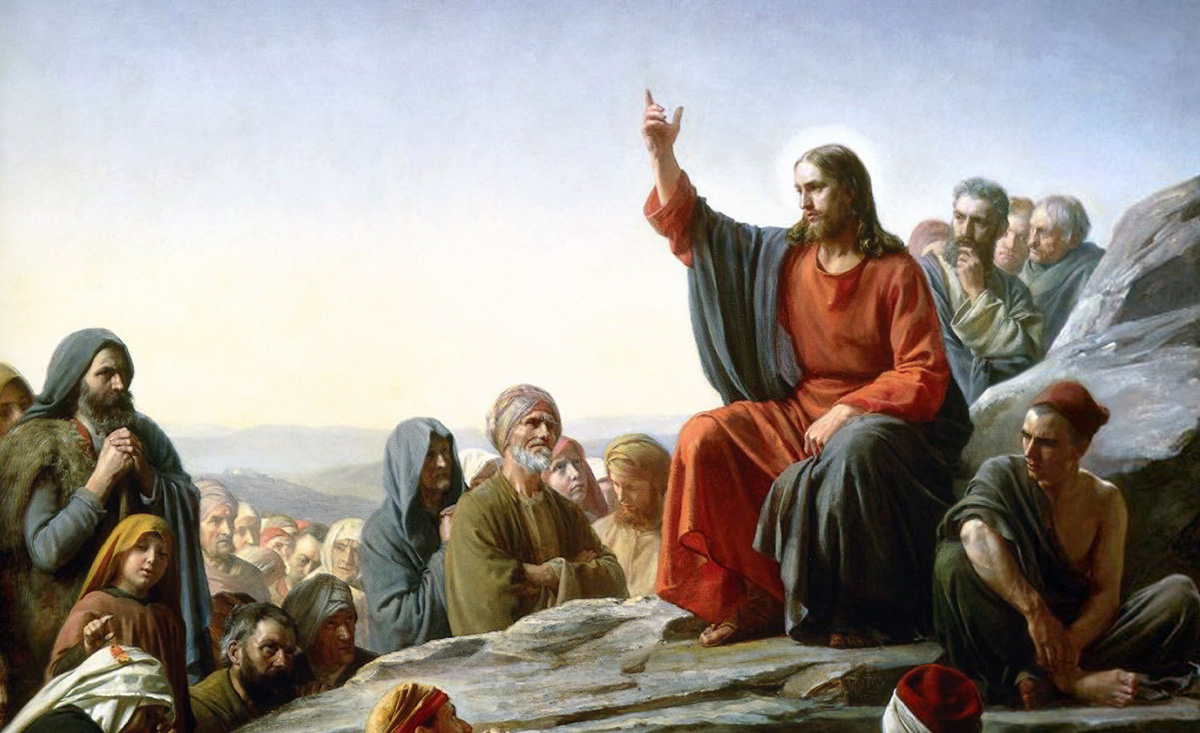
The Sermon on the Mount Carl Bloch, 1890

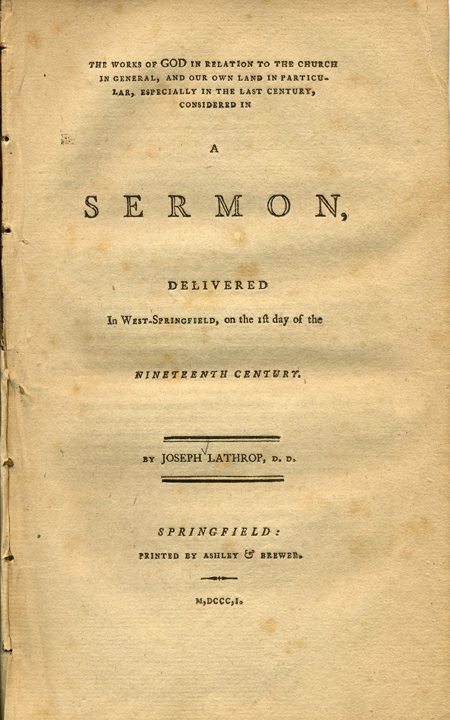
Sermon – Prayer – 1799


Thomas Baldwin (1753-1825), an influential pastor and well-known author, was born and raised in Connecticut until the age of 16 when he moved to New Hampshire, where he later became a member of the State Legislature. As a young man, he was many times called upon to read sermons before his church when the minister was absent. In 1783, he became an ordained evangelist and for 7 years traveled on horseback among the state’s towns, preaching the Gospel until 1790, when he became the pastor of the Second Baptist Church in Boston. In 1803, Baldwin began publication of the Massachusetts Baptist Missionary Magazine, later renamed the American Baptist Magazine (the only Baptist publication in America for years), of which he was the only editor until 1817 and the senior editor until his death in 1825. During his lifetime, Baldwin published 34 separate works, including several books and numerous sermons (published at the special request of his hearers). Baldwin died in Maine at the age of 72, having the day before his death preached two sermons in Massachusetts.


sermon-prayer-1799

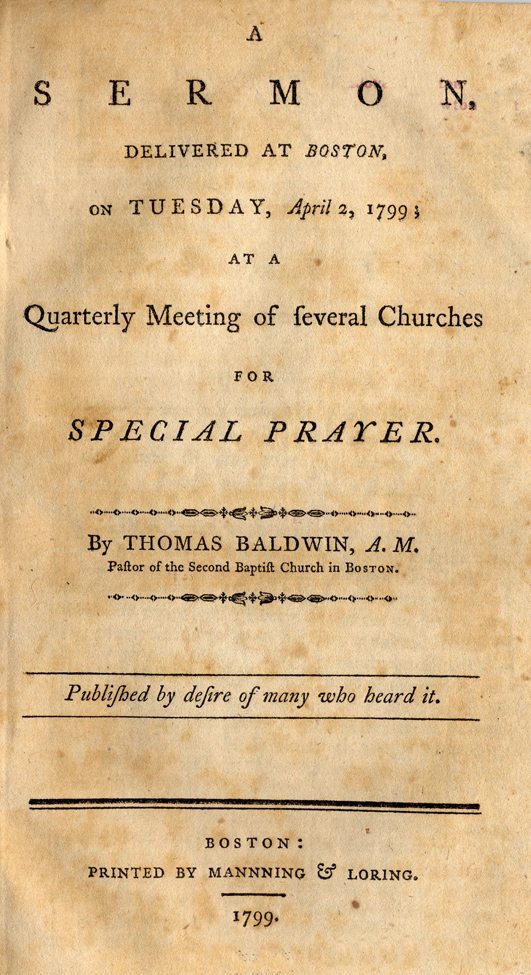
A

S E R M O N,

DELIVERED AT BOSTON,

On TUESDAY, April 2, 1799;

AT A

Quarterly Meeting of several Churches

FOR

SPECIAL PRAYER.

By THOMAS BALDWIN, A. M.
Pastor of the Second Baptist Church in Boston.

A

S E R M O N.

Isaiah xliii. 12, 13.

—Ye are my witnesses, saith the Lord, that I am God. Yea, before the day was, I am be, and there is none that can deliver out of my hand. I will work, and who shall let it?

A firm belief in the existence, perfections, and providence of God, is always to be considered as a first principle in religion. Where this belief is wanting, there is no rational ground to expect either virtue or morality. Every violation of the moral law, every secret or open sin, is a practical denial of the divine authority. And the most prominent features in the character of the bold transgressor, are his disbelief of the omnisciency of God, and of his own future accountability. Concealed from the observation of man, he is ready to ask, “How doth God know? And is there knowledge in the Most High? Can I be amenable at his dread tribunal?”

But however the practice of mankind may argue against their religious principles, (for the mind often assents to what the practice denies) we have been unwilling to believe that there were any, or at most but very few, who were so shockingly impious and absurd, as professedly to deny the being and providence of God. In this country, until very lately, an absolute, professed atheist, was almost as rare, and would perhaps have excited as much astonishment, as the transit of a comet. But infidelity and atheism are now throwing off the mask, and are daring to appear with impious, brazen front, even at noon-day. Many others there are, as we have reason to suppose, who, notwithstanding their professions of friendship, are secretly abetting the same wretched cause. These disguise the malignity of their hearts, under a base insidious smile, and, Judas-like, are endeavouring to betray the dearest interests of religion with a deceitful kiss.

It is truly affecting to a pious mind, to see with what avidity, deistical, and even some atheistical publications, have been received of late among us. Is it not seriously to be feared, that many of our thoughtless, unsuspecting youth, have already caught the impious contagion? A contagion, in my opinion, much more to be dreaded than the most fatal epidemic: for, while the latter destroys the body, and hath no more that it can do, the former dissolves the bonds of social union, corrupts morality, debauches virtue, and ruins the soul forever!

These things may seem to lower with gloomy aspect upon the cause of religion. But amidst this darkness, “light is sown for the righteous, and joy for the upright.” For “when the enemy shall come in like a flood, the Spirit of the Lord shall lift up a standard against him.” “In that day there shall be a Root of Jesse, which shall stand for an ensign of the people; to it shall the Gentiles seek, and his rest shall be glorious.” Around this sacred standard, like the ancient Hebrews around the tabernacle in the wilderness, will every true Israelite pitch his tent. Here will they set up their banners in the name of the Lord, and in the strength of the great Jehovah they will put to flight the whole camp of infidelity.

But should dark clouds gather round us; should we see iniquity abounding, and the love of many waxing cold; should Zion’s ways still mourn because so few come to her solemn feasts; should some depart from the Faith, giving heed to seducing spirits and doctrines of devils; yet let us not think the cause lost. This, perhaps this is the very time for God to work. He has a set time to favour Zion, and the text assures us that he will do it. “Ye are my witnesses, saith the Lord, that I am God.—I will work, and who shall let it?”

In order to strengthen your faith in the certain accomplishment of the declaration in the text, and to encourage one and all to become workers together with God, I propose,

I. To offer a few thoughts upon the character of Him who has said, “I will work, and who shall let it?”

II. Shall attempt to illustrate and distinguish the particular “work” intended in the text.

III. Shall consider the general, but ineffectual, opposition contemplated to this glorious work.

The first part of our subject contains an appeal, to the sentiments and feelings of all the friends of truth—“Ye are my witnesses, saith the Lord, that I am God.” But what are the facts to which we bear witness? We testify that He is, and that He is a rewarder of all them that diligently seek him. That from everlasting to everlasting he is God. That he is the self-existent, the independent, the immutable Jehovah. That all the divine perfections centre and harmonize in his character. That he upholds and governs all worlds and all beings; and that his tender mercies are over all the works of his hands. That his providential care extends to all, even the meanest of his creatures.

These are facts of which we have the greatest moral certainty. Yet, should some bold skeptic demand proof of his existence, we might perhaps be at a loss how to undertake it; not from the want of evidence, but from its exuberance. Should a man shut his eyes, and deny the existence of light, or demand evidence that the sun shines, how should we proceed in order to convince him? Should we appeal to the senses of all mankind, who are daily blessed with his beams? Should we attempt in detail, all that rich variety of infinitely multiplied favours daily derived from this fountain of created goodness? No; we should cut the work short, and tell him to open his eyes, and he would find an immediate cure for his skepticism. May not the same be said to the atheist? Let him become impartial but a single moment, and he shall find all nature rising in proof of the existence of a God. Can we believe that man to be honestly inquiring after truth, who can find no evidence through the universe of a supreme, intelligent First Cause? We certainly cannot: nor does reason or Christian charity demand it of us.

Men frequently embrace error, in order to get rid of the difficulties they meet with in vindicating the truth. On this ground, many have given up some of the peculiar doctrines of the gospel: OTHERS HAVE REJECTED Christianity altogether; and some there are, who have given up natural as well as revealed religion, and denied the existence of a God upon the same principle. But has atheism no difficulties in it? The material system of the universe must either be considered as eternal, and consequently self-existent, or it must have been created. But is there less difficulty in conceiving of the eternity of matter, than of the existence and eternity of God? Is there no difficulty in accounting for the motion, order, and harmony of the heavenly bodies, without admitting the idea of a Supreme Intelligence? Surely there is; for matter of itself is inert, and incapable of originating the smallest motion. Deny the existence of God, and you behold every where effects without a cause! Order and harmony without design! Of all systems that were ever originated in the wild fancy of man, atheism is the most blasphemous and absurd.

There is evidently a strong bias in mankind to novelty of opinion and sentiment, as well as in other things. Hence many look back upon the pious sentiments and godly zeal of their ancient fires, and view them in the same whimsical light as they do their old-fashioned pictures, and at once congratulate themselves that they live in an age of much greater taste and improvement. But, however modern times may boast of having improved in liberality of sentiment, in science and the fine arts—they certainly have very little to boast of, on account of religion and morality. I am at the same time sensible, that to some, this is looked upon as the golden age so long foretold by Grecian Bards. Those halcyon days which were to bless the world, in their view, are fast approaching! Reason’s millennium has already commenced! They glory to think they have liberated the human mind from the restraints of religion, and from the fears of futurity. But this fatal liberty only permits the mind to fly like an unbalanced system from its centre; to roam, in eternal uncertainty, through the wilderness of depraved reason; to be forever tormented in trying to believe what it is always afraid will finally prove true; to violate the sacred principles of justice, of reason, and religion; to trample the gospel under foot, and blaspheme the name of God; to set at defiance all laws, human and divine; and, in a word, to proclaim open war with both heaven and earth! O Liberty! How is thy sacred name prostituted and profaned!

That there have been, in every age, a few solitary individuals who have denied the existence of God, will be admitted; but tat atheism should be the professed creed of any considerable number of the ruling party of any civilized nation, it is presumed cannot be found in the history of the world, till near the close of the eighteenth century. It is not to be concluded, however, that even in that nation every individual is an atheist, any more than we may conclude every man a Christian who belongs to a Christian country. There may be many there still, who fear God and reverence his Son. Yet the wild project of those made philosophists, to dethrone the Deity and reign themselves, must be looked upon as the most bold and impious attack upon the throne of God, that has ever been made since the days of Nimrod. And even the attempt to build Babel is not, in my opinion, to be considered as an absolute denial of the existence of God; but rather as a distrust of his providential goodness, and an ignorant, slavish fear of his almighty power.

Soon after the confusion of tongues, we find idolatry introduced, or revived in the world: for some are of opinion that it existed before the floor; others suppose that it was first introduced by the Phenicians, and from them communicated to the Egyptians and the other neighbouring nations. But in that degenerated state of the world, notwithstanding the heathens worshipped a multiplicity of inferior deities, yet in general they acknowledged a supreme God, in distinction from them. This is evident from profane history, 1 as well as from those instances mentioned in the sacred scriptures. It is clear that Laban the Syrian acknowledged another God, beside those whom he charged Jacob with having stolen. “The God of your father,” said he, “appeared to me yesternight.” The same is true concerning the calves set up at Bethel and Dan by Jeroboam. The people, indeed, paid their immediate devotions to these images, much in the same manner as the Papists do to the crucifix; but still they acknowledged a supreme God, in distinction from them. Paul, in his epistle to the Romans, does not charge them with atheism, but with idolatry. “Because,” saith he, “when they knew God, they glorified him not as God, but became vain in their imaginations, and worshipped and served the creature more than the Creator.” That is, as I conceive, they worshipped their images and subordinate deities more than the supreme God, who is over all, blessed for evermore. The altar which St. Paul found at Athens, inscribed to the unknown God, although they had lost the knowledge of his true character.

Will you indulge me, my brethren to relate the reflections of one of the rude inhabitants of the North, a wild Greenlander? “It is true, (said he to a missionary) we were ignorant heathens, and knew nothing of God, or a Saviour; and indeed who should tell us of him until you come. But thou must not imagine that no Greenlander thinks about these things. I myself have often thought that a kajak, (a boat) with all its tackle and implements does not grow into existence of itself; but must be made by the ingenuity of man. Now the meanest bird has far more skill displayed in its structure than the best kajak, and no man can make a bird. But there is still far greater art shewn in the formation of man, than of any other creature. Who was it that made him? I bethought me he proceeded from his parents, and they from their parents: but some must have been the first parents—Whence did they come? Common report informs me, they grew out of the earth; but if so, why does it not still happen that men grow out of the earth? And from whence did this same earth itself, the sea, the sun, the moon, and stars, arise into existence? Certainly there must be some Being who made all these things—a Being that always was, and can never cease to be. He must be inexpressibly more mighty, knowing, and wise, than the wisest man. He must be very good, too; because that every thing which he has made is good, useful, and necessary for us. Ah! Did I but know him? None of us poor men. Yet there may be men, too, that know something of him. O that I speak with such!—Therefore,” said he, “as soon as I heard you speak of this great Being, I believed it directly with all my heart, because I had so long desired to hear it.” 2

The savages of America, who roam in our western forests, in general acknowledge the existence of the Great Spirit; although they are said to worship the devil, to keep him from hurting them. Hence it appears, that in every country, in every age and nation, a Supreme Being has generally been acknowledged. This has justly been considered as the great principle of national confidence. And indeed, what confidence can be put in engagements, oaths, and treaties, where the existence of God and future accountability are not acknowledged, is, at best, quite problematical.

But in addition to what has already been mentioned, the people of God in every age have been living witnesses for him. They have testified of his power and goodness, of his truth and faithfulness, to the children of men. Those who have borne witness to the Divine Character, are not a few. We are compassed about on every side with a cloud of witnesses. They rise to our view numerous as the multitude which John saw in heaven, that no man could number. I have only time to select a few.

What a noble testimony did Enoch bear to the character of God, by his living obedience to the precepts of truth; by his holy life in walking with God; by his foretelling the coming of the Lord; by the witness which he obtained that he pleased God; and by his being translated to glory without seeing death!

How convincing the testimony of Noah, the father of the new world. He witnessed to the holiness, the justice, and the faithfulness of God, in preaching the necessity of righteousness to that ungodly generation, and in persevering in building the ark an hundred and twenty years before the flood. By that awful catastrophe, God set a seal to his testimony. The windows of heaven were at length opened, and the fountains of the great deep were broken up. The astonished world now saw, that what Noah had told them about his God was true. The warnings which they had treated as idle tales, now began to assume a more serious aspect. All appeared reality. The flood was rising on every side. “In vain did man think of flying for safety to the lofty mountains. Thousands of torrents rushed down their sides, and mingled the confused noise of their waters with the howling of the winds and the roaring of the thunder. Black tempests gathered round their summits, and diffused a night of horror in the very midst of day. In vain does he turn an eager eye towards heaven; he perceives nothing in the whole circuit of the horizon, but piles of dark clouds heaped upon each other; a pale glare here and there furrows their gloomy and endless battalions; and the orb of day, veiled by their lurid coruscations [flash of light], emits scarcely light sufficient to afford a glimpse in the firmament of his blood disk wading through new constellations.” 3 The waters increase on every side. The flood swells, and bears down every thing before it. “Cities, palaces, majestic pyramids, triumphal arches,” all the labour of ages, and all the monuments of art, are buried in undistinguished ruin. But when the proud waves lift themselves up, Noah’s God sits in awful majesty upon the circle of the universe, directing the wild uproar of the mad elements. He again gathers the waters in the hollow of his hand, and pours them into the bosom of the ocean. He commands, and the stormy winds forget their fury, and cease to howl. All again is quiet. The sun once more sheds his cheering rays upon the drowned earth; the resplendent bow appears in the heavens, as a peaceful sign to sinful man, that the waters should no more go over the earth; but a still more interesting sign to the believer, that “God will no more be wroth with him, nor rebuke him.”

What an illustrious testimony did Abraham bear to the true character of God, in every country where he sojourned! The fear of the Lord fell upon the people, and the surrounding neighbourhood was often blessed for his sake. The affecting scene upon Mount Moriah, abundantly manifested the truth and faithfulness of God, and Abraham’s unshaken confidence in the divine faithfulness. Nor did his heroic conduct on the plains of Sodom give a less convincing evidence of his trust in the great Jehovah. Here we behold him with a little band, composed of only three hundred and eighteen of his household servants, and three volunteers, pursuing, and entirely defeating the combined army of four victorious kings, and rescuing five more, together with his nephew Lot. With what true greatness of soul does he appear, when refusing to accept the spoil which was generously offered to him—testifying to his astonished neighbours, that he had a portion in God far superior to all the treasures of this world! Give me the persons, said the king of Sodom, and take the goods to thyself. “No,” said Abraham, “I have lifted up mine hand unto the Lord, the Most High God, possessor of heaven and earth, that I will not take from a thread to a shoe-latchet.” But he did not go unrewarded; for “after these things, the word of the Lord came to him in a vision, saying, Fear not, Abram, for I am thy shield and thy exceeding great reward.”

But whom do we see yonder, appearing in such princely style, polished after the similitude of a palace? It is Moses!—Behold him despising the splendours of a royal court, and “refusing to be called the son of Pharaoh’s daughter; choosing rather to suffer affliction with the people of God, than to enjoy the pleasure of sin for a season.” “He endured as seeing Him who is invisible.” After forty years’ exile in Midian, we behold him returning with the rod of God in his hand, asserting his commission from the great I AM, to deliver Israel, before the atheistical tyrant of Egypt; and, by conviction addressed to his senses, obliging him at last to acknowledge that God, whose character he had held in the utmost contempt.

With what awful solemnity do we hear Moses appealing to the invisible God, to decide a dangerous controversy between him, and Korah and his coadjutors! “To-morrow,” said Moses, “God shall decide the matter.” The day arrives; the tribes assemble at the door of the tabernacle; the glory of the Lord appears; terror and anxiety sit silent on every countenance;—at length God speaks!—Moses and Aaron fall prostrate to the earth, and supplicate. “Go,” said God to Moses, “command the congregation to separate themselves from these bold transgressors”—(awful emblem of the last day!) “Hereby,” said Moses, “shall ye know that the Lord hath sent me to do all these works. If these men die he common death of all men, or if they be visited after the visitation of all men, then the Lord hath not spoken by me. But if the Lord make a new thing, and the earth open her mouth and swallow them up, with all that appertain unto them, and they go down quick into the pit, then ye shall understand that these men have provoked the Lord.” The alarmed congregation had no sooner retired, than the earth give way under the tents of these wicked men, “and they went down alive into the pit, and the earth closed upon them!” How glorious does the God of Israel appear, in punishing as well as pardoning!

Was it possible to exhibit more clear and convincing proof of the presence and power of an invisible God, than what Elijah gave to the idolatrous Hebrews? With what dignity do we behold him at Mount Carmel, surrounded by a host of false prophets, who were patronized by royal favour; and there proposing to put the matter upon an issue, which involved, not only his own personal reputation and safety, but, what was infinitely dearer to him, the cause of God and truth. “Choose you one bullock,” said he, “and I will choose another, and we will dress them and lay them upon wood, but put no fire under; and call ye on the name of your gods, and I will call on the name of the Lord; and the God that answereth by fire, let him be God.” The proposal was accepted; and Baal’s prophets, that they might, if possible, succeed, took the day before them, and called upon their sleeping, senseless god, from morning until evening, but there was no answer. At the time of the offering the evening sacrifice, Elijah “took twelve stones, and built an altar in the name of the Lord.” He prepared his bullock, and laid it in order upon the wood; and after having the altar thrice drenched in water, so as to prevent the possibility of fraud, we behold the adoring Tishbite drawing near to his God! Let us mark the manner of his address.—“Lord God of Abraham, Isaac, and of Israel, let it be known this day that thou art God in Israel, and that I am thy servant, and that I have done all these things at thy word. Hear me, O Lord, hear me; that this people may know that thou art the Lord God, and that thou hast turned their heart back again. Then the fire of the Lord fell, and consumed the burnt-sacrifice, and the wood, and the stones, and the dust, and licked up the water that was in the trench. And when all the people saw it, they fell on their faces; and they said, The Lord, he is the God; the Lord, he is the God.”

I will add only one instance more.

What conviction was offered to an impious monarch, by the three captives in Babylon, who testified that the God in whom they trusted was able to deliver them out of his hands! They nobly dared to despise the wrath of a king, and were unappalled by his raging furnace. Believing in God, they “quenched the violence of fire;” and triumphing over their blind persecutors, left a decided testimony for God.

But I should much sooner fatigue your patience than exhaust the subject; therefore can only say, that all the friends of truth and righteousness, in every age, have borne witness for God, both by their lives and by their deaths, that he is a God of covenant love and faithfulness. The word that has gone out of his mouth shall not return void. And do we hear him saying, “I will work?” It is settled in heaven—it shall be accomplished. I proceed,

II. To illustrate and distinguish the particular work intended in the text.

I conceive, by the expression in the text, we are to understand either the work of providence or grace. In both of these the hand of God is manifest; and the former is generally, if not always, carried on with reference to the latter. All the great events which are taking place at the present day, however dark and distressing, we have reason to believe, will be finally overruled for the advancement of the Redeemer’s kingdom. The wrath of man shall praise him, and the remainder of wrath he will wisely restrain.

From the whole context it appears evident, that the work of the Spirit of God upon the hearts of the children of men, is specially intended in the text. This is with great propriety called God’s work. It is he that begins it and carries it on; so that in its rise and progress, it is entirely dependent on the influences of his Holy Spirit.

Some are of opinion, however, that this work is a mere mechanical operation, produced by the address of the preacher, either by his boisterous airs, or by his canting tone of voice. That such an address may asset the passions will be granted; but the work we are speaking of, is quite a distinct thing from a mere operation upon the passions. The latter may take place without any connection with religion; but the former implants a principle of divine love in the soul. The passions may be greatly moved by the representation of a tragedy; but these impressions are only transient; they are excited by the circumstances of the moment, and as soon subside. We are willing to acknowledge, that if this “counsel or work be of men, it will come to naught; but if it be of God, it cannot be overthrown.”

That there is a natural disinclination in mankind to the doctrines of the cross, is too evident to be denied. This appears in their putting off the concerns of their souls, like Felix, for a more convenient season. The most persuasive arguments made use of by the ministers of Christ will prove ineffectual, unless accompanied by a divine influence. It remains still true, that Paul may plant, and Apollos water; but if there be any increase, it is God who gives it. It is one part of the office work of the Holy Spirit, to convince men of sin. And wherever we find a deep and affecting sense, wrought in the heart, of the infinite evil of sin, as committed against a God of spotless purity and rectitude, we may say to such, as the apostle did to the Philippians, We are “confident of this very thing, that He who hath begun a good work in you, will perform it until the day of Jesus Christ.” The believer is directed to “work out his own salvation with fear and trembling;” but not in his own strength; for it is added, “It is God who worketh in you, both to will and do of his good pleasure.” I conceive that those who apply this passage to sinners, whose hearts are at enmity with God, and exhort them to work out their own salvation, and especially without telling them that it is God who must work in them, both to will and to do—entirely mistake the meaning of the apostle. The words were at first addressed to obedient believers at Philippi, importing, that all the good that was found in them, either in willing or doing, was of God, who wrought it in them.

This work of which we have been speaking, is not a mere change of opinion and sentiment, but of temper and disposition. It gives a new direction to all the desires of the heart. It detaches the soul from its love of sinful objects, and kindles in it the most ardent desire after the knowledge of spiritual and divine things. It places morality upon a sure foundation. It inspires the soul with proper sentiments of devotion towards God. It gives energy to all the benevolent propensities of the heart. In fine, it has a commanding influence upon the heart and life, and by its sanctifying operations upon the mind, prepares it for the everlasting enjoyment of God in heaven. We come,

III. To consider the opposition, implied in the text, to this work—“Who shall let it?” By this expression I think it evidently implied, that there would be opposition.

But who are so base as to oppose so good a work? I answer, 1st. He who first opposed the happiness of man in the garden of Eden. We must either deny the existence of this malicious spirit, or acknowledge with the apostle, that he “now worketh in the children of disobedience.” Christ compared the human heart to a fortress, and Satan to a strong man armed, who keeps it as his palace, until a stronger than he dispossesses him.

2d. The lusts and corruptions of our own wicked hearts stand in direct opposition to this work of grace. It is the grand design of this work, to overcome and destroy them: But they never expire without a struggle. The law in the members will war against the law of the mind. If there were no opposition in our hearts, we should resign to the first call of the gospel. It would be only necessary to set the truth before us, and we should with the utmost readiness embrace it. But melancholy experience demonstrates, that we are “slow of heart to believe.” Christ comes to his own, and his own receive him not. But,

3d. There is opposition from without as well as within. Infidels, and all the open enemies of religion will oppose this work. They attack the Christian system in different directions, and with different weapons. Sometimes they bring forward what they call arguments, and attempt either to disprove the existence or necessity of this work. But their most common and most successful weapon is ridicule. They have found by experience, that it is much easier to laugh at our sentiments, than to confute them—to deny a proposition, than to disprove it.

Some who may be reckoned in this class, have gone still further. They not only deny the Christian revelation, but the most important sentiments of natural religion. “To them, a Supreme Being is a chimera; immortality is unconscious sleep; and future responsibility the frightful offspring of superstition.” 4 These are exulting in what they madly call the reign of Reason! But, instead of presenting that fair goddess, extending her mild sway over the savage passions of man, we behold “the hydra of despotism riding in her iron car,” her wheels rolling in blood, spreading desolation and death through the world! But the consideration that “God reigns, and that he will work,” still every fear, and calms the mind. But,

4th. This work will be opposed by some of the professed friends of Christ, who yet, in reality, are secret enemies. These disguise the hypocrisy of their hearts under a fair profession. St. Paul long since complained of false brethren, who came in privily to spy out their liberty, in order to bring them into bondage. And among the perils to which he had been exposed, he mentions, as none of the least, false brethren. These may show much zeal in contending for the form of godliness, and perhaps as much in opposing the power. A false-hearted, pretended friend, is capable of doing much greater injury to the interests of religion, than an open enemy. The deepest wounds which Christ feels in his cause, are often given in the house of his professed friends.

But should all the secret and open enemies of Christ, like the briers and thorns, set themselves in battle against God, he would go through them, he would burn them up together. It removes every mountain, and dissipates every cloud, only to hear him say, “I will work.”

Two or three reflections shall close the subject.

1st. Are not all who regard the character and cause of God, the salvation of their own souls, and the happiness of the rising generation, called upon, in this day of prevailing infidelity, to become living, active witnesses for God?

And can you, my brethren, remain indifferent and unconcerned, while the enemies of religion are making every exertion to disseminate their demoralizing sentiments, and insultingly saying, Where is your God? Can you sleep on and take your rest, while the cause of the Son of Man is betrayed into the hands of his enemies? Surely you cannot. Considerations of infinite moment call upon you to take a decided part, and fling your whole weight into the scale of truth. But you will not mistake me. I am not calling upon you to engage in a crusade to the Holy Land, nor endeavouring to stimulate you to propagate the gospel by fire and sword, as it was carried among the northern nations of Europe in the eleventh century; but would fain persuade you to manifest a zeal worthy of the cause you profess to own. You will give the best evidence of your religion to those around you, when you exemplify its doctrines in your lives. “If you love me,” said the blessed Jesus to his disciples, “keep my commandments.” Let your zeal for God be always according to knowledge, tempered with humility; and let justice and benevolence adorn your characters. Witness your love to your heavenly Father, by a sacred regard to the Lord’s-day, and the public institutions of religion. Add to a good profession, the influence of a good example; and above all things, have servant charity among yourselves, even that charity which is the bond of perfectness.

2dly. What great encouragement there is for the people of God to be instant in prayer, that he would “revive his work” among us! He knows, indeed, our every want; yet he will be fought unto by his people, to do those things for them which they stand in need of. We have not only reason to believe that God will yet work, but to rejoice that he has already begun it. From the best observation which I have been able to make, it appears that there have been more revivals of religion in these northern States, within a few months past, than for several years before. I have information, which I believe may be relied upon, from about thirty towns in this and the adjoining States, where God has been of late, or is now, pouring out of his blessed Spirit. In some towns the work has been nearly general. Persons of almost all ages and descriptions have been the subjects of it; nor has it been confined to any one denomination of Christians.5 The majority, however, in most places where these showers of heavenly influence have fallen, has been composed of youth and children! Yet many there are in advanced life, who have been called at the eleventh hour, who can give a very clear and rational account of what Nicodemus, though a master in Israel, could form no idea of, i.e. “how a man, when he is old, can be born again.”

I have lately received a very interesting account from a place at the Westward, of a most rapid and astonishing work. No less than a hundred and fifty have been added to one church within a few months past; seventy to another, and a considerable number to another, in a small town 6 of only six miles square. This is the Lord’s doing, and marvelous in the eyes of all who beheld it. Here God has literally ordained praise out of the mouth of babes! A number of children, from nine to fifteen years of age, have been brought to shout their young hosannas to the great Redeemer! And a number of bold infidels have bowed the knee to King Jesus, and owned him Lord, to the glory of the Father!

Have we not reason to believe, that a prayer-hearing God has granted these wonderful displays of his grace, in answer to the humble, united cries of his people, who on this day are offering up their servant supplications, with one accord, for the interests of religion? In several places, the reformation has been evidently traced, in its beginning, to these seasons of special prayer. And, my brethren, shall we not take courage, and pray without ceasing? For Zion’s sake, hold not your peace. Let us not be weary in well doing; for we shall reap in due season, if we faint not. Though we sow in tears, we may reap in joy. God will hear his own children, who cry day and night to him; yea, in some instances, “before they call he will answer, and while they are yet speaking he will hear.” 6 And is it not the ardent desire of our souls, that we may see such a glorious work among us—that the Lord would pour his “Spirit upon our seed, and his blessing upon our offspring?” Could we possible have greater joy than to see our dear children walking in the truth? O that we may soon have occasion to say, “Lo! This is our God; we have waited for him, and he will come and save us. This is the Lord; we have waited for him; we will be glad, and rejoice in his salvation.”

3dly. Let me caution all who hear me this day, not to oppose this work, lest they be found fighting against God. Are there any here present, who are under the power and dominion of sin? Permit me to tell you, that you must either bow to the mild sceptre of mercy, or to the iron rod of justice. Remember, that if you oppose this work, it is Omnipotence you have to contend with! “Have you an arm like God, or can you thunder with a voice like him?” It is the voice of God which saith, “I will work, and who shall let it?” “We then, as workers together with him, beseech you also, that you receive not the grace of God in vain.” “Be ye not mockers, lest your bands be made strong.” “Beware, therefore, lest that come upon you, spoken of in the prophets: Behold, ye despisers, and wonder and perish; for I work a work in your days; a work which ye shall in no wise believe, though a man declare it unto you.”

To conclude. May the Lord, of his infinite mercy, subdue the unbelief and opposition of all our hearts, and work in us, both to will and to do, of his own good pleasure, a work of faith with almighty power. Then, indeed, will Christ be precious to us. His very name will be like ointment poured forth. We shall rejoice in the enlargement of the empire of grace; and shall join the pleasing exclamation of the psalmist, with whose words I close. “His name shall endure forever—and men shall be blessed in him: all nations shall call him blessed. Blessed be the Lord God, the God of Israel, who only doeth wonderous things. And blessed be his glorious name forever; and let the whole earth be filled with his glory.

Amen, and Amen.”


Endnotes

1. Vide Banier’s Mythology of the Ancients.

2. Crantz’s History of Greenland, in Gill.

3. Studies of Nature.

4. President Maxcy’s Address, &c.

5. In Connecticut, this work has been principally among Congregationalists, (or Presbyterians, as they are there called). In this State, perhaps nearly divided between Congregationalists and Baptists. In New-Hampshire, much the same. In Vermont, principally among the Baptists: yet, both in Vermont, and in Connecticut, there are some of other denominations. This statement may not be very correct.

6. Shaftsbury, in Vermont.

7. Isaiah lxv. 24.

Sermon – Fasting – 1801, Massachusetts


Nathanael Emmons (1745-1840) graduated from Yale in 1767. He was the pastor of a church in Franklin, MA (1773-1827), where he also trained fifty-seven men for ministry. This sermon was preached by Emmons in Massachusetts on the state’s day of fasting on April 9, 1801.


sermon-fasting-1801-massachusetts

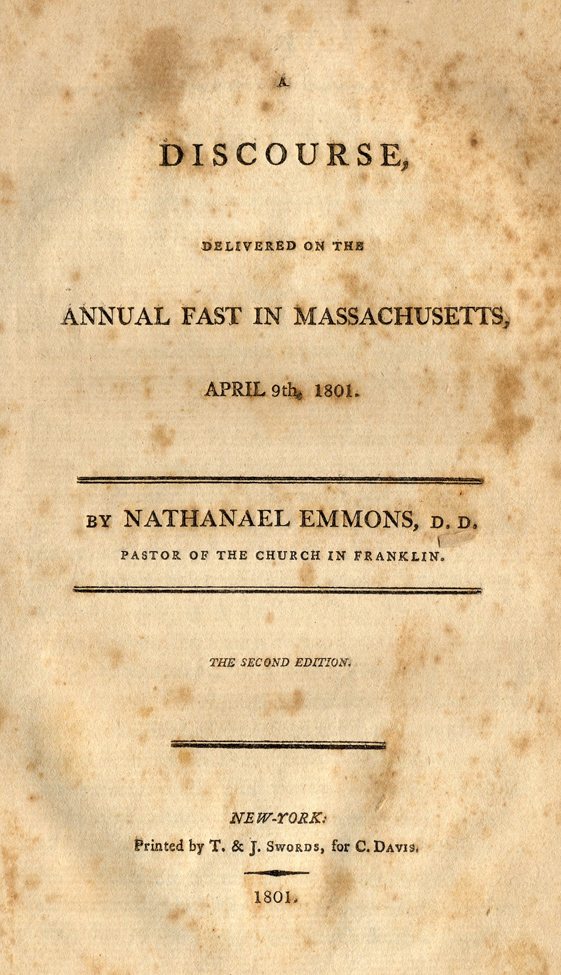
A

DISCOURSE,

DELIVERED ON THE

ANNUAL FAST IN MASSACHUSETTS,

APRIL 9TH, 1801.

BY NATHANAEL EMMONS, D. D.
PASTOR OF THE CHURCH IN FRANKLIN.

A DISCOURSE, &c.

2 Kings xvii. 21.

And they made Jeroboam the son of Nebat king; and Jeroboam drave Israel from following the Lord.

In reading the history of nations we commonly meet with some memorable events, which had peculiar influence upon their rise, progress, declension, and final ruin. Such events, whether recorded in sacred or profane history, are of all others the most entertaining and instructive. The first memorable event in the history of the Jews is the calling of Abram the father of the nation. The second memorable event is the descent of Jacob and his family into Egypt. The third memorable event is the return of the children of Israel to their own land. The fourth memorable event is the introduction of kingly government, under Saul the son of Kish. And the next memorable event is the accession of Jeroboam the son of Nebat to the throne of Israel. This strange and deplorable event laid the foundation for a train of national calamities, which have continued from that day to this; and how much longer they may continue we pretend not to be able to determine. For the admonition and instruction of all future ages God has been pleased to record the character and conduct of Jeroboam, together with the fatal consequences of his impious reign, with great particularity and plainness. The sacred historian never loses sight of the baneful effects of his administration, from the twelfth chapter of the first book of Kings to the seventeenth chapter of the second book of Kings, which contains the words of our text. Here his history terminates with the account of the captivity and dispersion of the once happy people whom he corrupted and destroyed.

It is the design of the present discourse,

I. To draw the character of Jeroboam before he was king.

II. To represent the state of the nation when they made him king.

III. To inquire how it came to pass that they did make him king.

IV. To show what methods he employed, after they had made him king, to drive them from following the Lord.

I. The character of Jeroboam, before he was king, deserves particular attention.

He early discovered some of those distinguishing natural and moral qualities, which formed him for the extraordinary part which he finally acted on the stage of life. His natural genius was sprightly, bold, and enterprising, which he evidently cultivated, notwithstanding the peculiar disadvantages and embarrassments which attended his education. Thou he lost his father in his youth, and was left to the care of his mother, who was a widow; yet, by the mere dint of his brilliant talents and close application, he recommended himself to the notice and patronage of his wise and sagacious sovereign. We read, “Jeroboam was the son of Nebat, an Ephrathite of Zereda, Solomon’s servant, whose mother’s name was Zeruah, a widow woman. And the man Jeroboam was a mighty man of valour; and Solomon seeing the young man that he was industrious, he made him ruler over all the house of Joseph.” His appointment to such an office, by such a penetrating prince, is an infallible evidence of his popular talents and pleasing address. These excellent and amiable accomplishments, had they been properly directed to the public good, would have rendered him a great blessing to the nation.

But it appears from his history, that a base, turbulent, ambitious spirit led him to prostitute his find abilities to the vilest purposes. Whether his ungovernable disposition were owing to the unhappy circumstance of being deprived of paternal instruction and restraint, or to a native malignity of heart, it certainly prompted him to disturb the peace of society, and oppose the best form and administration of government. For, though Solomon highly favoured him, and put him into a lucrative office in one of the principal tribes of Israel, yet he conspired against his royal master, and became a ring leader in sedition. His business of collecting the public taxes in the tribe of Ephraim and Manassah gave him a peculiar opportunity of tampering with the people, and of instilling into their minds the most absurd prejudices against the king and his public measures. He could easily persuade the unthinking multitude that they were unreasonably loaded with taxes, and that they ought to do themselves justice, by overturning the government. Having, in this or some other way, widely diffused a disloyal and rebellious spirit among the people, he presumed to throw off the mask, and appear in open opposition to the best of princes. It is expressly said, “He lifted up his hand against the king. And this was the cause that he lifted up his hand against the king: Solomon built Millo, and repaired the breaches of the city of David his father.” Here it is strongly intimated that Jeroboam complained of oppression, and that he made this complaint with a view to destroy his sovereign, and eventually seize his throne. This was a most bold and daring attempt in a young man, for which he deserved to be treated as an ungrateful and detestable traitor. Accordingly the king “sought to kill Jeroboam;” but, by some means or other, Jeroboam fled into Egypt, and remained there until the death of Solomon.

This seems to have been the most fatal period in Jeroboam’s life; for whilst he lived in that land of idols he totally apostatized from the religion of his country, in which he had been early initiated, and became a gross idolater. He was certainly of the seed of Abraham, and probably born and educated in Jerusalem, where he received the seal of circumcision, and usually attended all the religious institutions which God had appointed. These things must have made deep impressions on his young and tender mind, which he could not easily nor instantly eradicate. It must have required strong and repeated efforts to disbelieve what he had once firmly believed, and to despise what he had once inwardly revered. Hence, it is to be presumed that he gradually apostatized from the religion of his country. Whilst he lived in Jerusalem, where all the tribes of Israel statedly repaired to worship the only living and true God, it is probable he treated sacred and divine things with apparent decency and respect. But after he removed from the seat of true religion, to take the charge of the house of Joseph, he had a fair opportunity of neglecting those religious duties, and of renouncing those religious principles, which laid a painful restraint upon his corrupt inclinations and pursuits. He was, no doubt, an infidel at heart, while he was sowing the seeds of sedition, and plotting to ruin his king and country; but, for political reasons, he might not openly avow his infidelity until he fled into Egypt, to escape the hand of public justice. Having taken this desperate step, and exchanged a land of moral light for a land of moral darkness, neither his interest nor his reputation required him any longer to conceal his sentiments; but all the circumstances in which he was placed conspired to form him a complete, confirmed, and avowed apostate. He could do nothing more gratifying to the Egyptians than openly to conform to their religion, and renounce his own. And a man of such a corrupt and intriguing disposition as he was, would not hesitate a moment to sacrifice his God, his religion, and his eternal interest, to answer his political views, and effectually secure popular influence and applause. He could not have lived among a more dangerous people than the Egyptians, who were then the most noted nation in the world, for learning, magnificence, superstition, and the grossest idolatry. Hence his residence in Egypt prepared him to return to his native country a more bitter enemy to the God of Israel, and a more malignant oppose of all his sacred rights and institutions, than any pagan priest of Egyptian philosopher. Such was the ominous character of Jeroboam the son of Nebat, before he reached the object of his wishes, and was placed in the first seat of government. I proceed,

II. To represent the state of the nation, when a base and unprincipled majority raised him to supreme power.

His two immediate predecessors were great and illustrious princes, who reigned long and prosperously. David was a mighty man of war, who subdued the enemies of his country, enlarged the boundaries of his kingdom, and, when he died, left his people in the enjoyment of perfect peace. Solomon, his son and heir, was a wise and peaceful prince, who employed all the resources of his noble and capacious mind in refining, enriching, and strengthening his kingdom. He built a beautiful and magnificent temple for the residence and service of God. He instituted the best regulations for the decent and devout performance of public worship. He built, and repaired, and fortified a great number of cities, and made ample provision for the general defense of the country. He raised a large navy, and enriched both himself and his people, by an extensive and lucrative commerce. Silver and gold were, in his days, as plenty in Jerusalem as stones in the street. By promoting the interest and happiness of his people, he attracted the notice and admiration of the world. We are told, “Judah and Israel dwelt safely every man under his vine and fig-tree, from Dan even unto Beersheba, all the days of Solomon. And there came of all people to hear the wisdom of Solomon, from all kings of the earth, who had heard of his wisdom.” The children of Israel never enjoyed so much peace and prosperity in any period of their national existence, as they enjoyed during the glorious reign of Solomon. And when he ceased to govern the nation, he left them in a more free, flourishing, and happy situation, than any other people then in the world. Such was the state of things when Jeroboam the son of Nebat ascended the throne of Israel.

Let us now inquire,

III. How it came to pass that ten tribes out of twelve should raise such an impious and dangerous man to royal dignity.

Jeroboam had not the least claim to the crown, either by birth or by merit. He was the son of Nebat a servant: he had acted the part of a traitor, and he had fled his country to escape the punishment which he had justly deserved. Besides, Rehoboam was the proper heir to the throne of his father, and had arrived at the most proper age to take the reigns of government into his hands. How, then, should it ever enter the minds of the nation to make choice of the son of Solomon’s servant to reign over them? The answer to this is easy – Jeroboam the son of Nebat had long been a man of intrigue. He had secretly employed every artifice to prejudice the people against the former administration of government, and had openly presumed to lift up his hand against the king. All this he had done before he fled into Egypt; and it is extremely probable, that during his residence there he kept up a secret and traitorous correspondence with the disaffected in Israel, and only waited for the death of Solomon to return and seize his throne. It is certain, however, that as soon as Solomon expired his disaffected subjects immediately sent to Egypt for Jeroboam the son of Nebat, and set him up as the rival of Rehoboam, the proper heir to the crown. Let us read the account of this extraordinary conduct. “And Solomon slept with his fathers, and was buried in the city of David his father. And Rehoboam his son reigned in his stead. And Rehoboam went to Shechem: for all Israel were come to Shechem to make him king. And it came to pass when Jeroboam the son of Nebat, who was in Egypt, heard of it, that they sent and called him. And Jeroboam and all the congregation of Israel came, and spake unto Rehoboam, saying, Thy father made our yoke grievous; now, therefore, make the grievous service of thy father, and his heavy yoke which he put upon us, lighter, and we will serve thee. And he said unto them, Depart yet for three days, then come again to me. And the people departed.” So far Jeroboam succeeded in his designs. He had long been preaching and acting sedition. And he found upon his return from Egypt, that he had actually thrown the people into a strong delusion, by making them really believe that they had been cruelly oppressed under the reign of Solomon. He also perceived that the major part of the nation were ready to join with him in opposing Rehoboam, who had given him three days to employ all his political skill to rob him of his subjects. This precious opportunity he undoubtedly improved to the best advantage, to prepare himself and his friends for the next meeting; the result of which completely answered his highest expectations. “So Jeroboam and all the people came to Rehoboam the third day, as the king had appointed. And the king answered the people roughly, and forsook the old men’s counsel, and spake to them after the counsel of the young men, saying, My father made your yoke heavy, and I will add to your yoke: my father chastised you with whips, but I will chastise you with scorpions. So when all Israel saw that the king hearkened not to them, the people answered the king, saying, What portion have we in David? Neither have we inheritance in the son of Jesse: to your tents, O Israel. So Israel departed to their tents,” and made Jeroboam the son of Nebat king.

It is now easy to see how this subtle and aspiring man obtained the suffrages of the nation in his favour. It was through his own intrigues, which deluded and infatuated the ten tribes. He actually made himself king by disaffecting the people to the administration of his predecessor; and he caused this disaffection by basely misrepresenting the wise measures of that wise and excellent ruler. He might have justly complained of Solomon’s idolatry and deep declension in religion; but he made no such complaint, because he knew it would not answer his purpose. He, therefore, made a more popular objection, and loudly exclaimed against the intolerable burden of public taxes. These, indeed, had been uncommonly high; but no higher than the public good had required. Though Solomon exacted large sums from the people, yet he applied the money he raised to the most public and beneficent purposes. And while he saw it necessary to lay heavy taxes upon his subjects, he pursued, at the same time, the wisest and best measures to enrich the nation, and enable them to contribute largely to the national prosperity and happiness. Under such circumstances the people had no just cause of complaining of public expenses, but ought to have approved and admired an administration which made them extremely rich and prosperous. And had it not been for the false and artful misrepresentations of Jeroboam and his accomplices, the whole nation would have, most probably, been quite easy and contented under the government of the wisest prince that ever swayed a royal scepter. Hence it appears to have been primarily owing to a political delusion, brought about by Jeroboam himself, that the ten tribes were so unwise as to make choice of him, instead of Rehoboam, to govern the kingdom.

It now remains to show.

IV. What methods Jeroboam the son of Nebat employed to corrupt and destroy the people who had given him his power.

It is a melancholy truth that he did “drive Israel from following the Lord,” and involve them in a series of calamities, until they were dispersed and lost among the nations of the earth. There is something so extraordinary and so instructive in this part of Jeroboam’s conduct, that it deserves the deep attention of both rulers and subjects.

Conscious of having raised himself to the first seat of government, by corruption and delusion, he felt the absolute necessity of cherishing and promoting these destructive evils, in order to maintain his ill-gotten power and influence. Accordingly we are told, what it is natural to believe, that he was greatly afraid that the people would first kill him, and then return to Rehoboam, from whom he had caused them to revolt. Hence he was determined to “drive Israel from following the Lord,” and effectually prevent their ever returning to the house and worship of God in Jerusalem. This appears from the account we find in the text and context, “And they made Jeroboam the son of Nebat king: and Jeroboam drave Israel from following the Lord, and made them sin a great sin. For the children of Israel walked in all the sins of Jeroboam which he did; they departed not from them; until the Lord removed Israel out of his sight, as he had said by all his servants the prophets.” According to this representation Jeroboam was instrumental of corrupting not only that generation who made him king, but their children, and their children’s children, until they were completely ripened for ruin.

The natural cause of moral corruption in the body politic is from the head to all the members. Accordingly we find that Jeroboam corrupted all the people of Israel, from generation to generation, by corrupting all their kings and princes. It appears from the history of the kings of Israel, that they were all corrupted, and became corrupters, by following the pernicious example of Jeroboam the son of Nebat. Nadab, his immediate successor, imbibed his spirit, imitated his conduct, and lost his life. Baasha “walked in the way of Jeroboam, and made the people of Israel to sin.” Zimri and Elah resembled Jeroboam in their character and conduct. Zimri died “for the sins which he sinned in doing evil in the sight of the Lord, in walking in the way of Jeroboam.” Omri “wrought evil in the eyes of the Lord, and did worse than all that were before him. For he walked in the way of Jeroboam the son of Nebat, and in the sin wherewith he made Israel to sin.” Ahab “did evil in the sight of the Lord above all that were before him, as if it had been a light thing for him to walk in the sins of Jeroboam the son of Nebat.” Ahaziah “did evil in the sight of the Lord, and walked in the way of his father, and in the way of his mother, and in the way of Jeroboam the son of Nebat, who made Israel to sin.” Jehoram “cleaved unto the sins of Jeroboam the son of Nebat, who made Israel to sin; and departed no therefrom.” Jehu “departed not from the sins of Jeroboam the son of Nebat, who made Israel to sin.” Jehoahaz “did that which was evil in the sight of the Lord, and followed the sins of Jeroboam the son of Nebat, who made Israel to sin; he departed not therefrom.” Jehoash “did that which was evil in the sight of the Lord; he departed not from the sins of Jeroboam the son of Nebat, who made Israel to sin; but he walked therein.” Jeroboam, the son of Jehoash, “did that which was evil in the sight of the Lord; he departed not from all the sins of Jeroboam the son of Nebat, who made Israel to sin.” Zechariah “did that which was evil in the sight of the Lord, as his fathers had done; he departed not from the sins of Jeroboam the son of Nebat, who made Israel to sin.” Menahem “did that which was evil in the signt of the Lord; he departed not all his days from the sins of Jeroboam, the son of Nebat, who made Israel to sin.” Pekahiah “did that which was evil in the sight of the Lord; he departed not from the sins of Jeroboam the son of Nebat, who made Israel to sin.” Pekah “did evil in the sight of the Lord; he departed not from the sins of Jeroboam the son of Nebat, who made Israel to sin.” Thus Jeroboam the son of Nebat “drave Israel from following the Lord,” not only through his lifetime, but for near two hundred and fifty years after his death. He corrupted twenty kings in succession, and almost all their subjects. And though his reign was comparatively short, yet he did more to corrupt and demoralize a virtuous and religious people than can be easily described or conceived.

The question now is, What methods did he employ to “drive Israel from following the Lord?” His character and conduct before he came to the throne will not admit of the supposition of his acting ignorantly or inadvertently. And it appears from his history, that he exerted all his talents to devise the most effectual means of extinguishing every spark of true religion and virtue in the minds of his subjects. Here, then, it may be observed,

1. That he prohibited the worship of the true God, by substituting in the place of it the worship of graven images. The inspired historian gives us a particular account of this bold and impious method to banish all true religion and morality from his kingdom. “And Jeroboam said in his heart, Now shall the kingdom return to the house of David. If this people go up to do sacrifice in the house of the Lord at Jerusalem, then shall the heart of this people turn again unto the Lord, even unto Rehoboam king of Judah, and they shall kill me, and go again to Rehoboam king of Judah. Wherefore the king took counsel, and made two calves of gold, and said unto them, It is too much for you to go up to Jerusalem: behold thy gods, O Israel, which brought you out of the land of Egypt. And he set the one in Bethel, and the other put he in Dan. And this thing became a sin, for the people went to worship before the one in Dan.” This was taking advantage of the corruption of human nature. Mankind must have some religion, and they naturally prefer any false religion to the true. If Jeroboam had prohibited all religion, he would have displeased his people, and alienated their affections from him. But by instituting idolatry, which was a corruption of true religion, he exactly hit the ruling passion of the children of Israel, who were perpetually fond of the idols of the heathens, and took the most artful and effectual method to wean them from the house and worship of the true God in Jerusalem.

2. He appointed new times as well as new places of public worship. These two measures were intimately connected, and calculated to render each other the more effectual. To change the days as well as the places of religious worship, had a direct tendency to distinguish Israel from Judah, and to draw a lasting line of separation between the two kingdom. His policy clearly appears in what the sacred historian says concerning his appointment of new holy days. “And he made an house of high places, and ordained a feast in the eighth month, on the fifteenth day of the month, like unto the feast that is in Judah.” The general similarity between this religious festival and that of divine institution, was designed to favour the customs and habits of the people, which could not be easily and safely disturbed; while the dissimilarity of the month and of the day of the month, would answer all his purposes, without raising the least opposition to the measure. These two steps suggested another, and naturally led him,

3. To make new appointments to office. As his darling object was to corrupt and destroy the true religion, so he discarded the regular and faithful priests of the Lord, and appointed others to supply their place, who were attached to his person and cause, though of the vilest character and of the meanest condition. It is repeatedly said, “He made priests of the lowest of the people, who were not of the sons of Levi.” And it is added, “This thing became sin unto the house of Jeroboam, even to cut it off, and to destroy it from off the face of the earth.” It was a profane and presumptuous act in Jeroboam to despise and reject those whom God himself had appointed to minister in holy things; and it deserved the severest marks of the divine displeasure. This he knew; but he was resolved to shake every sacred as well as civil officer from his seat, rather than to lose his own. We are not, indeed, informed whom he appointed to stand around his person, and assist him in the administration of government; but who can doubt whether he did not display the same corruption of heart in appointing the officers of state which he had displayed in appointing the officers of religion? He sought nothing but his own interest; and this required him to raise such men to places of power and influence, both in church and state, as would heartily approve and promote his design of spreading religious error and delusion through all the tribes of Israel. These were the public measures which he employed “to drive Israel from following the Lord.” But it must be further observed,

4. That he enforced these measures by all the weight and influence of his own example. It appears, from his character and conduct in early life, that he possessed, in a high degree, the art of captivating and corrupting all sorts of people with whom he conversed. And when he was clothed with the ensigns of royalty, his power and opportunity of corrupting his subjects greatly increased. He became the standard of taste, and the model of imitation. His sentiments and manners became a living law to his subjects. In his familiar intercourse with all around him, he undoubtedly seized those soft moments, which were the most favourable to his malignant design of seduction. This he could do without departing from the dignity of his station; but it appears that he did more than this, and even stooped to mingle with the priests, and “to burn incense upon the altars of the golden gods of his own making.” He was such an apostate from the true religion, and such a bigot to idolatry, that he esteemed nothing too low, nor too mean to be done, that would serve to eradicate every moral and religious principle from the minds of the people. Hence it is natural to conclude, that he did more “to drive Israel from following the Lord,” by his personal example, than by all the other methods he employed for that impious purpose. And, indeed, his example is oftener mentioned than any thing else, as the fatal cause of corrupting and destroying the people whom he governed. High and low, rich and poor, princes and people, are said “to walk in the ways of Jeroboam the son of Nebat, who made Israel to sin.” It is certain, however, that his loose and irreligious example gave peculiar weight and authority to his idolatrous institutions and his partial appointments in church and state, and largely contributed “to drive all the tribes of Israel from following the Lord,” and eventually to plunge them in perpetual ruin.

IMPROVEMENT.
1. The character and conduct of Jeroboam may lead us to form a just estimate of good rulers. Everything appears in the truest light, by the way of contrast. Folly is a foil to wisdom; vice is a foil to virtue; false religion is a foil to that which is true; and wicked rulers are a foil to those who are wise and faithful. These, however, are often despised and reproached, when they deserve to be esteemed and admired. Though Solomon was the greatest man, and the wisest king, that ever adorned an earthly throne; and though the measures which he devised and pursued raised his kingdom to the summit of national prosperity, yet his subjects did not duly appreciate the blessings of his reign until he was succeeded by a vile and impious usurper. Then the striking contrast between Solomon and Jeroboam could not fail to open the eyes of a stupid and ungrateful nation. Those who had unreasonably murmured under the wise and gentle administration of the best of rulers, must have found the little finger of Jeroboam thicker than the loins of a wise and lenient prince. Solomon did a great deal to promote the temporal and eternal interests of his subjects; but Jeroboam did as much to ruin his subjects, both in time and eternity. Never before was there a greater contrast between two rulers in succession than between Jeroboam the son of Nebat, who drave Israel from following the Lord, and his great and illustrious predecessor. It seems God intended, by this contrast, to make the house of Israel deeply sensible of the pre-eminent virtues and services of Solomon: and, by recording this contrast, to make the house of Israel deeply sensible of the pre-eminent virtues and services of Solomon: and, by recording this contrast, he undoubtedly meant to teach future nations properly to appreciate those who govern them in wisdom and integrity. Let us all learn this lesson, and especially those who have complained of the late wise and gentle administration of government. It is more than possible that our nation may find themselves in the hand of a Jeroboam, who will drive them from following the Lord; and whenever they do, they will rue the day, and detest the folly, delusion, and intrigue, which raised him to the head of the United States.

2. The character and conduct of Jeroboam plainly teaches us what a dreadful scourge wicked rulers may be to their subjects. We can no where find the character of an hypocritical and unprincipled sovereign so fully delineated as in the history of Jeroboam the son of Nebat, who made Israel to sin. He is not only described before he came to the throne, and while he was in the exercise of supreme power, but he is represented as deceiving and destroying multitudes for ages after his death. And as the inspired historian drew such a large and lively portrait of his character on purpose to instruct, so it is extremely full of instruction. Who would have thought of ascribing the idolatry of twenty kings, and the degeneracy of a whole kingdom, during twenty reigns, to the conduct of one man, had not God, who perfectly knew the extensive influence of his example, expressly told us that he was the primary cause of such an amazing train of national calamities? How happy were the twelve tribes of Israel when Jeroboam the son of Nebat began to reign? David and Solomon had exerted all their power, wisdom, and piety, to strengthen, enlarge, enrich, refine, and reform the nation. They had been the happy instruments, under God, of rendering the Hebrews he most virtuous, the most religious, and the most happy nation on earth. But how soon did Jeroboam the son of Nebat reverse the scene, and completely blast all their bright and rising prospects! He designedly drave them from following the Lord, and cruelly deprived them of that magnificent temple, which they had expended so much labour and treasure to erect. He put a final period to their hearing the public instructions of their public teachers, and to their observing those religious institutions which God had appointed for their spiritual benefit. He set them an example of that gross idolatry which exposed them to the frowns of God in this life, and to his everlasting displeasure in the life to come. He divided the nation, destroyed the peace of his own subjects, and involved them in all the horrors of war. He dried up the sources of national wealth, and entailed poverty, meanness, and reproach upon the ten tribes to the latest generation. This is a true but shocking picture of a ruler who fears not God, nor regards man. It appears, from fact, that such a ruler is capable and disposed to destroy everything that a nation holds most dear and valuable in this world or the next. And the more happy a people are when they fall under the power of such a depraved and unprincipled tyrant, the more they have to lose, and the more they have to suffer as long as his authority or his influence shall last.

3. It appears from the intriguing character described in this discourse, how easily any people may be led into civil and religious delusion, by artful and designing politicians. The people of God, one would have supposed, were proof against every species of delusion, especially in the days of Solomon, who instructed, as well as governed, them with superior wisdom and integrity. Besides providing them with sacred teachers, he even condescended to give them the best civil and religious instruction himself. This we learn not merely from his general character, but from the particular account which the writer of his life has given us of his superior talents, and of the extensively useful purposes to which he applied them. He says, “God gave Solomon wisdom and understanding exceeding much, and largeness of heart, even as the sane that is on the sea shore. And he spake three thousand proverbs; and his songs were a thousand and five.” Though many of his songs and proverbs are lost, yet those which have come into our hands we know are full of civil and religious instruction. Where can we find the duty of rulers and of subjects more clearly exhibited, or more strongly enforced, hat in his writings? His proverbs contain the practical wisdom of ages, and convey to persons of all characters and conditions the most useful information, in the most striking and familiar manner. A great statesman said, “Let me compose the ballads for a nation; and let who will make their laws.” His meaning is, that whatever be the instruction, whether good or bad, which is most easily and most universally circulated among the mass of the people, will have the greatest influence in forming their sentiments and governing their practice. If this observation be just, then, while Solomon made the songs and proverbs for the people of God, they enjoyed the best advantages of gaining civil and religious information; and in that respect were especially guarded against civil and religious delusion. But it appears from the history of Jeroboam, that he could easily seduce this intelligent and well informed people. When he first appeared in public, he had the address to poison the sentiments of Solomon’s subjects, and to alienate their affections from him. When he was more advanced in years, and more acquainted with human nature and the arts of intrigue, he so completely blinded and deluded the ten tribes of Israel, that they unanimously made him king, and sacrificed all their political happiness to gratify his avarice and ambition. And when he had thus led them into one political error after another, his infidelity pushed him on to throw them into a greater and more fatal delusion. Having easily intrigued them out of their government, he as easily intrigued them out of their religion, and plunged them into the grossest idolatry. But the house of Israel are not the only people who have been made blind to their private and public good by artful politicians. The Romans, at the zenith of their learning and refinement, were equally unable to stand before the arts of seduction. How often did aspiring, eloquent, and designing men, raise popular commotions and insurrections, and take the advantage of political delusions, to seize the reigns of government? Though the Romans viewed themselves as connoisseurs in politics, yet all their political knowledge was totally insufficient to guard the weak side of human nature, and to prevent them from falling into the greatest political delusions. There is a natural propensity in mankind to oppose law and religion, and therefore their eyes, and ears, and hearts, are always open to those base politicians, who promise to free them from such painful restraints. What astonishing delusions have prevailed, and are still prevailing in France, and in many of the states and kingdoms of Europe? How have the Jeroboams of the present day succeeded in spreading political and religious delusions among the most enlightened nations? And who can tell when or where these delusions will end? Human nature is the same in America as in all other parts of the world. We are no less exposed to be carried down the current of delusion than others were, who have been overwhelmed and destroyed.

4. It appears from the character and conduct of Jeroboam, that corrupt rulers will always aim to corrupt the faithful ministers of religion. No other men are so intimately connected with the great body of the people, and have such favourable opportunities of pouring instruction into their minds, and of conversing with them under all circumstances of life. And whether it be a favourable or unfavourable aspect upon the public good, it is a certain fact, that wise and faithful ministers have a larger share in the respect and confidence of the people in general, than those of any other character or profession. Of course they have more influence in forming the religious opinions, the common habits, and even the political sentiments of the subjects of governments, than many of those who are immediately concerned in public affairs. Besides, religion of any kind, whether true or false, takes a stronger hold of the human mind, and has greater tendency to govern the actions of men, than any theoretical knowledge in any of the arts or sciences, or in any of the pursuits and concerns of the present life. The public teachers of religion, therefore, must necessarily be able, in many ways, to weaken the hands, and obstruct the designs of corrupt rulers. And it naturally follows, that they will endeavour, by all means, to corrupt those who minister in holy things. This we find clearly illustrated by the conduct of Jeroboam the son of Nebat, who drave Israel from following the Lord. He felt himself under a necessity of corrupting, or of deposing the clergy. A number of the sons of Levi were so sincerely attached to the true religion, and so heartily opposed to idolatry, that they could not be corrupted; but chose rather to be deposed from their office, and flee into the kingdom of Judah, than to lend their influence to promote his impious measures. But he soon found means to corrupt the whole body of the priests, and bring them entirely over to his own views; which, above everything else, firmly fixed him on the throne of Israel. The corrupt and unprincipled leaders in the late revolutions in France, have exactly imitated Jeroboam the son of Nebat, and pointed their peculiar vengeance against all the clergy in the kingdom, who would not unite with them in spreading civil and religious delusions through the world. But here it is proper and striking to remark, that they have taken much larger strides than Jeroboam ever did; for he substituted a false religion in the room of the true; but they have attempted, and used all the means in their power, to extirpate all religion, whether true or false, and to introduce universal infidelity or skepticism. And it is always to be expected, that when the rulers of a nation apostatize from the religion in which they were educated, that they will endeavour to destroy it, and, if possible, corrupt the public teachers of religion, and allure or drive them into their irreligious and demoralizing schemes. Should atheists or infidels fill the seats of our own government, the preachers of the gospel would be greatly exposed to their frowning or smiling influence. And even now there are some in power who begin to frown upon those ministers who dare to speak against their bold and impious exertions, to break the bands of religion and morality, and open the door to universal licentiousness.

5. We learn from the character, conduct, and history of Jeroboam, that it is the duty of the public teachers of religion to bear public testimony against all attempts of those in authority to destroy the religion and morals of the people. Who will deny, that it was the duty of prophets and priests to preach against the sins of Jeroboam the son of Nebat, by which he made Israel to sin? He was ruining himself and his subjects, by an open and avowed opposition to the God of Israel, and to all his sacred institutions. Such conduct called aloud upon the public teachers of religion, to warn both Jeroboam and his people of their great criminality and danger. They could not answer it to God, who put them into office, nor to the souls committed to their care, if they neglected or refused to bear solemn testimony against corrupters and those who were corrupted. Accordingly we find, that the faithful prophets and priests did boldly reprove and admonish Jeroboam and those who walked in his steps. They cried aloud, and spared not, to show the prince and the people their transgressions, and to forewarn them of the just judgments of God, which eventually fell upon them. While Jeroboam was in the presumptuous act of sacrificing to the idols he had made, the Lord sent a prophet to reprove his wickedness, and to predict his future punishment. “And, behold, there came a man of God out of Judah by the word of the Lord unto Beth-el: and Jeroboam stood by the altar to burn incense. And he cried against the altar in the word of the Lord, and said, O altar, altar! Thus saith the Lord, Behold, a child shall be born unto the house of David, Josiah by name; and upon thee shall he offer the priests of the high places that burn incense upon thee. And he gave a sign the same day, saying, This is the sign which the Lord hath spoken; Behold, the altar shall be rent, and the ashes that are upon it shall be poured out. And it came to pass, when king Jeroboam heard the saying of the man of God, which cried against the altar in Beth-el, that he put forth his hand from the altar, saying Lay hold on him. And his hand which he put forth against him dried up, so that he could not pull it in again to him. The altar was rent, and the ashes poured out from the altar, according to the sign which the man of God had given by the word of the Lord.” Such was the fortitude and fidelity of one prophet in reproving the apostate Jeroboam; and it appears that other prophets were no less bold and faithful in reproving him and his followers in idolatry, until the wrath of God came upon them to the uttermost. For we are told, “The children of Israel walked in all the sins of Jeroboam which he did; they departed not from them, until the Lord removed them out of his sight, as he had said by all his servants the prophets.” These faithful ministers of God ceased not, though at the hazard of their lives; to reprove the kings as well as people of Israel, who walked in the ways of Jeroboam, and forewarned them of the fatal consequences of their shameful apostacy. Is not this a noble example, and well worthy of perpetual imitation? Should any now rise into power who possess the spirit and imitate the example of Jeroboam the son of Nebat, would it not become the ministers of Christ to imbibe the spirit and imitate the example of those who boldly reproved that profane and impious corrupter of Israel? It is as true now as it was in the days of Solomon, that “righteousness exalteth a nation; and that sin is a reproach to any people.” The religion of Christ has been the glory and the happiness of our nation; and it would argue extreme unfaithfulness in the ministers of the gospel in these days, should they, for the sake of pleasing some, and for the fear of displeasing others, hold their peace, and suffer vice and infidelity to destroy our religion and government, without uniting their efforts, to prevent such deplorable evils? They are set for the defence of the gospel; and let them only be wise and faithful in the discharge of their duty, and they may safely confide in God, to wither the hand that shall be stretched out against them.

6. The nature and effects of Jeroboam’s conduct show us what we have to fear, should our civil rulers embrace and propagate the principles of infidelity. We have not so far lost our virtuous and religious habits, but that wise and virtuous rulers might, under Providence, restrain us from total declension and apostacy. But if those who fill the chief offices of state should openly renounce God and religion, it is difficult to see, why they should not as easily and as universally corrupt our nation as Jeroboam did the ten tribes of Israel. And who can say, that men in power may not catch the spirit of the times, and follow the example of Jeroboam, or rather that of the late apostates in Europe? We are becoming more and more connected with those infidel nations, whose politicians and philosophers are the bold patrons and preachers of infidelity. This mutual intercourse affords a peculiar opportunity to try the whole force of their infatuating philosophy upon us in America. And it is beyond a doubt, that our rulers are the most exposed to their fatal delusions. What is there, then, to forbid our apprehensions, that those in the highest places of power may be corrupted, and actually apostatize from the religion of their country? And should they happen to apostatize, what could hinder them from “driving our nation from following the Lord?” Here lies the greatest danger to which we are at present exposed. Could we only maintain our religion and virtue, and stem the current of moral corruption, we should have ground to hope for future prosperity; but if the rulers of our land should renounce the Bible and all the doctrines and duties taught in that sacred volume, we should have nothing to expect, but that the whole nation would be finally corrupted and destroyed.

7. It appears from what has been said in this discourse, that civil and religious delusions are the great evils which more especially call for our humiliation and mourning this day. Though we have been uncommonly happy and prosperous under the late administration of government, yet the people have loudly complained of public men and public measures, and, by a majority of suffrages, placed the supreme power in different hands. And though we have been favoured with the light of divine Revelation, and been well instructed in the doctrines and duties of Christianity, yet many individuals, in various classes of men, have renounced their former faith in the inspiration of the scriptures and in the existence of God, and become open and zealous proselytes to the cause of infidelity. These strange and disastrous events must have been brought about by the arts of seduction. And the same men who for the sake of subverting religion and government, have employed their artifice to promote civil and religious delusions, will wish and endeavour to increase them, to answer the same selfish purposes. These great and prevailing delusions are much to be lamented. They are not innocent errors, but national iniquities. They display the depravity of the heart, rather than the weakness of the understanding. God was highly displeased with Jeroboam for deluding Israel, and highly displeased with Israel for being carried away with his delusions. And he must be no less displeased with the deceivers and the deceived in our nation. Hence we have abundant reason to bewail the great and fatal delusions which are every day and every where prevailing among us. We ought to lament that any should cast off fear and restrain prayer before God, and actually disobey all human and divine laws; but we have much more cause to lament that so many should deny the existence of God, disbelieve the first principles of religion and virtue, strike at the foundations of government, and not only practice, but justify universal licentiousness. These are sins of the first magnitude in a land of gospel light, and are, of all others, the most alarming at the present day. God may justly expostulate with us as he did with his people of old. “What iniquity have your fathers found in me that they are gone far from me, and have walked after vanity, and are become vain? Wherefore I will yet plead with you, saith the Lord, and with your children’s children will I plead. For pass over the isles of Chittim, and see; and send unto Kedar, and consider diligently, and see if there be such a thing. Hath a nation changed their gods? Which are yet no gods; but my people have changed their glory for that which doth not profit. Be astonished, O ye heavens! At this.” Let all the friends of God sigh and cry for the abominable and fatal delusions which threaten us with the heaviest calamities that ever fell upon an ungrateful and apostate nation.

8. This subject teaches us the propriety and importance of praying for a general effusion of the divine Spirit. Without this we have no ground to expect to be reclaimed from our deep declension. The best defenses have been written in favour of our religion and government. The wisest measures have been adopted to open the eyes of the nation to see and pursue their best interests. An alarm has been sounded from the press and from the pulpit, to awaken the deluded from their delusions. But it seems that the light which has been exhibited has served to increase the blindness of the blind; and the alarm which has been sounded has served to diminish the fears of the deluded. Hence it appears that our national disorder lies in the heart, which bids defiance to all human exertions. The effusion of the divine Spirit is our only source of hope. Our present situation resembles the situation of Israel in the days of Jeroboam. No means nor motives could remove their delusions. While prophet after prophet admonished the corrupters and the corrupted, they still remained obstinate and bent to backsliding. God could have effectually reclaimed them by the influence of his Spirit; but it does not appear, that he ever poured out his Spirit upon Israel after they yielded to the delusions of Jeroboam. But Judah, who never totally revolted, he frequently reformed, and, for that purpose, sent down the influences of his Spirit to change their hearts. And if God intends to save our nation, he will remove our delusions by the same divine influence. In this way he can easily confound the designs of the enemies and corrupters of Christianity, and make even them the willing and active instruments of promoting the cause which they are attempting to destroy. It is, therefore, the special duty of this day of humiliation and prayer, to seek the outpourings of the Spirit. But who are prepared for this duty? Not infidels. They wish not to be undeceived. Their deception is their castle. They perfectly despise prayer, and the great and glorious object of prayer. Not the immoral. They dread all restraint, and especially that restraint which arises from the genuine convictions of the Spirit. Not mere moralists. They feel no need of a divine influence upon themselves or others. Who, then, are prepared to pray for the special operations of the divine Spirit? They are only real Christians, who have seen the plague of their own hearts, and who believe the deep depravity of human nature. Such persons as these have the spirit of grace and supplication. And is there not a remnant of such characters among us, who sigh and cry for our national declension and apostacy? The effectual fervent prayers of these righteous persons will avail much. Let these, therefore, stand in the gap, and cry mightily to God to pour out his Spirit, and save our nation from both temporal and eternal ruin. Amen.


Sermon – New Year – 1799


David McClure (1748-1820) graduated from Yale in 1769. Though he taught for a time, he was ordained in 1772 and was a missionary to the Delaware Indians for sixteen months shortly after his ordination. McClure was the pastor to a Congregational church at North Hampton (1776-1785) and later a church in East Windsor, CT (1786-1820). He also served as a trustee of Dartmouth (1777-1800). The following sermon was preached by David McClure on the first Sunday in 1799.


sermon-new-year-1799

The NEW-YEAR.

A

SERMON,

Delivered at East-Windsor, first
Society, on the first Lord’s
Day, after the
commencement of
the year
1799

By DAVID M’CLURE, A. M.
Minister of the Church in said Society

*** The following plain discourse, on an important practical subject, is published at the request of a number of hearers.

Preparation for death and eternity.

Ecclesiastes ix. 10.
Whatsoever thy hand findeth to do, do it with thy might: for there is no work, nor device, nor knowledge, nor wisdom in the grave whither thou goest.

NOTHING is more certain than that man is born to die; yet there is no one important truth, less practically believed!

Altho’ we daily see our fellow men falling around us, victims to death, and mouldering [disintegrating] to dust, it is strange that we who are living are so secure, and unalarmed, and that we do not consider ourselves equally exposed to the arrest of death, as others. “All men think all men mortal but themselves.” Constant experience verifies the solemn truth, THAT MAN’S LIFE IS LIMITED, AND HIS ABODE ON EARTH OF SHORT DURATION. Our life is indeed short compared with the eternal existence on which we must speedily enter. The few days of life, with many, are full of trouble; and all experience more or less sorrow and vexation.

There are a happy few who make the brevity of life, and a preparation for death, the interesting subjects of their daily devout meditation; and earnestly seek for grace, that they may be prepared for a speedy summons from life, and appear with acceptance before God, thro’ the mediation of the great Redeemer. One of the ancient, servants of God, reflecting on the uncertainty and sorrows of life, earnestly prays, “teach us O Lord, so to number our days, that we may apply our hearts to wisdom.” In the right estimation of our days, consists that wisdom by which men are made wise for eternity.

Multiplied and various are the calls which God gives to mankind, by his word and providences, to improve life, in preparation for death and eternal scenes. Among these, let me invite you to the solemn thoughts suggested in the exhortation given by the wisest of the sons of men. “Whatsoever thy hand findeth to do, do it with thy might.”

This life is a scene of labor. We have much to do. And whatever our duty dictates to be done, either of piety and devotion towards God, of goodness to men, or for our own comfort and usefulness in the world, or our eternal benefit beyond the grave; these great duties we are to do with zeal, labor and perseverance. The reason given for the faithful and diligent improvement of life, as a state of labor and probation for eternity, is, that no labor of ours, will avail to secure salvation beyond the grave. There is no DEVICE, nor KNOWLEDGE, nor WISDOM, after this present state of probation is ended, to secure eternal happiness. This life is our only state of trial for immortality. At death, all means of grace will cease, and men will be fixed in a state of happiness or misery, according to their works.

Knowing therefore what our duty is, in the various business of life, and in the momentous concerns of salvation, we are to engage therein willingly, pursue zealously, and finish faithfully, the work assigned us.

Directed by the solemn exhortation contained in the words that have been read, let us,

1. Inquire what we are to do in this life, so as best to answer the end of our creation.

2. Consider particularly the great motive suggested in the text, to hasten our preparation for death and eternity, which is, that this life is our only state of probation for that life which will never end.

1. We are to persevere in the ways of WELL-DOING. All evil doing, either the omission of duty or the commission of sin, is most strictly forbidden.—Whatever our hand findeth to do, in ways of obedience to the divine authority, we are to do with our best ability, and that perseveringly, and to allow no temptation to draw us into sin. The Most High assured Cain, that if he had DONE WELL, he would have been accepted; and if he did not well, but ill, sin lay at the door. The exhortation to do with our might, what we do, is to be understood of well-doing only. The divine law condemns all those evil doings of men which are dishonorable to God, or injurious to men. It condemns all profanation of the name of God, his holy word and ordinances. It condemns the works of unrighteousness, dishonesty, fraud and violence towards any; the indulgence of the vices of intemperance, sensuality, covetousness and every work that is opposed to the purity of the gospel. Multitudes of our fellow men do the works of sin and disobedience to God, with all their might, and turn not from the wickedness which they have imagined to do. They pervert the end of their creation, and prepare for themselves an aggravated condemnation. The important duties which we are to do in a preparation for death and eternity, do not forbid or interfere with those social and relative duties and labors which we owe to mankind and ourselves. These are important ranches of well-doing. The business of both worlds, the present and the future, may be conducted without interference. The person who is wise for eternity, will be careful to perform the duties of the present life. “Diligent in business, fervent in spirit, serving the Lord.” He will do everything in its proper time and place, so far as he has ability and advantages.

The confident Christian will be anxious to fulfill the duties, which he owes to others, as well as to himself. He will be sober, diligent and faithful in his calling; just and merciful to all men. As becometh a good soldier of Jesus Christ, he will be vigilant and fixed in his post. Not unstable or wavering; but established in his principles, and persevering in duty. The duties which he owes to parents, to children, to the poor and afflicted, to government, to society, to religion and sacred ordinances, he will faithfully and cheerfully perform.

Men are to do with their might their whole threefold duty to God, to man, kind and themselves. The duties which men owe immediately to God, essentially consist, in a cordial and perpetual obedience to his will, and dedication of themselves to him, whose absolute property they are. This is the first and great commandment: “Thou shalt love the Lord thy God, with all thy heart, and with all thy might, and with all thy mind.”

2. We are to live under an habitual, and impressive sense of dependence on GOD, and accountableness to him. So to do, in the sense of scripture and agreeably to its familiar language, is, “to walk with GOD.” He who habituates himself to meditate on God as a present witness, and righteous Judge, and his only portion and happiness, will feel a most powerful motive to well-doing, and an effectual restraint from all voluntary evil, in thought, temper and behavior.

3. Men are penitently to confess to GOD their offences, and implore his merciful forgiveness. By nature we are enemies to GOD and to holiness, and prone to sin. Influenced and governed by a depraved principle, they fall under the guilt and condemnation of GOD’s holy law; and laboring under a moral inability, to adopt of themselves a pure principle, they are wholly dependent on grace. And that grace which changes the heart, and turns the soul to GOD, he is ever ready to give to him, who is deeply convinced of sin, of righteousness and of the judgment to come.

Renouncing dependence on ourselves, we are with all the heart, to trust in JESUS CHRIST, “the Lord our Righteousness, who hath loved us, and given himself for us.” By sincere repentance, a cordial faith in Jesus Christ and persevering obedience to his gospel men are to secure a good hope of eternal life. “Whoso confesseth and forsaketh his sins shall find mercy.” Divine assistances are given to men to convince them of the justice of the law, and the grace of the gospel; to prepare their hearts to seek after God, and lead them to the Saviour.

In the performance of the duties which men owe to one-another, they are to have respect to the divine authority. It is this principle which will make the charities and good deeds of the righteous, accepted at the day of judgment. This is implied in the favorable sentence of our final Judge, “inasmuch as you have done it unto one of the least of these, my brethren, ye have done it unto me. From a principle of love and loyalty to JESUS CHRIST, the accepted Christian will do good to men. He will be just and merciful, knowing, that “if he forgives not men their trespasses, neither will his father in Heaven forgive his trespasses.”

The duties which men owe to themselves, they are to do with sincerity and purity. To cultivate the Christian (graces) and virtues, the habits of sobriety, temperance and the government of the appetites and passions; mortified to the (vanities) of the world and every lust.—Man’s threefold duty, is comprised by the apostle, in his direction to Christians, to live soberly, righteously and godly, By sobriety, we are taught the duties of temperance and self-government; by righteousness, the duties we owe to men; and by GODLINESS, those duties which are due immediately to God. This is the whole duty of man: and these duties we are to do, with all our might, in the best and most perfect manner, and which we are capable, as rational, immortal and accountable beings.

We come,

2. To the consideration of the powerful motive, so to do, even that this is our only state of trial, for death and the judgment.

“There is no device, nor knowledge nor wisdom in the grave.” This life is man’s harvest-season for eternity. His labor to obtain salvation, will cease at death. This, our Lord hath taught us by precept and example; saying, (“He) must work the works of him that sent me while it is day: the night cometh when no man can work.” We have a great work to do, and a short time to do it. “For we must all appear before the judgment seat of CHRIST, to give account of all things done in the body,” and to receive an eternal sentence. This life is the commencement of an existence which will never end. Our [ineligible] began a few years past, and will never cease; tho’ the body dies, the soul lives, and God has made it immortal.—Most powerful are the motives, which urge and impel us to improve life, in a preparation for that never ending existence; for

1. Death is near. It is nearer than we are aware. Persons in the possession of health know not why they are more exposed to die at the present moment that the past, and flatter themselves with the sure prospect of living many years. But death arrests men suddenly and unexpected. “It is appointed to man once to die;” and the time when, is wisely and kindly concealed from us, that the uncertainty may excite us to be always ready. The body composed of perishable materials, is continually liable to unknown accidents and death. When we look forward to future life, we view the time long; but in the retrospect, our life appears to have passed hastily away. We are deceived in our expectation of the length of time allotted us, to do the business of life, and prepare for eternal scenes. The sacred scriptures warn us of this deception, and in lively figures shew us, how short and vain our life is. It is compared to things of swiftest motion, and shortest duration. To the arrow that cuts the yielding air; to the swollen stream that rushes down the precipice, bearing all before it; to the ship that swiftly passes over the ocean; to the shuttle that flies through the loom; to the eagle that darts upon his prey; to the green and short-lived grass; to the flower which flourishes a moment and dies.

We are speedily brought to the utmost verge of life, and to the boundless shores of eternity. When our departing spirit shall stand upon the narrow isthmus, which separates time from eternity, and look forward to the endless prospect , how short and trifling will the time that has passed appear! And of how small account the cares and amusements of this fleeting world! No part of life will then appear of value, but that which has been spent in wisdom’s ways.

2. We are faithfully to improve life, to do the works assigned us, because after death, a judgment will be passed upon us. What makes life of value to us, is its connection with our future existence; for then a sentence will be pronounced upon us, either of acceptance to endless joy, or banishment to endless sorrow. After death it will be well with the righteous; but it will not be well with the wicked. Then to each candidate for eternity it will be said, either, “well done good and faithful servant;” or, alarming thought, “depart ye workers of iniquity!” At the resurrection, this sentence will be confirmed with circumstances of inconceivable happiness to pious men, and of misery to the wicked; when “they that have slept in the dust of the earth shall arise, some to everlasting life, and some to shame and everlasting contempt.”

3. We are faithfully to improve life, because the promises of grace to obtain salvation, are limited to the present state. By all the descriptions given in the sacred scriptures of a future state, this solemn truth is established, that the time of the sinner’s preparation for eternity, and obtaining the great salvation, is confined to this life and world. It cannot be fairly deduced from the general tenor of revelation, that gospel sinners, living and dying in an unholy state, will have another time of trial; or that the punishment of Hell will be disciplinary.—The opposite of this, is repeatedly asserted. It is this consideration that makes time, of such vast moment to men.—This, sirs, should excite our just fears, lest we be found in the unhappy number of misimprovers of that grace, and those means of salvation, which our merciful God now gives to men. How shall we escape if we neglect so great salvation.”

Thus have we taken into consideration, the salutary and solemn exhortation, TO DO with all our MIGHT the various work and labor, which God has assigned us in this life. That we are to be diligent in well-doing, in the conscientious and faithful performance of our whole three-fold duty, to God, to mankind and to ourselves: That we live under an habitual and impressive sense of dependence and accountableness to God: that we penitently confess to God our sins, and implore his merciful forgiveness, thro’ Jesus Christ his son, our Almighty Redeemer: that we believe in Jesus Christ, and live in new obedience to his gospel: that we are to do these works, and obtain this grace, because a judgment for eternity will be passed upon us, when we leave the world.

Some improvement will conclude.

1. We infer the duty and necessity of laboring to obtain an interest in the kingdom of Heaven, and to be accepted in JESUS CHRIST, that it may be well with us at death, and after death. Let me endeavor to bring this solemn subject home to your thoughts.

The different conditions of men in the future world, will be occasioned by sin and holiness. Heaven is a holy place to which without holiness, none will be admitted. Hell is a world of sin, to which the enemies of God will be doomed.

Constant experience, and the word of the eternal JEHOVAH, unite to assure you of the approach of death; and you must be rationally convinced of the importance of a preparation. For in the grave, the precious advantages now enjoyed, will be no more repeated. If, sirs, any of you will not be persuaded to attend to the calls of the word and spirit of GOD, in this state of your trial for eternity, can you expect to find in the world of misery, a more favorable season, or more suitable means? Must you not rationally conclude, that if it is the purpose of GOD, that sinners should come to the knowledge of the truth, and be saved, that he would afford them the most suitable and persuasive means and advantages to obtain in this life? Why should other or better means be denied to men here, if other or better means are possible? Defer not then to a future period, or to a future state, the great work of salvation, “for NOW is the accepted time, and NOW is the day of salvation.”

Every moment brings you nearer to the eternal world. Are you prepared for your final summons? Instances of mortality around you are often repeated. The young, the gay and thoughtless as well as the aged, are called away. Neither the vigor, nor the strength of youth, can ward off the shaft of death. Let every moment be improved in wisdom’s way’s, and in hastening a preparation for that world, to which the immortal spirit will be introduced, on its leaving the body. Thousands have lost Heaven by delay. In youth they have deferred the work of preparation to some more convenient season, which alas, they have never found. Now sirs, is the best, best because it may be the ONLY time. Many think little of a preparation, until sickness arrests them. But wise and happy is the youth, who in the days of health, and bloom of life, remembers GOD his Creator, and his merciful Redeemer. Early piety lays a good foundation for a useful life, for comfort in age, and support in death.—Your time, my fellow immortals, will speedily come, you know not but it will be this night. Should you die in an un-renewed state, how dismal must be your prospects, when your unwilling soul is about to take its departure into the world of spirits, to appear before GOD, your righteous and injured Judge!

Reflect a moment on your present state and danger. Let the text remind you that you are now on your way to death and the grave. “The grave whither thou goest.” It is not a peradventure, whether you will go there at all, or will go at some future period; but you are now on your way to that dark and narrow house, appointed for the living. That you may arrive there, and find it a peaceful rest, let me invite you to JESUS CHRIST, who hath said, “He that believeth on me tho’ he were dead, yet shall he live: and he that liveth and believeth on me, shall never die.”

A weighty motive, urging us to a diligent improvement of our time to prepare for death and eternal scenes, is, “that another year of our short and fleeting life is passed and gone.” And thro’ the good hand of God upon us, we are now entering on the threshold of a NEW YEAR. But who can assure himself that he shall see the end of it? How many have been arrested by the arm of death the year past?

God has loudly called us to prepare to meet him, in the return of mortal sickness, with which some of our populous towns have been visited. While we sympathized with our afflicted brethren under the awful scourge, his goodness spared us, and favored us with uncommon health. In the healthiest seasons, our acquaintance and dear friends leave the world. “There is no order in death,” and every age and condition of life, have abundant admonitions of his approach. This year, no doubt, some of us will be carried to our long home. It is the wise beforehand to be prepared for the solemn moment. To the sinner it will be a day of darkness and gloominess; but to the sincere Christian it will be a good day; the termination of all his sorrows, and the commencement of a happy eternity. Since we, my brethren, both preacher and hearers, have around us, and within us, daily admonitions of our approaching dissolution, let us be stirred up to give diligence to make our calling and election sure: that supported by that grace which God, the father of mercies, gives to every humble soul, we may meet our summons without terror or surprise; and be supported in death, by the gracious promises and presence of our Almighty Redeemer.

The word of God, speaks only of a blessed or miserable eternity. Heaven or Hell, sirs, are before us, and to one or the other, our immortal spirit must go. By sin we are condemned to the world of sorrows; but thro’ the abounding grace of God, may obtain the Heavenly world. How ought we then to improve every moment of time to “escape the wrath to come, and lay hold of eternal life!”

The best preparation for Heaven, is a conformity to God in holiness”—Let us strive to be holy, that our minds may be Heavenly. And may we be prepared for our departure, should it be THIS YEAR, or this day; and “stand with our Redeemer at the latter day, upon the earth.”

In “our hope towards God, that there shall be a resurrection, both of the just, and of the unjust, let us be faithful unto death,” and then we shall with joy, hail the happy morning of the resurrection, and see the face of our judge in peace.

A M E N.

The Sermon on the Mount Carl Bloch, 1890

Sermon – Overcoming Evil With Good – 1801


Stanley Griswold (1763-1815) served in the Revolutionary War and graduated from Yale in 1786. He also served as a pastor in Connecticut, as a newspaper editor (1804), as a United States Senator (1809), and as a judge for the Illinois Territory (1810-1815). Griswold preached this sermon in 1801, shortly after Thomas Jefferson was elected President.


sermon-overcoming-evil-with-good-1801

OVERCOMING EVIL WITH GOOD

A

S E R M O N,

DELIVERED AT

Wallingford, Connecticut,

March 11, 1801,

Before a Numerous Collection of the Friends

Of The

Constitution,

Of

THOMAS JEFFERSON, President,

And Of

AARON BURR, Vice-President

OF THE

United States.

By STANLEY GRISWOLD, A. M.
Of New-Milford.

Overcoming Evil With Good.

A SERMON.

My RESPECTABLE AUDIENCE,

I CAME not hither to preach a system of party-politics, nor to excite nor indulge ravings of faction. I came in obedience to what I conceived to be the duty of a Christian and a patriot, to contribute my most earnest endeavors toward healing the unhappy divisions of our country.

Unfortunately some individuals are to be expected to be beyond cure, especially from such remedies as I shall apply, having drank down the poisonous virulence of party too copiously to admit of an easy recovery. But the citizens at large I cannot consider by any means in this predicament. They have ever been honest, are still honest, and desire nothing but to be honest.

If unhappily any individuals be past cure, the lenient remedies of the gospel, which I purpose to apply on this occasion, upon such will be thrown away. And for such nothing seems to remain but the severer applications of reproof and rebuke, which our Saviour occasionally exhibited to some in his day, while he spake to the multitudes with the greatest mildness and affection.

The method I have judged most proper to attain the object suggested, is to address a few considerations more particularly to the injured,–those of every denomination and description of sentiment in our country, who may have suffered wrongfully,–who have received wounds, and whose wounds have not yet forgotten to smart.

On such the peace and tranquility of our country, I conceive, very greatly depend. Their conduct and the course they adopt are to have no inconsiderable share in determining, whether this country is to settle down in quietness, and harmony to be restored to its citizens,–or whether it is yet to be agitated and shaken to its centre by the outrages of party.

Far would I be from impeaching the prudence, the patriotism or the Christianity of any who hear me. But it must be confessed, that we are all men, and men of like passions. Hence the necessity of repeatedly calling to remembrance the maxims of sound wisdom and the wholesome precepts of religion.—If by suggesting any of these I might contribute in some small degree to the felicity of my country, I could easily forego the ambition of appearing a political preacher on this occasion, and should consider myself well rewarded for any calamities which are past, or for any which are yet to come.

For pursuing the object proposed, the gospel of the benevolent Jesus affords themes in abundance. I have chosen that cluster of directions recorded.


ROMANS xii. 14-21.
Bless them who persecute you; bless and curse not. Rejoice with them that do rejoice, and weep with them that weep. Be of the same mind one toward another. Mind not high things, but condescend to men of low estate. Be not wise in your own conceits. Recompense to no man evil for evil. Provide things honest in the sight of all men. If it be possible, as much as lieth in you, live peaceably with all men. Dearly beloved, avenge not yourselves, but rather give place unto wrath: for it is written, Vengeance is mind; I will repay, saith the Lord. Therefore, if thine enemy hunger, feed him; if he thirst, give him drink: for in so doing thou shalt heap coals of fire on his head. Be not overcome of evil; but overcome evil with good.

YOU will at once recognize these precepts as being peculiar to our holy religion. However different they may be from the suggestions of flesh and blood, however contrary to the habits of unholy men or to the temper and practice of the world, on candid examination they will be found perfectly to consist with reason and sound philosophy,–and they bear excellently the test of experience.

If anything like policy and art may be conceived of the religion of Jesus Christ, the sentiment which runs through the passage we have read and is summed up in the concluding words, has an eminent claim to such a character,–overcome evil with good.—A harmless policy indeed! Yet the most effectual to accomplish the purpose designed. If the expression may be used, it is to revenge one’s self by benevolence,–it is to take vengeance by shewing kindness. Would you melt the obdurate heart of your foe, would you conquer him and lay him completely at your feet, the surest and most effectual way to accomplish it, is to do him good. Heaping upon him acts of kindness will have a similar effect as the smith’s heaping coals of fire upon a crucible whose obstinate contents he wishes to resolve; they will soften the injurious passions, they will melt down the heart of iniquity and enmity:–the first effect will be shame,–the next, reconciliation and love.

If this be not the directest way to conquer and get recompense for evil, it is certainly the most noble way. If it is not the most effectual, it is certainly the most godlike. This is the policy which God Almighty pursues toward our wicked race. This is the policy by which he conquers evil. We behold it in every morning’s sun which he raises upon our world. We behold it in every shower of rain which he sends upon our earth. We behold it more gloriously still in the face of Jesus Christ, the Saviour. It shines in the redemption he wrought out for sinners. It is conspicuous in the example he set for mankind. It distinguishes he system of morals which he taught. It is the glory of the gospel. Much did he urge it upon men as what alone could make them truly the children of their Father who is in heaven, and in pursuing of which only, they could be accounted genuine Christians and be said to do more than others.

This divine, this peaceful policy, my hearers, is what I wish now to urge upon you and upon myself; and could my voice extend through my country, it should be urged upon every citizen of America.—Would to God! an angel from heaven might descend at this important epoch, that he might fly through our land, and in strains of celestial eloquence impress upon all the injured in it, the glory of rendering blessing for cursing, of overcoming evil with good.—But I hope such have no need of miraculous means to convince them of the excellence of this gospel-policy and of the propriety and urgent necessity of putting it into eminent practice at the present time.

How desirable,–what an epoch to be remembered indeed would this be, if the wounds of our country might now be healed!—if henceforth she might bleed no more through intestine divisions, party-virulence, the ravings of faction and the mad acts of blind infatuation!—How happy, if mutual good will, heavenly charity and justice might once more be revived among us! How glorious, if the new order of things, as it is called, (I care not whose order nor what order it is called) might prove but the abolition of hatred, calumny, detraction, rigid discrimination, personal depression and injustice, and instead thereof restore the old order of social felicity, mutual confidence, benevolent and candid treatment which once distinguished the citizens of this country!—If one sincere desire is cherished by my soul, it is, that this happy old order of things might be restored,–that we might see an eternal end to the little, detestable maxims of party, and that the generous principles of the country might come forward and reign.—O Genius of America! Arise; come in all the majesty of thine ancient simplicity, moderation, justice; re-commence thine equal empire; drive the demon, Party, from our land: From henceforth let the order among us be thy order.

To insure such a glorious and most desirable order of things, my hearers, it is absolutely necessary that the injured among us, of whatever sentiment or character, should not think of revenging, should not think of revenging, should not think of retaining prejudices and a grudge against their fellow-citizens;–but if they revenge at all, let it be by benevolence. The only strife should now be, who can shew the most liberality and kindness,–who can do an enemy the most good. Let those who have been the most wronged, be the first to come forward and forgive. Let them bury in magnanimous amnesty, all that is past; and let them exhibit an example of what it is to be truly great,–great like a Christian,–great like God.

In this sublime policy of the gospel it is by no means implied, that we should be stoics, indifferent to good and evil, or that we should be reconciled to abuse, or that we should not rejoice and be thankful to heaven when we are delivered from it. Christianity was never designed to impair the noble sensibilities of our nature.

I profess no great skill as a politician;–nor does it belong to me to say, whether the sufferings which have arisen in our country from political causes, be now certainly at an end. But this I say, if there be well-founded reason to think they are at an end, if the present epoch in American affairs may really be considered as a deliverance on all hands from that unparalleled injustice, those overbearing torrents of abuse and accumulations of injuries, which for some time past have been heaped upon worthy and innocent men, and stained, I fear, the annals of our country beyond the power of time to obliterate,–if, I say, this be really the case and may be relied on as fact, then I declare the present occasion an occasion of great joy, deserving our most fervent gratitude to God.—And if it be an epoch to prevent still greater abuses from coming on, if it is to set back the tide of party-rage from reaching any farther, if it is to say to that boisterous deluge, which was rolling on in such terrible floods and already swept away much that is dear to us, Hitherto hast thou come, but no farther,–and here shall thy proud waves be staid,–if it is to prevent a relentless civil war from existing among us, whose flames, alas! lately appeared to be fast kindling, and in the apprehension of many, threatened by this time to have exhibited the awful scene of brother armed against brother—and garments rolled in blood through our land,–if henceforth nothing more is to be feared for personal character, liberty, life, the safety of our Constitution and government,–the peace of our country and our social happiness, then I declare it an epoch deserving eternal remembrance and the most heart-felt exultation before the God of heaven. God grant, it may prove such an area, and that our dear country may once more be happy.

But it requires no great political skill to see that all this in a measure depends on conditions: and one principal condition unquestionably is, that the injured forget their wrongs and be above revenge.

This leads me to suggest a few considerations to recommend the precepts in the text, or the gospel-policy of overcoming evil with good.

No one can doubt, that this is an eminent and very distinguishing part of the system taught by the author of our religion. Forgiveness of injuries, love to enemies, charity, a mild, inoffensive behavior, and even literally the rendering of good for evil, were themes much upon his tongue, continually urged and enforced by him. By the authority of our Lord, then, we are bound to practice these virtues.

And his example was strictly conformable to these his precepts. Never man endured so much contradiction of sinners against himself, so much enormous outrage, such monstrous abuse, as Jesus Christ endured. Yet never man behaved so perfectly inoffensive, or so unremittingly persevered in doing good.—He was reproached as a glutton and a drunkard, a friend and associate of publicans and sinners, a petulant fellow in community, an enemy to Cesar and all government, a low-bred carpenter’s son, a turner of the world upside down, a foe to religion, a vile heretic, a perverter of the good old traditions of the elders and the commands and institutions of the fathers, a despiser of the Sabbath, a blasphemer, a deceiver of the people, an agent of Beelzebub—But the time would fail me to tell of all the reproaches and all the hard names with which he was reviled.

Nor did his sufferings rest only in what pertained to reputation. His whole walk on earth was amid snares and plots craftily laid to take, not only his liberty, but his life. And everything was favorable to render those snares successful:–they were laid by a powerful hierarchy, seconded by the Rulers of the day, and the Evil One must come and render his aid. Much did he suffer:–but never did he manifest a single wish to injure them,–The people generally were more friendly to him:–they frequently flocked in multitudes around him, and often did they form a defence for his life which his foes dared not provoke.—But sometimes means were found to inflame them also, and set them against him. In these cases he was left alone to sustain the vengeance of an enraged world.—He could not live long. He was too honest and too good for this earth. At an early period of life he fell a victim to the powers combined against him.

But what was his conduct under these sufferings? What was his conduct even in that last trying hour, that hour of darkness, when perfect innocence was about to suffer indignities which should belong only to the foulest guilt? Now we should expect revenge, if ever. Now, that the measure of his injuries was full, might we not look for some capital blow to retaliate for the whole at once? Why did he not shake the earth out of its place and crumble his enemies to dust? Why did he not bid his waiting legions of angels empty the realms of heaven—fly and smite his abusive foes to destruction?—Good God! what do we see!—he goes as a lamb to the slaughter, and as a sheep before her shearers is dumb, so he openeth not his mouth! His dying breath wafts a tender prayer to the throne of mercy for his murderers, Father, forgive them, for they know not what they do!

Shall such an example shine before us, and not ravish us with its glories? Shall we boast such an Author of our religion, and not be ambitious to imitate him?—How do all the injuries which we endure and all our sufferings dwindle into nothing compared with those of our Master? And oh! How should all dispositions of vengeance melt away from our souls before the burning lustre of his example?

But let us look at the intrinsic merits of this conduct, thus exemplified by Jesus, and so eminently required by his precepts.—This conduct may be justified both on the ground of good policy and of moral obligation.

First, on the ground of policy. The apostle evidently suggests the idea of policy in these words,–for, in so doing, thou shalt heap coals of fire on his head. We have already explained this figure. It alludes to a smith’s heaping coals of fire upon a crucible, or any hard substance which he wishes to soften or solve. A very happy allusion to set forth the power of kind actions upon the hearts of our abusive enemies. If we wish to conquer them most effectually, this is the way to do it. We all, I presume, have witnessed somewhat of this in our intercourse with mankind. If we ourselves have ever unjustly abused another, for him to return us obliging and good actions upon it, makes us ashamed, and we soon desire to forget what we have done. This kind of conduct, well-timed and properly directed, is absolutely irresistible. It puts upon man the appearance of a superior being, and compels regard.—To repulse evil with evil, tends only to sharpen the hostile passions and to fix the parties in everlasting hatred. This is not conquest,–it is only continuing the battle without ever deciding the victory.

I suppose it likely, that it was on account of this peculiar feature in the character of Christ and his religion, that so many of his crucifiers were afterwards pricked in the heart and turned to be his followers, as we are told three thousand did at one sermon of Peter’s, on the subject of the crucifixion. And on the same account the religion of Christ made rapid progress in the world, so long as its supporters exhibited this its peculiar feature. But when they assumed the power of the state and the power of armies to assist the power of Christianity, and its advocates became fierce, revengeful, intolerant, then its spread was retarded, and even Mahometanism outstripped it in progress.

But secondly, the gospel-conduct in question, may be justified upon the ground of moral obligation. Our enemies and abusers, be they who they may, have something in them or pertaining to them which deserves our regard, and I will say, our love,–notwithstanding the malice and depravity which they may also possess.

In the first place they have existence. And is not existence valuable?—Think of annihilation! See how anxious all are to preserve their lives, not excepting the very brutes.—What is thus demonstrated to be valuable by every testimony around us, and by our own irresistible feelings, ought surely to be prized at some rate and to be treated accordingly.

They have also rational faculties. And are not these valuable?—Look at the idiot or at the delirious wretch! What an afflicting sight is the absence of mental faculties?—They are to be regarded, then, where they exist.

Our enemies possess immortal natures. This confers inestimable worth. The fly, that lives and sport a summer, is a being of small value. The brute, that protracts his life to a few years, is more valuable. But man, who is destined to live when the sun and the stars are no more, who is to travel onward and grow in excellence through eternal ages, possesses a value beyond all computation, beyond all conception. Our Saviour estimates a soul above the whole world. Is such an object to be dealt lightly with? Is he rashly to be consigned over to utter hatred, and shall every sentiment be expunged from our hearts which should excite us to consult his welfare?

They also have a capacity for virtue and happiness. However depraved at present, yet they are not beyond recovery. If malice now rankles in their hearts, yet their hearts are capable of being receptacles of benevolence. They are salvable creatures, restorable to virtue and felicity. Shall they be thrown away as good for nothing, and all regard be withdrawn from them, when this capacity is in them and they may yet be ranked with ourselves in dignity and bliss? Ought they not rather to be considered as a valuable machine, disordered truly, but capable of repair? Do we throw away our gold and silver utensils, because for the present they may have gotten out of order? Moral evil is but a disorder of the mind, and is removable. The evil should be hated; but the unhappy subject of it is still to be regarded. Our desire and endeavor should be to rectify,–not destroy.

The dignified nature of man, and his capability of being restored to virtue and felicity, were what rendered him in his sins an object of regard to his Maker, and procured for him the merciful provision of the gospel. What if God had treated our sinful race according to the dictates of enmity and hatred? Who would ever have found mercy?—No, he loved us notwithstanding we were enemies in our minds by wicked works. God so loved the world, that he gave his only begotten son to die. Herein is love, not that we loved God, but that he loved us, and sent his Son to be the propitiation for our sins. God commendeth his love towards us, in that while we were yet sinners, Christ died for us. From the example of our Maker, then, as well as by looking directly at the subject, we see there is something in enemies and wicked men, which is a proper foundation for love, and demands benevolent treatment.

Another consideration which should commend our enemies to our affectionate regards is, they are our brethren, children with us of one great Parent, members together of one great family. Their blood is a branch of the same fountain which flows in our veins. They are “bone of our bone and kindred souls to our’s.”

—”Pierce my vein,”—says a poet,
Take of the crimson stream meandering there
And catechize it well:–apply thy glass,
Search it, and see now if it be not blood
Congenial with thine own.”—

They exercise all the functions which we exercise. They weep as we weep. They feel as we feel. They suffer as we suffer.—If some of the family are proud, selfish, disposed to be injurious and trample on the rights of the rest, let them be brought to know their places—but let them still be beloved. What is here suggested is the foundation of philanthropy, or universal benevolence, which unquestionably is the benevolence of the gospel, and what we all ought to entertain.

Thus on the solid basis of moral obligation rests the duty of loving and treating well our enemies.

I shall now mention a few considerations of another kind, which should make us extremely cautious how we indulge revengeful feelings toward those who may have abused us.

First of all, we ourselves are frail, fallible beings, and therefore may mistake the intentions of our fellow-creatures, misapprehend their motives, or may see their actions in a distorted form. Perhaps they are not so guilty as we imagine. Or it may be, through frailty we have offered unwarrantable provocation. In either of these cases revenge would be unjust.

We are further to consider, that our enemies and abusers are also subject to frailties. Great allowances are to be made on this account. The God of nature seems to have created some souls on an extremely little scale. Such are they who, capable only of being actuated by party-spirit, do nothing, think nothing, feel nothing, but just as party-spirit dictates. Some of this description have been known not to be able to hold common good neighborhood, nor Christian fellow-ship, nor to celebrate an anniversary festival, nor to communicate with their God, no, not even to hear a prayer, with one not of their particular party, be is character as bright as an angel’s. Shall we be disposed to revenge upon such little creatures?—pity, pity, nothing but pity is called for.

Others may become enemies and abusers merely because they mistake the intentions, the principles, the views of each other. They may see you through a false medium. Their enmity may be founded on some false report. They may be acted upon by an influence which they do not perceive;–may be led by the interested and crafty; may be deluded, deceived, excited by groundless alarm and cajoled in a thousand ways, which they themselves would despise, had they better information.—I verily believe, that more than one half of the feuds, animosities and enmities which afflict mankind, flow from these sources, rather than from any real ground of difference, or from downright malice of heart. I am certain this is the case in times of general party, when the people are roused up to oppress and abuse one another.—Oh! It is piteous to see the fatal fruits of this frailty,–to see honest and well-meaning people made to drink down potions of poisonous prejudice against their brethren for no cause,–to see them excited to baleful rage, made to vent reproaches, and ready to whet the sword of destruction, as against cannibals and monsters,–when the principles of both are identically the same, and all are seeking the same object,–only perhaps some party-name, devised and applied by knaves, with a plenty of misrepresentation, is the whole difference between them!—I am bold to say it, this of late years has been afflictingly the case in this country. People, whose real principles differ not one jot nor tittle, have been made most cordially to hate one another. The most genuine patriots have been anathematized by the most genuine patriots,–the truest whigs by the truest whigs,–the best republicans by the best republicans!—It was a pitiable scene.—But ought we to be disposed to revenge? Whoever thou art, of whatever party, that hast suffered in this way, if you hate these good people, you hate your best friends,–you hate your compatriots and real brethren. Moreover, they never hated you; they hated only a phantom in your stead,– a shade, an empty shade, which has been artfully raised up before them and called by your name.—The people at large are honest, and all the sin lies at the door of their deceivers. These may be rebuked sharply: they may be spoken to as the mild Jesus spake to the deceivers of the people in this day, Ye serpents! Ye generation of vipers! How can ye escape the damnation of hell? But to the people we should never speak in this manner. They were never spoken to thus by their friend Jesus. He always addressed the multitudes with respect and tenderness. And even their deceivers should not be devoted to hatred and ill offices. Like our Lord the genuine Christian will pray for them, if he can do no more.

When people are drawn by the designing into deep delusion and high party-rage, it is not to be expected that they all will come out together, that every one so soon as another will have the scales fall from his eyes to see clearly what has been the matter. This depends very much upon accident. The schemes of the crafty are often so deeply laid and so closely hedged about, that it requires years for them to come fairly out and be seen by the greater part of honest people. Often it is true of such schemes, “Longa est injuria,–longae ambages.” Many of the honest and unsuspecting will not be undeceived but by the unfolding of the scheme in serious and alarming facts.—But to some it may by accident be leaked out beforehand, perhaps from the very mouths of its authors. Or circumstances of a local and particular nature may conspire to convince some long before others. When this is the case, the first who are convinced will be thought hard of, and perhaps be calumniated and abused by their own brethren whose conviction is to come later. The schemers will endeavor to make this the case as much as possible, and will foment it by every means in their power. What is here observed may furnish an answer to those who sometimes ask one who differs from them, “How comes it that you know so much more than everybody else?” The true answer is, it comes by accident and various local circumstances, more than from any superiority of understanding or better principles of patriotism.—But it will be acknowledged, I think, that in these cases patience ought to be used, a very mild and gentle conduct ought to be observed. To revenge would be to revenge upon honest men.

We may vary a little the statement of this matter. The difference between honest people at the present day (and such I conceive the great body on both sides to be) is merely a difference of belief. Some individuals, to be sure may be most wicked and designing. But, it is idle to say, that the great body of people on either hand are not honest. They are honest, and most sincerely friendly to the Constitution and their country.—But one of one party believes there is a design on foot to overturn the Constitution and deprive the country of its liberties.—Another of another party believes no such thing. Whereas the latter would equally detest such a design and its authors, could he believe it were so.—Now shall men go to revenging upon one another merely for differences of faith, of belief? It would be reviving the worst doctrine of the dark ages.

Another consideration which should make us cautious not to indulge revenge is, that by so doing we pollute and injure our own souls. Revenge is a foul passion. To be overcome with it, is to be overcome with evil. Be it never so justly provoked, it hurts the temper; and if allowed to continue, will stop little short of entirely ruining it. Revenge is very properly pictured as a chief characteristic of the Infernals.—And the perfection of God is to be ever serene, good and forgiving.—When we can sincerely forgive our enemies, bless them and do them good, it is a token of great advancement in grace: for our Saviour considers this as the badge of Christian perfection, who in view of it says, Be ye therefore perfect, even as your Father who is in heaven is perfect.

As a further recommendation of this heavenly conduct, let me observe that whoever finds himself truly disposed to practice it, may have the consolation to think, that most probably he is in the right with respect to those things for which he is abused,–and that his oppressors are wrong. The sure signs of error are a rigid, illiberal conduct, persecution and abuse, a disposition to discriminate, depress and keep down by violence whatever is opposed, and to repay tenfold when we have it in our power. This kind of conduct from of old has always distinguished the advocates of error, and is a certain badge of it. Whereas truth never feels a necessity for these things,–but is always mild, meek, liberal, generous, friendly to moderation and the utmost fairness, asks only an equal chance to be heard, disdaining violence, sure to conquer by her own charms.—The Pharisees and chief-priests on one hand, and Jesus on the other, were perfect examples of the conduct which error and truth respectively inspire.

When parties exist, perhaps there is no better rule to determine which is nearest the truth, than to recur to the manner of their treating each other, and mark the quantity of abuse offered on either side. And among all the species of abuse, perhaps that of epithet is as sure a standard as any. Whichever party invents and applies odious epithets in the greatest abundance and of the most unfounded and scandalous import, may be presumed to be most out of the way.

The peaceful conduct under consideration may be recommended from the excellent effect which will ultimately attend it, although for the present moment it may be unsuccessful. When men are outrageously abused, they are wont to think, there was never anything like it before. And if their abusers prosper over them, they are apt to despair, and imagine all to be lost unless they resort to desperate efforts and oppose violence to violence.—But this is the short-sighted wisdom of the flesh. We at this late age of the world have reason to know better. Have not worthy men, the just, friends of truth, of righteousness, of liberty, of every the most laudable cause, suffered in every age? To omit the mention of others, did not the immaculate Jesus and his first followers suffer, as men never suffered? Yet, what was the effect? Did not the gospel rise, shake itself from ignominy and run triumphantly through the world; while their outrageous foes soon sank out of repute and out of remembrance? There is something in mankind which favors suffering merit, and will assist it in spite of all opposition,–something which approves of moderation and reasonable conduct, and condemns overbearing things. This is a laudable disposition in mankind, and where there is nothing special to repress the public will, it is certain to give eventual triumph to those who under abuse, conduct according to the maxims of Christ; it will in the end bring them, with their cause, out of all their troubles.

Finally, my hearers, if any of you (and I would address those of every description, sentiment and party) if, I say, any of you have experienced the odious effects of a system of conduct the opposite of the one we are considering, if you have experienced those effects in your reputation, business, profession, property or individual freedom,–if your indignation has been roused, or your contempt excited at any little, narrow, malevolent acts of men by which you have been attempted to be injured,–will you not still continue to detest, and forbear to adopt such a despicable system of conduct for your own? I beg to be considered as addressing all of every sentiment and character, who have been abused by any conduct opposite to the liberal precepts of Jesus.—Will you not abominate such conduct as you have been taught to do by your own hard experience? And will you not cleave to the generous, the manly, the godlike deportment prescribed in the gospel? Let me call upon your own sufferings;–let me appeal to your own past feelings,–your sorrow, your pity, your indignation, your scorn,–let me bring them all to your remembrance and conjure you by them, never, never to fall into a line of conduct which you so much disapprove. Never lost sight of those noble sentiments which you so much wished might have been shewn toward you. While they are fresh in your recollection, consecrate them,–santify them,–let them be eternally held sacred. Repay nothing of what you have received: nobly forbear. All things whatsoever ye would, that men should have done to you, do ye even so to them.

As it respects the public welfare and peace of the country, let me ask, Has not the monster, Party, raged long enough? Has he not marched like a bloody Cannibal through our land and glutted sufficiently his abominable maw? Has he not devoured enough of reputation, enough of honest merit, enough of our social peace and happiness? Has not brother hated brother, neighbor neighbor, citizen citizen, long enough? Is it not time to put an end to the wounds of society and to heal our bleeding country?—

I feel the more earnest on this occasion as I consider the present juncture of affairs most important. And I view myself addressing an audience composed in some considerable degree of a description of men through this country on whose prudent and wise conduct, much, very much depends to restore tranquility and happiness to our land.

Let me, then, bring to your view our bleeding country. Let me place her before you in all her deplorable plight,–torn and mangled with faction, poisoned with the venom of party,–wrecked with intestine hatred, strife, division, discord, and threatened with complete dissolution.—Before you she stands—To you she turns her eyes:–she implores your consideration:–she begs to be restored to her wonted dignity and happiness.—“Will you,” she cries, “introduce a system of party, personal depression and abuse, and tear my vitals asunder?—Oh! Remember Jesus, the friend of the world! His precepts will heal me. If you have been persecuted, I beseech you to bless:–if you have been despitefully used, pray for your abusers:–if you have been reviled, revile not again. Render to no man evil for evil, but contrariwise, blessing.—Overcome evil with good. Thus shall my reproach be wiped away:–thus shall my wounds be healed:–thus shall you and all my children be restored to happiness.”

Agreeably to these importunate cries of our country, suffer me to conclude with offering a few particular directions for the observance of all on whom anything depends relative to our country’s peace.

First of all, dropping on all hands every term and epithet of party,–I mean such terms and epithets particularly as originated in rancor, and have no foundation in reality,–carefully consult the ancient spirit of the country, see what its maxims were formerly, and what now are its genuine principles and wishes.—Whatever you find these to be, with them go forward and do the public will. Be not a faction within the country; but be the country itself. Let not your spirit be the passion of party; but let it be the public spirit. Let the Genius of America reign.

Give me leave to say, you will not mistake the ancient maxims of this country nor its present wishes, if you be stedfast, genuine Republicans.—If we recur to our forefathers we shall find them republican from the beginning. The spirit of freedom drove them from their native land and brought them to this then howling wilderness. Genuine principles of liberty were conspicuous in all their early proceedings. No greater liberty-men were ever seen in America, that Winthrop, Davenport, Hooker, Haynes, and all that band of worthies who, under God, were the means of our being planted here. Much has been said about the forefathers of New-England. The truth is, the leading, most distinguishing traits in their character were these two, Liberty and Religion. In both they were sincere, and prized them above all price. With beams extracted from these sources, their souls were illuminated and warmed.—They did not set up an outcry about liberty with an insidious view to root out religion and overturn its institutions: neither on the other hand did they make an outcry about religion and its institutions with a view to cover over an insidious design of departing from the principles of civil liberty. These principles they carefully handed down to their sons, and in every period of the country’s progress they have been conspicuous. They broke out in full splendor in 1775 and ’76, of which the Declaration of Independence is an illustrious proof.—Again they shone forth with effulgent lustre in 1787 and ’88,–and the unparalleled Constitution of the United States was their fruit. These ancient, deep-rooted, republican principles of the country must be most sacredly regarded; for, be assured every variation from them will be resisted and bring on convulsions.

To have said thus much in favor of republican principles I hope will not be deemed to favor of party-spirit. For, I am designating the acknowledged principles of my country. And I beg leave to add, that they are principles of eternal rectitude and equity. Republicanism can no more be considered a party, than immutable truth and righteousness can be considered a party. And Republicans can no more be called a faction, than nature, reason and scripture with their Author, can be called a faction. For, these principles rest on the solid basis of nature, are clear as the sun to the eye of reason, and the Bible is full of them from beginning to end.—Nothing ever appeared to me more preposterous than to say the Bible favors of monarchy.—What did God say to his people, Israel, when they first asked for a king to rule over them? Read the eighth chapter of I Sam. And you will see how he resisted their request and set before them all the evils of monarchy. 1 But when the people were deaf, and said, (because they could say nothing better) Nay, but we WILL have a king,–then God gave them a king in his wrath. And wrath indeed it was!—If the public mind at any time become so depraved as that they will have a king,–why then there is no help for it; and it becomes the duty of good men to make the best of the evil. Thus did the prophets and good men in Israel.—But because they wished to make the best of an evil, shall it be argued that they were in favor of the evil and were its zealous abettors?

When Jesus Christ came, every maxim and every precept he gave, so far as an application can be made, was purely republican. If we had no other saying of this than this, it would be sufficient to determine the matter. Ye know, says he, that the princes of the nations exercise lordship over them, and their great ones exercise authority upon them. But it shall not be so among you:–but whosoever will be chiefest among you let him be servant of all.—True he did not come to inter-meddle with human governments. But it is plain to see what his real sentiments were. It was not without ground that he was suspected of not being very friendly to Cesar. If he paid him his tribute-money, it was on this principle, lest we should offend them. He was a friend to order,–but he was in favor of righteous order. Mind not high things, but condescend to men of low estate.

If there be a privileged order of men known in the Bible, it is the poor and the oppressed. Such are in Scripture taken to God’s peculiar favor, he appears their special protector and avenger, and denounces terrible woes upon the head of their oppressors.

Is not iniquity condemned in the Bible? But what is iniquity? The word is from in and aequus,–unequal:–not unequal as to property or any other accidental circumstance, or appendage; but unequal as to rights. Thus the thief claims a right to trample on the rights of his neighbor, with respect to property,–the slanderer with respect to character,–the murderer with respect to life. These will not be subject to laws which subject the rest of community; but must claim privileges above them and peculiar to themselves.—The noble lord, who trespasses with impunity upon the enclosures of his neighbors, differs nothing from the thief, except that the iniquitous laws of unequal government protect the one and hang the other.—Iniquity surely is hateful to God. He repeatedly appeals to mankind in his word, Are not my ways equal? Are not your ways unequal?

Thus republican principles are no party-principles, inasmuch as they are founded in nature, reason and the word of God. At any rate, they are the principles of our country; and in exhorting you to abide by them, I am sure I speak the mind of the country, and what she herself would urge with pathetic importunity, were she to rise in my place and address you.

Permit me further to say, you would not mistake the old and genuine maxims of the country, if you should set an inestimable value upon that instrument, called The Declaration of American Independence. There her principles are displayed. There they are graven as in adamant, never to be effaced. That was the banner she unfurled when she arose to assert her rights. Under that banner she marched to victory and glory. On that were inscribed the insignia of all she contended for.

Cherish then, that immortal document of what once were DECLARED in the face of the world to be the principles of this country. I firmly believe they are still its principles.

Give me leave to say further, you will not mistake the will and pleasure of the country, if you give all your friendship, all your best wishes, and all the support in your power to the incomparable Constitution of the United States. This Constitution was adopted by a fair expression of the public will. It is the government of the country and the ordinance of God. When we examine its merits, we find it but another edition of the genuine principles of republicanism,–equal rights its foundation, and the welfare of the people its object. The precious maxims of the Declaration of Independence are transplanted into the Constitution. And as under the former the country marched to victory, so under the latter she may advance to prosperity.

Let the Constitution then, be esteemed the Palladium of all that we hold dear. Let it be venerated as the sanctuary of our liberties and all our best interests. Let it be kept as the ark of God. Obey the laws of government. Be genuine friends of order. Take that reproach from the mouths of monarchs, that Republicans are prone to rebellion. Dissipate that stigma, if it has been fastened upon any of you, that you are Disorganizers, Jacobins, Monsters. Let your love of order consist not in profession, but in reality. Let it be manifested, like true religion, in practice. Love not in word neither in tongue, but in deed and in truth.

Be not devoted to men. Let principles ever guide your attachments. To be blindly devoted to names and man’s person’s, is at once a token of a slavish spirit, and a sure way to throw the country into virulent parties. Be ready to sacrifice a Jefferson as freely as any man, should he become elated with power, exalt himself above the Constitution and depart from republican principles. Our Constitution contemplated independent freemen, men having a mind of their own, when it provided the right of suffrage. If we are to follow a man blindly wherever he leads, and if his coming once into office is to secure him there forever, whatever his conduct be,–in the name of common sense let so idle a thing as suffrage be expunged from our Constitution, and save the people the trouble of meeting so often for election. So long as a man in power behaves well and cleaves to your own principles, give him your support and your applause. But the instant he departs from the line prescribed for him by your social compact, peaceably resort to your right of suffrage, and hurl him from his eminence, be he who he may. In the mean time, always be in subjection to the powers that be.—By thus devoting yourselves to the principles of our excellent constitution and to the existing laws of government, you will be sure to do the pleasure of the country.

Let me say further, the pleasure of our country is to be free from foreign attachments. To be devoted to England or France or any one nation in preference to another, is unjust in itself, and a sure method to convulse the country with parties. We ought to wish well to all nations, desiring their deliverance from evil, and that they may enjoy their rights and happiness, without connecting ourselves intimately with the fortunes of any.—One principal purpose for which we should look at other nations is to learn from their miserable experience how to preserve our own liberties, how to secure our own happiness.

Lastly, to be genuinely and truly RELIGIOUS, would not be mistaking the ancient maxims of our nation. As I have endeavored in this discourse to hold up before you one of the chief and most peculiar features of the gospel, and have urged it by various considerations, I shall not now be lengthy. Give me leave to say, the genuine spirit of the gospel is the very perfection of man. Possessing that spirit, nation would no more rise against nation, nor kingdom against kingdom, the lion would lie down with the lamb, and there would be nothing to hurt or destroy throughout the earth; each one might sit under his vine and fig tree, having none to make him afraid. Genuine Christianity is a system of complete benevolence. Where it enters with its spirit and power, every relation is rendered kind, and every duty is cheerfully discharged. In no relation would its effects be more excellent than between ruler and people. Not that church and state should blended in the manner which has so much afflicted the world. Far from it. Christ’s kingdom, in such a sense, is not of this world. But it would be no matter how much the spirit of Christianity were blended with the spirit of rulers, or with the spirit of the ruled. The more the better. If the spirit of rulers were to be perfectly Christian, tyranny would never more be known. And if the spirit of the citizens were perfectly Christian, there would be little or no need of government.

This peaceful religion is the nominal religion of our country. How would she rejoice if it might be the real religion? Then indeed would she be glad and rejoice and blossom as the rose. She would blossom abundantly, and rejoice with joy and singing. The glory of Lebanon would be given her, the excellency of Carmel and Sharon. Imbibe, then, into your souls the spirit of this most excellent religion, and bring forth its fruits in your lives.

On the whole, my hearers, take the particulars we have mentioned, and blending them into one character, put that character on; and proceed with it in all its dignity and amiableness, along the course before you. Uniting the principles of liberty with order, and crowning the whole with genuine religion, be clear as the sun, fair as the moon, and terrible as an army with banners. Amaze once more the tyrants of the earth when they look toward this land:–let them see that men can be free without licentiousness,–orderly without needing the shackles of despotism,–religious without the impositions of bigotry. By assuming this character, be invulnerable to your foes;–baulk the hopes of the envious.

Let this character be invariably maintained. On no occasion and on no account let it sink into the low regions of party. Ah! Stoop not—stoop not to the extreme littleness—I was going to mention instances, but the dignity of the pulpit checks me.—Far,–far from such despicable things be your conduct.—Let the American character be borne aloft. Let it soar like the Eagle of heaven, its emblem, bearing the scroll of our liberties through fields of azure light, unclouded by the low-bred vapors of faction;–and let it not be degraded into a detestable owl of night, to dabble in the pools of intrigue and party and delight itself in the filthy operations of darkness.

Where are our Fathers? Where are our former men of dignity,–our Huntingtons, Shermans, Johnsons, Stiles’s, who in their day appeared like MEN, gave exaltation to our character, and never descended to a mean thing?—It appears to me, in every department we are dwindled, and more disposed to act like children than men.

Let the spirit of our Fathers come upon us.—Be men:–rise:–let another race of patriots appear:–bring forward another band of sages. Let America once more be the admiration of the world.

Think not that the dignity of a nation can be commuted. Think not that it can be transferred from its only genuine feat, the mind of its citizens, and be made to consist in anything else.

Ou lithoi, oude xula, oude
Technee tektoonoon ai poleis eisin:
All’ opou ot’ an oosin ANDRES,
Autous soozein eidotes,–
Entautha teiche kai poleis. ALCEUS.

“What constitutes a State?
“Not high-raised battlements and lofty towers;
“Not Cities proud, nor spangled Courts.—
“No;–MEN;–high-minded MEN;
“Men, who their duties know;–
“But know their rights,–and knowing, dare maintain.”

Yes, the true and everlasting dignity of a State spurns all commutation. It never can be made to consist in ornamented stone and wood.—You must be MEN, high-minded MEN, else the national character will unavoidably sink, prop it how you may.—What was Greece, what was Rome, when their MEN disappeared, their high-minded MEN? Splendor, pomp, luxury indeed,–enough of it;–but no glory. And soon their pomp was brought down to the grave. What was Egypt after its people became a race of slaves?—did their pyramids prop the falling character of the nation?—O Americans! Be MEN:–let the glory of the nation rest in the dignity of MIND.—Be like the pillars which formerly stood under and bore up your honor. It was a goodly range of plain, hardy, independent, republican Sages.—These are your best props.—Put them under again.—Many indeed are fallen. And chiefly thee we lament, O Washington, who waft thyself half our glory! What a pillar waft THOU in the fabric of our Commonwealth?—When shall another such arise?—But we hope we have others somewhat resembling.—Let us all, my friends, endeavor to be such. The way is open before us; and we have the best of models.—Be great then, like Washington,–be inflexible like Adams,–be intelligent and good like Jefferson.

Give me leave on this occasion particularly to point you to Thomas Jefferson as a laudable example of that magnanimous and peaceable conduct which I have recommended to you in this discourse, and which is so peculiarly necessary to be put in practice at the present juncture.—That he has been abused, I suppose will be acknowledged on all hands.—But have you heard of his complaining? Have you heard him talk of vengeance and retaliation? Do his writings heretofore betray a little foul? Does his late letter to his friend in Berkley, does his answer to the committee of the house of Representatives, does his farewell address to the Senate2 breathe the meanness of a spirit bent on revenge? Placid on his mount he seems to have sat, as Washington on his, and beheld the storm of passion among his fellow-citizens with no other sensations than those of extreme pity and deep concern for his country. Like Washington he seems to have looked with an equal eye to the north and to the south to the east and to the west of the Union, and wished them all happiness. Should it come to pass, that he can be so little as to discriminate one half of his fellow-citizens from the other half, and withhold from them all confidence and all respect, brand them for enemies and traitors, deprive them of all offices and honors, and depress and afflict them all in his power,–give me leave to say, I shall be one to execrate his conduct most sincerely. What! Shall the country be thrown into convulsion and wretchedness, and the conduct which does it, not be abominated?

But at present we are persuaded of better things. At least, every thing which as yet has transpired from him is directly the reverse. And it is for this reason that I point you to him for an example of what ought to be the conduct of all in the present posture of affairs.—O my countrymen! Those who have any regard for the peace and honor of America!—if you have been reviled, revile not again;–if you have been persecuted, bless; if you have had all manner of evil spoken against you falsely, recompense to no man evil for evil. In a word, be not overcome of evil, but overcome evil with good. Come, and in this holy sanctuary of God bring all your grievances, all your resentments, and laying them upon the altar of sacrifice, consume and purge them all away. Turning to the golden altar of incense, inhale largely the sweet perfumes of patriotism, charity and every heavenly grace. Let your breasts henceforth glow with nothing but these peaceful, exalted sentiments.

Then shall your dear country rejoice over you as her genuine sons,–her tears shall be dried, her reproach shall be wiped away,–peace shall be restored to her afflicted bosom; you shall be blessed with your own reflections, and generations to come shall rise up and call you blessed. AMEN.


Endnotes

1 Note. Those who are able to read the original Hebrew will find in this passage, as generally through the old Testament, ideas which can hardly be communicated by a literal translation.

2 The inaugural speech of the President had not at this time arrived. Otherwise a reference to that might have been sufficient, without alluding to the communications here mentioned, which had been seen.
The author presumes he shall not differ from the candid part of his fellow-citizens, if he declares this inaugural speech to be a very excellent specimen of fine sentiment, found policy, and of that magnanimity and moderation which are inculcated in this discourse. And he is happy to observe a very striking resemblance between the writings of President Jefferson and the late illustrious Washington, which augurs well for our country.

Sermon – Thanksgiving – 1798 Connecticut


Nathan Strong (1748-1816) graduated from Yale in 1769, was ordained in 1774, and became pastor of First Church in Hartford. He served as chaplain in the Revolutionary Army, ran the “Connecticut Evangelical Magazine” from 1800 to 1815, and was one of the founders of the Connecticut Missionary Society.


sermon-thanksgiving-1798-connecticut


POLITICAL INSTRUCTION FROM THE PROPHECIES OF GOD’S WORD

A

SERMON

PREACHED ON THE

STATE THANKSGIVING

NOV. 29, 1798

BY NATHAN STRONG,
PASTOR OF THE NORTH PRESBYTERIAN CHURCH IN HARTFORD, CONNECTICUT.

PUBLISHED ACCORDING TO THE ACT OF CONGRESS, AND BY DESIRE OF THE HEARERS.

A Thanksgiving Sermon

Revelations xviii. 4.
And I heard another voice from heaven saying, come out of here, my people, that ye be not partakers of her sins, and that ye receive not of her plagues.

Although the holy scriptures were not primarily written for a book of political instruction to mankind, they contain much which ought to be seriously studied by the rulers of a free and Christian people. The church and civil state are so connected in events which take place that the information God hath been pleased to give the former, may often be improved by the latter to great advantage. The whole divine government of men is with reverence to his church – to the interests of his kingdom, and the accomplishment of the purposes of his grace. The cabinet of earthly princes is subservient to the king of Zion; and the armies and the heroes of hostile nations, although they mean not to be thus considered and known not by whom they are girded, he calls his armies and his servants to execute the purposes of his counsel, and avenge him on his enemies who know not his name, or have departed from the faith which he gave them to keep.

There have been sundry periods, some of which were pointed out in the sure word of prophecy, when the world has been convulsed with mighty revolutions, to answer some great designs in God’s moral and evangelical government. It was thus when his people Israel were removed to Canaan. It was thus antecedent to Christ’s birth and the propagation of Christianity. It was thus in the dissolution of the heathen Roman empire, by which so much Christian blood had been wantonly shed. It was early foretold, that it should be thus at the dissolution of anti-Christian Rome, with the civil and religious tyrannies depending on it. We have every reason to suppose the last of these periods to be far advanced, and that we now see and hear the commencement of those terrible judgments on mankind, by which this work of God will be concluded.

If there be any serious believers in God, his government and the Christian religion, situated where the weight of theses judgments must fall, they can do no more than endeavor to preserve the purity of their own personal faith and practice, and pray God that he would preserve them from the miseries of a tumultuous state and from his heavy judgments. His wisdom and grace are able to bring such individuals, however situated, into his secret chambers, and keep them safely until the day of wrath be overpast.

If there be any people so situated that they may possibly escape the weight of calamity (as it is hoped the people of this nation are), it becomes them to stand at a distance from the scene of plagues and not come into a state of intimacy, lest they be necessitated to drink the dregs of a very bitter cup. To such a people the exhortation of the text, which is inserted in the prophetic account of the destruction of Babylon, contains most important instruction political and religious. And I heard another voice from heaven, saying, Come out of her, my people, that ye be not partakers of her sins, and receive not of her plagues.

In the proclamation which calls us to the duties of this day, there is the following very worthy passage, “At the same time, to review with humble admiration the course of events, as they are now passing on the great theatre of the world; and to contemplate the occurrences and revolutions in the divine and moral government, which are rapidly taking place at the present period, in such manner as to fill our minds with a heartfelt and thankful conviction of the superintending providence of the Most High, and of his general and influential government in all events; whereby we may be led to a grateful acknowledgement of his distinguishing goodness to our highly favored land and country, in the blessings which we peculiarly enjoy.”

This is truly a period of wonderful events in the moral government of God; and they take place in such a manner and at such a period, as cannot fail, if we indeed Christian believers, to fill our minds with heartfelt and thankful conviction of superintending providence. God is now making himself known by the judgments which he executeth in the earth. He is now by the works of his providence, giving the ultimate, and that which will be the all-convincing evidence of the truth of the scriptures. There is but a little period to come compared with the past, in which infidelity will dare speak its sentiments. All considerate and good people see this already, and though there be some infidels against growing light, infinite wisdom permits them to rise up for two purposes; first, to fulfill more bloody judgments on apostate Christiendom than men of good hearts would wish to be the instruments of executing, although they know them to be just; and secondly, that by their avowed principles, practice, and the end to which providence will bring them, they may be a warning to future ages against infidelity. God teaches men by experience. Within the conclusion of a century, from this time, it will not be disputed what was meant by prophetic Babylon. Her great wickedness will be illustrated to universal knowledge by her great plagues. It will also appear, that infidelity was the instrument prepared by God for her punishment; that this infidelity naturally sprung out of her own corruption, or rather was the last stage of anti-Christian apostasy; and that having consumed itself and the parent which gave it birth, the judgments of God are finished. A new era will take place. Through the instruction of past experience, and the pouring out of the Holy Spirit, righteousness and peace will fill the earth. All the prophecies describe this succession of events. The past and present fulfillment of them, must remove them from wise minds, all doubt concerning the future.

The ancient prophets, have interspersed in their writings, many predictions which are now fulfilling. The present period was foretold by all the prophetic seers, by David, Isaiah, Jeremiah, Ezekiel, and the lesser prophets. It would not be difficult to select from these a multitude of predictions relating to the present day, and it is only a want of time, on the present occasion, which prevents my doing it.

Daniel among the ancients may be called the father of prophecy both from the vast extent of his predictions, which reach down to the end of time, and from the exactness with which he marked all these great events in empire, by which the state of the church has been materially affected. His visions are an epitome of the history of the world. They are repeated in so many forms, and accompanied with such explanations, that a candid mind cannot deny them to be the wonderful truth of him who governs the universe, and holds the nations and all their counsels in his hand.

In the language of prophecy, tyrannical governments, both civil and ecclesiastical, are represented by fierce and destroying beasts, which desolate men and the places where they come. Civil history informs us of four successive dominions, which have arisen in the world from the time of Daniel – each aiming at universal empire, and destroying the one which preceded it. The ancient Babylonian which existed when Daniel prophesied, the Medo-Persian, the Grecian, and the Roman. These were represented in vision to him as related in chapter vii, by four fierce and destroying beasts. By a comparison between the character of these dominions, as they have been verified in fact, and the symbolical representation of them we find a remarkable similarity. The last of these dominions the Roman, is represented as being of long continuance, of might strength, fierce, terrible to mankind, full of oppression, persecution, and tyranny over both the souls and the bodies of men. It is the dying pangs of this fourth beast which now convulse the world.

But while mankind are tormented by this struggle, following the word of prophecy we meet a most comfortable truth, which is this, that there shall never be another universal tyrannical dominion. It may be attempted, and we have reason to suppose that it is now attempted, by the infidels of France, and their emissaries in other countries, but God will blast their designs. Of this the prophecy of Daniel assures us, in many passages of the book. In the 7th chapter, he tells us he beheld until this fourth beast was slain and his body destroyed and given to the burning flame. To which he directly adds, “I saw in the night-visions, and behold, one like the son of man came with the clouds of heaven, and came to the ancient of days, and they brought him near before him. And there was given him dominion, and glory, and a kingdom, that all people, nations, and languages should serve him: his dominion is an everlasting dominion, which shall not pass away, and his kingdom that which shall not be destroyed.” Again towards the end of the chapter, speaking of the destruction of this beast he saith, “But the judgment shall fit, and they shall take away his dominion to consume and to destroy it unto the end. And the kingdom and dominion, and the greatness of the kingdom under the whole heaven, shall be given to the people of the saints of the MOST HIGH; whose kingdom is an everlasting kingdom and all dominion shall serve and obey him.” Observe the prediction: The kingdom and the greatness of the kingdom under the whole heaven, shall be given to the people of the saints of the MOST HIGH. – Not to infidels. – Not to men who deny the being, the providence, the religion, and the Sabbath of the Lord, by which alone, as means, a sense of moral obligation can be kept alive in the human mind. – Not to those disorganizers of society who deny all moral obligation and the duties resulting from it. The Lord may use such instruments to do his strange work of judgment in the earth, but his prophetic word hath assured us they shall never attain universal dominion. They may, for a very short season, be used as a rod in the hand of divine justice, they may be the means of correcting many people and of correcting us, if our departure from the faith and practice of the gospel should require it for the honor of the truth; but after this is done they shall suddenly come to their end and no man shall help them. This is the course of events which must happen from the nature of society, and the effect of crimes on the social state. It is also made certain by the prophetic promise of God.

The evangelist John, who wrote the words of our text, is the next prophet of eminence, whom I shall notice at this time. He was one of the apostles, and the disciple whom Jesus loved. When of a great age he was banished by the emperor Domitian to the isle of Patmos, and there received and published his Apocalypse or book of Revelations. His prophecies were written more than six hundred years after the book of Daniel. At this time the three first of Daniel’s beasts, the ancient Babylonian, the Medo-Persian, and the Grecian empire formed by Alexander, had arisen in succession had destroyed each other, done their work of tormenting mankind, and their dominion was taken away, therefore the prophet John takes no notice of them. The fourth beast, the Roman Empire was then in its full strength. To this prophecy was directed, describing its character, its malice against the truth and the pure church of Christ – its diverse changes and forms of government – its decline and apparent death for a short season – and then its revival, in a more blasphemous form than is first existed – together with its miserable destruction by the avenging power of God, which is now taking place. We are, my brethren, come to what the scripture emphatically calls the last days. The last tyrannical form of government is falling to pieces, for which event there hath long been a growing preparation in the state of the nations. The pangs of misery will be great on men, and greatest on those nations and places, which most contributed to the rise and continuance of this civil and religious tyranny. Let us remember not to come near it, for its dying breath is contagious. It is the body of Daniel’s fourth beast that is dying, and infidelity with its natural consequences, war and disorganization, are the plague by which it is consuming. All wise people will withdraw their embraces, both from the dying body, and the disease by which it perisheth.

To understand the Apocalypse of St. John, there must be a very considerable acquaintance with history, both civil and ecclesiastical, from his day down to the present. But few men have it, and of this few, only a part are such Christians as have the interests of Christ’s kingdom on their hearts. This must be a sealed book to the greatest part of Christians, from their not having that acquaintance with civil and ecclesiastical history, which is necessary to see the fulfillment.

There is also another reason from which we must expect it to be a book hard to understand even to all. The infinite wisdom of God, designed for the comfort of his people and the consolidation of those who hold the faith of Jesus, to reveal the general state of things, his governing providence over his church, the rise of error, the conflict between the two kingdoms, and the miserable end of the delusion and of a departure from the humility and simplicity of the faith in Jesus; but not to describe the particular instruments and events by which all these things should be done. For this reason figurative and metaphorical language is introduced and we must wait until the fulfillment to see the exact intention of the Holy Spirit in all the figures which are used.

To the inconsiderate and unlearned in the past history of divine providence, it is not strange, that the book of Revelations appears like a confusion of metaphors, and a description of things done by agents out of the course of nature; but in solemn language, where the agency of God and creatures, and scenes of the visible and invisible world are awfully mingled. To those who are qualified and give themselves to understand it appears far different. Although expressed in metaphors, and containing a number of visions which represent the same truths, and the same events in the history of men and of divine providence it is a systematic book. It begins with a most solemn vision of the great king in Zion, and address to the churches then in being, signified by the seven churches in Asia. This is contained in the three first chapters. From the beginning of the fourth to the end of the eighteenth chapter, we have a description of the Roman dominion from the time of John to its utter extinction and punishment. It was then heathen Rome; after this is what has been called Christian Rome; which has since degenerated into antichristian Rome or the Babylon of this celebrated Christian prophet. It has been of long continuance, has assumed various forms of government, but in all of them been tyrannical, has been brought apparently to the dust, and the revived again – has been in every form, either by heathen violence or antichristian idolatry, dangerous to the pure religion of Jesus Christ – has first enslaved the world by civil power, and then by a mixture of civil and religious, tyranny and is now dying by the agency of its own infidel children. The unprincipled offspring are now eating the flesh and drinking the blood, the riches, the strength, and all the delicacies of the impure mother.

Before I proceed any further, to guard myself from an imputation of bitterness against the Roman church, I must observe that I see no reason to conclude there may not have been many sincere and good people in her communion, especially in that class of persons, who had little means of information. A great number of the late Roman clergy in France have met death in its most barbarous forms, with a constancy and a patience evincing a tender conscience and a love of God. It’s the Talleyrands in character and their associates, whom I conceive to be most properly designated by the mother of harlots, in the present period of the great apostacy from God.

Farther, it is yet impossible for us accurately to determine, how near the churches which call themselves protestant and reformed, come to the true standard of evangelical faith, practice and discipline. This reformation hath taken place in various degrees in the several parts where it hath extended, and in the best there may be much hay and stubble still to consume. Though no denomination of the protestant and reformed churches, will be willing to allow this of themselves, it may belong in some respects to all of them. Neither is it seen how any church, which rests in a bare profession without the power and vital life of godliness can free itself from the charge, and many such may doubtless be found in reformed Christendom. When God hath arisen to prepare the world for the establishment of a more pure faith and practice, it becomes all to examine themselves and repent, lest they be found in the number which must be exterminated.

After having made these observations, to secure myself against the imputation of a rigorous and uncharitable spirit, I must be allowed freely to say, that the Roman Empire in all its forms, the ancient and modern, the civil and ecclesiastical, hath been a tyrannical and persecuting power. It is unquestionably the same power pointed out in the gospel prophecies, by the man of sin – by the beast – the mother of harlots – the false prophet – the beast that ascended out of the bottomless pit and endeavored to destroy the witnesses of God – the modern Babylon which should fall by the signal judgments of God – that great city that ruleth over the kings of the earth. Most of these names were used by the prophet John in his successive visions, the latter explaining the former.

The events, which are principal matter of St. John’s prophecy, are thrown into three great divisions of time, designated by the opening of seven seals, the sounding of seven trumpets, and the pouring out of seven vials of God’s wrath. The opening of the seventh seal contains the whole succeeding period of the trumpets and vials. The sounding of the seventh trumpet contains the whole period of the vials down to the complete destruction of that tyrannical power, which is the burden of his description. All these prophetic figures describe judgments on the enemies of God’s truth, most of which have already taken place, but my present time prohibits a particular description of the events by which they have been fulfilled.

The six first seals are descriptive of heavy judgments on the heathen Roman Empire, from the time of John, down to Constantine, who declared himself a Christian, and placed Christians in all places of public office. The Christian church now enjoyed a short pause of peace from the power of its enemies, represented in the prophecy by praises in heaven and earth, and the sealing of the servants of God.

But the Roman Empire in its imperial form was not long to survive. Although Constantine and a number of succeeding emperors declared themselves to be Christians, Rome was to receive that deadly wound which was healed again in the rise of a mixed tyranny, partly civil and partly ecclesiastical. This wound was given by the events prefigured by the founding of the six first trumpets. The northern pagans and savages of Europe broke in upon the empire and reduced it to the deepest humiliation, which continued from 500 to 700 of the Christian era, in which period Rome had many changes, all of them humiliating. It was this period which is mentioned in the 13th chapter of John n his Revelation, when one of the heads of the beasts, meaning the imperial form of government received a deadly wound; which wound unto death he tells us was healed again so that all the nations wondered after the beast. The healing of this deadly wound consisted in the rise of the papal hierarchy, and the political estates of Europe, which have continued without essential change to the present day. This is eminently the beast with seven heads and ten horns described by John. He tells us that the seven heads are seven kings or forms of government which Rome should have, and every thorough historian can enumerate them. That the ten horns are ten kingdoms or political states, into which the ancient empire should be divided, and we know that in every period for more than a thousand years past, it hath been nearly or exactly this number. The co-estates of the old Roman Empire, although under different sovereigns, and often at mutual enmity, have formed a body distinct from the rest of mankind, and have stretched the iron hand of their influence to the ends of the earth. They have spoken of their rights as extending to the bodies and souls of all me; and of the balance of power between themselves, as though it were an eternal rule of right for all the creatures of God. This body of the old Roman Empire hath perpetually embroiled the world, either by its arts or its power. It hath visited every coast – hath made a claim on every clime – hath concentrated the luxuries of the earth in its bosom, and there hath scarce been a contention between nations, in other quarters of the globe, to which it hath not been the author or a partisan. Its tyranny hath been over its own subjects and the people of distant regions. To a civil despotism, which naturally grew out of the barbarous foundation of feudal rights, it hath added a religious tyranny beyond all the sins that have before defiled the earth or oppressed men. It hath blasphemously changed and used the religion of the meek and lowly Jesus, to scourge oppressed nations – to dethrone lawful princes – and to indulge and pardon the worst of subjects in the greatest crimes. The civil and the religious tyrant, have walked hand in hand to deceive, to impoverish, to enslave soul and body, and then to hail the whole as done for the glory of God. These prophecies of John had a vast object for their description. Not merely one city, or nation or century of time; but the great political body of Europe, with its dependencies in other quarters of the globe, which is the old Roman Empire arisen in a new form, consisting of apostles of Jesus at the head of armies, emperors, kings, princes and multifarious catalogue of civil and ecclesiastical courts, dignities, powers and oppressions. This vast body has been called the holy Roman church and the Holy Roman Empire with its allies. This enormous mass of civil and religious oppressions began to take its form and envelope it’s true character, from 500 to 600 of the Christian era. By the year 1350 its features were completely opened. The pouring of the seven vials of God’s wrath is a prophetic description of the events, through which this oppressive power shall be brought down again to utter ruin. They probably began to run between 800 and 900 of the Christian era, and from prophetic computation, we may determine that the great work of God will be done before the conclusion of the next century. The pouring out of the fifth vial on the seat of the beast, unquestionably means the reformation, with the foundation that was then laid by the spread of knowledge, for the spreading of civil and religious liberty, in many, which are not principal powers within the limits of the old Roman empire. It is worthy of remark, that the nations which then, in a degree emerged, although they have been shaken in the present commotion, have drank less deep of the cup; and are probably reserved by the wisdom of God, to set limits to this inundation of misery, through the outraging passions of men. This is true of Britain, the Swedes, The Danes, and the northern parts of Europe and Germany.

It is the sixth and seventh vials in combination that are now running. An ingenious and learned sermon, lately published by the Rev. President Dwight, hath justly explained the three impure spirits under the sixth vial, that went out of the mouth of the dragon, and out of the mouth of the beast, and out of the mouth of the false prophet, to mean the principles of infidelity which within a century have risen in the old Christian world. The events and the effects so precisely mark the period of prophecy, that we cannot mistake it. The causes of the present war in Europe lie in the moral world. These impure spirits, have already gathered the king or nation, to the battle of the great day of God Almighty. The battle is fighting, the blood is running, and it will run. There may be a multitude of contradicting events, but the principal features of the scene will be the same until this Babylon is fallen. 1 It is the irresistible work of God and must go on, for the mouth of the Lord himself hath spoken it. And while the work is going on, some will see and give glory to the God of heaven; but those who are most deeply involved in these events will neither see nor fear.

The 18th chapter of the prophecy, which my hearers will read at their leisure, describes the wailing that is made over this wreck of nations. The kings of the earth, and the merchants of the earth, and every ship-master, and all the company in ships and the sailors, and as many as trade by sea, are represented as standing afar off and saying, Alas, Alas, that great city Babylon, that mighty city, for in one hour, that is very suddenly, is thy judgment come. How corresponding are the events of the present period! The counsels and the policy of nations, far and near are deeply affected by the great battle. The merchants of the earth and those that do business on the deep waters, all become interested in the scene, and by its consequences almost through the whole world, they are reduced to wailing and distress. Who besides God could have enabled his servants to foretell these events at so vast a period from their accomplishment!

In the midst of the description of this ruin, our text hath its place – And I heard another voice from heaven saying, Come out of her, my people, that ye be not partakers of her sins, and that ye receive not of her plagues. This exhortation is full of important instruction. It must be principally meant for surrounding and distant nations; and all the preceding parts of this discourse were designed to give it a deep impression on your minds. A few individuals, of those who fear God may be so circumstanced as will enable them to leave the scene of destruction, and seek a foreign asylum; but it can be only a few. Much the greatest part of such individuals must by faith and prayer commit themselves to the divine keeping, and God can preserve them in the midst of these political thundering earthquakes.

To nations situated as the American now is, the text gives most excellent advice, and points out the only possible way of preservation. Come out of her my people.

1st. Avoid the principles which are bringing her to a deserved and an awful end. It is the demoralizing principles of infidelity, which have thrown Europe into a state on which the rest of mankind look with fear and horror. There may be many honest men in the revolutionizing nations, men who would love rational liberty under steady reign of just and equitable laws. Some of these men may be deceived to think they are working out the salvation of posterity; but the reins of public direction are evidently in the hands of another class, men who have no honesty belonging to the, no love of human nature and human rights, no moral principle who dare to do every wickedness which they have opportunity to execute either by force or deception the reason they do not regard the rights of justice and humanity is because they have no fear of God. The way has been a long time preparing for this reign of impiety, by the dissemination of an infidelity among those who have assumed to be the learned, which denies either the being or the just character of God, his providence, his written law, and his instituted worship. Let these sacred truths be exploded, and men will govern themselves by their own passions and appetites. When they have cast off God, by denying him and his sacred government and laws, we must expect that the next step will be to cast away the rights of humanity and social connection. The laws of nations, of common equity, of civil rights and prescriptive duties from one man to another, and of sacred consecration, will all of them be swept away by such people, and depravity will do its worst. Prophetic description often represents the present wrath of mankind by the metaphor of a consuming fire, and there could not be a more just one. These principles destroy all before them, and though they may first enflame the palace, they will in the end consume the thatched cottage. The only dark symptom attending the present state of our nation, is that some of its people have either embraced or appear approximating towards this infidelity. If there should ever be a period that this becomes our national character, or men of this cast are able to control our national counsels, America must drink the cup of Babylon. Then she will become a limb of the beast, whose body Goth hath said shall be given to the burning flame.

2dly. The divine advice prohibits all permanent political connection with that devoted part of the world. Such political engagements and alliances, as bind us to stand of fall with them, would be the most extravagant imprudence; yea more, they would be defying the judgments of Almighty God. None but a person bereft of reason would chain himself to a burning pile. The goodness of God brought our fathers into this region, distinct from the seat of plagues. He hath blessed and made us a great people, hath given us all that freedom civil and religious, which the nature of society admits, and there is not a single burden or loss upon us, except it be those which arise from our remote relations to the center of present ruin. The voice of providence loudly cries to us, Come out of her my people – bind not yourselves to rise or sink with her, lest ye be partakers of her sins, receive of her plagues.

3dly. The exhortation teaches us not to follow the example of her deceitful politics. It is righteousness which exalteth a nation, and national sin is the ruin as well as the reproach of any people. A Christian nation should be just to its promises, and open and sincere in its professions, and keep far away from an intimate union, with all people, who consider national engagements as promises made only for the convenience of the moment. Let America be open and sincere in her measures; let her require justice from others and always be willing to do it; let her stand undaunted by the menaces or marauders and pirates, and unpolluted by the intrigues of unprincipled men, and the God of heaven will bless her. Let none be deceived by a supposition that the commotions of the old world are soon to end, and that there is on this account, less reason for our being guarded. No speedy end to these troubles can happen. Their pillars are overturned and who can set them up again? Their schemes of policy are all unhinged, and who can brace them? Their interests are become opposite, and who can unite them? Their faith and their morals are gone, and who can restore them? We know that God hath the power to do it, but following the predictions of his word, we have not much reason to expect a gracious interposition of this nature; for we are told, that under these plagues, they blasphemed God, doubtless by denying his government and his word, and repented not to give him glory.

My hearers, what reason we have for national thanksgiving and praise! Let us rejoice and bless God, that we are far distant from the seat of those judgments, which he hath foretold and is now fulfilling. Let us rejoice and be glad that we have the word of God and ordinances of religion, and are not yet enslaved by a demoralizing infidelity. Let us adore his holy name for so excellent a form of civil government, for rulers who appear to be apprized of the danger on which we have been meditating, and that God hath given us the means of supporting our national and Christian independence.

The bounties of Gods common providence have been abundant, and it is hoped that the affluent will testify their gratitude to him by sending portions to the poor, for the poor, my brethren you are always to have among you. While we condole with those places where disease and death have prevailed, and mourn with their mourners, we have reason to bless the Lord who hath given us health, to a degree unknown before. Let all these mercies engage us to trust in the Lord and serve him forever. To his great and holy name let us ascribe everlasting praises.
Amen


Endnotes

The writer does not mean that every future event, in the course of those national commotions which have begun, will in the judgment of men, directly conspire to this end. God worketh by means beyond the search of human wisdom, and is often destroying when we think him to be building up. If France should again speedily obey a monarch, and Rome a consistory of pope and cardinals, this would not put a stop to the great work which is begun. There are natural and political reason inwrought with the present state of Europe and of society which show what the conclusion will be; and those retrograde events which may happen, can serve only to protract the misery of men, give every dreadful feature to the struggle and add to the completion of the final catastrophe, thus confirming the awful description of prophecy.

united states flag

Sermon – Century – 1801

Rev. Timothy Alden Jr. was born August 28, 1771, to a ministe­rial family in Yarmouth, Massachusetts, the direct descendant of John Alden of Plymouth Colony he was the first president of Alleghany College (as the name was then spelled) and professor of oriental languag­es, ecclesiastical history, and theology until 1831; librarian until 1832; and trustee until his death on July 5, 1839.


sermon-century-1801


THE GLORY OF America

A

CENTURY SERMON

DELIVERED AT THE
SOUTH CHURCH IN PORTSMOUTH,
NEWHAMPSHIRE,

IV JANUARY, MDCCCI.

TOGETHER WITH A NUMBER OF HISTORICAL NOTES, AND AN APPENDIX, CONTAINING AN ACCOUNT OF THE NEWSPAPERS IN THE STATE.

TO THE READER.

A few sentences, which seem, in some measure, malapropos to the solemnities of the Sabbath, were passed over, in the delivery, or have since together with the notes been added.

It is hoped that the errors which may discovered on perusing the subsequent pages, will be kindly veiled with a mantle of candor.

“Siquid, novisti, rectius istis, candidus imerti, si non, his utere mecum.”
T.A.


The Glory of America

The desert shall rejoice and blossom like the rose. Isaiah, XXXV.I.

This is a beautiful description of that glorious epoch, which Christendom beholds with an eye of faith, and in which the world will finally rejoice.

The time is rapidly advancing, when the outcasts of Israel and the dispersed of Judah will be gathered together, from the four quarters of the glove, to the ancient land of promise. They will wail because of him, whom their forefathers have pierced, and will flee to the standard of the cross.

This great event will usher in the aurora of that happy day, which prophets, time immemorial, have predicted, and which poets, with raptures, have often sung.

The children of Abraham, who are now despised, as the mere off scouring of the earth, will then be revered as the favored of heaven. Ten men,[i]at that time, out of all languages of the nations, will even take hold of the skirt of him, who is a Jew, and will say to him, we will go with you, for we have heard that God is with you.

The kingdoms of the world will become the kingdoms of Immanuel. The knowledge of the Lord will cover the earth, as the waters cover the depths of the sea. The great family of man will become a family of brethren, Every knee will bow in the name of Jesus. Every tongue will confess that he is Lord, to the glory of the God supreme. The fear of Jehovah will dwell in every heart, and tranquility and happiness in every dominion of the globe.

Agreeably to the ideas, which the speaker has been led to form, these are the outlines of that joyful period, which the followers of Jesus anticipate and which is elegantly prefigured in the language of the prophet. The desert shall rejoice and blossom like the rose.

Having, my Christian friends, touched upon the original and special import of the inspired passage, before us it will not be deemed an unwarrantable violence to improve it, on the present occasion, as a motto strikingly descriptive of that unparalleled glory, to which God, in his providence, has exalted this western world.

Upon entering a new century, there seems to be a propriety in taking a religious notice of the times, which are past. It is, therefore, our present design to animadvert on the great things, which God has done, to give us a name, among the nations of the earth, and to make the howling deserts of America to rejoice and blossom like the rose.

Without a formal division of our subject, we shall dwell considerably, on the two most important eras in the history of our country’ the first settlement of New England, and our deliverance from an ungenerous oppression. We shall then notice some of the special interpositions of providence. Finally, it will be our endeavor to make some miscellaneous reflections on our national prosperity, and, occasionally, to introduce a few historical facts.

There is, in many respects, a striking similarity between the fortune of the first settlers of New England and that of the children of Israel.

Like the chosen people our venerable, puritanic, progenitors were loaded, from time to time, with a rich exuberance of the most signal divine regard.

Like the chosen people, they fled from a land of tyranny and oppression, passed through clouds of difficulty and distress, were obliged to root out and destroy many barbarous and idolatrous nations, and at length possessed a land flowing with milk and honey.

Our pious ancestors, though conscious duty, forsook the endearments of friends and country, to gain the tranquil enjoyment of that holy religion, which descended from above.

For a few years, those who were destined in providence, to become the first settlers of the Old colony, sought an asylum in a hospitable city of Holland. Such, however, was the flagrancy of vice, in their neighbors, and such their apprehensions for the religious weal of their rising offspring, that, once more, they committed themselves to the mercy of an unstable element. After a most humble, serious, and melting address to the great Father of all, they sailed, in the midst of a thousand calamities, for the wilds of America.

At home, through the pragmatical frenzy of a weak and inconsiderate prince, they were persecuted. Abroad, though the irreligious deportment of those, with whom they sojourned, they were unhappy. On the wide Atlantic, they were often threatened with the most imminent danger. The dreary wilderness, for which they were destined, was peopled with tribes of unfeeling savages.

It was a zeal for the prosperity of Zion, which supported this little band of brothers, when overshadowed by the dark clouds of uncertainty and distress. Their trust was in the God of Abraham. On the land and on the deep, at home and abroad, his banner over them was love. They gloried in the cross of Christ. Like the primitive martyrs, they were ready to brave the storms of live, and even to die in the cause of heaven.

Perhaps it may be thought, that these observations are too minute, considering how small was the number, to whom they principally refer; but it may be asked, were not the first adventurers to New England a band of Christian heroes, who nobly dared to wage war with incalculable jeopardy? Were they not an important instrument, in the hand of God, in laying the foundation of this great and powerful empire?

It is worthy of notice, that, seemingly through a miraculous interposition, a most desolating[ii] pestilence, a little before the arrival of the first settlers of the Old colony, had swept away thousands of native Indians. If the way had not been prepared by this extensive destruction among the aboriginal tribes, the probability is, that our ancestors would have experienced on their first approach, the fatal vengeance of the tomahawk.

It is a historical fact, as handed down by unquestionable tradition, that the first adventurers, when they had reached the territory, destined for their settlement, stepped from their barge upon a ROCK,[iii] the identity of which is still ascertained. We may innocently consider this solid rock, as a sure prognostic, and a significant emblem of the permanence of the future faith, freedom, and independence of this western world.

The remarkable enterprise of the ancient colonist will continue to be a subject of the highest[iv] eulogy, so long as a spark of civil and religious liberty shall animate a soul of their posterity.

To form an idea of the hazardous adventure, on which we have descanted, we should bring to view the silken ties of kindred and country; the dangers of the long and tedious voyage; the uncultivated wilds of this distant land; the howling monsters of the extensive desert; and the unnumbered tribes of savages, who exulted in scenes of the most wanton barbarity.

We[v] have heard with our ears, O God, our fathers have told us what works thou didst in their days, in the times of old; how thou didst drive out the heathen; fur they got not the land in possession by their own sword; but, it was by thy right hand, and thy arm, and the light of thy countenance; because thou hadst a favor unto them.

This national scion, ingrafted on the American stock, has ever been nurtured by the hand of Deity. Like the tree, in Nebuchadnezzar’s dream, its height has reached the Heavens and its beauty the ends of the earth.

The early settlers of New England were the offspring of men, who had long been the guardians of a liberty, established by the word, and cemented with the blood of heroes. At the unhappy period of their departure, the helm of the British empire was guided by an unskillful pilot. They were doomed to flee from the impious scourge of a despot. They were obliged to bid adieu to their natural shore; but, thanks be to God, they retained and cherished that holy religion, for which they had suffered persecution, and that bravery and independence, which they had imbibed from their parent soil.

Planted in this remote and fertile territory; if England had ever been crowned with a ministry and a monarch, faithful to her interests; at length secure from the inroads of the savage foe; flushed with the bounties of nature; happy in the enjoyment of the true religion, and in defeasible rights of man; the Anglo-Americans would, for ages, have remained the loyal subjects of their parent empire. At some distant period, like the full ripe fruit, they would have gently dropped from their maternal stock, Then, collected in themselves, they would have stood an independent kingdom; but, oh the wretched tyranny of foolish, weak, and inconsiderate man! How fatal, to the glory of England, was that dreadful blow, which, since George the third ascended the throne, tor us asunder, never to join again!

There were not wanting friends, who in the cause of justice, opposed reason a and humanity to the base demands of a haughty, daring, and imperious ministry. In the cause of America, long did the British parliament resound, with the thunders of a Chatham. His majesty, said this nobleman, may wear his crown, but, the American jewel out of it, will scarce be worth the wearing.

On the part of America, justice innocence, and loyalty were urged in vain. While, in the most suppliant manner, we were prostrated at the throne of that monarch, who ought to have been the father of his loyal subjects, we were unnoticed, or spurned with scorn and contempt. In addition to a long and shameful neglect, and a series of insults, our mother country, at last, turned upon us the instruments of death, and we were forced into measures, which we viewed with abhorrence.

After a most devout and solemn appeal to the tribunal of unerring wisdom, we commenced that hazardous but glorious career, which, under a guidance from above, liberated us from the shackles of an ungenerous oppression, and crowned us with liberty and independence, while our enemy lost nearly a hundred thousand lives, and added many millions to her national debt.

The wonders, which we achieved, are the astonishment and the applause of the world. Under that almighty being, whose kingdom is over all, we had no reliance, but the justice of our cause, and the bravery, which we inherited from our fathers.

The enterprise, on which we have ventured a few sentiments, was big with the fate of millions. It was vast in design. It was fraught with the utmost hazard. Our situation was the most precarious possible. We were defenseless as the tender lamb. We were ignorant of the martial employment. Our enemy was unequalled in arts and arms. Her fleets had overspread the ocean. Her flag had waved triumphant in every quarter of the globe.

A green proportion of this society has heard, and many still recollect, with keen sensations, what scenes of rapine and plunder, fire and sword, bloodshed and carnage, distorted the face of this country from Georgia to Maine.

Our enemy was, at length, obliged to yield to the palm and to return, in shame, to reap the fruits of folly.

Let us never forget to give the glory and the praise to whom they are due. It was the God of armies, who lifted up his buckler, in excellency of his might, and gave us peace, liberty, and independence. By the blessing of heaven, “Under[vi] the banners of Washington and freedom, we fought conquered, and retired,” to enjoy the sweets of peace, the reward of valor, and the bounties of a rich and happy country.

It would be the height of ingratitude, the blackest stain in the catalog of guilt, not to acknowledge the repeated, special interpositions of God, on our behalf, from the earliest dawn of our national existence.

It was a kind and overruling providence, which conducted our pious forefathers to the howling wilds of America; gave them this goodly heritage; protected them, when their number was small; carried them from one degree of prosperity to another; and built them up, till they became a great and powerful nation. When our mother country threatened us with chains forged by the omnipotence of parliament, the heavens were melted at the voice of our complaint; liberated us from an ungenerous oppression; gave us peace, liberty and independence’ and crowned us with a form of government, which is admirably calculated to secure the rights, and promote the happiness of every order of citizens.

We have transiently adverted, my Christian friends, on the present occasion, to a number of historical facts, which are intimately connected with the two most important eras in the history of our country, in order to exhibit the unparalleled goodness of Jehovah to this western world. We shall now, in some measure, retrace the ground, with a design, as has already been proposed to notice more particularly, the special hand of heaven towards the American Israel. It is a pleasant thing to meditate on the loving kindness of our God. This is the least return, which we can make to him, whose mercies are as numerous, as the leaves of autumn or the stars of light. A thankful recollection of his unmerited favors is more acceptable, to him, than rivers of oil, or the incense of a thousand hecatombs. Has any people ever been under greater obligations to gratitude, than the American? Have we not planted, upholden, prospered, and raised high among the nations of the earth, by the special providence of God?[vii] Hear this, ye old men, and give ear, all ye inhabitants of the land. Tell ye your children of it, and let your children tell their children, and their children another generation.

If it had not been that God was on our side, the aborigines would have exterminated Every European, who should have dared to set foot on the American land.

When our ancestors had gained an establishment, in this territory, the bloodthirsty heathen would probably have spared neither root nor branch, but for the friendship and alliance of the good Massasoit.

At the time the great conspiracy, in 1630, John Sagamore became an instrument, in the hand of God, in delivering them from the jaws of destruction.

To all human appearance, it would have been an easy task for the New England tribes, with the artful and insidious [viii]Philip, the sachem of Mount-hope, at their head, to have affected the utter extirpation of the colonists, at the time, they combined for that nefarious purpose. The God of Israel, however, by a mighty hand and an outstretched arm, drove out these idolatrous nations, and gave our fathers this land for a possession forever.

We shall now turn out attention to the overtures of providence in later times.

The capture of Louisburg, in1745, is so remarkable a proof of a special overruling power, that we shall be indulged if somewhat minute.

This[ix] fortress was so strong as to be called the Dunkirk of America. It was, seemingly, as impregnable, as the rocks of Gibralter. It was oft the firs importance to France. In peace it was a safe retreat, and in war, a dreadful terror to her foes. The project for reducing this modern Carthage, originated in New England. It was at first rejected by the general court of Massachusetts, as a chimera. It is worth of notice, that the vote was finally obtained, in the absence of a number, known to be opposed to the expedition through the address of two influential characters, by a majority of only one.

The heavens and earth seemed to  combine in aid of the undertaking. Our winters were usually severe. This was as mild, as the spring Rivers, which were commonly frozen, were navigable, in the month of February. The news of the expedition was considered, in Canada, as a mere idle report, and was altogether unknown in Nova Scotia. A fortunate concurrence brought together a number of British ships, from various parts of the continent at the most important juncture. It, afterwards, appeared that the garrison was in want of warlike stores and provisions, and was in a state of mutiny. The provincial forces were also in want of provisions, but prizes supplied the deficiency. The siege continued for forty-nine[x] days. At length, this celebrated fortress surrendered, to the astonishment of Europe, and to the joy of the American colonies. The weather was extremely favorable during the expedition, but directly after the surrendry, a terrible storm commenced, which continued for ten days. The pious acknowledged that they saw the immediate finger of Deity, in this train of fortunate coincidences.

Was there ever a more remarkable interposition of providence? When God is for us, wo, can be against us?

Equally worthy of our notice is the destruction of the Chebucto[xi] fleet, on the ensuing year. France was exasperated at the loss of Louisburg, and was determined on revenge, She, accordingly, raised a naval armament of seventy sail, by the aid of which, it was her design to recapture the formidable garrison she had lost and to subjugate the English colonies, or to lay waste, with the fire and sword, every settlement from Nova Scotia to Georgia. This fleet which was commanded by the duke of Anville, having taken its departure, was soon separated by a most tremendous storm.  Some of the ships were so injured as to be obliged to return. Some were driven to the West Indies, and not more than on tenth arrived at the place of destination. In addition to this disaster, they were visited with sever sickness and mortality. Such, therefore, was the consternation of the duke that he put an end to his life. The second in command was equally discouraged, and fell upon his own sword. At length, the fleet, reducing to a very small number of ships, without effecting or even attempting a descent upon any part of the country, returned, like the messengersof Job, with a sorrowful tale.

Many of you, my Christian friends, still recollect the anguish and distress, which were portrayed in every countenance, in every countenance, at the awful vengeance, which was menaced the American colonies, by this formidable Gallic armada. [xii]“Never did that religion for which this country was settled appear more important, nor prayer more prevalent, than on this occasion. A God hearing prayer, stretched forth the arm of his power, and destroyed that mighty armament in a manner almost as extraordinary, as the drowning of Pharaoh and his host in the Red Sea.”

What a series of providential interpositions distinguished us, in the various steps, by which we were carried through the late revolutionary war! Before it commenced, a military ardor, like an electric shock, had fired the colonies. The pulpit, the rostrum, and the press glowed with the warmest zeal, in the cause of liberty, which was justly deemed the cause of God. The contest begun, warlike implements and stores, in a remarkable manner, and frequently, at most critical junctures, poured into our hand from various parts of the world. The success of our forces at Trenton, and a Princeton; the capture of Burgoyne; the surrender of Cornwallis; the timely development of Arnold’s treason; in a word, the glory of our arms, under the victorious banners of Washington, are full demonstrations of a repeated providential interposition, in behalf of united America.

How often was every human probability against us! How often, were we on the very brink of despair! How often, did every face gather paleness, and every soul tremble, like the king of Babylon, for the fate of his country! No tongue can describe, they alone who have witnessed can conceive the awful distress of a land, overrun with veterans, scattering arrows, firebrands, and death.

To give a narrative of the multiplied interpositions of providence, in aid of the American cause, would require a volume. They are engraved deep on every grateful heart. Many of them were almost miraculous. Suffice it to say, the God of armies girded his sword upon his thigh, and rode upon the heavens for our help. He laid our enemies prostrate, at our feet, or he destroyed them with the thunder of his might.

How many have been the wonderful works of God! How great has been his loving kindness! How unabounded has been his goodness to his American Israel!

At the conclusion of the war, when, to our shame be it spoken, we had cheated our soldiers out of a great part of their scanty stipulations, why did they not turn their arms upon their cruel and ungrateful country, till indemnified for the toils, and the hazard which they had endured?

When we were without law and government, as it were, what prevented us from falling an easy prey to our enemies?

Is it not astonishing that Shays[xiii] and his numerous retinue, when they were in arms, and ready to shed the blood of their fellow citizens were put to fight, and the tumult quelled in the bud?

When the collected wisdom of our country had formed a national constitution, so various was the public opinion, doe it not seem a matter of equal astonishment, that it was not finally rejected, and our country ruined by civil commotions?

Is it not the hand of heaven, in a most eminent degree, which has so thwarted the machinations of enemies, at home, and enemies, abroad, as to preserve us from an implication in that awful war, which having lost its primary object, has burned with the unhallowed lust of universal domination, drenched Europe in the blood of millions, and even tinged the Nile with the stain of her guilt?

If, my Christian friends, we cannot see a special overruling providence, in these various mercies, and thousands of others, which have been poured upon us, like the manna upon ancient Israel, from the first landing of our fathers, to the present day, neither should we see it, we may be bold to assert, though transported to the joys of the heaven of heavens.

What shall we say! Has any people, without the interventions of miracles, ever been so highly favored as the American? Let him, who protects the feeble, debases the proud, and exalts the humble, have all the glory, the honor, and the praise. It is he, who has made this desert to rejoice and blossom, like the rose.

According to our original design, we shall now offer some miscellaneous reflections, which will, occasionally, be interspersed with a few historical facts, apropos to a retrospective view of the times which are past.

To the goodness of our God we are indebted for the establishment, continuance, and prosperity of our civil, literary, and religious institutions. Without a regular form of government, the situation of the tawny tribes, beyond the western mountains, would be infinitely preferable to that of man, polished and refined from the barbarisms of the savage State. There is an Arabic[xiv] proverb, which teaches us that a man, without learning, is like a body without a soul. The very life of a republican government depends upon a general dissemination of knowledge. In such governments, the voice of the people is the law of the land. It is, therefore, evident, that, unless their minds be enlightened, their judgment will be erroneous, and the consequence fatal.

The welfare of a nation, under such a form of government, is better secured by schools, academies and colleges, than by a Grecian phalanx. Religion, however, should ever be the wheel within the wheel of the government. General information is necessary, that the path of duty may easily be descried; but, a reverence for religion, or a general prevalence of moral and religious habits, is, at least, of equal importance, that it may be faithfully followed. A republican constitution, aided by these indispensable supports, may bid defiance to the blasts of demagogues and the fiery indignation of the powers of darkness. Although the world is exceedingly corrupt, and ignorance greatly abounds, we may safely assert that the prosperity of our country has depended, in no small degree, upon the prevalence of knowledge and of moral and religious habits. It is a matter of fact, as we conceive, that, in those parts of our country, where the people have been the most attentive to the education of youth, and the warmest patrons of religious institutions, there we, in general, find, not only the most profound regard for the rights of man and the laws of heaven, but the greatest prevalence of peace and plenty, harmony and love.

It deserves the highest strains of pious gratulation, that the sun of righteousness, having risen upon this western world, continues to shed his heavenly beams on every class of men.

As we can never do too much to promote, so we can never be too thankful that our country is so generally favored with a diffusion of useful science. In more than twenty different places, with the United States colleges[xv] have been established. Many of them are handsomely endued and are continually pouring into the bosom of our country, characters, who would be an honor, to any seat of science, or nation in the world. Schools and academies so universally abound, that, it may be said, in no part of the world is the education of both sexes, of every description, upon a better footing than in America.

Our national government with these inestimable advantages is admirably calculated to promote the lasting welfare and happiness of every order. If we abuse it, or if we be discontented, under it, we shall be as blameworthy, as were the children of Israel, when murmuring under a government immediately from heaven.

It was principally for the tranquil enjoyment of pure and undefiled religion that our ancestors hazarded their lives and every earthly comfort. To this end, they fixed themselves down, a little band of brothers, amid unnumbered tribes of savages and the howling monsters of the desert. Far from adopting the papistic maxim, that ignorance is the mother of devotion, they made early provision for the establishment of schools and colleges. Through the goodness of that God, who promised Abraham that his children should be as the stars of heaven, in number, this little family of Christian patriarchs and heroes is become a nation and has the means to cope with any power on earth. Here they ingrafted the olive branch of the gospel of peace. Under its benignant influence, this desert has been made to rejoice and blossom like the rose. Here, the rights of conscience remain inviolate. There, the holy[xvi] bible is open wide for the direction and comfort of every friend of God and man.

The century, which is just closed, and particularly the latter part of it, has been distinguished by many important discoveries[xvii] in various arts, many improvements in almost every science, and many great and deeply interesting events. To particularize, we should scarcely know where to begin, or where to end. Here, then, let those, who delight to blazon the historic page, bend their genius to deck with every flower, Parnassian fields can boast, the heroes, statesmen, literati, discoveries, improvements, and multifarious events, which render the eighteenth century illustrious, in the annals of this Western world.

It is now, my Christian friends, one hundred and eighty years, since the first permanent settlement of New England. How astonishingly rapid, beyond all calculation and conjecture, has been the growth of the United States! Who, among the first settlers of Plymouth could have believed, if they had been told, that, before their grandchildren should be laid in their graves, the inhabitants of these colonies would amount to millions? It is a matter of fact, that there were two[xviii] grandchildren of one, who came in the first ship, in 1620, living, so late as the year 1774. Our number was, at that time, supposed to be about three millions. In 1790, notwithstanding the ravages of the revolutionary war, our numbers had increased to nearly 3,950,000. In a few months, when the census, which is already begun, will again be completed, we shall probably find that the inhabitants of these United States amount to nearly five millions.

To give a minute account of the rise of this western empire, and of its various sources of increasing wealth and glory, is inconsistent with the limits of the present discourse. We must therefore, refer to the several[xix] histories of the different parts of the union. It is particularly worthy of remark , that the early history of no country is so well known as that of the American.

The subsequent facts relative to the state of New Hampshire, have a claim on our notice, on this occasion. The first settlements in this state, were as early as 1633. (NOTE there is a handwritten note here that says “earlier”) One hundred years ago, it contained only seven incorporated towns. Fifty years ago, the number was increased to thirty seven. At the present period, so rapid has been the population of this state, particularly, since the revolution, the number of incorporated towns has amounted to two hundred and seven.[xx]

The number of clergymen, of all denomination, in New Hampshire, is nearly one hundred and fifty. Of these, according to the best information, there are fifteen of the Baptist, seven of the Presbyterian, three of the Episcopalian, one of the Sandimanian, and the residue of the congregational order.

The increasing attention paid to[xxi] literature, in this state, affords a happy presage. Our college, although it be but thirty years since it was founded, through the zeal of the late pious and benevolent Wheelock, amid the trees of the forest, is already high in reputation among the seminaries of the United States. The situation and resources of this alma mater are such that it will undoubtedly continue to flourish, so long as a taste for the useful science shall characterize this western world.

Many things further might be said relative to the flattering prospects of New Hampshire. We will, however, only observe that the flourishing condition of our agricultural and mechanical interests, and the attention, paid to the establishment of bridges and[xxii] turnpikes, in the interior parts of this state, are a handsome evidence of the prosperity, wealth, and laudable enterprise of its industrious in habitants.

It would be a pleasing task, on entering the nineteenth century, to take a retrospective view of this town from its first settlement to the present period. Our data, however, are inadequate to the attempt. Such an undertaking naturally devolves upon age and experience. A few reflections must therefore suffice.

On the banks of the Pascataqua we are favored with one of the most pleasant situations in America.

It is remarkable, that no fire has ever laid waste a street, and rarely a single house, within the limits of Portsmouth.

We have one of the best harbors in the United States. Our commercial interests are in a very prosperous condition. We know of no town, where greater encouragement is given to the mechanic.

Among the most distinguished improvements, have here marked the close of the eighteenth century, we may mention the new market; the number of elegant houses lately erected; the aqueduct; the convenient pavements, on one side of most of our streets; and the beautiful rows of the Lombardy poplar, which begin to appear.[xxiii]

It would not be malapropos to suggest a few ideas relative to the welfare, which we have experienced , as a Christian society. This however, we will leave to a future consideration.[xxiv]

Before we proceed to our general inference, we would beg leave to inquire have not the various literary societies, established in many parts of the United States, had an ample share in adding to our respectability, in the view of the world? Have not the societies, which have been instituted and patronized for the purpose of ameliorating the distressed condition of slaves, in the southern states, and those for the benevolent purpose of restoring life to the apparently dead, and for administering comfort to mariners, cast upon desolate islands, been not only the happy instrument of gaining the blessing of thousands, ready to perish, but of insuring the smiles of heaven upon our country?[xxv]

Let us hear the conclusion of the whole matter through the unbounded goodness of Jehovah the desert has been made to rejoice and blossom like the rose.

In the Christian History we find the following extract from a sermon, delivered, before the general court, at Boston, in 1668, by William Soughton, who was, for several years, a preacher of the gospel, then a magistrate, and finally lieutenant governor of Massachusetts. “If any people in the world,” says this excellent character, “have been lifted up to heaven, as to advantages and privileges, we are the people. Name what you will, under this head, and we have had it. We have had Moses and Aaron to lead us. We have had teachings and instructions, line upon line, and precept upon precept. We have had ordinances and gospel dispensations the choicest of them, We have had afflictions and chastisements in measure. We have had the hearts, and prayers, and blessing of the Lord’s people everywhere. We have had the hearts, and prayers, and blessing of the Lord’s people everywhere. We have had the eye and hand of God watching and working every way for our good. Our adversaries have had their rebukes. We have had our encouragements and a wall of fire around us. What could have been done for us more than has been done already?”

Without a comment, we see the pertinence of these reflections, at the present period, which is one hundred and thirty-two years, since they were made relative to the inhabitants of this country.

Who, among our venerable Ancestors, ever dreamed of the unparalleled glory of this western world? Our land, like that of Canaan, flows with milk and honey. From Dan to Beersheba, we have seen the arm of Jehovah continually stretched out for the protection, the deliverance, and exaltation of his American Israel. We now behold, in various parts of our country, flourishing vineyards, towns, and cities, where, on the dawn of the century, which is just elapsed, wolves, bears, and catamounts burrowed, and the aboriginal tribes, in awful powwows, howled their superstitious orgies to the heavens. The beasts of the forest are fled and have given place to our flocks and herds. The savages are extinct, or have retired, beyond the high topped mountains, to enjoy the sports of hunting. There, they have ceased the dismal warwhoop; buried the hatchet; brightened the chain of friendship; and their humble wigwams are filled with the grateful odor of the calumet of peace. Through the smiles of heaven, a nation has here been born in a day. The riches of the deep are poured into our hands. Our coffers are heaped with the wealth of every clime. Our navy[xxvi] has already checked the daring presumption of the marauding sons of Europe. To view our internal resources, our rapid population, and enterprising spirit, one might venture to predict, that the period is advancing, when the wooden walls of America will be able to bid defiance to the world. Our country is become the soil of genius and the seat of science. The religion of Jesus, “The noblest gift of God to man,” prevails and triumphs, in this distant land, to the joy of angels and the happiness of millions. The desert has been made to rejoice and blossom like the rose.

Terque quaterque beati bona si sua nôrint Americani.

The subject before us is like an infinite series in mathematics. It is impossible to exhaust it.

As the most important inference from our various considerations, it may be said that A SURPRISING INTERPOSITION OF PROVIDENCE has often been exercised towards us, from the time, when the pilgrims of Leyden embarked for the wilds of America, to the present period. The same blessing was experienced, by the children of Israel for ages; but their ingratitude and rebellion, at length, armed the justice and entailed the wrath of heaven.

God only knows how long it will be, before we, for the abuse of his loving kindness and tender mercy, shall experience the awful frowns of his vengeance; become the prey of vaction, the sport of enemies; be doomed to drag the chains of slavery; or be cast off, broken to pieces, and our name erased from the catalogue of empires. From these dreadful judgments may the God in whom our fathers trusted, graciously preserve us.

Some of the friends of this country are alarmed at the cloud, which is gathering on our political horizon; but  my Christian friends, why should we be anxious? The blackest cloud may discharge its thunder and its storm upon the wind; or, when it threatens terror and devastation, it may only distil a gentle and refreshing rain.

Let us, then, indulge the fond hope, that the same almighty arm, which has ever delivered us from danger, and, repeatedly, when every human probability was against us, will condescend to bless us still; to turn us from our sins; to bring good out of the evil, and light out of darkness; THAT THE GLORY OF America MAY BE THE JOYFUL THEME OF EVERY AGE, TILL TIME SHALL BE NO MORE.

Finally, my Christian friends, this is the last century sermon I shall ever preach, and no doubt, the last, which any of you will ever hear.

God grant that we, who are worshippers in this earthly temple, long before the commencement of another century, may all be worshippers in the temple, not made with hands, eternal in the heaves.

END OF THE SERMON.

A CARD

Mr. Alden has it in contemplation to employ some of those interstitial moments, which can be spared from parochial and domestic duties, in preparing a history of this town, from its first settlement to the present period.

The work will require time, patience, and industry.

If the suggestion should meet the cordial approbation of the enlightened citizens of Portsmouth, it is hoped that they will occasionally, communicate such historical facts, as may comport with their convenience and aid the undertaking.

APPENDIX

The writer of the foregoing pages having taken considerable pains to ascertain a few historical facts, relative to the newspapers, which have been printed, in New Hampshire, submits the fruit of his researches to the public.
Portsmouth

    • The first printing office, in this state, was erected for the use of Daniel Fowle. It is still standing and is at present improved as a dwelling house. Mr. Fowle came to Portsmouth, in 1756, and published the first number of THE NEW HAMPSHIRE GAZETTE, on the 7 October. Samuel Hall, who is a printer and bookseller in Boston, was with Mr. Fowle and executed the first impressions in the state. From the 25 May, 1776, to the 31 May, 1777 the paper was carried on under the superintendence of Benjamin Dearborn. It was then called THE FREEMAN’S JOURNAL this paper was at first conducted by Daniel Fowle, and then Daniel and Robert Fowle. Daniel Fowle, however, was ever the proprietor of the paper to the day of this death, which happened in 1787. For several years before this period, John Melcher carried it on for him. Upon his decease, Mr. Melcher became and has ever since continued the proprietor of the paper. This has ever been the state gazette. It is published every Tuesday. Motto. My country’s good shall be my constant aim. No 1 vol. 49, issued 30 December, 1800, and at that time  the whole number was 2341. The above facts are mostly from the information of Mr. Melcher.
    • The United States’ Oracle of the Day: Is published every Saturday morning by Charles Peirce printer of the laws of the United States, in New Hampshire. Motto. Of all the dispositions and habits, which lead to political prosperity, religion and morality are indispensable supports. Washington’s Legacy. No. 11, vol 11 27 December, 1800 and whole number 531. It was instituted 4 June, 1793, and was published, twice a week, till 1 January, 1796.
    • The Republican Ledger: Was begun, in September, 1799. By George Jerry Osborne, who deceased last summer. It is now conducted by Nutting and Whitelock. It is published every Tuesday. Motto. When you shall these deeds relate speak of them as they are nothing extenuate nor set down ought in malice. No. 19, vol. 2, 30 December, 1800, and whole number 71.
    • The Portsmouth Mercury and weekly Advertizer: Was printed in Portsmouth, by Thomas Furber and Ezekiel Russell in the years 1765, 6, and 7.
    • The New Hampshire Mercury: Was published about four or five years, between 1780 and 1790, by Robert Gerrish.
    • The New Hampshire Spy: Was published for five or six years and, most of the time, twice a week, by George Jerry Osborne, jun. and was discontinued early in 1793.
    • The Federal Observer: Was begun 22 November, 1798, and ended 12 June, 1800. It was first printed by William Treadwell and Samuel Hart, and finally by Treadwell alone.
      Exeter.
    • The first who attempted to carry on a paper at Exeter, was Robert Fowle. He was succeeded in the business by Zechariah Fowle. Melaher and Osborne began the Exeter Chronicle in June, and ended in December, 1784. Ranlet and Lmson began a paper in 1784 and continued it for several years. Stearns and Winslow printed the American Herald of Liberty, about two years. Ranlet printed the Exeter Federal Miscellany about two years. Lamson and Odiorne printed the Weekly Visitor. Ranlet again printed a paper. This is the best account the writer can give and he is sensible of its imperfection.

Concord.

    • The Courier of New Hampshire: Is printed every Friday, at Concord, by George Hough, printer of the laws of the United States except those which relate to commerce, for the district of New Hampshire. No. 48 vol, 11, 26 December 1800, whole number 568.
    • A few years since, a paper was printed at Concord for about two or three years, by Elijah Russel and Moses Davis.
    • The Concord Morror: Was printed by Moses Davis. Our documents will not admit of being more exact.

Dover.

    • The first paper in Dover entitled the Political Repository and Strafford Recorder, was published by Eliphelet Ladd. It was begun, 15 July, 1790, and ended, 19 January, 1792.
    • The Phoenix, under the same editor, was begun 23 January, 1792, and continued to 29 August, 1795. From March, 1794, to that time was published by Samuel Bragg, jun.
    • The Sun Dover Gazette and Country Advertiser: Is published, every Wednesday, by the last mentioned editor. It was begun, 5 September, 1795. Motto. Here truth unlicensed reigns. No. 17, vol. 6, 31 December 800, and whole number 278.

Gilmantown.

    • The Gilmantown Gazette and Farmer’s weekly Magazine: Is published every Saturday by Leavitt and Clough. Motto. By knowledge shall the chambers be filled with all precious and pleasant riches. Moreover the profit of the earth is for all. The king himself is served by the field. Bible. No. 18, vol. 1, 26 December 1800.
    • The Gilmantown Museum: Was published for six months, immediately before the Gazette, by Elijah Russell.

Amherst.

    • The Village Messenger: Which is published every Saturday, was begun by William Biglow and Samuel Cushing, 9 January 1796. From 12 July, 1796, to 18 April, 1797, it was carried on by Cushing. Since that period it has been published by Samuel Preston. No. 1, vol. 6, 27 December, 1800, and whole number 261.
    • The Amherst Journal and New Hampshire Advertiser: Was published, immediately before the Village Messenger, by Nathanael Coverly, and was begun 16 January, 1795.

Keene.

    • The New Hampshire Sentinel: Which was begun, in March, 1799, is published every Saturday, by John Prentiss. Motto. My country’s good, a faithful watch I stand. Vol 2, whole number 93. 27 December, 1800.
    • The New Hampshire Recorder: Was published from August 1789, for about two years and a half, by James Davenport Griffith. The same editor published from 1 January, 1792, the Cheshire Advertiser, Which continued about one year.
    • The Columbian Informer: Was published by Henry Blake, and Co. from 3 April, 1793 for two years. It was then carried on for four months by William Ward Blake.
    • The Rising Sun: Was published from 4 August, 1795, till March 1798, by Cornelius Sturtevant, junior, and Co. From that time it was published three months, by Elijah Cooper.

Walpole.

    • The Farmer’s Museum or Literary Gazette: Is published at Walpole, ever Monday, by David Carlisle, for Thomas and Thomas. It  was till lately edited under the superintendence of Joseph Dennis, the reputed author of the Lay Preacher. Motto. “Hither, each week the pheasant shall repair To sweet oblivion of his daily care. Again the farmers’ news, the barber’s tale Again the woodsman’s ballad shall prevail.” Goldsmith. Vol. 8, 29 December, 1800, whole number 404. This paper was first called the Farmer’s Weekly Museum and New Hampshire and Vermont Journal. From February 1799, for one year, it was called the Farmers Museum, or Lay Preacher’s Gazette. Its proprietors were first Isaiah Thomas and David Carlisle, secondly Carlisle alone, and then Isaiah Thomas, and no Thomas and Thomas.

Hanover.

    • Alden Spooner, now printer at Windsor, in Vermont, is said to have printed the first paper at Hanover.
    • The Eagle or Dartmouth Centinel: Was published by Josiah Dunham, A.M. from 22 July, 1793, to 23 February, 1795. It was then published from 2 March, 1795, to 30 March, 1795 by John M. Dunham. From 6 April 1795, to 13 March, 1797, it was published by Dunham and True. From 20 March, 1797, to 24 July, 1798, it was published by Benjamin True, under the same name. From that period it was published by True, with the title of the Eagle, but under the superintendence of Moses Fiske, A.M. till the first week of June, 1799 when it was stopped.
    • The Dartmouth Gazette,: Which commenced, 27 August, 1799, is published every Saturday. On the college plain, by Moses Davis. Motto. Here range the world, explore the dense and rare And view all nature in your elbow chair. Vol. 2, 27 December, 1800m, whole number 70.

Haverhill.

    • Some Years ago Nathanael Coverly published a paper for about six months at Haverhill. Three or four numbers of a magazine were, two or three years since, published by Moseley Dunham, at the the same place.
    • In 1799 the prospectus of a paper which was to have been published at Charleston, was issued, but the paper was never carried into effect.

The foregoing historiette, in some instances, may perhaps be erroneous. It is however, as correct, as our materials would admit. In collecting data, the writer has been assisted principally by Mr. Charles Pierce, editor and printer of the United States’ Oracle of the Day.
FINIS


[i] Zechariah, viiii.3.
[ii] History informs us that the Massachusetts’ fighting Indians were reduced, from thirty thousand, to about three hundred.
[iii] Before our late revolutionary war, the people of Plymouth removed a piece of this rock of several tons weight, to a conspicuous situation, in front of the court house. It was then contemplated to erect a handsome monument, by the side of it, which was to have been enriched with some pertinent historical inscription. It is visited by many, from various parts of the country, with a veneration little inferior to that, with which the followers of Mohammed repair to the black stone at Mecca.
[iv] The anniversary of the landing of the pilgrims of Leyden has, for many years, been celebrated, with a laudable zeal, by their descendants, at Plymouth, and for several years at Boston,
[v] Parts of the 44 psalm.
[vi] Philenia
[vii] Joel.
[viii] He was killed in 1676. His successor, Annawon, was soon after taken, by the brave colonel Church, and an end was put to the most bloody and alarming war, which New England has ever experience with the aboriginal tribes.
King Philip’s scalp is said to be preserved in the museum of Rhode Island college.
[ix] For this paragraph the writer is much indebted to Hutchinson and Belknap,.
[x] French’s sermon.
[xi] See Hutchinson and others.
Chebucto was the Indian name of Halifax, whither the fleet was destined to repair.
[xii] Thanksgiving sermon by the Reverend Jonathan French of Andover, in 1798.
[xiii] In 1786 and 1787.
[xiv] Shchts bla adb kgad bla rwhh. Preserved in Erpenius’ Arabic grammar.
[xv] Dartmouth college, at Hanover, in the western part of New Hampshire, received its royal charter, through the address of the late president Wheelock, in 1769.
A college at Burlington in Vermont, was incorporated in 1791. It remains in statu quo.
Various obstacles having obstructed the efforts, heretofore made, for the establishment of a college, in this state, its legislature has lately passed an act incorporating a university at Middlebury. It is already endued with a handsome library and apparatus. The number of its students from this and the neighboring states, as also from Canada, is continually increasing. It bids fair to be minently useful to Vermont and the interests of science. See a late Vergennes Gazette.
Harvard college, at Cambridge, in Massachusetts, was founded in 0638. It is the most ancient college and the best endued of any in America.
Williamstown college, at Williamstown, in the western part of this state, was incorporated in 1793.
Rhode Island College, at Providence, in Rhode Island, received its charger from the legislative assembly, in 1764. It was at first established, at Warren, and was removed to its present location in 1770.
Yale College, in Connecticut, was founded at Killingworth, in 1700. It continued there till 1707. From this first period, it was stationed at Saybrook till 1716, when it was permanently fixed, at New Haven.
Columbia college, in the city and state of New York, was founded in 1754.
Union College, at Schenectady, in this state, was incorporated, in 1794.
Nassau Hall, or the college at Princeton, in New Jersey, Obtained its charter of incorporation, from George the second, in 1748. See the laws of the institution.
Dickinson College, at Carlisle, 120 miles to the westward of Philadelphia, was founded in 1783.
Franklin College, a German institution, was founded, at Lancaster, in the same state as the above, in 1787.
The University of Maryland consists of Washington College at Chestertown, founded in 1782, and St. John’s College at Annapolis, founded 1784.
The Roman Catholics have a college, at Georgetown, on the Potomac, in Maryland.
Cokesbury College, an institution for the Methodists, at Abington, in the same state, was founded in 1786.
William and Mary College, at Williamsburg, in Virginia, was founded in the time of the King William and Queen Mary.
Hampden Sydney College is in Prince Edward County of the same state.
The legislature of Virginia made handsome provision for a college in Kentucky before its separation from that state. Funds are collecting for the establishment of another college in it .
The University of North Carolina was instituted by the general assembly, in 1779.
Greenville College, in Green county; Blount College at Knoxville, and Washington College in Washington county, are established by law, in the state of Tennessee.
Three colleges have lately been incorporated in South Carolina. One at Charleston, one at Winnsborough in the district of Camden, and the other at Cambridge, in the district of Ninety-six. The last is at present no more than a grammar school.
A college, with ample enduements, is instituted at Louisville in Georgia.
A great part of the above, for which no authority is quoted is drawn from Doctor Morse’s Geography.
[xvi] Les excellens Livres sont les lunes, ou les satellites, qui eclairent notre planete; car on sait bien qu’il n’y a qu’ un soleil. C’est le livre des ecritures sacrees.
[xvii] American mechanical  inventions.
In 1730, a reflecting quadrant was contrived by Thomas Godfrey, of Philadelphia. It may be said of him as it was of Virgil, at a certain period of his life. Alter tulit honores. It is commonly known by the name of Hadley’s quadrant.
In 1750, the late Benjamin Franklin. LL. D. discovered the use of electrical rods.
In 1776 David Bushnel of Saybrook, in Connecticut, became the author of an invention for submarine navigation. The design of the machine, which was put in operation by the aid of the screw, was to blow up the British ships, which lay in the Delaware. The floating kegs were another ingenious contrivance of the same man. See a humorous account of their effects, in a poem, by the late Francis Hopkinson esquire.
Major Samuel Sewall, of York, in Maine, is the inventor of the machine for sinking the wooden piers of all the large bridges in America, and a number, in Europe.
Joseph Pope, of Boston is the inventor of the orrery , at Harvard college.
The late David Rittenhouse, LL.D. is the inventor of the orrery, at Princeton college.
The Reverend John Prince, LL.D. of Salem, is the author of a very great improvement in the air pump. See memoirs of the American Academy.
Apollos Kinsley, of Bridgewater, is the inventor of a patent machine for making bricks of an excellent quality and with great expedition.
Major Isaac Lazell, of the same town, is the inventor of a useful patent machine for raising and removing rocks.
Dean Howard is the inventor of a patent boot and shoe lathe, calculated to facilitate the operation of boot and shoe making. See New England Palladium.
Captain Michael Wigglesworth, of Newburyport, is the inventor of a patent improvement in the rope making business.
Jacob Perkins of the same place, is the inventor of a patent machine for making nails with cold iron. Upon his plan they are cut out of plates of iron, whose width determines their length. They are cut with astonishing expedition, but every nail must be handled separately, in order to form the head, which requires considerable time.
The Reverend Jonathan Newell, of Stow, in Massachusetts, is the inventor of a patent nail machine, which goes beyond anything of the kind heretofore discovered. It not only cuts but heads the nail at the same operation. The machine is moved by water. A lad of fifteen years of age may tend it with ease. It completes sixty five nails in a minute. With a full head of water, it has completed eighty in the same time. Its principles will serve for nails of any size. M S letter from the Reverend Nathaniel Hill Fletcher of Kennebunk.
Sears, of Dennis in Massachusetts, has a patent for his improvements in the construction of salt works.
The late Hattel Killey, Junior, of the same town, obtained a patent for a further improvement.
Benjamin Dearborn, of Taunton, is the inventor of a patent improvement in the steelyard.
Stephen Parsons, of Parsonsfield, in Maine, is the inventor of a patent machine, for making window sashes. It is said that a man with this machine will complete in a day, two hundred squares, which is eight days’ work.
Mark Jambard Brunel, of the city of New York, is the inventor of a penna duplex, or machine for writing with two pens at the same time. It is so contrived that, when one of the pens into one inkstand, the other is carried to another. When one moves the other moves correspondently. Its principal use is in copying drawings. The inventor has obtained a second patent in Europe.
Benjamin Wyncoop of Philadelphia, is the inventor of a patent machine for expelling foul air from the holds of ships at sea. Two of his ventilators which are sufficient for any ship do not occupy the space of four flour barrels. See the Medical Repository where several attestations to their great utility are given by some, who have experienced their good effects.
The Reverend Ezra Weld, of Braintree near Boston, has a patent for a washing machine, of his contrivance, which greatly facilitates and expedites the severe labor of washing clothes. It is a great improvement upon all other machines of the kind, and is coming into general use, in every part of the country. The foregoing notes are from various sources of information.
[xviii] Caotaun Samuel Alden, of Duxborough, father of Colonel Ichabod Alden, who was killed, at Cherryvalley, was a grandson of John Alden, who was one of the signers of the covenant, at Cape Cod Harbor, and for many years an assistant in the Old Colony government. He lived, for some time, after the year 1774. A sister of Samuel Alden was also alive, at this time, in the county of Barnstable. See a note to the Reverend Charles Turner’s sermon, on the anniversary of the landing of the fathers at Plymouth.
[xix] The following are some of the most modern productions of this kind, which at present occur. History of Maine, by the honorable James Sullivan esquire, History of New Hampshire, by the Rev. Jeremy Belknap D.D., History of Vermont by Samuel Williams, LL.D., History of Massachusetts by the late Governor Thomas Hutchinson, and the honorable George Richards, Minot esquire, History of Connecticut, by the Reverend Benjamin Trumbull, D.D., History of New York, down to 1732, by William smith, A.M., Notes on Virginia by Thomas Jefferson LL.D., Vice President of the United States, History of South Carolina by David Ramsey, M.D., History of New England, by Hannah Adams. Collections of the Massachusetts Historical Society, American Geography, by the Reverend Jedediah Morse, D.D.
It is said, that a gentleman of respectability, in Rhode Island, has for a number of years been collecting materials for a history of that state.
The Reverend Samuel Miller, one of the Ministers of the United Presbyterian churches, in the city of New York, is preparing a history of the state of New York, from its first settlement to the present period.
It is ardently to be desired, that an example so laudable, may be followed, till the world shall be favored with an accurate history of every state in the union.
[xx] The number of incorporated towns in each county, is as follows.
Rockingham          45
Strafford                28
Hillsborough         40
Cheshire                                35
Grafton                  59
———
Total       207
[xxi] Executive officers of Dartmouth college.
John Weelock, LL.D president and professor of history
Bezaleel Woodward, A.M. Professor of mathematics and philosophy, and treasurer
Nathan Smith, A.M. professor of medicine and lecturer on anatomy and surgery, theory and practice of physics
Lyman Spalding, M.B. lecturer on chemistry and materia medica.
Stephen Bemis, A.B. tutor.
About 800 have been graduated at this college. Its library contains upwards of 2000 volumes. The libraries of its several literary societies consist of about 700 volumes, the chief f which are some of the most useful productions.
Academies in New Hampshire.
Phillips Academy at Exeter, is better endued, than any other in America. It was founded by the late honorable John Phillips LL.D. in 1780, Instructors, Benjamin Abbot, A.M. preceptor, Samuel Dunn Parker, A.B. and gates Burnap, A.B., assistants.
Moor’s school, or the Hanover Academy, founded in 1754, at Lebanon, in Connecticut, by the late reverend Eleazar Wheelock, and removed to its present situation in 1770.
Newipswich academy, founded in 1789
Aurean Academy, at Amhers, founded in 1790
Charleston academy, founded in 1791
Chesterfield academy founded in –
Haverhill academy, founded in 1793
Gilmantown academy founded in 1794
Salisbury academy, lately founded
Several others are said to be in contemplation.
[xxii] Acts for the establishment of four turnpike roads in the state of New Hampshire, have been passed by the general court.
The first, for a turnpike road from Pascataqua bridge in Durham, to Merrimac river, in Concord, was passed, 16 June, 1796.
The second for a Turnpike road from the lottery bridge in Claremont, to the plain in Amherst, near the courthouse, was passed, 26 December, 1799.
The third for a turnpike road from Bellows Falls, in Walpole, on Connecticut river, through Keene, towards Boston, to the Massachusetts line, was passed, 27 December, 1799.
The fourth, for a turnpike road from the east bank of Connecticut river, in Lebanon nearly opposite the mouth of White river, eastwardly, to the west bank of Merrimac river, in Salisbury, or Boscawen, was passed, 8 December 1800.
[xxiii] The following historical notes have been collected from various respectable sources.
According to the enumeration, made pursuant to an act of congress passed 9 July, 1798, there were in the town of Portsmouth six hundred and twenty-six dwelling houses. Of these eighty-six are one story, five hundred and twenty-four are two stories, and sixteen are three stories high. Since the enumeration, five houses of three stories, and several, of other dimensions, have been erected, in the town.
We have thirty-one streets, thirty-one streets, thirty-eight lanes, ten alleys, four roads, and three public squares.
The number of inhabitants in 1775 amounted to four thousand five hundred and ninety. In 1790, the number was four thousand seven hundred and twenty. It is supposed that in the last ten years there has been an increase of about a thousand.
In 1798, this town was visited with an alarming epidemic, the yellow fever, and dysentery. One hundred and seven died between 20 July and 6 October. It appears that fifty-five died with the fever and fifty-two with the dysentery and other disorders, but mostly with the dysentery. Among the fifty-two were twenty-nine young children. Forty-one persons who had the fever recovered. It is worthy of remark that the fever was confined to people, who either lived, or hand been employed in the north part of the town, and the dysentery, to those of the southern part.
A House of Mr. John Langdon father of the senator at congress of that name, at Sagamore’s Creek was burnt about sixty years ago. In 1745, the house of the honorable Richard Waldron, esquire, at the plains was demolished with fire and most of the probate courts records together with many other papers which belonged to the executive of the then province of New Hampshire. A house belonging to Nathaniel Rogers, esquire, in Pleasantstreet and occupied by James Nevin, esquire, which stood on the spot where now stands the house of the honorable John Langdon, was burnt about the year 1760. Many years before this, a house which belonged to the Reverend Nath. Rogers, and stood on the same ground was consumed with fire and a negro woman with it. Somewhere about the year 1750 or 1755, a barber’s shop which stood on the parade was burnt. In January 1761 a house belonging to James Stoodley, esquire, in Daniel street, was consumed with fire. In 1762, a barn belonging to the late Reverend Samuel Langdon, D.D. was burnt. In 1763, a house of George Jaffrey, esquire, in Washington street occupied by John Wendell, esquire, was reduced to ashes. A small house belonging to Mr. Philip Babb, was burt, at the plains. At another time, a house belonging to Mr. William Peyerly, was also burnt at the plains. In 1780, Mr. Samuel Sherburnes house was burnt at the plains. In the same year, a house of Mr. Volentine Nunes at Islington or the creek was also burnt. The most alarming fire, which this town has ever experienced was that in March, 1781, when the honorable Woodbury Langdon’s house, stable, large store, and the county gaol wwere destroyed. It is supposed that a great part of the town would inevitably have been laid waste, if the wind which was at first westwardly, had not veered to the northward. To check the progress of this fire a house of Mr. Richard Mills was torn down.
[xxiv] The author is leisurely collecting materials for a history of the south church.
Twenty-eight ships, forty-seven brigs, ten schooners, two sloops and one barque, which are employed on foreign voyages belong to the town of Portsmouth. It is particularly worthy or remark that seventeen of the above, and mostly large vessels have been built in course of the year 1800. We have also about twenty coasting and more than that number of fishing vessels.
The Portsmouth pier was incorporated in December, 1795. The pier, or wharf, is three hundred feet in length and averages sixty feet in breadth. There is one building on it which is not equaled by anything of the kind in New England. It is three hundred and twenty feet in length and thirty feet in breadth. It is three stories high and is divided into fourteen stores. On the north side of the pier there is another building of the same height, which is designed into two stores. On the front of the pier is a large brick hotel.
The new market was built in 1800. The building is eighty feet long thirty feet wide, and two stories high. The lower story, which is designed for the market, is twelve feet high. The upper story, which is fourteen feet high, is intended for a commodious and elegant town hall. The bricks, used in the building, amounted to one hundred and forty-five thousand and were all laid in thirty nine days.
The Portsmouth aqueduct was incorporated, 19 December, 1797. In 1799 and 1800, it was brought into operation, so that 200 and 14 houses and stores are amply supplied with water of an excellent quality for every domestic purpose. Its source is a spring, within the limits of Newington at the distance of nearly three miles from the Portsmouth pier. Its ramifications lead into most f the streets in town. The premium from a family consisting of from six to ten persons to the proprietors, is five dollars per annum. There appears to be a sufficiency of water so a much larger number of inhabitants than Portsmouth contains. On the north side of the pier is a waterhouse with a pump, where ships and the inhabitants, at any time can be supplied with water at twelve cents and half per hogshead. In case of fire the aqueduct must be of vast importance to the town.
In Portsmouth we have but one street entirely paved. In course of a few years however one side of most of our streets have been paved very nice flat stones, brought from Durham, in such a manner that two or three persons can conveniently walk a breast.
The Lombardy poplars in Mr. Joseph havens front yard, were twigs of six inches, in length, in the spring of 1794. They now measure thirty six inches in circumference at the but. Joshua Bracker, M.D.  and the honorable John Langdon, esquire, have some which are one or two years older, and were the first introduced in Portsmouth. The row on the south side of Pleasant street, was set out in 1798. The row before judge Langdon’s on the north side of Broad street was set out in 1799. The row on the north side of Deer street, extending  from Madam Sherburne’s to Fore street, the row on the north side of Pleasant street, extending from deacon Penhallow’s corner to the south church, and the row on the south side of Jaffrey street, in front of Mr. John Pierce’s elegant new house were set out in the spring of 1800. It ought to be noted that all these rows of trees have been set out, and neatly boxed, throught the are and experience of public spirited citizens. As trees are allowed by philosophers and physicians to render the air more salubrious and as nothing can be more ornamental to a town, it is to be hoped that their laudable example will be followed till every street and vacant corner is replenished with the Lombardy poplar.
There seems to be a propriety in adding the following historical facts, although not immediately connected with our discourse.
It has often been observed that we have had less snow, of late years, than formerly. The most remarkable snow, ever known in New England, fell in the latter part of April (this is marked out and beneath it is hand written February) 1717. It was so deep, that in many instances, people were obliged to get out of their chamber windows. The writer has been told by aged people, in the county of Plymouth, if he mistake not, that it was supposed to be eight feet on a level. This has ever since been known by the name of the GREAT SNOW.
The aurora borealis, or northern light, has been frequent during a great part of the eighteenth century. The first ever noticed in New England, was on the 11 December, 1719, and was very remarkable. Flashes were continually heard. The hemisphere seemed to glow like a burning oven. Many thought that the end of the world was at hand and expected every moment to behold the Son of man coming in the clouds to judge the world. Ten years ago the aurorae borealis were common; but for a number of years, scarcely any have appeared which is a matter for curious speculation.
The dark day, as it was called, happened on the 19 May, 1780. The darkness extended throughout New England and was perceived fifteen leagues at sea. It is said to have been occasioned by an unusual quantity of vapor, which had been generated by great burnings in the western woods. The writer, who was then at Bridgewater, perfectly recollections that a total eclipse of the sun was said to be calculated for the succeeding day. As it was previously cloudy, when the darkness same on, it was concluded that there was a mistake in the almanac of one day relative to the eclipse. The people were therefore not alarmed. Candles were lighted at dinner. Fowls repaired to their roost. The whippoorwill was heard to sing, and everything had the semblance of night.
About the 2 June, 1638, a great earthquake was felt in New England. In about half an hour, there was a second shock, but with less severity. There is an account of it in the New England’s Memorial. In the same work, it is also said that there was a great earthquake in the year 1658 and another shutting in of the evening of 25 January 1653, which was very great. Another shock was felt in the course of the same night, and again, another on the 28of the same month about nine in the morning. After this, it is said that there were several light shocks of earthquakes, in different years, but none very considerable till the great earthquake, 27 October, 1727. This happened at a little more than half after ten, on the evening of the Sabbath. It was at that time considered, as the greatest this country had ever experience. It was observed that some towns, or almost every day for several weeks after, felt slight repetitions of the shock. The last great earthquake was on Tuesday, 18 November, 1755, at about a quarter after four, in the morning. There was another small shock an hour, and a quarter after this, and a third, on the Saturday evening ensuing, at twenty seven minutes after eight. There was another shock at ten on the evening of Friday, 19 December. It is said that there have been three or four earthquakes since that period. Two or three of them were between 1758 and 1770j. A slight shock was felt about the year 1784, 5, or 6. The newspapers have lately mentioned that an earthquake was perceived at Hanover, on Friday evening, 19 December, 1800, and again, on the Saturday evening ensuing and at Bolton, Concord, and other places. See discourses, by Foxcroft, Prince, Chauncey, and Winthrop.
[xxv] “Let us recollect the success of philosophy in lessening the number and mitigating the violence of incurable diseases. In this age, medical practitioners have done more. Their knowledge, their zeal, and philanthropy have penetrated the deep and gloomy abyss of death and acquired fresh honors in his cold embraces. Witness the many hundred people, who have lately been brought back to life by the Royal Humane Society and other humane societies now established in many parts of Europe and in several parts of America” Benjamin Rush, M.D.
The Royal Humane society in Great Britain was founded in 1774. Since that period so happy have been the effects of this benevolent institutions that about one hundred lives, a year, have been restored from apparent death to husbands, wives, parents, brothers, sisters, friends, and the world, who, but for this noble establishment would have been numbered among the dead.
[xxvi] Our national navy is in its infancy. It however consists of fifteen frigates eleven sloops of war, seven brigs, two schooners and seven gallies.
Of these there are                                               guns.
6 Frigates which carry         44 guns each                        264
3                                              36                                           108
6                                              32                                           192
4 sloops of war                     24                                             96
4                                              20                                             80
3                                              18                                             54
1 brig                                      18                                             18
3                                              16                                             48
3                                              14                                             42
2 schooners                          12                                             24
____
Total number of guns          926

*Originally Posted: Dec. 26, 2016

[/fusion_text][/fusion_builder_column][/fusion_builder_row][/fusion_builder_container]

The Sermon on the Mount Carl Bloch, 1890

Sermon – Century – 1801

Joseph Lathrop (1731-1820) Biography:

Lathrop was born in Norwich, Connecticut. After graduating from Yale, he took a teaching position at a grammar school in Springfield, Massachusetts, where he also began studying theology. Two years after leaving Yale, he was ordained as the pastor of the Congregational Church in West Springfield, Massachusetts. He remained there until his death in 1820, in the 65th year of his ministry. During his career, he was awarded a Doctor of Divinity from both Yale and Harvard. He was even offered the Professorship of Divinity at Yale, but he declined the offer. Many of his sermons were published in a seven-volume set over the course of twenty-five years.

Lathorp delivered  this message on January 1, 1800, ushering in the new era.


sermon-century-1801-2

Dr. Lathrop’s
CENTURY SERMON.

The works of GOD in relation to the church in general, and our own land in particular especially in the last century, considered in
A
SERMON,
Delivered
In West-Springfield, on the 1st day of the
NINETEENTH CENTURY.

By JOSEPH LATHROP, D. D.


PSALM LXIV. 9
All men shall fear, and shall declare the work of God for they shall wisely consider of his doing.

As God manifests himself to us in his works, it is our wisdom to contemplate them, as far as they come within our view. And we are to consider them wisely; in their connection with one another, and their relation to their end; in the benefits resulting from them to ourselves and to mankind. To consider them piously and devoutly, that our conceptions of the Author may be enlarged, our gratitude to him enlivened, and our faith in him established.

The contemplation of God’s works may be daily exercise, but there are particular seasons which especially invite us to this agreeable employment. The anniversary of great events and the beginning of a new year may, with great propriety, be chosen for this devout purpose. The emancipation of the Jews from Egypt gave them a new epoch, and fixed the month in which their ecclesiastical year should in future begin. This event was ever after to be recognized by a festival celebrated in the same month.

Civilized nations have generally had an era from which they dated their time. The Greeks dated their time. The Greeks dated from the institution of their public games; the Romans from the building of their city; the Turks and Arabians date from the flight of their prophet from Mecca to Medina. Christian nations have a more remarkable epoch, the birth of that wonderful person, who taught their religion, founded their Church, and purchased their salvation. This epoch came not into immediate use among Christians It was first used by Dionysius a Roman abbot, in the beginning of the sixth century; and next by Bede, and English writer, in the beginning of the eights century. After him it soon came into general use. The French that they might wipe away the very remembrance of Christianity, have with the Sabbath, abolished this era, and substituted their own revolution. Other nations retain it, and all Christian nations will doubtless continue to retain it in memory of the great Redeemer.

As this day begins, not only a new year, but a new Century from that memorable era, it is proper that we should employ a part of it in recollecting the works of God, and wisely considering his doings. And as we date our time from the birth of the Savior of men, and the Ruler of the Church, God’s doings in relation to the Church in general, o our own country in particular, and more especially in the last century, will most naturally fall under our contemplation.

In surveying so spacious a field, we can only select some of the most prominent objects.

The though which first meets us is grand and solemn. Eighteen hundred years ago was born in Judea the great Redeemer of our fallen race. After spending about thirty years in private life, he appeared on the public theatre, taught that divinely excellent religion which is conveyed to us, and confirmed the truth of it by his miraculous works, then voluntarily submitted to a death on the cross for the expiation of human guilt and for the father proof of his heavenly mission; soon returned from the dead, and, after spending a few days among his disciples, visibly ascended into heaven in the presence of more than five hundred people. Before his ascent, he founded a Church, or rather enlarged the foundation of the ancient Church, and commissioned a number of his disciples, whom he had educated for the work, to go forth into all the world, and by their preaching and miracles to collect subjects into his kingdom. And he left them a promise, that he would never forsake the faithful ministers of his word, and that his Church founded on the truth, as on a rock, should stand unmoved, and the gates of hell should never prevail against it. His promise we, to this day, see remarkably verified, and hence receive fresh evidence of the truth of his religion.

The religion of Jesus soon made a mighty progress. It subverted the idolatry and polytheism of the heathens, reclaimed them from their abominable vices, introduced among them a traditional worship, and formed them to virtuous manners. Within the age of the Apostles it had spread over the greatest part of the Roman Empire, and found a place even in Cesar’s household. That a religion so holy, so contrary to the opinions and vices, the habits and prejudices of the world, should, in so short a time, so far extend its power, in the hands of such weak instruments, is an undeniable evidence, that a divine energy accompanied it, and that its origin was from Heaven.

In its progress, however, it met with great opposition: but this opposition operated to display its dignity and increase its influence.

Among the Jews arose the first persecutors of the Christian Church. Of the believing Jews many fled into other parts to escape the persecuting rage of their countrymen. The dispersed Christians carried their religion with them, and by their means it became more extensively known.

The Jews, at this time, had only a limited government of their own: their country was a province of the Roman Empire. In about forty years after the crucifixion, they were totally subdued and extirpated by the Romans, whom they had exasperated by repeated insurrections, being excited thereto by a false expectation of a Messiah to deliver them from this foreign government, and to give them dominion over all nations.

Their rejection of the gospel of Christ was the direct cause of their destruction. Had they believed in the Savior already come, they would not have looked for another, nor in this vain expectation have risen in arms against the Romans. In this war, in which they resisted their enemies with an enthusiastic ardor, they were finally conquered, multitudes perished, the rest were captivated and dispersed. The have never since existed in a national form, and never will, till the fullness of the Gentiles shall come in. They fell by their infidelity, we stand by faith. Let us not be high minded, but fear. If a people, who have had the gospel, explode it for the abominable licentiousness of infidelity, misery, and destruction await them.

The first Christian Church was in Judea. It might naturally have been expected, that the conquest of that country would have been the extinction of the Church. But it proved the reverse this conquest was an awful display of God’s wrath against the enemies of truth, and a striking accomplishment of the prophecies delivered by Christ, a few years before, concerning this grand catastrophe. The dissolution of the Jewish state suppressed the most implacable enemies of the Church. The dispersion of the Jews spread the knowledge of the Old Testament, and the flight of Christians disseminated the doctrines of the New, and both concurred to awaken enquiry and excite attention. The present state of the Jews, wholly expatriated, everywhere dispersed, generally despised, often oppressed, and still preserved a distinct people, is so singular, so correspondent to prophecy, and so expressive of God’s design to collect them again into a national capacity, that it must be regarded as a standing proof of the divinity of the gospel.

Christianity, in the second and third centuries, while it was in progress in the empire, suffered repeated persecutions from the pagan powers. But still it increased and grew. Persecution kept the zeal of Christians alive, and directed it to its proper object, their exemplary piety, peaceableness and benevolence confounded the accusations of their enemies; and the power of divine grace remarkably animated them in their dangers, and supported them in their sufferings. Hence many were constrained to confess, that God was among them of a truth.

In the beginning of the fourth century, the Church had a season of rest. Constantine the Great was called to the imperial throne. He, being a friend to Christianity, put an end to her grievous persecutions. In him was in some measure fulfilled the prophet’s prediction concerning the Church that “kings should be her nursing fathers.” This prediction will be more eminently fulfilled in a happy age yet to come. After the government of the empire fell into the hands of Christian princes, the Church enjoyed a season of prosperity. Her increase and happiness in this period, John, in the 7th chapter of the Revelations, describes by the sealing of 144,000 out of the tribes of Israel, and by the accession of innumerable multitudes from all nations of the earth. The happy alteration in the state of the Church consequent on the transition of the government from Heathen to Christian Princes was a new subject of praise in Heaven. On this occasion the saints and the angels fell down before the throne of God, ascribing to him blessing and glory and thanksgiving for the salvation which he had granted to the Church. If any imagine that civil government in a Christian land may safely be committed to infidels, let them recollect that this is not the opinion of Heaven. Saint Paul, indeed, directs Christians to be subject to, and peaceable under the then existing government, though administered by heathen magistrates : but where Christians have the power of choice, he instructs them to submit their temporal controversies to wise men chosen from among themselves; not to unbelievers, or heathens, who were least esteemed in the Church.

In this state of security, the Church, after some time, degenerated into a lukewarm and worldly spirit. Heresies of various kinds started up, as is common, when the power of religion declines; and Christians, now delivered from their common enemy, fell into warm altercations and violent animosities among themselves. In this period, Arianism, or the denial of the proper divinity of Jesus Christ, first disturbed the peace of the Church. Before this time, Christians had spoken of the Trinity in the God head, and the character of Christ, very much in the language of scripture, and thus had avoided all dangerous controversy on these mysterious subjects. But, Arius a presbyter of Alexandria, hearing, in the assembly of Elders, the divinity of Christ asserted in  terms, which he thought exceptionable, rose in opposition to it, and affirmed, that Christ, though the noblest of creatures, still was but a creature. His opinion was warmly embraced by many, and by many as warmly opposed. The Church was divided; the parties hereticated each other, and by their intemperate zeal produced distraction and violence. Other controversies grew out of this; an immoderate heat attended them; and pure and practical religion was in danger of being consumed in the flame of party zeal. Christians now needed, and soon they experienced new judgments to arrest their attention to, and engage their hearts in the practical concerns of religion.

In the fifth century the northern barbarians in prodigious numbers broke into the western empire, and carried conquest and devastation with them. They plundered and demolished opulent cities, laid waste large tracts of country and took and sacked Rome itself, overturned the ancient government and established their own, and divided the empire into those ten kingdoms, which Daniel and John had foretold under the figure of ten toes on the feet of Nebuchadnezzar’s image, and ten horns on the head of the beast. From the fulfillment of these prophecies there arose a new proof of the divinity of the scriptures. These calamities, for a while threatened the destruction of the empire and the extinction of the Church; but they ultimately proved favorable to mankind, and to the Christian cause. They repressed the exorbitant power of the empire, checked the growing luxury of the age, and called the attention of serious Christians to the solid doctrines and precepts of religion; and they eventually contributed to the spread of the gospel; for these victorious barbarians, instead of imposing their own superstitions, adopted the religion of the countries which they conquered. They, however, mingled with Christianity some of their pagan ceremonies, and thus unhappily prepared the way for a more easy introduction of the papal superstition. But the corruption, now openly appearing, awakened, for the present, the concern of pious Christians, and roused the zeal of the abler and better part of the clergy, to explain the nature, assert the simplicity and vindicate the truth of the religion taught in the gospel. Thus pure religion was maintained amidst gross and threatening corruptions.

When Christianity began to assume a worldly form, avarice and ambition became motives to spiritual offices and ecclesiastical distinctions. The successive pastors of the church in the city of Rome felt and discovered the influence of these motives in a peculiar manner. They contended for a superiority in office above other ministers, and for the preeminence of this Church above other Churches. And in the beginning of the seventh century, the Bishop then in office succeeded I his ambitious project so far as to obtain from the Emperor the title and authority of Pope, or Supreme Head of the Church. In the middle of the next century the Roman pontiff was vested with civil authority. This papal power is supposed to be the beast in the Revelation. This is to continue from the time of its rise, 1260 years. If we date its rise from the former of these periods, it is within about 60 years of its fall; if from the latter, it will stand 200 years longer. Its present condition does not promise so long a duration.

After the papal power began to operate, ignorance and superstition more and more prevailed, and the Church sunk into dismal bondage and darkness. The pontiff claimed a superiority over kings, assumed the power of remitting and indulging sins, pretended to infallible knowledge, took the scriptures out of the hands of the people, and disposed of their property and their souls according to his own sovereign will. The spirit of liberty and enquiry was almost suppressed, and pure, genuine Christianity scarcely to be found.

In this dark period, however, there were some, who had better discernment, maintained the truth, and lamented the general corruption. These were the two witnesses, who, during the reign of the beast, were to prophecy, clothed in sackcloth. Some efforts for a reformation, from time to time, were made; but with little success, until the beginning of t the 16th century when God remarkably appeared for the support of the sinking Church and the revival of expiring Christianity. Men of eminent ability and invincible fortitude were raised up, who opposed the vices and corruptions of the times with a force of argument which confounded their adversaries, and with boldness of spirit, which astonished the world. Their preaching awakened the drowsy multitude to enquiry, and their writings, aided by the art of Printing, now lately invented, gave the pure doctrines of the gospel a rapid spread. The Pope, feeling his danger, had recourse to arms: many princes, embracing the reformation role in its defense. A war commenced which, continuing for some years with various success, terminated in favor of the reformed religion.

The reformation soon made a public appearance in England, the country of our fathers, where the principles of it had been more privately taught for many years. It met, however, with violent opposition, and suffered severe persecution. In one reign it was conceived and protected, in another it was condemned and execrated by the ruling powers, until about the middle of the sixteenth century, when, in the reign of Elizabeth, it was fully established. Attempts to subvert it were afterward made, but they were providentially defeated.

The reformation, though a glorious, was an imperfect work. Many pious and discerning people wished it might be carried to greater purity: but if this might not be done, they at least, wished for themselves to be excused from a compliance with certain ceremonies retained in the English Church; and on this condition, they would gladly have continued in her bosom. But in this request they could not be indulged. An unqualified conformity to all her established ceremonies was an indispensable term of communion. They were therefore compelled to withdraw. These puritans, as they were now called, suffered great oppressions and cruelties from the bigotry of the Church and the tyranny of the court. They were deprived of the rights of humanity as well as of conscience. They were dragooned from the sanctuaries of worship, hunted in their secret retreats, ferretted from place to place, until wearied out with dangers, and worn down with sufferings, they sought asylum, firs in Holland, and then in the deserts of America.

We are now, in the course of our narrative, come to our own country. Had persecution and tyranny been unknown in Europe, America might long have remained a wilderness. How important are the consequences of those oppressions, which our fathers suffered! What a mighty territory is here cultivated, once a wilderness, the haunt of savage beasts and men more savage! How much has Europe been populated by emigrations to, and enriched by commerce with the American world! She supports millions more than could have been nourished in her bosom, if she had derived no assistance from America. What an increase of human liberty – what a spread of knowledge – what a growth of wealth – what an enlargement of the Church, have followed from events which portended nothing but misery! How unsearchable are the ways of God!

The settlement of New England, which began in the year 1620, was at a time, and in a manner the most favorable that can be imagined, to the introduction of the Gospel in its genuine purity. It was a little after the reformation from Popery, and just before the eruption of infidelity in England. The reformation was there established about sixty years before, and the first deistical book was there published by Lord Herbert about ten years, and the next by Hobbes, about thirty or forty years after the settlement of this country began. Had it begun a little earlier, Popery would have been the prevailing religion: had it been deferred a little longer, the seeds of infidelity, planted with it, would have taken root in the soil, and produced their poisonous fruits with the luxuriance, in which they have appeared in some parts of Europe. The period of the settlement seems to have been providentially chosen for the purpose of preserving the purity of religion. The principal adventurers in this arduous enterprise were men distinguished for their ability and learning their zeal and fortitude. Hence Churches were immediately erected, eminent ministers settled, decent provision made for their support, and a college soon founded and endowed to supply the Churches with learned ministers. Our fathers had too much wisdom to think that illiterate men were capable of performing the ministerial duties; they had too much honesty to pretend that divine inspiration would supersede a learned education; they furnished themselves for the service of the Churches, should perform the service at their own charges.

The settlement of New England was begun by a small number of people. There arrived at Plymouth in 1620 no more than 101 persons; and of these nearly half died in the ensuing winter. In the space of twenty years, there came over from England about 21,000 persons, men, women and children, of whom few settled in Plymouth were the soil was uninviting, but the greater part planted in Massachusetts, Hampshire, Maine, and other places. After the year 1640, there were few emigrations from England, as persecution had then ceased; and many, who had come hither, returned to enjoy the sweets of their native land.

The perils and distresses of these settlers in a dreary wilderness, filled with savages, must have been inconceivable, and their preservation and increase remarkably providential; as it was at any time in the power of savages to have extirpated them, had they not been mercifully restrained. There were times, however, when the natives, apprehensive of danger from these increasing foreigners, attempted a general combination for their destruction. The most distinguishable seasons of danger, were in the conspiracy of 1630, in the Pequot war of 1636, and in Philip’s war of 1675, in which Springfield was burnt, and many other towns; some within 20 miles of Boston. But these combinations were broken and defeated; and the two last with such destruction and terror to the natives as greatly facilitated the progress of the English settlements. These wars, however, were exceedingly calamitous. By a computation made at the close of Philip’s war, the losses sustained by the English amounted to £150,000 besides expenses incurred in their defense. There were 1,200 houses burnt: 8,000 head of cattle of all kinds killed; several thousands of bushels of grain destroyed; and great numbers of the active men and promising youth of the country slain. Of the Indians, it is said, more than 3,000 were destroyed.

About the year 1664, the colonies were alarmed with a danger of a different kind. Their enemies here and in England had been secretly plotting to annihilate or abridge their charter privileges. Commissioners were now sent from the king, vested with powers incompatible with these privileges; and they opened and exercised their powers with a hauteur which indicated no friendly design. By the prudent firmness of the colonial assemblies, especially that of Massachusetts, the commissioners were disappointed and with some disgust embarked for England. Apprehensions still remained, that by their unfavorable report to the king, new displeasure would be raised, and a new attempt made against the colonies. But the commissioners, in their homeward voyage, by storms and capture, lost all their papers, and no report was ever made.

In 1686 the design was renewed with more serious effect. James II a bigoted papist and an arbitrary tyrant being seated on the throne, resolved, as his brother Charles had done before him to establish through his dominions the popish religion and an absolute government. But he proceeded with less cautious steps, than Charles had done. He seized the charters of corporations in England, and demanded the New England charters. These infant colonies, unable to contend with the king, yielded to the imperious mandate. The Connecticut charter was saved by an artifice, and afterward resumed; but for the present it efficacy was lost with the rest. Sir Edmund Andros was appointed governor-general, and vested with absolute powers to rule the colonies. He arrived at Boston in December 1686, and soon began the exercise of his authority. From this time, for about two years, all civil and religious liberty was suspended, and seemed to be lost. Printing presses were restrained; congregational ministers were treated as laymen, and personally insulted; attempts were made to invalidate their marriages; meeting houses were threatened with demolition, and congregational worship with interdiction. The fees of officers were fixed by themselves at an exorbitant rate. The business of probate was conducted by the governor; and widows and orphans from the remote parts of the country were obliged to repair to Boston, and pay an immoderate fee for the probate of a will. Few estates in that early period would bear the expense of a settlement in the probate office. Titles to lands were declared void without a patent from the governor, the cost of which, in many instances was more than the owners could pay; nor was the current money in the country adequate to the purchase of new titles for all the possessors. In this matter the Governor found it necessary to relax. The people were taxed at the pleasure of the Governor and four or five of his Council, without an assembly of their own. No town meeting could be held without special license. In short, ever vestige of former liberty was obliterated. Provoked by intolerable oppression and encouraged by intelligence of a probable revolution in England, the people took the desperate resolution to seize and imprison the Governor and his creatures, and to resume their charter-government. This was a bold and adventurous act: But the abdication of James and the accession of William in 1688, delivered the people from servitude and danger, and restored them to liberty and security. In four years after this, our charter was granted by William and Mary. By this the colonies of Plymouth and Massachusetts were united. This, though less popular than the charter, which was lost, yet placed the people in a tolerable situation, and soon gave general satisfaction. If Britain had not been too exorbitant in her claims, it is probable we should for some time have been happy and contented under it. We have come to the century which is just closed. Here we meet events no less interesting. To trace their connection would be entertaining; but time will permit us only just to detail, them. This country in its dependence on Britain was involved in all her wars, which have occupied one half of the past century. These wars, though calamitous in themselves, have usually terminated favorably for us; and, together with the frequent incursion of the natives, they have obliged us to keep op that military spirit, which displayed itself so successfully in our late conflict with Britain.

The capture of Louisbourg, in 1745, by the New England forces, assisted by a few British ships, was a wonderful event. It raised the respectability of the colonies, gave them an idea of their strength and importance and enabled the British government to conclude a tolerable peace, after an unsuccessful war in Europe, and while it excited in that government a jealousy of our future attempts for independence, and suggested the expedience of bringing us more absolutely under their control, it strengthened our resolution to defend our liberties.

The defeat of the formidable French fleet, which, in the following year, was sent to recapture Louisbourg and destroy our coasts, and which had escaped the vigilance of the British fleet, was a striking instance of the care of providence for this favored country; for this defeat was effected wholly by the hand of Heaven – by unusual storms, sickness and mortality, without any human means.

The war, which began in 1755, and closed in 1763, was still more important in its consequences. It not only delivered us from the incursions of the savages, by which for 130 years we had been frequently alarmed and distressed; but drove the French from their encroachments on the claims of the British government, and put into the hands of that government a territory extending from the Atlantic to the Mississippi. In consequence of this acquisition, we now possess a territory vastly larger than could have been ceded to us in our treaty of peace with Britain, if the French had retained their encroachments. That war prepared the way for us to become a great and might nation. It operated to our independence in another respect. The prodigious expenses of that war put the British ministry on devising new expedients to increase their revenue. Among these the taxation of America was one. Their unbounded claims alarmed the spirit of freedom, which had ever distinguished the people of this country. As the ministry refused to recede from their claims, and we refused to submit to them, a war necessarily ensued, which, after a severe conflict terminated in our independence.

This is one of the most remarkable events recorded in the history of nations. Compared with our enemies we were few in number – without an army or navy – naturally brave, but undisciplined and unarmed – we had few experience officers – possessed little property, except the soil and its appendages – were thinly scattered over a wide country – without an energetic government – without any band of general union, but mere advice and recommendation, and without any coercive method to raise money or levy troops. We were to contend with a nation opulent, numerous, powerful and warlike; furnished with all the apparatus of war, and in a situation to form alliances if necessary. Great was the disparity – we saw it. But we felt the justice and importance of our cause. We were encouraged by able patriots. We entered the lists, trusting in the power and addressing the throne of the Almighty – we were united – we raised armies without compulsion, and we supported them almost without means – they soon were able to face veteran troops on equal ground – they endured hardship and met danger without complaining – we astonished the ocean with ships of force – we from various sources procured arms, ammunition and all the furniture of war. In many encounters we had success; in disastrous seasons we maintained our courage – we captured whole armies of invaders – we formed an advantageous alliance – we reduced our enemies to the necessity of withdrawing their forces and acknowledging our independence – we negotiated peace, which was ultimately established on terms equal to our wishes and superior to our hopes. Through the whole scene the hand of heaven was conspicuous in the production of events by disproportionate means; and in raising up and employing in the great work of men of eminent ability and unshaken fidelity, whose names will naturally occur to your mind. Among these General George Washington and President Adams were distinguished; the former in the field, the latter in the cabinet. The one at the head of his army conducted the war to a successful issue; the other, with his colleagues, negotiated an advantageous peace.

Nor can we overlook the divine influence in directing the people to the formation and adoption of constitutions, which happily combine energy with liberty; and to the choice of men to administer them, whose wisdom and fidelity have in the main preserved peace and respectability abroad, and tranquility and order at home, promoted industry, restored public credit and mutual confidence and rendered the nation prosperous and happy. If we can judge of the goodness of a government from its good effects, and this is certainly the best criterion, we must approve our own in its construction and administration.

The progress of our country in population, wealth, navigation and learning, is beyond example; and this has been most conspicuous since the revolution.

The growth of the Plymouth colony was, at first, but slow. In four years after it began, there were in it but 180 persons and 32 houses. In thirteen years its inhabitants were not more than sufficient to populate a single town. In the space of forty years it had only twelve small towns, on saw mill and a bloomer. The other colonies made greater progress. In 1643 there were in Massachusetts thirty incorporated towns, including four then under its jurisdiction within the limits of New Hampshire. Some other plantations were begun. There are within what is now the State of Massachusetts nearly 300 towns, 500 worshiping assemblies, and 400 settled ministers. The county of Hampshire was erected in 1662. There were then only three towns, Springfield, Hadley and Northampton. Within the same territory, which included Berkshire, there are now more than 90 towns.

In 1665, according to the report of the general court to the king’s commissioners, there were, in Massachusetts, 4,400 militia, exclusive of those excused by age, infirmity and office; and probably from 25 to 30,000 souls. The inhabitants at the present time may amount to 500,000. According to the same report, the shipping belonging to the colony was not far from 5,000 tons. The shipping of Massachusetts, exclusive of Maine, is now more than 200,000 tons. In the beginning of the past century, we may probably suppose, New England contained upwards of 100,000 souls; the other colonies a greater number. Virginia alone in 1671, contained 46,0000 white inhabitants, and 2,000 slaves. In 1760 there were in New England half a million, in 1790 more than a million of inhabitants. At this time there are probably 13 or 1,400,000; and in the united 5 million or more.

Within the last seven years, Pennsylvania has increased in taxable more than one fifth, and is supposed to have increased in inhabitants in equal ration, and to contain 530,000 souls. Her slaves, in this time, have diminished more than half, and are now but about 1500.

Within a century have arisen six new governments, and four within a few years, where before was only an uncultivated wilderness. Husbandry and commerce, by their mutual aid, are rapidly increasing. The shipping of the United States exceeds that of any nation, except the British. The armed ships of all descriptions, public and private, are said to amount to 300. In case of a war, which should offer inducements to the enterprise for private adventurers, the number might soon be doubled. In the Louisbourg expedition, fifty-five years age, it was with difficulty that a squadron of 12 armed ships, the largest mounting 20 guns, could be collected from New England.

In the year 1771, the exports from all the British colonies in America, including Bermuda and the Bahamas, and the shipments from colony to colony, amounted to about 15 millions of dollars. In the year 1790, the exports from the United only, exclusive of the colonies which the British retain, and of the home shipments, amounted 18 million. In 1796 they exceeded 67 million; in 1799 the amounted nearly to 79 million. They have considerably increased in the year past. The value of exports, in the space of nine years, has more than quadrupled. New York alone in 1799 exported as much in value, as all the states nine years before. Our exports in one year amount to more than the national debt. It is owing to our increasing commerce that our husbandry is in so flourishing a state. Our farmers had never less cause of complaint. The revenue arising from all our resources, chiefly from our commerce, was in 1791 short of five millions, in 1799 it was twelve and a half millions of dollars; and in this whole period it has amounted to above seventy-seven millions. This has been sufficient to defray the current expense of government, pay the interest of the national debt, and make some reduction of the principal; and all this at a time when our commerce suffered largely by wanton depredations, and when our expenses were increased by two insurrections, by Indian wars, by the building and arming of ships for the protection of our trade, and by the supposed necessity of assuming a warlike attitude on land. If we should enjoy external peace, internal tranquility and a wise administration of government, our strength and opulence in half a century will almost exceed calculation.

About the commencement of the last century, there was only one college in America, and in that number of students did not rise to seventy. Now there are in New England six colleges some of which contain from 150 to 240 students; and more than double this number of colleges in the other States.

Our country has produced many eminent characters in all the departments of civil and social life

In the late war our military officers soon equaled those of Europe in personal bravery and tactical knowledge. Our commander in chief was an honor to his country and to human nature. His reputation is surrounded with a glory to which no European can approach.

Our public ministers in the treaties which they have negotiated have shown a diplomatic skill not inferior to that of the ablest foreign ministers.

In our legislative assemblies there are speakers whose extensive science and commanding eloquence would do honor to a British parliament. And in our judicial courts, the bench and bar may boast of characters which would fill with dignity a correspondent place in the king’s bench.

Some of our literary writers in theology, history, philosophy, poetry and other sciences, might appear with reputation and acquire celebrity on an European theatre. American publications within twenty years have been multiplied, some of which are read with attention on the other side of the Atlantic. Too many7, however are frivolous some are vile. The increase of printing offices indicates the diffusion of knowledge. Newspapers are circulated through the nation and read by almost every citizen. These, if executed with regard to truth and decency, are useful vehicles of information. But when they are basely prostituted to irreligion, falsehood, slander, sedition, anarchy and party intrigue, they are the greatest curse that a nation can suffer. The moderate price at which they are obtained, and the facility with which they are circulated give them a peculiar advantage speedily to disuse their poison through all the veins of the body. A free and independent press is highly beneficial; but a licentious one is abominable. The former deserves encouragement; the latter will meet the execration of the wise and virtuous. There is no way in which a people can more rapidly accelerate their corruption and misery, than by patronizing newspapers of the latter description.

The American Revolution has been productive of serious consequences to other countries. By means of the French army and navy, which co-operated with us in the latter part of our late war the sentiments of liberty were spread through France; and, concurring with other causes, produced a revolution there. The opposition made to this revolution by the neighboring powers has involved Europe in a war, which has exceedingly deranged her ancient system of politics. Though the immediate effects of this war have been extremely calamitous, and though the French revolution, instead of exalting, has almost extinguished the liberties of the people, yet we doubt not, that the great events, which have taken place in that hemisphere, will, in the hands of providence, be made the means of accomplishing the predictions of scripture concerning the happy state of the Church and the world. The present events wear the complexion which prophecy has impressed on those which are to precede that glorious issue.

We see the prophecies fulfilling. Popery has received a mortal wound and is tending to its exit. According to prophecy, the mahometan and the papal powers will fall nearly together. The same duration is prefixed for both. Mahometanism arose about the time that the bishop of Rome was declared universal head of the Church. These two systems of superstition are equal obstructions to the spread of Christianity. This never can generally prevail, while either of those systems stands in the way.  The Turkish Empire has for some time been tottering. Its government, though despotic, is feeble and inefficient. The French have taken and still keep possession of Egypt. Passawan Oglou makes progress and gives terror to the Turkish government. He is probably assisted by the French and Russians. The Russians, who border upon and are enemies to the Turks, will probably soon make war upon them, and reduce till lower, their declining power. When popery and mahometanism have fallen, the two grand obstacles to the spread of the gospel will be removed. After this perhaps in about forty five years, if we rightly understand Daniel, a glorious reformation will begin to make its appearance. Previously, however there will be a great prevalence of infidelity. This, I fear, has not yet risen to his height, nor spread to its extent. It will be most bold and daring toward the commencement of grand reformation. The devil will come down with great wrath, when he sees that his time is short. Under the seventh vial in the Revelation, Babylon will completely fall. We are now supposed to be under the sixth vial perhaps near the last running of it. Under this we are warned, “Unclean spirits, the spirits of devils will go forth unto the kings of the whole world, and gather them to the battle of the great day of God Almighty.” These spirits of devils are supposed to be the malignant enemies of the gospel, who will apply every artifice to spread their pernicious sentiments and undermine the interest of Christ’s kingdom; and they will probably use force, as well as intrigue. This seems to be imported in the expression, “They will gather the kings to the battle,” Though they deny the right of rulers to support religion, they will call in their power to subvert it. They will, use every stratagem to put the power of the government into the hands of their own partisans, and to corrupt those in whom this power is vested. They will make a kind of open war against God. They will seem, for a while, to prevail against the friends of God and religion. This perhaps will be the slaying of the witnesses mentioned by Saint John. But these witnesses will not long lie dead. They will wonderfully rise up again and stand on their feet, to the terror of their enemies and astonishment of the world. On these enemies of the truth, awful judgments will now be executed thousands of them will be slain, and the remnant will be affrighted and give glory to God. Such a scene as we have described, prophecy instructs us, will precede the happy day.

“Blessed is he that watcheth and keepeth his garments.” Something of the kind seems already to have begun in Europe. Our safety will depend on our maintaining the religion of Christ, and standing firm against the machinations of its enemies. The gospel is a most benevolent and friendly institution: opposition to it must therefore proceed from a settled malignity of heart; and to what lengths this malignity may proceed, none can foretell. Let us not be shaken in mind, but stand fast in the Lord.

The 18th century has closed – and closed with an event, which, we hope, may be of happy consequence; a treaty of amity with the French. Of the merits of the treaty we pretend not to be judges. The disposal of it we leave to the continued authority. At least we flatter ourselves that it may lead to the termination of an unhappy controversy.

We wish this new century may begin with an event of more general importance, the establishment of a peace in Europe. Negotiations have been opened; but, I fear there is but a faint prospect of a pacific issue. The war has so deranged the ancient relations of the European powers, that an adjustment of their disputes will be extremely difficult; the satisfaction of their interfering aims will be utterly impossible. If necessity should compel them to a peace, it probably will be only a breathing spell to gather strength for war. This, if I mistake not, is that eventful period, in which there must be convulsions and over-turnings to prepare the way for the glory of the Redeemer’s kingdom. A people, among whom virtue and Christianity reign, will need no essential change; for the kingdom of Christ is already with them. O that we may be thus secured from a share in those judgments which will fall on a guilty world.

I will conclude this discourse with some general reflections.

1. In the dispensations of God toward his Church, we have full evidence of the truth of the gospel. From the beginning of the Christian institution; yea, from the beginning of the world, god has taken the Church under his protection. Mighty changes have been made in the world. Nations have risen, conquered, spread, declined and become extinct; others have succeeded them, followed their fortune, and shared their fate. But the Church has sustained and preserved; yea, to prevent its extinction God has often marvelously interposed. When we review God’s dealings toward it for eighteen centuries past, we plainly see that he has exercised over it a most peculiar care, and has directed the methods of his Providence in subservience to its interest. Can we doubt, then, whether the gospel be divine? On this the Church is founded: in this are foretold many of the great events which history records: evidence of its truth is constantly exhibited to our view. If the gospel is so much an object of God’s care, it must be highly important: indifference to it is a contempt of his grace; opposition is an outrage on his government.

2. Our subject gives us a humbling view of human corruption.

In all ages mankind, in a greater or less degree, have been favored with revelation. This, though in fact much confined, has been given under such circumstances, that, if men were as attentive to their eternal, as they are to their temporal interest, it would have prevailed universally. The partiality of it is no real objection against its divinity, but is a mortifying proof of human depravity. Were there the same attention to the concerns of futurity, as to those of the present life, the gospel would as easily and as rapidly spread among men, as discoveries in arts and sciences. It is a humiliating thought that when we need a remedy for our corruption, we are so obstinate in this corruption, as to spurn the remedy provided.

3. We see the importance of an attention to succeeding generations.

If the tendency of human nature is to corruption in sentiments and manners, it concerns us to communicate to our children just notions of religion, and to inculcate on them the virtues which it teaches. Let the generation on the stage faithfully discharge their duty to the next, and this again to the succeeding, and religion will be preserved. But the neglect of one generation opens the door to increasing corruption; and the neglect continued opens the door wider still; and in a succession of such generations the mounds will be broken down, and vice and error, breaking in like a flood, will overwhelm the land.

4. We see that the happiness of a nation depends on the existence of the Church among them.

This is God’s promise to his Church, “I am with thee to save thee: Though’ I make a full end of all nations, I will not make a full end of thee.” As the Church is under the protection of this promise, the nations which have a civil connection with her hence derive a national security. “Beautiful for situation is Mount Zion, the city of the great king; God is known in her palaces for a refuge.” Our security as a nation depends on our maintaining that religion which God, by a wonderful series of dispensations, has brought down to our days and put into our hands. If we neglect and despise it, and from us, our defense will depart with it, and we shall be made to feel, that it is an evil and bitter thing, that we have forsaken our God.

5. The events, which we have detailed, must awaken an expectation of still greater events.

The mighty drama is not closed. The day is coming, when the kingdom of Christ will overspread the world, and God will purge out of it all things that offend. But before this can take place, there is much to be done. God usually employs human agency in effecting the great purposes of his government, so that they seem to be brought forward in a natural way. He is now disposing the affairs of the world to introduce the mighty scene, and removing the obstacles which retard its appearance. Great alterations must be made before the gospel can have a general spread. Ignorant nations must be enlightened and arbitrary governments reformed. The paganism of heathens, the delusion of mahometans, the infidelity of the Jews, the superstition of papists, the corruptions of Protestants, the stupidity and formality of nominal Christians must all be removed. And all this must be a work of time. None of us can expect to see the glorious day foretold. It is our wisdom, however to seek and pray for such a state of religion among ourselves, as that which the world will hereafter enjoy. If we cannot see mankind as happy as we wish, yet let us be solicitous to obtain for ourselves that personal happiness, which religion offers. Let us diligently promote the faith and practice of religion within the circle of our influence – within the families in which we preside – within the societies of which we are members.

Through the goodness of God we have begun a new century. We saw not the beginning of that which is past, nor shall we see on earth the end of that which is begun. Great events have we seen, and great events will our children see. And there is one which we all must see, and which, as it concerns the individual, is more important than all that have passed before us – that within a short time, we must relinquish our earthly interests and connections, and remove, not from one clime, but from one world to another; must enter on a new state of existence; appear in presence of the Almighty Judge; receive our eternal destination to felicity or woe; dwell among spirits, holy or impure, according as our character is assimilated to the one, or the other – Good God! How amazing the thought! – To thine unbounded mercy we resort and here we rest. Compared with such a change, what is the revolution of a kingdom or the dissolution of an empire what multitudes have experienced such a change in the century past? What multitudes will experience the same in the century to come? Countless millions not yet in existence will, within a hundred years, come on the stage, act a part, and pass away to receive their retribution in another world. We have already come on the stage; our part is assigned us; our end will be according to our works. To us the gospel of salvation is given: whether our descendants will enjoy it, depends on our wisdom and fidelity. Let us cordially obey it, and faithfully hand it on to them. Thus we shall ensure our own salvation, and in the best manner contribute to theirs. Though we cannot in this low vale see all the vast events, with which the new century is pregnant, yet we may rise to a superior station, and thence behold them with admiration and joy. Though we shall not see the Church in its glory on earth, yet we may join a more glorious Church above, and thence look down on the wonders of Divine Providence toward the Church below, and join the Heavenly choir in ascribing glory and blessing to God for his great salvation to the faithful, and his righteous judgments on their enemies. Great and marvelous are thy works, Lord God Almighty: Just and true are all thy ways, thou King of Saints


A HYMN

Sung after sermon.

With wonder we survey they ways,
In which our God to men imparts
The blessings of his love; with praise
Our mouths are fill’d with joy our hearts.

From Heaven he sent his glorious son,
To dwell with men; for them to die;
From death he rais’d him to a throne,
With pow’r to rule through earth and sky.

Proud are the kingdoms of the world;
But though of wealth and pow’r they boast,
They all to ruin shall be hurl’d,
Rather than his Redeem’d be lost.

Rear’d by his hand, bought with his blood,
Firm stands his Church, though earth assail;
Through twice nine ages it has stood,
Nor will the gates of hell prevail.

Like Moses’ bush on Midian’s plains,
Oft has it been enwrapt in flame;
But unconsum’d it still remains,
Secur’d by Jesus’ mighty name.

By superstition’s madness driv’n,
To these Columbian wilds it fled;
Here nurtur’d by the care of Heav’n,
It , like a vine has grown and spread.

This vine, Dear Savior, nurture still;
Vile shoots prune off, but spare the root:
Increase it, till the land it fill
And bless the nations with its fruit.

With joy we contemplate the day,
When Christ shall through the earth be known:
Ye lin’ring years, come, roll away,
To speed the glories of his throne.


Sermon – Artillery Election – 1803

Jedidiah Morse (1761-1826) Biography:

Born in New Haven, Connecticut, Morse graduated from Yale in 1783. He began the study of theology, and in 1786 when he was ordained as a minister, he moved to Midway, Georgia, spending a year there. He then returned to New Haven, filling the pulpit in various churches. In 1789, he took the pastorate of a church in Charlestown, Massachusetts, where he served until 1820. Throughout his life, Morse worked tirelessly to fight Unitarianism in the church and to help keep Christian doctrine orthodox. To this end, he helped organize Andover Theological Seminary as well as the Park Street Church of Boston, and was an editor for the Panopolist (later renamed The Missionary Herald), which was created to defend orthodoxy in New England. In 1795, he was awarded a Doctor of Divinity by the University of Edinburgh. Over the course of his pastoral career, twenty-five of his sermons were printed and received wide distribution.

Morse also held a lifelong interest in education. In fact, shortly after his graduation in 1783, he started a school for young ladies. As an avid student of geography, he published America’s very first geography textbook, becoming known as the “Father of American Geography,” and he also published an historical work on the American Revolution. He was part of the Massachusetts Historical Society and a member in numerous other literary and scientific societies.

Morse also had a keen interest in the condition of Native Americans, and in 1820, US Secretary of War John C. Calhoun appointed him to investigate Native tribes in an effort to help improve their circumstances (his findings were published in 1822). His son was Samuel F. B. Morse, who invented the telegraph and developed the Morse Code.


sermon-artillery-election-1803

A

SERMON

DELIVERED BEFORE

THE

ANCIENT & HONOURABLE ARTILLERY COMPANY,

In Boston, June 6, 1803,

BEING THE

ANNIVERSARY

OF THEIR

ELECTION OF OFFICERS.

By JEDIDIAH MORSE, D. D.
Minister of the Congregational Church in Charlestown.

“Ask for the old paths, where is the good way, and walk therein, and ye shall find rest for your souls.”
The Prophet Jeremiah.


ARTILLERY SERMON.

PSALM LXXVII, 5.

I have considered the days of old, the years of ancient times.

JEHOVAH in governing that universe, which he has created, is uniform in all the operations of his administration. His throne is established in righteousness. All his ways are just and equal. With him there is no variableness, neither shadow of turning. What has happened in former ages, will happen again under similar circumstances. Like causes invariably produce like effects. For these reasons wise men will ever highly value and diligently consult faithful history. It is a mirror, in which nations and smaller communities, acquainted with their own civil and religious state and character, may perceive, what they have to hope or to fear from the righteous Governor and Judge of the world. From it they may learn, what causes have conduced to exalt nations to the favor and protection of God; and what character and conduct of a people have exposed them to his displeasure, and operated their final destruction. It will therefore be our wisdom with the psalmist, to “consider the days of old, the years of ancient times.” In particular it is our duty to examine the history of our own nation, to trace effects, which fall under our notice, to their legitimate causes, and to profit by the wisdom and experience of our sage and pious ancestors.

From the candor of this respectable audience I will hope that I shall not be considered, as deficient in respect for the remaining portion of the United States, or as intending to make any invidious distinction, if in this occasional discourse I confine my observations chiefly to New England. The history of this division of the United States, which is probably better known from its earliest settlement than that of any other portion of the globe, is marked with some peculiar facts and circumstances, recurrence to which may not be deemed unsuitable to this anniversary.

The settlement of New England was a regular, though remote effect of the grand Protestant Reformation. This purifying fire, kindled first in Germany about the year 1517 by the instrumentality of Luther and Melancton, soon spread through Switzerland and Geneva under the direction of Zuinglius and Calvin; and afterward, in the reign of Henry the 8th, under the preaching of Cranmer, Ridley, Latimer, and the famous John Knox, pervaded the native country of our venerable ancestors. 1

Of those in England, who appeared in favor of the Reformation, many, constrained by the torrent against popery to disguise their real opinions, were in heart papists, and retained the ‘old leaven.’ Others, influenced by political views, heartily joined in casting off the papal yoke, but were unwilling to relinquish the rites and ceremonies of the Romish worship. Some from a mistaken and timid policy advocated a gradual reform in hope, that by tolerating some things, which they disapproved, prejudices would be removed, and proselytes to the Reformation be multiplied. This accommodating policy to reconcile Christ and Belial, truth and error, has ever, when practiced, produced most pernicious effects both in church and state. There was still another class of the reformed, who, possessing more honesty, discernment, Christian zeal, and independence, boldly appealed to “the law and to the testimony,” and the only standard of religious truth. They openly renounced all the dogmas of popery, and all human impositions, asserted liberty of conscience in matters of faith, were enemies to ecclesiastical tyranny, to the splendor and magnificence of the Romish worship, and strenuous advocates of Scripture purity and simplicity, and hence acquired for themselves the distinctive name of Puritans. From these heroic disciples of Christ our ancestors descended; and they were worthy of their descent. They were men indeed of like passions with others; they had their imperfections, and they partook in a degree of the errors and delusions, peculiar to the times and circumstances, in which they lived. But these were only as spots in the sun; so resplendent were their virtues, that their blemishes are scarcely visible but to the telescopic eye of modern philosophism.

At the period, when the settlement of New England commenced, the parent country was in an advanced stage of improvement. The darkness and ignorance of popery had in a good degree been dissipated by the light of the Reformation, and the useful sciences began to be cultivated with success. It was at the same time in such a state of agitation from religious intolerance and persecution, as was calculated to force into exile the most wholesome members of the community. Accordingly the first settlers of New England were among the best and most enlightened people of the age, in which they lived. In servant Christian piety, independence of soul, and boldness of enterprise; in firmness to encounter danger, in patience to endure trials and hardships most severe, in wisdom to devise, and ability, energy, and perseverance to execute plans for the honor, safety, and lasting happiness of their posterity, they have been exceeded by no body of people in any age of the world. It is but justice to class the mothers with the fathers of New England. Each in their station equally excelled, and have an equal claim to the veneration and esteem of their posterity.

In evidence of the truth of this high character of our ancestors I adduce the testimony of that great and good man Mr. W. Stoughton, first a preacher and afterward promoted to the command of the Province of Massachusetts. He was cotemporary with these worthies, and declared, what he knew from personal observation. In his Election Sermon of 1668 he says, “As for extraction and descent, if we be considered, as a posterity, to what parents and predecessors, may we the most of us look back? As to New England, what glorious things might here be spoken unto the praise of free grace, and to justify the Lord’s expectations upon this ground? Oh what were the open professions of the Lord’s people, that first entered this wilderness? How did our fathers entertain the Gospel, and all the pure institutions thereof, and those liberties, which they brought over? What was their pitch of brotherly love, of their zeal for God and his ways, and against ways destructive of truth and holiness? What was their humility, their mortification, their exemplariness? How much of ‘holiness to the Lord’ was written upon all their ways and transactions? God sifted a whole nation, that he might send choice grain over into this wilderness.” Again, he asks, “Those, that have gone before us in the cause of God here, who and what were they? Certainly choice and picked ones, whom he eminently prepared, and trained up, and qualified for this service. They were worthies, men of singular accomplishments, and of long experience.” 2

“There were among them,” says another competent witness, 3 “many plants of renown, trees of righteousness, some of the choicest in the whole garden of Christ; and their transplantation from Britain to New England did but add to their beauty, verdure, and refinement. They flourished in this foil, and multiplied, and brought forth abundantly the fruits of righteousness.” They were “a noble army of confessors,” educated in the school of patience, purified in the furnace of affliction, and, finding no rest at home, fought an asylum abroad, and were directed by that “wisdom, which is first pure, then peaceable,” to this “land, which God had espied for them.” They were Abrahams, the friends of God, and their lot in life, in many particulars, bore a striking resemblance to his. The kindred and countrymen of this father of the faithful were given up to idolatry and superstition. Their example was contagious. The pure worship of God could not in safety be maintained. Liberty of conscience was denied. The true religion could be preserved only by emigration of the few, who remained uncorrupted, into a foreign country. Under these circumstances God called Abraham “to go out into a place, which he should after receive for an inheritance,” there to establish and maintain in its purity the worship of the true God. By faith he obeyed the call, and “took Sarai his wife, and Lot his brother’s son, and all the substance, that he had gathered, and the souls, that they had gotten in Haran, and went forth,” ignorant of the way, “to go into the land of Canaan,” an unknown country; but confiding in God, as their guide, they persevered, and “into the land of Canaan they came.” Almost literally the same may be said of our progenitors. Indeed, “if there has been any people in the world, whose general history runs parallel with that” of the descendants of Abraham, “it is the people of New England.” 4

Such were our ancestors; and such the circumstances, under which they commenced the settlement of this portion of the globe.

A country like New England rough, healthful, pleasant, calling for that portion of labour and industry, which conduces in the highest degree to soundness of body and purity of mind, abounding in all the comforts of life, planted under the special auspices of heaven, and by such men, we should naturally conclude, would become a second Canaan, a favored land. From feed so pure, we should expect a fair and abundant harvest of good fruits. Accordingly in no inconsiderable degree have the following promises, made to Abraham, been fulfilled to the founders of New England: “I will make of thee a great nation, and I will bless thee, and make thy name great, and thou shalt be a blessing; and I will bless them, that bless thee; and curse him that curseth thee.”

The little company who first went out like Abraham and his family “not knowing whither they went,” has increased into a very numerous people. Hardships incredible they were indeed called to endure in the infancy of the colony; but God had compassion on them, for his covenant’s sake, and permitted not the sword of the wilderness to devour, nor cold, nor famine to destroy, nor fatal sickness to make the land desolate. In all their afflictions he was afflicted, and the angel of his presence saved them. In his love and his pity he redeemed them , and he bare them, and carried them all the days of old. The righteous saw it, and were glad. Iniquity stopped her mouth; or her curse was turned into a blessing. The wrath of man praised God; the remainder thereof he restrained. The Lord was their strength, their fortress, their high tower, and deliverer; their shield, in whom they trusted. He taught their hands to war and their fingers to fight, and gave them victory over their enemies. The beauty of the Lord was upon his people, and he established and prospered the work of their hands. He blessed them in the city and in the field. Zebulon rejoiced in his going out, and Issachar in his tents.

As the righteous Governor of the world ever accomplishes all events by the fittest means; it may be profitable here to inquire, by what means New England rose in opposition to obstacles so formidable, as were opposed in her way, from small beginnings to so high a degree of respectability and prosperity. What causes have operated to secure for her inhabitants so singular a portion of the blessings of heaven?

Doubtless the early and continued increase and prosperity of the people of New England must be considered, as the gracious reward of their singular piety and wisdom; and the precious fruit of those excellent religious, civil, literary, and military institutions, which their piety and wisdom prompted and enabled them early to establish, and afterward to maintain.

The first planters of New England, it has been remarked, were not like the Israelites, who went up out of Egypt, a mixed multitude, “a promiscuous assemblage; they were in general of uniform character, agreeing in the most excellent qualities and principles. They were Christians very much of the primitive stamp.” There was nothing indeed in the nature and object of the enterprise, in which they engaged, to tempt men of a different character to quit their native country, and to brave the dangers of crossing a wide ocean, and the hardships of settling a wilderness. It promised to honors to the ambitious, to pleasures to the voluptuary , no gain to the avaricious. It opened no field of action to wicked men of any class. The main object of the hazardous enterprise being to establish and enjoy the pure religion of the gospel, the great body of those, who engaged in it, were men, “who felt the power of that faith, which worketh by love, which overcometh the world, and is the substance of things hoped for, and the evidence of things not seen.” The few, who mingled with them from sinister motives, or “came hither upon sudden and undigested grounds,” soon returned disheartened and in disgust to their native country, leaving behind them “a shining collection of sincere professors, who enlivened and animated each other in following after holiness by the reciprocal influences of an alluring example.” 5

Anxious to perpetuate for themselves and their posterity the liberty and privileges, both religious and civil, which they enjoyed, they fought, and received direction from heaven concerning the best means for this end. In every plantation their first care was to establish a church, and settle a minister, that the worship of God might be regularly and decently performed, and the people instructed in the doctrines and duties of the Christian religion. Knowing that the declension of piety and the corruption of morals are invariable consequences of neglect and profanation of the Christian Sabbath, they regarded, and by laws protected, this sacred day with uncommon strictness.

When the churches were multiplied and scattered over a considerable extent of country, in order to preserve unity and purity of faith in the bonds of love and peace, they assembled in Synod by their delegates, and framed and adopted a “Platform of church discipline.” From this instrument of union, which long continued to regulate all ecclesiastical proceedings, and which even now is appealed to, as an authority of weight, great good has resulted to the Newengland churches. We should readily suppose this from the characters, which formed it. According to the joint and dying testimony of the venerable and aged Higginson and Hubbard, who in the year 1701, had lived, one of them sixty, the other seventy years in Newengland, the framers of this platform “were men of great renown in the nation, whence the Laudean persecution exiled them. Their learning, their holiness, their gravity struck all men, that knew them, with admiration. They were Timothies in their houses, Chrysostoms in their pulpits, Augustines in disputation. The prayers, the studies, the humble inquiries, with which they fought after the mind of God, were as likely to prosper, as any men’s upon earth. And the sufferings wherein they were confessors for the name and truth of the Lord Jesus Christ, add to the arguments which would persuade us that our gracious Lord would reward and honor them with communicating much of his truth to them. The famous Brightman had foretold, Clariorem lucem adhuc solitude dabit; “God would yet reveal more of the true church state to some of his faithful servants, whom he would send into a wilderness, that he might there have communion with them.” And it was eminently accomplished in what was done for and by the men of God, who first erected churches for him in this American wilderness.” 6

Aware of the necessity of civil government to secure the welfare of the infant colony, the first adventurers, before they landed at Plymouth, formed themselves into a body politic, under a solemn covenant, which they made the basis of their government. By this civil compact they were empowered to “enact, constitute, and frame, such just and equal laws, ordinances, acts, constitutions, and offices, from time to time as might be thought most meet and convenient for the general good of the colony.” The foundation of their civil polity being thus laid, they religiously selected their wisest and best men to erect the superstructure. 7 Believing that “he, who ruleth over men must be just, ruling in the fear of God,” a hater of covetousness, a terror to evil doers, and a praise to them that do well, “they promoted none, but men of this character, to manage the affairs of government. To infidel despisers of religion and its ordinances, to unprincipled demagogues, to sycophantic declaimers, and office seekers, to men in general of corrupt principles and morals, they gave no countenance. They considered and treated the few of this class, who ventured into New England, as the bane of the commonwealth. Abundant testimony of the truth of what I have now stated might be adduced from our history; you will be satisfied, I presume, with that of the venerable Mitchel, Oaks, Prince, and Shepard, in their Election Sermons. In 1667 Mr. Mitchel observes, “This is the 37th year current with the Massachusetts colony, that God hath given them godly magistrate.” He adds, “The sun does not shine on a happier people, than they are in regard of his mercy.”

Six years after this Mr. Oaks testifies, as follows, “Many and wonderful are the favors and privileges, which the Lord your God hath conferred upon you. As to your civil government you have had Moses, men I mean of the same spirit, to lead and go before you. The Lord hath not given children to be your leaders, but pious, faithful, prudent magistrates, men in wisdom and understanding; men of Nehemiah’s spirit, that fought not themselves, but sincerely designed the good, and consulted the welfare and prosperity of these plantations. Good magistrates, good laws, and the vigorous execution of them, have been the privilege and glory of New England, wherein you have been advanced above most of the nations of the earth.”

In 1730 Mr. Prince confirmed the testimony of his predecessors: Speaking of the civil fathers of New England, who had gone before them, he says, 8 “They were mostly men of good estates and families, of liberal education, and of large experience; but they chiefly excelled in piety to God, in zeal for the purity of his worship, reverence for his glorious name and strict observance of his holy Sabbaths; in their respect and maintenance of an unblemished ministry; the spread of knowledge, learning, good order, and quiet through the land, a reign of righteousness, and the welfare of this people; and the making and executing wholesome laws for all these blessed ends.”

At that pure and pious period of our commonwealth there was a happy concurrence between civil and ecclesiastical leaders in promoting religion. “Then” (says Mr. Shepard, 9 one of my worthy predecessors,” “might be seen magistrates and magistrates upon the seat of justice, cemented together for the advancement of the kingdom of Christ in this wilderness. Then might be seen magistrates and ministers together in way of advice: ministers and ministers cleaving together in way of communion: ministers and their respective congregations together in way of prayer and holy worship: churches and churches together in way of consultation, by greater and lesser synods; magistrates and ministers and their people together, uniting hands and hearts in the common cause, breathing a public spirit, and conspiring with holy zeal and vigor, to advance the kingdom of Christ.” The excellent rulers of that day “united with their pastors in consultations and endeavors for the advancement and preservation of religion, and the privileges, peace, and order of the churches. By their grave and prudent carriage they happily preserved a veneration for their persons and authority among the people; and yet carefully protected them in the full enjoyment of their precious liberties.” 10

Blessed be the God of our fathers, who hath not forsaken us. Such characters, as we have now described, men of like excellent spirit, still govern in our favored New England. They are consoling evidences of our remaining health, previous guardians of our dearest privileges, the salt of the earth; pledges of the continued favor and protection of heaven. For such rulers we most fervently wish long life, increasing influence, and the blessing of God Almighty.

The doctrines, that “ignorance is the mother of devotion,” that human learning is not a requisite qualification in the ministers of religion, nor yet in those, who govern, and legislate for the commonwealth, were not the doctrines of our fathers. They had no belief, that the fear of God could be preserved, or that the rights of citizens would be secure, should the lowest of the people be advanced to the priesthood, or promoted to make and execute the laws of the commonwealth. They considered learning, as the handmaid of true religion and rational liberty; and that neither could flourish, or long exist, without her aid. Accordingly, prompted by their piety, and directed by their superior wisdom, they established schools on a plan new, liberal, and useful, far beyond any before or since invented; a plan, which, providing equally for the poor and the rich, who mingled in the same school, was admirably calculated to draw into notice and use, genius and worth, which, but for this device, might have been forever concealed in the obscure abodes of poverty. By means of this excellent institution of free schools, sufficient of itself to immortalize the memories of our sage progenitors, thousands have been advanced from the humblest sphere of life, and introduced upon the public stage, where they have acted parts in behalf of the state, and of the church, highly honorable to themselves and useful to their fellow citizens.

Sixteen years 11 only after the first landing of our fathers at Plymouth, and within less than eight after the first planting of the Massachusetts colony, while they were yet without wealth, in a wilderness, surrounded by a savage and faithless race, they laid the foundation of Harvard College. So highly did they value the advantages of liberal education. This seminary, nurtured by the prayers of its pious founders and friends, and the liberal benefactions of the legislature and of private individuals, greatly flourished, and diffused its benign influence through New England. From this ancient institution, respectable and pleasant in our eyes, early established “to enlighten and rejoice our land,” have proceeded some of the most brilliant and useful ornaments of New England, both in church and state. Shall not the example of those excellent men, who established, and fostered, and prayed for this institution; shall not the rich harvest of blessings, which it has yielded to our country, secure for it still the affection and patronage of our civil fathers? So shall it continue first, as she is the eldest, among her sisters, the beauty of New England, and the mother of illustrious worthies for ages and ages to come.

On all the glory of New England God was pleased to create a defense by inspiring the people in general with a brave, intrepid spirit, suited to their perilous circumstances, and particularly by leading them early to establish that very useful and honorable military association, whose anniversary we now religiously celebrate in the house of God; to whose history, agreeably to their request, I shall now invite your attention.

Our sagacious forefathers laid deep and broad foundations for the happiness of their posterity. They seem to have left nothing undone, which they could do, to secure the grand object of their migration to this country. Pacific and inoffensive as they were in their principles and conduct; fair and honorable as were their treaties and traffic with their Indian neighbors; they were still exposed to their insidious and hostile attacks. To their religious, civil, and literary institutions, it therefore seemed necessary to add one of a military kind, which might serve, as a school, in which the knowledge of this important art might be advantageously cultivated, and as a nursery for the formation of officers and soldiers for the defense of their country.

It appears from a paragraph in Governor Winthrop’s Journal, 12 that as early as December 1637, a number of respectable gentlemen, with others, had associated in a military company, and requested to be made a corporation. “But the council, considering from the example of the Praetorian band, among the Romans, and the Templars 13 in Europe, how dangerous it might be to erect a standing authority of military men, which might easily, in time, overthrow the civil power,” thought fit to decline granting their request. However, on the 24th of April following the Governor and Council established the Company by the name of “THE MILITARY COMPANY OF THE MASSACHUSETTS;” but they expressly provided that nothing, contained in their charter, should “extend to free the said company, or any of them, their persons or estates, from the civil government and jurisdiction” of the commonwealth.

This association, as we are informed in the preamble or their charter, originated from a concern in its members for “the public weal and safety; and to promote these, by the advancement of the military art and exercise of arms.” The situation of New England, at this period, was peculiarly calculated to inspire a disposition to promote military discipline. A long, distressing, and very bloody war, the first which had happened between the English and the Indians, in which the Pequod nation were utterly exterminated, had just closed. 14 Although the success of this war on the part of the English was so signal and complete, as to refrain the surrounding Indian tribes from waging open war for nearly forty years after; 15 yet, as this effect could not be foreseen, all felt the necessity of being armed, disciplined, and prepared for any emergency. Hence too the disposition in the government to patronize and distinguish it with peculiar privileges.

Its original charter, 16 grants liberty to choose its own officers, the two first in grade to be always such, as the Court or Council shall approve. Members of this company, (officers of other trained bands excepted,) were excused from ordinary trainings. The first Monday in every month was appointed for their meeting and exercise; and that they might not be interrupted, all other trainings, and particular town meetings, were prohibited on these days. They were also empowered to make, and by fines to enforce, such regulations for the management of their military affairs, as they might think expedient, which should be of force, when allowed by the Court. They had liberty to meet for military exercises in any town within the jurisdiction. And to assist them in defraying expenses, incident to their extraordinary exertions for promoting military discipline, the Court granted them first one thousand, and afterward in addition five hundred acres of land, for their use and that of their successors for ever. If we except the Roman, Praetorian band, no military association perhaps was ever distinguished by government, with similar privileges. The Council, by subjecting the association to the civil authority, while at the same time they extended to it liberal patronage, manifested great discernment and prudence, as they effectually secured all the advantages, while they avoided the dangers of the Praetorian band.

It appears, that the company at its commencement was composed in part at least, of some of the first men in the colony. Men of like character have ever since been ranked among its members. Before the close of a century from its establishment, the association, from the high respectability of its members, and from its extensive and acknowledged usefulness, received the name of “THE ANCIENT AND HONORABLE ARTILLERY COMPANY OF MASSACHUSETTS,” which name it still merits and retains.

The best institutions have their seasons of decline. Such a season, it appears this company experienced previously to the year 1700. A long time it had continued “a nursery for training up soldiers in military discipline, and who had been prepared for, and employed in, the service of their king and country.” 17 From various causes, not recorded, it had been for several years “under some decay.” Anxious to preserve the reputation, honor, and good influence of their institution, the company, in September 1700, met, and revised their former grants and orders, and considered what part of them might with propriety be annulled, and what additions made, to meet the increase and improved state of the country. The result was that the three, instead of the two first officers of the company, should be allowed by the Governor; that they should have liberty to meet for military exercises, not in “any town within the jurisdiction,” but, “in any neighbouring town at their discretion;” that instead of the first Monday in every month, training days should in future be the Election day, being the first Monday in June, annually, and the first Mondays in September, October, April, and May; that out of the several companies in Boston there may be enlisted 40 soldiers and no more; that upon the reasonable request of any member of the company they may have their dismission granted: The names of such are enrolled on an honorary list, kept for the purpose. 18

Though the great changes in the state of the country rendered it less necessary for the company to claim rigid respect to some of their peculiar privileges; yet as late as April 1st, 1748, one of the training days of the company, a town meeting called in Boston on this day, was declared illegal, null, and void, because contrary to their charter. 19 At a recent period also, I have been informed, a commanding officer of another military company, having inadvertently ordered out his soldiers on one of the training days of the honorable artillery company, very politely countermanded the order, as an infringement of their ancient rights.

This company, from the beginning, has shared the countenance and patronage of the public. No other company has succeeded in procuring like privileges. Its funds are exempted from taxes; its anniversaries have ever been celebrated by religious solemnities, as well as by military exhibitions, and honored with the presence of the civil fathers of the commonwealth, of numbers of the clergy, and of many other respectable members of the community.

Care is taken in the choice of members, to preserve the reputation of the company. None are admitted, but by a concurrence of three quarters of the votes; and sureties are required for their good behavior. Upward of fourteen hundred persons have been members of this association since its establishment.

Previous to the year 1767, owing in part to the extraordinary expenses, necessarily incurred by the officers, the association experienced another decline. Timely and effectual exertions however were made, to revive it again.

In 1772 the threatening aspect of public affairs awakened the attention of this company. Elevated by their profession and privileges, as centinels to watch the movements of those, who meditated evil against the commonwealth, it became them to take the lead in military preparations for the last resort. They were not ignorant of their duties, nor unfaithful in performing them. They resolved to adopt a uniform dress, to be very particular in the selection of their members, and strict and punctual in observing the rules of their institution. These and other vigorous measures were adopted with a view to inspire a military spirit into their own body, and to diffuse it among their fellow citizens. These exertions were continued with no inconsiderable effect, we may presume to say, upon the interesting transactions of that portentous period, till the opening of the revolutionary war in April 1775. In this war many of the members of this company engaged, and some, whose names adorn their records, acted very distinguished parts, both in the field and in the cabinet; whose names will with honor descend to posterity on the pages of history.

From April 1775 to August 1786, the company for obvious reasons intermitted their regular meetings. At the period, last mentioned, they reassembled, and organized themselves under their last elected officers. This was another period of danger, and these patriots and veterans were prompt in their preparations to meet it. A formidable insurrection, which for some time had been generating from a combination of causes, in the subsequent autumn burst forth in the western parts of this commonwealth, under the direction of Daniel Shays, and others, which threatened the most serious consequences, not to this state only, but to our whole country. At this anxious period, when all the blessings, purchased by the blood and treasure of our citizens, was put to the most imminent hazard, this patriot band, descrying the danger, and animated with noble ardor to repel it, at the call of the commander in chief declared, immediately and unanimously, “their readiness (these are their own words) to exert themselves in every thing in their power to support the government of the commonwealth, and to hold themselves in readiness, on the shortest notice, to turn out in defense of the same.” Accordingly they appeared foremost in discharging the duties of this momentous crisis. Considering their character as men, as patriots, and as soldiers, their example must have had a commanding influence upon others; and at so critical a moment, when many hesitated on which side to engage, when a short delay, a little less resolution and spirit manifested, would have turned the scale in favor of anarchy, it is probably doing but justice, to say that this ancient and honorable company, under Providence, contributed much, very much to the salvation of this state, of our country, and of all in this world, that our hearts hold dear.

Since this period under the smiles of heaven, our country has enjoyed peace and prosperity, and of course the history of this institution has been marked with no prominent event. Its time of action is, when the interests of our country are put to the hazard by invading foes. Its post of honor is the post of danger. It is sufficient, that in times of peace its members hold themselves prepared for war.

A remarkable feature of this honorable association must not escape our notice. On the day of election new officers are always chosen, and those of the preceding year return to the ranks, and continue to perform the duties of privates, till again promoted at some future election. This is done with appropriate ceremonies on the public common, in presence of the Governor and Council, surrounded with a crowd of spectators. “This is the very marrow and pith of republicanism.

A military association, founded in the purest age of New England, at once subject to, and nurtured by the government, highly republican in its principles, embracing, as it has done, in successive periods, so many characters of distinction and worth, reverencing the religious institutions of their country, must have diffused a salutary influence over the commonwealth. Placed, as a city on a hill, distinguished by their privileges, sensible that to whom much is given of them much is required, they must have felt a peculiar responsibility, and taken unusual pains to perfect themselves in the art military. They must have been, more especially in the infancy of the country, an example, which other military companies would aspire to imitate. The members, not belonging to a single town, but dispersed over the commonwealth, carried home with them a military spirit, and the knowledge of correct discipline, and spread them among their neighbors. When they emigrated into the surrounding provinces, thither also they conveyed their disciplinary and tactical improvements. This company, no doubt, has had large influence directly and remotely, in raising the military character of New England. Like leaven, it has operated in leavening the whole lump.

It is presumed, that nothing, which has now been said of the Ancient and Honorable Artillery, will be so construed, as to detract in any degree from the merit of our respectable militia, or from the high reputation of the many volunteer companies, formed in various parts of the commonwealth, several of which, in point of skill and exactness in military maneuvers and discipline, vie with the parent institution. As to the militia it is enough, that their Commander in Chief has said that, their body, “was never perhaps in a more respectable condition, than at present.” 20

My subject, I fear has led me to trespass already too long upon your patience. I must ask your indulgence, however, a few minutes longer, while I apply my discourse, first to the Ancient and Honorable Company, whose anniversary we this day celebrate; then to the audience at large.

Brethren, of the Ancient and Honorable Artillery Company.

Agreeably to a wish, expressed to me by your respected officers, I have attempted a summary history of your venerable institution. You cannot contemplate its origin, its uniform respectability, and extensive usefulness, without mingled emotions of devout gratitude, and virtuous emulation. Your Association was formed in perilous times by Christian patriots, trained up in scenes adapted to try their souls. It did not originate in ambition to create a military influence, to overawe the civil authority, and prostrate at its feet the liberties of the people; but in a just and pious concern for “the public weal and safety;” in a desire to co-operate in the military department with the legislative and executive authority, with the ministers of religion, and the cultivators and friends of science and literature, in laying deep, and broad, and secure, the foundations of the future peace, prosperity, and glory of New England. The piety and wisdom of our fathers led them to combine all their means and efforts, to produce the greatest possible good. We trust, brethren, that it will be your aim to keep in view the original design, of your association. It will be your study, how you shall most effectually preserve its high reputation, and render it most useful to the community. Should foreign foes again dare to invade our country’s rights, or anarchy to raise her hydra head in our own bosom, which may heaven forbid, you will be alert at the post of danger, and by your example inspire others to unite in repelling the aggressions and preventing the havoc of the presumptuous enemy. It will be your glory, as it was that of your renowned predecessors, to co-operate, in your department with all other useful institutions in promoting the safety, honor, and independence of our country. To this end you will place continually before you the excellent example of those of your predecessors, whose names adorn the list of your members; you will imbibe their spirit, emulate their moral and civic as well, as military virtues. Above all you will aspire to imitate their piety toward God, their zeal for his honor, their reverence for his Sabbath and ordinances: You will, in a word, be Christian patriots, and good soldiers of Jesus Christ. “Watch ye, stand fast in the faith, quit you like men, be strong.” So shall your ancient company still remain honorable, preserve its high rank, its respectable patronage, and extensive influence; and you yourselves, my brethren, having followed your predecessors, who through faith and patience now inherit the promises; having, like those Christian heroes, fought the good fight, finished your course, and kept the faith, you will receive from the righteous Judge the crown of righteousness the laurel of victory, that fadeth not away.

The view we have taken of the settlement of Newengland, and of the character and institutions of our venerable ancestors, furnishes to us all abundant matter for useful reflection. The hand of God was very visible in planting this country, in sustaining, protecting, and prospering its first Christian inhabitants. They were a chosen generation, and received wisdom from above to enact laws, and establish institutions, surpassing in excellence and utility those of perhaps any other nation under heaven. It is our honor and our privilege to have descended from such progenitors, to live under such laws, to enjoy the benefits of such institutions. Amid dangers, and trials, and hardships of which we can have but a faint idea, our fathers planted, God in his abundant goodness watered, and we are reaping, in manifold blessings, a large increase. Seeing these things are so, what manner of persons ought we to be in all holy conversation and godliness? How fervent should be our gratitude to God; how warm and enlightened our zeal for his honor; how cheerful and perfect our obedience to all his holy laws and institutions?

It is said of Rome, that “in her youth and manhood she was the seat of piety, of the purest patriotism, simplicity of manners, justice, honor, temperance, frugality, and splendid poverty.” Among all the heathen nations none perhaps ever enjoyed more light, advantages, and blessings, than the Romans, till the introduction of luxury; when money became the sole object of pursuit, and all veneration for religion, oaths, justice, and modesty, was by degrees annihilated. Their punishment was proportioned to the privileges and blessings, which they had enjoyed, and to the sins by which they had forfeited them. Tacitus thus describes their degenerate state. “Most hideous were the ravages of cruelty at Rome: for there it was treasonable to be noble; capital to be rich; criminal to have sustained honors; criminal to have declined them; and the reward of worth was quick and inevitable destruction. There the baneful villanies of informers were not more shocking, than their mighty and distinguishing rewards,” (for on them were conferred the most honorable and lucrative offices of the empire,) while “every station, exerting all their terrors, and pursuing their hate, they controlled and confounded all things; slaves were suborned to accuse their masters; freedmen their patrons; and such as had no enemies, were betrayed and undone by their friends.”

The Jews furnish an example still more in point. They were God’s peculiar people, on whom he bestowed his richest favors. He dealt so with no other nation. When they were but few in number, yea a very few and strangers; when they went from one nation to another, from one kingdom to another people, he suffered no man to do them wrong: Yea he reproved kings for their sakes. He increased his people greatly, and made them stronger, than their enemies. He sent Moses his servant, and Aaron, whom he had chosen, to lead them forth by a right way; and gave them the land of the heathen, that they might observe his statutes and keep his laws. Jacob was the lot of his inheritance; he instructed him, he kept him, as the apple of his eye. He made him to eat of the increase of the fields, and to suck honey and oil out of the rock. Butter of kine, did he give them, and milk of sheep, with fat of lambs, and kidneys of wheat, and they drank of the pure blood of the grape. This happy state of things continued so long as this people remained faithful in the service of the God of their fathers. “But Jeshurun waxed fat and kicked; and forsook God, who made him, and lightly esteemed the rock of his salvation. And, when the Lord saw it, he abhorred them, because of the provoking of his sons and his daughters.” The scene was reversed. Their blessing was turned into a curse; and their condition became as deplorable, as it was before prosperous. All this evil came upon them, because they had “forsaken the Lord God of their fathers, and served other gods.”

If then, like the ancient Romans, we lose our veneration for religion and its sacred institutions, our regard to justice and modesty, with our love of country; if we suffer luxury to destroy our simplicity of manners, and to create artificial wants, and money to become the chief object of our pursuit; if by any means we become so politically depraved, as that vice shall triumph and “impious men bear sway,” and the honorable man shall be found only in the private walks of life. Or, if, like Jeshurun, we wax fat and wanton in our prosperity, and depart from the old paths and the good way, and forsake the God of our fathers, the Rock of our salvation, then we may be assured, our destruction draweth nigh. And, when God shall enter into judgment with New England, it will be a day of his fiercest wrath. The plagues and miseries, inflicted by Jehovah on ancient Rome, on modern France, or even those poured out on his chosen people, are more tolerable, than those in store for us, if under our superior privileges, and more solemn warnings, we follow the example of these apostate nations. And are there not already upon us many symptoms of decline? Let us compare the modern with the primitive state of this part our country, and mark the difference. Oh that we were wise, that we understood this, that we would consider our latter end, and know the things, that belong to our peace, before they be hidden from our eyes!

Suffer me, in this connection, to address you in the solemn words of the excellent Gov. Stoughton: “Consider, and remember always, that the books, that shall be opened at the last day, will contain genealogies in them. There shall then be brought forth a register of the genealogies of New England’s sons and daughters. How shall we, many of us, hold up our faces then, when there shall be a solemn rehearsal of our descent, as well, as of our degeneracies! To have it published, whose child thou art, will be cutting to thy soul as well, as to have the crimes reckoned up, of which thou art guilty.” 21

But, though we have much to fear from our degeneracies, we have, through the mercy of our God, many things to encourage our hopes. Numerous and animating are the tokens of the favor of heaven, still visible among us, when we look into the state of our churches, of our colleges and schools, of our political, and military affairs. The institutions of our fathers still yield to us their increase, though the harvest is diminished and marred by our degeneracies. Shall we not then take courage, awake, unite, and strengthen the things which remain?

To this end let us “consider the days of old, the years of ancient times,” and reflect often on our descent, more highly to be valued, than that of kings and nobles. Let us venerate and by all means preserve uncorrupted, those institutions, which our fathers planted in their wisdom and piety, watered and cherished with their tears and their prayers, and defended with their blood; which have borne for their posterity so fair and plentiful a harvest of blessings. We cannot leave to our posterity a richer inheritance, than these institutions, in their primitive purity.

Let us guard against the insidious encroachments of innovation, that evil and beguiling spirit which is now stalking to and fro through the earth, seeking whom he may destroy. His business is to take off all salutary restraints upon the passions of men, to annihilate the force of law, to unkennel vice, to uncivilized man and reduce him to a state of nature. His path may be descried by the tears and groans of his seduced followers. It leads through the noisy, and bloody abodes of anarchy and wild misrule to the dreary, cheerless regions of despotism.

As we value our liberties and happiness, let us reject the visionary schemes of modern reformers; be contented with experimental knowledge; adhere unwaveringly to “the old paths and the good way,” in which our fathers walked, and found rest to their souls; cherish those found political and religious principles, and “steady habits,” which in this stormy period, will guide us safely, between Scylla and Charybdis, anarchy and despotism. Let those men, and those only, share the honors and offices of government, who are just, and will rule in the fear of God. If we see men anxious and intriguing for posts of trust and profit, uttering groundless clamors against those in office, claiming to be the exclusive friends of the people; calumniating the religion and the ministers of the gospel, and habitually neglecting its holy ordinances; indulging the lusts of the flesh, despising dominion, and speaking evil of dignities; we may be assured, such men are false hearted patriots; they are not to be trusted. “Clouds they are without water, carried about of winds; trees, whose fruit withereth; without fruit, twice dead, plucked up by the roots. Raging waves of the sea; foaming out their own shame; wandering stars, to whom is reserved the blackness of darkness for ever.”

While we diligently promote sound principles in religion, in politics, and science; while we study those things which make for peace; such are the hostile dispositions and attitudes of the nations of the earth; such our commercial connections with them, that it is necessary we be prepared for war. The example of Jehoshaphat, king of Judah, merits, in this connection, our notice and imitation. His kingdom was surrounded with enemies. He therefore wisely “strengthened himself against them; placed forces in all the fenced cities of Judah, and in the cities of Ephraim.” With these preparations for war he connected instruction in righteousness. “In the third year of his reign he sent of his princes to teach in the cities of Judah, and with them he sent Levites and priests. And they taught in Judah, and had the book of the law of the Lord with them, and went out through all the cities of Judah, and taught the people.” Mark the consequence of these combined efforts for the safety of the nation: “And the fear of the Lord fell upon all the kingdoms of the lands, that were round about Judah, so that they made no war against Jehoshaphat.”

Sound policy surely dictates to us the same means of national defense. We are taught by high authority, which will not be controverted, that “it will always be necessary to cultivate the military art, not to enable us to commit outrages with impunity, but to defend ourselves against the attempts of unprincipled and ambitious men, who consider all means, as lawful, that promote their ends; who make their glory consist in spreading misery through the world.” 22

A general knowledge of the art of war among a people, a manly attitude, preparations to meet meddlesome invaders, are necessary preservatives of honorable peace. Depraved and unprincipled men will be restrained only by fear. The wicked prey upon the defenseless. Pusillanimity ever invites insult and outrage. But, though ships and fortresses, the sword, the spear, and weapons of war, are good and necessary means of defense; yet the protection of God is far better; and without this they can avail us nothing. “Righteousness exalteth a nation to an honorable alliance with heaven, and sheltereth it behind the shield of omnipotence. Whatever, therefore, promotes righteousness, must be regarded by every man, who believes a Providence as a part of the national defense.” 23

Even the first Consul of the French nation, of whose military and political talents we have a higher opinion, than of the piety of his heart or the morality of his life, convinced, probably by the dreadful effects of abolishing Christianity in the nation which he now rules with a despotic arm, of the necessity of religion, is constrained to give it his sanction. “The principles of an enlightened religion, (he says) produce union in societies, and the happiest effect on public morals. From their consequence childhood is more docile to the instructions of parents, and youths more submissive to the authority of magistrates. 24

Finally, considering our honorable descent, our distinguished privileges, our consequent high obligations, what we owe to our God, and to our country, to ourselves and our posterity; let us all, magistrates and ministers, men of science and men of war, all of every occupation, and rank, and sex in the community, each in his lot, combine our efforts, to reform or exterminate every thing which mars or endangers our general happiness; and to cherish and invigorate all those things, which tend to promote and secure its continuance.

And now, in language, uttered by king David to an assembled princes, captains, and officers of his kingdom, with the mighty men and all the valiant men, permit me, as an ambassador of Christ, in the fight of this congregation, and in the audience of God, to charge you; “Seek for and keep, all the commandments of the Lord your God; that ye may possess this good land, and leave it for an inheritance to your children after you for ever.” 25

AMEN.
If of an enemy, and he be supposed to advocate religion because he may think it necessary to support a military despotism, while he acknowledges its high importance, and great effect, he utterly mistakes its true design and tendency. For “an enlightened religion,” if we understand by it true religion, is hostile to every species of despotism, and friendly only to just and equal government. If of a friend, and he be supposed to speak the language of conviction and sincerity, his talents, discernment and situation, render him a very competent witness; and his authority should have weight with those infidel, visionary theorists, who wish to see tried the experiment of a government administered without the aid of any religion.

NOTE [A].
Having mentioned the “Platform of church discipline,” upon which the congregational churches in New England were established, and, which, to the great detriment of the purity, order and harmony of our churches has been for many years passing gradually into neglect and disuse, it may be useful to direct the attention of those who have the interests of evangelical truth at heart, to this subject. In connection with the foregoing quotation from Messrs. Higginson and Hubbard, the pious and learned Mr. Prince of Boston, makes the following observations, which are submitted to the serious attention of the civil fathers, and to the congregational ministers and churches of New England.

“The inspired scripture is our only authoritative rule of faith and worship; and our Platform is no other than the declared judgment of the sense of scripture in matters of church order, discipline and worship which our ancient ministers and others, 26 with abundant prayers and humble, free and diligent inquiries and conferences, almost unanimously came into. But then as no other people in these later ages have been favored with such advantages as the founders of these churches, to search into, discover and put in practice the Christian way of church order, discipline and worship described in the word of God; they being entirely men of piety, knowledge, judgment, the most about the middle age of life, who had made the bible their familiar study, many of them persons of superior learning, and all free from any influence of human powers and constitutions in religious matters; they wholly relinquished all devised schemes of men, and set themselves to consult the sacred scriptures only, that they might happily see what these directed, and submit thereto; and having renounced all prospects of worldly riches, powers and dignities, for this very end. They were on these accounts most likely to find out the truth in those affairs. And though our faith is not to be subjected to their judgment, but we should also humbly, sincerely and carefully search the scriptures, and try these things by them, and see whether they are conformable to those oracles of God or no, as the noble Bereans did when even the apostles taught them; yet the result of their united, pious, anxious and laborious inquiries, under such advantages, demands a very extraordinary veneration from all impartial men, and especially from us their dear posterity.

“And can we do any thing better, both for the advantage of our ministry, the satisfaction of our people, and the quiet of our churches, than to go on upon the scriptural foundations these excellent men have already laid? Not to set aside or build anew, but to go on further as the light of scripture leads us, for our common peace and edification. And I know of nothing of greater moment, than to advise to methods about calling councils in a fairer, more peaceable, equal and harmonious manner, than we are now unhappily liable to; that so this sacred ordinance may not be so subject to be frustrated by the dark intrigues of crafty men, nor anti-councils raised to support contending parties to the great dishonor of Christ, the grief of all good men, and the inflammation and continuance of hatred and divisions.

“And how happy for these churches, and for all this country both to this and future generations, as I would with submission hope, if with the countenance and invitation of our civil fathers, we might have a synod in due time convened; not to make the least injunctions upon any, which is contrary to our known principles, but only to advise and propose those methods which may conduce to the promoting piety, peace and good order in our own churches; but left to every one to receive or not, as they think best. Two such happy synods we had in the reign of king Charles I. and two more in the reign of king Charles II. Without offence; invited by the civil rulers who also sat among them as chosen representatives of our churches, and as grave advisors with the rest, but all without the least coercive power. Our New England synods are not like those of other countries, who make decrees or canons, but for counsel only, for the peace and order of the churches who send their pastors and other delegates to consult together and give their rulers by deriving any power to such a synod, or in inviting the churches to them, the churches being always left at liberty whether to fend or no, to comply or no; there can be no invasion on any power in such a free invitation; it being impossible as I humbly apprehended, there should be any power invaded, where there is none assumed.”

NOTE [B].
The Praetorian band was a body of guards amounting to about 15,000 men, distinguished by double pay, and by privileges superior to the soldiers of the legions. This band was formed by Augustus, who stationed three cohorts, consisting of about 1500 men, in the capital during his reign. Tiberius afterwards assembled the whole corps at Rome, and there established them in a permanent camp, advantageously situated, and well fortified. In the year of our Lord 192, Pertinax was declared Emperor, and to him the Praetorian band took the oath of allegiance. Eighty seven days after, several hundreds of their number, at noon day, marched toward the imperial palace, where their companions upon guard, immediately threw open the gates, and joined them in assassinating their virtuous and excellent Prince, whose head, after dispatching him with many wounds, they cut off, fixed upon a lance, and carried in triumph to their camp. In those moments of horror, Sulpicianus, father in law of the murdered Pertinax, dead to all honor and public virtue, began to treat with these murderers for the throne. Thinking that a higher price might be obtained by exposing it to a public sale, than by private contract, they ran to the ramparts, and with a loud voice, proclaimed that the Roman world was to be sold at public auction, to the highest bidder. Julianus outbid Sulpicianus. The former promised each soldier 6250 drachms, equal to about 867 dollars, the latter 5000 drachms, equal to about 710 dollars. Accordingly, to Julianus they immediately threw open the gates of the camp, and declared him Emperor, took the oath of allegiance to him, placed him in the centre of their ranks, surrounded him on every side with their shields, and proceeded with him through the deserted streets of Rome, to the Senate, who dared not resist, but pretended great satisfaction at the happy revolution, and acknowledged him Emperor. 27 With this example before them, the fathers of New England would not have acted with their usual wisdom, had they laid the foundation of so fatal a military despotism in their government.

The Templars were a religious order, instituted at Jerusalem, in the beginning of the 12th century, for the defense of the holy sepulcher and the protection of Christian pilgrims. In every nation they had a particular governor, called Master of the Temple, or of the Militia of the Temple. The grand master had his residence at Paris. The order flourished for some time, acquired immense riches, and great military renown. As their prosperity increased, however, their vices multiplied, and their arrogance, luxury and cruelty rose at last to such a monstrous height, that their privileges were revoked, and their order suppressed, with the most terrible circumstances of infamy and severity. Encyclopedia Art. Templars.


Endnotes

1. Bennet’s Historical Account of the several attempts for a further reformation. Also, Foxcroft’s Sermon on the Beginning of Newengland; preached August, 1730.

2. Stoughton’s Election Sermon, April 29, 1668.

3. Foxcroft, page 22.

4. Foxcroft, page 19, Note.

5. Foxcroft, page 25.

6. Quoted in Prince’s Election Sermon, of 1730, p. 41, 42.

7. See Note [A].

8. Election Sermon, page 39.

9. In his Election Sermon.

10. Prince, page 39.

11. 1636. It received the name of Harvard College in 1638.

12. Page 147.

13. See Note [B].

14. See Hutchinson, vol. I. p. 80. Winthrop’s Journal, p. 142 to 147.

15. Hutchinson, vol. I. page 80.

16. See the Records of the Company.

17. Records, page 3.

18. Records, page 3.

19. See Records of this date.

20. See his Excellency’s Speech to the Legislature, May 1803.

21. Election Sermon.

22. Governor Strong’s Speech, May 1803.

23. Ferrier’s Sermon.

24. See a state paper entitled “A view of the state of the French republic, sent by Bonaparte to the legislative body on the 22d Feb. 1803, translated in the Centinel of May 25.
Whatever motives may have prompted Bonaparte to pronounce this eulogy upon religion, it must be received as his testimony in its favor. Of the credibility of this witness each reader will form his own opinion. If it be received as the testimony of an enemy or a friend, in either case it has weight.

25. I Chron. 28, 1 8.

26. “I say others, because it has been a fundamental principle with us, that as churches are composed both of ministers and brethren, and ecclesiastical councils or synods are proper representatives of churches; that therefore there should set in all such assemblies, not only ministers, but also others chosen by the churches to represent them; that they may not be merely clerical, or synods of the clergy, but ecclesiastical, or synods of the churches. And such have been all our Newengland synods and councils from the first; agreeable to that famous precedent in Acts XV.”

27. Gibbon’s Decline and Fall of the Roman Empire.

Sermon – Election – 1803, Massachusetts


Reuben Puffer (1756-1829) graduated from Harvard in 1778. He was pastor of the Congregational church in Berlin, Mass. from 1781 until his death. He was awarded his Doctor of Divinity degree in 1810 by Harvard. This election sermon was preached by Rev. Puffer in Boston on May 25, 1803.


sermon-election-1803-massachusetts

A

SERMON,

DELIVERED BEFORE HIS EXCELLENCY

CALEB STRONG, ESQ. GOVERNOUR,

HIS HONOUR

EDWARD H. ROBBINS, ESQ. LT. GOV.

THE HONOURABLE THE

COUNCIL, SENATE,

AND

HOUSE OF REPRESENTATIVES,

OF THE

Commonwealth of Massachusetts,

May 25, 1803,

BEING THE DAY OF GENERAL ELECTION.

BY REUBEN PUFFER,
PASTOR OF THE CHURCH AT BERLIN.

BOSTON:
PRINTED BY YOUNG AND MINNS.
MDCCCIII.


COMMONWEALTH OF MASSACHUSETTS.


In Senate, May 25, 1803.
 

ORDERED, That the Hon. Daniel Bigelow, Elijah Brigham and Jonathan Mason, Esquires, be a committee to wait on the Rev. Reuben Puffer, and, in the name of the Senate, to thank him for the Sermon he delivered this day before His Excellency the Governour, His Honour the Lieutenant Governour, the Honourable the Council, and the two Branches of the Legislature, and to request of him a copy for the press.

WENDELL DAVIS, Clerk.
 

Election Sermon.

LUKE XIX. 44.

Because thou knewest not the time of thy visitation.

The origin, progress, decline, and final subversion of civil states, yield a most interesting subject of contemplation. Beheld through the medium of history, they attract the notice, and command the attention of mankind. They are to be regarded as so many monuments erected by the hand of heaven for the benefit of succeeding ages. They point to the causes, by the joint operation of which nations rose and fell. They lay open the sources both of human felicity and misery. And they admonish the world to avail itself of the means, by which the latter may be escaped, and the former secured. The history of no nation is more replete with instruction, than that of the Jews; nor can any portion of their national existence be surveyed to greater advantage, than the one under review.

The dispensations of heaven towards this people, connected with their perverse conduct, form a striking contrast. On the one hand, we behold with astonishment the patience and forbearance of Deity; with scarcely less astonishment we view, on the other, a train of provocation, which admits of no parallel. At the time of which we are speaking, principles of a dangerous nature and tendency were adopted; a most pernicious fanaticism was prevailing; and such was the prostration of morals, such the unbelief, obstinacy, impiety, and abuse of things civil and sacred, as indicated the approach of some dangerous crisis.

This is a just account of the moral state of the nation at the time of our Saviour’s advent.

The outrage and violence, experienced by this Divine Teacher, are well known. It was in the foresight of his own death, and of the consequent judgments of heaven, that he uttered the pathetic lamentation, of which the text is the conclusion.

He was now on his last journey to Jerusalem. When that celebrated city opened to his view, which had long enjoyed, and long resisted the efforts of divine goodness and grace; where prophets and righteous men, sent to reclaim them, had cruelly and unjustly suffered; where he himself was shortly to be added to the number of these victims of popular prejudice, it affected him in the most sensible manner. A mingled tide of grief, compassion, and regret rushed upon his mind, and found vent in a flood of tears. “He beheld the city, and wept over it, saying; if thou hadst known, even thou, at least, in this thy day, the things which belong to thy peace; but now they are hid from thine eyes. For the days shall come upon thee, that thine enemies shall cast a trench about thee, and compass thee round, and keep thee in on every side, and shall lay thee even with the ground, and thy children within thee; and they shall not leave in thee one stone upon another; because thou knewest not the time of thy visitation.”

These last words assign the reason of that unequalled calamity, which shortly befell this devoted nation. While they lead us to explore the situation occupied by ourselves, they likewise bring into view those principles and habits, which are connected with our safety and happiness.

If we carefully search the records of divine providence, we shall be led to believe that nations, as well as individuals, have their seasons of visitation, when heaven is propitious; when the opportunity and means of happiness are afforded; and when it is in their power, by availing themselves of these advantages, to lay a foundation of solid and lasting prosperity. The entire history of God’s ancient people is an illustration of this remark. We scruple not to affirm, that proofs of it exist among all nations. They certainly exist in our own, and claim the attentive consideration of all.

Here it may be pertinently asked, when a people may be said to know the time of their visitation? They know this, when they duly consider the “signs of the times,” the character and aspect of divine providence towards them. They know this, when they appreciate present advantages and blessings, and do not hazard the loss of them in the delusive pursuit of a splendid phantom, of romantic schemes of liberty and equality, which can never be realized. Especially, they know this, when they eagerly seize, and diligently improve, the only safe and proper means for establishing national glory and tranquility.

There is a strong resemblance betwixt the character and state of nations, and of individuals. By prudent attention to their affairs, some, among the latter, acquire property, and rise into respectability, while others fall the untimely victims of profligacy. Is there not something resembling this visible among nations? Pursuing similar courses, they flourish or decline, ascend the heights of prosperity, or rush to the loss of freedom, of independence, and of all those political, civil, moral, and religious blessings, of which they once had the quiet and peaceable enjoyment.

Casting our eyes over those regions celebrated in ancient story, and what is discoverable, but a vast field of human misery and woe, where lie scattered round the broken remains of national greatness, policy, and power? Leaving these dreary realms, the prospect varies; brighter scenes, and more pleasing objects surround us. But concealed beneath the specious surface, principles are in operation, which tend to reproduce like disorders and calamities. Names and nations have changed; but their errors remain. New forms of government have arisen; but the evils which proved fatal to the old were not eradicated. Modern history with respect to ancient, is but a later edition of the wars and revolutions of nations; of struggles for freedom rarely crowned with success; or if in a few instances successful, the objects of which have speedily vanished, and left the people in less eligible circumstances than before. Thousands perish; but nothing worthy the sacrifice is gained to the sum of human happiness. Are we at a loss to account for these things? The solution is to be found in the text, “They knew not the times of their visitation.”

Rescued from foreign dominion by the outstretched arm of Omnipotence, and recently admitted to the honour of an independent existence, the United States now come forward to enjoy their day. Their political probation has commenced. The trial is progressing, and the decision impending, which shall make known, whether they are to be confirmed in the possession and enjoyment of the blessings of a free people, or be deprived of them.

How important is this period! How extensive the benefits, or the evils, that shall eventually flow from it! Posterity, distant generations, the race of man, are deeply concerned in the transactions of this time. These will reflect a bright ray, or cast a dark shade on ages to come.

No man liveth to himself. We live, we act for those who shall come after us. The customs, the manners, the habits, the national character now forming, will probably affect posterity of many generations. Their condition will take its complexion from this age. Their rights must descend to them through our hands. If by any neglect or misconduct on our part, these rights, of which we are the trustees and guardians, shall be forfeited and lost, they are forfeited and lost not to ourselves only, but to our descendants, who, in this respect, will suffer the consequences of their fathers’ sins.

Comparing our own with other countries, who can forbear to exclaim; “The lines are fallen to us in pleasant places; yea, we have a goodly heritage! Happy art thou, O Israel; who is like to thee, O people saved by the Lord!” saved “from the lion’s mouth, and from the horns of the unicorns.” It is not pride, it is pious gratitude, to say, that the blessings of freedom are enjoyed to as high perfection by us, as by any people on the face of the earth; perhaps to as high perfection, as will consist with the security of those blessings. They are not the exclusive privilege of a few: like the light and rain of heaven, they are a common gift, extending their salutary influence to the most distant part, and to the meanest individual. A situation so highly favoured, few nations have known. But are we secure of its continuance? Stands our mountain so strong, that it cannot be removed? Far otherwise. Whenever there shall be a general departure from the principles, which give support and permanency to our national institutions, they will then crumble to atoms.

It seems to be a maxim in the divine government, that when a people are no longer worthy of freedom, they shall cease to be free; that when they deserve to be slaves, they shall not long remain without their desert.

If such shall be the righteous doom of our country, which heaven avert! Then will this our day, wherein God hath “visited and redeemed his people,” rise, and witness against us. Then, with what anguish will posterity reflect on this period! In what accents of grief lament the mistakes, the errors, the faults, and the crimes, which combined to rob them of their rich inheritance, and left them poor indeed!

Admitting for a moment the painful supposition, and methinks I hear some future historian, after contrasting the happiness of our time with the wretchedness of his own, closing his remarks with these poignant reflections.

Happy America, hadst thou known, in the day of thy visitation, the things which belonged to thy peace! But these were hidden from thine eyes. Agitated by party, and rent by internal dissensions, thy true interests were neglected. Disagreeing about the best means of promoting the public good, the favourable opportunity for effecting this object was suffered to escape unimproved. Now, how art thou fallen! The days of darkness are come upon thee. The glory is departed. Lost is that freedom, which cost thee so dear. Perished are those liberties left in thy possession, and with paternal solicitude recommended to thy care, by the first of patriots and the best of men.

To proceed. The human race claims a share in the events of this day.

America arrests the attention of all nations. “We are made a spectacle to the world, and to angels, and to men.” The experiment is here making, whether, human guilt and depravity considered, mankind are capable of preserving the spirit, and supporting the form of a free, republican government. God forbid! that the negative should receive its last and decisive proof in us. If, indeed, our opinion were to be formed on past success, we should have reason to tremble for the result. In every instance that can be named, the trial has disappointed the hope of mankind. The singular advantages possessed by us, afford the prospect of a more favorable issue. Remote from other nations, there is less danger of falling under their influence, or of being involved in their endless disputes. A people dwelling alone, to use the expressive language of scripture, occupy a place of safety unknown to those, whose motions are perpetually disturbed by the proximity, and consequent powerful attraction of larger bodies. Add to this, we have the experience of past ages to guide our inquiries; to disclose hidden dangers; to develop the causes of failure in other instances; to acquaint us with the most probable methods of success; and to point out the course which ought to be pursued.

If with all these advantages the experiment should fail; should America follow the course of former republics, and exhibit only a transient view of liberty, glittering like a meteor for awhile, and then totally disappearing, what a dark aspect must it needs have on the common cause of mankind! Would the attempt to establish free governments again be made? Could it again be made on fairer grounds, and with better prospects? Must not the object, for which we have successfully contended be given up, on that contingency, as untenable? However reluctantly, must not the idea of equal liberty be thence-forward relinquished? With the freedom of America, will perish the world’s last, best hope; and ages will probably pass away ere mankind will have the courage to make a similar effort.

Contemplating the great things God hath done for this land, it imparts a hope that he will not destroy the work of his hands, and that future time shall perfect that which is begun in our day. But we have also our fears.

Will it be said that these fears exist only in a gloomy imagination? That they are visionary and groundless? Would to heaven they were! But if like causes must have like effects; if the eternal creator has so adjusted the relations of things in our world, that, in their general operation, virtue and piety lead to happiness, vice and irreligion terminate in misery; if, under his government, relaxation of moral principle is a prelude to the desolating judgments of heaven; then say, have we not some reason to apprehend that the day will come, (O that it might be a distant day!) which, concerning this noble structure of civil and religious freedom, shall verify our Saviour’s prediction; “There shall not be left in thee one stone upon another, that shall not be thrown down?”

Solemn words! Who can read or hear them without emotion? Who can think of their past, and not anticipate a future accomplishment? We are as yet upon our probation. The irreversible decree is not yet gone forth. The season of heaven’s merciful visitation continues. But if it be suffered to depart unimproved, it departs to return no more.

Let us look on other nations, and receive instruction. Let those which have fallen from distinguished heights of preeminence, be our monitors. Let us hearken to that voice, with which from the depth of their ruins they cry aloud to us, Beware of the errours, that proved our destruction!

Never, it is believed, since the days of the jewish theocracy, has an equal opportunity for laying a foundation of lasting national happiness been afforded; and never, perhaps, if we except that nation, will another be found so despicable as our own, should we fail to do it. Raised to a high point of elevation, it remains, under providence, with ourselves, whether we shall maintain our allotted station in the political hemisphere; or like a star fallen from its orb, sink to blackness of darkness forever.

The principals and habits connected with national safety and welfare, come next to be considered.

Among the things that should engage the earliest attention, is correct information, or enlightened views of their state and circumstances.

Knowledge is to a people what the light of the sun is to the world. The general diffusion of accurate sentiments must lead them to a true understanding of the nature, use, and value of their rights; of the dangers that threaten their existence; of the enemies by whom, and the part on which they will most likely be assailed; and of the means necessary to their preservation.

It is by successfully playing off among them the arts of deception; by giving a wrong and perverted turn to public opinion; by begetting in the minds of the people a jealousy of their best friends, and persuading them to place unbounded confidence in those who have an interest in deceiving them, that their liberties have been usually wrested out of their hands. Here the work of mischief begins; hence originates that rage for innovation, which like a resistless torrent, sweeps away all the defences of public liberty erected by wisdom and foresight, and in its course demolishes the stablest pillars of social order and happiness.

To ensure safety, and to disappoint the views of disorganizers, a people must keep a steady eye upon their true interests. Cool and dispassionate, yet watchful and circumspect, they must pursue that line of conduct, which, after the best information to be obtained, appears most conducive to the general benefit. Vigilance is the guardian angel of freedom; if that be lulled asleep, this falls an easy prey to the first bold invader.

A patriotic spirit is intimately connected with the happiness of a people.

This is a branch of the great principle of benevolence; the love of our neighbour extended on the broad scale of the community. It consists not in empty professions, but in actual services. It leads a man to promote the good of the public, by a faithful discharge of the duties of his particular rank and station in society.

What a bright example of genuine patriotism was exhibited in the life of Jesus Christ? He gave the best evidence of love to his country, by his incessant labours for its good. The lost sheep of the house of Israel had the benefit of his instruction, of his miraculous operations, and of his prayers. He lamented their infidelity, and wept at the foresight of their impending fate. Though unjustly condemned by an act of public authority, it did not extinguish this patriotic flame. He died, not imprecating vengeance, but interceding heaven for his implacable persecutors. When, after his resurrection, his disciples were sent forth to proclaim the glad tidings of salvation in all the world, he expressly commanded the first offer to be made to his own nation; “beginning at Jerusalem.” How unlike was he to some modern patriots, who, amidst the warmest professions of attachment to their country, are industriously aiming at personal emolument? How unlike the spirit manifested by him is that spurious passion which, usurping the name of patriotism, kindles the torch of war, and spreads desolation over the face of the earth?

So far as love of country is a real virtue, it is recommended by the spirit of the gospel, and sanctioned by the example of the benevolent Saviour.

This is an instructive lesson to rulers. With what ardour should they copy the amiable original! To all around, their practice should hold this language; “If I forget thee, O Jerusalem, let my right hand forget her cunning. If I do not remember thee; if I prefer not Jerusalem above my chief joy, let my tongue cleave to the roof of my mouth.”

That a people may flourish, they must cultivate industry, frugality, and temperance; and discourage the opposite vices.

Luxury and dissipation, idleness and intemperance, are the well known enemies of freedom. By rendering men unworthy, they make them incapable of this blessing. By debasing their sentiments, and corrupting their principles, they convert them into the instruments of their own degradation.

This remark receives a striking illustration in the Asiatic countries, where sloth and effeminacy have done that, which, without the aid of such auxiliaries, tyrants could never have effected; where the wretched inhabitants, long degraded to the lowest state of vassalage, have lost the hope, and almost the desire of meliorating their condition.

The liberties of a people will flourish or decline, in proportion as the virtues in question are cherished or forsaken. They impart health to the body, and energy to the mind. They are the pillars of national glory and strength, no less than of individual prosperity.

As the means of gratification multiply with our increasing wealth, it should induce a caution, how we depart too far from the simplicity of former times, the happy age of our fathers; left, with the loss of their domestic virtues, we lose also that independent spirit, the very soul of freedom, which those virtues have bequeathed us.

The manners of men in elevated stations will have a commanding effect. May the speaker therefore be permitted to solicit the influence of their example in aid of those social virtues, which coexist with the prosperity of a people, and the progress of whose ruin will be marked with their decline.

Union and harmony are the safeguard of a people; disunion and animosity a source of danger.

Amidst the prevalence of party, the common good too often ceases to be an object. In the heat of altercation, men forget they have a country; forget they have liberties, which must be secured and defended by union. More intent upon carrying some favourite point, or in mortifying an opponent, than in doing what the substantial interests of the community render necessary, they seem not to reflect how much those interests, which all profess to have at heart, are weakened and exposed.

Should jealousy and discord prevail to that degree in these states, as to blind their eyes to the common advantage, and lead them in pursuit of separate objects, the connecting bond, which now unites them into one people, will be quickly dissevered. Whenever that event shall take place, instead of being a respectable nation, we shall be broken into a number of unconnected parts, among which a destructive rivalship of interfering interests will continue to exist, until someone popular leader, more successful than his competitors, shall make himself master of the whole. Thus ended the quarrels between the Grecian States, in the dominion of a Philips, and of an Alexander.

To what is the instability of free governments owing? And by what means have they usually been subverted? By ambitious men fomenting jealousies, and sowing the seeds of disunion among the people, until, availing themselves of the scenes of confusion that ensued, they found means to seize on their liberties, and left them nothing to contend about. By arts like these, after long and violent convulsions, the enormous fabric of the Roman Commonwealth sunk at length into one universal, unqualified despotism.

Much does it concern every true friend of his country, and of man, to guard against this pernicious evil; to repress the virulence of party; to shun irritation; and to promote, to the utmost, union, harmony, and a mutual good understanding. Embarked in the common cause of freedom, how criminal shall we be to endanger it by our dissensions? Members of the same body, how unnatural our conduct, when actuated by disuniting, dissocial passions? “If ye bite and devour one another, take heed that ye be not consumed one of another.” Act rather by this rule, “As free, yet not using your liberty for a cloak of maliciousness, but as the servants of God.”

The choice of rulers is another thing, which nearly affects the well being of a state.

The right of suffrage is one of the most important exercised by a free people. Language must fail to express the ill effects of a negligent, careless use of this privilege. If many forbear to act, if many more act without a due regard to the characters and principles of candidates, public stations will be filled by men who do not merit the distinction. It will be still worse, if the exercise of this privilege shall fall under the influence of intrigue and management. For then there will exist in fact a secret, invisible power in the bosom of the state; an active principle, the effects of which bid defiance to calculation; the germ of revolution; the source of those numberless mischiefs, by which free governments are disturbed, convulsed, and overthrown. Our liberties will perish, they will then perish, when elections shall be conducted on principles, and be influenced by motives foreign to the public welfare.

A wise, upright, energetic administration, is essential to the honour, safety, and happiness of a people. While it commands respect abroad, it will secure internal peace, order, and tranquility. But when weakness, timidity, and irresolution hold, with a palsied hand, the reins of government, the evil affects the entire system, and is felt in the remotest extremities. Public proceedings bear evident marks of languor, indecision, want of consistent plan, and neglect to seize the advantage of existing circumstances. In this state of things there is much to fear, nothing to hope. The general tendency is to anarchy and dissolution. Patriotism weeps over the declining glories of her country, and with keen sensations of grief realizes her exposure to foreign insult, and to unrestrained domestic disorders.

This view of a feeble administration must evince the importance of raising to office, those who possess energy and strength of mind to support the dignity of government, and to protect the rights of the people.

If it be demanded, what the qualifications of good rulers are; and how the people are to be directed in the choice of such? Let inspired scripture give the answer. “Thou shalt provide out of all the people able men, such as fear God, men of truth, hating covetousness; and place such over them.”

That rulers must be “able men,” possessing a competency of natural and acquired accomplishments, is universally agreed. The necessity of religious principle has been contested. But if it be this, which gives direction and force to other principles; which adds dignity and worth to character; which lifts men to noble heights of virtue, to look with disdain on every mean artifice, on every base, dishonest, immoral practice; then, if this be set aside, no sufficient security remains for the fidelity of rulers; and there is reason to apprehend the abuse of power, and breach of public trust, so oft as the prospect of personal advantage, aided by the belief of concealment, or the hope of impunity, shall present the temptation. Allow to other principles all that can be justly said on their behalf; still this will have a preponderating influence, over which no sinister motive can prevail. Bearing in mind the tribunal of the Supreme Judge, before which rulers great men must stand, as well as those of meaner rank, awed and impressed with the solemn thought, they will aim to be “the ministers of God for good;” and to answer the design of their elevation, in being “a terror to evil doers, and a praise to them that do well.”

None but characters of this description merit the suffrages of a free, enlightened public.

In hereditary governments, a people are not answerable for the character and qualifications of the civil magistrate. It is not their fault, but their misfortune, when high stations are not filled with the best men. In elective republics it is otherwise. Where power emanates from the immediate act of the people, it is both their sin and their punishment, when it falls on improper and unqualified subjects.

Consonant to this remark is the following passage from a sermon, delivered nearly forty years since, on an occasion similar to the present; 1 which I the rather beg leave to introduce, as displaying, in a lively manner, the sentiment and spirit of our fathers. “When,” says the preacher, “a people immediately appoint their own rulers, they are to the last degree infatuated , if they fix on those, who are not capable of seeing with their own eyes, but are obliged to move by the direction of others, or who get into power to gratify their vanity, their luxury, or their avarice; and it requires no spirit of prophecy to foresee, that a community who are so lost to public virtue, are nigh to destruction. A people may be deceived, they may be betrayed, by men in whom they put confidence. But they deserve to be abandoned by providence, if they trust their interest with men, whom they know to be either weak or wicked.”

The last thing to be noticed, as connected with national safety and happiness, is the regard paid to the obligations and institutions of religion.

It is not thought necessary to enter into a formal proof of the beneficial influence of religion upon the peace and the order, the security and the welfare of society. This has been often done in the most satisfactory manner. Let it be simply asked: If the responsibility of human conduct be denied, what remains to deter men from atrocious criminality? If the restraints which religion imposes be taken off, will not evil men wax worse and worse? Will principles, which confound the distinctions of right and wrong, virtue and vice, conduct their votaries in the paths of integrity and honour? Or will a man be more temperate, more just, more attentive to his duty, and better serve his generation, the less he believes in the moral government of Deity, and a future state of retribution? Whatever may have been advanced to the contrary, if you remove religious principle, no sufficient base will be left for the support of moral and social duty. If you take the fear of God away, and the expectation of a judgment to come, you loosen those cords, you burst asunder those bands, by which men are held to be good men, good neighbours, good citizens, good subjects, and good rulers. In a word, religion is the palladium of social order and happiness; and those, who are striving to break down its altars, and to overthrow its institutions, are to be regarded as in a state of hostility to the dearest interests of man.

The love of our country, the memory of our pious ancestors, the happiness of unborn millions, and our own eternal salvation, all conspire to exact it of us as a duty, to cherish the principles, adhere to the institutions, cultivate the virtues, and imitate the examples of our holy religion. Whenever we shall degenerate from the piety of our forefathers to that degree, that the house of God shall be forsaken; the ministers of religion be cast off as a useless encumbrance; and our Sabbath’s sacred to devotion, be converted into days of amusement and pleasure; then shall we have abandoned the ark of our safety; then shall we find ourselves, without chart or compass, afloat on the troubled sea of revolution, liable to be swallowed up by every swelling surge, and exposed to perish in the storm, which our own vices have contributed to raise.

Deeply impressed with the importance of religion to the happiness of a state, it greatly adds to the joy of this anniversary, and must be esteemed a token for good, that we see repeatedly placed at the head of the commonwealth, by the increasing suffrages of his fellow-citizens, a chief magistrate, who is not ashamed of the gospel of Christ; and in whose character are united the accomplished statesman, and the devout Christian. Bound by the strongest and most endearing ties to the civil and religious institutions of his country, these, we doubt not, will have his decided support. Under an administration combining dignity with mildness, energy with moderation, and rectitude of measures with a liberal regard to the sentiments and feelings of the community, we promise ourselves great quietness. It shall be our fervent prayer for his Excellency, that he may continue to “see the desire of his heart, and peace upon Israel.” At some far distant period, having served his generation according to the will of God, may he quit the labours of a mortal, to receive the crown of an immortal life.

The gentleman re-elected to the second office in government, will accept our cordial congratulation. While this affords a pleasing testimony of the public approbation of his past services, it yields likewise a stimulus to further claims upon it. Convinced of His Honour’s zeal and abilities, we anticipate with pleasure the fruits of their exertion for the good of the Commonwealth.

In our divided state of public opinion, it much concerns the legislative branches of government to have “understanding in the times, to know what Israel ought to do.” The people hope for, and permit me to say, they have a right to expect in their rulers, a firm adherence to those principles and measures, which have raised us to a state of prosperity unequalled in the history of civil society. From such principles and measures, what discerning friend of his country will wish for a departure? Rapidly advancing in the road of improvement, what may we promise ourselves from a change? In your wisdom and integrity, respected rulers, do we confide, that the powers, constitutionally vested in you, will be uniformly employed in checking a progress of innovation; in preserving the union of the states under the general government; and in maintaining the strength and proportions of that goodly edifice, which deservedly attracts the admiration of the world.

May divine wisdom guide, and divine goodness crown your deliberations with success! Under your auspices, may the principles of freedom be well understood; genuine patriotism increase; the social and moral virtues prevail; and the uncorrupt religion of the gospel attain an influence unknown to former time! May this age, in which you are called to act a part so conspicuous, hereafter arise and shine with bright characters of distinction! And at the day of final audit, may you receive the rewards allotted to the friends and benefactors of mankind!

Men and Brethren of this numerous assembly.

We all profess to have the same object in view, the good of our common country. Whatever want of agreement there may be among us in other respects, let us at least unite in supplicating the God of our mercies, that he will be pleased to enlighten the guides of our nation with wisdom from above; that he will lead them in the paths of understanding, and make darkness light before them; that he will direct to the adoption of wise, safe, and judicious measures; and that he will preserve from dangerous errours and mistakes.

Amidst the fluctuation of human events, one point of comfort eternally remains, that the Lord reigneth. Defeat may attend the best concerted schemes of mortals; but his counsel shall stand. The wrath, the follies, and even the impieties of men shall praise him. Through all obstructions, the purposes of heaven shall hold an uninterrupted course, till they issue at length in the glorious discoveries of the perfect day.

Taking the prophetic writings for our guide, we are led to expect, that great events are yet to be unfolded. In them a period is clearly foretold, when wars shall cease; war, that scourge of nations, that indelible stigma on human nature! When the blessings of equal liberty, rarely known on earth, shall become the inheritance of all men; when civil and religious institutions, no more at variance, shall combine their influence to produce the greatest good; and when Christianity shall triumph over all that is corrupt and vicious in the human heart and manners.

Then shall commence the genuine age of reason, and perfectability of man; of which certain blind philosophers, in language stolen from prophetic inspiration, have spoken, but like Caiaphus, known not they were uttering a prophecy. Not, however, in the manner predicted by them; not by “throwing Christianity into the background,” and advancing infidelity and atheism in its place, shall this event happen; but by the universal spread of the gospel, and the prevalence of its sacred principles.

None can be ignorant of the attempts to discredit the authority, and to abolish the influence of divine revelation. To what lengths these may yet be carried, or with what degree of success they may for a time be attended, cannot be foreseen. But, eventually, the truth as it is in Jesus shall prevail. The enlightened eye of faith, through all the surrounding darkness, descries the triumphs of the cross, the bright glories of the Redeemer’s reign. Of those triumphs, of these glories, our country shall one day partake. For so runs the decree of the Almighty; “I will give thee the uttermost parts of the earth for thy possession.” And though mercenary Balaams should come from afar; though they should ascend every high place, and from every point of observation utter their blasphemies “against the Lord, and against his anointed;” yet, so far from defeating, they shall be made, contrary to their intention, to subserve “the purpose of him, who worketh all things after the counsel of his own will.”

In the mean time, let us be guarded against every insidious attempt to corrupt our principles, or misguide our practice. It concerns us to beware, that no man spoil us through philosophy and vain deceit that we forsake not the old paths, which righteous men have trodden, for the unsafe ones of later inventions; and that we hearken not to the plausible, but ill grounded schemes of modern theorists, having for their object the demolition of all that the wisdom of ages, of all that divine wisdom has reared up; and which, if they meet with no check, if they proceed with their refinements, will erelong refine us out of the blessings of a free people, leaving us only the shadow of liberty, and perhaps not even so much as that. Let us aim to have just views of the situation, interests, and welfare of our country, and strive to promote these important objects. Particularly, let us cultivate in our own hearts, and recommend by our example to others, the social, moral, and Christian duties. Laying aside all bitterness and wrath, and evil speaking, let us seek the things that make for peace. Let us conduct our elections, both as respects the general and state governments, with due caution. Aware of its importance, let us cherish an attachment to the national constitution, the cement of our union, the ground and pillar of our political hopes. Whatever be the station in society we fill, whether dignified or humble, let us discharge the duties of it with all good fidelity. Let us, in fine, “exemplify in ourselves, maintain in our families, diffuse among our acquaintance, and transmit to succeeding generations, the sentiments and manners of confederate republicans, and sincere christians.”

On a due attention to these things, our national safety and glory depend. We shall stand or fall, rise to distinguished eminence, or sink to contempt and misery, by the character we establish for virtue or vice, religion or infidelity. If we know and improve the time of our visitation, then from us shall blessings flow down to posterity, and to mankind at large. Neglecting this, the loss of American liberty will furnish to future ages and generations one proof more of the truth of this moral aphorism, that “sin is the reproach and the ruin of any people.” “O that we were wise, that we understood this, that we would consider our latter end! O that there were such an heart in us, that we would fear the Lord, and keep all his commandments always, that it might be well with us and with our children forever!”

END.


1.Rev. Dr. Eliot, 1765.

Sermon – Election – 1803, Connecticut

sermon-election-1803-connecticut


An

Election Sermon,

Preached at

Hartford,

On the Day of the

Anniversary Election,

May 12, 1803.

By Matthias Burnet, D.D.

Pastor of the First Church in Norwalk.

Psalm, xi. 3.

If the foundations be destroyed what can the righteous do?

This animated interrogatory exhibits in strong and expressive language, the deplorable state of the good man, when those only sure foundations of order, peace and security in
society, religion and government, are undermined and destroyed- For though these are not expressly named, yet I think it evident from the context, that they are the foundations referred to by the Psalmist, when he represents the righteous as reduced to such a perplexed; and wretched condition by their destruction. And indeed, what condition on earth can be imagined more wretched than this? If those only sure foundations of order; peace and security in society are destroyed, what can the righteous do? or where can they fly for protection and comfort?

The pillars on which their safety rested being taken away, they are of all men the most miserable. Their conscience will not allow them to resort to those measures, to which the wicked without scruple do, and they are exposed to the persecution, the rapine and plunder of all who hate their persons or covet their property, without hope of relief. If government is destroyed, every human barrier to the corrupt lusts and passions of men is broken down, and we have no security for any thing we possess. The hand of every man will be against the hand of every man, and the stronger will oppress the weak.

This doctrine, I am sensible, is contrary to that of some minute philosophers of the present day, who say, that man needs no external law or government to regulate his conduct, but that reason which was given him for his guide, united with opinion and sentiment, or the moral sense, as they call it, is amply sufficient to render him a law to himself and to answer all the purposes of society, without any written law or coercive power. But the falsity of this assertion is demonstrated by the whole history of man, and the great prevalence of vice, in every age and country, in opposition to reason, sentiment and law. Corrupt as the world is, the general sentiment of mankind is against vice and iniquity; the course of education in all schools and public instructions is to discountenance it, and the express design of all law and government is to restrain and repress it. Yet over all these barriers how often do the corrupt lusts and passions of men break?

How often are men found hardy enough to commit crimes which their own conscience and the judgment of all mankind condemn. They burst the law’s enclosure, rob the widow and the orphan, and riot in the spoil of innocence. They perpetrate treason, murder, and other atrocious deeds that strike the soul with horror but to name them.- And if such enormities are often committed in opposition not only to reason and the general sense of mankind, but to the restraints of law and government, how much more frequent would they be, and to how much greater height would they rise, if this fence was broken down, and this restraint taken off? Would not the lawless passions of men rage without control, and spread desolation far and wide? They surely would.

On this account therefore, in order to bridle the lusts, to curb the violence of men, and protect the person and property of one man from the invasion of another, all nations have of necessity, as well as of choice, submitted to some form of government, declared and established by written laws or common consent, to be administered and executed by the one, the few, or the many. A monarch, a body of nobles, or representatives and magistrates chosen by the people, for the terror and punishment of evil doers, and the encouragement and protection of them that do well. This is, or should be, the end and design of all government; and to this end when rightly framed and administered, it doth indeed greatly conduce.

But still excellent and beneficial as this institution is, feeble in many instances would be the best form of government, and ineffectual the most wise and salutary laws, and the greatest
fidelity in the execution of them, without a sense of religion and the terrors of the world to come. The great and the mighty are often, so exalted by their wealth and their power, as to be above the fear of the penalties of the law, and the censures of men for the breach of them; and the poor sometimes, view themselves as already sunk so low in the public estimation, that they have little concern about sinking lower, and they are so wretched in their circumstances that they cannot be reduced to much worse in this world, and are therefore under little restraint from what men think of or can do to them, and thus without fear or shame commit any crimes to which inclination or opportunity prompts.

But even where men dread the penalties of the law and the censures of the public, there are ten thousand instances in which they may elude them both. In which men of all ranks may commit a multitude of crimes, under the covert of such darkness and concealment as no human eye can penetrate, nor any finite arm lay hold on them.- If then there be no sense of religion on the mind, nor any fear of God before their eyes, what will restrain them from any deed however atrocious, to which profit or pleasure tempts them? Will the man who disregards the authority of that Being who is every where present, and to whose all piercing eye all things are open and naked, regard the authority of one whom he may deceive every moment? Will the man who has persuaded himself, if such a persuasion there can be, that there is no God, or if there is, that this life is the whole of his existence and that he shall never be called to an account in a future state, for any of his conduct in this; will he abstain from any crime to which his inclination leads, where concealment can shield him from the reproach, or power protect him from the vengeance of the public? Under such circumstances will he hesitate to defraud his neighbor, to betray or assassinate his friend, or fell his country, if he can make a profitable or even a saving bargain to himself? He surely will not.

But honor, honesty, gratitude and friendship, will in this case be all sacrificed at the shrine of interest, pleasure or ambition. In a word, banish a sense of religion and the terrors of the world to come from society, and you at once dissolve the sacred obligations of conscience and leave every man to do that which is right in his own eyes; you let mankind 1oose like so many beasts of prey, to roam at large, to deceive, destroy and devour all whom fraud or force may put in their power. Whoever therefore regards his own interest or that of the public, must be a friend to religion as the surest bond of propriety in all private dealings, and as the best preservative of national peace and welfare. If then religion and government are thus fundamental and important, to the order, peace and security of society, it will be natural to ask, how these foundations may be best laid and perpetuated? and to this question I answer,

I. By a right and virtuous education of the children and youth of the country. Train up a child in the way in which he should go, was the advice and command of a great ruler and very wise man; and the benefit of it he assures you will be, that when he is old he will not depart from it, and it is an advice most worthy of attention and regard as being founded in fact and experience. Tis education forms the mind and directs the habits.

Without education, and that knowledge which is the effect of it, men are ever liable to be imposed upon and led astray. Ignorant of the true nature of things they are degraded and depressed by the grossest superstition, or blown up by the wildest enthusiasm. They are duped and lead blindfold by every designing demagogue, or tamely crouch down under every lordly despot: but when men are well educated and rightly informed, they will shake off those fetters of the mind and affect the true rights and dignities of man. Instructed in the arts and sciences, in the laws and customs of nations, in their own rights and those of others, they will be more likely to defend the one and to abstain from infringing the other.

Trained up in the knowledge and in the habit of performing the duties they owe to God, their neighbor and themselves, they will be less likely to depart from or break the order and peace of society by any improper conduct. It is in this view that all civilized nations have considered the education of children and youth as a matter of the greatest importance. The ancient Greeks and Romans paid a very particular attention to this subject.

They early taught their children to fear the gods, to obey their parents, teachers and rulers, and to love their country. They instructed them in their rights, and inspired them with spirit and courage to defend them. They brought them up in the habits of industry, temperance and justice. They inured them to hardships by labor and exercises suited to their age. They simulated them to virtuous and heroic deeds by motives of glory and honor, and deterred them from vice and iniquity by disgrace and punishment.

Hence arose poets and orators, patriots and heroes, that have eternized the names of these republics. And would arrive to like fame, and hand down posterity unimpaired the happy constitution under which we live, and the divine religion which we enjoy, with a reasonable hope that they will be preserved in our land, it must be as one mean, by attending to the education of the rising generation. The happiness or misery of a nation like ours must greatly depend upon the knowledge or ignorance of the great body of the people.

2. In this view also, the public worship of God, the assembling ourselves together for prayer, praise, and religious instruction, on the Lord’s day, is a matter of the greatest moment. This is the most excellent method, to communicate, spread and perpetuate the knowledge of God and religion in the world, that ever hath been, or can be devised. Indeed it is the only method that can maintain a public regard to religion, which without it would be quickly lost and forgotten.

Were the preaching of the word and the administration of the sacraments of baptism and the Lord’s supper generally neglected or discontinued, men would soon relapse into the same darkness and idolatry which so universally prevailed before the appearance of the great sun of righteousness, and as universally reigns now in those parts of the earth where the gospel hath never come or been received. For this reason Julian the apostate, when he attempted to overthrow and destruction of the Christian religion, prohibited the public assembling of the Christians for public worship and religious instruction, well knowing that if he could succeed in this, he could the more effectually accomplish his design; and if ever the Christian religion is extirpated, it must be by bringing its institutions into disrepute, and causing them to be neglected. And therefore to demolish these is the great aim of its enemies.

But not only is public worship or an attendance upon the institutions of religion, important, as it is adapted to communicate, diffuse and perpetuate the knowledge of the doctrines and principles of Christianity, but as it has a most happy tendency to give them a deeper, and more lasting impression on the mind, to render men not only wiser but better, to rectify the temper and regulate the conduct. The hearing the virtues, of piety, justice, temperance, purity and charity or love from Sabbath to Sabbath explained and inculcated, and the opposite vices of impiety, injustice, intemperance, impurity, enmity, variance and contention, stigmatized and condemned, and all enforced, with the solemn consideration of a judgment to come, when the secrets of all hearts shall be revealed, and the deeds done in the body be rewarded or punished, according to their nature and desert, has a natural tendency to lead to the practice of the former, and to check and restrain from the commission of the latter.

In this way the public worship of God has a most salutary influence not only to promote the best good of individuals, but the order, peace, and harmony of families, societies, states and empires. To make good husbands and wives, good parents and children, good masters and servants, good rulers and subjects- To make rulers rule in the fear of God, and the ruled submit and pay all proper obedience, not only for wrath, but for conscience sake. Yea the very meeting together of numbers in one place, from Sabbath to Sabbath, as the children of one God and Father, to offer up their prayers and praises to him the Father of mercies and the fountain of all good, is adapted to conciliate their minds to each other, and make them more loving and friendly than they otherwise would be.

On the contrary were the public institutions of religion generally neglected and disused, gross ignorance in divine things, and great corruption in morals would soon ensue. This I think may be fairly concluded from the difference there is, between the knowledge and the morals of the mass of the people, in those places in our land, where the institution of the Sabbath, and the preaching of the gospel are regularly observed, and where they are not. In the latter the people grow up in ignorance of these things, quite rude and uncivilized in their manners. The Sabbath being considered as a day of rest, is spent in idleness, drinking, gaming, and other vices which corrupt the mind, and introduce penury and want, misery and wretchedness into the abodes of men. So that as one strongly but truly expresses it, if our churches were generally shut up and the public institutions of religion thrown aside, according to the infidel’s wish, the civil magistrate, if he consulted the good of society, would soon force them open in order to reclaim the criminals that would otherwise be let loose upon the world.

3. Another thing, upon which the welfare and stability of government much depends, is the choice of wise and worth men, men of sound heads, honest hearts, and exemplary lives to fill the legislative, judicial and executive departments of state. This in a republican or free government is a matter of most serious concern, what are the characteristics and qualifications of the persons you elect to office, and too much attention cannot be paid to it, by all who wish well to their county; because, if the men who, are raised by the people to legislate, judge of, or execute the laws for them, are weak and ignorant, the laws they frame must partake of the same qualities; or if they be corrupt in their principles, and dissolute and immoral in their lives, they will have a motive in their own breast and conduct to be remiss in the execution of the laws, however wise and good they maybe. Yea they become themselves examples and encouragers of vice to others, and thus contribute to weaken and destroy the very government they are sworn to maintain. On which account, the ancient Greeks in the time of the greatest purity and perfection of their government, would admit no person to office among them who lived a dissolute and immoral life, judging him unworthy of public trust who could not, or would not govern himself by the rules of prudence, sobriety and justice. And upon the same principle no doubt it was that Jethro the father in law of Moses, gave that excellent advice to him, with respect to the qualifications of the judges he should choose to assist him in the government of the people Israel.

That they should be able men, such as fear God, men of truth, hating covetousness. That is, as the words plainly import, that they should be men of good natural understanding and competent acquired knowledge. Men acting under the belief and awe of God as their inspector and judge, to whom they consider themselves accountable for their conduct and whom they fear to offend. Men truly honest and upright in their principles and views, not actuated and governed by he sordid motives of self interest and aggrandizement in their desire and execution of office, but by a sincere regard to the public good. And sure better advice than this, could not be given, nor more important qualifications directed to in the choice of rulers.

Yet I am well aware that one of these qualifications, viz. the fear of God, is by numbers, thought to be of very little consequence, and some there are, who even deride the very idea of paying any attention to it all, declaring our dearest interests to be as safe in the hands even of an atheist, as any other man. But with that great patriot and statesman the late governor Livingston of New Jersey, I must yet think that this is a qualification of very great importance in a ruler. And that the father in law of Moses gave him very good advice, when he directed him to pay particular attention to it in those whom he should appoint to be judges and rulers over the people Israel.

For if God be such a being, as both reason and revelation declare him to be, an omniscient, holy, just and all- powerful being, whose eyes are in every place, beholding the evil and the good, to punish the one and reward the other according to their character and deeds, then certainly, the fear and awe of him must operate as the greatest restraint from that which is evil, and the most powerful incentive to that which is good, and he who is truly actuated by this principle, will never give his voice or influence to pervert justice or support iniquity. But the man who does not believe in the being and providence of God, or is not actuated by the fear and awe of him, has in many cases no bond or restraint upon his conduct, and therefore is not fit to be trusted with a nation√s weal, which he will not scruple, whenever he can with impunity, to sacrifice to his lust or ambition.

4. Another thing highly worthy the attention of all who wish to promote the order, peace and stability of government is, that as much as in them lies, they cherish and cultivate a spirit of unity and concord, and avoid and discourage that unreasonable jealousy, and party zeal, which throws the members of the State, into different factions, pursuing different interests of their own, and often both of them very different from that of the public. So much political jealousy as leads men to watch over their rights and liberties with care, that they be not infringed, is proper and laudable, yea, is an indispensable duty: But when men enlist themselves in parties and range themselves under particular leaders, they too often lose sight of the public good and yield themselves up implicitly to their directions, whom like a band of dragoons they follow wherever they lead.

They consider not the truth, the reasonableness, or the justice of the cause, but what will promote the views and interests of the party to which they attach themselves. This casts a mist before their eyes and sanctifies every mean, however base and iniquitous, that will contribute to the particular designs of the party. Hence slander, misrepresentation, the grossest falsehoods and even violence when the end cannot be obtained without it, are the common resort of men actuated by this spirit. When it rises to any considerable height, it engenders the most virulent factions and deadly animosities in neighborhoods, societies and states, which are often perpetuated from generation to generation and sometimes work the overthrow and ruin of the community or state where they prevail.

It was this spirit of party, which hastened the downfall of ancient Rome, once the wonder and mistress of the world. The powerful parties of Caesar and Pompey kept the state a long time in convulsions, till the victory of Caesar over Pompey gave it a master, and instead of a government managed by freemen, subjected the property, the liberty, and lives of the citizens of Rome, to the will of a tyrant. And Josephus, the Jewish historian, informs us, that to the party factions and intestine divisions that rent and convulsed the Jews among themselves, their destruction as more owing, than to the conquering arms of the Romans. This same spirit also contributed to reduce Holland and Switzerland to their present degraded and humiliating condition, to have their rulers, government and laws dictated and controlled by a foreign power.

Should not then the fate of these and other nations famed in story, be a solemn memento and warning to the people of this land, to check and cast out that demon of party, which hath risen among us, engendering enmity, strife and contention, and inciting to the vilest slander, misrepresentation and falsehood, that alas! men of different parties in the violence of their zeal, can scarce think or say a good thing of each other; and of consequence, while this disposition reigns, will never unite in measures for the public good, but even against the plainest dictates of reason and common sense will forever use all their efforts to perplex and counteract each other.

5. Once more, permit me to observe, that in order to the stability of a free government it is necessary that the great body of the people be, and continue virtuous, sober, industrious and lovers of order. So long as this is the case, there will be little to be feared. All things will go well. Liberty, peace and prosperity, will dwell with such a people, at least there will be nothing among themselves, to interrupt or banish these blessed inhabitants from their residence with them.

But whenever there shall be a general corruption among the great body of the people, when pride, selfishness and ambition, or an insatiable thirst for power, shall pervade and actuate the higher orders; when vice, licentiousness and opposition to all just rule and restraint shall characterize the lower ranks of men; when rulers govern and people obey, when ministers counsel and soldiers fight, when judges preside over the laws and jurors bear testimony, not from any regard to the principles of conscience, the fear of the Lord or the public good, but their own private interests and aggrandizement, then it is easy to see, that a government thus administered is without any solid support within or without, and thus distempered in all its members, it must gradually decline and waste away, or fall a prey to the first acute disorder that attacks it.

This the Roman historians inform us, was the fatal progress of corruption and vice in that famed republic and once free state of ancient Rome. While a patriot ardor glowed in the breasts of her senators, judges and generals, while temperance, frugality and industry, submission to order and just government, patience and resolution, to do and to suffer all things for the security, reputation, liberty and glory of their country characterized her citizens, peace and prosperity reigned at home, fame, conquest and empire crowned their arms abroad; but when a selfish ambition took place of love of their country; and zeal for the public was extinguished by party rage, when the riches of the east and the spoils of conquered provinces, had introduced indolence, sloth, luxury and avarice, and all the arts and follies of a corrupted state, and above all, when the principles of Epicurus had banished religion, the only effectual restraint upon human conduct, from the state, and left every man to do what was right in his own eyes, then as a nervous writer very justly describes her fate, like the Israelites of old, when they had renounced the government of their God and the protection of his providence, they were given up to ruin.

Unnerved and inseminated by luxury and excess, they were exposed to insults from abroad, and to intestine broils and civil wars at home. A succession of tyrants, monsters of impiety, debauchery and cruelty, was permitted to lash the Romans into virtue, or correct and punish their vices, under whom the state languished, rather than lived under a complication of disorders, till Rome, imperial, immortal, eternal Rome, the mistress of the world, the strong and spreading oak, that covered all the beasts of the earth, having filled her measure of wickedness and accomplished her fate, the fate of nations, expires, or rather dwindles away, a poor and shriveled plant, deprived of its native virtue and the benign influences of heaven, and is scattered, the sport of winds, into the common mass of universal matter. An awful monument and solemn warning to the world, that while righteousness exalteth a nation, vice is the reproach and ruin of a people.-

And now to bring this already long discourse to a close, what are the lessons which it inculcates and the improvement which is proper to be made of it, by this numerous and august assembly?

To your Excellency the Governor- to your Honor the Lieutenant Governor, and to you Gentlemen the Legislators and Representatives of this State, doth it not strongly suggest, the high importance of giving all possible encouragement and support to the means of education, common schools and public seminaries, those fountains of useful knowledge to our youth, whence streams may continually flow to water and refresh our land, or to vary the figure, whence our children and youth may be trained up to usefulness and honor, and be as pillars in church and state? Again, do not the above considerations, also strongly declare the propriety and importance of giving countenance and support to the public worship of God, and its necessary institutions.

I know it is the opinion of some, and it is to be feared, that with the fool, who hath said in his heart, there is no God, it is the wish of more, that government should take no notice, nor by any laws enacted for that purpose, give any countenance or support to religion, but leave God and religion, entirely unnoticed, as much as if there was no such being or thing in existence. For a nation or government of atheists, if such a government ever did or can exist, I acknowledge such a conduct would be proper and in character; but for a nation of theists, and especially of Christian theists, who profess to believe in the being of a God, and that the worship of him is a duty, and of public and general utility to a people, I say for such a nation
or government to be silent on this head, would certainly be very improper, if not an impious and unpardonable neglect; for if there be a God, if the public worship of him be a duty and of great use to the virtue and morals of men, to check, restrain and repress, the overflowings of ungodliness, to engage men to live in peace and love with each other, to submit to order and good government, and above all to dispose and prepare them for a future and more happy state of existence, then certainly it must be a matter highly worthy the attention of every government to give countenance and support to the institutions of religion- nor can magistrates and rulers, according to scripture prophecy, be nursing fathers to the church, if they do not.

Far be it from me to wish to see, and God forbid we ever should see, any government in this country, enacting laws to dictate what articles of faith men shall believe, what mode of worship they shall adopt, or to raise and establish one mode of worship or denomination of Christians above or in preference to another. No, let the human mind be left perfectly free, in all these particulars, to chose and adopt, such modes as it pleases, and let all denominations have equal countenance and support of government; and while ye venerable fathers of your country, to whose care we commit our most valuable rights, civil and religious, while ye thus support the external institutions of religion, by wise and liberal laws and provisions, framed for that purpose, and thus become nursing, protecting fathers to the church, may we not rationally conclude, that while agreeable to the command of Moses to the tribes of Zebulon and Isachar, ye call the people to the mountain, the temple or house of God, there to offer the sacrifices of righteousness; you will sanction and give force to your laws, by your own example going before and leading them thither, and in all things being patterns to them, in piety, virtue and every good work. Thus will you most effectually give energy to your laws, and order, peace and permanency to government.

To you, my Reverend Fathers and Brethren in the gospel ministry, this discourse may with peculiar propriety be addressed.

It is your appropriate and honorable work to dissipate the clouds of ignorance and error, to enlighten and irradiate the human mind with knowledge, and by every mean to strive to make men wiser and better, to inculcate upon them principles of love and peace, with each other, of order and subjection to government, human and divine, and by instruction and example to lead their views to a future and better world. Let this then be the grand object of our aim.

Being by our station and office appointed and designed to reflect the rays of light from the great sun of righteousness, let our light so shine before men, that they seeing the light of our good works, may be led to glorify our Father, the Father of lights, who is in heaven. Considering ourselves as a city set on a hill that can not be hid, that all our actions and conduct is observed and critically scanned, and by many with the worst intent, that they may gain an advantage against us, and through our sides, wound and destroy the cause of our blessed Redeemer, let us agreeable to the command and direction of our Lord and his apostles, be wise as serpents and harmless as doves. Let us walk circumspectly, with prudence, honesty and uprightness, in all our intercourse with the world, being examples to the flock and to the world, in faith, in purity, in word, in doctrine and every good work. Thus let us put to silence and shame, the slanders and revilings of libertine and ungodly men, who are ever ready, and often do say all manner of evil of us.

But let us not be dismayed or disheartened, by their revilings, to give up the truth or desert the cause of our divine Master; but let us contend earnestly for the faith once delivered to the saints, when opposed, not with the virulence of bigots but with meekness, candor, and sound speech, that cannot be gainsayed. Let us go on, in the noble and pleasing work of diffusing knowledge, human and divine, of inculcating upon men the principles of virtue, peace and order, of training them up for, and leading them to heaven and happiness above.

And ye fathers and mothers in this our American Israel, will you not unite your efforts with ours in this benevolent work? Much depends upon you in training up the rising generation to be worthy and useful members of society here, or suitable inhabitants of a better world hereafter; and especially upon you, ye venerable and respected matrons, who have the care of the tenderest years of your children, to sow the seeds of virtue, which are afterwards to be matured by the fostering hand of the father. The impressions first made are often most lasting, and numbers of great and good men have declared themselves more indebted to the tender and pious instructions of their mothers in childhood, that they were kept from vice, and became virtuous members of society, than all after means.

Very honorable is the mention which St. Paul makes of the mother and grand mother of Timothy, and which St. Austin makes of his mother Monica in this view, that the religious instructions which she gave him when a child made such impressions on his mind as were never obliterated, but remained with him through the dangerous season of youth, and by the blessing of God, preserved him from many a vice and folly.

Early then ye parents begin this benevolent, this pleasing work of seasoning the minds of your children with sentiments of virtue; teach them their duty to God and man- acquaint them with their rights, as men and citizens; inspire them with a love of their country, and a zeal to promote and defend its interests; educate them in the habits of industry, temperance, frugality, peaceableness, order and subjection to government- instruct them in the nature of the worship of God, and lead them to the performance of it, in your families and in the church; bring these lambs of the flock and present them before your heavenly Father, the great Shepherd and Bishop of souls, for his blessing; and thus habituate them to, and prepare them for the sublime employments of his holy temple above.

And ye blooming youth of both sexes, who are rising to succeed your parents, in whose hands the country and church will soon be deposited, will ye not listen to the counsels, and follow the example of your pious and revered parents, ministers and friends. With pleasing hope we anticipate the day when you shall come forward an ornament and blessing to your country, to direct her counsels, and defend her rights, or polish the manners and sooth the manners of her sons. That this may be the case, furnish your minds while young with useful knowledge, search for it as for hid treasure, qualify yourselves to act your part with ability on the great theatre of life, to serve your country and your God, whether in a humbler or higher department of the various stations, posts and offices to which you may be destined and called.

Cease from the- instructions of them who would cause you to err from the word of knowledge. Guard against the poisonous- the wide spreading and soul destroying principles of infidelity and libertinism- listen not to the siren song of pleasure, nor to the seductions of evil company, whose evil communications corrupt good manners. Be companions of the wise and the good, the friends of order, religion and virtue, by whom your minds may be informed, and your morals refined. Above all things let me enjoin it upon you, to remember your Creator in the days of your youth, before the evil days come on in which ye shall say, ye have no pleasure. Impress your minds with the solemn awe of the dread majesty of heaven and earth, and this will preserve you from many a sin, and from many a bitter pang. Seek that wisdom which is from above, and it will regulate all your steps; prescribe the proper rule of your conduct, and show you what is due from you to yourselves, your neighbor, and your God.

Finally, ye Freemen, all of every class whose high prerogative it is, to raise up, or pull down, to invest with office and authority, or to withhold them, and in whose power it is to save or destroy your country, consider well the important trust and distinguishing privileges which God and nature have put into your hands. To God and posterity you are accountable for them. See that you preserve them inviolate and transmit them to posterity unimpaired. Let not your children have reason to curse you for giving up those rights, and prostrating those institutions which our fathers delivered to you as a sacred palladium, and which by the blessing of God have been peculiarly beneficial to the order, peace and prosperity of this State, amid all the vicissitudes and convulsions of other states and kingdoms round. And that this happy state of things may continue, look well to the characters and qualifications of those you elect and raise to office and places of trust.

In this momentous concern, let the wise counsel of Jethro, tho a priest, be your guide. Choose ye out from among you able men, such as fear God, men of truth and hating covetousness and set them to rule over you. Think not that your interests will be safe in the hands of the weak and ignorant or faithfully managed by the impious, the dissolute and the immoral. Think not that men who acknowledge not the providence of God nor regard his laws, will be uncorrupt in office, firm in defense of the righteous cause against the oppressor, or resolutely oppose the torrent of iniquity. Their own emolument, ease or pleasure, will at any time induce them to connive at injustice and iniquity, or join with the oppressor. Watch over your liberties and privileges civil and religious with a careful eye.

In defense of these be zealous, resolute and intrepid. They demand it of you and are worthy of it, even tho your lives were to be sacrificed. But indulge not an unreasonable jealousy, nor a captious spirit of caviling with, or faulting the conduct of those you entrust with power- nor a fondness for perpetual and unnecessary change of men or measures. Remember it is always safer and better for a people, to commit their interests to the care of those whose ability, fidelity and patriotism they have tried and found equal to their trust, than to those whom they have not, even though they may be supposed to be perfectly equal in all these particulars.

Banish party factions from among you- let the general good take place of contracted selfishness, and the public welfare triumph over private animosity. Discountenance vice, and be patterns and promoters of virtue and good morals as the only security for the support and prosperity of a republican government.

Revere, imbibe and practice that holy heaven- born religion, which is first pure, then peaceable gentle, easy to be entreated, and full of good fruits, without partiality and without hypocrisy. In a word, let the love of God, your country, and mankind rule your hearts and actuate your conduct; and let this be manifested by that which is the only true proof of it- obedience to his laws, a patriot soul and a public spirit.-

Then may you hope that order, peace and harmony- honor and prosperity will dwell with us, and God himself be our shield and defense-

AMEN