Sermon – Election – 1788, Connecticut


Josiah Whitney (1731-1824) preached this sermon in Connecticut on May 8, 1788.


sermon-election-1788-connecticut

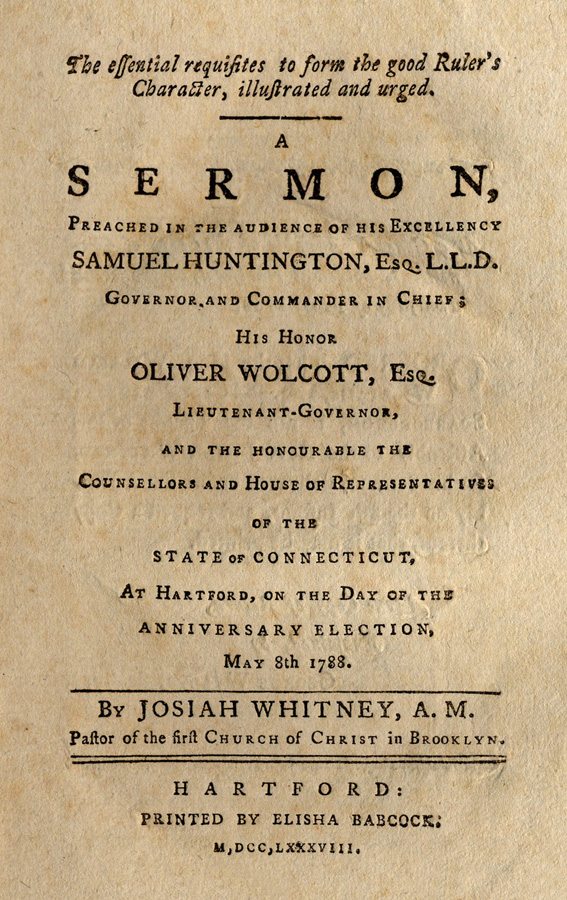
The essential requisites to form the good Ruler’s
Character, illustrated and urged.

A

S E R M O N,

Preached in the Audience of His Excellency

SAMUEL HUNTINGTON, Esq. L.L.D.

Governor and Commander in Chief;

His Honor

OLIVER WOLCOTT, Esq.

Lieutenant-Governor,

And the Honourable The

Counsellors and House of Representatives

Of the

STATE of CONNECTICUT,

At Hartford, on the Day of the

ANNIVERSARY ELECTION,

May 8th 1788.

By JOSIAH WHITNEY, A. M.
Pastor of the first Church of Christ in Brooklyn.


At a General Assembly of the State of Connecticut, holden at Hartford, on the second Thursday, of May, 1788.

ORDERED, That the Hon. William Williams, Esq. and Capt. Ebenezer Scarborough, return the Thanks of this Assembly to the Rev. Josiah Whitney, for his Sermon, delivered before the Assembly on the 8th Instant, and request a Copy thereof, that it may be printed.

A true Copy of Record,
Examined, by

George Wyllys, Sec’ry.


An ELECTION SERMON.
 

EXODUS, xviii. 21.

Thou shalt provide out of all the people, able men, such as fear God, men of truth, hating covetousness; and place such over them.

THAT there is a living, intelligent author of universal nature, a Being called God, is a truth, which shines gloriously in the splendor of the sun — vegitates in every plant — lives in every animal, and diffuses itself throughout all nature.

That this glorious Being does according to his will, in the army of heaven, and among the inhabitants of the earth; and that his dominion is absolute, yet wise and reasonable, are also truths agreeable both to natural and revealed religion.

Absolute dominion, doing according to will and pleasure belongs only to him.

Men are not fit for it. When any have assumed it, their government has ordinarily soon become tyrannical and intolerable.

The stock of corruption in men, discovers itself as soon as there are objects to call it forth: hence none ought to be trusted with absolute power, because it gives vicious inclinations their full play, which before were cramped, and confined within narrow bounds.

Men do not mistrust themselves, because they are ignorant of what is in them.

Many who would say in a private station as Hazael did; What is thy servant a dog, that he should do this great thing? Yet like him, have done the very thing when raised to sovereignty, which before they were shocked with the tho’ts of.

There is but one Being in the universe fit for absolute rule: This one is God, in whom all perfections to meet as to form the most perfect character.

Though he is an absolute sovereign, yet his perfections prescribe the measures of his providence, so as most to promote the welfare and happiness of his creatures.

In his providential government, there is a great variety, so great that we cannot fully comprehend it, nor reduce it to rules and measures.

Hence some who suppose it a reflection on their understandings, not to be able to solve all difficulties, and account for everything, are ready to think, that the course of things is without a wise, intelligent direction.

But wiser are they, who when they feel their inability, to investigate some of the ways of Providence, believe that all are guided and issued by a divine hand.

Often when particular events take place, we cannot at first tell, whether they are the effects of the favour, or displeasure of the world’s great Ruler: Time, the great expositer of events can only satisfy us—Nay perhaps we never shall have satisfaction as to some: Yet from a belief of a supreme providential guidance, we rest assured that things are ordered, or permitted in such a manner, as that in the issue, all will see and own God to be an infinitely wise, just and good governor.

Striking instances there are in every age, of a superintending Providence: human affairs are conducted thereby to their proper periods; all which to minds enlightened and enlarged from on high, are full of harmony and beauty.

That God influences and directs human affairs, is most evident from the sacred writings; these declare, That the kingdom is the Lord’s—That he is the governor among the nations—That he judges the people righteously, and governs the nations upon earth.—The living may know that the MOST HIGH ruleth in the kingdom of men, and giveth it to whomsoever he will.—The heavens do rule. But how does God govern the world?—By instruments? Or by his own immediate influence? It may be a sufficient answer, to say, that though the scriptures just quoted speak of none but God, as governing the world, and though he needs not the aid of any of his creatures, yet to keep them busy and active, he has assigned them work, according to the talents given them. Some he wills should move in higher, and others in lower spheres—Some are to govern; others are to be governed. He raised up Moses and Aaron to give law to Israel—lead them out of Egypt, and guide them towards the land of promise. This indeed is attributed to God, but not without the instrumentality of these his dignified servants. Thou leadest thy people like a flock, by the hand of Moses and Aaron.

Moses, in our text was directed by his father-in-law, the priest, or prince of Midian, to appoint some under him, to be rulers over the people. Should it be said this was not divine, but human counsel, therefore not obligatory: it may pertinently be replied, that it was counsel which probably wanted not a divine sanction. Jethro was sensible that God’s approbation was necessary, in order to Moses’s following his advice; therefore said, If thou shalt do this thing, and God command thee so. The government the Israelites were under, was a Theocracy; and it cannot be reasonably, supposed that Moses would have made so considerable an alteration in it, without divine leave. No doubt God directed him to follow the advice. Nay, may we not add, that it is advice so evidently reasonable, that there lies an appeal to common sense, that it must be agreeable to the will of God.

In our text we have several requisites, necessary to from the character of good magistrates. These will be distinctly considered, after premising a few things, which it is hoped, will be neither foreign to the subject, nor unacceptable to the audience.

Society is necessary, to the comfortable subsistence of mankind, in the present state.

Man is evidently formed for society. When God made the first man, he saw it was not good for him to be alone; therefore made an helpmeet for him. He formed him for society, and disposed him to enter into it.

Should we suppose one placed in Paradise, where were all outward good things, in the greatest variety and plenty, but without social intercourse with his fellow creatures—could he be happy? No, misery would be his portion.

Man alone is insufficient for his happiness—Alone, he is liable to innumerable evils, which he can neither prevent nor redress—full of wants, which he cannot supply.

Hence may be argued, the expediency and necessity of uniting in society, for mutual delight, help and defense.

To speak in the language of inspiration—Two are better than one, because they have a good reward for their labour; if they fall, one will lift up his fellow: But woe to him that is alone when he falleth; for he hath not another to lift him up. If one prevail against him, two shall withstand him, and a threefold cord is not easily broken. Mankind in every age have been so sensible of the necessity of civil combinations, that they have formed kingdoms, commonwealths, counties, towns and the like, for their mutual convenience, and for the preservation of their lives, liberties and properties.

Let it be further premised, that civil government is absolutely necessary to the support and well being of society.

As society is necessary to the well being of mankind; so government is no less necessary to the support of society. Nay, good government is the very life and soul of society.

Should a number lie together without government, and every one do what is right in his own eyes, what must the consequence be in such a lapsed, disordered world as this? Why, they would soon prey upon, and devour each other. Neither life nor property could be secure. The earth would be filled with violence. Rather would a considerate person fly to the wilderness, where he might be in safety, though alone, than remain with sons of rapine and violence.

Not a few of mankind are impatient under the restraints of government: They abhor it and the necessary expenses for its support. They ardently wish to be rid of both.

Wickedness, shocking to relate, prevailed in Israel when there was no government there, and everyone did that which seemed good to him. So would it be with others, left destitute of government as they were. They would soon disband and crumble to pieces.

It is sad to have a bad government, but a government in some, nay many respects bad, is better than none. It is impossible for things to go well where there is none.

Hence, we ought further to premise, that it is the will of God, that some form of civil government should be established among mankind.

What the particular form shall be, whether monarchical, republican, or aristocratical, he has not told us.

Nations or states are left to choose and adopt such as are most agreeable to their genius and circumstances.

Some natural rights are to be given up into the hands of one, or more, for the preservation of the rest.

One form may be best for one people, and a different one for another. In general, that ought to have the preference, which best secures the lives, liberties, and properties of men.

But some form, God wills every people should have to promote, and establish the interest of society, which is the great, and sole end of government.

His will it is also, that there should be some persons vested with authority, and placed over a people. And when properly designated to places of trust, and confidence, they are to be considered as ordained of God to their office, they receive not their commission immediately from him, but mediately. They who have the right of electing them to places of rule, and vesting them with civil power, are the instruments by which God conveys the power to them; and when they are thus vested with it, they are his ministers, and are to be acknowledged as such, as long as they do his will, and well discharge the duties of their place. While they do so they are entitled to respect, and should be obeyed.

But should they cease to be ministers of God for good — should they do evil, neglect the public interest, and have no higher, better object than the gratification of pride, ambition, and selfish regard, then the obligation upon people to respect, and obey them, also ceases.

Indeed no small degree of implicit confidence ought to be placed in rulers, a trust being committed to them, implies it.

They who call them to places of trust, should consider them as fallible, liable to do wrong in some instances. Errors they expect will be found in their administration, because these attend the best; hence they should make proper allowances for human frailty. They must be more than men, who err not. Judicious persons consider unreasonable jealousy of rulers, as mean and mischievous: therefore carefully guard against it themselves, and use their influence that others might not be troubled with this evil disease, which makes all under its dominion cruel as the grave.

But should rulers abuse their power and authority, turn oppressors and tyrants—Should they subvert the public welfare; then their right to command ceases: And it is not only lawful to oppose them, but depose them.

No government is to be submitted to, at the expence of that, which is the sole end of all government, viz. the common good and safety of society. Neither reason nor religion require submission to those who subvert this end: they ought to be discarded and hissed out of their places.

The title ministers of God, only belongs to them while they do the will of God, by exercising a just and reasonable authority, and ruling for the good of men.

These remarks are agreeable to reason, and revelation.

It might be affrontive to this respectable, enlightened audience, to intimate a suspicion, that they disbelieve them, or consume the time in a labored proof of things so level to common sense.

The requisites to form the character of good rulers, mentioned in our text, will now be attended to.

Moses was advised to provide out of all the people, able men, for rulers.

Ability is an essential requisite in the character of good rulers. “Able men, i.e. as a learned expositor says, men able to endure labour;–or men who are not needy, but rich and wealthy;–or men of parts;–or men of courage; for it may refer to any of these, especially the last, such as did not fear potent persons, but God alone.” According to this, they should be men of such health and strength as to be capable of bearing the burdens and fatigues of their office.—They should be men of so much interest or wealth, as shall raise them above the temptation of transgressing for a piece of bread.—Men of parts, of such natural and acquired accomplishments, as to understand well the constitution and laws of their country; as well as the duties of the place to which they are raised. The want of these would expose them to the artifices of party tools, and render them dupes to men of intrigue. Meanness of character, strangely lessens the dignity of rulers.

As ability which respects the faculty is necessary, so is courage, the proper and vigorous application of it to public duties.—Without this the best abilities will be useless. Rulers who know not their duty, or who have not resolution enough to do it well, will never have that respect, which is paid to well exercised authority—they will be despised by the giddy and thoughtless, while the reflecting good citizen, will drop a tear over prostrate authority, knowing that the consequence of its being trampled upon, will be faction, and every evil work, all which may be presented by rulers, who know their duty, and with a steady even hand dare to do it.

Thus essential is ability, to persons clothed with authority. Yet unless it is well directed, it may be injurious to society.

Therefore that able men may be useful men, our text nextly directs, that they should be such as fear God, i.e. religious persons.

Religion is often expressed in the sacred writings, by some eminent grace, or exercise of it, either by faith in God — or by the love of God — or by the fear of God, as in our text and many other places. Such as fear God in the sense of our text, are men truly religious; who make a profession of religion, and pay a practical regard to its laws and duties.

That rulers should fear God, is evident from scripture. — The man who was raised up on high, the anointed of the God of Jacob, and the sweet psalmist of Israel, with an inspired soul tells us, what God said to him.—The God of Israel said, the rock of Israel spake unto me, he that ruleth over men must be just, ruling in the fear of God.

Jehoshaphat, a pious king gave the following charge to persons, who were designated to places of trust, Take heed what ye do, for ye judge not for man, but for the Lord; wherefore let the fear of God be before you.—Nehemiah, a devout governor gave Hananiah charge over Jerusalem, because he was a faithful man, and feared God above many. These things which were written aforetime, were written for our learning, that we should have our eyes upon men of religion, in the choice of rulers.

We cannot find in the Bible, a ruler characterized as good, but who shewed a regard to God, and the things of God.

We cannot certainly determine who are truly religious, the internal character of others is out of our sight. But they who profess religion, and are visibly governed by its laws, are to be treated and confided in as religious. Rulers never should be ashamed of honouring God, by an explicit dedication of themselves to him, and by a personal and constant attendance upon his public worship, and ordinances.—Can they who do not thus honour God, reasonably expect to be raised to places of trust?—or if raised thereto, can they with equal reason expect to be honoured, and obeyed by a religious people, as religious rulers can? I trow not.

Good natural abilities, improved, and polished by education, and rightly directed, make persons publicly and extensively useful; but would not these enlarged, and aided by religious motives, make them much more so?

Irreligious rulers are not so likely to be extensively useful, as the religious—The examples of the latter will have an happier influence upon mankind,–Even their public devotions, may not only be acts of homage to the Deity, but of utility to men, as examples of piety.

Dominion is not founded in grace, nor is every religious man fit for a ruler; yet such a man, (other things being equal) is better qualified for public trust, than the irreligious.

The religion which rulers should have, and by which their lives and conduct should be governed, is the religion of Jesus, which eminently teaches the fear of God.

The gospel of Christ invites all to behold him, seated on the right hand of the majesty on high, exalted far above principalities and powers, and to believe that he will come the second time, to judge the world in righteousness. The government is on his shoulder—dominion and fear are with him—His voice is full of majesty to the rulers of this world—Be wise now,–be instructed—kiss the son, lest he be angry—serve the Lord with fear.

The temper which his religion recommends, wrought in the soul, by the divine spirit, restores it, to its primitive rectitude—directs its actions to the best ends—and extends its views, far beyond the limits of time, even, to the city which hath foundations whose builder and maker is God.

This discovered in rulers, demands reverence to their persons—attention to their counsels—and obedience to their laws.

Happy are such rulers, and happy they who are under their rule. When the righteous are in authority, the people rejoice.

The next requisite is truth, men of truth, i.e. honest upright men, above the meanness of deceit themselves, and careful to detect, and punish it in others—their words may be taken and relied upon with unsuspecting confidence—they neither violate truth by their words nor actions; their words are the true interpreters of their minds.—They punctually perform every private, and official engagement, unless unavoidably prevented, as may sometimes be the case.—The public faith they consider as sacred, and they mean to maintain it, notwithstanding the menaces of the mighty, or the murmurings of the multitude.—They abhor artifice and dissimilation—ambiguity in their discourse, whereby others might be imposed upon, they carefully avoid.

When called to judge in doubtful matters, they diligently search out the cause which at first they knew not, and having found the truth, are resolved to support it.

The last requisite to form the character of good rulers, mentioned in our text, is hating covetousness.

Which means a noble, and generous contempt of the world, and intimates that rulers should “not be greedy of money” but abhor bribery, and every dirty method of gain.

Covetousness, is an ill-looking vice, odious in itself, and pernicious in its effects. No vice perhaps more eradicates every virtuous, and social quality.

When it leads to riches, for no other end, than to look upon them, or to answer the demands of luxury, in both cases the true end of riches is defeated, and the consequence is, a forfeiture of integrity.—It leads the rich to oppress—the poor to great and petty larceny,–It hardens the parent against his offspring, makes the master cruel to his servant, and disturbes the peace of families, and communities.

A person under its dominion, is a stranger to the fervours, and pleasures of devotion, and to aspirations for Heaven, its refined, exalted delights, he has no taste for; if he was there, he would feel no joy, unless he should find that figurative description of the place literally true. The street of the city was pure gold, and could make the same use of gold there, as he has here.

Rulers under the dominion of this vice, will be mischievous to the State, by frustrating the measures which ought to be taken for its benefit, and turning them to their private emolument.

Avarice, where it is a ruling principle, silences the voice of reason, religion, honour, and public spirit; and where their voice is not heard, what effectual check can there be upon the greedy great, to control their unbounded insatiable desire of gain?—If the place they are in is lucrative, they are resolved to make the most of it, though the public might be greatly injured.

Men who hate not covetousness, are not fit for rulers, for their love of money will expose them to bribery, and to the violation of the sacred obligations they are under to fidelity.

They, whose god is either a golden, or silver, or, which is worse, a paper one, will sacrifice the public interest at the shrine of this sordid deity.

Should they be prevented enriching themselves at the public cost, by the vigilance of others, the disappointment might lead them to meditate mischief; for disappointed avarice, kindles faction. Wants, fears, hopes, and wishes terminating in selfish regard, at once check the efforts of generous public principle.

Avarice, enervates the force of government, and frustrates the most patriotic measures.

Public spirit, a liberal generous temper, springing from benevolence, stands opposed to this vice. They who have the former, hate the latter.

Though their charity begins at home, yet it ends not there, as it does in the avaricious. They wish well to all, and according to their abilities and opportunities, do good. They are faithful in things committed to their trust, rejoice in others prosperity, and happiness—embrace all opportunities to promote the public interest, and seek not their own profit, to the detriment of the public.

They hate covetousness.

The character formed by these requisites, tells civil rulers what theirs should be, and must be, to answer the end of their advancement.

Government will be poorly administered by rulers, who are destitute of these requisites. It cannot be expected that things will go well, when persons of vicious principles, and loose morals are in authority. If they are unfaithful to God, and their own souls, will they probably be faithful to the public? Every friend of virtue says no. They want something sufficient to control their lusts. Without the aids of religion, and virtue their best motives will be feeble, and inconstant.

Devout acknowledgements are God’s due, for the institution of civil government.

Some may consider it as a burden, rather than a blessing, as the invention of the ambitious, to raise themselves to the honors and profits of the world; and not as the institution of God, for the good of all—They must be wrong—for government under God, is the guard, and security of our peace, religion, lives, and properties; nay, of everything in this world, for which it is worthwhile to live in it.

Hence, submission to good government, and good rulers, is the duty of a people.

Government cannot exist, nor its advantages be felt, without proper submission, proper submission I say, not absolute, unlimited subjection, for this is fit for brutes only, not for men.

The people of this State, have an excellent form of government, and have been favoured with a succession of rulers, in whom the preceding qualification, have been eminently exemplified. Perhaps no ancient, nor modern State, in these respects has been happier.

Names, distinguished for ability, piety, and integrity grace the annals of our State. And it affords no small pleasure to believe, that Gentlemen in general of like complexion, at present fill the legislative and executive departments. And it is devoutly wished, that such may be the character of those, who may be either continued in office, or a new called thereto this day, by the suffrages of the freemen.—And also, that in future elections, persons of the same character may be the objects of their choice.

Our remaining a happy flourishing people, depends upon our having such rulers.

The discourse turns into addresses usual on this Great Anniversary occasion.

Custom, and decency, lead me in the first place, respectfully to address Governor Huntington, who, by divine providence is placed in the first chair of government.

May it please your Excellency,

As your command has brought me to perform the present service; you will allow me to put you in remembrance of the requisites, which form the good ruler’s character, though you have long known them, and are established in the present truth.

Your gradual rise on the scale of promotion, till you received the highest tokens of respect, and honor, in the power of the State to bestow, shews the public opinion of your ability, and integrity; which tokens you will be pleased to accept, as testimonials of their esteem, and gratitude, for your prudent, upright conduct, at the council-board, and on the seat of justice—For your patriotic conduct, in the federal council of the States, very especially at that most critical era, when the immortal act passed, which constitutes the Independence of these sovereign States—By which a Nation was literally born in a day, and your name, and the names of the rest of that august body, will be transmitted with applause to posterity—and for discharging afterwards, with dignity, and to universal approbation, the office of President of Congress.

Since you have been our first magistrate, you have been acceptable to the multitude of your brethren. And should you again be called to be so, we trust it will be your unremitted, unwearied care, to seek and promote the welfare of this people.

You cannot be insensible Sir, that they who have entrusted you, with this large portion of authority, have a right to expect this.

We doubt not the rectitude of your intentions, nor call in question the sincerity of your desires, to discharge the trust reposed in you, to the acceptance of this people, and what is ore, to the acceptance of God, before whom, you as well as we must stand, and be judged.— The fear of God, or religion (which we trust has a commanding influence upon your heart, and life) will best prepare you for every duty—afford the most effectual aids in doing it—diminish fears in times of danger—and raise you above the frowns and flatteries of time.

We can wish your Excellency no greater felicity, than the union of fervent piety, with a strong public affection; these united, and aiding each other, will make you eminently useful, afford peace in your own breast, such peace as the world cannot give, nor take away—administer the best supports in the article of death—and accompany you to the General Assembly, and the church of the first-born, which are written in Heaven, into which illustrious assembly, may an entrance be administered unto you abundantly, after you have served your generation, by the will of God. Amen.

The discourse nextly turns to Honor Lieutenant Governor Wolcott, the honourable Counsellors, and house of Representatives.

Honored, and much respected Gentlemen.

We esteem ourselves happy in having rulers, and Representatives, who proceed from the midst of us; and will therefore more naturally care for our State.

Your time, abilities, and authority, by your acceptance of public trusts, are consecrated to the community, and cannot without manifest injustice, be withheld therefrom.—And by your official oaths, you will feel an additional obligation, to promote the public welfare.—No solicitude to promote it, would be to violate your sacred honour, which you have pledged, and to incur the displeasure of God, unto whom you have lift up your hands.

When your attention in past sessions, has been called to national and State matters, difficulties neither few, nor small (by reason of the inefficiency of the consideration) have met you. It is hoped that future ones may not be so many, nor so formidable, if that Constitution of Government should be established, which the honourable convention of the States have recommended. The wisest and bestof our citizens, esteem this Constitution, though not perfect, yet as very replete, with temperate, energetic, political wisdom—They rejoice that seven of the States have accepted it, and earnestly wish that it may soon have the approbation of ALL—at least two more to complete the number required for its establishment.

Could its establishment, have been announced by the Chaplin of the day, with singular pleasure he would have congratulated your honours,–this respectable assembly, his fellow citizens, and countrymen, upon the auspicious event.—But though he cannot, yet is pleased with the prospect, that the Preacher on the next anniversary election, may have the satisfaction of doing it.

Meanwhile, may you Gentlemen, find no insuperable embarrassments, but be able to discover, and adopt adequate remedies, for every complaint.

To restore and maintain the public faith, and credit in pecuniary matters—do justly to creditors—promote peace and order—suppress vice—reprove and reform Sabbath-breakers, and the neglecters of public worship-=-patronize the interest of learning—and countenance religion,– the fear of the Lord, are things, most important, and will employ your thoughts, after the elections of this day are over.

Arise Fathers, these things belong to you.—The virtuous citizens of the State will be with you; and what is more, God will be with you—Be of good courage and do them.

The examples of rulers, have great influence upon the manners of the people.

We expect, and have a right to expect, religious ones from you, these will more effectually recommend, and enforce the practice of religion, than any laws you can make, these, beheld not only in your public administrations, but also in private life, will be the most forcible laws—the most effectual means of persuading others to fear God, and keep his commandments.

Our text not only requires, that you should be able men, but also such as fear God.

The best preaching will ordinarily be but to little purpose, if rulers in general by their practice say, the fear of God is not before their eyes. Gentlemen, we are persuaded better things of you, and things that accompany salvation, though we thus speak. Under the influential guidance of that wisdom, which is from above, may you shew yourselves able men, such as fear God, men of truth, hating covetousness; and may you receive the reward of faithful servants, when removed from the present sphere, and verge of mortality. Amen.

My fathers, and brethren of the Clergy, will candidly accept a few words, addressed to them, if fitly spoken.

Reverend Sirs,

Our office is important, its duties difficult, who is sufficient for these things? Aided by our Divine Master, our ministry will not be in vain; his grace therefore, let us devoutly solicit, that we may be serviceable to mankind.

Countenanced by civil rulers, we may successfully recommend obedience to lawful authority—the observance of the wholesome, and necessary laws of the State—reprove vice and immorality—shew the ruinous tendency of discontent and faction—and the salutary effects of leading quiet and peaceable lives in all godliness, and honesty.—If at proper times we judiciously treat these subjects, and influence others, to pay a practical regard to them, we shall be essentially useful to the commonwealth.

Our profession has been treated with contempt, and insult.

An Hume felicitated his times, and boasted, that “the clergy had lost their influence”—But ought it ever to be a matter of boast, that a learned virtuous clergy have lost their influence?—May not one, though of the order, be allowed boldly, yet decently to affirm, that when the clergy, and that religion which they faithfully preach, have been most honoured, and respected by a nation, then things went best among them, and they were most honoured, and respected by nations around them.

This State from its beginning has been happy under the influence of Christian Bishops of the above complexion; and does it not much concern us, the present Bishops of the churches, that we are good ministers of Jesus Christ? Certainly it does. Convinced of this, let it be our invariable aim, to promote the civil interests of the State, in the ways just mentioned.

But we are not to stop here—the spiritual and eternal good of those committed to our charge, should most of all engage our attention, and employ our time and talents—We are to declare all the counsel of God, respecting the recovery of our sinful race, from the ruins of the apostacy, through a Glorious Christ. To testify repentance towards God, faith towards our Lord Jesus Christ—to explain, and urge that holiness, without which no man shall see the Lord.—To affirm constantly the connection between the means of religion, and its existence—This derogates not from the grace of God, for his grace is not more exalted by precluding all beneficial tendency of means, than by allowing it, since the means, and their operation are from him. Means are appointed; but if of no service, why were they appointed?

In our preaching let us keep close to the word of life, and declare its truths, in their native purity, and simplicity.

Abstract reasonings, metaphysical speculations may amuse some, but cannot profit any, like the plain, easy, and simple truths of Christianity; these, will afford solid, lasting comfort to devout souls hovering on the verge of life, while those, in this solemn hour, will pass away as a vision of the night—In a word, let us preach the essential fundamental truths of the gospel, the unsearchable riches of Christ, and tell all, both high and low, rulers, and ruled, that unless they repent, and believe, and follow after holiness they cannot be saved.

The time to fulfill our ministry is short, we like the priests of old, are not suffered to continue by reason of death—presently, we know not how soon, we must go the way whence we shall not return—the way which our departed fathers, and brethren have gone—the way which those truly respectable, and eminent ministers of Christ 1 have gone, who have died since the last Election.

May we be diligent, and faithful, that we may be found in peace, without spot, and blameless at the coming of our Lord Jesus Christ. Amen.

An address to the Assembly at large closes the discourse.

Men, Brethren, and Fathers.

The requisites to form the character of good rulers, have been laid before you, let them have place in your memories, that those persons may have your suffrages, in future elections, who are able men, such as fear God, men of truth, hating covetousness. They who are deficient in these, or are vicious, and immoral, are at once to be reprobated. One of these requisites, viz. the fear of God, or religion is the one thing needful for everyone, of whatever age, or character. Happiness in time, and through eternity depends upon it.—This, we neither should have mentioned, nor urged had we meant, to court the applause of those, who value themselves as being too polite, to be religious.—This is their language—“To suppose persons of fashion, swayed in their conduct, by a regard to religion, is an affront to the delicacy, and refinements of a modest taste”—Hence, they deride the ordinances of Heaven—the day set apart by the law of God, and their country, for worshipping the deity is treated as a vulgar, obsolete institution—should you recommend to them, that family devotion which began the mornings, and concluded the evenings of their pious ancestors, you would become the objects of their pity, if not contempt. Had our object been the ratification of these persons, we must have apologized for the rudeness, of even hinting at religion as necessary, for anybody. But knowing we must speak not as pleasing men, but God who trieth our hearts, we are bold in asserting, the necessity of religion, and in saying, that such modest ones ought never to be raised to posts of honour, and trust—nay, should any after being raised thereto, be found such, let them speedily be removed as utterly unworthy the public confidence, and left to herd with their like, in irreligion and vice.

Should indifference, as to the character of rulers ever become fashionable, or the preference given those who cast off the fear of God—make light of Christ—his religion—laws and ordinances—that it would become those who speak in the name of the Lord, on such occasions as this especially, to urge with pathos, the necessity of rulers having the second requisite contained in our text—And they would be faulty if they did not.

Excellent, my fellow-citizens is the Constitution of our State, with a great sum it was obtained by our worthy Forefathers, and at the expense of much blood, and treasure it has been defended, and preserved—The footsteps of a kind, almighty Providence are to be traced, in uniting, and defending these States, when involved in the horrors of war,–raising them to freedom, and independence, restoring Peace, and hitherto continuing it—and also in the prospect, of soon having an energetic government established. May our gratitude for the great, and good things which have been done for us, be evidenced by a wise, and discreet improvement of our constitutional privileges.

The right of electing rulers and representatives, is ours. We cannot reasonably wish to elect them oftener than we do.

When called to elect representatives, let men be the objects of our choice, who have the requisites recommended in our text: They who have them, will not need the instructions of their constituents, to regulate their votes in General Assembly.

By a proper use of the right of electing rulers and representatives, we may obtain the redress of any real grievance.

Hence recurring to arms and staining our hands with blood, is quite needless—Nay, it is a crime which deserves the severest vengeance, in the power of a State to inflict.

The last year’s outrages opposition to government, in a neighbouring commonwealth, viewed in its nature, and tendencies, should lead us to abhor faction, and its promoters, and abetters. Whether the lenity of government towards the leaders of that rebellion, is consistent with good policy, is a question, which by and by will be faithfully answered by Time, the best expositor of events.

The disappointed, and restless, persons of broken fortunes, and characters, will at times excite, and foment disturbances; and under the guise of patriotism, call for the redress of pretended grievances, with a view to gratify their avarice, or ambition. These, when formed into little political clubs, and allowed to lead others, as uneasy, and mischievously inclined as themselves, are always troublers of a State, and should be treated as pests in society.

What Heaven’s will is concerning persons of this complexion, is manifest from that edict of its great ruler, to all his loyal subjects—Take us the foxes, the little foxes that spoil the vines, for our vines have tender grapes. q.d. “diligently look after these mischievous ones, take them in their early craft, check them in their beginnings, while they are yet little foxes, small whelps; knowing their craft and subtilty [artifice], windings and turnings, shifts and evasions; timely guard against them, detect their frauds, use every effort that they might be taken and kept from doing further mischief.”

Thankful, let us be for our privileges, and careful to cultivate and cherish the virtues of civil life—Let us encourage the hearts of rulers, and strengthen their hands, by appearing in their defence and for their support, while they shew themselves ministers of God for good to us.

By industry and frugality let us aim to improve what we are already possessed of to the best advantage, that we may keep what we already have, as well as acquire more. Aided by these, agriculture, manufactures, and traffick will flourish; and we shall be able in due time, to have the necessaries and conveniences of life in such plenty and variety, as to render the importation of them from foreign nations, less necessary.

Diligence in our callings, retrenching unnecessary expenses—living within, and not beyond our incomes—avoiding extravagance, and dissipation, will make us an opulent happy people.

All whether high or low, rich or poor, have work to do. Let none eat the bread of idleness.

Let not America’s daughters, however affluent their circumstances may be, think it disreputable, to seek wool and flax, and work willingly with their hands, by applying them to the spindle, or with them holding the distaff. And to enforce this, let it be remembered that no less a woman than the mother of king Lemuel did so, or recommend it.

Let us, respected hearers, do all the good we are capable of doing. A large reward awaits all who do much good.

The connection between time, and eternity, is real, and important.—The intellectual endowments, and moral pursuits of those of our race, who partake of the rest which remains for the people of God, are doubtless, analogous to those they had in this world.—The measure of their bliss there, is apportioned to their improvements in virtue here—pleasing thoughts these, to contemplative, devout minds; and should raise desires for the sublimest knowledge, in the improvement of intellectual powers; and serve to regulate moral pursuits, by the strictest virtue: in doing so, we may with reason expect capacities there, wonderfully enlarged, and fitted to operate with the utmost facility, in most extensive spheres.

The joys of Heaven, consist not in epicurean indolence, nor stoical apathy, nor enthusiastic raptures, nor in the sensual gratifications of the Koran—But in conformity to the image of God—doing his will, and enjoying him.

The rewards of eternity, were of old much confined by ethnic pride, or policy, to celebrate conquerors, and legislators.

But Christianity announces blessedness, to the virtuous of all nations, capacities, stations, and ages; it assures all the devout followers of the lamb of God, moving either in the higher, or lower walks of humanity, that the crown of life, shall be theirs, that in the Great Rising Day, they shall be happy in their whole persons, happy in proportion to their place, on the scale of goodness here.

But not so, shall it be with the ungodly, those who would not that Christ should reign over them—endless sorrow will be their portion.

Is the present life thus connected with the future? Does religion lead to happiness? Irreligion to misery? Then let us chuse and practice the former, and guard against the latter, that our future existence may be happy. By religion, not only our spiritual, and eternal interest will be promoted, but our temporal also; for it serves to render us useful, and ornamental members of society.

Such, let us invariably aim to be, so long as it shall please God, in whose hand our breath is, to continue us in this world.—But let us not chiefly look to the things which are seen, and are temporal: for our chief, our greatest interest lies in a better country, that is, an heavenly, to which may our souls, on the wings of faith, and contemplation often soar. While on earth, may our conversation our citizenship be in Heaven. And may we have the testimony, the first of the human race had, who went not downwards to the sky” which was this, That he pleased God. Our ambition can fly at no higher, nor better mark than the pleasing that Being, who made us, and will judge us. Though it would be presumption, to expect such a passage from earth to Heaven, as Enoch had; yet if we have a like testimony, that we please God, we may rest assured, that when our earthly tabernacles shall be dissolved, we shall find the building of God, the house not made with hands, eternal in the Heavens.

Now unto him that is able to keep us from falling, and to present us faultless before the presence of his glory, with exceeding joy; to the only wise God, our Saviour, be glory, and majesty, dominion and power, both now, and ever.

A M E N.


Endnotes

1. Rev. Mess’rs Little-Trumbull-Whittlesey-Williams.

Sermon – Election – 1787, Connecticut


Elizur Goodrich (1734-1797) graduated from Yale in 1752. He was a tutor at Yale (1755-1756), a pastor in Durham, CT (1756-1797), and prepared over 300 students for college. Goodrich gave this sermon in Connecticut on May 10, 1787.


sermon-election-1787-connecticut

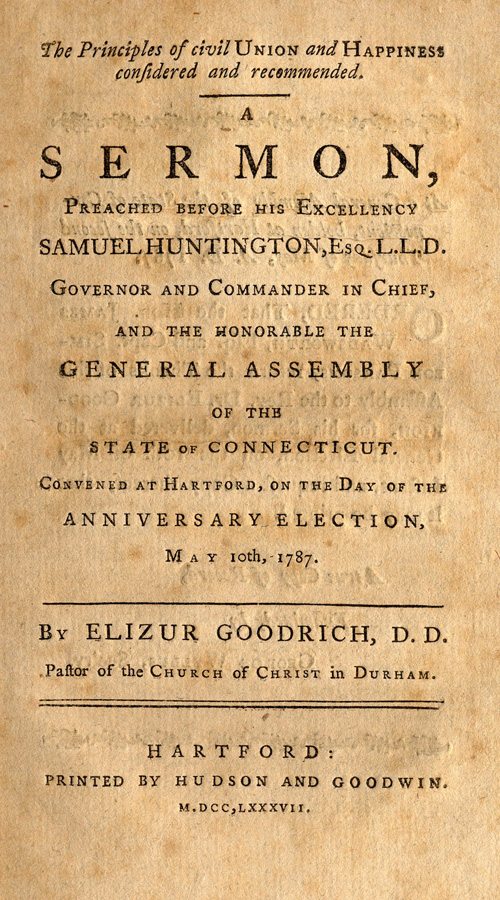
The Principles of civil Union and Happiness
Considered and recommended.

A

S E R M O N

Preached Before His Excellency

SAMUEL HUNTINGTON, Esq. L.L.D.

Governor and Commander in Chief,

And the Honorable the

GENERAL ASSEMBLY

OF THE

STATE OF CONNECTICUT.

Convened at Hartford, on the Day of the

ANNIVERSARY ELECTION,

May 10th, 1787.

By ELIZUR GOODRICH, D. D.
Pastor of the Church of Christ in Durham.


At a General Assembly of the State of Connecticut, holden at Hartford, on the second Thursday of May, A. D. 1787.

ORDERED, That the Hon. James Wadsworth, Esq. and Capt. Simeon Parsons, return the Thanks of this Assembly to the Rev. Dr. Elizur Goodrich, for his Sermon, delivered at the General Election, on the 10th of May Instant, and request a Copy thereof, that it may be printed.

A true Copy of Record,
Examined by

George Wyllys, Sec’ry.


P S A L M cxxii. 3

JERUSALEM IS BUILDED, AS A CITY THAT IS COMPACT TOGETHER.

JERUSALEM was a city, defended with strong walls, the metropolis of the kingdom of Israel, and the capital seat of the Hebrew empire.—It’s inhabitants were not a loose, disconnected people, but most strictly united, not only among themselves, but with all the tribes of Israel, into a holy nation and commonwealth, under Jehovah their king and their God.—And as Jerusalem was the place, which he was pleased to honour as the seat of his royal residence and government, it was most truly the city of the Great King. Hence both by divine appointment, and the common consent of the nation, it was established as the local centre of communion in all the privileges of their civil and sacred constitution. There were the thrones of judgment, the thrones of the house of David, and the supreme courts of justice, and of the public administration: There were the Levites, waiting in their courses, and the Priests, ministering in their offices, before the Lord: There was the testimony, the ark of the covenant, the temple, and the solemn services of religion: And there all the tribes and scepters of the people, assembled three times in the year, to present national homage to Jehovah, their king and their God.

In all these respects, whether Jerusalem be considered in a natural, civil or religious view, its strength and beauty consisted, in being builded “as a city, that is compact together.” Hence the Psalmist’s affection for Jerusalem expressed in this Psalm was not a mere partial and local fondness; but had in view, and was excited by the most noble objects. These were the exaltation of Jehovah, the king and God of Zion—the honour and happiness of the nation—the preservation of the true religion, and the peace and best good of all the tribes of Israel. Religion therefore, and public spirit were untied in the ardent affection of the pious Israelites, toward Jerusalem, which they preferred above their chief joy.

We have also a Jerusalem, adorned with brighter glories of divine grace, and with greater beauties of holiness, than were ever displayed, in the most august solemnities of the Hebrew-temple-worship; and presents, to our devout admiration, gratitude and praise, more excellent means of religion and virtue, peace and happiness, than ever called the attention of the assembled tribes of Israel. We enjoy all the privileges of a free government, the blessings of the gospel of peace, and the honours of the church of God. This is our Jerusalem.

The safety and preservation of it depend, under God, on the friendly agreement of its citizens in all those things, necessary for its honour and defence, happiness and glory. Without this agreement, it cannot be “builded as a city, that is compact together.” There will be no peace within its walls, nor prosperity within its palaces: It can have neither strength or beauty, nor administer protection to its inhabitants; but it will be as a city broken down, and without walls.

The text therefore, and the great occasion, on which we are assembled in the house of God, justify a discourse on the great principles and maxims, of civil union—the importance of a good, public administration, to answer the great ends of government—and the necessity of the joint exertions of subjects, with their rulers, in promoting the public peace and happiness.

I am then, in the first place, to point out some of the great principles and maxims, which are the foundation and cement of civil union and society.

The principles of society are the laws, which Almighty God has established in the moral world, and made necessary to be observed by mankind; in order to promote their true happiness, in their transactions and intercourse. These laws may be considered as principles, in respect of their fixedness and operation; and as maxims, since by the knowledge of them, we discover those rules of conduct, which direct mankind to the highest perfection, and supreme happiness of their nature. They are as fixed and unchangeable as the laws which operate in the natural world.

Human art in order to produce certain effects, must conform to the principles and laws, which the Almighty Creator has established in the natural world. He who neglects the cultivation of his field, and the proper time of sowing, may not expect a harvest. He, who would assist mankind in raising weights, and overcoming obstacles, depends on certain rules, derived from the knowledge of mechanical principles, applied to the construction of machines, in order to give the most useful effect to the smallest force: And every builder should well understand the best position of firmness and strength, when he is about to erect an edifice. For he, who attempts these things, on other principles, than those of nature, attempts to make a new world; and his aim will prove absurd and his labour lost. No more can mankind be conducted to happiness; or civil societies united, and enjoy peace and prosperity, without observing the moral principles and connections, which the same Almighty Creator has established for the government of the moral world.

Moral connections and causes in different circumstances produce harmony or discord, peace or war, happiness or woe among mankind, with the same certainty, as physical causes produce their effect. To institute these causes and connections belongs not to men, to nations or to human laws, but to build upon them. It is no more in the power of the greatest earthly potentate to hinder their operation, than it is to govern the flowing and ebbing of the ocean.

The great and most universal principle and law of rational union and happiness, is the love of God and of our neighbour: This in the moral, is like the great law of gravitation and attraction in the natural world, and its tendency in human society, is to universal good. The first maxim derived from it, is that divine precept in the gospel, “whatsoever ye would that men should do unto you, do ye also the same unto them.” Hence religion and virtue are the great principles on which the happiness of human societies must be built; and from these principles must be derived the knowledge of all laws, which determine the order of that benevolence, we owe to one another, and point out the means of attaining the greatest good.

If this were a state of so much innocence and perfection, that the law of reason and of love directed and influenced all the views and actions of mankind, there would be no necessity for the coercion of civil government. But in the present depraved state of human nature, the various dispositions and differing pursuits, the jarring interests, and unruly passions, the jealousies and misapprehensions of neighbours would spoil their harmony and good agreement; and, when disputes arose, there would be no common judge, to whom they might refer their differences; but everyone would be an avenger of his own wrong: This would soon end in a state of hatred and war; and destroy all human peace and happiness. To prevent this mischief, and to secure the enjoyment of rational liberty, which summarily consists in the unmolested privilege and opportunity of “leading a quiet and peaceable life, in all godliness and honesty,” is the great end of the institution of civil society and government.

The end therefore, and nature of civil government imply that it must have for its foundation, the principles and laws of truth, justice and righteousness, mercy and the fear of God; or it can never advance the happiness of mankind. For that mankind by uniting into society, and putting themselves under a common government, can promote their true interest, otherwise than by observing these laws, is as contrary to reason as, that a machine may be of great and beneficial use in human life, when its whole construction is contrary to all the principles, by which the world of nature is actuated and kept together.

There can be no beneficial union among the members of a community, where these great principles of righteousness and truth integrity and the fear of God, are not maintained, both among themselves, and towards all mankind. Any number of men, confederated, both among themselves, and towards all mankind. Any number of men, confederated together in wickedness and injustice, can have no strength, but what they derive from being faithful to one another. Such a combination may exist among robbers and pirates: but their agreement ought not to be dignified by the name of civil union: it ought rather to be esteemed a wicked conspiracy against the rights of mankind, which can never be justified by number, nor on any pretence of public good.

These moral principles and connections are moral laws, not only, as they point out a fixed order of events respecting moral ends, in which view the mere politician, who has no fear of God before his eyes, may consider them; but to the enlightened and religious mind, they are moral laws, in a higher sense—laws of our creator, for the conduct of our life and manners. They cannot therefore be transgressed, without offending against his will and authority—without incurring guilt in his sight, and rendering ourselves obnoxious to his wrath and displeasure, as the great and righteous governor of the world. “The Lord is in his holy temple, the Lord’s throne is in heaven; his eyes behold, his eye-lids try the children of men. The Lord trieth the righteous; but the wicked and him that loveth violence, his soul hateth. Upon the wicked he shall rain snares, fire and brimstone and an horrible tempest. This shall be the portion of their cup. For the righteous Lord loveth the righteous, his countenance doth behold the upright.”

If we can find what are the laws and rules, which men, as rational creatures, must observe, that they may arrive at the greatest happiness and perfection of their nature, these are the laws which they must observe, when united in political bodies, in order to promote the common good of society. The same virtue and integrity, truth, justice and honour, which, we venerate in a private character, must be found in the public administration, and generally prevailing among a people, or a state, cannot be united, peaceful and happy in itself, and respectable in the world.

Hence in all well regulated civil communities, laws of natural, universal and unchangeable obligation hold the first rank: They are such fixed means of union, peace and happiness, that no other can or ought to be substituted in their room. It may however be observed, that the force of civil society cannot extend to all laws of this kind; but only to such upon the observation of which the common quiet of mankind entirely depends. To do to our neighbour as we would that he should do to us is one of the planest dictates of reason, and a law of universal equity and obligation. It comprehends the whole of social duty, and extends to kindness, humanity and mercy, as well as to truth and justice. But although it is the great rule of our conduct and the bond of society, it cannot in its whole extension have the force of a civil law in commonwealths. Controversies about the violation of it would be perplexed and intricate: Litigious suits would be infinitely multiplied: The good and virtuous would be deprived of the most valuable part of their character: and the state would be torn with intestine division and discord.

But, tho’ all the laws of nature cannot be enforced with civil sanctions, yet every righteous state adopts those, which are necessary for the preservation of the public peace, and for an equal and impartial distribution of rewards and punishments. The good and virtuous, who are influenced to do well out of reverence to God, and sincere love to mankind, must be protected and encouraged; and the wicked and disorderly, restrained by the dread of punishment. The great laws of justice must be armed with a civil force, and never allowed to be transgressed with impunity. Such, for instance, is that statute of Jehovah, the God and King of Israel, “Ye shall do no unrighteousness; in judgment, in mete-yard, in weight or in measure. Just balances, just weights, a just ephah, and a just hin, shall ye have.” This law must be admitted into every civil state; but, that it may have force in society, the public standard must be fixed; the most convenient weights and measures, determined; the manner of their being tried, ascertained; and an awful penalty annexed to transgression. These are circumstances, which are not determined by the law of nature; but must be adjusted by civil regulations suited to the condition of particular commonwealths.

The principles and laws of justice are fixed and unchangeable—they depend not on human authority; but the particular regulations, by which they have force in society, as civil laws, not being determined by the law of nature, may be changed, when they are found inconvenient and hurtful to the community. Hence the legislative authority of a state, extends to the repealing of old, as well as the making of new laws.

Nevertheless, great care should be taken in framing laws, that they may be suited to the peculiar state of a people, and have an equal and uniform operation for the public good. New and different circumstances require new and different regulations in society, fitted to the occasions which produce them: But the fundamental laws, by which a people are compacted together, like the laws of the natural world, must have a fixed consistence and duration. Such, in general, are laws relating to personal liberty, the privileges of the subject, and the powers of the magistrate—to private property and the execution of justice—to the punishment of evil-doers and the preservation of the public peace—to marriage, education, religion, and the rights of conscience—to the public forms, and order of government—and to the revenues and taxes, by which the state is supported. Frequent changes even in the external appendages, much more an unfixedness in the laws, and a want of stability in the public administration, diminish he energy and dignity of government, and will be attended with uneasiness and discord.

I shall only add, that as the best and most useful laws can be of no use, unless subjects be trained up and educated in a manner of living conformable to them, every wise state will pay great attention to the education of children, and to all such regulations, as are necessary for the instruction of the people in the principles of piety and virtue. The best security men can have, of living together in harmony and love, is from the prevalence of true religion, and a due regard to the will and authority of the supreme being. Religion and virtue, are the strongest bond of human society, and lay the best foundation of peace and happiness in the civil state.

I proceed, in the next place, to consider the importance of a good public-administration of government, to the peace and happiness of a people.

All the qualifications of a good administration may be summed up in two heads, the ability and faithfulness of those, who are entrusted with the weighty concerns of the state: To one or the other of these two things may be referred, whatever can be desired or expected in a good ruler. These qualifications are of the highest importance, in every administration. A free people, under God, may justly put confidence in such an administration, and not find themselves disappointed, as they must unavoidably be if they commit themselves into the hands of weak or wicked men. The former, though they mean never so well, are unable to do good; the latter may improve their great talents, to do mischief: Neither of them are fit to be entrusted with the great affairs of state. Who, on the one hand, would willingly trust his whole interest to the power and disposal of a man of the greatest abilities, but destitute of honour and conscience; or on the other hand, who would undertake a dangerous voyage, on the boisterous ocean, under the command of the most upright and honest man, who had no knowledge of the art of navigation, nor any acquaintance with the seas. In common affairs no honest man will undertake any business for which he knows he is unfit, though he should be solicited to do it: The same should be observed by men, invited to serve the public. When a people have raised men of weak abilities to posts of honour, it may seem hard to neglect them; and it must, indeed, be ungrateful, if in any good degree, they maintain the dignity of their stations, and advance the public good; and especially, if the posts they hold, were un-sought, and conferred without solicitation. Nevertheless it should be considered, that those, who undertake the affairs of the public, are as answerable for their abilities, as the soldier for his courage, when he enlists into the service of his country. The safety of the public is to be preferred to the honour of an individual.

Here I might delineate more fully the character of an able and faithful administration; but I will not enlarge, and shall say only in a few words, that the principal lines of it, are knowledge, wisdom, and prudence, courage and unshaken resolution, righteousness and justice, tempered with lenity, mercy, and compassion, and a steady firmness of public measures, when founded in wisdom and the public good, together with inflexible integrity, the fear of God, and a sacred regard to the moral and religious interests of the community. These are the great characteristics of an administration, which will procure respect and confidence; and has the best tendency to promote the happiness, union and strength of a people, and to render them as a “city, that is compact together.”

If a virtuous people venerate rulers of this character, and unite their endeavours with them in advancing all the noble ends of society, they will have the fairest prospect of peace and prosperity; which was the last thing, I proposed to be considered.

Let the first object, exciting the attention of a free people, be the character of those, whom they introduce into public offices; and, the next, that they reverence the worthy magistrate, support him in his office and dignity, and shew a ready obedience to the laws of the state.

Not only may a people be delivered into the hands of tyrants, as the rod and scourge of heaven for their impiety and madness; but through their own folly, “children may be their princes, and babes rule over them.” Such a “people shall be oppressed every one by another, and every one by his neighbour.”

Happy the free and virtuous people, who pay strict attention to the natural aristocracy, which is the institution of heaven; and appears in every assembly of mankind, on whatever occasion, thy are met together. Happy the people who have wisdom to discern the true patriot of superior abilities, in all his counsels ever manifesting a sincere regard to the public good, and never with a selfish view attempting to deceive them, into hurtful measures; and happy the people who distinguish him from the designing demagogue, who, while he sooths them in their vices, and flatters them with high notions of liberty, and of easing their burdens, is plunging them into the depths of misery and bondage.

How idle are all disputes about a technical aristocracy, if people disregard that divine injunction, given by Moses, to the free electors of Israel, when he was about to appoint some assistants in government. “Take ye wise men and understanding and known among your tribes” for their great abilities and good deeds, “and I will make them rulers over you.”

Such an aristocracy is founded in merit and designed by the God of government and order, to direct a free people in the choice of their judges and public magistrates. Riches are so far necessary as to raise the judge and counselor above the temptation of transgressing for a peace of bread, nevertheless this aristocracy is derived from merit and that influence, which a character for superior wisdom, and known services to the commonwealth, has to produce veneration, confidence and esteem, among a people, who have felt the benefits, and enjoy the advantage of being under so happy a direction.

This influence of character in the language of the Roman republic, was called Auctoritas partum, and the veneration paid to it by the people, Verecundia plebis. It is essentially necessary in all good governments, but especially the life and spirit of a happy, free and republican state, which subsists on the virtues of its citizens, and can never, while any sound wisdom is left to direct the public choice, by design commit the civil administration into the hands of men destitute of political abilities, or who are the patrons of vice.

It is therefore, of the highest importance to the being, happiness and peace of free republics, to shew a fixed and unalterable regard to merit in the choice of their rulers: The next thing is to discover a deference and submission to authority, obedience to the laws, a spirit of righteousness and peace, and a disposition to promote the public good.

Honor and respect are due to rulers: The order and good of society require external marks of distinction, and titles of eminence to be given them. This is due to their office; an honour paid to the institution of government; but there is a further honour due to them, when they are faithful in executing the trust committed to them, and direct all their actions to advance the true interest of the state. In this view, good rulers alone can be honoured, because they alone deserve esteem and respect. We owe obedience and subjection to all rulers in the execution of their office, according to the laws of the land; but, as to cordial affection, veneration, esteem and gratitude, these are due only to the worthy magistrate;; and the debt will be paid by all virtuous citizens, although he should be blasphemed, arraigned, and condemned by the factious and discontended, who wish that there should be no righteous government in the world.

If we willfully transgress the laws of society and resist the just commands of civil authority, we do an injury not so much to the magistrate, as to the community, and expose ourselves to the high displeasure of Almighty God, whose authority is above all human constitutions, and can never be annulled by the decrees of kings and nobles, the consults of senates, or the joint consent of a people.

This is the sentiment of a great and good man, who well knew the rights of human nature, and the privileges of a subject, which he had the courage to plead before kings and magistrates; I mean the apostle Paul, who, illuminated with the knowledge of Christianity, and inspired with the benevolence of the gospel, the slave of no party, in the greatest transports of zeal, spoke only the words of truth and soberness. The doctrine he delivered was not the effect of servile flattery and shameful cowardice: It proceeded not from the spirit of fear, but of love and a sound mind: It is so expressed as at once to declare the great end of civil government, the duty of the magistrate, and the reasonableness of the subjects obedience. It contains both an effectual guard against supporting tyranny and oppression, and a most serious and solemn warning against lawless rebellion, anarchy and confusion: It is delivered as a divine injunction upon Christians, in a letter to the saints at Rome, and is profitable for all ages, and especially seasonable for the present. “Let every soul be subject to the higher powers. For there is no power but of God. The powers that be are ordained of God. Whosoever therefore resisteth the power, resisteth the ordinance of God, and they that resist shall receive judgment to themselves. For rulers are not a terror to good works, but to the evil. Wouldst thou then not be afraid of the power? Do that which is good, and thou shalt have praise of the same. For he is the minister of God to thee for good. But if thou dost evil, be afraid, for he beareth not the sword in vain: for he is the minister of God, a revenger to execute wrath, upon him that doeth evil. Wherefore ye must needs be subject, not only for wrath, but for conscience sake. For, for this cause pay ye tribute also: for they are God’s ministers, attending continually upon this very thing. Render therefore to all their dues: tribute to whom tribute is due; custom, to whom custom; fear to whom fear; honour to whom honour.”

When a constitutional government is converted into tyranny, and the laws, rights and properties of a free people are openly invaded, there ought not to be the least doubt but that a remedy consistent with this doctrine of the apostle, is provided in the laws of God and reason, for their preservation; nor ought resistance in such case to be called rebellion. But who will imagine, that God, whose first law, in the world of nature and reason, is order and love, has commissioned men of a private character, with a lawful power, on every pretence of some public mismanagement, to enflame and raise the multitude, embroil the state, and overturn the foundations of public peace.

Civil society can exist no longer, than while connected by its laws and constitution: These are of no force, otherwise than as they are maintained and defended by the members of the commonwealth. This regular support of authority is the only security, a people can have against violence and injustice, feuds and animosities, in the unmolested enjoyment of their honest acquisitions: Hence the very end of civil society demands, that the orders of government be enforced; the fountains of justice, kept open; the streams, preserved pure; and the state, defended against all internal and foreign violence. These ends can never be attained, under the most excellent constitution and laws, but by means of an able and faithful administration, and the concurring zeal and assistance of all good and virtuous citizens.

Although some exclude religion and the profession and worship of the gospel from having any concern in the happiness of civil society and in the choice of rulers among a free people, yet without religion, a people happily united in all other respects, want the bond, most essentially necessary to preserve the union, and to excite everyone to faithfulness in his station.

The chief glory of the Gospel is, that it opens the way of salvation to a fallen world, and contains the words of eternal life: And were not this its great and distinguishing excellence, it would be of so much less importance to mankind, as the concerns of eternity are greater than those of time. It does everything for our happiness in this world, which can be effected by the most excellent precepts of morality, and by instructing us in all the duties, we owe to God, our neighbour and ourselves: At the same time, it binds us to the most unremitting diligence and perseverance in all good works, by the solemn account we must give to our righteous judge, for all the deeds done in the body.

The blessed Gospel is therefore the best privilege which a people can enjoy; and were its precepts duly observed, the civil state would be in the best order, and in the most excellent condition. Persons of all ranks, according to their abilities, would be blessings to the community. The foundations of our Jerusalem would be laid with polished stones, and the city of our habitation be built up without the noise of saws and hammers. The stone would not cry out of the wall of public fraud and oppression, nor the beam out of the timber answer it; but our officers would be peace, and our exactors righteousness; our walls would be called salvation and our gates praise, and no wasting violence and destruction would be heard in our borders.

Having pointed out the principles and maxims, on which civil union and happiness depend, and considered both the character of a good administration of government, and what is required of the subjects and citizens of a free state, I proceed to address and exhort the several orders of men present, that in their several places they use their best and most faithful endeavours for promoting the public peace and prosperity, that this and the United States, may, after the model of Jerusalem, be “builded, as a city that is compact together.”

In the first place, duty requires, that with the greatest respect and reverence the public exhortation be addressed to his Excellency, Governor Huntington, the Chief Magistrate of this free State.

May it please your Excellency,

While I congratulate my fellow-citizens, on the return of this joyful anniversary, I beg leave to address your Excellency, with the honours of the day, and the thanks of a grateful people for all the peaceful blessings of your administration.

The many faithful and important services rendered to your country, in the most difficult and interesting affairs of this and the United States have distinguished you with honour, among the patriots of America—enrolled your name, in the immortal list of those great and noble personages, who in the most heart-searching times, sealed the independence of America, adventured to sit at the head of the national council—and added you to the bright constellation of the illustrious Statesmen and Governors of this free commonwealth.

How different is the station of a chief magistrate in a free government, who lives in the hearts of the people, from that of the arbitrary despot, who has many slaves, but not a loyal subject? All seem to adore the tyrant, and tremble at the least motion of his eye, while they sigh for a change; and at the first blow, the idol is pulled down, and trampled under foot. The confidence and esteem of a virtuous and free people are derived from known and approved merit, and have a lasting foundation. The chair of state is marked with this motto, FOR THE BEST AND THE WORTHIEST CITIZEN.

I SINCERELY with your Excellency, the most pleasing satisfaction, in the esteem, veneration and gratitude of your citizens; but I persuade myself, you look to an higher source of joy, and to a greater witness of integrity, than the most unanimous approbation of a sensible and grateful people: I mean the witness of conscience, appealing to the great searcher of hearts, that in the whole of your public conduct, and in all the private walks of life, you have considered yourself, as the servant of the Most High God, and devoted all your abilities, ultimately to the honour and service of the eternal king.

This is that rectitude of intention and endeavour, which is able to give calm peace through all the changing scenes of life, and all the uncertainties of earthly greatness; and even in the view of approaching death, and the prospect of the appearing and kingdom of our Lord Jesus Christ. It cannot therefore, fail of affording your Excellency serene joy, while with an unreproaching heart, you look round on the assembled commonwealth; and with an unruffled mind, meet the great event of this day.

Should the providence of God, and the voice of this free people continue your Excellency in the first feat of government, I would with the deepest humility and respect, honoured sir, beseech and even charge you, in the presence of the supreme judge and this great congregation, to look to the grace of the eternal Jehovah, that you may be furnished for, and be found faithful in the high employment. You will not think it, beneath your exalted dignity, to be exhorted by one of the meanest of Christ’s servants, to acknowledge the infinite source of wisdom, in all your ways, and to ask direction of heaven, in all your paths, that truth and integrity may ever guide you; and righteousness and mercy be the girdle of your loins.

I am persuaded, that the peace and happiness of this, and the United States, cannot be built up and established, but upon the maxims I have pointed out and recommended. You, Sir, are a master-builder on the walls of our Jerusalem: Let not these walls be daubed with the untempered mortar of injustice, jealousy and discord; but may they be cemented by the uniting principles of justice, benevolence and public spirit.

The post assigned your Excellency, in divine providence, is high and honourable,–the employment, great and weighty, the objects in view, beautiful and glorious, and the motives, such as may well inspire a noble and generous breast, with the warmest zeal, the most unshaken fortitude, and the most unremitting perseverance, in the most faithful endeavours, to answer the great ends of the exalted station, you hold in this commonwealth. Some of these objects, motives and ends are the exaltation of Jehovah, the King and Governor of the universe—the high importance and dignity of government, the great foundation of peace and quiet—your own honour in being furnished by God with great abilities of eminent usefulness—the loss or preservation of public liberty, and the rights of a free people, on which depends the happiness of thousands, or the misery of millions,–the cause of religion and virtue, and the consequences of them on the present and eternal interests of mankind—the peace and best good of civil society, and the honour and safety of this, and the United States,–and finally the joys or the sorrows of that great and glorious day, when dignity and power will be no defence; but the highest potentate, and the meanest slave, will stand without distinction before the supreme and eternal judge, and receive the solemn, and decisive sentence from his mouth.

These, Sir, are weighty considerations, which I humbly address to your constant attention, that under the influence of them, you may be found faithful, and met the final approbation of your Lord. In the weight of government, you will be encouraged and assisted by good men and virtuous citizens; whose continual and earnest prayer will be that the blessing of Almighty God may attend and render your administration successful for the honour of God, the advancement of piety and virtue, the true interest of this and the United States of America, and the general good of mankind.

May your Excellency long live, the ornament of your country and the church of Christ.—May you be happy in the consciousness of faithfully serving God and your people; and have the unspeakable joy of beholding them safe, virtuous and free.—And, when the Supreme Disposer of all events, shall dismiss you from the services of this world, whether you shall then be in public life, and the chief magistracy over this people, or free from public cares in the serene retirements of a peaceful old age, may you experience the solid supports of the Christian hope, share in the rewards of grace, and shine with unfading glories, in the kingdom of the Redeemer.

Let the public exhortation in the next place be acceptable to his Honour, Lieutenant-Governor Wolcott, the Honourable Councellors, and the Respectable Representatives of this State.

Honoured Gentlemen,

How happy will it be if the Magistrates and Representatives of this State shall enter upon public business, with a noble spirit of true patriotism, having no narrow and private interests at heart; but seeking the good of our Jerusalem, build it up on the great foundations of truth and righteousness. Then peace will be within our walls, and prosperity within our palaces.

A SELFISH and contracted spirit in any member of society is a great blemish; but in a chief ruler—in a senator—in the representative of a free people, it is vile—it is odious, and unpardonable. Let this spirit be banished from public counsel; or it will destroy all harmony of sentiment, and lead into the narrow by-paths of private ambition and self-exaltation: The builders will not understand each other’s language; scenes of confusion ensue, and the public resolutions shew more the complexion of party-attachment, than the public good.

If the leaders of a people are not united in the great maxims of government, and maintain not steadiness in the public administration, the people never will, nor can be easy. And when a community is rent by the animosities and different views of their principal leaders and citizens, a republic is verging towards an ochlocratical [mob rule] state, in which the prevalence of a party, is no sure token of truth. In this situation, justice may be overborne by the violence of misguided passion, blind to the true interest of the people and, the best means of safety. An Aristides through envy, was banished by his citizens; and Cicero, the friend of liberty, of the laws and constitution of his country, for his wise and vigorous measures in defeating and crushing the Catalinarian conspiracy and rebellion [an attempt by Lucius Sergius Catilina to overthrow the Roman Republic, 63 BC], under the administration of a furious tribune was driven from Rome: But, when the fire of party had subsided, and the people were recovered to their senses, they recalled him, with every mark of public honour; and styled him the father and preserver of his country; an honour never before conferred, on a Roman citizen.

Never was union in counsel and in public exertions, more necessary in America, than at the present day. If we improve the advantages, which Providence has put into our hands, we may be a great and flourishing people, happy and united among ourselves, and our name be respectable among the nations. But, if we forget the God of our salvation, and neglect the means of virtue and religion, with which we are favoured above any people on earth—if we are divided, and contend about every plan devised for strengthening the national union, and restoring the national honour and safety—if the several states, losing sight of the great end of the confederation, are influenced by mere local and partial motives, and if, in their respective and distinct jurisdictions, they forsake the paths of righteousness, we shall become the scorn and contempt of foreign nations, a prey to every bold invader; or fall by intestine divisions, till we sink into general ruin, and universal wretchedness.

If anyone doubt this, let him consult the history of nations, and especially of Israel: Let him look into the book of the Lamentations of Jeremiah. There, the Hebrew Prophet and mourner appears a man of sorrows, and compacted with grief’s: He breaths in sighs, and speaks in groans: Complicated scenes of horror and distress strike all our senses, while we hear the lamentations of his broken heart, mourning the ruins of Jerusalem, the cruel slaughter, and captivity of the people, the desolation of the temple, and that “from the daughter of Zion, all her beauty” was “departed.”

I THEREFORE, persuade myself, Gentlemen, that in full confidence of your zeal for the public good, I may with all deference and freedom, recommend to your attention, the honour and safety of the confederate republic, as being of the same importance to the happiness and defense of the several states, as the peace and prosperity of Jerusalem, were to the several tribes of Israel.

If the national union, by concentrating the wisdom and force of America, was the means of our salvation from conquest and slavery—if the existence, liberty and independence of these states, and their national character, importance and glory depend still upon their united firmness and strength—if this union be necessary for the decision of controversies, which might otherwise engender wars among themselves, and be the only probable means of their safety and defense against foreign nations,–and if without it, the American commerce and intercourse can never be respectable, safe and extensive in the various parts of the world.—If these things are true, which I leave, Gentlemen, to your own consideration, certainly there are no objects of greater magnitude and importance, more loudly calling the attention of America, than the national union, the necessity of supporting the national honour, and to give the federal government energy at home, and respectability abroad.

I WOULD, Gentlemen, beg leave to ask, whether to neglect the great interest of the whole, and to imagine that each state can singly preserve and defend itself, be not absurd, as if several men, at an amazing cost, should lay a costly foundation, and erect the mighty frame of a most magnificent palace; and then, before the expense be paid, from a fondness of finishing, each one, his own room, and enjoying the pleasures of his separate apartment, they should fall into such contention and division, as not only to leave the frame neglected, uncovered and exposed to continual decay and ruin, but the whole undertaking liable to that curse, pronounced in the book of God. “Woe unto him, that buildeth his house by unrighteousness, and his chambers by wrong; that useth his neighbours service without wages, and giveth him not for his work.”

I OWN, Gentlemen, I am concerned for the national honour and happiness; and were I to consult only my own feelings, I might hold up to your view, the dying languors of the national union, as foreboding ruin, division, or some dreadful convulsion, to these states. But perhaps, my fears are grounded not in the state of the nation, but in the want of an extensive knowledge of public affairs. You will, however, give me leave to hope, that the greatest attention will be paid to all just and reasonable measures, for supporting and maintaining the liberty and glory of the American states, and republic.

I only add, Gentlemen, on this subject, my most sincere prayer, that heaven would guide all your deliberations, and collect and unite the wisdom and patriotism of America, in the proposed convention of the states, in some just and equal system of federal subordination, effectually securing the internal liberty and sovereignty of the states, and giving such dignity and authority to the federal government, that it may be the means of securing the peace, and prosperity of the whole; and the benefit of it reach to the most distant ages, and increase from generation to generation to the latest posterity.

I persuade myself, Gentlemen, you will have a watchful regard to the rights and privileges of this people; and in all reasonable ways, ease their burdens and relieve their sorrows. You are too well acquainted, to need any information of the uneasiness, discontent and complaints, which prevail in the state. I will not presume to say, how far, these complaints are without any just foundation—how far, they arise from the real distresses and burdens of the times—how far, they are founded in any real, or supposed mistakes, in the public administration—or how far they have been nursed and cherished, by men of power and influence; whose office required them, to quiet the voice of murmuring, instead of inflaming the public, in order to answer their own ends, and procure self exaltation, or to prevent that of others. But, from whatever different and opposite sources, these complaints arise, you cannot do your people more essential service, than to apply the most faithful counsels and prudent means, for the removing and healing them.

If any of the evils, the people suffer, have been occasioned by their own imprudent conduct, you will nevertheless pity them; and afford all the relief in your power. This is to act the part of a kind and tender father, who would not by unreasonable severity, push his children on to ruin and despair. But, though you pity and study to relieve them in trouble, you must not support them in vice and disorder. As a faithful physician will sometimes use palliatives, but will never gratify a sick patient to his destruction: So as far as may be confident with the great rules of righteousness: you will suit the public conduct to the infirmities of the people, but you cannot consent to measures of iniquity, which will work ruin and misery to the state.

Hear all the equitable petitions of the people; but should they ask you to be unrighteous, stop your ears: Be merciful and compassionate; but maintain a conduct consistent with the dignity, faith and honour of government, and with those fixed rules and everlasting maxims, by which it is to be administered. It is a day, in which trimmers and time-servers are very unfit to direct the affairs of state. I wish, none such may be found among the honourable personages, whom I now address. If any of you, Gentlemen, for acting the dictates of an upright conscience, should fall under the displeasure of the people, you will have infinitely greater support and consolation in the rectitude of your own minds, than the highest applause fellow-mortals can give. Superior dignity and virtue, in these circumstances of trial, appear to the best advantage, and shines with the brightest luster; and will meet the approbation of the great judge in the presence of an assembled world. The frowns of a misguided, and the resentments of an ungrateful people, cannot bend the true patriot to meanness; nor the loss of honour and public station, tempt him to iniquity, and to consent to such measures, as in his fixed opinion and judgment, will end in public shame and ruin.

Remember, Gentlemen, that while you are examining the rights of individuals, and their claims on one another, or on the public, you drop the character of legislators, and should act by the same fixed rules of law and equity, as the judge on the bench. In causes of a judicial kind, your high character of sovereignty will not excuse an arbitrary decision, or denial of justice, any more than the same may be excused in the lowest executive court. In granting favours, you have only to consider, whether they are equitable and consistent with the good of the community; but in doing justice, you have no sovereign discretion. No wise man thinks his life and estate safe in the hand of a tyrant, bound by no restraint of law: Excuse me, Gentlemen, when I add, that the discretion of a popular assembly, acting by no fixed and known rules of equity, is a different expression, but the same in effect, as the arbitrary will of a despot. Sovereign power should never be perverted to acts of unrighteousness: Let not therefore the notion of omnipotence, and of being above control, insensibly insinuate itself into your deliberations, and lead to a different determination, from what you would give in a different character. With deference to your high stations, I am warranted with all freedom to assure you, in the fear of God, the almighty and eternal Judge, that the consideration of not being accountable to an higher court on earth, should be one of the most forcible motives, to engage you to the greatest uprightness and impartiality, not only between subject and subject, but especially the subject and the public. Remember, that as in this world, there is an appeal from a lower to a higher court, so when the most sovereign and uncontrollable court on earth, gives an unrighteous sentence, and wickedly perverts judgment, there is immediately entered in the high court of heaven, an appeal, which, in the great day of general assise, will be called, and must be answered. Then you, my honourable Auditors, and all the kings and judges of the earth shall appear, and give an account for your conduct, while you acted in the character of Gods, on earth.

I have not pointed out, wherein the difficulties and embarrassments of the present day consist; nor what political measures are best to extricate the people from them: These things, Gentlemen, belong to you, and demand the exercise of your superior wisdom and prudence; but I am confident of the real advantage of those principles and maxims, I have insisted on as the great foundation of the happiness and strength of civil society. In this, I think, I have kept within my own limits, and can therefore with an humble freedom, commend them to your attention and consideration. To you it belongs to build upon them, and to improve all your dexterity, zeal and authority to compact us together. To you we look to heal our wounds, to appease our disquiet, to rectify our disorders, and to apply those bands and ligaments, which shall hold us together, and prevent our dissolution and ruin. This is the righteous expectation of God, and the desire and hope of all good men. Be not like the ten spies, who brought up an evil report of the good land of Canaan, and discouraged the hearts of their brethren: but like Joshua and Caleb, who endeavoured to still the people with the assurances of good hope, that under God they were able to surmount the difficulties before them.

Notwithstanding the darkness of the present day, and the public difficulties we labour under, be of good courage, and the Lord be with you: Though the earth and it’s inhabitants be dissolved, hold up the pillars thereof; and never let this state be removed from the foundations of righteousness and truth. If these foundations have by any means received a shock, and seem to be in a tottering condition, let your wisdom and courage give them stability. If the pillars of public faith and justice, judgment and equity have been bent and twisted, like the limber osier, give them that strength and firmness, that they may hereafter stand unshaken as the aged oak: and let this people, and all the world know, that you man to be a righteous legislature; and wish to rule over a righteous people.

I shall add only in a few words, that while in all other ways, you endeavour the good of this people, and expect from them a reverential regard for magistracy, and a peaceable behavior in the state, you will Gentlemen, appoint men of virtue and religion on to all important offices of executive trust: And be yourselves the best examples of righteousness and the fear of God. Shew yourselves friends to religion and virtue—to the church of Christ, and the worship of God—to the ministers of the gospel—and to the great and important interests of education and learning in the state: By this you will do honour to yourselves, and essential service to your country, merit the esteem and gratitude of good men, and meet the approbation of God. If religion and good manners be legible, not only in your laws, but in your lives, rendering you conspicuous for piety and mercy, justice and sobriety, your authority will be strengthened, and your administration supported. The attractive force of your examples, will engage your people to that behavior, which is necessary to the peace and prosperity of the state; and the endeavours of good citizens will be united in procuring and advancing the noble and beneficial ends of society. Thus you will be the lights of the world, the ornaments of mankind; and having with eminent usefulness served your generation according to the will of God, may you finally enjoy the rewards of faithful servants.

The public exhortation and address now turns itself to the Ministers of the Gospel.

My Fathers and Brethren,

We are members of civil society, equally interested in it’s peace and prosperity, with the rest of our fellow-citizens; and especially “because of the house of the Lord our God,” we are bound “to seek” it’s “good.” The immediate ends of the magistracy and ministry are different, but not opposite: They mutually assist each other, and ultimately center in the same point. The one has for its object the promotion of religion and the cause of Christ; the other immediately aims at the peace and order of mankind in this world: Without which, there could be no fixed means of religion; nor the church have a continuance on earth, but through the interposition of a miraculous providence, constantly displayed for its preservation. Hence the church of Christ will have no fixed residence, where there is no civil government, until he, whose right it is, shall take to himself his great power, and reign King of nations, even as he is King of saints.

How thankful then should we be for the ordinance of civil government, which is a token of divine forbearance to a guilty world; and will continue till the designs of the Christian ministry, are accomplished. How many have no higher conception of the Christian ministry, and the wisdom and goodness of God in appointing it, than as relating to this world? Hence, while they pride themselves in civil privileges, and perhaps, allow the morality of the gospel to have some good influence on the happiness of society, they have no idea of the glory of the Christian scheme of salvation, and despise the gospel, the ministry and the church of God. And yet, were it not, that the gospel might be preached, and the church have a being on earth, civil government would cease among men.

To preach the gospel of the Redeemer, to open his salvation, to explain and urge his precepts, and to represent the motives of the religion taught by him, together with the administration of the ordinances, which he hath appointed, are the immediate end; and the peculiar work of the Christian ministry. This is the part, my Fathers and Brethren, assigned to us, on the walls of our Jerusalem; and whoever is faithful in this divine employment, will at once advance the temporal and eternal interests of mankind.

To this work, therefore, let us attend with all diligence and faithfulness, and use our utmost endeavours to promote the designs of redeeming love, in recovering sinful, guilty and miserable men, to the image and favour of God, in bringing them to a life of holiness, and to the practice of all righteousness and virtue. In doing this, we shall be the happy instruments of advancing the best good of society, by leading them to the diligent practice of all the duties of the social and Christian life; and render them, most useful in their respective places: But, more especially, we shall be happy, in being made instruments, under the sacred influence of our divine Lord, of plucking them from the jaws of destruction, and the power and tyranny of Satan, of raising them to the greatest dignity and perfection of their nature, and of preparing them for the new Jerusalem, the city of our God, “wherein dwelleth righteousness.”

While we look to our civil fathers for their kind countenance and protection, it will be our constant care to strengthen and encourage them, in the great and weighty concerns of government, by our prayers, by our public instructions, and by our examples, not only of civil subjection and obedience, but of all virtues, which adorn the Christian profession and ministry, and conduce to the peace and prosperity of the commonwealth.

In this let us strive to excite, and unite all our endeavours. What is more necessary, than union among the ministers of Christ? What gives the enemies of religion more advantage, than the discord, which has prevailed among Christians? Or what stabs the cause of the Redeemer, with deeper wounds, than the contention of his ministers? Let us not look to the coercive power of the civil sword, to heal these wounds; but to our divine and almighty Saviour, to give us one heart and one way; and let us study his gospel, which contains not only the doctrines we are to teach, and the duties we are to inculcate; but the most forcible motives of mutual love, kindness and forbearance. If we drink at this pure fountain of benevolence, and imbibe the spirit of the meek and lowly Jesus, it will cleanse away our envy, pride and ambition, the great sources of ministerial contention. We shall love one another, and strive together in our endeavours, and in our prayers for the success of the gospel, and the peace of churches.

Brethren, our time is short: Our fathers many of them are gone: Every year makes breaches upon our order. May God sanctify the heavy strokes of the year past, upon the churches, and the ministry, that we may be quickened to greater zeal and diligence in our important work. He that is faithful to the death, shall receive the crown of everlasting life and love, in the kingdom of our heavenly Father.

An Address to the numerous audience present, on this joyful occasion, shall conclude my discourse.

Friends and Fellow Citizens,

A CONSTITUTION of Government, which gives a people the liberty of choosing their own rulers, and of being governed by laws, established by common consent, while they make a wise use of it, is a privilege more valuable, than the gold of Ophir, and of greater importance to public happiness, than the rich mountains of Peru. What shall you do to render this privilege, a blessing to the present age, and hand down the joys of it to future generations? Make it your constant aim to choose able and faithful men, who fear God and hate covetousness, to be your rulers; honour and encourage them in all their endeavours to make you a virtuous, prosperous and happy people, and apply yourselves with diligence to your own business, that in your several stations, you may contribute to the public good.

The burden of government at all times, and especially at the present, is very great: We may so behave as to render it, far greater and more difficult, by our misconduct and disorderly practices; and prevent the best fruits of the most wise and righteous administration. We may discourage the hearts and slacken the hands of the most worthy magistrates, by an unruly and discontented spirit, and by an opposition to all their designs for the public good. How many endeavour to enervate and avoid the force of the most wholesome laws of society; and use every art to make the people discontented, and to promote factions in the state.

I THINK it my duty on this solemn occasion, to warn my fellow citizens, against all such vile and wicked practices, which tend to the ruin of magistracy, and the destruction of peace and order. I wish, my Fellow-Citizens, all had a due sense of the high importance of civil government, and the protection afforded us by the laws of our country. Whatever security and peace, we enjoy by day or night, at home or abroad, in the house, in the field, or by the way, are by means of civil union and society. Without this bond, and the restraint of civil institutions, no one would be safe in his person or property. The weak would be continually exposed to the oppression and injustice of a more powerful neighbour. Civil government therefore, well constituted, and impartially administered, is one of the most important blessings, a gracious God has bestowed upon a guilty world; and the laws and constitution of our country are our best inheritance, which we should defend at the hazard of our lives and fortunes.

If any real or supposed grievances should arise in a republic, they may be examined and redressed, without having recourse to arms, and opposing the government of the people, in the hands of the constitutional authority of the state. Good rulers will esteem it, an honour that the public conduct should be examined, and the errors of administration rectified: And if rulers appointed by the people abuse their authority, they may be displaced. A republic has the means of redress within itself; and cannot be oppressed, but by its own fault and neglect.

But while in a free government, the public conduct is open to inspection and discussion, there is a great difference between the reproof of friendship, and the reproach of an enemy; much more between personal slander and abuse, and a candid examination of public mistakes and grievances, that they may be rectified and redressed. The latter is the right of the people and may be encouraged; the former is to be detested, nor can its venom be hidden, or justified, under the cloak of public good. Its tendency is to introduce an embittered party-spirit, and to promote factions and disturbances: It favours, not of that wisdom from above, pure, peaceable, gentle, easy to be entreated, full of mercy and good fruits, without partiality, and without hypocrisy, but of that which is earthly, sensual, devilish: It is not a cement, having the least tendency to add strength to the foundations, beauty to the walls, or peace and prosperity to the palaces of our Jerusalem.

I SINCERELY condole with my country, under the heavy burden lying on the people. If a considerable part of this burden has been brought upon ourselves by imprudent conduct, we ought not to complain to our rulers, and think ourselves hardly used, if the foundations of justice be not removed for your sakes. If any part of it be occasioned by unnecessary expenses in government, and by salaries and rewards, too lavishly bestowed on those, who serve the public, we have right to complain, and to expect redress. And if the claims of any men on the public, or other burdens in the state, be unjust, we may boldly apply to our rulers for relief: For to execute judgment, to do justice, to loose the bands of wickedness, to undo the heavy burdens, to let the oppressed go free, and to break every yoke, is the great end of their institution and office: Surely then, a righteous Legislature will hear all our reasonable complaints, and ease our sorrows.

But if these burdens are just, the price of our liberty, and of all the privileges which we enjoy, what can our rulers do, but encourage us to be a righteous and industrious people, and contrive the best, most easy and effectual measures for discharging the public debt?—They cannot deny that we have had an army—hired soldiers, and carried on a long and expensive war, in which through the signal interposition of a wonder-working Providence, we have been gloriously successful—that we are indebted to France, Holland and Spain, in sums to a large amount—and that thousands of our citizens have lent their substance and treasure to this and the United States; many of whom are distressed by the public failure.—They cannot create silver and gold: But supposing, it were in their power to furnish a full and rich store of these articles, for which we might sell and mortgage our estates, would not this be the ruin of the greater part of the debtors in the state, and of many other citizens, now in flourishing circumstances?—But, it will be said, they can emit a bank of paper money, the benefit of which was experienced in former times. A mighty benefit; a blessed privilege, indeed, if it be on such a sinking foundation, that the dishonest taking advantage of its depreciation may defraud their creditors, and live and riot on the simplicity of their neighbours, and the spoils of public faith. Would it be right, y Fellow-Citizens, to force such a medium into the hands of the people, against their will and consent? A tyrant may compel his vassals for gold or silver promised, to take lead, tin, wood or stubble: But this would be esteemed in an eastern despot no better, than open and bare faced robbery. Such a thought ought not to be entertained of the righteous Legislature of a free people, who enjoy the Bible, in which we are taught, that whoever expects to be an inhabitant of the heavenly Jerusalem, though he sware to his hurt, changeth not. If this bank of paper-money be on a sure foundation, and have a currency, equal to gold and silver, the question returns, how shall we obtain it, unless we earn it, or pledge our estates for the redemption of it? In the first method, we might as well obtain silver and gold; the latter is big with ruin to thousands, and would tend to discourage the frugality, industry and economy, which begin to have so promising an appearance; and must be the means of freeing us from the great embarrassments we are under.

A SUDDEN plenty of money, would not help us; nay it would do us hurt, unless it were obtained in that way, which would encourage those virtues in society, which are the strength, the happiness, and beauty of a people. These are industry, honesty, frugality, and the reciprocal acts of friendship, kindness, and mercy, which arise from the dependencies of one upon another. Had we a thousand tons of silver dispersed in this state, in such manner as should check the growth of those virtues, it would be truly the root of all evil, and dispose us to such a conduct, that in a few years, this mighty sum would vanish and the people become reduced to a more wretched state of indigence and want, than before: The years of plenty would soon be over, and there arise a louder cry for the suspension of public and private justice, than has ever been heard in America.

I CANNOT my Fellow-Citizens but flatter myself, that the necessity of the times has begun to work for its own relief, in a way conducive to the public good, and the virtue and peace of the people. Agriculture is more encouraged and attended to—the herds and flocks of large and small cattle are increasing—wool and flax are more prized—home-manufactures begin to be thought necessary—the distaff, the wheel and loom are becoming more fashionable—the shops of trifling baubles and gewgaws are less crowded—suits at law diminished—a general spirit of industry is more prevalent, and patience and perseverance seem only necessary to crown the work.

But to close this discourse and address; let us my Friends and Fellow-Citizens, faithfully attend to our true interest and safety, in all those ways which are pointed out in wisdom and the circumstances we are under. Encourage your rulers in building up our Jerusalem, on the strong foundations of truth and righteousness—maintain in your hearts and conduct, those principles and maxims of love, benevolence and goodness, which will render you a united, happy and prosperous people. Let God be honoured, and the grace of the Redeemer exalted; the Sabbath sanctified; the worship and ordinances of the Lord’s house, maintained: The pious and virtuous education of the rising generation, religiously regarded; and a firm and inviolable adherence to the laws and institutions of Christ, manifested by all orders and ranks of men. Then virtue and peace, righteousness, mercy and the fear of God, will flourish, and every member of the community, will be found, fixed in his proper place, and discharging the duties of it.

This is that peaceful and happy state, which King David so earnestly desired might be the portion of Jerusalem, and make it a joy and a praise in all the earth. Let his holy and pious wish be the language of all our hearts: “Pray for the peace of” our “Jerusalem: They shall prosper that love thee: Peace be within thy walls, and prosperity within thy palaces: For my brethren and companions sake, I will now say, peace be within thee; because of the house of the Lord our God, I will seek thy Good.”

A M E N.

Sermon – Before the Governor and Legislature – 1785 Connecticut

THE NECESSITY OF

ATONEMENT,

AND THE CONSISTENCY BETWEEN THAT AND

FREE GRACE,

IN FORGIVENESS,

Illustrated in THREE SERMONS,

PREACHED BEFORE HIS ECELLENCY THE GOERNOR, AND A LARGE NUMBER OF BOTH HOUSES OF THE LEGISLATURE OF THE STATE OF CONNECTICUT, DURING THEIR SESSIONS AT NEW-HAVEN, IN OCTOBER, A. D. M.DCC.LXXXV.

BY JONATHAN EDWARDS, D. D.
Pastor of a Church in New-Haven.

NEW-HAVEN: Printed by Meigs, Bowen and Dana,
M.DCC.LXXXV.

PREFACE.
If the common Apology for printing Sermons, the Desire of the Hearers or of Friends, be sufficient, the Author will be excused in this Publication. However, he is sensible that this Apology will not go far, unless the Sermons themselves be pertinent and useful: and that if they be pertinent and useful, they will not need this or any other Apology. Such as they are, they are sent forth, with the sole Request, that wherein the Author hath presumed to walk in an unbeaten Track, he may be favoured with the same Attention and Candour, which everyone would wish in the like Case.

New-Haven, Dec. 12, 1785.


The Necessity of ATONEMENT, and its Consistency with FREE GRACE in Forgiveness.
EPHESIANS I. 7.
In whom we have Redemption through his Blood, the Forgiveness of Sins, according to the Riches of his Grace.
THE doctrine of the forgiveness of sins is a capital doctrine of the Gospel, and is much insisted on by the writers of the New-Testament: above all, by the author of this epistle. In our text, he asserts that we are forgiven according to the riches of grace: not merely in the exercise of grace, as the very term forgiveness, implies: but in the exercise of the riches of grace: importing that forgiveness is an act of the most free and abundant grace. Yet he also asserts that this gratuitous forgiveness is in consequence of a redemption by the blood of Christ. But how are these two parts of the proposition consistent?—if we be in the literal sense forgiven in consequence of a redemption, we are forgiven on account of the price of redemption previously paid. How then can we be truly said to be forgiven: a word which implies the exercise of grace? and especially how can we be said to be forgiven according to the riches of grace? This is at least a seeming inconsistence. If our forgiveness be purchased, and the price of it be already paid, it seems to be a matter of debt, and not of grace. This difficulty hath occasioned some to reject the doctrine of Christ’s redemption, satisfaction, or atonement.—Others, who have not been driven to that extremity by this difficulty, yet have been exceedingly perplexed and embarrassed. Of these last, I freely confess myself to have been one. Having from my youth devoted myself to the study of theoretic and practical theology, this has to me been one of the GORDIAN KNOTS in that science. How far what shall now be offered towards a solution, ought to afford satisfaction, is submitted to the judgment of my candid auditors.

Our text naturally suggests these three enquiries.

Are sinners forgiven through the redemption or atonement of Jesus Christ only?—What is the reason or ground of this mode of forgiveness?—Is this mode of forgiveness consistent with grace, or according to the riches of grace?—Let us consider these in their order.

I. Are we forgiven through the redemption or atonement of Jesus Christ only? I say, redemption or atonement, because, in my view, they mutually imply each other. That we are forgiven through the atonement of Christ—and can be forgiven in no other way, the scriptures very clearly teach. For evidence as to the first of these particulars, I appeal to the following passages of scripture, which are indeed but a few of the many which exhibit the same truth. First, our text itself: “In whom we have redemption through his blood, the forgiveness of sins, according to the riches of his grace.” Romans III. 24. “Being justified freely by his grace, through the redemption that is in Jesus Christ.” Acts, XX. 28. “To feed the church of God, which he hath purchased with his own blood.” Hebrews, IX. 12. “By his own blood he entered in once into the holy place, having obtained eternal redemption for us.” I. Peter. I. 18. “Forasmuch as ye know, that ye were not redeemed with corruptible things, as silver and gold, but with the precious blood of Christ, as of a lamb without blemish and without sot.” Ibid. chap. II. 24. “Who his ownself bare our sins, in his own body on the tree, that we being dead to sin, should live unto righteousness: by whose stripes ye were healed.” Isaiah, LIII. 4, 5, 6. “He hath borne our griefs, and carried our sorrows—He was wounded for our transgressions, he was bruised for our iniquities, the chastisement of our peace was upon him, and with his stripes we are healed.—“The Lord laid on him the iniquity of us all.” Ibid. v. 10, 11, 12. “Yet it pleased the Lord to bruise him; he hath put him to grief;–when thou shalt make his soul an offering for sin, he shall see his seed—He shall bear their iniquities—And he bare the sins of many.”

The scriptures also teach the absolute necessity of the atonement of Christ, and that we can obtain forgiveness and salvation through that only. The sacrifices appointed to be made by the ancient Israelites, seem evidently to point to Christ; and to show the necessity of the vicarious sacrifice of him, who is therefore said to be “our Passover sacrificed for us;” and to have given himself for us, an offering and a sacrifice to God, for a sweet smelling favour;” and “now once in the end of the world, to have appeared, to put away sin, by the sacrifice of himself.” I Cor. V. 7. Eph. V. 2. Heb. IX. 26. As the ancient Israelites could obtain pardon in no other way than by those sacrifices; this teaches us that we can obtain it only by the sacrifice of Christ.

The positive declarations of the New-Testament teach the same truth still more directly,–as Luke XXIV. 25, 26. “O fools, and slow of heart to believe all that the prophets have spoken! Ought not Christ to have suffered these things, and to enter into his glory?” verse. 46. “Thus it behoved Christ to suffer, and to rise from the dead the third day.” Romans, III. 25, 26. “Whom God hath set forth to be a propitiation through faith in his blood, to declare his righteousness—that he might be just, and the justifier of him which believeth in Jesus.” It seems that God could not have been just in justifying the believer, had not Christ been made a propitiation. John, III. 14, 15. “As Moses lifted up the serpent in the wilderness, so must the son of man be lifted up.” Heb. IX. 22. “Without shedding of blood is no remission.” I Cor. III. II. “Other foundation can no man lay, than that is laid, which is Jesus Christ.” Acts, IV. 12. Neither is there salvation in any other: for there is no other name, under heaven, given among men, whereby we must be saved.”

The necessity of the death and atonement of Christ sufficiently appears by the bare event of his death.—If his death were not necessary, he died in vain. But we cannot suppose that either he or his father would have consented to his death, had it not been absolutely necessary. Even a man of common wisdom and goodness, would not consent either to his own death or that of his son, but in a case of necessity, and in order to some important and valuable end. Much less can we suppose, that either Christ Jesus the Son would have consented to his own death, or that the infinitely wise and good father would have consented to the death of his only begotten and dearly beloved son, in whom his soul was well pleased, and who was full of grace and truth, the brightness of his own glory and the express image of his person, the chiefest among ten thousand and altogether lovely, if there had not been the most urgent necessity. Especially as this most excellent son so earnestly prayed to the father, to exempt him from death; Mat. XX. 39. “O my father, if it be possible, let this cup pass from me! Nevertheless not as I will, but as thou wilt.” The son himself hath told us, John, XI. 42. “That the father heareth him always:” and therefore we may be sure, that if the condition of his pathetic petition had taken place; if it had been possible, that the designs of God in the salvation of sinners should be accomplished, without the death of Christ; Christ’s prayer, in this instance, would have been answered, and he would have been exempted from death. And since he was not exempted, we have clear evidence, that his death was a matter of absolute necessity.

The necessity of the atonement of Christ, is clearly taught also by the apostle, Gal. II. 21. “If righteousness come by the law, then Christ is dead in vain.” It is to no purpose to pretend that the law, in this passage, means the ceremonial law; because he tells us hap. III. 21. “That if there had been a law given, which could have given life, verily righteousness should have been by the law.” But the moral law was a law which had been given, and since no law which had been given could give life, it follows, that forgiveness and life could not be by the moral law, any more than by the ceremonial, and that if they could, Christ is dead in vain.

II. Our next inquiry is, what is the reason or ground of this mode of forgiveness? Or why is an atonement necessary in order to the pardon of the sinner?—I answer, it is necessary on the same ground and for the same reasons, as punishment would have been necessary, if there had been no atonement made. The ground of both is the same. The question then comes to this: why would it have been necessary, if no atonement had been made, that punishment should be inflicted on the transgressors of the divine law? This, I suppose, would have been necessary, to maintain the authority of the divine law. If that be not maintained, but the law fall into contempt, the contempt will fall equally on the legislator himself; his authority will be despised, and his government weakened. And as the contempt shall increase, which may be expected to increase, in proportion to the neglect of executing the law, the divine government will approach nearer and nearer to a dissolution, till at length it will be totally annihilated.

But when moral creatures are brought into existence, there must be a moral government. It cannot be reconciled with the wisdom and goodness of God to make intelligent creatures and leave them at random, without moral law and government. This is the dictate of reason from the nature of things. Besides the nature of things, we have in the present instance fact, to assist our reasoning. God hath in fact given a moral law and established a moral government over his intelligent creatures. So that we have clear proof, that infinite wisdom and goodness judged it to be necessary, to put intelligent creatures under moral law and government. But in order to a moral law, there must be a penalty; otherwise it would be mere advice, but no law. In order to support the authority and vigour of this law, the penalty must be inflicted on transgressors. If a penalty be denounced indeed, but never inflicted; the law becomes no law, as really as if no penalty had been annexed to it. As well might no law have been made or published, a that a law be published, with all the most awful penalties, and these never be inflicted. Nay, in some respects it would be much better and more reconcilable with the divine perfections. It would be more consistent, and shew that the legislator was not ignorant, either of his own want of power to carry a law into effect, or of the rights of his subjects, or of the boundaries between right and wrong. But to enact a law and not execute it, implies a weakness of some kind or other: either an error of judgment, or a consciousness of a depraved design in making the law, or a want of power to carry it into effect, or some other defect. Therefore such a proceeding as this is dishonourable and contemptible; and by it, both the law and legislator not only appear in a contemptible light, but really are contemptible.

Hence, to execute the threatening of the divine law, is necessary to preserve the dignity and authority of the law, and of the author of it, and to the very existence of the divine moral government. It is no impeachment of the divine power and wisdom, to say, that it is impossible for God himself to uphold his moral government, over intelligent creatures, when once his law hath fallen into contempt. He may indeed govern them by irresistible force, as he governs the material world: but he cannot govern them by law, by rewards and punishments.

If God maintain the authority of his law, by the infliction of the penalty, it will appear, that he acts consistently in the legislative and executive parts of his government. But if he were not to inflict the penalty, he would act and appear to act, an inconsistent part; or to be inconsistent with himself.—If the authority of the divine law be supported by the punishment of transgressors, it will most powerfully tend to restrain all intelligent creatures from sin. But if the authority of the law be not supported, it will rather encourage and invite to sin, than restrain from it.

For these reasons, which are indeed all implied in supporting the dignity and authority of the divine law, it would have been necessary, had no atonement for sin been made, that the penalty of the law be inflicted on transgressors.

If in this view of the matter, it should be said, Though for the reasons before mentioned, it is necessary that the penalty of the law, in many instances, or in most instances, be inflicted; yet why is it necessary, that it should be inflicted in every instance? Why could not the Deity, in a sovereign way, without any atonement, have forgiven at least some sinners? Why could not the authority of the law have been sufficiently supported, without the punishment of every individual transgressor? We find that such strictness is not necessary or even subservient to the public good, in human governments: and why is it necessary in the divine?[[To these inquiries I answer, by other inquiries. Why, on the supposition of no atonement, would it have been necessary, that the penalty of the law should be inflicted in any instance? Why could not the Deity, in a sovereign way, without any atonement, have pardoned all mankind?—I presume it will be granted, for the reasons before assigned, that such a proceeding as this, would be inconsistent with the dignity and authority of the divine law and government. And the same consequence in a degree, follows from every instance of pardon in this mode. It is true the ends of human governments are tolerably answered, though in some instances the guilty are suffered to pass with impunity. But as imperfection attends all human affairs; so it attends human governments in this very particular, that there are reasons of state which require, or the public good requires, that gross criminals, in some instances, be dismissed with impunity, and without atonement. Thus, because the government of David was weak, and the sons of Zeruiah were too hard for him, Joab, a most atrocious murderer, could not, during the life of David, be brought to justice. In other instances, atrocious criminals are pardoned, in order to obtain information against others still more atrocious, and dangerous to the community. In many instances, the principals only in certain high crimes, are punished: the rest being led away by artifice and misrepresentation, are not supposed to deserve punishment. And it is presumed, that in every instance, wherein it is really for the good of the community, to pardon a criminal, without proper satisfaction for his crime; it is because of either some weakness in the particular state of the government, under which the pardon is granted; or some imperfection in the laws of that state, not being adapted to the particular case; or some imperfection attending all human affairs. But as not any of these is supposable in the divine government, there is no arguing conclusively, from pardons in human governments, to pardons in the divine.

It may be added, that in every instance in human governments, in which just laws are not strictly executed, the government is so far weakened, and the character of the rulers either legislative or executive, suffers, either in point of ability or in point of integrity. If it be granted that the law is just, and condemns sin to no greater punishment than it deserves, and if God were to pardon it without atonement, it would seem, that he did not hate sin in every instance, nor treat it as being what it really is, infinitely vile.

For these reasons it appears that it would have been necessary, provided no atonement had been made, that the penalty of the law should have been inflicted, even in every instance of disobedience: and for the same reasons doubtless was it necessary, that if any sinners were to be pardoned, they should be pardoned only in consequence of an adequate atonement. The atonement is the substitute for the punishment threatened in the law; and was designed to answer the same ends of supporting the authority of the law, the dignity of the divine moral government, and the consistency of the divine conduct in legislation and execution. By the atonement it appears that God is determined that his law shall be supported; that it shall not be despised or transgressed with impunity; and that it is an evil and a bitter thing to sin against God.

The very idea of an atonement or satisfaction for sin, is something which, to the purposes of supporting the authority of the divine law, and the dignity and consistency of the divine government, is equivalent to the punishment of the sinner, according to the literal threatening of the law. That which answers these purposes being done, whatever it be, atonement is made, and the way is prepared for the dispensation of pardon. In any such case, God can be just and yet the justifier of the sinner. And that that which is sufficient to answer these purposes, has been done for us according to the gospel plan, I presume none can deny, who believe, that the eternal word was made flesh, and dwelt among us, and that he the only begotten and well beloved son of God, John I. 14, bare our sins in his own body on the tree, I Peter II. 24, and gave himself a sacrifice to God for us. Eph. V. 2.

But perhaps some who may readily grant that what Christ hath done and suffered, is undoubtedly sufficient to atone for the sins of his people; may also suppose that if God had seen fit so to order it, we might have made a sufficient atonement for our own sins. Or whether they believe in the reality and sufficiency of the atonement of Christ or not, they may suppose that we might have atoned, or even now may atone, for our own sins. This hypothesis therefore demands our attention.

If we could have atoned, by any means, for our own sins, it must have been either by our repentance and reformation, or by enduring a punishment, less in degree or duration, than that which is threatened in the law as the wages of sin. No other way for us to atone for our own sins appears to be conceivable. But if we attend to the subject, we shall find that we can make no proper atonement in either of these ways.

1. We could not make atonement for our sins by repentance and reformation. Repentance and reformation are a mere return to our duty, which we ought never to have forsaken or intermitted. Suppose a soldier deserts the service into which he is enlisted, and at the most critical period not only forsakes his general and the cause of his country, but joins the enemy and exerts himself to his utmost in his cause, and in direct opposition to that of his country; yet after twelve months spent in this manner, he repents and returns to his duty and his former service: will this repentance and reformation atone for his desertion and rebellion? Will his repentance and return, without punishment, support the authority of the law against desertion and rebellion, and deter others from the like conduct equally as the punishment of the delinquent according to law? It cannot be pretended. Such a treatment of the soldier would express no indignation or displeasure of the general at the conduct of the soldier: it would by no means convince the army or the world, that it was a most heinous crime to desert and join the standard of the enemy. Just so in the case under consideration:–The language of forgiving sinners barely on their repentance is, that he who sins shall repent; that the curse of the law is repentance; that he who repents shall suffer, and that he deserves, no further punishment. But this would be so far from an effectual tendency to discourage and restrain from sin, that it would greatly encourage to the commission and indulgence of it; as all that sinners would have to fear, on this supposition, would be not the wrath of God, not anything terrible, but the greatest blessing to which any man in this life can attain, repentance. If this were the condition of forgiving sinners, not only no measures would be taken to support the divine law, but none to vindicate the character of God himself, or to shew that he acts a consistent part, and agreeably to his own law; or that he is a friend to virtue and an enemy to vice. On the other hand, he would rather appear as a friend to sin and vice, or indifferent concerning them. What would you think of a prince who should make a law against murder, and should threaten it with a punishment properly severe; yet should declare that none who should be guilty of that crime and should repent, should be punished? Or if he did not positively declare this, yet should in fact suffer all murders who repented of their murders, to pass with impunity? Undoubtedly you would conclude that he was either a very weak or a very wicked prince; either that he was unable to protect his subjects, or that he had no real regard to their lives or safety, whether in their individual or collective capacity.

2. Neither could we make atonement by any sufferings short of the full punishment of sin. Because the very idea of atonement is something done, which to the purpose of supporting the authority of the law, the dignity and consistency of divine government and conduct, is fully equivalent to the curse of the law, and on the ground of which, the sinner may be saved from that curse. But no sufferings endured by the sinner himself, short of the curse of the law, can be to these purposes equivalent to that curse; any more than a less number or quantity can be equal to a greater. Indeed a less degree or duration of suffering endured by Christ the Son of God, may, on account of the infinite dignity and glory of his person, be an equivalent to the curse of the law endured by the sinner as it would be a far more striking demonstration of a king’s displeasure, to inflict, in an ignominious manner, on the body of his own son, forty stripes save one; than to punish some obscure subject with death. But when the person is the same, it is absurd to suppose that a less degree or duration of pain can be equal to a greater, or can equally strike terror into the minds of spectators, and make them fear and no more do any such wickedness; Deut. XIII. 11.

Besides; if a less degree or duration of punishment, inflicted on the sinner, would answer all the purposes of supporting the authority of the divine law &c. equally as that punishment which is threatened in the law; it follows that the punishment which is threatened in the law is too great, is unjust, is cruel and oppressive: which cannot be as long as God is a just being.

Thus it clearly appears, that we could never have atoned for our own sins. If therefore atonement be made at all, it must be made by some other person: and since as we before argued, Christ the son of God hath been appointed to this work, we may be sure, that it could be done by no other person of inferior dignity.

It may be enquired of those who deny the necessity of the atonement of Christ, whether the mission, work and death of Christ were at all necessary in order to the salvation of sinners. If they grant that they were necessary, as they exhibit the strongest motives to repentance; I ask further, could not God by any revelation or motives otherwise, whether externally or internally, exhibited, lead sinners to repentance? We find he did in fact, without the mission, work and death of Christ, lead the saints of the Old Testament to repentance. And doubtless in the same way, he might have produced the same effect, on men of modern times. Why then doth the scripture say, “Other foundation can no man lay, than that is laid, which is Jesus Christ:” and, “neither is there salvation in any other?”—If it be said that these texts are true, as God hath seen fit to adopt and establish this mode of salvation: It occurs at once, that then it may with equal truth be said, concerning those who were converted by the preaching of Paul; and other foundation could no may lay, for their salvation, than the apostle Paul. In this sense too every event which ever takes place, is equally necessary as the mission and death of Christ: and it was in no other sense necessary, that Christ should be sent and die, than that a sparrow should fall, or not fall, to the ground. In short to say, that the mission and death of Christ were necessary, because God had made this constitution, is to resolve all into the sovereignty of God, and to confess that no reason of Christ’s mission and death is assignable.

Besides, if the mission, death and resurrection of Christ, and the knowledge of them, be, by divine constitution, made necessary to the salvation of sinners; this will seem to be wholly inconsistent with the fundamental principle of the system of those who deny the atonement of Christ; I mean the principle, that it is not reconcilable with the perfections of God, to refuse a pardon to any who repent. If bare repentance and reformation be the ground of pardon, doubtless all who repent, though ever so ignorant of Christ, his death and resurrection, and of the motives to repentance therein exhibited, are entitled to pardon; and if so, in what tense will the Socinians say, the mission and death of Christ are necessary to pardon? Not surely as purchasing salvation, for even those who are ignorant of them;–This is abhorrent to their whole system. Not as exhibiting the strongest motives to repentance; because in the case now supposed, these motives are perfectly unknown. And they will not say, it is impossible for any to repent, who are ignorant of Christ. 1

Again, how is it more consistent with the divine perfections, to confine pardon and salvation to the narrow limits of those who know and are influenced by the motives to repentance, implied in the death and resurrection of Christ; than to the limits of those who repent and depend on the atonement of Christ?

It may be further inquired of those gentlemen mentioned above, whether the pardon of the penitent, be according to the divine law, or according to the gospel.—If it be a constitution of the law, that every penitent be pardoned, what then is the gospel? And wherein does the grace of the latter, exceed that of the former?—Besides, is it not strange, to suppose that bare law knows anything of repentance and of the promise of pardon on repentance? Surely such a law must be a very gracious law: and a very gracious law and a very gracious gospel seem to be very nearly one and the same thing.—It has been commonly understood that the divine law is the rule of justice. If so, and it be a provision of the law, that every penitent be acquitted from punishment; then surely there is no grace at all in the acquittal of the penitent, as the gentlemen to whom I now refer, pretend there is none on the supposition of the satisfaction of Christ.—Again; if the law secure impunity to all penitents, then all the terror or punishment which the law threatens, is either repentance itself, or that wise and wholesome discipline which is necessary to lead to repentance; these are the true and utmost curse of the law. But neither of these is any curse at all; they are at left among the greatest blessings which can be bestowed on those who need them.—But if it be granted that the bare law of God does not secure pardon to the penitent, but admits of his punishment, it will follow that the punishment of the penitent would be nothing opposed to justice. Surely God hath not made an unjust law.—It also follows, that to punish the penitent would be not at all inconsistent with the divine perfections; unless God hath made a law, which cannot in any instance be executed consistently with his own perfections. And if the punishment of the penitent, provided no atonement had been made, would not be inconsistent with justice, or with the perfections of God, who will say, that the pardon of the penitent, on the sole footing of an atonement, is inconsistent with either?

If neither strict justice, nor the divine law founded on justice, nor the divine perfections, without an atonement, secure pardon to all who repent, what will become of the boasted argument of the Socinians, against the atonement, that God will certainly pardon and save, and that it is absurd and impious to suppose, that he will not pardon and save, all who repent? Are the Socinians themselves certain, that God will not do that which eternal justice, his own law, and his own perfections allow him to do? The dilemma is this:–eternal justice either requires that every penitent be pardoned in consequence of his repentance merely, or it does not. If it do require this, it follows, that pardon is an act of justice and not of grace: therefore let the Socinians be forever silent on this head. It also follows, that repentance answers, satisfies, fulfills, the divine law, so that, in consequence of it, the law has no further demand on the sinner. It is therefore either the complete righteousness of the law, or the complete curse of the law: For cursed is everyone that continueth not in all things written in the book of the law to do them. It also follows, that sin is no oral evil. Doubtless that which deserves no punishment, or token of the divine displeasure, is no moral evil. But the utmost that justice, on this hypothesis, requires of the sinner, is repentance, which is no token of the divine displeasure, but an inestimable blessing.—It also follows, that as eternal justice is no other than the eternal law of God, grace and truth, life and immorality came and were brought to light by Moses, since the law came by him; that the law contains exceeding great and precious promises, which promises however, exceeding great and precious as they are, are no more than assurances, that we shall not be injured.—It follows in the last place that justice and grace, law and gospel are perfectly synonymous terms.

Or if the other part of the dilemma be taken, that eternal justice does not require, that every penitent be pardoned; who knows but that God may see fit, to suffer justice, in some instances, to take place? Who will say that the other divine perfections are utterly inconsistent with justice? Or that wisdom, goodness and justice cannot coexist in the same character? Or that the law of God is such that it cannot be executed in any instance, consistently with the divine character? 2 These would be bold assertions indeed: let him who avows them, at the same time prove them. Indeed he must either prove these assertions, or own that justice requires the pardon of every penitent, and abide the consequences; or renounce the doctrine, that the divine perfections require that every penitent be pardoned, without an atonement. 3


SERMON II.
EPHESIANS 17.
In whom we have redemption through his blood, the forgiveness of sins, according to the riches of his grace.
 

HAVING in the preceding discourse, given an answer to the two inquiries proposed concerning the necessity, and the ground of the necessity of the atonement of Christ, I proceed to the third, which is,

III. Are we, notwithstanding the redemption of Christ, forgiven freely by grace?—That we should be forgiven wholly through the redemption of Christ, and yet by free grace, hath, as I observed, appeared to many, a grand inconsistency, or a perplexing difficulty. In discoursing on this question, I shall,

1. Mention several modes in which attempts have been made to solve this difficulty.—2. I shall suggest o me considerations which may possibly lead to the true solution.

First. I am to mention several modes, in which attempts have been made, to solve this difficulty.

1. Some allow that there is no exercise of grace in the bare pardon 4 or justification of the sinner: that all the grace of the gospel consists in the gift of Christ; in providing an atonement; in the undertaking of Christ to make atonement, and in the actual making it. And as the pardon of the sinner is founded on those gracious actions; so that in a more lax sense is also said to be an act of grace.—As to this account of the matter, I have to observe—That it is rather yielding to the objection, than answering it. It is allowed, in this state of the matter, that the pardon of the sinner is properly no act of grace. But this seems not to be reconcilable with the plain declarations of scripture; as in our text; In whom we have redemption through his blood, the forgiveness of sins, according to the riches of his grace. Being justified freely by his grace, through the redemption that is in Jesus Christ, Rom. III. 24. These and such like passages seem plainly to import, that pardon itself is an act of grace, and not merely that it is founded on other acts, which are acts of grace.—Besides the very idea of pardon or forgiveness implies grace. So far only is any crime pardoned, as it is pardoned graciously. To pardon a crime on the footing of justice, in the proper sense of the word justice, is a direct contradiction.

Again; It is not proper to say, that the pardon of the sinner is an act of grace, merely because it is founded on the gracious gift of Christ, and his gracious act in making atonement. It is not proper to say, that any act is an act of grace, merely because it is founded on another act, which is really an act of grace. As well we may say, that if a creditor, by a third person, furnish his debtor with money sufficient to discharge his debt, when the debtor has paid, in this way, the full debt, it is an act of grace in the creditor to give up the obligation. Whereas, who does not see that the furnishing of the money, and the giving up of the obligation, are two distinct acts, and however the former is indeed an act of grace; yet the latter is no more an act of grace, than if the money had been paid to some other creditor, and he had given up an obligation for the same sum. If it be an act of grace in the creditor, to deliver up an obligation, for which he hath received the full sum, because the money paid was originally furnished by himself, then it would be consistent with justice in the creditor, to retain the obligation, after he has received the full sum for which it was given; or to reject the money, and cast the creditor into prison, though he tenders payment. But neither of these, I presume, will be pretended to be just.

2. Some have attempted to relieve the difficulty now under consideration, in this manner: They say, The pardon of the sinner is no act of grace to Christ, because he has paid the debt for the sinner: but that it is an act of grace to the sinner: because the debt was paid, not by the sinner himself, but by Christ. Nor was Christ so much as delegated by the sinner to pay his debt.—Concerning this I observe, in the first place: That if the atonement of Christ be considered as the payment of a debt, the release of the sinner seems not to be an act of grace, although the payment be made by Christ, and not by the sinner personally. Suppose any one of you, my auditors, owes a certain sum: he goes and pays the full sum himself personally. Doubtless all will agree, that the creditor, in this case, when he gives up the obligation, performs a mere act of justice, in which there is no grace at all. But in what respect would there have been more grace in giving up the obligation, if the money had been sent by a servant, by a friend, or by any third parson? Here I am sensible an objection will arise to this effect; But we did not send the payment of our debt to God, by the hand of Christ as our friend: we did not delegate him to make atonement for us; he was graciously appointed and given by God.—To this I answer, That this objection places the whole grace of the gospel in providing the savior, not in the pardon of sin. Besides, if by delegating Christ, be meant such a sincere consent and earnest desire, that Christ should make atonement for us, as a man may have, that his doubt every true Christian, in this sense, delegates Christ to make atonement for his sins. Did not Abraham and all the saints who lived before the incarnation of Christ, and who were informed that atonement was to be made for them by Christ, sincerely consent to it, and earnestly desire it? And though now Christ has actually made atonement, yet everyone who walks in the steps of the faith of Abraham, is the subject of the like sincere consent to the office and work of Christ, and the like earnest desire, that by his atonement, a reconciliation may be effected between God and himself.—So that if Christ have, in the proper sense of the words, paid the debt for his people, his people do as truly send him to make this payment, as a man ever sends his friend to make payment to his creditor.

Nor is anything wanting to make any man, or all men, in this sense, delegate Christ to make atonement for them, but the gift of repentance or a new heart. And if God had not prevented them by previously appointing Christ to the work of redemption, all mankind being brought to repentance, and being informed that Christ, on their consent and delegation, would make atonement for their sins, would freely have given their consent, and delegated him to the work.

But what if the people of Christ did not, in any sense; delegate him to this work? Would this cause the payment of their debt by Christ, to be at all more consistent with free grace in their discharge? Suppose a man without any delegation, consent, or knowledge of his friend, pays the full demand of his creditor, it is manifest, that the creditor is obliged in justice to discharge the debtor, equally as if the agent had acted by the delegation from the debtor. Or if we had in every sense delegated and commissioned Christ, still our pardon would be an act of grace, as still we should be treated more favourably than our personal characters deserve.

Now to apply the whole of this to the subject before us: If Christ have, in the proper sense of the words, paid the debt which we owed to God, whether by a delegation from us or not; there can be no more grace in our discharge, than if we had paid it ourselves.

But the fact is, that Christ has not, in the literal and proper sense, paid the debt for us.—It is indeed true, that our deliverance is called a redemption, which refers to the deliverance of a prisoner out of captivity, commonly effected by paying a certain sum as the price of his liberty. In the same strain, Christ is said to give himself a ransom for many, and Christians are said to be bought with a price, &c. All which scripture expressions bring into view the payment of money, or the discharge of a debt.—But it is to be remembered, that these are metaphorical expressions, therefore not literally and exactly true. We had not deprived God of his property: we had not robbed the treasure of heaven. God was possessed of as much property after the fall as before: the universe and the fullness thereof still remained to be his. Therefore when Christ made satisfaction for us, he refunded no property. As none had been taken away, none needed to be refunded. But we had rebelled against God, we had practically despised his law and authority, and it was necessary, that his authority should be supported, and that it should be made to appear, that sin shall not go without proper tokens of divine displeasure and abhorrence; that God will maintain his law; that his authority and government shall not be suffered to fall into contempt; and that God is a friend to virtue and holiness, and an irreconcilable enemy to transgression, sin and vice. These things were necessary to be made manifest, and the clear manifestation of these things, if we will use the term, was the debt which was due to God. This manifestation was made in the sufferings and death of Christ. But Christ did not, in the literal sense, pay the debt we owed to God; if he had paid it, all grace would have been excluded from the pardon of the sinner. Therefore,

3. Others seeing clearly that these solutions of the difficulty are not satisfactory, have said, that the atonement of Christ consisted, not in the payment of a debt, but in the vindication of the divine law and character: that Christ made this vindication, by practically declaring the justice of the law, in his active obedience, and by submitting to the penalty of it, in his death: that as what Christ did and suffered in the flesh, was a declaration of the rectitude of the divine law and character, so it was a declaration of the evil of sin; and the greater the evil of sin appears to be, the greater the grace of pardon appears to be. Therefore the atonement of Christ is so far from diminishing the grace of pardon, that it magnifies it.—The sum of this is, that since the atonement consists, not in the payment of a debt, but in the vindication of the divine law and character; therefore it is not at all opposed to free grace in pardon.

Concerning this stating of the matter, I beg leave to observe; that if by a vindication of the divine law and character, be meant, proof given that the law of God is just, and that the divine character is good and irreproachable; I can by no means suppose, that the atonement consisted in a vindication of the law and character of God. The law is no more proved to be just, and the character of God is no more proved to be good, by the perfect obedience and death of Christ, than the same things are proved by the perfect obedience of the angels, and by the torments of the damned. But I shall have occasion to enlarge on this point by and by.

Again; if by vindication of the divine law and character, be meant, proof given that God is determined to support the authority of his law, and that he will not suffer it to fall into contempt; that he will also support his own dignity, will act a consistent part in legislation and in the execution of his law, and will not be disobeyed with impunity, or without proper satisfaction: I grant, that by Christ the divine law and character are vindicated; so that God can now consistently with his own honour, and the authority of his law, forgive the sinner. But how does this make it appear that there is any grace in the pardon of the sinner, when Christ as his substitute, hath made full atonement for him, by vindicating the law and character of God? what if the sinner himself, instead of Christ, had by obedience and suffering, vindicated the law and character of God; and in consequence had been released from farther punishment? Would his release in this case, have been by grace, or by <>justice? Doubtless by the latter and not by the former: for “to him that worketh, is the reward reckoned, not of grace, but of debt.” Rom. IV. 4.—Therefore why is it not equally an act of justice, to release the sinner, in consequence of the same vindication made by Christ? Payment of debt equally precludes grace, when made by a third person, as when made by the debtor himself. And since the vindication of the divine law and character, made by the sinner himself, precludes grace from the release of the sinner; why does not the same vindication as effectually preclude it, when made by a third person?

Those authors who give us this solution of the difficulty under consideration, seem to suppose that it is a sufficient solution to say that the atonement consists, not in the payment of debt, but in the vindication of the divine law and character; and what they say, seems to imply, that however or by whomsoever, that vindication be made, whether by the sinner himself, or any other person, it is not at all opposed to the exercise of grace in the release of the sinner. Whereas it appears by the text just now quoted and by many others, that if that vindication were made by the sinner himself, it would shut out all grace from his release. And I presume this will be granted by those authors themselves, on a little reflection. To say otherwise, is to say, that though a sinner should endure the curse of the law, yet there would be grace in his subsequent release—It seems then that the grace of pardon depends, not barely on this, that the atonement consists in a vindication of the law and character of God; but upon this particular circumstance attending the vindication, that it be made by a third person. And if this circumstance will leave room for grace in the release of the sinner, why is there not as much grace in the release of the sinner, though the atonement of Christ be a payment of the sinner’s debt: since the payment is attended with the same important and decisive circumstance, that it is made by a third person?

Objection. But we could not vindicate the law and character of God; therefore it is absurd to make the supposition, and to draw consequences from the supposition, that we had made such a vindication.—Answer: It is no more absurd to make this supposition, than it is to make the supposition, that we had paid the debt to divine justice; for we could no more do this than we could make the vindication in question. And if it follows from this circumstance, that we neither have vindicated nor could vindicate the divine character, that our release from condemnation is an act of grace; why does it not also follow from the circumstance, that we neither have paid nor could pay the debt to divine justice, that our release is an act of grace, even on the supposition, that Christ has in the literal sense paid the debt for us?

Thus, not any of these modes of solving this grand difficulty, appears to be satisfactory. Even this last, which seemed to bid the fairest to afford satisfaction, fails. Therefore,

Secondly. I shall suggest some considerations, which may possibly lead to the true solution.—The question before us, is, whether pardon through the atonement of Christ be an act of justice or of grace. In order to a proper answer to this question, it is of primary importance, that we have clear and determinate ideas affixed to the words justice and grace.

I find the word justice to be used in three distinct senses: sometimes it means commutative justice, sometimes distributive justice, and sometimes what may be called general or public justice.

Commutative justice respects property and matters of commerce solely, and secures to every man his own property. To treat a man justly in this sense, is not to deprive him of his property, and whenever it falls into our hands, to restore it duly, or to make due payment of debts. In one word, commutative justice is to violate no man’s property.

Distributive justice consists in properly rewarding virtue or good conduct, and punishing crimes or vicious conduct; and it has respect to a man’s personal moral character or conduct. To treat a man justly in this sense, is to treat him according to his personal character or conduct.—Commutative justice in the recovery of debts, has no respect at all to the character or conduct of the debtor, but merely to the property of the creditor. Distributive justice in the punishment of crimes, has no respect at all to the property of the criminal; but merely to his personal conduct: unless his property may, in some instances, enhance his crimes.

General or public justice comprehends all moral goodness: and though the word is often used in this sense, it is really an improper use of it. In this sense, whatever is right, is said to be just, or an act of justice; and whatever is wrong or improper to be done, is said to be unjust, or an act of injustice. To practice justice in this sense, is to practice agreeably to the dictates of general benevolence, or to seek the glory of God and the good of the universe. And whenever the glory of God is neglected, it may be said, that God is injured or deprived of his right. Whenever the general good is neglected or impeded, the universe may be said to suffer an injury.—For instance; if Paul were not to be cast down from heaven, to suffer the pains of hell, it would be wrong, as it would be inconsistent with God’s covenant faithfulness, with the designed exhibition of his glorious grace, and with the good of the universe. In this sense, it would not be just. Yet in the sense of distributive justice, such a treatment of Paul would be perfectly just, as it would be no more than correspondent to his personal demerits.

The term grace, comes now to be explained—Grace is ever so opposed to justice, that they mutually limit each other. Wherever grace begins, justice ends; and wherever justice begins, grace ends. Grace as opposed to commutative justice is gratuitously to relinquish your property or to forgive a man his debt. And commutative injustice is to demand more of a man, than your own property.—Grace as opposed to justice in the distributive sense, is to treat a man more favourably or mildly, than is correspondent to his personal character or conduct. To treat him unjustly is to use him with greater severity, than is correspondent to his personal character.—It is to be remembered, that in personal character I include punishment endured, as well as actions performed. When a man has broken any law, and has afterwards suffered the penalty of that law; as he has, by the transgression, treated the law with contempt, so by suffering the penalty, he has supported the authority of it: and the latter makes a part of his personal character, as he stands related to that law, as really as the former.

With regard to the third kind of justice, as this is improperly called justice, and as it comprehends all moral goodness, it is not at all opposed to grace; but comprehends that, as well as every other virtue, as truth, faithfulness, meekness, forgiveness, patience, prudence, temperance, fortitude, &c. All these are right and fit, and the contrary tempers or practices are wrong, and injurious to God and the system: and therefore in this sense of justice are unjust. And even grace itself, which is favour to the ill-deserving, so far as it is wise and proper to be exercised, makes but a part of this kind of justice.

We proceed now to apply these explanations to the solution of the difficulty under consideration.—The question is this, Is the pardon of the sinner, through the atonement of Christ, an act of justice or of grace?—To which I answer, that with respect to commutative justice, it is neither an act of justice nor of grace. Because commutative justice is not concerned in the affair. We neither owed money to the deity, nor did Christ pay any on our behalf. His atonement is not a payment of our debt. If it had been, our discharge would have been an act of mere justice, and not of grace. To make the sinner also pay the debt, which had been already paid by Christ, would be manifestly injurious, oppressive, and beyond the bounds of commutative justice, the rule of which is, that every man retain and recover his own property, and that only. But a debt being paid, by whomsoever it be paid, the creditor has recovered his property, and therefore has a right to nothing further. If he extort, or attempt to extort, anything further, he proceeds beyond his right and is guilty of injustice.—So that if Christ had paid the debt for the believer, he would be discharged, not on the footing of grace, but of strict justice.

With respect to distributive justice, the discharge of the sinner is wholly an act of Grace. This kind of justice has respect solely to the personal character and conduct of its objet. And then is a man treated justly, when he is treated according to his personal oral character. If he be treated more favourably than is correspondent to his personal character, he is the object of grace. I say personal character of a third person, or to anything which may be done or suffered by another person, than by him, who is the object of this justice, or who is on trial, to be rewarded or punished. And with regard to the case now before us, what if Christ has made atonement for sin? This atonement constitutes no part of the personal character of the sinner: but his personal character is essentially the same, as it would have been, if Christ had made no atonement. And as the sinner, in pardon, is treated, not only more favourably, but infinitely more favourably, than is correspondent to his personal character, his pardon is wholly an act of infinite grace. If it were, in the sense of distributive justice, an act of justice: he would be injured, if a pardon were refused him. But as the case is, he would not be injured, through a pardon were refused him; because he would not be treated more unfavourably than is correspondent to his personal character.

Therefore though it be true, that if a third person pay a debt, there would be no grace exercised by the creditor, in discharging the debtor, yet when a third person atones for a crime, by suffering in the stead of a criminal, and distributive justice still allows him to be punished in his own person. The reason is, what I have mentioned already, that justice in punishing crimes, respects the personal character only of the criminal: but in the payment of debts, it respects the recovery of property only. In the firmer case, it admits of any treatment which is according to his personal character: in the latter, it admits of nothing beyond the recovery of property.

So that though Christ has made complete atonement for the sins of all his disciples, and they are justified wholly through his redemption; yet they are justified wholly by grace. Because they personally have not made atonement for their sins, or suffered the curse of the law. Therefore they have no claim to a discharge on account of their own personal conduct and suffering.—And if it is objected, that neither is a debtor discharged on account of anything which he hath done personally, when he is discharged on the payment of his debt by a person: yet justice does not admit, that the creditor recover the debt again from the debtor himself: why then does it admit, that a magistrate inflict the punishment of a crime on the criminal himself, when atonement has been made by a substitute? The answer is, that justice in these two cases is very different, and respects very different, objects. In criminal causes, it respects the personal conduct or character of the criminal, and admits of any treatment which is correspondent to that conduct. In civil causes, or matters of debt, it respects the restitution of property only, and this being made, it admits of no further demand.

In the third sense of justice before explained, according to which anything is just, which is right and best to be done; the pardon of the sinner is entirely an act of justice. It is undoubtedly most conducive to the divine glory, and general good of the created system, that every believer should be pardoned, and therefore, in the present sense of the word, it is an act of justice. The pardon of the sinner is equally an act of justice, if, as some suppose, he be pardoned not on account of the death of Christ, considered as an equivalent to the curse of the law denounced against the sinner; but merely on account of the positive obedience of Christ. If this be the mode and the condition of pardon established by God, doubtless pardon granted in this mode and on this condition, is most conducive to the divine glory and the general good. Therefore it is, in the sense of justice now under consideration, an act of justice; insomuch that if pardon were not granted in this mode, the divine glory would be tarnished, and the general good diminished, or the universe would suffer an injury. The same would be true, if God had in fact granted pardon, without any atonement, whether by suffering or obedience. We might have argued from that fact, that infinite wisdom saw it to be most conducive to the divine glory and the general good, to pardon without an atonement; and of course that if pardon had not been granted in this way, both the divine glory and general good, would have been diminished, and injustice would have been done to the universe.—In the same sense the gift of Christ, to be our savior, his undertaking to save us, and every other gift of God to his creatures, are acts of justice. But it must be remembered, that this is an improper sense of the word justice, and is not at all opposed to grace, but implies it. For all those divine acts and gifts just mentioned, though in this sense they are acts of justice, yet are at the same time, acts of pure grace.

In this sense, of justice, the word seems to be used by the apostle Paul, Rom. III, 26. “To declare his righteousness, (or justice,) that he might be just and the justifier of him which believeth in Jesus.” That God might be just to himself and to the universe. Again in Psalm LXXXV. 10. “Mercy and truth are met together, righteousness and peace have kissed each other.” Righteousness, in the distributive sense, hath not kissed peace with respect to the sinner; but so far as it speaks anything, calls for his punishment. But the public good, and the divine glory admit of peace with the sinner.—In the same sense the word occurs in the version of the psalms in common use among us, where it is said “justice is pleased and peace is given.”—Again in the catechism of the assembly of divines, where they say, “Christ offered up himself a sacrifice to satisfy divine justice.

Thus it appears, that the pardon of the sinner, in reference to distributive justice, which is the only proper sense of the word, with respect to this matter, is entirely an act of grace, and that although he is pardoned wholly through the redemption of Jesus Christ.

It is in the same sense an act of grace, as the gift of Christ, or any other most gracious act of God. Though the sinner is pardoned wholly through the redemption of Christ, yet his pardon is an act of pure grace, because in it he is treated inconceivably more favorably then is correspondent to his personal character.

The pardon of the sinner, on this plan of the redemption or the atonement of Christ, is as entirely an act of grace, as if it had been granted on an atonement made, not by the sufferings of Christ, but merely by his active obedience. For if we suppose, that the atonement of Christ consists wholly in the obedience of Christ, not in his sufferings, in what sense would the pardon of the sinner be an act of grace, in which it is not an act of grace, on the hypothesis concerning the atonement which hath been now stated? Pardon is no more procured by the payment of the sinner’s debt, in the one case, than in the other. If it be said that Christ’s suffering the curse of the law is the payment of the debt; I answer, this is no more a payment of the debt, than the obedience of Christ. If it be said that Christ’s obedience only honors and magnifies the law, I answer, No more is done by the sufferings of Christ.—It is true, that if the sinner be pardoned on account of Christ’s obedience, he is treated more favourably than is correspondent to his personal character. The same is true, if he be pardoned on account of Christ’s sufferings. If it be aid, that in the one case, Christ suffers, as the substitute of the sinner; I answer, In the other case, he obeys as the substitute of the sinner. In one case, Christ has by his sufferings made it consistent with the general good, to pardon the sinner; in the other case, he hath made the same thing consistent with the general good, by his obedience. And if this circumstance, that the pardon of the sinner is consistent with the general good, abolishes, grace from his pardon in the one case, the same circumstance is productive of the same effect, in the other.—The truth is, that in both cases, the whole grace of pardon consists in this, and this only, that the sinner is treated infinitely more favourably, than is correspondent to his personal character.

Again; according to this scheme of the atonement, the pardon of the sinner, is as wholly an act of grace, as if he had been pardoned without any atonement at all. If the sinner had been pardoned without any atonement, he would have been treated more favourably than is correspondent to his own character: so he is, when pardoned through the atonement of Christ. In the former case, he would be pardoned, without a payment of his debt: so he is in the latter. If the measures taken by God, to secure the public good, those measures consisting neither in any personal doing or suffering of the sinner, nor in the payment of debt, be inconsistent with grace in the pardon of the sinner, in the one case; doubtless whatever measures are taken by God, to secure the public good in the other case, are equally inconsistent with grace in pardon. And no man will pretend, that if God do pardon the sinner without an atonement, he will pardon him in a way which is inconsistent with the public good.—In this view of the objection, either the bare circumstance that the pardon of the sinner is consistent with the public good, is that which abolishes the grace of pardon; or it is the particular mode, in which the consistence of pardon and the public good, is brought about. If the bare circumstance of the consistence of pardon and the public good, be that which abolishes the grace of pardon; then it seems, that in order that any pardon may be gracious, it must be inconsistent with the public good: and therefore the pardon of the sinner without any atonement, being by the concession of the objector, a gracious act, is inconsistent with the general good of the universe, and with the glory and perfections of God, and therefore can never be granted by God, as long as he is possessed of infinite perfection and goodness, whereby he is necessarily disposed to seek the good of the universal system, or of his own kingdom.

Or if it be said, that it is the particular mode, in which the consistence between pardon and the public good is brought about, which abolishes the grace of pardon; in this case it is incumbent on the objector, to point out what there is in the mode, which is opposed to grace in pardon. He cannot pretend, that in this mode, the debt of the sinner is paid, or that in repentance the sinner’s personal character is so altered, that he now deserves no punishment. If this were the case, there would certainly be no grace in his pardon. It is no grace, and no pardon, not to punish a man who deserves punishment. If the objector were to hold, that the personal character of the sinner is so altered by repentance, that he no longer deserves punishment, he would at once confute his own scheme of gracious pardon.

Neither can it be pretended, by the advocates for pardon without atonement, that there is any grace in pardon, in any other view than this, that the sinner is treated more favourably, than is correspondent to his personal character. And pardon on such an atonement as Christ hath made, is, in the same view, an act of grace. So that if the true idea of grace, with respect to this subject be, a treatment of a sinner more favourable than is correspondent to his personal character; the pardon of the sinner through the atonement of Christ, is an act of pure grace. If this be not the true idea of grace, let a better be given, and I am willing to examine it; and presume that on the most thorough examination of the matter, it will be found, that there is as much grace in the pardon of the sinner, through the atonement of Christ, as without any atonement at all.—Surely it will not be pleaded, that it is no act of grace to treat a sinner more favourably than is correspondent to his own personal character; of some other man, or some other being; and that it is no act of grace in a prince to pardon a criminal, from respect to the merits of the criminal’s father; or that if Capt. Asgill had been the murderer of Capt. Huddy, there would have been no grace exercised in the pardon of Asgill, from respect to the intercession of the court of France.

On every hypothesis concerning the mode or condition of pardon, it must be allowed, that God dispenses pardon, from regard to some circumstance, or juncture of circumstances, which renders the pardon both consistent with the general good, and subservient to it: and whatever this be, whether the death of Christ or anything else, provided it be not the payment of money, and provided the personal character of the sinner be the same, it is equally consistent or inconsistent with grace in pardon.

In short, the whole strength of this objection, in which the Socinians have so much triumphed, that complete atonement is inconsistent with grace in the pardon of the sinner, depends on the supposition, that the atonement of Christ consists in the literal payment of a debt which we owed to God; and this groundless supposition being set aside, the objection itself appears equally groundless, and vanishes like dew before the sun.

Whatever hypothesis we adopt concerning the pardon of the sinner, whether we suppose it to be granted on account of the death of Christ; or on account of the obedience of Christ; or absolutely without any atonement; all will agree in this, that it is granted in such a way, or on such conditions only, as are consistent with the general good of the moral system, and from a regard to some event or circumstance, or juncture of circumstances, which causes pardon to be consistent with the general good. And that circumstance or juncture of circumstances, may as well be called the price of pardon, the ransom of the sinner &c. as the death of Christ. And whereas it is objected, that if God grant a pardon from respect to the atonement of Christ, we are under no obligation to God for the grace of pardon; I answer that whenever God grants a pardon, from respect to the circumstance or juncture of circumstances before mentioned, it may as well be pleaded, that the sinner so pardoned, is under no obligations of gratitude to God, on account of his pardon; for that it was granted from regard to the general good, or to that circumstance which rendered it consistent with the general good, and not from any gracious regard to him: or that if he be under any obligation to God, it is to him as the author of that circumstance or juncture of circumstances, which renders his pardon consistent with the general good, and not to him, as the dispenser of his pardon: as it is objected, that if, on the scheme of pardon through the atonement of Christ, we be under any obligation to God at all, it is merely on account of the provision of the atonement, and not on account of pardon itself.

Perhaps some loath to relinquish this objection, may say, Though it be true, that the pardon of the sinner, on account of the atonement of Christ, be a real act of grace; would it not have been an act of greater grace, to pardon absolutely, without an atonement?—This question is capable of a twofold construction. If the meaning be, Whether there would not have been more grace manifested towards the sinner, if his pardon had been granted, without any atonement: I answer, by no means; because to put the question in this sense, is the same as to ask, Whether the favour of pardon granted without an atonement, would not be greater in comparison with the sinner’s personal character, than it is when granted on account of the atonement of Christ. Or whether there would not have been a greater distance between the good of pardon, and the demerit of the sinner’s personal character: if his pardon had been granted without an atonement, than if it be granted on account of the atonement of Christ. But the good, the safety, the indemnity of pardon, or of deliverance from condemnation, is the very same, in whatever way it be granted, whether through an atonement or not, whether in a way of grace or in a way of debt, whether from a regard to the merits of Christ, or the merits of the sinner himself. Again, the personal character of the sinner is also the same, whether he be pardoned through an atonement or not. If his pardon be granted without character and conduct the greater: or if it be granted on account of the atonement of Christ, it makes not the demerit of his personal character the less. Therefore as the good of pardon is the same, in whatever way it be granted; and the personal character of the sinner pardoned is the same; the distance between the good of pardon, and the demerit of the sinner’s character is also the same, whether he be pardoned on account of the atonement of Christ, or absolutely, without any atonement. Of course the pardon of the sinner is not an act of greater grace to him personally, if granted without regard to any atonement, than if granted from regard to the atonement of Christ.

But perhaps the meaning of the question stated above, is, Whether, if the sinner had been pardoned, without an atonement, it would not have exhibited greater grace, in the divine mind, or greater goodness in God, and whether in this mode of pardon, greater good would not have accrued to the universe. The answer to this question wholly depends on the necessity of an atonement, which I have endeavoured briefly to show, in the preceding discourse. If an atonement be necessary to support the authority of the law and of the moral government of God, it is doubtless necessary to the public good of the moral system, or to the general good of the universe and to the divine glory. This being granted or established, the question just now stated, comes to this simply, whether it exhibits greater grace and goodness in the divine mind, and secures greater good to the universe, to pardon sin in such a mode, as is consistent with the general good of the universe; or in such a mode as is inconsistent with that important object:–a question which no man, from regard to his own reputation would choose to propose.


SERMON III.
 

EPHESIANS I. 7.
In whom we have redemption through his blood, the forgiveness of sins, according to the riches of his grace.
 

HAVING in the preceding discourses, considered the particulars at first proposed, which were, That we can obtain forgiveness, in no other way, than through the redemption of Christ—The reason or ground of his mode of forgiveness—and the consistency between the complete atonement of Christ, and free grace in forgiveness—The way is prepared for the following inferences and reflections.

If the atonement of Christ be a substitute for the punishment of the sinner according to the divine law, and were designed to support the authority of that law, equally as the punishment of hell; then we may infer, that the atonement of Christ does not consist in shewing, that the divine law is just.—With regard to this, I venture to assert two things—That the obedience and death of Christ do not prove, that the divine law is just—That if they did prove this, still merely by that circumstance they would make no atonement.

1. The obedience and death of Christ do not prove, that the divine law is a just law. The sufferings of Christ no more prove this, than the punishment of the damned proves it. The former are the substitute of the latter, and were designed for substance to prove and exhibit the same truths, and to answer the same ends. But who will say that the torments of the damned prove the justice of the divine law? No more is this proved by the sufferings of Christ. If the justice of the divine law be called in question, the justice and moral perfection of God is of course equally called in question. This being the case, whatever he can say, whether by obedience or suffering, to testify the justice of the law, must be considered as the testimony of a party in his own cause; and also as the testimony of a being whose integrity is as much disputed, as the justice of the law. It cannot therefore, be received as proof in the case. The testimony of God, whether given in obedience or suffering, so long as his character is disputed; proves neither that the law is just, in reality, nor that it is so in his own estimation. A being of a disputed character may be supposed to testify, both contrary to reality, and contrary to his own knowledge. And as the character of the deity is disputed, by those who dispute the justice of the divine law; so there is the same foundation to dispute the character and testimony of the son of God. Therefore the obedience and death of Christ do not prove, that the divine law is just.

2. If the obedience and death of Christ did prove that the law is just; still by this circumstance, they would make no atonement for sin.—If it were a truth, that the obedience and death of Christ did prove the divine law to be just, and merely on that account made atonement, the ground of this truth would be, that whatever makes it manifest that the law is just, makes atonement. The essence of the atonement, on this hypothesis, is placed in the manifestation of the justice of the divine law. Therefore this manifestation, however, or by whomsoever it be made, is an atonement. But as the law is really just, it was doubtless in the power of infinite wisdom to manifest the justice of it, to rational creatures, without either the obedience or the death of Christ, or of any other person.—If it were not in the power of infinite wisdom to manifest the justice of the divine law, without the death of Christ; then if Christ had not died, but all men had perished according to the law, it never would have appeared that the law is just.—But bare attention to the law itself, to the reason, ground, and necessity of it, especially when this attention is excited, and the powers of the mind are aided, by even such a divine influence, as God does in fact sometimes give to men of the most depraved characters; is sufficient to convince of the justice of the law. But there can be no dispute, whether the sanctifying and savingly illuminating influences of the spirit of God, without the obedience and death of Christ, would convince any man of the justice of the law. We have no more reason to dispute this, than to dispute, whether the angels who kept their first estate, did believe the justice of the law, before they were informed of the incarnation and death of Christ. According to this hypothesis therefore, all that was necessary to make atonement for mankind, was to communicate to them sanctifying grace, or to lead them to repentance: and as to Christ, he is dead in vain.

Besides, if the obedience and death of Christ did ever so credibly manifest the justice of the law, what atonement, what satisfaction for sin, would this make? How would this support the authority of the law? How would this make it to appear, that the transgressor may expect the most awful consequences from his transgression? Or that transgression is infinitely abominable in the sight of God? And how would the manifestation of the justice of the law, tend to restrain men from transgressing that law?—Whatever the effect of such manifestation may be on the minds of those innocent creatures, who have regard to justice or moral rectitude; yet on the minds of those who are disposed to transgress, and have lost the proper sense of moral rectitude, the manifestation would have no effectual tendency to restrain them from transgression: therefore would in no degree answer the ends of the punishment threatened in the law, nor be any atonement for sin.

Perhaps some may suppose, that what hath now been asserted, that the death or atonement of Christ does not prove the justice of God and of his law, is inconsistent with what hath been repeatedly suggested in the preceding discourses, that it is an end of the death or atonement of Christ, to manifest how hateful sin is to God. If the death of Christ manifest God’s hatred of sin, it seems, that the same event must also manifest God’s love of holiness and justice. In answer to this, I observe; that the death of Christ manifests God’s hatred of sin and love of holiness, in the same sense as the damnation of the wicked manifests these, viz, on the supposition that the divine law is just and holy. If it be allowed the divine law is just and holy, then everything done to support and execute that law, is a declaration in favour of holiness and against sin; or a declaration of God’s love of holiness and of his hatred of iniquity. Both the punishment of the damned, and the death of Christ declare God’s hatred of all transgressions of his law. And if that law be holy, to hate the transgressions of it, is to hate sin, and at the same time to love holiness. But if the law be not holy, no such consequence will follow: it cannot, on that supposition, be inferred from the divine hatred of transgression, that God either hates sin or loves holiness.

Again; we may infer from the preceding doctrine, that the atonement of Christ does not consist essentially in his active or positive obedience. By atonement I mean that which, as a substitute for the punishment which is threatened in the law, supports the authority of that law, and the dignity of the divine government. But the obedience of Christ, even in the most trying circumstances, without any tokens of the divine displeasure against the transgressors of the law, would never support the authority of the law, and the dignity of the divine government. It by no means makes it appear, that it is an evil and bitter thing to violate the law, and that the violation of it deserves, and may be expected to be followed with most awful consequences to him, who dares to violate it.—A familiar example may illustrate this matter. It is the rule or law of a certain family, that a particular child shall steadily attend the school kept in the neighbourhood, and that if he absent himself for a day, without licence, he shall feel the rod. However after some time the child being weary of observing this law, does absent himself, and spend the day in play. At night the father being informed of it, arraigns the child, finds him guilty, and prepares to inflict the punishment, which he had threatened. At this instant, the brother of the offending child intercedes, acknowledges the reasonableness of the law, which his brother hath transgressed, confesses that he deserves the penalty, but offers himself to make satisfaction for his brother’s offence. Being interrogated by what means he expects to make satisfaction; he answers, By going himself to school the next day.—Now can anyone suppose, that in this way the second child can make satisfaction for the offence of the first? Or that if the father were to accept the proposal, he would find the authority of his law, and the government of his family supported with dignity? Or that the offending child, or the other children of the family, would by this mean be effectually deterred from future offences of the like nature?—And however trying the circumstances of going to school may be, if those circumstances be no token of the father’s displeasure at the disobedient child’s transgression; still the going to school of the second child, will not make the least satisfaction for the offence of the first.

I venture to say further that not only did not the atonement of Christ consist essentially in his active obedience, but that his active obedience was no part of his atonement properly so called, nor essential to it. The perfect obedience of Christ was doubtless necessary in order to the due execution of his prophetical office; in order to his intercession: and also in order that the salvation of his disciples might be a reward of his obedience. But that it was necessary to support the authority of the divine law in the pardon of sinners, does not appear.—If Christ himself could possibly have been a sinner, and had first made satisfaction for his own sin; it does not appear, but that afterward he might also satisfy for the sins of his people.—If the pretender to the crown of Great Britain, should wage war against king George, in the course of the war should be taken, should be brought to trial, and be condemned to the block; will any man say that the king of France, by becoming the substitute of the pretender, and suffering in his stead, could not make atonement for the pretender, so as effectually to support the authority of the British laws and government, and discourage all future groundless pretensions to the British crown? Yet the king of France could plead no perfect obedience to the British laws.—Even the sinner himself, but upon the supposition of the infinite evil of sin, could by his own sufferings, atone for his sins. Yet he could not exhibit a perfect obedience.

Beside; if the bare obedience of Christ have made atonement, why could not the repentance and perfect obedience of Christ’s people themselves, have answered, instead of the obedience of Christ? Doubtless if they had suffered the penalty of the divine law, it would have answered to support the authority of the law, and the vigour of the divine government, as really as the death of Christ. And since the eternal sufferings of the people of Christ, would have answered the same end of supporting the authority of the law, as the sufferings of Christ; why would not the eternal perfect repentance and obedience of the people of Christ, have answered the same end, as his obedience in their behalf? If it would, both the death and obedience of Christ as our substitute, are entirely in vain. If the elect had only been converted, and made perfectly and perseveringly obedient, it would have answered every purpose both of the death and obedience of Christ. Or if the obedience of Christ in the flesh were at all necessary, it was not necessary to support the authority of the law and government of God; but merely as it was most wise, that he should obey. It was necessary in the same sense only, as that the wind should, at this moment, blow from the north-east, and not from the south-west, or from any other quarter.

If the mere active obedience of Christ have made atonement for sin, it may be difficult to account for the punishment of any sinners. If obedience without any demonstration of divine displeasure at sin, will answer every purpose of the divine authority and government, in some instances, why not in all instances? And if the obedience of sinners themselves will answer as really as that of Christ, why might not all men have been led by divine grace to repentance, and perfect subsequent obedience, and in that way been saved from the curse of the law? Doubtless they might: nor was there originally, nor is there now, without any consideration of the atonement of Christ, any other necessity of the punishment of any of mankind according to the law, than that which results from mere sovereign wisdom: in which sense indeed it was necessary that Christ should be given to be the savior of sinners, that Paul should be saved, and that every other event should take place, just as it does take place.

From our doctrine we also learn the great gain which accrues to the universe by the death of Christ.—It hath been objected to the idea of atonement now exhibited, that if the death of Christ be an equivalent to the curse of the law, which was to have been inflicted on all his people; then there is on the whole no gain, no advantage to the universe: that all that punishment from which Christians are saved, hath been suffered by Christ, and therefore that there is just as much misery and no more happiness, than there would have been, had Christ not died.—To this I answer,

1. That is not true, that Christ endured an equal quantity of misery, to that which would have been endured by all his people, had they suffered the curse of the law. This was not necessary on account of the infinite dignity of his person. If a king were to condemn his son to lose an ear or a hand, it would doubtless be esteemed by all his subjects, a proof of far greater displeasure in the king, than if he should order some mean criminal to the gallows: and it would tend more effectually to support the authority of the law, for the violation of which, this punishment should be inflicted on the prince.

2. That if it were true, that Christ endured the very same quantity of misery, which was due to all his people; still by his death an infinite gain accrues to the universe. For though the misery, on this supposition, is in both cases the same, and balances itself; yet the positive happiness obtained by the death of Christ, infinitely exceeds that which was lost by Christ. As the eternal Logos was capable of neither enduring misery, nor losing happiness, all the happiness is lost by the substitution of Christ, was barely that of the man Christ Jesus, during only thirty-three years; or rather during the three last years of his life: because it does not appear, but that during the rest of his life he was as happy, as men in general, and enjoyed as much or more good, than he suffered evil. But the happiness gained by the substitution of Christ, is that of a great multitude, which no man can number, of all nations, kindreds, and people and tongues; Rev. VII. 9. Now if the happiness of one man for three years, or at most for thirty-three years, be equal to that of an innumerable multitude throughout eternity, with the addition of the greater happiness, which Christ himself must enjoy now that he has brought so many sons to glory, beyond what he would have enjoyed, if all these had been plunged in inconceivable and endless misery: then it may be justly said, on the present hypothesis, that by the substitution of Christ, no advantage is gained to the universe. But if the latter infinitely exceed the former, the gain to the universe, even on the supposition, that the sufferings of Christ were equal to those, to which all his people were exposed, is infinite.

I may also hence take occasion to oppose an opinion which appears to me erroneous; which is, that the perfect obedience of Christ was in a great measure designed, to show us, that the divine law may be obeyed by men. It shows indeed, that it may be obeyed by a man in personal union with the divine nature. But how does this show, that it may be obeyed by a mere man? If we should also allow, that it shows, that a man born into the world in perfect innocence, and who is not a fallen creature, may obey the law: yet how does this prove, that it may be obeyed by a fallen creature, dead in trespasses and sins?—It is an undoubted truth, that there is no inability in men to obey the law, except that which is of a moral nature, consisting in the disinclination or disaffection of their own hearts; which does not in the least excuse them in their disobedience. But this is manifest by other considerations, than the perfect obedience of Christ: if it were not, it would not be manifest at all.

Another remark which naturally offers itself in discoursing on this subject is, that Christ’s obedience of the precepts of the law, without submitting to the curse, would by no means prove the justice of that curse. This is the idea of some: That God sent his son into the world, to obey the precepts of the law, & that her mere obedience of these, proves the justice both of the precepts and of the penalty of the law. I have already given the reasons by which I am made to believe, that the obedience of Christ does not prove the precepts of the law to be just. But if it did prove the precepts to be just, it would not therefore prove the penalty too to be just. As the precept of any law may be just and reasonable, yet may be enforced by a penalty which is unjust and cruel; so the proof that the precept is just, does not at all prove, but that the penalty may be unjust and cruel. Indeed as the penalty of any law is designed to support and enforce the precept of that law, so to prove the justice of the penalty, proves the justice of the precept: because not the slightest penalty can be just, when applied to enforce an unjust precept. But this rule when inverted, doth not hold good. To prove the justice of a precept, does by no means prove the justice of the penalty by which that precept is enforced. So that if Christ have proved he precepts of the divine law to be just, this by no means infers the justice of its penalty.—On the other hand; if Christ came to prove the justice of the law, and all that he has done to this effect, have an immediate reference to the precepts only; and if he have done nothing to establish the justice of the penal art, considered by itself; the aspect of the whole will be, that the penal part is unjustifiable, and that for this reason he did not pretend to justify it.

The subject which hath been under our consideration, also shews us, in what sense the sufferings of Christ were agreeable to God, it has been said, that it is incredible, that mere pain should be agreeable to a God of infinite goodness; that therefore the sufferings of Christ were agreeable to God only as a proof of the strength of the virtue of Christ, or of his disposition to obey the divine law.—If by mere pain be meant pain abstracted from the obedience of Christ, I cannot see why it may not be agreeable to God. It certainly is, in the damned: and for the same reason might have been, and doubtless was, in the case of our Lord. The father was pleased with the pains of his son, as they were necessary to support the authority of his law and government, in the salvation of sinners.

Another reflection naturally suggested by this subject is, that in punishing some sinners according to the curse of the law, and in requiring an adequate atonement, in order to the salvation of others; God acts, not from any contracted, selfish motives, but from the most noble benevolence and regard to the public good.—It hath often and long since been made a matter of objection to the doctrines of the future punishment of the wicked, and of the atonement of Christ; that they represent the deity as having regard merely to his own honour and dignity, and not to the good of his creatures, and therefore represent him as deficient in goodness. But can it be pretended to be a proof of goodness in God, to suffer his own law, which is the perfect rule of virtue, to fall into contempt? However it might afford relief to some individuals, if God were to suffer his moral kingdom to be dissolved; can it be for the general good of the system of his creatures? Is it not manifestly necessary to the general good of the created system, that God’s moral kingdom be upholden? And that therefore the authority of the divine law, and vigour of the divine government be maintained? If so, then it is also necessary to the general good, that punishments be inflicted on the disobedient and lawless; or that they be pardoned in consequence only of a proper satisfaction or atonement.

So that those very doctrines which of all others are made matter of the most objection to the divine goodness or benevolence, are clear proofs of goodness, and are absolutely necessary to it.—If a prince should either make no laws for the government of his subjects, or should never execute them: but should suffer all crimes to pas with impunity: you would by no means esteem him a good prince, aiming at the good of his subjects: you would not hesitate to pronounce him either very weak or very wicked.

In reflecting on this subject, we may notice the reason, why so many, who profess to be advocates for that doctrine of atonement, yet place the atonement in that, in which it does by no means consist. The principal reason seems to be, that they have conceived, that the idea of Christ’s having suffered an equivalent to the punishment, to which all his people were exposed, is inconsistent with grace in their pardon. But if I have been so happy as properly to state the ideas of justice and grace, it appears that there is as much grace in the pardon of sinners on account of such an atonement as that just mentioned, as there would be on account of an atonement consisting in mere obedience; or as there would be in pardon without any atonement at all.

Hence also we see, that the death of Christ in our stead, is not useless or in vain. The oppressors of Christ’s substitution and atonement, assert, that no good end is answered by the sufferings of an innocent, amiable and virtuous person, in the stead of the guilty. But surely to support the authority of the law and of the moral government of God, is not a vain or unimportant end. It was not in vain that Zaleucus, having made a law, that all adulterers should have both their eyes put out, and his own son being the first who transgressed, put out one of his own eyes and one of his son’s. Hereby he spared his son in part, and yet as effectually supported the authority of his law, as if it had been literally executed.—Nor was it in vain, that during the late war, a soldier in the American army of a robust constitution, pitying his fellow-soldier of a slender constitution, who was condemned to receive a certain number of stripes, petitioned to be put in the place of the criminal, and actually received the stripes. 5 For the authority of the martial law was effectually supported, and perhaps by this mean, the life or future health and service of the criminal were preserved, and would otherwise have been lost.

Neither was the death of Christ in the stead of sinners, any injury done to an innocent person. As well may we say, that Zaleucus, or the soldier just mentioned, were injured: Or that a man is injured, when another man receives the money of him, which he voluntarily tenders in payment of the debt of a third person: Or that a man is injured by the surgeon, who takes off his leg to preserve his life, the man himself consenting, and desiring him so to do.

Again; we may observe in what sense justice and the divine law are satisfied by the death of Christ; and in what sense the atonement of Christ is properly called a satisfaction. It is only the third kind of justice before mentioned, that is satisfied by Christ. No man for the reasons already given, will pretend that commutative justice is satisfied by Christ; for the controversy between God and the sinner is not concerning property.—Nor is distributive justice satisfied. If it were, there would indeed be no more grace in the discharge of the sinner, than there is in the discharge of a criminal, when he hath endured the full punishment, to which according to law, he hath been condemned. If distributive justice were satisfied, it would have no further claim on the sinner. And to punish him, when this kind of justice has no claim on him, is to treat him more unfavourably or severely than his personal character deserves. If so, the penitent believer, considered in his own person, deserves even according to the strictness of the divine law, no punishment; and that merely because he repents and believes: and if so, repentance and faith satisfy the law, or are the curse of it, as I have already shown. If distributive justice be satisfied, it admits of no further punishment, and to punish him further, would be as positively unjust, as to continue a man’s punishment, after he hath endured the full penalty of any law.—If distributive justice be satisfied by Christ, in the behalf of sinners, then the rule of distributive justice is not the personal character of a man, but the character of his friend, his advocate, or representative; any man has a right, on the footing of distributive justice, is not the personal character of a man, but the character of his friend, his advocate, or representative; any man has a right, on the footing of distributive justice, to be treated according to the character of his representative; and if he be not thus treated, he suffers an injury; he is abused. On this principle, no prince or magistrate will have a right to punish, for any crime, a subject who can procure a man of a virtuous life, to represent him and plead his cause.

But perhaps it will be said, that distributive justice is satisfied by the death of Christ, because he placed himself in our stead, and suffered in our room; and that whenever a person thus substitutes himself for another, and suffers the punishment due to that other, that other hath a right to a discharge, as distributive justice is then satisfied.—Now according to this objection, the true idea of distributive justice is, to treat a man either according to his own sufferings, or according to the sufferings of his representative. And if according to the sufferings of his representative, why not according to the obedience of his representative. And this brings us just where we were; that every man may in justice demand, to be treated according to the character of his representative; which is absurd.

Distributive justice therefore is not at all satisfied by the death of Christ. But general justice to the deity and to the universe is satisfied. That is done by the death of Christ which supports the authority of the law, and renders it consistent with the glory of God and the good of the whole system, to pardon the sinner.

In the same sense of the law of God is satisfied by the death of Christ: I mean as the divine glory and the general good, which are the great ends of the law, are secured.—In this sense only is the atonement of Christ, properly called a satisfaction; God is satisfied, as by it his glory and the good of his system are secured and promoted.

Objection. But is not distributive justice displayed in the death of Christ?—Answer. The question is ambiguous: If the meaning be, Is not distributive justice satisfied? I answer, for the reasons already given, in the negative. If the meaning be, Is there not an exhibition made in the death and sufferings of Christ, of the punishment to which the sinner is justly liable? I answer in the affirmative; distributive justice is, in this sense, displayed in the death of Christ. But it is no more displayed, than the punishment of the sinner is displayed, in the death of Christ.

It may be proper here to notice the sense, in which justice admits of several things which it does not demand: That it admits of the salvation of Paul, but does not demand it. And it would admit also of the damnation of Paul, but does not demand that.—But in these instances the word justice is used in two very different senses, which ought to be carefully distinguished. When it is said, justice admits of the salvation of Paul, the third kind of justice before described, must be intended. The general good admits it: neither the glory of God nor the good of the system, opposes it.

But distributive justice, which requires every man to e treated according to his personal character, does not admit that Paul should be saved: So far as this kind of justice says anything concerning this matter, it demands that Paul be punished according to law: And if this justice be made the rule of proceeding in the case, Paul will inevitably be cast off. This kind of justice no more admits of the salvation of Paul than it admits of the salvation of Judas. But it is said, that “justice admits of the salvation of Paul, but does not demand it.” Justice to the universe does demand it, as fully as admit of it, and the universe would suffer an injury, if he were not to be saved: but justice to the universe, neither demands nor admits of the salvation of Judas. Whereas distributive justice to Paul personally, as much demands that he be not saved, as that Judas be not saved.

But if we will make a distinction between what justice admits and what it demands, the true and only distinction seems to be this: Justice admits of anything which is not positively unjust; of any favour however great or manifold: But it demands nothing, but barely what is just, without the least favour, and which being refused, positive injustice would be done. Distributive justice then admits of the salvation of Judas or of any other sinner; as surely no injustice would be done Judas in his salvation; but it demands not this, as it is a mere favour, or something beyond the bounds of mere justice; or it is no injury to Judas, that he is not saved. Neither does distributive justice demand the salvation of Paul. But public justice both admits and demands both the salvation of Paul and the damnation of Judas. On the other hand, it neither admits nor demands the damnation of Paul, nor the salvation of Judas.—But distributive justice, according to the present distinction between the meaning of the words admit, and demand, though it admits both of the salvation and damnation, of the one or the other: Or, to express the same thing in other words; no injustice would be done either to Paul or Judas personally, if they were both saved or both damned. Distributive justice never demands the punishment of any criminal, in any instance; because no injury would be done him, if he were graciously pardoned. It demands only that a man be not punished being innocent: or be not punished beyond his demerit; and that he b rewarded according his positive merit.

These observations may help us to understand a distinction, which to many hath appeared groundless or perplexing; I mean the distinction of the merit of condignity and merit of congruity. Merit of both these kinds refers to rewards only, and has no reference to punishments: and that is deserved by a merit of condignity which cannot be withholden without positive injury. That is deserved by a merit of congruity which is a proper expression of the sense which the person rewarding, has of the moral excellency of the person rewarded; which however may be withholden without positive injury. Of the former kind is the merit, which every good and faithful citizen has, of protection in his person, liberty and property, and the merit of a labourer who has earned his wages. These cannot be withholden without positive injury. Of the latter kind is the merit, which some eminently wise and virtuous citizens have, of distinguishing honours or marks of esteem. If these be withholden, the proper objects of them, may indeed be said to be neglected, but not positively injured.

This subject teaches also, in what sense God was under obligation to accept, on the behalf of the sinner, the mediation and atonement of Christ. It hath been said, that when Christ offered to make atonement for sinners, God was under the same obligation to accept the offer, as a creditor is to accept the proposal of any man, who offers to pay the debt of another. This is not true: because in matters of property, all that the creditor hath a right to, is his property. This being offered him, by whomsoever the offer be made, he hast the offer of his right; and if he demand more, he exceeds his right; and he has no more right to refuse to give up the obligation, on the offer of a third person to pay the debt, than to refuse the same, when the same offer is made by the debtor himself. All will own, that if a creditor were to refuse to receive payment, and give up the obligation, when the debtor offers payment; it would be abusive and unjust: and let any man assign a reason why it is not equally abusive and unjust, not to receive the payment, and to give up the obligation, when payment is offered by a third person.

But it is quite otherwise in atoning for crimes, in which distributive, not commutative justice is concerned. As the rule of distributive justice is the personal character of the person to be rewarded or punished, and not property; if a magistrate refuse to accept any substitute, and insist on punishing the criminal himself, he treats him no otherwise, than according to his personal character, and the criminal suffers no injustice or abuse. Nor is the magistrate under any obligation of distributive justice, or justice to the criminal himself, to accept a substitute.

It is true, that the circumstances of the case may be such, that it may be most conducive to the public good, that the offered substitute be accepted: in this case wisdom and goodness or public justice will require that it be accepted, and the criminal discharged.

This leads me to observe, that it hath also been said that when Christ offered to become a substitute, and to make atonement for sinners, God was under no obligation to accept the proposal.—This, I conceive, is as wide of the truth, as that he was under the same obligation to accept the proposal, as a creditor is to accept the proposal of a third person to pay the debt of his friend.—The truth is, the glory God and the greatest good of the moral system, did require, that Christ should become a substitute for sinners; and that his offered substitution should be accepted by God. This was dictated and recommended by both wisdom and goodness. So far therefore as wisdom and goodness could infer an obligation on the father, to accept the substitution of his son, he was under obligation to accept it. But this obligation was only that of the third kind of justice before explained, a regard to the general good.

This subject further teaches us, that that constitution which requires an atonement, in order to the pardon of the sinner, is nothing arbitrary. That divine constitution which is wise and good, as being necessary to the good of the moral system, is not arbitrary. But if an atonement was necessary, in order to support the authority of the divine law, and the honor, vigour and even existence of the divine moral government, while sinners are pardoned; undoubtedly that constitution which requires an atonement, in order to the pardon of the sinner, is the dictate of wisdom and goodness, and by no means, of an arbitrary spirit.

Hence we also learn in what sense the death of Christ renders God propitious to sinners. It does so only as it supports the authority of his law and government, and renders the pardon of sinners consistent with the good of the system, and the glory of God.

Finally; this subject teaches the groundlessness of that objection to the doctrine of atonement, that it represents the deity as inexorable. If to refuse to pardon sinners unless it be in a way which is inconsistent with the authority of his law, and with the authority and even existence of his moral government; is indeed a proof, that God is inexorable; then that God will not pardon sinners without atonement, or in a way which is inconsistent with the authority of his law, and with the authority and even existence of his moral government; is indeed a proof, that God is inexorable. But unless it be an instance of inexorability, that God will not pardon sinners, unless it be in a way which is consistent with the good of the moral system, there is no ground to object to the doctrine of atonement, that it represents the deity as inexorable. On the other hand; that God requires an atonement in order to pardon, is an instance and proof of truly divine goodness: and if he were to pardon without an atonement, it would prove, that he is destitute of goodness and regardless, not only of his own glory, but of the true happiness of the system of his moral creatures.

THE END.
ERRATA.
Page 24 Line 3 from the bottom, between it and common insert not. p. 29, 1. 30, for chater. Read character. P. 34, 1. 18, After far insert as. P. 35, 1. 5, dele and. P. 39, 1. 4, for this, read his. p. 40, 1. 26, After consistent, insert with. P. 49, 1. 22, For passitive read positive. P. 50, 1. 9, For ventre, read venture. P. 51, 1. 21, For at, read a.


1. “It is certainly the doctrine of reason, as well as of the Old Testament, that God is merciful to the penitent, and nothing is requisite to make men, in all situations, the objects of his favour, but such moral conduct as he has made them capable of.” [Priestly, Corruptions of Christianity page 279.]

2. That law in which Paul delighted after the inward man; which he declares to be holy, and just, and good; to be glorious too, nay, in the abstract, glory. (Rom. VII, and 2 Cor. III.) and which David pronounces to be perfect, and more desirable than gold, yea, than much fine gold: sweeter also than honey and the honey comb. Psalm XIX.

3. “Arguments drawn from such considerations as those of the moral government of God, the nature of things, and the general plan of revelation, will not be put off to a future time. The whole compass and force of them is within our reach, and if the mind be unbiased, they must, I think, determine our assent.” Corruptions of Christianity, Vol. I. p. 278.

4. The impropriety of expression, in speaking of pardon without grace, would need an apology, were not it common in treatises on this subject. No more is intended, than that the sinner is acquitted or released, without grace.

5. This I am informed was real fact.

Sermon – Election – 1791, Massachusetts


Chandler Robbins was born in Branford, Connecticut in 1738, and he graduated from Yale in 1756. He studied theology and was ordained pastor of the Congregational church in Plymouth, Massachusetts.

sermon-election-1791-massachusetts


A

sermon

Preached Before

His Excellency John
Hancock
, Esq.

Governor;

His Honor Samuel
Adams
Esq.

Lieutenant-Governor;

The Honorable The Council,

And The Honorable The

Senate And
House Of

Representatives,

Of The Commonwealth
Of

Massachusetts,

May 25, 1791.

Being The Day Of

General Election.

By Chandler Robbins,

Pastor of the First Church in Plymouth.

II. Chronicles, Chap. XII. Verse XII. Last Clause.

-And also in Judah things went well.

A Short, but a very striking description of the prosperous state of a community. May it ever characterize the growing Empire of this Western World- and, till time shall be no more, may “things go well” with United America!

The passage now read, alludes to the then peaceful and happy state of the kingdom of Judah. Judah, though once united with Israel, was now become a separate and independent people. Under the reign of some former Kings, they had enjoyed great prosperity- they were highly distinguished by the blessings of Heaven, and had long lived together in harmony and friendship. But, by an unhappy stroke of policy, and by certain arbitrary claims in the reigning Prince, instigated by evil counselors, such a convulsion was produced in the nation, as, in the end, dismembered the empire; and Israel and Judah became distinct governments, and were never afterwards united again.

It seemed a mysterious event in providence, at first; but we do not find, in the succeeding history of that people, that Judah had any particular cause to regret the separation, on account of any special calamities that befell them in consequence of it. On the contrary, it appears, that God was pleased, for his servant David’s sake, whom he loved, to make the kingdom of Judah the object of his peculiar care. They had, at different periods, Kings of eminent character, at the head of their government- renowned for piety and wisdom; under whose administration, the people of Judah enjoyed great quietness. When they were of a different character, and “did evil in the sight of the Lord,” he often testified his displeasure against them, by “terrible things in righteousness”- not unfrequently, by letting loose a barbarous, heathen enemy upon them, and they were brought into great distress.

This seems to have been the case with Judah, just before the happy Era, mentioned in the text. But when, in their trouble, they sought the Lord, and appeared to repent and humble themselves before him, God, rich in mercy, and who “never afflicts willingly,” turned from the fierceness of his anger, scattered the threatening storm, and again restored tranquility to their land. And now it is said of them, “in Judah things went well.” Their government was peaceful and happy- the smiles of Heaven attended their affairs, and there was no special cause for sorrow or complaint.

A concurrence of similar circumstances, must render any people happy. More happy still, if, in the enjoyment of these favors, they make suitable returns, to the author of all good, and are thankful.

The words, it is presumed, are a proper ground for some observations, suited to the present occasion. The method proposed, is,

I. To consider, more generally, the import of the phrase in the text, as applied to a civil community- or to enquire, when may things be said to go well in a State?

II. Shew, more particularly, what are necessary, as means, to constitute this prosperous state of community. Which will naturally lead us, by way of application, to confider the obligations such a people are under to a grateful sense, and a wise improvement of the divine favors.

I. To consider, more generally, the import of the expression in the text- or when do things go well with a civil community?

From the known analogy between the political and the human body, we may find a natural illustration of the phrase in the text.- This expression, when applied to the political, seems to import the same as health in the natural body.- The most happy and perfect state of the human body, results from the due order of its various members and parts, each performing regularly, the several offices assigned them by the great Creator. When this is the case, we say of a person, he is well- or, in other words, he enjoys health.

So in collective bodies, or societies- as they are composed of various orders and individuals, each connected with, and subservient to the other; the health and prosperity of the whole, is then only maintained, when the several parts and members of the body politic preserve their proper places, and regularly and faithfully perform the duties of their various stations.- When this takes place, “things go well with them”- they are in a state of political health.- These things, at least, constitute the internal welfare of a community, and the condition of such a people, must be really happy, provided they are not disturbed by enemies abroad, and are virtuous at home.

The political, as well as the natural body are liable to injury, from both these causes. And they may operate so powerfully, if unrestrained, as to prove fatal to both.

In order therefore, that a people may enjoy that prosperity in the fullest sense, which is intended in the text, it is necessary, not only, that internal order be preserved in the state, and the members of it be at peace among themselves, but that they be undisturbed by external force, and be permitted to “sit under their vine and fig tree, and have none to make them afraid.”

In a word, it goes well with a State, when they enjoy the blessing of a good government, wisely administered- when no foreign invasion disturbs their peace-no internal sedition interrupts their harmony- especially, when, in addition to this, benevolence and virtue reign among them- when the fear of God rules in their hearts, and Love to men, influences their conduct- when they practice sobriety- temperance- industry, and all the social virtues, and “lead quiet and peaceable lives in all godliness and honesty.”- Under these happy circumstances, who, but must acknowledge, “things go well” with such a community.

But this naturally leads us, in the Second place-

II. To point out, more particularly, what are necessary as means, to promote that happy state of society, mentioned in the text.- This important question may, perhaps, be elucidated, by a little further attention to the similitude before adduced.

What do we conceive necessary to constitute full health and vigor in the human frame? And, by what means, may an individual be rendered capable of enjoying life and the blessings of it?- To this, doubtless, it must be answered,

1st. That a good Constitution is of principle importance. Where this is wanting, a person can never enjoy high health- There is a radical obstruction to it- an original defect; which can never be fully supplied, by the greatest regularity and care.

Of equal importance to the health of a community, is a good civil Constitution or frame of government. This is the foundation on which political life and happiness are raised and secured. A defect here, will be attended with lasting ill consequences to the State- consequences, which will be felt through every part of the system- if not by convulsions and violent disorders, which threaten the life of the body, yet, by growing debility and languor, and such a want of energy, as will forever prevent the enjoyment of any great degree of happiness.

With respect to civil constitutions, mankind, it is true, have entertained different ideas; in consequence of which, the forms adopted, have been various; according to the different habits, genius and circumstances of the people. Some have been pleased with a monarchical form- others have chosen an aristocratical- while others have given the preference to a more popular mode of government.

Government, however, in some form, mankind have, in all ages, found absolutely necessary for their security and happiness. This seems to be a sufficient proof, if there were none more express, that civil government is of divine ordination the necessity of it, for the order and happiness of the world.

“The proper knowledge of mankind, is man.” And, however humiliating the thought, yet those who have attained the truest knowledge of men, will readily own, that such is the present state of depraved human nature- such the lusts and passions which predominate in the hearts of men, that without the restraints of government, the world would be but a stage of confusion and war. Murders- thefts- rapine and violence would spread horror and desolation over the earth.

That criminal selfishness, which is so opposed to the good of society, and is the bane of public happiness, if permitted a free operation, unbridled by laws, would make this earth, instead of a “quiet habitation,” a scene of outrage and misery.- The beneficent and wise Parent of the Universe, who is a “God of order,” hath therefore, in his “good will to men,” and that there might be “peace on earth,” granted, with. the Gospel, the great blessing of civil government; which is therefore expressly called the ordinance of God.

As to the particular forms, which have obtained among men, without remarking, either on the wisdom of some, or the impolicy of others, I think we may safely affirm that to be the best Constitution, which provides for, and secures to a people, the greatest degree of real liberty, and which has the best tendency to promote mutual confidence among the several orders in society.

But however important a good Constitution may be, it is certainly, of no less consequence to the prosperity of a State-

2dly, That there be a good administration of the government. The political health of a community, very essentially depends on this.

It is well known, that, in the natural body, the best original habit- the finest constitution, will not ensure health, where a person, either carelessly neglects the means of preserving it, or wantonly indulges to intemperance, and every criminal excess. So in the civil body, a people may boast the wisest frame of government; a constitution, in which every provision is made, equally to secure the rights of government, and the liberty of the subject; and yet after all, their hopes may be blasted, and all their agreeable prospects, end in disappointment, from no other cause than a corrupt administration.

This being a point of so much importance in the present subject, it merits a particular consideration in this place.

In every free government, founded on social compact, it is the indisputable right of the community, to elect their own rulers. When they are chosen, the path of their duty is clearly pointed out, as with a sun beam. The constitution defines their power, and Heaven has declared the end of their appointment. “He is the Minister of God to thee for good.” This is the great object, to which they are to direct all their views. “As men, they have, like other men, private interests and private views; and may as lawfully pursue them. But in their public capacity, they can of right, have no other end, than that of the public happiness.”

Rulers, indeed, are not to be denied the right of private judgment, in their official transactions. They are not to be considered as machines in the political system: Nor in such sort obligated to pursue the happiness of their constituents, as not to be at liberty to act their own sentiments. To desire this, would be highly unreasonable in a people; and to consent to it, would argue a contemptible weakness in rulers. They are to seek the good of the public; but, in pursuing this object, the are to act with freedom and choice with wisdom and determination.

These observations may serve to shew the importance of choosing to office, such men, as are duly qualified for a trust, on the right discharge of which, so much depends. To this then, let us briefly turn our attention, and endeavor to point out some of the leading traits in the character of a good Ruler. Among which, are, Knowledge- Integrity- A Public Spirit- Firmness and Resolution- yet, Tenderness and Compassion- and finally, Religion, which crowns his character, and adds a glorious luster to all his other qualifications.

That rulers should be men of knowledge and wisdom, it appears of great importance, from the very nature and design of their office. Public rulers are to the politic body, what eyes are to the natural. “The light of the body is the eye, if the eye be single, the whole body is full of light, but if the eye be evil,” what can be expected, but that the whole body will be full of darkness.”

It was, therefore a special command of God; to his favorite people, when they were about to elect their Officers of Government, “take ye wise men, and understanding, and known among your tribes, and I will make them rulers over you.” On the other hand, it was viewed as a great calamity, and a mark of God’s peculiar displeasure against them, when weak and ignorant men were placed at the head of their public affairs. “Wo unto thee, O land, when thy King is a child!”

It is mentioned of King Solomon, as a special qualification for his high trust, that “God gave him wisdom and largeness of heart, as the sands on the sea shore.” So convinced was he, of the vast importance of this blessing, that he made it his first petition to Heaven, when he began his administration, that “God would give him a wise and an understanding heart, that he might be able to judge so great a people.”

Indeed, the want of this qualification in a ruler, renders him so unfit for his station, on a variety of accounts, that no other accomplishment can fully compensate for the defect. Suppose him possessed of the strictest probity of heart- of the most upright intentions; yet, for want of wisdom, he will never be able to discern the true interests of the people, or know when their rights, are in danger. He will be perpetually liable to the impositions of crafty, designing Politicians, who, like erratic fires, will bewilder his judgment- impose on his understanding, and lead him into the mire.

There ever have been such characters, Ira civil communities. The best framed constitutions on earth, are not a sufficient security against them. They will profess a zealous attachment to liberty; none so true friends to their country as they; when at the same time, self is the idol they worship; and to advance their own private interest, they will sacrifice every other consideration.

How shall such political hypocrites be detected, and their dangerous machinations frustrated? Surely in no way more likely, than by appointing to public offices, men of knowledge and abilities- men of less craft, but of wiser heads, and more honest hearts than they.

It is not every kind of knowledge, however, that will qualify a man for a good ruler. He may excel in many parts of learning, and yet never make a Statesman. He may be a wiser Philosopher, yet no Politician. Many have done essential service, in various departments of life, who, yet, would have made wild steerage at the helm of State.

It is of particular importance, that rulers have a knowledge of men, as well as laws- of the different genius, humors and interests of the people, over whom they preside; that they may accomodate their administration in such a manner, as, at the same time, they may secure the love of the people, promote the general good, and preserve inviolate the rights of government.

There are other branches of knowledge, which will be of great advantage to men in power. It is, at least, desirable that they should have a tolerable acquaintance with natural law- that they understand the natural rights of men, which are the same, under every species of government, and do not owe their origin to the social compact. Such, in a peculiar manner, are the sacred rights of conscience

But, especially, is it incumbent on the civil magistrate; to be thoroughly acquainted with the constitution of the State in which he lives; that he may ascertain the limits of his own power, as well as the rights and privileges of the subject. That while he, with firmness asserts the former, he may guard, with sacred caution, against any encroachment on the latter.

“In free governments,” one justly observes, men are apt to feel, much quicker, than in those of a different form. To torch their liberties, is to touch the “apple of their eye.” Every attempt alarms them, and makes them jealous of further designs; and sometimes throws them into the hands of factious demagogues, who are enemies to all government; and are ever watching opportunities to embarrass public measures, and to introduce anarchy and confusion. Where so much, therefore, depends, and where the danger of acting wrong, is likely to produce such mischievous effects in the community, rulers ought to know very well, what it is to act right; where power ends, and liberty begins. The more difficult it is to settle this point, so much the more wisdom, knowledge and prudence, do rulers need, and so much the more cautious should they be in their political conduct. And where people observe such caution and tenderness in their rulers, they will make allowances for mistakes, and even for faults.”

Another, and an equally important qualification for public trust, is uncorrupted integrity- a mind free from base design- from low art and intrigue. A ruler should possess a soul above disguise, or dissimulation- that will neither be seduced by bribes and flattery, or intimidated by frowns and threatenings, to betray his trust- to counteract his judgment, or violate truth and justice.

How constantly do we had it inculcated in the sacred writings, that rulers be just men- fearers of God- haters of covetousness. That they shake their hands from holding bribes, because, a gift blindeth the eyes of the wise, and perverteth the words of the righteous.

It would exhibit but a dark picture of human nature, to trace the history of the fall of Empires- the loss of liberty- and the unnumbered miseries that have, like a flood, over- whelmed mankind, by means of corrupt and wicked rulers. Sad experience has evinced the truth of that observation, “That nothing will so surely, so rapidly bring on the dissolution of society, and the loss of the liberties of a people, as a want of virtue and integrity in their rulers”.

How many once flourishing States, who gloried in their freedom, have, from this fatal cause, tumbled into ruins: And from the heighth of political glory, have been reduced to the most abject slavery and wretchedness:- Where is thence boasted freedom of Rome- of Sparta, and of Carthage?- Where, may I not add, is that of the nation, with which we were once connected?- On whom, if we believe some of her best writers “Corruption and Bribery seem nearly to have accomplished the prediction of the great Montesquieu, which was, “She will lose her liberty- will perish; and will then perish, when the legislative power shall be more corrupt than the executive.”

Of such importance is integrity in civil rulers, that without it, the finest talents- the most brilliant genius, and the greatest improvements in erudition, instead of securing happiness to the State, would rather endanger its peace. Knowledge without honesty- a good genius with a bad heart, would but furnish them with an advantage with greater success, to rob the people of their rights, whenever it might serve the base purpose of their own aggrandizement, or help to carry a favorite plan.

Benevolence and a public spirit were mentioned as qualifications of importance, in a civil ruler.- These will dispose him, cheerfully to subordinate all private views to the public emolument.

We sometimes meet with such characters in public life, who seem to be born to do good, and to make mankind happy. Such is their diffusive goodness- such their ardent Philanthropy, that they exhibit a noble resemblance of that being, the glory of whose character, is, infinite benevolence.

Firmness and resolution in a civil magistrate, are also virtues, which will be found exceedingly necessary. Frequently, in the execution of his trust, may cases occur, when timidity would be treachery- when a temporizing compliance with the humors of a party, would be basely to betray the interests of the community.

Yet, in perfect consistence with this quality, is the exercise of compassion and tenderness, which are no less necessary, than amiable qualifications in a ruler.- As, the “Minister of God,” he is bound to imitate the “Father of mercies,” who is “slow to anger and of great kindness.” Who, when he inflicts punishment on offenders, does it, not because he takes pleasure in the misery of his subjects, but to vindicate his authority and government- to preserve order in the system, and, in the end, to promote the public good.- A glorious pattern for earthly judges. Nothing so truly exalts the character of a magistrate- nothing renders him more amiable to his fellow men, or more worthy the office he sustains than to see him softening the rigor of Justice, with beams of clemency. Gentleness often subdues, when wrath would but inflame; and well timed lenity has frequently, a more powerful and happy effect, upon a refractory spirit, than all the thundering menaces of penal law. In which case, all the good ends of government are secured, and the disobedient reclaimed, “being drawn by the cords of a man, the bands of love.”

I proceed to mention the other qualification of a good ruler, which indeed, crowns his character, and adds a peculiar glory to all his other accomplishments, which is religion. This, above all things, gives true dignity to his person and his administration.

Civil rulers are, in the inspired writings, denominated Gods. “I have said, ye are gods.” The expression is striking, and full of instruction. And whatever other qualities are implied in it, certainly it more than intimates that they should exhibit a moral resemblance of the supreme God, in virtue and holiness. For what a solecism in language, as well as religion, is an ungodly god!

When we consider them as men, as moral agents in common with others, accountable to God; it is certain, that their highest interest- their everlasting well- being depend upon their being men of piety and real religion, and as rulers, this divine principle will afford them the best, the only solid support under all the burdens and cares of government.

By Religion, I do not intend, merely the profession, or external shew of goodness. This, some have assumed, who have, eventually proved the most mischievous enemies, both to Church and State. Under the cloak of religion, they have gained, that confidence and affection of the people, which they have, afterwards abused, to, betray their most important interests. “No consideration can be of force sufficient to bind him, who dares to prevaricate with Heaven, and trifle with the Lord his maker.”

But, by a man of Religion, I mean one who fears God from the heart, with a fear sounded in esteem- in a supreme love implanted in the soul, by the renovating influence of the Spirit of God- one who believes in, and honors his Son Jesus Christ, as the only mediator and Savior; and who makes conscience of conforming his temper and life to the sacred rules of the Gospel.

Although we renounce the absurd heresy of “dominion sounded in grace”- because “Christs kingdom is not of this world”- yet virtue and religion must be, on a variety of accounts, considered as a necessary qualification in public rulers. This will regulate their passions- dignify and enlarge their minds, and form them for noble and benevolent actions. This will inspire them, with undaunted firmness, to pursue the path of duty, though it should lead them through a scene of the most painful opposition.

Every station in life hath its difficulties and its temptations- few, perhaps, are exposed to more than those advanced to power and eminence. They, therefore, stand in greater need of the aids of divine grace; without which they will be in danger of making shipwreck of their consciences, and of the rights of men.- But the man who is animated with the spirit which true religion inspires, will stand firm and unmoved when temptations assail him- and “his heart being fixed trusting in his God,” no unworthy motive shall induce him either to neglect his duty, or to betray his sacred trust.

It must be allowed, indeed, that many persons have been useful in public stations, and have done great service to the Commonwealth, who were actuated by other principles, than that of religion. Ambition- a desire of popularity- and in some, a certain benevolence and greatness of soul, have prompted them to actions exceedingly beneficial to society.- But these when compared with a fixed principle of religion, will be found, at best, but a very insecure and uncertain basis on which to build our confidence of a persevering, upright administration of government.

That men in authority, should be men of religion, it appears important, in another point of view- on account of the influence their example will have on society. There is a peculiar fondness in the lower orders of life, to copy after their superiors. This indeed would be of no hurtful consequence to the community, provided “great men were always wise.” But, unhappily, this is not always the case; and when it is otherwise, the effects are often, very pernicious. Agreeably, the inspired Solomon faith, “when a ruler hearkens to lies, all his servants are wicked.” It is a just remark, thatvices, like money, receive much of their credit and currency from the practice of the great.”

Besides, irreligion in a magistrate, counteracts the very design of his office. What ground can there be to expect, that he who, himself disregards the laws of God; will frown on vice and immorality in others? Or, that he who is a slave to his own lusts and passions, will seriously attempt to regulate the passions of others? vicious members of society will despise such a magistrate; and while they see the absurdity of his conduct, will insultingly apply the Proverb, “Physician heal thyself.” And thus all authority is brought into contempt.

But when men in power, are men of piety and religion, when they exhibit in their lives, a bright example of the amiable virtues of Christianity, what an encouraging aspect has it on a community. Such rulers answer to the description given in that sublime passage of inspiration, “The God of Israel said, the rock of Israel spake to me, he that ruleth over men, must be just, ruling in the fear of God; and he shall be as the light of the morning, when the sun riseth, a morning without clouds, as the tender grass springing out of the earth, by the clear shining after the rain.”

We have hitherto considered those two essential requisites to the health and prosperity of a State,- a good constitution; and a faithful virtuous administration.

But there is something still further, necessary to the full attainment of this great object, which is,

3dly. The concurrence of the People, by a cheerful discharge of their duty as subjects. “Things never can go well” in a society or State, where this is neglected. Public happiness depends as much, yea more, on the temper and conduct of the people, than upon the quality of their laws, or the character of their rulers. These may be of the best description, yet, if there be a prevailing spirit of licentiousness in the people, it will be impossible for the government to be happy.

It seems necessary, therefore, to point out the duty of the people, considered as subjects of government. This involves the obligations which they are under to their rulers- to themselves- and to the public at large,

To their Rulers, they owe respect- support- and obedience.

A respectful behavior, is, unquestionably due to those in authority. To withhold this, is not only disobedience to divine precept, but would imply a gross reflection upon the people themselves, by whom, in all free States, the rulers are appointed. Not to honor and reverence them, would be, implicitly to own, that in their choice of them, they were not governed by rational motives- that they had no regard to the worthiness of character, as a qualification- but have elected such men to office, as are only worthy of contempt,- And it would be a direct violation of a divine command, which requires us to “give honor to whom honor is due.”-

A cheerful support, is another branch of the duty of subjects to their rulers. They have a just claim upon society, not only for aid and encouragement, in the execution of their trust, but are justly entitled to a pecuniary consideration. They are the appointed guardians of the rights of the community. It is a sacred depositum, which the people have committed to their trust. Close application- great attention, are requisite to a faithful discharge of their duty. By accepting the trust, they have consecrated their time and abilities to the public, and they are under obligations to employ them in their service. It is but reasonable, therefore, they should receive an adequate compensation from the people, which ought not to be considered in the light of a gratuity, or viewed as a burden.- At the same time, a wise Legislature will always regard the ability of the people- they will cultivate the principles of economy- and will never countenance unnecessary expense, or wantonly lavish the public treasure.

Permit me to add, that the happiness of a State, greatly depends upon a regular and peaceful subjection to the authority of their rulers. Without proper subordination, it is absolutely impossible, things should go well with any community.

The doctrine of passive and unlimited obedience has, we know, in former periods, been carried to a most- contemptible length. The abettors of tyranny, have ever found it their interest to inculcate it, as an engine best calculated to support their lawless dominion. Thanks to the great source of light and liberty, this slavish doctrine has, long since, been proscribed by the enlightened part of mankind.

The obedience, for which we plead, is a rational subjection to constitutional authority.- It is the happiness of a republican government, that theirs is “a government, not of men, but of laws.”- Obedience, therefore, to their rulers, is nothing more then obedience to the authority and majesty of the laws- and laws too, made by themselves.

There is a fixed, unalterable rule, by which, the measure of obedience to rulers, is to be determined- that is, while they regulate their administration by the immutable laws of morality, and by the constitution and laws of the State- Or, in other words, while they act agreeably to the original design of all government, the good of the governed.- So long is obedience a duty, and no longer.

When those in power, so far lose fight of this object, as to enact laws, and require obedience, in violation of the constitution, or of the laws of God, in such a case, obedience would be rebellion against Heaven, and implicit treason against the State.

The only question that seems to arise here, is, when do those in power deviate from this rule?- And who are to decide upon this point?- They, who under God, are the fountain of all the power their rulers possess, undoubtedly, ought to determine it.- Yet this must be understood with proper caution; the want of which, may be attended with serious consequences- and may precipitate the Commonwealth into the most distressing scenes.

All power originating in the people, will, by no means justify individuals, or a small part of the community, in refusing obedience to laws which they may think oppressive.- They have an indisputable right, with a decent, and manly firmness, to represent their grievances, and to remonstrate to government, in a suitable manner. And rulers who are wise, will always pay proper attention to their applications, and will, in every instance remove the cause of complaint, when it can be done consistently with the public good.- But if tile aggrieved should fail of obtaining their wishes, and the ideas of the Legislature should not correspond with theirs, must they rise up and declare their will to be the Supreme law, and throw off all subjection to “the powers that be”?- Reason- Justice, and common Prudence revolt at the idea- and for this plain reason, that they are but a small part of the society, by whom the government was erected, and laws established.

There are some periods, in the revolution of events, wherein a people, who, in general, are well disposed to government, yet from a mistaken apprehension, that their liberties are threatened, have, in the phrenzy of their zeal, and being pushed on by men of restless minds, been guilty of unwarrantable combinations against authority, and of daring opposition to the laws; tending to bring on such convulsions as would shake the foundation of government.

If we have seen this observation in any degree verified, in the years that have gone over us, we will only learn instruction by the event. “Things have gone well in Judah, since.”- And we would by no means wish to revive painful ideas, but cover, with a mantle of charity, the human frailties of our brethren, and draw a friendly veil of oblivion over what was, in the greater number, perhaps, a well intended, but a misguided zeal. While at the same time, we reprobate with marked abhorrence, the spirit and conduct of those who aimed at anarchy and rebellion.

We are taught, however, by such events, the importance and value of good government, and the absolute necessity of regular subordination to the laws, in order to the prosperity and happiness of a State.

But, besides the obligations which a people are under to their rulers, there are duties which they owe to one another, and to the community at large; without attention to which, things cannot go well with them. Among these, nothing is of greater importance, than to cultivate a spirit of love and benevolence; of peace and kind affection one to another. That divine command, “By love serve one another,” is as obligatory on societies as on individuals. This is the principle, which gives animation and vigor to the whole political body. It is “the vital spring which puts every member in motion, and sets the whole system at work, in such a circulation of services, as cannot fail to produce happiness and health in the community.

Industry- attention to business, is another, and a very essential requisite to public prosperity. A spirit of dissipation and indolence is the bane of societies, as well as of families and persons. “Let every one abide in his calling,” is the divine injunction. A disregard of which, is commonly, and justly, followed with poverty, lots of credit, and misery to individuals, and to societies,

Frugality and temperance- sobriety and economy, are also, of singular importance, especially in a young and rising republic. Nothing so enervates the mind, and relaxes the sinews of the body politic, as the vices of intemperance, debauchery, prodigality and luxury, And certainly, judging by the tenor of the divine conduct towards mankind nothing has a more direct tendency to provoke the divine vengeance upon a community.- I observe once more.

Would a people be truly great and happy- would they enjoy the highest degree of political prosperity, the present state of things will admit, it is of the last importance that they be a truly virtuous- a religious people.- It will remain an unalterable truth, founded on the nature and eternal fitness of things, as well as on the express word of God, that righteousness exalteth a nation, but sin is a reproach to any people. Vice and wickedness have both a natural and a judicial tendency to misery and ruin.

On the other hand, such is the friendly aspect of virtue and religion on mankind, that they not only tend to promote the present and future welfare of individuals, but are the surest and most effectual means of advancing the happiness of society.

The Supreme Governor of the World, rewards or punishes, nations and civil communities only in this life; and that according to their visible character and conduct. Political bodies are but the creatures of time. They have no existence, as such, but in the present state; consequently, are incapable of punishments or rewards, in a future. We can, conceive no way in which the divine Being shall therefore, manifest the purity of his nature- his infinite abhorrence of sin, and love of virtue, towards such societies, but by rewarding or punishing them here, according to their public conduct- We find, therefore, from sacred, as well as profane history, the dispensations of divine providence, towards public bodies, have always corresponded with this rule; agreeable to that solemn declaration, delivered with an authority becoming a messenger of the Lord of hosts, to the King and nation of Judah, “Hear ye me Asa, and all Judah and Benjamin, The Lord is with you, while ye be with him, and if ye forsake him, he will forsake you.”

Improvement

But it is time to ask the indulgence of this respectable audience, while a few remarks are made from our subject, suitable to the occasion of the present solemnity.

And on this auspicious Anniversary,- what grateful emotions ought to rise in every heart, towards that infinitely good and gracious Being, who by a series of surprising events, has, in so great a degree, realized the words of our text, upon this Commonwealth, and upon our favored land. Whatever scenes of danger and distress we have, in past years experienced- at present, through the good hand of our God upon us, “things seem to go well” in our nation.

When we contrast our situation with that of a great part of our fellow- men, who are this day, groaning under the yoke of civil and religious bondage- When we view others, who have little more than the name and shadow of liberty- Indeed, when we take a retrospect of our own situation, but a very few years since, when our liberties- our country- and even life itself might be said to “hang in doubt”- suspended on the precarious event of an unequal war,- now to reflect, that we have lived to see a happy period to those days of anxiety and sorrow- to see the peaceful establishment of a national government- a government founded on the basis of justice and equal liberty, securing to its to citizens the full enjoyment of their natural, civil and religious rights; we are constrained to say, “surely this is the Lord’s doing, and it is marvelous in our eyes.”- With the profoundest gratitude, let us, as a people, bow the knee to the great Arbiter of nations, who has given us such a distinguished lot among the inhabitants of the earth, and that “the lines are fallen to us in so pleasant a place, that we have so goodly an heritage.”

“Since the world first existed,” says a late ingenious traveler, speaking of America, “no people ever had a more solemn charge committed to their hands; as the welfare of millions, for ages to come, rests on the persevering virtue of the present generation. America stands, like the sun in the Heavens, the centre of light, and the wonder of an admiring world, who feel the influence of its rays.- There the persecuted will find rest- tortured virtue and exiled worth, will take refuge among them, from every quarter of the old world.

“When we contemplate the singular advantages of this young empire, unconnected, by its situation, with the entangled politics of Europe- enjoying the freest local government on earth- inhabited by a brave, and enterprising people, scattered over a vast continent- we know of no limits, we can fix to our anticipations of their future wealth and glory.- Especially should the enlightened citizens be so peculiarly fortunate, as to be blest with a just and virtuous government, which will draw all their views and interests, under one compact head, fairly represented, from the pure and uncorrupted body of the people?” He concludes, “I pray God, this infant fabric may never be shattered by the clashing interests of different States, that they may continue their glorious career, nobly sacrificing partial views, to the general good of the common empire.”

These sentiments are, doubtless, just, and merit the attention of every class of citizens.

Our greatest danger, apparently, is from ourselves. And there are two sources, more especially, from whence I apprehend, this danger may arise- A criminal abuse of our liberty- and a careless inattention to the exercise of our rights.

There is great danger to be apprehended from the abuse of liberty.- It cannot be denied, that, by our constitution, we enjoy all that liberty, that a people can rationally desire. We have for instance, the inestimable privilege of appointing our own rulers. “Our nobles are from ourselves and our Governor proceedeth from the midst of us.”- But, great as this privilege is, how easily may it be abused? As when in the choice of the public officers, men are influenced, either from party spirit- from private pique and resentment, or other selfish motives, to neglect men of known and tried abilities, and the best characters, and, in their stead, to advance those to public trust, who are destitute of the most essential qualifications.

Another important privilege, in a free Commonwealth, is, that of writing, speaking and publishing, with decent freedom, our sentiments on public men and measures.- But is this liberty abused and prostituted to licentious purposes? It undoubtedly may be, many ways. As when persons, of little information, take liberty, upon the smallest pretence, to censure the conduct of their rulers, to vilify their characters, and to declaim against the measures of administration, thereby exciting jealousies, and destroying the public peace.

Jealousy, indeed, under proper regulations, far from being a crime, is a public virtue- and a very necessary one, in a republican government. Under Providence, it is one of the greatest securities of freedom.- But there is a jealousy, which is ungrounded- is petulant and unreasonable, and the bane of public happiness. And this is found, perhaps most frequently, among two sorts of men. One is, disappointed Seekers, who are ever finding fault with government, because they are not in place. No public measure is right, because they had not a hand in adopting it.

The other sort is found among persons in the lower walks of life- men of honest minds, but, uninformed an affairs of government, they become prejudiced, by the incessant declamations of the former, who take advantage of their ignorance, and blow up their minds with a jealousy that their rights are in danger- their rulers are plotting to aggrandize themselves upon the ruin of the liberties of the people.- It is easy to discover, that such a spirit may be productive of infinite mischief to a community.

Honest rulers are never unwilling, or afraid to have their public conduct examined. They have no objection to submit their measures to the judgment of a candid public, and to have their mistakes pointed out. (Humanum est errare.) But, to be subject to the envenomed tongue of slander, from men of capricious and unprincipled minds, is extremely hard, to an honest and feeling mind.

These observations have been confined to our civil- but our religious Liberty is no less liable to abuse.

The rights of conscience, by our happy constitution, are also secured, with great care and attention. It breathes a spirit of toleration, perhaps, unknown in any other part of the world. We have no religious establishment of one denomination of Christians, above another. Every man, as he is, at the day of judgment, to stand or fall for himself, so, is now at liberty, while he behaves as a peaceable citizen, to worship God in that way, which he, in his conscience, believes to be most acceptable to him. For “what government” (says a distinguished assertor of the Rights of men) “Shall dare to interpose between God and the heart of man.”

But how easy is it to perceive, that this liberty, important as it is to individual and social happiness, may be greatly abused? As when persons, under pretence of liberty of conscience, throw aside all visible reverence of the Deity, and of divine institutions- profane his Sabbaths, and cast practical contempt upon his word and ordinances- indulging to those licentious principles and practices, which, in their tendency, destroy all peace and order in society.- And then, perhaps, not unlike the Pharises of old- “Thank God they are not” as their Fathers were- that they live in a more liberal and catholic age, and enjoy liberty in a more refined degree, than did their well- meaning but bigoted ancestors.

The other source of danger, mentioned, is a careless inattention to our privileges. This, as it argues ingratitude to God, is also attended with consequences exceedingly prejudicial to the Commonwealth.

Man is a strange kind of being.- How often, like the pendulum, do we go, from one extreme to the other; and are guilty of the most palpable; inconsistency of conduct.- At one time, a people will be all vigilance and attention to their liberties- jealous of the least encroachment- careful in the extreme, to preserve and exercise their rights.- No pains are accounted too great, to find out the best characters for wisdom, virtue and patriotism, to fill public offices, lest the welfare of the community should be endangered.

At another time, there seems a total indifferency and carelessness, as if it were a matter of the smallest consequence, whether rulers are qualified for their stations or not.- By this means, how easy, for a designing few, by artful management, to obtain a majority of suffrages for a person to fill some important office in government, who is qualified only to bring reproach upon himself, and disgrace on his constituents.- Such, at least may be the effect of inattention and neglect of privilege; and if such an event, hereafter, should take place in our Republic, the people will have none to criminate but themselves, if their feelings are wounded, and the interests of the community suffer.

These things are suggested, and these sources of danger held up to view, that seeing the rocks before us, we may seasonably avoid them.

Should we, however, be so blind to our duty and our interest, as carelessly to neglect our privileges, or ungratefully abuse the favors of Providence.- Should prevailing infidelity and vice, profaness and irreligion, mark the character of this people; as we shall justly deserve, so we shall have awful reason to fear, that a God of infinite purity and righteousness, provoked by our daring offences; will not suffer us long to go on with impunity.- That for the vindication of his holy name and injured goodness, he will “empty us from vessel to vessel,”- despoil us of our glory, and lay our crown in the dust; and that by withdrawing his special protection, he will leave us to feel the sad effects of that righteous denunciation, “Woe also unto them, when I shall depart from them.”

But, if we are wise for ourselves- if we become a truly penitent, thankful, religious people, and make a suitable improvement of the blessings we enjoy, we have the highest grounds for hope, that we and our posterity, shall reap the happy fruits of liberty and peace, and, to the latest ages, glory in the name of Americans.

The revered characters, of different orders, which compose the administration of this Commonwealth, now demand our respectful attention.

The personal presence of his Excellency, our Commander in Chief, forbids eulogiums, affrontive to delicacy. But, while the preacher would avoid the insult of flattery, pleasing only to weak and ignoble minds, he may not omit, on this public occasion, and in the name of the Commonwealth, to pay that tribute of rational respect, which his just merits and high station demand- and to acknowledge, with gratitude, those unremited exertions for the public welfare, which, for so many years, have rendered his administration so happy to himself, and peaceful to this people.

He can neither wish, nor enjoy a higher encomium on his character or government, than that singular mark of confidence and affection, which the citizens of this great Commonwealth have so repeatedly shewn, by advancing him to the highest seat of honor among them.- His Excellency will, we doubt not, in return, convince them, by his paternal care and wise administration, that that confidence is not misplaced, that affection not unmerited. This, while it must afford a pleasing satisfaction to his own mind, will naturally lead him to feel the obligation he is under, to continue to exert all his powers, to promote the great end of his appointment, the happiness of the people.

To animate him to the greatest fidelity herein, his Excelllency will frequently contemplate that solemn period, when he must render an account of the talents with which he has been entrusted; and he will remember, that “unto whom much is given, of him shall much be required.” He is fully sensible, that in the great day of “dread decision,” no earthly titles or distinctions will avail, to procure acquitance at the bar of God. That none but the faithful servants of Jesus Christ will meet the approbation, and receive the plaudit of their Judge.

Under these impressions, from a sense of his own insufficiency, and his absolute dependence on divine aids, he will daily look to the fountain of all grace, for wisdom and strength to discharge the whole of his duty, to God and man. He will walk before this people, in the alluring example of piety and virtue, the greatest ornaments of the Christian character, and which truly ennoble that of a ruler.

May the infinitely good God, keep his servant under his holy protection- grant him confirmed health, and every personal and domestic blessing.- And when he shall have served his generation, by the will of God, may he, full of days, wisdom and Lord.

May the other distinguished character, whom the people have raised to be second in office and in honor, in this Commonwealth- who glories in the appellation of a “servant of a free people”- whose venerable locks have grown hoary in the service of his country- and who now, in declining years, experiences the love and esteem of his fellow- citizens, continue to merit and enjoy their grateful approbation. May the evening of his days be made bright and happy, not only by the testimony of an approving conscience, but, which is infinitely superior, by the “light of God’s countenance.”- And when the present scene of earthly cares shall close forever, may he be admitted to that “rest which remaineth for the people of God.”

The Honorable Council of this State, from the dignity of their station and characters, and the important services rendered to the Commonwealth, deserve our veneration, and are entitled to great respect. May this branch of our government ever be composed of men of approved abilities- of liberal minds- of sound judgment and uncorrupted probity. By their advice and co- operation with His Excellency, may they cheerfully pursue such measures, in the executive administration of government, as shall happily sub- serve the prosperity of the State; and when life shall cease, and worldly honors be no more, may they receive the reward of faithful servants.

Particular respect and attention are now due to the Honorable Senate, and the Honorable House of Representatives, who, by the voice of their brethren, are advanced to be the guardians of the liberties of a great community. In the fear of God, and in perfect harmony, may they enter upon the important transactions of this day. Under the influence of the same principles, and a solemn sense of the oath of God upon them, may they conduct all the public transactions of the year.

Our venerable Fathers will permit me, as a minister of Christ, to remind them, that they are subjects, and owe the most cordial allegiance to Him, who is “Head over all things.” That they possess but a delegated power- that Jesus Christ hath clothed them with their authority, and this day, constituted them his “Ministers for good,” to this people. They will remember, this is the great object they are to keep in view.- In all their acts of legislation, they will have a sacred regard to justice- to the honor of God, and to the true interest of this Commonwealth. In filling up the vacancies in the Legislature, and in all their other appointments, they will endeavor that their minds may be divested of all private views, and have regard only to those persons who are best qualified to serve the public.

And, to give weight and dignity to their administrations, our honored Rulers will consider the vast importance of example, from men in public station. They will therefore, go before the people, in the practice of all the moral and Christian duties: Particularly, in a sacred respect to the Word of God; a practical veneration of his Sabbath, and of all the holy institutions of the Gospel;- Remembering, that “the fear of the Lord, is the beginning of wisdom;” and that impiety in Rulers, brings aggravated guilt on themselves, and has the most baneful influence on the morals of Society.

They will, moreover, in their official, as well as private characters, use every means, to promote Industry, Frugality, and Temperance- as well as Agriculture, and Commerce- Arts, and Manufactures.

And, the more effectually to answer the end of their appointment, our political Fathers will give every possible encouragement to learning and education. Fully sensible of the great benefits which have arisen to this people, from literary institutions, they will feel the importance of them to the safety and well- being of the community. They are public fountains, from which such streams are diffused through the land, as add strength and dignity to the State, and “make glad the city of our God.” Persuaded of this truth, our civil Rulers will never lose sight of this great object; lest “darkness cover our land, and gross darkness the people.”

It might seem needless for me, before so enlightened a body, as compose the Legislature of this Commonwealth, particularly to recommend to their patronage, the university in this vicinity. The acknowledged benefits derived to this community, and to our land, from that institution; the many worthy and eminent characters it has produced, who have been ornaments to their country, and blessings to the world, all conspire to place that Seminary in a favorable point of light; and would, on this occasion, for obvious reasons, justify an importunity of address, which, in a matter of inconsiderable moment, might be deemed inexcusable, before an audience, I so justly revere.- But I chose to take it for granted, that our honored Fathers, are so fully apprized of the importance of that Society, to the welfare of the community, that nothing further need be added, to recommend it to their cordial support, and to the generous regards of government.

Among other objects of public importance, our respected Rulers, will not neglect to cultivate, both among themselves, and the people at large, a sacred regard for our national character and government. The importance of this, must be obvious to every real friend to our union and happiness. To this end, a liberal confidence ought to be placed in the National Legislature.

Groundless Jealousies, should, above all things, be banished from our minds; and every expression avoided, which has a tendency to create them.- May I be permitted to enquire- can it be wise- can it be just, or politic, to speak of our National Government, as a foreign jurisdiction?- What purpose can it serve, unless to inspire the public mind with jealousy, and uneasy fears? Such is the quick sensibility of Americans, who recollect the trying scenes, from which they have so lately emerged, that the term foreign, carries alarm and avoidance in its very sound- and excites dissidence in the people; as though the interests of the Federal government, and those of the States, were separate, at least, if not opposed to each other; than which, no idea can be harbored, more dangerous to our peace, or more untrue. We are one, is our motto,- May it so continue, to the latest period of time.

The Legislature, of the Union are our Brethren- our fellow-subjects. It is the offspring of the States. It has no existence but upon the basis of the individual governments- a sentiment recently urged from the highest authority in this State, and which ought to be indelibly impressed upon every member of the Union.- Let us cautiously avoid every dangerous insinuation- every alarming expression, which can have no other effect, than to scatter the seeds of jealousy and discontent- weaken our government- destroy the public confidence, and, in the end, sap the foundation of that fair structure, which under God, has been raised by American wisdom and valor.

There are many other objects, which will claim the attention of our honored rulers, which their own good judgment, and particular acquaintance with the circumstances of the Commonwealth, will naturally suggest to their minds.- The tranquility of the State so much depends upon their wise, steady and prudent administration, that it cannot fail to inspire them with an anxious concern, to act well the important part assigned them. And a consciousness of their need of divine aid, should excite them to a humble and prayerful dependence on him “who giveth wisdom to the wise, and understanding to the prudent.”

Among other powerful motives to fidelity, our civil fathers will remember, that their present conduct is not only strictly observed by him who “standeth in the congregation of the mighty, and judgeth among the gods,” but will have an important influence into their Eternal State. They will frequently anticipate their approaching dissolution, and the solemn account they must soon render to the Supreme Judge. For though they are stilled “gods on earth, they must die like men.”

This naturally brings to our recollection, the affecting comment which the providence of God hath lately given us, upon this sacred passage, in the removal, from our world, of that great and good man, who, not long since, appeared, once and again, on these anniversary solemnities, at the head of our tribes.- But “he is no more!” Imagine, honored sirs, you hear him, “though dead, yet speaking” this day, from the regions of unmolested security, and addressing his former associates in government, in some such language as this- “You are now employed in a sphere of action, interesting indeed to mortals, whose happiness in their present state, greatly depends on your fidelity and virtue. But, be assured, my friends, the hour is on the wing, and will quickly arrive, when, like me, you must quit your stations- must leave all sublunary scenes, and visit the world of unbodied spirits. Neither your eminence of character- usefulness in life- nor the wishes and tears of your country or your friends, can save you from that fatal stroke, which will lay your honors low, and bring all your earthly glory to the dust. Would you obtain immortal honor and an unfading crown, fear the great God- believe in, honor and obey his Son Jesus Christ- and, like Christian magistrates, fulfill the duties of your station- persevering to the end; and be assured, from the word of the immutable God, that glory, honor and immortality await you.”

We are not insensible, that the field of service is large, and the burthen great, to which our civil rulers are called. The consideration of which, must excite every man of religion to pray for them.- We cordially wish them a blessing, this day, from the house of the Lord.- May He who is “wonderful in counsel,” assist them in all their deliberations. May Justice and Benevolence distinguish their laws- May wisdom and equity mark the whole of their administration.- May they, with great unanimity and God- to themselves, and to mankind, may they, “with joy give up their account” at last, and exchange the honors and burden of government, “for a far more exceeding and eternal weight of glory.”

My Fellow- citizens, of every order, will now permit me to close this discourse, with an earnest exhortation to them all, to contribute, in their various stations, to the advancement of the peace and prosperity of our country. Our advantages for happiness as a people are great, almost beyond a parallel, bounteous Heaven has, with liberal profusion, poured his blessings upon our land- has given us a name and distinction among the kingdoms of the earth- we are spread over a great continent- so that, to use the expression of an European, and a great friend to America, “we make a world within ourselves.” Our national character and credit are daily rising- our resources are extensive, and increasing- arts and manufactures make surprising progress. We live under a mild and good government.- Our laws are equal and just- and we are blest with a wise and judicious administration.- Add to all, we live in a land of vision. We enjoy the divine Word- are favored with the glorious privilege of the Gospel of Christ.- Indeed, there seems to be nothing wanting, to complete, our character and our happiness, as a community, but the spirit and practice of real religion. The want of this, it must be acknowledged, has the most threatening aspect upon our nation.- The diffusive and rapid progress of declared infidelity and deism, of licentiousness and skepticism- the disregard of divine institutions- the practical contempt of the gospel of our Salvation- the awful dishonor which, with unblushing confidence, many have openly cast upon the eternal Son of God, whom we are commanded to “honor as we honor the Father,” because he is “the brightness of his glory, and the express image of his person”- In fine, the torrent of immorality, profaness and impiety, which daily increases among us- exhibit but a sad presage, if permitted in, of impending miseries on our land.- It is, in the nature of things, impossible it should eventually go well with a people of the above description, and who remain impenitent and unreformed. Truth must become falsehood- Immutability must change, before such an event can take place. For this is the language of unerring truth, “Say ye to the righteous, it shall be well with him, for he shall eat of the fruit of his doings- but woe to the wicked, it shall be ill with him, for the reward of his hands shall be given him.” It is manifest therefore, that righteousness alone can truly exalt our nation- that religion is the only basis, on which true happiness can be founded, either in communities or individuals.-

Let this then, be the object of universal concern. A few revolving Suns more, my brethren, will waft us into the eternal world, and close our state of trial forever. Our different stations here- our various social connections, will shortly, be all done away. The period fast approaches, when, according to the Scriptures, this world and all things in it, shall be dissolved- when “nature shall fall asleep, time expire, and death itself shall die.” Then, Empires, Kingdoms and States, shall be no more. The only happy collective body, will then be composed of the righteous and the holy- to the eternal exclusion of the “ungodly and the sinner.” The former will be united in bonds of the most pure and exalted friendship; but in a far different manner of society, from those on earth; and they will shine as the “brightness of the firmament,” in that “kingdom that shall never be moved.”- “There, an endless circle of happiness, infinitely greater than can be derived from the most prosperous state of things here, is provided- provided by the mercy of God, through the mediation of Christ- provided for all who repent and believe the gospel”- who “abound in all the fruits of righteousness,” and who continue “faithful to the death.”- To which holy and happy state, may we all, through grace, be admitted, for the sake of Jesus our only hope.-

AMEN

Sermon – Election – 1791, Connecticut


Timothy Dwight (1752-1817) graduated from Yale in 1769. He was principal of the New Haven grammar school (1769-1771) and a tutor at Yale (1771-1777). A lack of chaplains during the Revolutionary War led him to become a preacher and he served as a chaplain in a Connecticut brigade. Dwight served as preacher in neighboring churches in Northampton, MA (1778-1782) and in Fairfield, CT (1783). He also served as president of Yale College (1795-1817). This sermon was preached by Dwight in Connecticut on May 12, 1791.


sermon-election-1791-connecticut

Virtuous RULERS A National Blessing.

A

S E R M O N,

PREACHED AT THE

GENERAL ELECTION,

May 12th, 1791.

By TIMOTHY DWIGHT, D. D.
Pastor of a Church in Fairfield.

Our holy religion makes good men; from thence the Transition is easy and natural to regular citizens, and obedient subjects. Where private virtue cannot be found, it is in vain to look for public; and laws are of little efficacy without good examples. The operation of the one is slow and silent; that of the other is visible and strong, everyone sees and feels it.
Governor PATTERSON’S Answer to the Address of the Presbytery of New-Brunswick.


At a General Assembly of the State of Connecticut, holden at Hartford, in said State, on the second Thursday of May, A. D. 1791.

ORDERED, That James Davenport, Esq. and Colonel Elijah Abel, return the Thanks of this Assembly to the Rev. Dr. Dwight, for his Sermon delivered at the General Election, on the 12th Day of May 1791, and request a Copy thereof that it may be printed.

A true Copy of Record,
Examined by
George Wyllys, Sec.


ELECTION SERMON.
 

2 SAMUEL, xxiii. 3, 4.

The God of Israel said, the Rock of Israel spake to me, He that ruleth over men must be just, ruling in the fear of God.

And he shall be as the light of the morning, when the sun riseth; even a morning without clouds; as the tender grass springing out of the earth, by clear shining after rain.


When our ancestors instituted the solemnities of this day, they gave the world a fair exhibition of their wisdom and piety. The election of the great officers of a state is an event highly important, and solemn, and ought to be regarded with solemn emotions. To inspire such emotions, they justly determined, nothing would more effectually conduce, than the union of he Legislature in the public reverential acknowledgement of the presence, and agency, of Him, “whose throne is prepared in the heavens, and whose kingdom ruleth over all.” Influenced by that piety, which was their governing characteristic, they were experimentally convinced, that, as no consideration is so interesting, so none is so productive of rectitude, in public, or in private life, as the omnipresence, and omniscience, of that God, to whom we must give an account of all our conduct. Persons of such a character must also have clearly seen, and strongly felt, that pertinent religious discourses, concerning the duties incumbent on rulers, delivered at such a time, could not fail of advantageous effects. From these just and commendable sentiments, the divine service of this anniversary was instituted by our ancestors; and from the same sentiments, it has been uniformly celebrated by their descendants.

The truth of these remarks will, it is presumed, be readily acknowledged, by those at least, whose authority sanctioned, and whose presence countenances, the business of this meeting. With equal readiness will it be acknowledged, that they clearly point out the duty of the preacher. It is visibly his duty to aim at making such impressions on the minds of his audience, as will most effectually accomplish the design of the institution. It is his duty to address his discourse to the peculiar circumstances of those, who summoned him to the employment; and as far as may be, to awaken in them those reflections, which cannot fail to produce, in men of consideration, some desirable consequences.

For about a hundred and thirty years, has this institution existed; and, throughout this long period, wise and virtuous men have annually uttered, from this place, useful truths, and pious exhortations. After the labours of such a train of respectable characters, the present preacher cannot hope to entertain his audience with novelty, or instruction. In the humbler office of a monitor, he may however advantageously remind those, who hear him, of their interest, and duty; and thus may render to them an office of benevolence, eminently necessary to so frail, and so forgetful a being, as man.

To a design of this nature, the passage of scripture mentioned as the theme of the following discourse is an obvious introduction. The sentiments it contains, are of high importance, and unfold their truth, and moment, to the slightest inspection.

In the first of these verses, it is asserted to be the duty of a ruler to be just, and to rule in the fear of God.1 In the second, the beneficent influence of government, formed on these principles, is declared and described in terms of singular force, and unrivalled beauty.

On the first of these assertions, it will be unnecessary to expatiate. Of its truth, there can be neither denial, nor doubt; and of its importance, a brief examination of the second will furnish sufficient evidence. The following observations will therefore be principally confined to this solemn declaration of the God of Israel—That a just and pious Ruler is an eminent blessing to a people. Of this doctrine, the text naturally forms the first illustration.

Perhaps there is not, in the whole sacred volume, a single passage, introduced with such solemnity and magnificence, as the passage before us. It is ushered in by two prefaces; both of them conspiring, in a striking manner, to increase the impression. We are first informed by the recording prophet, that these are the last words of David—his solemn farewell to the great kingdom, he had so long governed; his dying monition to the numerous tribes of future princes, whom, with the eye of prediction, he saw springing from his loins; his final benediction to those unnumbered princes, and nations, for whom, throughout the vast regions, and extended duration, of this world, he knew his instructions would be recorded. That we may feel the weight of this preface, a singular and illustrious character of David is subjoined. “David, the son of Jesse, the man who was raised on high, the anointed of the God of Jacob, the sweet Psalmist of Israel, said,” &c.

Nothing could, with more pertinence, have been prefixed to these remarkable words, by the prophet who has recorded them. From the character of the author they derive the highest human sanction. Selected by the wisdom of Jehovah from the whole Israelitish nation, at the divine command, he ascended the throne. In this dignified station, he gave the clearest proof of the propriety of this providence. His country had, for ages, been involved in the most distressing wars. In a period of the deepest calamity, he assumed the direction of its public affairs, roused its dismayed inhabitants to arms and enterprise, and, in a little time, subdued all the surrounding nations, from the great sea to the river Euphrates. With soldiers, whom he raised, officered, and disciplined, with a heroism and military wisdom wholly unprecedented, and in dangers, difficulties, and distresses, of which there are few examples, he established the most respectable empire, at that time in the world.

For the government of these extensive dominions, he projected, and executed, a series of the wisest military, and political measures. Steadily attentive to all the great objects of policy, he effectually provided for the defense of his kingdom, for the enlargement of commerce, for the improvement of agriculture, for the promotion of useful knowledge, and for the regular administration of justice; and, in all, displayed a strength of genius, and a largeness of heart, to which we shall not easily find a parallel. At the same time, he exhibited an illustrious example of the most distinguished virtue. In his excellent and splendid institutions for the public worship of the nation; in those glorious monuments of genius and piety, those perpetual directories of private and public devotion, the psalms he composed; in the regular, expeditious, and impartial distribution of civil justice; and in the combined beauties of a noble personal example; he gained from the voice of heaven that exalted title, “the man after God’s own heart;” and left his memorial to succeeding ages, as a sweet smelling savour, as an object of the applause, and the imitation, of all who should come after him.

It is further to be remembered, that he was advanced to the kingdom, from the humblest station of private life. Tho’ descended from princes, he was, like the Messiah, whom he principally typified, born, and educated in the vale of poverty. In the condition of a subject, he had seen, and felt, all the evils of unjust and impious rule, exercised by his predecessor. As a subject, he knew how to feel for other subjects; as a man persecuted, for other objects of persecution; while, from his long possession of the sceptre of government, he became extensively acquainted with the art of governing with dignity, and success.

Of such a man, are these the last words, uttered at the close of such a life.

The preface of David is still more solemn, and affecting. “The spirit of the Lord,” saith he, “spake by me, and his word was in my tongue.” That eternal spirit “who searcheth all things, even the deep things of God,” speaks expressly the things, which I now utter, as the sum of his own infinite knowledge of this great subject, and the effusion of his infinite benevolence to the children of men. “The God of Israel said, the Rock of Israel spake to me,” &c. The father of the universe, the ruler of an infinite empire, declares to mankind these counsels, as a general conformity to his pleasure and example; and as the result of his own experience, in the august employment of ruling the immensity of intelligent beings.

Such is the magnificent introduction of this singular passage; and such is the force, with which it is intended to operate on the mind of every reader.

In a manner, perfectly suited to so impressive an exordium, is the doctrine exhibited by the passage itself. And he, i.e. a virtuous ruler, shall be as the light of the morning, when the sun riseth, even a morning without clouds; as the tender grass springing out of the earth, by clear shining after rain. Never were objects of more pleasing and splendid beauty exhibited in comparison; nor could any conceivable images unfold this subject with superior energy. The light of the morning is, without a question, the first object in the natural world, for beauty and glory, and the happiest allusion for the illustration of scenes, marked with unusual gladness, prosperity, and splendor. But it is here enhanced with peculiar felicity. It is not only the morning, but the happiest time of the morning; the time when the sun riseth; it is a morning without clouds; a morning of the spring, when the tender grass is springing out of the earth, and peculiarly endeared by the remembrance of the dreariness of winter; a morning succeeding a night of clouds and rain, and doubly delightful by the contrast it forms, to the melancholy gloom of the preceding darkness. Thus is the general gladness and felicity, produced by the benignant influence of a virtuous ruler, most advantageously impressed on us, by the voice of the infinite God, in the singularly happy allusion to the universal delight, created, thro’ this lower world, by the glorious rising of an unclouded morning in the spring, when a preceding night of rain and darkness has ushered it in with increased beauty and splendor; when the new born and newly freshened verdure has mightily enhanced the general luster of all those pleasing forms of elegance and grandeur, which the day-spring, in the magnificent language of the Creator, has stamped on the face of the earth, turned to the sun, “as clay to a seal,” that it may derive from his power an impression so wonderful and divine.

2. The conduct of a virtuous ruler, both in his public, and in his private character, will also happily illustrate the doctrine.

To form satisfactory ideas of the natural, the necessary conduct of a virtuous ruler, it may be useful to turn our attention, for a moment, to the several principles, under the influence of which, a ruler may be supposed to aim at the public good.

A ruler may be supposed to aim at the public good, from the selfish principles of avarice and ambition; so far as he conceives the public good and his own private interest to be inseparably connected. With what uncertainty and hazard, the welfare of a community is entrusted to men, governed solely by these principles, we may easily determine, by recollecting how often that welfare will be really separated from the private interest of any individual, and how much oftener these things will be viewed as separate, by the selfish affections, and the biased judgment of that individual. If this mode of determining should be thought improper, history, filled with the unnumbered and infinite evils of sceptered ambition, and avarice, will establish the like determination, with an authority, which can neither be gainsayed, nor resisted.

Honour constitutes another basis, on which it has been thought, the public interest might safely rest. Honour, as commonly used, and pride are but different names for the same odious, treacherous, domineering passion. Of its usual and natural effects, we may find an impressive list, in the private history of gambling, lewdness, dueling and suicide; and a more splendid one, in the public annals of imperial luxury, war, and despotism. It is however further to be remarked, that, as honour, in this sense, is wholly governed by a regard to the eye of mankind, so it can have no influence in measures, withdrawn from the inspection of that eye: a class of measures, on which always a great part, and often the whole, of the public good ultimately depends.

But it has been urged, that there is another and superior kind of honour, which, in opposition to the false kind, I have mentioned, is called true honour. This is variously defined. Sometimes it is asserted to be an instinctive and exquisite sensibility to right and wrong, to that which is noble or debased; by which the mind is irresistibly, or at least very forcibly, led to pursue that, which is right and noble, and to shun that which is wrong and debased. Sometimes it is spoken of, as a governing reverence, felt by a man for the approbation of his own mind, and a disposition steadily determined to deserve it. The opinion, contained in the first of these definitions, is fairly presumed to be chimerical; no satisfactory evidence having been hitherto offered, of the existence of such a principle. According to the last, honour will probably be found to differ little from conscientiousness; a principle which I shall now proceed to consider.

The natural conscience, then, carefully cultivated by education into habit, enlivened by a fixed sense of accountableness to God, and strengthened by the belief of future eternal retribution, as revealed in the scriptures of truth, forms another, and it must be confessed, a much more solid foundation, on which to rest the welfare of a community. A habit of conscientiousness is frequently lasting, and frequently extensive in its effects; and the steady belief of a certain, endless retribution, beyond the rave, furnishes a guard against temptation, and iniquity, which is powerful in its operations, and which extends its influence to the closet, as well as to the house top; to the conduct, which no human eye seeth, as well as to that, which is opened to the eye of the world.

But real or scriptural virtue presents us a still different object of public as well as private confidence. The great law of righteousness, by which the Creator requires his intelligent creatures to regulate their affections, is “Thou shalt love thy neighbour as thyself;” or, as it respects the actions of such creatures, “Whatever ye would that men should do unto you, do ye even so to them.” A cheerful obedience of the heart to this great command, and to that “other, which is like unto it,” is the sum of real, or scriptural virtue.

How fair and sufficient ground of public confidence is displayed by this principle, a few observations will easily illustrate. The governing disposition of a ruler, whose heart is conformed to this great law, must necessarily lead him to a faithful, uniform pursuit of the public interest, in preference to any private one, and to seek the good of millions rather than his own. Between selfish and general objects, as there is in reality, so there will be in his view, no proportion; and between the pleasure of seeking the one, and the duty of promoting the other, he can admit of no balancing. The principle, by which he is rendered the object of the public confidence, is superior to that of the avaricious, and that of the ambitious man, not only because it possesses higher dignity, and amiableness, but also because his interest can never be separated by it from that of the community: to that of the man of honour, because it furnishes a ruling motive to rectitude, in secret, as well as in open measures; and to that of the man habitually conscientious, and possessed of clear conviction of accountableness and retribution, because virtuous habits cannot change; and because, as we daily discern, in the different degrees of obedience, rendered by the dreading servant, and by the affectionate child, love is an incomparably more efficacious spring, than fear, of steady, faithful, and uniform duty.

Under the direction of this principle, the magistracy of a ruler will naturally be such as to secure the approbation of wisdom, and to command the applause of virtue. This all amiable disposition, pointing, with a few variations of human infirmity, to the pole star of public happiness, will direct the extensive means of usefulness, encircled by his office, to the noblest purposes. In the laws he enacts, in the judgments he pronounces, and in the punishments he executes, justice, benignity and mercy will form the great outlines of his character. It will be his natural, his constant labour, so to distribute the burthens of the community, that they will rest most easily on the public shoulder; to husband the public property, with the exactness of private economy; to treat the creditors of his nation with the scrupulous fairness of mercantile punctuality; and to pursue, through all its numerous paths, that righteousness, which nourishes, adorns, and exalts a nation. As a magistrate, he would blush to project, or to countenance, any measure, which would disgrace him as a man. If it were proposed to sanction fraud, to promulgate falsehood, or to establish iniquity, by law, it would present him no temptation, it would yield to him no support, to remember that multitudes, beside himself, were sharers in the guilt and in the infamy.

The first duty of a ruler, and the first concern of a virtuous ruler, is the support of religion. Let not my audience from this remark imagine, that I wish a revival of that motley system of domination which in Europe has so long, so awkwardly, and so unhappily blended civil and spiritual objects. An infidel could not, with more regret, see spiritual courts, laws prescribing faith, binding the conscience, and distinguishing by civil privileges the several classes of religious, or magistrates usurping the throne of the Creator, and claiming the prerogatives of the supreme head of the church. The ruler, who wishes to befriend religion, is forced by no necessity to acts of persecution, injustice, or party; nor because he is desirous of avoiding such acts, is he by any necessity restrained from acting at all. Friendship to religion is the first characteristic of a good man. As such a man must universally desire the good of mankind, so he must, with the greatest ardency, desire this infinite good. That elevation to office, which enlarges the means of doing good, will, in his view, instead of lessening, increase his obligations to “seek first the kingdom of God, its righteousness,” and prosperity. This duty he will endeavour to perform, not in the mistaken ways already mentioned, but by steadfastly opposing immorality, by employing and honouring the just, by contemning the vicious, by enlarging the motives to righteousness, by removing the temptations to sin, and, in a word, by that general train of virtuous measures, which, like a magical charm, unobservedly spreads its influence over moral things, and, in a gloomy waste of vice and impiety, calls up a new creation of beauty, virtue, and happiness.

Among the means of advancing religion, a personal example is commonly of the first importance. Even in private life, its effects are great and striking—In family education, a good parental example instructs more than the wisest precepts, and regulates beyond the best exerted government. But in a ruler, the importance of example is not easily measured. So numerous are the persons, who observe, and imitate his conduct, so distinguished is the brilliancy reflected on it by office, that in forming an idea of its influence, the most romantic imagination will easily fall short of the truth. Strongly affected by the importance of these facts, it will be the daily study of a virtuous ruler, to act always in such a manner, as to allure others to virtue, and not to vice; to uphold religion, and not licentiousness; to support the righteous, and not the enemies of righteousness. Though, during his administration, as at the present time, “iniquity should abound, and the love of many should wax cold” the strength of the opposition, the boldness of the ridicule, and the impudence of the contempt, will instead of relaxing, confirm his resolution, and redouble his efforts against the enemies of religion.

Thus to lessen the public distresses, to increase the public happiness, to discourage vice, to uphold religion, to stand approved at the awful tribunal of his conscience, and to gain the approbation of him, from whose judgment there is no appeal, will be the end of his plans and his exertions, his example and his magistracy.

3. The peculiar power which a virtuous ruler possesses, of being useful to a nation, may also advantageously illustrate the doctrine.

The pertinence of this observation, which is intended principally to be applied to the ruler of a free people, may be exhibited in the following manner. An important part of a ruler’s ability to be useful consists in his influence. The influence of any man depends principally on his personal character. If his actions be such, as to manifest principle, integrity, or virtue, to the general eye, he becomes, of course, possessed of the general confidence. In a country where all measures are decided by suffrages, a fixed belief of the mover’s integrity, and steady patriotism, as often commands those suffrages in favour of the measures, which he proposes, and gives popularity, and efficacy, to the execution of them, as the nature of the measures. Perhaps it is not even a strong assertion, to declare, that the confidence, reposed in the virtue of the first magistrate of this country, has had as much influence, in procuring the general voice in behalf of our national constitution, and in sanctioning its operations, as the nature of the constitution, or the wisdom and justice conspicuous in its operations. As therefore it will frequently happen, that very important public measures will much depend on this confidence, or the want of it, for their adoption, or their rejection, and as the whole wellbeing of a nation may not infrequently be decided by this circumstance, it’s weight cannot fail of a high estimation.

4. In the last place, I shall endeavour to illustrate the doctrine by a summary exhibition of the contrast, formed by a wicked ruler, to a virtuous one.

In all the important particulars, I have mentioned, a wicked ruler is the reverse of a virtuous one. His administration commences under the government of these two noxious principles—That his own highest interest is distinct from that of the public—and that his own interest is, in all things, to be preferred by him to that of the public. Magistracy is, therefore, in his view, but a convenient engine for the accomplishment of his selfish wishes; a courser, put into his hands, merely that he may ride, for business, or for pleasure. From these governing principles are derived all those evils, in public administration, which distract a community from within, or waste it from without. Oppressive laws, partial judgments, and cruel executions; burdensome taxes, and squandered revenues; injurious promotions, causeless ejections from office, neglect of the worthy, and employment of the worthless; caballing, electioneering, and corruption; general sufferings, and general murmurs, are in the number of those evils, which under the magistracy of such a ruler, distress the internal state of a people. It will be needless on this occasion to turn our eyes to the external miseries of war and devastation, naturally springing from the same fountain; war kindled merely to gratify pride, and devastation and rapine extended merely to glut the rapacity of avarice, or cruelty. Our own immediate concern is with the other class of objects; and from his class, I presume, a sufficient selection has been made.

The particular course of wicked conduct, pursued by an unprincipled ruler, will indeed be pointed out by his predominant propensity. As this may happen to be avarice, ambition, sloth, or sensuality, his conduct will be marked by the colouring peculiar to it; or should he, as frequently occurs, be governed by several, or all of them, his magistracy will be tinged by the evil disposition, at the time prevailing; but the tincture will be always deep and poisonous, and the variegations will be only variegations of foulness, guilt, and dishonor.

It has been generally agreed by enlightened men, and even by enlightened infidels and atheists, that religion in a community is essentially necessary to its wellbeing. This agreement may, I presume, be fairly supposed to be a sufficient proof of the justness of the opinion. Should higher proof be demanded, perhaps it may be furnished by a momentary survey of the state of a people, wholly without religion. Think, for a moment only, of a country, inhabited by those, who neither feared God, nor regarded man; by men, insensible to moral obligation, governed by fierce passion, and gross appetite; men of this world merely, unconcerned with truth, or duty, rewards, or punishments; men, strangers to veracity, justice, delicacy, and decency; men, exceptions to the character of human nature, even in the vilest national condition; an astonishment, a byword, and a hissing, to their fellow creatures; a nuisance to the universe, and a smoke in the nostrils of their Creator. On what grounds could the infinitely wise and just God be supposed to continue the existence of such a nation? What valuable end of being could they be supposed to answer?

But if a nation of profligates would be such a blot in the creation of God, let it be uniformly remembered, that a profligate ruler is the first and greatest instrument of national profligacy. That striking and infamous character of Jeroboam, “that he sinned himself, and made Israel to sin,” belongs, as the common sense of mankind, recording with an unerring, and prophetic hand, steadily testifies, to every wicked ruler. Combining in himself the great springs of action, presiding over all the great interests of a nation, directing all it’s great operations, and diffusing a malignant moral influence over all the parts of it, he is at once the moving principle and the regulating power, of the whole machine. Nor can we for a moment hesitate to believe, that, thus moved, and thus regulated, it must be soon disordered, and destroyed.

From the magistracy, and from the example, of such a ruler, alike, will corruption and ruin spread through the members of community, and poison the streams of health and life. Awed by his power, authority, and measures, the friends of virtue are necessitated to hide their heads from shame, insult, and punishment. Called forth, from their lurking places, into office, character, and distinction, “the wicked walk on every side.” Charmed by the splendor of dignity, by the glare of pomp, and by the dazzling effects of influence, all seen with a false deceiving gaudry, by the jaundiced eyes of ambition, the young, the gay, the aspiring, and the brilliant, look up to him, as the standard of excellence, and pant “to be perfect, as he is perfect.” His sentiments are greedily imbibed, his actions anxiously imitated, and his speeches repeated with admiration and applause. Example always powerful, and in a ruler always peculiarly powerful, in a vicious ruler has a redoubled power. The vicious inclinations which are so commonly the governing ones, are peculiarly delighted to see the door to vicious indulgence opened by the example of officed vice, and feel themselves strengthened to every evil pursuit, by the flattering union of wickedness and dignity. Thus is an allurement to depravity and corruption presented to youth, especially to the brightest and most ambitious, against the ruinous effects of which, reason and religion struggle in vain.

Thus all the valuable interests of a nation, the public and the private happiness alike, suffer, from the magistracy of an impious ruler. Law no longer looks with an equal eye on the several classes, and the several concerns, of the nation. Justice weighs, and distributes, with an uneven balance, and suffers that sword which was appointed to be the terror of evil doers, to rust in the scabbard. Religion, opposed by his measures, and discountenanced by his example, languishes and decays. Irreligion, elevated to distinction, and graced by office, impudently lifts up her deformed face, and looks down upon humbled wisdom and piety. The parent trembles for the morals, the character, the salvation of his children; the husband’s heart beats with perpetual alarms, for the fidelity, the honour, and the happiness of his wife; the wife sickens at the changed countenance; and the wife and good man is daily excruciated by the sight of his degenerating friends, and his corrupting country, by the decline of piety and wisdom, by the retreat of truth and salvation.

The several sentiments advanced as illustrations of this interesting doctrine, fraught with truth and evidence in themselves, receive the highest sanction from the inspired declarations. In the 101st Psalm, David, with the voice of truth, beautifully unfolds the proper character of a ruler, in a solemn covenant with his Maker, to “rule in the fear of God.” “I will sing of mercy and judgment, unto thee, O Lord, will I sing. I will behave myself wisely in a perfect way, I will walk within my house with a perfect heart. I will set no wicked thing before mine eyes; a forward heart shall depart from me; I will not know a wicked person. Whoso privily slandereth his neighbour, him will I cut off; him that hath a high look, and a proud heart, will I not suffer. Mine eyes shall dwell upon the faithful of the land, that they may dwell with me; and he that walketh in a perfect way, he shall serve me. He that worketh deceit shall not dwell within my house; he that telleth lies shall not tarry in my sight. I will destroy all the wicked out of the land, that I may cut off all wicked doers from the city of the Lord.” In the 72d Psalm he also exhibits both the character of a virtuous ruler, and the blessings of his government, with that glow of feeling, that splendor of poetry and inspiration, which are not often to be even in his writings, and which prove, at once, the peculiar sincerity of the writer, and on high importance of the subject. In the first nine chapters, and occasionally through the remaining part, of the book of Proverbs, Solomon urges the strictest course of piety, and righteousness, upon his son and successor, with the wisdom of the wisest of men, with the yearnings of a father’s heart, and with the fervor of a man bleeding at every pore, from the remembrance of his own backslidings. In the description of a corrupt and impious prince, given to the Israelites by Samuel, I. Sam. viii. 11, &c. we have one of the many striking pictures, in the Bible, of the odious character, and unspeakable miseries, of unrighteous dominion. To appeal to other passages of either kind will be unnecessary. These prove, beyond dispute, that, 2 ”as a roaring lion, and as a ranging bear, so is a wicked ruler over the poor people;” and that 3 ”the king by judgment” and righteousness “establisheth the land.”

History also yields abundant and unanswerable proof of the doctrine, and of the sentiments, by which it has been illustrated. In the history of the sacred volume, a history, which, beside its unquestionable authenticity, possesses the great advantage of being far better known to every Christian audience, than any other history, and is therefore more happily applied to this design, it seems to have been a principal intention, throughout several books, to exhibit the beneficent influence of virtue, and the malignant influence of vice in rulers. David, Jehoshaphat, Jotham, Hezekiah, Josiah, and Nehemiah, are illustrious examples of virtuous magistracy. The justice with which they governed, the heroism with which they defended, the constancy with which they loved, their people, were glorious proofs of their benevolence. The encouragement which they uniformly gave to the friends of religion, and the opposition they uniformly made to its enemies, by their public conduct and personal example, were equally glorious proofs of their piety. Under their protection, their countenance, their auspicious patronage, piety and righteousness, as in a fruitful soil, cheered by kindly rains, and temperate suns, sprang up, flourished, and yielded a plentiful and most profitable harvest. While the whole earth beside was one gloomy scene of ignorance, violence, and profligacy, the country which they ruled, enjoyed, in a greater degree than could be rationally hoped, peace, liberty, light, and happiness. Tinged they undoubtedly were with human imperfections; but they were yet very fair examples of the amiableness, the excellency, the propitious influence, of “ruling justly, and in the fear of God.”

From our own history, which after that of the scriptures, is better known to us than any other, I might multiply examples, of the like pertinent application. Perhaps no country has enjoyed the government of so many rulers, of distinguished virtue, as this. Our rulers have not only been decent, and unexceptionable, but bold, strenuous, and exemplary, in their virtue. In their public and private conduct, they have fought, and secured, the general prosperity, and caused “the righteous to flourish, with abundance of peace.”

Correspondent with their efforts have been the blessings generally enjoyed. The liberty, the order, the peace, the population, the learning, the piety, of our State have scarcely known an example. No such exhibition has probably been given to the eye of time, of the reign of righteousness; no such specimen of the weight of wisdom and integrity, unclothed with the ensigns of splendor; no such proofs of the happy influence of virtuous rule, since authority first erected her throne among the descendants of Adam.

The minds of all my audience will, almost of necessity, call upon me to produce, on such a list, the name of the first Magistrate of the United States of America. Had not the most evident propriety forced me to mention this great and illustrious person, I would have avoided making an addition to that burden of praise, with which he has been so long distressed. But as there are some persons from whom, on every occasion, infamy instinctively borrows her examples; so to him, with equal spontaneity, commendation always turns her eye, whether she searches for proofs, of private amiableness, or of public dignity and virtue. The application of this example to the doctrine in hand is, in every respect, obvious and striking. All persons must feel, and confess it, who remember, that to the charm of his influence, and to the confidence universally reposed in his integrity and wisdom, the adoption of our national constitution, the peace, the order, and the facility, with which it has begun to operate, and, of consequence, our present union, and all its interesting attendants, are, in a prime measure, to be attributed.

It may also, with the greatest propriety, be observed, that both the countries, from which our historical illustrations have been drawn, have, while thus governed, and thus influenced, been regarded by Heaven, with peculiar favour. That this might be fairly expected, few persons will dispute; and that it took place, with regard to Israel, we are assured by God himself. Concerning our own country, we have not indeed a prophet to testify; but if an uniform experience may be allowed to decide, there will be left little room for doubt. If we remember the blessings, which we have received; if we remember the declarations, on the general subject, in the word of God, if we remember, that the inhabitants, by their suffrages, have ever created their rulers; we shall be easily convinced, that the application of the sentiment is as just, to this country, as to Judea. While, therefore, the steady election of persons, distinguished by virtue, to the first offices of government, reflects the highest glory on the wisdom and integrity of the inhabitants of this State, we have very sufficient reason greatly to attribute, to this conduct, the peculiar favour of Heaven, which we have always enjoyed.

From history, also, we are furnished with the amplest proof, that the operations of wicked magistracy have ever constituted the first class of human evils, and stained the name of man with the deepest infamy. The earth has groaned with the insupportable burthen; time has shuddered to rehearse the tale; and Heaven, as at the deluge, has been often called upon for new feelings of repentance, that man was made. The names of Ahab, Manasseh, Nero, Caligula, Heliogabalus, Mary the 1st, and Charles the 2d, with innumerable others, are a sufficient verification of these remarks; but very page of history, sacred and profane, must be searched, if we would comprehend the height, and the depth, of this vast and humiliating subject.

I have only to observe further, concerning the doctrine, that it is applicable to all rulers, of what office soever, in proportion to the importance of their offices, and the extensiveness of their influence.

Among the several sentiments, naturally deduced from this discourse, two appear to be peculiarly commended to our attention.

1. How illustrious a character is a virtuous ruler.

All things, relating to this subject, unite to unfold, and to complete, the character of a virtuous ruler. The station, to which he is advanced, is the first eminence, beneath the sun. The views, excited by it, in the human mind, are strongly pictured to the eye, by those ensigns of majesty, which have surrounded it, from the beginning; the throne, the crown, the scepter, the pomp of attendance, and the other numerous peculiars of royalty. ON the ear are these views impressed by titles of dignity, of awfulness, of sanctity, of divinity. The services of the body, the treasures of the purse, and the homage of the heart, have conspired to shew, and that, even when mistaken and impious, the sublime ideas, men have instinctively formed of the dignity of a ruler.

The vast means of usefulness, within the limits of superior offices in government, not only render them desirable objects of possession to a person, who wishes to be useful, but exceedingly enhance their importance in the eyes of mankind. The human eye beholds, with the most solemn regard, so much happiness entrusted to the disposal of a single man, such extensive means of doing good attached to a single office, and is instinctively led to form no distant resemblance between him who fills that office, in a manner correspondent with the divine designation, and that glorious Agent, who, in an office infinitely more elevated, “is good, and doth good, and exercises his tender mercies over all his works.” Nor is this resemblance impiously, or irrationally formed. In the language of inspiration itself, we find the name Elokim, one of the titles of divinity, applied to those, who are appointed to be “Ministers of God, for good, to his people.” We can therefore scarcely be surprised, though we may well be displeased, that the mind of man, darkened, as it has generally been, with ignorance and superstition, and disposed, as it has ever been, to carry all its conduct into extremes, should attach to supremacy of dominion some of the attributes of Godhead, and render to the persons of princes that sacred homage, which is due to Jehovah alone.

In the hands of a virtuous ruler, all these materials of dignity, and all these means of usefulness, are presented to the considerate eye, with a peculiar splendor. Such a ruler not only fills the station, which, in this world, is the nearest approach to that infinite station, filled by the Creator; but he also acts the character, which is the nearest resemblance to his. Far from being satisfied with escaping censure, and passing, with quiet decency, through his administration; far from contenting himself with wishing kindly to the public weal, he makes it his prime object, he uses his most strenuous efforts, to promote it. To accomplish extensive good, to make mankind better, and happier, to give confidence to virtue, to trample vice under foot, to extend the kingdom of righteousness, to enlarge the general assembly of the first-born, to increase the glory of the Father, the Redeemer, and the Sanctifier, of man, is his constant, his favourite, his professional employment.

To a serious mind, the character of such a ruler appears invested with singular glory. In the view of such a mind, he stands the vicegerent of Jehovah, appointed to execute the noblest purposes. In the view of such a mind, he is not only elevated to the first earthly distinction, entrusted with the first means of usefulness, and separated from the rest of men by peculiar ensigns of dignity; but, by the voice of God, he is entitled to an unrivalled homage, and secured from opposition, obloquy, and irreverence. A long train of solemn commands, respecting the virtuous ruler alone, and pointed directly to great and general happiness, oblige us to love, to fear, to honor him, with a regard wholly singular, and inferior to that only, which is due to the infinite Ruler. Awful in his station, and amiable in his character, he is justly considered as a fellow-labourer with the Redeemer, in that glorious kingdom of righteousness which he came to establish. Temporal good he steadily promotes, to discharge his duty, to indulge his benevolence, and to furnish daily means of accomplishing eternal good. To him, the support, the reverence, the applause, of wisdom and piety are uniformly given; and servant supplications ascend daily from that great family, of which he is the common parent, that his life may be happy, and that his death may be blessed.

Venerable, however, as this character always is, in this country it is peculiarly venerable. It is here a distinction of reason, and rectitude; an elevation, holding a confessed superiority of intelligence, virtue, and amiableness. A ruler is here the favourite object of the approbation, and the choice, of an immense number of wise and good men. He is singled out from other men, not by conquest, law, or birth; but by the hearts of those, who obey, Free and unsolicited suffrages raise him to office. In the original bond, therefore, by which our society was formed, in the covenant interwoven in the very act of electing, our respect, affection, and allegiance, are pledged to our rulers. Happy in presiding over a people eminently free, enlightened, virtuous, and happy, they are ornamented with distinguished glory, and assured of a most honorary, and to an enlarged mind, a most delightful obedience.

2dly. The preceding observations strongly urge the duty of ruling virtuously.

To impress the importance of this great duty is the principal end for which the preacher was summoned to this place; the first use of this solemn institution. This remark, therefore, cannot be esteemed improper, or unseasonable. Should it be thought unnecessary, a little reflection may perhaps persuade us to adopt a contrary opinion.

It is a humiliating, but just observation, verified by daily experience, that human nature is much more resolute in perpetrating that, which is wrong, than in practicing that, which is right. The friends of virtue are often characteristically distinguished by modesty, and meekness; while the votaries of vice are s often marked by a brazen front, and an overbearing insolence. This calamity, at all times existing, in times of degeneracy is predominant. In such times, vicious men, encouraged by numbers, and feeling bold by increasing example, naturally indulge their hatred to virtue, and throw off that mark of decency, which fear and selfishness have before obliged them to wear. As their audacity gains strength, the confidence of most men’s virtue usually diminishes. When wickedness ascends the throne, when her conduct is fashion, when her voice is law, and her ministers are elders and nobles in the land, those, “who have not bowed the knee to Baal” will be unobserved, and unseen.

In our own country, the present period, tho not a period of the most absolute declension, will yet furnish a ruler sufficient allurements to a lukewarm temper and timid administration. A bold and steady course of virtuous measures will usually produce opposition, and obloquy; and, in a degree, the loss of suffrages, and the loss of reputation. Cabals will undermine, jealousy misconstrue, rivalry misrepresent, and enmity blacken. Thus threatened, alarmed, and wearied, human frailty will be too easily induced to seek the midway, inoffensive course of magistracy: a course, often leading to political safety, but oftener conducting away from duty and righteousness.

But however frequently timidity and indifference may mark the public, or private conduct of those, who act in public offices, it is not because they are not furnished, by Providence, with motives to strenuous virtue, sufficiently numerous, and sufficiently important.

In addition to those, already suggested in this discourse, the remembrance of what has been done, to establish virtue and piety in this land, and of the blessings, which they have produced, presents to the mind one of the most powerful, and interesting. Superior to danger, triumphant over persecution, and glowing with piety, our generous ancestors, that they might leave to their children this best of all legacies, braved every hazard, and overcame every difficulty. Heaven, as if to try, to refine, and to beautify their virtues, to hand down to their descendants a glorious example of meek and matchless fortitude, and to give the world an illustrious pattern of Christianity, “enduring to the end,” led them to seek a refuge in a distant and savage wilderness, summoned the tempest to meet them, on the ocean, and spread want and disease before them, on the land. Chastened, but not forsaken, cast down, but not destroyed, they submitted, yet they endured; they suffered, yet they overcame. Religion was their constant, their angelic guest, a cheering inmate of every dwelling, a divine Paraclete of every heart. This heavenly stranger, since the apostacy of man, and the closure of paradise, had travelled down the gloomy progress of time, and wandered over this inhospitable globe, shut out from the greatest part of human society, and, in most regions, but the guest of a night. Even in Judea, her proper dwelling place, she was often alarmed by violence, and often thrust out by corruption and idolatry; and when the Redeemer of men made that land his earthly residence, though, like him, she went about doing good, yet, like him also, she was shunned, and persecuted, and “had not where to lay her head.” In the company of his apostles, indeed, with the wisdom, strength, and loveliness, which she had derived from his precepts, miracles, and example, she gained a noble, but transient triumph, and saw, with ecstasy, her “still small voice” vanquish, for a season, the sophistry of philosophers, the power of emperors, and the furious persecution of ignorance and idolatry. But her transports were soon to terminate. In the midst of her friends, in the temple where her sacred mysteries were celebrated, arose a new and most terrible enemy, and with “a deadly wound,” pierced her to the heart. After a long and fatal torpor, she was raised, however, as from the grave, by the reforming voice of Zuingle, Calvin, and Luther, lifted up her head with returning strength, and placed her habitation in the western parts of Europe. But, as if warned by a divine premonition of returning licentiousness, with our forefathers she sought out this new world, as a last and permanent asylum. The savage, nursed with blood, and trained up to fraud, revenge, and idolatry, shrunk from her presence. Called into existence, as by a creating voice, towns and villages, schools and churches, rose up in the wilderness and the desert was changed into the garden of God. Let there be peace, she said, and there was peace. She commanded order, liberty, and happiness, to arise, and it was done. The land was no more called desolate; but she named it “Beulah, and Hephzibah,” “an enduring excellency, a joy of many generations.”

By her side, and for her blessings, our progenitors toiled, watched, bled, and died. In their counsels, she animated and presided; in their wars, she inspired and overcame; in their government, she influenced, and blessed; and in their families, she ruled and trained up for endless life.

To watch, to preserve, to extend, to perpetuate this mighty mass of good, earned by our ancestors, and given as an answer to the prayers, and as a reward of the obedience, of piety, is the first duty of every magistrate, minister, and man. Most unnatural children shall we prove, if, with the combined force of so glorious an example, and in the possession of such hard earned happiness, we neglect any means, or refuse any efforts, to discharge this duty.

On the magistrate this burden rests with peculiar weight; for “if the foundations be destroyed, what shall the righteous do?” While, therefore, those of my audience who hold offices of government may, in pursuing this inestimable object, assure themselves of the support and the prayers of the ministers of righteousness, and of all wise and good men, let me, to close with faithfulness the present duties of my office, summarily address to them the solemn motives to virtuous magistracy, suggested by this discourse.

Are you called by the Creator of men, to rule in the several offices of government, let m entreat you to think solemnly of the dignity, the importance, the usefulness of this employment. Remember that it is the noblest of all employments, the first of all the stages of usefulness. Remember that it is a singular honour to be summoned, by God, to the office, and to the power, of doing more good, than other men. Think affectingly, and always, of the inestimable worth of that religion, which the Son of God came from heaven to teach, and to establish which he died on the cross. Often recall to view the illustrious things, which your fathers have done, to leave the invaluable inheritance to you; and think, that your children justly demand of you similar proofs of parental tenderness. Feel, that it is unworthy of the descendants of such ancestors, to tarnish, or even to lessen, that high moral glory, which they attained; and that it is eminently cruel, to deprive your children of the superlative blessings, which those ancestors, with such strenuous duty, such unexampled distresses, such enduring fortitude, purchased for them, as well as for you. Call up into realizing view the glory of making a people virtuous and happy, of promoting the honour and kingdom of Jehovah, and of leaving a name to the affection, the reverence, and the imitation, of succeeding ages. Think of the manner, in which virtuous rulers, who have departed, are loved and mentioned; of the manner, in which you yourselves love and mention them. In all the temptations, dangers, and distresses, which surround you, you will find sufficient consolation, and firm support, in the love of good men, in the applause of conscience, and in the approbation of God. These are satisfactions, of which you cannot fail, independent solaces with which no stranger can meddle, and which worlds and ages cannot diminish. In that solemn period, “when flesh and heart shall fail,” when friends shall retire, and the world recede from your view, when the awakened guilty mind shall open its eyes, with infinite dismay, upon accumulated crimes, surpassing number, and conception, and shrink, with inexpressible amazement, from the approaching sentence of immutable justice, “the rod and the staff” of your Redeemer, your Shepherd, the testimony of a good conscience, the remembrance of so important a stewardship faithfully discharged, the consciousness of having steadfastly done good to your fellow men, “will support and comfort you,” will give you peace in so awful an hour, and firmness in so stupendous a trial. And may He, who holds the hearts of rulers in his hand, and turns them as the rivers of water are turned,” aid you to a faithful discharge of the duties of magistracy, to a fixed reliance on his favour, to a constant fear of his presence, to a steadfast love of mankind, and to a final attainment of the infinite approbation.


Endnotes

1. This passage of scripture has been supposed, perhaps justly, to be a prophecy of the Messiah; according to the following translation—There shall be a ruler over men, a just one, ruling in the fear of God, &c. Should this opinion be adopted, the doctrine may be fairly derived from it. The justice and piety with which it is prophesied, this glorious person shall rule over men, are plainly mentioned, as the reason of that great and general happiness, produced by his government. From the force of the argument, and the dignity of the example, the doctrine receives as high a sanction, as it could receive from any precept.

2. Prov. xxviii. 15.

3. Prov. xxix.4.

Sermon – Eulogy – 1790


Peter Thacher (1752-1802) graduated from Harvard (1769), was ordained pastor in Malden, MA (1770), and also served as pastor to the Brattle Street church (1785-1802). He was a supporter of the Americans during the Revolution, preaching a sermon against standing armies and publishing a “Narrative of the Battle of Bunker Hill.” Thacher was also a delegate to the Massachusetts state constitution convention (1780) and served as chaplain to one or the other of the branches of the state legislature for 15 years. The following sermon by Thacher was preached in 1790 on the death of James Bowdoin.


sermon-eulogy-1790

A

SERMON

PREACHED TO THE

SOCIETY IN BRATTLE STREET, BOSTON

NOVEMBER 14, 1790

AND OCCASIONED BY THE DEATH OF

The Hon. JAMES BOWDOIN, Esq. L. L. D.

Lately GOVERNOR of the Commonwealth of Massachusetts.

BY PETER THACHER, A. M.
PASTOR of the Church in Brattle Street.

Mr. THACHER’s
SERMON.

II. SAMUEL, iii. 38.

AND THE KING SAID UNTO HIS SERVANTS KNOW YE NOT THAT THERE IS A PRINCE AND A GREAT MAN FALLEN THIS DAY IN ISRAEL?

Observations upon mortality and the universal empire of death, are so frequently made in the pulpit, as sometimes to become tedious The ravages of this great enemy t mankind are constant, and our afflicted friends frequently call us to sympathize with them; so that every topic relating to the subject, fruitful as it is, appears to be exhausted, and I scarcely know whither to lead your thoughts on these occasions, till a new calamity takes place, and the peculiar circumstances which attend the stroke, point out some passage of scripture, seemingly dictated for the occasion.

The holy and wise providence of God has rendered the words of the text a proper subject to employ our present meditations; and not a person is there in this assembly perhaps who did not feel that propriety when they were first mentioned. We mourn this day on of those distinguished characters, which in life command the respect and esteem, and at death excite the sorrow and lamentations, of every good man. Never do we more regret the dominion of death, that when its power is exerted upon such men, nor do we ever more deeply feel the vanity of all things below the sun and the uncertain natures of earthly enjoyment, than upon these occasions.

It was the treacherous and violent murder of Abner, commander in chief of the forces of Israel, which drew from king David the words of the text. This great man was negotiating an union between Israel and Judah, and was preparing to set the crown of the United Kingdoms upon the head of David when this fatal event took place. Joab, captain of the host of Judah, was jealous of the influence which his service would give to Abner over his royal master; and ambition, burning, restless ambition stimulated him to an act of mean and treacherous cruelty, which his religion as a man ought to have prevented, and his honour as a soldier should have led him to detest. He met Abner as a friend; he saluted him in the mode, and with the language of a friend; but in the very act of salutation, while the suspicions of Abner were lulled to sleep, Joab plunged a dagger in his bosom, and removed forever this obstacle to his influence and advancement. Fatal indeed are the effects of a thirst for power! It destroys every feeling of religion and humanity in the bosom : It steels the heart against the dictates of justice, of honour, and of pity; and often embrues the hands in the heart’s blood of thousands!

David reprobated in pointed terms this conduct of his servant, and though the strength and influence of the sons of Zeruiah were then so great as to prevent him from doing justice upon Joab, yet he afterwards commanded it to be done. He lamented over Abner, and attended his remains with every mark of respect and honour, to the grave. Upon this occasion the words of the text were spoken, and they are the eulogy upon this faithful servant of the house of Saul.

The frailty of human nature and the social qualities of man, have rendered law and government necessary; and those who exercise them are, in the language of scripture, called princes. When magistrates answer the purposes for which power is entrusted to them; when they guard with vigilance and firmness the lives, the liberties, and estates of those whom they govern, they are the delights of mankind, and the favourite servants of heaven. For, government is an ordinance of God, and those who rule well over men are as “the light of the morning when the sun riseth, even a morning without clouds, as the tender grass springing out of the earth by clear shining after rain.” When men therefore who have sustained these useful and honourable stations are taken away from the world, we are called to deep lamentation over them, to cease from man whose breath is in his nostrils,” “to avoid putting our trust in princes, or in the son of man in whom there is no help, for his breath goeth forth, he returneth to his earth; in that very day his thoughts perish.”

The idea of greatness is generally annexed to power and authority, and it is annexed with propriety, when such power originates from its purest source, the unbiased suffrages of a free people. To enjoy the confidence of enlightened citizens to be marked out by them as the “man whom they delight to honour,” to be at the head of a free, sovereign, independent commonwealth, and thus to be designated as his favourite citizen, this is real greatness among men. It is a greatness far different from that which is caused by the fortuitous circumstance of descending from royal progenitors, or which is purchased by the base arts of adulation and venality. The latter may be the lot of a weak or wicked man, the former is not to be supposed attainable by any but the wise, the patriotic, and the good.

The phrase “great” is a relative term, and a comparison must be made with some other person, or objects, in order to its being applied to either with propriety. God alone is supremely great. Compared with him, “all nations are as the drop of the bucket and are counted as the small dust of the balance. He hath measured the waters in the hollow of his hand, and meted out heaven with the span, and comprehended the dust of the earth in a measure, and weighted the mountains in scales, and the hills in a balance. He setteth upon the circle of the earth, and the inhabitants thereof are as grasshoppers; he stretcheth out the heavens as a curtain, and spreadeth them out as a tent to dwell in; he bringeth the princes to nothing, and maketh the judges of the earth as vanity.”

It is in comparison with his fellow men only, that any mortal can be termed “great.” God hath been pleased to make a difference in the moral and intellectual faculties of men, as well as in their outward situation and circumstances. There is a difference also in the manner wherein men approve their faculties and use their advantages. And I will now attempt to describe with brevity, to whom the epithet of the text can with propriety be applied, and when we are justified in calling one of our fellow mortals a great man. Such a detail will prove the fitness of my text for this melancholy occasion, and will point out the course to be pursued by those who wish to become great and honourable.

The unthinking world have agreed to call heroes and conquerors of nations by this flattering appellation, because they have been distinguished by their valour and their triumphs. The mind of man is dazzled with the prospect of splendid actions, and they cast such a glare upon the optic of the soul, as prevents true and just vision. Hence Alexander of the ancient age and Frederick of our own, both arbitrary despots, both lawless invaders of the rights of men, both scourges, heavy bitter scourges to their subjects , have been dignified with the name of great : when they were really enemies to the human race, and by yielding to their mean and sordid passions, they discovered a littleness which is truly distinguishing. They were wild beasts of the earth, who preyed upon innocent and defenceless men. The sacrificed to their own lust, ambition, and avarice, the happiness and the lives of millions better than themselves. They were the common foe of humanity and peace, and merit their contempt and abhorrence of mankind, instead of their applauses.

By governing his spirit, and regulating his temper and conduct according to the rules of reason and religion; by performing the duty which he owes to God and man; by promoting the public and private happiness of his country and his friends; by cultivating his mind and improving his faculties in the attainment of science, human and divine; by filling with dignity and propriety every department in which he is placed; finally, by “living the life of righteous, and dying his death,” a man may purchase to himself the flattering appellation given to Abner in the text.

The government of our ourselves appears to be considered by scripture, as the first mark of greatness. “He, saith the wife man, that is slow to anger, is better than the mighty, and he that ruleth his spirit than he that taketh a city.” This dominion over ourselves implies not only a constant suppression of the angry, the envious and resentful passions, but also a resistance, an uniform and constant resistance to every impure, unjust intemperate, or sinful inclination. It implies a watchful attention to the state of our minds, and a power to deny ourselves, whenever our wishes and our duty interfere, This conquest is an evidence of a real greatness, because it proves our superiority to the strongest feelings of the human heart, and evidences that we can triumph over an enemy of equal strength, equal policy, and equal advantages with ourselves.

The good are always great. The man who reverences the DEITY in his heart, and who embraces the religion of the despised and persecuted Nazarene, proves himself superior to the casuistry and the sneers of thoughtless infidels. He is great enough to avow an attachment to his master, when others forsake him, and manifests himself to be above the reproaches and contempt of a misjudging world. He proves that he is great and wise, because he can look beyond present to future and more important objects, and can keep under his feet, and view with indifference what the world esteems as the most valuable good. He is great because he acts rightly according to fitness and propriety; because he honours GOD, recommends religion, and by these means does good to his family, to society, and the world. His religion teaches and induces him to practice sympathy with the afflicted, and charity to the poor; it enforces upon him impartial justice and strict fidelity to all men, and renders him temperate, decent and agreeable in his own person. Religion obliges us to improve our time and to cultivate all our talents, and where it is felt in its power, it effects an attention to everything which can dignify, adorn and improve human nature.

True it is that the world in general do not consider piety or religion, as indispensable to greatness. But still a brief consideration of the importance of morality and virtue to society, will shew us the justice of the above remarks. Let a man, destitute of principle, be endued with common talents, or invested with great riches and power, and how much injury will he do! We are to expect nothing from him but violence, oppression, and lawless indulgence, and his example is contagious to all around him. He is a scourge and a curse to society, and when he dies, the world rejoices that it is freed from one of its burdens. A man, destitute of religion and morality, a man who indulges his passions with out control, who is without principle in his mind, and who is debauched in his life, does not enjoy the reverence of mankind, nor will they agree to call him great.

Real religion is indeed real greatness, and is the true dignity of man; but it may with reason be observed, that eminence in the Christian virtues, as well as some superiority in moral faculties, if not in external circumstances, are necessary to constitute greatness of character. The mild virtues of Christianity may submit in the heart, and shine in the life of a man who is not, in other respects, superior to his fellow men.

There is a great difference, we know, in the faculties of mankind. But whence this difference arises, except from the will of the DEITY, whether from climate, the formation of the body, or the peculiar qualities of our parents, has not yet been determined. The faculties of some men are weak; they do not appear capable of receiving, comparing, or recollecting ideas. Others are endued with strong and vigorous minds, and every thing within the ken of human knowledge, appears to be easily attained, and faithfully remembered by them. Some persons are placed by providence in situations favourable to expand their faculties; while others are depressed by the hand of poverty and discouragement, so as effectually to cramp their powers, and nip in the bud the blossoming genius. Certain situations are necessary to call out men’s exertions, and discover the extent of their capacities, otherwise they will lie dormant, and never make their appearance. A warm and genial influence must arouse the latent faculties, and prove what fruit they are capable of producing. Perhaps Newton and Locke, had they been educated at the plow, and compelled by poverty to labour for their support, would have descended to the grave, undistinguished and unknown, like other peasants. And perhaps in the meanest walks of life there exit men, who, if they were properly called out, would sine with distinguished lustre as philosophers, statesmen and heroes.

But much, very much, depends upon the manner in which we improve our abilities and advantages, for in the intellectual as well as moral world, “to him that hath shall be given, but from him which hath not shall be taken away even that which he seemeth to have.” God almighty places us in particular situations, and furnishes us with opportunities of exerting our faculties, but we exercise our own volition inn improving them. Diligence, industry, and attention, will often render men of slow and narrow faculties “great.” Such persons frequently outstrip those of livelier fancies and more brilliant talents, who think that they have no need of exertion or diligence, because they have a native fund within them, competent to every demand. That man is great, who, from small beginnings, by his industry, his diligence, and prudence, rises to the universal learning or honorary distinction in the fields of science.

He is a great man, who, with patriotic fervor, resists strong temptations from wealth, power or honor, and boldly espouses the cause of mankind. It is great to resist these allurements so fascinating to mankind in general. It is great to have the bosom warmed with the love of our country, to sacrifice our own prospects to public emoluments, to contribute by our self denial, by our own counsels or arms, by our whole energies, to emancipate men from slavery, and secure and happiness of millions, who “are yet to be born.” Such patriotism affords the purest delight to the human breast. It elevates our prospects in this world, and death itself is not so painful, when we consider that we leave behind us the “good name, which is as precious ointment,” and that future generations shall “rise up and call us blessed.”

The compliance, or rather the false judgment of the world, hath induced them to call those who are affluent in their circumstances, and who can thus procure to themselves better accommodations, and more refined enjoyments than their neighbours, great men. But, although the goods of fortune are not to be despised, for they are valuable as they give us opportunity to honour God, and make mankind happy; yet no wise man will suppose that they give him any real greatness, or raise him above those who, with less property, have more wisdom or more virtue.

In these respects men are great during their lives, but there is a period approaching upon every one of the human race, which will try the efficacy of our principles, and assay the real value of our characters. This period is death, and the manner in which we die, will throw a light or shad over our whole lives. The great man, the Christian philosopher, will discover a superiority even to this formidable enemy, and will meet the king of terrors without apprehension, and with a calmness, serenity, and dignity, which shall evidence that he is not “weak like other men.” Death conquers all men, and he who conquers death, must necessarily be great. Delightful as well as affecting is it to see such a man bidding a farewell to the world, unappalled by those distressing circumstances which strike terror into others, laboring to do good, even in his last moments, and yielding to the fatal stroke, only because it is the will of God, and because it is inevitable. The principles of Christianity alone can give us this superiority, and divest death of its sting, for they alone hold out to us the certainty of pardon for our sins, and the glorious prospects of immortality.

The picture drawn in this discourse, is a bright and pleasant one. Its traits are agreeable and flattering to us, and we are ready to “call the great happy,” and look up to them with envy; but how mortifying is the last circumstance mentioned, how mortifying is the reflection, that great and “wise men die as well as the fool and brutish person!” How humiliating to human pride is the idea, that none of these distinctions can avail us in the hour of death, but that the greatest, the wisest and best of men must be weakened by disease, and conquered by death, as well as he who “knows not his right hand from his left,” and who “grinds at the mill” for his daily bread! But this we know to be the fact, for it is verified in daily and most affecting instances. Where are the heroes who have freed their country from slavery, and broken the chains of oppression; the legislators who have laid the strong and permanent foundations of great and happy states; the philosophers who have arrested the thunder of heaven in its course, and taught us to investigate the laws and properties of nature; the moralists who have defined the limits of right and wrong; and the patriarchs, the apostles, the evangelists, who have make known to us the pardon, the light and immortality of the gospel? — They are “gone the way hence composed their names only are known to us, and their dust is mixed with common clay! Universal indeed are the ravages of Death! He is no “respecter of persons,” and he visits, with equal certainty and equal indifference, the superb palace of the wealthy, and the humble cottage of the peasant!

Why are these things so? why doth “death pass upon all men,” and thus indiscriminately draw within its fatal vortex, everything that hath life? It is so ordered to shew that a future state shall succeed to the present, as men die before they reap the rewards, or the experience the consequences of their actions in the present world! It is to repress the towering thoughts of human vanity; to display the sovereignty of God, and the frailty of man; to quicken us with the greatest earnestness, to seek an int4erest in future and more important blessings; to nurture us in the school of affliction, and to shew us that sin is hateful above all things in the sight of God.

Let the consideration, I observe by way of improvement, of human greatness, lead us to admire the goodness of God, in bestowing such faculties, opportunities, and advantages upon men. The divine influence is the source of all things, good and great in man. “Every good gift and every perfect gift cometh down from the father o lights, with whom is no variableness nor shadow of turning.” We are sinful and unprofitable creatures, but his “gentleness has made us great.” He is “the father of our spirits and the former of our bodies.” He hath implanted “a spirit in man, and his inspiration hath given us understanding.” To his free grace we may ascribe all that we now are and all that we hope hereafter to be. Let our attainments in virtue, in science, in rank, or in property, be what they may, still we must ascribe them to him “in whom we live, and move, and have our being.”

This reflection with a sense of our mortality, should constantly keep us humble, and prevent us from “thinking more highly of ourselves than we ought to think.” For with the utmost propriety asks the apostle, “who maketh thee to differ from another? And what hast thou that thou didst not receive? Now, if thou didst receive it, why dost thou glory as if thou hadst not receive it? “Thus faith the Lord, let not the wise man glory in his wisdom, neither let the might man glory in his might; let not the rich man glory in his riches, but let them that glorieth glory in this, that he knoweth and understandeth me.”

Great men are useful to the world. Those who act under the influence of religion, and who are exemplary in their deportment, recommend the Christian profession, and induce others to embrace it. Their precepts and their example introduce the social and relative virtues, and thus increase the sum of private happiness. Patriots are blessings to their country, and good rulers are as the “shields of the earth.” Men of elevated stations and affluent fortunes, who conduct with wisdom, dignity, and prudence, shine with peculiar lustre, and warm, while they bless all within their circle.

To God then let us be thankful when he raises up such persons to do good to individuals and our country; and let us be properly affected when they are taken away from us. Good and great men are the pride, the ornament, and the defense of their country. They are “the chariots of Israel and the horsemen thereof.” And when it pleaseth “the Lord of hosts to take away from Judah and Jerusalem, the judge and the prophet, and the prudent and the ancient, the honorable man and the counselor,” deep sensibility and humble grief are proper exercises for our minds. When “a prince and a great man falls in Israel,” it becomes us to say with the psalmist, “For we are consumed by thine anger, and by thy wrath are we troubled. Return, O Lord, how long? And let it repent thee concerning thy servants. O satisfy us early with thy mercy, that we may be glad, and rejoice all our days. Make us glad according to the days wherein thou hast afflicted us and the years wherein we have seen evil. Let thy work appear unto thy servants, and thy glory unto their children, and let the beauty of the Lord our God be upon us.”

These, my brethren, are the duties which we are this day called to perform. The death of the Hon. Mr. Bowdoin is one of those dispensations of Providence, which ought to awaken our attention to the vanity of the world, and the uncertainty of its best enjoyments. It should excite us, let our station and circumstances be what they may, to attend to the “one thing needful.” “The fashion of this world is passing away.” “We have here no continuing city; let us then seek one to come, a city which hath foundations, whose builder and maker is God.”

The character of this great man has been already faithfully drawn, and is now under the public eye. There is no need of my adding to it. But were this my practice, and were there propriety in eulogiums from the pulpit, I have anticipated myself. In the past discourse I have drawn his character, for he was the great man described by it. He feared God; he believed, professed, and practiced the religion of Jesus Christ. His family, his friends, the church of God, can testify how punctually he discharged the private and public duties of religion; how constant he was in the observance of family devotion; how conscientious in keeping holy the Christian Sabbath, and how unvaried in his attendance upon the duties of God’s house and table. These offices of religion he evidently performed with that reverence, which we should always feel under the immediate eye of God. His religion was rational, uniform, and energetic; it induced him to patronize every useful public institution, and made him tender but manly, affectionate but wise, as an husband, a parent, a master, and a friend. Religion strongly marked his whole character in life; it enabled him to bear with singular fortitude and patience, and long and distressing illness, and it finally strewed “the dark valley of the shadow of death” with flowers, and enabled him to triumph over this grand enemy to the human race.

He was “great” in the faculties of his mind, and he improved with singular diligence and industry, the advantages which God had given him; so that we admired, in his character, the man of science and the philosopher, as well as the polite man and the Christian. He merited the approbation of his county, from his patriotic exertions in the period of its distress; he was favoured by his fellow citizens with their warm esteem, and he was repeatedly invested with their highest honours. Under these honours, and amidst the flattering distinctions given him by several illustrious literary societies, at home and abroad, he conducted with that decent but sincere humility, which proved him to be truly a great man. He was affluent, and he used his affluence to the best purposes, for I personally know that his charities were abundant and extensive, much more so than many persons have imagined. His religion was without ostentations, his learning without pedantry and his dignity without pride. He lived an amiable, useful and honorable life, and he died a calm and peaceful death. “Mark the perfect man and behold the upright, for the end of that man is peace.”

With his bereaved family this whole assembly will deeply sympathize. Cordially do we wish to each of them, the supports and consolations of the religion of Christ. They cannot forget his amiable example and his excellent precepts. They will, we sincerely hope, imitate his virtues, listen to his dying counsels, and conduct in such a manner as that they may finally meet him in a better world, to part no more forever!

This church of our Lord may upon this occasion with great propriety, adopt the exclamation of the psalmist, and say “Help, Lord, for the godly man ceaseth, the faithful fail from among the children of men.” Our numbers are constantly decreasing. Let us be humbled before our maker under his frequent rebukes, and pray earnestly to God that he would raise up others to fill our vacant places, and like our departed brother, to “adorn the doctrine of God our Saviour in all things.”

May the learned and humane societies over which Mr. Bowdoin presided flourish and increase! May their useful and charitable exertions be attended with a divine blessing! And, while the death of their president reminds them that the “time is short,” let them be excited to redeem the short portion of which remains, and not be weary in their attempts to advance human knowledge, and mitigate human calamity.

It is certainly right for the ministers of Christ to make use of the testimonies of such a great man as we now lament in favour of religion, for its enemies are desirous of making us believe that all wise and great men doubt its truth, and scruple its influence. It is the joy of my heart that I can now bring the living and dying testimony of the late Mr. Bowdoin to the truth and excellency of the religion of Christ; and I trust that you will now esteem my adducing this testimony, which may be to useful, as improper or redundant. He embraced Christianity in consequence of strict examination and serious conviction. He mentioned during his last sickness, that the perusal of “Bishop Butler’s Analogy” had been of great use to him in satisfying his doubts, and confirming his mind upon this subject. “From the time of my reading that book, said he, I have been an humble follower of the blessed Jesus.” His illness did not for a long time affect his reason, nor weaken his mind, so that he expressed, in strong but humble terms, his sense of the benefit of afflictions, the efficacy of Christian principles alone to support the mind under them, and the importance of religion to our present peace and future happiness. His hope was fixed “upon the foundation of the apostles and prophets, Jesus Christ himself being the chief corner stone,” and it was an anchor to his soul, sure and steadfast, entering into that within the veil. In his dying addresses to his family and servants, he recommended religion to them above all things; and assured them that it was the only foundation of peace and happiness in life and death. His prospects of immortality were bright and glorious, for when he apprehended his dissolution to be approaching, he expressed his satisfaction in the thought that the was “going to the full enjoyment of God and his Redeemer.” These declarations were not occasioned by the debility of mind, which weakness of body sometimes occasions. When he made them, he appeared to his physicians and friends to be in the full exercise of his faculties. His mind was collected and calm, and he retained that sense of propriety, and that dignity of deportment, for which he was remarkable in his full health.

The testimony of so dignified a character to the truth and excellency of religion, will, I trust, have a proper effect upon those who indulge themselves in skeptical doubts, and who search for no evidence, except such as will confirm them in those doubts. Let them examine both sides of this important question. Let them be careful that the fashionable liberality of the present day, which has substituted justice and charity to our fellow men, in the place of piety to wards god, and the faith, repentance and obedience which the gospel requires — let them be careful, I say, that this liberality does not render them indifferent as to so interesting question. But let them search examine and listen, “for it is their life.” Happy should I be, if the detail now made, by which my late excellent friend yet speaketh might have such an effect, and thus add to the honor of Christ and the happiness of mankind.

All human greatness, my brethren, is fading fast away. The men who now act the most important parts upon the theatre of the world, and who have been the friends, the saviours and benefactors of their country, must soon “go the way whence they shall not return,” and “the places that now know them shall know them no more.” “The heavens shall soon pass away as a scroll, and the elements shall met with fervent heat. The earth and the things that are therein shall be burnt up.” The monuments of human pride and magnificence, shall, in that day, fall to the ground. “The sun shall become black as sackcloth of hair, and the moon shall become as blood, and the stars of heaven shall fall, as a fig tree sheddeth her untimely figs.” Then the great object of solicitude with mankind will be, that they may experience the pardoning mercy of God, and be admitted to the enjoyment of heaven and glory. And while the wicked “call upon the rocks and mountains to fall” and conceal them from the view of “him whom they had pierced;” they who “have washed their robes and made them white in the blood of the lamb,” shall be acknowledged as the children of God, and the heirs of heaven. They shall enter upon the enjoyment of perfect and endless happiness, and they shall behold the face of their glorious master, and reflect his brightness through endless ages.

And now unto him who is able to bestow upon us this blessedness; unto the King eternal, immortal invisible, the only wise God, be ascribed almighty majesty and dominion both now and forever,

AMEN.
 

The following CHARACTER was written by another hand, and was published in the Herald of Freedom, printed in Boston, of November 9th, 1790.

On Saturday morning last, at one o’clock, Death, with inexorable hand, summoned to the world of spirits, the very much respected and highly revered character, the Hon. JAMES BOWDOIN, Esq. late Governor of this Commonwealth.

If native genius, embellished with all the ornaments of polite learning; if deep researches into the nature and principles of philosophy, and of the arts and sciences in general; if a profound knowledge of government, and the politics of his country; if the love and esteem of his fellow citizens and of the literati of the world, from an extensive reputation; if the prayers of the poor and needy, to whom he bestowed with a silent, but a liberal hand; if the tears of his relations and household; if the ardent wishes of his particular friends, and of all who knew him; if sincere and unaffected piety and religion, added to the most exemplary morality, from earliest youth, could have emancipated from the grave any character, this truly dignified one would have never tasted death : But “it is appointed for all men once to die.”

No trait in his character was perhaps more distinguished than his last, his DEATH : — Inspired by religion, and upheld by the Father of Mercies he endured a most painful sickness, with the greatest firmness and patience, and received the stroke of death with a calmness, a resignation and a composure that marked THE TRULY GREAT AND GOOD MAN. Thus has died, if not the pride, at least on of the brightest ornaments of his country and of human nature.

Governor BOWOIN, to the honour of Harvard College, was educated at the seminary of learning: and so highly was he distinguished for his abilities that at a very early age, he was a chosen Representative to the General Court, by the town of Boston; and was continued in that office until he was removed to the Council Board, where he served with great reputation until negative by Governors Barnard and Gage, for his decided and able opposition to British measures. He took a distinguished part in the revolution, having been President of the Council of this state for a number of years during the war; was President of the Convention that formed the state Constitution, and since the revolution he has been Governor of the Commonwealth. He died President of the Academy of Arts and Science, in this state; President of the Humane Society; Fellow of the Royal Societies of London and Dublin, and of the Society of Arts in Great Britain, and also of other Literary Societies, both in Europe and America; he was Doctor of Laws in the Universities Edinburgh and Cambridge.

No man was more known to the literati in all part of the world : Few men have contributed more to the general knowledge and improvement of his country.

“SWEET peace, and heavn’ly hope, and humble joy,
Divinely beam on his exalted soul;
Destruction Gilds and crowns him for the skies,
With incommunicable lustre bright.”

Sermon – Ordination – 1790


Elihu Thayer (1747-1812) graduated from Princeton in 1769. He was minister at a Congregational church in Kingston, NH from 1776 through 1812. The following sermon was preached by Rev. Thayer in 1790 on the occasion of the ordination of another minister.


sermon-ordination-1790

THE FAITHFUL WATCHMAN.

A

SERMON,

PREACHED AT THE

ORDINATION

OF THE REVEREND

PETER SANBORN, A.M.

PASTOR OF THE THIRD CHURCH IN

READING,

JUNE 9, 1790

BY ELIHU THAYER
PASTOR OF THE FIRST CHURCH IN
KINGSTON

AN
ORDINATION SERMON

JEREMIAH I. 17.
THOU THEREFORE GIRD UP THY LOINS AND ARISE, AND SPEAK UNTO THEM ALL THAT COMMAND THEE; BE NOT DISMAYED AT THEIR FACES, LEST I CONFOUND THEE BEFORE THEM.

ALL mankind are designed for an endless existence. They are furnished with a natural capacity for a most sublime and refined happiness — a happiness consisting in the knowledge and enjoyment of God; and which shall last and increase forever. It is therefore an object of unspeakable importance, especially, when we consider that endless misery is the only alternative.

Of this happiness man was originally possessed, for he knew his Maker, and loved him with all his heart — his affections were disinterested, and pure as the crystal stream — he was happy in the love and enjoyment of his Maker, and the continuance of the Divine favour was promised to man in a way which reason pointed out. But man being in honor abode not — he soon forsook God the Fountain of good — he became God’s enemy — he forfeited God’s favour, and plunged himself into a labrynth of evils, from which to extricate himself, and regain Divine favour, was infinitely above the comprehension of any finite mind.

At this gloomy and interesting period, the great Jehovah began to display his perfections to the view of angels and men, so as he had never done before, by exhibiting to their view, a glorious scheme of redemption, which ‘till now, had been an eternal secret in his own breast; for he had laid the plan of redemption before the foundation of the world, and constituted own Son a Mediator, to vindicate his character and condemn sin, and so open a consistent medium for divine gracious communications to guilty men, whereby they might be restored to the image and forfeited favour of God.

In addition to the foregoing expressions of Divine benevolence and grace to a fallen world, God was pleased to inspire, and send forth ministers, to instruct mankind into the nature of his character — the holiness, justice and goodness of his law — the infinite propriety of his being loved with all the heart and of being obeyed in everything — the unreasonableness of the sinner’s temper and conduct, and, so of his desert of eternal damnation, together with the glorious scheme of redemption, in which mercy and truth meet together, righteousness and peace embrace each other.

And because mankind in their fallen, guilty state, are naturally afraid of God, the divine goodness and mercy are displayed, in sending messengers to them, who are of their own species, and whose terror, therefore, may not make them afraid.

And, since the human heart is naturally averse from truth, they will be liable to the esteemed, and treated as enemies who came to men in God’s name with his friendly instruction; and, as the glory of God and the salvation of the sinner stand in close connection with a faithful discharge of the trust reposed in the messengers, we often find God solemnly charging those whom he appoints to the office of ambassadors, to take heed to their instructions, and conduct with all boldness, fidelity and caution : and the vast importance of fidelity to God and man in the ambassadors of Christ is frequently presented, by pointing out the tremendous consequences of unfaithfulness, both to themselves and others.

In the words which I have chosen as the subject of our present meditations, we are presented with an example of this kind. The PROPHECY is introduced, with an account of Jeremiah’s appointment to be God’s messenger to the nations, as in verse 4th. “Thus the word of the Lord came unto me, saying, before I formed the in the belly, I knew thee, and before thou camest forth of the womb I sanctified thee, and I ordained thee a prophet unto the nations.”

We then find the humble prophet dissident of his qualifications, and trembling in the view of the important and arduous work to which he was called, entering this objection, “Ah, Lord God, behold I cannot speak, for I am a child.”

Upon this it may be remarked, that Christ’s ministers do not run, before they are sent; but, instead of being confident of their own abilities and qualifications, are ready to question both; and no wonder, when we consider, that, by being invested with this sacred office, they become the constituted guardians of the souls of men, which are to exist forever, and the happiness of which in some important respects, depends upon the faithful discharge of their office; and that the honor of God and the interests of the Redeemer’s kingdom, are its immediate objects.

But God, whose prerogative it is to assign to his creatures their work; and who is able, and stands ready to furnish them with the necessary wisdom and strength to discharge the duties of the office to which he appoints them, will admit of no excuse : hence God says to Jeremiah, Say not I am a child, for thou shalt go to all that I shall send thee, and whatsoever I command thee thou shalt speak; then solemnly cautions him to guard against one of the most ensnaring enemies to the soul of a minister of Jesus, even the fear of man; “Be not afraid of their faces;” and immediately subjoins the encouragement to boldness and fidelity, without which, the stoutest heart must sink : “For I am with thee to deliver thee, saith the Lord.”

And being informed what he should speak, the former admonition, with the consequences of his providing disobedient, are repeated in the words of our text: “Thou therefore gird up thy loins and arise, and speak unto them all the words which I command thee; be not dismayed at their faces, left I confound thee before them.”

In this solemn charge given to Jeremiah, he was not distinguished from other prophets, or from the ministers of Christ in the gospel-day, as though he stood in need of such a caution and exhortation MORE than others who HAD BEEN, or SHOULD BE employed in the sacred office of preaching the Gospel: or, as though declaring God’s word in HIS DAY was attended with any PECULIAR difficulties; or the neglect of his duty followed with any UNCOMMONLY dreadful consequences; for we find the same exhortation and warning repeatedly given to the prophet Ezekiel, in the following solemn strain, “Son of man, be not afraid of them, neither be afraid of their words; through briars and thorns be with thee, and thou dwell among scorpions, be not afraid of their words, nor be dismayed at their looks — and thou shalt speak MY WORDS unto them, whether they will hear or whether they will forbear;” and then he is reminded of the dreadful consequences of neglecting his duty, both to himself and to others; “I have made thee a watchman to the house of Israel — therefore hear the word at my mouth, and give them warning from me. When I say unto the wicked, thou shalt SURELY DIE; and thou givest him not warning, nor speakest to warn the wicked from his wicked way, to save his life; the same wicked man shall die in his iniquity, but his blood will I require at your hands;” yet, for his encouragement it is added, “If thou warn the wicked, and he turn not from his wickedness, he shall die in his iniquity, but thou hast delivered thy soul.”

The same charge, with little formal variation, has been given to the ambassadors of Christ in ages since by Christ himself, and by his apostles, who received from him authority to separate others to the work of the gospel-ministry.

Our text instructs us, that it is the duty of ministers of the gospel, faithfully to declare to mankind what God commands them, notwithstanding any difficulties to which it may expose them.

In illustrating this doctrine, it will be natural

I. To point out some of the difficulties which attend a faithful discharge of the ministerial office, and

II. Shew WHY a faithful declaration of what God commands, is indispensably the duty of the evangelical minister, notwithstanding any supposed difficulties

I. We shall point out SOME of those difficulties which the evangelical minister may expect to conflict with, in the faithful execution of his office.

It is taken for granted, that the minister who plainly and faithfully publishes the sentiments of the gospel, and withholds no part of his message, must meet with opposition, and contend with many difficulties : this is more than intimated in the words of my text. This is a truth upon which is founded all the exhortations to boldness, and all the threatenings against those who betray the trust reposed in the ambassadors of Christ, which we find so often repeated in the sacred oracles. It is here universally assented, or taken for granted, that in this respect the disciple will be his Master, and the faithful servant, as his Lord, in a greater or less degree, and frequently in a great degree.

The reason of this opposition, in general is because the faithful ambassador of Christ is engaged in a cause to which the human heart is totally opposed. The business of the gospel-minister, is to plead the cause of God and vindicate his character, against all the aspersions and misrepresentations of a revolted world, or to justify God in all his conduct, and condemn the sins of men; in doing which it will be nothing strange, if he excite the hatred, and expose himself to the resentment of wicked men, who hate the truth: and from such he may expect reproach, if not persecution. In suffering thus, he will only taste of the cup of Christ’s sufferings; for, when Christ plainly and impartially held up to the Jewish nation the holiness of God and his law, and told them that they were serpents, and a generation of vipers, deserving the damnation of hell, they were enraged at him, and persecuted him from city to city, and never rested, ‘till they had embrued [saturated] their hands in his blood.

And when his apostles, the prime-ministers of his kingdom, took up the cross, and stood forth in defense of their Master and his cause, and publicly vindicated the character and ways of God, and condemned mankind in revolting from God; and for all their impenitent exercise, they had to suffer those indignities which even capital offenders are commonly exempted from by the laws of humanity. The same aversion from truth, which displayed itself in so many horrid forms, in the unreasonable rage and resentment which Christ endured, fired a wicked world against his ministers, and they soon were reduced to the pressing alternative, either to abjure Christ, and renounce Christianity, or sacrifice their lives in his cause. And as human nature is the same in all ages, and the carnal mind enmity against God; and, of consequence, opposed to the cause of tr5uth and righteousness, the work of the faithful minister must be laborious, and attended with many difficulties. The many different and clashing religious principles and systems which have prevailed in every age of the church, and the variety of discordant tastes and tempers which are to be found in almost every society, will throng the way of the faithful minister with difficulties; to remove which it will require firmness and revolution, joined with the wisdom of the serpent and the harmlessness of the dove.

To expose error in all its flattering forms, so as to convince, as well as to stop the mouths of gainsayers; to administer instruction and reproof, in those numerous critical cases which will fall in a minister’s way, so as to force conviction directly upon the conscience — that we love the man, while we expose his iniquity — This is labor! This is work indeed, which requires real benevolence, joined with uncommon prudence and discretion.

Nor do all the difficulties which attend the ministerial office and work, arise from the necessity of much painful application in order to get an acquaintance with the gospel-scheme, which the minister of Christ is to explain and inculcate: but he must expect opposition from the enemies of God and his people; for all the powers of darkness are combined against Christ, and, of consequence, against his ministers: They will therefore have to maintain a constant conflict, not only with flesh and blood — with their own selfish carnal inclinations, which will be ever tempting them to betray, or neglect the cause of God; but with principalities and powers, with spiritual wickednesses in high places.

The glorious Gospel of the blessed God is wisely and directly calculated to vindicate God’s injured character, to do honor to the divine law, and fix blame on the sinner.

It is a system of truth, and therefore directly crossing to the human heart : those, therefore, who bring into view the true character of God, and avoid falsehood and flattery in their description of human nature, and hold up plainly before men their total opposition to God and his law, and their infinite criminality and just exposedness to eternal wrath, together with their absolute dependence upon the sovereign mercy of God, through Christ, for every favor: The minister who inculcates these plain, pinching and soul-humbling doctrines of the gospel, must expect to meet with more or less opposition : for the enemies of the gospel will ever oppose its advocates in some form or other.

The ministers of Jesus has often to bear the scorn and derision of infidels, and be stigmatized as religious madman — a wild enthusiast, or self-righteous Pharisee, by the free-thinkers and the free livers of every age. Neither is he liable to the contempt and derision, to the reproach and persecution of those with whom he has no particular connection, but often from his nearest relations, his brethren according to the flesh. Nor is the painful reflection of apparently laboring in fain, and spending his strength for naught; or, rather of proving a favor of death unto death to his hearers, one of the least trials which press upon the heart of the faithful minister. O how killing to the spirits of the friend of the souls of men is to think, that the gospel by him dispensed should prove the occasion of aggravating the damnation of any of his hearers, or prove unto them a favor of death unto death. This is a trial which is felt by the benevolent heart ONLY. Such are the difficulties and trials to which the ambassadors of Jesus have been exposed, and with which they have had to encounter, as the history of ages shews, and to these they will ever be exposed, ‘till the happy era arrives, when the kingdoms of this world shall become the Kingdoms of our Lord and of his Christ. 1

I proceed,

II. To offer some reasons WHY it is the indispensable duty of Christ’s ministers to stand ready to declare what God commands them, notwithstanding all supposed difficulties.

The Gospel-minister is not to shun to declare the whole counsel of God, whether sinners will hear, or whether they will forbear; they are bound by the authority and command of God, to stand ready to do it, eve in the face of the greatest difficulties and dangers.

“Gird up thy loins and arise” is the command of god to the prophet whom he had appointed to the office of an ambassador.

The expression is metaphorical, borrowed from the custom of the oriental nations, who, wearing long loose garments, were wont to gird them about their loins, that they might not hinder them in travelling, or working, and is here applied to the mind, and signifies a readiness and preparation for spiritual work — a readiness to obey the commands of God, without hesitation or delay.

And there are several important reasons which render a faithful declaration of what God commands indispensably the duty of the gospel-minister.

PARTICULARLY. The honor of God makes it necessary that his ministers faithfully deliver their messages.

When God sends men upon his errands, they cannot neglect to comply with his command, either by varying, or with-holding any part of what they are directed to speak, without reflecting dishonor upon God; for such conduct in any supposeable instance, is a practical declaration, that God’s directions are not the dictates of infinite wisdom. And, for a minister to vary his message, in order to accommodate it to the taste of the depraved heart, would carry in it the same reflection.

The honor of God is also connected with the faithful discharge of the ministerial office, another way.

One principal thing God had in view, in the work of redemption, was, to display himself; or exhibit himself to his rational creatures, in his majesty, fullness and glory. And the glorious gospel, which is the message he puts into the mouth of his ministers, is, taken together, in the best manner calculated to bring DIETY into view; for, it is a declaration of his character and will, and for his designs respecting rational creatures : so far, therefore, as this is neglected, God is dishonored and his perfections concealed; for the bible, like a wisely contrived and complicated machine, appears beautiful, when each part is viewed in its connections and dependencies upon the rest, and the wisdom of the contriver is easily seen in his work; but if any essential part be removed, the wisdom and skill of the contriver cannot be discovered; so, leave one essential doctrine out of the bible, and the connection and beautiful consistency of the whole is destroyed, and nothing appears in worthy of the wisdom of God. Hence arises the importance that the ministers of God’s word, the ambassadors of Christ, should attend diligently to the scheme of divinity delineated in the sacred oracles, and acquire a consistent scheme of religious knowledge — a scheme consistent with itself, founded upon, and drawn from the sacred scriptures, holding up the truth, carefully, plainly, and fully; since either ignorance of the important and leading doctrines of the bible, or a neglect to publish them, tends directly to destroy one great end of the Holy Spirit in inditing [writing] the Scriptures; even a manifestation of the perfections of God.

Another reason why the minister of Christ is obliged to adhere to the directions of God’s word, and faithfully delver the messages it contains, even the most self denying, which are in general the most important, is, because the exhibition of the glory and grace of Christ as mediator in THIS WORLD greatly depends thereon.

MINISTERS are ambassadors for Christ. Their business is, to carry his messages, and hold up to sinners the infinite mercy of the Mediator in the work of redemption.

In order to this, it appears to be necessary that they should bring into view the infinite amiableness of the Deity, the holiness of his law, and the evil of, and the infinite criminality of the sinner and his desert of eternal punishment. If these things are not seen, how can the glory and grace of the Mediator appear?

For the gift of Christ, and his obedience and death; even all that he did in redemption, were acts of infinite mercy and grace, only on the supposition that the human race deserved eternal damnation, for there is no grace in saving from a punishment which is not deserved; and mankind deserve eternal death, only on the supposition that sin is an infinite evil, and sin is not an infinite evil, unless that law, of which sin is a transgression, and which requires us to love God with all the heart, on pain of eternal punishment, is holy, just, and perfectly equitable.

FURTHER. The goodness of this law can be defended, only upon the principle, that God is infinitely amiable in himself; even antecedently to a consideration of redemption. If, therefore, we leave out either of these doctrines, the cross of Christ will necessarily appear the most foolish, shocking event that ever took place in any part of the creation of God.

This view of the matter furnishes us with another reason, WHY a faithful discharge of the ministerial office is indispensably the duty of the ambassador of Christ.

It is necessary, because a neglect here, leaves those to whom the messages are sent, destitute of the necessary means of instruction and conviction, and becomes the occasion of their eternal ruin. The ambassador of Christ, therefore, by not attending to his duty, and carefully examining and understanding the nature of the messages with which he is charged, and delivering them without any essential alteration, not only reflects dishonor upon God, and keeps out of view the grace of the Redeemer, but stands chargeable with the blood of souls. The Gospel is perfectly adapted to the case of mankind; and the business of the evangelical minister, is to get an acquaintance with this divine system, and to draw stores from this treasury, and give to every man his portion in due season. He is to instruct the ignorant, and to hold up before the impenitent their infinite criminality, and their imminent danger, as well as the remedy revealed in the gospel. And where this is neglected, and the people perish for want of vision, they indeed die in their iniquities, but their blood will be required at the watchman’s hand.

If he who is set to decry dangers, and to give timely notice of approaching evils, neglects this business of his office, he betrays the cause of his Master and the souls of his flock. And when we consider the inexpressible worth of the human soul, and its capacity for advancing in knowledge, in holiness and happiness without end, and how much depends upon its being faithfully and plainly instructed, together with the probable consequences of neglect in the shepherd! How strongly do these things bind him to the utmost fidelity and caution!

We may add, that fidelity in a watchman is indispensably necessary, because it is immediately connected with his own salvation, and the contrary with his eternal destruction. The unfaithful, or slothful minister, neglects his own salvation, in neglecting that of his people.

If he shrinks from duty, to escape danger his danger will thereby be enhanced, for he is set to “watch for souls as one that must give an account.”

And when we consider how nearly the honor of God, the glory of the Mediator, and the eternal happiness of mankind are connected with a strict adherence to God’s word, and a faithful dispensation of it, without any essential addition, diminution, or alteration, we need not wonder that an inspired apostle should boldly stand forth and anathematize the person, even if an angel from heaven, who should preach any other gospel than that which he had preached. Nor need we wonder, that the Holy Ghost closes the cannon of the new testament, with a warning to ministers, as well as to others, carefully to avoid adding anything TO, or detracting anything FROM the doctrines of the gospel, in this expressive language “For I testify unto every man that heareth the words of the prophecy of this book, if any man shall add unto these things, God shall add unto him the plagues that are written in this book; and if any man shall take away from the words of this book of this prophecy, God shall take away his part out of the book of life, and out of the holy City, and from the things which are written in this book; he that testifieth these things which are written in this book; he that testifieth these things saith, surely I come quickly.” Bur if such are the difficulties and duties of the ambassador of Jesus, it will be here natural to enquire, who is the man, and what is his character who will surmount the former, and patiently and faithfully discharge the latter?

And here it is plain at first blush, that he who is an enemy to God himself, and in heart on the side of, and disposed to justify a revolted world, is not the MAN who will stand forth in the cause of God, in the midst of evil report and good report, honor and dishonor; and, amidst all the frowns and flatteries of the world, vindicate God’s character and law, and condemn sin in all its various forms, and enforce his doctrines, by a holy life.

It can never be supposed that a traitor, at heart, should prove a faithful soldier in the field of battle, against those in whose interest his heart is engaged, much less that he should be faithful, if called to act as a general in the camp, where he has a thousand opportunities and temptations to betray his trust.

That a man should sacrifice his ease, health, reputation, the favor of his friends, and, it may be, his life, in support of a cause, and in vindication of a character to which he is disaffected, can never be supposed, or rationally expected.

Nothing short of supreme love to God, and a hearty zeal for the good of mankind, will be sufficient to render the minister of the gospel steadfast and immoveable under such trials as these : accordingly we find, that Christ considers every natural man, as being totally unqualified for the work of the ministry, and has therefore, in all ages, formed his own ministers for the noble employ, by sanctifying their hearts, and communicating them his own Spirit, as appears, among other instances, from that of Jeremiah and the apostle Paul.

Indeed, without this necessary qualification, a minister may attend to the easier parts of his office, and perhaps gain the approbation and applause of the world, and render himself vastly popular. But when private interest (that tool of the human heart) must be given up, and perhaps all that is near and dear in the world sacrificed to the cause of truth, then where is the man who will stand by the truth, and steadfastly vindicate it, unless he loves God and his religion supremely? From such an one ONLY, can such a sacrifice be expected. Hence, the man who will act the part of the faithful minister, is no other than the godly man, whose heart has been renewed by Divine power and grace, and glows with love to God and man, it is necessary he should be under the influence of disinterested affection, in order to treat his fellow men with that tenderness and affection which the nature and importance of his office require.

But a renewed and sanctified heart, though essential, is not the ONLY essential qualification of the minister of Jesus; for “The priests lips shall preserve knowledge.” But his lips cannot express more knowledge than the heart conceives. The qualified minister is therefore acquainted, not only with God, and his own heart, but with his BIBLE, and understands the scheme of religion therein delineated. Hence it is a Divine direction to the ministers of Christ, to commit the gospel-ministry to “faithful men, and such as are able to teach others also.” But a knowledge of the sciences of history and of the languages in which the sacred scriptures were originally written, are, by all good judges, confessedly important, in order to such an acquaintance with the sacred classics as becomes a minister of the gospel : but in order to this, a man must be possessed of a good natural capacity. These all enter into the character of the qualified gospel-minister, as is evident, because, without a good capacity, no man in the short term of a few years, can acquire such a fund of speculative knowledge, as the instructive minister is supposed to possess : And the ignorant minister is unable, whatever his disposition may be, to execute the office of a gospel bishop; and, without a good heart, he will not be faithful, whatever his natural capacity and natural acquirements may be. With these noble qualifications, the ministerial office MAY be executed with credit and success; but, without them, it can NEVER be expected.

From this view of the subject, it appears, that, the governing motives by which Christ’s ministers are influenced to enter upon the work of the gospel-ministry, are, supreme love to God, and a benevolent regard to the good of mankind. And as these motives have a proper influence upon NONE but such as are renewed in the spirit of their minds, and are Christ’s disciples indeed; such only are likely to surmount the obstacles of the ministerial office, and answer the end of its institution. They therefore, in distinction from others, are the men whom Christ hath chosen to be stewards in his house. And it is plain that they who enter upon this important work without a cordial attachment to the glory of God, and the good of mankind, run therefore they are sent, and enter upon an employ for which they are by no means qualified, though their natural powers and acquirements be ever so great.

We may learn also from this subject, the importance of persons having some satisfactory evidence to themselves that they are God’s friends, before they presume to enter upon the sacred work of the gospel-ministry, in which employ, especially, it is required that a man be found faithful

We may learn likewise, from this subject, the importance of caution in recommending those ONLY to the use of the churches, as preachers of the gospel, who are persons of real and improved abilities, and, in a judgment of charity, friends to God and the souls of men. Has it not been owing to a neglect here, that the sacred office, in the minds of many, hath sunk into so great contempt? And doth it not become the ministers of Jesus, to see to it that they give no offence in this particular, that the ministry be not blamed?

But, omitting other obvious remarks, which are naturally suggested by the subject before us,

SUFFER me, Dear Sir, to address a few things to you, who are now to have committed to you, the most sacred and honorable, the most arduous and difficult; and, of all others, the most important work of the gospel-ministry; and may they be written on your heart in indelible characters.

You have heard some of the obstacles of the work, to which you are now about to be separated, described, and the indispensable importance of your surmounting them, together with the necessity of supreme love to God and his cause, and the heroic virtues of the real Christian, to discharge the sacred office with credit and success.

The honor of God, and the glory of the Redeemer, but especially your own salvation and that of this people, are deeply interested in the transactions of this day, and of your future life.

In the execution of your office, you must be prepared for trials, for, you may expect to meet with opposition and trials, from the corruptions of your own heart, from the temptations and snares of satan, and from the ignorance and wickedness of men. The work you are engaging in, is a difficult work, and requires much patience and fortitude. It is a GREAT WORK, and requires painful study and close and constant application. It is a GOOD WORK, and requires benevolence in the execution of it; and, without supreme love to God, whose cause you are to plead, and whose character you are to vindicate and without cordial benevolence to the souls of men, for whole eternal salvation you are to pray and preach, and labour, and be instant in season and out of season, you will betray the cause of God and the souls of your flock.

Without these grand pre- requisites, you will never stand with your loins girt, to sacrifice your own ease and private interest to the glory of God and the good of your fellow creatures : But, with a heart swallowed up in affection to God, and his glorious cause, you will not shun to declare the whole counsel of God to this people — you will do it with satisfaction, and do all that in you lies to make them wise undo salvation.

Remember, Sir that the business of your life will be, to feed Christ’s sheep, and his lambs, with knowledge and understanding. You are to “watch four souls as one that must give an account!” A consideration, big with the most mighty excitements to diligence and fidelity. Take heed to your heart, to your head and to your lips: see to it that you are acquainted with the way in which you are to lead others _ seek diligently, carefully and prayerfully, to know the truth, and to feel the efficacy of it upon your own heart. Embrace all advantages for intellectual improvement, that your tongue may be like the pen of a ready writer; and, remember that you are not only to PREACH, but to LIVE religion delineate your doctrines in a humble, holy and devout life. You will have little reason to expect that your hearers will be benefited by the doctrines you deliver, unless you evidence to them, by your example, that you believe them yourself. Great is the efficacy of example, and let the benevolent doctrines you deliver, be ever enforced, BY, and exemplified IN, a holy life, that your hearers may follow your example, as well as EMBRACE the doctrines you deliver, with safety and advantage.

And, O my Brother, never shun difficulties, to avoid danger, when your duty to God, or the interest of the souls of men require you look them in the face. The way of duty is, invariably, the way of safety; and, unfaithfulness, the direct way to lasting disgrace. Be sober, therefore, be vigilant, be valiant. Watch for souls, and never forget the tremendous consequences of “doing the work of the Lord deceitfully,” by flattering sinners that they can perform duty, and remain impenitent, or comply with any divine precept, while they reject Christ.

Neglect not to shew to the sinner his total depravity his absolute dependence and his infinite criminality and danger, as well as remedy provided, remembering the awful import of these words “When I say unto the wicked, thou shalt surely die, and thou givest him not warning — the same wicked man shall die in his iniquity, but his blood will I require at thine hands,” at the same time reflecting, that your fidelity may probably be followed with glorious happy consequences to your flock : But, however this may be, if thou warn the wicked, and he turn not from his wicked way, but die in his iniquities, thou shalt delivered thy should. Be thou faithful unto death, and thou shalt receive a crown of life.

The address, of course, turns to you, beloved brethren, by whom we are invited, this day to set over you in the Lord, the man you have chosen.

We cordially rejoice with you in the joy of the day, that you are to have the ordinances of the gospel re-settled among you. See to it, that you, and your minister, fall not out by the way. Consider him as a present made you, by Christ; and treat him as such. Consider the arduous nature of his work, and the many difficulties which will necessarily attend him in the faithful discharge of it. Remember that he is but a man, and will need all the assistance you can give him. Exert yourselves, therefore, to encourage his heart. And, O, never be guilty of the impiety of thinking, or treating him as an enemy, for telling you the truth, though directly crossing to all the natural biases of the human heart, for he is to come to you, not in his own name, but in the name of Christ. He is to deliver, not his own messages, but the messages of Christ. And Christ will consider himself as being treated by you, as you treat his minister. Love him, therefore, and pray for him : Attend his instructions with a friendly spirit, and so improve them, that you, and your minister may meet, and rejoice together in the day of the Lord.

A word to this assembly will close the discourse.

You, who are now convened to attend the ordination of a minister of Jesus, are one day to be gathered at the bar of God, to give an account of the improvement you shall have made of the gospel, which is put into the hands of Christ’s minister to publish : And this gospel will then prove a favour of life unto life, or of death unto death to you, according as you RECEIVE or REJECT it: Receive it, therefore, with love, and improve it with fidelity and carefulness; repent of sin, and be happy for ever.

A M E N


Endnotes

1 It is not, however, to be supposed, that faithful ministers ONLY, will meet with opposition; or, that opposition to a watchman is of itself a proof that he is faithful; for, an unjust man, or wicked minister, is as truly an abomination to the just, as he who is upright in the way, is to the wicked, and therefore each may expect opposition from the other, but the grounds of opposition, in these cases, will be totally different. The faithful minister will be opposed, because he is faithful. But the wicked minister may expect opposition from the just, because he deserves it.

Sermon – Election – 1790, New Hampshire


John Ogden (1740-1800) was originally ordained in the Church of England. He was minister of the Episcopal Church in Portsmouth, NH (1786-1793). The follow election sermon was preached in New Hampshire in June, 1790


sermon-election-1790-new-hampshire

A
SERMON,
DELIVERED BEFORE
His Excellency the President,
The Honourable Senate,
AND
The Honourable House of Representaties,
OF THE STATE OF
NEW HAMPSHIRE,
AT THE
ANNUAL ELECTION,
Holden at Concord on the First Wednesday in June,
M. DCC. XC.

BY JOHN C. OGDEN, A.M
Rector of Queen’s chapel in Portsmouth.

PRINTED AT CONCORD,
BY GEORGE HOUGH, FOR THE
GENERAL COURT.

M. DCC. XC.

STATE  OF NEW HAMPSHIRE.
In the House of Representatives,
June 3, 1790.
Voted, That messieurs Sherburne, Dow, and Abbott, with such of the honourable Senate as they may join, be a Committee to wait upon the reverend Mr. OGDEN, and return him the thanks of the General court, for his ingenious discourse this day delivered before the legislarture; and request of him a copy for the press.
Sent up for concurrence,
Thomas Bartlett, Speaker.
In Senate, the same day, read and concurred. Mr. Oliver Peabody, and Mr. Green joined.
J. Pearson, Secretary.

A
SERMON

NEHEMIAH V. 19.
Think upon me, my God, for good —according to all that I have done for this people.


These words are the pious ejaculation of one of the first patriots whose life adorns the page of history. They are the overflowings of a heart deeply impressed with a sense of his duty to God, and looking only to the Almighty for a reward for services done to a people, who were become dear by the ties of blood, and the bands of religion. They are the devout address of no less a personage than the truly illustrious Nehemiah, a favourite in the court of the king of Persia, and cupbearer, an office of honour and profit among the eastern nations.

A short review of his history and virtues, will lead us to improve the text as the foundation of a discourse, in which we may present the true patriot only in the true Christian – portray his virtues as a pattern for all — and make those observations which are proper upon the occasion of our assembling together and worshipping God on this day; and commending our country, our rulers and ourselves, to his guidance, and holy protection.

Nehemiah shines distinguished, for his anxious solicitude for his countrymen – for his liberality – disinterestedness – courage – – – uniformity of deportment – – – and social virtues; but, above all, for his piety.

The first of these immediately fired his soul to serve his friends and kindred as soon as he understood the desolate state of Jerusalem; and he could not suppress his anxiety, even in the royal presence. The king, vigilant for the felicity of so noble and faithful an attendant, asks the cause of his dejection. The answer is full and sufficient – – – Why should not my countenance be sad, when the city, the place of my father’s sepulchers, lieth waste, and the gates thereof are consumed with fire? How unlike most of the world was this man! Being in place and prosperity themselves, they forget their best friends and dearest relatives; they choose rather to rise upon the ruin of all these, than to lose the enjoyments of a gay court – – – the friendship of a chief magistrate – – – a splendid office – – – lucrative post – – – and great wealth. Especially are they greedy to preserve these, where they have not the merit requisite to gain them, as rewards for virtuous and noble actions.

The liberality of Nehemiah appeared upon all occasions particularly when he supported the dignity of a governor, at a great expense, from his own privy purse; refusing to accept any reward from the nation – – or even the sum which had been paid to those who had gone before him in that station: nay, he proceeded farther – – – and, vigilant over those around him, restrained his attendants from committing any plunder or spoil, or doing any injury to the people.

His courage was displayed, when he opposed and confronted Sanballat and Tobiah, who were exceedingly grieved when they heard that there was come a man to seek the welfare of the children of Israel; and when he strengthened the people, by exhorting them to unite their hands in building the walls, that they might no longer be a reproach, and arming them and his servants. So also he showed a fearless temper, when he gave a resolute answer to those who would wish to insinuate, that he meant to rebel, and set himself up for the sovereign of the country – – The God of Heaven will prosper us, therefore; we his servants will arise and build: but you have no portion, nor right, nor memorial, in Jerusalem. Hearing their scoffings – – – knowing their malice and secret plots, he set a watch – – – armed the labourers – – – and, like an experienced general, gave out his military orders. But a worse task, if possible, soon devolved upon him, and tried his valour; for amidst all his cares and exertions there arose a murmuring among his own people, and they and their wives cried to him against their brethren the Jews, who took the advantage of their distresses and strove to make themselves fortunes by involving them in debt, for even the necessaries of life, and then gaining a mortgage on their property, to bring their sons and their daughters into bondage – pushing their oppression to that extremity, as to put it totally out of their power to redeem themselves, because their lands and their vineyards were in the hands of other men: they had been transferred, so as to remove all possibility of extricating themselves from their embarrassments; leaving them nothing but poverty, despair, and slavery, for the future portion of their lives. Nehemiah, stung to the soul at hearings of all these evils, soon resolved what to do: – His honest heart, emboldened by a consciousness of having framed no laws that would screen such unbecoming conduct, and knowing that he had set a diametrically opposite example, encouraged him without delay to rebuke the usurious oppressors, and oblige them to bind themselves by a covenant, to restore their unjust gains; and lest they should attempt to evade or protract this reformation, he called the priests, and in their presence took an oath for the fulfilment, and shook his lap, and said, So God shake out every man from his house, and from his labour, that performeth not this promise, even thus be shaken out and emptied: and all the congregation responded, Amen, and praised the Lord – and the people did according to this promise. But, that demon Avarice should not submit to be thus foiled; and these nobles of Judah entered into a secret correspondence with Sanballat, his enemy, and aided his artful machinations against Nehemiah – they spread leis and false rumors and hired prophecies, wishing to terrify him by discovering his design; nay, they had the effrontery to extol the good deed of his enemies in his presence; and in return, like genuine sycophants, they carried his answers to their mischievous employers. But he passed firm and undaunted through all these – – – his big soul could not be shaken – – – his honest purposes could not be perverted: – – – And who, my brethren, has not seen such conduct, and such opposition arise, against almost every man, from the days of Nehemiah unto this hour who has attempted to stem the torrent of vice, irreligion, and oppression, and lead others to the performance of those things which are right?

His industry is seen, when he reconnoiters the walls and ruins, with a few faithful men, by night – – – in his appearing in person, exciting them to their work  – – – in watching their enemies’ motions – – – in putting them into a posture of defence: We made our prayer to God, says he, and I set the people with their swords, their spears, and their bows; and I said unto them, Be not afraid of them – – – remember the Lord, who is great and terrible, and fight for your brethren, you sons and your daughters, your wives and your houses. This industry also appeared in his attention to the reformation he made in the above mentioned usurious practices, and to a reestablishment of religion. To find false and treacherous brethren among the Jews themselves – – – to contend with men who were enlisted into the interest of foreigners – – – who were bribed into the service of idolatrous neighbours, and wished to behold their city and country invaded, in order to give all possible interruption to Nehemiah and the people – – – was employment enough for one man to guard against: but he must be industrious indeed, who could repel he assaults of apostate priests and false prophets, with their frightful enthusiastic  predictions – – – with their feigned reports of meditated destruction from the hands of conspirators and assassins – – – with their attempts, by artful advice, to lead him to act the coward, to flee for shelter to the temple, or put himself there into a place of safety – – – and kindly, though treacherously, offering him their company. How excellent was the answer of this firm faithful ruler, Should such a man as I flee, (a man in public station who is there that, being as I am would go into the temple to save his life? I will not go in.

His uniform deportment shone in all these cases; no shiftings; no waverings from his purposes; no false pretences or deceitful excuses, as popular passion, clamour, or frenzy – – – as ambition, avarice, or spleen, might lead. His eye was fixed upon the darling object of his heart; he abode twelve years by the work before he returned to Persia; and coming to Judea again, he proceeded in the reformation he had begun, and returning a second time, he probably devoted the remainder of his life to the service of God and his people. All fair means were taken to recover from the city from its ruin; and he had the unspeakable happiness to behold it filled with inhabitants – – – adorned – – – fortified – – – again distinguished among the neighbouring nation – – – and restored in a good degree to its former splendor.

His social virtues appeared, in that benevolent love to his countrymen, which led him, without pecuniary reward or emolument, to begin and appear in his own person at the head of this noble work; in his respectful and grateful attention to the king his master; in his hospitality to those whom he entertained daily at his table; in his sympathy for the suffering women and children and in his regard to the morals of the nation, by his attention to the reestablishment of their religion. Nay, all these virtues, and every one of his noble acts, are in reality to be extolled, and can only entitle him to the applause of God, from his real, unfeigned, and singular piety – – – a piety, which ever led him, as in our text, to appeal to God in every emergency, and having accomplished all, to cry, Think upon me, my God for good, and spare me according to the greatness of thy mercy. Most men would have been intoxicated with the success, the applause, the honour, and affection, which he met with; and been puffed up with the acclamations, and proofs of gratitude, which the world exhibited to him: but as what he did was for the service of God and religion, he preferred the approbation of Heaven before that of men. Humbled under the love, power, and mercy of God, to sinful man, he prays the great Creator and Preserver of all, top accept his good intentions, and forgive his imperfections. With the assistance of Ezra, he caused the law of God to be read and publicly explained to the people, and directed them religiously to observe all its rites and precepts, and ordained a solemn fast to ask the blessing of God. How pleasing were the sensations of this great man’s soul, when he beheld, in consequence of his exertions, synagogues built through the land, and public worship attended every Sabbath day! From thence the nation ever afterwards maintained the appearance of religion, and were preserved from idolatry.

Here we have a most justly admired personage – – – most highly to be extolled: behold him, secure upon all emergencies, in the honest and best affections of his people; – – – constantly blessed by his countrymen; – – – viewing, wherever he turned his eye, the great success of his exertions. He lives rewarded in Heaven with God, angels, and saints, and is enrolled in the first class of illustrious patriots, princes, and statesmen, who have lived in the world; and will continue to shine as a pattern to all such, in the present or future years, unto the last period of time. That country must be blessed, which lives under the administration of such a man; and that nation must be favoured by God indeed, which is ruled by a combination of such characters, , where similar worth and virtues are the excellencies that rouse the voice of gratitude and affection, and lay honours and profit at their feet, and court and importune their acceptance – – – hung o’er with no empty titles, and dazzling by no borrowed lustre – – – cursed by no injured innocent – – – dreaded by no defenseless citizen. Such will live, will rise and prosper, wherever merit is a jewel, and virtue a pearl of great price; while its enemies, pride, insolence, craft, duplicity, and insidious smiles – – – while they would deceive and betray our credulity, that they may grasp us in their armed paw, and crush us with their devouring jaws – – – may make our lives, honor, and prosperity, their sport and pastime – – – are spurned from our presence, and banished forever from our confidence.

Nehemiah is that noble character, in whom we see the likeness of the Beloved President of these States. Heaven has, in love, pointed them both to us, as patterns by which to regulate our actions, each in his sphere, whether in stations that are sacred or civil. These renowned men afford those distinguished traits, which all may read, and know; upon which they may and ought to form themselves from which they may gain just ideas, and a proper knowledge of those characters whom they, by their free election, appoint to govern themselves and others. Thus strengthening the bands of society, giving dignity, energy, and stability, to government, and making life a blessing.

Permit me to congratulate every class of my hearers, and every individual in these States, that a Washington has obeyed their summons, by an united suffrage, and honoured us by his cares and services. And while I do this, let me also strive to persuade my countrymen, when they contemplate his character, to imitate the conduct of those faithful followers of Nehemiah, who so steadfastly abode by the good work he was striving to effect and with warm, honest hearts, and cheerful voices, to echo their answer to his address, by crying, Let us rise up and build – – – perfect the temple of religion, and the edifice of liberty, which we have for a long time declared we wish to see properly founded, and their structures rise into a fair and beautiful building, united by the strongest ties of mutual affection and mutual interest : let us not , at this stage of our affairs, and in days of peace continue inactive, or forget the work before us; but strive to make civilization a blessing – – – to preserve our national honour, by mitigating, as far as possible, the lade distress occasioned by a long war – – – by reforming all dissoluteness or laxness of morals, and propagating of our holy religion; yielding to none in our exertions on these heads – – – proving that we are those patriots and Christians which we have professed and ought to be. This is a work to which every man may contribute a share – – – this is the errand for which we assemble in our religious, benevolent, and social combinations – – – in our state and national legislatures. In vain do we summon our brethren from their private business, and call our civil rulers, of every kind, from their homes and retirements, unless we also combine in carrying into execution their just laws. And we ought to guard our actions that in no particular we forfeit our honour as Americans – our rights as men – and, above all, our privileges as Christians. It is a degeneracy of morals, which language cannot sufficiently describe, for us to be sluggish, thoughtless, or selfish, who live in this age. It will be base indeed for us to forget our duty to God and man, by not striving to fix the rights and liberties of men on this continent, upon the firm foundations of law and good morals. It would pardon my repeating so painful a thought – it would be vile ingratitude in us, to the illustrious chief magistrate of the United States, should we call him to public station – hail him welcome to the chair – – – lift up our voices of joy and gratitude for so auspicious an event as his acceptance – – – salute and address him from every quarter – – – and thus to neglect, in the smallest degree, to help forward his disinterested, industrious labours in our cause, and we shall become monuments of ingratitude, and objects of abhorrence to all eternity. We are to guard his honour, and our own, by every selecting our wisest and best men to be his fellow-helpers, in the organizations of government. Piety, wisdom, virtues abilities, disinterestedness, firmness, are to be the requisites to form his councils, and preserve our freedom. If selfishness, if vices, if ignorance, and want of stability, should be indulged in our public officers – – – and places and preferments be their pursuit for themselves and their friends, and these begin gained, they may retire to enjoy the spoil, and wallow in their illgotten wealth – – – and thus give place for a second, and a third, and perpetual succession of electing, resigning and time serving regardless of expenses incurred in consequence, by leaving a people in the midst of difficulties, or throwing a whole country idle : if by new elections we shall be wretched and miserable soon, and evils accumulate thick and fast upon us – – – then patriotism, and virtue, and disinterestedness, will be farces indeed; they will be prostituted as sounds to dazzle a mob, and degrade the national honour. Or, should that amphibious animal, Insincere Duplicity, with its ignorance and indolence, with its fair words and plausible pretences, with its smiles and graces, serpent like, wind itself into our hearts and government – and proud Haman, and saluting rebelling Absalom, rise to the pinnacle of power, then will louder cries arise from injured citizens, lost property and usurious oppression, than ever rang in the streets of Jerusalem : then debauched youth, violated virgins, and abject vassals will be lifted into the retinue of public office – and no country rival us in wickedness. Sharping, over reaching, and deceit, will be recommended by public examples, and the world conclude themselves permitted to practice the same upon each other by way of retaliation. And if pride, with its undermining art, with its insolent followers stationed at every corner, and summoned at every sound of his trumpet, may exert all its art to serve itself, to silence the voice of injured worth, and the suitor for justice, and those who wish to preserve our national innocence and purity, we are going down in a broad road to destruction. We can all cry with Nehemiah, to an all seeing god and appeal to his mercy for time and eternity, because we have strove to do our duty, and can honestly say, Think upon me, my God for good, according as I have served my generation, by thy will – – – and done good to my people; then must we flourish and continue to prosper.

Under the fullest impression of the importance of all these great truths and duties, I am authorized to observe, that in no person can we find so important a pattern to regulate our lives, to give our characters the finishing strokes, and become as perfect as is possible for mortals to be, as in the great Author and founder of our religion, Jesus Christ the righteous, our great Mediator and advocate in heaven: – Nehemiah, and all the renowned men that ancient or modern times ever produced, sink as the stars before the bright luminary that rules the day when the Sun of Righteousness arises with healing under his wings, to those who fear God and keep his commandments. The great eternal Word, the Son of God, who came down from Heaven to save and reform a world lying in sin,  has displayed unto us a glorious pattern of purest benevolence – – – he hath opened a fountain, from which alone we can draw the purest draughts of that heavenly excellence. The sight of impending calamites called forth his tears for his countrymen, tho hew as to have no share in them himself. His gospel teaches us to love all mankind. His religion inculcates private friendship, and public spirit – – – confining both within their due bounds – – – expanding our love, not to an individual or a nation, but to all mankind. We all sprang from the one common ancestor, to teach us, that as we are all of one blood and one family, so we ought to live in peace and love and that seas and mountains are not to be viewed as limits to our affection for others. We are all partakers of one common nature, and the mutual benevolence this idea begets, inculcates also that we love our neighbor who is our image. In this love, is involved, the various ties which gratitude and blood join to the bands of society; and we are to love our superiours, inferiours, and equals, so as to preserve a regard to the honour and felicity of others also. On this ground, we arose above the narrow dirty shell of selfishness, and are led to extend our prayers and endeavours for the preservation and salvation of all; and to watch against all unlawful incursions upon other from art, pride, insolence, and arbitrary power.

We have one common country and kindred to provide for; and a little distance of place, or long absence, are not to steel our hearts against seeking their advantage; and in no better way can we do them a benefit, than by establishing order, protecting innocence, promoting virtuous exertions, and sparing the distressed. If we permit immoralities to pass unhurt, and bad examples to poison the hearts of others, nothing can compensate for our folly. True religion makes the real patriot, and the fear of God forms the honest man, and if we confide only upon pretences to patriotism and honour, without personal virtue, experience clearly proves, we shall be foiled in our wishes, and robbed of our rights, whenever ambition, lust, pride, revenge, or private profit, lead another way. The piety of Moses, Nehemiah, and others, preserved their countrymen, when all other things were of no avail. The prayer of the righteous man availeth much. It Is the extending and preserving of religion in these states, that is acknowledge on all hands to be the only safeguard, and bulwarks to our liberties. A similarity of religion, language, and laws, have ever availed much to spread peace and prosperity: and unless the first binds our hearts in love, and restrains our unruly passion, we shall ever be exposed to confusion and tumult. The preservation of a religious, pure heart, is not less important; but becomes much more so, in a  country where all religions are most justly tolerated, and ought and are promised to be protected; and all are to enjoy every advantage which law can afford to preserve, and whose professors are each determined to defend and maintain their own privileges. Upon this head, the conduct of our civil rulers every part of this continent, for many years, has been founded upon the purest justice, and most perfect policy, in not only protecting and guarding all from spoil and incursions, but striving to remove all cause of heartburnings, and jealousies by preferring one before another, either by an open or implied partiality; and while it is the duty, it is happy that it is the interest of every one to preserve it. Whilst “the path of true piety is left without any political direction,” and we profess to wish it to continue so, let us beware of infidelity and Laodicean indifference; and show our gratitude to God and our country, and prove our love to religion and its professors, by each living up to the rules and professions of his own order; and the emulation be, who shall best know, defend, and practice the truth; reproving backsliders, false professors, gainsayers, and other countries, for  what we suppose to be defects in them, by our more pure doctrine, and more perfect life and conversation. If we do not prove that we are better men, better Christians, and more genuine patriots, than foreign professors are, in vain have we exulted, and in vain wish to see them free also if on the contrary, we abuse our liberty to licentiousness, and an occasion for sin and unless innovation, we have but promoted misery to our species and our zeal for others will be suspected to arise from some evil passion within – – – or to speak more plainly, if we wish to see test acts repealed abroad and ecclesiastical power curtailed, let those to whom our benevolent words and exertions are extended, see us living more soberly, righteously, and godly, than they – – – religion more extensively propagated by our exertions – – – and better supported and attended among ourselves, than with them. Until we do this, they will retort the advice of the apostle as not inapplicable to us, Study to be quiet and mind your own business: or say, Thou hypocrite, first remove the beam out of thine own eye, and then shalt thou see clearly to take the mote out of thy brother’s eye.

To the desire of encouraging the generous principle of protecting all denominations of professors, I attribute the honour don me in calling me to lead the devotions of this day – – – and to preach before this assembly. So singular a proof of Christian charity and polite attention, in beginning a more equal practice in New England, according to the opinion and wish of so large a part of our country, demands my highest gratitude. It would however be arrogance in me, to assume this honour as done to myself alone. I am happy to know, and proud to receive it, as a tribute of affection and good will, to the communion of which I am a member. I declare, their united sentiments – – -their principles – – – their words & actions – – – demand, that I thank the honourable the President and legislature of this state, for this mark of love, and specimen of generosity: the first of its kind that has ever taken place in these eastern states. And, while our communion are thus noticed, let me ask the same tenderness and attention to our Christian brethren of every name. Good, pious sincere, learned men, are to be found in all communions. In every nation, he that feareth God and worketh righteousness, is accepted of him. If God thus extend his care to all, let us not be inattentive to his will, nor appear to limit his mercies or our favours by any unnecessary partialities; or debar them an equal opportunity to inculcate the great duties we owe each other. Morality and virtue to be encouraged: and it is the glory and interest of these states to cherish them in every person, and every shape. Our conduct ought to banish every idea of superiority; leaving all, while they are good and peaceable subjects, to possess their prosperity and privileges, without injury or distress, and to support and propagate true religion, as is most agreeable to their consciences.

To help us in our exertions in spreading the blessings of religion, learning, and liberty, in this state, we are happy to have a flourishing university – – – endowed by public aid, and by the benevolent contributions of all parties – – – by various grants and donations both at home and abroad, and by the assistance annually given in the sums expended there by students from all religious denominations. This, under the guidance of governours and instructors, chosen impartially from all, will tend to preserve equal liberty in our country – – – encourage private generosity – – – and fairly, justly, and honourably, open the public purse; and the kind offices and fostering care of every real patriot. And our academies, and inferior schools, being placed upon the same proper and liberal foundation, will derive advantages to themselves, and diffuse extensive benefits to the community, which will ever be liable to be lost by a contrary practice; and should we ever be so unhappy as to give just cause of jealousy and complaint upon this subject, which the first writers and advocates for the rights of men, both in our country and in Europe, have so often and so boldly taught and inculcated, with all possible zeal and eloquence; we must fully our honour as a nation, our reputation as a state, and our characters as Christians. Our youth are ever to be educated with the most generous sentiments, and ought not, by the early prejudice of education to be drawn to gain habits of thinking which may check the benevolent love and desire to serve every man – – – whether his colour, or his creed, accords with that of his own or not. These youth, in due time, will take the reins in matters both sacred and civil; and by a wrong bias may be deprived of advantages to themselves, and prevented doping good to their common country, from influence in early life, that they may lament when too late; and blame the inattention of the influential, who did not see to it, that they had more enlarged ideas and more generous sentiments; and in consequence behold themselves deprived of those pleasing sensations, and perhaps those honours and profits, that generally fall to the share of the most liberally and universally instructed and informed. Should our colleges and schools in America become the property of religious party, very man of our citizens must be subjected to great inconveniences, and experience real injuries and infringements upon their liberties. A conduct like this would be perverting the principles of the American revolution; it would be laying the charge of innocent blood upon the land, by any method whatever to oblige the sons and descendants of those who fought, bled and died, in the late war, to either remain in ignorance, or be driven to so painful and alternative as to receive an education where anything inconsistent with equal liberty can affect them – where neglects, unfair advantages, the influence of instructors, may warp them from their own, their parents and guardians principles.

Any and every superiority in matters of religion or education, leaves our patriots and their families and right to depend too much upon the precarious foundation of having them preserved and defended by those who fled from the very dangers in which their predecessors may have lost their lives – – – or to which their cowardice, or selfishness, might have caused them to turn their backs; and making our heroes and statesmen but tools to effect party purposes, and absurdly fix shackles upon themselves and their posterity. Here a thousand thoughts crowd upon the mind, and draw forth the wish, to see the instruction of our youth more generally under the public care than at present, that we may not tremble for any of them lest they lose those benefits in life, which their fathers purchased with their deaths. Persecution consists in depriving us of any right or honest enjoyment in life because of our religious tenents; and is found in the licentious tongue – in the assault upon the personal character – and in all the shapes in which men tyrannize over each other’s consciences. It may be found as distressing to our felicity, and dangerous to our rights, in other things, as in the inquisitions of Spain and Portugal: and while we strive to gain emancipation for slaves, we are to beware how we persecute freemen. When at the closing scene of life – when all things appear real – a long series of actions are to be reviewed; and amongst others, we shall examine how we have performed our duty to our neighbours, and particularly our general duties to society; how exquisite must be the sensation of the real Christian an patriot, who has contributed to do good – to reform the manners – and preserve men in a just regard to each other’s felicity! He can call upon God, Think upon me, for good, according to all that I have done for this people: sealing his will – his lips – and his life – with his sentiments; as Nehemiah does this book.

This day we see you, our civil fathers, collected together upon that all-important business, the attendance upon the civil and religious concerns of this people, in a thousand forms: may God prosper your consultations, for the promotion of his glory, and the good of every individual in this state. To be called fathers, is the most honorable epithet we can bestow upon the benefactors of our species — and to be political fathers, is the endearing term which we trust our rulers in these states will ever consider as the highest expression of love and veneration, that can be paid to them by us, her citizens.

In Nehemiah, I have depicted the leading traits n so important a character: he was a father indeed to the nation of the Jews – and was ever father more gratified by the success of his labours and cares? – May similar enjoyments and honors be the share of the beloved President of this state – of each of the members of this legislature – of  every officer in this government – and of every one, who, in his sphere as a person in sacred, civil, or private life, is striving to make our country prosperous.

Nehemiah did not accomplish his errand without piously following God’s own instituted mode, and calling in the assistance of Ezra, a minister and prophet of the Lord, and that of the priests: – and it is happy for us in this country, that a similar aid is to be had from the ministers of religion, and the teachers of virtue and morality, among Christians of every name. Their office, their piety, zeal, learning, and example, will gladly be afforded upon all occasions, to enforce our duties to God and man, and especially the necessity of obedience to the civil magistrate. With such united strength, the power of the people expressed by the acts of their representative, and the influence of religion, displayed in the lives and doctrines of spiritual guides, we may look forward to happy times on earth, and for rewards and joys in Heaven.  May we all, in our stations, remember and practice upon the precepts and examples of the great Founder of our religion, and Author of our salvation; and never forget to imitate Abraham, Moses, Nehemiah, and the renowned and benefactors in their day unto our race. But may we every day do something for the good of others, and by our piety to God, obtain his applause at last, and sit down with Abraham, Isaac, and Jacob, with patriarchs, prophets and apostles, in the kingdom of Heaven, enjoying the fullest draughts of love and benevolence, from God the Father of our Lord Jesus Christ, the God and Father of the spirits of all flesh – hearing no vice, thro the boundless realms of being but the voice of love; under whose meek but powerful influences, may all the kingdoms of the earth become the kingdoms of the Lord, and his Christ.

Now to the holy triune God, be ascribed all honour, glory, might, majesty, and dominion, forever and ever.

AMEN.
The Sermon on the Mount Carl Bloch, 1890

Sermon – Election – 1794, Connecticut


Jonathan Edwards (1745-1801) was a son of the First Great Awakening preacher, the senior Jonathan Edwards. When the Revolutionary War began and after the death of his father, Edwards and his family relocated to Princeton, NJ. He graduated from the College of New Jersey (1765), and was a tutor at Princeton (1767-1769). Edwards was pastor of the society at White Haven, CT (1769-1795), and a Church at Colebrook, CT (1796-1799). This sermon was preached by Edwards in Connecticut on May 8, 1794.


sermon-election-1794-connecticut

The Necessity of the Belief of Christianity by the Citizens of the State, or order to our political Prosperity;

ILLUSTRATED IN A

S E R M O N,

PREACHED BEFORE HIS EXCELLENCY

SAMUEL HUNTINGTON, Esq. L.L.D.

GOVERNOR,

AND THE HONORABLE THE

GENERAL ASSEMBLY

OF THE

STATE OF CONNECTICUT,

Convened at Hartford on the Day of the

Anniversary Election.

May 8th, 1794.

By JONATHAN EDWARDS, D. D.
Pastor of a Church in New-Haven.


At a General Assembly of the State of Connecticut, holden at Hartford, on the second Thursday of May, A.D. 1794.

ORDERED, that the Hon. Jonathan Ingersol, and David Daggett, Esqrs. Return the Thanks of this Assembly, to the Rev. Doct. Edwards, for his Sermon delivered on the Anniversary Election, and desire a Copy thereof, that it may be printed.

A true Copy of Record,
Examin’d,

By GEORGE WYLLS, Sec’ry.


ELECTION SERMON.
 

Psalm CXLIV. 15

Yea, happy is that people whose God is the Lord.


IN this passage of sacred scripture, that people is pronounced happy, whose God is the Lord. But what is the meaning of the expression, “whose God is the Lord?” or when may it be truly said, that the God of any people is the Lord? The answer is, when they believe, worship and obey the Lord or Jehovah, as the only true God, and that according to his revealed will. The Lord was the God of the Israelites, when they complied with the dispensation, under which they lived; and he is our God, when we cordially believe and comply with the gospel. If we do so, the text pronounces us happy; and it plainly implies, that we cannot be happy on any condition short of this.

Therefore the subject, which I beg leave to propose from our text for present consideration, is this, The necessity of a belief of Christianity by the citizens of this state, in order to our public and political prosperity. This proposition is plainly implied in the text. For if that people only be happy or prosperous, whose God is the Lord; and if to believe and comply with Christianity be implied in having the Lord for our God; it follows, that the belief of Christianity by the citizens of this state, is necessary to our political prosperity.

Political prosperity requires the general practice of a strict morality. But this cannot be so well secured by any other means, as by a belief of Christianity. Motives of a religious kind appear to be necessary to restrain men from vice and immorality. Civil pains and penalties alone are by no means sufficient to this end; nor are civil honours and rewards sufficient encouragements to the practice of virtue in general. The civil magistrate does not pretend to reward virtue in general according to its moral excellency. He does indeed reward some particular acts of virtue, which are highly beneficial to the public. But the many virtues of private life pass without any other reward from him, than the bare protection, which is afforded in common to the persons who practice those virtues, and to all who are free from gross crimes.

Nor does the magistrate pretend to punish vice in general. He does undertake to punish those gross vices, which consist in the violations of the perfect rights of men, and in those cases only, in which the violations are both manifest and are manifestly proved before a proper tribunal. But all violations of even these rights which are perpetrated in private, or which, though perpetrated publicly, are not legally proved, pass entirely free from civil pains and penalties. The same is true of all violations of the imperfect rights, as they are called, which are violated by ingratitude, selfishness, neglect of kind offices, &c. Yet these vices are in their consequences, often as hurtful to the public good, as injustice, fraud or robbery; and indeed the former are the source of the latter. Now to restrain from vices of this latter description, from all vices practiced in private, and from vice in general, nothing is so useful as a full belief of a final judgment, and of a subsequent state of rewards and punishments, in which all sin not renounced by sincere repentance, shall be punished, and every man shall receive according to that which he does in the body, whether it be good or evil.

Let us suppose a citizen restrained from vice by the fear of civil penalties only. Such a person will feel himself under no obligation to pay either public or private debts, unless he expects legal judgment and execution; and under no obligation to speak the truth, unless he fears a prosecution for fraud or defamation. He will feel himself at liberty to live in idleness, profusion, intemperance and lust, and to take every advantage consistent with law, to defraud and oppress his fellow citizens. He will requite no kind offices, as he has no motive to gratitude. He will have no motive to the greater part of this duty to his own children, and in a thousand instances may neglect them, when he is bound by the strictest moral obligation, to assist and do them good. He may indulge himself in passion and ill nature, in contention and violence, so far as not to expose himself to the law; and of course will take no pains to preserve peace among his neighbours; but will rather, as his humour happens to be, foment by words and actions, animosities, law-suits and contentions in every form. Ever complaining under the mildest and justest government, he will in numberless ways oppose measures, and especially expenses, subservient and necessary to the public good; and will excite and spread discontent among others. Now is this a good citizen? What if the whole state consisted of such citizens? Could it enjoy political prosperity?

The best and perhaps the only remedy for such diseases, is a full belief of the divine universal providence, of the accountableness of all men of God for all their conduct, and of a future equal retribution.

Some religion then, and some belief of a future state is necessary to our political prosperity. But what religion shall we adopt? And what system concerning a future state is most useful to the state? It is not possible to introduce and give a general spread through the state, to Mahometanism or Paganism; and it would be a work of time and of great difficulty, to lead the citizens in general into the belief of Deism or what is called the philosophical religion. Therefore we seem necessitated to have recourse to Christianity: and this is most excellently adapted to the ends of restraining men from vice and promoting that general practice of strict morality, which is so essential to the political prosperity of any people. It is adapted to these ends by its precepts; by the moral character of the author of those precepts; by his absolute supremacy and sovereignty; by the motives of reward and punishment with which those precepts are enforced; by the facts which it relates, and by the examples which it exhibits. It is enforced not by the bare authority of our feeble reason, but by the authority of our Creator, our Judge, and our all perfect God. It depends not on the obscure investigations, subtle refinements and uncertain conclusions of human intellect; but on the omniscience, the veracity, the justice, the goodness and the will of God: And thus it is excellently adapted to the principles and feelings which are common to human nature, and which exist in the weakest and most ignorant, as well as the most intelligent and learned. A man who cannot follow the shortest and most easy chain of reasoning on the nature of things and the tendency of human actions, and who will not from such reasoning feel his obligation to virtue in general or to particular virtues, will at once feel the force of the positive and authoritative declarations and requisitions of the Almighty: and where is the man, learned or unlearned, of weak or strong powers, who does not see and feel the difference between the advice and directions of some learned and acute philosopher, and thus saith the Lord? Above all, the motives arising from the doctrines of the final judgment and a future state, lay an inconceivably greater restraint on the depravity of human nature, than anything that is or can be suggested by the philosophical religion.

Let us compare this religion with Christianity in a few particulars, which immediately relate to our present subject.

It is a maxim of infidelity to follow nature. Now to follow her, is to follow all the appetites and passions of which we are naturally the subjects; and this will lead to all kinds of vice. But it is a maxim of Christianity, to follow the divine law, the precepts of the gospel and the example of Christ: and whether these lead to vice or virtue, I need not inform you.

Another maxim of infidelity is, that man was made for his own happiness; that is, that every man was made for his own individual happiness. This then is to be the supreme object of every man; and this object is to be pursued, as infidels themselves teach, by gratifying his natural appetites and passions, which brings us just where we were before, to all vice and wickedness: And if an infidel deny his appetites and passions, he must be governed by other motives than any which his system of morality suggests. But Christianity teaches, that we were created for an end, which so far as we pursue, we cannot fail of sincere piety and strict morality.

Infidels are divided into two classes, those who deny a future state of existence, and those who allow such a state. The former deny all moral government of God, and that we are at all accountable to him; and some of the most noted among them deny any evidence of his moral perfections. Now it is manifest, that according to this system mankind can be under no restraint from vice, by the consideration of a future state of rewards and punishments, or by the consideration of their accountableness to God, or of his commands or prohibitions. Nor does this system admit of any motives derived from these sources, to the practice of virtue. Yet these motives, with respect to mankind in the gross, are the most powerful. The authors and abettors of this system seem to rely on a sense of honour, as the great motive to virtue and restraint from vice. And what is this sense of honour? If it be a sense of shame in doing wrong, and a sense of the honourableness of doing right, it is a mere sense or knowledge of right and wrong; and this so far as it is founded on truth, is undoubtedly a proper rule of conduct, and a man who is disposed to virtue, will practice according to this rule. But how are men in general, without the aid of revelation, to attain, in all cases, to the knowledge of right and wrong, of virtue and vice? It is manifest by abundant experience both antient and modern, that mere human reason is insufficient for this.

If by this sense of honour be meant, as I imagine is generally meant, a sense of our own supposed personal dignity, a pride naturally arising from this sense, and a disposition to resent and revenge everything which is grating to our pride; this in many cases is so far from a motive to virtue and restraint from vice, that it is itself a vice. Let this sense of honour be ever so well limited and explained, it cannot be a motive to virtue and a restraint from vice to all men; because it does not reach and cannot influence all men. How many are there in every nation and country, who have very little sense of their own dignity, and very little elevation of soul in a consciousness of it? How many are there, who in a prospect of gain, would not scruple to betray their friends, to steal their neighbours property or to betray their country?

It is manifest therefore, that this philosophical religion, could it be generally introduced and established among us, would be a very great political evil, as it would weaken and even annihilate those motives to virtue and restraints from vice, which are most powerful on the minds of men in general.

Besides: this system so far as it denies the evidence of the moral perfections of God, not only cuts off the motives to virtue, drawn from a future state and from those divine perfections; but even suggests motives to vice. If it be a matter of uncertainty, whether God be a friend to virtue or a friend to vice, it may be, that we shall please him most by an unrestrained indulgence of vice, and by the practice of virtue shall provoke his malice and vengeance. Nay, if it be a matter of uncertainty, whether the Deity be a benevolent or malicious being, we can have no certainty, but that he will give us an existence in a future state, on purpose to gratify his malevolence in our everlasting torment. And to be consistent, the advocates for the system now under consideration should not say a word against the Christian doctrine of endless punishment, on the ground of its supposed injustice or opposition to grace and mercy; because they acknowledge, that they know not, that God is just, gracious or merciful. Thus this scheme, which was invented to avoid the fears of future punishment, defeats itself; and while it attempts to deliver us from a just punishment, leaves us exposed to any punishment ever so unjust, cruel and malicious.

As to that kind of infidelity, which allows the divine moral perfections and a future state of rewards and punishments; though this is more plausible than the former; yet the motives to virtue and restraints from vice, which it affords, are not to be compared with those of the gospel. Agreeably to the gospel all men are to be rewarded according to their works done in the body, whether they be good or evil. Some are to be beaten with few stripes, some with many stripes, according to their several aggravations of guilt. But in the future punishment which infidels admit, there is nothing vindictive, nothing therefore which is intended to support law and government. The only punishment which they admit, is that which is designed for the good of the person punished; 1 and therefore as soon as the person punished repents, he is released. Now it is manifest on the slightest reflection, that the motive to avoid sin and vice on this plan, is exceedingly diminished from what it is on the plan of the Gospel. On the plan of the gospel the motive is endless misery, proportioned in degree to the demerit of the person punished. On the infidel plan it is a merciful chastisement, which is to continue no longer than till the subject shall repent. And as every sinner will naturally flatter himself, that he shall repent as soon as he shall find his punishment to be intolerable; so all the punishment, which on this plan he will expect, is one that shall continue but for a moment, after it shall have become extreme or intolerable. And whether this momentary extreme punishment be an equal restraint on vice, as the endless misery threatened in the gospel, let every man judge. It is plain, that in a comparative view it is as nothing. Therefore as even this, the most plausible scheme of infidelity, cuts the sinews of morality and opens the flood-gates of vice; the prevalence of it in our state would be a very great political evil.

If we take the pains to compare Christianity with ancient paganism, we shall find, that the former has, even in a political view, the like advantage over the latter, which it has over infidelity.—If in the account, which I shall now give of the pagan religion, some things shall be mentioned, which will be grating to those of the most delicate feelings; I think I shall be entitled to the pardon of my hearers, as otherwise it will be impossible for me to do justice to this important subject.

Paganism, though it taught a future punishment of wicked men of certain descriptions; yet indulged and even encouraged vice in a variety of ways. It taught that there were many gods, some male and some female; some comparatively good, others exceedingly evil; but all and even the chief god, on many occasions acted a most wicked part and indulging the vilest lusts. Some of their female deities were deceased women of most abandoned characters. Jupiter, whom they called the father of gods and men, was himself the son of Saturn who according to some, was king of Crete; according to others, was Ham the son of Noah; according to others, was Adam; but on every hypothesis was a mere man. This man, the ancient heathens believed, had a number of children, and was wont to devour them as soon as they were born: but Jupiter was saved by an artifice of his mother. He, grown to maturity, rebelled against his father, who till then was supposed to be the supreme God, drove him from his throne, and seized his authority and dominions. When Jupiter had by these means raised himself to the place of supreme deity, he was wont to transform himself into various visible shapes, to facilitate his designs of criminal intercourse with women here on earth. Now how destructive of the interests of virtue and morality must necessarily have been these ideas of the gods; and especially these ideas of the character and conduct of the supreme god, Jupiter the greatest and the best!

In like manner destructive to morality must have been almost all their other ideas of their gods; as of their animosities and contentions among themselves; of their intrigues and lusts; and the vicious and most abominable practices by which, in many instances, they were worshipped. The goddess Venue was openly worshipped by whoredom; 2 and the feasts called Saturnalia and Bacchinalia were celebrated by the practice of every lewdness and debauchery. The vices of drunkenness and whoredom in these cases were accounted, instead of moral evils, the highest acts of virtue and piety.

Now as all these ideas and practices tended to a general depravity of morals; so their effects abundantly appeared in the vicious lives of the heathen world.

I am well aware, that it has been said, that Christianity has depraved the morals of mankind; that vice is far more predominant among Christians, than ever it was among the ancient heathens; and that therefore we may justly conclude, that Christianity is less subservient to virtue and a moral life, than paganism. This has been urged as an argument against the divine original and the truth of Christianity; and may be urged as an argument against the divine original and the truth of Christianity; and may be urged as an argument against the good policy of encouraging and supporting it in any state. The consideration of this objection then is pertinent and necessary to the discussion of the subject now before us.

In answer to this objection I beg leave to observe in the first place, that if vice were more predominant in Christian nations, than it was among the heathens, it would not certainly follow, that this increase of vice is the effect of Christianity. Christianity prevails in civilized nations only; and in such nations there is much more opportunity for many vices and much more temptation to them, than among those who are not civilized. Nay, in civilized nations only, is there a possibility of the prevalence of many vices. In proportion as civilization is promoted, the wants of men are increased. Their food, their drink, their apparel and the education of their children, must be more expensive, and more expense is in every respect required to their living in fashion among their neighbours. And in proportion to the increase of their wants, the temptation to covetousness, extortion, oppression, deceit and fraud, is increased. Again, in proportion as civilization is promoted, the means of luxury of every kind are increased, and with the means, the temptations to luxury and luxury itself are increased. No wonder a savage, who wishes for nothing more than what he may take in hunting and fishing, and who has furnished himself with this, does not steal, rob or extort his neighbour’s property; no wonder he attempts not to obtain it by falsehood or fraud. Nor is it any wonder, that living on such a low and scanty diet as he generally does, he is very rarely guilty of a rape, of adultery or other lewdness. Nor ought it to be matter of wonder, that all these vices are far more prevalent in civilized nations, than among barbarians. But the prevalence of these vices in such nations, is not owing to Christianity, but to civilization and its usual attendants. They were at least as prevalent among the ancient Greeks and Romans, as they are among us. Persecution does not usually obtain among heathen, because either they have no religion themselves to instigate them to persecution; or there is no religion different from their own, to be the object of their persecution; or if there be a different religion, it makes no opposition to that which they have chosen, and therefore their religious zeal is not excited against it.

This affords an answer to an objection to Christianity much insisted on by some, that the heathens do not persecute; but that Christians do most virulently persecute even one another; and therefore that Christianity makes men worse instead of better. The answer to this objection is, that the different religious sentiments and forms of worship among the ancient heathens did not in general oppose each other. They rather justified each other, as the heathens maintained an intercommunity of gods and religions. Though every nation had its own gods and religion; yet whenever the individuals went into another nation, they joined in the worship of the gods and in the observance of the rites of the nation in which they then were. Therefore there was no opportunity for persecution. But the nature of Christianity is very different. It condemns and opposes all other religions as false and ruinous. Therefore as it touches the pride of those whom it condemns, it provokes opposition and the persecution of itself, merely because it tells the truth. And the professors of Christianity too, by a misguided zeal, have been often led into the spirit and practice of persecution.

Now this persecution of Christianity by those of other religions, is not the effect of Christianity, but of opposition to it; and the persecuting spirit which has appeared in some Christians, is not the effect of Christianity, but of the abuse and perversion of it; and for neither of these is Christianity itself answerable. The best institution in the world may be opposed and persecuted; and the best institution in the world may be abused and perverted. But Christianity never gave any just occasion for either the persecution or perversion of itself.

Besides, the charge of persecution may justly be retorted. For no sooner did Christianity make its appearance in the world, than it was violently opposed and virulently persecuted, by those very heathens, who in the objection now before us are said not to have been guilty of persecution. And as long as they had the power in their hands, this opposition was continued or repeated, under various Roman Emperors, for ten successive and bloody persecutions, in which thousands and hundreds of thousands were martyred in various ways, the most malicious and cruel.

Nay, the heathens showed a disposition to persecute not only Christians, but one another, whenever there was opportunity. No sooner did Socrates oppose the religion and polytheism of his countrymen, than they began a persecution of him, which ended in his death. And Cambyses, the Persian monarch, in contempt of the Egyptian god Apis, not only stabbed him with his dagger, but ordered the priests of Apis to be severely whipped, and all the inhabitants of Memphis to be slain, who should be found rejoicing on the occasion of the appearance of that god. 3 These things demonstrate, that the ancient heathens did possess an high degree of the spirit of persecution, and not only toward the Christians, but toward one another. The like spirit hath been manifested by heathens of modern times. Passing other instances, I shall mention one which took place in our own country. By the exertions of our ancestors, the first European settlers of this country, a considerable number of the aborigines were converted to the Christian faith. The pagan Indians were displeased with this, banished from their society all the converts, and when they could do it with safety, put them to death, and would have massacred them all, had they not been restrained by the fear of our ancestors. 4

The facts concerning Socrates and Cambyses, furnish an answer to that part of the objection under consideration, which urges that Christians persecute not only heathens, but one another; whereas heathens did not persecute one another. It appears by the facts just mentioned, that heathens have persecuted one another. Besides, the same reason is to be assigned for Christians persecuting one another, as for the heathens persecuting Christians. The Protestants say, that the religion of the papists is fundamentally wrong; on the other hand, the papists assert the same concerning the protestants. Thus by a mutual renunciation, condemnation and excommunication of each other, the false zeal of these and other different sects among Christians is kindled into persecution, on the same grounds on which persecution is begun and carried on, between Christians and heathens. But by reason of the forementioned intercommunity of gods and religions among the ancient heathens, these grounds of persecution did not exist among them in general, though in some cases they did both exist and produce their usual fruits.

Let us now more directly attend to the charge brought against Christianity, that vice is more prevalent among Christians, than it was among the ancient heathens.

Christians indeed have no virtue to be the ground of boasting; on the other hand they have great reason to be ashamed and humbled on account of their vices and their depravity of manners. Still I maintain, that open vice is not so prevalent in Christian nations, as it was among the ancient heathens. Let us compare those ancient heathens, of whom we know the most and who were the most improved and polite, with the Christians of whom we know the most; the ancient Greeks and Romans with the citizens of the United States.

Here it is to be observed, that we labour under great disadvantage. We know our own country and its predominant vices, both public and private. In order to this we need but open our eyes and look around us. We have not the same advantage to know the ancients. We are entirely dependent on history for information concerning them and their vices; and this generally relates the public transactions of nations only, as their wars and treaties, their laws and public judgments; but is mostly silent concerning the morals and private lives of individuals or of the people considered collectively; and so far as we are ignorant of the ancients we have no right to charge them with vice. However, with all this disadvantage, I fear not to proceed to the comparison.

Let us then institute the comparison with respect to the principal moral virtues, as temperance, chastity, truth, justice and humanity.

1. As to temperance; though this was reckoned among the virtues by the pagan moral writers, yet it is plain from their writers in general, that drunkenness was exceedingly common among them, and among all ranks, among magistrates, philosophers and priests, as well as others. Their priests in some of their religious feasts were always intoxicated. Even Cato, though a Stoic philosopher, one of their strictest moralists and a principal magistrate, was remarkably addicted to this vice. So was Zeno, the founder of the sect of the Stoics; and Chrysippus, another Stoic philosopher died in consequence of excessive drinking at a sacrifice. 5 The character of their principal magistrates, priests and philosophers, does not appear to have suffered much, if at all, by this vice. It must therefore have been considered by the people, as a very venial fault, if any at all. Indeed this is evident by all their writers. But how it is esteemed among us, and what would be the effect of it on the reputation of our principal magistrates and divines, I need not inform you.

2. As to chastity, it is manifest from the whole current of pagan writers, that they considered fornication as no crime, and therefore ran into it without reserve. Not only is this observable of Homer’s heroes, but even the modest Virgil’s pious Eneas, who was meant to be a perfect character, had an amour with Dido, without the least shame or sense of indecency. Simple fornication was not only commonly practiced without restraint; but was allowed by all their philosophers, and was positively encouraged by some of them. 6 Many of the customs of the Greeks and Romans promoted lewdness. The manner of the appearance of women in some of their public exercises, was such as directly tended to that vice; and the ideas of the lawfulness and expediency of a community of wives so far prevailed and had such an influence on practice, as not only implied the violation of chastity, but had a most baleful general tendency with respect to that virtue. 7 Though it is hardly credible, yet unnatural vices had too much the sanction of some legislators and philosophers, and were countenanced by many of them. Xenophon informs us, that the sin of Sodom was encouraged by the public laws of several of the states of Greece. It was more especially so among the Cretans, in order to prevent too great an increase of the people. Solon, one of the seven wise men of Greece, and the celebrated law-giver of Athens, forbad this practice to slaves, which necessarily conveys the idea of his thinking it fit for free men only. According to Cicero, the Greek philosophers not only generally practiced, but even gloried in this vice: And Plutarch informs us, that many parents would not suffer their children to keep the company of those philosophers, who pretended to be fond of them. Diogenes was remarkable for indulging himself in the most abominable practices only, and without a sense of shame; affecting, according to the maxim of the Cynics, to live according to nature.8 These unnatural vices were increased in a most astonishing manner, about the time of the promulgation of Christianity. Seneca says, that in his time they were practiced openly and without shame at Rome.” 9These accounts given by heathen writers, fully justify the charges thrown out on this head against the heathens, by the writers of the New Testament, especially by the apostle Paul, in his first chapter to the Romans: Though to Christians the inspired writers need no authority, but do of themselves sufficiently prove the amazing depravity of the heathen world in this respect.

3. Truth is a moral virtue, the obligation and necessity of which are perhaps as evident as those of any virtue whatever. Yet the Stoic philosophers taught that lying was lawful, whenever it was profitable; and Plato allowed, that a man may lie, who knows how to do it at a proper time.

4. Let us inquire how far justice was maintained and practiced among the ancients. I now mean justice in matters of property. For that kind of justice which is opposed to oppression and cruelty, will come into view, when we shall consider the humanity of the ancients. It is well known to have been a maxim at Sparta, that probity and everything else was to be sacrificed to the good of the state. The Spartans encouraged their children to steal, but punished those who were taken in the fact, as not being dexterous in the business. “We may judge of the state of Greece, with respect to the kind of justice of which we are now speaking, from that passage in a dialogue of Xenophon—in which he humourously shows the advantages of poverty and the inconveniencies of riches; and by what Tacitus says, that the temples were full of debtors and criminals, as churches and monasteries used formerly to be in Popish countries. Rome and the neighbourhood of it, in the most interesting period of its history, viz. in the time of Cicero, abounded with robbers. Sallust says, that Cataline’s army was much augmented by the accession of highwaymen about Rome. Cicero observed, that had Milo killed Clodius by night, it might have been imagined, that he had been killed by highwaymen, and that the frequency of such accidents would have favoured the supposition, though he had with him thirty slaves completely armed and accustomed to blood and danger. By the law of the twelve tables, possession for two years formed a prescription for land, and of one year for moveables; an evident mark of frequent violences, when such a law was necessary to secure a title to property.” 10 How different our situation is from this, and how much more secure our persons and property are, I need not mention in this auditory.

5. We proceed now to inquire how far the ancient heathens practiced the duties of humanity, and how far they violated those duties by outrage, oppression and cruelty. The Stoics condemned all compassion. No wonder then that they imbibed and practiced inhumanity. Some philosophers, particularly Democritus, recommended revenge; and Plato owns that forgiveness of injuries was contrary to the general doctrine of the philosophers. These ides seem perfectly to coincide with those among the moderns, who are the great advocates for a sense of honour. And how far these ideas are consistent with scripture, with reason or with humanity, I leave you to judge.

It was common with the Romans to make war on other nations for the end of enlarging their own dominions, and aggrandizing their empire. Generally they had no better motive to their wars than this. But what is such a war, but a complication of downright robbery, cruelty and murder? They practiced equal injustice in the manner in which they carried on their wars. They enslaved their captives or put them to death in cold blood, as they pleased. Their triumphs were most oppressive and cruel. The conquered kings and generals, loaded with chains, were driven into the city, and to the capitol before their conquerors, and were followed by mimics and buffoons, who insulted over their misfortunes. When they arrived at the forum, they were led back to prison and there strangled; and this under the pretence of taking full revenge of their enemies. What better is this, than the treatment which our savage Indians give their captives?

The treatment which they gave those captives whose lives they spared, was correspondent to this cruelty toward those whom they put to death. As has been observed, they absolutely enslaved them; and by law, slaves were confided not as men, but as mere things, the mere property of their masters, and were treated, punished, and put to death at any time and in any manner, as their masters pleased, whether by beating, starving, torture, or otherwise. “The Spartans having conquered a neighbouring nation, the Helots, enslaved them, frequently butchered them in cold blood, and applauded their youths, when they killed them by surprise.” “The Romans were not ashamed to suffer their old and useless slaves, when worn out in their service, to starve on an island in the Tyber, as was their common practice. Vidius Pollio used to throw his slaves, who had disobliged him, into his fish ponds, to be preyed upon by his mullets.” 11

Though to our shame, to the shame of humanity and the sandal of Christianity, a slavery and a treatment of slaves similar to what existed among the Romans, exist and are tolerated in some parts of America; yet this scandal cannot be thrown on Christendom in general. Such a slavery did indeed once generally obtain in Europe; but the benevolent and humane spirit of the gospel and the principles of justice taught there, have long since generally abolished it from that quarter of the world.

The proscriptions and assassinations, which were so common among the ancients, are a further proof of their injustice, violence and inhumanity. It is well known that during the contests of Marius and Sylla, and during the triumvirate of Octavianus, Anthony and Lepidus, nothing was more common than to advertise a certain price for any man’s or any number of men’s heads; which was no other than hiring any cut-throat, and even a man’s own domestics, to murder him and bring in his head. In this way the best men of Rome were murdered, and among the rest Cicero the great orator, philosopher and ornament of Rome. Amidst all the vices justly imputable to Christians, they are not guilty of such barbarity and outrage as this. Such is the salutary influence of Christianity, that even kings, who among the ancients no sooner fell into the hands of their rivals or opposers, than they were assassinated, are now not put to death without a formal trial; which is a clear demonstration among many others, of our improvement in civilization and humanity, beyond anything which existed among the most enlightened heathens.

Another instance of the barbarity and inhumanity of the ancients, is their treatment of their children. “The ancient Roman laws gave the father a power of life and death over his children, upon this principle, that he who gave, had also the power to take away. And a son could not acquire any property of his own during the life of his father; but all his acquisitions belonged to his father, or at least the profits, for life.” 12 Thus children, during the life of their fathers, were perfect slaves, and in a worse condition than the slaves in this state; for the master in this state has not the power of life and death over his slaves. Nor were these mere speculations of the Romans; but their practice was correspondent. Hence the custom of exposing children; that is, of laying them, as soon as born, in the streets, on the banks of rivers, or in other frequented places, and unless some compassionate person should take them up and provide for them, leaving them there to perish and to be devoured by dogs. The motive to this horrid practice was, that the parents might be free from the trouble and expense of their education. Both Plato and Aristotle say, that there should be laws to prevent the education of weak children. Accordingly among the other Greeks, beside the Thebans, when a child was born, it was laid on the ground, and if the father designed to educate it, he immediately took it up. But if he forbore to do this, the child was carried away and exposed. The Lacedemonians indeed had a different custom; for with them all new born children were brought before certain triers, who were some of the gravest men in their own tribes, by whom the infants were carefully viewed; and if they were found lusty and well favoured, they gave orders for their education; but if weakly and deformed, they ordered them to be cast into a deep cavern in the earth, near the mountain Taygetus, as thinking it neither for the good of the children nor for the public interest, that defective children should be brought up. It was the unhappy fate of daughters especially to be thus treated, as requiring more charges to educate and settle them in the world than sons.” 13

In several nations, not only infants, but also the aged and the infirm, were exposed and left to perish.

Another horrid inhumanity, prevalent among the ancient heathens, was the practice of sacrificing captives and slaves at the funerals of the dead. Thus Achilles sacrificed twelve young Trojans to the manes of Patroclus; and Eneas sent captives to Evander, to be sacrificed at the funeral of Pallas. This was first practiced with respect to persons of great eminence only, but at length it was done at the funerals of all persons of property, and became a necessary part of the ceremony.

Another practice as horrid as any I have mentioned, was that of exhibiting gladiators, trained to fencing and the use of the sword, spear, &c. on purpose that they might fight and kill one another on the stage, for the mere entertainment of the spectators, as some people now bait bulls and set dogs to fighting. “These poor wretches were made to swear that they would fight unto death; and if they failed of this, they were put to death by fire or sword, clubs, whips, or the like.” 14 “Those who have not attended to history, are apt to imagine, that the exhibition of gladiators was a rare thing, and that when it happened, a few pairs only were engaged. But it was far otherwise. Under the Roman emperors this inhuman entertainment cost innumerable lives. Cesar when Edile, gave three hundred and twenty gladiators. Gordian in the time of his Edileship, exhibited twelve entertainments, that is, one in each month. In some of these were five hundred champions, and in none of them less than one hundred and fifty. Taking it at a medium, he must have exhibited at the very least, three thousand. Titus exhibited these cruel shows for an hundred days together. The good and moderate Trajan continued these spectacles for an hundred and twenty three days; and in that time gave ten thousand. When we consider how many different ranks of people gave these entertainments, Ediles, Pretors, Questors, Consuls, Emperors and Priests, besides private persons at funerals (which become so common a practice, that it was an article in a last will) we must be convinced, that the numbers were vast. What adds to the inhumanity of this custom, is, that it was designed for a gay entertainment and was attended as such. This horrible custom grew to such an extravagance, that it was found necessary to moderate it by law, in the time of the heathen Emperors. Constantine first prohibited it altogether. But so violent was the taste for it, that it crept in again. The Emperor Honorius entirely suppressed it.” 15

I shall take notice of only one more vice of the ancient heathens, that is suicide. This was recommended by many philosophers, as an heroic act of virtue, and was practiced by some of the highest fame, as by Zeno the founder of the sect of the Stoics, by Cato of Utica, and by Brutus. No wonder if under such instructors and such examples, suicide was very common among the ancients. Beside the wickedness of this in the sight of God, the ruinous tendency of it in a political view is manifest on the slightest reflection. By this one vice not only any man may deprive the state of his aid and throw his family and dependents on the public; but the most important citizens, by throwing away their own lives in the most important and critical moment, may greatly endanger and entirely overthrow the commonwealth. What if our Washington, or the most wise and influential members of our Congress, had destroyed themselves in the most critical periods of the late war?

From this brief survey of the vices of the ancient heathens, I leave my hearers to judge how well founded the objection against Christianity is, that it has depraved the morals of mankind.

I have now finished the observations which I intended, on the subject proposed, which was, The necessity of a belief of Christianity by the citizens of this state, in order to our public and political prosperity. In subserviency to this general design I have endeavoured to show, that some religion is necessary to our political prosperity; that no other religion than the Christian, can be generally received and established in this country; and that if some other religion could be established among us, it would by no means be so useful in a political view, as the Christian. I have endeavoured to illustrate the last observation by a comparison of Christianity with the philosophical religion of infidelity and with ancient paganism. I now beg leave to make two or three inferences from what has been said.

1. If Christianity be more useful than any other religion, even for political purposes, we may presume that it is still more useful for the other purposes, which are indeed its immediate objects, piety and true virtue, and peace and comfort in them. The great foundations of religion and virtue are, the moral perfections of God, his moral government, the rule of our duty, a future state of retribution, the possibility of pardon and the end of our creation. Let us in these several particulars compare Christianity with the philosophical religion, which is the only rival of Christianity with any among us.

I. As to the moral perfections of God, Christianity certainly teaches them more clearly than they can be learnt from any light afforded by the philosophical religion. The scriptures assure us, that holy, holy, holy is the Lord of hosts; that he is a God of truth and without iniquity, just and right is he; that he is the Lord, the Lord God merciful and gracious, long suffering, and abundant in goodness and truth, keeping mercy for thousand, forgiving iniquity and transgression and sin, and that will by no means clear the guilty. Yea, they assure us, that God is love. They clear up the difficulty arising from the evil in the world, by informing us of the end of all things, and that all things shall finally be overruled for good. But the philosophical religion gives no clear evidence at all of the moral perfections of God. This is acknowledged by some of the principal writers on that system. Hume, the most acute of all infidels, says we ought to infer from the works of God, intermixed as they are with good and evil, that God is of a mixed character, partly good and partly evil. Also Lord Bolingbroke, another principal deistical writer, holds, that there is no evidence of the moral perfections of God.

2. The like advantage have we by the scriptures as to the evidence of the reality and nature of the moral government of God. On the pretence that we are under the influence of a necessity of coactions, it is denied by some infidels that we are moral agents, and that we are capable of either virtue or vice. Now not only is this matter cleared up by revelation, but it is to be observed, that to be consistent, such infidels ought also to deny, that we are capable of any crime in civil society.

If we be not moral agents, we are no more capable of murder, than a stock or a stone; and a man who from malice prepense [premeditated] kills another, no more deserves punishment, than the stone or the tree, which falls on a man and crushes him to death; and the man who from a wish to introduce and establish arbitrary government in his country, now a free and happy republic, betrays its ships and fortresses, no more deserves punishment, than the stone or the tree, which falls on a man and crushes him to death; and the man who from a wish to introduce and establish arbitrary government in his country, now a free and happy republic, betrays its ships and fortresses, no more deserves punishment, than the tempests which sink the former, or the fire which consumes the latter.

Some deny, that God at all concerns himself with human affairs or actions. But this is not only not reconcilable with the scriptures, but not with the moral perfections of God. If we be capable of virtue, and yet he neglect us, so as not to set before us proper motives to it, and not to show by proper rewards and punishments his approbation of the virtuous, and disapprobation of the vicious; this cannot be reconciled with his moral perfection.

It is further urged, that we are not in any case punishable, as all things are right, or as the poet expresses it, whatever is, is right. If by this observation be meant, that things are by the all-wise and all-governing providence of God, overruled to answer a good purpose, though in many instances directly contrary to their natural tendency; this is granted. But if it be meant, that all things in their own nature tend to good, this is not true. Malice has no natural tendency to good but a natural tendency to evil. On the other hand, benevolence has a natural tendency to good. Nor will it be pretended, that if malice reigned through the universe, the universe would be as happy, as if benevolence universally reigned. It is the natural tendency of a rational action, which determines its moral quality, and not the consequence produced by Almighty God, contrary to its natural tendency.

If all human actions were in a moral view indifferent, we should no more deserve punishment for murder, than we should for saving our country from ruin.

This scheme shuts all moral good out of the universe, as well as all moral evil. For if all the tempers and actions of men, are as to morality alike, it must be because there is no morality in any of them. If there be moral good in any of those tempers or actions, there must be moral evil in the directly opposite; and if there be no moral evil in the latter, there is no moral good in the former: as if there were natural evil in pain there would be no natural good in pleasure.

But while infidels confound themselves and the principles of reason, in their discourses concerning the moral government of God; the scriptures assure us of the reality of that government, and of our accountableness to God.

3. The scriptures give us a plain and excellent rule of duty, pointing out our duty not only in general, but in all the most important particulars. How extremely deficient in this instance also, is the philosophical religion? It is indeed said, that the rule of our duty is right reason and the law of nature, and that virtue is a conformity to them. But this is saying no more than that virtue is virtue, and that the rule of our duty is the rule of our duty. For right reason in this case means what is reasonable and right in a moral sense; and duty and what is right in a moral sense are the same thing: and it is just as difficult to find out the law of reason and of nature, as to find out our duty.

4. The scriptures give us the most positive assurance of a future state. But the philosophical religion can never assure us of this, because it cannot assure us of the moral perfections of God, by which alone he is disposed to reward the righteous and punish the wicked. Therefore infidels are greatly divided among themselves on this subject. Some as was before observed believe a future state, some disbelieve it. Those who believe such a state, believe that God made all men for their own personal happiness, and that therefore he will make them all happy in the future world. But all this depends on the moral perfections of God, of which they, as their principal writers confess, have no evidence. And if there be no evidence, that he designs the happiness of his creatures either here or hereafter: nor is there any evidence but that he designs the final misery of all his creatures.—Or if infidels had evidence of the moral perfections of God, they would not have evidence, that God made every man for the end of his personal happiness. The perfect goodness of God doubtless implies, that he made all things with a design to promote good on the whole or on the large scale. So that taking the system of intelligent creatures together, there shall be the greatest possible happiness in it. But this does not imply, that every individual creature shall be completely happy. There is no accounting for the calamities and sufferings of this life on any other supposition, than that they will all finally issue in the greatest happiness of the system: and to suppose that they conduce to the good of the system, by making the persons themselves who suffer them here, more happy hereafter, is a mere conjecture unsupported by any argument. Therefore to indulge it and to build upon it, is altogether unreasonable and unphilosophical.

On the whole, there is no evidence but that the good of the general system may be promoted by the exemplary punishment of the wicked in the future world. And if it would be promoted by such a punishment, infinite goodness not only admits of it, but requires and demands it.

5. The scriptures assure us of a way of pardon and acceptance with God; but the philosophical religion gives no such assurance. Infidels do indeed expect to be pardoned on their bare repentance. But the expectation of pardon on repentance, implies an acknowledgment, that they deserve punishment even though they repent, and that such punishment would be just: otherwise there could be no pardon in the case. To pardon is to exempt from punishment not an innocent man, but a guilty one: and to pardon a penitent implies that he deserves punishment, and that his punishment would be just. But if the punishment of the penitent would be just, the interest of the kingdom of God, the great community against which he has sinned, requires his punishment. The very idea of a just punishment is of one which, (there being no atonement or substitution,) is due to the community or to the public good of the community, against which the crime punished was committed. But if the public good of God’s kingdom, which is the universe, require the punishment of a sinner, it is not consistent with divine goodness to pardon him. What ground then has the infidel to expect pardon, when both justice and goodness require his punishment?

6. Christianity informs us of the end of our creation. It is generally holden by infidels, as was before observed, that we were made for our own personal happiness. But if this were true, it would prove, that God does concern himself with human actions, and that he aims to prevent those which tend to our destruction. It would also prove, that those rational actions which tend to destroy our happiness, are morally evil, and that all actions are not in the same sense right. The evidence that God created us for our own happiness, must depend on the evidence of God’s moral perfections. But as has been observed, the infidel has no evidence of these. Besides, if God really created us all for the end of our own personal happiness, it seems that he has in this world obtained his end, in a very imperfect degree only; and on the plan of infidelity there is no evidence of a future state. Therefore on that plan there is no evidence, that God will ever obtain his end in our creation.

Or if infidels should grant, that we were made for the general good of the system of intelligences, this would be to give up the chief object of infidelity; because the general good may admit of our misery in the future world, as it does of our misery in this.

But Christianity clearly informs us, that God made all things for his glory, implying the greatest happiness and perfection of the creation as a system; or for the glorious exercise and display of his power, wisdom and goodness in raising his kingdom, which is the creation, as a system, to the highest degree of perfection and happiness.

Thus we see in what darkness, as to the most essential principles of religion, we should have been involved, had we not been favoured with the light of divine revelation, and in what darkness they are involved, who embrace the philosophical religion of infidelity. And thus we have further proof how happy that people is, whose God is the Lord, not only as this circumstance lays a foundation for their political good, but especially as it lays a foundation for true virtue and piety, for peace and comfort here and eternal happiness in the favour of God hereafter.

2. A second inference from this subject is, that since Christianity appears to be necessary to the public good of the state, it ought to be encouraged by magistrates and rulers of every description. They are appointed to be the guardians of the public good; of course it is their duty to protect and promote everything tending to it, and especially everything necessary to it. Therefore as Christianity is necessary to the public good, they are bound to encourage, promote and inculcate that, by their example and profession, by speaking and acting in favour of it both in public and private, by supporting Christian ordinances and worship, and by promoting to places of trust and profit those who profess it and live agreeably, and who are otherwise properly qualified. Magistrates are called to do all this on the ground of the soundest policy.

3. For the same reasons the citizens in general are obligated to encourage and promote Christianity, by being themselves Christians and that not only in profession, but in heart and life, and by giving their suffrages for those who are of the same character. It is indeed to be confessed, that not all professed Christians are good men or real Christians; yet among professed Christians are many men, who possess good abilities and a proper share of information, who are strictly moral and upright, and who expect to give an account of their conduct to God. Such are the men to be promoted in the state; and the citizens by promoting such men, will encourage and promote Christianity, and at the same time promote the good of the state.

I beg the further patience of the auditory, while I close the discourse, with the addresses usual on this occasion.

In the first place I beg leave to address myself to His Excellency the Governor.

May it please your Excellency,

In obedience to your command I appear in the desk this day; and I could think of no subject more important and at the same time more suitable to the present occasion, than the happiness of that people whose God is the Lord. I have therefore endeavoured to illustrate the necessity of the Christian faith and practice, to the prosperity of the state. I may appeal to your Excellency how far this faith and practice have hitherto contributed to our political prosperity. Had not our ancestors been firm and exemplary in this faith and practice; had they not taken pains to hand them down to us; had they not in all their towns and settlements instituted schools, in which the principles of Christianity, as well as other things were taught; had they not provided for the support of public worship, for the due observance of the Lord’s day and for the public teaching of Christianity on that day; had they not provided for the support of public worship, for the due observance of the Lord’s day and for the public teaching of Christianity on that day; had they not provided for the support of a studious and learned ministry, who being themselves men of knowledge, should be able to instruct others; I appeal to your Excellency, whether our political affairs would not at present have worn a very different aspect. And if our supreme magistrates had not been, both by profession and apparent practice, Christians, it would doubtless have had a very baleful influence on the Christian and moral character of the people at large, and consequently on our political prosperity. But we are happy in that we have had from the beginning, even to the present day, a series of Governors, who have been not only an honour to the state, but ornaments to our churches. May such a series be still kept up without interruption. This, as it will be a proof of our Christian character, will also be a proof of our public prosperity in every successive period, and a pledge of our subsequent prosperity. May God grant, that your Excellency shall effectually contribute to this prosperity in every way, in which your eminent situation affords opportunity. And when earthly states and empires shall be no more, may your Excellency, in that series of excellent men and excellent Governors, and among all real Christians, “shine forth as the sun in the kingdom of your Father.”

2. The discourse address itself to his Honour the Lieutenant Governour, to the Legislative Council of the state, and to the Representatives of the towns in General Assembly.

Honourable Legislators,

Since the belief and practice of Christianity are so necessary to the political good of our state, and since you are appointed to be the guardians of our political good, I thought it not impertinent to suggest to you some important means, by which you may obtain the end for which you are appointed. Opposition to Christianity both in faith and practice was never, at least in our country, so great and so increasing, as at the present day. It lies with you, gentlemen, by a steady belief, profession and practice of Christianity; by your conversation and weight; by the appointments which you shall make to the various offices, civil and military, and by all your public proceedings, to withstand this opposition, and to guard against the danger to the public good, arising from the depravity of manners which opposition to Christianity naturally induces. It is your province, in conjunction with his Excellency the Governour, to appoint all our executive civil authority and to confer the higher military honours. When men of licentious principles and practice are promoted either in the civil or military line, it gives a dignity and an influence to vice and irreligion. And “one sinner destroys much good,” especially when exalted to a high station of honour and authority. Now, if you give this advantage to vice, you will thereby injure the state; but more immediately you will injure religion and the kingdom of Christ. And let me beseech you to remember, that you also have a master in heaven, to whom you, as well as the rest of men, must give an account. The only way to gain his approbation is, to keep a conscience void of offence, and in your political transactions not to act from party attachments and private connections, not to practice intrigue to serve your own interests or those of your friends; but to endeavour to serve the public in the best manner according to your capacity and opportunity. In so doing you will appoint to the several executive offices, men of knowledge and discretion; men that fear God and hate covetousness; men who will be just and rule in the fear of God. By the promotion of such men, virtue will be encouraged and vice will be restrained; by their official proceedings, law and justice will be executed, and “judgment will run down as waters, and righteousness as a mighty stream,” even that righteousness which exalteth a nation.” Then shall our political interests be in a prosperous state; then shall we be that happy people whose God is the Lord.

3. The Reverend Pastors of the churches, who are present, will suffer the word of exhortation.

My Fathers and Brethren,

We who are employed in the work of the ministry, are deeply interested in this subject. We are interested in the prosperity of the state, and are peculiarly interested in this mean of prosperity on which I have been insisting. It is our business to study and teach Christianity, and thus to promote the political good of the state, as well as the spiritual good of the souls of our hearers. This is a noble employment, to fidelity and zeal in which, not only the motives of religion call us, but even those of patriotism. Therefore if we have any love to religion and the souls of men; nay if we have any public spirit and love to our country, let us diligently study the evidences, the nature, the doctrines and duties of Christianity, and inculcate them with all plainness, assiduity and perseverance, giving line upon line and precept upon precept. This is to be done,

1. By instruction. Without communicating instruction and information concerning the truth, we can expect to do nothing in our work to any good purpose. Knowledge and not ignorance is the mother of real devotion. The rational mind is to be led by the exhibition of the truth only.

2. By every motive to persuade, drawn from reason and revelation, from time and eternity; and among others this motive of the public good of the state and our general happiness, liberty and prosperity as a people, is not to be omitted.

3. By a Christian life and conversation. If we do these things; if we thus instruct, persuade and live, we shall at last stand in our lot, and shall be owned as his, when Christ our Lord and judge “shall make up his jewels.”

4. I shall, in the last place, address myself in a very few words to this numerous auditory collectively. Men and brethren, this subject nearly concerns you all. How happy would you be, if the Lord were indeed your God? Nor can you be truly happy on any other condition. However prosperous you may be in your private concerns, in your property, your business and your reputation; yet unless you are the objects of the favour of God and the heirs of eternal life, you are truly in a miserable situation. You have not only the motive of eternal happiness to choose the Lord for your God; but the motives of the peace, good order, and happiness of the people as a body politic, and the general prosperity of the state. You all feel a firm attachment to your liberties and to the privileges of a republican government. Of all forms of government a republic most essentially requires virtue and good morals in the great body of the people, in order to its prosperity and even its existence. But the way to virtue and good morals is to choose the Lord for your God. Nor is this all; you not only have to choose and serve the Lord yourselves, but by the same reasons by which you are obligated to choose the Lord for your God, you are obligated to seek out and by your suffrages to promote to legislative authority, such as are of the same character. In a republic all authority is derived from the people: and such as they generally are, we may expect their representatives, legislators and all their civil authority will be. If you have the Lord for your God, you will elect those of the same character with yourselves, to be your legislators; you will encourage and support them and other faithful rulers in the thorough discharge of their duties of civil government, and you will withhold your suffrages from those who acknowledge not the Lord as their God and regard not his law. Nor can you consistently and innocently give your suffrages to men of this last description: for thus you would give a sanction and influence to sin and vice, would be partakers of their wickedness and would do an injury to the state.

But if you and the good people of the state in general shall unite to practice virtue and Christianity, and to promote the wisest and best men among us, we shall doubtless be that happy people described in the text, and as so many instances of our happiness “judgment shall dwell in the wilderness and righteousness remain in the fruitful field. And the work of righteousness shall be peace, and the effect of righteousness quietness and assurance forever.”


Endnotes

11. See Blount and Tyndal.

2. Every woman among some nations was obliged, at least once in her life, to prostitute herself to any person, even the greatest stranger, who would accept her favour. This done in honour to Venus.

3. Prideaux’s connection.

4. Neal’s Hist. New-England.

5. Priestley’s Institutes.

6. “None of the philosophers ever represented simple fornication, especially on the part of the man, as any vice at all. Cato commended a young man for frequenting the public stews; and Cicero expressly speaks of it, as a thing that was never found fault with.” Priestley’s Institutes. All that was enjoined by Epictetus, who of all the philosophers, is perhaps the most celebrated for his strict maxims of morality, was, “that people should abstain from fornication before marriage as far as they could; and that if they did not abstain, they should use it lawfully, and not be severe in reprehending those who did not abstain.” Enchiridion, Chap. 47.

7. “At Sparta, young women appeared naked in the public exercises; and when married women had no children, their husbands were encouraged to consent to a free intercourse between them and other men; a custom which Plutarch vindicates. This was also agreeable to the doctrine of the Stoics; and it is well known, that that rigid Stoic, Cato of Utica, consented to such an intercourse between his own wife and his friend Hortensius. Plato in his book of laws, recommends a community of women; and he advises, that soldiers be not restrained with respect to any kind of sinful indulgence, even the most unnatural species of it, when they are on an expedition. Priestly.

8. Does not the forementioned deistic maxim of following nature, directly lead to the same abominable practices?

9. Priestly.

10. Priestley’s letters on general policy.

11. Priestly.

12. Blackstone.

13. Encyclopedia.

14. Chambers Dictionary.

15. Doct. Leachman’s Sermon I. Cor. i. 21.

Sermon – Pilgrims – 1793


Chandler Robbins was born in Branford, Connecticut in 1738, and he graduated from Yale in 1756. He studied theology and was ordained pastor of the Congregational church in Plymouth, Massachusetts.


sermon-pilgrims-1793


A

SERMON
PREACHED AT

PLYMOUTH,
DECEMBER 22, 1793;

BEING THE ANNIVERSARY OF THE LANDING OF OUR ANCESTORS IN THAT PLACE, IN 1620.

Published at the request of those who heard it, and others; with some enlargements, and particular anecdotes relating to their sufferings before they left England; never before published.

BY CHANDLER ROBBINS, D. D.

“…..He commanded our Fathers, that they should make them known to their children—who should arise and declare them to their children, that they might set their hope in God, and not forget the works of God, but keep his commandments.”

Psa. Lxxviii. 5, 6, 7.

BOSTON:

Printed by JOSEPH BUMSTEAD, Union-Street.

1794.

AN

ANNIVERSARY SERMON.

PSALM lxxvii. II

I will remember the works of the Lord; surely I will remember thy wonders of old.


To contemplate the being and the works of god, is an employment at once the most noble, the most satisfying and delightful, that can possibly engage the minds of intelligent creatures. Indeed this is the great end of their being. This is the employment of angels, and of all the heavenly hosts. Their distinguished powers, are constantly engaged in “looking into,” and admiring “the manifold wisdom,” order the beauty, which shine with peculiar glory in the works of their Maker. And after all the discoveries they have made, still new, and increasing wonders arise, which add fresh ardor to their desires, and growing delight and happiness to their minds. And thus it will continue to be, to all eternity.—And the nearer we resemble these heavenly intelligences, the greater pleasure shall we take in viewing and contemplating these objects: until, lost in wonder, we shall be ready to exclaim, “Great and marvelous are thy works, Lord God Almighty, just and true are thy ways, thou King of saints!”

That which principally engages the pious mind in this delightful employment, is, that in the discovery of the glory of the divine character, displayed in his works, he is led to more high and exalted ideas of the blessed God, and is thence excited to praise and adore him, to love and trust in him as the alone SUPREME Good—the only soul-satisfying Object, “in whom is all his salvation and all his desire.”

It was on this ground, the Psalmist uttered the pious resolution in the text, “I will remember he works of the Lord—surely I will remember thy wonders of old.” No object afforded him so much delight—no hours were so agreeably employed, as those spent in mediating upon, and recalling to his mind, the great things God had done for the children of men; and particularly, the mighty acts of his power and grace, in favour of his ancient chosen people, in times of old.—He refers here, doubtless, to the wonders which were wrought by the almighty hand, in the emancipation of Israel from their cruel bondage in Egypt, and the great salvation they experienced afterwards.

The passage before us would lead us into a wide and delightful field for serious and useful meditation. But the time allotted me, and the present season, will only permit me to consider some of them, which I shall endeavor, under this general Doctrine—

That it is a duty incumbent on ALL, and it will be the delight of the truly pious mind, frequently to recollect the works of God, and to acknowledge with gratitude his ancient WONDERS to our FATHERS.

Since, by the providence of God, my brethren, this day falls out on the anniversary of the landing of our FOREFATHERS in this place, this subject seems well calculated to afford us some agreeable and profitable improvement of that great and astonishing event—an event, which has been followed with such great and important consequences to this land; which has laid the foundation of this NEW WORLD; and all those surprising scenes which have already taken place in it—as well as those still greater ones which are now in action, and others which will succeed them, to the end of time.

We who are now on the stage, have seen so much in our day, that, it is hoped, we shall never forget “the works of the Lord;” besides those ancient “wonders” which “we have heard with our ears, and of which our fathers have told us.”

It will be proper for us to consider
I. First, what these works of the Lord are, which we should remember.
II. What is implied in the remembrance of them.
III. The benefits which result from a due remembrance of the works of the Lord.
I. We are first to consider what those works of the Lord are, which demand our devout recollection.

The WORKS of God are great and manifold, and none of them are to be forgotten, or excluded from pious observance. For “ALL his works praise him.” They are all wonderful, and loudly proclaim the glory of their divine Author.—But when we speak of the works of the Lord, they are usually distributed under these three heads—the work of creation—the works of providence—and his works of grace. All these bear the most evident and glorious signatures of God.

The work of CREATION exhibits such a display of the divine perfections of its Author, as demands the most explicit acknowledgement and praise of all rational intelligences. How astonishing must be the power of that Being, who, by a single act of his will, could cause this glorious fabric of the UNIVERSE, in a moment, to spring from nothing into existence; and in such beautiful order, grandeur and harmony! How striking and how solemn are those words, God said, “Let there be light, and there was light!” “He spake and it was done—he commanded, and it stood fast.” How is the serious, reflecting mind struck with amazement, likewise, at the vast number, and almost infinite variety of created existences, in every part of the universe! “The heavens” above us, with all their shining train, “declare” in the most expressive language, “the glory of their Creator.” “The firmament sheweth his handy work.” Wherever we turn our eyes, divine power, wisdom and goodness meet them. All creatures, animate and inanimate are full of glowing evidences of Deity. Our own bodies—“how fearfully and wonderfully are they made!” Our immortal souls bear a still nearer resemblance to, and more clearly display the wisdom and glory of their great Original.—Thus, by the work of creation, and “by the things that are made, are to be seen and understood his ETERNAL POWER and Godhead.”

The works of PROVIDENCE are no less remarkable, than those of creation. Indeed, so necessary is a DIVINE power for the preservation of the world in existence and order, that this has been, and not improperly, called a continued act of creation. None but the same omnipotent hand, which made the world, and could uphold it, a moment, in being. The constant preservation of created existence, is therefore, as strong an argument for the being of a God, as the first production of them from nothing. It is as much “in HIM” and from him, that “we live and move,” as that we “have our being.”—But the providence of God, is not only concerned in upholding creation, and continuing all things in being, but in the special ordering and directing all creatures and things, so as to answer the great and wise ends for which they were made. And this extends to all things in the moral, as well as the natural world: and comprehends all events which take place in both. Accordingly God is said to “work all things according to the counsel of his will.” And that he hath not only “the sparrow,” and the hairs of our heads, and all material things, but even “the hearts of all in his hand, and turneth them whithersoever he pleaseth, as the rivers of water are turned.” And that he “worketh in men, both to will and to do, of his own good pleasure.

David justly received it as a most joyful consideration (and so do all good men) that every thing was under God’s direction and controul. That all creatures and all events were entirely and absolutely at his disposal. “The Lord reineth, let the earth rejoice.” The government of the universe is in safe hands, because in the hands of a Being who is infinitely just and wise—who cannot err, and who will direct all to the best ends possible. “The Judge of all the earth will do right”—however dark many things in providence, may now appear to us. For he is as wise as he is powerful, and as good as he is wise.

In considering this part of the subject, he works of providence, a very large field opens to our view; in which, it is my purpose principally to walk, at this time; and to endeavor to aid our mutual contemplations, on so pleasing a theme. And I have no doubt, that before we shall have finished our mental walk, we shall see what abundant reason we have, to unite with the Psalmist in the text, and say, “we will remember the works of the Lord; surely we will remember his wonders of old.”

If the divine PROVIDENCE extend to the smallest, and most minute events, as we have heard; how much more to those great revolutions and those important affairs, which have, and which are continually, taking place in the world, in all ages: and especially to those which more immediately respect MAN, as the subject of moral government. But we will pursue this path a little further.—

In “remembering the works of the Lord,” in the government of providence, our minds are carried back to the commencement of ages—to the earliest dawn of time. For no sooner had JEHOVAH spoke creation into existence, but he began to exhibit his own glorious character on its theatre; and to give the most clear evidences of his wisdom, goodness and power, in his conduct towards his new world; and particularly, his noble creature MAN—the brightest image of himself, among all the creatures of this lower world. Here we are led to take a view of the original covenant, which God made with the first father of our race—His holy and happy condition, at his first formation—the delightful situation assigned him in the garden of paradise—and the more delightful communion he enjoyed with his Maker, God—in full possession of his love, and of all the joys of innocence—a stranger to want and sorrow, because a stranger to sin.

But, alas! From this pleasing scene, this state of primitive happiness and moral rectitude, we are led, by the history of providence, soon to behold a melancholy reverse of things—in that awful catastrophe, presented to us, in the guilty apostacy of man from his God, by a transgression of his law.—Thence to the deplorable state of the whole human race, in consequence of his sin—the death and ruin which have overwhelmed the world, “by one man’s disobedience,” by which, “many were made sinners.”

But in the midst of this scene of darkness, and woe, we are led to behold he first beam of hope, which shone upon this ruined world, in the gracious promise of a SAVIOUR, under the character of “the seed of the woman.”—In further looking into the records of providence, we are carried on to view the sad effects of the apostacy of man, in the dreadful destruction of the old world, by a universal flood of water, for their daring wickedness, and their awful defection from God.—After this, to the divine kindness to NOAH, in preserving him and his household from the common desolation, by means of an ark; precious emblem of that glorious sanctuary—that ark of safety, Jesus Christ—the only “hiding-place” for guilty sinners, from a more terrible flood of divine indignation, coming upon all the finally impenitent.—Thence we are led to see the exemplary vengeance which fell on the devoted cities of Sodom and Gomorrah, which were “turned into ashes, and condemned with an “overthrow, for an example to those, who, after, should live ungodly.”—With pleasing wonder, we then contemplate God’s gracious calling of Abraham, and his distinguished regard to this Father of the faithful, and to his seed after him—The miraculous preservation of Moses; and his call and commission to be the messenger of God’s mercy to his afflicted people, and the instrument of their deliverance from bondage.—Thence we come to the amazing story of the hardened monarch of Egypt who “knew not the Lord, nor would he” though at Heaven’s order, “let Israel go:” And whose signal obduracy would not be overcome by all the plagues of Egypt.—From thence to the final rescue of the armies of Israel, from his oppressive hands—The institution of the Passover, an instructive rite, to be observed in grateful commemoration of their deliverance—Their distress, soon after at the Red sea—Their miraculous escape from their enraged enemies—the song of praise, they then sung, and their seeming gratitude to their God, for this signal salvation—but—their speedy revolt, and awful “murmuring against the Lord and his servant Moses.”—The anger of God against their ingratitude, and yet his astonishing patience towards them, under all their rebellion—Their long wanderings a 40 years journey, in the wilderness—where thousands of their carcases fell, for their unbelief—Their safe arrival at last, and their happy settlement in the land of Canaan, the Lord “driving out, by little and little, the Heathen nations, and thus fulfilling his promise made 400 years before, to Abraham their FOREFATHER.—

These, which I have but briefly hinted at, are some of those “works of the Lord” which belong to his providential government of men—and these are “the wonders of old,” which ought to be remembered with devout acknowledgment and praise to God.

But besides these, the Lord, “whose hand is not shortened,” hath wrought great and marvelous works in PROVIDENCE towards other nations and people; and that, in every successive generation, down to the present eventful period. And we may justly view, as none of the least of these, the great and astonishing events, which have taken place in our own land, within eighteen years past—and which have been attended with consequences, so important not only to this country, but to others, and most probably, will be in the event, to all the nations of the world. To the revolution in America, as a mean, in the hand of providence, may probably, be ascribed, the surprising scenes which are acting on the European Continent at the present day; where “the nations, like a “potters vessel, are dashing to pieces,” one against another. The present period appears to be big with as important events, as ever the world has witnessed, as it respects the political state of mankind; and I believe, ultimately, the moral state too.—The grand contest between freedom and tyranny—liberty and slavery, is carried on with amazing ardour—with the most obstinate resolution. And the event must be, soon, either glorious or dreadful.—But it is a sweet and quieting consolation to the friends of religion, that the “the Lord God omnipotent reigns”—that events are entirely in his hands—That he sitteth upon the circle of the earth, and the inhabitants thereof are as grasshoppers—that he bringeth the PRINCES to nothing, he maketh the Judges of the earth as vanity. And it is a matter of unspeakable thankfulness and satisfaction that God is the unalterable friend of righteousness, and “abhorreth the oppressor and evil doer.” And that, “wherein any deal proudly, the Lord is above them.”

It was observed just now, that these great revolutions in providence, will, most likely, produce great changes in the moral as well as political state of the world.—It seems to have been, for a number of years past, my brethren, the evident design of Heaven, by these convulsions and overturnings in the world, to bring on, or at least, to prepare the way for ushering in those glorious and important events, which are so frequently foretold in scripture, respecting the advancement of the cause of truth and righteousness—the more universal spread of the gospel, and the enlargement of the kingdom of our divine Redeemer on earth—when “the kingdom of this world shall be given to Christ—and all the ends of the earth shall see and rejoice in his salvation.—And when the Lord shall build up Zion, he will appear in his Glory.”—

But to return—among other various “works of the Lord” in providence, let us, on this occasion, more particularly look into the history of our own country, and this day call to “remembrance, those wonders of old” which the Lord wrought for our pious progenitors, whose bodies lie mingled with the dust, in THIS PLACE, where we heir children dwell—but whose souls, have long time no doubt been at rest with God.

As, in the first discovery of America, the hand of God was most visibly seen, and ought forever to be remembered with gratitude—so, it has evidently been the object of the peculiar care of Heaven, through every successive period of time, to the present day. It seems to have been, from the beginning, a remarkable Theatre of great and astonishing “works of the Lord.” Our history, from the first landing of our FATHERS in this town, has been a history of wonders; and will furnish, to every generation, perhaps, as much matter for pious reflection and gratitude, as that of any nation or people that ever existed on earth. That of the children of Israel seems the nearest to resemble it: as any one may observe, who is acquainted with them both.

I propose here, agreeably to the words of our text, to give a brief narration of some of “the wonderful works of God, towards our ancestors, which we, their posterity, ought to remember,” and which, it is peculiarly proper, we should call to mind, on this anniversary. In doing this, although the accounts chiefly must be derived necessarily from historical facts, the substance of which some of you, perhaps, may have been already acquainted with—yet, I shall bring to your view, some circumstances—some ancient anecdotes, which, I presume, have never yet been made public, at least, which I have never seen. I shall take them from the first book of the very ancient records of this church, now in my hands. And I hope some useful entertainment, may be afforded at least to the rising generation among us; and on the present occasion, it will not be improper to have the minds of all, even of those who “once knew them, to be stirred up by way of remembrance.”

I would begin, by observing to you, that the moving cause of our fathers leaving England, their native land, and transplanting themselves, finally, in these then “dark corners of the earth,” was, the cruel persecution and religious oppression, they met with in their own land: originating in a spirit of intolerance which then prevailed, especially in the Episcopal hierarchy; a spirit, now abhorred, as much by the enlightened and pious members of that communion, as perhaps by any others whatever; and which is viewed as a miserable relick of ancient popish superstition and bigotry. Our fathers were not indulged the reasonable liberty of worshipping their God agreeably to their own consciences. And though they made no disturbance in the State, but were peaceable members of society, yet because they could not, in conscience, submit to unscriptural impositions, nor bow their necks to the yoke of human inventions, they were loaded with heavy fines and forfeitures—nay, hunted about like “partridges on the mountains,” and persecuted as pests to society. And merely for exercising that Christian liberty, which Christ hath given them, they were seized and many of them imprisoned—others had their houses beset, and watched night and day, and with difficulty escaped their hands; and most of them were obliged to fly and leave their habitations, and all means of subsistence.

Under these burdens they groaned for a considerable time, but still continued, as they had done, to meet as often as they could for the worship of God, (though privately for fear of their enemies) under the pastoral care of that famous and learned divine, Mr. John Robinson, the FIRST Pastor of this ANCIENT CHURCH: until at length, their burdens became intolerable; and they, by joint consent, resole to fly their natie country, and seek an asylum in Holland, where they had heard, was a general toleration given to all denominations of Christians; and where some of their own countrymen had gone before, under like troubles. The undertaking, they knew, was hazardous, and likely to be attended with great expence and difficulty. For their enemies watched them continually, and would do every thing in their power to prevent their escape. What a dreadful situation! They can neither be suffered to lie at home, in peace, nor to go abroad for it. The ports and harbours are watched: strict orders given by authority, not to suffer them to escape. They are obliged to use the most private methods possible, and give extravagant fees to the sailors—and yet were often betrayed by them. Twice hey attempted to remove, and though with the utmost possible privacy, yet they were discovered before they could get away.—One instance of this, I find, which is very affecting, and which I shall here mention, in the words of the records.

“There was a large companie of them purposed to gett passage at Boston in Lincolnshire,, for Holland; and for that end, had hiered a ship wholly to themselves, and made agreement with the master, to be ready att a certaine day, and take them and theire goods in at a convenient place appointed; where they all, accordingly, attended in reddiness. After longe waiting, and large expences, the master, tho he kept not his word as to the day, yett came at last, and tooke them in, in the night—and when hee had got them and theire goods aboard, h betrayed them; having before-hand, complotted with the searchers and other offices foe to doe, whoe took them and putt them into open boates, and there rifled and ransacked them, searching them to theire shirts for money–” offering the most brutal violence to the women, such as is not fit to be named: “and they carrye’d them backe into the towne, marching them aboute the streets, and making them a spectacle and wonderment to the multitude, who came fflockinge on all sides to behold them.”

Thus their design is broken up, and they come off with loss, indignity and shame.

The next year, however, they made another attempt, though with little better success than the former. There are some circumstances attending this also, which are so very peculiar and affecting, that it may not be amiss to give a particular account of them, which I shall do likewise, nearly in the words of the records.

“These adventurers, not willing to trust their own countrymen the second time, after they had met with such base treatment from them, heard of a Dutch shipmaster at Hull, having a ship of his own, belonging to Zealand. They made an agreement with him, and acquainted him with their condition and design, hoping to find more friendship in him, than in those of their own nation. He bad them not fear, for he would do well enough. He was, by appointment, to take them in between Grimsley and Hull, where was a large common, a good way distant from any town. Now against the time prefixed, that they might be in less danger of being discovered, they divide their company, and send on the women and children, with the goods, to the place first, in a small barque, which they had hired for that purpose. And the men were to go by land and meet them there, at the day appointed. But it so fell out, that they were all at the place, a day or two before the ship came. When she arrived, they found he barque, with the women, &c. aground, near the shore, it being low water. The shipmaster perceiving this, in order to lose no time, sent is boat to take the men aboard, whom he saw walking along the shore. But after the first boatful was got aboard, and she was ready to go for more, they lift up their eyes, and behold a large company of horse and footmen coming with full speed upon them. For by some treachery, their enemies had got notice of it, and the whole country thereabout was raised to take them. The men on the shore, had just time, by flight, to escape their pursuers.—But think, reader, of the sorrowful fate of the poor, piteous mothers and children in the barque, who fall a prey into their merciless hands! Canst thou think of this scene of heart-felt distress, without a tear of sympathy for them!

But what becomes of the few that had just been carry’d aboard the ship? Here is presented another scene, courteous reader, almost too much for the writer to narrate.—The Dutchman, seeing they were detected by the English, swore his country’s oath (sacrament!) he would not wait a minute longer. And having a fair wind, he gave orders to weigh anchor, hoist sail, and away for Holland.—Our men on board, in vain represent to him, their own, and the distress of their wives and children left behind in the barque. And with their parting eyes, they saw them taken by their enemies, and could give them no relief. Themselves also, were in the most destitute condition, not having a shift of clothes, more than they had on their backs, and some of them scarce a penny to help themselves withal—All they had being put aboard the barque. O what would we give, said they, to be on shore again! But all in vain—there is no remedy. They must sadly part, rent from their families and friends, and going to a strange country, where they know neither people nor language.—Yet this is but, in a sense, the beginning of sorrows to this desolate few. A terrible storm comes on, in their passage, which continued for seven days and nights together, in which they saw neither sun, moon nor stars, and were driven to the coast of Norway. At length it increased to such violence, that all hopes of life seemed gone—the mariners themselves despairing of ever seeing land. After some time, a doleful shriek is heard—“the founders—she sinks—she sinks!”—But behold, “in the mount the Lord is seen!” when man’s hope and help wholly faileth, then the Lord’s power and mercy appeared. And while the poor sailors, with trembling, yield to despair, our pious company on board are plying the oar of prayer. And with great faith and fervency, but calm and “without distraction,” even while the water ran into their mouths and ears, are heard to cry, “Yet Lord thou canst save!—yet Lord thou canst save!” When, to the astonishment of the whole crew, the ship rises—the wind lessens, and the storm abates; and the mariners get courage to manage the ship. Their spirits revive, and the Lord fills the afflicted hearts of our brethren, with such comforts, as every one cannot understand, or conceive of. And now, in a short time, they arrive at their desired haven, where the people come flocking about them, being amazed at their deliverance.” And while their hearts overflow with gratitude, their mouths repeat the words of David, “O that men would praise the Lord for his goodness, for his wonderful works to the children of men!”

Let us now return to the scattered company that were left on the English shore. The most of them, as we have observed before, made shift to escape and hide themselves from their pursuers—a few only tarrying in order to afford, if possible, some little comfort to the women and children. But pitiful it was, indeed, to see the condition of these poor creatures. What weeping and crying on every side—some for their husbands, who were carried away in the ship—others melted in tears to see their poor little ones hanging about them, crying for fear, and quaking with the cold. Being thus apprehended, hey are hurried away from one place to another, and from one justice to another; until, in the end, they know not what to do with them. To imprison so many women and innocent children for no other crime or cause than their being obliged to go with their husbands, seemed to be unreasonable, and they knew, all would cry out against them. And to send them home again, was as difficult; for, as the truth was, they alledged, they had no homes to go to; for they had sold, and otherwise disposed of their houses and livings. In short, after they had been thus ‘turmoiled’ and harassed a long time, and conveyed from one constable to another, the officers being weary’d out, were glad, in the end, to get rid of them on any terms.

A pious remark is made here, in our records, worthy of notice, which I give, as there recorded.—The writer says,

“I may not omit the fruite that came heerby; for by these soe publicke troubles, in soe many eminent places, theire cause became famous, and occationed many to looke into the same. And theire godlye carryage and Christian behaviour was such as left a deep impression in the minds of many. And altho some few shrunke att those first conflicts and sharp beginninges, (as it was noe marvell,) yet many more came on with ffreshe corrage, and greatly anymated others. And in the end, notwithstanding all these stormes of position, they all got over to Hollande at length, some att one time, and some att another, and mett together againe according to theire hearts desires, with noe small rejoiceing.”

They, having thus arrived, minister and people, to a land, though of strangers, yet, of peace and liberty, stayed the first year at Amsterdam, a large city, full of trade and people. But on account of some unhappy disputes and contentions of a religious nature, that prevailed there at that time, which had well nigh ruined Mr. Smith’s church, who had gone over thither from England before them, they prudently resolved, in season, to remove, lest the contagion should spread among them also. They accordingly, did remove to Leyden , a city about 20 miles south of Amsterdam, where they were kindly received, and here they settle themselves, and live, in the greatest harmony, as brethren, for about eleven years; where they enjoyed much comfort, under the ministry of their beloved and faithful pastor, Mr. Robinson. It seemed like a kind of heavenly rest to them, after the storms and troubles they had passed through. For here they “walked in the fear of the Lord, and in the comfort of the Holy Ghost, and were edified.” And here many more were added to them. For the flames of religious tyranny and persecution continued so to increase in England, hat many more fled over to them, for the sake of enjoying liberty and the rights of conscience. So that they became a very large congregation.

But time and changes render every thing uncertain, even our most precious enjoyments, in this world. And they found, at length, that this place was not to be their “continuing city.” There were a number of things concurred as reasons for their removal to some other place or country—the hardness of the land—the difficulty of getting a living from it, and the dearness of provisions—These were very discouraging to them, and caused many of their children to leave them and become soldiers or sailors, to the great grief of their parents. Besides, the immorality and loose way of living among that people, especially the prophanation of the Sabbath, setting a bad example to their children—was very grievous. But above all, the desired hope they had of spreading the gospel of Christ, and laying a foundation for the advancement of religion and the kingdom of Christ in this remote part of the world.—These, were some of the chief reasons which induced our ancestors to determine on a removal from Holland.

Accordingly, previous to so great an undertaking, and agreeably to their pious character, they first of all, set apart a day for prayer, to seek direction from God, in the important affair now under consideration. That scriptural direction being always their maxim, “In all thy ways acknowledge God, and he will direct thy paths.” And after due deliberation, they come to a resolution of removing to America; and accordingly set about the necessary preparations for it. They make application to the king, for permission to go under the royal sanction, but are refused. They renew their request, and endeavor to engage some of the great men of the nation, to aid their cause. Sometimes they meet with encouragement, and again are disappointed. Some speak well of them, others misrepresent and vilify them; and thus they are tossed between hope and fear—spend a great deal of time, are at vast expence and labour, until, at last, they gained heir point so far, as that they are encouraged to make preparations for their voyage.

Hey hired two ships for the purpose, concluded upon the number who should go over first; for all could not go at this time. And as the major part of the company tarried behind, their pastor stayed with them. While the others, with their pious elder, Mr. Brewster, prepare to embark. And now comes on another most trying scene, viz. their parting. This is almost too affecting to think of, when we consider the cordial love and unanimity which bound them together, as with the tenderest cord. This, still more strengthened by the mutual sorrows and distresses they had gone through—considering also what dangers on the sea they were going to encounter—and that, like Abraham of old, they were “going they know not whither,” into a new world—and especially, as this would probably be, as it was, a final parting, with many of them. These considerations served to make this a most affecting occasion to them all.

But before they separate, they conclude to spend one day more together in religious devotion, as a day of humiliation and prayer. On this occasion, besides pouring out their souls to the Lord in fervent prayer, supplications and tears, Mr. Robinson preached to them, from those words in Ezra viii. 21. “Then I proclaimed a fast there, at the river Ahava, that we might afflict ourselves there before God to seek of him a right way for US, and for our LITTLE ONES, and for all our substance.”—“And now, the trying time being come, that they must depart, (say the records) they were accompany’d by most of their brethren out of the city, into a town called Half-Haven, where the ship lay readye to receive hem. So they left that goodlye and pleasant city, which had been theire resting-place, near twelve yeeres. But they knew they were pilgrims, and looked not much on those things, but lifted up theire eyes to Heaven, theire dearest country, and quieted their spirits. When they came to the place, they found the ship, and all thinges readye. That night was spent with little sleep by most, but with Christian discourse and other like real expressions of true Christian love. The next day, the wind being faire, they went aboard, their friends accompanying them—but truly doleful was the sight of that sad partinge—to see what sythes and sobbes, and prayers did found among them, what teares did gush from every eye, and expressions which soe pierced each others harte, that sundrye of the Dutch strangers that stood on the Kees as spectators, could not refraine from teares. Yett comfortable and sweeete it was, to see such livelye and true expressions of deare and unfeigned love.—But the tyde calling them to departe, theire Rev. Passtor falling downe on his knees, and they all with him, with watery cheeks commended them, with most fervent prayers to the Lord, and his blessing, and then with mutual embraces, and many teares, they took their leave, with manye of them. Then hoysinge sayle, with a prosperous wind, they came, in a short time to Southampton, where the other ship lay, and the rest of the companye waiting for them.”

They now put to sea—but had not proceeded far, before one of the ships proved so leaky, that they found it was, by no means safe to proceed on the voyage; and finally they are obliged to leave her behind, with a number of their companions who had embarked in her. But they had been inured to disappointments, and bore it with gret patience, and concluded that as many as could, should take passage in the other larger ship, and on Sept. 6th, they sailed the last time from England for America.—It reminds us of Noah and his little family, housed in the ark, secure in the arms of divine protection and love, while storms and billows roar around them. The same God protected our fathers, while they cheerfully commit themselves, under his care, to the boisterous element, in search of an unknown land. He had, in his providence, raised up a number of men of singular piety and superior wisdom and fortitude, to go before them in this great undertaking; among whom, the names of Carver—Bradford—Winslow—Prince—Standish—Brewster—Morton,and others, are never to be forgotten by the inhabitants of Plymouth, or by the sons of New-England. These were raised up by divine providence to encourage and lead hem, in this important enterprize and “on they come, all alone, a small and feeble band, through contrary storms and boisterous seas, which they were never used to; late in the year—a terrible winter approaching, their wives and poor piteous children with them—going to a strange land.—But the Lord is with them, and is their guide—he divides the seas before them, and leads them through in safety.”—And thus they are brought, after a tedious passage of more than nine weeks to this long-expected shore.

“But Oh! How horrid and dismal, do these newfound regions appear! On the rivers and shores, nothing but fights of wretched, naked and barbarous savages, adorers of devils—the earth covered with hideous thickets, which will require infinite toil to subdue—a cold winter for a third part of the year—no friends to welcome them—no inns to entertain or refresh them, no houses, much less towns to repair unto, to seek for succor.—It is recorded in scripture, as a great mercy to the apostle Paul and his shipwrecked companions, that “the Barbarians when they met them, (as after will appear) were readier to fill their sides with arrows, than otherwise to comfort them.”

What could be more terrible to human appearance, than their situation and prospects at this time! Surely had not “the everlasting arm” supported them, they must have sunk in despair, amidst this gloom, at their first arrival. But ‘tis evident the whole design was of God, and he was determined to compleat it—for, “as for God, his way is perfect.”

They arrived at Cape-Cod, Nov. 10th. 1620, where, on their bended knees, they, first of all, give thanks to their guardian God, for his kind protection over them through a long and dangerous voyage. In the next place, they wisely formed a sett of laws and regulations, for the well ordering of the company, and enter into, and sign a solemn contract before they went ashore; and this was the foundation of their civil government.—The whole number belonging to their company, great and small, was 101 souls. One, indeed, had died on their passage, but they had another born at sea, so that the same number arrived, that embarked in England.

And now they enter upon a new scene. Though past the dangers of the seas, yet there are other, and greater difficulties to surmount, before they can gain a peaceable settlement. They are wholly unacquainted with the country. They find the place where they first landed, by no means suitable for them. They travel with their arms in their hands, from place to place, through wet and cold, in this late season of the year—often, for days and nights, lying exposed, in the wilderness, to the open air and inclement sky. And to add to their affliction, the master of the ship grows impatient and fretful—threatens that if they do not speedily find a place for settlement, he will turn their families, goods and effects upon the naked shore. The Indians, several times, surprise and fall upon them with their bows and arrows, which pierce their clothes—but their God suffered them not to touch their lives.—After many days spent in a fruitless search for a convenient place, they at length, conclude, by the advice of one of their company, to come in quest of this harbor. And he engages, (having touched here once before, in a voyage of discovery) to be their Pilot. They accordingly man their boat for the enterprize, with some of their principal men, and set out.

The particular circumstances of this affair, having so immediate a connexion with this anniversary occasion, although minute, yet may be deemed worthy of recital—which I shall give in the words of the writer.

“They are now in the Bay, in a small shallop. After some hours failing, it begins to snow and rain. It is now Friday afternoon. The wind rises, and blows with great violence. The sea grows rough—they brake their rudder. It is as much as two men an do to steer her with oars. The storm increases, and night coming on, they carrying what sail they can, to get into the harbor, broke their mast in three pieces—their sails fall overboard, in a very grown sea, and they are like to founder suddenly. Yet, by the mercy of Heaven, they recover, and the flood being with them, they strike into the supposed harbor. But the pilot was deceived—and cries out, “Lord be merciful, my eyes never saw this place before.”—“They, with some difficulty, get her about soon as possible, and providence shewing a fair sound before them, though very dark and rainy, they get under the lee of a small island, in our harbor, but are still divided about going ashore, lest they fall into the midst of savages. Some keep the boat—but others, worn out with wet, cold and fatigue, venture ashore, and with great difficulty kindle a fire. After midnight, the wind shifting, and the weather growing very cold, the rest are glad to get to them; and here they stay that night. In the morning they discovered it to be an island, secure from Indians; and it being the last day of the week, here hey dry their clothes, rest themselves, and give thanks to God for their many deliverances.”

And here, I find, the next day, they kept the Christian Sabbath, being about 20 in number. The first Sabbath ever observed in a religious manner, in this town, and in this part of the world.

The next day, they proceeded to sound out the harbor, find it commodious for their purpose, came ashore at this place—found several running brooks and old cornfields, but no inhabitants: a dreadful plague, as they were afterwards informed, having broke out among the Indians in this place, a little before, which carried off the inhabitants. Thus divine providence, in a signal manner seemed to go before them, to prepare a place for them.

Upon the whole, they judge this a suitable spot for settlement; and return to the ship at the Cape, with the news of their discovery, to the rest of their companions. Upon which, the ship sails for this harbor; where our worthy and pious ANCESTORS, in this month December, and on this day of the month, as our history dates it, just 173 years ago, here, on this very spot which we ow inhabit, began their settlement.

It would take up more time than is allotted for the present discourse, to attempt a further enumeration of the many hardships they endured the following winter, and afterwards; by hunger and cold, by open enemies, and false friends, here and abroad; as well as by wasting sickness; by which, more than half their number were carry’d off, within a year after their landing.

It may suffice to have comply’d with the particular design of this discourse; which was, to give a brief account of some of the principal occurrences, relating to our forefathers, until their landing in this place. I will only observe in general, that as the first settlers of this country, evidently, were actuated, not by worldly motives, but by those of religion and conscience, by an ardent zeal for the glory of God—the pure worship and unadulterated doctrines of the gospel; and an earnest desire, themselves of enjoying, and leaving to their children the enjoyment of those rights and liberties which God had given them; so it has remarkably appeared that a peculiar blessing of heaven has followed them and their posterity, in that this land has been the special care of God’s kind and gracious providence, from generation to generation down to our day. And although their descendants have been called to witness some scenes of distress and trouble; and enemies of various descriptions, and in various ways, have risen up against us; and at certain periods, we have seemed to be threatened with destruction; yet the Lord God of our fathers hath from time to time appeared in a most wonderful manner, for our deliverance. He hath “saved us by his right hand, and his holy arm hath gotten us the victory.” So that we have had occasion to “stand still and see the salvation of God–” and may, with the utmost propriety this day, asset up our “Ebenezer,” and say, with thankfulness “hitherto the Lord hath helped us.”

As it is not to the purpose of the present occasion, so I shall not proceed to mention particularly, at this time, the many “wonderful works” which “our fathers’ God” hath wrought for us of later years; which ought ever to be remembered with equal gratitude and admiration. And our admiration may well be increased when we contemplate the moral state and character of this people—our manifold provoking abominations—our ingratitude-our abuse of peculiar privileges—and our great degeneracy and defection from the pious ways of our forefathers.—Yet God hath not dealt with us according to our deserts, but he has saved us; “not for our righteousness sake, but for his own name’s sake.” So that we are now become a great and independent NATION; enjoying the happiest constitution and the freest government in the world. A government, the farthest removed from civil and religious imposition and tyranny, of any people under Heaven.

And now brethren, can we reflect upon this series of remarkable events in the government of PROVIDENCE, and not say, with the deepest gratitude, in the language of the text, “we will remember the works of the Lord; surely we will remember his wonders of old.”

We now proceed, as was proposed, briefly to consider.

III. Thirdly, his works of GRACE. And these ‘demand a noble song.’ Here we shall see such glorious displays of the divine perfections, as are far more astonishing than, either the work of creation, or those of providence. In this view of our text, we are led to contemplate those stupendous works of love and power, of wisdom and grace, which employ the inquisitive minds of holy angels, who “desire to look into them,” and are filled with heavenly admiration when they behold them. These are the works which will employ the praises of unnumbered myriads of the “redeemed from among men,” to all eternity. Here the whole mystery of redemption by Jesus Christ, opens to our view, and exhibits the united splendor of all the perfections of Deity. In this work, we behold “Christ crucified,” the only ground of the hope of guilty man. In this work, are included, all the means of grace which we enjoy. In a special manner, to this belongs the gift of the Holt Spirit, which is the SUM of the Redeemer’s purchase, and of all spiritual blessings—his gracious operations and saving influences upon the hearts of men—awakening the secure, convincing and converting sinners—opening the eyes of the blind—sanctifying and comforting his own people. To the same work also, belong, Christ’s erecting a visible Church and kingdom in the world—making continual additions to it—guarding and defending it from its powerful enemies, so that “the gates of hell, have not, nor ever will prevail against it.”

Moreover, this branch of the subject comprehends all those merciful restraints which God lays upon the lusts of men; whereby they are prevented from running to the greatest excess, and committing the most open daring, constant acts of wickedness—but for which restraint, this world would become a mere hell—as there is no act of impiety and wickedness too bad for the depraved heart of man, to be guilty of.

God’s works of grace, also include all those remarkable reformations and revivals of religion, which take place at any time, through the wonderful pouring out of the Holy Spirit; whereby Satan’s kingdom is weakened, and the interest of our blessed Lord Jesus gloriously advanced—the souls of men delivered from the awful bondage of sin, and from that dreadful state of guilt and condemnation, in which all unrenewed sinners are involved—and are brought into the glorious “liberty of the sons of God.”

And I may add, this branch of the subject also includes all those works of grace which WILL take place in future times, before the end of the world—all those astonishing things which shall come to pass in that remarkable period called the MILLENIUM—a period so much, and so frequently spoken of in the holy scriptures; when the Holy Spirit will be poured out in such copious effusions, and in so glorious a manner, that this present wicked world will, in a great measure, resemble Heaven.—No wars nor contentions—all will be love and peace and brotherly harmony—“The wolf shall dwell with the lamb, and the leopard shall lie down with the kid—the calf and the young lion and the fatling together, and a little child shall lead them; and there shall be none to hurt or destroy—“ and when holiness to the Lord shall be written upon all our enjoyments. What a glorious day will this be! The Lord hasten it in its time!

Thus I have considered the first which was the principal head intended to be insisted on, upon the present occasion.

II. With respect to the manner in which we are to “remember the works of the Lord,” it should be by a serious attentive observance of them—by a firm belief of God’s universal government, and that all these works are the effects of his wisdom, his power and goodness—together with a disposition to given him the glory due to his name, by a humble, devout, grateful acknowledgement of God in them, and a studious desire and care to live in some measure answerable to such discoveries and manifestations of his perfections.

III. As to the benefits resulting from a due remembrance of the works of God, which was the last thing proposed—they are very many and great. It will excite us to a humble and joyful adoration of him—to supreme love to him, as the fountain of all excellence and goodness—a reverential fear of him as being a great and holy, a just and powerful God; also, to lively gratitude, for such astonishing displays of his love, wisdom and benevolence, for which, we shall feel our immense obligations to him—likewise to a humble resignation to his government, and a quit submission to his will; as he is a Being on whom we, and all creatures are absolutely dependent, and to whom, it is our highest happiness to be intirely and for ever devoted.—In a word, it will excite in us an ardent desire for the ENJOYMENT of him, both here and hereafter, as the only supreme felicity—the only satisfying portion. And thus, as the result of all, we shall be ready to adopt the language of David, as the true expression of our hearts, “Whom have in heaven but THEE, and there is nothing on earth, which I desire besides THEE.” I proceed to the

IMPROVEMENT.
I. In the view of the preceding subject, we may well exclaim, what a MONSTER is an Athiest! Is it possible, that a rational creature should deny the being and the providence of God; when he has, all around him, such a full blaze of evidence of both; from all the works he beholds—from his own existence, and from every creature and thing he is daily conversant with?—Surely, such creatures, if any such there are, deserve not the name of rational—with utmost propriety are they therefore, in scripture, stiled fools. For none, certainly but “the fool will say, there is no God.”

2dly. It must be an evidence of deep depravity in man—of amazing stupidity and hardness of heart, not to be affected with gratitude and love, at the consideration of the wonderful works of God. Especially his works of grace. And yet, alas! How common are the instances of this depravity! How many are there, who enjoy the gospel, in which are displayed the brightest evidences of divine wisdom—of infinite love and grace; and yet they treat it as an idle tale—although it reveals to them, the only possible way of salvation for them. Oh! How great must be the guilt—and how aggravated the condemnation of such sinners, finally remaining in this condition! The Barbarians of Africa will rise up in judgment against them. For, if the Heathen, who have only the volume of creation to read, by which to discover the being and will of their Maker; if these will “be found guilty before God, for not glorifying him as God,” where shall the gospel-sinner appear; and what must be his guilt and punishment!

3d. We may infer from our subject, the peculiar obligations which we, the inhabitants of this ANCIENT TOWN are under to reflect, with adoring gratitude, upon those “wonders of old,” which the Almighty wrought for our forefathers, of blessed memory—his tender care and goodness to them, through all their singular dangers, and distresses, both before—at, and after their landing in this place. Perhaps there never was a dispensation of providence towards any body of people under heaven (except the Israelitish nation) so full of wonders as this, towards our ancestors. They are first persecuted in their own land; by this, they are driven to take refuge in a neighbouring state; but not able to continue there, they are, at length, directed and encouraged to seek an asylum in this, then howling, wilderness. And all this, to lay a foundation for those sacred and inestimable blessings, civil and religious, which we their children this day enjoy. What dangers, yea, what “deaths oft,” did they undergo, that they might leave us in the quiet and peaceful enjoyment of the rights of conscience, and of that liberty wherewith the Lord of nature hath made us free. No hazards could discourage them—no difficulties were too great to endure—no obstacles or enemies were powerful enough to damp the ardour of their resolution, or cause them to give over the design. They began it with God: and heaven, all along, smiled on the great undertaking.

It is worthy of particular remembrance, that this country had been discovered a hundred and ten years before their arrival here, and before any effectual settlements were made in it. Several attempts had, indeed, been formed with this view, but they were by persons who appear to have been actuated merely from worldly motives, and mercenary views; and their designs were all blasted by the hand of providence—They met with a series of crosses of one kind and another, till they gave over the attempt. Until at length, this pious people, forced by cruel oppression, from their own land, are spirited to attempt a settlement in this country. “To this end,” says a pious remarker, “how did the Lord bear them as on eagle’s wings—He made the depths of the sea a way for the ransomed of the Lord to pass over,” and brings them with joy, to the place of their desire. And having cast out multitudes of the heathen before their arrival, he gives them favour in the eyes of the rest, so that they dwell in peace, in the midst of many powerful nations, who could otherwise, have swallowed them up for a great many years together. He builds them houses to dwell in, and prepares them fields for planting—he greatly increases their substance, and multiplies their households, so that “the wilderness soon became a fruitful field, and the desart rejoices and blossoms as the rose.”

We are now enjoying the fruit of their labors. And how should our hearts glow with gratitude to heaven, when we reflect upon the amazing difference between our circumstances and theirs! While they were persecuted for righteousness sake, we enjoy the worship and ordinances of God without molestation or danger. While they were obliged to wander about, in a great measure friendless and destitute—we are surrounded with friends and have comfortable habitations. While they were often pinched with hunger and want, WE have even a luxuriant affluence of all the comforts of life. In a word, while they were in perpetual fear from savage enemies, and often waked out of sleep, by the noise and terror of them, we may rest on our beds in safety, enjoy peace, and quietness, and have none to make us afraid.

4thly. In reflecting on the foregoing subject, we may infer, that no length of time should efface from our memory, or cause us to forget the noble principles, both civil and religious which actuated our Fathers in their glorious and arduous undertaking.

As to their civil principles, an ardent love of liberty—an unshaken attachment to the rights of men, with a desire to transmit them to their unborn race—were those which governed them. And they were willing to hazard every thing dear to them, that they might secure these blessings for them and us.

And with regard to their religious principles, these are well known by all, who have any tolerable acquaintance with their history. It is known, with what sacred zeal, and unwavering perseverance they believed, professed, taught and defended the glorious truths of God’s word—the great, fundamental doctrines of the gospel. Such as the apostacy and total depravity of human nature by sin. Man’s utter inability to deliver himself from that state of guilt and ruin, in which he is involved by transgression—or to satisfy the divine law—work out righteousness, or make atonement for sin.—The absolute necessity of regeneration, by the supernatural agency of the Holy Spirit—the sovereignty of divine grace in the conversion of sinners—the true and proper Deity of the Lord Jesus Christ—the necessity of faith in Christ, as the only condition of an interest in him, and in all the benefits of his purchase—the righteousness of Christ the only meritorious ground of our justification before God—obedience and good works as absolutely necessary, and the never-failing fruits and evidence of a true faith—holiness of heart and life, without which no man can see the Lord”—and the final and unfrustrable perseverance of true Christians in grace and holiness, to eternal life, through the promise and power of God, and the all-prevalent intercession of Jesus Christ.

A person must be a great stranger to the character and history of our fathers, who does not know these were their avowed sentiments and principles, as to the doctrines of religion. These were truths, dearer to them than their estates—yea, than life itself. And they are but the same doctrines which have been held and preached by the most famous PROTESTANT DIVINES in England, Scotland and America, since the REFORMATION from popery. Divines as eminent for learning and piety, perhaps, as ever adorned the Christian world.

And, in this connexion, I may observe farther, without impropriety—That it is not a little remarkable, that through the singular goodness and watchful care of divine providence towards the children of our forefathers, these same doctrines have, invariably, from generation to generation, been preached in this town, the seat of our ancestors, with becoming boldness, zeal and affection, by all my predecessors in office, who now “rest from their labors, and their works follow them.”—And if I may take the liberty, I will humbly add—that these great and infinitely important truths, I have endeavoured, according to my capacity, to preach and declare, with all plainness, to you—to your fathers and to your children. For the truth of this, I hope I have a witness in your own breasts.—And as I am bound to “watch for your souls, as one that must give an account,” so I am determined, by the grace of Christ enabling me, still to declare them to you. And, as I hope to live and die in the belief and comfort of them, myself—as I am satisfied they have been a sweet support to many of your and my departed friends, in a dying hour, and their only ground of hope—so I am fully persuaded they are the only foundation, on which we can leave the world in peace. I may therefore, under these views, with great propriety, adopt the words of the apostle—“Necessity is laid upon me, and woe unto me, if I preach not this gospel.”

5thly. Our subject naturally reminds us of the peculiar obligations we are under to “remember” with highest praise and gratitude the works of grace, which God hath wrought—the wonderful work of redemption by Jesus Christ—the application of it by the Holy Spirit, in the conversion of sinners from age to age; bringing them out of the dark, miserable and wretched kingdom of Satan, into the kingdom of the Lord Jesus-subduing the enmity of their minds, and bringing them to a cordial reconciliation to God. Thankfully should we “remember, likewise, all those gracious seasons of revival of religion, by the out-pouring of the spirit of God, whereby poor sinners are delivered from the cruel bondage of the Devil, and vindicated into the glorious liberty of the children of God.” And while speaking on this subject, I might justly be chargeable with criminal ingratitude, should I neglect to mention, with deep humility and thankfulness, the wonderful work of God’s grace and power which we in this place have witnessed the year past. We humbly hope and trust, that through the infinite mercy of God, many have experienced that divine, renewing work of grace upon their hearts, which they will “remember” with grateful praises to all eternity. May their hope “purify them, even as Christ is pure.” To conclude, let us ever retain a thankful “remembrance of the works of the Lord, and wonders” he has wrought both for our fathers of old, and for us their children, in later times—and consider the amazing ingratitude we shall be guilty of, should we either forget, or not live answerable to our obligations. Let us set a high value upon those privileges, civil and sacred, which we now enjoy, as we would avoid the guilt of the blackest ingratitude to Heaven—and of casting a sacrilegious contempt upon the memory and blood of our ancestors. We are bound by the most sacred ties of duty to God—of esteem and gratitude to our fathers—and of affection and concern for our children, to maintain a religious and inviolable regard for those invaluable blessings, which have been handed down to us, through such a channel of sufferings, labour and danger.

May the Lord God of our fathers still delight to dwell with us, and to do us good as he did to them! May the divine Spirit be poured out more and more upon us, for the revival of pure and primitive Christianity! May his loving kindness never depart from us or from our children. And may we strive to be “followers of them who through faith and patience are now inheriting the promises.” And O! may we and ours, at last, with them, in a world of perfect love, see and adore, with wonder and delight, the mysteries of providence, and grace, which shall then be opened up, to our everlasting joy and satisfaction; and with them, and all the heavenly hosts, may we join in anthems of praise and hallelujahs to the Father, to the Son and to the Holy Ghost, one God over all, blessed for ever-more.—AMEN.

APPENDIX.
After the foregoing sermon was prepared for the press, it was suggested, that perhaps, some more particular account of what is hinted at in the Improvement, relative to a revival of religion in this place, might be gratifying to some, particularly to those who, living at a distance, may have heard something of it, but from imperfect representations, may not have been able to form just conceptions of it—and hoping it will not be offensive to any; especially since it coincides so naturally, with the preceeding text and subject—it is concluded to subjoin the following, by way of appendix; which is taken from a particular account of this matter, which the writer has recorded, in the records of this church: which is as follows—

“Nov. 9th. 1793. After the example of my venerable and pious predecessor, the Rev. Mr. Leonard, (on an occasion, in some respects, similar) I think it may be for the glory of God, the honour of the Redeemer, the comfort of his children, and the benefit of posterity, to mention here, and leave upon record, the wonderful displays of God’s rich and sovereign grace towards this people, in a remarkable revival of religion, through the blessed out-pouring of the Spirit of God, this year—which first began to appear, the latter part of Dec. and beginning of Jan. last. No uncommon dispensation of providence—no public calamity, or any thing of that nature, had taken place, which might be assigned as an awakening cause of it. It seemed, apparently, to be by the “still, small voice” of the Spirit of God, the Author of all true religion—by his secret, but powerful operation upon the minds of one and another; until, from small beginnings, it became more and more extensive; and at length, a general solemnity and serious concern seemed visibly to prevail through the town. The minds and attention of the greater part of the people appeared to be, in a greater or less degree, arrested on the subject of religion and the great concerns of another world. Besides the stated worship on the Lord’s days, we had frequent lectures in public and in private, on week days; and religious meetings for conference and social worship in private houses, several evenings in the week, in different parts of the town. Among which, it was remarkable, that the young children, from seven or eight, to fifteen years old, voluntarily agreed to meet once or twice a week under the patronage, and by the consent of their parents and guardians; at which times they prayed, sang, read and conversed upon the great things of another world; and behaved with great decency, order and unusual solemnity; commonly to the number of 30 and 40—oftentimes more, even to 70 and 80—several times to upwards of 90—and yet, surprising it was to observe, with what silence, they behaved, in coming to, and going from, as well as at their meetings. Most certainly, for a considerable time—even for several months, there was a visible and happy alteration among the youth and children—and there is reason to hope, some have been made partakers of a saving change.—Besides these, great numbers, of different ages, in the town, have been seriously engaged and deeply impressed with the infinitely important concerns of their souls and of eternity. And we have abundant reason humbly to hope, that a goodly number have really been made the happy subjects of the infinitely rich, free and sovereign reign grace of God—who have ‘witnessed a good confession before men,’ and who hitherto, all have appeared to be of blameless life, and to walk agreeably to their profession—O that they may continue, and endure to the end! More than 50 have, within a few months, been added to our communion, and many more, it is expected, will join, who have expressed their desires, and who entertain a hope of their being the subjects of real religion, at this time.

It is also to be remarked, with gratitude and satisfaction, that during this wonderful season of divine power and goodness here, the work has been remarkably free from those irregularities, disorders, enthusiastic reveries, and those corrupt mixtures, which, in times past, have been the unhappy occasion of great stumbling to many serious minds, and of biter opposition from others, and which have brought great and indeliable reproach upon religion.—And although it is not to be expected, while the world stands, and while the church of Christ is in its militant state, but that there will be every where, some, who disregard religion wholly, “caring for none of these things–” others who are enemies to Christ and his kingdom, and will be opposed to the truths and cause of God—and others again, who profess to be friendly to religion, but have different conceptions of some things relating to it, from others; towards whom, we would be very far from feeling an uncharitable disposition—yet, I say, we have reason to speak of it with thankfulness, there hath been less visible opposition to this work, than has been usual, at such times: which may probably (under a divine influence, and the restraining grace of God) be, in some measure the effect of that Spirit of liberty, of toleration and free inquiry, more prevalent at this day, than in former times.

It is very pleasant to behold many, who formerly led vicious, careless and ungodly lives, and who appeared to live without God in the world; nor had any thought or concern about their souls and an another life, now become serious and reformed, delighting themselves in religion, and of a holy, heavenly deportment and conversation. And ‘tis beautiful to see many who are quite young, publickly owning Christ before the world, and engaged in practical religion, devoting themselves to the service of God in the days of their youth—thus crying “Hosanna to the Son of David.” That passage has been truly verified amongst us, “Out of the mouths of babes, and children, the Lord hath ordained praise.”

It is likewise a pleasing consideration to observe that fervent, Christian love and unity, and that sweet communion, which subsists among the professed friends of Christ; who frequently meet together, and “speak often one to another,” of the great things of Christ’s kingdom, and his glorious power and grace, to their mutual edification, comfort and quickening. And we have found unspeakable benefit from such private conferences; and have reason to believe, they have been remarkably owned of God, as a means of keeping alive a sense of God, and a favour of religion and eternal things, in our own souls; agreeable to that word “As iron sharpeneth iron, so doth the countenance of a man his friend.” We have often been, on these occasions, constrained to believe and say, “Surely God is in this place–” and with the disciples, “It is good for us to be here.” And blessed be the name of God, that we still have the gracious and evident tokens of the divine preference among us, and the influences of his Holy Spirit; when it is now more than ten months, since the awakening and attention began. And with regard to myself (if I may be allowed to speak so personally) I am sure I have the utmost reason to remark, with lively and humble gratitude, the goodness of God, to an unworthy creature, in strengthening, and supporting him (naturally of a very feeble constitution) under arduous labours, in preaching more abundantly—visiting—conversing with persons under spiritual trouble—conference-meetings, &c. for so long a time together. It is to be ascribed alone to the goodness and power of God, whose “strength has been made perfect in weakness.” And to him be all, all the praise and glory for ever; and may his name be magnified more and more-and his work be still carried on here and throughout the land! And may these drops of mercy be a happy prelude of a more glorious and plentiful shower of divine grace, and may the world be filled with the glory of the Lord!—This record is here made, as a grateful memorial, to the honour of the blessed Redeemer: and may the generations which shall come after us, see it and praise his name.—Let them “remember the works of the Lord; surely let them remember his wonders of old.”

CHANDLER ROBBINS.