Declaration Signers: Test Your Knowledge!

Declaration Signers Quiz

Do you know the Declaration Signers who were orphans? What about the sacrifices by the signers: who lost a son in battle, how many lost their homes during the Revolutionary war?

Take the quiz below to answer these, and other trivia about the Signers of the Declaration of Independence who bravely sacrificed so much!

/10
326

Signers of the Declaration Quiz

Test your knowledge about the Signers of the Declaration of Independence!


1 / 10

Which signers of the Declaration spent time actively on the run from the British during the Revolution?

2 / 10

William Williams of Connecticut melted down a lead statue of King George III (torn down by Patriots in New York) into over 42,000 musket balls for the Continental Army.

There were a total of five signers captured by the British during the Revolution, but not all 5 are listed here.

3 / 10

Which of these signers were captured by the British during the Revolution? (You can select multiple answers.)

4 / 10

More than a dozen signers had their homes destroyed by the British.

5 / 10

Which signers of the Declaration of Independence later became US Presidents?

6 / 10

Which Declaration signer lost a son in the Battle of Germantown?

7 / 10

Which Declaration signer defended the British soldiers accused of murder in the Boston Massacre trial?

8 / 10

How many Declaration signers also signed the US Constitution?

9 / 10

Which signer of the Declaration died from a wound received in a pistol duel?

10 / 10

Which of these Declaration signers was an orphan?

Your score is

The average score is 33%

Name The Declaration Signer!

Declaration Signers Quiz

Do you know which Declaration Signer had the most children? Or who were the oldest and youngest among the Signers?

Take the quiz below to answer these, and other trivia about the Signers of the Declaration of Independence who bravely sacrificed so much!

/10
197

They pledged their lives, fortunes, and sacred honor. Jump in to learn even more about the the men who signed. 


1 / 10

Charles Carroll was the last surviving signer of the Declaration.

Look for the shaky signature on the Declaration.

2 / 10

Which signer, suffering from palsy, had to steady his right hand with his left in order to sign the document?

3 / 10

Which two of these Declaration signers were ministers or chaplains?

4 / 10

Who introduced the resolution proposing independence that led to the Declaration?

5 / 10

Who was the only member who initially voted against separation from Great Britain, but later changed his mind and signed the Declaration?


6 / 10

When did many of the delegates actually sign the Declaration?


7 / 10

Which of these Declaration signers did the British capture during the War for Independence?


8 / 10

Match each Signer of the Declaration of Independence with the correct description or fact about them.


Benjamin Franklin
John Adams
Carter Braxton
Edward Rutledge


9 / 10

Which signer was a first-generation immigrant from Ireland who became an indentured servant in order to come to America?

10 / 10

Which signer rode on horseback 80 miles overnight through a thunderstorm in order to cast his vote in favor of Independence?

Your score is

The average score is 48%


Jefferson’s Vision of Independence

Three weeks before the Civil War broke out and began watering American soil with soldiers’ blood, the vice president of the Confederacy, Alexander Stephens, addressed his fellow Confederates in Savannah, Georgia. His infamous words—known to history as the “Cornerstone Speech”—explained that the “cornerstone” of the Confederacy “rests upon the great truth that the negro is not equal to the white man; that slavery—subordination to the superior race—is his natural and normal condition.1

It was necessary for the Southern states to break away from America, Stephens told his audience, because the proslavery “cornerstone” of the Confederacy was “exactly the opposite idea” to the principles that America’s Founding Fathers had agreed upon in 1776. Stephens explained,

The prevailing ideas entertained by him [Thomas Jefferson] and most of the leading statesmen at the time of the formation of the old constitution were that the enslavement of the African was in violation of the laws of nature; that it was wrong in principle, socially, morally, and politically.

These words startle modern Americans, who have been taught their whole lives to be ashamed of, or even to condemn, the Founding Fathers because of their alleged bigotry. In particular, why did the vice president of the Confederacy, a sickening racist, regard Thomas Jefferson as a herald of equality? Didn’t he know that Jefferson lived on a plantation and owned slaves? Couldn’t he have appealed to Jefferson’s legacy as a racist slaveowner?

To the contrary, the generations that came after the Founders (and Stephens himself, despite his manifold faults) had a very different understanding of Jefferson. They knew much about him that most Americans have never heard today.

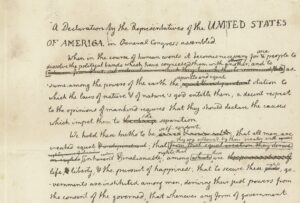
In his article, Was Thomas Jefferson America’s First Abolitionist?2 former University of Virginia law professor Robert F. Turner does a remarkable job rebuilding the true, historical Thomas Jefferson. He not only debunks the myth that Jefferson unequivocally fathered children with his slave but also documents Jefferson’s many attempts to fight and abolish the slave trade. Turner also introduces a document of premier importance—Jefferson’s rough draft of the Declaration of Independence.

The Declaration Draft

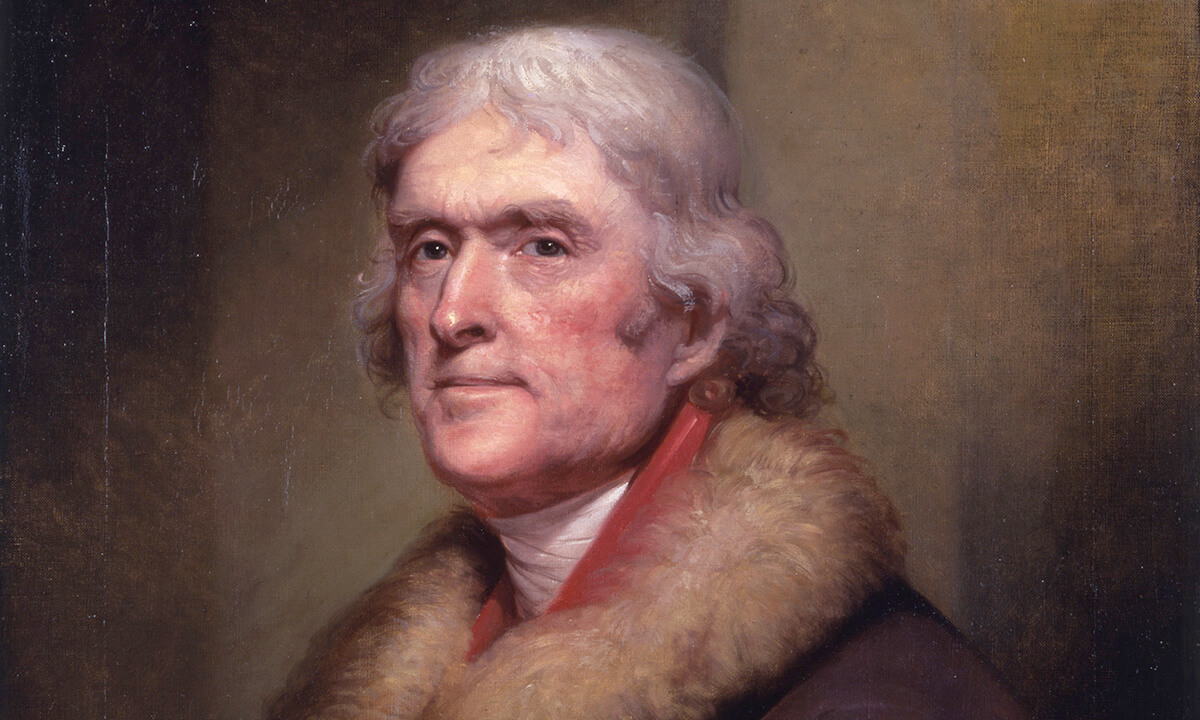
In June 1776, the colonies had already been warring against Great Britain for more than a year. So Congress, realizing that full separation from Great Britain was on the horizon, called upon Thomas Jefferson—who was only 33, but brilliant beyond his years—to draft the Declaration of Independence. It would be America’s “breakup letter” articulating the reasons that the colonies had to separate from Great Britain.

Hunched over his portable writing desk for 17 days in the sweltering summer heat, Jefferson condensed the great political philosophy of America into a few basic principles: there is a God; He creates men with inalienable rights; governments exist to protect those rights; and it is the right of the people to replace a government that violates those principles.

Years later, after Thomas Jefferson passed away in 1826, his grandson found that original rough draft, which had survived for half a century. Knowing that Americans would want to see that important document for themselves, Jefferson’s grandson produced exact facsimiles of his grandfather’s handwritten manuscript. These pages contain a beautiful treasure never seen by most Americans.

When, in July 1776, the colonies began debating the words that Jefferson had drafted, the delegates understood how important it was to be unified in their grievances against Great Britain. This way the British crown could not divide the colonies over disagreements on the grievances. As Benjamin Franklin reportedly quipped, “We must, indeed, all hang together or, most assuredly, we shall all hang separately.3

The Slave Trade Grievance

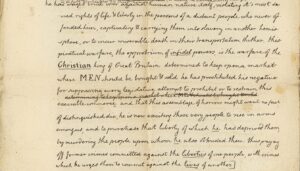
This resulted in certain of Jefferson’s original grievances being struck from the final version. One of these, Jefferson’s last and longest grievance, was a scathing condemnation of the slave trade. Jefferson opened:

He [King George III] has waged cruel war against human nature itself, violating its most sacred rights of life and liberty in the persons of a distant people who never offended him, captivating and carrying them into slavery in another hemisphere, or to incur miserable death in their transportation thither.

This is already a stunning indictment, but Jefferson goes on. The emphasis is his own:

This piratical warfare, the opprobrium [disgrace] of infidel powers, is the warfare of the Christian king of Great Britain.

Here Jefferson essentially accuses King George III of violating the commandment “you shall not take the name of the Lord your God in vain” (Exodus 20:7) by claiming the label of “Christian” while acting like the “infidel powers”—the Muslim Barbary Pirates on the north coast of Africa, who began and perpetuated the intercontinental slave trade. The king, although identifying himself with Jesus Christ, was acting no better than wicked nonbelievers.

Jefferson still was not done:

Determined to keep open a market where MEN should be bought and sold, he [King George III] has prostituted his negative [veto] for suppressing every legislative attempt to prohibit or to restrain this execrable commerce [the slave trade]…. (emphasis original)

This is the crux of the grievance. In the years before the American Revolution, many colonies had pushed to restrict or ban the slave trade. Some colonies, like Connecticut and Rhode Island, had succeeded.4 But most attempts had been vetoed by Britain, including those by South Carolina (1760), Massachusetts (1771, 1774, and 1774 again), Delaware (1775), and Pennsylvania (1775).5 Even efforts by Virginia (1766, 1769, 1772) to impose taxes on imported slaves and discourage the slave trade were also vetoed.6

And thus, Jefferson’s final and longest grievance condemns the king for imposing slaves and the slave trade on the colonies against their will.

There is also one word in this grievance that stands out among the rest: MEN. Nearly all the words in the draft are lowercase and cursive, yet MEN is not only printed but also capitalized. This word was used in referring to all those who were being enslaved and trafficked in the evil slave trade. The word harkens back to the opening of the Declaration: “we hold these truths to be self-evident; that all men are created equal.” Too often, Americans hear that Jefferson did not truly believe that all men are created equal;7 yet in the very same document where he penned those words, Jefferson appeals to the humanity of the Africans who were bought and sold in the transatlantic slave trade—evidence from Jefferson’s own writing of his sincere belief that all men are created equal in the image of God.

A majority of the colonies agreed that the king’s imposition of slaves and the slave trade on the colonies was legitimate grounds for separation and approved the grievance. Tragically, South Carolina and Georgia—the two most southern (and likely the most proslavery) colonies—opposed the grievance.8 The grievance was removed.

But the failures of two states do not negate the significance of Jefferson’s vision. His Declaration draft stands today as a testament to his righteous crusade for equality. His outspoken denunciation of slavery and his biting condemnation of the king of Great Britain are essential parts of his story. His own handwritten words—and not the contrived smears of modern academics—are why, for so many generations of Americans, Thomas Jefferson stood as a visionary and champion of the freedom and equality of all people.

1 Alexander Stephens, “Speech Delivered on the 21st March, 1861, in Savannah, Known as “The Corner Stone Speech,” Reported in the Savannah Republican,” March 21, 1861, Alexander H. Stephens in Public and Private with Letters and Speeches, Before, During, and Since the War, ed. Henry Cleveland (National Publishing Company, 1866), 721.

2 Robert F. Turner, “Was Thomas Jefferson America’s First Abolitionist?” May 20, 2021, Minding the Campus, https://mindingthecampus.org/2021/05/20/was-thomas-jefferson-americas-first-abolitionist/.

3  Benjamin Franklin, The Works of Benjamin Franklin, with Notes and A Life of the Author, Jared Sparks, editor (Boston: Tappan and Dennet, 1844), I:408.

4 W. E. B. Du Bois, The Suppression of the African Slave-Trade to the United States of America (New York: Longmans, Green, and Co., 1896), 222-223.

5 Du Bois, Suppression of the African Slave-Trade (1896), 20, 219, 221-222.

6 Du Bois, Suppression of the African Slave-Trade (1896), 12.

7 See, for example, Nikole Hannah-Jones, “Our democracy’s founding ideals were false when they were written. Black Americans have fought to make them true.” Aug 14, 2019, New York Times Magazine, https://www.nytimes.com/interactive/2019/08/14/magazine/black-history-american-democracy.html; Annette Gordon-Reed, “Thomas Jefferson’s Vision of Equality Was Not All-Inclusive. But It Was Transformative,” Feb 20, 2020, Time, https://time.com/5783989/thomas-jefferson-all-men-created-equal/; Melissa De Witte, “How the meaning of the Declaration of Independence changed over time” July 1, 2020, Stanford Report, https://news.stanford.edu/stories/2020/07/meaning-declaration-independence-changed-time; Shankar Vedantam et al., “The Founding Contradiction: Thomas Jefferson’s Stance On Slavery,” June 29, 2020, National Public Radio, https://www.npr.org/2020/06/29/884634146/the-founding-contradiction-thomas-jeffersons-stance-on-slavery.

8 Thomas Jefferson, Autobiography of Thomas Jefferson, ed. Paul Leicester Ford (New York: The Knickerbocker Press, 1914), 33.

Christian Faith Quotes by Signers of the Declaration

Below are statements by the Signers of the Declaration on Christian faith and the Bible!

John Adams

The Holy Ghost carries on the whole Christian system in His truth. Not a baptism, not a marriage, not a sacrament can be administered but by the Holy Ghost….There is no authority civil or religious – there can be no legitimate government – but what is administered by the Holy Ghost.1

The Christian religion is, above all the religions that ever prevailed or existed in ancient or modern times, the religion of wisdom, virtue, equity and humanity.2

I have examined all [religions], and the result is that the Bible is the best book in the world.3

The general principles on which the fathers achieved independence were….the general principles of Christianity….I will avow that I then believed, and now believe, that those general principles of Christianity are as eternal and immutable as the existence and attributes of God.4

Without religion, this world would be something not fit to be mentioned in polite company: I mean hell.5

Suppose a nation in some distant region should take the Bible for their only law book and every member should regulate his conduct by the precepts there exhibited….What a Eutopia – what a Paradise would this region be!6

If “Thou shalt not covet,” and “Thou shalt not steal,” were not commandments of Heaven, they must be made inviolable precepts in every society before it can be civilized or made free.7

The Bible….is the most republican book in the world.8

Samuel Adams

I rely upon the merits of Jesus Christ for a pardon of all my sins.9

The name of the Lord (says the Scripture) is a strong tower; thither the righteous flee and are safe [Proverbs 18:10]. Let us secure His favor and He will lead us through the journey of this life and at length receive us to a better.10

I conceive we cannot better express ourselves than by humbly supplicating the Supreme Ruler of the world…that the confusions that are and have been among the nations may be overruled for the promoting and speedily bringing on the holy and happy period when the kingdoms of our Lord and Savior Jesus Christ may be everywhere established, and the people willingly bow to the scepter of Him who is the Prince of Peace.11

[The rights of the colonists] may be best understood by reading and carefully studying the institutes of the great Law Giver and Head of the Christian Church, which are to be found clearly written and promulgated in the New Testament.12

He also called on the State of Massachusetts to pray that…

  • the peaceful and glorious reign of our Divine Redeemer may be known and enjoyed throughout the whole family of mankind.13
  • we may with one heart and voice humbly implore His gracious and free pardon through Jesus Christ, supplicating His Divine aid…[and] above all to cause the religion of Jesus Christ, in its true spirit, to spread far and wide till the whole earth shall be filled with His glory.14

Josiah Bartlett

Firstly, I commit my soul into the hands of God, its great and benevolent author.15

He also called on the people of New Hampshire…

to confess before God their aggravated transgressions and to implore His pardon and forgiveness through the merits and mediation of Jesus Christ…[t]hat the knowledge of the Gospel of Jesus Christ may be made known to all nations, pure and undefiled religion universally prevail, and the earth be fill with the glory of the Lord.16

Charles Carroll

On the mercy of my Redeemer I rely for salvation, and on His merits; not on the works that I have done in obedience to His precepts.17

Without morals a republic cannot subsist any length of time; they therefore who are decrying the Christian religion, whose morality is so sublime & pure, [and] which denounces against the wicked eternal misery, and [which] insured to the good eternal happiness, are undermining the solid foundation of morals, the best security for the duration of free governments.18

[I am] grateful to Almighty God for the blessings which, through Jesus Christ Our Lord, He had conferred on my beloved country.19

I….give and bequeath my soul to God who gave it, my body to the earth, hoping that through and by the merits, sufferings, and mediation of my only Savior and Jesus Christ, I may be admitted into the Kingdom prepared by God for those who love, fear and truly serve Him.20

Benjamin Franklin

As to Jesus of Nazareth, my opinion of whom you particularly desire, I think the system of morals and His religion as He left them to us, the best the world ever saw or is likely to see.21

I have lived, Sir, a long time, and the longer I live, the more convincing proofs I see of this truth, that God governs in the affairs of men. And if a sparrow cannot fall to the ground without His notice [Matthew 10:29, Luke 12:6], is it probable that an empire can rise without his aid [Daniel 4:17, Psalm 75:7]? We have been assured, Sir, in the Sacred Writings, that “except the Lord build the House, they labor in vain that build it” [Psalm 127:1]. I firmly believe this; and I also believe that without His concurring aid we shall succeed in this political building no better than the Builders of Babel [Genesis 11:1-9].22

The body of Benjamin Franklin, printer, like the cover of an old book, its contents torn out, and stripped of its lettering and guilding, lies here, food for worms. Yet the work itself shall not be lost; for it will, as he believed, appear once more in a new and more beautiful edition, corrected and amended by the Author.23 (Franklin’s eulogy that he wrote for himself)

Benjamin Franklin founded the University of Pennsylvania, assuring citizens that very clear lessons would be taught students “showing the necessity of a public religion…and the excellency of the Christian religion above all others, ancient or modern.” 24

Elbridge Gerry

He called on the State of Massachusetts to pray that…

  • with one heart and voice we may prostrate ourselves at the throne of heavenly grace and present to our Great Benefactor sincere and unfeigned thanks for His infinite goodness and mercy towards us from our birth to the present moment for having above all things illuminated us by the Gospel of Jesus Christ, presenting to our view the happy prospect of a blessed immortality.25
  • And for our unparalleled ingratitude to that Adorable Being Who has seated us in a land irradiated by the cheering beams of the Gospel of Jesus Christ…let us fall prostrate before offended Deity, confess sincerely and penitently our manifold sins and our unworthiness of the least of His Divine favors, fervently implore His pardon through the merits of our mediator.26
  • And deeply impressed with a scene of our unparalleled ingratitude, let us contemplate the blessings which have flowed from the unlimited grave and favor of offended Deity, that we are still permitted to enjoy the first of Heaven’s blessings: the Gospel of Jesus Christ.27

John Hancock

Sensible of the importance of Christian piety and virtue to the order and happiness of a state, I cannot but earnestly commend to you every measure for their support and encouragement.28

He also called on the State of Massachusetts to pray…

  • that all nations may bow to the scepter of our Lord and Savior Jesus Christ and that the whole earth may be filled with his glory.29
  • that the spiritual kingdom of our Lord and Savior Jesus Christ may be continually increasing until the whole earth shall be filled with His glory.30
  • to confess their sins and to implore forgiveness of God through the merits of the Savior of the World.31
  • to cause the benign religion of our Lord and Savior Jesus Christ to be known, understood, and practiced among all the inhabitants of the earth.32
  • to confess their sins before God and implore His forgiveness through the merits and mediation of Jesus Christ, our Lord and Savior.33
  • to pray that universal happiness may be established in the world, that all may bow to the scepter of our Lord Jesus Christ, and the whole earth be filled with His glory.34
  • that He would finally overrule all events to the advancement of the Redeemer’s kingdom and the establishment of universal peace and good will among men.35
  • that the kingdom of our Lord and Savior Jesus Christ may be established in peace and righteousness among all the nations of the earth.36
  • that with true contrition of heart we may confess our sins, resolve to forsake them, and implore the Divine forgiveness, through the merits and mediation of Jesus Christ, our Savior….And finally to overrule all the commotions in the world to the spreading the true religion of our Lord Jesus Christ in its purity and power among all the people of the earth.37

John Hart

Thanks be given unto Almighty God therefore, and knowing that it is appointed for all men once to die and after that the judgment [Hebrews 9:27]…principally, I give and recommend my soul into the hands of Almighty God who gave it and my body to the earth to be buried in a decent and Christian like manner…to receive the same again at the general resurrection by the mighty power of God.

Stephen Hopkins

We finally beg leave to assert that the first planters of these colonies were pious Christians…[and] to this day, all have…maintained peace and practiced Christianity. 38

Samuel Huntington

It becomes a people publicly to acknowledge the over-ruling hand of Divine Providence and their dependence upon the Supreme Being as their Creator and Merciful Preserver…and with becoming humility and sincere repentance to supplicate the pardon that we may obtain forgiveness through the merits and mediation of our Lord and Savior Jesus Christ. 39

Thomas Jefferson

The practice of morality being necessary for the well-being of society, He [God] has taken care to impress its precepts so indelibly on our hearts that they shall not be effaced by the subtleties of our brain. We all agree in the obligation of the moral principles of Jesus and nowhere will they be found delivered in greater purity than in His discourses.40

The doctrines of Jesus are simple, and tend all to the happiness of man.41

I am a Christian in the only sense in which He wished anyone to be: sincerely attached to His doctrines in preference to all others.42

I am a real Christian – that is to say, a disciple of the doctrines of Jesus Christ.43

Richard Henry Lee

It is certainly true that a popular government cannot flourish without virtue in the people. 44

When Richard Henry Lee died in 1794, his papers and correspondence, including numerous handwritten letters from other leading Founding Fathers, were passed on to his grandson, who compiled those documents into a two-volume work published in 1825. After having studied these personal letters from America’s leading statesmen, the grandson described the great body of men who founded the nation in these words:

The wise and great men of those days were not ashamed publicly to confess the name of our blessed Lord and Savior Jesus Christ! In behalf of the people, as their representatives and rulers, they acknowledged the sublime doctrine of his mediation!45

Thomas McKean

In the case Respublica v. John Roberts, 46 John Roberts was sentenced to death after a jury found him guilty of treason. Chief Justice McKean then told him:

You will probably have but a short time to live. Before you launch into eternity, it be­hooves you to improve the time that may be allowed you in this world: it behooves you most seriously to reflect upon your past conduct; to repent of your evil deeds; to be incessant in prayers to the great and merciful God to forgive your manifold transgressions and sins; to teach you to rely upon the merit and passion of a dear Redeemer, and thereby to avoid those regions of sorrow – those doleful shades where peace and rest can never dwell, where even hope cannot enter. It behooves you to seek the [fellowship], advice, and prayers of pious and good men; to be [persistent] at the Throne of Grace, and to learn the way that leadeth to happiness. May you, reflecting upon these things, and pursuing the will of the great Father of light and life, be received into [the] company and society of angels and archangels and the spirits of just men made perfect; and may you be qualified to enter into the joys of Heaven – joys unspeakable and full of glory! 47

John Morton

With an awful reverence to the Great Almighty God, Creator of all mankind, being sick and weak in body but of sound mind and memory, thanks be given to Almighty God for the same.

Robert Treat Paine

I desire to bless and praise the name of God most high for appointing me my birth in a land of Gospel Light where the glorious tidings of a Savior and of pardon and salvation through Him have been continually sounding in mine ears…. I believe the Bible to be the written word of God and to contain in it the whole rule of faith and manners.48

I am constrained to express my adoration of the Supreme Being, the Author of my existence, in full belief of His Providential goodness and His forgiving mercy revealed to the world through Jesus Christ, through whom I hope for never ending happiness in a future state.49

Benjamin Rush

My only hope of salvation is in the infinite transcendent love of God manifested to the world by the death of His Son upon the Cross [John 3:16-17]. Nothing but His blood will wash away my sins [Acts 22:16]. I rely exclusively upon it. Come, Lord Jesus! Come quickly! [Revelation 22:20].50

The Gospel of Jesus Christ prescribes the wisest rules for just conduct in every situation of life. Happy they who are enabled to obey them in all situations!…My only hope of salvation is in the infinite tran­scendent love of God manifested to the world by the death of His Son upon the Cross. Noth­ing but His blood will wash away my sins [Acts 22:16]. I rely exclusively upon it. Come, Lord Jesus! Come quickly! [Revelation 22:20]51

By renouncing the Bible, philosophers swing from their moorings upon all moral subjects….It is the only correct map of the human heart that ever has been published.52

Christianity is the only true and perfect religion; and…in proportion as mankind adopt its principles and obey its precepts, they will be wise and happy….The Bible contains more knowledge necessary to man in his present state than any other book in the world.53

The Bible, when not read in schools, is seldom read in any subsequent period of life…. It should be read in our schools in preference to all other books [because] it contains the greatest portion of that kind of knowledge which is calculated to produce private and public happiness.54

In contemplating the political institutions of the United States, I lament that we waste so much time and money in punishing crimes and take so little pains to prevent them. We profess to be republicans, and yet we neglect the only means of establishing and perpetuating our republican forms of government, that is, the universal education of our youth in the principles of Christianity by means of the Bible. For this Divine Book, above all others, favors that equality among mankind, that respect for just laws, and those sober and frugal virtues which constitute the soul of rebpulicanism.55

The great enemy of the salvation of man, in my opinion, never invented a more effective means of limiting Christianity from the world than by persuading mankind that it was improper to read the Bible at schools.56

The religion I mean to recommend in this place is that of the New Testament….All its doctrines and precepts are calculated to promote the happiness of society and the safety and well-being of civil government.57

The greatest discoveries in science have been made by Christian philosophers and…there is the most knowledge in those countries where there is the most Christianity. 58

Roger Sherman

I subscribe to the entire belief of the great and leading doctrines of the Christian religion, such as the being of God; the universal defection and depravity of human nature; the Divinity of the person and the completeness of the redemption purchased by the blessed Savior; the necessity of the opera­tions of the Divine Spirit; of Divine faith accompanied with an habitual virtuous life….[I] exhort and charge that the fear of God is the beginning of wisdom, that the way of life held up in the Christian system is calculated for the most complete happiness that can be enjoyed in this mortal state.59

I believe that there is one only liv­ing and true God, existing in three persons, the Father, the Son, and the Holy Ghost, the same in substance, equal in power and glory. That the Scriptures of the Old and New Tes­taments are a revelation from God, and a complete rule to direct us how we may glorify and enjoy Him….That He made man at first perfectly holy; that the first man sinned, and as he was the public head of his posterity, they all became sinners in consequence of his first transgres­sion, are wholly indisposed to that which is good and inclined to evil, and on account of sin are liable to all the miseries of this life, to death, and to the pains of hell forever. I believe that God…did send His own Son to become man, die in the room and stead of sinners, and thus to lay a foundation for the offer of pardon and salvation to all mankind, so as all may be saved who are willing to accept the Gospel offer….I believe a visible church to be a congregation of those who make a credible profession of their faith in Christ, and obedi­ence to Him, joined by the bond of the covenant….I believe that the sacraments of the New Testament are baptism and the Lord’s Supper….I believe that the souls of believers are at their death made perfectly holy, and immediately taken to glory: that at the end of this world there will be a resurrec­tion of the dead, and a final judgment of all mankind, when the righteous shall be publicly acquitted by Christ the Judge and admitted to everlasting life and glory, and the wicked be sentenced to everlasting punishment.60

God commands all men everywhere to repent. He also commands them to believe on the Lord Jesus Christ, and has assured us that all who do repent and believe shall be saved….[G]od…has absolutely promised to bestow them on all these who are willing to accept them on the terms of the Gospel – that is, in a way of free grace through the atonement. “Ask and ye shall receive [John 16:24]. Whosoever will, let him come and take of the waters of life freely [Revelation 22:17]. Him that cometh unto me I will in no wise cast out” [John 6:37].61

It is the duty of all to acknowledge that the Divine Law which requires us to love God with all our heart and our neighbor as ourselves, on pain of eternal damnation, is Holy, just, and good….The revealed law of God is the rule of our duty.62

True Christians are assured that no temptation (or trial) shall happen to them but what they shall be enabled to bear; and that the grace of Christ shall be sufficient for them.63

Of Sherman, it was reported: “The volume which he consulted more than any other was the Bible. It was his custom, at the commencement of every session of Congress, to purchase a copy of the Scriptures, to peruse it daily, and to present it to one of his children on his return.”64

Thomas Stone

Shun all giddy, loose, and wicked company; they will corrupt and lead you into vice and bring you to ruin. Seek the company of sober, virtuous and good people… which will lead [you] to solid happiness. 65

James Wilson

Human law must rest its authority ultimately upon the authority of that law which is Divine….Far from being rivals or enemies, religion and law are twin sisters, friends, and mutual assistants. Indeed, these two sciences run into each other….Our all-gracious Creator, Preserver, and Ruler has been pleased to discover and enforce His laws by a revelation given to us immediately and directly from Himself. This revelation is contained in the Holy Scriptures.66

John Witherspoon

I…entreat you in the most earnest manner to believe in Jesus Christ, for “there is no salvation in any other” [acts 4:12]….If you are not reconciled to God through Jesus Christ, if you are not clothed with the spotless robe of His righteousness, you must forever perish.67

No man, whatever be his character or whatever be his hope, shall enter into rest unless he be reconciled to God though Jesus Christ.68

There is no salvation in any other than in Jesus Christ of Nazareth [Acts 4:12].69

Christ Jesus – the promise of old made unto the fathers, the hope of Israel [Acts 28:20], the light of the world [John 8:12], and the end of the law for righteousness to every one that believeth [Romans 10:4] – is the only Savior of sinners, in opposition to all false religions and every uninstituted rite; as He Himself says (John 14:6): “I am the way, and the truth, and the life: no man cometh unto the Father but by Me.”70

It is very evident that both the prophets in the Old Testament and the apostles in the New are at great pains to give us a view of the glory and dignity of the person of Christ. With what magnificent titles is He adorned! What glorious attributes are ascribed to him!… All these conspire to teach us that He is truly and properly God – God over all, blessed forever!71

He is the best friend to American liberty who is the most sincere and active in promoting true and undefiled religion, and who sets himself with the greatest firmness to bear down profanity and immorality of every kind. Whoever is an avowed enemy of God, I scruple not to call him an enemy to his country.72

Oliver Wolcott

Through various scenes of life, God has sustained me. May He ever be my unfailing friend; may His love cherish my soul; may my heart with gratitude acknowledge His goodness; and may my desires be to Him and to the remembrance of His name….May we then turn our eyes to the bright objects above, and may God give us strength to travel the upward road. May the Divine Redeemer conduct us to that seat of bliss which He himself has prepared for His friends; at the approach of which every sorrow shall vanish from the human heart and endless scenes of glory open upon the enraptured eye. There our love to God and each other will grow stronger, and our pleasures never be dampened by the fear of future separation. How indifferent will it then be to us whether we obtained felicity by travailing the thorny or the agreeable paths of life – whether we arrived at our rest by passing through the envied and unfragrant road of greatness or sustained hardship and unmerited reproach in our journey. God’s Providence and support through the perilous perplexing labyrinths of human life will then forever excite our astonishment and love. May a happiness be granted to those I most tenderly love, which shall continue and increase through an endless existence. Your cares and burdens must be many and great, but put your trust in that God Who has hitherto supported you and me; He will not fail to take care of those who put their trust in Him….It is most evident that this land is under the protection of the Almighty, and that we shall be saved not by our wisdom nor by our might, but by the Lord of Host Who is wonderful in counsel and Almighty in all His operations. 73


Endnotes

1 John Adams to Dr. Benjamin Rush, December 21, 1809, from an original in the WallBuilders Collection, here.

2 John Adams diary entry for July 26, 1796, Massachusetts Historical Society, https://www.masshist.org/digitaladams/archive/doc?id=D46&bc=%2Fdigitaladams%2Farchive%2Fbrowse%2Fdiaries_by_number.php.

3 “Image 4 of John Adams to Thomas Jefferson, December 25, 1813,” Library of Congress, https://www.loc.gov/resource/mtj1.047_0129_0134/?sp=4&st=image.

4 “Image 3 of John Adams to Thomas Jefferson, June 28, 1813,” Library of Congress, https://www.loc.gov/resource/mtj1.046_0922_0925/?sp=3&st=image.

5 John Adams to Thomas Jefferson, April 19, 1817, National Archives, https://founders.archives.gov/documents/Adams/99-02-02-6744.

6 John Adams diary entry for February 22, 1756, Massachusetts Historical Society, https://www.masshist.org/digitaladams/archive/doc?id=D1&bc=%2Fdigitaladams%2Farchive%2Fbrowse%2Fdiaries_by_number.php.

7 John Adams, A Defense of the Constitution of Government of the United States of America (Philadelphia: William Young, 1797), III:217.

8 John Adams to Benjamin Rush, February 2, 1807, National Archives, https://founders.archives.gov/documents/Adams/99-02-02-5166.

9 Samuel Adams Last Will, December 29, 1790, original in the Massachusetts Judicial Archives.

10 Samuel Adams to Elizabeth Adams, December 26, 1776, The New York Public Library Digital Collection, https://digitalcollections.nypl.org/items/cfa19e60-0e20-0134-4fef-00505686d14e?canvasIndex=0.

11 Samuel Adams, Proclamation for a Day of Fasting, March 20, 1797, from the WallBuilders Collection.

12 Samuel Adams, The Life and Public Services of Samuel Adams, ed. William V. Wells (Boston: Little, Brown, and Company, 1865), I:504.

13 Samuel Adams, A Proclamation For a Day of Public Fasting, Humiliation and Prayer, October 14, 1795, from the WallBuilders Collection, here.

14 Samuel Adams, “Proclamation. February 19, 1794,” The Writings of Samuel Adams, ed. Harry Alonzo Cushing (New York: G. P. Putnam’s Sons, 1908), IV:361-362.

15 Josiah Bartlett, Last Will, February 26, 1795, original in the New Hampshire Historical Society.

16 Josiah Bartlett, Proclamation for a Day of Fasting and Prayer, March 17, 1792, from the WallBuilders Collection.

17 Charles Carroll to Charles W. Wharton, September 27, 1825, from the WallBuilders Collection, here.

18 Charles Carroll to James McHenry, November 4, 1800, Bernard C. Steiner, The Life and Correspondence of James McHenry (Cleveland: The Burrows Brothers, 1907), 475.

19 Lewis A. Leonard, Life of Charles Carroll of Carrollton (New York: Moffit, Yard & Co, 1918), 256-257.

20 Will of Charles Carroll, December 1, 1718, Kate Mason Rowland, Life of Charles Carroll of Carrollton (New York: G.P. Putnam’s Sons, 1890), II:373-374 (later replaced by a subsequent will not containing this phrase, although he expressed this sentiment on several subsequent occasions, including repeatedly in the latter years of his life).

21 Benjamin Franklin to Ezra Stiles, March 9, 1790, Works of Benjamin Franklin, ed. John Bigelow (New York: G.P. Putnam’s Sons, 1904), 185.

22 Benjamin Franklin, June 28, 1787, James Madison, The Papers of James Madison, ed. Henry D. Gilpin (Washington DC: Langtree and O’Sullivan, 1840), II:984-985.

23 Benjamin Franklin, Works of the Late Doctor Benjamin Franklin (Dublin: P. Wogan, P. Byrne, J. More, and W. Janes, 1793), II:149.

24 Benjamin Franklin, Proposals Relating to the Education of Youth in Pennsylvania (Philadelphia, 1749), 22.

25 Elbridge Gerry, Proclamation for a Day of Thanksgiving and Praise, October 24, 1810, in the WallBuilders Collection.

26 Elbridge Gerry, Proclamation for a Day of Fasting and Prayer, March 13, 1811, in the WallBuilders Collection.

27 Elbridge Gerry, Proclamation for a Day of Fasting and Prayer, March 6, 1812, in the WallBuilders Collection.

28 Abram English Brown, John Hancock, His Book (Boston: Lee and Shepard, 1898), 269.

29 John Hancock, Proclamation for a Day of Public Thanksgiving, October 28, 1784, in the WallBuilders Collection, here.

30 John Hancock, Proclamation for a Day of Public Thanksgiving, October 29, 1788, in the WallBuilders Collection.

31 John Hancock, Proclamation For a Day of Fasting and Prayer, March 16, 1789, in the WallBuilders Collection.

32 John Hancock, Proclamation for a Day of Thanksgiving and Praise, September 16, 1790, in the WallBuilders Collection.

33 John Hancock, Proclamation for a Day of Fasting and Prayer, February 11, 1791, in the WallBuilders Collection.

34 John Hancock, A Proclamation For a Day of Public Thanksgiving, October 5, 1791, in the WallBuilders Collection, here.

35 John Hancock, Proclamation for a Day of Fasting, Prayer and Humiliation, February 24, 1792, in the WallBuilders Collection.

36 John Hancock, Proclamation for a Day of Public Thanksgiving, October 25, 1792, in the WallBuilders Collection, here.

37 John Hancock, Proclamation for Day of Public Fasting, Humiliation and Prayer, March 4, 1793, in the WallBuilders Collection, here.

38 Stephen Hopkins, The Rights of Colonies Examined (Providence: William Goddard, 1765), 23-24.

39 Samuel Huntington, A Proclamation for a Day of Fasting, Prayer and Humiliation, March 9, 1791, in the WallBuilders Collection.

40 “Image 1 of Thomas Jefferson to James Fishback, September 27, 1809, with Copy, Not Sent,” Library of Congress, https://www.loc.gov/resource/mtj1.044_0270_0273/?sp=1.

41 “Image 1 of Thomas Jefferson to Dr. Benjamin Waterhouse, June 26, 1822,” Library of Congress, https://www.loc.gov/resource/mtj1.053_0253_0254/?sp=1.

42 “Image 1 of Thomas Jefferson to Benjamin Rush, April 21, 1803, with Syllabus of an Estimate of the Merit of the Doctrines of Jesus, with Copies,” Library of Congress, https://www.loc.gov/resource/mtj1.028_0191_0199/?sp=1.

43 “Image 1 of Thomas Jefferson to Charles Thomson, January 9, 1816,” Library of Congress, https://www.loc.gov/resource/mtj1.048_0745_0746/?sp=1.

44 Richard Henry Lee to Mortin Pickett, March 5, 1786, The Letters of Richard Henry Lee, ed. James Curtis Ballagh (New York: The MacMillan Company, 1914), II:411.

45 Richard Henry Lee, Memoir of the Life of Richard Henry Lee, and His Correspondence, ed. Richard Henry Lee (Philadelphia: H.C. Carey and I. Lea, 1825), 1:201.

46 A. J. Dallas, Reports of Cases Ruled and Adjudged in the Courts of Pennsylvania (Phila­delphia: P. Byrne, 1806), p. 39, Respublica v. John Roberts, Pa. Sup. Ct. 1778.

47 William B. Reed, Life and Correspondence of Joseph Reed (Philadelphia: Lindsay and Blakiston, 1847), II:36-37.

48 Robert Treat Paine, Confession of Faith, 1749, The Papers of Robert Treat Paine, eds. Stephen T. Riley & Edward W. Hanson (Boston: Massachusetts Historical Society, 1992), I:48-49.

49 From the Last Will & Testament of Robert Treat Paine, attested May 11, 1814.

50 Benjamin Rush, The Autobiography of Benjamin Rush, ed. George Corner (Princeton: Princeton University Press for the American Philosophical Society, 1948), 166.

51 Rush, Autobiography, ed. Corner (1948), 165-166.

52 Benjamin Rush to John Adams, January 23, 1807, National Archives, https://founders.archives.gov/documents/Adams/99-02-02-5162.

53] Benjamin Rush, “A Defence of the Use of the Bible as a School Book,” Essays, Literary, Moral & Philosophical (Philadelphia: Thomas & Samuel F. Bradford, 1798), 93.

54 Rush, “A Defence of the Use of the Bible as a School Book,” Essays (1798), 94, 100.

55 Rush, “A Defence of the Use of the Bible as a School Book,” Essays (1798), 112.

56 Benjamin Rush to Jeremy Belknap, July 13, 1789, Letters of Benjamin Rush, ed. L. H. Butterfield (Princeton, NJ: Princeton University Press, 1951), I:521.

57 Rush, “Of the Mode of Education Proper in a Republic,” Essays (1798), 8.

58 Benjamin Rush, “Thoughts upon Female Education,” Essays (1798), 84.

59 Will of Richard Stockton, dated May 20, 1780.

60 Lewis Henry Boutell, The Life of Roger Sherman (Chicago: A. C. McClurg and Company, 1896), 271-273.

61 Roger Sherman to Samuel Hopkins, June 28, 1790, Correspondence Between Roger Sherman and Samuel Hopkins (Worcester, MA: Charles Hamilton, 1889), 9.

62 Roger Sherman to Samuel Hopkins, June 28, 1790, Correspondence (1889), 10.

63 Roger Sherman to Samuel Hopkins, October 1790, Correspondence (1889), 26.

64] The Globe (Washington, DC: August 15, 1837), 1.

65 Thomas Stone to his son, October 1787, John Sanderson, Biography of the Signers to the Declaration of Independence (Philadelphia: R. W. Pomeroy, 1824), IX:333.

66 James Wilson, The Works of the Honourable James Wilson, ed. Bird Wilson (Philadelphia: Bronson and Chauncey, 1804), I:104-106, 137-138.

67 John Witherspoon, “The Absolute Necessity of Salvation Through Christ,” January 2, 1758, The Works of John Witherspoon (Edinburgh: J. Ogle, 1815), V:276, 278.

68 Witherspoon, “Absolute Necessity of Salvation,” January 2, 1758, Works (1815), V:245.

69 Witherspoon, “Absolute Necessity of Salvation,” January 2, 1758, Works (1815), V:248.

70 John Witherspoon, “Absolute Necessity of Salvation,” January 2, 1758, Works (1815), V:255.

71 Witherspoon, “Absolute Necessity of Salvation,” January 2, 1758, Works (1815), V:267.

72 John Witherspoon, The Works of the Reverend John Witherspoon (Philadelphia: William W. Woodward, 1802), III:42.

73 Oliver Wolcott to Laura Wolcott, April 10, 1776, Letters of Delegates to Congress, ed. Paul H. Smith (Washington DC: Library of Congress, 1978), 3:502-503.
Thomas Jefferson Quiz

Thomas Jefferson Quiz

Did you know that Thomas Jefferson was given two baby bear cubs as president of the United States?

Zebulon Pike was part of an expedition that explored the Louisiana Purchase. On his trip, he discovered two grizzly bear cubs that he sent to President Thomas Jefferson. (Interestingly, Pike’s Peak was named after Zebulon Pike.) Zebulon Pike wrote a letter to Thomas Jefferson when he sent the cubs and Thomas Jefferson later acknowledged the gift with a letter of his own.

Take the quiz below to find out more about Thomas Jefferson!

/10
48

THOMAS JEFFERSON

From unusual animals to giant wheels of cheese, the third President of the United States carved out a prominent place in American history. Take this quiz to see how much you know about Thomas Jefferson!

1 / 10

About how much did the giant Mammoth Cheese sent to Thomas Jefferson in 1802 weigh?

2 / 10

Where is Thomas Jefferson's book collection now?

Guess the three word answer! Click the "Check" button to see if you are right!

3 / 10

Which document did Thomas Jefferson write?

4 / 10

Who helped Thomas Jefferson and John Adams become friends again?

5 / 10

Thomas Jefferson was President during which American war?

6 / 10

Thomas Jefferson died on the same day as _____.

Enter first & last name, then click the "Check" button.

7 / 10

True or False. Thomas Jefferson believed that churches and religion should stay out of the government.

8 / 10

What position did Thomas Jefferson hold while George Washington was president?

9 / 10

True or False. Jefferson cut out parts of the Bible he didn't like to make "The Jefferson Bible."

10 / 10

What colony/state was Thomas Jefferson from?

Your score is

The average score is 67%

Declaration Hub

Introduction

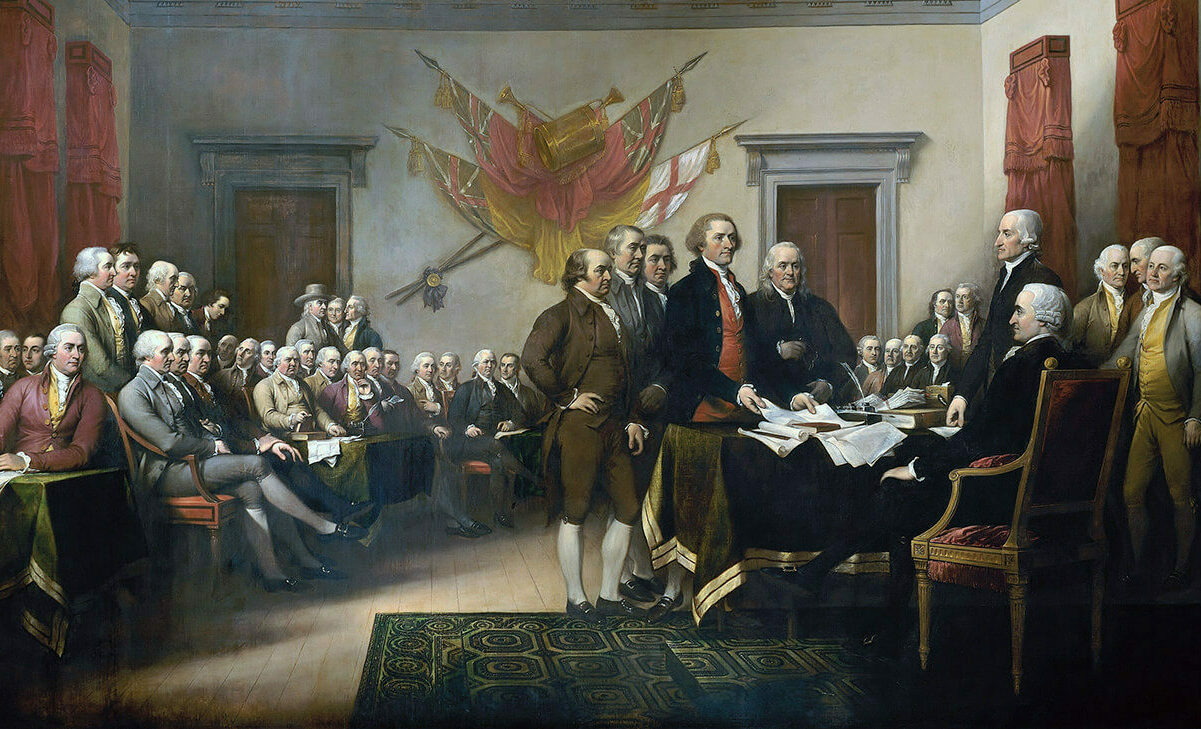
The Declaration of Independence, adopted by the Continental Congress on July 4, 1776, serves as America’s birth certificate and one of the most important documents in human history. It announced the separation of the thirteen American colonies from Great Britain and stated the key principles on which the new nation would be founded.

As Thomas Jefferson wrote in its famous preamble:

When in the course of human events, it becomes necessary for one people to dissolve the political bands which have connected them with another. We hold these truths to be self-evident, that all men are created equal, that they are endowed by their Creator with certain unalienable Rights, that among these are Life, Liberty, and the pursuit of Happiness.

These words justified the colonies’ break from tyranny and expressed a vision of government that is delegated its just powers by the consent of the governed. This was a groundbreaking idea based on the recognition of God-given rights.

The fifty-six signers of the Declaration pledged their lives, fortunes, and sacred honor to this cause.

Some History

Growing tensions between the American colonies and Britain led to the push for independence. Oppressive taxes, the Intolerable Acts, and limits on colonial freedoms fueled anger. In January 1776, Thomas Paine’s pamphlet Common Sense inspired many colonists to support breaking away from Britain.1

On June 7, 1776, Richard Henry Lee of Virginia proposed a resolution in the Continental Congress, stating that “these United Colonies are, and of right ought to be, free and independent States.”2 Congress then chose a Committee of Five—Thomas Jefferson (the primary author), John Adams, Benjamin Franklin, Roger Sherman, and Robert Livingston—to write a formal declaration.3

After intense debate and revisions (including the removal of a passage condemning the slave trade to secure unity4), Congress adopted the document. John Dunlap printed broadsides that night, spreading the news across the colonies.5

John Adams, writing to his wife Abigail on July 3, 1776, foresaw the day’s enduring legacy:

The Second Day of July 1776 will be the most memorable epoch in the History of America. I am apt to believe that it will be celebrated by succeeding Generations, as the great anniversary Festival… It ought to be solemnized with Pomp and Parade, with Shews, Games, Sports, Guns, Bells, Bonfires, and Illuminations from one End of this Continent to the other from this Time forward forever more.6

Although Adams anticipated celebrations on July 2 (the day the independence vote was held), history has adopted July 4 as Independence Day—the day the world was informed why America chose freedom.

The signers knew the risks: by declaring independence, they committed an act of treason against the British Crown, punishable by death. Yet, as Adams reflected, “posterity will triumph in that day’s transaction.”7

This hub explores the Declaration’s text, its courageous signers (including original documents and letters from several), and valuable resources for further study.

Timeline

  • June 7, 1776       Richard Henry Lee proposes independence.
  • June 11, 1776     Committee of Five appointed to draft the Declaration.
  • June 28, 1776    Draft presented to Congress.
  • July 2, 1776        Congress votes for independence (12 colonies in favor; New York abstains initially).
  • July 4, 1776        Declaration adopted and approved.
  • August 2, 1776  Most delegates sign the engrossed parchment copy.

The Text of the Declaration

The Declaration of Independence is remarkably concise—containing fewer than 1,400 words—yet it powerfully combines a philosophical defense of liberty with a detailed indictment of King George III’s abuses. The document is structured in four main parts:

  • The Preamble: States the necessity of explaining separation and introduces the famous self-evident truths.
  • A Statement of Rights and Principles: Outlines the purpose of government and the people’s right to alter or abolish it when it becomes destructive.
  • The List of Grievances: Presents 27 specific charges against the King.
  • The Resolution of Independence: Formally declares the colonies free and independent states.

These primary sources allow you to read the Declaration exactly as the Founders wrote, edited, and presented it to the world.

Primary Sources

Signers of the Declaration

The fifty-six men who signed the Declaration of Independence were not mythical figures—they were husbands, fathers, merchants, lawyers, farmers, and ministers who knowingly risked everything for the cause of liberty. By affixing their names to the document, they committed an act of treason against the British Crown, fully aware that failure could mean ruin or death. Yet they declared, in the document’s closing words, that “for the support of this Declaration, with a firm reliance on the protection of divine Providence, we mutually pledge to each other our Lives, our Fortunes and our sacred Honor.”

Many of these signers paid a heavy personal price: homes destroyed, families displaced, fortunes lost, and some imprisoned or hunted by British forces.8 Their courage and sacrifice laid the foundation for the nation we enjoy today.

WallBuilders is privileged to preserve and present original letters, documents, and artifacts from several of these brave patriots, offering a rare glimpse into their faith, character, and commitment. Below are highlighted resources featuring some of the signers and their stories.

Additional Helpful Resources

Explore the Declaration of Independence further through these trusted primary sources and educational tools. These resources provide everything from original manuscripts and images to classroom-ready materials, helping readers of all ages deepen their understanding of America’s founding document and the courageous men who signed it.

Additional Resources


Endnotes

1 Thomas Paine, Common Sense: Addressed to the Inhabitants of America (Philadelphia: 1776).
2 Richard Henry Lee’s handwritten resolution from the National Archives: https://www.archives.gov/milestone-documents/lee-resolution. See also, June 7, 1776, Journals of the American Congress: From 1774 to 1788 (Washington: Way and Gideon, 1823), 1:368.
3 June 11, 1776, Journals of the American Congress (1823), I:369.
4 “Thomas Jefferson, June 1776, Rough Draft of the Declaration of Independence,” Library of Congress, https://www.loc.gov/resource/mtjx.mtjbib000156/?st=gallery.
5 “Dunlap Broadside [Declaration of Independence],” July 4, 1776, National Archives, https://catalog.archives.gov/id/301682.
6 John Adams to Abigail Adams, July 3, 1776, Massachusetts Historical Society, https://www.masshist.org/digitaladams/archive/doc?id=L17760703jasecond.
7 John Adams to Abigail Adams, July 3, 1776, Massachusetts Historical Society, https://www.masshist.org/digitaladams/archive/doc?id=L17760703jasecond.
8 “FAQ: Difficulties and Sacrifices of the Declaration Signers,” WallBuilders, https://wallbuilders.com/resource/faq-difficulties-and-sacrifices-of-the-declaration-signers/.

Righteousness Exalts a Nation

Thoughts on Proverbs 14:34

America’s Founding Fathers were not only concerned for their own generation but also for posterity—about future generations. In fact, when they wrote the U.S. Constitution, they candidly acknowledged that they had done so to “secure the blessings of liberty to ourselves and our posterity.” The Rev. Mathias Burnet eflecting this ideal in an Election Sermon preached to the Connecticut legislature:

To God and posterity you are accountable [for your rights and your rulers]. . . . Let not your children have reason to curse you for giving up those rights and prostrating those institutions which your fathers deliv­ered to you. 1

He reminded citizens that they would answer to God for whether or not they had preserved the rights entrusted to them. And they would answer to posterity.

Patrick Henry held identical sentiments. When he passed away in 1799, his executers opened and read his personal legal documents and his will. Included was an original copy of the 1765 Stamp Act Resolutions (early precursors to the American Revolution). These were originally passed by the Virginia Legislature, of which he had been a member. On the back of those resolutions Henry penned a handwritten message, knowing it would be read at his death. He recounted the early colonial resistance to British policy that eventually resulted in the American Revolution, and then concluded with this warning:

Whether this [the American Revolution] will prove a blessing or a curse will depend upon the use our people make of the blessings which a gracious God hath bestowed on us. If they are wise, they will be great and happy. If they are of a contrary character, they will be miserable. Righteousness alone can exalt them as a nation [Proverbs 14:34]. Reader!—whoever thou art, remember this!—and in thy sphere practice virtue thyself and encourage it in others. P. Henry 2

Whether or not America will prosper into the future depends on its righteousness today. But how is national righteousness measured? Dozens of Bible passages (like Deuteronomy 28, 1 Kings 18, 1 Chronicles 21) affirm that national righteousness is defined by national policies and their allignment with God’s standards. As Samuel Adams advised, only God-honoring policies can exalt a nation:

[Divine] revelation assures us that “Righteousness exalteth a nation” [Proverbs 14:34]. Communities are dealt with in this world by the wise and just Ruler of the Universe. He rewards or punishes them according to their general character. 3

Civic Righteousness and Civil Rights

Across the pages of American history both political and religious leaders have regularly cited this verse. For example, Frederick Douglass, who was a preacher and famous political leader long before and after the Civil War, told citizens:

I have one great political idea. . . . That idea is an old one. It is widely and generally assented to; nevertheless, it is very generally trampled upon and disregarded. The best expression of it, I have found in the Bible. It is in substance, “Righteousness exalteth a nation; sin is a reproach to any people” [Proverbs 14:34]. Sir, this constitutes my politics – the negative and positive of my politics, and the whole of my politics. . . . I feel it my duty to do all in my power to infuse this idea into the public mind, that it may speedily be recognized and practiced upon by our people. 4

Douglass believed that every political concern should be guided by issues of righteousness. But too often today, political concerns (and votes) are instead guided by issues of economics—what is good for the economy, my job, my pocketbook, etc. When Jesus’ disciples focused on such worries—food, clothing, finances, and homes—He reminded them to “seek first the kingdom of God and His righteousness,” and all of their physical needs would be provided (Matthew 6:33). Strikingly, when a nation pursues economics over righteousness, it generally loses both. Notice how frequently secular nations find themselves facing burgeoning and unsolvable economic problems. The only way to preserve economic prosperity is by pursuing righteousness in public policy.

The Rev. Francis Grimke understood this. He was born to a slave mother in 1850 in South Carolina, and served as a valet in the Confederate army until Emancipation. After the war, he attended Lincoln University, Howard University, and Princeton Theological Seminary, and became a minister in Washington, D.C. He had lived through the Civil War as a boy, and as a young man survived the barbarity of the Ku Klux Klan during Reconstruction. Then in the early 1900s, he watched the second revival of the Klan as it marched openly in parades in Washington, D.C. Even members of Congress participated.

Grimke personally witnessed America’s literal split, and now the resurgence of the Klan. While he believed he nation would remain united, he delivered a sermon in 1909, warning what America’s future would be should we ever foresake righteousness:

The Stars and Stripes—the old flag—will float . . . over all these states. . . . If the time ever comes when we shall go to pieces, it will . . . [be] from inward corruption—from the disregard of right principles . . . from losing sight of the fact that “Righteousness exalteth a nation, but that sin is a reproach to any people” [Proverbs 14:34]. . . . The secession of the southern states in 1860 was a small matter with the secession of the Union itself from the great principles enunciated in the Declaration of Independence, in the Golden Rule, in the Ten Commandments, in the Sermon on the Mount. Unless we hold, and hold firmly to these great fundamental principles of righteousness . . . our Union . . . will be “only a covenant with death and an agreement with hell” [Isaiah 28:18]. If it continues to exist, it will be a curse and not a blessing. 5

Blessings for Posterity

When selecting public officials, Christians must not be concerned about their pocketbooks or their jobs. The foremost concern should be whether that official will advance policies upholding Biblical standards of righteousness. Biblical rights and wrongs on moral issues must always take precedence over economic, environmental, healthcare, energy, or any other issues. Whether and in what condition America will continue to exist in the future completely depends on if citizens will embrace and apply Proverbs 14:34 in both their private and their civic lives.


Endnotes

1 Matthias Burnet, An Election Sermon, Preached at Hartford, on the Day of the Anniversary Election, May 12, 1803 (Hartford: Hudson and Goodwin, 1803), 27.

2 Patrick Henry, Patrick Henry: Life, Correspondence and Speeches, ed. William Wirt Henry (New York: Charles Scribner’s Sons, 1891), 1:81-82, from a handwritten endorsement on the back of the paper containing the resolutions of the Virginia Assembly in 1765 concerning the Stamp Act.

3 Samuel Adams to John Scollay, April 30, 1776, The Writings of Samuel Adams, ed. Harry Alonzo Cushing (New York: G. P. Putnam’s Sons, 1907), 3:286.

4 Frederick Douglass, speech delivered at Ithaca, New York, October 14, 1852, The Frederick Douglass Papers, ed. John Blassingame (New Haven: Yale University Press, 1982), 2:397.

5 Rev. Francis J. Grimke, from “Equality of Right for All Citizens, Black and White, Alike,” March 7, 1909, Masterpieces of Negro Eloquence, ed. Alice Moore Dunbar (Johnson Reprint Corporation, 1970), 348-349.

Worth Riding a Hundred Miles to Hear

Thoughts on Psalm 35

By September 1774, the tensions between America and Great Britain had been escalating for a decade and were reaching a boiling point. But despite that strain, Americans were largely still loyal to Great Britain. The colonies were vigorously pursuing reconciliation. The British, however, rejected their overtures and even responded with military force. British governors in America also disbanded legislative assemblies (i.e., Governors Dunsmore and Boutetout in Virginia and Wright in Georgia), attempting to impose hardfisted tyrannical rule.

The colonies decided that the time had come to act together rather than individually. In May 1774, Virginia called for a Continental Congress,1 as did New York2 and others. They hoped that by speaking with a unified voice, Britain would no longer ignor their grievances and they could reach an understanding. Specifically, they were seeking a repeal of the Intolerable or Coercive Acts, including those disbanding colonial juries, replacing elected American officials with unelected ones appointed by the Crown, and requiring British troops to be boarded in private homes

On September 5, 1774, forty-five delegates gathered in Philadelphia in what became known as the First Continental Congress. While each delegate was a significant figure in his own colony, most were unknown to the others. Incidentally, many went on to become nationally recognized political or military leaders, or even US Presidents.

Prayer Proposed

The delegates met one another and contemplated their course of action. John Adams reported their very first proposal after organizing themselves:

When the Congress first met, Mr. [Thomas] Cushing [of Massachusetts] made a motion that it should be opened with prayer.3

This apparently harmless suggestion met unexpected stiff resistance:

It was opposed by Mr. [John] Jay of New York and Mr. [John] Rutledge of South Carolina because we were so divided in religious sentiments—some Episcopalians, some Quakers, some Anabaptists, some Presbyterians, and some Congregationalists—that we could not join in the same act of worship.4

Strikingly, both of the opponents (Jay and Rutledge) were devoted Christians. In fact, John Jay (an author of the Federalist Papers and the original chief justice of the US Supreme Court) was a founder and president of the American Bible Society. He also wrote lengthy evangelical treatises on the Scriptures. These pious individuals opposed an opening prayer because the various delegates came from many different Christian denominations.

Today, it seems strange that a denominational difference might prevent one Christian from praying with another, but not then. Most of the colonies had official state-established denominations (i.e., Anglicans in Virginia, South Carolina, Maryland, North Carolina, and New York;  Congregationalists in Connecticut, New Hampshire, and Massachusetts). The government-sanctioned denomination would sometimes persecute and even kill those from other denominations who preached or conducted religious services without authorization from the official church.5 But God had been preparing the colonists to overcome these abuses by helping Christians focus on the major Biblical teachings on which they all agreed rather than the nonessential denominational doctrines.

Whitefield’s “Faather Abraham” Sermon

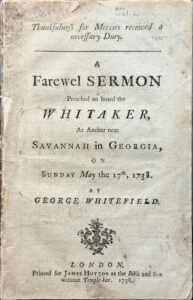
This groundwork was laid by the national revival known as the Great Awakening (1730-1770) and was especially facilitated through the influence of English evangelist George Whitefield. Whitefield made seven missionary journeys to America, preaching across the country for thirty-four years on horseback, delivering 18,000 sermons.6 It is estimated that eighty percent of all Americans heard him preach,7 and his “Father Abraham” sermon was one of his more famous ones.

John Adams heard that sermon and recounted its message to Thomas Jefferson. In that sermon, Whitefield pretended to be at the gates of Heaven talking to Abraham:

He [Whitefield] began: “Father Abraham,” with his hands and eyes gracefully directed to the heavens (as I have more than once seen him): “Father Abraham, whom have you there with you? Have you Catholics?” “No.” “Have you Protestants?” “No.” “Have you Churchmen?” [Anglicans].“No.” “Have you Dissenters?” [Congregationalists]. “No.” “Have you Presbyterians?” “No.” “Quakers?” “No.” “Anabaptists?” [Baptists, Amish, Mennonites]. “No.” “Whom have you there? Are you alone?” “No.” “My brethren, you have the answer to all these questions in the words of my next text: “He who feareth God and worketh righteousness, shall be accepted of Him’’ [Acts 10:35].8 God help us all to forget having names and to become Christians in deed and in truth.9

Samuel Adams took the message of Whitefield’s popular “Father Abraham” sermon and practically applied it in that first gathering of Congress. After hearing Jay and Rutledge oppose the motion for prayer, he “arose and said he was no bigot, and could hear a prayer from a gentleman of piety and virtue, who was at the same time a friend to his country.”10 Adams added that because he was from Boston, he “was a stranger in Philadelphia, but had heard that [Rev.] Mr. [Jacob] Duché [pronounced Dooshay] deserved that character, and therefore he moved that Mr. Duché, an Episcopalian clergyman, might be desired to read prayers to the Congress tomorrow morning.”11

It is significant that Samuel Adams—an ardent Congregationalist (Puritan)—personally suggested having an Episcopal clergyman from the Church of England (a denomination greatly disliked by Congregationalists) deliver the original opening prayer in Congress. By this suggestion, Adams was implementing the Acts 10:35 message so long preached by Whitefield.

Interestingly, seventy years later in arguments before the US Supreme Court, the great Daniel Webster recalled this example, reminding the justices:

At the meeting of the first Congress, there was a doubt in the minds of many about the propriety of opening the session with prayer; and the reason assigned was, as here, the great diversity of opinion and religious belief. Until at last Mr. Samuel Adams, with his gray hairs hanging about his shoulders and with an impressive venerableness now seldom to be met with . . . rose in that assembly, and with the air of a perfect Puritan said it did not become men professing to be Christian men who had come together for solemn deliberation in the hour of their extremity to say that there was so wide a difference in their religious belief that they could not, as one man, bow the knee in prayer to the Almighty, Whose advice and assistance they hoped to obtain. . . . And depend upon it, that where there is a spirit of Christianity, there is a spirit which rises above form, above ceremonies, independent of sect or creed, and the controversies of clashing doctrines.12

When Two or More are Gathered

Adams’ Whitefield-like rebuke penetrated the hearts of the other delegates:

[Cushing’s] motion was seconded, and passed in the affirmative. Mr. [Peyton] Randolph [of Virginia], our President, waited on Mr. Duché. . . Accordingly, next morning he appeared with his clerk and in his pontificals.13

In the culture of that day, prayer was not nearly so casual as it is today; it was very formal. As Benjamin Franklin once noted, clergy “officiated” in prayer.14 And recall that when Samuel Adams moved for Jacob Duché to “read prayers in the established form,” Duché agreed and arrived “with his clerk and in his pontificals.” (He entered the assembly with an entourage and in his special ceremonial robes.) Prayers over public bodies at that time involved an orthodox ceremonial formality that deliberately conveyed a majestic reverence for Almighty God.

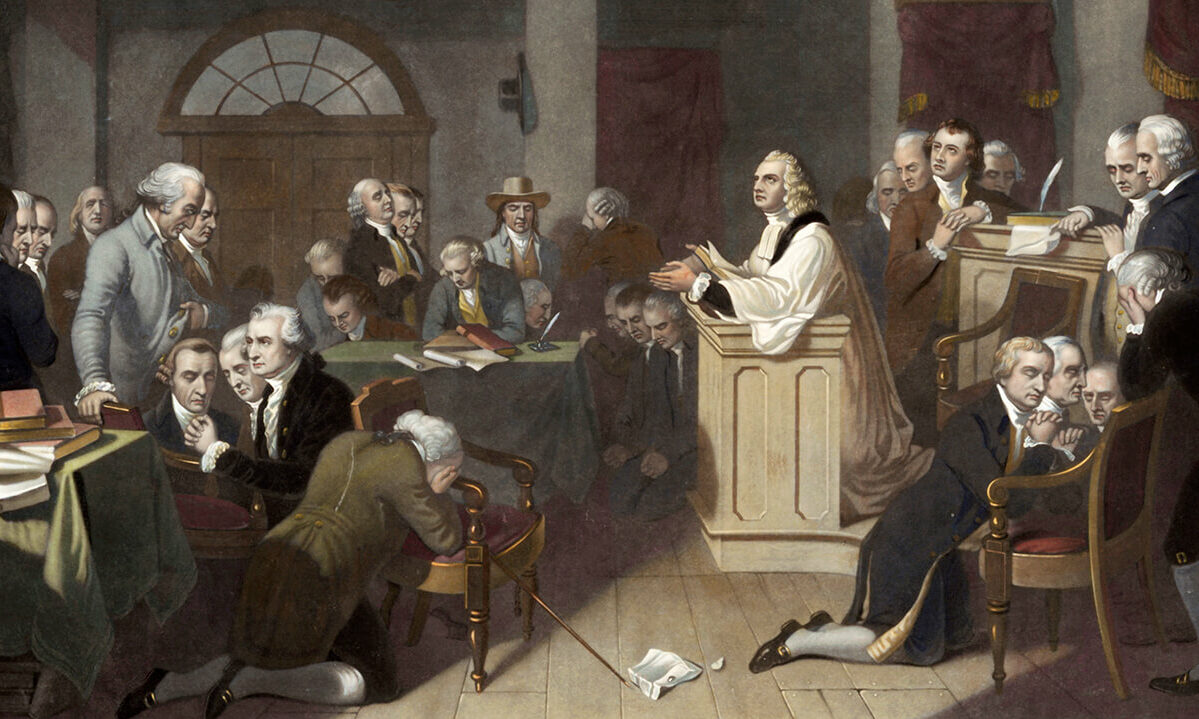
But Duché did much more than just “officiate” by “reading” prayers from the Book of Common Prayer. Surprising everyone present, he launched into an unforeseen but passionate and spontaneous prayer. According to John Adams:

Mr. Duché, unexpectedly to everybody, struck out into an extemporary prayer which filled the bosom of every man present.15

What was the effect?

I must confess I never heard a better prayer or one so well pronounced. . . .with such fervor, such ardor, such earnestness and pathos, and in language so elegant and sublime. . . .It has had an excellent effect upon everybody here.16

Several delegates including Samuel Adams,17 Joseph Reed,18 and Samuel Ward;19  commented on Duché’s remarkable prayer. Silas Deane reported that Duché’s prayer. . .

was worth riding one hundred mile to hear. He. . .prayed without book about ten minutes so pertinently, with such fervency, purity, and sublimity of style and sentiment, and with such an apparent sensibility of the scenes and business before us, that even Quakers shed tears.20

By the way, Deane’s comment that it was a prayer “worth riding one hundred mile to hear” is significant. In that day, riding one hundred miles meant three days in the saddle. Deane admitted that he would have willingly spent three days on horseback just to reach that gathering and hear that prayer. And the prayer was so powerful that it caused even the stern Quakers (the group most persecuted by Duché’s Anglican denomination) to “shed tears” as they listened.

While the exact wording of that first prayer is not known, we can ascertain the type of prayer from Duché’s continued service in the Second Continental Congress. Shortly after the Declaration of Independence was approved, Duché was appointed congressional chaplain21 and delivered this stirring prayer:

O Lord our heavenly Father, high and mighty King of kings and Lord of lords. . .over all the kingdoms, empires, and governments, look down in mercy, we beseech Thee, on these American States who have fled to Thee from the rod of the oppressor and thrown themselves on Thy gracious protection, desiring to be henceforth dependent only on Thee; to Thee have they appealed for the righteousness of their cause; to Thee do they now look up for that countenance and support which Thou alone canst give; take them, therefore, Heavenly Father, under Thy nurturing care; give them wisdom in council, and valor in the field; defeat the malicious designs of our cruel adversaries; convince them of the unrighteousness of their cause. . . .All this we ask in the name and through the merits of Jesus Christ, Thy Son and our Savior, Amen!22

Scripture Applied

A year later, it did not appear as if his prayer would be answered. The Americans had lost battle after battle, and British troops had invaded and seized his hometown of Philadelphia. During this gloomy outlook, Duché wrote George Washington, predicting American defeat and urging him to retract the Declaration of Independence. Washington refused, and Congress declared Duché a traitor, whereupon he fled to Great Britain. But late in life, after receiving permission from President Washington, Duché returned to America where he spent his remaining years.

But in that first gathering of Congress he did not just pray. According to John Adams, Duché also. . .

read the collect [Scriptures] for the seventh day of September, which was the thirty-fifth Psalm. You must remember this was the next morning after we heard the horrible rumor of the cannonade of Boston. I never saw a greater effect upon an audience. It seemed as if Heaven had ordained that Psalm to be read on that morning. . . .It has had an excellent effect upon everybody here. I must beg you to read that Psalm. . . .Read this letter and the 35th Psalm to [your friends]. Read it to your father [the Rev. William Smith, church pastor].23

Significantly, when the delegates gathered in Philadelphia, they heard a rumor that Boston was under attack. The Founders’ distress was palpable. They were still British citizens, and their own British army and navy was now besieging them. But Psalm 35 spoke directly to their growing fears.

Silas Deane noted that “the lessons [Scriptures] of the day, which were accidentally extremely applicable.24 John Adams agreed that the reading of Psalm 35 on that day was not only “most admirably adapted” but also that was “Providential.”25

Significantly, when the Book of Common Prayer was written in 1662 under King Charles II, Psalm 35 was designated for reading on September 7 of each year. (Other assigned daily passages studied in Congress that morning included Amos 9, Matthew 8, and Psalm 36.) The fact that Psalm 35 was assigned to that day over a century earlier confirmed to the Founders that God knew what they would be facing and was watching over them. As one Founding Father expressed it, “the liberties of America are the object of Divine protection.”26

As you read Psalm 35, place yourself in the Founders’ circumstances. Imagine their mindset on that day, and consider the uncertainty that must have gripped their souls. Since this Psalm contains the prayers of a defenseless people attacked by a much stronger adversary, it is easy to understand why it so impacted the nation’s first Congress.


Endnotes

1 “An association, signed by 89 members of the late House of Bugesses,” May 27, 1774, Library of Congress, http://hdl.loc.gov/loc.rbc/rbpe.17801200.

2 “Letter from the New York Committee of Fifty-One to the Boston Committee of Correspondence; May 23, 1774,” The Avalon Project, http://avalon.law.yale.edu/18th_century/letter_ny_comm_1774.asp.

3John Adams to Abigail Adams, September 16, 1774, Familiar Letters of John Adams and His Wife Abigail Adams, During the Revolution, ed. Charles Francis Adams (Boston: Houghton, Mifflin and Company, 1875), 37.

4 John Adams to Abigail Adams, September 16, 1774, Familiar Letters, ed. Adams (1875), 37.

5 See, for example, James Madison to William Bradford, Jr., January 24, 1774, The Writings of James Madison (New York: G.P. Putnam’s Sons, 1900), 1:21; James Underwood and William Burke, The Dawn of Religious Freedom in South Carolina (Columbia: University of South Carolina Press, 2006), 167; Robert Semple, A History of the Rise and Progress of the Baptists in Virginia (Richmond: Robert Semple, 1810), 14, 29-30; A Companion to Thomas Jefferson, ed. Francis Cogliano, editor (Chichester: John Wiley & Sons, 2011), 78; Cyclopedia of Methodism, ed. Matthew Simpson (Philadelphia: Everts & Stewart, 1878), s.v. “Virginia.”

6 See, for example, John Gillies, Memoirs of Rev. George Whitefield (Middletown: Hunt & Noyes, 1838), 273; N. F. Bryant, The Household Monthly (Boston: N.F. Bryant, December 1859), III:3: 237, “Whitefield in America.”

7 See, for example, “George Whitefield: Did you Know,” April 1, 1993, Christian History; Dave Schleck, “CW to Recreate Visit of Famous Preacher,” December 15, 1995, Daily Press; Stephen Gorham, “The Divine Dramatist: George Whitefield and the Full Flowering of the Great Awakening,” February 26, 2012, American History, Suite 101.

8 John Adams to Thomas Jefferson, December 3, 1813, The Writings of Thomas Jefferson, ed. Andrew A. Lipscomb (Washington, DC: The Thomas Jefferson Memorial Association, 1904), XIV:19-20.

9 Stephen Mansfield, Forgotten Founding Father: The Heroic Legacy of George Whitefield (Nashville: Cumberland House, 2001), 86.

10 John Adams to Abigail Adams, September 16, 1774, Familiar Letters, ed. Adams (1875), 37.

11 John Adams to Abigail Adams, September 16, 1774, Familiar Letters, ed. Adams (1875), 37.

12 Daniel Webster, Mr. Webster’s Speech in Defence of the Christian Ministry, and In Favor of the Religious Instruction of the Young (Washington, DC: Gales and Seaton, 1844), 36-37.

13 John Adams to Abigail Adams, September 16, 1774, Familiar Letters, ed. Adams (1875), 37.

14 The Works of Benjamin Franklin, ed. John Bigelow (New York: G.P. Putnam’s Sons, 1904), XI:378, “Motion for Prayers in the [Constitutional] Convention.”

15 John Adams to Abigail Adams, September 16, 1774, Familiar Letters, ed. Adams (1875), 37.

16 John Adams to Abigail Adams, September 16, 1774, Familiar Letters, ed. Adams (1875), 37.

17 Samuel Adams to Joseph Warren, September 9, 1774, Letters of Delegates to Congress, ed. Paul H. Smith (Washington, DC: Library of Congress, 1976), I:55.

18 John Adams diary entry of September 10, 1774 The Works of John Adams, Second President of the United States, ed. Charles Francis Adams (Boston: Little, Brown and Company, 1850), II:377-378.

19 Samuel Ward’s diary entry of September 7, 1774, Letters of Delegates, ed. Smith (1976), I:45.

20 Silas Deane to Elizabeth Deane, September 7, 1774, The Silas Deane Papers (New York: New York Historical Society, 1887), I:20.

21 July 9, 1776, The Journals of the Continental Congress (Washington, DC: Government Printing Office, 1906), V:530.

22 James Thatcher, A Military Journal (Boston: Richardson and Lord, 1823), 145n.

23 John Adams to Abigail Adams, September 16, 1774, Familiar Letters, ed. Adams (1875), 37.

24 Silas Deane to Elizabeth Deane, September 7, 1774, Silas Deane Papers (1887), I:20.

25 John Adams diary entry of September 7, 1774, Works of John Adams, ed. Adams (1850), II:368.

26 George Washington, General Orders of September 26, 1780, The Writings of George Washington, ed. John C. Fitzpatrick (Washington: United States Government Printing Office, 1937), XX:95.

Thanksgiving in America Tract

This printable tract contains a brief history of America’s Thanksgiving holiday and includes quotes from notable Founders excerpted from their Thanksgiving proclamations. See the complete text below and download it for your personal use!


The tradition of Thanksgiving as a time to focus on God and thank Him for His blessings dates back almost four centuries in America. While thanksgiving celebrations occurred as early as 1541 in Texas, and 1607 at Cape Henry, Virginia, it is from the Pilgrim festival of 1621 that we derive the current tradition of Thanksgiving.

The Pilgrims (a congregation of Bible-loving English Christians) set sail for America on September 6, 1620, and for two months braved the harsh elements of a storm-tossed sea. Upon arriving in what is now Massachusetts, and unprepared for the harsh New England winter, nearly half of them died before spring.

Emerging from that grueling winter, the Pilgrims were surprised when an Indian named Samoset approached them and greeted them in their own language, explaining to them that he had learned English from fishermen and traders. A week later, Samoset returned with a friend named Squanto, who also spoke English. Squanto lived with the Pilgrims and accepted their Christian faith.

Squanto taught the Pilgrims much about how to live in the New World, and he and Samoset helped forge a peace treaty that lasted for generations between the Pilgrims and the Wampanoag Indians. Pilgrim Governor William Bradford described Squanto as “a special instrument sent of God for [our] good.”

That summer, the Pilgrims, through hard work, prayer and the assistance of helpful Indians, reaped a bountiful harvest. As Pilgrim Edward Winslow affirmed, “God be praised, we had a good increase of Indian corn”; “by the goodness of God, we are…far from want.” The grateful Pilgrims therefore declared a time in the Fall to thank God and to celebrate with their Indian friends—America’s first Thanksgiving festival.

Ninety Wampanoag Indians joined the fifty-three Pilgrims for three days of feasting (which included shellfish, lobsters, turkey, corn bread, berries, deer, and other foods), athletic competition and play (the young Pilgrim and Wampanoag men engaged in races, wrestling matches, and athletic events, while the older men engaged in shooting competitions), and prayer and thanksgiving (for God’s providence in watching over and providing for them).

This celebration began an annual tradition that slowly spread to the entire nation. Americans now celebrate a Day of Thanksgiving each November as part of our long American tradition of openly and publicly acknowledging God.

Among the many examples of the open acknowledge of God is the Declaration of Independence, which declares:

We hold these truths to be self-evident, that all men are created equal, that they are endowed by their Creator with certain unalienable rights, that among these are life, liberty and the pursuit of happiness.”

As Thomas Jefferson affirmed: “And can the liberties of a nation be thought secure when we have removed their only firm basis—a conviction in the minds of the people that these liberties are the gift of God?

It was standard practice for our leaders across the generations to acknowledge God as the Source of our national rights and blessings, and to give thanks to Him.

Some people believe America has strayed from the strong religious convictions of previous generations. Perhaps, but an important question is not just “Where is our country’s faith?” but rather “Where do you stand on faith?” Have you thankfully acknowledged the providence of Almighty God in your own life?

As you celebrate Thanksgiving, remember to retain the original gratefulness to God that has always been the spirit of this, the oldest of all American holidays.

Give thanks to the LORD, call on his name; make known among the nations what he has done. PSALM 105:1

“It is the duty of all nations to acknowledge the providence of Almighty God, to obey His will, to be grateful for His benefits, and humbly to implore His protection and favor….Now, therefore, I do recommend …that we may all unite in rendering unto Him our sincere and humble thanks for His kind care and protection.” George Washington

“It is therefore recommended…[a day] for solemn thanksgiving and praise, that with one heart and one voice the good people may express the grateful feelings of their hearts and…join the penitent confession of their manifold sins…and their humble and earnest supplication that it may please God, through the merits of Jesus Christ, mercifully to forgive and blot them out of remembrance…and to prosper the means of religion for the…enlargement of that kingdom which consisteth in righteousness, peace and joy in the Holy Ghost [Romans 14:17]” Continental Congress, 1777

“It be recommended to the several states…a day of public and solemn thanksgiving to Almighty God…to beseech Him that He would…pour out His Holy Spirit on all ministers of the Gospel; that He would…spread the light of Christian knowledge through the remotest corners of the earth…[and] that He would establish these United States upon the basis of religion and virtue.” Thomas Jefferson

“The year that is drawing towards it close has been filled with the blessings of fruitful fields and healthful skies…We are prone to forget the Source from which they come….They are the gracious gifts of the Most High God….I do, therefore, invite my fellow-citizens…[to] observe…a Day of Thanksgiving and Prayer to our beneficent Father, Who dwelleth in the heavens.” Abraham Lincoln

“I…appoint…a day of public thanksgiving and praise,…rendering to God the tribute of praise for His unmerited goodness towards us…in continuing to us… the Holy Scriptures which are able to enlighten and make us wise to eternal salvation….[We] present our humble and penitent supplication…that He would… cause the benign religion of our Lord and Savior Jesus Christ to be known, understood, and practiced among all the inhabitants of the earth.” John Hancock

Download the complete tract here!


* To see more original Thanksgiving proclamations issued by presidents, governors, and other leaders over generations visit our Resources page and filter by “Proclamations” and “Holidays.”

** Learn the history of Thanksgiving through a few of WallBuilders’ articles, starting here.

George Washington First Becomes a National Leader

George Washington First Becomes a National Leader

george-washington-first-becomes-a-national-leader-1On July 3, 1775 George Washington took command of the newly formed Continental Army.1 Congress had selected him — one of its own members — to organize the farmers and local militia groups into an army capable of defeating the world’s greatest military power.2 Quite an undertaking!

One of his first orders to the new American military set a clear tone of what he expected from his troops and also told us much about his character. In that order, Washington urged that

“…every officer and man will endeavor so as to live and act as becomes a Christian soldier, defending the dearest rights and liberties of his country.”3

That his troops display Christian character was important to Washington, and he later additionally charged them:

“To the distinguished character of Patriot, it should be our highest glory to add the more distinguished character of Christian.”4

He also issued orders prohibiting swearing,5 profanity,6 and gambling.7 He clearly set a very high moral standard for his troops, but it was not more than what he expected from himself. In fact, while just a young boy, he copied out 110 maxims concerning good behavior and manners. Called his “Rules of Civility,” he lived by them throughout his life, and they were especially apparent during his time as a soldier.

george-washington-first-becomes-a-national-leader-2Washington longed for military life from the time he was a young boy, and he got his first experience during the French and Indian War, two decades before the American Revolution. He should have been killed in the Battle of the Monongahela, but his life was saved by God’s Divine intervention. As he told his brother:

“[I] now exist and appear in the land of the living by the miraculous care of Providence that protected me beyond all human expectation; I had four bullets through my coat and two horses shot under me and yet escaped unhurt.”8

(Similar instances of his life being spared during the Revolutionary War are in the The Founders’ Bible article, “George Washington: The Soldier Who Could Not Die”).

It was as a result of what he did in the French and Indian War that he was first vaulted into the national spotlight. In fact, a famous military sermon preached in 1755 by the Rev. Samuel Davies (considered the greatest pulpit orator in American history) specifically singled out the young George Washington for special attention because of what happened in that battle.9

george-washington-first-becomes-a-national-leader-3It was largely because of Washington’s experiences in that early war that he was chosen by his fellow citizens as a member of Congress, and then chosen by his peers in Congress as Commander-In-Chief.10 He led America on to a successful conclusion of the Revolutionary War, oversaw the formation of the United States Constitution,11 and guided us through the implementation of our new government as our first president. He is rightly honored as “The Father of His Country.”12

Washington fully understood that the important part he had played in America’s formation was by the direction of God, acknowledging: “I have only been an instrument in the hands of Providence.”13

Let’s remember to honor one of the key individuals responsible for America’s independence: George Washington.

Special Notes: The remarkable story of George Washington is told in The Bulletproof George Washington. And his 110 Rules of Civility are still available today. Several of Washington’s religious and moral orders to his troops are found in the booklet The Spirit of the American Revolution. All of these are available in the WallBuilders store.


Endnotes

1 US Army Center of Military History, “Washington takes command of Continental Army in 1775,” April 15, 2016, US Army; “Creating a Continental Army,” Library of Congress, accessed July 1, 2025.
2 Washington Irving, Life of George Washington (Leipzig: Bernhard Tauchnitz, 1856), II:1.
3 George Washington, “General Orders,” July 9, 1776, The Writings of George Washington, ed. John C. Fitzpatrick (Washington: United States Government Printing Office, 1932), 5:245.
4 Washington, “General Orders,” May 2, 1778, Writings of Washington, ed. Fitzpatrick (1934), 11:343.
5 Jared Sparks, The Writings of Washington, (Boston: Ferdinand Andrews, 1840), III:491n.
6 Washington, “General Orders,” August 3, 1776, Writings of Washington, ed. Fitzpatrick (1932), 5:367.
7 Washington, “General Orders,” February 26, 1776, Writings of Washington, ed. Fitzpatrick (1931), 4:347.
8 Washington to John Augustine Washington, July 18, 1755 Writings of Washington, ed. Fitzpatrick (1931), 1:152.
9 Samuel Davies, Religion and Patriotism: The Constituents of a Good Soldier. A Sermon Preached to Captain Overton’s independnet company of volunteers, raised in Hanover County, Virginia, August 17, 1755 (Philadelphia: 1756), 10n.
10 “George Washington’s Commission as Commander in Chief: Primary Documents in American History,” Library of Congress, accessed July 1, 2025.
11 “Creating the United States: Convention and Ratification,” Library of Congress, accessed July 1, 2025; “The Constitutional Convention of 1787,” September 17, 2023, National Park Service.
12 See, for example, S. G. Arnold, The Life of George Washington, First President of the United States (New York: T. Mason, 1840), 8.
13 George Washington to Lucretia Wilhelmina Van Winter, March 30, 1785, Founders Online.