Sermon – Election – 1807, Massachusetts


This election sermon was preached by Rev. William Bentley in Boston on May 27, 1807.


sermon-election-1807-massachusetts

A

SERMON,

BEFORE

THE GOVERNOR,

THE

HONORABLE COUNCIL,

AND

BOTH BRANCHES OF THE LEGISLATURE

OF THE

Commonwealth of Massachusetts,

ON THE DAY OF

GENERAL ELECTION,

MAY 27, 1807.

BY WILLIAM BENTLEY, A. M.

MINISTER OF THE SECOND CHURCH IN SALEM.

BOSTON:

PRINTED BY ADAMS AND RHOADES, PRINTERS TO THE STATE.

1807.


COMMONWEALTH OF MASSACHUSETTS.

In Senate, May 28, 1807.

ORDERED, That the Hon. Jonathan Maynard, William Gray, and Azariah Egleston, Esquires, be a Committee to wait upon the Rev. Mr. William Bentley, and, in the name of the Senate, to thank him for the Discourse delivered by him yesterday, before his Excellency the Governor, the Hon. Council, and both Branches of the Legislature, and request of him a copy thereof for the press.

Copy of Record,
JNO. D. DUNBAR,
Clerk of the Senate.
AN ELECTION SERMON.

DEUTERONOMY, xxxiii. 3.

YEA, HE LOVED THE PEOPLE; ALL HIS SAINTS ARE IN THY HANDS, AND THEY SAT DOWN AT THY FEET; EVERY ONE SHALL RECEIVE OF THY WORDS.

We refer to the Hebrew scriptures, for political, united with religious reflections, as their government combined these two objects, which the Christian scriptures do not. The religious sentiments of all ages, and the nature of all religious establishments, as well as the example of the primitive settlers of New-England, have concurred in recommending the appropriate devotions of this day. But this authority extends only to received forms of devotion, which are adapted most freely to express the public consent, or may concur to assist it. The less it is a maxim of state to direct ecclesiastical affairs, and the less the state interferes with the private judgment of the man, who exercises such functions, the more surely will an ingenuous man be cautious, that the liberty he enjoys, should be sacred to the prosperity of the state, which protects him. The privileges he possesses, belong not to his opinions, but to his patriotism; not to him as a man, but as a citizen. His freedom of speech belongs to the interest he has in the public happiness, in the laws, and the constituted authorities, and in the power to excite good affections, and to promote generous purposes among the people. The state has a right to avail itself of all opinions, rich in patriotism, as it has of all other contributions for the public welfare, but it is patriotism which gives the highest recommendation. Hence we are deeply impressed with the language, which has become venerable in the character of men, who have been useful in past generations. We dwell with delight upon the ardent love of our country, displayed in the affections of a Winthrop, the prudence of a Leverett, and the patriarchal manners of a Bradstreet. We behold them concurring with the infant strength of our nation. We learn not only the opinions, but the purposes of the age in which they lived. Their success gives them glory. If we change their measures, we retain their principles. We discover their safety, and secure our own.

With these convictions, the children of the Hebrew Patriarchs, in all generations, read the lessons given to their fathers, and in modern ages, we enjoy with rapture, the legacy which, our best patriots, upon a review of their services, and of the public hopes, as the best pledge of their affections, have generously bequeathed to us.

Of this nature is the address of Moses in the text. He reviewed his whole administration at its close. In the name of his God, he declares that its sure guide, was the love of the people. The same spirit which suggested the admonitions of the Patriarchs, and gave the words of wisdom in the past generations, was invariably regarded in all the changes of their political existence. Each had a blessing; all had counsel; all received the same law. Such is the truth which is accepted from the words of the Lawgiver of the Hebrews.

Useful criticism might be employed on the words, as it would develop some antient customs; as it would explain the hopes of private virtue, and as it would suggest that Moses expected to secure his hopes of the political prosperity of Israel, not by the wisest theory, he could propose, but by the consent of the national character to the Institute he had recommended. And upon this account he gave no rules whatever for the political changes, which future ages might introduce. In the words, is an allusion to the patriarchal blessing on the saints, or heads of the families, as may be concluded, from the consent of the Hebrews, in this sense, and from the appropriate use of the term, as applied to the primitive Christians in their scriptures. The oldest version regards the distribution of the last clauses, referring the former to the instructions of the Patriarch recorded by Moses, and the latter of them, to the Lawgiver himself. Each family had its peculiar instructions, but the whole congregation received the law commanded by Moses. While the text discovers that the happiness of the people was the object of the Law, it also assures us, that the private instructions of the families and tribes had contributed to a consent in the national hopes, and upon this consent their highest prosperity did depend. And this sentiment the present discourse is designed to support.

Our enquiry then is, into those circumstances of national character, which concur to support the present Constitution of our Government. That it be well defined, well guarded, and well supported, these things are to be considered when we pronounce of the public liberty. It had been defined and enjoyed in what was called the British Constitution; It had been reformed by the boldest experiments in that nation, and had profited in an age of experiments, by all the information which could meet the wishes of a free people. The history of our settlements will explain in what circumstances, it was adopted, and the American Revolution with what spirit it was maintained. Our Constitutions are the deliberate result of our political wisdom, and our vindication before the world.

The history of our Commonwealth divides itself into three distinct and well known periods. During the old till the new Charter; from the new Charter to the American Revolution. If ever a people were born free, such were the people of this plantation. If they at first submitted to an ecclesiastical dominion, it was a submission to character, not to law, as the event proved in the third generation. Their first measure was to consult their own wishes, and to accommodate themselves to their own condition, whatever might have been dictated by European policy. Even their servants found that their freedom was an easy claim, and a sure privilege. The settlers in the name of freemen, soon took the entire direction of their domestic affairs, and their arrangements were so often varied, that they could leave no prejudices in their favour, when contrary either to their present interest or convenience. The men, who led the settlements, had possessed a superiority of talents, as well as influence, gave an early example of their own independence. They assumed their religious functions, directed by the freedom, they had long sought, and now fully enjoyed. They adopted no confession of faith, which had the authority of any Church, nor did they admit, or name any canons of any Communion. They reserved to themselves no privileges, which could support a separate interest, or an exclusive power. They associated with their brethren in the first honours. They supported no other claims, than their personal reputation, and the public confidence could give them, while they entrusted all the power, which could be given by the association of brethren, to which they respectfully belonged, to any of their society, who were not elected as civil magistrates. And to exercise this power, nothing more was required, than a sincere disposition to find out, and encourage the best wishes of each association. Their civil privileges were greater still. While no civil distinctions did exist, all the ministers by their ecclesiastical maxims were excluded from any claims to represent the freemen, refusing all weight of character in influencing the public elections in their own favour, after a representation of the freemen had been judged convenient. These privileges were carefully maintained throughout the first period of the history. The greatest events arose from the influence, which the character of the ministers had upon the first generation. Such were the affairs of Mr. Williams of Salem, who was friendly to the public liberty. Such the discussions of Mr. Cotton at Boston, and of Mr. Parker at Newbury. But we seek the cause of this influence, not in the power granted to the ministers, but in their character, which gave authority to their opinions. The Synod which was called to give consistency to these opinions, by the manner in which its authority was admitted, has explained the public will; and in a succession of curious facts, has shewn how the superiority of this order of men had locally obtained.

The primitive ministers of New-England will justify an honourable comparison with any who have appeared in succeeding generations, and can maintain an evident superiority to all who profess to follow them in the same dogmas, and in the same course of studies. They were better acquainted with the learned languages, better informed in ecclesiastical history, and more deeply versed in scholastic and polemic divinity. They corresponded with the best men of their times, and had their works printed in Europe under the inspection of the best scholars, and at the best presses, and were acquainted with the private opinions of the leading men in the several communions of the Reformed Church. And many of the best men, who remained in Europe did not conceive it unworthy of their reputation, to entertain hopes of being united with them in the same settlements, for the promotion of Christian knowledge.

A comparison so favourable to them, when made with the generations which succeeded them, might be thought to be peculiarly happy among their own associates. But we should remember, that the display of their zeal and of their talents, was the favourite object of the settlements, while the condition of the society, in which they lived, operated against all the other members, as much as it did in favour of themselves, in regard to all the advantages to be derived from European improvements.

We are not left to uncertain tests of that knowledge which prevailed among their companions. Many might be drawn by interest and by local prejudices to embark for a new settlement, and for new hopes of prosperity. But men engaged by religious systems, and possessed of talents to distinguish their friends, do not hazard all their purposes with such men only. The persuasion was, that the company had common views, and as men of enterprise all the first to search into the truths of religion, as well as to make new experiments in nature, and the age of the arts, is an age of enquiry, that the company had embraced men of sound understandings. In all the rising sects of the Reformation, men of sound minds were found to give a sure direction to the sober minds of their brethren. The period is not so distant as to render it impossible to obtain the proper evidence of these facts. We can reach the occupations, the condition, and improvements of the first settlers, and though the greater part were in common employments, yet they were not without some of the best instructed men of the age. The best books, then known, were found in their possession, and Grotius their contemporary, has been compared to Tacitus himself. They displayed their knowledge as soon as they had occasion for it. They possessed in ship building the knowledge which the French had communicated, and which a late English artist has rendered familiar to his countrymen. They held all the valuable books on the subject. The first publication at Oxford of a contemporary of Vinci, whom Hogarth and the notes of Fresnoy have noticed, was with the first settlers.

The Military tracts which had the fame of the day were in their hands, and the private collections of books were made with good judgment. But they soon found that their condition offered no encouragement to the arts they possessed, and the knowledge of the first generation was succeeded with an education accommodated to their circumstances, and of consequence the arts and sciences were not in the second generation what they had been in the first. The works of the first ministers of Salem, Boston, Ipswich, Newbury, Cambridge, and Roxbury, and of other antient settlements, exist for a fair comparison. They who examine Mr. Ward’s publication and recollect that it contained the true doctrine of the first ministers respecting religious toleration, and compare it with many facts will ascertain that they differed not essentially from the opinions prevalent in Europe. The Synod then did not possess the power they were inclined to exercise, and the condition of the settlement obliged the ministers to correct a zeal which would have been daily encroaching upon the civil constitution. The jealousy which the British nation had of the settlements in America, and the intention to exalt its own power, obliged the ministers to do nothing without the consent of the people. And the persecution, at last obtained a full commission, it had its authority only in the superiority of the ministers and in the general consent of Europe. This superiority would eventually have been fatal, had not persecution been cruel, and enthusiasm extreme. And had not the condition of the settlements, entirely changed the relative importance of character among the people.

The Literary establishments, which from the wisest policy obtained at an early age, had not that strength from great talents, which give them a sovereignty in their influence. Knowledge, not so great with a few, was more equally distributed. The residence of Masters in the Arts in any infant country could not produce such an effect as arose from the habits of Europe, and could not be maintained with benefit to literary institutions without rich endowments. They belonged not to a large school into which the higher instructions could hardly be permitted to enter. And hence in the second generation, the ministers found their influence lessened by every attempt to maintain it, without a visible superiority of talents and character, and themselves reduced to such a share of favour, as they could procure by their usefulness, and their sincere affection to the people.

The character of society had insensibly changed. It was no longer an association in favour of liberty against heresy in religion, but of liberty against all its enemies. And thus every occurrence contributed to check, in the safest manner, any abuses, which could arise out of the public prejudices, and the old charter expired, and the new found us free.

The precedency of the civil to the religious character, might occasion new dangers. But the second period of our history proved as safe as the first. The state of affairs in the English nation, during the first period, had tended to confirm the inhabitants of these settlements in their early love of liberty, by better writings, and more powerful examples than they had before possessed in the times of the Republic. The restoration, while it promised nothing to the ministers, engaged them to prevent the attempts to extend the royal prerogative in America. The Revolution which promised moderation in Europe, promised nothing to the English settlements in America, but a system of dependence. Other settlements in the neighbourhood of our own, in which royal claims were acknowledged, led us to expect a common fate, when the last minister of religion employed in a civil negotiation, returned with a new Charter, an event expressive of the influence of his own order, and of the new dangers of his country.

Here commences a new period.

All the ecclesiastical institutions discover it. The toleration which appeared in the capital, and the changes in the forms of worship admitted in the Congregational churches at the opening of the eighteen century, discovered that a new order of things had begun. The contest now was between the two countries. The means of education had been most profitable, as they always will be, to men, whose talents are demanded by great occasions, and whose associations are strongest with ambition. The chief magistrate, to the antient habits of the people, was a stranger. He was not of their election. The contest then was between the officers of the Crown, and such men as ambition could awaken to defend the people. We look then among men instructed in public business for the great characters of this age. The ministers had not only generously declined civil offices but they had repeatedly consented to give up to the public wishes the instructions of their first institution for public education. The concession was in consent with the national character. The best talents were required in public affairs, but with a sure check from the British administration. Every domestic obligation united to keep in the interest of the people such as had not employments from the British Crown. The history of the Cookes, and of the Governor’s negative may explain the competition of talents and of power. The father and the son maintained the public favour for sixty years, but not without that jealousy which is awakened by the love of liberty. The vigour of the public character was not disgraced by the ambition which preserved any portion of North America from the dominion of any foreign power. The expeditions which distinguish these periods, and the second in which these settlements discovered their military spirit, as well as the last which extended the English dominions, are from the same principles which directed the negotiation, and which have united eventually, in our own times, the discoveries of Raleigh and Drake in the same empire. The times which preceded the American Revolution are well known. The British Constitution embraced the Church and the State, and the jurisdiction of the one might accompany the other. If the ministers had departed from the opinions of the first settlers, and had become more favourable to religious liberty, they had not lost the affections of the people, or the love of their own independence. Their union neither oppressed their understandings, nor lessened their interest. Alarmed at the dangers which threatened them, they made a bold and seasonable defence. The controversy which is in our hands, has rendered dear to us the names of the men who engaged in it. This zeal which consented to the spirit of the times, has given us a list of ministers, whose memory must exist in our history, and whose praises will be recited, as long as our national existence can continue.

We now behold a space great as the first, in which religion had all its honours, the mind all its freedom, while a generous defence of the public Liberty was maintained by the best talents of every class of citizens, and by the best literature of our country, and the cause had all the glory, which national favour could bestow. Such were the springs upon the public mind, when the nation resolved to declare its Independence, to vindicate its rights, and maintain, by the sword, its political existence.

At the commencement of the third period of our history, the most powerful domestic causes combined to assist the public liberty. They were felt in the energy of national character, in the system of education, in the freedom of elections, in the confirmed patriotism of men who filled the first offices of state, and in a good Constitution of Government. We have seen the strength of religious character guarded against the prevailing abuses, by causes which concurred to render the teachers of religion the sure friends of the people. The spirit of the laws, the character of education, and a political necessity contributed to this important end. In the next period, we see all the ambition of patriots corrected and refined by the struggles of men appointed to assert every claim of foreign dominion. The people were taught to reverence their benefactors without concessions unfriendly to their liberty, and to listen to patriots, whose claims on the public notice were, from the guards, they placed against every encroachment on the public liberty.

The energy of the national character was seen, in the full consent to measures, which involved every interest, obliged the greatest personal services, and never presented any rich hopes but in their eventual success. When opinion was irresistible to every plea of wealth and ambition; when habit in domestic, or social, or professional life had no prejudices firm enough to oppose, and when all could perform, more than they promised or expected, this was national strength and glory. And who that contemplates the danger, the struggle, or the event, can deny it to us in the most favourable circumstances of a great revolution.

Every thing contributed to put education under restraints most favourable to the national character. The schools had not been so associated with the State, as to receive any influence, unless by private manners. The laws had left them altogether to the rules of the respective incorporations. The teachers were approved by those who were to be instructed by them. They had not under any pretence departed from this simple character, and it was rendered necessary that our highest institution of public education should have a government directed by the legislative wisdom which ruled the State. And it is a pleasing recollection that at this time, the man who had the greatest influence in the State, was possessed of the highest reputation in the University, and of the most powerful direction of its studies. A circumstance the more memorable, as he was lineally descended from the first Governor Winthrop, 1 and united in himself a portion of all the powers exercised by the consent of the people. In possession of a seat in the Council, and of unrivalled eminence in his professional abilities, he was able to provide confidence in the people, and literary pursuits could remain uninterrupted by any jealousies that they embraced objects not favourable to the public liberty. And thus our University escaped from all the evils of the war.

Our religious institutions were in the same happy consent with the national character. The jealousies of foreign establishments had corrected the strong propensities to an imitation of new forms, so that nothing spoke to the senses in favour of the prejudices of foreign nations. Whatever was thought, could not be silently expressed. And the manner was our own. The teachers of religion held on accountableness to their respective incorporations, and they could not combine against the laws. Their associations were useful to them, only as they rendered the members more worthy of the public affections. No uniformity of ceremonies or opinions had imposed a form of doctrine or discipline. The results of Synods and Councils were consulted rather as precedents than authorities. The State was favourable to this religious education, because it regarded all the means, which a pure conscience may enjoy, a sober life recommend, and a quiet citizen freely accept.

The electors of the State were, at this time, of the highest value, and in their greatest honour. They had dangers, rather than riches to bestow. They required great labours, which they could repay only in gratitude. The reward was in the prosperity of the state, not of the person who performed the richest services. The promise was of fame, but neglect of duty was infamy. At once a host of heroes arose. Great occasions produce great men. We had men wise in counsel, powerful in arms, the deliverers of our country. They who commenced patriots in the revolution, continued their services till peace was restored, so that we found ourselves with the same friends, who engaged with us in the first dangers.

From these advantages resulted our free Constitution. Dr. Franklin said of one of our Constitutions, “I consent to it, because I expect no better, and because I am not sure, that it is not the best!” It is in just consent, with the great civil privileges on which the plantation begun; it profits from the experience of modern times, and is free from the antient prejudices, which constitute parts of the European republics, and is the firm basis of our liberty. It has maintained itself in the public affections, its powers have been exercised with success, and it still lives in the health of the nation. By its own energies, it has restored itself, when it felt the approaches of disease, and it preserves the hopes of a durable existence. The world has long been accustomed to appreciate its own moral advantages. A refined skill has done wonders upon an infirm and vitiated constitution. But severe rules seldom resist long habits. Health is easily nursed, when life is pure, by temperance, by energy, and a free spirit. A sound constitution promises every blessing, and sacred should be the charge to preserve it.

How painful would be the recollection, that they who were the most active to form our constitution of government, were the first to renounce it. That they should not dread the dangers of military power; should not fear oppressive excises; should oppose no established orders in the State, and should consent to change the form of the government. That men who instigated the public resentment against all oppression, should ridicule the patriotism they had excited. Roused by injuries, nations have been called to assert their liberties, but we are invited to our duty in the most favourable circumstances. Whatever can be attributed to habit, to association, to first choice, and best condition for it, obliges it. The love of the public liberty is maintained in the spirit of the General Government of the United States, and while we carry back to the heart, the pure blood of our veins, it is from the powerful action of the heart, life circulates freely throughout the nation. Gratitude bids us to remember our national benefactors. Washington employed our arms with glory, and Jefferson has instructed us in the arts of peace.

It is for the different branches of our Legislature to prove that they deserve to be entrusted with the administration of our affairs in these happy times. They should appreciate their talents in the dignity of their debates, in the wisdom of their resolutions, and in the impartiality of their Laws. Honesty is not less required in public, than in private concerns in a free republic. The branches of the Legislature which arise out of the fears of past ages, and are provided as checks upon the simple theory of government, should counsel with the prudence of age, and consent with the conciliating wisdom of fathers, who delight in increasing happiness. Their care should not enslave liberty, but inspire it. And while our present Governor, retires with a good conscience, and the best wishes of his fellow citizens, we may be confident that a man who has felt our dangers, and shared in the cares of our revolution; who is well informed in our history, and acquainted with our manners and laws; who has held the most important offices in the State, will support the best character of that people, which has bestowed upon him the highest honours. His virtues are to justify their confidence, and his great services to vindicate their choice, and then his fame will be immortal in his own wise administration.

Our experience might lead us to institute a plan of national education, connected with all the public instruction, from the known influence of education upon the purposes of moral and civil society. But till such designs are approved and accomplished, the condition of all public institutions should be carefully examined, and their purposes known, so that adequate means may be provided, all deficiencies supplied, and all abuses corrected. The friends of our University and other seminaries will secure the public favour by a full consent in the design of their establishments. In the city of the Republic from which our first settlers emigrated to America, the University therein established, the first in age and talents, was the first in patriotism, and free enquiry, and could boast of the most able friends of the public liberty. With the same reputation our University would enjoy its best subordination, its most ample resources, and the best praise in a full concurrence with the great ends it proposes, in our greatest prosperity.

Our experience may assure us also, of the best advantages from the instructions of the ministers of religion. Had Mr. Williams, who was the first to conceive what was great, in the State, though deceived in the character of private associations, extended his doctrine of exclusive associations of religion, to civil society, he must have dissolved all its ties. He gave full liberty to every freeman, but religious association not to character only, but to opinions. He conceived them inseparable. He attempted to follow the order of common life. This admits a sacred choice in the family, and an innocent freedom in the world. But all errors of judgment or life cannot dissolve the family. So far he must deserve our commendation, as he did not make the religious association interfere with civil liberty, and was bold enough to declare it.

The arts and genius may attach themselves to an obstinate superstition. We are not necessarily well informed in everything. The population may require indulgence to endless prejudices, born in the varied education of man, and the existence of all civil liberty may depend upon freedom from all prosecution in religion. The state must not then fix bounds to enquiry into religion, more than to any other researches of genius. The strength of the religious character should be most strongly united to the best character of the citizen, and he should be considered as the best minister who is most happy in preserving and uniting them. The Priesthood of Moses, very limited in its offices, was so disposed that we have no history of its opposition to the Laws. The establishments of the East are upon the same principles. If the laws are of a mild character, they are in more full consent with the benevolent religion, which is the just name of the Christian faith.

May we find those happy times in which our national character will confirm all our best hopes for liberty and peace. May no event disturb the kind succession of prosperous days in our history, and may tradition speak in all ages, of the same character, which has been to us a fair inheritance. A rest, O Lord, to the many thousands of Israel,

Thou loving Father of the people.


1.Hon. John Winthrop, Esq.

Sermon – Election – 1807, Connecticut


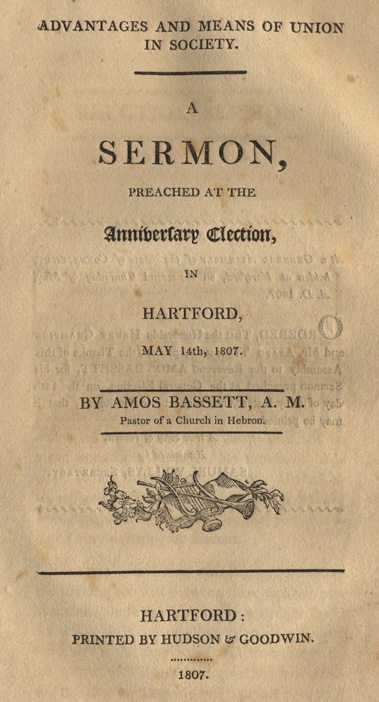
Amos Bassett (1764-1828) graduated from Yale in 1784. He was pastor of a church in Hebron, CT (1794-1824) and in Monroe, CT (1824-1828). This election sermon was preached by Rev. Bassett in Hartford, CT on May 14, 1807.

sermon-election-1807-connecticut

ADVANTAGES AND MEANS OF UNION
IN SOCIETY.

A

SERMON,

PREACHED AT THE

ANNIVERSARY ELECTION,

IN

HARTFORD,

May 14th, 1807.

BY AMOS BASSETT, A. M.
Pastor of a Church in Hebron.

At a General Assembly of the State of Connecticut, holden at Hartford, on the second Thursday of May, A. D. 1807.

ORDERED, That the Honorable Henry Champion and Mr. Asaph Trumbull, present the Thanks of this Assembly to the Reverend AMOS BASSETT, for his Sermon preached at the General Election, on the 14th day of May instant, and request a copy thereof, that it may be printed.

A true copy of record,
Examined by

SAMUEL WYLLYS, Secretary.

ELECTION SERMON.

PSALM CXXXIII. 1.

Behold how good and how pleasant it is, for
brethren to dwell together in unity!

THIS Psalm, it is thought, was composed and sung on occasion of the reunion of the twelve tribes of Israel after a distressing civil war of eight years. However this may be, it is probable that the inspired author of the pleasing and excellent sentiments contained in it, had on some occasions witnessed the numerous blessings arising from union in society. He had also, without doubt, had frequent opportunities invites them to “behold how good and how pleasant it is, for brethren to dwell together in unity.”

Though the term brethren, in its primary import, is applied to descendants of the same parents; yet, it is also used in the sacred scriptures, and in the general language of mankind, with some variety of signification. While the scriptures treat those as brethren, in the most exalted sense, who, in addition to other bonds of union, possess the holy image of the living God, they call those, also, in a more general sense, brethren, who, from their local situation, ought to consider themselves connected together for mutual benefit, and ought to aim for the promotion of the common good. 1 Of the last description are the members of a neighbourhood—a town—a state—and, indeed, of every civil community however extensive.

Of brethren of every description, and probably there are brethren of all the above descriptions present, it may truly be said, that it is “good and pleasant for them to dwell together in unity.” The favour of your candid attention is therefore requested, while an attempt is made to point out, with special reference to a civil community,

I. Some of the advantages of union among brethren.

II. Means for promoting this union.

I. Some of the advantages of union among brethren.

The union, now contemplated, is very different from a selfish combination of partisans. Such a combination contains the seeds of dissolution within itself. Drawn together at first by self interest and self gratification men may unite for a season. But such cannot, they will not long “dwell together in unity.” The basis of their union is essentially defective. The more they know of each other, the more their mutual jealousy will increase. The same unjustifiable motives that drew them together at first will invariably produce discords and contentions: and wretched is that society which must sustain the conflict.

Nor will this discourse contemplate that union, if anyone choose to call by this name, a mere quiet, enforced by the arm of a despot, who is subject to no law—controlled by no principle of virtue.

What is now advocated is the union of a free people in unfeigned regard for the public good—in benevolent, virtuous affection for each other—and in harmony of sentiment relative to the leading measures which are to direct their public concerns. Where the two first properties of a salutary union prevail, the last will be attained without great difficulty. Erroneous information will not be designedly given. Confidence may be placed in the opinions of the ablest members; and the disinterested, candid and diligent enquirer will be able to ascertain, to a sufficient degree, the men whose superior merit entitles them to promotion.

The advantages to be derived from such an union among brethren are numerous. The first that will be mentioned is peace—peace in society, resulting from the prevalence of pure principles, and from an universal attachment to them. This is among the richest blessings of divine providence. The benevolent Creator, in the promise of good things to be enjoyed in the present life, includes peace, as being one of his greatest favours. Yea, it is one of the blessings which constitute the perfect state of enjoyment in the heavenly world.

Another advantage of this union is strength. The union of a people, in real regard for the common good, powerfully braces and strengthens the public arm. Society can now avail herself of the united talents of her most able and respectable members. Her union presents also a firm and stable bulwark against violence from abroad—a far better defence than artificial mounds and ramparts erected without her walls, while the community within is confused with discord, and distracted with party divisions, frequently more opposed to each other than even to a common enemy. Infinite wisdom has declared “every kingdom divided against itself is brought to desolation, and every city or house divided against itself shall not stand.” The declaration of the destructive tendency of discord applies with peculiar force to a people enjoying a republican government. How many miserable examples of the truth of this declaration have even our own times produced! They fell—they were brought to desolation, and their enemies divided the spoil; because they were disunited, and of course destitute of strength. Behold, and consider them well: look upon them, and receive instruction.

Again—while “brethren by dwelling together in unity” are thus rendered powerful, another advantage is gained in a consciousness of security, both public and private. This consciousness of security attaches a value of great importance to all their possessions and to all their enjoyments. They tremble not with apprehensions of falling a prey to foreign enemies. Neighbours also, dwell securely by the side of each other.

How much does it abate, and oftentimes, how entirely does it destroy the enjoyment of blessings, to consider that they are entirely insecure from the violence of man? The enjoyment in such a case, is like that of the person mentioned in history, attempting to regale himself at a rich entertainment; but beholding at the same time a sword suspended over his head by a single hair. Need much be said to a considerate people upon this subject?

Who, in surveying and forming an estimate of the blessings with which he is surrounded, would not find his pleasure unspeakably abated did he know that his enjoyment of them was suspended upon the uncertain events of changes and revolutions,–upon the mercy of some foreign tyrant,–or upon the capricious humours and frenzy of irritated partisans. To-day he is surrounded with the dearest friends, and favoured with a tranquil enjoyment of his possessions. To-morrow he is doomed, perhaps, to behold those friends bleeding around him, and those possessions falling a prey to lawless invaders.

Happy is that people, who, “in union, dwell together,” and in security enjoy their liberties and their privileges. Happier still, when favoured by heaven with wisdom to prize, and resolution to preserve them.

Again—in a union thus constituted the pleasures of friendly intercourse are enjoyed in the highest degree. Each one is made happy by beholding the happiness of his neighbour and of the public. Where friendship is cordial and benevolence sincere, the prosperity of a neighbour can be beheld, not only without envy, but with delight. The eye of the beholder will not be evil because divine providence has been good.—nor because the favours of God have been distributed, in that proportion which seemed best to infinite wisdom.

Where even two or three are thus cordially united, in benevolent affection, the pleasure is great. The happiness is increased in proportion as the subjects of this union become numerous. Extend, then, this union, to neighbourhoods, to towns, to a whole community. Contemplate them,–all in harmony—all seeking the public good—all observing the duties of their respective stations—all engaged in offices of mutual kindness, wishing well to each other, counseling, warning, assisting and instructing each other in love. Notice their mutual civilities, their unsuspecting confidence, their numerous charities;–each person taking pleasure in the happiness of others, and endeavouring to his utmost to promote it.

If the mind be truly benevolent, the sight must be highly grateful: and while the heart of the observer expands with sensations of the sincerest joy, he adopts, as his own, the excellent sentiments of this psalm; “Behold, how good and how pleasant it is for brethren to dwell together in unity. It is like the precious ointment,”—(made in those days of the most rich and costly materials)—“like the precious ointment upon the head, that ran down upon the beard, even Aaron’s beard; that went down to the skirts of his garments;” not only refreshing and delighting with its fragrance, the whole assembly that were present; but perfuming the names of the twelve tribes, written upon the garment of Aaron; and representing thereby the advantages that might be derived to the whole nation, from that “unity” which true virtue produces. It is “as the dew of Hermon, and as the dew that descended upon the mountains of Zion.” How different is the origin of this from the origin of discord. This, like the dew, descendeth from heaven. Discord cometh up from beneath, accompanied with hatred, envy, and bitter revenge,–unhallowed, malignant passions, that mingle a portion of gall with the most valuable ingredients of our happiness.

The benefits attached to society are lost, and its enjoyments destroyed, in proportion to the prevalence of the malignant passions. “A fire devoureth before them, and behind them a flame burneth: the land is as the garden of Eden before them, and behind them a desolate wilderness.”

The peaceful and cordial friend of his fellow creatures, deprived now, of the sweet enjoyments which before had rendered society so desirable, and pained to behold the sufferings and wretchedness of those around him, will feelingly adopt the words of the Psalmist, on an occasion very opposite to that which produced the text: “I mourn in my complaint, because of the voice of the enemy, because of the oppression of the wicked. My heart is sore pained within me. Fearfulness and trembling are come upon me, and horror hath overwhelmed me. And I said, O that I had wings like a dove! For then would I flee away and be at rest; I would hasten my escape from the windy storm and tempest.”

The virtuous and upright union of brethren cometh down from heaven. Like the dew that distilled on Hermon and on the mountains of Zion, it is gentle, sweet, and mild in its influence. And, as the dew is most refreshing and fruitful in its effects, causing the earth to “yield her increase, and the bud of the tender herb to spring forth;” so, the seeds of public happiness shall abundantly spring up,–flourish—and issue in a joyful harvest; where “brethren dwell together in unity.” Instead of the thorn, shall come up the fir tree, and instead of the brier, shall come up the myrtle tree; and the happy inhabitants “shall go out with joy and be led forth with peace.”

To cultivate such an union by all proper means, must, surely, be an object worthy the attention of every wise people, and especially of that people who are favoured with a free government. Let the attention, therefore, of the good citizen, be directed,

II. To means for promoting this union.

And here two means present themselves, as being of primary importance, information and virtue.

1. Correct and liberal information is highly to be prized. Great pains ought to be taken to diffuse this, as far as is practicable, among the body of the people; for it deservedly claims a high regard in the public patronage. At the same time it ought not to be forgotten, that, without the prevalence of virtuous principle, the union of a free people cannot be preserved by mere information, however extensive. It is indeed a very valuable price put into the hand of man; but it may and will be abused by a corrupt heart. Extensive knowledge and great abilities, without virtue,–without principle—are dangerous in the extreme. The truth is suggested as necessary to be kept in view in all arrangements made for education; not as an objection against promoting and diffusing knowledge as far as is practicable. The only valid objection is against the abuse. Information is dangerous in the hands of the vicious only. Place it in the hands of a free and virtuous people, and it becomes of immense advantage to them. Hereby they are assisted to understand their privileges—to set a just value upon them—judiciously to defend them—to distinguish between what will contribute to preserve, and what will tend to destroy them—and to have a correct discernment of characters qualified to be their rulers.

Let information, then, be extended to every class of the community, by all proper means, and especially by the institution of schools and seminaries of learning, and let them receive the liberal patronage of government.

And further, as it is of indispensable importance that information be connected with virtue, and as youth are almost the only persons who are members of these institutions, it becomes peculiarly necessary that the instructors who are to superintend them be cautiously chosen. Our children are our hope and our joy. Whoever is engaged in corrupting their minds is doing them and us an injury which he can never repair. A person of vicious conduct, and who is zealously engaged in disseminating principles which tend to vice, is clearly disqualified to be a teacher of youth, whatever may be his learning.

Many are the unhappy dupes of vicious artifice, even among those who are arrived at manhood. Much more are youth liable to imposition. It is not difficult for an artful man to take advantage of their inexperienced years—to avail himself of the prevalence of passion in that early period of life—and, instead of giving them just ideas of what is practicable, and consistent with the being of well ordered society, to bloat them with pride, and excite in them an extravagant ambition. It is not difficult, by fostering their irregular propensities, to fill them with an impatience of control, to persuade them to despise the restrictions of moral virtue, and to engage them in a warfare against every wholesome and necessary restraint.

But, to do thus, is to train up a generation for slavery here, and perdition hereafter. Should our youth become thoroughly and generally abandoned,–should the gratification of vicious propensities become their supreme object—what can be expected from them in manhood? Will they hesitate to sell themselves and the liberties of their country for their favourite indulgences? No. The spirit of a people abandoned to vice is the spirit of slaves. While, as individuals, they are tyrannical to those who are under them, they can easily cringe and fawn around a despot without any material change of feeling.

Is a government attempting to promote the public union and happiness by means of schools and colleges? Let them not destroy with one hand what they attempt to build up with the other.

To improve the minds of your children by correct and useful information, is to do them an immense favour; but to confirm them in principles of virtue, is to do them a favour unspeakably greater: unite them both, and you bequeath to them the richest inheritance. When you are about to depart from the state of action, and to be gathered to your fathers, you may bid them adieu, with the pleasing prospect that they will be free and happy.

2. In every advance that is made in illustrating the subject under consideration, the essential importance of virtue becomes more and more evident.

The past and present experience of mankind authorizes the declaration, that virtue, including that morality which is the fruit of it, is the only sure and permanent bond of public union. Banish this from a people, and the blessings of union and freedom depart with it. It is impossible that the tranquility of a vicious people should be preserved long, except by means which will destroy their liberty.

Are any disposed to call this in question? They are requested, candidly to compare the nature and effects, both of virtue and vice, with the valuable objects of a free government. Are they still unsatisfied, and, at the same time, free from a criminal bias upon their minds? Let them next repair to history, sacred and profane, and they must be effectually convinced, that vice is the reproach and ruin of a people—that it alienates their affections from the public good—and tends to discord with all its train of miseries.

Virtue—living, operative virtue, which always includes pure morals, has such a decided influence in promoting “unity among brethren,” that it merits a further and more particular consideration.

A view will now be taken,–first, of the influence of morals,–secondly, of the nature of that virtue which will produce and preserve them.

(1.) Of the influence of morals. A practical view is now designed, which will be contrasted with a view of the tendency of their opposite vices.

Upon every good citizen, a conviction of the importance of morals to the welfare of his country, as well as motives of a higher consideration, will have a practical influence. In all his intercourse with society, he will maintain truth and integrity. He will take heed that he offend not against truth or justice with his tongue. This member, under the influence of an envious and malicious heart, frequently becomes “a fire, a world of iniquity. It setteth on fire the course of nature, and is set on fire of hell. It is an unruly evil, full of deadly poison. Behold how great a matter a little fire kindleth.” By malicious falsehoods, the nearest friends are often set at variance, and the most peaceable neighbourhoods are distracted with contentions. Envy and strife are excited: and “where envy and strife are, there is confusion and every evil work.” The fairest character cannot escape, and the most undeviating rectitude cannot shield the citizen, when envy and ambition aim their darts at him secretly.

In all the dealings of men with each other—in the transaction of every kind of business, let the same regard to truth and integrity be maintained. Thus, neighbours may “dwell together in unity.” Peaceful and secure, they will put confidence in the declarations and engagements of each other.

As in private intercourse, so, especially, in public communications, a sacred regard ought ever to be had to integrity. That man who has the public good at heart, will see, that all his communications are founded on truth. The means will be consistent with the motive. To practice deceit, by design, in information professedly given to the public, is to embarrass the public mind; and, so far, to deprive a people of the means of their security. Such conduct may proceed from a variety of motives; but it can never be dictated by a regard to the common welfare. It is an insult offered to the public, which deserves to be reprobated by every upright man.

Further—The true patriot, who wishes to preserve purity of morals, and, by means of them, to share in the union and happiness of a free people, ought carefully to guard against party spirit. Party spirit and discord are plainly the same; and whoever imbibes and indulges this spirit subjects himself to many dangerous temptations. This spirit never fails to injure the morals of a people. Passions of the most dangerous kind obtain the ascendency over reason, and the moral sense is gradually weakened;–the moral sense—which ought ever to be feelingly alive to the essential difference between virtue and vice. Destroy this, and you reduce the public body to a wretched mass of corruption. No longer will such a people experience, under a free government, “how good and how pleasant it is for brethren to dwell together in unity.” They cannot dwell together at all, without some government; and for forlorn expedient must now be a despotism. There are but two ways in which order is preserved among mankind, when they “dwell together.” The one is principle—the other is force. In proportion as the former prevails, the latter becomes unnecessary. Extinguish the former, and the latter must be applied in the fullest degree.

FURTHER—A temperate, yet faithful execution of the laws enacted for the suppression of vice and the preservation of order, is of great importance as a guard to the morals of a people. The best regulated society is liable to be disturbed by individuals who have not moral principle to restrain them from crimes injurious to themselves, destructive to moral and civil order, and, of course, subversive of the public union, peace and security. Law and government therefore become indispensably necessary. They are ordained by that Being who is perfectly acquainted with the state and dangers of our race. He has pointed out the objects of them,–and also, those qualifications which he requires civil officers to possess. Such officers, if they are faithful to God and man, will see that the laws are executed for the suppression of vice. The “oath of God is upon them;” they will endeavour to be “ministers of God for good” to society.

WHAT, then, shall be thought of the fidelity of civil officers, in places where Sabbath-breaking and riotous collections are publicly known, and yet meet with no legal censure? What of their fidelity, who by improper forbearance, give countenance to places employed as retreats for intemperance and various species of disorder? To pass by such places and not censure them is to sanction them.

You will suffer yourselves, in this place to be detained for a moment, by some remarks on the excessive use of spirituous liquors—an alarming, and, in some places, it is to be feared a growing evil; and that which needs the correction of executive authority. A great part of what is consumed is, in particular instances, worse than thrown away. Through the frantic influence of these spirits, rational beings are transformed into furies,–the peace of society is broken, and many crimes are wantonly committed. To procure this liquid poison, families of the poor are deprived of their necessary food and clothing; and not a season passes, in which many victims of intemperance are not registered in the bills of mortality. The excessive use is indeed confined to comparatively few, and therefore it is less impracticable to prevent it. There is no necessity of suffering individuals to consume, annually, from 50 to 70, and perhaps an hundred gallons of ardent spirits. Let the civil officer appointed to take cognizance of this, as well as of other crimes,–when he attends one and another of these wretched victims to their graves, lay his hand upon his heart, and be able to declare, as in the solemn presence of God, “I have done my duty,–I am free from the blood of this man.” Let retailers of spirits, and keepers of public houses be able, also, to make the same declaration.

FURTHER—among the things favourable to morals may be reckoned industry.

PERSONS engaged in some reputable, industrious calling, endeavouring to “provide things honest in the sight of all men,” are found, more usually than the idle, to be friends of morality and order. They have property to be protected. They wish for that security which is attached to union in society where all are engaged in seeking the public good.

A STATE of idleness, on the contrary, exposes to many temptations. It tends to extravagant expense—to poverty—to discontent—to envying others, and coveting their possessions—and, in many instances, to that turbulent conduct which endangers the public welfare.

The view, which has now been taken of the opposite tendencies of morality and vice, is thought sufficient to furnish decisive evidence of the importance of the former, as a means of union in society.

The inference is obvious. A wise republic will guard the morals of her citizens with the most assiduous care. No labour or expense, requisite to guard these, will be deemed too great, no watchfulness too strict; fully convinced, that to neglect or abandon them is to give up the public happiness, and to render insecure every valuable blessing of social life. She will take heed, also, that the same sentiment does feelingly and practically evade every branch of her government.

Apprized of the almost unbounded influence of the examples and sentiments of men in public stations, she will watch over her elections with a jealous eye, and guard against bribery, corruption and intrigue with persevering zeal. Knowing that the progress of degeneracy among a people, once virtuous, is commonly gradual, proceeding from small beginnings at first; she will “look diligently, lest any root of bitterness, springing up,” spread its malignant influence, till “many be defiled” With her, it will be a first principle, sealed with her seal, a principle which no man, on any pretence, may reverse; that all those who are elevated to public and important stations must be men of sound, approved virtue.

It becomes important to ascertain, as was proposed,

(2.) The nature of that virtue which will effectually produce and preserve morals.

It is here desirable to obtain a true description comprising the whole of virtue, in principle as well as practice. To neglect this, in the consideration of the present subject, would occasion a material defect. It is also desirable and necessary to find, if possible, a system of religion, which not only speaks of morals; but effectually influences mankind to practice them. Where then is this to be found? Shall we go to the heathen moralists? They have, indeed, written many valuable truths relating to virtue and morals; but they have failed in essential things: they cannot furnish what is now sought. Shall we repair to the modern infidel philosophy? The world has already tried enough of the bitter fruits of this philosophy to ascertain the nature of the tree. The wretched situation of those nations, who have “experimented” on the principles of this philosophy, forbids us to adopt it. Turn your eyes to these nations. The principles of Voltaire preceded the destruction and misery in which they are now involved. “Hath not God made foolish the wisdom of this world?” Do they experience, in the enjoyment of the blessings of freedom and happiness, “how good and how pleasant it is for brethren to dwell together in unity?” Far from it. “Destruction and death can only say, we have heard the same thereof with our ears.” That Being who alone possesses infinite benevolence and unerring wisdom has put into our hands “a sure word,” comprising a complete and perfect system of moral virtue,–including everything that is now sought—and accompanied with “promise of the life that now is, and of that which is to come.”

As it has been much disputed by some whether it is of advantage to civil government to patronize the Christian religion; the subject under consideration authorizes me to state some of the first principles of this religion, that it may be seen how far they comport with the justifiable objects of a civil community.

The existence and perfections of God are at the foundation of all true virtue. Begin, then, with the character of the Deity. This religion reveals to us a Deity rendered glorious and perfect by such attributes as commend themselves to every enlightened conscience. Infinitely just, holy, wise, powerful, merciful and faithful, he is necessarily the unchangeable friend of virtue, and the determinate enemy of vice.

It is, surely desirable to know the original cause of the vices and distresses of the nations. The sacred scriptures point it out. It is the apostacy of our race from God.

In the same scriptures, a law of moral virtue is stated to us, which, in its strictness and purity, resembles God. Holy, just, and good, it leaves not to every man to say what is virtue and what is vice, but both, as will presently appear, are truly and accurately defined.

No vicious propensities are fostered by this law or palliated. The pride of no person whatever, high or low, is flattered with any prospect, that it will or can be abated, in the least, on his behalf. But, a way is revealed in which God can be just and yet justify the penitent and reformed sinner, thro’ faith in Jesus Christ the son of the Highest who, by becoming a sin offering, has magnified the law and made it honourable. Thus, the divine law is supported, and moral virtue secured.

Not only does this religion shew to man the origin and nature of his moral disorder, but, different from all other religions, it makes effectual provisions for his cure, in a radical and total change of heart. In this change, “a new creature” is formed, by the power of the Holy Ghost, and a thorough, permanent principle of moral virtue is given. Men are “created unto good works,”—formed to act with fidelity in every situation of life.

This religion having thus formed men for moral virtue, proceeds to furnish them with instructions relative to duty in every condition of life. The law of God is continually placed before them, for their study and practice. A summary of it is given in these words, “Thou shalt love the Lord thy God with all thy heart, and with all thy soul, and with all thy mind, and with all thy strength:–and—Thou shalt love thy neighbour as thy self.” This is true virtue. A transgression of this law is sin,–is vice.

This summary, so far as is necessary, is traced out into its several branches. The disciple of Christ is taught to “deny ungodliness and worldly lusts; and to live soberly, righteously, and godly:” soberly, as it respects personal duty, exercising temperance, modesty and humility;–righteously, in his intercourse with his neighbour, “doing to others as he would that they should do to him;”—and godly in his treatment of the Deity, honoring him in all his institutions, and having a supreme regard to his glory in every transaction of life.

The religion of the Bible commands the public worship of the Deity. It enjoins the observation of the Sabbath, and, on this holy day, it forms a public school of moral virtue. While men stand in the holy presence of their Creator, a sense of his attributes is awakened,–they are reminded that they must be like him,–that they must “love one another, and live in peace.”

Men are taught, by this religion, their duty, in all their relative stations. The ruler finds his duty pointed out,–the subject finds his. The ruler is taught that he is to be a “minister of God,”—sent by him to be a “terror to evil doers and a praise of them who do well.” The subject is taught “to obey magistrates, and to submit to every ordinance of their appointment for the Lord’s sake.” If the citizen be favoured with the privilege of electing his rulers, the characters to be chosen are plainly pointed out to him. They are to be “just men, men of truth, haters of covetousness, fearers of God.” In the important transaction of choosing a ruler, the person cannot disregard the “oath of God” and be guiltless; for, even in the common concerns of life, he is not to abandon religious principle, but “whatever he does, is all to be done to the glory of God.”

Masters and servants—husbands and wives—parents and children—all find appropriate directions, relative to the duties of their respective stations. Every vice is condemned. Every social virtue is enjoined.

The religion communicated in the sacred scriptures having taught men that in this life they form their characters, and fix their destination for eternity, places before them the eternal retributions. Nothing can be so dreadful as the punishments that will assuredly be inflicted upon the vicious,–nothing so glorious as the rewards that will be bestowed upon the virtuous. They both infinitely exceed all that human laws can pretend to. The laws of Christ extend to every motive of action. They take cognizance of crimes which neither the law nor the eye of man can reach. They enjoin many acts of kindness and humanity which are not to be known till “the resurrection of the just.” They follow the workers of iniquity into every place of darkness where they may attempt to screen themselves from human view; assuring them that they are “naked and opened” to the penetrating eye of an almighty avenger, always present, always noticing their conduct for the purpose of a future judgment,–thus “placing by the side” of every crime an adequate and certain punishment.

To the consciences, and not to the passions of my audience is the appeal now made. Cannot this religion be of service to civil government?—In the consequence of every intelligent hearer, the answer is ready,–and it is the same.

Let it be added, that the period is advancing when there shall be the fullest display of the salutary influence of this holy religion upon civil government. “The kingdoms of this world shall become the kingdoms of the Lord and of his Christ: for the mouth of the Lord of hosts hath spoken it.”

Previous to this period, there are to be dreadful desolations in the earth; men having, by their great wickedness, become ripe for the execution of divine vengeance. These desolations are signified to us in scripture by the representation of “an angel standing in the sun, crying with a loud voice, and saying to all the fowls that fly in the midst of heaven, Come and gather yourselves together unto the supper of the great God; that ye may eat the flesh of kings, and the flesh of captains, and the flesh of mighty men, and the flesh of horses, and of them that sit on them, and the flesh of all men both free and bond, both small and great.”

If the time referred to in this representation be now commenced, the next important event will be the binding of Satan, and the ushering in of the millennial day.

“Behold, I come as a thief,” saith the glorious judge. A careless, unbelieving world will not know his judgments, nor consider the operation of his hand, in the passing events.

Blessed are those servants, of all descriptions, who watch, and are found, of their Lord, faithfully performing the duties of their respective stations.

Civil Rulers, exalted in the providence of God to decree and administer justice, will feel themselves addressed by the subject. While they bestow due praise upon those who do well, they will be a terror to evil works.

Duly impressed, also, with a sense of their obligations to the most High, they will adorn their honourable stations by “adorning the doctrine of God their Saviour.”

The Lord commanded the ruler of his people to pay great attention to the divine law. “It shall be with him,” saith the command, “and he shall read therein all the days of his life; that he may learn to fear the Lord his God; that his heart be not lifted up above his brethren; and that he turn not aside from the commandment, to the right hand or to the left.”

The same general reasons for cultivating an intimate acquaintance with the word of God must ever exist. The commandment of the Lord is pure, enlightening the eyes.”

“God is not a respecter of persons,” but of moral character. May the honoured and respected rulers of this state, ever be influenced by the most High, to honour him, and become blessings to his people, by maintaining a religious, firm, upright deportment. “Them that honour me I will honour,” saith the Lord.

Ministers of the gospel are reminded, by the subject under consideration, of the duties, which they, in their proper spheres, are required to perform to God, to their country, and to the souls of men.

When we engaged in the sacred office, my brethren, though we did not give up our rights as citizens, yet the chief employment assigned to us was to promote virtue, and bear testimony against sin. We are to beseech men, in Christ’s stead, to be reconciled to God. We are also to bear testimony against sin. When the voice of every friend of God, and of mankind ought to be lifted up against the vices that destroy the peace of society and the souls of men, let us not keep undue silence.

It is our acknowledged duty also, continually to intercede with the Most High for our common country, and for the churches of the Saviour, that he would “spare his people and not give his heritage to reproach.”

If we may be the happy instruments of promoting that love to God and man, and that pure morality which the gospel of our Lord and Saviour enjoins, we shall do an essential service, not only to the souls of men, but also to our country.

The chief design of the gospel is to fit men for the eternal enjoyment of God in heaven. And, in doing this, it necessarily enforces those principles and that conduct in the present life, which cannot fail to produce the most benign effect on civil society. The great duty of love or charity which the gospel enjoins is the strongest bond of union in society of any that can be named. Short is the period of duty in the present world. The recent and numerous deaths 2 of our brethren in the ministry remind us that “the time is short.” Let us “give all diligence in making full proof of our ministry. There is no work, nor device, nor knowledge, nor wisdom in the grave.”

The Freemen of the State have also a real and important interest in considering and understanding the subject suggested by the text. God has entrusted with you, fellow-citizens, the protection of your rights and privileges. Be thankful to him for the favour. Let no flattery entice, nor the gratification of any sordid passion allure you to part with the sacred deposite. Rising superior to every partial and degrading motive, and looking steadily at the common good, labour to strengthen the bonds of that “unity,” which causes it to be “good and pleasant for brethren to dwell together.” Virtuous principle is the basis of your government and must be the pledge of your security.

God, through the influence of his religion, has blessed your native state with a very high degree of prosperity, for more than a century and a half. Is not this a sufficient proof of the excellency of the plan on which the settlement was formed? “Consider the years of many generations: ask thy father, and he will shew thee, thy elders, and they will tell thee.”

It is not a vain thing to preserve your institutions,–“it is your life.”

“I beseech you in Christ’s stead, Be ye reconciled to God.” Bring up your children for him. Let their minds be enriched with knowledge, and their hearts with the love of their Creator. Labour to secure, for yourselves and for them, the protection of the Almighty; and you need not fear. Your enemies, however numerous, shall not overwhelm you; if the Lord do not deliver you over into their hands.

From the very beginning of the settlement of this state, to the present day, Jehovah has been acknowledged by the people, and by the government, as their “strength, their refuge, their deliverer, and the horn of their salvation.” Still do both appear openly on the side of Christ, and publicly patronize his cause.

This anniversary reminds us all of our obligations to praise and bless the God of our fathers, who “sheweth mercy unto the thousandth generation, of them that fear him and keep his commandments.”

Appearing, this day, as his messenger, in the revered and beloved assembly of the Governors, the Counselors, the Representatives and the Judges of this free and happy republic; and uniting in my wishes with my brethren the ministers of the Saviour; I close, in conformity to the tenor of this discourse, by “putting the name” of Jehovah, Father, Son, and Holy Ghost, upon this assembly, as including the sum of all blessings.

“The LORD bless thee and keep thee: The LORD make his face to shine upon thee and be gracious unto thee: The LORD lift up his countenance upon thee, and give thee peace.”

AMEN.


Endnotes


Amos Bassett (1764-1828) graduated from Yale in 1784. He was pastor of a church in Hebron, CT (1794-1824) and in Monroe, CT (1824-1828). This election sermon was preached by Rev. Bassett in Hartford, CT on May 14, 1807.


ADVANTAGES AND MEANS OF UNION
IN SOCIETY.

A

SERMON,

PREACHED AT THE

ANNIVERSARY ELECTION,

IN

HARTFORD,

May 14th, 1807.

BY AMOS BASSETT, A. M.
Pastor of a Church in Hebron.

At a General Assembly of the State of Connecticut, holden at Hartford, on the second Thursday of May, A. D. 1807.

ORDERED, That the Honorable Henry Champion and Mr. Asaph Trumbull, present the Thanks of this Assembly to the Reverend AMOS BASSETT, for his Sermon preached at the General Election, on the 14th day of May instant, and request a copy thereof, that it may be printed.

A true copy of record,
Examined by

SAMUEL WYLLYS, Secretary.


ELECTION SERMON.

PSALM CXXXIII. 1.

Behold how good and how pleasant it is, for
brethren to dwell together in unity!

THIS Psalm, it is thought, was composed and sung on occasion of the reunion of the twelve tribes of Israel after a distressing civil war of eight years. However this may be, it is probable that the inspired author of the pleasing and excellent sentiments contained in it, had on some occasions witnessed the numerous blessings arising from union in society. He had also, without doubt, had frequent opportunities invites them to “behold how good and how pleasant it is, for brethren to dwell together in unity.”

Though the term brethren, in its primary import, is applied to descendants of the same parents; yet, it is also used in the sacred scriptures, and in the general language of mankind, with some variety of signification. While the scriptures treat those as brethren, in the most exalted sense, who, in addition to other bonds of union, possess the holy image of the living God, they call those, also, in a more general sense, brethren, who, from their local situation, ought to consider themselves connected together for mutual benefit, and ought to aim for the promotion of the common good. 1 Of the last description are the members of a neighbourhood—a town—a state—and, indeed, of every civil community however extensive.

Of brethren of every description, and probably there are brethren of all the above descriptions present, it may truly be said, that it is “good and pleasant for them to dwell together in unity.” The favour of your candid attention is therefore requested, while an attempt is made to point out, with special reference to a civil community,

I. Some of the advantages of union among brethren.

II. Means for promoting this union.

I. Some of the advantages of union among brethren.

The union, now contemplated, is very different from a selfish combination of partisans. Such a combination contains the seeds of dissolution within itself. Drawn together at first by self interest and self gratification men may unite for a season. But such cannot, they will not long “dwell together in unity.” The basis of their union is essentially defective. The more they know of each other, the more their mutual jealousy will increase. The same unjustifiable motives that drew them together at first will invariably produce discords and contentions: and wretched is that society which must sustain the conflict.

Nor will this discourse contemplate that union, if anyone choose to call by this name, a mere quiet, enforced by the arm of a despot, who is subject to no law—controlled by no principle of virtue.

What is now advocated is the union of a free people in unfeigned regard for the public good—in benevolent, virtuous affection for each other—and in harmony of sentiment relative to the leading measures which are to direct their public concerns. Where the two first properties of a salutary union prevail, the last will be attained without great difficulty. Erroneous information will not be designedly given. Confidence may be placed in the opinions of the ablest members; and the disinterested, candid and diligent enquirer will be able to ascertain, to a sufficient degree, the men whose superior merit entitles them to promotion.

The advantages to be derived from such an union among brethren are numerous. The first that will be mentioned is peace—peace in society, resulting from the prevalence of pure principles, and from an universal attachment to them. This is among the richest blessings of divine providence. The benevolent Creator, in the promise of good things to be enjoyed in the present life, includes peace, as being one of his greatest favours. Yea, it is one of the blessings which constitute the perfect state of enjoyment in the heavenly world.

Another advantage of this union is strength. The union of a people, in real regard for the common good, powerfully braces and strengthens the public arm. Society can now avail herself of the united talents of her most able and respectable members. Her union presents also a firm and stable bulwark against violence from abroad—a far better defence than artificial mounds and ramparts erected without her walls, while the community within is confused with discord, and distracted with party divisions, frequently more opposed to each other than even to a common enemy. Infinite wisdom has declared “every kingdom divided against itself is brought to desolation, and every city or house divided against itself shall not stand.” The declaration of the destructive tendency of discord applies with peculiar force to a people enjoying a republican government. How many miserable examples of the truth of this declaration have even our own times produced! They fell—they were brought to desolation, and their enemies divided the spoil; because they were disunited, and of course destitute of strength. Behold, and consider them well: look upon them, and receive instruction.

Again—while “brethren by dwelling together in unity” are thus rendered powerful, another advantage is gained in a consciousness of security, both public and private. This consciousness of security attaches a value of great importance to all their possessions and to all their enjoyments. They tremble not with apprehensions of falling a prey to foreign enemies. Neighbours also, dwell securely by the side of each other.

How much does it abate, and oftentimes, how entirely does it destroy the enjoyment of blessings, to consider that they are entirely insecure from the violence of man? The enjoyment in such a case, is like that of the person mentioned in history, attempting to regale himself at a rich entertainment; but beholding at the same time a sword suspended over his head by a single hair. Need much be said to a considerate people upon this subject?

Who, in surveying and forming an estimate of the blessings with which he is surrounded, would not find his pleasure unspeakably abated did he know that his enjoyment of them was suspended upon the uncertain events of changes and revolutions,–upon the mercy of some foreign tyrant,–or upon the capricious humours and frenzy of irritated partisans. To-day he is surrounded with the dearest friends, and favoured with a tranquil enjoyment of his possessions. To-morrow he is doomed, perhaps, to behold those friends bleeding around him, and those possessions falling a prey to lawless invaders.

Happy is that people, who, “in union, dwell together,” and in security enjoy their liberties and their privileges. Happier still, when favoured by heaven with wisdom to prize, and resolution to preserve them.

Again—in a union thus constituted the pleasures of friendly intercourse are enjoyed in the highest degree. Each one is made happy by beholding the happiness of his neighbour and of the public. Where friendship is cordial and benevolence sincere, the prosperity of a neighbour can be beheld, not only without envy, but with delight. The eye of the beholder will not be evil because divine providence has been good.—nor because the favours of God have been distributed, in that proportion which seemed best to infinite wisdom.

Where even two or three are thus cordially united, in benevolent affection, the pleasure is great. The happiness is increased in proportion as the subjects of this union become numerous. Extend, then, this union, to neighbourhoods, to towns, to a whole community. Contemplate them,–all in harmony—all seeking the public good—all observing the duties of their respective stations—all engaged in offices of mutual kindness, wishing well to each other, counseling, warning, assisting and instructing each other in love. Notice their mutual civilities, their unsuspecting confidence, their numerous charities;–each person taking pleasure in the happiness of others, and endeavouring to his utmost to promote it.

If the mind be truly benevolent, the sight must be highly grateful: and while the heart of the observer expands with sensations of the sincerest joy, he adopts, as his own, the excellent sentiments of this psalm; “Behold, how good and how pleasant it is for brethren to dwell together in unity. It is like the precious ointment,”—(made in those days of the most rich and costly materials)—“like the precious ointment upon the head, that ran down upon the beard, even Aaron’s beard; that went down to the skirts of his garments;” not only refreshing and delighting with its fragrance, the whole assembly that were present; but perfuming the names of the twelve tribes, written upon the garment of Aaron; and representing thereby the advantages that might be derived to the whole nation, from that “unity” which true virtue produces. It is “as the dew of Hermon, and as the dew that descended upon the mountains of Zion.” How different is the origin of this from the origin of discord. This, like the dew, descendeth from heaven. Discord cometh up from beneath, accompanied with hatred, envy, and bitter revenge,–unhallowed, malignant passions, that mingle a portion of gall with the most valuable ingredients of our happiness.

The benefits attached to society are lost, and its enjoyments destroyed, in proportion to the prevalence of the malignant passions. “A fire devoureth before them, and behind them a flame burneth: the land is as the garden of Eden before them, and behind them a desolate wilderness.”

The peaceful and cordial friend of his fellow creatures, deprived now, of the sweet enjoyments which before had rendered society so desirable, and pained to behold the sufferings and wretchedness of those around him, will feelingly adopt the words of the Psalmist, on an occasion very opposite to that which produced the text: “I mourn in my complaint, because of the voice of the enemy, because of the oppression of the wicked. My heart is sore pained within me. Fearfulness and trembling are come upon me, and horror hath overwhelmed me. And I said, O that I had wings like a dove! For then would I flee away and be at rest; I would hasten my escape from the windy storm and tempest.”

The virtuous and upright union of brethren cometh down from heaven. Like the dew that distilled on Hermon and on the mountains of Zion, it is gentle, sweet, and mild in its influence. And, as the dew is most refreshing and fruitful in its effects, causing the earth to “yield her increase, and the bud of the tender herb to spring forth;” so, the seeds of public happiness shall abundantly spring up,–flourish—and issue in a joyful harvest; where “brethren dwell together in unity.” Instead of the thorn, shall come up the fir tree, and instead of the brier, shall come up the myrtle tree; and the happy inhabitants “shall go out with joy and be led forth with peace.”

To cultivate such an union by all proper means, must, surely, be an object worthy the attention of every wise people, and especially of that people who are favoured with a free government. Let the attention, therefore, of the good citizen, be directed,

II. To means for promoting this union.

And here two means present themselves, as being of primary importance, information and virtue.

1. Correct and liberal information is highly to be prized. Great pains ought to be taken to diffuse this, as far as is practicable, among the body of the people; for it deservedly claims a high regard in the public patronage. At the same time it ought not to be forgotten, that, without the prevalence of virtuous principle, the union of a free people cannot be preserved by mere information, however extensive. It is indeed a very valuable price put into the hand of man; but it may and will be abused by a corrupt heart. Extensive knowledge and great abilities, without virtue,–without principle—are dangerous in the extreme. The truth is suggested as necessary to be kept in view in all arrangements made for education; not as an objection against promoting and diffusing knowledge as far as is practicable. The only valid objection is against the abuse. Information is dangerous in the hands of the vicious only. Place it in the hands of a free and virtuous people, and it becomes of immense advantage to them. Hereby they are assisted to understand their privileges—to set a just value upon them—judiciously to defend them—to distinguish between what will contribute to preserve, and what will tend to destroy them—and to have a correct discernment of characters qualified to be their rulers.

Let information, then, be extended to every class of the community, by all proper means, and especially by the institution of schools and seminaries of learning, and let them receive the liberal patronage of government.

And further, as it is of indispensable importance that information be connected with virtue, and as youth are almost the only persons who are members of these institutions, it becomes peculiarly necessary that the instructors who are to superintend them be cautiously chosen. Our children are our hope and our joy. Whoever is engaged in corrupting their minds is doing them and us an injury which he can never repair. A person of vicious conduct, and who is zealously engaged in disseminating principles which tend to vice, is clearly disqualified to be a teacher of youth, whatever may be his learning.

Many are the unhappy dupes of vicious artifice, even among those who are arrived at manhood. Much more are youth liable to imposition. It is not difficult for an artful man to take advantage of their inexperienced years—to avail himself of the prevalence of passion in that early period of life—and, instead of giving them just ideas of what is practicable, and consistent with the being of well ordered society, to bloat them with pride, and excite in them an extravagant ambition. It is not difficult, by fostering their irregular propensities, to fill them with an impatience of control, to persuade them to despise the restrictions of moral virtue, and to engage them in a warfare against every wholesome and necessary restraint.

But, to do thus, is to train up a generation for slavery here, and perdition hereafter. Should our youth become thoroughly and generally abandoned,–should the gratification of vicious propensities become their supreme object—what can be expected from them in manhood? Will they hesitate to sell themselves and the liberties of their country for their favourite indulgences? No. The spirit of a people abandoned to vice is the spirit of slaves. While, as individuals, they are tyrannical to those who are under them, they can easily cringe and fawn around a despot without any material change of feeling.

Is a government attempting to promote the public union and happiness by means of schools and colleges? Let them not destroy with one hand what they attempt to build up with the other.

To improve the minds of your children by correct and useful information, is to do them an immense favour; but to confirm them in principles of virtue, is to do them a favour unspeakably greater: unite them both, and you bequeath to them the richest inheritance. When you are about to depart from the state of action, and to be gathered to your fathers, you may bid them adieu, with the pleasing prospect that they will be free and happy.

2. In every advance that is made in illustrating the subject under consideration, the essential importance of virtue becomes more and more evident.

The past and present experience of mankind authorizes the declaration, that virtue, including that morality which is the fruit of it, is the only sure and permanent bond of public union. Banish this from a people, and the blessings of union and freedom depart with it. It is impossible that the tranquility of a vicious people should be preserved long, except by means which will destroy their liberty.

Are any disposed to call this in question? They are requested, candidly to compare the nature and effects, both of virtue and vice, with the valuable objects of a free government. Are they still unsatisfied, and, at the same time, free from a criminal bias upon their minds? Let them next repair to history, sacred and profane, and they must be effectually convinced, that vice is the reproach and ruin of a people—that it alienates their affections from the public good—and tends to discord with all its train of miseries.

Virtue—living, operative virtue, which always includes pure morals, has such a decided influence in promoting “unity among brethren,” that it merits a further and more particular consideration.

A view will now be taken,–first, of the influence of morals,–secondly, of the nature of that virtue which will produce and preserve them.

(1.) Of the influence of morals. A practical view is now designed, which will be contrasted with a view of the tendency of their opposite vices.

Upon every good citizen, a conviction of the importance of morals to the welfare of his country, as well as motives of a higher consideration, will have a practical influence. In all his intercourse with society, he will maintain truth and integrity. He will take heed that he offend not against truth or justice with his tongue. This member, under the influence of an envious and malicious heart, frequently becomes “a fire, a world of iniquity. It setteth on fire the course of nature, and is set on fire of hell. It is an unruly evil, full of deadly poison. Behold how great a matter a little fire kindleth.” By malicious falsehoods, the nearest friends are often set at variance, and the most peaceable neighbourhoods are distracted with contentions. Envy and strife are excited: and “where envy and strife are, there is confusion and every evil work.” The fairest character cannot escape, and the most undeviating rectitude cannot shield the citizen, when envy and ambition aim their darts at him secretly.

In all the dealings of men with each other—in the transaction of every kind of business, let the same regard to truth and integrity be maintained. Thus, neighbours may “dwell together in unity.” Peaceful and secure, they will put confidence in the declarations and engagements of each other.

As in private intercourse, so, especially, in public communications, a sacred regard ought ever to be had to integrity. That man who has the public good at heart, will see, that all his communications are founded on truth. The means will be consistent with the motive. To practice deceit, by design, in information professedly given to the public, is to embarrass the public mind; and, so far, to deprive a people of the means of their security. Such conduct may proceed from a variety of motives; but it can never be dictated by a regard to the common welfare. It is an insult offered to the public, which deserves to be reprobated by every upright man.

Further—The true patriot, who wishes to preserve purity of morals, and, by means of them, to share in the union and happiness of a free people, ought carefully to guard against party spirit. Party spirit and discord are plainly the same; and whoever imbibes and indulges this spirit subjects himself to many dangerous temptations. This spirit never fails to injure the morals of a people. Passions of the most dangerous kind obtain the ascendency over reason, and the moral sense is gradually weakened;–the moral sense—which ought ever to be feelingly alive to the essential difference between virtue and vice. Destroy this, and you reduce the public body to a wretched mass of corruption. No longer will such a people experience, under a free government, “how good and how pleasant it is for brethren to dwell together in unity.” They cannot dwell together at all, without some government; and for forlorn expedient must now be a despotism. There are but two ways in which order is preserved among mankind, when they “dwell together.” The one is principle—the other is force. In proportion as the former prevails, the latter becomes unnecessary. Extinguish the former, and the latter must be applied in the fullest degree.

FURTHER—A temperate, yet faithful execution of the laws enacted for the suppression of vice and the preservation of order, is of great importance as a guard to the morals of a people. The best regulated society is liable to be disturbed by individuals who have not moral principle to restrain them from crimes injurious to themselves, destructive to moral and civil order, and, of course, subversive of the public union, peace and security. Law and government therefore become indispensably necessary. They are ordained by that Being who is perfectly acquainted with the state and dangers of our race. He has pointed out the objects of them,–and also, those qualifications which he requires civil officers to possess. Such officers, if they are faithful to God and man, will see that the laws are executed for the suppression of vice. The “oath of God is upon them;” they will endeavour to be “ministers of God for good” to society.

WHAT, then, shall be thought of the fidelity of civil officers, in places where Sabbath-breaking and riotous collections are publicly known, and yet meet with no legal censure? What of their fidelity, who by improper forbearance, give countenance to places employed as retreats for intemperance and various species of disorder? To pass by such places and not censure them is to sanction them.

You will suffer yourselves, in this place to be detained for a moment, by some remarks on the excessive use of spirituous liquors—an alarming, and, in some places, it is to be feared a growing evil; and that which needs the correction of executive authority. A great part of what is consumed is, in particular instances, worse than thrown away. Through the frantic influence of these spirits, rational beings are transformed into furies,–the peace of society is broken, and many crimes are wantonly committed. To procure this liquid poison, families of the poor are deprived of their necessary food and clothing; and not a season passes, in which many victims of intemperance are not registered in the bills of mortality. The excessive use is indeed confined to comparatively few, and therefore it is less impracticable to prevent it. There is no necessity of suffering individuals to consume, annually, from 50 to 70, and perhaps an hundred gallons of ardent spirits. Let the civil officer appointed to take cognizance of this, as well as of other crimes,–when he attends one and another of these wretched victims to their graves, lay his hand upon his heart, and be able to declare, as in the solemn presence of God, “I have done my duty,–I am free from the blood of this man.” Let retailers of spirits, and keepers of public houses be able, also, to make the same declaration.

FURTHER—among the things favourable to morals may be reckoned industry.

PERSONS engaged in some reputable, industrious calling, endeavouring to “provide things honest in the sight of all men,” are found, more usually than the idle, to be friends of morality and order. They have property to be protected. They wish for that security which is attached to union in society where all are engaged in seeking the public good.

A STATE of idleness, on the contrary, exposes to many temptations. It tends to extravagant expense—to poverty—to discontent—to envying others, and coveting their possessions—and, in many instances, to that turbulent conduct which endangers the public welfare.

The view, which has now been taken of the opposite tendencies of morality and vice, is thought sufficient to furnish decisive evidence of the importance of the former, as a means of union in society.

The inference is obvious. A wise republic will guard the morals of her citizens with the most assiduous care. No labour or expense, requisite to guard these, will be deemed too great, no watchfulness too strict; fully convinced, that to neglect or abandon them is to give up the public happiness, and to render insecure every valuable blessing of social life. She will take heed, also, that the same sentiment does feelingly and practically evade every branch of her government.

Apprized of the almost unbounded influence of the examples and sentiments of men in public stations, she will watch over her elections with a jealous eye, and guard against bribery, corruption and intrigue with persevering zeal. Knowing that the progress of degeneracy among a people, once virtuous, is commonly gradual, proceeding from small beginnings at first; she will “look diligently, lest any root of bitterness, springing up,” spread its malignant influence, till “many be defiled” With her, it will be a first principle, sealed with her seal, a principle which no man, on any pretence, may reverse; that all those who are elevated to public and important stations must be men of sound, approved virtue.

It becomes important to ascertain, as was proposed,

(2.) The nature of that virtue which will effectually produce and preserve morals.

It is here desirable to obtain a true description comprising the whole of virtue, in principle as well as practice. To neglect this, in the consideration of the present subject, would occasion a material defect. It is also desirable and necessary to find, if possible, a system of religion, which not only speaks of morals; but effectually influences mankind to practice them. Where then is this to be found? Shall we go to the heathen moralists? They have, indeed, written many valuable truths relating to virtue and morals; but they have failed in essential things: they cannot furnish what is now sought. Shall we repair to the modern infidel philosophy? The world has already tried enough of the bitter fruits of this philosophy to ascertain the nature of the tree. The wretched situation of those nations, who have “experimented” on the principles of this philosophy, forbids us to adopt it. Turn your eyes to these nations. The principles of Voltaire preceded the destruction and misery in which they are now involved. “Hath not God made foolish the wisdom of this world?” Do they experience, in the enjoyment of the blessings of freedom and happiness, “how good and how pleasant it is for brethren to dwell together in unity?” Far from it. “Destruction and death can only say, we have heard the same thereof with our ears.” That Being who alone possesses infinite benevolence and unerring wisdom has put into our hands “a sure word,” comprising a complete and perfect system of moral virtue,–including everything that is now sought—and accompanied with “promise of the life that now is, and of that which is to come.”

As it has been much disputed by some whether it is of advantage to civil government to patronize the Christian religion; the subject under consideration authorizes me to state some of the first principles of this religion, that it may be seen how far they comport with the justifiable objects of a civil community.

The existence and perfections of God are at the foundation of all true virtue. Begin, then, with the character of the Deity. This religion reveals to us a Deity rendered glorious and perfect by such attributes as commend themselves to every enlightened conscience. Infinitely just, holy, wise, powerful, merciful and faithful, he is necessarily the unchangeable friend of virtue, and the determinate enemy of vice.

It is, surely desirable to know the original cause of the vices and distresses of the nations. The sacred scriptures point it out. It is the apostacy of our race from God.

In the same scriptures, a law of moral virtue is stated to us, which, in its strictness and purity, resembles God. Holy, just, and good, it leaves not to every man to say what is virtue and what is vice, but both, as will presently appear, are truly and accurately defined.

No vicious propensities are fostered by this law or palliated. The pride of no person whatever, high or low, is flattered with any prospect, that it will or can be abated, in the least, on his behalf. But, a way is revealed in which God can be just and yet justify the penitent and reformed sinner, thro’ faith in Jesus Christ the son of the Highest who, by becoming a sin offering, has magnified the law and made it honourable. Thus, the divine law is supported, and moral virtue secured.

Not only does this religion shew to man the origin and nature of his moral disorder, but, different from all other religions, it makes effectual provisions for his cure, in a radical and total change of heart. In this change, “a new creature” is formed, by the power of the Holy Ghost, and a thorough, permanent principle of moral virtue is given. Men are “created unto good works,”—formed to act with fidelity in every situation of life.

This religion having thus formed men for moral virtue, proceeds to furnish them with instructions relative to duty in every condition of life. The law of God is continually placed before them, for their study and practice. A summary of it is given in these words, “Thou shalt love the Lord thy God with all thy heart, and with all thy soul, and with all thy mind, and with all thy strength:–and—Thou shalt love thy neighbour as thy self.” This is true virtue. A transgression of this law is sin,–is vice.

This summary, so far as is necessary, is traced out into its several branches. The disciple of Christ is taught to “deny ungodliness and worldly lusts; and to live soberly, righteously, and godly:” soberly, as it respects personal duty, exercising temperance, modesty and humility;–righteously, in his intercourse with his neighbour, “doing to others as he would that they should do to him;”—and godly in his treatment of the Deity, honoring him in all his institutions, and having a supreme regard to his glory in every transaction of life.

The religion of the Bible commands the public worship of the Deity. It enjoins the observation of the Sabbath, and, on this holy day, it forms a public school of moral virtue. While men stand in the holy presence of their Creator, a sense of his attributes is awakened,–they are reminded that they must be like him,–that they must “love one another, and live in peace.”

Men are taught, by this religion, their duty, in all their relative stations. The ruler finds his duty pointed out,–the subject finds his. The ruler is taught that he is to be a “minister of God,”—sent by him to be a “terror to evil doers and a praise of them who do well.” The subject is taught “to obey magistrates, and to submit to every ordinance of their appointment for the Lord’s sake.” If the citizen be favoured with the privilege of electing his rulers, the characters to be chosen are plainly pointed out to him. They are to be “just men, men of truth, haters of covetousness, fearers of God.” In the important transaction of choosing a ruler, the person cannot disregard the “oath of God” and be guiltless; for, even in the common concerns of life, he is not to abandon religious principle, but “whatever he does, is all to be done to the glory of God.”

Masters and servants—husbands and wives—parents and children—all find appropriate directions, relative to the duties of their respective stations. Every vice is condemned. Every social virtue is enjoined.

The religion communicated in the sacred scriptures having taught men that in this life they form their characters, and fix their destination for eternity, places before them the eternal retributions. Nothing can be so dreadful as the punishments that will assuredly be inflicted upon the vicious,–nothing so glorious as the rewards that will be bestowed upon the virtuous. They both infinitely exceed all that human laws can pretend to. The laws of Christ extend to every motive of action. They take cognizance of crimes which neither the law nor the eye of man can reach. They enjoin many acts of kindness and humanity which are not to be known till “the resurrection of the just.” They follow the workers of iniquity into every place of darkness where they may attempt to screen themselves from human view; assuring them that they are “naked and opened” to the penetrating eye of an almighty avenger, always present, always noticing their conduct for the purpose of a future judgment,–thus “placing by the side” of every crime an adequate and certain punishment.

To the consciences, and not to the passions of my audience is the appeal now made. Cannot this religion be of service to civil government?—In the consequence of every intelligent hearer, the answer is ready,–and it is the same.

Let it be added, that the period is advancing when there shall be the fullest display of the salutary influence of this holy religion upon civil government. “The kingdoms of this world shall become the kingdoms of the Lord and of his Christ: for the mouth of the Lord of hosts hath spoken it.”

Previous to this period, there are to be dreadful desolations in the earth; men having, by their great wickedness, become ripe for the execution of divine vengeance. These desolations are signified to us in scripture by the representation of “an angel standing in the sun, crying with a loud voice, and saying to all the fowls that fly in the midst of heaven, Come and gather yourselves together unto the supper of the great God; that ye may eat the flesh of kings, and the flesh of captains, and the flesh of mighty men, and the flesh of horses, and of them that sit on them, and the flesh of all men both free and bond, both small and great.”

If the time referred to in this representation be now commenced, the next important event will be the binding of Satan, and the ushering in of the millennial day.

“Behold, I come as a thief,” saith the glorious judge. A careless, unbelieving world will not know his judgments, nor consider the operation of his hand, in the passing events.

Blessed are those servants, of all descriptions, who watch, and are found, of their Lord, faithfully performing the duties of their respective stations.

Civil Rulers, exalted in the providence of God to decree and administer justice, will feel themselves addressed by the subject. While they bestow due praise upon those who do well, they will be a terror to evil works.

Duly impressed, also, with a sense of their obligations to the most High, they will adorn their honourable stations by “adorning the doctrine of God their Saviour.”

The Lord commanded the ruler of his people to pay great attention to the divine law. “It shall be with him,” saith the command, “and he shall read therein all the days of his life; that he may learn to fear the Lord his God; that his heart be not lifted up above his brethren; and that he turn not aside from the commandment, to the right hand or to the left.”

The same general reasons for cultivating an intimate acquaintance with the word of God must ever exist. The commandment of the Lord is pure, enlightening the eyes.”

“God is not a respecter of persons,” but of moral character. May the honoured and respected rulers of this state, ever be influenced by the most High, to honour him, and become blessings to his people, by maintaining a religious, firm, upright deportment. “Them that honour me I will honour,” saith the Lord.

Ministers of the gospel are reminded, by the subject under consideration, of the duties, which they, in their proper spheres, are required to perform to God, to their country, and to the souls of men.

When we engaged in the sacred office, my brethren, though we did not give up our rights as citizens, yet the chief employment assigned to us was to promote virtue, and bear testimony against sin. We are to beseech men, in Christ’s stead, to be reconciled to God. We are also to bear testimony against sin. When the voice of every friend of God, and of mankind ought to be lifted up against the vices that destroy the peace of society and the souls of men, let us not keep undue silence.

It is our acknowledged duty also, continually to intercede with the Most High for our common country, and for the churches of the Saviour, that he would “spare his people and not give his heritage to reproach.”

If we may be the happy instruments of promoting that love to God and man, and that pure morality which the gospel of our Lord and Saviour enjoins, we shall do an essential service, not only to the souls of men, but also to our country.

The chief design of the gospel is to fit men for the eternal enjoyment of God in heaven. And, in doing this, it necessarily enforces those principles and that conduct in the present life, which cannot fail to produce the most benign effect on civil society. The great duty of love or charity which the gospel enjoins is the strongest bond of union in society of any that can be named. Short is the period of duty in the present world. The recent and numerous deaths 2 of our brethren in the ministry remind us that “the time is short.” Let us “give all diligence in making full proof of our ministry. There is no work, nor device, nor knowledge, nor wisdom in the grave.”

The Freemen of the State have also a real and important interest in considering and understanding the subject suggested by the text. God has entrusted with you, fellow-citizens, the protection of your rights and privileges. Be thankful to him for the favour. Let no flattery entice, nor the gratification of any sordid passion allure you to part with the sacred deposite. Rising superior to every partial and degrading motive, and looking steadily at the common good, labour to strengthen the bonds of that “unity,” which causes it to be “good and pleasant for brethren to dwell together.” Virtuous principle is the basis of your government and must be the pledge of your security.

God, through the influence of his religion, has blessed your native state with a very high degree of prosperity, for more than a century and a half. Is not this a sufficient proof of the excellency of the plan on which the settlement was formed? “Consider the years of many generations: ask thy father, and he will shew thee, thy elders, and they will tell thee.”

It is not a vain thing to preserve your institutions,–“it is your life.”

“I beseech you in Christ’s stead, Be ye reconciled to God.” Bring up your children for him. Let their minds be enriched with knowledge, and their hearts with the love of their Creator. Labour to secure, for yourselves and for them, the protection of the Almighty; and you need not fear. Your enemies, however numerous, shall not overwhelm you; if the Lord do not deliver you over into their hands.

From the very beginning of the settlement of this state, to the present day, Jehovah has been acknowledged by the people, and by the government, as their “strength, their refuge, their deliverer, and the horn of their salvation.” Still do both appear openly on the side of Christ, and publicly patronize his cause.

This anniversary reminds us all of our obligations to praise and bless the God of our fathers, who “sheweth mercy unto the thousandth generation, of them that fear him and keep his commandments.”

Appearing, this day, as his messenger, in the revered and beloved assembly of the Governors, the Counselors, the Representatives and the Judges of this free and happy republic; and uniting in my wishes with my brethren the ministers of the Saviour; I close, in conformity to the tenor of this discourse, by “putting the name” of Jehovah, Father, Son, and Holy Ghost, upon this assembly, as including the sum of all blessings.

“The LORD bless thee and keep thee: The LORD make his face to shine upon thee and be gracious unto thee: The LORD lift up his countenance upon thee, and give thee peace.”

AMEN.


Endnotes


Amos Bassett (1764-1828) graduated from Yale in 1784. He was pastor of a church in Hebron, CT (1794-1824) and in Monroe, CT (1824-1828). This election sermon was preached by Rev. Bassett in Hartford, CT on May 14, 1807.


ADVANTAGES AND MEANS OF UNION
IN SOCIETY.

A

SERMON,

PREACHED AT THE

ANNIVERSARY ELECTION,

IN

HARTFORD,

May 14th, 1807.

BY AMOS BASSETT, A. M.
Pastor of a Church in Hebron.

At a General Assembly of the State of Connecticut, holden at Hartford, on the second Thursday of May, A. D. 1807.

ORDERED, That the Honorable Henry Champion and Mr. Asaph Trumbull, present the Thanks of this Assembly to the Reverend AMOS BASSETT, for his Sermon preached at the General Election, on the 14th day of May instant, and request a copy thereof, that it may be printed.

A true copy of record,
Examined by

SAMUEL WYLLYS, Secretary.


ELECTION SERMON.

PSALM CXXXIII. 1.

Behold how good and how pleasant it is, for
brethren to dwell together in unity!

THIS Psalm, it is thought, was composed and sung on occasion of the reunion of the twelve tribes of Israel after a distressing civil war of eight years. However this may be, it is probable that the inspired author of the pleasing and excellent sentiments contained in it, had on some occasions witnessed the numerous blessings arising from union in society. He had also, without doubt, had frequent opportunities invites them to “behold how good and how pleasant it is, for brethren to dwell together in unity.”

Though the term brethren, in its primary import, is applied to descendants of the same parents; yet, it is also used in the sacred scriptures, and in the general language of mankind, with some variety of signification. While the scriptures treat those as brethren, in the most exalted sense, who, in addition to other bonds of union, possess the holy image of the living God, they call those, also, in a more general sense, brethren, who, from their local situation, ought to consider themselves connected together for mutual benefit, and ought to aim for the promotion of the common good. 1 Of the last description are the members of a neighbourhood—a town—a state—and, indeed, of every civil community however extensive.

Of brethren of every description, and probably there are brethren of all the above descriptions present, it may truly be said, that it is “good and pleasant for them to dwell together in unity.” The favour of your candid attention is therefore requested, while an attempt is made to point out, with special reference to a civil community,

I. Some of the advantages of union among brethren.

II. Means for promoting this union.

I. Some of the advantages of union among brethren.

The union, now contemplated, is very different from a selfish combination of partisans. Such a combination contains the seeds of dissolution within itself. Drawn together at first by self interest and self gratification men may unite for a season. But such cannot, they will not long “dwell together in unity.” The basis of their union is essentially defective. The more they know of each other, the more their mutual jealousy will increase. The same unjustifiable motives that drew them together at first will invariably produce discords and contentions: and wretched is that society which must sustain the conflict.

Nor will this discourse contemplate that union, if anyone choose to call by this name, a mere quiet, enforced by the arm of a despot, who is subject to no law—controlled by no principle of virtue.

What is now advocated is the union of a free people in unfeigned regard for the public good—in benevolent, virtuous affection for each other—and in harmony of sentiment relative to the leading measures which are to direct their public concerns. Where the two first properties of a salutary union prevail, the last will be attained without great difficulty. Erroneous information will not be designedly given. Confidence may be placed in the opinions of the ablest members; and the disinterested, candid and diligent enquirer will be able to ascertain, to a sufficient degree, the men whose superior merit entitles them to promotion.

The advantages to be derived from such an union among brethren are numerous. The first that will be mentioned is peace—peace in society, resulting from the prevalence of pure principles, and from an universal attachment to them. This is among the richest blessings of divine providence. The benevolent Creator, in the promise of good things to be enjoyed in the present life, includes peace, as being one of his greatest favours. Yea, it is one of the blessings which constitute the perfect state of enjoyment in the heavenly world.

Another advantage of this union is strength. The union of a people, in real regard for the common good, powerfully braces and strengthens the public arm. Society can now avail herself of the united talents of her most able and respectable members. Her union presents also a firm and stable bulwark against violence from abroad—a far better defence than artificial mounds and ramparts erected without her walls, while the community within is confused with discord, and distracted with party divisions, frequently more opposed to each other than even to a common enemy. Infinite wisdom has declared “every kingdom divided against itself is brought to desolation, and every city or house divided against itself shall not stand.” The declaration of the destructive tendency of discord applies with peculiar force to a people enjoying a republican government. How many miserable examples of the truth of this declaration have even our own times produced! They fell—they were brought to desolation, and their enemies divided the spoil; because they were disunited, and of course destitute of strength. Behold, and consider them well: look upon them, and receive instruction.

Again—while “brethren by dwelling together in unity” are thus rendered powerful, another advantage is gained in a consciousness of security, both public and private. This consciousness of security attaches a value of great importance to all their possessions and to all their enjoyments. They tremble not with apprehensions of falling a prey to foreign enemies. Neighbours also, dwell securely by the side of each other.

How much does it abate, and oftentimes, how entirely does it destroy the enjoyment of blessings, to consider that they are entirely insecure from the violence of man? The enjoyment in such a case, is like that of the person mentioned in history, attempting to regale himself at a rich entertainment; but beholding at the same time a sword suspended over his head by a single hair. Need much be said to a considerate people upon this subject?

Who, in surveying and forming an estimate of the blessings with which he is surrounded, would not find his pleasure unspeakably abated did he know that his enjoyment of them was suspended upon the uncertain events of changes and revolutions,–upon the mercy of some foreign tyrant,–or upon the capricious humours and frenzy of irritated partisans. To-day he is surrounded with the dearest friends, and favoured with a tranquil enjoyment of his possessions. To-morrow he is doomed, perhaps, to behold those friends bleeding around him, and those possessions falling a prey to lawless invaders.

Happy is that people, who, “in union, dwell together,” and in security enjoy their liberties and their privileges. Happier still, when favoured by heaven with wisdom to prize, and resolution to preserve them.

Again—in a union thus constituted the pleasures of friendly intercourse are enjoyed in the highest degree. Each one is made happy by beholding the happiness of his neighbour and of the public. Where friendship is cordial and benevolence sincere, the prosperity of a neighbour can be beheld, not only without envy, but with delight. The eye of the beholder will not be evil because divine providence has been good.—nor because the favours of God have been distributed, in that proportion which seemed best to infinite wisdom.

Where even two or three are thus cordially united, in benevolent affection, the pleasure is great. The happiness is increased in proportion as the subjects of this union become numerous. Extend, then, this union, to neighbourhoods, to towns, to a whole community. Contemplate them,–all in harmony—all seeking the public good—all observing the duties of their respective stations—all engaged in offices of mutual kindness, wishing well to each other, counseling, warning, assisting and instructing each other in love. Notice their mutual civilities, their unsuspecting confidence, their numerous charities;–each person taking pleasure in the happiness of others, and endeavouring to his utmost to promote it.

If the mind be truly benevolent, the sight must be highly grateful: and while the heart of the observer expands with sensations of the sincerest joy, he adopts, as his own, the excellent sentiments of this psalm; “Behold, how good and how pleasant it is for brethren to dwell together in unity. It is like the precious ointment,”—(made in those days of the most rich and costly materials)—“like the precious ointment upon the head, that ran down upon the beard, even Aaron’s beard; that went down to the skirts of his garments;” not only refreshing and delighting with its fragrance, the whole assembly that were present; but perfuming the names of the twelve tribes, written upon the garment of Aaron; and representing thereby the advantages that might be derived to the whole nation, from that “unity” which true virtue produces. It is “as the dew of Hermon, and as the dew that descended upon the mountains of Zion.” How different is the origin of this from the origin of discord. This, like the dew, descendeth from heaven. Discord cometh up from beneath, accompanied with hatred, envy, and bitter revenge,–unhallowed, malignant passions, that mingle a portion of gall with the most valuable ingredients of our happiness.

The benefits attached to society are lost, and its enjoyments destroyed, in proportion to the prevalence of the malignant passions. “A fire devoureth before them, and behind them a flame burneth: the land is as the garden of Eden before them, and behind them a desolate wilderness.”

The peaceful and cordial friend of his fellow creatures, deprived now, of the sweet enjoyments which before had rendered society so desirable, and pained to behold the sufferings and wretchedness of those around him, will feelingly adopt the words of the Psalmist, on an occasion very opposite to that which produced the text: “I mourn in my complaint, because of the voice of the enemy, because of the oppression of the wicked. My heart is sore pained within me. Fearfulness and trembling are come upon me, and horror hath overwhelmed me. And I said, O that I had wings like a dove! For then would I flee away and be at rest; I would hasten my escape from the windy storm and tempest.”

The virtuous and upright union of brethren cometh down from heaven. Like the dew that distilled on Hermon and on the mountains of Zion, it is gentle, sweet, and mild in its influence. And, as the dew is most refreshing and fruitful in its effects, causing the earth to “yield her increase, and the bud of the tender herb to spring forth;” so, the seeds of public happiness shall abundantly spring up,–flourish—and issue in a joyful harvest; where “brethren dwell together in unity.” Instead of the thorn, shall come up the fir tree, and instead of the brier, shall come up the myrtle tree; and the happy inhabitants “shall go out with joy and be led forth with peace.”

To cultivate such an union by all proper means, must, surely, be an object worthy the attention of every wise people, and especially of that people who are favoured with a free government. Let the attention, therefore, of the good citizen, be directed,

II. To means for promoting this union.

And here two means present themselves, as being of primary importance, information and virtue.

1. Correct and liberal information is highly to be prized. Great pains ought to be taken to diffuse this, as far as is practicable, among the body of the people; for it deservedly claims a high regard in the public patronage. At the same time it ought not to be forgotten, that, without the prevalence of virtuous principle, the union of a free people cannot be preserved by mere information, however extensive. It is indeed a very valuable price put into the hand of man; but it may and will be abused by a corrupt heart. Extensive knowledge and great abilities, without virtue,–without principle—are dangerous in the extreme. The truth is suggested as necessary to be kept in view in all arrangements made for education; not as an objection against promoting and diffusing knowledge as far as is practicable. The only valid objection is against the abuse. Information is dangerous in the hands of the vicious only. Place it in the hands of a free and virtuous people, and it becomes of immense advantage to them. Hereby they are assisted to understand their privileges—to set a just value upon them—judiciously to defend them—to distinguish between what will contribute to preserve, and what will tend to destroy them—and to have a correct discernment of characters qualified to be their rulers.

Let information, then, be extended to every class of the community, by all proper means, and especially by the institution of schools and seminaries of learning, and let them receive the liberal patronage of government.

And further, as it is of indispensable importance that information be connected with virtue, and as youth are almost the only persons who are members of these institutions, it becomes peculiarly necessary that the instructors who are to superintend them be cautiously chosen. Our children are our hope and our joy. Whoever is engaged in corrupting their minds is doing them and us an injury which he can never repair. A person of vicious conduct, and who is zealously engaged in disseminating principles which tend to vice, is clearly disqualified to be a teacher of youth, whatever may be his learning.

Many are the unhappy dupes of vicious artifice, even among those who are arrived at manhood. Much more are youth liable to imposition. It is not difficult for an artful man to take advantage of their inexperienced years—to avail himself of the prevalence of passion in that early period of life—and, instead of giving them just ideas of what is practicable, and consistent with the being of well ordered society, to bloat them with pride, and excite in them an extravagant ambition. It is not difficult, by fostering their irregular propensities, to fill them with an impatience of control, to persuade them to despise the restrictions of moral virtue, and to engage them in a warfare against every wholesome and necessary restraint.

But, to do thus, is to train up a generation for slavery here, and perdition hereafter. Should our youth become thoroughly and generally abandoned,–should the gratification of vicious propensities become their supreme object—what can be expected from them in manhood? Will they hesitate to sell themselves and the liberties of their country for their favourite indulgences? No. The spirit of a people abandoned to vice is the spirit of slaves. While, as individuals, they are tyrannical to those who are under them, they can easily cringe and fawn around a despot without any material change of feeling.

Is a government attempting to promote the public union and happiness by means of schools and colleges? Let them not destroy with one hand what they attempt to build up with the other.

To improve the minds of your children by correct and useful information, is to do them an immense favour; but to confirm them in principles of virtue, is to do them a favour unspeakably greater: unite them both, and you bequeath to them the richest inheritance. When you are about to depart from the state of action, and to be gathered to your fathers, you may bid them adieu, with the pleasing prospect that they will be free and happy.

2. In every advance that is made in illustrating the subject under consideration, the essential importance of virtue becomes more and more evident.

The past and present experience of mankind authorizes the declaration, that virtue, including that morality which is the fruit of it, is the only sure and permanent bond of public union. Banish this from a people, and the blessings of union and freedom depart with it. It is impossible that the tranquility of a vicious people should be preserved long, except by means which will destroy their liberty.

Are any disposed to call this in question? They are requested, candidly to compare the nature and effects, both of virtue and vice, with the valuable objects of a free government. Are they still unsatisfied, and, at the same time, free from a criminal bias upon their minds? Let them next repair to history, sacred and profane, and they must be effectually convinced, that vice is the reproach and ruin of a people—that it alienates their affections from the public good—and tends to discord with all its train of miseries.

Virtue—living, operative virtue, which always includes pure morals, has such a decided influence in promoting “unity among brethren,” that it merits a further and more particular consideration.

A view will now be taken,–first, of the influence of morals,–secondly, of the nature of that virtue which will produce and preserve them.

(1.) Of the influence of morals. A practical view is now designed, which will be contrasted with a view of the tendency of their opposite vices.

Upon every good citizen, a conviction of the importance of morals to the welfare of his country, as well as motives of a higher consideration, will have a practical influence. In all his intercourse with society, he will maintain truth and integrity. He will take heed that he offend not against truth or justice with his tongue. This member, under the influence of an envious and malicious heart, frequently becomes “a fire, a world of iniquity. It setteth on fire the course of nature, and is set on fire of hell. It is an unruly evil, full of deadly poison. Behold how great a matter a little fire kindleth.” By malicious falsehoods, the nearest friends are often set at variance, and the most peaceable neighbourhoods are distracted with contentions. Envy and strife are excited: and “where envy and strife are, there is confusion and every evil work.” The fairest character cannot escape, and the most undeviating rectitude cannot shield the citizen, when envy and ambition aim their darts at him secretly.

In all the dealings of men with each other—in the transaction of every kind of business, let the same regard to truth and integrity be maintained. Thus, neighbours may “dwell together in unity.” Peaceful and secure, they will put confidence in the declarations and engagements of each other.

As in private intercourse, so, especially, in public communications, a sacred regard ought ever to be had to integrity. That man who has the public good at heart, will see, that all his communications are founded on truth. The means will be consistent with the motive. To practice deceit, by design, in information professedly given to the public, is to embarrass the public mind; and, so far, to deprive a people of the means of their security. Such conduct may proceed from a variety of motives; but it can never be dictated by a regard to the common welfare. It is an insult offered to the public, which deserves to be reprobated by every upright man.

Further—The true patriot, who wishes to preserve purity of morals, and, by means of them, to share in the union and happiness of a free people, ought carefully to guard against party spirit. Party spirit and discord are plainly the same; and whoever imbibes and indulges this spirit subjects himself to many dangerous temptations. This spirit never fails to injure the morals of a people. Passions of the most dangerous kind obtain the ascendency over reason, and the moral sense is gradually weakened;–the moral sense—which ought ever to be feelingly alive to the essential difference between virtue and vice. Destroy this, and you reduce the public body to a wretched mass of corruption. No longer will such a people experience, under a free government, “how good and how pleasant it is for brethren to dwell together in unity.” They cannot dwell together at all, without some government; and for forlorn expedient must now be a despotism. There are but two ways in which order is preserved among mankind, when they “dwell together.” The one is principle—the other is force. In proportion as the former prevails, the latter becomes unnecessary. Extinguish the former, and the latter must be applied in the fullest degree.

FURTHER—A temperate, yet faithful execution of the laws enacted for the suppression of vice and the preservation of order, is of great importance as a guard to the morals of a people. The best regulated society is liable to be disturbed by individuals who have not moral principle to restrain them from crimes injurious to themselves, destructive to moral and civil order, and, of course, subversive of the public union, peace and security. Law and government therefore become indispensably necessary. They are ordained by that Being who is perfectly acquainted with the state and dangers of our race. He has pointed out the objects of them,–and also, those qualifications which he requires civil officers to possess. Such officers, if they are faithful to God and man, will see that the laws are executed for the suppression of vice. The “oath of God is upon them;” they will endeavour to be “ministers of God for good” to society.

WHAT, then, shall be thought of the fidelity of civil officers, in places where Sabbath-breaking and riotous collections are publicly known, and yet meet with no legal censure? What of their fidelity, who by improper forbearance, give countenance to places employed as retreats for intemperance and various species of disorder? To pass by such places and not censure them is to sanction them.

You will suffer yourselves, in this place to be detained for a moment, by some remarks on the excessive use of spirituous liquors—an alarming, and, in some places, it is to be feared a growing evil; and that which needs the correction of executive authority. A great part of what is consumed is, in particular instances, worse than thrown away. Through the frantic influence of these spirits, rational beings are transformed into furies,–the peace of society is broken, and many crimes are wantonly committed. To procure this liquid poison, families of the poor are deprived of their necessary food and clothing; and not a season passes, in which many victims of intemperance are not registered in the bills of mortality. The excessive use is indeed confined to comparatively few, and therefore it is less impracticable to prevent it. There is no necessity of suffering individuals to consume, annually, from 50 to 70, and perhaps an hundred gallons of ardent spirits. Let the civil officer appointed to take cognizance of this, as well as of other crimes,–when he attends one and another of these wretched victims to their graves, lay his hand upon his heart, and be able to declare, as in the solemn presence of God, “I have done my duty,–I am free from the blood of this man.” Let retailers of spirits, and keepers of public houses be able, also, to make the same declaration.

FURTHER—among the things favourable to morals may be reckoned industry.

PERSONS engaged in some reputable, industrious calling, endeavouring to “provide things honest in the sight of all men,” are found, more usually than the idle, to be friends of morality and order. They have property to be protected. They wish for that security which is attached to union in society where all are engaged in seeking the public good.

A STATE of idleness, on the contrary, exposes to many temptations. It tends to extravagant expense—to poverty—to discontent—to envying others, and coveting their possessions—and, in many instances, to that turbulent conduct which endangers the public welfare.

The view, which has now been taken of the opposite tendencies of morality and vice, is thought sufficient to furnish decisive evidence of the importance of the former, as a means of union in society.

The inference is obvious. A wise republic will guard the morals of her citizens with the most assiduous care. No labour or expense, requisite to guard these, will be deemed too great, no watchfulness too strict; fully convinced, that to neglect or abandon them is to give up the public happiness, and to render insecure every valuable blessing of social life. She will take heed, also, that the same sentiment does feelingly and practically evade every branch of her government.

Apprized of the almost unbounded influence of the examples and sentiments of men in public stations, she will watch over her elections with a jealous eye, and guard against bribery, corruption and intrigue with persevering zeal. Knowing that the progress of degeneracy among a people, once virtuous, is commonly gradual, proceeding from small beginnings at first; she will “look diligently, lest any root of bitterness, springing up,” spread its malignant influence, till “many be defiled” With her, it will be a first principle, sealed with her seal, a principle which no man, on any pretence, may reverse; that all those who are elevated to public and important stations must be men of sound, approved virtue.

It becomes important to ascertain, as was proposed,

(2.) The nature of that virtue which will effectually produce and preserve morals.

It is here desirable to obtain a true description comprising the whole of virtue, in principle as well as practice. To neglect this, in the consideration of the present subject, would occasion a material defect. It is also desirable and necessary to find, if possible, a system of religion, which not only speaks of morals; but effectually influences mankind to practice them. Where then is this to be found? Shall we go to the heathen moralists? They have, indeed, written many valuable truths relating to virtue and morals; but they have failed in essential things: they cannot furnish what is now sought. Shall we repair to the modern infidel philosophy? The world has already tried enough of the bitter fruits of this philosophy to ascertain the nature of the tree. The wretched situation of those nations, who have “experimented” on the principles of this philosophy, forbids us to adopt it. Turn your eyes to these nations. The principles of Voltaire preceded the destruction and misery in which they are now involved. “Hath not God made foolish the wisdom of this world?” Do they experience, in the enjoyment of the blessings of freedom and happiness, “how good and how pleasant it is for brethren to dwell together in unity?” Far from it. “Destruction and death can only say, we have heard the same thereof with our ears.” That Being who alone possesses infinite benevolence and unerring wisdom has put into our hands “a sure word,” comprising a complete and perfect system of moral virtue,–including everything that is now sought—and accompanied with “promise of the life that now is, and of that which is to come.”

As it has been much disputed by some whether it is of advantage to civil government to patronize the Christian religion; the subject under consideration authorizes me to state some of the first principles of this religion, that it may be seen how far they comport with the justifiable objects of a civil community.

The existence and perfections of God are at the foundation of all true virtue. Begin, then, with the character of the Deity. This religion reveals to us a Deity rendered glorious and perfect by such attributes as commend themselves to every enlightened conscience. Infinitely just, holy, wise, powerful, merciful and faithful, he is necessarily the unchangeable friend of virtue, and the determinate enemy of vice.

It is, surely desirable to know the original cause of the vices and distresses of the nations. The sacred scriptures point it out. It is the apostacy of our race from God.

In the same scriptures, a law of moral virtue is stated to us, which, in its strictness and purity, resembles God. Holy, just, and good, it leaves not to every man to say what is virtue and what is vice, but both, as will presently appear, are truly and accurately defined.

No vicious propensities are fostered by this law or palliated. The pride of no person whatever, high or low, is flattered with any prospect, that it will or can be abated, in the least, on his behalf. But, a way is revealed in which God can be just and yet justify the penitent and reformed sinner, thro’ faith in Jesus Christ the son of the Highest who, by becoming a sin offering, has magnified the law and made it honourable. Thus, the divine law is supported, and moral virtue secured.

Not only does this religion shew to man the origin and nature of his moral disorder, but, different from all other religions, it makes effectual provisions for his cure, in a radical and total change of heart. In this change, “a new creature” is formed, by the power of the Holy Ghost, and a thorough, permanent principle of moral virtue is given. Men are “created unto good works,”—formed to act with fidelity in every situation of life.

This religion having thus formed men for moral virtue, proceeds to furnish them with instructions relative to duty in every condition of life. The law of God is continually placed before them, for their study and practice. A summary of it is given in these words, “Thou shalt love the Lord thy God with all thy heart, and with all thy soul, and with all thy mind, and with all thy strength:–and—Thou shalt love thy neighbour as thy self.” This is true virtue. A transgression of this law is sin,–is vice.

This summary, so far as is necessary, is traced out into its several branches. The disciple of Christ is taught to “deny ungodliness and worldly lusts; and to live soberly, righteously, and godly:” soberly, as it respects personal duty, exercising temperance, modesty and humility;–righteously, in his intercourse with his neighbour, “doing to others as he would that they should do to him;”—and godly in his treatment of the Deity, honoring him in all his institutions, and having a supreme regard to his glory in every transaction of life.

The religion of the Bible commands the public worship of the Deity. It enjoins the observation of the Sabbath, and, on this holy day, it forms a public school of moral virtue. While men stand in the holy presence of their Creator, a sense of his attributes is awakened,–they are reminded that they must be like him,–that they must “love one another, and live in peace.”

Men are taught, by this religion, their duty, in all their relative stations. The ruler finds his duty pointed out,–the subject finds his. The ruler is taught that he is to be a “minister of God,”—sent by him to be a “terror to evil doers and a praise of them who do well.” The subject is taught “to obey magistrates, and to submit to every ordinance of their appointment for the Lord’s sake.” If the citizen be favoured with the privilege of electing his rulers, the characters to be chosen are plainly pointed out to him. They are to be “just men, men of truth, haters of covetousness, fearers of God.” In the important transaction of choosing a ruler, the person cannot disregard the “oath of God” and be guiltless; for, even in the common concerns of life, he is not to abandon religious principle, but “whatever he does, is all to be done to the glory of God.”

Masters and servants—husbands and wives—parents and children—all find appropriate directions, relative to the duties of their respective stations. Every vice is condemned. Every social virtue is enjoined.

The religion communicated in the sacred scriptures having taught men that in this life they form their characters, and fix their destination for eternity, places before them the eternal retributions. Nothing can be so dreadful as the punishments that will assuredly be inflicted upon the vicious,–nothing so glorious as the rewards that will be bestowed upon the virtuous. They both infinitely exceed all that human laws can pretend to. The laws of Christ extend to every motive of action. They take cognizance of crimes which neither the law nor the eye of man can reach. They enjoin many acts of kindness and humanity which are not to be known till “the resurrection of the just.” They follow the workers of iniquity into every place of darkness where they may attempt to screen themselves from human view; assuring them that they are “naked and opened” to the penetrating eye of an almighty avenger, always present, always noticing their conduct for the purpose of a future judgment,–thus “placing by the side” of every crime an adequate and certain punishment.

To the consciences, and not to the passions of my audience is the appeal now made. Cannot this religion be of service to civil government?—In the consequence of every intelligent hearer, the answer is ready,–and it is the same.

Let it be added, that the period is advancing when there shall be the fullest display of the salutary influence of this holy religion upon civil government. “The kingdoms of this world shall become the kingdoms of the Lord and of his Christ: for the mouth of the Lord of hosts hath spoken it.”

Previous to this period, there are to be dreadful desolations in the earth; men having, by their great wickedness, become ripe for the execution of divine vengeance. These desolations are signified to us in scripture by the representation of “an angel standing in the sun, crying with a loud voice, and saying to all the fowls that fly in the midst of heaven, Come and gather yourselves together unto the supper of the great God; that ye may eat the flesh of kings, and the flesh of captains, and the flesh of mighty men, and the flesh of horses, and of them that sit on them, and the flesh of all men both free and bond, both small and great.”

If the time referred to in this representation be now commenced, the next important event will be the binding of Satan, and the ushering in of the millennial day.

“Behold, I come as a thief,” saith the glorious judge. A careless, unbelieving world will not know his judgments, nor consider the operation of his hand, in the passing events.

Blessed are those servants, of all descriptions, who watch, and are found, of their Lord, faithfully performing the duties of their respective stations.

Civil Rulers, exalted in the providence of God to decree and administer justice, will feel themselves addressed by the subject. While they bestow due praise upon those who do well, they will be a terror to evil works.

Duly impressed, also, with a sense of their obligations to the most High, they will adorn their honourable stations by “adorning the doctrine of God their Saviour.”

The Lord commanded the ruler of his people to pay great attention to the divine law. “It shall be with him,” saith the command, “and he shall read therein all the days of his life; that he may learn to fear the Lord his God; that his heart be not lifted up above his brethren; and that he turn not aside from the commandment, to the right hand or to the left.”

The same general reasons for cultivating an intimate acquaintance with the word of God must ever exist. The commandment of the Lord is pure, enlightening the eyes.”

“God is not a respecter of persons,” but of moral character. May the honoured and respected rulers of this state, ever be influenced by the most High, to honour him, and become blessings to his people, by maintaining a religious, firm, upright deportment. “Them that honour me I will honour,” saith the Lord.

Ministers of the gospel are reminded, by the subject under consideration, of the duties, which they, in their proper spheres, are required to perform to God, to their country, and to the souls of men.

When we engaged in the sacred office, my brethren, though we did not give up our rights as citizens, yet the chief employment assigned to us was to promote virtue, and bear testimony against sin. We are to beseech men, in Christ’s stead, to be reconciled to God. We are also to bear testimony against sin. When the voice of every friend of God, and of mankind ought to be lifted up against the vices that destroy the peace of society and the souls of men, let us not keep undue silence.

It is our acknowledged duty also, continually to intercede with the Most High for our common country, and for the churches of the Saviour, that he would “spare his people and not give his heritage to reproach.”

If we may be the happy instruments of promoting that love to God and man, and that pure morality which the gospel of our Lord and Saviour enjoins, we shall do an essential service, not only to the souls of men, but also to our country.

The chief design of the gospel is to fit men for the eternal enjoyment of God in heaven. And, in doing this, it necessarily enforces those principles and that conduct in the present life, which cannot fail to produce the most benign effect on civil society. The great duty of love or charity which the gospel enjoins is the strongest bond of union in society of any that can be named. Short is the period of duty in the present world. The recent and numerous deaths 2 of our brethren in the ministry remind us that “the time is short.” Let us “give all diligence in making full proof of our ministry. There is no work, nor device, nor knowledge, nor wisdom in the grave.”

The Freemen of the State have also a real and important interest in considering and understanding the subject suggested by the text. God has entrusted with you, fellow-citizens, the protection of your rights and privileges. Be thankful to him for the favour. Let no flattery entice, nor the gratification of any sordid passion allure you to part with the sacred deposite. Rising superior to every partial and degrading motive, and looking steadily at the common good, labour to strengthen the bonds of that “unity,” which causes it to be “good and pleasant for brethren to dwell together.” Virtuous principle is the basis of your government and must be the pledge of your security.

God, through the influence of his religion, has blessed your native state with a very high degree of prosperity, for more than a century and a half. Is not this a sufficient proof of the excellency of the plan on which the settlement was formed? “Consider the years of many generations: ask thy father, and he will shew thee, thy elders, and they will tell thee.”

It is not a vain thing to preserve your institutions,–“it is your life.”

“I beseech you in Christ’s stead, Be ye reconciled to God.” Bring up your children for him. Let their minds be enriched with knowledge, and their hearts with the love of their Creator. Labour to secure, for yourselves and for them, the protection of the Almighty; and you need not fear. Your enemies, however numerous, shall not overwhelm you; if the Lord do not deliver you over into their hands.

From the very beginning of the settlement of this state, to the present day, Jehovah has been acknowledged by the people, and by the government, as their “strength, their refuge, their deliverer, and the horn of their salvation.” Still do both appear openly on the side of Christ, and publicly patronize his cause.

This anniversary reminds us all of our obligations to praise and bless the God of our fathers, who “sheweth mercy unto the thousandth generation, of them that fear him and keep his commandments.”

Appearing, this day, as his messenger, in the revered and beloved assembly of the Governors, the Counselors, the Representatives and the Judges of this free and happy republic; and uniting in my wishes with my brethren the ministers of the Saviour; I close, in conformity to the tenor of this discourse, by “putting the name” of Jehovah, Father, Son, and Holy Ghost, upon this assembly, as including the sum of all blessings.

“The LORD bless thee and keep thee: The LORD make his face to shine upon thee and be gracious unto thee: The LORD lift up his countenance upon thee, and give thee peace.”

AMEN.


Endnotes

1. I Sam. xxx. 28.

2. Rev. Messrs. Matthias Burnet, D.D. Norwalk—Sherman John, Milford—Nicholas Street, E. Haven—David Brownson, Oxford—Jeremiah Day, Washington—Cotton M. Smith, Sharon—James Cogswell, D. C. and Cornelius Adams, windham—John Willard, D.D. Stafford—and Moses Mather, D. D. Stamford.

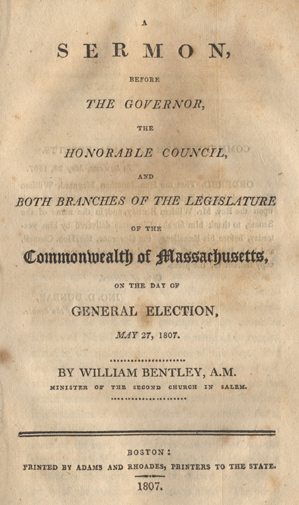
Sermon – Election – 1806, Massachusetts


Samuel Shepard preached this election sermon in Boston on May 28, 1806.


sermon-election-1806-massachusetts

A

SERMON,

PREACHED IN THE AUDIENCE OF

HIS EXCELLENCY

CALEB STRONG, ESQ.

GOVERNOR;

His Honor EDWARD H. ROBBINS, Esq.

LIEUTENANT GOVERNOR;

THE HONORABLE THE COUNCIL, SENATE,

AND

HOUSE OF REPRESENTATIVES

OF THE

Commonwealth of Massachusetts,

ON THE

ANNIVERSARY ELECTION,

May 28, 1806.

BY SAMUEL SHEPARD, A. M.

Congregational Minister of Lenox.

BOSTON:

YOUNG & MINNS, PRINTERS TO THE STATE

1806.

Commonwealth of Massachusetts.

IN THE HOUSE OF REPRESENTATIVES, May 28, 1806.
ORDERED, That Mr. Wheeler of Lanesborough, Mr. Parkman of Boston, and Mr. Smith of West-Springfield, be a Committee to wait on the Reverend Samuel Shepard, and thank him for his Discourse this day delivered before His Excellency the Governor, the Honourable the Council, and the two branches of the Legislature, and to request of him a copy for the press.

Extract from the Journal,
Attest. C. P. SUMNER, Clerk.
ELECTION SERMON.

I. CHRONICLES, XXIX. 12.

BOTH RICHES AND HONOUR COME OF THEE, AND THOU REIGNEST OVER ALL; AND IN THINE HAND IS POWER AND MIGHT; AND IN THINE HAND IT IS TO MAKE GREAT, AND TO GIVE STRENGTH UNTO ALL.


TO the pious mind the most substantial consolation is afforded by the consideration that there is a God. In his works, his providence, and his word there is abundant testimony of his being and attributes. It is no less pleasing to the good man, surrounded with dangers and in the midst of foes temporal and spiritual, to reflect that God extends his providential care to things of this world, and that the Most High ruleth in the kingdoms of men. David ascribes every event to the interposing hand of Divine Providence. Although from a humble station he was raised to a throne, and commanded in an eminent degree the affections and obedience of a nation truly great and respectable; yet he did not forget his dependence on God, nor deny his universal and particular providence. From the chapter, which contains the text, you will listen to his devout acknowledgment. “Thine, O Lord, is the greatness, and the power, and the glory, and the victory, and the majesty: for all that is in heaven and in the earth is thine; thine is the kingdom, O Lord, and thou art exalted as head above all. Both riches and honour come of thee, and thou reignest over all; and in thine hand is power and might; and in thine hand it is to make great, and to give strength unto all.”

God is to be seen in the production of all things animate and inanimate. He is to be seen in everything above and below us, within and around us, heard in the voice of every creature, felt in every motion, and read, in short, on every page in the great volume of the universe.

No less evident is it, that he, who created, superintends all the works on his hand. He, who “spake and nature took its birth,” does by the agency of his almighty arm continually uphold all things in existence. Should that power, which first caused them to exist, be withdrawn one moment, they would sink into nothing. It is impossible in the nature of things that a creature should be so made as to exist, one moment, in any respect independently of the Creator. If it might thus exist now, it might have so existed at first. If it might cause itself to exist now, it might have so existed at first. If it might cause itself to exist from one moment to another, it might have caused itself to exist from the beginning; and so a Creator would have been unnecessary. Everything, therefore, must be as really and as much dependent on the Deity for continuance in existence as for its first existence.

All things which exist, from the greatest to the least, are not only constantly upholden by the same power, which first gave them existence, but, in all their motions, actions, and changes, are under the care and direction of Divine Providence. He who first created all things for the best of purposes, so directs and disposes of everything, as, in the best manner, to answer those purposes.

It is true, all things in the course of God’s providence take place according to the laws of nature. The sun warms, and the showers refresh the earth; consequently, vegetation springs forth, and food is furnished for man and beast. This, it is said, takes place according to the course of nature. The hand of God, however, is in all this; for this course or law of nature is only the way, in which God constantly and regularly exerts his power and manifests his goodness. Notwithstanding the vital heat of the sun and the refreshing showers of heaven, the earth would produce nothing without the divine agency. These elements have no strength, in themselves, to cause even a spire of grass to grow. The laws of nature, therefore, by which things take place in a regular, stated manner, are only the way or course which God pursues in exerting his power and manifesting his goodness: so that what are called second causes have no power or efficacy in themselves aside from the immediate exertion of divine power, which is the proper efficacious cause of all things.

In the exercise of divine providence some events take place by the more immediate energy and agency of God; and others, by the instrumentality and agency of creatures, and by various mediums and what are called second causes. But in all events of the latter kind, the divine power and agency are as really and as much exerted, and are as much to be acknowledged, as if no instrument, agent, or second cause had been used: because, the creature or instrument has no power to act or effect anything which is not given by God himself.

This is the light, in which divine revelation everywhere represents the providence or government of God. It extends to all creatures, events, and circumstances throughout the immensity of the divine works.

In this view of the passage before us we may remark, that God’s providential government respects all things in the natural world. The heavenly bodies, in all their movements, revolutions, and changes, are under his direction. The “ordinances of heaven” are established by his hand, and the “dominion thereof” set in the earth. “The all-perfect hand that pois’d, impels and rules the steady whole.” This causes the sun to pour on us his vital heat, the moon to cheer the solitary night, and moves the comets, which blaze through the vast profound, and fill the astonished world with awe! To God we owe the grateful succession of the seasons, and under his providence we enjoy the fruits of the earth. He giveth us “the former and the latter rain,” and causeth the earth to yield her increase in plentiful measure. He maketh his paths to drop marrow and fatness on the pastures of the wilderness, and the little hills to rejoice on every side. He clotheth the hills with flocks and the vallies with corn. He taketh care of our lives and health. Protected by his hand, they that go down to the sea in ships and do business on the great waters survive the dangers, which surround, and threaten to swallow them up. They experience the goodness of God and behold the wonders of his hand, which, at any time, bringeth prosperity to our commerce and fishery, and causeth the heart as of the mariners to rejoice; for, he holdeth the winds in his fists and the storm and tempest obey his voice. “He shutteth up the sea with doors, and saith, hitherto shalt thou come, but no further; and here shall thy proud waves be stayed.” God’s providence extends to the brutal world. He provideth not only for the higher orders of his creatures, but he openeth his bountiful hand, and supplieth the wants of every living thing. “The young lions roar after their prey, and seek their meat from God.” He provideth for the ravens their food, and giveth to their young ones when they cry. The cattle on a thousand hills are fed by his hand. How numerous and various the tribes of living creatures, which inhabit every part of the material world! Every leaf, every particle of water, every breath of air teems with life: yet, not a particle of the ocean, not a leaf of the forest, not a ray of the sun moves without his direction. Not a sparrow falls to the ground without the agency of God, and the very hairs of our head are all numbered. In short, we may contemplate the divine hand in the movement of a world and in the movement of an atom.

God reigns in the moral world. His providence assigns to the unnumbered hosts, which surround his throne, their several stations. Their employments are all marked out by the same providential hand, and strength and assistance are afforded them according to their respective labours. The hearts of all flesh are in his hand. He causeth the wrath of man to praise him, and the remainder of wrath he restraineth.

God ruleth in the political world. His providence regardeth all the nations of the earth. One nation falleth and another riseth, because the Lord commandeth it. His word decideth the fate of empires, and he giveth them to whomsoever he will. His hand directeth the storm of war and decideth the victory. In the tumults of Europe, at the present day, his providence is to be regarded. Combined armies go forth in vain, unless the Lord be with them. He can render their counsels vain, and, by sending among them discord, or famine, or disease, can either divide, or destroy their strength. Whatever be his designs in the convulsions, which are taking place among the civil kingdoms of this world, surely he will, in his holy providence, accomplish them all.

To the considerate mind it affords the sublimest pleasure, that a God of infinite power, wisdom, and goodness, taketh the disposal of all things into his own hands, and superintendeth throughout his vast dominions. Should he cease to do this, universal disorder and confusion would ensue.

The harmony of heaven would soon give place to discord and dire confusion. Even angels themselves would lose all subordination. Order would press on order, and rank on rank, and the throne of God would shake amid the wild tumult.

Those orbs which now roll harmonious through the expanse of heaven, undirected by the hand of God, would rush upon each other, or wander from their courses into the fields of infinite space.

And, here on earth, what would be the rage and tumult, were the superintending hand of Divine Providence once withdrawn! Who would make the seasons regularly revolve? Who would give us seed time and harvest? Who would restrain the wrath and fury of man, and dispose the nations to peace? Alas! destitute of the restraints of the Supreme Ruler, nation would rise up against nation, man against man, brother against brother, and more horrid scenes of barbarity and outrage would be experienced, than language can describe, or imagination conceive.

Such would be the dreadful effects, should God cease to exercise his providence over his works. In his providential government, therefore, ought not every heart joyfully to acquiesce?

No one seemed more ready to acknowledge the fitness and propriety, yea, the absolute necessity of God’s superintending his works, than David. In all things he contemplated God, and saw him in every event. He knew that, to God’s sovereign disposal, he was indebted for all his greatness, his riches, and his honours, and, in all his ways, he devoutly acknowledged God as the Supreme Ruler of the universe. This appears not only from the text and its connection, but also from other passages of scripture. “No king,” saith he, “is saved by the multitude of an host: a mighty man is not delivered by much strength. An horse is a vain thing for safety: neither shall he deliver any by his great strength. Behold, the eye of the Lord is upon them that fear him.”

Contemplating the subject in this light, we may, with propriety, notice some things in divine providence respecting the Israelites; things, to which David probably referred when he said, “in thine hand is power and might; and in thine hand it is to make great.”

God gave to the people of Israel a good land. It abounded in the necessaries and comforts of life. It was the land of promise, which God gave to Abraham and to his seed. They were blessed not only with a soil which was fertile, a climate which was temperate, and air which was salubrious; but with a country, the natural situation of which was favourable to national peace and safety. A beautiful description of it is given us in Deuteronomy. “The Lord thy God bringeth thee into a good land; a land of brooks of water, of fountains, and depths that spring out of vallies and hills; a land of wheat, and barley, and vines, and fig trees, and pomegranates; a land of oil olive and honey; a land wherein thou shalt eat bread without scarceness, thou shalt not lack anything in it; a land whose stones are iron, and out of whose hills thou mayest dig brass.” In another description of it, the Israelites were told that it was a land which the Lord their God cared for; and, that the eyes of the Lord their God were always upon it from the beginning of the year even unto the end of the year. The Israelites, therefore, were peculiarly favoured in the enjoyment of those means, which are afforded to any nation, by a good and fruitful country, of becoming rich and prosperous, great and happy.

They were also blessed with an excellent constitution of government. It is sometimes called a Theocracy; but excepting some particular acts of royalty, which God reserved immediately to himself, it was, in its visible form, and as originally committed to the administration of man, republican. Opposed to every system of tyranny and oppression, it was well adapted to secure and perpetuate the rights and privileges of every member of the community. If the Israelites were not a free and independent people, the fault was in themselves. To the distinction, freedom, and independence of each tribe, their agrarian law was peculiarly favourable. In each province, all the freeholders must be not only Israelites, but descendants of the same patriarch. The preservation of their lineage was also necessary to the tenure of their lands. The several tribes, while they were united as one commonwealth, still retained their distinction and privileges, and were independent of each other. Each tribe was in a sense, a distinct state, having its own prince, elders, and judges, and at the same time was one of the united states of Israel. They had, also, a national council. This, which might with propriety be called a general congress, was composed of the princes, the elders, and heads of families from all the tribes. It was the business of this assembly to attend to all matters, which related to the common interest; such as levying war, negotiating peace, providing for, and apportioning the necessary expenses of the nation, and deciding in matters of dispute between particular tribes. No one tribe had a right of dictating to, or exercising superiority over another. In this grand national assembly, resided the highest delegated authority, and it was to be regarded by all the tribes with the greatest reverence. A violation of the constitution, in this respect, subjected the offenders to the most severe penalty. This grand council of the nation had its president, who was constituted such upon republican principles.

Happy had it been for the Israelites, if they had not eventually changed their form of government, and desired a king. By their folly and wickedness, in so doing, they lost many of their ancient privileges, and were brought at last under the iron yoke of despotism.

The Israelites were favoured with just and righteous laws. Their government, therefore, when duly administered, was a terror to evil doers, and a praise to all who did well. It was founded in righteousness, and the laws were executed with fidelity, every member of the commonwealth was secure in his rights and privileges.

The people of Israel were also distinguished above other nations, kingdoms, and states, by their system of religion. Its outward service was indeed attended with some burdensome rites and ceremonies; but these were wisely instituted in condescension to their weakness, or with a view to guard them against idolatry, or to lead them ultimately to the great sacrifice for sin, without which there could be no forgiveness. The being and attributes of God, the worship which would be acceptable to him; in short, all the duties incumbent on them, as subjects of moral government, towards God, their fellow creatures, and themselves, were forcibly inculcated in their religion, and it tended to make them wise, virtuous, and happy.

Equal reason have we to notice particularly some events in divine providence towards us as a nation. We inherit a pleasant and fertile country. Planted in a land equally distant from the frozen regions of the north and the burning sands of the south, we are furnished from our own soil, with all the necessaries and some of the delicacies of life. The air which we breathe is mild, temperate, and salubrious. The soil which we cultivate easily yields to the labour of the husbandman, and richly rewards his toils. We are not doomed to cultivate the rocky mountains of Switzerland and Norway, nor to glean a scanty subsistence on the barren plains of Arabia. Our natural situation, separated as we are from other nations by intervening oceans, is favourable to peace. Variegated with hills and vallies, and intersected with rivers and seas, our country is possessed of the greatest possible advantages for agriculture and commerce. There is no people in the known world so amply supplied with the necessaries of life from their own native soil as we are, and, at the same time, under such advantages to furnish themselves with all the luxuries of other climes.

We are favoured with a good constitution of civil government. When our land had been drenched, for seven long years, with the blood of our brethren, and fire and sword had made desolate some of our largest towns, God commanded, and the thunder of war ceased to roar, the blood of our brethren ceased to flow, and peace returned to bless an exhausted country. Joy was now on every countenance, and in every mouth thanksgiving and the voice of melody. But soon began we to feel the miseries of a weak and feeble government. Our commerce was shackled, our flag insulted, and our agriculture discouraged. Then the Most High appeared for us, and enabled us to devise, and united our hearts to accept, a form of government, which to this day, diffuses blessings over the union. Soon did we feel the good effects, which resulted from our excellent civil constitution. Our commerce was extended, our agriculture was encouraged, our publick credit was raised out of the dust and placed on a firm basis, our name became respectable among the nations, and wealth flowed in upon us as an overflowing stream.

Thus, as a nation, have we, in a season of prosperity, been rising in greatness and affluence. While the nations of Europe have been involved in the horrors of a most bloody and distressing war, it has been our lot to enjoy the blessings of peace and a good civil constitution, and, in a sense, to rise on their ruins.

We are governed by laws made by ourselves; laws, which, while they operate for the good of the whole, tend also to the security of each individual. Under an arbitrary government, there may be some security to the subject in rights and privileges. He may not be defamed, nor assaulted by his fellow subjects, without some protection from the laws. His security, however, may not, in these respects, be such as the publick good requires. Tyrants may suspend the execution of laws at their pleasure; laws, most essential to the security of the life of the subject. More dreadful still is a state of anarchy, in which anyone may, unrestrained, insult and abuse, torture or take away the life of another. Happy for us that we have laws well calculated to restrain the unreasonable and licentious, and magistrates of our own choice for the punishment of transgressors.

In a state of nature, our rights and possessions would be very precarious. To secure these, is one great end of civil government. The sanction of law is necessary to their security. In this respect, we have been by Divine Providence peculiarly favoured, and we are under the strongest obligations to transmit to future generations those just and equal laws, which so eminently secure us in the enjoyment of life, liberty, and property; laws, that tend to promote the practice of those virtues which are conducive to the happiness of the community, and to suppress those vices, which insure its destruction.

Our religious privileges are singularly great. In this land the principles of religious toleration are generally understood and embraced, and the rights of conscience and inquiry are held peculiarly sacred. Here the light of the glorious gospel shines with meridian lustre; and, without this,

“What were unenlighten’d man?
A savage roaming through the woods and wilds
Rough clad, devoid of ev’ry finer art
And elegance of life. Nor happiness
Domestick, mix’d of tenderness and care,
Nor moral excellence, nor social bliss,
Nor guardian law, were his;
Nothing save rapine, indolence and guile,
And woes on woes, a still-revolving train!
Whose horrid circle had made human life
Than non-existence worse: but taught by this,
Ours are the plans of policy and peace,
To live like brothers, and conjunctive all,
Embellish life.”
The excellency of the Christian religion, considered only as it respects the happiness of man in his civil and social state, has a claim upon our attention. At this time, however, I will only suggest for your consideration that peculiar characteristic of the gospel, the requirement of universal benevolence. The greater part of the moral instructions delivered by ancient philosophers respected man either as an individual, or as a citizen of a particular country. In either case, they must have been narrow and contracted. But the Christian religion, more extensive in its views, regards the whole family of man. It throws down that contrariety of interest, which divides men as they belong to different families, parties, or governments, and considers them as members of one great family, and requires them, as such, to exercise mutual love and friendship. This the most approved reason sanctions. Recommending the duty of benevolence, the gospel makes no difference between the inhabitants of Jerusalem and Samaria. The whole human race share in the benevolence of the Deity, and ought, also, to share in the benevolence of each other. God extends his benevolent regard equally to the inhabitant of Ethiopia and America. Why, then, should not the American manifest his benevolence towards the Ethiopian, as well as towards his whiter brother of Europe? Compared with this extensive benevolence, which our holy religion enjoins, the best instructions of Socrates, or Plato, or Epictetus, or Confucius, or Zoroaster, dwindle, in point of importance, into nothing. Were this benevolence to be exercised, as inculcated in the gospel, all the hostile divisions of nation against nation would entirely disappear. The family of man would walk together as a band of brothers; for what inducement would nation then have to rise up against nation, and to inflict on each other the miseries and devastations of war? Could men behold the blood of thousands of their fellow creatures poured out on the field of battle? No. Scenes of blood and carnage would then no more delight them. The very description of such scenes would fill them with horror. Their weapons of war, those instruments of human destruction, would be cast away with detestation.

Think on the vast destruction of property in the recent war between France and the combined powers. Think on the almost incredible labour and fatigue endured. Think on the quantity of blood which has been spilt, and the number of lies which have been lost. Think on the agonies of the vast numbers who have lingered out their lies in consequence of wounds, or, what is still more dreadful, have perished by famine. Cast up the vast account of human wretchedness and misery caused by this one unhappy war, and how great is the amount! But what is this one war! What, in comparison with all the wars which have afflicted mankind from the earliest ages down to Bonaparte! Wars, infinite in number, and, in cruelty and barbarity, almost incredible! But the exercise of benevolence among nations and individuals would have prevented all these, together with all that astonishing and unknown amount of human wretchedness and misery accompanying them. The excellency of this principle of the gospel, which we have been contemplating, is, therefore, invaluable. Were it to prevail universally, Eden again would blossom, and Paradise return to bless the earth.

For the peaceable enjoyment of this religion and its institutions, our fathers bade farewell to their native land, and came to these western climes. The providence of God was remarkable in their preservation and settlement. Although, in some instances, chargeable with error and misguided zeal, yet they were an enterprising and virtuous people. They served God much better than we do. From their native land they brought with them the love of civil and religious liberty. In what they did, they sought the welfare of the community as one family. They sought the good of posterity. Forests were subdued by their hands, and towns were incorporated. The object of their social intercourse was mutual benefit. They instructed their children, and remembered the Sabbath day to keep it holy. They duly respected those who were appointed to rule over them. The ultimate design of their every movement was to promote that righteousness, which “exalteth a nation.” By their wisdom and piety, we, under God, enjoy many invaluable privileges. In these, we are to acknowledge a superintending Providence; for, who maketh us to differ? To differ from the poor and distressed; from those who wear the chains of slavery; from those whose ears are stunned with the din of arms; from those whose eyes are constantly pained with the sight of blood? The answer is at hand. Hear it, admire, and adore! “Thine is the kingdom, O Lord. Both riches and honour come of thee, and thou reignest over all; and in thine hand is power and might; and in thine hand it is to make great, and to give strength unto all.”

The Most High ruleth in the kingdoms of men. He exalteth, and he bringeth low. In the rise and fall of states and empires, in ages past, his providence has been concerned. By his care, our fathers were planted in this land. When they were brought to the brink of destruction, he made bare his arm for their salvation, and was as a wall round about them. Gradually he drive out the heathen before them, enlarged their settlements, and increased their numbers. He hedged them in on every side. And, in later times, when attacked by the whole power of the British monarchy, and this while in an unarmed and defenceless state, how signal were the interpositions of his providence for our protection! He inspired us with unanimity and fortitude. He sent us military stores from the very ports of our enemies. He blessed and succeeded our enterprises. He enabled us to detect and to baffle the counsels of our enemies, and raised up and qualified men to lead us on to conquest and glory. Therefore it is, that we made effectual resistance: therefore it is, that we obtained our independence and humbled our foes. Without his care and support we had been overwhelmed, when men rose up against us. Without signal and almost miraculous interpositions of his providence, we had now been groaning under the tyranny of a foreign master. But instead of this, he hath made us honourable among the nations. What, but his providential care, kept us, on our liberation from British government, from falling into that anarchy7 and confusion, which are more to be dreaded, than the rod of tyranny, or a state of barbarism? Who, but the God of peace, hath united the hearts of so many millions of our citizens in the adoption of a form of government which is emphatically the envy of most other nations? Great reason, also, have we, as a people, to acknowledge and adore a superintending providence in placing at the head of the national government a succession of wise and able statesmen, under whose administration, marked with firmness and yet with moderation, we have enjoyed “great quietness.” Why is it that we have not been involved in the feuds and quarrels of Europe? Why have the sighs and groans of our citizens, who fell into captivity in a foreign land, “where ferocity growls and poverty starves,” ever been wafted across the deep and made to reach the ears of our rulers? Why is it, that the bones of our brave countrymen, who went, in obedience to the voice of our government, to effect the release of the unhappy prisoners, are not now mouldering in the “Lybian desert?” Why has such success attended the measures of our national government, that peace and prosperity have been diffused over the extended country of the United States? Let the voice of inspiration decide. “The Lord reigneth, let the earth rejoice; let the multitude of isles be glad thereof.”

But we are to remember, that the continuance of our prosperity must depend on the improvement which we make of our privileges. Means of happiness are sometimes possessed, where happiness is never enjoyed, or is of short continuance.

In the natural world, it seems to be, in some measure, necessary, that the Deity should operate in a steady, uniform manner, according to certain rules, steady, uniform manner, according to certain rules, causing the same effects constantly to follow from the same causes, that men may gain a proper knowledge of things around them, lay their plans with wisdom, and govern their conduct with discretion. Were there no settled order, no fixed connection in things and events, there would be no foundation for foresight, no ground for exertion, no reason to expect that we should obtain our desires by the use of means. We should be involved in total darkness and absurdity. God, therefore, in thus causing things to take place, in his providence, in an established order, and in conformity to certain rules, not only manifests his power, but his wisdom also, and his goodness, faithfulness, and constancy.

With great propriety may we apply this maxim to the conduct of nations. “Righteousness exalteth a nation; but sin is a reproach to any people.” This is the declaration of heaven. We can never form any just expectation, therefore, that the blessings of heaven will long be conferred on us, as a people, if we do not suitably regard the statutes of the Lord. The glory of Nineveh, Babylon, Jerusalem, Carthage, Athens, and Rome had not departed, if they had known and pursued the things which belonged to their peace!

It may be suitable then to turn our attention for a few moments to some things, which are naturally conducive to the happiness of the community.

To this end a civil constitution, which secures, and laws, which guards our rights, are undoubtedly necessary. Something more, however, is requisite in order to ensure the continuance of publick happiness. The best constitution is useless, as to the ends of government, if energy be not given to it in administration; and in vain are the most salutary laws enacted, if they be not faithfully executed and strictly adhered to as the measure of administering justice.

To a suitable provision for national defence we are also urged both by duty and interest. A people who wish for peace, must be prepared for war. For security at home and defence against foreign invaders, a republican government must depend on the natural strength of the country. One of its first objects, therefore, should be to provide for a well organized and well disciplined militia.

Industry must also be encouraged. The industrious man, while he serves himself, likewise serves the publick. The number of inhabitants alone will not ensure national felicity; they must be usefully employed. The slothful man is a curse to society. It feels the loss of what it might have gained by his industry. A mere drone in the hive, he adds nothing to the common stock. Living on the toils of others and disregarding divine precepts, he deserves to starve for his idleness. Were ever member of the Commonwealth to follow his example, all would go to ruin.

Temperance, sobriety, and frugality are subservient to the publick welfare. Extravagance, if it impoverish individuals and families, must necessarily injure the community. Intemperance and luxury debauch the mind, enfeeble the body, and degrade man to a level with the brute. They tend, of course, to the destruction of social happiness.

Suitable care relative to the instruction and education of youth is of great importance in civil society. By the history of all ages and nations we are assured that ignorance and misery accompany each other. To neglect the proper instruction of youth, therefore, is to entail publick misery on succeeding generations.

Sound morality is the stability of a government. When national virtue is gone, the foundation of publick prosperity is destroyed. As then we would hope for the favour of heaven; for a divine blessing on the means used to secure and perpetuate our publick tranquility, let the practice of humanity, kindness, benevolence, hospitality, and the like, become generally prevalent; yea, let a personal and general reformation in morals be our first, our highest concern.

With peculiar gratitude should we advert to the dispensations of divine providence towards the people of this Commonwealth. Singularly favourable have been the means of knowledge, virtue, and happiness, which they have enjoyed. Long have they been blessed with a succession of wise and virtuous rulers. The united exertions of our citizens have, from time to time, been called forth, in support of a government, which secures each individual in his person, name, liberty, and property; a government, the direct tendency of which, when duly administered, is to punish the vicious and protect the innocent. Our lands have been cultivated with success. Rich harvests have rewarded the toils of the husbandman. The hills have been covered with flocks, and the vallies with corn. The artificer hath not labored in vain; and, to use the language of another, our “commerce is an astonishing spectacle. It is coextensive with the circumference of the globe. Most of the inhabited countries of the earth are visited by our navigators, and the striped flag of the Union flutters in the remotest harbours. Cargoes have been derived from the depths of the ocean, and markets before unknown to commercial men have been found by our seamen.” Schools for the instruction of youth have been encouraged, and publick seminaries of learning have been founded. Beautiful temples are erected for the worship of Almighty God, and the rights of conscience are understood and vindicated.

Waving a consideration of the advantages, which we enjoy for improvement in arts, in sciences, in manufactures, we may thankfully notice the prevalence of health in our populous towns, in which we have been highly distinguished above some other portions of the Union. What, but the good providence of God, has saved us from the contagious disease, which has prevailed, for several years in succession, in some parts of the United States? God hath visited them with the pestilence which walketh in darkness, and with the destruction which wasteth at noon day. Death, with a sudden and awful hand, hath swept many to the grave. Multitudes, who beheld the scene, were filled with consternation. They fled from the hand of the destroying angel. We, who but heard of these things, were struck with terror. The contagion, if commissioned, might have pervaded every city, every town, every village, and brought death and destruction on its wings. Many of our citizens, might, ere this, have been numbered with the dead. But our heavenly Father hath watched over us for good.

Ours, also, is the blessing of peace. The year past has been a year of blood. The nations of Europe have waded in human gore. But how different, on this anniversary occasion, is our condition! Assembled with the heads of our tribes in this city of our solemnities, we tremble not, in view of civil dissensions; we fear no foreign invader. We behold no desolation of our coasts by war, nor the flames of burning towns. We record not the wounds and death of our friends in battle, nor the lamentations of helpless children, nor the tears of the disconsolate widow, nor the blasted hopes of parents. “Now, therefore, our God, we thank thee, and praise thy glorious name.”

Happy have we been in seeing the first office in the Commonwealth filled by one, whose reputation for talents, integrity, and patriotism is not the mushroom growth of a night. He lived and acted in times, “which tried men’s souls,” and was found faithful. But it is not the business of the speaker to eulogize. We trust, however, that His Excellency derives consolation not merely from a view of the many and important offices, which he has holden with dignity under the state and federal governments, but principally from a consciousness of having acted with upright views, and having, under God, contributed to the happiness of his country.

Reelected to the chief magistracy, may he ever discharge the duties of his important station with honour to himself and usefulness to the State. In the expectation of this we are warranted from the ability and apparent faithfulness, by which his publick services have already been distinguished. We believe that the welfare of the people will be kept in view by him, in the measures of his administration, and that he will adopt those methods, which are consistent with his rank and the duties of his station, to conciliate their affections. “To heal private animosities, and to prevent them from growing into publick divisions, is one of the principal duties of a magistrate. It too frequently happens, that the most dangerous publick factions are, at first, kindled by private misunderstandings. As publick conflagrations do not always begin in publick edifices, but are caused more frequently by some lamp, neglected in a private house; so, in the administration of states, it does not always happen that the flame of sedition arises from political differences, but from private dissensions, which, running through a long chain of connections, at length affect the whole body of the people.” Long may we be blessed with a chief magistrate, who, rightly understanding the true interests of the people, will be disposed to devote all his powers and influence in subserviency to their highest good.

His Honour the Lieutenant Governor, the Honourable the Council, Senators, and Representatives of the Commonwealth will permit us to remind them of the just claims, which we have upon their zeal and fidelity in discharging the duties of their respective stations. Raised to publick office by the suffrages of a free people, may they, in all their deliberations and decisions, be actuated by a suitable regard to publick utility. Highly important it is, that they who “rule over men should be just, ruling in the fear of God.” The oath of God upon them should lie with weight on their minds. Never should they be unmindful of a superintending Providence, nor of the final retributions, which await them as subjects of moral government. The day cometh, when “God shall bring every work into judgment, with every secret thing, whether it be good, or whether it be evil.” Acting under the influence of this solemn truth, civil rulers cannot fail of being instrumental in promoting the prosperity of their country. “When the righteous are in authority, the people rejoice; but when the wicked bear rule, the people mourn.” “It is to be expected,” says a writer of the present day, “that rulers should form the character of the people, and not that the people should form the character of rulers. It was never known that the house of Israel reformed one of their loose, irreligious kings; but it was often known that one pious, exemplary king reformed the whole nation.” Rulers, who live under an abiding sense of their obligations to God, and who suitably regard his word and institutions, will not fail to command the esteem of their fellow men.

Many things call for the attention of those, who, while acting in their legislative capacity, would keep in view the good of their constituents. One is, suitable provision for the instruction of youth.

By instituting schools, and establishing publick seminaries of learning, our fathers were, under God, peculiarly instrumental in transmitting knowledge, religion, and virtue to their posterity. To this day, we reap the benefit of their exertions. Had they been negligent of their duty, in these respects, we might long before this time, have lost our liberties and religion, and sunk into barbarous ignorance and superstition. Our university, colleges, and schools of useful learning, therefore, and all measures which may with propriety be adopted for the moral instruction of children and youth, will, we trust, readily receive the patronage of our civil rulers.

Equally mindful should they be of their obligations to promote a due observance of the Lord’s day. Aside from its subserviency to the purposes of piety, the Sabbath is of great efficacy in the preservation of civil and social order. The blessings of family subordination, of well regulated civil government, a general diffusion of knowledge, and, in short, all the blessings of life, are, in a sense, secured by a proper regard to this divine institution.

All trifling with sacred oaths should be discountenanced by legislators. By an oath, men are bound to truth and fidelity. In proportion to the contempt, which is felt towards the religion of an oath, is the insecurity as to property, reputation, and life. The want of a proper sense of the solemnity and obligation of an oath is, at this day perhaps, a growing evil. Its destructive influence relative to private and publick felicity cannot now be fully unfolded. But whatever remedy may be in the power of rulers to provided against this evil, certainly demands their attention.

No measures, we trust, will be neglected by the government of the Commonwealth, which may have a tendency to support and strengthen the union of the States. On this subject, our beloved Washington, “though dead, yet speaketh.” How forcible, how convincing his instructions! How important that we listen to his warning voice! It is for our political salvation! “Every kingdom divided against itself, is brought to desolation.” “Divide et Imperas,” is not a modern maxim of European cabinets. Powerful motives at the present day are set before us in divine providence to guard against dissension. A cloud hath risen in the east, extending along to the south; the heavens gather blackness; thunders begin to rumble! This, however, may be dangerous ground: I forbear. But, who can contemplate the late aggressions within the limits of our newly acquired territory; who can behold our commerce unjustly embarrassed; our flag insulted in our own harbours; the property of our citizens torn from them by the hands of pirates; some of our seamen instantly murdered; some detained in unwelcome service, and others carried into unhealthy climes, where they are snatched away from their friends and country by untimely death, and not feel the necessity of our united exertions in support of a common interest? To seek for publick happiness in a division of the States is madness, equal to that of a passenger on board a ship, who would set fire to the magazine, that, by destroying all on board, he might have a better opportunity to plunder.

With pleasure we behold so many ministers of the sanctuary present on this occasion. Moses and Aaron may walk together with united exertions for the publick good, if they do not infringe on the rights of each other. If the labours of the statesman, when rightly directed, tend to secure and perpetuate our civil and religious privileges, he who serves at the altar contributes to the same important ends, by putting the people “in mind to be subject to principalities and powers, to obey magistrates, and to be ready to every good work.” We may be free from the chains of earthly tyrants, and yet know not the “liberty of the sons of God.” To proclaim liberty to those, who are in bondage to sin and Satan, is the part of the gospel minister. Here, then, my fathers and brethren, a wide field opens before us. To this service, all our powers may well be devoted. As ambassadors for God to a revolted world, we may contemplate its moral state and drop a tear. See how the “world lieth in wickedness.” See how stupidity, sensuality, and worldly mindedness prevail. See ice and irreligion triumphing in the hearts and disgracing the lives of many. See multitudes traveling, apparently, in the road to destruction. Such are the painful scenes which strike our eyes, when we look abroad upon our country. Thousands regard not even the forms of religion. Look into Europe, “where blood and carnage clothe the ground in crimson, sounding with death groans.” See the grossest vice, the most shameful debauchery, the most enervating luxury, and the most unjustifiable extortion and oppression widely prevailing. In those countries, where reformation hath not yet opened the eyes of the inhabitants to the follies and enormities of popery, the thickest darkness and the most inconceivable ignorance reign. Look we, then, into Asia. There, where lived the prophets, the apostles, and primitive Christians; where lived and died the Saviour of the world; and where once stood the golden candlesticks, the churches of Jesus Christ, now live the deluded followers of the grand impostor Mohammed, and the ignorant worshippers of the sun, moon, and stars. Among them, but here and there, a solitary Christian is to be found. In Africa, the prospect still darkens. In what heathenism and delusion are the inhabitants, who are scattered over its vast regions, involved!

If such be the face of the moral world, with what zeal and fidelity should we discharge the duties appertaining to “the ministry of reconciliation!” How fervent should be our prayers and our endeavours that the gospel, in its power and purity, may be proclaimed by suitable missionaries in all the new settlements of our country; among the savages of the wilderness; and in Asia, Africa, and the Islands of the sea! As we are to beseech men “in Christ’s stead,” to “be reconciled to God,” surely no worldly consideration should ever divert our attention from the interesting employment. Christ’s “kingdom is not of this world;” and, when his ministers are solicited by the rulers of this world, or are tempted by any subordinate considerations, to neglect the proper duties of their station, he would have them reply, as in the words of Nehemiah: “I am doing great work, so that I cannot come down; why should the work cease, whilst I leave it, and come down to you?”

Fellow citizens of this numerous assembly: “To learn obedience and deference to the civil magistrate is one of the first and best principles of discipline: nor must these, by any means, be dispensed with,” would we enjoy the blessings of a free government. “Private dignity ought always to give place to publick authority.” A great part of mankind, it is to be feared, would never be satisfied with a righteous liberty. The liberty, which is sought by multitudes, is not a power of doing right, unmolested; but of being as idle, extravagant, intemperate, and injurious as they please without restraint. By the history of all nations, however, we learn, that when a people reject that liberty, which is regulated by just and righteous laws, they necessarily fall into slavery. No privileges with which a people can be indulged will secure their happiness, if they be not disposed to make a right use of them. We may be blessed with a fertile soil and a healthy climate, and our advantages for commerce may be great, and yet, by luxury, idleness and debauchery, avarice, dishonesty, and injustice, we may sink into poverty and contempt.

Melancholy indeed is the reflection, that, even in this infant empire, so many of those who are adorned with the richest gifts of nature, and who are capable of contributing so greatly to the happiness and glory of their country, should become abandoned to vice and ignominious sloth. Enchanted by the siren voice of pleasure, they sink upon the couch of indolence, or yield to beastly intemperance. Inglorious ease or detestable enormities obscure the splendor of their talents, and extinguish the sparks of divinity. Upon the graves of such, philanthropy will drop a tear, and lament, that genius, the fairest gift of heaven, should thus be rendered injurious to man.

We may enjoy the most excellent laws and religion, and still by vice be made miserable. We may have the best constituted government on earth, and yet by strife and contention, by “biting and devouring one another” be brought to ruin. Would to God, there were none among us characterized by the apostle when he saith, “They despise government; are not afraid to speak evil of dignities, and things they understand not.” In our land, political slander, if we may so term it, has risen to an alarming height. Over the whole face of our country it spreads a gloomy aspect. It is contrary to all good policy. It is contrary to the command of heaven. It destroys the peace and comfort of the citizens. Slander is, in scripture, represented as a devouring flame. That it is so, we know by its effects. “The tongue is a fire, a world of iniquity: it is an unruly evil, full of deadly poison. It setteth on fire the course of nature, and is itself set on fire of hell.”

It is truly an eventful period, in which we live. It is in many respects, an evil day. God’s judgments are abroad in the earth. “Behold,” as saith the prophet, “the Lord cometh out of his place, to punish the inhabitants of the earth for their iniquity: the earth also shall disclose her blood, and shall no more cover her slain.” Europe is the theatre of a “strange work;” and the most approved commentators on the scripture prophecies give us reason to tremble in view of the approaching “distress of nations, with perplexity.” The “sea and the waves” are now roaring, and “men’s hearts are now failing them for fear, and for looking after those things which are coming on the earth.” Thankful should we be for the privileges by which we are distinguished above the nations of the earth; and, happy for us, if we wisely improve them. Virtuous nations will ever be the peculiar care of heaven. Divine Providence, we have reason to believe, will bestow the blessing of civil liberty on every people prepared for it, and will undoubtedly take it away from all who pervert it to the worst of purposes. In this land, therefore, may that righteousness abound, which exalteth a nation, and may we ever have wisdom to commit our publick concerns to men of ability, integrity, and genuine patriotism. If a people live under a government of their own forming, and choose their own rulers, they enjoy the opportunity of having the wisest and best of their citizens to rule over them. If, therefore, the administration of their government be corrupt, the fault is chargeable on the people themselves. In all free governments, the complexion of a people may be seen in their rulers.

The blessings of civil liberty may long be enjoyed, and then lost forever; but, “if the Son shall make you free, ye shall be free indeed.” Worldly kingdoms and states have their commencement, their summit, and sink again into oblivion. But he who died on Calvary, hath, in opposition to the kingdom of darkness, established a kingdom, which shall endure when lower worlds dissolve and die. It shall not be moved. Its beauty, order, and harmony will be perpetual. To raise up and establish this kingdom of holiness and righteousness hath been the purpose of God in all the dispensations of his providence respecting the natural, moral, and political world. To this very end have all the operations of his hand been uniformly directed. On the wings of faith and heavenly contemplation, the truly pious mind soars aloft, and feasts on angels’ food, which a beneficent Creator hath strowed through all his works of providence and grace. It sees the great Supreme enthroned on high, holding the reins of universal government, rolling on the stupendous wheels of his providence, and directing every event in such a manner, as finally to issue in the highest good of his holy and eternal kingdom. They only are “called to liberty,” in the most important sense, whose names are enrolled among the subjects of this kingdom. By the most powerful motives are we all urged, to secure an interest in its unspeakable privileges. In this, our duty, our interest, and our happiness unite. Delay may be death. Time rolls on. Our days speed their flight with accelerated swiftness. Constantly are our fellow mortals going down to the dust of death. Placed here in a world of sorrows, we tarry but for a night, and then go into another state of existence. Never shall we all meet together again, till we assemble to receive, from our final Judge, everlasting retributions. Interesting to each one of us, and truly solemn is this thought! To God, then, be given the throne of the universe and the throne of our hearts, that we may be entitled to the blessings of a kingdom, which is not gained by the alarms of war nor garments rolled in blood; a kingdom which shall abide, when the angel shall lift his hand on high, and swear by him that liveth forever and ever, “that time shall be no longer,” and when all national revolutions shall be superseded by the scenes of eternity.

* * *

When the foregoing discourse was written and delivered, it was understood that Gov. Strong was re-elected. Under this impression the second paragraph in page 23, was prepared.

Sermon – Election – 1806, Connecticut


This election sermon was preached by Rev. William Lyman in Hartford, CT on May 8, 1806.


sermon-election-1806-connecticut

THE HAPPY NATION.

A

SERMON

PREACHED AT THE

ANNIVERSARY ELECTION,

IN

HARTFORD

MAY 8TH, 1806.

BY WILLIAM LYMAN, A.M.
Pastor of a Church in East-Haddam.

At a GENERAL ASSEMBLY of the State of CONNECTICUT, holden at Hartford, on the secont Thursday of May, A.D. 1806 —

Ordered, that the Honorable Stephen Titus Hosmer and the Epaphroditus Champion, Esquires, present the thanks of this Assembly to the Reverend WILLIAM LYMAN, for his Sermon preached at the General Election, on the eighth day of May instant, and request a copy there of, that it may be printed.

A true copy of record,
Examined by

Samuel Wyllys, Secretary.

ELECTION SERMON.

JEREMIAH XXXI. 23.

The Lord bless thee, O habitation of justice, and mountain of holiness.

Happiness, the great end of institutions and pursuits among men, though long and eagerly sought, hath never been fully attained in this world. The honor, security and welfare of nations have been favorite themes of discussion and panegyric, through many succeeding generations. The credulous part of mankind hath been charmed with descriptions of a terrestrial paradise; and the most enchanting images of union, peace and joy have glowed in the breasts of visionary patriots and moralists. The reign of sin and misery, anarchy and confusion, despotism and slavery, hath, in imagination, been extirpated, and this earth converted into the abode of beatified mortals, tasting all the pleasures of freedom, independence and social enjoyment. This ideal happiness, however, which hath been the subject of frequent and confident prediction, hath been expected from no higher source than intellectual improvements and civil refinements. An increase of knowledge, improvement of manners, and acquaintance with the arts of self government have been represented as an effectual antidote to the poison of discord, and a sovereign preventative of the various disorders which disturb the peace and mar the happiness of society. Such addresses to the pride, the vanity and credulity of human nature have never been verified in experience. The phantom they have exhibited to view, hath dissipated in the fumes of practical error; and the toilsome pursuers, after the research of ages, are as remote from the professed object as when these illusive dreams and idle speculations first began. The advocates, however, thought long and often disappointed, have gathered new courage from every new revolution in the state of human affairs, and, with a confidence becoming only the plainest and best of causes, have published again and again their exploded systems. The virtue, the integrity and the piety of a people, which alone can open the portals of such a paradise, and secure the blessings of this golden age, they have retreated with too much neglect. In consequence of this, their building, when reared and adorned with the most beautiful colorings of the imagination, is only “the baseless fabric of a vision.”

The prophet, who recorded the words of my text, guided by the spirit of unerring wisdom and truth, hath advanced a more correct and pract6ical theory – a theory built on the surest basis, and which asks only the privilege of experiment to prove its superiority to all others.

This system is founded in righteousness and moral purity; the two great pillars which support the throne and government of Jehovah.

On this momentous and auspicious occasion, I shall briefly canvass the doctrine of the prophet, with an appropriate reference to that privileged community, at the head of which we, this day, see the reverent rulers of our native and beloved State.

I look around on the magistrates and representatives of one of the freest and most enlightened States under heaven, and, with emotions of heartfelt desire and hope, say to the whole body politic, of which they are the head, “The Lord bless thee, O habitation of justice, and mountain of holiness.”

Since there is no happiness without the blessing of God and no peculiar blessing of God on a people who do not fall under the description here given, I shall advance this, as the doctrinal sentiment of the text, viz.

JUSTICE and HOLINESS are the foundation of national and individual happiness and glory.

This proposition will open the way for a discussion, interesting to us both as individuals as members of community. Happy would it be if this might be conducted in a manner edifying and convincing to all.

Two things will come into view as descriptive of a happy people. They must be righteous: and they must be holy. — The first of these I shall consider in relation to the civil, and the second in relation to the religious state of a people. According to this construction and arrangement, it will be natural,

I. To take a view of them under the notion of an “habitation of justice.” – This denotes their uniform and inviolable regard to equity, in all their concerns. In certain respects, and to a certain degree, they may be righteous and yet not deserve to be designated as the people with whom is the stated abode or habitation of justice. To arrive at the honor of this ennobling distinction, several things are requisite.

I. The acknowledged principles of government must have equal respect to the rights of all.

Whether the instrument which professes to recognize this sentiment be termed a covenant, a bill of rights, or a constitution is immaterial. It will be understood to import that consent which is given, by the several members of society, to the rules and maxims by which they have chosen to be regulated in their public concerns. If this agreement be grounded on the idea of unnatural distinctions and hereditary privileges, it is, in the form and structure of it opposed to the original rights of men; and presents, at the outset, a formidable barrier to the admission of justice. The constitution must admit no doctrine of separate and exclusive rights, in consistent with the rights of a free community, formed on the sure and broad basis of impartial equity. Far be it from me to decide what particular form of government may be adopted. The people, surely, have a right to choose and act for themselves. All legitimate power originates from this source; and that government which owes its existence to any other principle, is nothing less than usurpation and oppression. – The people must form their system of government and determine its mode of operation.

In a representative and popular government, the danger principally consists in having the elective franchise corrupted, and people either deluded or too remiss in exercising and maintaining their rights as freemen. Where the source of power is uncontaminated with bribery or corruption, and people act faithfully as guardians of their privileges, there is little reason to fear any dangerous encroachments from the unprincipled and ambitious. So far as power, by mutual agreement, is delegated to particular men, and they are called to act as the organs of the public will, it ought ever to be considered that the people, and not the rulers simply, are acting. For men to oppose themselves. And to attempt the alteration or obstruction of it, except in a legal and constitutional mode, is to commit acts of needless violence on their own doings, and fight against their own peace and happiness. The representatives and rulers of a free people are the people by their agents; and the rule by which they are to proceed is to consult and promote the public weal, having a constant regard to the rights of the several individuals. This is conductive to the support of justice and tends to serve her residence among a people. It is a principle which must not be abandoned in a free government, that the people are active in constitution their rulers. This principle, I conceive, is recognized in the word of God. See the account of Jephthah’s elevation recorded in the book of Judges xi. 11. “Then Jephthah went with the elders of Gilead, and the people made him head and captain over them.” This agency of the people, in so important a case, shows a divine regard for the rights of man, and furnishes an example of which justice requires a scrupulous imitations. Without enumerating or defining these rights, I shall proceed to observe,

2. That a government once established and on such a bias, should be well administered.

In vain is a theory of the wisest and best system of civil policy, without a corresponding operation of its principles; tending to promote the end of its institution. Here several ideas will come into view particularly, that the laws enacted should be founded in justice, and in the spirit of the constitution. They should have also a steady, faithful and uniform execution: to effect which it is necessary that those entrusted with the management of public concerns should be upright and faithful men. Under such circumstances, there is reason to hope that the claims of justice will be satisfied, and her abode among a people rendered stable and permanent. If either bad laws are framed, or they be badly executed, or, the management of them be committed to corrupt, unprincipled and wicked men, the commonwealth is in danger, and must suffer material injury. A sense of justice should be admitted into all councils and legislative assemblies: it should preside in all courts, and guide the hand which wields the executive sword. Good and wholesome laws, which shall not infringe upon the rights of any; and which shall secure equally to all the enjoyment of life, liberty and the means of happiness, should constitute the code adopted. The vast variety of circumstances, however, which is continually rising to view, and which may contribute, unequally to affect the local interests of men, calls for amendments, alterations and additions. This accommodation, so far as is practicable, justice requires. That imperfection, which attends all human affairs, forbids the expectation, either that all will be satisfied, or that all can have equal and perfect justice done them, at all times; yet this should be the design and tendency of every law.

But, admitting that the laws are good, there is another thing equally essential, and which must not be overlooked; I mean, a faithful and impartial execution of them. As the laws are designed for all, so the executive direction of them should be pointed alike to all. No partialities – no oppression – no violence should be practiced or known. The rude and vile disturbers of order, virtue and peace should be arraigned at the tribunals of public justice, and there be made to tremble before the insulted majesty of the laws. Flagrant offenders must have an exemplary punishment. On the other hand, the rights of the inoffensive, who commit no acts of hostility against the government or the subjects of itk and who maintain a regular course of life, should be secured; and the hand of extortion, rapine and cruelty should be palsied by 6the energetic interposition of the laws. In this way the magistrate and the executive officer become subservient to this double purpose of being a terror in the punishment of evil doers and for the praise of them that do well. – Such a state of things in society almost necessarily implies, that the rulers themselves are men of integrity and fidelity.

It is hardly to be expected that a good government, with good laws and well executed, will continue such and be of lasting utility in the hands of men whose principles and practice are constantly and powerfully at war with their professions; and whose minds, in the moral structure of them, are not congenial with such a state of society. That a government be respected and obeyed it is highly needful, among a free people, that it be honored by those who administer it. It is not sufficient that they prescribe to others the line of conduct they are to pursue, and constrain obedience in those they govern. There must be in them an exemplary deportment, corresponding with the rules they establish. Hence good rulers are ever characterized in the word of God as men distinguished for sobriety, integrity and uniformity of life, no less than for wisdom and knowledge. David, with peculiar energy and precision, expresseth the mind of God on this subject, 2 Sam. xxiii. 3. “The God of Israel said, the Rock of Israel spake to me, he that ruleth over men must be just, ruling in the fear of God.” — it will be noticed that in the expression here used there is conveyed an idea of obligation; and this obligation as extending not only to the conduct, but to the real character and motives of the ruler — He must be just, as well as do justice; and he must be actuated by a virtuous principle, “ruling in the fear of God.”

David himself is described as such a ruler. God expressly says “I have found David, a man after mine own heart.” The history of his official conduct is in these honorable terms (Psalm lxxviii. 72.) “So he fed them according to the integrity of his heart: and guided them by skillfulness of his hands.” ( 2 Sam. viii. 15.) “And David reigned over all Israel, and David executed justice and judgment unto all his people.” Such is the character and conduct of a good ruler: and, on this ground, those who have aspired at civil office and power have not failed, in prosecuting their design, to engage that they would act such a part.

The ambitious, enterprising and seditious Absalom professed to seek for authority on no other footing. “Oh, says he, that I were made judge in the land! That every man which hath any suit or cause might come unto me and I would do him justice!” He felt the necessity of assuming such a character, and adopting such a course. And those must be corrupt times indeed, when no such qualification is required in an officer of government and his political sentiment are regarded, rather than his veneration for the principles of equity.

Rules, to be qualified for their station are represented as men who “fear God and hate covetousness.” — When such men bear sway, and guide the wheels of government, we may hope for an administration which will effectually secure the blessings guaranteed by the principles on which the government is founded. In these happy times “judgment shall run down as waters, and righteousness as a mighty stream.”

Thus we see that by enacting good and wholesome laws, – executing them in a diligent and faithful manner, – and entrusting the management of public concerns with men, who both fear God and regard man, there is afforded to a people the best security for a wise and righteous administration of government : and thus may they place themselves under that fortress of national dignity and happiness, “the habitation of justice.” — But

3. To complete the parts of this picture, I add that the people, in their respective stations and various transactions, must be actuated by the same principles, and perform their duty with uprightness and fidelity.

Useless, in a great measure, would be government and laws, however excellent, without a submission and acquiescence on the part of the people. The gospel enjoins upon men submission to every ordinance of man, for the Lord’s sake, while they lead peaceable and quiet lives in all godliness and honesty. They must submit to the laws and obey magistrates; otherwise confusion and uproar, anarchy and wretchedness will ensure – the wheels of government will be clogged – needful subordination will cease, and the horrors of the most dismal picture of human woe will be presented, when every man does that which is right in his own eyes. — Not only should the seats of justice be free from the stains of corruption and bribery — not only should the professional advocates of justice be uncontaminated with the evil of loving and grasping “the wages of unrighteousness” — not only should those in public life be just and upright men, but the body of the people should merit the same description.

Calumnty, injustice and oppression, of every kind and in every degree, should be avoided, and the people of every grade, by fulfilling their contracts and yelling, implicitly, to the claims of justice would demean themselves as those worthy and wholesome members of society, who industriously seek the things which make for peace. — When such is the tenor of the people’s conduct, and they are faithful to “render to all their dues, tribute to whom tribute is due; custom to whom custom; fear to whom fear; honor to whom honor,” and make it their endeavor to owe no man anything but to love on another, then may we have a vision of those peculiarly happy times described by the prophet Isiah, when he says (Isa. lx. 21) “Thy people shall be all righteous.” — Enough, perhaps, has now been said to show what is comprehended under the notion of the “habitation of justice;” and what is needful to entitle a people to his honorable appellation. This is the nation or community where justice has her fixed abode. When driven out as an exile from all the courts of usurpation and tyranny under heaven – when prohibited the seats of nobles and the palaces of monarchs, here she finds a friendly asylum – here is her chosen, delightful and permanent “habitation.”

II. I am now to consider, under the second general branch of discourse, that still higher article of description, given in these words “mountain of holiness”

We have hitherto contemplated the character and state of a people in their civil capacity, as cherishing and maintaining the cause of justice; we are now to enliven and elevate the scene by giving a view of their religious state.

The “mountain of holiness” denotes an high state of religious experience, — an enlarged portion of spiritual attainments, and bespeaks a people who are formed in an eminent degree to shew forth the divine praise.

I. It will be worthy of primary attention to consider, that they are not atheistical in their sentiments; but believe in the existence, and acknowledge the supremacy of the one only living and true God. — This involves an idea also of belief in the word of God. For whatever credit deists may arrogate to themselves, for admitting a God into their system, yet it is an idle pretence that they believe in such a God as the scriptures describe. For to admit the existence of such a God, and ascribe to him greatness, dominion and power, is to come within the precincts of the Christian system : and it is, in substance, to own a truth long embraced by the saints, and in support of which we earnestly plead, that the scriptures are “given by inspiration of God.”

That the idea of a God may be admitted and yet the authority of the scriptures rejected, will not be controverted; but the God acknowledged in this case is one widely different from him who brightness into view in the sacred oracles. That belief in this being, which clothes him with the ensigns of independent sovereignty, and recognizes the perfections of his nature; which begets a reverence for his word and submission to his will, is supposed in the characteristic traits of a holy people.

2. Such a people support and honor divine institutions, their belief is not idle and inactive speculation; but an inwrought and operative principle. — Those who believe in the existence of such a God as the scriptures reveal, and are reconciled to the methods of his grace, are disposed to worship him, according to the directions of his word. — Hence they approve of his ordinances, and prize the privileges of his gospel. With them his day, hi word and his worship are in high estimation not aspiring to be wise above what is written, nor undervaluing the constitution of heaven, they venerate the Christian ministry and the appointed means of grace for this reason they willingly take part in supporting an evangelical ministration of the word, and honor this institution by a public and uniform attendance upon it.

Neither sloth, indolence nor disgust keeps them from the stated abodes of divine mercy. In a joyful concourse they meet within the gates of Zion, and pour forth their souls in devotional exercises, while they harmoniously join to give thanks to God at the remembrance of his holiness. Scarcely an individual is to be found who cannot adopt this language of the Psalmist, “I had gone with the multitude, I went with them to the house of God; with the voice of joy and praise, with a multitude that kept holy day.” — In this business, rulers and subjects are happily agreed; and, among them, there is conspicuous a governing sense of divine things.

They have communion with their Lord in sacraments, — they look to him habitually in the ordinance of prayer, and they unite to put honor upon him who came to redeem their precious souls, and purify them unto himself as a peculiar people, zealous of good works. This leads me to observe,

3. That they cultivate an acquaintance with the experimental parts of religion. — Among them there exists no doubt respecting the inward and saving work of the spirit. Their hopes are in unison with that experience of saints which inclines them to say “Not by works of righteousness, which we have done but according to his mercy he saved us, by the washing of regeneration and renewing of the holy Ghost.” — They ascribe all their hopes and all their comforts to the sovereign and effectual grace of God, not relying upon their own doings, but upon the merits of him who died to atone for their transgressions, and whose blood cleanseth from all sin. Being wrought into his spirit, and conformed to his image, they derive vital energy and support from him, by the continual actings of a vigorous faith; so that because he lives, they live also. This renders them, in a peculiar sense, the heritage of the Lord; and like a holy or consecrated thing, they belong to him of whom its is characteristic that he “saves his people from their sins.”

There is a further idea which may be gathered from the expression used in the text. Therefore,

4. Those we are describing are a people who have risen to high attainments in the art of holy living, and distinguished themselves for their zeal and firmness in the Christian cause.

They are not ashamed of the doctrine nor of the cross of Christ. They openly and boldly espouse the interests of his truth and kingdom. For him they plead, and to his service they are devoted. With fortitude, resolution and unabating fervency, they persevere in the ways of well-doing, and become eminent for their piety. Their light shines before men, and others see their good works. This conduces to the glory of their heavenly father, and to their own abundant comfort. Such marks of humility, devotion and piety are discovered in them, that others take knowledge of them that they have been with Jesus. Degrees of holiness are habitually increasing within, and the uniform tenor of their lives proves that they are going on to perfection. They ascend in their views and desires. — The glories of heaven more and more attract their souls, and they aspire after that maturity of spiritual stature to which they shall arrive in heaven. Already they feel the elevating power of hope, and the invigorating influence of a living faith. Their graces grow strong, and their attainments rise high. This comports with the idea of a mountain, denoting something which is elevated, conspicuous and stable.

The expression conveys also an idea of exuberance and richness. Mount Libanus, or the mountain of Lebanon, has been celebrated for its fertility — a part of which was uncommonly productive. In allusion to this, the mountain of holiness may denote an extraordinary growth of the plants of piety. This elevation brings to view also the notion of zeal, excited by the warm and vivifying rays of divine love, which penetrate the very bowels of this mountain, darting life and energy through every part. From the expression there further arises an idea of firmness, strength and security. A mountain which overlooks and commands at the adjacent country is a place of advantageous resort when assailed by an enemy. And it may fitly represent the protection and safety afforded to those who are in the favor and under the care of heaven. Christians, in this state, are on the pinnacle of faith, and in the fortress of almighty love. This conveys us, in our meditations, to the highest and most advantageous point on the mountain of holiness. The idea is that the church is in peculiar estimation; so that by its formidable greatness and exalted attitude it commands the veneration of all around. Faith, hope, love and zeal are carried to great perfection; the growth of Christians surpasses the ordinary measure. In them we see verified the assurance given by the prophet Daniel, “but the people that do know their God shall be strong and do exploits.”

Having thus, very briefly, delineated the character of those presented to our view, in the language of the text, and shown I two distinct points of view, how a people in their civil and religious capacity, may answer to the metaphorical description of the prophet, I shall, without entering into a detail of particular duties, pass to consider,

III. How these things unite in conducting a people to that summit of national honor and felicity, comprised in having for their portion the blessing of the Lord.

When righteousness and holiness combine their influence, in the manner above represented; and when the civil and religious state of a people is thus refined and ennobled, this is, of itself the choicest blessing : nor, is it difficult to see how this blessing will unfold itself, in the augmentation of national security and happiness. The benefits resulting from this quarter may be traced in a few things.

In the first place, it is obvious there will be security against the mischiefs of anarchy. A government is established, which is a righteous government – the execution of them impartial, and the rulers are of a character which excites confidence and respect. Moreover, the people are free from dishonesty, fraud and every species of iniquity : that godliness which is profitable unto all things, is found predominant among rulers and subjects and the great cement of union, order and harmony, which flows from the “mountain of holiness” diffuses itself over the various branches of society, enhancing the worth, raising the dignity, and multiplying the joys of such a community. Where then is the room for discord, uproar and confusion, with their numerous train of complicated evils? The door is effectually shut against them, nor can anarchy, with her subtle engines of collision and strife, enter and perform her operations. – Besides, through the indulgence of heaven, there is afforded to each his full and equitable proportion of enjoyments. Under such a government every right, civil and sacred, is secured. Life, liberty and the pursuit of happiness fall in the train of protected privileges. No man wrests from his brother his property, his good name, or his inalienable rights of conscience. Each one lives in peace with all men, and cultivates that holiness of heart and life which is a bond of the sweetest union. All sit quietly under their own vines and fig trees, having none to molest them in their pursuits, or make them afraid in their possessions. They worship God agreeably to the dictates of their own consciences, and are at liberty to be as happy as their capacity and means will admit. – On them, no arm of the oppressor and no scourge of the despot is laid. The character of the government, of the rulers and of the people, guards against the encroachments of usurpation and tyrannical power. That justice which takes up her abode among such a people is vigilant to detect, and powerful to check, the ambitious projects of unprincipled demagogues. More than all this, that “mountain of holiness,” which rears its majestic head towards heaven, forms an insuperable barrier against all the insidious movements of the aspiring and restless hunters after power.

We further trace the beneficial effects of this blessing in the removal or prevention of those numerous causes of litigation and civil contest, which so much disturb the peace of society, and introduce a train of vexatious and expensive troubles. Justice and holiness drive from their boarders that group of evils which is the product of litigious and revengeful measures. Near the habitation of the one, and the mountain of the other, these have no cultivation or fostering support.

It may also be remarked that the characteristic properties of which we have spoken have influence to ennoble the sentiments, harmonize the views, refine the tempers and purify the morals of men. They add a dignity to their whole deportment, and all the movements of their souls are upon a more sublime, enlarged and elevated scale. Instead of being “wise to do evil” they “learn to do well,” and, in their respective stations, act worthily their part.

Hence the joys of anticipation become their portion, and they not only are admitted to all the pleasures of reciprocal intercourse with heaven, and draw down, on themselves, the refreshing tokens of divine favor, but they look forward with hope and an assured confidence to the regions of consummate and endless felicity.

Such are the fruits and effects of that blessing from on high, which accompanies and beatifies a moral and religious people.

Thus does the Lord smile with complacency on those whom justice and holiness unite to render the objects of his peculiar favor; and to such a pitch of glory and felicity do these illustrious properties conduct nations and individuals. – We look forward to the millennium, to realize this alluring and transporting scene, in full assurance that when the prince of peace shall sway his scepter, and become king of nations as he is king of all saints, this splendid display of an earthly paradise will open to view.

Taking into consideration these several ideas, and contemplating their connection, we learn with what property it is affirmed, that justice and holiness are the foundation of national and individual happiness and glory.

APPLICATION.
The subject we have been considering presents for our instruction and benefit several useful reflections. We learn,

I. That in the business of reforming the world and ameliorating the condition of men, religion and politics have real and important connection. They combine their influence in this noble work. No politics deserve the credit of the least approbation which are not framed in “the habitation of justice:” and no such politics are at variance with religion. – Civil government and the church have a mutual and intimate concern in refining and perfecting the state of society. Civil rule must be built on the basis of morality; nor should any measures be adopted in political arrangements which justice does not approve. But to give the finishing stroke, and raise to the highest pitch the honors of national character, there must be an assemblage of those virtues which rank under the title of holiness. Religion must be cultivated, or in vain do you look for the “blessing of the Lord which maketh rich,” in the enjoyment of peace and safety. Bold indeed must be that adventurer in political renovation, who expects the exaltation and happiness of a people independently of the blessing of heaven. If you drive religion from among a people, you banish the very essence of intellectual and moral refinement: you tear down the towering hopes of a soul “longing after immortality:” you strip society of its brightest ornament; and you present to the view of degraded man the groveling scene of a lustful paradise. Let justice guide the decisions of civil judicatories, and let holiness sanction all the measures for enlightening and reforming mankind, you have then the key to unlock the treasures of national independence, elevation and glory. “Then God’s people shall dwell in a peaceable habitation, and in sure dwellings, and in quiet resting places.” And thus will it appear to be emphatically true that “righteousness exalteth a nation.”

But when I speak of the combined influence of civil and religious means, let no one imagine that I mean to blend the duties, or intermix the concerns of political and ecclesiastical functionaries. They have their distinct offices and distinct employments harmonizing in the end, but differing in the modes and forms of operation. The glory of God and the happiness of men are the leading and principal objects to the promoted by persons of every class. The civil magistrate and the minister of Christ should keep to their respective assignments of service, without interfering or encroaching; but should mutually aid each other in their benevolent and important work. Justice and holiness should preside and govern in the proceedings of both. We infer,

2. That rulers have a work which requires vigilance and sobriety, skill and fortitude.

They are to look over the affairs of state, and take care that the commonwealth suffer no detriment, from their neglect or mismanagements. As the ministers of God for good to the people, they are to defend the rights of office, and dispense justice to all the subordinate members of society. It is, therefore, requisite they should be always at their post, and discharge faithfully the duties of their exalted station. The interests of the people are to be the subject of their consultations, and the object of their diligent pursuit. They must be vigilant to descry and faithful to perform their duty. They need, like Daniel, be frequently on their knees before God; and, like Solomon, pray for a wise and understanding heart. Feeling the weight of their public employment, and anxious that they people may not mistake their true interests, they will be ready to say, with a celebrated judge in Israel, “Moreover God forbid that I should sin against the Lord by ceasing to pray for you : But I will teach you the good and the right way.” Opposition may be expected and sometimes experienced in faithfully discharging their official duties.

Restless spirits will foment difficulties. They may rise up in open rebellion, and hostility, saying, as did once daring company to Moses and Aaron, “Ye take too much upon you.” In repressing such outrage, in frowning on vice, and in punishing offenders, not only skill but prudence and resolution are requisite. The work is great, and demands peculiar activity. Accordingly it is suggested by the apostle, as a rule applicable in this case, “He that ruleth, with diligence.” While the rulers are exemplary in all moral and religious duties, it not only affords security but comfort to the whole community; so that in experience is verified that political maxim of the wise man, “when the righteous are in authority, the people rejoice.” We gather,

3. That ministers of the gospel hold a conspicuous station in promoting the good of their fellow men, and should be laborious and unwearied in their efforts. They are to stand on the mountain of holiness, and invite all to the summit of evangelical purity. While their political fathers, in the habitation of justice, are conspiring with their counsels and endeavors to promote the temporal prosperity of men; they, on this high and salubrious mountain, are to concentrate all their exertions to subserve a still more noble purpose, in accomplishing their spiritual and eternal good. – To their care, in a special manner, is committed the ark of God and the holy service of the sanctuary. Encouraged by the fostering hand of the civil power, and much more, enflamed by the love of Jesus and the worth of souls, they are to labor for the salvation and happiness of all. The nature, tendency and issue of sin they are to describe; and warn people of t the evils attendant on injustice and wickedness, both in this world and another. They must teach them to obey magistrates and be ready for every good work.

To the ministers of justice they must leave the concerns of civil law, while they charm and activate with the beauties of holiness. Moving in their proper sphere they must endeavor to shine as lights in the world. In a word, they are to act a distinguished part in calling down the blessings of heaven on a people, and in contributing to promote their temporal and eternal welfare. While the rulers like good Hezekiah, speak comfortably to all the Levites that teach the good knowledge of the Lord, the people will be at peace, and reap the benefit of their united and assiduous exertions.

My fathers and brethren in the ministry, awakened by the solemn and affecting calls, which have been repeated the last year, in the removal of fellow-laborers by death, 1 will be excited to redoubled diligence in the service of their divine Lord and master. Knowing that shortly they must put off this tabernacle, they will lose no time in testifying the gospel of the grace of God, and watching for souls, as they who must give an account. We learn

4. That special attention is due to the pious education of our youth. I mean not only by their being supplied with the public means of grace, and the advantages of such a ministry as I have described, but by doing their being provided with suitable instructors in the various seminaries of learning. If they are not taught, in that early part of life, the rules or righteousness, sobriety and godliness, no rational expectation can be formed that they will walk in the paths of virtue and religion. So soon as they begin to deviate from the maxims of justice and holiness, they become wanderers from the only infallible road to dignity and felicity. It is an approved maxim, which an inspired writer hath advanced and which experience confirms, “Train up a child in the way he should go, and when he is old he will not depart from it.” – In Vain do you look for good, wise and faithful rulers, or regular and wholesome members of society, from the schools of infidelity or the retreats of impurity. To subserve in the best manner, the interests of society, and be respectable or useful in life, persons must early be habituated to the fear of the Lord and the restraints of piety.

To secure such a blessing, a virtuous education is indispensably requisite. Not only able, but faithful conscientious and virtuous instructors should be provided. Liberal provision almost beyond a parallel, hath been made by our Legislature for the encouragement of learning. But if piety be not respect to an equal or superior degree, in these various fountains of science, the privilege we enjoy may become a snare. If inexperienced, unprincipled and immoral men are admitted as teachers into our nurseries of science, and superintend the earliest part of education, it will tend to poison the fountains of virtue and happiness. They should be men not only skilled in the rudiments of learning, but of unimpeachable character; whose principles and practice coincide with their instructions in favor of mortality and religion. Thus by imbuing the minds of our youth with virtuous principles, and habituating them to virtuous practices, our nation may grow into a habitation of peace, and rise into a mountain of dignity and joy. Let me entreat then that the public guardians of our rights would have a constant eye to these sources of our hopes and comforts. We learn,

5. How to prize the privileges we enjoy under a good and wholesome form of civil government, and how to appreciate those predictions of scripture which speak of an extensive and glorious spread of the gospel.

We live in an age of light, and in a land of liberty. – Our excellent constitution and the wise good and faithful administration of government extort praise even from the lips of enemies. Balaam, though called to curse, must lift up his voice and say “How godly are thy tents, O Jacob, and they tabernacles, O Israel.”

We have not to mourn in the plaintive language of the prophet, that “Judgment is turned away backward, and justice standeth afar off, for truth is fallen in the street, and equity cannot enter;” but we glory in the blessings which result from an unobstructed course of justice. Our eyes behold the rulers of this happy land, proceeding from among ourselves; not dazzling in the splendors of royalty, but charming in the more humble garb of republicans. Our state regulations have not undergone any material change. Our judges remain as at the first, and our counsellors as at the beginning. While others are verging on the horrors of civil contest, or wreathing beneath the tortures of despotism, we are, to a good degree, free from the turmoils of faction.

It cannot, however, be denied that difference of opinion prevails, producing violent struggles for the support of opposing measures. Nor is it less apparent that degeneracy of manners marks the age in which we live. Licentiousness of sentiment and practice hath affected most classes, and an awful neglect of God and divine things abounds. Numerous and glaring are the symptoms of declension : dark and lowering are the aspects of providence. We may, however have confidence in him who “hath his way in the whirlwind in the storm.”

When we look abroad and contemplate the rage of party, the illegal contest of political opponents, and the bloody issue of disappointed ambition, in the systematized barbarities of dueling, we are constrained to weep over our degraded and incrimsoned land, saying, in the desponding language of the prophet, “How is the faithful city become an harlot! It was full of judgment, righteousness lodged in it, but now murderers.” From this painful spectacle let us turn and once more view that favored part of the country in which we dwell. Notwithstanding our impieties, a good degree of order and regularity prevails. A general regard is paid to virtue and morality, among the various classes of your citizens, and we still gather comfort from the application of this prophecy, “Thou shalt be called the city of righteousness, the faithful city.”

Against the wisest measures and the most salutary laws, the enemies of order and government may, however, unite an clamor. Such combinations of infuriated man must have their seasons and their course. Though success attend their exertions, they will not long enjoy the triumph.

Let them alone, and ere long, under the influence of that spirit by which they are actuated, they will run violently down the steep place of discord, and be choked in the tempestuous sea of anarchy.

But, if we desert not the “habitation of justice,” nor abandon the “mountain of holiness,” we need fear no such evil. The Lord will bless us as he hath done our forefathers; and no weapon formed against our union, peace and government, shall be able to prosper. – Those civil and religious privileges which we enjoy to an unexampled degree, let us evermore cherish; let us guard the sanctuary of our rights from the inroads of insidious foes. Our only danger lies in forsaking the God of our fathers. Let us never have occasion to deplore, in the language of the repenting Israelites, “for we have added to all our sins, this evil to ask us a king.” To avoid so fatal an evil, let us, my countrymen, be evermore on the watch-tower of independence and freedom. Sell not the birthright of your liberties for the poisonous and deadly pottage of imperial delusion and tyranny. – For comfort in the darkest times, look to the animating descriptions and prophecies with which the word of God abounds. Read attentively and learn the progress, the energy and the triumph of truth. The day is coming, in prophetic vision it is already present, when righteousness and piety, justice and holiness shall prevail. “And it shall come to pass,” saith the evangelical Isaiah, “that the mountain of the Lord’s house shall be established in the top of the mountains, and exalted above the hills, and all nations shall flow unto it.” – Jerusalem shall become a praise in the earth, and there shall be perpetuated in the reign of him who “shall turn away ungodliness from Jacob.” The “habitation of justice” shall eventually stand on the ”mountain of holiness;” and “in mount Zion shall be deliverance as the Lord hath said.”

We need not fear the attacks of infidels. The blasphemies of no ancient or modern Rabshakeh should shake our faith, or appall our hopes.

Their attempts to demolish the immoveable basis of the Christian’s hope are like the efforts of an ant to dig down a mountain of solid rock; the smallest fragment of which is sufficient to crush the puny adventurers. By the mode of conducting their attack, some have contributed, though contrary to design, to establish the authenticity of divine revelation, by proving this one scriptural truth, “Wine is a mocker, strong drink is raging, and whosoever is deceived thereby, is not wise.” The mad design of such apostates from reason and decency hath not been effected.

The mountain of the Lord standeth firm; against which the storms of malice beat and rage in vain. The oracles of truth remain unconsumed, and will outlive the envenomed spite of all their opposers. – Inconsistencies and absurdities will obtain both in the political and moral world. – As on the prisons and dungeons of the terrible Republic were inscribed “Liberty and equality;” so, in the very outskirts and suburbs of moral insanity, you find erected this imposing signal “The age of reason.” But let not an age of impiety drive you from the safe retreat of revealed truth. Fear not to take shelter under the banner of a despised savior. Weep for the depravity which marshals man against his maker, but doubt not the validity of what God hath spoken. Legions of opposers cannot defeat his designs. – Let infidels of enormous size and combined strength employ their efforts; let them come, like the armies of Gog and Magog, from the four quarters of the earth, or like the croaking plagues of Egypt cover the land; let them summon to their aid the force of wit and ridicule; allow them the strength of every civil arm, nerved with tenfold fury; let them speak terror with the roaring instruments of death, and brandish the sword of persecuting rage; let them arrange, in order, the whole artillery of infernal malice, and point to the burning stake, the gloomy dungeon, the torturing gibbet, and the fatal ax; let them, in short, be aided by all the powers of darkness, and, with one voice, cry concerning mount Zion “Rase it, rase it, even to the foundation thereof,” yet ineffectual will be all their endeavors. The church must live; the church will flourish. The coalition of earth and hell cannot succeed to demolish this “mountain of holiness.” It is worse than madness then to oppose and fight against the methods of God’s grace. Our only safety lies in submitting to the force of truth, and bowing to the scepter of Jesus. This king God hath set on his holy hill of Zion, and the nations, who resist him, will he rule with a rod of iron.

In the great events which have passed, and are passing on the theatre of Europe, and arresting the attention of an astonished world, prophecy is receiving its exact accomplishment, and confirming the faith of those who look for the prosperity of Zion he truth, the justice, the holiness and the vengeance of God are remarkably exhibited to view. These overturnings among the children of men are preparatives for ushering in a more glorious day. Already the work is begun; the heralds of salvation have gone forth; the bible is making its way into the dark abodes of mahometanism and pagan idolatry; Ethiopia has stretched out her hands unto God, and the Isles are waiting for his law.

He whose right it is will take himself his great power and reign from sea to sea, and from land to land. – Borne on the wings of faith we hail the auspicious day, when “they shall not hurt nor destroy in all God’s holy mountain,” and when “the earth shall be full of the knowledge of the Lord as the waters cover the sea.” – In this view we are wrapt in ecstasy, while contemplating the display of that grace which shall effect the accomplishment of prophecy, and which shall not cease to operate, till “The stone cut out of the mountain without hands shall become a great mountain and fill the whole earth.”

It will be natural before we conclude this subject to transfer out thoughts from earth to heaven; from things visible to things invisible; and from the temporary affairs of men, in this world, to those more interesting and eternal concerns which await them at the bar of Jehovah. – There justice and holiness will appear in all their radiant beauty, perfection and glory. The trifling and short lived distinctions of men will be all done away, and impartial equity will be administered. The Ancient of Days will sit, and the books will be opened. Rulers and subjects, ministers and people of every description shall meet on a level, and be judged out of those things which are written in the books. Before this august tribunal, the court I now behold, with every other court under heaven, will dwindle into a point, and be lost in the mighty concourse of assembled worlds.

Unbelievers, whether in the higher or lower walks of life will be abashed and confounded those who have scoffed at divine truth and wantoned in the ways of impiety; who have loved the praise of men more than the praise of God and been lovers of pleasure more than lovers of God, shall no longer boast of their superior reason, wisdom and enjoyment. A court, from which there is no appeal, will examine and decide the case of every man. Nor will a reversal of judgment ever comfort the hearts or mitigate the sorrows of condemned malefactors. Have ye ruled in the fear of God and maintained the cause of righteousness ? will be addressed to those who have been in authority among men. Have ye been blind leaders of the blind ? will sound in the ears and awaken the attention of ministers. Have ye obeyed magistrates? Have ye prized religious ordinances ? have ye hearkened to the voice of my servants the prophets? And have ye led peaceable and quiet lives in all godliness and honesty? Will be demanded of all who have enjoyed these privileges. All the words, actions, and motives of men will be examined and form the basis of a judgment. Then shall the sentence of approving justice confusing joy through enraptured hosts, proceed from the mouth of the final Judge, “Come, ye blessed of my father, inherit the kingdom prepared for you from the foundation of the world:” and the awful denunciation, thrilling horror thro’ unnumbered millions be pronounced, “Depart, ye cursed, into everlasting fire prepared for the devil and his angels.”

Thus when the scene of nature’s conflict with sin shall be issued, when the meditorial work is accomplished, and Christ hath delivered up the kingdom to the father, the joys and the sorrows of eternity will commence.

On this stupendous scene, my hearers, we must all attend. Shortly the trump of the great arch angel will sound, the dead will awake, and we must stand before the judgment seat of Christ. May we then hear the plaudit of our judge; and join that angelic host, “the number of whom is ten thousand times ten thousand, and thousand of thousands, saying with a loud voice, Worthy is the Lamb that was slain to receive power, and riches, and wisdom, and strength, and honor, and glory, and blessing.”

AMEN


Endnotes

1. Rev. Messrs. Andrew Elliot of Fairfield, Joseph Washburn of Farming ton, and Justus Mitchel of New-Canaan.

Sermon – Election – 1830, Connecticut


The following election sermon was preached by Charles Boardman in New Haven, CT on May 5, 1830.


sermon-election-1830-connecticut

THE DUTIES AND EMBARRASSMENTS OF RULERS.

A

SERMON,

ADDRESSED TO

THE LEGISLATURE

OF THE

STATE OF CONNECTICUT,

AT THE

ANNUAL ELECTION

IN NEW-HAVEN,

MAY 5, 1830.

BY CHARLES A. BOARDMAN,
Pastor of the Third Congregational Church in New-Haven.

At a General Assembly of the State of Connecticut, holden at New-Haven in said State, on the first Wednesday of May, in the year of our Lord one thousand eight hundred and thirty,

Resolved, That the Hon. William W. Boardman of the Senate, and Joseph N. Clarke, Esq. of the House of Representatives, be a committee to wait upon the Re. Mr. Boardman, and to present to him the thanks of this Assembly for the Sermon delivered before them on Wednesday last, and to request a copy of the same for publication.

A true copy of record,
Examined by
THOMAS DAY, Secretary.


A SERMON. EXODUS xviii. 17-24.

“And Moses’ father-in-law said unto him, The thing that thou doest is not good. Thou wilt surely wear away, both thou and this people that is with thee: for this thing is too heavy for thee; thou art not able to perform it thyself alone. Hearken now unto my voice, I will give thee counsel, and God shall be with thee: Be thou for the people to God-ward, that thou mayest bring the causes unto God: and thou shalt teach them ordinances and laws, and shalt shew them the way wherein they must walk, and the work that they must do. Moreover, thou shalt provide out of all the people, able men, such as fear God, men of truth, hating covetousness; and place such over them to be rulers of thousands, and rulers of hundreds, and rulers of tens: and let them judge the people at all seasons: and it shall be, that every great matter they shall bring unto thee; but every small matter they shall judge: so shall it be easier for thyself, and they shall bear the burden with thee. If thou shalt do this thing, and God command thee so, then thou shalt be able to endure, and all this people shall also go to their place in peace.”

The charge committed to Moses at the Exodus, was of great magnitude. He was leading an infant nation, and that the nation upon which the Most High had set his name, out from the grasp of oppression, to the possession of privileges and immunities which would one day manifest to the world, that “they were the seed of the blessed of the Lord, and their offspring with them.” He was to give them laws, adjudicate in all their controversies, and bring them, an united people, into the possession of their promised inheritance. Qualified for the high trust, as he was, both by the excellencies of his mind, and the advantages of a finished education at the Egyptian court, he found himself sinking under the responsibilities and embarrassments of his office, and would doubtless have fallen an early victim to his devotion to the interests committed to his hands, had it not been for the timely suggestion of his father-in-law. This suggestion contains a condensed exhibition of the duties of rulers, and their embarrassments. It was adopted by Moses, approved by God, and produced the happiest results. It is my object to present these topics of thought, in their order. I therefore notice,

I. The general duties of rulers.

Government is obviously an ordinance of God, having for its object the happiness of men. The duties of rulers, therefore, all lie in the creation and appropriate application of the means of advancing and securing this object; involving,

1. The perspicuous definition of the rights and duties of the people; and their protection in the enjoyment of their rights and privileges. Insecurity, oppression and misery, must inevitably result from the neglect, on the part of rulers, of either of these branches of duty. Law must define and protect right, or government inevitably becomes the most powerful engine of corruption and wretchedness to the people. Accordingly, the plan suggested to Moses in the text, and approved of God, embraced distinctly this principle. “And thou shalt teach them ordinances and laws, and shalt show them the way wherein they must walk, and the work that they must do.

2. It is the duty of rulers, to provide for the education of the people, and to encourage and promote the universal diffusion of knowledge.

Although knowledge is not the “righteousness which exalteth a nation,” it is essential to the production of that righteousness, and to the existence and perpetuity of elevated national character, and happiness. It is true that a nation may become voluptuous in the midst of the glory of its intellectual renown, because a learned aristocracy may exist in the midst of general stupidity, and intellectual debasement; and because, moral depravity may, and, unresisted, will, pervert and prostitute privilege to selfish and vicious gratification. But ignorance is neither “the mother of devotion,” nor security against universal licentiousness. On the contrary, general ignorance constitutes the foundation on which every despotism on earth rests, and opposes one of the most effectual barriers to the progress of holiness and sound morality. Despots so understand this subject, and when they would enslave, the avenues to intellectual improvement are cautiously closed against the mass of the people, and opened only to the favored few; and then “truth falls in the streets, and equity cannot enter.” In this country, where the people are the original depositaries of power, nothing can be more idle, than to expect that any system of legislation can result in the happiness of the people, and the elevation of national character, which overlooks the wide diffusion of knowledge. The resources of a state can never be developed and applied to the augmentation of human happiness, while the mass of the people are shut out from the means of an education, so ample at least, as to qualify them for, and create in them more or less of a taste for reading, and thorough discussion in the different departments of practical writing. There must be therefore, schools and literary institutions of all that diversity of character, and in such numbers, as to place the amount of education just alluded to, within the reach of the great body of the people; or the splendid experiment which we are making of the ability of men to govern themselves, and thus to promote their own happiness, will result not only in our own undoing, but in the disappointment of the hopes of half the world, and the increased rigor of all existing despotisms.

3. The happiness of men as the object of government, makes it the duty of rulers to resist vice, and protect, and give scope to the institutions of religion.

Vice contains in itself the elements of disease and death. Unresisted, it produces the same certain suffering and ruin upon a State, which it inflicts upon its individual votaries. And against its encroachments, in all the forms in which it is tangible to legislative enactment and judicial fidelity, the law must lift up its voice and its penalty. For there is a contagion in vice, and such a wide spread predisposition in men to its contamination, that, without the resistance, and purifying influence of prohibitory enactment, it is resistless and overwhelming. I am not unaware of the power of a sound and healthful public opinion to resist evil. I know that a public opinion, formed under the light and sanctifying influence of the gospel, and modeled by its morality and pervading the mass of the community, can, and will do a thousand fold more to repress and exterminate vice, than all that the civil magistrate can do, by the mere force of law. But it is to be remembered, that such a public opinion does not now exist, and cannot be made to exist, and cannot be made to exist, without the influence of law to create and sustain it. The operation of the laws for the suppression of vice, and the protection of morals, adopted by the Pilgrim Fathers of New-England, has done more than all other causes combined, (with the exception of the gospel of God,) to produce the morality which has been her praise and glory all abroad; and to this hour, we are more indebted to this influence for what remains of healthful public opinion, than to any other cause, the gospel only excepted. True, some of these laws threw strong bands upon the arms of the ungodly; but most of them were the very cords by which the Lord Jesus would bind men to his throne, and an inheritance of light: and it becomes the descendants of this noble race of men, to see to it, that in removing those parts of their scheme of government, which change of circumstances has rendered useless or obnoxious, that they do not “break the bands of Christ asunder, and cast away his cords from us.” For it is vain to expect, that a public opinion which shall resist the encroachment of vice, will long survive the withdrawal of legislative and judicial resistance of the evil. Because, there is a large class of immoralities, and these the most deadly in their influence and ultimate results, to the countenance of which, legislative influence is virtually extended, by failing to array against them the power of law. In this class may be ranked, gaming in all its forms, Sabbath breaking, profanity, and intemperance. Now, had no law existed against these vices, could a public opinion have been formed, which would render the enactment and execution of such statutes now practicable? And what would be the immediate and certain result upon public opinion, of the present repeal of these statutes? Annihilate the protection which legislation has given to the Sabbath, or relax the frown which it has fixed on drunkenness, difficult as that vice is of legal detection, and you have given a governmental influence to corruption, under which a public sentiment would speedily be formed, which would laugh at the impotency of all law, and render useless all the machinery of civil government.

Still, however, the direct resistance of immorality by law, is not all that is needed, to secure the people against influence, or produce the greatest amount of elevation of character and happiness. It will be too late to expect deliverance from corruption and ruin, when the religion of the Bible; the religion which transforms the character of man, and stamps him with the living image of God, has lost its hold upon the hearts and consciences of men. For, then come down upon the land, not infidelity merely, nor heathenism even, but atheism, and the judgments from on high, which are necessary to convince the world that “there is a God in Israel.” And that day of calamity will come, when the gospel and its institutions, and the appropriate means of giving it effect, are prevented from exerting their proper influence. It is from the gospel, therefore, that that strong, redeeming and purifying influence is to come, which must give elevation and stability to the public morality, and dignity and happiness to the nation. But to accomplish these objects, the gospel must have “free course.” With its appropriate institutions, and the means of every character necessary to its application to the “business and bosoms” of the entire community, it must go forth unrestrained by the frown of legislative enactment or example, and unencumbered by legislative favoritism to particular sects. In other words, let the gospel and its institutions be properly upheld by the rulers of the people;–so upheld as never to encroach upon the rights of conscience; never to invade denominational privilege; never to compel men to assume the badge of discipleship, as a test of official qualification; but so upheld by the example of those in high places, and by their adoption of appropriate measures, as to protect the Sabbath from profanation, give unrestrained efficacy to the gospel in the hands of an enlightened and efficient ministry,–room and privilege to charitable and benevolent associations to do their work, and for the church of God to accomplish her high and holy enterprise, under the blessing of the Holy Ghost sent down from heaven; and from the mightiness and all pervading nature of this cause, we may expect the perpetuity of our free institutions, the steady advance of national prosperity, and individual elevation and blessedness, and God will look down upon the land with favor, and lay it over with the manifestations of his presence and glory.

II. My second topic of thought is, the embarrassments of rulers. These arise,

1. From the magnitude and complicated nature of the interests committed to their hands.

Amazing interests are involved in the development and application of the intellectual resources of a State. These interests mingle in, and go to form the elements of action, in every department of life, and to an indefinite, but wide extent, modify and control the character and destiny of the State. A particular direction given to education, once bound Europe to the papal throne, and enslaved the minds of three fourths of Christendom, for ages. Under the same influence, France was prepared for the infidelity, and contempt of authority, which overthrew the throne of the monarch, and demolished the altars of God; riveted the chains of her despotism, and in connexion with the awakened wrath of heaven, sent her sons to fatten with their blood the soil of every country of Europe.

Interests of similar magnitude are involved in the development and application of the industry of a State. These too are found spreading themselves over the formation of individual character, and giving to public morality its complexion and its influence. Let the laws of a State and their administration be such, as to hold out but a doubtful security to the rewards of patient general industry, or so foster the spirit of adventure and speculation, as to produce an impression upon the yeomanry of the land, more or less extensively, that adventure is preferable to labor; or that the public scorn attaches to their circumstances or employment, and a mighty spirit, at war with the regular and healthful operations of commerce, is raised up to allure both the young and the old to recklessness and ruin, and to fill the land with idleness and crime.

Of still greater consequence are the interests involved in the morality and religion of a State. These are to give direction to all its physical and intellectual resources; to array against order, hope, and heaven, the intellectual prowess;–the wealth;–the distinction of public favor, and the passions of the State: or, to sanctify them all to the purpose of blessing men and glorifying God. Beside; these are the moving power of all influences;–always operating, always producing results of some specific character, good or evil, which far distant generations are to inherit, and which reach, in a great multitude of instances, into eternity;–to the judgment, and away;–forever,–beyond it.

All these amazing interests, complicated as they are, are committed to the care of rulers. And when it is recollected what tremendous consequences are to follow the neglect, mismanagement or abuse of them, and how easily they may all be sacrificed; how gentle a touch of almost any of the springs which regulate them, may give a wrong direction to the movements of the whole machinery of government, and result in wasting and desolation in time, and woe eternal beyond the grave,–a sober man might well tremble at the thought of assuming even a share in the control of such interests: and such a man must feel embarrassed by the magnitude and intricacy of the work cast upon his hands. For where shall he begin? Shall it be with that class of interests which respect the development of the intellectual resources of the State? By pursuing it under false lights, or with a disproportioned ardor, he may push his favorite object beyond the point of safety, or give it a false, and perhaps fatal direction, and then, he may have touched some hidden “cord of woe,” that, in the language of another, “may vibrate, long after his head is laid in the dust.” What shall he do? Remain himself inactive, in hope to throw the labor and responsibility upon others? That, were to assume a more tremendous responsibility still, that of neglecting interests which suffer as fatally from neglect as from abuse. What shall we do? Follow the mere dictates of his own feelings, without exploring consequences? That, is to abuse public confidence, pervert justice, and trifle, it may be, with everlasting interests, and just before him, is God in judgment on his present conduct!

2. Another source of embarrassment to rulers is, in the nature and power of existing influences, adverse to the advancement of the great interests of the nation.

The very means of becoming great and happy, which God has put into our hands, are capable of a perversion to produce deep and extensive national corruption. Our free institutions may be made the means of corrupting the hearts and the morals of the great mass of the community. Our learning, turned to the advancement of ungodliness, with the power of a free press to give it application and expansion;–our wealth, and the influence of station, either not employed on the side of God and his salvation, or devoted to the cause of irreligion; and our means of reaching the public mind with a pure and vigorous morality, either neglected, or thrown away, would as certainly corrupt the nation, extensively and vitally, as is the connexion between causes and their appropriate effects. From these means of national greatness, there have already come forth powerful opposing influences.

The press is, to an unhappy extent, exerting this influence. While it is true that many, perhaps a majority of the presses of our country, are devoted to the cause of good order, and morality, it is neither to be denied nor concealed, that many of them are exerting their influence in an opposite direction. Some of them, presuming on either the good nature of the community, or the prostration of public principle, unblushingly avow their hostility to the Bible, and evangelical influence in every form, and Bible morality as protected by the existing laws of the land: while others, more insidiously indeed, but with still more effect, are directing their energies to the same great but dreadful object. Now although it be true, that the influence thus exerted to corrupt and destroy, is to a very considerable extent counteracted by the opposing power of a more elevated press, it is both absurd and wicked, to believe and expect that this corrupting influence will produce no destructive results. Neither the entire mass of the community, nor all that portion of it whose influence is most commanding, has reached that point of moral elevation, and quick and delicate moral sensibility, which, as from the touch of pollution, recoils instinctively from all contact with licentiousness, and throws back upon the propagators of its doctrines, the frown and the scorn which neither pride, nor passion, nor the offer of popular favor, nor the endurance of invective, can relax. It is presumption to suppose it. Presses are already scattering over the face of the nation, infidel, irreligious, and atheistical tracts and periodicals; and, they are supported, and are rearing up a generation “of strange children, whose mouth speaketh vanity; and their right hand is a right hand of falsehood,” and whose influence, through the whole extent of its range, is to sweep away “the foundations of many generations.”

Extended, organized resistance to benevolent efforts and institutions, constitutes a powerful opposing cause of national greatness and happiness. That this resistance exists, will not be questioned; nor, that it exists under the form of organized, voluntary associations. It aims to check and retard the progress, if not subvert the foundations of those societies, whose object it is to diffuse more widely the light of the gospel, and to give augmented power to its influence all over the nation, and throughout the globe. And while this resistance to these institutions thus continues, it carries over its hostility to that great standing defence of national morality and blessedness, the Sabbath of the Lord, and pleads at the bar of the national councils for its prostitution by the power of civil enactment. And more than this;–while the godly of every name are pleading for the preserving and sanctifying influence of this holy day, and weeping over the sins of the land, there comes down a voice from high places, rebuking their solicitations with the insidious charge of ecclesiastical ambition, and gravely preaching to them the duty of pious living. All this is not, and cannot be ineffectual. It will, to a greater or less extent, retard the advancement of the public morality, and weaken the only influence, which is infallibly adapted to secure the nation against the corruption and curse of voluptuousness.

Another opposing influence of national elevation and happiness, is found, in the causes in operation to produce diminished patriotism, and disunion.

Some of these causes have just been stated. For, whatever tends to corrupt the public morals, and impair the sense of religious obligation, and weaken the influence of the gospel and its institutions upon the public mind, becomes in the same proportion, a cause of diminishing that love of country, which, fixing its strongest attachments and sympathies on the real and abiding and great interests of that country, imparts to them a paramount importance and value, and draws around them a nation’s prayers, and treasures, and bosoms, and blood, and pours them all down when the perpetuity of these interests demand the sacrifice. Such a patriotism, not only imparts loftiness to a nation’s glory, and invincibility to its defences, but makes its government strong, and the work of legislation both easy and efficient. And in proportion as it is diminished, the opposing causes of the nation’s greatness are multiplied. And that there are causes beside those which have been named, in operation to produce this diminution, there is little reason to doubt.

The strong, and increasing love of money, indicated by the spirit of adventure and speculation, and the reluctance with which, in many sections of the land, it is granted for purposes of public utility and improvement; as it is a selfish affection, is incompatible with that lofty patriotism which renders the work of government easy and effectual.

The luxury, which is steadily advancing in the land, is infallibly connected with an effeminacy and corruption, at war with the advancement of all the great interests of the nation, and is silently, but steadily and surely diminishing both the number of truly patriotic men, and the power of patriotic principles.

The ambition of civil distinction, is operating to diminish the amount of sterling patriotism, and to produce division and strife. There is an ambition, which fixes first on extensive usefulness, as its object, and brings the whole man under the steady influence of a mental and moral discipline, that produces qualifications of an high order for the duties of every responsible station. In such an ambition, there is a magnanimity and a promise of good, which balance its power to do evil, and give its energies a happy direction and influence. That, is an ambition that waits, but not in hypocrisy nor guile, for the public favor; which follows the perceived development of official qualifications, not seizes on that favor by art or intrigue, and in the fullness of self-complacent confidence proclaims, “Come see my zeal (not indeed for the Lord, but) for the people!” And “Oh that I were made a judge in the land!” But there is an ambition of this latter kind abroad; and when it shall have spread itself over so broad a surface, and taken such a deep root, that the legislation of the land shall be exercised principally with reference to provisions of place and favor, and the government itself shall become one great laboratory of office, with its public functionaries sworn to the superintendence of the manufacture; “and the people” shall “love to have it so;” then there will have come up over the land, in the length and breadth of it, a spirit dark and foul;–a spirit of selfishness and insubordination; a spirit of party strife and bitter crimination; a spirit changeful as the wind, yet to patriotism, public health and peace, deadly as the Samoom, and resistless as death. And there is in the very circumstances, which contemplated in one aspect, hold out a brilliant promise to the stability of our institutions and the peace and prosperity of the land, an opportunity for the widely extended operations of this spirit, and perhaps a tendency to quicken the development of its fearful energies. While unlike all other civilized nations, were are separated by oceans from the intrigue and corruption of foreign courts; and our liability to disastrous alliances with them, is diminished by the breadth of the line, and the nature of the barrier of separation; from this very circumstance, we are destitute of one powerfully united influence, which their contiguity puts into their possession, viz: the external pressure of foreign, but contiguous jealousy, rivalry, and arms. This compressing influence from without, adapted as it is, to throw upon party strife and wild ambition the resisting power of a near, perceived, and common danger, and thus to present to all minds the necessity of preserving, as an interest which comprehends almost all others, a common union, we have not. The consequence is, that while there is no pressure from without, to awe the recklessness of unprincipled ambition, and dissolve the power of faction the moment it oversteps the bounds of public safety, the existence even in embryo of this spirit of ambition, within the nation, constitutes a pressure from the centre of unity, tending to the widest extremes of anarchy and ruin. This circumstance unbinds the arm of the wicked political aspirant, and invites the exercise of all the arts of intrigue and corruption, by the augmented hope of success which it proffers; and the thought of what some master spirits of this character might speedily accomplish, is terrible.

Now let these opposing causes of national elevation and blessedness go into complete and successful operation; let the irreligious portion of our public press go on to minister to a depravity which derides the Bible and its God; let the resistance to benevolent exertions become successful, and sweep away the Sabbath, and either annihilate the power of the gospel, or confine its energies to the present limits of its influence; let the love of money, and the luxury, and the ambition of civil distinction, which are already visible, become more and more general, and clamorous, and powerful, till virtuous patriotism is dead, and the spirit of faction and disunion has risen up in its might, and nothing of Bible religion or Bible morality is left to rebuke and resist it; and soon will corruption and spiritual wickedness go up into high places, and the Sabbath will be gone; and infidel judges will swear fidelity on the book which they believe a lie; and perjury, unrebuked, will occupy the stand of the witness, and the box of the juror; and shame will lose her blush; and all that is fair, and lovely, and of good report, in this delightful heritage, will rot under one vast and universal gangrene; and then comes the end, and the light that has gladdened half the world is extinguished forever. God opens the grave for a great nation, and into it, it sinks, without promise or hope of a resurrection.

This is the result of the unrestrained operation of these causes; and can the ruler who remembers his or his fellow men, and who would neither neglect nor abuse the interests committed to his hands, contemplate the existence of these causes, even in their incipient state, and the result to which they tend, and feel no embarrassment in the discharge of his duties? When he recollects that God has made him “his minister, for good,” and sees how far these causes of ruin lie from the reach of direct penal enactment; how the penalty, or censorship which would silence one licentious press, would lay a similar injunction upon all the presses in the land, and turn back the whole nation to barbarism and death; and how the punishment of resistance to benevolent effort must fall with equal effect upon that effort itself; and yet how surely evil influences, unresisted, go on to the production of evil—must he not stagger under the weight of his responsibilities and embarrassments, rather than amuse himself with the titles which he wears.

The view we have taken, discloses,

1. The temerity of those who covet political elevation, merely for the distinction it confers. God has instituted civil government, for immeasurably higher purposes, than those of decking its ministers with a few perishing names of honor, and furnishing them with stations of dignified repose. To official stations, he has bound by cords which never an be broken, duties and responsibilities which can never be dissolved; duties, and interests, and embarrassments, and results, both of action and inaction, which, could they be spread out in a clear and strong light before the eye, in all their magnitude, and intricacy, and relations, would be seen to create a demand on the intellect and heart, mighty enough for an angel to sustain. And yet, there are those, who, looking only on the outside of government, and fascinated with both the sound and glitter of titles, and in love with power, covet earnestly, and seek laboriously, the dignity of station, not for the purpose of benefiting their fellow men; not to enter into the labors of benevolence, and justice, but to become ministers of power, and enjoy the greetings of distinction in the market-place. They may not wish to deceive the people, nor pervert their privileges, nor abuse their interests; nothing may be farther from their deliberate intention. But they think little, how easily a deceived heart may turn man aside from duty and safety; and little of the responsibilities which attach themselves to the object of their pursuit. But let these look at the duties and embarrassments which are bound to official station; let them remember that to the hands of rulers are committed interests too great for a feeble mind to grasp, and influences too powerful for a corrupt heart wisely and happily to direct; and this too, under embarrassments that darken the path of the great, and burden the hands of the mighty; let them think what a dark record “spiritual wickedness in high places” makes for the judgment day to read, and what a fearful retribution is to follow oppression and misrule, down through eternity; and then let them judge whether wisdom or rashness guides the desire of their hearts.

The view we have taken,

2. Rebukes the spirit of violent and indiscriminate censure of rulers.

While the nature and value of the interests entrusted to the control of the rulers of a free people, demand that the characters of the men who are to assume this control should be well understood, and therefore fairly and honorably canvassed; yet no necessity for calumny, and personal abuse, and indiscriminate vituperation exists. Corruption only can create such a necessity. Yet the existence of parties, and the comparative violence which the fear or mortification of defeat on the one hand, and the hope or fruition of success on the other, excite and perpetuate, create upon the whole community a liability to the indulgence of a spirit of censure towards rulers, incompatible alike with justice, candor, gratitude, the requisitions of the Bible, and the best interests of the State. This liability too, is probably increased, to no inconsiderable extent by the general neglect of an enlightened and fair comparison of the duties, with the unavoidable and appalling embarrassments of rulers. From this neglect, often results the indulgence of unreasonable expectations, which, of course, are ungratified, and which occasion fault-finding, where justice would demand content, and hostility, where benevolence would require co-operation. But let this comparison be fairly made, and we shall see the wisdom of the statute of Israel, “Thou shalt not speak evil of the ruler of thy people,” and repress that spirit of vituperation and abuse even, which is already undermining the influence of authority, and withdrawing from the race of virtuous and honorable distinction, many of the men whose services might bless the land, but whose consciousness of integrity, and self-respect, will not allow them to brook the thanklessness and censure which, to so unhappy an extent, become the reward of public fidelity. Let it be remembered, that there are difficulties connected with the most conscientious and faithful discharge of public duty, which baffle the energies of the mightiest and the best of men, and that what may seem political error, when contemplated under one aspect, and in one class of relations, may, under another aspect, and different relations, appear political virtue “seven times tried.”

The view we have taken, suggests,

3. The importance of personal piety to rulers.

The duty which God requires at their hands, is the advancement of the public interests which involve and affect the happiness of their fellow men. Their influence is therefore necessarily felt in all the departments of life, and reaches in its consequences (it may be) over successive generations in time, and onward, through eternity. In the discharge of this duty, however, they find themselves continually in contact with real, practical, and amazing difficulties, any one of which, either wrongly met, or willfully neglected, may produce not only increased wickedness here, but the eternal ruin of deathless spirits. But their individual responsibility to God is not a “jot nor tittle” diminished by the embarrassments which cluster about their path. Let them, in regardlessness of God, trifle with those interests, or wickedly pervert them to the advancement of their own selfish advantage, and rule but to make gain of the people; and the execrations of an abused nation follow them to the grave:–And there—God,–an offended God, meets them, to fulfill the oath which he sware, “If I whet my glittering sword, and mine hand take hold on judgment, I will render vengeance to mine enemies, and will reward them that hate me!” And if men ever need an open intercourse with heaven; if they ever need such an alliance to eternal wisdom, as to derive from it continual accessions to their own; if they ever need such an interest in the blood of atonement, as shall secure the pardon of their sins, and the protection and salvation of God, it is when, clothed with the authority, they assume the responsibilities of rulers of the people. And let all our rulers thus ally themselves to the eternal throne, and they will carry up the temporal interests of the people they are set to govern, to a participation in the safety and blessedness of that alliance, and God will pour out the treasures of his goodness upon the land, and cheer it with the manifestations of his goodness and glory.

AMEN.

Sermon – Election – 1829, Vermont


The following election sermon was preached by Charles Walker in Montpelier on October 8, 1829.


sermon-election-1829-vermont

A

SERMON,

PREACHED AT MONTPELIER,

BEFORE

THE LEGISLATURE

OF THE

STATE OF VERMONT,

ON THE DAY OF THE

GENERAL ELECTION,

OCTOBER 8, 1829.

BY CHARLES WALKER,
PASTOR OF THE CONGREGATIONAL CHURCH, EAST RUTLAND.

PUBLISHED BY ORDER OF THE LEGISLATURE.


IN GENERAL ASSEMBLY,

October 10, 1829.

Resolved, that a committee of two members be appointed, to wait on the Rev. Charles Walker, and return him the thanks of this House for his Election Sermon, delivered before both branches of the Legislature, on the 8th inst. And request a copy for the press.

On this resolution Mr. Warner of Sudbury, and Mr. Wooster were appointed a committee.

T. MERRILL, Clerk.


Rev. Charles Walker,

Sir,–In pursuance of the foregoing resolution, we have the honor of tendering to you, the thanks of the House of Representatives, for your Election Sermon, delivered before both branches of the Legislature, on the 8th inst. And request a copy for the press.

JOSEPH WARNER,
BENJAMIN WOOSTER,
Committee.


SERMON.
Daniel VI. 10. “Now when Daniel knew that the writing was signed, he went into his house; and his windows being open in his chamber toward Jerusalem, he kneeled upon his knees three times a day, and prayed and gave thanks before his God, as he did aforetime.”

THE piece of history of which this text forms a part is peculiarly interesting and instructive. It is interesting on account of the standing and character of the actors, and on account of the plot and its development, in which goodness and wickedness are opposed to each other, and virtue is rewarded and vice punished. It is instructive because it shows us, by an example taken from real life, how, in certain circumstances, we may regulate our conduct so as to meet the approbation of God, and secure his favor—how He will frown on the disobedient and reward the obedient.

Daniel, on account of the excellence of his character, enjoyed the confidence of the king of Chaldea, and notwithstanding he was a foreigner and his people captives, he was raised to the office of highest dignity and authority in the gift of the monarch. Thus elevated, he became the object of the envy and malice of other rulers in the kingdom, and they commenced a most unjust and cruel persecution against him. His mantle of integrity and robe of innocence did not secure him from the malicious attacks of those who envied his prosperity and shrunk from the blaze of his goodness. They could not endure that a foreigner, a Jew, one who belonged to a captive race, should occupy a seat of honor and power above them. And they were especially offended that one whose religion was so different from theirs, who despised their Gods and worshipped Jehovah; and whose holy life was a constant reproof of their loose principles and vicious practices, should be raised to a station from whence the lustre of his virtues shone in high conspicuity, and revealed the dark depravity of those around him.

They determined on his destruction. To accomplish this, it was necessary either to shake the confidence which the king had reposed in him, or to render him, by some act of his own, obnoxious to the laws of the kingdom. But how could this be done? How could they impeach one whose official doings were ever regulated by the strictest principles of integrity and faithfulness, and whose whole life was adorned with whatsoever is pure and honest and lovely, and of good report? That they felt this difficulty is sufficiently evident from the language of the sacred historian.—“Then the presidents and princes sought to find occasion against Daniel concerning the kingdom; but they could find none occasion nor fault, forasmuch as he was faithful, neither was there any error or fault found in him.” They saw but one way in which they could find a plausible pretext for his impeachment, and this was to make his religion the occasion of his downfall, and to lay a snare which his piety would not permit him to avoid. They said among themselves—“We shall not find any occasion against this Daniel, except we find it against him concerning the law of his God.”

Having observed the regularity with which he engaged in devotional exercises, and knowing that he discharged these duties of piety from principle, they rightly judged that he would not omit them. If, therefore, they could prevail on the king to make a law that no man, during a certain space of time, should pray, they believed that Daniel might be detected in violating this law, and that thus an accusation might be brought against him which would ensure his condemnation. With this malicious object in view, they did prevail on the king to sign a decree, ‘that whosoever should ask a petition of any God or man for thirty days, save of the king himself, should be cast into the den of lions.”

The king was not aware of the purpose of those who obtained his signature to this unrighteous decree. He did not know that a plot was laid, and now sanctioned by his own hand and seal, to destroy his most trusty and approved servant. Flattered, perhaps, with the idea that he should be the only being, to whom the people, throughout his vast dominions, would present petitions or prayers for thirty days—thus elevating himself, as it were, to the place of God—he signed a writing which was intended to be the death-warrant of the man whom he prized above all others. The decree having obtained the royal signature, was irrevocable—according to the laws of the Medes and Persians, it altered not.

And now what will Daniel do? Will he yield to the machinations of his enemies and cease to worship God? Will he give up his devotional exercises, which are enjoined by the divine law, and tremble and turn pale and submit to a human mandate which counteracts the authority of Heaven? Will he let evil men triumph over his defection from his religion? Will he violate his conscience to save his life?

What did he do? Just what his enemies supposed he would. They knew the integrity of his character and the firmness of his principles. They knew his unconquerable attachment to religious duties and his sternness of purpose to obey God rather than man. They knew that, though he might not e afraid to violate an unnecessary and unrighteous human law, there was a Power that he dared not disobey—there were laws which he would not violate. They expected, therefore, that he would disregard the law which they had caused to be made; and it was this expectation which urged them to procure the wicked decree.

He hesitated not. His views of duty were maturely formed and strengthened by holy habit, and they were not now to be given up. What followed, therefore, as related in the sacred narrative, was a matter of course—“Now when Daniel knew that the writing was signed, he went into his house, and his windows being open in his chamber toward Jerusalem, he kneeled upon his knees three times a day, and prayed and gave thanks before his God, as he did aforetime.” It made no alteration either in the manner or frequency of his devotions. While, on the one hand, he did not seek to enrage his enemies nor pour contempt on the royal authority, by a more open or frequent performance of religious services; neither, on the other hand, did he seek to gain the favor of his persecutors or avoid the operation of the iniquitous law, by a more retired or less constant attendance on the duties of divine worship. The former would have been unnecessary bravado; the latter, considering that he was determined to worship God, would have been hypocrisy. From both, the course he pursued clearly exempted him. He simply continued in his former habits, doing exactly and only “as he did aforetime.”

It was of course soon known that the first officer in the kingdom paid no regard to the monarch’s decree. The history says—“Then these men assembled and found Daniel praying and making supplication before his God.” Now their object was accomplished—they had an accusation against him. To the king they went; and according to the letter and penalty of the impious decree, they had the malicious satisfaction of seeing Daniel, at the going down of the sun, cast into the den of lions.

The events which followed—the safety of this servant of God in his perilous situation—his deliverance, and the utter destruction of those who plotted against his life—though exceedingly interesting and instructive, it does not come within the compass of my present design to notice.

The history, as far as we have pursued it, shows us the conduct of a good man and of a distinguished civil ruler, in such circumstances as are fitted to develop moral character, and will afford a foundation for some profitable reflections, not inappropriate to the present occasion.

1. We have, in this historic record, a sublime example of moral courage.

We see a man who, in the discharge of duty, fears nothing but the God who made him. We see a man who, having regulated his principles and shaped his course by the standard of divine truth, refuses to be turned aside from the path of obedience by the command or the force of the mightiest power on earth. He dares to act as his conscience dictates. He dares to be singular, and, in the midst of an idolatrous nation, surrounded by opposers and enemies, to maintain the worship of Jehovah. In full view of the den of lions, and with the certain prospect of a horrible death, he dares to violate the king’s decree, and hold fast his allegiance to God.

He had adopted the principle, the correctness of which is generally admitted in theory but too seldom reduced to practice, that “we ought to obey God rather than man.” On this principle he was determined to act, whatever might be the consequences. He felt that it might not be necessary for him to live; but it was necessary for him to obey God.—This was true courage—courage, not excited by ambition, nor fed by applause; not like the courage of the warrior, roused to deeds of daring by the notes of fame’s loud trumpet; not like the courage of the conqueror in whose eyes the world’s diadem glitters and who is intoxicated with the lust of dominion; but cool, collected, and sustained by its own noble and unearthly principles. It was courage which had its origin and derived its strength, not from earth, but from heaven—not from “looking at things seen and temporal,” but from contemplating “things unseen and eternal.”

Worldly policy, I know, would condemn the conduct of Daniel. It would say that he unnecessarily exposed his life—that he might have neglected his devotions for thirty days, or have performed them only in secret. He thought otherwise—God thought otherwise, for He approved of the conduct of his servant.—The spirit of every divine command is—obey, and leave the event with God. This is the path of duty; it is the only path of safety. But to go undeviatingly and unshrinkingly forward in the path, in the circumstances we have contemplated, required the moral courage of a martyr. It demanded a courage to which many a soldier, who can breast a cannon’s mouth, is a stranger. It called for a courage as much superior to the heedless daring of those heroes whom the world applauds, as the motive which inspired it is superior to worldly ambition.

2. We see, in the example before us, how a human law ought to be treated which requires men to violate the laws of God.

The decree of the Chaldean king was directly opposed to the law of God. Men are commanded by the divine law to worship their Maker daily—to “pray without ceasing.” By the decree in question, they were forbidden to pray at all for thirty days. To obey both was impossible. He of whom the text speaks obeyed the divine law and violated the human edict. And he did right. His conscience approved his course; and his God approved it. The decree, as it counteracted the laws of God, ought not to have been obeyed. No man had a right to obey it. And no human power had a right to require obedience.

Not often, in civilized and Christian lands, have governments enacted laws which clearly and openly opposed the commands of God. But they have sometimes done it. An instance of this kind exists in the history of our own national government—in the law which requires the transportation and opening of the mail on the Sabbath. This law, being a violation of the commandment of God, ought not to be obeyed. And the man who should conscientiously refuse to obey it—though he might be rejected from office or otherwise punished for his disobedience—would stand justified at the tribunal of heaven, in regard to this act, as certainly as Daniel was justified in refusing to obey the wicked decree of the Chaldean king.

I know it is said by many, that the pecuniary interests of our country render it expedient to continue the business of the mails on the Sabbath. But I have yet to learn that such expediency, provided it exists, is a sufficient excuse for setting aside a divine commandment. Are we never to obey God when our obedience will be attended with any pecuniary sacrifice? Are we never to make an offering to God of anything but of that which costs us nothing? But does the alleged expediency exist? How happens it to exist in this country, when in the commercial emporium of the world—the city of London, there are no mails sent forth, nor is the post-office opened on the Sabbath? Does not God know what is expedient for the subjects of his kingdom? And has He not, by a positive commandment, clearly decided that it is expedient for man to rest from worldly business one seventh part of the time? And is not the wisdom of this appointment satisfactorily demonstrated by the experience and history of all Christian nations?

I know, also, when petitions were sent to Congress praying that the law, requiring the business of the mail to be attended to on the Sabbath, might be repealed—it was said, by those who opposed the petitioners, that Congress had no right to legislate concerning the Sabbath. Granted; so the petitioners thought, and they simply asked that Congress would not make laws touching the Sabbath—that they would repeal the law which required its violation. They did not ask for a statute obliging men to keep the Sabbath holy and inflicting a penalty in case of transgression. They did not ask—“as they be slanderously reported and as some affirm that they did”—that Congress would order every mail-contractor and post-master, every stage-driver and stage-passenger to keep the Sabbath, on penalty of its high displeasure. All they sought for was, that the government would no longer command men to attend to secular business on the hours of holy time.

I know, moreover, that it was said in the report of the committee of the Senate, to whom the petitions had been referred, that if Congress complied with the prayer of the petitioners, it would be deciding a disputed theological question—which day is the Sabbath—and that, as there was a difference in the views of the people on this point, government had no right to decide it. This has been regarded, by many, as a master-stroke of unanswerable argument and enlightened liberality, and as such has been praised from one end of the nation to the other. But it is nothing but a piece of sophistry, which has, in a hundred instances, been exposed and refuted. Congress has already decided which day is the Sabbath, by not holding its sessions on the Lord’s day, and by exempting that day from days of business in its courts of judicature. All that the petitioners desired was that government would be consistent with itself, and exempt that sacred day also from days of business in regard to the mails.—If a Jew or a Sabbatarian were appointed a member to Congress, would that body adjourn over Saturday to accommodate him? Must a nation’s Sabbath be disregarded because a mere handful of individuals in that nation happen to think differently from the whole body of the people? Such pretended argumentation is scarcely worthy of an answer.

I am happy in being the citizen of a State, where the divine law of the Sabbath is regarded by the public acts of the civil rulers. 1 And it is with no small degree of pain, that I have felt myself called upon by duty, to censure the conduct of the national government in relation to the Sabbath mails. I love and honor the government of my country; and in all things which do not require me to violate the laws of God, consider myself bound to obey its statutes. But no government can have a right to require its subjects to violate the laws of God. And no law, directly requiring such violation, ought to be obeyed by any citizen.

3. We see, in the example brought to view in the text, that extensive business and the multiplied calls of office do not necessarily preclude a regular attention to the duties of religion.

Few men have ever been in circumstances requiring a more constant and untiring attention to the duties of his station than he, whose history we have contemplated. He was the prime minister of a great nation—had no powerful friends to sustain him—had nothing but his reputation, growing out of his unremitting attention to the duties of his office, to recommend him either to the public favor or to the patronage of the king. And as his official conduct, even by the admission of his enemies, was above suspicion, he must have been devotedly occupied with the business of his station. And yet he found time for a strict attention to the duties of religion. Regularly, three times a day, he had a season of devotion and “prayed and gave thanks before his God.”

How this fact puts to flight many excuses that are offered for neglecting the duties of religion. How it ought to put to shame many a man, who pleads his worldly engagements as an apology for not attending to devotional exercises. This plea is often hears, The man says that the calls of office, or of business, are so constant that he has no time to spend in the daily worship of God. No time! Can this be true? Who gives you all the time you spend on earth? And is it too much that He requires some portion of what he gives to be devoted exclusively to Him? Have you time for meals and sleep, and no time to serve Him whose blessing alone can cause either to be refreshing and invigorating? Have you time to attend to the wants of your body, which is soon to moulder into dust, and no time to attend to the interests of your soul, which is to exist forever? Have you time to spend in conversation with your friends, in relaxation from toil and in amusement, and no time to spend in communion with God, in seeking salvation and laying up a treasure in heaven?—For what purpose was time given? Was it to afford an opportunity to gather a little golden dust which will be blown away by the tempest of the last day, or to collect a few wreaths of worldly honor which will wither and perish; or was it not rather given to afford an opportunity to seek durable riches, honors that never die, crowns of unfading glory in the presence of God and of the Lamb? No time to pray! No time to serve God in the daily exercises of devotion? For what, then, have you time? Were not the days and hours of this world intended principally to afford a season of preparation for eternity? For what is time really valuable, but for this? No man ought to feel that he has time for anything else, till the duties of devotion are performed. This was the grand object for which God gave us time. And, oh! let no man who lives; who measures out his existence by a succession of days and nights which God gives him; who feeds on the divine bounty, sleeps under the divine protection, moves by the divine support—let no man says that he has not time to acknowledge these benefits in daily acts of devotion.

The plea is vain. Others, who have been as busily employed as any of us can pretend to be, have been constant in their attention to religious duties. Daniel, with a principal share of the responsibility in the government of a mighty empire, was an eminent example of constancy in domestic devotion. And our own beloved Washington, than whom no man was ever more devoted to the calls of office, either in the cabinet or in the field, always found time for daily devotional exercises. All men, whose hearts are right with God, have frequent seasons of private and domestic worship. And no man, who has time for anything, can truly say he has no time for these duties. He, who gave us our being and our days, demands of us the homage of habitual thanksgiving and prayer, and no plea for neglect can be admitted before his tribunal.

4. We learn from the example before us, that patriotism alone, in the popular signification of that word, is not sufficient to secure salvation and eternal life.

The man, whose character and history we have contemplated, was a patriot. His untiring application to the duties of his office, and his singular wisdom and integrity as a ruler, are manifest and striking proofs that he sought the best interests of the country which he served. And probably if ever there was a man, who might have claimed the rewards of heaven on account of the extent and usefulness of his efforts for the public welfare, he was the man. Yet he thought it necessary to super add to the virtues of patriotism those of piety. He did not expect to obtain forgiveness and salvation on account of having consecrated his services to the public good. He sought for a seat in heaven by daily prayer and a religious life.

Doubtless he judged right. Such views accord with the standard of divine truth. While every man is bound, by the highest obligation to seek the welfare of his country and the good of his fellow men, he is bound also, by the same obligation, to honor God by discharging the peculiar duties of religion. Nor will the most devoted attention to the former excuse the neglect of the latter. The same divine authority, which commands—“Render unto Caesar the things that are Caesar’s,” commands also—“And render unto God the things that are God’s.” Will an obedience to the one do away the obligation of obeying the other? A man has served his country—Very well; and has he also served his God? A man has been useful as a patriot—Very good, we will give him due credit and honor; but has he been useful too as a Christian? Is not the latter as important as the former? Look into the Bible and say—which will weigh most in the balances of eternity.

But notwithstanding the plainness and positiveness with which the scriptures decide, that a life of piety and prayer is the only evidence of a title to heaven, many cherish the notion, that the man who has served his country well and faithfully will receive, on that account, the reward of eternal life. We can excuse heathen poets and orators, who were destitute of a written revelation, for always sending their departed heroes and statesmen up to a dwelling among the gods. But how can we excuse poets and eulogists and historians, called Christian, when they manifest a similar dark and heathenish disposition to exalt patriots, on account of their patriotism, to a seat in heaven? Yet this, in despite of truth and of the Bible, is often done. Thus when certain distinguished American patriots have died, a hundred writers from the formal eulogist to the newspaper scribler, have given them a place in paradise. Now I pretend not to decide concerning the eternal condition of those departed statesmen. This must be determined by their Almighty Judge. But, in the name of the Bible and of Christianity, I protest against the principle, extensively cherished and often directly avowed, that the patriotism and public services of those men entitled them to the happiness of heaven. If they were Christians and pious men, they are happy: if they were not, there is, of course, no place for them in those mansions which Christ prepared for his followers.

I honor the man who has usefully devoted his life to the service of his country. Let him have deserved praise. Yea, let him “have his reward,” the reward he sought. If he sought the “honor that cometh from man,” let him have it, up to the full measure in which it is due. If he sought the “honor that cometh from God only,” then, and only then, let him be accounted worthy of the reward, which the scriptures promise to the disciple of Jesus Christ.

I have already alluded to Washington. To illustrate the point now under discussion, I mention him again. I love to repeat his revered name. Whose patriotism was ever of a purer and more elevated kind than his? Whose devotedness to a country’s welfare was ever more entire, useful and disinterested than his? If patriotism and public usefulness could entitle any man to the happiness of heaven, was not Washington that man? But he had no such views. He sought, it is true, a dwelling in heaven; but he sought it as a sinner at the feet of his Saviour, and not as a reward for his patriotism. Some striking facts in his history will exemplify this. His servant, who waited on him during the long period in which he led our armies and presided in our councils, told a Christian minister, a few years since, that when he entered his master’s room, as he was directed to do, early in the morning, he frequently found him on his knees, pouring out his desires in fervent prayer before God. This, we have reason to believe was his habitual practice.—An original anecdote of the father of his country, recently published, gives another pleasing testimony to the genuineness of his piety. “While the American army under the command of Washington lay encamped at Morristown, N. J. it occurred that the service of the communion was to be administered in the Presbyterian church in that village. In a morning of the previous week, the General, after his accustomed inspection of the camp, visited the house of the Rev. Dr. Jones, then pastor of that church, and after the usual preliminaries, thus accosted him—‘Doctor, I understand that the Lord’s supper is to be celebrated with you next Sunday, I would learn if it accords with the cannons of your church to admit communicants of another denomination? The Doctor rejoined—‘Most certainly; ours is not the Presbyterian table, General, but the Lord’s table, and we hence give the Lord’s invitation to all his followers of whatever name.’ The General replied, ‘I am glad of it; this is as it ought to be; but as I was not quite sure of the fact, I thought I would ascertain it from yourself, as I propose to join with you on that occasion. Though a member of the church of England, I have no exclusive partialities.’ The Doctor reassured him of a cordial welcome, and the General was found seated with the communicants the next Sabbath.”—Such a man was Washington. He sought for a place in heaven, not by relying on his public services, but by obeying the precepts of his Saviour. He sought the favor of God by habitual prayer and by attending devoutly on the ordinances of the gospel. And eternity will tell to which his country is most indebted, his skill in arms and his wisdom in council, or to that spirit of humble piety and prayer by which he obtained the favor of God in all his enterprises. And now let me ask—whose patriotism will save him, if Washington’s would not?

5. We see, in the example furnished by the text, how rulers may promote the interests of religion without directly legislating on the subject.

Whatever may have been the authority with which the Chaldean ruler was clothed, it is plain that the circumstances in which he was placed prevented his establishing, by law, his own religion. He was among a nation of idolaters, and any official act on his part, designed to destroy idolatry and establish the Jewish religion, would doubtless have been resisted, and the loss of his office and probably of his life would have been the consequence. Still, however, he exerted a powerful influence in favor of true religion—an influence which even his enemies felt, and which, we have reason to believe, was widely useful among the people. This was done by his example. He was a living epistle of the truth, known and read of all men. And it is certain that even to the present day his example, as recorded by the pen of inspiration, sends forth a healthful influence, and is among the means by which the world is benefitted and men are saved.

The civil rulers of this State are not permitted by the constitution to enact laws regulating the creed or the form of worship of the inhabitants. They cannot dictate, by statute, how, or where, men shall worship God, or whether they shall worship him at all. These matters are left to be decided by every man’s conscience and to be answered for by every man’s accountability to God. This is as it should be. We are glad that is so.

But does it follow, because our civil rulers cannot legislate concerning the modes of religion, that they can do nothing in favor of Christianity and of the immortal interests of their constituents? Certainly not. You can, Honored Rulers, do much to promote the eternal welfare of your fellow men and to send the streams of salvation through our beloved State. Do not the offices you hold by the choice of your fellow citizens, show that you are men of high standing and influence? Are not your opinions, feelings and movements felt, in their effects, throughout the State? By imitating then the example of that ruler, whom the text places so prominently before us, you may recommend piety as the richest of all personal possessions—you may lead many, in the ways of truth and righteousness, up to the seats of holiness and the bliss of heaven.

And now, Respected Rulers, when you invited me to meet you on this occasion you did not expect from me a lecture on the science of legislation. On such a subject, were it needful for my usefulness, the station you occupy would seem to be proof that I might sit at your feet and take lessons of instruction from you. But you invited me, as a minister of Jesus Christ, to proclaim His messages and urge His commandments—In the name, then, of my Lord and Master, I come, and ask you all to love and obey Him. This is His will. To show how you may comply with his requisitions, I have placed before you the example of one ruler, whose character and conduct He approved, and who is now with Him in the world of glory. Will you imitate the example of that ruler in worshipping and serving God? Will you engage heartily in the work of obeying the Saviour’s commandments? Will you piously discharge all the duties of religion? Oh! do it, and Vermont shall be blessed. Do it, and though our mountains may not be greener or our vallies more fertile, a moral beauty, pleasing to the eye of God, shall be thrown over our State. Do it, and you will awaken the voice of thanksgiving and the voice of prayer in a thousand dwellings scattered over our territory. Do it, and the news that all the rulers in the State have become obedient to the Son of God, shall cause new “joy in the presence of the angels” on high. O do it, and you will comply with the message of my Lord and Master, Jesus Christ. Nothing less than this will please him or satisfy his demands.—And need I tell you that you are bound to obey Him? Is he not your Lord and King?

He has erected a tribunal before which we must all shortly appear. Soon the trumpet will sound and we shall stand before the Son of man. Then all these human distinctions will be done away and the ruler and the subject stand on the same level. Then these heavens shall pass away and this earth shall be burnt up. And then shall every man be rewarded according to his works. “Be wise, therefore, O ye kings; be instructed ye judges of the earth. Serve the Lord with fear, and rejoice with trembling. Kiss the Son, lest he be angry and ye perish from the way, when his wrath is kindled but little. Blessed are all they that put their trust in Him.”


Endnotes

1 A particular instance may be mentioned.—The law, passed some years since, requiring the courts, in our several counties, to commence their sessions on Monday, was found to subject the Judges and other gentlemen attending courts to the necessity of traveling on the Sabbath, in order to pass from county to county, or to assemble from distant parts of the same county, at an early hour on Monday. Of the operations of this law, our honorable Judges and many other gentlemen, who conscientiously regard the sacredness of the Sabbath, complained. The Legislature, on hearing these facts, with a promptness for which they ought to be honored by every good citizen, altered the day of commencing the courts from Monday to Tuesday.

Sermon – Election – 1826, New Hampshire


This election sermon was preached by Rev. Ferdinand Ellis in Concord, NH on June 8, 1826.


sermon-election-1826-new-hampshire

CIVIL GOVERNMENT AN ORDINANCE OF GOD.

A

SERMON,

DELIVERED AT CONCORD,

BEFORE

HIS EXCELLENCY THE GOVERNOR,

THE HONORABLE COUNCIL, AND BOTH BRANCHES
OF THE LEGISLATURE

OF THE

STATE OF NEW-HAMPSHIRE,

JUNE 8, 1826.

BY FERDINAND ELLIS, A. M.
Pastor of the Baptist Church in Exeter.

CONCORD:
PRINTED BY JACOB B. MOORE,
For the State.

1826.


STATE OF NEW-HAMPSHIRE.
In the House of Representatives, June 8, 1826.

Ordered, That Messrs. Flanders, Piper and Putnam, with such as the Honorable Senate may join, be a committee to wait upon the Rev. Ferdinand Ellis, and return him the thanks of the Legislature, for his ingenious and appropriate Discourse, delivered this day before his Excellency the Governor, the Honorable Council, and both branches of the Legislature, and request of him a copy for the press.

M. L. NEAL, Clerk.

Copy examined by

P. CHADWICK, Assist. Clerk.

In Senate, same day—Read and concurred.

Mr. Burgin joined.

B. B. FRENCH, Assist. Clerk.


SERMON.
Any and every custom, calculated to preserve and cherish a sense of obligation to God, is undoubtedly beneficial to society. The fear and love of God are not only the most important principles of conduct in moral agents, but even essential to all true virtue, whether publick or private. Without them, honour is but an empty name, and patriotism a species of refined selfishness. Hence the propriety of religious worship, at the commencement of all important undertakings.

And is this the motive which has drawn together the present assembly,–an assembly of which the legislators of the state, form a distinguished part? Have not our united prayers been intended, to propitiate the almighty ruler of the universe? Shall not our preaching be wholly consecrated to truth and righteousness?

Under these impressions, I propose for consideration the following subject, viz.

THE DIVINE APPOINTMENT OF CIVIL GOVERNMENT, AND THE ACCOUNTABLENESS OF RULERS.

The portion of scripture furnishing the subject, is the lxxxii. Psalm, part of the 6th, and part of the 7th verses.

I have said, ye are Gods; but ye shall die like men.

In this Psalm, the Most High expostulates with wicked rulers. “How long will ye judge unjustly, and accept the persons of the wicked? They know not, neither will they understand; they walk on in darkness: all the foundations of the earth are out of course.” How just a picture this, of a disordered government! But blessed be Jehovah of Hosts, such is not the condition of our beloved country. Long ago, was the yoke of bondage broken from the necks of our forefathers; and long have we, their posterity, enjoyed the blessings of good government, of civil and religious liberty.

In attending to the subject before us, I propose the following method:

I. I shall endeavour to establish the proposition, that civil government is an ordinance of God.

II. I shall suggest some of the principles by which civil rulers ought to be governed.

III. I shall show that the highest, as well as the lowest, are accountable to God.

And may that Eternal Wisdom, by whom kings reign and princes decree justice, bestow upon us a measure of his spirit, that, in our several stations and duties, we may render an acceptable service, and be preparing to give up our accounts with joy.

I. Our first proposition is, that civil government is an ordinance of God. And in support of it, we have three sources of argument, viz. the nature of man; the necessity of the case; and the Holy Scriptures.

The nature of man furnishes evidence of the will of God, respecting his course of conduct. God is our Creator. Whatever belongs to our nature, was wrought by his hand. And would an infinitely wise and good being, endow his creatures with appetites, propensities and passions, never to be gratified, and of course, only fitted to torment them? Would our great and gracious Creator implant in our breasts, those unconquerable desires we all feel, only for the sake of making us miserable?

But man is a social being. It never was good, that he should be alone. As an insulated being, man can be neither happy nor useful. His nature must undergo an entire change, before he can delight to eat his morsel alone, or seek felicity in the solitary mountain cave.

Before dismissing this article, it may be necessary to suggest to the libertine, that he of all men, can have neither part nor lot in this matter. What! Can an appeal be made to the dictates of nature, to justify a total perversion of everything natural? What! Shall the debauchee tax the almighty with being the author of his worse than brutal lusts? Shall the drunkard charge his maker with those cravings of appetite, which are the direct and certain consequence of his own irrational, his criminal indulgences? We say again: the nature of man indicates the will of the great Creator. Man is formed for society. But society supposes government, order or rule, under and according to which, men shall conduct themselves, in their intercourse one with another.

This leads to my second source of argument, which is, the necessity of the case. It is necessary that civil government should be maintained among men; and this necessity is evidence of the will of God.

Of all relations in the present life, that of families is the most tender and interesting; and of all modes of government, that which we dominate patriarchal, was undoubtedly the first. And in families, even if we suppose every child possessed of the highest degrees of filial love, such is the relation between parents and children, that there can be no question with whom the government ought to rest. Nature itself teaches, yea absolute necessity requires, that parents should rule as well as provide: nay their superior wisdom will give them the precedence in counsel, even when they shall have lost their vigour in action. We may add, what greater perversion, than for inexperienced youth to treat with contempt the wisdom of age? What greater absurdity, than to put the scepter into the hands of infancy? Or to imagine the child, whose utmost ability reaches no higher than some attempts at imitation, as sitting on a throne?

The same mode of reasoning will be found applicable to the larger associations of men: for by these associations, the united energies of the many, make up the deficiencies of individual weakness. There is but one being in the universe, who is absolutely independent; and that being, is the mighty God. An independent man, i.e. a man who needs no aid from others, is nowhere to be found. The Nebuchadnezzars, the Alexanders, and the Caesars of ancient times, those scourges of the human race; though they had the address to secure the homage of millions, must, if denied the service of their fellow-creatures, have sunken into insignificance.

Whatever is great, whatever is extensively useful, though originating as to its first discovery or design, with a few, or perhaps with an individual, must depend for its full effect, upon the united energies of society. For, to say nothing of the pyramids and catacombs of Egypt; the temples, aqueducts, and amphitheatres of ancient Greece and Rome; it is more to my purpose to remind you, that our ordinary dwellings, our common merchant vessels, our most necessary and useful manufactures; yea, even the fruits of the earth, are, in a greater or less degree, the happy result of associated wisdom, and united strength.

But who, I might ask, who shall superintend in framing, raising and finishing your dwelling? Who, in building, rigging and navigating the merchant ship? Who, in the various branches of our manufacturing establishments? Who, in commanding fleets and armies? To these questions, common sense furnishes a ready answer.

How demonstrable, then, the necessity of government, order or rule, in society; and how evident, that all government and direction ought to rest with those, who are best qualified to fulfill the trust.

These, in fact, are the only rational ideas upon the subject. For the end of all confederation is, most assuredly, the general welfare; the means by which this important end is secured, are the united wisdom and energy of the whole body: and, as a great diversity of talent will ever prevail; and, as a body, without a head is deformed and useless; men of acknowledged excellence should hold the reins, and give laws to the community.

In establishing the proposition, that civil government is an ordinance of God, the Holy Scriptures are a third source of argument. “All scripture is given by inspiration of God, and is profitable,” not only in what relates to the all important concerns of a future world, but also in promoting our best interests in the present life.

The following, from Paul’s epistle to the Romans, may be considered as a summary of what the Scriptures inculcate upon this subject. “Let every soul be subject to the higher powers. For there is no power but of God; the powers that be are ordained of God. Whosoever, therefore, resisteth the power, resisteth the ordinance of God: and they that resist, shall receive to themselves condemnation. For rulers are not a terror to good works, but to the evil. Wilt thou then not be afraid of the power? Do that which is good, and thou shalt have praise of the same, for he is the minister of God to thee for good. But if thou do that which is evil, be afraid: for he beareth not the sword in vain: for he is the minister of God, a revenger to execute wrath upon him that doeth evil.”

In this quotation, we have the outlines and fundamental principles of good government. Here it is affirmed, that there must of necessity be a governing, controlling power; and that rulers are not to be a terror to good works, but to the evil. All this, as we have seen, is according to the dictates of common sense, and in harmony with the character of God, as the righteous governour of the world. The opposite is tyranny and oppression. Nevertheless, there is room for the enquiry; has this been the uniform character of rulers? Are there none among the potentates of the earth, who have abused their power for the sole purpose of self aggrandizement? Are there none who, dazzled by the false glare of greatness, have ascended their thrones through seas of blood? None, that have seemed to delight in the miseries of mankind? Are passive obedience and unrepining submission the only duties of those who feel the power of a despot? Are our fathers, the heroes of the Revolution, whose bold design, and glorious achievements astonished the world, to be considered as offenders against God?

Such conclusions can never, except by prejudiced minds, be drawn from the Scriptures. The Sovereign of the universe, although in the dispensations of his providence, he may have suffered the mighty to oppress the weak, and the vilest to sit on thrones, never made a tyrannical despotism lawful; nor, for a moment, laid aside the purpose of judging all, and especially the oppressors of mankind, according to their works.

The Apostle does indeed say, “let every soul be subject unto the higher powers; the powers that be are ordained of God.” Yet the picture he draws is that of a wise and equitable administration of justice.

When therefore, any people, disgusted, worn out, and driven to despair under the miseries of oppression; being, at the same time, possessed of that wisdom and virtue by which they became capable of establishing for themselves a system of good government, resolve to be free; and if necessity require, to assert their rights in the ensanguined field: Jehovah of hosts will plead their cause, and humble the pride of the oppressor.

Let it also be considered, that in those laws which respect the organization of Christian Churches, the Lord has more than intimated the necessity and nature of an equitable government.

I am indeed entering upon a disputed subject.—And what subject is there either in nature, philosophy, political science, or theology, which has not been made a matter of controversy. How surprising, that, from the same unerring word of truth, systems the most opposite, hypotheses the most absurd, and maxims the most pernicious, should have been drawn. The Pope of Rome, by divine right, claimed the triple crown. By the same divine right, the high church party in Great Britain long exacted a rigorous conformity to established ceremonies. And, through the same prejudice, protestant dissenters themselves have been chargeable with persecuting, by fines, by bonds, and by banishment, those who dared to think and to judge for themselves.

Nothing however is more certain, than that in the New Testament of our Lord and Saviour, Jesus Christ, no authority is given to the papal hierarchy;–nothing said of the patriarch of the Greek church;–nothing of the archbishops and lords spiritual of the English episcopacy;–but on the contrary, all lording it over God’s heritage, is most pointedly condemned. So shall it not be among you, said Christ to his disciples, (alluding to the pretentions of princes and nobles;) but he that will be greatest among you shall be servant of all. In the government of the churches, so far as it is formed according to the model of the Scripture, there is nothing of monarchy, nor yet of aristocracy. For this holy communion, godliness is the essential qualification; charity or universal love, the bond; and the glory of God, in connexion with doing good to all men, the final cause.

Nor can I forbear improving this opportunity to remind my fellow citizens, that all the blessings, by which we are so highly exalted above the nations of the earth, are derived to us through the medium of the everlasting gospel.

Our fathers were puritans. Their fervent piety rendered liberty of conscience dearer than life.—For this, they braved the dangers of the seas. For this, they hazarded their lives in an uncultivated wilderness. For this, they patiently endured, amidst the heaviest calamities. And when, through the good hand of their God upon them, the little one had become a thousand, and the small one a strong nation; having already tested the sweets of liberty, they pledged their lives, their fortune, and their sacred honour, in one united, glorious effort, to free themselves forever from a foreign yoke.

II. My second head of discourse, which is, to suggest some of the principles that should govern the conduct of civil rulers, will now engage our attention. And in doing this, propriety will require me to be concise.

Goodness and wisdom, righteousness and mercy, appear to me to embrace everything essential. Goodness, or enlarged benevolence, is the first requisite; and the more closely men, entrusted with authority, imitate the example of him, whose meat it was to do the will of his heavenly Father; the better, other things being equal, will they be found qualified to promote the happiness of their constituents. Nevertheless, much of imperfection attaches itself to the best. To expect that refinement of benevolence, that absolute disinterestedness of conduct, which would banish all ideas of emolument or honour, must lead to certain disappointment. Selfishness, unjustifiable selfishness, is so deeply rooted in the hearts of fallen creatures, as to render it extremely difficult, even for good men, however pure their intentions, always to free themselves from its influence. But if, as has been shown, publick happiness is the great end of government, publick spirit is assuredly an essential requisite in the character of all, by whom it is to be administered.

Another requisite is wisdom. The mind of a legislator should be comprehensive, his perception clear, and his judgment sound. The science of legislation is not to be acquired in a moment. Some knowledge of general history, an intimate acquaintance with the peculiarities of our own forms of government; a just regard to the conflicting interests of the body politick;–in a word, that wisdom, which is the fruit of much study, of much inherent energy of mind, and of much observation upon men and things, is indispensable, in order to successful legislation. There is also a dignity of wisdom, from which a representative, a senator, or chief magistrate, should never descend.

It is peculiar to our free institutions, that every voter is at liberty to judge for himself, as to the qualifications of men who are candidates for office; and every representative and senator may fully discuss all measures, that are proposed for the general welfare. But, if in these discussions, party spirit pours forth its bitterness, and irritated minds indulge in the groundless recrimination; or if, (what is equally inconsistent with the responsibilities of men high in office,) low intrigue, which shrinks from nothing that may serve to accomplish an object, supplant the exalted principles of publick spirit;–the more eminent the station, the more despicable the character.

“I have said, ye are Gods.” Here is an intimation that rulers, men entrusted with the well-being of their constituents, should, in the highest possible degree, imitate the supreme governor of all the universe. Is he, in goodness, the parent of all his intelligent creatures? Let magistrates, in their humble sphere, delight in the diffusion of happiness. Is wisdom, united with goodness, abundantly manifest in all the works of the great Jehovah? Let “the powers that be,” those of whom we are taught to say, “ye are Gods,” aspire to that wisdom which exalts the character, and secures the gratitude of a happy people. Are righteousness and judgment the habitation of the eternal throne? Do mercy and truth go before the face of the sovereign Lord? Let righteousness and mercy preside in our legislative assemblies; govern the hearts of our chief magistrates; and give judgment in all our courts of justice: then shall the people lead quiet and peaceable lives, in all godliness and honesty.

Before I close this part of my subject, may I be permitted to take notice of another class of men, to whom my text is, at least, in some degree applicable. This class is made up of the ministers of the gospel. For them we are to look, not only in the sacred desk, but also in the chambers of the sick, in the cottages of the poor, and at the feet of their fellow creatures, beseeching them to be reconciled to God. Among them, the community has a right to expect the purest, the most enlarged benevolence; the brightest display of holiness, the utmost perseverance in labours of love; the warmest patriotism; and the most zealous endeavours in support of good government.

“I have said, Ye are Gods,” illustrates the character and duties of gospel ministers, not as clothing them with authority to legislate, but merely to publish the will of their sovereign. But though unauthorized to add, alter, or diminish; yet, when engaged in proclaiming the law, word, and truth of the divine Immanuel, they hold the keys of the kingdom of heaven. What they “bind on earth, shall be bound in heaven;” and what they “loose on earth, shall be loosed in heaven.”

The question has been agitated, whether the “powers that be,” need the aids of religion for their support; or religion, the aid of the “powers that be.” Nor has this question rested in the speculations of the theorist. It has been tested by experiment. From the days of the Roman emperor Constantine until the present, crowned heads and legislative bodies have taken the church under their fostering care; and what has been the result? I appeal to history. What has been the amount of all the aid thus afforded the Redeemer’s kingdom? Let truth answer. One thing, however, may be assumed as indisputable. So far as the ministers of Christ are successful in proclaiming the glad tidings of salvation, and in gaining the hearts of men to the love and practice of godliness; so far they co-operate in all the purposes of civil government. Yea, could these labourers in the Lord’s vineyard be favoured with universal success; the wolf might lie down with the lamb, the leopard with the kid, the calf and the young lion and the fatling together, and a little child lead them.

I close this article with a quotation from the amiable and pious Cowper.

“The pulpit, therefore, (and I name it fill’d
With solemn awe, that bids me well beware
With what intent I touch that holy thing,)—
I say the pulpit, (in the sober use
Of its legitimate peculiar pow’rs)
Must stand acknowledg’d, while the world shall stand,
The most important and effectual guard,
Support, and ornament, of virtue’s cause.
There stands the messenger of truth: there stands
The legate of the skies! His theme divine,
His office sacred, his credentials clear:
By him the violated law speaks out
Its thunders; and by him, in strains as sweet
As angels use, the gospel whispers peace,
He ‘stablishes the strong, supports the weak,
Reclaims the wand’rer, binds the broken heart;
And, arm’d himself in panoply complete
Of heav’nly temper, furnishes with arms,
Bright as his own, and trains, by ev’ry rule
Of holy discipline, to glorious war,
The sacramental host of God’s elect.”

I now hasten to my third, and last head of discourse, viz. the accountableness of civil rulers. “I have said, Ye are Gods; but ye shall die like men.”

The frailty, the mortality of man is an interesting subject. If we consider death as the wages of sin, it must lead to the most sincere and bitter repentance. If we consider the consequences of death, as breaking asunder the tenderest ties of our nature; as tearing from our embrace our nearest relatives and friends; how overwhelming the sorrow! And are none exempt? O death! Death! Thou destroying angel; Must the smiling infant, and affectionate parent; the useful citizen, and honoured magistrate; must kings and conquerors, smitten by thee, mingle their dust in one common grave! “As the waters fail from the sea, and the flood decayeth and drieth up: so man lieth down, and riseth not; till the heavens be no more, they shall not awake, nor be raised out of their sleep.” “Till the heavens be no more.” This is the limit, prescribed by infinite mercy to the power of the grave.

The hour approaches, when the heavens shall be rolled together as a scroll; the elements melt with fervent heat; the trumpet sound, and the dead awake; this mortal put on immortality; and death be swallowed up of life. After the resurrection, small and great must stand before God, and be judged according to the deeds done in the body. The certain prospect of death and judgment, should teach us the vanity of worldly distinction.

Riches are sought, not merely as a security against want, but on account of the distinction they create. Eminence of station is courted, not always for the sake of doing good on a larger scale; but for the gratification of pride and self-complacency. There is a constant strife among men, and this the prize; who shall be greatest? Ambition has deluged the earth in blood. But amidst all the gaieties, the splendor, and the triumphs of the present life, a voice is heard from the eternal throne, “ye shall die like men.” “I have said, Ye are Gods.” You have I endowed with superior talents;–you have I entrusted with authority;–ye are my ministers who, as a terror to evil doers, bear my sword to execute vengeance;–but ye, notwithstanding your exaltation, shall die like men. To me are ye accountable. At my tribunal, shall ye receive a just recompense of reward. The certain prospect of death and judgment should influence distinguished characters, to glory in being a blessing to the world. “Thus saith the Lord, let not the wise man glory in his wisdom; neither let the mighty man glory in his might; let not the rich man glory in his riches; but let him that glorieth glory in this, that he understandeth and knoweth me, that I am the Lord who exercise loving kindness, judgment, and righteousness, in the earth, for in these things I delight, saith the Lord.” The subject before us furnishes matter for an address to the citizens of the state, the ministers of the gospel, and the honourable legislature, together with every member of the government.

In addressing my fellow-citizens, I would remind them, that good government is an invaluable blessing. In adverting to the scenes of the American Revolution, and the events consequent upon it, we find much to admire. But in nothing, among the distinguished personages of those days, was there a greater display of wisdom and talent, than in framing that excellent constitution of civil government, which has made us the envy of monarchs, and the admiration of the world. A great nation may be compared to complicated machinery. A wise and equitable government, is the main spring, that keeps the whole in motion, and makes every part contribute to the grand result. And although in our present code of law, there might, in matters of minor importance, be some improvement; yet, in all essential points, it harmonizes with the best light of reason and revelation. That difficulties should be experienced in suppressing vice, and in bringing offenders to justice, is by no means surprising.—These difficulties it is believed, are however, less in the United States, and in New-England especially, than in any other portion of the known world. It is, indeed, a melancholy reflection, that wickedness, in some of its forms, seems to bid defiance to every human effort. Of this kind is intemperance. The abuse of ardent spirit, in destroying the faculties, in besotting the mind, in wasting property, in breaking down families, and in rendering those, who otherwise might have been ornaments, a nuisance and curse to society, is a source of incalculable misery.

My fellow-citizens will also permit me to remind them, that much depends upon the election of suitable men, to offices of trust. Our elective franchise is an important privilege. Directly or indirectly, every member of the legislature;–all who fill the judiciary department;–yea, every officer in the government, must be indebted to your election. Be it then your fixed determination, never to give your votes for men, whose qualifications are not of the most undoubted character, and whose integrity is not beyond distrust.

But when men are once chosen into office, and experience justifies such choice, let due respect be paid them, and let their measures be vigorously supported. Will not the wise and good, if they find themselves neglected and deserted, retire from public life, while the reins of government fail into the hands of the ambitious and undeserving—Another subject must, on the present occasion, be brought into view; and ought, ever, to be deeply engraven upon our hearts. “Godliness,” my fellow-citizens, “godliness is profitable unto all things.” The gospel, in its purifying and saving influences, has hitherto been, in a peculiar degree, the glory of our land. Its light is that of heaven, and its power in restraining the wicked, even more effectual and salutary, than the power of the civil arm. Let me ask of you, then, shall its institutions be neglected? Shall the Lord’s Day become a day of labour or recreation? Shall the ministry languish? Will the people rob God, by refusing to honour him with their substance, and the first fruits of all their increase?

By the present laws of the state, all denominations of Christians are now placed on the footing of the most perfect equality; and everything that relates to the support of a gospel ministry, is left to the free and voluntary effort of each religious society. And what, let me again ask, what was the intention of the Legislature, in thus committing the whole to your voluntary choice? Not surely, to prostrate our religious institutions, and of consequence, to open the flood-gates of vice and ungodliness; but rather, to ease every individual, of everything like an oppressive burden; to prove the pious liberality of their constituents; to prove also, that the kingdom of the Redeemer is able to support itself.

In addressing the ministers of the gospel, I would take the liberty of suggesting, that your office is at once the most humble, and the most exalted.

What an example have we, my brethren, in the character and ministry of our Lord Jesus Christ, who, though rich, for our sakes became poor, that we, through his poverty might be made rich. In order to accomplish the designs of Jehovah’s eternal love, he who was in the form of God, must take upon himself the form of a servant, humble himself and become obedient unto death, even the death of the cross. He who upheld all things by the word of his power, must be placed in circumstances to say; “the foxes have holes, and the birds of the air have nests, but the son of man hath no where to lay his head.” And in all the life of the gracious Redeemer, what compassion do we behold; what meekness; what holy zeal; in relieving the distresses, in forgiving the injuries, and in ministering to the necessities of the children of men.

In copying out the example of his Divine Master, Paul, of the whole apostolic college, was perhaps the most distinguished. He could learn, in whatever condition he was placed, therewith to be content. He was determined in his conversation and preaching, to know nothing but Jesus Christ and him crucified. It was this holy man, who counted all things but loss, for the excellency of [WallBuilders’ copy of this sermon ends here.]

Sermon – Election – 1861, New Hampshire


This election sermon was preached by Rev. Henry Parker on June 6, 1861.


AN

ELECTION SERMON

DELIVERED BEFORE

THE HONORABLE SENATE

AND

HOUSE OF REPRESENTATIVES

OF THE

STATE OF NEW HAMPSHIRE

THURSDAY, JUNE 6, 1861,

BY HENRY E. PARKER,
Pastor of the South Congregational Church, Concord, N. H.

CONCORD:
ASA McFARLAND, STATE PRINTER.
1861.


RESOLUTONS.
 

Resolved by the Senate and House of Representatives:
That the thanks of the Senate and House be tendered to the Rev. Henry E. Parker, for the very impressive, eloquent and patriotic discourse delivered before the different branches of the Legislature, on the 6th instant, and that he be requested to furnish a copy for publication.
Resolved, That a joint committee be appointed to present the above resolution.
House Committee – Messers. CHAMBERLAIN of Keene, HUGHES of Nashua, and WESTAGE of Haverhill.
Senate Committee – Mr. Wentworth, of No. 6

In House of Representatives,
June 7, 1861.

The above resolutions passed.

Attest,
EDWARD SAWYER, Clerk.

In Senate,
June 7, 1861.

These resolutions being read before the Senate, were adopted.

WILLIAM A. PRESTON, Clerk of the Senate.

CORRESPONDENCE.
 

Rev. H. E. Parker:
Dear Sir – The undersigned, agreeably to the foregoing resolution of the two branches of the Legislature respectfully present you with the same, and solicit a copy of your sermon delivered on the 6th instant.

ELI WENTWORTH,
LEVI CHAMBERLAIN,
AARON P. HUGHES,
N. W. WESTGATE.
June 11, 1861

Messrs. Wentworth, Chamberlain, Hughes and Westgate,

Joint Committee of the Senate and House of Representatives:
Gentlemen:
The joint resolution of the Senate and House, communicated through yourselves to me, speaks in too kind a manner of my late discourse before the Legislature for me not to acknowledge their kindness very gratefully. Wishing the discourse had been more worthy of the occasion, I yet place it at your disposal.
I remain, gentlemen,

Yours, very respectfully,
HENRY E. PARKER
Concord, June 12, 1861.

SERMON.
 

Gentlemen of our State Executive and of our State Legislature:

I am happy to be your instrument today in the revival of a good and ancient custom – the annual Election Sermon of former times. A sagacious historian has made a remark like this: That when any people find themselves in difficulty and peril, it is an omen of promise if they are seen returning to the early principles and good usages of their fathers.

The passage of Scripture selected for the text is the following:

JEREMIAH 18: 7, 8, 9, 10.
“At what instant I shall speak concerning a nation, and concerning a kingdom to pluck up, and to pull down, and to destroy it; if that nation, against whom I have pronounced, turn from their evil. I will repent of the evil that I thought to do unto them. And at what instant I shall speak concerning a nation, and concerning a kingdom, to build and to plant it; if it do evil in my sight, that it obey not my voice, then I will repent of the good wherewith I said I would benefit them.”

As the reader of history peruses and ponders the past, few things arrest his attention more fitly or forcibly than the vitality of nations. As his eye runs along the different lines of those nations whose names and deeds have filled the historic page, he sees that, however illustrious or obscure their origin however wide apart their location, however various their boundaries, governments, laws, languages, physical characteristics, manners and religions, yet they all seem to have been endowed with a principle of vitality of wonderful strength and permanence.

Four thousand years ago Egypt presents to us the picture of an even then well organized nation, powerful and prosperous. And, although we dimly see her early dynasty supplanted by those tattooed barbarians under the lead of the Shepherd Kings, these after long years giving way to the great line of the Pharaohs, and from one period to another transferred to Ethiopian, Assyrian, Persian, Macedonian, roman and Mussulman power, and changing from the loftiest heights of art, science and culture, to the lowest depression and abasement, yet through all we see her living on; her existence on as broad and permanent a basis, apparently, as her pyramids, and having a name even at this day; and the Coptic portion of her population giving evidence that they are the descendants of the same race which occupied her soil in her best and earliest days.

Quite as early do we find the famous cities of Babylon and Nineveh being founded, and the great Chaldean and Assyrian empires coming upon the stage, with the long story of their achievements, their conquests, their learning, their riches and their luxury, reaching far down through the centuries whatever changes, her name never lost, holds rank among the nations today. China, being a national career earlier perhaps than they all, is China still.

The national of Israel, able to exist, and existing under all possible conditions, as slaves or freemen, subject or independent, victorious or conquered, in their own land, or in other lands, or in all lands, or without a land, or language, or government of their own, still existing, never very numerous, yet never blotted out – their national vitality has been so wonderful the world has long since ceased attempting to account for it, and called it the miracle of god.

Phoenicia sent her fleets into every sea, became the mother of commerce and letters, stamped her influence on every ancient nation, lived long in opulence and power at the Mediterranean’s eastern extremity, longer still at its southwestern, in the power and opulence of her daughter Carthage, and she has left to this day something more than the names at least of her two most flourishing cities, Tyre and Sidon.

Thirty-eight centuries ago the Greeks sprang to view on that little peninsula which the Aegean and Adriatic deigned to spare when stretching out the bounds of the Mediterranean; and while the name and nation in some sense continued to the present hour, they more gloriously live through the lessons of Grecian art and philosophy in every civilized nation today. The life of the Roman nation – the mere mention of it – what a large portion of the world’s whole history it seems to cover! And the lately started cry of “Italy for the Italians” has almost seemed to affirm that the Roman nation was never destined to die.

Look at the history of any nation which has a name and place on the map of modern Europe – through what a variety of changes and commotions, wars and revolutions, have they all passed, and yet there is perhaps not one of them which does not today bid fairer to live on than it has ever done. How the world has been startled this very spring by that cry from Warsaw, showing that Polish sympathies, character and institutions, were not extinct, as they were thought to be. And what an illustration does the whole history of unhappy Poland furnish of the tenacity with which vitality clings to a nation.

And we, my countrymen, this nation, our nation, had fondly thought that a long as well as illustrious national life was to be ours in history also. We never associated with our nation’s life the thought, hardly, of any possible, certainly not of any premature decay. Advancement, progress, expansion, extension, with unexampled rapidity and without limit, seemed the undeviating law of her life. W never witnessed an interruption in the operation of this law – we never imagined there could be one. We often lost ourselves in contemplating the magnitude of her destiny, admiring and amazed; but we never had our hearts sink within us at any suppositions of her decline and death. Each succeeding census showed us not merely moving steadily forward with a gentle, gradual growth of population, territory and resources, but leaping onward, from decade to decade, with gigantic bound. From our national cradlehood, in the short space of eighty-five years, we had become a first-class power in the earth. The world was looking upon us with wonder. We shared the admiration and the envy of every land. Heaven seemed to have denied us no element of power, prosperity, greatness or permanence. We seemed like Mount Zion of old, “beautiful for situation, the joy of the whole earth;” no such national vigor and bloom to be found in all the world elsewhere, when, suddenly, deep gloom overspreads our horizon, such as is wont to precede an earthquake. The ground heaves beneath us; it cleaves asunder; huge fissures appear; our whole civil fabric totters; it seems about to fall and to be swallowed up. Were we then so utterly deceived in regard to our security? This wonderfully rapid maturing of our national life, was it to be a transient as precocious? Was all this fair and flourishing appearance of life and longevity totally deceptive? Was this wide and rapid growth of ours a mere mushroom, starting up and putting forth, short-lived as rank and hasty? Or was there all the while some worm gnawing fatally at the root of all this apparent thriftiness and beauty, such as destroyed that grateful leafiness and shade of the prophet’s arbor which grew in a night and perished in a night; so that we who dwelt so happily beneath such protection and attractions are now exposed to be smitten and withered by the scorching fires of anarchy or despotism? Or were we more like that lofty and wide-spreading tree, the pride and beauty of the field, upon which the bolt of heaven falls, riving and scattering afar its blasted, broken parts?

We who once presented so fair a sight are now a spectacle sad indeed to behold; – different sections of our country discordant and belligerent, in arms against each other; eleven of our States doing their utmost to destroy this Union, and subvert this government; filled with hostility and hate, and indulging in every taunt and malediction. Business no longer frequents the shop, the store, the office, the mill; — the commerce of the North is threatened; the ports of the South are closed. Prosperity no longer crowns our land with joy and plenty. Proclamations of hostility and resistance go forth from Montgomery and Washington to our shame before the world. Fraternal blood has already been spilt, and we know not to what dire lengths of disaster and deadly conflict we are destined. Our enemies abroad exult; our friends await the issue in consternation and dread. These fain would extend a helping hand, but they as yet know not how; — those point toward us the fi9ngwer of scorn, and fling out the cry of derision: “Behold you boasted Republic dropping to pieces; a disease, fatal as the leprosy of old is upon it, which no skill short of miracle can arrest, or prevent the wretched victims limbs dropping off one after another, joint by joint.” We who once were respected by all the world, for whom to command both respect and security it was enough in any quarter of the globe to say, “I am an American,” of late have found “none so poor to do us reverence,” and among us there are some who are filled not only with dismay but despair; who have not only lost confidence in the permanency of our government, but have doubts with regard to the stability and desireableness of even a republican form of government. They are inclined to regard our present convulsions as our nation’s death-throes; they are even now bidding her a sad adieu, and are just upon the point of uttering in lugubrious tones over our country’s remains, those words of Moses’ melancholy chant: “The days of our years are three-score years and ten; and if by reason of strength they be four score years, yet is their strength labor and sorrow, for it is soon cut off, and we fly away.”

It is quite possible that this Southern rebellion is writing a page in our country’s history at the perusal of which we and our descendants will forever blush; but, for one, I feel that nothing has yet transpired which makes despondency or despair in regard to our country’s present and future, either necessary or becoming.

The expression, hence, of some thoughts in respect to national vitality, with especial reference to the danger or endurance actually pertaining to our own nation’s life, it has seemed to me would not be idle or inappropriate at the present time. There are some thoughts connected with this topic of no little interest and importance; indeed, they are of so much importance that, unless they be before our minds with great distinctness, we shall be quite unfit for the present emergency; we shall not rise to any proper apprehension of the duties and responsibilities laid upon us, and we certainly shall fail to engage in the lofty work now given us to accomplish, with anything of that enthusiasm, energy and hopefulness which are both justified and demanded.

I. First, then, let us observe; this vitality of nations is a thing of God’s own arranging and appointment. It was he himself who, after the flood, directed to their several localities the tribes and races whom he had caused to spring up from “the families of the sons of Noah, after their generations, in their nations; and by these were the nations divided in the earth after the flood.” “By these were the isles of the Gentiles divided in their lands; every one after his tongue, after their families in their nations.”

The Creator, for the accomplishment of his wise and beneficent purposes, appoints the life of each individual human being, with all its varied circumstances and surroundings, with all its wonderful powers, faculties and capacities, its influence and its destiny. The Creator, also, still in the fulfillment of his vast and excellent purposes, just as much requires and makes use of the life of nations, with all their varying peculiarities and characteristics. This great and suggestive truth the Hebrew Lawgiver, Poet and Prophet declared in his farewell words to the people of his race and love: “When the Most High divided to the nations their inheritance, when he separated the sons of Adam, he set the bounds of the people according to the number of the children of Israel.” The text recognizes the same truth in its so distinct enunciation that all national vitality is entirely within the divine hands for the accomplishment of the divine purposes. “At what instant I shall speak concerning a nation and concerning a kingdom, to pluck up, and to pull down, and to destroy it: if that nation against whom I have pronounced, turn from their evil, I will repent of the evil that I thought to do unto them. And at what instant I shall speak concerning a nation, and concerning a kingdom, to build and to plant it; if it do evil in my sight, that it obey not my voice, then I will repent of the good wherewith I said I would benefit them.” The allusions made at the outset o of this discourse show how plainly the providence of God in history has spoken of the vitality of nation. We are astonished to see how, amid the most amazing commotions, upheavings and changes, they still live, and live on, from century to century, from epoch to epoch. The destruction of a nation’s life is a most rare, and apparently, well nigh impossible thing. Medical science makes much of that recuperative energy resident in the human system which is so tenacious of health and antagonistic to disease. There is a more astonishing vis vitae in the organism of nations. You may undertake anything sooner, with greater hope of success, than the destruction of a nation’s life. The ordinance, the word and the providence of God, all say so. Vitality is the normal condition of a nation. I am sure the present and future of our own will anew affirm it. A nation is a wonderful and fearful thing; as has well been said, “a mighty moral mass, immortal in mortality.”

One of the most unpromising features in the present aspect of affairs has been the wavering and waning confidence of men in the stability of a republican form of government. Men who never in all their lives before questioned for one moment the sufficiency of our government for all that human society demands of a government; who have ever loved an honored our own as the best; have now had their faith seriously shaken and the ardor of their affection cooled. Good and sensible men have turned away their lifelong admiration from our won civil institutions, and seriously though sadly questioned whether for a great, powerful and enduring nation, other institutions were not better. But there is no just reason for any such doubts and questionings. I allow that if this rebellion prove successful, there will be. I allow, further, that if it prove successful we must bid adieu to republican institutions, for no body in all the world, not even we ourselves, will any longer have confidence in them. But in the point we are contemplating we have one of the strongest arguments against the success of this rebellion. If there is one form of government above another, most consonant and most promotive of national vitality, I should say it was our own. The people’s own work, controlled and upheld by them, it is less to be found fault with any other. It certainly is most in accordance with than any other. It certainly is most in accordance with the spirit of modern civilization and human progress, which respects more and more reverently and carefully the individual man in society; remembering his rights esteeming his capacities and developing and employing them, while opening before him every possible avenue of acquisition, knowledge, happiness and honor. We feel that thus it has the love of Heaven, which loves the highest welfare of every man, and thus has a new promise of vitality in Heaven’s smile and care. We feel that it is most in accordance with the Christian volume which makes so much of the individual man – the child of God and heir of immortality; object of redeeming love and a Savior’s death – which view men not in the mass, but addresses itself to individual duty and individual destiny. Without any question too, it most resembles that form of government which came the nearest to being of divine origin – the ancient Hebrew commonwealth, which was a representative, constitutional republic, with well established laws, a written constitution, an elective executive head, a senatorial chamber, and popular assembly. I would much sooner endeavor to show the divine right of republic s than the divine right of kings. There is one King whose right to rule is divine because he is divine. Let him reign king and king alone. Let not earthly creatures assume the title or place. So our fathers thought and said; so have we, up to the present time. Let not now our confidence or devotion with regard to the happy form of government or devotion with regard to the happy form of government which is ours, be disturbed. It had divine sanction eminently, I was almost saying solely, such is my own enthusiastic regard and preference for it. Let it have not only our most unwavering fealty, but let it also foster within us every fond assurance and firm belief in its sufficiency and permanence. History, too, gives us no more reason to distrust the permanency of republics than of monarchies and empires. If the Hebrew commonwealth, in that rude and early age, endured for five hundred years, until the people, in imitation of the nations round them, madly persisted in having a king, against every warning and expostulation of the illustrious Samuel, noble president and prophet of their republic; — if the ancient Athenian republic survived through nine centuries, that of Sparta for six hundred years, and the great Roman commonwealth five hundred, it is not time, yet at this day, when all over the world the people are reaching after and receiving that recognition which no longer condemns them to inferiority and servility, but permits them the indulgence of every noble aspiration native to the human breast, an secures to them more and more every facility for its realization, — it is not time yet, I say, for us to despair of the vitality of the republic.

III. Thirdly, the fact that God has some especial work to be accomplished through each individual nation, demanding the presence and ordinarily long continuance of a nation upon the stage of earthly influence and action, has a most pertinent and inspiring application to the American people. Though the particular design, vast and good, associated in the divine mind with the existence of each separate nation, is not always discernible to our narrow and dimly penetrating vision, yet sometimes it is so obvious as to leave no doubt, and full scope is given to our admiring view. The wonderful providences connected with the building up and preserving, the making so distinctive and separate, the ancient Jewish people, sufficiently explain themselves as we see that people made a suitable receptacle for the maintenance and guardianship of the religion of Jehovah; a fit depositary for the great gift of the Hebrew Scriptures, and prepared ultimately for presenting the gospel and the Savior to the world. We hardly question the design of providence in permitting Alexander to conquer the world; when thereby the Greek language was spread over the nations in which the New Testament might be most worthily written with its heaven-given, earth-saving truths. Nor do we hesitate adoringly to declare the providence of God in subsequently giving to the Romans universal empire; when their power, their laws, and their perfected methods of intercommunication gave such consolidation, sanitary life and facility of intercourse to the nations, thereby furnishing the most open highways everywhere to the spread of the gospel in the earliest days of its blessed communication to the world. And when we see what God has made this nation of ours, what elements of growth, influence and power he has given us, what light and wealth and greatness, what institutions of government, law, liberty, learning and religion, when we see how the world has wanted our presence, how it has hailed our example, how already the power of this example has happily modified every government on the globe; when we see what inventions and discoveries of value we have given to the world, and, more, what an impulse to national and constitutional freedom, to Christian civilization, and the spread of the virtues and hopes and infinite benefits of the Christian religion, — the world wanting our work now more than ever, craving it more, and we never so well fitted to render it, — is it for one moment to be despairingly supposed that our existence and our work are now to be terminated? We may gratefully seize upon the argument furnished by our country’s manifest mission, yet so obviously barely begun to be accomplished, and have no doubt that we are destine yet to live.

IV. Again, we may observe, fourthly, the source and circumstances of a people’s origin have much to do as regards the promise of national vitality. And here, with assuring and grateful joy we may revert to the sources and circumstances of our own origin. Rom the then foremost nation on the globe foremost in laws, in liberty, in learning, in religion, in wealth and in power, there came the best representatives of English Protestantism to our shores. Better men have not trod the earth than the Pilgrims of New England and the Quakers of Pennsylvania; and no nation ever sent forth a Catholic colony of such character as the men who accompanied Lord Baltimore to Maryland. God-fearing and liberty-loving men came to New York from Holland. Protestant Danes and Norwegians of sterling worth found their way to New Jersey; and with immigrants of a less worthy character there came to our southern coasts multitude of the French Huguenots, a noble, godly race. We came of a good stock; we inherited a vigorous constitution, promising to last long and well. Together with the various motives of mingled purity which naturally actuated those who left the old world to try their fortunes in the new, nobler motives never influenced men than found a place in the bosoms of those whose influence was most potential in the formation of these States.

Our ancestors established here the institutions of law, liberty, learning and religion, just as soon as they reared themselves dwellings to live in, and felled the forests to open fields whose tillage should give them food. During those years of suffering and struggle, from 1776 to 1783, pregnant with a new nation’s birth, never were shown more willing sacrifices, nobler heroism, sincerer patriotism, grander efforts, heartier faith in God, more unhesitating offerings of blood and treasure. Prayers and faith, Christian lives and deeds, the devoutest recognition of God, the living and acting as in his sight, as dependent upon him and accountable to him, characterize the whole progress of our nation’s forming period, from the day when the Pilgrims kept holy their first Sabbath in Plymouth Bay, till Washington, before Congress at Annapolis, “after commending the interests of his country to the protection of Heaven, resigned his commission as commander-in-chief of the American army,” our name and place among the nations at length having been fully won and acknowledged. If ever a nation’s origin had about it that any promise of permanency, whether looking earthward or heavenward for the reasons, I think we may thankfully, humbly claim it for our own.

V. Again, it may be observed, when a nations is in its decline and in the process of decay, the premonitions of it have been long furnished, and the proofs clearly indicated. Apply this, too, to ourselves. Has our history, since we gained our independence, shown any interruptions in our course – any standing still – any retrogression? Why, on the contrary there has been on unbroken, unexampled course of progress. From thirteen states we have become thirty-four. From six millions we have become thirty; doubling our population almost every twelve years. From occupying States skirting only our Atlantic border, we have stretched across the continent; no States more flourishing than those most inland, and those on the Pacific side. We have doubled our area of territory. We have more than a thousand-fold multiplied all the elements of national wealth and strength. We have covered our lakes and rivers and every ocean with our sails and steamers. We produce nearly everything, and we manufacture nearly everything. We build churches and we build schools as fast as we build towns and villages. We have as many miles of railroad and telegraph, and as many newspapers as all the rest of the world. Mind and hand were busy everywhere among us. The restless, world-wide activity and enterprise of Americans had become proverbial. The evidences of our vigor and power were before all eyes; — the sturdy pulsations of our heart-beats, and the activity and strength of the circulation coursing through all the channels of our national life, the world felt, and, astonished, called us the Young Giant of the West. Thus it was up to the time when 1860 was shutting down its closing hours upon us. There never was greater evidence of national vitality.

Recall vividly to your minds the happy picture of national vitality our country then presented. Mere vitality in a nation is nothing very remarkable, or even especially desirable; the Caffirs and Fejees have that. But a healthy, beautiful vitality is a glorious thing ! and such was ours. All over our land the various callings and trades of men gave honorable occupation and comfortable livelihoods to those who filled them. The student and the professional man were busy in their high pursuits. The clergyman from Sabbath to Sabbath delighted to point out to his listening congregation the bright path from early sin and sorrow to heavenly peace and rest; or on other days moved in his quiet round of pastoral duty, in sympathy and attempted usefulness among the families and friends of his parish. The lawyer in his office prepared his briefs, and listened to his clients, or sought their interests, and plead their cause with argument and eloquence at the bar. The physician listened to the call of the poor and of the rich, hastening to every bedside of the sick where he might be summoned, to do what professional skill might do for the restoration of health, and the bringing back from the gates of death. The husbandman, from season to season, covered the earth with verdure and fruits, and stored his garners with abundance. The mechanic and the artisan, with stalwart arm or skillful hand, wrought out their work; by the bench, by the anvil, with chisel, with awl, with needle, with brush – the workman with whatever tools, plied diligently and successfully the implements of his craft. The merchant occupied himself with the calculations and cares of trade. The architect busied himself over his plans; the builder in the structure he was rearing; the moneyed man with his investments; the teacher with his pupils. There were men for every calling, there were calling for every man. There were not consumers without producers; there were no more producers than consumers. There was no useless surplus, no troublesome plethora, but demand and scope for all. Plenty, with inverted horn, moved over the land, scattering every where her treasures and abundance. The press, the mail, the telegraph bore tidings and intelligence to every spot at each one’s will, according to each one’s wan. Everywhere stood the halls of legislation and justice, every where respected. All over the land, lining the cities, streets, dotting the river-sides, gemming valley and hilltop and plain, stood the thousand myriad dwellings of our people – happy homes- within whose walls were the family altars of a pious people, the beauty and peace and sweetness and charm of a free, intelligent and virtuous people, and the accumulation of all those blessed domesticities and joys represented by the dear names of father and mother, husband and wife, son and daughter, brother and sister. And upon all the people and each citizen of this land no law bore heavily, no burden of government rested oppressively; no one would be conscious of either government or law, except in the experience of security and social order, which gave perfect protection to him and his, and every facility and encouragement for every laudable employment of head or hand. Our manufactures coined every watercourse into wealth. Our commerce, with her enterprise and nameless benefits, stirred every sea with her keel and helm. While Christian philanthropy, gospel in hand, bore to every nation the arts and sciences, the light, the virtues and the heaven of Christian civilization. Such was the national life which God had made our own. It challenged the admiration of the nations. It was every way worthy their praise, their envy and their imitation, with one sole exception, in a single institution – the only thing the world could point to as an inconsistency and a blot. We lamented it. We apologized for it at home, and especially abroad. We cared to say but little about it, most of us. We rather averted our eyes from it, and silently sorrowfully went backward, as it were, bearing a covering mantle with which to hide a parent’s shame and exposure. With his single exception, the aspect of our nation’s life was without a blemish. The world never saw its parallel for vigor and beauty.

And now let us observe that it was against such a national vitality that this southern movement arrayed itself. It sought, designed and undesignedly, to blot out all this fair picture. It has already laid its paralyzing influence on nearly every department of business; it has required the largest sacrifices of treasure and of life it may be; it has sent gloom and foreboding to the patriot’s heart; it has sent gloom and foreboding to the patriot’s heart; it has exposed us to the scorn or pity of the nations; and into all our homes it has sent clouds an shadows, of greater or less darkness, sorrow and unknown apprehension – fears of what we as yet dare not whisper. It is a fearful thing, of dire responsibility, to aim a blow a national vitality, if that vitality be tolerably answering the purposes of God’s design. Life, all life, is with him a sacred thing; national life most sacred. I would almost write this southern rebellion down as the crime of the ages. There never was anything, it seems to me, conceived and carried on more iniquitously. Pray, what names are there of wickedness and crime which do not belong to it. Plots, snares, falsehood, robbery, treachery, treason, rebellion, despotism, anarchy, murder, piracy, — have they not all been connected with it. And was such multitudinous and wholesale perjury ever heard of in the history of the world; — senators, representatives, judges magistrates, attorneys, collectors of customs, keepers of government funds, — all violating their most solemn oaths to support our national government, and even with them and worst of all, officers of our navy and army, educated and long supported at the nation’s expense, expressly for the nation’s defense, violating their military oaths – among all nation’s from time immemorial, held to sacred. The holiest word we have almost, that which signifies more of solemn, sacred obligation perhaps, than any other, namely, sacrament, it is generally allowed we took from the Roman name of the military oath. The name of the best6 element in the early ancestry of the south, Eignots or Huguenots, signified those bound by an oath. How sadly have these descendants of theirs lost all claim to that venerable and almost holy name! I have, with no uncareful eye, endeavored to find and appreciate the reasons put forward by themselves to justify their course. It is most difficult to ascertain them. I find an abundance of vague, indefinite statement. But little that is specific and less that is true. It will puzzle the future historian to state the causes of this rebellion, or, if he apprehend them, he will blush to record them as we do now. Whatever charges of actual offence and injury we have committed against them, which they definitely specify, are positively trifling, and will not bear the test of a moment’s examination as justifying their acts. But whatever may be said, this one fact stands out patent to every eye, a fact which will condemn their course in the view of the whole world and to all future ages; it is this, that not one charge do they bring against the general government which they are seeking to overthrow, or, what is the exact equivalent, separate from it violently, lawlessly, unconstitutionally. With not a majority in more than a single State in favor of secession at the outset, we know how it has spread like some pestilential contagion, or like the growing whirlwind or whirlpool, till it has swept within its maw eleven of our once noble and may I not say still loved sister states. Appeals to pride, passion, prejudice, deceptive prospects of increasing power and greatness, have been the means employed; — and most of all, the fostering, the mistaken idea that there was the old glory of striking for independence about it; forgetful that it entirely depends upon the character of that we declare ourselves independent of, whether such declaration be noble and justifiable or not; since otherwise Satan himself could claim sympathy and glory for that act of his, and the rebel angels when they declared themselves independent of the Almighty. And is it to be supposed that this rebellion is to be successful! Every sentiment of righteousness and patriotism within our breasts, every principle of justice and right, every obligation to country and good government, and every ground of reliance upon a heaven- loving equity, truth and the good government say No. Shall we suppose that our national vitality is by any possibility to give way before it? No, indeed! A thousand times, no, has been the response from every section in every faithful State. This unlooked for, this amazing uprising of the people with united heart and united arm, is sufficient and glorious proof of the continuance of our national vitality. There was a panic in the winter, most painful even to look back upon, when all was uncertainty and foreboding; when nothing definite and decisive was done or attempted by our general government, and really, for a while, it did seem a question whether we had any national life or not. The lamp of it seemed at best but dimly flickering and going out. But, as sometimes a burglar and assassin with fell intent steals into a house whose owner is wrapped in the security of his dreams, but whose ear partly catches some unusual sound, and the step toward his bed is not so stealthy but that his slumber is a little disturbed and he partly hears it. Nearer still the step comes: the sleeper is half awake; he is almost a-mind to ask who is there. The clothes have his person are slightly moved. He thinks – what? He does not know. When the moon, hitherto obscured, throws its sudden beams into his apartment, and he sees the villain with dagger already lifted to strike. An instant leap, — that lifted hand is seized – a brief, sharp struggle, the villain is smitten down, and the destined victim with his family is save. So when the flash of Sumpter’s first gun lighted up the bewildering darkness of our national sky, and the fell intent and attempt upon our nation’s life was discerned, at a single bound the nation started with the quick instinct of self preservation, and please God, the assassin will be thwarted. The people will not return to their repose again till safety is once more within the dwelling. Every event which has thus far occurred proves it more and more. Even the recent death of that eminent citizen of Chicago and Senator of our country, the tidings of Chicago and Senator of our country, the tidings of which sent sadness to all our hearts, as we felt we could ill spare such a lover of his country, leaves his last public speeches a dying legacy to those who loved to follow him as their political chief; a legacy they will cherish, in their own most fervent love of country and devoted maintenance of her integrity. This meeting of all classes and parties on a common ground, and mingling of heart with heart, as citizens are lifted above party to the lofty, holy heights of patriotism, is so delightful, and so becoming fellow-countrymen, that it will not soon be forgotten or foregone. We may apply the words of DeTocqueville, respecting Great Britain, to the great political parties of our own land. “There are always,” he says, “two parties in England, who fight with the pen and with intrigue; but they invariably unite when there is need to take up arms in defense of their country and their liberty; they may hate each other, but they love the State; they are like jealous lovers, whose rivalry is to see which shall serve their mistress best.” Let nothing, then in this rebellion, awaken one fear that our nation’s vitality is like to be destroyed. It will only be invigorated and intensified. The idea of civil war seems terrible; it is terrible. But civil wars do not of necessity destroy a nation. There is no great nation but has had them, and passed through many of them. In may almost be a question whether they have not as often resulted in good as in evil. The bloodiest of England’s civil wars, so fierce and general that one in ten of her whole population bore arms to the battlefield, gave her, it has been said, he
r House of Commons. Her civil wars in the seventeenth century, when Hampden and Pyrm, and Maston and Cromwell won eternal names, secured to England, and placed William and Mary upon the throne, secured Protestantism to Great Britain. History will not, I think, however, record this struggle as a civil war; but only as a rebellion; — a rebellion attempted, a rebellion quelled. There is really but a single consideration which may fill the reflective mind with any serious fears at the present, with regard to the possible overthrow of our nation’s life, — and that is the one suggested by the text, which plainly intimates that a nation’s sins are its destruction; — that the Almighty, in whose had its vitality is alone and ever held, will not support it f its wickedness, grievous and unrepented, provoke him to withdraw his care. On this point we can only speak with the deepest humility. May he induce us to repent sincerely of our pride and arrogance, our covetousness and unrighteousness, our disregard of his word and sacred institutions; may he listen to our confessions; and may he hear the innumerable supplications which ascend night and day from the thousands and hundreds of thousands of his true children who are scattered through all our land! And yet in this aspect of our theme, also as well as in every other, do I see deepening accumulating reason for hope and assurance in regard to the vigor and permanency of our national life.

And now permit me to offer the general remark, that not only is it our duty to cherish confidence in God’s kind design to continue us as a nation, and a republican nation, but we are also under the high obligation to do all that is possible to perpetuate and perfect the nation’s life, for God keeps nations only as they keep themselves also.

This we should do by regarding the nation’s life as a most sacred thing, and every attempt against it as a crime of unmeasured magnitude. We must cherish, unyieldingly, the principle that unity is necessary to national life; that every part of our civil organism is vitally connected with the whole, – that for one part to say we can dispense with any other, is like the severance of a limb from the body, each being essential to the other; – or it is the repetition of Aesop’s fable of the belly and the members. We must remember that disintegration of our body politic will be fatal and irremediable; — that to suppose when once broken asunder we can hope to unite again under any improved form or condition will be as absurd as the listening of the daughters of Pehis to the falsehood of Medea that she could make their aged parent young and beautiful again, if they would only cut his decrepit form in pieces and throw them into her magic cauldron; and the experiment will prove as futile and as fatal. We must render the most devout and undeviating loyalty to government, as indispensable to any true national life; as having its form from men but its sanction from God. We must habitually render a most hearty deference and submission to law. We must be ready to put forth every effort, and make any sacrifice for our country’s welfare. The bearing arms in her defense at the present time, if called upon, is, I believe, a high duty and most righteous act; one deserving the commendation of the patriot and Christian. Say not that in urging this I show a fondness for war. I hate it as much as ever, and that most deeply. But as every good citizen will rejoice that the strong arm of the law exists, and wish it success in seizing, restraining and punishing the dangerous criminal, so we may be thankful for the means government has at its command for repressing this rebellion. It is not the subjugation of a proud and noble people that we seek. It is not subjugation. It is simply compelling them to return to an equality with ourselves, and preventing their ruining themselves and us. Cromwell’s battle-cry at Lincoln was “Truth and peace.” We take the same; — striking for the former whilst we seek the latter; knowing that this without that would be worthless, were it not impossible. It is with no feelings of malice nor to achieve revenge that we enter the strife but only eager for the right and ready to hail the day when it shall be acknowledged and reconciliation effected.

For stronger far, and in their strength
More honorably due to fame,
Are they who through the stormy length
Of combat keep a flawless name;
Who, reddened to the brows with strife,
Have nourished hearts not cruel still;
Men who, though widely taking life,
Shed Blood for conscience sake, not will,
And sheathe the sword when peace may be,
And bravely glad, confess it gain.”
God bless the men who have gone to the field of danger periling their own lives to rescue our imperiled Union! And he will bless them; —nor will their country ever forget them.

We each one of us do our duty toward the preservation and perfecting of our nation’s life when we fully and faithfully as possible fill our individual place in the social state, and do our utmost to secure the smile of Heaven; for, as the text so unmistakably affirms, our prosperity and perpetuity absolutely depend upon our having the smile of Heaven; and that smile is found only as we are living in accordance with Heaven’s commands and will. Those words of Washington, in his first Presidential Address to the American people, were equally the dictates of piety and of patriotism: “There is no truth more thoroughly established than that there exists in the economy and course of nature an indissoluble union between virtue and happiness, between duty and advantage, between the genuine maxims of an honest and magnanimous policy and the solid rewards of public prosperity and felicity; since we wrought to be no less persuaded that the propitious smiles of Heaven can never be expected on a nation that disregards the eternal rules of order and right which Heaven itself has ordained and since the preservation of the sacred fire of liberty, and the destiny of the republican model of government, are justly considered as deeply, perhaps as finally staked, on the experiment intrusted to the hands of American people.”

In the entertaining of the views which have been expressed, I dismiss all fear in regard to the issue of the contest in which we are engaged. I feel confident that ere long even a different spirit will be awakened in the breasts of our alienated brethren. Sorrowful regrets will start for the good old government of earth; tearful and touching memories of the nation’s flag, whose respect is worldwide, and whose history glorious, and under which their fathers and ours marched and fought together all the way from Massachusetts to the Carolinas, and over every battlefield, from Bunker Hill to Yorktown; and it will not be long before the meet and crowning sentiment of patriotism will again find and welcome and a home in their fraternal breasts. It is in the entertaining of such views as I have expressed that, with “a solemn joy” even, I hail the issues of the hour. I see them leading us to a wholesome return and firmer adherence to the good principles of our father. I see them necessary for the revival of a purer patriotism. There is a providential purpose in their occurring within the very twelvemonth in which we have consigned to the grave the last of our Revolutionary fathers. Those patriot heroes are no longer with us, to tell us what our government is worth by what it cost them of sacrifice, toil, treasure and blood; and we need to have our own appreciation of its value deepened by similar sacrifices which we ourselves may make. I see the greatest test possible of a republican government now being made; of a republican government now being made; of its stability and strength. I see it bearing the test, and anew commending itself, not only to us but to all the world. I see Providence fitting us as a nation for a greater influence and work than ever. I see him humbling, purifying and then exalting us. I see the oppressed, the liberty-loving and freedom-loving all over the earth, and the approaching millions of countless generations yet to come, with the sainted shades of our departed fathers hanging with intensest interest over the work we are called to undertake in preserving the Republic. Nor do I think they are at all destined to be disappointed. We, of course, cannot now see all God’s designs in the permission of this great crisis which has come upon us. Its history must first be completed. Still, I firmly believe we may take the view which has been presented; and so, energetically and joyfully, go forward in what remains to us for restoring our Union to its pristine position, and hopefully wait for whatever god may yet have in store for us; certain always of this, that the world goes not backward, and that God loves freedom and right; certain, too, that we shall yet say, with a new adoration:

“All is best, though we oft doubt
What the unsearchable dispose
Of highest Wisdom brings about,
And ever best found in the close.
Of the seems to hide his face,
But unexpectedly returns,
And to his faithful champions hath in place
Bore witness gloriously;” the fore thence “mourns,
And all that band them to resist
His uncontrollable intent;
His servants he, with new acquist
Of true experience, from this great event
With peace and consolation hath dismissed,
And calm of mind, all passion spent.”

Sermon – Election – 1856, Vermont


The following is an election sermon preached by Willard Child in Vermont on October 11, 1856.


sermon-election-1856-vermont


SERMON

PREACHED BEFORE

THE GENERAL ASSEMBLY

OF THE

STATE OF VERMONT:

OCTOBER 11, 1856,

BY
REV. WILLARD CHILD, D. D.,
OF CASTLETON, VERMONT.

PRINTED BY ORDER OF THE GENERAL ASSEMBLY.


Resolved, by the Senate and House of Representatives, That the thanks of the General assembly be tendered to the Reverent Willard Child, D. D., for his Election Sermon, and that the Secretary of State be directed to request a copy of said Sermon for the press, and to cause one thousand copies of said Sermon, when procured, to be printed for the use of the General Assembly.

In House of Representatives, Oct. 11, 1856.
Read and adopted.
NORMAN WILLIAMS, JR., Ass’t Clerk.
In Senate, Oct. 11, 1856.
Read and adopted in concurrence.
R. C. BENTON, Jr., Ass’t Sec’y.


SERMON.
“HE SHOWETH HIS WORD UNTO JACOB, HIS STATUTES AND HIS JUDGMENTS UNTO ISRAEL. HE HATH NOT DEALT SO WITH ANY NATION, AND AS FOR HIS JUDGMENTS, THEY HAVE NOT KNOWN THEM. PRAISE YE THE LORD.—Psalm CXLVII, 19, 20.

The four Psalms, with which the book is concluded, are believed to have been written after the restoration of the Jews from their long captivity, and the re-building of their temple and the re-establishment of their religious service under Nehemiah and his compatriots. They breathe a fervent spirit of gratitude and joy, unmingled with the mournful strains with which many of these wonderful compositions are saddened. They celebrate the power, and wisdom and goodness of God, as manifested in the kingdom of Nature, yet often recurring with deeper delight to the more precious revelation of his character and ways to his peculiarly favored nation. In the psalm of the text, the writer sings in lofty strains the glory of that only living and true God, who controls the seasons of the year, and all material elements, and makes them subserve the wants of all his creatures; yet the intelligent reader cannot but observe how he is attracted to the truth, and how fondly he broods over it, that this great Being, who is so mighty in counsel and so wonderful in working, is eminently the God of Israel; and, in the language of a recent commentator, “will work spiritual changes corresponding to these natural phenomena, for the benefit of the people whom he has entrusted with the revelation of his will.” But if such were the views and feelings of the Jew, with his incomplete revelation, and his system of worship, which was chiefly only the shadow of good things to come, how much more should similar views and feelings be cherished by a people who are blessed with the full-orbed revelation, and the spiritual worship of the Christian dispensation;–a dispensation in which ‘life and immortality are brought to light,” and not the consecrated hierarch alone, but every worshiper, permitted, through “the offering made once for all,” by Jesus his great High Priest, to enter himself “the most holy place,” and draw near to God in full assurance of faith. The following statement, then, is plainly derived from the text, and, I trust, will not be deemed inappropriate to the occasion which has assembled us before God in this house of prayer: The highest privileges and richest blessings of any people, are found in the possession of the word of God, and the institutions, instructions and ordinances of a pure religion. This proposition, obviously warranted by the text, will be sustained and enforced by every just view we can take of the character, condition, relations and prospects of man. And a due consideration of its significance may fully justify the propriety of the course you have adopted, as the rulers and legislators of a commonwealth, to signalize the commencement of your offices and duties by an act of homage to that religion, which is the fountain-light of our best knowledge, and the sure guardian of our dearest interests, for this world and that which is to come. It is no unhallowed union of church and state, injurious to both, but the fit acknowledgment of wise and good men, that for the right discharge of their official duties they need that wisdom which cometh from above, and that for the state, whose welfare they are sacredly bound to promote, the blessing of God is the only effectual provision: that “except the Lord keepeth the city, the watchman waketh in vain.” For the confirmation of the statement proposed as the theme of discourse at this time,–

I. Let us look, first, at man in his social and civil relations; and see how, for the perfection of all these, and to ensure the realization of their highest blessings, the truths and institutions and influences of religion are indispensable. It is not difficult to show, by decisive historic proof, that for our civil freedom, and those institutions of popular government in which we rejoice, we are directly indebted to religion. Our popular institutions of civil government were the gift of religion to the state. The wisdom and instincts of religion revealed their conception and produced the longing for them, and the purifying influences of religion prepared a people by whom they could be realized. An infidel historian has been compelled to record, that the great principles of freedom in the English constitution owe their existence to that noble body of earnest religious men, who were derided by their enemies as “puritans,” a name now widely honored among the nations. From these men came our own pilgrim fathers. And be it forever remembered, that their great object in coming hither, was freedom to worship God according to the high behests of a religion which they regarded as paramount to all the considerations relating to the duty and the destiny of man. Their establishment of free political institutions, the freest the world has ever seen, was a corollary to their main proposition. That proposition was not human, it was divine; it was not earthly, but heavenly. It was freedom of conscience,–freedom to learn, and do all the will of God, without human dictation or human restraint. And the wisdom which guided them in ordering their civil and political affairs well—better than the world had ever seen before,–was an emanation from that wisdom which made them wise unto salvation. They were wise in the things of earth and time, because they reverenced “the word, and the statutes and the judgments” which the Lord had given unto them, and, guided by such a heavenly light, they considered all the things of time in their relation to the things of eternity. Such was the way in which our blessed heritage was prepared and transmitted to us, and only in this way can it be preserved and freed from the formidable dangers which now oppress it, and be handed down to bless the thronging generations that shall come after us.

“Sons of sainted pilgrim sires,
Guardians of their altar fires,
Hold the truth that made them free,
Hold their faith and purity.”

“They were sent to free the mind,
Heavy burdens to unbind,
Nobly they discharged their trust,
Peace and honor to their dust.”

“By their tears, their toils, their cares,
Martyr struggles, wrestling prayers,
We, beneath our spreading vine
And our fig-tree now recline.”

“Sons of sainted pilgrim sires,
With a zeal that never tires,
Tread the path your fathers trod,
Serve the Lord, your Father’s God.”

We have indeed a great and goodly land—a land “flowing with milk and honey,” with a fullness of tide such as Canaan in its palmist days never knew. But “man doth not live by bread alone. By every “word that proceedeth out of the mouth of the Lord doth man live.” And we have marvelous mechanical inventions. What were the swift ships, and swift dromedaries of the old Hebrew, to the storm-wind velocity and lightning speed with which we traverse land and sea? But though man may yoke his car to the storm-wind or to the lightning, he cannot so overtake his highest good, even for this world, and much less for another. By other means must that be reached than by any discovery or application of the powers of nature, or any perfection of mechanical inventions.

We are certainly in possession of the freest political institutions which have ever been known on earth. And we talk full often, and I fear too boastfully, of our superiority to other nations in this regard. We foster thus, it is to be apprehended, a selfish and vain-glorious spirit, instead of that humble gratitude which acknowledges the Divine giver of our privileges, and ensures to us their continuance, with His favor to crown them all. And often, it seems to me, the very nature of these free political institutions is misunderstood or forgotten, and they are thought of and spoken of, as if they had in themselves an inherent living energy to work out their results and secure our well-being. But what, in truth, are all the institutions of freedom but open and unobstructed channels for the utterance and action of the general sentiments of the people? And what if the people become generally corrupt? What, if unscrupulous ambition, unchecked covetousness, and wanton and brutal self-indulgence become lords of the ascendant, and the ruling spirits of the hour,–what then will be our boasted free institutions? Like other mere channels, they can only give free course to the flood that is poured into them from the fountains, having no power in themselves to determine whether that flood shall be the water of life, bearing health and gladness to all the people, or whether it shall be the torrent of woe and death. The ballot box and universal suffrage are doubtless mighty instruments, but they are instruments which ignorant and bad hands can use, as well as wise and good. And if ignorance and vice predominate, may not then the ballot box become a terror and a curse? Can we rely on the collisions of unmitigated selfishness neutralizing each other, and ensuring the dominion of that law, “whose voice is the harmony of the universe?” “The voice of the people is the voice of God,” only when the people are informed and actuated by the spirit of the Lord. If the mind and conscience and heart of the people are not educated to intelligence and goodness, then our institutions cannot be maintained, and it would not in such a state of things be best that they should. Then we should be compelled to invoke the aid of brazen gates and bars to hold in stern check that very freedom in which we now exult.

And is there any agency, on which we may securely rely, to give the needful knowledge and integrity to a great and rapidly growing people? Where are we to look for the conservative influences that shall save us from following in the way of those free states which have grown great, and rich, and luxurious, and wicked, until they were strangled by their own vices, and smothered by their own corruptions? Let all due honor be given to the literary institutions of our land, and especially to our noble system of free schools, designed to give the means of education to all the children of our land; to the poorest and lowest not less than to those by fortune more favored. Let them be perfected, and let them be perpetual. Every wise statesman will place it among his chief cares to give to our system of free education for all the people every excellence and advantage of which it is capable. He will regard that as suicidal parsimony which withholds any needful and possible expenditure of money or of effort for the accomplishment of such an end. Mr. Webster once eloquently said, in describing the vast military power of Great Britain, “the beat of her morning drum follows the rising sun “around the globe.” But there is a power more benign, more honorable and more mighty, than that of navies and armies. And let ours be the boast, abjuring alike the false glory, and all the murderous accompaniments of “the spirit-stirring drum, the ear-piercing fife, and all the pomp and panoply of war,” that far as our republic extends, the morning school-bell summons the myriads of our happy children and youth to their richly provided and well disciplined schools. But while we foster with generous care, let us not idolize our system of school education. Let us not depend upon it for that which it will certainly never accomplish. If “knowledge is power,” be it ever remembered that it is, in itself merely, equally the power of good or of evil. What is knowledge in the hand of the bold bad man but a mighty engine to be wielded for a villain’s ends? To another agency besides that of the mere school, to another power than that of such an education, must we look for an enlightened conscience, and a renovated heart, safely and happily to guide the energies and shape the destinies of a self-governed nation. That power is the Bible, setting forth the statutes and judgments of the Lord, and rendered quick and powerful by the spirit of God in awakening the conscience and renovating the heart. The lessons of history and the character of man duly pondered, would clearly show that the school itself had its origin in, and must depend mainly for its continuance and perfection upon, a religion which puts a Bible into every man’s hand, and strives by all means to have him make that book “the man of his counsel and the guide of his life.” It was the men who braved the dangers of a wintry ocean and the horrors of a New England wilderness “to seek a faith’s pure shrine,”—freedom to worship God after the dictates of their own conscience,–who built the school house next to the house of God, and honored the good school master next to the faithful minister of Christ. We are now the possessors and guardians for the generations who shall throng after us, of a broad and fair heritage, prepared by the wisdom and toils, and sacrifices not without blood, and blessed by the prayers of those more deeply learned in the school of Christ. If we would have it go well with us and with our children, we must profit by their heaven-taught wisdom and experience. True religion seeks not the protection and support of rulers and legislators, it asks no human enactments to enforce its behests, but it offers itself as a hallowed protection and support to all men in all conditions; and if its behests have due reverence, it will “bind our princes” in bonds which will be ornaments of glory upon them, and “teach our senators” a “wisdom” which conflicts not with the wisdom which is from above, and which therefore commends itself to every man’s conscience in the fear of God. This is the one great palladium of our safety,–mighty alike to give strength to a healthy conservatism, and energy to all needful reforms. This will ensure the enactment of good laws, and their faithful execution, and that sacred loyalty in the people, which identifies self-respect, and earnest regard for our neighbor’s well-being, with the spirit of obedience to the government of the state. We are now, as a nation, subjected to the severest trial which we have ever experienced. Various elements of evil are developing themselves with peculiar malignity and power, and thoughtful men, who love our government and feel that the cause of human freedom, as connected with popular institutions, is deeply involved in the issue of our experiment, have sometimes trembled for the result. Such men know that the combinations of selfishness cannot always be depended on to adjust our increasing difficulties. Nothing, I believe, can effect this but the power the conscience and the heart of the nation can be so controlled as to constrain the putting away from us of all that conflicts with the laws of eternal justice, and at the same time to constrain the needful concessions when points of mere interest are in question, then the Lord will be our God, and we shall be a light to the nations. Otherwise we shall fall like Lucifer, and our example, instead of being the elevating hope of the oppressed, will be a by-word and a hissing among the nations, and the tyrant’s strongest argument and most impregnable defence.

When we look at man in his more intimate social relations, the truth receives increased confirmation that the richest blessings of any people are found in the possession of the word of God, and the instructions and ordinances of a pure religion. What is to give us that earthly paradise—that only bliss of man which has survived the fall,–a pure and happy home? Legislation cannot do it. The mere intellectual culture of the school can by no means achieve this end.—Nothing can do it but that religion, with its heavenly revelations, its solemn worship, and its affecting sanctions, which the word of the Lord and his statutes and judgments ordain. It is this religion presiding in every dwelling-place, and making all there feel that the favor of God is life, and his loving kindness better than life, which will make all the inmates,

“Each in his proper station move
And each fulfill his part,
With sympathizing heart,
In all the cares of life and love.”

There the Bible will proclaim to listening ears and reverent hearts—“Husbands love your wives, even as Christ loved the church, and ye wives see that ye reverence your husbands.” “Children obey your parents in the Lord, for this is right.” “Honor thy father and mother,” &c. “And ye parents, provoke not your children to wrath lest they be discouraged, but bring them up in the nurture and admonition of the Lord.” “Servants obey in all things your masters according to the flesh, not with eye-service, as men pleasers, but in singleness of heart, fearing God. And what service ye do, do it heartily as unto the Lord, and not unto men, knowing that of the Lord ye shall receive the reward of the inheritance, for ye serve the Lord Christ.” “Masters give unto your servants that which is just and equal, knowing that ye also have a master in heaven.” Nothing but this could have prepared those delightful pictures of family piety which adorn that charming book—“Henderson’s tour in Iceland.” It was this which furnished the Ettrick Shepard with the matter for those descriptions of most sacred and touching beauty found in his sketches of the highlands of Scotland. It was this which furnished all the elements of that loveliest of Burns’ poems, which the world will never let die. It was this which prepared and moved the Christian patriarch, reverently to uncover his hoary head, and lead his family in the high praises of God, in the sweetest of Scotia’s holy lays. It was this that taught the old patriarch to seek for himself and for all his family around him the lessons of eternal wisdom, in the old family Bible. It was this which inspired the Christian patriarch, the husband and the father, kneeling to commend to the wisdom and care of Heaven’s high King, himself and the dear objects of his love. Well might the poet, awed by the spirit of his theme, exclaim,–

“From scenes like these old Scotia’s grandeur springs,
That makes her loved at home, revered abroad.”

But to the existence of scenes like these, every thoughtful man must know that the Kirk of Scotland, with its plain and faithful preaching, and its solemn worship and ordinances, was indispensably needful. And then in other important relations of society, beyond the family circle, on which the happiness of man greatly depends, on no other agency can he rely to ensure their proper working, but on the Divinely appointed and Divinely blessed institutions of religion. The kind and trustworthy physician, the honorable lawyer, the honest mechanic, the good neighbor, and the faithful friend, all these are schooled and disciplined, as a general truth, only in the hallowed precincts of the sanctuary. This truth has forced itself, in part, upon the conviction of even some intelligent infidels, and led them to give their countenance and patronage to religious institutions. Happy for them on to a profounder view; that, having seen the adaptation of our holy religion to the present wants of man, they had marked duly this convincing proof of its divine origin, and laid hold for themselves of its everlasting blessings, instead of being contented to glean only “the blessings which it scatters on the field of time, on its march to immortality.” As surely as man is a sinner, and as God is just, no other agency can create, and adjust, and guard from fatal injury, “the thousand ties which bind our race in gentleness together,” but the divinely appointed institutions and influences of the religion of Christ. “Here, before God, and in view of judgment and its eternal retributions, the rich and the poor meet together,” and feel that “the Lord is the Maker of them all.” And here, if anywhere, or ever, they learn the lessons of that “love,” which “worketh no ill to its neighbor,”—that “charity,” which “is the bond of perfectness.”

And then again, where but in the word of the Lord, with its statutes and its judgments, is man to find refuge and consolation in the sorrows of earth, which embitter the present, and darken all the future? God has written it as the destiny of man, and all will see its fulfillment, “if a man live many years and rejoice in them all; yet let him remember the days of darkness; for they also shall be many.” The lightest and the gayest heart will be made heavy and sad, and from the sturdiest spirit will be wrung the wail, “Man was made to mourn.” No human wisdom, vigilance or labor can avail to avert the destiny. The legions of evil are around us, the bow is bent, the arrow is drawn to the head, and the shaft will ere long quiver in each heart. Now the God of all consolation, in pity to man in his peril and sadness, has given him the sanctuary, which his word with its statutes and judgments ordains, as his refuge. Here the nature and end of all affliction is expounded. And while the heart is awed by the conviction that it is no accident—no plant of bitterness springing spontaneously from the soil of earth, but God’s own appointment,–it is also soothed by the assurance that it is the Divine method of bringing the blind, by a way that they know not, to rest in his bosom. Out from the sanctuary, angel voices send forth the cheering strains,

“Come ye disconsolate, where’er ye languish,
Come, at the shrine of God fervently kneel,
Here bring your wounded hearts,
Here tell your anguish,
Earth has no sorrow which Heaven cannot heal.”

“Joy of the comfortless, light of the straying,
Hope when all others die, fadeless and pure,
Here speaks the Comforter,
In God’s name saying,
Earth has no sorrow which Heaven cannot cure.”

But there are higher and more momentous relations pertaining to man than those which concern earth and time; and when these are contemplated, the word of the Lord, and his statutes and judgments, are at once revealed as man’s grand want. We are accountable to God, and shall soon pass away from earth, and all its sorrows, and all its joys, to judgment. Earth is no home for the generations of men; and if any regard it as such, they will wrong themselves with a mighty error, which will soon become irretrievable. Since all the places which now know us will soon deny us, and welcome other occupants, to be disposed of in turn in quick succession, while we have departed to other joys or sorrows, great and eternal, we need other oracles than those which the wisdom of this world can offer, and another discipline than that which would teach us how to treasure its wealth, acquire its honors, or luxuriate in its pleasures. We want to be so trained as to meet death’s inevitable hour with peace and hope, and to render our account with joy to the Judge of all. With such an account and its retributions in prospect, how trivial are all the pursuits and interests of earth! Do my ways please God? Will heaven at last welcome me home? These questions disclose the infinite worth of the word of God, and the ordinances of religion. Here all men are gathered together in view of that which is the grand concern of all. On that hallowed day especially, which hushes the din of business, and calls man into audience with God, the man of business is reminded that he has an interest claiming his attention of infinitely greater moment than anything to which earth can summon him—his interest in the great salvation. Here buoyant youth,

“Whose pulses mad’ning play,
Wild drive them pleasure’s devious way,”

are met with the solemn warnings of life’s great issues,–death, judgment and eternity. And here the worldly wise man is called to the solution of the mighty problem,–“What shall it profit a man if he gain the whole world and lose his own soul? Or what shall a man give in exchange for his soul?”—And, in a word, all are here called to estimate aright the significance of man’s earthly life, as a problem for eternity. And here we have disclosed to our view what clothes the word of God and the ordinances of religion with infinite dignity, and exalts to the highest our estimate of their importance:–the grand concerns of a spiritual life. They testify of the great salvation which God has provided in the face of all people. This is their direct and great subject and end. It is not that men may be favored with the best governmental institutions, and rejoice in a prosperous commonwealth; it is not to spread over domestic relations a banner of love, nor to consecrate the fellowship of good neighborhood, nor to guard and adorn an earthly paradise, nor even to soothe the sorrows of man’s mournful lot on earth. Not any of these, nor all of these combined, constitute the chief end for which God hath written unto men the great things of His word, and hallowed and blessed for him the Sabbath, and encompassed him with the instructions and warnings and promises of the sanctuary. It is that man may be a partaker of the great salvation. Man is a guilty and ruined creature, and a new relation must be established between him and his Maker, by the pardon of his sins and the renewal of his nature after the image of God, or Heaven can never know him. If this be so, what a dreadful impertinence is everything which would divert man’s chief attention from the great question of salvation; and what madness is in his heart who does not set this question before him in all his ways. But a voice sounds from the word of the Lord and his statutes and judgments, to convince men of sin, of righteousness and of judgment; to warn man that death is ever but a step from his path, and to adjure him, in the name of his pitying God and Redeemer, not to neglect the great salvation. But even those who have drawn near to God in the inner sanctuary, who are aroused to a thorough earnestness in working out their salvation, are still beset in their new spiritual career with formidable difficulties. The world is still around them with its thronging temptations, and their long unresisting subjugation to the law of sin has endowed temptation with frightful power. Often vigilance begins to slumber, the strenuous purpose falters, the bright visions of faith wane, and they are tottering to a fall. But they enter the sanctuaries of the Lord, and light from on high breaks upon them, and a purer atmosphere encompasses them. Their temptations are unmasked; keenness of sight is renewed to the eye of faith; and hope again exults in her heavenly aspirations. Here culminate the influences of the word and statutes and judgments of the Lord, in admonishing the Christian disciple to hold fast that which he has received, that no man may take his crown; in nerving him to fight the good fight of faith, that he may lay hold on eternal life; in keeping him assured that he can be made a partaker of Christ only by holding fast the beginning of his confidence steadfast unto the end; in a word, in training the child of God to be made meet to be a partaker of the heavenly inheritance in his Father’s presence for eternity.

Views, like those which we have now been considering, have doubtless influenced the Chief Magistrate, and the Gentlemen of the Senate and the House of Representatives of this Commonwealth, to the religious appointment and observances of this day. You thus express, honored Rulers, your conviction that every man, in all the relations he sustains, and in all his present and his eternal interests, owes allegiance to the word, the statutes and the judgments of the Lord, and that upon them he is to depend for the guardianship of his well being. You reverence Him who has declared—“Them that honor me I will honor, and they that despise me shall be lightly esteemed;” and of whom his prophet also has proclaimed, “the nation and the kingdom that will not serve thee shall perish; yea, those nations shall be utterly wasted.” May He, whose favor is life and whose loving kindness is better than life, vouchsafe a gracious acceptance of your worship, and grant you wisdom and grace in the discharge of your responsible duties to the State, and may his blessing prosper all the interests of our beloved Commonwealth, and delivering our nation from all its perils and oppressions, establish us in justice and in peace. May this broad land be the home of freedom, and the dwelling place of a people whom God has blessed, for thousands of generations. And may that religion, which is the best, the only effectual guardian of our social and civil institutions, and all the dear interests dependent upon them, be to us personally a light to guide and cheer our way through this earthly life, and when the shadows of earth are changed for the realities of eternity, may it be to us a preparation for our welcome reception,

“High in salvation and the climes of bliss.”

Sermon – People Responsible for Character of Rulers – 1895


Henry Van Dyke (1852-1933) graduated from Princeton with a B.A (1873) and an M.A. (1876), and was a student in Germany (1877-1878). He become an ordained minister in 1879 and was pastor of the United Congregational Church in Newport, RI (1879-1882) and of the Brick Presbyterian Church in New York City (1883-1901). He was a professor of English literature at Princeton (1900-1908; 1919-1923), and a visiting lecturer at the University of Paris (1908). He also served as minister to the Netherlands and Luxembourg, being appointed by friend and former classmate Woodrow Wilson in 1913. Van Dyke joined the U.S. Naval Reserve chaplain’s corps (1918) after retiring from his diplomatic post. He was the author of several books and poems – including the hymn “Joyful, Joyful We Adore Thee.” The sermon below was preached in New York in 1895 by Rev. Van Dyke.


sermon-people-responsible-for-character-of-rulers-1895-1


The People Responsible

For The

Character Of Their Rulers

A Sermon Delivered By The

Rev. Henry Van Dyke, D.D.

Before The

Society

Of

Sons of the Revolution

In The

State of New York

February 24th, 1895


“Now therefore behold the king whom ye have chosen, and whom ye have desired! and behold, the Lord hath set a king over you.” -I. Sam. xxii. 13,

The Sons of the Revolution are honored and hereditary guests in the Brick Presbyterian Church. Many of the fathers of the Revolution worshipped here in olden time. For this is a church of that Presbyterian order, which was rightly judged to be so favorable to liberty that a Tory wrote of it, a hundred and twenty-five years ago, “The Presbyterians must not be allowed to grow too great; they are all of republican principles.” The first Bishop of this church, the Rev. Dr. John Rodgers, was a chaplain in the Revolutionary Army, and its first edifice, at the corner of Beekman and Nassau Streets, had the distinction of being confiscated and turned into a hospital and military prison by the enemies of our country. Its walls, which once echoed to the groans of those who were imprisoned for the cause of freedom, have crumbled into dust; but its ministers and its people hold fast to the faith of their forefathers, and this church has still a welcome, and a message from the Word of God for the Sons of the Revolution.

You will find a truth appropriate for our consideration at this service commemorative of Washington’s Birthday in the declaration of Samuel to the Hebrew people at the coronation of their first king: “Now therefore behold the king whom ye have chosen and whom ye have desired! and behold, the Lord hath set a king over you.” – I. Sam. xii. 13.

Saul in Israel, and Nebuchadnezzar in Babylon, and Nero in Rome, and William the Silent in Holland, and Philip II in Spain, and George III in Great Britain, and George Washington in America, – all the powers that be, or have been, were ordained of God. And yet in every case the forces that have created them, and the causes that have exalted them, are to be sought in the character of the nations over which they have ruled. God ordains the power but He ordains it to fit the people. A bandit-chief for a tribe of brigands, a tyrant for slaves, an inquisitor for bigots, a sovereign tax-collector for a nation of shop-keepers, and a liberator for a race of freemen. The ruler is but the exponent of the inmost thoughts, desires, and ambitions of the ruled; sometimes their punishment and sometimes their reward.

Therefore we advance (subject to those limitations and exceptions that are always understood among intelligent people when the speak in broad terms) the general law which is the theme of this sermon: The people are responsible for the character of their rulers.

There are some complications which obscure the operations of this law in monarchy, an empire or an oligarchy. A hereditary crown, a sword transformed into a scepter, a transmitted title, gives an opportunity to usurp or extend unrighteous power. And yet even here, a keen, clear eye can discern the people in the sovereign. Napoleon raised his empire of conquest cemented with blood, on a prepared foundation in the heart of France filled with the lust of military glory. George III obtained the power to nominate his own ministers of incompetent arrogance to carry out his policy of colonial oppression from a national conscience dulled by commercial rapacity and a fat-witted spirit of Toryism fallen into a contemptuous indifference for the rights of others. But in a republic the truth emerges distinct and vivid, so that a child can read it. The rulers are chosen from the people by the people. The causes which produce the men and raise them to office, and clothe them with authority, are in the heart of the people. Therefore in the long run, the people must be judged by, and answer for, the kind of men who rule over them.

When we apply this law to the beginning of our history it gives us ground for gratitude and noble pride of birth. George Washington is the incarnation of the Spirit of ’76, and the conclusive answer to all calumniators of the Revolution. No wild fanatic, no reckless socialist or anarchist, but a simple, sober, sand God-fearing, liberty-loving gentleman, who prized uprightness as the highest honor, and law as the bulwark of freedom, and peace as the greatest blessing, and was willing to live and die to defend them, – this is the typical American. He had his enemies who accused him of being an aristocrat, a conservative, a friend of the very England he was fighting and who would have defamed and cast him sown if they could. But the men of the Revolution held him up, because he was in their hearts, their hope and their ideal. God ordained him as a power, and because the people chose him as their leader. And when we honor his memory, we honor theirs. “We praise famous men and our fathers that begat us.”

But shall our children and our children’s children have the same cause to thank and esteem us? Shall they say of us, as we say of our fathers, “They were true patriots, who loved their country with a loyal, steadfast love and desired it to be ruled by the best men”?

That depends on one thing, my brethren, and on one thing only and unalterable. Not on the chance of war, the necessity of revolution, the coming of a national crisis. The obligation of patriotism is perennial and its occasion comes with every year. In peace or war, in prosperity or in adversity, the true patriot is he who maintains the highest ideal of honor, purity, and justice for his country’s laws and rulers and actions. The true patriot is he who as willing to sacrifice his time and strength and prosperity to remove political shame and reform political corruption, as he would be ready to answer the bugle-call to battle against a foreign foe. The true patriot is he who works and votes, with the same courage that he would fight, in order that the noblest aspirations of a noble people may be embodied in the noblest rulers. For, after all, when history completes the record and posterity pronounces the verdict, it is by the moral quality of their leaders and representatives that a people’s patriotism must be judges.

It is true that the sharp crisis of war flashes light upon this judgment. In the crisis of liberty we see Washington has the proof that the revolution was for justice, not for selfishness; for order, not for anarchy. In the crisis of equality we see Lincoln as the proof that the heart of the American nation was not like the King of Dahomey [an African kingdom that existed from 1600-1900], who desired that the slave-trade should be suppressed everywhere else and tolerated in his dominion, and that the war of the Union was not a war of conquest over the South, but a war to deliver the captive and let the oppressed go free. Those two men were the central figures in the crises; but the causes which produced them, and supported them in the focus of light, while men of violence raged, and partisans imagined a vain thing, were hidden in the secret of the people’s life and working in secret through years of peace and preparation.

And when the third crisis comes, – the crisis of fraternity, in which it shall be determined whether a vast people of all sorts and conditions of men can live together in liberty and brotherhood, without standing armies or bloody revolts, without unjust laws which discriminate between the rich and the poor, and crush the vital force of individuality, and divide classes, in the liberty and fraternity, I say, with the least possible government and the greatest possible security of life and property and freedom of action, – when the imminent crisis comes in which this great hope of our forefathers must be destroyed or fulfilled, the leaders who shall wreck or rescue it and the ultimate result of that mighty conflict will simply represent the moral character and ideals of the American people.

Now the causes which control the development of national character are threefold: domestic political and religious: the home, the state, and the church.

The home comes first because it is the seed-plot and nursery of virtue. A noble nation of ignoble households is impossible. Our greatest peril today is in the decline of domestic morality, discipline, and piety. The degradation of the poor by overcrowding in great tenements and the enervation of the rich by seclusions in luxurious palaces, threaten the purity and vigor of old-fashioned American family life. If it vanishes nothing can take its place. Show me a home where the tone of life is selfish, disorderly, or trivial, jaundiced by avarice, frivolized by fashion, or poisoned by moral skepticism; where success is worshipped and righteousness ignored; where there are two consciences, one for the private and one for public use; where the boys are permitted to believe that religion has nothing to do with citizenship and that their object must be to get as much as possible from the State and to do as little as possible for it; where the girls are suffered to think that because they have as yet no votes they have therefore no duties to the commonwealth, and that the crowning glory of an American woman’s life is to marry a foreigner with a title – show me such a home, and I will show you a breeding-place of enemies of the Republic.

It has not hitherto, e4ven in this favored land, seemed fit to that Almighty Being who rules over the universe to entrust the responsibility of suffrage to the hands of women. But (it may be to test and qualify them for its use, or it may be to more than compensate them for its absence), he has given to the daughters of the Revolution the far higher trust of training great men for their country’s service. A great general like Napoleon may be produced in a military school. A great diplomatist like Metternich may be developed in a court. A great philosopher like Hegel may be evolved in a university. But a great Man like Washington can only come from a Christian home. The greatness, indeed, parental love cannot bestow; but the manliness is often a mother’s gift. Teach your sons to respect themselves without asserting themselves. Teach them to think sound and wholesome thoughts free from prejudice and passion. Teach them to speak the truth, even about their own party, and to pay their debts in the same money in which they were contracted and to prefer poverty to dishonor. Teach them to worship God by doing some useful work, to live honestly and cheerfully in such a station as they are fit to fill, and to love their country with an unselfish and uplifting love. Then they may not all be Washingtons, but to be their ruler and leader in

“The path of duty and the way to glory.”

And in the coming conflict between corporate capital and organized labor, if come it must, they will stand fast as the soldiers, not of labor nor of capital, but of that which is infinitely above them both, the commonwealth of law and order and freedom. They will be men of the spirit of that latest Hero of the Sons of the Revolution the young captain in the 12th Regiment of the National Guard of the State of New York, who marched out the other day with hundreds of the best youth of this city – not gilded youth, but golden youth – to defend the peace and liberties of a demoralized sister-city, and lost his life through exposure and exhaustion on the field of duty: Capt. Frank Roosevelt, – as true a martyr-patriot as though he had fallen at Bunker Hill or Gettysburg.

But the character of the people is not only molded by the tone of domestic and social life, it is also expressed and influenced by the tone of political life, by the ideals and standards which prevail in the conduct of public affairs. And here, it must be confessed, our country discloses grave causes for anxiety. Our political standards have undoubtedly shifted from that foundation on which Washington placed them in his first inaugural , “the principles of private morality.” Take for example the appearance of Governors of sovereign states who excuse and defend the destruction of life and property which would be called murder and arson if it were the work of individuals because it is committed by great labor-unions which control public sentiment and votes. Take for example the unblushing audacity of legislators who propose that the Government shall pay a debt of a dollar with forty-six cents. Take for the great example the system of distributing public office as party spoils.

Let me concentrate here, and speak plain words. I say without hesitation that the Spoils System is an organized treason against the Republic and transgression against the moral law. It is a gross and sordid iniquity. Its emblem should not be the eagle, but the pelican, because it has the largest pouch. It shamelessly defies three of the Ten Commandments. It lies, when it calls a public office a spoil. It covets, when it desires to control that office for the benefit of party. It steals, when it converts that office from the service of the commonwealth, into a gift to “reward” a partisan, or a sacrifice to “placate” a faction. And for how many indirect violations of the other commandments, in Sabbath-breaking, blasphemy, adultery and murder, the Spoils System is indirectly responsible, let the private history of the “rings” and “halls” which it has created, answer.

But it is an idle amusement for clever cynics in the newspapers, and amiable citizens in their clubs, to vituperate the Ring and the Boss, while we approve, sanction, or even tolerate the vicious principle “To the victors belong the spoils.” This principle is the root of the evils which afflict us. There can be no real cure except one which is radical. Police investigations and periodical attempts to “drive the rascals out” do not go deep enough. We must see and say and feel that the whole Spoils System from top to bottom is a flagrant immorality and a fertile mother of vices. The ring does not form itself out of the air; it is bred in the system. A Boss is simply a boil, an evidence of bad blood in the body politic. Let it out and he will subside.

Sons of The Revolution kindle their indignation by contemplating the arrogance of the Tea-Tax and the Stamp-Act which tyranny attempted to impose on freemen. I will tell you of two more arrogant iniquities nearer home. The people of the largest state in the Union not long ago made a law that their civil service should be taken out of the domain of spoils and controlled by merit and efficiency. A committee appointed last year to investigate the working of the law, reported that it had been systematically disregarded, evaded and violated, by the very Governor elected and commissioners appointed to carry it into execution, so that the number of offices distributed as spoils had steadily increased, and the proportion of appointments for ascertained merits and fitness had decreased twenty-five per cent. in a year and a half. That is the first instance. And the second is like unto it. The people of the largest city in the Union, regardless of party, joined hands last fall in successful effort to drive out a corrupt and oppressive organization which had long fastened on the spoils of municipal office. They elected a chief magistrate pledged to administer the affairs of the city on a business basis, with a single eye to the welfare of the city, and without regard to partisan influence. To this chief magistrate now appears that man from the rural districts, like Banquo’s ghost [from William Shakespeare’s Macbeth], but without crown and with plenty of “speculation in his eyes,” demanding that his counsel shall be taken, and his followers rewarded, and his faction “placated,” in the distribution of the offices of this great city of which he is not even a citizen. I say that is as impudent an iniquity as George III and his ministers ever proposed towards their American colonies.

But who is responsible for it? I will tell you. The corporations from whom the Boss gets his gains in payment for his protection. The office-seekers, high or low, who go to the Boss for a place for themselves of for others. And the citizens who, by voting or not voting, have year after year filled our legislative chambers with men who were willing to do the Bosses’ bidding, for a consideration. “Ah” but you say, “this year it is not going to work. This year we have found

“The still strong man in a blatant land’

who is going to give us a clean city government.” I thank God it looks as if that were true. but if the cleansing is to be radical and permanent, if it is to pervade the entire fabric of government in state and nation, it can only be by breaking up and eradicating the whole system of irresponsible and haphazard appointment to office (which has gone far towards killing our best men like Cleveland and Harrison, and which has gone still father in corrupting our worst men), and by substituting for it the system of appointment for merit and fitness, under wise and just rules which throw the whole civil service of nation, state, and city open, on equal terms, to every citizen who can prove that he is qualified to serve.

Think for a moment of what we have gained and what we have still to gain in this direction. There are 200,000 places in the Civil Service of the United States. (In Washington’s day they were counted by hundreds; and yet he groaned under the burden of filling them, and declared that he would make, “when the pretensions of every candidate are brought to view, so far as my judgment shall direct me, justice and the public good the sole objects of my pursuit.”) Of these places 47,975 have been classified under the rules. Since March 46th, 1893, 8164 have been added to the classified list. There are still 154,848 places which are outside of the classified service. It should be the desire and object to remove these places as rapidly and as completely as possible from all chance of occupation or use by the Spoils System. Burn the nests, and the rats will evacuate. Clean the sewers, and the malaria will abate. Let it be understood that our chief elective officers are no longer to be sent into the fields to feed place-hunters, and it will no longer be difficult to get the most conscientious men to serve. Let the people once thoroughly repudiate and disown the “spoils system,” and then the spoilsman and the boss, the ring and the hall,

“Shall fold their tents like the Arabs
And as silently steal away.”

But what has all this to do with religion and the Church? Just this: a free church in a free state must exercise a direct and dominant moral influence upon the tone of domestic and political life. If not, then may God have mercy upon such dumb, impotent, and useless parody on Christianity. The Church is set as a light in the world. Let it not be change into a dark lantern and turned backwards upon the Scribes and Pharisees. Set it on a candle stick that it may give light unto all that are in the house. Let the Church shed the light of warning and reproof upon the immoral citizen who enjoys the benefits of citizenship and evades its responsibilities; the dishonest merchant who uses part of his gains to purchase political protection and his good reputation to cover the transaction; the recreant preacher who denounces the corruptions of government “down in Judee” and ignores the same corruptions in the United States; the lawyers who study the laws in order to defend their clients in evading them; and the officials who profess to serve the State then add, “The State – that’s me.” Above all let the Church shed the light of honor and glory upon the true heroes of the republic, the brave soldiers, the loyal citizens, the pure statesmen, that all men may know that the Church recognizes these men as servants of the most high God because they were in deed and in truth the servants of the people.

Let us not forget how the American Church Bore her part in the Revolution inspiring, purifying and blessing the struggle for justice and liberty. Let us not forget that she has a duty, no less sacred, in the conflicts of these latter days; to encourage men in the maintenance of that liberty which has been achieved and in the reform of all evils which threaten the purity of private and public life; to proclaim that our prosperity does not depend upon the false maxims of what is called “practical politics,” but as Washington said, upon “Religion and morality, those great pillars of human happiness, those firmest props of the duties of men and citizens.” When the church evades or neglects this office of public prophecy, When she gives her strength to theological subtlety, and ecclesiastical rivalry, and clerical millinery, and stands silent in the presence of corruption and indifferent to the progress of reform, her own bells will toll the death knell of her influence, her sermons will be the funeral discourses of her power, and her music will be a processional to the grave of her own honor. But when she proclaims to all people, without fear or favor, the necessity of a thorough-going conscience and regenerating Gospel in every sphere of human life, the reverence of men and the favor of God will crown the walls of Zion with perpetual and living light.

As the servant of a Church which has been loyal to this ideal in the past, I deliver her message in the present to the Sons of the Revolution.

Be not the Sons of the Revolution after the flesh only but also after the spirit. Be true to the principles of you forefathers, and to the responsibilities of the citizenship which they bought with their blood. Hold fast to the great quadrilateral of their patriotic faith: the greatest possible liberty for the individual; the equality of taxation and representation; the purity and simplicity of republican government; and adherence to God’s moral law as the only basis of national security. And remember, brethren, as we judge and honor of our fathers by their choice of Washington to be their commander, even so will our children measure and esteem us by the character of the men whom we desire and choose to be our rulers in this free republic.