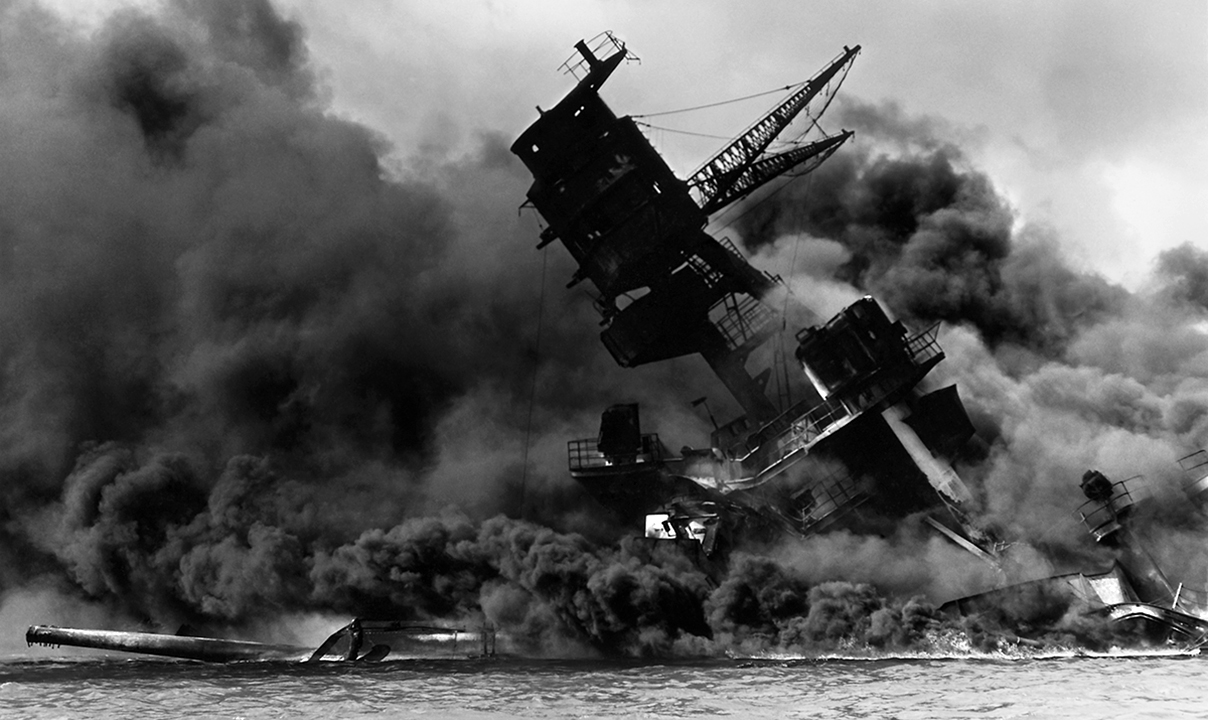
The USS California (a battleship stationed in the Pacific) was one of the eight battleships sunk at Pearl Harbor. During the attack on December 7, 1941, it took three direct hits — two torpedoes and one bomb, killing over 100 crew. The California caught fire and the remainder of the crew made their way to shore before the ship sank. It was later salvaged, repaired, and returned to service during World War II before being decommissioned in 1947.
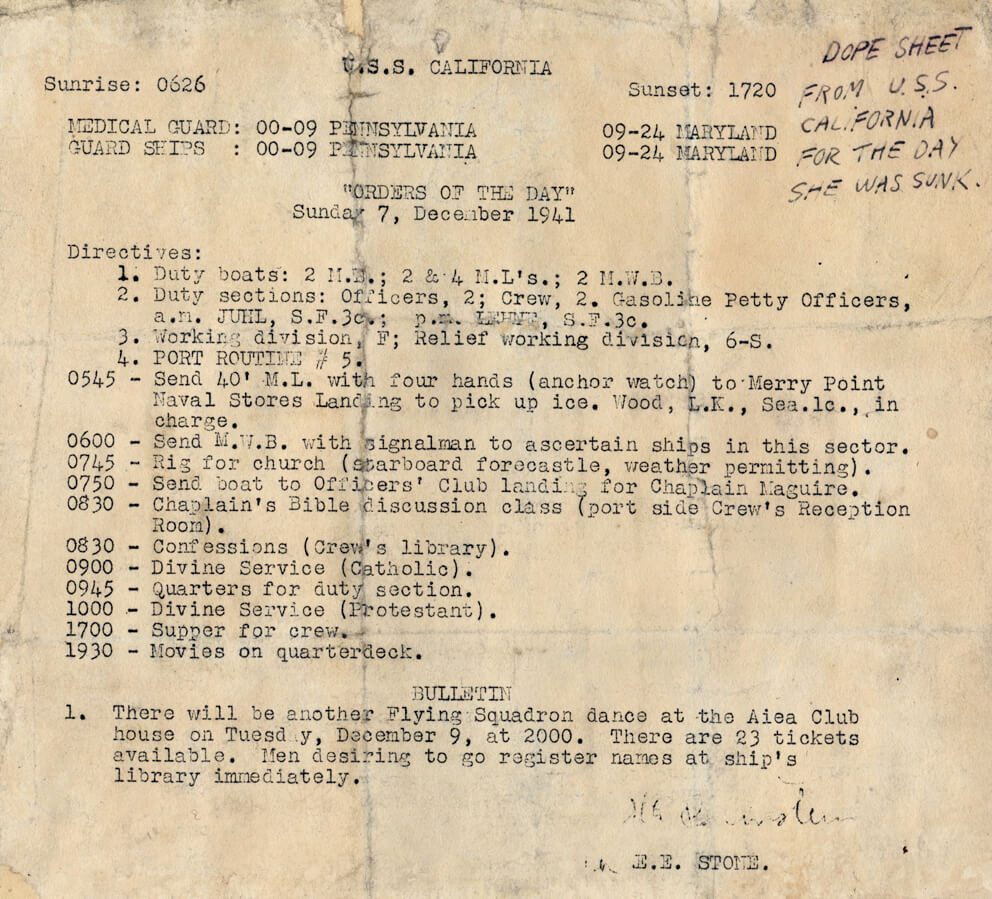
Below is the December 7, 1941 “Orders of the Day” for the USS California, from WallBuilders’ Collection. Since that day was a Sunday, the orders include notations for church services for the ship’s crew.
3. Working division, F; Relief working division, 6-S.
4. PORT ROUTINE # 5.
0545 – Send 40′ M.L. with four hands (anchor watch) to Merry Point Naval Stores Landing to pick up ice. Wood, L.K., Sea. lc., in charge.
0600 – Send M.W.B. with signalman to ascertain ships in this sector.
0745 – Rig for church (starboard forecastle, weather permitting).
0750 – Send boat to Officers’ Club landing for Chaplain Maguire.
0830 – Chaplain’s Bible discussion class (port side Crew’s Reception Room).
0830 – Confessions (Crew’s library).
0900 – Divine Service (Catholic).
0945 – Quarters for duty section.
1000 – Divine Service (Protestant).
1700 – Supper for crew.
1930 – Movies on quarterdeck.
BULLETIN
1. There will be another Flying Squadron dance at the Aiea Club house on Tuesday, December 9, at 2000. There are 23 tickets available. Men desiring to go register names at ship’s library immediately.
E.E. Stone.
* Handwritten Note (top right): “Dope Sheet from U.S.S. California for the day she was sunk.”
The author of this letter, John Munroe, enlisted as a private in the 2nd Massachusetts Infantry at the age of 19 on May 22, 1861, and served until mustered out on July 1, 1864. During the war he acted as the musician for K Company. 1 Aside from this, not much is known of Private Munroe.
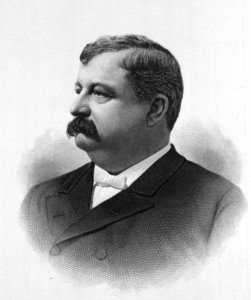
The letter’s most notable character, Colonel William Cogswell, however, was perhaps one of the most famous members of the 2nd Massachusetts. Col. Cogswell served with exemplary distinction during the Civil War, finally being brevetted a Brigadier General. Afterwards, he was three times of the mayor of Salem, five times a member of the Massachusetts House of Representatives, then he was elected to the Senate of Massachusetts in the mid 1880’s. In 1886, Cogswell became a Republican representative in the Federal Congress—a position to which he was reelected to until his death in 1895.2
In one of the many addresses given during the memorial to his life, the speaker attested to his strong character saying:
When heroes were needed, Mr. Cogswell could easily be found. When the tender sympathies of a woman were needed, his heart was loaded with that sweet necessity of life.
His close companions, those whom he loved, knew him to be great in God’s holiest, sweetest, and tenderest gifts, as well as great in the heart that accomplishes the grand achievements of life.
He had a soul fitted to reprove the wicked. He had an arm potential against the oppressor. He had a heart dauntless in the face of danger, ever quick to respond when duty called him to action. The tear of a suffering child, the sigh of an unfortunate woman, and the pitiful look of the debased, all found sympathy in his great soul.3
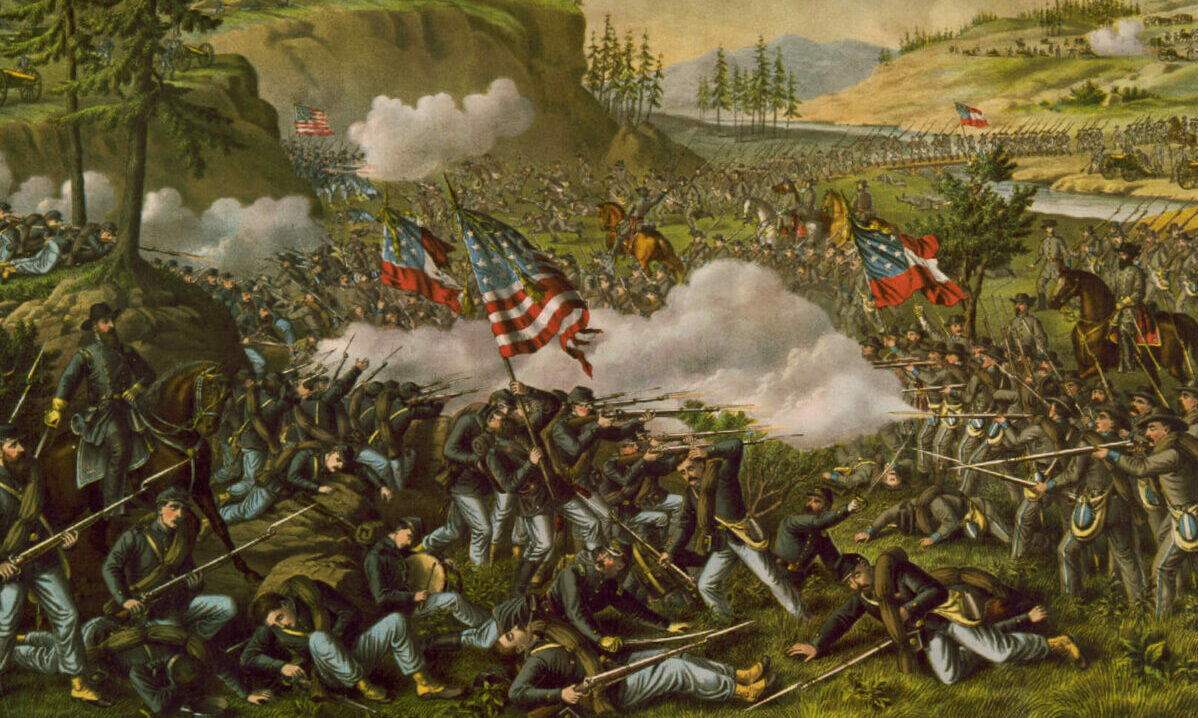
The anecdote related by Private Munroe in the letter most likely happened towards the end of 1864 after the capture of Atlanta on September 2. General Sherman had appointed Cogswell to be the post-commandant during the period immediately after the completion of the siege.4
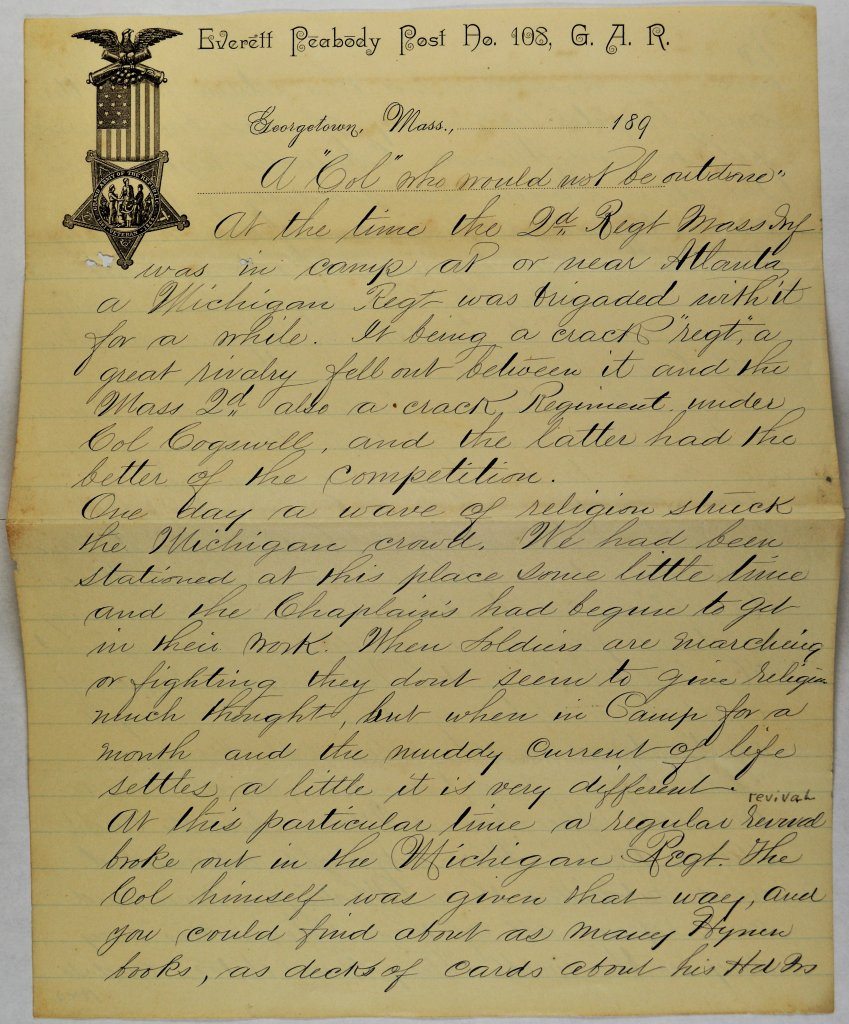
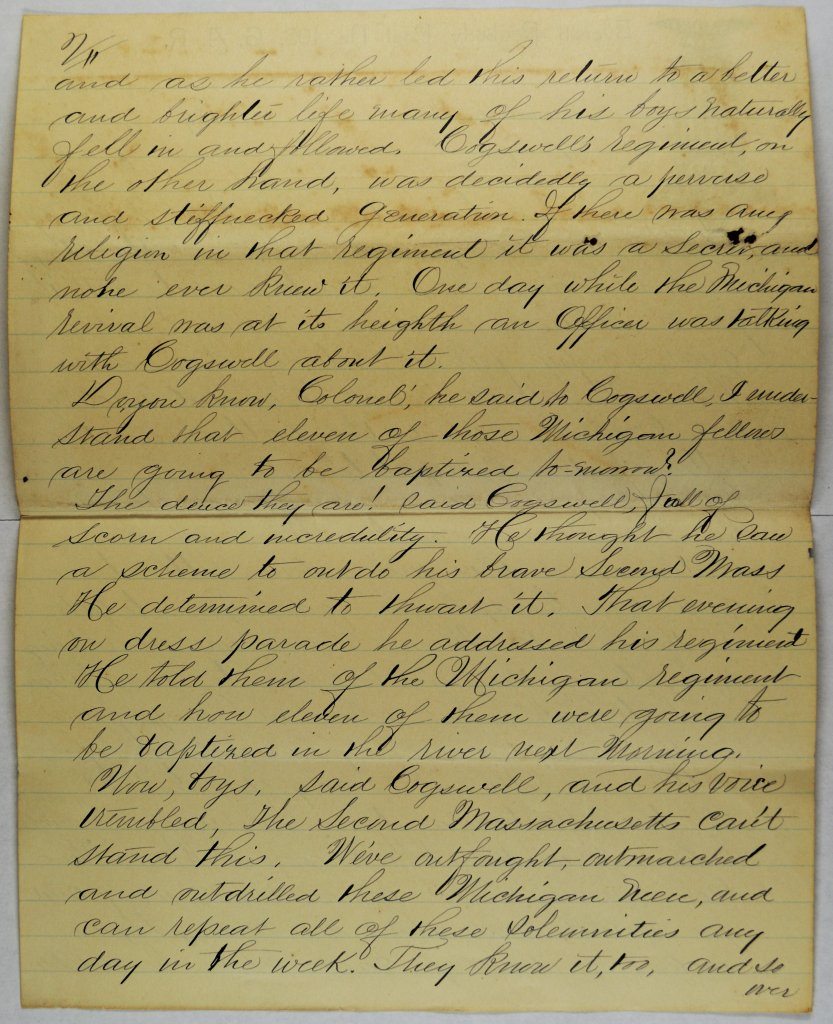
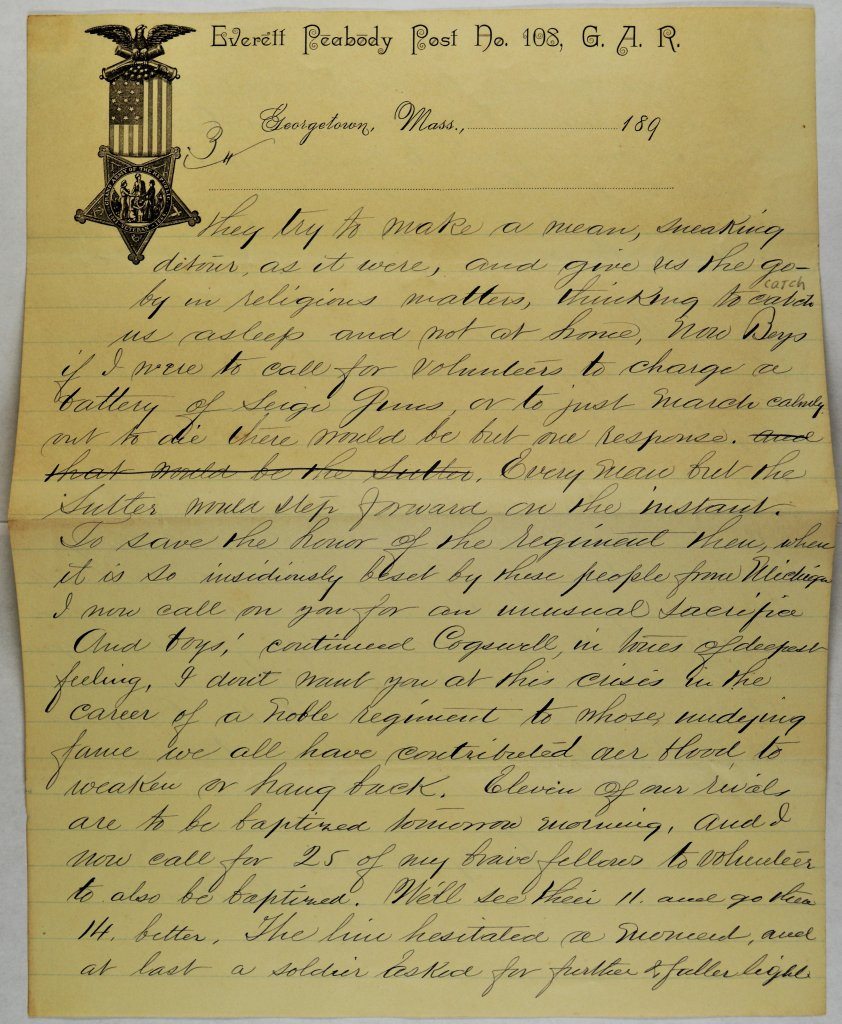
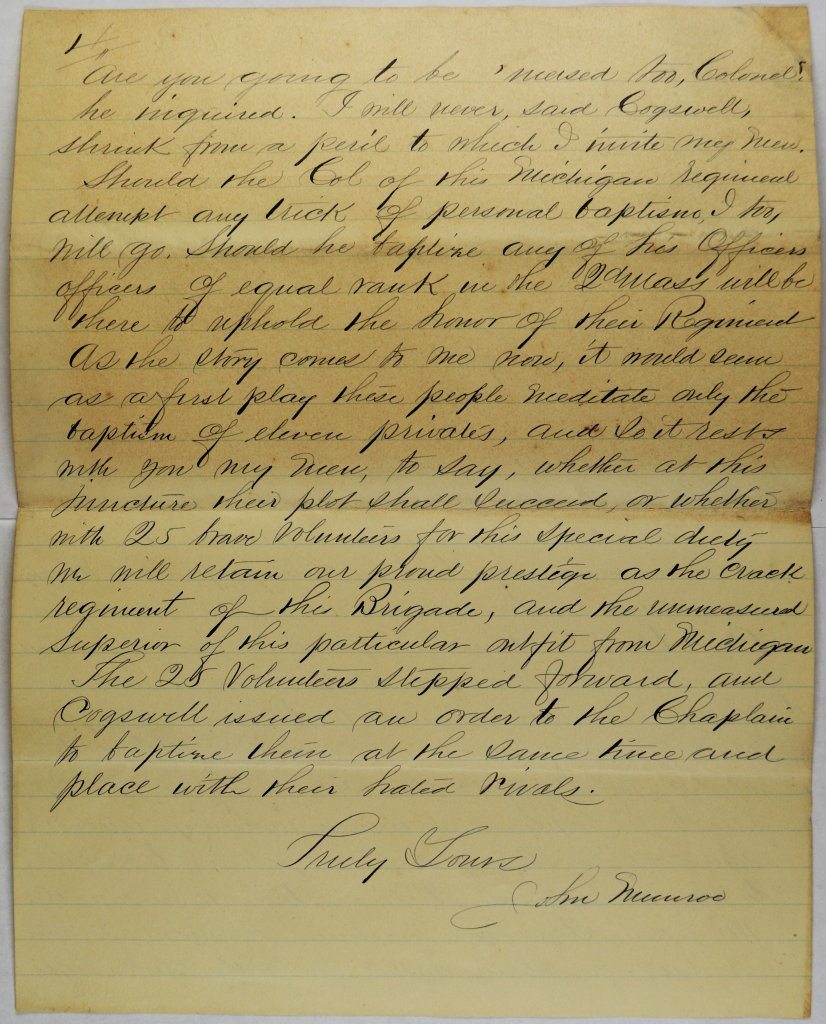
Below are the pictures and transcript of the letter.
A “Col” who would not be outdone
At the time the 2nd Regt Mass Inf was in in camp at or near Atlanta, a Michigan Regt was brigaded with it for a while. It being a crack “regt,” a great rivalry fell out between it and the Mass 2nd, also a crack Regiment under Col. Cogswell, and the latter had the better of the competition.
One day a wave of religion struck the Michigan crowd. We had been stationed at this place some little time and the Chaplains had begun to get in their work. When Soldiers are marching or fighting they don’t seem to give religion much thought, but when in Camp for a month and the muddy current of life settles a little it is very different.
At this particular time a regular revival broke out in the Michigan Regt. The Col himself was given that way, and you could find about as many Hymn books, as decks of cards about his Hd. Qs.* and as he rather led this return to a better and brighter life many of his boys naturally fell in and followed. Cogswell’s regiment, on the other hand, was decidedly a perverse and stiffnecked generation. If there was any religion in that regiment it was a secret and none ever knew it. One day while the Michigan revival was at its heighth [sic] an Officer was talking with Cogswell about it.
“Do you know, Colonel,” he said to Cogswell, “I understand that eleven of those Michigan fellows are going to be baptized to-morrow?” “The deuce they are!” said Cogswell, & all of scorn and incredulity. He thought he saw a scheme to outdo his brave Second Mass. He determined to thwart it. That evening on dress parade he addressed his regiment. He told them of the Michigan regiment and how eleven of them were going to be baptized in the river next morning.
“Now boys,” said Cogswell, and his voice trembled, “the Second Massachusetts can’t stand this. We’ve outfought, outmarched and outdrilled these Michigan men, and can repeat all of these solemnities any day in the week. They know it, too, and so ever they try to make a mean, sneaking detour, as it were, and give us the go-by in religious matters, thinking to catch us asleep and not at home, now Boys, if I were to call for volunteers to charge a battery of siege guns, or to just march calmly out to die there would be but one response. And that would be the Sutler. Every man but the Sutler would step forward on the instant. To save the honor of the regiment then, when it is so insidiously beset by those people from Michigan, I now call on you for an unusual sacrifice.”
“And boys,” continued Cogswell, in tones of deepest feeling, “I don’t want you at this crisis in the career of a noble regiment to whose undying fame we all have contributed our blood, to weaken or hang back. Eleven of our rival are to be baptized tomorrow morning, and I now call for 25 of my brave fellows to volunteer to also be baptized. We’ll see their 11 and go ____ 14 better.” The line hesitated a moment, and at last a soldier asked for further & fuller light. “Are you going to be ‘mersed [sic for immersed] too, Colonel?” he inquired. “I will never,” said Cogswell, “shriek from a peril to which I invite my men.
“Should the Col of the Michigan regiment attempt any trick of personal baptism, I too, will go. Should he baptize any of his Officers, officers of equal rack in the 2nd Mass will be there to uphold the honor of their Regiment.”
“As the story comes to me now, it would seem as a first play these people meditate only the baptism of eleven privates, and to it rests with you my men, to say, whether at this juncture their plot shall succeed, or whether with 25 brave volunteers for this special duty we will retain our proud prestige as the crack regiment of this Brigade; and the unmeasured Superior of this particular outfit from Michigan.”
The 25 Volunteers stepped forward, and Cogswell issued an order to the Chaplain to baptize them at the same time and place with their hated rivals.
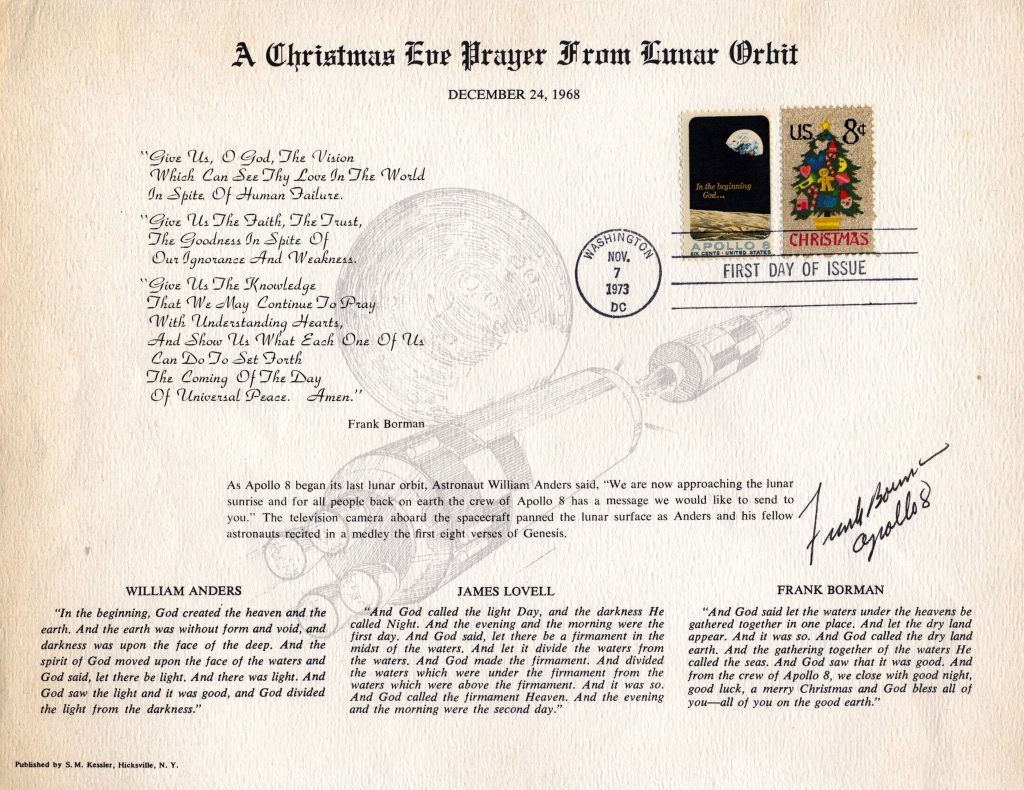
The astronauts of Apollo 8 (the first manned mission to the moon) entered orbit around the moon on Christmas Eve, 1968. While circling the moon, the three astronauts hosted a live telecast in which all three read from Genesis 1 and then Frank Borman delivered a special Christmas greeting.
WallBuilders Collection includes a document signed by Frank Borman with the text of the Christmas Eve message. Also included is a prayer recorded by Borman on Christmas Day, 1968. Below is a scan and transcript of this document from our collection.
A Christmas Eve Prayer From Lunar Orbit December 24, 1968
“Give Us, O God, The Vision
Which Can See Thy Love In The World
In Spite of Human Failure.
“Give Us The Faith, The Trust
The Goodness In Spite Of
Our Ignorance And Weakness.
“Give Us The Knowledge
That We May Continue To Pray
With Understanding Hearts,
And Show Us What Each One Of Us
Can Do To Set Forth
The Coming Of The Day
Of Universal Peace. Amen.”
Frank Borman
As Apollo 8 began its last lunar orbit, Astronaut William Anders said, “We are not approaching the lunar sunrise and for all people back on earth the crew of Apollo 8 has a message we would like to send to you.” The television camera aboard the spacecraft panned the lunar surface as Anders and his fellow astronauts recited in a medley the first eight verses of Genesis.
William Anders
“In the beginning God created the heaven and the earth. And the earth was without form and void, and darkness was upon the face of the deep. And the spirit of God moved upon the face of the waters and God, let there be light. And there was light. And God saw the light and it was good, and God divided the light from the darkness.”
James Lovell
“And God called the light Day, and the darkness He called Night. And the evening and the morning were the first day. And God said, let there be a firmament in the midst of the waters. And let it divide the waters from the waters. And God made the firmament. And divided the waters which were under the firmament from the waters which were above the firmament. And it was so. And God called that firmament Heaven. And the evening and the morning were the second day.”
Frank Borman
“And God said let the waters under the heavens be gathered together in one place. And let the dry land appear. And it was so. And God called the dry land earth. And the gathering together of the waters He called the seas. And God saw that it was good. And from the crew of Apollo 8, we close with good night, good luck, a merry Christmas and God bless all of you — all of you on the good earth.”
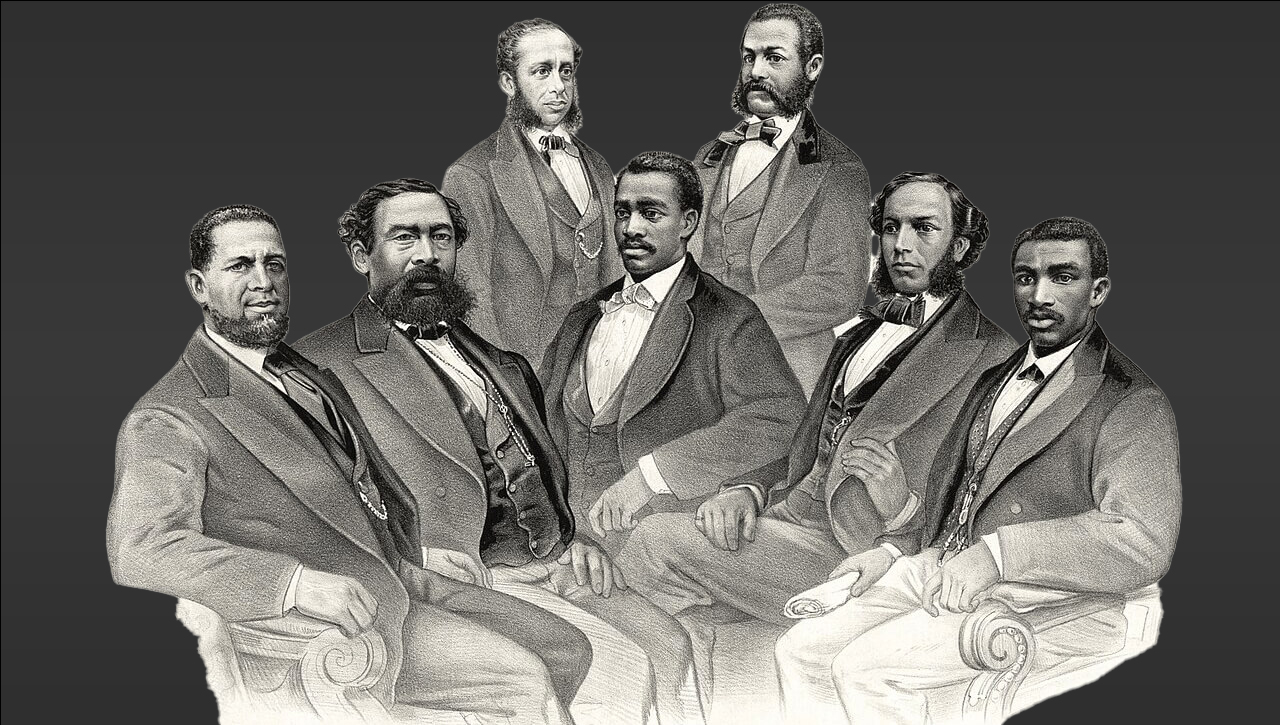
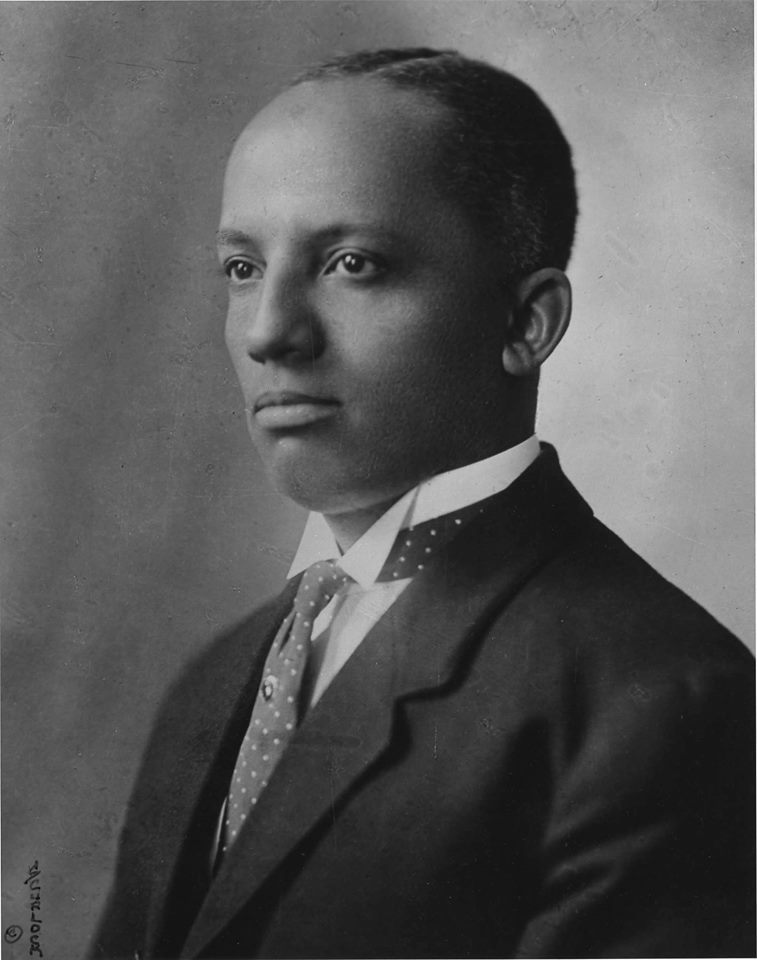
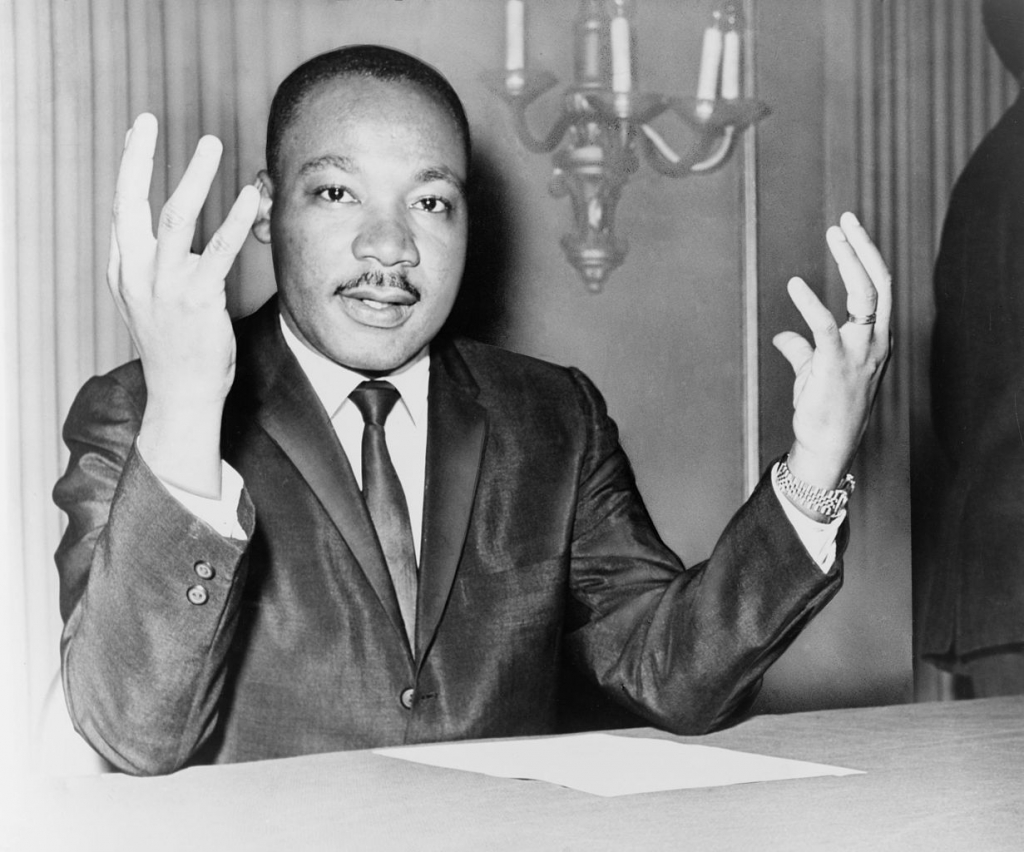
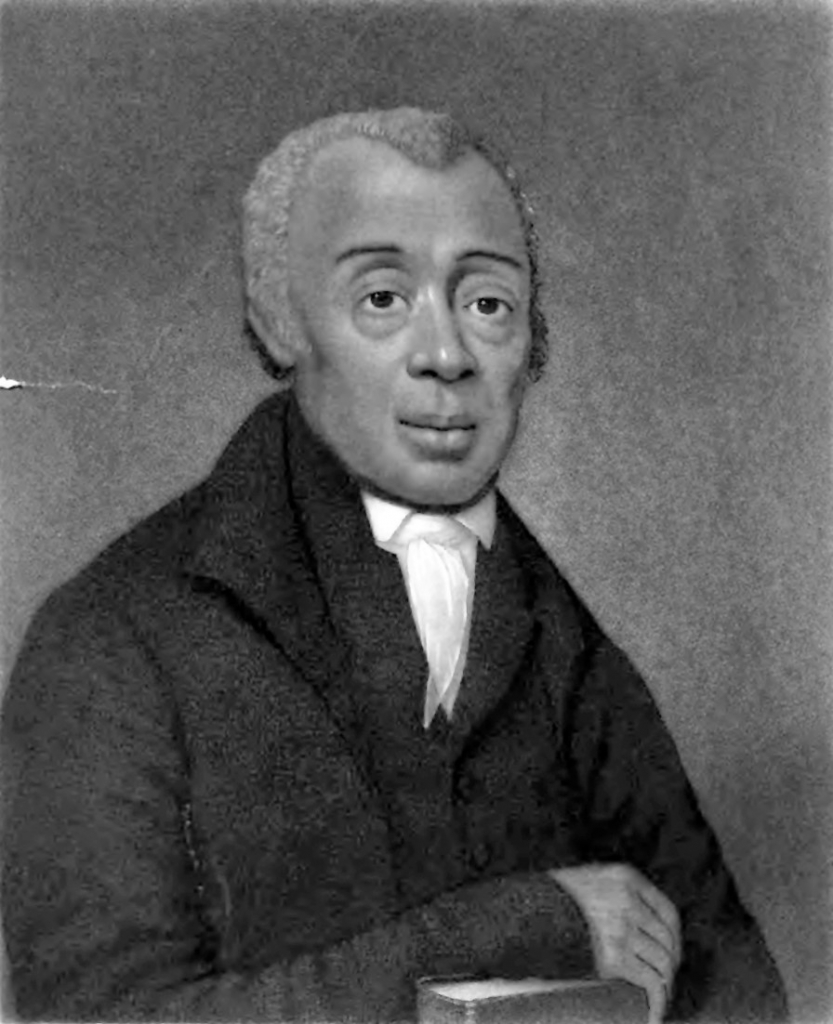
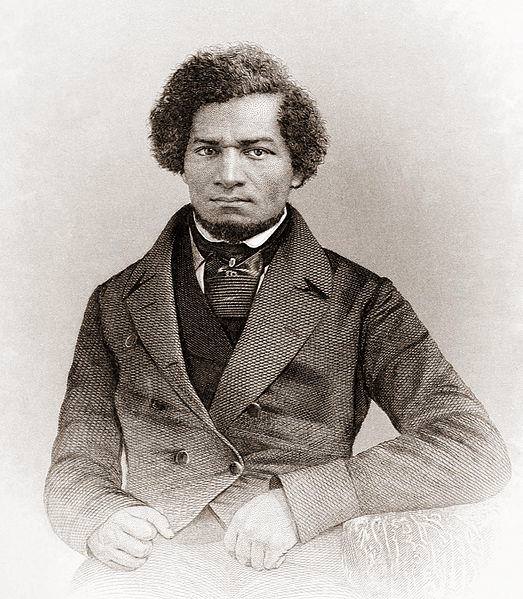
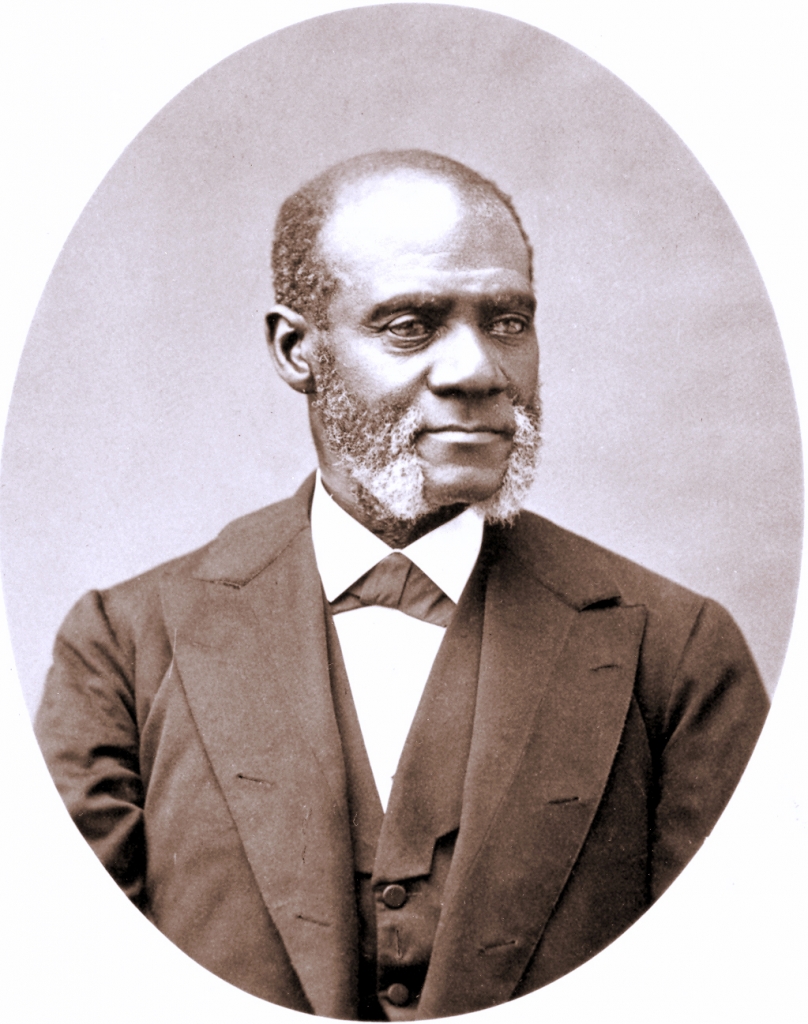
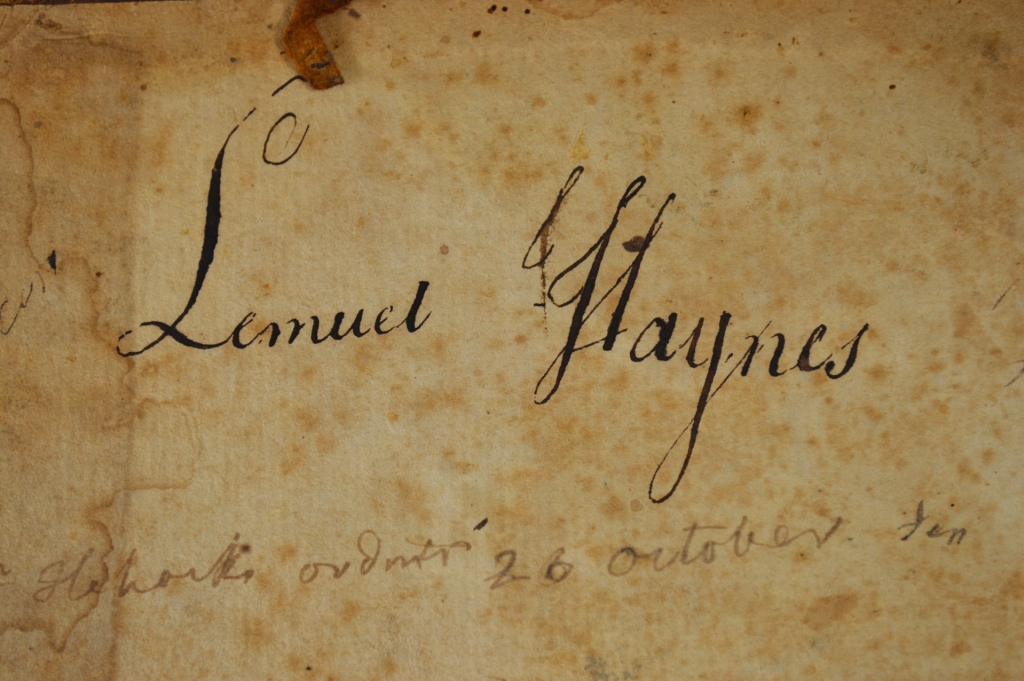
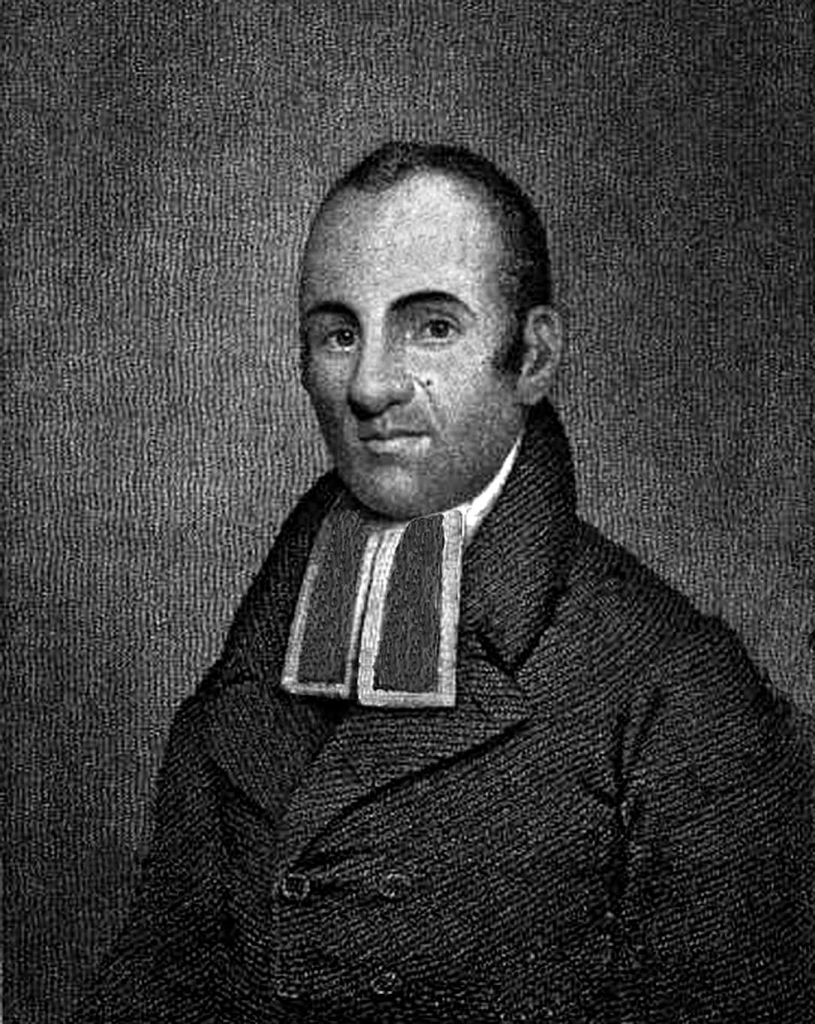
Below is a compilation of various resources and biographies for several black history related people and events.
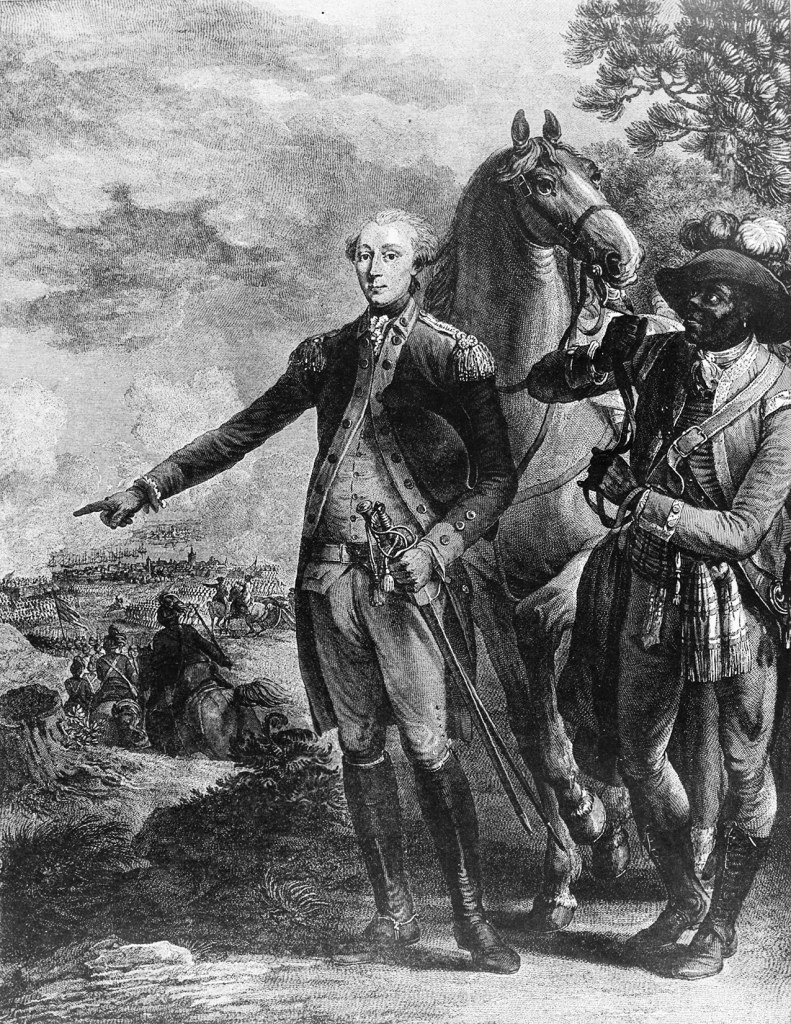
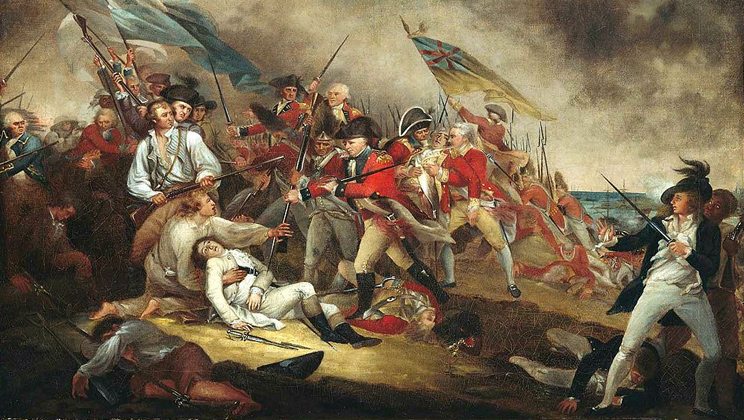
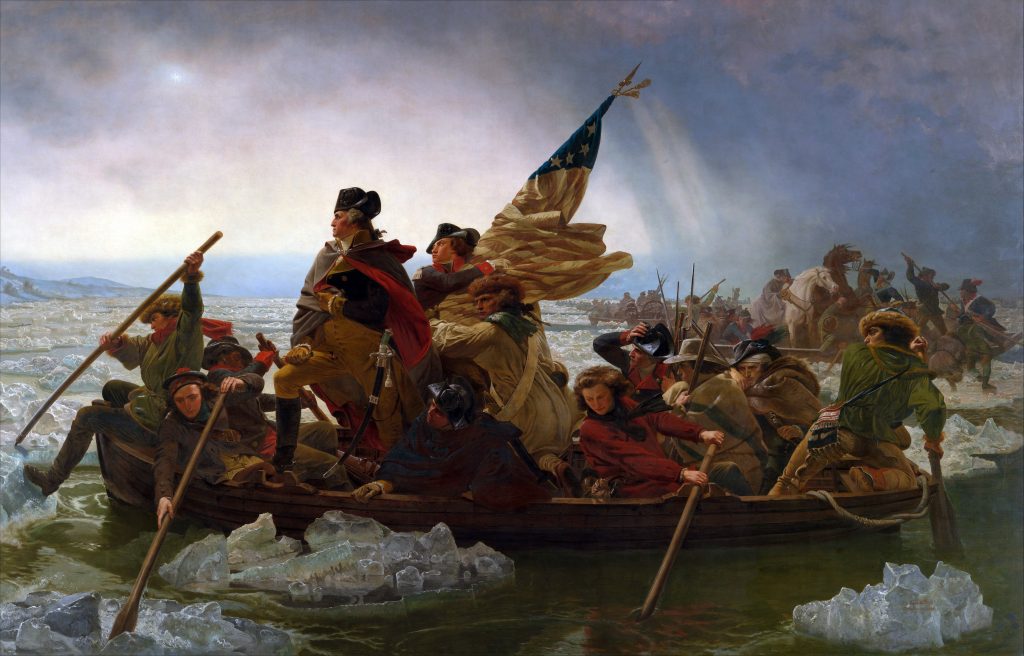
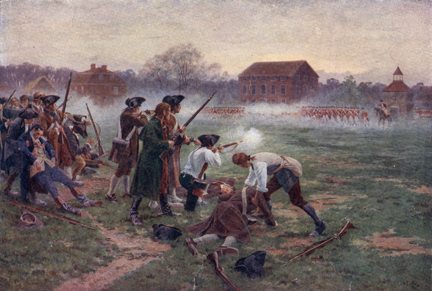
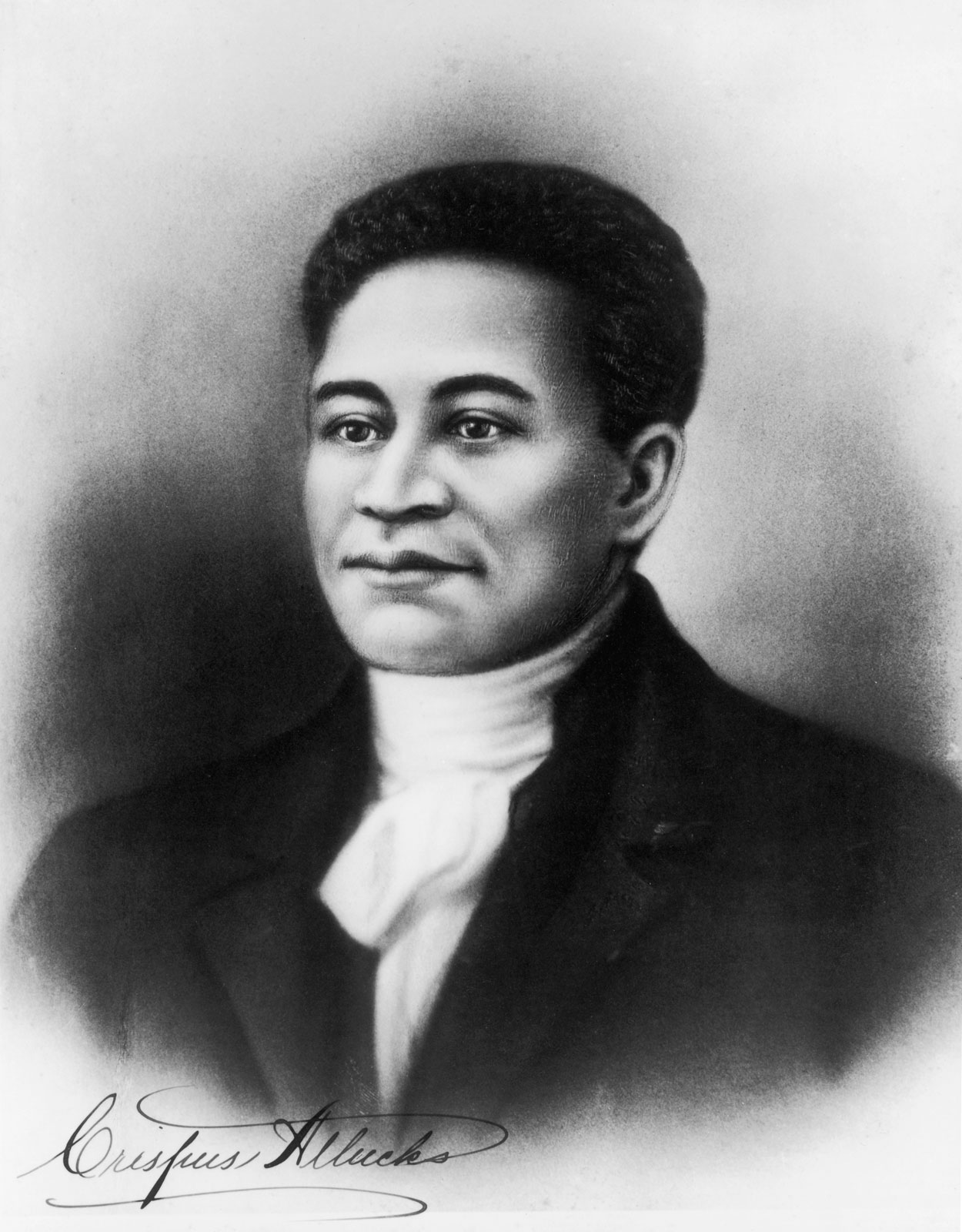
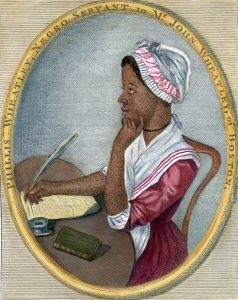
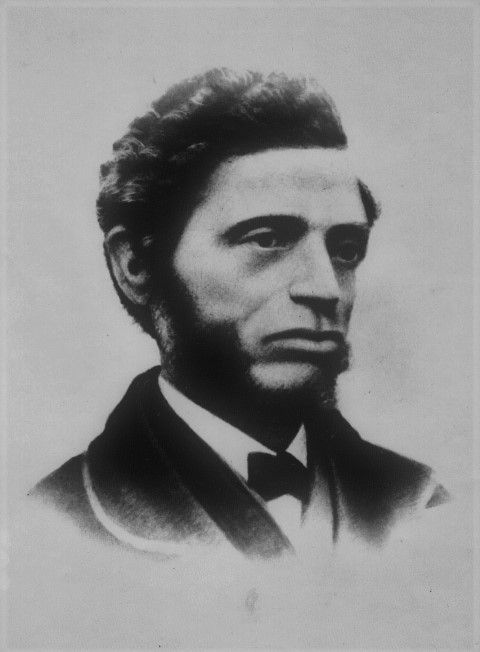
American War for Independence Soldiers
James Armistead Biographical Resources: WallBuilders Biography Black Past US Army The Black Phalanx; A History of the Negro Soldiers of the United States in the Wars of 1775-1812, 1861-’65 , pp. 50-51.
“Prince” Sisson Biographical Resources: WallBuilders Camp Fire of the Afro-American; or the Colored Man as a Patriot, p. 141. The Colored Patriots of the American Revolution, p. 127.
Of all forms of violent intimidation, lynchings were by far the most effective. Between 1882 and 1964, 4,743 persons were lynched — 3,446 blacks and 1,297 whites.
If our nation had done nothing more in its whole history than to create just two documents, its contribution to civilization would be imperishable. The first of these documents is the Declaration of Independence and the other is that which we are here to honor tonight, the Emancipation Proclamation. All tyrants, past, present and future, are powerless to bury the truths in these declarations, no matter how extensive their legions, how vast their power and how malignant their evil. The Declaration of Independence proclaimed to a world, organized politically and spiritually around the concept of the inequality of man, that the dignity of human personality was inherent in man as a living being. The Emancipation Proclamation was the offspring of the Declaration of Independence. It was a constructive use of the force of law to uproot a social order which sought to separate liberty from a segment of humanity.
When the architects of our republic wrote the magnificent words of the Constitution and the Declaration of Independence, they were signing a promissory note to which every American was to fall heir. This note was a promise that all men, yes, black men as well as white men, would be guaranteed the “unalienable Rights” of “Life, Liberty and the pursuit of Happiness.”
When writing to Thomas Jefferson on June 28, 1813, John Adams discusses the fact that America achieved independence through the general principles of Christianity. The letter itself, however, was the culmination of events which began nearly fifteen years earlier.
Adams and Jefferson were friends for many years but fell out after the events of the presidential election of 1800. By the year 1813 Jefferson and Adams had resumed their friendship after the repeated urgings of Dr. Benjamin Rush.1 This newly revived friendliness, however, was significantly tested when private letters written by Jefferson to Dr. Joseph Priestly were published in the biography of Rev. Theophilus Lindsey. One of the letters from 18012 included apparent and harsh censures of Adams’ policies. Upon readings this book Adams wrote to Jefferson on May 29, 1813, saying, “I wish to know if you have seen this book. I have much to say on the subject.”3
After waiting for twelve days without a response, Adams again took up his pen on June 10, 1813, and went through the 1801 Jefferson letter responding to the various claims made against him. Adams focused on the part where Jefferson had quoted him, writing: “The President himself declaring that we were never to expect to go beyond them in real science.”4 In the original letter to Rev. Priestly, Jefferson explains his disgust at this alleged statement by the then President Adams, exclaiming:
Those who live by mystery & charlantanerie, fearing you would render them useless by simplifying the Christian philosophy, – the most sublime & benevolent, but most perverted system that ever shone on man, – endeavored to crush your well-earnt & well-deserved fame.”5
Responding to these now twelve year old charges, Adams declared:
The sentiment that you have attributed to me in your letter to Dr. Priestley, I totally disclaim, and demand, in the French sense of the word, of you the proof. It is totally incongruous to every principle of my mind and every sentiment of my heart.6
Four days later Adams wrote another letter to Jefferson continuing the project of rebuffing Jefferson’s claims from 1801, but this time focusing mainly on the “alien law.”7
On June 15, 1813, Jefferson responded to the initial letter from May 29. The existence of the biography and even the person of Theophilus Lindsey was entirely new information to him. After looking back upon his own copies of the letters sent to the Dr. Priestly, Jefferson began explaining these letters. He told Adams that, “it was a confidential communication of reflections on these from one friend to another, deposited in his bosom, and never meant to trouble the public mind.”8 He further explained:
Still less must they [readers of the letters in question] consider it as looking personally towards you. You happen, indeed, to be quoted, because you happened to express more pithily than had been done by themselves, one of the mottos of the party. This was in your answer to the address of the young men of Philadelphia.9
At the end of the letter Jefferson makes clear that he sees no need to drag up things from so long ago remarking: “I should see with reluctance the passions of that day rekindled in this, while so many of the actors are living, and all are too near the scene not to participate in sympathies with them. About the facts you and I cannot differ; because truth is our mutual guide.”10
Upon receiving Jefferson’s letter, Adams retrieved his response to the address of the young men of Philadelphia from 1798, fifteen years prior.11 Adams then proceeded to correct Jefferson’s misconception of what had been said. The young men of Philadelphia had addressed Adams during the time when hostilities with France where high, assuring the President that they were, “accentuated by the same principles on which our forefathers achieved their independence.”12 In answer to this Adams admonished them to hold fast to those fundamental principles:
Science and morals are the great pillars on which this country has been raised to its current population, opulence, and prosperity. Without wishing to damp the ardor of curiosity, or influence the freedom of inquiry, I will haphazard a prediction, that after the most industrious and impartial researches, the longest liver of you all will find no principles, institutions, or systems of education more fit, in general, to be transmitted to your posterity than those you have received from your ancestors.13
It was from this statement that Jefferson had drawn the criticism that Adams thought no improvement could be made upon the sciences of the ancestors, thereby implying that he was one of those who preferred “mystery and charlantanerie” over the simplicity of Christianity. Perceiving Jefferson’s misunderstanding, Adams described the principles which he referred to in his 1798 letter. He began by walking through what his answer did not mean:
Could my answer be understood by any candid reader or hearer, to recommend to all the others the general principles, institutions, or systems of education of the Roman Catholics, of those of the Quakers, or those of the Presbyterians, or those of the Philosophers? No.14
Adams here dismissed any idea that he attempted to propagate and employ for personal power a “most perverted system” of values instead of that “most sublime and benevolent” form of Christianity. Carrying on, Adams revealed what he truly meant, saying:
The general principles in which the fathers achieved independence, were the only principles on which that beautiful assembly of young men could unite, and these principles only could be intended by them in their address, or by me in my answer. And what were these general principles? I answer, the general principles of Christianity, in which all those sects were united, and the general principles of English and American liberty…15
Adams explained to Jefferson that in actuality they both desired the same ends – that the simplicity of those general principles of the Christian faith be maintained by the younger generation just as it had been by their own.
2 Thomas Jefferson to Doctor Joseph Priestly, March 21, 1801, The Works of Thomas Jefferson, ed. Paul Ford (New York: G. P. Putnam’s Sons, 1905), IX:216.
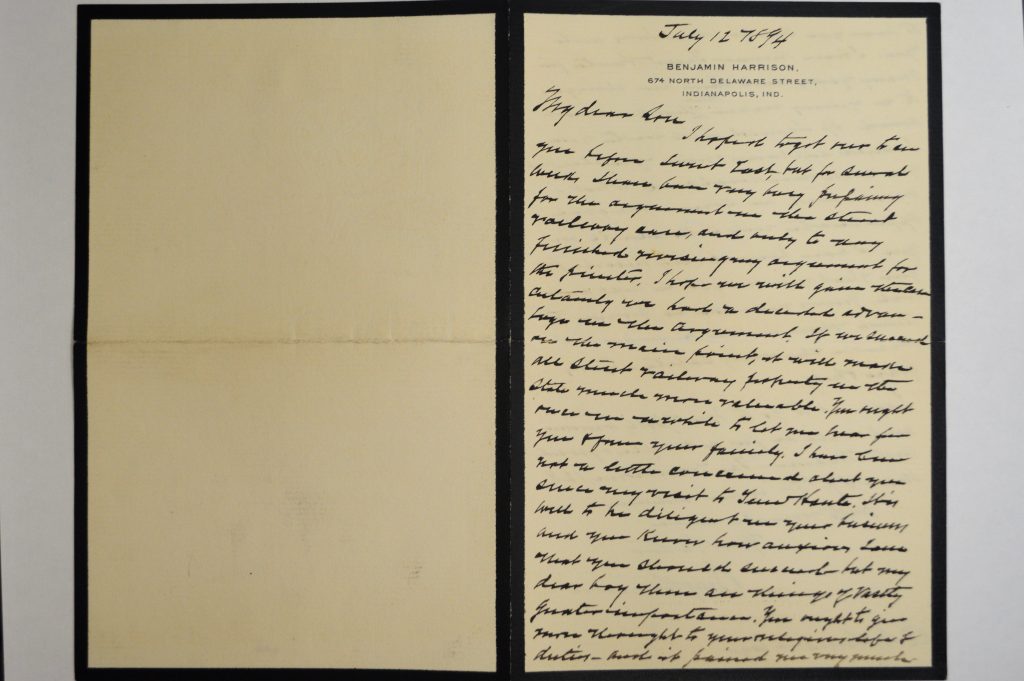
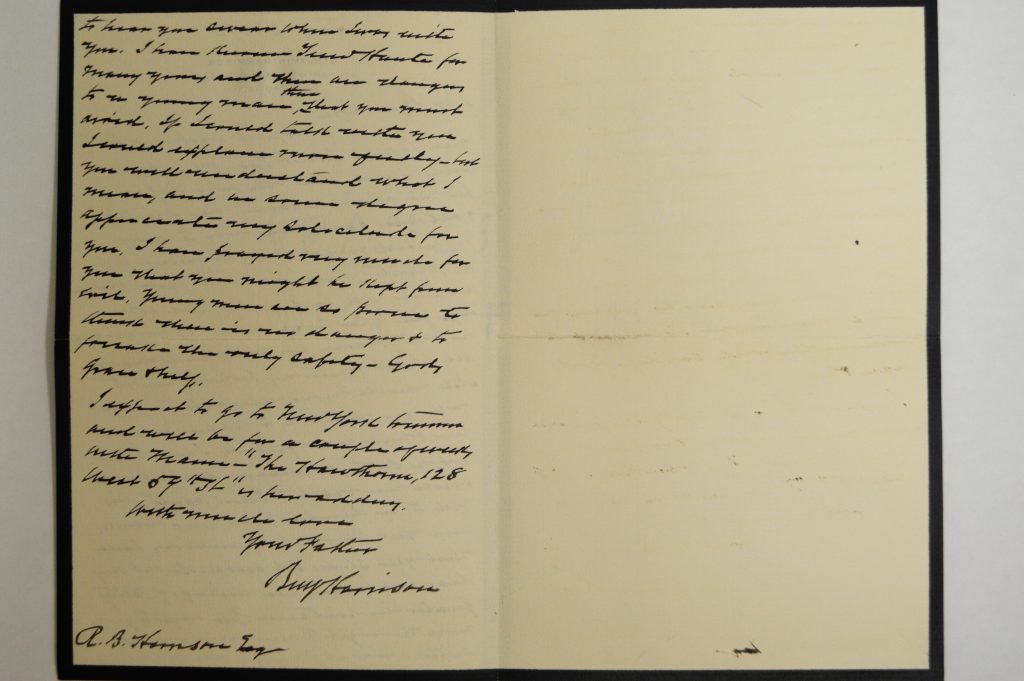
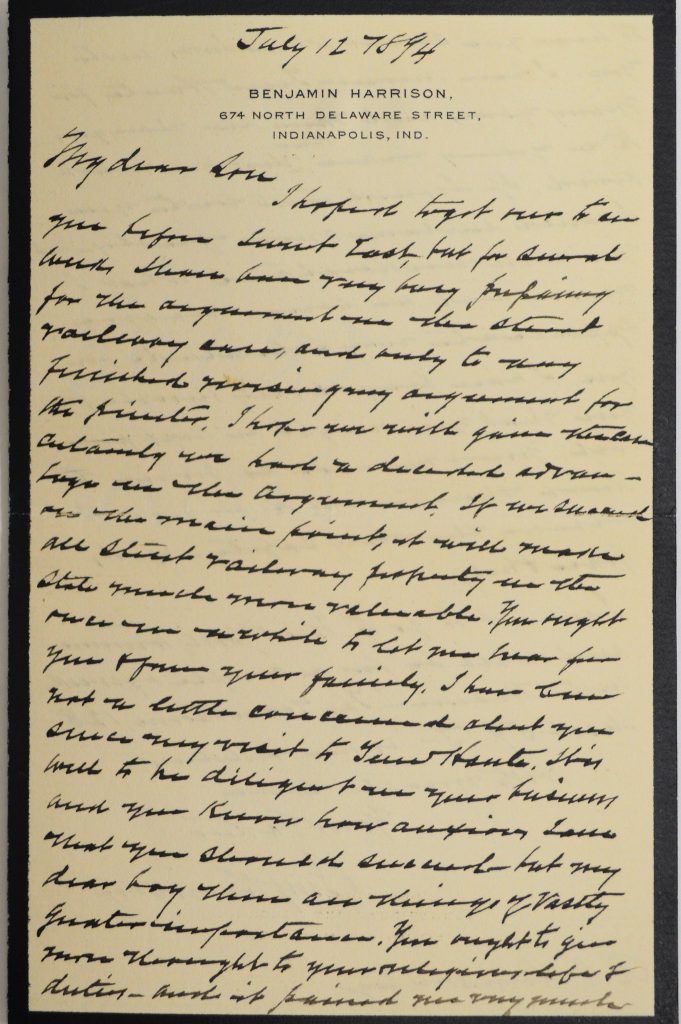
Benjamin Harrison (1833-1901) was a lawyer, a Civil War brigadier general, and eventually the twenty-third president of the United States from 1889-1893. In this letter to his son, Russell Benjamin Harrison, on July 12, 1894, he admonishes the younger Harrison to remain steadfast in the faith. The former president explains to his son, “It’s well to be diligent in your business, and you know how anxious I am that you should succeed – but my dear boy there are things of vastly greater importance. You ought to give more thought to your religious life and duties.” Such a candid and clear call to a higher life came due to a recent incident in which Russell Harrison had cursed in front of his father. President Harrison continues, writing, “Young men are so prone to think there is no danger and to forsake the only safety – God’s grace and help.”
Benjamin Harrison’s faith, however, was not confined to personal letters to his son. While he was sitting president he routinely expressed his faith when acting in an official capacity. Harrison made it evident from the beginning that he and all Americans had God to thank for their country, declaring in his 1889 inaugural address:
No other people have a government more worthy of their respect and love, or a land so magnificent in extent, so pleasant to look upon, and so full of generous suggestion to enterprise and labor. God has placed upon our head a diadem, and has laid at our feet power and wealth beyond definition or calculation. But we must not forget that we take these gifts upon the condition that justice and mercy shall hold the reins of power, and that the upward avenues of hope shall be free to all the people.1
Following this introductory address, President Harrison issued several proclamations calling the nation to prayer. Of these included a yearly call for Thanksgiving which continually reinforced the national reliance our country had upon God. Selections include:
A highly favored people, mindful of their dependence on the bounty of divine Providence, should seek fitting occasion to testify gratitude and ascribe praise to Him who is author of their many blessings. It behooves us then to look back with thankful hearts over the past year and thank God for his infinite mercy. – THANKSGIVING PROCLAMATION 18892
I do invite the people, upon that day to cease from their labors, to meet in their accustomed houses of worship and to join in rendering gratitude and praise to our beneficent Creator for the rich blessings He has granted to us as a nation, and in invoking the continuance of His protection and grace for the future. – THANKSGIVING PROCLAMATION 18903
To God, the Beneficent and the All Wise, who makes the labors of men to be fruitful, redeems their losses by His grace, and the measure of whose giving is as much beyond the thoughts of men as it is beyond his desserts, the praise and gratitude of the people of this favored nation are justly due. – THANKSGIVING PROCLAMATION 18914
He [God] has stayed the pestilence at our door; He has given us more love for the free institutions in the creation of which His directing providence was so conspicuous; He has awakened a deeper reverence for law; He has widened our philanthropy by a call to succor the distress in other lands; He has blessed our schools and is bringing forward a patriotic and God-fearing generation to execute His great and benevolent designs for our country; He has given us great increase in material wealth and a wide diffusion of contentment and comfort in the homes of our people; He has given His grace to the sorrowing. – THANKSGIVING PROCLAMATION 18925
On top of these prayer proclamations, he also issued a special call to prayer on the centennial of George Washington’s inauguration. In the proclamation itself Harrison explained the purpose behind it:
In order that the joy of the occasion may be associated with a deep thankfulness in the minds of the people for all our blessings in the past, and a devout supplication to God for their gracious continuance in the future, the representatives of the religious creeds, both Christian and Hebrew, have memorialized the Government to designate an hour of prayer and thanksgiving on that day.6
Therefore, in accordance to the wishes of the Christian and Jewish representatives, Harrison recommended that at 9 o’clock in the morning:
The entire community repair to their respective places of divine worship, to implore the favor of God that the blessings of liberty, prosperity, and peace may abide with us as a people, and that His hand may lead us in the paths of righteousness and good deeds.7
Benjamin Harrison, both in his private life and while before the public eye, always remembered and strove to remind others that God was the source of safety, prosperity, and comfort.
Pictures of the Letter
Page 1Page 2Page 1 Close Up
Transcription
My dear Son,
I hoped to out get out to see you before I went East but for several weeks I have been very busy, preparing for the argument in the street railway case, and only today finished revising my argument for the printer. I hope we will gain the case. Certainly we had a decided advantage in the argument. If we succeed in the main point, it will make all street property in the state much more valuable.
You ought once in a while to let me hear from you and from your family. I have been not a little concerned about you since my visit to Terre Haute. It’s well to be diligent in your business, and you know how anxious I am that you should succeed – but my dear boy there are things of vastly greater importance. You ought to give more thought to your religious life and duties. And it pained me very much to hear you swear when I was with you. I have known Terre Haute for many years and there are dangers to a young man there that you must avoid. If I could talk with you I would explain fully. But you will understand what I mean, and in some degree appreciate my solicitude for you. I have prayed very much for you that you might be kept from evil. Young men are so prone to think there is no danger and to forsake the only safety – God’s grace and help. I expect to go to New York tomorrow and will be a couple of weeks with Mama – “The Hawthorne, 128 West of 59th St.” is the address.
In the last year of his life Daniel Webster (1782-1852) stood before the New York Historical Society and declared:
That if we, and our posterity, shall be true to the Christian religion, if we shall respect his commandments, if we, and they, shall maintain just, moral sentiments, and such conscientious convictions of duty as shall control the heart and life, we may have the highest hopes of the future fortunes of this country.1
Daniel Webster
Such a stance was, however, not a rarity for Daniel Webster who regularly defended the Christianity throughout his life. One example was in 1844, when Webster rose for the final summation in the case of Vidal v. Girard’s Executors and “delivered one of the most beautiful and powerful arguments in defense of the Christian religion ever uttered.”2
The case concerned the legality of the will of Stephan Girard. In his will Girard had set aside a trust of two million dollars3 for the formation of a college for the education of “as many poor white male orphans, between the ages of six and ten years, as the said income shall be adequate to maintain.”4 The executors of his will, and specifically of the construction and maintenance of the college, were declared the Mayor, Aldermen, and Citizens of Pennsylvania.5 After proceeding through many of the details concerning the organization of the school, Girard lists several “conditions on which my bequest for said college is made and to be enjoyed.”6 The second of these restrictions dictated stipulations regarding the teachers to be employed:
I enjoin and require, that, no ecclesiastic, missionary, or minister of any sect whatsoever, shall ever gold or exercise any station or duty whatever in the said college, nor shall any person ever be admitted for any purpose or as visitor, within the premises appropriated for the purposes of said college.7
After making such a striking demand, Girard attempted to explain and justify this action writing:
In making this restriction, I do not mean to cast any reflection upon any sect or person whatsoever; but as there is such a multitude of sects, and such a diversity of opinion amongst them, I devise to keep the tender minds of the orphans, who are to derive advantage from this bequest, free from the excitements which clashing doctrines and sectarian controversy are so apt to produce.8
The familial heirs of Girard, however, contested the viability the bequest by saying that these sections of the will rendered it void. The plaintiff’s case was argued by Daniel Webster and another preeminent advocate of the day, Walter Jones. The attorneys submitted two main objections to the will. The Court summarized these two objections, writing that:
The principle questions, to which the arguments at the bar have been mainly addressed, are; First, whether the corporation of the city of Philadelphia is capable of taking the bequest of the real and personal estate for the erection and support of a college upon the trusts and for the uses designated in the will: Secondly, whether these uses are charitable uses valid in their nature and capable of being carried into effect consistently with the laws of Pennsylvania.9
The second of these issues addressed whether or not the will was valid according to the laws of Pennsylvania. Webster submitted two reasons why it would be unacceptable. He first argued that the beneficiaries of the bequest (i.e. the “poor white male orphans”) were a category:
So loose a description, that no one can bring himself within the terms of the bequest, so as to say that it was made in his favor. No individual can acquire any right, or interest; nobody, therefore, can come forward as a party, in a court of law, to claim participation in the gift.10
The second objection Webster offers (which takes up the vast majority of his speech) is that the will is invalid due to the breach of the common law by being averse to Christian education. He declares that:
In the view of a court of equity this devise is no charity at all. It is no charity, because the plan of education proposed by Mr. Girard is derogatory to the Christian religion; tends to weakens men’s reverence for that religion, and their conviction of its authority and importance; and therefore, in its general character, tends to mischievous, and not to useful ends.11
Webster argues at length that due to the will banning the presence of any ecclesiastic from ever entering the college compound, Mr. Girard attacks Christianity to such an extent that it will substantially harm the community; thus creating a breach of both the common law of America and the general interests of Philadelphia.12 To show this he questions the Court asking:
Did the man ever live that had a respect for the Christian religion, and yet had no regard for any of its ministers? Did that system of instruction ever exist, which denounced the whole body of Christian teachers, and yet called itself a system of Christianity?13
Pressing further against anti-religious intention he found apparent in Girard’s will, Webster denounces its claim to charity by explaining that any charity which excludes Christ fails to even meet the definition of charity.
No, sir! No, sir! If charity denies its birth and parentage—if it turns infidel to the great doctrines of the Christian religion—if it turns unbeliever—it is no longer charity! There is no longer charity, either in a Christian sense, or in the sense of jurisprudence; for it separates itself from the fountain of its own creation.14
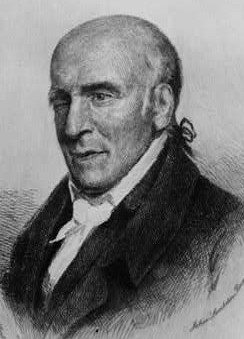
Stephan Girard
Webster, understanding that the will did not explicitly exclude all Christian teaching, next argues that any attempt to declare the will allows for lay-teaching of religion would be completely antithetical to the spirit and intention of the will—thus rendering the trust equally void. Webster submits that if Girard’s desire was to prevent all conflict concerning the Christian faith from arising and splitting apart the contingent of young scholars, then any religious education would lead to differences of opinion, especially if the students were taught by lay ministers. He inquires:
Now, are not laymen equally sectarian in their views as clergymen? And would it not be just as easy to prevent sectarian doctrines from being preached by a clergyman as being taught by a layman? It is idle, therefore, to speak of lay preaching. … Everyone knows that laymen are as violent controversialists as clergymen, and the less informed the more violent.15
Next Webster takes on the premise of Girard’s exclusion itself. He derides the reasoning of Girard, declaring:
But this objection to the multitude and differences of sects is but the old story—the old infidel argument. It is notorious that there are certain great religious truths which are admitted and believed by all Christians. All believe in the existence of a God. All believe in the immortality of the soul. All believe in the responsibility, in another world, for our conduct in this. All believe in the divine authority of the New Testament. … And cannot all these great truths be taught to children without their minds being perplexed with clashing doctrines and sectarian controversies? Most certainly they can.16
To give an example of how all the various sects and denominations can work, Webster refers the Court to the example the Founding Father’s established in the first Continental Congress. There, setting aside all differences in religious opinions, they came together to pray and ask God’s help in the War for Independence, Webster reminded the Court that many of the delegates doubted the propriety of praying together due to their differences but Samuel admonished them:
It did not become men, professing to be Christian men, who had come together for solemn deliberation in the hour of their extremity, to say that there was so wide a difference in their religious belief, that they could not, as one man, bow the knee in prayer to the Almighty, whose advice and assistance they hoped to obtain.17
Justice Joseph Story
Building upon that image of the Founders on their knees in prayer, Webster closes his case by clearly defining the two positions on the issue of Girard’s will. On the one side, there are “those who really value Christianity,” and who “plainly see its foundation, and its main pillars… [who] wish its general principles, and all its truths, to be spread over the whole earth.”18 On the other side, however, are those who do not value Christianity, and thus, “cavil about sects and schisms, and ring monotonous changes upon the shallow and so often refuted objections.”19 With that dichotomy, Webster charged the Court to likewise defend the Christian faith and preserve American society.
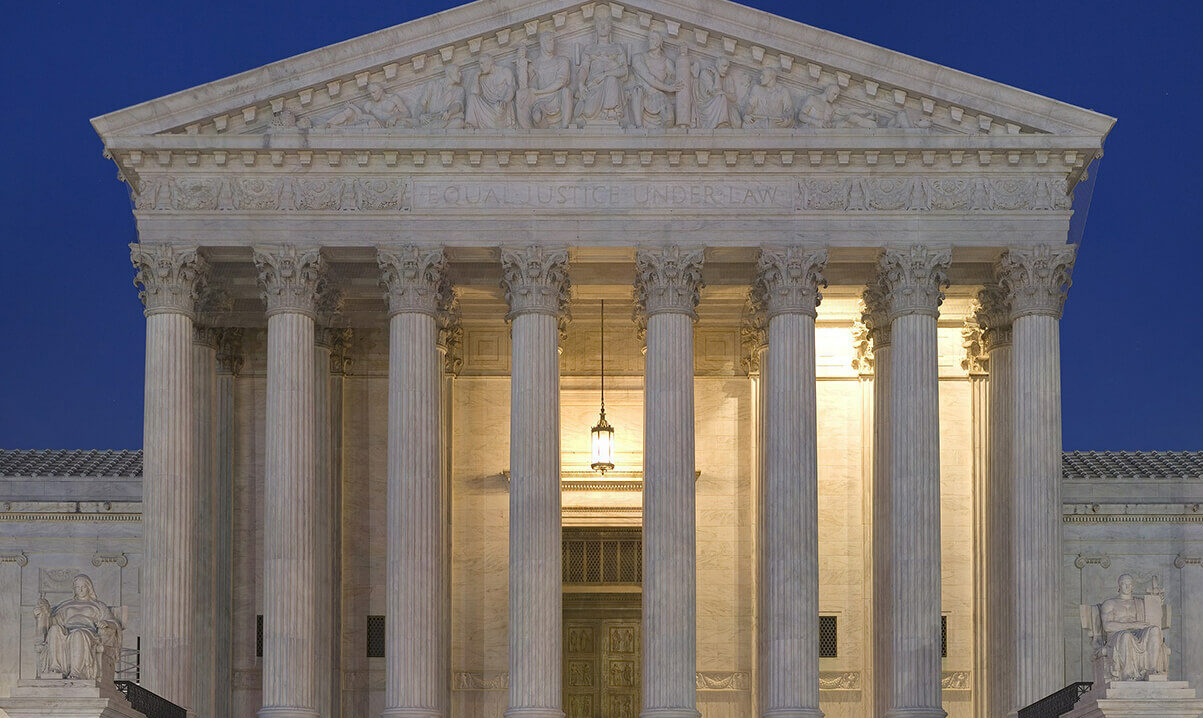
Although a unanimous decision for Girard’s executors, the Court, in its written opinion, agreed with all of Webster’s arguments concerning the breach of common law arising from flagrant attacks upon Christianity. Justice Joseph Story, author of the opinion, confirms Webster’s understanding of the law’s relationship to the Christian religion:
It is said, and truly, that the Christian religion is a part of the common law of Pennsylvania.20
We are compelled to admit that although Christianity be a part of the common law of the state, yet it is so in this qualified sense, that its divine origin and truth are admitted, and therefore it is not to be maliciously and openly reviled and blasphemed against, to the annoyance of believers or the injury of the public.21
Such a case is not to be presumed to exist in a Christian country. … There must be plain, positive, and express provisions, demonstrating not only that Christianity is not to be taught; but that it is to be impugned or repudiated.22
In the areas pertaining to Christianity and the common law Webster and the Court concurred. The difference did not come from a disagreement concerning the interpretation of the law, but rather the interpretation of the will. Webster held that where the letter of the will may not have openly assailed Christianity, the spirit of the will clearly did. The Court, however, rejected this interpretation, insisting instead that the exclusion of Christian pastors from the school on the grounds of sectarian conflict did not necessitate exclusion of Christian education in general. Story explains:
But the objection itself assumes the proposition that Christianity is not to be taught, because ecclesiastics are not to be instructors or officers. But this is by no means a necessary or legitimate inference from the premises. Why may not laymen instruct in the general principles of Christianity as well as ecclesiastics. There is no restriction as to the religious opinions of the instructors and officers. … Why may not the Bible, and especially the New Testament, without note or comment, be read and taught as a divine revelation in the college — its general precepts expounded, its evidences explained, and its glorious principles of morality inculcated? What is there to prevent a work, not sectarian, upon the general evidences of Christianity, from being read and taught in the college by lay-teachers? Certainly there is nothing in the will, that proscribes such studies.23
So the Court dismissed Webster’s argument that the will was hostile to Christianity, thus deciding the trust to be valid. Even though the Court differed from Webster’s reading of the will, this case provides an interesting view into the mindset of this early Supreme Court regarding the freedom of religion in American schools. Both Webster and Story advocated clearly for the important role of the Bible in education.
Endnotes
1 Daniel Webster, An Address Delivered before the New York Historical Society (New York: New York Historical Society, 1852), 47. 2 Fanny Lee Jones, “Walter Jones and His Times,” Records of the Columbia Historical Society Vol. V (Washington: Columbia Historical Society, 1902), 144. 3The Will of the late Stephan Girard (Philadelphia: Thomas Silver, 1848), 16. 4The Will (1848), 21. 5The Will (1848), et al. 6The Will (1848), 22. 7The Will (1848), 22-23. 8The Will (1848), 23. 9Vidal et al. v. Girard’s Executors, 43 US 127, 186 (1844). 10 Daniel Webster, In Defense of the Christian Ministry, and in Favor of the Religious Instruction of the Young (Washington: Gales and Seaton, 1844), 10. 11 Webster, In Defense of the Christian Ministry (1844), 10. 12 Webster, In Defense of the Christian Ministry (1844), 11. 13 Webster, In Defense of the Christian Ministry (1844), 13. 14 Webster, In Defense of the Christian Ministry (1844), 16. 15 Webster, In Defense of the Christian Ministry (1844), 21. 16 Webster, In Defense of the Christian Ministry (1844), 35. 17 Webster, In Defense of the Christian Ministry (1844), 36. 18 Webster, In Defense of the Christian Ministry (1844), 37. 19 Webster, In Defense of the Christian Ministry (1844), 37. 20Vidal et al. v. Girard’s Executors, 43 US 127, 198 (1844). 21Vidal et al. v. Girard’s Executors, 43 US 127, 198 (1844). 22Vidal et al. v. Girard’s Executors, 43 US 127, 198 (1844). 23Vidal et al. v. Girard’s Executors, 43 US 127, 200 (1844).
On January 19, 1966, Lyndon Baines Johnson (1908-1973), the 36th president of the United States, held a ceremony at the White House to declare that 1966 would be a “Year of the Bible.” On that occasion he remarked that, “No human accountant can calculate the immense good that your Society has done over the years.”1 Throughout his life, and especially while he was in office, Johnson repeatedly referred to the Bible in his conversations and speeches. Billy Graham, who was a personal friend to President Johnson, in an interview said of Johnson, “Well he had, as you know, an overwhelming personality. He always liked to have preachers around him.”2 Being one of those of those preachers, Graham had personal insight into Johnson’s faith and recalled:
He was very religious. … In fact, a number of times I had prayer with him in his bedroom at the White House, usually early in the morning. He would get out of bed and get on his knees, while I prayed. I never had very many people do that.3
Johnson’s did not, however, confine his faith to private displays alone. In his speeches for various occasions and audiences he quoted the Bible extensively. Here are but a few examples:
To President Zalman Shazar of Israel:
And you know that our Republic, like yours, was nurtured by the philosophy of the ancient Hebrew teachers who taught mankind the principles of morality, of social. justice, and of universal peace.
This is our heritage, and it is yours.
The message inscribed on the Liberty Bell in Philadelphia is the clarion call of Leviticus:
“Proclaim Liberty throughout all the land unto all the Inhabitants thereof.”
It is a message not only for America, or for Israel, but for the whole world.
We cannot proclaim tonight that all men have liberty, that all men are moral, that all men are just. We do not have universal peace.
But those of good will continue their work to liberate the human spirit from the degradation of poverty and pestilence, of hunger and oppression. As spiritual heirs of the Biblical tradition we recognize that no society anywhere can be more secure unless it is also just.4
On lighting the Christmas tree at the White:
For nearly 200 years of our existence as a nation, America has stood for peace in the world. At this Christmas season–when the world commemorates the birth of the Prince of Peace–I want all men, everywhere, to know that the people of this great Nation have but one hope, one ambition toward other peoples: that is to live at peace with them and for them to live at peace with one another.
Since the first Christmas, man has moved slowly but steadily forward toward realizing the promise of peace on earth among men of good will. That movement has been possible because there has been brought into the affairs of man a more generous spirit toward his fellow man.
Let us pray at this season that in all we do as individuals and as a nation, we may be motivated by that spirit of generosity and compassion which Christ taught us so long ago.5
On the death of the Archbishop of New York, Cardinal Spellman:
THE LORD has called home a man who served Him and all His children well.
Cardinal Spellman gave his life to God. For half a century, his faith and works were testament to God’s enduring and universal love of men.
The race of man mourns him now, for mankind was his ministry. The grace of his goodness touched all manner of men and nations. He brought to all who opened their hearts to his spirit the miracles on which men must build their earthly hopes–truth and charity, mercy and compassion, trust in God and in the destiny of God’s human family.6
At a fundraising dinner in Detroit:
So the ultimate test of our beloved America is the larger purpose to which we turn our prosperity.
We must first turn it toward relief of the oppressed, the underprivileged, and the helpless. We must, in the words of the Bible, “Learn to do well, seek judgment, relieve the oppressed, judge the fatherless, plead for the widow” (Isaiah 1:17).7
At the Annual Swedish Day Picnic in Minneapolis:
The Bible counsels us: “To everything there is a season, and a time to every purpose under the heaven . . . a time of war and a time of peace” (Ecclesiastes 3:1, 8).
So I come today to speak to you in the hope that, after decades of war and threats of war, we may be nearing a time of peace.8
At a breakfast meeting in Portland:
But it was not territory that made us great. It was men. Our West is not just a place. The West is an idea. The Bible says, “Speak to the earth and it shall teach thee” (Job 12:8). And here, in the West, we learned man’s possibilities were as spacious as the sky that covered him. We learned that free men could build a civilization as majestic as the mountains and the rivers that nourished him. We learned that with our hands we could create a life that was worthy of the land that was ours.
And that lesson has illuminated the life of all America–east, west, north, and south.9
To the crowd at Soldiers and Sailors Square in Indianapolis:
The Bible tells us “Every man’s work shall be made manifest” (1 Corinthians 3:13). This is true, too, of our Government.
Seldom has an administration’s work been made manifest more abundantly than this one. We promised 4 years ago, under the leadership of that beloved, great champion of this country, John Fitzgerald Kennedy, that we would get the country moving again. Well, it is moving.10
At the Fifth Regiment Armory in Baltimore:
Our adversaries are not weak. They are strong, but I can assure you faithfully tonight that America is stronger. And I
want to announce to them and I want to announce to you that they should have no doubts or illusions about America’s strength.
In the words of the Bible, “When the strong man armed keepeth his palace, his goods are in peace” (Luke 11:21).
We have strength in our country tonight, and you young men that must patrol our borders and wear those uniforms must maintain that strength.11
And at a rally in Chattanooga:
The Bible admonishes us to “run with patience the race that is set before us” (Hebrews 12:1).
Run with patience, and that is what I intend to do. We have grown strong in the last 4 years, and we must continue to increase that strength.12
As evident by this small sampling of his many appeals to the Bible, President Johnson clearly saw the need for Americans and America itself to be guided by the Scripture.
Endnotes
1 Lyndon B. Johnson, “Remarks at a Ceremony Marking 1966 as the “Year of the Bible.” The American Presidency Project. 2 Oral history transcript, Billy Graham, interview 1 (I), 10/12/1983, by Monroe Billington, Transcripts of Oral Histories Given to the Lyndon B. Johnson Library, LBJ Presidential Library, accessed December 18, 2023. 3 Billy Graham Oral History, LBJ Presidential Library, accessed December 18, 2023. 4 Lyndon B. Johnson, “Toasts of the President and President Zalman Shazar of Israel,” The American Presidency Project. 5 Lyndon B. Johnson, “Remarks at the Lighting of the Nation’s Christmas Tree: December 18, 1964,” The American Presidency Project. 6 Lyndon B. Johnson, “Statement by the President on the Death of Francis Cardinal Spellman, Archbishop of New York,” The American Presidency Project. 7 Lyndon B. Johnson, “Remarks at a Fundraising Dinner in Detroit: June 26, 1964,” The American Presidency Project. 8 Lyndon B. Johnson, “Remarks at the Annual Swedish Day Picnic, Minnehaha Park, Minneapolis: June 28, 1964,” The American Presidency Project. 9 Lyndon B. Johnson, “Remarks on Conservation at a Breakfast in Portland Saluting the Northwest-Southwest Power Transmission Intertie,” The American Presidency Project. 10 Lyndon B. Johnson, “Remarks in Indianapolis at Soldiers and Sailors Square,” The American Presidency Project. 11 Lyndon B. Johnson, “Remarks Before Two Groups at the Fifth Regiment Armory in Baltimore,” The American Presidency Project. 12 Lyndon B. Johnson, “Remarks at an Airport Rally in Chattanooga,” The American Presidency Project.
On May 24, 1844, a seismic breakthrough occurred: the first telegraphic message was transmitted between cities. People in two separate and distant geographic locations could instantly communicate with each other!
What was that first message? It was a Bible verse: Numbers 23:23 “What hath God wrought!” Such a message today likely would be met with much criticism, but for most of history–especially most of American history–religion was not seen as a hindrance to scientific thought but rather just the opposite.
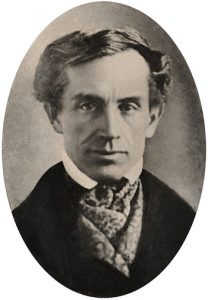
This particular scientific breakthrough came at the hands of dedicated Christian inventor Samuel F. B. Morse. Morse (developer of the famous Morse Code) was also a celebrated painter, and while painting a portrait in Washington, D.C. in 1825, he received word that his wife in New England was seriously ill. He quickly returned home but found his wife had not only died but had already been buried.
Frustrated at the length of time it had taken the message to reach him, he sought a better and faster method of long distance communication. Morse initially developed a single strand telegraph which could transmit messages only over a short distance. He continued to perfect his invention until finally developing a means of transmitting magnetic signals over long distances.
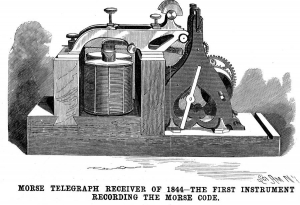
Morse demonstrated his invention at the U. S. Capitol, and in 1843 Congress appropriated money to construct a telegraph line between the Capitol and Baltimore. That first telegraphic message (pictured below) from Numbers 23 was sent from the basement of the U.S. Capitol the following year. (That message had been suggested by the daughter of a friend.)
Many years later, looking back over that invention, Morse reflected:
If not a sparrow falls to the ground without a definite purpose in the plans of infinite wisdom [Matthew 10:29], can the creation of the instrumentality so vitally affecting the interests of the whole human race have an origin less humble than the Father of every good and perfect gift [James 1:17]? . . . I use the words of inspiration [that is, the Bible] in ascribing honor and praise to Him to Whom first of all and most of all it is pre-eminently due. “Not unto us, not unto us, but to God be all the glory” [Psalm 115:1]. Not what hath man, but “What hath God wrought!” [Numbers 23:23]
(You can read more about Samuel F. B. Morse’s invention in the Numbers 23 article in The Founders Bible.)
Biblical faith permeated Morse’s life. For example, in an 1830 letter (from WallBuilders’ collection, a page of which is pictured on the right), Samuel included a religious poem he had written earlier in life:
Yield then thy pen to God to draw
On the next leaf His perfect law
So when thy book of life is done
Cleans’d by the blood of God’s own Son.
From sin’s dark blots and folly’s stain
A purer volume shall remain
And rest (to grace a splendid prize)
In Heaven’s alcoves in the skies.
The use of Morse’s telegraphic invention grew rapidly and expanded not only across America but also the globe. (See, for example, an 1858 sermon from WallBuilders’ library, The Atlantic Telegraph: As Illustrating the Providence and Benevolent Designs of God, was preached after the laying of a trans-Atlantic telegraph cable.) Today we enjoy the modern technological blessings that sprang from what Christian inventor Samuel F. B. Morse began on May 24, 1844.
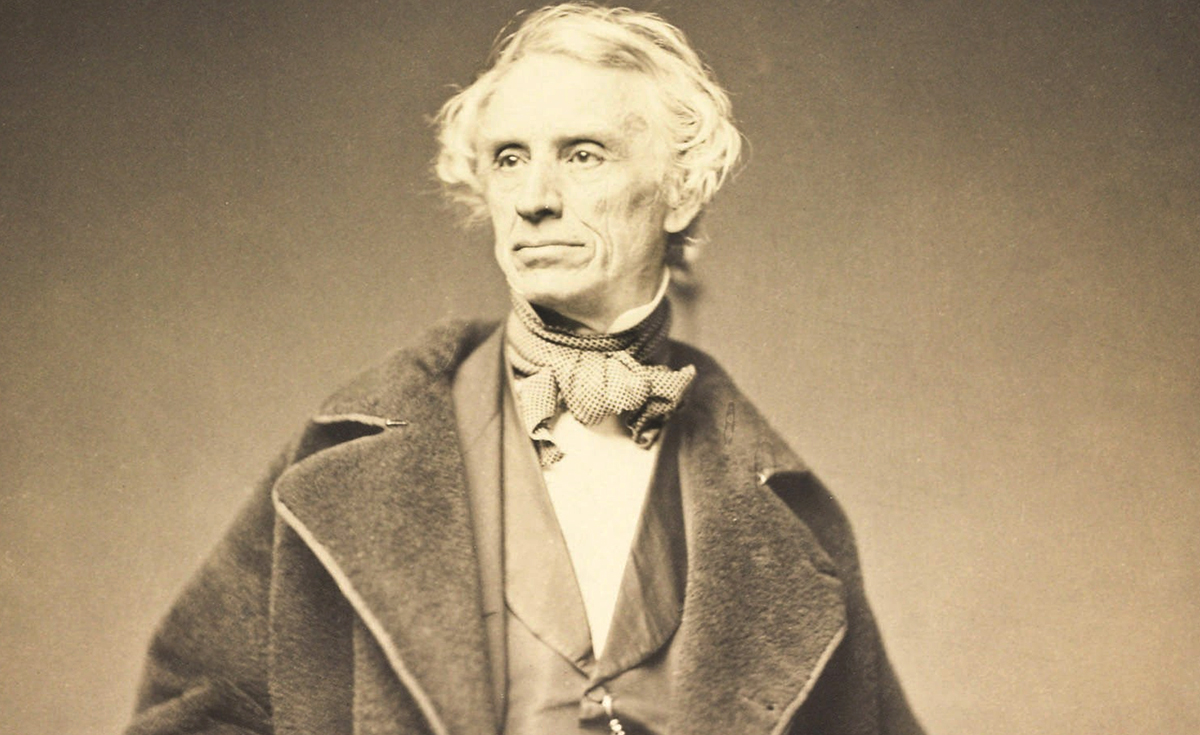
Samuel Finley Breese (F.B.) Morse (1791-1872) is best remembered for being the inventor of the American telegraph system and the Morse Code alphabet which is still widely used today. It was his development and perfection of an instantaneous method of electronic communication over long distances which contributed to the rapid expansion of the West during the late 1800’s and laid the groundwork for today’s 24/7 mass media culture.
Something which history widely forgets today about Morse’s great inventions, however, is the role God played throughout the process. Educated on religious matters from birth by his father, the notable Rev. Jedidiah Morse, Samuel developed a deep and sincere faith in God. In the two volume work, Samuel F.B. Morse: His Letters and Journals, his own son describes the inventor’s character:
The dominant note was an almost childlike religious faith; a triumphant trust in the goodness of God even when his hand was wielding the rod; a sincere belief in the literal truth of the Bible, which may seem strange to us of the twentieth century; a conviction that he was destined in some way to accomplish a great good for his fellow men.
Next to love of God came love of country. He was patriotic in the best sense of the word. While abroad he stoutly upheld the honor of his native land, and at home he threw himself with vigor into the political discussions of the day, fighting stoutly for what he considered the right….
A favorite Bible quotation of his was “Woe unto you when all men shall speak well of you.” He deeply deplored the necessity of making enemies, but he early in his career became convinced that no man could accomplish anything of value in this world without running counter either to the opinions of honest men, who were as sincere as he, or to the self-seeking of the dishonest and the unscrupulous.1
Morse’s pious character clearly exhibits itself in the historic message relayed during the public demonstration of the telegraph on May 24, 1844. Morse had promised Annie Ellsworth, the daughter of the Commissioner of Patents that she would get to decide what would be said. After talking with her mother, Annie decided to send a portion from Numbers 23:23: “What hath God wrought!”
Early that morning, Morse and his guests gathered in the chamber of the Supreme Court while his assistant prepared to receive the fateful transmission in Baltimore. Then, at 8:45 a.m. on May 24, 1844, the electricity flowed through the line:
| . – – | . . . . | . – | – |
| W H A T |
| . . . . | . – | – | . . . . |
| H A T H |
| – – . | . . | – . . |
| G O D |
| . – – | . . . | . . | . . – | – – . | . . . . | – |
| W R O U G H T |
That message inaugurated the beginning of electronic media in America, setting off a chain of technological advancements which continues to this day nearly two-hundred years later. From the telegraph to the telephone to the internet, we all have good reason to declare, “What hath God wrought!”
Samuel Morse never forgot the role that God had in the development and success of the telegraph, always bearing in mind the powerful phrase selected by Annie Ellsworth. Later in life Morse explained that the telegraph was not merely an example of American ingenuity, but rather an example of God’s gracious providence:
Yet in tracing the birth and pedigree of the modern Telegraph, ‘American’ is not the highest term of the series that connects the past with the present; there is at least one higher term, the highest of all, which cannot and must not be ignored. If not a sparrow falls to the ground without a definite purpose in the plans of infinite wisdom, can the creation of an instrumentality so vitally affecting the interests of the whole human race have an origin less humble than the Father of every good and perfect gift?
I am sure I have the sympathy of such an assembly as is here gathered if, in all humility and in the sincerity of a grateful heart, I use the words of inspiration in ascribing honor and praise to Him whom first of all and most of all it is preeminently due. ‘Not unto us, not unto us, but to God be all the glory.’ Not what hath man, but ‘What hath God wrought?’2
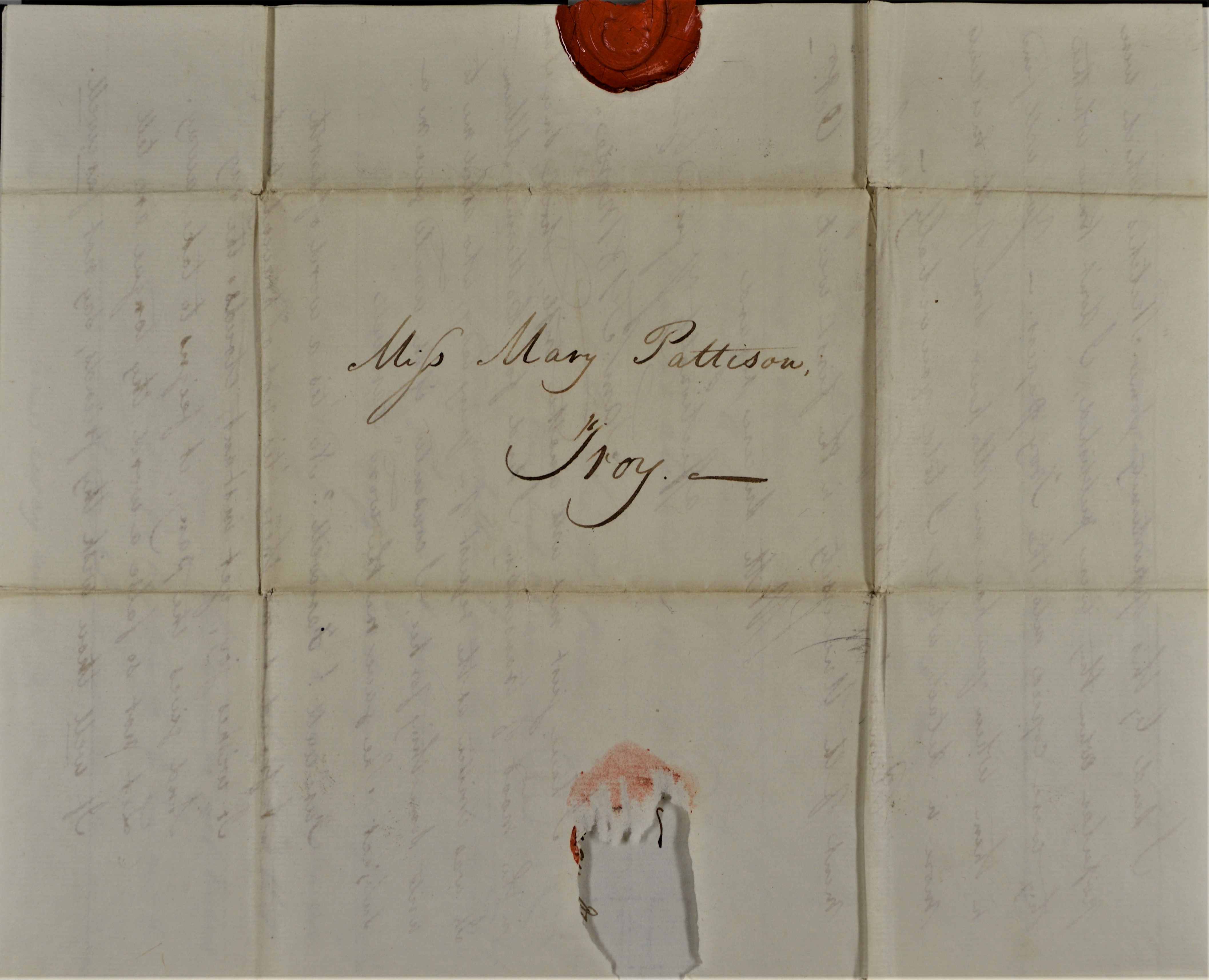
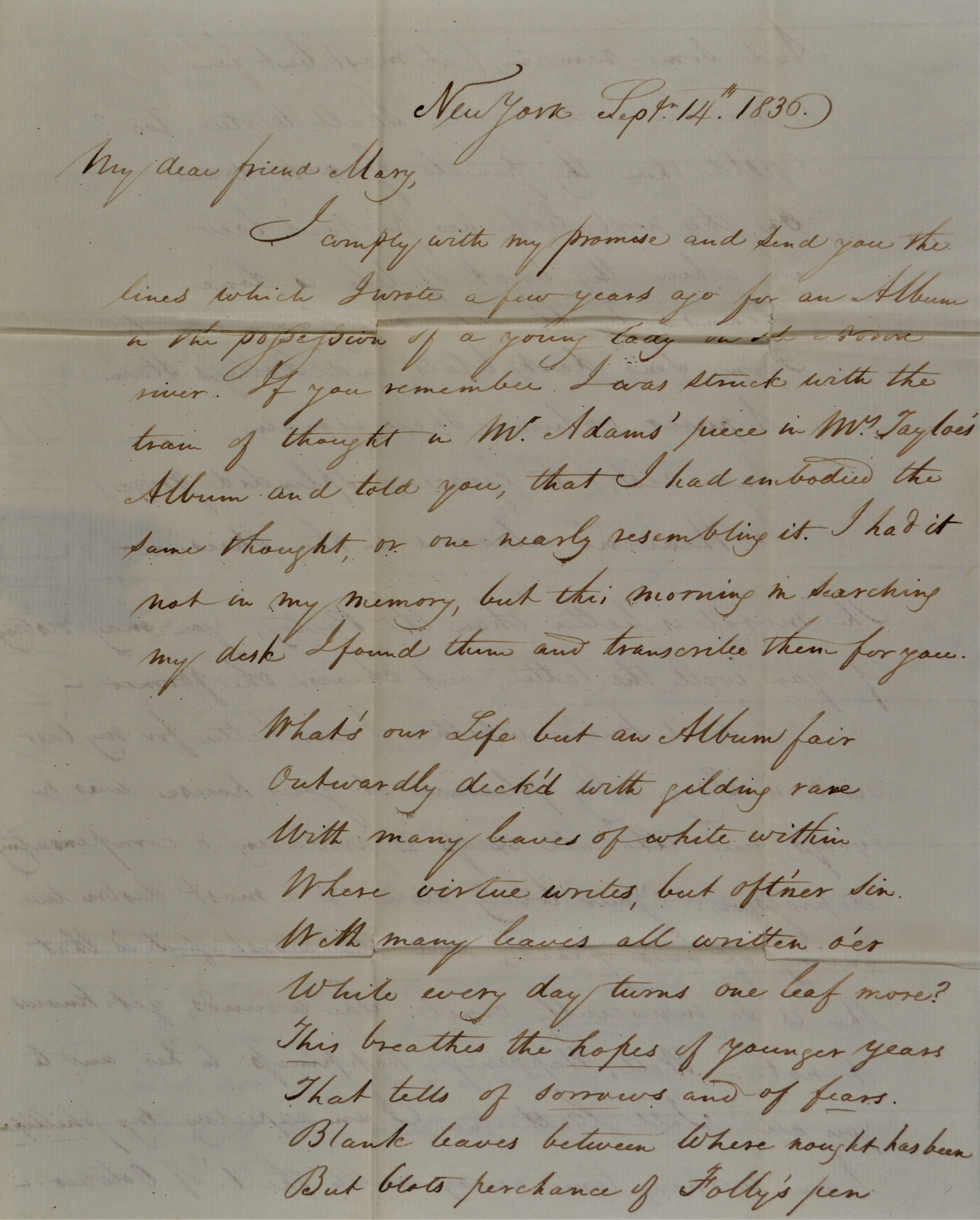
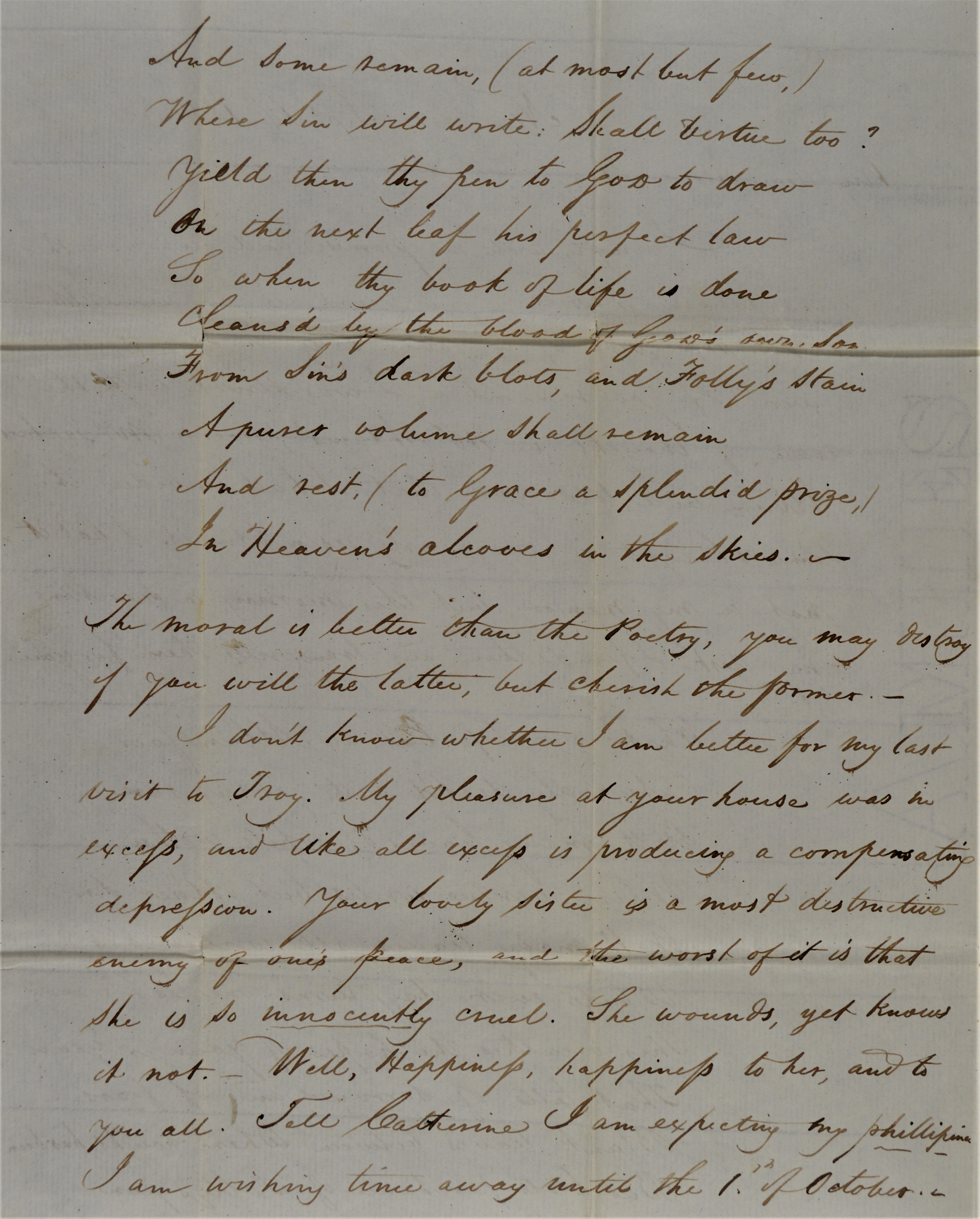
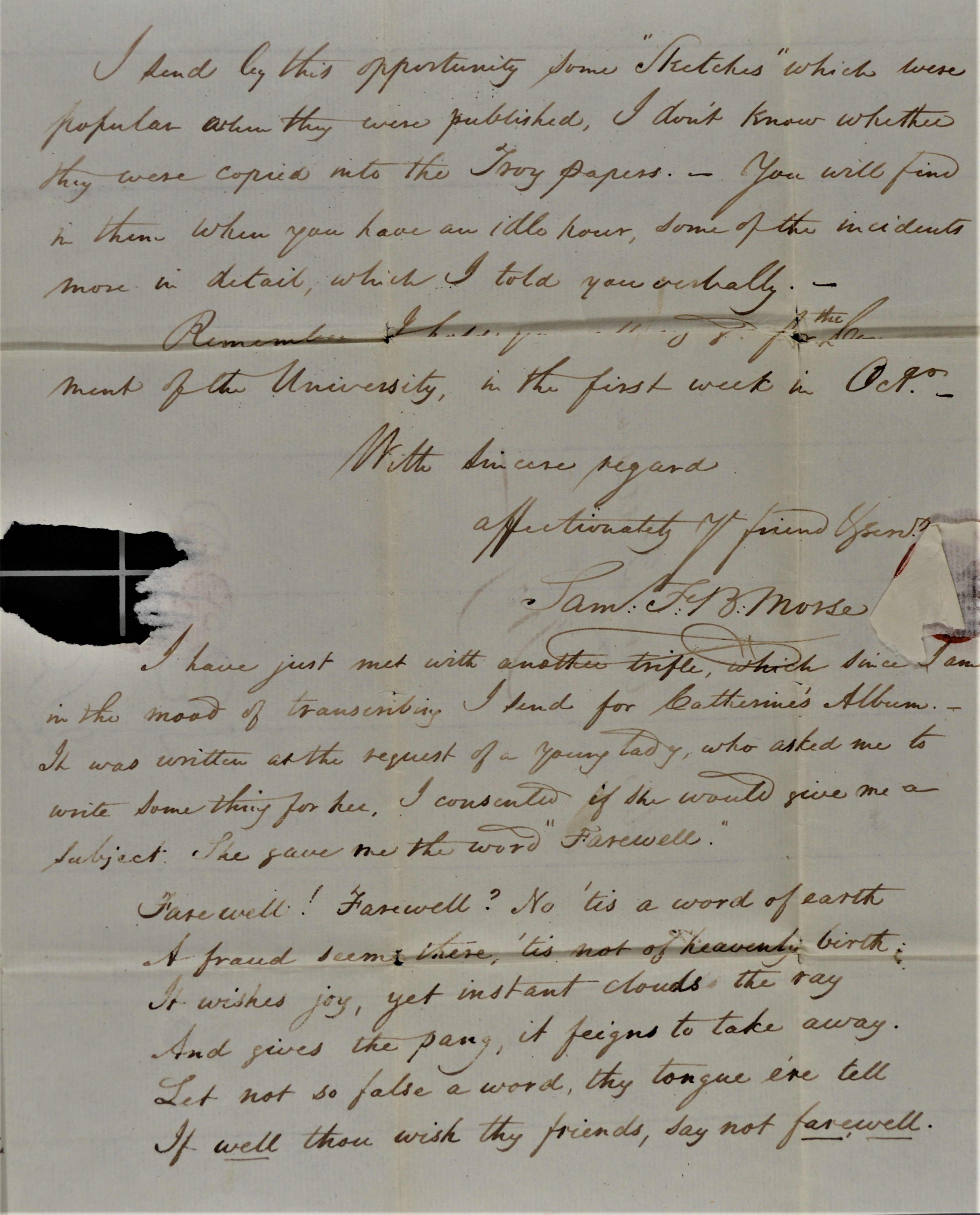
The WallBuilders’ Library is home to a handwritten letter from Samuel Morse composed in 1836, a full eight years before the triumph of the telegraph. In this personal letter to Miss Mary Pattison we get a glimpse into artistic side Morse’s mind through the portions of poetry he records, which also exhibit his deep devotion to God. Below is the transcript of the WallBuilders’ letter followed by pictures of the document itself.
Miss Mary Pattison, Troy
New York, Sept. 14th, 1836
My dear friend Mary,
I comply with my promise and send you the lines which I wrote a few years ago for an Album in the possession of a young lady on the North river. If you remember I was struck with the train of thought a Mr. Adams’ piece in Mr. Taylor’s Album, and told you, that I had embodied the same thought, or nearly resembling it. I had it not in my memory, but this morning in searching my desk I found them and transcribe them for you.
What’s our Life but an Album fair
Outwardly deck’d with gilding name
With many leaves of white within
Where virtue writes, but oft’mes sin
With many leaves all written o’er
While every day turns one leaf more?
This breathes the hopes of younger years
That tells of sorrows and of fears.
Black eaves between Where naught has been
But blots perchance of Folly’s pen
And some remain, (at most but few,)
Where Sin will write: Shall Virtue too?
Yield then thy pen to God to draw
On the next leaf his perfect law
To when thy book of life is done
Cleans’d by the blood of God’s own son
From Sin’s dark blots, and Folly’s stain
A purer volume shall remain
And rest, (to Grace a splendid prize,)
In Heaven’s alcoves in the skies.
The moral is better than the poetry, you may destroy if you will the latter, but cherish the former.
I don’t know whether I am better for my last visit to Troy. My pleasure of your house was in excess, and like all excess is producing a corresponding depression. Your lovely sister is a most destructive enemy of one’s peace, and the worst of it is that she is innocently cruel. She wounds, yet knows it not. Well, Happiness, happiness to her, and to you all. Tell Catharine I am expecting my Philippina. I am wishing time away until the 1st of October.
I send by this opportunity some “Sketches” which were popular when they were published, I don’t know whether they were copied into the Troy papers. You will find in them where you have an idle hour, some of the incidents more in detail, which I told you verbally.
Remember I hold you all engaged for the Commencement of the University, in the first week of October.
With sincere regard,
Affectionately your friend & servant
Sam. F.B. Morse
I have just met with another trifle, which since I am in the mood of transcribing I send for Catherine’s album. It was written at the request of a young lady, who asked me to write something for her. I consented if she would give me a subject. She gave me the word “Farewell.”
Farewell! Farewell? No ‘tis a word of earth
A fraud seen there, ‘tis not of heavenly birth.
It wishes joy, yet instant clouds the ray
And give the pang, it feigns to take away.
Let not so false a word, thy tongue ‘ere tell
If well then wish thy friends, say not farewell.
American liberty is being eroded, and our Biblical foundation is under constant attack. Here at WallBuilders, we provide education, training, and resources to equip people to know and defend the truth to protect our freedom.

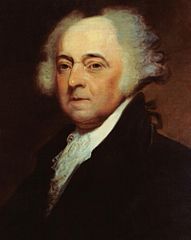 When writing to Thomas Jefferson on June 28, 1813, John Adams discusses the fact that America achieved independence through the general principles of Christianity. The letter itself, however, was the culmination of events which began nearly fifteen years earlier.
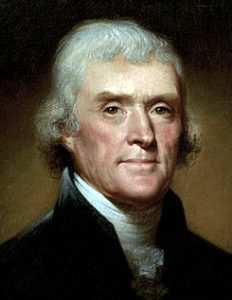 After waiting for twelve days without a response, Adams again took up his pen on June 10, 1813, and went through the 1801 Jefferson letter responding to the various claims made against him. Adams focused on the part where Jefferson had quoted him, writing: “The President himself declaring that we were never to expect to go beyond them in real science.”
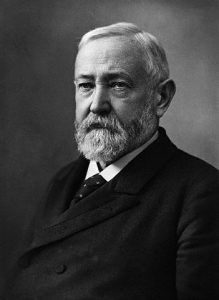 Benjamin Harrison (1833-1901) was a lawyer, a Civil War brigadier general, and eventually the twenty-third president of the United States from 1889-1893. In this letter to his son, Russell Benjamin Harrison, on July 12, 1894, he admonishes the younger Harrison to remain steadfast in the faith. The former president explains to his son, “It’s well to be diligent in your business, and you know how anxious I am that you should succeed – but my dear boy there are things of vastly greater importance. You ought to give more thought to your religious life and duties.” Such a candid and clear call to a higher life came due to a recent incident in which Russell Harrison had cursed in front of his father. President Harrison continues, writing, “Young men are so prone to think there is no danger and to forsake the only safety – God’s grace and help.”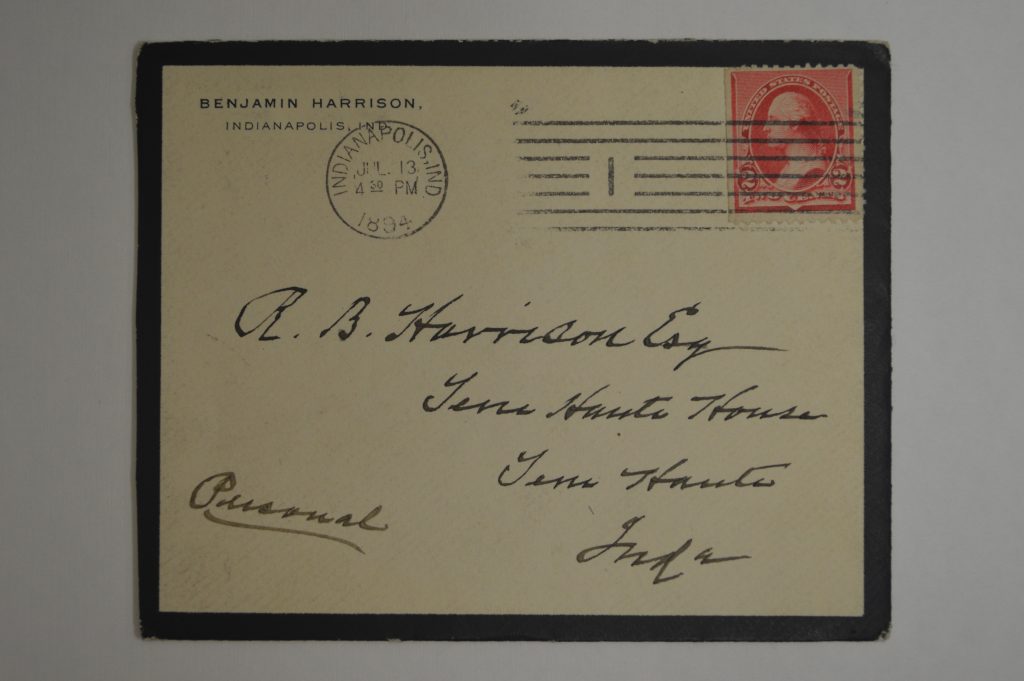


 On
On 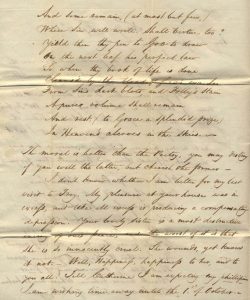 Biblical faith permeated Morse’s life. For example, in an
  Morse’s pious character clearly exhibits itself in the historic message relayed during the public demonstration of the telegraph on May 24, 1844. Morse had promised Annie Ellsworth, the daughter of the Commissioner of Patents that she would get to decide what would be said. After talking with her mother, Annie decided to send a portion from Numbers 23:23: “What hath God wrought!”